

Essentials of geology a comprehensive manual with 1300+ MCQs, answers, feedbacks, and illustrative figures by Ali Kareem Neamah - HTML preview
Download the book in PDF, ePub, Kindle for a complete version.
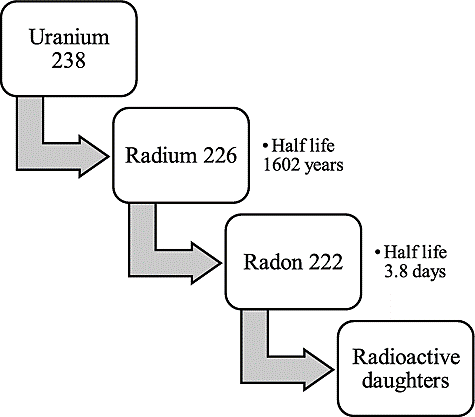
--------------------------------------------------------------
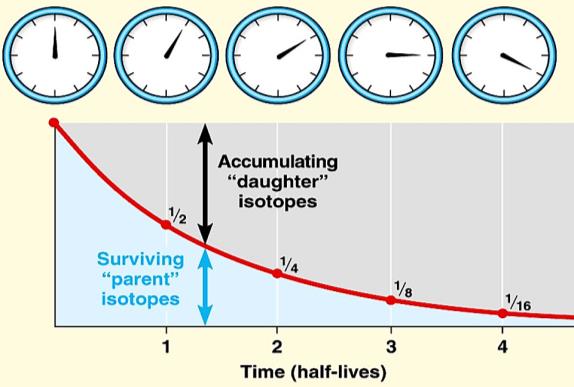
1031. If a radioactive element has a half-life
of 16 million years, what fraction of the
b) 1/16. their position in the geologic record is: c) 1/32. a) Absolute dating. d) 1/4. b) Correlation. e) 1/64. c) Historical dating. d) a) 1033. Placing geologic events in sequential 1/2. or chronological order as determined by remain after 96 million years? original amount of parent material will --------------------------------------------------------------
Feedback: Relative dating. The half-life of a radioactive e) Uniformitarianism. element is the time it takes for half of the atoms of the parent material to decay into the daughter Feedback : Relative dating involves material. Therefore, after one half-life, there will establishing the order of past events without be 1/2 of the original amount of parent material necessarily determining their specific numerical left. After two half-lives, there will be 1/4 of the ages. It relies on principles such as
210
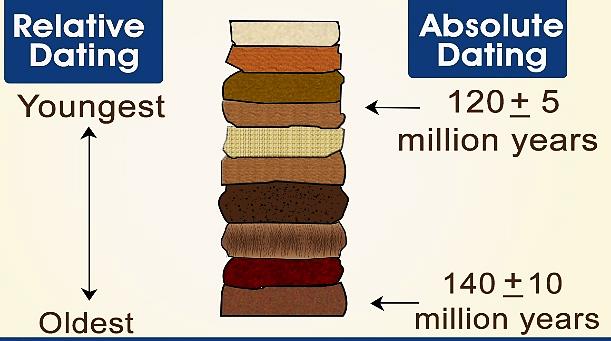
superposition, original horizontality, cross- a) Alpha decay. cutting relationships, and fossil succession to b) Beta decay. determine the relative order of geological c) Electron capture. events. d) Fission track.
e) None of these.
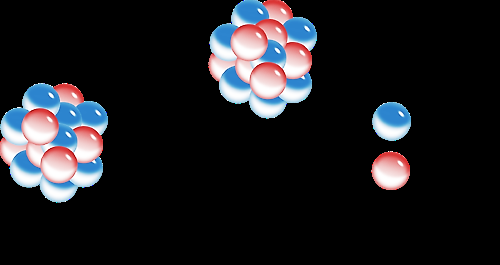
Feedback: Beta decay is a type of radioactive decay in which an atomic nucleus emits a beta
particle, which is a fast moving electron or

positron, transforming into an isobar of that
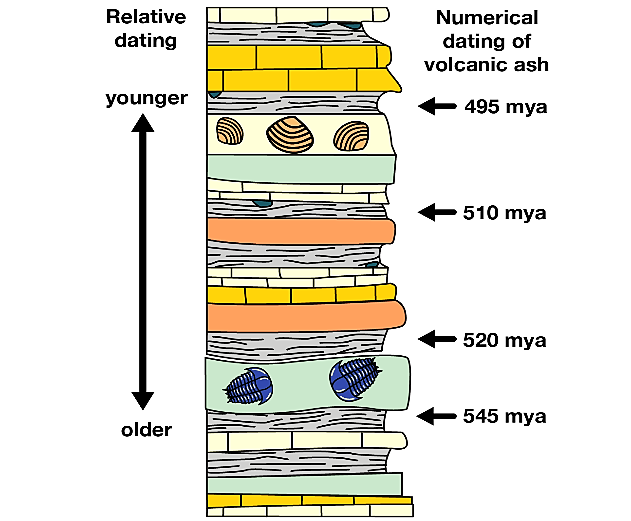
nuclide. Beta decay involves the transformation
of a neutron in the nucleus to a proton and an
electron. The electron is then ejected from the
nucleus with high kinetic energy.
--------------------------------------------------------------
1034. If a flake of biotite within a sedimentary
rock (such as a sandstone) is radiometrically
dated, the date obtained indicates when:
b) -------------------------------------------------------------- a) The biotite crystal formed.
c) 1037. What is being measured in radiometric The sedimentary rock formed.
d) dating is: The parent radioactive isotope formed.
e) a) The time when a radioactive isotope formed. The daughter radioactive isotope(s) formed.
None of these.
Feedback containing an isotope. : Radiometric dating measures the The amount of the parent isotope only. b) The time of crystallization of a mineral age of the minerals within a rock. In this case, c)
biotite crystal within the sedimentary rock sedimentary rock. When the stable daughter isotope was the date obtained would indicate when the d) When the dated mineral became part of a
formed. It does not provide the age of the e) sedimentary rock itself, the parent radioactive formed.
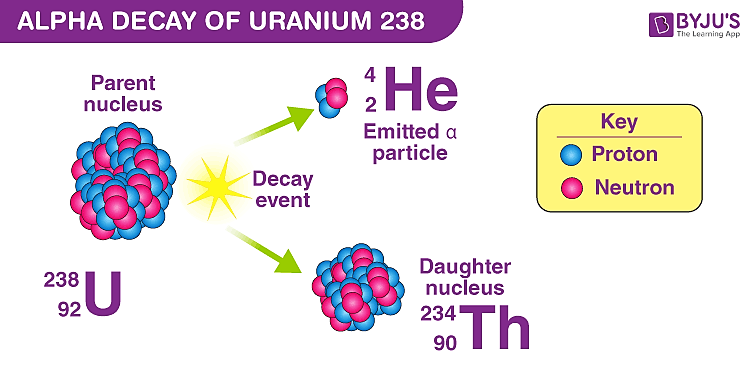
a) information about the time when the mineral Alpha decay. crystallized or formed. The age is calculated b) Beta decay. based on the radioactive decay of the parent c) Electron capture. isotopes into daughter isotopes over time. d) Fission track. -------------------------------------------------------------- e) None of these. 1038. How many half-lives are required to yield a mineral with 625,000,000 atoms of Feedback : Alpha decay involves the emission thorium 232 and 19,375,000,000 atoms of of an alpha particle, which consists of two lead 235? protons and two neutrons. This emission 1035. measure the age of a mineral by determining In which type of radioactive decay are the ratio of parent isotopes to daughter isotopes two protons and two neutrons emitted from within the mineral. This ratio provides the nucleus? -------------------------------------------------------------- Feedback: Radiometric dating techniques isotope, or the daughter radioactive isotope(s).
reduces the atomic number of the nucleus by 2 a) 1 and the mass number by 4. b) 2
c) 3 d) 4 e) 5
Feedback: To determine the number of half-lives required to reach a certain ratio of parent
and daughter isotopes, you can use the
following formula:
-------------------------------------------------------------- N = N n 0 x ( ) Where: 1036. In which type of radioactive decay is a N is the final number of parent isotopes (in this fast moving electron emitted from a neutron case 625,000,000 atoms of thorium-232. in the nucleus?
211
N0 is the initial number of parent isotopes determine what fraction of the original uranium-
(19,375,000,000 atoms of lead-235). 235 (U-235) will remain after 2,816,000,000
n is the number of half-lives. years, you can use the formula for radioactive
We want to find out how many half-lives (n) are N = N 0 x ()t/T required to reach the given ratio, so we can decay:
Where:
rearrange the formula as follows: N is the final amount of the substance (in this n ( ) = ۼ ( ) case, the remaining U-235). Now, plug in the values: N ۼ
( t is the elapsed time. n ) = ǡǡ 0 is the initial amount of the substance. ૢǡૠǡǡ T is the half-life of the substance.

Next, take the natural logarithm (ln) of both
sides to solve for n: In this case, the half-life (T) of U-235 is 704
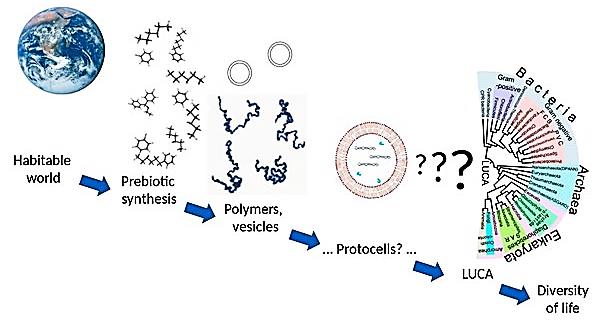
So, approximately 10 half-lives are required to n = ܔܖሺ ǡǡ million years, and the elapsed time (t) is ሻ ૢǡૠǡǡ 2,816,000,000 years. ܔܖሺ ሻ N = N 0 x 2,816,000,000/704,000,000 ( ) n ≈ 10 Simplify the exponent: 4 N = N 0 yield the given ratio of parent and daughter x ( ) isotopes. Therefore, the answer is e) 5 because Now, calculate the fraction: 10 half-lives represent 5 complete cycles of N = N 0 x ( ) decay (each cycle consists of a half-life). So, after 2,816,000,000 years, 1/16 of the -------------------------------------------------------------- original uranium-235 will remain. 1039. As carbon 14 decays back to nitrogen -------------------------------------------------------------- in radiocarbon dating, what isotopic ratio decreases? 1041. The idea that life arose from nonliving matter is called: a) Nitrogen 14 to carbon 12. a) Polymerization. b) Carbon 14 to carbon 12. b) Abiogenesis. c) Carbon 13 to carbon 12. c) Accretion. d) Nitrogen 14 to carbon 14. d) Endosymbiosis. e) Nitrogen 14 to carbon 13. e) Outgassing.
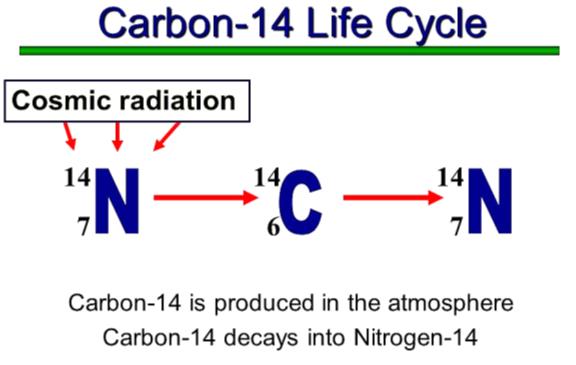
Feedback: Carbon-14 undergoes radioactive decay, transforming into nitrogen-14 over time. Feedback: Abiogenesis, also known as This results in a reduction in the concentration spontaneous generation, is the concept that life
of C-14 relative to C-12 in the sample being can originate from inanimate substances or
dated, which is the basis for radiocarbon dating. non-living matter through natural processes. It
is the opposite of biogenesis, which posits that
living organisms can only arise from other living
organisms.
--------------------------------------------------------------
1040. Considering that the half-life of uranium
235 is 704 million years, what fraction of the
original uranium 235 will remain after
2,816,000,000 years? --------------------------------------------------------------
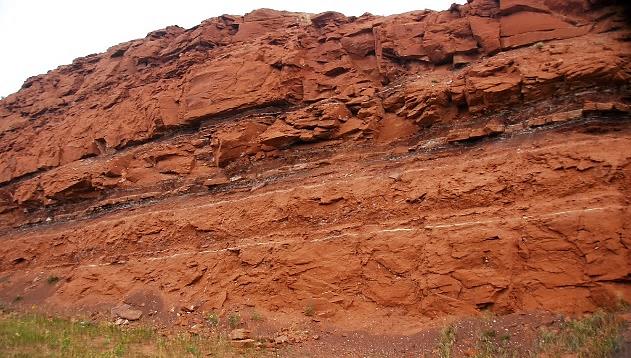
a) 1/2. 1042. One indication that the Proterozoic b) 1/4. atmosphere contained some free oxygen is
c) 1/8. the presence of: d) 1/16. a) Ultramafic lava flows. e) 1/32. b) The Midcontinent rift.
c) Continental red beds.
Feedback: A radioactive half-life refers to the d) Autotrophic prokaryotes. amount of time it takes for half of the original e) The Wilson cycle. isotope to decay. For example, if the half-life of
a 50.0 gram sample is 3 years, then in 3 years Feedback: Continental red beds are only 25 grams would remain. During the next 3 sedimentary rocks that have a reddish color
years, 12.5 grams would remain and so on. To due to the presence of iron oxides, such as
212
hematite. Iron oxides form when iron is exposed d) The origin of banded iron formations. to oxygen and water, which indicates that the e) The evolution of eukaryotic cells from Proterozoic atmosphere contained some free prokaryotic cells. oxygen.
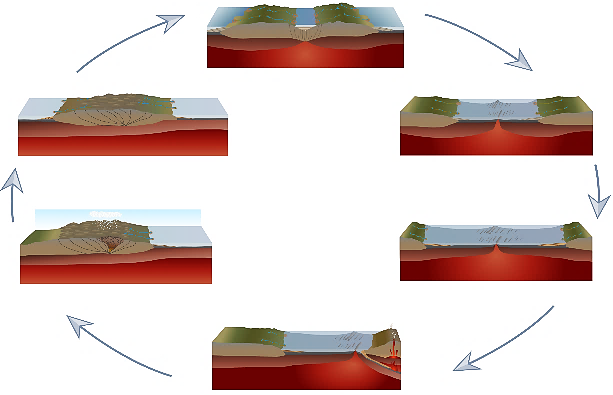
Feedback: The Wilson cycle is a geological concept that describes the cyclical process of
ocean basin formation, evolution, and closure
due to the movement of tectonic plates. It
includes the opening and closing of ocean

basins through processes like seafloor
spreading, subduction, and continental
collision.
--------------------------------------------------------------
1043. A lithostratigraphic unit made up of two
or more formations is a:
a) Group.
b) Facies.
c) Range zone.
d) Member.
e) Disconformity.
Feedback: A group is a higher-level lithostratigraphic unit that can consist of --------------------------------------------------------------
multiple formations, which are themselves 1046. The most widespread Archean-age composed of rock layers with similar lithological rocks are those found in: characteristics. a) Ultramafic plutons. -------------------------------------------------------------- b) Granite–gneiss complexes. 1044. c) Meteorite impact successions. The largest exposed area of the North
America craton is the: d) Passive continental margin associations.
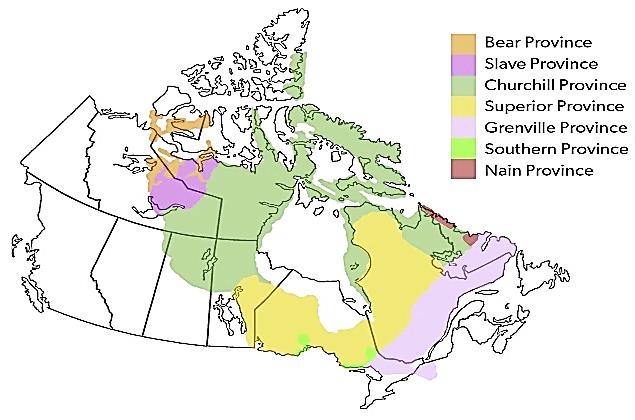
a) e) Red beds in intracontinental rifts. Minnesota lowlands.
b) American platform.
c) Feedback: Archean-age rocks, which are Grand Canyon.
d) some of the oldest on Earth, often occur as Wyoming fold belt.
e) granite-gneiss complexes. These complexes Canadian shield.
contain a mixture of granitic igneous rocks and
Feedback: metamorphic gneiss rocks and are The Canadian Shield, also known
as the Precambrian Shield or the Laurentian characteristic of the Archean Eon. They
Shield, is a vast geological region that covers a represent some of the foundational geological
significant portion of northeastern North formations on Earth and are widespread in
America, including parts of Canada and the various parts of the world, particularly in
northern United States. It is one of the most continental shield areas like the Canadian
ancient and stable geological features on the Shield and the Baltic Shield. continent and represents the exposed portion of
the North American craton.
--------------------------------------------------------------
1047. The lowermost unit in a greenstone belt
is composed mostly of:
-------------------------------------------------------------- a) Sandstone. 1045. A complete Wilson cycle involves: b) Red beds. a) Opening and then closing of an ocean basin. c) Stromatolites. b) Uplift of mountains and their deep erosion. d) Volcanic rocks. c) Deposition of sandstone, shale, and e) Anaerobic bacteria.
limestone in the continental interior.
213
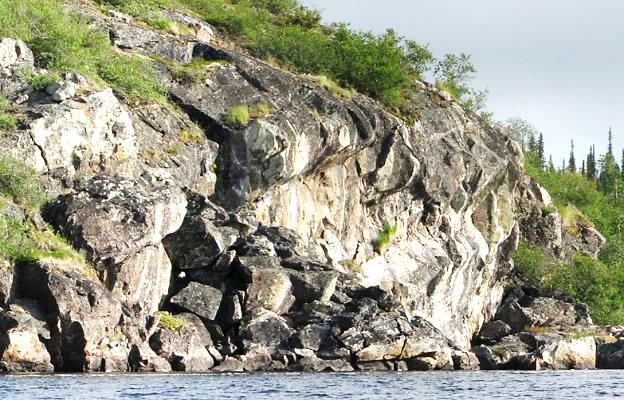
Feedback: Greenstone belts are geological c) Laurentia. formations that consist primarily of volcanic and d) Sedonia. sedimentary rocks. The lowermost unit typically e) Newfoundland. comprises volcanic rocks, including basaltic
and andesitic lavas, as well as associated Feedback: Laurentia was a major landmass volcaniclastic sediments. These volcanic rocks during the Proterozoic Eon, and it played a
often host valuable mineral deposits and are significant role in the formation of North
characteristic of greenstone belts. America as we know it today. --------------------------------------------------------------

1048. Many scientists think that the first self-
replicating system might have been a/an:
a) ATP cell.
b) Proteinoid.
c) RNA molecule.
d) Bacterium.
e) Stromatolite.
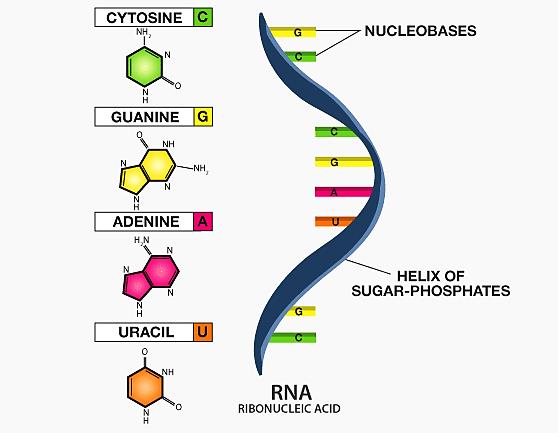
Feedback: RNA (ribonucleic acid) is considered a prime candidate for the first self-
replicating molecule because it can store
genetic information and catalyze chemical
reactions, similar to DNA and proteins. The
"RNA world hypothesis" suggests that early life
forms on Earth may have been based on self-
replicating RNA molecules, which eventually
led to the evolution of more complex life forms. --------------------------------------------------------------
1051. Columnar masses of rock produced by
the activities of cyanobacteria (blue-green
algae) are:
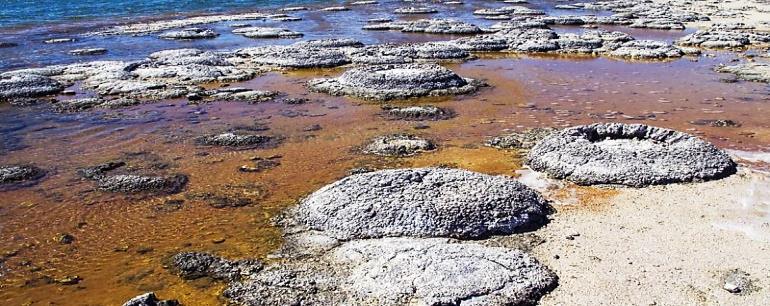
a) Orogens. b) Stromatolites. c) Heterotrophs. d) Rodinians. e) Polymers.
Feedback: Stromatolites are layered structures formed by the trapping and cementation of
sediment by microbial communities, primarily
-------------------------------------------------------------- cyanobacteria. These structures are some of
1049. the earliest evidence of life on Earth and have The most significant biologic event to been preserved in the fossil record for billions
a) take place during the Proterozoic was the of years. appearance of:
Pannotian organisms.
b) Autotrophic prokaryotes.
c) Trilobites and brachiopods.
d) Anaerobic proteinoids.
e) Eukaryotic cells.
Feedback: The emergence of eukaryotic cells during the Proterozoic Eon was a major
milestone in the evolution of life on Earth.
Eukaryotic cells are more complex than --------------------------------------------------------------
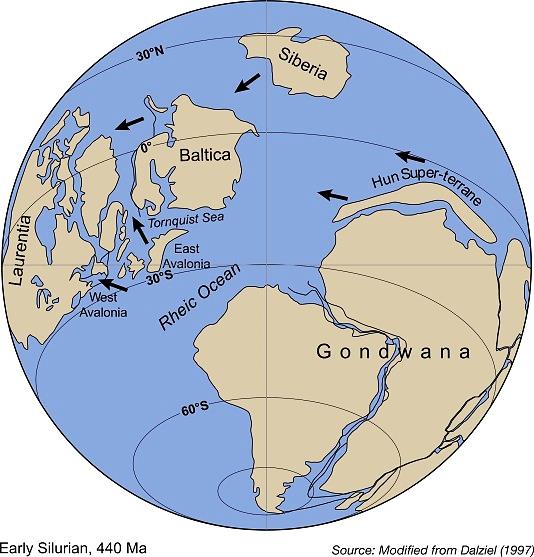
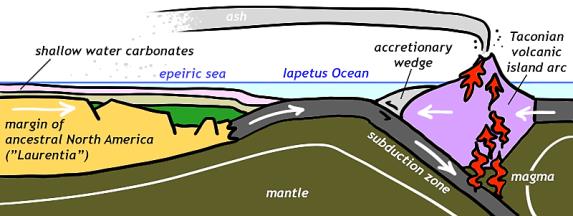
prokaryotic cells and gave rise to multicellular 1052. What type of plate interaction produced life forms, leading to the diversification of the Taconic orogeny? organisms and the eventual development of a) Oceanic–oceanic convergent. complex life as we know it. b) Oceanic–continental convergent. -------------------------------------------------------------- c) Continental–continental convergent. 1050. ____ was a Proterozoic supercontinent d) Divergent.
made up mostly of Greenland and North e) Transform. America.
a) Pangaea. Feedback: The Taconic orogeny, a significant b) Grenville. mountain-building event in the late Ordovician
214
period, was produced by oceanic–continental Pennsylvanian Period. The Absaroka convergent plate interaction. In this type of Sequence is the name given to the Paleozoic
interaction, an oceanic plate subducts, or dives cratonic sequence that spans from the Late
under, a continental plate due to the oceanic Mississippian to the Early Permian. plate's higher density. This process can lead to --------------------------------------------------------------
the formation of mountain ranges and is 1055. The European Old Red Sandstone is associated with significant seismic and volcanic the equivalent of the North American: activity. a) Queenston Delta clastic wedge.
b) Capitan Limestone. c) Caledonian Delta clastic wedge. d) Oriskany Sandstone. e) Catskill Delta clastic wedge.

Feedback: The Catskill Delta clastic wedge in North America and the European Old Red
-------------------------------------------------------------- Sandstone share similarities as sedimentary
1053. Which mobile belt is located along the rock sequences deposited during the same
eastern side of North America? geological period. These formations are often
a) Franklin. considered equivalents and provide important
b) Cordilleran. insights into the geological history of their
c) Ouachita. respective regions. d) Appalachian. --------------------------------------------------------------
e) Hercynian. 1056. Which mobile belt is located along the
Western side of North America?
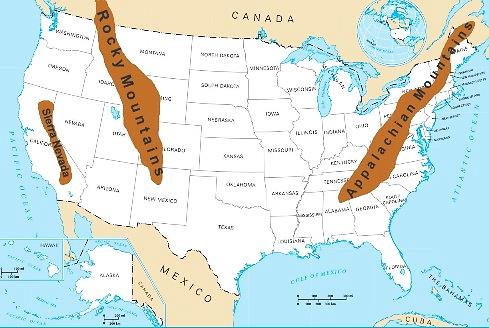
Feedback: The Appalachian Mountains, also a) Franklin known as the Appalachians, are a major b) Cordilleran. mountain range extending from eastern c) Ouachita Canada through the United States to northern d) Appalachian. Alabama. They represent a significant mobile
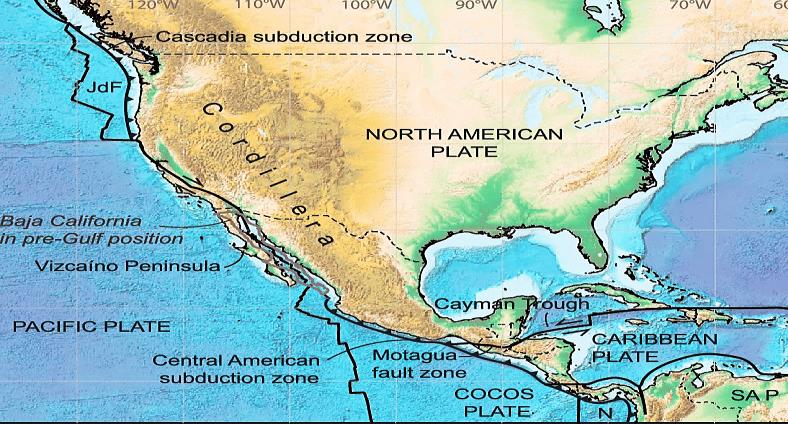
belt in eastern North America, formed by the Feedback: The Cordillera, or Cordilleran collision and convergence of tectonic plates region, is a major mountain system and mobile
during various geological events. belt that runs along the western side of North
America. It includes the Rocky Mountains, the
Sierra Nevada, and other mountain ranges in
western Canada and the western United
States. The Cordilleran region is associated
with tectonic plate interactions and mountain-
building processes.
--------------------------------------------------------------
1054. During which Paleozoic cratonic
sequence were cyclothems common?
a) Sauk.
b) Absaroka.
c) Kaskaskia.
d) Zuni.
e) Tippecanoe.
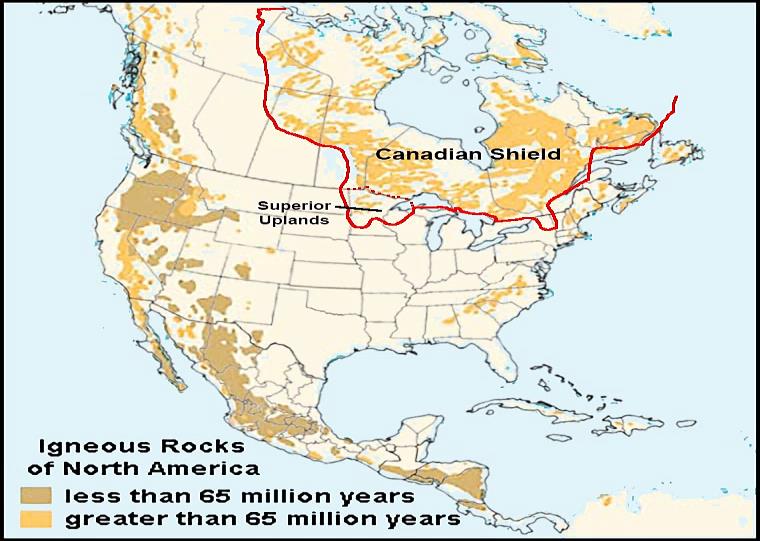
Feedback: -------------------------------------------------------------- Cyclothems are cyclic stratigraphic 1057. During deposition of the Sauk sequences that are unique to the Sequence, the only area above sea level Pennsylvanian and earliest Permian periods besides the Transcontinental Arch was the: within the US Midcontinent, that formed as a a) Cratonic margin. result of marine transgressions and regressions b) Canadian shield. (rise and fall of sea level) related to the waning c) Queenston Delta. and waxing of ice sheets at the South Pole. d) Appalachian mobile belt. Transgressions and regressions, probably e) Taconic Highlands. caused by advancing and retreating Gondwanan ice sheets, over the low-lying Feedback: The Canadian Shield, also known North American craton, resulted in cyclothems as the Precambrian Shield or Laurentian and the formation of coals during the
215
Shield, represents one of the oldest and most Feedback: The Ancestral Rockies resulted stable geological regions on Earth. During the from intracratonic deformation, which is the
deposition of the Sauk Sequence and other deformation of the stable interior of a continent.
early Paleozoic sedimentary sequences, the Intracratonic deformation is caused by the
Canadian Shield was one of the few areas concentration of strain into regions of
above sea level, while the Transcontinental decreased lithospheric strength, often along
Arch was another significant landmass. pre-existing faults or at the boundaries of
different cratonic blocks. The Ancestral Rockies
formed during the late Paleozoic, when

compressional stress from the collision of
Gondwana and Laurussia was transmitted into
the North American craton. This stress
reactivated Proterozoic extensional faults and
generated flat-topped uplifts bordered by
outward-verging, monoclinal forced folds. The
Ancestral Rockies were eroded by the end of
the Permian and their remnants are preserved
as clastic wedges in the western interior basins.
--------------------------------------------------------------
1058. Weathering of which highlands
produced the Queenston Delta clastic
wedge?
a) Transcontinental Arch.
b) Acadian. --------------------------------------------------------------
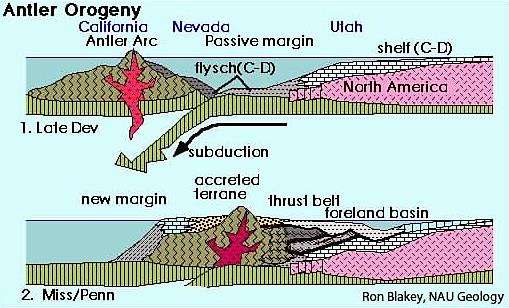
c) Taconic. 1060. Which was the first Paleozoic orogeny d) Sevier. to occur in the Cordilleran mobile belt? e) Caledonian. a) Acadian.
b) Alleghenian.
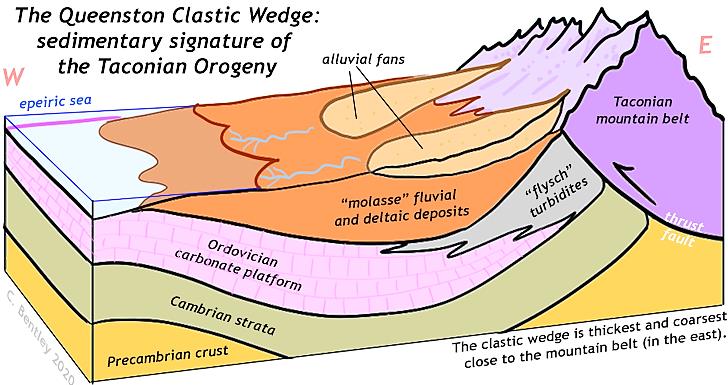
Feedback: The Queenston Delta clastic wedge c) Antler. was produced by the weathering and erosion of d) Caledonian. the Taconic Highlands, which were formed by e) Ellesmere. the Taconic orogeny during the late Ordovician
period. The Taconic orogeny was a mountain- Feedback: The Antler orogeny was the first building event that resulted from the collision of Paleozoic orogeny to occur in the Cordilleran
a volcanic island arc with the eastern margin of mobile belt, which is a zone of mountain-
Laurentia (ancestral North America). The building activity along the western margin of
clastic wedge consists of thick coarse-grained North America. The Antler orogeny began in the
detrital sediments nearest the highlands and late Devonian and lasted until the early
thins laterally into finer-grained sediments on Mississippian. It was caused by the collision of
the craton. a volcanic island arc with the passive
continental margin of Laurentia. The Antler

orogeny resulted in the uplift of the Antler
Highlands, which shed clastic sediments into
the adjacent basins. The Antler orogeny also
marked the transition from a passive to an
active margin in the Cordilleran region.
--------------------------------------------------------------
1059. Which of the following resulted from
intracratonic deformation?
a) Antler Highlands.
b) Acadian Highlands.
c) Ancestral Rockies.
d) Caledonian Highlands.
e) Taconic Highlands.
--------------------------------------------------------------
216
1061. A major transgressive–regressive b) Carbonized impressions of many extinct soft
cycle bounded by craton-wide bodied animals. unconformities is a(n): c) Fossils of rare marine plants.
a) Cratonic sequence. d) Earliest known benthic community. b) Biostratigraphic unit. e) Earliest known fish. c) Orogeny.
d) Shallow sea. Feedback: The Burgess Shale fauna is e) Cyclothem. significant because it contains the carbonized
impressions of many extinct soft bodied

Feedback: A cratonic sequence is a large- animals that are not normally preserved in the
scale lithostratigraphic unit representing a fossil record. The Burgess Shale fauna includes
major transgressive-regressive cycle bounded a variety of sponges, worms, arthropods, and
by craton-wide unconformities. A other invertebrates that display a remarkable transgressive-regressive cycle is a sequence of diversity of body plans and ecological
sedimentary rocks that reflects the rise and fall adaptations. The Burgess Shale fauna also
of sea level over time. A craton-wide provides insights into the Cambrian explosion,
unconformity is a time gap in the rock record a period of rapid evolutionary diversification that
that indicates when the sea receded and occurred about 540 million years ago. The
sediment was eroded rather than deposited. Burgess Shale fauna is one of the most
The sedimentary rock record of North America important fossil discoveries in the history of
is divided into six cratonic sequences, each paleontology. named after a prominent geographic feature
where the rocks are well exposed. The study of
cratonic sequences is called sequence
stratigraphy, which analyzes the rocks within a
time-stratigraphic framework related to facies
and bounded by unconformities.
--------------------------------------------------------------
1062. The greatest recorded mass extinction
to affect Earth occurred at the end of which
period?
a) Cambrian.
b) Ordovician.
c) Devonian.
d) Permian.
e) Cretaceous.
--------------------------------------------------------------
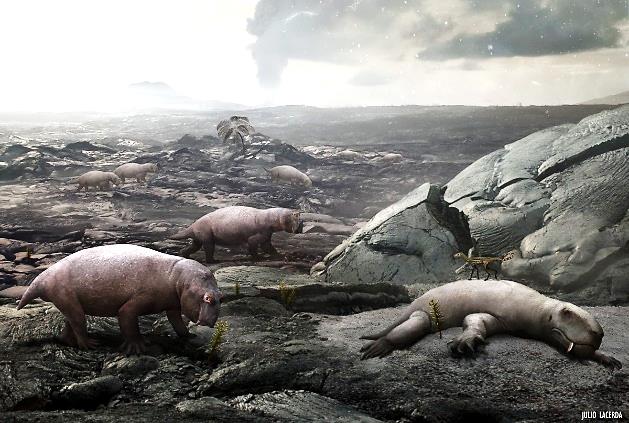
Feedback: The Permian period ended about 1064. What type of invertebrates dominated 250 million years ago with the largest recorded the Ordovician invertebrate community? mass extinction in Earth’s history. This mass a) Epifaunal, benthonic, sessile suspension extinction event is often referred to as the feeders. Permian-Triassic extinction event or the "Great b) Infaunal, benthonic, sessile suspension Dying." It was a catastrophic event that resulted feeders. in the loss of approximately 96% of marine c) Epifaunal, benthonic, mobile suspension species and 70% of terrestrial vertebrate feeders. species, making it the most severe extinction d) Infaunal, nektonic carnivores. event in Earth's history. e) Epifl oral, planktonic primary producers.
Feedback: The type of invertebrates that dominated the Ordovician invertebrate
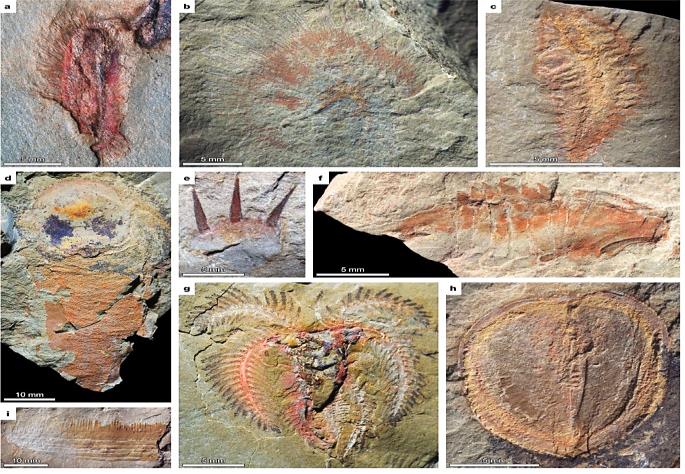
community were epifaunal, benthonic, sessile
suspension feeders. Epifaunal means living on
the surface of the sea floor, benthonic means
living on or near the bottom of the sea, sessile
means attached to a substrate and not able to
move, and suspension feeders means filtering
food particles from the water. Some examples
of epifaunal, benthonic, sessile suspension
feeders in the Ordovician are sponges, corals,
-------------------------------------------------------------- bryozoans, brachiopods, and crinoids. These
1063. animals formed diverse and complex reef The Burgess Shale fauna is significant
because it contains the: ecosystems that provided habitats for many
a) other organisms. First shelled animals.
--------------------------------------------------------------
217
1065. Based on similarity of embryo cell 1067. Which of the following groups did
division, which invertebrate group is most amphibians evolve from? closely allied with the chordates? a) Coelacanths.
a) Molluscs. b) Ray-finned fish. b) Echinoderms. c) Lobe-finned fish. c) Sponges. d) Pelycosaurs. d) Worms. e) Therapsids. e) Arthropods.
Feedback: Amphibians are believed to have

Feedback: Echinoderms, which include evolved from a group of lobe-finned fish that
animals like sea stars and sea urchins, exhibit had adaptations allowing them to move and
a type of embryo cell division known as breathe in shallow waters and on land. This
deuterostome development. Chordates, which transition from water to land was a significant
include vertebrates like fish, amphibians, birds, step in the evolution of vertebrates and
and mammals, also belong to the deuterostome eventually gave rise to the first amphibians. group. This similarity in embryonic --------------------------------------------------------------
development is one of the reasons 1068. Which algal group was the probable echinoderms are considered closely related to ancestor of vascular plants? chordates within the animal kingdom. a) Yellow.
b) Blue-green. c) Red. d) Brown. e) Green.

Feedback: Green algae are considered the most likely ancestors of vascular plants. The
similarities in pigments and chloroplast
structure between green algae and vascular
plants suggest a close evolutionary
-------------------------------------------------------------- relationship. This transition from green algae to
1066. vascular plants marked a critical step in the Organisms living in the water column
above the seafloor are: evolution of terrestrial plants.
a) Benthic.
b) Epifaunal.
c) Infaunal.
d) Epifloral.
e) Pelagic.
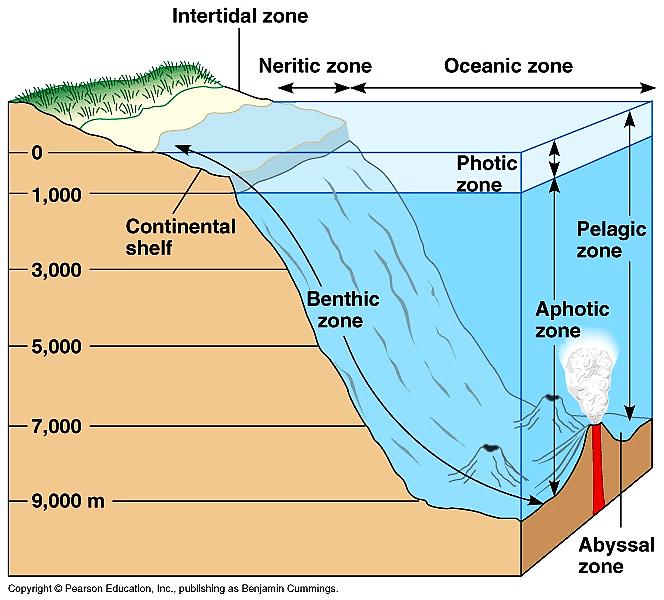
Feedback: Pelagic organisms are those that inhabit the open water of oceans and other
bodies of water, as opposed to the seafloor
(benthic) or attached to objects on the seafloor --------------------------------------------------------------
often referred to as pelagic species and can significant because it is: The ancestor of modern reptiles. (epifaunal or infaunal). These organisms are 1069. The discovery of Tiktaalik roseae is
include various types of plankton and swimming a)
column. and amphibians. The first vascular land plant. animals that live and move within the water b) An intermediary between lobe-finned fish
c)
d) The “missing link” between amphibians and

reptiles.
e) The oldest known fish.
Feedback: Tiktaalik roseae is a well-preserved fossil that represents a transitional form
between lobe-finned fish and early tetrapods
(amphibians). It possesses features of both fish
and amphibians, providing important insights
into the evolution of tetrapods and the transition
from aquatic to terrestrial environments. While
it is not the direct ancestor of modern reptiles, it
is a critical piece of the evolutionary puzzle that
helps us understand the emergence of land-
dwelling vertebrates.
-------------------------------------------------------------- --------------------------------------------------------------
218
1070. When we refer to an animal as an development of the amniotic egg allowed
endotherm, we mean that it: reptiles to reproduce on land without the need
a) Lays eggs. for an aquatic environment, enabling them to
b) Is warm blooded. thrive in a variety of terrestrial habitats. c) Has a skeleton of cartilage. --------------------------------------------------------------
d) Is covered by scales. 1073. The orogeny responsible for the e) Lived during the Mesozoic Era. present-day Rocky Mountains is the:
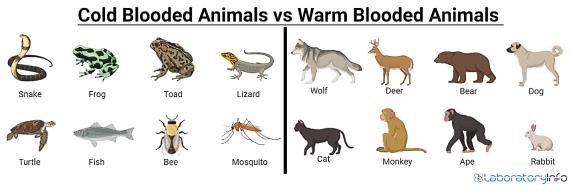
a) Sonoma.
Feedback: Endothermic animals, often called b) Sevier. warm-blooded animals, can regulate their body c) Laramide. temperature internally, maintaining a relatively d) Nevadan. constant temperature regardless of the external e) Antler. environment. This is in contrast to ectothermic f) Mesozoic. animals, which rely on external sources of heat

to regulate their body temperature. Feedback: The Laramide orogeny was a
geological event that occurred during the Late
Cretaceous and early Paleogene periods and
played a significant role in the formation of the
Rocky Mountains in North America.
--------------------------------------------------------------
1071. Pelycosaurs are:
a) Jawless fish.
b) Jawed, armored fish.
c) Reptiles.
d) Amphibians.
e) Plants.
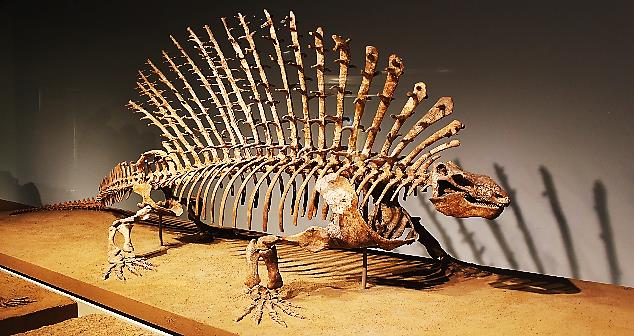
Feedback: Pelycosaurs were a group of early reptiles that lived during the Paleozoic era.
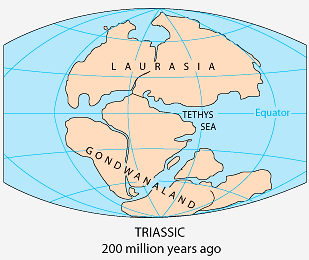
They are not to be confused with fish or -------------------------------------------------------------- amphibians; they were distinct reptilian 1074. Triassic rifting between which two creatures with various species, some of which continental landmasses initiated the are well-known, such as Dimetrodon. breakup of Pangaea? a) India and Australia. b) Antarctica and India. c) South America and Africa. d) North America and Eurasia. e) Laurasia and Gondwana.
Feedback: Triassic rifting between Laurasia (North America and Eurasia) and Gondwana
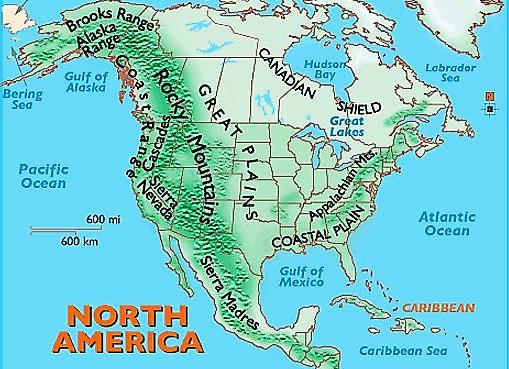
(South America and Africa) initiated the
-------------------------------------------------------------- breakup of Pangaea. This rifting event led to the
1072. eventual separation of these landmasses and Which evolutionary innovation allowed
reptiles to colonize all of the land? the formation of the Atlantic Ocean. It was a
a) crucial geological process in shaping the Tear ducts.
b) modern continents and ocean basins. Additional bones in the jaw.
c) The middle-ear bone.
d) An egg that contained food and waste sacs
and an embryo surrounded by a fluid-filled
sac.
e) Limbs and a backbone capable of
supporting the animals on land.
Feedback: Reptiles were the first group of vertebrates to evolve amniotic eggs, which had
several important adaptations for terrestrial life.
These eggs contained protective membranes,
including the amnion, which surrounded the
embryo in a fluid-filled sac, providing protection
from desiccation and mechanical damage. The --------------------------------------------------------------
219
1075. The formation or complex responsible d) Atlas.
for the spectacular scenery of the Petrified e) Laramide. Forest and painted desert is the:
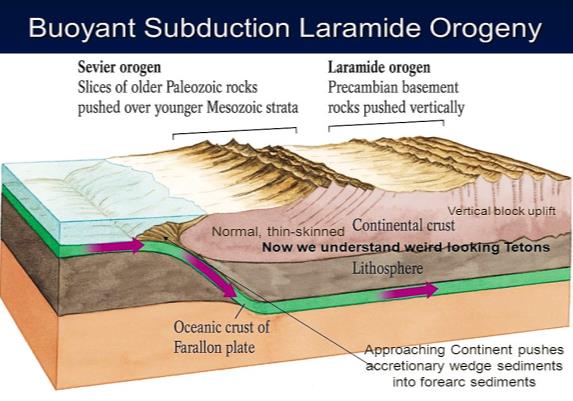
a) Franciscan. Feedback: The Laramide orogeny was a b) Morrison. geological event that occurred during the Late
c) Chinle. Cretaceous and early Paleogene periods, and
d) Wingate. it was associated with the shallow-angle
e) Navajo. subduction of the Farallon plate beneath North
America. This orogeny played a significant role

Feedback: The Chinle Formation is a in the uplift and formation of mountain ranges in
geological formation that contains colorful and the western United States, including the Rocky
visually striking sedimentary rocks. It is known Mountains. for its petrified wood and vibrant landscapes,
including the Petrified Forest National Park and
the Painted Desert in the southwestern United
States.
--------------------------------------------------------------
1076. The Himalyas formed when the
_______ plate collided with the ______
plate.
a) North American/Pacific.
b) Nazca/Cocos.
c) Indian/Asian.
d) Farallon/African.
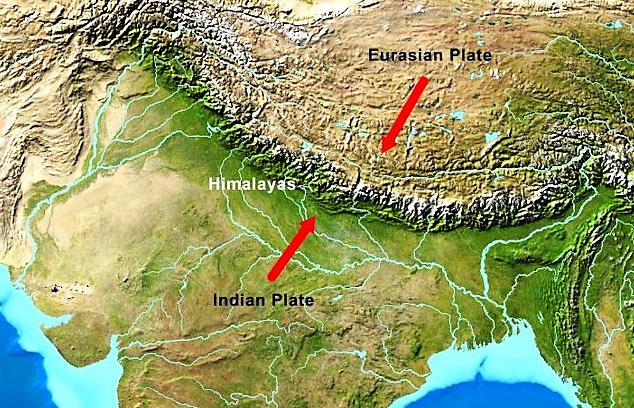
Feedback: 1078. Mammals evolved during the Triassic The collision between the Indian Period, but major diversification began plate and the Asian plate is responsible for the during which Cenozoic Epoch? uplift and formation of the Himalayan mountain e) Atlantic/Middle Eastern. --------------------------------------------------------------
range, one of the most significant geological a) Paleocene. events in the history of Earth's crust. This b) Eocene. collision between the Indian plate and the Asian c) Oligocene. plate is part of the ongoing process of plate d) Miocene. tectonics, and it primarily took place during the e) Pliocene.
Cenozoic Era, particularly in the Late Cenozoic. While the earliest mammals Feedback: The uplift of the Himalayas is a relatively recent appeared in the Triassic Period, it was during geological event, spanning millions of years, the Cenozoic Era, particularly in the Eocene and it continues to shape the landscape in the Epoch, that mammals underwent significant present-day geological epoch, which is the diversification and expansion in terms of Holocene. This geological process has not only species and ecological roles. Mammals resulted in the immense elevation of the underwent significant diversification and Himalayan peaks but also has had significant expansion in terms of species and ecological impacts on regional climate, geology, and roles during the Eocene Epoch. The Eocene is biodiversity over this extended period of time. often referred to as the "Age of Mammals"
because it was during this time that mammals
began to fill many of the niches that were left
vacant by the dinosaurs. There are a number of
reasons why mammals were able to diversify so
rapidly during the Eocene:
First, the extinction of the dinosaurs at the end of the Cretaceous Period removed many of the
competitive pressures that had been limiting the
evolution of mammals.
Second, the climate of the Eocene was much warmer than it is today, which created new
-------------------------------------------------------------- habitats for mammals to occupy. 1077. Shallow-angle subduction of the Third, the Eocene was a time of significant
Farallon plate beneath North America is tectonic change, which created new
considered responsible for which of the landmasses and isolated populations of
following orogenies? mammals. This isolation led to the development
a) Hercynian. of new species through the process of
b) Antler. speciation. c) Caledonian. --------------------------------------------------------------
220
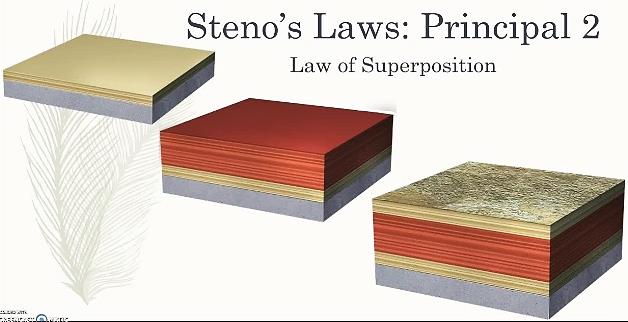
1079. The act of placing rocks in their proper Superposition states that in any sequence of
sequence of formation is called _______. undisturbed sedimentary rocks, the youngest
a) Cross-cutting rocks are at the top, and the oldest rocks are at
b) Absolute dating the bottom. This principle is a fundamental
c) Correlation concept in relative dating and is used to
d) Principle of original horizontality determine the relative ages of rock layers and
e) Relative dating. the fossils they contain.
Feedback: Relative dating is the act of placing rocks in their proper sequence of formation,

without assigning them specific numerical
ages. Relative dating is based on the principles
of stratigraphy, such as superposition, original
horizontality, cross-cutting relationships, and
fossil succession. Relative dating allows
geologists to reconstruct the geological history
of an area and correlate rocks from different
locations. --------------------------------------------------------------
1082. Most layers of sediment are deposited
in a horizontal position.
a) True. b) False.
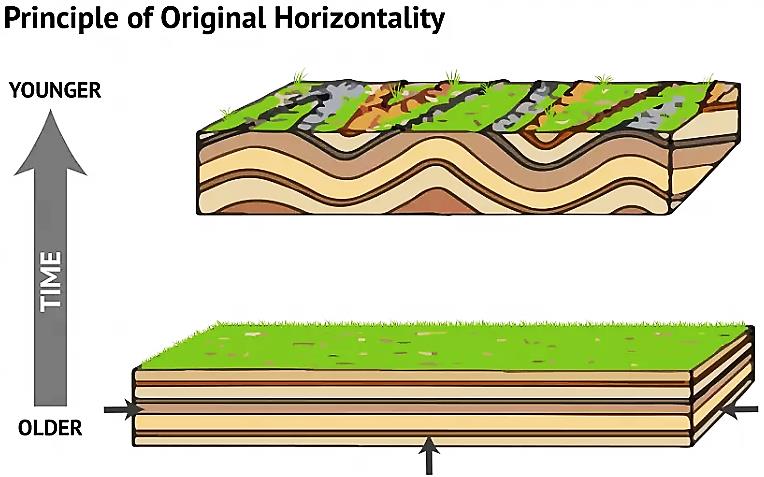
Feedback: The principle of original horizontality states that most layers of sediment
are initially deposited in a horizontal or nearly
horizontal position. This principle is a
1080. To assume that rock layers that are positions of sedimentary rock layers. However, inclined have been moved into that position it's important to note that geological forces, by crustal disturbances is to apply a principle such as tectonic movements, can later tilt or of relative dating known as cross-cutting -------------------------------------------------------------- geologists interpret the relative ages and fundamental concept in geology and helps
deform these sedimentary layers.
relationships.
a) True.
b) False.
Feedback: The statement is not accurate. Cross-cutting relationships in relative dating do
not assume that inclined rock layers have been
moved into position by crustal disturbances.
Instead, cross-cutting relationships refer to the
principle that any geological feature or rock unit
that cuts across or intersects another is
younger than the one it cuts through. Inclined or
tilted rock layers can result from various --------------------------------------------------------------
geological processes, including tectonic forces, 1083. To state that "in an undeformed without necessarily implying that they were sequence of sedimentary rocks the
moved into position. So, while cross-cutting oldest rock is at the bottom" is to use a relationships are a principle of relative dating, basic principle of relative dating called the
they are not related to the assumption of law of superposition. movement by crustal disturbances. a) True. -------------------------------------------------------------- b) False. 1081. What fundamental principle of geology
did Nicolaus Steno propose in 1669? Feedback: The statement accurately describes
a) Principle of inclusion. the basic principle of relative dating known as
b) Principle of cross-cutting relationships. the law of superposition. This principle states
c) Uniformitarianism. that in an undeformed sequence of sedimentary
d) Law of superposition. rocks, the oldest rocks are found at the bottom,
e) Principle of original horizontality. and the youngest rocks are at the top. It is a
fundamental concept used by geologists to
Feedback: Nicolaus Steno proposed the determine the relative ages of rock layers and
fundamental principle of geology known as the fossils they contain. "Law of superposition". Steno's Law of --------------------------------------------------------------
221
1084. An igneous rock that cuts through a rock containing the inclusions is younger than
sedimentary rock must be younger than that the rock from which the inclusions originated.
sedimentary rock. This is an example of: This is one of the principles used by geologists
a) Original horizontality. to determine the relative ages of rock layers
b) Inclusion. and their events. c) Cross-cutting relationships.
d) Unconformity.
e) Superposition.

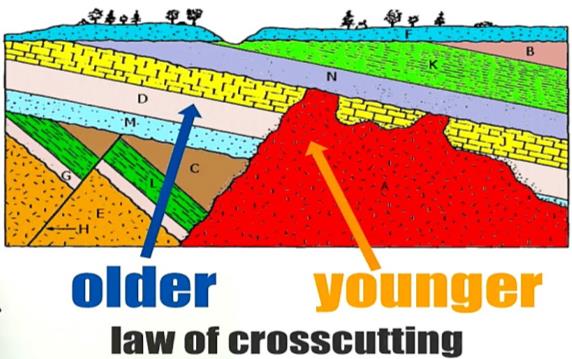
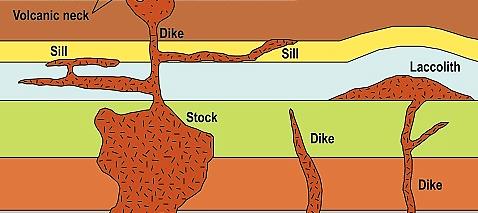
Feedback: When an igneous rock cuts through a sedimentary rock, the igneous rock is
considered younger because it must have
formed after the sedimentary rock was already
cutting relationships, one of the principles of in place. This is a classic example of cross- --------------------------------------------------------------
relative dating in geology. 1087. When magma works its way into a rock
and crystallizes, we can assume that the
intrusion is younger than the rock that has
been intruded.
a) True. b) False.
Feedback: When magma intrudes into a pre-existing rock and crystallizes to form an igneous
intrusion, it is reasonable to assume that the
intrusion is younger than the rock it has intruded
into. This is a common application of the
1085. An unconformity is a break in the rock considered older than the intrusion itself. record during which deposition ceased, erosion removed previously formed rocks, and then deposition resumed. -------------------------------------------------------------- geology, where the rock being intruded upon is principle of cross-cutting relationships in
a) True.
b) False.
Feedback: An unconformity represents a break in the geological rock record where there --------------------------------------------------------------
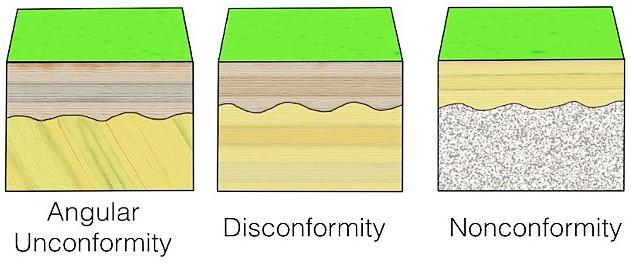
is evidence of a gap in time during which 1088. A break in the rock record where the
deposition ceased, erosion occurred, and then deposition of sediment has been interrupted
deposition resumed. Unconformities can result is referred to as a(n) __________. from various geological processes and are a) Inclusion. important markers in understanding the history b) Intrusion. of sedimentary rock sequences. c) Unconformity.
d) Isotope. e) Cross-cutting relationship.
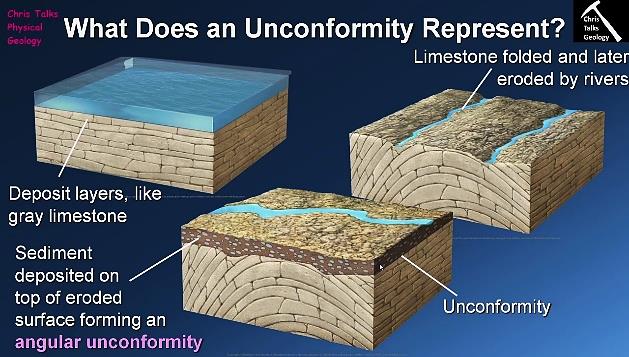
Feedback: The term for a break in the rock record where the deposition of sediment has
been interrupted is "Unconformity".
Unconformities represent gaps in the
geological record due to erosion, non-
deposition, or other geological processes. They
-------------------------------------------------------------- history of rock formations and the events that occurred during geological history. are important features for understanding the
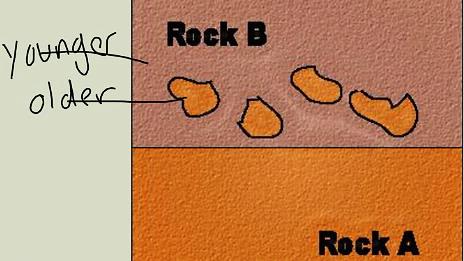
1086. Pieces of one rock unit contained within
another are called inclusions.
a) True.
b) False.
Feedback: Pieces of one rock unit contained within another are referred to as inclusions in
geology. Inclusions are often used as evidence
for relative dating because they indicate that the --------------------------------------------------------------
222
1089. The "matching-up" of rocks from uninterrupted sequence of sedimentary rock
similar ages but different regions is referred layers with no gaps or unconformities.
to as correlation. Geological processes, including erosion,
a) True. tectonic activity, and changes in sea level, have
b) False. resulted in gaps or missing sections in the
geological record in various locations.
Feedback: Correlation in geology refers to the Unconformities and missing layers are common
process of "matching up" rocks or geological features in the Earth's rock record. strata from similar ages but different regions. --------------------------------------------------------------

Geologists use various methods, such as 1092. The fact that fossils succeed one examining rock types, fossils, and other another in a definite and determinable order
characteristics, to determine how rocks in one is known as the principle of fossil
area relate to those in another area of similar succession. age. This helps establish a chronological a) True. framework for understanding the geological b) False. history of different regions.
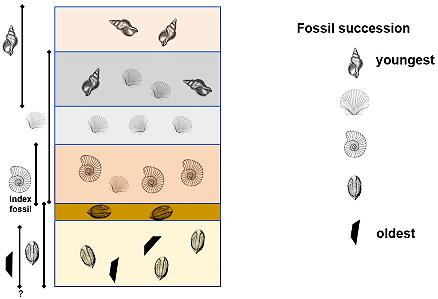
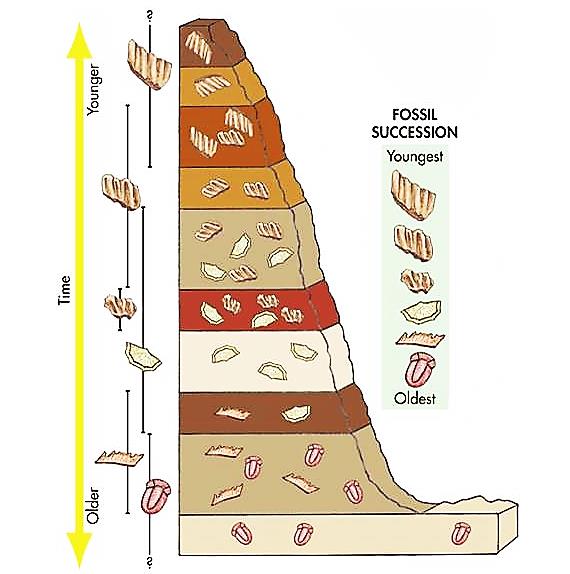
Feedback: The principle of fossil succession, also known as the law of faunal succession,
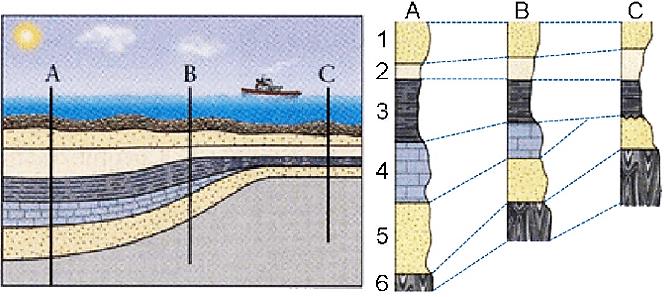
states that different strata each contain
particular assemblages of fossils by which the
rocks may be identified and correlated over
long distances. These fossil forms succeed one
another in a definite and habitual order. This
-------------------------------------------------------------- principle, along with the law of superposition of strata, allows the relative age of a rock to be 1090. Which fundamental geologic principle deduced from its content of fossil faunas and allows geologists to use the remains of floras. organisms when correlating rock units? a) Fossil succession. b) Inclusion. c) Original horizontality. d) Cross-cutting relationships. e) Uniformitarianism.
Feedback: The fundamental geologic principle that allows geologists to use the remains of
organisms when correlating rock units is fossil
succession. Fossil succession refers to the
predictable order in which fossils appear in the
rock record, with younger fossils found in higher
(more recent) rock layers and older fossils
found in lower (older) rock layers. This principle
is essential for relative dating and for
establishing the relative ages of rock units in
different locations. --------------------------------------------------------------
1093. Atoms of the same element that
contain different numbers of neutrons are
called _________.
a) Alpha particles. b) Nuclei. c) Isotopes. d) Radioactivity. e) Ions.
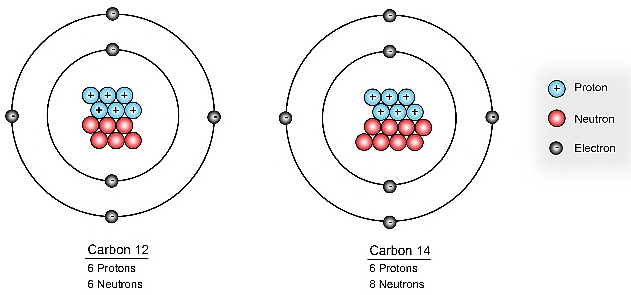
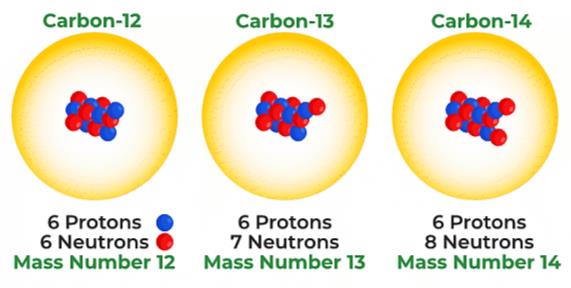
Feedback: Isotopes are atoms of the same
1091. No place on Earth has a complete set the same number of protons (6) but different of conformable strata. numbers of neutrons (6 and 8, respectively). a) True. Isotopes of an element have the same atomic b) False. number but different mass numbers. Isotopes can have different physical and chemical -------------------------------------------------------------- neutrons. For example, carbon-12 and carbon- 14 are isotopes of carbon, because they have element that contain different numbers of
Feedback: No place on Earth has a complete properties depending on the number of set of conformable strata, meaning an
223
neutrons they have. For example, some 1096. Of the three rock types, igneous rocks isotopes are stable and do not change over are more suitable for radiometric dating than
time, while others are radioactive and decay sedimentary rocks. into other elements. a) True.
b) False.
Feedback: Igneous rocks are generally more suitable for radiometric dating than sedimentary
rocks. This is because igneous rocks form from

molten magma that solidifies and traps
radioactive isotopes within its crystal lattice. As
the rock solidifies, the radioactive isotopes
begin to decay at a known rate, allowing
-------------------------------------------------------------- scientists to measure the ratio of parent
1094. __________ is the result of the isotopes to daughter isotopes to determine the
spontaneous decay of an atom's nucleus. age of the rock. Sedimentary rocks, on the
a) Superposition. other hand, are formed from the accumulation
b) Succession. and cementation of sediments, which may
c) Correlation. contain material eroded from older rocks and
d) Inclusion. may not accurately represent the age of the
e) Radioactivity. sedimentary rock itself.
--------------------------------------------------------------
Feedback: Radioactivity is the result of the 1097. The complete decay of uranium spontaneous decay of an atom's nucleus. eventually produces a stable daughter
During radioactive decay, unstable atomic consisting of the element __________. nuclei release particles or energy in the form of a) Strontium. radiation, which can lead to the transformation b) Lead. of the atom into a different element or isotope. c) Rubidium. This process is a fundamental concept in d) Thorium. nuclear physics and plays a crucial role in e) Argon. radiometric dating methods used in geology.
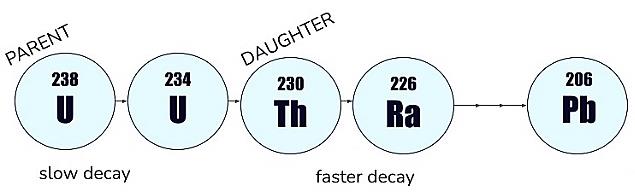
Feedback: Uranium isotopes, such as uranium-238 (238U), decay through a series of radioactive decay steps, ultimately ending with
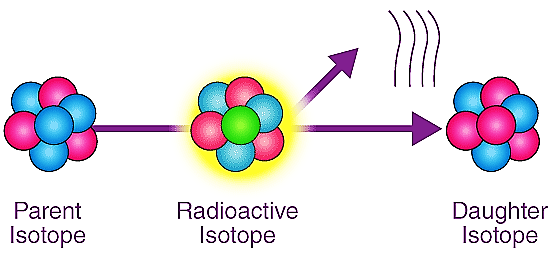
the stable isotope lead-206 (206Pb). This process is used in radiometric dating methods,
such as uranium-lead dating, to determine the
age of rocks and minerals.
--------------------------------------------------------------
1095. Using radioactive isotopes to calculate
the ages of rocks and minerals is a
a) -------------------------------------------------------------- procedure called radiometric dating.
b) 1098. If the ratio of parent isotope to daughter True.
False.
Feedback: a) 1 Radiometric dating is a method 2 isotope is 1:7, ____ half-lives have elapsed. used to determine the absolute age of rocks, b) minerals, fossils, and archaeological artifacts c) 3 by measuring the abundance of certain d) 4 isotopes within them. Radiometric dating relies e) 5 on measuring the ratio of parent isotopes
sample and applying the known decay rates to have elapsed, we can use the formula: n (radioactive) to daughter isotopes (stable) in a Feedback: To find the number of half-lives that
determine the age of the sample. Radiometric Nt = N0 (1/2) dating provides valuable information about the Where Nt is the remaining amount of the parent ages of Earth's geological formations, the isotope, N0 is the initial amount of the parent timing of geological events, and the ages of isotope, and n is the number of half-lives. We
fossils and ancient human artifacts. It is a can rearrange this formula to solve for n: fundamental tool in the field of geology and n = log (Nt / N0) / log (1/2) archaeology for understanding Earth's history If the ratio of parent isotope to daughter isotope
and the chronology of past events. is 1:7, then the remaining amount of the parent
--------------------------------------------------------------
224
isotope is 1/8 of the initial amount. Therefore, methods like potassium-argon and uranium-
we can plug in these values into the formula: series dating are more suitable.
n = log (1/8) / log (1/2)
n = -3 / -1
n = 3
Hence, three half-lives have elapsed.
--------------------------------------------------------------
1099. All rocks can be dated radiometrically. a) True.

b) False.
Feedback: Not all rocks can be dated radiometrically. Radiometric dating is most
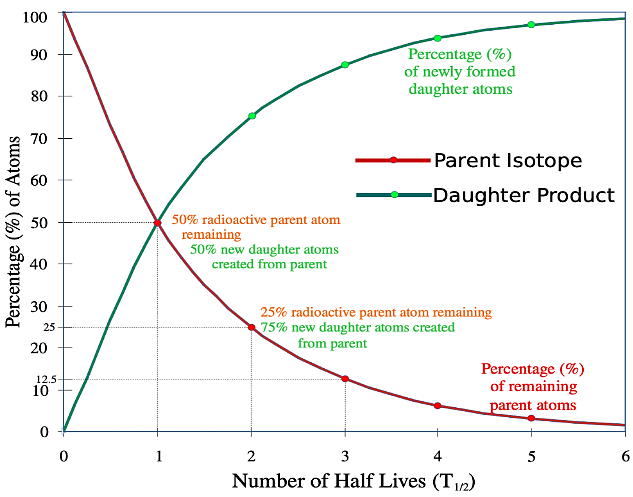
effective for igneous rocks, which form from the -------------------------------------------------------------- cooling and solidification of molten magma or 1101. During radioactive decay, as the lava. These rocks contain minerals that can percentage of radioactive parent atoms incorporate radioactive isotopes during their declines, the proportion of stable daughter crystallization, and the age can be determined atoms also decreases. by measuring the ratio of parent isotopes to a) True. daughter isotopes. b) False. Sedimentary rocks, on the other hand, are generally not suitable for radiometric dating Feedback: During radioactive decay, as the because they are composed of particles that percentage of radioactive parent atoms were eroded, transported, and deposited from declines due to their decay, the proportion of pre-existing rocks. While some sedimentary stable daughter atoms increases, not rocks may contain minerals that can be dated, decreases. This is because radioactive decay the ages obtained are often less precise and involves the transformation of parent isotopes may represent the age of the source rocks into daughter isotopes through the emission of rather than the deposition of the sedimentary particles or radiation. As time passes, more layer. parent isotopes decay into daughter isotopes, Metamorphic rocks, which result from the leading to an increase in the abundance of alteration of pre-existing rocks due to heat and stable daughter atoms relative to the remaining pressure, can also be challenging to date parent atoms. directly using radiometric methods, as the
original minerals may have been reset or
altered during metamorphism.
So, while radiometric dating is a powerful tool
for dating certain types of rocks, its applicability
depends on the rock type and the presence of
suitable minerals within those rocks.
--------------------------------------------------------------
1100. Which isotopic system is commonly
used by anthropologists and archaeologists,
as well as geologists, for dating objects a
few thousand years old?
a) Potassium/Argon.
c) Rubidium/Strontium. -------------------------------------------------------------- d) b) Carbon-14/Nitrogen-14.
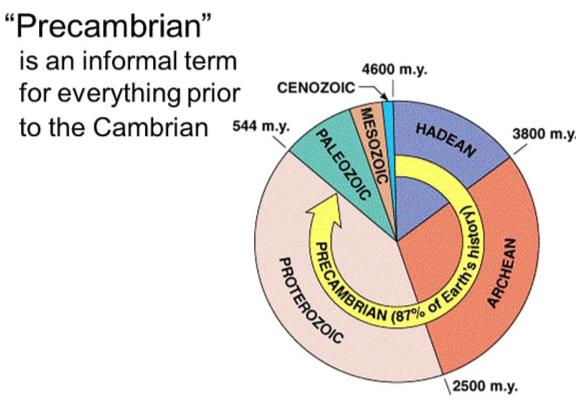
e) Uranium-238/Lead-206. 1102. The first 88 percent of Earth's history, Uranium-235/Lead-207.
used by anthropologists, archaeologists, as Paleozoic. b) Cenozoic. well as geologists, for dating objects a few thousand years old is the Carbon-14 ( 14 c) Phanerozoic. C) d) Feedback: referred to as the __________. The isotopic system commonly a) about which geologists know very little, is
dating system. This method is based on the Cambrian. 14 radioactive decay of carbon-14 ( e) Precambrian. C) to nitrogen-14 ( 14 N). Carbon-14 dating is Feedback: The first 88 percent of Earth's particularly useful for dating organic materials history, about which geologists know relatively such as wood, charcoal, bone, and textiles. It is little, is referred to as the Precambrian. The effective for dating objects up to about 50,000 Precambrian represents a vast span of time years old because carbon-14 has a relatively that encompasses the formation of the Earth, short half-life of approximately 5,730 years. the development of the first continents and Beyond this age range, other radiometric dating
225
oceans, the evolution of life from simple single- the Cambrian period provide valuable insights
celled organisms to more complex forms, and into the early evolution of animals and the
the formation of the first rocks and minerals. It development of ecosystems. is a significant portion of Earth's history but is
less well-documented in the geological record
compared to more recent periods like the
Paleozoic, Mesozoic, and Cenozoic eras,
which are part of the Phanerozoic eon.

-------------------------------------------------------------- --------------------------------------------------------------
1103. The Hadean, the Archean, and the 1105. Which of the following sequences
Proterozoic eons are commonly referred to places the different units of the geologic time
as the Precambrian. scale in proper order beginning with the
a) True. greatest expanses of time? b) False. a) Era-period-eon-epoch.
b) Era-eon-epoch-period.
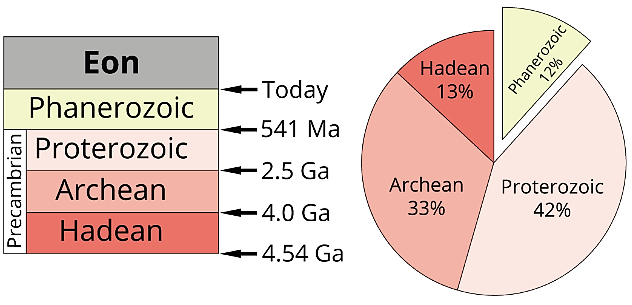
Feedback: The Precambrian is an informal unit c) Eon-epoch-period-era. of geologic time that encompasses the Hadean, d) Eon-era-period-epoch. Archean, and Proterozoic eons, which span e) Eon-period-era-epoch. from the formation of Earth about 4.6 billion
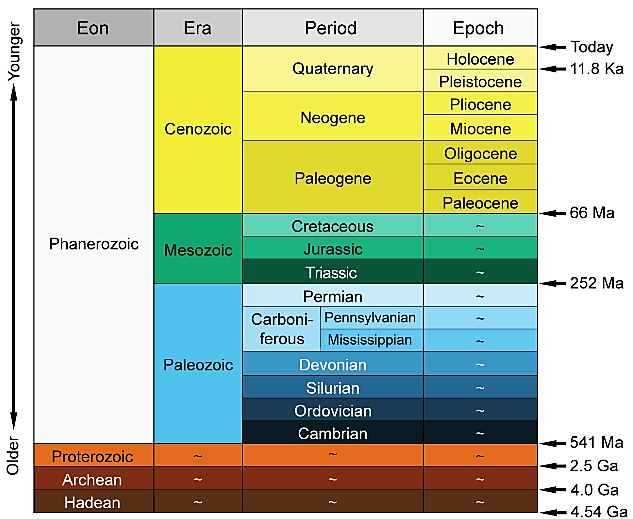
years ago to the beginning of the Cambrian Feedback: The geologic time scale is the Period, 541 million years ago. The Precambrian “calendar” for events in Earth history. It
represents more than 80 percent of the total subdivides all time into named units of abstract
geologic record. time called - in descending order of duration -
eons, eras, periods, epochs, and ages. The
enumeration of those geologic time units is
based on stratigraphy, which is the correlation
and classification of rock strata.
--------------------------------------------------------------
1106. The Mesozoic era is the age of "recent
life" on Earth.
a) True. b) False.
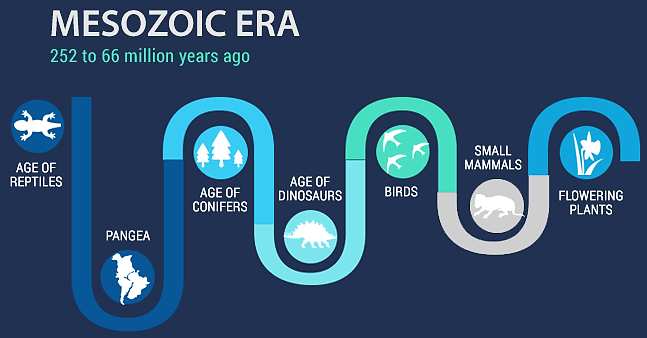
Feedback: The Mesozoic era is not the age of "recent life" on Earth; it is often referred to as
1104. The first appearance of abundant fossil this era, reptiles, including dinosaurs, were evidence in the geologic record occurs at the dominant on Earth. The Mesozoic era is divided beginning of the __________ period. into three periods: the Triassic, Jurassic, and -------------------------------------------------------------- million years ago to 66 million years ago. During the "Age of Reptiles." It lasted from about 252
a) Cambrian. Cretaceous. It ended with the mass extinction b) Jurassic. event that wiped out many of the dinosaurs and c) Quaternary. marked the transition to the Cenozoic era, d) Permian. which is often called the "Age of Mammals." e) Silurian.
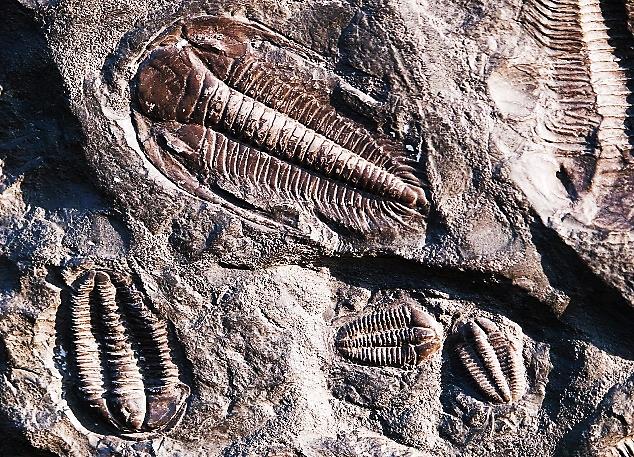
Feedback: The first appearance of abundant fossil evidence in the geologic record occurs at
the beginning of the Cambrian period. This
event, known as the Cambrian Explosion,
marked a significant diversification of life forms,
including the emergence of many complex
multicellular organisms with hard shells and
skeletons. It represents a crucial transition in
the history of life on Earth, and the fossils from --------------------------------------------------------------
226
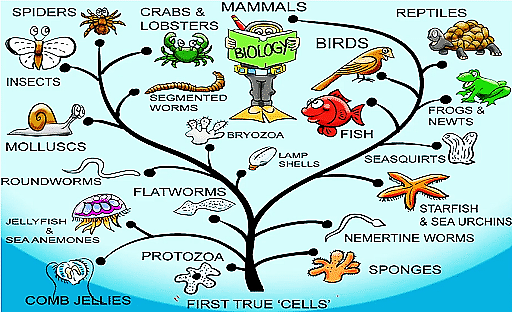
1107. The study of the "family tree of life" is 20,000 atoms of AA to begin with (and 0
referred to as __________. atoms of BB), how long will it take for there
a) Ecology. to be 2,500 atoms of AA? b) Phylogeny. a) 100,000 years. c) Sociology. b) 200,000 years. d) Archeology. c) 300,000 years. e) Evolution.
Feedback: Okay, let's think through this step-
Feedback: The study of the "family tree of life," by-step: which explores the evolutionary relationships The half-life of AA decaying to BB is 100,000 and history of organisms, is referred to as years. That means after 100,000 years, the

phylogeny. Phylogeny seeks to understand the number of AA atoms will reduce by half. We branching patterns and common ancestors of start with 20,000 atoms of AA and 0 atoms of different species and how they are related in the BB. We want to know how long it takes to get tree of life. It is a fundamental aspect of the field to 2,500 atoms of AA. Since the half-life is of evolutionary biology. 100,000 years, after 100,000 years there will be
10,000 atoms of AA left (half of 20,000). After another 100,000 years, there will be 5,000
atoms left. And after one more 100,000 years,
there will be 2,500 atoms of AA left. Therefore, the total time it will take for there to be 2,500
atoms of AA is 300,000 years. --------------------------------------------------------------
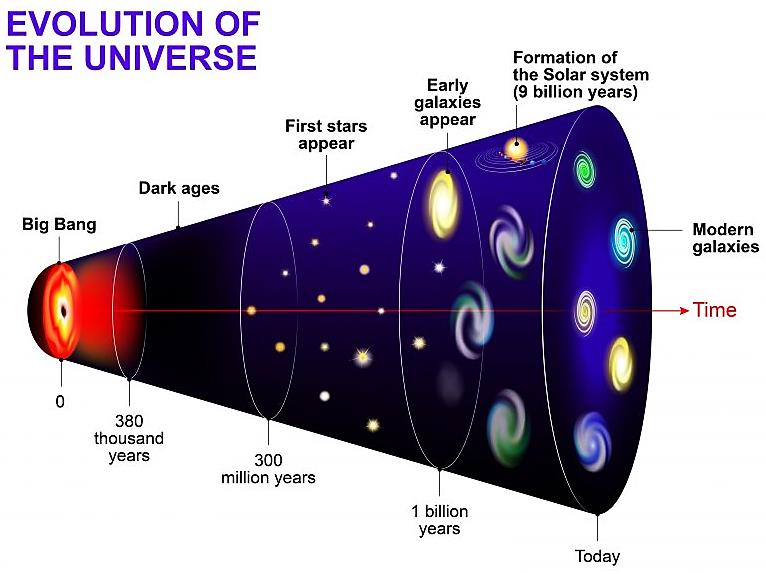
1110. The Universe began with a "Big Bang"
about __________ years ago.
a) 1,200 million. b) 4.5 billion. c) 13.8 billion. d) 540 million. e) None of the above.
Feedback: The current estimate for the age of the Universe is approximately 13.8 billion years.
-------------------------------------------------------------- microwave background radiation and other cosmological data, and it is often referred to as This age is based on observations of cosmic
1108. The entire geologic time scale was the time since the "Big Bang," which is the created using numerical dates. moment when the Universe is believed to have a) True. originated. b) False.
Feedback: The entire geologic time scale was not created using numerical dates. While
numerical dating methods like radiometric
dating have been essential for assigning
specific ages to certain events and rock layers,
the geologic time scale itself was initially
developed based on relative dating principles.
The geologic time scale is primarily based on
the relative order of rock layers (stratigraphy)
and the fossils contained within them. It
involves dividing Earth's history into various
eons, eras, periods, and epochs based on the
relative sequence of rock layers and the --------------------------------------------------------------
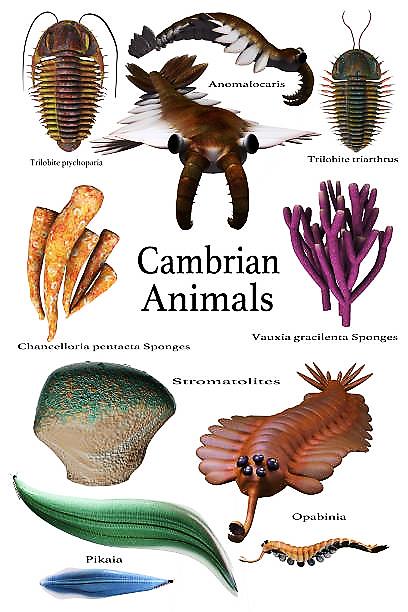
presence of key fossil assemblages. Numerical 1111. Determine when the first vertebrates dates have been integrated into the time scale developed on Earth. to provide more precise ages for certain a) Tertiary. boundaries and events, but the relative b) Archean. relationships between these divisions were c) Pennsylvanian. established through careful observation of the d) Cambrian. rock record and the principles of relative dating. e) Holocene. --------------------------------------------------------------
1109. Atoms of AA decay to atoms of BB with Feedback: The first vertebrates are believed to
a half-life of 100,000 years. If there are have developed during the Cambrian period,
227
which began around 541 million years ago and elements into space. Over time, these materials
marked a significant period of diversification of can become part of new star systems and
life on Earth. These early vertebrates were planetary bodies like Earth. So, the origin of
primitive and quite different from modern elements like oxygen and carbon can be traced
vertebrates, but they represent an important back to the interior of stars. step in the evolutionary history of animals with
backbones. The Cambrian period is known for
the appearance of various complex
multicellular organisms, including the first

vertebrates.
--------------------------------------------------------------
1113. In the past there were (more or less)
atoms of radioactive Uranium?
a) Less. b) More. c) No way to tell.
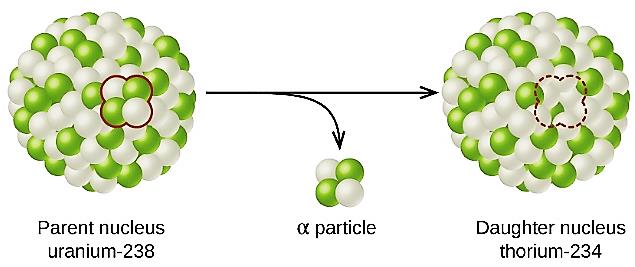
Feedback: In the past, there were more atoms of radioactive uranium than there are today.
This is because uranium radioactively decays
by emitting an alpha particle, which is a helium
nucleus consisting of two protons and two
neutrons. When an atom of uranium decays, it
transforms into another element, such as
thorium or plutonium. This process reduces the
number of uranium atoms over time.
Radioactive decay of uranium is also used to
date the age of rocks and fossils, by measuring
the ratio of parent and daughter isotopes in a
sample.
--------------------------------------------------------------
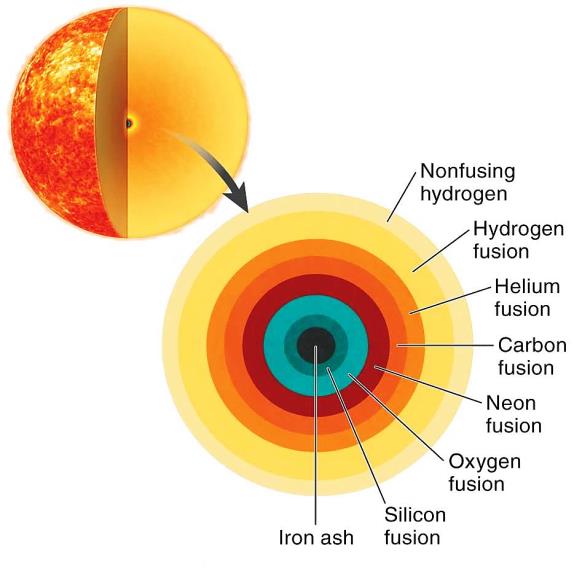
1112. Where did the elements such as
oxygen and carbon that make up Earth
originate?
a) In the Andromeda galaxy.
c) -------------------------------------------------------------- b) From the "Big Bang".
d) 1114. There was ____ heat produced in the In a star.
e) crust in the past: In the vacuum of space. More. In the Sun.
a)
Feedback: b) Less. Elements such as oxygen and carbon, which make up a significant portion of c) No way to tell. Earth's composition, were formed through
nucleosynthesis within stars. These elements Feedback: There was more heat produced in
are created through the fusion of lighter the crust in the past than there is today. This is
elements within the intense heat and pressure because the heat production in the crust is
the end of their life cycle, they can undergo such as potassium, thorium, and uranium, which have finite half-lives and decrease over at the core of stars. When massive stars reach mainly due to the radioactive decay of isotopes
supernova explosions, releasing these
228
time. According to one source, the heat c) Mesozoic. production was twice that of present-day at d) Cenozoic. approximately 3 billion years ago, resulting in
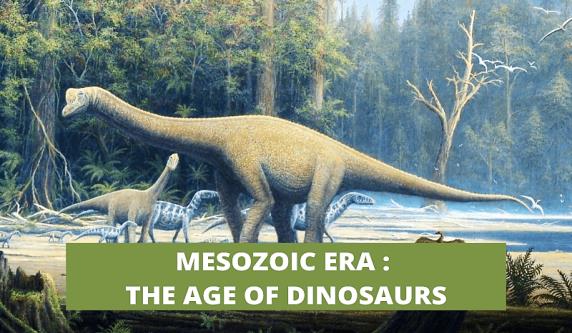
larger temperature gradients within Earth, Feedback: The Mesozoic Era, often referred to larger rates of mantle convection and plate as the "Age of Dinosaurs," spanned from
tectonics, allowing the production of igneous approximately 252 million years ago to 66
rocks such as komatiites that are no longer million years ago. It is divided into three
formed. Another source estimates that the heat periods: the Triassic, Jurassic, and Cretaceous
production in the crust has decreased by about periods. During this era, dinosaurs evolved and

50% since 2.5 billion years ago. Therefore, became the dominant land animals. They
there is evidence that the crust was more diversified into various forms and sizes,
radioactive and hotter in the past than it is including the massive sauropods, fearsome
today. theropods, and herbivorous ornithischians. The
-------------------------------------------------------------- Mesozoic also witnessed the rise of other
1115. Which of the following represents the notable groups like pterosaurs, marine reptiles,
longest time period: and the earliest mammals. The era ended with
a) Precambrian. a mass extinction event, often linked to the
b) Paleozoic. impact of a large asteroid, which led to the
c) Mesozoic. extinction of most dinosaurs and many other
d) Cenozoic. species, marking the boundary between the
Mesozoic and Cenozoic Eras.
Feedback: Precambrian represents the longest time period in Earth's geological history.
The Precambrian Eon spans from the formation
of the Earth, approximately 4.6 billion years
ago, to about 541 million years ago. It's a vast
stretch of time that includes several eons, such
as the Hadean, Archean, and Proterozoic, and
it accounts for over 80% of Earth's history. The
other options, Paleozoic, Mesozoic, and
Cenozoic, are subsequent eons in the geologic
time scale and are relatively shorter in -------------------------------------------------------------- comparison. 1118. Radiometric age is often referred to as _____ age. a) Total. b) Absolute. c) Historic. d) Geologic.
Feedback: Radiometric age is often referred to as absolute age. This is because radiometric
dating techniques provide precise numerical
ages for rocks and minerals, making them
absolute measures of time in geological terms.
--------------------------------------------------------------
1116. The Paleozoic does not include the: a) Ordovician.
b) Jurassic.
c) Mississippian.
d) Permian.
Feedback: The Paleozoic Era does not include the Jurassic period. The Jurassic period
belongs to the Mesozoic Era, which follows the --------------------------------------------------------------
Paleozoic Era in the geologic time scale. 1119. The principal of original horizontality -------------------------------------------------------------- states that ________. 1117. The ______ was an era dominated by a) Most rocks in the Earth's crust are layered
the dinosaurs: horizontally.
a) Precambrian. b) Igneous rocks form essentially horizontal b) layers. Paleozoic.
229
c) Metamorphic gradients are essentially a) Sedimentary.
horizontal before deformation. b) Igneous.
d) Sediments are deposited as essentially c) Metamorphic.
horizontal layers. d) All of these commonly contain fossils.
Feedback: The principle of original Feedback: Fossils are most common in horizontality states that sediments are sedimentary rocks. Sedimentary rocks are
deposited as essentially horizontal layers. This formed from the accumulation and cementation
principle is one of the fundamental concepts in of sediments, which often contain the remains

geology, suggesting that sedimentary rocks, of plants and animals that lived in the past.
when originally formed, were deposited in flat, Fossils are much less common in igneous and
horizontal layers. Deviations from this metamorphic rocks, as the extreme heat and
horizontal orientation can indicate subsequent pressure associated with their formation tend to
geological processes like tilting, folding, or destroy organic material. faulting.
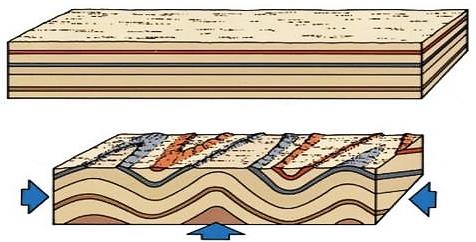
-------------------------------------------------------------- 1123. --------------------------------------------------------------
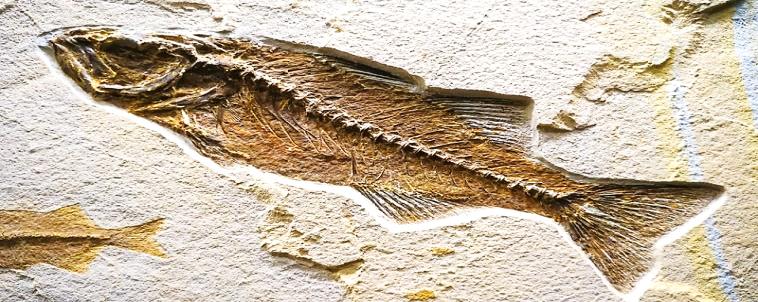
1120. The study of faunal succession allows: seem to coincide with major changes in the The boundaries between _______ a) Matching of similarly-aged rocks from different outcrops.
a) life forms present on Earth. b) Absolute dating of fossil-bearing strata. Precambrian. c) Recognition of the kings of the beasts in b) Systems. past times. c) Eras. d) The study of habits of extinct mammals. d) Epochs.
Feedback: Feedback: The study of faunal succession The boundaries between eras involves examining the fossilized remains of seem to coincide with major changes in the life organisms found in sedimentary rocks to forms present on Earth. Eras are broad determine their relative ages. This helps subdivisions of the geologic time scale, and geologists correlate rocks from different each era typically represents a significant locations based on the fossils they contain, period characterized by distinctive geological allowing them to establish a chronological and biological features. Major changes in life framework for the Earth's history. forms, such as mass extinctions and the appearance of new groups of organisms, often
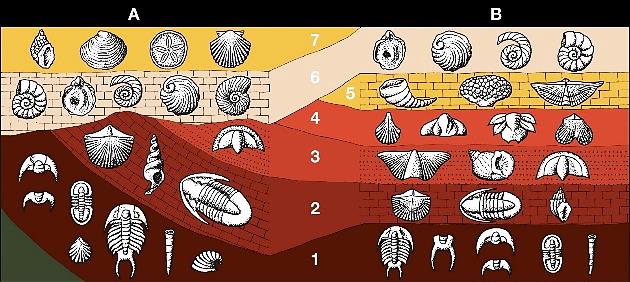
mark the transitions between eras.
--------------------------------------------------------------
1121. An undeformed sedimentary layer is
_____ than the layer above and ____ than
the layer below.
d) Older , younger. 1124. A disconformity is ___________ . Older , older. a) A rock unit that does not contain fossils. b) An erosional surface between igneous and Feedback: This statement reflects the principle metamorphic rocks. of superposition in stratigraphy, which states c) b) Younger , older. -------------------------------------------------------------- c) a) Younger , younger.
that in a sequence of undisturbed sedimentary An erosional surface between horizontal sedimentary rocks. rock layers, the youngest rocks are at the top, d) An erosional surface between different rock and the oldest rocks are at the bottom. types. Therefore, an undeformed sedimentary layer is
older than the layer above it and younger than Feedback: A disconformity is an erosional the layer below it. surface that separates younger sedimentary --------------------------------------------------------------rocks deposited on top of older, horizontally 1122. Fossils are most common in which rock layered sedimentary rocks. It represents a types?
230
period of erosion and non-deposition, often due a) Asymmetrical ripple marks. to a gap in the geologic record. b) Symmetrical ripple marks.
c) Faults. d) All of these could be used.
Feedback: Asymmetrical ripple marks are formed by unidirectional currents, such as
streams or waves, and they have a steeper
slope on the downstream side and a gentler

slope on the upstream side. This makes them
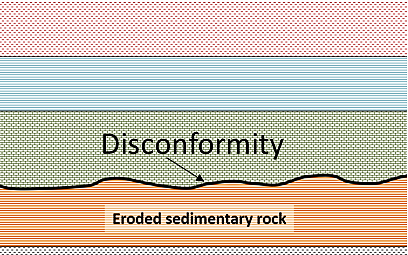
useful way-up structures, as they can indicate
the paleo-current direction and the original
-------------------------------------------------------------- orientation of the rock layer. Symmetrical ripple
1125. marks are formed by bidirectional currents, What is the name for an erosion
surface that separates two sets of such as tides, and they have equal slopes on
sedimentary layers with non-parallel both sides, so they cannot be used to tell if a
bedding planes? rock layer is right side up or upside down.
a) Faults are fractures in rocks along which Cross-bedding.
b) displacement has occurred, and they do not Formation.
c) provide any information about the original Angular unconformity.
d) depositional environment or orientation of the Fault.
rock layer. Therefore, only asymmetrical ripple
Feedback: marks can be used to tell if a rock layer was The name for an erosion surface
that separates two sets of sedimentary layers right side up or upside down. with non-parallel bedding planes is angular --------------------------------------------------------------
unconformity. This type of unconformity occurs 1128. Radiometric dating is least useful for when older sedimentary rocks are tilted or ________ rocks. folded, eroded, and then younger sedimentary a) Granitic. rocks are deposited on top of the eroded b) Basaltic. surface at a different angle or orientation. c) Metamorphic.
d) Sedimentary.
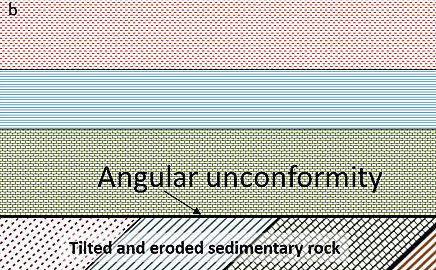
Feedback: Radiometric dating is least useful for sedimentary rocks. This is because
sedimentary rocks are typically composed of
mineral grains that have been eroded,
transported, and then deposited, which can
result in a mix of different ages of minerals.
Radiometric dating relies on the presence of
1126. Which of the following is used by radiometric dating is most commonly used for geologists to determine the relative ages in igneous and some metamorphic rocks, where a rock sequence? the minerals formed from molten material or a) Stratigraphy. experienced high-temperature metamorphism, -------------------------------------------------------------- within rocks, which are often absent or not well- preserved in sedimentary rocks. Instead, radioactive isotopes and their decay products
c) preserving the isotopic signatures. b) Fossils.
d) -------------------------------------------------------------- Cross-cutting relationships.
All of these.
Feedback: radioactive parent element, but only Geologists use a combination of contains 250 radioactive parent atoms 1129. A rock formed with 1,000 atoms of a
and determining the age of the rock layers), and old is the rock? a) 250,000 years. cross-cutting relationships (examining how b) 500,000 years. geological features cut across each other) to relative positions), fossils (for biostratigraphy today. If the half-life is 1,000,000 years, how stratigraphy (the study of rock layers and their
determine the relative ages of rocks in a c) 1,000,000 years. sequence. These principles help geologists d) 2,000,000 years. establish the chronological order of events in
-------------------------------------------------------------- using radioactive decay, we need to know the original amount of the parent isotope, the Earth's history. Feedback: To determine the age of a rock
1127. Which of the following could be used to current amount of the parent isotope, and the tell if a rock layer was right side up or upside half-life of the parent isotope. The half-life is the down: time it takes for half of the parent atoms to
231
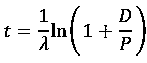
decay into daughter atoms. The age equation very common and does not trap the argon
that relates radioactive decay to geologic time within the crystal structure. Argon, being a
is: noble gas, does not form compounds with other
elements, and can escape from molten rocks
when they are heated. However, when the
Where: trapped within the crystals and start to is the age of a rock or mineral specimen. rocks cool and solidify, the argon atoms are
t accumulate. Therefore, by measuring the ratio
D is the number of atoms of a daughter product of argon-40 to potassium-40 in a rock sample,
today. and knowing the half-life of potassium-40, we

P is the number of atoms of the parent product can calculate the time elapsed since the rock
today. was last cooled below a certain temperature,
λ is the decay constant of the parent isotope. called the closure temperature or blocking
temperature. This temperature varies
The decay constant can be calculated from the depending on the mineral and its composition,
half-life as follows: but it is usually between 300°C and 500°C. The

potassium-argon dating method can be used to
date volcanic rocks that are more than a few
Where: lunar samples, meteorites, and tectonic events. thousand years old. It can also be used to date
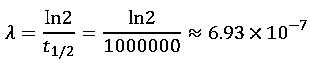
t1/2 is the half-life of the parent isotope.
The original amount of the parent isotope was
1,000 atoms. The current amount of the parent
isotope is 250 atoms. The half-life of the parent
isotope is 1,000,000 years. We can use these
values to find the age of the rock. First, we need
to find the decay constant of the parent isotope
using its half-life: --------------------------------------------------------------
1131. Which of the following radioactive
isotopes is most useful for dating a very
Next, we need to find the number of atoms of young sample (<20,000 years) of wood? the daughter product today. Since we know that a) Rubidium-87. the original amount of the parent isotope was b) Uranium-238. 1,000 atoms, and that only 250 atoms remain c) Carbon-14. today, we can infer that 750 atoms have d) Potassium-40. decayed into the daughter product:
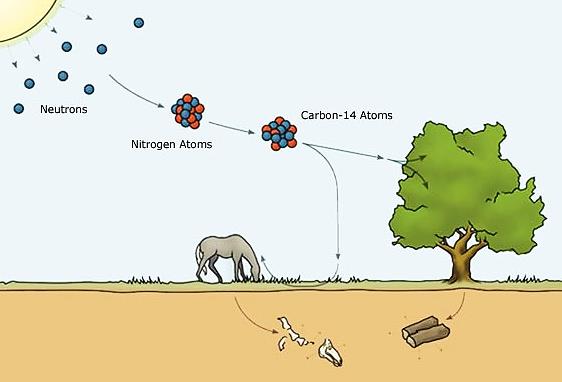
Feedback: Carbon-14 dating, also known as

Now, we can plug in these values into the age dating relatively young organic materials, such radiocarbon dating, is particularly useful for
equation and solve for t: as wood, up to about 50,000 years old. This

method relies on the radioactive decay of
carbon-14 (14C) in organic material. When an
Therefore, the age of the rock is about organism is alive, it takes in carbon-14 from the
2,000,000 years. atmosphere. When the organism dies, it stops
-------------------------------------------------------------- taking in carbon-14, and the carbon-14 in its
1130. A Potassium-Argon (K-Ar) age tissues begins to decay. By measuring the
measures _________. remaining amount of carbon-14 in a sample and
a) The time since last cooling below the gas comparing it to the initial amount, scientists can
retention temperature - Potassium is the determine how long it has been since the death
gas. of the organism, which provides the age of the
b) The time since last cooling below the gas sample.
retention temperature - Argon is the gas.
c) The time since the tree containing the
Potassium died.
d) The time since crystallization of a mineral
containing Potassium.
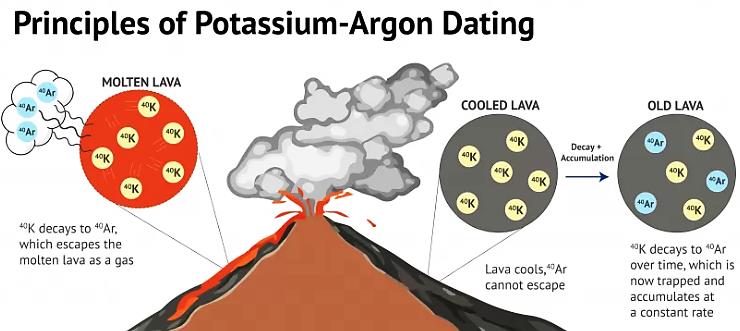
Feedback: Potassium-argon dating is based on the decay of the radioactive isotope of
potassium (40K) to the stable isotope of argon (40Ar) in minerals and rocks. Potassium-40 decays to argon-40 and calcium-40, but only
argon-40 is used for dating because calcium is --------------------------------------------------------------
232
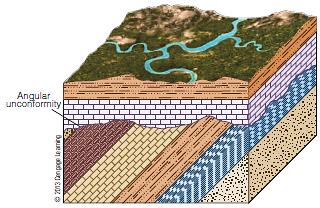
1132. A stratigraphic sequence is a vertical activity or uplift, followed by erosion, before the
set of strata: deposition of the overlying sedimentary layers.
a) Used as a chronological record of the It results in a noticeable angular discordance
geologic history of a region. between the older rocks below and the younger
b) That is unique to a specific area. rocks above. c) That represents a repeating set of events
such as recurring floods, debris flows, etc..
d) Bounded above and below by igneous
and/or metamorphic rocks.

Feedback: A stratigraphic sequence is a vertical set of strata that is bounded by
unconformities or their correlative conformities,
which are surfaces that represent gaps in the
geologic record. A stratigraphic sequence
reflects changes in relative sea level, sediment --------------------------------------------------------------
supply, and tectonic activity that affected the 1135. The most common fossils in rocks of deposition and erosion of sediments in a region the last 500 million years are _______ over time. By identifying and correlating a) Vertebrate bones. stratigraphic sequences, geologists can b) Vertebrate teeth. reconstruct the paleogeography, paleoclimate, c) Invertebrate shells. and paleoenvironment of a region and d) Leaves. understand its geologic evolution.
-------------------------------------------------------------- Feedback: Invertebrate shells, such as those 1133. We cannot accurately measure time in of mollusks and brachiopods, are among the
years with stratigraphy for several reasons. most common types of fossils found in rocks
Which of the following is FALSE. from the last 500 million years. These shells
a) Sediments accumulate at different rates in have a higher likelihood of preservation
different sedimentary environments. because they are made of durable materials
b) Many sedimentary rocks contain fossils that like calcium carbonate, which can withstand the
have not been identified. fossilization process and geological conditions.
c) The rock record does not tell us how many While vertebrate bones and teeth can also
years have passed between periods of fossilize, they are generally less common in the
deposition. fossil record compared to invertebrate shells.
d) Stratigraphy alone cannot be used to
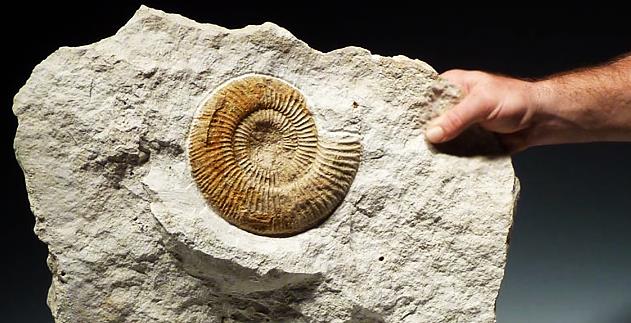
determine the relative ages of widely
separated beds.
Feedback: This statement is false because the presence of unidentified fossils in sedimentary
rocks does not necessarily prevent the
measurement of time in years with stratigraphy.
Fossils, when identified and correlated with
known fossil assemblages, can be used to --------------------------------------------------------------
establish the relative ages of rock layers and 1136. Who is credited with developing the provide a rough estimate of geological time. principle of faunal succession? However, the accuracy of absolute dating in a) Charles Lyell. years may still be challenging due to the other b) Charles Darwin. factors mentioned in the options. c) William "Strata" Smith. -------------------------------------------------------------- d) John C. Butler. 1134. What is the name for an erosion
surface that separates two sets of Feedback: The person who is credited with sedimentary layers with non-parallel developing the principle of faunal succession is
bedding planes? William “Strata” Smith, a British civil engineer
a) Cross-bedding. and geologist. He was the first to use fossils to
b) Formation. correlate rock strata across different regions
c) Fault unconformity. and to create a geological map of England
d) Angular unconformity. based on his observations. He published his
findings in 1815 in a book titled A Delineation of
Feedback: An angular unconformity is an the Strata of England and Wales, with part of
erosion surface that separates two sets of Scotland. He is also known as the “Father of sedimentary layers with non-parallel bedding English Geology” for his contributions to the planes. This type of unconformity typically science of stratigraphy. indicates that there was a period of tectonic --------------------------------------------------------------
233
1137. A nonconformity is _________ . estimate of the age of the Earth is radiometric
a) A rock unit that is different than units above dating. Radiometric dating involves measuring
or below it. the abundance of certain radioactive isotopes
b) A gap in the geologic record bounded below and their decay products in rocks and minerals
by metamorphic or igneous rocks and to determine the elapsed time since the
bounded above by sedimentary rocks. material was last heated or otherwise altered.
c) A rock unit that does not contain fossils. This method provides a robust and widely
d) A sequence of rocks that does not contain accepted estimate of the Earth's age, which is
any gaps in the geologic record. approximately 4.5 billion years.

--------------------------------------------------------------
Feedback: A nonconformity is indeed an 1140. Which of the following units is the important geological feature. It represents a youngest? gap in the geologic record where sedimentary
rocks rest on top of either metamorphic or
igneous rocks. This contact indicates a period
of erosion or non-deposition followed by the
deposition of new sedimentary layers. It's a
valuable clue for understanding the geological
history of an area.
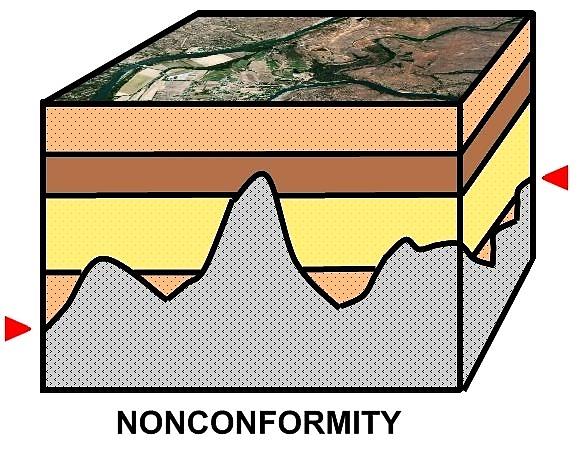
a) A b) B c) C d) D --------------------------------------------------------------
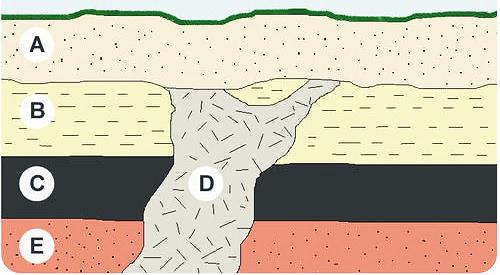
1141. Which of the following units is the
oldest?
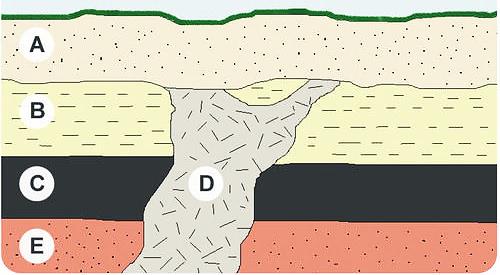
--------------------------------------------------------------
1138. Which of the following will NOT make a
fossil?
a) Decomposed organic material.
b) Plant impressions (casts).
c) Animal footprints.
d) Loose animal bones.
Feedback: Decomposed organic material is not a fossil because it does not preserve any
remains or traces of the original organism. a) A Fossils are the preserved remains or traces of b) B ancient organisms that are typically more than c) D 10,000 years old. Fossils can be formed by d) E various processes, such as mineralization, --------------------------------------------------------------carbonization, permineralization, and amber 1142. Which of the following happened most preservation. However, all these processes recently? require some part of the organism to be buried by sediment and protected from decay.
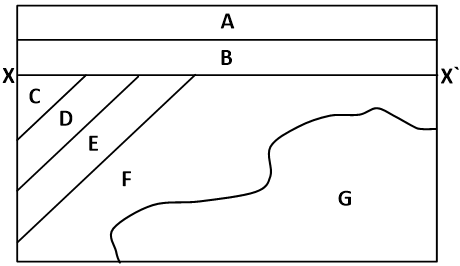
Decomposed organic material does not meet
this criterion, and therefore cannot become a
fossil.
--------------------------------------------------------------
1139. What scientific avenue of investigation
gave scientists the best estimate of the age
of the Earth?
a) Dating fossils.
b) Archaeological dating.
c) Radiometric dating. a) Deposition of unit C. d) Carbon dating. b) Deposition of unit B.
c) Deposition of unit F.
Feedback: The scientific avenue of d) Tilting of C,D,E, and F. investigation that gave scientists the best --------------------------------------------------------------
234
1143. A geologist finds that unit F contains
eroded pieces of unit G. Which of the a) Deposition of unit A. following statements is true? b) Deposition of unit D.
c) Emplacement of unit G. d) Cannot tell from the information given. --------------------------------------------------------------
1147. The age estimate for point A in the
diagram below is ______ million years.

a) The granite is younger than unit B.
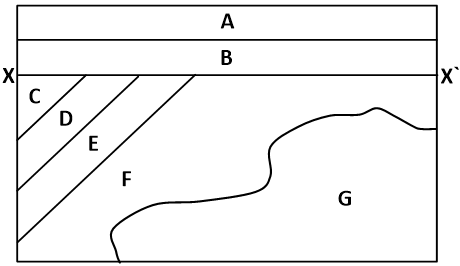
b) Unit B is younger than the granite.
c) Unit B and the granite are the same age. d) The relative ages of the granite and unit B
cannot be determined from the information a) 0.16
-------------------------------------------------------------- c) given. b) 2.6 1144. The horizontal line labeled X-X' is a(n): d) 16 160
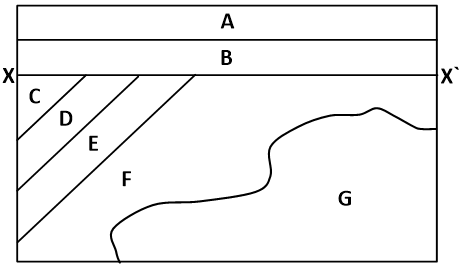
Feedback: The Quaternary Period began approximately 2.6 million years ago and
continues to the present day. It is the most
recent geological period and is characterized by
the advent of the ice ages and the development
of modern humans.
a) Fault.
b) Angular unconformity.
c) Non conformity.
d) Disconformity.
--------------------------------------------------------------
1145. Which of the following statements is
FALSE? --------------------------------------------------------------
1148. The age estimate for point B in the
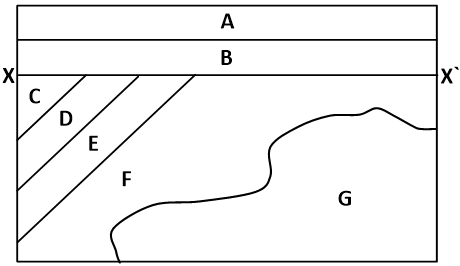
diagram below is ______ million years.
a) Unit A was deposited after unit B was
deposited. a) 35
b) Erosion took place prior to deposition of unit b) 66
B. c) 245
c) Unit C is younger than unit A. d) 570 d) Unit E is older than unit B.
-------------------------------------------------------------- Feedback: The Cenozoic Era began 1146. Which of the following occurred most approximately 66 million years ago and
recently? continues to the present day. It followed the
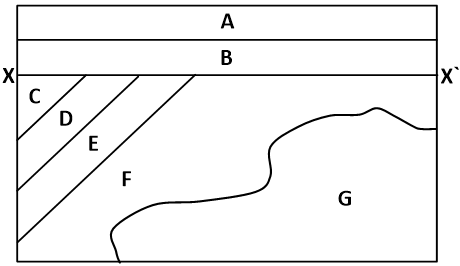
Mesozoic Era and is characterized by the
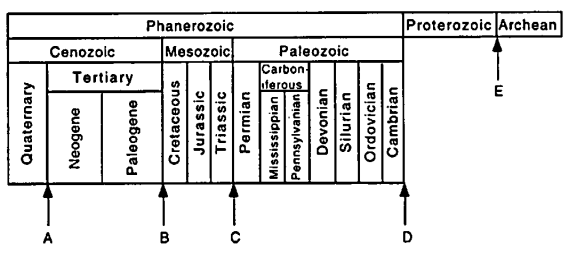
diversification of mammals, birds, and flowering
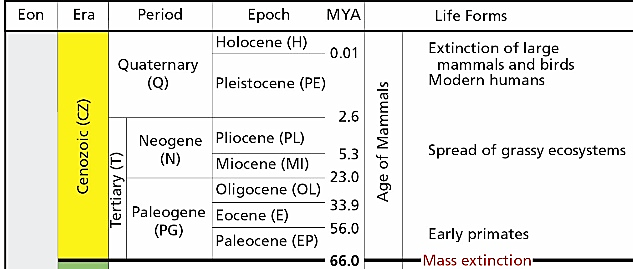
plants, as well as significant geological
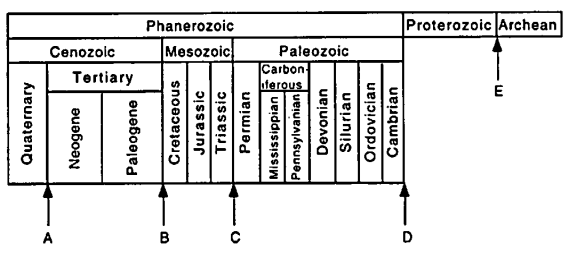
changes. The Cenozoic Era is often referred to
as the "Age of Mammals" due to the
prominence and evolution of mammalian life
forms during this time.
235
Feedback: The Paleozoic Era began approximately 541 million years ago and lasted
until about 252 million years ago. It marked a
significant period in Earth's history
characterized by the diversification of life forms,
including the appearance of early vertebrates,
land plants, and the proliferation of marine
invertebrates. The Paleozoic Era is divided into
-------------------------------------------------------------- six major periods, starting with the Cambrian

1149. The age estimate for point C in the Period and ending with the Permian Period.
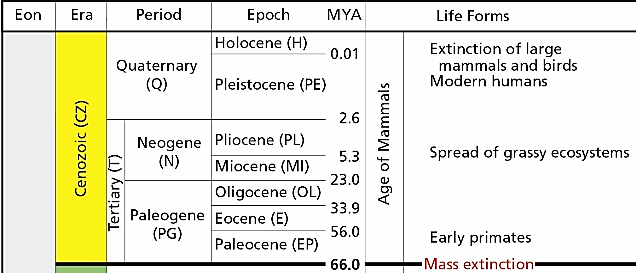
diagram below is ______ million years.
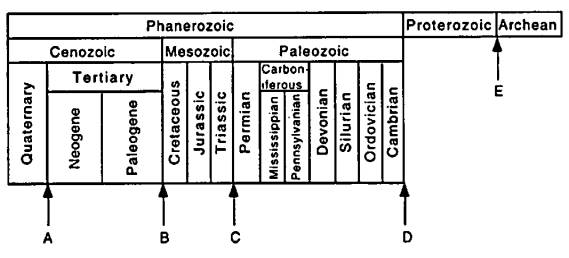
a) 35 -------------------------------------------------------------- b) 65 1151. The age estimate for point E in the c) 252 diagram below is ______ million years. d) 570
Feedback: The Mesozoic Era began approximately 252 million years ago and lasted
until about 66 million years ago. It followed the
Paleozoic Era and preceded the Cenozoic Era.
The Mesozoic Era is often referred to as the
"Age of Dinosaurs" because it was a period
when dinosaurs thrived and diversified. It is
divided into three major periods: the Triassic, a) 570 Jurassic, and Cretaceous periods. b) 2500
c) 3000 d) 4500
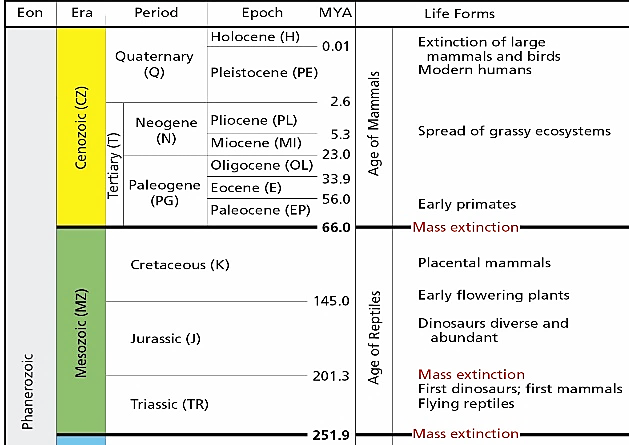
Feedback: The Proterozoic Eon began approximately 2.5 billion years ago and lasted
until about 541 million years ago. This eon is a
major division of geologic time and is known for
significant events such as the formation of
oxygen-rich atmospheres, the development of
eukaryotic cells, and the emergence of early
multicellular life forms. The Proterozoic Eon is
further divided into several eras and periods,
marking important milestones in the Earth's
-------------------------------------------------------------- geological and biological history. 1150. The age estimate for point D in the
diagram below is ______ million years.
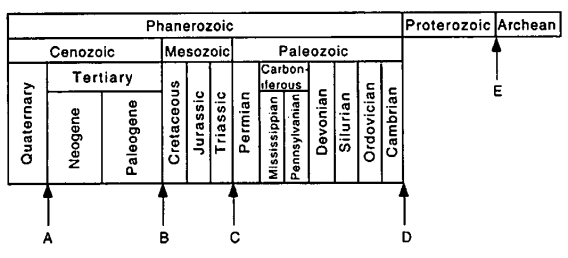
--------------------------------------------------------------
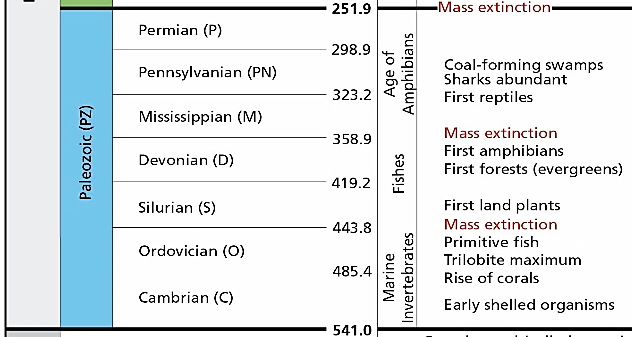
1152. Most periods in the geologic time scale
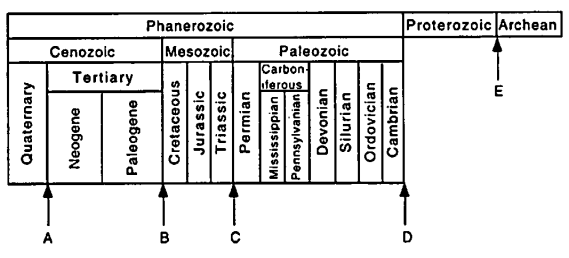
b) 65 a) Geographic localities. 245 b) a) are named for _______. c) 541 c) Fossils. d) Catastrophic events.
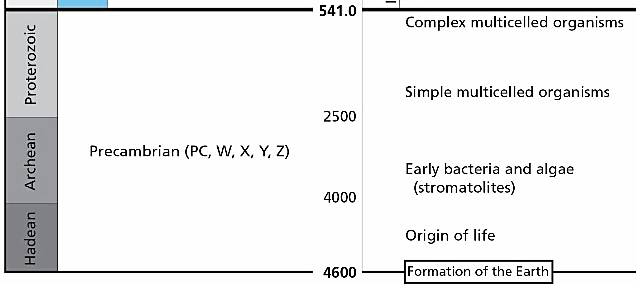
2500 d) Paleontologists.
236
Feedback: Most periods in the geologic time d) Uranium-238. scale are named for geographic localities where
rocks of that age are well-exposed and can be Feedback: Rubidium-87 has a longer half-life studied. These localities often provide than uranium-238, but its usefulness in dating
important insights into the geological and is affected by other factors. While Rubidium-87
paleontological history of the Earth during those has a half-life of about 49 billion years, more
periods. than 10 times longer than uranium-238, it is less
-------------------------------------------------------------- abundant in nature, making it harder to detect
1153. Radiometric dating is possible if a rock and measure. The method of decay also

contains a measurable amount of ______. matters; Rubidium-87 decays by beta emission,
a) Only parent isotopes. which is more challenging to measure than the
b) Only daughter isotopes. alpha decay of uranium-238. Additionally, the
c) Both parent and daughter isotopes. daughter isotope of Rubidium-87, strontium-87,
d) Either parent or daughter isotopes. can be further affected by other processes,
introducing errors in dating. Uranium-238, on
Feedback: Radiometric dating is possible if a the other hand, decays to stable lead-206
rock contains a measurable amount of both through a well-known series, allowing for more
parent and daughter isotopes. The dating reliable dating. Therefore, despite its longer
process relies on the ratio of parent isotopes to half-life, rubidium-87 is less useful for dating
daughter isotopes, so having both present in due to these factors. the rock is necessary for accurate dating.
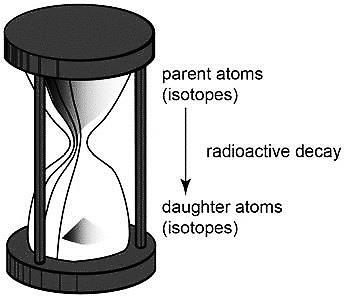
--------------------------------------------------------------
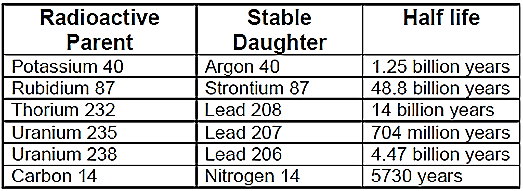
1156. Which of the following radioactive
isotopes has the shortest half-life?
a) Rubidium-87. b) Potassium-40. c) Carbon-14. d) Uranium-238.
-------------------------------------------------------------- Feedback: Carbon-14 has a half-life of 5,730 1154. Which of the following statements years, which is much shorter than the other regarding radiometric dating is FALSE ? three isotopes. Rubidium-87 has a half-life of 49 a) Rubidium is incorporated into minerals as billion years, potassium-40 has a half-life of they crystallize from a melt. 1.25 billion years, and uranium-238 has a half-b) Argon-40 is the daughter isotope of life of 4.47 billion years. potassium-40. --------------------------------------------------------------c) Carbon-14 is useful for dating materials up 1157. Which of the following isotopes is most to 70,000 years old. useful for dating very young wood and d) Sedimentary rocks can be dated more charcoal? easily than igneous rocks. a) Rubidium-87. b) Potassium-40. Feedback: Radiometric dating is typically more c) Carbon-14. applicable to igneous rocks because it relies on d) Uranium-238. the crystallization of minerals from a molten state, which is a process that occurs in igneous Feedback: Carbon-14 dating is most useful for rocks. Sedimentary rocks are often composed dating very young wood and charcoal because of weathered particles from various sources, these materials do not need complex making it more challenging to date them directly pretreatment, and they contain relatively high using radiometric methods. Instead, dating of amounts of carbon compared to other sedimentary rocks often involves dating the materials. Carbon-14 dating is also limited by minerals within them or dating associated the fact that it can only date samples that are igneous rocks or volcanic ash layers. younger than 60,000 years old, as older --------------------------------------------------------------samples have too little 14 C left to be accurately 1155. Which of the following radioactive measured. Other isotopes, such as rubidium-isotopes has the longest half-life ? 87, potassium-40, and uranium-238, have a) Rubidium-87. much longer half-lives and are used to date b) Potassium-40. older rocks and minerals. c) Carbon-14. --------------------------------------------------------------
237
1158. Uranium-238 decays to which of the Feedback: Human evolution is a relatively
following daughter isotopes? recent development in Earth's history. The
a) Rubidium-87. earliest hominins, our distant ancestors,
b) Uranium-235. appeared during the Cenozoic era, which is
c) Lead-206. often referred to as the "Age of Mammals." The
d) Nitrogen-14. Cenozoic era began around 66 million years
ago and continues to the present day. It saw the
Feedback: Uranium-238 decays through a diversification and evolution of mammals,
series of steps to become a stable form of lead. including primates, which ultimately led to the

Each step in the decay chain involves the emergence of modern humans. Therefore,
emission of either an alpha particle (two protons human evolution is associated with the
and two neutrons) or a beta particle (an electron Cenozoic era. or a positron). The decay chain of uranium-238
is also called the “radium series” or “uranium
series” and includes the following elements:
astatine, bismuth, lead, polonium, protactinium,
radium, radon, thallium, and thorium. The final
step in the chain is the decay of lead-206 to
bismuth-206, which is stable and does not
undergo further radioactive decay.
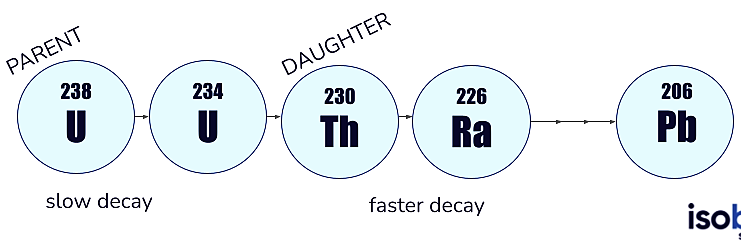
--------------------------------------------------------------
1161. Mammals became abundant during the
________Era?
a) Cenozoic.
-------------------------------------------------------------- c) b) Mesozoic.
a) Rubidium-87. Feedback: Mammals became abundant and Potassium-40. b) diversified during the Cenozoic Era, which is c) Carbon-14. often referred to as the "Age of Mammals." This d) Uranium-238. era began around 66 million years ago and continues to the present day. It witnessed the Feedback: 1159. The radon environmental hazard is d) Precambrian. associated with the radioactive decay of: Paleozoic.
Radon is a naturally occurring evolution and proliferation of various
product of uranium-238. Uranium-238 modern mammals. undergoes a series of radioactive decays, radioactive gas that is produced as a decay mammalian species, including the ancestors of
--------------------------------------------------------------
gas. Radon is colorless, odorless, and dating methods, the age of the earth was tasteless, making it difficult to detect without eventually leading to the formation of radon 1162. Before the development of isotopic
estimated by:
specialized equipment. It can seep into a) Counting the ages of people within
high uranium content, and can pose health risks Bible. when inhaled over extended periods. Testing buildings, particularly those built on soil with successive generations as described in the
for radon levels in homes and taking measures surface today with the geologic record. b) Comparing rates of change on Earth’s to mitigate its presence are important for c) Calculating the rate of cooling of Earth from protecting human health. an assumed initial temperature.
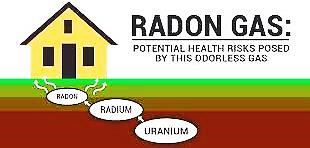
d) Estimating evolution rates from the fossil
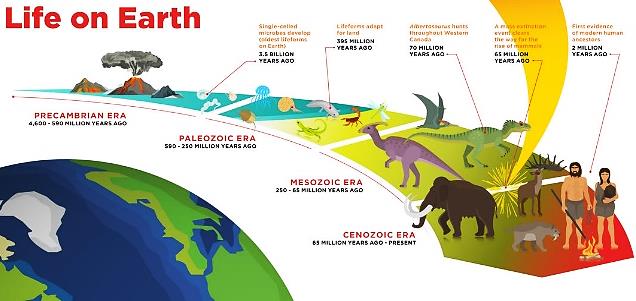
record.
e) All the possible answers are correct.
Feedback: All of the possible answers were used to estimate the age of the Earth before the
development of isotopic dating methods.
-------------------------------------------------------------- The age of the Earth has been estimated using
a) geologic era? rates, and evolution rates. However, these Cenozoic. methods are not reliable because they are b) 1160. various methods, such as biblical genealogies, Human beings evolved during which rates of erosion and sedimentation, cooling
c) Mesozoic. based on assumptions, uncertainties, and Paleozoic. variable factors. Isotopic dating methods, which d) Precambrian. use the decay of radioactive elements, are
238
more accurate and consistent. They have terrestrial ecosystems and helped to create the
revealed that the Earth is much older than conditions for the evolution of land animals.
previously thought, about 4.5 billion years.
--------------------------------------------------------------
1163. Large reptiles became abundant during
the ________Era?
a) Cenozoic
b) Mesozoic
c) Paleozoic

d) Precambrian
Feedback: Large reptiles, including dinosaurs, became abundant during the Mesozoic Era, --------------------------------------------------------------
often referred to as the "Age of Dinosaurs." This 1166. Uniformitarianism: era began approximately 252 million years ago a) Means Earth’s surface - its oceans, and lasted until around 66 million years ago. It continents, and atmosphere - have always
was characterized by the dominance of reptiles, been the same and always will be the
especially dinosaurs, in various terrestrial same. ecosystems. b) Is an outdated theory that states that
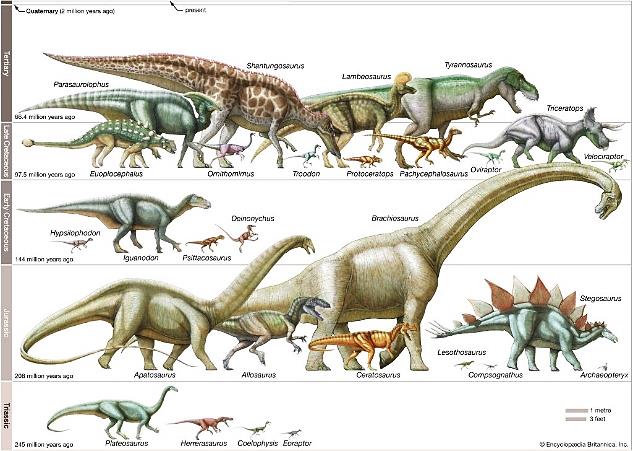
catastrophes like major volcanic eruptions
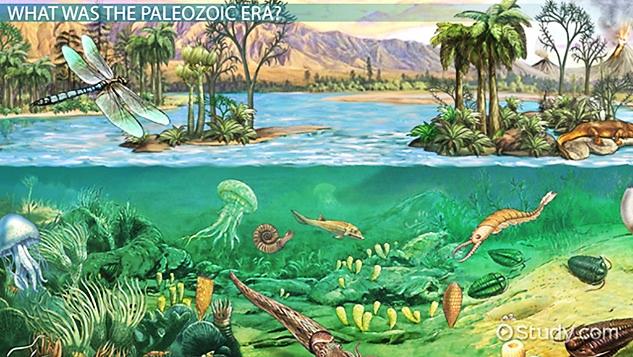
no longer happen.
c) Is illustrated by scientists’ seeing pillow
lava form only underwater, then theorizing
that pillow lava found high in the mountains
today did nevertheless form underwater.
d) Means that neither the scientific past nor
future should be predicted because
physical laws change over time.
e) Is an idea that was formulated by the great
physicist Becquerel in about 1900.
b) Cenozoic. the key to the past." In this context, observing Precambrian, Paleozoic, Mesozoic, the formation of pillow lava underwater and Cenozoic. applying that understanding to the discovery of c) Phanerozoic, Precambrian, Mesozoic, pillow lava in mountainous regions aligns with Cenozoic. the principle of uniformitarianism. It doesn't d) Hadean, Cenozoic, Mesozoic, Proterozoic assume that Earth's surface has always been e) Archean, Paleozoic, Hadean, Proterozoic. the same but rather that the same geological -------------------------------------------------------------- processes have been active over time. 1165. Land plants appeared during the -------------------------------------------------------------- 1164. Which of the following shows four time processes that operate on Earth today have divisions listed from oldest to youngest? been at work throughout Earth's history. It's a) Precambrian, Mesozoic, Archean, often summarized by the phrase "the present is -------------------------------------------------------------- geology that suggests that the same natural Feedback: Uniformitarianism is the principle in
b) Mesozoic Mammals, Age of Dinosaurs, and longest c) Paleozoic named geologic unit of time. d) Precambrian a) a) Cenozoic the following three descriptions: Age of _________Era? 1167. Choose the proper list of names to fit
Mesozoic, Cenozoic, Paleozoic.
Feedback: Land plants first appeared during c) b) Cenozoic, Hadean, Paleozoic.
the Paleozoic Era, around 425 million years d) Cenozoic, Mesozoic, Precambrian. ago. The Paleozoic Era is divided into six e) Mesozoic, Cenozoic, Proterozoic. Phanerozoic, Mesozoic, Precambrian.
periods: the Cambrian, Ordovician, Silurian,
plants that lived in damp, shady environments. when mammals diversified and became the Over time, more complex plants evolved, dominant animals on Earth. It began 66 million including vascular plants that could transport years ago and continues to the present day. first land plants were simple, non-vascular the Age of Mammals, because it is the time Devonian, Carboniferous, and Permian. The Feedback: The Cenozoic Era is also known as
water and nutrients throughout their bodies. By The Mesozoic Era is also known as the Age of the end of the Paleozoic Era, land plants had Dinosaurs, because it is the time when become diverse and widespread. They played dinosaurs evolved and flourished. It lasted from an important role in the development of
239
252 to 66 million years ago and ended with the Therefore, if the entire span of Earth's history is
mass extinction of most dinosaurs. one year, life adapted to land around November
The Precambrian is not an official geologic 1st. time unit, but a term that refers to all the time The answer is d) Approximately November 1.
before the Phanerozoic Eon, which includes the --------------------------------------------------------------
Paleozoic, Mesozoic, and Cenozoic Eras. The 1170. Which of the following statements is Precambrian covers about 88% of Earth’s FALSE? history, from 4.6 billion to 541 million years ago. a) A formation is the name of a rock layer It is subdivided into three eons: the Hadean, the identified by such factors as rock type and

Archean, and the Proterozoic. The approximate geologic age. Precambrian is the longest named geologic unit b) An unconformity is a break in the rock of time. record that indicates the area was
-------------------------------------------------------------- underwater for millions of years. 1168. Which of the following is NOT a method c) The generally accepted age of Earth is 4.57
to determine numerical age? billion years.
a) Carbon-14 dating. d) Varieties of an element that differ only in the b) Radioactive decay of uranium to lead. number of neutrons are called isotopes.
c) Fission-track dating. e) If there are several layers of sedimentary d) Dendrochronology. rock, the oldest layer of rock will be on the
e) Cross-cutting relations. bottom.
Feedback: Cross-cutting relations are a Feedback: An unconformity is indeed a break principle used in relative dating to determine the in the rock record, but it doesn't necessarily
sequence of geological events but do not indicate that the area was underwater for
provide a numerical age. The other methods millions of years. Unconformities represent
mentioned are used to determine numerical gaps in the geologic record, and they can result
ages. from various processes, including erosion, non-
deposition, or even periods of tectonic activity,
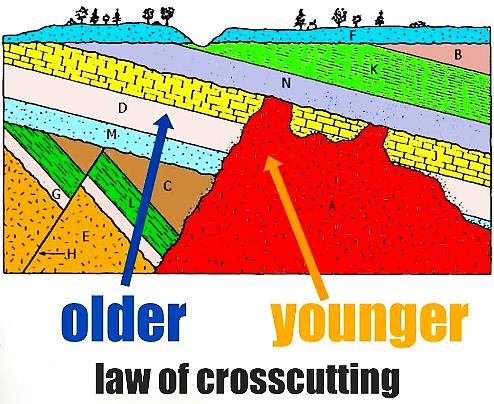
not solely from being underwater.
--------------------------------------------------------------
1171. Which of the following statements is
FALSE? According to the diagram shown:
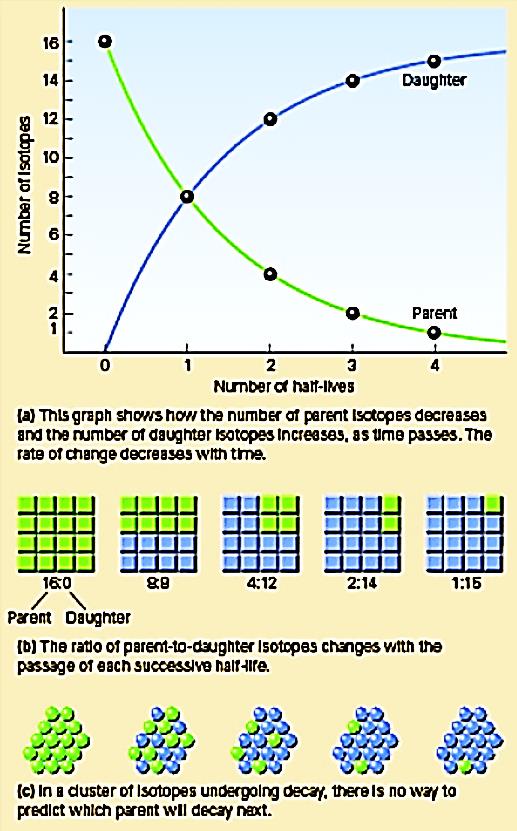
--------------------------------------------------------------
1169. If we use the analogy of the entire span
of Earth’s history being only one year in
length and starting January 1, approximately
when did life adapt to living on land?
a) early August
b) Approximately September 1.
c) Approximately October 5.
d) Approximately November 1.
e) Approximately November 15.
Feedback: Using the analogy where the entire history of the Earth is condensed into 1 year:
The Earth formed around 4.5 billion years ago
Simple life first appeared in the oceans around
3.5 billion years ago
So if the Earth's history spans Jan 1st to Dec The area under the purple curve represents the amount of daughter material formed 31st: from decay of the parent material present. 4.5 billion years ago = January 1st c) land around 450 million years ago the amount of parent material present. b) The first plants and animals adapted to living on a) The area under the green curve represents
450 million years ago = approximately three half-lives, there will also be 14 g of daughter material present. 3.5 billion years ago = somewhere in March If 2 g of parent material are present after
November 1st
240
d) There are equal amounts of parent and c) The igneous intrusion "baked"
daughter material present after the (metamorphosed) the sedimentary rock it
passage of two half-lives. touched.
e) The ratio of parent to daughter isotopes d) The dike is younger than the sedimentary
constantly changes with the passage of rock layers it cuts across. time. e) The inclusions are younger than the
sedimentary rock they are in.
Feedback: The topic is about radioactive decay and the changing ratios of parent to daughter Feedback: Statement e) is false. The principle isotopes over time. In this scenario, the amount of inclusions states that fragments of one rock

of parent material decreases as it decays into unit that are enclosed within another rock unit
daughter material. After one half-life, half of the are older than the enclosing rock unit.
parent material has decayed, resulting in a 1:1 Therefore, the inclusions are older than the
ratio of parent to daughter isotopes. After sedimentary rock they are in, not younger as
another half-life, the ratio becomes 1:3, and so stated in option e). on. This illustrates the fundamental principle of --------------------------------------------------------------
radioactive decay used in isotopic dating 1174. Identify the FALSE statement. methods. a) James Hutton introduced the principle of -------------------------------------------------------------- uniformitarianism. 1172. Which of the following statements is b) Charles Lyell presented the basic principles
FALSE? The principle of: of relative age-dating.
a) Superposition says that in a sequence of c) Henri Becquerel discovered principles of
sedimentary beds, the youngest is on top. radioactivity, which were applied to
b) Original continuity says that sedimentary determining the numeric age of Earth.
layers began as continuous expanses of d) William Smith noted the similarities of rock sediment. layers and fossil assemblages at different
c) Inclusions says that rock containing locations, which led to the process of
inclusions is older than the inclusions. correlation.
d) Cross-cutting relations says that the feature e) William Kelvin calculated that Earth was
doing the cutting is younger than the about 4.4 billion years old. feature it cuts.
e) Original horizontality says that sedimentary Feedback: Lord Kelvin, also known as William
layers started out flat. Thomson, estimated the age of the Earth to be
about 20-40 million years old based on the rate
Feedback: This statement is false because the of cooling of the Earth from a molten state.
principle of inclusions states the opposite: any Kelvin did not know about radioactive decay.
rock fragments that are included in another rock This estimate was later found to be significantly
must be older than the rock that contains them. younger than the actual age of the Earth, which
For example, a xenolith in an igneous rock or a is estimated to be about 4.5 billion years old
clast in sedimentary rock must be older than the using modern dating methods. rock that includes it. This is because the --------------------------------------------------------------
inclusions had to exist before they were 1175. Pebbles within a sedimentary rock and incorporated into the host rock. xenoliths within an igneous rock are
examples of which principle of relative age-
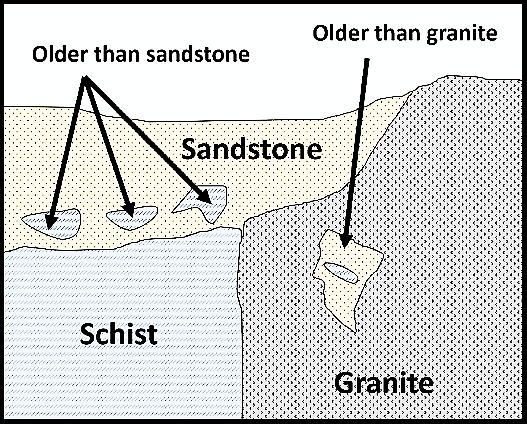
dating?
a) Inclusions. b) Cross-cutting Relations. c) Original Sedimentology. d) Matter within Matter. e) Superposition.
Feedback: Pebbles within a sedimentary rock and xenoliths within an igneous rock are
considered inclusions, which is a principle of
-------------------------------------------------------------- relative age-dating stating that rock containing
1173. An area of slightly dipping sedimentary inclusions is older than the inclusions
rock layers has large inclusions and is themselves. intruded by an igneous dike. Apply the basic --------------------------------------------------------------
principles for determining relative ages, and 1176. Identify the FALSE statement. identify the FALSE statement. Radiometric dating:
a) The sedimentary layers started out lying a) Can begin only when the isotopes cool
flat. enough to lock into the crystal lattice.
b) The oldest sedimentary layer is the bottom b) Can be used only if there’s some uranium
layer. present in the rock.
241
c) Of sedimentary rock dates the time of mica when it first crystallized from the melt,
crystallization of the sedimentary minerals, and the ratio of radioactively produced
not the time of sedimentary rock formation. argon to the unstable parent potassium is
d) Of metamorphic rock tells when the high found to be 7:1, how many half-lives have
temperatures of metamorphism cooled occurred? below the blocking temperatures of the a) 1 half-life. minerals involved. b) 3 half-lives.
e) Requires determining the ratio of parent to c) 7 half-lives.
daughter isotopes in a mineral.

Feedback: The ratio of radioactively produced
Feedback: Radiometric dating is a technique argon to the unstable parent potassium is 7:1,
that can be applied to various radioactive which means that for every 7 atoms of argon,
isotopes, not just uranium. Different isotopes there is 1 atom of potassium left in the mica.
are used to date different types of rocks and The original amount of potassium in the mica
minerals depending on their specific properties can be represented by P, and the amount of
and half-lives. Uranium is just one of the argon produced by its decay can be
isotopes commonly used in radiometric dating, represented by A. Therefore, we have A = 7 and
and there are several others, such as P = 1 in the mica. The half-life of potassium-40
potassium-argon dating, carbon-14 dating, and is 1.248 × 10^9 years, which means that after more, each suitable for dating specific materials this time, half of the original amount of
and age ranges. potassium-40 will decay into argon-40. The
-------------------------------------------------------------- number of half-lives that have occurred can be
1177. Which of the following methods of calculated by using the pocket calculator tool
determining the age of materials is a and the formula: radiometric dating technique?
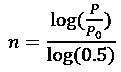
a) Magnetostratigraphy.
c) Seasonal changes in growth rings in Where n is the number of half-lives, P is the travertine deposits and shelled organisms. b) Dendrochronology.
d) amount of potassium-40 left, and P0 is the Measuring the proportions of certain original amount of potassium-40.
e) isotopes with respect to one another. Substituting P = 1 and P0 = A + P = 7 + 1 = 8 Layering in glacial ice. into the formula, we get:
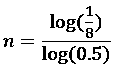
Feedback: Radiometric dating involves measuring the proportions of certain isotopes

(parent and daughter isotopes) in a material to Since n is negative, we can take its absolute determine its age. This technique relies on the value to get the number of half-lives that have known decay rates of radioactive isotopes and occurred: is widely used to estimate the numerical age of

rocks, minerals, and fossils.
Magnetostratigraphy: Therefore, about 3 half-lives have occurred a method that uses the
changes in Earth’s magnetic field recorded in since the mica crystallized from the melt. magnetic minerals in rocks or sediments to --------------------------------------------------------------
correlate them with a global magnetic polarity 1179. Identify the FALSE statement. William
time scale. Smith’s observations: Dendrochronology: a method that uses the a) Were made around 1800 in fresh annual growth rings in trees to date wooden exposures of sedimentary bedrock in the
objects or events associated with them. English countryside. Seasonal changes in growth rings in b) Recognized that groups of fossil species
travertine deposits and shelled organisms: (fossil assemblages) occurred in limited
a method that uses the variations in growth intervals of strata. rates or chemical composition of calcium c) Noted that a fossil species could disappear,
carbonate deposits or shells due to seasonal then reappear in much younger strata. changes in temperature, precipitation, or d) Led to the principal of fossil succession. nutrient availability to date them or events e) Recognized that fossil species progressed
associated with them. from older at the bottom to younger at the
Layering in glacial ice: top of sedimentary strata. a method that uses the annual layers of snow and ice accumulated on
glaciers or ice sheets to date them or events Feedback: Statement c) is false. William Smith
associated with them. did not note that a fossil species could
-------------------------------------------------------------- disappear, then reappear in much younger
1178. In a mica formed from a melt, one of the strata. On the contrary, he observed that once
isotopes of the element potassium decays to a fossil species disappeared from the sequence
produce argon. If there was no argon in the of strata, it never reappeared in younger layers.
242
This implied that the fossil species had become
extinct and were replaced by new species over
time.
--------------------------------------------------------------
1180. On the diagram shown, a geologist has
used principles of stratigraphy to correlate
the geologic material intercepted in each of
three vertical boreholes. Which rock type
consistently " pinches out" landward, causing the units above and below it to be

unconformably against each other at drill
hole C?
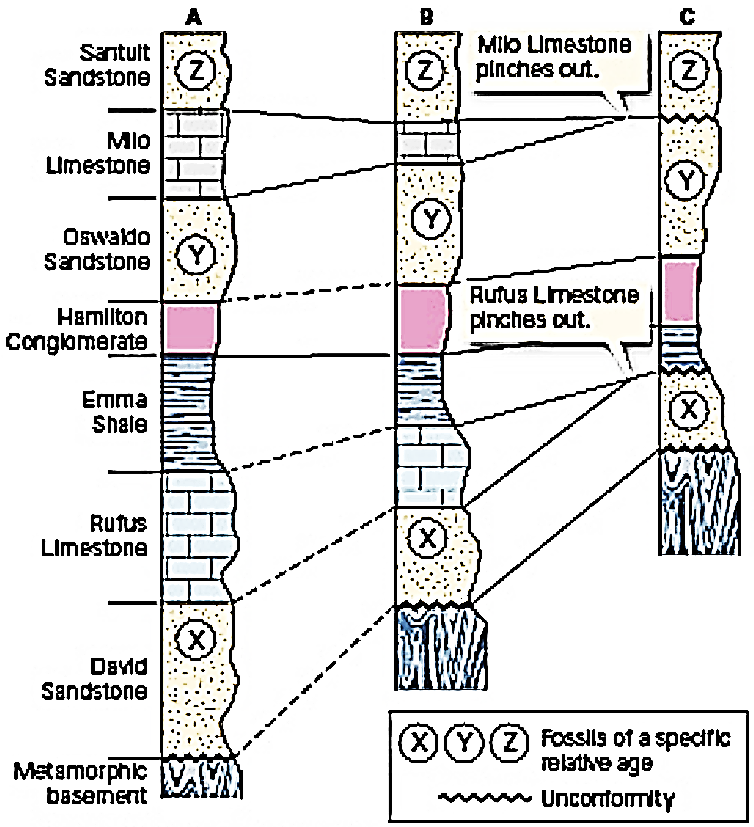
a) Superposition. b) Inclusions. c) Original horizontality. d) Cross-cutting relations. e) All the possible answers are shown in the
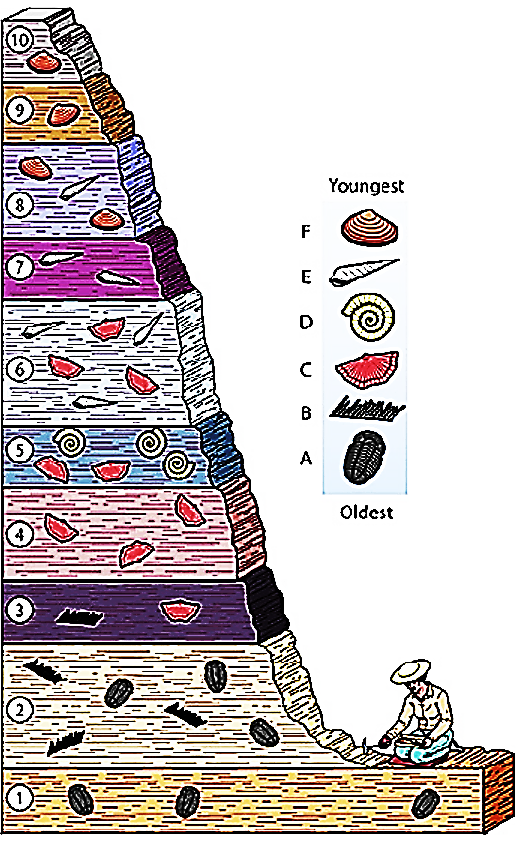
figure.
a) layered sedimentary units that contain fossils Limestone. illustrate superposition, original horizontality, Feedback: A succession of horizontally
b) Sandstone.
d) relations are not exhibited here because there The Hamilton Conglomerate. are no faults or igneous intrusions. c) and the principle of inclusions. Cross-cutting Shale.
Feedback: -------------------------------------------------------------- On the figure, the wavy line is an
unconformity. Note that two different limestone 1183. In the figure below, what is the layer units are found in boreholes pointed to by the arrows, and how do you A and B , but
neither limestone was found in borehole know? C . This means that the limestones were either never
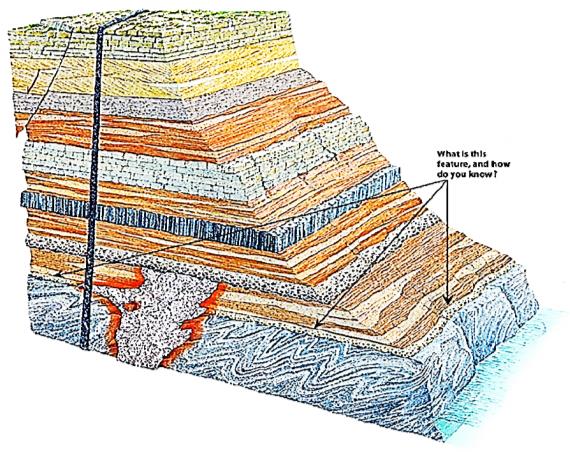
deposited at location C or were both completely eroded away before the deposition of the
overlying rock types.
--------------------------------------------------------------
1181. It’s not possible to say just when an
individual radioactive atom will decay, but it
is possible to say when half of an existing
quantity of radioactive material will be gone.
a) True
b) False
Feedback: Radioactive decay is a random process at the level of individual atoms, and it
is impossible to predict exactly when a single a) An angular unconformity. atom will decay. However, radioactive decay b) The base of a sill. follows a statistical pattern, and the concept of c) A disconformity. half-life allows us to predict when half of a d) A layer of zircon that can be used for age-quantity of radioactive material will decay. dating. -------------------------------------------------------------- e) A horizontal fault of recent age. 1182. Which of the following principles of
relative age-dating is NOT illustrated in the Feedback: The horizon shown separates figure below? folded metamorphosed rock (below) from
relatively undisturbed sedimentary rock
243
(above). It is both an angular unconformity and a) Summer-winter temperature variation. a nonconformity, but the latter (a contact b) Repeated annual patterns. between sedimentary and igneous or c) Carbon-14. metamorphic rock) was not among your d) Cellulose-14 age-dating. choices!. e) Variations in precipitation. --------------------------------------------------------------
1184. In 1815 William Smith correlated strata Feedback: Tree rings and permanent
from many locations and plotted it on paper snowfields (glaciers) can be used for age-
to show the spatial distribution of rock units dating because they exhibit repeated annual

on Earth’s surface. This document was the patterns. Each year, a new ring is formed in a
first modern: tree as it grows, and these rings can be counted
a) Geologic column. to determine the tree's age. Similarly, in
b) Geologic map. glaciers, distinct layers of snow accumulate
c) Stratigraphic column. each year, creating an annual record that can
d) Geologic time scale. be used for dating. This principle relies on the
e) Range. recognition of recurring patterns over time.
Feedback: In 1815, William Smith created the first modern geologic map, which showed the
spatial distribution of rock units on Earth's
surface. This map was a groundbreaking
development in the field of geology and played
a crucial role in understanding the Earth's
geology. Below is William Smith’s Geological Map of England.
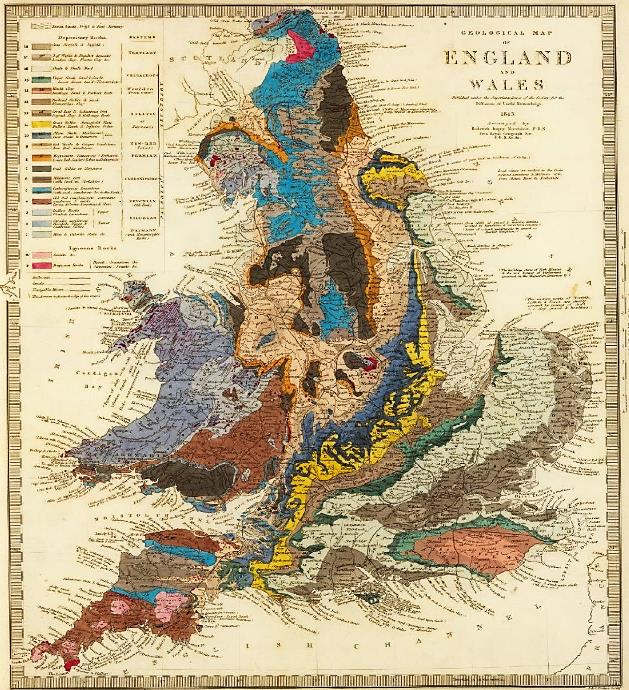
--------------------------------------------------------------
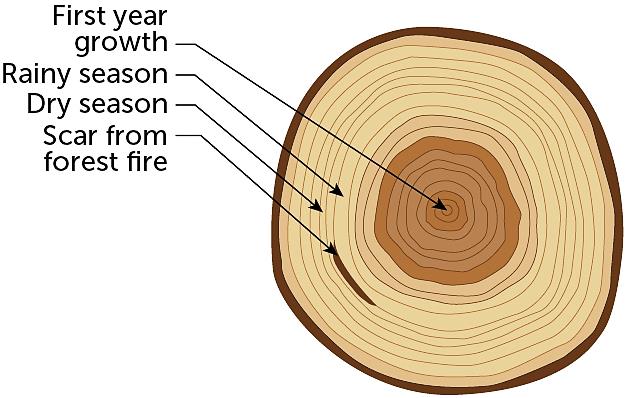
1187. A disconformity is a type of
unconformity in which sedimentary rocks
overlie either igneous or metamorphic rocks.
a) True b) False
Feedback: A disconformity is a type of unconformity in which sedimentary rocks
overlie other sedimentary rocks that are parallel
to each other, but have a gap in time between
them. A disconformity represents a period of
erosion or non-deposition that removed or
prevented the accumulation of some
sedimentary layers. A nonconformity is a type
-------------------------------------------------------------- overlie either igneous or metamorphic rocks of unconformity in which sedimentary rocks
a) rocks were uplifted, metamorphosed, and False True of age; relative dating assigns numbers. nonconformity indicates that the underlying 1185. Numerical dating is just a comparison that have been exposed to erosion. A
b) eroded before the sedimentary rocks were
deposited on top of them.
Feedback: Numerical dating involves assigning specific numerical ages to rocks or
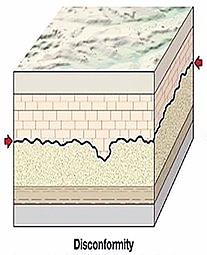
geological events using various dating
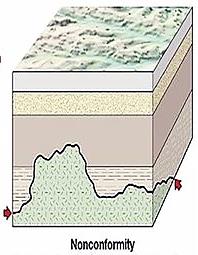
techniques, such as radiometric dating. In
contrast, relative dating does not assign
specific numerical ages but instead establishes
the sequence of events or the relative order of
rocks or geological features. So, numerical
dating goes beyond just a comparison of age; it
provides actual age values.
-------------------------------------------------------------- --------------------------------------------------------------
1186. What principle allows tree rings and 1188. If you equate all Earth history to one
often permanent snowfields (or glaciers) to calendar year, all recorded human history
be used for age-dating?
244
occupies the week from Christmas to New of rock layers and their relative positions in the
Year’s Eve. Earth’s crust. Key beds are usually thin,
a) True widespread, and easily recognizable by their