

The Desclergues of la Villa Ducal de Montblanc, Second Edition Omnibus by Nico Declercq - HTML preview
Download the book in PDF, ePub, Kindle for a complete version.
Tiphaine Raguenel, the esteemed spouse of the individual in question, made a personal gift by including her jewels.
After successfully organizing his troops, Du Guesclin started his military campaign, subsequently confronting the formidable army led by the famed Thomas Grandson. Following a demanding nocturnal march against inclement weather conditions, the individual caught the opposing forces off guard, resulting in a decisive triumph at Pont-Vallain. After engaging in vigorous close-quarters combat, the grandson was subsequently captured by Du Guesclin. After fifty years marked by pride and triumph, English chivalry ultimately experienced a setback and later made payments for the release of captives. As Lefèvre asserts, this outcome was so widespread that even the most junior members of the military, such as squires and Pages, managed to capture prisoners on that particular day.
19.15 Descendants in Spain
© 2024 Nico F. Declercq
The Desclergues of la Villa Ducal de Montblanc, 2nd ed., Omn., VOL. I
19.15. DESCENDANTS IN SPAIN
185
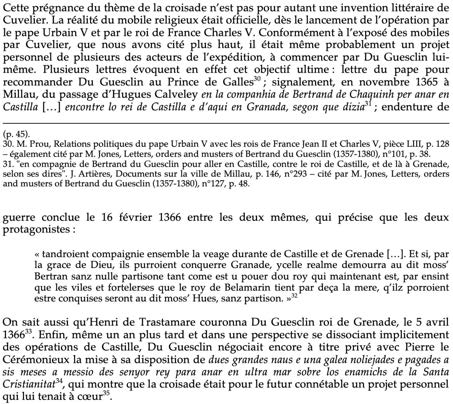
Figure 19.21: Facsimile of pages 25-26 of Lassabatère Thierry. Bertrand Du Guesclin et la
guerre juste : traces et motifs d’une construction légendaire. In: Écrire la guerre, écrire la paix.
Actes du 136<sup>e</sup> Congrès national des sociétés historiques et scientifiques, « Faire la guerre, faire la paix », Perpignan, 2011. Paris : Editions du CTHS, 2013. pp. 18-28. (Actes
des congrès nationaux des sociétés historiques et scientifiques, 136-9). From this document with
proper references, we know that Du Guesclin received support and recommendations by the Pope
and we also know that Henry of Trastamara crowned Du Guesclin king of Granada on April 5,
1366.
19.15.1 Banquet with the King, and Errors in Historical Works
In understanding why the Count of Barcelona warmly welcomed Bertrand Du Guesclin and even invited him for dinner, shown in Figure 19.19 on page 169, it is essential to consider the strategic and historical contexts. The support from Aragon for Du Guesclin can be seen through the lens of medieval geopolitics and shared values. Du Guesclin’s military prowess and strategic acumen were crucial during the Hundred Years’ War and the Spanish War of the Two Peters. His resistance against English claims to French territories, driven by a confluence of feudal obligations and burgeoning French nationalism, made him a significant figure in reclaiming and defending French sovereignty. Aragon’s King saw Du Guesclin as a valuable ally in diminishing English influence in Spain, aligning with Aragon’s interests in regional stability and dominance. The shared knightly values and the moral alignment against Peter the Cruel further solidified this support. Thus, the Count of Barcelona’s warm reception of Du Guesclin was rooted in a combination of realpolitik and mutual benefit.
Historical animosities and alliances also played a crucial role in this welcoming gesture. The longstanding enmity against the Montfort family explained in Chapter 19.20 and dating back to the brutal Albigensian Crusade led by Simon de Montfort, created a shared grievance between Du Guesclin and the Count of Barcelona. The House of Montfort’s actions left a legacy of bitterness in Occitania, which was carried forward into the Breton War of Succession. Du Guesclin’s support for Jeanne de Penthièvre against the Montforts resonated deeply with the Count of Barcelona, who viewed this struggle as a continuation of resistance against a common foe.
Furthermore, as explained in Chapter 19.19, Du Guesclin’s lineage, potentially tracing back to the respected Desclergue family in the County of Barcelona, further endeared him to the Count. This convergence of historical grievances, shared values, and strategic alliances explains the Count of Barcelona’s friendly and welcoming attitude towards Bertrand Du Guesclin.
Bertrand Du Guesclin, undeniably a prominent figure in French medieval history, indeed merits a closer examination due to his remarkable military prowess and influential alliances. In his lifetime, Du Guesclin earned unparalleled recognition for his military acumen, a reputation that led him to become an indispensable advisor to the French King Charles V. His impact extended beyond the borders of France, particularly in Spain, where his military achievements commanded respect, even though his noble lineage was not of the highest echelons.
Above all, Du Guesclin, as explained in Chapter 19.11, had purple blood, being a patrilineal descendant of Desclergues through an ancestor who had flourished as Hakim in Muslim Spain.
While Bertrand Du Guesclin descended from the oldest nobility on our planet, he did not hail from a patrilineal bloodline of the highest nobility, such as Kings. Nevertheless, it is worth noting that he possessed noble ancestry through his mother and other ancestral grandmothers, such as the one described in Chapter 19.13, who hailed from Brittany. His connection with the French King Charles V and his affiliations with the Aragonese King Pere IV of Aragon and the Castilian Enrique de Trastamare undoubtedly played a pivotal role in facilitating his integration into Spanish society. These powerful alliances not only bolstered his status but also likely aided him in forming connections with local Spanish women.
Significantly, the fact that Du Guesclin’s descendants continued to forge marital unions with the high nobility or old nobility, such as Desclergue, Torró, Miquel, underscores the significance of his choice of a life partner from the Torró family. It is improbable that The Desclergues of la Villa Ducal de Montblanc, 2nd ed., Omn., VOL. I
© 2024 Nico F. Declercq
186
CHAPTER 19. BERTRAND DU GUESCLIN
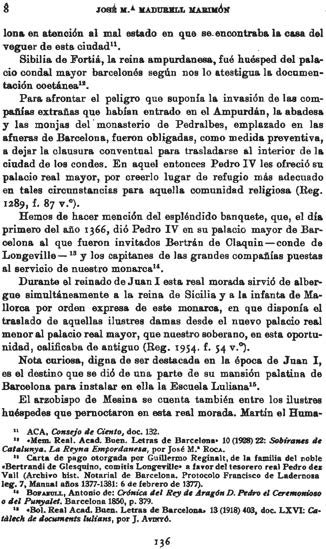
Figure 19.22: Bertrand Du Guesclin was
warmly welcomed in Barcelona by King
Pedro IV of Aragon on the first day of
aJosé M. Madurell Marimón, "El Archivo
Viejo o de las Puertas de Hierro," in Las An-
tiguas Dependencias del Palacio Real Mayor de
Barcelona, in Analecta Sacra Tarraconensia,
Revista de Ciencias Histórico-Eclesiásticas,
Balmesiana, Barcelona, 1941, p.8.
such unions would have been feasible had he chosen a woman of lesser significance.
It underscores his ability to navigate the complex social hierarchies of medieval Europe and his lasting legacy, partially influenced by modern viewpoints, as a figure who transcended the limitations of his birthright through his military prowess and strategic alliances.
In French literature, we find “Doña de Soria, dame de la cour de la reine Jeanne de Castille” as the consort of Du Guesclin in Spain, where it is assumed that she was from a powerful family in Soria, sometimes assumed de Torres. This is, however, impossible.
Either it was caused by misunderstandings, wrong translations from French to Spanish or vice versa, or deliberately to avenge the loss of Soria by du Guesclin.
In reality, Du Guesclin’s consort must have been “dame de la cour de la princesse Jeanne de Aragon”, or in other words, a Lady of Honor in the court of Juana de Aragón.
Juana de Aragón was born in Barcelona on November 7, 1344, and she died in Castellón de Ampurias in 1385. Castellón de Ampurias is also known as Castelló d’Empúries. Juana de Aragón was the princess of Aragon because she was the daughter of King Pedro IV of Aragon and his wife, María de Navarra. She was the countess of Ampurias by her marriage (June 19 of 1373) with Juan I of Ampurias (1338-1398).
Doña de Soria was from the Torró family of Castelló d’Empúries.
We may assume that the alliance between Bertrand Du Guesclin and Doña Torró, later to be known as Doña de Soria, was made by King Pere IV of Aragon during a banquet on January 1, 1366.33 Indeed, the companies, including that of Bertrand Du Guesclin, arrived in Barcelona on Christmas Eve 1365 and were directed to their designated quarters in or around the city. The main dignitaries of the troops, i.e. Bertrand du Guesclin, Hugh de Calveley, Marshal of France Arnoul d’Audrehem and Louis de Chalon (nicknamed the Green Horseman) were warmly received by the king, as evidenced by the pomp displayed by King Pere IV of Aragon (also known as Peter the Ceremonious) during the banquet given in their honor on New Year’s Day 1366.
Indeed, the text in Figure 19.22 on page 186 provides34 a fascinating glimpse into the historical events surrounding Bertrand Du Guesclin, a notable French commander and Constable of France, illustrating his significant standing in medieval European politics.
Specifically, it recounts a grand banquet held in his honor by King Pedro IV of Aragon on the first day of 1366, situated in the grandeur of the Royal Palace of Barcelona. This event underscores Du Guesclin’s importance and reflects the period’s strategic alliances and diplomatic engagements.
During the mid-14th century, regions such as the Ampurdán (The area of Empúries) in Catalonia were plagued by the invasions of mercenary groups, commonly referred to as ’free companies.’ These mercenaries, often comprised of demobilized soldiers from various European armies, posed significant threats to local stability and security. In response to such crises, communities like the nuns from the Pedralbes monastery were compelled to seek refuge within the fortified city of Barcelona, specifically within the Royal Palace, which was deemed the safest sanctuary by the king.
33Pere el Cerimonioós, Crònica, Barcelone, Ed. F. Soldevila, 1971, chap. 6 et 58, p. 1150-1151, chap. 57, p. 1150
34José M. Madurell Marimón, "El Archivo Viejo o de las Puertas de Hierro," in Las Antiguas Dependencias del Palacio Real Mayor de Barcelona, in Analecta Sacra Tarraconensia, Revista de Ciencias Histórico-Eclesiásticas, Balmesiana, Barcelona, 1941, p.8.
© 2024 Nico F. Declercq
The Desclergues of la Villa Ducal de Montblanc, 2nd ed., Omn., VOL. I
187
The splendid banquet hosted by Pedro IV, which prominently featured Du Guesclin among other captains of these mercenary companies, was not merely a social occasion but a profound demonstration of political alliance and mutual support. By inviting Du Guesclin and his captains, Pedro IV acknowledged their crucial role in defending his realm. He secured their loyalty and service amid his territories’ ongoing conflicts. The presence of these esteemed military leaders underscored their significance in the political landscape of the time.
This narrative is corroborated by other historical records, such as a payment letter issued by Du Guesclin’s family member in 1377, further indicating the deep financial and contractual relationships established between Du Guesclin’s forces and the Crown of Aragon. Furthermore, Antonio de Bofafull’s chronicle vividly details these events, painting a broader picture of King Pedro’s reign, known for his strategic matrimonial and military alliances that significantly shaped the political landscape of medieval Spain.
In sum, the banquet for Bertrand Du Guesclin was not just an event of mere ceremonial dining but a strategic focal point that reinforced necessary alliances, showcasing the intertwining of military power with royal diplomacy during a tumultuous era in European history. This occasion vividly illustrates how medieval monarchs utilized grand gestures of hospitality in the face of geopolitical struggles to secure crucial military support and stabilize their reigns. The strategic importance of these alliances cannot be overstated, as they were the bedrock of political stability in a time of uncertainty and upheaval.
Furthermore, the banquet really happened and is not the result of the fantasies of later chroniclers because testimonies are found in the ancient archives of the time.3536
We should also keep in mind that King Pere IV of Aragon had interest in his alliance with the French King and that Henry of Trastamara a few months later, on April 5, 1366, crowned Bertrand du Guesclin as King of Granada, as shown in Figure 19.21 on page 185 clearly shows. In other words, this crowning and his alliances made Du Guesclin more attractive as a husband than one would otherwise tend to believe.
In the initial edition of this book, the author meticulously delineated the accounts found in historical chronicles pertaining to Du Guesclin and his descendants in Spain. Given the aforementioned factors, it becomes necessary to consider that these chronicles, authored one to three centuries following Du Guesclin’s demise, were likely constructed upon hearsay regarding two offspring who were purportedly born in Soria to a lady hailing from the Torró family. These chroniclers, however, were inclined to seek plausible connections within Castile, the geographical location of Soria, and consequently concentrated their attention on noble lineages associated with the ’de Torres’ surname. This approach led them to assert that the Du Guesclin lineage had merged with various noble lineages such as the de Guzman family, the de Fuentes lineage, the commanders of Mudela within the Order of Calatrava, among other imaginative connections. Ultimately, the French chroniclers, later adopted by their Spanish counterparts, seemingly aimed to elevate the lineage of Du Guesclin to a lofty status within the context of the Spanish Empire.
It is imperative to regard all of this information as speculative accounts and, in some instances, deliberate distortions of historical facts.
The sole point of certainty that can be gleaned from historical chronicles is that Du Guesclin fathered two sons during his time in Spain. One of these offspring bore the name Beltran, Bertran or Bertrand and adopted a surname found in various forms, including de Torres, de Tours, Thoreux, or, as our research has revealed, Torró.
The Torró family and their heraldry are described in Chapter 20 on page 215.
19.15.2 ’Dame de Soria’ was not from Soria
19.15.2.0.1 Soria is a Journey through Spanish History and Genealogy Nestled within the heart of Spain lies the picturesque region of Soria, a land steeped in rich history and adorned with tales of lineage and ancestry. Through the annals of time, Soria’s noble families have generated a narrative intertwined with the broader Spanish heritage, tracing their roots back to the historic regions of Navarra and León.
Soria’s aristocracy boasts a proud lineage, with familial ties dating back centuries. These noble houses, often bearing surnames like Rada, Azagra, Bazán, Muriera, Lopez, Fortunez, and Aznarez, are emblematic of the enduring spirit of Spanish nobility. They have historically played pivotal roles in shaping the region’s destiny, from defending against Moorish incursions to participating in the tumultuous politics of medieval Spain.
However, beneath the surface of these noble lineages lies a narrative shrouded in controversy and obscured by the sands of time.
The intricate web of political intrigue, religious fervor, and territorial disputes has often led to the manipulation of historical truths.
Forces such as the Papacy and the Crown of Castile have been known to rewrite narratives, erasing the contributions of certain groups, such as the Templars, the Navarrese, and the Aragonese, in favor of a more streamlined version of history.
Salamanca, a neighboring region, is a notable example of the diverse influences shaping Spanish genealogy. Accounts suggest the presence of families with Breton ancestry, intertwined with local lineages such as Anaya and Paz. Despite this, historical narratives propagated by certain institutions have sought to downplay or erase the contributions of these settlers, perpetuating a myth of a homogeneous Spanish identity untouched by external influences.
Figures like Papa Luna emerge as champions of historical truth, challenging the prevailing orthodoxy and advocating for the recognition of diverse ancestries. They argue against the erasure of contributions from regions such as Brittany, Normandy, and Poitou, highlighting the complexity of Spanish heritage. Yet, amidst the tide of political upheaval and cultural change, certain chronologies, particularly those promoting a monolithic Gothic identity, have persisted, obscuring the true diversity of Spain’s genealogical landscape.
As we move deeper into the labyrinthine corridors of Spanish genealogy, we are confronted with the complexity of our collective heritage. From the Jewish origins obscured by Gothic reinterpretations to the enduring legacy of French aid in the Christian Conquest, the tale of Soria and Spain is one of diversity, defiance, and resilience. It beckons us to challenge established narratives and embrace the richness of our ancestral truth, recognizing that the intermingling of cultures, bloodlines, and historical forces shapes our identities.
19.15.2.0.2 Soria and Du Guesclin French historical records designate Bertrand Du Guesclin’s Spanish consort as the ’Dame de Soria,’ suggesting her origin in the region of Soria. Correspondingly, these records associate her with the surname ’de Torres,’
or at least presume their progeny adopted this name.
However, such an assertion is untenable. A Sorian lineage bearing the name ’de Torres’ would have unlikely allied with Du Guesclin, 35Carta de pago otorgada por Guillermo Reginalt, de la familia del noble Bertrandi de Glesquino, comitis Longeville, a favor del tesorero real Pedro dez Vall (Arcbivo bist. Notarial de Barcelona. Protocolo Francisco de Ladernosa leg. 7, Manual años 1377-1381: 6 de febrero de 1377).
36Antonio de Bofafull, Crónica del Rey de Aragón D. Pedro el Ceremonioso o del Punyalet. Barcelona 1850, p. 379.
The Desclergues of la Villa Ducal de Montblanc, 2nd ed., Omn., VOL. I
© 2024 Nico F. Declercq
CHAPTER 19. BERTRAND DU GUESCLIN
while a counterpart from Aragon would not have possessed the requisite nobility to warrant his alliance. As elucidated in Chapter
19.15.3, it becomes apparent that Du Guesclin’s consort could only have been a woman known as ’Torró.’ It is plausible that French chroniclers, in their translations and interpretations, misconstrued ’Torró’ with the surname ’de Torres,’ given the shared reference to a tower in French.
The implausibility of a noblewoman from Soria engaging in a liaison or marriage with Bertrand Du Guesclin stems from the fact that Sorian nobility typically aligned with Pedro de Trastamara, not Enrique de Trastamara, whom Du Guesclin served as a vassal, supported by the Kings of Aragon and France. Consequently, control over Soria and Molina eventually fell under Enrique de Trastamara, elevating Du Guesclin to Duke of Molina and Lord of Soria. These appointments served as compensation for Du Guesclin’s assistance and retribution against the Sorian nobility, staunch supporters of Enrique de Trastamara, and fervent adversaries of the French.
However, Molina later transitioned into the possession of the King of Aragon due to Enrique de Trastamara’s dubious dealings.
While Du Guesclin briefly resided in Deza, Soria, it was Molina where he maintained prolonged dominion. Given the geographical proximity between Molina and Soria, French chroniclers likely assumed that Du Guesclin’s consort, Torró or Turró, hailed from the neighboring Soria. The notion of her Catalonian origins seemingly eluded chroniclers, thus leading to their fallacious attribution.
This oversight might have even been politically motivated, serving as retribution against Castile by the French monarchy.
Although the precise sequence of events remains elusive, Du Guesclin’s consort certainly could not have been a ’de Torres’ from Soria, as he never held sway in the region’s courts, precluding any noble families from offering their daughters in union with him.
In a conversation with medievalist Jairo Eduardo Cortés Rosal, it was emphasized that the conservative Sorian nobility, aligned with Pedro de Trastamara, vehemently opposed the bestowal of Molina upon Bertrand Du Guesclin, underscoring their antipathy toward him. This animosity likely dissuaded Du Guesclin from establishing a familial presence in Molina, opting instead for brief sojourns. Consequently, no noble family would have countenanced a union between their daughter and Du Guesclin. Therefore, the designation of his consort as a ’de Torres’ from Soria is patently unfounded. The absence of any reprisals against families allied with Bertrand Du Guesclin affirms that none bore the surname ’de Torres’ and establishes the inaccuracy of such claims.
The aversion of Castilians towards Pedro de Trastamara’s demise contrasts sharply with the French perspective, which celebrated it as a triumph, given Pedro’s alliances with Portugal, England, and potentially Gascony, Aquitaine, Brittany, and Normandy—regions subdued by the French crown.
Bertrand Du Guesclin relinquished the countship of Trastamara due to the tarnished reputation of the Trastamara lineage under Enrique de Trastamara, compounded by Du Guesclin’s role in Pedro’s demise, supported by the King of France. These factors collectively preclude the possibility of Du Guesclin forming a familial bond with a ’de Torres’ from Soria.
Conversely, a Torró from Aragon would have been a more plausible match, given the diminished hostility towards Du Guesclin in that region. Nonetheless, it is conceivable that such an alliance would have required establishment before Pedro de Trastamara’s defeat, as even Aragonese nobility would have balked at such a union after that. Nevertheless, the descendants of Du Guesclin would likely have identified more closely with their mother’s lineage, Torró, given the potential repercussions of openly acknowledging their Du Guesclin heritage. Later generations would be more inclined to manifest their patrilinear identity.
The portrayal of the Torres lineage from Soria as descendants of Bertrand Du Guesclin likely originated from the writings of Argote, possibly driven by motives of vengeance. Subsequent misinterpretations by French chroniclers, perhaps influenced by biased translations, further perpetuated this misconception.
In conclusion, Bertrand Du Guesclin’s reputation fared more favorably in Aragon, owing to the strained relations between Pedro IV
of Aragon and Pedro de Trastamara of Castile. Consequently, a union with a lady from Aragon or Catalonia would have been more socially acceptable than in Castile, where animosity towards Du Guesclin and his associates was pronounced. Hence, it is more feasible to entertain the notion of Du Guesclin’s involvement with a Torró in Aragon or Catalonia rather than with a noblewoman from Soria, particularly given the prevailing sentiments of the Sorian nobility at the time.
We must also consider that Du Guesclin has several crusaders among his ancestors and that the blood of the Counts of Barcelona and Toulouse ran through his veins, as described in Chapter 19.13. Therefore, he was an acceptable marriage partner to the Aragaonese and, more precisely, the Catalans and the Barcelonese. Further reasons are explained in Chapter 19.19 and Chapter
19.15.3 Doña Torró - Du Guesclin’s Doña de Soria, and their Offspring
19.15.3.0.1 Context, Heraldry and Perspective Territories in Spain that were of interest to Bertrand Du Guesclin’s adventure in Spain are shown in Figure 19.11 on page 162, such as, as outlined in Chapter 19.22 on page 203, Soria, shown in Figure
19.12 on page 163, Almazán, Atiensza, Deza, shown in Figure 19.13 on page 164 and Figure 19.14 on page 165, and Molina (Molina de Aragón).
As described in Chapter 19.26.1, the French King and his Constable Bertrand Du Guesclin were on the side of H.M. Enrique de Trastámara in the conflict between Peter the Cruel and Henry of Trastámara. This conflict occurred within an ongoing conflict between Castile and Aragon, in which the French King and his Constable Bertrand Du Guesclin were also on the side of Aragon.
H.M. the King of Aragon stood equally on the side of H.M. Enrique de Trastámara.
The families of Soria were on the side of Peter the Cruel. It is not thinkable that any of these families would have had their daughter marry or have children with Bertrand Du Guesclin. They were on a different side, and Du Guesclin was not an established and recognized nobleman in Soria.
When Henry of Trastámara made Bertrand du Guesclin Count of Trastámara in 1366 and Duque of Molina and Soria in 1371 under the Spanish version of his name ’Claquin,’ he likely did this to take revenge on the noble families of Soria because they had not supported him. Du Guesclin, as French constable, would, however, not ally with any woman not from high nobility as it would damage his reputation in France and Spain.
When Du Guesclin resided in Soria, he had offspring with a Lady, but she could not have been from Soria. Only a noble Lady from the Crown of Aragon, from the ancient noble Turró or Torró family, would have been acceptable. French historians with political motives, soon copied by Spanish chronicles, referred to her as ’de Tours’ or ’de Touraine’ and ’de Torres’ and claimed she was a ’de Torres’ from Soria. The claim must have been done to stab the noble lineages of Soria in the back at first and, centuries later, to assert nobility bonds between France and Spain.
When Henry of Trastámara made Bertrand Du Guesclin Count of Trastámara in 1366, he established this new Claquin nobility line in Spain and allowed Du Guesclin to create a new Heraldic shield containing the double-headed eagle from the du Guesclin family and also the three fleurs-de-lys from the Turró or Torró family, as shown in Figure 23.6 on page 251. The use of three fleurs-de-lys suited Du Guesclin in France, too, as the French King must have interpreted it as a reference to France and its Monarchy, while to
© 2024 Nico F. Declercq
The Desclergues of la Villa Ducal de Montblanc, 2nd ed., Omn., VOL. I
19.15. DESCENDANTS IN SPAIN
189
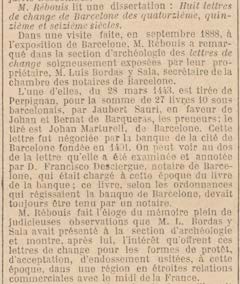
Figure 19.23: Notary Francesc Desclergue, described
as notary of Barcelona, who played a role for the Bank
of Barcelona on march 28, 1443. Citation from ’Jour-
nal officiel de la République française. Lois et décrets’ ,
June 14, 1889. (reference 1889/06/14 (A21, N158) of
Bibliothèque nationale de France.
Du Guesclin, it perpetuated his status as Constable of France.
Nevertheless, Du Guesclin’s glory in Spain did not last very long and went down with the glory of Henry of Trastámara. The County and Dukedoms were lost, and Du Guesclin’s children continued the lineage through the names of ’Torró.’ Their ’Torró’
bloodline was, nevertheless, part of the Torró clan that was already established as a very ancient nobility in Catalonia long before the arrival of Du Guesclin. In other words, not every Torró nobleman is a descendant of Bertrand Du Guesclin.
The lineage leading to Pere Desclergue (DC01) of Montblanc used Torró until Pere Torró i Desclergue (DC01). He was the first to establish the family line of the Desclergues in Montblanc, which is our patrilineal ancestry, the family who founded the famous house on its Main Square.
The Torró ancestry of Du Guesclin’s partner is full of cross-breeding marriages in Girona, with the ‘de Miquel’ family, and this interbreeding continued after that, whereby some descendants chose to go with the family name Torró and others de Miquel throughout this family clan, or both, some descending from Du Guesclin. ‘De Miquel’ used the gryphon as shield, while ‘Torró’ used three fleurs-de-lys, sometimes with the middle one replaced by a tower and sometimes with the outer two replaced by a star. The Desclergues of Montblanc adopted these signs in their heraldic coat of arms, where they placed the gryphon on the helmet and the three fleurs-de-lys as ornaments around their shield. By doing so, they indirectly referred to their Miquel and Torró ancestry and Du Guesclin, who also used the gryphon on the helmet.
19.15.3.0.2 The Specific DNA Clues The Y-DNA Haplogroup of Du Guesclin is described in Chapter 19.27.3 on page 211.
19.15.4 The Descendants of Beltrán Torró, Son of Bertrand Du Guesclin
Based on the literature, Bertrand Du Guesclin produced two sons in Spain. Under the assumption they carried the name Torró, these sons were Beltrán Torró and Guerau Torró. The first was named after Bertrand Du Guesclin and appears as such in the
literature37, the second assumed name possibly is the maternal grandfather’s name.
In 1974, Carmen Batlle i Gallart published research38 on the Torró family of Barcelona and discovered they were split off from the Torró of Castelló d’Empúries. She did not know or discover that one or two of these split-off branches may have been descendants of Bertrand Du Guesclin.
Her article was a continuation of her thesis on Barcelona’s social and economic crisis in the middle of the 15th century.39
Beltrán Torró had a son, Galceran Torró. The latter had two children, Nicolau Torró and Pere Torró. Nicolau had a son, Galceran Torró.
Pere Torró married Eulalia Miquel, and their children were Francesc Torró i Miquel and Joan Torró i Miquel. An investigation by Cortés Rosal revealed that Joan Torró y Miquel and Doña Hostalric had no sons, only a daughter, Eleonor Torró y Miquel. She is the mother of Joan Berenguer Desclergue (DC02), and she was married to our Desclergue forefather described in Chapter 25, Pere Torró y Desclergue.
Francesc Torró i Miquel was royal secretary, and he was married to Clementa Desclergue;40 their children were Eulalia Torró and Francina Torró. The other children of Francesc Torró i Miquel and Clementa Desclergue were two sons, Galceran Torró y Desclergue and Pere Torró y Desclergue (DC01), our patrilineal ancestor.
19.15.5 The Ancestry of Clementa Desclergue
Clementa Desclergue, the wife of Francesc Torró y Miquel, was the daughter of Berenguer Desclergue. The latter was the brother of Francesc Desclergue and Pere Desclergue, also known as Pere de Clerico, a notary from 1445-1461 at Santa Coloma de Queralt.
Berenguer Desclergue was a man of the law, and in 1439, he held the position of local deputy of Montblanc and its ward, which he resigned on January 26, 1440. He must have been well connected with the courtly circles since, on October 5, 1451, and from Tudela, the infant Joan, Duke of Montblanc, appointed him general curator of the Duchy of Montblanc.
The father of Berenguer Desclergue was Francesc Desclergue, found in Figure 19.23 on page 189, and his mother was Doña d’Anguera (alias Desclergue).
Berenguer’s grandfathers were Ramon Desclergue on his father’s side and Bernat Desclergue (Bernat d’Anguera, alias Desclergue), 37Bertrand Thoreux, or de Torres, while Torró is much more plausible.
38Batlle i Gallart, Carme. «Una família barcelonesa: los Torró». Annals de l’Institut d’Estudis Gironins, 1974, Vol. 22, p. 203-210
39C. BATLLE, La crisis social y económica de Barcelona u mediados del siglo XV, Barcelona, 1973.
40We derived that Clementia was Clementa Desclergue.
The Desclergues of la Villa Ducal de Montblanc, 2nd ed., Omn., VOL. I
© 2024 Nico F. Declercq
190
CHAPTER 19. BERTRAND DU GUESCLIN
on his mother’s side. There is a reference to him in the year 1383 in a notary document of 1494 and to his father, Guillem. Bernat d’Anguera was a military, located in Montblanc, like his father Guillem.
Francesc Desclergue, described in Chapter 18.18, the father of Berenguer Desclergue, was a notary in Barcelona in 1443, who played a role for the Bank of Barcelona and he is shown in Figure 19.23 on page 189.
Clementa Desclergue also appears in Chapter 18.20.
The ancestors of Clementa Desclergue are described in Chapter 18. In particular, we find her father, Berenguer Desclergue, in Chapter 18.19, her grandfather, Francesc Desclergue, in Chapter 18.18, her great-grandfather, Ramon Desclergue, in Chapter 18.17.
Ramon Desclergue’s forefathers are described in Chapter 18.16, concerning Gerónimo Desclergue, Chapter 18.15, concerning Pere Desclergue, Chapter 18.12, concerning Guillermo Desclergue, Francesc Desclergue in Chapter 18.11 and Raymond Desclergue in Chapter 18.10.
Clementa Desclergue’s grandmother, the mother of Berenguer Desclergue, was the daughter of Bernat D’Anguera, the son of Guillem D’Anguera. Bernat D’Anguera’s mother was the granddaughter of Guillermo Desclergue, described in Chapter 18.12.
In other words, Clementa Desclergue, through her father, Berenguer Desclergue, descended along two bloodlines from Raymond Desclergue, described in Chapter 18.10.
19.15.6 The Descendants of Guerau Torró, Son of Bertrand du Guesclin
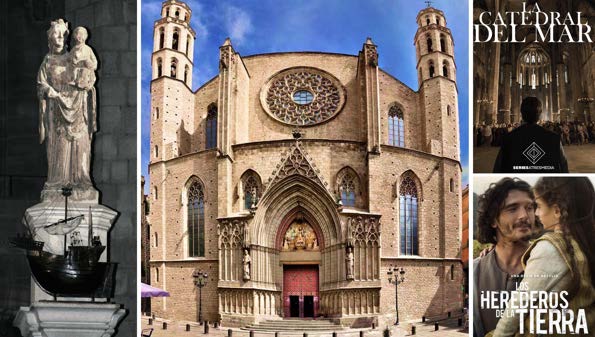
Figure 19.24: The Cathedral Santa Maria del Mar, located in the Ribera district of Barcelona, is an exquisite example of Catalan Gothic architecture. Constructed between 1329 and 1383, the cathedral was built by the parishioners and the port workers of the La Ribera neighborhood. Its majestic structure stands as a testament to the communal effort and devotion of the people of medieval Barcelona. Several members of our Torró, Miquel and Ros family were buried inside the Cathedral Santa Maria del Mar in Barcelona. This historic church, renowned for its architectural splendor, also served as the central building in the two acclaimed Netflix series ’La Catedral del Mar’ and ’Los Herederos de la Tierra.’ Both series offer modern-day interpretations of ancient Barcelona, a time when our ancestors thrived in the city. The main character in these series, Arnau Estanyol, bears a sentimental resemblance to the Desclergues family through his merchant activities and his friendly relations with the Jewish community of Barcelona.
As mentioned in Chapter 19.15.4, a brother of Beltrán Torro existed, while his name is an assumption, namely Guerau.
In her work, Batlle I Gallart, mentioned in Chapter 19.15.4, focuses on Bertrán Torró, who married Sibillia Miquel and is not our ancestor. She observed that the Torró family originated in Castelló d’Empúries, not far from Girona, and that one branch of that family migrated to Barcelona. She found that the brothers’ Jaume and Joan Torró branches remained in Castelló d’Empúries. At the same time, Guerau Torró and his wife Margarida moved to Barcelona, followed by Nicolau, who is the father of the subject of interest to Carmen Batlle i Gallart, i.e. Bertrán Torró, husband of Sibillia Miquel. It was, for instance, discovered by Carmen Batlle i Gallart that Elionor, the daughter of Joan Torró (of the branch that stayed in Castelló d’Empúries), was sponsored by Galceran Torró (the son of Nicolau), who in his will also remembered Francesca Torró, the wife of Pere Miquel. The latter was a graduate of the decrees of Castelló d’Empúries. He also remembered Pere, the son of Francesca Torró and Pere Miquel.41
Carmen Batlle i Gallart observed that Guerau Torró from Castelló d’Empúries was the first of this Torró family to settle in Barcelona. He was, according to Carmen Batlle i Gallart, a faithful servant of Ferdinand I. Guerau Torró was part of the embassy sent by this monarch to Naples in October 1414 to study the possibilities of carrying out the marriage of his second son Juan with the new Neapolitan queen, Juana.42 Carmen Batlle i Gallart, however, did not reach an explanation on why Guerau Torró was so much a trustee of King Ferdinand I of Aragon that he entrusted him with finding a bride for his son. The Torró were, of course, an ancient noble family, but there was more.
To understand this trust, it is important to look closely at King Ferdinand I of Aragon,43 born on November 27, 1380 in Medina 41Archivo Histórico de Protocolos de Barcelona, Francesc Matella, leg. 6, Primer libro de testamentos 1441-1468, 17 de julio de 1454.
42M. de la Cinta Mañé, “Algunos aspectos de la lugartenencia del infante don Juan en Sicilia (1415-14-16),” tesis para obtener el grado de Licenciatura, Barcelona, 1975, pág. 30.
43King Ferdinand I of Aragon is also known as Ferdinand of Antequera. In Catalan, whe was called Ferran d’Antequera, in Castilian, Fernando de Antequera.
© 2024 Nico F. Declercq
The Desclergues of la Villa Ducal de Montblanc, 2nd ed., Omn., VOL. I
19.15. DESCENDANTS IN SPAIN
191
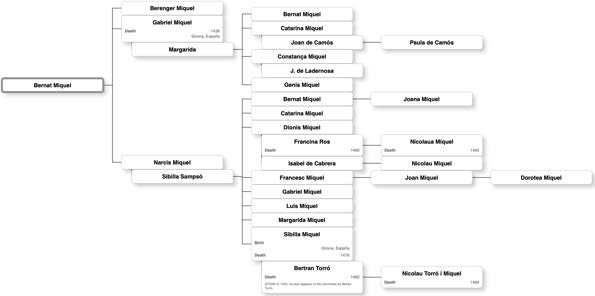
Figure 19.25: The descendants of Bernat Miquel, ancestor of Sibilla Miquel, the wife of Betrán Torró.
del Campo. King Ferdinand I of Aragon died on April 2, 1416 in Igualada. He was the grandson of King Peter IV of Aragon and was the son of King John I of Castile (1358-1390). He was the King of Aragon, the King of Sardinia, and the King of Sicily from 1412 to 1416. Additionally, he was also the King of Valencia, the King of Mallorca, the Count of Barcelona, the Count of Besalú, the Count of Pallars Jussà, the Count of Roussillon, the Count of Cerdagne, and, importantly, the Count of Empúries from 1412
to 1416, as well as the Count of Urgell and the Viscount of Age from 1413 to 1416.
His mother was the Infanta Éléonore of Aragon (1358-1382), daughter of King Peter IV of Aragon and sister of the following two kings of Aragon: John I and Martin I.
King Ferdinand I of Aragon lost his mother when he was two and his father when he was ten. In 1390, his older brother Henry (1379-1406) took over from John I of Castile under the name Henry III.
On the death of Henry III in 1406, he assumed the regency of the kingdom of Castile until 1410 in the name of his nephew John II.
In 1410, the death of his uncle Martin I of Aragon triggered a succession crisis44 in the States of the crown of Aragon. In that crisis, some supported James II, Count of Urgell, the closest descendant of the King in the male line, while others supported the French Louis III of Anjou, the grandson through his mother of King John I of Aragon. Others supported Ferdinand. A conference was held from March 1412 in Aragon, in Caspe, where the influence of Pope Benedict XIII of Avignon led the participants to choose Ferdinand.45 Ferdinand, therefore, became the King of Aragon, the first representative in Aragon of the House of Trastamare.46
So, Ferdinand I of Aragon was the grandson of King Peter IV of Aragon, but also the grandson of Henry II of Castile through his father, King John I of Castile. Henry II of Castile is better known as Enrique de Trastamare, the son of Alphonso XI and Leonor de Guzman and the half-brother of Peter I of Castile, Peter the Cruel, whom he opposed during the first civil war of Castile from 1351 until 1369.
Bertrand Du Guesclin fought on the side of Enrique de Trastamare. In other words, Guerau Torró was the trustee of King Ferdinand I of Aragon, grandson of Enrique de Trastamare. The clue in this story is that Guerau Torró, or Grau de Torró, nephew of our ancestor Beltrán Torró, was the grandson of Bertrand Du Guesclin.
Once Guerau Torró, grandson of Bertrand Du Guesclin and nephew of our ancestor Beltrán Torró, had settled in Barcelona, he was followed by his brother, the money changer Nicolau, probably because of his business, and he was already called a Barcelona citizen at the beginning of the 15th century. From the money changer’s marriage to a woman named d’Estapera, Galceran was born, sponsored by Antonia, wife of the Barcelonese merchant Pere Morer and a relative of the Torrós. Doña d’Estapera was the daughter of Antoni d’Estapera, a notary.47 Thanks to his paternal fortune, Galceran could study law at the Lérida Study and expand his knowledge at the Universities of Toulouse and Montpellier until he obtained the title of Doctor of Laws. In Toulouse, he left some debt and later worked with the Doctor of Laws, Joan Agulló, who always owed him part of his salary. To prepare for his studies and then to carry out his work in Barcelona, he needed to have books, and in fact, we know part of his jurist’s library, which was pawned.48
Carmen Batlle i Gallart focuses much of her article on Bertrán Torró (dead in 1462 and married to Sibillia Miquel), half-brother of Galceran (Doctor of Laws, dead in 1454) and married to Sibilla Miquel (dead in 1476). She writes that Bertrán, son of the money changer and his second wife, Francesca, did not receive such careful cultural training but only the standard education of honorary citizens, the class to which the family belonged. It is explainable, considering he was the second born and destined for business.
The two brothers appear very close. Once their father died (before 1431), they continued to share their father’s house in El Borne, equipped with a bridge. Galceran did not arrange his burial in the Torró chapel in Santa María del Mar. Carmen Batlle i Gallart believes that this is because the chapel would only later become the property of the Torró. Galceran indicated in his will that he be buried in the church of Saint Catherine of the Convent of the Preachers.
Bertrán, husband of Sibillia and possessor of the solid family fortune, seems to have first dedicated himself to commercial businesses and then concentrated his activity in municipal politics until achieving a certain prestige in the City House during the government of the ’buscaris.’
44The War of Succession of Aragon, 1410-1412
45Jacques d’Urgell rejected this decision, but the rebellion he launched was quickly put down.
46The House of Trastamare was the House of the Kings of Castile since 1369.
47BITECA bioid 2924, Antoni D’Estapera, notari, Floruit 1409, Lloc vinculat Barcelona; manid 1050 MS: Barcelona: Arxiu de Protocols, 7 - Constantia Julia, escrit 1409-12-02 a quo.
48Two ’Bartol’ or comments by this jurist on the first part of the ’Digesta nova’ and the second part of the ’Inforsada,’ a Joan Fabra on the ’Instituta,’
a Radulf, several books of the ’Codi’ and others that ended up in the hands of their creditors as a guarantee for the payment of census and life pensions or the purchase of them.
The Desclergues of la Villa Ducal de Montblanc, 2nd ed., Omn., VOL. I
© 2024 Nico F. Declercq
CHAPTER 19. BERTRAND DU GUESCLIN
His situation in establishing the merchants of the Council of Hundred lasted more than twenty years from 1433. Carmen Batlle i Gallart found him in said estate in 1433, 1435, 1436, 1437, 1438, 1446, 1448, 1449, 1450, 1451 and 1452.49 As a buscari he developed great activity. He occupied a prominent place in the Barcelona government, becoming councilor in 1455, the first year merchants and artisans arrived at the conselleria. Certainly, his prestige within the popular group led to his tragic end at the hands of his enemies. Bertran had been a member of the Cortes, a position for which he was elected on October 9, 1454. Bertrán, for his ability and commitment, was re-elected on May 12 of the following year, while the majority of his colleagues were dismissed.50
His dedication to the work of trustee led him to be appointed ambassador of the Corts to King Juan II, who was going to Gerona at the end of August 1456.51
In his mission, Bertrán ran into the members of the Biga, who, already in October 1457, wanted his death, as the notary of the Provincial Council expressed. On October 16 of that year, Bertrán left Barcelona on the ’somatent, towards Caldes to recover Isabel, the widow of citizen Joan Romeu, kidnapped by Pere de Castellbell.
When arriving in Caldes, Bertrán Torró, one of the captains, asked for a bowl of broth because he was faint. Chronicler Jaume Safont tells us that this detail earned him ridicule from his companions. The nickname remained with him until his death, “que més li haguera valgut que hagués bagut plom fus”, he adds, moved by his hatred towards the searchers52 This chronicler hated Bertrán for political reasons despite both being more or less related. Indeed, Jaume Safont was the half-brother of Francesc Torró, royal secretary.
During this long period of the Cortes, a certain contact would occur between Bertrán and Juan, then King of Navarre and then of Aragon, to the point that the Barcelona trustee lent the monarch 500 florins. The debt was left pending due to the expulsion of the King and the violent death of Bertrán Torró, so Juan II included it in his will so that it could be paid by his son Fernando.53
A candle in an iron candelabra illuminated the macabre scene until the moment of the funeral, which occurred at night.
Bertrán Torró’s death is recorded in the death book of Santa María del Mar of Barcelona, his parish, because he owned a large house with a chapel in El Borne, a house that faced Calle de las Moscas and had a bridge. Among other assets, it was inherited by his widow, Sibilla Miquel, who had many conflicts with Nicolau Torró, a money changer, perhaps Bertrán’s natural son or son from a first marriage. The fight was motivated by the possession of the important sum of 3217 pounds of censuses on the kingdoms of Aragon and Mallorca, and the appointment of arbitrators resolved it: Joan Planes, doctor of decrees and canon of the Seu d’Urgell, Arnau Dezmas, doctor of laws from Barcelona and Joan Narcís Saplana. These jurists handed down the sentence before the notary Joan Brujó on June 6, 1496, with their decision favorable to the heirs of Nicolau, who had already died on this date. His relative Francesc Torró, the king’s secretary, inherited a part and used the 400 pounds received to provide for his daughters Francina and Eulalia.
Sibilla, the wife of Betrán Torró, belonged to an important family from Gerona, the Miquel family. Her place in her ancestry tree is shown in Figure 19.25 on page 191. Her father was Narcís Miquel, an honorary citizen with a gentleman brother; her mother, Sibilla Sampsó, belonged to another well-known family from the same city. Five sons and five daughters were born from this marriage, most of whom entered religion: Caterina in Sant Pere de les Puelles in Barcelona, Margarida in Sant Feliu in Gerona, Isabel in Sant Salvador in Perpignan and Aldonga in Belloc de Peralada, Gabriel was abbot of Gerri and Lluís archdeacon of Conflent and canon of Elna, when on January 3, 1456 the Barcelona councilors, including his brother-in-law Torró, recommended him to the Pope.
Of Sibilla’s brothers, the one who Carmen Batlle i Gallart was mostly interested in is Díonís Miquel, for having been the heir to the fortune of his brother-in-law Bertran Torró, along with receiving the surname Torró, which could, however, not be perpetuated on this side either. Indeed, he received the inheritance upon the death of his sister on April 16, 1476. Dionís, like his brothers, entered religion and was a hospital canon in Pamplona, but he abandoned his ecclesiastical career to fulfill his sister’s will. So, he adopted the surname Torró, and he married Francina Ros, signing the marriage chapters on October 15, 1479, before the family notary, Rafael Riudor.
Francina Ros belonged to a family of honorary citizens of Barcelona, the daughter of Joan Ros, a doctor of law, and Margarida. It seems like a good match for Dionís Torró alias Miquel, who was a gentleman and used his brother-in-law’s fortune based mainly on public censuses, like those mentioned above, and private ones like the one paid by the notary Joan Ubach and his family.
From this marriage, a daughter was born, Nicolaua, who died a few months later, barely surviving her mother, who died on April 27, 1490. 54 Dionís went to Castile, where he was in 1494, perhaps to serve King Ferdinand. He then remarried Isabel de Cabrera, with whom he had no children. Dionís lived in Barcelona, where he participated in the municipal government, being councilor ’en cap’ in 1507. He was also appointed consul of the Catalans in Malta on September 18, 1510.55 Perhaps he did not take possession of the position because he died then. His wife survived him and was his heir. So, on November 5, 1511, he made an inventory of his property before the notary Guerau Joan Coromina, who listed the house of Bertrán Torró in Borne.
The Torrós had their own grave in the chapel of Saint Ivo and Saint Eulalia in the church of Santa María del Mar, and their shields appeared there. Santa María del Mar is shown in Figure 19.24 on page 190. The Torrós included a tower between two spearheads on a field of gold. The Miquels applied only two fleurs-de-lis. The Roses used a rose.
In this chapel, badly destroyed in 1936, one can still see the shields of the Miquel, Torró, and Ros on the cartouches and that of the Miquel on the holy water font. The recumbent statues of Sibilla Miquel and Francina Ros were also preserved on the covers of their respective coffins, which have disappeared.56
19.15.7 Historians on Du Guesclin’s Offspring
The life of Bertrand Du Guesclin is very well documented because of his importance to the history of France. Although many of these works are written from a rather French nationalistic viewpoint, from these sources, we must conclude that Du Guesclin has been officially married twice in France and had no legal descendants from any of these marriages. However, the same sources also 49Historical Archive of the City of Barcelona, Deliberations books of those years.
50Manual de Novells Ardits vulgarment appellat Dietari del antich Consell Barceloní, II, Barcelona, 1893, págs, 189 y 207. Sobre dichas Cortes véase S.
SOBREQUÉS, Los orígenes de la revolución catalana del siglo XV, Cortes de Barcelona de 14154-1458, «Estudios de Historia Moderna», II (1952), 1-96.
See also C. BATLLE, La crisis, págs. 331-349.
51Cortes de los antiguos reinos de Aragón y Valencia y Principado de Cataluña, XXIII, págs, 117-118.
52Jaume Safont, Díetari de las zurbasíons del tems del rey Don Joan... Biblioteca de Catalunya, ms. 978, fol. 55 v.
53The claim was presented to Ferdinand the Catholic in the Cortes held against the Catalans as a grievance, and finally the king ordered the payment of the amount owed in five monthly installments (ACA reg, 3,572, íol. 177 v-178 , Alcalá de Henares, February 24, 1498).
54Francina made a will before the notary Miquel Carbonell on April 22, 1490. (José M.a DE ALÓS Y DE DOU, The heraldry in the basilica of Santa María del Mar, «Bulletin of the Society of Attraction of Foreigners» (Barcelona ), 1924, pp. 37.38).
55Antonio Capmany y Monpalau, Memorias históricas sobre la marina, comercio y artes de la antigua ciudad de Barcelona, reed. Barcelona, II, 1961-1963, págs, 857 y 1.029.
56Juan Ainaud, José Gudiol y Federico Verrié, Catálogo monumental de España. La ciudad de Barcelona, Madrid, 1947, I, pág. 125 y II, figs, 738-739.
© 2024 Nico F. Declercq
The Desclergues of la Villa Ducal de Montblanc, 2nd ed., Omn., VOL. I
193
mention that he had a relationship with a lady at Soria in Castile during his stay in Spain between 1365 and 1370 and that there were descendants. At the same time, the reader is urged to read Chapter 19.15.2 and Chapter 19.15.3.
In the medieval era, it was common for nobility to father numerous illegitimate offspring. Unlike today, during that period, illegitimate children were not concealed within the family; they were acknowledged as the offspring of their noble fathers to the same extent as legitimate children. Distinctions between legitimate and illegitimate offspring primarily surfaced in inheritance matters following the father’s demise. In the absence of explicit provisions within a will, illegitimate children were typically excluded from inheriting their father’s assets or titles. Consequently, medieval marriages often served as strategic alliances aimed at facilitating the transfer of wealth and titles, prioritizing pragmatic considerations over romantic affection.
In the case of Bertrand Du Guesclin, this was the same. It is, however, remarkable that he has never had legal children. Therefore, he had no heir when he died.
A son, known from documents,57 was named Michel Du Guesclin and died in 1383. There were also reportedly two children from his relationship with a doña at Soria in Castile in Spain.
Indeed, André Davy, in his book ’Frères d’ Armes,’ writes that Bertrand Du Guesclin joined Torró58, his dame of Soria, in December 1370. He writes,
’Il voyait tendrement s’ écouler les jours auprès de sa Dame De Soria, suivante de la reine Dona Léonor.’
From the relationship of Du Guesclin and his Dame de Soria were two children born. The alliance with his Dame de Soria lasted from 1366 until at least 1370. Other authors write that this Dame de Soria was dame de la cour de la reine Jeanne de Castille. In other words, they are all guessing. What is most likely, as stated above, is that Dame de Soria “dame de la cour de la princesse Jeanne de Aragon”, or in other words, a Lady of Honor in the court of Juana de Aragón59 the daughter of King Pedro IV of Aragon who was supported by Bertrand Du Guesclin and who also acknowledged the military achievements of the Desclergues in Montblanc as shown in Figure 21.1 on page 235, Figure 21.2 on page 237, Figure 21.3 on page 238, and Figure 21.4 on page 239.
In the period 1370-1371, the ’Corts Generals’ of the Crown of Aragon were held in Tarragona, Tortosa and Montblanc, which is described in Jordi Rius i Jové60
Historians also allude to the existence of heraldic shields employed by the descendants of Du Guesclin. However, it is important to underscore that these assertions lack empirical substantiation and are primarily predicated upon presumptions regarding the purported lineage of Du Guesclin within noble Castilian families, including the de Torres and de Guzman clans.
A close look at the tomb of Du Guesclin in Paris reveals an interesting detail. His sword’s handle, seen in Figure 19.10, shows two young persons, in the age range of 9-14 years, mourning on a weapon shield that shows no heraldic symbols. As Du Guesclin died in 1380, his Spanish children, with his Doña de Soria, must have been 9-14 years old at that time. The lack of heraldic symbols on the shield may symbolize that they were not the heraldic heirs in France of Du Guesclin because they did not stem from a legally married couple.
Besides the literature facts shown below, the other tangent pieces of evidence are DNA with fractions of old Breton families found in our DNA, and a paternal line separated from ours around 1000 years ago (based on the Y-DNA Haplogroups) exists near the ancestral villages of Bertrand Du Guesclin. Gathering these facts forms compelling evidence, although critics would say that the old Breton autosomal DNA may also appear through some noble lineages passing through the Torró family.
Next, we will summarise what is known about each child and present the testimonies in the literature.
In Chapter 19.26.3, we describe the evidence of Bertrand Du Guesclin visiting Montblanc in 1365 and 1370. Later, Montblanc was under the influence of de Trastámara, but the connections in that area must be searched in the Girona area instead.
19.15.7.1 On Michel Du Guesclin (DG12)
He was a son of Du Guesclin in France and is mentioned in the Chamber of Accounts register of 1380, f ° 17a, for a receipt of twenty-nine ’Livres tournois’ which are granted to him in consideration of his services. He was a bastard of Bertrand Du Guesclin and Jeanne de Laval. He served very briefly in Flanders and established himself in Normandy.
19.15.7.2 On Beltran Torró (DT01), our ancestor
He was Du Guesclin’s son in Spain. He received his father’s first name, and if historians are right about him, he must have followed in his father’s military footsteps despite their confusion with the name Beltran de Torres. According to their accounts, in that case, he was a Commander of Mudela in the Knight’s Order of Calatrava.
The historians’ accounts, despite the name confusion and that fact that the boys of Bertrand Du Guesclin were Aragonese and not Castilian, is somewhat reasonable, because the Order of Calatrava played a significant role in the Crown of Aragon during the era of the Reconquista. Their presence in this region can be traced back to 1179 when Alfonso II, known as ’the Chaste,’ granted them the territory of Alcañiz and its surrounding areas. In this newly acquired domain, the order established various ’encomiendas’ and
’subencomiendas,’ with the Alcañiz Commission emerging as the most prominent.
The Calatravas of Alcañiz significantly contributed to the ongoing Reconquista efforts. They gradually expanded their influence by acquiring strategic locations such as Monroyo in 1209, Alcorisa in 1263, Calaceite in 1271, and Calanda in 1360. Their territorial holdings extended even further to encompass Bejís in 1235, and they briefly controlled Villena in the Kingdom of Valencia.
However, the Encomienda of Alcañiz faced a steady decline beginning in 1533, marked by the death of Juan de Lanuza, the commander of the order and Viceroy of Aragon. Subsequent papal bulls resulted in the transfer of authority over the encomienda to the monarchs Carlos I and Felipe II.
In the 18th century, the Alcañiz encomienda experienced fragmentation as Valdealgorfa, La Codoñera, and Torrocilla de Alcañiz gained independent jurisdiction, marking a significant transformation in the organization and governance of the region.
19.15.7.3 On Guérech Torró (DT01b)
He was Du Guesclin’s son in Spain. There is no direct evidence in the literature as to what the first name of this descendant was.
It may be Guérech, a Breton name appearing in Catalonia as Guerau, Gerau, or Grau, another word for Gerardo. In Jean Ogée61,
57le registre de la Chambre des Comptes en 1380
58André Davy, like all historians, wrote Torres and not Torró.
59Juana de Aragón was born in Barcelona on November 7, 1344, and she died in Castellón de Ampurias, in 1385. Castellón de Ampurias is also known as Castelló d’Empúries. Juana de Aragón was princess of Aragon, because she was the daughter of King Pedro IV of Aragon and his wife María de Navarra. She was the countess of Ampurias by her marriage (June 19 of 1373) with Juan I of Ampurias (1338-1398).
60Jordi Rius i Jové, ’Capítols de Cort de Barcelona i Fraga, 1379-1384’ , Institut d’ Estudis del Baix Cinca-I.E.A., IEBC.
61Jean Ogée, ’Dictionnaire Historique et Géographique de la Province de la Bretagne’
The Desclergues of la Villa Ducal de Montblanc, 2nd ed., Omn., VOL. I
© 2024 Nico F. Declercq
194
CHAPTER 19. BERTRAND DU GUESCLIN
it is found that the name was considered a Breton version of Girard, which in Spanish transforms either to Gerardo or to Grau.62
Some sources state that the Lords of de Fuentes (from the land of Sevilla), such as Pedro de Fuentes, Gómez de Fuentes, and Alvaro de Guzmán, descend from Bertrand Du Guesclin. Other sources say this is not true and suggest that de Fuentes stem from a mercenary who accompanied Bertrand Du Guesclin (e.g., a cousin or someone else) during his stay in Spain. Alonso López de Haro even explains the origins of the Lords of de Fuentes and does not consider Bertrand Du Guesclin. As stated above, we figured out that all such claims are fiction and that Du Guesclin had no offspring with a Torres lady from Soria, but rather with a Torró lady from Gerona.
The reader will find that we have DNA connections with Guzmán and Fuentes. Still, since it concerns autosomal DNA, it’s impossible to reconstruct which ancestry line the links appear along.
Other sources state that Grau de Torres and Juan Gutiérrez de Torres, come from this house founded in Soria. They settled in Arévalo and Cuéllar, where they perpetuated the family name, consistent with other information. This is, however, also fiction.
19.15.7.4 An Undated Reference
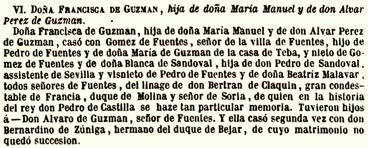
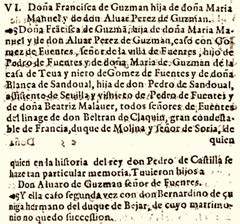
Figure 19.26: Narrative on Doña Francisca de Guzmán, daughter of Doña
María Manuel and Don Alvar Pérez de Guzmán. (Courtesy of R. Grouazel-
Krauss)
The narrative in Figure 19.26 says that Doña Francisca de Guzmán, daughter of Doña María Manuel and Don Alvar Pérez de Guzmán, married Gómez de Fuentes, lord of the town of Fuentes, son of Pedro de Fuentes and Doña María de Guzmán of the house of Teba, and grandson of Gómez de Fuentes and doña Blanca de Sandoval, daughter of don Pedro de Sandoval, assistant to Seville and great-grandson of Pedro de Fuentes and doña Beatriz Malabar, all gentlemen are of Fuentes, of the lineage of don Bertrand de Claquin, great constable of France, Duke of Molina and Lord of Soria, of whom in the history of King Don Pedro de Castilla such a particular memory is made. Doña Francisca de Guzmán had children by Don Álvaro de Guzmán, Señor de Fuentes; and she married a second time to don Bernardino de Zúñiga, brother of the Duke of Bejar, from whose marriage there was no succession.
19.15.7.5 A Reference by Cuvelier, 14th Century
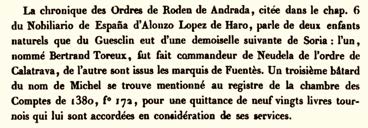
Figure 19.27: Narrative by Cuvelier. (Courtesy of R. Grouazel-Krauss)
We investigated a transcript, shown in Figure 19.27 found in Ernest Charrière (éd.), Chronique de Bertrand du Guesclin, par Cuvelier, trouvère du XIVe siècle, Paris, Firmin-Didot, 1839 (2 tomes).
The narrative tells that the chronicle of the Orders of Roden de Andrada, quoted in chap. 6 of Alonzo Lopez de Haro’s Nobiliario de España, speaks of two natural children that du Guesclin had from a young Lady from Soria:
A) one, named ’Bertrand Toreux’ (Bertrand Torró (DT01)), who was made Commander of Neudela of the Order of Calatrava, B) from the other (DT01b) stem the Marquis de Fuentès.
C) A third bastard named Michel (DG12) is mentioned in the Chamber of Accounts register of 1380, f ° 17a, for a receipt of nine twenty ’Livres Tournois’ granted to him in consideration of his services.
The challenge at hand revolves around Cuvelier’s limited access to information regarding the subsequent generations following Du Guesclin’s children, whence facts were clearly added here in later times. Consequently, these later historical accounts contain supplementary data characterized by a blend of propaganda, inaccurate details, and unsubstantiated rumors interwoven with factual elements, mirroring a pattern consistent with other historical references of its kind.
19.15.7.6 A Reference by Francisco de Rades y Andrada, 1572
As shown in Figure 19.28, we examined Francisco de Rades y Andrada, ’Chronica de las tres ordenes y cauallerias de Sanctiago, Calatraua y Alcantara: en la qual se trata de su origen y successo, y notables hechos en armas de los maestres y caualleros de ellas:
.. Compuesta por el licenciado Frey Francisco de Rades y Andrada’ , printed in 1572 by Juan de Ayala.
62Perhaps this name made historians believe that Don García de Torres, Bishop of Burgos, was a Descendant of Grau, son of Du Guesclin and buried in his Cathedral in Burgos after his death.
© 2024 Nico F. Declercq
The Desclergues of la Villa Ducal de Montblanc, 2nd ed., Omn., VOL. I
19.15. DESCENDANTS IN SPAIN
195
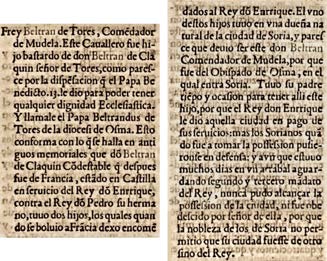
Figure 19.28: Narrative by Francisco de
Rades y Andrada, 1572. (Courtesy of R.
Grouazel-Krauss)
The narrative reports that ’Frey’ (i.e. a brother of a brotherhood) Beltran Torró (DT01) was Commander of Múdela. This Knight was the bastard son of Don Beltrán de Claquin, Lord of Torres (i.e. Tours), as is seen from the dispensation that Pope Benedict 13
gave to have any Ecclesiastical dignity. The pope called him ’Beltrandus de Torres of the Diocese of Osma’ (where Soria is located).
Indeed, he must have been born there while his mother, a Torró from Gerona, resided there. The use of the word ’Torres’ by an Italian or Latin writing pope would also not disagree with the name Torró.
Note that although Bertrand Torró was born in Soria (probably in Deza), he never actually possessed Soria. Indeed, his father (Beltran de Claquin) had had the time and the opportunity to have sons at Soria, but he could never take possession because the local nobility opposed him strongly. King Don Enrique had given the ownership of the town to Claquin, but the Sorianos protested and defended against him taking the city. And although he spent many days in a suburb waiting for the King’s second and third mandate, he could never take control of the city, nor could he exercise his claim as Lord of the town because the nobility there did not allow it. This is a very strong indication that his woman could not have been a Torres from Soria, but, as we state, was a Torró from Gerona.
19.15.7.7 A Reference by Juan Manuel, 1575
Figure 19.29: Narrative by Juan Manuel, 1575 (Cour-
tesy of R. Grouazel-Krauss). This text is essentially
the same as the narrative by Juan Manuel, Infante de
Castilla, 14th century, shown in Figure 19.26.
We researched Juan Manuel, ’El Conde Lucanor’ , 1575, shown in Figure 19.29. The narrative, in English, says that Doña Francisca de Guzmán daughter of doña María Manuel and don Alvar Pérez de Guzmán, was married to Gómez de Fuentes, the Lord of the town of Fuentes, son of Pedro de Fuentes and doña Maria de Guzmán of the house of Teva and grandson of Gómez de Fuentes and Doña Blanca de Sandoval, daughter of Don Pedro de Sandoval, assistant to Seville and great-grandson of Pedro de Fuentes and Doña Beatriz Malabar. All mentioned gentlemen of Fuentes are from the lineage of Don Beltrán de Claquin, Grand Constable of France, Duke de Molina and lord of Soria of whom in the history of the king don Pedro de Castilla such a special memory is made.
She had children with Don Álvaro de Guzmán, the Lord of Fuentes. She married a second time with Don Bernardino de Zúñiga, brother of the Duke of Bejar, of whose marriage there was no offspring.
Note that we have DNA in common with persons carrying the names Sandoval, Guzmán, Fuentes, Zúñiga, as shown earlier in Chapter 73, but there is no possibility to show through which bloodlines we inherited this DNA. As stated above, the claims made in this reference came ex-post-facto, 2 centuries after Du Guesclin passed away and are the imagination of the chronicler.
19.15.7.8 A Reference by Gonzalo Argote de Molina, 1588
We have taken a close look at Gonzalo Argote de Molina, ’Nobleza de la Andalucia. Historia de las hazañas y de los caballeros del reinado de Jaén’ , printed in Sevilla by Fernando Diaz, 1588 and shown in Figure 19.30.
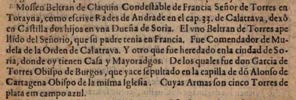
The narrative says that Mosén Beltrán de Claquin, Constable of France, Señor de Torres in Torayna, as Rades de Andrade writes in chap. 33. Calatrava, left two children in Castile with Doña de Soria. One child was Beltran Torró (DT01), who had the Lordship’s surname, which his father had in France. He was Commander of Múdela of the Order of Calatrava. The other child (DT01b) was the heir of the Lordship of the city of Soria, where he inherited titles and possessions. From the latter child (DT01b) stem (among others) Don García de Torres, Bishop of Burgos, who lies buried in the chapel of Don Alonso de Cartagena and who was bishop of the same Church. His weapons were five silver towers on a blue field.
Again, this chronicler confuses ’de Tours’ with ’Torró’ and imagines it must be ’de Torres.’
The Desclergues of la Villa Ducal de Montblanc, 2nd ed., Omn., VOL. I
© 2024 Nico F. Declercq
196
CHAPTER 19. BERTRAND DU GUESCLIN
Figure 19.30: Narrative by Gonzalo Argote de Molina, 1588.
19.15.7.9 A Reference by Medro Porralis, 1591
We have found Medro Porralis, ’Coronica del Serenissimo Rey Don Pedro, hijo del Rey don Alonso de Castilla y con licencia de su Magestad impressa’ , 1591.
This reference focuses on King Don Pedro and describes ’Mossen Beltran de Claquin’ frequently, including the fact that he became the Lord of Soria, for instance, in chapter VIII on page 154. His offspring is, however, not mentioned in this reference.
19.15.7.10 A Reference by Andre Fauyn, 1620
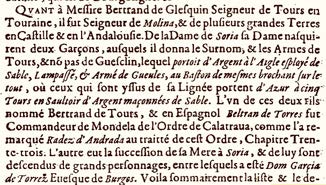
Figure 19.31: Narrative by Andre Fauyn,
1620 (Courtesy of R. Grouazel-Krauss)
We evaluated Andre Fauyn, ’parisien, advocat, en la cour de Parlement’ , ’Le theatre d’ honneur et de chevalerie, ou L’ histoire des ordres militaires des roys, & princes de la chrestiente, & leur genealogie: de l’ institution des armes, & blasons , Volume 2’ , 1620, shown in Figure 19.31.
The narrative says that Messire Bertrand de Glesquin, Lord of Tours in Touraine, was the Lord of Molina and several vast lands in Castile and Andalusia. From his Lady in Soria were two boys born, to whom he gave the name, and the arms of Tours, not of Guesclin. His sons wore either a shield of Argent à l’ Aigle esplayé de Sable, Lampassé, and Armé de Gueules, in Baston of the same debris on the whole, or on Azure five Towers in Saultour d’ Argent masonry of Sable. One of these two sons was named Bertrand de Tours (DT01), or Beltran de Torres in Spanish, and was Commander of Mudela of the Order of Calatrava, as Radez d’ Andrada noted in that Order’s treaty, Chapter Thirty-three. The other (DT01b) had his mother’s succession in Soria, and from him descended great personages, among whom was Dom Garcia de Torrez (DT02e), the Bishop of Burgess.
Again, the assumption that they should be Torres because du Guesclin was Lord of Tours, is the imagination of the chronicler who copied from earlier works. The real name must have been Torró. The consequence on the assumed shields of the descendants is a simple deduction by the chronicler from his inaccurate statements.
19.15.7.11 A Reference by Alonso Lopez de Haro, 1622
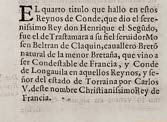
We refer to Alonso López de Haro (criado de su Majestad, y Ministro en su real Consejo de las Ordenes), ’Nobiliario genealógico de los reyes y títulos de España. Dirigido a la Magestad del Rey Don Felipe Quarto nuestro señor.’ , printed (con privilegio) in Madrid, by Luis Sánchez Impresor Real, in 1622. The extracts are shown in Figures 19.32, 19.33, and 19.32. Alonso López de Haro describes how Mosén Beltran de Claquin received the title of Count of Trastámara. He was rewarded the honor by King Don Henrique II as a token for his support. It is found in the referred book and Chapter 3 of year 7 of King Don Pedro’s chronicle and equally in Esteban de Garibay in book 14 of part 2 of his compendium chapter 38. The title of ’Count of Trastamare’ did not last long because King Henrique II lost the conquered kingdoms temporarily. The Dynasty did not reinstall it in its contemporary form.
One would later give it to another dynasty.
In 1371, Du Guesclin was bestowed with other titles as compensation. He became the Duke of Molina and Soria. The title of Count of Trastámara, Lemos and Sarria went to Don Pedro of Castile.
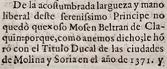
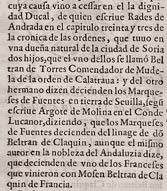
Du Guesclin, who was the natural owner of Soria, had two children: Beltran Torró (DT01), Comendador de Múdela of the Order of Calatrava; At the same time, the other (DT01b) was the natural heir of Soria, and his offspring gave rise to different lineages of descendants, including, as some say, the Marquises of de Fuentes from the land of Sevilla. Argote de Molina stated this in ’Conde Lucanor’ . In particular, concerning the Fuentes line, Alonso López de Haro declares that this line may have originated from a mercenary who was with Du Guesclin (possibly a nephew or brother) and not Du Guesclin himself. Therefore, in the 1600s, there were two opinions concerning the House of ’de Fuentes’ . The Dynasty of de Fuentes received the Duchy of de Soria through a dowry payment in the time of H.M. King Enrique III. This House would later carry the name of ’de Guzmán’ . Alonso López de Haro further declares that everything indicates that Francisco Hernández was the first person to represent the House of de Fuentes at Soria, that he was Spanish, and not French. He achieved this title by marrying Leonor Pérez. The latter was from the Guzmáns of the House of Orgaz. The heraldic shield used by de Fuentes is that of the House of Orgaz, with five flowers and being bordered.
The name came from Alsonso Fernandez de Fuentes, the first to take this surname from Fuentes’ town’s dominion. The latter was a Knight who served King Don Juan I and became the city owner, bought from the sons of Martin Fernandez de Guzmán, Lord of Almonte and a rich man from Castile. In other words, Alonso López de Haro makes several claims that the ’de Fuentes’ family are not descendants of Du Guesclin.
© 2024 Nico F. Declercq
The Desclergues of la Villa Ducal de Montblanc, 2nd ed., Omn., VOL. I
19.15. DESCENDANTS IN SPAIN
197
Clearly this chronicler mixes rumors with facts and then adds logical deductions based on inaccurate claims. However, he was right in concluding that they were not descendants of Du Guesclin.
Figure 19.32:
Alonso López de Haro writes that Bertrand Du
Guesclin received the title of Count of Trastámara.
Figure 19.33:
Alonso López de Haro describes how Bertrand Du
Guesclin after he had lost the title of Count of Trastámara, was re-
warded with the titles of Duke de Molina and Duke de Soria.
Figure 19.34: Alonso López de Haro describes the two children of Du
Guesclin and writes about the line of de Fuentes, which is disputably
stemming from one of them showing arguments against, but also leaving
sufficient doubt.
19.15.7.12 A Reference by Père Anselme de Sainte-Marie, continuée par Honoré du Fourny, 1726-1733
We have shed some light on Anselme de Sainte-Marie (1625-1694 ; augustin), ’Histoire généalogique et chronologique de la maison royale de France, des pairs, grands officiers de la Couronne, de la Maison du Roy et des anciens barons du royaume. Tome 6 / par le P. Anselme de Sainte-Marie, continuée par Honoré du Fourny’ , book published by la Compagnie des libraires (Paris) in 1726-1733.
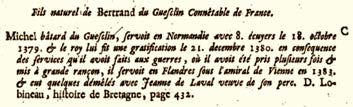
The narrative, shown in Figure 19.35, says that Michel Du Guesclin (DG12), bastard of Bertrand Du Guesclin, served in Normandy with eight noblemen on October 18, 1379; the King gratified him on December 21, 1380, for his services during the wars. He also served briefly in Flanders under the leadership of admiral Vienne in 1383. He had some problems with Jeanne de Laval, the widow of his father.
19.15.7.13 A Reference by Michaud frères, 1814
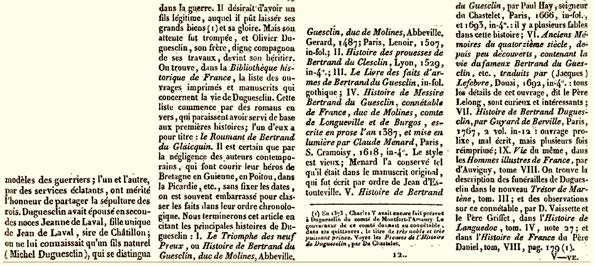
We studied Michaud frères, 1814, ’Biographie universelle, ancienne et moderne, ou, Histoire, par ordre alphabétique, de la vie publique et privée de tous les hommes qui se sont fait remarquer par leurs écrits, leurs actions, leurs talents, leurs vertus ou leurs crimes: ouvrage entièrement neuf, Volume 12’ . This article, shown in Figure 19.36, is written from a French perspective and confirms a son of Du Guesclin in France, with Jeanne de Laval, namely Michel Du Guesclin. It’s also referring to famous works about Du Guesclin, and it exposes the ancient spelling of this family name, such as du Glaicquin.
19.15.7.14 A Reference by Christine de Pisan, 1824
We have reviewed Christine de Pisan, ’Collection complète des mémoires relatifs a l’ histoire de France - Du Guesclin, tome 2
Anciens Mémoires sur Du Guesclin, 1er et 2me parties’ , edited by Petitot de l’ imprimerie de Rignoux, 1824. This article states that Du Guesclin left no children in his two marriages. Still, according to Rodez de Andrada’s testimony, in his chronicle of orders, he had had in Spain two natural sons, of a young lady in the town of Soria. One of these sons, named Bertrand Toreux, was Commander of Neudela, Order of Calatrava; From the other, it is said, descend the Marquis de Fuentès. Du Guesclin had certainly a third natural son; because one finds in the registers of the chamber of accounts, in the year 1380, a receipt of 29 ’Livres tournois’ , paid by order of the King, to Michel, bastard son of the late Comte de Longueville, constable of France, ’for consideration of several good and pleasant services that said Michel (DG12) would have done for him in his wars, which he has been taken several times, and put in great ransom.’
The fact that still stands out in this reference is that Bertrand Torró, son of Bertrand Du Guesclin, was Commander of Neudela (or Mudela), even when de Pisan spells his name as was Toreux and not, like other chroniclers, de Torres.
19.15.7.15 A Reference of Alberto y Arturo Garcia Carraffa, 1952-1958
We have examined Alberto y Arturo Garcia Carraffa, ’El Solar Catalán Valenciano y Balear - con la colaboración de Armando de Fluvia y Escorsa’ , San Sebastián, Librería Internacional, in particular 1952-1958, 87: 110-111 and 112-113. The reference is interesting for ’de Torres’ lineages, but is unimportant to the descendants of Du Guesclin because they cannot have been ’de Torres.’
Lucia Mosquera Novoa, shown further, like many others, also refers to Los Carraffa.
The Desclergues of la Villa Ducal de Montblanc, 2nd ed., Omn., VOL. I
© 2024 Nico F. Declercq
198
CHAPTER 19. BERTRAND DU GUESCLIN
Figure 19.35: Citation of D. Lobineau, histoire de Bretagne, page 432.
Figure 19.36: Statements by Michaud frères, 1814 (Courtesy of R. Grouazel-Krauss)
19.15.7.16 A Reference of Roberto Calvo Torre
In an online article (in ’Solo Genealogie’) about Capitán Gaspar Sánchez de Torres, born at Evoria in Aragon in 1615 and dead in Venezuela, the different de Torres lineages are mentioned. The work is interesting to read, but does not concern descendants of Du Guesclin because they did not carry the name ’de Torres,’ but ’Torró.’
19.15.7.17 A Reference of Lucia Mosquera Novoa, 2015
Before reading this secion, the reader might be interested to read Chapter 19.15.3 on page 188 first. We have read with great interest Lucia Mosquera Novoa, tesis doctoral ’Juan de Torres: edición y estudio de su poesía’ , Universidade da Coruña, 2015.
We refer to chapters ’2. 1. Orígenes de un linaje’ and ’2. 2. 2. Juan de Torres, from the Soria lineage’ and ’2. 2. 2. Juan de Torres, from the Soria lineage.’
Lucia Mosquera Novoa describes that there are many, sometimes confusing, sources in antique literature, which point at old noble origins of the ’de Torres’ families in Spain, with roots in the Kingdom of Navarra in the 13th century, the most famous one being Gutierre López de Torres, chief of the nobles of the Navas de Tolosa in 1212. The author points out that there are numerous branches of this clan, probably all having different origins.
The genealogists closest to the 15th century, typically refer to two essential lineages, namely the ’de Torres of Soria’ and the ’de Torres of Jaén’ . Some genealogists claim that the ones of Soria, descend from Bertrand Du Guesclin. Thus, the name Torres is said to derive from ’Torrayna’ , a French domain owned by Du Guesclin63, or from the surname of the unknown lady of Soria’s family with whom he had children; We cite Georges Minois,64
’La maîtresse attittrée de Bertrand en Castile es, d’ après d’ Ayala, la ’dame de Soria’ , dont nous ignorons le nom, mais qui appartenait, semble-t-il, à la puissante famille de Los Torres, un des clans dirigeants de Soria. Cette dame faisait partie des suivantes de la reine Jeanne, femme d’ Henri, très influente auprès son mari, assure Cuvelier. Est-ce par son intermédiaire que Soria fut donné à Du Guesclin, afin de rapprocher les deux amans? Ce n’ est pas impossible. Bertrand a maintenant deux fils de la dame de Soria.’
It is, however, highly unlikely that the Soria noble families would have allowed any of their daughter to become the wife of Du Guesclin. It is therefore almost impossible that any of the Torres bloodlines that stem from Soria, would carry the blood of Bertrand Du Guesclin. Despite the very high quality of Lucia Mosquera Novoa’s work and its particular interest to Torres families, the work does not concern Bertrand Du Guesclin.
19.15.7.18 A Reference of Lucia Mosquera Novoa, 2017
We refer to the book ’De Lagrymas Fasiendo Tinta. Memorias, identidades y territorios cancioneriles,’ edited by Virginie Dumanoir, in the series ’Collection de la Casa de Velázquez’ , 2017; and in particular the chapter written by Lucia Mosquera Novoa, ’El problema de la homonimia en la identificación histórica de Juan de Torres, poeta y caballero del siglo XV’ . This chapter is a brief version of her thesis of 2015, elaborated in Chapter 19.15.7.17.
On pages 139-152, we cite reference 29,
63Núñez de Castro 1653: 371
64Georges Minois, ’Du Guesclin’ , 1993, page 351.
© 2024 Nico F. Declercq
The Desclergues of la Villa Ducal de Montblanc, 2nd ed., Omn., VOL. I
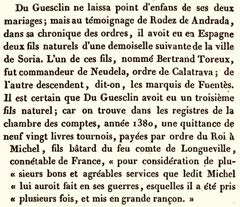
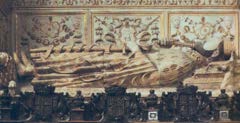
19.16. DU GUESCLIN’S BRIEF BIOGRAPHY
199
Figure 19.37:
Words by Christine de Pisan, 1824.
(Courtesy of R. Grouazel-Krauss)
Figure 19.38: The tomb of Enrique II of Trastámara,
the first king of Castile from the Trastámara dynasty,
who died on May 29, 1379. He ascended to the throne
after killing his half-brother, Peter I of Castile. Enrique
II was the illegitimate son of Alfonso XI, and his rise to
power marked a significant shift in the Castilian monar-
chy.
’Algunos consideran antepasado del linaje Torres de Soria a Bertrand du Guesclin,65, ...’
Despite the assumptions made by Lucia Mosquera Novoa in her work of very high quality, there are no reasons to believe that Du Guesclin would have had offspring with a Torres from Soria. Instead, his woman must have been a Torró from Gerona and their two sons were born at Soria, but they were not Torres. Despite the connections Lucia Mosquera Novoa found in later generations of Torres with Aragon, they were not the descendants of Du Guesclin.
19.16 Du Guesclin’s Brief Biography
Bertrand du Guesclin, son of Robert Dugesclin and Jeanne de Malesmains, was born circa 1320 at Château de la Motte-Broons in Dinan, Brittany, France. Some sources, such as Acques Saillot, suggest 1311 or 1314 as his birth year66. He had several sisters and two brothers. Du Guesclin died on July 13, 1380, in Châteauneuf-de-Randon, Lozère, Languedoc-Roussillon, France. He held titles such as Comte de Longueville and Connétable de France. He was also titled King of Granada (1369 - July 13, 1380), Ducque of Soria and Molina (1369 - July 13, 1380), Condestable de Castilla (1369 - July 13, 1380), and Count of Borja (1366 - July 13, 1380).
While Du Guesclin’s professional life was illustrious, his personal life was equally intriguing. He was married twice, first to Thiéfaine Raguenel, the Vicomtesse de la Belière and daughter of Robert Raguenel and Jeanne de Dinan, who sadly passed away in 1371.
His second marriage, on January 21, 1373, was to Jeanne de Laval, the daughter of Jean de Laval and Isabeau de Tinténiac.
He also had extramarital relationships, and it is from a union in Spain that the Desclergues descend.
In 1341, Du Guesclin served alongside Charles de Blois in military operations. On July 25, 1364, he made a donation to Raoul de Beauchamp and Clémence Du Guesclin, as noted by Gaultier et Dupaz67.
Du Guesclin participated in the Battle of Cocherel in 1364, capturing Jean Grailly. That same year, he married Thiéfaine Raguenel.
On May 26, 1371, he leased land to Raoul de Beauchamp and Clémence Du Guesclin. In January 1374, he signed a marriage contract with Jeanne de Laval in Rennes, Brittany6869.
Du Guesclin died on July 13, 1380.
19.17 Du Guesclin’s Appearance in Spain: War of Two Peters
The War of the Two Peters, fought between Castile and Aragon from 1356 to 1375, was a protracted contest between Peter of Castile and Peter IV of Aragon for the sovereignty of Castile. The English supported the former through Edward III and his son, while France supported the latter. Furthermore, Navarre and Portugal were drawn into the conflict. The outcome placed Aragon in a position of dominance, although the Black Death had severely impacted their economy before the conflict.
Castile was in turmoil at the beginning of the 14th century due to a civil war that pitted the crowned king Peter of Castile and his allies against his half-brother Henry of Trastámara, shown in Figure 19.38 on page 199, and his supporters, including the French commander Bertrand du Guesclin and his troops. The trajectory of du Guesclin can be found in Figure 19.41 on page 206. This conflict, also known as the War of Two Peters, was connected to the larger Hundred Years’ War. Peter, King of Castile, desired to obtain control of the Kingdom of Valencia, which consisted of the regions of Murcia, Elche, Alicante, and Orihuela. On the other hand, King Peter IV of Aragon desired dominance over the Mediterranean Sea in opposition to Castile and its ally, Genoa.
An incident occurred between these two powers regarding Catalan galleys supported by Mossèn Francesc de Perellós of Aragon and assisting France in its war against England. The Catalan crew of Perellós was able to seize two Genoese ships at Sanlcar de Barrameda. At the same time, the Castilian armada commanded by King Peter of Castile pursued them to Tavira but failed to capture them.
Peter of Castile and Henry of Trastámara fought in the border region between Castile and Aragon from 1356 to 1375, with the 65Núñez de Castro, Historia Eclesiástica y Seglar de la Muy Noble y Muy Leal Ciudad de Guadalaxara, p. 371 y Argote de Molina, Nobleza de Andalucía, pp. 425-426.
66Acques Saillot, ’Tome XX - Encyclopédie généalogique de la Noblesse de France,’ 2018.
67Gaultier et Dupaz, ’Histoire généalogique de plusieurs maisons illustres de Bretagne, enrichie des armes et blasons d’icelles de diverses fondations d’abbayes et de prieures,’ 1619.
68Tome VI - 3e Edition - Histoire généalogique de la maison royale de France et des grands officiers de la couronne et de la maison du Roy.
69Tome XX - Encyclopédie généalogique de la Noblesse de France,’ 2018.
The Desclergues of la Villa Ducal de Montblanc, 2nd ed., Omn., VOL. I
© 2024 Nico F. Declercq
CHAPTER 19. BERTRAND DU GUESCLIN
Castilians capturing Aragonese cities such as Teruel. On March 9, 1357, Castile advanced into Aragon and conquered Tarazona. The same year, on May 8, a peace treaty was signed. Castilians captured several fortresses, including Verdejo, Alhama, and Torrijos, at the beginning of 1361. On May 18, however, a peace treaty was signed, and the subjugated territories were returned to their original proprietors. This agreement, also known as the ’Peace of Terrer’ or ’Peace of Deza,’ was mediated by the Aragonese ambassador Bernardo de Cabrera. Peter IV of Castile betrothed his daughter Constance to Frederick III the Simple to solidify the truce.
In June 1362, Charles II of Navarre and Peter of Castile met in Soria and pledged mutual assistance. Peter allied with The Black Prince and his father, King Edward III of England. After concluding the negotiations, the monarch of Castile made a covert incursion into Aragon’s territory, resuming hostilities. Peter of Castile discovered the Aragonese monarch in Perpignan without an army and was caught off guard. The Castilians captured Arize, Atece, Terrer, Moros, Cetina, and Alhama; however, despite a full-scale siege, they were unable to seize Calatayud. Peter then returned to Seville without advancing further.
In 1363, Castile again laid claim to Tarazona, reigniting the conflict between the two parties. Pedro of Castile sought assistance from Portugal and Navarre, while the monarch of Aragon sought aid from France and an alliance with Henry II of Castile. Pedro of Castile was ultimately victorious, capturing Cariena, Teruel, Segorbe, Morvedre, Almenara, Xiva, and Bunyol.
On July 2, 1363, the papal nuncio Jean de la Grange initiated peace negotiations with Mourvedre (Sagunt), but the treaty was never ratified, resulting in ongoing hostilities. From 1363 to 1369, the Castilians initiated a campaign to penetrate the Kingdom of Valencia, invading and capturing cities such as Alicante, Caudete, Elda, and Gandia. During this time, Peter of Castile was focused on thwarting Henry of Trastámara’s attempt to seize the throne of Castile. Peter was ultimately dethroned in 1366 and encountered opposition from Henry, Bertrand du Guesclin, and Hugh Calveley, among others.
Peter, feeling threatened, fled his dominion immediately and did not remain to battle the opposing forces. He retreated from Burgos first, then Toledo, and finally Seville. He brought his treasury to Portugal, where his uncle, Peter I of Portugal, greeted him with hostility. Peter traveled from Portugal to Galicia in northern Spain, where he issued orders to murder Suero, the archbishop of Santiago, and Perálvarez, the dean. Both were devoted Henry supporters.
In 1369, Henry overthrew and murdered Peter of Castile. Throughout the War of the Two Peters, the Kingdom of Granada supported Peter. Castilian forces and their Moorish allies invaded southern Valencia during the conflict. This led to a period of low-level devastation and political instability. Unfortunately, in 1364, their siege of Orihuela was ineffectual.
John I of Castile and Eleanor of Aragon contracted their marriage to reclaim the comarcas that Aragon had conquered. Eleanor of Aragon was the daughter of Peter IV of Aragon, whereas John I of Castile was Henry II of Castile’s successor. Lordship of Molina was one of the comarcas that Castile reclaimed. Due to the destruction of the Aragonese economy by war, the Black Death, scarcity, and a scourge of locusts, there was a significant population decline. In addition, the Cathedral of Tarazona was destroyed and not rebuilt until much later. Intriguingly, it is believed that this conflict contributed to the development of administrative and military forces that set the groundwork for a unified Castile and Aragon in the following centuries.
In Spanish, the War of Two Peters is also known as La Guerra de los Dos Pedros, and, in Catalan, La Guerra dels dos Peres.
19.18 Bertrand du Guesclin’s Chivalric and Strategic Motives in the War of
the Two Peters
To gain a deeper insight into Bertrand du Guesclin’s motivations during the War of the Two Peters and his subsequent perception by the Aragonese nobility, we draw extensively on the scholarly work of Thierry Lassabatère.70 Bertrand du Guesclin, a prominent figure from the fourteenth century, famously participated in the War of the Two Peters in Spain, which pitted Peter I of Castile against his half-brother Henry of Trastámara. The reasons for du Guesclin’s involvement and subsequent appreciation by the regional powers of Aragon and Barcelona can be distilled from political, personal, and ideological motives.
Initially, du Guesclin’s entry into the Spanish conflict was primarily motivated by political and strategic considerations linked to the broader Franco-English rivalry during the Hundred Years’ War. The Kingdom of France, under Charles V, saw an opportunity to weaken England’s ally, Peter I (known as "Peter the Cruel"), by supporting his rival, Henry of Trastámara. Du Guesclin, having earned a reputation for his military prowess and leadership, was chosen to lead the "Free Companies" — groups of mercenaries ravaging the French countryside during a lull in the conflict with England — and redirect their activities toward a politically helpful purpose.
This intervention was about removing mercenaries from French soil and expanding French influence in Iberia at England’s expense, especially after the English-supported Peter I defeated Henry in the Battle of Nájera (1367). The reversal of this outcome was crucial for France’s strategy, which relied on weakening English alliances and extending French influence across the Pyrenees.
His contemporaries framed du Guesclin’s campaign in Spain — notably in Cuvelier’s "Chanson de Bertrand du Guesclin" — as a war of cause. The conflict was depicted as a moral and ethical obligation to depose a tyrant (Peter the Cruel) who was notorious for his alleged injustices and cruelty, including the murder of his wife, alliances with Muslim kingdoms, and general tyranny. These actions were portrayed as violations of Christian and kingly duties, legitimizing Henry’s claim and the intervention by external forces like du Guesclin under the doctrine of just war. This portrayal aligned with the medieval concept of chivalry and the responsibilities of nobility to uphold justice and Christian values.
Du Guesclin’s efforts in Spain earned him significant admiration from the regional powers, notably the King of Aragon and the Count of Barcelona. His military success against Peter the Cruel directly benefited these rulers by stabilizing the region and removing a despotic leader whose actions destabilized Castile and its neighboring realms. Furthermore, du Guesclin’s role in reinstating Henry of Trastámara aligned with their interests in promoting a more balanced power dynamic in Iberia, which could resist English influence more effectively.
The nobility of Aragon, Barcelona, and Empúries appreciated du Guesclin for his immediate military achievements and his longer-term impact on the region’s geopolitical stability. By supporting Henry, du Guesclin played a part in establishing a regime that was seen as more legitimate and favorable to the interests of its neighboring Christian powers.
While Bertrand du Guesclin did not physically lead campaigns into Granada, his strategic intentions towards this Muslim-held kingdom illustrated his broader military and religious objectives. His involvement in the Iberian Peninsula, particularly during the War of the Two Peters, was deeply intertwined with the ideological framework of the Reconquista. Although he never fought in Granada, du Guesclin was promised the title of King of Granada by Henry of Trastámara should he successfully aid in its capture.
This promise highlights the extent of du Guesclin’s involvement and his aspirations within the larger context of Christian reconquest 70Thierry Lassabatère, "Bertrand Du Guesclin et la guerre juste : traces et motifs d’une construction légendaire", Actes des congrès nationaux des sociétés historiques et scientifiques, 2013, 136-9, p. 18-28. The article belongs to "Écrire la guerre, écrire la paix. Actes du 136e Congrès national des sociétés historiques et scientifiques, Faire la guerre, faire la paix, Perpignan, 2011"
© 2024 Nico F. Declercq
The Desclergues of la Villa Ducal de Montblanc, 2nd ed., Omn., VOL. I
19.19. THE LOGIC BEHIND ARAGON’S SUPPORT OF BERTRAND DU GUESCLIN
201
efforts against Muslim territories in Spain.
The ambitions towards Bougies (Béjaïa), while not realized during du Guesclin’s lifetime, further underscore his broader vision for expanding Christendom’s influence. The strategic interest in Bougies, a critical Mediterranean port, reflects the medieval priorities of controlling vital maritime routes and ports for economic and military advantage. While direct military actions by du Guesclin in Bougies are not documented, his plans for such territories demonstrate his understanding of the interconnected nature of military conquests and economic dominance during the period, not to mention his claim that he descended from a certain Hakin (Aquin) who once controlled Bougies.
Bertrand du Guesclin’s chivalric intentions and aspirations toward Granada and beyond played a significant role in shaping his legacy, particularly in the eyes of the Aragonese nobility. The Count of Barcelona and the King of Aragon, along with their noble courts, likely viewed du Guesclin as embodying the ideals of higher nobility — not necessarily in terms of lineage but through his adherence to the chivalric codes and his commitment to the Christian cause during a tumultuous period in Iberian history.
Du Guesclin’s reputation as a leader who pursued noble causes, especially in the context of the Reconquista, resonated strongly with the values held by the Aragonese. His ambitions to extend Christian dominion, his strategic mindset, and his willingness to engage in alliances that aimed at stabilizing and securing Christian territories against Muslim kingdoms would have been seen as exemplifying the virtues of knighthood and nobility. This recognition was due to his military prowess and his embodiment of the chivalric virtues of loyalty, courage, and honor in service to a greater, divinely inspired mission.
The appreciation of du Guesclin by the Aragonese nobility and royalty reflects his alignment with the region’s broader political and religious goals. His legacy, enriched by his chivalric aspirations and his strategic contributions to the Christian cause in Iberia, positions him as a figure of respect and admiration across different realms of medieval Europe. Through this lens, du Guesclin’s narrative is not just one of a military leader but also a paragon of the chivalric ideals highly esteemed among Aragon’s nobility.
While Bertrand du Guesclin was regarded highly by the Aragonese nobility for his chivalric values and strategic contributions, his reputation among the nobility of Soria, who had aligned with Peter the Cruel rather than Henry of Trastámara, was markedly different. Loyal to Peter’s cause, these nobles likely viewed du Guesclin with contempt and hatred, perceiving him as an external aggressor who disrupted the existing order and sided with what they saw as usurpation. This stark contrast in perceptions —
admiration in one camp and detestation in another — highlights the complex and divisive nature of du Guesclin’s involvement in Spanish affairs. Such a mixture of hate and admiration from different factions within Spain and Brittany underscores the dual nature of his legacy.
Bertrand du Guesclin remains a fascinating historical figure, embodying the variegated responses elicited by his actions, which were seen with mixed feelings across Brittany and Spain, reflecting his time’s diverse political landscapes and allegiances.
19.19 The Logic Behind Aragon’s Support of Bertrand Du Guesclin
This analysis draws upon the nuanced interpretations found in Léon-Honoré Labande’s study on Bertrand Du Guesclin’s historical role during the tumultuous period of the Hundred Years’ War and his involvement in the Spanish War of the Two Peters. Du Guesclin’s actions encapsulate a narrative deeply intertwined with feudal loyalties, nationalistic fervor, and the strategic imperatives of medieval geopolitics. It’s essential to recognize that interpretations of Du Guesclin’s nationalism might be influenced by later chroniclers who viewed his exploits through burgeoning French nationalism.
Du Guesclin’s motivations for supporting the French crown against English claims, his rationale for backing Enrique de Trastámara in Spain, and the King of Aragon’s favor towards him are not simple to decipher. They are pivotal to understanding this period.
At the core of Du Guesclin’s resistance against English territorial ambitions was a robust confluence of legal and feudal elements.
He upheld values that ancient scribers or Clergue exemplified, emphasizing his progenitor ’Hakin.’ The English claim to French territories, rooted in Edward III’s maternal lineage from Philip IV, clashed with the French Salic Law, which precluded succession through the female line. Du Guesclin, representing the French martial and noble elite, deemed these claims legally void. According to Labande, his stance was also propelled by a burgeoning French nationalism, which opposed any form of English dominion over French lands. Du Guesclin’s military engagements, characterized by significant confrontations aimed at reclaiming French territories, were not just about reclaiming land. They were driven by a strategic imperative to expunge English influence and reaffirm French rule. These actions underscored his commitment to French sovereignty and his role as a stalwart defender of his homeland against foreign encroachments. His involvement in the Spanish War of the Two Peters illustrates his strategic and value-driven approach to medieval politics. Du Guesclin’s support for Enrique de Trastámara over Peter the Cruel was influenced by political alignment, personal values, and feudal loyalty. This decision aligned with the broader French geopolitical strategy to dilute English influence in Spain, symbiotic with France’s long-term objectives in the Hundred Years’ War. Du Guesclin viewed Enrique’s cause as more just and moral than Peter’s despotic rule, resonating with his chivalric ideals.
Supporting Enrique also aligned with his feudal obligations, promising further military and political dividends and enhancing his stature within the French and Spanish courts.
The King of Aragon’s support for Du Guesclin can be viewed through strategic realpolitik and shared knightly values. Aragon had much to gain from a weakened English presence in Spain, seeing Du Guesclin’s military expertise as vital for Enrique’s campaign, promising a quicker resolution to the conflict and regional stabilization—a direct benefit to Aragon.
Supporting Du Guesclin also fostered beneficial relations with the French crown, promising diplomatic and military support and bolstering Aragon’s regional dominance and diplomatic leverage. If the King of Aragon shared Du Guesclin’s knightly values of justice and chivalry, he would see his involvement as morally appropriate, further justifying his support.
19.20 The Role of the House of Montfort in the Mutual Sympathy Between
Bertrand Du Guesclin and the Count of Barcelona
To understand why Bertrand Du Guesclin was warmly welcomed by the Count of Barcelona, described in Chapter 19.15.1, despite historical tensions between France and Occitania, we must examine the political, dynastic, and military interactions spanning from the Albigensian Crusade (1209-1229) to the Breton War of Succession (1341-1364).
The Albigensian Crusade, initiated by Pope Innocent III from 1209 to 1229, aimed to eradicate Catharism in the Languedoc region. However, the crusade was significantly motivated by the French Crown’s desire to control southern France’s affluent and semi-independent territories. King Philip II Augustus and his successor Louis VIII played crucial roles in this crusade, which saw the French monarchy, with northern French nobles’ assistance, subjugate these territories, expanding Capetian influence.
Simon de Montfort led the crusading forces ruthlessly, with campaigns marked by massacres and the establishment of French The Desclergues of la Villa Ducal de Montblanc, 2nd ed., Omn., VOL. I
© 2024 Nico F. Declercq
CHAPTER 19. BERTRAND DU GUESCLIN
dominance over Occitan lands. Montfort’s actions were deeply resented by local nobility and populace, including the counts of Toulouse and Barcelona. The House of Montfort’s legacy, particularly Simon’s role, left enduring bitterness, creating hatred against the northern French and their interventions.
In the 14th century, Bertrand Du Guesclin emerged as a central figure in the Breton War of Succession (1341-1364). This conflict arose after Duke John III of Brittany’s death, leading to a succession dispute between Jeanne de Penthièvre, supported by France, and John of Montfort, backed by England. Bertrand Du Guesclin, her most important vassal and military commander, supported Jeanne’s claim. The Montfort family’s involvement created a direct lineage of enmity tracing back to Simon de Montfort’s actions in the Albigensian Crusade. John of Montfort, against whom Jeanne de Penthièvre fought, was a descendant of the same Montfort lineage that had devastated Occitania, entrenching hatred among those who suffered under their earlier campaigns.
By Du Guesclin’s time, the French monarchy had evolved, with Charles V (Charles the Wise) of the House of Valois on the throne.
The Valois continued the territorial ambitions of their Capetian predecessors. Charles V strategically used military leaders like Du Guesclin to consolidate and expand French influence.
The alliance between the Count of Barcelona and Bertrand Du Guesclin can be understood through several factors. They shared hostility towards the Montforts, whose brutal legacy in Occitania during the Albigensian Crusade and involvement in the Breton War of Succession made them mutual adversaries. Du Guesclin’s support for Jeanne de Penthièvre, who fought against the Montforts, resonated with the Count of Barcelona, who viewed Jeanne’s struggle as resistance against a common foe.
Historical grievances against the French crown also played a role. Although Charles V had no direct involvement in the Albigensian Crusade, his Capetian lineage connected him to the Crusaders who oppressed Occitania. However, Du Guesclin’s role was personal and distinct from the broader actions of the French monarchy, allowing regional leaders to differentiate between the king’s vassal and the historical monarchy. Additionally, Du Guesclin descended from a ’Hakin’ from Spain, suggesting origins from the Desclergue, a highly respected lineage prominent in the County of Barcelona. This connection further endeared him to the Count of Barcelona.
In conclusion, Bertrand Du Guesclin was warmly welcomed by the Count of Barcelona due to a convergence of historical grievances and contemporary political alliances. Both figures shared a mutual disdain for the Montforts, rooted in their destructive legacy from the Albigensian Crusade and the subsequent Breton War of Succession. Du Guesclin’s chivalric loyalty to Jeanne de Penthièvre aligned him against the Montfort faction, endearing him to those who opposed the Montforts and their legacy. Thus, despite broader historical tensions between France and regions affected by the Albigensian Crusade, the specific circumstances and alliances of the 14th century facilitated a warm reception for Du Guesclin in Barcelona.
19.21 Du Guesclin’s role in the Battle of Montiel
Due to the nature of a portion of its interests and participants, the Battle of Montiel (1369) was situated within the Castilian Civil War and the Hundred Years’ War, particularly in the War of the Two Peters, described in Chapter 19.17. A contextual map is shown in Figure 19.41 on page 206. It was fought between Castilian-French and Castilian-Granada alliances. Enrique de Trastámara (later Enrique II of Castile) prevailed over his brother Pedro el Justiciero, who commanded the second force. It was contested around Montiel on March 14, 1369, in Ciudad Real, Castilla-La Mancha province. Bertrand du Guesclin played a decisive role in the outcome of the battle.
Enrique de Trastámara, the illegitimate half-brother of King Pedro I of Castile, had claims to the Castilian succession. France supported the right of the second and dispatched its top constable to confront the pro-government forces. Thus, the great strategist Bertrand du Guesclin traversed the Pyrenees and confronted Pedro at the battle of Montiel, which was part of a much larger conflict on a continental scale: the Hundred Years’ War. This literal and figurative conflict between brothers lasted for over fifteen years.
Enrique, motivated by his desire to become monarch, resolved to invade Castile in 1360 and quickly captured the city of Nájera.
Pedro, however, responded swiftly and confronted his brother in that city, defeating him at the end of April. Upon discovering that his adversaries had fled beyond the boundaries of his kingdom, the monarch signed an extradition treaty with the King of Portugal to retrieve the exiles and punish them appropriately for their support of his brother and hostility toward him. Enrique, having survived the conflict of Nájera with the aid of Bertrand du Guesclin and Guillaume Boitel, traversed the Pyrenees and sought sanctuary in France, whose court was sympathetic to his cause. He engaged a mercenary army with a significant amount of money and, after traversing Aragon in 1366, returned to Castile on a war footing. He was coronated King of Castile and Leon after conquering Calahorra, Navarrete, and Briviesca.
Edward, son of the King of England and, therefore, Prince of Wales, also known as the Black Prince, saw an opportunity to benefit himself in his conflict with France and to prevent Castile from becoming an ally of France against the English interests of the Plantagenets in their struggle for dominance in France from the south of Aquitaine, on its border with Castile. As this kingdom supported the Trastámara, he sided with Pedro the Cruel and supplied him with weapons, personnel, and other supplies. The Anglo-Castilian army invaded Castile in 1367 and fought Enrique at Nájera.
The expert French commander of Enrique’s army, Bertrand du Guesclin, was captured prisoner but subsequently liberated and sought refuge in Aragon. The Black Prince renounced his alliance with Pedro because he was irritated that Pedro had not reimbursed him for his campaign expenses. He was appalled by the violent vengeance with which the Castilian monarch punished his defeated enemies, contrary to all honor codes of late medieval chivalry. In August of that year, he departed the peninsula, abandoning him to his fate.
Enrique returned to invade Castile in a new campaign that lasted an additional year and a half after he learned about the English defection.
Pedro had assembled a large army of loyal Castilians, Moors, and Jews to compensate for the defection of Edward of Lancaster.
Aware that his half-brother already de facto ruled half the kingdom, he traversed the land until he located it and confronted his army beneath the battlements of Montiel Castle.
On March 14, Enrique was able to render Pedro’s men impotent and compel them to seek refuge within the fortress after a brutal battle.
Peter the Cruel, already besieged by his brother’s forces, attempted a desperate escape by negotiating a separate surrender with du Guesclin, whom he believed to be more approachable.
Instead of taking him out into the open, the French soldier led him straight to Enrique’s compound. Pedro knocked Henry down and was about to murder him when Du Guesclin, a man of tremendous physical strength, grabbed the monarch by the ankles and brought him to the ground. Already Enrique, on top of his sibling, repeatedly stabbed the monarch. Faced with Pedro’s silent accusation of treason, the French general uttered his famous words: textit"I neither install nor remove a king; I only assist my lord."
After Pedro’s death, his brother severed the head of the corpse (which he flung onto a path) and, positioning the mutilated body
© 2024 Nico F. Declercq
The Desclergues of la Villa Ducal de Montblanc, 2nd ed., Omn., VOL. I
19.22. HONORS RECEIVED BY DU GUESCLIN
203
between wooden boards, hung it on the walls of the castle of Montiel, much to the dismay of the pro-government supporters who were still resisting there. Upon observing the unfolding of events, they immediately surrendered.
Enrique de Trastámara was named king of all Castile in lieu of his brother, whom he had murdered, and was given the name Enrique II.
Upon ascending the throne, Enrique II maintained the alliance with Carlos V of France and assisted the French in retaking the English-held port of La Rochelle in 1372.
Despite fears that he would seek vengeance against the Moors and Jews who had fought for and against his brother, Enrique revealed himself as a just monarch who forgave both groups and allowed them to live in peace after that.
19.22 Honors Received by Du Guesclin
The titles of Bertrand du Guesclin were Seigneur de La Motte Broons (1353 - July 13, 1380), Comte de Longueville (1364 - July 13, 1380), Connétable de France (October 2, 1370 - July 13, 1380), Seigneur de Pontorson (1376 - July 13, 1380), Roi de Grenade (1369 - July 13, 1380), Duc de Soria and de Molina (1369 - July 13, 1380), Connétable de Castilla (1369 - July 13, 1380), Comte de Borja (1366 - July 13, 1380).
Alfred Morel-Fatio studied the donation of the dukedom of Molina to Bertrand Du Guesclin. 71 He quotes Ayala72, "E dio (Enrique II) a Mosen Beltran de Claquin, que era Breton, a Molina e diole mas el condado de Trastámara, e mando que se llamase duque de Trastámara." 73
Historians disagree when Du Guesclin became the duke of Molina. Ayala believes that it must have been 1366, and he states "E
dio a Mosen Beltran de Claquin, que era Breton, a Molina et dioke mas el condado de Trastámara", while Morel-Fatio states that
"Il est bien plus vraisemblable d’admettre que Molina a été donné à notre Bertrand après sa rentrée en Castile, au commencement de 1369, et comme compensation de la donation de Trastámara qui après Nágera perdit son effet."
Ayala, among others, also refers to other places awarded to Du Guesclin, namely, Soria, Almazan, Atienza, Montagudo, Deza, and Seron. It is interesting to read that many years later, Antoni Desclergue i Ratera (DC05b) received a letter from the Marquis of Almazan, as shown in 32.18 on page 497.
Bertrand du Guesclin has been bestowed with the highest honor in France, post mortem, by being buried with the Kings of this country, as seen in Figure 19.39.
19.23 Du Guesclin’s Legacy
Numerous statues of Bertrand Du Guesclin can be found throughout France, particularly in Brittany, commemorating his significant historical contributions. As with many historical figures, Du Guesclin has been utilized for political purposes in the centuries following his death, either honored or criticized, similar to the symbolic use of Jeanne d’Arc following the Franco-Prussian War of 1870.
Du Guesclin’s pivotal roles in the histories of England, Brittany, France, Castile, and Aragon are well-documented. His military prowess and strategic acumen were instrumental in various conflicts, including the Hundred Years’ War and the Castilian Civil War, where he supported Henry II of Castile against Peter of Castile. Du Guesclin’s appointment as Constable of France under King V
highlights his critical role in reorganizing the French military and fortifying the kingdom’s defenses against English aggression.
In Brittany, Du Guesclin’s legacy is particularly revered, reflecting his roots and early military exploits in the region. His successful campaigns, such as the Battle of Cocherel and the reconquest of Poitou, cemented his reputation as a formidable knight and tactician. Furthermore, his diplomatic skills were evident in his ability to forge alliances and manage the complexities of medieval geopolitics.
Du Guesclin’s legacy extends beyond his military achievements; he is also remembered for his chivalric values and leadership qualities. His death at the Siege of Châteauneuf-de-Randon in 1380 marked the end of an era, but his contributions have left an indelible mark on French history. Consequently, he is perhaps most remembered in France, where his life and deeds continue to be studied and celebrated.
19.24 Bertrand Du Guesclin’s Final Words Revealed his Roots
Accounts of Du Guesclin’s death are documented in various historical narratives.
On the way, Du Guesclin stopped under the walls of Châteauneuf-Randon in Occitanie, which his friend Marshal de Sancerre besieged. The thirst to fight retook hold of him, and he led several assaults. The governor had promised to surrender in two weeks if he was not rescued. Then, Du Guesclin fell ill and died soon. While dying, he said to Sancerre, giving him the constable’s sword:
“It helped me to defeat the enemies of my king, but it gave me cruel ones near him. I hand it over to you, and I protest that it has never betrayed the honor that the king had done me by entrusting it to me."
He added, turning to the officers who surrounded him:
“Souvenez-vous qu’en quelque pays que vous fassiez la guerre, les Clergues, les enfants et le pauvre peuple ne sont point vos ennemis."74
The governor, true to his word, brought the keys of the city to the constable’s coffin.
Bertrand du Guesclin, on his deathbed, reputedly referenced the Desclergue family, emphasizing their neutrality and longstanding presence in regions such as Occitania and Catalonia and historical contexts like Byzantine and Muslim Spain. This interpretation, though controversial and biased, aligns with the thematic focus of this book. It challenges the longstanding belief that Du Guesclin used the term gens d’église. Such a term would have been anachronistic and disrespectful in the 14th century. Instead, the appropriate terms would have been clergé in French or clergue in Occitan. Clergue could mean clergy, clerk, scriber, or the family Clergue and Desclergue.
71Alfred Morel-Fatio, "La donation du duché de Molina à Bertrand du Guesclin", Bibliothèque de l’école des chartres, 1899, tome 60, pp 145-176, Paris and pp. 1-32, depending on the copy or scan.
72Ayala, Cronica del rey D. Pedro, ed. Rivedeneyra, ann. 1366, ch. 7.
73The quote said conde, but Alfred Morel-Fatio discovered this to be an error and had to be duque instead, based on other documents in France.
74Clergues was Occitan for clercs as well as clergy and would, in French be translated to clergé, or gens d’église in modern accounts.
The Desclergues of la Villa Ducal de Montblanc, 2nd ed., Omn., VOL. I
© 2024 Nico F. Declercq
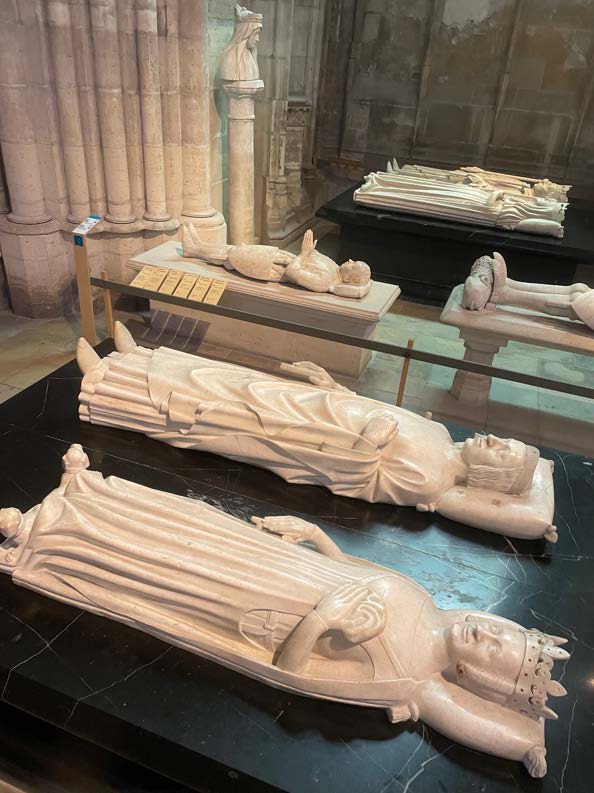
204
CHAPTER 19. BERTRAND DU GUESCLIN
Figure 19.39: The Basilica of Saint Denis in Paris is where Du Guesclin was awarded the greatest honor of being buried among the Kings of France. The tomb in front is that of Jeanne de Bourbon (1338-1377), queen of France and consort of French King Charles V. Next is Charles V (1338-1380), King of France from 1364 until 1380. Consequently we find the tomb of Bertrand Du Guesclin (1320-1380), connétable de France from 1370 until 1380 and the tomb was commissioned by King Charles V. The post close to Du Guesclin is the bust of Marie d’Anjou (1404-1463), queen of France and consort of King Charles VII. In the back are the tombs of Isabeau de Bavière (1371-1435), queen of France and consort of Charles VI, and that of Charles VI (1368-1422), King of France from 1380 until 1422. The photo was taken in 2023. (Declercq de Silva archive
© 2024 Nico F. Declercq
The Desclergues of la Villa Ducal de Montblanc, 2nd ed., Omn., VOL. I
19.25. THE BURIAL PLACE OF BERTRAND DU GUESCLIN
205
Figure 19.40: Tomb of Du Guesclin at the Basilica of Saint-Denis in Paris. The photos were taken in 2023. (Declercq de Silva archive
19.25 The Burial Place of Bertrand Du Guesclin
He is buried at Saint-Denis in Paris, as shown in Figure 19.40, the final resting place of the French Kings. Anyone interested in the other tombs associated with Du Guesclin75 is redirected to other sources.
19.26 Heraldry and the Appearance of Du Guesclin in Spain
19.26.1 Du Guesclin supporting H.M. Enrique de Trastámara of Castile in The Castilian Civil
War, and supporting H.M. Peter IV of Aragon in The War of the Two Peters
As Muhammad V of Granada strived to establish and maintain peace in his kingdom, the neighboring realm of Castile, under the rule of Peter I, pursued a contrasting path of almost constant warfare. Peter’s belligerent career, which earned him the epithet
’Peter the Cruel,’ had its roots in a complex web of dynastic conflicts and geopolitical rivalries.
Peter’s tumultuous reign can be traced back to his father, Alfonso XI, a monarch known for his aggression and prolificacy in fathering children. In 1334, Alfonso’s wife, Maria of Portugal, gave birth to Peter I, securing the male heir line for the Castilian throne.
However, Alfonso’s extramarital affair with Eleanor de Guzman, a noblewoman with roots in the Kingdom of Leon’s aristocracy, would set in motion a series of events that would shape Peter’s future.
Eleanor bore Alfonso several children, further exacerbating Maria’s discontent. Her resentment reached its zenith when Eleanor gave birth to ten children. Upon Alfonso XI’s death during the plague, while besieging Gibraltar, Maria orchestrated her son Peter’s ascent to the throne. Her first act was to have Eleanor imprisoned and executed, a move that would have lasting consequences.
Eleanor’s surviving children, collectively known as the House of Trastamara, coexisted with Peter under an agreement but nursed deep grudges against him. One of Eleanor’s sons, Henry, born shortly before Peter, would play a pivotal role in the unfolding drama. Some argued that Henry, or Enirque, was a more legitimate heir to the throne. Over time, he and his brothers rebelled against Peter’s rule, seeking vengeance for their mother’s execution.
This familial strife ignited the Castilian Civil War, a conflict driven by the desire to claim the throne and avenge Eleanor’s death.
Peter initially quashed Henry’s rebellion, but his repeated pardons of his brother allowed Henry to regroup and seek new allies with each uprising.
Meanwhile, the political landscape of Western Europe was undergoing significant changes. The Hundred Years’ War between England and France, with their respective allies, raged on. Simultaneously, Castile, under Peter I, engaged in a border conflict with Aragon, led by Peter IV, known as the War of the Two Peters. The event is detailed in Chapter 19.17 on page Chapter 19.17. At the highest level, the Castilian Civil War raged between Peter and his half-brother, Henry de Trastamare. These conflicts became 75four graves, one containing his heart
The Desclergues of la Villa Ducal de Montblanc, 2nd ed., Omn., VOL. I
© 2024 Nico F. Declercq
206
CHAPTER 19. BERTRAND DU GUESCLIN
Figure 19.41: Map of the Iberian Peninsula in 1369 during the war between Peter the Cruel and Henry of Trastámara.
Courtesy of Elryck, who made this work and published it on Wikimedia Commons, under Creative Commons Attribution 4.0
international.
Figure 19.42: 1979, the author with his father Maurice Declercq and his grandfather René
Vangheluwe at Pico Veleta, in the Sierra Nevada Mountains of Spain. The image right was
taken in 1978, during a short fuel stop at ’Nico Hotel 70’ . The place still exists and is now
called ’Hotel Restaurante Nico’ . It is located at ’Autovia del Nordeste’ junction with ’Autovia de
Navarra’ at Service Station Jacinto Manuel Miguel Santander. At the intersection, one can drive
north to Soria (70km), North-East to Zaragoza or South-West to Guadalajara and Madrid. A
2022 view is shown in Figure 19.43. From left to right: Maurice A. Declercq, René Vangheluwe, Nico F. Declercq and Anna Den Dauw, a snapshot from a moving image taken by Nelly M.
Vangheluwe. (Declercq de Silva Archive)
Figure 19.43: In 1979, shown in Figure 19.42, the author visited Hotel Nico and returned with his family in 2022. The junction is located in Medinaceli, a place of great historical importance
for Spain. (Declercq de Silva Archive)
© 2024 Nico F. Declercq
The Desclergues of la Villa Ducal de Montblanc, 2nd ed., Omn., VOL. I
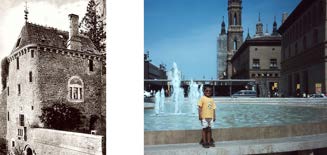
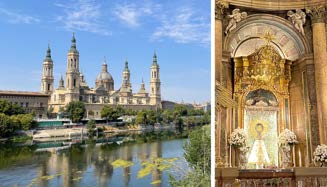
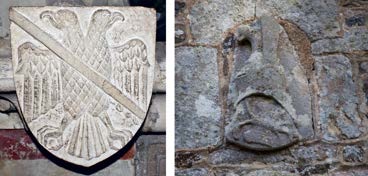
19.26. HERALDRY AND THE APPEARANCE OF DU GUESCLIN IN SPAIN
207
Figure 19.44: Left is a Flamenco dancer
in Granada in June 2003. Right is the au-
thor, also in 2003, at the Congress Center
of Granada with its famous wooden inte-
rior design. (Declercq de Silva Archive)
Figure 19.45:
Left is the House at
Mont Saint Michel where it is believed that
Bertrand Du Guesclin resided before his
departure for Spain. Right is the author’s
eldest son Benjamin in Zaragoza in 2002.
The Catedral-Basílica de Nuestra Señora
del Pilar is visible in the background. The
city was constructed on the Ebro River.
(Declercq de Silva Archive)
Figure 19.46: The Catedral-Basílica de
Nuestra Señora del Pilar in 2022 with the
statue of Nuestra Señora del Pilar. (De-
clercq de Silva Archive)
Figure 19.47: Left is the Shield of Du Guesclin at Saint-Laurent du Puy-
en-Velay, France: ’d’ argent à l’ aigle bicéphale éployée de sable becquée et
membrée de gueules, à la cotice du même brochant sur le tout.’ Right is the
Coat of Arms of the du Guesclin family, Chapelle Notre-Dame-du-Temple,
Pléboulle (second half of the XIVth century - Pierre III du Guesclin Lord
of Plancoët)(Courtesy of R. Grouazel-Krauss). The shield is also shown in
Figure 19.20 on page 175. The use of the gryphon on the coat of arms of the Desclergues may have been inspired by the coat of arms of Du Guesclin.
Examples are given in Figure 23.1 on page 247, and in Figure 23.4 on page
249. An explanation of this probably inspiration is depicted in Figure 23.5 on page 250. The gryphon, shown in Figure 9.1 on page 79, was also popular in Phocaea from where the greeks migrated to Empúries, where they married our
patrilineal ancestor.
The Desclergues of la Villa Ducal de Montblanc, 2nd ed., Omn., VOL. I
© 2024 Nico F. Declercq
CHAPTER 19. BERTRAND DU GUESCLIN
intricately intertwined, drawing in various European powers.
In 1362, Peter I sought to break the War of the Two Peters stalemate by forming alliances with Navarre, England, and Portugal.
Together, they launched a full-scale invasion of Aragon, catching Peter IV off guard while conducting diplomacy in France. Castilian forces rapidly captured border territories, but the dynamics changed when Aragon allied with France and Henry de Trastamare joined the conflict.
Henry, a skilled strategist, employed guerrilla tactics that inflicted casualties on the Castilian forces. Their conflict culminated at the Battle of Najera in 1367, a brutal engagement that saw significant losses on both sides. Despite his army’s defeat, Henry managed to escape, leaving Peter in a precarious position, and the Castilian Civil War continued.
Peter eventually regained the Castilian throne and allied with Muhammad V of Granada. However, internal turmoil, financial difficulties, and Peter’s ruthless actions eroded his popularity, earning him the infamous epithet "Peter the Cruel." His brutal methods, including the execution of disloyal subjects and even members of his own family, further alienated his subjects.
As Peter’s grip on the kingdom weakened, Henry of Trastamare prepared for another rebellion. In 1366, Bertrand Du Guesclin, a renowned Breton knight, embarked on an expedition to Spain to support Count Enrique of Trastámara against Pedro I of Castile.
This expedition marked a critical turning point in the ongoing conflict.
Du Guesclin, accompanied by soldiers who had been pillaging France after the Treaty of Brétigny, laid siege to several fortresses, including Magallón, Briviesca, and the capital city of Burgos. After being crowned at Burgos, Enrique proclaimed Du Guesclin the
"Count of Trastámara" and "King of Granada," although the Nasrids still ruled Granada at the time. This coronation took place between March 16 and April 5, 1366.
In 1369, Henry, backed by France, invaded Castile, leading to the pivotal Battle of Montiel, as described in Chapter 19.21 on page
202. Bertrand Du Guesclin, serving as Henry’s commander, played a crucial role in the conflict. Although Pedro I had defeated Enrique at Nájera in 1367 with the support of Edward, the English Black Prince, Du Guesclin had been imprisoned and later released after a ransom was paid by Charles V of France.
The English, victorious but weakened and suffering from dysentery, were unable to provide further support. This allowed Du Guesclin to organize a delayed counterattack with Enrique of Trastámara. Together, they faced Pedro I of Castile in the infamous Battle of Montiel in 1369, a brutal encounter described in detail in other sources. Henry emerged victorious, forcing Peter to flee and seek refuge within Montiel Castle.
Cornered within the castle’s walls, Peter attempted to bribe Du Guesclin to help him escape, but he was ultimately betrayed by his half-brother, Enrique, and captured. In a dramatic turn of events, a conflict between the two half-brothers ensued, with Du Guesclin serving as a neutral bystander. As Pedro was about to kill Henry, Du Guesclin intervened, offering an advantage to Henry, who subsequently killed Pedro. Allegedly, Du Guesclin uttered the famous words, "Ni quito ni pongo rey, pero ayudo a mi señor"
in Spanish, which translates to "I neither remove nor install a king, but I do help my sire" in English. This expression remains renowned in Spain and signifies someone who acts according to their duty, regardless of moral or justice considerations.
Following this pivotal moment, Du Guesclin received the title of Duke of Molina, marking the beginning of the Franco-Castilian alliance. Henry’s ruthless act marked the end of the Castilian Civil War and the establishment of the Trastámara Dynasty. The political landscape of Castile shifted, and the relationship between Castile and Granada fluctuated over the years, with periods of hostility and warfare interspersed with treaty agreements.
In the early 15th century, Castile made territorial gains, but the Reconquista was temporarily deferred due to political instability.
Only when Isabella I ascended to the Castilian throne in 1474 was a determined effort to complete the Reconquista launched.
In less than two decades, Granada would fall, ending over 800 years of Muslim rule in Al-Andalus and decisively achieving the Reconquista.
However, Granada’s survival during the preceding centuries was not solely due to Castile’s incapacity. The kingdom’s internal strife and external conflicts played a significant role in shaping its fate. While Granada experienced inner turmoil and factional power struggles, it managed to survive and expand its territory during Muhammad V’s reign, marking a period of prosperity and diplomatic finesse.
Yet, upon Muhammad V’s death in 1391, the Nasrid dynasty faced increasing discord and decline. Granada’s internal disintegration intensified, leading to numerous rulers and a revolving door of reigns. Despite these challenges, Granada managed to persist, while Castile’s ability to launch successful offensives remained uncertain.
Alfonso XI’s innovations in artillery were significant, but Castile’s rulers lacked the resolve for a full-scale invasion of Granada.
However, with the ascension of Isabella, a determined queen, Granada’s fate was sealed. In less than two decades, Castile’s Reconquista efforts led to the fall of Granada, ending Muslim rule in Al-Andalus.
Isabella’s reign marked the completion of the Reconquista, though the kingdom’s decline had been a prolonged process. Al-Andalus, which had thrived for centuries, ceased to exist, forever altering the political and cultural landscape of the Iberian Peninsula.
19.26.2 Recorded places visited by Du Guesclin in Spain
Only some places Bertrand Du Guesclin visited are reported in the literature. However, it is possible to reconstruct his path based on what is registered. For instance, he came via Perpignan to Girona and Barcelona. He likely met Desclergues at that time relating to the financing of his endeavors because some of them were bankers. In contrast, others were notaries, had high ecclesiastic positions, and even held professorships. It is also where he must have met the Turró or de Torró family since he allied with a daughter of that family and would have children with her later in Soria.
We refer to the book by Michael Jones, ’Letters, Orders and Musters of Bertrand du Guesclin,’ The Boydell Press, 2003.
While Du Guesclin was still reported at Montpellier on December 3, 1365, he appeared in Barcelona on January 1, 1366. Therefore, at some point between these two dates, he traveled to Spain. Jones further lists:
Barcelona (6 and 9 January 1366), Tarragona (2 and 6 February 1366), Zaragoza (February 20, 1366), the gates of Tudela (March 8, 1366), Calahorra (around March 16, 1366), San Vincente (March 24, 1366), Las Huelgas - Burgos (from March 29 until April 5, 1366), Estella (April 26, 1366), Toledo (May 5 1366), Sevilla (July 3, 1366), Albaterra (July 20 1366), Haro (January 2, 1367), Santa Cruz de Campezo (early January 1367), Zaragoza (around January 29 and around February 16, 1367), Lleida (24 and 27
February 1367), Banares (early March 1367), Zaragoza (on or before March 22, 1367), Battle of Najera (April 3, 1367), Najera (April 3, 1367).
Before December 7, 1367, he appeared in Bordeaux, France. Then he moved towards France’s areas, such as the Provence, Montpellier, etc., to enter Spain again and cross Aragon (15 and 20 December 1368).
Furthermore, Jones lists the following places:
Borja (February 4, 1369), Orgaz (around March 10, 1369), the battle of Montiel (March 14, 1369, explained in Chapter 19.21 on
© 2024 Nico F. Declercq
The Desclergues of la Villa Ducal de Montblanc, 2nd ed., Omn., VOL. I
19.26. HERALDRY AND THE APPEARANCE OF DU GUESCLIN IN SPAIN
209
page 202), in the areas around Montiel (March 16, 1369), Montiel (22-23 March 1369), Soria (June 26, 1369), Zamora, Galicia and Northern Portugal where he very likely took part in the sieges of Braganza and Guimares by Enrique de Trastámara (July-August 1369), Zaragoza (before September 11, 1369), Soria (around October 20, 1369), Soria (November 2, 1369), Toro (November 18, 1369), Soria (around December 18, 1369), Almazan (December 25, 1369), San Mateo (before February 15, 1370), Soria (February 19, 1370), a departure from Soria for Vozmediano (before April 1, 1370), Soria (April 26, 1370), Atienza (May 11, 1370), San Esteban de Gormaz (around May 24, 1370), Soria (June 20, 1370), Borja (June 23, 1370), Borja (June 26, 1370).
Then, Du Guesclin followed the route via Agreda, Tarrazona, Borja, Magallon, Tudela, Jaca, and across the Pyrenees back into France, during which he crossed the Ebro River around July 2, 1370.
He arrived in Moissac, in France, on July 26, 1370. His subsequent adventures all occur in France, with a close encounter with Spain on May 1, 1374, at Carcassonne, May 19, 1374, at Narbonne, and June 2, 1374, at Carcassonne.
The personal life of Du Guesclin is a tale of drama and intrigue. It is believed that in 1365, he resided at Mont-Saint Michel, shown in Figure 19.45, with his wife Tiphaine Raguenel, an astrologer of noble descent, whom he likely married in 1363. This was just before his fateful journey to Spain. However, the children he would have in Spain were not from his marriage but from an affair with his ’Dame de Torró de Soria.’ The story takes a tragic turn with the passing of Tiphaine Raguenel in 1373, without having any children of her own.
19.26.3 The Presence and Liberation of Montblanc by Du Guesclin in the Records of 1366-1370
Despite the possibility that Du Guesclin visited Montblanc multiple times during his campaigns in Spain, our analysis is constrained to extant documents. Notably, from the summer of 1369 until the summer of 1370, Du Guesclin is documented to have been active west and southwest of Zaragoza. However, this does not exclude the possibility of his presence elsewhere, including Montblanc, though this remains speculative for this period. For other timeframes, our evidence is more concrete.
A significant document issued by King Pere IV of Aragon suggests Du Guesclin passed through Montblanc in 1365. As detailed in Chapter 19.26.2, Du Guesclin was recorded in Tarragona on February 2 and 6, 1366, and in Zaragoza on February 20, 1366. It is reasonable to infer that he may have been in Montblanc between these dates. Figures 19.45 and 19.46 provide images of Zaragoza.
The year 1370 offers a specific link between Du Guesclin and Montblanc, although his direct presence in the town that year is unlikely. A letter from Enrique II, dated June 10, 1370, indicates that Du Guesclin had already departed. Alfred Morel-Fatio corroborates this, noting that Du Guesclin and his troops left before June 10, 137076.
Michael Jones’ compilation77 reveals that Du Guesclin was in Moissac, France, on July 26, 1370, and had crossed the Ebro River by July 2, 1370, following a route that did not include Montblanc.
Additionally, a Corts assembly was held in 1370, starting in April and extending over several months in three cities, including Montblanc. Specifically, the Corts took place in Montblanc in October 137078. Ferrer and Vives document that King Pere IV
convened the Catalan Corts to prepare for Catalonia’s defense against foreign mercenaries79.
In the year prior, on June 25, 1369, defensive reinforcements for towns including Montblanc were ordered by Pere IV80. This directive aimed to fortify cities against threats, which was attributed to Du Guesclin’s activities in the region. Correspondence from Pere IV
to his son on June 25, 1369, highlights the urgency of these preparations due to Du Guesclin’s perceived threat81.
From these references, we can infer that Du Guesclin played a crucial role in the liberation or conquest of Montblanc on behalf of Enrique II. The timing of the Corts in Montblanc in October 1370, combined with Du Guesclin’s presence in Spain until early June, supports the hypothesis that he was instrumental in Montblanc’s liberation before his departure to France.
19.26.4 The Spanish format of Du Guesclin’s name
The French format of Bertrand Du Guesclin’s name is outlined in Chapter 75, where some versions closely resemble De Clergue or Desclergue. Here, we describe the appearances in Spain.
We again refer to Michael Jones82. Du Guesclin appears in many documents written by others, which gives an idea of what others used to call him. We are interested, however, in how he referred to himself. As can be seen below, the way he referred to himself is very close to ’DeClergue’ (or Desclergue), which may have been yet another reason for the descendants from whom we stem from choosing the name Desclergue after their mother, rather than Torró after their father. Indeed, during his Spanish appearances (1365-1370), he appears in his own documents as follows (spelling is as is):
-’Bertran de Glesquin, conte de Longueville et signeur de la Roche Tesson’ (December 22, 1365, document 133),
-’Bertran de Glerquin, duch de Trestamera, conte de Longevile et de Borges’ (July 3, 1366, document 163),
-’Beltran de Claquin, duc de Molina, et Conde de Longavilla et de Borja et de Magallon, et Senor de Soria’ (June 26, 1369, document 292),
-’Bertran du Guerclin, duc de Molines, conte de Longueville et de Bourges’ (November 18, 1369, document 311),
-’Bertran du Guerclin, duc de Mouline, conte de Longueville, seigneur de Sorie et de la Roche Tesson’ (April 26, 1370, document 329),
-’Nos don mosen Beltran, duc de Moljina, conde de Longavila, senor de Soria e de Borja e de Magallon’ (May 11, 1370, document 331).
The Spanish name formats, as well as the French, are consistent with the theory that Bertrand Du Guesclin may have descended from a certain Aquin, who was actually a Desclergue, as exposed in Chapter 19.11.
19.26.5 Heraldry of the Du Guesclin family
The coat of arms of the Du Gesclin family is shwown in Figure 19.47 on page 207.
76Alfred Morel-Fatio, ’La donation du duché de Molina à Bertrand Du Guesclin,’ Bibliothèque de l’école des chartes, tome 60, pp. 145-176, 1899.
77Michael Jones, ’Letters, Orders and Musters of Bertrand du Guesclin,’ The Boydell Press, 2003.
78La corona catalanoaragonesa i el seu entorn mediterrani a la baixa edat mitjana: actes del seminari celebrat a Barcelona, els dies 27 i 28 de novembre de 2003.
79Maria Teresa Ferrer i Mallol and Josefa Mutgé Vives, ’La corona catalanoaragonesa i el seu entorn mediterrani a la baixa edat mitjana,’ Editorial CSIC – CSIC Press, Catalonia, Spain, 2005.
80Bertrand Du Guesclin (Count of Longueville), ’Letters, Orders and Musters of Bertrand Du Guesclin, 1357-1380.’
81ACAragón, Reg. 1081 fo. 60r-v.
82Michael Jones, ’Letters, Orders and Musters of Bertrand du Guesclin’ , The Boydell Press, 2003.
The Desclergues of la Villa Ducal de Montblanc, 2nd ed., Omn., VOL. I
© 2024 Nico F. Declercq
CHAPTER 19. BERTRAND DU GUESCLIN
19.26.6 The seal of Du Guesclin upon his arrival in Spain: The Gryphon
Nobles sealed their letters and documents with wax, on which they pressed a stamp with their seal. Du Guesclin typically used only red wax. Several seals were used of different sizes, and of the ones that survived, only a handful are in satisfactory condition for examination.
Michael Jones lists the descriptions of these seals and how Du Guesclin appears on them. Here we focus only on his time of arrival in Spain.
On May 31, 1364, and August 22, 1365 (documents 67, 108, 109, and 159), he used the following seal:
’A small (17/19 mm) round seal or signet of arms couche, a crest, on a helmet, a gryphon’s head between two wings erect, charged with a double-headed eagle, as in the shield; supporters, a wildman or standing female figure (dexter), a griffon (sinister), beaded borders, and with the legend: S B’ TRAN DOU GUERCLIN. ’83.
The supporters of Du Guesclin’s seal are of particular interest. The placement of a griffin on the sinister side and a wild man or standing female figure on the dexter side is not merely a design choice, but a deliberate symbol of a marital alliance. This alliance is further emphasized by Du Guesclin in his heraldic coat of arms, which he presents on the seal for his purposes in Spain. The gryphon, we may infer, is a reference to a Byzantine history of Du Guesclin’s ancestry, while the female figure underscores the ideals of nobility, grace, and refinement, highlighting the high status and cultured nature of the Torró family. This deeper understanding of the symbolism enriches our analysis of Du Guesclin’s seals.
The appearance of the Gryphon on the Helmet, equally visible in Figure 19.20 on page 175, with erected wings, is the one that appears on the Desclergues coat of arms on the house at Montblanc, shown in Figure 23.1.
Michael Jones, as mentioned above, does not show a picture of Du Guesclin’s seal. Other seals more often showed an eagle than a gryphon as a helmet sign in different periods. In Figure 19.47, at Chapelle Notre-Dame-du-Temple, Pléboulle, France, reveals the coat of arms of the Du Guesclin family in the second half of the 14th century; in this case, an eagle as a helmet sign is used rather than a gryphon.
The use of the Gryphon by Bertrand Du Guesclin is a remnant of his link to the Borrell family, Counts of Barcelona, as explained in Chapter 19.13.3.
19.26.7 The shield of Du Guesclin as Count of Trastamara
The chevron with fleur-de-lis in a heraldic shield can symbolize several meanings. It might suggest a family’s French heritage or ties to France, indicating a French connection. Additionally, it could represent an alliance or relationship with another family using fleur-de-lis in their heraldic shield, possibly through marriage or friendship. The fleur-de-lis often symbolizes purity, loyalty, and honor, so a chevron with fleur-de-lis may convey these virtues. Furthermore, depending on the historical and geographical context, the fleur-de-lis might also be a regional or cultural symbol, representing a connection to a specific area or culture.
To accurately interpret the meaning of a chevron with fleur-de-lis in a coat of arms, it is essential to consider the family’s history, the context of the coat of arms’ creation, and any documented explanations. Heraldic symbols often have layered meanings and histories that can vary significantly between different cases.
The inclusion of the Torró fleur-de-lis in Du Guesclin’s Trastamara shield is, therefore, not necessarily indicative of a direct French connection.
Figure 23.6 on page 251 illustrates the genesis of the shield of Bertrand Du Guesclin as the Count of Trastamara. This shield combines his family crest, depicted in Figure 19.47 on page 207, with a chevron featuring three fleurs-de-lis from the Torró family, as shown in Figure 20.2 on page 216. This amalgamation signifies a new Spanish lineage initiated by Du Guesclin and his Dame de Soria, presumably a Torró family member. However, when Enrique de Trastamara lost power, Du Guesclin forfeited the title, and consequently, his descendants no longer used this shield. Instead, they continued under the Torró name, blending with their established Torró relatives.
19.27 DNA Analysis Exposing the Connection with Du Guesclin
19.27.1 DNA Evidence of Du Guesclin as the Originator of the Desclergues of Montblanc
The reader might decide to read Chapter 73.10.3.1, Chapter 73.10.4.3, and Chapter 73.10.4.7 first. The DNA analysis indicates a deeper Brittanic root that is more ancient than the detected Spanish roots. We have no access to the DNA of Bertrand Du Guesclin, but we did find, first, a person from nearby (R. Grouazel-Krauss, also described in Chapter 19.27.12) who has a Y-DNA Haplogroup separated from ours during the last 1500 years. It is indeed estimated that our common ancestor lived between 1000
and 1500 years ago. This person is from Ruca, the middle between Chateau de Glay (Saint Coulomb) and Broons (where Du Guesclin was born), i.e., 40 km from each. The three places are each located 20 km from Dinan. He has a paper trail at Ruca in 1584 when his paternal ancestor was born as an illegitimate son of Jeanne Groasel from a wealthy local family of church builders.
The godparents are both members of the ancient Gueheneuc bloodlines of Bretagne, which suggests a biological father being either a Gueheneuc or another related ancient Briton bloodline, Boisguehenneuc or Uuethenoc. The coat of arms of Du Guesclin shows, through similarities and heraldic tradition, that both families have chivalric and likely blood ties. Traces of DNA are still found in the DNA of the Desclergues, which they have in common with ancient Breton families. This fact proves that the ancestral line must have lived and blended several generations in Brittany. The amount of such DNA is significantly smaller than the amount of DNA in common with Spanish families. It means that the Breton DNA dates further back in history (700- 1400) than the traces resulting from mixing with Spanish families in the period at Montblanc (1400- 1600) and the early period in Belgium when marriages with Spanish were preferred above local unions (1600- 1700). A more extensive DNA analysis is shown next, where we briefly describe the DNA connection between the Desclergues of Montblanc and a sample from Ruca in Brittany, i.e., that of R. Grouazel-Krauss, followed by other samples which are as good as 100% genetically imbedded in Brittany. More connections are found in the Chapter
Later, the DNA of a Du Guesclin from France was also examined and it delivered the same Y-DNA Haplogroup as the author. We refer to Chapter 19.27.3 for the analysis.
In Chapter 19.27.2, we expose a link with the Royal House of Aragon and the Counts of Barcelona, indicating that the direct descendants of Bertrand Du Guesclin must have had good reasons to marry a Desclergue from Barcelona. In Chapter 19.27.4, the early study involving DNA of R. Grouazel-Krauss from Ruca in Brittany is described. Then, in Chapter 19.27.5, Chapter 19.27.6,
83Michael Jones, ’Letters, Orders and Musters of Bertrand du Guesclin’ , The Boydell Press, 2003, page XIII
© 2024 Nico F. Declercq
The Desclergues of la Villa Ducal de Montblanc, 2nd ed., Omn., VOL. I
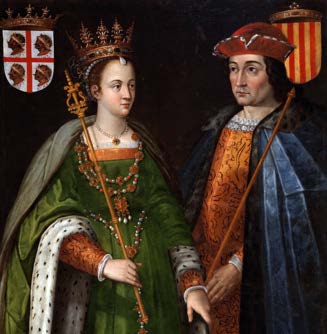
19.27. DNA ANALYSIS EXPOSING THE CONNECTION WITH DU GUESCLIN
211
Figure
19.48:
Queen Petronila of
Aragon and count Ramon Berenguer IV
of Barcelona, oil canvas 1634 (Prado Mu-
seum). They are our ancestors, as outlined
in Chapter 27.2 on page 301. p
and Chapter 19.27.7, we describe persons with whom we share autosomal DNA, who have a Du Guesclin as ancestor. In Chapter
19.27.11, a sample is described with deep roots in Bretagne (Côtes d’Armor), where, in Broons near Dinan, the birthplace of Bertrand du Guesclin, is found. This sample has autosomal DNA in common with Desclergue and Du Guesclin in Chapter 19.27.5.
Other samples of particular interest are given in Chapter 19.27.8, Chapter 19.27.9, and Chapter 19.27.10.
19.27.2 The Counts of Barcelona and the Royal House of Aragon
In Figure 19.16 on page 166, Figure 19.15 on page 165, Figure 18.11 on page 133, and Figure 34.156 on page 578, the reader can see how the Desclergues are related to the House of the Counts of Barcelona.
In section Chapter 73.5, a DNA connection was revealed between Desclergue and the Royal House of Aragon and the Counts of Barcelona through Ramon Berenguer IV. We assume such a link may be due to a yet-to-be-discovered marriage between a Desclergue from Barcelona and this family. A connection through our Cortés ancestors is established, as outlined in Chapter 27.2.
Ramon Berenguer IV (Barcelona, 1113 - Borgo San Dalmazzo, August 8, 1162), shown in Figure 19.48 on page 211, was a son of Count Ramon Berenguer III of Barcelona and his second wife Dulce of Provence. He succeeded his father as Count of Barcelona in 1131. He was also a count of Osona and Besalú. In 1137, he became Prince of Aragon through his betrothal to Petronila of Aragon (1136-1174), daughter of Ramiro II. Ramon Berenguer supported the Reconquista and succeeded in reconquering Almería in 1147.
As Count of Barcelona, he fought against the Count of Toulouse and gained the lordship of Béarn. He was the father of Alfons II (1154-1196), Dolça (1159-1198), Pere (1161-1213), and Ramon Berenguer III of Provence (died in 1181). Dolça married Sancho I of Portugal (1154-1211) in 1175. Pere became King Peter II of Aragon and died in 1213 at the Battle of Muret. Ramon Berenguer III of Provence became the Count of Provence and died in 1181.
19.27.3 The Du Guesclin Haplogroup
Figure 19.49 shows that a sample, taken from a du Guesclin from France, examined anonymously after having been requested by Grouazel, has the same Y-DNA Haplogroup as the author, namely R-FGC46150, which proves that both have the same patrilineal ancestor. We further refer to Chapter 73.10.3.1 for more links to Brittany.
19.27.4 A sample of R. Grouazel-Krauss from Ruca in Brittany, male descendant of Guéhéneuc
The Haplogroup FGC46150 - R-FGC82424 of Grouazel-Krauss differs from other Grouazels in Brittany (mostly R-S16264), which confirms the speculation that they originate from Uuetgenoc and Boisguehenneuc as described before, instead of an ancient Grouazel ancestor. They split off from R-FGC46150 as R-FGC82424/FGC13015. A sub-branch of their Haplogroup even ended up in Germany in recent history.
This sample is essential in the context of our Y-DNA analysis and, therefore, the paternal ancestry leading to Bertrand Du Guesclin.
Both subjects did the analysis and collaborated with the experts of YFull®, FamilyTreeDNA®, genebase®, Ysearch® and, in particular, Alex Williamson, Gareth Henson, and Stephen Parrish.
The considered DNA samples are of Nico F. Declercq, a patrilineal descendant of the Desclergues of Montblanc and, therefore, a patrilineal descendant of Bertrand Du Guesclin. His DNA is registered in FamilyTreeDNA® as sample ’IN22013’ and ’YF13887’
on YFull®; and of Romain Grouazel-Krauss, a patrilineal descendant of an ancient Breton family. His DNA is registered in FamilyTreeDNA® as sample ’169843’ and ’YF67901’ on YFull®. The common Y-DNA Haplogroup of N.F. Declercq and of R.
Grouazel-Krauss is R-FGC46150, on the genetic tree of humans M173 - M343(=R1b) - L754 - L389 - M297 - M269 - L23 - L51
- L151 - P312 - DF27 - Z195 - Z198 - ZS312 - Z267 - SRY2627(=RM-167) - Z202 - R-BY3266 - R-BY3265 - R-FGC46150. As indicated earlier, the Grouazel-Krauss Haplogroup differs as FGC82424/FGC13015 of the common R-FGC46150 Haplogroup. Their Y-DNA is not genetically identical because each has different mutations, which occurred later than the R-FGC46150 mutation. In other words, they have a paternal ancestor in common, whose DNA has undergone the R-FGC46150 modification.
According to YDNA results (111 STR values) as well as all ’BIG Y’ SNP values of both individuals, Desclergues and Grouazel ’s most distant common ancestor (MDCA) lived sometime between 700and 1300 (with the highest probability 1056 years ago, i.e.
963 AD). The estimation was based on an average value of 35.2 years per generation. Knowing that Brittany’s legal custom to get The Desclergues of la Villa Ducal de Montblanc, 2nd ed., Omn., VOL. I
© 2024 Nico F. Declercq
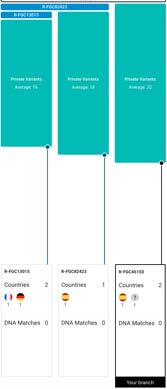
212
CHAPTER 19. BERTRAND DU GUESCLIN
Figure 19.49: FamilyTreeDNA has a sample of a du Guesclin from
France who tested his DNA anonymously, after being requested by
Grouazel, and ended up with the same Haplogroup as the author,
namely R-FGC46150.
married and pregnant in Medieval times was about 11 to 14 years old, we could expect a younger estimation.
If we take a standardized approach, using MyMcGee®, applying the ’infinite allele mutation model’ by using an average mutation rate of 0.0034 based on FamilyTreeDNA® data, and an average generation of 30 years, then we obtain the following results: It is 5% sure that a common ancestor lived less than 780 years ago (after 1240 AD), it is 50% certain that a common ancestor lived less than 1100 years ago (after 920 AD), and it is 95% sure that a common ancestor lived less than 1500 years ago (after 520 AD).
Usually, the 50% value is used as an age estimate of the most recent common ancestor, with an error range of around 150 years.
We can increase this uncertainty by approximately 40 years to account for the birthdate of the persons who provided samples. In other words, if we apply standard estimations, we can say that NFD and RGK had a common ancestor between 800 and 1100 with, given the typically young age of marriage in Brittany, as mentioned above, a common ancestor very likely around 1100 AD.
Given the story told about the ancestors of Du Guesclin, namely King Aquin, in Chapter 19.7, or alternative explanations given in Chapter 19.8, we must place these ages in the light of the reign of Charlemagne, who lived from 742until 814 AD. It means that the common ancestor of Grouazel-Krauss and Desclergue lived not long after the reign of Charlemagne and was likely a descendant of the Spanish conquerer of the castle of Glay on whom the legend of King Aquin is based. Desclergue also has distant DNA links to old Breton families, besides the vast presence of Spanish DNA, which confirms these conclusions.
The Haplogroup R-FGC46150, to which both Desclergue and Grouazel-Krauss belong, is a subclade of BY3266. When we check the database of FamilyTreeDNA® which shows a ’Public DNA Haplotree’ based on the collected information by the Genographic Project of Nation Geographic®, we can see that of the known individuals who belong to BY3266 (and its subclades), 47% are Iberian (16% Portuguese and 31% Spanish), and 23% very likely have Iberian roots, while 30% are French. In other words, around 2/3 are Iberian, and 1/3 are from France. Unfortunately, we don’t know which regions in France, but most are likely from near the Pyrenees regions because that’s also where SRY2627 is most prevalent in France, though less outspoken than in Spain. Of the 30%
French, 1/4 is due to Grouazel-Krauss; therefore, the French contribution is even more minor without this sample.
Using the Iain McDonald Method® , Big Tree® estimates that BY3266 originates (with 95% confidence) between 456 BC and 800 AD, most likely time 365 AD. Therefore, we can be confident that it formed before the era of Charlemagne and, because of the prevalence of Iberian, did so in Iberia before the Islamic influence from 711 onward.
19.27.5
A sample of Nadine Isabelle Ulrich, descendant of Robert II Du Guesclin
In the Geneanet® database, as sample is found of Nadine Isabelle Ulrich with 10.8 centiMorgan autosomal DNA in common with the author on Chromosome 12.
The genealogical connection between Robert II Du Guesclin and Nadine Isabelle Ulrich is found on Geneanet® and is as follows: Robert II Du Guesclin (around 1300 - around 1353) & 1319 Jeanne de Malesmains (around 1300 – around 1350) > Clemence Du Guesclin & Raoul II de Beauchamps > Guillemette de Beauchamps & Jean de Colombieres (1366-1403) > Olivier de Colombieres (dead around 1430) & Valentine de Villiers (married in 1413) > Jeanne de Colombieres (1415) & Jean III de Saint-Germain (dead in 1449) > Foulques de Saint-Germain & Maline d’Esquay > Fernand de Saint-Germain & Olive de Marguerye > Michel de Saint-Germain (dead around 1493) & Guillemette de L’Oraille (dead in 1525) > Anne de Saint-Germain & Jean II Du Mesnildot (born around 1470 and married in 1494) > Michel Du Mesnildot & Marie de Marigny > Louise Du Mesnildot & Cyprien Le Tresor (dead in 1595) > Jacques Le Tresor & Suzanne de Pierrepont (married in 1600) > Jacqueline Le Tresor (1623-1707) &1661 Jean Herouard (around 1607-1667) > Marie Herouard (around 1652-1713) & Olivier Germain (around 1649-1704, married in 1671) > Guillemette Germain & Gilles Vivier (around 1676-1746, married in 1713) > Gilles Michel Tanguy Vivier (1716-1766) & Charlotte Marie Vaultier (1727-1782, married in 1743) > Marie Anne Vivier (1758-1811) & Pierre Antoine Lemarquier (1758-1823, married in 1782) > Aimable Anne Louise Lemarquier (1797-1879) & Jean Francois Coudrey (1790-1856, married in 1818) > Apolline Desiree Coudrey (1821-1888) & Louis Edouard Le Bastard (1816-1875, married in 1844) > Eugene Auguste Le Bastard (1855-1888) & Eugenie Josephine Andre (1855-1900, married in 1878) > Albertine Apolline Louise Le Bastard (1885-1924) & Louis Ferdinand Ulrich (1883-1950, married in 1906) > Henri Lucien Emile Ulrich (1907-1972) & Lucienne Speurt (1907-1998, married in 1927) > Louis Ferdinand Ulrich (born in 1931) & Louise Suzanne Duclos > Nadine Isabelle Ulrich.
© 2024 Nico F. Declercq
The Desclergues of la Villa Ducal de Montblanc, 2nd ed., Omn., VOL. I
19.27. DNA ANALYSIS EXPOSING THE CONNECTION WITH DU GUESCLIN
213
We further refer to Chapter 73.10.3.1 for more links to Brittany.
19.27.6
A sample of Marguerite Emma De Myttenaere, descendant of Robert II Du Guesclin
In the Geneanet® database, a sample is found of Marguerite Emma De Myttenaere with 7.9 centiMorgan autosomal DNA in common with the author on Chromosome 12. The genealogical connection between Robert II Du Guesclin and Marguerite Emma De Myttenaere is found on Geneanet® and is as follows:
Robert II Du Guesclin (around 1300 - around 1353) & 1319 Jeanne de Malesmains (around 1300 – around 1350) > Clemence Du Guesclin & Fraslin II de HUSSON > Henri III de Husson (1342-1395) & Thomasse de Hellande (born in 1345) > Jeanne de Husson (born around 1395) & Jean de Rantot > Guillemine de Rantot (dead in 1472) & Guillaume Le Berseur (born in 1424) > Thomas Le Berseur & Marie Le Chatel de Bruyeres > Cardette Le Berseur & Philippe Nicolas Lefebvre (dead around 1553) > Peronne Lefebvre (born around 1478) & Jean Baptiste des Tailleurs (born around 1475) > Jehanne des Tailleurs (around 1500 - around 1595) & Eliachim Lezaire (married around 1520) > Henry Ignace Lezaire (born around 1520) & Marie Marissal (born around 1525)
> Jacques Lezaire (around 1555-1620) & Martine Petronille Du Castel (around 1565 - 1626, married around 1591) > Jacques Lezaire (1602-1626) & Gilette D’Halluin (born in 1607) > Charles Lezaire (1629-1694) & Marie Anne Heddebaut (born in 1634, married around 1653) > Catherine Lezaire (born in 1659 & Jacques Salembier (1661-1702) > Jacques Simon Salembier (1698-1738)
& Marie Masure (around 1701-1752, married in 1730) > Marie Joseph Salembier (1737-1812) & Pierre-Joseph Niffle (1734-1805, married in 1757) > Jean-Baptiste Niffle (1770-1809) & Catherine Joseph Derzelle (1772-1801, married in 1794) > Catherina Josepha Niffle (1798-1884) & Joannes Baptista De Myttenaere (1797-1878, married in 1832) > Constantinus De Myttenaere (1842-1925) & Leonie-Maria Delroeux (1858-1934, married in 1884) > Marguerite Emma De Myttenaere 1894-1979 .
We further refer to Chapter 73.10.3.1 for more links to Brittany.
19.27.7
A sample of Vargas-Kolabukoff, descendant of Pierre III Du Guesclin
In the Geneanet® database, a sample is found of Vargas-Kolabukoff with 8.9 centiMorgan autosomal DNA in common on Chromosome 7 with the author.
The genealogical connection between Pierre III Du Guesclin and Margaret Vargas is found on Geneanet®, through her grandfather Marcel Elisee Duhem, and is as follows:
Pierre III Du Guesclin & Jeanne De Montfort > Thiphaine Du Guesclin (born in 1335) & Bertrand de Chateaubriand (1340-1398)
> Philipotte de Chateaubriand (born in 1375) & Geoffroy de Chourses de Chourses (born in 1380) > Guy de Chourses (born around 1400) & Marie de Beaumont Bressuire (1407-1461) > Jean II de Chourses & Marie de Vivonne > André de Chourses (born in 1455) & 1474 Jeanne de Feschal > Pierre de Chourses & Jacqueline de la Chapelle > Madeleine de Souches (born in 1510) & Rolland de Mercastel (born in 1505) > Jeanne de Mercastel (born around 1550) & Adrien Mabille (born in 1540) > Anne Mabille 1603-1675 & Toussaint Staquet (1595-1675, married in 1625) > Andre Staquet (1640-1690) & Anne Deleau (born in 1640, married in 1663) > Gilles Staquet (1680-1750) & Marie André (1671-1761, married in 1703) > Anne Catherine Staquet (1708-1778) & Jean Simon Tison (1707-1765, married in 1730) > Martin Tison (1734-1810) & Marie Josephe Boulvin (1733-1809, married in 1759) > Joachim Joseph Tison (1764-1810) & Marie Antoinette Felix (born in 1772, married in 1790) > Adrien Joseph Tison (1796-1875)
& Léonore Robasse (1800-1877, married in 1823) > Désirée Tison (1833-1907) & Louis Gosselin (1830-1889, married in 1858) > Juliette Gosselin (born in 1866) & Elisee Duhem (1866-1920, married in 1892) > Marcel Elisee Duhem (1895-1961) & Jeanne Marie Mollet (born in 1899, married in 1920)
We further refer to Chapter 73.10.3.1 for more links to Brittany.
19.27.8 A sample of F. Guézénnec
This sample shows that old DNA remains from Brittany are still found in our autosomal DNA. The name ’Guézénnec’ is the West-Brittany form of the term ’Guéhéneuc.’ This DNA sample has been made available through her son B. C. Desmortreux on Geneanet®. An autosomal comparison reveals two shared segments, 18.7 centiMorgans in total, the most extended segment being 11.2 centiMorgans. This sample represents Bretagne, given the ancestry tree, which almost wholly consists of family names associated with Brittany. Until Generation 4, we find the specific words Guézennec and Louédec. Further on the ancestry, the illustrious names from Brittany appear, such as: De Kerven de Kersulec, De Cornouaille, Le Manach Moyne, Le Trouadec, Braouezec, Le Bihan, Fouenec, Crechguen, Gueguen, le Grider, Coguen, Sourimant, le Bouédec, le Bellec, Quemener, Guézennec, Louédec, Deunff, Le Helchat, Goupil, Coat, Callarec, Kergoat, Rihouay, Le Guinezre, Jourdain, Cleach, Quere, Meriadec, Le Cotty, le Guilloux.
We further refer to Chapter 73.10.3.1 for more links to Brittany.
19.27.9 A sample of B. Chaix
This sample of B. Chaix, grandson of J. B. Rioux from Brittany, on Geneanet®, also shows that the old DNA from Brittany is still found in our autosomal DNA. However, there may also be some form of Catalonia because B. Chaix has two grandparents from the Alpes-Côte d’ Azur area in France. We share 18.9 centiMorgans with this person, the most extended segment being 11.2
centiMorgans. His ancestry is mainly embedded around Morbihan in Brittany. Among his ancestors, we find, often in multiple branches, Guézénnec, Le Bihan, Guillo, Roperh, Giquel, Ollichon, Le Bris, Gallerne, Riant, Le Couedic, Raoul, Le Bot, Guingat, le Coq, Kervazol, Le Gall, Le Peru, Jegouic, Duault, Videlo, Le Chanony, Le Bigot, Le Couedic, Riant, Alliot, Le Drogo, Le Meur, Moizan, Hellart and Le Pottier.
We further refer to Chapter 73.10.3.1 for more links to Brittany.
19.27.10 A sample of M. Cariou
This sample, on Geneanet®, also shows that the old remains of DNA from Brittany are still found in our autosomal DNA. We share 12.7 centiMorgans with this person in one segment. Her ancestry is chiefly rooted in Finistère in Brittany. Among her ancestors, we find Cariou, Pernes, Frambourg, Daret, Struillou, Pernés, Lezervant, Le Tareau, Le Pape, Coupa, Le Calvez, Le Bec, Andro, La Palud, Le Cossec, Peron, Kernau, Pober, Le Bleis, Le Ballacon, Cadiou, Le Lay, Le Certen, Le Quemener, Falgoas, Le Cam, Le Facheux, Le Gars, Penizic, Folgoas, Andreau, Odiern, Compas, Deic, Chatalen and Routuler.
We further refer to Chapter 73.10.3.1 for more links to Brittany.
The Desclergues of la Villa Ducal de Montblanc, 2nd ed., Omn., VOL. I
© 2024 Nico F. Declercq
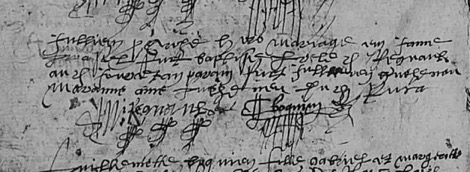
214
CHAPTER 19. BERTRAND DU GUESCLIN
19.27.11 A sample of Cloarec-Le Prunennec-Le Parlouer
This sample, on Geneanet® (account laurie1312), with which we share 7.7 centiMorgan autosomal DNA on Chromosome 12, has deep roots in the corner of Brittany where Du Guesclin is from, namely in the Côtes d’Armor. In particular, the person’s ancestor are Cloarec, Le Prunennec, Le Parlouer, but also Le Caodou, Le Patézour, Le Louam, Lescope, Le Guillou, Troadec, Derrien, l’Horset, Le Chevanton, Le Duff, Denes, Tugdual, Loas, Le Flem, Le Judec, Le Maignan, Kerbrat, Tual, Keranhoat, Le Guen, Le Coz, Le Moullec, Dornadic, and Boniec.
Interestingly, on Chromosome 12, this sample shares the same autosomal DNA with Desclergue as it shares with the sample of Chapter 19.27.5, who has Du Guesclin as an ancestor. The combination of these samples and the others described forms undisputable evidence that the Desclergues have autosomal DNA segments from Du Guesclin that are deeply rooted in Brittany. This knowledge, together with the Y-DNA Haplogroup, proves the patrilineal descendence.
We further refer to Chapter 73.10.3.1 for more links to Brittany.
19.27.12 The Brittanic Grouazel-Krauss family as Descendants of Uuethenoc and Boisguehen-
neuc
Figure 19.50: Ruca, February 13, 1584, the baptism of an illegitimate son of
Jeanne Grouazel. Both godparents were ’Guéhéneuc’ . The records transcribes as,
’Julien groasel [né] hors mariage de Janne groasel fut baptisé par Dom [Michel]
Regnaud au dit jour et an parain fut Jullien gueheneuc marainne anne gueheneuc
en Ruca Mi[chel] Regnaud
Xxxxxxx’
We acknowledge R. Grouazel-Krauss on this matter and thank him for his help in searching links between the Desclergues and Du Guesclin. His expertise in Brittany’s history and his passion for Celtic languages were inspirational for our investigations.
This branch descends from a Guehenneuc paternal ancestry line from Brittany’s old Uuethenoc and Boisguehenneuc families. For this reason, genealogical records and Y-DNA analysis led to a paternal ancestor in common with Bertrand Du Guesclin. In what follows, we will briefly overview the genealogy of Romain Grouazel-Krauss.
Romain Grouazel (1981, St Brieuc) is the son of Alain Grouazel (1957, Plancoët) and N. Krauss, himself the son of Pierre Grouazel (1924, Pléboulle) and M.T. Quéméner, son of Edouard Grouazel (1889, Matignon) and M.J. Trotel, son of Jean Marie Grouazel (1852, Pluduno) and M.L.J. Ménier, son of François Grouazel (1807, Pluduno) and J. Fermal, son of François Grouazel (1778, Pluduno) and M.F. Josse, son of François Grouazel (1745, Ruca) and J.J. Morvan, son of Marc Grouazel (1703, Ruca) and C.
Beaudouard, son of Jean Grouazel (1664, Ruca) and M. Betfer. From there, records are lacking, and we cannot be sure of the lineage upstream apart from the fact that the Grouazel Y-DNA revealed that his lineage resulted out of wedlock, and hence his Haplogroup does not match the common ones for Grouazel in Bretagne: Julien Grouazel (Ruca, 1584) son of Jeanne Grouazel (present at the birth; Julien Guéhéneuc –godfather, and Anne Guéhéneuc –godmother), herself a descendant of either Guillaume or Ollivier Grouazel the Master-builders of the church of Plancoët (1521).
We share an essential birth record in Figure 19.50, with godparents of Jullien Grouazel at Ruca, February 13, 1584, of an illegitimate son of Jeanne Grouazel. Both godparents were ’Guéhéneuc’ .
Jullien Guéhéneuc (godfather of Julie Groassel) was born on January 9, 1542, in St Germain de Matignon and was the ancestor of the Lords of Leslen and Ville-es-Loin as well as the future seneschal of Matignon, Louis Guéhéneuc, Lord of Leslien.
Jullien Guéhéneuc was married to Guillemette de la Marre or Marque.
It is important to note that many Spanish troops were sent to Bretagne during the reign of Henri IV (1589-1610). The first contingent of 3000 soldiers arrived in 1590 to occupy Blavet and Crozon near Brest. The arrival was six years after the birth of Julien Grouazel, mentioned above. We may, therefore, exclude that he would have been the son of a Spanish soldier.
© 2024 Nico F. Declercq
The Desclergues of la Villa Ducal de Montblanc, 2nd ed., Omn., VOL. I
The Torró Bloodline
20.1 Introduction
The interest in this family for our ancestry is that the Desclergues descend from the Torró and their links with Miquel and Ros.
There are also indications that Bertrand Du Guesclin may have fathered children with a Torró. We refer to Chapter 19.15.1 on page 185. In Garcia Carraffa234, we read the following explanation for Torró,
’At the beginning of the 15th century this surname already enjoyed notoriety in Catalonia. One of its branches passed to the kingdom of Valencia, remaining based in the town of Jávea, in the judicial district of Denia (Alicante). From this branch were Jaime Torró Yago Cruañez, a relative of the Holy Office of the Inquisition of Jávea, and Damián Torró, justice of the same town.’
About the heraldic shield, the book writes the following’
’In a field of gold, an azure tower, clarified with gold and supported by two azure fleurs-de-lis. (Shield 67). This is how they appear on a seal by Geraldo Torró, which dates from the year 1405 and is preserved in the Royal Heritage Archive in Barcelona. In another seal by Galcerán Torró, the year 1445, which is kept in the Municipal Archive of Barcelona, the same weapons are seen with the only difference that the fleurs-de-lys are replaced with two azure stars placed in the cantons of the leader. In the same Barcelona Municipal Archive, another seal from the year 1449 corresponds to the Torró family, which only contains the azure tower in the golden field. ’5
The text and shield are shown in Figure 20.1 on page 216. We do not possess sufficient information to go further back in time and determine precisely when the tower was first used. It is clear that the family, while residing in France, used three fleurs de lys in gold placed on azur, but we do not know if they had already introduced a tower in France or did this from around 1400 onward.
If they only used a tower from around 1400 onward, then this clearly indicates their wanting to connect with the tower symbol (’Torró’ does not mean ’tower’) as descendants of Du Guesclin (’De Tours’). In that case, it is natural that not every Torró line used the tower as a symbol. In other literature, we find the following information on the shield of Torró.
Of gold, a tower of azure, with pointed battlements, set with two stars, clarified and hammered with silver.67
Of gold, an azure tower, with pointed battlements, clarified and mashed with silver, supported by two azure stars.8
Of gold, a tower of azure, with pointed battlements, clarified with gold, hammered with saber, set with two stars of the same.9101112
Of gold, a tower of azure, lying with two arrowheads.13
Of gold, a tower of azure, lying on two azure fleurs-de-lys, crenelated tips.14
Of gold, an azure tower, with crenelated tips.15
The Chief Councilor of the Barcelona Municipal authorities was a historic position that came from the Barcelona institution of the Consell de Cent. The position disappeared with the New Plant Decree in 1714, along with the abolition of the Generalitat de Catalunya. The first Chief Councilor was Ponç d’Alest in 1257, while the last to hold the position was Rafael Casanova in 1713.
Below is the list Chief Counselors of the Barcelona Municipal authorities16 with names of interest to our family tree: Torró / Turró:
1455-1456 Bertran Turró
1456-1457 Bertran Turró
Ferrer:
1514-1515 Bernat Ferrer
1580-1581 Francesc Ferrer i Despuig
1600-1601 Miquel Ferrer
1674-1675 Francesc Vidal i Ros
1690-1691 Miquel Ferrer
2A. Y. Garcia Carraffa, con la colaboracion de D. Armando de Fluvia y Escorsa, "El Solar Catalan, Valenciano y Balear", Primera Edicion, Tomo Cuarto, p. 272
3Nobilíari general ‘Catalá, de Félix Domenech y Roura, cuaderno XXIII.
4La Heráldica dé Jávea, del barón de’ San Petrillo, en la Revista de Historia y Genealogía Española, tomo II, segunda época, pág‘. 559.
5F. of Sagarra; J. R. Vila
6E. Tamburini.
7J. del Corral
8“Aquest font conseller de barcha enlo any m.ccccLb and endit any will donate afaro Valensia.” (sic) (Translation: He was Counselor of the city of Barcelona in the year 1453, and in the same year he gave aid to the kingdom of Valencia), described in B. de Llupià.
9Fr. de Alós
10Seal of Galceran Torró, Assessor of the County of Ampurias, year 1445; see also the work of F. of Sagarra.
11Seal of Galceran Torró, Assessor of the County of Ampurias, year 1445; see also the work of F. of Sagarra.
12see also the work of J. R. Vila.
13Blazon of Bertran Torró, the year 1476, the church of Sta. María del Mar, Barcelona. See also the work of J. M. de Alós i de Dou.
14Seal of Grau Torró, the year 1445, Municipal Archives of Barcelona. See also the work of Ll. Doménech i M.
15Seal of Galceran Torró, the year 1445, Municipal Archives of Barcelona. See also the work of Ll. Doménech i M.
16Barcelona. Autoritats municipals fins al 1714. rulers.cat
The Desclergues of la Villa Ducal de Montblanc, 2nd ed., Omn., VOL. I
© 2024 Nico F. Declercq
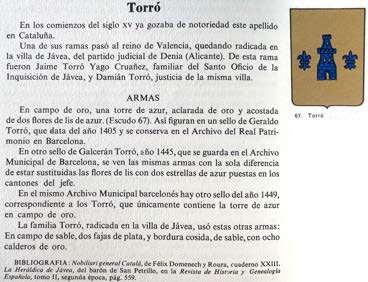
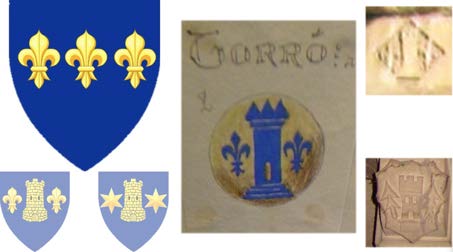
216
CHAPTER 20. THE TORRÓ BLOODLINE
Figure 20.1: Citations from A. Y. Garcia Carraffa, con la colaboracion de
D. Armando de Fluvia y Escorsa, "El Solar Catalan, Valenciano y Balear",
Primera Edicion, Tomo Cuarto, p 272 and lamina 31. If the text can be
interpreted as the tower being used with two fleurs de lys, rather than only
three fleurs de lys starting around 1400, then this may be an indication of
this line’s forefather being Bertrand Du Guesclin. Indeed, the family used
only three fleurs de lys, gold on azur, before they migrated to Gerona from
Occitania. When they migrated, they inverted the colors on their shield, but
there is no indication that they effectively replaced one fleur de lys immediately.
In other words, the tower may come from Du Guesclin.
Figure 20.2: The use of 3 ’flors de lys’ in gold, on azure, is what the Torró family used when
they were located in Occitania and were still called Turro. We do not know if alterations, shown
in the top middle and right, occurred while this family resided in Occitania. When the family
migrated to Girona and Barcelona, Turro became Torró, while the colors were inverted. From
around 1400, and perhaps sooner, the shield sometimes had a tower placed in the middle, and
sometimes the flowers were replaced by stars. Perhaps the three flowers contributed to forming
the coat of arms of the count of Trastamara, Bertrand Du Guesclin, explained in Figure 23.6 on page 251. The oldest reference to a Torró shield with a tower in the middle dates from around 1400. If it is genuinely the first, then it may indicate that the descendants of Du Guesclin
introduced the tower on the shield to distinguish their Torró line from the other Torró lines
in this old noble family. More evidence would be required to acquire certainty. The reader is
also directed to Figure 20.1 on page 216 to know what the literature tells. It may be that early members of this Torró family were responsible for old shields that can still be found today at the
Sant Miquel church of Montblanc, as shown in Figure 25.2 on page 259. The shield of Turro, shown on the left, was also used by Castres in France, where this family stems. The image of the
shield with a blue tower on gold comes from "Armorial Historic de Catalunya" por Ll. Doménec i Montaner (14th centrury). The shield in the lower right corner is that of the Blason of Bertran
Torró on the tomb of his wife in 1476. The on in the upper right corner is the coat of arms of the
Torró family on a pedestal at the entrance to the church of Santa María in Castelló d’Ampúries
(Girona) and belongs to Galceran Torró.1 (Courtesy of Fco. Lerena Aracil)
© 2024 Nico F. Declercq
The Desclergues of la Villa Ducal de Montblanc, 2nd ed., Omn., VOL. I
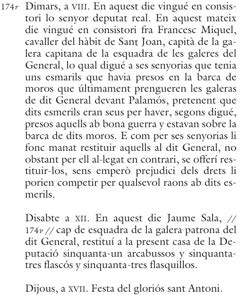
20.2. THE TORRÓ CAME FROM OCCITANIA
217
Figure 20.3: Francesc Miquel, a knight of the order of
Sant Joan and captain of the squadron of the General’s
galleys, asserts his authority and honor by returning cap-
tured goods despite dispute, showcasing his unwavering
commitment to duty and integrity. Citation from Di-
etaris de la Generalitat de Catalunya, 1411-1714, Collec-
cio de 10 volums, Generalitat de Catalunya, 1997, year
1619, page 350.
Ros:
1427-1428 Joan Ros (2a vegada)
1430-1431 Joan Ros (3a vegada)
1478-1479 Jaume Ros
1490-1491 Jaume Ros
1501-1502 Jaume Ros
1549-1550 Jaume Ros
1611-1612 Galceran Ros
1622-1623 Joan Ros
1675-1676 Francesc Vidal i Ros (2a vegada)
Miquel:
1456-1457 Bernat Miquel
1508-1509 Dionís Miquel
1522-1523 Benet Miquel de Corbera
20.2 The Torró came from Occitania
One of the first known lords of Maurí, near Perpignan, at the end of the 11th century, was Bernat Torró, to whom the counts of Besalú had granted rights to Maurí and the castle of Fenollet. He, however, probably does not appear in the more distinguished Torró bloodline that married a ’de Bésiers’ in the 12th century, from whom we descend.
The Torró lineage originates17 from Occitania, like the Desclergues who arrived in Mallorca and later in Catalonia.
The Torró lineage passed from Occitania to the Catalan region during the heresy in Languedoc between 1190 and 1213. These first origins are found in a marriage between the Lord of Turre and Magdalena de Bésiers.
Magdalena de Bésiers was the daughter of Guilhen de Besièrs, son of Gaucelme or Galceran de Besièrs, and N. Trencavèl , the natural daughter of Raimon Trencavèl.
Bertrandus, the lord of Turre and the son of Bernat de Turre, was a vassal of the Count of Auvernhe. He married Magdalena de
Bertrandus de Turre and Magdalena de Bésiers were the parents of Gaucelm de Turre, or Galceran as he would later be called in Catalan.
Gaucelm de Turre was the father of Guilhen de Turre, who, at the time of the severe conflict over heresy, left Béziers and moved to the Catalan region to settle in Girona.
Guilhen de Turre was the first to use the coat of arms as we know of the Torró family, i.e. à Campo de Oro , une tour d’azur, éclairée d’or et soutenue par deux fleurs de lys d’azur19, which also involved a name change from ’de Turro’ to ’de Torró,’ or ’Torró,’
Among Guilhen or Guillermo de Turre’s children are Ramón de Torró and Bernat de Torró. Bernat de Torró was a monk scribe and notary at the monastery of Santa María de Poblet in 1232. Ramón de Torró was the continuator of the Torró lineage in Gerona.
20.3 Beltrán Torró (DT01)
Torró individuals of prominence are found in the 13th century in different places in Catalunya, which indicates that some of the Turró or Torró branches must have originated in earlier times in Catalonia than the period of found documents. Of interest to our ancestry, however, is the branch from Empúries.
17The author is grateful to Jairo Eduardo Cortés Rosal for his help concerning the Torró Medieval Ancestry.
18This marriage took place in the 12th century, because we know that her grandson, Bernat, was a monk in 1232.
19Two azur fleurs de lys left and right of an azur tower, on a gold background, while, before that, the colors were reversed, i.e. gold fleurs de lys and tower on an azur background.
The Desclergues of la Villa Ducal de Montblanc, 2nd ed., Omn., VOL. I
© 2024 Nico F. Declercq
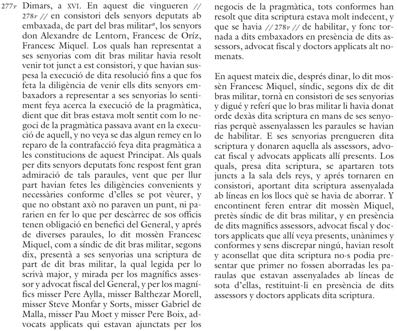
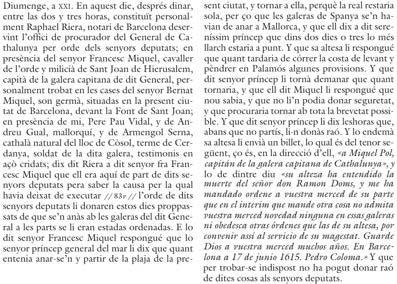
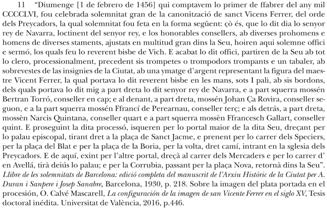
218
CHAPTER 20. THE TORRÓ BLOODLINE
Figure 20.4:
Francesc Miquel: The Trusted Syndic and Advocate for Military
Diplomacy. Citation from Dietaris de la Generalitat de Catalunya, 1411-1714, Col-
leccio de 10 volums, Generalitat de Catalunya, 1997, year 1613, p 104.
Figure 20.5: Francesc Miquel, Knight of the Order and Captain of the General’s
Galley, faced inquiry regarding his deviation from orders. His pivotal role in naval
affairs is underscored as he navigates the intricacies of command, loyalty, and duty
amidst the directives of his superiors. Citation from Dietaris de la Generalitat de
Catalunya, 1411-1714, Colleccio de 10 volums, Generalitat de Catalunya, 1997, year
1615, page 200.
Figure 20.6: Bertran Torró, playing an
important role in a procession in 1456,
and being referred to as Mossen Bertrand
Torró, indicating his high status. Cita-
tion from Emilio Callado Estela, "Tiempos
de reforma: Pensamiento y religión en la
época de Carlos V", 2022, Page 459.
© 2024 Nico F. Declercq
The Desclergues of la Villa Ducal de Montblanc, 2nd ed., Omn., VOL. I
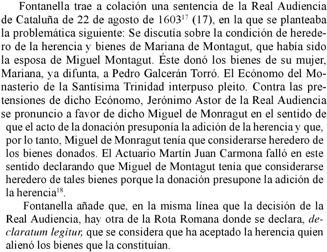
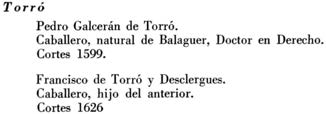
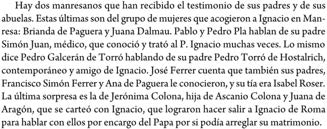
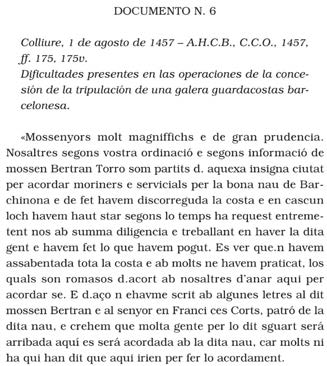
20.3. BELTRÁN TORRÓ (DT01)
219
Figure 20.7: An inheritance dispute in-
volving Pere Galceran Torró in 1603. Ci-
tation from Ortuño Pérez, María Euge-
nia, "Contribuciones al Derecho Romano
de Sucesiones y Donaciones", Dykinson,
2015, from p. 114-115.
Figure 20.8: Pere Galceran de Torró and
Francesc de Torró y Desclergue in Fran-
cisco José Morales Roca, "Próceres ha-
bilitados en las Cortes del Principado de
Cataluña, siglo XVII (1599-1713)", Edi-
ciones Hidalguia, 1983, p. 126.
Figure 20.9: Story of 1595 in Manresa, a
citation showing that Pere Galceran Torró
was the son of Pere Torró y Hostalrich,
in Ignacio Vila Despujol, "La Compañía
de Jesús en Barcelona en el siglo XVI:
El colegio de Nuestra Señora de Belén",
Universidad Pontificia Comillas, 22 nov.
2010, p. 50.