

The Desclergues of la Villa Ducal de Montblanc, Second Edition Omnibus by Nico Declercq - HTML preview
Download the book in PDF, ePub, Kindle for a complete version.
Figure 20.10:
Bertran Torro (DT03f)
in a document of August 1, 1457. Ci-
tation from Anna Unali, "Marineros, pi-
ratas y corsarios catalanes en la Baja Edad
Media", Editorial Renacimiento, 2007, p.
233.
The Desclergues of la Villa Ducal de Montblanc, 2nd ed., Omn., VOL. I
© 2024 Nico F. Declercq
220
CHAPTER 20. THE TORRÓ BLOODLINE
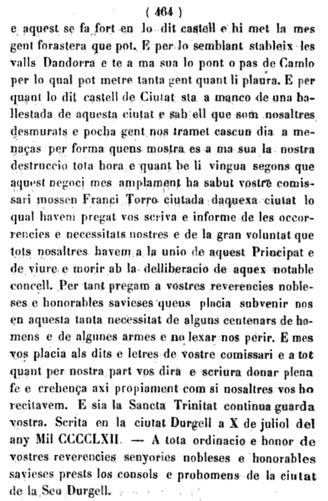
Figure 20.11: Francesc Torró, appearing
in Urgell, 1462, in a document in Colec-
ción de documentos inéditos del Archivo
General de la Corona de Aragón. Es-
pagne: J.E. Montfort, 1861, p. 464.
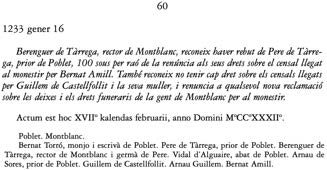
Figure 20.12: Bernat Torró in a docu-
ment in 1233. Citation from Josep Torné i
Cubells, "Catàleg de pergamins de l’actual
arxiu del monestrir de Poblet", 2007, p.
37.
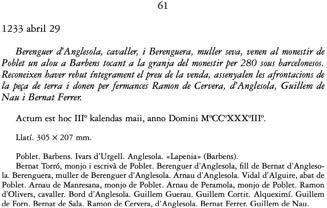
Figure 20.13: Bernat Torró in a docu-
ment in 1233. Citation from Josep Torné i
Cubells, "Catàleg de pergamins de l’actual
arxiu del monestrir de Poblet", 2007, p.
38.
© 2024 Nico F. Declercq
The Desclergues of la Villa Ducal de Montblanc, 2nd ed., Omn., VOL. I


20.3. BELTRÁN TORRÓ (DT01)
221
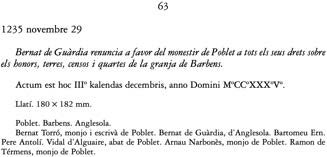
Figure 20.14: Bernat Torró in a docu-
ment in 1235. Citation from Josep Torné i
Cubells, "Catàleg de pergamins de l’actual
arxiu del monestrir de Poblet", 2007, p.
39.
Figure 20.15: Bernat Torró in a docu-
ment in 1237. Citation from Josep Torné i
Cubells, "Catàleg de pergamins de l’actual
arxiu del monestrir de Poblet", 2007, p.
40.
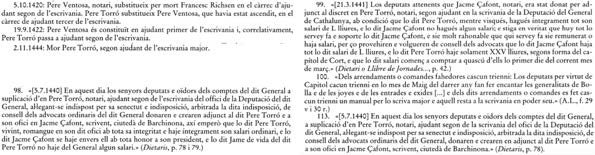
Figure 20.16: Some facts in the life of Pere Torró. The citations come from Isabel Sánchez de Movellán Torent, "La Diputació del General de Catalunya (1413-1479)", 2004, p. 192, 200 and 204.
Figure 20.17:
Galceran Torró, Doc-
tor in Civil Law, appears alongside a
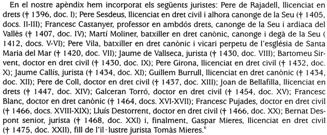
cadre of learned individuals, each bearing
their own expertise and scholarly achieve-
ments. Citation from El món urbà a la
Corona d’Aragó del 1137 als decrets de
nova planta, Volume 2, Edicions Univer-
sitat Barcelona, 2003, p. 730.
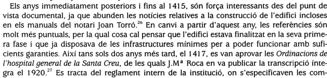
Figure 20.18:
Joan Torró, notary, is
mentioned in the Ordinances of the Gen-
eral Hospital of the Holy Cross in 1417.
Citation from El món urbà a la Corona
d’Aragó del 1137 als decrets de nova
planta, Volume 2, Edicions Universitat
Barcelona, 2003, p. 541.
Figure 20.19:
Galceran Torró’s testa-
ment, dated July 17, 1468. Citation from
El món urbà a la Corona d’Aragó del 1137
als decrets de nova planta, Volume 2, Edi-
cions Universitat Barcelona, 2003, p. 740.
Figure 20.20: Galceran Torró, referred
to as a Doctor in Civil Law, in a document
of 1454.
The Desclergues of la Villa Ducal de Montblanc, 2nd ed., Omn., VOL. I
© 2024 Nico F. Declercq

222
CHAPTER 20. THE TORRÓ BLOODLINE
Figure 20.21:
Joan Torró in the Bib-
liography list, under the sources from
Barcelona, in Jill Rosemary Webster,
"Carmel in Medieval Catalonia", 1999.
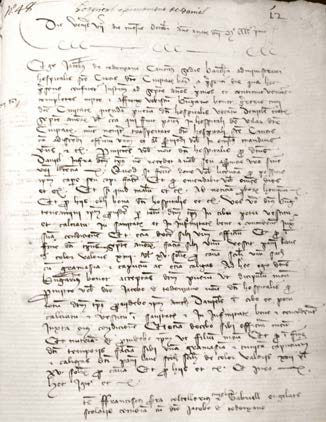
Figure 20.22:
Joan Torró’s handwrit-
ing. Arxiu de l’Hospital de la Santa Creu i
Sant Pau, Manual primer de Joan Torró,
f. 11v-bis. Afermament de Daniel. Edi-
ció, doc. 4.
One Torró branch, despite its blood relation to the others, remains a puzzle in our understanding of Torró ancestry. The brothers Joan Torró and Jaume Torró from the Castle of Empúries, as described by Batlle i Gallart, offer intriguing and valuable information that we have yet to comprehend fully. 20
Our genealogical journey begins with the couple Bertrand du Guesclin and Dona Torró, also known as Dame de Soria in the literature. Their lineage, intricately connected to ours, forms a crucial part of our research.
They had two children, Beltran Torró (DT01) and Geraldo (or Guérech or Guerau) Torró (DT01b). Both were born around 1358.
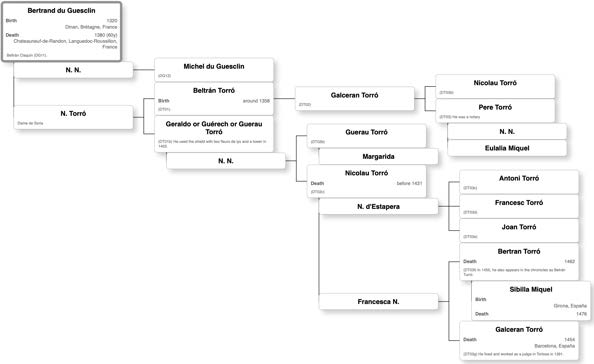
Guerau Torró used the shield with two fleurs de lys and a tower in 1405. Beltrán Torró (DT01) had a son, Galceran Torró (DT02), described in Chapter 20.4.
The first three generations of descendants of Bertrand Du Guesclin are shown in Figure 20.27, on page 226.
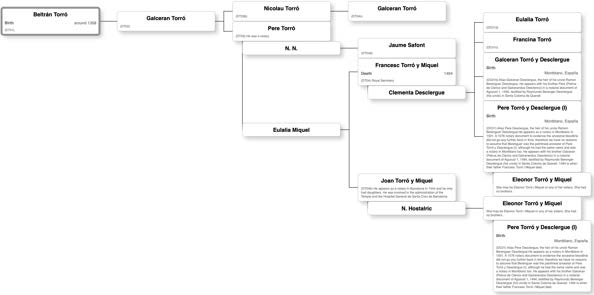
The descendants of Beltrán Torró (DT01) are shown in Figure 20.28 on page 227.
20.3.1 Guerau Torró (DT01b), Brother of Galceran Torró (DT02)
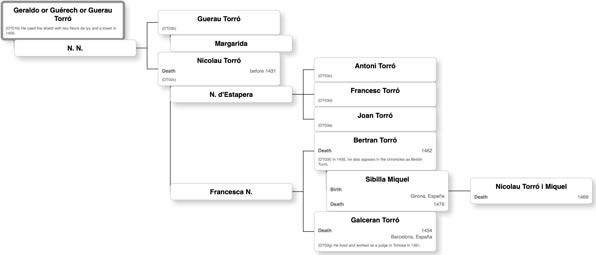
Guerau Torró (DT01b), who used the shield with two fleurs de lys and a tower in 1405, had two children, Guerau Torró (DT02b), who married Margarida; and Nicolau Torró (DT02c), who died in 1431 and is described in Chapter 20.3.2.
Nicolau Torró (DT02c) was married twice. With Dona d’Estapera, the daughter of Antoni d’Estapera, he had three children, Antoni Torró (DT03c), Francesc Torró (DT03d), and Joan Torró (DT03e).
With Francesca, Nicolau Torró (DT02c) had two children, Galceran Torró (DT03g), who lived and worked as a judge in Tortosa in 1391 and died in 1454 in Barcelona; and Bertran Torró (DT03f), who, in 1455, appears in the chronicles as Betrán Turró, and who is described in Chapter 20.7.8.
Bertran Torró (DT03f) married Sibilla Miquel, from Girona, who died in 1476. The latter couple had a son, Nicolau Torró i Miquel, who died in 1469. Their appearance in the Miquel family is shown in Figure 19.25 on page 191, while the Miquel clan is described in Chapter 20.8. The descendants of Guerau Torró (DT01b) are shown in Figure 20.29 on page 227.
20.3.2 Nicolau Torró
He was the son of Guerau Torró (DT01b), described in Chapter 20.3.1. Batlle i Gallart provides valuable information.21
Nicolau Torró, a pioneering member of the Torró family in Barcelona, contributed significantly to the city’s economic and social fabric during the late medieval period. He became a money changer, a profession integral to Barcelona’s burgeoning mercantile economy.
Nicolau’s migration from Castelló d’Empúries to Barcelona mirrored the broader trend of rural-urban migration, indicative of the city’s growing prominence as a commercial hub. Following the death of his first wife, his marriage to Francesca underscored his familial ties within Barcelona’s merchant circles.
As a money changer, Nicolau was crucial in facilitating trade and financial transactions, contributing to the city’s economic prosperity. His legacy endured through his descendants, who continued to shape Barcelona’s socio-economic landscape for generations 20Batlle i Gallart, Carmen. ’Una família barcelonesa: los Torró.’ Annals de l’Institut d’Estudis Gironins, 1974, Vol. 22, p. 203-210.
21Batlle i Gallart, Carmen. «Una família barcelonesa: los Torró». Annals de l’Institut d’Estudis Gironins, 1974, Vol. 22, p. 203-210.
© 2024 Nico F. Declercq
The Desclergues of la Villa Ducal de Montblanc, 2nd ed., Omn., VOL. I
20.4. GALCERAN TORRÓ (DT02)
223
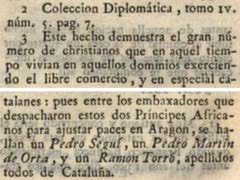
Figure 20.23:
Ramon Torró in Antonio de Cap-
many Surís y de Montpalau, "Memorias historicas so-
bre la marina, comercio, y artes de la antigua ciudad de
Barcelona. Publicadas... Y dispuestas por d. Antonio
de Capmany, y de Monpalau", la imprenta de Sancha,
1792, p. 200.
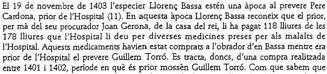
Figure 20.24:
Guillem Torró was the
first Presbyter of the Hospital in Barcelona
established by his brother, notari Joan
Torró. Citation from Carles Vela i Aulesa,
"La Primera Especieria de l’Hospital de La
Santa Creu de Barcelona, 1401-1414", p.
54.
to come.
20.4 Galceran Torró (DT02)
He was the son of Beltrán Torró (DT01), shown in Chapter 20.3 and the grandson of Bertrand du Guesclin.
Galceran Torró (DT02) was the father of Nicolau Torró (DT03b), father of Galceran Torró (DT04c). Another son of Galceran Torró (DT02) was Pere Torró (DT03), a notary, described in Chapter 20.5.
Galceran Torró (DT02) appears in ’Quaderns d’Historia Tarraconense V,’22 concerning an event in 1391, a document detailing a legal dispute involving the Jewish community in Tortosa in the aftermath of the pogroms of 1391. At the center of this dispute is the refusal of Vital Astruc and his son Astruc Bonsenyor to financially support the expenses incurred by the Jewish community for their protection during times of unrest.
Galceran Torró (DT02), also known as Galcerà Turró in the text, plays a significant role as a legal expert in arbitrating the dispute.
Alongside other legal experts such as Joan de Naters, he is tasked with resolving the conflict between the Jewish community, represented by Salomó Alfauhell and Bonjuha Aleva, and Vital Astruc and Astruc Bonsenyor.
Galceran Torro’s role is primarily that of a judge or legal adjudicator entrusted with interpreting the agreement terms between the parties and delivering a verdict based on legal principles and evidence presented. His involvement suggests that he is a respected legal figure in the community, capable of impartially evaluating complex legal matters.
In the resolution delivered by Galceran Torró (DT02) and Joan de Naters, Vital Astruc and Astruc Bonsenyor are not obligated to contribute financially to the expenses incurred by the Jewish community for their protection. The decision is reached after carefully considering the arguments both parties presented and examining relevant legal documents, including a letter of agreement.
20.5 Pere Torró (DT03) & Eulalia Miquel
Pere Torró (DT03) married twice. He married Dona Safont and had a son, Jaume Torró y Safont, also known as Jaume Safont (DT04d).
Pere Torró (DT03) and Eulalia Miquel had two children, Francesc Torró y Miquel (DT04), described in Chapter 20.6, a Royal Secretary who married Clementa Desclergue, and Joan Torró y Miquel (DT04b), who married Dona Hostalric. Joan Torró y Miquel (DT04b) appeared as a notary in Barcelona in 1444, and he only had daughters. He was involved in the administration of the Temple and the Hospital General de Santa Creu de Barcelona.
20.5.1 Pere Torró
He was a notary. He was the son of Galceran Torró, described in Chapter 20.4 and married to Eulalia Miquel, described in Chapter
20.5.2 Eulalia Miquel
She was married to Pere Torró, given in Chapter 20.5.1. Her father was Antoni Miquel, a notary.
20.6 Francesc Torró i Miquel (DT04) & Clementa Desclergue
Francesc and Clementa had two daughters, Francina and Eulalia, and two sons, Galceran Torró y Desclergue, described in Chapter
20.6.3, and Pere Torró y Desclergue (I), described in Chapter 20.6.4 and Chapter 25.
20.6.1 Francesc Torró i Miquel (DT04)
He was a Royal Secretary of Pedro of Portugal and Catalonia in 1464-1466, and he was married to Clementa Desclergue, described in Chapter 20.6.2.
22Quaderns d’Historia Tarraconense V, Institut d’estudis Tarraconenses Ramon Berenguer IV, EXCMA. Diputacio de Tarragona, 1985, p. 10-14.
The Desclergues of la Villa Ducal de Montblanc, 2nd ed., Omn., VOL. I
© 2024 Nico F. Declercq
224
CHAPTER 20. THE TORRÓ BLOODLINE
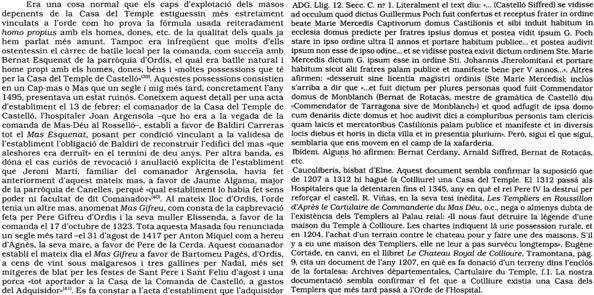
Figure 20.25: The description of documents highlighting the role of Anton Miquel in the Order of the Temple. The right column are footnotes. The citations are taken from Miquel Pujol i Canelles,"Els Templers a l’Empordà - la comanda del Temple de Castelló d’Empúries, primera part", p. 65, 69, 90.
20.6.2 Clementa Desclergue
Clementa Desclergue was married to Francesc Torró i Miquel, described in Chapter 20.6.1. Her father was Brenguer Desclergue, son grandson of Bernat Desclergue and great-grandson of Guillem Desclergue. Guillem. The ancestry of Clementa Desclergue is described in Chapter 25.0.1. In Chapter 25.0.1, the brother of Clementa Desclergue is described as Ramon Berenguer Desclergue, in Chapter 25.0.1.2, while her ancestors through her grandmother’s side, D’Anguera, equally descending from Raymond Desclergue, are similarly outlined.
20.6.3 Galceran Torró y Desclergue (DC01b)
Galceran Torró y Desclergue (DC01b), alias Galceran Desclergue, was the heir of his uncle Ramon Berenguer Desclergue. He appears with his brother Pere (Petrus de Clerico and Galcerandus Desclerico) in a notarial document of August 1, 1494, testified by Raymundo Berenger Desclergue (his uncle) in Santa Coloma de Queralt.
20.6.4 Pere Torró y Desclergue (I) (DC01)
Pere Torró y Desclergue (I) (DC01), alias Pere Desclergue, is described in Chapter 25. He was the heir of his uncle Ramon Berenguer Desclergue. He appears as a notary in Montblanc in 1501. A 1576 notary document to evidence the ancestral bloodline did not go any further back in time; therefore, we have no reasons to assume that Berenguer was the patrilineal ancestor of Pere Torró y Desclergue (I), although he had the same name and was a notary in Montblanc too. He appears with his brother Galceran (Petrus de Clerico and Galcerandus Desclerico) in a notarial document of August 1, 1494, testified by Raymundo Berenger Desclergue (his uncle) in Santa Coloma de Queralt. 1494 is when their father, Francesc Torró i Miquel, died.
20.7 Other Members of the Torró clan
In Catalan history, archival records from 1180 reveal the presence of Turró Knights Templars. While their mention is relatively scarce in the literary works of both ancient and contemporary chroniclers, it is noteworthy that their lineage boasts far greater antiquity and nobility than any known Torres lineage within the Spanish domain.
In modern works, the Torró is usually referred to in later eras in the context of the Knights Templars. In such works, we read that the Torró surname, alternatively spelled Turró, represents an enduring lineage in Catalan history, primarily concentrated in the regions of Girona and Barcelona. Lesser concentrations of this surname are dispersed throughout Lleida, Tarragona, Valencia, and the Balearic Islands. As early as the late 14th century, a notable lineage bearing the Torró surname was established in Torroella de Montgrí, in the province of Girona.
Descended from this lineage was Joan Torró, holding the esteemed positions of Burgher and Trustee of Torroella de Montgrí. His significance was underscored by his representation at the Catalan Cortes of 1410 through the Real Arm. In subsequent centuries, another distinguished family lineage bearing the Torró surname emerged in Barcelona during the 15th century. Notable among its descendants was Bertrán Torró, who held the esteemed position of Councilor in Cap within the city.
His active participation in the Catalan Cortes of 1454, 1456, and 1460, representing the Royal Arm, further solidified the prominence of the Torró lineage in Catalan political affairs. The Torró lineage continued to contribute significantly to Catalan society and governance in later centuries.
Pere Galcerán de Torró, hailing from Balaguer in Lleida, exemplified this legacy as a Knight of the Principality of Catalonia and a Doctor of Law. His representation at the Cortes of 1599, representing the Military Arm, attested to his esteemed status within Catalan political circles.
The modern chroniclers also refer to Francesc de Torró i Desclergues, the son of Pere Galcerán de Torró, who maintained the family’s tradition of civic engagement by attending the Cortes of 1626, also representing the Military Arm.
Furthermore, they write that the Torró lineage’s presence is further evidenced by the Catalan census of 1553, which documents the residences of various individuals bearing the surname. Among them, Joan Torró resided in "Mollet y Parets (del Vallès)," another
© 2024 Nico F. Declercq
The Desclergues of la Villa Ducal de Montblanc, 2nd ed., Omn., VOL. I
20.7. OTHER MEMBERS OF THE TORRÓ CLAN
225
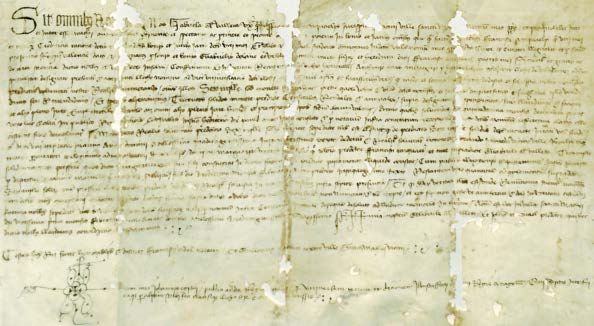
Figure 20.26: Apoca of Na Gabriela, alias Valletas, wife of the notable Francesc Miquel, and Joan Miquel, student, son of the couple, both residents of San Mateo, for the amount of 6000 Valencian salaries. The document dates from 21 February 1460 and is written by notary Johannes Pasqual. Escrit en Llatí. Tamany del pergamí. Sant Mateu. Repositori Universitat Jaume I.
Joan Torró in Anglés (Girona), and Pere Torró in the "loch de Canet" (Girona).
The Torró family constitutes a lineage entrenched in commercial endeavors, particularly in rental markets and financial transactions, enjoying notable prominence across Barcelona, Lleida, and Girona. This familial association is underscored by legal and notarial professions, which likely facilitated a closer interconnection between the respective families.
20.7.1 Ramon Torró
In the Gerona area, we find Torrò in 1300-1400. Guillem Torró was a Royal Mayor (’batlle real’), and his widow, Saura, was found in documents in 1311.
Their son was Ramón Torró, and he received the Mayorship.
Ramon Torró lived in 1309, in a time when diplomats were of crucial importance in negotiating and trading between the Catholic rulers and the Muslim Caliphate in Iberia, and he is found in 20.23 on page 223.
Furthermore, there was a Jaume Torró, who was a Royal Mayor (’batlle real’) in 1341, while Ramón Torró was the procurator of Jaume Torró and also his father. It is, however, not known if both Ramón Torró are the same.
20.7.2 Aynard Torró
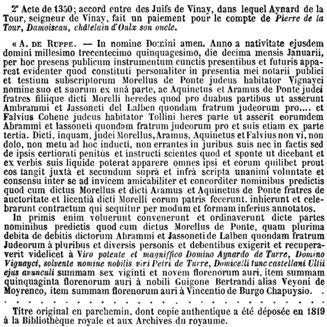
Aynard Torró, a figure of religious significance, is referenced in a Latin document dated 1350 as ’magnifico Domino Aynardo de Turre,’ alongside Petrus Torró. It is notable that while Turre was the ancient Occitanian rendition of Torró, French chroniclers, as evidenced at the outset of the citation, depicted in Figure 20.30 on page 227, chose to translate the name Turre or Torró as ’de la Tour.’ This translation underscores that Turre and Torró were not perceived as inherently French names, consequently allowing their designation to be subject to translations and misinterpretations by chroniclers. This phenomenon is exemplified by chroniclers who recounted the lineage of Bertrand Du Guesclin in Spain in Chapter 19.15.7, unaware that their surname was ’Torró’ rather than ’Thorreux’ or ’de Torres.’
20.7.3 Galceran Torró
Batlle i Gallart provides valuable information.23
Galceran Torró, a pivotal figure in the Torró family of Barcelona, emerged as a prominent citizen during the late medieval period.
Born around 1370, he hailed from Castelló d’Empúries and established himself in Barcelona alongside his brother, Nicolau. Galceran’s marriage to Estapera, sponsored by Antònia, wife of the Barcelona merchant Pere Morer, solidified his ties within the city’s merchant class.
Galceran’s pursuit of legal education at the Lérida Study and subsequent studies at the Universities of Toulouse and Montpellier culminated in his title of Doctor of Law. Despite accruing debts in Toulouse, Galceran forged professional alliances, notably with the jurist Joan Agulló, furthering his legal career.
Throughout his life, Galceran navigated financial challenges, evidenced by the pawning of his jurist’s library to secure loans. His fortunes fluctuated, yet his status as an esteemed legal practitioner and scion of the Torró family ensured his enduring presence in Barcelona’s socio-political landscape.
20.7.4 Joan Torró
During his active years spanning the late 14th and early 15th centuries, Joan Torró played a pivotal role in the administrative landscape as a notary. His responsibilities were paramount in documenting the legal and bureaucratic proceedings of the time, 23Batlle i Gallart, Carmen. «Una família barcelonesa: los Torró». Annals de l’Institut d’Estudis Gironins, 1974, Vol. 22, p. 203-210.
The Desclergues of la Villa Ducal de Montblanc, 2nd ed., Omn., VOL. I
© 2024 Nico F. Declercq
226
CHAPTER 20. THE TORRÓ BLOODLINE
Figure 20.27: Three generations of descendants of Bertrand Du Guesclin. The descendants of his grandchildren, Beltran Torró (DT01) and Guerau Torró (DT01b), are shown in Figures 20.28 and 20.29, respectively.
thereby providing a detailed account of the city’s transformation.
Figure 20.18 on page 221 underscores Joan Torró’s significance in constructing a grand and notable building, marking a significant landmark in the city.
The approval of the Ordinances of the General Hospital of the Holy Cross in 1417 further emphasizes Torró’s importance. This approval marks a milestone in establishing institutional frameworks, highlighting Torró’s role in shaping the city’s governance structures.
Belonging to the class of notaries, Torró was closely associated with the city’s elite, catering to the needs of nobles, merchants, and the burgeoning administrative apparatus.
Joan Torró served as a notary in Barcelona from 1401 until 1444, with his documents preserved in the archives of the Santa Creu Hospital of Barcelona, as indicated in Figure 20.21 on page 222.
Salvator Marino’s work, "El Memorial dels Infants," published in Barcelona in 2019, presents a compelling exploration of childhood in 15th-century Barcelona. Marino extensively references Joan Torró’s documentation, shedding light on the operations of the Santa Creu Hospital in Barcelona. The hospital’s founding act, initially penned by Bonanat Gili, coincided with Torró’s tenure as a clerk. Gabriela Piccinni’s analysis in "I modelli ospedalieri" delves into the ethical tensions inherent in the foundational documents of hospitals, highlighting the societal dichotomy between unrest and wealth distribution. Moreover, Piccinni argues that these documents outline an assistance system primarily geared towards the impoverished, encompassing diverse groups such as orphans, widows, and the destitute. Joan Torró’s handwriting, as a notary, is exemplified in Figure 20.22 on page 222.
As described in Chapter 18.11.1, Joan’s brother, Guillem, was the first presbyter of the Hospital.
20.7.5 Pere Torró
Pere Torró’s life unfolds, based on Figure 20.16 on page 221, through a series of administrative appointments and events documented in historical records. Born around the late 14th or early 15th century, Pere Torró lived during a period marked by significant political and administrative changes in Catalonia.
In October 1420, Pere Torró began his career as the third desk assistant, replacing Pere Ventosa, who had been promoted following the death of Francesc Richsen. This marks the beginning of Torró’s journey within the bureaucratic machinery of the General Deputation of Catalonia, an administrative body responsible for managing the region’s affairs.
As the years pass, Torró’s career within the bureaucracy flourishes. In September 1422, he achieved the position of second desk assistant, a testament to his unwavering commitment and exceptional skills, as Pere Ventosa was promoted to the role of first assistant. This advancement underscores Torró’s competence and dedication to his duties.
However, tragedy strikes in November 1444 when Pere Torró passes away. His death marks the end of a long and distinguished career serving the General Deputation of Catalonia. Yet, Torró’s contributions to the administration are acknowledged and honored even in death.
In July 1440, Pere Torró, feeling the effects of old age and indisposition, requests relief from his duties. In response, the deputies and auditors of the General’s accounts unanimously appointed Jacme Çafont as his deputy. This decision not only underscores the trust and respect Torró commanded among his peers but also highlights his pivotal role within the administration.
Interestingly, a dispute arises regarding the allocation of salaries between Torró and Çafont. While Torró is granted his full wage, Çafont initially receives no compensation despite assuming additional responsibilities. This disparity reflects the complexities of bureaucratic arrangements and the negotiations involved in distributing resources.
The historical records also shed light on the administrative practices of the time. The mention of leases or binding orders every three years highlights the meticulous record-keeping and periodic reviews undertaken by the General Deputation to ensure the smooth functioning of governance.
In summary, Pere Torró’s life story offers a glimpse into the intricate workings of administrative institutions during the late medieval
© 2024 Nico F. Declercq
The Desclergues of la Villa Ducal de Montblanc, 2nd ed., Omn., VOL. I
20.7. OTHER MEMBERS OF THE TORRÓ CLAN
227
Figure 20.28: The descendants of Beltran Torró (DT01). His place on the family tree of Bertrand Du Guesclin is shown in Figure 20.27.
Figure 20.29: The descendants of Guerau Torró (DT01b). His place on the family tree of Bertrand Du Guesclin is shown in Figure 20.27.
Figure 20.30: This is a document from
1350, detailing an agreement involving
Jews from Vinay. It involves a payment
arrangement made by Aynard de la Tour,
the lord of Vinay, on behalf of his un-
cle Pierre de la Tour, who is the castel-
lan of Oulx. The notarial act is witnessed
by Morellus de Ponte, a Jew from Vignay,
and other parties including Aquinetus and
Aramus de Ponte, who are the heirs of
Morelli, along with Flavius Cohene from
Tollini.
The Desclergues of la Villa Ducal de Montblanc, 2nd ed., Omn., VOL. I
© 2024 Nico F. Declercq
CHAPTER 20. THE TORRÓ BLOODLINE
period in Catalonia. His career trajectory, marked by diligence, promotions, and eventual retirement due to illness, contributes to our understanding of bureaucratic systems and the individuals who navigated them.
20.7.6 Elionor Torró
Batlle i Gallart provides valuable information.24
Elionor Torró, a lesser-known member of the Torró family, represents an intriguing figure in late medieval Barcelona’s social tapestry.
Sponsored by her relative Galceran Torró, Elionor’s familial connections underscored her integration into the city’s merchant elite.
While details regarding Elionor’s life remain elusive, her association with Galceran suggests her involvement in Barcelona’s commercial and social spheres. Her presence within the broader Torró network reflects the interconnectedness of familial ties in shaping the city’s socio-economic dynamics.
Though overshadowed by more prominent figures within the Torró lineage, Elionor’s inclusion highlights the diverse individuals contributing to Barcelona’s vibrant urban landscape during the late Middle Ages.
20.7.7 Galceran Torró (DT03g)
Galceran Torró (DT03g) was the son of Nicolau Torró (DT02c) and Francesca, described in Chapter 20.3.1. He was the brother of Bertran Torró (DT03f), described in 20.7.8.
He studied Law at Lérida first and then at the universities of Toulouse and Montpellier
Galceran Torró (DT03g) lived and worked as a judge in Tortosa in 1391 and died in 1454 in Barcelona.2526272829
Galceran Torró, a figure shrouded in medieval Catalonia’s legal and societal landscape, emerges as a multifaceted persona of noble lineage and scholarly pursuits. He was an honorable citizen, a doctor, a jurist, and a judge. Galceran Torró’s presence resonated notably in 1391 when he served as a judge in Tortosa. His judicial endeavors were entwined with the complex case concerning the Jewish community of the Aljama, wherein he collaborated with fellow Tortosa judge Joan de Naters. While his exact origins remain debated, it is conjectured that Torró hailed from a distinguished family in Castelló d’Empúries, with ties reaching into the urban fabric of Barcelona.
The familial lineage of Torró unfolds with his father, the money changer Nicolau Torró, who, alongside his brother Guerau, established close affiliations with King Ferdinand I of Antequera. Notably, Galceran’s baptismal obligations extended to Eleanor, the daughter of Joan Torró, emblematic of familial ties deeply embedded within societal structures of the time. Educationally, Torró’s journey led him through the corridors of legal scholarship at prestigious institutions such as the universities of Lleida, Toulouse, and Montpellier, culminating in a doctorate in law. In 1445 and 1451, he was engaged as an advisor to the procurator of Barcelona, reflecting his active involvement in the legal governance of the county of Empúries.
An insight into Torró’s intellectual pursuits unveils glimpses of his legal library, shedding light on the scholarly resources that enriched his legal acumen. Torró inscribed his final wishes on the testamentary grounds on July 17, 1454, marking the denouement of a life dedicated to legal scholarship and civic duty.
Intriguingly, Torró’s narrative intertwines with linguistic remnants preserved through a diet prescription, possibly dating back to circa 1420. This artifact, bearing linguistic nuances reflective of the Tortosa region, hints at interpersonal connections, perhaps with figures like Joan de Naters, resonating with Torró’s societal engagements.
Moreover, a manuscript bearing an Aljami inscription in Hebrew, discovered alongside a legal codex fragment in Latin, alludes to Torró’s potential interactions with a prior owner—potentially a Jewish physician. This serendipitous encounter with historical artifacts unveils the intricacies of Torró’s societal milieu, offering glimpses into his engagements beyond the realms of jurisprudence.
20.7.8 Bertran Torró (DT03f)
He died in 1462 and was the son of Nicolau Torró and Francesca, described in Chapter 20.3.1. He was married to Sibilla Miquel, described in Chapter 20.7.13, born in Girona and who died in 1476. Bertran Torró (DT03f) was the brother of Galceran Torró (DT03g), described in 20.7.7.
A citation is shown in Figure 20.6 on page 218.
There is a document, dated August 1, 1457, and shown in Figure 20.10 on page 219, that recounts the challenges faced in organizing the crew for a Barcelona guardacoslas galley. Bertran Torro, a key figure in the narrative, is mentioned as a source of information guiding the efforts to recruit sailors and crew members for the ship. The document describes the diligent efforts undertaken, including traveling along the coast to identify and engage potential crew members. Bertran Torro appears to have played a pivotal role in facilitating these operations, with individuals being dispatched to various locations to secure personnel for the ship.
However, complications arise when the captain of Cobliure, Berenguer d. Olms, intervenes, expressing concerns about the potential vulnerability of the town to impending attacks by Genoese galleys. Despite attempts to persuade Berenguer to release the recruited men for service on the Barcelona ship, he remains steadfast in his decision to retain them for the town’s defense.
The narrative underscores the diplomatic efforts made to navigate the situation, appealing to Berenguer’s sense of duty to the King and country and emphasizing the importance of the Barcelona ship’s mission. Despite these efforts, Berenguer refused to release the recruited men. Consequently, the writers of the document expressed their inability to proceed further without instructions from higher authorities, seeking guidance on how to proceed with the situation.
Batlle i Gallart provides valuable information.30 Bertran Torró, a prominent figure in late medieval Barcelona, hailed from the town of Castelló d’Empúries, branching from the Torró family. Born around 1400, he was the son of Nicolau, a money changer, and his second wife, Francesca. Bertran’s elder half-brother, Galceran Torró, pursued legal studies in Lérida, Toulouse, and Montpellier, eventually earning a doctorate of law. Meanwhile, Bertran, destined for business, received a standard education befitting his family’s status as honest citizens.
Following their father’s death before 1431, Bertran and Galceran maintained a close relationship, sharing their father’s residence in 24Batlle i Gallart, Carmen. «Una família barcelonesa: los Torró». Annals de l’Institut d’Estudis Gironins, 1974, Vol. 22, p. 203-210.
25Batlle i Gallart (1974), "Una família barcelonesa: los ...", pp. 203-204 i quadre genealògic (Torró de Girona-Barcelona) 26Grau i Monserrat (1985), "Vendes de seients de la Sinagoga ...", pp. 10, 12-13 i 18 (Tortosa) 27Iglesias Fonseca (1996), Llibres i lectors a la Barcelona ..., doc. 262 (llibres al testament)
28Iglesias Fonseca (2003), "Els llibres dels juristes: un ...", pp. 730 i 740, doc. XV (llibres al testament) 29Raufast Chico (2008), "Ceremonia y conflicto: entradas ...", p. 1043n (assessor, 1451)
30Batlle i Gallart, Carmen. «Una família barcelonesa: los Torró». Annals de l’Institut d’Estudis Gironins, 1974, Vol. 22, p. 203-210.
© 2024 Nico F. Declercq
The Desclergues of la Villa Ducal de Montblanc, 2nd ed., Omn., VOL. I
20.7. OTHER MEMBERS OF THE TORRÓ CLAN
229
El Borne.31 After inheriting his father’s wealth, Bertran initially engaged in mercantile ventures before shifting his focus to municipal politics. His tenure in the Council of Hundred spanned over two decades, during which he rose to prominence, particularly during the Busqueris’ governance.
Bertran’s political career peaked when he served as city trustee in the Cortes, a position he held from October 1454. Despite his dedication and re-election in May 1455, his affiliation with the Busqueris drew the ire of their adversaries, leading to his tragic demise. Engaging in conspiracies favoring King John’s return, Bertran was sentenced to death alongside fellow conspirator Martí Solzina on May 19, 1462. Their execution followed swiftly, with their bodies displayed in the Plaza del Rey.
Bertran’s death, recorded in the death register of Santa Maria del Mar, marked the end of a tumultuous era. His estate, including a significant inheritance and conflicts over assets, passed to his widow, Sibilla Miquel, a scion of the influential Miquel family of Gerona. Bertran’s legacy, entwined with political upheavals and familial disputes, left a lasting impact on Barcelona’s socio-political landscape. The brother-in-law of Bertran Torró (DT03f) is described in Chapter 20.7.12.
20.7.9 Francesc Torró
Figure 20.11 on page 220 shows Francesc Torró, appearing in Urgell, 1462.
20.7.10 Francesc de Torró y Desclergue
Figure 20.8 on page 219 shows that Francesc de Torró y Desclergue, the son of Pere Galceran de Torró, was a Knight and attended the Corts in 1626.
20.7.11 Pere Galceran Torró
Pere Galceran Torró was the son of Pere Torró y Hostalrich, as shown in Figure 20.9 on page 219. It concerns Saint Ignatius of Loyola’s canonization process, in which Pedro Galcerán de Torró’s testimony holds particular significance. His account vividly connects to Ignatius’s life and times, as he speaks at length about his father, Pedro Torró de Hostalrich, a contemporary and close friend of Ignatius.
Pedro Galcerán de Torró’s testimony was part of a broader collection gathered in Barcelona, representing a wide spectrum of social classes. Galcerán’s father, Pedro Torró de Hostalrich, had known Ignatius personally, adding a layer of authenticity and intimacy to his son’s account.
Pere Galceran Torró (DC02by) was a Knight and born in Balaguer. He was a doctor in law and participated in the Corts of 1599.
He married a Desclergue and was the father of Francesc Torroó y Desclergue (II) (DC02byy), a Knight who attended the Corts of 1626. Pere Galceran Torró was the son of Pere Torró i Hostalric (I)(DC02b), also known as Pere Desclergue and as Pere Desclergue y Torró. Pere Torró i Hostalric was the son of Pere Torró y Desclergue (I) (DC01) and Eleonor Torroó y Miquel.
In 1603, Pere Galceran Torró became embroiled in a legal battle over the rightful ownership of the inheritance and property previously belonging to Mariana de Montagut. Despite Miguel Montagut’s donation, the Monastery’s Bursar called into question the legality and validity of this transfer, ultimately leading to a legal ruling in favor of Miguel Montagut as the rightful heir. In Figure 20.7 on page 219, Fontanella introduces a legal case from August 22, 1603, originating from the Royal Court of Catalonia.
The case revolves around the inheritance and property of Mariana de Montagut, who was married to Miguel Montagut.
After Mariana’s passing, Miguel donated her assets to Pedro Galceran Torró. However, the Bursar of the Monastery of the Holy Trinity contested this donation, leading to a lawsuit. In this legal dispute, Pere Galceran Torró is the recipient of the disputed assets through the act of donation made by Miguel Montagut, Mariana’s husband. However, the Bursar of the Monastery of the Holy Trinity challenges this donation, claiming that Miguel Montagut should be considered the rightful heir to Mariana’s property since the donation implies the addition of the inheritance. The decision of the Royal Court, supported by Jerónimo Astor and Actuary Martín Juan Carmona, favors Miguel Montagut’s claim, asserting that the donation presupposes the addition of the inheritance, thus making Miguel the heir of the donated property.
Fontanella further reinforces this legal standpoint by referring to a similar decision from the Roman Rota, stating that the individual who disposed of the assets forming part of the inheritance is deemed to have accepted the inheritance.
Figure 20.8 on page 219 shows that Pere Galceran de Torró, the father of Francesc de Torró y Desclergue, was a Knight, born in Balaguer and Doctor in law. He attended the Cors in 1599.
20.7.12 Dionís Torró (alias Miquel)
Batlle i Gallart provides valuable information.32
Dionís Torró, also known as Dionís Miquel, emerged as a significant figure in late medieval Barcelona, inheriting the legacy of his brother-in-law Bertran Torró, described in Chapter 20.7.8. Born around 1450, Dionís entered religious life, becoming a hospital canon in Pamplona. However, he later abandoned his ecclesiastical career to fulfill his sister’s will, adopting the surname Torró.
In 1479, Dionís married Francina Ros, the daughter of Joan Ros, a respected doctor of law in Barcelona. This union solidified his position within the city’s elite circles, bolstered by his inheritance from Bertran, primarily consisting of public and private censuses.
Following Francina’s death in 1490,33 Dionís remarried Isabel de Cabrera, though they had no children. He continued his involvement in municipal governance, serving as a councilor in 1507 and appointed consul of the Catalans in Malta in 1510.34 Despite perhaps not assuming the latter role due to his wife’s demise, Dionís remained a prominent figure until his passing, documented after 1511.
Dionís’ legacy, intertwined with familial ties and civic duties, reflected the complexities of late medieval Barcelona’s socio-political fabric. His contributions to governance and his adaptation of the Torró name underscored the enduring influence of family connections in shaping the city’s trajectory.
31Alós, La heràldica, pàg. 37.
32Batlle i Gallart, Carmen. «Una família barcelonesa: los Torró». Annals de l’Institut d’Estudis Gironins, 1974, Vol. 22, p. 203-210.
33Francina otorgó testamento ante el notario Miquel Carbonell el 22 de abril de 1490. (José M. de Alós yde Dou, La heràldica en la basílica de Santa Maria del Mar, «Boletín de la Sociedad de Atracción de Forasteros» (Barcelona), 1924, pàgs. 37.38).
34Antonio Capmany y de Monpalau, Memorias históricas sobre la marina, comercio y artes de Ui antigua ciudad de BarceUina, reed. Barcelona, II, 1961-1963, pàgs. 857 y 1.029.
The Desclergues of la Villa Ducal de Montblanc, 2nd ed., Omn., VOL. I
© 2024 Nico F. Declercq
CHAPTER 20. THE TORRÓ BLOODLINE
20.7.13 Sibilla Miquel
Batlle i Gallart provides valuable information.35
Sibilla Miquel, a scion of the esteemed Miquel family of Gerona, played a pivotal role in late medieval Barcelona’s social milieu.
Born around 1420, she was the daughter of Narcís Miquel and Sibilla Sampsó,36 both revered citizens of Gerona. Raised in a family steeped in tradition and influence, Sibilla married Bertran Torró, described in Chapter 20.7.8, a key figure in Barcelona’s political landscape.
During their marriage, Sibilla bore Bertran a natural son, Nicolau, while immersing herself in familial and religious endeavors. Following Bertran’s demise in 1462, Sibilla became embroiled in disputes over inheritance, particularly regarding significant censuses on the kingdoms of Aragon and Mallorca.
After Bertran’s death, Sibilla’s life centered on managing his estate and navigating familial conflicts. Her involvement in legal proceedings, including arbitration over contested assets, exemplified her determination to uphold her family’s legacy amidst challenges.
Sibilla’s passing in 1490 marked the end of an era, leaving behind a legacy intertwined with the Torró family’s fortunes and the broader socio-political dynamics of late medieval Barcelona. Her descendants would continue to shape the city’s narrative, perpetuating the enduring influence of the Miquel-Torró lineage.
20.7.14 Galceran Torró
Galceran Torró was a prominent person in the legal landscape of his time, as can be seen in Figure 20.17 on page 221 where he appears within a list of esteemed lawyers.
During the mid-15th century, when Galceran Torró graced the legal fraternity with his presence, the halls of jurisprudence pulsated with intellectual fervor. It was an era characterized by the pursuit of knowledge, where legal minds converged to navigate the intricate tapestry of civil and canon law. In an age where legal scholarship was revered, Galceran Torró, adorned with the title of Doctor in Civil Law, stood as a beacon of erudition. His presence among the luminaries of his time underscores his significance and contribution to the legal discourse of the period.
Galceran Torró’s testament, shown in Figure 20.19 on page 221, dated July 17, 1468, reveals his acknowledgment of indebtedness to several individuals, including Margarida Torrelles, Joan de Gualbes, Antónia (widow of Ramon Serra), and Joan de Bellafilla.
These individuals hold some of Torró’s books as pledges. The testament offers insights into the financial arrangements and social networks of fifteenth-century Barcelona, shedding light on the legal and economic practices of the time.
The testament also shows that Galceran Torró was a civil law doctor and a citizen of Barcelona. He is also referred to as such in Figure 20.20 on page 221.
20.7.15 Bernat Torró
Bernat Torró, identified as a monk and scribe from the monastery of Poblet, plays a significant role in documenting various transactions and agreements involving land and property rights.
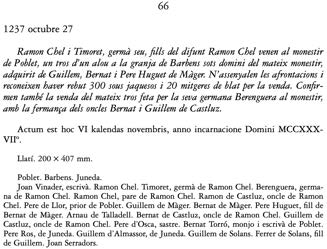
In the document dated January 16, 1233, in Figure 20.12 on page 220, Berenguer de Tàrrega, rector of Montblanc, acknowledges receipt of 100 sous from Pere de Tàrrega, prior of Poblet. This transaction involves renouncing rights on a census bequeathed to the monastery by Bernat Amill. Berenguer de Tàrrega also renounces any claims on censuses from other individuals and funeral rights of the people of Montblanc for the monastery. Bernat Torró is involved as the monk and scribe from Poblet who documents this transaction.
The document dated April 29, 1233, in Figure 20.13 on page 220, records the sale of land in Barbens to the monastery of Poblet by Berenguer d’Anglesola and his wife, Berenguera. Bernat Torró, a monk and scribe from Poblet, is present during this transaction to record the sale details. Other notable individuals mentioned include Arnau d’Anglesola and Ramon de Cervera.
Dated November 29, 1235, the document, in Figure 20.14 on page 221, records Bernat de Guàrdia’s renunciation of his rights over honors, lands, censuses, and quarters of the farm of Barbens in favor of the monastery of Poblet. Bernat Torró, a monk and scribe from Poblet, documents this renunciation agreement. Notable individuals mentioned in this document include Bartomeu Ern and Peter Antolí.
Finally, the document, in Figure 20.15 on page 221, dated October 27, 1237, involves the sale of a piece of land in Barbens to the monastery of Poblet by Ramon Chel and his brother, Timoret. Bernat Torró is again present during this transaction, fulfilling his role as a monk and scribe from Poblet, likely to document the sale. Other individuals mentioned in this document include Pere de Llor, Guillem de Máger, and Pere Huguet.
20.7.16 Guillem Torró
Guillem Torró was, as can be read in Figure 20.24 on page 223, the first presbyter of the Hospital established by his brother, notary Joan Torro, described in Chapter 20.7.4.
20.7.17 Jaume and Joan Torró
Batlle i Gallart provides valuable information.37
Jaume and Joan Torró, members of a branch of the Torró family originating from Castelló d’Empúries, played significant roles in Barcelona’s urbanization during the late medieval period. While specific details regarding their lives remain scarce, their association with the city’s merchant circles underscores their economic influence.
Operating in tandem with the broader Torró network, Jaume and Joan facilitated the migration of rural inhabitants to Barcelona, contributing to the city’s demographic growth. Their ties to Galceran Torró further solidified their integration into Barcelona’s commercial and social network
Despite their relative obscurity in historical records, Jaume and Joan’s contributions exemplify the collective efforts of families like the Torrós in shaping Barcelona’s transformation into a bustling urban center during the late Middle Ages.
35Batlle i Gallart, Carmen. «Una família barcelonesa: los Torró». Annals de l’Institut d’Estudis Gironins, 1974, Vol. 22, p. 203-210.
36AHPB, Joan Franch major, leg. 15, Segundo libro de testamentos 1434-1444, 30 de mayo de 1439
37Batlle i Gallart, Carmen. «Una família barcelonesa: los Torró». Annals de l’Institut d’Estudis Gironins, 1974, Vol. 22, p. 203-210.
© 2024 Nico F. Declercq
The Desclergues of la Villa Ducal de Montblanc, 2nd ed., Omn., VOL. I
20.8. MEMBERS OF THE MIQUEL CLAN
231
20.8 Members of the Miquel clan
The descendants of Bernat Miquel are shown in Figure 19.25 on page 191.
His clan intermarried with Torró and Desclergue. One such marriage is that of Bertrand Torró and Sibillia, and they gave birth to Nicolau Torró,38 described in Chapter 20.3.1. In this chapter, we describe several Miquels that may interest our ancestry.
20.8.1 Berenguer de Miquel
Don Berenguer de Miquel was a native of Girona, a Knight of the Order of the Temple, and a doctor of Law. He was an Ambassador of the King of Aragon, Don Pedro II, in 1203 in Montpellier and in 1204 before the Pope in Rome.
20.8.2 Pere Miquel
Pere Miquel was a figure of significance in Girona’s history. Born in medieval Catalonia, his life unfolded against societal transitions and ecclesiastical duties. He was a native of Girona, Knight of the Order of the Temple, and went with King James I of Aragon to the conquest of Valencia.
At Girona’s Hospital de la Seu, Pere Miquel held sway as an administrator,394041424344 a steward entrusted with the well-being of both body and soul. From 1327 to 1342, he navigated the complexities of managing the hospital, a sacred institution intertwined with the cathedral chapter’s patronage. His tenure was marked by diligent oversight, ensuring the smooth operation of the hospital’s affairs.
Yet, Pere Miquel’s influence extended beyond the confines of administrative duties. A man of multifaceted talents, he was not merely a bureaucrat but also a custodian of knowledge and a charity conduit. At the behest of the bishop, he cataloged the hospital’s possessions, an endeavor that underscored his commitment to meticulous stewardship.
His involvement in the ecclesiastical sphere went beyond the walls of the hospital. Pere Miquel likely served as the bishop’s butler, a role that afforded him proximity to the corridors of power and the inner workings of the Church. Through his service, he navigated the intricate web of ecclesiastical politics, earning the trust and respect of his superiors.
However, Pere Miquel’s story is not confined solely to his professional endeavors. The scattered fragments of historical records hint at a broader narrative; one intertwined with familial ties and spiritual legacies. While his precise lineage remains shrouded in obscurity, tantalizing glimpses suggest connections to benefices and chapels, each thread weaving a tapestry of his familial and spiritual affiliations.
Tragically, Pere Miquel’s journey met its denouement in the shadows of mortality. By 1362, his name graced the inventory of the deceased, a testament to the ephemeral nature of human existence. Yet, his legacy endured, etched into the annals of Girona’s history as a paragon of service and stewardship.
20.8.3 Anton Miquel
Anton Miquel, as shown in the historical record described in Figure 20.25 on page 224, emerges as a notable figure within the administrative apparatus of the Order of the Temple at Empúries during the medieval period. Contextualized within the rural landscape of Catalonia, Miquel’s significance is discerned primarily through his involvement in land transactions, notably concerning Mas Gifreu, a Templar-managed farmhouse situated within the territorial jurisdiction of the House of the Temple.
Miquel’s association with Mas Gifreu is documented in a deed dated August 31, 1417, wherein he is identified as the heir of Agnes, his mother, and thus vested with proprietary interests in the property. This document serves as a testament to Miquel’s familial lineage and entanglement within the Templar network as a beneficiary of inherited land tenure rights. Notably, his subsequent actions within this transactional context shed light on his agency and role within the order’s estate administration.
In the deed, Miquel relinquishes his hereditary claims to Mas Gifreu in favor of Pere de la Cerda, thereby effectuating a transfer of property rights within the Templar hierarchy. This act of renouncement underscores Miquel’s compliance with the institutional protocols governing succession and land tenure within the Order of the Temple. Moreover, his relinquishment of Mas Gifreu denotes his surrender to the order’s directives, highlighting his commitment to the collective interests of the institution over individual prerogatives.
Furthermore, Miquel’s involvement extends beyond mere renouncement to a proactive role in establishing Mas Gifreu under a new custodian, Bartomeu Pages. Through this transaction, documented in the same deed, Miquel assumes the mantle of authority, orchestrating the transfer of property rights by institutional norms and customary practices. The stipulations outlined within the deed, including pecuniary considerations and agricultural obligations, underscore Miquel’s meticulous adherence to the procedural intricacies of Templar land tenure practices and his thoroughness and attention to detail.
Readers interested in historical debate, particularly inquisitive in Tarragona and Montblanc, may read the text in the right column in Figure 20.25 on page 224 from the same source or the work of Miquel Pujol i Canelles for more information.45
Anton Miquel’s mother was Agnes, the daughter of Joan Torró and Geraldona.46
20.8.4 Joan Miquel
Joan Miquel, a student and the son of notable Francesc Miquel (residing in San Mateo), appears in a document of 1460, shown in Figure 20.26 on page 225.
38Batlle i Gallart, Carmen. «Una família barcelonesa: los Torró». Annals de l’Institut d’Estudis Gironins, 1974, Vol. 22, p. 203-210.
39Batlle i Prats (1934), "Inventari dels béns de ...", p. 74 (un llibre de medicina en català que li pertangué).
40Castells - Puigdevall - Reixach (1989), L’Hospital de Santa Caterina, p. 20 (llista d’hospitalers amb les dates 1329-1353).
41Gironella i Delgà (2001), "La cultura de la caritat ..." (inventari).
42Conejo da Pena (2013), «Domus seu hospitale»: espais d ..., pp. 35 i 83.
43Girona - ADG – Manuals de col·lacions beneficials, vol. D-161, ff. 93r-109r – Inventari, Notarial – 10 gener 1362.
44Girona - AHG - Hospital de Santa Caterina – perg. 684 – Inventari, Notarial – 31 gener 1342.
45Miquel Pujol i Canelles,"Els Templers a l’Empordà - la comanda del Temple de Castelló d’Empúries, primera part", p. 65, 69, 90.
46Apothecary of Tarragona. The inventory of his goods (10/04/1360) is preserved, made at the request of his widow Geraldona, guardian of the common daughter Agnès.
The Desclergues of la Villa Ducal de Montblanc, 2nd ed., Omn., VOL. I
© 2024 Nico F. Declercq
CHAPTER 20. THE TORRÓ BLOODLINE
20.8.5 Gabriel de Miquel
Fray Gabriel de Miquel was the Prior of Cerviá and attended the Cortes of Barcelona for the Religious Arm in 1493.
20.8.6 Guillermo Torró de Miquel
Guillermo Torró de Miquel, or Guillem Turró de Miquel, was a Knight of the Order of Saint John. He was Commander and Prior at the Hospital of the Holy Cross and Saint Paul in Barcelona.
20.8.7 Gerónimo de Miquel i Torró
Don Gerónimo de Miquel i Torró was a Trustee of Barcelona, a Doctor of Laws, a Councilor of Barcelona, and an Honored Citizen of Barcelona. He attended the Cortés Catalanas of Barcelona in 1599 by the Royal Arm.
20.8.8 Francesc Miquel
Francesc Miquel is found as Knight of the Saint John’s order of Jerusalem Figure 20.4 on page 218, in 1613, in Figure 20.5 on page
218, in 1615 and in Figure 20.3 on page 217, in 1619.
More information can be found about Francesc Miquel in 161547
There, in Catalunya’s history during the early 17th century, amidst the intricate webs of political and maritime affairs, one figure emerges prominently—Francesc Miquel. As a knight of the esteemed Order and Militia of Sant Joan de Hierusalem, Miquel held a position of honor and responsibility, further elevated by his role as captain of the galley of the General of Catalonia.
The events of June 17, 1615, stand as a testament to Miquel’s pivotal role in the maritime operations of Catalunya. On this day, Raphael Riera, acting as the attorney of the General of Catalonia by order of the senior deputies, confronted Miquel regarding his alleged failure to execute the directives of the said deputies. Positioned before the Font de Sant Joan in the bustling city of Barcelona, Miquel faced scrutiny amidst the presence of witnesses.
Miquel’s response revealed his position’s complex interplay of authority and pragmatism. He relayed the instructions he received from the Serene Prince General of the Sea, emphasizing the necessity of complying with higher commands. Despite the pressures and uncertainties of maritime logistics, Miquel demonstrated a steadfast commitment to his duties, assuring prompt readiness for forthcoming voyages.
Central to Miquel’s narrative is the message dispatched by the Highness, underscoring the gravity of the situation. Addressed to
"Miquel Pol, captain of the captain galley of Catalonia," the message conveyed the Highness’s directive in clear terms. Miquel was urged not to entertain deviations from the established orders, reaffirming his allegiance to his majesty’s service.
Yet, amidst the weighty responsibilities thrust upon him, Miquel was hindered by indisposition, impeding his ability to convey crucial developments to the senior deputies. This unforeseen setback serves as a poignant reminder of the human element woven into the fabric of historical events, highlighting Miquel’s vulnerability despite his unwavering dedication.
Information of 161948 concerning Francesc Miquel, further encompasses his diplomatic and logistical undertakings in service of the General of Catalonia. As the consistory of the royal delegation convened on Dimars to viii, Miquel, adorned with the esteemed habit of Sant Joan, assumed his role as captain of the galley squadron with characteristic poise and diligence.
In this gathering, Miquel brought forth a matter of pressing concern—Esmarils held captive in the clutches of a Moorish vessel recently encountered by the General’s galleys near Palamós. With a steadfast resolve to uphold the honor and rights of the General, Miquel apprised the assembly of the exigency to secure the release of these prisoners of war. Despite encountering resistance, Miquel remained undeterred, pledging to effect the restitution of the Esmarils to the General, thus fulfilling his duty with unwavering fidelity.
The subsequent days bore witness to Miquel’s unwavering commitment to the operational readiness of the squadron under his charge.
As the demands of military logistics unfurled, Miquel orchestrated the return of armaments and provisions essential for the fleet’s sustenance and efficacy. His meticulous attention to detail and committed execution underscored his indispensability within the hierarchical framework of Catalunya’s maritime apparatus.
On 12 Disabte, amidst Jaume Sala’s case, Miquel facilitated the return of fifty-one harquebusses and fifty-three flasks, ensuring the replenishment of vital resources critical for the squadron’s operational tempo. This transaction bore testament to Miquel’s astute stewardship and unwavering commitment to the logistical imperatives underpinning Catalunya’s naval endeavors.
As the calendar turned to 17 Dijous, Miquel’s endeavors intersected with the auspicious Feast of the Gloriosa Sant Antoni, a poignant reminder of the symbiotic relationship between faith and duty woven into the fabric of Miquel’s existence. Amidst the occasion’s solemnity, Miquel’s presence resonated as a beacon of steadfast devotion to his calling, and his actions were symbolic of the courage and resolve of Catalunya’s maritime heritage.
47Dietaris de la Generalitat de Catalunya, 1411-1714, Colleccio de 10 volums, document 82, page 200
48Dietaris de la Generalitat de Catalunya, 1411-1714, Colleccio de 10 volums, document 174r, page 350
© 2024 Nico F. Declercq
The Desclergues of la Villa Ducal de Montblanc, 2nd ed., Omn., VOL. I
The Desclergues in Montblanc
The Desclergues of la Villa Ducal de Montblanc, 2nd ed., Omn., VOL. I
© 2024 Nico F. Declercq
Chapter 21
Earliest Desclergues in Montblanc - Matrilineal
Connection
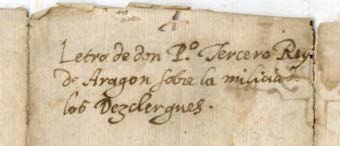
Figure 21.1: Back side of the 1494 (August 7) copy of the 1383 (Decem-
ber 8) notary document testifying the military ’Bernat D’Anguera, alias
Desclergue,’ and his father, Guillem D’Anquera, stationed in Montblanc.
The label refers to Don Pedro III of Aragon, but this is an error. The
dates in the document clarify that it concerned Don Pedro IV of Aragon.
(Source: Arxiu Comarcal Urgell Desclergues; Courtesy of Arxiu Comar-
cal Urgell and the de Pedrolo family)
The Desclergue family’s tale in Mediterranean trade history is a fascinating account of migration, cultural interchange, and business ventures. During the height of economic success in Barcelona and Mallorca, the Desclergues were deeply involved in the thriving business activities of these essential port cities, with their family history being connected to the dynamics of commerce and banking. The Desclergues did not live isolated in Mallorca but were continuously in contact with Barcelona, Valencia, Zaragoza, Huesca, and even Occitania, where they originated from.
Though lacking the cosmopolitan allure of coastal cities, Montblanc became the canvas for the Desclergue family’s lasting influence.
Initially, Montblanc may have seemed an unlikely choice for a family accustomed to Barcelona’s luxury and Mallorca’s wealth.
However, the Desclergues, with their refined preferences in art and architecture, transformed Montblanc into a sophisticated and alluring destination. Their prestigious mansion on the Plaza Mayor stands as a testament to their ability to shape their environment.
Yet, the Desclergue family’s influence extended far beyond the cobblestone streets of Montblanc. As Catalan traders, their commercial ventures reached the shores of distant lands far beyond the Iberian Peninsula. The allure of Sevilla, the gateway to the Americas, beckoned to the Desclergues’ adventurous spirit. Amidst the bustling port and labyrinthine streets, they firmly established themselves in transatlantic trade, further bolstering their wealth.
Francesc Torró y Miquel and Clementa Desclergue had four children: Eulalia Torró (DC01d), Francina Torró (DC01c), Galceran Torró y Desclergue (DC01b), and Pere Torró y Desclergue (DC01). In a notarial document of 1494, Galceran and Pere appear under the names Galceran Desclergue and Pere Desclergue. The different spelling, i.e., ’Petrus de Clerico’ and ’Galcerand Desclerico,’ in the document is evidence that their family name was not immutable, even though they are explicitly mentioned as brothers.
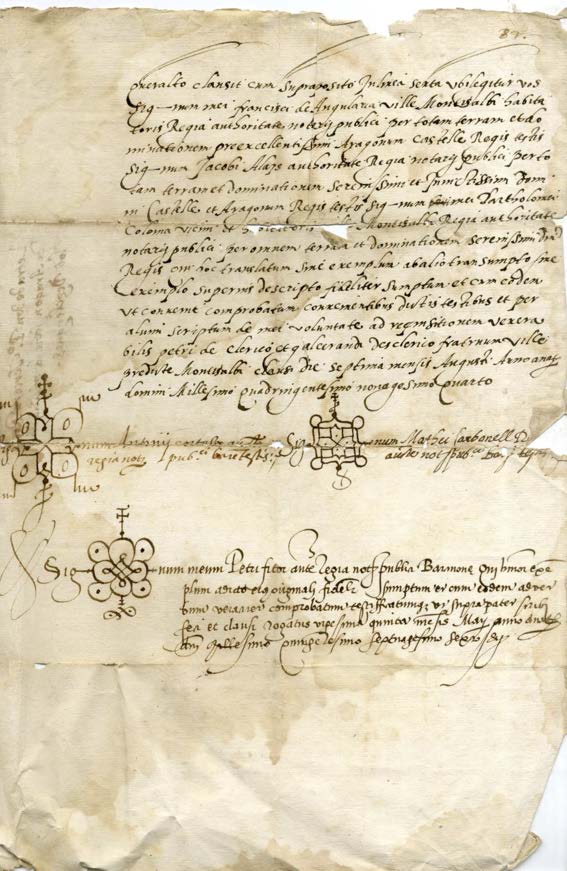
The notary document is the oldest reliable reference of the Desclergues of Montblanc, and it dates from October 1383 and was copied on August 7, 1494, and testified by Raymundo Berenger Desclergue of Santa Coloma de Queralt. The 1494 copy was written to allow our patrilineal ancestor, Pere de Torró y Desclergue, also known as Pere Desclergue (DC01), and his brother Galceran Desclergue (DC01b) to establish their careers. It was the year their father, Francesc Torró i Miquel, died, and they needed evidence of their Desclergue military ancestry.
The original 1383 document had been written under the reign of Don Pedro IV of Aragon1
The notary document refers to ’Bernat D’Anguera, alias Desclergue,’ and his father, Guillem D’Anquera, who were military stationed in Montblanc during the 100-year war in the 14th century. The document highlights that they stem from a bloodline of the military. Since the document dates from 1383, there is no information about the later period, in which, through other documentation, we found Berenguer Desclergue, who was a man of the law in 1440 and whose daughter Clementa married Francesc Torró i Miquel.
The notary document is shown in Figures 21.1, 21.2, 21.3, and 21.4. Pere de Torró y Desclergue, also known as Pere Desclergue (DC01), is described in Chapter 22 and Chapter 25.
The 1383 document describing Bernat D’Anguera, alias Desclergue, and his father Guillem D’Anguera does not provide details on how, in 1494, they were connected to Pere Torró y Desclergue (DC01) because the connection was not patrilineal. Indeed, the grandsons of Bernat D’Anquera, alias Desclergue, were Berenguer Desclergue and Francesc Desclergue. The daughter of Berenguer Desclergue was Clementa Desclergue, and she married Francesc Torró y Miquel, the parents of Pere Torró y Desclergue (DC)1), our forefather.
This is evidence that the name Desclergue was only transmitted father-to-son from Pere Torró y Desclergue (DC01) onward. Before his generation, the name was sometimes transmitted through the mother. In other words, to discover our patrilineal ancestry, we 1This can be verified by the mentioned dates, although on the back of the letter, Pedro III is mentioned, which is an error.
The Desclergues of la Villa Ducal de Montblanc, 2nd ed., Omn., VOL. I
© 2024 Nico F. Declercq
CHAPTER 21. EARLIEST DESCLERGUES IN MONTBLANC - MATRILINEAL CONNECTION
should look beyond the family name, which is what we did in this study. More details are provided in Part VI, and in Chapters
19.3, 19.15, 19.15.3, 19.15.4, and 19.15.6.
Therefore, although we do not descend patrilineally from the oldest Desclergues of Montblanc, they are our ancestors, and they were matrilineal ancestors of the Desclergues of Montblanc who established the famous Casal Dels Desclergue on the Plaza Major.
The Desclergues were keenly aware of this, which is why the 1383 document does not state patrilinearity and why none of the Desclergues were ever named Guillem or Bernat. Had they been patrilinear ancestors, their names would have been reused to honor their legacy.
The wife of Guillem D’Anguera was the daughter of Guillermo Desclergue, described in Chapter 18.12, son of Francesc Desclergue, and the daughter of Guillem Borrell, described in Chapter 18.11.3. Francesc Desclergue, described in Chapter 18.11, was the son of Raymond Desclergue, described in Chapter 18.10.
© 2024 Nico F. Declercq
The Desclergues of la Villa Ducal de Montblanc, 2nd ed., Omn., VOL. I
237
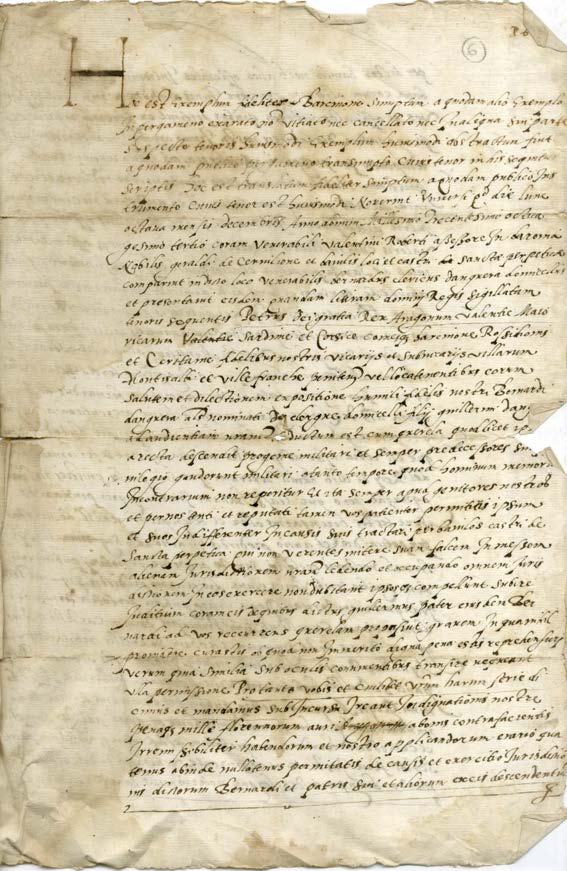
Figure 21.2: Page 1 of the 1494 (August 7) copy of the 1383 (December 8) notary document testifying the military
’Bernat D’Anguera, alias Desclergue,’ and his father, Guillem D’Anquera, stationed in Montblanc. (Source: Arxiu Comarcal Urgell Desclergues; Courtesy of Arxiu Comarcal Urgell and the de Pedrolo family)
The Desclergues of la Villa Ducal de Montblanc, 2nd ed., Omn., VOL. I
© 2024 Nico F. Declercq
238
CHAPTER 21. EARLIEST DESCLERGUES IN MONTBLANC - MATRILINEAL CONNECTION
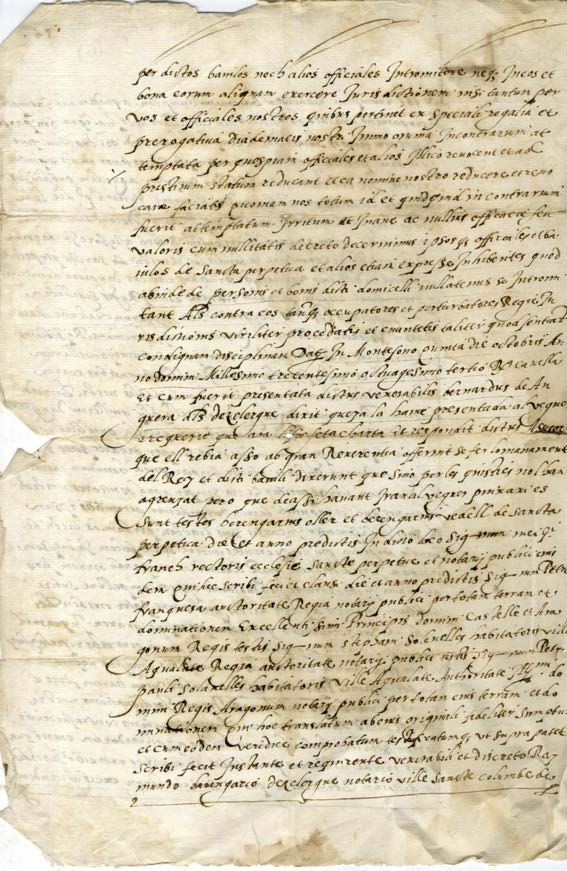
Figure 21.3: Page 2 of the 1494 (August 7) copy of the 1383 (December 8) notary document testifying the military
’Bernat D’Anguera, alias Desclergue,’ and his father, Guillem D’Anquera, stationed in Montblanc. (Source: Arxiu Comarcal Urgell Desclergues; Courtesy of Arxiu Comarcal Urgell and the de Pedrolo family)
© 2024 Nico F. Declercq
The Desclergues of la Villa Ducal de Montblanc, 2nd ed., Omn., VOL. I
239
Figure 21.4: Page 3 (last) of the 1494 (August 7) copy of the 1383 (December 8) notary document testifying the military ’Bernat D’Anguera, alias Desclergue,’ and his father, Guillem D’Anquera, stationed in Montblanc. (Source: Arxiu Comarcal Urgell Desclergues; Courtesy of Arxiu Comarcal Urgell and the de Pedrolo family)
The Desclergues of la Villa Ducal de Montblanc, 2nd ed., Omn., VOL. I
© 2024 Nico F. Declercq
CHAPTER 21. EARLIEST DESCLERGUES IN MONTBLANC - MATRILINEAL CONNECTION
© 2024 Nico F. Declercq
The Desclergues of la Villa Ducal de Montblanc, 2nd ed., Omn., VOL. I
Chapter 22
Summary of the Desclergue Paternal Ancestry Line
When we investigate our ancestry and the frequency of first names, the names Antoni and Joan stem from the Miquel and Torró families, the names Pere, Francesc, and Galceran from Torró, Gabriel and Bernard from Miquel, and the name Beltrán or Bertran or Bertrand stem from the Du Guesclin ancestors.
Preserving the ancestral overview is challenging when writing a book about a person’s genealogy. Throughout the book, sections of the ancestry tree are shown as appropriate. The entire ancestry tree is also published on the internet. Here, we present the patrilinear ancestry line from the author to Richer Guarplic, the earliest known ancestor of Bertrand Du Guesclin. Four lines connect the author with this eldest known ancestor. The primary is solely patrilineal, but two side paths through a maternal ancestor bind them. We present the ancestry lines from Richer de Guarplic to the author in different sections for presentation purposes.
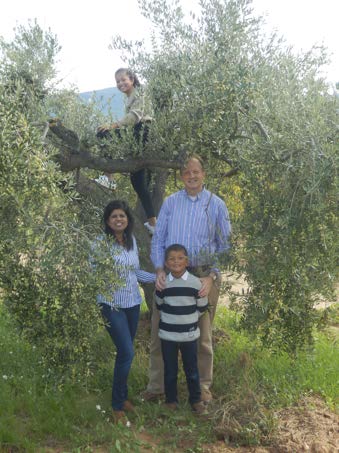
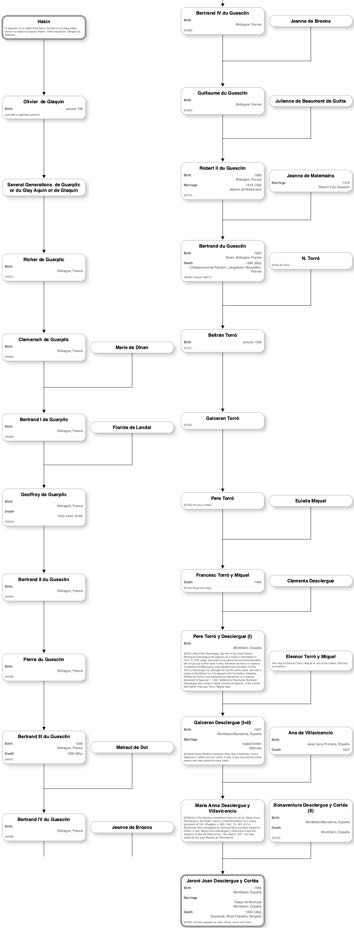
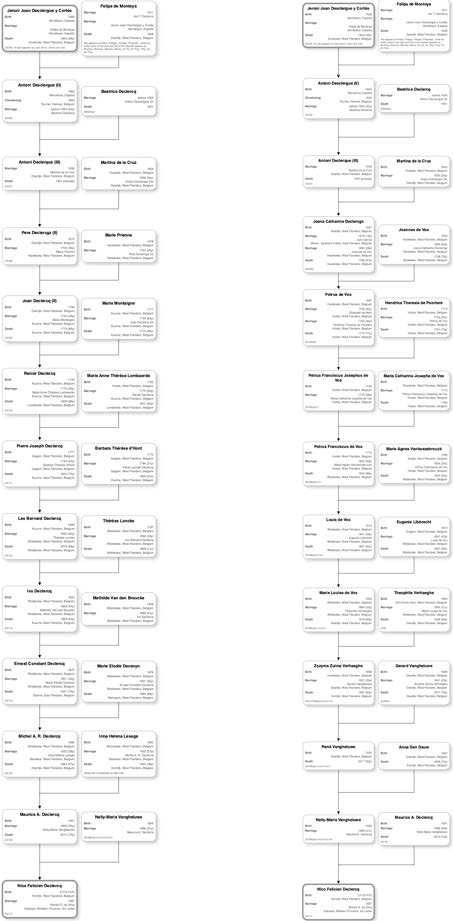
Figures 22.2 and 22.3 assist in situating each individual within the context provided. It is anticipated that the author’s descendants, some of whom are depicted in Figure 22.1, will, in due course, come to value the significance of this comprehensive work.
Figure 22.1: The author, his wife, and the two youngest children in
Barbera de la Conca, a few kms from Montblanc, October 30, 2018.
The Desclergues of la Villa Ducal de Montblanc, 2nd ed., Omn., VOL. I
© 2024 Nico F. Declercq
242
CHAPTER 22. SUMMARY OF THE DESCLERGUE PATERNAL ANCESTRY LINE
Figure 22.2: Patrilinal connection between Richer de Guarplic and Pere
de Torró y Desclergue (I) (DC01). In addition, we can also see the pa-
trilineal connection between Pere de Torró y Desclergue (I) (DC01) and
Jeroni Joan Desclergue y Cortés (DC05), and the matrilineal connection
between Pere de Torró y Desclergue (I) (DC01) and Jeroni Joan Desclergue
y Cortés (DC05).
© 2024 Nico F. Declercq
The Desclergues of la Villa Ducal de Montblanc, 2nd ed., Omn., VOL. I
243
Figure 22.3: Patrilineal connection between Jeroni Joan Desclergue y Cortés (DC05) and the
author (DC17); and also the matrilineal connection between Jeroni Joan Desclergue y Cortés
(DC05) and the author (DC17).
The Desclergues of la Villa Ducal de Montblanc, 2nd ed., Omn., VOL. I
© 2024 Nico F. Declercq
CHAPTER 22. SUMMARY OF THE DESCLERGUE PATERNAL ANCESTRY LINE
© 2024 Nico F. Declercq
The Desclergues of la Villa Ducal de Montblanc, 2nd ed., Omn., VOL. I
Coat of Arms: Links to Du Guesclin and Cortés de
Monroy
23.1 The Shield
In heraldic studies, the analysis and comparison of shields often convey their meanings inherently. We therefore refer the reader to Figure 17.9 on page 127, Figure 19.47 on page 207, Figure 23.1 on page 247, Figure 23.2 on page 248, Figure 23.5 on page 250,
Figure 23.3 on page 249, Figure 23.6 on page 251, Figure 23.4 on page 249, Figure 23.7 on page 251, Figure 46.67 on page 877, and Figure 23.8 on page 252.
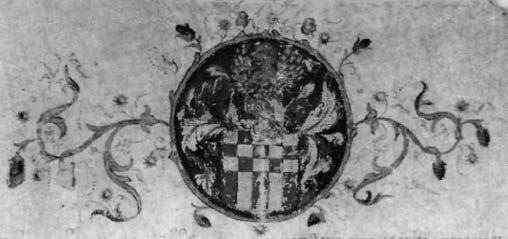
The pattern in the shield of Desclergue is used as a border around Nico F. Declercq and his descendants’ shield. The other heraldic elements stem from de Patin and other sources, as described in Chapter 4.1.
Note that late 17th century, there was also a family in Catalonia, named Sesclergues, who have used heraldic shields,234 of which Desclergue from Montblanc has inspired one. However, from a Heraldic point of view, they are not related. Also, from a genealogy point of view, they are unrelated.
23.2 The Helmet
The Desclergues were of ancient nobility, often referred to as having ’purple blood,’ or, ’purpura de la Patria,’ in chronicles of the 13th and 14th centuries, signifying their esteemed and long-standing lineage. Modern reports sometimes refer to them as ’hidalgos de sangre,’ indicating that the authors found sufficient indications of ancient nobility, based on more recent observations in the 16th and 17th centuries. Their status, rooted in antiquity, often surpassed that of other nobles not through specific power but through their venerable heritage—a crucial factor in the aristocratic hierarchy.
Securing particular noble titles would not have elevated their noble status. Still, it would have had practical implications, particularly concerning taxes they could levy or were obligated to pay to the Crown. Historical documents reveal that some members of the Desclergues family sought and successfully obtained noble titles, even while in Flanders.
Due to their independence from specific titles and high regard due to their ancient lineage, the Desclergues did not display particular titles on their coat of arms. This is evident from the coat of arms on their residence in Montblanc, which lacks any insignia indicating specific noble ranks on the helmet.
23.3 The Gryphon on the Helmet
To comprehend the origins of the Gryphon in the Coat of Arms of the Desclergues of Montblanc, it is instructive to examine Figure
23.5 on page 250. This figure reveals a significant connection to Miquel and Du Guesclin. Furthermore, one can trace the lineage back to Borell, as depicted in Figure 18.4 on page 130, or even to the ancient Greeks, as illustrated in Figure 9.1 on page 79.
In heraldry, the Gryphon’s amalgamation of a lion and an eagle represents courage and boldness. It is used to denote strength, military courage, and leadership. Gryphons are portrayed with a lion’s rear body, an eagle’s head with erect ears, a feathered breast, and the forelegs of an eagle, including claws. These features indicate a combination of intelligence and strength.
From Dr. Luis Valero de Bernabé y Martín de Eugenio5, we learn that Enrique II of Castile was the first King of the Trastámara dynasty to apply the Gryphon as a Helmet sign,
’Enrique II de Castilla (1369/1379), el primer monarca de la dinastía Trastámara, adoptó el Grifo como emblema durante la guerra contra el rey legítimo Pedro I, al que disputaba el trono, adornando su yelmo con un grifo dorado y alado.’
His son and successor used it too. Subsequent successors did not further use it on their heraldic helmets because of a marriage with Princess Dona Catalina, granddaughter of Peter I, therefore merging the two rival dynasties again under the original coat of arms, whence the Gryphon disappeared after 1400.
In December 1368, Du Guesclin had been sent to Spain to assist Enrique II in his battle against his half-brother Peter the Cruel. It was from Enrique II that Du Guesclin would receive noble titles in Spain. The coat of arms of the Desclergues at Montblanc may refer to Enrique II by applying his Gryphon as a heraldic helmet sign.
However, more likely, it refers to Bertrand Du Guesclin himself because, as described in Chapter 19.26.6, his seal, upon arrival in Spain, which expressed his coat of arms, had the same helmet sign and even used a Gryphon as a supporter.
The origin of the Gryphon on the Helmet of the coat of arms of Du Guesclin dates back to Bertrand III Du Guesclin, who married Mahaut de Dol. Indeed, she descended from the Borrell family, among others, of Barcelona. The Borrell shield is shown in Figure
18.4 on page 130. The Borrell family also enters our ancestry through Chapter 18.11.3.
2Moisés Selfa, Universitat de Lleida, Spain, "about the concept of onomastic identity: the privileges’ parchments of the city of Balaguer (1211-1352)"
3Luis Valero de Bernabé y Martín de Eugenio, Análisis de las características generales de la Heráldica Gentilicia Española y de las singularidades heráldicas existentes entre los diversos territorios históricos hispanos, Tesis Doctoral, Universidad Complutense de Madrid, Facultad de Historia, Directora: Doctora Doña Ana Belén Sánchez Prieto, 2007.
4We suspect that in certain situations, Desclergue and Sesclergue refer to the same family and are only a spelling issue. An illustration is found on page 27 and page 386 in Fundació Noguera, Textos i Documents, El primer llibre d’inventaris i encants del notari de Tarragona Bernat Gendre (1577-1597), Barcelona, 2015.
5Luis Valero de Bernabé y Martín de Eugenio, Marqués de Casa Real, Director de Colegio Heráldico de España y de las Indias, ’El Grifo en la Heráldica Española’
The Desclergues of la Villa Ducal de Montblanc, 2nd ed., Omn., VOL. I
© 2024 Nico F. Declercq
CHAPTER 23. COAT OF ARMS: LINKS TO DU GUESCLIN AND CORTÉS DE MONROY
Therefore, the Gryphon may refer to Borrell, Miquel, or the ancient ancestry in Greek Empuries in one way or another. However, only Du Guesclin emphasized it so much by having it as a helmet sign and a supporter in his coat of arms while in Spain.
23.4 Three Military Flags
Each of the three flags depicts the ’Cruz de Borgoña’ or the Cross of Burgundy, a historical military ensign utilized by the Spanish Army of Flanders. This emblem signifies the military service of the three sons of Bonaventura Desclergue who served as soldiers in Flanders: our ancestor Jeroni Joan (DC05), alongside his brothers Antoni (I) (DC05b) and Enric (DC05c).
23.5 The Fleurs de Lys
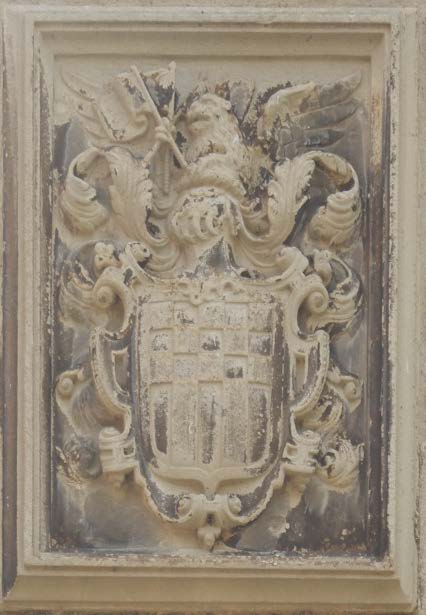
Three Fleurs de Lys (Flor de Lis) are visible on the coat of arms, exposed in Figure 23.8. They are remains (worn by time) of 3-dimensional representations of the Fleur de Lys, which only appear exceptionally on top of the French royal crown. On the contrary, in most cases, one can only see a projected representation of this symbol. The Desclergues, who had the coat of arms designed for their new home early in the 1600s, were conscious of their noble ancestors’ rank.
The use of 3 such flowers comes from Du Guesclin, as is found on his shield as the Count of Trastámara, shown in Figure 23.8. It is also seen as the symbol of the French Monarchy (1380 onwards).
Three Fleurs de Lys were likely input from the Dame de Soria, a daughter from the Torró family, as indicated in Figure20.2 on page 216. Other heraldic connections have been shown above in the description of the shield of Desclergues, in Chapter 23.1.
© 2024 Nico F. Declercq
The Desclergues of la Villa Ducal de Montblanc, 2nd ed., Omn., VOL. I
23.5. THE FLEURS DE LYS
247
Figure 23.1: Coat of arms of the Desclergues of Montblanc (Montblanc, August 2018).
On the Helmet is a gryphon holding three flags. Note the fleurs de lys in the three corners
of the shield and the little roses on the border. It is assumed that the gryphon refers
either to Miquel, a family with whom the Desclergues allied and stemmed from, or Du
Guesclin. In contrast, the roses refer to the shield of Ros, equally a family with whom the
wider Desclergue family allied. Antoni Desclergue also applied roses as ornaments in the
polychrome panels he brought from Spain, shown in Figure 49.33 on page 1001. The fleurs de lys either refer to Torró, shown in Figure 20.2 on page 216, or Du Guesclin, explained in Figure 23.6 on page 251, or both. (Declercq de Silva Archive) The Desclergues of la Villa Ducal de Montblanc, 2nd ed., Omn., VOL. I
© 2024 Nico F. Declercq
248
CHAPTER 23. COAT OF ARMS: LINKS TO DU GUESCLIN AND CORTÉS DE MONROY
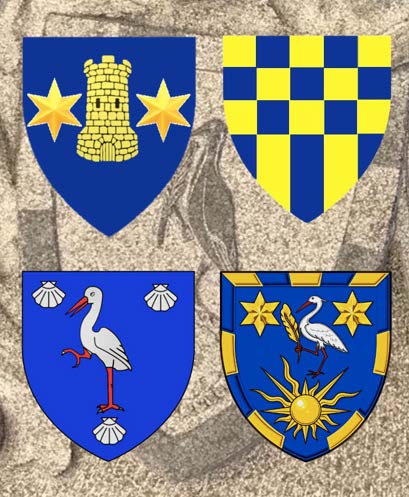
Figure 23.2: The modern shield of Nico F. Declercq and his descendants consists of a
border that constitutes a memory of the old Desclergue shield in Montblanc, shown in
Figure 23.1 on page 247, in Figure 23.4 on page 249, with a heraldic genesis depicted in Figure 17.9 on page 127. The other symbols in the modern shield of Declercq are described in Chapter 4.1. The top left is one of the forms of the Torró shield, the one on the top right is that of the Desclergues of Montblanc, the lower left is that of de
Patin, while the one on the bottom right is the modern shield of the author and his
children. (Declercq de Silva Archive) Figure 23.3 makes a comparison with the shield of Hernán Cortés, equally visible in Figure 27.4 on page 297.
© 2024 Nico F. Declercq
The Desclergues of la Villa Ducal de Montblanc, 2nd ed., Omn., VOL. I
23.5. THE FLEURS DE LYS
249
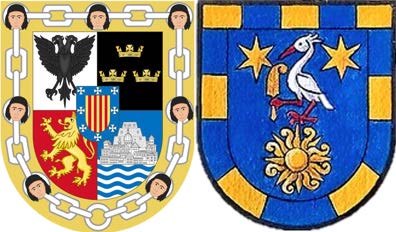
Figure 23.3: The modern shield of Nico F. Declercq and his descendants is shown
in Figure 23.2 and right on this figure. Left is that of Hernán Cortés, a relative of the Desclergues, created for him and his descendants and exposing the old Cortés de
Monroy, referring to the Aragonese noble blood, in the middle. The appearance of
yellow squares on the border of Declercq’s shield in the same location as the heads
of Hernán Cortés may seem curious, but it is a mere coincidence.
The shield of Cortés, also shown in Figure 27.4 on page 297, is described as follows: Quarterly: 1st, Argent, an eagle double-headed Sable; 2nd, Sable, three crowns 1 and
2 Or; 3rd, Gules, a lion rampant Or; 4th, Azure, the city of Tenochtitlan rising from
the lake proper; all within a bordure Or charged with a locked chain linking seven
Indians’ heads proper, and en surtout an inescutcheon Or thereon four pallets Gules
within a bordure Azure charged with eight crosses patty Argent. The interpretation is
as follows. The eagle emblem represents the Habsburg empire, while the crowns sym-
bolize the Aztec emperors, Moctezuma, Cuitláhuac, and Cuauhtémoc, whom Cortés
overthrew. The lion in the emblem signifies attributes like strength, constancy, and
courage. Additionally, the reference to the city of Tenochtitlan serves as a reminder
of Cortés’ conquest and is considered a significant accomplishment in his endeavors.
The chained skulls shown on the bordure symbolize the defeat of seven vassals of
Moctezuma by Cortés, while the central portion showcases his family coat of arms.
The motto means: The Lord judged them in their deeds and strengthened my arm.
More information about Cortés and how we are related can be discovered in Chapter
27.2 on page 301 (Declercq de Silva Archive)
Figure 23.4: The arms of the Desclergues of Montblanc, found on a document in 16531. It can be compared with Figure 23.1 on page 247, with an explanation in Figure 23.5 on page 250. The addition of 3 flags held by the gryphon only occurred after 3 sons of the Desclergues, Jeroni, Antoni, and Enric, had become soldiers in Flanders and was, therefore, not yet visible in this old document.
The Desclergues of la Villa Ducal de Montblanc, 2nd ed., Omn., VOL. I
© 2024 Nico F. Declercq
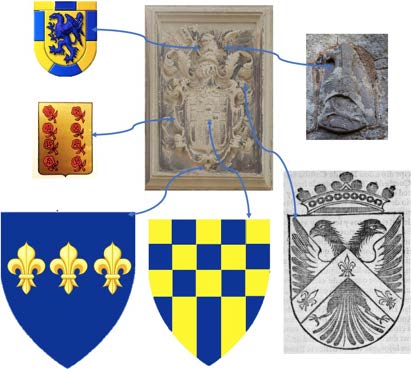
250
CHAPTER 23. COAT OF ARMS: LINKS TO DU GUESCLIN AND CORTÉS DE MONROY
Figure 23.5: The genesis of the Coat of Arms of the Desclergues on their House in
Montblanc. The shield is Desclergue, established in Figure 17.9 on page 127. The flors de lys are from Torró, as shown in Figure 20.2 on page 216, possibly with a hint to Du Guesclin, as explained in Figure 23.6 on page 251. The little roses on the side refer to Ros, a family that the Torró and Miquel families frequently allied with, and
possibly also the Desclergues themselves. The gryphon refers to Miquel and possibly
also to Du Guesclin, shown in Figure 19.20 on page 175, and in Figure 19.47 on page
207. However, the Gryphon can also refer to Borrell, equally ancestors, described in Chapter 18.11.3, with shield shown in Figure 18.4 on page 130. Roses were also used as ornaments in the panels in Deerlijk, shown in Figure 49.33 on page 1001. The gryphon, shown in Figure 9.1 on page 79, was also popular in Phocaea from where the Greeks migrated to Empúries, where they married our patrilineal ancestor.
© 2024 Nico F. Declercq
The Desclergues of la Villa Ducal de Montblanc, 2nd ed., Omn., VOL. I
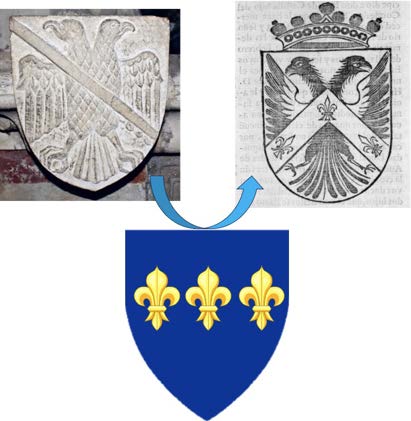
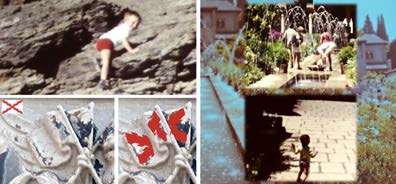
23.5. THE FLEURS DE LYS
251
Figure 23.6: The genesis of the Conde de Trastamara shield of Bertrand Du Guesclin,
being his own family shield, shown in Figure 19.47 on page 207, covered by a chevron with the three flors de lys of the Torró family, shown in Figure 20.2 on page 216. The shield, therefore, reflected a new Spanish bloodline initiated by Du Guesclin and his
Dame de Soria, who must have been a Torró. Unfortunately, Du Guesclin lost the title
when Enrique de Trastamara lost power, and his descendants would no longer use the
shield. Instead, they lived on as Torró, among their other Torró relatives of the Torró
blood already well established before the arrival of Du Guesclin in Spain.
Figure 23.7: Left is 1979, a snapshot of a moving image of the author climbing
the Pico Veleta in the Sierra Nevada near Granada. The lower inserts form a study
of the three flags in the coat of arms on the House of Desclergue, revealing the Cruz
Borgoña on each. Right is Granada in 1978. The author was bathing in (assisted by
Maurice A. Declercq) and playing around the fountains of the Alhambra. (Declercq
de Silva Archive)
The Desclergues of la Villa Ducal de Montblanc, 2nd ed., Omn., VOL. I
© 2024 Nico F. Declercq
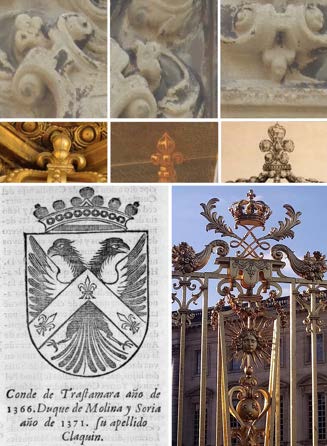
252
CHAPTER 23. COAT OF ARMS: LINKS TO DU GUESCLIN AND CORTÉS DE MONROY
Figure 23.8:
Top: the three fleurs de
lys that appear on the coat of arms of
Desclergue at Montblanc. Middle: 3 ex-
amples of Fleur de Lys on French royal
crowns. Bottom-right: a gate in Ver-
sailles, exposing three fleurs de lys as a
symbol of French Royalty. (Declercq de
Silva Archive) The bottom-left shows the
Shield of Beltran Claquin (Bertrand Du
Guesclin) as the Count of Trastámara, a
title which he has had for a short timea. As
indicated in Figure20.2 on page 216, the 3
flors de lys in the coat of arms of the De-
sclergues were probably mainly originating
from Torró. Still, they may also have been
inspired by Du Guesclin ancestry, keeping
in mind Figure 23.6 on page 251.
aAlonso López de Haro (criado de su Ma-
jestad, y Ministro en su real Consejo de las
Ordenes), ’Nobiliario genealógico de los reyes
y títulos de España. Dirigido a la Mages-
tad del Rey Don Felipe Quarto nuestro señor.’
, printed (con privilegio) in Madrid, by Luis
Sánchez Impresor Real, in 1622.
© 2024 Nico F. Declercq
The Desclergues of la Villa Ducal de Montblanc, 2nd ed., Omn., VOL. I
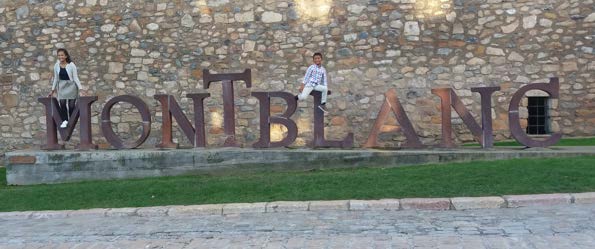
Chapter 24
Settlement of our Desclergues at Montblanc
In Part IV, the ancient history of our ancestors is presented, ranging from the Greek over the Roman and Visigoth era through the Byzantine and Muslim eras and the Reconquista of Catalunya and the Conquest of Mallorca. At the same time, in the era of Charlemagne, a branch landed in Brittanny and would later return to Spain.
In Part VI, the patrilineal origins of the Desclergues family of Montblanc, renowned for constructing the famous house on the Main Square, are elucidated. Their lineage traces back to Bertrand Du Guesclin.
Chapter 73 presents compelling DNA evidence supporting our descent from the Du Guesclin family, progressing through the Torró, Desclergue, and Declercq lines. This heritage is meticulously documented from the era of Charlemagne to the present. Utilizing a comprehensive paper trail, we focus on our Desclergues ancestors in Montblanc, detailing their extensive history up to the current generation.
Part VI demonstrates that the Desclergues of Montblanc are descendants of Du Guesclin, adopting the Desclergue name through a female ancestor to perpetuate the notarial dynasty bearing this name. Still, Du Guesclin himself also descended from the Desclergues through a nomenclature passage in Muslim Spain as Hakin.
The descendants were predominantly based in Barcelona and maintained continuous connections with the city and province. Our documented genealogical tree of the Declercq family begins with Pere de Torró y Desclergue (I) (DC01). Jose Sanchez Real1 did not construct an ancestry tree preceding (DC01) but identified individuals through archival research and literature. Subsequent scholars, including Santiago Alberti2 and Salvador J. Rovira i Gómez3, developed genealogies commencing with Pere de Torró y Desclergue (I) (DC01), referred to as ’Pere Desclergue.’ Gener Gonzalvo i Bou4 provides extensive information on the Desclergue family, particularly the Pedrolo and Pedrolo y Desclergue branches. On page 172 of his report, he describes the Desclergue family of Montblanc as an aristocratic lineage, noting their preservation of an extraordinary archive, partially conserved in the T‘arrega County Archive, and passed down through the Pedrolo family. The earliest known ancestor, Pedro Desclergue (DC01), also known as Pere de Torró y Desclergue (I) (DC01), held a knightly rank.
Emperor Charles I of Spain (Charles V, also known as Charles Quint) confirmed the family’s heraldic symbols. Bonaventura Desclergue (DC04) is documented as attending the General Court of Catalonia in 1599 to receive a personal nobility privilege.
The historical context of the Dukes of Montblanc adds depth to the Desclergues’ narrative. The Trastámara dynasty, a significant ruling family, governed the Duchy of Montblanc from 1412 until 1458, following the House of Barcelona (1387-1396) and preceding the Habsburgs (1516-1700), with the Bourbons assuming control from 1996 onwards. The Trastámara dynasty’s influence on Montblanc during this period is crucial to understanding the Desclergues’ settlement there.
Joan I de Montblanc, also known as Joan el Gran, ruled from 1412-1458, a time marked by significant historical events. He was succeeded by Ferran I de Montblanc (Ferran el Catòlic) from 1458-1462. The Catalan Civil War (1462-1472) disrupted his rule, but he resumed his position in 1472 until 1479.
These events provide a coherent framework for the Desclergues’ history. Joan I de Montblanc, or Joan I of Aragon, was the son of Ferran I d’Aragon (Ferdinand I of Aragon) and Elionor d’Albuquerque (Eleonora Urraca of Castile). Ferdinand I of Aragon was the son of Joan I of Castile and Eleonor of Aragon and Sicily. Joan I of Castile, in turn, was the son of Henry II of Castile and Joanna Emmanuella of Castile. Henry II of Castile, known as Henry II of Trastámara, supported Aragon in efforts to depose Peter I, relying on military aid from allies, including Bertrand Du Guesclin.
Figure 24.1: Anna-Laura Declercq and Lambert Declercq in Montblanc, 2018. (Declercq de Silva Archive)
1Jose Sanchez Real, ’La Casa Desclergue de Montblanc,’ 1974
2Santiago Alberti, ’Esquema històric del llinatge Pedrolo,’ 1995
3Salvador J. Rovira i Gómez, ’La baixa noblesa de la Conca de Barber‘a a l’ edat moderna,’ 2005
4Gener Gonzalvo i Bou, Fons documentals de Montblanc a l’Arxiu comarcal de T‘arrega
The Desclergues of la Villa Ducal de Montblanc, 2nd ed., Omn., VOL. I
© 2024 Nico F. Declercq
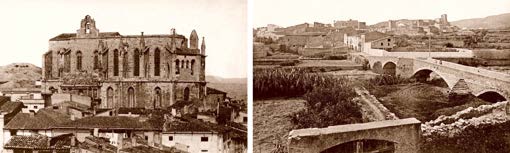
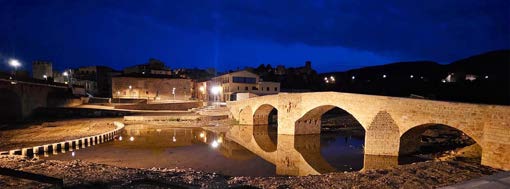
254
CHAPTER 24. SETTLEMENT OF OUR DESCLERGUES AT MONTBLANC
Figure 24.2: Montblanc, view on the beautiful Iglesia de Santa Maria la Mayor and a view on the old
bridge and the town, also shown in Figure 24.3, from across the Francoli River. (around 1900, p) Figure 24.3: Montblanc, 2023, the repaired bridge, locally known as Pont Vell, after it had been damaged by a severe flood. Courtesy of Ramper.
It is plausible that our Desclergues ancestors, responsible for constructing the House of Desclergue on Montblanc’s Main Square and possessing historical ties to the House of Trastámara, settled in Montblanc between 1412 and 1458, during Joan el Gran’s tenure as Duke of Montblanc, shown in Figure 24.4. Notably, the Cortes Generales Catalanas convened at Montblanc in 1414, summoned by Ferdinand. This timeline aligns with the absence of known Desclergues records in Montblanc before 1450, specifically before 1412.
For further context, refer to Chapter 25.0.2.1 on the 1359 census of Montblanc.
© 2024 Nico F. Declercq
The Desclergues of la Villa Ducal de Montblanc, 2nd ed., Omn., VOL. I
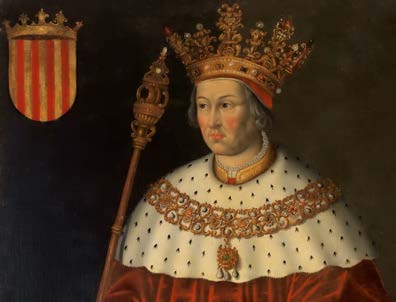
255
Figure 24.4: Joan II of Aragon (Medina del Campo 1398 - Barcelona 1479), better
known as Joan el Gran, was the Duque of Montblanc from 1412 until 1458. He was
also the Prince of Girona and the Count of Barcelona. His parents were Ferdinand
I of Aragon and Eleanor de Albuquerque.
The Desclergues of la Villa Ducal de Montblanc, 2nd ed., Omn., VOL. I
© 2024 Nico F. Declercq
CHAPTER 24. SETTLEMENT OF OUR DESCLERGUES AT MONTBLANC
© 2024 Nico F. Declercq
The Desclergues of la Villa Ducal de Montblanc, 2nd ed., Omn., VOL. I
Don Pere Torró y Desclergue (I) (DC01)
Don Pere Torró y Desclergue (DC01), was from Barcelona and married a Barcelonese. He must have decided to continue as Desclergue because he was a notary, just like his grandfather on his mother’s side. More importantly, he was the heir of his uncle, Ramon Berebguer Desclergue, a notary, and must have either felt or been contractually obliged to use his name. He established a family line of notaries at Montblanc, ancestors of the author and descendants of Du Guesclin. However, Barcelona’s connection has always remained, and several descendants lived either at Barcelona or Montblanc, or both. He is described in Chapter 25.0.2, as the earliest Desclergue in our paternal family line.
He had four sons, namely Antich Desclergue (I), Joan Berenguer Desclergue (DC02), Pere Desclergue (DC02b) and Galceran Desclergue (I=II) (DC02d). The notary document, shown in Figures 25.3, 25.4, and 25.5, from 1494 mentions several Desclergues, including Pere Desclergue (DC02b) and Galceran Desclergue (I=II) (DC02d). The notary spells their names as Petrus De Clerico and Galcerand Des Clerico and explicitly states that they are brothers living in Montblanc. Elsewhere in the document, he refers to other Desclergues as ’Bernardo De Clergue’ and ’Bernardo Desclergue’ and ’Raymundo Berengario Desclergue’ (notary from Santa Coloma Queralt. Santa Coloma de Queralt is also decribed in Chapter 29.4). Name differentiation confirms that our ancestors, who used the name Desclergue, were not immediately related to the other Desclergue families. In Chapter 25.0.2 we show more evidence. Pere Torró y Desclergue (DC01) was married to Eleonor Torró i Miquel, and both are described in Chapter 25.
Pere Desclergue appears in two historical records2 from April 21, 1501, primarily concerned with the administrative and ecclesiastical proceedings of the Poblet Monastery, located in the Tarragona region of Spain, under the Cistercian Order.
The first document, a significant historical record, chronicles the election of Antoni Boada as the Abbot of Poblet and the subsequent appointment of Domènec Porta, a monk of the same monastery, as his procurator. Porta’s assignment was to secure the confirmation of Boada’s election from the Holy See, headed by Pope Alexander VI at the time. This process, a standard ecclesiastical procedure, was crucial to ensure the validity of such an election, reflecting the significant influence and control exercised by the papacy over monastic appointments during this era.
The second document details the monastery’s administrative actions following the election. This document describes the chapter conventual of Poblet appointing Jaume Peris, the sub-prior, as another procurator alongside Domènec Porta. Peris was charged with the dual responsibilities of obtaining papal confirmation for Abbot Boada and negotiating financial obligations such as paying annotates (a form of ecclesiastical tax) and managing financial instruments known as canals.
Pere Desclergue, the notary from Montblanc, emerges as a central figure in these documents, playing a pivotal role in the procedures.
As a notary, Desclergue’s responsibility was not merely to record these proceedings, but to ensure their accuracy, legal standing, and official acknowledgment. His involvement was not just important, but crucial for the validity of these documents in both secular and ecclesiastical realms. The mention of his role in multiple related documents underscores his significance in maintaining the legal framework and documentation integrity necessary for the monastery’s operations within the broader ecclesiastical hierarchy and its interactions with the Holy See in Rome.
These documents, rich with details of the ecclesiastical administration and the involved parties from various locales like Montblanc, Sanaüja, Xàtiva, and Rome, vividly illustrate the intricate and complex processes of church governance during the early 16th century. This complexity, highlighted by the interconnectedness of local monastic practices with the overarching authority of the papacy, provides a deeper understanding of the historical context, inviting the reader to delve into the intricacies of this fascinating period. The reader may be interested in looking at Figure 25.1 on page 258, and Figure 25.2 on page 259.
25.0.1 Ancestry of Pere Torró y Desclergue (I) (DC01) on his Mother’s Side
25.0.1.1 Clementa Desclergue, the Mother of Pere Torró y Desclergue (DC01)
Clementa Desclergue was the sister of Ramon Berenguer Desclergue, described in Chapter 25.0.1.2, and she married Royal Secretary Francesc Torró y Miquel, described in Chapter 20.6.1. Her husband’s ancestry is described in Chapter 20.
Clementa Desclergue’s father was Berenguer Desclergue, described in Chapter 25.0.1.4. She equally appears in Chapter 18.20.
25.0.1.2 Ramon Berenguer Desclergue
Alberto Reche Ontillera3 cites a notarial record, by Ramon Berenguer Desclergue, in 1485: 1485, maig, 5. Constança d’Erill, dona de Joan de So, senyor del castell de Talavera, fa donació al seu marit del censal de 6.000
sous i pensió de 20 lliures que té sobre la baronia de Centelles. A. AMMV, Speculo..., fol. 114v. Insolutum donacio feta per la señora Constansa d’Eril, muller del noble Joan de So, señor del castell de Talavera, y altres, a dit son marit de tot aquell censal de preu de 6.000 sous y penció 20 lliures, ab las pencions degudas que li corresponian tots anys lo señor Ramon de Centelles, ab lo qual censal hi fou obligada dita baronia de Centellas. Consta en poder de Ramon Barenguer Desclergue, notari de Barcelona, als 5
de maig de 1485.
He was a notary in Barcelona in 1485, in Santa Coloma de Queralt in 1488 and 1494, described below and in Chapter 21 and shown in one of his own documents in Figure 21.1 on page 235, in Figure 21.2 on page 237, in Figure 21.3 on page 238, and in Figure 21.4
on page 239, and in Barcelona in 1508, described in Chapter 25.0.1.3.
He had no children who were heirs and therefore appointed his sister’s, Clementa Desclergue, sons, Galceran Torró y Desclergue 2Josep Torné i Cubells, "Catàleg de Pergamins de l’actual Arxiu del Monestir de Poblet", Item 70 and 71, p. 42-43.
3Alberto Reche Ontillera, "L’Speculo de 1764: Una aproximació documental al Montornès medieval", ajuntament de Montornès del Vallès publicacions de l’Abadia de Montserrat 2014, ISBN 978-84-9883-659-2, page 242, entry 399.
The Desclergues of la Villa Ducal de Montblanc, 2nd ed., Omn., VOL. I
© 2024 Nico F. Declercq
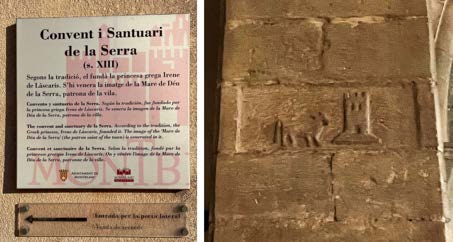
258
CHAPTER 25. DON PERE TORRÓ Y DESCLERGUE (I) (DC01)
Figure 25.1: An engraving on the wall inside the Convent I Santuari de la Serra in Montblanc
depicts a cow and a tower. It is not a heraldic shield because the cow points in the wrong direction.
Possibly, the engraving was ordered by the families Cabeza de Vaca Mejías and Torró (i.e., Torró
y Desclergue), although they should most likely only be interpreted as monastic symbols. Torró
is, for instance, also found in Figure 25.11 on page 278.
(DC01b) and Pere Torró y Desclergue (DC01) his heirs.
In the Historical Archive of Protocols of Barcelona, there are two manuscripts belonging to this Desclergue, a notary from 1486 to
14904. He also appears as Ramon Berenguer de Clericó in 1488. He is listed in ’Relació cornològica dels notaris de Santa Coloma de Queralt Segles XIII-XX’ in the article ’Els notaris de Santa Coloma de Queralt (Segles XIII-XX). Els retorn dels protocols notarials anteriors al segle XIX ’ by Josep M. Porta i Balanyà.
Figure 25.20 on page 281 shows the appearance of Ramon Berenguer Desclergue, with chronological connections to Pere Desclergue, described in Chapter 25.0.1.5 and Berenguer Desclergue, described in Chapter 25.0.1.4, in Santa Coloma de Queralt. Their ancestral connections are shown in Figure 25.21 on page 282.
In Figure 25.23 on page 282, additional evidence is given that Ramon Berenguer Desclergue was a notary in an unspecified period between 1487 and 1490.
25.0.1.3 Support and Patronage of Church Retables
Across generations, as seen in Chapter 49, our family has recognized the profound significance of Church Retables, not only as expressions of faith but also as embodiments of cultural heritage and artistic mastery. With their intricate designs and spiritual narratives, retables serve as focal points within sacred spaces, inviting contemplation and reverence.
Understanding the resource-intensive nature of creating such monumental works, we have made it a custom to provide financial support to ensure the realization of these projects. Our commitment extends beyond mere philanthropy; it is a testament to our belief in the power of art to inspire, uplift, and unite communities.
By investing in the creation of church retables, we honored our familial tradition and contributed to the preservation and enrichment of our shared cultural heritage. Our patronage empowered talented artists to continue their craft and leave a lasting legacy that transcends generations.
Notary Ramon Berenguer Desclergue, for instance, supported Joan Barceló in making a retable at Santa Maria del Pi in Barcelona.
Mauro Salis,5 describes the events as follows.
In 1508 there was an interruption in the series of news relating to the Sardinian events of Joan Barceló: on 11 December, he signed a contract with the obrieri and the parishioners of the church of Santa Maria del Pi in Barcelona in which he committed himself to paint, within five years starting from Christmas 1510, the retable for the main altar of the church. At the time of signing, the obrers are represented by the donzell Galceran de Corrego, the notary Ramon Berenguer Desclergue and the fuster Climent Carbonell, while Joan Barceló is supported by the revenedor Matheu Sanç. Witnesses are the priests Cristophol Planes, prior of the church of San Giovanni, Pere Ponç, beneficiary and començal of the same church, Jaume Mani, beneficiary of the church of Pi, and the parayre Jaume Osona.
25.0.1.4 Berenguer Desclergue
He was the father of Clementa Desclergue, described in Chapter 18.20, Chapter 20.6.2 and Chapter 25.0.1, who was married to Francesc Torró y Miquel, described in Chapter 20.6.1, and also of Ramon Berenguer Desclergue, described in Chapter 25.0.1.2. The brother of Berenguer Desclergue was Francesc Desclergue, described in Chapter 25.0.1.2.
Before being a notary and having other prominent positions during his long career, he started as a scriptor. He appears as ’Berengarius de Clerico, scriptor’ on July 19, 1417, in Santa Coloma de Queralt. The document is about a power of attorney granted by Avraham Barukh, a Jew from Santa Coloma de Queralt, in the person of his brother, Joan Bosc, a convert from Tàrrega, to recover unpaid debts.67
He was a man of the law, and in 1439, he held the position of local deputy of Montblanc and its ward, which he resigned on January 26, 1440. He must have been well connected with the courtly circles since, on October 5, 1451, and from Tudela, the infant Joan, 4J. M. Madurell Marimón, Indice cronológico alfabético. Archivo General de Protocolos de Barcelona. Sección Histórica I. Barcelona. Pág. 74.
5SALIS, Mauro. 3. Artisti, opere, e committenti. Casi studio In : Rotte mediterranee della pittura : Artisti e committenti tra Sardegna e Catalogna nella prima età moderna [en ligne]. Perpignan : Presses universitaires de Perpignan, 2015 (généré le 12 mars 2024).
619.07.1417 (24.1), in Josep Xavier Muntané santiveri, "Ex nactione Judayca ad Fidem Christianam Noviter Conversi: Conversos Jueus de Tàrrega i de Poblacions Veïnes"
7ACCB, FN, Sta Coloma de Queralt, Bernat Giner, Llibre de notes (1417-1418), f. 4v-5r.
© 2024 Nico F. Declercq
The Desclergues of la Villa Ducal de Montblanc, 2nd ed., Omn., VOL. I
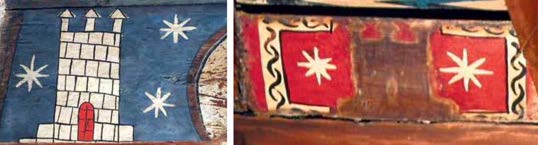
259
Figure 25.2: When the shields in Figure 20.2 are compared to ornaments inside the Sant Miquel church of Montblanc, some exciting features may or may not be relevant. Heraldry plays a notable role among the varied decoration of Sant Miquel’s teginat. Leaving aside the background decoration of the beams, painted lengthwise with strips of the yellow and red colors of the House of Barcelona, many heraldic signs adorn the beams, corbels, and some tablets. The heraldry of this teginate of Sant Miquel is probably early, possibly close to the middle of the 13th century, just like the estimated construction era of the building. Proof of this would be that Montblanc’s coat of arms still does not include the gold bars and gules of the Barcelona count house. Indeed, at the beginning of Catalan municipal heraldry in the second half of the 13th century, royal towns such as Barcelona, Girona, Lleida, Cervera, or Montblanc did not have the definitive coats of arms, i.e., within their shields, the combination of the municipal sign with the royal coat of arms had not yet occurred. Left is Section D, left side, beam 2, bracket 4. Right is Section E, left side, beam 2. Presumably, these are early heraldic signs, probably related to names referring to ’tower’ (Torres, Torrelles, Torrell...). In particular, the one on the right is very close to Torró, shown in Figure 20.2 on page 216; if the colors are ignored, the family that the Desclergues stem from and remain closely connected to the Desclergues for several generations due to mixed marriages. The Desclergue shield is not found in this church because the Desclergues were still thriving in Barcelona and Mallorca at the time of its construction.
Duke of Montblanc, appointed him general curator of the Duchy of Montblanc.
His father was Francesc Desclergue, described in Chapter 18.18. His mother was from Barcelona and was the daughter of Bernat D’Anguera, alias Bernat Desclergue, described in Chapter 25.0.1.6.
Figure 25.20 on page 281 shows the appearance of Berenguer Desclergue, with chronological connections to Pere Desclergue, described in Chapter 25.0.1.5 and Ramon Berenguer Desclergue, described in Chapter 25.0.1.2, in Santa Coloma de Queralt. Their ancestral connections are shown in Figure 25.21 on page 282.
Isabel Sánchez de Movellán Torent8, elucidates the entitlements accorded to local deputies within the context of their roles. Local deputies enjoyed certain fiscal immunities and entitlements comparable to their counterparts serving in broader administrative capacities. Specifically, they and their immediate family members were absolved from the obligation of remitting fees associated with bars and tolls. Furthermore, they were permitted to bear arms, primarily for personal defense and security, a prerogative particularly exercised during the discharge of their official duties. Noteworthy is the provision that allowed local deputies to tender their resignation while actively serving, necessitating the appointment of a successor by the general deputies during the incumbent’s tenure. Berenguer Desclergue was an example of such a deputy who resigned.
Indeed,9 in January 1440, the town of Montblanc saw a notable event documented in a notarial text shown in Figure 25.22 on page
282: the resignation of Berenguer Desclergue from his position as local deputy. This act occurred on January 26th, coinciding with the passing of Galceran de Mataró, the manager of the General’s accounts.
Berenguer Desclergue’s resignation marked a significant moment in Montblanc’s administrative landscape. As a local deputy, he held a position of authority and responsibility within the town and its surrounding village. His decision to resign from this role was formally communicated to the honorable Deputation, indicating a voluntary relinquishment of his duties.
The notarial text also records the arrival and departure of various individuals during January. This includes the movements of priests such as Phelipp de Sentceloni, Guillem de Santcliment, and Philip de Santceloni, as well as the prior of Tarragona, Bernat Guillem de Çamasó. Additionally, the text documents administrative decisions made by the Deputation during this time. On January 27th, it was determined that books, paper, and pamphlets necessary for the affairs of the Deputation of the General of Catalonia would be procured from Anthoni Ramon, the librarian of the said General.
25.0.1.5 Pere, the brother of Berenguer Desclergue
Figure 25.20 on page 281 shows the appearance of Pere Desclergue, with chronological connections to Berenguer Desclergue, described in Chapter 25.0.1.4 and Ramon Berenguer Desclergue, described in Chapter 25.0.1.2, in Santa Coloma de Queralt. Their ancestral connections are shown in Figure 25.21 on page 282.
Pere Desclergue was a notary at Santa Coloma de Queralt from 1445 until 1461. While his brother, Berenguer, was stationed in Barcelona, Pere established notarial activities in Santa Coloma de Queralt that would later be inherited by Berenguer and later by Ramon Berenguer Desclergue, described in Chapter 25.0.1.2. He also appears in the literature as Pere de Clerico.
25.0.1.6 Bernat D’Angera, alias Desclergue
He is also described in Chapter 18.19. He was the grandfather of Berenguer Desclergue, in Chapter 25.0.1.4, and he was the son of Guillem D’Angera, described in Chapter 25.0.1.7 and of Doña N. Desclergue shown in Chapter 25.0.1.8. He resided at Çavit in Barcelona in 1358.10
There is a reference to him in the year 1383 in a notary document of 1494 in Figure 21.1 on page 235, in Figure 21.2 on page 237,
in Figure 21.3 on page 238, and in Figure 21.4 on page 239 and also to his father Guillem. He was once a military, located in 8Isabel Sánchez de Movellán Torent, La Diputació del General de Catalunya (1413-1479), Institut d’Estudis Catalans, 2004, p. 224, reference 215
(26.1.1440)
9Josep Maria Sans i Travé, "Dietaris de la Generalitat de Catalunya, Volum I, Anys 1411-1539," folio 60-62, p. 76-77.
10Suma dels fochs de Çavit IX , p. 414, item 85 v. Listed in J. M. Pons Guri, "un fogatjament desconegut de l’any 1358."
The Desclergues of la Villa Ducal de Montblanc, 2nd ed., Omn., VOL. I
© 2024 Nico F. Declercq
CHAPTER 25. DON PERE TORRÓ Y DESCLERGUE (I) (DC01)
Montblanc.
The family d’Anguera often appears in works containing descriptions of military campaigns in the 14th, 15th, and 16th centuries.
We found the appearance of names, such as Bernat de Anguera, Joan d’Anguera, Pere d’Anguera, Guillem d’Anguera and Ramón de Anguera. However, we were unable to track their family ties. The mentioned notary document of 1494 also claims they are from a military bloodline.
In 1421, Bernat Desclergue was a grocer at Cervera, as can be read in Figure 25.24 on page 282.
It is reasonable to assume that Geronimo Desclergue, described in Chapter 18.23.3, and Joan Desclergue, described in Chapter
18.23.2, are also his descendants.
Clarity is provided in Figure 25.25 on page 282.
25.0.1.7 Guillem D’Anguera
He was a military and was the father of Bernat D’Angera, alias Desclergue, in Chapter 25.0.1.6. In Chapter 25.0.1.8, his wife was a daughter of Guillermo Desclergue, in Chapter 18.12.
The descendants of Guillem D’Anguera and N. Desclergue, are provided in Figure 25.25 on page 282.
25.0.1.8 N. Desclergue
Her father was Guillermo Desclergue, described in Chapter 18.12. She was the sister of Geronimo Desclergue, described in Chapter
18.16. Guillermo Desclergue’s father was Francesc Desclergue, described in Chapter 18.11, son of Raymond Desclergue, described in Chapter 18.10 She is also described in 18.15.2
25.0.2 Pere Torró y Desclergue (I) (DC01) was a Notary
Pere Desclergue appears as a respected inhabitant of Montblanc in the report of the February 1450 visit of Pedro Ximénez de Urrea i de Bardaxi (1445-1489), as found in Podall.11
We find ’Desclergue Pere’ in 1501 as notary at Montblanc in Josep Torné i Cubells.12
On pages 179-180 of URTX índex onomàstic Personatges històrics, we find ’DESCLERGUE, Pere (noble): VII, 66’ .
A 1576 notary document to evidence the ancestral bloodline did not go any further back in time; therefore, we have no reasons to assume that Berenguer was the patrilineal ancestor of Pere Torró y Desclergue (I), although he had the same name and was a notary in Montblanc too. Indeed, Berenguer was Clementa’s father and, therefore, the father-in-law of Pere Torró y Desclergue (DC01).
He appears with his brother Galceran as ’Petrus de Clerico and Galcerandus Desclerico’ in a notarial document of August 1, 1494, testified by Raymundo Berenger Desclergue of Santa Coloma de Queralt, their mother’s brother. 1494 is when their father, Francesc Torró y Miquel, died.
Pere Torró y Desclergue (I) (DC01), also known as Pere Desclergue (DC01), was introduced in Chapter 25. His position in our ancestral tree is shown in Figure 25.7 and Figure 25.7. He was a Doncel and a Notary in Montblanc. The literature states that he stems from an old noble family. Earlier genealogists found several people in ancient documents that were probably distantly related to Don Pere Desclergue (I) (DC01). Still, the fragmented knowledge was insufficient to unravel the mutual family ties. A summary is provided in Part V.
In this book, as described in Part VI and Chapter 25, we have been able to form a link between this Pere Desclergue (DC01) from Montblanc, with his Desclergue, Torró and Miquel relatives.
His family name, Desclergue, came from his mother, Clementa Desclergue, the daughter of Berenguer Desclergue, while his father was Francesc Torró y Miquel. We know this because his descendant, Bonaventura Desclergue, a couple of generations later, did not make any reference to a patrilinear Desclergue lineage before Don Pere Desclergue (I) (DC01), when he established his own Desclergue ancestry to obtain a Noble title. Indeed, to get a noble title, Bonaventura Desclergue would have included earlier ancestors if they had been paternal and carried the same family name.
In other words, the Desclergue patrilineal ancestry began with Pere Torró y Desclergue (I) (DC01). Before him, there were Desclergues on his mother’s side and Torró on his father’s side. Still, when going back sufficiently far, surpassing the ancestry of Du Guesclin, the line sprout from Desclergue.
Pere’s (DC01) father was Francesc Torró y Miquel, a patrilineal descendant of Beltran Claquin (Bertrand du Guesclin). Pere Desclergue’s (DC01) brother was Galceran Torró y Desclergue.
Josep Maria Grau i Pujol13 and Francesc Badia i Batalla state,
’Desclergue, Pere de. Notari de la vila (1499).’
He was Burgués Honrado of Manresa, and Trustee of Prats del Rey, in 1533. Pere Desclergue (DC01) appears at the end of the 16th century as a notary, referred to by Palau i Dulcet14, who states that he is known to have been Burgués Honorado of the city of Manresa (Barcelona), a native of Montblanc, and a Trustee of Manresa in 1528 and 1537.
The year 1576 was revolutionary in Flanders: The death of Requesens, a coup d’ état by Willem van Oranje, the Spanish mutiny in Antwerp, the Pacification of Ghent, etc. A Spanish notary document in Montblanc (’Montisalbi’) dating from 1576 and shown in Figures 25.12, 25.13, 25.14, 25.15, 25.16, 25.17 and 25.18 lists testimonies concerning the descendants of Pere Desclergue (DC01), in particular our ancestors Joan Berenguer Desclergue (DC02), Bonaventura Desclergue (I) (DC03) and Bonaventura Desclergue (II) (DC04), who are also described in this Chapter 24.
It is essential to understand that this document was made during the reign of H.M. King Felipe II amidst the rise of Protestantism in Europe.
In particular, France, with the rise of Calvinism and the Huguenot reign in many areas, followed by several civil wars, especially near the Spanish border, threatened the Spanish catholic power. The fear was real as resurrections had also taken place in the German areas of the empire, followed by the Dutch revolt. The Belgians still mention the ’Spanish fury’ in their history books in school, as in Figure 25.10.
The Spanish King Felipe II and his regime were wary of its threat to the Spanish Empire. Liaisons with France were out of the 11Podall, ’Visites pastorals a Montblanc durant l’ època medieval (segle XV),’ 2016, 20
12Josep Torné i Cubells, ’Catàleg de Pergamins de l’ actual arxiu del monestir de Poblet’
13Josep Maria Grau i Pujol and Francesc Badia i Batalla, ’Diccionari biogràfic històric de Montblanc (1155-1920)’ , Fundació Martí l’ Humà. Tot Conca. Carrer Josa, 6, Montblanc, 2008.
14A. Palau y Dulcet, Guía, Ob. cit. Lugar citado
© 2024 Nico F. Declercq
The Desclergues of la Villa Ducal de Montblanc, 2nd ed., Omn., VOL. I
question for persons seeking to rise in the administration and the nobility. In that period, it would have been unfortunate for the Desclergues to reveal their foreign, French patrilinear bloodline.
It is, therefore, not surprising that the ancestry exposed at that time does not go further back, patrilinearly, than Pere Desclergue (DC01). Revealing his full name, ’Torró y Desclergue,’ or his ancestors, ’Torró,’ and earlier, even ’Claquin’ or ’Du Guesclin,’ would not have been beneficial.
Still, the notary document was signed by ’altissima F Torró,’ who was Francesc Torró y Desclergue, described in Chapter 27.21.1,
the cousin of Bonaventura Desclergue y Cortés (DC04).
A possible exciting indication of de Torró is found in Figure 25.1 on page 258.
In Chapter 25, we already showed the proof that our earliest Desclergue ancestors descended from a ’Torró’ bloodline with Du Guesclin origins. Therefore, a notary in 1494 made a distinction in the name spelling, as shown in Chapter 25, in particular Figures
Pere Torró y Desclergue (I) (DC01) was married to his first cousin, Eleonor Torró y Miquel, described in Chapter 25.0.3.
25.0.2.1 Note on the Census in Montblanc of 1359
In Lluis Paris i Bou and Josep M. Sans i Travé,1516 we find that, in the census, or fogatge, of 1359 at Montblanc, ordered by H.M.
King Pere III of Aragon, a certain Pere Desclergue is enlisted as an inhabitant inside the town’s walls. Even the street, Calle Mayor (the Main Street), is supposedly given.
We cannot exclude that a certain Pere Desclergue lived in Montblanc in 1359, but he cannot have been the patrilineal ancestor of the Desclergues who later constructed the famous house on the Plaza Mayor. Furthermore, after discussing with several historians, including Jairo Eduardo Cortés Rosal, who was very supportive of uncovering new information about the ancestry of the Desclergues and the different branches overlapping with his ancestry, we must conclude that the Census of 1359 referred to in the literature, contains data of a later century.
First of all, the street name, Calle Mayor, is, according to historians, younger than the 14th century. Furthermore, documents from that period are typically meager and fragmented, and it would be implausible that so much information would have appeared in one authentic document from 1359. A later chronicler would have been tempted to complete data based on expectations and known facts from the time of the chronicler but not from 1359. Not even in the 16th century would such a detailed census have been made. Not even in Toledo, Burgos, Seville, Córdoba, Granada, Valencia, or Barcelona did such a detailed census exist in 1359, and it would be implausible for Monblanc to beat these cities in that respect.
Our Desclergues ancestors, in 1359, were still involved in Mallorca, and it would be unthinkable that so soon after James III of Mallorca and during the reign of Peter IV of Aragon, the Desclergues would have moved to Montblanc. The Desclergues left Mallorca in the 1370s of the 14th century, as described in Chapter 18.
Medievalist Cortés Rosal made the following observation:
Analyzing economic aspects in Mallorca, and the metropolises Valencia and Barcelona, in terms of links with Mallorca, I see it as illogical in the mentality of a consolidated merchant to emigrate from Mallorca at the time of the confrontation and tension between Jaime and Pedro or immediately after the events of 1349. The Balearic Islands were thriving, which is why Aragon resisted losing them since its autonomy and very prosperous economy marked that course. In addition, the structure of a census of those years in a town or city done in the way supposedly done in the mentioned 1359 census is inconceivable. It was something one would only expect in such a format centuries later. Another point is the doubtful existence of documents of such a census in that century. The form of the alleged census stands out as something unusual in those times and is discordant with the Administrative Law of the Councils of the time.
So, a merchant house such as Desclergue would not have left Mallorca for a town like Montblanc, which was much less commercially attractive. The Desclergues migrated in the 1370s because of Mallorca’s disadvantageous fiscal policy.
Cortés Rosal states that
Looking at the economic behavior of Barcelona, it is actually from the 15th century onwards that Montblanc becomes an attractive place for a merchant who has a strategy of penetration and competition in a region monopolized by the central city, Barcelona.
When the Desclergues arrived in the 1370s, due to a disadvantageous fiscal regime implemented in Mallorca, they settled first in Penedés, not yet in Montblanc. Their merchant partners were, most likely, wealthy Jewish merchants, and the circumstances became difficult for Jews in Mallorca at that time, which must have been another reason to leave the island and settle on the mainland. The Desclergues served as leads of the Jews wanting to settle on the mainland, and the Jews, highly experienced in trade, would, at that time, never have decided to settle their businesses in Montblanc, but instead in Penedés and, later, Barcelona.
25.0.3 Eleonor Torró y Miquel, the Wife of Don Pere de Torró y Desclergue (I) (DC01)
Eleonor Torró y Miquel was the Spouse of her first cousin, Don Pere de Torró y Desclergue (I) (DC01), described in Chapter 25.0.2.
In fact, she may be Eleonor Torró y Miquel or any of her sisters. She had no brothers. We only know the family where she originated from and found no other husband of Eleonor, whence it is reasonable that she was the one.
Pere de Torró y Desclergue (DC01) had four sons: Joan Berenguer Desclergue (DC02), who established his family and offspring at Montblanc, Pere Torró y Hostalric (DC02b), Antich Desclergues (DC02c), who founded their families in Manresa, and Galceran Desclergue (DC02d) (I=II), who established a Barcelona branch.
The parents of Eleonor Torró y Miquel were Joan Torroó y Miquel and Doña Hostalric. Her grandparents were Pere Torró and Eulalia Miquel. The latter were also the parents of Francesc Torró y Miquel, described in Chapter 20.6, the father of Pere Torró y Desclergue (I) (DC01).
Eleonor Torró y Miquel was a very distinguished and noble lady, carrying the blood of Miquel, Torró, and Hostalric, allied with the
The etymology and significance of the Hostalric surname, allied with Torró, have historical ties to Catalonia. Originating from the town of Hostalric, named after the same locality, it belongs to the judicial district of Santa Coloma de Farners within the province of Gerona. Notably, Ramón de Hostalric crossed paths with Ramón Berenguer, the Count of Barcelona, during the conquest of 15Lluis Paris i Bou, ’El creixement de Montblanc medieval i un fogatge de finals del s. XVI’ , Aplex de Treballs, vol 1 (1978), p 145-152.
16Josep M. Sans i Travé, ’El Fogatge de Pere III - El de Montblanc,’ in 1359.
17Barcelona, 4 February 1531, Testament de Joana Montbui i d’Hostalric, vidua de Joan d’Hostalric Sebastida, cavaller, domiciliat a Barcelona, governador dels comtats dels Rosselló i de la Cerdanya,.. vidua de Dirmes de Requesens, ... etc. Testament registered by Pere Fito notari public de Barcelona, en non i en lloc d’Antoni Anglés, son of the procurador of Jeronima de Requesens i d’Hostalric, li dóna forma publica el 1571, gener, 8; Trasllat de Pere Mambla, notari public de Barcelona de 1571, gener 10.
The Desclergues of la Villa Ducal de Montblanc, 2nd ed., Omn., VOL. I
© 2024 Nico F. Declercq
CHAPTER 25. DON PERE TORRÓ Y DESCLERGUE (I) (DC01)
Mallorca, and both figures also maintained a residence in Sabastida.
The family crest of the Hostalric surname is characterized by a silver background adorned with three vibrant red wavy bars.
Meanwhile, the Sabastida branch features a silver shield embellished with red sparkles.
The symbolism of the Hostalric surname’s heraldic coats of arms encompasses silver and gules to signify purity and courage, respectively, with specific associations with various celestial, elemental, and seasonal aspects.
We can, for instance, also mention Ramón de Hostalric, the Abbot of the Monastery of Poblet in 1222 near Montblanc. The Hostalrics connected with the Torró. In the same monastery, we also find Ferrer and Ratera in 1342—the Hostalrics, Ratera, and Ferror allied with Montblanc’s Desclergues and their ancestors.
The Hostalric Castle in Girona is shown in Figure 25.19.
25.1 Descendants of Pere Desclergue (I) (DC01)
25.1.1 Pere Desclergue (DC02b), a Mercador
He was a son of Pere de Torró y Desclergue (DC01) and is described by Francisco José Morales Roca19.
Miguel Royano Cabrera20 also mentioned Pere Desclergue (DC02b) as a brother of Mercador Galceran Desclergue (I=II) (DC02d).
Apparently Pere Desclergue (DC02b) was involved in the business that was setup by Galceran (DC02d), while he resided in Sevilla in the period 1524-1552.
An impression of Sevilla’s beauty is given in Figure 25.28.
Pere Desclergue (DC02b), as a brother of Galceran (DC02d), is also referred to as factor (’Pedro Desclergue’) for his brother, for the collection of debts in 1548, in the city of Veracruz21, shown in Figure 25.26.
25.1.2 Antich Desclergue (DC02c)
He was a son of Pere de Torró y Desclergue (DC01) and was a Burgués Honrado de Manresa, and Trustee of Manresa, in 1563.
According to Francisco José Morales Roca22, he is indeed a son of Pere de Torró y Desclergue (I) (DC01) (Pere Desclergue).
There is a reference to Antich, whose identity remains uncertain. Given the connection to Lleida during the same period, it is plausible that Antich is the same person. This Antich Desclergue is included in Chapter 18.24.1 for thorough documentation.
25.1.3 Galceran Desclergue (I=II) (DC02d) & Ana de Villavicencio
25.1.3.1 Galceran Desclergue (I=II) (DC02d), a Mercador
In the inaugural iteration of this treatise, a mention was made of a Galceran Desclergue (II), who was purportedly the progeny of Galceran Desclergue (I). This assertion, stemming from antecedent scholarly works, regrettably constituted an inadvertent error.
Such an erroneous attribution emanated from the misapprehension that Galceran Desclergue’s longevity in his field warranted the presumption of a filial relationship between the two individuals. Nevertheless, in the annus mirabilis of 2023, a momentous discovery was made by Miguel Royano Cabrera, which unveiled the verity that both entities were, in actuality, one and the same individual.
This revelatory revelation upended the previous misconceptions and rectified the historical record.23
Rather than uncritically endorsing Cabrera’s findings, the author undertook a thorough reassessment of the work of Galceran Desclergue, enlisting the expertise of Jairo Eduardo Cortés Rosal to contextualize Cabrera’s recent discoveries within the genealogical frameworks of the pertinent families of the historical period. These investigations yielded a trove of compelling new insights pertaining to Maria Anna Desclergue y Villavicencio, whose prior erroneous identification as ’Maria Anna Desclergue y de Ojeda’ in the inaugural edition and earlier publications warranted correction. This endeavor not only rectified her nomenclature but also shed light on her lineage and familial connections. The ensuing findings represent a noteworthy contribution to the field of genealogical research.
19Francisco José Morales Roca, ’Ciudadanos y burgueses honrados habilitados como síndicos del brazo real en las Cortés del Principado de Cataluña.
Dinastias de Trastámara y de Austria. Siglos 15 y 16 [1410-1599]’ , Ediciones Hidalguia, 1995
20Miguel Royano Cabrera, ’La comunidad mercantil de la Corona de Aragón afincada en Sevilla durante el reinado de Carlos I - el caso de Galcerán Desclergue’ , El legado hispánico: manifestaciones culturales y sus protagonistas / Abel Lobato Fernández (ed. lit.), Esperanza de los Reyes Aguilar (ed.
lit.), IRené Pereira García (ed. lit.), Cristina García González (ed. lit.), Vol. 1, 2016, ISBN 978-84-9773-769-2, págs. 415-432.
21Historical Archive of Protocols of Seville, Notarial Protocols of Seville, Legajo 9.823, f .342 r. (29 - 4 - 1547) 22Francisco José Morales Roca, ’Ciudadanos y burgueses honrados habilitados como síndicos del brazo real en las Cortés del Principado de Cataluña.
Dinastias de Trastámara y de Austria. Siglos 15 y 16 [1410-1599]’ , Ediciones Hidalguia, 1995.
23Royano Cabrera, Miguel (2023): La comunidad mercantil de la corona de Aragón en la Baja Andalucía (1516-1556). Sevilla: Editorial Universidad de Sevilla (Colección Historia, n. 401).
© 2024 Nico F. Declercq
The Desclergues of la Villa Ducal de Montblanc, 2nd ed., Omn., VOL. I
25.1. DESCENDANTS OF PERE DESCLERGUE (I) (DC01)
263
Miguel Royano Cabrera summarized what he deemed important about Galceran Desclergue (I=II) as follows.242526 2728293031323334353637383940414243444546474849505152535455565758596061626364
24See also Cabrera (2023), p. 119-124, ref. nr. 415. (Otte 1967: 469). y AGI, J., leg. 733, n.o 1, ff. 58r-230r (en declaraciones de 25-6-1539 a 7-9-1540).
25See also Cabrera (2023), p. 119-124, ref. nr. 416. Como lo indica que su hermano Pedro Desclergue fuese factor suyo para el cobro de deudas en 1548 en la ciudad de Veracruz Archivo Histórico Provincial de Sevilla, PNS, leg. 9823, f. 342r (29-4-1547). Y la fe- cha aproximada de su fallecimiento en Archivo Histórico Provincial de Sevilla, PNS, leg. 9162, f. 83r (7-1-1548), así como Lluis Desclergue en Cádiz (AHPCa, PNC, leg. 4355, ff. 81v-82v (10-2-1546); (Martínez Shaw 1980: 234). Felipe Desclergue en Cádiz: AGI, J., leg. 889, n. 5, ff. 15v-20v (de 18-5-1569 a 9-8-1569).
26See also Cabrera (2023), p. 119-124, ref. nr. 417. Como apuntan los diferentes autores Armenteros Martínez 2012: 149-271; Bello León 2010: 115-117; Madurell Marimón 1955: 569-570; Otte 1967: 469-480; Otte 2008: 132-311.
27See also Cabrera (2023), p. 119-124, ref. nr. 418. AGI, J., leg. 889, n. 5, ff. 32r-32v (18-5-1569 y 9-8-1569); AHPCa, PNC, leg. 4336, ff. 641v-642v (5-10-1547); ACA, Diversos, Monistrol, Pergaminos, n.o 1.115, f. 1r (17-6-1567).
28See also Cabrera (2023), p. 119-124, ref. nr. 419. (Declerq 2021: 100-200). El autor confunde a Galcerán Desclergue como un hijo homónimo. En realidad, tanto los dos que describe son la misma persona ya que vive más de 60 años.
29See also Cabrera (2023), p. 119-124, ref. nr. 420. AMS, Sección de estadística. Padrón municipal de habitantes. Índice de padrones anteriores a 1865 (1384-1857). Padrón de vecinos de 1533. Microfilm (en adelante, M) 1714, 1715 y 1716.
30See also Cabrera (2023), p. 119-124, ref. nr. 421. (Otte 1967: 467).
31See also Cabrera (2023), p. 119-124, ref. nr. 422. Archivo Histórico Provincial de Sevilla, PNS, leg. 3309, ff. 986v-988v (20-3-1535).
32See also Cabrera (2023), p. 119-124, ref. nr. 423. AGI, Contaduría, leg.1051, CuentasdeAlonsodelaTorre.TambiénenOtte1967:471.
33See also Cabrera (2023), p. 119-124, ref. nr. 424. Archivo Histórico Provincial de Sevilla, PNS, leg. 3323, f. 1092r (2-8-1537).
34See also Cabrera (2023), p. 119-124, ref. nr. 425. En 31 de mayo de dicho año. Véase en Otte 1967: 461 y AGI, J., leg. 733, n.o 1.
35See also Cabrera (2023), p. 119-124, ref. nr. 426. (Otte 1990: 119-121).
36See also Cabrera (2023), p. 119-124, ref. nr. 427. (Madurell Marimón 1955: 569-570). Archivo Histórico Provincial de Sevilla, PNS, leg. 3323, f.
1092r (2-8-1537).
37See also Cabrera (2023), p. 119-124, ref. nr. 428. Inicio de las compañías con Desclergue en AGI, Santo Domingo, leg. 868, libro 2, f. 295r (1540); (Otte 1967: 469). Fallecimiento de Llenes en Archivo Histórico Provincial de Sevilla, PNS, leg. 9162, f. 906r (28- 4-1548). Será cónsul catalán en Nápoles, donde residirá con su esposa (1517-1524) hasta su tras- lado a Sevilla: Vaquero Piñeiro 1993: 290 (a inicios de 1517); (Mañé i Mas y Rovira i Solà 2010: 240); (Durán i Pujol y Feliu i Monfort 2005: 1228), entre 1519 y 1524.
38See also Cabrera (2023), p. 119-124, ref. nr. 429. (Otte 1967: 469-474).
39See also Cabrera (2023), p. 119-124, ref. nr. 430. Archivo Histórico Provincial de Sevilla, PNS, leg. 9164, ff. 978v-979r (8-5-1549), leg. 9168, f. 786v (1-7-1551), leg. 9169, f. 2117r (3-11-1551), f. 2072v (28-11-1551); (Otte 1967: 469).
40See also Cabrera (2023), p. 119-124, ref. nr. 431. Archivo Histórico Provincial de Sevilla, PNS, leg. 9168, f. 786r (1-7-1551), leg. 9169, f. 2117r (3-11-1551); (Otte 1967: 469).
41See also Cabrera (2023), p. 119-124, ref. nr. 432. AHPC, PNC, leg. 4343, ff. 637v-638r (11-7-1555).
42See also Cabrera (2023), p. 119-124, ref. nr. 433. (Madurell Marimón 1955: 569-570); (Otte 2008: 469); AGI, Contratación (en adelante CT), leg.
4948 B. (1542).
43See also Cabrera (2023), p. 119-124, ref. nr. 434. (MadurellMarimón1955:569-570);(Otte1967:477);AGI, IG, leg.1802(1544-1545).
44See also Cabrera (2023), p. 119-124, ref. nr. 435. (Otte 2008: 146).
45See also Cabrera (2023), p. 119-124, ref. nr. 436. (Otte 2008: 132). Concretamente en la villa de Marchena (1546-1547).
46See also Cabrera (2023), p. 119-124, ref. nr. 437. Archivo Histórico Provincial de Sevilla, PNS, leg. 12 316, f. 1551r (9-9-1544).
47See also Cabrera (2023), p. 119-124, ref. nr. 438. (Madurell Marimón 1955: 569-570); (Otte 1967: 477); AGI, J, leg. 733, n.o 1, ff. 107r-115r (en declaración de 18-7-1539).
48See also Cabrera (2023), p. 119-124, ref. nr. 439. (Otte 1967: 469); AGI, CT, leg. 4948 B. (1542).
49See also Cabrera (2023), p. 119-124, ref. nr. 440. (Madurell Marimón 1955: 569-570); (Otte 2008: 69-311). (Ejemplos de Desclergue, Dalmao Ros, Juan Bonet, etc.); o los casos que se ofrecen de diferentes mercaderes catalanes y valencianos como Dalmao Ros para pescado, cueros, etc. Véase en Ferrer i Mallol 1997: 306-314.
50See also Cabrera (2023), p. 119-124, ref. nr. 441. Venta en Indias del arroz Archivo Histórico Provincial de Sevilla, PNS, leg. 9823, f. 342r (29-4-1547), leg. 10573, f. 1357r (24-5-1547), leg. 10 573, f. 1416v (2-6-1547); (Otte 2008: 311); (solo para Desclergue); (Armenteros Martínez 2012: 155-158), entre otros, véase para comprobar la venta de arroz en Sevilla y Andalucía occidental.
51See also Cabrera (2023), p. 119-124, ref. nr. 442. Para paños: Archivo Histórico Provincial de Sevilla, PNS, leg. 9156, f. 224r (6-10-1542), f. 240r (12-10-1542), f. 316r (21-10-1542), leg. 9164, f. 659r (28-3-1549), leg. 1547, f. 649r (10-7-1549). Para cordellates: Archivo Histórico Provincial de Sevilla, The Desclergues of la Villa Ducal de Montblanc, 2nd ed., Omn., VOL. I
© 2024 Nico F. Declercq
CHAPTER 25. DON PERE TORRÓ Y DESCLERGUE (I) (DC01)
In the first half of the 16th century, Galcerán Desclergue emerged as a prominent figure in Seville’s commerce field. Born in 1507 into a merchant family from Barcelona, he was part of a lineage that included his brothers and relatives, such as Berenguer Desclergue, Antich, and Pere. The family originated from Barcelona and connected with the Aragonese Simón family. Galcerán married Isabel Simón in Valencia and eventually settled in Seville, later remarrying the daughter, mentioned in Chapter 25.1.3.2, of Doña Catarina Cabeza de Vaca Mejía and Pedro Núñez de Villavicencio from Jerez de la Frontera. He also had an illegitimate relationship, resulting in the birth of Luis, Felipe, and Maria Anna Desclergue in 1551.
Galcerán’s journey to Seville in 1533 marked the beginning of his career there, likely influenced by his mercantile apprenticeship in Barcelona or Valencia. Initially, he served as a representative or factor for the Catalan merchant Jaime Planes, who had been operating in Santo Domingo since 1535. Galcerán also engaged in independent ventures, including sending shipments to Cartagena de Indias and investing in Santo Domingo in 1536, despite facing challenges like royal officials’ confiscation due to forced loans to Charles V. He continued his trade in the Indies in subsequent years, involving the export of hides among Puerto Rico, Seville, and Barcelona.
A turning point in Galcerán Desclergue’s career occurred with the death of his partner, Jaime Planes, in Santo Domingo in 1537. This event signaled a period of change within the Aragonese mercantile group in Seville, leading Galcerán to fill the void left by Planes. He joined forces with Valencian merchants Toribio Manzano, Gabriel Feristre, and Jaime Torregrosa, solidifying his position within the mercantile community.
Diverse market engagements and geographical diversification characterized Galcerán’s commercial activities in Seville. He sourced agricultural products like cereals, wine, and oil from the Andalusian region. He also acquired livestock products, such as bovine leather from Marchena, and fisheries products, including sardines from the Algarve and the Huelva coast. These goods were destined for Santo Domingo and various Spanish cities, including Barcelona, Alicante, Valencia, and Tarragona.
Valencia contributed to rice exports and manufactured items, primarily cloth, which were transported to Seville and the Indian market. Catalonia, particularly Barcelona and Tarragona, provided hemp for cordonería and Perpignan, essential commodities in Seville. Galcerán also participated in the sugar trade. Additionally, strategic locations such as Cádiz, Malaga, Granada, the Canary Islands, and the Portuguese and Huelva Algarve played vital roles in his commercial endeavors, facilitating trade in various goods, including slaves, precious metals, hides, and fish.
Galcerán Desclergue’s economic activities extended beyond commerce during his tenure in Seville. He engaged in various businesses, such as providing loans of varying sizes, intermediating financial transactions with the order of Montesa and the Sevillian military, investing in ships for commercial purposes, and participating in insurance policies for precious metals, hides, and New World fish. He also ventured into real estate by acquiring houses and estates. This multifaceted involvement established him as a financial leader within the Crown of Aragon community and emphasized his long-term strategy, always considering the New World.
Furthermore, Galcerán maintained close ties with fellow community members in Seville, as evidenced by his assistance to the daughters of his former partner, loans extended to individuals like Felipe Ribas, and his appointment as executor of Perot Rabaza’s will. These connections endured even after he died in Barcelona in 1567, with his son Jerónimo Luis assuming guardianship of his former factor in Cádiz, Francisco Solsona, along with Solsona’s widow.
In summary, Galcerán Desclergue’s presence in Seville during the 16th century marked a significant chapter in commerce and mercantile networks, characterized by his diverse trade activities, financial leadership, and enduring community relationships.
Cabrera was, however, not the first investigator to work on the importance of Galcerán Desclergue (I=II). In the first edition of this work, numerous facts have already been described, summarized below.
He was a son of Pere de Torró y Desclergue (DC01) and an ancestor, though not along a direct paternal line. His descendants are shown in Figure 25.29, and his connection, through his daughter Maria Anna Desclergue y Villavicencio, with Jeroni Joan Desclergue y Cortés (DC05), our forefather, is shown in Figure 25.33. This connection is situated in the same era as the presence of Galcerán Desclergue (I=II) (DC02d), son of Pere de Torró y Desclergue (DC01) in Andalusia. Another Pacheco connection is described in Chapter 27.2 on page 301.
Below, we describe a request made by him on December 19, 1539, which proves that the family name ’Desclergue’ came from a PNS, leg. 6704, s. f., en 2 de junio (2-6-1547). Para chapines: Archivo Histórico Provincial de Sevilla, PNS, leg. 9163, f. 294r (4-8-1548); (Otte 2008: 208-311).
52See also Cabrera (2023), p. 119-124, ref. nr. 443. Archivo Histórico Provincial de Sevilla, PNS, leg. 9163, f. 262r (30-7-1548). La retribución se contaba por arrobas de cáñamo, y los precios a principios del siglo XVI se consolidaron en torno a los 32-35 mrs/a. Tanto los productores como los compradores eran los cordoneros de Sevilla y de otros lugares de Andalucía.
53See also Cabrera (2023), p. 119-124, ref. nr. 444. Archivo Histórico Provincial de Sevilla, PNS, leg. 12 335, f. 736r (26-8-1549).
54See also Cabrera (2023), p. 119-124, ref. nr. 445. Archivo Histórico Provincial de Sevilla, PNS, leg. 9156, ff. 224r-224v (6-10-1542). Véase la envergadura del comercio de perpiñanes en Sevilla y Andalucía en Ferrer i Mallol 1997: 315-334; (Otte 2008: 208).
55See also Cabrera (2023), p. 119-124, ref. nr. 446. Registro de venida de navíos entre 1539-1551 en AGI, Indiferente General, leg. 1801 y 1802 (de 1539 a 1556); Contaduría, leg. 1051, cuentas de Alonso de la Torre; Archivo Histórico Provincial de Sevilla, PNS, leg. 9164, f. 1178r (3-6-1549). (Otte 1967: 471-480).
56See also Cabrera (2023), p. 119-124, ref. nr. 447. AGI, Indiferente General, leg. 1801 y 1802 (de 1539 a 1556). (Otte 1967: 475); (Otte 1977: 79).
57See also Cabrera (2023), p. 119-124, ref. nr. 448. De las Indias sin concretar: Archivo Histórico Provincial de Sevilla, PNS, leg. 9156, ff. 248r-248v (13-10-1542). De Santo Domingo: Archivo Histórico Provincial de Sevilla, PNS, leg. 9825, f. 857v (21-8-1549). De Puerto Rico: Archivo Histórico Provincial de Sevilla, PNS, leg. 10 569, f. 421r (20-8-1545).
58See also Cabrera (2023), p. 119-124, ref. nr. 449. Archivo Histórico Provincial de Sevilla, PNS, leg. 9824, en cuaderno del 23 de agosto (22-8-1548).
59See also Cabrera (2023), p. 119-124, ref. nr. 450. Archivo Histórico Provincial de Sevilla, PNS, leg. 9162, f. 973r (8-5-1548).
60See also Cabrera (2023), p. 119-124, ref. nr. 451. Archivo Histórico Provincial de Sevilla, AAT, leg. 29180, exp. 2, f. 7r (en declaraciones de F.
Remón de Llenes de 29-10-1544).
61See also Cabrera (2023), p. 119-124, ref. nr. 452. AHPCa, PNC, leg. 4335, ff. 330v-331r (7-5-1546).
62See also Cabrera (2023), p. 119-124, ref. nr. 453. (Martínez Shaw 1980: 234).
63See also Cabrera (2023), p. 119-124, ref. nr. 454. Archivo Histórico Provincial de Sevilla, PNS, leg. 9157, f. 311r (26-2-1543), f. 715r (27-2-1543); (Otte 2008: 79).
64See also Cabrera (2023), p. 119-124, ref. nr. 455. Archivo Histórico Provincial de Sevilla, PNS, leg. 9163, f. 262r (30-7-1548).
© 2024 Nico F. Declercq
The Desclergues of la Villa Ducal de Montblanc, 2nd ed., Omn., VOL. I
25.1. DESCENDANTS OF PERE DESCLERGUE (I) (DC01)
265
female ancestor and was first carried by Pere Desclergue (I) (DC01) (i.e., Pere de Torró y Desclergue). Galcerán Desclergue (I=II) (DC02d) was involved early on with trade between Spain, Hispaniola, and Mexico, and he visited various places, such as Santo Domingo, Veracruz, and Andalucia. However, we have not found documents proving his involvement in the military conquest of the New World (the Conquista), unlike our other blood-relative Hernán Cortés de Monroy, described in Chapter 27.20. For instance, he does not appear in Manuel Orozco y Berra’s list of conquistadors65. Therefore, we may conclude that he was involved in trade, not warfare.
He is our ancestor but not our paternal ancestor, unlike his brother Berenguer Desclergue (DC02). Indeed, his daughter Maria Anna Desclergue (DC02dx1), who married Don Bonaventura Desclergue (II) (DC04) y Cortés, our paternal ancestor, is an ancestor.
Hence, Galcerán Desclergue (I=II) (DC02d) is also an ancestor, as illustrated in Figure 25.30. His branch was geographically linked to Barcelona with its architectural marvels, as shown in Figure 25.27, though it always maintained a bond with Montblanc.
Galcerán Desclergue (I=II) (DC02d) was married to Isabel, and the couple had one child, Jerónimo Desclergue (DC02dy2).
Besides his marriage, Galcerán Desclergue (I=II) (DC02d) had two illegitimate children whom he legitimized later, with Ana de Villavicencio from Jerez, described in Chapter 25.1.3.2, namely Luis Desclergue y Villavicencio (DC02dy1) and Maria Ana Desclergue y Villavicencio (DC02dx1). Figures 25.31 and 25.32 provide clarification.
Maria Anna Desclergue y Villavicencio (DC02dx1) was hence a daughter of Galcerán Desclergue (I=II) (DC02d) and married her cousin Don Bonaventura Desclergues (II) (DC04) y Cortés. The couple had two children: our ancestor Jeroni Joan Desclergue y Cortés (DC05) y Cortés and Enric Desclergue (DC05c) y Cortés. Evidence shows that ’Mariana Dezclergue’ was ’esposa de Bonaventura Dezclergue’ in a paragraph mentioning ’Francesc Picaire (1603), médico. Testigo en la venta de una viña, realizada por Mariana Dezclergue, esposa de Bonaventura Dezclergue, 22 agosto 1603. Protocolo del año correspondiente. A.P. de Montblanc’ on page 159 of Jose Sanchez Real’s book66. This Mariana was Maria Ana (DC02dx1), daughter of Galcerán Desclergue (I=II) (DC02d) and Ana de Villavicencio, described in Chapter 25.1.3.2.
On pages 179-180 of URTX índex onomàstic Personatges històrics, we find,
’Desclergue, Galceran (noble): VII, 66.’
In 1502, Galcerán Desclergue (I=II) (DC02d) of Montblanc completed his studies in Lleida and Tolosa, allowing him to support himself. He received his canon and civil law doctorate, granted after examination and verification of his life and customs67. Other sources mention that he was a doctor of law. Being the son of Pere de Torró y Desclergue (DC01) of Montblanc and brother of Bonaventura Desclergue senior (DC02), who established his family and offspring in Montblanc, Galcerán Desclergue (DC02d), a Squire, founded a Barcelona branch of the Desclergue family, although born in Montblanc. The constituents in Barcelona and Montblanc were not separated; members moved between the cities. As described earlier in this book, the Desclergues formed a dynasty of notaries in Barcelona, Montblanc, and other significant Catalonian places, predating the arrival of Bertrand Du Guesclin in Spain. A descendant of Du Guesclin took the name of Desclergue after his mother because he established himself professionally as a notary, making the name advantageous.
Josep Maria Grau i Pujol and Francesc Badia i Batalla68 write,
’Desclergue, Galcerà II de. Doctor en drets canònic i civil, veí de la vila (1502). Estudià a Lleida i a Tolosa.’
They also mention that on December 19, 1539, he asked the Council of Aragon to recognize the condition of generosity and militia of the two preceding generations of Desclergue, which was resolved favorably and confirmed the use of the family heraldic weapons69.
Since he refers only to two generations, the third generation before him carried a different name, as outlined in Chapter 25.0.2.
Indeed, his grandfather was Francesc Torró y Miquel, described in Chapter 20.6.1.
Francesc J. Morales Roca70 states that Galcerán Desclergue (DC02d) was a Squire of Montblanc and a doctor in law. On page 214 of Eufemio Lorenzo Sanz’s book71, Galcerán Desclergue is referred to as a resident of Sevilla in what is called, in the book, the Catalan colony of Sevilla.
He also appears in the works of Carlos Martinez Shaw72 and Juan Manuel Bello León73 of Universidad de la Laguna. In the Catalan encyclopedia, which appears online as ’enciclopedia,’ Galcerán Desclergue (I=II) (DC02d) appears in an article titled ’Participació Catalana en el tràfic colonial’ (Catalan participation in colonial traffic),
’In Seville, the most significant Catalan merchants, towards the second and third decades of the 16th century, were the brothers Tries, Jeroni Aimeric, Galcerán Desclergue, and Els Planes. Some of these manufacturers and merchants soon jumped to Santo Domingo or La Española, and later, Cuba, Puerto Rico, and Mexico. In the Antilles, these merchants were mainly dedicated to importing Spanish wines and flours. In return, they returned sugar, leathers, pearls, and precious metals.’
This trade was dramatically enhanced by the Conquista of Hernán Cortés de Monroy, who was of the same generation and whose cousin Anna Cortés de Monroy (our ancestor) married Bonaventura Desclergue (I) (DC03) (our ancestor), cousin of the described Galcerán Desclergue (I=II) (DC02d).
In Maximo Garcia Fernandez’s book74, Galcerán Desclergue (I=II) (DC02d) appears in a section on the Catalan-Valencian Mercantile Community. The author points out that in the 15th century, Catalonia and Valencia’s regions appointed certain people 65Manuel Orozco y Berra, ’Los Conquistadores de Mexico,’ Editorial Pedro Robredo, Calle de Justo Sierra No. 41, Mexico, D. F., 1938.
66Jose Sanchez Real, ’Médicos y cirujanos de Montblanc, Siglos XV-XVIII’
67Reg. 3578 (1502) Fol. 103, Archivo de la Corona de Aragón, Barcelona. This note was delivered to Jose Sanchez Real by doña Mercedes Costa.
68’Diccionari biogràfic històric de Montblanc (1155-1920), Fundació Martí l’ Humà. Tot Conca. Carrer Josa, 6, Montblanc, 2008.
69Arxiu Comarcal de Tàrrega, Fons Pedrolo, Fons Pedrolo, sign. top. 6.
70Francesc J. Morales Roca, ’Próceres habilitados en las Cortés del Principado de Cataluña .., Volume 2,’ page 218
71Eufemio Lorenzo Sanz, ’Comercio de España con América en la época de Felipe II, Tomo I, Los Mercaderes y el Tráfico Indiano,’ published by Institution Cultural Simancas, 1979 and edited by Servicio de Publicaciones de la Diputación Provincial de Valladolid, Angustias, 50, Valladolid. Depósito legal VA 32-1979, ISBN 84-500-3065-X, Imprime: Server-Cuesta. Prado, 10. Valladolid, 1979.
72Carlos Martinez Shaw, ’Cataluña y el comercio con America. El fin de un debate.’
73Juan Manuel Bello León, ’The Catalan Presence in the Western Andalusia at the end of the middle ages’ in Annuario de Estudios Medievales (AEM), 40/1, enero-junio de 2010, pages 93-127, ISSN 0066-5061; in ’Tabla VI : Mercaderes Catalanes Localizados en la Documentacion Sevillana (1489-1525)’
74’Familia, Cultura material y formas de poder en la España Moderna,’ chapter 3 Encuentro de Jóvenes Investigadores en Historia Moderna, by Maximo Garcia Fernandez (editor), Valladolid 2 y 3 de julio del 2015, ISBN 978-84-938044-6-6.
The Desclergues of la Villa Ducal de Montblanc, 2nd ed., Omn., VOL. I
© 2024 Nico F. Declercq
CHAPTER 25. DON PERE TORRÓ Y DESCLERGUE (I) (DC01)
in business as representatives of the regional business people in Seville. They had to do this as there were no ambassadors for areas then. He mentions that,
’In a second step, other merchants such as Galcerán Desclergue would be located, followed by Toribio Manzano, Miguel Izquierdo, Rafael Codina, etc. On the other hand, the Catalan-Valencian nation stood out among the rest of foreign mercantile communities settled in Seville.’
Further, the author writes about ’an episode of frustrated social promotion’ of the Catalan merchant Juan Oto Soldevila and explains how Santo Domingo and Mexico were involved in his life story. Then, he mentions that others did not use their economic power for social promotion. In the list, he mentions Galcerán Desclergue (I=II) (DC02d),
’However, we have observed that other members of the community did not attempt to climb in the Sevillian or Colonial society, as is the case of Galcerán Desclergue, who returned to Barcelona, or for instance Felipe de Ribas, who still kept his house in the county city on the street de las Ginas, although he could not return to it since he was surprised by death before reaching the age of 35.’
Several other documents refer to Galcerán Desclergue75767778798081. Miguel Royano Cabrera82 also writes,
’However, we have observed that other members of the community did not attempt to climb in the Seville or colonial society, as is the case of Galcerán, who revealed that he returned to Barcelona in 1551.’
Galceran Desclergue is also mentioned in Carles Camp83 as a member of the Catalan Society who traded with and traveled to Santo Domingo in Cuba, via Andalusia.
Below are citations from an agreement document from 1536, related to trade with Santo Domingo and Catalan merchants, whose entire transcript was published in 2016 by Carles Camp84. The citation shows that Galceran Desclergue played a prominent role in the trade of wine and flour between Iberia and Santo Domingo and indicates that the contract language reads like a mixture of Castilian and Catalan.
Die lune II mensis junii amo predicto M.D.XXXVI II I0.
Instrumentum capitulorum Cactorum et firmatorum per et inter honorabilem Petrum Bernardum Codina, Franciscum Xifre, Jacobum Casademunt et Jacobum Codina, mercatores, cives Barchinone, super societate ex causa unius viagii rotundi ad Insulam Sancti Dominici per dictum Jacobum Codina faciendi, prout est large in scedula.
Testes in scedula.
Die lune II mensis januarii anno a Nativitate Domini MDXXXVI II I.