

The Desclergues of la Villa Ducal de Montblanc, Second Edition Omnibus by Nico Declercq - HTML preview
Download the book in PDF, ePub, Kindle for a complete version.
Lo nom de Nostre Senyor Déu Jhesu Christ y de la gloriosa Verge María Mare sua, humilment invocats, Sobre la Companyia per causa de ter un viatge rodó en la Illa de Sancto Domingo, desliberada a ser feta, per y entre lo honorable en Pere Bernat Codina, Francesch Xifre, Jaume Casademunt e Jaume Codina, mercaders, son stats, pactats hi concordats los capítols segiients:
...
E més havant és pactat y concordat, per y entre les dites parts, que lo dit Jaume Codina se haja a partir per Civilla lo més prest sia possible, y com Déu vulla sia allí, compre tants vins y farines, ho forments perfer ferines, com per Galceran dez Clergue li sera concellat, per un viatge della suma sobredita li aparés se dega esmersar en semblants mercaderies de vi y ferines y, aquells compre a tot son consdl y horde de dit Galceran dez Clergue, e los fassa portar en Civilla ho ahont per dit Clergue li sera dit y, finalment, metreho hen horde hen les botes ho pipes per carregar, com per lo dit dez Clergue li sera dit, tenint diligencia en aver principalment la mercaderia bona y aprés trehallant d’ avantatgar lo que’s porà.
E més avant és pactat y concordat, que lo dit Francesch Xifre don cornisió al dit Galceran dez Clergue, de donar al dit Jaume Codina, los dinés que per a lla compra de dits vins y farines seran menester, donanthi horde s’ en valega de la part per hont millor li haparrà.
E més havant és pactat y concordat, que lo dit Jaume Codina, aja a tenir lo compte de la compra de dits vins y farines, lo qual acabat que haja de comprar y metre hen horde per carregar ans que pertesca per Santo Domingo, aja a cloure 19 dit compte de compre y despesses y aquel trametre al dit Francesch Xifre y, aprjs lo com.pte corrent dells diners li haura, donats lo dit dez Clergue y, lo compte de totes les despesses que fin[a] en aquella hora haura fetes ha tall, que ans que per dit loch de sancto Domingo pertesca se sapia lo cost y si serà tomador dells diners haurà rebuts ho no.
...
E més havant és pactat y concordat, que lo que serà esmerzat per dit Francesch Xiifre o per sa comissió hen Vallensia ho Perpinya o altre loch, per ell serà fet esmerzar per la via que millor li apparrà dega fer portar en Civilla, ramés tot al dit Jaume Codina y, anant per mar aja fer asegurar fins ha Civilla, fins los tres quarts o més, si més li haparrà.
E més havant és pactat y concordat, que lo dit Jaume Codina, com los dits vins hi farines seran hen horde, he la roba sera haribada en Civilla ab tot lo dit hesmerzs, a la hora que per lo dit Galceran dez Clergue li serà haconsellat, dega carregar totes les susdites mercaderies per dit lloch de Sancto Domingo, hen un ho més pasatges, y lo dit Jaume Codina aja de anar ab la hu d’ ells, y que se fassa lo consignament a ell y per sa absència al qui lo dit Galceran dez Clergue li dirà.
E mes avant és pactat y concordat, que lo dit Francesch Xifre, axí en Barchinona ho hen Càliz, dega fer asegurar alla hont miilor li apparrà a risch de dites mercaderies ho avers, de Sivilla a Sancto Domingo, entrada ab exida, ço és, s’ is fa en Barchinona mil y set cents ducats y si’s fa en Càliz tots los dos milia ducats.
E més avant és pactat y concordat, que lo dit Jaume Codina prengue en Civilla recort del dit Galceran des Clergue, del que te a fer en Sancto Domingo y, que estigue a tot lo que ell li hordonorà per dit recort y, que prengue letres de recomendacions per dit loch de 75Dalmao Ros, Galcerán Desclergue and Francesc Remón de Llenes, in AHPSe, PNS, leg ff.235r.-v.
76Statements by Galcerán Desclergue, Felipe de Ribas, and Jerónimo Pedrálvarez about the life of Jaime Planes, in Archivo General de Indias, Judicia, leg.733, nº1, ff.54 r.-66 r.
77Statements by Galcerán Desclergue, Felipe de Ribas, and Atanasio Navarro on the life of Jerónimo Mayor, in AHPSe, AAT, exp.2, leg, ff.22 v r., 24 r.
78Galcerán Desclergue as executor of Nicolás Terreu in AHPSe, PNS, leg.9.162, f. 58 r., Leg.9.164, f.663 r.
79The merchants Perot Forcadell, Jaime Codina, Galcerán Desclergue, Felipe de Ribas, and Jerónimo Pedrálvarez knew the daughters and lover of Jaime Planes, in Archivo General de Indias, Judicia, leg.733, nº1, ff.49 r.-70 r.
80Perot Forcadell, Galcerán Desclergue, and Bernal Minguella knew the relatives of Planes in Barcelona, in Archivo General de Indias, Judicia, leg.733, nº1, ff.231 r.-330 r.
81Francesc Remón de Llenes, Felipe de Ribas, and Galcerán Define the relatives of Jerónimo Mayor in Valencia, in AHPSe, AAT, leg, exp.2, f.7 r.-23 r.
82Miguel Royano Cabrera of Universidad de Sevilla, ’The Catalan mercantile community,’ Chapter III of ’Meeting of Young Researchers in Modern History,’ University of Valladolid, Spanish Foundation for Modern History, 2015, page 125
83Carles Camp, ’Catalans a Amèrica al segle XVI,’ Fundació d’Estudis Històrics de Catalunya, ART01844
84Carles Camp, President de la Fundació d’Estudis Històrics de Catalunya, ’Un exemple (més) de l’activitat comercial entre Catalunya i Amèrica durant el segle XVI,’ published on the online portal of Fundació d’Estudis Històrics de Catalunya. (ART02860).
© 2024 Nico F. Declercq
The Desclergues of la Villa Ducal de Montblanc, 2nd ed., Omn., VOL. I
25.1. DESCENDANTS OF PERE DESCLERGUE (I) (DC01)
267
Sancto Domíngo.
E més havant és pactat y concordat, que cont Déu vulla sia junt lo dit Jaume Codina en Sancto Domingo, segesca, com per lo dit Galceran dez Clergue li serà hordenat, aurà de fer del que s’ en porterà y largament vendreho tot, axí a temps com de comptans baretar ab cuyrons y alguna part de sucres y algunes haltres mercaderies, si per dit des Clergue li serà dit, tenint en son libre la venda per manut del que vendrà y compta del que y comprarà, y com venés de comptans, aqui mateix tornar hesmerzar en. dits cuyros, sucres y altres coses hordenades per dit des Clergue, en cars que venés ha temps baretar las dites ab les dites mercaderies ho havers e corn no’s pugés fer esperar lo tempse rebut esmersar en dites mercaderies ho avers.
E més havant és pactat y concordat, que lo dit Jaune Codina, tantost com tenga alguna mercaderia, per poqua que sia, per trametre, encara que no sia despedit haventy pasatge per Civilla o Càliz, dega carregar tot lo que tindra lo més prest porà per Civilla o Càliz.
Y finalment, en una ho més partides, ho dega tot carregar per Civilla o Càliz, consignat cont ell vindrà a ell, e per sa absènsia a Rafel Codina, y corn ell no vindrà, tant sollament, consignant al dit dez Clergue en Civilla o al dit en Rafel Codina en Càliz, per seguir l’ orde de dit Xifre.
E més avant és pactat y concordat, que lo dit Jaume Codina no s’ en dega venir de Sancto Domingo fins se meta devanter tot lo proseyt del present viatge, si donques no y restàs, collqua cossa que fos perduda, só que Déu no vulla, avent emperò tramés hi carregat lo proceyt del dit viatge, aja y sia tingut venir en Civilla y allí dar avís al dit Xifre de tota cossa aurà feta y portada y esperar horde del dit Xifre del que haurà de fer.
E mes havant és pactat y concordat, que lo proceyt que vindrà de dit loch de Sancto Domingo, lo dit Xifre puga fer vendre en Civilla ho Càliz, si li appar fer, per portar así o en Nàpols, o fer vendre part en Civilla ho Càliz y part en Nàpols, o part portar así, ahont millor apparrà, y axi en Civilla, ací o Nàpols vendre ho fer vendre a temps, de comptans com millor li apparrà.
...
E axi u juren hen animes lurs a Nostre Senyor Déu e alls seus quatre Sancts Evangelis corporalment toquats.
E finalment, vollen les dites parts que dells presents capitolls y de les coses en aquells contengudes e de quiscuna de aquelles sien fetes he hordenades a les dites parts e quiscuna de aquelles liurades, tantes cartes com demanades y requestes seran per lo notari devall escrit, ab totes les clàusulles desus hoportunes e nesesàries, ha coneguda del dit notari, substància dell fet principall no mudada.
Testes firmarum dictorum Petrum qui firmarunt dicto die lune .II mensis junii amo predicto a Nativitate Domini M.D.XXXVIIII sunt: Franciscus Perez, mercator, et Franciscus Catarro, parator pannorum lane, cives Barchinone.
The above text comes from Pedro Celitons85
In what follows, we present a summary of two extensive works about Galcerán Desclergue (I=II) (DC02d), by historian Miguel Royano Cabrera in 201586, and in 201687. The works are based on Cabrera’s Master’s thesis88.
To the reader who is not very familiar with the history of Europe, it is interesting to highlight that Andalucia, and in particular Seville, had been a trading hub for a long time, connecting the Mediterranean with the Atlantic coast and even the north of Europe. Seville’s importance rose significantly after the discovery of America. Therefore, many merchants from Catalonia established themselves in Seville to pursue their trading interests, both in the Mediterranean and, during periods of increased competition, along the Atlantic coast and the Americas.
Galcerán Desclergue (DC02d) was born in 1507, between March 16 and June 2589. His age and origins can also be deduced from the fact that he had a brother, Pere Desclergue (DC02b), who acted as his factor for debt collection in Veracruz in 154890. The approximate date of his death can be found in the Historical Archive of Protocols of Seville91. The presence of Lluis Desclergue (Lluis Desclergue y Cortés (DC04d)) in Cádiz is documented by C. Martínez Shaw92. More information is provided by various authors, including I. Armenteros Martínez93, J. M. Bello León94, J. M. Madurell Marimón95, Enrique Otte96, and in the Archivo General de Indias97.
Galcerán (DC02d) was likely in Seville for the first time during 1533-1534 and had strong connections with Catalan merchants such as Jaime Planes, Valencian merchants like Jerónimo Padrálvarez, and Burgos merchants such as Alvaro de Briones. Galcerán had known Jaime Planes since he was 17 years old, i.e., since 152498. Planes moved to Seville in 152699. Initially, Galcerán (DC02d) may not have been registered as a resident of Seville but maintained his presence there to facilitate trade. He likely learned his trading skills as an apprentice in Barcelona before moving to Seville. Galcerán (DC02d) likely acted as a representative for Jaime Planes from 1535 onwards, as this was when the latter moved to Santo Domingo100. In 1539, Galcerán (DC02d) referred in a written statement to his negotiations with Jaime Planes101. Galcerán (DC02d) also visited and invested in Santo Domingo, as indicated by documents from 1536. He even loaned money earned in Santo Domingo to Charles V. He was also involved in the leather trade 85AHFB. Pedro Celitons, leg. 2 ’prothoc. sive man’ , años 1539-1540; Caja VI, pliego suelto de Compañías.
86Miguel Royano Cabrera, ’La comunidad mercantil catalano-valenciana afincada en la Sevilla de la primera mitad del siglo XVI,’ pages 121-130, in Máximo García Fernández (Editor), Familia, Cultura Material y Formas de Poder en la España Moderna, Valladolid, July 2-3, 2015, III Encuentro de Jóvenes Investigadores en Historia Moderna (ISBN 978-84-938044-6-6).
87Miguel Royano Cabrera, ’La comunidad mercantil de la Corona de Aragón afincada en Sevilla durante el reinado de Carlos I - el caso de Galcerán Desclergue,’ in El legado hispánico: manifestaciones culturales y sus protagonistas, Abel Lobato Fernández (ed. lit.), Esperanza de los Reyes Aguilar (ed.
lit.), Irene Pereira García (ed. lit.), Cristina García González (ed. lit.), Vol. 1, 2016, ISBN 978-84-9773-769-2, pp. 415-432.
88Miguel Royano Cabrera, ’Galcerán Desclergue: Un mercader Catalán en la Sevilla de mediados del siglo XVI y su red de relaciones mercantiles,’
Master Thesis in Estudios Históricos Avanzados en Historia Moderna, Universidad de Sevilla, 2015.
89Enrique Otte, ’Los comienzos del comercio catalán con América,’ p.469, and Archivo General de Indias, Justicia, Legajo 733, nº1, f. propia 58-230; En declaraciones de 25-6-1539 a 7-9-1540.
90Historical Archive of Protocols of Seville, Notarial Protocols of Seville, Legajo 9.823, f.342 r. (29-4-1547).
91Historical Archive of Protocols of Seville, Notarial Protocols of Seville, File 9.162, f. 83 r. (7-1-1548).
92C. Martínez Shaw, ’Cataluña y el comercio con América. El fin de un debate,’ Boletín Americanista, nº 30, 1980, p.234.
93I. Armenteros Martínez, ’Cataluña en la era de las navegaciones: la participación Catalana en la Primera economía atlántica (c.1470-1540),’ Vilassar de Mar, Barcelona, Fundació Ernest Lluch, Lleida, Milenio, 2012, pp. 149-227.
94J. M. Bello León, ’La Presencia Catalana en Andalucía Occidental a finales de la Edad Media,’ Anuario de Estudios Medievales, nº 40/1, January-June 2010, pp. 115-117.
95J. M. Madurell Marimón, ’Notas Sobre el Antiguo comercio de Barcelona con las Islas Canarias y de Santo Domingo,’ Anuario de Estudios Atlánticos, nº3, Cabildo Insular de Gran Canaria, Madrid, pp. 569-570.
96Enrique Otte, ’Los comienzos del comercio Catalán con América,’ pp. 469-480.
97Seville, XVI century, pp. 132-311. Archivo General de Indias, Justicia, File 733, nº1, p. 58-230.
98Archivo General de Indias, J, Legajo 733, nº1, f. propia 220-231. En declaraciones de 22-11-1539; Archivo General de Indias, J, Legajo 733, nº1, f.
propia 256-271. En declaraciones de 22-11-1539 a 28-11-1539.
99Enrique Otte, ’Los comienzos del comercio catalán con América,’ p. 467.
100Enrique Otte, ’Los comienzos del comercio catalán con América,’ p.467.
101Archivo General de Indias, J, Legajo 733, nº1, f. propia 225-230; 22-11-1539.
The Desclergues of la Villa Ducal de Montblanc, 2nd ed., Omn., VOL. I
© 2024 Nico F. Declercq
CHAPTER 25. DON PERE TORRÓ Y DESCLERGUE (I) (DC01)
between Puerto Rico, Seville, and Barcelona102103104.
When Jaime Planes passed away in 1537, Galcerán Desclergue (DC02d) attained complete independence on May 31 of that year105.
Even before this, Galcerán had significant economic assets, evidenced by the fact that Planes owed him substantial money for handling merchandise from Seville to Santo Domingo106107108.
Galcerán Desclergue (DC02d) was involved in various trading companies, including Barcelonese companies109110, trying to monopolize different trade sections between the Americas and Iberia. He had several trading partners, including Francisco Remón de Llenes from Valencia111112113 and Alvaro de Briones from Seville114. The last partner he worked with before his definitive return to Barcelona in 1551 was Jeronimo Fenol from Valencia.
An important set of products that Galcerán (DC02d) traded included cereals, flour, wine, oil, bovine hides, and sardines. Wine and wheat, in particular, were destined for the growing population of Santo Domingo115116117. Most products sold in Iberia were destined for H.M. the King’s armies118119 and also for the Crown of Aragon, including the cities of Barcelona, Alicante, Valencia, and Tarragona120121122.
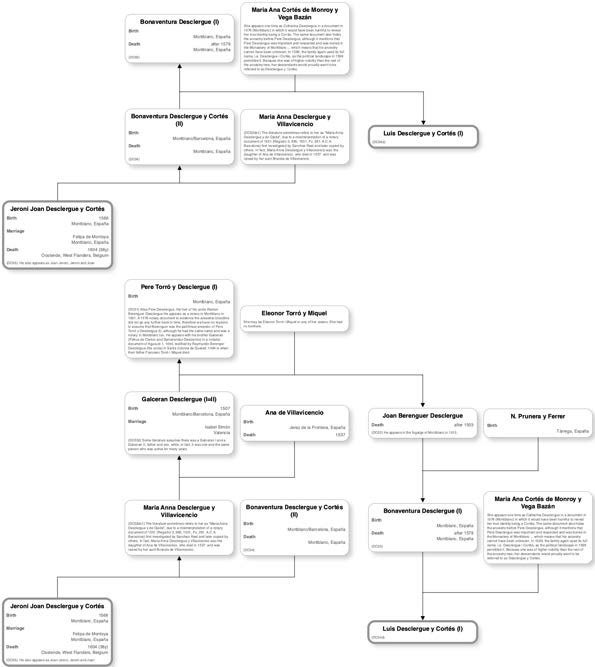
Galcerán Desclergue (DC02d) had an elder brother, Berenguer Desclergue (DC02), our ancestor. The latter had a grandson, Lluis Desclergue y Cortés (DC04d), already mentioned above and shown in Figures 25.31 and 25.32, half-uncle of Jeroni Joan Desclergue y Cortés (DC05). Luis (DC04d) resided in Cadiz123 and was also involved in the tradesmanship of his granduncle Galcerán Desclergue (DC02d).
Cabrera also mentions that Galcerán Desclergue (DC02d) was active as a merchant in Malaga and Granada. One of his trades was in Mexican silver, which he transformed in Spain by local silversmiths. He also traded with the Canary Islands. Equally interesting is that Galcerán (DC02d) traded with Extremadura, specifically ’Regenal de la Sierra,’ not far from the birthplace of Hernán Cortés de Monroy124.
In Catalonia’s trade, Galcerán (DC02d) received help from his brother Pere Desclergue (DC02b). Galcerán (DC02d) often reinvested his profits in insurance companies and real estate.
Cabrera points out that Galcerán Desclergue (DC02d) was focused on making money and showed a lot of solidarity with people in need. He helped, among others, the daughters of Planes after the latter had died and Felipe Ribas with several loans. In some written statements, Galcerán (DC02d) also warned others to be friendly to some of his close connections. His circle of friends consisted mainly of Catalans, Aragonese, and Valencians. Galcerán (DC02d) considered merchandising in Seville a temporary activity, not his final goal in life. Therefore, in 1551, he returned to his home. Galcerán’s inner circle of friends, such as Jaime Planes, Monserrat125126, and Felipe Ribas, shared these sentiments and sometimes even planned their burials in Barcelona. In those days, the death often came unexpectedly, and Jaime Planes, Pere Desclergue (DC02b), and Felipe Ribas died before returning to the Crown of Aragon. The connection with Monserrat is not surprising, as we see that Francesc Desclergue y Ratera (DC05e), a son of Bonaventura Desclergue y Cortés (DC04) and Maria Anna Desclergue y Villavicencio (DC02dx1), married Catalina Tous y Monserrat. This means that she was the sister-in-law of Jeroni Joan Desclergue y Cortés (DC05). A clarification is shown in Figure
Cabrera explains that by age 45, Galcerán (DC02d) had already had a long and very active career, and aging may have contributed to his decision to return to Catalonia. Whether intentional or consequential, his return to the Principality also had beneficial consequences for Catalonia, as he brought wealth back to his home region. His economic connections with the Americas made him a wealthy man with valuable connections. Simultaneously, the trade axis Genoa-Barcelona was re-established. Below, we cite the valuable bibliography collected by Miguel Royano Cabrera in his work mentioned above for referential reasons.
I. Armenteros Martínez, ’Cataluña en la era de las navegaciones: la participación catalana en la primera economía atlántica (c.1470 - 154 0 )’ , Vilassar de Mar, Barcelona, Fundació Ernest Lluch, Lleida, Milenio, 2012.
J. M. Bello León & M. Del C. Gonzalez Marrero, M. Del C., ’Los otros extranjeros: catalanes, flamencos, franceses e ingleses en la sociedad canaria de los siglos XV y XVI (primera parte)’ , en Revista de Historia Canaria , nº180, 1998, pp. 11 - 71.
J. M. Bello León, ’La presencia catalana en Andalucía Occidental a finales de la Edad Media’ , Anuario de Estudios Medievales , nº 40/1, enero - junio de 2010, pp. 93 - 127.
J. M. Bello León, R. J. González Zalacain, ’Los catalanes en la documentación notarial de Tenerife (1505 - 1525)’ , Estudis històrics i documents dels arxius de protocols , nº29, 2011, pp. 63 - 186 .
M. Cachero Vinuesa, ’Redes mercantiles en los inicios del comercio atlántico. Sevilla entre Europa y América, 1520 - 1525’ en Redes y negocios globales en el mundo ibérico, siglos XVI - XVIII , N. Böttcher, B. Hausberger, A. Ibarra ( coords. ) , Biblioteca Ibero - americana, Publicaciones del instituto Ibero - Americano, Fundación Patrimonio Cultural Prusiano, vol. 137, Iberoamericana vervuert, El colegio de México, 2012, pp. 25 - 50.
102Archivo General de Indias, Contaduría, Legajo 1.051, Cuentas de Alonso de la Torre.
103Enrique Otte, ’Los comienzos del comercio catalán con América,’ p.471.
104Historical Archive of Protocols of Seville, Notarial Protocols of Seville, Legajo 3.323, f.1092 r.; 2-8-1537
105Enrique Otte, ’Los comienzos del comercio catalán con América,’ p. 461 and Archivo General de Indias, J, 733, nº1.
106Archivo General de Indias, Judicia, Legajo 733, nº1, f. propia 107-115. (en declaración de 18-7-1539) 107Historical Archive of Protocols of Seville, Notarial Protocols of Seville, Legajo 9.147, f.1480
108Enrique Otte, ’Los comienzos del comercio catalán con América,’ p.469. El total ascendía a 377 pesos y medio de oro; 109.092 mrs.
109J. M. Madurell Marimón, ’Notas sobre el antiguo comercio de Barcelona con las Islas Canarias y de Santo Domingo,’ Anuario de Estudios Atlánticos, nº3, Cabildo Insular de Gran Canaria, Madrid, pp. 569-570.
110Historical Archive of Protocols of Seville, Notarial Protocols of Seville, Legajo 3.323, f.1092 r. (2-8-1537).
111Inicio de las compañías con Desclergue en Archivo General de Indias, Santo Domingo, Legajo 868, Libro 2, f. 295 (1540) 112Enrique Otte, ’Los comienzos del comercio catalán con América,’ p.469.
113Fallecimiento de Llenes en Historical Archive of Protocols of Seville, Notarial Protocols of Seville, Legajo 9.162, f.906 r.; 28-4-1548) 114Enrique Otte, ’Los comienzos del comercio catalán con América,’ pp.469-474.
115J. M. Madurell Marimón, ’Notas sobre el antiguo comercio de Barcelona con las Islas Canarias y de Santo Domingo,’ Anuario de Estudios Atlánticos, nº3, Cabildo Insular de Gran Canaria, Madrid, pp.569-570.
116Enrique Otte, ’Los comienzos del comercio catalán con América,’ p.477.
117Archivo General de Indias, Justicia, Legajo 733, nº1, f. propia 107-115. (en declaración de 18-7-1539) 118Enrique Otte, ’Los comienzos del comercio catalán con América,’ p.469
119Archivo General de Indias, Contratación, Legajo 4948 B. (1542)
120J. M. Madurell Marimón, ’Notas sobre el antiguo comercio de Barcelona con las Islas Canarias y de Santo Domingo,’ Anuario de Estudios Atlánticos, nº3, Cabildo Insular de Gran Canaria, Madrid, pp.569-570.
121Enrique Otte, Seville, siglo XVI, pp.69-311 (Examples from Desclergue, Dalmao Ros, Juan Bonet, etc.) 122the cases offered by different Catalan and Valencian merchants such as Dalmao Ros for fish, leather, etc. See M. T. Ferrer i Mallol, ’El comerç català a Andalusia al final del segle XV,’ Acta historica et archaeologica mediaevalia, nº18, 1997, pp.306-314.
123C. Martínez Shaw, the cited work, p.234.
124Historical Archive of Protocols of Seville, Notarial Protocols of Seville, Legajo 10.569, f.421 r. (20-8-1545).
125Archivo General de Indias, Justicia, Legajo 733, nº1.
126Enrique Otte, ’Los comienzos del comercio catalán con América,’ p. 461.
© 2024 Nico F. Declercq
The Desclergues of la Villa Ducal de Montblanc, 2nd ed., Omn., VOL. I
25.1. DESCENDANTS OF PERE DESCLERGUE (I) (DC01)
269
H . Chaunu, P. Chaunu, ’Séville et lÁtlantique (1504 - 1650) , S.E.V.P.E.N. , 12 vol., París, 1955 - 1960.
M. Del Treppo, ’Els mercaders catalans i léxpansió de la Corona catalano - aragonesa al segle XV’ , Trad. Jaume Riera i Sans, Documents de Cultura, Curial Edicions Catalanes, Barcelona, 1976.
P. Desportes Bielsa, ’Aragón en el comercio con Flandes (Siglo XVI) ’ , Revista de Historia Jerónimo Zurita, nº 74, 1999, pp. 175 - 200.
P. Desportes Bielsa, ’El Consulado ca talán de Brujas (1330 - 1488)’ , Aragón en la Edad Media , nº14 - 15, 1, 1999, pp. 375 - 390.
M. Diago Hernando, ’Relaciones comerciales de la Corona de Aragón con la Andalucía Atlántica durante el siglo XIV y primera mitad del XV’ , Historia, instituciones, documentos , nº 27, Universidad de Sevilla, 2000, pp. 19 - 54.
J. H. Elliot, ’El Viejo Mundo y el Nuevo’ , 1492 - 1650, Alianza, Madrid, 1984.
L. Febvre, ’Combates por la historia’ , Ariel, Barcelona, 1982.
M. F. Fernandez Cháves, R. M. Pêrez García, ’Las redes de la trata negrera: Mercaderes portugueses y el tráfico de esclavos en Sevilla (C.1560 - 1580)’ , en La esclavitud negroafricana en la historia de España. Siglos XVI y XVII, A. Martín Casares, M. García Barranco (coords.), Comares, Granada, 2010, pp. 5 - 34.
M. T. Ferrer i Mallol, ’El comerç català a And alusia al final del segle XV’ , Acta historica et archaeologica mediaevalia , nº 18, 1997, pp. 301 - 334.
R. Franch Benavent, ’El comercio en el mediterráneo es pañol durante la Edad Moderna: Del estudio del tráfico a su vinculación con la realidad pro ductiva y su contexto social’ , Obradoiro Historia. Moderna , n º17, 2008, pp.77 - 102.
D. Igual Luis, ’Valencia e Italia en el siglo XV. Rutas, mercados y hombres de negocios en el espacio económico del Mediterráneo Occidental’ , Bancaixa i Fundacio Caixa Castello, Castello de la Plana, 1998, pp. 261 - 322.
E. Lorenzo Sanz, ’Comercio de España con América en la época de Felipe II , T.I: Los mercaderes y el tráfico indiano, Diputación Provincial de Valladolid’
, Institución Cultural Simancas, Valladolid, 1986
J. M. Madurell Marimó N, ’Notas sobre el antiguo comercio de Barcelona con las Islas Canarias y de Santo Domingo’ , Anuario de Estudios Atlánticos , nº3, Cabildo Insular de Gran Canaria, Madrid; Las Palmas, 1957, pp. 563 - 592.
C. Martínez Shaw, ’Cataluña y el comercio con América. El fin de un debate’ , Boletín Americanista , nº 30, 1980, pp.223 - 236.
E. Otte, ’Los comienzos del comercio catalán con América’ , en Homenaje a Jaime Vicens Vives, J. Maluquer de Motes (ed.) , vol.2, Universidad de Barcelona, Facultad de Filosofía y letras, Barcelona, 1967, pp.459 - 480.
E. Otte, ’Las perlas del Caribe, Nueva Cádiz de Cubagua’ , Fundación John Boulton, Caracas, 1977.
E. Otte, ’Los mercaderes transatlánticos bajo Carlos V’ , Anuario de Estudios Americanos , nº47, Sevilla, 1990, pp. 96 - 121.
E. Otte, ’Sevilla y sus mercaderes a fines de la Edad Media’ , A. M. Bernal, y A. Collantes de Terán eds., Universidad de Sevilla, Vicerrectorado de Relaciones Institucionales y Extensión Cultural [etc.], Sevilla, 1996.
E. Otte, ’Sevilla, siglo XVI: Materiales para su historia económica’ , Centro de Estudios Andaluces, Consejería de la Presidencia, Sevilla, 2008.
M. J. Peláez, ’Catalunya després de la guerra civil del segle XV. Institucions, formes de govern i relacions socials i econòmiques (1472 - 1479)’ , Curial, Barcelona, 1981.
L. De Peraza, ’Historia de la ciudad de Sevilla’ , S. M. Pérez González (ed.) , Área de Cultura del Excmo. Ayuntamiento de Sevilla, Sevilla, vol. 2, 1997.
J. M. Ruiz Povedano, ’El consulado catalán de Málaga en época de los Reyes Católicos’ , La Ciudad Hispánica, siglos XIII al XVI , edit. Universidad Complutense, Madrid, 1987, pp. 419 - 444. E. Salvador Esteban, ’En torno al comercio y a la economía valenciana del Quinientos ,’ Estudis: Revista de historia moderna, n º 1, 1972, pp.25 - 42.
R. M. Serrera Contreras, ’La América de los Habsburgo (1517 - 1700)’ , Universidad de Sevilla, Secretariado de publicaciones, Sevilla, 2013.
V. Vázquez de Prada, ’La colonia mercantil valenciana en Amberes, en la época de Carlos V’ en Homenaje a Jaume Vicens Vives , J. Maluquer de Motes (ed.), vol.2, Universidad de Barcelona, Facultad de Filosofía y letras, Barcelona, 1967, pp. 733 - 754.
M. Zambrano Pérez, ’Piratas, piratería y comercio ilícito en el Caribe: la visión del otro’ , Historia Caribe , nº12, Universidad del Atlántico, Barranquilla, Colombia, 2007, pp.23 - 56.
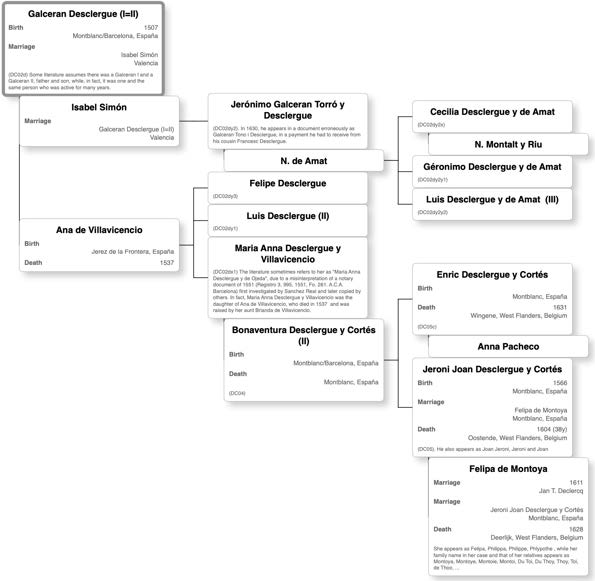
Galcerán and Isabel had one child, Jerónimo Desclergue (DC02dy2). Besides his marriage, Galcerán Desclergue (I=II) (DC02d) had two illegitimate children, whom he later legitimized with Ana de Villavicencio, as described in Chapter 25.1.3.2. These children were Luis Desclergue (DC02dy1) and Maria Anna Desclergue y Villavicencio (DC02dx1), who died in 1537.
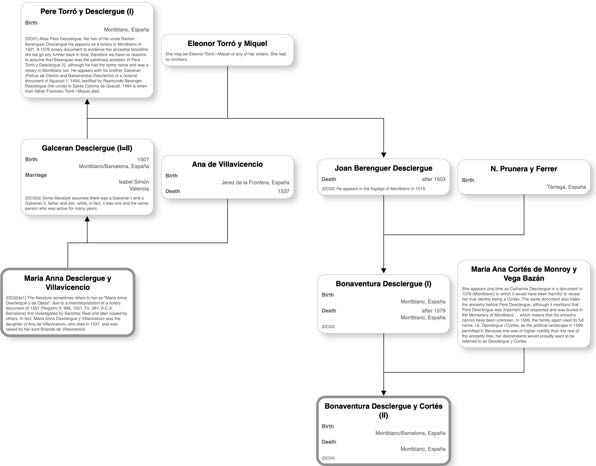
Maria Anna Desclergue y Villavicencio (DC02dx1), described in Chapter 25.1.3.4, was a daughter of Galcerán Desclergue (I=II) (DC02d) and married her distant cousin Don Bonaventura Desclergues (II) (DC04) y Cortés, our ancestor. The couple had two children: our ancestor Jeroni Joan Desclergue y Cortés (DC05) y Cortés and Enric Desclergue (DC05c) y Cortés. Jeroni Desclergue (DC02dy2) probably died in 1633 in Barcelona, as indicated below. His descendants established the Rui y Desclergue branch of the family in Vich.
Galcerán Desclergue (I=II) (DC02d) appears as ’Senior Galzeran Desclerga’ in the works of Damià Martínez Latorre127, and Jaume
Bassa128. A person named ’Galceranus Desclergue’ is listed as a doctor medicus Spirae in the year 1570129. His son Luis Desclergue (II) (DC02dy1) is referred to as ’Lluís Esclergue’ in the work of Carlos Martinez Shaw130.
Notably, Galcerán Desclergue (I=II) (DC02d) assumed the role of father-in-law to Bonaventura Desclergue (II) (DC04) y Cortés, a connection that was forged through the marriage of his daughter Maria Anna Desclergue y Villavicencio (DC02dx1). This intricate web of relationships reveals that both Galcerán and Bonaventura are our ancestors, linked through their grandson Jeroni Joan Desclergue y Cortés (DC05). The latter, a fascinating blend of conquistadors, merchants, and notaries, inherited the bloodlines of both his parents.
25.1.3.2 Ana de Villavicencio
Galceran Desclergue (I=II) (DC02d) was first married to Isabel. He was a citizen of Barcelona, remained for some time in Seville, and, from his relation with Ana de Villavicencio, an unmarried woman, Ana de Villavicencio, he had two children: Luis and Maria Ana, whom he legitimized for the second time in 1551, in the Crown of Aragon, although they had already been legitimized in Andalusia before.131 132
Ana de Villavicencio was the daughter of Catarina Cabeza de Vaca Mejias and Pedro Núnñez de Villavicencio. The latter was the 127Damià Martínez Latorre, ’El testament de l’enginyer militar Giovan Battista Calvi (1556),’ Locus Amoenus 5, 2000-2001, 195-203.
128Jaume Bassa, ’El senyor de Sant Jordi i la fortificació de les Medes,’ 2009, Llibre Festa Major, 37.
129Reference 673 in ’Le cinquecentine della Biblioteca provinciale Cappuccini di Trento, catalogo di p. Lino Mocatti - Silvana Chiste, A cura di Anna Gonzo, Presentazione di Marielisa Rossi, In aggiunta Le edizioni del secolo XV di M Cristina Bettini,’ published by Provincia Autonoma di Trento -
Servizio beni librari e archivistici, 1993.
130Carlos Martinez Shaw, ’Cataluña y el comercio con América. El fin de un debate.’
131Registro 3 995 (1551) Fol. 261, A.C.A., Barcelona.
132The literature in the past sometimes referred to Ana de Villavicencio as ’Beatriz de Ojeda,’ which is an error. It is caused by misinterpreting a notary document of 1551 (Registro 3, 995, 1551, Fo. 261. A.C.A. Barcelona) first investigated by Sanchez Real and later copied by others. Ana de Villavicencio died in 1537 and her children were raised by her aunt Brinda de Villavicencio.
The Desclergues of la Villa Ducal de Montblanc, 2nd ed., Omn., VOL. I
© 2024 Nico F. Declercq
CHAPTER 25. DON PERE TORRÓ Y DESCLERGUE (I) (DC01)
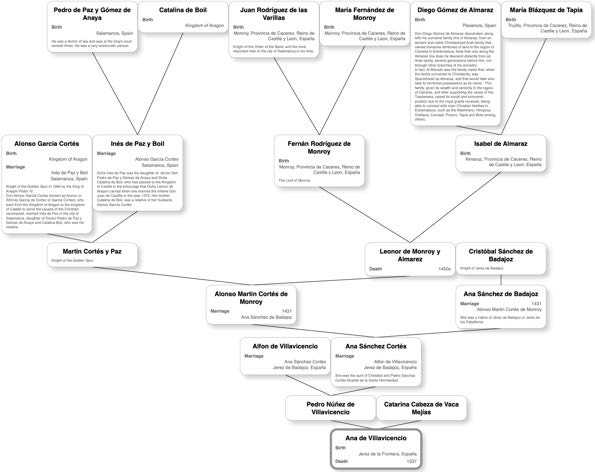
son of Alfon de Villavicencio and Ana Sánchez Cortés, who married in Jerez de Badajoz. Ana Sánchez Cortés was the aunt of Cristóbal and Pedro Sánchez Cortés, Alcalde de la Santa Hermandad. She was the daughter of Alonso Martin Cortés de Monroy and Ana Sánchez de Badajoz. The latter couple married in 1431, and their ancestry is described in Chapter 27.2. Ana Sánchez de Badajoz was a native of Jerez de Badajoz or Jerez de los Caballeros. She was the daughter of Cristóbal Sánchez de Badajonz, a Knight of Jerez de Badajoz.
Ana de Villavicencio was named ’Ana’ because that was also the name of her Grandmother Ana Sánchez Cortés and her great-grandmother Ana Sánchez de Badajoz. When she was orphaned, she was raised by her maternal aunt and Godmother, Brianda de Villavicencio, who also left her an inheritance.
In fact, Ana de Villavicencio emerged as a luminous figure, embodying the grace and allure of her lineage. Born to the illustrious union of Doña Catarina Cabeza de Vaca Mejía and Pedro Núñez de Villavicencio de Jerez de la Frontera, her ancestry bore the weight of prestige and heritage.
Ana’s radiant beauty was renowned far and wide, a testament to the exquisite charm that graced the ’Sánchez de Badajoz’ and
’Vega Bazán’ lineages, enchanting the hearts of the affluent and noble alike. Among these distinguished suitors, Galceran Desclergue (I=II) (DC02d), a merchant of Seville, found himself captivated by Ana’s allure.
In the wake of the discovery of the Americas, Seville burgeoned into a colossal financial and commercial epicenter, rivaling even the zenith of New York in its heyday. Gold flowed like a boundless river, luring merchants and adventurers from every corner of the globe to its gates. Along with its bustling ports, the city commanded the crossroads of maritime trade routes to the Atlantic, rendering it an indispensable nexus of commerce.
For Galceran Desclergue (I=II) (DC02d), Seville was not merely a city of opportunity but a realm of boundless prosperity. His endeavors as a merchant flourished amidst the burgeoning trade routes, where fortunes were made and lost with each tide. The discovery of the silver route to Castilla and Portugal further solidified Seville’s position as the linchpin of international trade.
Within commerce and ambition, Ana and Galceran forged their union, a union steeped in the legacy of their lineage and the promise of a future entwined with the riches of distant shores. Their journey mirrored the grandeur of their era, where love and ambition intertwined amidst the opulence and intrigue of a world in transformation. Moreover, as they embarked on their voyage together, they carried with them the legacy of generations past, navigating the seas of destiny with the steadfastness of those who dared to dream amidst the upheaval of history.
Ana de Villavicencio, just like Maria Ana Cortes de Monroy y Vega Bazan, exposed in Chapter 27.2 and blood-relative of Conquistador Hernán Cortés, described in Chapter 27.20, as our ancestor, is important in understanding an archaeological artifact at the chapel of Deerlijk, as outlined in Chapter 49.4.2.
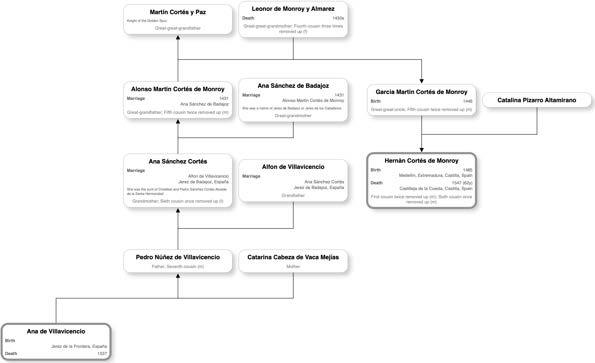
Her ancestors are shown in Figure 25.36, while her connection with Hernán Cortés de Monroy is shown in Figure 25.35.
As shown in Chapter 33.3.3, Captain Don Lorenzo Villavicencio, an infantry sergeant major in the Spanish tercio of Maestro de Campo Don Juan de Meneses, attested in Ostend on October 29, 1604, the qualities of Enric Desclergue (DC05c) as military. Both were distant cousins.
Military Manuel de Vega Cabeza de Vaca was related to Ana de Villavicencio’s mother, Catarina Cabeza de Vaca Mejias. He fought with our forefather, Jeroni Desclergue (DC05), in Bergen op Zoom in 1588, as described in Chapter 29.5.5. Furthermore, from Santiago, Manuel de Vega Cabeza de Vaca certified in Brussels on January 20, 1598 the qualities of Jeroni Desclergue (my forefather) as a military, as explained in Chapter 29.5.25 and shown in Figures 29.93 on page 413, and 29.94 on page 414.
25.1.3.3 Jerónimo Desclergue (DC02dy2), the son of Galceran Desclergue (I=II) (DC02d) a servitor of the Marquis of Aytona
This Jerónimo Desclergue (DC02dy2), son of Galceran Desclergue (I=II) (DC02d) must not be confused with Galceran’s grandson (through his daughter Maria Anna Desclergue who married Bonaventura Desclergue (II) (DC04) y Cortés) Jeroni Joan Desclergue y Cortés (DC05) y Cortés. Confusion, however, is found here and there in the literature. Nevertheless, he must have been the godfather of Jeroni Joan Desclergue y Cortés (DC05).
From his will, extended on November 11, 1633, we know that he had served for twenty-four years to the Marquis of Aytona. He died confident that the Marquis would make a dignified burial and pay him masses for his soul, thanks to the wages he owed him. He arranged his tomb in the cathedral’s cloister, in Barcelona, in front of the chapel of S. Blay, where his parents’ grave was located133.
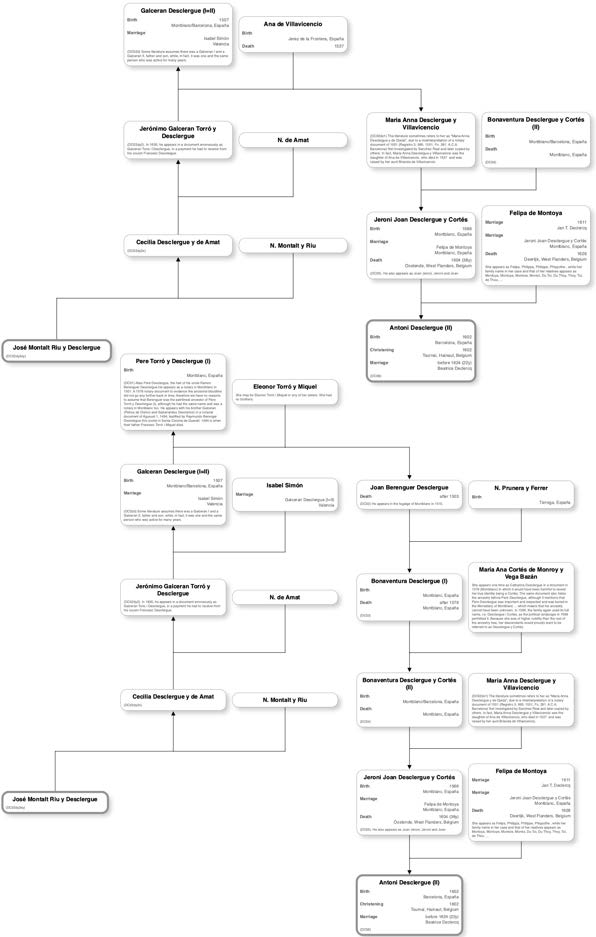
A daughter of Jerónimo Desclergue (DC02dy2), Cecilia (DC02dy2x1) married a certain Riu, and a son of this union was José Riu y Desclergue (DC02dy2x1y1), a bourgeois of Perpignan, who was constituted as heir, as the grandson, of Jerónimo Desclergue (DC02dy2). Figure 25.34 shows how he is connected to Antoni Desclergue (DC06), our ancestor, to illustrate his position in our ancestry. José Riu y Desclergue (DC02dy2x1y1) was captain of the infantry in Roussillon from 1637 to 1640. It is in this period that he may have met his distant cousin Antoni Desclergue (II) (DC06) (our ancestor in Belgium) when the latter went to Spain, as described in Chapter 34.5.11. In 1652, for loyalty, he moved with his family to Vich, where he confiscated a property134. In 1654, he applied for the privilege of nobility. The Council’s information on his request is preserved. At the end of the year, he was granted a military privilege135.
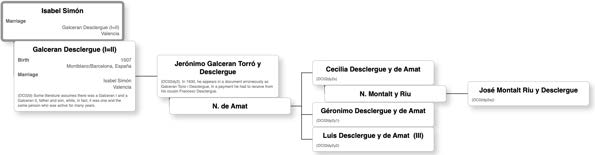
The cited documents refer to José Montalt Riu y Desclergue (DC02dy2x1y1), and he is the grandson of Jerónimo Desclergue (DC02dy2). Figure 25.37 on page 290 shows the descendants of Galceran Desclergue (I=II) and Isabel Simón and the link with José Montalt Riu y Desclergue (DC02dy2x1y1).
We should, in this framework, also mention the appearance of a nun, called Cecilia Desclergue, appearing in ’La lista dels confrares que ingressen l’ any 1587 ’ 136. It is not known if she was related. The Monestir de Vallbona de les Monges is located 30 km from Montblanc and approximately 100 km from Barcelona and Manresa. As mentioned, Jerónimo Desclergue (DC02dy2) had a daughter Cecilia Desclergue (DC02dy2x1), who married Joan Riu u Ardit (’Burges Honrat de Perpignan’) around 1600, perhaps the mentioned nun is the same person or at least a relative.
A son of Jerónimo Desclergue (DC02dy2), was, according to Francisco J. Morales Roca137, Gerónimo Desclergue y de Amat (DC02dy2y1), Caballero, and was authorized by the Brazo Militar in the Corts of the Principality of Catalonia in 1626.
133Third Book of Testaments (1610-1634) of the notary Antonio Estalella. Folio. 181 v. Historical Archive of Protocols of Barcelona. Real had the text thanks to the search and transcription made by Amadeo J. Soberanas Lleó.
134Consejo de Aragón. (1654) Legajo 307. A.C.A. Barcelona.
135Consejo de Aragón (1654) Cámara. Vol. 69, fol. 134 v. A.C.A. Barcelona.
136’La lista dels confrares que ingressen l’ any 1587’ , on page 239 of section ’Noms de monges i servidors delmonestir de Vallbona ,’ published by Josep-Joan Piquer i Jover, in Analecta sacra Tarraconension, Vol XLVII of the year MCMLXXIV (1974).
137Francisco J. Morales Roca, ’Próceres habilitados en las Cortés del Principado de Cataluña, siglo XVII: 1599-1713, Volume 2’ , Ediciones Hidalguia, 1983
© 2024 Nico F. Declercq
The Desclergues of la Villa Ducal de Montblanc, 2nd ed., Omn., VOL. I
25.1. DESCENDANTS OF PERE DESCLERGUE (I) (DC01)
271
Another son of Jerónimo Desclergue (DC02dy2) was Luis Desclergue y de Amat (DC02dy2y2), a Knight, and, according to Francisco J. Morales Roca138, authorized by the Brazo Militar in the Corts of the Principality of Catalonia in 1599. Luis Desclergue y de Amat (DC02dy1) on February 16, 1581, was recognized by the judge of Montblanc who, through Joan de Valls, had given him a pedrenyal139.
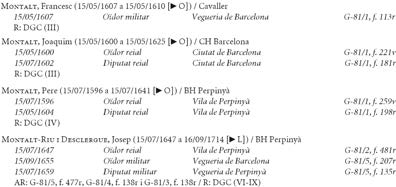
Further appearances of Montalt in Perpignan and in their original city of Barcelona are shown in Figure 25.38 on page 290, Figure
25.39 on page 290, and Figure 25.40 on page 290.
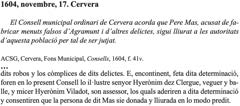
Concerning Gerónimo Desclergue y de Amat (DC02dy2y1), an interesting reference is found in Figure 26.6 on page 293. The reference, originating from 17th-century records of the Ordinary Municipal Council of Cervera, delves into a legal case involving the alleged production of counterfeit coins and other criminal activities. The narrative unfolds within a context where local authorities are tasked with adjudicating the case of Pere Mas, also known as ’cap pelat’ (translated as ’bald head’), accused of manufacturing fake Agramunt coins. The story presents the legal proceedings and highlights the intricate dynamics between different municipalities and their respective councils. One prominent figure in this narrative is Gerónimo Desclergue y de Amat (DC02dy2y1) (’Hyerónim dez Clergue’), who holds the title of veter y balle, denoting a position of authority within the local governance structure. As a member of the Ordinary Municipal Council of Cervera, Gerónimo Desclergue y de Amat (DC02dy2y1) plays a pivotal role in the decision-making process concerning the fate of Pere Mas. His presence in the council chamber signifies his significance in the municipal hierarchy and involvement in crucial matters of justice and governance. In the events unfolding, Gerónimo Desclergue y de Amat (DC02dy2y1) and other council members are presented with evidence implicating Pere Mas in producing counterfeit currency. The text describes how the Council deliberates on the appropriate course of action, ultimately handing over Pere Mas to the authorities of Agramunt for trial.
Gerónimo Desclergue y de Amat’s (DC02dy2y1) presence in this decision-making process underscores his responsibility to uphold justice and ensure the smooth functioning of legal proceedings within the municipality.
25.1.3.4 Maria Anna Desclergue y Villavicencio (DC02dx1), our ancestor and the daughter of Galceran Desclergue (I=II) (DC02d)
Maria Anna Desclergue y Villavicencio (DC02dx1) and Luis Desclergue y Villavicencio (II) (DC02dy1) were children of Galceran Desclergue (I=II) (DC02d), described in25.1.3.1 and Ana de Villavicencio, described in Chapter 25.1.3.2. 140
Central to our narrative, as detailed in Chapter 28.4, is Maria Anna’s union with Bonaventura Desclergue y Cortés (II) (DC04), our esteemed forefather. This union bore fruit in the form of Jeroni Joan Desclergue y Cortés (DC05), our paternal ancestor, and Enric Desclergue y Cortés (DC05c). The fact that she adopted the Desclergue name for the remainder of her life and married her cousin Bonaventura Desclergue y Cortés (II) (DC04) would have been highly improbable had she been an illegitimate child.
Galceran legitimized Maria Anna Desclergue y Villavicencio to avoid inheritance issues in the Crown of Aragon because she was born and raised by her aunt in Andalusia, not Catalonia. There are indications that Galceran Desclergue also had other bastard children that he did not legitimize.
138Francisco J. Morales Roca, ’Próceres habilitados en las Cortés del Principado de Cataluña, siglo XVII: 1599-1713, Volume 2’ , Ediciones Hidalguia, 1983.
139Arxiu Històric de Tarragona, Fons notarial de Montblanc, reg. 3508, s/p.
140In the literature, the mother of Maria Anna Desclergue y Villavicencio is sometimes erroneously referred to as ’Beatriz de Ojeda,’ while she was, in reality, Ana de Villavicencio. It also means that Maria Anna Desclergue y Villavicencio is sometimes erroneously referred to as ’Maria Anna Desclergue y de Ojeda.’ It is because a ’Beatriz de Ojeda’ is mentioned in the notarial document of 1551, but she was not the mother. Gonzalo Miguel Ojeda describes the Ojeda family de Ojeda in : Gonzalo Miguel Ojeda, ’El hidalgo Alonso de Ojeda,’ Boletín americanista, 1959, 2, pp. 83-91. The notarial document of 1551 is found in Registro 3, 995, 1551, Fo. 261. Sanchez Real first investigated A.C.A. Barcelona, and others later copied his misinterpretation in the first edition of his book and earlier papers, including this author. De Ojeda or Hojeda’s family was not noble. Therefore, it is hardly possible any Desclergue would have married one or had a relationship with one.
The Desclergues of la Villa Ducal de Montblanc, 2nd ed., Omn., VOL. I
© 2024 Nico F. Declercq
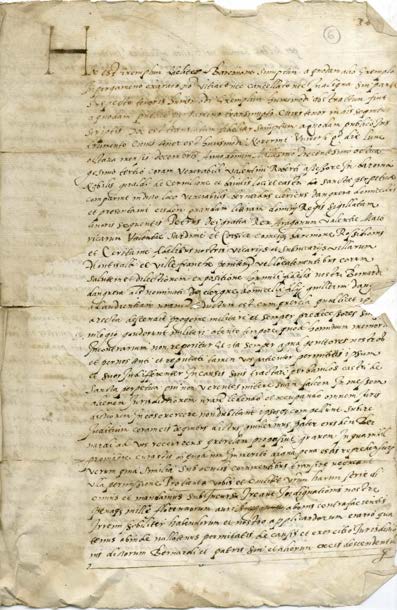
272
CHAPTER 25. DON PERE TORRÓ Y DESCLERGUE (I) (DC01)
Figure 25.3: This is a fragment of ’1494 una lletra de Pere III sobre els fets d’
armes dels Desclergue’ (Source: Arxiu Comarcal Urgell Desclergues document 6 page
1; Courtesy of Arxiu Comarcal Urgell and the de Pedrolo family)
© 2024 Nico F. Declercq
The Desclergues of la Villa Ducal de Montblanc, 2nd ed., Omn., VOL. I
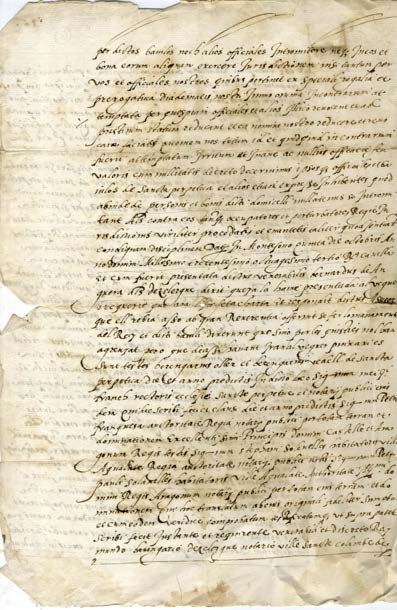
25.1. DESCENDANTS OF PERE DESCLERGUE (I) (DC01)
273
Figure 25.4: This is a fragment of ’1494 una lletra de Pere III sobre els fets d’
armes dels Desclergue’ (Source: Arxiu Comarcal Urgell Desclergues document 6 page
2; Courtesy of Arxiu Comarcal Urgell and the de Pedrolo family)
The Desclergues of la Villa Ducal de Montblanc, 2nd ed., Omn., VOL. I
© 2024 Nico F. Declercq
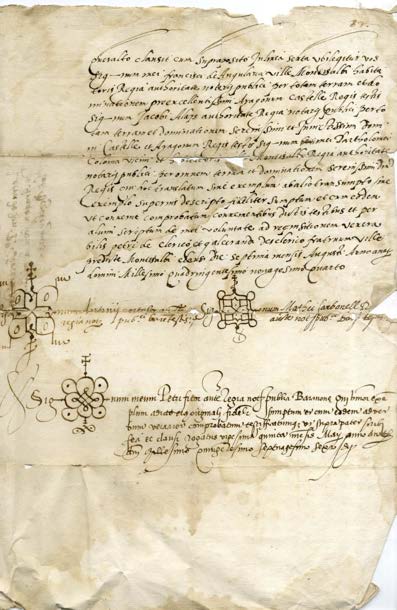
274
CHAPTER 25. DON PERE TORRÓ Y DESCLERGUE (I) (DC01)
Figure 25.5: This is a fragment of ’1494 una lletra de Pere III sobre els fets d’
armes dels Desclergue’ (Source: Arxiu Comarcal Urgell Desclergues document 6 page
3; Courtesy of Arxiu Comarcal Urgell and the de Pedrolo family)
© 2024 Nico F. Declercq
The Desclergues of la Villa Ducal de Montblanc, 2nd ed., Omn., VOL. I
25.1. DESCENDANTS OF PERE DESCLERGUE (I) (DC01)
275
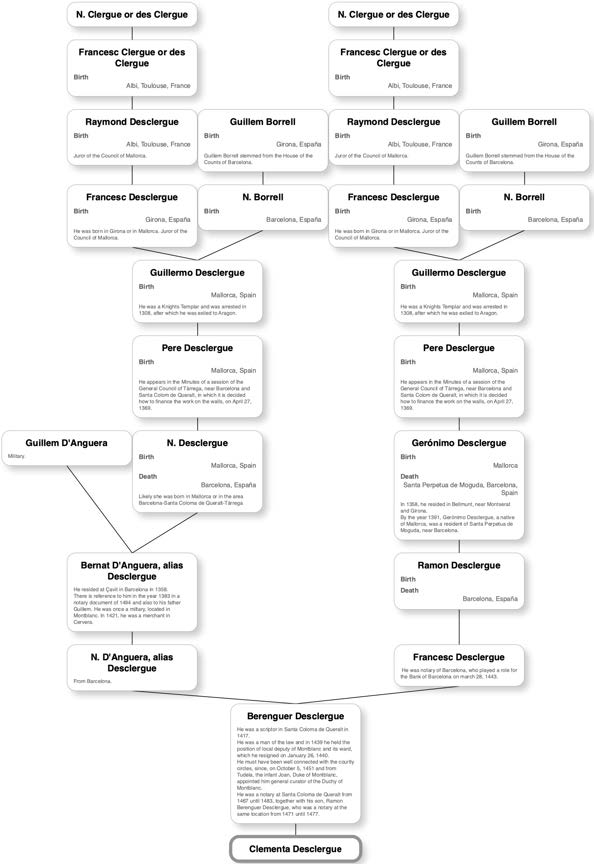
Figure 25.6: The ancestry of Clementa Desclergue. Her sons were the heirs of her brother, Ramon Berenguer Desclergue, a notary. Hence, they took the family name Desclergue rather than Torró y Desclergue. The eldest known patrilineal ancestor of Clementa Desclergue is Raymond Desclergue. His descendants, until Clementa and including Ramon Berenguer Desclergue, are shown in Figure 18.6 on page 132.
The Desclergues of la Villa Ducal de Montblanc, 2nd ed., Omn., VOL. I
© 2024 Nico F. Declercq
276
CHAPTER 25. DON PERE TORRÓ Y DESCLERGUE (I) (DC01)
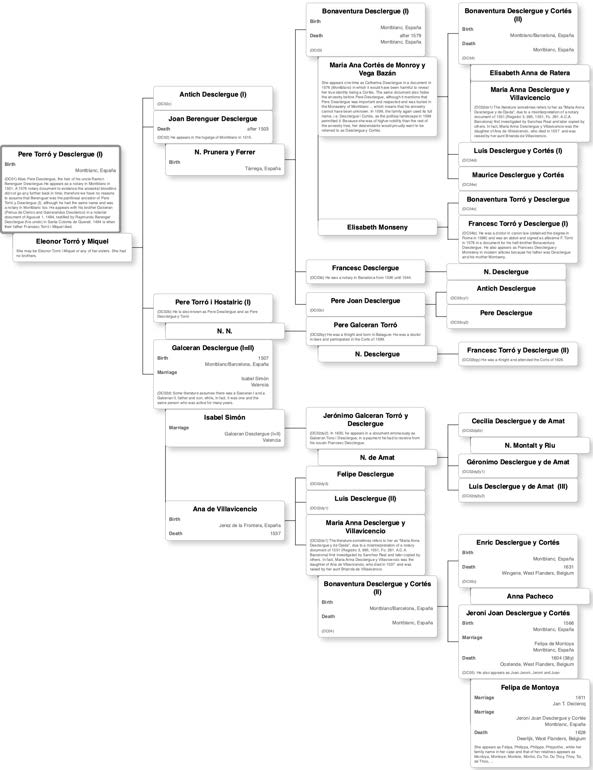
Figure 25.7: Three descending generations of Don Pere de Torró y Desclergue (I) (DC01)
© 2024 Nico F. Declercq
The Desclergues of la Villa Ducal de Montblanc, 2nd ed., Omn., VOL. I
25.1. DESCENDANTS OF PERE DESCLERGUE (I) (DC01)
277
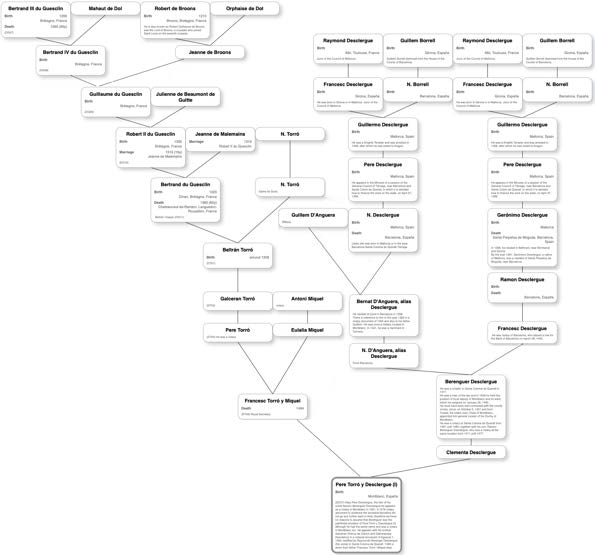
Figure 25.8: Ascending generations of Don Pere de Torró y Desclergue (I) (DC01)
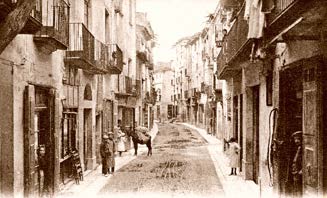
Figure 25.9:
Montblanc, Calle mayor
(around 1900, p)
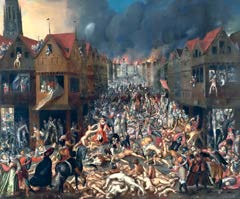
Figure 25.10: A painting depicting the Spanish fury
of Antwerp in 1576. The scene may be an exaggeration
of the events because the painter and his intentions are
unknown. (around 1585, p)
The Desclergues of la Villa Ducal de Montblanc, 2nd ed., Omn., VOL. I
© 2024 Nico F. Declercq
278
CHAPTER 25. DON PERE TORRÓ Y DESCLERGUE (I) (DC01)
Figure 25.11: In the first edition of this book, the author made a mistake by inter-
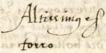
preting this handwritten note as ’altissima es torro.’ In reality, it is ’Altissima F.
Torró,’ the signature of Fransesc Torró y Desclergue. It can be found in Figure 25.13
on page 278. It was, however, this text that, in 2023, with the help of Jairo Eduardo Cortés Rosal, led to the completed genealogy of the Desclergues. A similar indication
of de Torró is found in Figure 25.1 on page 258. F. Torró is described in Chapter
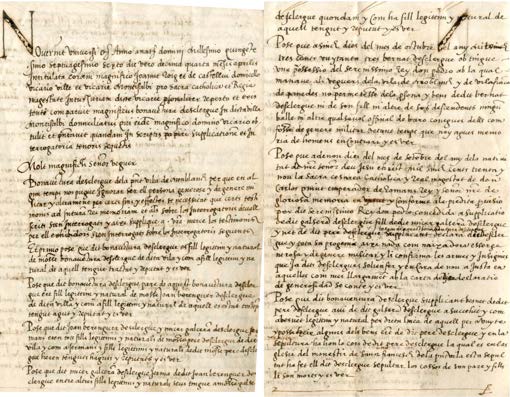
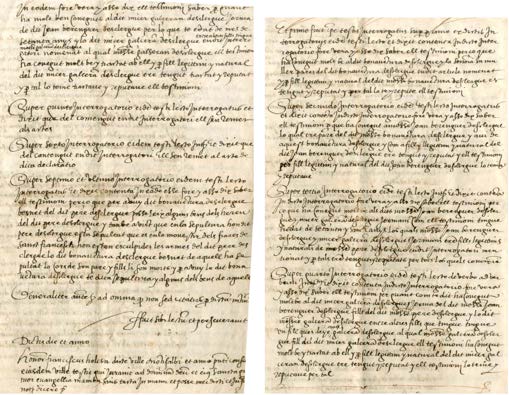
Figure 25.12: A handwritten text with notary seal ’1576 Mérits del llinatge Desclergue’ (Source: Arxiu Comarcal Urgell Desclergues document 5 page 2 view 2, and page 3 view 1; Courtesy of Arxiu Comarcal
Urgell and the de Pedrolo family.
Figure 25.13: Arxiu Comarcal Urgell Desclergues document 5 page 3 view 2, and document 5 page 4 view
1. We also refer to Figure 25.11 on page 278.
© 2024 Nico F. Declercq
The Desclergues of la Villa Ducal de Montblanc, 2nd ed., Omn., VOL. I
25.1. DESCENDANTS OF PERE DESCLERGUE (I) (DC01)
279
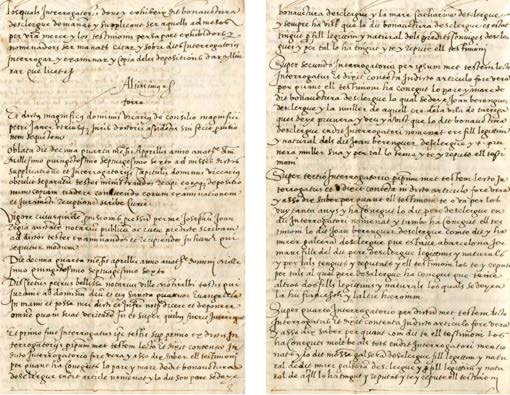
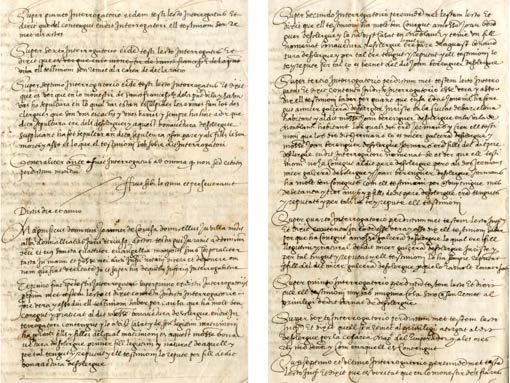
Figure 25.14: Arxiu Comarcal Urgell Desclergues document 5 page 4 view 2, and document 5 page 5 view
1.
Figure 25.15: Arxiu Comarcal Urgell Desclergues document 5 page 5 view 2, and document 5 page 6 view
1.
The Desclergues of la Villa Ducal de Montblanc, 2nd ed., Omn., VOL. I
© 2024 Nico F. Declercq
280
CHAPTER 25. DON PERE TORRÓ Y DESCLERGUE (I) (DC01)
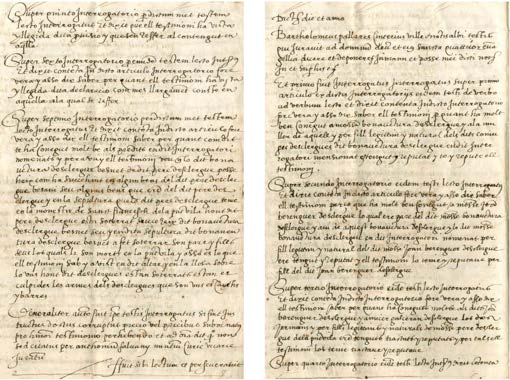
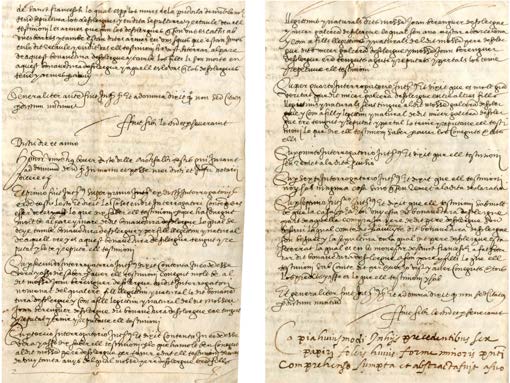
Figure 25.16: Arxiu Comarcal Urgell Desclergues document 5 page 6 view 2, and document 5 page 7 view
1.
Figure 25.17: Arxiu Comarcal Urgell Desclergues document 5 page 7 view 2, and document 5 page 8 view
1.
© 2024 Nico F. Declercq
The Desclergues of la Villa Ducal de Montblanc, 2nd ed., Omn., VOL. I
25.1. DESCENDANTS OF PERE DESCLERGUE (I) (DC01)
281
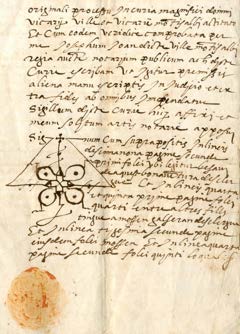
Figure 25.18: Last page of a handwritten text with no-
tary seal ’1576 Mérits del llinatge Desclergue’ . (Source:
Arxiu Comarcal Urgell Desclergues document 5 page 8
view 2; Courtesy of Arxiu Comarcal Urgell and the de
Pedrolo family)
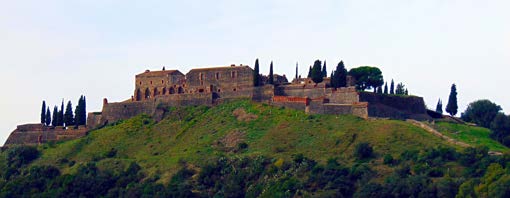
Figure 25.19: The castle of our Hostalric ancestors, described in Chapter 25.0.3. Credit of the Reverend Josep Maria Viñolas Esteva (modified). The historic military fortress atop volcanic rock, guarding strategic routes between Barcelona and France was built on the location of our ancestor’s castle. Initially built in the 18th century, it replaced our ancestor’s medieval castle, which French troops had demolished. Declared a national asset, the modern fortress boasts Vauban-inspired defenses and offers stunning panoramic views.
Now partly a restaurant, it is a testament to centuries of military history and strategic importance.
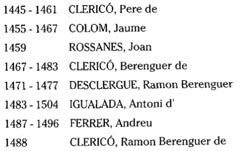
Figure 25.20: This documenta presents observations in
Santa Coloma de Queralt in agreement with the three
Generations of Notaries: Pere, Berenguer, and Ra-
mon Berenguer Desclergue. Active in Santa Coloma
de Queralt and Barcelona from the mid-15th to early
16th century. In Santa Coloma de Queralt, Pere served
from 1445 to 1461, followed by his brother Berenguer
from 1467 to 1483 and Berenguer’s son, son Ramon
Berenguer from 1471 to 1477. The latter served later in
Barcelona in 1485 and again in Santa Coloma de Quer-
alt in 1488 and 1494. Their familial ties shaped their
legal careers, with Berenguer’s court connections evident
in his appointment as general curator of the Duchy of
Montblanc. Pere Torró y Desclergue (DC01) was Ra-
mon Berenguer Desclergue’s heir, his sister’s, Clemeta
Desclergue, son with Francesc Torró y Miquel. The re-
lationships are shown in Figure 25.21 on page 282.
aJosep M. Porta i Balanyà, "Els notaris de Santa Coloma
de Queralt (segles XIII-XX), el retorn dels protocols notarials
anteriors al segle XIX", p. 145.
The Desclergues of la Villa Ducal de Montblanc, 2nd ed., Omn., VOL. I
© 2024 Nico F. Declercq

282
CHAPTER 25. DON PERE TORRÓ Y DESCLERGUE (I) (DC01)
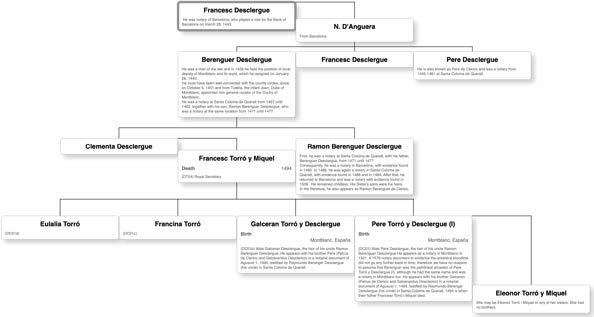
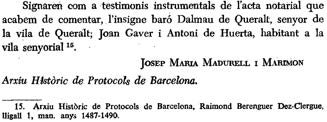
Figure 25.21: The descendants of Francesc Desclergue to show the relationship between Pere Desclergue, Berenguer Desclergue, and Ramon Berenguer Desclergue, as they appear in Figure 25.20 on page 281.
Figure
25.22:
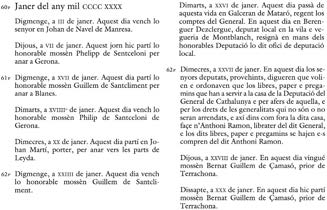
The resignation of
Berenguer Desclergue of Montblanc in
1440 from his position as a local deputy.a
aJosep Maria Sans i Travé, "Dietaris de la
Generalitat de Catalunya, Volum I, Anys 1411-
1539," folio 60-62, p. 76-77.
Figure 25.23: Ramon Berenguer Descle-
rgue served as the notary, in Barcelona, in
the period 1487-1490, for a document on
which the baron Dalmau de Queralt, lord
of the town of Queralt, was a witness.a
aJosep Maria Madurell i Marimonn, "El
Castll de Turlada, feu de Santes Creus", Santes
Creus Boletin del archivo bibliografico 31, Vol
IV, 1970, p.71-76.
Figure 25.24:
This citation mentions
Bernat Desclergue, a grocer at Cervera, in
aRoser Salicrú Lluch, "Esclaus assegurats
contra fuga a la Vegueria de Cervera: el
compte de la guarda de 1421", Miscélainia
Cerverina 12 (1998) 135-147, p. 145.
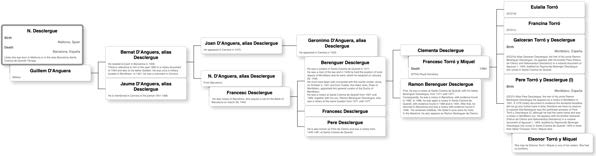
Figure 25.25: The descendants of Guillem D’Anguera and N. Desclergue.
© 2024 Nico F. Declercq
The Desclergues of la Villa Ducal de Montblanc, 2nd ed., Omn., VOL. I
25.1. DESCENDANTS OF PERE DESCLERGUE (I) (DC01)
283
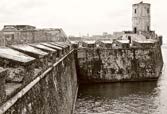
Figure 25.26: San Juan de Ulua, a Spanish fortress in Veracruz,
Mexico.
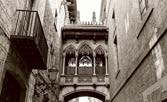
Figure 25.27: Architecture in barri gòtic of Barcelona.
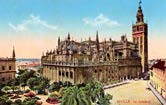
Figure 25.28: Sevilla, La Catedral, Tarjeta Postal, Union Postal Uni-
versal, España (1920).
Figure 25.29: Two descending generations of Galceran Desclergue (I=II) (DC02d)
The Desclergues of la Villa Ducal de Montblanc, 2nd ed., Omn., VOL. I
© 2024 Nico F. Declercq
284
CHAPTER 25. DON PERE TORRÓ Y DESCLERGUE (I) (DC01)
Figure 25.30: Blood-relationship between Maria Anna Desclergue y Villavicencio (DC02dx1) and Bonaventura Desclergue y Cortés (II) (DC04) (I)
© 2024 Nico F. Declercq
The Desclergues of la Villa Ducal de Montblanc, 2nd ed., Omn., VOL. I
25.1. DESCENDANTS OF PERE DESCLERGUE (I) (DC01)
285
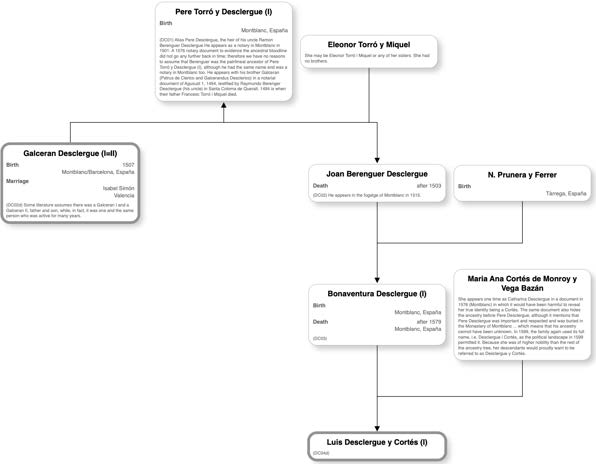
Figure 25.31: Blood-relationship between our ancestor, Jeroni Joan Desclergue y Cortés (DC05), and Luis Desclergue y Cortés (I) (DC04d).
The Desclergues of la Villa Ducal de Montblanc, 2nd ed., Omn., VOL. I
© 2024 Nico F. Declercq
286
CHAPTER 25. DON PERE TORRÓ Y DESCLERGUE (I) (DC01)
Figure 25.32: Blood-relationship between Galceran Desclergue (I=II) (DC02d) and Luis Desclergue y Cortés (I) (DC04d).
© 2024 Nico F. Declercq
The Desclergues of la Villa Ducal de Montblanc, 2nd ed., Omn., VOL. I
25.1. DESCENDANTS OF PERE DESCLERGUE (I) (DC01)
287
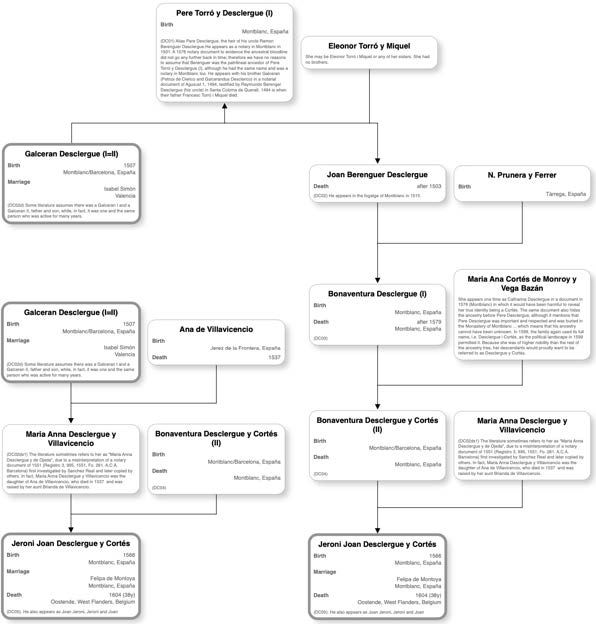
Figure 25.33: Blood-relationship between Galceran Desclergue (I=II) (DC02d) and our ancestor, Jeroni Joan Desclergue y Cortés (DC05).
The Desclergues of la Villa Ducal de Montblanc, 2nd ed., Omn., VOL. I
© 2024 Nico F. Declercq
288
CHAPTER 25. DON PERE TORRÓ Y DESCLERGUE (I) (DC01)
Figure 25.34: Blood-relationship between José Montalt Riu y Desclergue (DC02dy2xy) and Antoni Desclergue (II) (DC06)
© 2024 Nico F. Declercq
The Desclergues of la Villa Ducal de Montblanc, 2nd ed., Omn., VOL. I
25.1. DESCENDANTS OF PERE DESCLERGUE (I) (DC01)
289
Figure 25.35: Relationship between Ana de Villavicencio and Hernán Cortés de Monroy. The relationship through Anna Cortés de Monroy y Vega Bazan is shown in Figure 27.6 on page 298, and is described in Chapter 27.2
Figure 25.36: The ancestors of Ana de Villavicencio, a woman of high nobility, who married Galceran Desclergue (I=II).
One of their children was Maria Anna Desclergue y Villavicencio, who married Bonavenura Desclergue y Cortés (DC04), and they were the parents of Jeroni Joan Desclergue y Cortés (DC05), our forefather.
The Desclergues of la Villa Ducal de Montblanc, 2nd ed., Omn., VOL. I
© 2024 Nico F. Declercq


290
CHAPTER 25. DON PERE TORRÓ Y DESCLERGUE (I) (DC01)
Figure 25.37: The descendants of Isabel Simón and Galceran Desclergue (I=II).
Figure 25.38: Joseph Montalt Riu y De-
sclergue in Perpignan in 1659. a
aEls llibres de l’ànima de la diputació del
general de catalunya (1493-1714), p. 466-467,
item 135r
Figure 25.39: Joseph Montalt Riu y De-
sclergue in Perpignan.a
aEls llibres de l’ànima de la diputació del
general de catalunya (1493-1714), p.546, item
138r.
Figure 25.40: Francesc Montalt, appears in Barcelona in 1607-1610, Joaquin Mon-
talt appears in Barcelona in 1600-1625, Pere Montalt appears in Perpignan in 1596-
1641, Josep Montalt-Riu y Desclergue apperas in Perpignan in 1646-1659.18
© 2024 Nico F. Declercq
The Desclergues of la Villa Ducal de Montblanc, 2nd ed., Omn., VOL. I
Don Joan Berenguer Desclergue (DC02) & Doña
Prunera y Ferrer
26.0.1 Don Joan Berenguer Desclergue (DC02), General Conservator of the Montblanc Duke-
dom
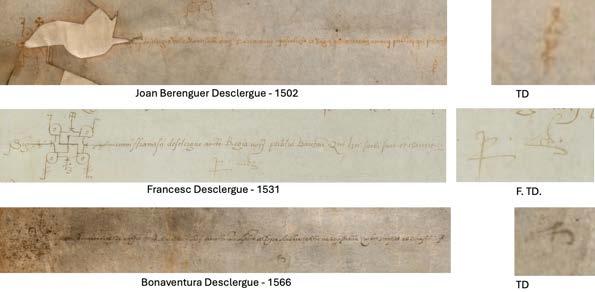
Figure 26.1 displays his signature, which includes an acronym indicating that his full name was Torró y Desclergue.
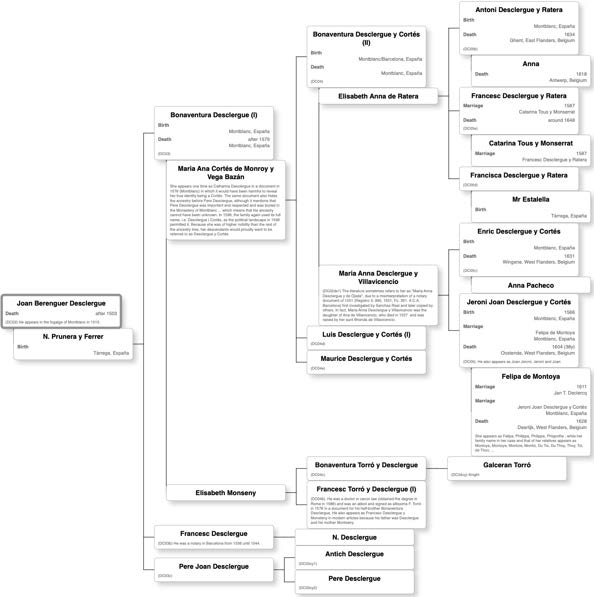
He is mentioned as a person from Montblanc in A. P. M.2, and also in Jaume Felipe Sánchez.3 In 1515, Joan Berenguer Desclergue (DC02) appears in Montblanc’s census,4 with his son Francesc Desclergue (DC03b).
He was married to Doña Prunera y Ferrer from Tàrrega in Spain, described in Chapter 26.0.2.
We have illustrated his descendants in Figure 26.2. He became a notary very young, probably helped by his good standing due to his infamous ancestors. He died after 1503 in his 80s or even older. He was a Doncel and was a Notary at Montblanc. We know that he was married to a Targarina (i.e., from Tàrrega) named Prunera and was the father of Bonaventura Desclergue (I) (DC03) and the grandfather of Bonaventura Desclergue (II) (DC04).
We can cite ’Desclergue, Berenguer de. Notari de Montblanc (1440).’ in Josep Maria Grau i Pujol and Francesc Badia i Batalla5.
Don Berenguer Desclergue (DC02) can be found several times in old archives.
Palau y Dulcet, in his Guide, cites, in a list of notaries, this Berenguer Desclergue (DC02) with the date of 1438 AD6.
Berenguer Desclergue (DC02) appears in 1440 as a law professional and town representative. Apparently, on this date, he resigned from his position. According to the Dietary of the Generalitat (vol IV, fol 62)’
’Tuesdays January 26, Berenguer Dez-Clergue, a local deputy in the town and neighborhood of Montblanc, resigned in the hands of the honorable and delegated his duties to this local council office.’
Indeed, in 1439, he was in charge of the local deputy of Montblanc and its court.
He must be well-related and linked to the middle-high nobility court since, on October 5, 1451, the infante Juan from Tudela, Duke of Montblanc, appointed him as the general conservator of the Montblanc Dukedom.
Santiago Alberti7 writes,
’This Berenguer was to be welcomed in courteous ways by the data we know from 1452. Alfonso Alonso was then the Magnanimous, whose second brother Joan was the Duke of Montblanc as every second king’s son. He could not take care of the duchess nor go there. Joan was retained in Navarre, where he was H.M., the King’s consort. According to the privilege letter of October 5, 1452, signed in Tudela, Berenguer Desclergue (DC02) was appointed as the conservator of his property in the duchy of Montblanc.’
In URTX,8 we find ’Desclergue, Berenguer (noble): VII, 66.’
Valentí Gial Vilá9 writes that, in 1503, he was a witness of an event that took place at Montblanc.
In the Concordia volume, which is stored in the Museum Archive, there is an annotation referring to Berenguer Desclergue (DC02), notary, as the owner of some lands near the mill of Pas. The land limits on two sides with the road to Prenafeta, namely on one side with the path from Cantalosella, and on the other, with a vineyard of the same Desclergue10.
Berengarius Dezclergue notarius dicte ville Montisalbis in termino dicte ville supra molendinus del Pas, apad crucem Guillermi Giner peciam terre seu mallol a duabus partibus cum camino per quem itur ad locum de Penafreta, ab alia parte cum camino que venit de Cantalosella, et ab alia parte cum quadam vinea eiusdem Berengarii. . . ’.
Joan Berenguer Desclergue (DC02) is also mentioned, referring to 1502, in a document by the notary Bartomeu Joan Coloma of Montblanc in 1546, shown in Figure 29.113 on page 420. The relevance of this observation is described in Chapter 29.5.2, when Joan Berenguer Desclergue’s great-grandson, Jeroni Joan Desclergue y Cortés (DC05), joins Carlos Coloma to Flanders. Both Colomas were relatives.
26.0.2 Doña Prunera y Ferrer, the wife of Joan Berenguer Desclergue (DC02)
Genetic evidence of our Ferrer ancestry is given in Chapter 73.10.4.6.3 on page 1597, and in Chapter 73.4 on page 1586. The wife of Don Berenguer Desclergue (DC02), described in Chapter 26.0.1, was N. Prunera y Ferrer, born at Tàrrega in Spain, the daughter of Juan Prunera and Catalina de Ferrer, daughter of Don de Ferrer.
Catalina de Ferrer was a noble lady. She was the sister of Don Luis de Ferrer, Lord of La Mora, and the Veguer (Doncel) of Tárrega.
Catalina de Ferrer’s cousin was Don Mateo de Ferrer, a Knight of the Golden Spur and the Veguer (Doncel) of Tárrega.
Don Juan Prunera was a bourgeois and merchant.
Juan Prunera y Ferrer, the brother of N. Prunera y Ferrer, was ’Ingresó en la Cartuja de Santa María de Scala Dei.’
The Ferrers had land in Montblanc, and Catalina de Ferrer’s dowry included some of these lands.
2Arxiu Parroquial de Montblanc (A. P. M.), reg. num. 1 fr,. foli 24r
3Jaume Felipe Sánchez, ’L’ ermita i el retaule de Sant Joan Baptista de Montblanc (Segle XVI)
4Jordi Sotorra i Montblanch, ’El Fogatge de 1515, A la Conca de Barberà i la Baixa Segarra’
5Josep Maria Grau i Pujol and Francesc Badia i Batalla, ’Diccionari biogràfic històric de Montblanc (1155-1920), Fundació Martí l’ Humà. Tot Conca.
Carrer Josa, 6, Montblanc, 2008.
6A Palau y Dulcet. Guía de Montblanch. Barcelona, 1931. Pág. 94. (It does not say where it is taken from) 7Santiago Alberti, ’Esquema històric del llinatge Pedrolo’ , page 49 – 88 of URTX Revista Cultural de l’ Urgell, Num 7, 1995.
8Pages 179-180 of URTX índex onomàstic Personatges històrics
9Valentí Gial Vilá, ’Conflictes entre poblet i Montblanc per Prenafeta, Segles XV-XVi’ , Aplec de Treballs (Montblanc) 19 (2001), 13-14, Centre d’
Estudis de la Conca de Barberà.
10Concordia. Museo-Archivo de Montblanc. Fol. 28 v.
The Desclergues of la Villa Ducal de Montblanc, 2nd ed., Omn., VOL. I
© 2024 Nico F. Declercq
292
CHAPTER 26. DON JOAN BERENGUER DESCLERGUE (DC02) & DOÑA PRUNERA Y FERRER
Figure 26.1: The Notary Seals and Signatures of Joan Berenguer Desclergue (DC02) in 1502, Francesc Desclergue (DC03b) in 1531 and Bonaventura Desclergue (DC03) in 1566. They are located on our ancestry tree in Figure 26.2. Their signatures consist of the acronym TD, meaning Torró y Desclergue, despite their appearance as notaries under the name Desclergue.
Joan Berenguer is described in Chapter 26.0.1, Bonaventura Desclergue in Chapter 27.1. 1
Figure 26.2: Three descending generations of Don Berenguer Desclergue (DC02)
© 2024 Nico F. Declercq
The Desclergues of la Villa Ducal de Montblanc, 2nd ed., Omn., VOL. I

293
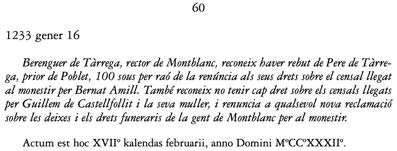
Figure 26.3: Josep Torné i Cubells, "Catàleg de pergamis de l’actual arxiu del
monastir de Poblet." Page 37, item 60, Montblanc. We notice Bernat Torró, monk
and scribe, and Berenguer de Tàrrega, rector of Montblanc and brother of Pere.
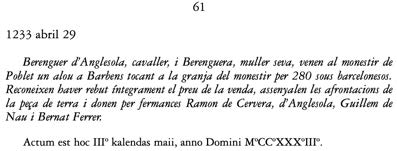
Figure 26.4: Josep Torné i Cubells, "Catàleg de pergamis de l’actual arxiu del
monastir de Poblet." Page 38, item 61, Barbens. We notice Bernat Torró, monk
and scribe, and Bernard Ferrer.
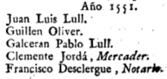
Figure 26.5: Francisco Desclergue on page 109 of ’Appendice de var-
ios documentos y noticias para el suplemento a las memorias históricas
del antiguo Comercio, Marina y Artes de Barcelona’ , in ’Memorias
Historicas Sobre La Marina Comercio Y Artes De La Antigua Ciuidad
De Barcelona, Volume 4’ , En La Imprenta De D. Antonio De Sancha,
1792.
Figure
26.6:
Gerónimo Desclergue y de Amat
(DC02dy2y1) in 1604 in Cervera.a
aDocument 8, pagina 109-110, in J. M. Llobet i Portella,
"Moneda falsa a la vegueria de Cervera (1479-1634)."
Figure 26.7: Francesc Desclergue (DC03b) was a no-
tary in Barcelona from 1536 until 1544.a
aLluisa Cases i Loscos, "Inventari de l’arxiu historic de
protocols de Barcelona, 2. Segle XVI", Fundacio Noguera,
barcelona, 2003, p. 96.
Figure
26.8:
Francesc Desclergue
(DC03b) was still a notary in 1551 and
he was, as his ancestors, connected to
the family Llull. Citation from Ignacio
Vila Despujol, "La Compañía de Jesús
en Barcelona en el siglo XVI: El colegio
de Nuestra Señora de Belén", Universidad
Pontificia Comillas, 22 nov. 2010, p. 156-
157.
The Desclergues of la Villa Ducal de Montblanc, 2nd ed., Omn., VOL. I
© 2024 Nico F. Declercq
CHAPTER 26. DON JOAN BERENGUER DESCLERGUE (DC02) & DOÑA PRUNERA Y FERRER
In 1408 and later, the chronicles show that Juan de Ferrer, ancestor of Doña Prunera y Ferrer was Veguer de Tárrega and of Urgel in 1452. He was a Doncel of Tárrega, Lord of la Mora and the son of Guillerma de Ferrer. The latter was also the Lord of la Mora and was the Veguer of Montblanc. Juan de Ferrer was enobled by King Alfonso V of Aragon and he participated in the Corts of Perpignan in 1449. He had lands in Montblanc. The Ferrers had relatives in Mallorca, Valencia, and Barcelona.
The Ferrer family, the Torró family, in Montblanc and Tárrega were intertwined, as can be seen in Figure 26.3, on page 293 and Figure 26.4, on page 293.
Among the Prunera Ancestors in Verdu, north of Montblanc, around 1440,11 we found Berenguer Prunera and his wife Simoneta, and Joan Prunera and his wife Catarina, but also Antoni Prunera and Pere Prunera.
26.0.3 Children of Joan Berenguer Desclergue (DC02)
Two of Joan Berenguer Desclergue’s (DC02) children were notaries, Don Bonaventura Desclergue (I) (DC03) in Monbtblanc, described in Chapter 27.1, and Francesc Desclergue (DC03b), described in Chapter 26.0.3.1.
26.0.3.1 Francesc Desclergue (DC03b)
Francesc Desclergue (DC03b) is shown in Figure 26.1 on page 292, and in Figure 26.5 on page 293. In 1515, Francesc Desclergue (DC03b) appeared (as ’Franci Delicer’) in the census of 151512 with his father Joan Berenguer Desclergue Desclergue (DC02).
In 1519, this Desclergue appeared as a witness in a document, as scribe,13 and years later, he appeared as a notary, of whom a manuscript is kept in the Historical Archive of Protocols of Barcelona14.
Francesc Desclergue, who also had the office of the Consulate of the Sea of Barcelona, had an employee, Gabriel Garau, who was considered undesirable by the Priors of the College of Notaries. Francesc was required to expel him from his office15.
He was Prior of the College of Notaries in 1541, 1548, and 152216.
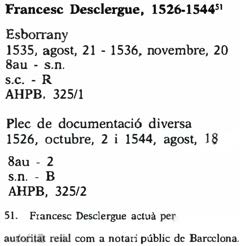
Francesc Desclergue (DC03b) was, according to Figure 26.7 on page 293 a notary in Barcelona from 1536 until 1544.
In a later reference from 1551-1552, Francesc Desclergue is still identified as a notary, as depicted in Figure 26.8. Interestingly, the Llull family, with whom the Desclergues had a long-standing connection, is still mentioned in relation to the Desclergues in 1151.
Francesc Desclergue is also mentioned in 1534, on November 5, in Barcelona, in a document, shown in Figure 29.113 on page 420,
about the sale of a property.17
Francesc Desclergue also appears as a public notary in a document of December 7, 1535, in Barcelona18
The documents shown, for instance, in Figure 26.5 referring to Barcelona in 1551, remind us that the notarial Dynasty of the Desclergues continued in Barcelona, with co-existence at Montblanc. We found one case where Desclergues at Montblanc and Barcelona were mixed up because of existing homonyms19.
11Josep Torné i Cubells, "Catàleg de pergamis de l’actual arxiu del monastir de Poblet," page 151.
12Jordi Sotorra i Montblanch, ’El Fogatge de 1515, A la Conca de Barberà i la Baixa Segarra’
13J. M. Madurell and J. Rubió, Documentos para la historia de la imprenta y libreria en Barcelona (1474-1553). Barcelona 1955. Pago 606.
14J. M. Madurell Marimón. Indice . . . Ob. cit. Pág. 237.
15R. Noguera and J. M. Madurell, Centenario de la Ley del Notariado. Sección IVa. Vol. II. Tomo I. Barcelona 1965, Página 312.
16R. Noguera and J. M. Madurell, Centenario. Ob. cit. Página 566.
17Sale of "Violari", Can Falguera ACBL50-41-T2-86, Baix Llobregat Regional Archive, 1534, November, 5. Barcelona. Perot Mollet of Barcelona sells to the nobleman Ferran Albert, lord of Ponts, of Maldà and Maldanell, a violary worth 115 ll, pension 15 ll, annually, to which must be added outstanding debts and other amounts, which to him it is made by the noble Jerónimo de Cardona as principal together with his wife Angela and Joan de Geultrude.
This "violari" must be paid during the natural life of the nobleman Joan Mora d’Arbeca and his wife Aldonça. This property belonged to the said seller due to the donation made to him by Caterina Rodés, a nun of the monastery of St Jerónimo in Barcelona, with the consent of the abbess. Joan Mora gave it to her, and Jerónimo de Cardona sold it to him and on the properties of this property called "violari." The sale price is 193 pounds 12 sous. Notary: Joan Vilar, from Barcelona, who replaced Joan Janina and had the deeds of deceased notary Pere Ripoll.
18Reference 2057 on page 72 of ’Catàleg dels pergamins municipals de Barcelona, Anys 1531-1559 (Volum VI)’ , edited by Maria Cinta Mañé i Mas, Ajuntament de Barcelona, Institut de Cultura. Arxiu Històric de la Ciutat de Barcelona, 2011, ISBN 978-84-9850-367-8.
19Francisco J. Morales Roca, ’Próceres habilitados en las Cortés del Principado de Cataluña, siglo XVII: 1599 - 1713, Volume 2’ .
© 2024 Nico F. Declercq
The Desclergues of la Villa Ducal de Montblanc, 2nd ed., Omn., VOL. I
Don Bonaventura Desclergue (I) (DC03) & Maria
Anna Cortés de Monroy
27.1 Don Bonaventura Desclergue (I) (DC03), a Notary and Local Deputy
His signature, with evidence in his acronym that his full name was Torró y Desclergue, is shown in Figure 26.1 on page 292. He is also known as Buenaventura Desclergues (DC03), he was the son of Don Joan Berenguer Desclergue (DC02) and Dona Prunera y Ferrer, described in Chapter 26, and he is our ancestor. Dona Prunera y Ferrer was the daughter of Juan Prunera and Catalina de Ferrer, daughter of Don de Ferrer, she is described in Chapter 26.0.2.
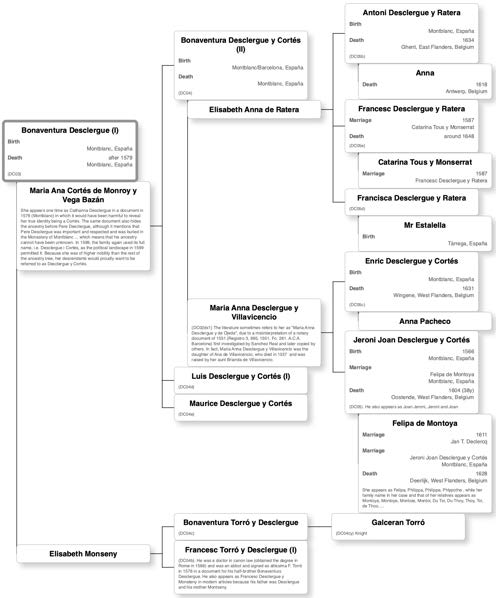
Buenaventura Desclergues’ (DC03) descendants are shown in Figure 27.1. Through his marriage with Maria Ana Cortés de Monroy y Vega Bazán, he introduced the bloodline of Cortés into our family with an illustrious ancestry.
His grandson also married someone who descended from the Cortés branch, namely Maria Anna Desclergue y Villavicencio.
Buenaventura Desclergues (DC03) was born when his father was already of considerable age. Therefore, we know that Dona Prunera y Ferrer, Bonaventura Desclergues’s (I) (DC03) mother, must have been much younger than her husband.” We can cite
"Desclergue, Bonaventura I de. Notari de la vila (1546) i diputat local, pare de Bonaventura Desclergue, beneficiat de l’ església de Sant Miquel, i de Francesc Desclergue. En primeres núpcies es casà amb Isabel Monseny", in the work of Josep Maria Grau i Pujol and Francesc Badia i Batalla2.
He was born in Montblanc in Spain and died after 1579 in Montblanc. He was a Doncel and was a Notary at Montblanc. His first wife was Isabel Monseny. His second wife was Maria Ana Cortés de Monroy y Vega Bazán. Some of his notarial documents, written for others, were collected by Rafael Valldecabres Rodrigo3 As the records show, he is called ’venerable,’ ’honorable,’ and similar titles.
Bonaventura Desclergue, in his role as a notary and scribe, can be seen in action in Figure 27.50 on page 319, transcribed by the author with the initial help of Dolors Domingo.4 Within the document of 1535, Desclergue’s role is clearly defined as the individual responsible for recording and transcribing the original 1320 document accurately. Bonaventura Desclergue was the notary and scribe appointed by the great lord vicar of the court. With meticulous attention to detail, Desclergue diligently recorded the events unfolding, ensuring that every word was accurately transcribed. His signature, a mark of authority and authenticity, sealed the document, affirming its validity in the eyes of the law. The decree, entrusted to Desclergue’s care, held immense significance for the town of Montblanc and its inhabitants. It outlined the transfer of authority and responsibility, safeguarding the rights and privileges of its citizens for generations to come. With the stroke of his pen, Bonaventura Desclergue cemented his place in history as a custodian of justice and a guardian of the law. His role as a notary and scribe was not merely administrative but instrumental in shaping the legal landscape of Montblanc and beyond. The original document from 1320 pertains to a legal or administrative decree issued by Jacobus, the King of Aragon, concerning matters of governance and jurisdiction.
Bartholomeo Joan Coloma, in the document, appears to be another individual involved in the legal or administrative proceedings.
Specifically, Coloma is mentioned in the context of holding a position of authority as a public notary in the town of Montblanc within the diocese of Tarragona. Somewhat rephrased, the document reads as follows:
"On the seventeenth day before the Kalends of May, in the year of our Lord one thousand three hundred and twentieth, it was witnessed. The seal of Jacobus, by the grace of God, King of Aragon, Valencia, Sardinia, and Corsica, and Count of Barcelona.
The witnesses are: Eximinus, Archbishop of Tarragona; Philip of Salutiis; William of Angularia; Gerald of Rocabertins; Otto of Mantechateno. The seal of Francis de Bastida, scribe of the aforesaid lord king, who, by his command, caused these to be written, with corrections made in the fourth line where it is written: "quoquomodo", and in the eighth line where it is written: "septimo decimo", and sealed.
The seal of Ambrose Tarrega, doctor of both laws, vicar of the town and vicariate of Montblanc, Diocese of Tarragona, who, with his original duly authenticated, has faithfully and properly executed this translation on behalf of our will, on the part of the truly imperial, catholic, and royal majesty, we equally impart and decree our authority, by the hand of myself, Bonaventura Desclergue, notary and scribe of the court of the said magnificent lord vicar. In whose power the said magnificent lord vicar has made this firm, on Thursday, the fourteenth day of the month of September, in the year of the nativity of our Lord one thousand five hundred and thirty-fifth; in the presence of the honorable witnesses Bernard Mediona, merchant, and Peter Fabrer, tailor, inhabitants of the town of Montblanc. Therefore, I, the said notary and aforementioned scribe, have written these and affixed here my usual notarial sign.
The seal of Bartholomeo Joan Coloma, native and inhabitant, by apostolic and royal authorities, of the public notaries of the town of Montblanc, Diocese of Tarragona; overseeing the documents of the archives of the council hall, in the absence of the discreet Peter Bellissen, by the royal authority as his co-notary, who, with his translation from his original found in the archive of the council hall, is said to pertain, in a certain box where all the privileges granted by the university itself are kept, and there are kept: with the license and command of the honorable Jacobus Pont and Joan Rosich, consuls of the present year, and of the undersigned of the same university and town of Montblanc, together with the honorable Jacobus Madiona, in the absence and request of the honorable Berengar Alos, deputy of the city of Balagari, taken and truly verified with him. Authorized as is apparent above by the magnificent vicar of Montblanc together with the aforesaid witnesses and his co-notary, he was present and the great seal of the said university and town of Montblanc, with red and yellow wax seals attached, was caused to be affixed in testimony of the foregoing, written and 2Josep Maria Grau i Pujol and Francesc Badia i Batalla, ’Diccionari biogràfic històric de Montblanc (1155-1920), Fundació Martí l’ Humà. Tot Conca.
Carrer Josa, 6, Montblanc, 2008.
3Rafael Valldecabres Rodrigo, ’Dos Còdexs de l’ Arxiu de Poblet Sobre Sant Vicent i Quart’ .
4Dolors Domingo, "Pergamis de Privilegis de la ciutat de Balaguer", El Comtat d’Urgell, Lleida, 1997, p. 64-65.
The Desclergues of la Villa Ducal de Montblanc, 2nd ed., Omn., VOL. I
© 2024 Nico F. Declercq
296
CHAPTER 27. DON BONAVENTURA DESCLERGUE & MARIA ANNA CORTÉS DE MONROY
Figure 27.1: Two descending generations of Don Bonaventura Desclergue (I) (DC03).
sealed on the fourteenth day of the month of September, in the year of the nativity of our Lord one thousand five hundred and thirty-fifth, with the addition in the fourth line of this translation where it reads: "propter et raso et emendato”, in the twelfth, in the participation of witnesses where it reads: "Geraldus."
The seal of myself, Joan Muntanyola, by apostolic and royal authorities, public notary of the town of Montblanc, witness to this translation. The seal of Bonaventura Desclergue, of the town of Montblanc, Diocese of Tarragona, by apostolic and royal authorities, public notary, witness to this translation."
Bonaventura Desclergue (I) (DC03) had two sons, Francesc Desclergue (DC04b) and Bonaventura Desclergue (DC04c) (who would be a priest), from his first marriage with Dona Elisabeth Monseny and two other children from his later marriage with Maria Ana Cortés de Monroy y Vega Bazán from Barcelona, namely Luis Desclergue y Cortés (I) (DC04d) and Bonaventura Desclergue y Cortés (DC04).
Bonaventura Desclergue’s (DC03) children are recognized as personalities by the population or as jurisconsults.
The second wife of Bonaventura Desclergue (DC03), Doña Ana Cortés, was from Barcelona. Indeed, Bonaventura Desclergue (DC03) appears in 1578, frequently residing in Barcelona, and Luis Desclergue (I) (DC04d) was a resident in this capital, which is due to the mother’s ancestry there.
On pages 179-180 of URTX índex onomàstic Personatges històrics, we find,
’DESCLERGUE, Bonaventura (noble): VII, 66.’
In particular, from 1545 until 1548, he was a local deputy of Montblanc. On September 18, 1548, he presented the accounts of his administration to the deputies and auditors of the Generalitat, which were approved.5
We found Desclergue Bonaventura in 1545 as notary at Montblanc in Josep Torné i Cubells.6 In the mid-sixteenth century (1546), Bonaventura Desclergue (DC03) appeared in several preserved documents as a notary.
Several annotations are found in the notarial manuals in which he appears as a buyer or investor. He acquired, for instance, land located on the plane of Anguera, tangent to the path of Barbara7:
"Ego Gabrieli Vilalta presbiter oriundus loci de Vinaixa in ecclesiam ville Montísalbi beneficiatus presbiter et ex certa scientia per me et meos heredes et successores quoscumque vendo et ex causa vendicionis conceda vobis discreto Bonaventure Desclergue (DC03) notario dicte ville Montisalbi.. troçum terre quod ego ut layca et privata persona habeo possideo in termino dicte ville Montisalbi a 5Dietaris de la Generalitat de Catalonia. Anys 1539 a 1578, Barcelona, Generalitat de Catalonia, 1994, II, 33.
6Josep Torné i Cubells, "Catàleg de Pergamins de l’actual Arxiu del Monestir de Poblet", Item 274.
7Manual Notarial 3 504 (1546). Archivo Histórico de Protocolos, Tarragona
© 2024 Nico F. Declercq
The Desclergues of la Villa Ducal de Montblanc, 2nd ed., Omn., VOL. I
27.1. DON BONAVENTURA DESCLERGUE (I) (DC03), A NOTARY AND LOCAL DEPUTY
297
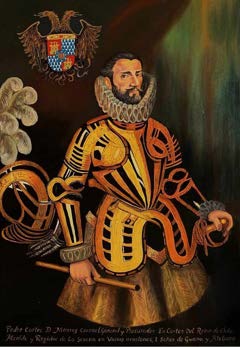
Figure 27.2: The author on the beach of Yucatan in 2009. Like Hernán Cortés, most
people are highly impressed by the beautiful white beaches and gorgeous blue waters in
this world area. The picture was taken at Playa del Carmen, where Hernán Cortés
arrived on Yucatan after his stop-over at Isla Cozumel. The beach is 180 km East of
Chichen Itza and South of Cancun. (Declercq de Silva Archive)
Figure 27.3: The Great Conqueror captain of Chile,
Captain Don Pedro Cort es de Monroy, the founder of
the most aristocratic family in Chile.
Figure 27.4: Left: The authentic coat of arms of Hernán Cortés belongs to the collection of the
Iberoamerican University of Mexico. The appearance of 8 Saint John (San Juan) crosses around the
shield that is also used by Aragon, is of very high historical significance. Right: the coat of arms Pedro Cortés de Monroy, Chile.
The Desclergues of la Villa Ducal de Montblanc, 2nd ed., Omn., VOL. I
© 2024 Nico F. Declercq
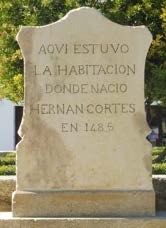
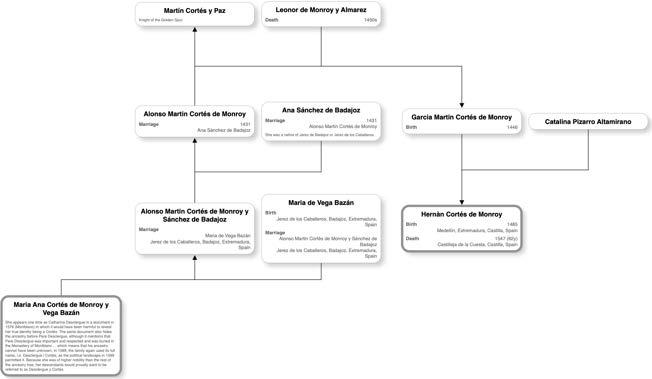
298
CHAPTER 27. DON BONAVENTURA DESCLERGUE & MARIA ANNA CORTÉS DE MONROY
Figure 27.5: Hernán Cortés de Monroy y Pizarro Altamirano, 1st
Marquis of the Valley of Oaxaca, was a Spanish soldier who, at the
beginning of the 16th century, led the conquest of the Mexica empire o
known as the conquest of Mexico, which meant the end of said empire,
putting it under the control of the Crown of Castile and giving rise
to the creation of the Viceroyalty of New Spain. He was born in the
Extremaduran city of Medellín in 1485. He decided to seek his fortune
in the New World by traveling to Hispaniola and Cuba, where, for a
short time, he was mayor of the second city founded by the Spanish
during the third expedition to the mainland, which he partially financed.
His enmity with the governor of Cuba, Diego Velázquez de Cuéllar, led
to the cancellation of the trip at the last minute, an order that Cortés
ignored. He died in Castilleja de la Cuesta, December 2, 1547. A
commemorative stone is placed in Medellín, Spain, at the location of
his birth.
Figure 27.6: Relationship between Anna Cortés de Monroy y Vega Bazan and Hernán Cortés de Monroy. The relationship through Ana de Villavicencio is shown in Figure 25.35 on page 289, and is described in Chapter 25.1.3.2
Figure 27.7: Left is a portrait of Hernán Cortés. His uncle Alonso Cortés was
our ancestor. Maria Ana Cortés de Monroy y Vega Bazán, the grandmother of
Jeroni Desclergue (DC05), was his cousin. We are also related through Ana de
Villavicencio, as shown in Figure 25.35 on page 289. In the middle, an image of Quetzal Coatl in the Codex Magliabechiano (16th century) is shown. The God is
often depicted with a cross, a sign that the Aztecs must have confused with the cross
worn by the Spanish Conquistadors, to begin with, Hernán Cortés. Right are photos,
taken by the author in 2002, of the head of Quetzal Coatl at Chichen Itza on a
location other than the El Castillo Pyramid; and the Raingod Chac at Chichen Itza.
(Declercq de Silva Archive)
© 2024 Nico F. Declercq
The Desclergues of la Villa Ducal de Montblanc, 2nd ed., Omn., VOL. I
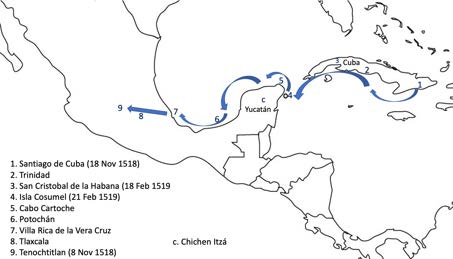
27.1. DON BONAVENTURA DESCLERGUE (I) (DC03), A NOTARY AND LOCAL DEPUTY
299
Figure 27.8: ’Tornado Over Kansas,’ 1929 painting by John Steuart Curry (Courtesy of the
Muskegon Art Museum, Muskegon, Kansas, USA). The artist John Steuart Curry (1897 - 1946)
was an American naturalistic painter who pictured the American people in their struggle for life,
pride, happiness, and setbacks. ’Tornado in Kansas’ is a typical example of his works and depicts
a family searching for safety in their tornado shelter. The twister in the back is what the Aztecs
associated with Quetzalcoatl. When the author’s father died at the end of June 2015, a week after
his funeral, he visited his grave covered with flowers in pots. While he stood there, a small tornado
appeared above the grave and laid down all the flowers. Although physics laws can describe the
phenomenon, it seemed like a sign from above that his father had reached his destination and
was in good hands. Perhaps even more striking is that the Aztec interpretation would have been
the Quetzalcoatl deity and its presumed connection to our ancestral cousin Hernán Cortés de
Monroy. Life is a mystery, and so is death. Although it took the author another five years to
link a tornado to our ancestors, the event must have been the most transparent and meaningful
sign ever received. (Declercq de Silva Archive)
Figure 27.9: Painting of Hernán Cortés with La Malinche as trans-
lator, negotiating with Taxcaltecans (Fresco by Desiderio Hernández
Xochitiotzin, in el Palacio de Gobierno at Tlaxcala (photo of 2005,
when the author visited Santa Cruz in Tlaxcala and gave a keynote
presentation there on the acoustics of Chichen Itza, Yucatan - Public
Domain as per Ley Federal de Derechos de Autor article 148, VII).
(Declercq de Silva Archive)
Figure 27.10: The journey of Hernàn Cortès.
The Desclergues of la Villa Ducal de Montblanc, 2nd ed., Omn., VOL. I
© 2024 Nico F. Declercq
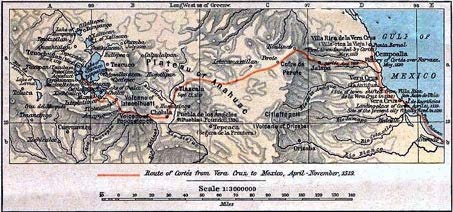
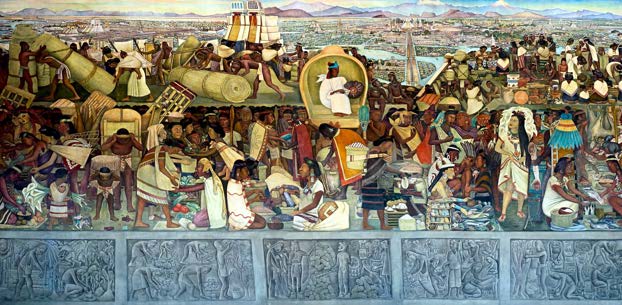
300
CHAPTER 27. DON BONAVENTURA DESCLERGUE & MARIA ANNA CORTÉS DE MONROY
Figure 27.11: The road taken by Hernán Cortés from Veracruz via Tlaxcala to Tenochtitlan.
Figure 27.12: Fresco of Tenochtitlan by Diego de Rivera (1886-1957) at the National Palace in Mexico City. La Malinche is depicted on the right-hand side. (the photo was taken in 2005 - public Domain as per Ley Federal de Derechos de Autor article 148, VII) (Declercq de Silva Archive)
la plana de Anguera.. cum camino de Barberano. . . ".
Bonaventura Desclergue (DC03) was a local deputy and was, as such, quoted by the General Deputation of Catalonia8:
"Instrumentum presentacionis quondam litterarum revocatorum et citacionarum emanatorum a domini Deputatis Generalis Cathalonie dat. Barch, xxiii presentis mensis maij sub signat. per Dni. Jacobum Cassador ex in B. Vicar. P. Albanell assesores et vicarium de viso sigillat ac aliis solemnitatibus expeditus sortis per Gasparem Pallas passamanorum cive Tarracone ut procuratorem offertum Angeli Carcassona hon. Bonaventure Desclergue deputato locali ville Monsalbi."
He also bought a walled garden, in which there was a house in ruins, located near the ’portal d’ en Tous,’ next to the wall and adjacent to the road called ’del Rio’ 9:
Fco. Frexa mercator civi Tarracone.. Margarita uxor Augustini Frexa patris mai noverca mea el Joanna uxor mea.. vendo vobis honor. et discreto Bonaventure Desclergue not.. ortum parietibus circum clausum qui olim erat domus dirrute una cum quodam camara ipsi orto contigua.. proper portale vulgo dictus d’ en Thous.. cum via dicti portalis, ex alia cum muro dicte ville ex alia cum vico vulgo dicto de Riu."
He equally appeared as the owner of an orchard near the house of the dye, which should have been located in the suburb of Raval10:
...casale sive casa del tint.. ab lo perol, tina y altres aynes utensilies ac dit tint.. affronta ex una parte cum orto vener. Bonaventura Desclergue (DC03) not. ex alía cum vico quo tenditur ad sequiam dicta Parellada et ex alia partibus cum dicta sequia mediante alio vico. . . ".
The family of Bonaventura Desclergue (DC03) inhabited, in 1549, a house in Calle Mayor (Main Street) in Montblanc. Indeed, the famous Desclergue house on Main Square still had to be constructed.
Another reference to Bonaventura Desclergue (I) (DC03) or his son Bonaventura (II) (DC04), says11:
"Ego Bonaventara Dezclergue (DC06) not. ville Montisalbi, agens hec tanquam paser et legittimus, administrator Bonaventure filli mei clerici olim beneficiati benefici sub invocatione Sancti Michaelis in ecclesiam eiusdem invocationis dicte ville Montísalbi et quondam Arnaldus Jover instituto..."
In 1566, we found a reference declaring that Bonaventura Desclergue (I) (DC03) was the heir of his father Berenguer (DC02) and was a notary of Montblanc. He had two marriages; the first marriage was with Isabel Monseny, the daughter of Francesc and Joana, 8Manual Notarial 3 506 (1548). Archivo Histórico Provincial (A.H.P.) Tarragona
9Manual Notarial 3 506 (1549). 4 enero. Archivo Histórico Provincial (A.H.P.) Tarragona.
10Manual Notarial 3 506 (1549). 2 abril. Archivo Histórico Provincial (A.H.P.) Tarragona.
11Manual Notarial 3 506 (1549). 23 ene. Archivo Histórico Provincial (A.H.P.) Tarragona.
© 2024 Nico F. Declercq
The Desclergues of la Villa Ducal de Montblanc, 2nd ed., Omn., VOL. I
27.2. MARIA ANA CORTES DE MONROY Y VEGA BAZAN, HER LINEAGE AND RELATIVES
301
Figure 27.13: The author at a congress in Santa Cruz Tlaxcala, October 26-28, 2005. In the picture, Mexican-born Hilda Lucia Estrella Rodriguez is equally seen, the fifth person from the left on the first row; she is Russian-born Leo Lev’s wife. Since then, the latter couple has become very good friends of the author and always formed a beacon of light for him during his frequent and long stays in Atlanta in the past decades. They have wise, well-mannered and amiable children. Despite the long distance from Europe, the couple is two of the author’s best friends. (Declercq de Silva Archive)
who made a testimony on February 18, 156612, and the second marriage was with Anna Cortés de Monroy.
On April 14, 1576, Bonaventura Desclergue (I) (DC03) asked Lluís-Joan de Castellví i Roig, the mayor of Montblanc, to certify his status as a nobleman13.
There are two other significant references to this Bonaventura Desclergue (DC03). One of them is that in 1577, he maintained a lawsuit with the treasurer and convent of Santes Creus14.
The death of Bonaventura Desclergue (I) (DC03) occurred after January 29, 1579. This year, we have found him mentioned for the last time in a will related to the goods of his son Francesc Desclergue y Monseny (DC04b), who inherited from his mother15. The other is the sale, in 1579, of a house that he had in Montblanc, on the Plaza de San Miguel, for 230 Barcelonese pounds, to Pere Monparler, a merchant from Cambrils; and the sale of some lands, to Juan Llort, a farmer from Rojals, for 120 Barcelonese pounds, and located in the upper garden of the Parellada16. The wording of the document, in which he appears as the administrator of his son, indicates that these properties were from the estate of his deceased wife, Dona Elisabeth Monseny.
27.2 Maria Ana Cortes de Monroy y Vega Bazan, her Lineage and Relatives
Maria Ana Cortes de Monroy y Vega Bazan, just like Ana de Villavicencio, exposed in Chapter 25.1.3.2 and blood-relative of Conquistador Hernán Cortés, described in Chapter 27.20, as our ancestor, is vital in understanding an archaeological artifact at the chapel of Deerlijk, as outlined in Chapter 49.4.2.
Maria Ana Cortes de Monroy y Vega Bazan was the wife of Don Bonaventura Desclergue (I) (DC03), described in Chapter 27.1.
Her ancestry is shown in Figure 27.35. The ancestors of Maria-Anna Cortés de Monroy include Pacheco, Portocarrero, and Ponce de Leon. Note that the Desclergues are connected to Pacheco, as outlined in Chapter 33.4.2 on page 516, or Chapter 19.15.3 on page 188.
Maria Ana Cortés de Monroy y Vega Bazán’s parents17 were Alonso Martin Cortés de Monroy y Sánchez de Badajoz, described in Chapter 27.6, and Maria de Vega Bazán, described in Chapter 27.3. They married in Jerez de los Caballeros, Badajoz, Extremadura, Spain. She was the wife of Don Bonaventura Desclergue (I) (DC03).
Maria de Vega Bazán was the daughter of Diego de Vega y Sessé and Mayor de Bazán, and she was born in Jerez de los Caballeros, Badajoz, Extremadura, Spain. She married Alonso Martin Cortés de Monroy y Sánchez de Badajoz in Jerez de los Caballeros, Badajoz, Extremadura, Spain. She is described in Chapter 27.3. Alonso Martin Cortés de Monroy y Sánchez de Badajoz, described in Chapter 27.6, husband of Maria de Vega Bazán, was the son of Alonso Martin Cortés de Monroy and Ana Sánchez de Badajoz.
Alonso Martin Cortés de Monroy and Ana Sánchez de Badajoz married in 1431, and the latter was a native of Jerez de Badajoz or Jerez de los Caballeros. Note that they were ancestors of Ana de Villavicencio, equally our ancestor, described in Chapter 25.1.3.2.
Maria Ana Cortés de Monroy y Vega Bazán appears one time as Catharina Desclergue in a document in 1576 (Montblanc) where it would have been harmful to reveal her true identity as a Cortés. The same document also hides the ancestry before Pere Desclergue.
However, it mentions that Pere Desclergue was influential and respected and was buried in the Monastery of Montblanc, which implies that his ancestry cannot have been unknown. In 1599, the family again used its full name, i.e., Desclergue y Cortés, as the political landscape in 1599 permitted it. Because she was of higher nobility than the rest of the ancestry tree, her descendants 12Arxiu Comarcal de Tàrrega, Fons Pedrolo, Fons Pedrolo, sign. top. 6
13Arxiu Comarcal de Tàrrega, Fons Pedrolo, Fons Pedrolo, sign. top. 52.
14Registro 4 812 (1577) Fol. 35 v. A.C.A. Barcelona. Nota facilitada por doña Mercedes Costa
15Arxiu Històric de Tarragona, Fons notarial de Montblanc, reg. 3507.
16Manual. Notarial 3 507. (1579). 3 febrero. Archivo Histórico Provincial (A.H.P.) Tarragona.
17Unlike other investigations in this book which have been a combination of existing literature and own discoveries, we rely, in this chapter, on works published by other genealogists and research done by Jairo Eduardo Cortés Rosal.
The Desclergues of la Villa Ducal de Montblanc, 2nd ed., Omn., VOL. I
© 2024 Nico F. Declercq
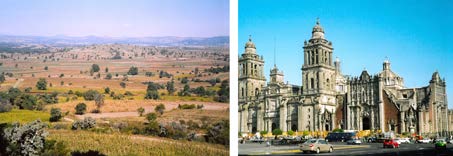
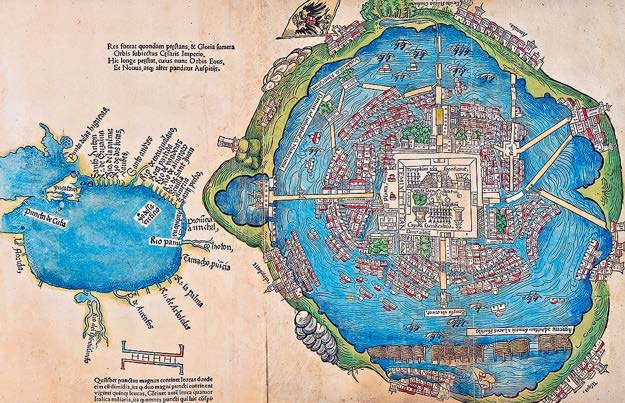
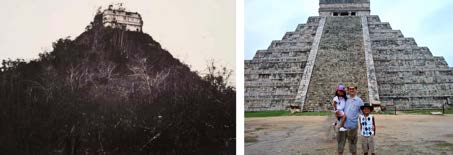
302
CHAPTER 27. DON BONAVENTURA DESCLERGUE & MARIA ANNA CORTÉS DE MONROY
Figure 27.14: Tlaxcala looks a bit like Spain nowadays. If the planes looked similar when Cortés
arrived, he just felt at home (2005). Right is the ’Catedral Metropolitana de la Asunción de la
Santísima Virgen María a los cielos’ , in Mexico City (Tenochtitlan), in 2005. The cathedral
was built from 1573 onward and was completed in 1813. It’s dedicated to the assumption of
Mary, was consecrated in 1656, and is made of Chiluca Stone. (Declercq de Silva Archive)
Figure 27.15: In 1524, a map was published in Nuremberg, together with Latin copies of Hernán Cortés’s letters to Emperor Charles V. It was the first image shown to the Europeans, of Tenochtitlan under the Habsburg imperial flag. Historians believe that the map was based on the Aztecs’ original drawings and, therefore, indicates how they viewed their capital. The plan is oriented with the North at the bottom.
Figure 27.16: Left is the El Castillo pyramid of Chichen Itza when it was re-discovered in
modern times. Right is the author, with his daughter Anna-Laura and son Benjamin, at the
same location in 2009. (Declercq de Silva Archive)
© 2024 Nico F. Declercq
The Desclergues of la Villa Ducal de Montblanc, 2nd ed., Omn., VOL. I
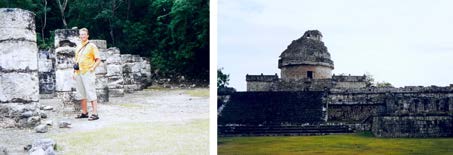
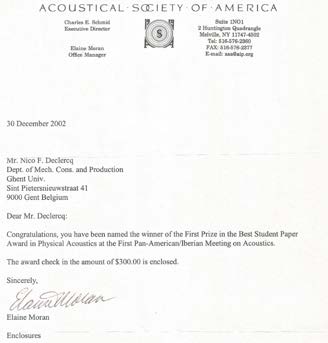
27.2. MARIA ANA CORTES DE MONROY Y VEGA BAZAN, HER LINEAGE AND RELATIVES
303
Figure 27.17: These pictures were taken in 2002. Several periodic structures exist at Chichen
Itza, acting as a phononic crystal or a meta-material. The author belonged to the pathfinders in
research on such materials and, despite his essential focus on nondestructive testing of materials,
produced several pioneering papers in this field. Right, we see the astronomical observatory of
the Mayans. (Declercq de Silva Archive)
Figure 27.18: The letter received from
the Acoustical Society of America, an-
nouncing that the author had won the first
prize. He was still early in his PhD at that
time. (Declercq de Silva Archive)
would proudly want to be referred to as Desclergue y Cortés.
The family Cortés de Monroy is, in modern literature, frequently referred to as Cortés because the conquistador and ruler over Mexico, Hernàn Cortés de Monroy, is typically called Cortés. Historians glorify Hernàn Cortés de Monroy’s ancestry or state that little is known. On the other hand, many historians are not very positive in their description of the personal life of Hernàn Cortés de Monroy. In contrast, others try to find a balance and claim that much of the negativity is influenced by propaganda spread by competitors of Cortés during his life and after that. The author has decided to remain neutral and considers that personal decisions made by Cortés are not necessarily representative of his blood relatives and their lineages. Therefore, for genealogical reasons, there is no reason to exclude Hernàn Cortés de Monroy or any of his relatives from this book. A similarity between the author’s heraldic shield and that of Hernàn Cortés de Monroy, as shown in Figure 23.3 on page 249, is only a coincidence.
The author crossed paths with Jairo Eduardo Cortés Rosal, who has studied the ancestry and history of this family and has revealed convincing facts and documentation to show a genealogy of the Cortés de Monroy family that is realistic yet remarkable, as will be outlined below. A lot of what Cortés Rosal discovered was not published earlier and shed light on the importance of this family and their ancestry in Spain’s history and that of the New World.
It’s equally essential to explain Anna Cortés de Monroy’s ancestry18 to understand archaeological artifacts at the chapel of Deerlijk, as described in Chapter 49.4.2. Her ancestry also assists in understanding genetic links with, among others, the Count of Barcelona and Queen Petronila of Aragon. Anna Cortés de Monroy was a cousin of Hernán Cortés de Monroy, described in Chapter 27.20
and a descendant of an illustrious family of bloodlines of high significance in Spain’s history and that of the New World.
The ancestry of Maria Ana Cortes de Monroy y Vega Bazan is illustrious. Among her ancestors are the Count of Barcelona, Don Ramón Berenguer IV, and Queen Petronila of Aragon. The ancestry is partially seen in the literature, partially by fragments from genealogical data discovered by the author, and, in particular, the extensive research done by Jairo Eduardo Cortés Rosal192021.
The latter is a Venezuelan-Spanish historian and genealogist who earns all the credit for providing the author with an enormous amount of information about the ancestry of Maria Ana Cortés de Monroy y Vega.
Jairo Eduardo Cortés Rosal is a descendant of Don Alonso Martín Cortés, who was a Notary and Royal Notary of the Archbishopric of Santa Fé de Bogotá, native of Alange in Extremadura, and who passed to the New Kingdom of Granada with the Archbishop Doctor Don Luis Zapata de Cárdenas.
18Unlike other investigations in this book which have been a combination of existing literature and own discoveries, we rely, in this chapter, on works published by other genealogists and research done by Jairo Eduardo Cortés Rosal.
19Jairo Eduardo Cortés Rosal created the Santa Fe de Bogotá Genealogy team, led by Fenita Hollman de Villaveces, in Bogotá 20Jairo Eduardo Cortés Rosal is a descendant of Don Enrique de Guzmán, the Count of Niebla of the Ducal House of Medina-Sidonia.
21His grandfather is Juan Flórez de Ocariz, a Royal Notary in the Viceroyalty of New Granada in Santa Fe de Bogotá and was a great genealogist. He wrote the excellent work ’Genealogies of the New Kingdom of Granada.’
The Desclergues of la Villa Ducal de Montblanc, 2nd ed., Omn., VOL. I
© 2024 Nico F. Declercq
304
CHAPTER 27. DON BONAVENTURA DESCLERGUE & MARIA ANNA CORTÉS DE MONROY
Figure 27.19: The author ’s family on a beach between Cancun and Cozumel in 2009. The author has good memories of Cancun, as shown in Figure 27.18. (Declercq de Silva Archive)
Figure 27.20: Greece can be cold and wet, something the author experienced during a visit in 2003. Thessaloniki has exciting archaeology thanks to excavations done for the Metro system. The Epidaurus theater in Greece is shown in the middle. May 26, 2003, just after the author had returned from a visit to Greece, it was his mother’s birthday, and he had to rush to Brussels to defend his PhD grant renewal at the Flemish Applied Science Foundation (IWT). Benjamin is seen pretending to be happy for having received a shirt from Greece. As scientists, we can, unfortunately, not take our family everywhere. (Declercq de Silva Archive)
Figure
27.21:
In July 1997, in
Kataragama, Sri Lanka, the author discov-
ered a fascinating phenomenon: clapping
hands while crossing the Menik Ganga
River causes echoes resembling quacking
ducks on the staircases along its shores.
This discovery was also featured in the au-
thor’s 2005 interview with Nature News.
Kataragama is a pilgrimage town sacred
to Vedda, Hindu, and Buddhists, with a
shrine dedicated to Kataragama Deviyo.
The author visited during the Poson full
moon festival in 1997, traveling by bus
from Colombo with his wife. Amidst the
festival, he was the sole foreign attendee,
cherishing memories of warm sand and
elephants strolling nearby. The diverse
sacrificial rituals during the Perahera left
a lasting impression. The author captured
a photo the morning after this memorable
experience. (Declercq de Silva Archive)
Figure 27.22: The remains of Hernán
Cortés on November 28, 1946.
© 2024 Nico F. Declercq
The Desclergues of la Villa Ducal de Montblanc, 2nd ed., Omn., VOL. I
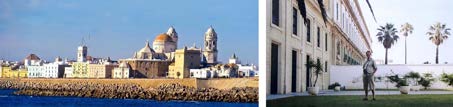
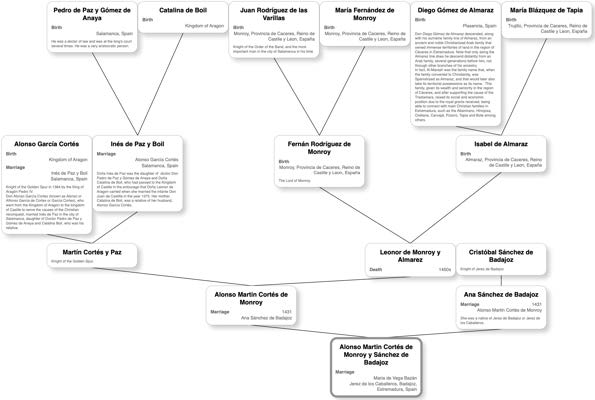
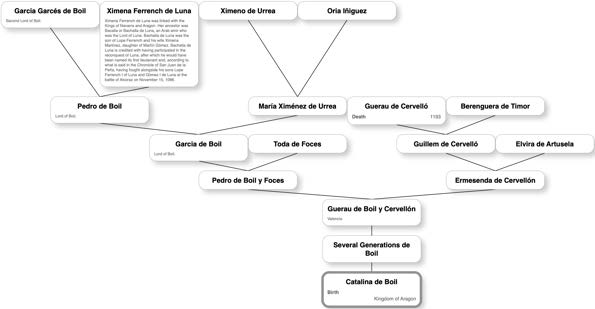
27.2. MARIA ANA CORTES DE MONROY Y VEGA BAZAN, HER LINEAGE AND RELATIVES
305
Figure 27.23: Cadiz, 2002, left, and June 16, 2003, right, at the University of Cadiz. (Declercq
de Silva Archive)
Figure 27.24: Four ancestral generations of Alonso Martin Cortes de Monroy y Sanchez de Badajoz. The ancestors of Pedro de Paz y Gomez de Anaya can be found in Figure 27.40, the ones of Catalina de Boil in Figure 27.25, the ones of Juan Rodriguez de las Varillas in Figure 27.33, the ones of Maria Fernandez de Monroy in Figure 27.37, and those of Isabel de Almaraz in Figure 27.32. The reader is also referred to Figure 27.42 and Figure 27.45.
Figure 27.25: Ancestral generations of Catalina de Boil. Her position on our ancestry tree is shown in Figure 27.24. The ancestry of Pedro de Boil y Foces is given in Figure 27.39 and that of Ermesenda de Cervellon is shown in Figure 27.27.
The Desclergues of la Villa Ducal de Montblanc, 2nd ed., Omn., VOL. I
© 2024 Nico F. Declercq
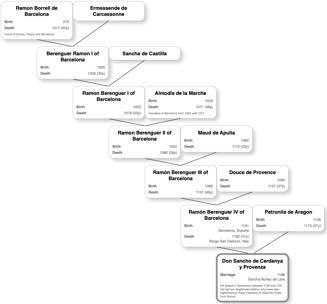
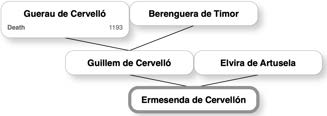
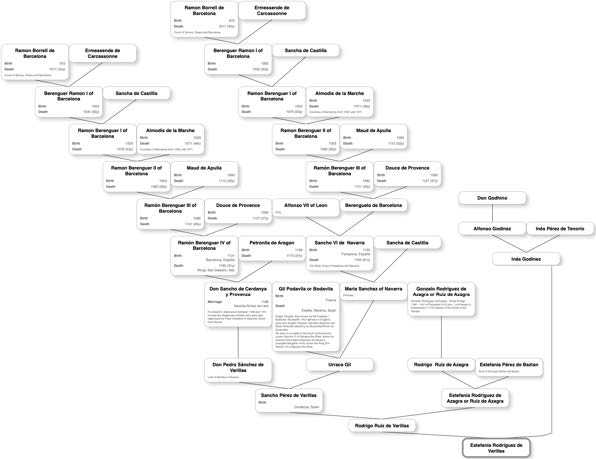
306
CHAPTER 27. DON BONAVENTURA DESCLERGUE & MARIA ANNA CORTÉS DE MONROY
Figure 27.26: Ancestral generations of
Don Sancho de Cerdanya y Provenza. His
position in our ancestry is shown in Figure
27.33 and Figure 27.28. The reader is also
referred to Figure 27.48.
Figure 27.27: Two ancestral generations
of Ermesenda de Cervellon. Her position
in our ancestry is shown in Figure 27.25.
Figure 27.28: Ancestral generations of Estefania Rodriguez de Varillas. Her position in our ancestry is shown in Figure
27.37. The ancestry of Don Sancho de Cerdanya y Provenza is shown in Figure 27.26, while that of Maria Sanchez of Navarra is given in Figure 27.38.
© 2024 Nico F. Declercq
The Desclergues of la Villa Ducal de Montblanc, 2nd ed., Omn., VOL. I
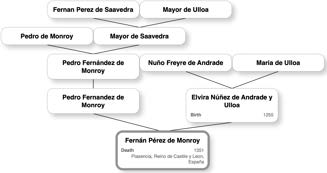
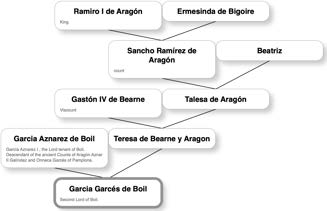
27.3. MARIA DE VEGA BAZAN
307
Figure 27.29: Four ancestral generations
of Fernan Perez de Monroy. His location
on our ancestry tree is shown in Figure
27.37. The reader is also referred to Fig-
ure 27.44.
Figure 27.30: Four ancestral generations
of Garcia Garces de Boil. His position
in our ancestry is shown in Figure 27.39.
The reader is also referred to Figure 27.47.
27.2.1 Don Cristóbal Cortés de Monroy
Cortés Rosal revealed the following information:
The brother of Maria Ana Cortés de Monroy y Vega Bazán was Don Cristóbal Cortés de Monroy or Cristóbal Sánchez Cortés and was a notary in Don Benito and Alange. His son, Alonso Martín Cortés, was Notary of Alange and Notary of Archbishop Luis Zapata de Cárdenas in Santa Fe de Bogotá. The archbishop had taken him to the New Kingdom because his niece was married to a cousin of Alonso Martín Cortés.
Alonso Martín de Cortés, Ecclesiastical Notary of the Archbishopric in the New Kingdom of Granada, had a son who was Regidor of Santa Fe de Bogotá, Don Juan Bautista Cortés, who married a significant woman, Doña Beatriz de Olalla Vasconcelos, granddaughter of the very famous conqueror Captain Don Gómez de Silva Vasconcelos from Caracas in Venezuela.
It is practically certain that Maria Cortes de Monroy and Bonaventura Desclergue (I) met each other at Jerez de la Frontera, where merchants from Aragon and other areas met for trade.
27.3 Maria de Vega Bazan
Her ancestry is shown in Figure 27.36. Maria de Vega Bazan was the mother of Maria Ana Cortes de Monroy y Vega Bazan, described in Chapter 27.2.
Maria de Vega Bazán was born in Jerez de los Caballeros, Badajoz, Extremadura, Spain. She was married to Alonso Martin Cortés de Monroy y Sánchez de Badajoz in Jerez de los Caballeros, Badajoz, Extremadura, Spain.
The parents of Maria de Vega Bazán were Diego de Vega y Sessé, Señor del Portazgo de Badajoz, and the son of Diego de Vega Bonifaz and Juana Sessé de Luna, and Mayor de Bazán. The descendants of Diego de Vega y Sessé are shown in Figure 27.43.
Diego de Vega Bonifaz was the son of Lope Fernández de Vega, described in Chapter 27.4, and Luisa Bonifaz. Juana Sessé de Luna was the daughter of Gracián de Sessé y Luna and Inés de Luna y Rojas.
Gracián de Sessé y Luna was Alcaide of the Trujillo fortress and the Lord of San Felices de los Gallegos. He married his cousin Inés de Luna y Rojas, the daughter of Martin de Luna and Inés de Rojas.
Inés de Luna y Rojas, described in Chapter 27.5, descends from an Arab king of Mallorca, Said Ben Alhakem Abu Otman Al Koraisini, a famous writer, who lived at the Almudaina Palace in Mallorca.
27.4 Lope Fernandez de Vega
His ancestry is shown in Figure 27.34.
Lope Fernández de Vega was married to Luisa Bonifaz, and their son was Diego De Vega Bonifaz, described in Chapter 27.3.
Lope Fernández de Vega was the son of Lope Fernández de Vega and Juana de Bazán. The latter was the daughter of Aldonza de Villamayor and García de Bazán. The latter was the son of Juana de Almoravid and Juan González de Bazán. The latter was the son of Aldonza Cornel and Gonzalo Ibáñez de Bazán. The latter was the son of Juan Pérez de Baztan and Toda Ibáñez de Azagra.
The latter was the daughter of Teresa Ibáñez de Guevara and Fernando Rodríguez de Azagra, the Lord of Albarracín.
The Desclergues of la Villa Ducal de Montblanc, 2nd ed., Omn., VOL. I
© 2024 Nico F. Declercq
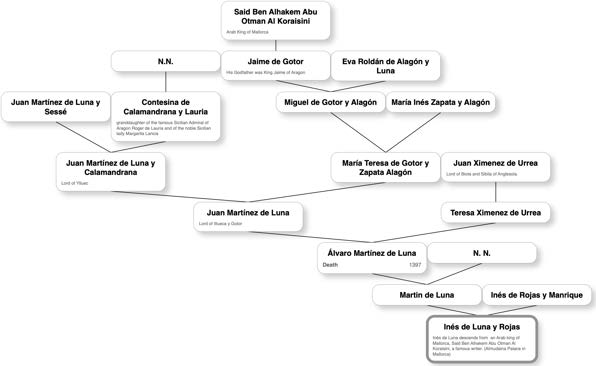
308
CHAPTER 27. DON BONAVENTURA DESCLERGUE & MARIA ANNA CORTÉS DE MONROY
Figure 27.31: Seven ancestral generations of Ines de Luna y Rojas. Her position in our ancestry is shown in Figure 27.36.
The reader is also referred to Figure 27.46.
27.5 Ines de Luna y Rojas
The Luna family belongs to the highest and oldest nobility of Spain. Illustrations are shown in Figure 27.51 on page 319, and Figure 27.49 on page 319.
Ines de Luna y Rojas’ ancestry is shown in Figure 27.31. Inés de Luna y Rojas and Gracián de Sessé y Luna were the grandparents of Maria de Vega Bazán, described in Chapter 27.3.
Inés de Luna y Rojas descends from an Arab king of Mallorca, Said Ben Alhakem Abu Otman Al Koraisini, a famous writer.
(Almudaina Palace in Mallorca)
She was the daughter of Martin de Luna and Inés de Rojas y Manrique.
Martin de Luna was the son of Álvaro Martínez de Luna, who died in 1397, and who was the son of Juan Martínez de Luna, the Lord of Illueca y Gotor, and Teresa Ximenez de Urrea, the daughter of Juan Ximenez de Urrea, the Lord of Biota and Sibila of Anglesola.
Juan Martínez de Luna, the Lord of Illueca y Gotor, was the son of Juan Martínez de Luna y Calamandrana, the Lord of Ylluec, and María Teresa de Gotor y Zapata Alagón.
Juan Martínez de Luna y Calamandrana was the son of Juan Martínez de Luna y Sessé and Contesina de Calamandrana y Lauria.
The latter was the granddaughter of the famous Sicilian Admiral of Aragon Roger de Lauria and the noble Sicilian lady Margarita Lancia. Her family and descendants are shown in Figure 27.46.
María Teresa de Gotor y Zapata Alagón was the daughter of Miguel de Gotor y Alagón and María Inés Zapata y Alagón.
Miguel de Gotor y Alagón was the son of Jaime de Gotor and Eva Roldán de Alagón y Luna.
Jaime de Gotor had King Jaime of Aragon as his Godfather, and he was the son of Said Ben Alhakem Abu Otman Al Koraisini, known as Abu Yahya, the Arab King of Mallorca.
Abu Yahya,22 the King of Mallorca, was famous for his letters and in addition to being a man famous for his beauty and great physical attractiveness that outshone his subjects when he toured the city. He died in the War of the Conquest of Mallorca.
Abu Yahya, shown in Figure 27.54, Mallorca’s last Muslim ruler, died in 1229. He was an ancestor of Maria Ana Cortés de Monroy y Vega Bazán, Jeroni Joan Desclergue y Cortés (DC05) grandmother. He is, therefore, also our distant ancestor.
Abu-Yahya, the last Muslim ruler of Mallorca before its conquest by King James I of Aragon in 1229, was born into the powerful Almohad dynasty, which controlled large parts of North Africa and Spain. Abu Yahya’s governance of Mallorca was marked by efforts to maintain stability and prosperity amid growing external threats from the Christian Reconquista. As the ruler of Mallorca, Abu Yahya faced significant challenges. The island had been under Muslim rule since its conquest in 902 by Isam al-Jawlani, but the political landscape was shifting by the early 13th century. The Almohad control over the Iberian Peninsula was weakening due to internal strife and increasing pressure from Christian forces seeking to reclaim territory.
In September 1229, James I of Aragon launched a campaign to conquer Mallorca. His forces landed at Santa Ponça and quickly moved to besiege Medina Mayurqa, the island’s capital. Abu Yahya organized the defense of the city, but despite his efforts, the well-organized and determined Aragonese army prevailed after several months of siege. Abu Yahya was killed during the conquest, marking the end of Muslim rule on the island and initiating a period of Christian reorganization and repopulation. Contemporary sources, including Christian accounts, often remarked on Abu Yahya’s physical beauty and attractiveness, noting that he outshone his subjects when he toured the city. Besides his physical presence, Abu Yahya was also known for his literary contributions, mainly his letters. These writings reflect his administrative skills, diplomatic engagements, and personal reflections. Although specific surviving examples of his writings are scarce, his reputation as a literate and cultured ruler remains part of his legacy.
The fall of Mallorca to James I marked a significant milestone in the Reconquista, ending over three centuries of Muslim rule on the island. Despite the conquest, the influence of Islamic culture remained evident in the architecture, agriculture, and place names 22Said Ben Alhakem Abu Otman Al Koraisini is also known as Abu Yahya Muhammad ibn Ali ibn Abi Imran al-Tinmalali, and also as Muhammad ibn Ali ibn Mussa, Muhammad ibn Ali ibn Musa o Abu-Yahya ibn al-Hakam ar-Rashid, and is even called, in Christian sources, Abu Iehie or Aboheihe.
© 2024 Nico F. Declercq
The Desclergues of la Villa Ducal de Montblanc, 2nd ed., Omn., VOL. I
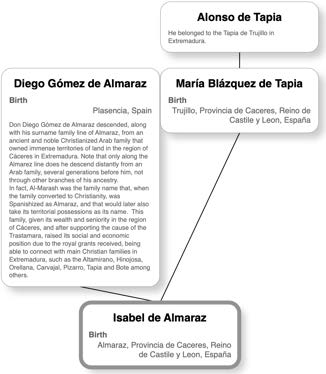
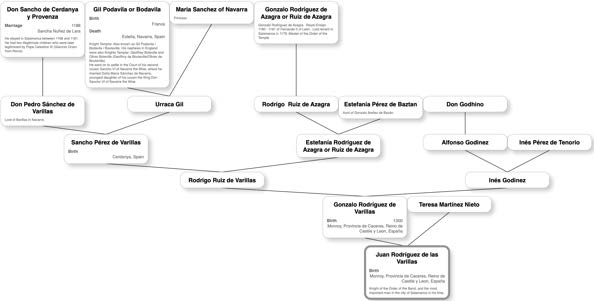
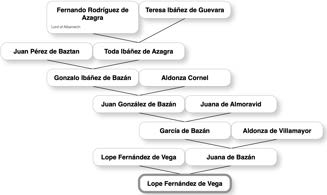
27.5. INES DE LUNA Y ROJAS
309
Figure 27.32: Two ancestral generations
of Isabel de Almaraz. Her position in our
ancestry is shown in Figure 27.24.
Figure 27.33: Five ancestral generations of Juan Rodriguez de las Varillas. His position in our ancestry is shown in Figure
27.24. The ancestors of Don Sancho de Cerdanya y Provenza are given in Figure 27.26, and the ones of Maria Sanchez of Navarra are given in Figure 27.38.
Figure 27.34: Six ancestral generations
of Lope Fernandez de Vega. His position
in our ancestry is given in Figure 27.36.
The Desclergues of la Villa Ducal de Montblanc, 2nd ed., Omn., VOL. I
© 2024 Nico F. Declercq
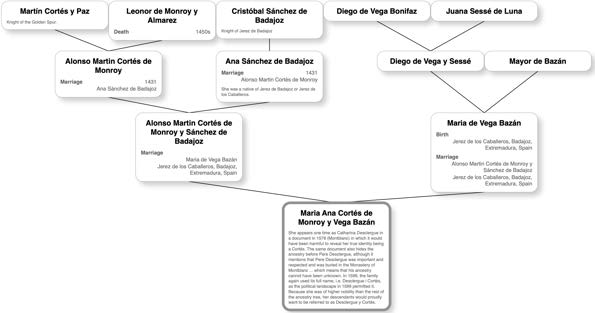
310
CHAPTER 27. DON BONAVENTURA DESCLERGUE & MARIA ANNA CORTÉS DE MONROY
Figure 27.35: Three ancestral generations of Maria Ana Cortes de Monroy y Vega Bazán. The ancestry of Alonso Martin Cortes de Monroy y Sanchez de Badajoz is shown in Figure 27.24, and that of Maria de Vega Bazan in Figure 27.36. The reader is also referred to Figure 27.42 and Figure 27.43.
of Mallorca. Abu Yahya’s legacy, though overshadowed by the Christian reconquest, highlights the rich cultural and intellectual history of Muslim Mallorca and its last ruler’s efforts to navigate a tumultuous period in the island’s history.
Abu Yahya’s eldest son, the heir to the Kingdom, aged 16, was beheaded while his father was being tortured.
His second son was taken from the island and taken to Zaragoza, Aragon, and he was baptized Christian as Jaime because King Jaime of Aragon himself sponsored him.
Years later, the King granted him the lordship of Gotor, which is why he is known as Jaime de Gotor, the Arab prince of Mallorca.
It is worth nothing that, during that time, our ancestor Raymond Desclergue also appears as an important figure in the conquest of Mallorca.
Gotor is located between Saragoza and Medinaceli, 30 kms from Deza in Soria, and 15 km from Calatayud.
The King arranged for Jaime de Gotor’s marriage to the very noble lady of the Kingdom, Eva Roldán de Alagón y Luna.
Their children were Miguel de Gotor y Alagón, who married to María Inés Zapata y Alagón. The latter were the parents of María Teresa de Gotor y Zapata Alagón. The latter married Juan Martínez de Luna y Calamandrana, the Lord of Yllueca and the son of Juan Martínez de Luna y Sessé and Contesina de Calamandrana y Lauria, granddaughter of the famous Sicilian Admiral of Aragon Roger de Lauria and of the noble Sicilian lady Margarita Lancia.
Juan Martínez de Luna y Calamandrana and María Teresa de Gotor y Zapata Alagón were the parents of Pope Benedict XIII (the famous Pope Luna) and Juan Martínez de Luna, the Lord of Illueca y Gotor, who married Teresa de Albornoz. The latter couple were the parents of Álvaro Martínez de Luna, who died in 1397. The latter was the father of Álvaro de Luna, a famous Constable of Castile, a Master of the Order of Santiago in the Kingdom, and Valid of King Juan II of Castile. Álvaro Martínez de Luna was equally the father of Martín de Luna, married to Inés de Rojas y Manrique. The latter were the parents of Inés de Luna, who married to Gracián de Sessé. The latter couple is the one this section focuses on.
Regarding the Calamandrana family, a prominent member of that family was Boniface of Calamandrana, recognized in history as a key figure among the Hospitallers during his day.23 Although there is less historical information about his early life, his significant achievements during the latter years of the Latin kingdom of Jerusalem and the subsequent transfer of the Hospitallers’ headquarters to Cyprus in 1291 are unquestionable.
Boniface’s beginnings are shrouded in darkness, with few information available save for his later association with the Hospitaller order. His first appearance as a Hospitaller probably signaled the start of his rise within the institution, showcasing traits that would eventually set him apart as a strong diplomat and leader.
Quickly rising in position, Boniface was suddenly placed in the chaotic political environment of the crusader nations. As the Grand Commander in the East, he skillfully managed the intricate network of alliances and rivalries in the area, refining his diplomatic abilities and forming meaningful relationships that would benefit him in the future.
Boniface had exceptional diplomatic skills while serving as a prominent representative in northern Syria until 1288. He conducted careful negotiations and formed fragile coalitions in the center of Mamluk territory, often facing the possibility of armed conflict.
His adeptness in navigating these hazardous waters established his renown as a proficient negotiator and a reliable representative of the Hospitaller order.
Boniface’s actual diplomatic skills were shown in his capacity as Grand Commander of the West. Based in Europe, he used his wide network of connections to further the Hospitallers’ interests across the continent. Boniface strategically used his influence from Italy to the Iberian Peninsula, solidifying the order’s position as a significant participant in geopolitics.
Boniface of Calamandrana exemplified the important Hospitaller traits of piety, diplomacy, and military skill throughout his distinguished career. His abilities and contacts were fully employed, significantly influencing the course of history at a crucial period for the Hospitaller order. Boniface’s everlasting impact serves as a monument to the lasting influence of diplomacy amid times of turmoil and unpredictability.
Pope Luna, also known as Pope Benedict XIII, was involved in intrigue, controversy, and rebellion against the established authorities of the Catholic Church during the Western Schism.
Pedro Martínez de Luna y Pérez de Gotor was born in 1328 in Illueca, Spain. He advanced in the church hierarchy and later became 23Jochen Burgtorf, "The Hospitallers, the Mediterranean and Europe", 1st edition, Routledge, 2007, ISBN 9781315557069
© 2024 Nico F. Declercq
The Desclergues of la Villa Ducal de Montblanc, 2nd ed., Omn., VOL. I
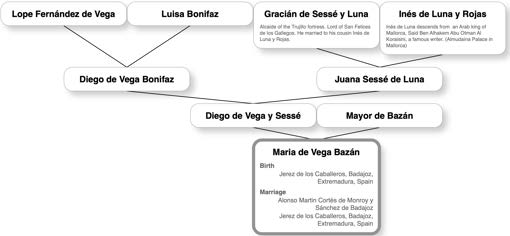
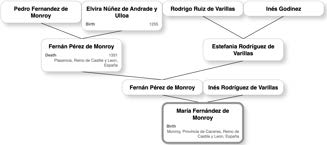
27.6. ALONSO MARTIN CORTÉS DE MONROY Y SÁNCHEZ DE BADAJOZ
311
Figure 27.36: Three ancestral generations of Maria de Vega Bazan. Her position in our ancestry is shown in Figure 27.35. The ancestors of Lope Fernandez de Vega are given in Figure 27.34, and the ones of Ines de Luna y Rojas in Figure 27.31. The reader is also referred to Figure 27.43.
Figure 27.37:
Three ancestral genera-
tions of Maria Fernandez de Monroy. Her
position in our ancestry is shown in Figure
27.24. The ancestors of Fernan Perez de
Monroy are shown in Figure 27.29, while
the ones of Estefania Rodriguez de Varillas
are given in Figure 27.28.
Cardinal Bishop of Valencia. In 1394, Martínez de Luna was chosen pope by the Avignon papal conclave after the death of Pope Clement VII. He assumed the name Benedict XIII. The papal palace of Avignon is shown in Figure 27.53 on page 320.
His pontificate faced early challenges from rival contenders to the papal throne, leading to the Western Schism. During this split, many contenders competed for leadership in the Catholic Church. Benedict XIII held the pope at Avignon, while Pope Innocent VII and subsequently Pope Gregory XII claimed the papacy in Rome.
Benedict XIII’s obstinacy in neither resigning nor engaging in discussions to resolve the split caused significant dissatisfaction within the Catholic Church. Despite attempts by several European rulers and councils to address the problem, Benedict XIII remained unwavering in his assertion of papal authority.
Benedict XIII became known as Papa Luna for excommunicating King Alfonso V of Aragon in 1411. King Alfonso initiated a siege on the papal residence in Peñíscola, Spain, where Benedict XIII was staying. The siege persisted for many years while Benedict XIII adamantly refused to surrender.
Benedict XIII’s pontificate ultimately ended in disgrace. The Council of Constance was called in 1417 with the goal of resolving the Western Schism definitively. Benedict XIII was officially labeled a heretic and removed from his position as pope. Although he refused to abdicate, he was essentially ousted from office, and the Council appointed Pope Martin V as the rightful pope.
Benedict XIII persisted in asserting his papal authority until his passing in 1423. However, he was never acknowledged as a legitimate pope by the Catholic Church. His obstinate nature and unwillingness to negotiate led to a significant era of turmoil in the history of the papacy, resulting in a lasting legacy of disunity and conflict within the Church. His biography is a captivating part of ecclesiastical history, leading to his becoming known as Papa Luna, shown in Figure 27.55.
27.6 Alonso Martin Cortés de Monroy y Sánchez de Badajoz
He was married to Maria de Vega Bazán Jerez de los Caballeros at Badajoz in Extremadura, Spain. Alonso Martin Cortés de Monroy y Sánchez de Badajoz was the father of Maria Ana Cortes de Monroy y Vega Bazan, described in Chapter 27.2.
His ancestry is shown in Figure 27.24.
Alonso Martin Cortés de Monroy y Sánchez de Badajoz stems, patrilinearly, as the great-great-great-grandson, from Fernán Pérez de Monroy, described in Chapter 27.18. His parents were Alonso Martin Cortés de Monroy and Ana Sánchez de Badajoz, and they married in 1431. Ana Sánchez de Badajoz was a native of Jerez de Badajoz or Jerez de los Caballeros, and her father was Cristóbal Sánchez de Badajoz, a Knight of Jerez de Badajoz.
Alonso Martin Cortés de Monroy is mentioned as the uncle of Hernán Cortés, by Bartolomé Bennassar24. We can quote,
’(Hernán Cortés de Monroy), nació en el seno de una familia hidalga, de solar conocido. Su padre, (Garcia) Martín Cortés de Monroy, cristiano viejo’ , según Las Casas; y su madre, Catalina Pizarro Altamirano, procedían de linajes de buena fama. (Garcia) Martín no sufrió por el apoyo que llevó a su pariente, Alonso Cortés de Monroy (senior), en su rebeldía contra la reina Isabel la Católica.’
Alonso Martin Cortés de Monroy married Ana Sánchez de Badajoz in 1431. His parents were Martín Cortés y Paz, a Knight of the Golden Spur, and Leonor de Monroy y Almarez, who died in the 1450s. Alonso Cortés de Monroy, husband of Doña Ana Sánchez de Badajoz was at the court of the II Count of Medellín, Don Juan Portocarrero y Pacheco, son of the I Count of Medellín, Don Rodrigo Portocarrero y Monroy, who in turn was the son of Don Alonso Fernández Portocarrero and Mrs. Leonor de Monroy. The 24Bartolomé Bennassar, ’Hernán Cortés’ , DB-e, Real Academia de la Historia
The Desclergues of la Villa Ducal de Montblanc, 2nd ed., Omn., VOL. I
© 2024 Nico F. Declercq
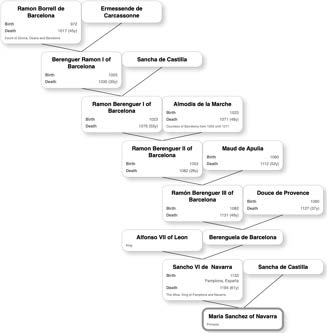
312
CHAPTER 27. DON BONAVENTURA DESCLERGUE & MARIA ANNA CORTÉS DE MONROY
Figure 27.38: Ancestral generations of
Maria Sanchez of Navarra. Her position
in our ancestry is given in Figure 27.33
and Figure 27.28. The reader is also re-
ferred to Figure 27.48.
latter belonged to a branch of the Monroy family based in the city of Salamanca. Alonso had rebelled against Isabella I of Castile (Isabel la Catolica). Also, Martin Cortés de Monroy (1449-1527), Hernán’s father, was an infantry captain in the military and joined his brother Alonso in this rebellion.
Martín Cortés y Paz was the son of Alonso García Cortés and Inés de Paz y Boil, and the couple married in Salamanca, Spain.
Alonso García Cortés was born in the Kingdom of Aragon and made a Knight of the Golden Spur in 1384 by the King of Aragón Pedro IV. He was very noble. He married, in Salamanca, Doña Inés de Paz y Boil, the daughter of his cousin Doña Catalina de Boil, lady of the princess or infanta Leonor of Aragon who passed in his entourage to Castil, and of Dr. Pedro de Paz y Gómez de Anaya, who was the King’s Counselor and as such was in several embassies or missions of the Crown of Castile to the Crown of Aragon. Don Alonso García Cortes,25 went from the Kingdom of Aragon to the Kingdom of Castile to serve the causes of the Christian reconquest. The Descendants of Alonso García Cortés are shown in Figure 27.42.
Inés de Paz y Boil was the daughter of Pedro de Paz y Gómez de Anaya and Catalina de Boil.
Doña Inés de Paz was the daughter of doctor Don Pedro de Paz y Gómez de Anaya and Doña Catalina de Boil, who had passed to the Kingdom of Castile in the entourage that Doña Leonor de Aragon carried when she married the infante Don Juan de Castilla in the year 1375.
Pedro de Paz y Gómez de Anaya was born in Salamanca, Spain. He was a doctor of law and was at the king’s court several times.
He was a very aristocratic person and is described in Chapter 27.7.
Catalina de Boil was born in the Kingdom of Aragon, and she is described in Chapter 27.8.
Fernán Rodríguez de Monroy, father of Leonor de Monroy y Almarez, was born in Monroy, Provincia de Caceres, Reino de Castile y Leon, España. He was the Lord of Monroy. His parents were Juan Rodríguez de las Varillas and María Fernández de Monroy.
Don Fernán Rodríguez de Monroy married26 Doña Isabel de Almaraz.
Juan Rodríguez de las Varillas was born in Monroy, Provincia de Caceres, Reino de Castile y Leon, España. He was a Knight of the Order of the Band and the most important man in the city of Salamanca in his time. His ancestry is described in Chapter 27.13.
María Fernández de Monroy was born in Monroy, Provincia de Caceres, Reino de Castile y Leon, España, and she is described in Chapter 27.17.
Isabel de Almaraz, the mother of Leonor de Monroy y Almarez, was born in Almaraz, Provincia de Caceres, Reino de Castile y Leon, España. Her parents were Diego Gómez de Almaraz and María Blázquez de Tapia. Her ancestry is shown in Figure 27.32.
Don Diego Gómez de Almaraz was born in Plasencia, Spain, and he descended, along with his surname family line of Almaraz, from an ancient and noble Christianized Arab family that owned immense territories of land in the region of Cáceres in Extremadura.
Note that only along the Almarez line does he descend distantly from an Arab family, several generations before him, not through other branches of his ancestry. Al-Marash was the family name that, when the family converted to Christianity, was Spanishized as Almaraz, and that would later also take its territorial possessions as its name. This family, given its wealth and seniority in the region of Cáceres, and after supporting the cause of the Trastamara, raised its social and economic position due to the royal grants received, being able to connect with main Christian families in Extremadura, such as the Altamirano, Hinojosa, Orellana, Carvajal, Pizarro, Tapia and Bote among others.
María Blázquez de Tapia was born in Trujillo, Provincia de Caceres, Reino de Castile y Leon, España; she was the daughter of Alonso de Tapia, who belonged to the Tapia de Trujillo in Extremadura.
Cortés Rosal articulated the following assertions, elucidating the trajectory underlying his revelations, which, to a fellow genealogist, offer a compelling narrative.
An intriguing observation struck me one day concerning Hernán or Fernán Rodríguez de Monroy, who was colloquially referred to as the "dummy" owing to his notably thick, protruding lips. Notably, Hernán Cortés, the renowned Conqueror of Mexico, also possessed similarly full lips. Historical chronicles depict him as of moderate stature, consistently lean, with fair complexion, hazel eyes, dark blond hair, and a prominent, elongated, aquiline nose. Remarkably, both individuals shared the distinctive feature of full or voluminous lips, indicative of a familial trait. However, the origin of this trait remained enigmatic. My inquiries led me to explore potential Moorish or Jewish ancestry, yet initial investigations yielded no substantive leads. It was not until I meticulously examined the Monroy-Almaraz lineage, particularly scrutinizing the toponym "Almaraz," purportedly denoting their ancestral land, that I uncovered concealed Moorish lineage, obscured by the shadows of the Inquisition. It became evident that many prominent Iberian 25Alonso or Alfonso Garcia de Cortes or Garcia Cortes.
26The marriage occurred through negotiations and hereditary conveniences according to arrangements by Garci González de Herrera, the second husband, and widower of his aunt Doña Estefanía Fernández de Monroy.
© 2024 Nico F. Declercq
The Desclergues of la Villa Ducal de Montblanc, 2nd ed., Omn., VOL. I
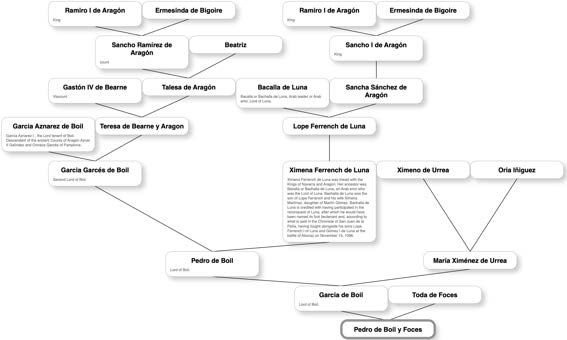
27.7. PEDRO DE PAZ Y GOMEZ DE ANAYA