

The Desclergues of la Villa Ducal de Montblanc, Second Edition Omnibus by Nico Declercq - HTML preview
Download the book in PDF, ePub, Kindle for a complete version.
313
Figure 27.39: Ancestral generations of Pedro de Boil y Foces. His position in our ancestry is shown in Figure 27.25.
The ancestors of Garcia Garces de Boil are shown in Figure 27.30, and the ones of Ximena Ferrench de Luna are given in Figure 27.41.
families, including Spanish, Portuguese, Corsican, Sardinian, Sicilian, and Neapolitan lineages, harbored obscured Moorish or Jewish origins, a legacy shrouded by historical contingencies. Further inquiry unveiled a protracted subterfuge spanning generations within the affluent Almaraz family, descendants of Moorish or Arab lineage from the region, compelled to convert to Christianity.
Through this lineage, the distinctive feature of full lips found its ancestral nexus.
Returning to the union of the Monroy-Almaraz clans, a historical narrative unfolds.
At a pivotal juncture in history, the Monroy estate passed into the possession of Doña Estefanía Fernández de Monroy upon her marriage to Mr. García Álvarez de Toledo, the lord of Oropesa. Subsequent tumultuous political shifts, notably the ascendancy of the illegitimate Enrique II of Trastámara over the Monroy-aligned King Pedro I of Castile, precipitated a coercive marriage between Doña Estefanía and Garci González de Herrera, a protege of the new monarch. This union, orchestrated to usurp the Monroy estate, instigated a fierce feud between the Rodríguez de las Varillas and Fernández de Monroy factions against Garci González de Herrera.
Eventually, through tenacious legal battles and influential alliances, Fernán Rodríguez de Monroy emerged as the rightful heir, albeit inheriting a significantly diminished estate. As compensation and for strategic interests, Garci González de Herrera orchestrated the marriage between Fernán Rodríguez de las Varillas and Isabel de Almaraz, heiress to a substantial estate rooted in Moorish heritage, cementing his control over the Monroy domain.
A nuanced examination of historical dynamics reveals further layers of intrigue.
Against the backdrop of the Castilian Civil War, wherein Enrique II of Castile, dubbed the "Mercedes" for his promises of largesse to supporters, ascended to power, the Monroy-Almaraz union exemplifies the shifting fortunes amidst political upheaval. Despite stark social standing disparities, the marriage consolidated local influence and curry favor with the Trastámara regime. Notably, the advent of the Trastámara dynasty precipitated the waning influence of the Monroy family, staunch supporters of King Pedro I, ultimately relegating them to the periphery of regional power dynamics. Moreover, a critical reassessment of the purported offspring of the Monroy-Almaraz union unveils discrepancies, suggesting that several children attributed to the lineage were, in fact, offspring of relatives residing in Salamanca and its environs, emblematic of the intricate webs of kinship and legitimacy in medieval Iberia.
Cortés Rosal extends his genealogical analysis.
Within the annals of the Monroy-Almaraz lineage, documented evidence substantiates the existence of four progeny: Alonso de Monroy, heir to the Deleitosa-Belvís domain, espoused to Juana de Sotomayor; Rodrigo de Monroy, inheritor of the Monroy estate, wedded to Mencía de Orellana in 1428; Isabel de Monroy, betrothed to her first cousin Antón de Salamanca (Rodriguez de las Varillas), scion of the Salamanca lineage; and Leonor de Monroy, the youngest, whose marriage to Don Martín Cortés "Senior," a knight of the Order of the Golden Spur from an illustrious Aragonese lineage, signifies inter-familial alliances transcending regional boundaries.
27.7 Pedro de Paz y Gomez de Anaya
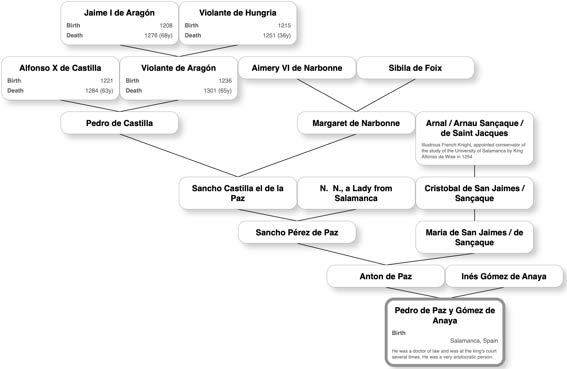
Pedro de Paz y Gómez de Anaya was the great-great-grandfather of Alonso Martin Cortés de Monroy y Sánchez de Badajoz, described in Chapter 27.6. His ancestry is shown in Figure 27.40.
Pedro de Paz y Gómez de Anaya was born in Salamanca, Spain. He was a doctor of law and was at the king’s court several times.
He was a very aristocratic person. His parents were Anton de Paz, son of Sancho Pérez de Paz and Maria de San Jaimes or de Sençaque, and of Inés Gómez de Anaya.
Sancho Pérez de Paz was the son of Sancho Castilla el de la Paz and a lady from the city of Salamanca.
Sancho Castilla el de la Paz was the son of Pedro of Castile and his wife Margaret of Narbonne, the daughter of Viscount Aimery VI of Narbonne and Sibila de Foix.
Pedro of Castile was the son of Alfonso X of Castile and his wife Violante of Aragon.
Maria de San Jaimes, or de Sençaque, was the daughter of Cristobal de San Jaimes of Sençaque. The latter was the son of Arnal or The Desclergues of la Villa Ducal de Montblanc, 2nd ed., Omn., VOL. I
© 2024 Nico F. Declercq
314
CHAPTER 27. DON BONAVENTURA DESCLERGUE & MARIA ANNA CORTÉS DE MONROY
Figure 27.40: Six ancestral generations of Pedro de Paz y Gomez de Anaya. His position in our ancestry is shown in Figure 27.24.
Arnau Sençaque or de Saint Jacques. Arnau de Saint Jacques was an illustrious French Knight appointed conservator of the study of the University of Salamanca by King Alfonso de Wise in 1254.
27.8 Catalina de Boil
Catalina de Boil was the great-great-grandmother of Alonso Martin Cortés de Monroy y Sánchez de Badajoz, described in Chapter
27.6. Her ancestry is shown in Figure 27.25. Catalina de Boil, the wife of Pedro de Paz y Gómez de Anaya and the mother of Inés de Paz y Boil was born in the Kingdom of Aragon as the daughter of several generations of de Boil, with paternal ancestor Guerau de Boil y Cervellón from Valencia. The parents of Guerau de Boil y Cervellón from Valencia were Pedro de Boil y Foces and Ermesenda de Cervellón. Pedro de Boil y Foces is described in Chapter 27.9. Ermesenda de Cervellón is described in Chapter
27.9 Pedro de Boil y Foces
Pedro de Boil y Foces was the great-grandfather of Catalina de Boil, described in Chapter 27.8. His ancestry is shown in Figure
27.39. Pedro de Boil y Foces was the son of the Lord of Boil, Garcia de Boil, and of Toda de Foces.
Garcia de Boil was the son of Pedro de Boil, Lord of Boil, and María Ximénez de Urrea. The latter was the daughter of Ximeno de Urrea and Oria Iñiguez.
Pedro de Boil was the son of the Second Lord of Boil, Garcia Garcés de Boil, and Ximena Ferrench de Luna.
Ximena Ferrench de Luna is described in Chapter 27.10.
Garcia Garcés de Boil is described in Chapter 27.11.
27.10 Ximena Ferrench de Luna
Ximena Ferrench de Luna was the great-grandmother of Pedro de Boil y Foces, described in Chapter 27.9.
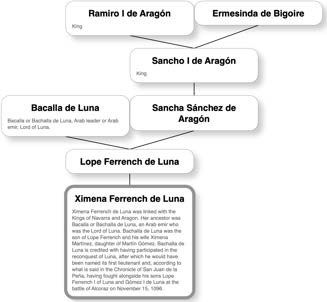
Her ancestry is shown in Figure 27.41. Ximena Ferrench de Luna was linked with the Kings of Navarra and Aragon. Her ancestor was Bacalla or Bachalla de Luna, an Arab emir who was the Lord of Luna. Bachalla de Luna was the son of Lope Ferrench and his wife Ximena Martínez, daughter of Martín Gómez. Bachalla de Luna is credited with having participated in the reconquest of Luna, after which he would have been named its first lieutenant and, according to what is said in the Chronicle of San Juan de la Peña, having fought alongside his sons Lope Ferrench I of Luna and Gómez I de Luna at the battle of Alcoraz on November 15, 1096.
Lope Ferrench de Luna was the father of Ximena Ferrench de Luna and the son of Bacalla de Luna and Sancha Sánchez de Aragón.
Bacalla or Bachalla de Luna was an Arab leader or Arab emir, the Lord of Luna.
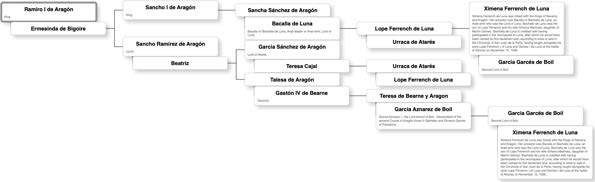
Sancha Sánchez de Aragón was the daughter of King Sancho I de Aragón, the son of King Ramiro I de Aragón and Ermesinda de Bigoire. The descendants of King Ramiro I de Aragón are shown in Figure 27.47.
27.11 Garcia Garces de Boil
Garcia Garcés de Boil was the great-grandfather of Pedro de Boil y Foces, described in Chapter 27.9.
His ancestry is shown in Figure 27.30.
Garcia Garcés de Boil was the second Lord of Boil, and he was the son of Garcia Aznarez de Boil and Teresa de Bearne y Aragon.
© 2024 Nico F. Declercq
The Desclergues of la Villa Ducal de Montblanc, 2nd ed., Omn., VOL. I
27.12. ERMESENDA DE CERVELLON
315
Figure 27.41: Four ancestral generations
of Ximena Ferrench de Luna. Her position
in our ancestry is shown in Figure 27.39.
The reader is also referred to Figure 27.47.
Garcia Aznarez de Boil, or García Aznarez I, was the Lord tenant of Boil, a descendant of the ancient Counts of Aragón Aznar II Galíndez and Onneca Garcés of Pamplona.
Teresa de Bearne y Aragon was the daughter of Viscount Gastón IV de Bearne and Talesa de Aragón.
The latter was the daughter of Count Sancho Ramírez de Aragón and Beatriz.
Count Sancho Ramírez de Aragón was the son of King Ramiro I de Aragón and Ermesinda de Bigoire.
27.12 Ermesenda de Cervellon
Ermesenda de Cervellón was the great-grandmother of Catalina de Boil, described in Chapter 27.8.
Her ancestry is shown in Figure 27.27. Ermesenda de Cervellón was the daughter of Guillem de Cervelló and Elvira de Artusela.
Guillem de Cervelló was the son of Guerau de Cervelló, who died in 1193, and Berenguera de Timor.
27.13 Juan Rodriguez de las Varillas
Juan Rodríguez de las Varillas was the great-great-grandfather of Alonso Martin Cortés de Monroy y Sánchez de Badajoz, described in Chapter 27.6. His ancestry is shown in Figure 27.33.
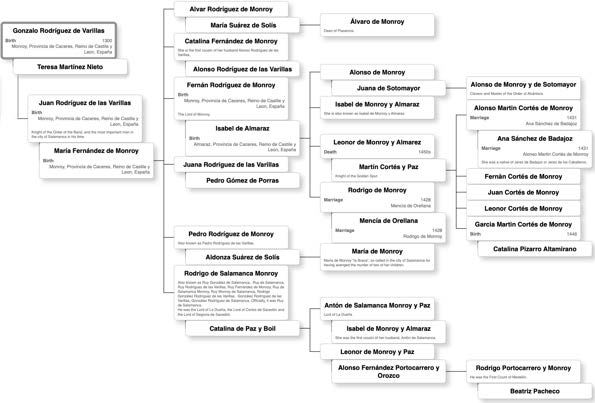
Juan Rodríguez de las Varillas was born in Monroy, Provincia de Caceres, Reino de Castile y Leon, España. He was a Knight of the Order of the Band, and the most important man in the city of Salamanca in his time. His parents were Gonzalo Rodríguez de Varillas and Teresa Martínez Nieto.
Gonzalo Rodríguez de Varillas, Master of the Order of the Temple, was born in 1300 in Monroy, Provincia de Caceres, Reino de Castile y Leon, España, and he was the son of Rodrigo Ruiz de Varillas and Inés Godinez. The descendants of Gonzalo Rodríguez de Varillas are shown in Figure 27.45.
Inés Godinez was the daughter of Alfonso Godinez and Inés Pérez de Tenorio. Alfonso Godinez was the son of Don Godhino.
Doña Inés Godinez is also of particular interest. She was married to Don Rodrigo Ruíz de Varillas, and their daughter was Doña Estefanía Rodríguez de Varillas, who married Don Fernán Pérez de Monroy.
Cortés Rosal communicated the following.
The Portuguese Knight, Don Godhino, monedeiro de Coimbra, was the Administrator and had ownership of the mint in the city of Coimbra. He was very wealthy, and he went to Castile in response to a tremendous economic offer from King Alfonso X the Wise so that he could put the Kingdom’s finances in order. This gentleman, the progenitor of the Godinez family, was the paternal grandfather of Doña Inés Godinez, who married Don Rodrigo Ruíz de Varillas. Don Godhino was a Jewish convert to Christianity.
He was an affluent Jew.
Cortés Rosal also explained how natural it was for a Catalan family, Desclergue, to marry someone from the Cortes clan.
The Sánchez de Badajoz family used the entire or split surname, either Sánchez or Badajoz. They and the family of de Vega Bazan had spread through Jerez de los Caballeros, through Écija, through Seville, through the port of Santa María, and Jerez de la Frontera since that entire area became a key point of trade with America, Genoa, Corsica, Sardinia, Sicily, Naples, and Tunisia.
It is essential to point out that Badajoz was crucial as a crossroads between the south and the north and the interior of the Kingdom of Castilla. It had a customs right of ’portazgo.’ Many merchants settled between Cádiz, Puerto de Santa María, Jerez de la Frontera, Écija, Carmona, Seville, and Badajoz and its areas of influence such as Jerez de los Caballeros, Talavera la Real, etc.
These merchants were Genoese, Venetian, Flemish, Catalan and Basque. Most were connected with wealthy, noble, and old families from those regions. The mentioned right to ’portazgo’ of Badajoz is of particular interest, held by the Sessé and then the Vega Bazán. Numerous merchants necessarily had a relationship with the city of Badajoz and its area of influence and, therefore, with the Vega Bazán family.
Jerez de la Frontera was a critical place for exchanging goods with the city of Badajoz and from Badajoz to Salamanca, Galicia, and León. That is why a customs office was established there, as well as the customs rights of the port of Badajoz, which the Sessé and the Vega Sessé held, and then the Vega Bazán. It is not surprising that the family married the Desclergues in that region at some point in time.
Prominent members of the Sánchez de Badajoz clan are Garci Sánchez de Badajoz (born around 1460 and dead about 1526), a Spanish writer and poet, described in 27.13.1, and Diego Sánchez de Badajoz (born in Talavera la Real, Spain and deceased in 1549), a Spanish poet and dramatist of the Renaissance, described in 27.13.2. Cortés Rosal continues his discourse as follows.
Captain Don Pedro Cortés de Monroy, Conqueror of Chile, was the son of Juan Fernández Borregas, a rich wool merchant and The Desclergues of la Villa Ducal de Montblanc, 2nd ed., Omn., VOL. I
© 2024 Nico F. Declercq

316
CHAPTER 27. DON BONAVENTURA DESCLERGUE & MARIA ANNA CORTÉS DE MONROY
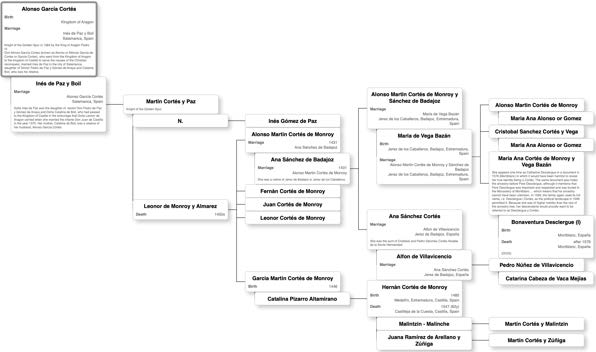
Figure 27.42: Four descendant generations of Alonso Garcia Cortes and Inés de Paz y Boil. The branch appears in Figure
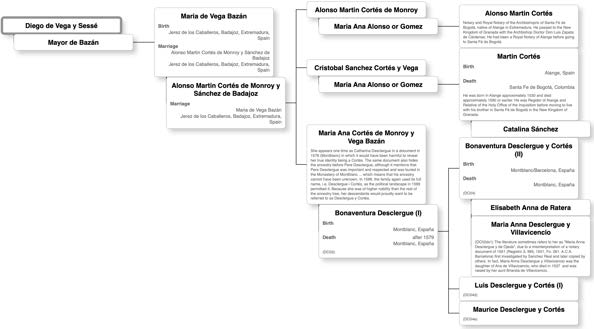
Figure 27.43: Three descendant generations of Diego de Vega y Sesse and Mayor de Bazán. The branch appears in Figure
Figure 27.44: Four descendant generations of Fernan Perez de Saavedra and Mayor de Ulloa. The branch appears in Figure
© 2024 Nico F. Declercq
The Desclergues of la Villa Ducal de Montblanc, 2nd ed., Omn., VOL. I

27.13. JUAN RODRIGUEZ DE LAS VARILLAS
317
Figure 27.45: Three descendant generations of Gonzalo Rodriguez de Varillas and Teresa Martínez Nieto. The branch appears in Figure 27.24.
Figure 27.46: The family of Contesina de Calamandrana y Lauria and her descendants with Juan Martínez de Luna y Sessé.
The branch appears in Figure 27.31.
Figure 27.47: Four descendant generations of Ramiro I de Aragon and Ermesinda de Bigoire. Their appearance is also given in Figure 27.41 and Figure 27.30.
The Desclergues of la Villa Ducal de Montblanc, 2nd ed., Omn., VOL. I
© 2024 Nico F. Declercq
318
CHAPTER 27. DON BONAVENTURA DESCLERGUE & MARIA ANNA CORTÉS DE MONROY
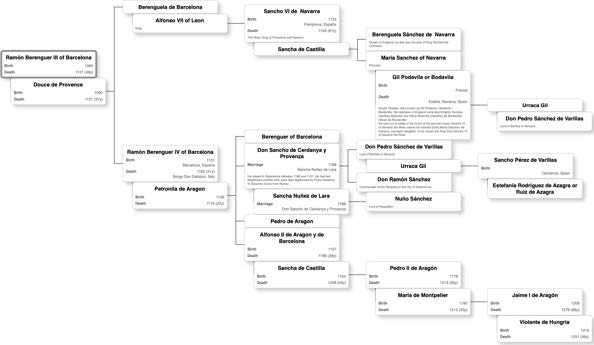
Figure 27.48: Four descendant generations of Ramon Berenguer III of Barcelona and Douce de Provence. Their appearance is also given in Figure 27.38 and Figure 27.26.
also owner of large flocks of sheep (descendant of a Jewish-converted family that went to Chile for fear of the Inquisition) and of María Cortés; maternal grandson of Gonzalo Alonso Cortés (sometimes also called Gonzalo García Cortés) and Marina Mateos; maternal - paternal great-grandson of Alonso Cortés de Monroy and Ana Sánchez de Badajoz. He is shown in Figure 27.3.
You can see our family coat of arms in the center, which is the same as that of the Rodríguez de las Varillas and was adopted with permission from the Crown of Aragon by the Cortés de Monroy. Well, that shield, which is esoteric and represents the blood of the Grail, was carried with great pride by the Cortés descendants of Don Martín Cortés and Doña Leonor de Monroy. The general coat of arms belongs to the Monroys, which derives from another significant family in the history of Europe and the Crusades.
Rodrigo Ruiz de Varillas was the son of Sancho Pérez de Varillas and Estefanía Rodríguez de Azagra or Ruiz de Azagra.
Sancho Pérez de Varillas was the son of Don Pedro Sánchez de Varillas and Urraca Gil.
Don Pedro Sánchez de Varillas was the Lord of Barillas in Navarre, and his father was Don Sancho de Cerdanya y Provenza.
The latter was married to Sancha Nuñez de Lara in 1188; and he stayed in Salamanca between 1168 and 1181, and he had two illegitimate children who were later legitimized by Pope Celestine III (Giacinto Orsini from Rome). His ancestry is described in Chapter 27.14.
Urraca Gil was the daughter of Gil Podavila or Bodavila and of Maria Sanchez of Navarra, a Princess described in Chapter 27.15.
Gil Podavila or Bodavila was born in France and dead in Estella, Navarra, Spain. He is described in Chapter 27.16.
Estefanía Rodríguez de Azagra or Ruiz de Azagra was the daughter of Rodrígo Ruiz de Azagra and Estefanía Pérez de Baztan, the aunt of Gonzalo Ibañez de Bazán. Rodrígo Ruiz de Azagra was the son of Gonzalo Rodríguez de Azagra or Ruiz de Azagra, Royal Ensign 1180 - 1181 of Fernando II of León, Lord tenant in Salamanca in 1179, and Master of the Order of the Temple.
27.13.1 Garci Sánchez de Badajoz
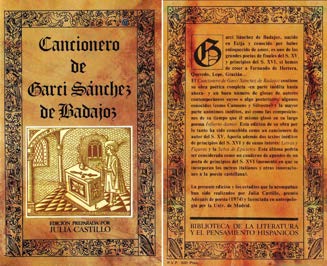
Garci Sánchez de Badajoz (1460-1526), in Figure 27.56 on page 322, was a notable Spanish poet from the late 15th and early 16th centuries, associated with the lyric poetry movement known as ’lírica cancioneril’ and the allegorical-Dantean school. Born in Écija, his family hailed from the lower nobility of Badajoz, but they settled in Seville during the 15th century. His work is prominently featured in the ’Cancionero General’ (1511), a significant anthology of Spanish poetry. Additional compositions by him appear in loose sheets (’pliegos sueltos’) and the ’Cancionero de romances.’
Fray Jerónimo Román, in his ’República del mundo,’ highlights Sánchez de Badajoz as an eminent musician skilled in playing the Spanish vihuela. His life took a dramatic turn when a profound romantic passion led him to lose his sanity.
Sánchez de Badajoz’s literary contributions are diverse and often reflect a blend of parody and allegory. One of his notable works,
’Liçiones de Job apropiadas a las pasiones de amor,’ is a parody of the biblical Book of Job, which faced scrutiny and expurgation by the Inquisition before it could be published in the ’Cancionero General.’ Other significant works include ’Claro escuro,’ ’El sueño’ (where he envisions his own funeral), and ’El infierno del amor,’ an allegorical poem in the style of Dante Alighieri that depicts perpetual suffering through erotic songs of deceased poets.
His romance ’Caminando por mis males’ is remarkable for its subjective and morbid sentimentality, which foreshadows elements of Romanticism. Another acclaimed work is ’Lamentaciones de amores,’ which was highly praised by the poet Fernando de Herrera.
His contemporaries and later figures highly regarded Sánchez de Badajoz’s style and compositions in Spanish literature. Juan de Valdés commended his poetic style in the ’Diálogo de la lengua,’ and the famed playwright Lope de Vega extolled his verses in the prologue to his work ’Isidro,’ stating, "What equals a redondilla by Garci Sánchez?" His oeuvre includes various genres such as songs, villancicos, and dezires, reflecting his rich and diverse poetic talent. Despite the challenges posed by the Inquisition and the tumultuous personal life that marked his later years, Garci Sánchez de Badajoz remains a significant figure in the landscape of Spanish Renaissance poetry.
© 2024 Nico F. Declercq
The Desclergues of la Villa Ducal de Montblanc, 2nd ed., Omn., VOL. I
27.13. JUAN RODRIGUEZ DE LAS VARILLAS
319
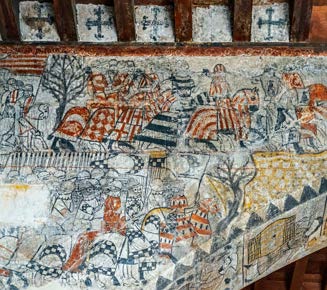
Figure 27.49: Fresco at the Convent of
the Knights of Calatrava in Alcañiz, Spain,
1325-1347. The importance of the Luna
family, appearing in Chapter 27.5, is clear.
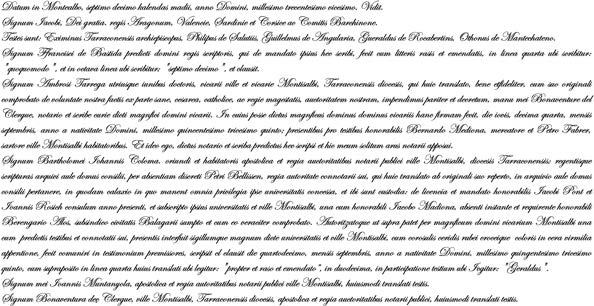
Figure 27.50: The importance of Bonaventura Desclergue (DC03), as a scribe and notary in 1535 is exemplified by this document, in which he is responsible for the proper transcription and translation of a document of 1320, concerning the legal rights of the citizens of Montblanc. The text is transcribed from the 1535 document, with help from Dolors Domingo.1
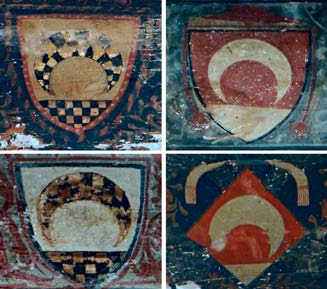
Figure 27.51:
Iglesia de Santa Maria
in Maluenda, near Calatayud, Spain. The
Luna lineage is represented in this church
by heraldic shields of several of their fam-
ilies. Right are shields of the Martínez de
Luna with a silver crescent and a silver
campaign on a field of gules. It is assumed
that it refers to Don Pedro Martínez de
Luna, “El Papa Luna”, since he is accom-
panied by symbols related to the hierarchy
of the Catholic Church. Left are shields
of the Ferrench de Luna with a ranverse
crescent of gold and sable checkers on a
silver field and a checkered campaign of
gold and sable. It is almost certain that
when this alfarje was built, Queen María
de Luna, the wife of Martin I the Humane,
who ruled at the beginning of her husband’s
reign, between 1395 and 1397, was a rep-
resentative of this lineage.
The Desclergues of la Villa Ducal de Montblanc, 2nd ed., Omn., VOL. I
© 2024 Nico F. Declercq
320
CHAPTER 27. DON BONAVENTURA DESCLERGUE & MARIA ANNA CORTÉS DE MONROY
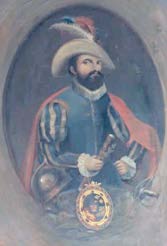
Figure 27.52: Don Martín Cortés y Zuñiga, the son of Hernàn Cortés
de Monroy and Juana Ramírez de Arellano y Zúñiga, described in
Chapter 27.20.18.
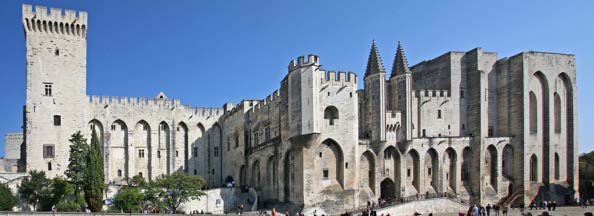
Figure 27.53: The Papal Palace of Avignon, an architectural marvel of the 14th century, served as the residence of the Popes during the Avignon Papacy (1309-1377). Constructed in phases, the palace reflects a fusion of Gothic and fortified architecture, symbolizing the church’s power and influence. The grand halls, chapels, and private apartments are adorned with frescoes by artists such as Matteo Giovanetti. Today, the palace is a UNESCO World Heritage site and a testament to medieval ecclesiastical architecture. It hosts various cultural events, including the renowned Avignon Festival. It offers historians and architects insights into the ecclesiastical and political history of the 14th century, as well as the evolution of Gothic architecture. This photo is the courtesy of Jean-Marc Rosier.
27.13.2 Diego Sánchez de Badajoz
Diego Sánchez de Badajoz, born in Talavera la Real in the late 15th century, emerged as a significant figure in the Spanish Renaissance. He passed away in 1549. Despite limited biographical data, it is believed that he may have graduated with a bachelor’s degree from Salamanca, though he served as the parish priest of Talavera la Real from 1533 until his death. Sánchez de Badajoz had strong connections with the Cathedral of Badajoz and the influential Dukes of Feria.
Diego Sánchez de Badajoz, shown in Figure 27.57, is renowned for his poetic and dramatic works, compiled posthumously by his nephew in ’Recopilación en metro.’ This collection includes 27 dramatic pieces known as farsas. Some of these works, characterized by allegorical techniques and Eucharistic themes, can be classified as autos sacramentales, as scholar Bruce W. Wardropper noted.
His plays often reference religious settings, implying they were performed within church interiors. His poetry predominantly revolves around religious themes, with notable works such as ’Matraca para jugadores,’ ’Montería espiritual,’ ’Romance de Nuestra Señora,’
and ’Danza en que todos los pecados mortales danzan con nuestro padre Adán.’
Sánchez de Badajoz’s theater is moralistic and employs the Extremaduran dialect sayagués, introducing picaresque elements devoid of eroticism and bucolic themes. His plays typically feature three to six characters, often allegorical and unnamed, representing general types like the beekeeper, the shepherd, the woman, and the husband. The world depicted in his works retains a medieval outlook with an unchangeable social order. As a moralist rather than a social critic, his plays emphasize established societal norms.
His dramatic works are notable for their tripartite structure, beginning with an introito by a shepherd, followed by the main dramatic body, and concluding with a villancico sung by all characters. Unlike the shepherds in Juan del Encina’s works, Sánchez de Badajoz’s shepherds are more medieval, serving as commentators on theological themes and adding a comic element. These shepherds introduce the plays, outline their moral and doctrinal purposes, and occasionally incorporate social critique.
Sánchez de Badajoz’s contributions to theater are significant. He presented relatable shepherd characters and adeptly handled theological themes. He advanced the allegorical technique seen in autos sacramentales, infusing his works with comedic and satirical elements. Though rooted in a joyful and somewhat naive piety, his Christian ethics firmly supported Christian orthodoxy and a static social structure.
27.14 Don Sancho de Cerdanya y Provenza
Don Sancho de Cerdanya y Provenza was the Great-great-great-grandfather of Juan Rodriguez de las Varillas, described in Chapter
His ancestry is shown in Figure 27.26.
Don Sancho de Cerdanya y Provenza married Sancha Nuñez de Lara in 1188. He stayed in Salamanca between 1168 and 1181. He
© 2024 Nico F. Declercq
The Desclergues of la Villa Ducal de Montblanc, 2nd ed., Omn., VOL. I
27.14. DON SANCHO DE CERDANYA Y PROVENZA
321
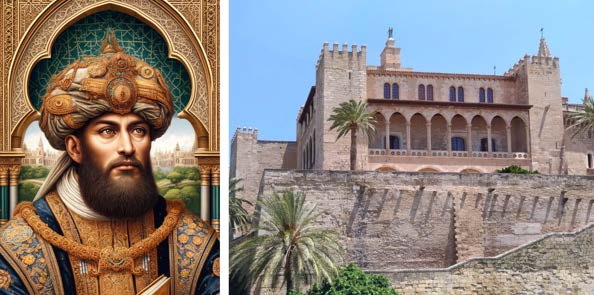
Figure 27.54: Abu Yahya, the last Muslim ruler of Mallorca, who died in 1229. He was an ancestor of Maria Ana Cortés de Monroy y Vega Bazán, Jeroni Joan Desclergue y Cortés (DC05) grandmother. He is, therefore, also our distant ancestor.
Renowned for his wisdom, literary accomplishments, and exceptional physical beauty, Abu Yahya was a prominent figure in the island’s rich history. His reign marked the end of centuries of Islamic rule, culminating in his death during the conquest of Mallorca by King James I of Aragon. Mallorca was a flourishing center of culture, trade, and agriculture during its Muslim rule. The island, known as Madina Mayurqa, was adorned with lush, verdant gardens, sophisticated irrigation systems, and stunning examples of Islamic architecture. The bustling ports of Palma facilitated trade across the Mediterranean, making Mallorca an essential hub for commerce and cultural exchange. The Muslim rulers promoted arts and sciences, contributing to a rich intellectual environment. This era left a lasting legacy on the island’s landscape, language, and cultural practices, elements of which are still evident in Mallorca today.
The language of Mallorca, distinct from the Catalan of mainland Spain, is infused with Arabic-derived words. Many Mallorcians are unaware of how deeply Islamic culture is embedded in their history, from language and architecture to agriculture.
One of the most remarkable sites is the mansion of Alfabia, situated northwest of Palma. This mansion stands on the location of the residence of the last Muslim wali (viceroy) of Mallorca. It blends Islamic and Mediterranean architecture with lush gardens nourished by a spring that has flowed continuously since 1254. The gardens, designed in the Hispano-Arabic tradition, showcase elements like cascading water and intricate water channels.
The discovery of a Muslim family’s treasure, buried in a cave and now housed in the Museu de Mallorca, further illustrates this heritage. The treasure includes gold and silver coins and jewelry from the Almohad period, providing tangible links to the island’s past. The coins and jewelry, with their inscriptions and designs, highlight the sophisticated culture and enduring legacy of the Muslim community in Mallorca.
Left is an impression made by AI of how Abu Yahya may have looked like (DALL·E 2024-05-27 18.07.07). Right is the Palace of Almudaina in Palma.
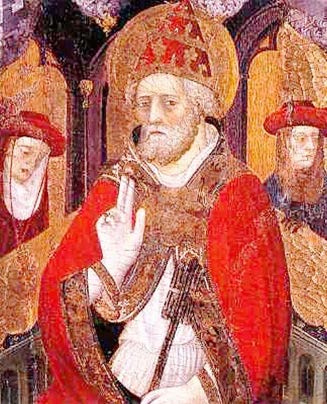
Figure 27.55: Pedro Martínez de Luna,
more famously known as Antipope Bene-
dict XIII or Pope Luna, was born in Il-
lueca, Aragón, Spain. Elected Pope in Avi-
gnon in 1394 during the Western Schism,
his papacy was marked by controversy and
conflict. Benedict XIII steadfastly refused
to abdicate even after being deposed in
1417, a stance that led him to seek refuge
in the castle of Peñíscola in Castellón,
Comunidad Valenciana. He continued to
assert his legitimacy until his death, the
exact date of which remains uncertain,
though some sources suggest November 29,
1422. Following his death, Benedict XIII’s
body was interred in the castle at Peñís-
cola. Later, his remains were moved to
his birthplace in Illueca. However, during
the War of Spanish Succession, his body
was destroyed, with only his skull surviv-
ing. This relic is now housed in the Condes
de Argillo Palace in Aragón, Spain. Pope
Luna’s unwavering resolve and the dra-
matic events surrounding his papacy and
posthumous fate underscore his complex
and contentious legacy within the history
of the Catholic Church.
The Desclergues of la Villa Ducal de Montblanc, 2nd ed., Omn., VOL. I
© 2024 Nico F. Declercq
322
CHAPTER 27. DON BONAVENTURA DESCLERGUE & MARIA ANNA CORTÉS DE MONROY
Figure 27.56:
’Cancionero de Garci
Sanchez de Badajoz’ was prepared by Julia
Castillo and published in 1980.
Figure 27.57: Diego Sánchez de Badajoz was a prominent Spanish
poet and dramatist of the Renaissance. He died in 1549.
had two illegitimate children who were later legitimized by Pope Celestine III (Giacinto Orsini from Rome).
Don Sancho de Cerdanya y Provenza’s parents were Ramón Berenguer IV of Barcelona, who was born in Barcelona, Spain, in 1131
and died in Borgo San Dalazzo, Italy, in 1162, and Petronila de Aragon. The parents of Ramón Berenguer IV of Barcelona were Ramón Berenguer III of Barcelona and Douce de Provence.
27.15 Maria Sanchez of Navarra
Maria Sanchez of Navarra was the Great-great-great-grandmother of Juan Rodriguez de las Varillas, described in Chapter 27.13.
Her ancestry is shown in Figure 27.38. Maria Sanchez of Navarra was a Princess. She was the daughter of Sancho VI de Navarra and Sancha de Castilla.
Sancho VI de Navarra was born in Pamplona, España in 1133. He was the King of Pamplona and Navarra, also known as The Wise. His parents were King Alfonso VII of Leon and Berenguela de Barcelona.
The latter was the daughter of Ramón Berenguer III of Barcelona and Douce de Provence. The descendants of Ramón Berenguer III of Barcelona are shown in Figure 27.48.
27.16 Gil Podavila or Bodavila
Gil Podavila or Bodavila was the Great-great-great-grandfather of Juan Rodriguez de las Varillas, described in Chapter 27.13.
Gil Podavila, or Bodavila, was born in France and died in Estella, Navarra, Spain. He was a Knight Templar, also known as Gil Podavila or Bodavila or Bouteville. His nephews in England were also Knights Templar, namely Geoffrey Boteville and Oliver Boteville (Geoffroy de Bouteville/Olivier de Bouteville).
He went on to settle in the Court of his second cousin, Sancho VI of Navarra the Wise, where he married Doña María Sánchez de Navarra, the youngest daughter of his cousin, King Don Sancho VI of Navarre the Wise.
27.17 Maria Fernandez de Monroy
Maria Fernandez de Monroy was the granddaughter of Fernán Pérez de Monroy, described in Chapter 27.18.
Her ancestry is shown in Figure 27.37. María Fernández de Monroy was born in Monroy, Provincia de Caceres, Reino de Castile y Leon, España. She was the daughter of Fernán Pérez de Monroy and Inés Rodríguez de Varillas.
Fernán Pérez de Monroy was the son of Fernán Pérez de Monroy, described in Chapter 27.18, who died, in 1351, in Plasencia, Reino de Castile y Leon, España, and Estefania Rodríguez de Varillas. The latter is described in Chapter 27.19.
27.18 Fernan Perez de Monroy
Fernan Perez de Monroy was the great-great-great-grandfather of Alonso Martin Cortés de Monroy y Sánchez de Badajoz, described in Chapter 27.24.
Fernán Pérez de Monroy died in 1351 in Plasencia, Reino de Castile y Leon, España. He was the son of Pedro Fernandez de Monroy and Elvira Núñez de Andrade y Ulloa. The latter was born in 1255 as the daughter of Nuño Freyre de Andrade and Maria de Ulloa.
© 2024 Nico F. Declercq
The Desclergues of la Villa Ducal de Montblanc, 2nd ed., Omn., VOL. I
27.19. ESTEFANIA RODRIGUEZ DE VARILLAS
323
His ancestry is shown in Figure 27.29.
Pedro Fernandez de Monroy was the son of Pedro Fernández de Monroy. The latter was the son of Pedro de Monroy and Mayor de Saavedra, the daughter of Fernán Pérez de Saavedra27 and Mayor de Ulloa. The descendants of Fernan Perez de Saavedra are shown in Figure 27.44. Doña Mayor de Saavedra was a sister of Don Pedro Fernández de Saavedra, the conqueror of Cáceres and its temporary possessor. Pedro de Monroy and Mayor de Saavedra were the first of his Monroy lineage to go to the Kingdom of Léon and settle in the Extremadura.
Fernán Pérez de Monroy had a son with the same name who married his first cousin, Doña Inés Rodríguez de las Varillas.
Don Fernán Pérez de Monroy (junior) and Doña Inés Rodríguez de las Varillas were the parents of Doña María Fernández de Monroy. The latter married her cousin, Don Juan Rodríguez de las Varillas, the son of Gonzalo Rodríguez de las Varillas and Doña Teresa Martínez Nieto.
Concerning the above-mentioned Pedro de Monroy, husband of Mayor de Saavedra.
Cortés Rosal revealed a crucial discovery that he declared as the most important of all the facts he discovered decades before. It is a contestation of what is regularly found in existing history books.
Don Pedro de Monroy, the first person carrying this family name, participated in the first siege of the influential Muslim of Cáceres.
He was still a very young man then, and he participated because that was expected of a man of his noble blood. The unsuccessful siege came under the direct orders and personal participation of Savary de Mauleon, a famous military and an Occitan troubadour serving King Alfonso IX of León. The unsuccessful siege was not the end. Don Pedro de Monroy besieged the enclave in 1222, 1223, and 1225 until, finally, in 1229, he was successful. Indeed, in 1229, the siege, undertaken with Pedro Fernández de Saavedra, eventually resulted in a victory by the Christians, and Cáceres was definitively conquered.
Unlike custom in later years, at the time of the conquer of Cáceres, Don Pedro de Monroy did not receive ’fueros’28 granted by King Alfonso IX of León because a reward by state-property was prohibited. So, Don Pedro de Monroy was not rewarded with lands for his exploits and participation in this triumphal siege of Caceres.
In 1287, however, his grandson, Don Fernán Pérez de Monroy, obtained from the Crown through the Council of Plasencia, in return for the merits and services provided to the Crown by his grandfather Don Pedro de Monroy, some lands located in the Arañuelo countryside, very close to Cáceres, to which he gave his name. Since then, these lands have been known as the lordship of Monroy.
From then onward, the Monroy lordship constituted the nucleus of the "mayorazgo" instituted by the family.
Don Pedro de Monroy, the first of the name stated above, married Doña Mayor de Saavedra, the sister of his military partner, Don Pedro Fernández de Saavedra. Doña Mayor de Saavedra and Don Pedro Fernández de Saavedra were children of Don Fernán Pérez de Saavedra and Doña Mayor de Ulloa.
This information is valuable because it explains the origin of the place’s name. Indeed, the site was named after the family and not vice versa. Also, keep in mind that Savary de Mauleon’s contribution is significant because it indicates involvement from France.
It is also important that Don Pedro de Monroy was the first to carry that name because it means that his father had a different name.
Cortés Rosal presented evidence that Don Pedro de Monroy was the first of his lineage to settle in Extremadura, and he counts among his ancestors noble knights belonging to the Order of the Temple and even some as martyrs of Christianity who died in military campaigns of the Crusades. The templars in the ancestry of Cortés are the reason why Antoni Desclergue (DC06), when he brought polychrome retable panels to Flanders from Spain, ensured that the templar flower would surround them as indications of his fathers used family name, Desclergue y Cortés. The appearance of Jewish conversos in that Cortés ancestry may also explain the closeness between Jeroni Joan Desclergue y Cortés (DC05) and Carlos Coloma de Saa, whose ancestors were conversos, as known from the literature.
Concerning the brother of Fernan Perez de Monroy, Don Nuño Pérez de Monroy, Cortés Rosal explained that Don Nuño Pérez de Monroy, the son of Don Pedro Fernández de Monroy and Doña Elvira Núñez de Andrade, and brother of our grandfather Don Fernán Pérez de Monroy, husband of Doña Estefanía Rodríguez de las Varillas was a prominent person. He was an indispensable canon in his time, with much power and influence in the Royal Court, which he passed from a very young age. He was Archdeacon of Trujillo in Extremadura and Abbot of Santander. When Queen María de Molina (Queen of Castile, the wife of Sancho IV de Castilla and the mother of King of Castilla Fernando IV) became widowed and became Regent, he who was her Confessor became the "Queen’s right hand," and she was her Chancellor and Counselor. He died in the year 1326.
27.19 Estefania Rodriguez de Varillas
Estefania Rodríguez de Varillas was the grandmother of Maria Fernandez de Monroy, described in Chapter 27.17.
Her ancestry is shown in Figure 27.28.
Estefania Rodríguez de Varillas was the daughter of Inés Godinez, described in Chapter 27.13, daughter of Alfonso Godinez, minister of King Sancho IV, and Inés Pérez de Tenorio. The father of Alfonso Godinez was Don Godhino, the coin holder of Coimbra, who passed to Castile at the request of the King of Castile, Alfonso X the Wise.
The father of Estefania Rodríguez de Varillas was Rodrigo Ruiz de Varillas, the son of Sancho Pérez de Varillas and Estefanía Rodríguez de Azagra or Ruiz de Azagra.
Estefanía Rodríguez de Azagra or Ruiz de Azagra was the daughter of Estefanía Pérez de Baztan, the aunt of Gonzalo Ibañez de Bazán and Rodrígo Ruiz de Azagra. The latter was the son of Gonzalo Rodríguez de Azagra or Ruiz de Azagra, who was the Royal Ensign in 1180 and 1181 of Fernando II of León, and who was the Lord tenant in Salamanca in 1179 and a Master of the Order of the Temple.
Sancho Pérez de Varillas, born in Cerdanya, Spain, was the son of Don Pedro Sánchez de Varillas and Urraca Gil.
Don Pedro Sánchez de Varillas was the Lord of Barillas in Navarre and the son of Don Sancho de Cerdanya y Provenza. The latter was married, in 1188, to Sancha Nuñez de Lara, and he stayed in Salamanca between 1168 and 1181. Don Sancho de Cerdanya y Provenza had two illegitimate children who were later legitimized by Pope Celestine III (Giacinto Orsini from Rome).
Urraca Gil was the daughter of Princess Maria Sanchez of Navarra and Gil Podavila or Bodavila. The latter was born in France and died in Estella, Navarra, Spain. Gil Podavila was a Knight Templar, also known as Gil Podavila, Bodavila, or Bouteville.
His nephews in England were also Knights Templar, namely Geoffrey Boteville and Oliver Boteville (also known as Geoffroy de Bouteville and Olivier de Bouteville).
Gil Podavila went on to settle in the Court of his second cousin, Sancho VI of Navarra the Wise, where he married Doña María 27Many genealogists confuse Don Fernán Pérez de Saavedra with Don Pedro Fernández de Saavedra.
28fueros are rights and privileges
The Desclergues of la Villa Ducal de Montblanc, 2nd ed., Omn., VOL. I
© 2024 Nico F. Declercq
CHAPTER 27. DON BONAVENTURA DESCLERGUE & MARIA ANNA CORTÉS DE MONROY
Sánchez de Navarra, the youngest daughter of his cousin, King Don Sancho VI of Navarre the Wise.
27.20 Hernán Cortés de Monroy, Ana’s Cousin and a Conquistador
27.20.1 Introduction
Hernán Cortés de Monroy29 (also known as Fernando Cortés or Fernan Cortés), conqueror of Mexico, was the son of Garcia Martín Cortés de Monroy, born around 1446, and Catalina Pizarro Atamirano. Garcia Martín Cortés de Monroy was the son of Martin Cortés y Paz and Leonor de Monroy y Almarez.
The brother of Garcia Martin Cortés de Monroy, Alonso Martin Cortés de Monroy, was the grandfather of Maria Ana Cortés de Monroy y Vega Bazán. This is illustrated in Figure 49.91 on page 1021. Alonso Martin Cortés de Monroy was Ana de Villavicencio’s great-grandfather, the mother of Maria Anna Desclergue y Villavicencio. The latter relationship is illustrated in Figure 49.92 on page 1022 and in Figure 25.35 on page 289.
Hernán Cortés de Monroy was born in Medellin, shown in Figure 27.5 on page 298 in Spanish Extremadura in 1485, and he died on December 2, 1547, in Castileja de la Cuesta in Spain. He was a conquistador. His full name was Hernán Cortés de Monroy Pizarro Altamirano, and he was marqués del Valle de Oaxaca. Hernán Cortés is famous for conquering Mexico from 1519 until 1531. He is controversial for several reasons. Specifically, during his life and the century after his presence in Mexico, he was admired and simultaneously ignored in Spain. The reason is that, despite the treasures he brought back from Mexico, he followed a somewhat independent path by taking too much initiative.
For this reason, his loyalty to the King of Spain, H.M. Emperor Carlos V, and the European feudality was questioned, and he was not trusted. His popularity with a part of the population in Mexico could have allowed him to establish the independent Mexican Kingdom, which resulted in mistrust by the Europeans and, in particular, the Council of the Indies. His family would probably never have used his fame to seek appreciation from the King because of this doubly faced reputation. For this reason, we may assume that the descendants of Anna Cortés de Monroy, wife of Bonaventura Desclergue (I) (DC03) and cousin of Hernán Cortés, would probably never have dared to exploit their connection with Hernán when seeking nobility titles. An implicit influence may, nevertheless, have occurred, and, after all, the family Cortés de Monroy was of high standing. However, the descendants must have known the blood link with Hernán Cortés. Antoni Desclergue (II) (DC06), for instance, used Hernán’s face as the example in a sculpture, shown in Figure 49.52 on page 1009, depicting his father Jeroni Desclergue y Cortés (DC05) in a chapel in Deerlijk, described in Chapter 49.4.2. In the same chapter, in particular, in Chapter 49.10.2, another panel depicting the Flight from Egypt, shown in Figure 49.76 on page 1014 exposes more references to Hernán Cortés.
27.20.2 Heraldic Shield
The authentic coat of arms of Hernán Cortés is shown in Figure 27.4. The Heraldic Shield of Hernán Cortes contains a blue border with eight San Juan crosses around the middle shield, similar to that of the Kingdom of Aragon.
Hernán Cortés de Monroy, shown in Figure 27.7, a cousin of our ancestor Anna Cortés de Monroy, has been the most successful Conquistador. His connection is exposed in Figure 27.6. His success was the most important trait a person can have; namely, he possessed the ability to rise to the occasion.
In 1506, Hernán Cortés de Monroy left for the New World to conquer Hispaniola (nowadays the Dominican Republic). In 1511, he beat, together with Diego Velázquez, the territory of Cuba. In this period, namely, 1507, our ancestor Galceran Desclergue (II) (DC02dy1), described above, was born. Becoming part of the trade with Cuba and Mexico would have been an essential activity of Galceran.
Hernán Cortés de Monroy ’married’ la Malinche, also known as Doña Marina or Malinalli Tenepal. She was born in Coatzacoalcos around 1502 and died in Mexico City around 1529. She played an essential role as a translator. She was the first woman to give birth to Mestice children and is called the mother of Mexico because most Mexicans can be considered mestizo or blended descendants from Aztecs and Spanish. His father was Martin Cortés de Monroy (born in Medellin in 1449 and Conquistador of Peru), and his mother was Catalina Pizarro Altamirano (born in 1450 in Medellin and dead in 1530 in Mexico). Catalina Pizarro Altamirano was a blood relative of Francisco Pizarro, who conquered the Inca empire. The brothers of Martin Cortés de Monroy were Hernán Cortés de Monroy, Juan Cortés (senior) de Monroy and Alonso Cortés de Monroy.
Martin Cortés de Monroy was a hidalgo who held various official positions, including the Attorney General, suggesting that he had a personal fortune. The Monroys are a family of old Catholics from Cantabria in Northern Spain. They took part in the Reconquista of Extremadura and have possessions in their stronghold of Belvís (now Belvís de Monroy) and Salamanca. Several ancestors of Cortés are famous for their military accomplishments.
One of Hernán’s uncles, our ancestor, was Alfonso or Alonso Cortés de Monroy. He was the Lieutenant of the mayor of Don Benito, Rodrigo de Portocarrero, and a grandmaster of the Order of Alcántara, one of the mighty Spanish orders of chivalry.
Alonso Cortés de Monroy had a daughter, Anna Cortés de Monroy. She is our ancestor, and she married Don Bonaventura Desclergue (I) (DC03) when she was merely sixteen or seventeen years old.
The couple had two children, namely our ancestor Bonaventura Desclergue y Cortés (II) (DC04) and Luis Desclergue y Cortés (I) (DC04d). Jeroni Desclergue y Cortés (DC05) and Enric Desclergue y Cortés (DC05c), two sons of Bonaventura Desclergue y Cortés (II) (DC04) and Maria Anna Desclergue y de Villavicencio, would carry the same name. The two other sons of Bonaventura Desclergue y Cortés (II) (DC04), along with his later wife, Anna de Ratera, would live as ’Desclergue y Ratera.’
Alonso Cortés de Monroy had three brothers and two sisters: Hernán Cortés de Monroy (senior), Juan Cortés de Monroy (father of Francisco Cortés, active in Mexico in 1518), and Martin Cortés de Monroy (father of the Conquistador Hernán Cortés).
In Part XV, one can also find that we still have some DNA in common with Cortés (7.5 centiMorgans). Connections with Cantabria, where the Monroys originate from, are also apparent.
27.20.3 His Early Life and Arrival in the New World
Describing the life of Hernán Cortés can be done in a contemporary manner or a modern method. One can write entire books about slavery, a phenomenon that the author denounces. However, the facts are that what they are and customs in the 16th century differed from those in our modern world. Therefore, the author describes Hernán as someone who has always been defined 29Conquistador Don Fernando Cortés, better known as Hernán Cortés, probably never used the surname Monroy, apart from one occasion.
© 2024 Nico F. Declercq
The Desclergues of la Villa Ducal de Montblanc, 2nd ed., Omn., VOL. I
27.20. HERNÁN CORTÉS DE MONROY, ANA’S COUSIN AND A CONQUISTADOR
325
in historical literature without condemnation. The latter would indeed be beyond the descriptive scope of this work.
Hernán Cortés was an only child, born in 1485. He said he didn’t like his mother very much, whom he described as ’tough and mean,’ even though he has always respected her. He was very close to his father, one of the ’Great men of Spain,’ proud and arrogant, even in front of the King. Hernán Cortés shared this trait.
At 14, his parents sent him to Salamanca. He was in Salamanca at the home of his aunt Doña Inés Gómez de Paz (half-sister of his father and natural daughter of Don Martín Cortés y Paz), married to the Notary of the city of Salamanca, Don Francisco Núñez de Varela, a descendant of a well-known Jewish-converted family.
Historians write that there have been several reasons for his short stay at the University, such as illness, boredom, a lack of money, and restless youth. Nevertheless, he acquired a fruitful basis in Latin, law, and rhetoric, which would be useful later in life. While a student, he worked as an apprentice notary in Valladolid, where his cousin Anna Cortés de Monroy was born fifty years later in 1553.
Back in Medellín, after quitting the University, Cortés opted for a military career. He hesitated between Italy and the New World.
After a few adventures, especially in love, he embarked in 1504 or 1506 for Hispaniola (Santo Domingo). The departure occurred in Sanlúcar de Barrameda, just north of Cadiz, shown in Figure 27.23, on a ship owned by Palos and led by Alonso Quintero. The five convoy ships headed first to La Gomera on the Canary Islands and then to Hispaniola, where the fleet of five boats arrived a few days later than planned due to some setbacks.
Upon arrival on the island, Cortés received land and local inhabitants, ’Indians,’ to develop colonization. On his estates, he was relatively successful in his mission.
When he met Nicolás de Ovando, the governor of Hispaniola, the latter granted him the notary office in Azua. In 1509, he had syphilis and could not participate in an expedition to conquer more lands.
In 1511, Cortés accompanied Diego Velázquez de Cuéllar to Cuba, where he participated in the island’s conquest. He was appointed the first mayor of Santiago de Cuba and received a large property and many slaves as a reward. At some point, he was imprisoned for conspiring against Velázquez. When he was liberated, Hernán married Velázquez’ sister-in-law Catalina Juárez Marcaida. At that time, he noticed that expeditions, which returned from Yucatan and were led by Francisco Hernández de Córdoba (1517) and Juan de Grijalva (1518), reported on distant lands and also brought gold with them.
Cortés decided to sell all his goods to purchase ships and equipment. He agreed with Velázquez, who had recently become the governor of Cuba, to lead an expedition. The official purpose of the journey was to explore and find ways to trade with new lands in the West.
When Velázquez expressed suspicion, and Hernán feared that the expedition would be denounced, the Armada of Cortés quickly left Santiago de Cuba’s port on November 18, 1518. The flotilla made stop-overs in places such as Trinidad to gather more provisions.
They finally left Cuba on February 10, 1519, with 11 ships, 16 cavalries, 518 infantry, 13 artillerymen with eight small cannons, 32
crossbowmen, 13 arquebusiers, 110 sailors, and 200 Indians and black slaves as auxiliaries to the troops. They also took 32 horses, ten bronze cannons, and four falcons (smaller batteries). The captains of this expedition were Alonso Hernández Puertocarrero, Alonso de Ávila, Diego de Ordás, Francisco de Montejo, Francisco de Morla, Francisco de Saucedo, Juan de Escalante, Juan Velázquez de León, Cristóbal de Olid and Pedro de Alvarado, many of whom were veterans of the Italian Wars.
Famously, the convoy arrived on Cozumel’s island (not far from Cancún, shown in Figures 27.2 and 27.19), where they found Gerónimo de Aguilar, a Spanish deacon, who had eight years earlier, survived a shipwreck on the return from Yucatan to Santo Domingo. De Aguilar had been imprisoned by the Mayans but was paid free by a ransom of Hernàn Cortés, and eight years of imprisonment had allowed him to learn Yucatan Mayan and be very useful as a translator. Later, Hernán would also count on ’La Malinche’ for translations from Yucatan Mayan to Nahuatl and vice versa.
27.20.4 The Deity Quetzal Coatl
Quetzalcoatl, shown in Figure 27.7, was a God in Mesoamerican culture. The name comes from the Nahuatl language and means
’the Quetzal-feathered-serpent.’ It was the literal meaning, as in a metaphorical sense, and it meant ’the wisest of men.’ The veneration of the God started in Teotihuacan and then spread all over Mesoamerica. During the Mayan empire’s height, the Mayans, Kukulkan, and Gukumatz called the deity, which also means ’feathered serpent.’
Quetzalcoatl is the Aztec God of the wind and also wisdom. The roots of the connection between a current and a serpent are probably linked to hurricanes and tornados, as in Figure 27.8.
To the Aztecs, the God was called Quetzal Coatl; to the Mayans, it was Kukulkan. The large pyramid of Chichen Itza (called El Castillo by the Spanish Conquistadors) was the Mayans’ Kukulkan pyramid, devoted to the God Quetzal Coatl and the Rain God Chac.
According to the Florentine Codex, written 50 years after Cortés’ discovery and conquering Mexico, the Aztecs expected the Quetzalcoatl deity’s return. When Cortés arrived from the East with sailing boats and riding horses on the land, they believed Hernán Cortés de Monroy was the one. Although historians dispute whether this has been a fact and whether the Aztecs honestly expected a return of Quetzalcoatl, it is a legend that has prevailed ever since, primarily in Europe. The Quetzal is shown in Figure
27.7, and the rain God Chac, too. The referred Codex, as well as Cortés letters to H.M. Emperor Charles V, make the following statement about what the Aztec ruler Moctezuma II told Hernán,
’You have graciously come on earth, you have graciously approached your water, your high place of Mexico, you have come down to your mat, your throne, which I have briefly kept for you, I who used to keep it for you.;’ and,
’You have graciously arrived, you have known pain, you have known weariness, now come on earth, take your rest, enter into your palace, rest your limbs; may our lords come on earth.’
If this happened, it implied that Moctezuma II believed he had to pass the throne onto Hernán Cortés. After all, who could withstand the arrival of a tornado-type god, such as Quetzal Coatl?
A confederacy of states revolted against the Aztecs, including Tlaxcala, Puebla, and Oaxaca. They were the ones who offered numerous military positions to Cortés to support the conquering of the Aztecs. First, the Spanish took the city of Cholula from its pro-Aztec ruler and then the Aztec capital of Tenochtitlan (Mexico City).
Later, the Tlaxcalteca and city-states on Puebla’s Plain would further support Cortés’s conquering of Guatemala and the West of Mexico.
The Desclergues of la Villa Ducal de Montblanc, 2nd ed., Omn., VOL. I
© 2024 Nico F. Declercq
CHAPTER 27. DON BONAVENTURA DESCLERGUE & MARIA ANNA CORTÉS DE MONROY
27.20.5 His Life in Hispañola
Hernán became a farmer when he arrived in Hispaniola. Simultaneously, he also served as a notary to a town council. He was ill because he missed Diego de Nicuesa and Alonso de Ojeda’s expeditions to the American mainland in 1509. In 1511, though, he joined Diego Velázquez to conquer Cuba. In Cuba, Velázquez became governor, and Hernán Cortés became a clerk to the treasurer and constructed the first European house in Santiago, Cuba’s capital. He also received land and slaves. Soon, he was elected alcalde (the head) of the town of Santiago. His peers valued Cortés because of his noble behavior, good manners, and educated personality.
Therefore, Velasquez appointed him to a new expedition, as Capitan General, to the mainland in 1518. Because Cortés knew such a decision was volatile, he immediately departed so the decision could not be revoked. It took him only one month to gather six ships and 300 men. When Velasquez changed his mind, Cortés was already on his way to Yucatán.
27.20.6 His First Visit of Tenochtitlan (Mexico City)
By the time Cortés left Hispañola for the coast of Yucatán on February 18, 1519, he had gathered more than 500 soldiers, 11 vessels, and 16 horses.
As seen in Figure 27.10, he arrived via the island of Cozumel and the coast of Cancun at the Tabasco River in March 1519. He spent the necessary time to get accustomed to the local population and gathered knowledge about inland Mexico. The local Indians finally accepted him and gave Hernán gifts, including 20 women. One was ’la Malinche,’ shown in Figure 27.9. She would become his mistress, his wife, and his interpreter. Some historians claim that they must have married according to the local customs. The couple would have a son, Martin, who would soon be the first mestizo child in Mexico.
At the Tabasco River, Cortés had asked the Indians if there was gold in mainland Mexico. He said that the Iberians had heart disease and that gold was the only remedy to heal them. Upon confirmation, he was determined to go inland and find it.
From the Tabasco River, Cortéz moved on to the place known as Veracruz in modern times. He was exceptionally skilled in organizing his men and forming a significant military force. To avoid mutiny, he sank all of his ships. The only way to go was to march forward and conquer the Aztecs because there was no way back. Marching forward, the nose against the wind is an equally paramount quality in life.
From Veracruz, he undertook a long journey, a tremendous adventure, shown in Figure 27.11, towards Tenochtitlán (nowadays Mexico City), shown in Figure 27.12. As mentioned above, Cortés could count on military support from several tribes who were hostile towards the Aztecs. The coalition delivered him 200000 soldiers.
In particular, the Tlaxcala were very supportive. The modern area of Santa Cruz in Tlaxcala is shown in Figures 27.13 and Figure 27.14. Cortés entered Tenochtitlán on November 8, 1519. He was highly welcomed by the ruler Montezuma II. Hernán and Montezuma got along with each other almost at a spiritual level, likely because of the story related to Quetzalcoatl described above.
The initial plan of Cortés was to conquer the Aztecs by converting their leader and, hence, by avoiding a military conflict.
The diplomat Hernán had everything under control and was about to obtain full power in Tenochtitlán when competition arrived in the person of Pánfilo Narváez with military from Cuba. Jealousy was perhaps the reason the other Spanish wanted to seize Cortés’ power in Mexico. Hernán, therefore, had to pull back from the city and defeat his competitor while a garrison remained in the town.
When Cortés returned, he found his troops in dire straits. Indeed, under Pedro de Alvarado’s command, the Spaniards had killed several chiefs in the city and were besieged by the Aztecs when Cortés returned. The situation was so bad for Cortés and his soldiers that the Spaniards organized a sortie to escape and lost many men.
27.20.7 His Conquista of Tenochtitian (Mexico City)
On July 7, 1520, after a few days of retreat, the Spaniards won a battle against the Aztecs, after which they were able to reorganize and prepare to return to the capital. Meanwhile, in a distant forest, they cut trees and built ships for the siege of Tenochtitlán, shown in Figures 27.15 and 27.14. Starting in December 1520, the sack began corner by corner, street by street, and was completed on August 13, 1521. The fall of the capital equally meant the fall of the Aztec empire. Hernán Cortés became the ruler of an extensive land area from the Caribbean Sea to the ocean on the other side.
Jealousy by Velázquez resulted in political resistance and even attacks by the Spanish regime, mainly through Bishop Juan Rodriguez de Fonseca and the Council of the Indies. He sought support from H.M. Emperor Charles V (Charles Quint) and sent the King several letters, which have all been preserved and in which he has explained his entire endeavor. Had Cortés wanted, given all the support from the local population, he could have established his own independent country of Mexico, which the Council of the Indies feared the most. Nevertheless, he remained faithful to the Spanish King, which was the right thing to do.
27.20.8 His Involvement in Other Conquistas
Hernán Cortés was an explorer and Conquistador to the bone. In 1524, he went to Honduras to explore and conquer the land.
However, the endeavor, which took two years, harmed his health heavily. While he was gone, the officials who had to look after his assets heavily misbehaved, which upset the Spanish ditto. Once again, he had to write a letter to H.M. Emperor Carlos V
to explain the situation. However, the latter was too occupied with other matters in Europe and the Mediterranean and let the problem be resolved by a commission under Luis Ponce de León. A misfortune then happened that Ponce de Leon died suddenly, and Hernán Cortés was accused of poisoning him. The regime forced him to retire and retreat to his estate. Hernán returned to Spain in 1528 to meet with H.M. the King in Toledo. The latter rewarded him with the title of Marqués del Valle. Hernán Cortés remarried after he arrived in Spain with a lady from a ducal family. After Cortés returned to New Spain in 1530, he noticed the whole land was in anarchy. He decided to retreat to his estates of Cuernavaca, about 50 km south of Mexico City, as the capital Tenochtitlán was then called.
27.20.9 A Devastating End of His Life
The remains of Hernán Cortés have not been lost but embedded in public secrets. They ended up in Mexico. However, it turns out that they have been moved and hidden several times in history for protection against destruction. Indeed, Cortés has been loved and hated. He has been used as a symbol for the Conquista and the victory of the Tlaxcala over the Aztecs. His relationship with la Malinche was equally despised and embraced. We leave it to the reader to investigate where the remains of Cortés are located.
We can mention that officially, they are supposed to be found where Cortés first met Montezuma II, where Cortés later built a
© 2024 Nico F. Declercq
The Desclergues of la Villa Ducal de Montblanc, 2nd ed., Omn., VOL. I
27.20. HERNÁN CORTÉS DE MONROY, ANA’S COUSIN AND A CONQUISTADOR
327
hospital.
In other words, ’Templo de la Purísima Concepción y de Jesús Nazareno,’ in Mexico City.
Hernán Cortes’ greatest enigma was his grave. It went missing between the 19th and 20th centuries and fueled one of America’s great historical mysteries. Some thought the tomb had been looted, others speculated with extravaganza, and some turned the case into a metaphor for Spain’s fate in Mexico. The truth was neither far nor near. But even today, when the Conquistador’s tomb is lost into oblivion, it retains its capacity for surprise.
In 1541, Cortes returned to Spain definitively. In the following years, he planned his return to Mexico. However, on December 2, 1547, death surprised him in Castilleja de la Cuesta in the province of Seville. The remains were buried in the Monastery of San Isidoro del Campo in the same region, with an epitaph on the tombstone of his Mexican son Martín Cortes Zúñiga.
In 1566, the family decided to move Cortes’s remains back to New Spain to be buried next to one of his daughters in the San Francisco de Texcoco temple. Years later, in 1629, at the death of the last of his male descendants, Pedro Cortes, the Conquistador’s remains were buried and taken alongside his sons in the temple of the convent of San Francisco in Mexico City, in a little niche behind the sacristy. In 1716, the temple’s reconstruction began, and the remains were moved to the back of the main altar.
In 1794, by orders of the viceroyalty government and fulfilling the testamentary wishes of Cortes, his remains were taken to the church of Jesus of the Nazarene, which is precisely adjoined to the hospital of the same name. Both buildings were constructed for the Conquistador in 1524.
In 1823, after the War of Independence and in the face of the anti-Spanish fury sweeping Mexico, the Mexican minister Lucas Alamán, as detailed by historian Salvador Rueda, devised a plan to prevent the remains of Cortes from falling into the hands of profiteers and being destroyed. He first hid them under a tariff of the Hospital of Jesus, the place where legend considers Cortes and Moctezuma first met, and 13 years later, behind a wall in the adjacent Church of The Immaculate Conception and Jesus of the Nazarene.
The location of the niche was silenced and for years remained a secret until, in 1843, Alaman himself, to prevent his whereabouts from falling into oblivion, deposited a deed of the clandestine burial at the Spanish Embassy. The document, far from seeing the light, received secret treatment. The paper always stayed in diplomatic safety from one century to the next. Hernán Cortes had long since ceased to be authentic and had become a taboo in Mexico, and the excellent relationship with the American country was forgotten, including that of his grave. In 1946, a senior Republican government official in exile, on whom the embassy depended, leaked a document copy. On November 28 of that year, the relics, shown in Figure 27.22 on page 304, were fully identified.
27.20.10 The Author’s Meso-American and Hellenistic Research
27.20.11 Description
In the author’s professional journey, one significant episode relates to Quetzalcoatl. While pursuing his PhD, he traveled to Mexico in late Fall 2002 to present his groundbreaking work explaining and simulating the backward beam displacement observed when an ultrasound beam diffracts on a corrugated surface. This research, conducted voluntarily alongside his funded work on non-destructive testing of fiber-reinforced composites, earned him the prestigious Best Student Paper Award from the Technical Committee on Physical Acoustics of the Acoustical Society of America, as shown in Figure 27.18. This award, his first international recognition, remains a cherished memory.
During his time in Mexico, the author visited Chichen Itza, depicted in Figure 27.16, where he encountered explanations by various researchers regarding the echo of Quetzalcoatl in response to a handclap in front of the pyramid’s massive staircase. Based on Bragg diffraction and geometric models, these explanations suggested that the Mayans intentionally designed the pyramid to produce this sound. However, the author was skeptical, noting the lack of archaeological evidence supporting that the Mayans were aware of or utilized this acoustic phenomenon. Subsequent investigations revealed that the Bragg diffraction assumption was flawed. The author developed a new approach, providing accurate results and a proper explanation for the effect. A similar acoustic phenomenon can also be observed in Kataragama, Sri Lanka, as shown in Figure 27.21.
Despite no archaeological evidence supporting the Mayans’ awareness of these acoustic effects, the author was intrigued by how pseudo-science and wishful thinking, even featured in documentaries, often gain popularity. This overwhelming influence of pseudo-science partly motivated the author’s shift towards investigating the acoustics at Epidaurus in Greece, illustrated in Figure 27.20.
The field of archaeo-acoustics, rife with self-proclaimed experts, often embraces fanciful theories over rigorous scientific inquiry.
Journalists frequently amplify these views, similar to conspiracy theories, due to their appeal to the general public.
Despite his colleagues’ skepticism in the winter of 2002-2003, the author dedicated several weeks to investigating the pyramid’s acoustics. His persistent efforts led to simulations and explanations of the Quetzal echo effect based on physics, mechanics, and acoustics, producing results that closely matched experimental data. Unlike many in archaeo-acoustics, he rejected the notion that the pyramid was constructed as a sound recorder, citing the absence of evidence in Mayan codices, Spanish Conquistador reports, or archaeological findings.
Nevertheless, the acoustic effect exists, and a handclap can produce an echo. The author’s numerous interviews on this topic have influenced the design of cheaper and more efficient sound barriers along highways and improved our understanding of sound diffraction, aiding in developing surface acoustic wave devices and phononic crystals for communication and radar purposes. Though the author’s research yielded no personal accolades, its societal benefits are undeniable.
In addition to surface acoustic waves, the author developed a model to simulate the raindrop effect on the pyramid, often associated with the rain god Chac. Again, no evidence suggests the Mayans were aware of or utilized this effect. However, the raindrop effect illustrates how phenomena observable at large, audible scales also exist in miniature, ultrasonic scales. Corrugated surfaces can generate Scholte-Stoneley surface ultrasonic waves, which are helpful for non-destructive material testing and underwater communication by submarines in shallow water. The author successfully simulated this effect on air-limestone surfaces, not only at Chichen Itza but also at Teotihuacan.
Although complex, sound diffraction by corrugated structures can be understood using the plane wave expansion principle. Lord Rayleigh initially considered this approach, incorporating mechanical coupling conditions between two media separated by corrugation. Based on the Fourier series and the acoustic wave equation, this principle links periodic structures with diffraction orders through the grating equation, which is also used in optics. Research teams in the 1980s and 1990s exploring these areas encountered phenomena such as Raman-Nath diffraction in acousto-optics. Scholars focused on transforming bulk acoustic waves into surface acoustic waves, noting anomalies like Wood anomalies, which coincide with the generation of Scholte-Stoneley surface acoustic waves. The author’s work extended these investigations by explaining backward beam displacement in acoustics, akin to the optical Goos-Hanchen effect. Early experiments observed this effect but couldn’t explain it. The author combined inhomogeneous wave theory with plane wave expansion to model and explain the phenomenon, discovering that it resulted from a new type of surface The Desclergues of la Villa Ducal de Montblanc, 2nd ed., Omn., VOL. I
© 2024 Nico F. Declercq
CHAPTER 27. DON BONAVENTURA DESCLERGUE & MARIA ANNA CORTÉS DE MONROY
acoustic wave. This research revealed that backward beam displacement, previously seen as an exotic laboratory phenomenon, occurs under various conditions, provided the incident wave is an ultrasonic pulse.
The author’s research on periodic structures, such as phononic crystals, has shown their potential in applications ranging from seismic wave deflection to precise electronic filters. The Hellenistic theatre of Epidaurus, known for its exceptional acoustics, drew the author’s attention. He proposed that the theatre’s acoustic quality results from the corrugated structure of its seat rows, enhancing sound clarity through a filtering effect. This study provided valuable design guidelines for modern outdoor theatres and sports stadiums, significantly influencing contemporary architectural acoustics.
In conclusion, the author’s investigations into Meso-American and Hellenistic acoustics have bridged ancient architectural marvels with modern scientific understanding. His work debunks pseudo-scientific claims and contributes to practical applications in sound barrier design, non-destructive testing, and acoustic communication. The fusion of historical inquiry with advanced acoustical physics underscores the enduring relevance of ancient knowledge in addressing contemporary challenges.
27.20.12 The Author’s Publications on this Matter
Nico F. Declercq et al., ’A full simulation of the Quetzal echo at the Mayan pyramid of Kukulkan at Chichen Itza in Mexico’ , Oral Presentation at 145th Meeting of the Acoustical Society of America, Nashville Convention Center, Nashville, Tennessee, USA, April 28 - May 2 2003. Abstract in Journal of the Acoustical Society of America 113(4), 2189, 2003.
Nico F. Declercq et al., ’ A full simulation of the Quetzal echo at the Mayan pyramid of Kukulkan at Chichen Itza in Mexico’ , Journal of the Acoustical Society of America 113(4), 2189, 2003.
Nico F. Declercq, et al., ’A theoretical study of special acoustic effects caused by the staircase of the El Castillo pyramid at the Maya ruins of Chichen-Itza in Mexico’ , Journal of the Acoustical Society of America 116(6), 3328-3335, 2004 Reported by Nature News December 14 2004; | doi:10.1038/news041213-5.
Nico F. Declercq, et al., ’The extended model to simulate the Quetzal echo at the Mayan pyramid of Kukulkan at Chichen Itza in Mexico’ , Proceedings of the Joint congress CFA/DAGA ’04 22-25 March 2004 in Strasbourg, France.
Nico F. Declercq, et al., ’The extended model to simulate the Quetzal echo at the Mayan pyramid of Kukulkan at Chichen Itza in Mexico’ , oral presentation at CFA/DAGA’ 04, 7ème Congrès Français d’ Acoustique, Salon Européen de l’ Acoustique - 30. Deutsche Jahrestagung für Akustik, Europäische Akustik-Ausstellung, Palais des Congrès et de la Musique, Strasbourg, France 22-25 March 2004.
Nico F. Declercq, et al., ’An acoustic raindrop effect at Chichen Itza in Mexico’ , paper 3pAA5, Journal of the Acoustical Society of America 121, 3129
(2007).
Jorge Antonio Cruz Calleja, Nico F. Declercq, ’An acoustic raindrop effect at Chichen Itza in Mexico’ , Oral Presentation 3pAA5 at the 153rd Meeting of the Acoustical Society of America, Hilton Salt Lake City Center, Salt Lake City, Utah, 4–June 8 2007, USA. Abstract in Journal of the Acoustical Society of America 121, 3129, 2007.
Jorge Antonio Cruz Calleja, Nico F. Declercq, ’The acoustic raindrop effect at Mexican Pyramids: the architects’ homage to the rain god Chac?’ , Acta Acustica united with Acustica, 95(5), 849-856, 2009 | reported by New Scientist September 16, 2009, by Linda Geddes ’Mayans ’played’ pyramids to make music for rain god’ , magazine issue 2726, page 12, 2009. Nico Felicien Declercq, ’On the Fascinating Phenomenon of Diffraction by Periodic Structures’ , Acoustics Today 9(1), 8-13, 2013, published by the Acoustical Society of America.
Nico F. Declercq, Cindy S. A. Dekeyser, ’Acoustic diffraction effects at the Hellenistic amphitheater of Epidaurus: seat rows responsible for the marvelous acoustics’ , Journal of the Acoustical Society of America 121(4), 2011-2022, 2007.
27.20.13 Articles Published by News Agencies on the Author’s Activity, concerning the Quet-
zal echo at Chichen Itza
Nature News (UK), Mystery of ’chirping’ pyramid decoded, Acoustic analysis shows how temple transforms echoes into sounds of nature, December 14
2004; doi:10.1038/news041213-5, by Philip Ball.
USA Today, Maya pyramids pose acoustic riddle, by Dan Vergano, 14/11/2010.
Die Zeit, (Germany) Wissen, Tschirp, tschirp, Wenn die Treppe singt, by Urs Willmann, 05/01/2005.
El Universal (Mexico), El trino de la pirámide de Chichén Itzá, 10/01/2005.
Europe Sun Breaking News (Australia), page visited 18/12/2004.
Caribbean Herald, Breaking Internet News, page visited 18/12/2004.
Gazeta (Poland), rezonans w piramidzie majow, 19/12/2004.
Hirado (Hungary), Tudomány - Megfejtették a csicserg piramis titkát, 15/12/2004.
VTM TV (Belgium), Het Nieuws, Vlaamse Televisie Maatschappij (VTM), 27/01/2005.
La Flecha (Spain), La música de las piedras, El misterio de la pirámide que trina es descodificado, 27/12/2004.
Meridiano Scuola (Italy), Piramidi musicali, 20/12/2004.
My Press (Japan), ’Saezuru’ piramiddo no nazo ga kaidoku sa remashita’ , 14/12/2004.
Knack (Belgium), Zingende Piramides, 01/02/2005.
Radio 1 (Belgium), De Nieuwe Wereld, Radio 1, Friedle Lesage, Lieten de Maya’s hun piramiden sjirpen?, 20/12/2004.
Onnet La Primera del Pais, (Ecuador), El misterio de la pirámide que trina es descodificado, page visited 29/12/2004.
Stern Shortnews (Germany), Das Geheimnis der zwitschernden Pyramide entschlüsselt, 15/12/2004.
Szines Mai Lap (Hungary), Esõ zuhog és madár énekel a piramisban, page visited 21/12/2004.
Ulisse nella rete della scienza (Italy), Casuale l’ effetto eco delle piramidi maya, 15/12/2004.
Web Sound Russia, ’Sintezatory drevnikh vremen’ page visited 12/01/2005.
WFAEN (USA), World Forum for Acoustic Ecology Newsletter, volume 2(1), Mystery of ’Chirping’ Pyramid Decoded, 02/2005.
Wikinews (Germany), Geräusche der Mayapyramiden enträtselt, 14/12/2004.
Archeonet Vlaanderen (Belgium), Zingende piramides, 26/01/2005.
CanTho (Thailand), Bíimt tieng chim keu trong kim t thap, 27/12/2004, by M.THO (Theo Nature).
Kompas News (Indonesia), Misteri Suara Hujan di Piramid Maya, Cetak Berita, 17/12/2004.
Ghent University (Belgium), Persbericht Faculteit Toegepaste Wetenschappen, Universiteit Gent, Het geheim van de tsjilpende Maya-piramide ontrafeld, 16/12/2004.
Omroep Nederland (Netherlands), Noorderlicht, De piramide die tjilp zegt, vogelecho geen toeval, Omroep Nederland, 15/12/2004.
Intellego (Italy), Gli echi della piramide Maya, page visited 06/12/2004.
τ ηζφσηζ , page visited 12/01/2005.
© 2024 Nico F. Declercq
The Desclergues of la Villa Ducal de Montblanc, 2nd ed., Omn., VOL. I
27.20. HERNÁN CORTÉS DE MONROY, ANA’S COUSIN AND A CONQUISTADOR
329
27.20.14 Articles Published by News Agencies concerning the Author’s Work on the Raindrop
Effect
USA Today, Dan Vergano, USA TODAY, Posted 11/14/2010 10:30 AM , Maya pyramids pose acoustic riddle. New Scientist (UK), New Scientist September 16 2009 by Linda Geddes ’Mayans ’played’ pyramids to make music for rain god’ , magazine issue 2726, page 12, 2009.
27.20.15 Articles Published by News Agencies Concerning the Author’s Work in Epidaurus
Nature (UK), Nature News, Why the Greeks could hear plays from the back row - An ancient theatre filters out low-frequency background noise, Published online: March 23 2007; | doi:10.1038/news070319-16, by Philip Ball.
Washington Post (USA), Seating in Ancient Greek Theater Found to Help the Acoustics, 09/04/2007.
The Economist (USA), Ancient acoustics, Theatre design - No need to shout, Why the acoustics of ancient Greek theatres are so good, 29/03/2007.
Physics Today (UK), Why the Greeks could hear plays from the back row, 24/03/2007.
Geotimes (USA), Rocks ring true at Epidaurus, by Megan Server, June 2007.
Science Daily (UK), Ancient Greek Amphitheater: Why You Can Hear From Back Row, 06/04/2007.
PhysOrg, (USA), Seats helped ancient greeks hear from back row, 04/04/2007.
De Standaard (Belgium), Griekse Akoestiek, 04/05/2007, by Bruno Tersago.
Knack (Belgium), Belgische wetenschappers onderzoeken akoestiek Griekse theaters, 26/3/2007.
Inclasssables Mathematiques (France), Le secret de l’ acoustique du théâtre d’ Epidaure, 28/06/2007.
Het Nieuwsblad (Belgium), Geheim akoestiek amfitheaters ontrafeld, by Marc Vergote, 27/03/2007.
Het laatste Nieuws, (Belgium), Vlaamse prof ontrafelt oud akoestisch geheim – Theater van Epidaurus dankt perfect geluid aan trappenstructuur, by Stijn Vanderhaeghe, in 2007.
Gemeenteblad Deerlijk (Belgium), Deerlijkse Prof. Nico Declercq zorgt voor wereldnieuws, in 2007.
De Streekkrant (Belgium), Wetenschappelijk wereldnieuws, Prof. Nico Declercq ontrafelt het geheim van het Griekse amphitheater, in 2007.
Kennislink (Netherlands), Griekse akoestiek verklaard , 27/03/2007.
Physics University Utrecht (Netherlands), Physics University Utrecht, 32 (Netherlands), Griekse akoestiek verklaard , 05/2007.
The Whistle (USA), The Whistle (Georgia Tech, USA), For ancient Greek theater, seating arrangement aided acoustics, 09/04/2007.
Archeonet (Belgium), Belgische wetenschappers onderzoeken akoestiek Griekse theaters, 29/03/2007.
27.20.16 Offspring of Hernán Cortés de Monroy
27.20.17 Martín Cortés el Mestizo, Martín El Viejo
In 1523, Martín Cortés el Mestizo was born in Coyoacán, Mexico, and he passed away in 1595 in Granada. He is the eldest child and the illegitimate offspring of Hernán Cortés and Doña Marina, known as "La Malinche," who served as the conquistador’s translator and concubine. Indeed, Martín was born very shortly after the arrival in Coyoacán of Doña Catalina Xuárez, the first wife of Hernán Cortés, who was jealous due to Cortés’ love for his illegitimate son Martín.
Martín is called El Mestizo because he is considered one of the earliest Mestizos in New Spain. There is some uncertainty over the particular time and day of his birth. Despite his illicit origin, Martín, son of the Malinche, was Hernán Cortés’ only male heir until the birth of his younger brother, Martín Cortés Zuñiga, who was born to Hernán Cortés and his second wife. Martín was Cortés’
only male heir since Cortés did not have any children from his first marriage to Catalina Suárez. He spent his childhood in Spain but moved back to the Americas as an adult. Because they were Cortés’ heirs, he and his brother were seen as a danger by the Viceroy of New Spain, who suspected them of being involved in a scheme. Martín was taken into custody, subjected to torture, and finally banished to Spain, where he passed away in 1595.
Martín Cortés el Mestizo was born in New Spain, in present-day Mexico City in Mexico, a historic Aztec capital. It is told that both his father, the conqueror Hernán Cortés, and his mother, La Malinche, an enslaved person who served as Cortés’s guide, translator, and mistress, selected the name Martín for their son as a way to pay tribute to Hernán’s father, Martín Cortés de Monroy, and also to the god of war, Mars. When Martín was just two years old, his mother and father gave him into the care of Juan Altamirano, a cousin of Cortés so they might go on a military expedition to Honduras. Cortés was in charge of the expedition. The following year, in 1524, Cortés brought Doña Marina with him on the Las Hibueras expedition as a language teacher. As soon as the voyage started in Orizaba, Cortés planned to marry her to Juan Jaramillo, with whom Doña Marina had a daughter, Maria. Their dowry consisted of the villages of Oluta and Jáltipan, which were given to them by the conqueror. They also had a Mexico City mansion located on Calle de las Medinas. In the year 1527, La Malinche passed away.
Martín continued to live with Altamirano, according to Hernán’s decision. Martín made his way back to Spain with his father when, in 1529, he was six years old.
Martín landed at the port of Palos de la Frontera in May 1528. Martín traveled with Cortés to visit Emperor Charles V in June 1528. Father and son always traveled together. In 1529, Hernán Cortés employed the services of an attorney to petition Pope Clement VII to validate Martín’s birth. Since the Pope was an illegitimate child himself, he agreed. However, there were more reasons to decide.
Pope Clement VII sent Cortés two bulls on April 16, 1529, in response to Cortés’ gift of "two Indians who were masters of playing the stick with their feet." Martín Cortés el Mestizo, Luis Cortés y de Altamirano, the son he had with the Spanish Antonia or Elvira de Altamirano, and Catalina Pizarro, daughter of Leonor Pizarro, were three of Hernán’s bastard offspring whom the Pope legitimized by the first of these bulls. The second bull granted Cortés the patronage of the Hospital de Jess, which he built in Mexico City and to which he gave exceptional care and dedication. The hospital is still standing and operating today. It also authorized him to receive tithes and the first fruits of the land that belonged to him. The crown opposed the latter, prohibiting Cortés from using said exemption).
Shortly after this, Carlos V personally bestowed legitimacy on Martín. In 1531, the Emperor bestowed the father and son with the mercy of the habit of Santiago and made them knights in the order of Calatrava. In 1537, Martín Cortés el Mestizo became a military serving King Philip II of Spain after spending most of his youth at the Royal Court of Spain. On December 2, 1547, Hernán Cortés passed away in Castile. Don Martín Cortés, half-brother of Martín Cortés el Mestizo, Marquis of the Valley of Oaxaca, was his legal son and the primary successor even though he was not the eldest son. After another three years, in 1550, when Martín was twenty-eight years old, he served for a year in the forces of the Emperor of the Holy Roman Empire and spent that year fighting across Europe. In the year 1557, Martín Cortés el Mestizo filed a lawsuit against his brother to reclaim certain mines and enslaved The Desclergues of la Villa Ducal de Montblanc, 2nd ed., Omn., VOL. I
© 2024 Nico F. Declercq
CHAPTER 27. DON BONAVENTURA DESCLERGUE & MARIA ANNA CORTÉS DE MONROY
people that his father had promised to give him eight years before he passed away.
After enduring a harrowing trip, Martín Cortés finally arrived at the port of San Francisco de Campeche in September of 1562. At the end of January 1562, Cortés and his two half-brothers, Don Martín and Luis Cortés, set sail for Vera Cruz, a town their father had established almost half a century before. In February, the brothers Cortés arrived at the location their father and La Malinche had formerly called home.
Because of the new encomienda regulations implemented in New Spain in 1566, Hernán Cortés’s sons were dispossessed of the properties in America that had belonged to their father.
In March 1566, the brothers Gil and Alonso de Avila celebrated in their home in Mexico City. They invited people from all over the region. This was the scene from the episode often referred to as "The Marquis’ Plot." The Cortés brothers had taken on the role of Mexican chieftains and were paying their respects to a man who had been costumed as Hernán Cortés. The Spanish Court in New Spain viewed it as an effort to overthrow the government.
Martín Cortés el Mestizo was taken into custody by guards on July 16, 1566, and found out that his friends, the Avila brothers, and eighteen of his other acquaintances had also been taken prisoner and were being accused of conspiracy. Martín was accused of not exposing his friends, who were plotting an insurrection against His Majesty, and was brought before the magistrate. Alonso de Avila and his brother were both executed by beheading in public in September of 1566.
The new viceroy, the Marquis de Falces, arrived in Vera Cruz on November 15, 1567. He permitted Martín Cortés el Mestizo to leave New Spain and Luis Cortés to serve his sentence in a colony close to Algeria. Both of these decisions were made after the Marquis de Falces took office. Martín Cortés el Mestizo, however, stayed in Mexico while Don Martín Cortés Zuñiga traveled to England to argue his case in front of the monarch there.
Martín Cortés el Mestizo married doña Bernaldina de Porras, who gave him two children:
Dona Ana Cortes; and don Fernando Cortés, judge in Veracruz. The descendants of this branch are still present in Mexico.
27.20.18 Don Martín Cortés Zuñiga
DNA analysis shows a significant relationship with Maltese families. This was shown, for instance, in Figure 73.8 on page 1586 and in Chapter 73.10.4.5.6 on page 1596. It is not clear where this connection comes from. Possible candidates are Enric Desclergue, who may have been in Malta while Carlos Coloma resided there, or Don Martín Cortés, son of Hernán Cortés de Monroy. Perhaps, given the significant connections with Malta, both persons contributed through local offspring.
The half-brother of Martín Cortés el Mestizo, known as Don Martín Cortés Zuñiga, shown in Figure 27.52 on page 320, was born in Cuernavaca, Mexico, in 1532 as the result of the marriage between Hernán Cortés and his second wife, Doña Juana de Zuñiga, who was a member of the Spanish aristocracy. Juana Ramírez de Arellano y Zúñiga was the daughter of Don Carlos Ramírez de Arellano y Enríquez Conde de Aguilar de Inestrillas and Lord of Cameros, and Doña Juana de Zúñiga y Guzmán, lady of the House of the Duke of Béjar por lo Zúñiga, and of the House of Medina Sidonia por lo Guzmán.
In honor of his father, Hernán Cortés likewise gave this son the name Martín, but unlike the other sons, this son was given the prestigious title of Don. Martín became unwell in October when he received the title and was hospitalized. The letters that Hernán Cortés addressed to his cousin Francisco de Nuñez indicate that he suffered from Tuberculosis.
Cortés made his way back to Spain in the spring of 1540, and it was then that the two Martíns crossed paths for the first time.
Martín Cortés was honored with the rank of knight in the Order of Santiago in 1541 and went on to represent Charles V at the Battle of Algiers the same year, where he fought heroically and was responsible for establishing a beachhead upon arrival so that the rest of the army could invade the city. Cortés was also present in the Battle of Muhlberg, which took place in Germany in April of 1547.
Don Martín Cortés Zuñiga always remained a close ally of King Felipe II. Martín Cortés would participate in the fight of Saint Quentin on the Somme River in France. It would seem that he was victorious in this conflict since Felipe II afterward elevated him to the post of Thirteen of the Order of Santiago, which is one of the greatest honors that can be bestowed.
In 1565, he had already attained the rank of captain when he sailed to the help of Malta, which was under siege by the Turks. It was possible to successfully thwart a long-awaited plan planned by Suleiman the Magnificent to seize the strategic island and, from there, dominate southern Italy and directly threaten the Pope, thanks to this action, which was directed personally by Felipe II himself, who appointed Garcia de Toledo as general of the sea.
In fact, on March 20, 1565, the most extensive fleet that had ever traversed the Mediterranean Sea was preparing to seize Malta.
This fleet consisted of two hundred galleys and fifty thousand troops for the landing. As a sea captain, Garcia de Toledo had flawlessly organized all the defensive resources and assistance. Thus, the Turkish surprise attack was a total failure. When the Spanish fleet, which also included ships from ally nations, came within striking distance of the island, the leader of the Turks promptly gave the order to retire to the island of Cyprus. As a result of his efforts, the Knights of Malta were saved, and large-scale enemy attacks in the western Mediterranean were thwarted.
Martín had already achieved the rank of sea captain before departing for Malta. Don Luis de Requeséns, the commander of the Mediterranean fleet, had given him instructions to go, and he had complied.
In 1566, he followed the commands of the Duke of Alba and traveled with the army down the Camino de los Españoles in Lombardy.
There, he was tasked with fending off a Huguenot assault that King Henry II of France had instigated.
In 1568, he returned to New Spain, where, along with his half-brother and namesake, he was involuntarily involved in a natural or supposed conspiracy to "seize the land." After exposing the plot, both of them were arrested by order of the Audiencia, which governed after the viceroy Don Luis de Velasco had passed away. It is reported that Don Martín was subjected to torture, which was also carried out at the behest of the Royal Court; nevertheless, because a confession could not be extracted from him, he and his half-brother were exiled from New Spain permanently. It is important to note that despite the Court not having the authority to engage in torture, the equipment known as the rack was used on Martín, and he had to drink a quart of water while it was stretched. When they removed Martín’s nightgown, they discovered multiple wound scars on his body. When questioned about what caused them, Don Martín would only say that the wounds had been inflicted "at the service of his majesty."
Once he returned to Spain, he returned to his military life. Both brothers were granted an audience with Felipe II. Then, acting on a command from Don Juan of Austria, he traveled to Flanders to enlist and dispatch five hundred troops, including seasoned soldiers and officers who were impeccably dressed, to Granada to put down a Moorish rebellion there.
In Granada, in December of 1569, only ten days after he had arrived to fight with Don Juan of Austria, he went on an incursion not far from the city. He fell gravely wounded in a canyon. After following the staggered retreat that Cortés had ordered and seeing their captain lying down, his veterans made an uncovered charge to pick him up. Martín Cortés passed away in Granada two days after the battle.
© 2024 Nico F. Declercq
The Desclergues of la Villa Ducal de Montblanc, 2nd ed., Omn., VOL. I
27.21. DESCENDANTS
331
Figure 27.58:
Citation, page 93, of
Rafael Ramis Barceló, ’Doctores Hispanos
en Leyes y Cánones pr la Universidad de
La Sapienza de Roma (1549-1774)’ , Pub-
lished by Carlos III University of Madrid,
2017. Footnote 161 in the mentioned book
refers to ’ASR, reg. 234, Registrum docto-
rum et decretorum (1585-1587), f. 71r.
Figure 27.59: Citation, page 93-94, of
Rafael Ramis Barceló, ’Doctores Hispanos
en Leyes y Cánones pr la Universidad de
La Sapienza de Roma (1549-1774)’ , Pub-
lished by Carlos III University of Madrid,
2017.
27.20.19 Other Offspring of Hernán Cortés
Hernán Cortés married twice, in Cuba with Catalina Suárez Marcaida, who died in Coyoacán in 1522 without issue, and in 1529 to doña Juana Ramírez de Arellano de Zúñiga, daughter of don Carlos Ramírez de Arellano, 2nd Count of Aguilar including: Don Martín Cortés y Zuñiga, described in Chapter 27.20.18.
Don Luis Cortés y Ramírez de Arellano was born in Texcoco in 1530 and died shortly after birth.
Doña Catalina Cortés de Zúñiga was born in Cuernavaca in 1531 and died shortly after birth.
Don Martín Cortés y Ramírez de Arellano, 2nd Marquess of the Valley of Oaxaca, born in Cuernavaca in 1532, married in Nalda on February 24, 1548, to doña Ana Ramírez de Arellano y Ramírez de Arellano with issue.
Doña María Cortés de Zúñiga, born in Cuernavaca between 1533 and 1536, married to Don Luis de Quiñones y Pimentel, 5th count of Luna.
Doña Catalina Cortés de Zúñiga, born in Cuernavaca between 1533 and 1536, died in Seville after the death of her father.
Doña Juana Cortés de Zúñiga, born in Cuernavaca between 1533 and 1536, married to Don Fernando Enríquez de Ribera y Portocarrero, 2nd Duke of Alcalá de los Gazules, 3rd Marquess of Tarifa and 6th Count of Los Molares.
He also had several natural, illegitimate children, other than Martín Cortés el Mestizo:
Catalina Pizarro, born between 1514 and 1515 in Santiago de Cuba, was the daughter of a Cuban, Leonor Pizarro. Doña Catalina married Juan de Salcedo, a conquistador with whom she has a son, Pedro.
Luis Cortés, born in 1525, son of doña Antonia or Elvira Hermosillo.
Luis Cortés y de Altamirano, the Illegitimate son of Hernán Cortés with the Spanish Antonia or Elvira de Altamirano.
Leonor Cortés Moctezuma, born in 1527 or 1528 in Mexico City, daughter of the Aztec princess Tecuichpotzin (baptized Isabel), born in Tenochtitlan on July 11, 1510, and died on July 9, 1550, eldest daughter of Moctezuma II Xocoyotzin and his wife doña María Miahuaxuchitl; married to Juan de Tolosa, a Basque merchant.
María Cortés de Moctezuma, daughter of an Aztec princess.
27.21 Descendants
The couple’s son Don Bonaventura Desclergue y Cortés (II) (DC04) is described in the next Chapter 28. The other children are listed here.
27.21.1 Francesc Torró y Desclergue (DC04b)
Francesc de Torro i Desclergue attended the Corts in the year 1626, while earlier, his brother Pere Galcerán de Torró, a native of Balaguer (Lleida), Knight of the Principality of Catalonia, Doctor of Law, attended the Corts in 1599.
Evidence of his existence is seen in Figures 27.58 and 27.59, but also in Figure 25.11 on page 278, and Figure 25.13 on page 278.
He became a Doctor of Canonical Law on January 20, 1586, as evidenced by the citation given in Figure 27.58.
He is also known as Francesc or Francisco Desclergues y Monseny in recent literature, while during his life he was called Francesc Torró y Desclergue. His mother, the wife of Bonaventura Desclergue (DC03), Dona Elisabeth Monseny, was the daughter of Francesc Monseny and Joanne Monsenya.
Francesc Desclergue y Monseny (DC04b) is a son of Bonaventura Desclergue (DC03) and is mentioned in the following annotation30:
Bonaventura Desclergue (DC03) domicellus in villae Montisalbi doimiciliatus Tarragonae... pater et legitimus adminitrator Francisci filii (DC04b) mei pauperibus heredis universalis in casu habuit per obitum Bonaventum Desclergue (DC06) q. filii mei filii legitimi Dona Elisabeth quondam uxor mei matris q. heredis seu donatori q. l. Dona Joanne Monsenya qa. uxor F. Monseny qa. parentum suorum.’
In 1549, Francesc Desclergue (DC04b) purchased, to expand and improve his home, a place that was below of his house, to be used 30Manual Notarial 3 507 (1579) 29 enero. Archivo Histórico Provincial (A.H.P.) Tarragona.
The Desclergues of la Villa Ducal de Montblanc, 2nd ed., Omn., VOL. I
© 2024 Nico F. Declercq
332
CHAPTER 27. DON BONAVENTURA DESCLERGUE & MARIA ANNA CORTÉS DE MONROY
Figure 27.60: Fragment of the document
shown in Figure 28.21 on page 356. It
shows how Galceran Torró is blood-related,
namely as the son of Bonaventura Torró y
Desclergue.
as a store31:
. . . quondam botigam sive sotulum una cum tosculate lapideo sive cup in ea constructo... in vico Maiori subtus domum vestram dicti emptoris et afronta ex duabus partibus videlicet ex una latere et a parte retro cum domo heredes Joannis Fernos et ex altera laterecum dictus domus vestre et a parte ante cum dicto vico Maiori...
He died without leaving descendants after March 1585, when he appeared together with his father and stepmother in the act of sale to Francesc de Vilafranca of the Montblanc32.
27.21.2 Bonaventura Torró y Desclergue (DC04c)
He is also known as Bonaventura or Buenaventura Desclergues y Monseny in literature. At the same time, during his life, he was called Torró y Desclergue and was the son of Don Bonaventura Desclergue (I) (DC03).
From the work of Josep Maria Grau i Pujol and Francesc Badia i Batalla33, we can cite:
’Desclergue i Monseny, Bonaventura de. Prevere, fill de Bonaventura I Desclergue. Fou beneficiat de l’ església de Sant Miquel (1549).’
His parents dedicated him to the Church’s service. On January 23, 1549, he became a priest of San Miguel, instructed by Arnau Jover in the Montblanc church of San Miguel34.
He died between February 18, 1566, the date of his mother’s will, where he was appointed heir in the first place, and January 29, 1579, when his brother Francesc Desclergue y Monseny (DC04b) inherited his maternal estate in place35.
27.21.3 Galceran Torró, son of Bonaventura Torró y Desclergue (DC04c)
Pere Galcerán de Torró, a native of Balaguer (Lleida), Knight of the Principality of Catalonia, and Doctor of Law, attended the Corts in 1599. Later, in 1626, his brother Francesc de Torro i Desclergue participated at the Corts too.
The existence of Galceran Torró, son of Bonaventura Torró y Desclergue (DC04c), is proven in Figure 27.60. It shows that this branch preferred to use Torró rather than Desclergue, probably to distinguish themselves from the other branches using the same first names.
27.21.4 Luis Desclergue (I) (DC04d) y Cortés, a Mercador
He was a son of Don Bonaventura Desclergue (I) (DC03). From the work of Josep Maria Grau i Pujol and Francesc Badia i Batalla36
we can cite:
’Desclergue, Lluís de. Veguer de Montblanc (1581).’
He was indeed a son of the second wife of Bonaventura Desclergue (DC03); therefore, his mother was not Monseny but Cortés de Monroy. He was a Squire, domiciled in Barcelona, and was named veguer of the town and veguería of Montblanc. During his life, he established a concord with the consuls of the Villa37,
31Manual Notarial 3 506 (1549) 16 abril. Archivo Histórico Provincial (A.H.P.) Tarragona.
32Arxiu Històric de Tarragona, RHPM, no. 14, f. 265.
33Josep Maria Grau i Pujol and Francesc Badia i Batalla, ’Diccionari biogràfic històric de Montblanc (1155-1920), Fundació Martí l’ Humà. Tot Conca.
Carrer Josa, 6, Montblanc, 2008.
34Arxiu Històric de Tarragona, Fons notarial de Montblanc, reg. 3506, p. 277v.
35Arxiu Històric de Tarragona, Fons notarial de Montblanc, reg. 3507, p. 207.
36Josep Maria Grau i Pujol and Francesc Badia i Batalla, ’Diccionari biogràfic històric de Montblanc (1155-1920), Fundació Martí l’ Humà. Tot Conca.
Carrer Josa, 6, Montblanc, 2008.
37Manual Notarial. 3 508 (1581) 16 feb. Archivo Histórico Provincial (A.H.P.) Tarragona.
© 2024 Nico F. Declercq
The Desclergues of la Villa Ducal de Montblanc, 2nd ed., Omn., VOL. I
333
’Ludovicus Desclergue domicellus Barchinone domiciliatus, vicarius ville et vicarie Montisalbi cum hoc presenti publico instrumento perpetuo valituro et confiteos et recognosco vobis hon. March Palau, Joannis Monsaro et Jacobo Rosell consulibus anno prtis...
universitatis ville Montisalbi. . . .’
Note that he appears as ’Lluís de Desclergue, 1581’ in the list of ’Veguers de Montblanc’ , online on ’Vegueria de Montblanc -
Viquipèdia, l’ enciclopèdia lliure’ (consulted on Aug 29, 2018).
During some period of his life he has also resided in Cadiz. He is mentioned by Miguel Royano Cabrera38
Cabrera indeed refers to him as a relative of Galceran Desclergue (DC02d). The relationship between the two is described in Chapter 25.1.3, about Galceran (DC02d).
Luis Desclergue (I) (DC04d) y Cortés is also referred to by C. Martínez Shaw39. More information is also pointed out by different other authors, such as I. Armenteros Martínez40, J. M. Bello León41, J. M. Madurell Marimón42, and Enrique Otte43.
38Miguel Royano Cabrera, ’La comunidad mercantil de la Corona de Aragón afincada en Sevilla durante el reinado de Carlos I - el caso de Galcerán Desclergue’ , El legado hispánico: manifestaciones culturales y sus protagonistas / Abel Lobato Fernández (ed. lit.), Esperanza de los Reyes Aguilar (ed.
lit.), IRené Pereira García (ed. lit.), Cristina García González (ed. lit.), Vol. 1, 2016, ISBN 978-84-9773-769-2, págs. 415-432.
39C. Martínez Shaw, ’Cataluña y el comercio con América. El fin de un debate’ , Boletín Americanista , nº 30, 1980, p.234.
40I. Armenteros Martínez, ’Cataluña en la era de las navegaciones: la participación Catalana en la primera economía atlántica (c.1470 - 1540)’ , Vilassar de Mar, Barcelona, Fundació Ernest Lluch, Lleida, Milenio, 2012, Pp. 149-271.
41J. M. Bello León, ’La presencia catalana en Andalucía Occidental a finales de la Edad Media’ , Anuario de Estudios Medievales , nº 40/1, enero -
junio de 2010, Pp. 115 - 117.
42J. M. Madurell Marimón, ’Notas sobre el antiguo comercio de Barcelona con las Islas Canarias y de Santo Domingo’ , Anuario de Estudios Atlánticos
, n º3, Cabildo Insular de Gran Canaria, Madrid, p. 569-570.
43Enrique Otte, ’Los comienzos del comercio catalán con América’ , pp. 469 - 480; Seville, XVI century .., pp. 132 - 311. 16 Archivo General de Indias, Justicia, File 733, nº1, p. 58 - 230.
The Desclergues of la Villa Ducal de Montblanc, 2nd ed., Omn., VOL. I
© 2024 Nico F. Declercq
CHAPTER 27. DON BONAVENTURA DESCLERGUE & MARIA ANNA CORTÉS DE MONROY
© 2024 Nico F. Declercq
The Desclergues of la Villa Ducal de Montblanc, 2nd ed., Omn., VOL. I
Chapter 28
Bonaventura Desclergue y Cortés (II) (DC04) and his
family
Don Bonaventura Desclergue y Cortés (II) (DC04) is a patrilineal ancestor and is the son of son of Don Bonaventura Desclergue (I) (DC03). Of his children, three soldiers went to Flanders, including our ancestor Jeroni Joan Desclergue y Cortés (DC05).
It’s possible that the complete name of Bonaventura Desclergue (DC04) was Bonaventura Berenguer Desclergue (DC04), given that a Berenguer Desclergue, notari at Montblanc, is on a document of May 2, 1622, in Poblet.1 Indeed, no other document mentions any Berenguer Desclergue in that era.
28.1 Introduction
Don Bonaventura Desclergue y Cortés (II) (DC04) is our last ancestor in Montblanc. Thanks to his sons, the family came to Belgium, and we descended from his son Jeroni Joan Desclergue y Cortés (DC05), who died in Ostend in 1604. Very likely, Bonaventura constructed the famous home on the Plaza Mayor of Montblanc, or at least renovated it, shown in Figure 28.5, and placed the family’s coat of arms, including indications of his three sons who went to Flanders with the Spanish army. The coat of arms is described in Chapter 23.
28.2 Don Bonaventura Desclergue y Cortés (II) (DC04)
Don Bonaventura Desclergue y Cortés (II) (DC04), as seen in Figure 28.3, was our paternal ancestor. He received a noble title thanks to the achievements of his three military sons, including our ancestors Jeroni Joan Desclergue y Cortés (DC05). Figure 28.4,
written by Francesc de Pedrolo y Desclergue (DC05ex1y2), his great-grandson described in Chapter 28.5, gives some insight into his status and family situation.
Don Francisco Desclergue y Ratera (DC05e) described in Chapter 28.3.1, had three captain brothers in Flanders, equally sons of Don Buenaventura Desclergue, Don Gerónimo Desclergue y Cortés (DC05), our ancestor described in Chapter 29, Don Enrique Desclergue y Cortés (DC05c) described in Chapter 33, and Don Antonio Desclergue y Ratera (DC05d) described in Chapter 32.
Francesc de Pedrolo y Desclergue kept silent in his letter that they did not have the same mother. In several instances, we note that he hides the facts that are not to his advantage. He refers to a will of Don Francisco Desclergue y Ratera (DC05e), recorded by the public notary of Montblanc, Juan Alba, on February 8, 1646. He equally relates to the will of Don Buenaventura Desclergue y Cortés (DC04) and Don Enric Desclergue (DC05c), recorded by the public notary of Montblanc, Gaspar Fernós, on December 19, 1627, in which the sons who were still alive, were the beneficiaries, namely Don Antonio Desclergue y Ratera (DC05d) and Don Francisco Desclergue y Ratera (DC05e). Indeed, Don Gerónimo Desclergue (DC05), our ancestor, had died in 1604, while Don Enric Desclergue (DC05c) would die in 1631 in Wingene (Flanders), and Don Antonio Desclergue (DC05d) would die in Ghent (Flanders) in 1634. It indicates that Enrique (DC05c) visited Montblanc in 1627 and had no descendants at that time.
Francesc de Pedrolo y Desclergue (DC05ex1y2) states that his grandfather Francesc Desclergue y Ratera (DC05e) has received the noble title of ’Don,’ not only because of the achievements of his brothers but also because of those of his wife’s family. Her name was Catarina Tous y Monserrat.
This title was given in the same document on June 12, 1628, in Madrid. It means that, for instance, Jeroni Joan Desclergue y Cortés (DC05) was a nobleman of the rank of ’Knight,’ as mentioned elsewhere, but that he did not possess the title of ’Don.’
Figure 28.1: The street near the San Miguel church of Montblanc.
South, this street led to the Sant Francesc church. The old cemetery of
Montblanc, where Bonaventura Desclergue y Cortés (II) (DC04) and
his ancestors must have been buried, was located there. There are no
remains anymore of the old cemetery. (source and date unknown)
1Josep Torné i Cubells, "Catàleg de Pergamins de l’actual Arxiu del Monestir de Poblet", Item 368.
The Desclergues of la Villa Ducal de Montblanc, 2nd ed., Omn., VOL. I
© 2024 Nico F. Declercq
336
CHAPTER 28. BONAVENTURA DESCLERGUE (DC04) AND HIS FAMILY
Figure 28.2:
Jeroni Desclergue’s (DC05) mother,
Maria Anna Desclergue y Villavicencio, wife of
Bonaventura Desclergue (DC04), sold a vineyard in
1603.
Nevertheless, other documents indicate that he used the title ’Don’ and, therefore, he must have received it independently of his brothers.
Don Bonaventura Desclergue y Cortés (II) (DC04) was a son of Don Bonaventura Desclergue (I) (DC03) with Doña Maria Ana Cortés de Monroy y Vega Bazán, who was a cousin2 of Hernán Cortés de Monroy, the well-known Conquistador.
Simultaneously, Bonaventura (DC04) became a son-in-law of Galceran Desclergue (I=II) (DC02d), the famous Mercador described above, through his marriage with Maria Anna Desclergue y Villavicencio (DC02dx1). She was the daughter of Galceran Desclergue (I=II) (DC02d) and Ana de Villavicencio. Depending on the occasion, and the interpretation of the registrar, he is therefore sometimes referred to as the son (in law) of Bonaventura and sometimes of Galceran3.
The Brazo Militar authorized him in the Corts of the Principality of Catalonia in 15994.
As a man of law, he served, at the beginning of the seventeenth century, as an ordinary legal advisor to the veguer Llordat.
From the work of Josep Maria Grau i Pujol and Francesc Badia i Batalla5, we can cite:
’Desclergue, Bonaventura II de. Doctor en drets. Assessor jurídic ordinari del veguer Llordat (1603).’
He was born in Barcelona, Spain, but resided in Montblanc as well. He was a Doncel and died in Montblanc.
He received a noble title on June 24, 1618, primarily because of the achievements of his children, as stated above6. Santiago Alberti
’En Bonaventura II ha tingut almenys quatre fills mascles, l’ un afincat a Montblanc, advocat, i els altres amb carreres militars molt dures i sacrificades,’
so he had four sons.
On pages 179-180 of URTX índex onomàstic Personatges històrics, we find:
’Desclergue, Bonaventura (noble): VII, 66, 67.’
He must have been born a significant time before 1549 because he appears in a statement made by his father in that year. The reference to Bonaventura Desclergue (DC04) says8:
’Ego Bonaventara Dezclergue (DC03) not. ville Montisalbi, agens hec tanquam paser et legittimus, administrator Bonaventure (DC04) filli mei clerici olim beneficiati benefici sub invocatione Sancti Michaelis in ecclesiam eiusdem invocationis dicte ville Montísalbi et quondam Arnaldus Jover instituto. . . .’
In the work of Pablo de Sarraga y Sámper9, we find:
’Bonaventura Desclergues, de Barcelona, Noble 4.899 (1617-18), 279, Madrid, 24-VI-1618 (Garma).’
On March 8, 1585, with the consent of his wife Maria Anna Desclergue (DC02dx1) and son Francesc Desclergue (DC05e), Bonaventura Desclergue y Cortés (DC04) sold to Francesc de Vilafranca, the rights of the clerk and curia of the veguer (Calle Mayor, Montblanc). This is also found in the work of Josep M. T. Grau i Pujol10. He writes that, in the early 1600s, he must have been a wealthy man because, in 1604, he could show the total number of the census of his capital of 327 pounds in the community of Montréal. After four years, he could add two hundred thirds of a count of 300 pounds.
Josep M. T. Grau i Pujol states:
’Unsatisfied with the confirmation of nobility of the Desclergue, made by Charles Quint, i.e. H.M. Emperor Carlos V, to Galceran Desclergue (I=II) (DC02d), he underwent a personal nobility privilege, presenting himself as merit the facts of arms of his sons, in particular, Jeroni Joan Desclergue y Cortés (DC05), Antoni Desclergue (DC05b) and Enric Desclergue (DC05c), which was granted to him on June 12, 1618.’
He made a will at Montblanc on December 19, 1617, and was succeeded by his son Francesc Desclergue (DC05e).
Bonaventura Desclergue y Cortés (DC04) was the ordinary legal advisor of the Llordat veguer in 1603. Also, at that time, he appears as the owner of a house on Santa Tecla street11.
28.3 His Marriage with Anna (II) Ratera and Their Children
28.3.1 Don Francesc Desclergue (DC05e) y Ratera
He was the son of Don Bonaventura Desclergue y Cortés (DC04) and Anna Ratera.
28.3.1.1 Introduction and source of income
Further in this book, we highlight the descendants of Don Bonaventura Desclergue (II) (DC04) who went to Flanders, namely Enric (DC05c) in Chapter 33, Antoni (DC05b) in Chapter 32, and Jeroni (DC05) (our ancestor) in Chapter 29. Here, we honor Francesc Desclergue (DC05e), the heir and eldest son of Don Bonaventura Desclergue (II) (DC04), and his descendants.
Don Francesc Desclergue (DC05e) y Ratera was the eldest son of Don Bonaventura Desclergue y Cortés (DC04) and Elisabeth Anna de Ratera.
Unlike his three brothers Jeroni (DC05), Enric (DC05c), and Antoni (DC05b), he did not go to Belgium in the Spanish Army of 2First coustin once removed up.
3’Próceres habilitados en las Cortés del Principado de Cataluña .., Volume 2’ by Francesc J. Morales Roca, on page 218.
4Francisco J. Morales Roca , ’Próceres habilitados en las Cortés del Principado de Cataluña, siglo XVII: 1599-1713, Volume 2’ , Ediciones Hidalguia, 1983.
5Josep Maria Grau i Pujol and Francesc Badia i Batalla, ’Diccionari biogràfic històric de Montblanc (1155-1920), Fundació Martí l’ Humà. Tot Conca.
Carrer Josa, 6, Montblanc, 2008.
6’Bonaventura Desclergue, de Barcelona, Noble, 4.899 (1617-18), 279, Madrid, 24-VI-1618 (Garma)’ on page 7 of ’Privilegis Nobiliaris Atorgats Pel Comte-Rei FelipeII (1598-1621)’ , by Pablo de Sarraga y Samper, published by Societat Catalana de Genealogia, Heraldica, Sigillografia i Vexillologia 7Santiago Alberti, ’Esquema històric del llinatge Pedrolo’ , page 49 – 88 of URTX Revista Cultural de l’ Urgell, Num 7, 1995.
8Manual Notarial 3 506 (1549). 23 ene. Archivo Histórico Provincial (A.H.P.) Tarragona.
9Pablo de Sarraga y Sámper, ’Privilegis Nobiliaris Atorgats Pel Comte-Rei FelipeII (1598-1621), Societat Catalona de Genealogia, Heràldica, Sigilografia i Vexillologia, Paratge 7, page 14.
10Josep M. T. Grau i Pujol, ’El Castlà de Montblanc, una institució medieval en època moderna’
11Manual Notarial. 3 512 (1604). 5 octobre. Archivo Histórico Provincial (A.H.P.) Tarragona.
© 2024 Nico F. Declercq
The Desclergues of la Villa Ducal de Montblanc, 2nd ed., Omn., VOL. I
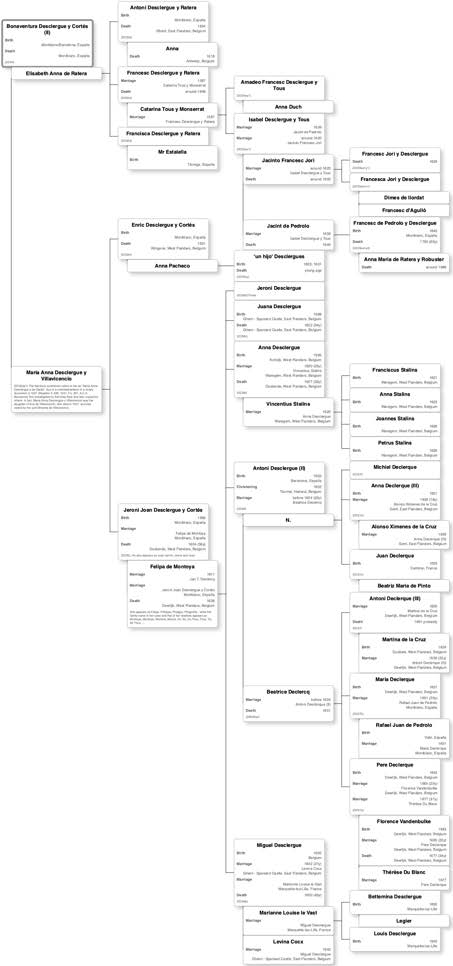
28.3. HIS MARRIAGE WITH ANNA (II) RATERA AND THEIR CHILDREN
337
Figure 28.3:
Three descending generations of Don Bonaventura Desclergue y Cortés (II)
(DC04).
The Desclergues of la Villa Ducal de Montblanc, 2nd ed., Omn., VOL. I
© 2024 Nico F. Declercq
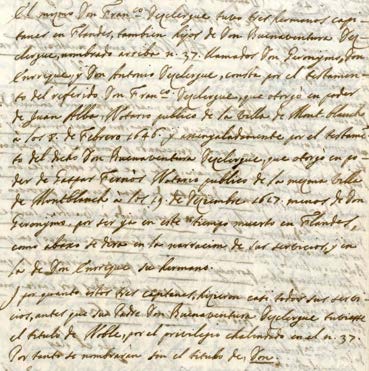
338
CHAPTER 28. BONAVENTURA DESCLERGUE (DC04) AND HIS FAMILY
Figure 28.4: This is a fragment of a handwritten ’1661 transcript of nobility
letter Francesc de Pedrolo y Desclergue’ by Francesc de Pedrolo y Desclergue,
born in 1641, son of Jacint de Pedrolo and Isabel Desclergue y Tous. (Source:
Arxiu Comarcal Urgell Desclergues document 3 page 11 view 1; Courtesy of
Arxiu Comarcal Urgell and the de Pedrolo family)
Flanders but was the heir of the family and remained in Montblanc. During difficult times, he can be considered the conservator of the famous House of Desclergue on the Main Square of Montblanc. As described in Chapter 28.3.3, the house would be inherited by his daughter’s son, Pedrolo y Desclergue, who was primarily raised by Francesc Desclergue (DC05e).
A reference of 1604 is shown in 28.8 on page 341.
He is also found in 1646 in Montblanc as a military representative in Figure 28.9 on page 341.
According to Francisco J. Morales Roca14, he is, indeed, a son of Bonaventura Desclergue y Cortés (DC04). He was a nobleman and appeared, authorized by the Brazo Militar, in the Corts in 1599, 1626, and 1640.
Francesc Desclergue y Ratera (DC05e) married Catalina Tous y Monserrat. The couple had two children, Amadeo Francesc Desclergue y Tous (DC05ey1) and Isabel Desclergue y Tous (DC05ex1). The latter married first Jacinto Francesc Jori and later Jacint Pedrolo. From the marriage with Jacint de Pedrolo, Francesc de Pedrolo y Desclergue (DC05ex1y2) stemmed. He is described in Chapter 28.5.
In what follows, we focus on Francesc Desclergue’s (DC05e) care of his assets, such as the casa Desclergue in Montblanc.
Desclergue also offered loans to his colleague Clemente Estallés to gain money. He also had an additional mill, called Dalt, in the Parellada15.
The other way to earn money was to obtain benefits from leasing his farmland. Some lease contracts have even been preserved.
For instance, he leased to the honorable Jaime Cabesa and his son Juan the piece of land called ’la sort llarga’ in ’la partida de la Parellada,’ dyad of the Divendres y Disapte, and the piece Magença, in ’la huerta del Dijous,’ for four years (from 1633 until 1636), at a rate of 22 pounds per year16.
Pere Salvany and Jaime Salvany, wool weavers, leased from him the pieces of land close to the San Jordi area, starting from Parellada, dyad of Dijous, for four years, for the amount of 20 pounds per year17.
To Salvador Capdevila, he leased the land of the Dimecres, located in the Vinyols, for four years and 40 pounds per year18.
To José Ferigola, master of Seo de Montblanc, he leased the land he owned in ’la huerta del Disapte,’ in the Parellada area, where Desclergue had other properties, for four years at a rate of 10 pounds and ten annual salaries (total 42 pounds) payable on the day of the festival of All Saints19.
To Juan Vidal, ’peraire,’ he leased the land called ’lo Quadro’ in the Parellada for four years for 7 pounds per year20.
To Juan Gavaldá, ’peraire,’ he leased a piece of land he had in ’la huerta del Disapte,’ in the Parellada, for four years for the amount of 5 pounds and ten salaries each year21.
To Tibau, a farmer, he also rented a land he owned in the Parellada, close to Baix’s mill, for 7 pounds a year22.
While taking care of increasing family assets, Francesc Desclergue (DC05e) tried to improve his patrimony by acquiring estates near or right next to some of his properties. For instance, in 1633, he bought, for 20 pounds, a demolished house and patio of 6 steps wide and 25 long, from the widow of Gaspar Perera (doctor of Medicine of Montblanc), through the intermediary of priest Carlos 14Francisco J. Morales Roca, ’Próceres habilitados en las Cortés del Principado de Cataluña, siglo XVII: 1599-1713, Volume 2,’ Ediciones Hidalguia, 1983.
15Manual Notarial. 3 514 (1623) 15 abr. A. H. P. Tarragona.
16Manual Notarial. 3 517 (1632) 13 sept. A. H. P. Tarragona.
17Manual Notarial. 3 517 (1632) 13 sept. A. H. P. Tarragona.
18Manual Notarial. 3 517 (1632) 13 sept. A. H. P. Tarragona.
19Manual Notarial. 3 517 (1632) October 10 A. H. P. Tarragona.
20Manual Notarial. 3 517 (1632) October 10 A. H. P. Tarragona.
21Manual Notarial. 3 517 (1632) October 10 A. H. P. Tarragona.
22Manual Notarial. 3 517 (1632) October 10 A. H. P. Tarragona.
© 2024 Nico F. Declercq
The Desclergues of la Villa Ducal de Montblanc, 2nd ed., Omn., VOL. I
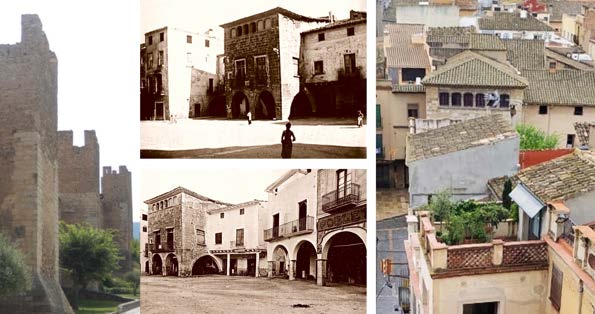
28.3. HIS MARRIAGE WITH ANNA (II) RATERA AND THEIR CHILDREN
339
Figure 28.5: Left, we see the walls and towers of Montblanc (2018)(Declercq de Silva Archive). In the middle, two old photos show the Main Square of Montblanc with the House of Desclergue p. Right, we have a view of the Casal dels Desclergue from the Church Santa Maria la Mayor, on September 8, 2020 (Courtesy of Maria Teresia Aluja Tarrago).
Jener, along the road to Arrabal, right next to his mill.
On February 8, 1646, Francesc Desclergue (DC05e) made a testament in which he appointed Vicente Requesens, plebian of Montblanc, Pere Forés, rector of Vimbodí and José Ivorra as his legatees. For himself, he arranged to be buried in the side chapel of the Nativity of the Monastery of San Francesc, just outside Montblanc. The tower of the Church of Sant Francesc de Montblanc is shown in Figure 28.10.
In his testament, he remembered his servants Sansón Ribera and Maria, Pere Toralló’s widow, bequeathing a portion of his wheat and wine to them.
28.3.1.2 Life and traits as a lawyer
On pages 179-180 of ’URTX índex onomàstic Personatges històrics’ , we find:
’Desclergue, Francesc: VII, 66, 67, 68, 69.’
We can also cite:
’Desclergue, Francesc de. Jurista de gran prestigi i personalitat, doctor en drets civil i canònic, assessor del veguer de Montblanc Francesc de Castellví (1627); assessor del batlle de Sarral (1635) i advocat, assessor i procurador del monestir de Poblet durant molts anys (1640). Arribà a ocupar el càrrec de veguer de Montblanc (1624). En testament de 8 de febrer de 1646 disposà ser enterrat a l’ església de Sant Francesc de Montblanc,’
in the work of Josep Maria Grau i Pujol and Francesc Badia i Batalla23.
Francesc Desclergue (DC05e) outlived all his brothers in the 17th century. He was a highly active individual who significantly expanded the family’s holdings. Demonstrating considerable acumen, he effectively utilized neglected lands for profit. He staunchly defended his property and rights through all available legal avenues and was a highly esteemed figure in his profession.
On August 1, 1587, he married Caterina Tous y Monserrat, daughter of Francesc Tous and Joan Monserrat, of Montblanc, before the notary Joan Toldrà.
He was a Squire and was a Doctor of Laws. He was the advisor to Francesc de Castellví, the veguer of Montblanc.
More precisely, he studied law in Lleida, and soon after his wedding, on August 27, 1587, he obtained a Doctor of Laws degree in the Estudi General. For his education, he was sponsored by the gentleman Francesc de Ratera from Lleida, possibly an uncle or his maternal grandfather.24
As a jurist, he soon became a man of prestige and good relations, which allowed him, on February 15, 1595, to be appointed as the legal advisor to the county of Prades and the barony of Entença. On February 6, 1598, the position was reconfirmed when the Duke of Cardona appointed him as the judge for all his territories and, therefore, the said county and barony. The appointment was that the Duke requested the administration of finances, wheat, and other essential matters, such as education in the villages and towns of the county of Prades, be examined by experienced and trustworthy people.
The Brazo Militar authorized him in the Corts of the Principality of Catalonia in 1599. He was summoned by letter dated in Barcelona on May 25.25
On January 15, 1600, he was granted powers to take responsibility
’for all registrations, from the Prades County as well as from the baronies of Entenza, to observe, to visit, to recognize and to overlook the inquisitors’ processes in the mentioned locations.’
Besides, because of the ’confidence that we have always had,’ he was nominated as Prades’ county treasurer26.
We also find him as a notary in a document used in Valentí Gual Vilá’s work.27
23Josep Maria Grau i Pujol and Francesc Badia i Batalla, ’Diccionari biogràfic històric de Montblanc (1155-1920), Fundació Martí l’ Humà. Tot Conca.
Carrer Josa, 6, Montblanc, 2008.
24Arxiu Comarcal de Tàrrega, Fons Pedrolo, sign. top. 6.
25Arxiu Comarcal de Tàrrega, Fons Pedrolo, Fons Pedrolo, sign. top. 6.
26Arxiu Comarcal de Tàrrega, Fons Pedrolo, Fons Pedrolo, sign. top. 52.
27Valentí Gual Vilá, ’Poblet i vimbodí. Senyor i vassalls. Una Mostra de conflictivitat al segle XVII’ , Aplex de Treballs (Montblanc) 20 (2002), 95-112, Centre d’ Estudis de la Conca de Barberà.
The Desclergues of la Villa Ducal de Montblanc, 2nd ed., Omn., VOL. I
© 2024 Nico F. Declercq
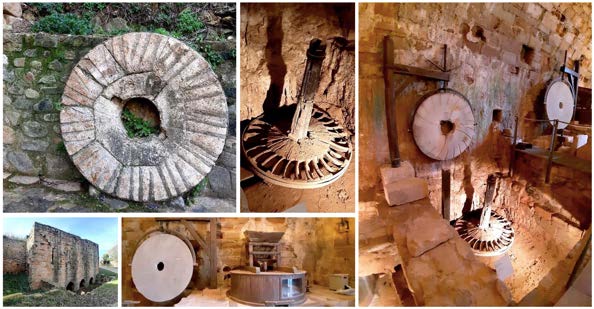
340
CHAPTER 28. BONAVENTURA DESCLERGUE (DC04) AND HIS FAMILY
Figure 28.6: Remains of watermills (Xiquet and Volta, ’Molins de la vila de Montblanc’) outside the town of Montblanc (Courtesy of Joaquim Parés Pubil , ’Ramper’). The functioning of Spanish watermills differs from others in that water streams flow into the building. Then, the hydraulic force is transferred by pouring the water jet on a horizontally spinning rotor, whose vertical shaft is connected to a millstone a few meters higher, on which one can produce the flower. The crane to handle the millstones is also typical for these sophisticated systems. The reader can find more details in Toni Pujol, Jordi Solà, Lino Montoro, Marc Pelegrí, ’Hydraulic performance of an ancient Spanish watermill,’ Renewable Energy 35 (2010) 387-396.
On May 15, 1604, he became a member of the military deputy for the Vegueria of Montblanc.28
Economically, his status was excellent. In 1607, he bought, for 60 pounds, a fenced garden located in the orchard of Vinyols, the dyad of Dijous, which was bounded on the east by the road that went to the Pontarró and on the south by a ditch.29
’. . . hortum parietibus circum clausum situm in termino dicte ville Mointisalbi, in horta de Vinyols... in diata del Dijous... ad oriente cum itinere.. del Pontarro, a mediodia cum sequia. . . .’
In the work of Salvador J. Rovira i Gomez30, we find: ’From Jeroni de Armengol and Cardona, the tenth baron of Rocafort, we can only say that on December 12, 1608, he gave to Mn. Gaspar Luna, representative of Montblanc, two-thirds of the capital of 300
pounds of the census that he owed to Lord Francesc de Desclergues of Montblanc.’
He also appears as a legatori in the testament of Jaume Figuerola, as can be found, for instance, in the work of Gener Gonzalvo i
We also find him as being called, in 1611, ’Sir’ or ’Mossèn’ Desclergues of Montblanc (’mossèn Desclergue de Montblanc’) on page 86 of Vealenti Gual Vilà’s work.32 The title ’Mossèn’ is a typical Catalan and Crown of Aragon expression. Indeed, in the work of Fernando Sánchez Miret33, we find, on page 210,
’afirma, amb raó i a diferència de Coromines, que Don s’ useva en persones només de gran categoria - I ndica també com l’ aparició de mossén al XIV farà que en es quederà per al baix estament i mossèn per a clergues34, nobles i cituadans.’
It means that, starting from the 14th century, the title ’Don’ was mainly used for the high nobility, while the title Mossèn was more used for Squires, Burgers and even clergy.
In 1614 Francesc Desclergue bought for 1125 pounds a flour mill with two millstones, called the Trullols mill, which was located near the wall. This mill had been owned by doctor Onofre Trullols, whose widow Jerónima (married in a second marriage with Jacobo Fontanilles, a merchant) had given it to his son Francesc Fontanilles, who was the seller:35
’..totum illum molendinum farinerium cum duabus molis duabus sequiis, bacia et cum corrali sive horto coram dicto molendino..
dictum lo moli del metje Trullols, situm iuxta menia dicte ville Montisalbi...’
He also participated in the political life of Montblanc, which is why, in 1616, he was entitled to the position of the first jury.36
The community of Santes Creus recognized his capacity as a professional in legal affairs. It appointed him as an advisor and ordinary judge of all the monastery’s jurisdictions, with an annual 20-pound allowance.37 It is in such capacity that, in May 1620, he represented the Gaià monastery before the Royal Hearing against the marriage of Baget, who did not want to pay the third that corresponded to the sanctuary for the transfer of the ’Mas de en Plana.’ 38
In 1622 the Desclergue couple loaned 80 pounds to their colleague, Clemente Estallés.39
As a lawyer, he was an advisor to the veguer Francesc de Castellví.40
In 1624, he bought for 88 pounds from the widow of businessman Andreu, a house with a corral located on the street called Vilanova 28Arxiu Comarcal de Tàrrega, Fons Pedrolo, Fons Pedrolo, sign. top. 6, f. 25v.
29Manual Notarial. 3 512 (1607) November 26 Archivo Histórico Provincial (A.H.P.) Tarragona.
30Salvador J. Rovira i Gomez, ’Notes d’ arxiu sobre els Armengol, barons de Rocafort de Queralt’ , Cenre d’ Estudis de la Conca de Barberà, 110.
31Gener Gonzalvo i Bou, ’El Testament de Jaume Figuerola, prohom hospitaler de l’ Espluga de Francoli (1608)’ , Podall, 2015.
32Vealenti Gual Vilà, ’Sobre llibres de cort. les piles, edat moderna.’
33Fernando Sánchez Miret, ’Actas del XXIII Congreso Internacional de Lingüística y Filología Románica. Volume II: Sección 3: sintaxis, semántica y pragmática. Part 1’ , Walter de Gruyter GmbH & Co KG, 2015.
34clergues, here, means clergy
35Manual Notarial. 3 510 (1614) 10 abr. A.H.P. Tarragona.
36Arxiu Històric de Tarragona, Fons notarial de Montblanc, reg. 3547, s/f.
37Arxiu Comarcal de Valls, Fons notarial de Montblanc, reg. 256, p. 193v.
38Elisabeth Baldor, El monestir de Santes Creus des del primer abadiat quadriennal a la guerra dels Segadors (1619-1641)(Valls, Consell Comarcal de l’ Alt Camp 1999), 72 i 158.
39Manual Notarial. 3 514 (1623) 15 abr. Archivo Histórico Provincial (A.H.P.) Tarragona
40Manual Notarial. 3 522 (1622) 3 mayo. Archivo Histórico Provincial (A.H.P.) Tarragona.
© 2024 Nico F. Declercq
The Desclergues of la Villa Ducal de Montblanc, 2nd ed., Omn., VOL. I
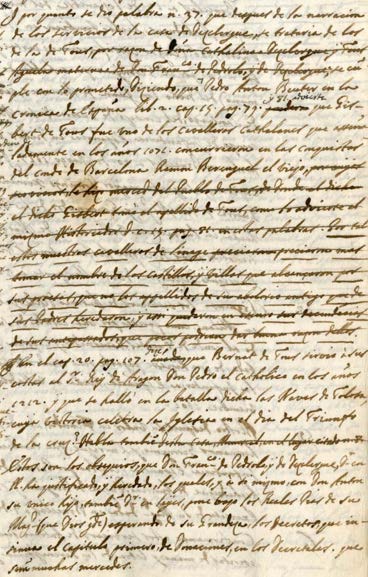
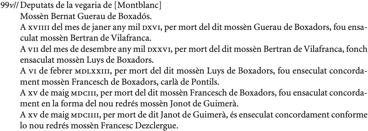

28.3. HIS MARRIAGE WITH ANNA (II) RATERA AND THEIR CHILDREN
341
Figure 28.7: This is a fragment of a handwritten ’1661 transcript of nobility
letter Francesc de Pedrolo y Desclergue’ by Francesc de Pedrolo y Desclergue
(born in 1641, son of Jacint de Pedrolo and Isabel Desclergue y Tous). It’s a
narrative on the traits of the family Tous, which has been a reason, in addition
to the military career of the brothers of Francesc Desclergue, to offer him a
noble title ’Don’ . (Source: Arxiu Comarcal Urgell Desclergues document 3
page 15 view 1; Courtesy of Arxiu Comarcal Urgell and the de Pedrolo family)
Figure 28.8: Francesc Desclergue in Montblanc in 1604.12
Figure 28.9: Francesc Desclergue in Montblanc as military representative in
The Desclergues of la Villa Ducal de Montblanc, 2nd ed., Omn., VOL. I
© 2024 Nico F. Declercq
342
CHAPTER 28. BONAVENTURA DESCLERGUE (DC04) AND HIS FAMILY
Figure 28.10: An aerial photo taken of the tower of the
Sant Francesc convent. Right, the tower of Sant Miquel
rises, while left, the Church of Santa Maria de Mont-
blanc. Courtesy of Ignasi Baltà and Jaume Vila Vives.
del Mercadal, which is adjacent in the east to the home of Desclergue, in the south to the road that goes from Mercadal street to the Church of San Miguel, in the west to Mercadal Street, and in the north to the house of the said buyer and part with that of the widow Boscha:41
’. . . in vico dicto de Vilanova del Mercadal affrontatur ab oriente cum dicto emprendi a meridie cum vico quo tenditur a dictí vico del Mercadal ad ecclesiam Sancti Michaelis, ab occidente cum vico del Mercadal et a circio partem cum domo dicto empreuis et partem cum domina viuda Boscha. . . ’
He was authorized by the Brazo Militar in the Corts of the Principality of Catalonia in 1626.42
We also find him in the work of Jesús Villanueva.43 He said he had a good friendship with Francesc de Castellví and Peguera, who, on May 3, 1627, made a brotherhood for him to purge a table for the Veguer’s office, and while in charge, he was the consultant.44
On May 15, 1628, he was tightly empowered by the military branch of la Junta de Braços.45
In 1629, he was a lawyer at the monastery of Poblet, and still, in 1640, he took care of some legal affairs of the community. His fees were 25 pounds per year.
As a legal professional, he was a lawyer, advisor, and procurator of the Royal Monastery of Poblet for many years.46
In May 1630, he also appeared in documents.47
In the 1630s, we also find him acting as an agent of the monastery of Poblet, with an annual salary of 25 pounds.48
He knew how to defend his rights, which a couple of speaking episodes can show:
In 1616, Francesc Desclergue demonstrated his capabilities when the Montblanc Council decreed that all grain in the town could only be milled at the local mills. As the owner of two mills, this decision adversely affected his interests. Determined to defend himself, Francesc took the matter to court, especially since the royal attorney also sought contributions from properties previously registered as the King’s. This situation impacted him as one of his mills, Trullols, was a royal mill.
In 1629, another dispute arose when Castlà Carles de Calders demanded payments from the Castellani. On September 7, Francesc sought resolution from the veguer, Francesc de Castellví, with the notary Alba present to record the proceedings. Francesc acknowledged the potential rights Calders might have over his property but stated that he lacked the inherited titles to accept the property burdens formally. Consequently, the Castlà decided to consult his lawyer.
Two days later, Francesc faced the royal attorney again, who insisted that the Trullols mill was regal property. Francesc was ordered to pay 79 pounds—41 for the due censuses and 28 for additional costs.
Detailing this episode, on June 12, 1616, the Censejo de Montblanc decreed that all grain should be milled at the town’s mills.
Francisco Desclergue (DC05e) opposed this decision as it harmed his interests as a mill owner, a right he was entitled to defend.
According to Palau and Dulcet, the town argued that they facilitated the collection and milling of wheat, a service not provided by private mills.
This litigation coincided with another issue. The Royal Procurator demanded that all properties formerly belonging to the King be registered and taxed. Montblanc resisted, citing a charter by Enrique de Trastámara, which exempted them from such payments.
After extensive investigations, Judge Jerónimo Pujades of Catalonia acquitted them on May 11, 1618. Francesc Desclergue played a pivotal role in opposing the town’s milling mandate and the Procurator’s claim that his mill, once belonging to Onofre Trullols, was royal property.
In 1629, the royal claim was renewed, this time targeting private individuals. Montblanc required Francesc Desclergue (DC05e) to settle the censuses owed to the town based on his property titles. On September 7, a meeting at the veguer Francesc Castellví’s house included participants like Hortensio de Castellvi, Luis Guanter, Francesc Desclergue, and Carlos de Calders y Villafranca, with notary Juan Alba documenting the event. Francesc expressed willingness to acknowledge the censuses but insisted on seeing the property rights documentation before accepting any claims. Lacking his inherited titles from his father, Bonaventura Desclergue (DC04), Francesc was told the Castlà would seek legal counsel from Clemente Estallés, the veguer’s adviser.
Francesc maintained connections with Santes Creus until 1631, when Dr. Ciprià Fernós succeeded him in Montblanc, likely on 41Manual Notarial. 3 514 (1624) 25 ener. Archivo Histórico Provincial (A.H.P.) Tarragona.
42F. J. Morales, Próceres, I:218.
43Jesús Villanueva, ’El debat sobre la constitució de l’ observança a les corts catalanes de 1626-1632’ , Manuscrits, nr 13, Gener 1995, 247-272.
44Arxiu Històric de Tarragona, Fons notarial de Montblanc, reg. 3522, p. 290v.
45Dietaris, V:234
46Manual Notarial. 3 516 (1629) 28 marzo, 17 junio, y 10 agosto. Archivo Histórico Provincial (A.H.P.) Tarragona.
47Arxiu Comarcal de Tàrrega, Fons Pedrolo, Fons Pedrolo, Llibre Major, f. 123.; and also Arxiu Històric de Tarragona, Fons notarial de Montblanc, reg. 3517, p. 167; reg. 3520, p. 34.
48Arxiu Històric de Tarragona, Fons notarial de Montblanc, reg. 3524, pp. 97v i 104.
© 2024 Nico F. Declercq
The Desclergues of la Villa Ducal de Montblanc, 2nd ed., Omn., VOL. I
28.3. HIS MARRIAGE WITH ANNA (II) RATERA AND THEIR CHILDREN
343
his recommendation. Despite the royal pressure, Francesc used his legal expertise and influence to defend himself. His persistence paid off in 1637 when the courts rejected the royal attorney’s claim. In 1640, the courts ruled against the municipality, allowing inhabitants to mill grain at private mills again. Notably, 1640 was also when Antoni Desclergue (DC06), son of Jeroni Joan Desclergue y Cortés (DC05), visited Montblanc, as detailed in Chapter 34.5.11.
In 1632, Gaspar Torrella, a Montblanc resident, sought Francesc’s legal services to represent him before the Generalitat. On June 11, 1619, he appeared before the mayor general in this capacity.
As a legal professional, Francesc was procurator of the veguer Gaspar Torroella.49.
At the end of 1633, he worked for the Duke of Cardona, then Viceroy of Catalonia.
As a lawyer he was also advisor to Sarreal.50
When, later, during the War of the Reapers, Montblanc remained in the French camp, Francesc had nothing much to worry about, partly because he was the counsellor of the Count of Savallá. Still, on September 23, 1642, he had to undergo the fury of the soldiers of the Spanish army of the Marquess of Leganés, passing through Montblanc towards the front of Lleida, who sacked and burned the ancestral home, which therefore became uninhabitable.
Being already of considerable age and faced with the warlike circumstances surrounding him, he decided to make a will on February 8, 1646. He declared his grandson and godson, Francesc Jacinto de Pedrolo y Desclergue (DC05ex1y2), as his heir.51 Francesc Jacinto de Pedrolo y Desclergue is described in Chapter 28.5.
Furthermore, Santiago Alberti52 provides the following information on Francesc Desclergue (DC05e):
’Francesc Desclergue inherited his father’s substantial holdings in Montblanc. Among these assets was a magnificent house located on the Plaça Major, considered one of the most desirable locations in the entire city. Additionally, he possessed several parcels of land and a once-profitable mill, although its productivity had declined over time. The year 1626 proved particularly challenging due to a severe water shortage that halved grain production, leading to significant disputes involving all the mills in Montblanc. The city council imposed regulations mandating that milling must be conducted at municipal mills rather than private ones to increase public revenue. This decree was met with widespread opposition from private mill owners and the general population. In a rare show of unity, they collectively filed a lawsuit against the municipality.
Francesc Desclergue, one of the litigants, took on the case as a lawyer and emerged victorious. Testimonies from the lawsuit revealed that professional millers estimated the Desclergue mill owed an annual fee of approximately 90 pounds. While this sum was not crucial to Francesc’s overall wealth, it was significant enough to warrant a robust defense. Due to the declining profitability of his mill, Francesc dismissed his 16-member household staff and increasingly focused on his legal profession. His expertise as a jurist ensured he could maintain his livelihood. Furthermore, Francesc’s marriage to Caterina de Tous was a strategic alliance, aligning him with a noble and well-connected family.’
’At the end of 1633, Francesc Desclergue provided notable assistance to the royal lieutenant in the Principality, the Duke of Cardona.
Despite being exempt from the obligation to billet troops due to his noble and legal status, Desclergue accommodated five soldiers in his home. He asserted that, as a servant of the county of Prades, he could not overlook the necessity of housing these soldiers, even though he was officially exempt from such duties.
This action earned him a favor, sanctioned by the mayor of Montblanc and supported by legal counsel. As a result, Desclergue was appointed as an advisor to the Vicar Cardona and subsequently to his successor, the Count of Santa Coloma, in the ensuing years. ’53
There are letters addressed to Francesc Desclergue by H.M. King Philip IV (September 7) and the Duke of Cardona (November 5
and December 28). The last one is interested in granting Desclergue the legal advisory of Montblanc for a fair and fixed salary.
Competent and justly reputed, Francesc became the adviser of the same royal lieutenant or Viceroy, the Duke of Cardona. He would also continue under his successor, the Count of Santa Coloma.
Then, in 1639, his only remaining daughter Isabel (DC05ex1) married Jacinto de Pedrolo in Montblanc. Antoni Desclergue (DC06), as described in Chapter 34.5.11, attended the wedding. Unfortunately, his new son-in-law would soon die, and Isabel would be a pregnant widow. Isabel was consequently warmly welcomed to live in Montblanc and have her child there. The child, Francisco de Pedrolo y Desclergue (DC05ex1y2), would be raised mainly by Francesc during his youth. The child was baptized on January 30, 1640, and Francesc was the grandfather and served as godfather. Francisca Desclergue (DC05d) y Ratera, described in Chapter
28.3.3, served as the godmother.
In the wake of the War of Separation, Francesc Desclergue does not seem to have had headaches for being the adviser of the last two Spanish lieutenants, who were killed in 1640. His role had indeed not been political. With Montblanc being located on the French side until the end of the new conflict in 1652, Desclergue also appears as an adviser to the count of Savalla, a prominent Frenchman.
Nevertheless, having had three brothers in the Spanish army in Flanders and a nephew, Antoni Desclergue (II) (DC06), still active as a military officer at that time, Francesc had other reasons to fear the French besides his personal and professional involvement with the Spanish in the years before.
From the work of Santiago Alberti, we must conclude that in 1640-1652, the Desclergues of Montblanc and the ones in Belgium must have been disconnected. In Chapter 34.9, the reader can find that Antoni Desclergue II (DC06) revisited Montblanc in 1659
and would become godfather to Antoni de Pedrolo, the first-born son of Francisco de Pedrolo y Desclergue (DC05ex1y2).
We may also add that Anton Ratera, ’presbiter, Rector et notarii publici ville Spelunce Francolini’ (L’ Espluga de Francolí, is close to Montblanc) was an acquaintance, if not a friend, of Francesc Desclergue (DC05e). This can be found in the work of Gener Gonzalvo i Bou.54 It is therefore likely that Ana Ratera was the daughter of this Anton Ratera.
28.3.2 Don Antoni Desclergue y Ratera (DC05b)
He was the son of Don Bonaventura Desclergue y Cortés (DC04) and Anna Ratera. He went to Belgium in the Spanish Army of Flanders with his brothers Jeroni and Enric. Chapter 32 is devoted to him.
49Manual Notarial. 3 517 (1632) mayo. Archivo Histórico Provincial (A.H.P.) Tarragona.
50Manual Notarial. 3 519 (1635) 18 nov . Archivo Histórico Provincial (A.H.P.) Tarragona.
51Arxiu Històric de Tarragona, Fons notarial de Montblanc, reg. 3547, s/f.
52Santiago Alberti, ’Esquema històric del llinatge Pedrolo’ , page 49 – 88 of URTX Revista Cultural de l’ Urgell, Num 7, 1995.
53Arxiu Comarcal de Tàrrega, Fons Pedrolo, Fons Pedrolo, sign. top. 52.
54Gener Gonzalvo i Bou, ’El Testamant de Jaume Figuerola, prohom hospitaler de l’ Espluga de Francolí (1608)’ , Podall 2015.
The Desclergues of la Villa Ducal de Montblanc, 2nd ed., Omn., VOL. I
© 2024 Nico F. Declercq
CHAPTER 28. BONAVENTURA DESCLERGUE (DC04) AND HIS FAMILY
28.3.3 Doña Francisca Desclergue (DC05d) y Ratera
She was the daughter of Don Bonaventura Desclergue y Cortés (II) (DC04) and Anna (II) Ratera. On pages 179-180 of URTX
índex onomàstic Personatges històrics, we find:
’DESCLERGUE, Francesca (—-): VII, 68.’
There is not much known about her. She married a Mr Estalella, from Tarrega, whose father was forced to create a census of 100
pounds with Mn. Pere Aliart, in Tarragona, to pay for the dowry. We also know that she became the godmother of Francesc de Pedrolo y Desclergue (DC05ex1y2), the son of her niece Isabel de Desclergue (DC05ex1).
28.3.4 Doña Isabel/Elisabeth Desclergue y Tous (DC05ex1) - First Marriage, with Jacinto
Francesc Jori
She is the daughter of Don Francesc Desclergue (DC05e) and Catalina Tous y Monserrat. On pages 179-180 of URTX índex onomàstic Personatges històrics, we find:
’Desclergue, Isabel (noble): VII, 60, 65, 66, 68, 69.’
Isabel Desclergue (DC05ex1) married Jacinto Francesc Jori, a Civil and Ecclesiastical Law doctor, around the end of the 1620s.
Only one daughter, Francesca Jori y Desclergue (DC05ex1x1), and one son, Francesc Jacint Jori y Desclergue (DC05ex1y1) (who would die young), were born from the Jori-Desclergue couple. Isabel Desclergue (DC05ex1) married a second time to Pedrolo in 1639 (their children had the name Pedrolo y Desclergue), exposed in Chapter 28.3.5.
Francesca Jori y Desclergue (DC05ex1x1), being the daughter of Dr. Jacint Francesc Jori and Isabel Desclergue y Tous (DC05ex1) became the heiress of Jacinto Francesc Jori, after he had made a testament to the notary Joan Lluna, which occurred after his son Francesc Jacint Jori y Desclergue (DC05ex1y1) had died in 1629.55
Francesc Jori was Lord of the Pareres and the castle of Bolet in the veguería of Villafranca del Panadés, diocese of Barcelona.56
Francesca Jori y Desclergue (DC05ex1x1) would also have been the heiress of her mother, Isabel Desclergue y Tous (DC05ex1), the only descendant of Francesc Desclergue (DC05e) and, therefore, the owner of all the heritage of Desclergue. Still, Elisabet married Jacint Pedrolo in second place, which is why the inheritance of Desclergue was passed to Francesc de Pedrolo y Desclergue, who died around 1700.
In 1547, some lands were registered down in the ’toçalet d’ en Jori ,’ in the direction of Lleida road.57
Also around this time is a reference to a farmer Francesc Jori and Pere Jori, who reside in Barcelona. He was the son of Matías
In the notarial manuals are references to Francesc Jori with authorizations to collect debts, and others.596061
Francesc Jori died in October of 1629.6263
Being a textile merchant, Jacinto Francesc Jori appeared well-established in Montblanc in 1604.64 In his store, the personalities of the town were supplied.65
Clemente Jori was the nephew of Juan Jori, a merchant, who died in Lleida and made a will before Blas Pons in August in 1631.66
Francisca Jori y Desclergue (DC05ex1x1) had an influential position because of her possessions and profession. In 1627, the Jori couple held a benefit under Saint James’s patronage in the parish church of Villafranca del Panadés. This benefit, which Jacobo Armengol used, presbyter of Valls, passed to a nephew of Isabel Desclergue (DC05ex1) called José Vicente Jusea, a tonsured cleric, a student of Montblanc.67
Shortly after the marriage of Jori-Desclergue (DC05ex1), they bought, in 1632, for 47 pounds, the part of the land that Francesc Grangyo, presbyter, had in the area of Gras, in the direction of Pascuala, and that extended to the Pi Forcat, and that had as limit the lands of Bernardo Fort, at the portal of San Antonio.68
Jacinto Francesc Jori lived in the street of Riber or the one of the Regina, since in 1632 when locating to a house, one says, in the street of Riber and that is adjacent, by an arch, to the home of Jacinto Francesc Jori, and in the street of Regina.69
There are some citations regarding Jori’s professional performance as a Lawyer. The most curious is the one that refers to the proceedings and sentence issued at the request of Pablo Queralt of Cabra in the criminal case against Juan Tapiol and Juan Closet, sentenced to death. He was collecting information for twenty-four days and charged 32 pounds.
28.3.5 Doña Isabel/Elisabeth Desclergue y Tous (DC05ex1) - Second Marriage, with Jacinto
Pedrolo
Isabel Desclergue (DC05ex1), the daughter of Don Francesc Desclergue (DC05e) and Catalina Tous y Monserrat, married, a second time, to Jacinto de Pedrolo, a Squire, in 1639.
Gener Gonzalvo y Bou70 describes an archive that contains a lot of information about Desclergue and, in particular, the family Pedrolo and Pedrolo y Desclergue. On page 172 of his work, he focuses on the Pedrolo family of Montblanc. There, we can find:
’Jacinto de Pedrolo married, in 1639, with Isabel Desclergue (DC05ex1). Soon, her husband Jacint Pedrolo died, and in 1640 was born, already in Montblanc, Francesc de Pedrolo y Desclergue, in times of great agitations.’ It explains why Isabel Desclergue (DC05ex1) decided to reside in Montblanc, close to her family, which means Valls’ abandonment and a loss of connection with the Pedrolo family.
55Manual Notarial 3 523 (1629) 13 nov. Archivo Histórico Provincial (A.H.P.) Tarragona.
56Manual Notarial 3 523 (1628) 12 jul. Archivo Histórico Provincial (A.H.P.) Tarragona.
57Manual Notarial 3 504 (1547) Archivo Histórico Provincial (A.H.P.) Tarragona.
58Manual Notarial 3 506 (1548) 5 y 27 oct. Archivo Histórico Provincial (A.H.P.) Tarragona.
59Manual Notarial 3 522 (1626) 28 ag. Archivo Histórico Provincial (A.H.P.) Tarragona.
60Manual Notarial 3 523 (1628) 2 abr. Archivo Histórico Provincial (A.H.P.) Tarragona.
61Manual Notarial 3 523 (1629) 1 marzo. Archivo Histórico Provincial (A.H.P.) Tarragona.
62Manual Notarial 3 518 (1629) 30 ag. Archivo Histórico Provincial (A.H.P.) Tarragona. On this date he was alive...
63Manual Notarial 3 523 (1629) 23 oct. Archivo Histórico Provincial (A.H.P.) Tarragona. On this date, he had already died...
64(Manual Notarial 3 511 (1604) Archivo Histórico Provincial (A.H.P.) Tarragona
65Manual Notarial 3 523 (1630) 9 ener. Archivo Histórico Provincial (A.H.P.) Tarragona.
66Manual Notarial 3 525 (1631) Fol. 122 v. Archivo Histórico Provincial (A.H.P.) Tarragona.
67Manual Notarial 3 517 (1631) September 2 Archivo Histórico Provincial (A.H.P.) Tarragona.
68Manual Notarial 3 517 (1632) 12 marzo, Archivo Histórico Provincial (A.H.P.) Tarragona.
69Manual Notarial 3 517 (1632) Fol. 406 v. Archivo Histórico Provincial (A.H.P.) Tarragona.
70Gener Gonzalvo y Bou, ’Fons documentals de Montblanc a l’ Arxiu comarcal de Tàrrega’
© 2024 Nico F. Declercq
The Desclergues of la Villa Ducal de Montblanc, 2nd ed., Omn., VOL. I
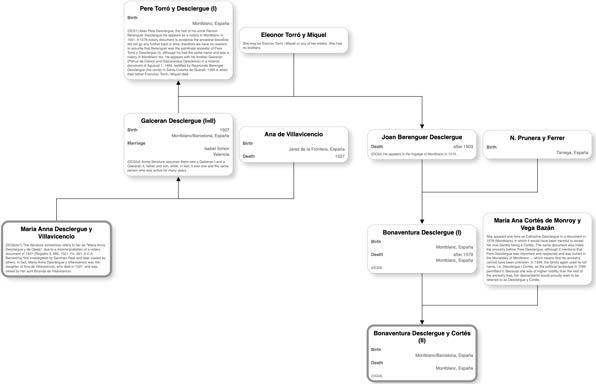
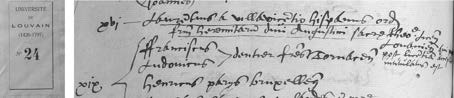
28.4. MARRIAGE WITH MARIA ANNA DESCLERGUE Y VILLAVICENCIO AND CHILDREN
345
Figure 28.11: Relationship between Maria Anna Desclergue (DC02dx1) y Villavicencio and Bonaventura Desclergue (II) (DC04) y Cortés
Figure 28.12: Lorenzo de Villavicencio (’Hispanus’) appears as a student on October 15, 1557
in the registers of the Catholic University of Leuven.
We find, indeed, that Francesc Jacinto de Pedrolo y Desclergue (DC05ex1y2) was born from this union in 1640.71
Isabel Desclergue (DC05ex1) made a will on December 9, 1641, shortly before her death.
It seems that Jacinto Pedrolo was also a widower since, in 1656, Francesc Desclergue (DC05e) cites Rafael de Pedrolo and Moxo, son of Jacinto de Pedrolo, Squire, and Maria de Pedrolo. This Rafael de Pedrolo would therefore be the stepbrother of Francesc (DC05ex1y2). The relationship is confirmed by the fact that when he made his will, Rafael de Pedrolo ordered that he be buried in the first chapel on the left, in the church of the monastery of San Francesc de Montblanc, precisely where Francesc Desclergue (DC05e) also had arranged his burial spot.
Also, Rafael’s testament was ’sagellat ab les armes de Don Francesc Desclergue.’ Therefore, it contained, as a notary seal, the arms of Don Francesc Desclergue (DC05e).
The Desclergue-Jori (DC05ex1) families stayed indeed in a good relationship. Francesc Desclergue (DC05e) was negated as procurator by the widow of Jori72. Also, Jacinto Francesc Jori received on some occasions amounts owed to his father-in-law,73 and Francesc Desclergue gave them amounts owed to him.74
Evidently, there was a remarkable mutual understanding between the parties involved.
28.4 Marriage with Maria Anna Desclergue y Villavicencio and Children
Maria Anna Desclergue (DC02dx1) y Villavicencio was a daughter of Galceran Desclergue (I=II) (DC02d), a second cousin of Bonaventura Desclergue (II) (DC04) y Cortés and Ana de Villavicencio, as shown in Figure 28.11. Because both parents had the same name, the children took their father’s full name, Desclergue y Cortés, preserving the illustrious ’Cortés’ in their name.
The children born from this marriage were Jeroni Joan Desclergue y Cortés (DC05) (our ancestor), and Enric Desclergue y Cortés (DC05c).
It can also be found that ’Mariana Dezclergue’ , was ’esposa de Bonaventura Dezclergue’ in the paragraph
’Francesc Picaire (1603), médico. Testigo en la venta de una viña, realizada por Mariana Dezclergue, esposa de Bonaventura Dezclergue, 22 agosto 1603. Protocolo del año correspondiente. A.P. de Montblanc,’
in Jose Sanchez Real’s book.75 This ’Mariana’ was indeed Maria Ana (DC02dx1), the daughter of Galceran Desclergue (I=II) 71Testamento de Francesc Desclergue (DC05e). Véase nota 67.
72Manual Notarial 3 517 (1632) November 22 Archivo Histórico Provincial (A.H.P.) Tarragona.
73Manual Notarial 3 518 (1634) 23 ener. Archivo Histórico Provincial (A.H.P.) Tarragona.
74Manual Notarial 3 516 (1629) 21 dic. Archivo Histórico Provincial (A.H.P.) Tarragona.
75Jose Sanchez Real, ’Médicos y cirujanos de Montblanc, Siglos XV-XVIII’ , page 159.
The Desclergues of la Villa Ducal de Montblanc, 2nd ed., Omn., VOL. I
© 2024 Nico F. Declercq

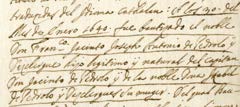
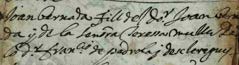
346
CHAPTER 28. BONAVENTURA DESCLERGUE (DC04) AND HIS FAMILY
Figure 28.13: This is a fragment of a handwritten text ’Notes relatives ales gestes
militars del llinatge Desclergue’ , by Francesc de Pedrolo y Desclergue (born in 1641,
son of Jacint de Pedrolo and Isabel Desclergue y Tous). It shows that Francesc de
Pedrolo y Desclergue was the only child of Jacint de Pedrolo and that he was born
in 1640, on January 30, in Montblanc. (Source: Arxiu Comarcal Urgell Desclergues
document 2 page 1 view 1; Courtesy of Arxiu Comarcal Urgell and the de Pedrolo
family)
Figure 28.14:
This is a fragment of a handwritten
’1659 short description of the Desclerges by Francesc de
Pedrolo y Desclergue’ (born in 1641, son of Jacint de
Pedrolo and Isabel Desclergue y Tous) (Source: Arxiu
Comarcal Urgell Desclergues document 4 page 2 view 1;
Courtesy of Arxiu Comarcal Urgell and the de Pedrolo
family)