

The Desclergues of la Villa Ducal de Montblanc, Second Edition Omnibus by Nico Declercq - HTML preview
Download the book in PDF, ePub, Kindle for a complete version.
However, Raimond Borrell’s ambitions were curtailed by mortality, as he breathed his last in 1017, leaving behind a legacy of political sagacity and cultural resurgence. His offspring, including Berengar-Raimond I, continued the legacy of the Borrell lineage, steering Catalonia through the tides of history.
The Borrell ancestry is intertwined with Toulouse’s legacy, forging a lineage that endured the vicissitudes of time. From Borrell II’s patronage of intellect to Raimond Borrell’s geopolitical maneuvers, the Borrells left an indelible mark on Catalonia’s history, illuminating the path of progress and resilience in the face of adversity.
© 2024 Nico F. Declercq
The Desclergues of la Villa Ducal de Montblanc, 2nd ed., Omn., VOL. I
18.12. GUILLERMO DESCLERGUE, THE SON OF FRANCESC DESCLERGUE
143
18.11.3.5 Ermessenda, the consort of Ramon Borrell
This section is added for the reader interested in enigmatic historical figures. Ermessenda emerges as a central figure in the annals of Catalonia and Girona during the tumultuous 11th century, her life and legacy intertwined with the shifting tides of power and authority. Born in 972, she would eventually wield influence as consort and regent, leaving an indelible mark on the political and cultural landscape of her era.
At the tender age of 17, Ermessenda entered into matrimony with the Count of Barcelona, Ramon Borrell, thus initiating a partnership that would define her role in governance. Together, they embarked on a journey marked by military campaigns against the Saracens, navigating the treacherous waters of civil war in the Caliphate of Córdoba. Despite facing formidable adversaries, their joint efforts yielded significant military and economic triumphs, laying the foundation for their shared rule over the counties of Barcelona, Girona, and Osona.
Following the untimely demise of her husband in 1058, Ermessenda assumed the mantle of regent, guiding her son through the turbulent waters of minority rule. Her tenure as regent was characterized by astute governance and unwavering resolve, as she navigated the challenges posed by external tensions and internal strife. In the face of feudal revolution and familial discord, Ermessenda exhibited intelligence, skill, and a steadfast commitment to her principles.
Her regency spanned decades, marked by numerous disagreements and power struggles, particularly with her son Berenguer Ramon I and grandson Ramon Berenguer I. Yet, Ermessenda’s resolve remained unyielding, her loyalty to her principles unwavering until the twilight of her days. Ultimately, faced with the prospect of surrendering control to her grandson, she made the difficult decision to sell the estates of the three counties, a testament to her unwavering commitment and principled stance.
Ermessenda’s legacy extends beyond the realm of governance, encompassing significant contributions to the Catholic Church and cultural heritage. Through her patronage, she facilitated the construction of the Cathedral of Girona and the Monastery of Sant Daniel, ensuring the preservation of pieces of great historical and material value for posterity.
In retrospect, Ermessenda’s life serves as a testament to the resilience and fortitude of women in medieval Europe, her legacy enduring as a beacon of strength and leadership in the face of adversity. Through her intelligence, determination, and unwavering commitment to her principles, she left an indelible mark on the history of Catalonia and Girona, shaping the destiny of generations to come.
18.11.4 Bernat Desclergue, the Son of Francesc Desclergue
He was the son of Francesc Desclergue, in Chapter 18.11, and the brother of Guillermo Desclergue, described in Chapter 18.12.
On the orders of Guillem Borrell, his grandson Bernat Desclergue, son of Francesc Desclergue, became a Benedictine monk at the monastery of Sant Pere de Rodes in Girona and was then named abbot of the Benedictine monastery of Sant Benet de Bages.
His father, Francesc Desclergue, gave the goods to the Order of Sant Benet. The documents show that there was a problem with these goods. Indeed, it seems that they were late in delivering it in full, which is why the Order of Sant Benet filed a legal claim against the family.
18.12 Guillermo Desclergue, the Son of Francesc Deslergue
He was the son of Francesc Desclergue, in Chapter 18.11, and the brother of Bernat Desclergue, described in Chapter 18.11.4.
In the historical context of 1308, mentioned in Chapter 18.13, Guillermo Desclergue, akin to his progenitor Francesc Desclergue, was apprehended alongside fellow members of the Templar Order during the widespread arrests targeting Templars. This event substantiates Guillermo Desclergue’s affiliation with the Templar Order, a legacy inherited from his father Francesc and grandfather Ramón. Notably, the familial entanglement in this ordeal extends to encompass all male members of the Desclergue lineage.
Legal proceedings ensued promptly following their apprehension, culminating not in capital punishment or physical torment, but in the imposition of exile and forfeiture of assets. King James of Mallorca orchestrated a swift and clandestine implementation of exile, compelling the Desclergue family to seek refuge in Aragon, where the punitive measures against Templars were comparatively lenient. Within the Catalan domain of Aragon, the displaced Mallorcan Templars found sanctuary through the patronage of two influential noble families, namely the Queralt and the Cervelló, both deeply entrenched within the Templar network.
Subsequent to a period of settlement and stabilization in Aragon, Guillermo Desclergue, along with other Templar affiliates, endeavored to reclaim a portion of their confiscated wealth through legal recourse, particularly before the court of King Sancho of Mallorca. However, these efforts proved ineffectual during Sancho’s reign, necessitating protracted litigation that ultimately found resolution under the governance of Pedro IV. It was during Pedro IV’s reign that the Desclergue lineage, along with other Mallorcan Templar families, achieved a partial restitution of their real estate holdings, unencumbered by commercial or legal entanglements with the defunct Templar Order.
18.13 The Trial of the Templars in 1307
The trial of the Order of the Temple stands as a significant international legal event of the 14th century. Initiated in 1307 by the French monarchy, the Order of the Temple faced a barrage of allegations, including charges of heresy, simony, sodomy, and idolatry.
This episode assumes critical importance due to its intersection with a religious military order and its implication in the power struggle between King Philip the Fair of France and Pope Boniface VIII.
Commencing on the ominous date of Friday, October 13, 1307, the trial culminated in the issuance of the papal bull "Considerantes dudum" by Clement V on May 6, 1312. Notably, it concluded with the execution of the order’s Grand Master, Jacques de Molay, at the stake on either March 11 or 18, 1314. Subsequently, the assets of the Order underwent dispersal over the ensuing years.
Of particular note are two significant events in this process: the recognition of the Order of Montesa in the Kingdom of Aragon by Pope John XXII through the papal bull ’Ad fructus uberes’ on June 10, 1317, and the acknowledgment of the Order of Christ in the Kingdom of Portugal on March 14, 1319. These events underscore the far-reaching ramifications of the trial and its enduring impact on the ecclesiastical and geopolitical landscape of medieval Europe.
From 1308 onward, the Desclergues and other Templar families in Mallorca were protected and welcomed by two very powerful noble families who had had great ties and relationships with the Order of the Temple, the Queralts and The Cervelló, who were less affected by the debacle of the Templars, thanks to a certain consideration on the part of the Royal House of Aragon in times of misfortune for the Order of the Templars.
The Desclergues of la Villa Ducal de Montblanc, 2nd ed., Omn., VOL. I
© 2024 Nico F. Declercq
CHAPTER 18. OUR DESCLERGUE ANCESTRY
18.14 The Desclergues Emigration from Mallorca to Aragon in 1382
In 1382, the Desclergues, a notable family from Mallorca, made a significant migration to Aragon, marking a pivotal moment influenced by economic conditions and political turmoil. Their decision to relocate was rooted in a series of economic and political factors that shaped the landscape of trade and governance in the region during the late 14th century.
Prior to their migration, the Desclergues enjoyed positions of prominence in Mallorca, allowing them to weather economic downturns to a certain extent. However, the economic stability of Mallorca began to wane, particularly after 1349, as a consequence of various factors, including the fiscal policies of reformer Berenguer de Abellá and the military actions of Pedro IV against James III.
The attractiveness of Barcelona as a destination for merchants increased following the Cortes of 1333, when Alfonso III implemented measures to alleviate the tax burden on merchants. Despite these changes, Mallorca remained economically viable until the latter half of the 14th century. However, the economic crisis precipitated by Berenguer de Abellá’s reforms led to a mass exodus of merchants from Mallorca to cities such as Barcelona and Valencia.
The Desclergues, prominent figures in Mallorcan society as merchants, bankers, and notaries, possessed extensive commercial networks, social connections, and familial relationships in Barcelona due to their professional engagements. Constantly engaged in travel, contractual negotiations, and business transactions, they maintained an active lifestyle, seldom remaining fixed at their residence in Mallorca. Given the island’s significance as a hub for trade, Mallorcan merchants were compelled to navigate a competitive marketplace, fostering numerous commercial and interpersonal alliances.
Following the 1307 trial of the Templars, the Desclergues, despite their residency in Mallorca, confronted severe repercussions stemming from the dissolution of the Templar Order. Consequently, in 1308, all their assets on the mainland, and possibly some in Mallorca, were confiscated. Subsequently, upon the subsiding of these tumultuous events, they endeavored to reclaim their seized properties, albeit with uncertain prospects of success. It was not until the reign of Peter IV of Aragon and the reconquest of Mallorca that they managed to retrieve the remaining assets, owing to the protective patronage extended to former Templars by the Crown of Aragon.
Upon their complete relocation to the mainland after 1382, the Desclergues severed ties with Mallorca indefinitely, marking the conclusion of their association with the island—a chapter definitively closed in the annals of their history.
For the Desclergues clan, the decision to migrate to Barcelona in 1382 was a strategic response to the deteriorating economic conditions in Mallorca. It was a collective endeavor, with the entire family relocating together, leveraging their diverse skills and professions to support each other. Among them were bankers, merchants, jurists, priests, and notaries, whose combined expertise contributed to their success in Barcelona.
The decline of Mallorca from 1349 onwards can be attributed to the military actions of Pedro IV against James III. Following a series of conflicts and confrontations, Pedro IV declared James III guilty of charges brought against him in 1343. Subsequently, Pedro IV invaded Mallorca, culminating in the defeat of James III’s troops at Santa Ponsa. This victory enabled Pedro IV to assert control over Mallorca and expand his dominion to include Roussillon. James III’s subsequent attempts to regain power, including an attack on Mallorca in 1349, ultimately ended in his defeat and death in the battle of Lluchmayor.
18.15 Pere Desclergue, the Son of Guillermo Desclergue
Pere Desclergue was the son of Guillermo Desclergue, described in Chapter 18.12.
He appears as a witness in the minutes of a session of the General Council of Tàrrega, near Barcelona and Santa Coloma de Queralt, in which it is decided how to finance the work on the walls, on April 27, 1369.34
Pere’s son was Geronimo Desclergue, described in Chapter 18.16. His other children, Berenguer and his daughter, are described in Chatper 18.15.1 and Chapter 18.15.2, respectively.
18.15.1 Berenguer, the Son of Pere Desclergue
Berenguer was the son of Pere Desclergue and he resided in Granyana in 1358.35
18.15.2 N. Desclergue, the Daughter of Pere Desclergue
N. Desclergue was the daughter of Pere Desclergue and she married Guillem D’Anguera, described in Chapter 25.0.1.6. She is also described in Chapter 25.0.1.8.
18.16 Geronimo Desclergue, the Grandson of Guillermo Desclergue
He was the son of Pere Desclergue, described in Chapter 18.15, and the grandson of Guillermo Desclergue, described in Chapter
18.12. In 1358, he resided in Bellmunt, near Montserat and Girona.36 He was a merchant. By the year 1391, Gerónimo Desclergue, a native of Mallorca, was a resident of Santa Perpetua de Moguda. near Barcelona.
Geronimo Desclergue had a sister, N. Desclergue, who married a military, Guillem D’Anguera. She is described in Chapter 18.15.2
and Chapter 25.0.1.8.
Geronimo Desclergue belongs to the generation that returned from Mallorca to Aragon because the economic and political situation deteriorated too much in Mallorca.37
34"Acta d’una sessió del Consell General de Tàrrega en què es decideix com finançar l’obra dels murs," 1369, abril, 27 (AHCT LP III 80r; SARRET
261-262) (trasllat de 1369, juny, 11), Tàrrega, transcribed in Max Turull Rubinat i Jaume Ribalta Haro, "De Voluntate Universitatis, La Formació I 1.
Expressió de la voluntat del municipi" (Tàrrega, 1214-1520), p. 220.
35item 164, Suma dels fochs de Granyena LXXVI, p. 370 in J. M. Pons Guri, "un fogatjament desconegut de l’any 1358."
36Suma dels fochs de Bellmunt XI, p. 414, item 85 v. Listed in J. M. Pons Guri, "un fogatjament desconegut de l’any 1358." He also appears on p.
165.
37It is conceivable that other persons carrying the name Clergue equally arrived in Mallorca, who were not noblemen. Their history is different as they were less attached to their family name and allowed it to evolve into Quecles, nowadays a common family name on the Balearic islands. The phenomenon is described in Antoni Mas Forners and Joan-Luis Monjo Mascaró, "La Mallorquinització onomàstica a la València del segle XVII. L’aportació de la vila de Santa Margalida",2002, ISBN 84-95802-16-3, págs. 119-144.
© 2024 Nico F. Declercq
The Desclergues of la Villa Ducal de Montblanc, 2nd ed., Omn., VOL. I
18.17. RAMON DESCLERGUE, THE SON OF GERONIMO DESCLERGUE
145
One of the descendants of Guillermo Desclergue, was Pere Desclergue, a priest. Jaume Sobrequés i Callicó writes,38 "The Chancellor of Enrique IV of Castile orders, on February 1, 1463, priest Pere Desclerga, of Santa Perpétua to provide information on whether Beltrán de Armendáriz had promised, when attacking the castle of Santa Perpétua, in Penedés, to respect the property of Guerau Alemany de Cervelló and Elionor de Montagut, widow, castellan of said castle, and if he had kept his promise. He orders that Elionor’s assets not be returned to her, but rather that they be held hostage until something is decided in justice."
18.17 Ramon Desclergue, the Son of Geronimo Desclergue
Ramon Desclergue was the son of Geronimo Desclergue, described in Chapter 18.16. He was named after his patrilineal ancestor Raymond Desclergue, described in Chapter 18.10. His son was Francesc Desclergue, described in Chapter 18.18.
18.18 Francesc Desclergue, the Son of Ramon Desclergue
He is also mentioned in Chapter 19.15.5.
Francesc Desclergue was the son of Ramon Desclergue, described in Chapter 18.17.
He was married to the daughter of Bernat D’Anguera, alias Desclergue, and their sons were Brenguer Desclergue, described in Chapter 18.19, and Francesc Desclergue, junior.
He was notary of Barcelona, who played a role for the Bank of Barcelona on march 28, 1443, as shown in Figure 19.23 on page 189.
18.19 Berenguer Desclergue, the Son of Francesc Desclergue
His father was Francesc Desclergue, described in Chapter 18.18. He is also described in Chapter 25.0.1.4.
He started his career as scriptor in Santa Coloma de Queralt in 1417.
He was a man of the law and in 1439 he held the position of local deputy of Montblanc and its ward, which he resigned on January 26, 1440. He must have been well connected with the courtly circles, since, on October 5, 1451 and from Tudela, the infant Joan, Duke of Montblanc, appointed him general curator of the Duchy of Montblanc.
Berenguer Desclergue was the father of Clementa Desclergue, described in Chapter 18.20, and Ramon Berenguer Desclergue, described in Chapter 25.0.1.2.
18.20 Clementa Desclergue, the Daughter of Berenguer Desclergue
In Chapter 25.0.1, the brother of Clementa Desclergue is described, Ramon Berenguer Desclergue, in Chapter 25.0.1.2, while her ancestors through her grandmother’s side, D’Anguera, equally descending from Raymond Desclergue, are equally outlined. She equally appears in Chapter 25.0.1 and Chapter 20.6.2.
She married Royal Secretary Francesc Torró y Miquel, described in Chapter 20.6.1. The ancestry of her husband is described in Chapter 20.
Clementa Desclergue’s father was Berenguer Desclergue, described in Chapter 25.0.1.4 and in Chapter 18.19.
18.21 The Settlement in Montblanc
The settlement of the Desclergues in Montblanc is elucidated in Chapter 21. However, it is crucial to acknowledge that their residency in Monblanc did not confine them solely to that locale. Instead, the Desclergues maintained multifaceted engagements in various regions, including Barcelona, Cervera, Lleida, Granvera, Balaguer, Manresa, and Sevilla. This dispersion underscores the expansive network of familial affiliations that the Desclergues cultivated beyond the confines of Montblanc.
Moreover, the Desclergues demonstrated remarkable resilience and adaptability in their professional activities, often operating in multiple locations concurrently. This mobility was driven by the exigencies of their professions, necessitating frequent relocations.
Consequently, it was not uncommon for members of the Desclergue family to have children born in disparate locales, reflecting their itinerant lifestyle and unwavering professional commitments.
The Desclergues epitomized a dynamic and interconnected presence across various geographical and professional spheres, transcending the boundaries of any single settlement such as Montblanc.
18.22 Desclergues in Barcelona
18.22.1 Benedicto Desclergue in Barcelona
We also find ’El Padre Maestro Fray Benedicto Desclergue fue hombre de grande gobierno, hijo del Convento de Santa Catarina Martyr de Barcelona,’ on page 88 of Historia de la antiqva Hibera, Written by Francesc Martorell y de Luna, Hijo natural y Ciudadano de Tortosa, MDCXXVII (1627). No further traces of this individual have been found; therefore, his relationship to the Desclergue family remains unknown.
18.23 Desclergues in Cervera
18.23.1 Joan Desclergue in Cervera
He is most likely the brother of Bernat Desclergue, described in Chapter 25.0.1.6, and the son of Guillem D’Anguera, who was married to the daughter of Pere Desclergue. He is mentioned in Cervera in the period 1341-1368.39
38Jaume Sobrequés i Callicó, "Catálogo de la cancillería de Enrique IV de Castilla, señor del principado de Cataluña: (lugartenencia de Juan de Beaumont, 1462-1464)", Editorial CSIC - CSIC Press, 1975, page 406
39Jacme dez Clergue, in Xavier Rivera Sentís, "Un capbreu del monestir benedictí de Sant Pere el gros: 1341-1368", Miscel·lània Cerverina 19 (2009) 75-128, p. 115, item 37v.
The Desclergues of la Villa Ducal de Montblanc, 2nd ed., Omn., VOL. I
© 2024 Nico F. Declercq
CHAPTER 18. OUR DESCLERGUE ANCESTRY
18.23.2 Joan Desclergue in Cervera & Barcelona
He is most likely a descendant of Bernat Desclergue, described in Chapter 25.0.1.6.
There is a Joan Desclergue appearing as preserver of a hospital, namely,
’[Li]ber primus infirmarie Ospitalis [Sanct]e Crucis presentis civitatis inceptus per Thomam Soldevila, presbiterum, nunc dicti Ospitalis infirmarium [. . . ]’4041
The reference to Joan Desclergue, the preserver, is also found in ’AH 2 1473, maig 1-1479, desembre 30. Barcelona ,’ of the Brochure published by the Biblioteca de Catalunya42.
In a record of 1472, Joan Clergues, presbyter of Cervera, and his sister Joana, widow of Antonio Carnicer de Granyena (Lleida), are mentioned43.
His son was most likely Geronimo Desclergue, decribed in Chapter 18.23.3.
18.23.3 Geronimo Desclergue in Cervera & Barcelona
He is most likely a descendant of Bernat Desclergue, described in Chapter 25.0.1.6, who was the son of Guillem D’Anguera and N. Desclergue, the daughter of Pere Desclergue, described in Chapter 18.15. Presumably, he was the son of Joan Desclergue, in Chapter 18.23.2.
In the book ’La Casa Desclergue de Montblanc’ , authored by Jose Sanchez Real44, the author refers to,
’Pere Costa: Nobiliario Catalán, Siglo XVIII, Manuscrito 153, Pago 214.,’ and,
’Desclergas. Esta familia fué domiciliada en Barcelona, en donde se acabó la linea varonil; las memorias que de ella hallo son que en el año 1503, Geronimo Desclergas se hallava Veguer de Cervera por el Sr. Rey de España y Archiduque de Austria Don Felipe I.
Consta de un mandato expedido en 19 de julio de dicho año en la Curia de Cervera, en las escrituras de Matheo Magre, en donde se lee que esta familia de Desclergas eran Cavalleros Donzeles.,’ or,
’Desclergas. This family was domiciled in Barcelona, where the male line was finished; the memories that I find are that in the year 1503, Geronimo Desclergas was Veguer de Cervera (Vigerius of Cervera, or Lord of Cervera) by H.M. the King of Spain and Archduke of Austria Don Felipe I. It consists of a mandate issued on July 19 of that year in the Curia of Cervera, in the writings of Matheo Magre, where it is read that this family of Desclergas were Cavalleros Donzeles (i.e. Knights).’
The descendants of Geronimo Desclergue have died out. We also find Geronimo Desclergue in a list of nobles of the year 1458, who have received a noble title by Felipe II in the Corts de Barcelona, where Geronimo Desclergue appears, on page 241 (Libro XIX
Cap XIV), in Anales de Catalunya y Poilogo Breve de Los Progressos Contiene los svcessos del Ano 1458. Published in 1709 by Juan Pablo Marti. This Geronimo should not be confused with the later Gerónimo Desclergue y de Amat (DC02dy2y1) appearing in Figure 26.6 on page 293 in Chapter 25.1.3.3.
18.24 Desclergues in Lleida
18.24.1 Antich Desclergue in Lleida
We retrieve an Antich Desclergue, in the book ’Mestrescoles i rectors de l ’Estudi General de Lleida (1597-1717)’ , by Francesc Esteve i Perendreu, where on page 44 we find: ’On the 25th day the rector appeared at the House of the Mestrescolia (the School Rector) and, in front of the Mestrescolia and the presence of Francesc Baffart, professor of laws; Josep Galino, chaplain, Antich Desclergue and Miguel Sallent, addressing the Mestrescolia said: ’If he had ripped off the sign and broken it into pieces, he did not do it in disrespect of the Lord or the Apostolic authority. Therefore it should be forgiven’ after which the Mestrescolia has forgiven it.’
Antich Desclergue also appears on the Faculty and Rectors of ’Estudi General de Lleida (1597-1717). Note that ’another’ Antich Desclergue, related to Manresa/Barcelona, also existed. Because we are not sure if they were, in fact, the same person or not, we have separated both entries.
18.25 Desclergues in Granvena
18.25.1 Gabriel Desclergue in Granvena & Lleida
Bernardo Desclergue (DC04b), presbyter (dead in 1490), son of Gabriel Desclergue, an inhabitant of Granyena (Lleida), appears in a handwritten will in the Historical Archive of Protocols of Barcelona45. Joana, daughter of Gabriel Desclergue, would marry Antoni Carnicer de Granyena.
40Biblioteca de Catalunya, Topogràfic: BC AH 2, Número de Registre: 10830, Dates: 1473, maig 1-1479, desembre 30. Barcelona. Contingut: Llibre d’
entrades de malalts de l’ Hospital de la Santa Creu. Els assentaments recullen les dades següents (de forma incompleta): nom, professió, edat, procedència, pertinences i díxits; al marge: cambra de l’ Hospital on ingressa, incidències (data de la mort o sortida, restitució de pertinences) i diners. Dut per Tomàs Soldevila, prevere i infermer de l’ Hospital; Joan Desclergue, prevere (f. 10).
41Gabriel Aguaço, prevere i infermer (f. 41); Pere Olzina, prevere i infermer (f. 73).
42Fons Hospital de la Santa Creu de Barcelona (documents conservats a la Biblioteca de Catalunya), Arxiu, Biblioteca de Catalunya, Reis Fontanals –
Maria Toldrà, 31 d’ octubre de 2012 , [Última actualització: 24 octubre de 2013].
43Registro 3 459 (1472) Fol. 41 v. A.C.A. Barcelona. This note and the others obtained from the exact file has been provided to Sanchez Real by Mercedes Costa.
44Jose Sanchez Real, ’La Casa Desclergue de Montblanc’ , published in 1974 by Caja de Ahorros Provincial, Tarragona; deposito legal B IVa.P.665 -
1974 and printed by Graficas Lorente, Ciudad 13, Barcelona 2, Spain.
45Notary’s Handbook of Marco Busquets (1463-1490); Historical Archive of Protocols of Barcelona.
© 2024 Nico F. Declercq
The Desclergues of la Villa Ducal de Montblanc, 2nd ed., Omn., VOL. I
18.26. DESCLERGUES IN VERDÚ-TÀRREGA
147
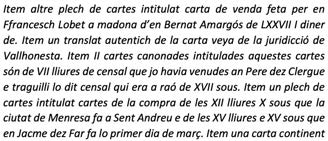
Figure 18.16: Pere Desclergue, appear-
ing in an inventory in Manresa, in 1410.
Citation from Josep Batlle i Costa, "La
famíla Amargós a través dels seus llibres
particulars", Els Tretze Llibres de la Nis-
saga dels Amargós (Manresa 1299-1438),
Annex 8. Inventari de Bernat Amargós
Marit d’Alamanda de Copons, p. 109.
18.26 Desclergues in Verdú-Tàrrega
18.26.1 Balaguer Desclergue in Verdú
Josep Xavier Muntané santiveri46 describes the existence of a couple, Balaguer Desclergue and Arsenda, in Verdú, near Tàrrega.
On January 13, 1393, in the district of Verdú, a noteworthy transaction47 involving a vineyard in the Tàpies d’en Llanera took place, which had a significant bearing on Balaguer Desclergue (’Balaguer deç Clergue,’ ’Balaguer des Clergue’) and his wife Arsenda (sic, and ’eius uxori na Aseno’). The property, bordering lands owned by Pere Bufraganyes and Pere Pereguiam as well as the public road of Ciutadilla, was sold by Blanca Bonanada along with her son Pere Merles and his wife Dolça to Pere Barba of Verdú for 40 sous. A critical aspect of this sale was the stipulation that a continuing census payment of 3 sous was to be made to Balaguer Desclergue and Arsenda in honor of Sant Marc. This arrangement highlights the ongoing financial and social influence that Balaguer and Arsenda held in the region, reflecting their status and the economic dependencies woven through such land transactions during that period.
18.27 Desclergues in Tarragona
18.27.1 Benet Desclergue in Tarragona
We find Desclergue Benet in 1549 as prior dominic de Tarragona in Josep Torné i Cubells, ’Catàleg de Pergamins de l’ actual arxiu del monestir de Poblet’ .
18.28 Desclergues in Balaguer
18.28.1 Bonaventura Desclergue in Balaguer
We found, for the town of Balaguer (near Leida), a Bonaventura Deç Clergue in the period 1211-1352, on pages 141 and 145 in Moisés Selfa, ’About the concept of onomastic identity: The privileges’ parchments of the city of Balaguer (1211-1352)’ , Imago TemporIs. medIum aevum, VIII (2014), 135-149.
18.29 Desclergues in Manresa
18.29.1 Pere Desclergue in Manresa
Pere Desclergue was intricately involved in various transactions and possessions related to Bernat Amargós and his household in Manresa in 1410. The inventory, referred to in Figure 18.16 on page 147, reveals a detailed list of items ranging from mundane household goods to significant documents and valuable possessions. Pere Desclergue appears to have been engaged in several financial dealings and exchanges with Bernat Amargós, evident from the numerous letters of purchase and sale mentioned in the inventory. Pere Desclergue was a creditor, as indicated by the letter of order detailing a debt owed to Bernat Amargós by Pere Anglada de Prats. Additionally, Pere Desclergue had purchased or had been involved in the transfer of various census allowances, with specific mentions of transactions involving Livres, Sous, and other monetary units. These transactions reflect his economic ties and investments in the region.
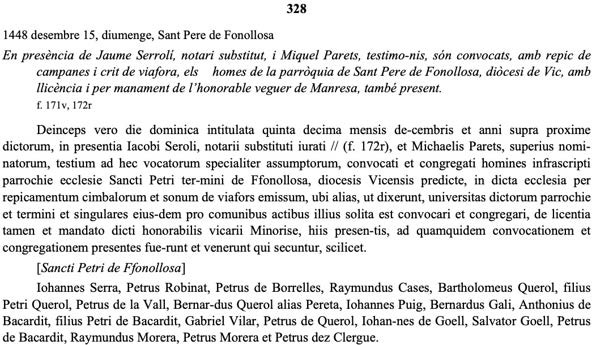
In the document in Figure 18.17 on page 148, we find a text with a narrative revolving around a gathering of individuals from the parish of Sant Pere de Fonollosa, within the diocese of Vic, convened under the authority of the Veguer of Manresa. This assembly, which took place on December 15th, 1448, is described as being attended by various members of the community, as well as notaries and witnesses. Among those listed as present at the assembly is one individual named Pere Desclergue (’Peter dez Clergue’). While the text does not explicitly detail the role or significance of Pere Desclergue, his inclusion among the assembled individuals suggests that he held some degree of importance within the community or was involved in the proceedings taking place at the church. It is possible that he held a position of leadership or authority within the parish, or that he was personally involved in the matters being discussed or decided upon during the assembly.
We do not know how Pere Desclergue and two persons named Nicolas Desclergue, in Chapter 18.29.2 and Chapter 18.29.3 are related to each other.51
46Muntané Santiveri, Josep Xavier. «Ex nacione judayca ad fidem christianam moviter conversi: conversos jueus de Tàrrega i de poblacions veïnes».
Urtx: revista cultural de l’Urgell, 2020, Núm. 34, p. 63-111, item 12.1
47in APV, 110.4, Manual notarial (1392-1393), f. 37r-v.
51It is, however, remarkable that around 1500, there was a family in Kortrijk, with whom the Desclergues of Montblanc would marry, where there was also a tradition of naming their sons Nicolas Declercq. If we allow wild speculation, we could assume a possibility that the Declercqs of Kortrijk, described in Chapter 34.13, who married the Desclergues, were, in fact, descendants of Desclergues in Manresa and, therefore, related. Chapter 18.32.2 is, in this context, equally interesting. It is important to remember that Carlos V conquered Tournai from the French and returned the city to Flanders, under Spanish Habsburg reign in 1521. Undoubtedly Spanish military and administration must have settled then at Tournai. Perhaps, there were Desclergues from Manresa among them, with a prospect of establishing trade between Flanders and Aragon.
The Desclergues of la Villa Ducal de Montblanc, 2nd ed., Omn., VOL. I
© 2024 Nico F. Declercq
148
CHAPTER 18. OUR DESCLERGUE ANCESTRY
Figure 18.17: Pere Desclergue in a narrative revolving around a gathering of individuals from the parish of Sant Pere de Fonollosa, within the diocese of Vic, convened under the authority of the Veguer of Manresa on December 15, 1448.48
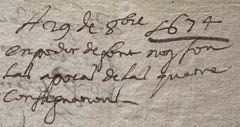
Figure 18.18: Label on a document of 1674 concerning
Nicolau Desclergue. It states "On October 29, 1674, ..."
The document itself is shown in Figures 18.19, 18.21 and
18.22. (Declercq de Silva Archive)
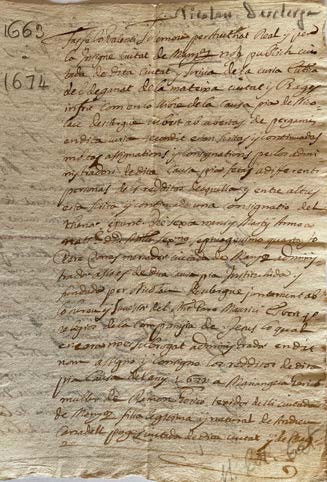
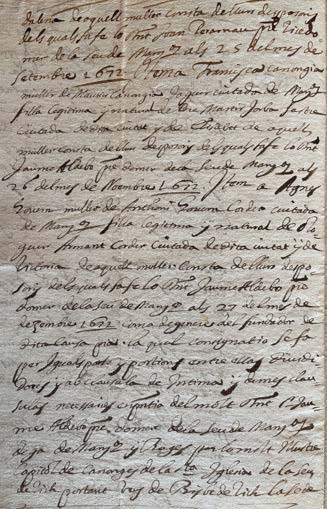
Figure 18.19: The first page of the 1674
document concerning Nicolau Desclergue.
The next page is shown in Figure 18.21.
(Declercq de Silva Archive)
© 2024 Nico F. Declercq
The Desclergues of la Villa Ducal de Montblanc, 2nd ed., Omn., VOL. I
18.29. DESCLERGUES IN MANRESA
149
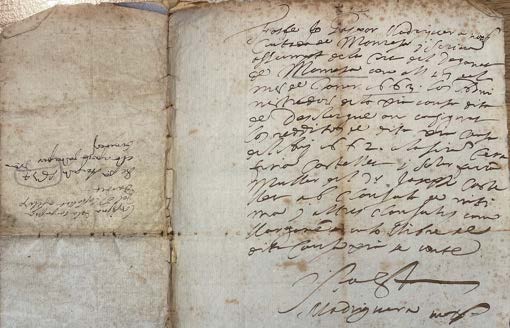
Figure 18.20: 1663, January 23, Gaspar Madrynera, notary at Manresa, in a document about Severina
Costella, the wife of Josep Gostella, and Desclergue. Possibly, it concerns Nicolau Desclergue. (Declercq de Silva Archive)
Figure 18.21:
The second page of the
1674 document concerning Nicolau Descle-
rgue. The next page is shown in Figure
18.22. (Declercq de Silva Archive)
The Desclergues of la Villa Ducal de Montblanc, 2nd ed., Omn., VOL. I
© 2024 Nico F. Declercq

150
CHAPTER 18. OUR DESCLERGUE ANCESTRY
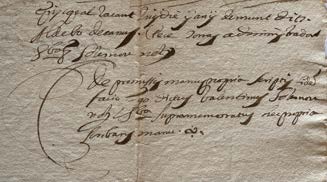
Figure 18.22: The third page of the 1674
document concerning Nicolau Desclergue.
The previous pages are shown in Figures
18.19, 18.21. (Declercq de Silva Archive)
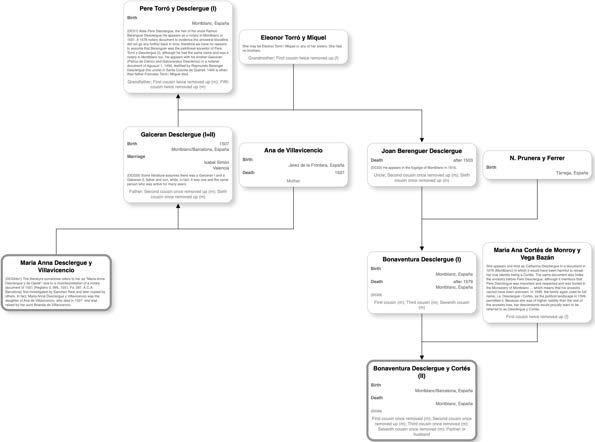
Figure 18.23: The blood connection between the parents of Jeroni Joan Desclergue (DC05), described in 29. Bonaventura Desclergue y Cortes (DC04) was married to Maria Anna Desclergue y Villavicencio. The latter was the daughter of Galceran Desclergue (DC02d) and Ana de Villavicencio.Bonaventura Desclergue y Cortes (DC04) was the son of Bonaventura Desclergue (DC03) and Maria Ana Cortes de Monroy y Vega Bazan. Both Maria Anas were of the same generation due to Galceran Desclergue’s long marital career while a merchant in Seville. The bloodbond of Jeroni Joan’s parents is a testimony of the activity of the Desclergues in Sevile and the trade established there, with the New World, through Hernán Cortés, described in Chapter 27.20.
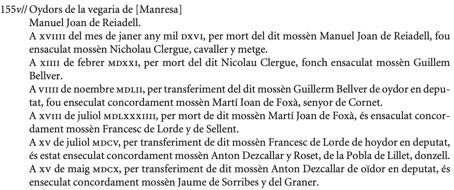
Figure 18.24: Nicolaus Desclergue pledged allegiance to His Majesty the King, on Wednesday
November 29, 1458.49
© 2024 Nico F. Declercq
The Desclergues of la Villa Ducal de Montblanc, 2nd ed., Omn., VOL. I
18.30. THE DESCLERGUES IN SEVILLA
151
Figure 18.25: Nicolas Desclergue died in Manresa, in 1521.50
18.29.2 Nicolau Desclergue (I) in Manresa
He is found as ’Mestre en medicina’ and possessed 106 lliures in the period 1490-1493 as can be read in Marc Torras i Serra, ’Les declaracions de béns dels metges i apotecaris de Manresa en el segle XV.’
Nicolau Desclergue (I) was a Knight and he died in 1521, as can be read in Figure 18.25 on page 151.
Pere Torró y Desclergue (I) (DC01), described in Chapter 25.0.2, was not only an inhabitant of Montblanc, but also Burgués Honrado of Manresa, and Trustee of Prats del Rey, in 1533. Therefore it is almost sure that the Desclergues of Manresa are blood-related. Most likely, Nicolau Desclergue (I) was his brother or his maternal cousin, while Nicolau Desclergue (II), in Chapter
18.29.2, a descendant of Nicolau (I).
18.29.3 Nicolau Desclergue (II) in Manresa
Nicolau Desclergue is a close or distant cousin of the Desclergues of Montblanc and likely descends from Nicolau Desclergue (I) in Manresa in Chapter 18.29.2. We have found an interesting document in which he appears in 1674 in Manresa. The document is shown in Figure 18.18 on page 148, Figure 18.19 on page 148, Figure 18.21 on page 149 and Figure 18.22 on page 150. The document shown in Figure 18.20 on page 149 likely also concerns him.
18.30 The Desclergues in Sevilla
The prominence of the Desclergues, among the Catalan merchants in Sevilla, is described in Chapter 25.1.3, through our ancestor Galceran Desclergue (DC02d).
The trade routes, meticulously crafted by the strategic genius of Hernán Cortés, outlined in Chapter 27.20, spanned from Mexico to Cuba, Santo Domingo, and finally Seville. His masterful endeavors precipitated a surge in commercial activities, drawing merchants from diverse corners of the Mediterranean to converge upon Seville. Here, they sought to establish thriving commercial enterprises and marriages, among them the enterprising Desclergue lineage, who left an indelible mark on Seville’s bustling mercantile landscape.
It’s crucial to recognize the challenges these merchants faced in their endeavors to export and import goods between America and the Canary Islands. In their quest for solutions, they turned to the wise counsel of Don Francisco Núñez, a luminary figure in legal circles. Don Francisco Núñez, a Doctor of Law from the prestigious University of Salamanca, served as the Relator within the Royal Council of Charles V for a significant period, from 1518 to 1545, his guidance proving invaluable in their commercial pursuits.
Interestingly, Don Francisco’s personal life was intertwined with the era’s significant figures, further bolstering his influence and network. He was the first cousin of Anna Cortés de Monroy, the father of Doña María, and a cousin-uncle to Doña María Anna, establishing deep connections within Seville’s elite. His marriage to Mrs. Isabel Rodríguez de las Varillas also played a role in solidifying his position within the upper echelons of Sevillian society.
Through the astute guidance of figures like Don Francisco Núñez, the merchants of Seville, such as the Desclergues, navigated the complex maze of international trade, laying the groundwork for enduring commercial prosperity within the burgeoning transatlantic economy of the sixteenth century.
Galceran Desclergue (DC02d), the uncle of Bonaventura Desclergue (DC03), was married to Ana de Villavicencio, whose grandfather was Ana Sánchez Cortés, the daughter of Martin Cortés de Monroy from the family of Hernán Cortés, described in Chapter 27.20.
Bonaventura Desclergue (DC03) was married to Maria Ana Cortés de Monroy y Vega Bazán, stemming from the family of Hernán Cortés. The latter couple is described in Chapter 27.
Figure 18.23 on page 150, shows the blood connection between the parents of Jeroni Joan Desclergue (DC05), described in 29.
His father, Bonaventura Desclergue y Cortes (DC04) was married to Maria Anna Desclergue y Villavicencio, Jeroni’s mother.
Maria Anna Desclergue y Villavicencio was the daughter of Galceran Desclergue (DC02d) and Ana de Villavicencio. Bonaventura Desclergue y Cortes (DC04) was the son of Bonaventura Desclergue (DC03) and Maria Ana Cortes de Monroy y Vega Bazan.
Maria Anna Desclergue y Villavicencio and Maria Ana Cortes de Monroy y Vega Bazan were of the same era. The blood bond of Jeroni Joan’s parents is a testimony of the activity of the Desclergues in Sevile and the trade established there, with the New World, through Hernán Cortés, described in Chapter 27.20.
18.31 Other Desclergues in Montblanc
Before the arrival of our patrilinear bloodline in Montblanc, introduced by Pere Torró y Desclergue (I) (DC01), described in Chapter
25 and Chapter 25, there were already Desclergues as military, under the family D’Anguera. We refer to Chapter 25.0.1.7 for more information.
The Desclergues of la Villa Ducal de Montblanc, 2nd ed., Omn., VOL. I
© 2024 Nico F. Declercq
CHAPTER 18. OUR DESCLERGUE ANCESTRY
18.32 Other Desclergues
18.32.1 Cerdana Desclergue
Cerdana Desclergue lived in Urgell in 1313-1315 and was the concubine of Raymond Emil.52. We do not know who she was.
18.32.2 Nicolaus Desclergue
Nicolaus Desclergue pledged allegiance to His Majesty the King, in Figure 18.24 on page 150, on Wednesday November 29, 1458.
We do not know who he was. There is a frequent encounter of persons, named Nicolas Desclergue, at Manresa, as shown in Chapter
18.29. We also urge the reader to read a footnote in Chapter 18.29.1.
18.32.3 Benet Desclergue
On February 18, 1549, Benet Desclergue appeared in Montblanc’s notarial document.53 The document is a historical record of land transactions and ecclesiastical permissions involving various individuals and places in Catalonia, specifically around Montblanc and the Monastery of Poblet, dating back to the 16th century. It includes references to the establishment of emphyteutic leases, a medieval legal agreement for land use, which were granted by ecclesiastical authorities to local inhabitants under certain conditions.
The document details the administrative and clerical personnel involved and the geographic scope of these transactions, spanning multiple villages and municipalities.
Benet Desclergue, as mentioned in this document, was the prior Dominic of Tarragona. His role in this context is likely that of a critical ecclesiastical authority responsible for overseeing and granting permissions for significant ecclesiastical property transactions.
This would have included approving the use and management of church lands, which in this period would have been critical given the Church’s substantial land holdings and the economic and social importance of such properties. The involvement of figures like Benet Desclergue would have been essential to ensure that such transactions were in line with the canons and regulations of the Church and that they were conducted for the benefit of the community and the Church’s interests.
It’s possible that Benet Desclergue was the brother of Bonaventura Desclergue y Cortés, described in Chapter 27, but we found no details to support this assumption.
52Josep M. Palau i Baduell, Doctoral thesis, "El bisbat d’Urgell del Segle XIV (a travas de la visita pastoral de 1312 a 1315)", 2015, University of Barcelona., records of 1313 GENER 26, 1315 GENER 30, and 1315 MAIG 3
53Josep Torné i Cubells, "Catàleg de Pergamins de l’actual Arxiu del Monestir de Poblet", Item 04.
© 2024 Nico F. Declercq
The Desclergues of la Villa Ducal de Montblanc, 2nd ed., Omn., VOL. I
The Patrilineal Ancestry along Bertrand Du Guesclin
The Desclergues of la Villa Ducal de Montblanc, 2nd ed., Omn., VOL. I
© 2024 Nico F. Declercq
Chapter 19
Bertrand Du Guesclin or Beltràn de Claquin
19.1 Introduction
Bertrand du Guesclin’s declaration, "Ni quito ni pongo rey, pero ayudo a mi señor," epitomizes loyalty and duty underpinning 14th-century feudal society. This statement, rich with historical nuance, mirrors the expectations placed upon various societal roles, including noblemen, scribes, notaries, jurors, and academics.
For noblemen, the 14th century was marked by stringent codes of chivalry and feudal obligations. Their primary duty was to their lord, a relationship underscored by personal loyalty and service in military and political arenas. Du Guesclin’s allegiance to Enrique de Trastámara is a testament to this feudal principle, where the bond between a vassal and his lord was sacrosanct and paramount, reflecting the core tenets of medieval nobility.1
Scribes and notaries, though not directly involved in declarations of political loyalty, played a critical role in the administration of justice and governance. Their responsibility was to maintain the integrity and truth of documents, which supported their societies’
legal and administrative framework. The notion of aiding a lord, as expressed by du Guesclin, aligns with their duty to ensure that records and agreements accurately reflect their lords’ rightful claims and intentions, thereby upholding social order and legal legitimacy.2
Jurors, often drawn from the local nobility or respected citizens, were expected to balance personal loyalty with broader principles of justice. While du Guesclin’s statement might suggest a bias, it highlights a common medieval dilemma: navigating personal loyalties within the framework of public duties. Jurors had to make decisions that upheld justice while also reflecting the complex web of feudal allegiances, thereby maintaining both personal and public integrity.3
Academics and scholars, somewhat removed from direct feudal conflicts, were nevertheless bound by a duty to pursue knowledge and truth. Their work often relied on the patronage of nobles, creating a dynamic where loyalty and support were crucial. The principle of aiding a lord is an extension of their duty to support societal stability and governance, facilitating the flourishing of academic and intellectual pursuits. This relationship underscores the interconnectedness of medieval society, where various roles, despite their differences, were united by underlying principles of loyalty and duty.4
In summary, du Guesclin’s statement encapsulates the essence of 14th-century feudal and societal principles. It emphasizes the importance of loyalty to one’s lord while navigating the dynamics of power and duty. This loyalty was a binding force that maintained social and political order, a cornerstone of medieval societal structure from noblemen to jurors and beyond. The overarching theme of personal service and loyalty was integral to the highly stratified and duty-bound society of the Middle Ages, ensuring cohesion and stability amid the complexities of feudal life.
The premise positing Bertrand Du Guesclin as the progenitor of the patrilineal lineage is founded on several corroborating observations.
Firstly, historical records penned by Ancient French Chroniclers assert that Du Guesclin sired descendants in Soria, who bore appellations such as ’de Touron,’ ’de Tours,’ or ’Thoreux.’ In Spanish, these names are reducible to ’de Torres’ or ’Torró,’ with the archaic rendition of ’Torró’ being ’Turró.’ Comprehensive analysis contends ’de Torres’ implausibility, favoring ’Torró’ as the probable nomenclature.
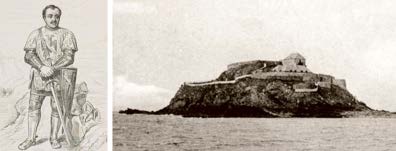
Secondly, the Desclergues of Montblanc trace their lineage back to Torró ancestry. Despite the Desclergues’ familial heritage spanning more than two millennia, historical records reveal an absence of patrilineal lineage beyond Pere Desclergue (DC01) in noble title petitions. A thorough examination of genealogical and historical data reveals Pere Desclergue’s full designation as Pere Desclergue Figure 19.1: Left is an image of Bertrand Du Guesclin (by Féron, work on paper,
date unknown, origin unknown, found at the Scottish National Portrait Gallery Print
Room, accession number UP G 239). At Saint Coulomb, right, on the Côte d’
Émeraude in Brittany, the fortress ’Le Fort du Guesclin’ is located (the photo was
taken before 1900).
1Keen, M. (1984). Chivalry. Yale University Press.
2Clanchy, M. T. (1993). From Memory to Written Record: England 1066-1307. Blackwell.
3Hyams, P. R. (1981). King, Lords, and Peasants in Medieval England: The Common Law of Villeinage in the Twelfth and Thirteenth Centuries.
Clarendon Press.
4Southern, R. W. (1986). Scholastic Humanism and the Unification of Europe. Blackwell.
The Desclergues of la Villa Ducal de Montblanc, 2nd ed., Omn., VOL. I
© 2024 Nico F. Declercq
156
CHAPTER 19. BERTRAND DU GUESCLIN
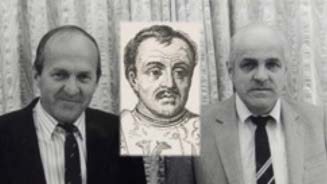
Figure 19.2: The author’s father (1941-
2015) (left) and elder uncle (1937-2007,
father of Carole) (right), to compare with
an image of Du Guesclin (middle). (De-
clercq de Silva Archive)
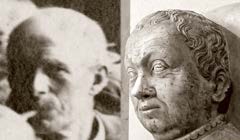
Figure 19.3:
The author’s great grandfather Ernest
Constant Declercq (left) and Bertrand Du Guesclin
(right). It’s evidence that the skull of men (not neces-
sarily the face) is dominantly inherited along the male
line. (Declercq de Silva Archive)
y Torró or Pere Torró y Desclergue. This historical reticence to trace lineage patrilineally underscores the prevalence of the name Pere Torró y Desclergue (DC01), described in Chapter 25, thereby emphasizing Torró lineage from the paternal line and Desclergue lineage from the maternal line.
Thirdly, contemporary accounts from Du Guesclin’s era record diverse renditions of his surname, some of which resemble ’Desclergue,’ as outlined in Chapters 19.26.4 and 75. This linguistic proximity suggests familiarity and acceptance among Du Guesclin’s descendants with the appellation ’Desclergue,’ substantiating its adoption within the lineage.
Fourthly, employing abductive reasoning based on critical evidence—such as Du Guesclin’s own assertion of his descent from Aquin—suggests that the Du Guesclin lineage traces back to a figure known as Desclergue. This individual, while operating under Moorish rule in Iberia, was designated as ’Hakin’ or ’Hakim,’ a title synonymous with ’Clergue,’ as explained, for instance, in Chapter 15. The swift affiliation of Bertrand Du Guesclin with the King of Aragon and the Trastamara dynasty implies a recognition and exploitation of the Desclergues’ esteemed reputation and noble lineage. This lineage, reputed for its ’purple blood,’ outlined in Chapter 17.1, traces its roots to Byzantine rule in Spanish territories, including Bougie, now part of modern-day Algeria. Such connections underscore the historical significance and the noble heritage that Bertrand Du Guesclin leveraged in his ascent.
Lastly, genetic analyses, including Y-DNA and autosomal DNA studies, shown in Chapters 19.27 and 73.10.4.3, corroborate Bertrand Du Guesclin as the patrilineal forebear of the Desclergues, providing empirical support for those mentioned above historical and genealogical conjectures.
The precise genealogy can be found in Chapter 20 and Chapter 25.
In this Chapter, we extensively study the patrilineal ancestry through Bertrand Du Guesclin by exposing and explaining all the existing evidence.
The current study ranges from historical facts to heraldry and DNA. The Y-DNA Haplogroup of the Desclergues stems from Du Guesclin, while specific autosomal DNA fractions were inherited from old families in Brittany, together with larger fractions from old nobility in Aragon and Castilla. The heraldic coat of arms of the Desclergues of Montblanc provides further evidence of this lineage.
Genetically speaking, the Desclergues have a Y-DNA Haplogroup in the branch SRY2627, typically referred to as ’Catalan DNA’ , but there is a historical explanation why Du Guesclin may have had the same DNA while he was born in Bretagne. One of several migrations from Spain to Bretagne, recorded in history, must be the reason and is described further in Chapter 19.6.
To summarise, several facts in different adjacent fields of expertise confirm that Du Guesclin is the forefather of the Desclergues of Montblanc, who constructed the house on the Main Square. At the same time, the patrilineal ancestors of Du Guesclin, must equally have been Desclergues. In what follows, we will refer to DNA analysis, the Coat of Arms and also facts known about the offspring of Du Guesclin in Spain. The Trastámara family forms the link between Du Guesclin and Montblanc. The bloodline, starting with the eldest recorded ancestor of Du Guesclin, is:
Richer de Guarplic (around 1040 AD) (DG01),
Clamaroch de Guarplic (DG02),
Bertrand I de Guarplic (DG03),
Geoffroy de Guarplic (DG04),
Bertrand II du Guesclin (DG05),
Pierre du Guesclin (DG06),
Bertrand III du Guesclin (DG07),
Bertrand IV du Guesclin (DG08),
Guillaume du Guesclin (DG09),
Robert II du Guesclin (DG10),
Bertrand du Guesclin / Beltràn Claquin (DG11),
Beltrán Torró (DT01), Galceran Torró (DT02),
Pere Torró (DT03),
Francesc Torró y Miquel (DT04),
Don Pere de Torró y Desclergue (DC01),
Don Berenguer Desclergue (DC02),
Don Bonaventura Desclergue (I) (DC03),
© 2024 Nico F. Declercq
The Desclergues of la Villa Ducal de Montblanc, 2nd ed., Omn., VOL. I
19.2. WHO WAS BERTRAND DU GUESCLIN?
157
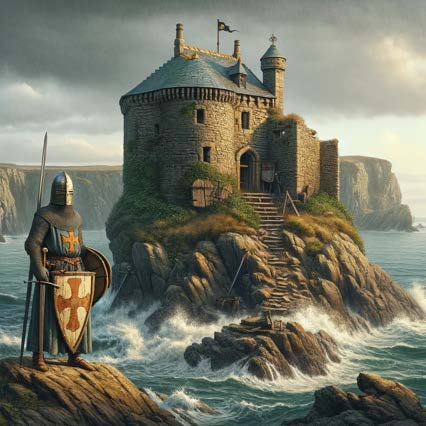
Figure 19.4: Artistic impression of the first Du Guesclin, Aquin or Hakin, who was
stationed at Saint Coulomb, an outpost of the Marche of Bretagne. This image was made
with AI (DALL·E 2024-05-22 20.52.24)
Don Bonaventura y Cortés (II) (DC04),
Don Jeroni Joan Desclergue y Cortés (DC05),
Don Antoni Desclergue (II) (DC06) (1602 AD),
Don Antoni Declerque (III) (DC07),
Don Pere Declercgz (II) (DC08),
Don Joan Declercq (II) (DC09),
Renier Declercq (DC10),
Pierre Joseph Declercq (DC11),
Leo Bernard Declercq (DC12),
Ivo Declercq (DC13),
Ernest Constant Declercq (DC14), shown in Figure 19.3 on page 156,
Michel Achiel Renatus Declercq (DC15),
Maurice Alois Declercq (DC16),
Nico Felicien Declercq (DC17),
Benjamin J. H. Declercq, Anna-Laura F. M. Declercq, Lambert L. B. Declercq (DC18).
An illustration of ’Le Fort du Guesclin’ is, finally, shown in Figure 19.1 on page 155.
19.2 Who was Bertrand Du Guesclin?
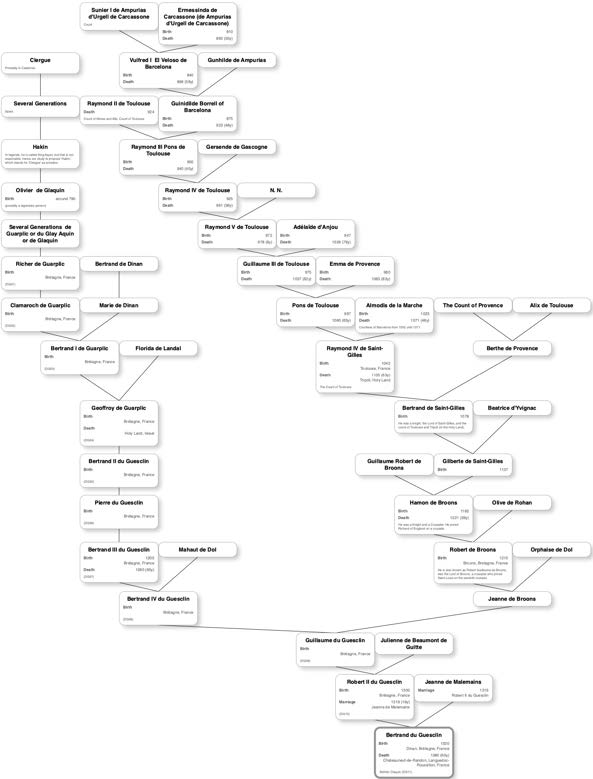
During the rise of French nationalism in the 19th century, Bertrand Du Guesclin was often depicted as a quintessential common Breton who ascended from humble beginnings to heroic stature. This portrayal, however, is a romanticized and historically inaccurate representation. Social mobility in the 14th century was virtually nonexistent. In reality, Du Guesclin hailed from a lineage of distinguished families. As detailed in this study, his patrilineal ancestry includes noble bloodlines, tracing back to the Desclergues of Spain. This noble heritage was established through the settlement of the knightly figure, Hakin, in Brittany. Thus, Du Guesclin’s rise was not from obscurity but rooted in his noble heritage and connections. His ancestry, partially shown in Figure 19.7 on page
161, was not that of a common man.
Bertrand Du Guesclin was a Complex Figure of Loyalty and Allegiance.
Bertrand Du Guesclin, a prominent figure of the Hundred Years’ War, remains an enigmatic character whose loyalty and allegiances have been the subject of historical debate. While some portray him as a hero of the conflict, celebrated by troubadours like Cuvelier for his romanticized exploits, others view him with suspicion and label him a traitor, particularly among certain Breton factions.
He had noble origins and a dutiful Lordship. Born around 1319, Bertrand Du Guesclin was no mere second-rate squire but the scion of a prestigious and affluent lineage. In the early 14th century, when the dubbing of knights was an extravagant affair, even the lesser members of the Du Guesclin family were not spared. Bertrand inherited two substantial fiefs, Broons and Sens, adding to his stature as the head of the family. He fulfilled his role as a lord and family leader by ensuring the well-being of his vassals and relatives who accompanied him in his rise and military campaigns, generously bestowing lands and fiefs upon them.
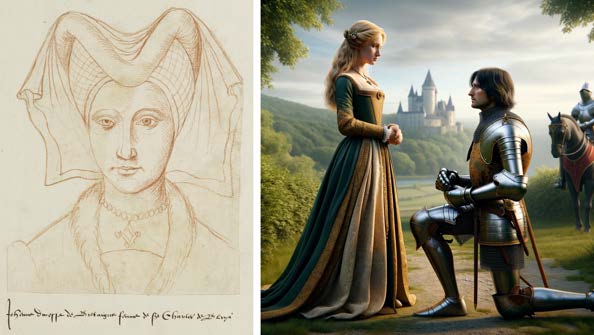
Du Guesclin was a loyal vassal to Jeanne de Penthièvre, shown in Figure 19.5 on page 158. His loyalty would play a significant role in his acceptation by the Count of Barcelona and the King of Aragon, as explained in Chapter 19.20 and Chapter 19.19. Throughout The Desclergues of la Villa Ducal de Montblanc, 2nd ed., Omn., VOL. I
© 2024 Nico F. Declercq
158
CHAPTER 19. BERTRAND DU GUESCLIN
Figure 19.5: Bertrand Du Guesclin, the loyal vassal and war leader, and Jeanne de Penthièvre, the legitimate Duchess of Brittany, whose alliance shaped the Breton War of Succession. Du Guesclin’s unwavering commitment to Jeanne’s cause underscored his military prowess and dedication, pivotal in her struggle against Jean de Montfort. The photo right is an impression made by AI (DALL·E 2024-05-25 08.21.02). The image left is a portrait of Joan of Penthievre, the duchess of Brittany, in the 16th century Receuil d’Arras, a collection of portraits copied by Jacques de Boucq and was drawn around 1570.
his life, Du Guesclin remained steadfast in fulfilling his vassal obligations, particularly towards Jeanne de Penthièvre. Jeanne, the heiress to the Avaugour and the Duchy of Brittany, held a pivotal position in his life. Du Guesclin’s war contracts consistently included a clause that obligated him to leave everything and fight for her when called upon. To Du Guesclin and much of the Breton aristocracy, Jeanne was the legitimate Duchess of Brittany, and Jean de Montfort was regarded as a usurper. Du Guesclin served as Jeanne’s war leader, succeeding notable figures in her familial network, such as Rolland de Dinan-Montafilant and the renowned hero of the Combat des Trente, Jean de Beaumanoir.
Jeanne de Penthièvre, born in 1319 and dying in 1384, was a significant figure in the 14th-century Breton War of Succession, a conflict that shaped the political landscape of Brittany. As the daughter of Guy de Penthièvre and Jeanne de Avaugour, Jeanne’s claim to the Duchy of Brittany was based on her descent from Arthur II, Duke of Brittany, through her father, who was Arthur II’s younger son. Jeanne’s marriage to Charles of Blois in 1337 further strengthened her position. When Duke John III of Brittany died without direct heirs in 1341, Jeanne and her husband Charles of Blois claimed the duchy, sparking the War of Succession against John of Montfort, another claimant.
Jeanne de Penthièvre’s significance extends beyond her dynastic ambitions. She played a crucial role in Bertrand Du Guesclin’s career. Bertrand Du Guesclin rose from obscurity to become one of the most respected generals of his time. His loyalty to the House of Blois, specifically to Jeanne de Penthièvre, was a pivotal aspect of his early career. Du Guesclin initially served as a loyal vassal to Jeanne, supporting her claim to the Breton duchy against the Montfort faction. His military prowess was instrumental in several key battles during the Breton War of Succession, where his strategic insight and leadership significantly bolstered Jeanne’s position.
As a vassal, Du Guesclin owed military service and support to Jeanne, who, in turn, provided him with protection and the means to sustain his retinue. This relationship was mutually beneficial, as Jeanne’s cause allowed Du Guesclin to demonstrate his military capabilities, ultimately leading to his recognition as one of the foremost knights of his era. His loyalty to Jeanne and the House of Blois was steadfast until the Treaty of Guérande 1365 ended the war and recognized John of Montfort as the Duke of Brittany.
This resolution marked a turning point in Du Guesclin’s career, as he then shifted his allegiance to the French crown, where he continued to distinguish himself in the Hundred Years’ War.
Du Guesclin’s prominence as a formidable warlord surged in 1354 at Pontorson, where he assumed the role of captain, a stronghold that guarded the northeastern entrance to Brittany. This strategic location allowed him to monitor key territories like Mayenne and Dinan under Jeanne de Penthièvre’s control. His remarkable military acumen was showcased in Normandy, where he bravely battled against the Anglo-Navarrese forces, culminating in the victorious Battle of Cocherel in May 1364. King Charles V rewarded him with the county of Longueville. However, Du Guesclin also experienced captivity at the hands of the English, with his lords ultimately securing his release through ransom.
He became a Constable of France and the defender of Allied Interests.
Following his release, Du Guesclin played a pivotal role in the Spanish theater, supporting the Duke of Anjou’s ally, Henry of Trastamare, in ascending to the Castilian throne. He expanded his territory and welcomed Breton settlers to his lands in Borja and Molina. At the behest of Louis of Anjou, King Charles V appointed him the Constable of France on October 2, 1370, placing him in command of the royal armies during a critical period marked by a major English offensive. Du Guesclin’s priorities lay in safeguarding the interests of his lords and their allies, with the king’s concerns taking a secondary role.
1373 Du Guesclin expelled Duke John IV and his English allies from Brittany. However, King Charles V did not restore Brittany to Jeanne de Penthièvre, leading to a five-year period where Du Guesclin governed Brittany unofficially. In December 1378, the King annexed Brittany into his realm, causing tension. From his vantage point in Pontorson, Du Guesclin observed the movements of his vassals, allies, and fellow soldiers who formed a League to resist the annexation. He allowed John IV, backed by this League and endorsed by Jeanne de Penthièvre, to return to Brittany. Charles V was displeased, even contemplating removing Du Guesclin’s constable’s sword, but the Duke of Anjou intervened. Du Guesclin ultimately resumed military operations and passed away due to
© 2024 Nico F. Declercq
The Desclergues of la Villa Ducal de Montblanc, 2nd ed., Omn., VOL. I
19.3. WHY BERTRAND DU GUESCLIN?
159
illness during the siege of Châteauneuf-de-Randon on July 13, 1380.
In retrospect, Du Guesclin’s lifelong loyalty to Jeanne de Penthièvre, his allies, vassals, and friends is evident. He acted in defense of Brittany by driving out English marauders. Yet in 1378, despite possessing significant military power, he did not intervene when John IV, an Anglophile sovereign, returned to the Breton throne. For Du Guesclin and other Breton nobles, annexing Brittany to the royal domain meant becoming direct vassals of King Charles V, obligating them to fight for him without compensation.
The plan to eventually return the duchess to her Breton throne faltered when John IV had descendants, the Montfort dukes, who painted Du Guesclin as a traitor to Brittany.
The disposition of Du Guesclin’s remains is a testament to the complex web of allegiances and loyalties he navigated during his lifetime. His flesh found its resting place with the Dominicans of Montferrant, his heart in the Franciscan church of Dinan, and his bones were ultimately laid to rest in the royal necropolis of Saint-Denis. A glorious ceremony marked this final honor, attended by the entire royal family and the elite of the military aristocracy of the Kingdom of France.
Ultimately, we find ourselves compelled to ponder the true essence of Bertrand Du Guesclin during his lifetime. Historiography offers varied perspectives: some praise him as a gallant knight, celebrated for his numerous military triumphs and esteemed titles, while others depict him as originating from relatively modest beginnings, hailing from the lesser nobility of Brittany but ascending within noble echelons. Though enticing to contemporary sensibilities, the latter portrayal is fraught with complexity. In Du Guesclin’s era, social mobility was severely constrained. Historical records attest that Bertrand Du Guesclin consistently asserted his lineage traced back to a Saracen sovereign named Aiquin (or Aquin). We can scrutinize this assertion in our present era, aided by the renowned ’Aquin’s Romance.’ Yet, within Bertrand Du Guesclin’s consciousness, his descent from the Saracen king Aiquin or Aquin, who reigned over Bougie in modern-day Algeria and certain territories in Spain, remained an unwavering certainty. He identified his original family name as Glay Aquin, employing it prominently during his stays in Spain, where he was occasionally referred to as Claquin or Beltran Claquin. The open embrace of this narrative indicates the absence of contention from Breton’s French and Spanish nobility regarding his genealogical origins. As a scion of royalty, it was therefore unsurprising for Bertrand Du Guesclin to secure entry into the Aragonese nobility and entirely natural for him to secure a marriage alliance with Miss Torró, hailing from the venerable nobility of the Empúries region near Gerona. Likewise, as a descendant of regal lineage, it was within the realms of normativity for Bertrand Du Guesclin to be conferred the lordship of Soria and for Henri de Trastemara to elevate him to the throne of Granada, incentivizing his efforts towards the reconquest of Granada from the Saracens.
Concerning Aquin, we must refer to the work of Paris Gaston5 The narrative of Aquin’s Romance, alternatively known as Aiquin, embodies a rich tapestry of gestural lyricism, detailing the epic resurgence of Charlemagne’s control over Brittany from the grasp of the Saracen ruler Aiquin. This tale, steeped in antiquity, is a guiding light through the obscure corridors of regional folklore, preserving invaluable local traditions within Brittany’s cultural fabric. Likely crafted between 1170 and 1190, its passage through time has been hindered by the unfortunate state of a 15th-century rendition, suffering truncations and mutilations that greatly affected its syntax, semantics, and prosody. Joüon des Longrais provided insight into the narrative’s journey by chronicling the saga of the manuscript, which had been safeguarded on the diminutive isle of Cézembre since at least the 16th century. Despite enduring English attacks in 1693, the manuscript survived unharmed and found refuge within the National Library’s vaults, cataloged as number 2233 in the French collection. Joüon des Longrais identified other manuscripts as mere replicas of this revered exemplar, though mistakenly dating its origins to the early 15th or late 14th century, a claim unsupported by philological evidence beyond the mid-15th century.
Continuing seamlessly, a plethora of bibliographical references emerge, encompassing literary historiography from Fauchet’s manuscript annotations to scholarly investigations into Bretonic antiquity intertwined with the history of Du Guesclin. Of particular interest are the connections drawn by Froissart, linking the saga with the illustrious lineage of Du Guesclin.
Luce’s analysis dissects the chronicler’s narrative, as delineated by Joüon des Longrais. It reveals encounters with a Breton knight who unveils the constable’s name as "Du Glay Aquin," along with the story behind it.
The genesis of the narrative unfolds as follows: A monarch from Bougie and Barbary named Aquin (later Aiquin by the 14th century), taking advantage of Charlemagne’s conflicts in Iberia, arrives at Vannes, seizing control and constructing a tower by the sea named Glay, colloquially referred to as Glay Aquin. After Charlemagne frees Brittany from Saracen’s rule, Aquinas flees with his partner, inadvertently leaving their child behind in the fortress. Charlemagne, our ancestor, shown in Figure 76.8 on page 1681,
discovers the child, Olivier, and grants him the fiefdom of Glay Aquin and its surroundings. Olivier, the progenitor of the lineage from which Bertrand du Glay Aquin, or Du Guesclin, emerges as a notable figure. Intriguingly, Bertrand purportedly embraced this saga, envisioning a quest to reclaim the Bougiean crown after his involvement in placing Henri de Transtamare on the Spanish throne.
Subtle differences arise between the narrative and the lyrical composition, potentially due to memory lapses or intentional embellishments. The Glaiequin lineage likely fabricated this tale, perhaps influenced by the phonetic similarity between their surname and Aiquin or Aquin. Consequently, the "Aiquin Tower" in the story evolved into Glay Aquin, distancing itself from its origin in Quidalet. Nevertheless, traces of its true essence persist, hinted at by its possible identification with the Oregle tower in Saint-Servan, known as Solidor—a name shrouded in mystery. An annotator of the manuscript, hailing from Saint-Malo in the 16th century, suggests "Seul y dort" as its etymology, interpreted as "sleep there alone," implying the tower’s supposed impregnability.
This fabrication of the abandoned child’s presence within the tower is a vital link connecting the Glaiequin lineage to their former Saracen overlords.
In conclusion, as Luce astutely observed, these ingrained illusions, nurtured since childhood, may have subtly influenced the constable’s ambitions and, consequently, his fate. Paris Gaston argues that the legend of Aquinas deserves a place in Du Guesclin’s biography.
19.3 Why Bertrand Du Guesclin?
The ancestral lineage of the Desclergues family presents an intriguing puzzle, with connections to historical figures such as Bertrand Du Guesclin and involving individuals like Torró, Miquel, and Clergue.
In part II, the research methodologies applied by historians are discussed. The inclusion of Bertrand Du Guesclin in our ancestry is founded on a comprehensive synthesis of inductive, deductive, and abductive reasoning, integrating all historical and DNA evidence available to the author. A Y-DNA Haplogroup analysis of Bertrand Du Guesclin’s remains would significantly enhance this research.
However, given the current limitations and logistical challenges, such an analysis is unlikely to occur soon. Despite these constraints, 5Paris Gaston. Le Roman d’Aquin, ou la Conqueste de la Bretaigne par le roy Charlemaigne, chanson de geste du XIIe siècle, publiée par F. Joüon des Longrais, 1880. In: Romania, tome 9 n°35, 1880. pp. 445-463.
The Desclergues of la Villa Ducal de Montblanc, 2nd ed., Omn., VOL. I
© 2024 Nico F. Declercq
160
CHAPTER 19. BERTRAND DU GUESCLIN
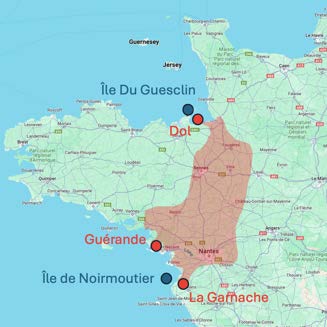
Figure 19.6:
The Breton March (La
Marche de Bretagne) is highlighted in red.
Established by the Carolingian Empire dur-
ing the reign of Charlemagne, the Bre-
ton March served as a fortified buffer zone
along the western frontier of the Frank-
ish Empire.
Its primary purpose was
to protect the empire from incursions by
the independent and often rebellious Bre-
ton territories. The March encompassed
strategically significant strongholds such
as Nantes, Rennes, and Vannes, fortified
to maintain Frankish control and influ-
ence over the region. Île de Noirmoutier
in the South and Saint Coulomb (Île du
Guesclin) in the North were strategic out-
posts.
the author remains hopeful that future advancements will facilitate this crucial aspect of genealogical validation.
A genealogist striving for straightforwardness and simplicity might assume that Pere Desclergue (DC01) descends patrilineally from Ramon Desclergue. However, such an assumption would overlook critical details revealed in historical documents. Notably, the appearance of the name Torró and the omission of Pere Desclergue’s paternal ancestors in a document intended for his descendants to obtain a noble title suggest complexities in his lineage. Given the importance of patrilineal ancestry in claims to nobility, the absence of mention of his paternal lineage is significant. If Pere Desclergue had inherited his surname from his father, his descendants would undoubtedly have emphasized this connection in their noble appraisals. This evidence indicates that the Desclergue name was inherited through Pere’s mother. As elucidated in this study, Pere adopted the name from his maternal uncle, from whom he inherited, while his paternal lineage traces back to the Torró family, stemming from Du Guesclin.
Bertrand Du Guesclin represents a particularly intriguing figure in our ancestry tree. The seamless integration of his descendants with the Desclergue family, adopting their name after just a few generations, can be attributed to an awareness of their ancient genealogy. Bertrand Du Guesclin himself asserted his descent from a figure named Aquin. The name Aquin, or Hakin, derives from the Arabic term Hakim, which essentially shares the same meaning as Clergue. Discounting the legendary notion that Du Guesclin descended from an obscure king named Aquin, the most plausible hypothesis is that he descended from Hakin, a member of the Desclergue family established in Islamic Spain. This genealogical connection underscores the historical and cultural amalgamations that have shaped our lineage.
19.4 La Marche de Bretagne and Île Du Guesclin
To better understand the March of Brittany, the reader may consider Chapter 13 first. During the reign of Charlemagne, a significant historical figure known as Hakim, also referred to as Hakin or Aquin in various sources, was stationed at an outpost in the Marche de Bretagne. This Hakim, whose lineage is traced back to the prestigious Desclergues family from Spain, detailed in Chapter 15, had earned the designation under Moorish rule, where the title ’Hakim’ was equivalent to ’Clergue’ in the local context. His ancestry returned to the Byzantine period in Spain, during which his forebears gained ’purple blood’ status, explained in Chapter 17.1,
denoting noble lineage. One of his patrilineal ancestors resided in Bougie (present-day Béjaïa in northern Algeria), described in Chapter 11, which influenced Bertrand Du Guesclin’s ambition to conquer Bougie. This ambition was intertwined with his support for Enrique de Trastamara and the King of Aragon in their efforts to thwart English influence in Spain, as explained in Chapter
Figure 19.6 on page 160 illustrates a contemporary map of Brittany, highlighting in red the approximate area of the Breton March (La Marche de Bretagne). Within this delineated zone, numerous fortifications were established. In the southern part of the March, significant strongholds included La Garnache and Guérande, with the island of Noirmoutier serving as a crucial outpost. In the northern section, fortifications were centered around Dol, with Saint-Coulomb, also known as Île Du Guesclin, acting as a vital outpost.
The Franks strategically employed Île de Noirmoutier as a refuge and defensive position against the frequent Viking raids during the 9th century. The fortifications on the island enabled the Franks to launch military operations aimed at securing the coastal regions and maintaining surveillance over Breton activities. Saint-Coulomb, or Île Du Guesclin, held further significance as it was the station of the patrilineal ancestor of Bertrand Du Guesclin, underscoring, in retrospect, the military and strategic importance attributed to these fortified locations within the broader context of the Carolingian defensive network against external and internal threats. The significance in the realm of the ancestry of Du Guesclin is clarified in Chapter 19.8.
19.5 Spanish Patrilineal Roots
Bertrand Du Guesclin is remembered for his notable titles, ’King of Granada,’ ’Connétable de France,’ and ’Condestable de Castilla,’
listed in Chapter 19.22. The history of Bertrand Du Guesclin’s ancestors is actually deeply rooted in Spanish origin, French ancestry, and descendants in Spain, as explained in Chapter 19.13.
The story begins with his ancestor, who held a significant judicial position under Moorish rule in Spain and later settled in Saint-Coulomb, Brittany.
This settlement is crucial in understanding Du Guesclin’s Mediterranean roots, which he was well aware of, as indicated by his dark
© 2024 Nico F. Declercq
The Desclergues of la Villa Ducal de Montblanc, 2nd ed., Omn., VOL. I
19.5. SPANISH PATRILINEAL ROOTS
161
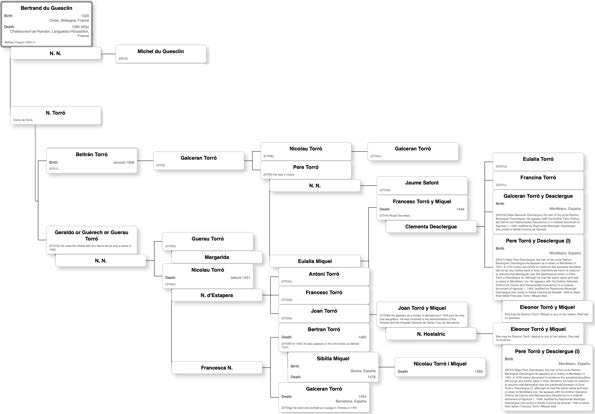
Figure 19.7: Ancestry of Bertrand Du Guesclin.
Figure 19.8: The picture was taken at Nabeul in Tunesia, around 500
km East of Béjaïa (Bougie) in Algeria, in 1984. The author stands in
the middle. Bertrand Du Guesclin believed he had ancestors in Bougie.
(Declercq de Silva Archive)
The Desclergues of la Villa Ducal de Montblanc, 2nd ed., Omn., VOL. I
© 2024 Nico F. Declercq
162
CHAPTER 19. BERTRAND DU GUESCLIN
Figure 19.9: Descendants of Bertrand du Guesclin. Pere Desclergue (DC01) (Pere Torró y Desclergue) was a patrilineal great-great-great-grandson of Bertrand Du Guesclin (DG11).
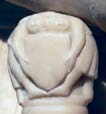
Figure 19.10: Close up of the sword handle on the tomb of Du Guesclin at the
Basilica of Saint-Denis in Paris. Two young children mourn on a blank heraldic
shield, after the death of Du Guesclin, in 1380. They likely represented his biological
children. (Declercq de Silva Archive)
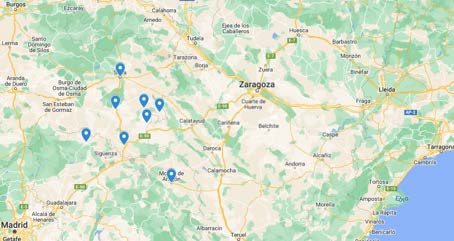
Figure 19.11: A map showing the locations offered to Bertrand Du Guesclin, namely, Deza,
Soria, Molina de Aragon, Almazán, Atienza, Monteagudo de las Vicarías, Serón de Nágima.
© 2024 Nico F. Declercq
The Desclergues of la Villa Ducal de Montblanc, 2nd ed., Omn., VOL. I
19.6. MEDITERRANEAN BLOOD AT SAINT COULOMB
163
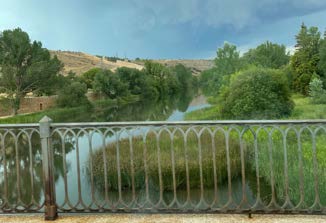
Figure 19.12: The Duero River in Soria
(2022)
hair and complexion, traits that set him apart from his contemporary Bretons. 678
19.6 Mediterranean Blood at Saint Coulomb
Despite numerous theories and assumptions formulated in later centuries, it is evident that Du Guesclin believed he had Mediterranean roots. He likely had precise knowledge about his ancestors, given how smoothly he gained access to the French King and to the Count of Barcelona, the King of Aragon and to the Trastamara of Castilla.9. Du Guesclin had black hair and was relatively dark-skinned, earning him the nickname ’le Dogue noir,’ which referred to his color and fighting skills.
Despite numerous claims by modern Bretons that old Bretons sometimes had dark skin and dark hair, it does not explain why the ancient literature focussed so much on these aspects of Bertrand Du Guesclin. Had he looked like a regular Breton, they would never have mentioned it.10111213 The Mediterranean blood theory is supported by the Y-DNA investigation, described in Chapter
73.3, which suggests that Du Guesclin’s Haplogroup is older than the settlement of the bloodline in Brittany and originates from Spain. This aligns with the idea that Bertrand Du Guesclin descended from Hakim, his Spanish ancestor.
19.7 The Legend of King Aquin
Du Guesclin often recounted that he descended from King Aquin of Bougie, present-day Béjaïa in Algeria. Although this legend seems fanciful, the name Aquin holds significant weight. The myth is rooted in historical facts around Charlemagne (742-814) when northern Spain allied with him against the Saracens of the south. Historical DNA studies, particularly regarding the SRY2627
Y-DNA Haplogroup, given in Part XV, suggest its origins in northeastern Spain, explaining its appearance in the Du Guesclin lineage. It is known that many locals converted to Islam under Muslim rule in Spain, leading to numerous mixed marriages. The rulers of Spain, after several generations, had blue eyes and blond hair, as recorded in contemporary literature.
In the legend, Bougie is an actual location and the French name for ’Bejaia’ in Algeria. Aquin was believed to be a Saracene commander who held the Château de Glay at Saint-Coulomb during Charlemagne’s reign. The capture of this castle by a Saracene would have been possible through an overseas raid. The legend states that King Aquin of Bougie withdrew to Spain, leaving one of his sons behind. This son would be raised as a Christian Knight under the legendary Knights Roland and Olivier’s aegis and Charlemagne’s hospitality. This bloodline, known as Glay-Aquin, eventually transformed into ’De Claquin’ in Spanish documents during Bertrand Du Guesclin’s time and ’Du Guesclin’ in central France.
6Dark hair and slightly dark skin in Brittany’s population may also result from ’Britonia,’ a connection in the 6th century between Brittany and the north of Galicia. Excluding all the theories related to Aquin, there is a possibility that ’Spanish DNA’ arrived in Brittany through Britonia, forming the deep ancestry of Du Guesclin. Legends and stories in the British Isles, such as ’The Book of the Taking of Ireland’ (Lebor Gabála Érenn), describe Spanish invasions in ancient times. Because Brittany is situated between Spain and Ireland, Spanish settlements in Brittany might have contributed to Du Guesclin’s ancestry. Particular examples in this Irish book of invasions, or the ’Historia Brittonum’ version, include Partholón, Nemed, Fir Bolg, Tuatha Dé Danann, and the Milesians. The Milesians were sons of ’Mil Espáine’ (hence ’Milesians’) in Gaelic, meaning Miles Hispanica in Latin (Spanish soldiers). Therefore, even much earlier than the time of Charlemagne, there are traces of Spanish migrations to Brittany, which should not be excluded as possible origins of Du Guesclin. Romain Grouazel-Krauss, an expert on Celtic history and language, graciously provided this information. Nevertheless, the fact that Du Guesclin’s darkness was so explicitly mentioned in historical sources must have set him apart from the average Breton. Also, the French King would never have trusted him so much had he been considered indegeneously Breton with archaic roots in Breton. Contemporaries of Bertrand Du Guesclin must have known better and accepted his claims of southern roots stemming from Aquin (or Hakin).
7In Brittany, many names describe a place of origin. Such tradition is not unique and also appears in other regions and countries. However, peculiar to Brittany is that some of these widespread names refer to distant lands. An example is ’Lespagnol,’ referring to Spain. Historians claim that Brittany is at the tip of France along the naval highway of the West-coast of Europe, where sailors and military passed from all over Europe, even in ancient times.
Interesting work on such matters was written by Jean Le Dû, who explored the ethnic appellatives in the anthroponymy of Basse-Bretagne. Therefore, it is plausible that the ancestors of Bertrand Du Guesclin arrived in Brittany similarly to others with Iberian roots, whether by trade, accident, or other means. However, being a regular Breton would not have inclined the French King ever to make him Constable of France.
8Jean Le Dû, ’Les appellatifs ethniques dans l’ anthroponymie de la Basse-Bretagne’ , in Hommes et Terres du Nord, numéro hors-série 1988; Campagnes et littoraux d’ Europe, Mélanges offerts à Pierre Flatrès. pp. 67-76.
9The assertion that Bertrand Du Guesclin perceived himself, through sentiments, as distinct from his contemporary Bretons and suspected, therefore, a Mediterranean lineage, for which he sought a historical context, aligns with contemporary romantic narratives. However, projecting our modern corny interpretations onto the 14th century would be naive.
10The word ’noir’ in old French did not necessarily mean ’black’ but could also imply ’sad’ or ’scary.’
11Some Bretons had slightly dark skin, believed to be a relic of the Atlantic (Mesolithic) people who lived around 10000 years ago on the West Coast of France and Great Britain. Kerry Lotzof explains that DNA research on old remains revealed indications of blue or green eyes, dark hair, and probably dark skin, not pale white skin. Although no direct descendants (perhaps because the Y-DNA Haplogroup is different) exist, the autosomal DNA survives in modern populations through blending. Elaine Evans agrees with Lotzof’s conclusions. However, it is more likely that the dark-haired appearance in many Britons is linked to Britonia. Britonia was a small empire in the 6th century, connecting the very North of Galicia (Spain) to Armorica (Brittany) and the West-side of Britain (West coast of England and Wales). An exchange of genes may have resulted in dark hair and perhaps slightly darker skin in these regions.
12Kerry Lotzof, ’Cheddar Man: Mesolithic Britain’s blue-eyed boy’ , The Natural History Museum (Cromwell Road, London SW7 5BD, UK).
13Elaine Evans, ’Why does Whitehaw Woman have dark skin?’ , Brighton Museum & Art Gallery.
The Desclergues of la Villa Ducal de Montblanc, 2nd ed., Omn., VOL. I
© 2024 Nico F. Declercq
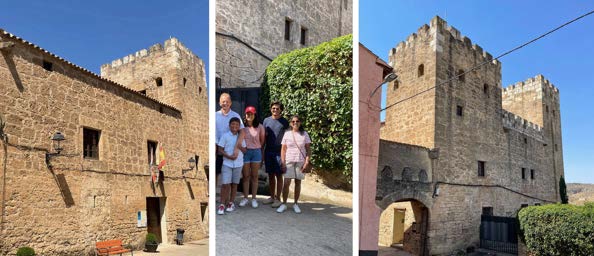
164
CHAPTER 19. BERTRAND DU GUESCLIN
Figure 19.13: Deza Castle, Palacio de los Finojosa (2022). As detailed by Clemente Sáenz Ruidrejo and Florentino Zamora Lucas in Corpus of Medieval Castles of Castile, the town of Deza was once enclosed by a wall of Arab origin, extensively modified by Christian builders. This wall, constructed of unworked masonry, was of considerable height, though only scant remnants remain today. The wall, which ran in an NW-SE orientation, lacks visible remains of towers or other constructions.
The original castle stood inside the town, at the site known as del Castillo or La Fortaleza. This castle featured a semicircular arch access flanked by two structures and a ramp adjacent to the Gothic church of Nuestra Señora de la Asunción. Historical accounts suggest the presence of an additional outer defense gate and possibly a fortified barrier. The fortified house of the Finojosa, now an exhibition hall on the town’s perimeter, has a square floor plan with two towers and a two-story patio.
Adjacent to this palace, a path leads to the ruins of an ancient castle with fortifications. In 1296, the infantas de la Cerda seized Deza and other towns in eastern Soria, reluctantly returning them to Castile following the Peace of Tarazona in 1305
and the settlements of Huerta and Monreal in 1308. Peace was often fleeting, as exemplified by the brief Deza peace of 1361
between Pedro I the Cruel and the Aragonese King, brokered by Cardinal Guido, which lasted less than a year. Deza became a strategic headquarters for Pedro I during the conflicts with the Trastámaras. King Enrique de Trastámara later granted Deza, along with Almazán, Morón, and Monteagudo, to Bertrand du Guesclin as a reward for defeating his half-brother Pedro. In 1437, the Peace of Naples between Castile, Aragon, and Navarre restored Deza to Castilian control.
If this story holds true, King Aquin was likely a self-proclaimed king who conquered a small territory in Brittany, probably a Saracene knight with Spanish roots. A medieval French ’chanson de geste’ titled ’Aquin, la conqueste de la Bretaigne par le roy Charlemagne’
(Aquin, the conquest of Brittany by king Charlemagne), likely written in the 12th century, supports this narrative. Additionally,
’La Chanson de Roland,’ recorded in the 11th century, references Charlemagne’s activities in northern Spain, mentioning Muslim warriors from ’overseas,’ possibly converted Basques.
The Saracen rulers of Zaragoza, Girona, Barcelona, and Huesca agreed to obey Charlemagne in return for military support against the Umayyad Emir of Cordova. Charlemagne viewed this as an opportunity to extend his empire into Spain and spread Christendom on the Peninsula. Negotiations between Charlemagne and the Spanish Saracens occurred in the late 8th century, leading to the northern part of Spain becoming part of Charlemagne’s empire, known as the Spanish March (Marca Hispánica). This period might explain the movement of Du Guesclin’s ancestors from Spain to Brittany, possibly holding the castle of Glay. However, they might not necessarily have been Kings, but could have been, instead, jurors and scribes, operating under the designation Hakin or Hakim, Arabic for Clergue.
Bertrand Du Guesclin was so convinced of his Mediterranean roots that he planned to conquer Bougie before becoming Connétable de France. Jean Froissart wrote, in Chroniques, éd. Kervyn, t. XII, p. 227:
.Messire Bertrand disait, quant il eut bouté hors le roi Don Pietre de son royaume de Castilla et couronné le roi Henri de Castilla et d’ Espagne, qu’ il s’ en voulait aller au royaume de Bougie (il n’ avait que la mer à traverser), et disait qu’ il voulait reconquérir son royaume et son héritage.’
Du Guesclin negotiated with the king of Aragon, Pere IV, to make available to him two large ships and a galley for six months to undertake this personal crusade, highlighting the significance of this endeavor to him.14
The family name of Du Guesclin appears in old archives in various forms: ’du Guesclin, Waglip, Gayclip, Guarclip, Guerplic, Glerquin, Claquin, Glaquin, Glayequin, etc.’ Some names contain ’Aquin,’ reinforcing the myth. While political motives may have driven Du Guesclin, the French, and the Bretons to create, spread, and transform such tales, it remains a well-known legend that could not be omitted.
Although descending from a King Aquin may seem fanciful and legendary, strong indications suggest that Bertrand Du Guesclin may actually have descended from a certain Aquin or Hakin, who was not a king but a juror or governor, as further explained. How else would the King of Aragon or Enrique de Trastamara have trusted him in their combat against the Muslims of Spain?
19.8 Hakin in La Marche de Bretagne, Originating from La Marche d’Espagne
19.8.1 General Considerations
The context of the paternal ancestor of Du Guesclin with Spanish roots is, still, most likely explained through the establishment of La Marche de Bretagne and La Marche d’Espagne under Charlemagne (742-814), explained in Chapter 13 and Chapter 19.4. These protection corridors, established in the north of Spain and the East of Brittany, facilitated the movement of Charlemagne’s allies, including Du Guesclin’s ancestors, from Spain to Brittany. DNA analysis in Chapter 19.27.4 confirms this Spanish root, and the settlement period around 801-818 aligns with the establishment of these marches.
14Michael Jones, Letters, Orders and Musters of Bertrand du Guesclin, Boydell Press, 2004, no.178, p. 65.
© 2024 Nico F. Declercq
The Desclergues of la Villa Ducal de Montblanc, 2nd ed., Omn., VOL. I
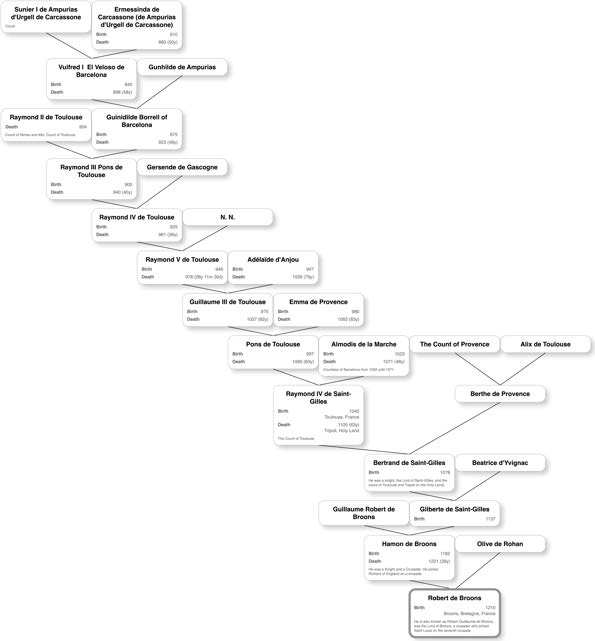
19.8. HAKIN IN LA MARCHE DE BRETAGNE, ORIGINATING FROM LA MARCHE D’ESPAGNE
165
Figure 19.14: Old homes in Deza. (2022)
Figure 19.15: The ancestry of Robert de Broons. Apart from the earlier ancestors, from the Borrell house of Barcelona, Counts of Barcelona, there is also a connection to that House through Almodis de la Marche, as shown in Figure 19.16 on page 166.
The Desclergues of la Villa Ducal de Montblanc, 2nd ed., Omn., VOL. I
© 2024 Nico F. Declercq
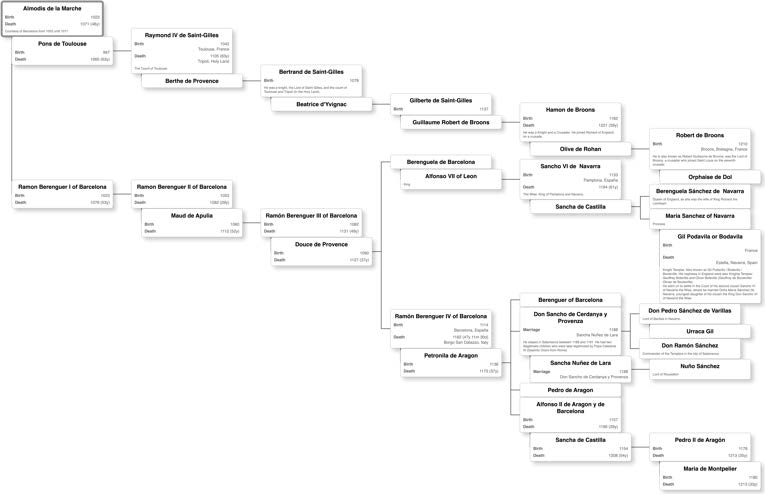
166
CHAPTER 19. BERTRAND DU GUESCLIN
Figure 19.16: The descendants of Almodis de la Marche. She connects Bertrand Du Guesclin to the House of the Counts of Barcelona, Borrell. Du Guesclin was also connected to Borrell through direct ancestors, as seen in Figure 19.15 on page 165.
Léon Levillain15 writes that the Breton and the Spanish Marches were connected and should not be considered isolated regions.
There was an exchange of people in a military context, and there were also marriages of the nobility involving both regions.
La Marche de Bretagne was established in 753 by Pépin le Bref and was succeeded by Roland (778), Adulf (786), le comte Guy (799), and Lambert I of Nantes (814-818). A second March was established in 861 by Charles le Chauve (Charles the Bald). La Marche d’Espagne existed from 801 until 843 and began with the Siege of Barcelona in 801. The counties belonging to the March were Barcelona, Berga, Besalu, Cerdagne, Conflent, Empúries, Gerona, Manresa, Osona, Pallars, Ribagorza, Roussillon, and Urgell.
The appearance of a Mediterranean ancestor of Du Guesclin may be traced back to the period 801-818 if we assume it is real and reject heroic and romantic legends. Readers are invited to read Chapter 17.3 to understand better the context of La Marca in the realm of Aquitaine and Toulouse and the ancestors ’Clergue’ who lived in Albi in the county of Toulouse. The population of the Marca Hispanica was heterogeneous, including Frankish invaders, native Hispano-Roman residents, and remnants of Visigothic nobles who had migrated southward after the Muslim conquest. Over time, the territory attracted people from many regions of the Frankish Empire, enhancing its demographic and cultural variety.
If Bertrand Du Guesclin is indeed a patrilineal descendant of someone from the families of the counties in La Marche d’Espagne, six notable candidates emerge among these counts, contributing to the administrative and territorial organization of the region. The legendary King Aquin may have been one of them. However, more likely, the Hakin or Clergue of whom Du Guesclin descends, was a scriber or a juror under one of these nobles.
19.8.2 Specific Notable Figures in La Marche d’Espagne
19.8.2.0.1 Borrell Borrell, whose tenure extended beyond 809, is a significant figure in the March of Spain. Notable mentions of Borrell include references in the Vita Hludowici Imperatoris, which records his involvement in campaigns against Tortosa in 798
and 809. His name suggests a potential familial connection to later counts of Barcelona. Additionally, Borrell’s son, Seniofredo, is documented in historical charters, further cementing Borrell’s presence within the March’s administrative landscape.
19.8.2.0.2 Zaddo Zato, also known as Zaddo, held sway as a Muslim ruler of Barcelona. Historical accounts, such as the Annales Laurissenses Continuatio and the Vita Hludowici Imperatoris, attest to his role in the governance of Barcelona, particularly in its interactions with neighboring territories. Zato’s significance within the March of Spain is underscored by his actions, including his journey to Narbonne in 801, as documented in the Vita Hludowici Imperatoris.
19.8.2.0.3 Aureol Aureol, whose tenure ended in 809, served as a count within the March, overseeing territories across the Pyrenees. Einhard’s chronicles provide insight into Aureol’s demise, attributing it to conflicts with neighboring authorities, notably Amoroz, the prefect of Cæsaraugusta and Osca. Despite limited details regarding his lineage, Aureol’s presence underscores the diverse counts operating within the March of Spain.
15Léon Levillain, ’La Marche de Bretagne, ses marquis et ses comtes’ , Annales de Bretagne. Tome 58, numéro 1, 1951. pp. 89-117
© 2024 Nico F. Declercq
The Desclergues of la Villa Ducal de Montblanc, 2nd ed., Omn., VOL. I
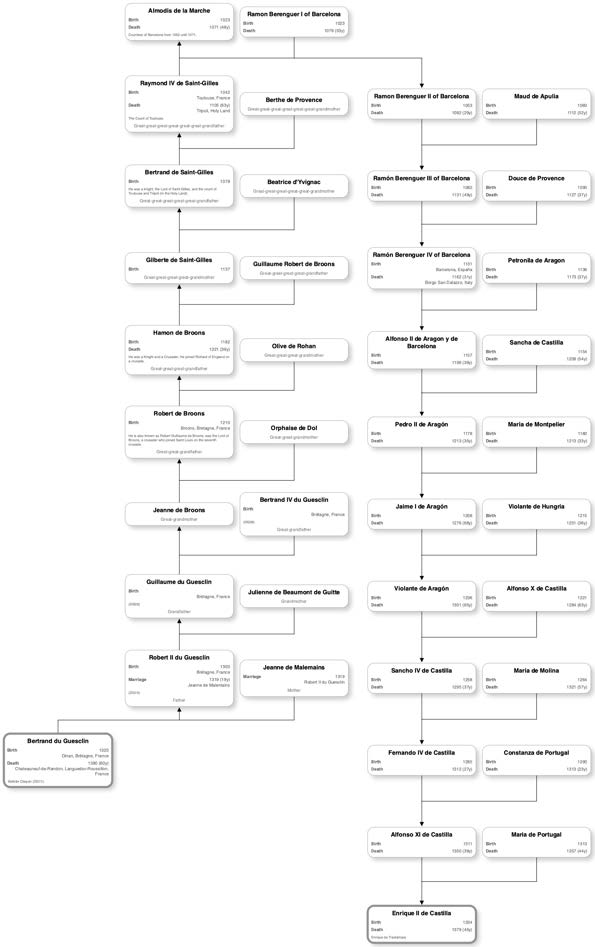
19.8. HAKIN IN LA MARCHE DE BRETAGNE, ORIGINATING FROM LA MARCHE D’ESPAGNE
167
Figure 19.17: Bertrand Du Guesclin was a distant blood-relative of Enrique de Trastamara.
The Desclergues of la Villa Ducal de Montblanc, 2nd ed., Omn., VOL. I
© 2024 Nico F. Declercq
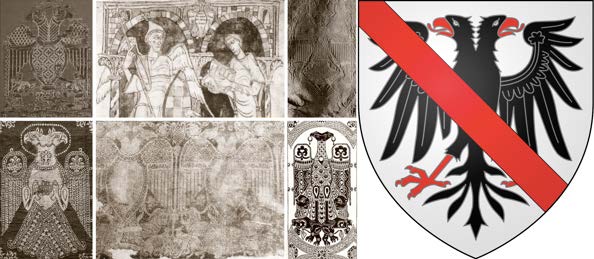
168
CHAPTER 19. BERTRAND DU GUESCLIN
Figure 19.18: Right is the Heraldic Shield of Du Guesclin. It is described as "d’argent à l’aigle bicéphale éployée de sable becquée et membrée de gueules, à la cotice du même brochant sur le tout." Left are images of the double headed eagle in Spain or related to Spain. From left to right, top to bottom:
1) Silk textile fragment with double-headed eagles, Islamic Spain, 12th century. This silk fragment belongs to the ’cloak of the Virgin’ of Thuirs, in the Pyrénées Orientales. Such silk clothes were used by christian princes and for liturgic purposes.
2) The ’Pseudo-saint Clément, Recognitiones,’ showing the Archangel Michael, killing a devil, and a monk, with a two-headed eagle between the arches. It can be found at Mont Saint-Michel. The image is from the time of Otto III, crowned emperor in 996, who strongly propagated the ’Renovatio Imperii.’ Since the Archangel Michael was the patron of the Castilian and French Kings, the scene refers to the defeat of the Muslims in Spain, their emblem, the two-headed eagle, being attached between the arches.
3) Detail of the Tunica of Infante Don Garcia (†1145/46), son of Alfonso VII El Emperdor, from his tomb in the Parochial Church of Oña in Burgos. Two-headed eagles are shown, emblems of the rank of a caesar or military. This is the first proof that the two-headed eagle emblem was adopted by a christian commander.
4) Blue Tissue from San Zoilo Monastery in Palencia, Spain. It has Kufic inscriptions and dates from the 10th-11th century.
5) Two-headed-eagle with lions in Spain in the 12th-13th centuries.
6) Textile Fragment with Double-Headed Eagles from Islamic Spain, 11th-12th century. From the tomb of Saint Bernard of Calvó in the Cathedral of Vich, Catalonia, Spain. This silk is believed to be a part of a booty from the reconquest campaigns against the Muslims of Spain that Calvó led as bishop of Vich.
19.8.2.0.4 Bero Bero, son of Guillaume, emerges as a prominent figure within the March, associated with territories conquered from the Saracens. Historical documents, including charters and annals, attest to his campaign involvement and his role as a witness to significant events, such as Emperor Charlemagne’s testament in 811. Bero’s connection to Barcelona is further underscored by his familial ties, notably through his wife, Romella, and their descendants.
19.8.2.0.5 Odilo Odilo, whose parentage remains undisclosed, is documented as a count within the Spanish March, as evidenced by a charter issued by Emperor Charlemagne in 812. Although details regarding Odilo’s activities and territories are scarce, his inclusion among the March counts highlights the diversity of individuals appointed to administer its regions.
19.8.2.0.6 Salamon Salamon, whose tenure spanned from before 864 to 873, played a pivotal role as a count within the March of Spain. Historical records, including charters and chronicles, provide insights into Salamon’s activities, including his involvement in judicial matters and interactions with ecclesiastical institutions. His enduring influence and the events surrounding his demise underscore the significance of Salamon’s role in the March.
19.9 Consistency with the Official History of Saint Coulomb
After reading several old and recent sources, we found a description formulated by the Office du Tourisme de Saint-Coulomb, which we will briefly summarize. Figure 19.6 on page 160 illustrates the geography. The oldest remains of Saint Coulomb date back to 450
BC. Some traces of Roman history have also been found. In 580, the Irish Saint Colomb (not to be confused with Saint Columba of Sens) established the parish, later named after him.
The ancestors of Du Guesclin established a small fortress on the tiny island nowadays known as ’l’ilot du Guesclin’ on the East of the beach of Saint Coulomb around the year 800, probably on the ruins of an old Roman settlement. An artistic impression is shown in Figure 19.4 on page 157. The lords of Guarplic (the ancestors of Du Guesclin) would reign over the island until 1250. Before this, we can situate the legend of Aquin, a Saracen who escaped from the Carolingian armies and arrived with his entire household on a rock called ’le Glay.’ He would reside there for 30 years and would run when he heard of the arrival of Charlemagne. During his escape, he left behind (he forgot) one of his sons. The child would receive protection from Charlemagne, who gave the child the name Glay Aquin, which soon transformed to Guarplic and Clakin, and later to Du Guesclin.
In 1254, the Lord of Guarplic established a more massive fortress (le Plessis-Bertrand) at Saint Coulomb, easier to defend. One of the ’cadet’ descendants of this person was the ancestor of Bertrand Du Guesclin.
Note that the official story dates the first arrival of an ancestor of Du Guesclin at Saint Coulomb to 800, which corresponds to the above conclusion that during the period 801-818, the Marches of Spain and Brittany co-existed.
Therefore, a knight from the north of Spain may have arrived in Brittany.
Interestingly, Mont Saint Michel was the northernmost fort of the Marche de Bretagne, located on the east side of a bay. If the Carolingian armies wanted to control the entire bay, they had to capture Saint Coulomb on the west side. Therefore, from a military standpoint, it makes sense that Saint Coulomb was occupied at that time and served as outpost. It may or may not have remained
© 2024 Nico F. Declercq
The Desclergues of la Villa Ducal de Montblanc, 2nd ed., Omn., VOL. I
19.10. DU GUESCLIN’S STRATEGIC GENESIS IN BOUGIE (BÉJAÏA)
169
Figure 19.19: This image depicts a grand banquet held at the Royal Palace of Barcelona on January 1, 1366. Bertrand Du Guesclin, a notable French commander, was invited by King Pedro IV of Aragon (the Count of Barcelona). During this event, Du Guesclin was introduced to Doña Torró, a noblewoman who would later be known as Doña de Soria. The banquet was attended by other prominent dignitaries, including Hugh de Calveley, Marshal of France Arnoul d’Audrehem, and Louis de Chalon, known as the Green Horseman. The gathering was a significant political and social event, reinforcing alliances and showcasing the grandeur of the medieval court. This image was made with AI (DALL·E 2024-05-25 17.51.19) disconnected from the rest of the March; hence the reasons for the legend of a family who resided there for several years until they abandoned the place, leaving behind one son is plausible.
19.10 Du Guesclin’s Strategic Genesis in Bougie (Béjaïa)
Bougie, or Bejaia, is shown in Figure 11.2 on page 88 during the time of Byzantine Spain, explained in Chapter 11.4.
Bertrand Du Guesclin’s strategic positioning within the geopolitical landscape of medieval Europe, particularly his patrilineal origins in La Marche d’Espagne, encompassing prominent regions such as Barcelona, Berga, Besalu, Cerdagne, Conflent, Empúries, Gerona, Manresa, Osona, Pallars, Ribagorza, Roussillon, and Urgell, is a subject of historical intrigue. This assertion gains credence through DNA analysis, suggesting a connection to this geographically diverse region. Du Guesclin’s awareness of his lineage is evidenced not only by his physical appearance, which purportedly differed from his Breton contemporaries but also by genealogical records indicating blood ties to the count of Barcelona and the Kings of Aragon, as outlined in Chapter 19.13.
The strategic implications of Du Guesclin’s claimed patrilineal ancestry in Bougie, shown on the map in Figure 11.4 on page 89,
coupled with his familial connections to the count of Barcelona and the kings of Aragon, reverberate throughout medieval European politics. His astute assertion of ancestral ties provided him with a multi-faceted advantage, garnering support not only from the Count of Barcelona and the King of Aragon but also from the French monarchy. This strategic move allowed him to maintain a form of neutrality in the Hundred Years’ War, a valuable asset to the French King because he had no reason to ally with the English.
Furthermore, Du Guesclin’s purported roots in Bougie, strategically located in present-day Algeria, assumed heightened significance concerning Aragon’s Mediterranean expansion during the 14th century.
Bougie’s strategic position as a harbor facilitated trade and maritime endeavors, making it a coveted prize in the regional power struggles. Recognizing the potential benefits of controlling this crucial port city, Aragon and Barcelona eagerly embraced Du Guesclin’s endeavors, banking on his renowned military prowess to secure Bougie under friendly control. The capture of Bougie held the promise of enhancing Aragon’s influence over Mediterranean trade routes, consolidating its position as a formidable maritime power in the region.
The Desclergues of la Villa Ducal de Montblanc, 2nd ed., Omn., VOL. I
© 2024 Nico F. Declercq
CHAPTER 19. BERTRAND DU GUESCLIN
19.11 Descent from Desclergue through Hakim
An interested reader might search for Aquino 16 near Rome or explore the roots of Du Guesclin in the context of the Umayyad invasions of France. 17 However, these endeavors are unlikely to yield fruitful results. Such hypotheses are based on illogical assumptions and possess a very low probability of accuracy.
Before the arrival of the Moors on the Iberian Peninsula, outlined, for instance, in Chapter 12, Catalonia, along with much of what is now Spain, was part of the Visigothic Kingdom. The Visigoths were a Germanic tribe that invaded the Iberian Peninsula in the 5th century AD and established their kingdom there. Catalonia was not specifically delineated as a distinct political entity during this time. Instead, it was part of the broader territory ruled by the Visigothic kings. The Visigothic Kingdom’s capital was initially located in Toulouse, in what is now southern France, but it was later moved to Toledo in Spain.
A consequence of this fact is that there must have been members of the Clergue family in Catalonia before the Moors arrived, just as there were members of that family in Toulouse and other parts of Occitania.
The genesis of the name Desclergue, explained in Chapter 15, should be studied here with a focus on the Muslim period, during which Hakim stood synonym for Clergue.
The Hebrew word for Clergue, in its meaning before it was used for religious clergymen, is Hakham, which essentially means ’wise.’
In Arabic, it is, as already mentioned, Hakim.
When the Moors conquered the Iberian Peninsula in the early 8th century, diverse populations already inhabited the region, including Visigoths, Hispano-Romans, Jews, and various indigenous groups.
Hakim was a title in the Western Caliphate judicial system, comparable to Clergue or a Juror. This was somewhat similar to the role held by Raymond Desclergue and Francesc Desclergue in Mallorca in the 13th century and resembles the positions held by later Desclergues. Rafael Altamira18 writes,
"the Caliph administered justice in person; but as a rule this function was exercised by the cadis (qadi) (and in small villages by hakims). At their head stood the qadi of the qadis, who was established at Cordova. A special judge, the Sahib-ash-shurta or Sahib-al-madina (zal-medina) heard criminal and police cases, under a procedure simpler than that of the aadi. The zabalaquen or hakim carried out the sentences of the qadi."
Christian Müller19 writes, while citing numerous Arabic sources related to Moorish Spain, that,
"Hakim is a judicial magistrate, and the title is also used to denote a judge who is not a qadi."
In other words, Hakim overlaps significantly with the positions of Clergue before the term was used for religious clergymen, i.e., jurors, judicial magistrates, and notaries. In modern Turkish, Hakim is also a judge.
Jean-Pierre Van Staëvel published a study20 on the judiciary system of Al-Andalus and discovered the relevance of Hakim, or Hakin, in Moorish Spain. Van Staëvel writes that,
"the diversity of these, particularly with regard to the procedural means that they implement in the context of the cases submitted to them, corresponds to a similar complexity of the methods of investigation" as well as "levels of the judicial hierarchy (There were secondary magistrates, hakim, or sahib al-ahkam, subordinate to the qadis in large towns), by the apparently increasing recourse to justice auxiliaries who, instrumental witnesses, notaries or experts, constitute judicial personnel of less prestige, particularly well-known for the case of notaries, although they play a role not negligible in the mediation of law with individuals, on the very ground of the application of the rule and the judgment."
The arrival of the Moors marked a significant shift in the socio-political landscape of Iberia, leading to complex interactions and transformations among the existing populations.
One of the primary effects of the Moorish conquest was the gradual Islamization of the Iberian Peninsula. While some indigenous peoples and rulers embraced Islam voluntarily, motivated by economic, social, or political factors, others continued to practice their existing religions, including Christianity and Judaism. Conversion to Islam was not universally enforced, and different regions experienced varying degrees of religious tolerance under Moorish rule.
Those who converted to Islam and those who allied with the Moors often adopted Arabic names and cultural practices. This phenomenon was particularly prominent among the urban elite and administrative class, who sought to integrate themselves into the new ruling structures established by the Moors. However, many aspects of pre-existing cultures and identities persisted alongside Islamic influences, contributing to the rich culture of al-Andalus, the Islamic territory in Iberia.
Communities of Christians and Jews, known as Mozarabs and Sephardic Jews, respectively, continued to exist under Moorish rule, albeit subject to certain social and legal restrictions. These communities often maintained their religious and cultural practices while adapting to the evolving political and social dynamics of al-Andalus.
Following the Moorish conquest of the Iberian Peninsula in the 8th century, the fate of clerics, administrators, scribes, and governors who already resided in Iberia varied depending on various factors, including their religious affiliation, social status, and regional circumstances. The Moorish rulers established a new administrative system in al-Andalus, drawing upon existing administrative structures while introducing Islamic institutions and practices.
For many clerics, administrators, and scribes who were Christians or adherents of other religions, the transition to Moorish rule necessitated adaptation to the new political and cultural realities, such as adopting a new name to better fit into the new tradition.
Some individuals could retain their positions within the administrative apparatus, particularly if they demonstrated loyalty to the new rulers or possessed valuable skills and expertise. In certain cases, Christian clerics and administrators continued to serve under 16Suppose we assume that a certain Aquin established Glay-Aquin at Saint-Coulomb and that Du Guesclin descended from this person. In that case, it is more likely that instead of a King from Bougie, the man was a person from Spain or Italy carrying the name d’Aquino or d’Aquin. Perhaps during a short period, Saint-Coulomb was held by the armies of the Marche de Bretagne, leading to the settlement of Du Guesclin’s ancestors there. Families named D’Aquin or D’Aquino could have been present in Northern Spain (mainly Barcelona and Valencia) and Italy, suggesting possible Roman roots.
The village of Aquino, located in Frosinone, Italy, established in early Roman times as Aquinum, became a crucial trade center between Rome and Capua.
Cicero transformed it into a ’municipium,’ and the Triumvirate turned it into a colonia. Several well-known personalities were born in Aquino, such as the poet Juvenal (around 100 AD) and the emperor Pescennius Niger (193-194 AD). Saint Thomas of Aquino (1225-1274) was born 8 km north of Aquino.
Nevertheless, in the time of Charlemagne, there was no Aquino of importance and a person who lacked noble blood would not have been entrusted with an outpost in Brittany.
17Du Guesclin’s lineage may also be connected to the Umayyad invasion of France during the period 719-759, which reached as far north as Bourges before Charlemagne’s reign. Perhaps a Spanish family (Aquin or Aquino) settled in Brittany during this time, producing the ancestors of Bertrand Du Guesclin. However, this theory is less likely due to the lack of historical evidence supporting Saracen invasions reaching Brittany.
18Rafael Altamira, Cambridge Medieval History, Cambridge University Press, 1922, Vol. III, Chapter 16: The Western Caliphate.
19Christian Müller. Administrative tradition and civil jurisdiction of the Cordobán ¯aib al-ak¯am (I). Al-Qanara : revista de estudios árabes , 2000, 21
(1), pp.57-84. ff10.3989/alqantara.2000.v21.i1.403ff. ffhalshs-04144926f
20p. 47-80, in Staëvel, Jean-Pierre Van. "Institution judiciaire et production de la norme en al-Andalus aux ixe et xe siècles." Regards sur al-Andalus (VIIIe- XVe siècle), édité par François Géal, Casa de Velázquez, 2006. The chapter is part of Géal, François, éditeur. Regards sur al-Andalus (VIIIe- XVe siècle). Casa de Velázquez, Éditions Rue d’Ulm, 2006.
© 2024 Nico F. Declercq
The Desclergues of la Villa Ducal de Montblanc, 2nd ed., Omn., VOL. I
19.11. DESCENT FROM DESCLERGUE THROUGH HAKIM
171
Moorish governors, albeit subject to the authority of Islamic law and governance.
People identified as Clergue would, under Arabic rule, become Hakim, an expression with several meanings, such as wise man, governor, ruler, prefect, judge, magistrate, administrative, or master. Hakim is also used in Arabic to refer to the alderman, constable, sultan, or province governor.
To understand the link between Hakim, Hakin, and Aquin, keep the following in mind. Arabic names were always changed according to local interpretation in parts of Europe that were not under Islamic rule. Famous examples are Avicenna, for Ibn Sina, or Saladin, for Salah ad-Din Yusuf ibn Ayyub. Another word that serves as a good example is Imam, often appearing as Inam in Western literature and chronicles. The alteration of m into n in that process is not unique. Other examples include Ibn al-Haytham, which was transformed into Alhazen.
The name Hakim often appears in Western historical texts as Hakin due to transliteration differences and variations in spelling conventions over time. For instance, Ibn Sina often appears as Avicenna al-Haki and Avicenna al-Hakin. Another example is Al-Hakim bi-Amr Allah, who often appears as Al-Hakin bi-Amr Allah, or Hakim ibn Hizam, who appears as Hakin ibn Hizam.
The case of Hakim appearing as Hakin is essential in the context of Bertrand Du Guesclin, who claimed patrilineal descent from a Mediterranean Aquin. The latter can only have been Hakin or Hakim, Arabic for Clergue.
If Bertrand Du Guesclin indeed descends from a Clergue in Spain, as we postulate, with the Moorish version of his name Hakim or Hakin, then this theory is consistent with his claim that he descended from an Aquin from the Mediterranean and the fact that his name in Bretagne and France was sometimes spelled as de Glerquin, De Glerquino, De Guerclin, Du Clerquin, De Clequin, De Clequino, De Glerquin, De Glerquino, du Glearquin, as explained in Chapter 75, and, in Spain, Glesquin, de Glerquin, de Claquin, du Guerclin, du Guerclin, or Claquin, as outlined in Chapter 19.26.4.
Literally, Des Clergue is Al-Hakim in Arabic.
Therefore, there may be some ground of truth in the legend that Bertrand Du Guesclin used to claim for his ancestry, in that his ancestor may have been a certain Aquin, but not a King. If so, then this Hakim or Hakin should have had, given De Guesclin’s Y-DNA, a Desclergue as an ancestor dating back to the time before the Arabic invasion of Iberia and from the same clan as our Desclergue ancestors in Occitania.
In Chapter 19.13, we go deeper into the autosomal connection of Bertrand Du Guesclin.
19.11.1 Du Guesclin’s Heraldic Shield points at Muslim Spain
The double-headed eagle motif is significant in the iconography of numerous cultures throughout history, symbolizing power, royalty, and divine authority.
The roots of the double-headed eagle motif stretch back to the ancient Near East, specifically Mesopotamia, where it served as a royal emblem for the Hittites. Despite limited research on the motif before the Common Era, scholars have acknowledged its presence on Hittite monuments in central Anatolia since their discovery by Charles Texier in the early 19th century. However, it wasn’t until Arthur C. Parker’s influential article in 1923,21 that the Mesopotamian precursor to the Hittite usage was recognized.
The Hittite Empire, a cultural amalgamation that thrived from the 14th to 12th centuries BCE, was a prime example of the double-headed eagle motif’s significance. This symbol, representing a fusion of cultures with influences from the Assyrians during the Assyrian Colony period, was a testament to the peaceful era that saw the Assyrians establishing trading posts in Anatolia. The Hittite pantheon, a reflection of this syncretization, incorporated deities from various sources. However, the fall of the kingdom, directly or indirectly related to invasions by the Sea Peoples, marked the end of this prosperous period.
Evidence suggests that the Hittites engaged in falconry, as depicted in texts and imagery portraying a double-headed eagle, referred to as a ’hawk’ in some instances. Falconry, an ancient practice, played a role in Hittite culture, with images depicting the use of the lituus, an implement for hunting hares. These depictions underscore the significance of avian symbolism in Hittite society and the potential connection between falconry and the double-headed eagle motif.
During the reign of Charlemagne and a few centuries after, the double-headed eagle played a significant role in its association with Muslim Spain, contrary to its later association with the Byzantine Empire. The stylized depictions of the eagle on artifacts served as emblems of local emirs, with ornamental adaptations reflecting the dynamic interactions between Muslim and non-Muslim communities on the Iberian Peninsula. In central Europe through the Holy Roman Empire and in Byzantine, following a prolonged hiatus in its usage, the double-headed eagle reemerged in the thirteenth century AD as a prominent symbol within the Byzantine Empire, particularly under the Palaiologos dynasty. However, simultaneous to its adoption in Byzantium, the symbol found resonance among the Seljuk Turks of R¯um, also known as the Sultanate of R¯um, during the 13th century. The Seljuk elite, influenced by Byzantine cultural elements, incorporated the double-headed eagle into their heraldic repertoire, reflecting a fusion of identities within Anatolian Muslim society.
Western Europe, particularly Brittany, associated the double-headed eagle with Muslim Spain.2223 Evidence is found in a 1000 AD
French version of the Clementine Recognitions depicting the Archangel Michael slaying a devil, with a two-headed eagle positioned between the arches.24 Given the significance of Archangel Michael as the patron saint of Castilian and French kings, this imagery symbolizes the triumph over perceived Muslim adversaries, represented by the double-headed eagle, aligning with prevailing religious and political narratives of the time.
Examples of the use of the double-headed eagle in Muslim Spain or its connection to it are shown in Figure 19.18 on page 168. 2526272829
In that figure, the heraldic shield of Du Guesclin is also shown for comparison.
Because of its association with Muslim Spain, it is unthinkable that anyone would voluntarily use this emblem in his heraldic shield 21Arthur C. Parker, "The Double-Headed Eagle and Whence it Came," 1923.
22Reconstructed by the Abegg Stiftung Riggisberg, Switzerland. P. Ackermann: A Gold-woven Byzantine Silk of the Tenth Century. In: Revue des Arts Asiatiques X, 1936, 87-88. D.G. Sheperd: A mediaeval brocade. In: Bulletin of the Cleveland Museum of Arts 37, 1950, 195-196; S. Müller-Christensen: Zwei Seidengewebe als Zeugnisse der Wechselwirkung von Byzanz und Islam. In: Artes Minores. Dank an Werner Abegg. Bern, 1973, 22-25.
23Stone slab with Double-Headed Eagle, Stara Zagora, Nasionalen Arkheologicheski Muzei, Sofia Inv. nr.B: 854; 10th-11th century, from the time of the Macedonian Empire in Bulgaria (976-1018) or from the time of Byzantine occupation (971-976; 1018-1185) and may be the emblem of the rank of the Bulgarian tsar/basileus in Illyricum. Evans, Helen C. & William D. Wixom. Eds. The Glory of the Byzantine Empire. Art and Culture of the Byzantine Era A.D. 843-1261. The Metropolitan Museum of Art, New York, 1997. 326f.
24Miniature of the Archangel Michael (killing a devil) and a monk, with a two-headed eagle between the arches, ms. of Pseudo-saint Clément, Recognitiones; Mont Saint-Michel, c. 1000. Avranches, Bibliothèque Municipale ms. 50.
2529Í19 cm Achat à Chamonton, 1906. Inv. 28003. Musée des Tissus, Lyon. Guide des Collections, 1998, p. 69
26Avranches, Bibliothèque Municipale ms. 50
27Dodds, Jerrilynn, D.A.: Andalus. New York, 1992, p. 107-108
28Lyon, Musée des Tissus, inv. N° MT 25080
29Miguel y Badia, Madrid. The Metropolitan Museum of Art, New York, N.Y. Purchase, Joseph Pulitzer Bequest, 1941 (41.92).
The Desclergues of la Villa Ducal de Montblanc, 2nd ed., Omn., VOL. I
© 2024 Nico F. Declercq
CHAPTER 19. BERTRAND DU GUESCLIN
until, in later centuries, the double-headed eagle was associated with Byzantine or the Holy Roman Empire.
We may, therefore, assume that Du Guesclin used the emblem based on heraldic rights and obligations, which must be considered evidence of ancestry in Muslim Spain, a fact that was, in a sense, even highlighted by the family’s proclaimed descendence of a legendary King Aquin. Given that ’King Aquin’ was, to all possible logic, a certain Hakin or Hakim with ancestors who were Clergue, as outlined in Chapter 19.11, the use of the double-headed eagle, the appearance of Aquin and the application of a red bend on top of the shield, indicate that Du Guesclin descended from a Clergue, who transformed the family name into Hakim and whose descendant arrived in Brittany as military on the island that was, after that, called Glay Aquin, where Du Guesclin claims his Brittannic roots.
19.12 The Reported Patriliniar Ancestors of Du Guesclin
19.12.1 Richer de Guarplic (DG01)
He is the earliest documented paternal ancestor of Bertrand Du Guesclin. Retrospectively, he is often referred to as "Richer Du Guesclin" or "Richer de Guarplic," although he was not known to have had a distinctive family name in the modern sense. He resided at Fort du Guesclin in Saint Coulomb at the beginning of the 11th century, indicating a gap between him and the paternal ancestor who arrived in Bretagne during the reign of Charlemagne or earlier.
Richer Du Guesclin, the Lord of Saint-Mélor, Saint-Coulomb, and Clos Poë-Alet, as well as the Lord of the castle of Guarplic, which would later be called Guesclin, has a rich lineage. He founded the fort of Richeux and was married to Marie de la Vieuville. Notably, genealogists such as Le Père Anselme claim that Richer de Guarplic was a son of Solomon, the bastard of Dinan, a claim that invites further discussion. This connection to Solomon, born around 1010 as the son of Aymon de Dinan, adds depth to Richer’s lineage. Aymon, born in 975 and deceased in 1030 at Conquerreuil (Loire Atlantique), was Vicomte d’Alet and Seigneur de Dinan, Dol, and Combourg. Aymon was a son of Aimery III de Thouars, Vicomte de Thouars from 987 until 997, and Judith de Poitou.
Aimery III de Thouars was the son of Herbert I de Thouars, a Knight and Vicomte de Thouars, and Hildegarde d’Aulnay. Herbert I de Thouars, born around 935 and died on May 18, 988, at Thouars in Poitou-Charentes, was a Knight and Vicomte de Thouars.
His parents were Aimery II de Thouars, Vicomte de Thouars, and Alienore. Aimery II de Thouars, born in 916 at Thouars, died in 955, and was buried at l’Abbaye de Saint Léger. He was a son of Aimery I le Rich de Thouars, the 3rd Viscount of Thouars, and Aremburge de Vermandois. Aimery I le Riche de Thouars, born in 875 in Loudrun, Vienne in Poitou-Charentes, died after 936. Geoffroy I de Thouars, a Knight, and Emmeline de Poitou were his parents. Geoffroy I de Thouars was a Knight born around 850-870 at Thouars in Deux Sèvres, Poitou-Charentes. His parents were Aimeric de Thouars, born around 820-840, and a lady ’de Fezensac.’ Aimeric de Thouars was ’Vassus dominicus Thouars’ (vassal of the Lord).
Because the family line via Solomon, the bastard of Dinan, does not extend further than Aimeric de Thouars, born between 820 and 840, it is possible that he was a descendant of the child left behind in Bretagne during the period 801-818 as described in Chapter
19.7. The family line via Solomon, the bastard of Dinan, is disputed among ancient genealogists, warranting caution.
19.12.2 Clamaroch de Guarplic (DG02)
Clamaroch Waglip (du Guesclin) (Clamaroch / Glamarouch), was a son of Richer de Guarplic. He was married to Marie de Dinan.
Marie de Dinan was the daughter of Bertrand de Dinan.
19.12.3 Bertrand I de Guarplic (DG03)
Bertrand Waglip (du Guesclin) was the son of Clamaroch Waglip and married to Florinne (or Florida) de Landal, Dame of Fresnay.
He was the lord of Guesclin, Saint-Coulomb, Saint Ideux and Cancale. From his wife he inherited in 1150 ’la terre de la Fresnaye aux moines de l’ abbaye de la Vieuville, du diocèse de Dol,’ which supposedly was the house of de Landal. The couple had two sons, Geoffroy (a crusader), Richard and Guillaume.
19.12.4 Geoffroy de Guarplic (DG04)
Geoffroy Waglip (du Guesclin) (Waglip, Gayclip, Guarplic) was the son of Bertrand Waglip and Florida de Landal. He died in 1080 and was Lord of the Chateau Richeux and Guarplic. It is not known who he had children with. He was a crusader in the 2nd crusade. This crusade liberated Lisbon, Tarragona and Tortosa from the Moors in Iberia and besieged Damascus in the East. He was the Lord of Château-Richeux, which he had to abandon due to the wars in Brittany. Then he became the Lord of Guarplic30.
19.12.5 Bertrand II du Guesclin (DG05)
Bertrand du Guesclin was a son of Geoffroy Waglip. He was the Lord of Guesclin, Saint-Coulomb, Saint-Ideuc and Cancale. It is not known who he had children with.
19.12.6 Pierre du Guesclin (DG06)
Pierre du Guesclin was a son of Bertrand du Guesclin. He was the Lord of Guarplic, and he died after 1234. It is not known who he had children with. He chose to take the side of the English.
19.12.7 Bertrand III du Guesclin (DG07)
Bertrand du Guesclin was a son of Pierre du Guesclin. He was the Knight Lord of Guarplic and lived from 1200 to 1260. He had two sons, Pierre du Guesclin and Bertrand IV du Guesclin. His wife was Mahaut de Dol.
30Dictionnaire de la Noblesse par M. de la Chenaye-Desbois, tome VII. Paris M. DCC. LXXIV.
© 2024 Nico F. Declercq
The Desclergues of la Villa Ducal de Montblanc, 2nd ed., Omn., VOL. I
19.13. AUTOSOMAL ROOTS OF BERTRAND DU GUESCLIN IN OCCITANIA
173
19.12.8 Bertrand IV du Guesclin (DG08)
He was a son of Bertrand III du Guesclin and Mahaut de Dol. He was the Lord of La Ville-Anne, of Quatre-Voies, of Vauruze and of Clos-Poulet. His wife was Jeanne de Broons, daughter of Robert de Broons and Orphaise de Dol.
19.12.9 Guillaume du Guesclin (DG09)
He was a son of Bertrand IV du Guesclin and Jeanne de Broons. He was first married to Alix de Dinan, daughter of Roland de Dinan, Lord of Montafilant, and Anne de Leon. He later married Julienne de Beaumont de Guitte. We refer to Chapter 19.13 for more information.
19.12.10 Robert II du Guesclin (DG10)
He was a son of Guillaume du Guesclin and was born around 1300. In 1319, he married Jeanne de Malemains, Dame of Sens and Moulin de Vieuxvy-sur-Couasnon. Jeanne was the only child of Foulques, a family from Sacey in Normandy. Robert II du Guesclin died in 1353 in Spain. He was a Knight. He was the Lord of Broons, a vassal of the Lord of Dinan, and he collaborated with Charles de Blois against the Count of Montfort.
They had children, including Bertrand V du Guesclin, our ancestor, referred to as ’Bertrand Du Guesclin (DG11).’
19.13 Autosomal Roots of Bertrand du Guesclin in Occitania
19.13.1 Toulouse-Gerona-Barcelona-Empúries
The comté de Toulouse, situated in the heart of medieval Occitania, held strategic significance as a crossroads of trade and culture.
Its creation in 778 by Charlemagne followed the Carolingian defeat of the Basques at Roncesvalles, reflecting efforts to secure the region against external threats. Toulouse’s prominence grew as it became a key center of power within the fragmented kingdom of Aquitaine. The counts of Rouergue, who also held sway over Toulouse, contributed to the consolidation of regional authority, laying the groundwork for the principality’s eventual emergence.
One pivotal figure in Toulouse’s history was Raymond of Saint-Gilles, whose principality encompassed Toulouse and territories extending into Languedoc and Provence. Raymond’s involvement in the First Crusade and subsequent establishment of the Crusader state of Tripoli underscored Toulouse’s international significance. His son Bertrand carried on his legacy, engaging in conflicts with neighboring powers, including the counts of Barcelona, as part of the broader struggles for regional supremacy.
Meanwhile, the comté de Gerona, centered around the ancient city of Girona, traced its origins to the Carolingian era. The initial integration of Girona into the Carolingian kingdom facilitated its administrative organization under Frankish aristocrats like Ros-taing. However, subsequent developments, including the rise of the Barcelona dynasty under Guifred the Hairy, reshaped Gerona’s political landscape. Establishing independent counties such as Besalú underscored the region’s evolving dynamics, characterized by a delicate balance of autonomy and suzerainty.
Empúries, named after the ancient Greek colony of Emporion, emerged as a distinct county in the 9th century following the division of the comté de Gerona. The House of Empúries, founded by Count Suniaire II, exerted influence over territories spanning Empúries and Peralada. Dynastic alliances with neighboring powers, notably Roussillon, shaped Empúries’ trajectory, culminating in its eventual integration into the Crown of Aragon. The county’s economic significance, stemming from its coastal position and maritime trade, contributed to its strategic importance within Catalan.
Barcelona, the preeminent power in Catalonia, played a central role in shaping the region’s political landscape. Count Raimond-Bérenger III’s acquisition of Besalú and Cerdagne expanded Barcelona’s territorial reach, consolidating its dominance over adjacent counties. The absorption of Roussillon and Empúries further augmented Barcelona’s influence, paving the way for its emergence as a regional powerhouse. Barcelona’s strategic location along the Mediterranean coast facilitated economic prosperity and cultural exchange, bolstering its position as a leading center of commerce and governance.
The religious landscape of the region, marked by the emergence of Catharism, posed challenges to secular and ecclesiastical authorities alike. Count Raymond V’s efforts to combat Cathar heresy underscored the tensions between religious orthodoxy and dissent.
The Albigensian Crusade, instigated by the assassination of the papal legate Pierre de Castelnau, led to the annexation of Toulouse by the French crown, signaling the end of an era of regional autonomy.
In summary, the historical narrative of the comté de Toulouse, Gerona, Empúries, and Barcelona reflects the intricate interplay of political, economic, and religious forces in medieval Catalonia. From consolidating territorial power to the challenges of religious dissent, the region’s history offers insights into the complexities of medieval governance and identity formation.
19.13.2 Bertrand Du Guesclin’s Occitanian Blood
Guillaume du Guesclin, described as a patrilinear ancestor of Bertrand Du Guesclin in Chapter 19.12.9, forms Du Guesclin’s blood connection with Occitania. This connection is crucial for what is described in Chapter 19.15.1.
Guillaume du Guesclin was the son of Bertrand IV de Guesclin and Jeanne de Broons. The latter was the daughter of Robert de Broons and Orphaise.
Robert de Broons, also known as Robert Guillaume de Broons, was the Lord of Broons, a crusader who joined Saint Louis on the seventh crusade. He was born around 1210 in Broons, in Bretagne. His father was Hamon de Broons, born around 1182, equally a Knight and a Crusader. He joined Richard of England on a crusade. Hamon de Broons died in 1221. He was the son of Robert de Broons and Gilberte de Saint-Gilles.
Gilberte de Saint-Gilles was born around 1137 as the daughter of Bertrand de Saint-Gilles and Beatrice d’Yvignac.
Bertrand de Saint Gilles, born around 1078, was a knight, the Lord of Saint-Gilles, and the count of Toulouse and Tripoli (in the Holy Land). His father was Raymond IV, the count of Toulouse, born around 1042 and died around 1105. His mother was Berthe de Provence, the daughter of the Count of Provence and Alix de Toulouse.
It means Bertrand Du Guesclin had the Counts of Toulouse and Barcelona among his ancestors.
A closer look at Raymond IV of Toulouse, and his parents Pons Guillaume de Toulouse and Almodis de la Marche speaks for itself.
Raymond IV of Toulouse, also known as Raymond de Saint-Gilles, was a prominent figure in medieval Occitan politics and European affairs during the 11th and early 12th centuries. Born around 1042 in Toulouse, Raymond was the second son of Pons, Count of Toulouse, and Almodis de la Marche. Despite being born into a prestigious lineage, Raymond’s inheritance was modest compared The Desclergues of la Villa Ducal de Montblanc, 2nd ed., Omn., VOL. I
© 2024 Nico F. Declercq
CHAPTER 19. BERTRAND DU GUESCLIN
to that of his older brother, William IV, who inherited most of their father’s estates upon his death. Raymond’s share included the county of Saint-Gilles, comprising half of the diocese of Nîmes, the castle of Tarascon, the land of Argence, and half of the abbey of Saint-Gilles.
Raymond’s rise to prominence began when he married a Provençal princess, solidifying his ties to the region. Raymond expanded his territorial holdings significantly through astute political maneuvering and opportunistic acquisitions. In 1065, upon the death of his cousin Berthe, Countess of Rouergue, Raymond seized her titles and properties, including the coveted county of Rouergue.
This acquisition marked a crucial step in consolidating his territorial power.
Raymond’s political alliances and conflicts further shaped his legacy. In 1074, he defied Pope Gregory VII’s call to combat the Normans of southern Italy, leading to his excommunication twice by the pope. However, these excommunications were later lifted in 1080 upon the death of Raymond’s first wife. Raymond also aligned himself with the Archbishop of Arles against the Count of Provence and the papacy, further establishing his independence and authority in the region.
Raymond expanded his influence beyond Provence and Rouergue by leveraging strategic marriages and inheritance. In 1094, upon his brother’s death during a pilgrimage to Jerusalem, Raymond inherited additional territories, including the counties of Toulouse, Albi, Agenais, and Quercy. His marriage to Elvira of Castile further augmented his wealth and power, solidifying his position as a formidable Occitan lord.
Raymond’s legacy extended beyond political prowess and contributed to economic developments in his domains. He instituted the coinage of Saint-Gilles, known as the ’moneta egidiensis,’ which symbolized his authority and economic prosperity. Despite facing challenges, such as disputes over inheritance and conflicts with rival claimants, Raymond’s leadership and strategic vision laid the foundation for the formidable county of Toulouse.
In conclusion, Raymond IV of Toulouse, or Raymond de Saint-Gilles, emerged as a key figure in medieval Occitan history, renowned for his political acumen, territorial expansion, and contributions to economic development. He solidified his position as a powerful lord in southern France through a combination of inheritance, marriages, alliances, and military strength. He played a significant role in shaping the region’s political landscape during his lifetime.
Pons Guillaume de Toulouse (dead in 1060), also known as Pons II, was a significant figure in the political landscape of medieval France. He served as the Count of Toulouse, Albi, Agen, and Quercy from 1037 until he died in 1060. Born to William III, Count of Toulouse, and Emma, Countess of Provence, Pons inherited his father’s titles and possessions upon his succession.
Pons’ early reign was marked by strategic acquisitions and alliances, consolidating the power of the House of Toulouse. In 1038, he acquired rights over Albigensian and Nîmes through his marriage to his first wife, Marjorie. Additionally, Pons shared the diocese of Albi with Bernard Aton Trencavel, demonstrating his influence in ecclesiastical affairs.
His commitment to expanding Toulouse’s influence is evident in his charters of donation to Cluny in 1040 and his recognition as a count palatine in a charter of Moissac in 1047. These actions contributed to the establishment of Toulouse as a significant political entity in the region, laying the foundation for its future prominence under the reign of his youngest son, Raymond de Saint-Gilles.
Pons’ marital alliances played a crucial role in furthering his political ambitions. His first wife, Marjorie, brought him territorial rights, while his second marriage to Almodis de la Marche, following the annulment of her previous marriage due to consanguinity, solidified alliances with influential families. Pons had several children from his second marriage, including William IV, Raymond IV, Hugh, and Almodis, who would play significant roles in shaping the future of Toulouse and its surrounding territories.
Despite his political accomplishments, Pons’ personal life is shrouded in mystery, particularly regarding his first son, Pons the Younger. The absence of references to Pons the Younger in contemporary sources raises questions about his existence and fate.
While some genealogical records acknowledge his existence, his omission from Pons Guillaume’s will, which carefully outlined succession plans, remains perplexing.
Pons Guillaume de Toulouse’s legacy extends beyond his lifetime, as his strategic maneuvering and familial alliances laid the groundwork for Toulouse’s continued political ascendancy in the medieval period. His descendants would go on to shape the history of the region, leaving an indelible mark on the landscape of southern France.
Almodis de la Marche, born circa 1023 and passing away on November 17, 1071, in Barcelona, is a significant figure in the landscape of high medieval southern nobility. Through her successive marriages, she wielded considerable political influence and played a pivotal role alongside her husbands and children, shaping the events in the regions where she held sway. Martin Aurell aptly characterizes her as an "extraordinary woman" whose life was marked by intrigue, power struggles, and tragedy. This essay seeks to delve into the multifaceted life of Almodis de la Marche, tracing her lineage, marriages, political maneuverings, and eventual demise.
Almodis was born into the noble lineage of the Counts of La Marche, her father being Bernard I and her mother Amélie. She was among several siblings, including notable figures such as Audebert II and Eudes I. Notably, she should not be confused with her niece, who bore the same name. Almodis’s family connections would prove instrumental in shaping her alliances and ambitions throughout her life.
Her journey into matrimony began with her marriage to Hugues V, lord of Lusignan, around 1035. This union bore her two sons, yet due to consanguinity issues, the marriage was annulled. Almodis’s subsequent marriage to Pons, Count of Toulouse, significantly shifted her fortunes. However, her life took a dramatic turn when she was abducted by Raimond-Bérenger I, Count of Barcelona, while still married to Pons. Despite the controversial nature of their union, Almodis and Raimond-Bérenger I were wedded, cementing her position as the Countess of Barcelona.
Almodis’s tenure as Countess of Barcelona was marked by her active involvement in the region’s political and cultural affairs. She engaged in lawmaking, notably contributing to the compilation of the Usages of Barcelona, and played a crucial role in consolidating her husband’s power. Her diplomatic skills were evident in her alliances with Catalan vassals and even Muslim emirs, underscoring her pragmatic approach to governance.
The complexities of Almodis’s marital and political entanglements reached a tragic climax with her assassination by her stepson, stemming from conflicts over succession and power dynamics within the Barcelona dynasty. Her death marked the end of an era characterized by alliances, rivalries, and shifting loyalties among the nobility of southern France and Spain.
In conclusion, Almodis de la Marche emerges as a captivating figure whose life epitomizes the intricacies of medieval power dynamics, familial alliances, and personal ambitions. Her story serves as a testament to the agency wielded by noblewomen in shaping the political landscape of medieval Europe, even as they navigated the constraints imposed by patriarchal norms and dynastic pressures.
19.13.3 Du Guesclin and Borrell
Pierre II Du Guesclin and Bertrand IV Du Guesclin both married to daughters of Robert de Broons and Orphaise de Dol.
The subsequent generation identified with the Heraldry of the ancestry of de Broons, through the use of the Gryphon. Indeed, the
© 2024 Nico F. Declercq
The Desclergues of la Villa Ducal de Montblanc, 2nd ed., Omn., VOL. I
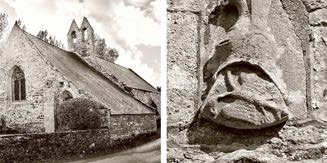
19.14. WAS DU GUESCLIN A TEMPLAR?
175
oldest very established ancestry of de Broons were the Borrell, counts of Barcelona, who, as can be seen in Figure 18.4 on page 130,
used the Gryphon in their heraldic shield. Of the subsequent generations, there was Pierre III du Guesclin on the one hand, and the cadette branch of Bertrand IV Du Guesclin on the other. Pierre II Du Guesclin is described in Chapter 19.14.4 and one can see, for instance in Figure 19.20 on page 175 that he began to use the gryphon on the helmet of his coat of arms.
Bertrand IV Du Guesclin married Jeanne de Broons, and their son was Guillaume Du Guesclin, who married Juliette de Beaumont de Guitte. Guillaume de Guesclin and Julienne de Beaumont de Guitte had a son, Robert II Du Guesclin, who married Jeann de Malement. Bertrand Du Guesclin was their son.
The ancestry of Robert de Broons is shown in Figure 19.15 on page 165. Two key figures appear in his ancestry, namely, Almodis de la Marche, who was married to Pons de Toulouse, ancestor of Du Guesclin, and, after his death in 1060, to Ramon Berenguer I of Barcelona. The descendants of Almodis de la Marche, until Robert de Broons, are shown in Figure 19.16. The House of Barcelona was the House of Borrell. They appear through the second marriage of Almodis de la Marche and Guinidilde Borrell of Barcelona, the daughter of Vuifred I El Veloso de Barcelona and Gunhilde de Ampurias. The shield of Borrell is shown in Figure 18.4 on page
130. The prominent use of the Gryphon by Bertrand Du Guesclin in Spain is explained in Chapter 19.26.6. More details are given below.
Almodis de la Marche (1023-1071) was the countess of Barcelona from 1052 until 1071. Her husband, the count of Barcelona, was Berenger Ramon I of Barcelona (1005-1035), the son of Ramon Borell de Barcelone (972-1017), Count of Girona, Osana and Barcelona, and Ermessende de Carcassonne. After the death of Berenger Ramon I of Barcelona, Almodis de la Marche married Pons de Toulouse (997-1060), and from that marriage stemmed Raymond de Saint-Gilles, known as Raymond IV (or VI) of Toulouse (925-961).
However, Pons de Toulouse also stemmed from the House of Borrell of Barcelona. Indeed, his parents were Guillaume III de Toulouse (975-1037) and Emma de Provence (980-1063).
Guillaume III de Toulouse was the son of Raymond V de Toulouse (972-978) and Adélaïde d’Anjou (947-1026).
Raymond V de Toulouse was the son of Raymond IV de Toulouse (925-961).
Raymond IV de Toulouse was the son of Raymond III Pons de Toulouse (900-940) and Gersende de Gascogne.
Raymond III Pons de Toulouse was the son of Raymond II de Toulouse (who died around 924) and Guinidilde de Barcelone, of the Borrell House of Barcelona.
Suniarius comes ac marchius et uxor mea Richildes comitissa” donated donated property to the church of Barcelona, for the souls of “patri meo condam qui fuit Guifredi comitis et matri mea condam qui fuit Guinidillis comitissa et fratri meo qui fuit condam Borrello comites...et proles meos condam Ermengadus et Borrellus”, by charter dated 16 May 944.31
The earliers Count of Barcelona is referred to in ancient writings as Burrello comitis, conerninf the events in 798, in Vita Hludowici Imperatoris. The Vita Hludowici Imperatoris names Isembardum, Hudemarum, Beram, Burellum as those leading the campaign against Tortosa in 809. His name suggests a family connection with the later counts of Barcelona.
19.13.4 Du Guesclin was a Blood Relative of Enrique de Trastamara
Because Bertrand Du Guesclin was related to the nobility of Arragon and Barcelona, it is obvious that he was also blood-related to Enrique de Trastamara. The precise relation is shown in Figure 19.17 on page 167.
19.14 Was Du Guesclin a Templar?
Figure 19.20:
The shield of the Du
Guesclin family in the façade of the Notre
Dame du Temple at Pléboule in Bre-
tagne, allegedly a former Templar’s chapel,
by many believed evidence that the Du
Guesclins were templars. The shield and
it’s particular gryphon on top, is also
shown in Figure 19.47 on page 207. It’s
possible role in the formation of the coat
of arms of the Desclergues is explained in
Figure 23.5 on page 250. The use of a
gryphon on the Du Guesclin shield is de-
scribed in Figure 18.4 on page 130 and
linked Du Guesclin with the Borrell clan
of Barcelona. The gryphon, shown in Fig-
ure 9.1 on page 79, was also popular in
Phocaea from where the greeks migrated to
Empúries, where they married our patri-
lineal ancestor.
19.14.1 Introduction
The question of whether Bertrand Du Guesclin was a templar is a very controversial one. The author assumes he was not because it is not even sure that such a secret order existed in France after 1307. It is a fact, however, that he had a crusader among his ancestors, perhaps even more than one. When Du Guesclin was in Spain and allied with someone with ancestors of ancient nobility, several of whom were known to be Knight’s Templars, that does not mean that he was also a Templar. However, his crusader ancestors and reputation as a winning military, not to mention the support and friendship of the King of Aragon, were probably of higher importance than whether he might have been a Templar. Du Guesclin’s ancestry is still debated today and may or may not have included the high nobility of Brittany, either through marriage or beyond. In other words, Du Guesclin possessed sufficient glamour and appeal to establish a liaison with a woman of the noble Torró family in Aragon despite his lack of physical attraction.
31Marca Hispanica (1688), Appendix, LXXXI, col. 857.
The Desclergues of la Villa Ducal de Montblanc, 2nd ed., Omn., VOL. I
© 2024 Nico F. Declercq
CHAPTER 19. BERTRAND DU GUESCLIN
Still, some explanations of the Crusades and Templars may interest the reader.
The cohort of individuals participating in the Crusades was characterized by a duality in their affiliations: some amongst them transitioned into the esteemed ranks of the Templar Order, while others pursued alternative trajectories, abstaining from Templar induction. Simultaneously, a segment of crusaders were pre-existing members of the Templar Order. The comprehension of the Templar milieu remains challenging within contemporary historiographical discourse due to the paucity of historical artifacts. This scarcity is attributable to the substantial destruction of Templar-related materials, followed by the fabrication of counterfeit chronicles and documents, which subsequently obfuscated the authentic historical record. Consequently, the corpus of genuine Templar knowledge is exceedingly limited.
The Templars occupied an eminent stratum within medieval society, epitomizing an intellectual and influential elite endowed with profound erudition. Their organization also commanded substantial wealth, an entity that functioned as an early precursor to modern banking institutions, surpassing both the Papal and Royal Houses in financial affluence. Entrance into their ranks necessitated a lineage of exceptional distinction. Within the Templar ambit, the concept of the bank check was conceived, and they wielded dominion over currency exchange and money-changing practices. This enduring influence on contemporary financial and banking structures is reminiscent of the enduring impact of Roman Law on modern legal systems.
Moreover, the Templars were adept practitioners of cryptographic methods, employing encoded language as a means of disseminating crucial information and news. Their extensive knowledge of antiquity, gleaned from their activities in the Middle East, augmented their mystique and intellectual prowess.
So, the Poor Fellow-Soldiers of Christ and the Temple of Solomon, commonly recognized as the Knights Templar, constituted a prominent military order within the Catholic faith during the medieval period, specifically within Western Christianity. Established circa 1119, their primary headquarters resided on the Temple Mount in Jerusalem, where they thrived for nearly two centuries.
The Templars received formal endorsement from the Roman Catholic Church, most notably through papal edicts such as the papal bull Omne datum optimum issued by Pope Innocent II. Consequently, the Templars garnered substantial support as a charitable organization throughout Christendom, experiencing significant growth in membership and influence. Distinguished by their characteristic white mantles adorned with a red cross, the Templar knights emerged as highly skilled combatants during the Crusades.
Moreover, a considerable proportion of the order’s membership, amounting to as much as 90%, consisted of non-combatant individuals who oversaw an expansive economic infrastructure spanning Christendom. They pioneered innovative financial practices reminiscent of early banking systems and established a network of approximately 1000 commanderies and fortifications across Europe and the Holy Land, laying the foundation for one of the earliest multinational corporations in the world.
The Templars maintained close associations with the Crusades, and as their capacity to secure their holdings in the Holy Land waned, support for the order dwindled. Heightened by rumors surrounding the Templars’ clandestine initiation rituals, a sense of mistrust arose. Despite being heavily indebted to the order, King Philip IV of France skillfully exploited this mistrust. In 1307, he exerted pressure on Pope Clement V to orchestrate the arrest of numerous Templar members in France, subjecting them to torture until they provided false confessions, ultimately leading to their execution by burning at the stake. Under mounting pressure, Pope Clement V dissolved the order in 1312. The sudden disappearance of a substantial component of the medieval European infrastructure fueled speculation and gave rise to enduring legends, perpetuating the enduring allure of the "Templar" name to the present day.
The Poor Fellow-Soldiers of Christ and the Temple of Solomon, also known by their Latin designation "Pauperes commilitones Christi Templique Salomonici," were alternatively referred to as the Order of Solomon’s Temple, the Knights Templar, or simply the Templars.
The mystique surrounding the Templars’ headquarters on the Temple Mount was deeply rooted in its believed connection to the ruins of the Temple of Solomon. Consequently, the Crusaders, inspired by this association, referred to the Al-Aqsa Mosque as Solomon’s Temple. From this location, the nascent order adopted the name ’Poor Knights of Christ and the Temple of Solomon,’
or simply ’Templar knights.’
19.14.2 Bertrand Du Guesclin had Ancestors who were Crusaders
The story of the Crusaders is closely connected to the story of the Knight’s Templars, although, technically, they are different phenomena. Still, some Knights who went on a crusade were or became Templars, while not all Templars were Crusaders and not all Crusaders were Templars.
Geoffroy Waglip, or Geoffrou de Guarplic, participated in the Second Crusade in 1147. He died in the Holy Land. Bertrand Du Guesclin was his great-great-great-great-great-grandson.
Approximately twenty years after the First Crusade was successfully concluded in 1118, a limited number of knights contacted the Patriarch of Jerusalem with a request that deviated from the norm. These persons articulated their intention to undertake vows of poverty, chastity, and obedience, committing themselves to an exceptional service to God. Rather than withdrawing from society and adopting a monastic lifestyle, they advocated to dedicate themselves to the protection of defenseless pilgrims who were at risk of being assaulted by bandits and Saracens while undertaking their journeys to sacred locations. The effort was received with great enthusiasm by the King of Jerusalem, who extended a gracious welcome and provided them with lodging at his palace situated on the Temple Mount in Jerusalem. This location is widely regarded to be the historical site of King Solomon’s Temple and place of residence. The aforementioned geographical site served as the origin for their appellation, ’the Poor Knights of the Temple of Solomon in Jerusalem.’ During this juncture, their economic circumstances had deteriorated so much that they depended on donated and abandoned garments. It has been said that they faced a scarcity of equines, which resulted in their first seal depicting two knights sharing a single horse.
Nevertheless, the individuals who established the organization have significant social influence and financial resources. Significantly, the Order attracted several notable individuals during its early stages, most notably Hugh, Count of Champagne, who became a member of the nascent organization in the year 1125. Several nobles were either unable or unwilling to commit to vows of chastity and poverty, demonstrating their support of the Poor Knights’ cause by offering donations of land or earnings. Arguably, the most notable advantage possessed by the organization in the first twenty years after its formation was its affiliation with St. Bernard of Clairvaux, a very prominent ecclesiastic figure of the early 12th century, facilitated by one of its founders, Hugh of Payns.
The ’Poor Knights’ did not gain a monastic constitution and formal recognition as a religious order until the Council of Troyes in 1129. St. Bernard formulated the Rule and drew inspiration from the Cistercians’ Rule but with modifications to account for the knights’ obligations regarding their equipment, steeds, and duties on the road instead of living in isolation inside a monastery.
Indeed, the precise formulation of the Rule was devised by a substantial committee, including various members of the Knights’
© 2024 Nico F. Declercq
The Desclergues of la Villa Ducal de Montblanc, 2nd ed., Omn., VOL. I
19.14. WAS DU GUESCLIN A TEMPLAR?
177
Order. During this particular era, the Poor Knights, who experienced a gradual accumulation of riches as a collective entity but remained humble as individuals, decided to choose white robes and surcoats as their selected garments. The authorization to don a red cross patée on their shoulders and breasts was bestowed 17 years later, in 1147.
Notwithstanding their accomplishments in acquiring acknowledgment, possessions, and fresh members, the Knights Templar, as they were progressively referred to, had not yet solidified their position as a noteworthy military entity or shown their prowess in combat. The Second Crusade afforded the change in question.
The capture of the County of Edessa by the influential Seljuk commander Zengi in 1144 had a profound impact on Western Europe.
It catalyzed the initiation of a fresh crusade. The formal plea was sent by Pope Eugenius, with St. Bernard emerging as a particularly zealous, articulate, and impactful preacher for this nascent crusade. Although St. Bernard managed to get the backing of Conrad of Hohenstaufen, the German King, it was ultimately the youthful French King Louis VII who played a pivotal role in spearheading this campaign. Louis originally intended for a career in the Church but assumed the position of ruler in France after the death of his older sibling. Throughout his lifetime, he was renowned for his profound devotion, and the crusade concept resonated with him. Following a fiery oration delivered by St. Bernard at Vézélay on Palm Sunday in the year 1147, a satisfactory contingent of nobility, which notably included the Duchess of Aquitaine, spouse of King Louis, pledged their participation in the crusade, ensuring its feasibility.
From the very beginning, the campaign had difficulties in terms of coordination. The German crusaders embarked on the French contingent. They proceeded in an unorganized fashion across the Western regions of the Byzantine Empire, leading to many confrontations with the forces of the Empire. The French troops, arriving around one month later, demonstrated a higher level of discipline. However, they had challenges in their interactions with the locals, who had become resentful due to the Germans’
actions.
Consequently, the acquisition of necessary supplies proved to be a challenging endeavor. The circumstances escalated to a critical point, leading King Louis to dispatch diplomatic representatives to the Greek Emperor to negotiate market rights. These advantages were sought in return for ensuring the organized transit of the Crusaders through Byzantine territory.
One of the envoys appointed by Louis was the Master of the Temple in France, who should not be mistaken for the Grand Master.
Everard de Barres, a figure of significance, had already established a strong rapport with King Louis and held leadership over a contingent of 130 Templar Knights, accompanied by a comparable number of sergeants and support staff, resulting in a combined force of around 300 Templars. The Templars in question were presumably individuals who had just joined the organization from France, although they had received training and completed a process of indoctrination.
Since the commencement of the Second Crusade, the participants adhered to their customary duty of protecting pilgrims. However, in this particular instance, the pilgrims were armed and accompanied by a substantial convoy of supplies, which included the Queen of France and several other noble women.
After passing the Bosporus in the latter part of October, the French crusaders were informed of distressing accounts of the destruction of the German crusaders. These rumors were subsequently confirmed to be tragically accurate. The German forces experienced extensive devastation in the vicinity of Dorylaeum, a location of notable triumph for the Crusaders during the First Crusade.
Reportedly, a mere 20% of the German crusaders managed to escape the carnage. Conrad von Hohenstaufen ascribed the calamity to the ’act of betrayal’ committed by the Greeks instead of assuming accountability for his deficient leadership and neglect in deploying scouts. This narrative was then communicated to King Louis.
Subsequently, the other members of the German contingent aligned with the French forces, but Conrad, the group leader, became indisposed and later embarked on a voyage back to Constantinople. The French proceeded with more caution as they advanced down the coastal path.
After surpassing the city of Laodicea, the pathway moved for another two days, eventually over a steep mountain pass atop Mount Cadmus. The commander, who held a vassalage to the Queen of France rather than her husband, chose to defy the given instructions for the vanguard to establish a camp at the summit of the pass.
Consequently, this decision resulted in a notable separation between the various sections of the army. Taking advantage of this favorable circumstance, the Turkish forces, who had been closely monitoring the movements of the army, promptly launched an assault on both the leading and trailing divisions, who were still grappling with the arduous ascent. During the combat, King Louis was unhorsed prematurely and sought shelter, as reported in varying accounts, either amid the rocky terrain or by climbing a tree.
During the turmoil and widespread destruction, the Templars emerged as the only organized and disciplined military unit capable of executing successful retaliatory actions. At the onset of dusk, the Turkish forces were successfully repulsed, but at the cost of significant casualties incurred by the Crusaders, primarily affecting their equine units and logistical convoy.
Profoundly impacted by this particular encounter, King Louis relinquished complete control over his whole military force to the Templars. The organization of the Crusader army by Everard de Barres included the formation of units consisting of 50 individuals, with each unit under the leadership of a solitary Templar. The Templars built a military organization and emphasized the importance of its preservation. Additionally, they gave directives for deploying infantry units to safeguard the cavalry during offensive maneuvers.
They stressed the need to launch counterattacks only when they were organized correctly and under competent leadership. The implementation of these procedures by the Templars upon assuming leadership seems to have been lacking since they had not been previously executed. This contrasts sharply with the notably disciplined army of Richard the Lionheart, seen half a century later.
Nevertheless, using discipline in isolation proved insufficient in tackling the complex issues around food and forage. The Turkish forces used a tactical approach, sometimes called the ’scorched earth’ plan, to deprive the advancing Crusaders of essential supplies.
In due course, the Crusaders were compelled to consume their equine companions, except the Templars, who had judiciously administered their provisions and could sustain themselves and their steeds. The Templars were able to effectively mask the inherent vulnerability of their whole military contingent, successfully fending off a further four assaults by the Turks. It was only after these encounters that the Crusaders ultimately arrived at the port of Adalia, which was under Byzantine authority.
Upon arriving at Adalia, King Louis VII, unlike his descendant and namesake, King Louis IX, decided to separate from his army and expeditiously journeyed to Antioch accompanied by his spouse and prominent nobles. The ordinary participants of the Crusades were confronted with the challenges of widespread disease and famine, leading many to resort to selling themselves into Turkish enslavement as a means of ensuring their survival.
In March 1148, King Louis arrived at Antioch, facing the absence of his infantry forces and experiencing a pressing financial predicament. During this period, the Templars sought to showcase their prowess in a different domain that would eventually earn them a reputation, whether positive or negative, in the realm of finance. Everard des Barres embarked on a maritime voyage from Antioch to Acre, where he successfully obtained financial assistance by leveraging Templar assets via the mortgaging process. The funds received were significant, as shown by King Louis’ directives to his ministers in France to reimburse the Templars. These orders prove that the loans equated to around fifty percent of the King of France’s yearly income at that period.
The Desclergues of la Villa Ducal de Montblanc, 2nd ed., Omn., VOL. I
© 2024 Nico F. Declercq
CHAPTER 19. BERTRAND DU GUESCLIN
The outcome of the Second Crusade was similarly disastrous. On June 24, 1148, a collective resolution was reached by the leaders of the crusade, which included Conrad of Hohenstaufen (who had embarked immediately from Constantinople to the Holy Land and subsequently participated in the crusader council), King Louis and King Baldwin of Jerusalem, to initiate a military offensive against Damascus. The decision was very unconventional, given that the Sultan of Damascus, during that period, had maintained a relatively amicable relationship and a shared adversary with Nur ad-Din, the successor of Zengi. Despite the presence of the Masters of both the Temple and the Hospital at this war council, their views remain unknown, and their influence was not yet significant enough to impact the outcome.
The first attempts to capture Damascus from the Eastern and Southern directions were fruitless due to the presence of gardens and orchards around the city. These cultivated areas, together with their accompanying irrigation canals, hindered large-scale horse attacks while providing archers with advantageous concealment.
A consensus was reached to relocate the encircling military forces towards the eastern region, characterized by the absence of gardens and orchards, as well as a limited availability of water resources. Following this, the whole of the crusade devolved into conflicts and allegations as the crusading military force fragmented, resulting in the tarnishment of the reputations of both King Louis and Conrad of Hohenstaufen.
The outcome of the Second Crusade had noteworthy ramifications. The event proved that the prowess of ’Frankish’ knights was not impervious, and the invincibility of Frankish forces was not unassailable, instilling a sense of increased confidence among the Turks. In Western Europe, it was seen that the Crusaders did not consistently receive divine favor from God.
Nevertheless, the pursuit of individuals to blame started promptly due to the prevailing belief that divine favor was necessary. The Greeks emerged as the primary target of blame, as Conrad and Louis saw themselves to have been ’betrayed,’ either by deception or deliberate entrapment into ambushes. The ’Poulains,’ referring to the barons and lords of the Kingdom of Jerusalem, were also subjected to censure since the Crusaders saw them to be too willing to engage in peace negotiations with their Saracen foes.
However, it is essential to highlight that a German writer ascribed the catastrophe in Damascus to the Templars. It is said that the Templars had received a significant monetary incentive from the Saracens to assist the besieged city covertly. The charge above was only put up by German authorities, whereas the French made no such claims. Upon his return to France, King Louis was effusive in his admiration for the Templars, contributing to the further enhancement of their esteemed status.
The Templars did not manage to develop a strong presence in the German-speaking regions, and within fifty years, the Germans formed their Order, known as the Deutsche Ritter Orden. Nevertheless, it was a monarch from France who eventually precipitated the demise of the Knights Templar.
Bertrand Du Guesclin hailed from a lineage deeply entrenched in the legacy of the Crusades, not only through his patrilineal ancestry. At the heart of Bertrand Du Guesclin’s Crusader matrilineal ancestry lies Robert de Broons, also known as Robert Guillaume de Broons, the Lord of Broons, whose participation in the Seventh Crusade under King Louis IX, commonly known as Saint Louis, underscores the family’s commitment to the Crusading cause. The Seventh Crusade (1248-1254) was primarily aimed at recapturing Jerusalem, which had been lost to the Muslims in 1244. Led by King Louis IX of France, it ultimately failed with the capture and imprisonment of Louis IX in Egypt.
Robert de Broons’s decision to join Saint Louis on this expedition reflects the widespread enthusiasm among Western European nobility to reclaim the Holy Land from Muslim control during the 13th century. His father, Hamon de Broons, an esteemed Knight and Crusader, accompanied Richard the Lionheart, King of England, on a Crusade, showcasing the family’s continued dedication to the Crusading ethos across generations.
Hamon’s involvement underscores the transnational nature of Crusading efforts, as knights from various European regions rallied under the banner of Christendom to defend or reclaim territories in the Levant. Richard the Lionheart’s crusade was the Third Crusade (1189-1192), which aimed to reconquer Jerusalem after its capture by Saladin in 1187. Notable figures like King Richard I of England, King Philip II of France, and Holy Roman Emperor Frederick I participated in this crusade.
Delving deeper into the familial tree, Gilberte de Saint-Gilles emerges as a pivotal figure in Bertrand Du Guesclin’s Crusader ancestry.
As the daughter of Bertrand de Saint-Gilles, a distinguished knight and ruler, Gilberte inherited a legacy shaped by Crusading endeavors. Bertrand de Saint-Gilles’s multifaceted roles as the Count of Toulouse and Tripoli exemplify the interconnectedness between Crusading ventures and political power dynamics in the medieval Mediterranean world.
Bertrand de Saint-Gilles’s lineage intertwines with illustrious Crusaders and rulers, including Raymond IV, Count of Toulouse, a central figure in the First Crusade (1096-1099). The First Crusade was called by Pope Urban II in 1095, aiming to capture Jerusalem from Muslim control.
Raymond IV played a significant role in capturing Jerusalem and establishing the Crusader states, including the County of Tripoli.
Raymond’s participation in the Crusades and his territorial holdings in Toulouse and Tripoli underscore the entanglement of Crusading aspirations with territorial expansion and consolidation in the Levant. The Crusades were not only religious expeditions but also had significant political and territorial objectives, with rulers like Raymond IV seeking to expand their influence in the region under the guise of religious fervor.
19.14.3 Templars in Matignon, Bretagne
Matignon is nowadays a French commune located in the Côtes-d’Armor department in the Brittany region, 40 km West of Ile-Du-Guesclin in Saint Coulomb and 40 km North of Broons, where Bertrand Du Guesclin was born. The Templars had a presence inside the geographical boundaries of the nation known as Matignon.
During the Middle Ages, the Templars and, subsequently, the Hospitallers of Saint-Jean of Jerusalem had a significant role, particularly at Pléboulle, located near Cap Fréhel, as well as in Pléneuf-Val-André.
The existence of the ancient inhabitants is shown by many remains, particularly at Pléboulle, Fréhel, Plévenon, and Saint-Alban.
Jean-Pol Pimor and Didier Marsaudon, two individuals with a keen interest in history and local traditions, have embarked on a journey to retrace the footsteps of several monastic orders. It is worth noting that, in many instances, legends have been given more prominence than facts.
Recently, researchers have presented their collaborative findings in a publication titled "Tracing the Path of the Templars and Hospitallers of Saint John of Jerusalem." The narrative has elements of both astonishment and exhilaration.
According to Didier Marsaudon, the organization’s primary purpose was to safeguard Christian pilgrims throughout their journey to the Holy Land. The European authorities warmly welcomed pilgrims but with the caveat of securing enough financial resources to fulfill their objectives. Pope Clement V disbanded the Order of the Templars in 1312.
The Hospitallers order was established in 1099, with the primary objective of providing hospitality to travelers and tending to the infirm.
© 2024 Nico F. Declercq
The Desclergues of la Villa Ducal de Montblanc, 2nd ed., Omn., VOL. I
19.14. WAS DU GUESCLIN A TEMPLAR?
179
According to Jean-Pol Pimor, in 1312, the Order of Hospitallers successfully reclaimed a significant portion of the assets formerly held by the Order of the Temple, which the Pope had disbanded. Subsequently, their organization emerged as the preeminent force within Christianity. In the realm of Matignon, there are two distinct orders.
The first installation of the Templars in Brittany occurred in the city of Nantes. The presence of the Hospitallers in that region was rather limited in terms of their population. Nevertheless, evidence of their historical presence may be identified by place names, including the term ’Hospital.’
Throughout history, La Fresnaye Bay has consistently functioned as a sanctuary and intermediate point for vessels navigating from the vast expanse of the open sea. The Templars established the Temple commandery at Montbran, located near Pléboulle.
The Temple Chapel at Pléboulle has been consistently portrayed as a Templar chapel in various historical records. Historians now believe that the Temple Chapel originated linked to the Hospitallers.
According to Didier Marsaudon, the renowned Montbran fair may be traced back to the Middle Ages and is likely to have been established by the Templars.
19.14.4 A templar’s Chapel in Pléboule
In Pléboule, in the Côtes-d’Armor in Bretagne, there is indeed a chapel, shown in Figure 19.20 on page 175, called initially Chapelle de la Sainte-Croix (The Chapel of the Holy Cross), and later called Notre-Dame-du-Temple, or le Temple.
The chapel of Notre-Dame du Temple, also known as the Sainte-Croix chapel, situated in Pléboulle, is among the three remaining structures associated with the Knights Templar. These structures are located at the entrance of the Cap Fréhel peninsula, alongside the Tour de Montbran and the church of Plurien. It is believed that the Templars from the prominent commandery of Lannoué near Yvignac were responsible for the establishment of the church above.
The chapel was constructed around the 13th century and underwent restoration in the 15th century under the patronage of a progeny of Bertrand du Guesclin, whose heraldic emblem is intricately carved into the stone above the main entrance.
Regrettably, no remnants of the cottage next to the church exist within the Templars’ historical context.
In 1274, an individual named Hamon Danebant made a generous contribution by donating many parcels of property in the parish of Pléboulle to the monastery of Saint-Aubin-des-Bois. One of the establishments above is situated in Clos Saint-Gilles, near the hospital. Given that the extant remains of the Clos Saint-Gilles mill are situated around 400 meters to the north of the Temple town, it is quite probable that the hospital in question pertains to the Notre-Dame church.
Furthermore, in 1295, the abbey above entered into a formal arrangement with Geoffroy le Porc, a resident of Pléboulle, about a precious feudal kingdom known as Trehen Daan. This particular stronghold was situated next to the fortified enclosure of Daan, around 500 meters south of the Temple. However, starting from the latter part of the 14th century, Pierre III du Guesclin and the Hospitallers jointly held the lordships of Montbran and Trehen. If the fiefdom of Montbran was to be restored to the lords of Plancoët, it is worth noting that the fiefdom of Tréhen was bestowed to the Hospitallers.
In the year 1424, Brother Nicolas Poitevin, who held the position of commander at La Guerche and La Noué, made a declaration about around ten establishments situated in Pléboulle at the Temple Trehen near Monbran. This included a courtyard in front of the church of the said Temple. The use of the word ’legalize’ implies that the settlement of the Temple accommodated parish offices starting from the 15th century. The persistence of this arrangement can be observed in the 18th century through the examination of the paper terrier of the commandery of La Caillibotière, which was initiated in 1776.
Within the parish of Pléboulle exists the Church of Notre Dame du Temple, situated within the immediate jurisdiction of the seigneury above dela Caillibottiere. According to the terrier, it is mandated that the Great Parish Mass be conducted on Three Sundays: firstly, on the day of the exaltation of the Holy Cross, specifically on September 14 during the Amonbran fair; secondly, on Shrove Sunday; and finally, on all days of the feast of the Blessed Virgin. The authority of the commandery encompasses the Cemetery of the Church above. The officers’ seats are in the wall surrounding the Cemetery, constructed from cut stone. The audience was convened every week, namely on Mondays. According to the Napoleonic land registration of 1826, the church and Cemetery were encompassed totally by a surrounding fence.
A detailed description of the chapel was provided in the topographic inventory conducted by Patrick Pichouron in 2010: The chapel of Notre-Dame du Temple is a structure characterized by a singular nave, which has been created using materials such as granite and schist rubble. The architectural structure consists of a central nave and a choir section, which are distinctly divided by a diaphragm arch. The western gable wall is accompanied by a pair of angular buttresses with projections on each side. The entrance has a pointed arch doorway adorned with an archivolt, including returns, arches, and columns. Above this is a decorative element carved in high relief, situated inside a walled bay. This decorative element is shaped like a scutiform shield, displaying a two-headed eagle on a crest helm. The northern wall lacks windows or openings. The buttress provides support to the structure, similar to the south wall. The surface of the bedside is level. The structure has an openwork design, including a pointed arch bay adorned with Gothic-style tracery. Additionally, it is equipped with straight buttresses, each projecting from its respective side. The architectural feature that divides the nave from the chancel consists of a two-bay comb bell tower, while the western roof is equipped with bolt holes. The exposed wooden frame, previously concealed by affixed paneling, is now visible. The choir is situated next to an aisle on its northern side, while a door provides access to the choir from the southern direction.
Steven Lemaître, in his regional thematic inventory 2016, described the chapel as follows:
The chapel of Notre-Dame-du-Temple is situated in the hamlet of the same name, located around 1.9 kilometers to the south of Pléboulle. The structure in question is characterized by its rectangular shape, with a solitary central space further elongated by a chancel, accompanied by a two-bay aisle on each side. The western façade of the structure has a gateway that is adorned with triple arches, positioned at third places. These arches are accentuated on the inner curve by a toric molding and are topped by a substantial archivolt. The entrance is characterized by a simple cylindrical window adorned with a large coat of arms and a prominent two-headed eagle wearing a helmet adorned with a peacock crest. The lack of a specific design element, known as a notice, clearly identifies the lineage of the Du family Guesclin as the oldest branch. Two oblique buttresses support the gable wall, each with two drip-edge projections. Additionally, the roof has smooth slopes that terminate in slightly projecting brackets. The presence of masonry connecting the oblique buttresses and the outside face of the eaves in the nave suggests a subsequent restoration of the roof. The barrel window and the Du Guesclin coat of arms were likely repurposed from a previous structure. The southern front of the structure is adorned with three semi-circular windows that date back to the 17th century. Of particular note is the second window, which incorporates elements of Gothic tracery. This window has two trefoiled lancets topped by a reassembled network design. The outer facade has a buttress that divides the elevation into two sections and adjoins the triumphal arch of the nave.
Twin drip edge projections characterize the buttress. The eastern portion of the external facade, which corresponds to the chancel, has decorative elements like a pointed arch doorway with a simple cavetto molding, a narrow square aperture, and a contemporary The Desclergues of la Villa Ducal de Montblanc, 2nd ed., Omn., VOL. I
© 2024 Nico F. Declercq
CHAPTER 19. BERTRAND DU GUESCLIN
semi-circular window. The bedside exhibits a flat surface, which is upheld by three angular buttresses with drip edges and lacks a foundation. Specifically, two buttresses are positioned to the south and one to the north. The bedside is further adorned with a pointed arch window that incorporates tracery. This window consists of two trefoiled lancets topped by a network design, which encloses a quatrefoil. Additionally, the window is embellished with two trefoiled spandrels on each side. The slopes provide a consistent and polished appearance, aligning with the repair efforts undertaken on the gable wall of the western facade. In contrast to the choir, the northern aisle of the structure is illuminated by a Gothic bay with tracery adorned with a trefoiled lancet. Additionally, a modern entrance with a straight lintel provides entry to the western side. The north gutter of the nave is blind; only two buttresses with double drip edges, similar to the one that abuts the opposite gutter, interrupt the façade. The bell tower is situated on the ridge of the eastern roof of the nave. It has two barrel chambers with cavetto transoms, each topped by a triangular roof. In the eastern section of the Cemetery, situated behind the choir, are observable late-medieval and modern graves. Notably, a bubo calvary returning to the 17th century commands attention in this area. The pinnacle cross of this calvary, depicting a crucifixion scene, is likely a repurposed element from a previous calvary of medieval origins.
The inside of the nave has a floor composed entirely of compacted soil. Positioned along the southern gutter is a funeral slab that depicts a cross resting on a two-tiered foundation. This design serves as a poignant reminder of the dispersed human remains discovered during unplanned investigations conducted in the last several decades. The nave and choir are distinguished by a prominent diaphragm arch, characterized by a pointed arch shape and adorned with two modestly chamfered extensions. A decorative relief arch with a floral motif further enhances this arch. The arch in question is supported by engaged pillars with numerous sides lacking a foundation. These pillars are adorned with decorative foliage and sculpted caps. The entrance leads to a chancel with a modern altar. However, when observing the eastern roof, it becomes apparent that there are two discernible layers of whitewash, suggesting the presence of a previously paneled vault. In the northern direction are two arcades with pointed arches, each consisting of two chamfered arches. These arcades provide access to the aisle, which contains a private chapel. The arcades are supported by an octagonal pier and two engaged pillars with a chamfered base and molded capitals. In proximity to the center mound, four sepulchral slabs, aligned in a north-south direction, are visibly exposed from the earthen surface of the exclusive chapel. Traces of ironwork may be identified, indicating the existence of a historical iron partition between the nave and the choir, as well as between the private chapel and the choir.
It is worth noting that there was also a Saint-Croix temple in Barcelona,32 locally referred to as Santa Creu, established by Guillem Torró. Establishing the Santa Creu hospital in Barcelona is a pivotal moment in the history of healthcare institutions, particularly in medieval Europe. Delving into its origins reveals not only the inception of a significant medical center but also sheds light on broader trends in hospital administration and development during the late Middle Ages.
Before the union of 1401, Barcelona’s hospital landscape was diverse, with various institutions serving different functions within the community. The merging of hospitals marked a significant shift, leading to the creation of larger, more centralized facilities, such as the Hospital de la Santa Creu. Understanding this context is crucial in comprehending the motivations behind the establishment of such institutions and the challenges they faced in their early years.
A key figure in unraveling the early history of the Santa Creu hospital is the notary Joan Torró. Through his First Manual, spanning the years 1401-1404, valuable insights into the administrative processes and day-to-day operations of the hospital emerged. Torró’s documentation offers a glimpse into the inner workings of this nascent healthcare institution, revealing the roles and responsibilities of its personnel, as well as the procedures governing patient care and financial management.
Examining Torró’s manual alongside broader historical trends allows us to grasp the Santa Creu hospital’s significance in late medieval Europe. Its establishment symbolized a shift towards more organized and centralized healthcare provision, reflecting the evolving needs and aspirations of urban societies during this period. Moreover, the challenges faced by the hospital in its formative years underscore the complexities involved in establishing and maintaining such institutions, highlighting the resilience and ingenuity of those involved in their administration.
In essence, the foundation of the Santa Creu hospital in Barcelona represents not only a milestone in the city’s medical history but also a microcosm of broader developments in healthcare provision and administration during the late Middle Ages. Through meticulous archival research and analysis of primary sources such as Torró’s First Manual, scholars can continue to unravel the intricacies of medieval healthcare systems and their enduring legacies.
19.14.5 Jacky Minier’s thoughts
As Bertrand Du Guesclin is portrayed in modern literature, an obscure Breton nobleman rose inside the annals of history as a notable military figure, garnering acclaim for his achievements in warfare. In the year 1370, the King granted him the esteemed designation of Constable, which held a position of great significance in the military hierarchy, comparable to that of a Chief General overseeing the Armies at that particular period.
This accomplishment had substantial significance. Nevertheless, because of the shifting political environment, the Constable was compelled to return to Brittany, resulting in the disbandment of the forces under his command. Paradoxically, those above inactive military personnel would subsequently coalesce into the notorious paramilitary factions known as the ’Grandes Compagnies,’ often portrayed as marauders who ravaged the rural regions of France and launched assaults on fortresses and aristocratic properties.
Amidst this era of societal turmoil, a captivating sequence of occurrences transpired. In light of the need to confront the prevailing presence of the Grandes Compagnies, a proposition arose to engage the assistance of Du Guesclin to expel them from the kingdom.
Du Guesclin expeditiously initiated measures, although intriguingly, without resorting to the customary use of sheer physical strength often associated with him. Conversely, he began discussions with the organization’s leaders, assumed control over their ranks, and guided them towards territories like Provence, Languedoc, and, ultimately, Spain.
Regrettably, Du Guesclin found himself in a predicament when he was apprehended in Spain during his involvement in a military confrontation between Peter of Castile and Henry of Trastamarre. Intriguingly, Peter of Castile had difficulty ascertaining a suitable monetary payment for the highly regarded French warrior. Ultimately, the establishment of an excessive amount is attributed to Du Guesclin himself, a perception commonly associated with his vanity.
The atypical depiction of a character who is both revered for his bravery in the military and regarded with doubt because of his inflated self-esteem evoked a complex range of emotions. Nevertheless, my viewpoint of Du Guesclin saw an abrupt transformation when I came across a line in a publication authored by Bernard Fabré-Palaprat, who wrote the ’Manual of the Knights of the Temple’ and advocated for a neo-Templar order during the era of Napoleon.
The prevailing historical narrative often conforms to the preferences of ruling elites, who manipulate events to further their interests.
32Alberto-Jesús Martínez Bedmar, "La fundación del hospital de la Santa Creu de Barcelona: el manual Primero del notario Joan Torró," thesis, 2028, The University of Barcelona, Faculty of Geography and History.
© 2024 Nico F. Declercq
The Desclergues of la Villa Ducal de Montblanc, 2nd ed., Omn., VOL. I
19.14. WAS DU GUESCLIN A TEMPLAR?
181
However, an alternate explanation exists, which lacks backing from official documents but presents thought-provoking inquiries.
According to Fabré-Palaprat, Bertrand Du Guesclin occupied the esteemed role of Grand Master within the covert Order of the Temple. This organization persisted in France for fifty years following its official disbandment by Philip the Fair and Clement V.
However, it operated openly in other nations, such as Spain, Portugal, Scotland, Italy, and Austria.
If this claim is valid, it implies that the Templars aligned themselves with the French faction in opposition to the English forces during the Hundred Years’ War. In this particular context, it is plausible that the military forces under the leadership of Du Guesclin consisted of captains who often hailed from esteemed lineages, maybe including those affiliated with the Templar Order or those who had sympathies towards it. Nevertheless, as political factors became more important than the struggle against the English, the Constable was recalled to his barony, resulting in these men being left to their ways without their influential commander. It is possible that their views and beliefs were not per the changing political environment. Nevertheless, their actions in the years 1373
and 1374 showed little respect for the directives issued by the monarchy.
When Bertrand was assigned to expel them from the realm, he refrained from participating in a conventional ’hunt.’ Instead, he negotiated with the group’s leaders and subsequently took charge, leading them toward Spain.
In this region, the Templars were known to operate publicly, as we have already shown. Is it possible that there was a covert collaboration between Du Guesclin and the Templars? The potentiality is undeniably extraordinary. What were the persuasive reasons used by Du Guesclin to secure the loyal allegiance of the fearsome ’Grand Companies’ in their expedition to Spain, where they engaged in combat on behalf of Henry of Trastamarre against Peter I, who had allied with the ’Black Prince’ of Aquitaine (English)? The impact of the Templars is significant throughout the 14th century, which may account for their concession to Bertrand.
A distinct viewpoint arises when considering the exorbitant ransom demanded by Du Guesclin from his prisoner, Peter I the Cruel.
How could an individual with extensive knowledge of the socioeconomically disadvantaged areas at that period, suffering from severe food shortages since the disintegration of the Templar territories, justify requesting such a disproportionately large amount of money from the monarchy, apparently motivated by a sense of arrogance?
The issue pertains to a prominent figure in the nation’s history, often seen as possessing arrogance and excessive self-regard, particularly among kids in their second year of middle school. One of the most puzzling elements of this line of thought is when individuals collectively mobilized to make contributions and gather funds for the hero’s ransom. Would individuals have shown the same behavior towards their monarch or against someone they held low esteem? These inquiries need careful attention.
Did the individuals admire a conceited and arrogant individual? Individuals tend to see these attributes, even without a profound comprehension of political matters, and our predecessors had a comparable level of perceptiveness, although with a lesser degree of knowledge.
Can you provide an alternate explanation? It is plausible that the individuals involved did not exclusively provide the financial resources, particularly in the second instance when Du Guesclin purportedly assumed responsibility for his ransom by liquidating the Duchy of Trastamarre, subsequently succeeded by the Duchy of Molina, as the narrative suggests.
Was the event indeed a ransom, or might it perhaps be classified as a different kind of financial transaction? The covertly transferring funds under the premise of a ransom, performed with the strategic sophistication reminiscent of Du Guesclin. From this perspective, the theory proposing ’Du Guesclin’s role as the Grand Master of the Temple’ presents a significantly divergent interpretation.
Could the ’Treasure of the Temple’ be transported to Spain or other locations outside 14th-century France? During that period, the Languedoc region was next to Aragon, which included the territories of Roussillon and Catalonia. This presents thought-provoking possibilities.
19.14.6 Cuvelier’s thoughts
The following text is rephrased from Cuvelier (Chronique de Bertrand Du Guesclin) and M. De Frémenville (Histoire de Bertrand Du Guesclin) and deals with ’Le Connétable Du Guesclin.’
It is well recognized, in concurrence with the perspectives of several biographers, that after the Treaty of Guérande and the talks about his ransom, which the King of France financially supported, Du Guesclin earnestly considered the realization of his youthful goals. He likely encountered steadfast support and unyielding commitment to this mission among his fighters. Nevertheless, we must exercise caution in endorsing Mr. de Fréminville’s assertion that he was compelled to go to the sacred regions due to profound and enigmatic duties, of which the author of this text claims to possess esoteric knowledge.
The issue of whether Du Guesclin possessed the title of Grand Master of the Order of the Temple remains unanswered, based on the transmission charter released by Mr. de Fréminville. The existence of an original charter is not a matter of debate, and it is acknowledged that Jacques de Molay, foreseeing the unfavorable conclusion of his trial, handed the confidential archives of the Order of the Temple to Larmenius, who held the position of patriarch in the East. The historical record indicates that a significant number of Templars faced execution by burning at the hands of King Philip IV.
However, the intervention of Joan of Navarre, as well as the support from the monarchs of Scotland and Portugal, provided a safeguard for many Templars, enabling the Order to persist as a covert organization inside France. Nevertheless, can it be ascertained if this affiliation has sustained a consistent and unbroken existence from the early 14th century to the current era? The clandestine history of the organization can be traced back to 1313 when it started at the base of the pyre, and the unfortunate Grand Master met his demise. This historical investigation is supported by certified records that provide evidence linking the organization to the period of the Duke of Cossé-Brissac, who served as its last legitimate head before facing execution.
The title above does not provide a conclusive response to the inquiries above. Although the list of grandmasters is extensively documented, its consistent nature gives rise to some uncertainties instead of definitively resolving them. The name of Bertrand Du Guesclin arises in the context of the highest authority, positioned between Jean de Clermont, who is thought to have assumed this role in 1349, and Jean III d’Armagnac, who is believed to have followed Du Guesclin as Constable in 1381. According to historical records, the individual in question is said to have affixed his signature on a document that may be traced back to 1357.
The task of acknowledging the appointment of a twenty-seven-year-old man as the supreme figure of a prohibited and rigorously supervised organization is undeniably arduous. This individual, who had not yet achieved recognition outside the confines of Brittany in 1357, was only starting to establish a reputation at that time. This objection presents a strong argument and is corroborated by other sources. We express our sorrow in communicating this issue to Mr. de Fréminville. We wanted to give him a concession that would enhance Du Guesclin’s status to a heightened degree of magnificence. The recognition of the importance attributed by Mr.
de Fréminville to establishing a connection between the constable image and the Order of the Temple is rooted in a profound sense of filial loyalty.
Nevertheless, there is a lingering historical ambiguity around the underlying impulses that drove Du Guesclin towards the Eastern The Desclergues of la Villa Ducal de Montblanc, 2nd ed., Omn., VOL. I
© 2024 Nico F. Declercq
CHAPTER 19. BERTRAND DU GUESCLIN
territories, which have traditionally been associated with tremendous achievements and triumphs.
Charles V unquestionably had a clear purpose in mind when endorsing this endeavor and generously allocating the required resources to its head. Unlike several rulers of his day, this particular King demonstrated a realistic and rational approach, devoid of any ambition to engage in a fresh crusade that would distract him from his lifetime endeavors.
This is supported by his transition from the initial intention of embarking on a religious mission to Cyprus and Syria to pursuing a merely political campaign beyond the Pyrenees. Charles V was motivated by a specific objective, which was to create a sense of Order in France. This included consolidating royal power and bringing under control the feudal and military forces that had either transformed into tools of revolt against the monarchy or contributed to societal chaos.
During the 14th century, the military structure of the kingdom consisted of two distinct components. On the one hand, some warriors were bound to the territorial jurisdiction of the monarchy, alongside others who were influential vassals compelled to serve the sovereign under the risk of losing their possessions. Conversely, some enjoyed freedom and saw warfare as a vocation, willingly providing their military services to the highest bidder. The troops often engaged in contractual agreements with the King or with knightly commanders who held commissions. These captains, in turn, provided the enlisted men with the necessary equipment in exchange for a mutually agreed-upon sum. The feudal system, or the prevailing customary practices, required vassals and sub-vassals to fulfill a yearly obligation of forty days of duty. Nevertheless, in instances of utmost importance, these responsibilities often went unmet.
In response to this issue, the French monarchs enlisted many groups of mercenaries, brigands, and soldiers of fortune. These individuals, finding it difficult to readjust to a society marked by a strict social structure during periods of tranquility, ultimately clashed with it. These bands of marauders traversed many territories, engaging in acts of robbery against travelers and looting castles and monasteries. They were under the command of greedy soldiers and destitute knights who lacked inherited wealth.
The assailants engaged in acts of aggression against urban settlements, causing devastation to rural areas and perpetrating ab-horrent offenses, as documented in contemporary records, with a sense of dread. Hailing from the region of Brabant, this group was first referred to as ’Brabançons’ and then as ’cotereaux,’ a term derived from their use of short swords. During the era of Du Guesclin, individuals of his ilk were often denoted as ’itinerant combatants’ or ’tardiness-afflicted individuals.’ The marauders, who were organized into substantial groups, had emerged as a significant cause of fear for governing authorities and the general public, presenting an overwhelming challenge to establishing any societal structure.
Notably, the executives of these corporations were esteemed individuals and knights of their day. Prominent individuals of historical significance included Bègue de Vilaine, Ives de Caverley, Arnoult de Cervolles, sometimes referred to as the archpriest or archdevil, Mathieu de Gournay, Bernard de Lasalle, Gaultier Huet, the viscount of Auxerre, the Mauny brothers, and several more individuals whose remarkable achievements were meticulously documented in extensive historical accounts. These strong military units had lately achieved a decisive victory against a royal army, resulting in the capture of the Duke of Bourbon and his son. The size of their group had seen a substantial increase due to the protracted conflict in France dating back to the Rule of the first Valois monarch.
This growth was so pronounced that the whole kingdom seemed to be powerless in the face of their presence.
In light of the urgent need to counteract these factions, King Charles V endeavored to gain the support of their leaders and establish a collaborative relationship. The individual had the task of identifying a foreign organization that would be enticing to them, with a crucial emphasis on including a charismatic leader who had a comprehensive understanding of the aims of the monarchy and could effectively establish a sense of trust among the members. If the extant troubadour poem provides an accurate depiction of the encounter between Du Guesclin and the marauders at the Châlons camp, wherein he arrived with an offer of two hundred thousand francs on behalf of the King of France and the promise of potential riches in Spain, then the speech attributed to the Breton knight during this large gathering of forty thousand individuals would undeniably position him as one of the most skilled orators of his era. The speech begins with the following statement:
"Allow me to elucidate the purpose of my presence here.
Individuals freely endeavored to protect their fellow citizens at the behest of the monarch, who was responsible for safeguarding France.
I express my desire for your presence. May you kindly accompany me throughout my journeys. In a mutually agreeable partnership, you shall willingly bear the responsibility.
Due to his strong inclination to engage in combat against the Saracens, one may choose to accompany the monarch of Cyprus under divine protection or go to Spain to partake in its pleasurable offerings. The region is known for its favorable conditions conducive to sustaining life, as well as its production of exceptional wines, renowned for their exquisite taste and clarity.
I implore you not to refuse my request, as I want to go to Avignon, where I possess knowledge of the route. I intend to seek forgiveness on your behalf for the transgressions you have committed, including the acts of murdering and robbing. Following this, we will proceed with our trip in unison.
It is plausible to assert that we may see our actions as having sufficiently burdened our conscience.
In my assertion, esteemed lords, I confidently affirm my conscientiousness, having refrained from engaging in any actions that would cause moral distress. However, should any transgressions be attributed to my name, it is not unfounded to surmise that, as my esteemed associates, you have committed acts of greater impropriety towards me. Let us demonstrate reverence for the divine and disavow allegiance to evil forces.
In human existence, we must introspect and contemplate the consequences of our behaviors.
Engage in courtship with women and ensure the protection of households, Engage in acts of violence against men and children, and seek monetary compensation from all parties involved;
The consumption of bovine animals such as cows, cattle, and sheep, as well as the exploitation of geese, chicks, and capons, with the indulgence in exquisite wines, were prominent aspects of our revelry.
The act of desecrating churches and religious organizations was a transgression of far higher magnitude than those often associated with ordinary criminals.
It is imperative to discourage engaging in harmful actions only targeting Christians strongly. I propose that by heeding my advice, we may collectively achieve financial prosperity. Furthermore, following my guidance will enable us to enjoy eternal bliss hereafter."
How may an individual counteract the influence of compelling arguments put forward by an individual with such persuasive abilities? Exclamations of joy reverberated throughout all quarters; the vocalizations of the exultant gathering fervently reiterated the appellation of the monarch. A formal invitation was made to partake in a meal with the monarch inside the confines of his royal residence.
© 2024 Nico F. Declercq
The Desclergues of la Villa Ducal de Montblanc, 2nd ed., Omn., VOL. I
19.14. WAS DU GUESCLIN A TEMPLAR?
183
On that significant occasion, Du Guesclin, supported by substantial financial resources, successfully garnered the allegiance of his first group of dedicated followers, who had previously occupied peripheral positions within the realm of the monarchy. Furthermore, a formidable force of forty thousand troops, now under his exclusive command, played a crucial role in achieving his policy goals.
Charles V effectively found a purpose for these strong groups and, as a result, managed to suppress their constant hostility. This difficulty is commonly confronted at the culmination of significant social crises: revolutions can only be ended by such measures.
When a discerning authority encounters formidable forces, its primary objective should be to include and integrate them rather than to eliminate them.
France was no longer at risk from the mighty corporations, and the remarkable diversion of the Loire River demonstrated to the global community the deeply ingrained material structure inside the nascent civilization. The marauders abandoned their practice of extorting ransom from locals, refraining from threatening the reputation of aristocratic women.
Additionally, the modern condottieri transitioned from using their swords to selling their services instead of using their writing talents. However, it remained crucial to provide these passionate aspirations and creative intellects with a significant objective.
Suppose Charles V had recognized the promise of the Castilian expedition under the leadership of Bertrand Du Guesclin. In that case, it is plausible that a government with a comprehensive understanding of its difficulties and resources might likewise identify a productive mission and willing partners.
King Charles V, displaying unwavering dedication to liberating France from the occupying forces, first showed a predisposition towards embarking on a crusade regardless of the associated expenses.
Nevertheless, the evolving circumstances in Spain during that period prompted a modification in his intended course of action, a strategic maneuver that he astutely linked to religious inspiration, a facet that Du Guesclin initially highlighted. Peter the Cruel, the monarch of Castile, who was responsible for the death of his spouse, Blanche de Bourbon, had been engaged in a prolonged dispute with France ever since. King John had provided refuge for Henry of Transtamarre, the brother and competitor of Peter, inside his royal court for an extended period. A significant portion of the Spanish nobles expressed a desire for reform, and a reasonable time had arisen to undertake an endeavor, with the backing of France, to modify the prevailing circumstances. This undertaking directly impacted French interests extending beyond the Pyrenees and the monarchy’s prestige.
During that particular era, Spain was renowned for its grandeur and adherence to chivalric values. Embarking on a journey over the mountains was akin to undertaking a crusade since it entailed an imminent encounter with the Saracens of Granada. These Saracens were known to be associates of Peter the Cruel, an individual characterized as a renegade and sorcerer whose notoriety from afar gave rise to peculiar narratives. The historical context was the pursuit of territorial expansion via the conquest of countries, the defeat of the Moors, the desire for retribution against a captivating queen, the acquisition of money, and the forcible attainment of absolution. What factors can impede one’s ability to achieve success given the promising opportunities and the guidance of a prominent individual such as Du Guesclin?
The written records provide ample evidence of the outcomes of the twin missions in the Iberian Peninsula, characterized by notable prudence and an unparalleled military strategy. It is well recognized that Henry of Transtamarre assumed the position of ruler in Castile but, shortly after that, encountered a decisive English invasion headed by the Black Prince to overthrow the monarch supported by the French. The ensuing mistakes and violations committed by Don Pèdre facilitated the rise of his competitor. After a strenuous war orchestrated by Du Guesclin, who held the position of commander-in-chief for both French and Castilian armies, the opposing King ultimately assumed power over a throne marred by the act of killing one’s sibling.
The expeditions conducted in the years 1365 and 1368 are early examples of our historical record of intricate and far-reaching military operations devised to subjugate and perpetuate foreign control. Du Guesclin effectively maintained Order and discipline among the individuals involved in this operation, changing them from unruly marauders into well-disciplined warriors. Under the supervision of a leader exclusively committed to upholding the monarchy, they formed the steadfast nucleus of an establishment that would imminently bring about a profound metamorphosis inside the country.
Following the events above, Charles VII strategically used the influence bestowed upon him by Joan of Arc, much like his predecessor, who had profited from Du Guesclin’s efforts. As a result, Charles VII successfully concluded the administrative modifications set in motion by the esteemed commander, culminating in the notable enactment of the ordinance of 1448. The decree above implemented a military function for every parish and formed ordinance companies that appealed to the youthful nobles. Henceforth, feudal responsibilities and the inclusion of lordly contingents became a peripheral role within the military framework of the kingdom. The detachment of service from territorial ownership resulted in the disintegration of the feudal system at its core. The military, under the strict Rule of the monarchy, served as a means of exercising absolute authority, leading to the transformation of the territory to provide a foundation for a new system of administration.
The royal corporations played a significant part in undermining the once invincible nobility, whose sturdy strongholds would eventually succumb to the might of artillery. In his comprehensive study on military tactics, M. de Fréminville presents persuasive evidence that the process of besieging a fortress was much prolonged and unpredictable before the introduction of cannons. Modest fortifications, manned by around fifty steadfast defenders, have successfully shown the capacity to withstand much greater military forces for one year. Nevertheless, as the author expounds, the use of artillery brought about a significant transformation in the conduct of siege warfare, altering the balance of power in favor of the assailants. In the aftermath of this transition, no castle remained impenetrable.
During this historical period, a significant number of strongholds and castles, which had long withstood the dominion of the governing authorities, started to deteriorate, revitalizing France’s geographical terrain in parallel with the evolving societal dynamics. A moment of great historical significance transpired when Du Guesclin directed his cannons toward a humble edifice. This day, he was proved to be as crucial as the occasion when he partook in a lavish meal alongside King Charles V within the regal chambers of Paris, thereby cementing his authority over formidable troops who would soon become steadfast and devoted commanders.
Bertrand du Guesclin, in addition to his prowess as a courageous knight, had exceptional political insight that enabled him to have significant influence during his time due to his forward-thinking nature. The remarkable acts of bravery documented by his biographers, however noteworthy, only represent a small portion of his genuine contributions to future generations.
Suppose Du Guesclin had not had a profound understanding of his obligations and purpose. In that case, he might have potentially reveled in the influence and authority derived from his military achievements, which were still considered crucial then. As Constable of Castile, Count of Soria, and Duke of Molinas, he was bestowed with abundant riches and prestigious accolades. Nevertheless, despite the pleas from a grateful monarch, Du Guesclin decided to go back to France, relinquishing a stable and unchallenged position in favor of the risks associated with military conflict, the perils of jealousy, and an unknown destiny. His steadfast commitment to France and their deeply rooted adherence to monarchical principles, characteristics that were uncommon during the 14th century but became more prevalent in the 17th century, compelled them to conceptualize the nobleman’s existence as a continuous endeavor to resist England, a perpetual surrender of personal desires to the monarch whose power encompassed the entirety of the nation.
The Desclergues of la Villa Ducal de Montblanc, 2nd ed., Omn., VOL. I
© 2024 Nico F. Declercq
CHAPTER 19. BERTRAND DU GUESCLIN
During his military campaign in Andalusia, where he was subduing the last strongholds loyal to Don Pèdre, Du Guesclin was corresponded with by Charles V, who issued a pressing summons for his immediate return. The monarch, who had diligently prepared for an impending fight with intelligent strategies and covert schemes inside the subjugated regions, presently saw a revival of prosperity for the kingdom. In light of the reasonable accumulation of resources and the observation of a growing national spirit, Charles acknowledged the need for a leader capable of efficiently organizing the military and successfully exerting its influence.
He sought somebody with the exceptional strategic abilities of a distinguished military leader and esteemed recognition from the general public. Du Guesclin had the first attribute due to his innate qualities provided by nature.
In contrast, the latter attribute was acquired more recently via his successful mission, which garnered significant attention from the kingdom and elevated his status among the most prominent knights of his day. The elevation of the individual to the valued post of Constable seems to have been carefully planned and deliberated upon by the monarch for a significant period, allowing for the development and maturation of both individuals and situations involved. Before commencing the imminent conflict, in which he intended to take a proactive role, the monarch despatched Marshal d’Andreham, a former comrade-in-arms of Du Guesclin, to the region of Spain. The objective of his assignment was to communicate the monarch’s objectives to Du Guesclin and direct him to promptly return to the Pyrenees, mobilizing all feasible military resources from France and Spain in service of the monarchy.
The tremendous excitement experienced by Du Guesclin upon his abrupt elevation to the highest echelons of the kingdom, surpassing countless princes and lords, may be easily imagined by the narratives provided by his biographers. It is plausible to consider that, despite his modesty, he may have had both uncertainties and anxieties over attaining unparalleled levels of prosperity. Nevertheless, under the assurance of Marshal d’Andreham, who secured the unwavering backing of the kingdom’s knighthood for the King’s selection, Du Guesclin consented to assume the position of Constable. However, he stipulated a solitary condition that offered a comprehensive insight into his character: he insisted on a formal commitment to a predetermined salary, which would be consistently disbursed to his army, ensuring his capacity to exercise commanding authority. Without a doubt, it can be inferred that he had foresight while establishing this condition, as he anticipated the imminent difficulties that would emerge, even from the most knowledgeable counselors of King Charles, who lacked an understanding of the need for significant financial resources to support an army, particularly in light of the considerable depletion of the royal treasury.
After receiving thorough reassurance from Marshal d’Andreham of the King’s objectives and their unequivocal alignment, Du Guesclin embarked on his journey. While journeying across the mountainous terrain, the individual arrived at the territory of Foix, an area that maintained its allegiance to the nation of France. The individual’s expedition originating from the lower regions of the Pyrenees evolved into a sequence of intense conflicts, including confrontations with English defensive structures impeding progress and the need to overcome isolated divisions of the Prince of Wales’ military forces. Nevertheless, the size of his military troops expanded as he traversed this particular area of France, gradually seeing the emergence of a desire for self-governance.
Every day was marked by a series of attacks, unexpected events, and intense hand-to-hand fighting encounters, reminiscent of the vivid descriptions found in Froissard’s flowery prose. Across the regions of Languedoc, Périgord, and Limousin, the resounding call of "Notre Dame Guesclin!" reverberated, effectively fostering a sense of solidarity among the populace, who were united by their shared patriotic sentiments and under the influence of Du Guesclin, the inhabitants of these regions started to rouse from their extended periods of inactivity. He advocated reconquesting a kingdom that had suffered significant losses, emphasizing restoring past achievements and fostering a profound animosity towards the English. This sentiment, which he effectively disseminated, persisted throughout the history of France.
While journeying across these territories, he garnered not only moral backing but also mobilized tangible assets, mobilizing the populace towards their emancipation, a notion that was innovative for that age.
In the meanwhile, the King of England, with his characteristic vigor, mounted a military expedition. Before Du Guesclin crossed the Loire, the English had initiated invasions of Normandy and Maine, deploying a substantial military contingent under the leadership of Robert Knolles, who swiftly advanced towards the fortifications of Paris. According to historical chronicles, there is evidence of English messengers making frequent visits to the Saint-Honoré gate. Additionally, the citizens of Paris were known to see the enemy’s campfires, which could be seen flickering on the horizon from the towers of Notre Dame nightly. With a cautious approach, Charles postponed the engagement with Knolles until his new Constable arrived, considering previous setbacks.
Following the successful capture of Limoges, Du Guesclin promptly expedited his journey back. Clad in the attire of a modest trader and mounted on a resilient equine companion, he embarked upon a journey via the English encirclement enveloping the capital, traversed the fortifications of the city, and proceeded into the Saint-Paul mansion among the exuberant festivities of Christmas.
The bold action undertaken and its successful result, together with Du Guesclin’s established status as a seasoned combatant, stimulated widespread emotion, fostering a sense of assurance that might incite acts of heroism under practical guidance and feelings of powerlessness in its absence.
In October 1369, Du Guesclin, now near the King, was bestowed with the esteemed position of Constable at an elaborate ceremony inside the confines of the besieged city. In light of the need to launch a surprise attack on the English, he formulated a strategic plan. With the fortification of Paris’s fortifications and the concentration of troops in the region, the strategic priority shifted towards launching swift offensives against the adversaries in Poitou and Normandy. This approach aimed to effectively cut off their access to vital reinforcement from the southern territories and the sea.
The responsibility of overseeing the forces stationed in the capital city was entrusted to the esteemed Marshal de Sancerre. At the same time, Du Guesclin made his way to Caën, successfully deceiving the English, who were under the impression that he was still in Paris. A significant portion of his military forces promptly assembled at that location. Instead of monetary compensation, he allocated his riches obtained in Spain and his opulent gold dinnerware, which was bestowed to him by King Henry, to his soldiers.