

The Desclergues of la Villa Ducal de Montblanc, Second Edition Omnibus by Nico Declercq - HTML preview
Download the book in PDF, ePub, Kindle for a complete version.
In acknowledgment of their assistance, King James I of Aragon granted Occitanian allies some privileges and territorial concessions on the island of Mallorca, therefore consolidating their established influence. As a result, Mallorca underwent a process of cultural and political amalgamation, exemplifying the heterogeneous backgrounds of its governing class.
In summary, the historical period from 1000 AD to 1400 AD in Mallorca is characterized by a complex series of transformations.
The historical period under consideration spans the transition from Islamic governance to Christian governance, the founding of the Kingdom of Mallorca, and its later assimilation into the Crown of Aragon. The modifications above occurred against a context of economic expansion, cultural interchange, and oscillations in population, with the inclusion of Occitanian participation introducing an additional stratum of intricacy to the historical narrative of the island. The lasting impact of this period serves as evidence of the complex interaction of historical factors that influenced the Mediterranean region.
17.9 The Desclergues were Pioneers of Mallorcan Banking
Within the labyrinthine corridors of medieval Mallorcan banking,9 the indelible imprint of pioneers such as Ramon Desclergue and his contemporaries looms large. Amidst the prevailing obscurity, their endeavors emerge as beacons of financial innovation and entrepreneurial acumen, shaping the nascent landscape of banking in the Kingdom of Mallorca. This chapter delves into their seminal contributions, elucidating the origins and evolution of Mallorcan banking through the prism of their visionary exploits.
At the dawn of Mallorca’s conquest, Ramon Desclergue epitomized the entrepreneurial spirit that underpinned the burgeoning credit activity. As early as 1242, he navigated the intricate webs of money deposit and lending operations, laying the groundwork for a nascent banking ecosystem. Alongside Desclergue, luminaries such as Renovard de Malbosch, G. De Temines, and de Guardia emerged as stalwarts of Mallorcan banking, their collective endeavors forging a path towards financial prosperity.
The symbiotic relationship between Desclergue and his contemporaries, epitomized by limited partnerships and collaborative ventures, underscored the interconnectedness of Mallorca’s banking elite. Together, they navigated the turbulent currents of medieval commerce, leveraging their collective expertise to facilitate economic transactions and foster commercial growth. In the annals of Mallorcan banking, their names resonate as paragons of financial ingenuity and entrepreneurial resilience.
As the Kingdom of Mallorca navigated the complex interplay of religious and cultural dynamics, Desclergue and his colleagues transcended conventional boundaries, fostering cross-cultural exchanges and economic cooperation. Their pioneering efforts laid the foundation for a vibrant banking ecosystem, characterized by diversity and dynamism. Within the realm of private banking, their enterprises thrived, providing vital financial services to merchants and individuals alike.
Amidst the archival lacunae and historical ambiguities, the legacy of Desclergue and his contemporaries endures as a testament to the enduring spirit of Mallorcan entrepreneurship. Their visionary exploits, immortalized in the annals of medieval banking, continue to inspire contemporary scholars and historians, offering invaluable insights into the genesis and evolution of Mallorcan financial institutions.
In conclusion, the pioneering endeavors of Ramon Desclergue and his colleagues illuminate the hitherto obscured landscape of medieval Mallorcan banking. Through their visionary exploits and entrepreneurial acumen, they forged a path towards financial prosperity, shaping the contours of Mallorca’s economic destiny. Their legacy, enshrined in the annals of history, serves as a poignant reminder of the indomitable spirit of innovation and resilience that defines Mallorcan banking.
17.10 The Tradehub of Mallorca in the Late 13th Century
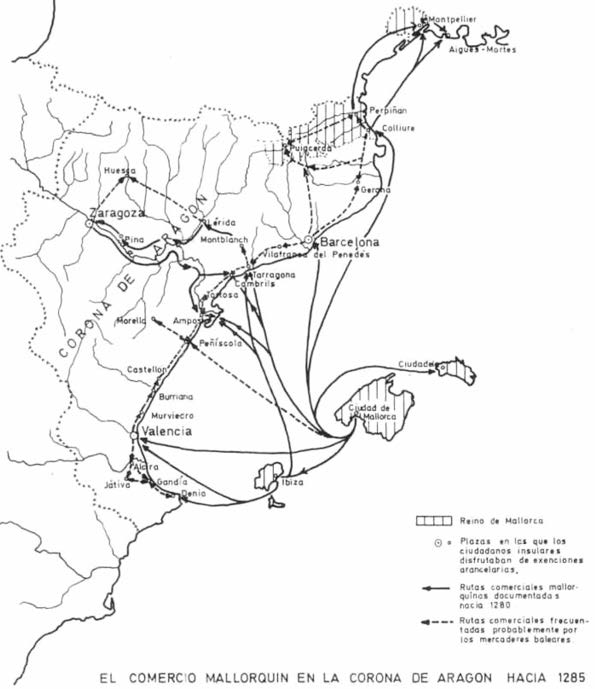
A map, showing Mallorcan trade in the Crown of Aragon around 1285 is shown in Figure 17.4 on page 123.
During the latter part of the 13th century, the island of Mallorca was a primary constituent of the Crown of Aragon, exerting a crucial influence on the intricate commerce network that spanned the Mediterranean area. Mallorca’s advantageous geographical position in the western Mediterranean, along with its conducive agricultural environment, facilitated its emergence as a prominent commercial center.
The marine commerce of Mallorcan trade in the year 1285 was characterized by its outstanding strength and resilience. The island harbored a highly advanced fleet of vessels, referred to as "nàutiques," that played a crucial role in enabling maritime commerce across the Mediterranean region. Merchants and shipowners from Mallorca were actively involved in marine endeavors that included regions such as the Levant, North Africa, and the Iberian Peninsula. The primary basis of Mallorca’s commerce was exporting domestically produced commodities, including cereals, wine, olive oil, and almonds. The items above were in great demand throughout the Mediterranean markets, therefore making a substantial contribution to the economic success of the island.
Additionally, the economic importance of Mallorca was enhanced by its involvement in the manufacturing of premium textiles, namely silk and wool. The island was well recognized for its proficient weavers and textile artisans, and the manufacturing of textiles played a crucial part in its commercial interactions. The textiles produced in Mallorca were much sought after in both the Crown of Aragon and other distant places, playing a significant role in bolstering the island’s economic prowess.
During the specified historical time, the prevalent medium of exchange in Mallorcan commerce was the "diner," which served as a prominent unit of account within the broader Mediterranean commercial network. The diners of Mallorca were acknowledged and embraced in other Mediterranean ports, augmenting the island’s capacity for trade.
The commerce of Mallorca was influenced by its religious variety. The island had a substantial Jewish population, characterized by their prominent engagement in commerce and banking. The extensive network of links maintained by Mallorca throughout the Mediterranean region and other areas played a pivotal role in fostering commercial partnerships and bolstering the economic success 9Antonio Mercader, "La Banca Mallorquina en la Baja Edad Media", Tesis doctoral Tomo I, Frau Director: Dr. Pau Cateura Bennàsser, Departament de Ciències Històriques i Teoria de les Arts, Universitat de les Illes Balears Palma, junio 2014.
© 2024 Nico F. Declercq
The Desclergues of la Villa Ducal de Montblanc, 2nd ed., Omn., VOL. I
17.11. INTERTWINED MALLORCA AND BARCELONA
121
of the island.
In addition, the political stability experienced by Mallorca during its affiliation with the Crown of Aragon had a pivotal role in creating a favorable setting for commercial activities. The island saw advantageous outcomes due to the protection and backing provided by the Aragonese crown. This support fostered an environment that encouraged foreign merchants to actively participate in commerce with Mallorca, augmenting its economic influence.
The scope of Mallorcan commerce in 1285 extended beyond the exchange of tangible commodities. The island’s advantageous geographical position further made it a central center for the dissemination of information. The intellectual and cultural liveliness of Mallorca was enhanced by the acquisition of information about various cultures, markets, and inventions, which merchants and tourists facilitated.
In summary, during the approximate period of 1285, the trade activities of Mallorca within the Crown of Aragon exhibited several noteworthy features. These included the establishment of a prosperous maritime network, the exportation of agricultural and textile goods, the implementation of a distinctive currency system, the presence of a diverse populace encompassing a notable Jewish community, and the stability ensured by the governance of Aragon. The convergence of these elements resulted in Mallorca becoming a prosperous hub of trade and commerce within the Mediterranean region, fostering economic success and cultural plenty over the specified timeframe.
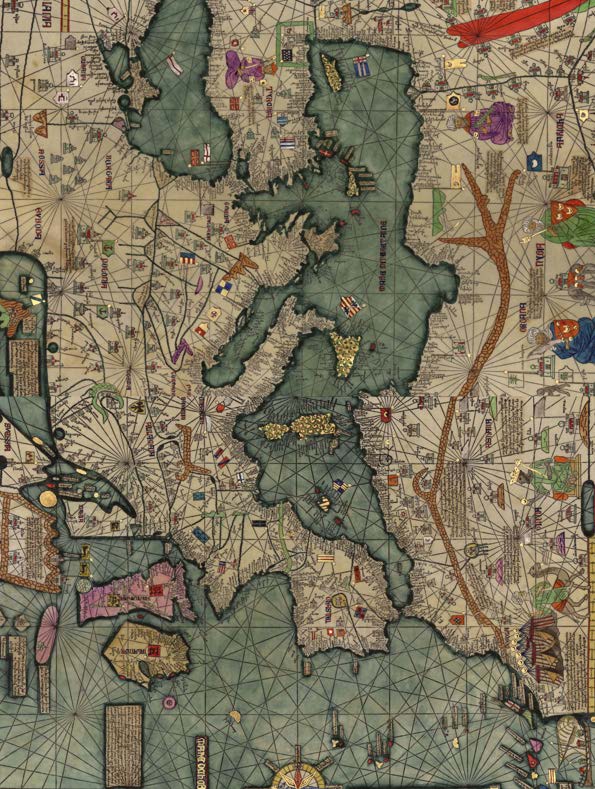
The depicted cartographic representation in Figure 17.5 on page 124, showcases Aragon and Mallorca as pivotal hubs of maritime interactions spanning across Europe, Asia, and Africa within the expansive Mediterranean basin, rendering it a captivating and invaluable artifact. Crafted by the esteemed Jewish geographer and cartographer, Elisha Ben Abraham, this map not only illustrates geographical features but also underscores the profound historical significance of Mallorca. Notably, Mallorca became the birthplace of the renowned Mallorcan Cartographic School, a testament to its pivotal role amidst the maritime flourishing attributed to its strategic location within the Mediterranean. Produced in Mallorca in the year 1375 by Elisha Ben Abraham, this masterpiece epitomizes the maritime grandeur of its era, encapsulating both aesthetic allure and scholarly insight.
17.11 Intertwined Mallorca and Barcelona
During the 14th century, the historical narratives of Mallorca and the bustling metropolis of Barcelona, shown in Figure 17.2 on page
114, were closely interconnected, influenced by a diverse range of elements, including political dynamics, economic activities, cultural exchanges, and commercial interactions. During this period, there was a notable movement of nobles, bankers, and businesspeople from Mallorca to Barcelona. This occurrence was strongly influenced by historical circumstances that had a significant impact on the Crown of Aragon and fostered a dynamic relationship between these two Mediterranean cities.
The political shift of Mallorca after its integration into the Crown of Aragon served as a significant motivator for this departure. The invasion of Mallorca by King James I of Aragon in 1229 effectively terminated the island’s autonomy, establishing its integration into the broader Aragonese domain. Consequently, the aristocracy and elites of Mallorca forged alliances with the central authority in Barcelona, which had emerged as the administrative and political hub of the Crown.
The movement was propelled by the appeal of economic prospects since Barcelona was undergoing a phase of remarkable prosperity due to a thriving trade and commerce industry. Barcelona, geographically located along the Mediterranean coast, played a significant role as a crucial commerce hub. This geographical advantage attracted a diverse range of individuals, including merchants, bankers, and businesspeople from Mallorca, who were keen on capitalizing on the city’s developing markets and profitable opportunities.
The concentration of authority under the Crown of Aragon further stimulated the migration process. Barcelona assumed a prominent role as the focal point of political decision-making, characterized by the presence of the royal court, which became a distinguishing characteristic of the city. To maintain proximity to centers of political influence and engage in political activities, the aristocracy of Mallorca considered it beneficial to transfer to Barcelona.
The migratory process was heavily influenced by the importance of security and stability, particularly in light of the tumultuous events that impacted Mallorca in the 14th century. Historical occurrences such as the Black Death and the anti-Jewish pogroms in 1391 engendered a prevailing sentiment of uncertainty and instability among the inhabitants of Mallorca, hence motivating some individuals to pursue a more stable milieu in Barcelona.
Cultural and intellectual forces also influenced the migration. During this period, Barcelona emerged as a dynamic hub of cultural and educational activities, characterized by prominent universities and institutions fostering intellectual exchange. The city’s vibrant cultural environment attracted scholars, artists, and intellectuals from Mallorca, who sought to participate in scholarly endeavors and facilitate the interchange of ideas.
Moreover, the prominent position of Barcelona as a significant center for commerce enabled Mallorcan entrepreneurs to enhance their commercial ventures and gain entry into more extensive trade networks, therefore accessing a larger pool of potential customers.
The urban area’s robust economic activity provided many prospects for expansion and success.
Finally, the relocation to Barcelona provided the Mallorcan nobles and gentry with social and networking prospects. Residing in an urban environment allowed them to establish meaningful connections with their contemporaries and cultivate social and professional networks that may potentially provide benefits aligned with their personal and vocational pursuits.
In brief, the migration of nobility, bankers, and merchants from Mallorca to Barcelona during the 14th century was multifaceted and intricate. Political integration, economic prospects, administrative incentives, security considerations, cultural allure, and the pursuit of social and business opportunities drove this phenomenon. The migration seen during this era not only demonstrated the changing dynamics of the Crown of Aragon but also played a significant role in the development of Barcelona as a prosperous hub for trade and cultural activities. The interchange of ideas, products, and knowledge between Mallorca and Barcelona during this century demonstrated the interconnection of Mediterranean communities. This shared history and collaboration contributed to the wealth and vitality of both regions within the superb framework of the Crown of Aragon.
17.12 The Transition from Mallorca to the Catalan Mainland
During the 14th century, particularly until around 1370, the illustrious lineage of the Desclergues found its abode nestled within the vibrant landscapes of Mallorca, an island teeming with commercial opportunities and cultural richness. This era coincided with the twilight of James III of Mallorca’s reign and the ascension of Peter IV of Aragon to the throne, both pivotal figures shaping the political and economic landscape of the region. Against this backdrop, the Desclergues flourished within the prosperous milieu of Mallorca.
To grasp the motivations behind their eventual migration, one must delve into the intricate complexity of economic dynamics that The Desclergues of la Villa Ducal de Montblanc, 2nd ed., Omn., VOL. I
© 2024 Nico F. Declercq
CHAPTER 17. HISTORICAL EVENTS MARKING THIS PERIOD
characterized Mallorca and its relationships with the mainland metropolises of Valencia and Barcelona. During this epoch, the Balearic Islands stood as bastions of economic vitality, their autonomy and flourishing trade serving as a bulwark against Aragon’s reluctance to relinquish control. Within this thriving environment, the logic of a seasoned merchant abandoning such prosperous shores amidst the simmering tensions between James and Peter, or in the immediate aftermath of the tumultuous events of 1349, appears inherently flawed.
Indeed, the decision to depart Mallorca in favor of Montblanc, situated on the mainland near Tarragona, defies conventional economic rationale. Montblanc, at the time, lacked the commercial allure and infrastructural advantages enjoyed by the bustling hubs of Mallorca or Barcelona. Yet, the Desclergues embarked on their migration during the 1370s, driven not by mere caprice but by the harsh realities of fiscal policies that rendered Mallorca less hospitable for their commercial endeavors.
Upon their arrival on the Catalan mainland, the Desclergues initially established themselves in Penedés, a region offering greater economic promise and stability compared to Montblanc. The presence of affluent Jewish merchants among their network likely played a significant role in this strategic relocation. Concurrently, the mounting difficulties faced by Jewish communities in Mallorca would have provided additional impetus for departure, as the Desclergues facilitated the transition of Jewish merchants to the mainland.
From Penedés, the Desclergues eventually gravitated towards Barcelona, the preeminent commercial hub of the region. Here, they found fertile ground for their entrepreneurial ambitions amidst the bustling trade networks and burgeoning urbanity of the Catalan capital.
It is only from the vantage point of the 15th century onwards that Montblanc emerges as an attractive locus for merchants seeking to penetrate and compete within a region hitherto monopolized by Barcelona.
In retrospect, the migration of the Desclergues stands as a testament to the nuanced interplay of economic imperatives, political exigencies, and cultural dynamics that shaped the medieval Mediterranean world. Their journey from Mallorca to the Catalan mainland reflects not only the shifting tides of commerce but also the resilience and adaptability inherent to the merchant class in navigating the ever-evolving currents of history.
17.13 Highlighting the Templars in Catalonia
Figure 17.3 shows the Templar’s presence in Catalonia.
The Templar presence in Catalonia is deeply intertwined with the region’s history of conquest, noble patronage, and strategic territorial acquisitions. Dating back to the early 12th century, the Templars swiftly gained prominence through significant donations and alliances with Catalan nobility, ultimately playing a crucial role in the defense and expansion of Catalonia’s border territories.
One of the pivotal moments in the Templar’s establishment in Catalan territory occurred in 1130 or 1131, with the generous donation of the Granyena castle by Ramon Berenguer III, the count of Barcelona. This act not only signified the beginning of Templar presence in the region but also highlighted the personal commitment of Ramon Berenguer III to the Order, as he professed within its ranks. Building upon this momentum, the Count of Urgell, Ermengol IV, followed suit by donating the Castle of Barberà (de la Conca) to the Templars just a year later. This initial wave of donations demonstrated a clear intention on behalf of Catalan nobility to involve the Templars in the ongoing conquest efforts.
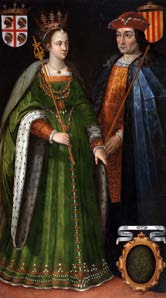
The consolidation of Templar holdings in Catalonia continued with the donation of Ramon Berenguer IV’s share of dominion over Barberà in 1133, further solidifying the Templar presence in the region. Ramon Berenguer IV is shown in Figure 17.10 on page
127. However, it is essential to note that despite these early donations, the formal establishment of Templar commanderies in Catalonia did not occur until the conquest and stabilization of crucial border territories, notably Tortosa-Miravet (1148-1153) along the Ebro and Lleida-Gardeny (1149) along the Segre. The strategic significance of the Conca de Barberà, situated in the rear of the border, cannot be understated, and it is believed that the Templar commission established in the Barberà castle played a pivotal role in the Order’s operations within the Principality. The Templar encomienda in Barberà, along with its sub-encomiendas Vallfogona, Rourell, and Espluga de Francolí, attracted the patronage and support of local nobility, particularly notable were the Queralt-Timor, Su, Oluja, and Cervera-Torroja lineages. The involvement of these noble families further underscored the symbiotic relationship between the Templars and the Catalan aristocracy.
Central to the consolidation of Templar territories in Catalonia was the figure of Arnau de Torroja, who served as Provincial Master and later Grand Master of the Order. Arnau de Torroja’s ties to prominent Catalan lineages, including the Queralt-Timor and Cervera-Torroja families, further facilitated the Templar’s expansion and influence in the region.
The Templar presence in Catalonia continued to attract individuals of noble lineage, such as Ramon de Anglesola, who joined the Barberà encomienda in 1307. Notably, Ramon’s profession within the Order occurred at the Franciscan convent of Montblanc, coinciding with an assembly of the Templar Order. Despite not holding any formal position within the encomienda or professing before the trial, individuals like Ramon de Anglesola received substantial pensions, reflecting the influence of their noble lineage within the Order.
Furthermore, the familial connections within the Templar Order extended beyond Catalonia, as evidenced by Sibyl, the wife of the Viscount of Ampurias and mother of the Templar Hug of Ampurias. Hug’s involvement in the Order and subsequent capture during the siege of Tripoli in 1289 underscored the transregional nature of Templar activities and the interconnectedness of noble lineages throughout the Mediterranean.
In conclusion, the Templar presence in Catalonia was characterized by strategic acquisitions, noble patronage, and territorial consolidation, all of which played a vital role in the defense and expansion of Catalonia’s borders. Through alliances with Catalan nobility and the leadership of figures like Arnau de Torroja, the Templars established a formidable presence in the region, shaping its history and leaving a lasting legacy that continues to fascinate historians to this day.
© 2024 Nico F. Declercq
The Desclergues of la Villa Ducal de Montblanc, 2nd ed., Omn., VOL. I
17.13. HIGHLIGHTING THE TEMPLARS IN CATALONIA
123
Figure 17.4: Mallorcan trade in the Crown of Aragon around 1285. This map was taken from Antonio Riera Melis.2
The Desclergues of la Villa Ducal de Montblanc, 2nd ed., Omn., VOL. I
© 2024 Nico F. Declercq
124
CHAPTER 17. HISTORICAL EVENTS MARKING THIS PERIOD
Figure 17.5: The Mediterranean Sea, copied from the Catalan Atlas of Elisha ben Abraham Cresques (1325-1387). Source: Library of Congress, Geography and Map Division.
© 2024 Nico F. Declercq
The Desclergues of la Villa Ducal de Montblanc, 2nd ed., Omn., VOL. I
17.13. HIGHLIGHTING THE TEMPLARS IN CATALONIA
125
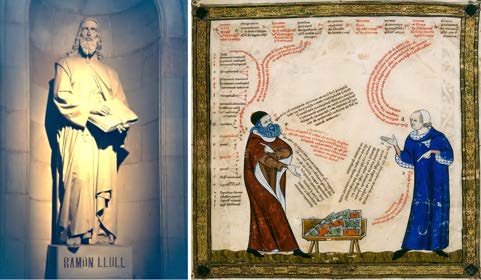
Figure 17.6: Ramon Llull knew our ancestor Francesc Desclergue in Mallorca. Left is a statue at
the University of Barcelona, right is Ramon Llull (left) and Thomas le Myésier (right), taken from
’Illustration de Electorium parvum seu breviculum, 1321.’
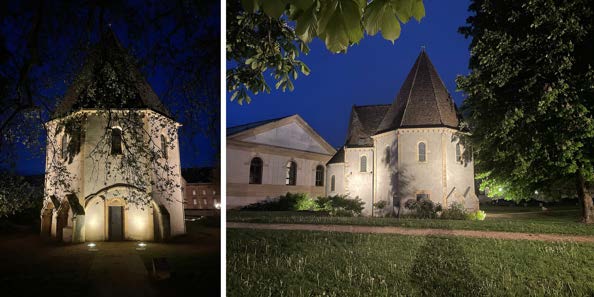
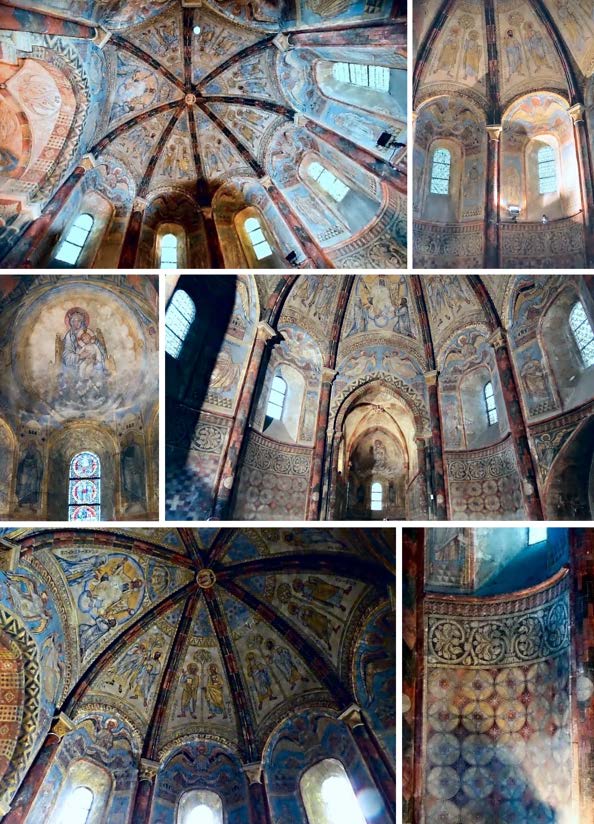
Figure 17.7: Two views of the Templar’s Chapel of Metz at night, highlighting its octagonal structure and the subtle yet striking details of its Romanesque-Gothic architecture under the soft illumination.
The Desclergues of la Villa Ducal de Montblanc, 2nd ed., Omn., VOL. I
© 2024 Nico F. Declercq
126
CHAPTER 17. HISTORICAL EVENTS MARKING THIS PERIOD
Figure 17.8: A compilation of photos showcasing the interior of the Templar’s Chapel of Metz, featuring the intricate frescos, the sculpted keystone, and the detailed capitals that exemplify its rich historical and artistic heritage. The photo bottom-right shows frescos of templar roses, similar to those applied in the Chapel of Deerlijk in Figure 49.33 on page 1001 and also in Santa Coloma de Queralt, shown in Figure 29.16 on page 375 and Figure 29.17 on page 375.
© 2024 Nico F. Declercq
The Desclergues of la Villa Ducal de Montblanc, 2nd ed., Omn., VOL. I

17.13. HIGHLIGHTING THE TEMPLARS IN CATALONIA
127
Figure 17.9: The shield of Clergue in Occitania evolved into that of the Desclergues
from Montblanc in a way that is totally logic in Heraldry. The one on the left is the
oldest of Clergue, followed by two later evolved Clergue shields. The shield on the
right is Desclergue. In Figure 23.1 on page 247, for instance, the coat of arms of the Desclergues, including the shield, on their house on the Main Square of Montblanc
is shown. How this shield would later serve to form the one of the author and his
descendants, is explained in Figure 23.2 on page 248. The other elements of the coat of arms of the Desclergues of Montblanc are explained in Figure 23.5 on page 250.
The shield can also be found in ancient documents, as seen in Figure 23.4 on page
Figure 17.10:
Queen Petronella of Aragon and count Ramon
Berenguer IV of Barcelona, painted by Filippo Ariosto in 1587. p
The Desclergues of la Villa Ducal de Montblanc, 2nd ed., Omn., VOL. I
© 2024 Nico F. Declercq
CHAPTER 17. HISTORICAL EVENTS MARKING THIS PERIOD
© 2024 Nico F. Declercq
The Desclergues of la Villa Ducal de Montblanc, 2nd ed., Omn., VOL. I
Chapter 18
Our Desclergue Ancestry
18.1 The Genesis of Catalunya Nova: Conquest and Colonization
In the 12th and 13th centuries, a significant movement of settlers from the Occitan region, particularly around Toulouse, migrated into the newly conquered territories of New Catalonia, or Catalunya Nova, under the rule of the Counts of Barcelona. This movement was part of a broader pattern of conquest, colonization, and Christianization, pivotal in forming Europe during the medieval period.3
The Count of Barcelona spearheaded the conquest of New Catalonia, Ramon Berenguer IV, who successfully seized control over the territories from the Islamic Taifas of Tortosa and Lleida in the mid-12th century. These military victories were not just territorial expansions but also marked the beginning of significant demographic and cultural transformations in the region. The subsequent expulsion of a substantial portion of the Muslim population and the destruction of their social fabric necessitated a repopulation of the area with Christian settlers.
The Occitan settlers from the Toulouse region played a crucial role in this process. The motives for their migration were multifaceted, including push factors such as social upheaval, inheritance practices that disadvantaged younger sons, and periodic famines and crises back home. These factors were compounded by pull factors in New Catalonia, such as land and wealth accumulation opportunities through participation in the feudal colonial system established by the Counts of Barcelona.
Upon arrival, these settlers were not merely transplanting their previous lifestyles but actively participating in creating a new feudal society. They brought with them their agricultural practices, legal norms, and religious customs, which they integrated with the existing frameworks in New Catalonia. The presence of Occitan settlers is vividly documented through notarial records, which contain detailed transactions and demographic information illustrating these settlers’ integration and economic activities.
Archival records from ecclesiastical sources like the Cathedral of Tortosa and the Cistercian monasteries of Poblet and Santes Creus offer rich insights into colonization. These documents reveal the mechanisms of land distribution and the establishment of new laws and societal norms. For historians, such records are invaluable for understanding the socio-economic underpinnings of medieval frontier societies.
Furthermore, the analysis of anthroponyms in the records from this period shows a clear transition from predominantly patronymic names to those reflecting geographic or topographic origins. This shift indicates the broader social transformations in New Catalonia, where land and identity were redefined under the new Christian rule.
The migration of settlers from the Toulouse region into New Catalonia during the 12th and 13th centuries is a testament to the dynamic processes of medieval European history that involved conquest, colonization, and the reshaping of cultural landscapes, which determined the course of our ancestry.
18.2 The Role of the Knight’s Templar in Catalonia’s Expansion
The Knights Templar played a pivotal role in the broader context of the Christian Reconquista in the Iberian Peninsula, including the territorial expansions into New Catalonia during the 12th and 13th centuries. This period marked a crucial phase in Templar involvement in military and socio-economic structures across Europe, particularly within newly conquered territories such as those around Tortosa and Lleida.
Founded in 1119, the Order of the Knights Templar was established to protect Christian pilgrims traveling to the Holy Land.
However, their role quickly expanded to include fighting in the Crusades and establishing a financial network across Christendom.
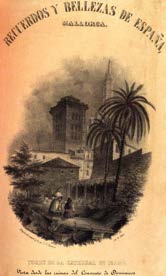
Figure 18.1:
In ’Recuerdos y bellezas de España: Mallorca’a, we
read: Also then the Common showed the spirit of freedom that the
concessions of the late Conqueror awakened in all hearts: the trustees
did not leave without first extending a solemn protest on January 26,
1281 that they intended to carry out their mission without detriment
to the privileges of the island. And the Juries, as interpreters of the
distrust that had been engendered by the reservation of imposing new
taxes and the promises to fully benefit the kings of Aragon stipulated
by Don Jaime in the agreement, obtained from him with their requests
a declaration that he did not intend to thereby harm their vassals, nor
violating their privileges, nor imposing any servitude on them, and that
they ratify their franchises for the third time. That year, the Juries were
Pedro Saudera, Bernardo de Zaragoza, Francesc Desclergue (Francisco
Desclergue), Guillelmo Valenti, Bernardo de Vich and Martin Mayol.
aPablo Piferrer, "Recuerdos y bellezas de España: Mallorca", Jose Repul-
lés, 1850, page 240
3Núria Pacheco Catalán, « Les migrations transfrontalières au Moyen Âge. Les Occitans en Catalogne Neuve (xiie-xiiie siècles) », Les Cahiers de Framespa [En ligne], 43 | 2023, mis en ligne le 01 décembre 2023, consulté le 07 mai 2024.
The Desclergues of la Villa Ducal de Montblanc, 2nd ed., Omn., VOL. I
© 2024 Nico F. Declercq


130
CHAPTER 18. OUR DESCLERGUE ANCESTRY
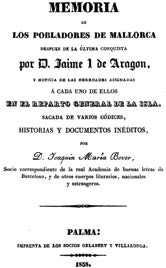
Figure 18.2: Francesc Desclergue on page 267 in Recuerdos y bellezas de España: Mallorca’1
Figure 18.3: Clergue or Desclergue (Francisco), a citizen of Mallorca,
in 1276 he wore the purple of the country and in 1279 he was trustee to
King D. Pedro of Aragon. "La púrpura de la patria" is a metaphorical
expression in Spanish that refers to the highest honors or distinctions
a person can receive from their country. The term "púrpura" (purple)
symbolizes prestige, distinction, and honor, as historically purple has
been associated with royalty and nobility. So, when someone is said
to have "la púrpura de la patria," it means they have been recognized
and honored by their nation for their achievements, contributions, or
sacrifices, with nobility roots in Byzantine Spain. It signifies the highest
level of recognition and honor bestowed upon an individual by their
aDon Joaquin Maria Bover, "Los Pobladores de Mallorca despues de la
última conquista por Don Jame I de Aragon", Palma, 1858. Page 35.
Figure 18.4: The Heraldic Shield of Borrell, described in Chapter
18.11.3. The use of a Gryphon on the Coat of Arms of the Descler-
gues in Montblanc, described in Chapter 23.3, may refer to the Borrell
Shield, or else, to that of Bertrand Du Guesclin. As a matter of fact,
the Gryphon used by Du Guesclin, as shown, For instance, in Figure
19.20 on page 175 in Chapter 19.14, and equally described in Chapter
19.26.6 also refers to Borrell, as he was a descendant of the House of
Borrell of Barcelona, through his forefather Bertrand IV Du Guesclin,
the son of Bertrand III Du Guesclin and Mahaut de Dol. Despite being
Borrell, once a Count, the Counts of Barcelona used the Heraldic Shield
of the County of Barcelona, however. The gryphon, shown in Figure
9.1 on page 79, was also popular in Phocaea from where the Greeks migrated to Empúries, where they married our patrilineal ancestor.
© 2024 Nico F. Declercq
The Desclergues of la Villa Ducal de Montblanc, 2nd ed., Omn., VOL. I
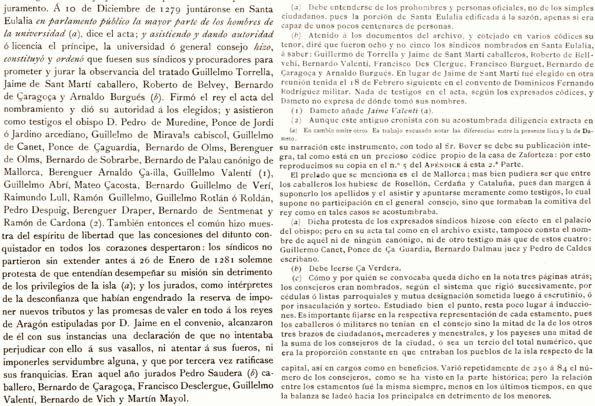
18.3. THE BROTHERS FRANCESC AND ARNAU CLERGUE
131
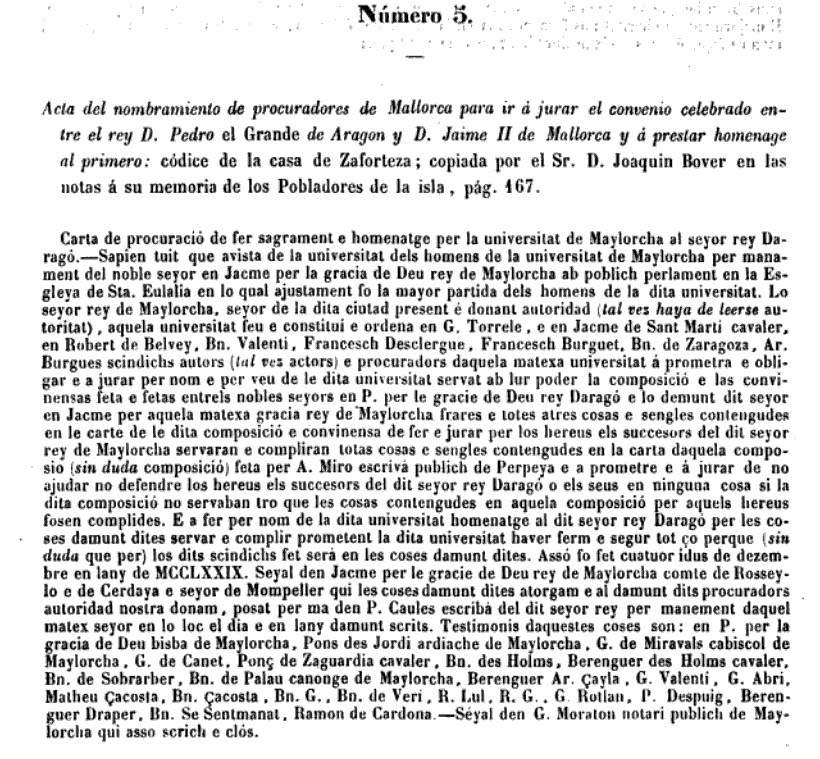
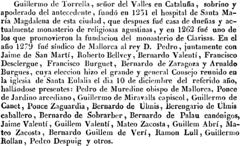
Figure 18.5: On page 141 and 142, we find that, in the year 1279,
Guillermo de Torrella was trustee of Mallorca to King D. Pedro to-
gether with Jaime de San Marti, Roberto Bellvey, Bernardo Valentí,
Francisco Desclergue, Francisco Burguet, Bemardo de Zaragoza and
Amaldo Burgués, whose election was made by the great and general
council gathered in the church of Santa Eulalia on December 10 of the
aforementioned year, with present: Pedro de Moradine bishop of Mal-
lorca, Ponce de Jardino archdeacon, Guillermo de Miravalls capiscol,
Guillermo de Canet, Ponce Zaguardia, Bernardo de Ulmis, Berengario
de Ulmís knight, Bernardo de Sobrarbér, Bernardo de Palau canons,
Jaime Valentí, Guillem Valentí, Mateo Zacosta, Guillem Abrí, Mateo
Zacosta, Bernardo Guillem de Veri, Ramón Llull, Guillermo Rollan,
Pedro Despuig and others. Page 159 explains how Francesc Desclergue
was establish at the University of Mallorca. On page 165, Francesch
Desclergue is mentioned as juror of Mallorca.
In the context of the Iberian Peninsula, the Templars were instrumental in both military campaigns and stabilizing these new frontiers.
In New Catalonia, the Templars’ presence became significant following the conquests of Tortosa and Lleida by Count Ramon Berenguer IV, who was keen on using their military expertise and resources. The Count granted the Templars extensive lands and privileges as a reward for their assistance in the conquests and to ensure the consolidation of Christian control in these areas. These lands often included strategic points along crucial trade routes and borders, which were vital for the defense and expansion of the Christian territories.
The establishment of Templar commanderies in New Catalonia served multiple functions. These commanderies were military bases, agricultural hubs, administrative centers, and part of a more extensive financial network that supported Templar activities across Europe and the Holy Land. In Tortosa, for example, the Templars established a significant commandery that managed large tracts of land and took part in the region’s local governance and economic life. The commandery helped organize and secure the area, which was crucial for its integration into the Christian domains.
Moreover, the Templars’ role in administrating and developing new settlements in the conquered territories was significant. They introduced advanced agricultural techniques, improved irrigation systems, and brought in new crops, which transformed the agricultural landscape of New Catalonia. Their land management and development efforts were instrumental in stabilizing these frontier regions, making them attractive for further settlement by Christian colonists, including those from Occitania.
The Templars also contributed to the spiritual and cultural landscape of New Catalonia by establishing churches and temples within their commanderies. They helped anchor the new Christian communities firmly in their faith.
The Knights Templar’s dual role as fierce warriors and savvy administrators facilitated the successful integration of these new territories into the Christian dominions of the Counts of Barcelona. The Templars’ legacy in New Catalonia is evident not only in the military victories that expanded Christian borders but also in the socio-economic transformation of the region, which they helped to administer and develop.
18.3 The Brothers Francesc and Arnau Clergue
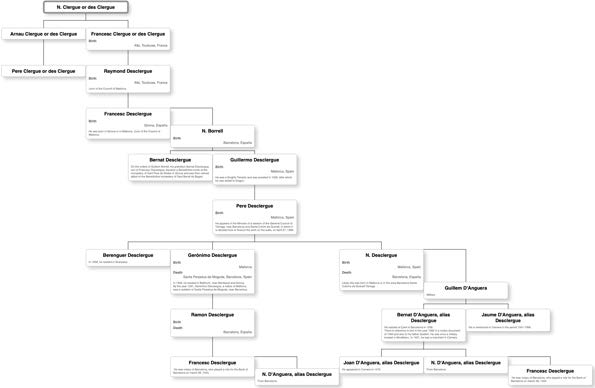
The reader will find the descendants of the brothers Arnau and Francesc Clergue in Figure 18.15 on page 135. In the later decades of the 12th century, the Reconquista and territorial expansions in Catalonia offered unprecedented opportunities for individuals across Christendom to gain land and prestige. Among these individuals were Arnau Clergue and his elder brother, Francesc Clergue, both hailing from Albi in the Toulouse region. Their divergent paths illuminate the socio-political dynamics of the time, particularly within the framework of the Knights Templar and the feudal structures of newly conquered lands.
As the eldest, Francesc inherited the family’s estate in Albi, a common practice that often left younger siblings like Arnau seeking fortunes elsewhere. The expansion of the Christian territories in Catalonia under the Counts of Barcelona presented such an opportunity for Arnau, who, with great courage and determination, joined the military efforts of the Knights Templar. His involvement was not just a quest for land but also a spiritual and social endeavor, aligning with the Templars’ dual role as both a monastic order and military force.
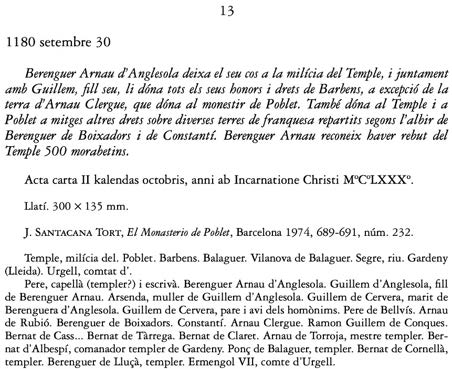
A pivotal September 30, 1180 document, provided in Figure 18.14 on page 134, provides crucial insights into Arnau’s circumstances and achievements. This document records a significant transaction involving Berenguer Arnau d’Anglesola, a local nobleman who dedicated his body and soul to the militia of the Temple (the Knights Templar). In this act, he also distributed his lands and rights among various parties, including a specific mention of the lands of Arnau Clergue. This land was explicitly exempted from a broader grant to the Monastery of Poblet, indicating Arnau’s distinct and notable status in the region.
The document specifies that alongside the Templar and monastic affiliations, the rights and lands in Barbens, a strategic location along the Segre River near Lleida, were intricately managed and redistributed among various local stakeholders. Arnau Clergue’s holding within this framework suggests that by 1180, he had established himself sufficiently to warrant individual mention in these significant legal and territorial rearrangements. This mention not only underscores his integration into the feudal and military structure of New Catalonia but also his successful alignment with the Templar’s strategic interests in the region.
The nature of Arnau’s landholding and his role in local society would have been multifaceted. As a Templar knight, he would have had military responsibilities, including defending the Christian frontier against possible Moorish counterattacks and participating in further campaigns of the Reconquista. Economically, his landholdings would contribute to the region’s agricultural output, supporting the local economy and the sustenance of the Templar order. Socially, Arnau would likely have played a role in the regional administration of justice and governance, typical of Templar knights, who were often integrated into the local noble hierarchy.
Arnau Clergue’s story is a testament to the mobility and fluidity of the medieval European social structure, driven by the expansive and transformative forces of the Crusades and the Reconquista. His successful establishment in Catalonia reflects the broader The Desclergues of la Villa Ducal de Montblanc, 2nd ed., Omn., VOL. I
© 2024 Nico F. Declercq
132
CHAPTER 18. OUR DESCLERGUE ANCESTRY
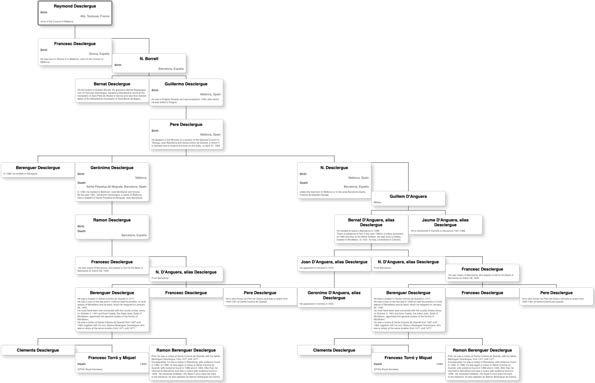
Figure 18.6: The descendants of Raymond Desclergue. In Figure 25.6 on page 275, the ancestors of Clementa Desclergue are shown, through whom the Desclergues of Montblanc took the name Desclergue, as they were the heirs of Clementa’s brother, Ramon Berenguer Desclergue.
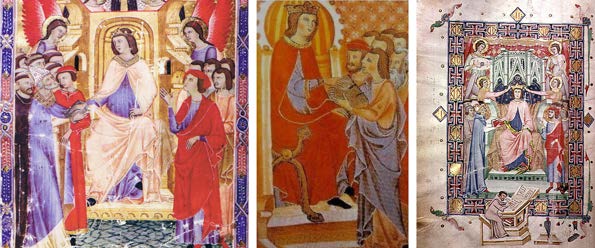
Figure 18.7: On September 12 of 1276, Jaume II, at the age of 33, was crowned as King of Mallorca in the Church of Santa Eulàlia. He would reign until 1311. The person handing over the book and the crown is Francesc Desclergue, in Chapter 18.11, who served as the Jurat. The three images depict the same scene, but are from different historical sources. A close-up of Francesc Desclergue is shown in Figure 18.8. One of the images comes from "al Llibre de privilegis dels reis de Mallorca in 1334" (Arxiu Històric Municipal de Palma). The other is a "miniatura del Llibre dels Privilegis - Jaume II i les ordinacions de l’any 1300." The assertion that the Desclergues possessed ’purple blood’ or belonged to the ’purpura de la patria’ is substantiated not only by written records but also visually corroborated in the presented images, where members of the Desclergues family are depicted wearing purple attire.
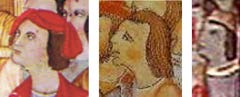
Figure 18.8: Francesc Desclergue, in Chapter 18.11.
Close-up of Figure 18.7.
© 2024 Nico F. Declercq
The Desclergues of la Villa Ducal de Montblanc, 2nd ed., Omn., VOL. I
18.3. THE BROTHERS FRANCESC AND ARNAU CLERGUE
133
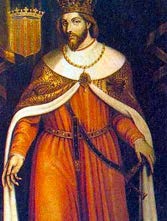
Figure 18.9: King James I of Aragon (Montpelier 1208 - Valencia
1276) conquered Mallorca and was thereby helped by prominent persons,
such as Raymond Desclergue, described in Chapter 18.10.
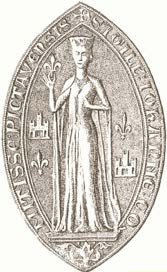
Figure 18.10:
Jeanne de Toulouse (1220–1271), Countess of
Toulouse and Marquise of Provence, depicted here, was a French noble-
woman. Born in Toulouse, she married Alphonse of France, brother of
Louis IX, and accompanied him on the Seventh and Eighth Crusades.
After Alphonse’s death in 1271, Jeanne passed away just days later in
Sienna. She influenced her cousin, King James I of Aragon, shown in
Figure 18.9, on page 133, in establishing his confidence in Raymond Desclergue, described in Chapter 18.10.
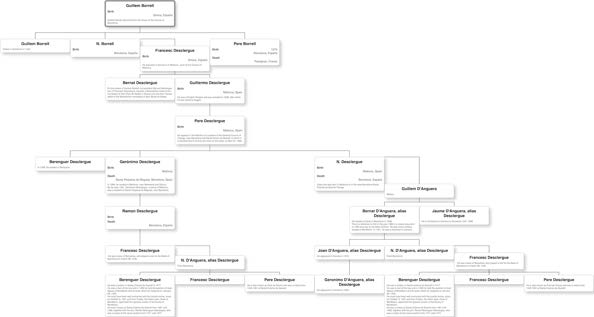
Figure 18.11: Descendant generations of Guillem Borrell.
Figure 18.12: Francesc Desclergue in Juan Dameto,
"Historia general del Reino de Mallorca, Volume 2", Im-
prenta Nacional a cargo de D. Juan Guasp y Pascual,
1841, p. 858-859.
The Desclergues of la Villa Ducal de Montblanc, 2nd ed., Omn., VOL. I
© 2024 Nico F. Declercq
134
CHAPTER 18. OUR DESCLERGUE ANCESTRY
Figure 18.13: Francesc Desclergue and his role in Mallorca.
Figure 18.14: The September 30, 1180 document2 contains a significant transaction between Berenguer Arnau d’Anglesola, a prominent High Middle Ages nobleman, and two key institutions: the Templars and the abbey of Poblet. Berenguer Arnau d’Anglesola contributes and
dedicates himself and his son Guillem to the Templar Order. This dedication is symbolic but
includes tangible donations. Berenguer Arnau donates all his honors and rights in Barbens, a
crucial and commercial location, to save property belonging to Arnau Clergue, which he gives to
Poblet Monastery. The Templars and Poblet received their properties by the medieval custom of
nobility, which granted land and privileges to religious organizations for spiritual protection and
alliances. Berenguer Arnau and the Templars agree to share property rights in different regions,
with management discretion given to Berenguer de Boixadors and Constantí, indicating a com-
plicated governance network and shared interests. The record notes that Berenguer Arnau got
500 morabatins from the Templars, implying a reciprocal connection rather than charity. This
financial transaction may indicate a military responsibility or noble-Templar assistance and as-
surance.
© 2024 Nico F. Declercq
The Desclergues of la Villa Ducal de Montblanc, 2nd ed., Omn., VOL. I
18.4. EXCILE FROM ALBI LANGEDOC 1209-1229
135
Figure 18.15: The brothers Arnau and Francesc Desclergue and their descendants.
patterns of land redistribution, military service, and religious commitment that characterized the era, a time of profound historical significance. His life and achievements provide a window into the complex interplay of feudal loyalty, familial duty, and spiritual devotion that defined the lives of many during the high Middle Ages in the newly Christian territories of the Iberian Peninsula.
The role of Frances Desclergue was similar to that of Arnau in that he was also a Knight’s Templar, but he remained in Albi. The Clergues would, however, migrate again when the son of Francesc, Raymond Clergue, outlined in Chapter 18.10, would join the conquest of Mallorca in 1229.
The Conquest of Mallorca was a significant military campaign initiated by King James I of Aragon, also known as James the Conqueror. The campaign began in December 1229, aiming to seize the Balearic island of Mallorca from Muslim rule. The strategic importance of Mallorca, located in the Mediterranean Sea, made it a valuable asset for controlling maritime routes and enhancing trade and military logistics. The conquest was successfully concluded by 1231, leading to the incorporation of Mallorca into the Crown of Aragon and marking a significant extension of Christian dominions in the Mediterranean region and the settlement of our ancestral branch of the Desclerues in Mallorca.
18.3.1 Pere Clergue, Arnau Clergue’s Son
A document4 dated September 9, 1252, emerges in a context that bridges ecclesiastical authority, feudal lordship, and community rights, reflecting the evolving dynamics of medieval Catalan society. This document concerns a judicial decision presided over by Pere de Queralt, acting as an arbitrator, to resolve a boundary dispute involving territorial demarcations between the lands of Vilosell and those of l’Albi (in Spain). This dispute involved several parties: Berenguer de Castellots, abbot of the monastery of Poblet, the community of Vilosell, Ramon Pere, the lord of l’Albi, his son Arnau, and the men of l’Albi.
Pere de Queralt’s arbitration concludes with the setting of boundary stones (’fites’) and both parties agreeing to respect these boundaries under the penalty of 100 morabetins—a substantial sum indicating the importance of the dispute.
Pere Clergue, mentioned as a witness in this document, ties back to the earlier one from September 30, 1180, explained in Chapter
18.3, where his father Arnau Clergue’s land was excluded from a donation to the Templars and given to the monastery of Poblet.
By 1252, Pere appears to have achieved a significant professional status, likely as a notary or scribe. His presence as a witness in such an important legal document further suggests that the Clergue family maintained or even enhanced their local social standing over the decades.
Pere’s cousin, Raymond Clergue, would bet on Mallorca to establish his career, as explained in Chapter 18.10.
18.4 Excile from Albi Langedoc 1209-1229
In contrast with Arnau Clergue and his son Pere Clergue, highlighted in Chapter 18.3, the events in Albi and Toulouse were detrimental to the branch of Francesc Desclergue, the heir of the family, who has stayed in Albi and whose son, Raymond Clergue, would join the conquest of Mallorca, becoming Ramon Desclergue, and establish our ancestral family line outside Occitania. The reasons for resettling the head of the family were linked with the Albigensian Crusade in Toulouse, which caused turmoil and probably broke the Clergue family in pieces. Indeed, some may have been Cathars, while others, such as Raymond Clergue, followed Rome and preferred the Knight’s Templar.
The Albigensian Crusade (1209-1229), also known as the crusade against the Albigensians, represents a significant historical event in which the Catholic Church mobilized forces to combat heretical movements, primarily Catharism and, to a lesser extent, Valdeism.
The origins of this crusade can be traced back to the twelfth century, with the Council of Lombers marking the formal recognition 4Josep Torné i Cubells, "Catàleg de Pergamins de l’actual Arxiu del Monestir de Poblet", p. 42.
The Desclergues of la Villa Ducal de Montblanc, 2nd ed., Omn., VOL. I
© 2024 Nico F. Declercq
CHAPTER 18. OUR DESCLERGUE ANCESTRY
of the "Albigensian heresy." It’s notable that this designation was applied to the region without it necessarily being more Cathar than its neighboring areas.
The stronghold of this heretical movement was primarily situated in Languedoc, where two influential families, the House of Toulouse and the House of Trencavel, held sway. However, internal divisions among these families hindered a united front against the encroaching crusaders. While Count Raymond VI of Toulouse eventually capitulated and aligned with the Church, Raimond-Roger Trencavel chose to resist the crusade. Subsequently, the crusaders, having captured Béziers and Carcassonne and imprisoned Trencavel, entrusted leadership to one of their own, Simon de Montfort, in 1209. What began as a campaign against heresy swiftly transformed into a conquest, initially serving the interests of Montfort and later, following his demise in 1218 and the subsequent failure of his son Amaury, becoming a venture for the crown.
Despite the shifting political dynamics, the suppression of Catharism persisted, initially under the auspices of local bishops and later through the establishment of the Inquisition in 1233. The territorial repercussions of the crusade were profound, with the viscounties of Carcassonne, Albi, and Béziers being annexed to the royal domain by 1226, and the County of Toulouse passing to Alphonse de Poitiers, brother of Saint Louis, in 1249 before being fully annexed in 1271. Languedoc, which had previously fallen within the sphere of influence of the Crown of Aragon, gradually came under the dominion of the King of France by the end of the thirteenth century.
By the close of the century, the scourge of Catharism had been largely eradicated from Languedoc, with only a scattering of adherents finding refuge in Lombardy.
18.5 The Conquest of the Arab Kingdom of Mallorca
The Desclergue family’s migration from Languedoc to Mallorca is exemplary of medieval Mediterranean dynamics. Rooted in their time’s political and economic upheavals, the Desclergues undertook their journey reflecting a strategic response to shifting fortunes and opportunities. While still in the Languedoc, they tried to establish connections with Barcelona.
During the medieval era, Barcelona emerged as a bustling trade and finance hub, exerting its influence over maritime Aragon.
For families like the Desclergues, proximity to this economic powerhouse presented an avenue for advancement. Descendants of Raymond Clergue and his progeny, they sought to carve their niche within Barcelona’s orbit while maintaining a distinct presence outside the city walls. This strategic positioning allowed them to compete effectively against rivals such as Genoa, leveraging their notarial positions and financial acumen to ascend the social and political ladder.
However, the allure of Barcelona’s prosperity was not the sole driving force behind the Desclergues’ migration. Faced with limited prospects for advancement in their native Occitania and in their guest town, Barcelona, they cast their gaze further afield in search of new opportunities.
The conquest of the Arab Kingdom of Mallorca occurred in 1229. It was carried out by King James I of Aragon (also known as James the Conqueror) with the support of troops from Catalonia and other parts of the Crown of Aragon. This conquest marked the beginning of Christian rule on the island of Mallorca, which was previously under Islamic control.
The conquest of the Arab Kingdom of Mallorca emerged as a promising venture, offering unexplored markets and the potential for social and economic ascent. Unlike the saturated conquest of Valencia, Mallorca represented a frontier ripe for exploitation, albeit fraught with risks.
The Desclergues, imbued with a familial ethos of enterprise and exploration, embraced the challenge with gusto. Their migration to Mallorca symbolized a broader pattern of familial ascendancy driven by a desire to expand horizons and capitalize on emerging trends. In Mallorca, they found a melting pot of cultures and commerce where Arab, Jewish, and Christian influences intermingled to create a vibrant society.
The Desclergues thrived in their new surroundings, leveraging their expertise in commerce and finance to navigate the complexities of Mediterranean trade networks. Their adaptability and resilience underscored their ability to seize opportunities amidst geopolitical flux, leaving an indelible mark on Mallorca’s economic and social landscape.
18.6 Banking in Mallorca
The kingdom of Mallorca was located in the 13th and 14th centuries at the epicenter of the great Mediterranean trade routes. In this world in full transformation, private banking institutions will emerge, which will provide important services to merchants such as currency exchange, deposits, exchanges and loans. For this reason, we already detected five private banks in the middle of the 13th century, in the last decades of the same century and the first decades of the 14th century their number grew to six or seven, reducing to three or four banking institutions at the end of the 14th century.
The need felt by institutions, such as the Crown and the municipality, to manage their income and taxes more efficiently determined the founding of a royal bank (’taula del senyor rei’), in 1301, linked to the monetary reform of the kingdom, and a municipal bank (’taula de la Universitat’) in 1321, emerged in the context of the economic collaboration of Mallorca with the company of the conquest of Sardinia, becoming after Venice the oldest public banking institutions in Europe.
18.7 Trade in Mallorca
The economic interactions of Mallorca during the thirteenth century witnessed significant engagement in transatlantic trade routes, particularly with Ligurian sailors navigating to England and Flanders. The involvement of Mallorcan sailors in Atlantic commerce became evident by May 1296. This period also marked pivotal developments in trade regulations, with Edward I of England granting the Mercatory Charter on February 1, ensuring free trade and perpetual peace with France on May 20. Such regulatory changes spurred merchant activities, attracting Mediterranean sailors to the burgeoning trade routes.
The port of Palma emerged as a crucial node in the transshipment of goods between Ligurian coasts, Flanders, and England.
Mallorca’s economic landscape was characterized by a dual commercial dynamic, facilitating the exchange of goods between diverse regions. Flemish textiles, routed through Languedoc and Montpellier, were among the commodities traded, with Mallorca serving as a key intermediary. Conversely, pharmaceutical substances were imported into England through companies established by Montpellier bourgeois.
Documentation indicates the regular arrival of Atlantic supplies at the port of Palma, while Mallorcan ships were acknowledged in England through credentials issued by Edward III’s chancellery. Castilian sailors also found a lucrative charter market on the island, further enhancing Mallorca’s position as a pivotal trading hub. Similarly, towns along the Strait of Gibraltar became indispensable
© 2024 Nico F. Declercq
The Desclergues of la Villa Ducal de Montblanc, 2nd ed., Omn., VOL. I
18.8. THE DESCLERGUES EMBODIED THE RENAISSANCE SPIRIT
137
stopovers for transactions with Portugal.
The Desclergues family, prominent in Mallorcan history, epitomized the multifaceted involvement in commerce during this era. Their roles as jurors, notaries, and merchants underscored active participation in trade, finance, and currency exchange. The family’s ties extended to Barcelona, reflecting shared business interests and necessitating frequent travel for negotiations, legal matters, and business expansions. This interconnected economic framework operated within the broader Kingdom of Aragon, renowned for its commercial and military influence.
The Desclergues family’s legacy unfolds as a narrative of perpetual movement and engagement across various urban centers, including Barcelona, Valencia, and beyond. Their activities encompassed contract negotiations, dispute resolution, and network expansion, transcending geographical boundaries. Far from static figures, they epitomized dynamism and entrepreneurial spirit, traversing trade routes extending from Mallorca to Seville, Granada, Montpellier, and beyond. This dynamic engagement epitomized the pursuit of commercial opportunities, symbolized by the Spanish expression "men with restless asses."
18.8 The Desclergues embodied the Renaissance Spirit
The Desclergues stood as a beacon of commerce, culture, and connectivity in the vibrant medieval Mediterranean. Their lifestyle was intricately woven into the bustling trade routes and cosmopolitan hubs that spanned from the shores of Mallorca to the markets of Genoa, from the ports of Marseille to the alleyways of Seville.
In an era where East met West in a whirlwind of commercial activity, the Desclergues thrived. The Mediterranean was their playground, where the competition between Arabs, Christians, and Jews was not just a clash of civilizations but a symphony of economic dynamism. The family’s footsteps echoed through the bustling ports of Sardinia, Corsica, Montpellier, and beyond as they navigated the currents of trade and finance.
Mallorca, with its blend of Arab and Jewish influences, served as a vibrant economic emporium where cultures converged. Amidst the hedonistic atmosphere of sophistication and luxury, the Desclergues embraced the spirit of cultural crossroads, engaging with philosophers, poets, and troubadours. It was a world of great freedom of thought, where ideas mingled as freely as goods and currencies.
Yet, amidst the luxury and refinement, the Desclergues were not untouched by the conflicts of their time. The Crusades raged on, casting shadows of war and skirmishes across the Mediterranean landscape. But theirs was not a dark epic but a story of resilience and adaptability in the face of adversity.
For the Desclergues, travel was not just a luxury but a necessity. From Barcelona to Zaragoza, Valencia to Genoa, they traversed the Mediterranean with purpose, forging connections, sealing contracts, and navigating the intricacies of trade. Their contacts spanned far and wide, a testament to their prominence in the commercial world.
In Barcelona, Valencia, and Zaragoza, the Desclergues were frequent visitors, and their presence was felt in the bustling markets and streets. Every journey was an opportunity; every encounter was a potential business deal or alliance.
Theirs was a life lived at the intersection of commerce and culture, where the sea was not just a barrier but a bridge connecting distant lands and disparate peoples.
18.9 Countess Joan of Toulouse (1220–1271)
The Viscounty of Albi belonged to the County of Toulouse. Countess Joan of Toulouse (1220–1271), shown in Figure 18.10 on page
133, was a pivotal figure in the medieval history of the County of Toulouse, inheriting her title from her father, Raymond VII, and playing a significant role in the political and religious dynamics of her time. Born at the Castle of Corneto near Siena, her lineage traced back to the noble houses of Toulouse and Aragon.
Early in her life, Joan’s betrothal to Hugh, the heir of Hugh X of Lusignan, hinted at the intricate webs of European aristocratic alliances. However, this engagement was short-lived. Following the Treaty of Paris in 1229, Joan’s marital destiny shifted. One of the stipulations of this treaty was her betrothal to Alphonse, Count of Poitiers, brother of King Louis IX of France, signifying the strategic importance of alliances in medieval politics.
Joan’s upbringing at the French royal court distanced her from her Occitanian heritage. This detachment was evident in her lack of sympathy towards the Albigensians, a religious group persecuted during the Albigensian Crusade. Her marriage to Alphonse, though the exact date remains uncertain, solidified her position as Countess of Toulouse alongside her spouse.
Despite the absence of offspring from their union, Joan and Alphonse embarked on significant military campaigns together, including the Seventh and Eighth Crusades. These endeavors underscored their commitment to both religious fervor and political power.
Upon her father’s death in 1249, Joan ascended to the role of ruler of Toulouse alongside her husband. However, their governance was often absentee, as they entrusted the administration of their lands to appointed officials. Joan’s attempt to dispose of her inherited lands in her will, designating her distant relative Philippa de Lomagne as her universal heiress, reflected the complexities of medieval inheritance laws and familial connections.
Notably, Alphonse’s will included a provision to bequeath Joan’s lands in the Comtat Venaissin to the Holy See, a decision that was upheld, leading to the territory’s status as a Papal territory until the late 18th century.
Joan de Toulouse was blood-related to James I the Conqueror, born in 1208 and who died in 1276, who was the King of Aragon, Count of Barcelona and Lord of Montpellier from 1213 to 1276, King of Mallorca from 1231 to 1276, and Valencia from 1238 to 1276.
Joan of Toulouse and James I of Aragon were blood-related through marriage. Joan of Toulouse was the daughter of Raymond VII, Count of Toulouse, and his wife, Sancha of Aragon. Sancha was the daughter of Alfonso II of Aragon (James I of Aragon’s grandfather), making her a sister to James I of Aragon. Therefore, Joan of Toulouse was James I’s niece, establishing their blood relationship.
Through James I of Aragon, born in Montpelier in 1208 and dead in 1276, Joan of Toulouse provided nobleman Raymond Desclergue new opportunities in James I’s conquest of Mallorca. Being a Knight’s Templar and, as far as we can assume, being a Roman Catholic and not a Cathar, he received total confidence from Joan of Toulouse and, therefore, from James I of Aragon.
18.10 Raymond des Clergue, Father of the Desclergues Clan in Spain
Ramón Clergue or des Clergue or Desclergue was the son of Mossen Francesc Clergue or des Clergue, a native of Languedoc who went to Catalonia in the Kingdom of Aragon, where he settled and founded a family, during the time of Peter II King of Aragon, The Desclergues of la Villa Ducal de Montblanc, 2nd ed., Omn., VOL. I
© 2024 Nico F. Declercq
CHAPTER 18. OUR DESCLERGUE ANCESTRY
Count of Barcelona and Lord of Montpellier.He was a Juror of the Council of Mallorca as a result of the family’s support of King James I in the Conquest of Mallorca. Ramón des Clergue or Ramón de Clergue or Ramón Desclergue was a Jury of Mallorca in 1249 and in 1253.567
Cateura refers to Ramon Des Clergue as "Ramon Des Clergue, another of the jurors of 1249 who, like Valenti de Torres, appears in 1237 among the 10 leaders chosen and confirmed by the Infante Pedro de Portugal to administer a general collection, and who 18 concept..." 8
He was the father of Francisco Clergue or des Clergue or Desclergue (Francesc Desclergue, described in Chapter 18.11), Knight of the Order of Saint John of the Hospital of Jerusalem, who was also a Juror of Mallorca in 12769 and 1281.
The descendants of Raymond Desclergue are shown in Figure 18.6 on page 132.Raymond des Clergue was a Knight’s Templar from Albi, who would, later in his life, be known as Ramon Desclergue. He was the father of Francesc Desclergue and is the founder of the Desclergues name-line in Catalonia. He settled in Girona and established activities in Mallorca. Although his main location remained Girona, he probably lived prolonged times in Mallorca. Certainly, his son, Francesc Desclergue, was fully established in Mallorca and maried a daugther of Borell, in Mallorca, as described in Chapter 18.11.
In the tumultuous period of the 13th century, when Occitan was engulfed in a civil war due to the Albigensian heresy, Raymond des Clergue found himself at a crossroads. His family was divided into heretics on the one hand and Roman Catholics on the other hand. The year was 1229, and King James I of Aragon, shown in Figure 18.9, on page 133, was embarking on a daring mission to conquer the island of Mallorca on behalf of the Roman Catholic kingdoms. This endeavor would prove to be a pivotal moment in the history of the region.
Raymond, a member of the Clergue family, hailed from a land marred by religious strife. The family itself was divided, with some members adhering to the heretical beliefs of the Albigensians, while others remained staunch followers of Roman Christianity. This internal schism within the Clergue family added a layer of complexity to Raymond’s decision-making.
The political landscape of Occitan was treacherous, characterized by opposing camps locked in a bitter struggle. The Albigensian heresy had created an environment of great instability and danger. It was amidst this turmoil that Raymond found himself in the service of King James I of Aragon, a ruler with ambitions to expand the influence of Christianity in the region.
Raymond’s decision to join King James I’s campaign in the conquest of Mallorca was multifaceted. On one hand, it was a chance to escape the chaotic and perilous atmosphere of his homeland. Occitan’s civil war had left no corner untouched, and the promise of a more stable life in the conquered territories of Mallorca was an enticing prospect.
Furthermore, there was the allure of economic prosperity tied to serving King James I in the Christian cause against the Muslims.
The conquest of Mallorca offered the possibility of wealth and land for those who participated in the endeavor. Raymond saw this as an opportunity to secure a brighter future for himself and his family.
Lastly, the involvement of religious orders like the Order of the Temple or the Order of Saint John also played a role in Raymond’s decision. These orders held a significant presence in the crusading efforts of the time. Joining their ranks offered spiritual purpose and a chance to serve a higher calling.
Raymond des Clergue’s journey from the tumultuous Occitan to the shores of Mallorca was driven by a combination of factors – the desire for stability, economic opportunity, religious fervor, and a sense of duty in a time of conflict. His story is a testament to the complex and multifaceted nature of historical decisions made during a period marked by religious strife and territorial expansion.
In Mallorca, Ramon Desclergue was a Knights Templar and Juror, 10 a banker and a merchant. 111213
In the historical context of the establishment of municipal systems in Valencia and Mallorca following military operations and political shifts under Jaume I, Ramon Desclergue emerges as a pivotal figure in the pre-municipal and early municipal development of Mallorca.
During the transitional period in Mallorca, marked by the dominion of Peter of Portugal and Nunyo Sanç, Ramon Desclergue played a multifaceted role. Desclergue, identified as a merchant and banker, was not merely a participant in commercial activities but also a key actor in shaping the socio-political landscape of the emerging municipality.
Desclergue’s involvement in the prohoms commission underscores his significance in the colonization efforts and economic administration of Mallorca. Initially focused on coordinating colonization and settlement efforts, Desclergue and other prohoms quickly expanded their roles beyond mere coordination to become central figures in the management of communal economic affairs.
One notable instance of Desclergue’s influence is reflected in the land grant made by Nunyo Sanç to the community in 1235. This marked a crucial step in the institutionalization of the municipality, as Desclergue and his contemporaries negotiated the transfer of land ownership to the community, setting a precedent for communal governance and legal personality.
Moreover, Desclergue’s inclusion in the commission of prohoms tasked with collecting funds for the island’s defense highlights his integral role in shaping the fiscal policies of Mallorca.
Alongside other influential figures, Desclergue contributed to the formulation and implementation of economic strategies essential for the sustenance and defense of the island.
Furthermore, Desclergue’s presence in the early municipal landscape indicates the convergence of economic power and political authority within the emerging municipal framework. As a merchant and banker, Desclergue wielded considerable influence, not only in economic matters but also in shaping political decisions and communal governance structures.
Ramón Desclergue worked as a merchant banker as early as 1242, carrying out money deposit and loan operations, and participating in limited partnerships.14
Pau Cateura Bennasser writes 15 that Year 1252 - The consuls of the City of Mallorca are: Ferrer de Sant Martí, Ramon Desclergue, 5Alvaro Campaner y Fuertes, "Cronicon Mayoricense: noticias y relaciones historicas de Mallorca desde 1229 a 1800," Juan Colomar y Salas, 1881.
6Bartomeu Bestard, "Los Jurados de la ciudad y reino de Mallorca," Diario de Mallorca, March 2015.
7Los jurados de la ciudad y reino de Mallorca (1249-1718) ; Editorial: Lleonard muntaner, editor, s.l. ; EAN: 9788496242463 ; Año de edición: 2005
8P. Cateura Bennasser, "Sociedad, jerarquia y poder en la mallorca medieval", Fontes Rerum Balearium, 1984, ISBN 978-8439826842.
9Alvaro Campaner y Fuertes, "Cronicon Mayoricense: noticias y relaciones historicas de Mallorca desde 1229 a 1800," Juan Colomar y Salas, 1881.
10juror or jurador was a magistrate, a local official and came from the Knight’s establishment. A translation is more or less as foillows: Jurado, Jurat, Veguer, Juries
11A. Pons, "Historia de Mallorca. Instituciones, cultura y constumbres del Reino (s.XII-XV), II (Palma de Mallorca, 1965)" cit., II, señala los nombres siguientes como jurados: Francisco de Sant Martí, R. de Clergue, Valentín Ses Torres, Berenguer de Pinós, A. de Llearda y P. F. Ferrer.
12Joaquin Cerdá Ruiz-Funes, "Jurados, iurats, en municipios Españoles de la baja edad media (reflexiones para una comparacion)", Universidad Autónoma de Barcelona, ISSN 0210-7716, Nº 14, 1987, págs. 27-40.
13Pau Cateura Bennasser, " Municipi i monarquia en la Mallorca dels segles XIII-XIV", Anales de la Universidad de Alicante, Historia Medieval, ISSN: 0212-2480, 1984.
14Antonio Mercader Frau, Thesis "Banca y crédito en el reino de Mallorca (Baja edad media) 1229-1401," Ciències Històriques i Teoria de les Arts, Universitat de les Illes Balears, 21 de juliol 2009, (Thesis director Dr. Pau Cateura Bennàsser)
15Pau Cateura Bennasser, " Municipi i monarquia en la Mallorca dels segles XIII-XIV", Anales de la Universidad de Alicante, Historia Medieval, ISSN: 0212-2480, 1984.
© 2024 Nico F. Declercq
The Desclergues of la Villa Ducal de Montblanc, 2nd ed., Omn., VOL. I
18.11. FRANCESC DESCLERGUE, THE SON OF RAYMOND DES CLERGUE
139
Valentí Ses Torres, Berenguer de Pinós, A. De Lleida, P. F.
18.10.1 Desbosch, Friend of Desclergue
The Desbosch family’s lineage spans centuries, with its origins rooted deeply in the annals of history, dating back to the medieval period of the 11th to 14th centuries. They were founded by a family in Gascony (nowadays in France). Primarily associated with the defense of Catalonia against the incursions of the French forces during the tumultuous period of 1285, the Desbosch family emerged as stalwart defenders of their homeland. Notably, their valorous contributions are epitomized in the heroic resistances witnessed at critical strongholds such as Castelló de Empuries and Perelada.
Through their steadfast defense of Castelló de Ampuries and Perelada, the Desbosch family exemplified the noble virtues of loyalty, courage, and sacrifice, leaving an enduring imprint on the collective memory of Catalonia and perpetuating their esteemed lineage through the ages.
Although the Desbosch is Catalan, their French counterparts are called Du Bois.16
Like Raymond des Clergue, family members of the Desbosch family acted as bankers. The reader is urged to read Chapter 49.9.2,
concerning the period around 1600 in Belgium, where Jeroni Joan Desclergue (DC05) was acquainted with Jean Du Bois, which is also evidenced in chapter 34.13.8.12.
The author acknowledges the contributions made by Cortés Rosal in uncovering the history of the Desclergues before they arrived in Montblanc. The key to finding the connection and the first origins North of the Pyrenees came through a study of the Desbosch family, originating from Templars in Occitania who carried the name ’Bosch.’ Indeed, Rénovard Desbosch was a friend of Raymond Clergue, and both were Knights Templars. They were Juanista.
Note that in the chronicles, ’Desbosch’ and ’Malbosch’ are identical.
18.10.2 Ramón Desclergue ceased the Opportunity
In Mallorca, Raymond des Clergue was known as Ramón Desclergue.
In Pau Cateura Bennàsser,17 we find the following citation:
The first modality involved the banking system established on the island. Through Blasco’s accounts, we indeed detected four taulas.
These are the banks of Ramón Desclergue de Renovard de Malbosc de G. de Temines and de Guardia. Together they make payments, charged to funds deposited from the bailiwick, worth 4261 salaries. However, the other formulas mentioned are the most common, sometimes even combined with individuals who hold some position or who manage some type of The income is paid to the interested party on behalf or by order of Blasco or, where appropriate, of the king.
Ramón Desclergue worked as a merchant-banker, carrying out both deposit and money lending operations, as well as participating in limited partnerships. In 1242, for example, he delivered 2260 salaries in deposit to Bernat Cer, invested in cloth, and 1225 salaries in cash to sell and invest in Yspania.18 In 1245, he hired Bernal de Riba as a fisherman for a year, which proves that he ceased every opportunity.19 Specific banking operations are listed further by Pau Cateura Bennàsser,20
18.11 Francesc Desclergue, the Son of Raymond des Clergue
Images of Francesc Desclergue are shown in Figure 18.7 on page 132, with a close-up in Figure 18.8 on page 132.
Piferrer y Fábregas21 writes: "On December 10, 1279, most of the men of the university met in Santa Eulalia in public parliament, the minutes say; and with the prince assisting and giving authority or license, the university or general council made, constituted and ordered its trustees and attorneys to promise and swear to observe the treaty Guillelmo Torrella, Jaime de Sant Martí knight, Roberto de Belvey, Bernardo de Çaragoça and Arnaldo Burgués. Based on the archive documents, and comparing their tenor in several codices, I will say that there were eight and not five the trustees appointed in Santa Eulalia, namely: Guillermo de Torrella and Jaime de Sant Martí gentlemen, Roberto de Bellvehí, Bernardo Valentí, Francesc Desclergue, Francisco Burguet, Burguet, Bernardo de Çaragoça and Arnaldo Burgués. In place of Jaime de Sant Martí, Fernando Rodríguez, a military man, was elected in another meeting held on the following February 18 at the Dominican convent. No witnesses in the record. according to the aforementioned codices, and Dameto does not express where he took their names from."
Francesc Desclergue was a Knight’s Templar. like his father, Ramon Desclergue, described in Chapter 18.10. Both individuals hailed from aristocratic lineages deeply entrenched within the history of Occitanie, exhibiting notable eminence in their social standing.
Francesc Desclergue in Mallorca is found in Figure 18.1 on page 129 and in Figure 18.2 on page 130. His social status, like that of his ancestors, was Purpura de la Patria, as can be found as such in Figure 18.3 on page 130 and in Figure 18.5 on page 131.
Francesc Desclergue is mentioned as the previous owner of a house in Mallorca in the work by Pablo Cateura Bennasser22
He married in Mallorca to a daughter of Guillem Borrell, a merchant established in Mallorca described in Chapter 18.11.3. The chronicles write that Guillem Borrell came from a family of merchants and notaries originally from Girona. He left by testamentary disposition the goods he owned in Girona for the Monastery of Santa Pere de Rodes of the Order of Sant Benet as a dowry to his grandson, described in Chapter 18.11.4, son of his daughter, who received sacred vestments and studies in the said monastery.
Francesc Desclergue was Jurado of Mallorca in 1276 and 1281.2324 In this role, he can be seen in Figure 18.7 on page 132, with a close-up in Figure 18.8 on page 132.
Antonio Ortega Villoslada2526 also writes that...Since the pact did not contemplate the victims of Daniel Can’s coca, the ruling of the lieutenant and the jurors is challenged in Mallorca, at the request of the ship’s boss and merchants. The list of claimants has 16Note that the modern and prevalent translation of ’bois’ is ’wood.’ However, throughout history, in French, ’bois’ has also been used to indicate a forest. The word ’forêt’ in French is typically preserved for a large forest, while ’bois’ is used for a small forest.
17Pau Cateura Bennàsser, "Las cuentas de la colonización feudal (Mallorca, 1231-1245)", ISSN-e 1988-2971, ISSN 0214-3038, N 20, 1997, págs. 57-142.
18ARM. E.C.R. 342, fol, 83v
19ARM. E.C.R. 343, fol. 296 r.
20Pau Cateura Bennàsser, "Las cuentas de la colonización feudal (Mallorca, 1231-1245)", ISSN-e 1988-2971, ISSN 0214-3038, N 20, 1997, pages 81, 114, 115, 132, 133, 134.
21Piferrer y Fábregas, Pablo, 1818-1848; Quadrado, José María, 1819-1896, "Islas Baleares; por Pablo Piferrer y José Ma. Quadrado," Barcelona Cortezo, 1888, page 877
22Pablo Cateura Bennasser, "Aspectos de la propiedad urbana en la época de la dinastia privativa de Mallorca," page 38, La Fardelliana, 1984.
23Bartomeu Bestard, "Los Jurados de la ciudad y reino de Mallorca," Diario de Mallorca, March 2015.
24Los jurados de la ciudad y reino de Mallorca (1249-1718) ; Editorial: Lleonard muntaner, editor, s.l. ; EAN: 9788496242463 ; Año de edición: 2005
25Antonio Ortega Villoslada, "El reino de Mallorca y el mundo Atlántico, 1230-1349: evolución político-mercantil", Netbiblo, 2008, page 285.
26A.R.M. A.H-1760, fols. 91r-147/10v.
The Desclergues of la Villa Ducal de Montblanc, 2nd ed., Omn., VOL. I
© 2024 Nico F. Declercq
CHAPTER 18. OUR DESCLERGUE ANCESTRY
a majority of Jews from the Mallorcan aljama: Simón Virgili; Francesc Desclergue; the pharmacist Guillermo Roig; Bannus Caxi Pisano; Rafael Dayen; Abraham Malaqui; Isaac ben Aron Hayo Cohen; Samuel Maani; Haco ben Farra; Jacob ben Ninem Isaac ben Farra; Mosse Mayr; Abraham ben Salema and Isaac Levi... habitatores Maioricarum et alii adherentes eis.
Francesc Desclergue also acted, being a Knight’s Templar, as emissary of one of the Muslim Caliphs of the well-known lineage of the Yaqub or Yaacub and he helped the King of Aragon in the Conquest of Mallorca.
In Antonio Ortega Villoslada27, we find an interesting exploration of the Kingdom of Mallorca’s interactions within the broader Atlantic world during the period spanning from 1230 to 1349. This exploration unveils complex economic, political, and cultural exchanges. Integral to this analysis is an examination of the House of Mallorca’s trajectory alongside the burgeoning trade routes linking the Mediterranean to the English Channel. Amidst the backdrop of the Reconquista, tensions between Castile and the Merinids over control of the Strait of Gibraltar reverberated through the region, manifesting in Castile’s stringent regulation of Balearic shipping. Papal decrees further underscored Castilian authority, particularly evident in the provisioning of grain to Maghreb ports by Balearic vessels. Concurrently, the Kingdom’s engagements with northern Europe pivoted towards supplying raw materials for the textile industry. The 1330s ushered in a new era of conflict, marked by wars with Genoa and Morocco, as well as recurrent Anglo-Flemish hostilities. These challenges spurred the establishment of mercantile enterprises across the Atlantic coast, from Andalusia and Portugal to France, England, and Flanders. Drawing on eight years of meticulous archival research spanning French, Peninsular, and Mallorcan repositories, this study delves into the intricate networks that underpinned medieval Mediterranean commerce. The inclusion of comprehensive indices—ranging from general and toponymic to onomastic classifications—enhances the volume’s accessibility and scholarly rigor, offering a nuanced understanding of Mallorca’s entanglements within the Atlantic world.
In particular, Antonio Ortega Villoslada writes that the Balearic Islands were the target of the Merinid army, and in the summer of 1293 an alarm was declared due to foreseeable raids. Despite this and the renewed anti-Castilian alliance, in autumn 1293, of Abu Ya’qub and Muhammad II, in order to surrender Tarifa, and the assistance of Valencian and Barcelona galleys, no negative incidents are seen in stable Aragonese merchant traffic in Morocco with Mallorcan residents holding relevant positions in the court of Abu Ya’qub. This is the case of Francesc Desclergue, the sultan’s emissary to James II of Aragon - July 1294. Dufourcq28 writes that the presence of Mallorcan citizens acting as links between Aragon and Morocco was based on the privileged island location. In particular, with these ulterior motives, James II accredited in July a new ambassador to the Merinid, Father Batle. Like Torrella and Deslergue, he was a Mallorcan: the great Balearic island was the advanced base of the Catalan Empire towards the Maghrib, the Christian land of Spain, which had the easiest and most frequent relations with the whole of Berberia. Furthermore,29 the impulse of the Infante Pedro of Portugal and the pontifical bulls will favor the full integration of the Balearic Islands into the Maghreb mercantile fabric.
Apart from being Purpura de la Patria and a Knight’s Templar, the reason he was a Juror of the Council of Mallorca was a result of the family’s support of King James I in the Conquest of Mallorca.
The activities of Francesc Desclergue, testified by historical sources, indicate that he epitomized a convergence of ideological affiliations, embodying both the ethos of the Knight’s Templar and the doctrinal framework of Juanism, thereby reflecting a nuanced interplay between military-religious orders and mystical traditions within the historical context under scrutiny.30
18.11.1 Francesc Desclergue and his Freedom of Speech
In the 1600s, we find Antoni Desclergue (DC06) protesting as seen in the literature citations in Chapter 34.3.
Freedom of speech of the Desclergues resulted from their status surpassing the other nobility because of the ancient nature of their purple blood, dating back to Byzantine and Roman times.
Francesc Desclergue emerges prominently in the historical narrative of Mallorca’s governance during the late 13th century. The text, shown in Figure 18.13 on page 134, provides glimpses31 into his role as one of the trustees appointed during a critical juncture in Mallorcan history, marked by the convocation of the 72nd public parliament on December 10, 1279.
During this assembly, convened in Santa Eulalia, Francesc Desclergue, alongside other notable individuals such as Guillermo de Torrella, Roberto de Belvey, Bernardo de Qaragoga, and Arnaldo Burgués, was entrusted with the solemn task of upholding the observance of the treaty. This treaty, commonly attributed to Guíllelmo Torrella, Jaime de Sant Martí, and others, carried significant implications for the governance and autonomy of Mallorca within the broader political framework of the Kingdom of Aragon.
The participation of Desclergue and his counterparts as trustees underscores the intricate web of alliances and power dynamics characterizing medieval Mediterranean politics. Mallorca’s strategic location and economic significance made it a prized possession coveted by various powers of the time, including the Crown of Aragon. Thus, the agreements forged during such parliamentary sessions were crucial in safeguarding the island’s interests and autonomy amidst shifting geopolitical currents.
Moreover, the text sheds light on the internal dynamics of Mallorcan society, with references to the spirit of freedom ignited by the concessions of past rulers. The trustees, including Francesc Desclergue, exhibited a staunch commitment to preserving the privileges and autonomy of Mallorca, as evidenced by their solemn protest in January 1281. This protest, aimed at affirming their mission without compromising the island’s rights, reflects the tension between local autonomy and external authority during this period.
18.11.2 Francesc Desclergue and the Maria Magdalena Hospital
In Mallorca’s medieval history, Francesc Desclergue emerges as a key player in establishing religious institutions and shaping its administrative landscape. He stands alongside illustrious companions, his actions intertwined with the founding narratives of monasteries and the renowned hospital of Santa María Magdalena.
Francesc Desclergue’s legacy is deeply entwined with the foundational narratives of Mallorca’s religious and administrative evolution, as shown, for instance, in Figure 18.12 on page 133. In 1231, Guillermo de Torrella, lord of Valles in Catalonia and nephew of 27Antonio Ortega Villoslada, "El reino de Mallorca y el mundo Atlántico, 1230-1349: evolución político-mercantil", Netbiblo, 2008 - 350 pages.
28Ch. E. Dufourcq, "L’Espagne catalane." p. 231.
29Ch. E. Dufourcq, "L’Espagne catalane." p. 346.
30The inquisitive scholar, with a yearning akin to the seeker of ancient lore, may embark upon a quest to unearth the enigmatic traces of a hospital intertwined with the names of Francesc Desclergue, Hugo Ponce, and Guillermo Serrà, while delving deep into the labyrinthine ideological entanglements of the revered King of Aragon.
31The footnote in Figure 18.13 on page 134 provides additional insights into the complexities of Mallorcan politics, with discrepancies regarding the number and identity of trustees recorded in different sources. Despite such discrepancies, the overarching narrative remains one of concerted efforts by influential figures like Francesc Desclergue to navigate the intricate socio-political landscape of medieval Mallorca.
© 2024 Nico F. Declercq
The Desclergues of la Villa Ducal de Montblanc, 2nd ed., Omn., VOL. I
18.11. FRANCESC DESCLERGUE, THE SON OF RAYMOND DES CLERGUE
141
Raimundo de Torrella laid the foundation of the hospital of Santa María Magdalena in Mallorca. Initially a place of care and solace, this institution would later undergo a remarkable transformation, becoming a haven for dueñas and eventually evolving into a monastery for Augustinian nuns, a testament to Desclergue’s vision and influence.
Furthermore, Francesc Desclergue’s imprint on Mallorca’s religious landscape extends to establishing the Clarisas monastery in 1262, a testament to his commitment to fostering spiritual sanctuaries within the region. However, his most significant endeavor materialized in 1279 when he assumed the mantle of the Mallorca syndic under King Don Pedro’s patronage.
In this pivotal role, Francesc Desclergue collaborated with a cadre of influential individuals, including Jaime de San Martí, Roberto Bellvey, Bernardo Valenti, Francisco Burguet, Bernardo de Zaragoza, and Arnaldo Burgues, among others. Their collective efforts culminated in the formal ratification of Desclergue’s appointment by the grand and general Council convened in the venerable precincts of the church of Santa Eulalia on December 10th of that historic year.
The assembly witnessed the convergence of ecclesiastical dignitaries and secular authorities, underscoring Francesc Desclergue’s role in Mallorca’s political and administrative spheres. His partnership with visionaries in establishing monastic institutions and the iconic hospital of Santa María Magdalena illuminates his enduring legacy as a steward of Mallorca’s spiritual and social fabric.
Furthermore, for those familiar with the Knight’s Templars, the establishment of the Santa Maria Magdalena Hospital resonates.
Interestingly, Jeroni Joan Desclergue (DC05) also resided in the parochial of Maria Magdalena in Tournai while he stayed in Flanders, as shown in Chapter 30.5.
18.11.3 Guillem Borrell, Father-in-law of Francesc Desclergue
Guillem Borrell, the father-in-law of Francesc Desclergue belonged to a wealthy family of merchants and notaries in Girona, connected with the Bellonids, or the ancient House of Barcelona, and also connected to the Torró family of Empuries, Girona and, later, Barcelona. His descendants are shown in Figure 18.11 on page 133.
The connection between the Bellonids and the Borrell family lies in the lineage of the Counts of Barcelona. The Bellonids were a noble Frankish family that played a significant role in the Carolingian Empire. They were descended from Bellon, who was a contemporary of Charlemagne.
The earliest known Count of Barcelona from the Bellonid lineage was Wilfred the Hairy (Guifré el Pilós in Catalan), who ruled in the late 9th and early 10th centuries. However, it was his son, Borrell II, who is often considered the first to bear the title ’Count of Barcelona’ officially.
Borrell II is particularly notable for his rule during a tumultuous period in the history of Catalonia, facing threats from both Muslim raiders from Al-Andalus and the Frankish kings from the north. His reign saw the consolidation and expansion of the County of Barcelona’s territory and influence.
The House of Barcelona, represented by the Borrells and their descendants, held the title of Count of Barcelona and exerted authority over the County of Barcelona in Catalonia. Over time, they established themselves as one of the most powerful noble families in the region, playing pivotal roles in the political and social landscape of Catalonia and beyond.
18.11.3.1 Pere Borrel
Pere Borrell was Francesc Desclergue’s brother-in-law and son of Guillem Borrell. Despite Guillem Borrell’s presence in Mallorca, his trade activities brought him to Barcelona and other regions, and definitely also to Girona, where his own roots were. Pere Borrell, born in Barcelona around 1275, was a merchant or shipowner32 who engaged in commercial activities between Catalonia and other Mediterranean regions in the early 14th century.
A conflict arises around the time of the prosecution of the Knight’s templars and, therefore, around the time when the Borrells and many other families, including the Desclergues, would be expelled from Mallorca and find refuge in Aragon.
Pere Borrell’s unfavorable stance towards Mallorca is evident in a particular incident that unfolded during the summer of 1309.
A squadron of Mallorcan corsairs intercepted Pere Borrell’s vessel, heavily laden with firewood and en route from Alicante, at the entrance to the port of Alcoll. The Mallorcans redirected his ship to the Balearic capital, where Pere Borrell was held captive for a prolonged period of four months. This detention resulted in significant damage to the fruit cargo he was transporting, with Pere Borrell estimating the losses at a staggering 700 Barcelona pounds.
The aftermath of the incident unfolded into a complex web of diplomatic negotiations and legal disputes between Pere Borrell, representing Catalan interests, and the monarchs of Aragon and Mallorca. Jaume II of Aragon, in a bid to seek justice, demanded compensation for Pere Borrell’s losses from the Mallorcan monarch, initiating a protracted legal process. Despite the involvement of legal experts and negotiations spanning several years, a resolution remained elusive, highlighting the intricate nature of such disputes during that era.
The conflict between Pere Borrell and Mallorca exemplifies the complexities of maritime trade relations and the legal frameworks governing commercial activities during the early 14th century. Pere Borrell’s case highlights the risks faced by merchants operating in the Mediterranean, where political tensions and piracy were prevalent. Moreover, it underscores the importance of diplomatic channels and legal mechanisms in resolving disputes between merchants and sovereign entities.
The involvement of legal experts and the mediation efforts of Jaume II and Sanç de Mallorca underscore the significance of legal norms and diplomatic protocols in regulating commercial disputes during this period. Additionally, the reference to the active role played by the people of Perpignan in supplying cloth to the Catalan market sheds light on the interconnectedness of regional economies in the medieval Mediterranean.
Overall, Pere Borrell’s anti-Mallorcan stance reflects broader dynamics of political and commercial competition in the Mediterranean during the early 14th century, highlighting the intricate web of interests and alliances that shaped maritime trade relations in the region.
18.11.3.2 Guillem Borrell, junior
He was the son of Guillem Borrel. He was the brother of Pere Guillem and the brother-in-law of Francesc Desclergue.
We cite Sarah Decker’s work,33 "On May 31, 1330, twelve women went before the notary Guillem Borrell of Barcelona to invest in a 32Antoni Riera i Melis, "La marca antimallorquina de Pere Borrell" in "El regne de Mallorca, la corona d’Aragó i França al començament del segle XIV", October 28, 2027, in e-Spenia, revue interdisciplinaire d’etudes hispaniques médiévales et modernes.
33Decker, Sarah. ’5 Working Women in Medieval Catalan Cities.’ The Fruit of Her Hands: Jewish and Christian Women’s Work in Medieval Catalan Cities, University Park, USA: Penn State University Press, 2022, pp. 101-128.
The Desclergues of la Villa Ducal de Montblanc, 2nd ed., Omn., VOL. I
© 2024 Nico F. Declercq
CHAPTER 18. OUR DESCLERGUE ANCESTRY
commercial partnership (societas) formed earlier that day between Bernat de Vila, a merchant of Barcelona, and Berenguer Vinot, a merchant of Mallorca, for commerce within and between their two cities as well as across the Mediterranean.1 Together, these twelve women made nearly half of the investments in Bernat and Berenguer’s partnership and contributed slightly over one-third of the capital that the two men received for their budding joint business venture.".
18.11.3.3 The Borrell family
The Borrell family stands as an illustrious lineage, their significance resonating through the centuries. Originating in the aftermath of Visigothic rule, Catalonia’s ascendancy burgeoned after the retreat of King Amalric to Barcelona following his defeat by Childebert, King of the Franks, in 531 CE. Amidst the shifting tides of power and influence, the Borrells emerged as stalwart custodians, navigating the intricate geopolitical landscape of medieval Catalonia.
The genesis of the Borrell dynasty coincided with the tumultuous epoch of Moorish incursions into the Iberian Peninsula. Barcelona, nestled amidst strategic terrain, served as a bulwark against Moorish encroachment, fostering a legacy of resilience and defiance against foreign dominion. The Borrells, entrenched in the heart of Catalonia, became instrumental in repelling Moorish advances, safeguarding the region’s autonomy.
The Carolingian Franks, in their bid to assert hegemony over the region, established the ’March of Spain,’ a buffer zone against Moorish expansionism. Within this crucible of political intrigue, the Borrells ascended to prominence, assuming stewardship over Barcelona and its surrounding territories. Their dominion expanded, encompassing the counties of Girona, Osona, and beyond, consolidating Catalonia under their sway.
The Borrells epitomized the fusion of feudal authority and regional autonomy, their governance marked by a delicate balance between central control and local autonomy. Amidst the ebb and flow of dynastic rivalries, they navigated the intricate web of alliances and conflicts, cementing their position as paramount rulers of Catalonia.
The zenith of Borrell hegemony witnessed the consolidation of Catalonia’s territorial domains through judicious matrimonial alliances and strategic acquisitions. Counties such as Besalú, Cerdanya, and Roussillon were seamlessly integrated into the Borrell sphere of influence, bolstering their stature as preeminent lords of the Catalan realm.
The crowning achievement of the Borrell dynasty came with the union of Ramon Berenguer IV, Count of Barcelona, with Petronila, heiress to the Kingdom of Aragon, in 1137. This auspicious marriage heralded the birth of the Aragonese-Catalan confederation, a formidable union that reshaped the geopolitical landscape of medieval Iberia.
The Borrells’ legacy endures as a testament to Catalonia’s indomitable spirit and quest for self-determination. Through their astute leadership and unwavering resolve, they navigated the tumultuous currents of history, leaving an indelible imprint on Catalonia’s collective consciousness. As custodians of Catalonia’s heritage, the Borrells remain venerated figures, their legacy serving as a beacon of inspiration.
The Desclergues of Montblanc not only trace their lineage to the Desclergues of Mallorca but also to the House of Borrell of Barcelona. For a detailed account of how these connections unfolded, the reader is referred to Part VII.
18.11.3.4 The Borrell linkage between Toulouse and Barcelona
When the Borrell family is studied, in connection with the counts of Barcelone, one immediately encounters the County of Toulouse, where the Desclergues had their ancient roots.
The lineage of Borrell, intricately a part of Catalonia’s history, unveils a tale of political acumen, cultural enlightenment, and strategic alliances that shaped the destiny of the region. At the heart of this saga stand two eminent figures: Borrell II of Barcelona, a pioneer in the county’s renaissance, and his illustrious descendant, Raimond Borrell of Barcelona, a formidable leader who navigated the turbulent waters of medieval politics.
Borrell II, born into the esteemed lineage of the Counts of Barcelona, ascended to power amid the splendor of the Ottonian Renaissance. His tenure marked a period of cultural blossoming, where the ancient libraries inherited from the Visigothic Kingdom flourished under his patronage. In 967, his union with Luitgarde of Toulouse not only solidified strategic alliances but also ushered in an era of intellectual exchange. It was during this auspicious occasion that Borrell II encountered Gerbert d’Aurillac, a luminary destined for papal glory. The Count’s patronage of Gerbert’s education in the Catalan abbeys of Vich and Ripoll foreshadowed the latter’s ascent to the papal throne as Sylvester II, leaving an indelible mark on European history.
However, Borrell II’s reign was not devoid of challenges. The specter of Al-Mansur’s incursions loomed large, as the Moors sacked Barcelona in 985, testing the mettle of the Catalan count. Yet, Borrell’s resilience shone through as he undertook the arduous task of fortifying Barcelona, transforming it into a bastion of defiance against external threats. His deft diplomacy, coupled with the allure of Muslim gold, not only fortified Barcelona’s defenses but also elevated it to the status of a burgeoning capital, exerting influence over neighboring Moorish kingdoms.
The legacy of Borrell II found continuity in the personage of Raimond Borrell of Barcelona, his descendant who inherited not only the mantle of leadership but also the burden of safeguarding Catalonia’s autonomy. Born to Borrell II and Letgarde de Rouergue, Raimond Borrell’s ascendancy to power marked a period of geopolitical maneuvering amid the crumbling Caliphate of Cordoba.
Faced with the encroaching threat of Almanzor’s incursions, Raimond Borrell’s astute leadership and strategic alliances with neighboring counts proved pivotal in repelling the Moorish onslaught.
His marriage to Ermessende of Carcassonne in 993 further cemented alliances, laying the groundwork for a formidable coalition against Sulayman al-Mustain. The Barcelona Cathedral, a testament to Raimond Borrell’s patronage, stood as a beacon of his commitment to cultural and religious resurgence. Yet, his ambitions were not confined to the realm of diplomacy; Raimond Borrell’s military campaigns against Sulayman al-Mustain underscored his resolve to safeguard Catalonia’s autonomy against external threats.