

The Desclergues of la Villa Ducal de Montblanc, Second Edition Omnibus by Nico Declercq - HTML preview
Download the book in PDF, ePub, Kindle for a complete version.
The Desclergues of la Villa Ducal de Montblanc, 2nd ed., Omn., VOL. I
8.8. THE HABSBURG RULE OF BELGIUM UNDER THE SPANISH CROWN AFTER CARLOS V
51
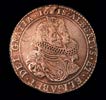
Figure 8.19: A ducatón coin of 1618, exposing Isabella of Spain and Albert of
Austria.
Christianity, while enjoying fine food. On October 25, 1555, Emperor Charles V announced his abdication. He celebrated his farewell at the ’Staten Generaal’ of the Low Countries in the presence of his son, Philip, underscoring the importance he placed on his Belgian roots. Philip ascended as Philip II, Lord of the Netherlands. It is also noteworthy that Emperor Charles V held William of Orange in high regard, considering him his favorite military commander. However, William would later betray the Spanish Habsburgs by advocating for separation. Carlos V is perhaps the most formidable working monarch Europe has ever seen.
His vast European Empire, depicted in Figure 8.15, stands as a testament to his influence. Kortrijk proudly displays his fresco in the Notre Dame Church, as shown in Figure 8.14. Unlike his son Felipe II, Charles Quint was a monarch who spent much of his career traveling throughout Europe to forge alliances, lead military campaigns, and rule as emperor. During his absences from the Iberian Peninsula, his wife, Isabella of Portugal, served as Governor. Numerous books have chronicled the life of Carlos V, noting his slightly deformed chin and awkward youth. It is plausible that he viewed his life and career as an emperor, a divine gift, and a duty to be fulfilled. This belief likely contributed to his delay in marriage. In Isabella of Portugal, he found his soulmate; the couple is shown in Figure 8.13. Sadly, she passed away in 1539. Carlos V’s personal life was as intriguing as his political career. He fathered children both before his marriage and after his wife’s death, a fact that adds depth to his character. In the context of this book, it is significant that Carlos V presided over the Catalan Courts in 1519 and was recognized as Count of Barcelona.
8.8 The Habsburg Rule of Belgium under the Spanish Crown after Carlos V
Emperor Carlos V is also known as King Carlos I of Spain and is described in Chapter 8.7. Here we present the further list of Habsburg Kings who ruled over Spain during the Spanish Netherlands.
8.8.1 H. M. Felipe II as King of Spain and Ruler of the Spanish Netherlands, 1556-1598
H.M. Felipe II (Valladolid 1527 - Escorial 1598), depicted in Figure 8.14 at Kortrijk, reigned as the King of Spain from January 16, 1556, until December 13, 1598. He was the son of Emperor Charles V and Isabella of Portugal. Unlike his father, who was born in Ghent and raised in the Low Countries, Felipe II had no personal ties to these regions beyond his inherited authority. His reliance on Fernando Álvarez de Toledo, Duke of Alba, known for his harsh rule in the Spanish Netherlands, waned as Felipe II eventually preferred a less severe approach. Felipe II did not speak Flemish or French, distancing him from the local populace.
In contemporary Belgium and the Netherlands, Felipe II is closely associated with the religious civil war between Catholics and Protestants. However, his reign was also marked by significant challenges, including ongoing conflicts with the Ottoman Empire, the administration of the vast Spanish and Portuguese global empires, and numerous financial issues such as managing the silver fleet, handling loans, and facing bankruptcy.
Felipe II was married four times: to Maria of Portugal, Mary Tudor of England, Elisabeth de Valois, and Anna of Austria. Mary Tudor, Queen of England from 1553 to 1558, was the daughter of Henry VIII and his first wife, Catherine of Aragon. She earned the nicknames "the Catholic" and "Bloody Mary" for her zealous persecution of Protestants. Near the end of his life, Felipe II endowed the Spanish Netherlands to his daughter, Isabella Clara Eugenia, as a dowry for her marriage to Albert VII, Archduke of Austria. Their story is detailed in Chapter 8.8.3.
It is noteworthy that King Felipe II was descended from several notable historical figures, which might surprise those from Belgium and the Netherlands unfamiliar with their shared history. His ancestry included William II of Holland and Hainaut (1286-1337), Jean de Avesnes (1218-1257), Aleida of Holland, Floris IV, Count of Holland, Machteld of Brabant, William I, Count of Hainaut, Dirk V, Count of Holland, among others. Thus, King Felipe II was intricately linked to the history of the Northern Netherlands and Belgium, Burgundy, and Spain.
8.8.2 H. M. Felipe III as King of Spain, 1598-1621
H.M. Felipe III (Madrid 1578 - Madrid 1621), King of Spain from September 13, 1598, until March 31 1621, was the son of H.M.
Felipe II of Spain and Anna of Austria.
He is shown in Figure 29.100 on page 415, and his will is shared in Figures 34.26, 34.27 and 34.28, on page 533.
8.8.3 H. M. Isabella of Spain and H. M. Albert of Austria as Rulers of the Spanish Netherlands,
1598-1621
As described in Chapter 8.8.1, Isabella of Spain received the Spanish Netherlands as a wedding gift from her father, H. M. Felipe II of Spain, just before he died in 1598, for her marriage with Albert of Austria. The couple is shown in Figure 29.82 on page 409 and Figure 33.4 on page 503, and also on a coin in Figure 8.19. The doble soberano (double sovereign), the soberano (sovereign), ’2/3
de soberano’ (2/3 of a sovereign), a medio soberano (half sovereign), a patagón (Patagonian), a medio patagón (half Patagonian), and a cuarto patagón (Patagonian quarter), were the new coins in the Duchy of Brabant and the county of Flanders. Later a new silver coin of ’11 dineros y 8 granos’, better known as the ducatón, was minted for the first time in 1618 and is shown in Figure
8.19. This coin was the basis of the monetary system until the middle of the 18th century. Isabella of Spain and Albert of Austria, despite their piety, were the first sovereigns who suppressed all religious inscriptions from their coins, replacing them with their names and titles.
After the death of Albert of Austria in 1621, there were regents or governors of the Netherlands, just like before and during their rule, shown on page 52, including the widow Isabella of Spain (1621-1633). Still, they fell under the power of the Spanish King, who, therefore, effectively ruled the Spanish Netherlands. H. M. Felipe IV is briefly described in Chapter 8.8.4
The Desclergues of la Villa Ducal de Montblanc, 2nd ed., Omn., VOL. I
© 2024 Nico F. Declercq

52
CHAPTER 8. A BRIEF HISTORY OF FLANDERS AND ITS IBERIAN CONNECTIONS
Figure 8.20: Wall Street, Manhattan, July 2006. The
Dutch East India Company (VOC), established in 1602,
is often seen as the first multinational corporation and a
pioneer of global trade. Early stock exchanges, like the
Bruges Bourse in 1409, laid the groundwork for Wall
Street and free enterprise. The VOC’s historical trade
challenges are vastly different from modern digital trad-
ing. (Declercq de Silva Archive)
8.8.4 H. M. Felipe IV as King of Spain and Ruler of the Spanish Netherlands, 1621-1665
H.M. Felipe IV (Valladolid 1605 - Madrid 1665), King of Spain from March 31, 1621 until September 17, 1665, can be seen in Figure 8.14 on page 49 on a fresco in Kortrijk, but also in Figure 34.163 on page 582, Figure 49.43 on page 1005, and his signature is shown in Figure 49.42 on page 1005.
8.8.5 H. M. Carlos II as King of Spain and Ruler of the Spanish Netherlands, 1665-1700
H.M. Carlos II (Madrid 1661 - Madrid 1700), King of Spain from September 17, 1665 until November 1, 1700, is shown in Figure
8.14 on page 49, Figure 8.25 on page 60, and Figure 34.167 on page 585.
His successor as King of Spain was H. M. King Felipe V and is described in Chapter 8.13.1. The Spanish Netherlands, however, became Austrian in 1700 and are further described in Chapter 8.17.
Indeed, following Carlos II’s death, the reign of the House of Bourbon-Anjou commenced in Spain, while the Austrian Habsburgs assumed control over the Spanish Netherlands. Complex political dynamics in Europe marked this transition, the details of which will be elaborated upon in subsequent sections of this book. Upon restoring stability in Spain and the Spanish Netherlands, it can be asserted that the governance of the House of Bourbon-Anjou and the House of the Austrian Habsburgs was exemplary.
8.9 The disaster of the Eighty Years War and the game of thrones between
H.M. King Felipe II, William of Orange, H.M. the King of France and
H.M. the Queen of England
King Felipe II of Spain was a devout Catholic sovereign, characterized by a profound sincerity and strict adherence to high moral
standards20. He was an idealist who governed during a period fraught with challenges: he ruled over a vast empire perpetually besieged by external threats and composed of a mosaic of quasi-independent territories, each with its own laws, tax systems, languages, and distinct histories. Due to his inability to travel extensively, Felipe II relied heavily on his representatives to inform and act on his behalf. Despite his genuine piety and fear of anti-Catholic sentiment, he often failed to fully grasp the motivations and principles of his subjects, particularly those in the Netherlands21.
His advisors and representatives were caught between the idealistic and perfectionist demands from the Spanish crown and the Netherlands’ desire for religious freedom, a self-managed tax system, and significant self-governance. Following the Protestant Reformation in the German territories of Charles V, Spain imposed a draconian policy in the Netherlands, which ultimately sparked the Dutch Revolt and the Eighty Years’ War. The situation’s complexity was exacerbated by anti-Spanish propaganda and military interventions from the House of Nassau, the English, and the French Huguenots, turning the Low Countries into a volatile battleground. Both sides committed atrocities, and the conflict evolved into a protracted war between the States of the Netherlands and the Spanish Netherlands, or Flanders.
Numerous works have documented the early years of the conflict, beginning with the Iconoclasm of 1566, or ’Beeldenstorm’ as it is known in Dutch. It is important to note that these brutal events predated the arrival of the Desclergues in Flanders, and thus, our Spanish ancestors were not implicated in them.
Fernando Álvarez de Toledo y Pimentel, the Duke of Alva, son of García Álvarez de Toledo y Zúñiga and Beatriz Pimentel y Pacheco, governed the Netherlands from 1567 to 1573. His grandmother, Maria Pacheco, may have been distantly related to Enric Desclergue’s wife, Ana Fabiana Pacheco, as discussed in Chapter 33.4.2 on page 516, or possibly through a different lineage outlined in Chapter 27.2 on page 301. Felipe II appointed the Duke of Alva to suppress the Protestant uprising due to his close connections with Felipe’s father, Charles V. However, his tenure was marked by brutality and bloodshed. The Dutch Orange dynasty has perpetuated the memory of this period to maintain ongoing hostility towards the Spanish and the Spanish Netherlands throughout the Eighty Years’ War.
During this time, the Dutch also competed with the Spanish and Portuguese in Asia22 and the Americas23. The world’s trade epicenter, Manhattan, depicted in Figure 8.20, originates in this era. After the reign of Alva, rulers of higher moral standards governed over the Spanish Netherlands. The list is as follows:
Luis de Zúñiga y Requesens (1573-1576),
Juan of Austria (1576-1578),
Alexander Farnese duke of Parma (1578-1592), shown in Figure 29.23 on page 393,
Peter Ernst I von Mansfeld (1592-1594), als shown in Figure 29.23 on page 393,
Ernst of Austria (1594 - 1595),
Pedro Henriquez de Acevedo (1595-1596),
20Geoffrey Parker, ’Imprudent King - a new life of Philip II,’ 2014
21Flanders, Holland, Brabant, Friesland
22through their VOC
23through their VWIC
© 2024 Nico F. Declercq
The Desclergues of la Villa Ducal de Montblanc, 2nd ed., Omn., VOL. I
53
Albrecht of Austria (1596-1598),
Archduke and Archduchess Albrecht and Isabella who ruled as sovereigns (1598-1621),
Isabella of Spain (1621-1633),
Francisco de Moncada (1633-1634),
Ferdinand of Austria (1634-1641),
Francisco de Melo (1641-1644), shown in Figure 34.78 on page 552,
Manuel de Castel Rodrigo (1644-1647),
Leopold Willhelm of Austria (1647-1656),
Juan II of Austria (1656-1659),
Luis de Benavides Carillo (1659-1664),
Francisco de Castel Rodrigo (1664-1668),
Íñigo Fernández de Velasco (1668-1670),
Juan Domingo Mendez de Haro y Fernández de Córdoba (1670-1675),
Carlos de Gurrea (1675-1678),
Alexander Farnese (1678-1682),
Ottone Enrico del Carretto (1682-1685),
Francisco Antonio de Agurto (1685-1691),
Maximilian II Emanuel von Bayern (1691-1706).
Interestingly, one of the prominent leaders of the ’Malcontenten’ who played a crucial role in overthrowing the Calvinist governments in the Southern Spanish Netherlands, particularly in regions such as Flanders, was Valentin de Pardieu. Born in 1535 and deceased in 1595 in Doullens, Valentin was the seigneur de la Motte, the son of Jean de Pardieu and Catherine du Pret. His family, the de la Motte (de Baraffes), had significant involvement in the early history of the Chapel in Deerlijk, as detailed in Chapter
49. The resurgence of Catholicism, supported by the Spanish, began in earnest in 1578. The ’Malcontenten,’ also known as
’Paternosterknechten,’ were not always known for their decorum, but the Calvinists were equally infamous for their conduct. The populace of Flanders generally supported the restoration of Catholicism and the expulsion of the Protestant Calvinists.
During the decline of Calvinist rule in the region, Casimirus, in 1578, infamously plundered churches and destroyed crops. His force of 100 soldiers, including 100 cavaliers, wreaked havoc on the local populace, their homes, and their produce. Starting in October 1578, the ’Malcontenten’ progressively liberated village and town after town. Notably, Kortrijk was liberated on February 28, 1580. Following this, Alexander Farnese stationed Spanish troops in Harelbeke. As analyzed in this book in Chapters 29.5.8,
29.12, and 30, the military presence remained in the area east of Harelbeke, particularly in the Manor of Overacker, well into the 17th century. The number of troops fluctuated, but they were a constant presence. Additionally, Irish troops also resided in the area, as documented in Chapter 73.10.3.7.
The ’Malcontenten,’ with Spanish backing, effectively repelled the dissident governments to the North while liberating the south.
Nonetheless, the conflict with the North persisted, culminating in the prolonged Eighty Years’ War.
8.10 El Camino Español
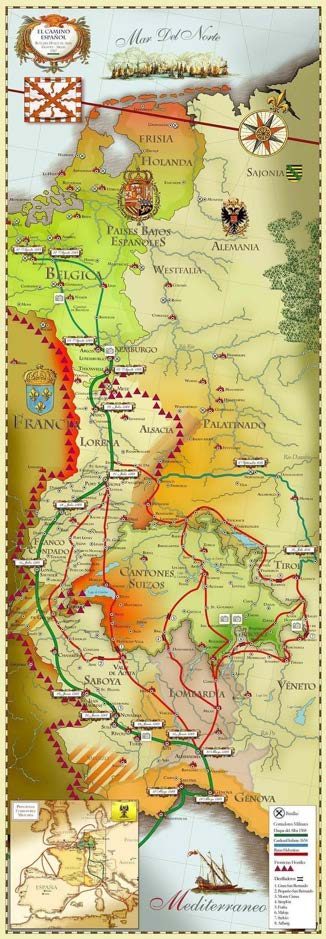
The Spanish Road, also known as El Camino Español, is depicted and described in Figure 8.21. The Road’s development was contingent on the fluctuating political landscape of Europe. Initially established in 1567, it reached its final form in 1634. The Spanish Road represented a significant technical and logistical achievement of approximately 1500 kilometers, enabling travel from Spain to Brussels in around 45 days. Its primary function was to facilitate the transportation of essential materials, such as weaponry, personnel, and provisions, to the soldiers of the Tercios and the forces serving the Hispanic Monarchy.
The Spanish Empire faced considerable challenges due to its extensive territories and the limited availability of human resources.
Consequently, the Spanish Road emerged as a crucial land route for maintaining imperial control, stretching from Italy to Belgium.
It served as a strategic pathway for the Empire and its adversaries. Persistent maritime threats from Barbary and Ottoman pirates in the Mediterranean and English and Dutch forces in the Atlantic necessitated the creation of a secure overland route for transporting essential goods. The travel methods of the armies reflected a balance between safety and speed, with the Spanish Road being safe but relatively slow.
The Spanish Road was a historical path that linked Milan to Brussels, frequently traversed by the Tercios during the 16th and 17th centuries. This initiative sought to maintain the connection between the Spanish Netherlands and the central hub of the Hispanic Monarchy in Milan. The Spanish Tercios, originating from Castile and Aragon, established their presence in various Italian territories, including Sicily, Naples, and Milan. These Tercios played a crucial role in defending the Mediterranean region from Muslim incursions. The Spanish Road passed through regions controlled by allied powers, such as Savoy and Lorraine, and territories under the Spanish crown, including the Duchy of Milan, the Franche-Comté, and the Spanish Netherlands. The route ran east of France, primarily aiming to maintain the territorial continuity of the Spanish Crown. For Lorraine and Savoy, the Road and their strong alliance with Spain provided security against French expansionist ambitions. The Swiss cantons and the Habsburg Empire also played vital roles in the Road’s trajectory.
Spanish forces, often exceeding 1000 personnel at a time, were accompanied by various elements, including luggage, chariots, artillery, wives, children, prostitutes, priests, bankers, food, and livestock. Initially, the routes the Duke of Alba used during the first stage of the Camino comprised preexisting trade routes without prior military presence. Along the Camino, an average daily distance of 23 kilometers was achieved. A year before Alba’s departure, Francisco de Ibarra dispatched an engineer with a contingent of 300 sappers to widen the pathway to facilitate the movement of soldiers. Military personnel required cartographic resources, and guidance from local inhabitants proved indispensable on several occasions.
After 1634, the Spanish Road ceased to function as a direct highway from Spain to Flanders. Although land travel continued, potentially along the last established but more perilous route, journeys became more individualized and occasionally substituted with sea routes when overland travel became too challenging.
8.11 The Spanish Army of Flanders during the Eighty Years War
It is well-known that the historical memory of the Belgians has long been shaped by literature from the 16th and 17th centuries, which functioned as Dutch propaganda to perpetuate animosity towards the Spanish rulers of Flanders. The Dutch aimed to dominate global trade and rival the Spanish, a goal epitomized by establishing the Dutch East India Company (VOC). Consequently, a The Desclergues of la Villa Ducal de Montblanc, 2nd ed., Omn., VOL. I
© 2024 Nico F. Declercq
54
CHAPTER 8. A BRIEF HISTORY OF FLANDERS AND ITS IBERIAN CONNECTIONS
Figure
8.21:
Miguel de Cervantesa
wrote, "Now, I will briefly recount what
has happened to me since then. I em-
barked at Alicante, arrived in Genoa af-
ter a smooth crossing, then traveled to Mi-
lan. There, I bought weapons and sol-
dier’s equipment, intending to enlist in the
Piedmont troops. On my way to Alexan-
dria, I learned the Grand Duke of Alba
was passing through Flanders. Changing
my mind, I followed him, served in his bat-
tles, witnessed the deaths of Counts Horn
and Egmont, and was appointed ensign to
a famous captain from Guadalajara named
Diego de Urbina." The Spanish Road was a
crucial 1000-kilometer military route, con-
necting Northern Italy to the North Sea,
facilitating troop movements for the Hab-
sburg Spanish monarchs between their ter-
ritories. It included the Duchy of Mi-
lan and the Netherlands, where the War
of Flanders began following a revolt in
1566. This uprising posed a significant
challenge to the Spanish Monarchy, which
relied on regiments and additional soldiers
relocated to Flanders to combat the rebels.
In 1567, after a 50-day journey from Mi-
lan, the first tercios led by the Duke of
Alba arrived in Brussels. The route became
known as El Camino Español. In 1567,
the Duque of Alba traveled from Genoa to
Brussels via Genoa, Milan, Turin, Aigue-
belle, Chambery, Lons-le-Saunier, Be-
sançon, Nancy, Metz, Luxemburg, Leu-
ven, and Brussels. In 1595, Archduke
Albert took a similar route, adding Al-
bertville, Annecy, Arinthod, Baume-les-
Dames, Epinal, Thionville, and Namur.
In 1601, the route ran from Milan to
Mea, Aoste, Bourg-St-Maurice, Pont de
Gressin, St Claude, Champagnole, Baume-
les-Dames, Epinal, Luxemburg, Namur,
and Brussels. By 1604, it went from Mi-
lan to Lugano, Bedinzona, St Gottard,
Luzern, Baden, Rupt-Sur-Moselle, Epinal,
Nancy, Luxemburg, Namur, and Brus-
sels.
In 1620, the route included Mi-
lan, Gravedona, Col du Simplon, Briga,
Furkapass, Schyz, Baden, Breysach, Col-
mar, St-Die-des-Vosgues, Baccarat, Lux-
emburg, Namur, and Brussels. In 1623,
it extended from Milan to Como, Forte
di Fuentes, Col du Grand-Saint-Bernard,
Thusis, Konstantz, Strasbourg, Saverne,
Sarrebourg, Lagrade, Metz, Thionville,
Luxemburg, Namur, and Brussels. By
1634, the route from Milan to Brussels in-
cluded Como, Forte di Fuentes, Sondrio,
Innsbruck, München, Nordlingen, Bonn,
Köln, Lummen, and Leuven. The figure
shows the original Spanish Road used by
Alba. (Courtesy of elcaminoespanol.com)
aMiguel de Cervantes, ’El ingenioso hi-
dalgo don Quijote de la Mancha,’ 1605.
© 2024 Nico F. Declercq
The Desclergues of la Villa Ducal de Montblanc, 2nd ed., Omn., VOL. I

8.11. THE SPANISH ARMY OF FLANDERS
55
Figure 8.22: In 1600, on April 19, the VOC ship ’De Liefde’ arrived
in Japan. It was one of 5 VOC vessels that departed in the Netherlands
on June 27, 1598. This picture is taken in Tokyo on March 12, 2006,
when the author stayed for more than four weeks at the Tokyo Institute
of Technology in Yokohama. The daily commute between Susukakadai
and O-Okayama was marvelous. The picture was taken on a day off
with one of the students from the lab. (Declercq de Silva Archive)
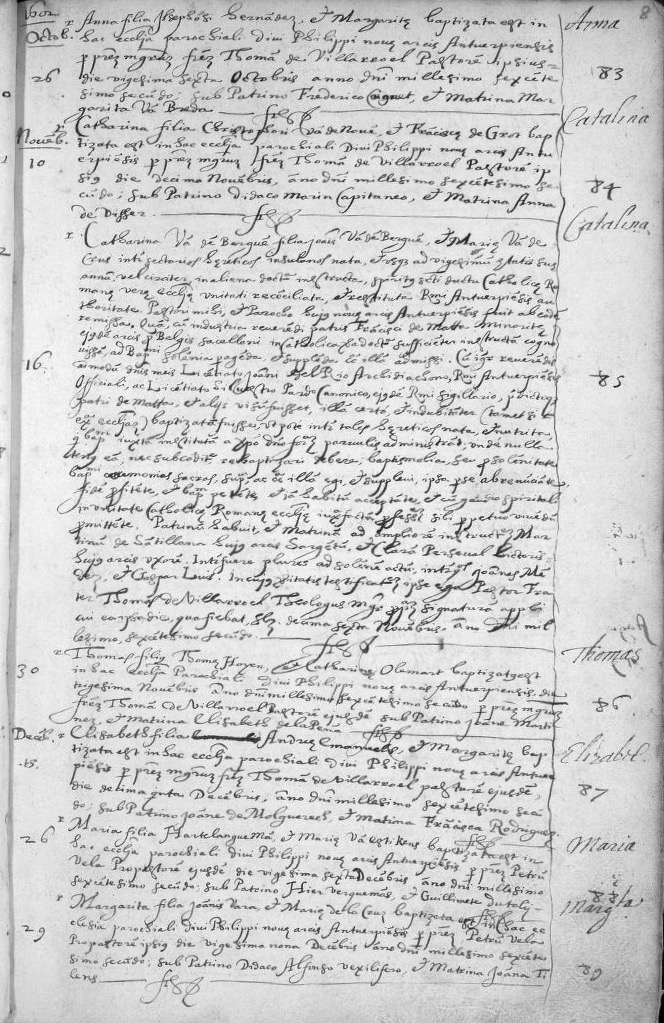
Figure 8.23: Middle record, Antwerp, Castle of San Felipe de la Castilla, November 12, 1602. The oldest found record of ’Belgium’ , in this book’s reported research.
The Desclergues of la Villa Ducal de Montblanc, 2nd ed., Omn., VOL. I
© 2024 Nico F. Declercq
56
CHAPTER 8. A BRIEF HISTORY OF FLANDERS AND ITS IBERIAN CONNECTIONS
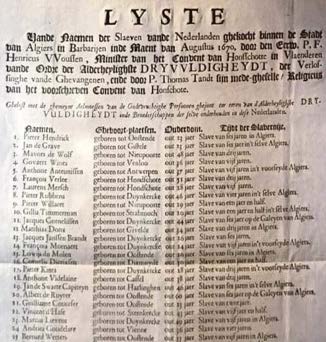
Figure 8.24: 1670, a list of Belgians who
were bought free from the Slave Market
of Algiers by the convent of Hondschote.
They had been enslaved by Dutch pirates,
active on the Mediterranean. Martijn Van-
denbroucke, who shared these facts with the
author, is acknowledged.
pervasive myth exists in Belgium, persisting to this day, that Spanish soldiers and their proxies systematically raped women and burned homes. This myth has contributed to developing the so-called "black legend" in Belgium.
While it is plausible that such events did occur, it is essential to acknowledge that Calvinist forces were also culpable of similar atrocities. In contrast, Spanish literature offers a much more nuanced and historically grounded perspective, arguably presenting a more accurate portrayal of events. This Spanish narrative is diverse and rich in historical detail, thereby providing a counterbalance to the predominantly negative depictions propagated by Dutch sources.
In an article by Jose Javier Esparaza24, a glimpse is released on the complexity of the conflict in the Netherlands in the 16th and 17th centuries. In the framework of our book, we can extract the following citation from the article:
’Testamentos de soldados españoles desvelan que miles de ellos se casaron con mujeres flamencas. Pero el remoquete del «enemigo español» hizo fortuna gracias a la excelente propaganda de guerra de los calvinistas holandeses, y aún la haría más siglos después, cuando Holanda primero, y Bélgica después, se conformen como naciones. Hoy el flamenco común ve al español como a un enemigo ancestral. No le han contado que, muy probablemente, algún tatarabuelo suyo era de Tomelloso.’
8.11.1 The composition of the Army of Flanders
The work of Geoffrey Parker25, offers an overview of the composition of the Army of Flanders for every year of the campaign between 1567 and 1659.
For the period between 1609 and 1618, Spanish men in the army were consistently around 50% (about 8000), while the other 50%
was approximately equally divided among Belgian, Burgundian, Italian and British men. For different periods in the campaign, the number of Spanish troops remained more or less constant. In contrast, the total amount was increased by the non-Spanish to sometimes 90 thousand men (e.g. after 1618), the vast majority being from Germany and the Netherlands. The age of the Spanish troops at the end of the 1500s was between 18 and 70, with approximately 75% in the age range from 18 to 40 and 25% between 40 and 70. For the troops of the Netherlands (mainly from Wallonia), the age mostly was between 18 and 35. Note that the Army of Flanders soldiers typically had their wives and family with them and lackeys and other civilians, even bankers and prostitutes.
They lived as a family in barracks or with local families in their homes.
Interestingly, Geoffrey Parker refers in his book, on pages 147-148, to works describing that many Spaniards in the army, from 1606
onward, began to love Flanders more than their original home in Iberia and began to call the Netherlands ’su casa’ (their home).
Spaniards began to purchase property and homes in the Netherlands and adopted Flemish customs and titles. Spaniards started to speak French and Dutch, and Flemish and Walloons began to learn Spanish. The two populations also intermarried. Examinations of the wills of Spanish soldiers revealed double as often a local woman as a widow than a Spanish woman.
Later, the pattern of intermarrying reversed again after 1625. From 1632 onward, only one Spanish soldier in 6 was allowed to marry, which, according to church registers, led to many illegal children. It is also known that the army contained double as many civilians (wives, children, lackeys) as soldiers. Also, for every five actual Spanish military, there were around two lackeys who served the soldiers.
Soldiers were typically grouped as Camarada , where there were one captain and approximately six companions. Soldiers of lower ranks also formed comrade groups. Each Camarada stayed together and shared fortunes and misfortunes.
It is also known that the Spaniards in the army considered themselves of higher moral standing than soldiers of other nations.
Above all, even amid cruelty, they remained very catholic and proudly wore crucifix ornaments. They also willed lots of money to fraternities and monasteries. Note that the Spanish veterans still in the Netherlands in 1585 (around 4500 men) received a suitable amount of money for the prior 3-year service.
In Chapter 8.9, we list the governors of the Spanish Netherlands. The army was led by Captain Generals, who were sometimes also the governors. Closer to the battlefields, there were also commanders. A famous commander was Spinola26, from 1602 until 1629
and appears in many places in this book, including in Chapter 33.3.7.
24Jose Javier Esparaza, ’Una pica en Flandes, el Vietnam del imperio español y por qué los flamencos no amaban al rey Felipe’ , El Mundo, November 23 of 2017
25Geoffrey Parker, ’The army of Flanders and the Spanish Road 1567-1659’ , Cambridge, 2nd edition
26Ambrosio Espínola, Marqués de Los Balbases
© 2024 Nico F. Declercq
The Desclergues of la Villa Ducal de Montblanc, 2nd ed., Omn., VOL. I
8.11. THE SPANISH ARMY OF FLANDERS
57
8.11.2 Timeline of the Eighty Years War with some milestones of the lives of the Desclergues
We present a concise timeline of the Eighty Years’ War. This overview omits many events, but significant details are elaborated upon throughout this book.
1566: The Iconoclasm in the Netherlands commenced, beginning in what is now France.
1567: Spanish forces fought and won The Battle of Oosterweel against Dutch Protestant troops. Subsequently, the Duke of Alba (Alva) arrived in the Netherlands to establish control amidst religious unrest. His rule was marked by severe repression, leading to the execution or flight of many Calvinists to the swamped areas in the Netherlands and regions of modern-day Germany.
1568: The Calvinists, now better organized, secured a victory at the Battle of Heiligerlee against Spanish forces. In the same year, high-ranking nobles were executed by Alva.
1570: A Spanish mutiny occurred due to insufficient tax revenues collected from the Netherlands. The Spanish, not viewing their presence as an occupation, expected local tax payments for protection and administrative services.
1572: The Calvinists captured Den Briel and massacred numerous clergy in Gorcum, provoking Catholic outrage. Spanish forces retaliated at Naarden.
1573: Alva’s brutal policies led King Philip II to request his resignation. Requesens, a more skilled diplomat, replaced him.
Meanwhile, Alva’s son, Frederick, managed to recapture most of the eastern cities of the Netherlands in Overijssel and Gelderland.
1575: William of Orange founded a university in Leiden, aiming to rival Leuven.
1576: The Spanish Fury erupted in Antwerp, followed by the signing of the Pacification of Ghent, a peace treaty. This treaty sought to unite the Catholic Southern Netherlands and the Protestant Northern Netherlands, laying the groundwork for the eventual formation of Belgium and the modern Netherlands.
1578: Alessandro Farnese was appointed Governor of the Netherlands. 1580: The Iberian Union began, uniting Spain and Portugal until 1640.
1581: The official name of the Netherlands changed as the region split into the Spanish Netherlands in the south and the States of the Netherlands in the north. The entire area became known as Belgica Confoederata, or the Confederation of Belgium.
1584: William of Orange was assassinated, and his son, Prince Maurice of Orange, succeeded him.
1587: Don Jeroni Joan Desclergue y Cortés (DC05), our ancestor, arrived in Belgium with the Spanish Army of Flanders and participated in the capture of Geldern.
1588: The Dutch Republic was established. The Spanish Armada’s attempted invasion of England failed, and Bergen op Zoom was besieged, with Jeroni Joan Desclergue y Cortés (DC05) taking part.
Juana Desclergue (DC06c), the daughter of Jeroni Joan Desclergue (DC05), was born at the Spaniard Castle in Ghent.
1589: Spanish forces attempted to reclaim Ostend. The sieges of Heusden, Heel, and Bommelwaard occurred. Jeroni Joan Desclergue y Cortés (DC05) arrived at Harelbeke and Kortrijk on the Leie River.
1590: Spanish forces attacked Paris and the fort of Noordam near Zevenbergen.
1591: Spanish forces defended Nijmegen.
1592: Spanish forces defended Steenwijk. At the end of August, Jeroni Joan Desclergue y Cortés (DC05) was a godfather in Kortrijk.
Maria Desclergue (DC06e), the daughter of Jeroni Joan Desclergue (DC05), was baptized at Kortrijk in 1592 on May 29.
1593-1594: The Siege of Coevorden took place. In April, Jeroni Joan Desclergue y Cortés (DC05) appeared as a godfather in Kortrijk.
1594: The Dutch Republic began its quest for a route to Asia. Felipa de Montoya, wife of Jeroni Joan Desclergue y Cortés (DC05), appeared in Kortrijk at the baptism of a child of Pedro de Montoya in October. In January, Jeroni Joan Desclergue y Cortés (DC05) also served as a godfather in Kortrijk. From this year onward, the Spanish regime paid more attention to military conduct, establishing courts to ensure justice and discipline27.
1595: The capture of Hoei occurred, first by the Dutch and then by the Spanish in early spring. The sieges of Le Châtelet, Doullens, and Cambrai took place in the summer. In January, Anna Desclergue (DC06f), Jeroni Joan’s daughter, was born.
1596: Johan van Oldenbarnevelt formed a coalition between the Dutch Republic, England, and France against Spain. The sieges of Calais and Hulst also occurred.
1597: The Battle of Turnhout and the surprise capture of Amiens took place. Jeroni Joan Desclergue y Cortés (DC05) temporarily ended his military career to take on new duties in Tournai by the end of the year.
1598: Albrecht of Austria and his wife Isabella of Spain became the governors of the Southern Netherlands, while Philip III ascended to the Spanish throne. France made peace with Spain. Jeroni Joan Desclergue y Cortés (DC05) began a new career in Barcelona and served as a member of the Corts from 1598 to 1601.
1600: The Battle of Nieuwpoort was fought.
1601: The Siege of Ostend began. Concurrently, the Dutch formed the Verenigde Amsterdamse Compagnie, a precursor to the VOC, which would later reach as far as Japan, evoking cherished memories as shown in Figure 8.22.
1602: Jeroni Joan Desclergue y Cortés (DC05) returned to Tournai, where he resided until his death in 1604, maintaining properties in Deerlijk and possibly Kortrijk. In Tournai, Antoni Desclergue (DC06), born in Barcelona before returning to Flanders, was baptized on June 26. Jeroni (DC05) resumed military service. Ambrogio Spinola arrived with a Spanish army of 9000 men to support the reign of Albrecht of Austria. The Siege of Ostend, begun this year, would continue until the end of 1604.
The 1602 document shown in 8.23 mentions Belgium (’Belgis’) and is transcribed28 as: Catharina van den Berguen filia Joannis van den Berguen et Mariae van de Crus inti sectarios haereticos insulanos nata, et usque ad vigesimum aetatis suae annum vel circiter, in aliena doctrina instructa, Spiritus Sancti ductu Catholicae Romanae verae ecclesiae unitati reconciliata, et restituta Reverendissimi Antuerpiensis authoritatepastori mihi, et parocho hujus novae arcis Antuerpiensis fuit ab eodem remissa. Qua cum industria reverendi patris Francisci de Matta minoritae ejusdem arcis et Belgis sacellani in Catholica etcetera doctrina sufficienter instructam cognovisse, ad Baptismi solemnia peragenda et supplenda eo (?) illam admissi.
Cum i.gr reverendis admodum dominis meis Licentiato Joanni del Rio Archidiachono, Reverendissimi Antuerpiensis Officiali ac Licentiato Silvestro Pardo Canonico, ejusdem Reverendissimi sigillario, praedictique patri de Matta, et alijs visu fuisset, illam certo, et indubitanter (tametsi et (?) ex. ecclesia.) baptizata fuisse, ut pote intime toles haereticos nata, et nutrita per baptismam iuxta institutam a ... .po Domino for. parvulis administrator; unde nulla ...que ea. nec sub conditione rebapitizari debere; baptismalia, seu per solemnitate baptismi ceremonias sacras, super : ac cc. illá egi, et supplevi, ipsa per se ab renunciante fide persitente 27Alicia Esteban Estríngana, ’La superintendencia de la justicia militar: establecimiento y evolución inicial en el ejército de Flandes (1594-1622),’ in Davide Maffi (ed.), Tra Marte e Astrea. Giustizia e giurisdizione militare nell’Europa della prima età moderna (secc. XVI-XVIII), Milano, FrancoAngeli, 2012, 87-123.
28Transcript made with help from Georges Picavet.
The Desclergues of la Villa Ducal de Montblanc, 2nd ed., Omn., VOL. I
© 2024 Nico F. Declercq
CHAPTER 8. A BRIEF HISTORY OF FLANDERS AND ITS IBERIAN CONNECTIONS
(?), et baptismam petentes et iam habitum acceptante et cum gaudio spiritali in veritate Catholicae Romanae ecclesiae iux factam persessi. sibi perpetuo vivendum permittente. Patrinum habuit et matrinam ad ampliorem instruct. Martinum de Santillana hujus arcis sargentum et Claram Perseval lictori huius arcis uxorem. Intime fuere plures ad solemnem actum, inter quos (?) Joannes Mendez et Gaspar Louis. In cujus veritatis testificat... ipse ego Pastor Frater Thomas de Villarroel Theologus Magisto (?) presentes signaturae applicui ea ipsa die qua fiebat ... decima sexta novembris anno domini millesimo sexcentesimo secundo.
1603: Jeroni Joan Desclergue y Cortés (DC05) participated in the Siege of Ostend. The Battle of Sluis also took place. Meanwhile, Jacob van Heemskerk conquered a Portuguese ship in the Strait of Malacca; Portugal and Spain were, at that time, united. In December of the same year, Enric Desclergue y Cortés (DC05c) joined the Spanish army in Flanders and participated in the defense of ’s-Hertogenbosch.
1604: The Spanish recaptured Ostend, while a supernova was visible in the night sky. A mine blast killed Jeroni Joan Desclergue y Cortés (DC05) at Ostend. Meanwhile, the Dutch captured Sluis.
1605: The baptism of Jeroni Desclergue’s last son, Miguel (DC06b), occurred after Jeroni’s (DC05) death. He was baptized on the day of Saint Hieronymus to commemorate his father.
1606: Ambrogio Spinola arrived in Flanders with a vast army from Milan. Enric Desclergue (DC05c) and Antoni Desclergue (DC05b) participated in the Sieges of Groenlo and Lochem. They also made an unsuccessful attack on Sluis and participated in the Siege of Rheinberg. In the summer of 1606, the Spanish also tried to capture Zwolle. In 1601, Íñigo de Borja y Velasco became the governor of the Antwerp citadel.
1607: The Battle of Gibraltar occurred between the Spanish and Dutch fleets.
1609: A Twelve-Year Truce began. This ceasefire would strengthen the Dutch Republic and weaken Spain, leading to the resumption of hostilities after twelve years. This year, a judicial specialist, Hugo Grotius, published his Mare Liberum, which helped the Dutch gather support for their overseas endeavors. This work would later be elevated to a higher moral level by our blood-relative Charles Philippe de Patin in his Mare Liberum, described in Chapter 70.
A full description of the global situation in the 15th, 16th, and 17th centuries would be fascinating but require a new book.
Therefore, only some key facts to remember while reading about this period are mentioned. We also refer to Part XII to better understand the Portuguese endeavors in the centuries and decades preceding the current period.
First, it is important to note that an Iberian Union existed from 1580 until 1640. Although Spain and Portugal were separate countries, they united under the Spanish crown. As seen in Part XII, this union significantly affected the exchange of people and culture with Asia, as Spanish influence in Asia became possible. Still, the global power balance had important implications for the Netherlands’ trade and its position in the world. For the Netherlands29, Portugal’s involvement in the Eighty Years’ War allowed the Dutch to attack the Portuguese wherever the two nations competed. It also meant that the Dutch could no longer buy spices from the Portuguese, challenging them to find their route to Asia.
Until 1595, the world’s seas were dominated by Spain and Portugal. They had, so to speak, a monopoly and had divided the world into two spheres of influence. From 1595 onwards, the Dutch, who had learned about Portuguese trade routes, started their own companies to trade with Asia. These companies were owned by affluent families with roots in the Dutch states or Belgium.
Nevertheless, they were successful, and to avoid internal competition, they established the VOC30 in 1602. Being a company and not a country, the VOC had many successes throughout Asia but was often not guided by a moral compass. Historical sources indicate that the Portuguese were the most humane colonialists in Asia, and they treated the local population almost as equals and married them just as if they were Portuguese. The VOC was different. It is also essential to know that the VOC did not just send Dutch people worldwide but that many foreigners, such as Danes, Germans, Scandinavians, and former inhabitants of France and Belgium, were also involved. They all contributed to both the success and the misbehavior of the VOC in the world.
In 1641, the VOC conquered Malacca from the Portuguese. In 1658, they conquered Ceylon (Sri Lanka) from the Portuguese. Note that ’to conquer’ did not mean killing or forcing everyone to return to Portugal. It merely involved a change in governance to VOC
control and redirected all finances from Portugal to the VOC. The VOC often used unconventional techniques such as making false promises or using any possible excuse to steal from their competitors while achieving their goals. They often tricked local men of power into alliances that became highly profitable for the VOC and disastrous for the other party. This can be compared to modern practices by some global corporations. After all, the VOC was not a country, and local populations did not necessarily understand this. They were also not held accountable by the Vatican because they were Protestant, not Catholic.
In the West, the Dutch also became very active. For instance, from 1609 onward, they were engaged in the New York Bay31. Hudson, who worked for the Chamber of the VOC in Amsterdam, discovered the ’Hudson River’ in his attempt to find a new route through America to Asia. The first colonials arrived in 1624. In 1626, Peter Minuit32 bought Manhattan from the Lenape Native Americans.
Nieuw Amsterdam was established in Nova Belgica or New Belgium. This fort would later become New York City. People who understand the different mentalities in Europe and the United States will recognize that the Dutch can be considered the Americans of Europe, with valid similarities at every level of society. Indeed, all stereotypes are common to both territories. This suggests that the Dutch must have had a significant impact on the early development of the states along the East Coast before modern Americans expanded to the West Coast, either through conquest or purchase from the Natives, the Spanish (and Mexicans), or the French. In particular, Belgians are wary of the differences in mentality between Catholic Belgium and the Protestant Netherlands, which is beyond the scope of this manuscript.
We can also mention that the Dutch conquered the Antilles33 through their West India Company. The islands had been discovered by Alonso de Ojeda and were conquered by the Dutch in 1634 from the Spanish. In 1616, the Dutch settled at Essequibo, and in 1627, they settled at Berbice, both in Dutch Guiana and Suriname. The English tolerated the Dutch presence because of the deal concerning Nova Belgica in 1667, which became New York and would continue as British territory. Colonial history is fascinating and cannot be separated from European events and vice versa. Nevertheless, it is beyond the scope of this book. We will, therefore, continue the sequence of events by going back to 1613.
1613: The famous Piet Hein became a captain for the VOC.
1614: The University of Groningen was established. The Spanish took Aachen and Wesel.
1616: The Dutch settled in Essequibo in the Antilles.
1617: Carlos Coloma de Saa returned to Flanders after a stay in Malta, becoming the Governor of Cambrai. He would soon recruit Antoni Desclergue (DC06), our ancestor.
29modern Belgium and the Netherlands
30Verenigde Oostindische Compagnie, officially called ’Generale Vereenichde Geoctroyeerde Compagnie’
31as it is called today
32with roots in Tournai
33Aruba, Curaçao, Sint Maarten, etc.
© 2024 Nico F. Declercq
The Desclergues of la Villa Ducal de Montblanc, 2nd ed., Omn., VOL. I
8.12. THE SPANISH DEVOLUTION WAR AND THE WAR OF SUCCESSION
59
1618: Maurits of Nassau became, by inheritance, Prince of Orange. A comet was visible in the sky around Christmas.
1619: Maurits of Nassau executed Johan van Oldenbarnevelt in a struggle for power within the Dutch Republic.
1621: This year marks the end of the Twelve-Year Truce. Spanish troops attacked Sluis. The Siege of Jülich took place in 1621
and 1622.
1622: The Sieges of Bergen op Zoom and Steenbergen occurred.
1624: The Siege of Breda (1624-1625) occurred.
1626: King Philip IV presided over the Catalan Courts and rejected a Union of Arms proposed by his favorite and minister, the Count-Duke of Olivares. Antoni Desclergue (DC06) appeared in Waregem as a godfather. This year, Peter Minuit bought Manhattan for the Dutch, forming the beginning of New Amsterdam and Nova Belgica34.
1628: Piet Hein captured a Spanish silver fleet near Cuba, causing a temporary financial disaster for Spain.
1629: Olivares established a united army of Spanish and German troops. In October, Antoni Desclergue (DC06) appeared in Wingene as a marriage witness for a soldier.
1632: The Dutch captured Maastricht.
1634: France and the Dutch Republic decided to form their independent federation if the Southern Netherlands revolted. The two powers believed that the Belgians wanted to become independent. Their propaganda poisoned the political atmosphere. In 1634, Maastricht was recaptured by Spanish troops. This year, the Dutch (through their VOC) conquered the Antilles from the Spanish.
1635: Spain decided not to give up Belgium and defended the southern border while attacking the Dutch Republic. The Siege of Leuven occurred.
1638: The Dutch attempted to capture Antwerp but were defeated by the Spanish. The consequent year’s hostilities by the French determined the scene.
1639: Due to French wars, the Spanish road could hardly take. Therefore, most of the transport of people, goods, and soldiers occurred overseas. This year, Antoni Desclergue (DC06) initiated the construction of a chapel, highly supported by Marguerite Kelduwier, at Deerlijk and went to Spain. His wife Beatrice remained at Deerlijk, we may assume. She was pregnant. Their son Pere (DC07d) was born and baptized during Antoni’s (DC06) absence.
1640: The Corpus de Sang occurred in Barcelona, which initiated the Reapers’ War or the Catalan Revolt. This year also marked the end of the Iberian Union.
1641: A Catalan republic was formed under French protection, and Louis XIII of France was proclaimed Count of Barcelona.
Antoni Desclergue (DC06) returned to Belgium. He, or his religious brother Jeroni (DC06c), described in 29.9.5, donated to the Hospital of Saint-Jean at Cambrai, where his father Jeroni (DC05) had been treated in 1596.
1642: The Battle of Honnecourt-sur-Escaut occurred.
1643: The Spanish suffered a defeat at Rocroi.
1648: Peace was established between Spain and the Netherlands, and therefore between the Spanish Netherlands and the Dutch Republic. 1650: Antoni Desclergue (DC06) went to Barcelona to participate in the city’s siege. His wife Beatrice probably joined him and died in Spain because no funeral was recorded at Deerlijk. Her children at Deerlijk inherited from her in July 1651.
1652: The Spanish army recaptured Barcelona from the French-protected regime. Catalonia thus became Spanish again.
1656: Antoni Desclergue (DC07), son of Antoni Desclergue (DC06) and grandson of Jeroni Joan Desclergue y Cortés (DC05), married Martina Ximenez de la Cruz at Deerlijk.
1659: The Treaty of the Pyrenees between Spain and France was signed. Roussillon and the northern part of Cerdanya became French and have remained so. Antoni Desclergue (DC06) visited Montblanc and returned to Belgium in 1660 or 1661.
One of the essential differences between propaganda and news is that propaganda is conceived to influence opinion and highlights only one part of the truth while hiding all others. Many of our modern textbooks on history in Belgium are based on Dutch sources.
For this reason, most Belgians do not know that in the 17th century, compatriots were often turned into slaves by the Dutch.
This happened through Dutch pirates and privateers. Indeed, to gain access to the Mediterranean, numerous Dutch converted to Islam. When they boarded and hijacked Flemish ships from the Spanish Netherlands in the Mediterranean, they stole the goods and turned the men into slaves.
Consequently, these men were sold in the slave markets of North Africa. When the Belgians became aware of this, they tried to free the enslaved individuals by paying ransom to the slave owners. An example of a list of freed slaves is shown in Figure 8.24. It can be seen that, on the slave market of Algiers, numerous men from Ostend, Dunkirk, and other places were bought free thanks to the support of the convent of Hondschoote, which is now in northern France near the border with Belgium.
A well-known example is Jan Janszoon (1570), from Haarlem, who converted to Islam and became Murat Reis, after which he joined the fleet of Salé. His conversion took place after he had a shipwreck on the island of Lanzarote and was consequently picked up by Ivan de Veenboer, who had converted earlier and had become Suleiman Reis35.
The organization that liberated Belgian slaves was ’De Confrerieën van de Trinitariërs in West-Vlaanderen,’ also known as ’De Orde van de Trinitariërs.’ This organization was established in 1198 in the south of France by Saints John, Martha, and Felix of Valois to liberate Christians from the Turks. After 1200, the order was also active in Flanders to free Flemish slaves from Islamic slave owners. Sometimes men were taken as slaves even on the North Sea by Islamic seafarers from the Mediterranean3637.
1679: Antoni Desclergue visited Spain after the Peace of Nijmegen. He served as a marriage broker for his godchild Antoni de Pedrolo y Desclergue (born in 1659 at Montblanc as the son of Francesc Jacinto de Pedrolo y Desclergue and Anna Maria de Ratera y Robuster) and Maria Anna Vosa (de Vos) in Blanes, Gerona.
1691: Antoni Desclergue (DC06) died this year, or soon after.
8.12 The Spanish Devolution War and the War of Succession
8.12.1 The Devolution War 1667-1668
The War of Devolution arose from the principle known as jus devolutionis, which His Majesty King Louis XIV of France applied to himself and his wife, Maria Theresia of Spain. This principle made him the legitimate heir to the Spanish territories of Flanders and Franche-Comté, further fueling his ambitions to inherit more Spanish lands in Spain. The Dutch, who had maintained a long-standing alliance with France, broke their ties and formed a Triple Alliance with England and Sweden to prevent France from 34later, this would all become New York
35Abdelkader Benali, ’Reizigers van een nieuwe tijd: Jan Janszoon, een Nederlandse piraat in Marokkaanse dienst,’ De Arbeiderspers, 2020.
36Biekorf, Jaargang 75 (1974), ’De confrerieen van de Trinitariërs in West-Vlaanderen’
37Peter Lamborn Wilson, ’Pirate Utopias - Moorish Corsairs & European Renegadoes,’ Autonomidia, 1996.
The Desclergues of la Villa Ducal de Montblanc, 2nd ed., Omn., VOL. I
© 2024 Nico F. Declercq
60
CHAPTER 8. A BRIEF HISTORY OF FLANDERS AND ITS IBERIAN CONNECTIONS
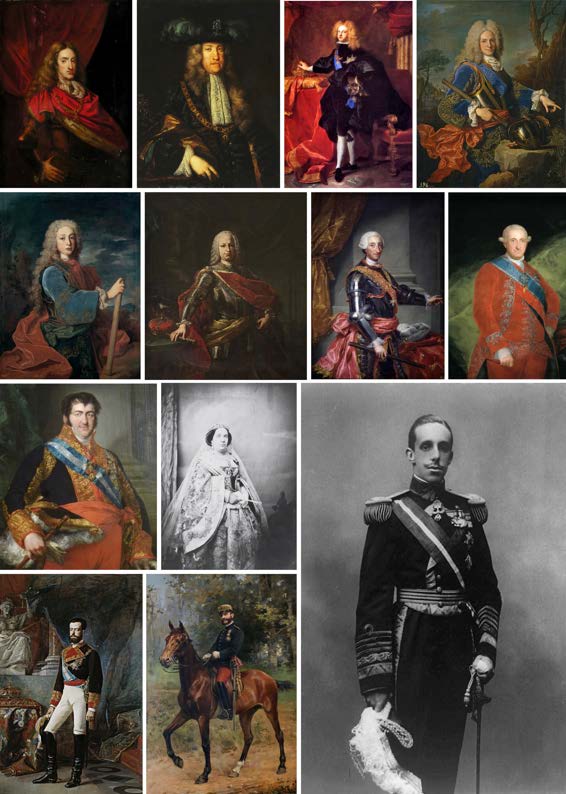
Figure 8.25: Left to right, top to bottom, we see H.M. Carlos II of Spain (1661-1700), who was the last Habsburg King of Spain; Archduke of Austria Charles III (1685-1740), who was also H.M. the Emperor Charles VI of the Holy Roman Empire; H.M. King Felipe V of Spain (Versailles 1683 - Madrid 1756), who was Philippe d’ Anjou, grandson of Louis XIV; H.M. King Felipe V of Spain in 1723; H.M. King Luis I de España; H.M. King Fernando IV de España, around 1754; H.M. King Carlos III de España, around 1765; H.M. King Carlos IV de España in 1789; H.M. King Fernando VII de España; H.M. Queen Isabella II de España; H.M. King Amadeo I de España; and H.M. King Alfonso XII de España. Finally, in the right lower corner, H.M. King Alfonso XIII de España.
© 2024 Nico F. Declercq
The Desclergues of la Villa Ducal de Montblanc, 2nd ed., Omn., VOL. I
8.13. THE SPANISH MONARCHY FROM H.M. KING FELIPE V UNTIL THE FIRST REPUBLIC
61
extending its territory to the Dutch border.
To truly grasp the intricacies of the War of Devolution, which will be examined in Chapter 34.10, one must delve into the complexities of the Treaty of the Pyrenees of 1659. This treaty, a delicate balance of power, established peace between Spain and France and orchestrated the marriage between His Majesty King Louis XIV and Maria Theresia, daughter of His Majesty King Felipe IV
of Spain. As part of the agreement, Maria Theresia renounced her inheritance rights to prevent Spain from eventually falling under French control, and Spain was supposed to provide a substantial dowry. However, this dowry was never paid, which Louis XIV
construed as a breach of contract, thus reviving his wife’s potential claim to the Spanish throne, contrary to the original agreement.
Upon the death of King Felipe IV, his son from a subsequent marriage was expected to inherit the throne and territories. However, the principle of devolution, which deemed Maria Theresia the rightful heir due to her being a child of Felipe IV’s first marriage, effectively blocked the younger half-brother’s inheritance. This provided Louis XIV with a pretext to claim the Spanish Netherlands, encompassing regions such as Brabant, Limburg, Cambrai, Antwerp, Mechelen, Upper Guelders, Artois, Hainaut, and Namur. This conflict’s personal and familial implications were profound, particularly for the Desclergues family in Belgium, as detailed in Chapter
In May 1668, Spain retaliated by invading Cerdanya under the leadership of the Viceroy of Catalonia. Following high-level negotiations across Europe, France relinquished its claims to most of the captured territories, retaining only a few exceptions, many of which remain part of modern-day France. These exceptions included Lille, Armentières, Bergues, and Douai. The regions that temporarily remained under French control included Tournai, Oudenaarde, Kortrijk, Veurne, Binche, Charleroi, and Ath.
8.12.2 The War of Succession 1701-1714
The War of the Spanish Succession was precipitated by the death of His Majesty King Carlos II of Spain, who died childless. His likeness is shown in Figure 8.25. King Carlos II’s inability to produce an heir was attributed mainly to the extensive inbreeding within the Habsburg family. Upon his death, the major claimants to the Spanish throne were from the Austrian Habsburg and the French Bourbon dynasties. Ultimately, Philip of Anjou, the grandson of Louis XIV of France, emerged as the legal heir and ascended to the Spanish throne as His Majesty King Felipe V, depicted in Figure 8.25. In exchange for this inheritance, he renounced any future claims to the French throne for himself and his descendants.
The Spanish Netherlands (modern-day Belgium) was ceded to the Austrian Habsburgs, with Archduke Charles, shown in Figure
8.25, assuming control. Archduke Charles would later become Emperor Charles VI in 1711. During the conflict, Catalonia sided with the Austrian Habsburgs but was subsequently conquered by Philip of Anjou’s forces, leading to the reunification of Spain under Bourbon rule.
This overview simplifies a complex historical event. The War of the Spanish Succession involved numerous battles, treaties, and political maneuvers, and it has been extensively documented in historical literature. We recommend consulting the comprehensive body of work available on this subject for those interested in a more detailed understanding.
8.13 The Spanish Monarchy from H.M. King Felipe V until the First Republic
8.13.1 H.M. Felipe V of Spain
Felipe V de España (Versailles 1683 - Madrid 1746), shown in Figure 8.25, is also described above. He has been the King of Spain from 1700 until 1724.
8.13.2 H.M. Luis I of Spain
Luis I de España (Madrid 1707 - Madrid 1724), shown in Figure 8.25, was the eldest son of H.M. King Felipe V of Spain. He was the King of Spain in 1724 but tragically died very soon after the coronation. His father would consequently further rule.
8.13.3 H.M. Felipe V of Spain
Felipe V de España (Versailles 1683 - Madrid 1746) is also described above, in Chapter 8.13.1. He became King a second time after the death of his son Luis I de España. Consequently, he remained the King of Spain from 1724 until 1746.
8.13.4 H.M. Fernando VI of Spain, El Prudente
Fernando VI El Prudente (Madrid 1713 - Villaviciosa de Odón 1759), shown in Figure 8.25, was the fourth son of Felipe V of Spain.
He was the King of Spain from 1746 until 1759.
8.13.5 H.M. Carlos III of Spain
Carlos III of Spain (Madrid 1716 - Madrid 1788), shown in Figure 8.25, was the eldest son from the second marriage of Felipe V of Spain. He was the King of Spain from 1759 until 1788.
8.13.6 H.M. Carlos IV of Spain
Carlos IV of Spain (Portici 1748 - Rome 1819), shown in Figure 8.25, was a son of Carlos III of Spain. He was the King of Spain from 1788 until 1808.
8.13.7 H.M. Fernando VII of Spain
Fernando VII of Spain (Escorial 1784 - Madrid 1833), shown in Figure 8.25, was the King of Spain from March until May 1808.
Later, he became the King again from 1814 until 1833.
8.13.8 H.M. Isabella II of Spain
Isabella II of Spain (Madrid 1830 - Paris 1904), shown in Figure 8.25, was the Queen of Spain from 1833 until 1868.
The Desclergues of la Villa Ducal de Montblanc, 2nd ed., Omn., VOL. I
© 2024 Nico F. Declercq
62
CHAPTER 8. A BRIEF HISTORY OF FLANDERS AND ITS IBERIAN CONNECTIONS
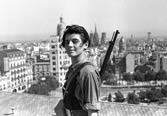
Figure 8.26:
Iconic photograph by Juan Guzmán as described in
Chapter 8.15, of Marina Ginestà, during the Spanish civil war.
8.13.9 H.M. Amadeo I of Spain
Amadeo I of Spain (Torino 1845 - Torino 1890), shown in Figure 8.25, was the King of Spain from 1870 until 1873.
8.14 The Spanish Monarchy between the two republics, followed by the Second
Republic and the Civil War
During the First Republic, from February 11, 1873, until December 29 1874, Spain was ruled by the following presidents: Estanislao Figueras, Francesc Pi y Margall, Nicolas Salmeron, Emilio Castelar and Francisco Serrano y Dominguez. The Monarchy was reinstalled after that.
8.14.1 H.M. Alfonso XII of Spain
Alfonso XII of Spain (Madrid 1857 - El Pardo 1885), shown in Figure 8.25, was the King of Spain from 1874 until 1885.
8.14.2 H.M. Alfonso XIII of Spain
Alfonso XIII of Spain (Madrid 1886 - Rome 1941), shown in Figure 8.25, was the King of Spain from 1886 until 1931.
8.15 The Second Spanish Republic followed by the ad interim regime of Fran-
cisco Franco
The Second Spanish Republic spanned from April 14, 1931, to April 1, 1939. Prominent political figures during this era, many of whom played significant roles during the subsequent civil war, included Niceto Alcalá-Zamora, Manuel Azaña, Diego Martínez Barrio, Francisco Largo Caballero, Santiago Casares Quiroga, Juan Negrín, Francesc Macià, José Aguirre, and Lluís Companys.
A notable figure was José Antonio Primo de Rivera, leader of the Falange party, who was executed on November 20, 1936. He is interred at the Monumento Nacional de Santa Cruz del Valle de los Caídos near Madrid, later symbolizing admiration for Francisco Franco’s regime.
With respect and neutrality, it is essential to recognize the extraordinary courage displayed by women on both sides during the Spanish Civil War. Future studies may assert that the war was a pivotal moment for the global emancipation and advancement of women’s rights. This is a commendable fact that all involved parties should acknowledge. Among the most famous women of the civil war was Isidora Dolores Ibárruri Gómez, a communist from Gallarta, known for the slogan "No Pasarán." She later served as a member of the Cortes Generales (1977-1979) and spent much of her post-war exile in the Soviet Union. Another notable woman was Pilar Primo de Rivera of the Falange party, sister of José Antonio Primo de Rivera. Numerous other women, primarily daughters, and mothers, took up arms to fight for their beliefs and what they deemed best for Spain.
The Spanish Civil War has garnered significant international attention, often not for its core issues but for the romanticized idealism associated with the international brigades. Many journalists worldwide documented the conflict, capturing the fervent idealism of those involved. While Ernest Hemingway’s involvement is well-known, other journalists utilized photography to immortalize the moment. One such photographer was Juan Guzmán (born Hans Gutman) (1911-1982), who captured thousands of images. His photograph of Marina Ginestà, a 17-year-old member of the Unified Socialist Youth, standing on top of the Hotel Colón in Plaça de Catalunya, Barcelona, is particularly iconic, symbolizing the power of women during the war. Although this image represents a Republican girl, courageous women also existed on the Nationalist side. Future reconciliation will likely be facilitated by mutual recognition of such valor. Historical comparisons to the role of women during WWI in Europe reveal that human strength and bravery transcend gender. The civil war’s dark side includes numerous deaths on both sides, as detailed by historian W. Blockmans38:
Military casualties: 75000 Nationalists, 77000 Republicans;
Murdered: 6000 Nationalists, 10000 Republicans;
Lynched or executed: 70000 Nationalists, 60000 Republicans;
Civilian casualties due to military actions: 5000 Nationalists, 10000 Republicans;
Deaths from disease: 90000 Nationalists, 230000 Republicans.
In total, approximately 633000 people, or about 3The establishment of the Second Republic and the ensuing Civil War (July 17, 1936, to April 1, 1939) led to Francisco Franco’s interim regime, extensively documented in books, papers, and documentaries.
The author acknowledges the sensitivity and complexity of these events and is particularly troubled by the regime’s large-scale abduction of children. However, it is also necessary to recognize the Spanish government’s efforts during WWII to protect Jews by insisting to the Nazi regime that Jews with Spanish heritage were Spanish citizens and should be allowed to ’return’ to Spain due to its neutrality. Some historians argue that the government could have saved more lives had it acted less hesitantly and did not overlook the plight of the Gypsies. Nonetheless, Spain did facilitate the passage of nearly 35000 Jews to safer countries and granted residence permits to another 2000. While this number could have been higher, comparing it to the 25000 Belgian Jews murdered by the Nazis highlights its significance. Compared to the Nazi-occupied Netherlands, where over 100000 of the 140000 Jews were deported and killed, Spain’s actions, though limited, were notable.
Further study of the Spanish Civil War and Franco’s regime, examining aspects from both perspectives, could provide valuable insights.
38W. Blockmans, ’Oorlog door de eeuwen heen,’ Rijksuniversiteit Leiden, 1993.
© 2024 Nico F. Declercq
The Desclergues of la Villa Ducal de Montblanc, 2nd ed., Omn., VOL. I

8.16. SPANISH MONARCHY AFTER FRANCISCO FRANCO
63
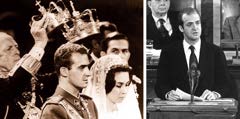
Figure 8.27: Athens, May 14, 1962, the wedding of
H. R. H. Juan Carlos de Borbón y Borbón-Dos Sicilias
and H. R. H. Princess Sophia of Greece and Denmark.
On June 6, 1976, H.M. King Juan Carlos I of Spain
addressed the American Congress.
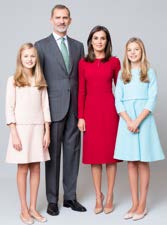
Figure 8.28: Sus Majestades los Reyes junto a Sus hijas Sus Altezas
Reales la Princesa de Asturias y la Infanta Doña Sofía, © Casa de
S.M. el Rey. / Estella de Castro (with permission, July 1st, 2020, La
Casa de S. M. El Rey, Palacio de La Zarzuela, Madrid)
However, as the historical events related to the Desclergues are unrelated to this period, they are beyond the scope of this book.
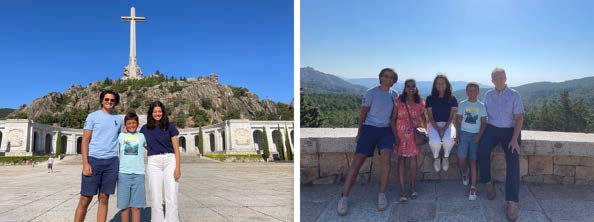
The next generation of leaders will likely continue to work towards reconciliation, with truthful information and mutual forgiveness key to settling the past. Figure 8.30 shows El Valle de los Caídos in 2022 after Franco’s remains were relocated.
8.16 Spanish Monarchy after Francisco Franco
8.16.1 H.M. King Juan Carlos I of Spain
H.M. King Juan Carlos I, a figure of immense historical significance, was born in Rome in 1938. His reign, which spanned from November 22, 1975, until his abdication in 2014, marked a pivotal period in Spanish history. He is the son of H.R.H. Juan de Borbón, Conde de Barcelona, the legitimate heir to H.M. King Alfonso XIII of Spain, and Princess Maria de las Mercedes of Bourbon and the Two Sicilies. The complex historical circumstances, including the establishment of the Republic and the subsequent Franco regime, led to Juan Carlos ascending to the throne, surpassing his father, the Count of Barcelona. Born in La Granja in 1913, the Count of Barcelona passed away in Pamplona in 1993. On May 14, 1977, Juan de Borbón formally renounced his rights as the successor to H.M. King Alfonso XIII, enabling his son, Juan Carlos I, to become the lawful Monarch of Spain. In a gesture of profound respect and filial honor, H.M. King Juan Carlos I conferred the title ’Conde de Barcelona’ upon his father through a Royal Decree on November 6, 1987.
His Majesty’s consort is Princess Sophia of Greece and Denmark, with whom he entered matrimony in Athens on May 14, 1962, as illustrated in Figure 8.27. The Spanish Civil War and the subsequent period until 1975 remain etched in the collective memory of the Spanish people. While the deep scars of history cannot be erased, the era of King Juan Carlos ushered in an epoch of peace, stability, and prosperity. In close collaboration with Adolfo Suárez González, the 1st Duke of Suárez (1932-2014), King Juan Carlos played a pivotal role in the transformation of Spain into a modern democracy, culminating in the establishment of a constitutional monarchy in 1978.
The author of this book was born on December 27, 1975, a mere 37 days after the death of Franco and 35 days following Juan Carlos’s ascension to the throne. The principle of ’De la ley a la ley’ and Juan de Borbón’s renunciation of his claim solidified the legitimacy of the Spanish Monarchy. As in all democratic nations, diverse opinions serve to keep society vibrant and engaged.
The peaceful transition from a dictatorship to a modern constitutional monarchy is an extraordinary achievement and a source of pride for all Spaniards. Politics, akin to a pendulum, oscillates over time. Post-World War II, Europe sought unity, forming the Figure 8.29: Left, we see H.M. King Felipe VI de España with H.E. President Barack Obama of the United States of America on September 23 of 2014, at the Waldorf Astoria Hotel, New York (by Pete Souza - United States Government Work). In the middle, the Coat of Arms of Modern Spain is exposed. Right, we observe Su Alteza Realla Princesa de Asturias y Girona, Duquesa de Montblanc (2019).
The Desclergues of la Villa Ducal de Montblanc, 2nd ed., Omn., VOL. I
© 2024 Nico F. Declercq

64
CHAPTER 8. A BRIEF HISTORY OF FLANDERS AND ITS IBERIAN CONNECTIONS
Figure 8.30: El Valle de los Caídos (2022) (Declercq de Silva Archive)
Figure 8.31: From left to right, the flag of Spain; The flag of the short-lived independent Bel-
gium (Verenigde Nederlandse Staten), 1789-1790; The flag used by France and the First Empire,
and therefore also by Belgium during the French period, including the reign of Napoleon Bona-
parte; The flag used by the United Kingdom of the Netherlands; The original flag of Belgium,
developed by Lucien Jottrand and Édouard Ducpétiaux; and, finally, the modern flag of Belgium.
European Union, while contemporary times emphasize regionalism. Recognizing differences fosters cultural pride and identity, yet acknowledging similarities is essential for unity. Constructive endeavors, emblematic of human intellect and cultural progress, stand in stark contrast to the destructiveness of conflict. Like a stable marriage, unity thrives on mutual respect for identity, forming the bedrock of stability upon which individuals and societies can flourish and secure prosperity for future generations. Instability diverts energy and resources away from productive pursuits. As experienced sailors know, achieving a common goal requires collective effort.
The recent pandemic underscored the interconnectedness of all humanity, demonstrating that we all inhabit the same vessel.
The author married on the Indian Subcontinent, in Sri Lanka, precisely 21 years after the celebrated 1976 address by H.M. King Juan Carlos I of Spain to the American Congress, as depicted in Figure 8.27.
8.16.2 H.M. King Felipe VI of Spain
His Majesty, King Felipe VI of Spain, was born in Madrid on January 30, 1968, in the Nuestra Señora de Loreto clinic, a city whose rich history and cultural vibrancy are fittingly reflected in his distinguished life. His birth names are Felipe, Juan, Pablo, and Alfonso de Todos los Santos, commemorating, respectively, the first Bourbon king of Spain; his paternal grandfather, the Head of the Spanish Royal Household; his maternal grandfather, the King of the Hellenes; and his great-grandfather, King Alfonso XIII of Spain.
His godparents were his grandfather, His Royal Highness Don Juan de Borbón, Count of Barcelona, and his great-grandmother, Queen Victoria Eugenie. In Figure 8.29, His Majesty is shown with President Barack Obama, highlighting his role as a respected global leader.
On June 19, 2014, Felipe VI ascended to the throne, embodying the virtues of a modern monarch while steering Spain with a blend of tradition and progressive vision. His coronation came following the abdication of his father, King Juan Carlos I, who sanctioned the requisite Organic Law on June 18, 2014. King Felipe took the Oath outlined in Article 61 of the Constitution and was proclaimed King before the General Courts. A rigorous academic and military education marked King Felipe VI’s formative years. He attended the Colegio Santa María de los Rosales for primary and secondary education. After completing his secondary studies, he spent a year at Lakefield College School in Canada, equivalent to the University Orientation Course. From September 1985 to July 1988, he pursued military studies at the General Military Academy in Zaragoza, followed by training at the Naval Military School in Marín and the Air Force Academy in San Javier. His training culminated in receiving the commissions of Infantry Lieutenant, Ensign of the Navy, and Aviation Lieutenant in July 1989. He is a licensed helicopter pilot with proficiency in instrumental flight in the 402
Squadron of the Air Force. Additionally, he holds the Pilot Wings of the Army and the Navy. King Felipe furthered his education by earning a Law degree from the Autonomous University of Madrid between October 1988 and June 1993 and taking Economics courses to broaden his knowledge. In September 1993, he began a Master’s program in International Relations at the Edmund Walsh School of Foreign Service at Georgetown University in Washington, D.C., graduating on May 26, 1995. From September 1999 to June 2000, he attended a course on Security and Defense at various international organizations.
King Felipe VI’s official activities began in earnest in 1990 with a series of visits to the Autonomous Communities of Spain, aiming to deepen his understanding of the nation and foster closer ties with its people. Following his academic studies in the United States, he undertook numerous institutional commitments as the Heir to the Crown domestically and internationally. His engagements included meetings with constitutional bodies, major state institutions, autonomous communities, and public and private audiences with political, economic, cultural, and media representatives, ensuring he stayed informed on national and international matters.
In his military role, King Felipe VI maintains frequent contact with the Armed Forces and the Civil Guard through a program of activities that includes the presentation of dispatches at Officer and Non-Commissioned Officer Academies, exercises, maneuvers, visits to units, centers, and organizations, and military audiences since 2010. He keeps abreast of military affairs through private audiences with senior military officials, the Civil Guard, and work meetings on current issues.
As Prince of Asturias, he actively promoted Spain’s economic and commercial interests abroad, supported the Spanish language and culture through the Cervantes Institute network, and established university chairs to disseminate Spain’s history and current affairs.
Annually, he made official trips with Queen Letizia to an Ibero-American country and a country of the European Union, the Middle
© 2024 Nico F. Declercq
The Desclergues of la Villa Ducal de Montblanc, 2nd ed., Omn., VOL. I
65
East, or the Far East, where Spain had strategic interests. Since January 1996, he has represented Spain at the inaugurations of Ibero-American presidents.
In addition to his official activities, King Felipe VI is the Honorary President of several associations and foundations, notably the Prince of Asturias Foundation, the Prince of Girona Foundation, and the Hesperia Foundation. The Prince of Asturias Foundation, established in Oviedo on September 24, 1980, aims to promote cultural and moral values that contribute to humanity’s progress, with the prestigious "Prince of Asturias" awards presented annually in Oviedo. The Prince of Girona Foundation, founded in 2009, supports young people by fostering entrepreneurial spirit in business, social, scientific, academic, and cultural fields, with the annual Impulsa Forum held in Girona. With Queen Letizia, he presides over the Hesperia Foundation, created in 2010 to promote social projects for disadvantaged youth. He also regularly engages with the Codespa Foundation, which is dedicated to combating poverty through economic and social development, and the Elcano Royal Institute, Spain’s foremost think tank on international and strategic affairs.
King Felipe VI’s interests include sports, mainly sailing. He was a member of the Olympic sailing team in the Soling class at the Barcelona 1992 Games, where he served as the flag bearer for the Spanish team and finished sixth, earning an Olympic Diploma.
Queen Letizia Ortiz Rocasolano, born in Oviedo on September 15, 1972, to Jesús Ortiz Álvarez and Paloma Rocasolano Rodríguez, epitomizes grace and dedication. She began her studies in Oviedo before moving to Madrid with her family, where she completed her schooling at the Ramiro de Maeztu Institute. Queen Letizia graduated in Information Sciences, specializing in Journalism, from the Complutense University of Madrid and holds a Master’s degree in Audiovisual Journalism from the Institute of Audiovisual Journalism Studies. She initially worked at newspapers La Nueva España, ABC, and the EFE news agency. She pursued her Doctorate in Mexico, collaborating with the newspaper Siglo 21.
Her television career started at the Madrid headquarters of Bloomberg, where she specialized in economy and finance under the supervision of the EFE agency. She later joined CNN+ as a reporter, writer, and presenter. In 2000, she joined Spanish Television (TVE), working with the Second Edition news team, and presented Informe Semanal. She also anchored Telediario Matinal, covered Euro specials, and reported from various global locations. She received the "Larra" Award from the Madrid Press Association for the most outstanding journalist under 30 for her exemplary work.
Queen Letizia’s official duties focus on her family and supporting King Felipe VI’s institutional work. She balances her role as a mother with her official responsibilities alongside the King. Since 2007, she has developed her agenda within the framework of official activities, mainly focusing on education, promoting vocational training, fostering reading and literacy, and supporting healthy habits from early childhood. She championed rare diseases and cancer awareness, becoming Honorary President of the Spanish Association Against Cancer and its Scientific Foundation in 2010, the first permanent presidency she accepted. Her commitment includes promoting scientific research in education, health, and innovation and supporting various disability groups.
Queen Letizia maintains contact with the Armed Forces, attending Armed Forces Day, presenting Combat Flags to Units, and presiding over an Oath of Allegiance ceremony with the Royal Guard. She also accompanies King Felipe VI on official international trips.
Their union, solemnized in the Cathedral of Santa María la Real de la Almudena in Madrid on May 22, 2004, is a testament to their shared dedication and love. Their daughters, Princess Leonor de Todos los Santos and Infanta Sofía de Todos los Santos, embody the future of the Spanish monarchy. Princess Leonor, born on October 31, 2005, in Madrid, is the Princess of Asturias, Girona, and Viana, as well as the Duchess of Montblanc, Countess of Cervera, and Lady of Balaguer, linking her to Spain’s rich heritage.
Her presence is noted in various sections of this book, including Figure 8.29 and the closing Figures 80.22 and 80.23, where she symbolizes the continuity and future of the Spanish monarchy.
Infanta Sofía, born on April 29, 2007, in Madrid, also brings joy and continuity to the Royal Family. A family portrait, which can be found in Figure 8.28, captures the warmth and unity of the Royal Family. Together, King Felipe VI and Queen Letizia exemplify grace and mutual respect, setting a profound example for their subjects.
King Felipe VI excels in moments of royal splendor and approachable simplicity, navigating his office with a profound sense of duty and genuine connection to his people. His courteous and upright nature has endeared him to many, fostering trust and admiration.
Whether engaging in state affairs or spending cherished moments with his family, King Felipe’s presence is dignified and endearing, exemplifying the noble virtues of the Spanish Crown.
8.17 Belgium Austriacum
Belgium Austriacum, also called the "Imperial Netherlands" or "Oostenrijkse Nederlanden," formed an autonomous entity within the Habsburg monarchy, comprising 10-11 provinces. The War of the Spanish Succession, culminating in the Treaties of Utrecht in 1713, resulted in the Spanish mainland falling under the Bourbon Dynasty while the Spanish Netherlands came under the control of the Austrian Habsburg Dynasty.
Belgium, a region of considerable prosperity, was thus transferred to Austrian rule, providing significant economic benefits and a strategically valuable border with France for military purposes. Belgium Austriacum lasted from 1715 until 1795. This period is particularly notable in the context of the life of Viscount Charles Philippe de Patin, our blood-relative, as described in Chapter
70.6. Given the lack of other significant genealogical events, we will confine our discussion to a concise overview.
Firstly, it is essential to emphasize that Belgium was regarded as a single unit within the Austrian Empire, notwithstanding the presence of individual provinces. Secondly, the ultimate authority over Belgium resided with the Austrian Monarchy. Thirdly, Belgium had its own local governors.
The first ruler was His Majesty Emperor Charles VI, who succeeded His Majesty Emperor Joseph I in 1711. He was followed by his daughter, Her Majesty Empress Maria Theresa, in 1740, who ruled until 1780. Following Maria Theresa, the ruling family’s name changed, marking the beginning of the Habsburg-Lorraine era. His Majesty Emperor Joseph II ruled from 1780 until 1790, succeeded by His Majesty Emperor Leopold II, who reigned from 1790 until 1792. After Leopold II, His Majesty Emperor Francis II (Franz) ruled over the Austrian Netherlands until 1795 and continued as Emperor of Austria until 1835.
8.17.1 H.M. Emperor Charles VI
Charles VI (1685 - 1740), shown in Figure 8.32, was Emperor from 1711 until 1740 and had succeeded his brother Joseph I.
The Desclergues of la Villa Ducal de Montblanc, 2nd ed., Omn., VOL. I
© 2024 Nico F. Declercq
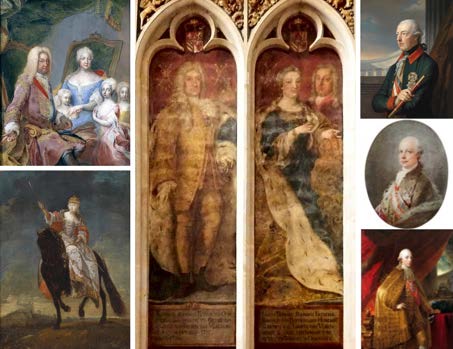
66
CHAPTER 8. A BRIEF HISTORY OF FLANDERS AND ITS IBERIAN CONNECTIONS
Figure 8.32: Top-left, we see Emperor Charles VI with his family; bottom-left, Maria Theresia
depicted as H.M. the Queen of Hungary. Top-right, we see Emperor Joseph II; middle-right,
Emperor Leopold II; bottom-right, Emperor Francis II. In the middle, we can see a fresco in
Kortrijk, at ’ Onze-Lieve-Vrouwe Kerk’ . The fresco shows Emperor Charles VI of Austria, left,
and Empress Maria-Theresa of Austria, right. (Declercq de Silva Archive)
8.17.2 H.M. Empress Maria Theresia
Maria Theresia (1717 - 1780), shown in Figure 8.32, was the Empress from 1745 until 1765. She is equally seen in Figures 70.48
8.17.3 H.M. Emperor Joseph II
Joseph II (1741 - 1790), shown in Figure 8.32, was the Emperor from 1765 until 1790.
8.17.4 H.M. Emperor Leopold II
Leopold II (1747 - 1792), shown in Figure 8.32, was the Emperor from 1790 until 1792.
8.17.5 H.M. Emperor Francis II
Francis II (1768 - 1835), shown in Figure 8.32, was Emperor from 1792 until 1806 and ruled over Belgium until 1795. Note, however, that there was an interruption of the Austrian rule in 1789-1790, as is mentioned in Chapter 8.18. Figure 8.32 shows a fresco in the church Onze-Lieve-Vrouwe-Kerk of Kortrijk, of H.M. Emperor Charles VI and his daughter H.M. Empress Maria Theresia.
The use of flags did not convey the significance as it does nowadays to the existence of nation-states. However, sometimes a flag was needed, for instance, to make the identification of a ship possible. According to several sources, during Austrian Belgium, we find a flag consisting of a red (top) and a yellow (bottom) banner, horizontally oriented, with white in between. Later, during the first Belgian revolution, the Belgians transformed the white plane to black, possibly because it resembled better the colors of Brabant, and it’s shown in Figure 8.31. The Black, Yellow and Red banners would later form the Flag of Modern Belgium. A brief search for sources depicting this old Austrian Belgian Flag was, however, unsuccessful. Therefore we are not entirely sure of the correctness of this information. We are confident yet of the Flag used in 1789, as described below in Chapter 8.18.
8.18 The First Belgian Revolution in 1789
The First Belgian Revolution of 1789 is often overlooked in educational curricula due to its seemingly insignificant outcomes.
Nevertheless, it warrants recognition because, as is widely acknowledged, the year 1789 holds substantial global historical significance.
It marked the commencement of the French Revolution, the inauguration of George Washington as the first President of the United States, and Antoine Lavoisier’s formulation of the law of conservation of matter, alongside his proof that oxygen is consumed during combustion. Moreover, for art enthusiasts, it was the year Francisco Goya was appointed as an official painter to the Spanish court under King Carlos IV of Spain.
The First Belgian Revolution, also known as the ’Brabantse Omwenteling,’ began in 1789 and persisted into 1790. This insurrection was directed against Austrian rule over Belgium. The rebellion originated in Brabant and was quickly disseminated to Flanders, Limburg, Hainaut, and Namur. For a brief period, a state known as the ’Verenigde Nederlandse Staten’ was established under the leadership of Hendrik van der Noot. This republic encompassed approximately half of modern Belgium today, predominantly the western half. The contemporary linguistic divide within Belgium was irrelevant to this republic.
Belgium reverted to Austrian control despite international pressures and certain concessions from the Austrians.
However, relentless pressure from France culminated in the French annexation of the territory in 1794. Historians frequently argue
© 2024 Nico F. Declercq
The Desclergues of la Villa Ducal de Montblanc, 2nd ed., Omn., VOL. I
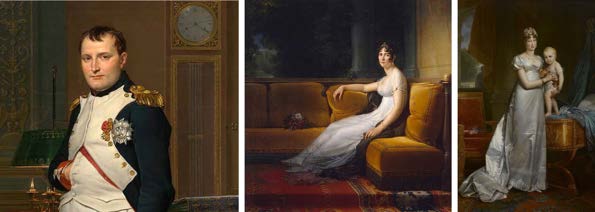
8.19. H.M. EMPEROR NAPOLEON BONAPARTE
67
Figure 8.33: H.M. Emperor Napoleon Bonaparte, with his legal wives: left, Joséphine de Beauharnais in 1801, and right, 1813, Empress Marie Louise, mother of Napoleon Bonaparte ’s legal son.
that the French campaigns against Austria were motivated not by a desire to conquer Austria but to secure control over Belgium and the Netherlands.
8.19 H.M. Emperor Napoleon Bonaparte in Belgium and Spain
Belgium and the Netherlands were once integral parts of the French Republic and the Napoleonic Empire. Particularly noteworthy is the military involvement of several of our ancestors or their siblings, as documented in Chapter 68.7.1, Chapter 71.7.3, Chapter
48.9.2.3.1, Chapter 65.16.4.2, and Chapter 67.9.6.
When considering the world’s most illustrious leaders in history, we should focus on those who demonstrated a strong sense of morality and purpose and their remarkable achievements. Napoleon Bonaparte is among these leaders, along with Alexander the Great, Charlemagne, and Emperor Charles V. Indeed, His Majesty Napoleon Bonaparte was a highly inspiring figure, particularly for his military. He is also renowned for his ’Code Civil,’ which continues to influence many countries, including Belgium. Numerous portraits of Napoleon exist, such as the one depicted in Figure 8.33. Born Napoleone Buonaparte, he was the son of Carlo Buonaparte and Maria Ramolino. He was born in Ajaccio in 1769 and died under unfortunate circumstances on Saint Helena in 1821. He arrived in France at nine to attend a military school. His mother tongue was Corsican, and he also spoke French with a Corsican accent.
Napoleon was well-read, especially in history, though he was not proficient in languages. He participated in the French Revolution of 1789 under General Jean-Pierre du Teil. Napoleon achieved some success at Toulon in 1793 and had interactions with Robespierre, though he did not join Robespierre’s movement. After 1795, Napoleon lived in Paris in poverty. During the uprising of ’13
Vendémiaire,’ he achieved military success in Paris. On March 9, 1796, he married Joséphine de Beauharnais, depicted in Figure
8.33, and was subsequently sent to Italy to assume command. Napoleon modernized and inspired his unit, achieving significant successes in Italy and initiating the peninsula’s unification—a feat many deemed impossible. His military accomplishments continued to grow.
In 1799, with the approval of most of the establishment, he executed a ’coup d’état,’ becoming the First Consul of France and later being crowned Emperor. The Flag of France is shown in Figure 8.31. When recounting Napoleon’s successes, often described as miraculous, there is a tendency to overlook his actions across the Atlantic. In 1803, he sold Louisiana39 for 15 million USD.
This sum, equivalent to approximately 25000 kg of gold, would exceed a billion Euros or USD today. Given the low military salaries and the cost of their equipment, this amount significantly contributed to Napoleon’s military successes and his Grande Armée. This book will discuss notable events such as Austerlitz, the expedition to Moscow, the Iberian Peninsula, and the defeat at Waterloo.
Napoleon’s battles occurred in:
Sardinia: 1794 - 1796
Italy: 1796 - 1797
Malta: 1798
Egypt: 1798 - 1799
Sardinia: 1800
Bavaria: 1805
Austria: 1805 (Austerlitz)
Prussia: 1806 - 1807
Spain: 1808 - 1809
Bavaria: 1809
Russia: 1812
Saxony: 1813
French Empire: 1814
The United Kingdom of the Netherlands (Belgium): 1815
Crucial aspects of Napoleon’s life include:
Napoleon married Joséphine de Beauharnais, who remained his dominant passion despite their mutual infidelities. She had been previously married with children and remarried Napoleon on March 9, 1796. Her connections were vital in the early days of Napoleon’s career. Because the couple remained childless, Napoleon, who had an extramarital son and thus knew he was fertile, felt compelled to divorce and marry a younger woman for the sake of Imperial France. The couple divorced in 1809. In 1810, His Majesty Napoleon Bonaparte married Her Royal Highness Marie Louise of Austria, shown in Figure 8.33, daughter of His Majesty Emperor Franz I. They had a son, François Charles Joseph, Napoleon II, in 1811. The Austrians raised this child after Napoleon’s exile to Elba and later to Saint Helena.
Following the defeat in Russia, Napoleon was exiled to Elba. He had to reside there without his son, who was raised under a false 39Louisiana encompassed nearly one-third of the current territory of the United States, i.e., 827000 square miles of land west of the Mississippi River The Desclergues of la Villa Ducal de Montblanc, 2nd ed., Omn., VOL. I
© 2024 Nico F. Declercq
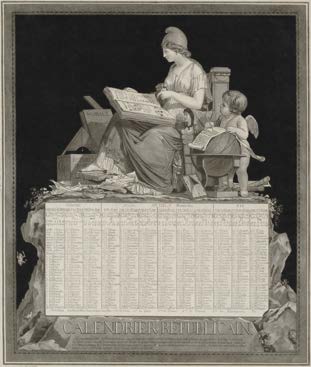
68
CHAPTER 8. A BRIEF HISTORY OF FLANDERS AND ITS IBERIAN CONNECTIONS
Figure 8.34: Symbols used on the French republican calendar.
One can see that every date on the calendar had a name. Here,
we show the calendar for Year III (1794).
name by the Austrian Imperial Court. This separation was perhaps the most significant reason why Napoleon could not accept his
situation40. Napoleon intended to house his son at Elba, raising him to prepare him for his future role. Had he been more patient, Napoleon might have found peace.
However, instead of waiting, Napoleon seized an opportunity to return. In February 1815, he escaped Elba with 1000 soldiers, landed at Juan-les-Pins, and marched to Paris, gaining support village by village, primarily from his former soldiers. Napoleon’s return lasted 100 days, ending with the final battle near Waterloo on June 18, 1815. This defeat, due to bad luck and health issues, led to his ultimate downfall.
After Waterloo, Napoleon surrendered to a British vessel and was exiled to Saint Helena. He lived in Longwood House, where Hudson Lowe tormented him until his health deteriorated, leading to his death on May 5, 1821. Napoleon’s family did not assist him, believing he had escaped to the United States rather than being at Saint Helena. In 1840, he was reburied in Paris at the Dôme des Invalides.
Following the 1789 revolution, the French regime used the Republican calendar, as seen in Figure 8.34. The Republican calendar is crucial for genealogical purposes. Some basics are as follows:
Year I: started September 22, 1792
Year II: started September 22, 1793
Year III: started September 22, 1794
Year IV: started September 23, 1795
Year V: started September 22, 1796
Year VI: started September 22, 1797
Year VII: started September 22, 1798
Year VIII: started September 23, 1799
Year IX: started September 23, 1800
Year X: started September 23, 1801
Year XI: started September 23, 1802
Year XII: started September 24, 1803
Year XIII: started September 23, 1804
Year XIV: started September 23, 1805, and lasted until December 1805.
The Gregorian calendar resumed on January 1, 1806. Converting these dates requires detailed conversion tables, as the start date can be on the 21st, 22nd, or 23rd of our Gregorian months.
The months begin with the end of September, the first month of Fall and the Republican year:
Vendémiaire (vintage month)
Brumaire (mist month)
Frimaire (frost month)
Nivôse (snowy month)
Pluviôse (rainy month)
Ventôse (windy month)
Germinal (germination month)
Floréal (flower month)
Prairial (meadow month)
Messidor (harvest month)
40In this world, there is nothing more complicated than overcoming the loss of a child. And in this world, there is nothing crueler than taking away someone’s child.
© 2024 Nico F. Declercq
The Desclergues of la Villa Ducal de Montblanc, 2nd ed., Omn., VOL. I

8.20. THE DUTCH PERIOD
69
Figure 8.35: Left: Oxford, Mississippi, May 2003. Mack Breazeale and Louise Scott proudly offered renowned local dishes such as Cowboy Burgers, Catfish, Southern Barbecue, and Pulled Pork, alongside their celebrated pecans and pecan pie. Mack favored Danish rolls. This photo was taken during the author’s first visit to the Breazeales and his maiden trip to the USA.
Before Oxford, they met in Tennessee, where the author recalls his first lunch in Nashville, enjoying grilled beef and shrimp while listening to Jimmy Buffett’s "Cheeseburger in Paradise." The warmth and hospitality of the South, particularly the Breazeales, motivated the author to work in the USA, driven by a desire for freedom and the pioneering spirit of GT Lorraine rather than career advancement. Middle: The Natchez Trace, a historic trail established by Native Americans and later used by European and American explorers, traders, and emigrants in the 18th and 19th centuries. Mack Breazeale, a native of Bristol, Tennessee, frequently took the author along this trail. The path declined in use with the advent of steamboats on the Mississippi River. Mack was born and buried in Bristol. Right: July 2006, Benjamin, the author’s son, in Mack Breazeale’s lab at the National Center for Physical Acoustics, University of Mississippi, Oxford. The experimental setup involved acousto-optic Bragg imaging using an acoustic field and cylindrically focused laser light. Mack’s lab also possessed a superior Schlieren imaging lens, formerly used by the military in U2 planes before the satellite era, which surpassed the equipment available to the author in Belgium. (Declercq de Silva Archive)
Figure 8.36: Photographs taken in Washington D.C. in September 2012 are shown on the left and right. A map of D.C. reveals that the Washington Monument is slightly off-axis because the intended site had soft ground, necessitating its construction a few meters away. The Washington Monument, the tallest obelisk ever built, is not a monolith like those of ancient Egypt; its construction, delayed by the Civil War, was completed in 1884. The city’s architect, Pierre Charles L’Enfant, was a French military engineer with possible Flemish ancestry. His name, L’Enfant, might have originated from the Flemish name ’t Kint, which appears in the author’s family history as discussed in Chapter 68. The U.S. Capitol, designed by William Thornton, was completed in 1800, destroyed in 1814, and rebuilt by 1819, with the dome added later. Washington D.C. was not always the capital; earlier locations for the United States Congress included Philadelphia, New York City, York, Lancaster, Annapolis, and Princeton (Declercq de Silva Archive). In the middle, Pierre Charles L’Enfant is depicted. He was born in Paris on August 2, 1754, and died on June 14, 1825, in Prince George’s County, Maryland.
Thermidor (summer heat month)
Fructidor (fruit month)
Finally, weeks consisted of ten days: Primidi, Duodi, Tridi, Quartidi, Quintidi, Sextidi, Septidi, Octidi, Nonidi, and Decadi, with Decadi a day of rest. Most calendars from that time feature artistic depictions of the Republican months by almost Greek goddess-like half-naked women.
When Napoleon sold Louisiana to the United States in 1803, Mississippi had separated since 1763. The French history of the region is still evident in the names of villages, towns, and counties such as Batesville, Paris, Abbeville, and others, interspersed with Spanish names like Senatobia, Hernando, Tula, and many more. Some places still bear the names of Native American towns or individuals. This area holds particular significance for the author, who fell in love with America and decided to join the U.S.
faculty. Sweet memories of this period are shown in Figure 8.35, and further in Figure 80.7 on page 2001, and Figure 80.8 on page
French influences extend beyond the South. A visit to Washington, D.C., reveals a significant French impact, as illustrated in Figure 8.36.
8.20 The Dutch Period before the Second Belgian Revolution
After the defeat of Napoleon and his Grande Armée in Russia, a power vacuum emerged in Europe, enabling the Dutch to take control of Belgium. While a small percentage of the population accepted this change, the majority were opposed. Despite His Majesty King Willem I of the United Netherlands’ good intentions, his rule was never fully embraced and resulted in significant friction.
After Napoleon’s reign, the imposition of the Dutch language was perceived by many as a form of oppression. This resentment later fueled the reinstatement of French as the official language when Belgium gained independence in 1830. Communication remains a passionately debated issue in Belgium.
The literature on the approximately fifteen years of Dutch rule in Belgium consistently agrees that King Willem I, depicted in Figure 8.37, viewed his governance as a unification of the Low Countries. In contrast, the Belgians perceived it as an occupation.
The author is convinced that the Dutch mentality differs too greatly from the Belgian mindset for the two countries ever to unite harmoniously. Nonetheless, it is unfortunate for Willem I that his mission was unsuccessful, as his intentions were indeed noble.
The Desclergues of la Villa Ducal de Montblanc, 2nd ed., Omn., VOL. I
© 2024 Nico F. Declercq
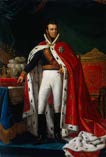
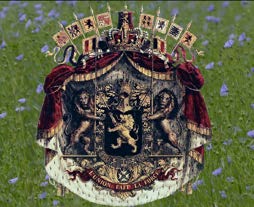
70
CHAPTER 8. A BRIEF HISTORY OF FLANDERS AND ITS IBERIAN CONNECTIONS
Figure 8.37: Z.M. Koning Willem I van de Verenigde Nederlanden.
Figure 8.38: The Coat of Arms of Belgium, on a
background of blooming flax.
Perhaps the Belgians did not favor the Dutch flag, shown in Figure 8.31.
His Majesty King Willem I was a descendant of several notable figures, including ’Stadhouder’ Willem V, ’Stadhouder’ Willem IV,
’Stadhouder’ Johan Willem Friso, Hendrik Casimir II van Nassau-Dietz, and Willem Frederik van Nassau-Dietz. The latter was a son of Ernst Casimir van Nassau-Dietz and succeeded Willem II van Oranje as ’Stadhouder’ of Groningen and Drenthe. Willem II van Oranje, the Prince of Orange and Count of Nassau-Orange, served as ’Stadhouder’ of Holland, Zeeland, Utrecht, Overijssel, Gelderland, Zutphen, Groningen, and Drenthe. His heir as Prince of Orange was Willem III of Oranje. Willem II van Oranje’s father, Frederik Hendrik van Oranje, was the son of Willem van Oranje and succeeded Maurits van Oranje as Count of Nassau and Prince of Orange.
8.21 Modern Belgium
When modern Belgium, represented by its contemporary flag depicted in Figure 8.31, which derives from the flag used during the Belgian Revolution (also illustrated in Figure 8.31), gained independence from its Dutch occupier in 1830, both nations adopted new constitutions. Consequently, modern Belgium and the modern Netherlands share the same age regarding their contemporary forms.
However, the Netherlands has a more extended history of independence, having established its sovereignty much earlier, whereas Belgium was often under the rule of other nations despite being recognized as a distinct entity. For this reason, the Netherlands is traditionally considered older than Belgium.
Upon the completion of the Belgian constitution and the installation of a constitutional monarch, Belgium’s new constitution was regarded as one of the most modern and progressive in the world at the time, earning widespread acclaim. On July 21, 1831, the coronation of H.M. King Leopold I took place, marking his inauguration as the first King of modern and independent Belgium. The Belgian coat of arms, considered one of the most beautiful globally, is shown in Figure 8.38. The Royal Castle of Laeken, which Napoleon once preserved, serves as the official residence of the monarchy and is depicted in Figure 8.39.
People often reflect on their country’s illustrious past, yearning to revert to a time perceived as idyllic—where life was perfect, nature exuded a delightful fragrance, happiness was universal, longevity was common, love was abundant, and wealth was widespread.
While this nostalgic perspective holds emotional appeal, it is crucial to ground these reflections in historical reality.
Belgium’s history provides a rich story of diverse influences and periods of foreign rule. It was part of the Roman Empire for 463
years, the Austrian Netherlands for 80 years, the Spanish Netherlands for 133 years, the Burgundian Netherlands for 98 years, the United Kingdom of the Netherlands for 15 years, the First French Empire for 21 years, and the German Third Reich for four years.
As a sovereign state, Belgium has enjoyed nearly 200 years of independence.
For historians, politicians, and academics, it is vital to balance the romanticization of the past with understanding historical complexities and continuous evolution. Embracing this nuanced perspective, which illuminates the intricacies of our past, allows for a more informed and constructive approach to addressing present challenges and shaping the future.
8.21.1 H.M. King Leopold I
Leopold I41 (Coburg 1790 - Laken 1865), shown in Figure 8.40, was the King of Belgium from July 21, 1831 until 1865.
8.21.2 H.M. King Leopold II
Leopold II of Belgium (1835-1909), shown in Figure 8.40, was the King of Belgium from 1865 until 1909.
41Leopold Joris Christiaan Frederik van Saksen - Coburg - Saalfeld
© 2024 Nico F. Declercq
The Desclergues of la Villa Ducal de Montblanc, 2nd ed., Omn., VOL. I
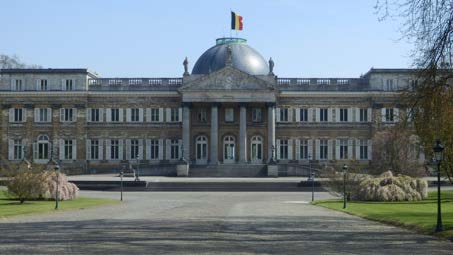
8.21. MODERN BELGIUM
71
Figure 8.39: 2015, the Royal Castle of Laken, Brussels. It’s thanks to Napoleon that the
Belgians own this beautiful construction. (Declercq de Silva Archive)
8.21.3 H.M. King Albert I
Albert I of Belgium (1875 - 1935), shown in Figure 8.40, was the King of Belgium from 1909 until 1934. He is equally shown in Figures 64.76 on page 1226.
8.21.4 H.M. King Leopold III
Leopold III of Belgium (1901 - 1983), shown in Figure 8.40, was the King of Belgium from 1934 until 1951. He is also shown in Figure 45.73 on page 840.
8.21.5 H.M. King Boudewijn
Boudewijn of Belgium (Brussels 1930 - Motril 1993), shown in Figure 8.40, was the King of Belgium from 1951 until 1993. His Majesty’s Queen Fabiola was Doña Fabiola Fernanda María-de-las-Victorias Antonia Adelaida de Mora y Aragón. She was born in Madrid, Spain. The Royal couple married on December 15, 1960.
8.21.6 H.M. King Albert II
Albert II of Belgium (born on June 6, 1934, precisely 10 years before D-day and 63 years before the author’s wedding), shown in Figure 8.40, was the King of Belgium from 1993 until 2013. He has four children. His Majesty’s Queen is donna Paola Ruffo di Calabria. The Royal couple married on July 2, 1959.
8.21.7 H.M. King Philippe
8.21.7.1 The Royal Family
Born on April 15, 1960, in Brussels, His Majesty King Philippe, shown in Figure 8.42, is King Albert II’s and Queen Paola’s eldest son. Ascending to the throne on July 21, 2013, King Philippe’s reign has been marked by unwavering dedication, reflecting a deep commitment to his role and responsibilities.
His coronation was a momentous occasion, attended by numerous dignitaries and citizens, including the author and his children.
He is a Monarch of Principles and Dedication whose early life demonstrated a keen intellect and a passion for learning. He broke royal tradition by pursuing a classical and bilingual education in Belgium and later enrolled in the Royal Military Academy in 1978.
His interest in aerospace led him to earn a fighter pilot’s license and qualifications as a paratrooper and commando.
King Philippe continued his studies abroad, attending the University of Oxford and Stanford University, and he obtained a Master’s in Political Science. Upon returning to Belgium in 1985, he immersed himself in his country’s political, economic, and social structure, acquiring a profound understanding of Belgium through numerous engagements and humanitarian visits.
His intellectual curiosity extends to history, literature, and philosophy. Extensive travels and interactions with global leaders enriched his perspectives, and he closely follows the European integration process.
The death of King Baudouin in 1993 was a pivotal moment for Philippe, as he became the heir apparent following his father’s ascension to the throne. King Philippe began to play a more prominent public role by emulating his uncle’s steadfastness and principled approach. His commitment to critical contemporary issues has marked his tenure. As Honorary Chairman of the Foreign Trade Agency, he led over 85 economic missions, fostering connections between Belgian and international enterprises. His dedication to sustainable development led him to chair the Federal Council for Sustainable Development and support the International Polar Foundation.
He established the Prince Philippe Fund in 1998 to promote dialogue among Belgium’s diverse communities, enhancing mutual recognition and respect. King Philippe’s empathy and concern for marginalized individuals drove him to engage with those affected by illness, social exclusion, and disasters. As a patron of Belgian talent, he actively encourages athletes, artists, scientists, and young talents.
King Philippe’s reign shines both in the simplicity of his daily interactions and the grandeur of his royal duties. His ability to connect with individuals from all walks of life and his regal presence make him a beloved and respected figure. His openness about his personal challenges has inspired many young people to overcome their difficulties and strive for a promising future. King Philippe embodies the values of perseverance, empathy, and dedication, leading by example with genuine kindness and integrity.
The Desclergues of la Villa Ducal de Montblanc, 2nd ed., Omn., VOL. I
© 2024 Nico F. Declercq
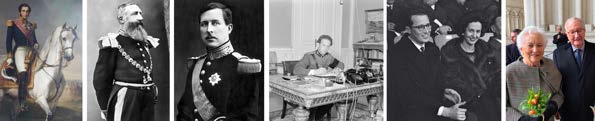
72
CHAPTER 8. A BRIEF HISTORY OF FLANDERS AND ITS IBERIAN CONNECTIONS
Her Majesty Queen Mathilde, born on January 20, 1973, in Uccle, is the daughter of Count and Countess Patrick d’Udekem d’Acoz. She is a Pillar of Compassion and Advocacy. Her early education in Bastogne and Brussels laid the foundation for a lifelong dedication to service. Queen Mathilde earned a degree in speech therapy and a Master’s in psychology from the Université Catholique de Leuven, working as a speech therapist before her marriage to Prince Philippe in 1999.
As Queen, Mathilde supports the King in his duties, engaging with institutions, organizations, and citizens across Belgium and beyond. Her interests focus on education, child poverty, women’s empowerment, financial literacy, and mental health. Queen Mathilde’s hands-on approach involves regular visits to social organizations and care institutions, ensuring she remains attuned to the population’s needs. She assists citizens in financial distress through the Queen’s Aid Fund and supports vulnerable youth transitioning to independence. As Honorary President of the King Baudouin Foundation, she engages in societal debates, particularly those affecting vulnerable groups.
Her commitment extends to Child Focus, UNICEF Belgium, and numerous humanitarian causes, emphasizing child welfare and combating violence against children. Queen Mathilde’s role as a United Nations Advocate for the Sustainable Development Goals highlights her global influence. She promotes initiatives to address critical issues by 2030. Her leadership in sustainable development earned her the Honorary National German Sustainability Award in 2017. She has conducted numerous humanitarian missions, particularly in Africa, focusing on children’s rights, health, poverty reduction, and women’s economic empowerment. In 2023, Queen Mathilde was awarded an honorary doctorate from The University of Hasselt for her significant societal contributions. She passionately advocates for culture, art, and music, participating in the Queen Elisabeth Music Competition and serving on the Schwab Foundation Board for social entrepreneurship.
King Philippe and Queen Mathilde have built a beautiful and exemplary family, shown in Figure 8.42, blessed with four remarkable children: Princess Elisabeth, the Duchess of Brabant, Prince Gabriel, Prince Emmanuel, and Princess Eléonore. Their union is a testament to a strong and supportive partnership, setting a sterling example of marital harmony and mutual respect. Princess Elisabeth, highlighted in Chapter 8.21.7.2, currently a student at Harvard University, stands out as a poised and capable heir, ready to follow in her father’s footsteps with dignity and strength. Prince Gabriel, Prince Emmanuel, and Princess Eléonore also embody the qualities of kindness, intelligence, and responsibility, traits nurtured by their parents’ guidance.
King Philippe and Queen Mathilde embody a harmonious blend of intellect, compassion, and dedication. Their combined efforts to foster national unity, promote sustainable development, and advocate for vulnerable populations create a radiant example of modern monarchy. King Philippe’s moral leadership and Queen Mathilde’s empathetic advocacy form a partnership that shines brilliantly, much like a diamond, reflecting the strength and resilience of Belgium’s royal family and, as an extension, the Belgians.
Their exemplary lives and steadfast commitment to their country and its people serve as an inspiring beacon for Belgians and the international community alike.
Figure 8.40: From left to right, we find H.M. King Leopold I at the Military Museum, Jubelpark, Brussels (2015); H.M. King Leopold II of Belgium as Garter Knight; H.M. King Albert I of Belgium; H.M. King Leopold III in 1934 at his desk at the Royal Palace of Laken (by Willem van de Poll, image placed in the public domain by the creator, Nationaal Archief 252-1571); H.M. King Boudewijn on April 12, 1962, and H.M. Queen Fabiola, at a soccer game of Real Madrid against Standard Liege (fraction of a picture by Pot, Harry / Anefo, Nationaal Archief 913-7602, an image placed in the public domain by its creator); and on February 19 of 2020, in Laken, H.M. King Albert II and H.M. Queen Paola (Courtesy of Piet Kesteloot).
Figure 8.41: H.M. King Boudewijn with H.R.H. Prince Filip Leopold Lodewijk
Maria de Saxe Cobourg et Gotha (left) and H.R.H. Prince Felipe Juan Pablo Alfonso
de Todos los Santos de Borbón y de Grecia (right). Both Princes have later been
crowned as Kings of Belgium and Spain, respectively, and are described in Chapter
8.21.7.2 H.R.H. Princess Elisabeth, the Duchess of Brabant
Princess Elisabeth Theresia Maria Helena, Duchess of Brabant, depicted in Figure 8.43, holds a unique position in the lineage of the Belgian monarchy. Born on October 25, 2001, in Anderlecht, she is the first child of Their Majesties the King and Queen of
© 2024 Nico F. Declercq
The Desclergues of la Villa Ducal de Montblanc, 2nd ed., Omn., VOL. I
73
Belgium. This places her as the heir apparent, a role she has gracefully held since July 21, 2013, when she was bestowed the title of Duchess of Brabant, a designation reserved for the presumptive heir.
Princess Elisabeth’s journey towards the throne is marked by rigorous education and dedicated public service. She is a student at Harvard University, where her intellectual pursuits reflect her deep commitment to understanding the complexities of history and politics. This educational path continues her academic endeavors, including studying at Lincoln College, Oxford, and earning her International Baccalaureate from UWC Atlantic College in Wales in 2020. Her comprehensive education is further highlighted by completing the Military and Social Sciences program at the Royal Military Academy in July 2021, showcasing her readiness to undertake the multifaceted responsibilities of future leadership.
Princess Elisabeth’s educational journey is enriched by her multilingual proficiency. She fluently speaks Dutch, French, German, and English, a skill that allows her to engage with a wide range of the Belgian population and the international community. This linguistic dexterity is a testament to her ability to bridge diverse cultures and perspectives, a crucial trait for a future leader.
Princess Elisabeth’s dedication to public service is not a recent development. In September 2011, she inaugurated the Princess Elisabeth Children’s Hospital at the University Hospital of Ghent, marking her first official engagement. This early commitment to public service laid the foundation for her subsequent endeavors, such as lending her name to the Princess Elisabeth Antarctica Research Station and serving as the patron of the naval patrol ship P902 Pollux. Her humanitarian spirit was further demonstrated during her field visit to Kenya with Her Majesty the Queen in 2019, organized by UNICEF, and through her introductory course at the Permanent Representation of Belgium to the United Nations in New York.
Her dedication to social causes extends to her volunteer work with organizations supporting school leavers, the elderly, individuals with disabilities, and people experiencing homelessness. During the COVID-19 pandemic, she made numerous phone calls to isolated seniors in care homes, providing them with much-needed support and encouragement.
Princess Elisabeth’s interests are as diverse as her public engagements. She is an avid sportswoman, enjoying skiing, rowing, and sailing, and finds solace in nature through hiking. Years of piano lessons nurture her artistic side, and her musical tastes are as varied as any young person’s. Reading remains a source of joy and inspiration for her, fueling her curiosity and broadening her horizons.
Despite her many commitments, Princess Elisabeth values her time with family and friends. She often spends weekends with her siblings Gabriël, Emmanuel, and Eléonore. Her ability to balance the demands of her role with personal interests and relationships speaks to her well-rounded character.
As Princess Elisabeth continues her path toward queenship, her journey is a testament to her exceptional intelligence, dedication, and grace. Her academic achievements, public service, and personal qualities portray a future monarch who is well-prepared to lead Belgium with wisdom and compassion. Her story is not just one of royal duty but of a young woman navigating her unique path with poise and promise, embodying the bright future of the Belgian monarchy.
The Desclergues of la Villa Ducal de Montblanc, 2nd ed., Omn., VOL. I
© 2024 Nico F. Declercq
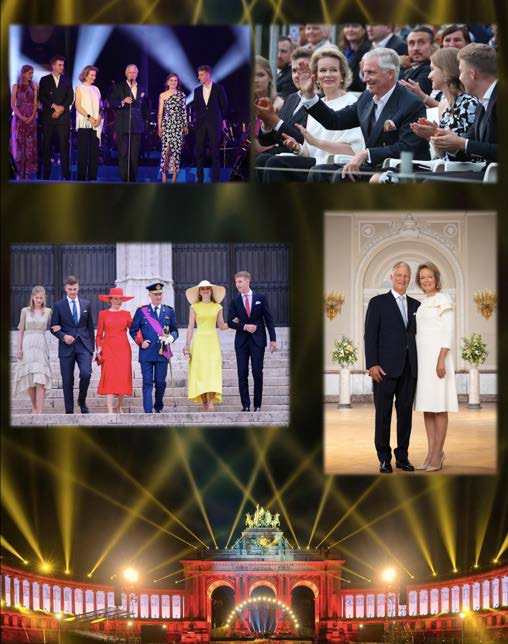
74
CHAPTER 8. A BRIEF HISTORY OF FLANDERS AND ITS IBERIAN CONNECTIONS
Figure 8.42: The Royal family of Belgium on the occasion of the celebrations of the Ten Year Jubilee
of King Philippe’s reign, July 21, 2023. We can see H.M. King Philippe and H.M. Queen Mathilde, and
their children, H.R.H. Princess Elisabeth, the Duchess of Brabant, H.R.H. Prince Gabriël, H.R.H. Prince Emmanuel, and H.R.H. Princess Eléonore. In the background, we see the Cinquantenaire, constructed with the help of Theophile Verhaeghe, described in Chapter 48.9 and shown in Image 48.95 on page 920. (Courtesy of the Belgian Royal Palace)
© 2024 Nico F. Declercq
The Desclergues of la Villa Ducal de Montblanc, 2nd ed., Omn., VOL. I
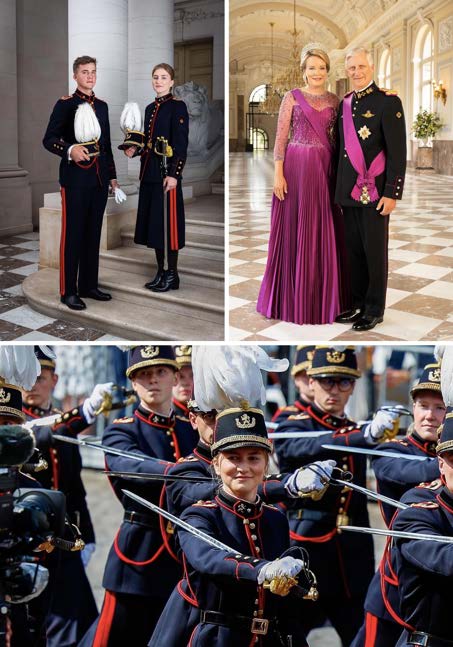
8.21. MODERN BELGIUM
75
Figure 8.43: July 21, 2023, H.R.H. Princess Elisabeth with her parents and her brother, H.R.H.
Prince Emmanuel. (Courtesy of the Belgian Royal Palace)
The Desclergues of la Villa Ducal de Montblanc, 2nd ed., Omn., VOL. I
© 2024 Nico F. Declercq
CHAPTER 8. A BRIEF HISTORY OF FLANDERS AND ITS IBERIAN CONNECTIONS
© 2024 Nico F. Declercq
The Desclergues of la Villa Ducal de Montblanc, 2nd ed., Omn., VOL. I
More than two thousand years of Desclergues
The Desclergues of la Villa Ducal de Montblanc, 2nd ed., Omn., VOL. I
© 2024 Nico F. Declercq
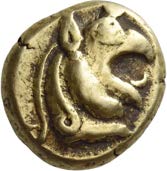
Chapter 9
The Desclergues during the Greek Era
9.1 Introduction
Reconstructing the rich history of the Desclergues family can be meticulously achieved by integrating genetics, onomastics, and historical facts within a logical framework. This approach allows one to trace the Desclergues’ lineage from the present day back to their distant origins. The Desclergues’ roots coincide with the Greeks’ arrival in Empúries around 540 BC. Emerging from the local nobility and intermarrying with the daughter of a Greek merchant, the Desclergues were well-educated and initially served as grammateus or scribes. During the Roman period, they held the position of scriba, placing them within the social class of clerics, akin to notaries, in Roman society.
Their status elevated during the Byzantine era as they continued their clerical duties under the Byzantine Emperor, earning the designation of "purple blood," a term denoting their noble status. Under Muslim rule in Spain, the Desclergues thrived as Hakim of Hakin, a title reflecting their role as learned and administrative officials. With the advent of Frankish rule, they adopted the name Clergue and continued flourishing.
During the religious turmoil in Albi, a significant chapter in the Desclergues’ history unfolded. Members of the family, steadfast in their beliefs and commitment, aligned themselves with the King of Aragon and played a crucial role in the conquest of Mallorca.
Despite the subsequent decline of Mallorca, the family’s resilience shone through as they migrated to Catalonia, establishing themselves in Barcelona, Santa Coloma de Queralt and Manresa, and, later, in Montblanc.
The Desclergues have weathered the storms of various cultural landscapes and thrived across different political eras.
9.2 The Foundation of Empúries and the Desclergues Lineage
The story of the Desclergues begins in the rugged landscapes of ancient Iberia, where the local tribe of the Indigetes settled in what would become Empúries. This coastal region, primed for agriculture and trade, nurtured a class of local elites, among whom were the earliest ancestors of the Desclergues. The arrival of Greek colonists from Phocaea around 575 BC marked a pivotal moment.
These settlers introduced Empúries to the broader currents of Hellenic civilization, bringing sophisticated governance systems, trade, and cultural exchange.
Herodotus described the Greeks in Phocaea, which is now Foça in Turkey. They originated from Athenians and Phocidians. The Phocians were considered noble and sacred due to their historical and cultural significance in ancient Greece. Phocis, located in central Greece, west of Boeotia, held a unique position both geographically and spiritually, contributing to its esteemed status.
The sacredness of Phocis was largely due to the Panhellenic sanctuary of Delphi, nestled at the base of Mount Parnassus. This sanctuary, dedicated to Apollo, housed the renowned oracle, a pivotal figure in Greek religious life. The oracle’s influence drew visitors from all corners of the Greek world, including statesmen, military leaders, and common citizens seeking divine guidance.
This influx of visitors bolstered the region’s prosperity and reinforced its sacred character.
Historically, the Phocians were also known for founding several important Mediterranean cities, known as "Phocaean cities," such as Phocaea in modern-day Turkey and Marseille in France. This expansion demonstrated their maritime prowess and influence, enhancing their noble status. The region was initially populated by Pelasgians and later saw an influx of Greek populations, including Achaeans, Ionians, and Dorians. This blend of cultures enriched Phocis and contributed to its historical depth and nobility.
Politically and militarily, the Phocians played a significant role in Greek affairs. Initially neutral during the Persian Wars, they eventually aligned with Athens. In the Peloponnesian War, they switched sides to support Sparta, showcasing their strategic importance and adaptability. The Third Sacred War (356-346 BCE) was a pivotal conflict that underscored the sacred status of Phocis. Sparked by the Thebans’ accusation of the Phocians cultivating sacred lands, this war highlighted the region’s crucial role in the broader geopolitical struggles of Greece, including the ascent of Philip II of Macedon.
Following various conflicts, Phocis became part of the Corinthian League and later the Aetolian League, indicating its strategic importance and integration into larger political entities. These elements collectively underscored the nobility and sacredness of the Phocians, positioning Phocis as a crucial region in the religious, cultural, and political landscape of ancient Greece.
As Empúries flourished under Greek influence, it was inevitable that the Desclergues’ ancestors, positioned within the local nobility, Figure 9.1: A stater coin from Phocaea with Gryphon head, around
580 BC. The gryphon plays an important role in the symbols used by
our ancestors, as can be verified in Figure 19.20 on page 175, Figure
18.4 on page 130, Figure 19.47 on page 207, and Figure 23.5 on page
The Desclergues of la Villa Ducal de Montblanc, 2nd ed., Omn., VOL. I
© 2024 Nico F. Declercq
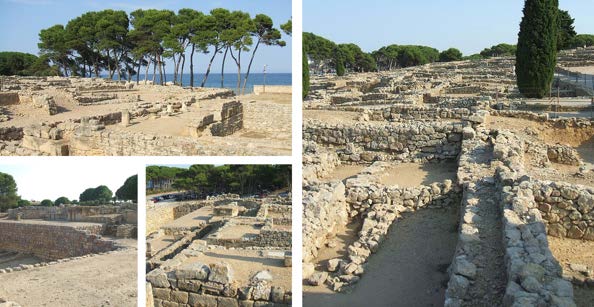
80
CHAPTER 9. THE DESCLERGUES DURING THE GREEK ERA
Figure 9.2: Ruines of Empúries. Credit: LeZibou, wikimedia commons.
forged strategic marital alliances with the Greeks, thus cementing their social ascent. They adapted to the new cultural landscape, blending their local traditions with the administrative and mercantile practices introduced by the Greeks and, later, the Romans.
9.3 Phocaea was the Origin of Greek Colonists
Phocaea, or Phokaia (modern-day Foça in Turkey), was an ancient Ionian Greek city on the western coast of Anatolia. Greek colonists from Phocaea founded several significant colonies around the Mediterranean, including Massalia (modern-day Marseille) in 600 BC, Emporion (Empúries) in 575 BC, and Elea (Velia) in 540 BC. Phocaea was known for its strategic location near the mouth of the Hermus River and its two natural harbors, which facilitated its development into a thriving maritime economy and a great naval power.
Phocaea’s history is marked by its resilient spirit and extensive maritime exploration. According to Herodotus, the Phocaeans were the first Greeks to make long sea voyages, discovering the coasts of the Adriatic, Tyrrhenia, and Spain. Their seafaring prowess was so impressive that Arganthonios, the king of Tartessus in Spain, invited them to settle in his lands and even financed the construction of a defensive wall around their city.
However, the city’s fortunes changed under the reign of the Lydian king Croesus and later under Persian control after Cyrus the Great’s conquest in 546 BC. Rather than submit to Persian rule, many Phocaeans abandoned their city, with some fleeing to their colonies, including Emporion. This migration significantly influenced the demographic and cultural landscape of Empúries, reinforcing the Hellenic elements within the Iberian context.
9.4 Empúries was a Greek Foundation in Iberia
Empúries, derived from the Greek word "Emporion," meaning "market" or "trading place," was founded around 575 BC by Phocaean Greeks. It is shown in Figure 9.3 on page 81, Figure 9.5 on page 82, Figure 9.6 on page 83, Figure 9.4 on page 82, and Figure 9.2
on page 80. Initially established as a trading post, Empúries soon grew into a significant urban center due to its strategic coastal location and the influx of Greek settlers following the Persian conquest of Phocaea.
The early Greek settlers established their first settlement on a small island near the coast, which archaeologists called the Paléopolis.
This island provided a defensible position and a natural harbor, essential for trade and protection. The settlement of Paléopolis, though not extensively excavated due to its current occupation by the village of Sant Martí d’Empúries, has yielded some Greek fortifications dating back to the 4th century BC.
Following the Persians’ destruction of Phocaea in 546 BC, a significant influx of refugees arrived in Empúries. The original island settlement could no longer accommodate the growing population, leading to the establishment of a new town on the mainland, referred to as Néapolis. This new section of the city was marked by Greek-style houses and a fortified wall, remnants of which still stand today.
9.5 The Integration of Local and Greek Elites
The intermingling of Greek settlers with the local Indigete nobility was a natural outcome of Empúries’ growth as a multicultural hub. Marriages between Greek colonists and regional elites, such as the notable union between a Greek woman and a local nobleman, played a crucial role in the social and cultural integration of the two communities. This blending of traditions and practices was pivotal in developing Empúries as a thriving center of trade and culture.
The Desclergues family, rooted in the local nobility, strategically aligned themselves with the Greek settlers through marital alliances.
This union solidified their social standing and facilitated the transfer of Greek administrative and mercantile knowledge to the local elite. The integration of Greek governance systems and economic practices with indigenous traditions created a unique cultural milieu that defined Empúries.
© 2024 Nico F. Declercq
The Desclergues of la Villa Ducal de Montblanc, 2nd ed., Omn., VOL. I
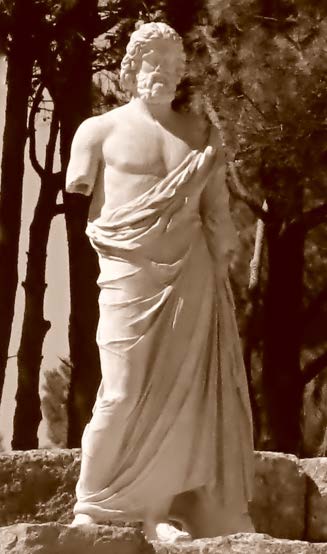
9.6. THE LEGACY OF EMPÚRIES AND THE DESCLERGUES
81
Figure 9.3: The Asclepius of Empúries,
also known as the Esculapi of Empúries,
is a marble statue discovered in 1909 at
the archaeological site of Empúries. Cur-
rently believed by most experts to represent
Serapis rather than Asclepius, the statue is
composed of two pieces: the lower part is
made from Pentelic marble, and the bust
and arms from Parian marble. Standing at
2.15 meters tall, this late 2nd century BCE
artifact is notable for its grandeur and his-
torical significance. Although the origi-
nal scepter and serpent were not preserved,
the figure’s divine status is inferred. Dis-
played at the Barcelona location of the
Museu d’Arqueologia de Catalunya for 98
years, it was transferred to Empúries in
March 2008. It remains one of the most
significant Greek artworks discovered in
the Catalan region and a centerpiece of
the Museu d’Arqueologia de Catalunya’s
Empúries collection, alongside the Sac-
rifice of Iphigenia. Serapis was a syn-
cretic Hellenistic-Egyptian god combining
aspects of Osiris and Zeus, while Asclepius
was the Greek god of medicine and healing.
9.6 The Legacy of Empúries and the Desclergues
Empúries flourished under Greek influence until it was eventually absorbed into the Roman Empire. The Romans, recognizing the strategic importance of Empúries, further developed the city, introducing Roman administrative systems and infrastructure.
Despite these changes, the Greek heritage of Empúries remained deeply embedded in its cultural and social fabric.
The Desclergues lineage, originating in the fusion of Greek and local Indigete nobility, exemplifies the broader historical processes at play in Empúries. A Phocaea slater coin with Gryphon, a symbol used by the Desclergues for centuries, is shown in Figure 9.1
on page 79. Their story is a testament to the enduring impact of Greek colonization on the Iberian Peninsula and the dynamic interplay of cultures that shaped the region’s history.
It is quite an interesting thought that the Greek era of Empúries coincided with the height of Epidaurus in Greece, shown in Chapter
The Desclergues of la Villa Ducal de Montblanc, 2nd ed., Omn., VOL. I
© 2024 Nico F. Declercq
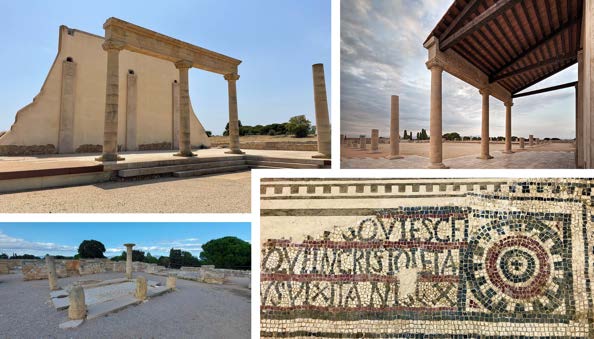
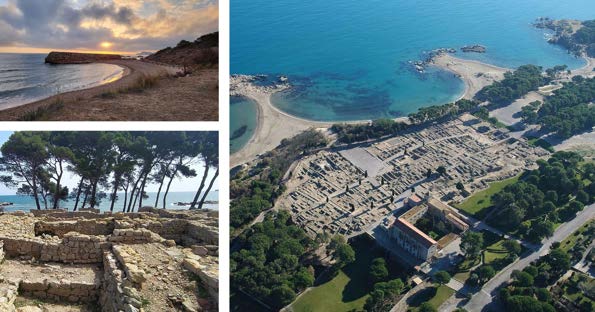
82
CHAPTER 9. THE DESCLERGUES DURING THE GREEK ERA
Figure 9.4: Ruins of Empúries.
Figure 9.5: Empúries with its coast and harbor.
© 2024 Nico F. Declercq
The Desclergues of la Villa Ducal de Montblanc, 2nd ed., Omn., VOL. I
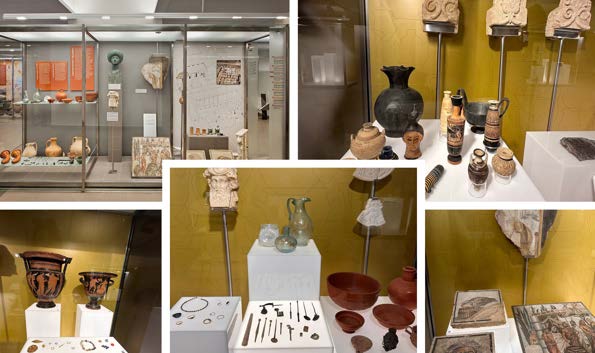
9.6. THE LEGACY OF EMPÚRIES AND THE DESCLERGUES
83
Figure 9.6: Museu d’arqueologia de Catalunya, MAC, Empúries.
The Desclergues of la Villa Ducal de Montblanc, 2nd ed., Omn., VOL. I
© 2024 Nico F. Declercq
CHAPTER 9. THE DESCLERGUES DURING THE GREEK ERA
© 2024 Nico F. Declercq
The Desclergues of la Villa Ducal de Montblanc, 2nd ed., Omn., VOL. I
The Desclergues during the Roman Era
10.1 The Roman Conquest of Empúries
The Roman conquest of Empúries marked a significant transformation in the region’s political, social, and economic landscape. By the 3rd and 2nd centuries BC, Empúries, through its connections with Massalia (modern-day Marseille), was allied with Rome.
This alliance was solidified in 218 BC when Scipio Africanus landed at Empúries, intending to cut off Hannibal’s rear guard as he advanced towards Italy. The city played a crucial role again in 195 BC when Cato the Elder pacified the indigenous tribes from Empúries, demonstrating its strategic importance to Roman military campaigns.
As the city lost its autonomy, installing Pompey’s veterans in 45 BC transformed Empúries into the thoroughly Romanized settlement of Emporiae. The new Roman town was on a broad plateau overlooking the port and the older Greek quarters. This division underscored the social stratification, with Roman merchants and officials living in opulent domus above while artisans and the local populace inhabited the lower, bustling port area.
10.2 The Role of the Desclergues in Roman Empúries
The Desclergues family, with their deep roots in the local nobility and their previous integration with Greek settlers, adeptly navigated the complexities of Roman rule. As Empúries was absorbed into the Roman Republic and later the Empire, the Desclergues’
forebears transitioned into crucial roles within the new administrative framework. Their expertise as scribes and bankers became invaluable, allowing them to thrive and prosper under Roman governance.
10.3 Integration into the Roman Administrative Framework
During the Roman era, the Desclergues leveraged their pre-existing status and skills to secure significant positions within the local administration. Their background in Greek administrative practices, acquired through their ancestors’ integration with Greek settlers, provided a solid foundation for their roles as scribes and bankers. These positions were essential in the highly bureaucratic Roman system, which required meticulous record-keeping and financial management.
The Desclergues became known for their reliability and expertise, ensuring the smooth functioning of various administrative processes. Their roles included managing land records, tax collection, and overseeing financial transactions, which were critical for maintaining the region’s economic stability. As scribes, they were responsible for drafting official documents, which required precision and trustworthiness. Their ability to navigate Rome’s complex legal and financial systems solidified their reputation as indispensable figures within the local administration.
10.4 Economic Prosperity and Social Influence
The economic prosperity of Empúries during the Roman era provided ample opportunities for the Desclergues to expand their influence. The city’s strategic location on the Mediterranean coast facilitated trade and commerce, attracting merchants and traders across the Empire. The Desclergues, with their banking expertise, played a vital role in financing trade ventures and managing commercial transactions.
Their involvement in banking not only enhanced their wealth but also extended their social influence. The Desclergues became patrons to various local artisans and merchants, fostering a network of clients and allies. This patronage system, characteristic of Roman society, further entrenched their status within the local elite. Their ability to provide financial support and protection reinforced their clients’ authority and prestige.
10.5 Adaptation and Legacy
The Desclergues’ adaptability was crucial to their enduring success as Roman cultural and administrative practices permeated Empúries. The family adeptly incorporated Roman customs while preserving their Greek and Iberian heritage. This cultural synthesis was reflected in their patronage of local art and architecture, blending Roman styles with indigenous and Hellenistic elements.
The Roman era also saw the Desclergues investing in the construction of public buildings and infrastructure, contributing to the city’s development and serving as a testament to their civic commitment. Their involvement in public works endeared them to the local populace and further solidified their legacy as influential and beneficent figures in Empúries.
The Desclergues of la Villa Ducal de Montblanc, 2nd ed., Omn., VOL. I
© 2024 Nico F. Declercq
CHAPTER 10. THE DESCLERGUES DURING THE ROMAN ERA
© 2024 Nico F. Declercq
The Desclergues of la Villa Ducal de Montblanc, 2nd ed., Omn., VOL. I
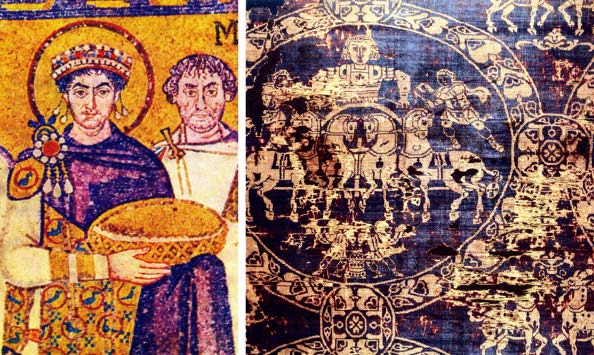
Chapter 11
Byzantine Era
Figure 11.1: Left: Byzantine Emperor Justinian, mosaic in St Vitale church, Ravenna, Italy Right: Shroud of Emperor Charlemagne, purple dyed silk.
11.1 The Desclergues and Their Byzantine Alliance
An impression of a scribe or a juror in Byzantine Spain is shown in Figure 11.3 on page 89. The Desclergues family, known for their roles as scribes and administrators, found an opportune moment to align with the Byzantine Empire amid the internal strife within the Visigothic kingdom. This strategic alliance elevated their status and gave the family the prestigious epithet of "purple blood."
This term reflected their imperial administrative roles, aligning with the Byzantine tradition where purple symbolized imperial authority. Consequences are described in Chapter 17.1.
The two artifacts shown in Figure 11.1 on page 87 exemplify the profound significance of the color purple, particularly within the context of the Byzantine Empire and its influence on noble and imperial symbolism.
On the left of Figure 11.1, the mosaic of Byzantine Emperor Justinian I in the Basilica of San Vitale, Ravenna, Italy, showcases the emperor adorned in a purple robe. This color, known as Tyrian purple, was derived from the Murex sea snail and was so rare and expensive that it was worth its weight in gold. The dyeing process required tens of thousands of snails to produce even a small quantity of dye, making it a luxury only the wealthiest could afford. As such, sumptuary laws restricted its use primarily to imperial and royal families within the Byzantine Empire, symbolizing their supreme authority and noble lineage.
Tyrian purple was not the hue we perceive today; it was a deep, muted reddish-brown. The robe of Justinian in the mosaic may appear more blueish in photographs, but in person, it embodies the rich, intense color that symbolizes his imperial status. This mosaic is a prime example of Early Byzantine art, portraying the emperor with the dignity and sternness characteristic of rulers and divine figures of the time.
On the right of Figure 11.1, the shroud of Emperor Charlemagne, an early 9th-century artifact, further illustrates the enduring prestige of purple. This shroud, woven from purple-dyed silk in Constantinople, is now housed in the Musée National du Moyen Âge in Paris. Depending on the light, the purple silk’s shimmering effect could appear more blueish or reddish, showcasing the dye’s prized luster. Like Justinian’s robe, Charlemagne’s shroud highlights the extraordinary value placed on purple textiles, often used to signify the highest echelons of power and divinity.
The association of purple with nobility has deep roots in the Byzantine Empire, where it was mythologically credited to be discovered by the dog of Hercules. Plato described it as the greatest hue, and Roman emperors, followed by Byzantine rulers, adopted it to signify their supreme status. Even religious figures like Jesus and the Virgin Mary were depicted in purple in Byzantine art, underscoring its symbolic importance. However, after the fall of Constantinople in 1204, the production of Tyrian purple declined, leading to the adoption of other dyes like red kermes.
Today, authentic Tyrian purple remains incredibly rare and expensive, with only a few grams available for art conservation.
The Desclergues of la Villa Ducal de Montblanc, 2nd ed., Omn., VOL. I
© 2024 Nico F. Declercq
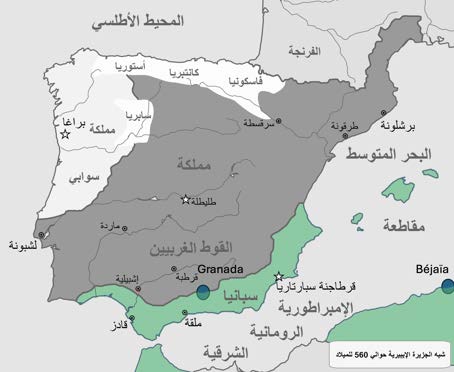
88
CHAPTER 11. BYZANTINE ERA
Figure 11.2: Byzantine Spain and Byzantine North Africa, including Bougie, or Béjaïa, in
560, indicated in green.
Nevertheless, these historical artifacts vividly capture the legacy of purple as the ultimate color of imperial and noble power, particularly in the Byzantine Empire. By the mid-6th century, under Emperor Justinian, the Byzantine Empire sought to reclaim former Roman territories, leading to their intervention in Hispania. This period, often referred to as the Byzantine Hispania, saw the empire establish control over the southeastern quarter of the Iberian Peninsula. The Desclergues leveraged their administrative skills, serving the Byzantines as they attempted to restore Roman order in the region.
11.2 Byzantine Conquest and Administration in Hispania
The Byzantine presence in Hispania began around 552 AD, following the dispatch of an expeditionary force by Justinian to support the rebel Athanagild against the Visigothic king Agila. The Byzantines, under the command of the elderly general Liberius, managed to secure key cities such as Cartagena and Malaga. These cities, serving as critical ports, became the region’s main bastions of Byzantine authority.
Despite their initial successes, the Byzantines faced significant challenges. The provincial boundaries were often indeterminate, and their hinterland control remained tenuous. The local Visigothic aristocracy, predominantly adhering to Arian Christianity, opposed the Byzantine-backed Nicene Christians. This religious and political tension made the province challenging to defend, especially as subsequent Byzantine emperors grappled with more pressing issues closer to the heart of the empire.
The establishment of the Byzantine province of Spania was part of Justinian’s broader campaign, known as the Reconquest, to restore Roman territories lost to various Germanic tribes. Following their military success in assisting Athanagild, the Byzantines formalized their control by establishing a network of fortifications and governing the region through a Byzantine military and administrative hierarchy. This structure helped maintain control over the area despite its distance from the main centers of Byzantine power in the Eastern Mediterranean.
11.3 The Desclergues in Hispania and North Africa
The Desclergues’ collaboration with the Byzantines extended beyond the Iberian Peninsula. Some family members were stationed in Bejaia (ancient Saldae), a strategic port in present-day Algeria under Byzantine control following the Vandalic War. This stationing in North Africa was significant, as it expanded the geographical reach of the Desclergues and enriched their cultural and administrative experience. Their interactions with Islamic and North African influences during this period contributed to the family’s diverse legacy.
The integration of the Desclergues into the Byzantine administration exemplifies the interconnectedness of Mediterranean cultures during this period. Their presence in Bejaia is a testament to the fluidity of boundaries and the exchange of ideas across regions.
This experience would later be echoed in the claims of Bertrand Du Guesclin in Chapter 19.7, a notable figure who highlighted his ancestral connections to Bougie, underscoring a legacy that spanned continents.
By the late 6th century, the Byzantines organized North Africa into the Exarchate of Africa, a form of governance combining civilian and military authority in the hands of the Exarch. The Exarchate included modern-day Tunisia and parts of Libya, Algeria, and Morocco. This structure aimed to integrate Roman administrative practices with local governance structures, ensuring smoother administration and more effective control.
© 2024 Nico F. Declercq
The Desclergues of la Villa Ducal de Montblanc, 2nd ed., Omn., VOL. I
11.4. BYZANTINE NORTH AFRICA: BEJAIA (SALDAE)
89
Figure 11.3: A historical impression of a scribe or juror in Byzantine Spain. This image
was made with AI (DALL·E 2024-05-22 20.46.47)
11.4 Byzantine North Africa: Bejaia (Saldae)
Bejaia, known in ancient times as Saldae, came under Byzantine control following their victory over the Vandals in the Vandalic War (533–534 AD). The city, strategically located on the Mediterranean coast, was a naval base and commercial hub. Its port facilities and position along trade routes made it a valuable asset for the Byzantines, who integrated it into their Exarchate of Africa.
Saldae’s administration, including some Desclergues ancestors, under Byzantine rule was managed by a Byzantine-appointed official, operating under the jurisdiction of the Exarchate of Africa based in Carthage. The city’s military role included serving as a base for naval operations and protecting against threats from Berber tribes and later Arab invaders. The Byzantine period in Bejaia was marked by efforts to promote Eastern Orthodoxy, adding to the region’s complex religious mix, which the spread of Islam would later influence. A map of Byzantine Spain, including Béjaïa of Bougie, is shown in Figure 11.2 on page 88.
11.5 The Decline of Byzantine Hispania
Byzantine control in Hispania began to wane towards the end of the 6th century. Visigothic king Leovigild’s efforts to consolidate power and his successor Reccared’s conversion to Nicene Christianity weakened the Byzantine position. By the early 7th century, Byzantine Hispania was reduced to a narrow coastal strip before disappearing around 624 AD, except for the Balearic Islands, which remained nominally under Byzantine control until the early 10th century.
Several factors marked the decline of Byzantine influence in Hispania. The local Romanized populations, initially supportive of the Byzantines due to their shared Nicene faith, gradually aligned with the Visigoths as religious tensions eased. The logistical difficulties of defending distant territories and Constantinople’s lack of substantial support compounded the Byzantines’ challenges.
11.6 Conclusion
The Byzantine presence in Hispania and North Africa during the 6th century exemplifies the empire’s ambitious efforts under Emperor Justinian to restore Roman imperial control over lost western territories. The Desclergues family’s involvement in these regions highlights the interconnectedness of Mediterranean cultures and the complexities of Byzantine administration, largely based on the skills of scribers. The decline of Byzantine Hispania and the eventual Arab conquests reflect the shifting political and religious landscapes of the early medieval period. This era, marked by military campaigns, strategic alliances, and cultural exchanges, underscores the dynamic nature of Byzantine influence across the Mediterranean. The purple blood of the Desclergues would persist and always refer to this period.
The Desclergues of la Villa Ducal de Montblanc, 2nd ed., Omn., VOL. I
© 2024 Nico F. Declercq
CHAPTER 11. BYZANTINE ERA
© 2024 Nico F. Declercq
The Desclergues of la Villa Ducal de Montblanc, 2nd ed., Omn., VOL. I
Chapter 12
Visigothic and Islamic Era
12.1 The Byzantine Reconquest and Visigothic Resurgence
The initial Byzantine foothold in Spain was established during the reign of Emperor Justinian I, who aimed to reclaim former Roman territories. This effort, part of Justinian’s more extensive policy of reconquest, sought to restore Roman rule over the Western territories lost to various Germanic tribes. In 552, the Byzantine general Liberius led an expedition to support the rebel Athanagild against the Visigothic king Agila I. The intervention enabled the Byzantines to secure parts of southern Spain, including key coastal cities like Cartagena and Malaga, thereby forming the province of Spania.
Byzantine control in Spania was characterized by military and administrative structures typical of the Empire, integrating the region into the broader Byzantine imperial framework. Despite these efforts, Byzantine authority was continually challenged by the Visigoths and internal strife within the Empire.
The Visigothic resurgence began in earnest under King Leovigild (568-586), who aimed to consolidate the entire Iberian Peninsula under his rule. Leovigild’s victories against the Byzantines near Malaga and Baza and the capture of Cordoba in 572 marked significant setbacks for Byzantine ambitions in Spain. However, the Byzantine administration persisted, focusing on fortifying their remaining territories and maintaining influence through diplomatic and military means.
12.2 The Desclergues and the Visigothic Alliance
During this turbulent period, the Desclergues family adeptly navigated shifting allegiances. Initially aligned with the Byzantine administration due to their noble status and administrative expertise, they transitioned to serving the Visigothic rulers as Byzantine influence waned. This realignment was essential for their survival and prosperity in an era of political instability and frequent regime changes.
Leovigild’s successor, Reccared I (586-601), abandoned Arianism in favor of Nicene Christianity, fostering improved relations with the remaining Byzantine territories. The Desclergues, known for their adaptability, leveraged this religious and political shift to secure positions within the Visigothic administration. This period saw a temporary stabilization of the Byzantine-Visigothic frontier, with treaties confirming respective territories and prohibiting further conquests.
12.3 The Islamic Conquests and the Transformation of the Iberian Peninsula
The arrival of Islamic forces in the early 8th century dramatically altered the political landscape of the Iberian Peninsula. The rapid expansion of Islamic rule, marked by the decisive Battle of Guadalete in 711, led to the collapse of Visigothic power and the establishment of Al-Andalus under Umayyad control. The Desclergues, demonstrating remarkable adaptability, transitioned to serving the new Islamic rulers.
Renamed Hakim or Hakin, the Desclergues continued their roles in administration and banking, leveraging their extensive experience and noble lineage. Their ability to serve under successive regimes—Visigothic, Byzantine, and Islamic—highlights their diplomatic acumen and underscores the fluidity of identity and allegiance in medieval Iberia.
In the forthcoming period, certain members of the Desclergue family would settle in Septimania, particularly in the regions near Albi and Toulouse. Concurrently, other branches of the family would remain under Islamic governance, later altering their allegiance as their territorial rulers transitioned to an alliance with the Frankish kingdom. These branches would refer to their lineage as Hakim or Hakin, while the former would refer to Clergue.
Figure 12.1: The professional outfit of our earliest Clergue ancestors
in the 9th-12th centuries. They were escribano, a profession that would
later become that of clercs and notaries.
The Desclergues of la Villa Ducal de Montblanc, 2nd ed., Omn., VOL. I
© 2024 Nico F. Declercq
CHAPTER 12. VISIGOTHIC AND ISLAMIC ERA
12.4 The Byzantine Legacy and Cultural Influence
Despite their eventual decline, the Byzantines left a lasting cultural and economic impact on the Iberian Peninsula. Byzantine influence permeated various aspects of Visigothic rule, including administrative practices and religious affiliations. For instance, Leovigild adopted the imperial purple and minted coins resembling Byzantine currency, reflecting the enduring prestige of the Eastern Roman Empire.
Prominent religious figures like Leander of Seville and John of Biclar maintained connections with the Byzantine world, facilitating cultural and intellectual exchanges. This period also saw continued trade with other Byzantine territories, ensuring the flow of goods and ideas across the Mediterranean.
During the Byzantine era, members of the Desclergues family were actively involved in the administration and defense of Byzantine territories in southern Spain. The Byzantine stronghold included regions like Cartagena and other coastal cities, critical for maintaining Mediterranean trade routes and military operations. Additionally, the Desclergues extended their influence to Bougie in Algeria, reflecting their integration into the Byzantine Empire’s broader strategic interests in North Africa.
12.5 The Onset of the Muslim Conquest
The Muslim conquest of Iberia began in 711 when Tariq ibn Ziyad landed at Gibraltar with an army primarily composed of Berbers.
The swift victory over King Roderic at the Battle of Guadalete led to the rapid expansion of Umayyad control across the Iberian Peninsula. As the Muslims advanced, the Desclergues family faced significant decisions regarding their allegiance and survival.
12.6 Adaptation and Division within the Desclergues Family
The Desclergues family responded to the Muslim conquest in various ways. Some members, leveraging their administrative and diplomatic skills, adapted and operated under the new Muslim rule. These Desclergues continued to reside in southern Spain, maintaining their estates and influence by collaborating with the Umayyad authorities. Their ability to navigate the changing political landscape ensured their survival and prosperity during this turbulent period. Some would later ally, with the ruler where they resided, with the Frankish.
Conversely, other family members, wary of the new rulers and seeking stability, opted to move northwards into Septimania. Their ancestral ties to Empúries facilitated this migration, allowing them to relocate swiftly and integrate into the local nobility of Septimania. Under Visigothic and later Carolingian influence, this region provided a relatively safer environment for those resisting Muslim rule.
12.7 Catalonia and the Visigothic Resistance
Catalonia was a region of strategic importance during the Muslim conquest. Agila II, a Visigothic noble, established control over parts of Catalonia and Septimania, forming a bastion of resistance against the Umayyads. The Desclergues who moved to Septimania supported these Visigothic efforts, defending key strongholds such as Narbonne and Perpignan.
By 720, however, the Umayyad forces had captured much of Septimania successfully, marking a significant power shift. The fall of these cities signaled the end of organized Visigothic resistance in the region, but individual noble families like the Desclergues continued to wield influence.
12.8 Transition from Scribes to Hakim under Muslim Rule
The Desclergues family, renowned for their scribal expertise, shown in Figure 12.1 on page 91, adapted to significant cultural and political transformations during the Muslim conquest of Iberia. Their very name, ’Clergue,’ reflects their long-standing role as scribes, a position of considerable intellectual and administrative importance in both the Byzantine and Visigothic periods. With the advent of Muslim rule, the Desclergues successfully transitioned into the role of ’Hakim’ or ’Hakin,’ terms that similarly denote a scholar or learned person, underscoring their continued prominence as professional scribes.
Indeed, before the Muslim conquest, the Desclergues had established themselves as key administrative figures in Empúries and the broader regions of Byzantine influence in southern Spain. Their literacy and command of administrative practices positioned them as indispensable assets in the bureaucratic machinery of the time. The term ’Clergue’ derives from the Latin ’clericus,’ indicating their scholarly and clerical functions within the administrative hierarchy.
Further, the arrival of the Umayyad forces in 711 marked a profound shift in the political landscape of Iberia. As the Muslim conquest advanced, the administrative and intellectual elite, including the Desclergues, faced the challenge of adapting to the new ruling powers. The Desclergues, with their deep-rooted expertise in literacy and governance, were well-placed to transition into the Islamic bureaucratic framework.
Under Muslim rule, the Desclergues must, indeed, have assumed the title ’Hakim’ or ’Hakin,’ terms that denote wisdom, learning, and administrative proficiency, akin to their original role as ’Clergue.’ The term ’Hakim’ in Arabic encompasses the dual notions of a wise man and a learned scholar, aligning with the Desclergues’ traditional role as scribes and intellectuals.
The professional shift from ’Clergue’ to ’Hakim’ was a change in terminology and a seamless transition in function and status. The Desclergues continued to perform essential administrative and scholarly duties, maintaining records, drafting official documents, and managing bureaucratic processes. Their ability to adapt to the Muslim administration’s new linguistic and cultural context facilitated their continued relevance and influence.
This continuity ensured that the Desclergues remained integral to the administrative operation of the region, contributing to the governance and cultural synthesis characteristic of Al-Andalus. More details of the name evolution of the Desclergues are given in Chapter 15.
© 2024 Nico F. Declercq
The Desclergues of la Villa Ducal de Montblanc, 2nd ed., Omn., VOL. I
Brittany, Occitania and Catalonia
13.1 Introduction
The Muslim conquest of Iberia began in 711 when Tariq ibn Ziyad landed at Gibraltar with an army primarily composed of Berbers.
The swift victory over King Roderic at the Battle of Guadalete led to the rapid expansion of Umayyad control across the Iberian Peninsula. As the Muslims advanced, they established themselves as the ruling elite, comprising Arabs, Syrians, and Berbers. The Arabs, holding superior status, owned prime land, occupied vital government positions, and resided in grand estates. Although numerically less significant, the Berbers often clashed with the Arabs, resentful of their perceived arrogance.
In medieval Spain, the Muslim rulers of Al-Ándalus left a lasting legacy in various aspects of Spanish society, including agriculture, architecture, medicine, and other fields of knowledge. The introduction of irrigation systems, advancements in medical science, and architectural marvels contributed to the region’s prosperity. The Islamic rulers’ tolerance towards other faiths, particularly Christianity, allowed for religious freedom, albeit with certain obligations such as taxation and respect for Islamic traditions.
Despite occasional conflicts with Christian kingdoms in the north, coexistence between Muslims and Christians was relatively harmonious, characterized by cooperation and peaceful cohabitation.
Over successive generations, intermarriage between the Arab ruling class and local Spanish women led to a dilution of Arab bloodlines with European genes. Consequently, many descendants of the aristocracy in Al-Ándalus displayed physical traits more akin to the indigenous Spanish population, such as blonde hair, blue eyes, and fair complexions. Historical evidence suggests that some of these Muslim rulers were of patrilineal descent of Christians, distinct from the typical Arab or Berber lineage.
Zato, to name one example, also known as Zaddo or Zate, was a significant figure in Barcelona’s history during the 9th century. He was a Muslim ruler who held sway over the city during the period of Islamic rule in the Iberian Peninsula. His presence, marked by a name resonant with Islamic heritage, sparks conjecture and debate among scholars. Some posit him as Sad¯un, a shadowy figure from the annals of Arabic chronicles, while others cast him as Zadun, a Moorish ruler whose destiny intertwined with the Frankish conquest of Barcelona.
Amidst medieval politics, Zate’s story unfolds, weaving through alliances, betrayals, and the clash of civilizations. In 812, , our ancestor, Charlemagne, shown in Figure 76.8 on page 1681, admonished a group of Frankish counts to treat the Hispani living in their domain fair and to restitute to them the land they had acquired through independent land development. This instruction, penned with the weight of imperial authority, spoke of Hispani, immigrants from the Iberian Peninsula, caught in the crossfire of territorial disputes and administrative oppression.
Among their ranks stood Zate, a figure shrouded in ambiguity, his origins hinted at through the veils of historical interpretation.
The chronicles describe Zate’s audience with Charlemagne as a pivotal moment in which allegiances hung in the balance. Some accounts suggest that he surrendered the keys of Barcelona to the Frankish emperor, while others claim he resisted, only to meet his fate at the hands of Charlemagne’s forces. His true fate remains elusive, with various accounts offering conflicting narratives.
13.2 The Formation and Development of the Spanish March (778-950)
The history of Catalonia’s formation as a distinct entity is deeply intertwined with the legacy of the Spanish March established by Charlemagne in the late 8th and early 9th centuries. This period, which marked the early foundations of Catalonian identity, saw the emergence of a complex and dynamic system of counties governed by a mix of Frankish and local nobility and supported by a structured administration of secular and ecclesiastical officials. The political and military strategies employed by the Carolingians in establishing and maintaining the Spanish March were pivotal in shaping the medieval landscape of the Iberian Peninsula.
13.2.1 Early Muslim Incursions and Carolingian Response
The establishment of the Spanish March began in the context of the Muslim conquest of the Iberian Peninsula, which had rapidly overrun the Visigothic Kingdom by the early 8th century. The Muslim armies pushed into Gaul, but Charles Martel halted their advance at the Battle of Tours in 732. This victory did not end Muslim incursions but set the stage for subsequent regional Carolingian campaigns.
Internal conflicts within the Muslim emirate of Cordoba piqued Charlemagne’s interest in the Iberian Peninsula. In 777, Muslim governors from the Ebro Valley sought Charlemagne’s assistance against the emir ‘Abd al-Rahmân I. Seeing an opportunity to expand his influence and spread Christianity, Charlemagne launched a campaign in Spain in 778. However, the expedition was unsuccessful, culminating in the disastrous Battle of Roncevaux Pass, where Basque forces ambushed the rear guard of his army.
Despite this setback, the Carolingians continued their efforts to establish a foothold in the region. In 785, the city of Girona voluntarily submitted to the Franks, followed by the counties of Cerdanya and Urgell. These early conquests laid the groundwork for establishing the Spanish March, a buffer zone to protect the Carolingian Empire from Muslim incursions and serve as a base for further expansion.
13.2.2 Structure and Governance of the Spanish March
The Spanish March was not a single administrative unit but a collection of counties that included Barcelona, Ausona, Urgell, Cerdagne, Girona, Empúries, and Roussillon. The primary function of these counties was to secure the Carolingian Empire’s southern frontier and facilitate future military campaigns. Each county was governed by a count, who wielded significant military The Desclergues of la Villa Ducal de Montblanc, 2nd ed., Omn., VOL. I
© 2024 Nico F. Declercq
CHAPTER 13. BRITTANY, OCCITANIA AND CATALONIA
and administrative authority.
The governance of these counties was initially entrusted to both Frankish and local nobility. Notable among the early leaders was William of Gellone, Duke of Toulouse, and cousin of Charlemagne, who played a crucial role in defending and expanding the frontier. Another important figure was Borrell, a local noble who governed the counties of Cerdagne, Urgell, and Ausona. These counts were responsible for maintaining the defense of their territories, administering justice, and collecting taxes. They acted as intermediaries between the local populations and the Frankish king or emperor.
The ecclesiastical organization was also crucial in consolidating Carolingian control. The territories of the Spanish March were divided into four bishoprics: Barcelona, Ausona, Urgell, and Elne. These bishoprics worked to align the region’s religious practices with those of the Carolingian Empire, combating local heresies such as Adoptionism, which was contrary to the dogma promoted by the papacy.
13.2.3 Conflicts and Consolidation
Frequent conflicts with Muslim forces and internal dissent marked the early years of the Spanish March. The Muslim emirate launched several retaliatory raids in response to Frankish expansion. In 793, for instance, Abd al-Malik ibn Abd al-Wahid ibn Mughith led a significant expedition against Girona and Narbonne. These raids underscored the constant threat faced by the frontier counties.
Internally, the governance of the March was often contentious. The aristocracy was divided between factions favoring peaceful coexistence with the Muslims and those advocating for continued military aggression. The assassination of Bera, the first count of Barcelona, in 820 exemplified these internal divisions. Bernard of Septimania, a prominent Frankish noble, succeeded Bera and sought to assert more robust control over the region but faced rebellions and accusations of disloyalty, ultimately being executed in 844.
The mid-9th century saw the rise of the house of Carcassonne, led by Sunifred, who consolidated power in several counties, including Barcelona, Girona, and Urgell. Sunifred’s successful defense against Muslim incursions and loyalty to the Carolingians earned him significant influence. His descendants, particularly Guifred the Hairy, continued this trend of consolidation. Guifred the Hairy is often credited with unifying several counties and establishing a hereditary dynasty that would become the foundation of medieval Catalonia.
13.2.4 Towards Autonomy and Independence
The transition from Frankish rule to local autonomy was gradual but significant. By the late 9th century, the counts of the Spanish March began to exercise greater independence from the Carolingian rulers. Guifred the Hairy’s successors continued to strengthen their political and military positions with less reliance on Frankish support. This shift was marked by the practice of hereditary succession among the counts, which solidified local control and reduced the influence of the Frankish monarchy.
The symbolic break from Frankish authority occurred in 988 when Borrell II, count of Barcelona, refused to renew his oath of allegiance to the new Capetian king of France, Hugh Capet. This act is often seen as the de facto declaration of Catalonian independence, though the formal recognition of this independence would come much later.
13.3 The Breton March
The Breton March, important in Chapter 19.4 and Chapter 19.8, similar to the Spanish March, was a frontier zone established by the Carolingians to protect the western borders of their empire from external threats, specifically the Bretons. Created in the 8th century, the Breton March encompassed the counties of Nantes, Vannes, and Rennes. Its establishment and subsequent evolution played a crucial role in the Carolingian military strategy and in shaping the political landscape of western France.
13.3.1 Historical Background and Initial Establishment
The origins of the Breton March can be traced back to the late 5th and early 6th centuries when Breton populations began settling in the Armorican peninsula, fleeing the Anglo-Saxon invasions of Britain. By the time of the Carolingians, the Bretons had established several small kingdoms and principalities that frequently clashed with their Frankish neighbors.
The first significant attempt to establish control over the Bretons was made by Clovis I, who, after defeating Syagrius, sought to extend his influence over Brittany. However, a more structured approach was taken during the reign of Charlemagne. Charlemagne created the Breton March as a military district to organize and support expeditions against the Bretons and to defend against their incursions into Frankish territory.
13.3.2 The Role of Roland and Early Conflicts
One of the most famous figures associated with the Breton March is Roland, the legendary prefect immortalized in the "Song of Roland." Roland’s death at the Battle of Roncevaux in 778 marked the beginning of the Breton March’s defensive and offensive military zone role.
The Battle of Roncevaux Pass fought on August 15, 778, represents a significant episode in the history of the Carolingian Empire.
This battle, an ambush against the rearguard of Charlemagne’s army by the Vascons, has been immortalized in the epic poem "The Song of Roland." The historical reality of the battle is detailed in various sources, including the accounts of Einhard in the Vita Karoli Magni.
Upon Pepin the Short’s death in 768, his son Charles, later known as Charlemagne, ascended to the throne. By 777, Charlemagne was approached by Sulayman al-Arabi, the Muslim governor of Barcelona, who sought his assistance against the Emir of Cordoba, Abd al-Rahman I. Charlemagne’s campaign into the Iberian Peninsula aimed to establish a Frankish presence and protect Christian territories, creating buffer states against Muslim raids.
The strategic significance of Zaragoza, a key objective of Charlemagne’s campaign, lay in its control over the Ebro River and its status as a prominent Christian enclave within Muslim-dominated Iberia. Despite initial successes, including the submission of several towns, the campaign faced complications when local Muslim leaders, such as El Hussayn of Zaragoza, resisted Charlemagne’s advances.