

The Desclergues of la Villa Ducal de Montblanc, Second Edition Omnibus by Nico Declercq - HTML preview
Download the book in PDF, ePub, Kindle for a complete version.
73.10GEDmatch® Results . . . . . . . . . . . . . . . . . . . . . . . . . . . . . . . . . . . . . . . . . . . . . . . . . . . . . 1590
73.10.1 Population matches . . . . . . . . . . . . . . . . . . . . . . . . . . . . . . . . . . . . . . . . . . . . . . . . . . 1590
73.10.2 Spanish Matches . . . . . . . . . . . . . . . . . . . . . . . . . . . . . . . . . . . . . . . . . . . . . . . . . . . 1591
73.10.3 Detailed Autosomal Analysis . . . . . . . . . . . . . . . . . . . . . . . . . . . . . . . . . . . . . . . . . . . . . 1592
73.10.4 A Focus on the Regions . . . . . . . . . . . . . . . . . . . . . . . . . . . . . . . . . . . . . . . . . . . . . . . 1594
73.11Genetic Analysis based on MyTrueAncestry® . . . . . . . . . . . . . . . . . . . . . . . . . . . . . . . . . . . . . . . 1597
73.12Genetic Analysis based on MyHeritage® . . . . . . . . . . . . . . . . . . . . . . . . . . . . . . . . . . . . . . . . . . 1600
73.12.1 Spanish Rooted . . . . . . . . . . . . . . . . . . . . . . . . . . . . . . . . . . . . . . . . . . . . . . . . . . . . 1600
73.12.2 Spanish Residents . . . . . . . . . . . . . . . . . . . . . . . . . . . . . . . . . . . . . . . . . . . . . . . . . . . 1600
73.12.3 Portuguese Residents . . . . . . . . . . . . . . . . . . . . . . . . . . . . . . . . . . . . . . . . . . . . . . . . . 1601
73.12.4 Other . . . . . . . . . . . . . . . . . . . . . . . . . . . . . . . . . . . . . . . . . . . . . . . . . . . . . . . . . 1601
73.13Genetic Analysis based on Geneanet® . . . . . . . . . . . . . . . . . . . . . . . . . . . . . . . . . . . . . . . . . . . 1602
73.13.1 Spanish Links . . . . . . . . . . . . . . . . . . . . . . . . . . . . . . . . . . . . . . . . . . . . . . . . . . . . . 1602
73.13.2 Links with Brittany . . . . . . . . . . . . . . . . . . . . . . . . . . . . . . . . . . . . . . . . . . . . . . . . . . 1602
73.13.3 Other . . . . . . . . . . . . . . . . . . . . . . . . . . . . . . . . . . . . . . . . . . . . . . . . . . . . . . . . . 1602
73.14Comparison with Ancient Skeletons by GEDmatch® . . . . . . . . . . . . . . . . . . . . . . . . . . . . . . . . . . . 1602
73.14.1 Alps (13700 year old skeletons) . . . . . . . . . . . . . . . . . . . . . . . . . . . . . . . . . . . . . . . . . . . 1602
73.14.2 Byzantine area (8300-9700 year old skeletons) . . . . . . . . . . . . . . . . . . . . . . . . . . . . . . . . . . . 1603
73.14.3 Iberia (4700-7200 year old skeletons) . . . . . . . . . . . . . . . . . . . . . . . . . . . . . . . . . . . . . . . . 1603
73.14.4 Celtic British Isles (4000-5200-year-old skeletons) . . . . . . . . . . . . . . . . . . . . . . . . . . . . . . . . . 1603
73.14.5 Germanic-Hungarian (3100-7000-year-old skeletons) . . . . . . . . . . . . . . . . . . . . . . . . . . . . . . . . 1603
73.14.6 Roman and Anglo Saxon British Isles (1500-1800-year-old skeletons) . . . . . . . . . . . . . . . . . . . . . . . 1604
1605
74.1 Introduction . . . . . . . . . . . . . . . . . . . . . . . . . . . . . . . . . . . . . . . . . . . . . . . . . . . . . . . . . . 1605
74.2 Iberia and the Ancestors Before Genealogical Records: The Byzantine Migration Path 224-1300 . . . . . . . . . . . 1605
74.3 Mixed Byzantine and Iberian Genes . . . . . . . . . . . . . . . . . . . . . . . . . . . . . . . . . . . . . . . . . . . . . 1606
74.4 An Interesting Observation . . . . . . . . . . . . . . . . . . . . . . . . . . . . . . . . . . . . . . . . . . . . . . . . . . 1608
74.5 DNA analysis by FamilyTreeDNA® . . . . . . . . . . . . . . . . . . . . . . . . . . . . . . . . . . . . . . . . . . . . 1608
74.6 The Iberian Byzantine Haplogroup . . . . . . . . . . . . . . . . . . . . . . . . . . . . . . . . . . . . . . . . . . . . . 1610
© 2024 Nico F. Declercq
The Desclergues of la Villa Ducal de Montblanc, 2nd ed., Omn.
lvii
74.7 YFull® DNA analysis . . . . . . . . . . . . . . . . . . . . . . . . . . . . . . . . . . . . . . . . . . . . . . . . . . . . 1611
74.8 The Y-STR values indicate Iberian Roots from a Byzantine Origin . . . . . . . . . . . . . . . . . . . . . . . . . . . . 1611
74.10The mt-DNA Haplogroup reveals the Kuru Kingdom as the Maternal-line Origin (FamilyTreeDNA®) . . . . . . . . 1614
74.11Old DNA analysis by Consanguinitas® Agrees with New Results . . . . . . . . . . . . . . . . . . . . . . . . . . . . 1614
74.12GEDmatch® Results for De Silva . . . . . . . . . . . . . . . . . . . . . . . . . . . . . . . . . . . . . . . . . . . . . . 1615
74.12.1 Population Matches with de Silva (GEDmatch®) . . . . . . . . . . . . . . . . . . . . . . . . . . . . . . . . . 1615
74.12.2 Individual Matches with de Silva (GEDmatch®) . . . . . . . . . . . . . . . . . . . . . . . . . . . . . . . . . 1616
74.12.3 Match between de Silva and Declercq . . . . . . . . . . . . . . . . . . . . . . . . . . . . . . . . . . . . . . . . 1618
74.12.4 Old Ancestry Matches between de Silva and de Rivera . . . . . . . . . . . . . . . . . . . . . . . . . . . . . . 1618
74.12.5 De Silva - Carvalho - de Almeida DNA (GEDmatch®) . . . . . . . . . . . . . . . . . . . . . . . . . . . . . . 1618
74.13Genetic Analysis based on MyTrueAncestry® . . . . . . . . . . . . . . . . . . . . . . . . . . . . . . . . . . . . . . . 1619
74.14Geneanet® DNA Results for De Silva . . . . . . . . . . . . . . . . . . . . . . . . . . . . . . . . . . . . . . . . . . . 1621
74.15MyHeritage® DNA Results for De Silva . . . . . . . . . . . . . . . . . . . . . . . . . . . . . . . . . . . . . . . . . . 1624
74.15.1 Portugal . . . . . . . . . . . . . . . . . . . . . . . . . . . . . . . . . . . . . . . . . . . . . . . . . . . . . . . . 1624
74.15.2 Far-East Portuguese Settlements . . . . . . . . . . . . . . . . . . . . . . . . . . . . . . . . . . . . . . . . . . 1624
74.16Comparison with ancient Skeletons . . . . . . . . . . . . . . . . . . . . . . . . . . . . . . . . . . . . . . . . . . . . . 1624
74.16.1 Byzantine and Georgia (8300-9700 year old skeletons; weights 1-31) . . . . . . . . . . . . . . . . . . . . . . . 1628
74.16.2 Ireland (3900-5200 year old skeletons; weights 1-30) . . . . . . . . . . . . . . . . . . . . . . . . . . . . . . . . 1628
74.16.3 Switzerland (13700 year old skeletons; weight 16) . . . . . . . . . . . . . . . . . . . . . . . . . . . . . . . . . 1628
74.16.4 England (1450-1800 year old skeletons); weights 2-11) . . . . . . . . . . . . . . . . . . . . . . . . . . . . . . . 1630
74.16.5 Iberia (5800-7200 year old skeletons; weights 2-9) . . . . . . . . . . . . . . . . . . . . . . . . . . . . . . . . . 1630
74.16.6 Germany (4200-9100 year old skeletons; weights 1-9) . . . . . . . . . . . . . . . . . . . . . . . . . . . . . . . 1630
74.16.7 Russia (2300-7300 year old skeletons) (weights 1-3) . . . . . . . . . . . . . . . . . . . . . . . . . . . . . . . . 1630
74.16.8 Sweden (5700-7700 year old skeletons; weights 1-2) . . . . . . . . . . . . . . . . . . . . . . . . . . . . . . . . 1630
74.16.9 Hungary (4200-4900 year old skeletons; weight 1) . . . . . . . . . . . . . . . . . . . . . . . . . . . . . . . . . 1630
1631
1633
75 Faucon’s Study of the Onomastics of Du Guesclin
1635
76 The Merovingian Ancestry of Guyotte de Hames
1673
76.1 Introduction . . . . . . . . . . . . . . . . . . . . . . . . . . . . . . . . . . . . . . . . . . . . . . . . . . . . . . . . . . 1673
76.2 DNA and Genealogy . . . . . . . . . . . . . . . . . . . . . . . . . . . . . . . . . . . . . . . . . . . . . . . . . . . . . 1673
77 Gerard Verbrugghe & Maria Vandenabeele
1683
77.1 Introduction . . . . . . . . . . . . . . . . . . . . . . . . . . . . . . . . . . . . . . . . . . . . . . . . . . . . . . . . . . 1683
77.2 The French Military Adventure during WWII . . . . . . . . . . . . . . . . . . . . . . . . . . . . . . . . . . . . . . . 1683
77.2.1 The Train Journey into the Unknown . . . . . . . . . . . . . . . . . . . . . . . . . . . . . . . . . . . . . . . . 1683
77.2.2 The journey on foot and the near-death experiences . . . . . . . . . . . . . . . . . . . . . . . . . . . . . . . . 1688
77.2.3 The Border Crossing between Vichy-France and German-France and the Return Home. . . . . . . . . . . . . 1690
77.3 Their life in Photos . . . . . . . . . . . . . . . . . . . . . . . . . . . . . . . . . . . . . . . . . . . . . . . . . . . . . . 1690
1691
78.1 Introduction . . . . . . . . . . . . . . . . . . . . . . . . . . . . . . . . . . . . . . . . . . . . . . . . . . . . . . . . . . 1691
78.2 The Author’s Kinship Report . . . . . . . . . . . . . . . . . . . . . . . . . . . . . . . . . . . . . . . . . . . . . . . . 1691
78.3 The Author’s Ahnentafel Report . . . . . . . . . . . . . . . . . . . . . . . . . . . . . . . . . . . . . . . . . . . . . . . 1877
78.4 Persons in the Author’s Ancestry Tree . . . . . . . . . . . . . . . . . . . . . . . . . . . . . . . . . . . . . . . . . . . 1911
78.5 Events in the Author’s Ancestry Tree . . . . . . . . . . . . . . . . . . . . . . . . . . . . . . . . . . . . . . . . . . . . 1959
79 The 1661 Report by Francesc de Pedrolo
1979
80 The Author’s Academic Ancestry and Curriculum
1995
80.1 Short Biography - 2024 . . . . . . . . . . . . . . . . . . . . . . . . . . . . . . . . . . . . . . . . . . . . . . . . . . . . 1997
2005
2013
The Desclergues of la Villa Ducal de Montblanc, 2nd ed., Omn.
© 2024 Nico F. Declercq
CONTENTS
© 2024 Nico F. Declercq
The Desclergues of la Villa Ducal de Montblanc, 2nd ed., Omn.
The Desclergues of la Villa Ducal de Montblanc, 2nd ed., Omn., VOL. I
© 2024 Nico F. Declercq
Foreword
The Desclergues of la Villa Ducal de Montblanc, 2nd ed., Omn., VOL. I
© 2024 Nico F. Declercq
0.1. A REFLECTION ON THE DICHOTOMY BETWEEN THE FIRST AND SECOND EDITIONS
5
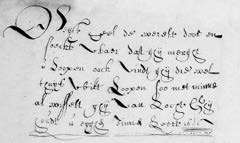
Figure 6: From the files of notary Passchier Pissens
at Vilvoorde, between records 6 and 7 September 1687.
The transcription is ’Reyst heel de wereld door en soeckt:
waer dat ghij meught u Loopen oock; vindt ghij die wel
thuys wilt Loopen soo met minne, al wisselt ghij van
Locht. Ghij houdt u eyghen zinne Leert. 1686’ . It im-
plies that, despite an exhaustive search across the globe,
true happiness can only be discovered within the confines
of one’s own home. Furthermore, regardless of one’s ge-
ographical relocations, the essence of one’s identity re-
mains fundamentally unchanged. This notion resonates
with the philosophical idea that contentment and self-
identity are intrinsically tied to our inner being rather
than external circumstances.1686. In modern Dutch:
’Waar je ook zoekt, het geluk vind je thuis; en zelfs als je
verhuist, je blijft altijd wie je bent’
0.1 A Reflection on The Dichotomy Between the First and Second Editions
Within the realm of genealogy, the author frequently encounters individuals who seek not only to uncover historical truths but also to attain recognition for their findings. These individuals often become disheartened when third parties appropriate their research without proper attribution. However, the author’s unwavering dedication to the pursuit of truth, without any aspirations for personal acclaim, sets them apart. As both an author and a descendant of the individuals whose histories are explored, the author recognizes that they do not own or seek to profit from their ancestors’ data. Hence, this second edition remains accessible online, free of charge, and is exclusively available in printed form at the production cost.
In addition, genealogists frequently grapple with apprehension when contemplating the publication of their research due to the inherent uncertainty that pervades this field. They are acutely aware of the tenuousness of their conclusions, often stemming from incomplete or ambiguous historical records. This fear of potential errors and the prospect of encountering critiques from peers can deter many from sharing their findings.
However, the author approaches genealogy from a scientific standpoint, using a methodological approach that draws conclusions based on the available data. They acknowledge that their findings may require revision as additional data surfaces. As a scientist, the author understands the necessity of publishing conclusions, inviting scrutiny and critique, as this crucible of inquiry is an indispensable part of the scientific process.
The primary impetus behind the release of the initial edition of the author’s book in late 2021, even before thorough proofreading, stemmed from their commitment to this scientific ethos. The first edition contained some audacious assumptions and conclusions, subsequently met with praise and criticism.
Other genealogists incorporated many of the author’s findings into their work. For instance, Miguel Royano Cabrera, in his 2023
publication "La comunidad mercantil de la corona de Aragón en la Baja Andalucía (1516-1556)," cited the author’s research to assert that Galcerán Desclergue hailed from their family in Barcelona and Montblanc. Miguel Royano Cabrera’s 2023 article also offered supplementary insights into Galceran Desclergue. It prompted a reevaluation of the author’s research, alongside data from their first book, concerning Maria Anna Desclergue y Villavicencio, who married Bonaventura Desclergue y Cortés.
While praise is undoubtedly welcome, it is often through criticism that deeper insights are gained. An illustrative example pertains to the challenging reception of the author’s assertion that Antoni Desclergue (DC06), a Spaniard, played a role in establishing a chapel in Deerlijk in 1639. In response to this claim, the author encountered unsportsmanlike criticism in early 2023, disregarding multiple supporting indications and the scientific experiments conducted within the chapel. Some critiques even took a derogatory tone towards Antoni Desclergue, who happens to be the author’s ancestor. Nevertheless, the author has extended forgiveness to those individuals, recognizing the significance of their roles as local historians, albeit without extensive academic training. These critics need to appreciate the limitations of their insights and acknowledge that their findings should instead be placed within the broader context and traditions understood more comprehensively by academic historians and professional genealogists specializing in the Spanish empire. The Spanish art historians and medievalists the author has engaged in extensive discussions are better equipped to navigate the nuances of interpreting ancient documents. Furthermore, naming conventions and traditions have evolved since the 1600s, adding complexity to genealogical research.
It is worth noting that the criticism, though at times challenging, served as a catalyst for the author’s deeper exploration and yielded additional evidence, often without the critics’ awareness. The author’s resilience in the face of adversity, turning stones thrown at them into building blocks that fortified their work, is a testament to their commitment to the truth.
The published first edition also facilitated meaningful connections with experienced colleagues who offered valuable insights and aided in the rectification of errors in the manuscript.
The author is particularly indebted to Jairo Eduardo Cortés Rosal for his numerous discussions and constructive contributions.
The author’s consistent prioritization of humility and setting aside ego to accept criticism is a testament to their respect for the potential contributions of others in uncovering the truth about their ancestors.
Over the years, the author continued to amass evidence and meticulously refined the book, resulting in this second edition surpassing its predecessor in completeness, accuracy, and illustration. To enhance the reader’s experience, the author transitioned from a
’double-column’ to a ’single-column’ text format and included many illustrations. The expanded content necessitated the book’s presentation as multiple volumes rather than a single volume.
The author anticipates a third edition in the coming years, should time and energy permit. This prospective edition could focus on data from the past three centuries, including details about subsequent generations’ professional pursuits and assets. The author will exercise patience to approach this endeavor efficiently until a more extensive corpus of notarial deeds becomes accessible online.
0.2 About this Manuscript’s First Edition, 2021
The genesis of this book can be traced back to an insatiable curiosity that has spanned many years. While genealogy is often categorized as a mere pastime, for the author, it transcends that definition, becoming an ardent quest for truth and a profound understanding of our reality—a way of life in its own right. This relentless pursuit continued until insight was attained, allowing The Desclergues of la Villa Ducal de Montblanc, 2nd ed., Omn., VOL. I
© 2024 Nico F. Declercq
6
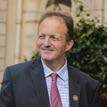
Figure 7: The author. The picture was taken at the Travellers Club, 25 Av. des
Champs-Élysées, Paris, France, in 2016.
space for engagement in other leisurely pursuits.
The author’s fervent exploration into the authenticity of the past, unraveling the connections between diverse ancestral lineages culminating in the author’s existence, was profoundly ignited with the arrival of his children. The knowledge of one’s forebears is a vital legacy to bequeath, for it imparts a sense of identity and belonging. Just as magnificent trees draw their sustenance from deep roots, this book aspires to contribute to nurturing remarkable individuals.
However, knowledge of one’s lineage is but a preliminary step. In life’s journey, one must diligently labor to fulfill one’s latent potential. The growth of a tree into magnificence demands years of nurturing and development. Therefore, it is paramount to retain a sense of humility, recognizing that, regardless of the path’s uniqueness, the path ahead remains consistently steep and challenging.
The realization of this book necessitated the temporary set-aside of cherished pastimes and other personal activities dear to the author’s heart. It was a necessary sacrifice to complete this monumental work. Through this endeavor, the author aspires to provide his children and the generations that follow with invaluable support in their quest for self-discovery. The time they will engage with this work will be contingent upon their circumstances and interests. Yet, whether in youth or old age, its worth will be genuinely appreciated one day.
The author extends a warm welcome to all readers embarking on this extensive voyage through time. It is crucial to remember that, at its core, this book is a narrative of human lives. Every ancestor, irrespective of their station, is of equal significance, for the absence of even one among them would render our existence impossible.
Genealogy often offers a seemingly limited perspective, focusing on birth, marriage, procreation, and death, primarily due to resource constraints when reconstructing their lives. It is, however, incumbent upon us to acknowledge that each individual within these pages has traversed a unique path—a life marked by moments of happiness and misfortune, achievements and setbacks, joys and sorrows in both somber and exultant epochs of human history.
0.3 A few words about the author
The author’s professional achievements are summarized in Chapter 80, at the end of this book. He is married with three children, born between 1999 and 2011.
His roots are primarily Belgian, from the Flemish region, with a paternal bloodline originating in Spain, mainly in the Catalonia region, with ancient roots passing by France’s Brittany region and Occitania. His wife’s roots are Sri Lankan, with partial origins in Goa in India and Iberia.
The author is convinced that profiting from the narratives of ancestors who embarked on their eternal journey long ago would be ethically unsuitable. These ancestral life stories are inherently theirs, and any form of acknowledgment or tribute we can offer is rooted solely in honoring their memory.
0.4 The Author’s Academic Background
This work is neither sponsored nor patentable and contains no material subject to export control. It draws upon openly available knowledge, primarily within the public domain. Consequently, the contents are made freely available, although the manuscript is protected by copyright and author rights. The research was conducted in the author’s free time, predominantly during weekends and late evenings, as an engaging pursuit following rigorous professional duties in science.
The author is a full professor of mechanical engineering, tenured at the Georgia Institute of Technology, and has an academic background in engineering physics, general physics, and astrophysics. His education began in Belgium, where he received a broad foundational education, including history. This formal education was supplemented by years of self-directed learning, which continues today. His master’s thesis in astrophysics at the Catholic University of Leuven incorporated historical analysis. This trend persisted throughout his PhD at Ghent University, where he investigated ultrasonics for nondestructive testing of fiber-reinforced composite materials and explored archaeo-acoustics. He resolved the acoustic phenomena associated with the El Castillo pyramid’s staircase at Chichen Itza in Mexico. Later, at Georgia Tech, he combined his interest in Greek history with the Theater of Epidaurus’s acoustics, elucidating the seating arrangement’s role in its exemplary acoustics.
The author delved into European history as a hobbyist, particularly his family’s genealogy. This personal project led him to integrate scientific methods, such as ultraviolet fluorescence and infrared thermography, revealing signatures of his ancestor Antoni Desclergue (DC06) on art from around 1639 AD, detailed in Chapter 49. His interdisciplinary interests span art, religion, history, philosophy, and science, which he chose to share in this publication. The manuscript aims to benefit scientists, students, friends, family, and anyone interested in these topics while also expressing gratitude towards his outstanding students, who are always a source of a positive mindset.
The ideals of the Georgia Institute of Technology and the United Nations align with the scope of this book. Sustainability begins with appreciating both our present and our history. We must also value our historical, cultural, and intellectual diversity to safeguard our planet. Georgia Tech’s commitment to creating a global community of well-rounded scientists and engineers is reflected in its technical education and international programs integrating engineering with culture, language, history, and geography.
The author’s students frequently appreciate historical anecdotes shared during classes on acoustics, thermodynamics, fluid mechanics, signal analysis, and more. This book, therefore, offers scientific content and micro-historical narratives about the author’s ancestors, which readers can use to gain a broader historical perspective.
Few scholars work simultaneously on science as a profession and history as a hobby, and even fewer combine both. An exception is Prof. José Sánchez Real, a chemist turned archaeologist whose work the author discovered in 2020. This affirms that he is not alone in this interdisciplinary endeavor.
© 2024 Nico F. Declercq
The Desclergues of la Villa Ducal de Montblanc, 2nd ed., Omn., VOL. I
0.4. THE AUTHOR’S ACADEMIC BACKGROUND
7
Publishing this work aligns with Georgia Tech’s 2040 goals for deliberate innovation and lifetime education, including Whole-Person Education, A Distributed Worldwide Presence, and Bridging Organizational Silos. The content also supports Georgia Tech’s core values, such as celebrating an inclusive, diverse community and culture and its commitment to lifelong education and a global presence. This interdisciplinary work is a testament to the whole person education qualities identified by Georgia Tech, including critical thinking, reasoning, interpretation, integrity, diversity appreciation, intellectual curiosity, continuous learning, cultural appreciation, self-direction, communication, citizenship, collaboration, and teamwork.
Regarding Georgia Tech’s Strategic Plan 2020-2030, this multidisciplinary work aligns with the Impact Amplification section, particularly in integrating STEM disciplines with the arts, humanities, and social sciences and strengthening curricula to support the United Nations Sustainable Development Goals. It also fits within the Global Connection strategy, aiming to foster worldwide collaboration and build a global learning network, preparing students to be cross-culturally competent and globally minded leaders.
This book is not a conventional textbook but a unique amalgamation of insights from diverse disciplines. It attempts to provide a comprehensive history of the Desclergues of Montblanc and the de Silva family of Uduwara in Sri Lanka, combining engineering, paleography, genealogy, history, metallurgy, agriculture, textiles, acoustics, optics, thermodynamics, military history, astronomy, chemistry, archival research, literature, colonialism, genetics, medicine, and various languages, among others. The multidisciplinary approach enriches the narrative, offering a holistic understanding of history and its intersections with science and engineering.
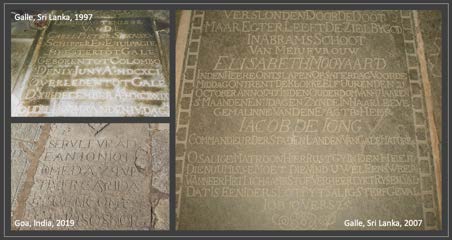
Figure 8: The author’s investigation of the ’Estado da India’ and the ’V.O.C.’ presence in Sri
Lanka, a hobby which has accompanied his weekend evenings for many years, actually started in
1997. Three images are shown, taken at Galle (Sri Lanka) in 1997 and 2007, and Goa (India)
in 2019. The V.O.C. tombstones in Galle are found in the Dutch Reformed Church, established
in 1755 (Nederlandse Hervormde Kerk, Galle). (Declercq de Silva Archive)
The Desclergues of la Villa Ducal de Montblanc, 2nd ed., Omn., VOL. I
© 2024 Nico F. Declercq
© 2024 Nico F. Declercq
The Desclergues of la Villa Ducal de Montblanc, 2nd ed., Omn., VOL. I
0.4. THE AUTHOR’S ACADEMIC BACKGROUND
1
The Desclergues of la Villa Ducal de Montblanc, 2nd ed., Omn., VOL. I
© 2024 Nico F. Declercq
© 2024 Nico F. Declercq
The Desclergues of la Villa Ducal de Montblanc, 2nd ed., Omn., VOL. I
Research Fundamentals and Synopsis: Methods and
Major Discoveries
The Desclergues of la Villa Ducal de Montblanc, 2nd ed., Omn., VOL. I
© 2024 Nico F. Declercq
Chapter 1
Boudewijn I van Vlaanderen & Judith van
West-Francië
Waar en wanneer begint een boek over familiegeschiedenis? Misschien is het, gezien de Engelse taal van dit boek, gepast om de lezer een voorwoord in het Nederlands te bieden, de moedertaal van de auteur.1
Dit boek richt zich op de mannelijke lijn omdat deze onze familienaam en genetische haplogroep op het Y-chromosoom doorgeeft.
Er werd ook geprobeerd de vrouwelijke lijn te traceren, aangezien mitochondriaal DNA die lijn volgt. Deze zoektocht strekt zich uit tot het begin van de 17e eeuw, met aanwijzingen van een mogelijke migratie uit Ierland rond 1600, wellicht als soldaten in het Spaanse leger. Ditzelfde leger bracht onze mannelijke familielijn vanuit Catalonië naar Vlaanderen. De geschiedenis van deze voorouders in Montblanc, nabij Tarragona, wordt in dit boek uitvoerig besproken.
De auteur wijst de aandachtige lezer erop dat de meeste van onze voorouders diepgeworteld waren in Vlaanderen, in ons mooie België. Na het lezen van dit boek zal het de lezer niet verbazen dat Gabrielle en André Demedt’s kind thuis waren bij de Declercqs, waar zij cultuur en inspiratie opdeden voor sommige van hun werken. Stijn Streuvels, Edward Vermeulen en Hugo Verriest waren ook geen vreemden in het huishouden van de Declercqs. Onze Declercqs stammen af van de samensmelting van de Kortrijkse notarissenfamilie Declercq en de familie Desclergue uit Montblanc. Het Spaanse leger bracht niet alleen Carlos Coloma de Saa naar Harelbeke en Kortrijk, maar ook Jeroni Joan Desclergue y Cortés, onze voorouder, die in 1604 het leven liet bij het ontzetten van Oostende van bezetting door protestantse Nederlanders en Engelsen. Harelbeke had destijds meer prestige dan nu, zoals blijkt uit Spaanse literatuur uit de 1500s, die de stad vanwege haar historische belang niet onbenoemd laat.
Wanneer men Harelbeke te berde brengt, denkt men aan de potentiële voorouders van de eerste Graaf van Vlaanderen, Boudewijn I, die als men oude kronieken mag geloven, de naam ’Van Harelbeke’ droegen.
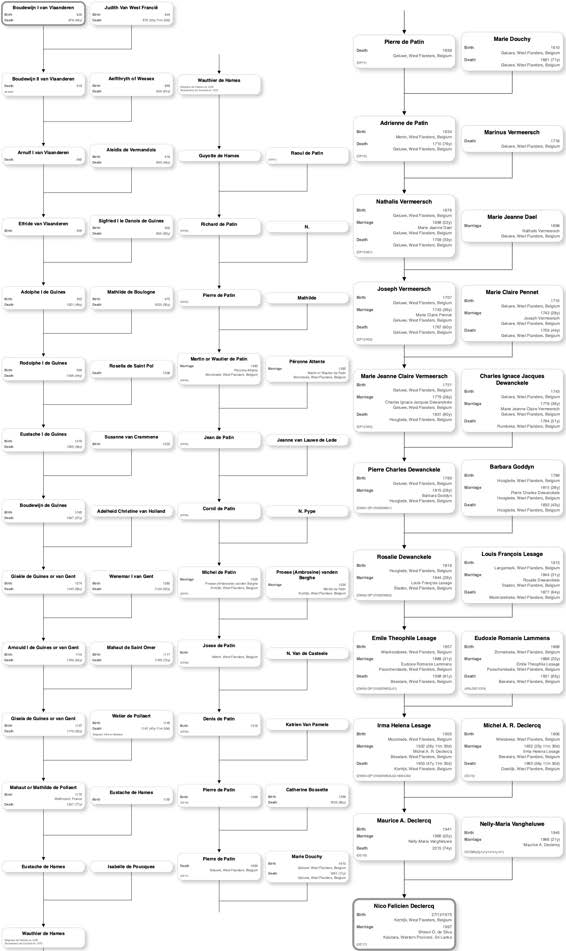
Deze eerste graaf is onze voorouder. Het was het paar Boudewijn I en Judith van West-Francië, getoond in Figuur 1.1, die de oorsprong vormden van het Graafschap Vlaanderen. Hen tot onze voorouders rekenen, 34 generaties terug (zie Hoofdstuk 76),
verankert dit boek in de woelige wateren van onze regio en stelt ons in staat vele expedities te ondernemen doorheen de hoofdstukken van dit boek, naar Spanje, Occitanië, Bretagne, Amerika en Azië.
Harelbeke, toen de Oude Leie er nog stroomde en er nog geen sluis was gebouwd, was een relais aan de rivier, waar soldaten in alle rust konden ontschepen of inschepen. Rust was ook het motto van de kapel gebouwd in Deerlijk in 1639.
Sommige van onze voorouders waren soldaten, zoals Bertrand Du Guesclin, of Raymond Clergue die Mallorca veroverde met de Koning van Aragón, of de Desclergue-broers die naar Vlaanderen kwamen, waaronder onze voorouder Jeroni die in 1604 stierf, of in recentere tijden, voorouders in het leger van Napoleon of als verdedigers van België in WOI, of in het verzet in WOII.
Echter, soldaat zijn was niet het kenmerk van onze voorouders. Om onze voorouders langs de lijn van Declercq te begrijpen, moet men zich verdiepen in de wereld van de schrijvers. Dit boek bespreekt de klasse waartoe onze voorouders behoorden: de schrijvers, die in Empuries en later elders verantwoordelijk waren voor het opstellen van wat wij vandaag zouden classificeren als notariële akten, overeenkomsten en wetten. Het boek behandelt in detail de Griekse, Romeinse, Visigotische, Byzantijnse, Arabische en Frankische periodes, maar ook de Bretoense periode, de wederwaardigheden in Albi, de tijd in Mallorca, in Barcelona, in Montblanc, in Doornik en in de regio aan de Leie, in Kortrijk, Harelbeke, Deerlijk en later ook dorpen aan de andere kant van de Leie.
In de Byzantijnse periode werd de familie voor het eerst opgenomen in de klasse van het purperen bloed, Purpura de la Patria zoals men later behelsde. Het is ook deze periode waaruit de voorouders van Bertrand Du Guesclin inspiratie vonden voor hun wapenschild. In de Arabische tijd werden onze voorouders ofwel Clergue of Aquin2 genoemd, afhankelijk van hun locatie. Hun taak als schrijvers vereiste immers een stevig verankerde neutraliteit, wat betekende dat zij werden geraadpleegd door elk heersend regime.
Tijdens de tijd van de Tempeliers speelden zij een prominente rol in het gebied dat nu Languedoc en Catalonië heet. Onze voorouders waren niet alleen Tempeliers maar ook Kruisvaarders.
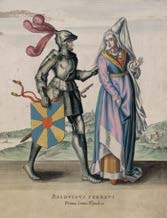
Met een focus op Vlaanderen mogen we zeker de familie de Patin niet vergeten. Deze voorouders, stevig verankerd in het gebied van Figure 1.1: Baldwin I of Flanders (c. 837–879) & Judith of West
Francia (843–870) are our ancestors. Baldwin I, born in Arras, pos-
sibly Laon, and Judith of West Francia, born in October 843 in the
Carolingian Empire, married in 862 after a dramatic elopement. Their
love story defied royal opposition, leading to Baldwin’s establishment as
the first Count of Flanders. Baldwin died in 879 in Ghent, while Ju-
dith passed in 870 in the same city. Their union laid the foundations
for the County of Flanders, significantly shaping the region’s medieval
history.
1This chapter is written in Dutch.
2Aquin is een verbastering van Hakin en Hakim, wat Arabisch is voor Clergue.
The Desclergues of la Villa Ducal de Montblanc, 2nd ed., Omn., VOL. I
© 2024 Nico F. Declercq
6
CHAPTER 1. BOUDEWIJN I VAN VLAANDEREN & JUDITH VAN WEST-FRANCIË
Figure 1.2: The link between Baldwin I of Flanders and the author. They are separated by 34 generations.
© 2024 Nico F. Declercq
The Desclergues of la Villa Ducal de Montblanc, 2nd ed., Omn., VOL. I
Ieper tot Menen, brachten een van de grootste diplomaten voort die ons land ooit heeft gekend: Charles Philippe de Patin. Bekend om zijn werk ’Mare Liberum’, leidde hij ons land, België, naar een onafhankelijker koers binnen het Oostenrijkse Habsburgse Rijk.
Hij vond zelfs internationale steun om de oprichting van de Oostendse Compagnie mogelijk te maken, waardoor wij handel konden drijven met India, iets wat ons sinds het einde van het Spaanse tijdperk was ontzegd.
Indien men belangstelling heeft voor muziek, zal men Peter Benoit als verre bloedverwant terugvinden in onze stamboom.
Terugkerend naar onze voorouder Boudewijn I van Vlaanderen, is de oorsprong van het Graafschap Vlaanderen geworteld in een opmerkelijke en romantische geschiedenis, verweven met de levens van Boudewijn I, bijgenaamd ‘met de IJzeren Arm,’ en Judith van West-Francië, dochter van de Karolingische Koning Karel de Kale. Hun verhaal is niet alleen een epische liefdesgeschiedenis maar ook de basis van een dynastie die Vlaanderen zou vormen tot een van de meest invloedrijke regio’s van middeleeuws Europa.
Boudewijn I werd geboren rond 840, mogelijk in Laon, als zoon van Odakar III, een edelman aan het Karolingische hof. Hij groeide op in een tijd van politieke onrust en Vikingaanvallen in West-Europa. Zijn bijnaam, ‘met de IJzeren Arm,’ werd hem later gegeven vanwege zijn moed en militaire bedrevenheden.
Judith van West-Francië, geboren rond 844, was de dochter van Karel de Kale en Ermentrude van Orléans. Als lid van de Karolingische dynastie was haar leven diep beïnvloed door de politieke intriges en machtsstrijd van haar tijd. Ze was tweemaal Koningin van Wessex geweest, getrouwd met Æthelwulf en daarna met zijn zoon Æthelbald, voordat ze Boudewijn ontmoette.
In 861 ontmoette Boudewijn Judith toen zij door haar vader naar het klooster van Senlis was gestuurd na de dood van haar tweede echtgenoot. Het was liefde op het eerste gezicht. Rond Kerstmis 861 slaagde Boudewijn erin Judith uit het klooster te ontvoeren met de hulp van haar broer, Lodewijk de Stamelaar. Ze vluchtten naar het noorden en zochten bescherming bij Lotharius II van Lotharingen.
Hun vlucht en geheime huwelijk maakten Karel de Kale woedend, die zijn dochter terug wilde en Boudewijn door de kerk liet excommuniceren. Dit dwong het paar naar Rome te reizen en hun zaak voor te leggen aan Paus Nicolaas I. De paus, ontroerd door hun verhaal, zette Karel onder druk om het huwelijk te erkennen. Na twee jaar correspondentie en bemiddeling stemde Karel uiteindelijk in, en op 13 december 862 werd hun huwelijk officieel bekrachtigd in Auxerre.
Als gebaar van verzoening schonk Karel de Kale Boudewijn het gebied van de Vlaamse Gouw en de Waasgouw als leen, met de opdracht het te verdedigen tegen de Vikingen. Boudewijn bleek een bekwame militaire en politieke leider. Hij bouwde versterkingen in steden als Gent en Brugge en slaagde erin de Vikingaanvallen effectief af te slaan. Deze successen versterkten zijn positie en legden de basis voor het graafschap Vlaanderen.
Judith speelde ook een cruciale rol in de opbouw van Vlaanderen. Ze bracht prestige en koninklijke connecties mee, die hielpen allianties te smeden en de positie van het graafschap te versterken. Samen stichtten ze kerken en kloosters, zoals de kerk gewijd aan Donatianus van Reims in Brugge en een Benedictijns klooster in Veurne, die bijdroegen aan de culturele en spirituele ontwikkeling van de regio.
Boudewijn en Judith hadden vier kinderen: Karel, die jong stierf; Boudewijn II, die zijn vader opvolgde als Graaf van Vlaanderen; Rudolf, die Graaf van Kamerijk werd; en mogelijk een dochter die trouwde met Wifried I van Urgell. Hun nakomelingen zouden een grote invloed hebben op de verdere geschiedenis van Vlaanderen en Europa.
Boudewijn stierf op 2 januari 879 en werd begraven in de Abdij van Sint-Bertinus in Sint-Omaars. Judith overleefde hem, en haar exacte sterfdatum is onbekend, maar ze leefde waarschijnlijk nog enige tijd na zijn dood.
Het liefdesepos van Boudewijn I en Judith van West-Francië is een saga van moed, romantiek en politieke intrige. Hun gedurfde ontsnapping en huwelijk smeedden niet alleen de fundamenten van het Graafschap Vlaanderen, maar verwekten ook een dynastie die een blijvende invloed op de Europese geschiedenis zou hebben. Met hun gezamenlijke inspanningen en visie herschiep dit koppel Vlaanderen tot een welvarende en invloedrijke regio, een erfenis die voortleeft tot op de dag van vandaag. Het familieverband wordt getoond in Figuur 1.2
Genealogen delven vaak in de oorsprong van hun voorouders op zoek naar betekenis en identiteit. Hoewel dit waardevol is, is het van vitaal belang niet enkel te vertrouwen op de glorie of rijkdom van voorbije generaties.
Iedere ziel draagt namelijk de verantwoordelijkheid voor zijn eigen daden en verwezenlijkingen.
Het lijkt de auteur echter nuttig om dit hoofdstuk nog niet af te sluiten. Een van de kinderen van Boudewijn en Judith was mogelijk een dochter die trouwde met Wifried I van Urgell. Deze bewering kan echter niet definitief worden bevestigd. Wat wel met zekerheid kan worden gesteld, is dat Wifried I van Urgell, beter bekend als Guifré I de Barcelona of Guifred le Velu, een voorouder is van de auteur. De auteur stamt namelijk af van de Graven van Barcelona en de Dynastie van Aragon, via verschillende takken waaruit de Desclergues van Montblanc door huwelijken zijn voortgekomen.
The Desclergues of la Villa Ducal de Montblanc, 2nd ed., Omn., VOL. I
© 2024 Nico F. Declercq
CHAPTER 1. BOUDEWIJN I VAN VLAANDEREN & JUDITH VAN WEST-FRANCIË
© 2024 Nico F. Declercq
The Desclergues of la Villa Ducal de Montblanc, 2nd ed., Omn., VOL. I
Introduction to Historical Research Methodology
2.1 What is Historical Research?
Historical research systematically investigates past events to derive accurate and comprehensive understandings of historical phenomena. The methods employed in historical research are critical to the validity and reliability of the conclusions drawn. Three principal approaches stand out among these methods: deduction, induction, and abduction. Each method has its distinct process and application, and understanding their roles is essential to grasping the complexities of historical inquiry.
Deductive Reasoning in historical research begins with a general theory or hypothesis, which is then tested by examining specific instances. This approach starts from a broad perspective and narrows to particular evidence, allowing historians to see if the evidence supports or refutes the preconceived theory. For instance, a historian might start with the theory that economic factors were the primary cause of the fall of the Roman Empire and then examine specific economic data from that period to test this theory.
Inductive Reasoningworks in the opposite direction. It involves drawing general conclusions from specific observations. Historians using inductive reasoning collect particular pieces of evidence and then formulate broader theories based on these observations. For example, after observing the conditions of peasant life in various medieval European regions, a historian might inductively conclude general trends about the socioeconomic structures of medieval Europe.
Abductive Reasoning, or inference to the best explanation, is a method where historians formulate the most likely explanation based on the evidence, especially when the evidence is incomplete or ambiguous. This method is handy in historical research, as historical records often need to be completed and made more cohesive and consistent. Abductive reasoning allows historians to hypothesize plausible scenarios that best fit the available evidence, even if those scenarios cannot be definitively proven. For example, when determining the cause of a sudden population decline in ancient societies, a historian might abduce the most likely cause based on environmental, archaeological, and textual evidence.
2.2 Application of Methods in Historical Research
In this work, all three historical research methods—deduction, induction, and abduction—have been meticulously applied. It is essential to acknowledge that, in practice, historians often integrate these methods, even if some claim to exclusively use induction due to its perceived rigor and lesser vulnerability to refutation by peers. The author, with a background in physics, brings a unique perspective, naturally blending abduction and deduction with inductive reasoning.
Throughout this book, readers will encounter an extensive array of sources and original documents in instances where inductive reasoning was utilized. The evidence collected forms the basis for broader historical theories. Conversely, in cases requiring greater reliance on deductive reasoning, the focus shifts to understanding the historical context, thereby elucidating the framework within which conclusions were drawn.
In instances where evidence is scarce, abductive reasoning plays a crucial role. For example, when examining periods with limited documentation, the author employs DNA analysis alongside social, political, cultural, and structural likelihood analyses. This methodological approach allows for plausible reconstructions of historical events. If applied to the enigma of Christopher Columbus, the author would likely challenge the notion of a talented individual from a poor wool weaver family in Genoa gaining royal favor in Portugal and Spain, positing instead a theory rooted in the likelihood of noble lineage or illegitimate birth within noble or wealthy merchant families, given the social immobility of that era.
2.3 Significance of Abduction in Historical Breakthroughs
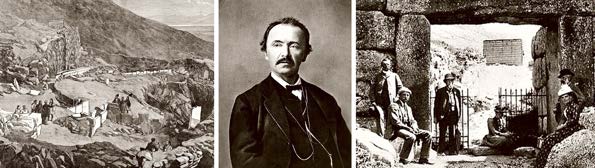
The most significant breakthroughs in historical research often stem from abductive reasoning rather than mere induction or deduction. For instance, understanding the decline of the Roman Empire or Easter Island’s societal collapse required recognizing the role of environmental factors, an insight born from abductive reasoning. Similarly, the origins of the Black Death were elucidated through the hypothesis of human lice and fleas as vectors. Heinrich Schliemann’s discovery of Troy, shown in Figure 2.1 was guided by abductive reasoning, transforming it from myth to historical reality. Other historians known for their breakthroughs by abductive reasoning are Carlo Ginzburg, Marc Bloch, Fernand Braudel, Natalie Zemon Davis, E. H. Carr, and Barbara Tuchman. The list of scientists using this approach is much longer. A few famous examples are Albert Einstein, Charles Darwin, Marie Curie, Niels Bohr, Rosalind Franklin, Richard Feynman, Barbara McClintock, and Stephen Hawking. Discovering new particles through symmetries in mathematical group descriptions in particle physics further exemplifies the power of abduction.
2.4 Achievements in this Work
By integrating abduction, deduction, and induction, the author took initial risks but fortified his hypotheses with extensive support.
He traced the history of the Desclergues of Montblanc back to around 500 BC, and that of the de Silva family of Uduwara to Goa and Portugal. This abductive approach, where deductions and inductions were impossible, acknowledges that new evidence could necessitate adjustments to the theory, embodying the scientific spirit of research.
The Desclergues of la Villa Ducal de Montblanc, 2nd ed., Omn., VOL. I
© 2024 Nico F. Declercq
10
CHAPTER 2. INTRODUCTION TO HISTORICAL RESEARCH METHODOLOGY
Figure 2.1: From left to right: Heinrich Schliemann at the site of Troy, a portrait of Schliemann and his excavations at the Acropolis of Mycenae. Heinrich Schliemann, born on January 6, 1822, in Neubukow, Germany, was a self-made businessman whose enduring passion for ancient history and archaeology revolutionized the study of classical antiquity. Despite his lack of formal training in the field, Schliemann’s entrepreneurial success afforded him the resources to pursue his archaeological interests. From a young age, Schliemann was captivated by the epic tales of Homer, particularly the "Iliad" and the "Odyssey."
This fascination propelled him towards one of his most notable achievements: the excavation of Troy. Beginning his work at Hisarlik in modern-day Turkey during the 1870s, Schliemann was determined to prove that the legendary city of Troy was more than just a myth. His excavations unearthed multiple layers of ruins, which he interpreted as evidence of the city’s historical existence. Among his significant finds was "Priam’s Treasure," a collection of gold and artifacts that, although later reassessed as belonging to a different period, brought substantial attention to his work. Schliemann’s contributions did not end with Troy. He also conducted groundbreaking excavations at Mycenae in Greece. In 1876, he discovered the Shaft Graves, which contained an array of gold objects, including the renowned "Mask of Agamemnon." While the precise identification of this mask remains debated, the discovery itself underscored the richness of Mycenaean civilization and its connections to Homeric epics. However, Schliemann’s methods were often controversial. His aggressive excavation techniques, including dynamite, were criticized for their destructiveness and lack of scientific rigor. These methods sometimes caused irreparable damage to the sites, complicating the task of subsequent archaeologists. Despite these criticisms, Schliemann’s legacy is substantial. His passionate pursuit of archaeological truth brought significant attention to the field and helped transform the study of ancient civilizations into a scientific discipline. His work at Troy and Mycenae laid the foundation for modern archaeological practices and expanded our understanding of the ancient world. Heinrich Schliemann died in Naples, Italy, on December 26, 1890. His pioneering efforts and discoveries continue to influence the field of archaeology, marking him as a pivotal figure in the history of historical research.
© 2024 Nico F. Declercq
The Desclergues of la Villa Ducal de Montblanc, 2nd ed., Omn., VOL. I
Executive Summary
3.0.1 Introduction
This book meticulously examines the Desclergues family, tracing their lineage over two millennia and unraveling the complex web of cultural, political, and social connections that have shaped their legacy. The narrative commences in the ancient world, charting the family’s origins among the Indigetes in Iberia and their interactions with Greek colonists in Empúries. As the family integrated into the broader currents of Hellenic civilization, they adopted the administrative and mercantile practices of the Greeks and, later, the Romans, solidifying their position within the local nobility.
The Desclergues exhibited remarkable adaptability throughout the centuries, aligning with various ruling powers, from the Visigoths and Byzantines to Islamic rulers and later the Christian reconquest led by the Franks. This adaptability is a recurring theme, with the family continually leveraging their administrative and diplomatic skills to maintain and enhance their status. The book delves into critical periods such as their involvement with the Knights Templar during the Reconquista, their strategic alliances through marriage with other noble families, and their eventual migration to Flanders during the Habsburg era. Additionally, it explores the genetic and genealogical research that corroborates the family’s historical records, offering a detailed account of their cultural and intellectual contributions across different eras and regions.
Overall, the book presents a rich tapestry of the Desclergues’ history, highlighting their resilience and influence from ancient to modern times. It underscores their role as pivotal figures in the socio-political landscapes they inhabited, driven by a commitment to public service, intellectual pursuits, and cultural exchange rather than political power. The narrative is complemented by meticulous research and vivid depictions of their lineage’s pivotal moments, providing readers with a comprehensive understanding of the Desclergues’ enduring legacy.
3.0.2 Comprehensive Family Lineage: An Overview
This comprehensive eight-volume investigation into the Desclergues family lineage reveals a remarkable diversity within their ancestral origins. The monograph delineates various intriguing familial lineages, particularly on patrilineal descent. This focus stems from an interest in the etymology and historical trajectory of the family name, further motivated by the possibility of tracing this lineage through the Y-DNA chromosome.
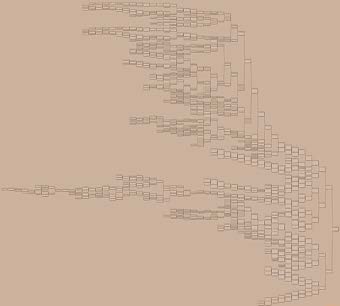
The patrilineal line, charting a migratory path from Spain, Occitania, and Brittany to Flanders by the Spanish military at the end of the sixteenth century, frequently exhibited matrimonial alliances within specific familial clusters. These unions were strategically advantageous, serving noble and economic interests, thus suggesting a constrained genealogical expansion rather than a divergent one. This notion of restricted lineage proliferation is visually represented in Figure 3.1, underscoring the limited yet distinct familial interconnections characteristic of our ancestors.
The Desclergues family’s lineage presents a rich cultural, historical, and genealogical chronology from ancient tribes to medieval nobility. To adequately narrate their journey, we explore their roots in the ancient world, their adaptations through major historical transitions, and their influence across various regions, underscoring their role as key players in the socio-political landscapes they inhabited.
The book commences with an introductory section in Part III, with foundational information intended for readers who may lack familiarity with heraldry, onomastics, the town of Montblanc, or the historical context and timeline relevant to the presence of Spanish individuals in Belgium during the Habsburg era. Subsequently, Part IV offers a comprehensive account of over two thousand years of our family’s history, with a particular emphasis on antiquity, followed by later eras in Part V, Part VI, and Part
3.0.3 Ancient Iberian Roots and Greek Integration
The story of the Desclergues begins in the rugged landscapes of ancient Iberia, where the local tribe of the Indigetes settled in what would become Empúries. This coastal region, primed for agriculture and trade, nurtured a class of local elites, among whom were the earliest ancestors of the Desclergues. The arrival of Greek colonists from Phocaea around 575 BC marked a pivotal moment.
These settlers introduced Empúries to the broader currents of Hellenic civilization, bringing sophisticated governance systems, trade, and cultural exchange.
As Empúries flourished under Greek influence, it was inevitable that the Desclergues’ ancestors, positioned within the local nobility, forged strategic marital alliances with the Greeks, thus cementing their social ascent. They adapted to the new cultural landscape, blending their local traditions with the administrative and mercantile practices introduced by the Greeks and, later, the Romans.
3.0.4 Roman Era: Administrative Ascendancy
The Roman conquest introduced another layer of complexity. As Empúries was absorbed into the Roman Republic and later the Empire, the Desclergues’ forebears transitioned into crucial roles in the new administrative framework. Their expertise as scribes and bankers became invaluable, facilitating their survival and prosperity in the Roman hierarchy. During this period, they solidified their reputation as essential administrative figures, a legacy that would carry forward into the Visigothic era.
The Desclergues of la Villa Ducal de Montblanc, 2nd ed., Omn., VOL. I
© 2024 Nico F. Declercq
12
CHAPTER 3. EXECUTIVE SUMMARY
Figure 3.1: Depiction of the constrained genealogical expansion within
specific familial clusters, illustrating strategic matrimonial alliances
along the patrilineal line from Spain to Flanders.
3.0.5 Byzantine Influence and North African Ventures
With the shifting sands of power, the Byzantine Empire extended its influence into Hispania during the 6th century, following internal strife within the Visigothic kingdom. The Desclergues, leveraging their well-established roles as scribes and administrators, aligned with the Byzantines, who were keen on restoring some semblance of Roman order in the region. This association with the Byzantine administration notably marked the Desclergues with the epithet of having ’purple blood,’ reflecting their imperial administrative roles and echoing the Byzantine penchant for purple as a color of imperial authority.
The alliance with Byzantium opened new avenues for the Desclergues. Some family members were stationed in Bejaia (ancient Bougie) in present-day Algeria, a strategic port then under Byzantine control. Their time in North Africa expanded their geographical reach and enriched their cultural and administrative repertoire, integrating Islamic and North African influences. This period, though brief, is crucial in understanding Bertrand Du Guesclin’s later claims of ancestral connections to Bougie, highlighting a legacy that spanned continents.
3.0.6 Visigothic Resurgence and Islamic Conquests
As Byzantine influence waned, the Desclergues realigned themselves with the Visigothic rulers once more, navigating through the complex political landscape of the Iberian Peninsula. However, the Islamic conquests of the 8th century introduced a new era.
The swift expansion of Islamic rule under the Moors transformed the political and cultural life of the region. The Desclergues, known for their adaptability, transitioned to serving the new Islamic rulers. Renamed Hakim or Hakin, they continued their work in administration and banking, positions they held with high esteem due to their ’purple blood’ legacy. Their ability to serve under varied rulers—Visigothic, Byzantine, and now Islamic—underscored their diplomatic and administrative acumen.
3.0.7 Frankish Reconquest and Christian Revival
The tides again turned with the Frankish conquests, gradually pushing Islamic forces back. The Battle of Tours in 732, led by Charles Martel, marked a decisive turning point. By the late 8th century, the Franks had regained control over much of the territory, including Septimania. During this period, the Desclergues returned to their roots, shedding the Islamic monikers of Hakim and Hakin and resuming their original Roman family identity as Clergue. Under Frankish rule, they continued to thrive, capitalizing on their historical reputation as trusted administrators.
3.0.8 Breton Expansion and Du Guesclin Connection
The fluid geopolitical boundaries during the Christian Reconquista necessitated the northward migration of a branch of the Desclergues family to Brittany, part of Charlemagne’s strategy. This relocation was not merely geographical but also carried profound cultural and historical implications, as evidenced by the adoption of the Byzantine double-headed eagle and the ancient gryphon in their heraldic symbols. These emblems, along with the memory of their Islamic heritage—specifically, the profession of their ancestor Aquin (derived from the Arabic Hakim or Hakin, synonymous with Clericus or Clergue)—illustrate a profound cultural syncretism.
The Desclergues family’s relocation to Brittany was not just a change of location. It marked a significant shift in their identity.
The family’s name, Hakin in Moorish Spain, became the foundation for the Aquin progenitor of Du Guesclin, illustrating a complex evolution of identity shaped by diverse cultural and historical influences.
The re-establishment of this lineage in Catalonia led to the reintegration of the family’s traditional roles and identities, specifically those of scribes, scholars, merchants, and bankers.
The Desclergues lineage, based in Montblanc, was again drawn into warfare during the Habsburg period. This involvement included deploying soldiers to Flanders, including our ancestor Jeroni Joan Desclergue y Cortés. He perished in Ostend in 1604 during the military campaigns in Flanders.
© 2024 Nico F. Declercq
The Desclergues of la Villa Ducal de Montblanc, 2nd ed., Omn., VOL. I
3.0.9 Catalonia and the Knights Templar: Reestablishment
As the Christian Reconquista gradually reclaimed Iberian territories from Islamic rule, the Desclergues family was at the forefront of these transformative changes, particularly during the pivotal late 12th and 13th centuries. With significant military gains during the Reconquista, such as the capture of Toledo in 1085 and the fall of Seville in 1248, the Desclergues leveraged their historical expertise in governance to reestablish themselves in the heart of Catalonia. Barcelona, burgeoning as a commercial and administrative hub by the 13th century, became their new base of influence.
During this period, Catalonia was often at the center of conflict and expansion, especially under the reign of King James I of Aragon.
The Desclergues, with their deep roots in administration and governance, played a crucial role in establishing the administrative frameworks needed in these newly conquered lands.
Their strong Catholic faith aligned them with the influential Knights Templar, prominent in Spain during this time. The Templars were warriors, key financial brokers, and administrators in the reconquered territories.
The Desclergues’ association with the Templars began around the early 13th century, coinciding with the Templars’ rise in power and influence across Europe. This alliance bolstered the Desclergues’ political and economic status, giving them a pivotal role in shaping the post-Reconquista landscape of Catalonia and beyond.
This renewed influence in a rapidly changing Catalonia positioned the Desclergues as essential figures in the socio-political fabric of medieval Spain. Their ability to adapt and thrive in varying political climates, from Roman to Islamic to Christian rule, showcases a lineage defined by resilience, adaptability, and an enduring legacy of leadership.
3.0.10 Conquest of Mallorca: A Family Milestone
A pivotal chapter in the history of the Desclergues family unfolds with the conquest of Mallorca, led by King James I of Aragon, known as James the Conqueror. Between 1229 and 1231, this significant historical event marked a major expansion of Christian realms during the Reconquista.
Among those who played a crucial role in this campaign was Ramon Desclergue, a descendant of the Desclergue lineage that had stayed in Albi during a tumultuous period marked by religious strife between the Cathars and orthodox Catholics.
Ramon, a staunch Catholic, and a Knight Templar became increasingly alienated in Albi’s heated environment amidst the Albigensian Crusade, which began in 1209 to root out Catharism. His status as a Templar highlighted his martial prowess and underscored his deep commitment to the Catholic Church. This background made him particularly eager to join forces with King James I, seeking religious redemption and a new beginning far from the religious conflicts of Albi.
The campaign to conquer Mallorca began on September 8, 1229, when King James I’s forces, including Ramon Desclergue, landed on the island. Over the next few months, they waged a series of battles against the Muslim defenders, culminating in the capture of Palma, the island’s capital, on December 31, 1229. The conquest was completed by 1231, with the island under Christian control.
Ramon Desclergue’s involvement in the conquest of Mallorca was multifaceted. As a Knight Templar, he brought not only his combat skills but also his experience in administration to the forefront. He was vital in establishing the governance structures necessary for integrating Mallorca into the Kingdom of Aragon. His expertise as a scribe and his administrative acumen, honed through generations of his family’s involvement in such roles, was instrumental in the smooth transition of Mallorca from Islamic to Christian rule.
The successful conquest of Mallorca opened new avenues for the Desclergues. Ramon and his descendants established themselves as influential figures in the island’s governance, helping to shape its development during a critical period in its history.
3.0.11 Establishing the Desclergue Dynasty in Montblanc
Following Mallorca’s successful conquest and stabilization, a significant development unfolded within the Desclergue family. Ramon Desclergue, having established his legacy on the island, saw some of his descendants return to the mainland during the latter phases of Mallorca’s integration into the Crown of Aragon.
These descendants of Ramon Desclergue settled in Barcelona, where they founded a formidable dynasty known for their expertise in notary work, banking, and commerce. Leveraging the administrative and financial acumen inherited from their forebears, they rapidly established themselves as a prominent family in the bustling economic environment of Barcelona. Their influence soon spread to towns such as Santa Coloma de Queralt and Montblanc, where they continued to thrive as law, academia, and trade professionals.
This period marked a golden era for the Desclergues as they diversified their engagements, holding positions as professors, lawyers, notaries, clergy, and merchants. Their reputation for reliability and skill in these fields made them indispensable in the communities they served. The Desclergues’ success was a testament to their capabilities and the enduring legacy of their family’s adaptability and commitment to public service.
A notable matrimonial alliance further solidified the Desclergues’ standing when they merged with descendants of Bertrand Du Guesclin, the famed Breton knight, who equally descended from the Desclergues through a branch that served under the Moors as Hakin. This union blended Du Guesclin’s martial legacy with the Desclergues’ administrative prowess, enriching the family’s heritage and expanding their social network across Europe’s nobility.
Pere Torró y Desclergue epitomized the culmination of this prosperous era in the late 15th century. Heir to his uncle, the esteemed notary Ramon Berenguer Desclergue, Pere Torro y Desclergue became the progenitor of the Desclergue lineage in Montblanc.
Their accomplishments were numerous, including opening trade between Catalonia and the Americas, but they are perhaps best remembered for constructing the famous Desclergue home on the Main Square of Montblanc. Almost stately in its design and grandeur, this building symbolized the Desclergue family’s success and significant role in the region’s social and economic life.
3.0.12 Strategic Marriages and Noble Alliances: Further Rise in Prominence
As the Desclergues family continued establishing themselves as a cornerstone of Catalan society, their strategic matrimonial alliances were pivotal in their ascent to higher social and economic prominence. By allying with some of the most notable and deeply noble families of their time, the Desclergues significantly enhanced their influence. They reinforced their status within the aristocratic circles of Europe. Among the illustrious marriages, Doña Maria Anna Desclergue y Vilavicencio was a noteworthy union that linked the Desclergues with an ancient noble lineage, bringing wealth and additional social prestige. Similarly, the marriage to Doña Eleonor Torró y Miquel connected them with a family known for its significant holdings and political connections in Catalonia.
Another prominent alliance was formed with Doña Maria Ana Cortés de Monroy y Vega Bazán, whose family ties extended to The Desclergues of la Villa Ducal de Montblanc, 2nd ed., Omn., VOL. I
© 2024 Nico F. Declercq
CHAPTER 3. EXECUTIVE SUMMARY
Castile and the Spanish American nobility. This alliance reflected the Spanish Empire’s and its colonies’ expansive reach, bringing international connections and opening trade and economic opportunities across the Atlantic.
Doña Prunera y Ferrer and Doña Eulalia Miquel also brought substantial alliances, linking the Desclergues to influential families known for their historical roles in regional governance and commerce. These marriages were not merely social contracts but strategic partnerships that enhanced the Desclergues’ trade, governance, and diplomacy capabilities. The alliances even incorporated the papal family of de Luna.
Through these connections, the Desclergues also found themselves related by marriage to descendants of the Counts of Toulouse, the Counts of Barcelona, the Counts of Provence, the House of Anjou, and even the Kings of Navarre and the Kings of Aragon.
Through de Luna, the Desclergues even have the last Islamic ruler of Mallorca among their ancestors and one of the most prominent Portuguese families, Godinho. These relationships afforded them a remarkable network that included some of the most influential figures of medieval and Renaissance Europe.
3.0.13 Migration to Flanders: Military and Notarial Alliances in Kortrijk
This epoch in the history of the Desclergues aligns with the periods of Habsburg rule in Belgium and Spain, as detailed in Part
VIII. Initially, the focus is on the era under the Spanish Habsburgs, followed by the Austrian Habsburgs.
3.0.14 Genetic Legacy and Analysis
Part XV presents an in-depth examination of the DNA analyses conducted by various commercial entities on the genetic material of the author and his brother-in-law. These investigations juxtapose the genetic data with the genealogical information provided in this work, demonstrating high consistency. For example, the results confirm that the author is a direct male descendant of the Desclergues of Montblanc and possesses maternal lineage connections to this family, corroborating the historical records. Additionally, autosomal DNA analysis reveals a proportionate presence of genetic markers corresponding to Spain’s regions, the Desclergues’ origin, and Brittany, their ancient paternal homeland, aligning with documented ancestral origins. Regarding the brother-in-law’s DNA, which indicates the genetic history of the author’s wife, the findings are consistent with her documented ancestral background.
3.0.15 Notable Individuals and Their Contributions
The book provides a detailed account of various individuals, each characterized by unique attributes. Notably, in Part VI, we offer an in-depth portrayal of Bertrand Du Guesclin. Furthermore, we meticulously trace the lineage of Jeroni Joan Desclergue y Cortés, focusing on his maternal ancestors and elucidating their connections to eminent historical figures such as Hernán Cortés, the Counts of Barcelona, and the Kings of Aragon. We also examine their affiliations with notable families in other regions of Spain, including Castile and Extremadura. This genealogical analysis is primarily presented in Chapter 27.2 and comprehensively explored throughout Chapter 27.
Moreover, the de Patin family’s significant involvement in Austrian Habsburg Belgium is thoroughly examined in Chapter 65 of Part XIII and Chapter 70 of Part XIV.
3.0.16 Maternal Ancestry: Expanding the Family Network
In addition to the patrilineal lineage of the Desclergues of Montblanc, the author’s maternal ancestry also traces back to the Desclergues through a branch emerging in the latter half of the 17th century. The examination of this lineage, detailed in Chapter
X, offers significant insights as it expands the understanding of the Desclergues’ influence and networks within Belgium.
3.0.17 The Montblanc Period: A Focused Exploration
For those readers whose primary interest lies in the Desclergues during their residence in Montblanc, comprehensive details can be found in Part VII. Conversely, for an in-depth exploration of the period preceding their arrival in Montblanc, Parts V and VI are especially pertinent.
3.0.18 The De Silva Lineage of Uduwara: A Global Journey
Chapter XII presents a compelling narrative for globetrotters, detailing the extensive paternal lineage of the author’s wife, Shirani de Silva. This patrilineal heritage originates from North West India and traces a migratory path through Persia to Byzantine.
The lineage subsequently extended to Iberia, where the family integrated with the local population. The Carvalho family line, established in this manner, later merged with the de Silva lineage and migrated to Goa during the Iberian expansion into India.
From Goa, the family eventually relocated to Uduwara in Sri Lanka to fortify a stronghold on the Kalu Ganga River. Documents, DNA analysis, and recent archaeological discoveries in Uduwara and Goa support the substantiation of this historical journey.
3.0.19 Additional Ancestral Lines and Military Service
Chapters XIII and XIV present additional genealogical lines of the author. This section notably includes records of military service for various individuals, offering valuable insights for researchers interested in the Napoleonic Wars.
3.0.20 The Chapel in Deerlijk: A Historical Revelation
Unexpectedly discovered during this research was Antoni Desclergue’s (DC06) role in founding a chapel in Deerlijk, Belgium. This finding is substantiated by archaeological discoveries and historical records, as thoroughly detailed in Chapter XI. These facts are crucial for comprehending the Monblanquians’ influence in Flanders and provide significant insights for the residents of Deerlijk.
The village’s ancient legend of a miracle in 1634, once dismissed as a mere fairy tale in previous decades, is now recognized as having a factual basis. The nobleman in the legend was Antoni Desclergue, and the events narrated closely mirror those of the Mare de Deu de la Serra legend in Montblanc, with the primary distinction being the involvement of oxen in Montblanc and horses in Deerlijk. The earliest known depiction of this miracle features an image of Montblanc’s Mare de Deu de la Serra and includes Antoni
© 2024 Nico F. Declercq
The Desclergues of la Villa Ducal de Montblanc, 2nd ed., Omn., VOL. I
Desclergue’s initials. Antoni Desclergue later adorned the chapel with various artworks, such as a polychrome panel illustrating Montblanc’s Main Square, including the House of Desclergue, and a finely crafted statuette by Cano.
3.0.21 Epilogue: Insights and Reflections
Throughout their extensive history, from the classical Greek period to the contemporary era, the Desclergues family has consistently embodied noble principles and maintained an esteemed position in both academic and social spheres. Renowned for their noble lineage, often referred to metaphorically as having purple blood, they have transcended the confines of nationalism and conflict.
Historical evidence illustrates their alliances with a diverse array of groups, including Roman Catholics, Cathars, the Knights Templar, Crusaders, Muslims, and Jews. They have also established good relations with atheists, Buddhists, and Hindus. This eclectic network underscores their enduring international presence.
Remarkably, the Desclergues have adeptly navigated the vicissitudes of history without ever aspiring to political power, instead fostering a legacy of intellectual and social prominence.
Further research into the Desclergues lineage reveals a profound commitment to scholarly pursuits and cultural exchange. Their alliances with various religious and cultural groups highlight their diplomatic acumen and role as intermediaries in fostering in-tercultural dialogue. The Desclergues’ historical narrative is a testament to their ability to adapt and thrive amidst the dynamic shifts in geopolitical landscapes, ensuring their influence remained through intellectual and social contributions rather than political dominance.
The Desclergues of la Villa Ducal de Montblanc, 2nd ed., Omn., VOL. I
© 2024 Nico F. Declercq
CHAPTER 3. EXECUTIVE SUMMARY
© 2024 Nico F. Declercq
The Desclergues of la Villa Ducal de Montblanc, 2nd ed., Omn., VOL. I
Prelude
The Desclergues of la Villa Ducal de Montblanc, 2nd ed., Omn., VOL. I
© 2024 Nico F. Declercq
Chapter 4
Heraldry and Geography
4.1 Arms of Nico Felicien Declercq
4.1.1 Motto
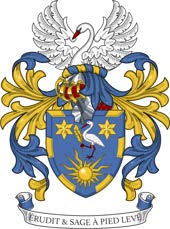
The term "Érudit et Sage à Pied Levé" denotes the ancestral Clergues, from whom our lineage originates. These individuals served as scribes and magistrates within a noble lineage tracing back to Roman antiquity in the region of Occitania. They were characterized by their readiness to relocate as circumstances demanded and their role as custodians of knowledge and written records.
4.1.2 Historical Backbones of the Arms: Toulouse
The heraldic emblems denoting celestial bodies, such as stars and the sun, were emblematically adopted by the Counts of Toulouse.
These symbols recurrently manifest within the heraldic shields of ancient noble lineages originating from the regions of Toulouse and Languedoc.
4.1.3 Historical Backbones of the Arms: Desclergue
The Desclergue lineage boasts a venerable antiquity within the echelons of nobility, ostensibly predating the adoption of heraldic shields. It is posited that the progenitors of this lineage only embraced the heraldic tradition once it gained traction within societal conventions. The shield displayed prominently on the façade of the renowned Desclergue residence situated in the Main Square of Montblanc bears significance and was utilized by the family subsequent to their migration to Catalonia after their departure from Mallorca.
The arms of the Desclergue family had already been in use when H.M. Emperor Charles confirmed them, ’Keizer Karel’ or ’Carlos V’ (Ghent 1500 - Cuacos de Yuste 1558) on December 19, 1539, on the request of Galceran Desclergue.
The arms are shown for instance on page ’Lamina 11’ of Tomo II (shield 37)1. It is also described on page 90 of the same book as ’De Barcelona. Son sus Armas: Escudo ajedrezado de oro y azur; medio cortado de azur, con dos palos de oro. Bibliografia: Adarga Catalana, de Garma y Durán, impresso, tomo II, pág. 224, Nobiliari general Català, de Félix Domenech y Roura, impreso, cuaderno VIII.’
On page 83 of the book ’La Casa Desclergue de Montblanc’ 2, we find a chapter on ’El Titulo Nobiliario de los Desclergue’ , that states ’The shield that in stone stands out in the center of the facade of the Casal dels Desclergue in Montblanc, responds to the description that in the books of Heraldry is presented as belonging to the surname Desclergue: Checked shield of gold and azure, half cut of azur, with two gold sticks’3
The oldest found shield of Desclergue is described in Spanish as : ’trae ajedrezado de oro y azur, medio cortado de azur y dos medios palos de oro’ ; or also ’Escudo ajedrezado de oro y azul: cortado de azur, con dos palos de oro’.
Figure 4.1:
The Coat of Arms
of Nico F. Declercq and his descen-
dants. (Declercq de Silva Archive)
1found in the book series ’El Solar Catalan, Valenciano y Balear’ , by A. Y. A. Garcia Carraffa, ’con la colaboracion de D. Armando de Fluviá y Escorsa, de la Societat Catalana d’ Estudies Historics’ , Libreria Internacional (Colección Heraldica), Churruca, 6, San Sebastian, 1968
2authored by Jose Sanchez Real, published in 1974 by Caja de Ahorros Provincial, Tarragona, deposito legal B 19.565 - 1974 and printed by Graficas Lorente, Ciudad 13, Barcelona 2, Spain
3G. Tarafa. Enciclopedia Heràldica y Genealògica Hispano-Americana. Vol. 28; and Garma and Durán. Adargo Catalana. Vol. II. Pág. 224.
The Desclergues of la Villa Ducal de Montblanc, 2nd ed., Omn., VOL. I
© 2024 Nico F. Declercq
20
CHAPTER 4. HERALDRY AND GEOGRAPHY
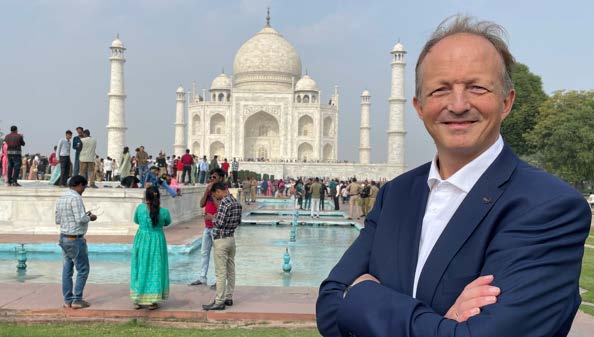
Figure 4.2: When the author visited the Taj Mahal at the end of November 2008, shown in Figure 53.1 on page 1047, his mindset needed to be more open to fully appreciate the grandeur and intricate beauty of this UNESCO World Heritage Site.
Determined to rectify this, he returned on December 1, 2023, and finally immersed himself in the monument’s splendor.
A fascinating detail about the Taj Mahal is the use of Noir de Golzinne from Belgium in its ornamental inlays. This expensive stone, known for its deep black color, contrasts beautifully with the white Makrana marble from Rajasthan, India, which constitutes the mausoleum’s main structure. The construction of the Taj Mahal began in 1632 and was completed in 1653
under the commission of the Mughal Emperor Shah Jahan in memory of his beloved wife, Mumtaz Mahal. This period also coincides with the construction of other notable architectures in this book, such as the Chapel in Deerlijk.
The Taj Mahal is not merely a symbol of architectural excellence but also an epitome of the Mughal era’s cultural and artistic zenith. It combines elements of Islamic, Persian, Ottoman Turkish, and Indian architectural styles. Using pietra dura, a technique of inlaying precious and semi-precious stones into marble, adds to its aesthetic and historical value. (Declercq de Silva Archive)
4.1.4 Historical Backbones of the Arms: de Patin
The earliest version of the weapon shield of de Patin is essentially described as ’un écusson’ d’ azur à une grue d’ argent, sur pied, accompagnée de trois coquilles de même, deux en chef et une en pointe.’ It can, for instance, be found on the Shield on the ’de Patin family grave’ at Ypres. That of de Patin inspired the heraldic composition of the modern Shield to express our blood relation with the family. It is, however, sufficiently different as to avoid assuming paternal descendence. Also, the celestial symbols refer to the Occitanian roots of Desclergue, not de Patin. One may also look at Figure 70.126 on page 1510 concerning Cotteau de Pain.
4.1.5 Presentation of Declercq’s Arms
First of all, the border of the Shield is the old Desclergue Shield in Barcelona and Montblanc, which originates in Medieval Catalonia, Spain with indications to ancestral knowledge, explained in Chapter 23. It discretely exposes the old Shield, which had two gold pillars on a blue field, forming five palos. This background Shield is placed behind a novel shield, leaving the border visible. The novel shield resembles that of Desclercq’s de Patin ancestors (originating in the 14th century in Cambrai, France, as described in Chapter 65.2) and explained above, with symbols of particular importance to the ancestry tree and particularly the Occitanian roots. The most important symbol is the feather, held by a crane. It refers to the Desclergue dynasty of scribes from which we stem.
The coat of arms is described in French as : A la bordure componnée de quatorze pièces d’ or et d’ azur dont cinq au chef, un écusson d’ azur, a une grue d’ argent sur pied, membrée et becquée de gueules, tenant de la patte dextre une plume d’ oie taillée d’
or posée en pal, accompagnée en chef de deux étoiles radiée de 6 pointes d’ or et en ponte un soleil d’ or. Devise: ’Érudit et Sage à Pied Levé’ . Cimier: un cygne éployé d’ argent et becquée de gueules.
The coat of arms is described in English as: On the bordure a compone of 14 pieces gold and azure of which five at the top, an azure shield, having a silver crane with a raised foot, membered and beaked in red, holding in the right foot an upright feather in gold, accompanied in chief by two six-pointed stars and at the bottom a sun in gold. Motto: ’Érudit et Sage à Pied Levé’ . Crest: A rising silver swan with a red beak.
The family crest emblazoned on the heraldic helmet symbolizes Zeus, the paramount deity of ancient Greek mythology. Zeus was the king of the Olympian gods, ruling over Mount Olympus as the god of the sky, thunder, and justice. He was a central figure in Greek mythology, known for his numerous affairs with goddesses and mortal women, resulting in many divine and heroic offspring.
The legend of Zeus and Leda is among the most renowned myths involving a swan. In this myth, Zeus metamorphosed into a swan to seduce Leda, the queen of Sparta. The Swan connects us not only to our de Patin ancestry but also to the distant origins of the Desclergues in Empúries, where a local nobleman has married the daughter of a Greek merchant.
4.1.6 The Declercq de Silva Family Tomb
An artisan from Ypres meticulously crafted the tombstone. It is made of granite sourced from a quarry near Madras, India, and imported specifically for this purpose. This region is historically significant for the Ostend Company’s trade along the Coromandel
© 2024 Nico F. Declercq
The Desclergues of la Villa Ducal de Montblanc, 2nd ed., Omn., VOL. I
21
Coast, associated with Charles Philippe de Patin. The granite blocks were transported by ship, circumnavigating the island of Sri Lanka—a connection to our family heritage that is unmistakably evident.
Remarkably, similar to the near-perfect symmetry of the Taj Mahal in India, shown in Figure 4.2, which exhibits a deliberate asymmetry in the placement of the tombs and cenotaphs of Shah Jahan, the tomb of Declercq de Silva is designed to be almost perfectly symmetric, save for an intentional asymmetry. This design choice reflects the belief that only God is perfect; therefore, a monument should never achieve ideal symmetry.
A slight asymmetry for aesthetic reasons is, in fact, not uncommon. Indeed, for instance, Branislav Cvetkovic4 describes that although a lot of artistic works, even church programs, may be perceived as symmetric, there are elements of asymmetry introduced mainly to induce a perception of beauty. From Ian Christopher Mcmanus 5, we can cite the following quote: ’However philosophers and art historians seem generally agreed that although symmetry is indeed attractive, there is also a somewhat sterile rigidity about it, which can make it less attractive than the more dynamic, less predictable beauty associated with asymmetry. Although a little asymmetry can be beautiful, an excess merely results in chaos.’ Also, in the Rococo style, which appeared late in Baroque architecture, we find intentional asymmetry in its structure and decorations to make everything more organic, sometimes to the extent of organized chaos.
The red ’romantica’ granite slab as part of the tomb, refers, just like the three flags in the coat of arms on the house of Desclergue in Montblanc, to the first generations of paternal ancestors who lived in Belgium. They were military in the Spanish army of Flanders and, ’La prenda distintiva de los soldados españoles solía ser una banda roja, y la de los capitanes, una faja roja ceñida a la cintura, muy ancha en al caso de los maestres de campo y maestres generales.’6
The Cross on the grave stands for the Catholic religion. Equally, it continues the tradition of the oldest known shields used by the Spanish and French Nobility, as exposed in the description of the arms of de Silva in Chapter 4.2. A cross on the ground was also crucial during the sowing of linseed by flax cultivators, described in Chapter 44.6.2.
4.1.7 Heraldic Registrations
The shield and blazon of Nico F. Declercq are recognised and protected for himself and his descendants according to heraldic rules and tradition. Additional registrations for protection have been made as well.
The coat of arms and motto of Declercq is legally protected under heraldic rules and international copyright: Confirmed by the Heraldic College of Flemish Genealogy on April 21, 2017, as number 473;
Deposited at the Benelux Bureau for Intellectual Property on September 05, 2017, as design number 87188-01; Registered with United Kingdom Copyright Service (UKCS) Reg. Ro.: 284716520 deposited on September 5, 2017; Filed at the United States Copyright Office under case 1-5790198271; Published in ’Vlaamse Stam, tijdschrift voor familiegeschiedenis’ , by Familiekunde Vlaanderen vzw, Kennisknooppunt voor familiegeschiedenis’ 53(4), p 432, oktober-december 2017 (ISSN
0774-5486);
Approved and published in the Old Armory of the Schweizerischen Heraldischen Gesellschaft / Société Suisse d’ Héraldique 2018; Published in ’Cinc segles després els Desclergues tornen a Montblanc’, El Foradot, Revista bimestral de Montblanc, 108, October 2018.
The coat of arms is exposed in granite on the family grave of Declercq de Silva.
Confirmed by the ’Nederlands College Heraldiek’ , Utrecht, June 2020, with the following statement: Registratie van het fami-liewapen van Nico F. Declercq na onderzoek van de geleverde stamreeks: ’Hij stamt af van Don Jeroni Joan Desclergue y Cortés, geboren in Montblanc in Spanje en overleden te Oostende in 1604, zoon van Don Bonaventura Desclergue y Cortés. Hij kwam als militair naar de Nederlanden in 1587. Hij huwde Doña Felipa de Montoya die stierf in Deerlijk in 1628.’
Published in the Netherlands, in ’Heraldisch Tijdschrift, Periodiek voor wapen- zegel- en vlaggenkunde’, jaargang 26, nummer 6, november-december, 2020, page 19.
The current manuscript and its contents are also subject to copyright.
4.2 Arms of Shirani de Silva: The Crowned Rampant Lion of Leon
The information below can be found, almost literally, in ’Historia Genealogica de la casa de Silva’, by Don Luis de Salazar y Castro, in 12 volumes, 1685, namely in chapter V, ’Armas de la Casa de Silva’.
Noble families historically employed mottos and distinctive armaments to differentiate themselves from one another and separate themselves from the ordinary people, as noted by de Salazar y Castro. These symbols served as enduring reminders of the achievements of their originators and encouraged their descendants to uphold the responsibilities imposed by noble birth. This practice dates back to ancient civilizations such as the Egyptians, Greeks, and Romans, where mottos and insignias were used at the discretion of individuals or sometimes entire families. This tradition persisted in Europe until the late eleventh century when Catholic Princes involved in the Conquest of Jerusalem granted their descendants the right to use specific mottos and insignias on their coats of arms.
Experts in historical matters affirm the accuracy of this claim, challenging the erroneous belief that emperors have used the eagle symbol since the deity Jupiter and that Julius Caesar, identifying with this deity, passed it on to his heirs. Notable historians, including Enrique Spelmano and Juan Jacobo Chiflecio, confirm that hereditary family symbols only became widespread after the Conquest of Jerusalem. Don Lorenzo de Padilla, Archdeacon of Ronda, provides evidence that Spanish kings exclusively used the Cross as their symbol out of respect for their faith until King Alfonso VII of Castile, Emperor of Spain, divided his kingdom among his children, who then adopted distinct symbols: a gold castle on a red field for Castile and a red lion on a silver field for León.
Scholars like Gonzalo Argote de Molina and Dr. Pere de Salazar de Mendoza support this historical narrative. Historian Geronimo de Zurita notes that the kings of Aragon used a red cross with four Moorish kings’ heads after their victory at the Battle of Acores under King Pedro I in 1096 AD. Father Pere Abarca, chronicler of the kings of Aragon, confirmed that these monarchs and their immediate successors used no other symbol than the Cross.
Until the late eleventh century, familial symbols were not hereditary but personal seals or mottos lasting only the creator’s lifetime.
Subsequently, coats of arms became permanent, often reflecting the family’s name, residence, or estate. For example, the Lords of 4Intentional asymmetry in Byzantine Imagery: The communion of the apostles in St Sophia of Ohrid and later instances, Byzantion, Vol 76 (2006), pp. 74-96, Peeters Publishers.
5’Symmetry and asymmetry in aesthetics and the arts’ , in European Review 13(S2):157-180 · October 2005
6citation from ’la vida del soldado’ , by Ayuntamiento de Medina del Campo; contents also available in M. Martinez Laínez and J. M. Sánchez de Toc,
’Tercios de España, la infantería legendaria’ , EDAF. 2006.
The Desclergues of la Villa Ducal de Montblanc, 2nd ed., Omn., VOL. I
© 2024 Nico F. Declercq
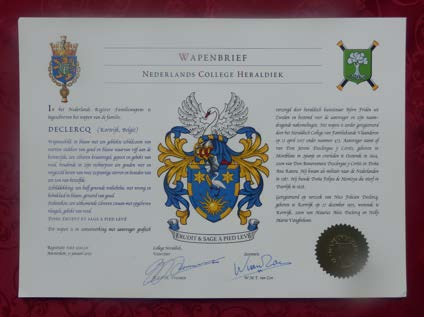
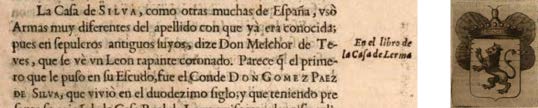
22
CHAPTER 4. HERALDRY AND GEOGRAPHY
Figure 4.3: Patent Letter, ’Wapenbrief Nederlands College Heraldiek’ (NRF 2020-311),
Amsterdam, 31 januari 2020. (Declercq de Silva Archive)
Figure 4.4: Ancient literature states that ’de Silva’ uses as heraldic shield ’un Leon rapante coronado.’ An example is shown of the use of the rampant lion in a heraldic coat of arms of the specific branch of de Silva from whom Shirani de Silva descends.
Vizcaya, usually named Lopes (from the Latin "lupus"), adopted two wolves as their arms. Similarly, the Cabreras of Galicia used a goat, and the Viscounts of Cardona adopted thistles. The Acunas, Padillas, and Ríos chose symbols reflecting their names.
The House of Silva, unlike others, employed arms unrelated to their surname. According to Don Melchor de Tevés, old tombs display a crowned rampant lion, first used by Count Don Gómez Páez de Silva in the twelfth century to honor his lineage from the Royal House of León. This symbol persisted in the Silva family, mirroring the arms of the Kings of León.
The adoption of the crowned lion by Count Don Gómez Páez de Silva is not definitive proof of royal descent but rather a personal choice. Nonetheless, other documented evidence supports the Silva family’s royal ancestry. The similarity in colors and metals between the Silva and Royal León arms has long been indicative of shared bloodlines. The Ponce family, descendants of Aldonza Alonso and Aldonza Martinez de Silva, both daughters of King Alonso IX of León, and the Benavides and Tenorios, descendants of the same prince, also use the lion symbol.
The Silva family’s continued use of this symbol, corroborated by various scholars and displayed in prestigious locations like the Sala de Los Linajes in the Palace of the Duke of the Infantado in Guadalajara, underscores their noble heritage. Despite some variations in depiction, the lion remains a central element of the Silva’s arms, signifying nobility and virtue.
In conclusion, noble families did not possess hereditary arms but personal symbols until the late eleventh century. Adopting permanent coats of arms began later, often reflecting the family’s heritage and achievements. The House of Silva, using the crowned lion, exemplifies this tradition, linking its symbol to its royal ancestry and noble status.
© 2024 Nico F. Declercq
The Desclergues of la Villa Ducal de Montblanc, 2nd ed., Omn., VOL. I
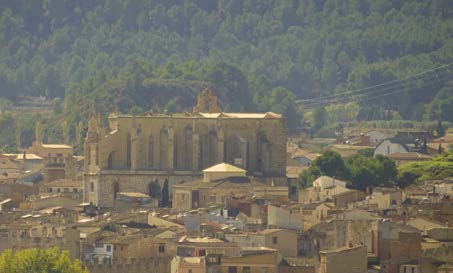
Chapter 5
The Town and the Duchy of Montblanc in Spain.
Figure 5.1: Iglesia de Santa Maria Mayor of Montblanc (2018). In this church were the De-
sclergues baptized, while their burials took place in the nearby San Francesc Convent. (Declercq
de Silva Archive)
The ducal town of Montblanc, a medieval settlement, is 45 km from Tarragona, towards Lleida. Montblanc was established in the 12th century and has retained its historic appearance, mainly due to recent restorations. The town’s romantic streets and alleyways, along with the picturesque Plaça Major at its center, which houses the Casal dels Desclergue and the Townhall, are notable features. Impressive walls with well-preserved towers encircle the city.
In the early 11th century, a settlement called Duesaigües was founded at the confluence of the Anguera and Francolí rivers. Count Ramón Berenguer IV granted tax-free licenses to specific villages, including Duesaigües, to encourage repopulation in New Catalonia.
1155, the town was renamed Vilasalva (villa salvada = tax-free city). Due to frequent floods and the need for fortification on the road from Lleida to Tarragona, King Alfonso II decided to relocate the population to a small mountain near Vilasalva, resulting in the founding of Montblanc in February 1163 by Ramon Berenguer IV, with its municipal charter granted by King Peter II. During the 14th and 15th centuries, Montblanc frequently hosted the kings and the Parliament (the Corts), meeting there five times.
Following the Treaty of Olorón in 1287, Montblanc and Barcelona, Huesca, Lérida, and Cervera were granted jurisdictional privileges.
On several occasions between 1307 and 1414, the Crown of Aragon court sessions were held in Montblanc. In 1392, King Joan I established the Duchy of Montblanc, a title for his successors. The city was a significant trading center in the Middle Ages, with the creation of the Duchy in 1387 marking its peak. However, Montblanc was sacked and burned during the Catalan uprising in the 17th century, culminating in the War of the Segadors in 1640, leading to its loss of economic and political influence. The Spanish Succession War (1701-1714) saw the town lose all privileges, and the Carlist Wars (1833-1849) marked its final decline.
The Gothic church of Santa Maria, known as the Cathedral of the Mountain due to its size and location atop a promontory, testifies to Montblanc’s medieval power. It houses the 14th-century altarpiece of Sant Bernat and Sant Bernabé, featuring intricately carved scenes of the saints’ lives. The church-hospital of Sant Marçal is notable for its 15th-century mural of Sant Cristòfol and a Gothic sculpted window. The Alenyà Palace, reflecting Montblanc’s prosperous past, is a Gothic building with a large central, round-arched portal and slender windows. Though much altered over the years, it now serves as the headquarters of the Consell Comarcal de la Conca de Barberà (the County Council of Conca de Barberà).
Montblanc derives, as is said, its name not from a snowy mountain but the barren hill above the old town, Pla de Santa Bárbara, where the soil was infertile (’blanc’ in ancient Catalan). The medieval town is encircled by massive fortified walls constructed during the reign of Peter III of Aragon (1239-1285), with 17 of the original 28 towers still in good condition. One of the most renowned buildings in Montblanc is the Casal dels Desclergue on the Plaça Major, constructed by our ancestors. The blazon of Montblanc includes a flory ’mont blanc’ (Catalan for ’white mountain’) and the royal arms of Catalonia-Aragon (four red pales on gold). In 1387, King John I gave his brother, the infant Martin (later King Martin I), the Duchy of Montblanc. Consequently, the crown atop the arms became a duke’s crown, used by the local council since at least 1320.
The burial site of the Desclergues of Montblanc remains unknown, though it is likely the ’San Francesc Convent,’ as inferred from information related to Francesc Desclergue of Montblanc. However, all graves were removed in the 19th century during the installation of an alcohol factory, which destroyed the old pavement and tombs. Today, only fragments of old tombstones have been preserved12.
1Eduard Contijoch i Miquel, ’L’empresa Alcohols Contijoch de Montblanc: una fàbrica installada en un antic convent. (1882-1951),’ podall, 38-65, 2015)
2personal communication with Josep Maria Grau
The Desclergues of la Villa Ducal de Montblanc, 2nd ed., Omn., VOL. I
© 2024 Nico F. Declercq
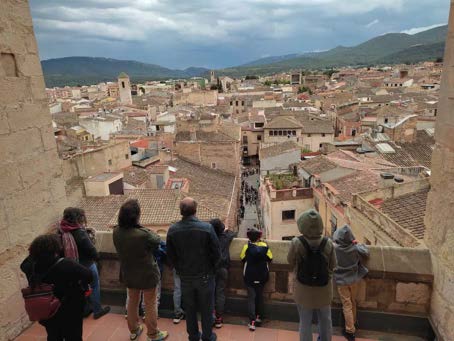
24
CHAPTER 5. THE TOWN AND THE DUCHY OF MONTBLANC IN SPAIN.
Figure 5.2: View, in May 2023, by local inhabitants, from the Iglesia de Santa Maria Mayor of
Montblanc, shown in Figure 5.1, on the town. In the middle, the Casal dels Desclergue is seen.
On the left is the Sant Miquel church. Far in the back is the San Francesc Convent where the
burials of the Desclergues took place. Courtesy of Jesus Mart Casan and Montblanc Medieval.
It is important to note that many documents have been lost in fires and other disasters, as in many European places. Most information about our family in Montblanc comes from other researchers who have published their knowledge. We refer to these works whenever applicable rather than showing the original documents, except those found in the Pedrolo archives. Further details, for instance, can be found in Josep M. T. Grau Pujol i Manel Güell, ’La crònica negra de la destrucció d’arxius a la demarcació de Tarragona,’ Revista Catalana d’Arxivística, Llegal 18, 2001. This work describes how much of the archives of Montblanc were destroyed during events associated with ’segadors,’ ’filipistes,’ ’napoleònides,’ ’revolucionaris,’ ’carlins’ and ’nacionals,’ but also due to ’robatoris’ and ’furts’ and even ’confiscacions,’ ’ocultació’ and above all ’incendis,’ ’humitats,’ and ’inundacions.’ Approximately a quarter of the Montblanc archives were destroyed, with higher losses in certain periods.
The historical narrative surrounding the Cathars of Albi in France, a Christian sect deemed heterodox by the Catholic Church, unfolds a compelling saga of religious conflict and societal upheaval. The Albigensian Crusade, commencing in 1209, was a concerted effort by the Catholic Church and secular powers, notably the French monarchy, to suppress the Cathars and other dissenting factions in the Languedoc region of southern France. The Cathars faced persecution tactics ranging from military assaults to ecclesiastical inquisitions and coerced conversions, culminating in a protracted campaign of subjugation that lasted until the early 14th century.
In the aftermath, a diaspora of Cathars sought refuge in various enclaves, notably Gerona, Barcelona, and Tarragona, alongside settlements along the Francoli riverbanks. Montblanc, a municipality near Tarragona, traces its origins to an era known as ’Campo Barberano’ and ’Castrum Barbara,’ initially marked by scant human habitation. Its demographic landscape transformed in the 12th century when it was granted to the Knights of the Order of the Temple, heralding increased settlement activity. By the early 13th century, the name ’Montisalbi’ was bestowed upon the locale, denoting the ’white hill’ due to its barren terrain.
This toponym has a deeper connection with Albi in France, reflecting a migratory influx of settlers from Albi during the height of the Cathar movement. Montblanc’s proximity to the town of Albi underscores a shared lineage influenced by Albi and the spread of Catharism in the 12th and 13th centuries. Although our ancestors, the Desclergue lineage, had not yet established roots in Montblanc during this period, tracing their domicile to Barcelona further north, it is plausible that early settlers of Montblanc and the Desclergue name could have originated from Albi or Castres in Languedoc and Occitania.
Thus, the Desclergue progenitors who later settled in Montblanc were likely aware of their ties to Albi in France, intertwined with the etymological origins of Montisalbi, perpetuating an ancestral legacy steeped in historical resonance345. We can cite "El 1322, la declaració de Bernat Laufret de Tinhacdavant de Jacme Fournier a Pàmies relatava la seva trobada amb heretges a Puigcerdà, Montblanc, Tarragona i Cervera, localitats on es va trobar amb diversos creients càtars"6.
3Jorge Ventura i Subirats, "El catarismo en Cataluña," Boletín de la Real Academia de las Buenas. Letras de Barcelona, XXVIII, 1959-1960, pp.
75-168.
4Grau Torras, Sergi. "Historiografía del catarismo en Cataluña: estudios y documentos (Siglo XIII)," Acta historica et archaeologica mediaevalia, 2010, Núm. 30, p. 375-408.
5Grau Torras, S. (2018). Els càtars a la provincia eclesiàstica de Tarragona. In Les minories socials i la justicia: Època medieval i moderna (pp.
71-104)
6Sergi Grau Torras, Universitat Autònoma de Barcelona, "Els càtars a la província eclesiàstica de Tarragona", 2018, AAVV, Les minories socials i la justícia. Època medieval i moderna, Tarragona: Arxiu Arxidiocesà de Tarragona, 2018, pp. 71-104.
© 2024 Nico F. Declercq
The Desclergues of la Villa Ducal de Montblanc, 2nd ed., Omn., VOL. I
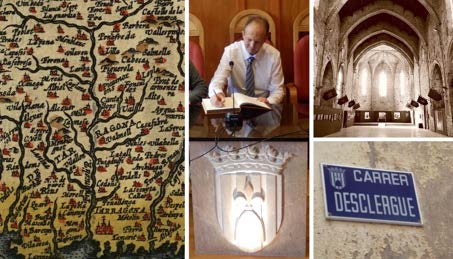

25
Figure 5.3: Left, we find a close-up of a map of 1608 of Catalonia, with a beautiful depiction
of the Francoli River passing by Montblanc (top) and flowing in the Mediterranean sea in Tar-
ragona. The entire map, drawn in Antwerp, is shown in Figure 5.6. On November 1, 2018, shown in the middle, the author signed the Golden Book of the town of Montblanc, invited by
the mayor of the town Mr Josep Andreu Domingo and in the presence of historian Eduard Con-
tijoch. Right, we observe the Carrer Desclergue, behind the Casal dels Desclergue of Montblanc
and also the San Francesc Church. (Declercq de Silva Archive)
Figure 5.4: The author’s children in front of the Casal dels Desclergue (right) and at El Foradot
of Montblanc (left)
Figure 5.5: Left are two images of 1978, of the Francoli River (snapshots from a moving image), one of which shows the author with his mother bathing in the fresh water in summer. The two images are followed by a 1979 image, of the author and his father, near Tarragona. Right is a view through the old bridge on the Francoli River at Montblanc (2018). (Declercq de Silva Archive)
The Desclergues of la Villa Ducal de Montblanc, 2nd ed., Omn., VOL. I
© 2024 Nico F. Declercq
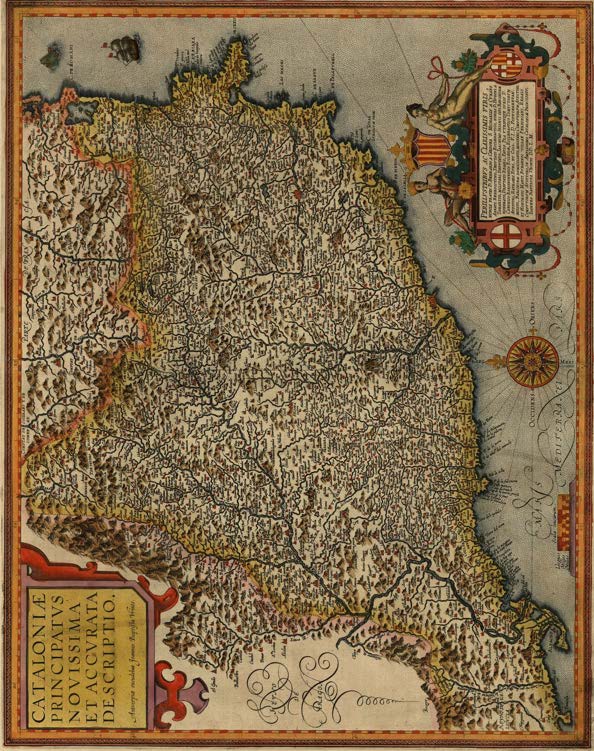
26
CHAPTER 5. THE TOWN AND THE DUCHY OF MONTBLANC IN SPAIN.
Figure 5.6: Map of the Principality of Catalonia, 1608. A close-up of the Francoli River was shown in Figure 5.3. The map was drawn in Antwerp, in the Spanish Netherlands. Note that all the documents in the Pedrolo archives, dating from the 17th century, that mention the Desclergues refer to, in order of size of the administrative powers of Montblanc, the ’Principado de Cathaluña’ , ’Aragon’ and ’España’ . Montblanc is referred to as ’Mont Blanch’ or ’Montesalbi’ and ’Montisalbi,’ as the
’cabeça de vegueria y de ducado’ . The entity in charge of Catalonia, on behalf of the King, is referred to as the ’Virrey de Cathaluña’ . The areas where the Desclergues have been military active outside Spain are, according to the same documents,
’Francia’ , ’Flandes’ and ’Países Bajos’ .
© 2024 Nico F. Declercq
The Desclergues of la Villa Ducal de Montblanc, 2nd ed., Omn., VOL. I
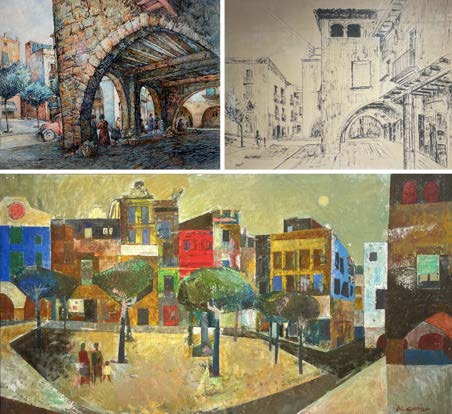
27
Figure 5.7: Contemporary paintings of the Plaza Mayor of Montblanc and the House of Descle-
rgue. The original paintings can be found at the Museum of La Conca de Barbera in Montblanc.
Work is seen of Joan Fuguet (1953), Juli Garola (1956) and A. Potan.
The Desclergues of la Villa Ducal de Montblanc, 2nd ed., Omn., VOL. I
© 2024 Nico F. Declercq
CHAPTER 5. THE TOWN AND THE DUCHY OF MONTBLANC IN SPAIN.
© 2024 Nico F. Declercq
The Desclergues of la Villa Ducal de Montblanc, 2nd ed., Omn., VOL. I
A Glimpse on the Desclergues
Regarding the ancestors bearing the name Desclergue, it is documented 1 that the family was "noble and very powerful, possessing extensive properties and owning mills and orchards along the banks of the Francolí. They constructed the splendid mansion at the Plaça Major, which still stands today despite numerous internal and external renovations. An eminent figure from this family, Francesc des Clergue, a royal and legal notary of Montblanc who held a significant role in local politics, was instrumental in saving his manor from the devastating fire of 1652 and other subsequent calamities that befell the city." This resilience in the face of adversity is a testament to the strength and character of the Desclergue family. The Desclergue family, with its noble blood (Hiraldo de Sangre), and several members knighted, has a long-standing and respected lineage. Historical chronicles often describe them as having purple blood, a testament to their noble heritage and significant contributions to Spanish history.
Our research on the Spanish lineage of the Desclergue family was conducted with utmost care and thoroughness. It initially relied on José Sanchez Real’s La Casa Desclergue de Montblanc2, supplemented by various online sources and archives. Subsequently, we also consulted Salvador J. Rovira i Gómez’s La baixa noblesa de la Conca de Barberà a l’edat moderna3. This meticulous research process ensures the accuracy and reliability of the information presented.
A specific reference to Jeroni (Geronimo) Desclergue notes that the Desclergue were Cavalleros Donzeles, or Knights.
Several sources posit that the Desclergue family was already recognized as nobility during Jaime II de Aragón, el Justo (Valencia 1267–Barcelona 1327). According to contemporary records, this suggests that the maternal line, through which the Desclergue name was passed following marriage with a ’Torró’ (descendant of Du Guesclin, himself also a descendant of the Desclergues), played a significant role even before Du Guesclin’s presence in Spain. Numerous sources corroborate this, and it is also extensively outlined in this book in the chapters concerning the Desclergues in Occitania and Mallorca. For instance, on page 235 of Pablo Piferrer y Fábregas’s Mallorca, Recuerdos y Bellezas de España, it is noted that "In the year 1237, Señor Infante D. Pere ruled Mallorca, who, on June 8th, confirmed the consuls of Mallorca to save and defend the island with an order to Pere Urtiz, Roberto de Tarragona, Bernardo Español, Guillermo Hugo, Ferrer de Olceto, Valentin de Torres, Ramón Desclerga, Ramón Cortés, Rollan Sabater, and Arnaido Vidal". This assertion is further supported by Álvaro Campaner y Fuertes in Cronicon Mayoricense. Noticias y relaciones históricas de Mallorca desde 1229 á 1800 extraidas de las apuntaciones, diarios, misceláneas y obras manuscritas de D. Guillermo Terrassa (etc.)4:
On page 127: "In the year 1276, Berenguer Arnaldo de Illa was governor of Mallorca, and the jurors of this city and kingdom were: Pere Savardera, knight, Bernardo de Zaragoza, Francesc Desclerga, Guillermo Valentí, Bernardo de Vich, and Martin de Mayol."
In the introduction: "The agreement made between the two brothers, the King of Aragon and the King of Mallorca, in the previous year is well-known; and it was agreed to swear to the said concordat the universities and trustees of the states of the King of Mallorca. Consequently, King Jaime of Mallorca, on December 10, 1279, summoned at the Church of Santa Eulalia the principal subjects and, in the presence of the King, granted authority to those subjects, constituting, ordering, and appointing Guillermo de Torrella, Fernando Rodríguez, Jaime San Martí, knights; Roberto de Bellvey, Benito Valentí, Francesc Desclerga, Francesc Burgués, Benito de Zaragoza, and Arnaldo Burgués, as syndics and attorneys of the University of Mallorca, to swear and commit themselves on behalf of the said university to uphold the composition made between the said brother kings."
"In the year 1281, during the lieutenancy of D. Berenguer in Mallorca, the jurors of the city and kingdom were: Pere de Verdera, knight, Bernardo de Zaragoza, Francesc Desclerga, Guillermo Valentí, Bernardo de Vich, and Martin de Mayol."
The Desclergue family name appears in the list of Catalonian nobility, specifically in Cataluña (255), dos (48), page 71 5.
1L. Vives y Poblet, Fills illustres del segle XII al XX. (extraído del manuscrito Notes históriques de Montblanch) Vives y Poblet, Fills illustres del segle XII al XX. (extraído del manuscrito Notes históriques de Montblanch) ’Quintos 1970’ (Montblanc: 1970).
2Jose Sanchez Real, La Casa Desclergue de Montblanc (Tarragona: Caja de Ahorros Provincial, 1974), depósito legal B 19.565 - 1974, printed by Graficas Lorente, Ciudad 13, Barcelona 2, Spain.
3Salvador J. Rovira i Gómez, La baixa noblesa de la Conca de Barberà a l’edat moderna (Montblanc: Centre d’Estudis de la Conca de Barberà, 2005), series: Monografies, Montblanc, Spain, Volume 12.
4Álvaro Campaner y Fuertes, Cronicon Mayoricense. Noticias y relaciones históricas de Mallorca desde 1229 á 1800 extraidas de las apuntaciones, diarios, misceláneas y obras manuscritas de D. Guillermo Terrassa (etc.) (Palma de Mallorca: Establecimiento tipografico de Juan Colomar y Salas, Editor, 1881).
5Luis Valero de Bernabé y Martín de Eugenio, Análisis de las características generales de la Heráldica Gentilicia Española y de las singularidades heráldicas existentes entre los diversos territorios históricos hispanos (Madrid: Universidad Complutense de Madrid, Facultad de Geografía e Historia, 2007), ISBN: 978-84-669-3028-4.
The Desclergues of la Villa Ducal de Montblanc, 2nd ed., Omn., VOL. I
© 2024 Nico F. Declercq
CHAPTER 6. A GLIMPSE ON THE DESCLERGUES
© 2024 Nico F. Declercq
The Desclergues of la Villa Ducal de Montblanc, 2nd ed., Omn., VOL. I
Onomastics
7.1 Names in a Genealogical Context
Napoleon Bonaparte standardized family names in Belgium. Prior to this, family names existed but were not fixed; they evolved based on convenience, local traditions, and variations. In France, family names were standardized in 1539 by King François I through the ordinance of Villers-Cotterêts.
Our Declercq ancestors in Spain spelled their name in various ways. It is generally accepted that their name was Desclergue or Desclergues, pronounced as Declercg, with an ending sound between ’g’ and ’k.’ Historian Eduard Contijoch explains that in Catalan, words tend to shorten by ignoring the final vowel and hardening the last consonant, e.g., Francisco becomes Francesc, and Madrid becomes Madrit. This specific ’g’ does not exist in Flanders, where the Desclergues arrived in the late 16th century. The Flemish ’g’ is pronounced like the ’J’ in ’Jimenez,’ whereas the French would prefer ’-gue’ to express a softer ending. Consequently, our ancestors’ family name often appeared with different endings, such as ’-qz,’ ’-cqz,’ ’-qç,’ ’-cqç,’ and sometimes ’-gh’ or ’qh,’
’-gue,’ or ’-que.’ This variation in spelling was identified through Georges Picavet’s research at the Plantin-Moretus museum, where he found a 1556 text (see Figure 7.1 on page 34).
Upon arriving in Belgium in the late 16th century, our ancestors bore a Spanish name with a Flemish and French counterpart, Declercq (spelled as Declercq, De Clerc, Declerc, Declerck, De Clerck, etc.). As they settled in Flanders, subsequent generations adapted their name to the local version we use today: Declercq. This natural process was even accelerated by marrying with a Declercq lineage in Kortrijk. For example, a 1624 Spanish book mentions the Flemish family name Declercq/De Clerck in relation to historical figures, indicating no resistance to using the Flemish version of Desclergue by our Spanish family. Historical figures include Gil de Clerck (1437) and Clerck (1452) in present-day Belgium, and chancellor Juan le Clerc (Jean le Clerc, 1418-1430) and Pere Declercq (Pierre Declercq, 1435) in present-day France1. Initially, the name was often Declercqh, Declercz, or Declercqs, with the ’q’ sometimes replaced by a ’g.’ As mentioned earlier, this ’z’ might also have been an ’h,’ hence ’-qh’ or ’-gh’ endings were common. They likely retained the Spanish pronunciation in the first century and insisted on spelling it differently from the local version. Notably, 16th-century Castilian printed books used the character ç for z. As outlined in this book, the Desclergues in Catalonia came from Occitanie. Their name was Clergue or Des Clergue in Occitanie, and this transformed into Desclergue in Catalonia.
The ancient origin of the name, whether in Belgium, France, or Spain, is likely ’Clericus,’ derived from the profession ’Clericus Romanum.’ Certainly, in our case, this stems from the fact that they were scribers.
Thus, two individuals named Declercq or any of its variants are not necessarily more closely related than any other randomly chosen persons. Establishing a blood relationship requires specific genealogical research combined with DNA analysis. For this book, the author has researched the paternal ancestors of various Declercqs, finding no blood relations, including Flemish writer René Declercq, several Belgian politicians, and the Clerque de Wissocq and Clerque de Wissocq de Sousberghe families, none of whom are included in this book.
In contemporary discussions about our family name, one might question whether it should be written as one word or two, and whether it should end in -cq or -ck. Investigating our ancestors reveals that spelling in official documents depended on the village and the official (priest, notary, civil servant). However, over the past four centuries, our ancestors consistently wrote their name as Declercq, and before that, in Spanish Castilian or Catalan, and even in Latin. In old Spanish documents, the name appears in various forms: Clerga, Clergua, Clergue, Clergues, des Clergue, des Clergues, dez Clergue, dez Clergues, Dezclergue, Desclergue, Declergue, Dezclerga, Dezclergua, Dezclergues, and Desclergue.
Genealogical research on common names like Declercq requires reconstructing family clusters, historical context, and acquaintances rather than relying on single documents. Our family’s mobility regarding marriages and residences further complicates research, which is reflected in the extensive efforts behind this book.
Experienced genealogists might find the following information redundant, but for novices, there is much to learn about names.
Historically, the exact spelling of a name was less important than the individual’s identity. In modern society, each character is crucial for identification. In the past, priests often identified first names by corresponding Saints and used synonyms or variations.
For example, a person named ’Mayke’ could appear as Maria, Maria Anna, etc., and a person named Anna could also be Ana, Joanna, or Anna-Maria. Willem could be Wilhelmus, William, or Guillaume. Experienced genealogists can identify individuals behind local names, but foreign names pose additional challenges. Numerous examples in this book demonstrate priests’ difficulties with foreign names, and family names present even more significant challenges. Modern readers might not associate Verelst with Vanderelst, but historically, both were considered equivalent. Thus, within the same family, names might vary: Xelst, Verelst, Vanderelst, Verhelst, or Verstraete, Vierstrate, Verstraeten, Vanderstraeten. Family names were often regionalized, and switching between French and Flemish versions was common (e.g., Verhaeghe / La Hague; Patin / Pattijn; De Clerq / Le Clercq). Foreign names were either adapted to local versions or spelled phonetically. Examples include Irish names like ’O’ Daly’ becoming ’Dale’
in Waregem in 1653.
Genealogists’ choices often reflect their national, political, or traditional backgrounds. Some transform every name into Flemish or French, while others adhere to the baptism certificate’s spelling. This book attempts to maintain continuity without following any particular tradition.
Chapter 42 presents a case study of Pieter Jan Renier’s wife from Deerlijk, where social pressure transformed a family name from 1Anales de Flandes, y provincias Belgicas, Copuestos por Emanuel Sueyro, Cavallero del Habito de Christo & caet. Repartidos en dos cuerpos. Con sus tablas copiosissimas. Dirigidos al Rey Don Felipe Quarto Nuestro Sennor. Tomo Segundo. En Amberes en casa de Pere Juan Bellero, son privilegio.
MDCXXIV.
The Desclergues of la Villa Ducal de Montblanc, 2nd ed., Omn., VOL. I
© 2024 Nico F. Declercq
CHAPTER 7. ONOMASTICS
Pes and Peis to Peers over 2-3 generations. The original name might have been Spanish Peset, German Peiss, or Italian Pesce.
Chapter 49 discusses the construction of a Chapel at Deerlijk and the French name ’de le Quellerie,’ originating from ’La Flandre.’
In Flemish-speaking Flanders, this name is rare, while Caluwier/Callewier is common. There was a tendency to transform names to their Flemish versions in the 17th century. Examples include Jose Quellerie and Elisabeth Stalins (granddaughter of Jeroni Joan Desclergue y Cortés (DC05)), whose names appeared in various formats: Calluier (daughter Elisabeth’s baptism in Deerlijk, 1643), Kelduier (son Jean’s baptism in Deerlijk, 1644), and Kellewier (Elisabeth’s marriage in Ooigem, 1682). Other forms include Qaullierie (Ypres, 1663), Calluyer (Kain, 1689), and Quellerye (Hollebeke). Moisés Selfa from the Universitat de Lleida classifies Desclergue as a typological surname derived from an ecclesiastical post2. Note, however, that the profession of clericus predated the ecclesiastic and was the Latin name for scribers.
7.2 Polymorfic Names
Above, we already mentioned the names Declercq and Patin as polymorphic names in different countries under different forms: Declercq - Desclergue, Patyn - Patin - Patiño.
For reasons of general interest, we have investigated the literature to discover specific examples of names that are either susceptible to polymorphic use or which have, in particular instances for individual persons and their descendants, been transformed from one language to another. The list is shown to open the minds of anyone doing genealogy in an international arena. One of the fascinating aspects of genealogical research is observing the evolution of names in ancestry trees. Take, for instance, the name
’Mariasi,’ which transforms into ’Mariage’ and eventually ’Hauwelyck’ ; or ’Valzolio,’ which changes to ’Vausseul’ and then ’Van Solo’ and ’Van Soldij’ ; or ’Portillo,’ which becomes ’Portielje.’
In Flanders, well-known Spanish names are Balduc(k) or Balduyck (from Balduque, which is Spanish for Hertogenbosch). Hurtado, Furtado, Legon (from the Spanish Leon); Pais/Paix/Pays/Paiis/Peijs/Peis (from the Spanish Paix), Real, Tavares, Varga/Vargas/Vargaz, Prat.
In the Spanish Archivo General de Indias, we have found numerous names of people who left Spain for the Americas. From that list, we have extracted many names that were either indeed from Belgium or that could and may have easily been exchanged with Flemish names and vice versa. We list them below. However, if a person has such a name, it does not automatically mean that his name was once exchanged for a Spanish or Flemish name by one of his ancestors. Still, it shows that it is possible, and in several cases, we have noted such an exchange either when a Flemish person settled in Spain or when a Spanish person dwelled in Flanders. Some names have changed so little that families in Spain might still have a real Flemish name or Flemish families may always be around who have an official Spanish name. We also refer here to cases from the 16th and 17th centuries. In the past centuries, there has also been an exodus linked to the Spanish Civil War and tourism in the other. During the Spanish Netherlands, the authorities typically transformed Flemish names into Spanish, and bodies in the Spanish Netherlands turned them into local versions. Sometimes, this was done either on the semantics grounds (Del Ponte - Verbrugghe, Cortillo - Lindenhove) or based on homonyms or homophones (De Souza - Lesage or Amaya - Ameye). Sometimes, names are so close in both languages that it is natural to transform (Declercq - Desclergue, Maas - de la Maza, de Vos - de Poch).
Below is a list of names, either of Belgian inhabitants who appear in Spain on the list of the Spanish Archivo General de Indias or some other sources, or of people, on that list, carrying a name which is clearly originating from Belgium, or would very easily be transferred from the Spanish version to the Belgian version or vice versa and would hardly be identifiable as foreign. The linguistic intricacies of genealogical research are evident in these names, where similarities are either semantic, phonetic, or both, often rendering the original name unrecognizable.
Esqueldes (’Verschelde’), Del Haya (’Verhaeghe’), Somera (’Somers’), Catoira (’Catoir’), De Pau (may be ’De Pauw’), De Mora del Saz (’De Moor -
’Saxe’ or ’Van ’t Sas’), Fuentes (often used for ’Fonteyne’ or ’La Fontaine’), De la Rosa (may be ’Roose’ , ’Van Roost’), De Molina (may be ’Vermeulen’), Casanuevas (’Nieuwenhuyse’), De la Mota (’Vermote’ , ’Vermaut’), Franco (may in some cases be ’Francken’), De Henaeo (’De Hainaut’ , ’Van Henegouwen’), Bamboren (’Vanvooren’), Roman (widespread in both countries), De Licht, Lanbermay (’Lambermont’), De Paris (’Van Parijs’), Del Campo (’Vercaemst, Deschamps, Vandevelde’), Del Olmo (’Vanolmen’), Mestre (’Meesters’ , ’Demeester’), Blanco (may in some cases be ’De Witte’), Bonifaz (’Boniface’), De Cordoba y Sande / de Sola y Sande (’Vandesande’), De la Cruz (’Vercruyse’), De Landeche (’De Lander’ , ’Van Lander’), De Valverde (’Groenendael’), Dufosse, Potflis (perhaps ’Powis’ or ’Peutevin’ or ’Pothuis’), Rosel (’Rosseel’), Van Hoenacquer (’Vanhoenacker’), Caballero /Cavallero (perhaps ’de ridder’), De Lepe (’Van Lepe’), De Yepes (’Ypes’ , ’IJpes’), Adame (may be ’Adams’), Loaysa / De losa (’De Loos’ , ’Loyson’ , ’Louage’), Campana (may be ’Van Buiten’ , ’Van de Velde’), De Leiza (may be ’Delhaize’ , ’Deleye’), De Roo, De Roa (’De Roo’), De Viana ( ’Viane’ , ’De Viane’ ,
’Viaene’ , . . . ), de Lamparte (’Lampaert’), Cornehjo (’Cornelius’), Pelgrom, de Sousa / de Sosaya / de Sosa / De Suazo (may in some cases be ’Le Sage’), de Amaya (’Ameye’), Carlier, Paz (’Pas’), De Corta (’De Corte’), De los Cameros (’Vercameren’), Haeneke (’Hinneken’), Notere (’De Notere’), De Lara (’Delaere’), De Lea (’De Leye’), De Lira (’Van Lier’), Overlante (’Overlant’ , ’Van Overland’), Herck, Van Covenbergh, De Molina (’Vermeulen’), De Montaña (’Van den Berghe’), Lainez, Betancur, De Baeza (’Buyse’), Del Hoyo / Loya (’Van Looij’), Rico (’Derijcke’), Luque (’Luyckx’), Celis, Van-resvique (’Van Rijswijk’), Vandeval (’Vandewalle’), Bosque / De Bosch (’Bos’ , ’Bossche’ , Vandenbossche’), De Miguelena (’Vanmechelen’), del Puerto (’Vanderpoorten’ , ’Verhaven’), Freyra (’Frère’), De la O / De la Hoz (’De Lahaut’), Duarte (’d’ Huart’), Van diepenbrock (’Vandiepenbrouck’), Ferrer, De Tove (’Detobbe’), De la Guelga (’De Gelcke’), Federigue (’Federicq / Federique’), Tabares/Tavares, Del Duque (’Duc’ , ’Duque’ , ’Den Hertog’ , ’Den Hartog’), Luchit (’de Luchy’), De Mir (’Mirre’ , ’Le Myre’), Dubois y Casanova (’Dubois/Van den Bosche/Vanhoutte - Van Nieuwenhuyze’), Leigrave (’De Grave’), Gata (Spanish immigrants in Belgium, 16-17th century), Noeli / De la Natividad (’De Noyelle’ , ’De Noel’ , ’Denoelle’), Leon (may be ’De Leeuw’), De Olivares (’Olivier’ , ’Ollevier’), De Lovera (’Desloovere’), Bruin (’De Bruine’), Hermans, Fresco (’Devries’), Lopez (’De Wolf’), Lambertengo (’Lambert’), Falcon (’De Valk’), Fortun (’Fortuyn’), Negrón (’De Swarte’), Estebanez (’Stevens’), Claros (’Declare’), De Lili (’Vanrijsel’ , ’De Lille’), Perez (’Peers’), De la Plaza (’Verplaatse’ , ’Vandeplas’ , ’de la Place’), Van Hemert, Lison (’Lyson’), De Verjuste (’Verhoust’), De via (’Vandeweghe’), Del saz (’D’ alsace’ / ’van ’t sas’), Bequer (’Becker’), De Mestas (’Mestdagh’), De Portes (may be ’Depoorter’), Brandes (’Vandenbrande’), De Monsalve (’Van Wittenberghe’), Gough (’Hoghe’), De Sayas (’Saey’), De Nis (’Denis’ , ’Denijs’ , ’Denys’), De Zelaeta (’Van Zelzate’), Colarte (’Colart’), De Mon (’Demon’), Grande (’De Groote’), De Camino (’Vandeweghe’), De Conique (’De Coninck’), Peri, Patiño (’Pattyn’ , ’Patin’), Van der Becquen (’Verbeke’
, ’Vanderbeken’), De la Maza (’Maas’ , ’Maes’ , ’Maessen’ , ’Vermassen’), De Bel (’Debels’), De Echauz (’De l’ Escaut’ , ’Verschelde’ , ’Vanderschelden’), De la Calle (’Calle’), De Mena / De Menesis (’Van Menen’ , ’Demenin’), De Mesa / De Mesain (’Vermeersch’ , ’Vandermeersch’ , ’Tafel’ , ’Table’ ,
’Demees’), De Monesterio (’Van Klooster’), Enriquez (’Hendricks’ , ’Heyndericks’), Gil (’Gilis’), Croquer (’De Croock’), Pinquet (’Piquet’ , ’Pincet’), Martinez (’Martens’), Miciano (’Messiaen’ , ’Missiaens’), De Lago (’Vermeer’ , ’Vermeers’ , ’Vandermeersch’ , ’Vandevyver’), De Ostos (’Hoste’ , ’Vanoost’), Van Hoecnaquer (’Van Honacker’), Vergara (’Verhaert’), Pardo, Mariscal (’Marechal’), Vandenbrouch (’Van den Broucke’), Marchan (’Marchand’), De los Reyes (’Coninckx’), De los Rios (’Rivière’), De Coen y Campos (’Decoene / Cohen - Vandevelde / Vancamp’), Betens (’Bettens’), Beyens, Camps, 2’About the concept of onomastic identity: the privileges’ parchments of the city of Balaguer (1211-1352), Imago Temporis. Medium Aevum, VIII (2014) 135-149, ISSN 1888-3931
© 2024 Nico F. Declercq
The Desclergues of la Villa Ducal de Montblanc, 2nd ed., Omn., VOL. I
33
De Garate (’Degroote’ , ’Degras’), De Vilde (’Dewilde’), De Leira (’Vanleer’ , ’Vanlier’), Rigolene (’Rigole’), De Velreder (’Develder’), Huet, Adriansen (’Adriaensen’), Barte (’Baert’), Mariscal (’Marechal’), Groenenberg (became Monteverde in Spain) , Van Damme (became BANDAMA), Grimont (became Grimón), Lefevre (became Febles / Febres), Fonteyne (becames Fuentes), Severeyn, Kleywegt, Van Scoit, Jambooz, Zweedyk, Van Pamelen, Houtman, Geizzelez, Höffken, Wijnen, Maas, Van Putten, Van Houten, Van Dalle, Westerling (Westerlin, Heusterlin, Hesterlin, Esterlin).
We found an interesting Master thesis by Janna Everaert3 concerning Spanish who lived in Flanders in the 16th century, before the religious conflicts.
Some persons were indicated as ’flamencos’ , while others were probably Flemish or Dutch but without complete certainty. Examples are: de la Bala, Claveson, Criter, Equilfe, Fermaute, Firens, Hermis, Hermosen, de Latre, de Morin, de Olanda, de Proudhome, Rrubin, Tulaime, de Urio, Mayeu, de la Corte, Flamenco, Gastebanove, de Flandes, de Amberes, de Bruselas, de Cambray, de la Haya, de Bucq.
Similar work, written by Raymon Fagel4, mentions some interesting facts. The author found 38 presumable Spanish family names at Middelburg during the periods of ’Filips de Schone’ and ’Karel V’ : Abrio, Aguirre, Aleman, Amedo, Burgos, Cachopin, las Casas, Castro, Cavallero, Cenoese, Gaypense, Garcia, Gerbier, Henriquez, Hiniosa, Jaimes, Lario, Lescaltes, Libano, la Loo, Lopez; Ortiz, Palma, Payz, Perez, Pinto, Posque, Poza, Rodrigues, Salinas, Segura, Sevilla, Ugarte, Unibasso, Valladolid, Villamonte, Ximenes, to name a few.
Raymond Fagel also writes that, for instance, the Spanish family name ’De Valladolid’ was sometimes registered in the Netherlands (prior to the Dutch revolt), as ’Van der Lyt’ . He also stated, what is described in Chapter 8.5.6, that a political bond was established between Castile and the Northern and Southern Netherlands through the marriage between ’Johanna de Waanzinnige’
with ’Filips de Schone’ , in 1496.
Economic connections between the two ’countries’ predate the specified period. From the mid-15th century, Spain’s economy experienced significant growth, establishing robust relations and representations in major cities such as London, Bordeaux, Nantes, Florence, Lisbon, Bruges, and even Middelburg. Although the Genoese network was more extensive, the Spanish network was also considerable. Moreover, post-1492, the New World played a pivotal role in the Spanish economy. Cities in Flanders, Brabant, Zeeland, and Holland competed to host Spanish merchants. This paper highlights intriguing aspects concerning Burghers (’bourgeois foraines’ or ’poorters’). Spanish traders were often well-protected by their trading nations within local cities, which granted them specific duties, rights, and privileges. In other instances, it was advantageous for Spaniards to become Burghers.
There were several pathways to acquiring Burgher status. The simplest method was marriage to a female Burgher, which typically resulted in losing privileges as ’Spanish foreigners,’ conferring local status instead. This was beneficial in regions where locals enjoyed better treatment than foreigners. Offspring of mixed marriages were also considered locals, inheriting the status of Bourgeoisie or ’poorterschap,’ as well as their parents’ businesses. Thus, while maintaining their Spanish identity and citizenship, they were subject to local laws like other residents. This necessitated maximum integration into the local district to obtain the best advantages. During the period discussed, most Spanish city inhabitants were involved in overseas trade. The paper notes that the Spanish remained mobile, relocating to cities offering better treatment or visiting trade and family contacts in other regions, even across different counties. Furthermore, Spanish integration was not unidirectional; within the same generation, some family members married Dutch individuals, while others married Spaniards.
The most common Spanish family names found at Middelburg appear to be De Sevilla, Deque, De Valladolid, Da la Palma, Hiniosa, De la Loo, Poza, Ximenez, Ximenes, Pinto, Ortiz, Arnedo, Abrio, Aguirre, Aleman, Burgos, Cachopin, las Casas, Castro, Cavallero, Certoese, Dies, Gaypense, Garcia, Gerbier, Henriquez, Jaimes, Lario, Lescalles, Libano, la Loo, Lopez, Payz, Perez, Posque, Rodrigues, Salinas, Segura, Sevilla, Ugarte, Unibasso, Valladolid, Villamonte.
The paper provides a comprehensive account of how the Spanish maintained significant intra-community contacts, specifically among their respective regional groups (e.g., Aragonese with Aragonese, Castilians with Castilians, Andalusians with Andalusians, etc.). Notably, over a century later, similar patterns are observed among our ancestors, who primarily formed connections through marriages and served as witnesses for each other.
The Belgian archives have meticulously transcribed numerous church records, ensuring the accuracy and reliability of the data. For Bruges, all 465 transcripts pertaining to the Spanish community between 1649 and 1706 have been categorized under the ’Spaans Register’ (Spanish register). While some entries are unique, others are duplicates also found in various Bruges churches’ regular baptism and marriage records. The criteria for these duplicate entries are unclear, but it is presumed that the transcribers consulted additional lists to identify Spanish families. Most entries are derived from specific church books written in Castilian. Spanish marriages predominantly took place in Spanish chapels affiliated with the army, with their documents recorded accordingly. However, records have sometimes been preserved, especially if the Spanish chapel was situated in a fixed chapel or church within a city, such as Bruges, Ghent, or Antwerp. Spanish military personnel, particularly those with necessary connections or in the absence of their chapel, occasionally used local churches for baptisms or marriages. Therefore, the reconstruction of Spanish families relies on the surviving records of their life events, which remain accessible for consultation.
Given the limitations of the available records, it is impossible to document the entire Spanish community in Belgium during the 17th century comprehensively. However, we have made the most of the available resources. Below, we list all the family names that appear under the ’Spaans Register’ in Bruges. We have selected all the records, extracted the family names, and removed duplicates. The names are presented as they appear, despite administrative errors from priests who may have misspelled names and transcribers who might have made mistakes. We have preserved the original spellings to maintain their historical charm and illustrate the evolution or phonetic miswriting of names. It is evident that some names have been almost entirely assimilated into Flemish, while others have been adapted into a Spanish version suitable for the Spanish community in the city. Readers are encouraged to explore this list to appreciate its charm. For instance, names like Devos, Depuis, Monroy, and Dela Cruz, which are significant in our ancestry as discussed in this book, are notable. Additionally, prominent Spanish names such as Fernandes and Gonzalez appear in the regular records of Bruges, not listed under the ’Spanish registers.’ Thus, the list below is constrained to the Spanish registers and is not exhaustive for the entire city.
The list of family names appearing in the Spanish registers of Bruges between 1649 and 1706:
Aba, Abad, Abbad, Acosta, Alenardi, Alfonso, Alfonzo, Alia, Almarez, Alonso, Alonzé, Aluares, Alvares, Alvarez, Anar, Andrea, Andreas, Ansia, Ansiau, Anthony, Antoni, Aranjo, Arion, Arrauxo, Auberto, Avalle, Bacquero, Bagantell, Bais, Balangur, Baluque, Baptista, Barbiers, Barca, Barela, Barelaet, Batalla, Beatricis, Bedado, Belo, Beltram, Beltroy, Benites, Benitto, Benyte, Berge, Berlimont, Bernabella, Bernal, Bernet, Bernett, Bernette, Berselle, Bertran, Betres, Bettaumur, Beyre, Beyre De Ayangurem, De Ayangurem, Bieites, Bienfait, Billalobos, Bilones, Binkens, Bique, Blanchar, Blanco, Blundo, Bogallo, Borhemmans, Bouco, Bourgeois, Breton, Brignon, Brinon, Briscra, Bronon, Bruial, Brulane, Bruno, Bruyn, Budelon, Budin, Bun-3Janna Everaert, ’de Flandes - De Nederlandse aanwezigheid in Valladolid en omstreken tijdens de zestiende eeuw’, Faculteit Letteren en Wijsbegeerte
- Geschiedenis, 2011-2012, Universiteit Gent, Promotor René Vermeir
4Raymon Fagel, ’De Spaanse kooplieden in Middelburg voor de Opstand: succesvolle integratie met behoud van eigen identiteit’, Nieuwe Nederlanders, Vestiging van migranten door de eeuwen heen, Amsterdam, 21-33, 1996
The Desclergues of la Villa Ducal de Montblanc, 2nd ed., Omn., VOL. I
© 2024 Nico F. Declercq

34
CHAPTER 7. ONOMASTICS
Figure 7.1: Robert Granjon, Civilité, Médiane Lettre Françoise, 1556,
found at the Plantin-Moretus museum. The image is referred to in
Chapter 7.1. The ’h’ found in this text is very similar to the character
used in certificates of the 16th and 17th century to let the name Declercq
of our ancestors end and denote a soft ’q’ (-qh) or ’g’ (-gh) rather than
a hard ’k’ . (Courtesy of Georges Picavet)
Figure 7.2: Bruges, 1620, Saint Salvator Church, the baptism of Anna
De Cerezo y Burke (written as ’Joannes de Cerezo gezegd Bryche’), the
daughter of Juan De Cerezo y Burke, godfather was Juan De Cerezo y
Burke (’Joannes de Cerezo’), godmother was Anna Coucke.
quez, Buse, Busett, Buzullo, Cade, Calderon, Calro, Cambois, Camu, Cano, Carballo, Cardon, Carneer, Carrasal, Carrion, Carton, Carvillo, Cassek, Cassell, Catalan, Cayart, Cegart, Charlori, Charpentier, Charpintier, Chimenez, Chori, Claré, Clavet, Clenpuit, Cler, Cogesus, Col, Colmans, Comas, Congé, Crao, Creps, Criado, Cries, Cuhera, Dacosta, Danguit, Danzin, Dardo, Daveiga, Davina, Davisson, De Ansene, De Armas, De Ayangurem, De Baquerino, De Caroallo, De Castro, De Contreras, De Dies, De Efwada, De Elforge, De Ferr, De L’ ane, De Lizaura, De Lopez, De Loy, De Lueard, De Menna, De Neppe, De Ohaigo, De Osorio, De Preter, De Viezma, De Vil, De Viles, Dea Campo, Deacosta, Deaguere, Deaguilar, Deaguirre, Dealbos, Dealdao, Dealdrey, Deangila, Deansias, Deaport, Deaquirre, Dearaella, Dearanxo, Dearauxo, Dearmada, Dearmas, Deayala, Debaleneuela, Debarcelo, Debeade, Debillalobos, Debillarele, Debinch, Debruno, Debryen, Decabrera, Decanbra, Decancelas, Decarmona, Decarros, Decastaneda, Decastro, Declois, Decoiras, Decontreras, Decorias, Decorte, Decou, Decovello, Decurbas, Dedie, Defiguerca, Defornoz, Degarefa Uul, Degroedos, Deguzmon, Dehejo, Dejajo, Dejasso, Del, Del Bourgo, Del Forge, Del Oro, Dela Barra, Dela Cruz, Delacalle, Delacrus, Deladrier, Delafuente, Delajon, Delama, Delamott, Delarea, Delavega, Delcastilio, Delcollado, Deleasur, Delenares, Deleon, Deleu, Delferier, Delgadillo, Delgado, Delivares, Delmonte, Deloncheval, Delos, Delosrios, Delpoyo, Delrio, Deltoral, Deltumbe, Dembonne, Demena, Demendoca, Demeneses, Demerts, Demesens, Demettere, Demir, Demoja, Demolina, Demoraly, Demunos, Demuruas, Demusica, Dentino, Deocampo, Deohaigo, Deosin, Deotero, Deouiedx, Deparedes, Depaz, Depindas, Deplaca, Depomar, Deprost, Depuis, Derlano, Derobles, Derojos, Derosa, Derouar, Deroxas, Desalas, Desantaballa, Desantiago, Desantillana, Descouar, Desidro, Desomonrostro, Desoto, Despinal, Detexeda, Detorre, Detrieu, Deulloa, Deveis, Devias, Deviezma, Devigo, Devill, Devillaplana, Devillar, Devoque, Devos, Devries, Diaez, Dias, Diazdelamota, Disacqs, Disca, Djacqs, Domingos, Dominguez, Domminguez, Douden, Doymia, Drogenbrocq, Drumond, Du Foy, Dubeu, Dujardin, Dumont, Duro, El Brinas, Eneleck, Esnockx, Espring, Estevan, Etien, Faibo, Fanego, Feirfron, Felix, Ferdrandes, Ferera, Ferjo, Fernande, Fernandes, Fernandez, Fernandoz, Fernille, Ferre, Ferreiro, Ferrer, Ferrera, Ferreropinto, Ferreti, Feveda, Figez, Figne, Fonten, Franco, Francodemedina, Francois, Francq, Francx, Friclo, Frizano, Fuxardo, Gabre, Gallane, Garcia, Garcia Desantiago, Garcia Saleles, Garzia, Garzia Jaborda, Gazo, Geets, Gemmy, Gerard, Ghienca, Ghimenez, Gigo, Gillet, Ginart, Giro, Gno, Godina, Goecke, Goele, Gomes, Gomez, Gomze, Goncales, Goncalez, Gonsales, Gonsaly, Gonzales, Gorgis, Granier, Gribas, Groyo, Grry, Guinart, Guzmáne, Haber, Haermes, Hanes, Hannel, Hassel, Hejo, Hemmi, Hernándes, Hernández, Herrera, Hersenckin, Hey, Hinilto, Hollin, Hopez, Hubin, Hugo, Isidro, Janson, Jerlo, Jerosse, Jocob, Joge, Joli, Jop, Joquet, Juares, Jupeu, Kolins, L’
sage, Lagar, Lambert, Lamberti, Lancro, Langhe, Lansre, Lapesa Belarde, Lapse, Lardo, Latorre, Lazarini, Le Leu, Le Roy, Leboi, Leger, Legere, Lelup, Lemer, Leon, Leones, Leroy, Lesage, Letonis, Lirente, Liveres, Lobel, Loi, Lonfi, Loopes, Loorencia, Lopez, Lopez , Lorent, Lorenzo, Loro, Lowis, Lubio, Luiz, Lybaert, Malfroy, Malo, Mangeler, Manglos, Manoel, Marchand, Marchier, Margarita, Marin, Marques, Martin, Martinez, Masilles, Mason, Massin, Masson, Maulin, Maybos, Melos, Mena, Mendes, Metlis, Michié, Mideler, Miguel, Mine, Minga, Mires, Monick, Monroy, Montellano, Montes, Morales, Moreno, Morio, Moyan, Munie, Munoz, Murcia, Mys, Nelet, Netos, Nunes, Nunez, Oherchion, Ondail, Opinot, Ôquiere, Ortega, Ortenes, Ortis, Osdines, Otero, Ouli, Oyers, Ozen, Padilla, Pan, Paniso, Pardo, Paren, Parmestul, Parra, Patou, Payon, Pedrosa, Pelerin, Penites, Perdido, Perdomo, Pereira, Peres, Perez, Permisel, Pez, Phillipeant, Pier, Pierson, Piney, Pique, Piquett, Piquz, Planille, Pol, Polida, Polin, Pomez, Pon, Ponce, Porbu, Portel, Portillo, Possion, Pymi, Quines, Quinones, Quiñones, Quiquinpea, Radis, Ramires, Ramirez, Ramiroz, Ramos, Rasette, Rayoo, Recio, Reis, Requedo, Requesr, Retine, Robilliart, Rodriguez, Rodroquez, Roge, Roguet, Roj, Romero, Romerset, Rondar, Rubic, Ruis, Rumero, Rus, Sabedra, Salasar, Salazar, Salazor, Saleles, Salgado, Sanches, Sanchez, Sandie, Santibanes, Schellambrough, Serrano, Servais, Seteri, Sevillia, Shilet, Signales, Signiferi, Silvain, Silvania, Sinchi, Sitimbruck, Sloutmaker, Snucq, Soriano, Spiring, Spltemix, Suarez, Taelboom, Terneri, Ternero, Ternes, Thartaro, Thomas, Titiliano, Tochbs, Torizes, Trejocte, Trico, Trigo, Tripet, Tufar, Uaneras, Valis, Valleslro, Van Hoof, Van Randink, Vanbygard, Vandam, Vandamme, Vandenburg, Vandersaint, Vandersmiser, Vanmaldre, Vanneya, Vanosse, Vansiter, Vanstell, Vasquez, Vautier, Vee, Veladetorres, Vellarde, Vennejo, Vesell, Vevers, Vilioso, Villanneba, Villenis, Villido, Vilondres, Vin, Vinal, Vincent, Vinon, Voin, Vola, Vondal, Voy, Vunes, Wanthy, Ximenes, Ximenez, Ximenez De Lizaura, Yanes, Yhanens, Zutiers.
7.3 Other Foreign Names
This book shows the appearance of soldiers and their families in the 16th and 17th centuries in church certificates, where, for instance, Irish names have been spelled in a Flemish manner. This was done so that the name still sounded like the original or was significantly transformed. Examples appear where appropriate. The following discoveries can be read as an illustration.
An excellent example is the family de Cerezo y Burke, linked to our Declercq (Desclergue) family and the Maes family (de la Maza).
Cerezo y Burke was likely a mixed marriage of a Spanish soldier, ’de Cerezo,’ and an Irish daughter, ’Burke.’ There is no local variant of this name in Flanders; above all, the name sounds very foreign. It must have been tough to even spell by a priest in the 1600s in Flanders.
Figure 7.3: Harelbeke, 1616, the baptism of Juan De Cerezo y Burke (’Joannes Bryche’),
the son of Natalis who had a restaurant or was an inn-keeper (’cauponis’) and of Elisabeta
van Harlebeke. The Godfather was Juan de la Maza (’Joannes Maes’).
© 2024 Nico F. Declercq
The Desclergues of la Villa Ducal de Montblanc, 2nd ed., Omn., VOL. I


7.4. FIRST NAMES
35
Figure 7.4: Harelbeke, 1629, baptism certificate of Anna Bucquet, daughter of Natalis
and of Elisabeth van Hollebeke, the godfather was Arnoldus Andries, godmother was Maria
van Hollebeke, family of Elizabeth, from Rumbeke.
We will show a few examples of the appearance of this family.
In 1588, we found a wedding of Maria Bruwyc and Jacobus Feys in Bruges (St Gillis, January 31). (Note that the priest first wrote Bruwykhar but crossed it and replaced it with Bruwyc.)
In 1592, we found at Bruges a baptism of a child NN Breyke (Sint Anna, August 16, 1592).
In 1597, we found a wedding of Anna Bruyck and Judocus Brocquet in Bruges.
In 1604, we found a baptism of Antonius Brike, son of Carolus Brike and Joanna Medlen (’Midble’), in Bruges.
In 1609, we found a mother, Maria Buerick (the father is Jacobus Vercuut, the child is Anna), in Bruges.
In Ghent, we found in 1610 a wedding witness, Jacques Burrick. In 1614, we found the marriages of Adriana Bryck and Jean De Castian (’Joannes Dekestian’) and Adriana Brycque and Jean Du Cauteleu (’Joannes Ducathuliau’) in Bruges.
To provide some context, we know that Irish troops were part of Spain’s Army of Flanders throughout the seventeenth century and fought first against the Dutch and then against the French. Between 1587 and 1661, this force included, on average, 1000 Irishmen.
The literature found that ten thousand Irish immigrants reached the Spanish Netherlands during this period, of whom 6300 joined the army.
In Bruges, in 1620 again, shown in Figure 7.2, we found a member of this family, and the priest had great difficulties writing down his name. He wrote ’Cerezo gezegd Bryche’ . Very likely, this was de Cerezo y Burke. In Harelbeke, this family is also linked to the de la Maza family (Maes) in 1616, shown in Figure 7.3. Now, interestingly, the names evolve in future documents. ’Van Harlebeke’
becomes ’Van Hollebeke,’ and ’Bryche’ becomes ’Bucquet’ in later records to the extent we investigated. Probably ’Van Harlebeke’
changed because the mother lived in Harelbeke, and therefore, it was weird to carry that name; definitely ’Bryche’ as it was first written in Harelbeke, and Bruges was a non-existing name, and ’De Cerezo y Burke’ was too, difficult. Therefore, it evolved to an existing name in the 1620s that was perhaps more comfortable living within Harelbeke, namely ’Bucquet.’ The name ’Van Harlebeke,’ or ’Van Horlebeke’ or ’Van Harelbeke,’ existed but was uncommon; we found it in Rumbeke, Roeselare, and Kortrijk in the 17th and 16th centuries.
Several certificates on which either the couple Natalis De Cerezo y Burke (’Natalis Bucquet’) and Elisabeta van Harlebeke (’Elisabetha van Hollebeke’) as parents or else separately as godfather or godmother have been found in Harelbeke. An example of 1629
at Harelbeke is shown in 7.4. The couple Natalis De Cerezo y Burke (a.k.a. ’Natalis Buquet’) and his wife Elisabete van Harlebeke (a.k.a. ’Elisabeth van Hollebeke’) is referred to by André Woestijn5, as ’Noël Bucquet’ and his wife ’Elisabeth van Hollebeke.’ It appears that across from the hospital of Harelbeke was an inn called ’den Grooten en Kleinen Hert,’ which belonged to Judocus Deconinck in 1580. On January 28, 1581, the inn was rented to Jan van Stoppelgat. The owner in 1584 was Karel Deconinick. The inn was bought by ’Noël Bucquet’ and his wife ’Elisabeth Van Hollebeke’ on March 16, 1621 from Thomaes de Cocle and Isabau van Rike, daughter of Olivier. In 1667, the share of Noël Bucquet was purchased by the widow of Simoen Vandenbulke. One year later, the inn’s owner was Elisabeth Bucquet, probably a daughter of Noël Bucquet and wife of Vincent Bressou. Yet another example is where the Irish name O’Brien becomes ’Breine’ on church certificates in Harelbeke. Indeed, Breine, or Breyne, is a locally existing name. Therefore, one used the local version rather than the exotic O’Brien.
7.4 First Names
The landscape of first or given names in the world is even more complex than that of family names. Without presenting a profound study, we can mention synonyms such as Maria, Mayke, or Maaiken; Pere, Pero, Pedro, Petrus, Pierre, Pieter, Peter; Fernandes, Hernandes; Hieronymus, Jeroni, Jeroom, Jerome; Antoine, Antheunis, Antoni, Antonio, Antonius; Isabel, Elisabeth; ...
7.5 The Name Connected to the Casal dels Desclergue
Figure 7.5: Montblanc, panoramic view of the church of Santa Maria la Major. (2018) (Declercq de Silva Archive) The House, a physical remnant of the Desclergue family of Montblanc, is commonly referred to as Casa Desclergues, Casal dels Desclergue, or Palau dels Desclergue. This edifice is situated in the Plaça Major of Montblanc, near Tarragona. In this context, it is imperative to acknowledge the author José Sánchez Real for his work on this family, particularly in relation to the conservation of Casa Desclergue. Prior to the 1970s, contemporary knowledge about this family was limited. A 1970 local brochure6 reveals that the Desclergue family was described as "Noble and very powerful, with extensive properties, owning mills and orchards on the banks of the Francolí. The family erected the splendid mansion in the Plaça Major, which, despite internal and external alterations, still stands today. Francesc des Clergue (DC05e), a royal and legal notary of the town who held a prominent position in local politics, 5André Woestijn, ’Harelbeke in de Spaanse tijd, 1585-1713,’ De Roede van Harelbeke (De Leiegouw), nr 14, 1994
6L. Vives y Poblet. Fills illustres del segle XII al XX. (extraído del manuscrito Notes históriques de Montblanch) ’Quintos 1970.’ Montblanc, 1970.
The Desclergues of la Villa Ducal de Montblanc, 2nd ed., Omn., VOL. I
© 2024 Nico F. Declercq
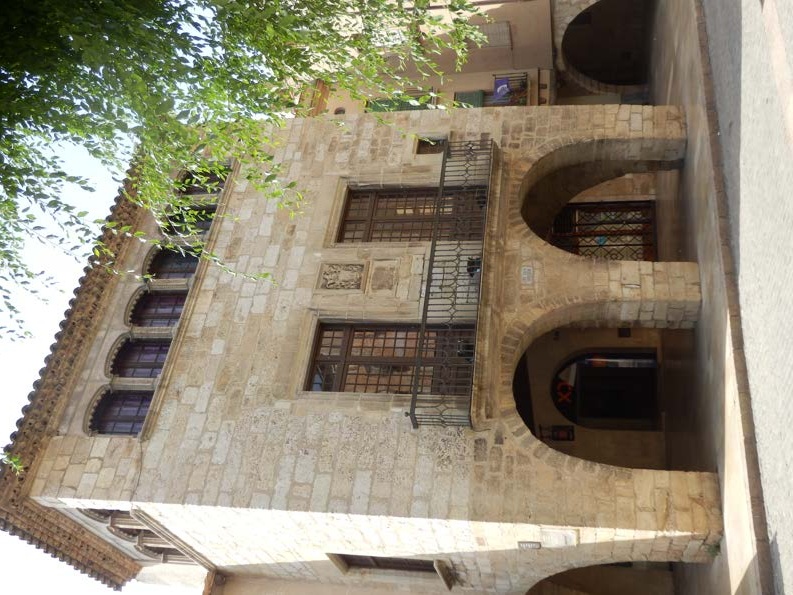
36
CHAPTER 7. ONOMASTICS
Figure 7.6: The house of Desclergue on the Main Square of Montblanc. (2018) (Declercq de Silva Archive) managed to save his Casal from the massive fire of 1652 and other destructions that plagued the city."
José Sánchez Real asserts that those with a deeper historical understanding knew that Francesc Desclergue (DC05e) had likely already died by 1652, having signed his testament in 1646. Consequently, his House was not damaged in 1652, and by that time, the Desclergue family name had vanished from Montblanc. The population decline in Montblanc should not be attributed solely to the events of 1652. The town’s dilapidated state began much earlier. As Sánchez Real notes, in 1585, the traveler Enrique Cock remarked that "... many of their houses are fallen, or they want to fall."
All available data (documents, architectural style, decorative details) indicate that the House built by the Desclergue family in the Plaça Major was originally constructed around 1575, with the coat of arms likely added later during a renovation by Francesc Desclergue (DC05e). This building, albeit modified, has preserved its noble façade. As Sánchez Real states, the Provincial Savings Bank of Tarragona has preserved this structure for the town, and according to current local rumors, it is soon to become the property of the People of Montblanc to be used for official ceremonies.
© 2024 Nico F. Declercq
The Desclergues of la Villa Ducal de Montblanc, 2nd ed., Omn., VOL. I
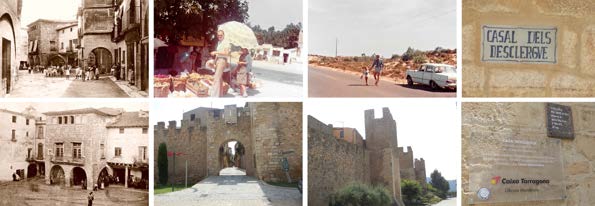
7.5. THE NAME CONNECTED TO THE CASAL DELS DESCLERGUE
37
Figure 7.7: On the left, there are two historical photographs of the House of Desclergue located in the Main Square of Montblanc, provided courtesy of Eduard Contijoch. In the upper central section, a 1978 photograph depicts Maurice A.
Declercq purchasing fruits somewhere in Spain. Adjacent to it is a 1979 image showing Nico F. Declercq and Maurice A.
Declercq, captured at an unspecified location in Spain; the nostalgic Mercedes car used during their summer travels across Spain is also visible. On the right, the ’Casal dels Desclergue’ name sign on the family house in Montblanc is shown (2018).
Below this, there is an informational sign for Montblanc’s Casal dels Desclergue, stating, "Casa Desclergue, Construïda al voltant de 1575 per la Família Desclergue. Benefici amb notables modificacions, del que es conserva la noble façana, ha estat recuperat per a la vila de Montblanc per Caixa Tarragona (Caixa Tarragona Oficina Montblanc)." The two lower central images display the Portal de Sant Antoni and the renowned city walls of Montblanc (2018). (Declercq de Silva Archive) The Desclergues of la Villa Ducal de Montblanc, 2nd ed., Omn., VOL. I
© 2024 Nico F. Declercq
CHAPTER 7. ONOMASTICS
© 2024 Nico F. Declercq
The Desclergues of la Villa Ducal de Montblanc, 2nd ed., Omn., VOL. I
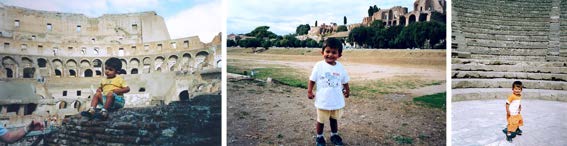
Chapter 8
A Brief History of Flanders and its Iberian
Connections
Etymologically, the terms Flanders (Vlaanderen) and Belgium (België or Belgique) derive from the Germanic word Flaum and the Celtic word Belc’h, meaning wetland and flax, respectively—two characteristics historically associated with the region. European history, often referred to as Cap d’Asie, reveals a continent intertwined by dynasties that facilitated cultural, religious, and commercial exchanges under the Vatican’s aegis. These exchanges frequently involved the movement of individuals through trade, warfare, or strategic marriages, as evidenced by the foreign origins of many family names in Flanders. Historically, the Low Countries, characterized by forests, rivers, lakes, and wetlands, experienced significant demographic shifts due to challenging periods such as the Little Ice Ages, diseases, and invasions. Consequently, it is reasonable to surmise that every individual in Flanders, Belgium, or the Netherlands has at least one ancestor from elsewhere over the past 600 years, and likely 75% to 100% of their ancestors from abroad over the past 2000 years.
Studies have shown that nearly everyone in Europe is, in some way, a descendant of Charlemagne (742 AD - 814 AD). The people of Flanders and Belgium are often humble and sensitive to foreign influences on their Culture and language, which suggests an introverted nationalism. Conversely, extroverted nationalism acknowledges the historical migration of Belgians throughout Europe, contributing to linguistic cross-fertilization. Trade, a pivotal force throughout history, has not only shaped economies but also influenced cultures and languages. For instance, numerous tradespeople from South-West Flanders settled in places like Cadiz in Spain or the Azores, leaving a lasting impact on the local Culture and language. This dynamic interplay between trade, migration, and cultural exchange is a key aspect of the region’s history.
Culture, art, and science have historically flourished in geographical hubs of trade and during periods of economic activity. Examining the historical connections between Belgium and Spain, particularly through trade, would be fascinating but requires an investigation beyond the scope of this work. Thus, this study focuses on dynastic links, guiding the reader through a historical journey to uncover the history of Flanders and Belgium in the context of their association with Iberia. Additionally, aspects of Spain, particularly Catalonia, will be highlighted. While the information presented is neither perfect nor exhaustive, it aims to encourage further reading and deeper exploration of these topics. The historian’s most challenging task is writing about history without judgment and without reference to future events. One can only describe history accurately within its own context, which is not easy. In discussing Catalonia and Flanders, Spain and Belgium, the expectation might be to frame the past within modern history, but that would be misleading. History is immutable, and any current context surrounding the author’s desire to present a historical setting to his ancestry involves the beautiful people of Spain and Belgium, particularly those in Montblanc in Catalonia and Deerlijk in Flanders. The call for further exploration of these historical connections and influences is a testament to the richness and complexity of the subject.
Before the formation of nations, language did not constitute national identity. Many legal entities, such as dukedoms, principalities, counties, and kingdoms, encompassed multiple languages and diverse juridic practices. It is crucial to remind the reader that time and history only make sense when everything is correlated, like a river flowing from source to mouth. Multiple brooks form a stream’s foundation, yet a hierarchy exists. When two rivers merge, the larger one takes precedence, even if the smaller one holds greater economic significance. This principle applies to European history, particularly in the context of Iberia and Flanders.
Hierarchically, a kingdom is the primary entity, and a dukedom joins as a subordinate. The same applies to principalities, which rank higher than dukedoms but lower than kingdoms. Therefore, the dukedom took precedence when the County of Flanders joined the Dukedom of Burgundy. Similarly, when Castile and Burgundy merged, Castile was the primary entity. Thus, sentimentally, we might say Spain was part of Flanders, but traditionally, Flanders was part of Spain, hence the term "Spanish Netherlands" rather than "Flemish Iberia" or "Flemish Spain."
Similar processes have occurred within Iberia’s history. The preceding historical context of this work has undoubtedly influenced our ancestors’ lives, yet we lack records to detail the Greeks, Romans, and preceding great cultures. Consequently, these eras are omitted from this discussion.
Figure 8.1: Benjamin, the author’s eldest son, is pictured at the Colosseum in Rome, September 2001. Following this, there is an image of him at Circus Maximus. On the right, he is seen at Pompeii, also in September 2001. This theatre is considerably smaller than the Hellenistic one in Epidaurus, as described in Chapter 27.20.10. Nonetheless, it is magnificent. Pompeii appears as an abandoned city where time has been frozen since the eruption in 79 AD, as described by Gaius Plinius Caecilius Secundus, known as Pliny the Younger (62-113). (Declercq de Silva Archive) The Desclergues of la Villa Ducal de Montblanc, 2nd ed., Omn., VOL. I
© 2024 Nico F. Declercq
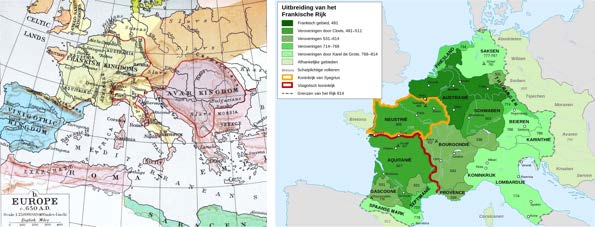
40
CHAPTER 8. A BRIEF HISTORY OF FLANDERS AND ITS IBERIAN CONNECTIONS
Figure 8.2: Left is a map of Europe of 650 p. Right, the expansion of the Frankish empire is shown. (Wikipedia®, GNU
Free Documentation License, version I.J.2.)
8.1 Rethinking the Middle Ages: A Comprehensive Reevaluation
The Middle Ages, a period often shrouded in misconceptions, invites us to revisit its multifaceted reality. It has endured an enduring image of darkness, violence, and primitiveness, largely due to the way historical narratives have been constructed over time. In this article, we embark on a journey to dispel five pervasive myths about the Middle Ages, offering a more nuanced understanding rooted in meticulous historical research. While acknowledging the challenges of the era, we will also shed light on the unexplored positive facets of medieval life.
One enduring stereotype about the Middle Ages portrays it as a time of abject filth and unsanitary conditions. Contrary to this belief, medieval cities possessed rudimentary yet effective sewage systems. Rather than haphazardly discarding waste, people collected it in buckets, which were then emptied into cesspools. While not on par with modern sanitation, this practice attests to a level of hygiene awareness.
The popular notion that medieval life was dominated by incessant violence and torture is far from the truth. Historical records reveal a different reality. The death penalty was a rare occurrence, with torture even rarer. Torture was employed only in cases of extreme significance and when guilt was almost beyond doubt. Instruments designed to minimize physical suffering were used, in consideration of public sentiment.
The Middle Ages are often mischaracterized as a time of misogyny and prudishness, where women had limited rights and influence.
However, a closer examination of history uncovers a more nuanced narrative. Women in medieval society had opportunities to participate in various spheres, including business, culture, and education. Notably, the era acknowledged female sexual pleasure and even provided advice to enhance it, challenging the notion of prudishness.
It is commonly believed that non-binary and intersex identities are recent phenomena, yet they had a place in medieval society.
Grounded in the "theory of humor," medieval thinkers understood that variations in gender and sexuality were natural. This demonstrates a surprising level of comprehension and acceptance of diversity in a supposedly rigid era.
While the Middle Ages are often portrayed as a grim and austere period, they also encompassed elements of romance, including the iconic figures of knights, damsels, and picturesque castles. This romanticized view emerged during the era of industrialization when people yearned for an escape from the rapid transformations of their time. The Middle Ages were a complex epoch that embraced both the positive and challenging aspects of human existence.
The Middle Ages, often viewed through a distorted lens, deserve a comprehensive reappraisal. By challenging conventional wisdom, we have uncovered a more nuanced reality regarding sanitation, violence, gender roles, sexual diversity, and romanticism during this era. This endeavor encourages us to reimagine our medieval predecessors with a greater appreciation for the intricate tapestry of their lives. The understand the Middle ages, the reader should read good books and continue to unravel the intricacies of the Middle Ages, dispelling further misconceptions and explore the captivating truths of this often-misunderstood epoch.
8.2 Francia - The Kingdom of the Franks
Upon the collapse of the Roman Empire, Europe became a mosaic of territories governed by various entities, including the Frankish Empire (Francia) and the Visigothic Kingdom, as depicted in Figure 8.2. This decline should not be misconstrued as a withdrawal of the Romans to Italy; instead, it represented a governmental shift that minimally impacted the general populace. The Visigoths ruled the Iberian Peninsula, encompassing present-day Spain, but this region had a rich and ancient history predating their control.
This history was characterized not by fixed states or countries but by significant settlements, such as those established by the Phoenicians. Tarragona, for example, was a major Roman city from the 2nd century AD, known as Colonia Iulia Urbfdses Tri-umphalis Tarraco, or simply ’Tarraco.’ The name ’Iberia’ is derived from the Ebro River, reflecting the prominence of settlements in the Ebro Valley.
The early history of Catalonia mirrors that of Roussillon in southern France and areas extending eastward to Marseille and Monaco.
Evidence of human presence in Iberia dates back to prehistoric times. From a Catalonian perspective, it could be argued that Spain’s origins lie in Catalonia, though this perspective must be balanced with the distinct histories of other regions. Spain’s complexity is underscored by such areas as Tarraconensis, Cartaginensis, Baetica, Lusitania, and Gallaecia, each with unique historical narratives.
The quest for identity in the modern era is nuanced and multifaceted.
Figure 8.2 illustrates the European continent in 650 AD, showing the established Frankish and Visigothic Kingdoms. At that time, Catalonia and Roussillon were part of the Visigothic Kingdom, which spanned the Iberian Peninsula, except for some northern provinces. The Frankish Kingdom encompassed much of France, Belgium, and parts of present-day Germany. Notably, regions now known as the Netherlands and Belgium were then essentially waterlogged, forested, and sparsely populated.
© 2024 Nico F. Declercq
The Desclergues of la Villa Ducal de Montblanc, 2nd ed., Omn., VOL. I
41
Another map in Figure 8.2 displays the expansion of the Frankish Kingdom up to Charlemagne’s reign (768-814). Under Charlemagne, regions such as Catalonia, Saxony, and Lombardy were incorporated into the Frankish realm. The Francoli River historically marked the border between the Frankish Kingdom and the southern Caliphate of Córdoba.
It is also noteworthy that Metz once served as the capital of Belgium and the eastern Netherlands, falling under Austrasian rule.
Due to its antiquity, the era discussed here holds little significance for our direct ancestry. However, it might explain the migration of Bertrand Du Guesclin’s ancestors to Brittany, as elaborated in Chapter 19.5. While substantial human movement between these territories at that time is not well-documented, the Frankish Kingdom politically connected Montblanc and Deerlijk for the first time since the Roman Empire, with a subsequent connection during the Spanish Habsburg reign, detailed from Chapter 8.5.1 onwards.
Regarding Deerlijk, P. Lansens notes in his book1 that Deerlijk, adjacent to Harelbeke, has been historically referred to as Deerlike, Derlikken, Trellighem, and in a 1120 diploma of ’Karel de Goede,’ as ’Therslinghem.’ Likely named after a Gothic military figure, the first church in Deerlijk was established in 654 AD by Saint Amandus. Lansens also mentions a place of worship in ’Bottenhoek,’
now known as the parish of ’Sint Lodewijk.’ The modern name of Deerlijk’s church is ’Sint Columba,’ named after a Saint from Sens in France, equivalent to ’Coloma’ in Iberia. While the Desclergues family, after arriving in Flanders, might not have influenced the church’s name, the rarity of ’Saint Columba’ suggests a more profound historical significance. Montblanc features a street called Carrer Santa Coloma de Queralt, leading to the village of Santa Coloma de Queralt, named after the same Saint as in Deerlijk.
Santa Coloma de Queralt is discussed in Chapter 29.4, suggesting the Desclergues felt a connection to Deerlijk due to the church’s name. Adjacent to the church, a Saint Columba chapel once housed the ’Retabel van de Heilige Columba,’ commissioned by the de Costere family, who owned the Deerlijk manor until 1628. Historians estimate the retable’s creation around 1535. The chapel’s name, rather than the church’s, likely honored Santa Coloma, which locals used in the 17th century2.
Whether the church was initially named after Saint Amandus or Santa Coloma remains unclear. In 1119, documents referred to it as ’altara de trelleke,’ and the first visual representation dates to 1609, necessitating further research for clarity. Deerlijk’s baptism registers from 1629 mention ’Derlicke anno 1629,’ without referencing Columba, indicating the chapel’s name might not extend to the church. Saint Columba was venerated across Europe, particularly under Frankish ruler Charlemagne, symbolizing the dynasty’s unity. Her life is primarily recorded in Arabic manuscripts, but her worship was widespread in Charlemagne’s territories, including Deerlijk. In La Conca de Barberá, where Montblanc and Santa Coloma de Queralt are located, the Francoli River marked the border between Frankish-Christian and Hispano-Islamic territories. Several villages in this region bear names reminiscent of French towns, reflecting the historical Frankish influence during Charlemagne’s reign and the early West Frankish Empire. Deerlijk and Santa Coloma de Queralt are among the few places in Europe where Saint Columba continues to be revered despite her diminished presence during the Gothic period. Readers interested in Deerlijk’s church will find several intriguing references345678910.
8.3 The Spanish Reconquista
Various scholarly works delve into the intricate conquest of the Iberian Peninsula by the northern states of Spain. This historical period, often referred to as the "Reconquista," hints at a recapture of the peninsula to restore it to a state reminiscent of Visigothic Spain. However, some historians argue that "Conquista" is a more fitting term, as the events had little connection to Visigothic Spain. This epoch is widely regarded as the bedrock of modern Spain, with each region boasting its unique history and timeline of recapture from the Moors. For instance, Catalonia was conquered from the Umayyad Caliphate, a part of Al-Andalus, in 801 AD
after being under Umayyad control since 718. The northern regions of Spain became part of the Marca Hispanica, a buffer zone between the Muslim-ruled part of Spain and the Frankish Kingdom.
In an attempt to erase Arab and Jewish heritage in Spain, a narrative emerged claiming that all noblemen were descended from Visigoths, originating from the very north of Spain, from where the rest of Spain was subsequently reconquered from the Arabs.
However, modern DNA analysis challenges this narrative, revealing a more accurate picture of noble and non-noble lineages in Spain. These lineages are a rich tapestry of Arab, Jewish, and French roots, and in some cases, North-Indian, Byzantine, or Gitano roots. This diversity is not a point of insult but a reflection of the fascinating historical reality of Spain.
Spain’s complexity is not unique. For instance, France is also a diverse country, with regions like Languedoc and Brittany each having distinct histories that do not represent the entire country. Similarly, Wallonia in southern Belgium differs significantly from France despite sharing the French language. The Flemish in northern Belgium have a different mentality from people in Germany, even though both speak a Germanic language. Significant differences also exist between Flanders and the modern Netherlands.
This regional diversity is not limited to Europe. For example, Sri Lanka has experienced a long civil war between the Tamil Tigers in the north and the Sri Lankan state in the south. Although the Tamil Tigers may have identified more with the Tamil population of South India, modern genetic studies reveal that Sri Lankan Tamils are closer to the Sinhalese than to Indian Tamils, except for families that migrated under British rule around 1900 AD. Recognizing and celebrating similarities rather than differences is an enlightening exercise, revealing agreements among regions, peoples, and nations.
Y-DNA analysis has shown that the SRY2627 Haplogroup is most prevalent in the northeast of Spain and is sometimes referred to as "Catalan," although it originates from prehistoric Iberia. Catalans also possess various other Haplogroups. The SRY2627
Haplogroup likely stems from an ancestor who lived in a valley in the southeastern Pyrenees. Like other Spaniards, Catalans have diverse roots, including Celtic (the SRY2627 Haplogroup), Phoenician, Greek, Italian, Visigoth, Berber, among others. Autosomal DNA studies indicate that Catalans have mixed autosomal DNA. After the Reconquista, many Jews and Muslims fled Iberia, while others converted to Christianity and sought mixed marriages for better safety and integration. Sephardic immigrants with North African roots arrived in the Netherlands and other European regions during the Reconquista; thus, their DNA is found in significant portions of these populations. Additionally, historical trade between Spain and other European regions involved merchants who 1P. Lansens, ’Alouden Staet van Vlaenderen, voor en gedurende het leenroerig bestier, gevolgd van eene beknopte etymologische en geschiedkundige beschryving der steden, en van een groot deel der parochien, gelegen in het oud Graefschap van dien naem’ , Bruges, Drukkerij van C. De Moor, Philipstockstraet, 1841
2private communication with historians Filip Benoit and Karl Uyttenhove
3A. Bruggeman, Kerkinterieur, Derlike nummer 2, 1991, p. 44-49; nummer 3, 1992, p. 86-90; nummer 4, 1992, p. 99-102; nummer 1, 1992, p. 16-21
4F. Byttebier, Toren Sint-Columbakerk gerestaureerd, Derlike, nummer 3, 1988, p. 92-94
5H. De Backer, Het Delmotte-orgel van de Sint-Columbakerk te Deerlijk, deel 1, Derlike, nummer 1, 2000, p. 10
6P. Despriet, De Sint-Columbakerk in Deerlijk, Gaverstreke, jaarboek 1977, p. 23-42
7P. Despriet, De Zuidwestvlaamse parochiekerken, deel 1, Kortrijk, 1982, p. 96-104
8Bernadette Roose-Meier en Hugonne Vanderschraegen, Fotorepertorium van het meubilair van de Belgische bedehuizen, Provincie West-Vlaanderen, Kanton Harelbeke, Brussel, 1979, p. 19-23
9P. Roose, Een primeur in Vlaanderen: de restauratie van een Delmotte-orgel uit 1907 in Deerlijk, in Orgelkunst, XXV, 2002, nummer 3, p. 170
10J. Stroobants, De restauratie van het retabel van Deerlijk, in Monumenten en landschappen, 1988, nummers 6/7, p. 33, 34, 38
The Desclergues of la Villa Ducal de Montblanc, 2nd ed., Omn., VOL. I
© 2024 Nico F. Declercq
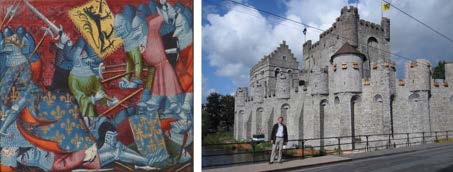
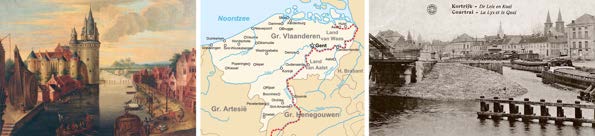
42
CHAPTER 8. A BRIEF HISTORY OF FLANDERS AND ITS IBERIAN CONNECTIONS
Figure 8.3: Left is a miniature from the Grandes Chroniques de France (Paris, BnF, MS
Français 2608, fol 377v). It represents the battle of the golden spurs of 1302. (around 1395)
p. Right is the author in September, 2010. The photo shows Ghent’s famous castle, called
’Gravensteen’ . The first construction dates from the 9th century. Philippe d’ Alsace constructed
the version still seen today, in the 12th century. Lodewijk van Male moved the residence to ’Hof
ten Walle’ which later became ’Prinsenhof’ , where Charles V would be born and where Charles
Philippe de Patin, described in Chapter 70.6 later resided. (Declercq de Silva Archive) Figure 8.4: In the middle, a map of Flanders in the 14th century is shown (by Sir Iain, p). Left, the Burgundian Castle of Kortrijk is depicted, which existed in the period 1394-1684. Members of the de Patin family were involved in financing the project at the beginning. It was destroyed by the French when they had to leave Kortrijk at the end of the Spanish-French conflict. The castle was located on the area from the corner of Heilige Geeststraat and Oude Kasteelstraat, and the corner of Vismarkt and Kasteelkaai, which was on the opposite side of the Leie River of Reepkaai, where the old hospital used to be and where the author’s two eldest children were born p. Right is a view of the location where the Burgundian castle of Kortrijk was located (a row of homes have replaced the fortification) p.
often married and had children in foreign lands. Regions significantly influenced politically or economically by Spain, such as Burgundy, Brittany in France, and the Low Countries, also reflect this genetic diversity.
8.4 The Battle of the Golden Spurs in 1302.
The event in 1302, depicted in Figure 8.3, was not initially considered significant but has been exaggerated since Hendrik Conscience wrote about it in the 19th century. Given that it took place in Kortrijk, the birthplace of Conscience, and where Jeroni Joan Desclergue y Cortés (DC05) would first settle at the end of the 16th century, this event should not be overlooked in Belgian history.
Essentially, the battle was inevitable between those defending the feudal liberties gained by the cities in the County of Flanders and those supporting feudal loyalty to France. In Flanders, linguistic diversity was evident, with French and Flemish spoken in different regions. Territories outside Flanders, such as Zeeland, Brabant, and Namur, were also involved in the conflict and had populations speaking either French or Flemish. Thus, the battle had no basis in linguistic or ethnic divisions, contrary to modern-day populist narratives that frame it as a conflict between Flemish-speaking and French-speaking people, which is unfounded. It is also important to note that a significant part of the County of Flanders is now within modern-day France (since the reign of King Louis XIV).
In that area, Flemish was spoken in the North, and French was spoken in the rest. Speaking French did not equate to loyalty to France, nor did speaking Flemish imply hostility towards France. In feudal Europe, depicted by the castle in Figure 8.3, language was not the primary issue before the formation of modern nation-states. The central question was feudal loyalty: "To which king or count am I loyal?" or "Who do I choose to protect me, and to whom do I pay taxes?" A crucial but often overlooked detail in 20th and 21st-century rhetoric is that the armies of Namur joined the Flemish troops against the French. This truth is usually ignored because Namur is a French-speaking province in Belgium, outside the region now called Flanders, which once included parts of Brabant and Limburg. The Flemish suffered similar defeats in subsequent battles: in 1328 at Cassel and in 1382 at Westrozebeke, when Flanders, then under Burgundian control, faced the combined forces of the Burgundian and French armies against the armies of Ghent. Despite these defeats, the Battle of the Golden Spurs is celebrated as a national day in Flanders. The author’s primary concern is the date of this celebration, July 11. The switch from the Julian Calendar to the Gregorian Calendar in 1582 AD means that, astronomically, the correct date should be July 19. It would be beneficial if more astronomers were involved in politics to address such discrepancies.
8.5 The Burgundian Empire Rise
Most individuals and their histories discussed in this book are in the South of West Flanders, Belgium, as illustrated in Figure 8.4.
To fully appreciate the context, it is imperative to understand the origins of Belgium. Contrary to some misconceptions, Belgium is often mischaracterized as an artificial state established by other nations in 1830, having previously been part of the Netherlands.
© 2024 Nico F. Declercq
The Desclergues of la Villa Ducal de Montblanc, 2nd ed., Omn., VOL. I
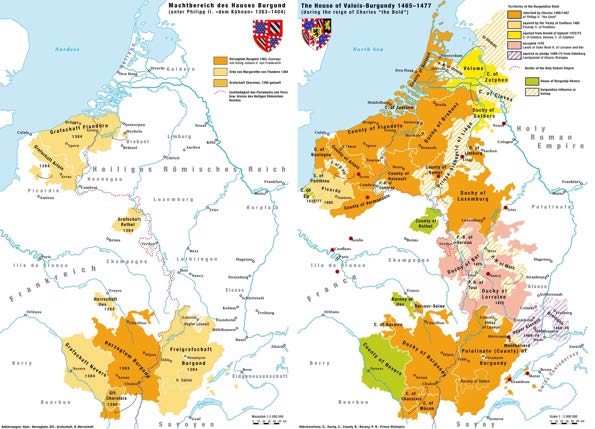
8.5. THE BURGUNDIAN EMPIRE RISE
43
Figure 8.5:
Left is a map of the territories of Philip de Bold who united Burgundy with Flanders (by Marco Zanoli, Wikipedia® Creative Commons Attribution-Share Alike 4.0 International license). Right are the territories of the House of Valois-Burgundy during the reign of Charles the Bold, 1465/67-1477 (by Marco Zanoli, Wikipedia® Creative Commons Attribution-Share Alike 4.0 International license).
While this holds true for the modern state of Belgium, the historical narrative is more complex. For instance, France has undergone five republics since 1792, with the fifth established in 1958; however, this does not imply that France was founded in 1958. The consensus places the founding of France in 843 AD, following the Treaty of Verdun, which divided the Carolingian Empire.
Belgium’s history is not confined to its post-independence era. It was a geographical entity long before it achieved independence, formed by the unification of various subregions under larger political structures. The Belgian identity and the status of Belgians were firmly established before the country’s independence. From the reign of Philip the Good until Charles the Bold, the capital was located on Belgian soil—first in Brussels and later in Mechelen. The Low Countries, before being integrated into the Burgundian regime, were a diverse mix of small counties, duchies, principalities, and other entities, each contributing to the rich tapestry of Belgian history.
The unification of the regions that now form Belgium was not a straightforward process. These regions were not unified by language, race, governance, currency, measurement standards, or laws. However, they shared commonalities in their management of water and their prosperity and appeal for trade, migration, and governance. The Burgundian period saw a gradual unification, which was later disrupted by religious conflicts during the Reformation. This led to a shifting border between predominantly Protestant and Catholic areas. The Catholic region, which changed shape and size during the Spanish era, gradually formed the territory of modern Belgium. This region was internationally recognized by terms such as ’Spanish Netherlands,’ ’Austrian Netherlands,’ ’Belgium,’
’la Belgique,’ and ’Belgien.’ The significance of this region should not be underestimated; for instance, Napoleon’s conflicts with the Austrians were aimed at acquiring Belgium rather than Austria itself. To comprehend the origins of Belgium as a nation, it is essential to examine the Burgundian period briefly.
Many scholarly works have explored the Burgundians, and a particularly engaging recent contribution is Bart van Loo’s book, De Bourgondiërs, aartsvaders van de Lage Landen (2018), published by De Bezige Bij11. This highly recommended work provides valuable insights into the Burgundian influence on the Low Countries.
8.5.1 Filips de Stoute - Philip the Bold - Philippe II le Hardy - Felipe II de Borgoña
Scholars, including Bart Van Loo, regard Philip the Bold as the founder of the Low Countries, and their assertion carries significant merit. While Philip did not achieve the unification of the territory himself, he initiated the process that would later be completed by his descendant, Philip the Good.
In 1356, near Poitiers, a pivotal battle occurred between the French and English armies. At fourteen, Philip the Bold demonstrated remarkable resolve by assisting his father, King John II of France. As a reward for his bravery, Philip was granted the Duchy of Burgundy. During this period, Flanders—which encompasses modern-day East Flanders, West Flanders, Southern Zeeland, and part of Northern France—was likely the wealthiest region in Europe. Through astute political maneuvering, Philip the Bold married Margaret of Flanders in 1369. Margaret, the only child of Lodewijk van Maele, Count of Flanders, brought substantial inheritances to the union. The couple is depicted in Figure 8.7. Upon Lodewijk van Maele’s death, Philip the Bold succeeded him as Count of Flanders, effectively merging Burgundy with Flanders.
Flanders’ political situation was complex due to its allegiance to France while engaging in trade with England and the Iberian 11Bart van Loo, ’De Bourgondiërs, aartsvaders van de Lage Landen,’ published by De Bezige Bij, in 2018
The Desclergues of la Villa Ducal de Montblanc, 2nd ed., Omn., VOL. I
© 2024 Nico F. Declercq
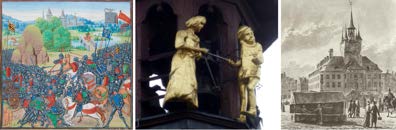
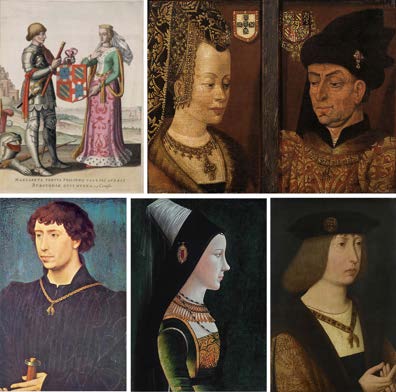
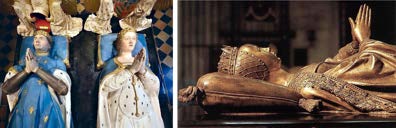
44
CHAPTER 8. A BRIEF HISTORY OF FLANDERS AND ITS IBERIAN CONNECTIONS
Figure 8.6: Left is the Battle of Westrozebeke of 1382 AD, from the chronicle
of Jean Froissart (1405 AD) p. In the middle, we see figures of ’Manten’ and
’Kalle’ in the tower of the cloth hall of Kortrijk, shown right, and built in the 15th
century. Kalle refers to the old name for the river that became Leie. (Declercq de
Silva Archive)
Figure 8.7: Left to right, top to bottom, we see Philip the Bold and Margareta Van
Maele in Flandria Illustrada, 1641; Philip the Good and Isabella of Portugal; Charles
the Bold (Dijon 1433 - Nancy 1477, buried at Bruges); Maria van Bourgondië; and
Felipe I de Castilla, around 1500.p.
Figure 8.8: Left is the tomb of John of Burgundy and Margaret of Bayern found
at Dijon (Musée des beaux-arts) (Declercq de Silva Archive). Right is the grave of
Maria van Bourgondië at Bruges. (Image by ’Napoleon Vier’ , Creative Commons
Atribution - Share Alike 3.0 Unported)
© 2024 Nico F. Declercq
The Desclergues of la Villa Ducal de Montblanc, 2nd ed., Omn., VOL. I
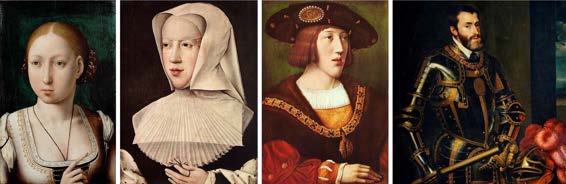
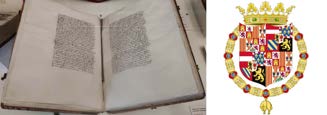
8.5. THE BURGUNDIAN EMPIRE RISE
45
Figure 8.9: From left to right, we see Juana la Loca, ruler of Castilla and Leon, mother of Carlos V and Ferdinand I. She was born in Toledo in 1479 and died in Tordesillas in 1555. She was married to Felipe I de Castilla (Filips de Schone / Philip de Handsome). We then find Margareta of Austria, sister of Philip the Handsome; The young Carlos V; and finally Emperor Carlos V. p
Figure 8.10: The grave of Felipe I and of Juana de Castilla at the
Capilla Real of Granada. (Creative Commons Attribution-Share-Alike
4.0 International Licence, photo taken and shared by Javi Guerra Her-
nando)
states, particularly for importing wool and exporting linen. Philip’s ascendancy as Count gave Flanders a more distinct identity in European commerce and politics.
Lodewijk van Maele’s ancestry was notably international, including figures such as Lodewijk van Nevers, Johanna van Rethel, Robrecht van Vlaanderen, Yolande van Bourgondië, Isabella van Grandpré, Filips van Frankrijk, Otto van Bourgondië, Johanna van Navarra, and Mathilde van Artesië.
While Burgundy remained a separate political entity under Philip the Bold, the duchy faced financial difficulties despite its military stability. To bolster his finances, Philip the Bold played a critical role as regent of France after his brother’s death, granting him access to the French treasury. This financial support facilitated Burgundy and Flanders’ continued growth.
Philip’s control over the French army and Burgundy enabled him to quash a rebellion in Ghent, which had become an independent city-state under Philippe d’Alsace. A significant battle occurred at Westrozebeke in 1382, illustrated in Figure 8.6. As detailed in Chapter 64.6, Emile Lesage was born in recent history. The battle ended disastrously for the Flemish forces and is often viewed as retribution for the French defeat in 1302. Following this, Flanders came under Burgundian control, with Philip the Bold as Count of Flanders.
Notably, the Burgundians took two statues, ’Manten’ and ’Kalle,’ from Kortrijk to Dijon after the battle of Westrozebeke, as shown in Figure 8.6.
Within the Burgundian-Flemish alliance, Flanders was not a nation defined by a common language but rather a geographical region governed by a Count. The name "Flanders" derives from the Latin "Flumen" (river) or the Germanic "Flaum" (wetland), known for its flax cultivation. "Flax" in Celtic is "Belc’h," giving rise to the name "Belgica" or "Belgium." The people of Flanders spoke diverse dialects that evolved into modern Flemish, Dutch, and French, influenced by Scandinavian, Germanic, Celtic, and Indo-European languages. Globalization post-1500 introduced numerous new words.
The alliance between Burgundy and Flanders marked the first step towards establishing the Spanish Road, a crucial land route circumventing France from Spain to Flanders. The subsequent addition of Castile to the coalition would later unite Spain with the Spanish Netherlands.
After the 1382 battle of Westrozebeke, Philip the Bold decided not to retaliate against the people of Ghent. He listened to their grievances and granted them privileges, setting a precedent for diplomatic governance. This foresight benefited his descendants, such as Emperor Charles V, who was born in Ghent and later became King of Castile.
Belgium is renowned for its exquisite cuisine and high-standard restaurants, a legacy of the Burgundians. Philip the Bold’s extravagant banquets, featuring elaborate meals, special effects, and the finest Burgundian wines, showcased Burgundy’s opulence and propagated the image of a realm of unparalleled quality and resources.
Figure 8.11:
Left is the Marital Set-
tlement for the marriage of Joanna of
Castile and Archduke Philippe the Hand-
some. The document of 1493, stored in
the Simancas archive, is exposed at the
Palace of Liria (Courtesy of Palacio de
Liria). Right is the Coat of Arms of
Philip the Handsome in his role as Fe-
lipe I de Castilla (Image drawn by ’Her-
alder’ , licensed under the Creative Com-
mons Attribution-Share-Alike 3.0).
The Desclergues of la Villa Ducal de Montblanc, 2nd ed., Omn., VOL. I
© 2024 Nico F. Declercq
CHAPTER 8. A BRIEF HISTORY OF FLANDERS AND ITS IBERIAN CONNECTIONS
8.5.2 Jan Zonder Vrees - John of Burgundy - Jean sans Peur - Juan I de Borgoña
Jan Zonder Vrees, known as John the Fearless, was a son of Philip the Bold. He married a bride from the House of Bavaria, and their tomb is depicted in Figure 8.8. The House of Bavaria was the ruling family of Holland (now part of the Northern Netherlands), Zeeland (currently just north of the border between Belgium and the Netherlands), and Hainaut (now in Wallonia, Belgium). This marriage thereby facilitated the unification of these territories with Flanders and Burgundy. Johanna van Brabant favored this alliance, preferring the proximity of the Burgundians over the English.
It is crucial to note that the de Patin family resided in Cambrai during this period, as detailed in Chapter 65.2. It was in Cambrai in 1385 that negotiations took place to enable the Burgundians to consolidate the Low Countries12 by incorporating territories such as Limburg. This process would later be fully realized under Philip the Good.
Philip the Bold and Margaret of Flanders, deeply devoted to the Catholic faith, commissioned the construction of numerous exquisite cloisters. Their fervent support for the faith is a testament to their devotion. Burgundy, still celebrated for its architectural masterpieces, such as those in Cluny and Dijon, was a hub of artistic and architectural excellence. Notably, artists and architects from the Burgundian Netherlands, including Ypres, Liège, Brussels, Haarlem, and Nijmegen, were employed to create these wonders.
In 1404, while dining in Brussels with Johanna van Brabant, Jan Zonder Vrees, and Philip the Good, Philip the Bold suddenly fell critically ill and had to be transported to Dijon. Unfortunately, he passed away in Halle, near Brussels, in ’Het Hert’ inn. His remains were then ceremoniously transported from Halle to Dijon.
In the context of the later Spanish Empire, it is noteworthy that when Philip the Good died, the empire encompassed Franche-Comté, Artois, Nevers, Antwerp, and Mechelen. Brabant was integrated into the larger Burgundian cluster through the marriage of Anthony, the brother of Jan Zonder Vrees. During the reign of Philip the Good, the center of power in the united Burgundian empire shifted from Burgundy to Flanders.
8.5.3 Filips de Goede - Philip the Good - Philippe le Bon - Felipe el Bueno
Philip the Good was born during his father Jan Zonder Vrees’ crusade. He is considered the unifier of the Netherlands13. In 1419, Jan Zonder Vrees was assassinated at Yonne. This event severed the ties between Philip and France, as he blamed the French for his father’s death. Subsequently, in 1420, through the Treaty of Troyes, Philip the Good ceded the French crown to England, designating the King of England as the successor to Charles VI of France.
Philip the Good inherited significant territories encompassing much of modern-day Belgium and the Netherlands. However, this did not equate to a unified region; each territory retained its distinct fiscal and legal systems, and Philip held various titles across these regions. True unification only materialized with the formation of nation-states in the 19th and 20th centuries. Nevertheless, Philip endeavored to foster unity by forcefully acquiring Brabant, Henegouwen, and Holland and purchasing Namur.
In 1464, a significant step towards political unity was taken with the establishment of the ’Staten Generaal’ in Bruges’ ’Gotische Zaal.’ This assembly, akin to the ’Las Cortés Catalanas’ in Spain, brought together representatives from different territorial entities.
Philip the Good sought legal unity and a unified tax system. The rationale behind this centralization mirrors the Roman Empire’s establishment, which aimed to simplify governance across numerous separate entities in Europe and the Mediterranean.
Philip the Good fathered numerous illegitimate children and one legitimate son, Charles the Bold, with his third wife, Isabella of Portugal, as shown in Figure 8.7. Exploiting the financial difficulties of various states in the Low Countries, Philip purchased many territories and strategically placed his illegitimate children in positions of power in Utrecht, Cambrai, and Tournai.
Following a series of conflicts with his cousin Jacoba of Bayern, who controlled Holland, Zeeland, and Henegouwen, her death led to Philip inheriting her territories. Through these acquisitions, Philip endeavored to unite the Low Countries by implementing a universal legal system and a common currency. This common currency fostered economic integration, reminiscent of the modern Euro and the Eurozone, and facilitated commercial prosperity, making peaceful unification more feasible.
Philip the Good established the ’Staten Generaal’ as part of his preparations for a crusade against the Muslims who had occupied Constantinople, fulfilling his knightly duty and political responsibilities.
From an intellectual standpoint, Philip the Good is notable for recognizing the importance of knowledge and expertise in governance.
He relied on advisors and established educational institutions such as universities in Burgundy and Leuven. Judges were required to hold diplomas, moving away from the previous practice where noble descent sufficed.
Philip the Good passed away in Bruges at the Prinsenhof in 1467.
8.5.4 Karel de Stoute - Charles the Bold - Charles de Bourgogne / Charles le Hardy - Carlos
el Temerario
Charles the Bold, depicted in Figure 8.7, was the son of Philip the Good. He was present with his father at the time of Philip’s death. Initially, the Low Countries were reluctant to accept Charles as the rightful successor to Philip the Good. However, by the time of Philip’s passing, this issue had been resolved, and Charles had been recognized as the heir. Charles the Bold was pivotal in expanding the Burgundian Empire through military campaigns. The territorial extent of his conquests is illustrated in Figure 8.5.
Although he achieved significant success, his ambitions were ultimately curtailed. Charles met his demise in 1477 at the Battle of Nancy, a considerable defeat that marked the end of his expansionist efforts.
8.5.5 Maria van Bourgondië - Marie de Bourgogne - Mary the Duchess of Burgundy - Maria
de Borgoña
Following the sudden death of her father, Charles the Bold, and being left in command of a debilitated army, Maria of Burgundy, born in Brussels in 1457 and depicted in Figure 8.7, faced a precarious situation. His Majesty King Louis XI of France sought to exploit her vulnerability by seizing several of her territories and attempting to coerce her into a marriage with his son. In response to these pressures, Maria ultimately chose to marry Maximilian of Habsburg, the son of Emperor Frederick III. This union marked the transition of the Burgundian Netherlands into the Habsburg Netherlands, thereby integrating the territory into the expansive Habsburg Empire.
Maria van Bourgondië, who met her untimely demise following a hunting accident in 1482, is interred in the Church of Our Lady 12nowadays Belgium and the Netherlands
13Modern Netherlands, Belgium, Luxembourg, and Flanders in the North of France
© 2024 Nico F. Declercq
The Desclergues of la Villa Ducal de Montblanc, 2nd ed., Omn., VOL. I
8.6. IBERIA AS THE CROWN OF THE WORLD
47
(Onze-Lieve-Vrouwekerk) in Bruges, as illustrated in Figure 8.8. She left behind two children: Margaret of Austria and Philip the Handsome.
8.5.6 Filips de Schone - Philip the Handsome - Philippe le Beau - Felipe el Hermoso / Felipe
I de Castilla
Philip the Handsome, depicted in Figure 8.7, was born in Bruges in 1478 and died in Burgos, Spain, in 1506. He was the son of Maximilian of Austria, a member of the Habsburg dynasty, and Maria of Burgundy. In the context of the 17th-century events that led to the establishment of Saint Louis (Sint Lodewijk) in Deerlijk, as elaborated in Chapters 50 and 34.10, it is crucial to highlight that Philip the Handsome was a grandson of King Louis IX of France, who was canonized by the Pope, likely due to Philip’s influence. This connection to the French Holy King significantly contributed to the early unity of the Low Countries.
Philip played a pivotal role in uniting Spain with Burgundy, including present-day Belgium. The heraldic hierarchy, which ranks kingdoms above duchies, implies that Spain assumed administrative precedence through its union with Burgundy and the Netherlands. For modern observers, it is essential to note that Spain did not conquer Burgundy or the Netherlands but joined through marriage, leading to Spain’s administrative dominance.
At the age of four, following the death of his mother, Maria of Burgundy, in 1482, Philip the Handsome succeeded her as the ruler of the Netherlands and Burgundy. Figure 8.9 shows his sister, Margaret of Austria. Due to Philip’s young age, actual governance was handled by his father, Maximilian. Philip was raised in Mechelen by his grandmother, Margaret of York. He later became the Archduke of Austria by inheritance, but his marriage to a Spanish princess was a strategic choice he made independently.
On October 20, 1496, Philip the Handsome married Juana of Castile in Lier, Belgium. The marriage document is illustrated in Figure 8.11. Juana was the daughter of Ferdinand of Aragon and Isabella I of Castile. Although initially arranged, the marriage reportedly blossomed into genuine affection upon the couple’s first meeting. This union did not immediately unify Spain and Belgium because Juana was not the heir to the throne; her brother Juan of Aragon was the heir until his untimely death in 1497.
This event set the stage for Philip to rule over the Netherlands, Austria, Burgundy, and Spain, among other territories.
Philip became Philip I of Castile following Isabella of Castile’s death in 1504. However, his reign was brief, as he died three months later, with many historians suspecting foul play. His widow, Juana, mourned him deeply, to the extent of sometimes carrying his body with her, earning her the moniker "Juana la Loca" or "Johanna the Mad," depicted in Figure 8.9. Historians suggest her alleged insanity was declared to remove her from political power. The couple had a son, Charles (Karel or Carlos), who would become a more accepted ruler than his father, as discussed in Chapter 8.7.
Philip’s coat of arms, shown in Figure 8.11, is described as follows: El matrimonio de doña Juana con Felipe el Hermoso trajo otro cuartelado más: (..) las mismas que usaron los Reyes Católicos (..) se cuartelaron con las de Felipe: cuartelado de Austria, Borgoña moderno, Borgoña antiguo y Brabante; sobre el todo partido de Flandes y Tirol. Rey ’Jure Uxoris’ de Castilla, Felipe el Hermoso usó sus armas simplificadas, (sin Tirol) fuera de España, solas sin combinarlas con las de Juana.
Despite being considered a foreigner and thus less acceptable for the throne compared to his son Charles, Philip’s lineage included notable figures such as Eleonora of Portugal, Eleonora of Trastámara, Isabella of Portugal, Charles I de Bourbon, and Isabelle de Bourbon. His tomb is depicted in Figure 8.10.
Juana of Castile and Philip the Handsome’s son, Charles (Karel or Carlos), would later become Emperor Charles V, ruling over much of Europe and the world, as detailed in Chapter 8.6.
8.6 Iberia as the Crown of the World
This book does not delve deeply into the global expansions of Spain and Portugal. References to these expansions are scattered throughout the text. Notably, significant descriptions are found in Part XII, which discusses the de Silva family and their arrival in Sri Lanka.
The courage of the Iberians is commendable, especially considering the feats described in Chapter 56.6. Vasco da Gama’s discovery of the sea route to India via Africa in 1497-1498 followed earlier explorations of Africa’s west coast by other brave men. Similarly, Christopher Columbus’ first voyage to the Americas in 1492 marked a pivotal historical moment. These discoveries paved the way for the numerous subsequent endeavors undertaken by the Crowns of Portugal and Castile and by Iberia as a whole in their global expansion.
Shortly after these initial Iberian discoveries, Philip the Handsome married Isabella of Castile in 1496, an event occurring between Columbus’ discovery of America and Vasco da Gama’s route to India. This marriage highlighted the involvement of the Low Countries14 in early Iberian endeavors due to their political alliance with Iberia. In contrast, Aragon and the Italian states focused primarily on Mediterranean affairs. The origins of Christopher Columbus remain a subject of investigation, as shown in Figure
8.12, even in 2023.
For further reading on Spain’s position and global power during the period of the Spanish Netherlands, Robert Goodwin’s work is highly recommended15. Additional information can be found in Chapter 56.6.
8.7 Emperor Charles V and the brotherhood of Spain and Flanders
Karel van Habsburg16, depicted in Figure 8.9, was born in Ghent in 1500. Chapter 25.1.3 reveals that our ancestors lent money to him, which was earned in the Americas. He passed away in Yuste in 1558. In 1556, he abdicated for reasons that remain unclear.
Some attribute his abdication to health issues, while others believe he sought to return to a life of modesty and genuine Christian piety. His abdication ceremony took place at Hof van Brussel17 (the Palace on Koudenberg), where he transferred power to his son, Felipe II of Spain18, and his brother, Ferdinand I19.
After his abdication, Charles Quint chose to reside in the Monastery of Yuste, awaiting his death in humility, simplicity, and devout 14Belgium and the Netherlands
15Robert Goodwin, ’Spain, the Centre of the World 1519-1682,’ Bloomsbury, 2015
16Karel van Habsburg was also known as Charles Quint, Carlos V, H.M. Carlos I of Spain, Duke of Burgundy, Count of Flanders, and Carlos II of Sicily.
17Hof van Brussel has always been associated with Spanish rule in Belgium and was also the name of the Desclergues’ farm in Wielsbeke, reflecting their Spanish heritage, as highlighted in Chapter 43, Chapter 29.5.25, Chapter 33.6, Chapter 38, and Chapter 39.6
18He received Spain, Burgundy, the Netherlands, etc.
19He received the Holy Roman Empire
The Desclergues of la Villa Ducal de Montblanc, 2nd ed., Omn., VOL. I
© 2024 Nico F. Declercq
48
CHAPTER 8. A BRIEF HISTORY OF FLANDERS AND ITS IBERIAN CONNECTIONS
Figure 8.12: ’Virgen de Los Navegantes’
at the Alcazar of Sevilla, depicting Colom
in the front left of the painting, partially
bald and having white remaining hair. p
Figure 8.13: Carlos V and Isabella of Portugal were wed in 1526. Numerous historical
records recount that their union quickly blossomed into a vibrant and passionate relation-
ship following their nuptials, which took place at the Alcázar of Seville. Their honeymoon
was celebrated at the Alhambra in Granada, further solidifying their bond. This mar-
riage was not only a personal union but also a politically strategic alliance, reinforcing the
ties between the Spanish and Portuguese crowns. The Alcázar of Seville, a royal palace
renowned for its Mudejar architecture, and the Alhambra, an iconic example of Moorish
architecture, both were fitting backdrops for the beginning of their storied marriage.p
© 2024 Nico F. Declercq
The Desclergues of la Villa Ducal de Montblanc, 2nd ed., Omn., VOL. I
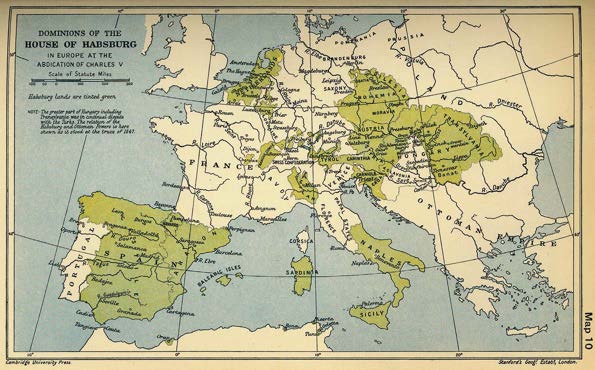
8.7. EMPEROR CHARLES V
49
Figure 8.14: Kortrijk, Onze-Lieve-Vrouwe Kerk. Left to right: Carlos V (Ghent 1500 - Yuste 1558), Felipe II (Valladolid 1527 - Escorial 1598), Felipe IV (Valladolid 1605 - Madrid 1665), Carlos II (Madrid 1661 - Madrid 1700), Felipe V (Versailles 1683 - Madrid 1746). The frescoes depict the rulers of Flanders. (Declercq de Silva Archive)
Figure 8.15: A map of the dominions (in green) of emperor Charles V (1556) (’The Cambridge Modern History Atlas’ edited by Sir Adolphus William Ward, G.W. Prothero, Sir Stanley Mordaunt Leathes, and E.A. Benians. Cambridge University Press; London. 1912) p
The Desclergues of la Villa Ducal de Montblanc, 2nd ed., Omn., VOL. I
© 2024 Nico F. Declercq

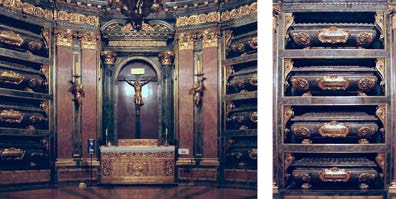
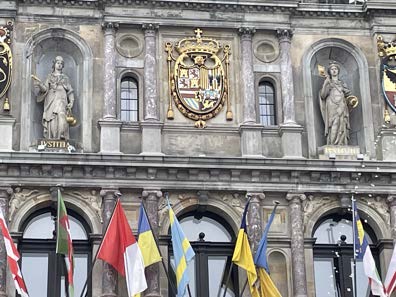
50
CHAPTER 8. A BRIEF HISTORY OF FLANDERS AND ITS IBERIAN CONNECTIONS
Figure 8.16: On October 25, 1555, Emperor Charles V abdicated in Brussels, Belgium.
The Burgundian Netherlands came under the rule of his son Philip II, King of Spain.
This was reported almost immediately throughout the territory, as can be seen from this
note drawn up on October 26, 1555, by the Registrar of the Supreme Court of Namur.
It states: ’Memoire coucher doresnavant es lettres en lieu de l’ empereur nostre sire le
roy nostre sire comme aiant cedé ledit empereur son droit au prouffit dudit roy son filz’
, found in Hooggerechtshof van Namen, nr. 57: Register Transport en Schepenakten,
1555-1556, folio 80 verso.
Figure 8.17: At ’Cripta Real del Monasterio de El Escorial,’ shown left, where the
Spanish Kings, beginning with Charles Quint (Charles V, Carlos I of Spain, Keizer
Karel Heer der Nederlanden), are granted their final resting place, we see, in the
right photo, from top to bottom, the graves of Carlos I (a.k.a. Charles Quint or
Carlos V), Felipe II, Felipe III and Felipe IV of Spain. (Declercq de Silva Archive)
Figure 8.18: The heraldic shield of Felipe II of Spain, whose tomb is shown in
Figure 8.17, in the facade of the Town Hall of Antwerp, 2023. (Declercq de Silva
Archive)
© 2024 Nico F. Declercq