

The Desclergues of la Villa Ducal de Montblanc, Second Edition Omnibus by Nico Declercq - HTML preview
Download the book in PDF, ePub, Kindle for a complete version.
70.4.5 Joseph Jacques Benoît de Patin & Susanne-Charlotte Letten
Joseph Jacques Benoît de Patin (DP12by1y2y1y1) was born in Ypres on August 13, 1764. He was the Lord of Letuwe, an alderman of the hall and castellany of Ypres, mayor of the municipality of Voormezeele, and president of the Royal Administration of the Hospice of Messina. On November 7, 1796, he married in Ypres to Susanne-Charlotte Letten, born in St-Jean on March 20, 1771.
She died in Ypres on February 24, 1829; she was a daughter of Jean-Jacques Letten and Marie-Philippine Ortaert, a native of Nivelles. Joseph Jacques Benoît de Patin died in 1843, in Figure 70.24.
Joseph Jacques Benoît de Patin (DP12by1y2yy) and Susanne-Charlotte Letten had the following children, represented in Figure
70.25: Charles Joseph François de Patin (DP12by1y2y1y1y1), Marie Thérèse Charlotte de Patin (DP12by1y2y1y1x1), Charles Eugène Joseph de Patin (DP12by1y2y1y1y2), Géneviève Antoinette Constance de Patin (DP12by1y2y1y1x2), Thérèse-Joséphine de Patin (DP12by1y2y1y1x3).
70.5 Charles Joseph François de Patin & Lucie Fidèle Thérèse de Hem
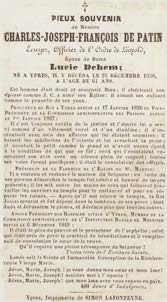
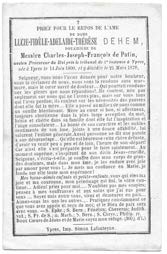
Charles Joseph François de Patin (DP12by1y2y1y1y1) was born in Ypres on June 3, 1797, at the church of St-Martin. He was a Royal Prosecutor at the civil court in Ypres. On October 13, 1825, he married Lucie-Fidèle-Thérèse de Hem, born in Ypres on July 14, 1800, who died at Ypres on March 21, 1878, the daughter of Philippe-Martin de Hem and Josephine Adrienne de Bouck.
Charles Joseph de Patin died in 1858, in Figure 70.28. Lucie Dehem died in 1878, in Figure 70.29.
Charles Joseph François de Patin (DP12by1y2y1y1y1) and Lucie Fidèle Thérèse de Hem had the following children, shown in Figure
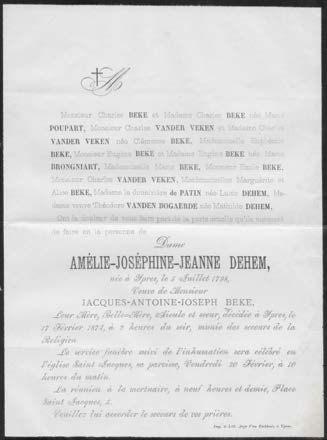
70.27: Aline-Caroline-Joséphine de Patin (DP12by1y2y1y1y1x1), Jules-Philippe de Patin (DP12by1y2y1y1y1y) and Hélène-Emélie-Joséphine de Patin (DP12by1y2y1y1y1x2). Other souvenirs are shown in Figure 70.30.
The Desclergues of la Villa Ducal de Montblanc, 2nd ed., Omn., VOL. VI
© 2024 Nico F. Declercq
1460
CHAPTER 70. THE SIDE-BRANCH OF DE PATIN DE LANGEMARCK
Figure 70.28: The obituary card of Charles Joseph de Patin, husband
of Lucie Dehem, in 1858. (Declercq de Silva Archive)
Figure 70.29:
The obituary card of Lucie Dehem, the widow of
Charles Joseph de Patin, in 1878. (Declercq de Silva Archive)
Figure 70.30: The death announcement
of Amélie Dehem, the wife of Jacques
Beke, in 1874. (Declercq de Silva Archive)
© 2024 Nico F. Declercq
The Desclergues of la Villa Ducal de Montblanc, 2nd ed., Omn., VOL. VI
70.5. CHARLES JOSEPH FRANÇOIS DE PATIN & LUCIE FIDÈLE THÉRÈSE DE HEM
1461
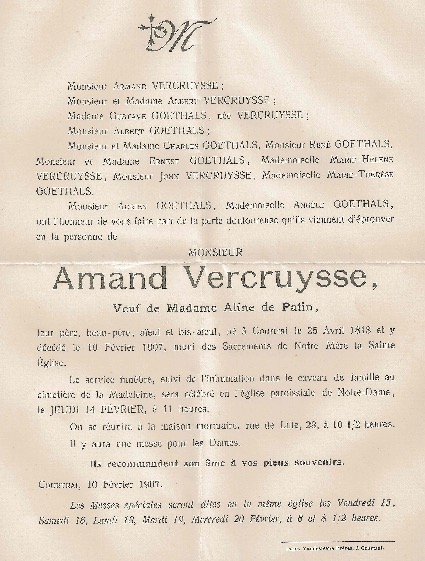
Figure 70.31: The death announcement
of Amand Vercruysse, husband of Aline
de Patin, in 1907. (Declercq de Silva
Archive)
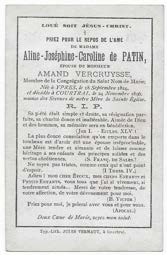
Figure 70.32: The obituary card of Aline de Patin, the wife of Amand
Vercruysse, in 1896. (Declercq de Silva Archive)
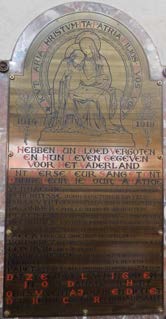
Figure 70.33: A Memorial Plaque in the church of Voormezeele. At
the bottom we can read ’Don de la Douairiere Albert Vercruysse de
Patin en souvenir de son fils John’ . Her name was Marie van der
Straeten. (Declercq de Silva Archive)
The Desclergues of la Villa Ducal de Montblanc, 2nd ed., Omn., VOL. VI
© 2024 Nico F. Declercq
1462
CHAPTER 70. THE SIDE-BRANCH OF DE PATIN DE LANGEMARCK
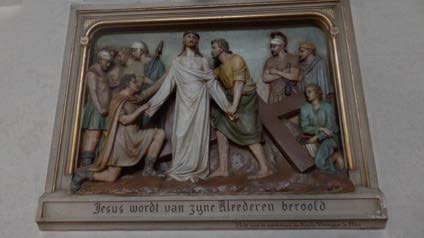
Figure 70.34: A depiction of Jesus, in the church of Voormezeele. At the bottom we
can read ’Bidt voor de overledenen der familie Vercruysse de Patin’ . (Declercq de Silva
Archive)
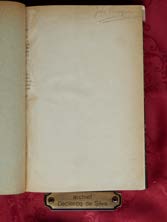
Figure 70.35:
The signature of John Vercruysse in the book
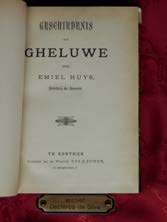
’Geschiedenis van Gheluwe’ , shown below. (Declercq de Silva Archive)
Figure 70.36: The cover page of the book Geschiedenis van Gheluwe
by Emiel Huys, in which John Vercruysse’s signature is written on the
first page, as seen in Figure 70.35. (Declercq de Silva Archive)
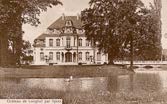
Figure 70.37: The Chateau of Langhof in Ypres was destroyed during
WWI.
© 2024 Nico F. Declercq
The Desclergues of la Villa Ducal de Montblanc, 2nd ed., Omn., VOL. VI
70.5. CHARLES JOSEPH FRANÇOIS DE PATIN & LUCIE FIDÈLE THÉRÈSE DE HEM
1463
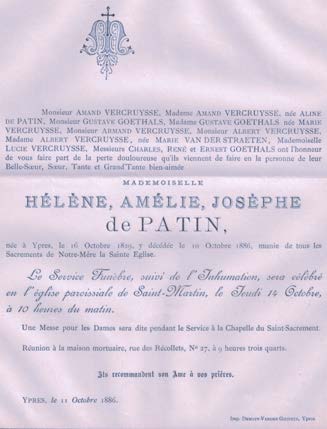
Figure 70.38: The death announcement
of Hélène de Patin in 1886. (Declercq de
Silva Archive)
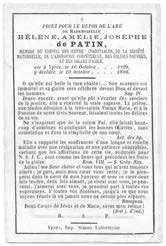
Figure 70.39: The obituary card of Hélène de Patin in 1886. (De-
clercq de Silva Archive)
Figure 70.40: The matriculation record
of Joseph Jacques Benedict de Patin in the
year 1785, on October 21, at the Catholic
University of Leuven.
The Desclergues of la Villa Ducal de Montblanc, 2nd ed., Omn., VOL. VI
© 2024 Nico F. Declercq
CHAPTER 70. THE SIDE-BRANCH OF DE PATIN DE LANGEMARCK
70.5.1 Aline Caroline Joséphine de Patin
Aline Caroline Joséphine de Patin (DP12by1y2y1y1y1x1) was born in Ypres on September 28, 1824, and married Amand Vercruysse of Kortrijk on May 6, 1846. She died in Kortrijk on November 24, 1896, in Figure 70.32. Amand Vercruysse was born in Kortrijk in 1818 and died in Kortrijk in 1907. His father was Henricus Vercruysse (1789-1857), and his mother was Maria Joanna Bruneel (1789-1853).
Amand Vercruysse and Aline Caroline Joséphine de Patin (DP12by1y2y1y1y1x1) had a son, Albert Raphael Vercruysse, born in Kortrijk in 1851, who died in 1923. He married Lucie Charlotte Marie Van der Straeten in 1886, who was born in Brussels in 1862
and died in Foy-Notre-Dame in 1931. They had one son, John Vercruysse, born in 1891 and killed at the beginning of WWI in Pervijze in 1914. He was a law student in Leuven when the war began. His full name was John Pierre Henri Marie Ghislain; he was soldier 2 kl mil 1913, 24 Linie 2/1 (5 Cie - E.M.) and died on October 22, 1914. His place of birth was Minister Tacklaan 5
at Kortrijk.
Amand Vercruysse (1818-1907), whose death announcement is shown in Figure 70.31, was a son of Henri Vercruysse (1789-1857) and a grandson of Charles Jacques Joseph Vercruysse (1751-1825), who was the son of Jean Antoine Ignace Vercruysse (1720-1795) and Marie Isabelle Claire van de Maele (1709-1772). The latter couple also had a son, François Xavier Vercruysse (1746-1805), whose son was Dominicus Vercruysse (1797-1880), father of Arséne Vercruysse (1823-1882), who was married to Mrs Ellebout.
Other souvenirs are shown in Figures 70.33, 70.34, 70.35 and 70.36.
An interesting topic in the family Vercruysse de Patin framework is that their second residence near Ypres, close to the Zillebeke border, called Chateau de Langhof, formed a dramatic episode in WWI and, after the war, only a surviving tree witnessed the events which took place on this site.
Langhof Castle, shown in Figure 70.37, was located along the Rijselseweg, across the Ypres-Komen canal in the direction of Ypres.
The castle was also called de Patin or Vercruysse’s castle. From 1800 onward, it was the second residence of the de Patin family, which passed on to the Vercruysse family from Kortrijk by inheritance. The castle was destroyed in WWI.
When banker Destamaudt died in 1725, the mansion was occupied by Count François Mombrey, who died in 1712 and was succeeded by Count Charles de Patin, who died in 1763. Later, the mansion was rebuilt and inhabited by the then-Mayor of Vormezeele, Joseph Jacques Benedict de Patin.
Unfortunately, he converted the estate into a castle and was located on the front line during the First World War. It was safe for three years and in British hands until the Germans moved further south of the frontline and destroyed it at the end of the war.
The castle was destroyed, but the British shelters survived. The farm which belonged to the court was rebuilt after the war.
The last owner was Albert Vercruysse de Patin, born in 1851 and died in 1923. He and his wife, Marie van der Straeten, used the castle as a summer residence. Their son was John Vercruysse, who died as a soldier during WWI.
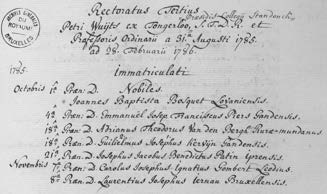
More information about Joseph Jacques Benedict de patin (1764-1843) can be found in Dierickx Visschers1. We found an subscription of Joseph Jacques Benedict de Patin at the Catholic University of Leuven in 1785 in Figure 70.40 on page 1463.
70.5.2 Jules Philippe de Patin
Jules Philippe de Patin (DP12by1y2y1y1y1y) was born in Ypres on February 3, 1827, and died in Ypres on August 8, 1839.
70.5.3 Hélène Emélie Joséphine de Patin
Hélène Emélie Joséphine de Patin (DP12by1y2y1y1y1x2) was born at Ypres on October 16, 1829. She died at Ypres on October 10, 1886, in Figures 70.38 and 70.39.
70.6 Charles Philippe de Patin & Thérèse Waltrude du Bois
70.6.1 Introduction
The author has Charles Philippe de Patin’s great-grandparents in common, as explained in Chapter 70. Furthermore, his grandparents, Philippe de Patin, and Anne Thérèse Vermeersch, were both siblings of Adrienne de Patin and Marinus Vermeersch, the author’s ancestors.
Charles Philippe de Patin (DP12by1y1) was the son of Pierre de Patin (DP12by1) and Catherine Thérèse de Smet. He was born in Ypres on April 19, 1687. He received a noble title from Emperor Charles VI, introduced in Chapter 8.17.1, on December 5, 1735, and became Viscount de Pattyn or de Patin. He was the Lord of Ter Beke, Burghcoutere, and Langemarck. In 1721 he was regent-raadsheer of den Hoogen Raad van Mechelen.
In 1729, he was a counselor for the secret Imperial Council. In 1733, he was Regent of the Hoogen Raad der Nederlanden (The Council of Flanders) at Vienna.
He married Trees-Waltrudis van de Bossche, the daughter of François du Bois and Catherine De Vos, on April 10, 1715, at Ghent.
He often stayed at his home, Ter Beke, in Geluwe, in 1766, where he appeared to have signed several documents.
He died in Ghent on July 17, 1773, and was buried at Langemarck. Charles-Philippe de Patin (DP12by1y1) and Thérèse Waltrude du Bois had nine children: Sabine de Patin (DP12by1y1x1), Caroline de Patin (DP12by1y1x2), François-Guillaume de Patin (DP12by1y1y1), Jean-Baptiste-Benedict de Patin (DP12by1y1y2), Léopold-Joseph de Patin (DP12by1y1y2), Thérèse-Catherine de Patin (DP12by1y1x3), Jeanne de Patin (DP12by1y1x4), Joséphine de Patin (DP12by1y1x6), Marie-Louise-Bernardine de Patin (DP12by1y1x5).
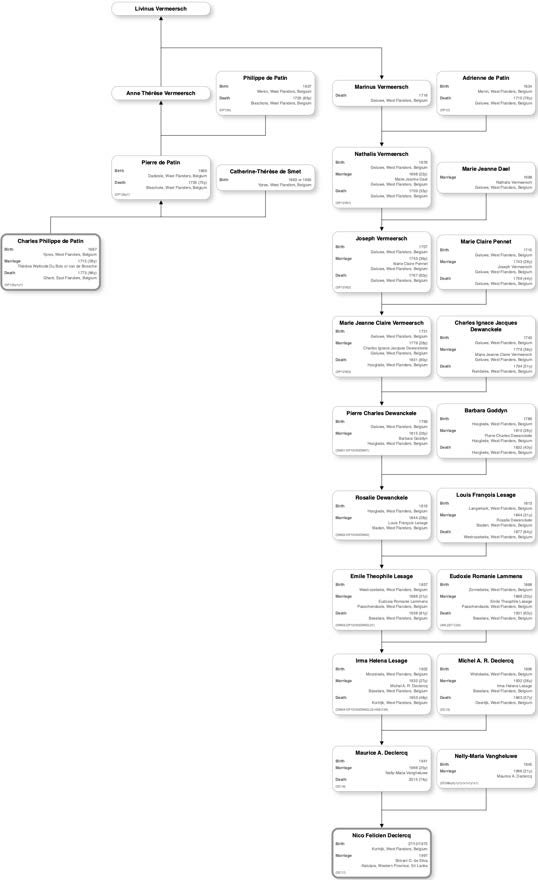
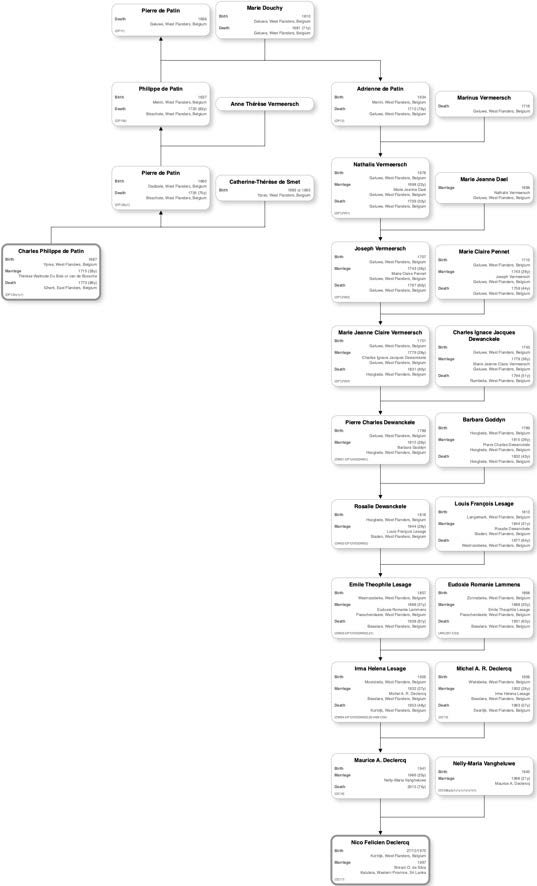
The blood relationship between the author and Charles Philippe de Patin (DP12by1y1) is shown in Figures 70.41 and 70.42. Figure
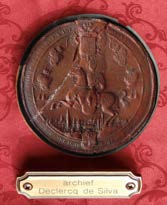
70.43 gives a souvenir of the concerned period.
Charles Philippe de Patin (Ypres, April 19, 1687 – Ghent, July 17, 1773) was a Flemish writer, a poet, a magistrate, and a legal and fiscal expert. He is well known for his work ’Mare Liberum ex jure naturae, gentium & civili assertum, vindicatum, redevivum’
1F. Dierickx Visschers, De liberale adel in de provincie WestVlaanderen 18301914, Ghent, R.U.G., onuitgegeven lic.verhandeling (sectie geschiedenis), 1981, p. 201.
© 2024 Nico F. Declercq
The Desclergues of la Villa Ducal de Montblanc, 2nd ed., Omn., VOL. VI
70.6. CHARLES PHILIPPE DE PATIN & THÉRÈSE WALTRUDE DU BOIS
1465
Figure 70.41: Relationship Chart of Charles Philippe de Patin (DP12by1y1) and Nico Felicien Declercq (DC17), connection 1.
The Desclergues of la Villa Ducal de Montblanc, 2nd ed., Omn., VOL. VI
© 2024 Nico F. Declercq
1466
CHAPTER 70. THE SIDE-BRANCH OF DE PATIN DE LANGEMARCK
Figure 70.42: Relationship Chart of Charles Philippe de Patin (DP12by1y1) and Nico Felicien Declercq (DC17), connection 2.
© 2024 Nico F. Declercq
The Desclergues of la Villa Ducal de Montblanc, 2nd ed., Omn., VOL. VI
70.6. CHARLES PHILIPPE DE PATIN & THÉRÈSE WALTRUDE DU BOIS
1467
Figure 70.43: A wax print of a seal from the Belgian Austrian period.
(Declercq de Silva Archive)
(1726) and his prominent role as a statesman in Austrian Belgium2 during the age of enlightenment,3 and his Presidency of the Council of Flanders from 1742 until his death.
The family name ’de Patin’ 45 was consistently used late in the life of Charles Philippe de Patin and was also used by all his descendants. The French version ’de Patin’ originates from the knowledge that a genealogical survey, when he received the title
’viscount,’ revealed that the oldest known ancestors were from Cambrai in France and spelled their name as ’Patin.’
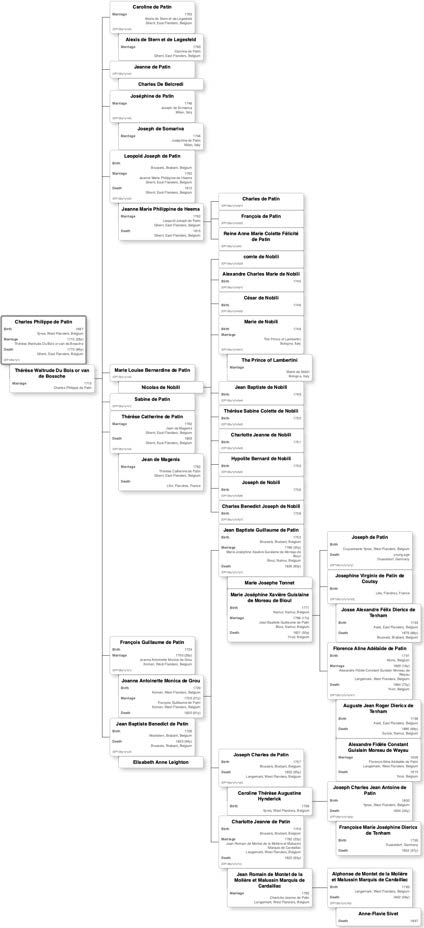
Pseudonyms are Charles Philippe burghgrave de Patin6, Charles Philippe de Patin7, Carolus Philippus Pattyn Iprensis8, Patin van Ieper9, Charles Philippe de Pattyn10, Karel Filips Pattijn 11, M. Pattyn12, or his birth name Carolus Philippus de Patin. The descendants of Charles Philippe de Patin (DP12by1y1) are shown in Figure 70.44.
70.6.2 Parents and Ancestors
Charles Philippe de Patin descends from an ancient noble family13 1415 described by G. Van Hoorebeke as ’noble of race,’ 1617 with early roots in France at the castle of Selles at Cambrai in the 13th century.
The name de Patin would also be used in more recent times by descendants in maternal line combined with a word from a paternal line, such as Cotteau de Patin, Struye de Patin, Vercruysse de Patin, etc. and when explicitly referring to family members who lived at Langemark, the expression de Patin de Langhemarck can be found although in civil records the latter appear simply as de Patin, hence de Langhemarck was not (always) a part of their name. There are no direct descendants in the paternal line, carrying the name de Patin, alive anymore as can be found in several references.1819
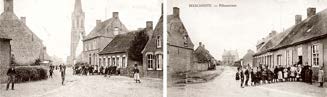
Charles Philippe de Patin’s mother was Catherine Thérèse de Smet (Ypres, 1663).
His father was Pierre de Patin (DP12by1; Dadizele, 1660 - Bikschote 1735), shown in Figure 70.45, who was the Lord of Langemarck, Shaepweide, Ter Beke,20 Burgcautere and Nonneland. At Ypres, Pierre de Patin (DP12by1) had been the Bailiff of the Barony of 2Note that when books, articles or websites are consulted, the territory that is now called Belgium, is called Southern Netherlands, Austrian Netherlands, Austrian Belgium, Austrian Flanders, etc. Here the name Austrian Belgium is used because that is also how Charles Philippe de Patin called his country on the final page of Mare Liberum when he wrote, ’Courage Belges Autrichiens, Courage, Continuez a défendre avec intrépidité vos droits et votre liberté, et tout ensemble la liberté du genre humain.’
3H. Pirenne, Histoire de Belgique des origines a nos jours, Bruxelles, La renaissance du Livre, 1948-1952, deel III, p. 137.
4This is the format that the National Library of Australia used to register de Patin’s book ’Le Commerce maritime fondé sur le droit de la nature & des gens, sur l’ autorité des loix civiles & des traitez de paix & rétabli dans sa liberté naturelle’ on microfilm, Libraries Australia ID 14445900.
5G. Van Hoorebeke, ’ Généalogie de la noble famille de Patin’ , in Annales de l’ Académie d’ archéologie de Belgique, tome X, Anvers, Froment, 1853, 211-234.
6Burgghrave is old Flemish, it means viscount.
7vicomte is viscount in French; Pseudonym list for author Charles Philippe de Patin on the website of the International Standard Name Identifier (ISNI), 000000008094989X
8Official documents during the life of de Patin were written in Latin; Iprensis refers to where Charles Philippe had grown up, namely Ypres.
9van Ieper is Dutch and means from Ypres. Because de Patin was well known during his life, they refer to him in certain documents in a conversational manner.
10This was the format that the National Library of the Netherlands used to register de Patin’s book ’Le Commerce maritime fondé sur le droit de la nature & des gens, sur l’ autorité des loix civiles & des traitez de paix & rétabli dans sa liberté naturelle’ when they shared a digitised version on Google Books® on December 13, 2013.
11Frans Eric René De Pauw, ’ Het Mare Liberum van Grotius en Pattijn’ , Uitgeverij voor rechts- en bestuurswetenschappen Die Keure N.V., Oude Gentweg 104, Brugge, 1960. Note that in this dissertation, the author has systematically translated each person’s name, even when English, Spanish, French, or Austrian, into a Dutch version except for the Dutch ’Hugo de Groot’ whom he calls by his Latinized name ’Grotius.’ For instance, the spelling
’Pattijn’ never occurred in any of the historical references, neither did ’Filips,’ and are hence merely a 20th-century creation by De Pauw.
12Name in Flemish as written by the publisher Vander Elst on de Patin’s book printed in 1727, ’M ’ stands for ’Mister,’ or ’Magister,’ or ’Mesire’;
’Pattyn’ is the most common way this family name is spelled in Flanders by families that are not related to Charles Philippe de Patin.
13R. De Vegiano (seigneur d’ Hovel), Jacques Salomon François Joseph Léon de Herckenrode, ’ Nobiliaire des Pays-Bas et du Comté de Bourgogne: I’
, 1529-1531.
14Louis Charles Comte de la Motte et de Combles Waroquier Sieur de Mericourt, ’ Tableau genealogique, historique, chronologique, heraldique et geographique ..’ , p 104.
15The notation de Patin (sic) can for instance be found in Johan Roelstraste, Wilfried Devoldere, Lucien Alliet editors, ’t Stamboompje, Zuid-en Middenwestvlaams v.v.f. krantje, 25ste jaargang, nr 1, januari 1997, p 39 : De 4 1/2 bunderen te Sint-Baafs-Vijve, article by Egard Seynaeve,
’Denombrementen van Zwevegem ter Kerke’ : (in Dutch) ’Op 23 augustus 1499 werd tav Philips de Berghes, heer van Zwevegem, een denombrement gemaakt door Jan de Patin als kerkelijke voogd van Yzabeele vanden Bussch fa Jans’. This ’Jan de Patin’ is most probably ’Jean de Patin’, who appears in the reference of G. Van Hoorebeke and is the son of Wautier de Patin and grandfather of Michel de Patin who was married in 1500 to Proese Ambrosine vanden Berghe (or ’ de Berghes’ ) from Kortrijk.
16A. Merghelinck wrote about the genealogy study published by G. Van Hoorebeke, that it is ” too often truncated in the first degree thereby hiding additional siblings in the different mentioned generations’ ’, Royal Library at Brussels, handwritings, Merghelinck Foundation, Ypres, nr 412, document 24.
17G. Van Hoorebeke, ’Généalogie de la noble famille de Patin,’ in Annales de l’ Académie d’ archéologie de Belgique, tome X, Anvers, Froment, 1853, 211-234.
18De Ryckman de Betz, ’Armorial général de la Noblesse belge orne des armoiries figures dans les lettres patentes originales’ , Liege, H. Dessain, 1957, p 358.
19Roger Coussé en Martin Boudry, De familie Pattyn of de Patin, Iepers Kwartier, December 1984, p.100; and Annales de l’ Academie d’ Archeologie de Belgique, Tome Quatorzieme, printed by Imprimerie J. E. Buschmann, Rue des Israelites, Anvers, 1857.
20E. Huys, Geschiedenis van Gheluwe, Kortrijk, Drukkerij Vooruitgang, Tweede uitgave, p. 375.
The Desclergues of la Villa Ducal de Montblanc, 2nd ed., Omn., VOL. VI
© 2024 Nico F. Declercq
1468
CHAPTER 70. THE SIDE-BRANCH OF DE PATIN DE LANGEMARCK
Figure 70.44: Three descending generations of Charles Philippe de Patin (DP12by1y1)
© 2024 Nico F. Declercq
The Desclergues of la Villa Ducal de Montblanc, 2nd ed., Omn., VOL. VI
70.6. CHARLES PHILIPPE DE PATIN & THÉRÈSE WALTRUDE DU BOIS
1469
Figure 70.45: A view of the church, and
children of Bikschote.
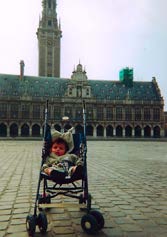
Figure 70.46: The author and his wife married while still a student
on June 6, 1997. When he graduated in July 2000, his firstborn, Ben-
jamin, joined him for the graduation ceremony. The author took this
picture on that day in front of Leuven’s famous library. The author’s
father, who had been somewhat disappointed to see his son marry at
such a young age, was delighted to hear that he had graduated in astro-
physics ’cum laude.’ Later, he would continue on a PhD in Engineering
Physics and succeed ’summa cum laude.’
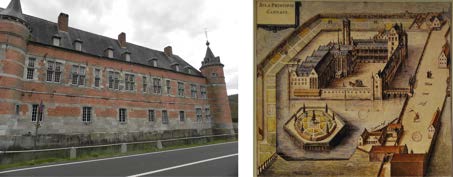
Figure 70.47: Left, 2016 Chateau de Freyr (Declercq de Silva Archive). Right, Ghent, Prin-
senhof in 1641, by Antonius Sanderus.
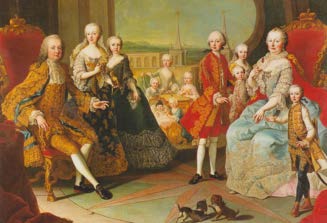
Figure 70.48: Maria Theresia of Aus-
tria.
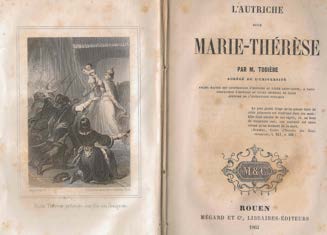
Figure 70.49: Image of Maria Theresia
of Austria trying to convince Hungary not
to separate from her imperium. (Declercq
de Silva Archive)
The Desclergues of la Villa Ducal de Montblanc, 2nd ed., Omn., VOL. VI
© 2024 Nico F. Declercq
1470
CHAPTER 70. THE SIDE-BRANCH OF DE PATIN DE LANGEMARCK
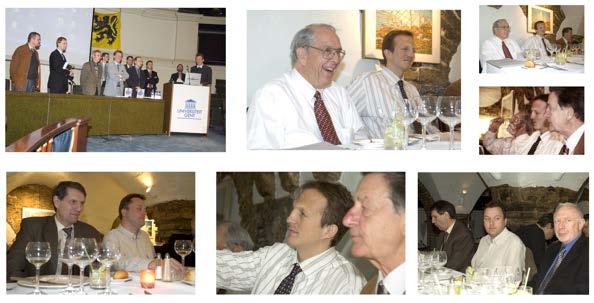
Figure 70.50: The author’s PhD Thesis in 2005 was ’The interaction of complex harmonic elastic waves with periodically corrugated surfaces and with anisotropic viscoelastic and/or piezoelectric layered media’ and had 766 pages. The examination jury consisted of Professors Ronny Verhoeven (chair), Joris Degrieck, Oswald Leroy, Rudy Briers, Mack A. Breazeale (USA), Laszlo Adler (USA), Gennady Shkerdin (Russia), Christ Glorieux, Dick Botteldooren, Roger Van Keer and Wim Van Paepegem (secretary). As a tradition in Belgium, there was first a private defense, followed by a public one. Both events took place in Ghent, on the premises of Ghent University. The international jury offered the Doctor’s degree in Engineering Physics, summa cum laude, and the jury’s congratulations. The author had published, during his PhD, 27 journal papers and had made around 40 regular and invited congress presentations (10 times what was regularly expected in 2005). (Declercq de Silva Archive)
Guysen21 and clerk at Geluwe.22
Furthermore, he had also been a deputy magistrate for the noblemen and vassals at the Chamber and Lordship of Ypres, for which he also served various times as an alderman and representative of the government, in 1699 he had become a council of the city of Ypres and in 1705 he became responsible for distributing bourgeoisie rights for the citizens.23
Charles Philippe’s grandfather was Philippe de Patin (Menin 1637 - 1712) and was married to Anne Vermeersch (1637), while Philippe’s eldest sister Adrienne de Patin (DP12; Menin 1634 – Geluwe 1710) was married to Anne’s brother Marinus Vermeersch.242526
The family of Vermeersch were landowners at Geluwe.27
In contrast, the family of de Patin was wealthy, partially due to possessions inherited by Philippe de Patin’s mother, Marie Douchy (Geluwe 1610 – Geluwe 1681). The latter had inherited possessions from her grandfather’s family de Peutevin.28 De Pauw29 also mentions that the uncle of Charles Philippe de Patin was a brewer at Ypres and that his father, Pierre de Patin, sold goods to the French.
Charles Philippe de Patin (DP12by1y1) had a brother, Charles Joseph de Patin (DP12by1y2; 1691-1762)30, Lord of Nonneland and Letuwe, responsible for forest management in Austrian Belgium. Charles Joseph was first married to Marie Jacqueline de Voldere in 1717, and after her death, he married Genevieve Mombry in 1732.
70.6.3 Early Years and Education
When Charles Philippe was born in 1687, the city of Ypres had been French since the treaty of Nijmegen of September 17, 1678, under Louis XIV. It had been heavily fortified by Sebastien de Vauban.31 Despite growing up in French Ypres, Charles Philippe decided to study at the Catholic University of Leuven, on the Belgian side of the border in the Spanish Netherlands, and not at a French university; this indicates loyalty of the family de Patin to what would later be called Austrian Belgium and was later mentioned in his letter of nobility when awarded the title of Viscount by Emperor Charles VI, introduced in Chapter 8.17.1, Holy Roman Emperor32. The same document also indicates the family’s loyalty to Catholicism during the French wars of religion. Despite a tradition in the Spanish Netherlands to spell his family name as Pattyn or Patyn by registrars, the family would hold on to their 21Tomb stone of Pierre de Patin, quoted by G. Van Hoorebeke, Genealogie de la noble famille Gobert, avec un apendice relative al la famille de Patin, in Annales de l’ Academie d’ archeologie de Belgique, tome X, Anvers, Froment, 1853, 218.
22E. Hellin, Histoire du Conseil Privé, Rijksarchief te Brussel, Conseil privé Autrichien, registre 766, part II, p. 192.
23A. Merghelynck, ’ Cabinet des titres de généalogie et d’ histoire de la West-Flandre et des régions limitrophes’ , Tournai, Vasseur-Delmée, 1896-1897, p 27.
24A. Merghelynck, ’ Cabinet des titres de généalogie et d’ histoire de la West-Flandre et des régions limitrophes’ , Tournai, Vasseur-Delmée, 1896-1897, p 27.
25G. Van Hoorebeke, ’ Généalogie de la noble famille de Patin’ , in Annales de l’ Académie d’ archéologie de Belgique, tome X, Anvers, Froment, 1853, 211-234.
26A. Merghelinck wrote about the genealogy study published by G. Van Hoorebeke, that it is ’too often truncated in the first degree thereby hiding additional siblings in the different mentioned generations,’ Royal Library at Brussels, handwritings, Merghelinck Foundation, Ypres, nr 412, document 24.
27Het familiefonds Maertens de Noorthout (stukken MDN/611en MDN/616 : Stukken inzake een hofstede en gronden te Geluwe).
28The Belgian Archives, inventarisnummer I10063400000956, file about de Peutevin at Geluwe
29see earlier reference to Frans Eric René De Pauw.
30A. Merghelinck wrote about the genealogy study published by G. Van Hoorebeke, that it is’too often truncated in the first degree thereby hiding additional siblings in the different mentioned generations,’ Royal Library at Brussels, handwritings, Merghelinck Foundation, Ypres, nr 412, document 24.
31J. E. Cornillie, Ieper door de eeuwen heen, printed by the city council, 1950, p 245.
32Nobility Letter of Charles Philippe viscount de Patin, December 5, 1735.
© 2024 Nico F. Declercq
The Desclergues of la Villa Ducal de Montblanc, 2nd ed., Omn., VOL. VI
70.6. CHARLES PHILIPPE DE PATIN & THÉRÈSE WALTRUDE DU BOIS
1471
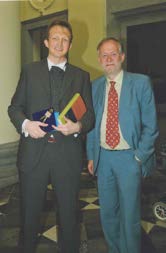
Figure 70.51: The author with the Rector of Ghent University, Prof
Paul Van Cauwenberghe in Ghent, May 12, 2005. (Declercq de Silva
Archive)
French name de Patin.33343536
In 1710, amid the Spanish Succession war, Charles Philippe received a Master’s Degree in Law from the Catholic University of Leuven, then called Studium Generale Lovaniense.37
At the University of Leuven, shown in Figure 70.46, Charles Philippe was fiscus in 1709 and later decanus of the Collegium Baccalaureorum.
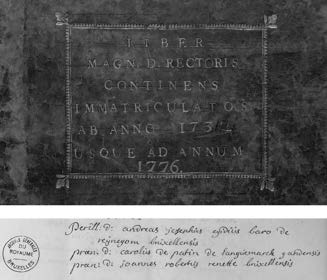
We found a subscription of Charles de Patin de Langemarck from Ghent at the Catholic University of Leuven in 1736 in Figure
70.65 on page 1476. We assume it concerns Charles Philippe de Patin.
70.6.4 Career in Austrian Belgium During the Reign of Charles VI and Before Becoming a
Viscount
Charles Philippe de Patin quickly became a renowned lawyer38 at the end of the Spanish Netherlands period. Austrian Belgium came into being in 1715. On October 12, 1720, de Patin was appointed, being a lawyer, as the counsellor of the Council of Flanders by Prince Eugene de Savoy, who was the governor of the Netherlands (1716-1725).3940
By a decree of April 8, 1721, Charles Philippe received the title of Conseiller et Maitre aux Requêtes ordinaire de notre Grand Conseil.
He took the oath on April 12, 1721, before the Council’s President Christophe Ernest, count of de Baillet41. This was amid the early disputes between Austrian Belgium and the two Naval Powers of Britain and the United Provinces of the Netherlands42 concerning the plans to establish an Indian Company (comparable to the East and West Indian Companies): the Ostend Company in Austrian Belgium, for which Charles VI issued a patent on December 19, 1722.
Soon after, Charles Philippe would write the first version of his book Mare Liberum in 1726. At that time, the Austrian Emperor had not yet employed de Patin. Therefore, according to De Pauw43, his work was written to defend the economic freedom of his country, Austrian Belgium, against the established monopolies of Britain and the Dutch East India, safeguarding the legitimate rights of the Ostend Company.
Nevertheless, newspapers published very positive comments on his work. They encouraged the idea of bestowing de Patin with higher positions in society4445.
Soon, ordered by Charles VI, de Patin was sent to the Congress of Soissons by the Emperor’s sister Maria-Elisabeth46 to negotiate with France, England and the Dutch East India Company about the Ostend Company. De Patin’s French background enabled him to weaken the bonds between France and the other partners in favor of preserving the Ostend Company47.
The Austrians were prepared to give up the Ostend Company in the framework of higher diplomatic goals. They hoped to receive favors from Spain and the negotiating countries at Soissons. De Patin, however, kept defending the Ostend Company and the principles of the free seas as described in his Mare Liberum.
However, he was unable to save the Ostend Company because the Treaty of Vienna of March 16, 1731, involved Charles VI refraining from further attempts to establish an Austrian trade route to India. The Belgian Austrians and Charles VI remembered de Patin’s 33In de Patin’s nobility letter by Charles VI and reconfirmation by Maria Theresa, introduced in Chapter 8.17.2, he is referred to as de Patin, Patin, Pattyn, de Patyn and de Pattyn, which clarifies an ambiguity that also existed during his life.
34Nobility Letter of Charles Philippe viscount de Patin, December 5, 1735.
35On Charles Philippe de Patin’s gravestone, the spelling de Patin was used, which indicated his preference and that of his descendants, related to the knowledge of their French roots.
36G. Van Hoorebeke, ’ Généalogie de la noble famille de Patin’ , in Annales de l’ Académie d’ archéologie de Belgique, tome X, Anvers, Froment, 1853, 211-234.
37Rijksarchief te Brussel, archief van de Leuvense universiteit, nr. 281, Liber computum receptorum universitatis, rekening van receptor Leunckens, van 1 maart 1710 tot 31 augustus 1710 : mentions ’Licentiati juris solvent sex florenses, fuerent 40, valet 240. Nomina 40 : Carolus Philippus Pattyn Iprensis.’
38Notes sur des Presidents et membres du Conseil de Flandre, Koninklijke bibliotheek te Brussel, handschriften, Van den Gheyn, IX, 6126 (16870), tweede levensbeschrijving.
39Lijsten van advokaten postulerende in den Raad van Vlaanderen 1620-1737, Stadsarchief Gent, Archief van de praktizijnen van de Raad van Vlaanderen, 200/1B, 16.
40Rijksarchief te Brussel, Conseil d’ Etat, nr. 654.
41Rijksarchief te Brussel, Archief van de Grote Raad, Partie generale, Registres aux patentes, commissions admissions et serments, nr 4, folio 111.
42P. Geyl, ’ Geschiedenis van de Nederlandse stam’ (herziene uitgave), dbnl, Wereldbibliotheek N. V., Amsterdam/Antwerpen 1948-1959, p. 277.
43see earlier reference to Frans Eric René De Pauw.
44Vandervynckt Pere et Fils (Luc Jean Joseph respectively Emmanuel) calls de Patin’s work ’this was a work that made de Patin very renown,’ Recueil des recherches historiques et chronologiques du Grand Conseil de Malines, 1776, Universiteitsbibliotheek Gent, handschrift G 14231, deel II, p 640; also in Rijksarchief te Brussel, Manuscrits divers, 860 A, p 283.
45Europische Mercurius, p. 251, November 1726.
46Letter of Maria-Elisabeth to Charles VI, Brussels, May 21, 1728, Rijksarchief te Brussel, Secretairerie d’ Etat et de Guerre, nr 915, folio 164-165.
47see earlier reference to Frans Eric René De Pauw.
The Desclergues of la Villa Ducal de Montblanc, 2nd ed., Omn., VOL. VI
© 2024 Nico F. Declercq
1472
CHAPTER 70. THE SIDE-BRANCH OF DE PATIN DE LANGEMARCK
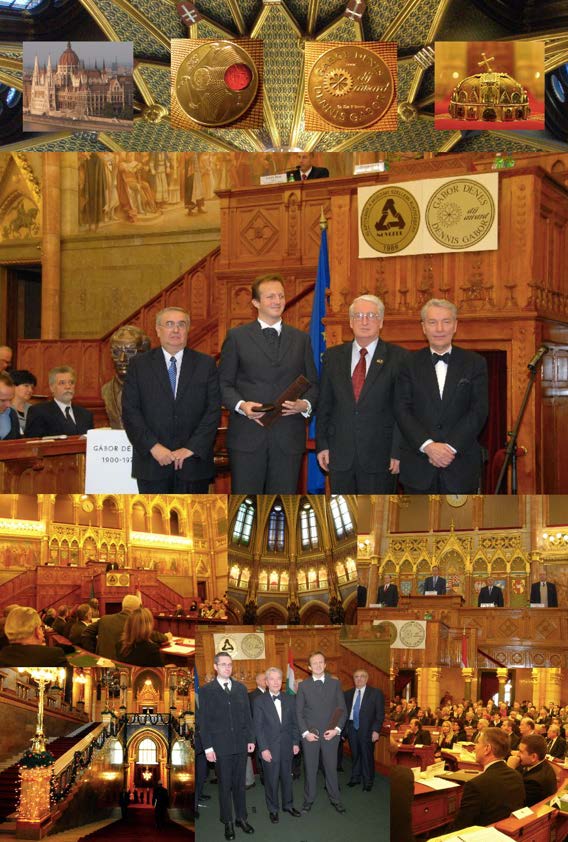
Figure 70.52: Budapest, Hungary, 2006. The author received the International Denis Gabor Award at the Hungarian Parliament. (Declercq de Silva Archive)
© 2024 Nico F. Declercq
The Desclergues of la Villa Ducal de Montblanc, 2nd ed., Omn., VOL. VI
70.6. CHARLES PHILIPPE DE PATIN & THÉRÈSE WALTRUDE DU BOIS
1473
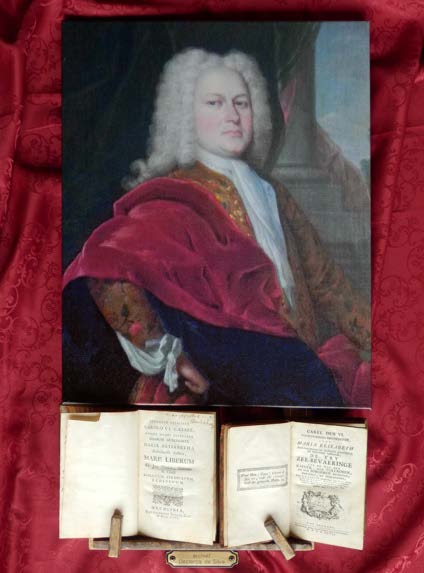
Figure 70.53: Charles Philippe de Patin with two original versions of his book Mare
Liberum. (Declercq de Silva Archive)
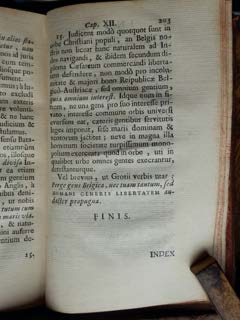
Figure 70.54:
Last page of the Latin version of de
Patin’s book on Mare Liberum.
(Declercq de Silva
Archive)
The Desclergues of la Villa Ducal de Montblanc, 2nd ed., Omn., VOL. VI
© 2024 Nico F. Declercq
1474
CHAPTER 70. THE SIDE-BRANCH OF DE PATIN DE LANGEMARCK
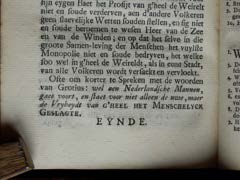
Figure 70.55:
Last page of the Flemish version of
de Patin’s book on Mare Liberum. (Declercq de Silva
Archive)
Figure 70.56: This is a handwritten insert in de Patin’s
Mare Liberum book. (Declercq de Silva Archive). This
handwritten text, by Charles Philippe de Patin, was writ-
ten just after the book was published and before it was
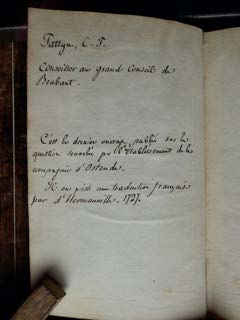
translated into French. It states ’Pattyn, C. P., Con-
seiller au Grand Conseil de Brabant. C’ est le dernier
ouvrage publié sur la question souvelu par l’ établisse-
ment de la Compagnie d’ Ostende. Il (est) en piste un
traduction française par d’ Hermauville. 1727.’ In En-
glish, it means ’Pattyn, C. P., Counsellor, Grand Coun-
cil of Brabant. This is the latest work published on the
subject to be seen by the establishment of the Ostend
Company. A French translation by Hermauville is on
its way. 1727.’
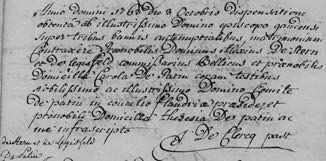
Figure 70.57:
Ghent, Sint Michiels
Church, October 3, 1763, the marriage of
Caroline de Patin (’domicella Carola de
Patin’) and Alexis de Stern et de Leges-
feld. The witnesses were ’Domino Comite
de Patin in concilio flandria praeside’ and
’pronobili domicilla Theresia de Patin.’
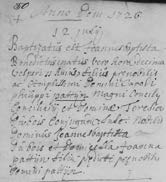
Figure 70.58: Mechelen, Sint Rombouts, July 12, 1726, Mechelen, the
baptism of Jean Baptiste Benedict de Patin, the son of ’prenobilis et
amplissimi domini Carolus Philippus Pattyn magni concily conciliarij’
, and ’domina Teresia Dubois’ . According to the priest, the godparents
were Jean Baptiste Dubois and Jeanne de Patin, who was, according
to the priest, Charles Philippe de Patin’s daughter. The latter is an
interesting person for further historical research. Note that Charles
Philippe was 39 when Jean Baptist Benedict was born in 1726, and he
married Thérèse du Bois in 1715. He was possibly married before. We
also refer to Chapter 70.6.13.5.
© 2024 Nico F. Declercq
The Desclergues of la Villa Ducal de Montblanc, 2nd ed., Omn., VOL. VI
70.6. CHARLES PHILIPPE DE PATIN & THÉRÈSE WALTRUDE DU BOIS
1475
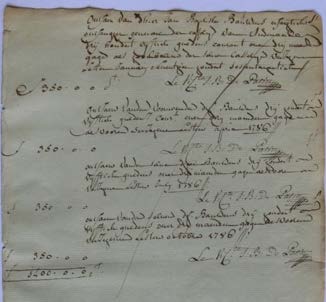
Figure 70.59: 1786 AD, January, April,
July and October, Receipts of Jean Bap-
tiste de Patin, High-Bailiff of the city of
Oudenaarde from 1784 until 1796.a
asource MOU Oudenaarde, object AUT
00310.
Figure 70.60:
Ghent, Sint Michiels-Noord, May 3,
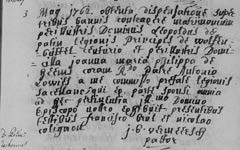
1762, the marriage of Léopold Joseph de Patin and
Joanna Maria Philippa De Heems. The witnesses were
Franciscus Brul and Nicolaus Colignon.
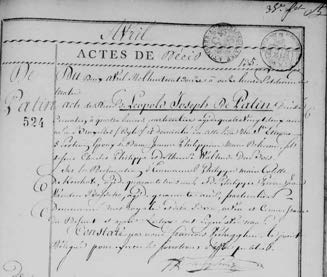
Figure 70.61: Ghent, April 2, 1812, the
death of Leopold Joseph de Patin.
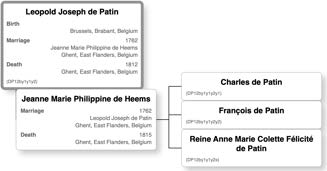
Figure 70.62: Children of Leopold Joseph
de Patin (DP12by1y1y2).
The Desclergues of la Villa Ducal de Montblanc, 2nd ed., Omn., VOL. VI
© 2024 Nico F. Declercq
1476
CHAPTER 70. THE SIDE-BRANCH OF DE PATIN DE LANGEMARCK
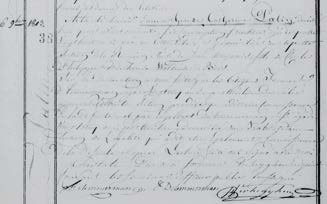
Figure 70.63: Ghent, November 6, 1803,
the death of Thérèse-Catherine de Patin.
Figure
70.64:
Ghent, St Michiels-
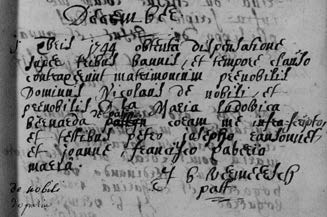
Noord, December 1, 1744, the marriage
of Nicolaus De Nobili and Maria Ludovica
Bernarda De Patin. The witnesses were
Petrus Josephus Ransonnet and Maria
Joanna Francisca Xaveria. The pastor was
Jean Baptiste Vermeersch, possibly a rela-
tive.
Figure 70.65: The matriculation record
of Charles Philippe de Patin in the year
1736, on September 1, at the Catholic Uni-
versity of Leuven. We assume it’s him and
not a relative. The record states Charles de
Patin de Langemarck from Ghent.
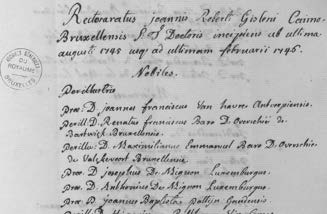
Figure 70.66: The matriculation record
of Jean Baptiste Benedict de Patin in the
year 1745, on August 31, at the Catholic
University of Leuven.
© 2024 Nico F. Declercq
The Desclergues of la Villa Ducal de Montblanc, 2nd ed., Omn., VOL. VI
70.6. CHARLES PHILIPPE DE PATIN & THÉRÈSE WALTRUDE DU BOIS
1477
passionate attempts to save the Ostend Company and nominated him on August 5, 1733, for a position in the High Court48. For this reason, de Patin went to Vienna in the Fall of 1733, leaving his sick wife behind in Austrian Belgium.49
Finally, by Imperial decree of December 5, 1735, at Vienna50, de Patin was ennobled as Viscount because of his values and because of his noble ancestors and their merits dating back to the 13th century.5152
70.6.5 Career as a Viscount in Austrian Belgium during the reign of Charles VI
After receiving the noble title of Viscount, de Patin became Conseiller-Regent (Regent Advisor) in the Supreme Court of Austrian Belgium. The Supreme Court was the authority dealing with the national politics of Austrian Belgium and offered the ability to de Patin to defend the interests of his fellow citizens.53
Charles Philippe de Patin was also a member of a junta at Vienna that, on October 10, 1737, expressed its disapproval of governess Maria-Elisabeth’s plans to install severe censorship on literature in Austrian Belgium.54
Furthermore, against the wishes of Maria-Elisabeth, de Patin advised publishing a decree to limit legal immunity for clergypersons on December 6, 1737.55
Meanwhile, De Patin’s wife, Thérèse Waltrude du Bois, died in Brussels in 1737.
After her death, de Patin remained active and was very concerned about Austrian Belgium’s trade with India and the Ostend Company.56 He was also been approached several times in 1738 by different bankers and by Meijer Zum Goldstein to establish a new company in Hamburg to replace the Ostend Company.57
In a letter to her brother Charles VI on April 9, 1738, Governess Maria-Elisabeth insisted on sending de Patin, because of ’his competence and his gentle and polite manners,’58 to Antwerp where on August 27, 1737, tedious negotiations had begun between representatives of the maritime powers and Charles VI. The purpose was to agree on a new trade treaty planned in article XXVI of the Barrière-Traktaat of 1715. The problem with item XXVI was not that very detrimental tax rates would have to be paid by Austrian Belgium on trade with England and the United Dutch Provinces originating from the English-Batavian occupation until a new one would replace that article, but that England and the United Dutch Provinces continued, for more than 22 years, to delay such negotiations in an attempt to maintain the established tax regime for as long as possible in their favour. De Patin made proposals to England and the United Dutch Provinces founded on reciprocity principles: the free passage of citizens and an equal tax regime for trade in each direction between Austrian Belgium and England and the United Dutch Provinces.
The maritime powers rejected his proposals and claimed that Austrian Belgium was occupied. Despite many attempts by de Patin, a new agreement was not made.59606162
Between 1738 and 1740, an exciting episode in the life of de Patin occurred. After the death of Pierre Van Volden63, a position became available in the Grand Court of Austrian Belgium. Usually, a candidate for that position would be sought in the High Court. De Patin was the favorite candidate, proposed by Count de Fonseca64. However, de Patin was also requested to be in Vienna to serve the Emperor in the High Court, and Governess Maria-Elisabeth did not favor cumulating both positions. Letters being sent back and forth between Maria-Elisabeth and the High Court show how well de Patin was appreciated in Austrian Belgium and
Charles VI had to send four letters to Brussels to remind them to call de Patin back to Vienna.
De Patin, being disappointed by the refusal to let him cumulate both positions, arrived in Vienna 6 days before the death of Charles VI on October 20, 1740.66
De Patin joined the High Court again, and it appears he was the only representative with roots in Austrian Belgium.67
70.6.6 Career in Austrian Belgium during the reign of Maria Theresa
Maria Theresa was born in 1717 and succeeded Charles VI on October 20, 1740, as Queen of Hungary and Bohemia, and Archduchess of Austria, to become tenured Holy Roman Empress consort on September 13, 1745.
Marie Theresia, introduced in Chapter 8.17.2 and shown in Figures 70.48 and 70.49, favored Charles Philippe de Patin very much and offered him, on October 5, 1741, the Presidency of the Council of Flanders.68
48J. Lefevre, ’ Documents sur le personnel supérieur des conseils collatéraux du gouvernement des Pays-Bas pendant le dix-huitième siècle’ , Bruxelles, Commission Royale d’ Histoire, 1941, nr. 97 and nr. 99, p 124-125.
49Stadsarchief te Antwerpen, Insolvente Boedelkamer, De Pret, 1681, ’ J. De Pret aan de Patin, letter of January 15, 1734’ .
50The decree of 1735 was later adjusted by a new decree on October 15, 1755, to define the weapon shield better, and on October 25, 1779, the decree was re-interpreted in favor of all his descendants to carry the title of Viscount. The three diplomas are published in the book by G. Van Hoorebeke. Baron A. de Vinck la Vignette Couthuin owns the original diplomas.
51Rijksarchief te Brussel, Chancellerie autrichienne des Pays-Bas, nr 33, Registro de decretors, despachos y ordenes reales por Flandres, 1732-1733, folio 159: decision of November 16, 1735, to offer the title of Viscount to de Patin, based on the old history of his ancestors and ’como por lo conermiente a sus particulares meritos, contrahidos por espacio de muchos anas en mi cess. Real servicio’ ’.
52Michèle Galand: ’Gages, honneurs, mérites : les hauts fonctionnaires dans les Pays-Bas autrichiens; In: Revue belge de philologie et d’ histoire. Tome 79 fasc. 2, 2001. Histoire medievale, moderne et contemporaine -Middeleeuwse, moderne en hedendaagse geschiedenis. p. 568.
53J. Lefevre, ’ Documents sur le personnel supérieur des conseils collatéraux du gouvernement des Pays-Bas pendant le dix-huitième siècle’ , Bruxelles, Commission Royale d’ Histoire, 1941, nr. 97 and nr. 99, p 9.
54A. Puttemans, ’ La censure dans les Pays-Bas autrichiens’ , Académie royale des Belgique, Classe des lettres et des sciences morales et politiques, mémoires, collection in-8, deuxième série, tome XXXVII, Bruxelles, Palais des Académies 1935, p 45, not 3.
55L. Jadin, ’ Le Cardinal Thomas-Philippe d’ Alsace, archevêque de Malines et le Saint-Siège, correspondance tirée des archives du Vatican 1703-1759’
, Brussels, Rome, 1953 (Bibliothèque de l’ Institut historique belge de Rome, fasc. VI), p. 74.
56M. Huisman, ’ La Belgique commerciale,’ p 509.
57Rijksarchief te Brussel, ’ Chancellerie des Pays-Bas, 643’ and E. Baasch, ’ Hamburg und die Compagnie von Ostend’ , in Zeitschrift für Sozial- und Wirtschaftsgeschichte, V. Band, Weimar, 1897, p 309-319
58see earlier reference to Frans Eric René De Pauw.
59M. Huisman, ’ La Belgique commerciale,’ p 523-524.
60F. Prims, ’ Geschiedenis van Antwerpen’ , IX, 2de boek (24ste boekdeel), p 125-126.
61Haus-, Hof- und Staatsarchiv Wien, Staatskanzlei, Ostindische Compagnie in Ostend, 1726-1772, Raszikel 2, Interuniversitaire commissie voor microfilm, films 12 A, 16, 17, 18.
62Rijksarchief te Brussel, Chancellerie autrichienne des Pays-Bas, nrs 642, 644 & 646.
63Pierre van Volden, from Mechelen, had died on June 9, 1738; he had been subsequently clerk, counselor, and president of the Great Council.
64Marc, Comte de Fonseca, had been an ambassador of Charles VI in Paris.
65see earlier reference to Frans Eric René De Pauw.
66E. Hellin, Histoire du Conseil Privé, Rijksarchief te Brussel, Conseil Privé autrichien, register 766, deel II, p 192-196.
67G. Piot, ’ Le règne de Marie-Thérèse dans les Pays-Bas autrichiens’ , Leuven, Veuve Ch. Fonteyn, 1874, p 16.
68J. Lefevre, ’ Documents concernant le recrutement de la haute magistrature dans les Pays-Bas autrichiens aux dix-huitième siècle’ , Bruxelles, Commission royale d’ histoire, 1939, nr 48, p 64-65.
The Desclergues of la Villa Ducal de Montblanc, 2nd ed., Omn., VOL. VI
© 2024 Nico F. Declercq
CHAPTER 70. THE SIDE-BRANCH OF DE PATIN DE LANGEMARCK
On December 19, 1742, de Patin, a widower since 1737, arrived with his children at Ghent. Maria Theresa had offered him the famous Prinsenhof Palace as an official residence to accept the Presidency. A horse parade and fireworks have celebrated his entry in Ghent.
As a curiosity, we cite exactly what was written:69
’Op den 19en decembre 1742 heeft Mesire Charles Philippe Burghgrave de Patin als President sijnen publicquen intrede ghedaen op den Raedt, de neeringe vande vleeschauwers hem te peered cavalcadensgehwyse gheaccompagneert hebbende als near oude ghewoonte, ende hebben d’ heeren van het Hof ende alle supposten ’s avonts gheviert met illumination, mitsgaeders andere inwoonders der stede ghelijck in diergelijcke occasion altyt is geplogen geworden.’
De Patin took the oath before Count de Silva Tarouca70 and accepted his function as President from Counselor Coppens.71
As President of the Council of Flanders, one of the most important courts of Austrian Belgium, de Patin was a very important magistrate. His position would allow him to play a significant political role in his country, being such a close affiliate and first representative of the Empress. We can cite his responsibility as follows:72
’’Le président du conseil en Flandres non seulement préside a ce corps et en a la direction interne suivant ses instructions, mais il est le chef de la justice et représente immédiatement le souverain par toute la province.’
The war of the Austrian succession (1740-1748), provoked by most of the Powers of Europe and based on the excuse that Maria Theresa, being a woman, was an illegitimate successor of Charles VI, would significantly impact the career of de Patin.
When, in the early morning of June 12, 1745, the armies of French King Louis XV conquered the city of Ghent after an assault between Sint-Pieters-Poort and the Schelde River, the Council of Flanders decided to send de Patin as an emissary to the French King, who was at that moment located at the Castle of Rooborst, to greet the Sovereign. De Patin held a speech for Louis XV, after which the Sovereign decided to preserve and protect the Council of Flanders. De Patin himself, being very loyal to his Empress, requested the French Marquis d’ Argenson73 to explain to Louis XV that,
’he would instead give up his position as President of the Council of Flanders to join his Empress rather than to operate under Louis XV.’
Marquis d’ Argenson told de Patin that Louis XV would probably approve his request to abdicate and that he wished he also had such loyal subjects,74 as follows:75
’La harangue faite, de Patin parla en particulier au Marquis d’ Argenson, qui les avait conduit a l’ audience et lui dit que, plus étroitement lie par les bienfaits et les devoirs des charges dont la Reine de Hongrie l’ avait honore, il demandait au Roi la permission de se retirer pour vivre sous les ordres de la Reine sa Maitresse. Mr. d’ Argenson lui répondit qu’ il en ferait rapport au Roi, mais qu’ il osait lui dire d’ avance que sa Majesté approuverait son zèle, et qu’ elle souhaiterait, que dans ces occasions tous ses sujets lui fussent aussi fidèles.’
De Patin received a passport and permission to depart; he took leave of the Council in an uttermost polite fashion76 and went to Brussels and later Roermond, Aix-la-Chapelle (Aachen) and Vienna77 until the war was over.
Meanwhile, his residence, Prinsenhof, was being used as a military hospital.78
The other members of the Council remained in office during the occupation.79
Meanwhile, de Patin was planning to expand the international trade of his country. De Patin initially proposed constructing a highway between Liege and Germany.80 This plan would later be realized by Marquis de Botta-Adorno.81
After the Treaty of Aix-la-Chapelle of October 18, 1748, Austrian Belgium was governed by a State Council. Charles Philippe de Patin played the most prominent role,82 and he resided at Roermond. The State Council presided until it passed its power to Charles of Lorraine on April 23, 1749.8384
Marquis de Botta-Adorno, a plenipotentiary minister from 1749 until 1753, was well informed about the qualities of de Patin85,
’puisque ce sont autant de bras qui concourent à la perfectionner l’ exécution de ses idées et à conduire les choses au but qu’ on se propose d’ atteindre.’
The era after 1750 was one of peace and prosperity for Austrian Belgium. It was also in that period that the Age of Enlightenment flourished.
Charles Philippe de Patin, trustee of the central authority at Brussels and Vienna and the President of the Council of Flanders, has played an important political role. Maria Theresa trusted de Patin to establish fair trade treaties with the naval powers of Europe.
However, those powers demanded that Austrian Belgium construct a defense line against France to keep itself and the Dutch Provinces protected from further invasions by the French. These constructions would be costly, which would result in high financial pressure on the cities of Austria and Belgium. Triggered by the age of enlightenment, the cities no longer accepted privileges for specific cities in the country’s decision-making process at the expense of the other cities. In contrast, all towns had to share the costs of the country.86
69Rijksarchief te Gent, Raad van Vlaanderen, reeks G. Resolutieboeck 1738-1785, folio 28.
70Rijksarchief te Gent, Varia, II, nr 122, ’ Registre vande patenten ende commissien, beginnende met den VI maerte 1734.’
71Rijksarchief te Gent, Raad van Vlaanderen, reeks G. Resolutieboeck 1738-1785, folio 28.
72Histoire du Conseil de Flandre, Koninklijke Bibliotheek te Brussel, handschriften, Van den Gheyn, IX, 6123 (16864), p 45.
73René Louis, marquis d’ Argenson (1696-1757), member of the State Council (1724), Secretary of State for Foreign Affairs (1744).
74L. Vandervynckt, Recherches chronologiques et historiques sur le Gouvernement General et les Gouverneurs des Pays-Bas, Koninklijke Bibliotheek te Brussel, handschriften, Van den Gheyn, VII, 4883 (16310), p 336.
75H. Pichot, ’ La champagne du Marechal de Saxe dans les Flandres, De Fontenoy (mai 1745) a la prise de Bruxelles (février 1746)’ , Paris, R. Chapelot et Cie, 1909, p 82.
76L. Vandervynckt, ’ Histoire du Conseil de Flandre’ , Universiteitsbibliotheek te Gent, handschrift G14232, deel III, p. 906.
77According to E. Hellin, de Patin stayed at Vienna until the end of the war.
78J. Neve de Mevergnies, ’ Gand sous l’ occupation de Louis XV (1745-1749)’ , in Bulletijn der maatschappij van geschied- en oudheidkunde te Gent, 40ste jaar, 1933, p. 42.
79’Mémoire forme par le vicomte de Patin pour régler les articles d’ un traité a faire avec la France et pour autant qu’ ils concernent les Pays-Bas’ , over grensgeschillen en tariefregeling, Rijksarchief te Brussel, Chancellerie autrichienne des Pays-Bas, nr 652.
80see earlier reference to Frans Eric René De Pauw.
81J. Laenen, ’ Le ministère de Botta-Adorno dans les Pays-Bas autrichiens pendant le règne de Marie-Thérèse, (1749-1753)’ , Anvers, Librairie néerlandaise, 1901, p. 194.
82Imperial decree of October 9, 1748.
83G. De Boom, ’ Les ministres plénipotentiaires dans les Pays-Bas autrichiens principalement Coblenz’ , Koninklijke Belgische Academie, afdeling Letteren, verhandelingen, verzameling 8, boek XXXI, aflevering I, Brussel, M. Lammertin, 1932, p. 49.
84A. Von Arnetii, ’ Geschichte Maria Theresias’ , Wien, W. Braumüller, 1863-1879, deel IV, p. 248.
85J. Laenen, ’ Le ministère de Botta-Adorno dans les Pays-Bas autrichiens pendant le règne de Marie-Thérèse, (1749-1753)’ , Anvers, Librairie néerlandaise, 1901, p. 60.
86P. Lenders, ’ De politieke crisis in Vlaanderen omstreeks het midden der achttiende eeuw, bijdrage tot de geschiedenis der Aufklärung in België’ , Verhandeling van de Koninklijke Vlaamse Academie voor Wetenschappen, Letteren en Schone Kunsten van België, Klasse der Letteren, nr. 25, Brussel,
© 2024 Nico F. Declercq
The Desclergues of la Villa Ducal de Montblanc, 2nd ed., Omn., VOL. VI
70.6. CHARLES PHILIPPE DE PATIN & THÉRÈSE WALTRUDE DU BOIS
1479
Hence, governmental and financial reforms were necessary, starting with better transparency to avoid illicit expenditure,87
’Viscount de Patin, charged in 1765 with the search for the origin of this institution, could go back to a deed from 1367, in which approximately the later form of government could be recognized. From this, de Patin deduced that the establishment of the college probably went back to the first transport of Flanders in 1317.’
It was Charles Philippe Jean viscount de Cobenzl who was in charge of modernisation of the economy and the politics of Austrian Belgium, while continually being advised by Charles Philippe viscount de Patin and Jean Jacques Philippe viscount Vilain XIIII.8889
Proost et al.90, states,
’2 mai 1750 - Sur un avis du vicomte de Patin, chargé de constater l’ état des biens et revenus de l’ abbaye de Terhaeghen, à Gand, à l’ effet de savoir s’ ils sont suffisants pour justifier l’ imposition d’ une pension sur ce monastère (folio 1). 1750-1750 (Les consultes sont adressées à Charles de Lorraine, gouverneur général des Pays-Bas et au marquis de Botta Adorno, ministre plénipo-tentiaire.).’
De Patin, having a similar mindset91 as H.M. King Juan Carlo I and Adolfo Suárez in 1977, wrote to Cobenzl that it made no sense to destroy all the fundamental laws but that it was better to make corrections where needed, avoid any abuse of power or financial means, for every class of society to fully support the implementation of the reforms. De Patin wrote92
’Le grand art et le meilleur moyen est d’ y parvenir sans détruire les lois fondamentales, mais plutôt de les assister, et rectifier pour autant qu’ elles sons défectueuses, en retranchant les abus qu’ on en a fait, afin que le clergé, la noblesse, et la plus saine partie du people embrasse avec plaisir et satisfaction le règlement et le projet a faire entre le gouvernement et les dites châtellenies pour ensuite le faire gouter a un chacun, et avec un concours mutuel l’ exécuter.’
From that time, voting rights in Austrian Belgium were no longer based on historical privileges but preferably commensurate with the importance and financial capacity while the economy was being rationalized.
As an impartial examiner, De Patin oversaw several investigations of financial irregularities within the country.93
De Patin continued to play an essential role in Austrian Belgium94 until blindness prevented further activities in 177195.
On March 25, 1772, Maria Theresa consequently allowed him to retire while retaining all privileges, as the Secret Council, Charles of Lorraine and Chancellor Kaunitz proposed. In her letter, Maria Theresa famously called de Patin her loyal servant, ’ce bon serviteur,’ and exceptionally granted him this favor96 as follows,
’J’ accorde a ce bon serviteur sa jubilarisation comme vous le propose hors que par grâce spécial je veux que par le gestos secretos on lui paie les épices en entier,’
which was the most significant distinction one could be bestowed with upon retirement.97
On July 17, 1773, at the age of 86, de Charles Philippe de Patin passed away at the Prinsenhof in Ghent. He would be buried inside the church of Langemark. Unfortunately, his grave was destroyed during WWI, together with the church, the castle constructed by his descendants, and the entire village of Langemark.
Maria Theresa declared through a decree on October 25, 1779, that de Patin’s descendants were allowed to carry the noble title of Knight and Viscount98 simultaneously. This honor is unique in the history of nobility and nobles’ titles.99100
70.6.7 Official Reports
a) ’Het Verslag de Patin over de financiële en sociaal-economische toestand van onze dorpen in de 2de helft van de achttiende eeuw’
. This report is mentioned in Bibliographie de l’ Histoire de Belgique - Bibliografie van de Geschiedenis van België – 1992, in Revue belge de philologie et d’ histoire, Tome 72 fasc. 2, 1994 : Histoire médiévale, moderne et contemporaine - Middeleeuwse, moderne en hedendaagse geschiedenis. pp. 381-518, p. 441.
70.6.8 Handwritings Lost During the Destruction of Langemark in WWI
a) Apparitio Themidis instruentis juvenem de vita et moribus, de virtute et vitiis et iis demique quae amplectanda sunt, contra, quae fugienda: a collection of 22 editions each dealing with juridical or moral subjects, such as the selection of kings, the education of a prince, religion, progress and heresy, fairness of war and peace, friendship, Venus & Bachus, . . .
b) Carmina miscellanea diversis temporibus ab auctore elaborata partim seria, partim jocose, nunc in unum digesta : a collection of 150 Latin, French and Dutch poems. They are elegies, letters, epigrams, inscriptions, eclogues, songs, colloquies, hymns and odes on the most diverse topics, such as the poor wine harvest of the year 1722, the death of his wife, the war of succession, the muse, the evils of the French conquest, a letter from a father to his son at the University of Leuven, the snow, an invitation to a meal, age, the city of Ypres, a reply from the King of Prussia to Voltaire, a dialogue between body and soul, the book index, ...
c) Een commentaar op de costumen van Ieperen.
paleis der Academiën, 1956, p 37 noot 2, p 38 noot 4.
87Tom Boterbergh, ’Burgers, boeren en soldaten. Militaire lasten in de twee steden en het Land van Aalst 1621-1648’ , Chapter 1, reference 8 states (in Dutch).
88E. Discailles, ’ Les Pays-Bas sous le règne de Marie-Thérèse (1740-1780)’ , Bruxelles et Leipzig, C. Muquardt, 1873, p. 64: ” Vilain XIIII a été dans la Flandre l’ un des instruments les plus actifs de l’ oeuvre de progrès entreprise par le gouvernement de Marie-Thérèse’ ’.
89H, Van Houtte, ’ L’ essor économique de la Belgique sous Marie-Thérèse (1740-1780’ , La revue générale, tome XCII, 1910, p. 707).
90J. Proost, A. Goovaerts, E. De Breyne, M. Soenen : ’Analyses des consultes du Conseil Privé sous le régime autrichien II (1749-1794)’ .
91yendo de la ley a la ley por la ley
92Letter of de Patin to Cobenzl, Gent April 20 1754, Rijksarchief te Brussel, Secrétairerie d’ Etat et de Guerre, nr 1187, page 82.
93J. Lefevre, Conseils Collatéraux, nrs 367, 270 en 271, p 243-246.
94Het Nationaal Biografisch Woordenboek, Deel 1, p743 (in Dutch)
95L. Strobant, ’ Les magistrats du Grand Conseil de Malines’ , in ’Annales de l’ Académie Royale d’ Archéologie de Belgique, 5e série, tome IV, 4e livraison, Anvers, De Backer, 1903, p 93.
96Rijksarchief te Brussel, Chancellerie autrichienne des Pays-Bas, dossier H. 577, bundle 571.
97J. Lefevre, ’ La Haute Magistrature belge dus XVIIe siècle’ , in Revue générale belge, 87e année, octobre 1952, p. 952.
98Tijdschrift Contactblad van de kring voor geschiedenis en kunst van Deinze en de Leiestreek, 27ste jaargang nr 2, april-mei-juni 2007, erkenningsnum-mer P409064, p. 3561.
99C. Carton, F. van de Putte, J. de Mersseman and O. Delepierre, ’ Biographie des hommes remarquables de la Flandre occidentale’ , Bruges, Vandecastele-Werbrouck, 1843-1849, deel IV, p171-182.
100Baron J. Bethune, ’Biographie nationale’ , deel XVI, kol. 692-694.
The Desclergues of la Villa Ducal de Montblanc, 2nd ed., Omn., VOL. VI
© 2024 Nico F. Declercq
CHAPTER 70. THE SIDE-BRANCH OF DE PATIN DE LANGEMARCK
70.6.9 Preserved Handwritings
a) Theresiados: libri novem poema epicum amore, et pietate in agustissimos principes Franciscum Primum Imperatorem et Mariam Theresiam Imperatricem justos, clementes, pios felices, maximos ab autore elaboratum in perpetuam tanti belli memoriam101.
These nine books have poems without the author’s name. However, de Patin’s gravestone indicated that he was the author of the Theresiados102. De Patin has written these poems in exile during the occupation of Ghent by French king Louis XV.
b) Regnante feliciter Carolo VI Caesare neque minus feliciter Belgium gubernante Maria Elisabetha Archiducissa Austriae mare liberum ex Grotio alijsque assertum, vindicatum, redivivum103: this is the first (handwritten and not yet completed) draft of de Patin’s later publication Mare Liberum.
c) A handwritten description in 1727 on the first page of a printed version of his Mare Liberum, in the author’s archive104 and shown in Chapter 70.6.10, Figure 70.56.
70.6.10 Mare Liberum
The author proudly possesses Charles Philippe de Patin’s Mare Liberum, shown in Figures 70.53, 70.54, 70.55 and 70.56.
a) Charles Philippe de Patin (C. P. Pattyn), Mare Liberum, 1726 (in Latin), printed by Mechliniae, typis Laurentii Van der Elst.
Complete title: Regnante feliciter Carolo VI. Caesare, neque minus feliciter Belgium gubernante Maria Elisabetha Archiducissa Austriae, mare liberum ex jure naturae, gentium & civili assertum, vindicatum, redivivum.
This book would appear in 4 editions105. The publication year 1726 is not indicated but appears in an announcement of the book in a newspaper of 1726106107.
b) Charles Philippe de Patin (C. P. Pattyn), De vry zee-bevaeringe, 1726 (Mare Liberum in Dutch), printed by Andreas Wydts standsdrukker inde Breyel-straete, Brugge. Complete title: Carel den VI. Voorspoedigh regnerende, ende Maria Elisabeth Aerts-hertoginne van Oostenrijk geluckighlijk het Nederlandt bestierende, de vry zee-bevaeringe uyt de wet der natuur, der volckeren, en der borgeren bevestigt, herstelt, en herlevende, door C. P. Pattyn raeds-heer van Syne Keyserl. en Cathol. Majesteyts Grooten Raedth tot Mechelen, in het Latijn uyt-gegeven; ende in onse Neder-duydtsche taele overghestelt 108
c) Charles Philippe de Patin (M. Pattyn), Le Commerce Maritime et la liberté naturelle, 1727 (Mare Liberum in French), printed by Laurent Vander Elst, sur la Place, Malines (Mechelen). Complete title : Le Commerce Maritime fondé sur le droit de la nature
& des gens, sur l’ autorité des loix civiles & des traitez de paix, & rétabli dans la liberté naturelle, traduit du Latin de M. Pattyn, augmenté & enrichi des notes de l’ auteur dans cette édition.
d) Charles Philippe de Patin , ’Nieuwjaarsverzen aan Aybert van Huerne de Schievelde, burgemeester van Brugge, met Franse begeleidingsbrief’ ], reprinted in chapter 6 of ’Latijnse poëzie van de 17e en 18e eeuw’ where work is reprinted from Arnoldus Valcke, Franciscus Vanden Heuvel, Jan Vander Meulen, T. L. B. A., Charles Philippe de Patin.
70.6.11 Poem in Honor of Charles Philippe de Patin
This poem (in Dutch) was written by Philippe Jacques de Neckere for de Patin and was later published109 in 1815110. The publication stated:
” Le grand art et le meilleur moyen est d’ y parvenir sans détruire les lois fondamentales, mais plutôt de les assister, et rectifier pour autant qu’ elles sons défectueuses, en retranchant les abus qu’ on en a fait, afin que le clergé, la noblesse, et la plus saine partie du people embrasse avec plaisir et satisfaction le règlement et le projet a faire entre le gouvernement et les dites châtellenies pour ensuite le faire gouter a un chacun, et avec un concours mutuel l’ exécuter’ ’,
and was preceded by the following information ” about the Viscount de Patin (State Council and President of the Council of Flanders), who was the son of Pierre de Patin (the Bailiff of the Baronny of Guysen, or Coutsy, and the Lord of Burgcoutre, dead and buried at Bikschote in 1735)’ ’.
The poem was:
’ ’ Hoe snel, de Patin, verdryven onse jaeren !
Hoe ras draeyt Lachesis ons Levens-garen af!
Men koomt, men groeyt, men bloeyt, men krankt, men kruypt in ’t graf,
Den tyd verdwynt als rook, het leven als de baeren.
De nooyt versoenbre dood, den schrik van alle vleys,
En spaert geen leegen man, en swigt geen hooge koppen,
Maer met gelyken voet het schrik-dier gaet vast kloppen
Aen eene herdershut, en aen een trots paleys.
Wy, die hier onbekend en sonder luyster leven
In een verschove vlek, een onbekende kust,
’ T en sy om dat hier ’t stof van uwen vader rust,
Wy sullen twyffel-vry ’t spook synen tol ook geven
En gy, beroemden Heer, by Vorsten hoog geacht,
101Rijksarchief te Mons, fonds Bonaert.
102C. Carton, F. van de Putte, J. de Mersseman and O. Delepierre, ’ Biographie des hommes remarquables de la Flandre occidentale’ , Bruges, Vandecastele-Werbrouck, 1843-1849, deel IV, p169.
103Koninklijke Bibliotheek te Brussel, handschriften, Van den Gheyn, VII, 4875 (7444), Bib. Lovain. 1781, nr 3465.
104Declercq de Silva Archive
105see earlier reference to Frans Eric René De Pauw.
106Gazette van Antwerpen, Friday July 19, 1726, nr 38.
107Gazette van Antwerpen, Friday, August 23, 1726, nr 68.
108Announcement in Gazette van Antwerpen, December 17, 1726, nr 101: ” Waerschouwinghe, dat by Andreas Wydts boek-drucker tot Bruges gedruckt wort, ende met nieuw-jaar uyt-gegeven sal worden, het boeckxken met titel Carel den VI. . . Uyt-gegeven in het Latyn, ende nu in onse Neder-duytsche taele over-gestelt. Het selve boeckxken sal by de voornaemste boeck-verkoopers van geheel het Neder-land te becomen zyn’ ’ .
109J. Lefevre, Conseils Collatéraux, nrs 367, 270 en 271, p 243-246.
110Letter of de Patin to Cobenzl, Gent April 20 1754, Rijksarchief te Brussel, Secrétairerie d’ Etat et de Guerre, nr 1187, page 82
© 2024 Nico F. Declercq
The Desclergues of la Villa Ducal de Montblanc, 2nd ed., Omn., VOL. VI
70.6. CHARLES PHILIPPE DE PATIN & THÉRÈSE WALTRUDE DU BOIS
1481
Een steunssel van den Staet, en wellust van den menschen,
Gy sult, schoon wy dit vry wel anders souden wenschen,
Ook worden overheard door syn onwimbre kragt
’ T is waer, het aerdsche deel sal sig alleen begeven :
Uwe naems gewag blyft staen soo lang men menschen vind;
En Mnemosyn alree heeft met vergulden int
In haeren temple selve uw hoogen lof geschreven
Dit sal eew voor eew nae, wie naemaels komen sal
Nog lessen met vermaek en met een lief gedenken:
Maer God wille eerst u veel heylvolle jaeren schenken :
Leef lang, o de Patin, tot vreugde van ons al.
70.6.12 Additional works on Charles Philippe de Patin
Besides the numerous works referred to in this book, the reader may also look at the works of Baelde,111 for a concise biography of Charles Philippe de Patin in Dutch.
A biography of Charles Philippe de Patin can equally be read in ’Biographie des Hommes Remarquable de la Flandre Occidentale’
112. A diary of Ferdinand Vander Eecken113 states that ’de Patin was chairing the selection committee as representative of Charles of Lorraine’. A description of the coat of arms of Charles Philippe de Patin and his brother Charles Joseph de Patin (1691-1762) can be found in ’Nobiliaire des Pays-Bas’ 114.
Gérard et al.115 printed the announcement of ennoblement of Charles Philippe de Patin and his brother Charles Joseph de Patin (1691-1762) on the basis of ancient nobility of his ancestors; he equally printed the announcement of the title of Viscount for all descendants of Charles Philippe de Patin. The role of Charles Philippe de Patin in Austrian Belgium is described briefly between 1733 and 1750 by Bernard and Couvreur116.
Vander Straeten states that a tragedy stage performance in 1737 at Geluwe was dedicated to Charles Philippe de Patin117.
Charles Joseph de Patin became a student at the Catholic University of Leuven on September 1, 1713.118
70.6.13 Offspring of Charles Philippe de Patin and Thérèse du Bois
70.6.13.1 Caroline de Patin
Caroline de Patin (DP12by1y1x2) married in Ghent on December 24, 1763, in Figure 70.57 to Alexis de Stern et de Legesfeld, War Commissioner of Her Imperial Highness.
70.6.13.2 Jean Baptiste Benedict de Patin
Jean Baptiste Benedict de Patin (DP12by1y1y3) was born in Mechelen on July 12, 1726, in Figure 70.58. He was advisor and master of the Chamber of Accounts of Her Imperial Majesty in Brussels, then Grand Bailiff of Oudenaarde.
He died in Brussels on January 24, 1820. On May 1, 1777, he married Elisabeth-Anne Leighton, widow of M. Joseph Labina, who died in Brussels without offspring. A souvenir is shown in Figure 70.59.
We found a subscription of Jean Baptiste Benedict de Patin at the Catholic University of Leuven in 1745 in Figure 70.66 on page
70.6.13.3 Léopold Joseph de Patin
Léopold Joseph de Patin (DP12by1y1y2) was born in Brussels. He was a captain in the Wolfenbuttel regiment in the service of His Imperial Majesty in 1762, then became colonel, then deputy mayor of Bruges. He died in Ghent on April 2, 1812, in Figure 70.61.
He married in Ghent on May 3, 1762, in Figure 70.60, to Jeanne Marie Philippine de Heems, who died in Ghent on November 12, 1815, and who was a daughter of Mr Jean-Baptiste de Heems, Bailiff of the city of Ghent, the Lord of Luchteren, Ten Buysere, etc., and Marie Elisabeth de Stappens, his first wife.
The children of Léopold Joseph de Patin (DP12by1y1y2) and Jeanne-Marie-Philippine de Heems, shown in Figure 70.62, are Charles de Patin (DP12by1y1y2y1), François de Patin (DP12by1y1y2y2) and Reine Anne Marie Colette Félicité de Patin (DP12by1y1y2x).
70.6.13.3.1 Charles de Patin Charles de Patin (DP12by1y1y2y1) was a lieutenant in service of the Emperor of Austria in the Murray regiment and was killed in the battle near Arlon during the patriotic revolution.
70.6.13.3.2 François de Patin François de Patin (DP12by1y1y2y2) died at Revel and was captain of a Fregate in service of his Imperial Majesty of Russia.
70.6.13.3.3 Reine Anne Marie Colette Félicité de Patin Reine Anne Marie Colette Félicité de Patin (DP12by1y1y2x) was the countess of Zeveren. She was married to Jean-Guillaume Mawhood, an English captain, and they had children.
111M. Baelde: ’ De Samenstelling van de Hoge Raad der Nederlanden te Wenen (1717-1757), Studia Historica Gandensia, 190, Overdruk uit Album Charles Verlinden, Gent, 1975, p. 7.
112’Biographie des Hommes Remarquable de la Flandre Occidentale, Tome IV’ , Imprimerie de Vandecasteele-Werbrouck, Bruges 1849, p. 163-170.
113The log of Ferdinand Vander Eecken (priest and professor of theology) who was elected abbot at Okegem on May 2, 1754
114’Nobiliaire des Pays-Bas, et du comté de Bourgogne depuis le régne de Philippe le Bon.. jusqu’ a la mort de l’ empereur Charles VI. pc Raportées par ordre chronologique 1686-1762’ , Volume 5, p 277-278.
115Pierre Auguste Florent Gérard, Joseph Ermens, Jean Baptiste Théodore De Jonghe : ’Listes des titres de noblesse, chevalerie, et autres marques d’
honneur accordées par les souverains des Pays-Bas, depuis 1659 jusqu’ à 1794: précédées d’ une notice historique’ Vandale, 1847, p. 194 and p. 244.
116Bruno Bernard, Manuel Couvreur, ’ Bruxellois à Vienne. Viennois à Bruxelles’ , in Problèmes d’ histoire des religions, Volume 32, Editions de l’
Université de Bruxelles, 2004, page 33-34.
117Edmond Vander Straeten, Le Theatre Villageois en Flandre. Tome Deuxieme, Printed by Librairie Alex Tillot et Cie, Bruxelles, 1881, p. 97.
118His record is in the university’s database, but we did not find the original matriculation book of that period.
The Desclergues of la Villa Ducal de Montblanc, 2nd ed., Omn., VOL. VI
© 2024 Nico F. Declercq
CHAPTER 70. THE SIDE-BRANCH OF DE PATIN DE LANGEMARCK
70.6.13.4 Thérèse Catherine de Patin
Thérèse Catherine de Patin (DP12by1y1x3) died in Ghent on November 6, 1803, in Figure 70.63, without any posterity. She had been married in Ghent on October 9, 1762, to Jean de Magenis, knight of the Royal and Military Order of St-Louis, a valiant captain in the Bulkeby regiment in the service of France, and later a colonel in the service of the Austrians, who died at Lille towards the end of the 1700s.
Le Carpentier in his ’Histoire générale des Pays-Bas ou Histoire de Cambrai ou du Cambrésis, II, 861’ describes an interesting episode. . . He has found a birth certificate at Saint Peter’s church in Ghent which reads,
’Joanna-Genoveva f. Nicolai-Garoli La Croix-Le Cocq et Mariae-Genovevae Le Sénéchal conjugum, baptisata est sub conditione 4
januarii 1771, nata heri Vesperi quadrante post Sextam. Susceperunt Franciscus Fayan nomine D Joannis de Magenis, Colonelii in Servitio Regis Gallici, equitis ordinis militaris et regii Sancti Ludovici , et .Joanna Francisca Le Caslez. (Signé) S. Declercq.’
As can be seen in this certificate, it is that of Jeanne-Geneviève La Groix-Le Cocq, daughter of Nicolas-Charles and Marie-Geneviève Le Sénéchal. The latter belongs to the illustrious ’Le Sénéchal de Kerguisé-Kercado’ and, according to Le Carpentier, she must be a daughter of Luc-Julien Le Sénéchal de Kerguisé, the Count of Kerguisé, the Lord of Tredudai, and Lieutenant of the Marshals of France, and Alexandrine-Rosalie Bruc de Montplaisir his first wife.
However, according to information the Marquis de Carcado-Molac of Toulouse has conveyed to Le Carpentier, Marie-Géneviève widow Le Senechal, the married couple’s daughter, just mentioned, died without having been married. But then, Le Carpentier notes that this is impossible because no death certificate authentically states that Marie-Geneviève Le Sénéchal, daughter of Luc-Julien and Alexandrine-Rosalie de Bruc de Montplaisir, died unmarried. And still, in that case, one must question who would be the daughter of the sister of M. Le Senechal de Kerguis de Tretade, lieutenant of the Marshals of France at Vanne.
Indeed, according to Le Carpentier, a letter emanating from this statesman proves, with more or less certainty, that his consan-guineous sister, probably when she was almost at the end of her pregnancy, must have written to her to receive the number of her annuities. The concerned letter is signed ’Your elder brother The Seneschal Kerguis de Tretade, lieutenant of our lords the marshals of France in Vanne, (sic).’
It is dated January 19, 1771, and was written to Marie-Geneviève Le Sénéchal. Le Carpentier believes that it makes sense to assume that Marie-Geneviève Le Sénéchal is very much the daughter of Luc-Julien and Alexandrine-Rosalie of Bruc de Montplaisir.
Therefore, Le Carpentier is convinced that it is a mistake or ignorance that the genealogical tables of this illustrious house carry her as ’dead without having allied.’
The death certificate, recorded in the registers of the same church of Saint Peter, proves, moreover, that Marie-Geneviève Le Sénéchal has died as the wife of Nicolas-Charles La Croix-Le Cocq, fifteen days after the birth of the child. Nothing is missing from this act except the filiation, but it is nevertheless almost sure that this act is indeed that of the death of the daughter of Luc-Julien de Kerguise. Indeed, as her age tells, she must have been born in 1739, and it is known that in 1737 Alexandrine-Rosalie de Bruc de Montplaisir married Luc-Julien Le Senechal de Kerguise; therefore, she must have been the eldest child of this marriage.
70.6.13.5 Jeanne de Patin
Jeanne de Patin (DP12by1y1x4) married Charles Marquis de Belcredi and had children.
In Chapter 70.6.13.2, a Jeanne de Patin existed, daughter of Charles Philippe de Patin, godmother in 1726, i.e., 11 years after her father married Thérèse du Bois. This concerns another daughter, Jeanne de Patin, who was from a previous marriage and was not reported in the literature.
70.6.13.6 Joséphine de Patin
On December 1, 1746, Joséphine de Patin (DP12by1y1x6) married, in Milan, Joseph de Somariva, who lived at the Villa de Lodi, close to Milan. They had no children.
70.6.13.7 Marie Louise Bernardine de Patin
Marie Louise Bernardine de Patin (DP12by1y1x5) was married in Ghent on October 23, 1744, in Figure 70.64, to Nicolas de Nobili, Noble Lucuois, senator, advisor of his Imperial Highness at Brussels. He was the son of Count de Nobili and Eléonore Sarde.
They had the following children:
Alexandre-Charles-Marie de Nobili (DP12by1y1x5y1), César de Nobili (DP12by1y1x5y2), Mgr de Nobili (DP12by1y1x5y3), Marie de Nobili (DP12by1y1x5x1), Jean-Baptiste de Nobili (DP12by1y1x5y4), Thérèse Sabine Colette de Nobili (DP12by1y1x5x2), Charlotte Jeanne de Nobili (DP12by1y1x5x3), Hypolite Bernard de Nobili (DP12by1y1x5y5), Joseph de Nobili (DP12by1y1x5y6), Charles Benedict Joseph de Nobili (DP12by1y1x5y7).
Nicolas de Nobili was the son of Count Charles de Nobili and his wife, Éléonore Sardi. Because of his ties with the Amsterdam banking house Sardi, the Nobili ended up in the Netherlands.119
After marrying the de Patin in 1744, he was naturalized and became Master Counselor of the Court of Auditors. From 1755, he also held the title of Commissioner for the Management of the Lottery.
He was also given a seat on the Council of Finance that same year. However, De Nobili ended his career as a counselor to the Council of State.
70.6.13.7.1 Alexandre Charles Marie de Nobili Alexandre Charles Marie de Nobili (DP12by1y1x5y1) was born on August 13, 1745. He was a General and became a Field Marchal of Austria in July 1815.
70.6.13.7.2 César de Nobili César de Nobili (DP12by1y1x5y2) was also a General of Austria and was born on July 22, 1746.
70.6.13.7.3 Mr de Nobili Mr. de Nobili (DP12by1y1x5y3) was Canonic at Tournai.
70.6.13.7.4 Marie de Nobili Marie de Nobili (DP12by1y1x5x1) married the Prince of Lambertini at Bologna. She became dame d’ honneur of Her Majesty the Impress Marie-Louise and often joined her in Italy. She was born in November of 1748.
119C. Bruneel, J.P. Hoyois, Les grands commis, pages 451-452.
© 2024 Nico F. Declercq
The Desclergues of la Villa Ducal de Montblanc, 2nd ed., Omn., VOL. VI
70.7. FRANÇOIS GUILLAUME DE PATIN DE LANGEMARCK & JOANNA ANTOINETTE MONICA DE
GROU
1483
70.6.13.7.5 Jean Baptiste de Nobili Jean Baptiste de Nobili (DP12by1y1x5y4) was born on November 16, 1749. He was a Captain in the Cuirassiers Regiment of Zurn in service of His Imperial Majesty.
70.6.13.7.6 Thérèse Sabine Colette de Nobili Thérèse Sabine Colette de Nobili (DP12by1y1x5x2) was born on November 11, 1750.
70.6.13.7.7 Charlotte Jeanne de Nobili Charlotte Jeanne de Nobili (DP12by1y1x5x3) was born on December 27, 1751, 224
years before the author.
70.6.13.7.8 Hypolite Bernard de Nobili Hypolite Bernard de Nobili (DP12by1y1x5y5) was born on May 28, 1753.
70.6.13.7.9 Joseph de Nobili Joseph de Nobili (DP12by1y1x5y6) was born on October 25, 1756.
70.6.13.7.10 Charles Benedict Joseph de Nobili Charles-Benedict-Joseph de Nobili (DP12by1y1x5y7) was born on August 27, 1758.
70.6.14 Other Offspring of Charles Philippe de Patin
We could infer from DNA evidence that Charles Philippe de Patin may have had illegitimate offspring in Bohemia, possibly conceived during his stay in Vienna. The evidence concerns DNA, which the author shares with Steven T. Jancarek from Bohemia and the author’s cousin’s son on his father’s side. It concerns 25.9 centiMorgans in common with the author and 14.6 centiMorgans with the author’s cousin’s son. It possibly concerns the following ancestor of Steven T. Jancarek: Rosina Dedek, born in 1735 to an unknown father.
Other samples from Bohemia with DNA in common with the author, such as Ljuba Filova (14.9 centiMorgans) and Zsuzsanna Klara Bata (14.4 centiMorgans), prove this is not a coincidence. Firm conclusions should, however, be drawn on more than autosomal DNA evidence. If we knew that de Patin had illegitimate offspring, then this would prove it. The opposite reasoning is, however, only sometimes valid. There may be a Spanish connection with those persons through Sephardic roots. We don’t know.
70.7 François Guillaume de Patin de Langemarck & Joanna Antoinette Monica
de Grou
François Guillaume de Patin de Langemarck (DP12by1y1y1) was the Treasurer of the Order of the Golden Fleece, Baron de Coutsy, Lord of Langemarck, Larapernisse, Terbeke, Bixschote, Walermolendam and other places, and feudal heir of his father. He was born in 1724 and died in 1802, and had married in Commines on November 11, 1750, Jeanne-Antoinette-Monique de Grou, Baroness de Coutsy, etc., born in Commines in 1729 and dead on June 18, 1820, in Figure 70.67, aged 91, daughter of Pierre-Antoine-Ferdinand de Grou and Monique-Eugenie Gobert or ’de Garzeken,’ daughter of Charles-François Gobert or ’de Garzeken’ , counselor to the king at the presidial at Ypres, and Jeanne Delebarie. A souvenir of Jeanne-Antoinette-Monique de Grou is shown in Figure 70.69.
He sold, in 1781, to de Predikheeren of Ypres, the castle of Ter Beke in Geluwe. He died in Prague on May 17, 1802. On February 24, 1779, he sold a hotel at ’la rue des Boiteux’ to Louis-J. Robyns120.
François Guillaume de Patin de Langemarck (DP12by1y1y1) continued the bloodline of the viscounts de Patin. His son, Charles Philippe Jean Marie Joseph de Patin de Langemarck (DP12by1y1y1y2yyy), was the last member and died at Langemarck on June 10, 1888, described in Chapter 70.10.
From this union are born, shown in Figure 70.68, Jean-Baptiste-Guillaume de Patin (DP12by1y1y1y1), Joseph-Charles de Patin (DP12by1y1y1y2), and Charlotte de Patin (DP12by1y1y1x).
The Langemark castle, a testament to the grandeur and heritage of the de Patin family, was purchased and later renovated by them. In the 19th century, it was known as the Chateau de Langemark or Chateau de Patin de Langemark. Images are shown in Figure 70.70. The castle of Langemark came into the hands of the de Patin family around 1700. François Guillaume de Patin de Langemarck (DP12by1y1y1) renovated it at the beginning of the nineteenth century and used it as a summer residence. His great-great-grandson Charles Philippe Jean Marie Joseph de Patin de Langemarck (DP12by1y1y1y2yyy) renovated it around 1883
based on Joris Helleputte’s design. The young viscount was residing in Leuven as a student at the time. He lived in Vaarstraat, in Leuven, from 1880 to 1885. The earliest pre-designs of the castle were made on September 29, 1882.
Despite the untimely demise of Charles Philippe Jean Marie Joseph de Patin De Langemarck (DP12by1y1y1y2yyy), the de Patin family’s legacy continued. The castle came into the hands of Charles Marie Victor Joseph Cotteau de Patin (DP12by1y1y1y2yx2y1), husband of Céline Pauline Gantois and son of Charles Louis Victor Joseph Cotteau (from a family in Cambrai) and Aline Elisabeth Joséphine Antoinette de Patin de Langemarck (DP12by1y1y1y2yx2). In 1892, he received permission to add de Patin to his name.
His son, Raoul Charles René Ghislain Cotteau de Patin (DP12by1y1y1y2yx2y1y1), constructed a new castle on the same site in 1926-1927, after the devastation of WWI. The famous reconstruction architects H. Steels and V. Renders designed the new court.
After the Second World War, the municipality of Langemarck bought it and established the town hall there.
Two children have resided in the castle of the family Cotteau de Patin - Gantois, namely Marie Louise Caroline Ghislaine Cotteau de Patin (DP12by1y1y1y2yx2y1x1), described in Chapter 70.8.1.2.2.2, born in Brussels in 1891 and dead in 1946, who married Ferdinand de Theux de Montjardin; and Raoul Charles René Ghislain Cotteau de Patin (DP12by1y1y1y2yx2y1y1), appearing in Chapter 70.8.1.2.2.1, born in Brussels on March 3, 1877, who never married and died in 1940.
70.7.1 Jean Baptiste Guillaume de Patin
Jean Baptiste Guillaume de Patin (DP12by1y1y1y1) was born in Brussels on October 2, 1753. He has been a major in Murray’s regiment in the service of His Imperial Majesty, then lieutenant-colonel of His Majesty the King of the Netherlands, a member of the Equestrian Order, etc.
He married twice. First, he married, at Bioul (Province of Namur) on September 9, 1788, Marie Joséphine Xavière Guislaine de Moreau de Bioul, born in Namur on February 21, 1771, dead in Yvoir (Namur) on March 7, 1827, in Figure 70.73, daughter of 120Found in Revue Belge de Numismatique et de Sigillographie, 1933.
The Desclergues of la Villa Ducal de Montblanc, 2nd ed., Omn., VOL. VI
© 2024 Nico F. Declercq
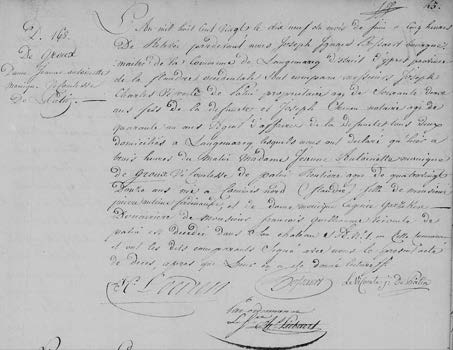
1484
CHAPTER 70. THE SIDE-BRANCH OF DE PATIN DE LANGEMARCK
Figure 70.67: Langemark, June 19, 1820, the death of Jeanne Antoinette Monique De Groux,
the widow of François Guillaume de Patin.
Guillaume, the Lord of Bioul, and Ferdinande de Raymond.
Second, he married Marie Josephe Tonnet, Henri and Marie Jeanne Wautier’s daughter in Brussels.
From this last, he had no children, but from his first marriage were born: Florence Aline Adélaïde de Patin (DP12by1y1y1y1x1), Virginie de Patin (DP12by1y1y1y1x2) and Joseph de Patin (DP12by1y1y1y1y) Jean Baptiste Guillaume de Patin (DP12by1y1y1y1) died in 1836, in Figures 70.71 and 70.72.
70.7.1.1 Florence Aline Adélaïde de Patin
Florence Aline Adélaïde de Patin (DP12by1y1y1y1x1) was born in Mons on October 17, 1791.
She married first at Langemarck, on July 5, 1809, to her cousin Alexandre Fidèle Constant Guislain de Moreau de Wayau, who died in Yvoir on March 6, 1815, and who was a son of Charles Joseph de Moreau de Valigot and Anne Marie Misson.
Then, she married a second time to Auguste Jean Roger Diericx de Tenham, born in Aalst on December 23, 1796, who died at Surice on May 3, 1885, a knight of the Holy Roman Empire, son of John Diericx de Tenham, grand bailiff of Zottegem (Sotteghem), and Josephine Louise Carpentier. Aline de Patin died in 1864, in Figure 70.74. Her children were: Eulalie-Hubertine Sophie de Moreau (DP12by1y1y1y1x1x1), Charlotte Josèphine Adélaïde de Moreau (DP12by1y1y1y1x1x2), Joseph Charles Alexandre de Moreau (DP12by1y1y1y1x1y1), Jean Baptiste Joseph Charles Auguste Diericx de Tenham (DP12by1y1y1y1x1y2), Marie Josèphe Virginie Diericx de Tenham (DP12by1y1y1y1x1x3) and Nathalie Diericx de Tenham (DP12by1y1y1y1x1x4).
Marie Françoise Fanny Diericx was born at Dusseldorf on June 10, 1795, and married Charles de Patin de Langhemarck on August 31, 1822. Auguste Jean Rogier Diericx was born at Aalst on December 23, 1796 and married at Yvoir, in 1822, Aline de Patin, widow of Alexandre de Moreau d’ Yvoir. He died in 1885, in Figure 70.75. Another souvenir is shown in Figure 70.76.
70.7.1.1.1 Eulalie Hubertine Sophie de Moreau Eulalie Hubertine Sophie de Moreau (DP12by1y1y1y1x1x1) was born at Ypres on January 2, 1811 and was married to Ultain de Coppin de Florifoux.
70.7.1.1.2 Charlotte Josèphine Adélaïde de Moreau Charlotte Josèphine Adélaïde de Moreau (DP12by1y1y1y1x1x2) was born in Namur on February 12, 1815, and married Mr Gaiffier d’Emeville.
70.7.1.1.3 Joseph Charles Alexandre de Moreau Joseph Charles Alexandre de Moreau (DP12by1y1y1y1x1y1) was born on December 25, 1815, and was married to Eugénie Arnould.
70.7.1.1.4 Jean Baptiste Joseph Charles Auguste Diericx de Tenham Jean Baptiste Joseph Charles Auguste Diericx de Tenham (DP12by1y1y1y1x1y2) was a Knight of the Holy Roman Empire. He was born at Oordeghem (East Flanders) on May 26, 1823, and was married on May 6, 1851, to Adolphine de Villenfagne de Sorinne.
70.7.1.1.5 Marie Josèphe Virginie Diericx de Tenham Marie Josèphe Virginie Diericx de Tenham (DP12by1y1y1y1x1x3) was born at Yvoir on December 13, 1828.
70.7.1.1.6 Nathalie Diericx de Tenham Nathalie Diericx de Tenham (DP12by1y1y1y1x1x4) was born in 1834.
70.7.1.2 Josephine Virginie Adelaide de Patin
Josephine Virginie Adelaide de Patin (DP12by1y1y1y1x2) was born in Lille. She married at Yvoir on October 9, 1822, to Josse Alexandre Félix Diericx de Tenham, Knight of the Holy Roman Empire, born in Aalst on January 23, 1793, who died in Brussels on December 12, 1879.
© 2024 Nico F. Declercq
The Desclergues of la Villa Ducal de Montblanc, 2nd ed., Omn., VOL. VI
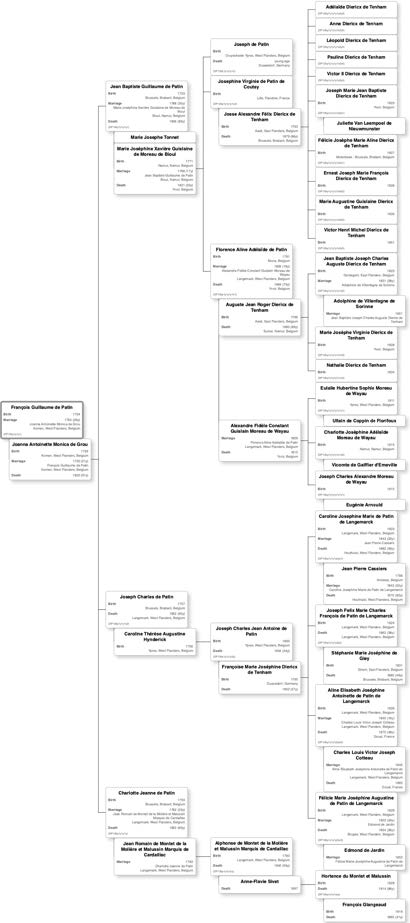
70.7. FRANÇOIS GUILLAUME DE PATIN DE LANGEMARCK & JOANNA ANTOINETTE MONICA DE
GROU
1485
Figure 70.68:
Three descending generations of François Guillaume de Patin
(DP12by1y1y1) and Joanna Antoinette Monica de Grou.
The Desclergues of la Villa Ducal de Montblanc, 2nd ed., Omn., VOL. VI
© 2024 Nico F. Declercq
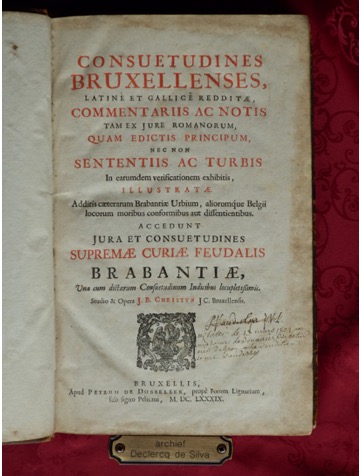
1486
CHAPTER 70. THE SIDE-BRANCH OF DE PATIN DE LANGEMARCK
Figure 70.69: A book signed by Madame la Douariere de Patin née Degrou on
March 13, 1804. (Declercq de Silva Archive)
The latter was a brother of Auguste Jean Roger Diericx de Tenham, husband of Florence-Aline-Adélaïde de Patin (DP12by1y1y1y1x1).
Their children were Joseph-Marie Jean Baptiste Diericx de Tenham (DP12by1y1y1y1x2y1), Félicie Josèphe Marie Aline Diericx de Tenham (DP12by1y1y1y1x2x1), Ernest Joseph Marie François Diericx de Tenham (DP12by1y1y1y1x2y2), Marie Augustine Guislaine Diericx de Tenham (DP12by1y1y1y1x2x2), Victor II Diericx de Tenham (DP12by1y1y1y1x2y3), Adélaïde Diericx de Tenham (DP12by1y1y1y1x2x3), Lèopold Diericx de Tenham (DP12by1y1y1y1x2y4), Pauline Diericx de Tenham (DP12by1y1y1y1x2x4), Anne Diericx de Tenham (DP12by1y1y1y1x2x5), Victor Henri Michel Diericx de Tenham (DP12by1y1y1y1x2y5). Souvenirs are shown in Figures 70.77, 70.78 and 70.79.
70.7.1.2.1 Joseph Marie Jean Baptiste Diericx de Tenham Joseph Marie Jean Baptiste Diericx de Tenham (DP12by1y1y1y1x2y1) was a Knight of the Holy Roman Empire, was born at Yvoir on August 8, 1823, and he married in 1831 to Juliette van Leempoel de Nieuwmunster.
70.7.1.2.2 Félicie Josèphe Marie Aline Diericx de Tenham Félicie Josèphe Marie Aline Diericx de Tenham (DP12by1y1y1y1x2x1) was born at Molenbeek in Brussels on May 19, 1827.
70.7.1.2.3 Ernest Joseph Maric François Diericx de Tenham Ernest Joseph Maric François Diericx de Tenham (DP12by1y1y1y1x2y2) was born on March 4, 1828, and died at a young age in Namur.
70.7.1.2.4 Marie Augustine Guislaine Diericx de Tenham Marie Augustine Guislaine Diericx de Tenham (DP12by1y1y1y1x2x2) was born on March 15, 1830.
70.7.1.2.5 Victor Henri Michel Diericx de Tenham Victor Henri Michel Diericx de Tenham (DP12by1y1y1y1x2y5) was born on June 19, 1851, and died at a young age.
70.7.1.3 Joseph de Patin
Joseph de Patin (DP12by1y1y1y1y) was born at Cruysstraete near Ypres, was baptized at Vlamertinge, and died at a young age in Dusseldorf.
© 2024 Nico F. Declercq
The Desclergues of la Villa Ducal de Montblanc, 2nd ed., Omn., VOL. VI
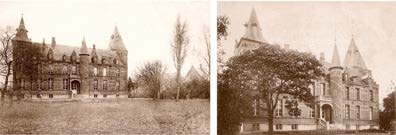
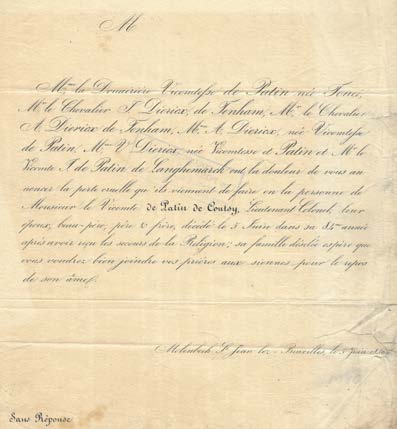
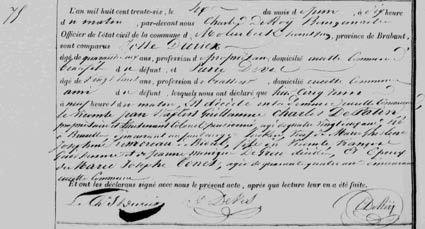
70.7. FRANÇOIS GUILLAUME DE PATIN DE LANGEMARCK & JOANNA ANTOINETTE MONICA DE
GROU
1487
Figure 70.70: The castle of de Patin de Langemark.
Figure 70.71:
The death announcement of Jean Baptiste-Guillaume de Patin
(DP12by1y1y1y1) in 1836. (Declercq de Silva Archive)
Figure 70.72: Sint Jans Molenbeek, Brussels, June 5, 1836, the death of Jean Baptiste
Guillaume Charles de Patin (DP12by1y1y1y1).
The Desclergues of la Villa Ducal de Montblanc, 2nd ed., Omn., VOL. VI
© 2024 Nico F. Declercq
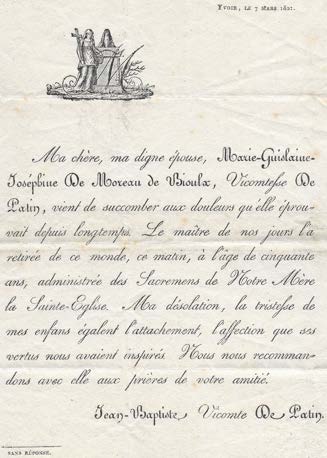
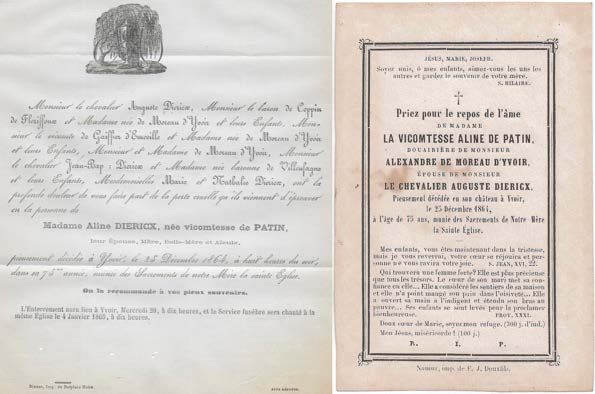
1488
CHAPTER 70. THE SIDE-BRANCH OF DE PATIN DE LANGEMARCK
Figure 70.73: The death announcement
of Marie Guislaine Joséphine de Moreau
de Bioulx in 1827. (Declercq de Silva
Archive)
Figure 70.74: The death announcement of Aline de Patin, wife of Auguste Jean Roger Diericx 1864. Right is the obituary card of Aline de Patin, the widow of Alexandre de Moreau d’ Yvoir and Auguste Diericx, 1864. (Declercq de Silva Archive)
© 2024 Nico F. Declercq
The Desclergues of la Villa Ducal de Montblanc, 2nd ed., Omn., VOL. VI
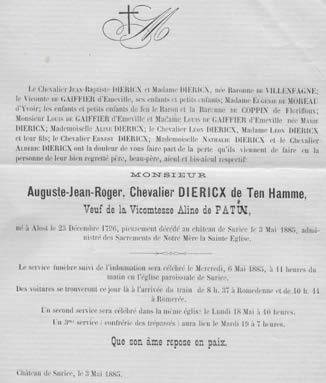
70.8. JOSEPH CHARLES DE PATIN
1489
Figure 70.75: The death announcement
of Auguste Jean Roger Diericx de Ten
Hamme, the widower of Aline de Patin,
1885. (Declercq de Silva Archive)
70.7.2 Caroline de Patin
Caroline de Patin (DP12by1y1y1x), shown in Figure 70.80, was born in Brussels on February 17, 1759, was baptized at Ste-Catherine, and married in Langemarck, on November 12, 1782, in Figures 70.81 and 70.82, to Jean Romain du Montet de la Molière et Malussin, Marquis de Cardaillac, a captain in the regiment of Turenne, Knight of the Order of St. Louis, and son of Alphonse, Count of Montet de la Moliere et Malussin, Marquis de Cardaillac, Field Marshal of the King of France, Chevalier de St. Louis, etc. and Marcelle de Schisadour, Marquise, Baroness etc.
Their children were: Alphonse Count of Montet de la Moliere et Malussin,(DP12by1y1y1xy) Marquis de Cardaillac; They had another son, who died young and also a daughter who equally died at a young age.
Caroline de Patin died in 1822, in Figures 70.83 and 70.84. Her offspring are shown in Figure 70.85. Their home is shown in Figure
70.7.2.1 Alphonse du Montet de la Moliere et Malussin
Alphonse du Montet de la Moliere et Malussin (DP12by1y1y1xy), shown in Figure 70.80, was born in Langemarck, August 12, 1783, in Figure 70.87. Four children were born in his marriage.
Limoges, France, was the place of their residence. Alphonse died in 1842. He married Anne-Flavie Sivet (who died in 1897). They had a daughter, Hortense du Montet de Malussin (DP12by1y1y1xyx).
70.7.2.1.1 Hortence du Montet de Malussin Hortence du Montet de Malussin (DP12by1y1y1xyx), shown in Figure 70.80,
was born on July 7, 1828, in Figure 70.88, in Limoges and died on August 7, 1914 at Le Mazet (Lot, Esclauzels) (Janailhac, 87077, Haute-Vienne, Limousin, France, Le Mazet).
She married François Glangeaud (1819-1860), and they had a son, Joseph Glangeaud (DP12by1y1y1xyxy).
70.7.2.1.1.1 Joseph Glangeaud Joseph Glangeaud (DP12by1y1y1xyxy) (1858-1929), shown in Figure 70.80, was born in Limoges in 1858, in Figure 70.89, and married Marie-Jeanne Lespinas (1862-1944). They had a son, Étienne Glangeaud (1890-1981) (DP12by1y1y1xyxyy).
Étienne Glangeaud (DP12by1y1y1xyxyy) is shown in Figure 70.80 and was an officer in the French ’Légion d’ honneur.’
70.8 Joseph Charles de Patin
Joseph Charles de Patin (DP12by1y1y1y2) was born in Brussels on July 17, 1757.
He has been an officer-commander of a company in the Murray regiment in the service of His Imperial Majesty. He has been a chamberlain of H.M. the King of the Netherlands and was a member of the Equestrian Order and the provincial states of West Flanders. He has been mayor of Langemarck, etc. He deceased on October 19, 1852, in Figures 70.90 and 70.91.
He married at Ypres on August 29, 1798, to Caroline Thérèse Augustine Hynderick, born in Ypres on December 14, 1756, daughter of Pierre-Jean Hynderick, Lord of Theulegoet, and Susanne-Thérèse de Buus.
From this marriage of Joseph Charles de Patin (DP12by1y1y1y2) and Caroline Thérèse Augustine Hynderick was born Joseph Charles Jean Antoine de Patin (DP12by1y1y1y2y).
70.8.1 Joseph Charles Jean Antoine de Patin
Joseph Charles Jean Antoine de Patin (DP12by1y1y1y2y) was born in Ypres on April 12, 1800, and died on October 1, 1834.
He married at Oordeghem on July 29, 1822, in Figures 70.92 and 70.93, to Françoise Marie Joséphine Diericx de Tenham, born in Dusseldorf on June 10, 1795, and who died on November 20, 1852, in Figure 70.95.
The Desclergues of la Villa Ducal de Montblanc, 2nd ed., Omn., VOL. VI
© 2024 Nico F. Declercq
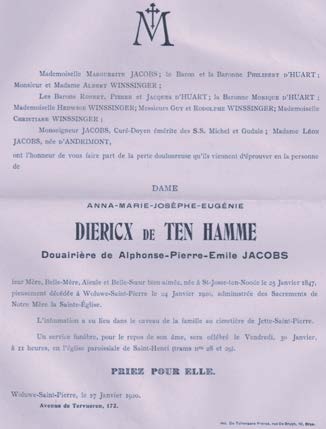
1490
CHAPTER 70. THE SIDE-BRANCH OF DE PATIN DE LANGEMARCK
Figure 70.76: The death announcement
of Anna Marie Josèphe Eugénie Diericx de
Ten Hamme, the widow of Alphonse Pierre
Emile Jacobs, in 1920. (Declercq de Silva
Archive)
Françoise Marie Joséphine Diericx of Tenham was a sister of Auguste Jean Roger Diericx of Tenham (husband of Florence-Aline-Adélaïde de Patin (DP12by1y1y2y1x1)).
From this marriage was born, as shown in Figure 70.94, Caroline de Patin de Langemarck (DP12by1y1y1y2yx1), Aline Elisabeth Joséphine Antoinette de Patin de Langemarck (DP12by1y1y1y2yx2) and Félicie Marie Joséphine Augustine de Patin de Langemarck (DP12by1y1y1y2yx3).
70.8.1.1 Caroline Josephine Marie de Patin de Langemarck & Jean-Pierre Cassiers
Caroline Josephine Marie de Patin de Langemarck (DP12by1y1y1y2yx1) was born at Langemarck on June 8, 1823, and married on August 10, 1843, to senator Jean-Pierre Cassiers, born in Antwerp on May 23, 1788, and dead at Houthulst on March 12, 1870.
Caroline died on January 5, 1882, at Houthulst.
70.8.1.1.1 Introduction Caroline de Patin, shown in Figure 70.96, was born in Langemark on June 8, 1823, in Figure 70.97,
and married on August 10, 1843, to Senator Jean-Pierre Cassiers, born in Antwerp on May 23, 1788, and dead at Houthulst on March 12, 1870. Caroline died on January 5, 1882, in Figure 70.98, at Houthulst.
Caroline de Patin was the daughter of Joseph Charles Jean Antoine de Patin (Ypres, April 12, 1800 – October 1, 1834) and Françoise Marie Joséphine Diericx de Tenham (Dusseldorf, June 10, 1795 – November 20, 1852). She belonged to the last generation of descendants of Charles Philippe de Patin, who were born at the castle of Langemark. Her brother was Joseph Felix Marie Charles François de Patin (Langemark July 25, 1824 – Langemark December 22, 1862), her sisters were Aline Elisabeth Joséphine Antoinette de Patin (Langemark, August 26, 1826) and Félicie Marie Joséphine Augustine de Patin (Langemark, July 9, 1828 – Brugge, 1854).
Caroline’s nephew, Charles Philippe Jean Marie Joseph de Patin (Langemark, August 14, 1861 – Langemark June 10, 1888), was a notable figure in his own right. He served as a member of the Provincial Council of West Flanders, an alderman of the municipally of Langemark, and was the last person to bear the name de Patin in the branch residing at Langemark.
Her grandfather was Joseph Charles de Patin (Brussels, July 17, 1757 – Langemark, October 19, 1852), a grandson of Charles Philippe de Patin (Ypres, April 19, 1687 – Ghent, July 17, 1773). Some souvenirs are shown in Figures 70.99 and 70.100.
70.8.1.1.2 Marriage with Jean Pierre Cassiers Caroline de Patin married the nearly 30 years older senator Jean-Pierre Cassiers (Antwerp, May 25, 1788 – Houthulst, March 12, 1870), in Figure 70.101) on August 10, 1843. They built the castle of Houthulst in 1848 in the forest Vrijbos.
Because they had no descendants, the castle (representing 20% of the inheritance of Cassiers-de Patin) was inherited by Raymond de Groote (Roeselare 1827 – Diksmuide 1892). His descendants would continue to live there; one of them, Hubert de Groote, would later play a crucial role in the resistance against the Germans in WWII.
Nowadays, the castle is known as the castle of de Groote. It is located at Houthulst in Eugène De Grootelaan. It was heavily damaged during WWI on September 28, 1918, but was renovated (by architect Vierin) in the 1920s.
70.8.1.1.3 The Houthulst project Jean-Pierre Cassiers and Caroline de Patin are a remarkable couple who transformed the Belgian village of Houthulst from a bare forest into a flourishing community. Before their efforts, the Vrijbos forest, as depicted in Figure 70.102, was home to a few impoverished inhabitants with no municipal infrastructure. Caroline de Patin, placing great importance on education, made it her mission to establish a well-rounded village.
In 1856, after several attempts, Caroline convinced religious sisters from Lendelede to relocate to Houthulst. These sisters, dependent on the hospitality of Cassiers and de Patin, immediately established a lace school. This initiative provided education and allowed the sisters and the village to be self-sustainable by trading lace.
© 2024 Nico F. Declercq
The Desclergues of la Villa Ducal de Montblanc, 2nd ed., Omn., VOL. VI
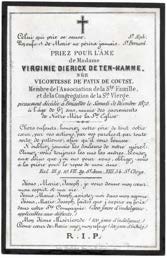
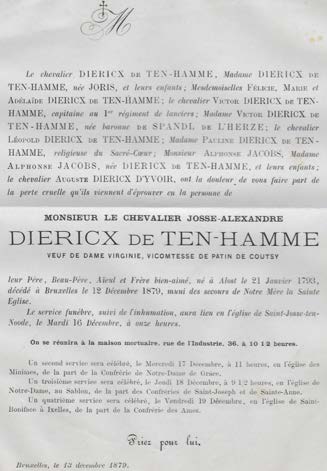
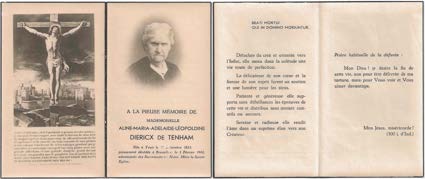
70.8. JOSEPH CHARLES DE PATIN
1491
Figure 70.77: The obituary card of Virginie de Patin de Coutsy, in
1870. (Declercq de Silva Archive)
Figure 70.78:
The death announce-
ment of Josse Alexandre Diericx de Ten
Hamme, the widower of Virginie de Patin
de Coutsy, in 1879. (Declercq de Silva
Archive)
Figure 70.79: The mortuary card of Marie Aline Adelaide Leopoldine Diericx, born
at Yvoir on December 15, 1853, and dead in Brussels on February 1, 1942. She was
the daughter of Jean-Baptiste Diericx and Josephine de Villonfagne. She was an in-law
relative of Josephine Virginie Adelaide de Patin (DP12by1y1y1y1x2). (Declercq de Silva
Archive)
The Desclergues of la Villa Ducal de Montblanc, 2nd ed., Omn., VOL. VI
© 2024 Nico F. Declercq
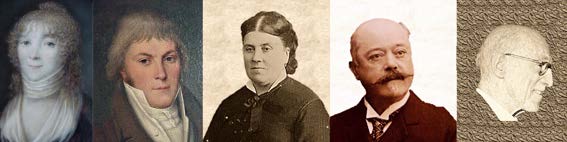
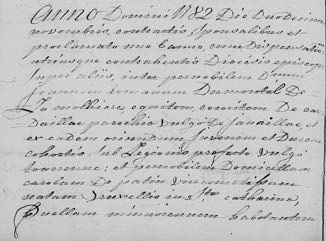
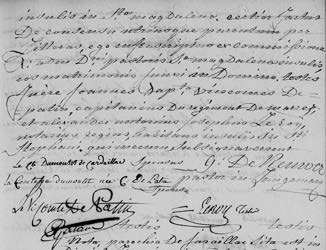
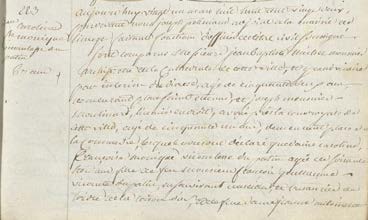
1492
CHAPTER 70. THE SIDE-BRANCH OF DE PATIN DE LANGEMARCK
Figure 70.80: A bloodline starting with Carline de Patin is shown from left to right. We can see Caroline Françoise Monique de Patin (DP12by1y1y1x), 1759-1822; Alphonse du Montet de la Moliere et Malussin, Marquis de Cardaillac; Hortence du Montet de Malussin; Joseph Glangeaud; and Étienne Glangeaud.
Figure 70.81: The marriage of Caroline
de Patin and Jean Romain du Montet de la
Molière et Malussin at Langemark in 1782.
(part 1)
Figure 70.82: The marriage of Caroline
de Patin and Jean Romain du Montet de la
Molière et Malussin at Langemark in 1782.
(part 2)
Figure 70.83: Limoges, March 21, 1822, the death of Caroline De Patin
(part 1).
© 2024 Nico F. Declercq
The Desclergues of la Villa Ducal de Montblanc, 2nd ed., Omn., VOL. VI
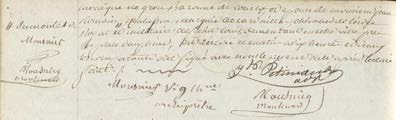
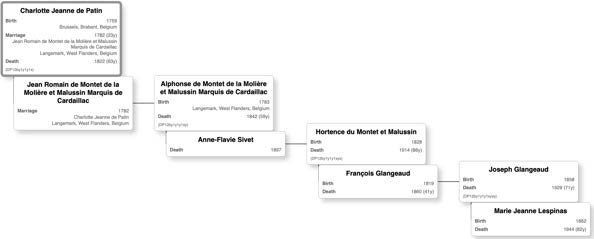
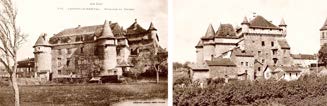
70.8. JOSEPH CHARLES DE PATIN
1493
Figure 70.84: Limoges, March 21, 1822, the death of Caroline De Patin (part 2).
Figure 70.85: Three descending generations of Charlotte de Patin (DP12by1y1y1x).
The same year, Jean-Pierre Cassiers and Caroline de Patin built a chapel, laying the foundation for the village’s spiritual and communal life. Shortly after, they provided land for the construction of a church. The year 1857 marks the official founding of Houthulst as an authentic village with the commencement of the neo-gothic Church of Saint John the Baptist, completed between 1857 and 1868, shown in Figure 70.102.
By 1865, Caroline de Patin had successfully transformed the Houthulst monastery into an independent entity separate from Lendelede. She provided shelter for orphans and older people, contributing to the village’s growing population. By 1868, the lace school had generated enough wealth to eradicate poverty in Houthulst, ensuring every inhabitant owned a home. Caroline also established a farm nearby to support the monastery and the village with food.
After the death of her husband, Caroline continued to invest her time and resources in the education and well-being of Houthulst’s children. She constructed Belgium’s first Lourdes grotto, shown in Figure 70.102, enhancing the village’s spiritual significance.
In 1874, Caroline’s dedication to education led to the establishment of the Monastery of Saint Xavier and the Sint-Franciscus-Xaveriusschool. These institutions provided boys in Houthulst with education and weaving skills, significantly contributing to the village’s development. She also continued to support the villagers with resources for home improvement, ensuring the village’s continued prosperity even after her passing.
Despite the near-destruction of Houthulst during World War I, the resilience of the villagers prevailed, leading to a successful rebuilding in the 1920s. In 1876, Caroline further demonstrated her commitment to religious and communal development by sponsoring the construction of a cloister for the Claris sisters in Nieuwpoort.
The legacy of Jean-Pierre Cassiers and Caroline de Patin is a testament to their remarkable achievements. They built a vibrant, self-sustaining community from scratch, transforming not only the landscape but also the lives of its inhabitants.
70.8.1.1.4 The Castle of Houthulst The castle of Houthulst, better known as Kasteel De Groote, is situated in a remnant of the historic ’free forest’ or Vrybosch. Jan-Pieter Cassiers built the original castle in 1848. After his and his wife’s death, Caroline de Patin de Langemarck, the court was inherited by Raymond De Groote. As a consequence, it bears his name to this day.// In the final WWI offensive of September 28, 1918, in which a large part of the Belgian army took part, the Bos van Houthulst recapture was considered crucial. The 7th Infantry Division recaptured the forest, but not without significant losses.// Houthulst Castle was severely damaged and was rebuilt in the 1920s. The area had been of military importance to the Germans because of its elevation.
The military engagement destroyed three castles in this area during the war.// Images and souvenirs of the castle are shown in Figure 70.86: The Château de Lacapelle-Marival, situated in the Lot department of
France’s Occitanie region, is a remarkable
example of 13th-century medieval architec-
ture. Built by Géraud de Cardaillac, this
castle served as a defensive stronghold and
a noble residence throughout its history,
especially during the Hundred Years’ War.
Its well-preserved towers, walls, and inte-
rior spaces offer a fascinating glimpse into
the medieval era for visitors and historians
today.
The Desclergues of la Villa Ducal de Montblanc, 2nd ed., Omn., VOL. VI
© 2024 Nico F. Declercq
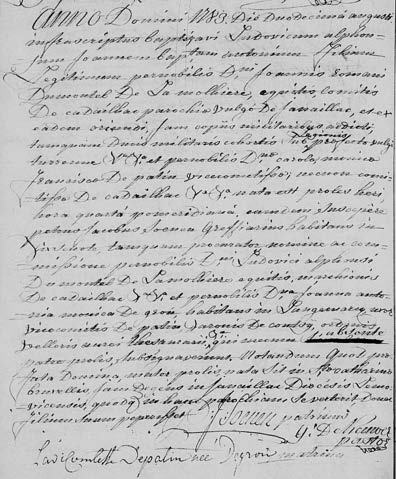
1494
CHAPTER 70. THE SIDE-BRANCH OF DE PATIN DE LANGEMARCK
Figure 70.87: Langemark, 1783, the baptism of Alphonse du Montet de la Moliere
et Malussin.
70.8.1.1.5 Destruction in 1918 We also refer to Chapter 48.9.5.4 and Chapter 64.7.6 about Maurice Florimond Verhaeghe and Hector Alidor Lesage because both soldiers, as Belgian military, had to fight the Germans in and around the forest of Houthulst at the end of WWI in October 1918.
Unfortunately, both soldiers were killed during the final battle. The destructive force of WWI at Houthulst is shown in Figure
70.8.1.1.6 Relatives Souvenirs of relatives are shown in Figures 70.105, 70.106 and 70.107.
70.8.1.2 Aline Elisabeth Joséphine Antoinette de Patin de Langemarck & Charles Louis Victor Joseph Cotteau Aline Elisabeth Joséphine Antoinette de Patin de Langemarck (DP12by1y1y1y2yx2) was born in Langemark on August 26, 1826, in Figure 70.108 and married there on July 2, 1845, in Figure 70.109, to Charles Cotteau, doctor of law and councilor of the Royal Court at Douai. Aline de Patin died in 1875, in Figures 70.110 and 70.111.
70.8.1.2.1 Charles Louis Victor Joseph Cotteau Charles Louis Victor Joseph Cotteau, the husband of Aline Elisabeth Joséphine Antoinette de Patin de Langemarck (DP12by1y1y1y2yx2), died at Douai (France) on July 22, 1865, in Figures 70.112
and 70.113, at the age of 65.
70.8.1.2.2 René Charles François Cotteau de Simencourt de Patin René Charles François Cotteau de Simencourt de Patin (DP12by1y1y1y2yx2y2) died at Houthulst on September 18, 1906, in Figure 70.114, at the age of 57.
Some family souvenirs are shown in Figures 70.116, 70.117, 70.118 and 70.119. He was buried at Père Lachaise in Paris, as seen in Figure 70.115.
70.8.1.2.2.1 Charles Marie Victor Joseph Cotteau de Patin & Céline Pauline Ghislaine Gantois Charles Marie Victor Joseph Cotteau de Patin (DP12by1y1y1y2yx2y1), shown in Figure 70.120, was born in Douai, in France, on December 16, 1847, in Figure 70.121. He died at his castle at Langemark on July 5, 1895, in Figures 70.123, 70.124 and 70.125. His shield is shown in Figure 70.126. Charles Cotteau de Patin’s wife, Celine Pauline Ghislaine Gantois, died in 1927, in Figure 70.127.
Souvenirs of relatives are shown in Figures 70.128, 70.129, 70.130, 70.131 and 70.132. Their son Raoul Charles René Ghislain Cotteau de Patin (DP12by1y1y1y2yx2y1y1), shown in Figures 70.134, 70.135 and 70.136, was born in Brussels on March 3, 1877, and died in Ypres on March 31, 1940.
Souvenirs of Langemark and its castle are shown in Figures 70.137, 70.138 and 70.139. An impression of the WWI devastations is shown in Figure 70.140.
After WWI, Raoul Charles René Ghislain Cotteau de Patin reconstructed Langemark Castle. He died in 1940, in Figure 70.141.
© 2024 Nico F. Declercq
The Desclergues of la Villa Ducal de Montblanc, 2nd ed., Omn., VOL. VI
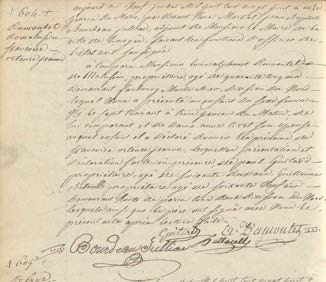
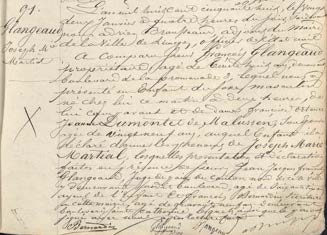
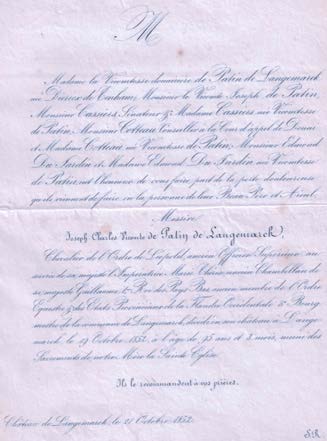
70.8. JOSEPH CHARLES DE PATIN
1495
Figure 70.88: Limoges, the birth of Hort-
ence du Montet de Malussin, July 7, 1828.
Figure 70.89:
Limoges, January 22,
1858, the birth of Joseph Glangeaud.
Figure 70.90: The death announcement
of Joseph Charles de Patin de Langemarck
in 1852. (Declercq de Silva Archive)
The Desclergues of la Villa Ducal de Montblanc, 2nd ed., Omn., VOL. VI
© 2024 Nico F. Declercq
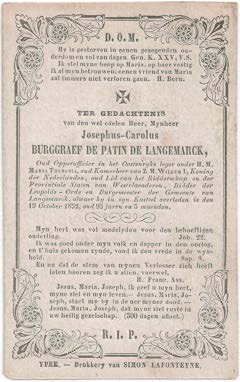
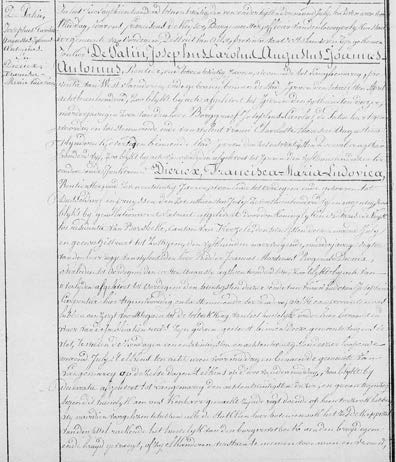
1496
CHAPTER 70. THE SIDE-BRANCH OF DE PATIN DE LANGEMARCK
Figure 70.91: The obituary card of Joseph Charles de
Patin de Langemarck, in 1852. (front) (Declercq de Silva
Archive)
Figure 70.92: Oordegem, 1822, the marriage of Joseph Charles de Patin and
Francoise Diericx (part 1).
© 2024 Nico F. Declercq
The Desclergues of la Villa Ducal de Montblanc, 2nd ed., Omn., VOL. VI
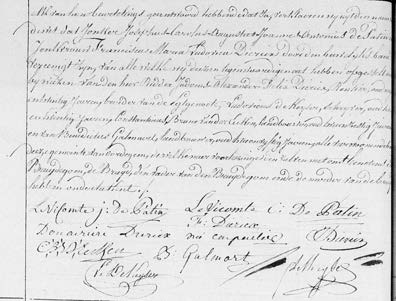
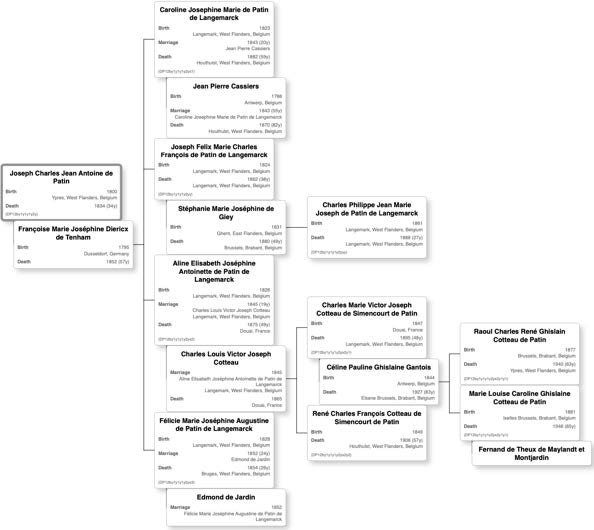
70.8. JOSEPH CHARLES DE PATIN
1497
Figure 70.93: Oordegem, 1822, the marriage of Joseph Charles de Patin and
Francoise Diericx (part 2).
Figure 70.94: Three descending generations of Joseph Charles Jean Antoine de Patin (DP12by1y1y1y2y).
The Desclergues of la Villa Ducal de Montblanc, 2nd ed., Omn., VOL. VI
© 2024 Nico F. Declercq
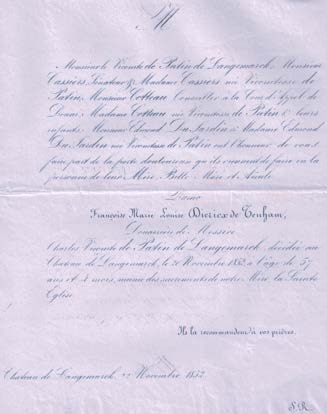
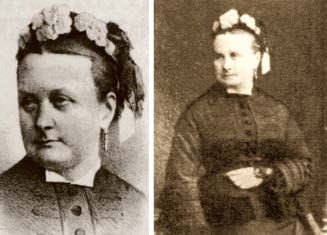
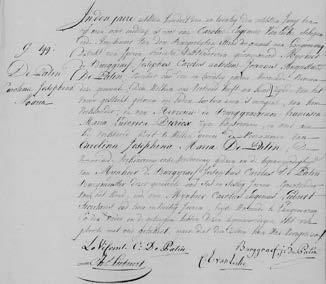
1498
CHAPTER 70. THE SIDE-BRANCH OF DE PATIN DE LANGEMARCK
Figure 70.95: The death announcement
of Francoise Marie Louise Diericx de ten
Ham, the widow of Charles de Patin de
Langemarck, in 1852. (Declercq de Silva
Archive)
Figure 70.96: Caroline Josephine Marie
de Patin de Langemarck (from her obitu-
ary card and, right, based on a photo in
the public library of Houthulst). (Declercq
de Silva Archive)
Figure 70.97: 1823, the birth of Caroline
de Patin at Langemark.
© 2024 Nico F. Declercq
The Desclergues of la Villa Ducal de Montblanc, 2nd ed., Omn., VOL. VI
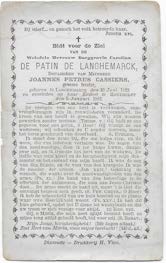
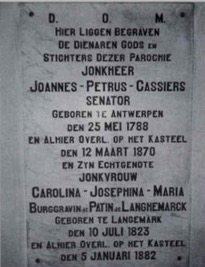
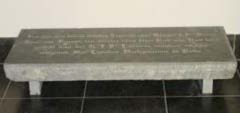
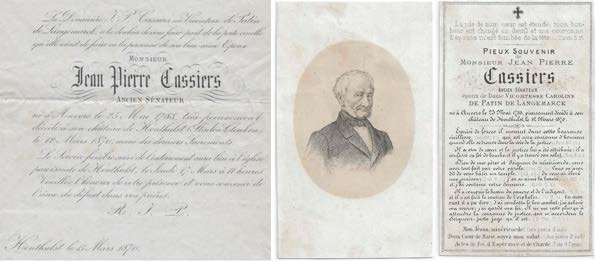
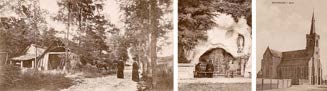
70.8. JOSEPH CHARLES DE PATIN
1499
Figure 70.98: The obituary card of Caroline de Patin, January 5,
1882, in Houthulst. (Declercq de Silva Archive)
Figure 70.99: This memorial plaque is located in the right aisle of
the church of Houthulst, above the grave. (Courtesy of ’vrije basisschool
Houthulst’)
Figure 70.100:
Foundation stone of the church of
Houthulst reads ’Ten jare 1858 den 21 October legende
(sic) zyne hoogwd J. Btn. Malou bissp van Bruges den
eersten steen dezer kerk van Houthulst door den hr. J.
Pus. Cassiers senateur en zyne echtgenoote mevw Car-
olina markgravinne de Pattin.’ (Courtesy of inventaris
onroerend erfgoed Vlaanderen.)
Figure 70.101: The death announcement and obituary card of Jean Pierre Cassiers, the husband of Carline de Patin de Langemarck, March 12, 1870. (Declercq de Silva Archive)
Figure 70.102:
The left is the ’Free
Forest’ or ’Vrybosch’ at Langemark and
Houthulst. In the middle is the Lourdes
grotto at Houthulst, constructed by Caro-
line de Patin. The right is the church of
Houthulst.
The Desclergues of la Villa Ducal de Montblanc, 2nd ed., Omn., VOL. VI
© 2024 Nico F. Declercq
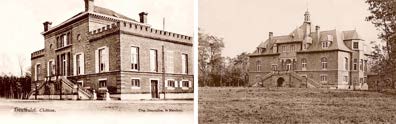
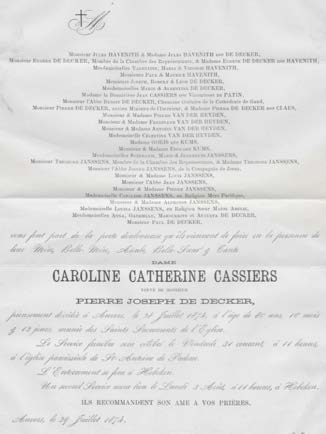
1500
CHAPTER 70. THE SIDE-BRANCH OF DE PATIN DE LANGEMARCK
Figure 70.103: The left is the original castle of Houthulst, constructed by the couple
Cassiers-de Patin and later called ’Kasteel Degroote.’ On the right is a picture of
the new Houthulst castle built after WWI.
Figure 70.104: Here is some news about Houthulst and Langemark
during WWI. Source: ’Belgisch Dagblad’ , Wednesday September 22,
1915.
Figure 70.105: The death announcement
of Caroline Catherine Cassiers, wife of
Pierre Joseph De Decker, August 28, 1874.
(Declercq de Silva Archive)
© 2024 Nico F. Declercq
The Desclergues of la Villa Ducal de Montblanc, 2nd ed., Omn., VOL. VI
70.8. JOSEPH CHARLES DE PATIN
1501
Figure 70.106: The death announcement
of Isabelle Cassiers, December 10, 1859.
(Declercq de Silva Archive)
Figure 70.107: The death announcement
of François Henri Cassiers, May 14, 1869.
(Declercq de Silva Archive)
The Desclergues of la Villa Ducal de Montblanc, 2nd ed., Omn., VOL. VI
© 2024 Nico F. Declercq
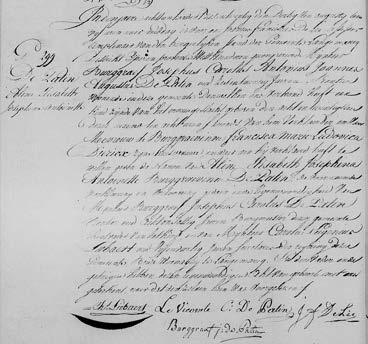
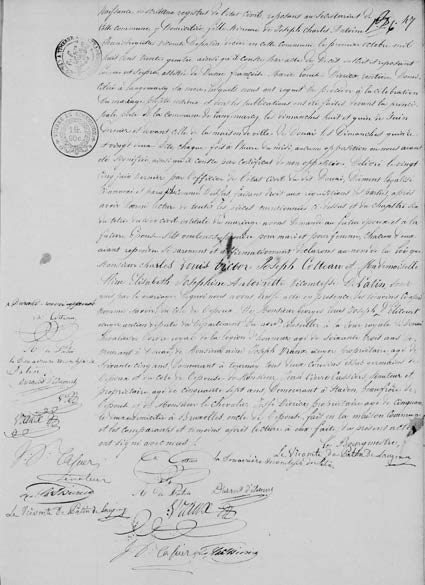
1502
CHAPTER 70. THE SIDE-BRANCH OF DE PATIN DE LANGEMARCK
Figure 70.108: The birth of Aline Elisabeth Josephine Antoinette de Patin
at Langemark in 1826.
Figure 70.109: Langemark 1845, the marriage of Charles Louis Victor Joseph Cotteau
and Aline Elisabeth Josephine Antonette de Patin.
© 2024 Nico F. Declercq
The Desclergues of la Villa Ducal de Montblanc, 2nd ed., Omn., VOL. VI
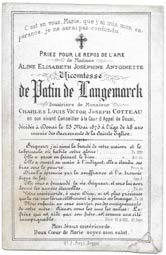
70.9. JOSEPH FELIX MARIE CHARLES FRANÇOIS DE PATIN DE LANGEMARCK
1503
Figure 70.110: The obituary card of Aline Elisabeth Josephine An-
toinette de Patin de Langemarck, the widow of Charles Louis Victor
Joseph Cotteau, in 1875. (Declercq de Silva Archive)
The castle, as it can still be admired today, is shown in Figures 70.142, 70.143, and 70.144. There is not much left in Langemark that reminds the visitor of this beautiful family, except for a statue, also shown in Figure 70.144.
70.8.1.2.2.2 Marie Louise Caroline Ghislaine Cotteau de Patin & Fernand de Theux de Meylandt et Montjardin Marie Louise Caroline Ghislaine Cotteau de Patin (DP12by1y1y1y2yx2y1x1) was born at Ixelles on November 16, 1881, and died on January 27, 1946, in Figure 70.146. She married Fernand de Theux de Montjardin in 1901, in Figure 70.145. The latter died in 1919, in Figure 70.147. Souvenirs of relatives are shown in Figures 70.148 and 70.149.
70.8.1.3 Félicie Marie Joséphine àugustine de Patin de Langemarck & Edmond du Jardin
Félicie Marie Joséphine Augustine de Patin de Langemarck (DP12by1y1y1y2yx3) was born at Langemark on July 9, 1828, in Figure
70.150, and married, on May 25, 1852, in Figures 70.152 and 70.153, to Edmond du Jardin.
She died in 1854, Figures 70.154, 70.155 and 70.156. Edmond du Jardin died in 1877, in Figure 70.157. Proof of Félicie’s performance at school can be seen in Figure 70.151.
70.9 Joseph Felix Marie Charles François de Patin de Langemarck
Joseph Felix Marie Charles François de Patin de Langemarck (DP12by1y1y1y2yy), shown in Figure 70.158, was born at Langemark on July 25, 1824, in Figure 70.159.
He died in 1862, in Figures 70.160, 70.161 and 70.162, and had one son, described in Chapter 70.10, the last person to represent the viscounts de Patin de Langemarck, who died early, namely Charles Philippe Jean Marie Joseph de Patin de Langemarck (DP12by1y1y1y2yyy).
Joseph de Patin de Langemarck married Stéphanie de Giey in 1855, in Figure 70.163. Stephanie Marie Josephine de Giey, the wife of Joseph Félix Marie Charles François de Patin de Langemarck, constructed a chapel at Leuven with her son Carlos before 1875.
She died in 1880, in Figures 70.164 and 70.165.
A souvenir of Joseph Charles de Patin de Langhemarck is shown in Figure 70.166.
70.10 Charles Philippe Jean Marie Joseph de Patin de Langemarck
Charles Philippe Jean Marie Joseph de Patin de Langemarck (DP12by1y1y1y2yyy) was born in 1861, in Figure 70.167, and died in 1888, in Figures 70.169, 70.168, 70.170 and 70.171. A facial comparison is found in Figure 65.88 on page 1328.
The mortuary card of Charles Philippe Jean Marie Joseph de Patin describes him (literally, in Dutch) as
’Zalige gedachtenis van den Edelen Heer Carlos Philippus Joannes Maria Jozef Burggraaf de Patin de Langemarck, . . . Van kinds-been af in de vrees des Heeren opgevoed was hij Christen in den echten zin des woords: frank en rechtzinnig Katholijk vurig en verstandig in zijne godsvrucht, onthecht van de aardsche goederen in ’t midden der rijkdommen, onuitputbare voorzienigheid van den arme, onderstand van weduwen en weezen. Vol van zachtmoedigheid en goedheid, aangenaam in zijne woorden, onberispelijk van zeden, spraakzaam en vriendelijk met eenieder, wist hij de genegenheid van allen te winnen en niemand sprak van hem een woord kwaad. De dood, gelijk aan de schuit die den reiziger op de anderen oever overzet, heeft hem vervoerd verre van alle bekoringen en lijden, de dood heeft dus niet droevigs ten zij voor ons die zij aan de droefheid der scheiding overlaat. Vaartwel, mijne duurbare bloedverwanten, weent niet gelijk deze die geene hoop hebben, wij zullen elkander wederzien en gij jonge lieden die nauwelijks begint te leven, denkt hoe kort het leven is, en hoe vele slachtoffer van mijnen ouderdom dagelijks door de dood worden weggerukt. Daarom weest bereid want gij weet noch dag noch uur. Zoet hert van Maria, wees mijne zaligheid.’
The Desclergues of la Villa Ducal de Montblanc, 2nd ed., Omn., VOL. VI
© 2024 Nico F. Declercq
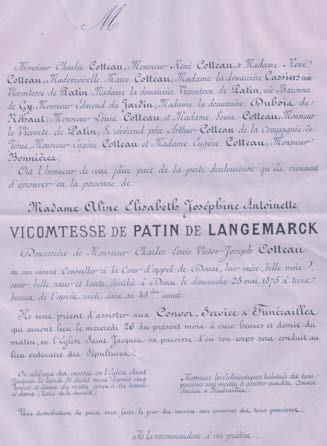
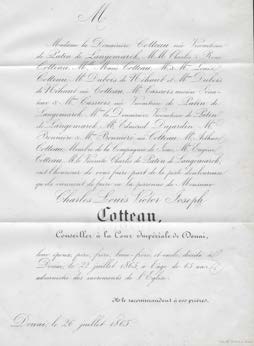
1504
CHAPTER 70. THE SIDE-BRANCH OF DE PATIN DE LANGEMARCK
Figure 70.111: The death announcement
of Aline Elisabeth Josephine Antoinette
de Patin de Langemarck, the widow of
Charles Louis Victor Joseph Cotteau, in
1875. (Declercq de Silva Archive)
Figure 70.112: The death announcement of Charles
Louis Victor Joseph Cotteau, the husband of Aline
Elisabeth Joséphine Antoinette de Patin de Lange-
marck, in 1865. (Declercq de Silva Archive)
© 2024 Nico F. Declercq
The Desclergues of la Villa Ducal de Montblanc, 2nd ed., Omn., VOL. VI
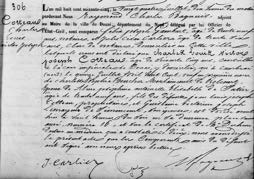
70.10. CHARLES PHILIPPE JEAN MARIE JOSEPH DE PATIN DE LANGEMARCK
1505
Figure 70.113: Douai, 1865, the death of Charles
Louis Victor Joseph Cotteau, husband of Aline Elisa-
beth Joséphine Antoinette de Patin de Langemarck.
Figure 70.114:
The death announce-
ment of René Charles Francois Cotteau de
Simencourt de Patin in 1906. (Declercq de
Silva Archive)
Figure 70.115: The register of the Père Lachaise cemetery in Paris shows that René
Charles François Cotteau de Patin was buried there. His grave is in the vicinity of
that of his distant cousin, Cyrille Lesage, shown in Figure 64.109 on page 1239.
The Desclergues of la Villa Ducal de Montblanc, 2nd ed., Omn., VOL. VI
© 2024 Nico F. Declercq
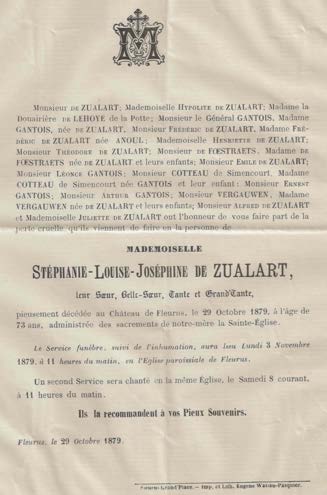
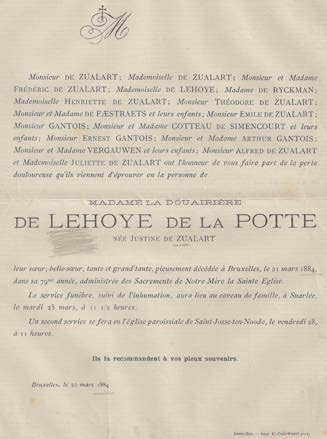
1506
CHAPTER 70. THE SIDE-BRANCH OF DE PATIN DE LANGEMARCK
Figure 70.116: The death announcement
of Stephanie Louise Josephine de Zualart
in 1879. (Declercq de Silva Archive)
Figure 70.117: The death announcement
of Justine de Zualart in 1884. (Declercq de
Silva Archive)
© 2024 Nico F. Declercq
The Desclergues of la Villa Ducal de Montblanc, 2nd ed., Omn., VOL. VI
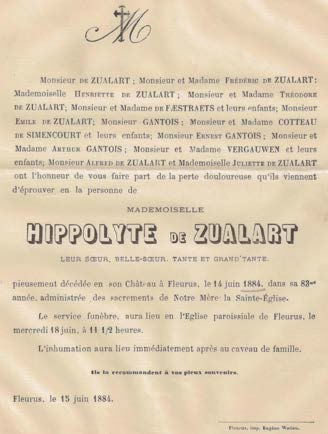
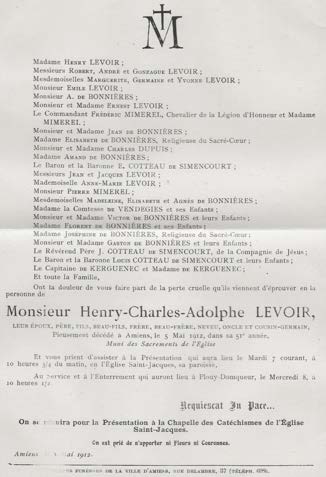
70.10. CHARLES PHILIPPE JEAN MARIE JOSEPH DE PATIN DE LANGEMARCK
1507
Figure 70.118: The death announcement
of Hippolyte de Zualart in 1884. (Declercq
de Silva Archive)
Figure 70.119: The death announcement
of Henry Charles Adolphe Levoir in 1912.
(Declercq de Silva Archive)
The Desclergues of la Villa Ducal de Montblanc, 2nd ed., Omn., VOL. VI
© 2024 Nico F. Declercq
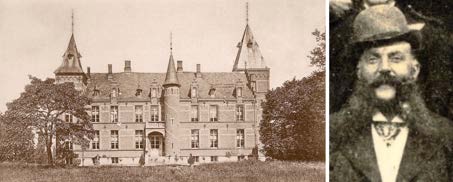
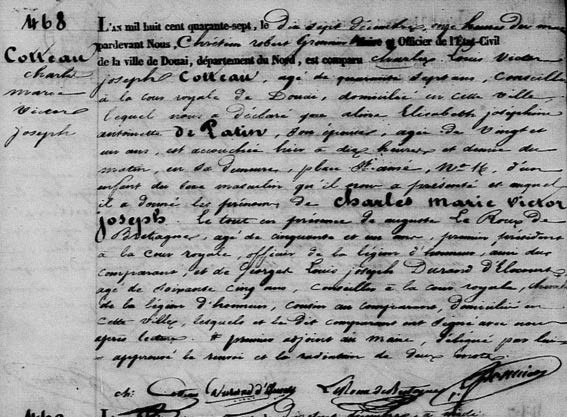
1508
CHAPTER 70. THE SIDE-BRANCH OF DE PATIN DE LANGEMARCK
Figure 70.120: Charles Cotteau de Patin (DP12by1y1y1y2yx2y1) is posing in front of his
castle, inherited from the family de Patin de Langemarck. He is also shown right.
Figure 70.121: Douai, December 16, 1847, was the birth of Charles Marie Victor Joseph de Patin.
Figure 70.122: The mansion of Cotteau de Patin in Ypres, D’ Hontstraat 34.
(Declercq de Silva Archive)
© 2024 Nico F. Declercq
The Desclergues of la Villa Ducal de Montblanc, 2nd ed., Omn., VOL. VI
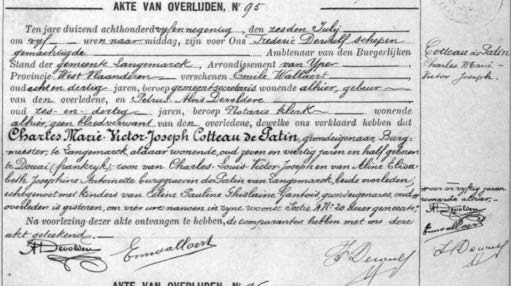
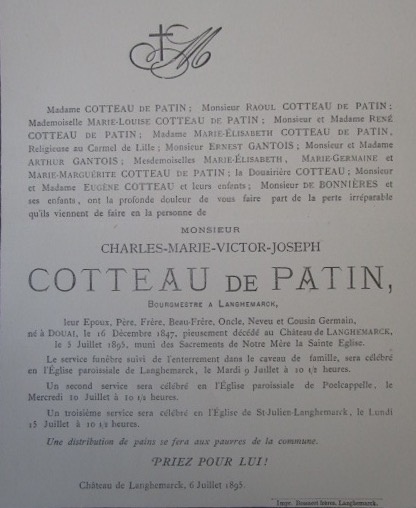
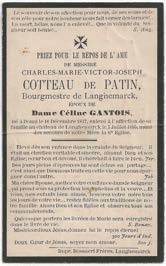
70.10. CHARLES PHILIPPE JEAN MARIE JOSEPH DE PATIN DE LANGEMARCK
1509
Figure 70.123: Langemark, the death of Charles Marie Victor Joseph Cotteau de Patin, in 1895.
Figure 70.124: The death announcement
of Charles Marie Victor Joseph Cotteau de
Patin in 1895. (Declercq de Silva Archive)
Figure 70.125: The obituary card of Charles Marie Victor Joseph
Cotteau de Patin, the husband of Celine Gantois, in 1895. (back) (De-
clercq de Silva Archive)
The Desclergues of la Villa Ducal de Montblanc, 2nd ed., Omn., VOL. VI
© 2024 Nico F. Declercq
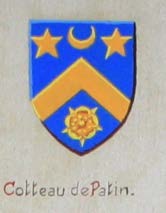
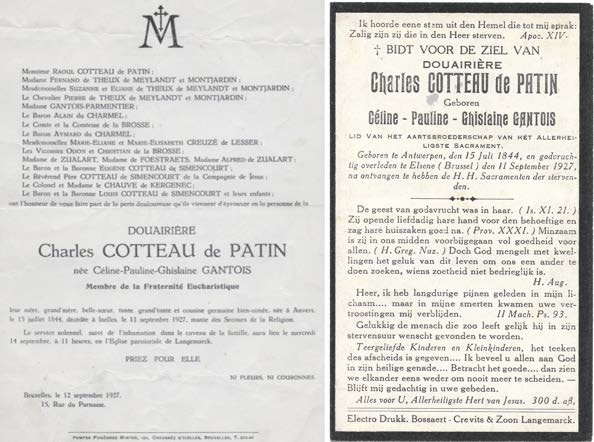
1510
CHAPTER 70. THE SIDE-BRANCH OF DE PATIN DE LANGEMARCK
Figure 70.126: The heraldic shield of Cotteau de Patin. (Declercq de
Silva Archive)
Figure 70.127: The death announcement and obituary card of Celine Pauline Ghislaine Gantois, the widow of Charles Cotteau de Patin, in 1927. (Declercq de Silva Archive)
© 2024 Nico F. Declercq
The Desclergues of la Villa Ducal de Montblanc, 2nd ed., Omn., VOL. VI
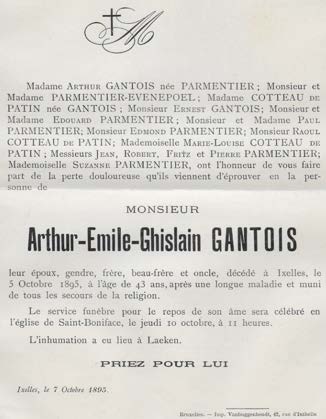
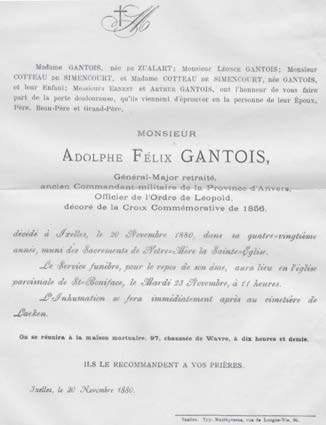
70.10. CHARLES PHILIPPE JEAN MARIE JOSEPH DE PATIN DE LANGEMARCK
1511
Figure 70.128: The death announcement
of Arthur Emile Ghislain Gantois in 1895.
(Declercq de Silva Archive)
Figure 70.129: The death announcement
of Adolphe Felix Gantois in 1880. (De-
clercq de Silva Archive)
The Desclergues of la Villa Ducal de Montblanc, 2nd ed., Omn., VOL. VI
© 2024 Nico F. Declercq
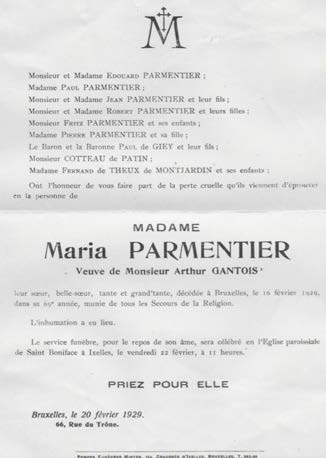
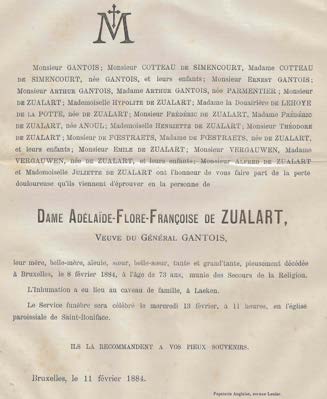
1512
CHAPTER 70. THE SIDE-BRANCH OF DE PATIN DE LANGEMARCK
Figure 70.130:
The death announce-
ment of Maria Parmentier, the widow of
Arthur Gantois, in 1929. (Declercq de
Silva Archive)
Figure 70.131:
A letter addressed to
Mrs. Cotteau de Patin was sent in 1902
from Houthave (near Ypres) to Lange-
mark. (Declercq de Silva Archive)
Figure 70.132: The death announcement
of Adelaide Flore Francoise de Zualart, the
widow of Mr Gantois, in 1884. (Declercq
de Silva Archive)
© 2024 Nico F. Declercq
The Desclergues of la Villa Ducal de Montblanc, 2nd ed., Omn., VOL. VI
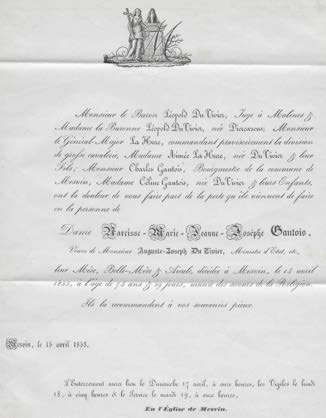
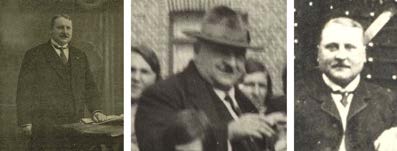
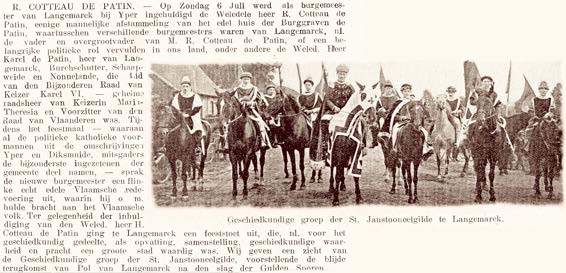
70.10. CHARLES PHILIPPE JEAN MARIE JOSEPH DE PATIN DE LANGEMARCK
1513
Figure 70.133: The death announcement
of Narcisse Marie Jeanne Josephe Gan-
tois, the wife of Auguste Joseph Du Vivier,
in 1853. (Declercq de Silva Archive)
Figure 70.134: Raoul Charles René Ghislain Cotteau de Patin.
Figure 70.135: The inauguration of Mayor Raoul Charles René Ghislain Cotteau de Patin was in a newspaper in 1913. p
The Desclergues of la Villa Ducal de Montblanc, 2nd ed., Omn., VOL. VI
© 2024 Nico F. Declercq
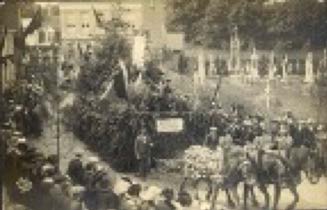
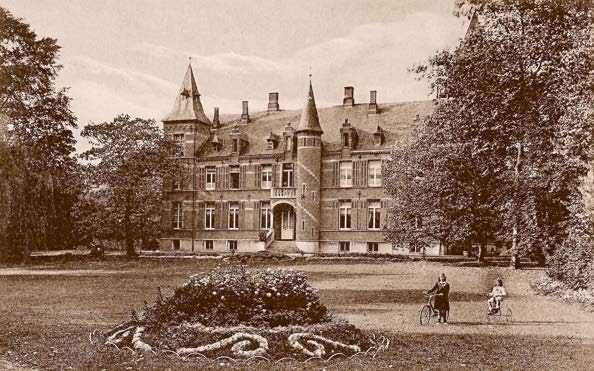
1514
CHAPTER 70. THE SIDE-BRANCH OF DE PATIN DE LANGEMARCK
Figure 70.136:
Photo taken on the
occasion of the inauguration of mayor
Raoul Cotteau de Patin on July 6, 1913.
The procession came from Statiestraat and
went past the cemetery to the Market where
beautiful tombs stood. The carriage was
decorated with all kinds of branches and
flowers. An inscription was in the mid-
dle, while the corners were decorated with
Belgian flags. The members of the Forest
Growers Guild (Boskwekersgilde) sat on
the wagon. The horses were also dressed.
The inscription on the carriage read: ’De
wagen schoon versierd, door het volk dat
hoveniert, toont hoe ook de Boschkant
viert, voor Cotteau die ons bestiert’ .
(Langemark) p
Figure 70.137: A picture of the castle of Langemark, probably taken between 1900 and 1910.
Figure 70.138:
In the above picture,
two children were photographed at the
Langemark castle before WWI. We have
not identified them, but one may be
Marie Louise Caroline Ghislaine Cotteau
de Patin (DP12by1y1y1y2yx2y1y1), born
in 1891.
© 2024 Nico F. Declercq
The Desclergues of la Villa Ducal de Montblanc, 2nd ed., Omn., VOL. VI
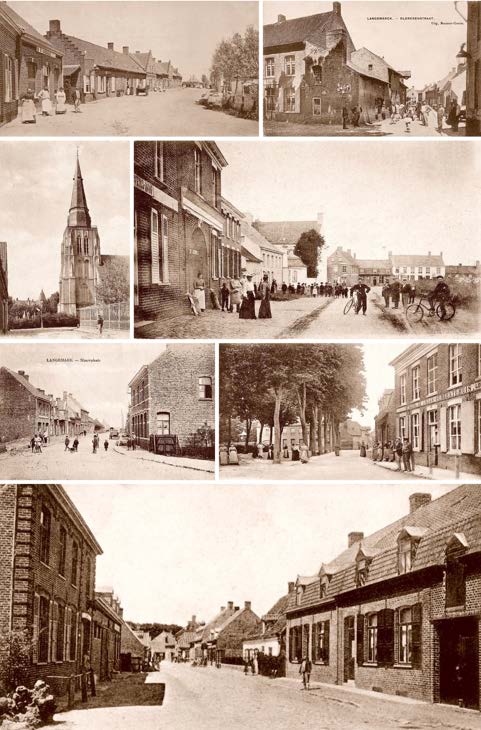
70.10. CHARLES PHILIPPE JEAN MARIE JOSEPH DE PATIN DE LANGEMARCK
1515
Figure 70.139: A collection of images of pre-WWI Langemark. We see, for instance, the Mar-
ket Square and Nieuwplaats. We can also see de Patin posing with the inhabitants on Nieuwplaats,
in Clerckenstraat, on the Market Square, in front of the Church of Langemark in Ieperstraat, and
Lekkerboterstraat.
The Desclergues of la Villa Ducal de Montblanc, 2nd ed., Omn., VOL. VI
© 2024 Nico F. Declercq
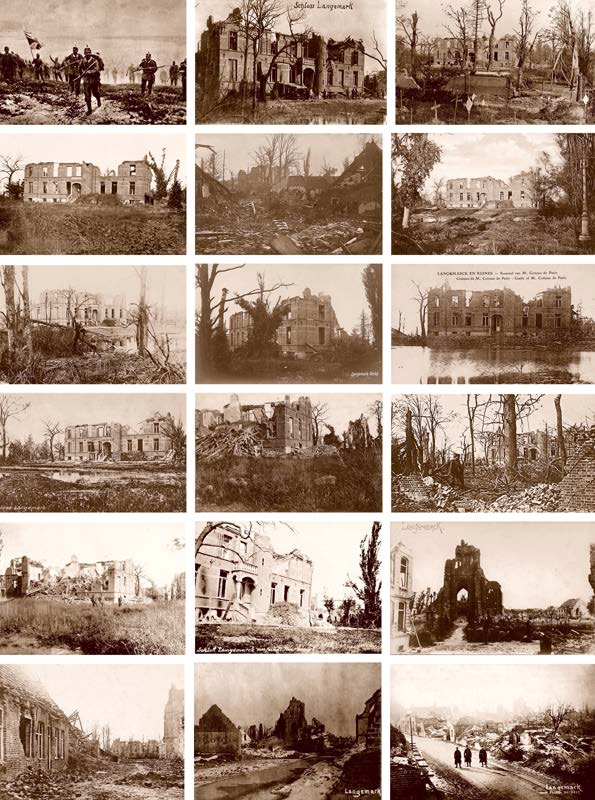
1516
CHAPTER 70. THE SIDE-BRANCH OF DE PATIN DE LANGEMARCK
Figure 70.140: Langemark was infamous in Germany because the name sounded German and because early in WWI, there was a battle that killed numerous young German soldiers, shown in propaganda in the upper left corner. The other images show Langemark, particularly the castle, during the devastation of WWI.
© 2024 Nico F. Declercq
The Desclergues of la Villa Ducal de Montblanc, 2nd ed., Omn., VOL. VI
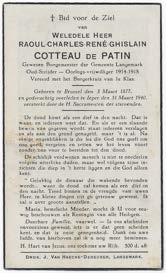
70.10. CHARLES PHILIPPE JEAN MARIE JOSEPH DE PATIN DE LANGEMARCK
1517
Figure 70.141: The obituary card of Raoul Charles René Ghislain
Cotteau de Patin in 1940. (Declercq de Silva Archive)
Figure 70.142: The castle of Langemark (2013) was built by
Raoul Cotteau de Patin after 1918 on the same spot as the old
castle of De Patin de Langemarck after its destruction during
WWI. Nowadays, the castle serves as the town hall.
Figure 70.143: Benjamin and Anna-Laura, the eldest children of the author, in Langemark, 2013. (De-
clercq de Silva Archive)
The Desclergues of la Villa Ducal de Montblanc, 2nd ed., Omn., VOL. VI
© 2024 Nico F. Declercq
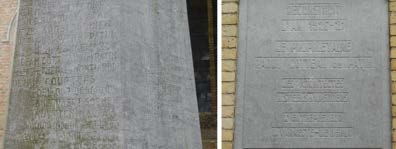
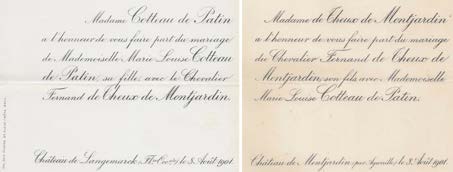
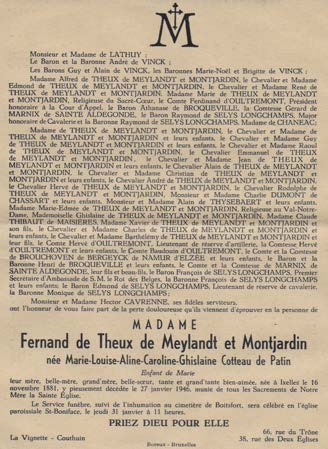
1518
CHAPTER 70. THE SIDE-BRANCH OF DE PATIN DE LANGEMARCK
Figure 70.144: The column of the statue in front of the church of Langemark
commemorating the victims of WWI was photographed in 2013. Among the list of
families: ’De Burggraven de Patin de Langemarck’ and ’De Fam. Cotteau de Patin.’
Right is a Memorial Plaque on the wall of the Castle of Langemark (Declercq de Silva
Archive)
Figure 70.145: The marriage announcement of Marie-Louise Cotteau de Patin and Fernand
de Theux de Montjardin at Chateau de Langemark and at Chateau de Montjardin in 1901.
(Declercq de Silva Archive)
Figure 70.146: The death announcement
of Marie Louise Aline Caroline Ghislaine
Cotteau de Patin, the wife of Fernand de
Theux de Meylandt et Montardin, in 1946.
(Declercq de Silva Archive)
© 2024 Nico F. Declercq
The Desclergues of la Villa Ducal de Montblanc, 2nd ed., Omn., VOL. VI
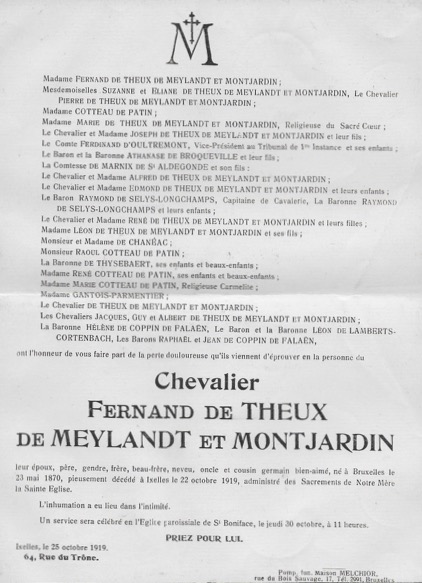
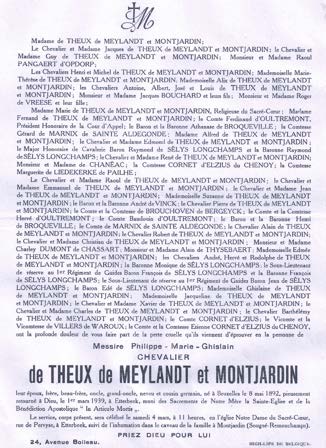
70.10. CHARLES PHILIPPE JEAN MARIE JOSEPH DE PATIN DE LANGEMARCK
1519
Figure 70.147: The death announcement
of Fernand de Theux de Meylandt et Mont-
jardin in 1919. (Declercq de Silva Archive)
Figure 70.148: The death announcement
of Philippe Marie Ghislain de Theux de
Meylandt et Montjardin in 1939. (Declercq
de Silva Archive)
The Desclergues of la Villa Ducal de Montblanc, 2nd ed., Omn., VOL. VI
© 2024 Nico F. Declercq
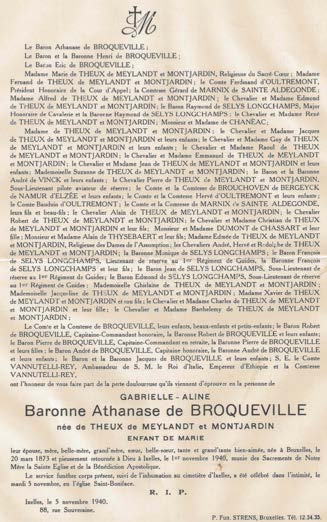
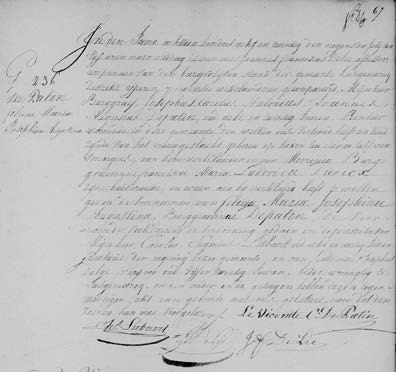
1520
CHAPTER 70. THE SIDE-BRANCH OF DE PATIN DE LANGEMARCK
Figure 70.149: The death announcement
of Gabrielle Aline de Theux de Meylandt
et Montjardin in 1940. (Declercq de Silva
Archive)
Figure 70.150: Langemark, 1828, the birth of Félicie Marie Joséphine Augustine
de Patin de Langemarck.
© 2024 Nico F. Declercq
The Desclergues of la Villa Ducal de Montblanc, 2nd ed., Omn., VOL. VI
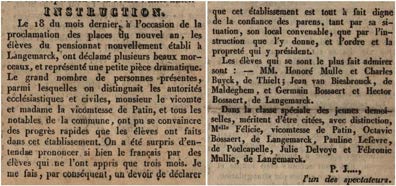
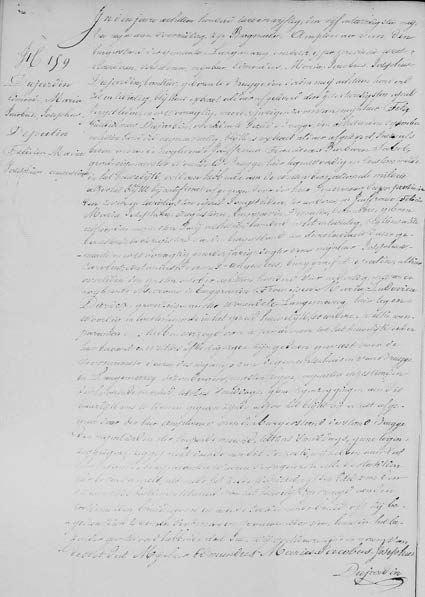
70.10. CHARLES PHILIPPE JEAN MARIE JOSEPH DE PATIN DE LANGEMARCK
1521
Figure 70.151: Félicie Marie Joséphine Augustine de Patin de Langemarck men-
tioned in an article in Le Propagateur, Journal de la Flandre-Occidental et de la
Ville d’ Ypres, Samedi, 10 Février, 1838 (Nr 2124, XXIme Année).
Figure 70.152: Langemark, 1852, the marriage of Félicie Marie Joséphine Augustine de
Patin de Langemarck and Edmond Dujardin. (part 1)
The Desclergues of la Villa Ducal de Montblanc, 2nd ed., Omn., VOL. VI
© 2024 Nico F. Declercq
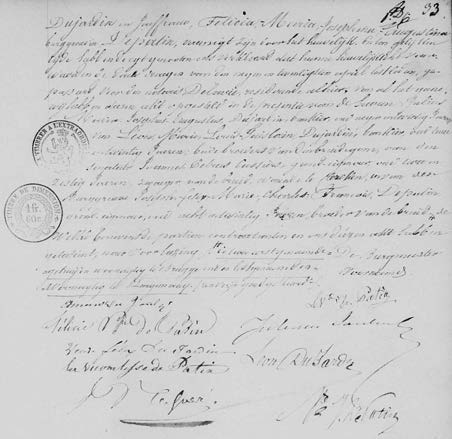
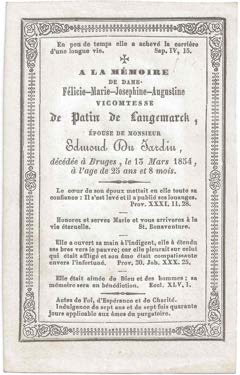
1522
CHAPTER 70. THE SIDE-BRANCH OF DE PATIN DE LANGEMARCK
Figure 70.153: Langemark, 1852, the marriage of Félicie Marie Joséphine Augustine de Patin
de Langemarck and Edmond Dujardin. (part 2)
Figure 70.154:
The obituary card of Felicie Marie
Josephine Augustine de Patin de Langemarck, the wife
of Edmond du Jardin, in 1854. (back) (Declercq de Silva
Archive)
© 2024 Nico F. Declercq
The Desclergues of la Villa Ducal de Montblanc, 2nd ed., Omn., VOL. VI
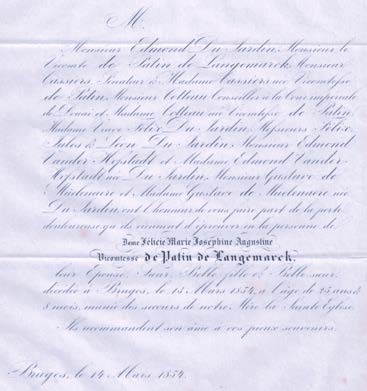
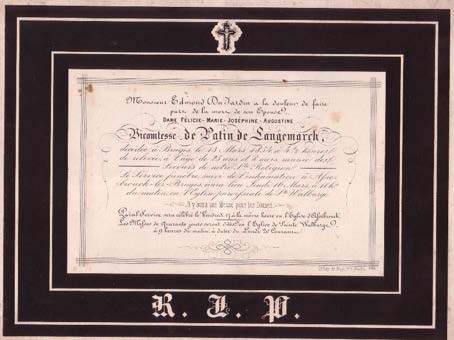
70.10. CHARLES PHILIPPE JEAN MARIE JOSEPH DE PATIN DE LANGEMARCK
1523
Figure 70.155: The death announcement of Félicie Marie Josephine Augus-
tine de Patin de Langemarck, the wife of Edmond du Jardin, in 1854. (part
1) (Declercq de Silva Archive)
Figure 70.156: The death announcement of Félicie Marie Josephine Augustine de Patin de
Langemarck, the wife of Edmond du Jardin, in 1854. (part 2) (Declercq de Silva Archive)
The Desclergues of la Villa Ducal de Montblanc, 2nd ed., Omn., VOL. VI
© 2024 Nico F. Declercq
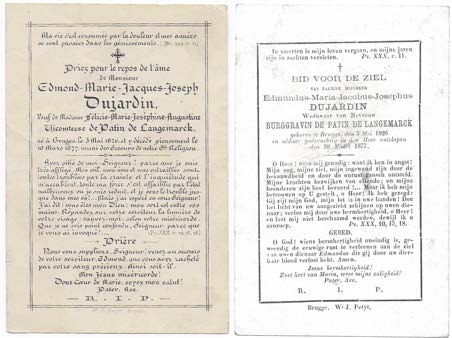
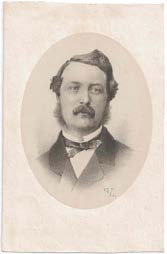
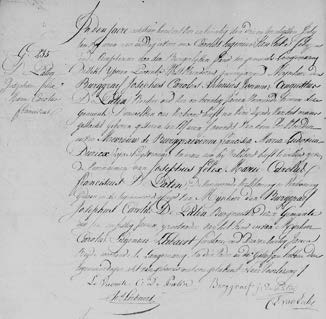
1524
CHAPTER 70. THE SIDE-BRANCH OF DE PATIN DE LANGEMARCK
Figure 70.157: The obituary card of Edmond Marie Jacques Joseph Dujardin, the widower
of Felicie Marie Josephine Augustine de Patin de Langemarck, in 1877. (French and Flemish
version) (Declercq de Silva Archive)
Figure 70.158: Joseph Felix Maria Carolus Franciscus de Patin de
Langemarck.
Figure 70.159:
Langemark 1824, the
birth of Joseph Felix Marie Carolus Fran-
ciscus de Patin.
© 2024 Nico F. Declercq
The Desclergues of la Villa Ducal de Montblanc, 2nd ed., Omn., VOL. VI
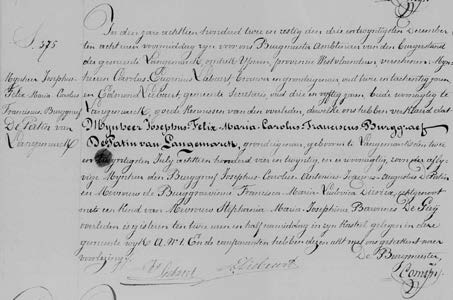
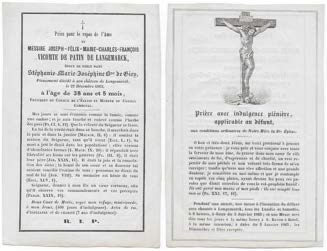
70.10. CHARLES PHILIPPE JEAN MARIE JOSEPH DE PATIN DE LANGEMARCK
1525
Figure 70.160: Langemark, 1862, the death of Josephus Felix Maria Carolus Franciscus de
Patin de Langemarck (’de Patin van Langemarck’).
Figure
70.161:
The obituary card
of Joseph Félix Marie Charles François
de Patin de Langemarck, husband of
Stéphanie Marie Joséphine de Giey, in
1862. (Declercq de Silva Archive)
The Desclergues of la Villa Ducal de Montblanc, 2nd ed., Omn., VOL. VI
© 2024 Nico F. Declercq
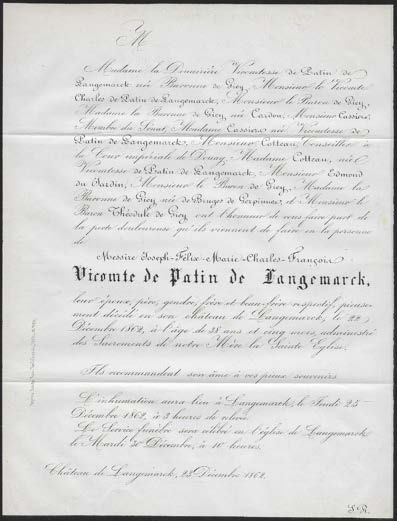
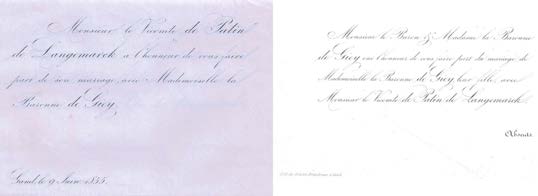
1526
CHAPTER 70. THE SIDE-BRANCH OF DE PATIN DE LANGEMARCK
Figure 70.162: The death announcement of Joseph Félix Marie Charles François
de Patin de Langemarck, husband of Stéphanie Marie Joséphine de Giey, in 1862.
(Declercq de Silva Archive)
Figure 70.163: 1855, the marriage announcements of Joseph de Patin de Langemarck and Stéphanie de Giey.
(Declercq de Silva Archive)
© 2024 Nico F. Declercq
The Desclergues of la Villa Ducal de Montblanc, 2nd ed., Omn., VOL. VI
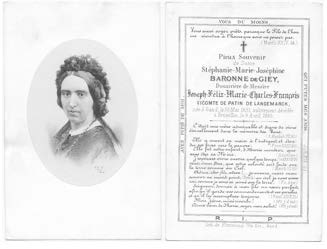
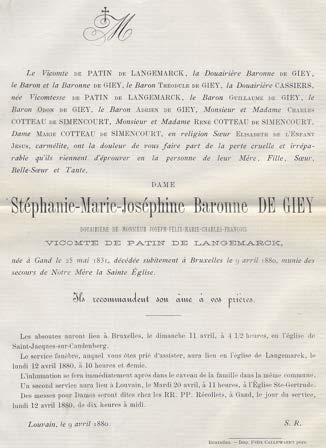
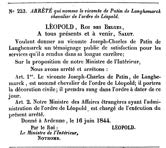
70.10. CHARLES PHILIPPE JEAN MARIE JOSEPH DE PATIN DE LANGEMARCK
1527
Figure 70.164:
The obituary card of
Stephanie Marie Josephine de Giey, the
widow of Joseph Felix Marie Charles Fran-
cois de Patin de Langemarck, in 1880.
(Declercq de Silva Archive)
Figure 70.165: The death announcement
of Stephanie Marie Josephine de Giey, the
widow of Joseph Felix Marie Charles Fran-
cois de Patin de Langemarck, in 1880.
(front) (Declercq de Silva Archive)
Figure 70.166:
1844, a reward for Joseph Charles de Patin de
Langhemarck (a knighthood in the order of Leopold) was published in
the official bulletin ’staatsblad’ of Belgium.
The Desclergues of la Villa Ducal de Montblanc, 2nd ed., Omn., VOL. VI
© 2024 Nico F. Declercq
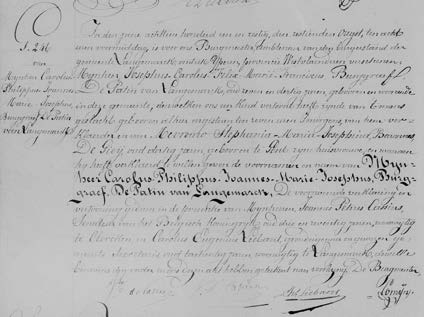
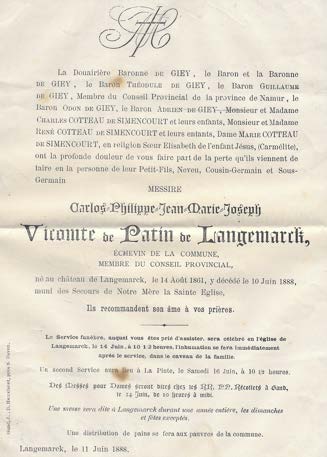
1528
CHAPTER 70. THE SIDE-BRANCH OF DE PATIN DE LANGEMARCK
Figure 70.167: Langemark, 1861, the birth of Carolus Philippus Joannes Marie Josephus
de Patin van Langemarck (’de Patin van Langemarck’).
Figure 70.168: The death announcement
of Charles Philippe Jean Marie Joseph de
Patin de Langemarck, who died in 1888
during a journey to Italy. (Declercq de
Silva Archive)
© 2024 Nico F. Declercq
The Desclergues of la Villa Ducal de Montblanc, 2nd ed., Omn., VOL. VI
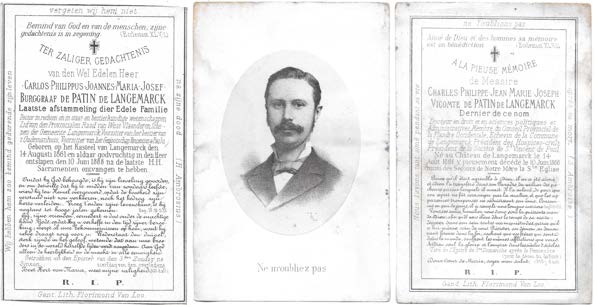

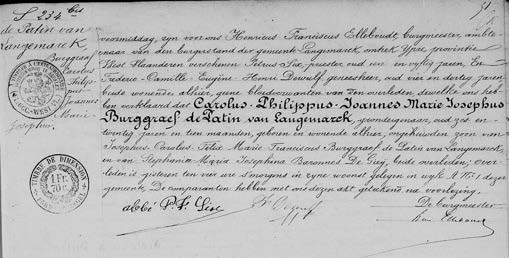
70.10. CHARLES PHILIPPE JEAN MARIE JOSEPH DE PATIN DE LANGEMARCK
1529
Figure 70.169: The obituary cards of Charles Philippe Jean Marie Joseph de Patin de Langemarck, who died in 1888 during a journey to Italy. (Declercq de Silva Archive)
Figure 70.170: Langemark, 1888, the death of Carolus Philippus Joannes Marie
Josephus de Patin de Langemarck (’de Patin van Langemarck’). (part 1)
Figure 70.171: Langemark, 1888, the death of Carolus Philippus Joannes Marie Josephus de Patin de
Langemarck (’de Patin van Langemarck’). (part 2)
The Desclergues of la Villa Ducal de Montblanc, 2nd ed., Omn., VOL. VI
© 2024 Nico F. Declercq
CHAPTER 70. THE SIDE-BRANCH OF DE PATIN DE LANGEMARCK
© 2024 Nico F. Declercq
The Desclergues of la Villa Ducal de Montblanc, 2nd ed., Omn., VOL. VI
The Ardan-Rouye-Lammens-Decaestecker Ancestry
line
71.1 Introduction
This line consists of farmers and soldiers. Jean François Ardan was a military stationed at Damme in the garrison of de Rysbourgh and later de Morel. He was married to Maria Josephe Rouye. They are ancestors of Eudoxie Romanie Lammens, the author’s great-grandmother.
The ancestors of Eudoxie Romanie Lammens are presented in Figure 71.1.
The descendants of Jean François Ardan are shown in Figure 71.2.
For instance, DNA evidence linking the author to the Lammens family is given in Chapter 73.13.3 on page 1602.
71.2 Jean François Ardan (ARLD01) & Marie Josephe Rouye
71.2.1 Jean François Harden
71.2.1.1 Introduction
Jean François Ardan was a military, stationed at Damme in the garrison of de Rysbourgh and later de Morel, and is the founder of our Ancestry line Ardan-Rouye-Lammens-Decaestecker (ARLD). The family names ’Ardan’ and ’Rouye’ existed in different forms.
We chose the ones prevalent in Burgundy around that time, while it may as well have been ’Harden,’ or ’Ardoiun,’ and ’Rouye.’
The fortifications of Damme in 1702, around the time when Jean François Ardan resided there, are shown in Figure 71.5 on page
Jean François Ardan was married to Marie Josephe Rouye. They are the ancestors of Eudoxie Romanie Lammens, the author’s great-grandmother.
As often with the military, other acquaintances served as witnesses at baptisms or weddings if their family was not nearby. On such matters, we found a connection with Doña Ana Ximenez (’Domicella Ana Ximenez’), which indicates that the Burgundian regiment was in the presence of the Iberian military.
We may refer to an article by Etienne Rooms1, which states,
’that, in the second half of the 17th century, the Spanish troops were no longer strictly separated according to their region of origin but were more mixed than during the decades before.’
It also states,
’that after 1659, the big enemy of the Spanish-Habsburg regime in Belgium was no longer The Netherlands but France.’
Ironically, support by the (Northern) Netherlands was necessary to prevent Belgium from becoming French. Spain had been severely weakened compared to the other allies in the defense against France. For instance, the Devolution War and the Treaty of the Pyrenees resulted in the loss of Northern Catalunya. One must also remember the losses of territories in the world. Indeed, during the Dutch War (1672-1678), William of Orange succeeded in keeping the military conflict outside his own country, namely by fighting with the French in Belgium. History tells that Belgium would, from then onwards, become Europe’s battlefield: the 9-year war (1689-1697), Waterloo in 1815, the Yser battles between 1914 and 1918, etcetera.
An influential citation Etienne Rooms’ article is,
’De Bourgondische eenheden werden niet enkel gelicht in de voormalige Habsburgse bezittingen in Bourgondië en Franche-Comté, doch eveneens in Lotharingen.’
In other words, the Burgundian cohort consisted of men from the actual Burgundy territory and Franche-Comté and Lorraine.
After Burgundy had become French in 1678, it is likely that the Burgundian cohort mainly consisted of men from Franche-Comté and Lorraine under the commandment of a person from those territories or another region. More information on the organization of the Spanish army is found in the earlier mentioned works of Van der Essen23, Parker4 and ’Gonzalez de Leon5 In the second half of the 17th century, Belgium’s total number of troops was significantly reduced (to around 6000 men only) due to Spain’s gradual loss of power. Nevertheless, there were still Spanish troops present. In terms of the number of divisions, this was around 30%; in terms of absolute numbers of the military, it was probably 10-20%. One can find this in Parker and Evrard et al.6, who mention that health care did no longer function correctly due to a lack of money from Madrid.
Before the Spanish regime, health care hardly existed, and it was thanks to the Spanish, the authorities had significantly improved it in the 16th century.
In Damme, Marie Josephe Rouye was godmother to Jean Claude Sangy on June 21, 1696, in Figure 71.3. The father was Pierre Sangy, who was a Burgundian military. The mother was Elisabeth Vandenberghe. The godfather was Jean Claude Peté.
1Etienne Rooms, ’De organisatie van infanterie en ruiterij in de Spaanse Nederlanden gedurende de periode 1659-1700’ , ’De zeventiende eeuw, jaargang 13, 1997, p153. (this paper was brought to our attention by genealogist Georges Picavet)
2Van der Essen, ’L’ armée espagnole,’ pages 39, 40, and 44.
3Van der Essen, ’Alexandre Farnèse II,’ pages 10 and 15.
4Parker, ’Army of Flanders,’ 31-32.
5Gonzalez de Leon, ’The road to Rocroi.’
6’J. Evrard, J. Mathieu et al., ’Asklepeios onder de wapens. 500 jaar militaire geneeskunde in België’ , published by Wetenschappelijke vereniging van de militaire Medische dienst, 1997, page 15.
The Desclergues of la Villa Ducal de Montblanc, 2nd ed., Omn., VOL. VI
© 2024 Nico F. Declercq
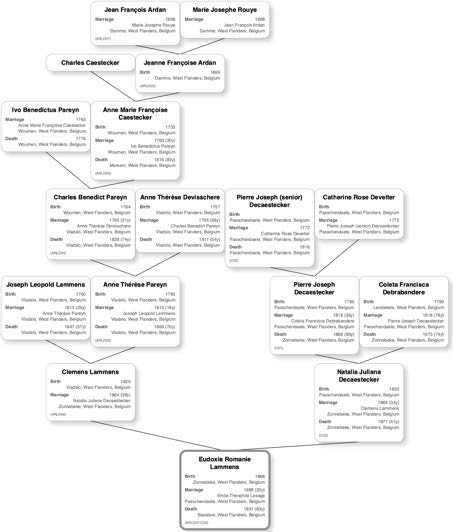
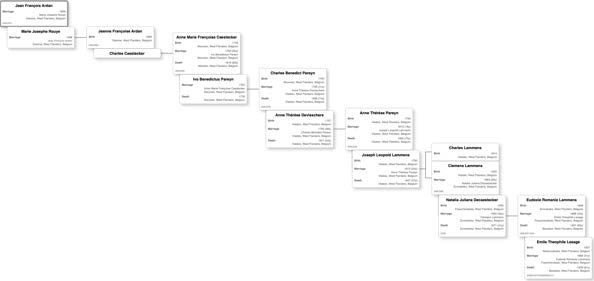
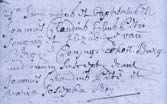
1532
CHAPTER 71. THE ARDAN-ROUYE-LAMMENS-DECAESTECKER ANCESTRY LINE
Figure 71.1: The ancestry of Eudoxie Romanie Lammens (H07-C03)
Figure 71.2: The descendants of Jean François Ardan (ARLD01) and Marie Josephe Rouye.
Figure 71.3: Damme, June 21, 1696, the baptism of Jean-Claude
Sangy (’Joannes Claudius Sanguy’). Marie Josephe Rouye was god-
mother. The mother was Elizabeth Vandenberghe, and the godfather
was Jean Claude Peté. The father was Pierre Sangy (’Petrus Sanguy’)
from the Burgundian regiment.
© 2024 Nico F. Declercq
The Desclergues of la Villa Ducal de Montblanc, 2nd ed., Omn., VOL. VI
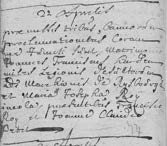
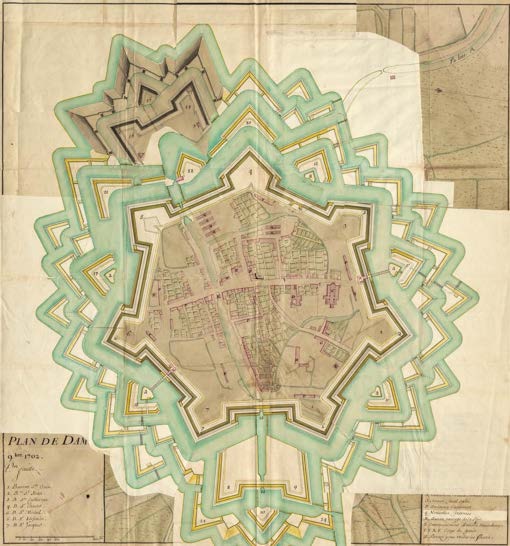
71.2. JEAN FRANÇOIS ARDAN (ARLD01) & MARIE JOSEPHE ROUYE
1533
Figure 71.4: Damme, April 22, 1698, the wedding of military Jean
François Ardan (ARLD01) and Marie Josephe Rouye at Damme. The
witnesses were François Rouye and Jean Claude Peté.
Figure 71.5: The fortifications of Damme in 1702. Damme, a historical city in Flanders near Bruges,
was a significant strategic location during the late medieval and early modern periods. Originally a thriving port town in the 13th century, Damme’s importance grew due to its proximity to Bruges and its accessibility via the Zwin estuary. By 1702, the fortifications of Damme were well-established, reflecting its role in the Eighty Years’ War and the War of the Spanish Succession. The city’s defenses included moats, ramparts, and bastions designed to protect against maritime and land-based threats. These fortifications were a testament to the military engineering of the time and played a crucial role in the city’s defense. However, by the early 18th century, Damme’s prominence had declined due to the silting of the Zwin, leading to a decrease in maritime trade and strategic importance. Despite this, the fortifications remained a notable feature of the city’s landscape, symbolizing its rich historical heritage.
The Desclergues of la Villa Ducal de Montblanc, 2nd ed., Omn., VOL. VI
© 2024 Nico F. Declercq


1534
CHAPTER 71. THE ARDAN-ROUYE-LAMMENS-DECAESTECKER ANCESTRY LINE
Figure 71.6:
Damme, January 20, 1699, the baptism of Jeanne
Françoise Ardan (’Anna Francisca Harden’), the daughter of Jean
François Ardan from the equestrian regiment of Marchione de Rys-
bourgh, and Marie Josephe Rouye. The godparents were Jean François
Rouye and Doña Ana Ximenes (’D(omi)cella Anna Giminis’).
Figure 71.7:
Woumen, May 11, 1776,
the funeral of Ivo Benedictus Pareyn
(’Parain’), husband of Maria Caestecker.
Interestingly, Damme was further fortified during the Spanish War of Succession (1703-1713). Still, in 1796, the Duke of Marlborough’s troops took the town. Families with foreign roots then likely spread over Flanders. Eighty years later, the ground on which the fortifications had been built was sold by Emperor Joseph II, introduced in Chapter 8.17.3, to the highest bidder.
71.2.2 Marie Josephe Rouye
As shown above, in 1696, Marie Josephe Rouye was the godmother of Jean Claude Sangy, son of Pierre Sangy, a military officer in the Burgundian cohort, and his wife, Elizabeth Vanden Berge. The godfather was Jean Claude Peté.
71.2.3 Marriage and offspring
Jean François Ardan (ARLD01) and Marie Josephe Rouye married at Damme in 1698. On April 20, they had their banns read, while on April 22, they married, in Figure 71.4.
The wedding certificate states that Jean François Ardan (’Joannes Franciscus Hurden’) was military in the legion of M. Derysbourgh.
The witnesses were Jean Claude Peté and François Rouye, father of the bride Marie Josephe Rouye.
71.3 Charles Caestecker & Joana Francisca Ardan (ARLD02)
71.3.1 Charles Caestecker
We have strong indications that Charles Caestecker was first married to Elisabeth Tabary. She died at Woumen on February 8, 1721, and was born at Handzame on October 2, 1691, the daughter of Petrus Tabary and Joanna Vaneeckhoutte. If so, Charles Caestecker was probably the son of Charles Caestecker’s senior.
The documents at Woumen have not survived, apart from a couple of name lists. We can, therefore, not study the early roots of this Caestecker branch.
71.3.2 Jeanne Françoise Ardan (ARLD02)
She was born at Damme in 1699, in Figure 71.6. Her godmother was Doña Ana Ximenez, a Spanish noblewoman. Her godfather was François Rouye.
71.3.3 Marriage and offspring
We have found six children born between 1722 and 1737, including a twin and including Anna Marie Françoise Caestecker (H03).
The family name is spelled in the following ways: ’Castecker’ and ’Caestecker’ on the one hand and ’Horten’ on the other.
71.4 Ivo Benedictus Pareyn & Anna Marie Françoise Caestecker (ARLD03)
71.4.1 Ivo Benedictus François Pareyn
On the administrative lists, we found this Ivo also as ’Joan’ or ’Yvon,’ e.g., ’Yvon Benedictus François Pareyn.’ We have not found his birth certificate. He died at Woumen in 1776, in Figure 71.7.
He should not be confused with a certain Ivon Benedictus Parain (junior), born at Woumen on January 23, 1761 (akte 56) as the son of Andreas Parain and Francisca De Wilde. Perhaps our Ivo Benedictus Pareyn was his godfather, though. Access to the original church certificates of this period at Woumen is impossible as they have been destroyed; hence, we must rely on tables where not all the details are given.
71.4.2 Anne Marie Françoise Caestecker (ARLD03)
She was born at Woumen in 1733, in Figure 71.8, as the daughter of Jeanne Françoise Ardan and Charles Caestecker. She died in Merkem on April 5, 1816.
Figure 71.8:
Woumen, October 11,
1733, the baptism of Anna Maria Fran-
cisca Castecker, the daughter of Charles
Caestecker and Jeanne Françoise Ardan
(’Joanna Francisca Horten’).
© 2024 Nico F. Declercq
The Desclergues of la Villa Ducal de Montblanc, 2nd ed., Omn., VOL. VI

71.5. CHARLES BENOIT PAREYN (ARLD04) & ANNE THÉRÈSE DEVISSCHERE
1535
Figure 71.9: Woumen, April 15, 1777,
the re-marriage of Anne Marie Françoise
Caestecker with Pierre Jacques Hoornaert.
Figure 71.10: Merkem, April 4, 1816,
the death of 82-year-old Anne Marie
Françoise Caestecker, born at Woumen,
and the daughter of Charles Caestecker
and Marie Jeanne Horten.
She was
the wife of 69-year-old Pierre Hoornaert
(and the widow of Ivo Benedictus François
Pareyn).
After the death of Ivo Benedictus François Pareyn, Anne Marie Françoise Caestecker remarried Pierre Jacques Hoornaert on April 15, 1777, in Figure 71.9 at Woumen, and she died in Merkem in 1816, in Figure 71.10.
71.4.3 Marriage and Offspring
Ivo Benedictus François Pareyn and Anne Marie Françoise Caestecker married at Woumen in 1763, in Figure 71.11. We found six children born at Woumen, including Charles Benoit Pareyn (H04) (Benedictus Carolus Parain).
The family names are spelled as Parain, Parrein on the one hand, and Caesteker, Caestecker, Castecker, De Caesteecker and De Kaesteker, on the other.
71.5 Charles Benoit Pareyn (ARLD04) & Anne Thérèse Devisschere
71.5.1 Charles Benoit Pareyn (ARLD04)
He was born at Woumen in 1764, in Figure 71.12, as the son of Ivo Benedictus François Pareyn and Anne Marie Françoise Caestecker.
Below, we show his appearance on the list of baptisms. The original documents have been destroyed. Based on the list, we can see that he had six siblings and that his parents in this transcription appear as Parain, Parrein, Parein and Caestecker, Castecker, Caesteeker, De Kaesteker, De Caesteecker for their family names and Ivon Benedictus, Ivannes Benedictus, Benedictus Ivo, Ivo Benedictus and Anna Maria, Anna Maria Francisca, Maria Francisca for their first names.
After the death of this wife, our ancestor, Anne Thérèse Devisschere, at Vladslo in 1811, Charles Benoit Pareyn (ARLD04) remarried Anna Theresia Swaels in 1813, in Figures 71.13 and 71.14. Charles Benoit Pareyn (ARLD04) died at Vladslo in 1838, in Figure
71.5.2 Anne Thérèse Devisschere
She was born at Vladslo in 1757, in Figure 71.16, and was the daughter of Jean Baptiste Devisschere and Joanna Clara Engelbreght.
Before she married Charles Benoit Pareyn (ARLD04), Anne Thérèse Devisschere had been married to Jean Pierre Jacques Marchand in 1778, in Figure 71.17.
Anne Thérèse Devisschere died at Vladslo in 1811, in Figure 71.18.
71.5.3 Marriage and Offspring
Charles Benoit Pareyn (ARLD04) and Anne Thérèse Devisschere married at Vladslo on February 10, 1795, in Figure 71.19.
In Chapter 71.6.2, we show the baptism of our ancestor and daughter of Charles Benoit Pareyn (ARLD04) and Anne Thérèse Devisschere, Anne Thérèse Pareyn (ARLD05), born on September 8, 1795. Charles Benoit Pareyn (ARLD04) and Anne Thérèse Devisschere had probably consumed their marriage before their wedding.
Figure 71.11: Woumen, February 8, 1763, the marriage of Ivo Benedictus François
Pareyn and Anne Marie Françoise Caestecker.
The Desclergues of la Villa Ducal de Montblanc, 2nd ed., Omn., VOL. VI
© 2024 Nico F. Declercq
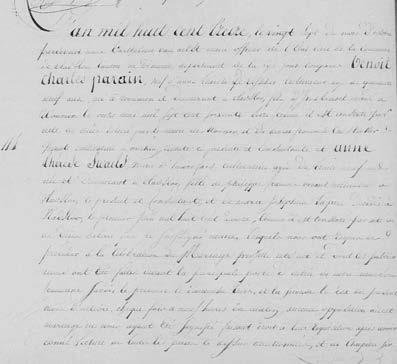
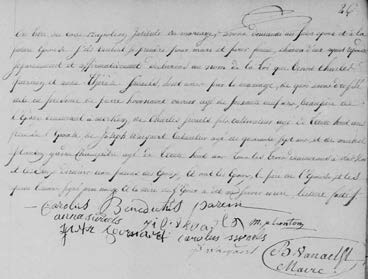
1536
CHAPTER 71. THE ARDAN-ROUYE-LAMMENS-DECAESTECKER ANCESTRY LINE
Figure 71.12: Woumen, January 14, 1764, the baptism of Charles Benoit Pareyn
(’Benedictus Carolus Parein’), son of Ivo Benedictus François Pareyn and Anne
Marie Françoise Caestecker. The document shows all his siblings as well.
Figure 71.13: Vladslo, October 27, 1813, the marriage of 39-year-old Anna There-
sia Swaels, a widowed farmer born at Vladslo, and 49-year-old Charles Benoit
Pareyn, a widowed farmer born at Woumen and residing in Vladslo. The groom’s
father was Ivo Benedictus François Pareyn (’Francis Benoit Parein’), who died at
Woumen on May 11, 1776, and his mother was Anne Marie Françoise Caestecker
(’Marie Francoise Caesteker’). The bride’s father was Philippe François Swaels, a
farmer residing at Vladslo, and her mother was Marie Josephine Lapere, who died
in Vladslo on June 1, 1812. The groom’s previous partner was Anne Thérèse De-
visschere; the bride’s previous partner was Henri Faes. (sheet 1)
Figure 71.14: Vladslo, October 27, 1813, the marriage of Anna Theresia
Swaels and Charles Benoit Pareyn. (sheet 2)
© 2024 Nico F. Declercq
The Desclergues of la Villa Ducal de Montblanc, 2nd ed., Omn., VOL. VI
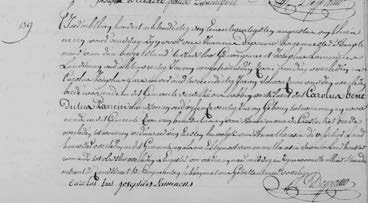
71.6. JOSEPH LEOPOLD LAMMENS & ANNE THÉRÈSE PAREYN (ARLD05)
1537
Figure 71.15: Vladslo, August 21, 1838, the death of 75-year-old farmer
Charles Benoit Pareyn (ARLD04) (’Carolus Benedictus Parrein’). He was
the son of Benedictus François Pareyn (’Benedictus Parrein’), who died at
Woumen, and Anne Marie Françoise Caestecker (’Anna Marie Decaestecker’),
who died at Woumen. His wife was farmer Anna Theresia Swaels, who lived
in Vladslo, while his previous partner was Anne Thérèse Devisscher, who died
in Vladslo.
Figure 71.16: Vladslo, September 21, the baptism of Anne Thérèse Devisschere, daughter
of Jean Baptiste Devisschere and Joanna Clara Engelbreght.
71.6 Joseph Leopold Lammens & Anne Thérèse Pareyn (ARLD05)
71.6.1 Joseph Leopold Lammens
He was born at Vladslo in 1790, in Figure 71.20.
He was a landed gentry farmer.
He died at Vladslo in 1847, in Figures 71.21 and 71.22.
71.6.2 Anne Thérèse Pareyn (ARLD05)
She was born at Vladslo in 1795, in Figure 71.23.
She was a landed gentry farmer.
She died at Vladslo in 1865, in Figure 71.24.
71.6.3 Marriage and Offspring
Joseph Leopold Lammens and Anne Thérèse Pareyn (ARLD05) married at Vladslo in 1813, in Figures 71.25, 71.26 and 71.27.
We found 15 births at Vladslo, including Charles Lammens (1814, described in detail in Chapter 71.6.5), Louis Lammens (1819), Clemens Lammens (ARLD06, described in detail in Chapter 71.7), Joseph Lammens (1825), Francis Lammens (1829) and Robert Lammens (1832).
The family names are spelled as Pareyn, Parein, Parin and Parrein, on the one hand, and Lammens on the other.
71.6.4 Relatives
To refer to our archives, it is interesting to mention the marriage at Koekelare, on April 19, 1871, of 44-year-old farmer Rosalia Cattrysse, born at Koekelare on January 5, 1827, with the 51-year-old farmer and widower Louis Lammens, who was born on October 19, 1819, at Vladslo and had earlier been married to Amelie Vanhecke who died on November 13, 1870. The groom’s parents were Joseph Leopold Lammens, who died on June 16, 1847, at Vladslo, and Anne Thérèse Parrein, who died on January 26, 1865, at Vladslo. The bride’s parents were Pierre Cattrysse, who died at Koekelare on October 7, 1827, and Anne Thérèse Sioen, who died at Koekelare on November 6, 1868. The Lammens family had established bonds with Koekelare earlier. Indeed, the mortuary card in Figure 71.28 is that of Anna Theresia Lammens, a blood relative of the father of Joseph Leopold Lammens through his uncle Pierre Jean Lammens. Anna Theresia Lammens was born at Koekelare on May 9, 1801, and died in Koekelare on January 15, 1872.
Anna Theresia Lammens was married to Joannes Baptiste Denduyver and was a daughter of Jacques Lammens, a farmer at The Desclergues of la Villa Ducal de Montblanc, 2nd ed., Omn., VOL. VI
© 2024 Nico F. Declercq
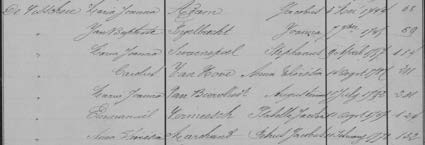
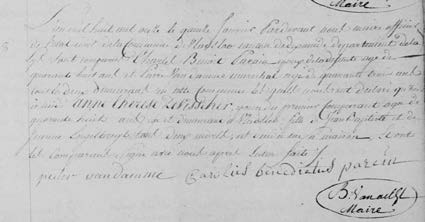


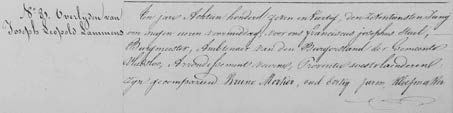
1538
CHAPTER 71. THE ARDAN-ROUYE-LAMMENS-DECAESTECKER ANCESTRY LINE
Figure 71.17: Vladslo, February 10, 1778, the marriage of Anne Thérèse Devisschere
and Jean Pierre Jacques Marchand. We know from other sources that the witnesses were
Jean Baptiste Devisschere and Pierre Jacques Pareyn; however, we have not found the
original file (folio 132).
Figure 71.18: Vladslo, January 15, 1811, the death of 48-year-old Anne Thérèse De-
visschere, wife of Charles Benoit Pareyn (ARLD04) and the daughter of Jean Baptiste
Devisschere and Joanna Engelbreght.
Figure 71.19:
Vladslo, February 10, 1795, the marriage of Charles Benoit Pareyn
(ARLD04) and Anne Thérèse Devisschere.
Figure 71.20: Vladslo, September 1790, the baptism of Joseph Leopold Lammens, son of
Pierre Lammens and Marie Thérèse Catrisse.
Figure 71.21: Vladslo, June 16, 1847, the death of 56-year-old farmer Joseph Leopold Lam-
mens, born at Vladslo as the son of Pierre Lammens (’Pieter’) and farmer Marie Thérèse
Catrisse. Both parents died in Vladslo. He was the husband of 49-year-old Anne Thérèse
Pareyn (ARLD05), daughter of Charles Benoit Pareyn (ARLD04) (’Benedictus Pareyn’) and
Anne Thérèse Devisschere. (sheet 1)
© 2024 Nico F. Declercq
The Desclergues of la Villa Ducal de Montblanc, 2nd ed., Omn., VOL. VI
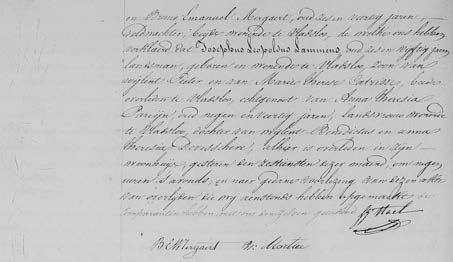

71.6. JOSEPH LEOPOLD LAMMENS & ANNE THÉRÈSE PAREYN (ARLD05)
1539
Figure 71.22: Vladslo, June 16, 1847, the death of 56-year-old farmer Joseph Leopold Lam-
mens. (sheet 2)
Figure 71.23:
Vladslo, December 8, 1795, the baptism of Anne Thérèse
Pareyn (ARLD05), daughter of Charles Benoit Pareyn (ARLD04) (’Benedic-
tus Pareyn’) and Anne Thérèse Devisschere.
Koekelare, and Isabelle Sys, equally a farmer at Koekelare. Jacques Lammens was a son of Joannes Lammens and Genoveva Degrieck and was born at Koekelare on April 29, 1766; he was a brother of Pierre-Jean Lammens, father of Joseph Leopold Lammens, who was the grandfather of Eudoxie Lammens. So, Anna-Theresia Lammens was the great-grand-aunt of Eudoxie Romanie Lammens. Anna-Theresia was, therefore, also the daughter of a cousin of Joseph Leopold Lammens.
In Figure 71.24, we have mentioned Robert Lammens, son of Joseph Leopold Lammens and Anne Thérèse Pareyn (ARLD05). In 1865, he was 31 years old. He was born on February 26, 1832, and his birth registration shows that his father was 43-year-old farmer Joseph Leopold Lammens, born in Vladslo, while 34-year-old Anne Thérèse Pareyn was born in Vladslo. Robert Lammens married Amelie Mergaert at Vladslo on May 3, 1866. Their son Charles Louis Lammens married Emiliana Dekien, daughter of Ferdinand Dekien and Juliana Deruyter, at Vladslo on September 9, 1904. Charles Louis Lammens and Emiliana Dekien had a daughter, Alice Parailde Lammens, who died at the age of 9, at the end of WWI on September 16, 1918, in Figure 71.28, in Brustem, Limburg.
Because of Vladslo’s location, the inhabitants must have fled the violence and stayed far away from the front.
Francis Lammens, appearing in Figure 71.24, was born on January 2, 1829, at Vladso. His parents were 39-year-old Joseph Lammens and 31-year-old Anne Thérèse Pareyn. He had a son, Auguste, born in Vladslo on August 31, 1852, mentioned in Figure 71.29.
The parents of Auguste were 23-year-old Franciscus Lammens, who was born in Vladslo, and 20-year-old Rosalie Devrome, born in Vladslo. Auguste Lammens married Julia Maria Depauw, and they had a son, Arthur, whose obituary card is shown in Figure
71.29. In particular, Arthur Franciscus Lammens was born in Vladslo on May 11, 1881; his parents were 28-year-old Auguste Lammens, born in Vladslo, and 37-year-old Julia Maria Depauw, born in Loppem. Another souvenir is shown in Figure 71.29.
We also mentioned Louis Lammens, born in Vladslo on October 3, 1819. His parents were 21-year-old Joseph Leopold Lammens and Anne Thérèse Pareyn. Louis Lammens married Rosalie Catrysse at Koekelare on April 19, 1871. Rosalie was a farmer born at Koekelare in 1827 as Pierre Catrysse and Anne Thérèse Sioen’s daughter, both from Koekelare. She died in 1899, in Figure 71.28.
71.6.5 Charles Lammens, a chasseur à pied with Hendrik Conscience
71.6.5.1 Introduction
Charles Lammens was a son of Joseph Leopold Lammens and Anne Thérèse Pareyn (ARLD05) and was a soldier (’chasseur ’a pied’) with Hendrik Conscience, a renowned Belgian writer. His relationship to Eudoxie Romanie Lammens is shown in Figure
71.6.5.2 Military files
The military database (the list of Belgian officers, in Figure 71.31) contains the following information about him:
’Naam (Name): LAMMENS Charles; Geboortedatum (date of birth): 16/10/1814; Geboorteplaats (place of birth): Vladslo; Eenheid (unit): Chasseurs à pied / Jagers te voet; Type (type of document): Stamboek Troep; Stamboeknummer (studbook number): 126 /
3837.’
We also found his initial military registration in Figure 71.32.
71.6.5.3 Birth
Charles Lammens was born at Vladslo on October 16, 1814, in Figure 71.33.
His father was Joseph Leopold Lammens (24 years old), while his mother was Anne Thérèse Pareyn.
The Desclergues of la Villa Ducal de Montblanc, 2nd ed., Omn., VOL. VI
© 2024 Nico F. Declercq
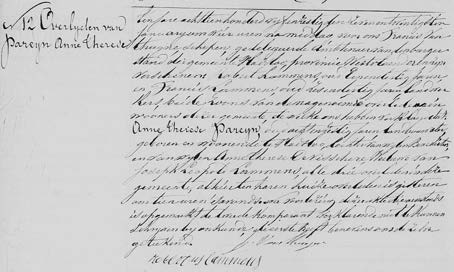
1540
CHAPTER 71. THE ARDAN-ROUYE-LAMMENS-DECAESTECKER ANCESTRY LINE
Figure 71.24:
Vladslo, January 26, 1865, the death of 68-year-old farmer Anne Thérèse
Pareyn, wife of Joseph Leopold Lammens, who died in Vladslo. She was born in Vladslo as
the daughter of Charles Benoit Pareyn (ARLD04) (’Benedictus’) and Anne Thérèse Deviss-
chere and was the widow of Joseph Leopold Lammens. Her sons, who were farmers, reported the
death, 31-year-old Robert Lammens and 36-year-old Francis Lammens, both described in Chap-
ter 71.6.4.
71.6.5.4 He served with Hendrik Conscience in the 2nd Regiment Chasseurs ’a pied, as an officer
Henri Conscience, shown in Figure 71.34, was born in Antwerp on December 3, 1812, and died on September 10, 1883, in Elsene. He is well-known in Belgium for his historical writings and his attempts to teach the Belgians, through his novels, about their history.
At seventeen, Henri left his father’s house to become a tutor in Antwerp and continue his studies, which were soon turned upside down by the Belgian Revolution 1830. He volunteered as a soldier in the new Belgian army and served in the barracks of Venlo and later Termonde until 1837, having obtained the rank of sergeant-major. He thus found himself among the Flemish of all social classes and closely observed their mental habits. The young man then decided to write in the despised language of the country, an idiom considered then too peasant to be spoken and predominantly written by the French speakers who formed the bourgeoisie in Flanders.
More precisely, Henri Conscience was indeed a military from 1831 until 1837. Just before, he had also participated in the Belgian revolution7.
As a military man, he was a ’Jager te Voet’ or ’Chasseur à Pied’ and was with the ’2de jagers te voet’ unit8. During his service, Henri Conscience formed a significant connection with Charles Lammens, my ancestor, who also served in the same unit. This connection highlights the shared experiences and camaraderie between the two and places them together during a pivotal moment in Belgian history.
Conscience’s military experience profoundly influenced his writing, particularly his decision to write in Flemish, thus playing a crucial role in the revival of Flemish literature. His novel "The Lion of Flanders" is a testament to his dedication to Flemish culture and history, which he sought to promote and preserve through his literary works.
In the context of this book, it is essential to note that besides Henri Conscience and with him Charles Lammens, we also find, much later, Cyrille Lesage with the ’2de jagers te voet,’ described in Chapter 64.7.1.
The 2nd Regiment of Chasseurs ’a Pied (Jagers te voet) finds its origins during the Belgian Revolution of 1830 by regrouping several free corps made up of volunteers acquired to the ideals of Belgian independence. Thus, between March and August 1831, the 2nd Brigade of Free Corps formed the Regiment with the successive absorption of the 1st Battalion of Tirailleurs Liégeois and the 2nd Battalion of Tirailleurs Luxembourgeois. Exceptionally for the time, the company had its fanfare. François Humblet (1822-1871), leader of this musical formation between 1855 and 1862, composed the regimental march.
Stationed in 1843 in Tournai, the 2nd Chasseurs moved to Mons in 1890. In the meantime, the Regiment received its flag from King Léopold II on August 10, 1872. The emblem of the free corps of Niellon, one of the volunteer units at the origin of the Regiment, had, however, been kept as a ’regimental flag’ until 1865.
During the mobilization of August 1914, the 2nd Chasseurs split and formed, besides the 2nd and 5th Chasseurs ’a Pied and mobilized, a fortress regiment. Like the 1st Chasseurs, the company distinguished itself on the battlefields of the Great War. Four citations (Yser, Eertvelde, Antwerp, Dixmude) are inscribed on the flag and decorated with the Fourragère in the colors of the Order of Leopold. Cyrille Lesage fought in each of these battles. The end of 1918 saw the 2nd Chasseurs occupy Germany until March 1919.
Afterward, they moved to their quarters in Charleroi, in the Trésignies barracks, named after this symbolic hero of the Regiment, equally described in Chapter 64.7.1. In the mid-twenties, the unit was attached to the 5th DI of the 1st Army Corps. The mobilization of 1939 gave birth to the 5th Chasseurs (1st DI), 8th Chasseurs (17th DI), and 11th Chasseurs (5th CRI). The Chasseurs carried out the campaign of May 1940 within the 5th Infantry Division.
71.6.5.5 Their Marriage
Charles Lammens married Caroline Rommelaere on April 27, 1854, in Figures 71.35, 71.36, 71.37, 71.38, 71.39 and 71.40, at Vladslo.
Charles Lammens was born at Vladslo on October 15, 1814, while Caroline Rommelaere was born at Beerst on February 2, 1828, but she lived in Vladslo.
7Hendrik Conscience, Volledige werken 13. De keus des harten. De omwenteling van 1830. J. Lebègue, Brussel z.j. ,1912.
8’Conscience heeÍt indertijd in het 2de Regiment Jagers te voet gediend’, on page 8 of ’VOX, Militair weekblad’ 15, 21 April 1983, 10e jaargang.
© 2024 Nico F. Declercq
The Desclergues of la Villa Ducal de Montblanc, 2nd ed., Omn., VOL. VI
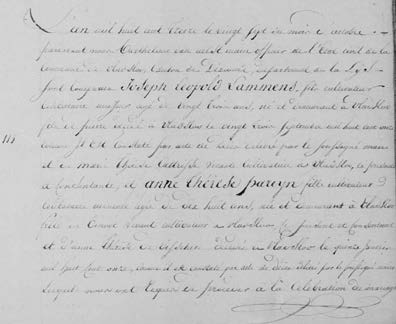
71.6. JOSEPH LEOPOLD LAMMENS & ANNE THÉRÈSE PAREYN (ARLD05)
1541
Figure 71.25:
Vladslo, October 27, 1813, the marriage of 23-year-old farmer
Joseph Leopold Lammens and 18-year-old farmer Anne Thérèse Pareyn (ARLD05).
The groom was the son of farmer Pierre Lammens, who died in Vladslo on Septem-
ber 23, 1811, and farmer Marie Thérèse Cattrysse, who lived in Vladslo. The bride
was born in Vladslo as the daughter of farmer Charles Benoit Pareyn (ARLD04)
(’Benoit Pareyn’), who lived in Vladslo, and Anne Thérèse Devisschere, who died in
Vladslo on January 15, 1811. (sheet 1)
Figure 71.26: Vladslo, October 27, 1813, the marriage of Joseph Leopold Lammens and
Anne Thérèse Pareyn (ARLD05). (sheet 2)
Figure 71.27: Vladslo, October 27, 1813, the marriage of Joseph Leopold Lammens and
Anne Thérèse Pareyn (ARLD05). (sheet 3)
The Desclergues of la Villa Ducal de Montblanc, 2nd ed., Omn., VOL. VI
© 2024 Nico F. Declercq
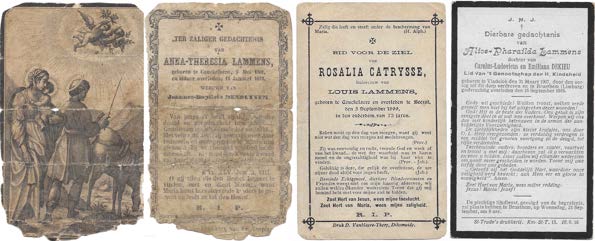
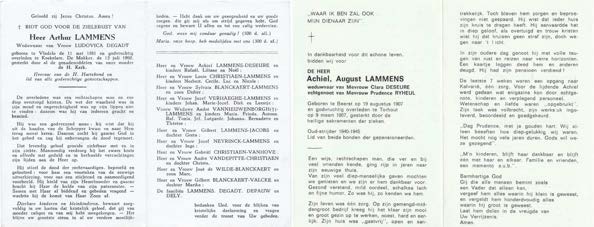
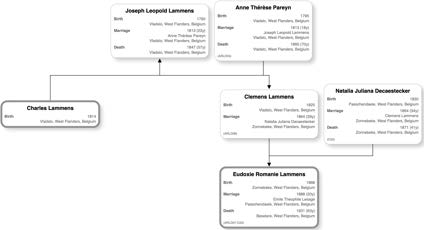

1542
CHAPTER 71. THE ARDAN-ROUYE-LAMMENS-DECAESTECKER ANCESTRY LINE
Figure 71.28: Souvenirs from left to right. The mortuary card of Anna Theresia Lammens, born at Koekelare on May 9, 1801, and deceased at Koekelare on January 15, 1872. The obituary card of Rosalie Catrysse, wife of Louis Lammens. She was born in Koekelare, and she died at the age of 73 on September 5, 1899, in Beerst. The mortuary card of Alice Pharailda Lammens, 1918. (Declercq de Silva Archive)
Figure 71.29: Left is the obituary card of Arthur Lammens, who died on July 13, 1960, and was married to Louise Degadt.
Arthur Franciscus Lammens was born in Vladslo on May 11, 1881. His parents were 28-year-old Auguste Lammens, born in Vladslo, and 37-year-old Julia Maria Depauw, born in Loppem. Right is the obituary card of Achiel Lammens, the son of Arthur Lammens and Louise Degadt. (Declercq de Silva Archive)
Figure 71.30: Relationship Chart Charles Lammens and Eudoxie Romanie Lammens
(H07-C03).
Figure 71.31: Facsimile of the entry of Charles Lammens in the military database, list of officers.
© 2024 Nico F. Declercq
The Desclergues of la Villa Ducal de Montblanc, 2nd ed., Omn., VOL. VI

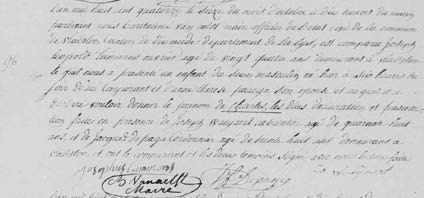
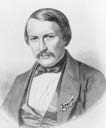
71.6. JOSEPH LEOPOLD LAMMENS & ANNE THÉRÈSE PAREYN (ARLD05)
1543
Figure 71.32: Military registration of Charles Lammens in lichting 1833, Nationale Militie, Provincie West-Vlaenderen, 10e Canton, Gemeente Vladslo, Lotings-register. He was born on October 16, 1814, in Vladslo. His father was Joseph Leopold Lammens, and his mother was Anne Thérèse Pareyn. He was a textile manufacturer, just like his parents. He had a round face and forehead, brown eyes, a regular nose, a round chin, and auburn hair and eyebrows. He was recruited on March 27, 1833, in the 2nd Regiment of Chasseurs à pied. He also passed in the 15th Regiment of Reservists on October 8, 1839, as number 27596.
Figure 71.33: 1814, Vladslo, birth of Charles Lammens on October 16.
Figure 71.34: Henri Conscience (1812-1883) was a renowned Belgian writer, often
hailed as the ’Flemish Walter Scott.’ Born in Antwerp, he served in the Belgian
Army during the Belgian Revolution of 1830. Conscience is best known for his novel
’The Lion of Flanders,’ which significantly revived Flemish literature and national
identity. His works have left an indelible mark on Belgian culture, making him a
prominent figure in the literary world.
Figure 71.35: 1854, the marriage at Vladslo of Charles Lammens
and Caroline Rommelaere. (sheet 1)
Figure 71.36: 1854, the marriage at Vladslo of Charles Lammens and Car-
oline Rommelaere. (sheet 2)
The Desclergues of la Villa Ducal de Montblanc, 2nd ed., Omn., VOL. VI
© 2024 Nico F. Declercq
1544
CHAPTER 71. THE ARDAN-ROUYE-LAMMENS-DECAESTECKER ANCESTRY LINE
Figure 71.37: 1854, the marriage at Vladslo of Charles Lammens and Car-
oline Rommelaere. (sheet 3)
Figure 71.38: 1864, the marriage at Vladslo of Charles Lammens and Car-
oline Rommelaere. (sheet 4)
Figure 71.39: 1854, the marriage at Vladslo of Charles Lammens and Car-
oline Rommelaere . (sheet 5)
Figure 71.40: 1854, the marriage at Vladslo of Charles Lammens and Caroline
Rommelaere. (sheet 6)
© 2024 Nico F. Declercq
The Desclergues of la Villa Ducal de Montblanc, 2nd ed., Omn., VOL. VI
71.7. CLEMENS LAMMENS (ARLD06) & NATALIA JULIANA DECAESTECKER (C02)
1545
Figure 71.41: 1881, Vladslo, the death of Charles Lammens.
Figure 71.42:
Vladslo, December 26, 1825, was the birth of Clemens Lammens
(ARLD06), son of 34-year-old Joseph Lammens and 28-year-old Anne Thérèse Pareyn
(ARLD05).
The groom’s father was Josephus Leopoldus Lammens, who had died on June 16, 1847, at Vladslo. The groom’s mother was Anne Thérèse Pareyn, a farmer from Vladslo.
The bride’s father was Pieter Jacobus Rommelaere, a roof constructor from Vladslo. The bride’s mother was Maria Josepha Harnhout, also from Vladslo.
71.6.5.6 His Death
He died at Vladslo on August 4, 1881, in Figure 71.41, at 66 years, nine months, and 19 days. The death certificate mentions his father’s name, Josephus Leopoldus Lammens from Vladslo, his mother’s name, Anna Theresia Parreyn from Vladslo, and his wife, Carolina Rommelaere.
71.7 Clemens Lammens (ARLD06) & Natalia Juliana Decaestecker (C02)
71.7.1 Clemens Lammens (ARLD06)
He was the son of Joseph Leopold Lammens and Anne Thérèse Pareyn (ARLD05) and was born at Vladslo in 1825, in Figure 71.42,
precisely 150 years and one day before the author’s birth. His military register in 1844 is shown in Figure 71.43.
He died in Zonnebeke at 82, in 1907, in Figure 71.44. We know from the death certificate that Clemens Lammens had been married to Barbara Cecilia Depoorter before he married Natalia Juliana Decaestecker.
Indeed, Clemens Lammens married Barbara Cecilia Depoorter on April 2, 1856, in Zonnebeke. She was a farmer and widow, born at Langemark on April 26, 1813. Clemens at that time was ’Dienstbode,’ and the certificate indicates that he was born at Vladslo on December 26, 1825, but lived in Klerken (’Clercken’).
His parents are listed as Josephus Lammens and Anna Theresia Parein. The bride’s parents are listed as Gregorius Franciscus Depoorter and Agatha Cornelia Casier.
The couple had a daughter, Juliana Lammens, at Zonnebeke on January 1, 1858. Barbara Cecilia Depoortere died at Zonnebeke on October 14, 1863.
The Desclergues of la Villa Ducal de Montblanc, 2nd ed., Omn., VOL. VI
© 2024 Nico F. Declercq

1546
CHAPTER 71. THE ARDAN-ROUYE-LAMMENS-DECAESTECKER ANCESTRY LINE
Figure 71.43: Clemens Lammens in the military register Ligting van den jaere achttien honderd vierenveertig, national Militie, Provincie West-Vlaenderen, 10de Canton, Gemeente Vladslo. He was a worker born on December 26, 1825. His father was Joseph Lammens, and his mother was Anne Thérèse Pareyn. He had an oval face, round forehead, blue eyes, pointed nose, average mouth, round chin, brown hair, and eyebrows. He was recruited on March 21, 1844, and stayed until April 1, 1855.
Figure 71.44: Zonnebeke, April 2, 1907, the death of 82-year-old Clemens Lammens, born in Vladslo (the registrar wrote ’Clercken’ instead, which is neighboring Vladslo), son of Joseph Leopold Lammens and Anne Thérèse Pareyn. He was a widower of his first wife, Barbara Cecilia Depoorter, and his second wife, Nathalia Juliana Decaestecker. His death was reported by his 42-year-old son and shop owner, Pierre Lammens, and his 49-year-old son-in-law, farmer Henri Knockaert.
Figure 71.45: Passchendaele, October 24, 1830, the birth of Natalia Juliana Decaestecker, daughter of
45-year-old Pierre Joseph Decaestecker (C01) (’Petrus’), a farmer born in Passchendaele, and 31-year-old Coleta Francisca De Brabandere.
© 2024 Nico F. Declercq
The Desclergues of la Villa Ducal de Montblanc, 2nd ed., Omn., VOL. VI
71.7. CLEMENS LAMMENS (ARLD06) & NATALIA JULIANA DECAESTECKER (C02)
1547
Figure 71.46: Zonnebeke, February 18, 1871, the death of 40-year-old farmer Natalia Juliana Decaestecker, born in Passchendaele and the daughter of Pierre Joseph Decaestecker (C01) (’Petrus’) and Coleta Francisca de Brabandere. The death was reported by her 45-year-old husband and farmer, Clemens Lammens, and 48-year-old teacher, Louis Lammens.
Figure 71.47:
Obituary card of Hendrik Descamps, son of Louis
Descamps and Amelie Decaestecker. He was born in Beselare on April
2, 1856, and died in Poelkapelle on July 2, 1930. (Declercq de Silva
Archive)
Their daughter, Juliana, married on April 4, 1875, in Passchendaele, where she lived at that time. The groom was Henricus Desiderius Develter, a farmer at Passchendaele born on March 24, 1849, in Passchendaele. His Parents were Pieter Joannes Develter and Beguia Develter.
71.7.2 Natalia Juliana Decaestecker (C02)
Natalia Juliana Decaestecker (C02) was born at Passchendaele in 1830, in Figure 71.45. She was the daughter of Pierre Joseph Decaestecker (C01) and Coleta Francisca de Brabandere.
She died at Zonnebeke in 1871, in Figure 71.46. Figure 71.47 is the obituary card of Hendrik Descamps, son of farmers Amelia Sophia Decaestecker (born in Passchendaele on November 18, 1824) and Louis Francis Descamps (born in Beselare on July 23, 1814). Amelie Sophia was the daughter of Pierre Joseph Decaestecker (C01) and Francisca Coleta de Brabandere.
The genetic link is shown in Chapter 73.13, on page 1602.
71.7.3 Pierre Joseph Decaestecker (C01), the Father of Natalia Juliana Decaestecker
71.7.3.1 Introduction
He was the father of Natalia Juliana Decaestecker. He was in Napoleon’s army. He is identified by code (C03) and is related to Eudoxie Romanie Lammens (ARLD07-C03), as shown in Figure 71.48. Having been military in Napoleon’s army, he must still have dwelled in the memory of Eudoxie and, therefore, in that of her three sons who would become soldiers during WWI.
Pierre Joseph Decaestecker was born in Passchendaele in 1785, in Figure 71.49.
A few days before the birth of Pierre Joseph Decaestecker, Blanchard and Jeffries crossed the Channel from Dover to Calais in a hydrogen gas balloon. Soon after, the University of Georgia was established in the USA, while Thomas Jefferson replaced Benjamin Franklin as Minister to France for the USA. In the same year, the Dollar was chosen as a currency for the entire USA. The Madras Courier, the first English-language newspaper in India, was published for the first time on October 13. In the same year, Louis XVI of France issued a law that a handkerchief always had to be square, while Napoleon Bonaparte became a French artillery lieutenant.
One of the famous Grimm brothers, Jacob Grimm, was born a few days before Pierre Joseph, while French engineer Navier (well known for the Navier-Stokes theorem) was born a few days later. This year, Louis XVII of France was born as well. At the end of the year, we found the birth of Etienne de Gerlache, who would later become Belgium’s first Prime Minister.
He was a conscrit of the year 1805, in Figure 71.50 because he was born in 1785. On the first day of frimaire of the year XIV, which means November 20, 1805, he joined the 45e régiment d’ infanterie de ligne in its arrangement as from the year X until 1815.
He was registered in ’matricules 3601 ’a 6600,’ ranging from 1er vendémiaire an XIV (September 23 1805) until July 24 1807. In The Desclergues of la Villa Ducal de Montblanc, 2nd ed., Omn., VOL. VI
© 2024 Nico F. Declercq
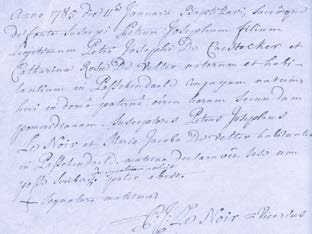
1548
CHAPTER 71. THE ARDAN-ROUYE-LAMMENS-DECAESTECKER ANCESTRY LINE
Figure 71.48: Relationship Chart Pierre Joseph Decaestecker
(C01) and Eudoxie Romanie Lammens (ARLD07-C03). His par-
ents are also given.
Figure 71.49:
Passchendaele, 11th of January in 1785, the
baptism of Pierre Joseph Decaestecker (’Petrus Josephus De
Caestecker’), son of Petrus Josephus and Catharina Rose de Vel-
ter, all born and living in Passchendaele. The Godfather was
Petrus Josephus Le Noir, and the Godmother was Maria Jacoba
De Velter from Passchendaele.
© 2024 Nico F. Declercq
The Desclergues of la Villa Ducal de Montblanc, 2nd ed., Omn., VOL. VI
71.7. CLEMENS LAMMENS (ARLD06) & NATALIA JULIANA DECAESTECKER (C02)
1549
Figure 71.50: Military file of Pierre Joseph Decaestecker (source SHD/GR 21 YC 385)
Figure 71.51: The left is a painting of Napoleon at the Military Museum in Paris (2019). The right is the Battle of Austerlitz, painted by François Gérard in 1810. p. Le Soleil d’ Austerlitz is clearly visible.
Figure 71.52: ’The battle of Lübeck, Prussian and French troops fighting at the
Burgtor town gate’ , by Benjamin Zix (1772-1811). p
Figure 71.53:
Napoleon at the Battle
of Friedland. This painted dish is anec-
dotic: the author was ’gifted’ this token
by ’Saint-Nicolas’ around 1980 in Deer-
lijk (Donckels). Not knowing, at that time,
who Napoleon Bonaparte was, he thought
that the ’N’ on this plate stood for his first
name. The dish was exposed above the fire-
place in the Declercq-Vangheluwe home in
Saint Louis in Deerlijk. It is a reproduc-
tion of the painting of Napoleon at the Bat-
tle of Friedland by Horace Vernet (1789-
1863). p
The Desclergues of la Villa Ducal de Montblanc, 2nd ed., Omn., VOL. VI
© 2024 Nico F. Declercq

1550
CHAPTER 71. THE ARDAN-ROUYE-LAMMENS-DECAESTECKER ANCESTRY LINE
Figure 71.54: Left is the famous Roman bridge of Alcantara on the Tagus River near the
Spanish-Portuguese border. Ernst Wasmuth took the picture in 1892. (p, shared by Constantin
Uhnde). Right is a painting by Louis-François Baron Lejeune (1775-1848) of the Battle of
Chiclana on March 5, 1811. Behind the battle scene, one can identify Cadiz’s beautiful harbor.
p
Figure 71.55: Left, 2003, June 16, Cadiz. The cat in the middle was posing very nicely on the fortress of Cadiz in June 2003. For instance, Iberian cats look precisely like those in India and Sri Lanka and are very different from those in Turkey.
Indeed, sailors took cats with them to catch mice on their ships. Those cats are still found in Iberia, and their descendants still thrive on the Indian subcontinent. Right is a view of the old fortress of Cadiz in June 2003. (Declercq de Silva Archive) Figure 71.56: Left is the battle of Vitoria (from a British-Spanish perspective), painted in 1836 by W. Heat. Right is the battle of the Pyrenees on July 28, 1813, by William Heat, from T. Sutherland, and J. Jenkins, around 1814.p Figure 71.57: 1814, Napoleon’s Abdication.
© 2024 Nico F. Declercq
The Desclergues of la Villa Ducal de Montblanc, 2nd ed., Omn., VOL. VI
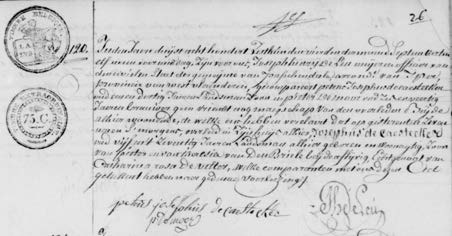
71.7. CLEMENS LAMMENS (ARLD06) & NATALIA JULIANA DECAESTECKER (C02)
1551
Figure 71.58: A compilation of key figures of the battle near Waterloo is shown with, from
left to right and top to bottom, the following men. Napoleon in 1812, by Girodet. The image is
more realistic than the heroic paintings of the same period. Indeed, when the Battle of Water-
loo began, his health was not fabulous anymore after his stay at Elba and after the 100 days of
resurrection. Next is Maréchal Michel Ney (Saarlouis 1769 - Paris 1815). Then, we see Lord
Arthur Wellesley, the Duke of Wellington in 1814, by Thomas Lawrence. Consequently, we ob-
serve Gebhard Leberecht von Blücher (1742 - 1819) in H.F. Helmolt (ed.): History of the World.
New York: Dodd, Mead and Company, 1902. Then, we notice Willem Frederik George Lodewijk
(1792-1849), Prins van Oranje Nassau. Finally, the star of the battle is shown, Wellington
at Waterloo. He is, by most historians, considered the victor of the fight. Painting by Robert
Alexander Hillingford. p
Figure 71.59: The left is Napoleon Bonaparte’s grave at Les Invalides in Paris (2019), and
the right is Sainte Hélène’s medal. (Declercq de Silva Archive)
Figure 71.60: Passchendaele, 1816, the death certificate of Josephus Decaestecker (senior)
The Desclergues of la Villa Ducal de Montblanc, 2nd ed., Omn., VOL. VI
© 2024 Nico F. Declercq
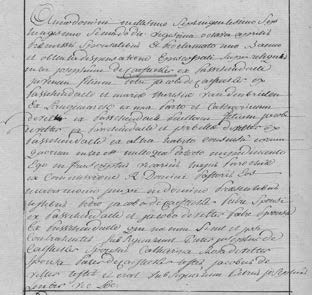
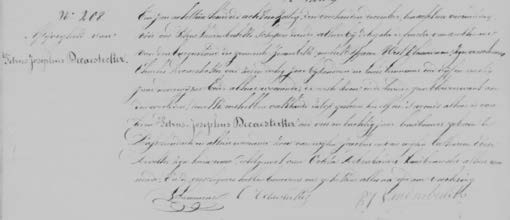
1552
CHAPTER 71. THE ARDAN-ROUYE-LAMMENS-DECAESTECKER ANCESTRY LINE
Figure 71.61: Passchendaele, 1772, the marriage of Josephus
Decaestecker and Catharina Rosa Develter.
Figure 71.62: 1868, Zonnebeke, the death of Petrus Josephus Decaestecker.
particular, his number was 3995, and he was in the 2nd battalion of the 4th company. He served in this Regiment until the Battle of Waterloo on June 18, 1815. A recent photo of Waterloo is shown in Figure 71.69 on page 1556.
As seen in his military file, an administrative error was made after the Battle of Waterloo. An administrator wrote that he was
’fusillé’ (shot) and that he had ’deserté’ (deserted) ’en route le’ (on the road on) without further details. He was mistaken for someone else, or perhaps it was standard practice to consider any missing ’French’ soldier as ’deserté et fusillé’ if he had not returned from the battle of Waterloo. However, we know that Joseph married in 1818, and had he been shot, the author, a descendant, would not have been able to write this story.
The Regiment of Joseph de Caestecker, under Napoleon, shown in Figure 71.51, took part in the following battles: Battle of Austerlitz (1805),
Battle of Crewitz and Lubeck (1806),
Battle of Ostrelenka and Friedland (1807),
Battle of Espinosa-de-Los-Monteros (1808),
Battle of Alcantara, Aspern-Essling, Wagram, Talevera-de-la-Reina, and Almonacid (1809),
Battle of Barrosa, Fuentes-de-Onoro, and Albuera (1811),
Battle of Cadiz (1812),
Battle of Vittoria, Echalar, Nivelle, and Bayonne (1813),
Battle Orthez and Toulouse (1814),
Battle of Waterloo (1815).
His military career from 1805 until 1815 was quite extraordinary. From a historical point of view, he has been part of Napoleon’s mastery for ten years. He did not join the Russian campaign in 1812, lucky for him, but contributed to all other battles. The last one was a defeat at Waterloo, but given its supereminence, perhaps this was a victory for all and formed one of Europe’s historical cornerstones.
71.7.3.2 Battle of Austerlitz
The Battle of Austerlitz, depicted in Figure 71.51, occurred on the 11th Frimaire of the Year XIV of the French Republican Calendar, corresponding to December 2, 1805. This decisive engagement occurred near Austerlitz in the Austrian Empire, now known as Slavkov u Brna in the Czech Republic. The battle is renowned as one of Napoleon Bonaparte’s most significant victories.
It is often referred to as the ’Battle of the Three Emperors,’ involving Napoleon of France, Tsar Alexander I of Russia, and Holy Roman Emperor Francis II of Austria.
© 2024 Nico F. Declercq
The Desclergues of la Villa Ducal de Montblanc, 2nd ed., Omn., VOL. VI
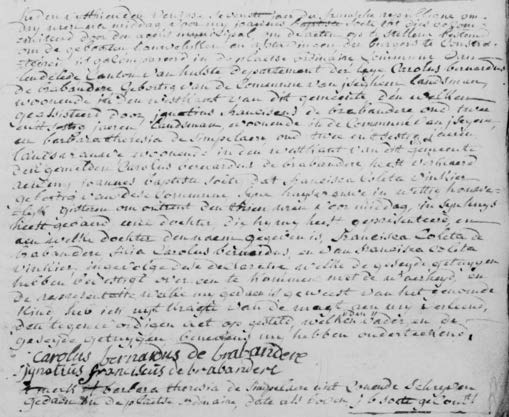
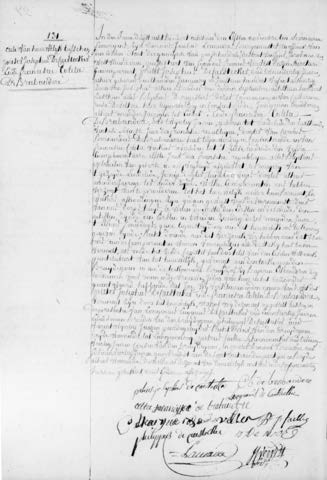
71.7. CLEMENS LAMMENS (ARLD06) & NATALIA JULIANA DECAESTECKER (C02)
1553
Figure 71.63: 1799, Lendelede, the birth of Coleta de Brabandere on March 4, which was 14 Ventose an
VII.
Figure 71.64: 1818, Passchendaele, the
marriage of Petrus Josephus Decaestecker
and Coleta Francisca de Brabandere.
The Desclergues of la Villa Ducal de Montblanc, 2nd ed., Omn., VOL. VI
© 2024 Nico F. Declercq
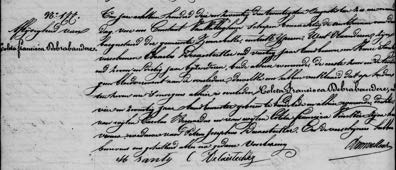
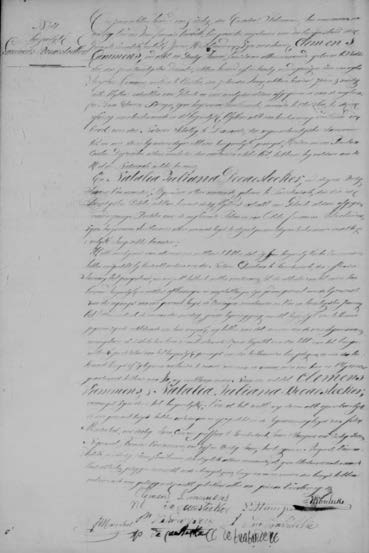
1554
CHAPTER 71. THE ARDAN-ROUYE-LAMMENS-DECAESTECKER ANCESTRY LINE
Figure 71.65: 1873, Zonnebeke, the death of Coleta Francisca de Brabandere.
Figure 71.66: Zonnebeke, February 2, 1864, the marriage of Clemens Lam-
mens (ARLD06) and Natalia Juliana Decaestecker (C02). They settled a mar-
riage contract with notary Christiaens in Passchendaele on January 15, 1864.
The bride was 33 years old and born on October 23, 1830, at Passchendaele
but lived in Zonnebeke. The groom was 38 years old and born in Vladslo on
December 26, 1825; he was a farmer and widower. The groom’s parents were
Joseph Lammens and Anne Thérèse Pareyn. The bride’s parents were Pierre
Decaestecker and Coleta Francisca de Brabandere.
© 2024 Nico F. Declercq
The Desclergues of la Villa Ducal de Montblanc, 2nd ed., Omn., VOL. VI
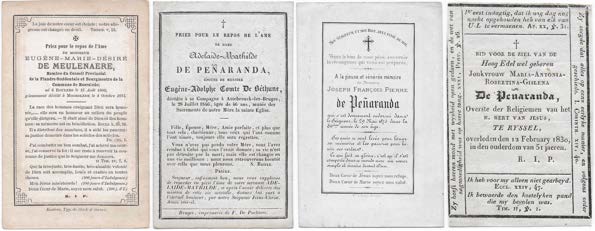
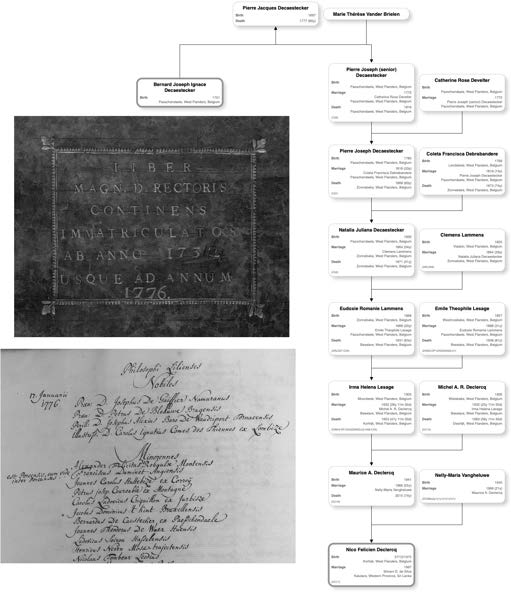
71.7. CLEMENS LAMMENS (ARLD06) & NATALIA JULIANA DECAESTECKER (C02)
1555
Figure 71.67: We show the following souvenirs from left to right: The obituary card of Eugène Marie Désiré de Meulenaere, 1871. The obituary card of Adelaide Mathilde de Peñaranda, 1846. The obituary card of Joseph François Pierre de Peñaranda, 1875. The obituary card of Maria Antonia Robertina Gislena de Peñaranda, 1830. (Declercq de Silva Archive) Figure 71.68: The matriculation record of Bernard Joseph Ignace Decasestecker as a philosophy student
in the year 1776 at the Catholic University of Leuven. His link with the author is shown on the right side.
The Desclergues of la Villa Ducal de Montblanc, 2nd ed., Omn., VOL. VI
© 2024 Nico F. Declercq