

The Desclergues of la Villa Ducal de Montblanc, Second Edition Omnibus by Nico Declercq - HTML preview
Download the book in PDF, ePub, Kindle for a complete version.
67.9.2.3 Remi Gentil Waelkens & Marie Louise Euphrasie Furnier
Mr Remi Gentil Waelkens (Deerlijk 1884 - Heestert 1970) and Mrs Marie Louise Euphrasie Furnier (1891 - 1963). The couple married on May 3, 1913, at Zwevegem.
67.9.2.4 Cyrille Arthur Loosvelt & Alida C. Waelkens
Mr Cyrille Arthur Loosvelt (1907 - 1986) and Mrs Alida C. Waelkens (Deerlijk 1886 - Stasegem 1967 Stasegem).
67.9.2.5 Richard Ludolf Waelkens & Romanie Helene Malfait
Mr Richard Ludolf Waelkens (Deerlijk 1889) and Mrs Romanie Helene Malfait (Deerlijk 1893 - Kortrijk 1967).
67.9.2.6 Jules Waelkens & Demeyer
Mr Jules Waelkens and Mrs Demeyer.
67.9.2.7 Julien Waelkens & Mahieu
Mr Julien Waelkens and Mrs Mahieu.
67.9.2.8 Jozef Waelkens & Waelkens
Mr Jozef Waelkens and Mrs Waelkens.
67.9.3 Their Marriage
Their wedding was in 1914, in Figure 67.89, in Vichte.
© 2024 Nico F. Declercq
The Desclergues of la Villa Ducal de Montblanc, 2nd ed., Omn., VOL. V
67.9. ALFRED DEN DAUW & AUGUSTA WAELKENS
1371
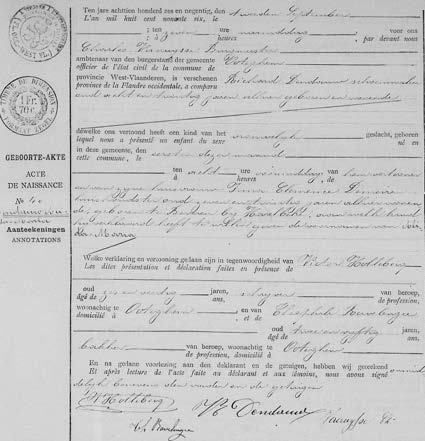
Figure 67.53: Otegem, September 1, 1896, the birth of Alida Maria Den Dauw, the
daughter of 28-year-old shoemaker Richard Den Dauw and 27-year-old Irma Clemence De
Meire from Beveren-Leie. 52-year-old Baker Theophile Revelengée was a witness.
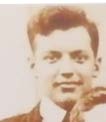
Figure 67.54: Gentil Den Dauw, 1919. (Declercq de Silva Archive)
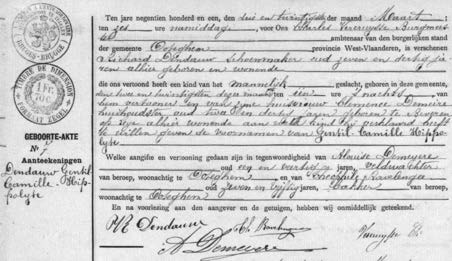
Figure 67.55: Otegem, March 22, 1901, was the birth of Gentil Camille Hippolyte Den Dauw,
son of 37-year-old shoemaker Richard Den Dauw and 32-year-old Clemence De Meire from
Beveren-Leie. 57-year-old baker Theophile Revelengée was a witness.
The Desclergues of la Villa Ducal de Montblanc, 2nd ed., Omn., VOL. V
© 2024 Nico F. Declercq
1372
CHAPTER 67. THE DEN DAUW ANCESTRY LINE
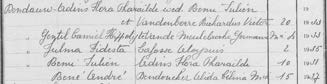
Figure 67.56: 1933, Otegem, the wedding
of Gentil Camille Hippolyte Den Dauw
with Germaine Van de Meulebroucke.
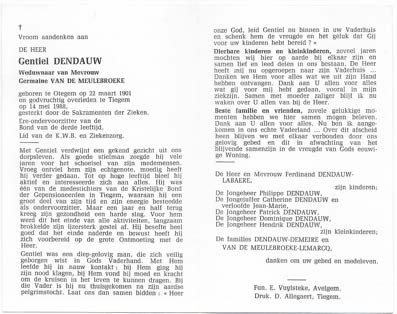
Figure 67.57: Obituary card of Gentil Den Dauw, husband of Germaine Van de
Meulebroeke, 1988. (Declercq de Silva Archive)
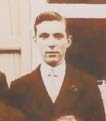
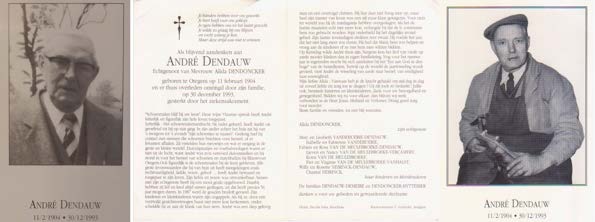
Figure 67.58: André Den Dauw, 1919. (Declercq de Silva Archive)
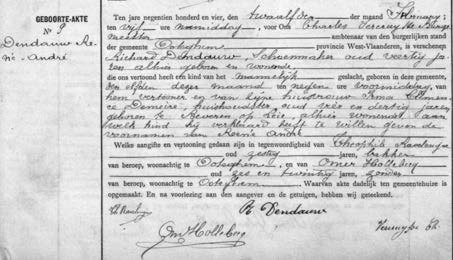
Figure 67.59: Otegem, February 11, 1904, the birth of René André Den Dauw, son of 40-year-
old shoemaker Richard Den Dauw and 34-year-old Irma Clemence De Meire from Beveren-Leie.
The witnesses were 60-year-old baker Theophile Revelengée and 26-year-old Omer Hollebecq.
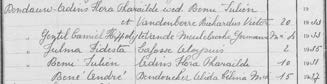
Figure 67.60: 1937, Otegem, the mar-
riage of René André Den Dauw with Alida
C. Maria Dedoncker.
© 2024 Nico F. Declercq
The Desclergues of la Villa Ducal de Montblanc, 2nd ed., Omn., VOL. V
67.9. ALFRED DEN DAUW & AUGUSTA WAELKENS
1373
Figure 67.61: Obituary card of André Den Dauw, 1993, two versions. (Declercq de Silva Archive)
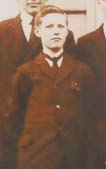
Figure 67.62: Jerome Den Dauw, 1919. (Declercq de Silva Archive)
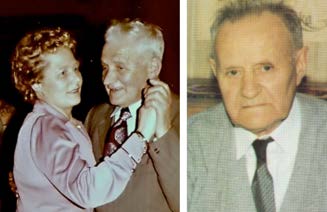
Figure 67.63:
Jerome Den Dauw is
dancing with his niece Anna Den Dauw,
daughter of Alfred Den Dauw and the au-
thor’s grandmother. The picture taken
from his obituary card shows Jerome Den
Dauw on the right with his niece. (Declercq
de Silva Archive)
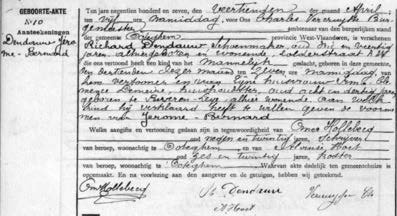
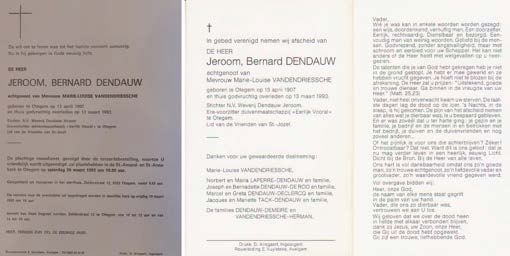
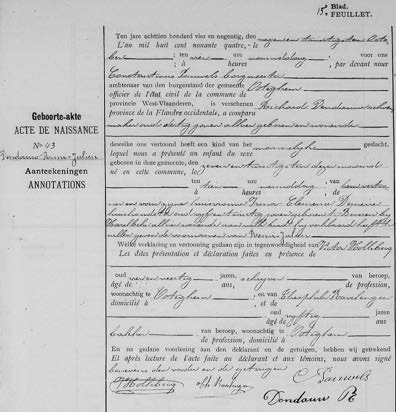
Figure 67.64: Otegem, April 14, 1907, the birth of Jerome Bernard Den Dauw,
son of 43-year-old shoemaker Richard Den Dauw and 38-year-old Iene Clemence
De Meire from Beveren Leie. The witnesses were 29-year-old Omer Hollebecq and
26-year-old Alois Hoet.
The Desclergues of la Villa Ducal de Montblanc, 2nd ed., Omn., VOL. V
© 2024 Nico F. Declercq
1374
CHAPTER 67. THE DEN DAUW ANCESTRY LINE
Figure 67.65: The death announcement and obituary of Jerome Den Dauw, 1993. (Declercq de Silva
Archive)
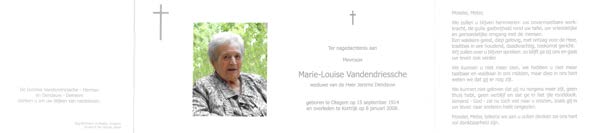
Figure 67.66: Obituary card of Marie Louise Vandendriessche, wife of Jerome Den Dauw. (Declercq de Silva Archive) 67.9.4 Their Offspring
67.9.4.1 Richard Den Dauw
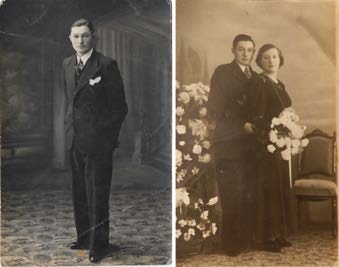
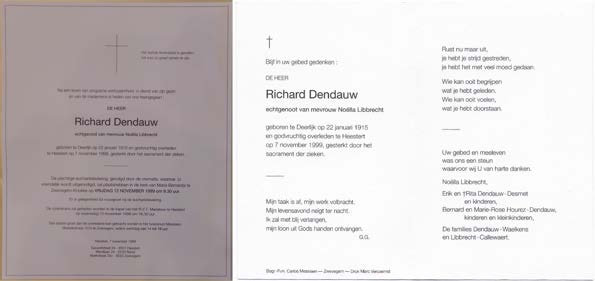
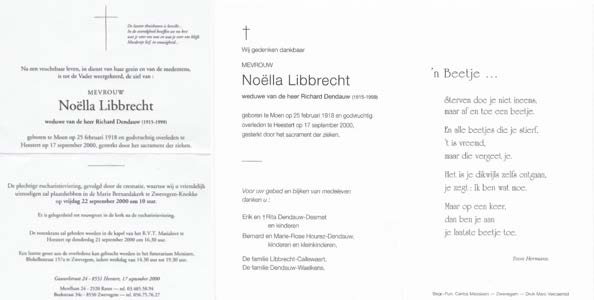
Richard Den Dauw is shown in Figure 67.90. He was born on January 22, 1915, at Deerlijk and died on November 7, 1999, at Heestert, in Figure 67.91. He was married to Noëlla Libbrecht, who died in 2000, in Figure 67.92.
67.9.4.2 Maria Den Dauw
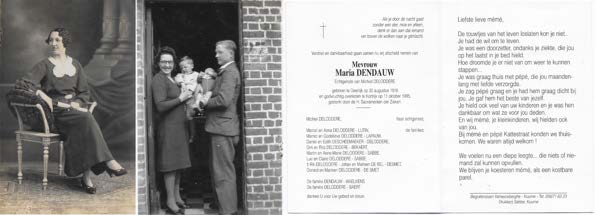
Maria Den Dauw is shown in Figure 67.93. She was born on August 30, 1916, at Deerlijk and died on October 11, 1995, in Figure
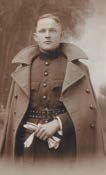
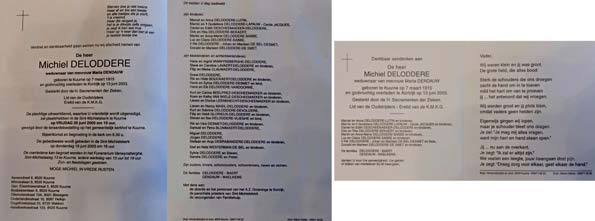
67.93, in Kortrijk. She married Michel Deloddere, shown in Figures 67.94 and 67.95.
67.9.4.3
Maurice Felicien Den Dauw
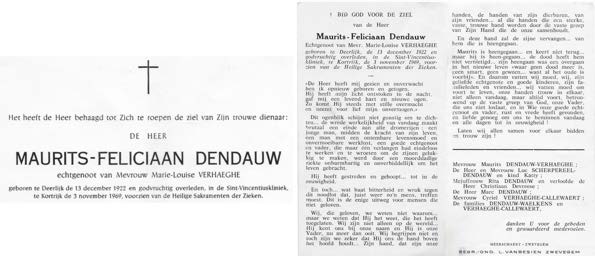
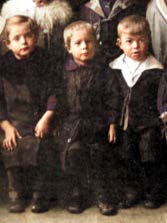
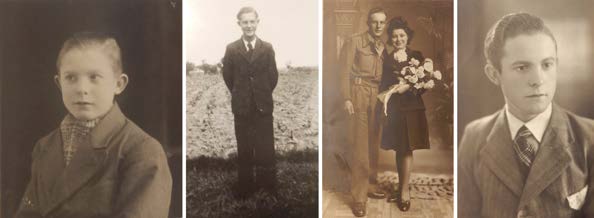
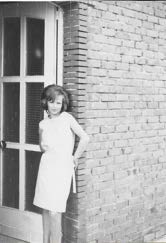
He was born on December 13, 1922, in Deerlijk and died on November 3, 1969, in Figure 67.96 at Kortrijk. He was married to Marie-Louise Verhaeghe. Images of Maurice are shown in Figures 67.97 and 67.98. Maurice Den Dauw had three children. One, Rita, is shown in Figure 67.99.
67.9.4.4 Anna Den Dauw
She is described in Chapter 67.10.1 and Part X as the wife of René Vangheluwe.
67.9.4.5 Camilla Den Dauw
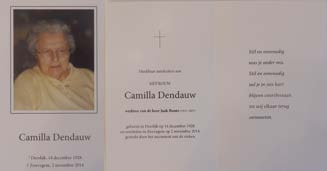
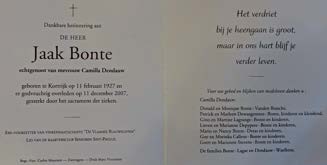
She was born on December 14, 1928, in Deerlijk and died on November 2, 2014, in Figure 67.101, at Zwevegem. She married Jacques Bonte (1927-2007), whose mortuary card is shown in Figure 67.102. Camilla was buried in Zwevegem on November 7, 2014.
Images of Camilla Den Dauw are given in Figure 67.100.
67.9.4.6 Paula Den Dauw
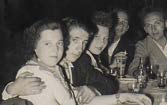
Paula Den Dauw is shown in Figures 67.103 and 67.104.
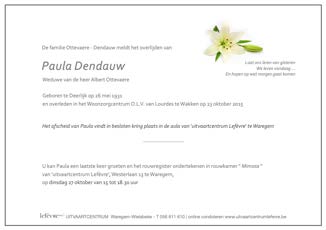
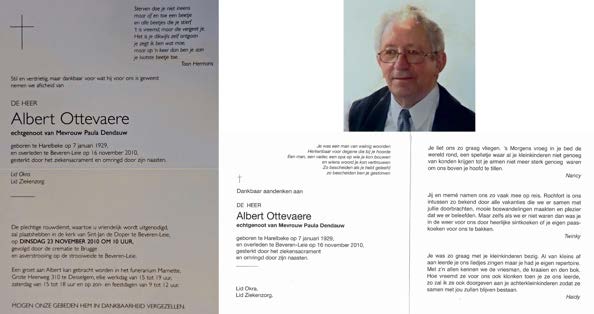
She was born on May 26, 1931, in Deerlijk and died on October 23, 2015, in Figure 67.105, at Wakken. She married Albert Ottevaere, shown in Figure 67.106.
67.9.4.7 Joseph Den Dauw
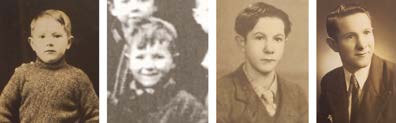
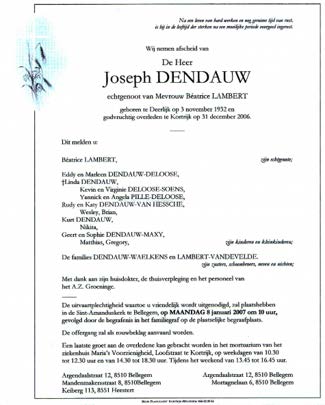
Joseph Den Dauw is shown in Figure 67.107. He was born in Deerlijk on November 3, 1932, and died at Kortrijk on December 31, 2006, in Figure 67.108. He was buried in Bellegem on January 8, 2007. He was married to Béatrice Lambert.
© 2024 Nico F. Declercq
The Desclergues of la Villa Ducal de Montblanc, 2nd ed., Omn., VOL. V
67.9. ALFRED DEN DAUW & AUGUSTA WAELKENS
1375
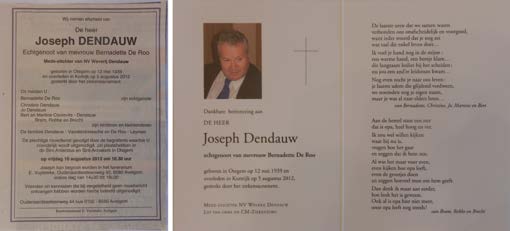
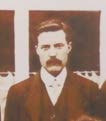
Figure 67.67: Obituary card of Joseph Den Dauw, son of Jerome Den Dauw and husband of Bernadette
de Roo, 2012. Left is a newspaper announcement of the death of Joseph Den Dauw, son of Jerome Den
Dauw and husband of Bernadette de Roo, 2012. (Declercq de Silva Archive)
Figure 67.68: Otegem, October 27, 1894, the birth of Remi Julien Den Dauw, son
of 30-year-old shoemaker Richard Den Dauw and 25-year-old Irma Clemence De
Meire. The witnesses were Hollebecq and Theophile Revelengée.
Figure 67.69: Remi Den Dauw, 1919. (Declercq de Silva Archive)
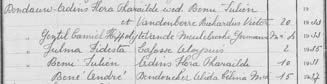
Figure 67.70: Otegem, 1931, the wed-
ding of Remi Julien Den Dauw with
Flora Pharailde Adins. Also, in 1933, at
Otegem, Flora Pharailde Adins’s wedding
was with V. Richard Vandenborre. She
was the widow of Remi Julien Den Dauw.
The Desclergues of la Villa Ducal de Montblanc, 2nd ed., Omn., VOL. V
© 2024 Nico F. Declercq


1376
CHAPTER 67. THE DEN DAUW ANCESTRY LINE
Figure 67.71: Otegem, 1932, the death of Remi Julien Den Dauw, husband
of Flora Pharailde Adins.
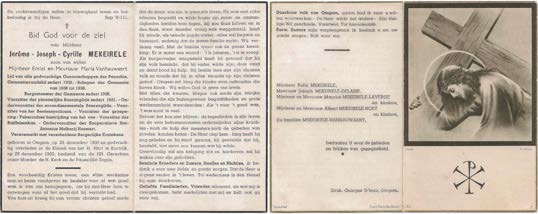
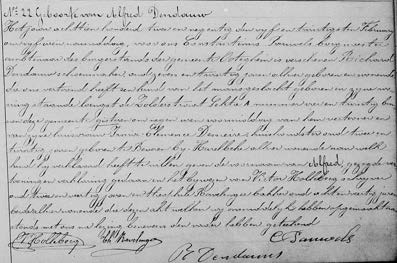
Figure 67.72: The obituary card of Jerome Joseph Cyrille Mekeirele, Otegem, 1960. (Declercq de Silva Archive) Figure 67.73: Otegem, February 24, 1892, the birth of Alfred Den Dauw, son of
27-year-old shoemaker Richard Den Dauw and 22-year-old Irma Clemence De Meire
from Beveren-Leie. He was born at their home in Zolderstraat, Section A, number
24. The witnesses were Hollebecq and baker Theophile Revelengée.
Figure 67.74: The military registration of Alfred Den Dauw, Nationale Militie, Province de la Flandre Occidentale, 14e Militiekanton. He entered the army on September 30, 1911, and stayed until April 1, 1914. He was a worker, born at Otegem in West Vlaanderen on February 24, 1892, and was 168 cm tall. His father was Richard Den Dauw, from Otegem; his mother was Irma Clemence De Meire, from Beveren-Leie. During his service, he was admitted to a hospital in Brussels in February 1912 and was exempted for one year, after which he returned to the army. During WWI, he was also a forced laborer.
© 2024 Nico F. Declercq
The Desclergues of la Villa Ducal de Montblanc, 2nd ed., Omn., VOL. V
67.9. ALFRED DEN DAUW & AUGUSTA WAELKENS
1377
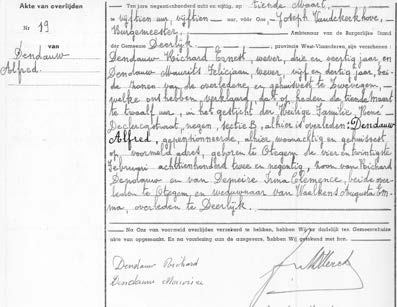
Figure 67.75: Deerlijk, March 10, 1958, the death of Alfred Den Dauw. His death
was reported by 35-year-old Maurice Felicien Den Dauw and 43-year-old Richard
Ernest Den Dauw, his sons living in Zwevegem. Alfred was born in Otegem on
February 24, 1892, and a son of Richard Den Dauw and Irma Clemende De Meire.
He was a widower of Augusta Emma Waelkens, who had died in Deerlijk. Alfred
died at a home for the elderly in Deerlijk (Heilige Familie, René Declercqstraat 9,
section B).
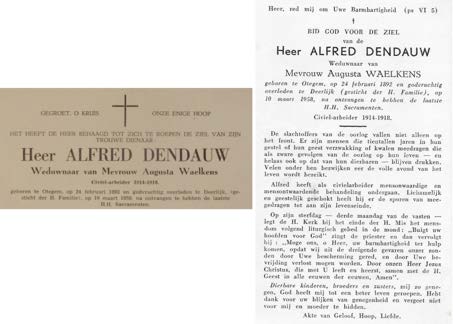
Figure 67.76: The death announcement (heading) and obituary of Alfred Den Dauw, March
10, 1958. He was buried at Sint Lodewijk Deerlijk on Saturday, March 15, 1958. (Declercq de
Silva Archive)
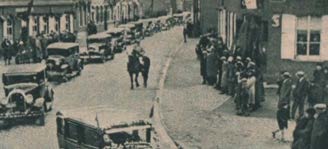
Figure 67.77:
Deerlijk, Sint Lodewijk,
1935, the inauguration of the new pastor
Vileyn.
The Desclergues of la Villa Ducal de Montblanc, 2nd ed., Omn., VOL. V
© 2024 Nico F. Declercq
1378
CHAPTER 67. THE DEN DAUW ANCESTRY LINE
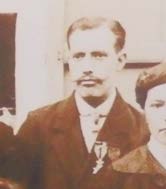
Figure 67.78: Alfred Den Dauw, just after WWI, was wearing medals
received for his experience in the war. (Declercq de Silva Archive)
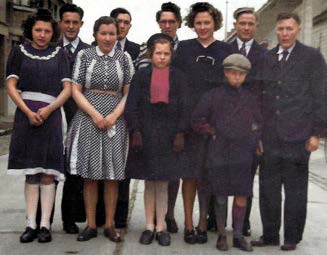
Figure 67.79:
Alfred Den Dauw in
March of 1944. He is the person right
in the picture, taken on the occasion
of the engagement of Anna Den Dauw
and René Vangheluwe.
From right to
left: Alfred Den Dauw, Michel Deloddere,
Jozef Den Dauw, Anna Den Dauw, Maria
Den Dauw, Paula Den Dauw, Richard
Den Dauw, Noëlla Libbrecht, Maurice
Den Dauw, Camilla Den Dauw.
The
photo in Stationsstraat, Deerlijk, by René
Vangheluwe, was taken with his Agifold
camera. There were almost no cars then;
therefore, the group posed in the middle
of the street. MyHeritage® colorized this
photo. (Declercq de Silva Archive)
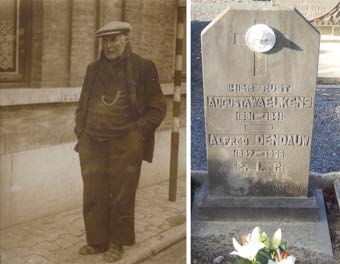
Figure 67.80: 1957, Alfred Den Dauw, during one of his numerous
walks in Deerlijk, went from the home for older people to his children
or friends. Right is the tombstone of Alfred Den Dauw and Augusta
Waelkens at Sint Lodewijk in Deerlijk before it was removed in 2014. In
the end, only the author placed flowers because most descendants lived
far from the cemetery, had died, or did not know that the grave was still
there. (Declercq de Silva Archive)
© 2024 Nico F. Declercq
The Desclergues of la Villa Ducal de Montblanc, 2nd ed., Omn., VOL. V

67.9. ALFRED DEN DAUW & AUGUSTA WAELKENS
1379
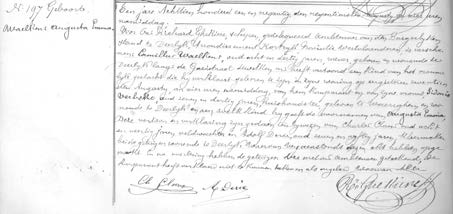
Figure 67.81: Deerlijk, August 17, 1891, the birth of Augusta Emma Waelkens. She was the
daughter of 38-year-old Camille Waelkens and 37-year-old Sidonie Verbeke from Waregem. The
witnesses were 48-year-old Charles Claes and 57-year-old tailor Adolf Deru.
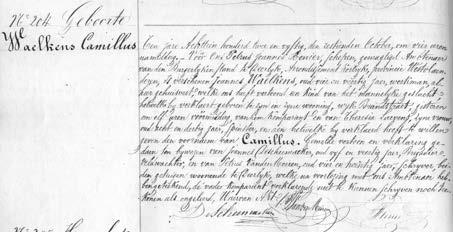
Figure 67.82: Deerlijk, October 56, 1852, was the birth of Camille Waelkens, father of Augusta
Emma Waelkens. He was the son of 44-year-old Joannes Waelkens and 38-year-old Theresia
Laevens, born in Brandstraat.
Figure 67.83: Military registration of Camille Waelkens, in levée de 1872, Milice Nationale, Province de la Flandre Occidentale, 17e Canton de Milice, Commune de Deerlijk. He was a textile manufacturer in Deerlijk, recruited on September 15, 1852. He was 162 cm tall. His face was oval, and his forehead was round. His eyes were brown, his nose small, his mouth was average, his chin was round, and his hair was black. His father was Jean Waelkens, and he was dead. His mother was Thérèse Laevens, and, as a widow, she fabricated bobbins. On March 14, 1872, he was recruited and remained in the army until April 20, 1876.
The Desclergues of la Villa Ducal de Montblanc, 2nd ed., Omn., VOL. V
© 2024 Nico F. Declercq
1380
CHAPTER 67. THE DEN DAUW ANCESTRY LINE
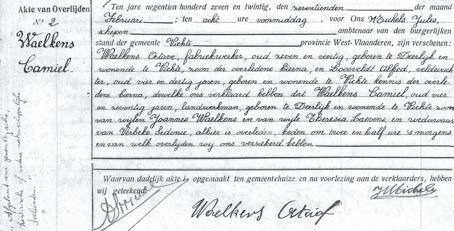
Figure 67.84: Vichte, February 17, 1927: The death of 74-year-old Camille Waelkens, father
of Augusta Emma Waelkens, was reported by his son Octave Waelkens, who was born in Deerlijk
but lived in Vichte. Camille Waelkens, who resided equally in Vichte, was the son of Joannes
Waelkens and Thérèse Laevens. He was a widower of Sidonie Verbeke.
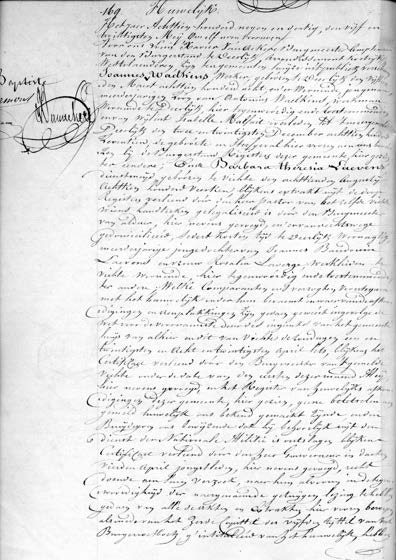
Figure 67.85: Deerlijk, May 25, 1839, the marriage of Joannes Waelkens and
Barbara Theresia Waelkens. The groom was born in Deerlijk on March 15, 1808,
and was the son of Antonius Waelkens, present, and Isabelle Malfait. The latter
died in Deerlijk on December 22, 1817. The bride was born in Vichte on August 18,
1814, and resided in Deerlijk, although her official address was still in Vichte. She
was the daughter of Joannes Baudouin Laevens and Rosalie Laverge, who lived in
Vichte. (sheet 1)
© 2024 Nico F. Declercq
The Desclergues of la Villa Ducal de Montblanc, 2nd ed., Omn., VOL. V
67.9. ALFRED DEN DAUW & AUGUSTA WAELKENS
1381
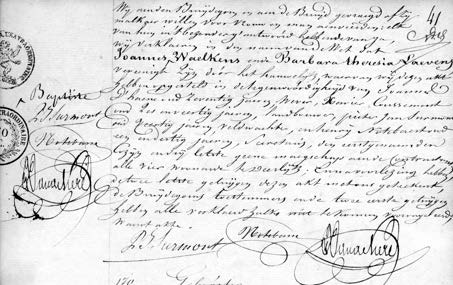
Figure 67.86: Deerlijk, May 25, 1839, the marriage of Joannes Waelkens and Barbara Theresia
Waelkens. (sheet 2)
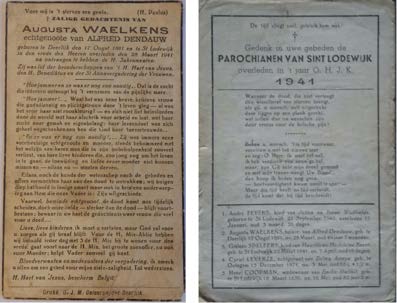
Figure 67.87: Left is the obituary card of Augusta Emma Waelkens, 1941, during
WWII. Right is a memorial card of deceased persons from Sint Lodewijk (Saint
Louis, Deerlijk) of 1941. Augusta Waelkens is listed (Augusta Waelkens, huisvrouw
van Alfred Den Dauw, geboren te Deerlijk 17 Oogst 1891, overleden op 25 Maart,
ouderdom 49 jaar en 7 maanden). (Declercq de Silva Archive)
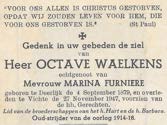
Figure 67.88: Heading of the obituary card of Octave Waelkens, hus-
band of Marina Furnier. (Declercq de Silva Archive)
The Desclergues of la Villa Ducal de Montblanc, 2nd ed., Omn., VOL. V
© 2024 Nico F. Declercq
1382
CHAPTER 67. THE DEN DAUW ANCESTRY LINE
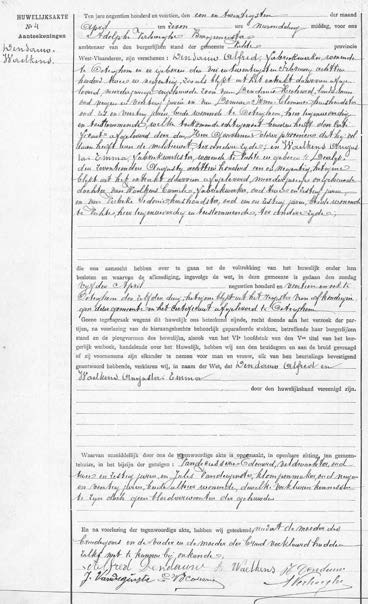
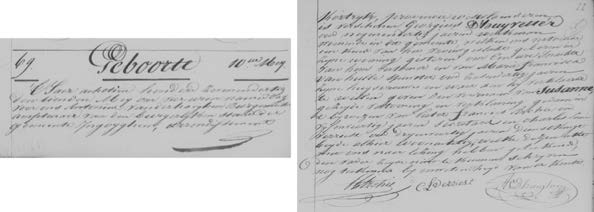
Figure 67.89: Vichte, April 21, 1914, the marriage of Alfred Den Dauw
and Augusta Emma Waelkens. The groom was born in Otegem on February
24, 1892, and was the son of 49-year-old Richard Den Dauw and 46-year-old
Irma Clemence De Meire. The bride lived in Vichte but was born in Deerlijk
on August 17, 1891, and was the daughter of 62-year-old Camille Waelkens
and 61-year-old Sidonie Verbeke, who resided in Vichte and was present for
the wedding. The witnesses were 62-year-old Edouard Vandebussere and 49-
year-old clog maker Jules Vandeginste.
© 2024 Nico F. Declercq
The Desclergues of la Villa Ducal de Montblanc, 2nd ed., Omn., VOL. V
67.9. ALFRED DEN DAUW & AUGUSTA WAELKENS
1383
Figure 67.90: Richard Den Dauw, brother of Anna Den Dauw, and
his wife Noella Libbrecht. (Declercq de Silva Archive)
Figure 67.91: The death announcement and obituary card of Richard Den Dauw, husband of Noella Libbrecht, 1999. (Declercq de Silva Archive)
Figure 67.92: The death announcement and obituary card of Noella Libbrecht, widow of Richard Den Dauw, 2000. (Declercq de Silva Archive)
The Desclergues of la Villa Ducal de Montblanc, 2nd ed., Omn., VOL. V
© 2024 Nico F. Declercq
1384
CHAPTER 67. THE DEN DAUW ANCESTRY LINE
Figure 67.93: Michel Deloddere and Maria Den Dauw (left and middle), with their children Marcel and Marnix. Right is the obituary card of Maria Den Dauw, wife of Michel Deloddere and sister of Anna Den Dauw, 1995. (Declercq de Silva Archive) Figure 67.94: Michel Deloddere, husband of Maria Den Dauw. (Declercq de Silva
Archive)
Figure 67.95: The death announcement and obituary card of Michel Deloddere, 2003, widower of Maria Den Dauw, and Anna Den Dauw’s brother-in-law. (Declercq de Silva Archive)
Figure 67.96: The heading of the death announcement and the obituary of Maurice Felicien Den Dauw, Marie Louise Verhaeghe’s husband and Anna Den Dauw’s brother, 1969. (Declercq de Silva Archive)
© 2024 Nico F. Declercq
The Desclergues of la Villa Ducal de Montblanc, 2nd ed., Omn., VOL. V
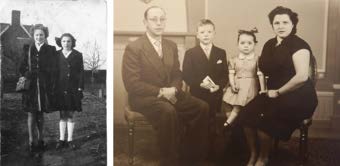
67.9. ALFRED DEN DAUW & AUGUSTA WAELKENS
1385
Figure 67.97: Maurice Felicien Den Dauw at school in Sint Lodewijk
Deerlijk in 1928. To his right is Magdalena Bulcaen, and to his left is
Omer Degloire. His teacher was Sister Aldegonde. Courtesy of Rachel
Nuyttens. The picture also appeared in Derlike 14de jaargang, nr 4,
april-mei-juni 1992. MyHeritage® colorized this photo.
Figure 67.98: Maurice Felicien Den Dauw and his wife Marie Louise Verhaeghe. (Declercq de Silva Archive) Figure 67.99: Early 1960s. Rita Den Dauw is the cherished daughter of Maurice Den Dauw and Marie-Louise Verhaeghe from Tielt.
René, through a unique and profound connection with Marie-Louise,
contributed as the biological father to the children, enriching their fam-
ily story beyond traditional bounds. Her brother, Marc, has two chil-
dren, Jane and Jason. Rita’s grandparents are Gerard Vangheluwe
and Zozyma Verhaeghe. Rita, married to Christiaen Devreese from
Waregem, ran a renowned bakery confectionery on the market square
until their retirement. Rita’s children are Françoise and Alain. (De-
clercq de Silva Archive)
Figure 67.100: Left is 1944, Anna Den Dauw with her sister Camilla
Den Dauw. The picture was taken at their home in Sint Lodewijk (Saint
Louis), Deerlijk. Right is Camilla Den Dauw with her husband Jacques
Bonte and their eldest children, Donald and Marleen. (Declercq de Silva
Archive)
The Desclergues of la Villa Ducal de Montblanc, 2nd ed., Omn., VOL. V
© 2024 Nico F. Declercq
1386
CHAPTER 67. THE DEN DAUW ANCESTRY LINE
Figure 67.101: Obituary card of Camilla
Den Dauw, wife of Jaak Bonte, 2014.
(side 1) (Declercq de Silva Archive)
Figure 67.102:
Obituary card of Jaak
Bonte, husband of Camilla Den Dauw and
brother-in-law of Anna Den Dauw, 2007.
(Declercq de Silva Archive)
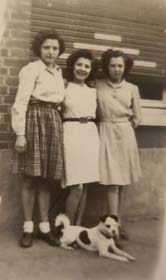
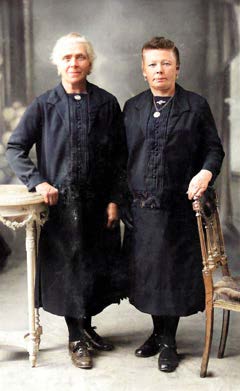
Figure 67.103: From left to right, Anna Den Dauw, Marie Louise
Verhaeghe and Paula Den Dauw. Unfortunately, we do not recall the
dog’s name. (Declercq de Silva Archive)
Figure 67.104: Around 1947, left to right: Paula Den Dauw, her
husband Albert Ottevaere, Anna Den Dauw, Maurice Vangheluwe, René
Vangheluwe. (Declercq de Silva Archive)
Figure 67.105: The death announcement
of Paula Den Dauw, 2015, Albert Otte-
vaere’s widow and Anna Den Dauw’s sis-
ter. (Declercq de Silva Archive)
© 2024 Nico F. Declercq
The Desclergues of la Villa Ducal de Montblanc, 2nd ed., Omn., VOL. V
67.9. ALFRED DEN DAUW & AUGUSTA WAELKENS
1387
Figure 67.106: The death announcement and obituary of Albert Ottevaere, husband of Paula Den Dauw, 2010. (Declercq de Silva Archive)
Figure 67.107: Joseph Den Dauw, brother of Anna Den Dauw (Declercq de Silva
Archive). The second image shows him in a photo taken at school of the children
at their first communion in Sint Lodewijk Deerlijk on March 25, 1939 (Courtesy
of Archive Leon Defraeye, picture nr 1720). The picture also appeared in Derlike
XXXVI, 3 (2014), p. 94).
Figure 67.108: The death announcement
of Joseph Den Dauw, Anna Den Dauw’s
brother and Beatrice Lambert’s husband.
(Declercq de Silva Archive)
The Desclergues of la Villa Ducal de Montblanc, 2nd ed., Omn., VOL. V
© 2024 Nico F. Declercq
CHAPTER 67. THE DEN DAUW ANCESTRY LINE
67.9.5 Marc Waelkens, a Distant Blood-relative
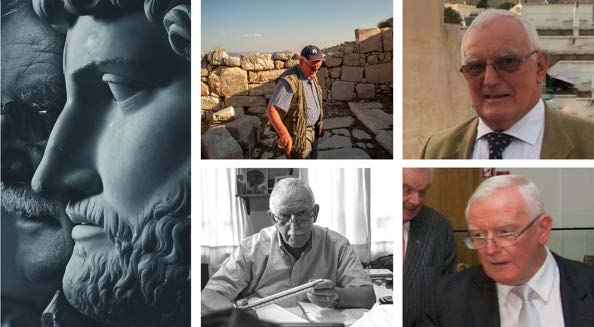
67.9.5.0.1 Genealogy Marc Waelkens, shown in Figure 67.109, was born in Waregem on April 12, 1948. He was an archaeologist and professor at Katholieke Universiteit Leuven. He is well-known for his work at Sagalassos in Turkey. The King of Belgium knighted him in 2008. He died on February 21, 2021, almost one year after exchanging information, and the text below was written.
The author is a distant blood relative of Marc Waelkens as follows:
The grandparents of Marc Waelkens are Henri Waelkens and Clementine Declercq (unrelated to the author).
Henri Waelkens is a son of Jean-Baptiste Waelkens (Waregem 1838 - 1909) and Marie Julie Garrez (1842-1906).
Jean Baptiste Waelkens is the son of Jean Baptiste Waelkens senior (Anzegem 1794—Gent 1857) and Barbara Theresia Deplancke (1797-1842).
Jean Baptiste Waelkens senior is the son of Ferdinandus Josephus Waelkens (Waregem 1772—Waregem 1844) and Joanna Regina Vindevogel (1754 - 1835).
Ferdinandus Josephus Waelkens is a son of Ferdinandus Waelkens (Waregem 1738 - Waregem 1738) and Maria Josepha Decostere (1739 - 1813).
Ferdinandus Waelkens is a son of Joannes Waelkens (Waregem 1705 - Waregem 1770) and Maria Joanna Theresia Demeester (1708-1749).
Joannes Waelkens and Maria Joanna Theresia Demeester had another son, Jean Baptiste Waelkens (Waregem 1723 - Deerlijk 1803), who married Maria Josepha Moreels (Otegem 1740 - Deerlijk 1811).
They were the parents of Petrus Antonius Waelkens (Waregem 1777 - Deerlijk 1847).
The latter married Isabelle Rose Malfait (Deerlijk 1777 - Deerlijk 1817).
Their son was Jean Baptiste Waelkens (Deerlijk 1808 - Deerlijk 1868), who married Barbara Theresia Laevens (Vichte 1814 - Deerlijk 1890). The couple had a son, Camille Waelkens (Deerlijk 1852 - Vichte 1927), father of Augusta Waelkens, and great-grandmother of the author.
In other words, Marc Waelkens and the author have common ancestors, Joannes Waelkens and Maria Joanna Demeester. Joannes Waelkens was born on February 28, 1705, at Waregem and died on March 7, 1779, in Waregem. Maria Joanna Theresia Demeester was born at Sint-Baafs-Vijve on February 25, 1708, and died on February 25, 1749, in Waregem.
The reader who is interested in going further back in history will find that Joannes Waelkens is the son of Joannes Waelkens senior (Waregem 1671—Waregem 1738) and Joanna Theresia Impe (1670-1742).
Joannes Waelkens senior is the son of Judocus Waelkens (Waregem 1631—Waregem 1678) and Anna Gossaert (1624-1690).
Judocus Waelkens was born in Waregem on February 13, 1631 and is a son of Jacobus Waelkens and of Marie Lelief.
This section was written with permission from Marc Waelkens; Figure 67.109 is his courtesy. He died at Oud-Heverlee on February 21, 2021, and the author attended a Leuven ceremony on December 3, 2022.
67.9.5.0.2 The Life and Career of Professor Marc Waelkens Marc Waelkens, born in Waregem, Belgium, on April 12, 1948, displayed an early interest in history and archaeology. This interest would shape his life and career, leading him to become one of the most renowned figures in his field. Growing up in Waregem, where the author also attended middle and high school, Waelkens was inspired by the local heritage and ancient artifacts he encountered. His early education in Belgium laid a solid foundation for his future academic pursuits.
Like the author, Waelkens pursued higher education at the prestigious Katholieke Universiteit Leuven (KU Leuven). There, he studied history and archaeology. His passion for uncovering the past was evident in his dedication to his studies and early research projects. He completed his doctoral studies at KU Leuven, focusing on the ancient civilizations of the Mediterranean. His thesis, which examined the trade and cultural exchanges in ancient Anatolia, earned him significant recognition and set the stage for future research endeavors.
After completing his doctoral studies, Waelkens joined the faculty at KU Leuven, where he would spend most of his academic career. He quickly rose through the ranks, becoming a full professor and chair of the Department of Archaeology. His work was characterized by a rigorous methodological approach, combining fieldwork with advanced analytical techniques.
Waelkens is best known for his groundbreaking work at the archaeological site of Sagalassos in Turkey. Sagalassos, an ancient city in the western part of the Taurus Mountains, was a major center of the Hellenistic and Roman periods. Waelkens began his work at Sagalassos in the mid-1980s, and his excavation project soon became one of the most critical archaeological undertakings in the Mediterranean region.
Under Waelkens’ leadership, the Sagalassos project revealed a wealth of information about the ancient inhabitants’ urban planning, architecture, and daily life. His meticulous excavation techniques and interdisciplinary approach, including collaboration with experts in geology, botany, and bioarchaeology, provided a comprehensive understanding of the site’s historical significance. The discoveries at Sagalassos included well-preserved buildings, intricate mosaics, and a vast array of artifacts, all contributing to a deeper knowledge of ancient Anatolian culture.
In recognition of his contributions to archaeology and his significant impact on understanding ancient civilizations, Marc Waelkens received numerous honors throughout his career. One of the most prestigious accolades was his knighthood by the King of Belgium in 2008. This honor acknowledges his outstanding achievements and dedication to the archaeology field.
Waelkens’ work also earned him international acclaim. He was invited to lecture at universities and conferences worldwide, where he shared his insights and research findings with colleagues and students. His publications, which include numerous articles and books on Sagalassos and related topics, are considered essential reading for scholars in the field.
Marc Waelkens was a dedicated scholar, mentor, and inspiration to many young archaeologists. His passion for uncovering the past and his commitment to academic excellence left a lasting impression on his students and colleagues. He was known for his generosity in sharing knowledge and his collaborative spirit, which fostered a vibrant academic community around the Sagalassos project.
Waelkens passed away on February 21, 2021, leaving a legacy of scholarly excellence and archaeological knowledge. His contributions to archaeology, particularly through his work at Sagalassos, continue to influence current research and inspire future generations of archaeologists. The information he exchanged and the texts he wrote remain valuable resources for understanding the ancient world.
Marc Waelkens’ life and career exemplify the profound impact that dedicated scholarship can have on our understanding of history.
His achievements at Sagalassos and his archaeological contributions will be remembered and celebrated for many years.
© 2024 Nico F. Declercq
The Desclergues of la Villa Ducal de Montblanc, 2nd ed., Omn., VOL. V
67.10. ANNA DEN DAUW & RENÉ VANGHELUWE
1389
Figure 67.109: Professor Marc Waelkens (1948-2021), renowned Belgian archaeologist celebrated for his groundbreaking work at the ancient city of Sagalassos in Turkey. His extensive research and excavations at Sagalassos uncovered significant insights into the urbanization, culture, and history of the region, earning him international acclaim in the field of archaeology.
(Declercq de Silva Archive)
67.9.6 Ferdinand Waelkens, dissident soldier of Napoleon
According to the French military files, Ferdinand Waelkens was born on May 24, 1780, as the son of Jean Waelkens and Marie Josephe Moreels. He was a conscript of the republic year 9. He was convicted on November 17, 1804 (26 brumaire, an 13) by the court-martial of Hannover (Germany)1. We have no further details.
Delving into the church and civil records, we uncover the rich family lineage of Ferdinand Waelkens. He was the son of Jean Baptiste Waelkens (Waregem 1723 - Deerlijk 1803), and Maria Josepha Moreels (Otegem 1740 - Deerlijk 1811). His brother was Petrus Antonius Waelkens (Waregem 1777-Deerlijk 1847). The latter married Isabelle Rose Malfait (Deerlijk 1777-Deerlijk 1817).
His brother was Petrus Antonius Waelkens (Waregem 1777 - Deerlijk 1847). The latter married Isabelle Rose Malfait (Deerlijk 1777
- Deerlijk 1817). Their son was Jean Baptiste Waelkens (Deerlijk 1808 - Deerlijk 1868), who married Barbara Theresia Laevens (Vichte 1814 - Deerlijk 1890). The couple had a son Camille Waelkens (Deerlijk 1852 - Vichte 1927), father of Augusta Waelkens, great-grandmother of the author.
67.9.7 Their Acquaintances
Some Acquaintances are shown in Figure 67.110.
67.10 Anna Den Dauw & René Vangheluwe
67.10.1 Anna Den Dauw
Anna Den Dauw is primarily described in Part X as the wife of René Vangheluwe, a descendent of the Desclergues along a maternal line.
Furthermore, as she carries the same mtDNA as the author and is his grandmother, she also appears in Chapter 72.
67.10.2 René Vangheluwe
René Vangheluwe is primarily described in Part X as the son of Zozyma Verhaeghe and Gerard Vangheluwe and as the father of Nelly Maria Vangheluwe. He is equally referred to in the following chapters: and Chapter 69, as the grandson of Maria Nathalie Surmont.
67.11 Nelly Maria Vangheluwe & Maurice Alois Declercq
67.11.1 Nelly Maria Vangheluwe
Nelly Maria Vangheluwe is primarily described in Part X as the daughter of René Vangheluwe and Anna Den Dauw and as the mother of the author.
She is equally referred to in the following chapters: Chapter 64, as the daughter-in-law of Irma Helena Lesage; Chapter 65, as great-great-great-great-great-great-granddaughter-in-law of Adrienne de Patin (DP12; Chapter 66.1, as the great-great-great-great-granddaughter-in-law of Barbara Benoit; Chapter 66.2, as the great-great-great-great-great-granddaughter-in-law of Maria Jeanne Christine Benoit; Chapter 68, in the ’t Kint ancestry line; Chapter 69, as the great-granddaughter of Marie Nathalie Surmont; Chapter 71, as great-granddaughter-in-law of Clemens Lammens; and in Chapter 72, the maternal (mt-DNA) ancestry line of the author, as his mother.
1Hugo Defraeye, ’Deerlijkse Lotelingen in het leger van Napoleon (dl.VIII)’ , pages 10-14 of Derlike, 18de jaargang, nr 1, 1995.
The Desclergues of la Villa Ducal de Montblanc, 2nd ed., Omn., VOL. V
© 2024 Nico F. Declercq
1390
CHAPTER 67. THE DEN DAUW ANCESTRY LINE
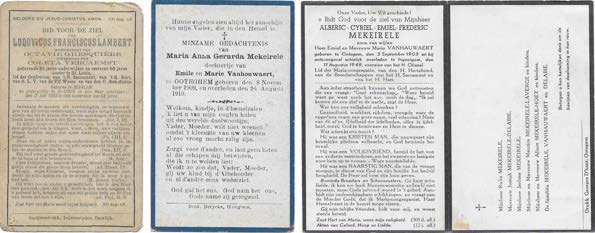
Figure 67.110: Souvenirs from left to right. The mortuary card of Louis François Lambert, a teacher at Saint Louis known by the Waelkens family, 1889. The obituary card of Maria Anna Gerarda Mekeirele, daughter of Emile Mekeirele and Marie Vanhouwaert, Otegem, 1910. The obituary card of Alberic Cyrille Emile Frederic Mekeirele, son of Emile and Maria Vanhauwaert, Otegem, 1948. (Declercq de Silva Archive)
67.11.2 Maurice Alois Declercq
Maurice Alois Declercq (DC16) is primarily described in Chapter 46 as a descendant of the Desclergues and father of the author.
He is equally referred to in the following chapters: Chapter 64, as the son of Irma Helena Lesage; Chapter 65, as the great-great-great-great-great-great-grandson of Adrienne de Patin (DP12); Chapter 66.1, as the great-great-great-great-grandson of Barbara Benoit; Chapter 66.2, as the great-great-great-great-great-grandson of Maria Jeanne Christine Benoit; Chapter 68, in the ’t Kint ancestry line; Chapter 69, as the great-grandson-in-law of Marie Nathalie Surmont; and Chapter 71, as the great-grandson of Clemens Lammens.
67.12 Nico Felicien Declercq & Shirani Olupathage de Silva
67.12.1 Nico Felicien Declercq
Nico Felicien Declercq (DC17) is the author of this book and is primarily described in Chapter 47 as a descendant of the Desclergues.
He is equally referred to in the following chapters: Chapter 64, as the grandson of Irma Helena Lesage; Chapter 65, as the great-great-great-great-great-great-great-grandson of Adrienne de Patin (DP12); Chapter 66.1, as the great-great-great-great-great-grandson of Barbara Benoit; Chapter 66.2, as the great-great-great-great-great-great-grandson of Maria Jeanne Christine Benoit; Chapter 68,
in the ’t Kint ancestry line; Chapter 69, as the great-great-grandson of Marie Nathalie Surmont; Chapter 71, as the great-great-grandson of Clemens Lammens; and in Chapter 72, the maternal (mt-DNA) ancestry line of the author. Furthermore, he is equally referred to in Part XII as the husband of Shirani Oluphathage de Silva.
67.12.2 Shirani Olupathage de Silva
Shirani Olupathage de Silva is first described in Chapter 47.3, as the author’s wife.
She is equally referred to, in much detail, in Part XII, and also in the following chapters: Chapter 64, as the granddaughter-in-law of Irma Helena Lesage; Chapter 65, as the great-great-great-great-great-great-great-granddaughter-in-law of Adrienne de Patin (DP12); Chapter 66.1, as the great-great-great-great-great-granddaughter-in-law of Barbara Benoit; Chapter 66.2, as the great-great-great-great-great-great-granddaughter-in-law of Maria Jeanne Christine Benoit; Chapter 68, in the ’t Kint ancestry line; Chapter 69,
as the great-great-granddaughter-in-law of Marie Nathalie Surmont; and Chapter 71, as the great-great-granddaughter-in-law of Clemens Lammens.
© 2024 Nico F. Declercq
The Desclergues of la Villa Ducal de Montblanc, 2nd ed., Omn., VOL. V
The ’t Kint Ancestry line
68.1 Introduction
The author senses that this family line may be interesting to investigate further by future generations. They were somewhat mobile and also formed a link with the De Patin family. We traced them back to Waregem, although we still need to exclude a connection with Zwevegem. The ancestry is shown in Figure 68.1.
68.2 Catherine ’t Kint & François Camerteyn
68.2.1 Catherine ’t Kint
The mystery of Catherine’s birthplace adds an intriguing layer to our research. The two potential candidates, one from Zwevegem and the other from Waregem have captured our attention. While the Waregem candidate seems more likely, further investigation is needed to confirm.
Catherine ’t Kint was born in 1618, in Figure 68.2, in Zwevegem as the daughter of Pierre ’t Kint and Antonia de Dievel. Her godfather was Amandus de Dievel, and her Godmother was Catherine de Dievel.
Her parents, Pierre ’t Kint and Antonia de Dievel, were married in Zwevegem in 1614, in Figure 68.3.
Still, Catherine ’t Kint can also be born in Waregem on March 25, 1618, in Figure 68.5, as the daughter of Joannes ’t Kint and Judoca Nolf. If so, it must have been her father Joannes ’t Kint, who was the godfather of her son Jean Camertyn at Waregem in 1640, as shown in Chapter 68.3.1.
68.2.2 François Camerteyn
He was married to Catherine ’t Kint.
68.3 Jean Camerteyn & Judoca Geldof
68.3.1 Jean Camerteyn
He was born in 1640, in Figure 68.6, in Waregem as the son of François Camertyn and Catherine ’t Kint. His godfather, Jean ’t Kint, may have been his grandfather, i.e., Catharina’s father, although more investigations are necessary to be sure. We found a Jean ’t Kint, brother of Catharina, who was married to Judoca Geldof so that the situation might have been more complicated.
Potegem Castle, still a landmark in Waregem, is shown in Figure 68.7.
68.3.2 Judoca Geldof
She was born around 1640. She died in 1710, June 22, in Figure 68.8, in Waregem.
68.3.3 Their Marriage
They married before 1667, but not at Waregem.
68.4 Pierre Camerteyn & Marie Jeanne Christine Benoit
68.4.1 Pierre Camerteyn
He was born in 1677 in Waregem, the son of Jean Camertyn and Judoca Geldof. He married Marie Jeanne Christine Benoit and died in 1754 in Waregem.
His life events are shown in Chapter 66.2.13.1.
68.4.2 Marie Jeanne Christine Benoit
She was born in 1680 in Waregem. She was married to Pierre Camertyn, and she died in 1724 in Vichte. Her parents were Ludovic Benoit and Claire Lagodt. She also appears in Chapter 66.2.12.2. Her descendants are also documented there. Her life events are shown in Chapter 66.2.13.2.
68.4.3 Their Marriage
Their wedding was in 1703 at Waregem and is shown in Chapter 66.2.13.3.
The Desclergues of la Villa Ducal de Montblanc, 2nd ed., Omn., VOL. V
© 2024 Nico F. Declercq
1392
CHAPTER 68. THE ’T KINT ANCESTRY LINE
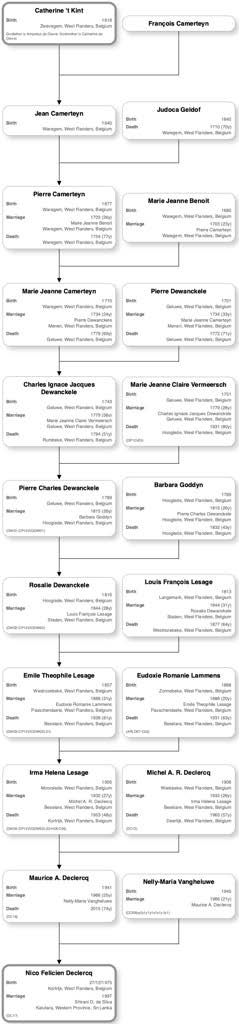
Figure 68.1: Descendants of Catherine ’t Kint until the
author.
© 2024 Nico F. Declercq
The Desclergues of la Villa Ducal de Montblanc, 2nd ed., Omn., VOL. V



68.4. PIERRE CAMERTEYN & MARIE JEANNE CHRISTINE BENOIT
1393
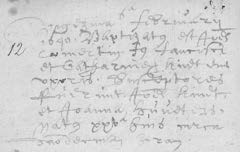
Figure 68.2: Zwevegem, July 13, 1618, the baptism of Catharina ’t Kint, daughter
of Pierre ’t Kint and Antonia De Dievel. The godparents were Amandus de Dievel
and Catharina de Dievel.
Figure 68.3: Zwevegem, October 6, 1614, the marriage of Pierre ’t Kint with
Antonia de Dievel. Petrus ’t Kint was a witness with Lion Houdese (’Haudeese’).
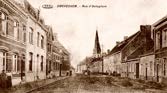
Zwevegem is shown in Figure 68.4.
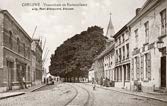
Figure 68.4: Zwevegem, Otegemstraat.
Figure 68.5: Waregem, March 25, 1618,
the baptism of Catharina ’t Kint, the
daughter of Joannes ’t Kint and Judoca
Nolf. The godparents were Antonius ’t
Kint and Catharina ’t Kint, daughter of
Antonius ’t Kindt.
Figure 68.6: Waregem, February 12, 1640, the baptism
of Joannes Camerteyn, son of Franciscus Camertyn and
Catharina ’t Kint. The godparents were Joannes ’ t Kint
and Joanna D’ Huyvetter (’Huveters’).
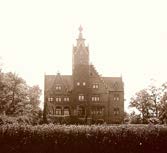
Figure 68.7: Potegem castle at Waregem, 1946. (Declercq de Silva
Archive)
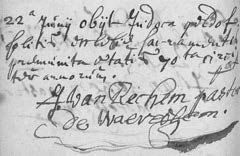
Figure 68.8: Waregem, June 22, 1610 the death of Ju-
doca Geldof.
The Desclergues of la Villa Ducal de Montblanc, 2nd ed., Omn., VOL. V
© 2024 Nico F. Declercq
1394
CHAPTER 68. THE ’T KINT ANCESTRY LINE
Figure 68.9: Geluwe.
68.5 Marie Jeanne Camerteyn & Pierre Dewanckele
68.5.1 Marie Jeanne Camerteyn
She was born in 1710 in Waregem as the daughter of Pierre Camerteyn and Marie Jeanne Christine Benoit. She was married to Pierre Dewanckele, and she died in 1779 in Geluwe. Her life events are shown in Chapter 66.2.14.1 and also in Chapter 65.16.1.
68.5.2 Pierre Dewanckele
He was born in 1701 at Geluwe, shown in Figure 68.9. He was married to Marie Jeanne Camertyn, and he died in 1779 in Geluwe.
Some genealogists assume that Pierre Dewanckele is (1) the son of Marinus Dewanckere, who, as they believe, is (2) the son of Bertrand Dewanckere (death at Geluwe in 1720) and Judoca de Halewyn (death at Geluwe in 1720) (married at Menen in 1669).
However, no evidence for (1) and (2) has been found so far. His life events are shown in Chapter 66.2.14.2 and also in Chapter
68.5.3 Their Marriage
Their wedding was in 1734 in Menen and is shown in Chapter 66.2.14.3.
68.6 Charles Ignace Dewanckele & Marie Jeanne Claire Vermeersch
68.6.1 Charles Ignace Dewanckele
He was born in 1743 in Geluwe, Belgium, as the son of Pierre Dewanckele and Marie Jeanne Camertyn. He was married to Marie Jeanne Claire Vermeersch and died in 1794 in Rumbeke, Belgium.
He was a Landed Gentry Farmer and only child. His life events are shown in Chapter 65.16.2.
68.6.2 Marie Jeanne Claire Vermeersch
She was born in 1751 in Geluwe, Belgium. She was married to Charles Ignace Dewanckele and died in 1831 in Hooglede, Belgium.
She was a landowner and rentier. Her Godfather was Jean-Baptiste Stagier, and her Godmother was Anna-Clara Soene. She also appears in Chapter 65 , in particular, Chapter 65.16.1. Her descendants are also reported there.
68.6.3 Their Marriage
Their wedding was in 1779 at Geluwe, Belgium, and is shown in Chapter 65.16.3.
68.7 Pierre Charles Dewanckele & Barbara Goddyn
68.7.1 Pierre Charles Dewanckele
He was born in 1789 as the son of Charles Ignace Dewanckele and Marie Jeanne Claire Vermeersch. He was married to Barbara Goddyn, and he died in 1860 in Hooglede, Belgium.
He was in the military at Napoleon’s Grande Armée.
He was a Landed Gentry Farmer.
Pierre Charles Dewanckele is primarily described in Chapter 65, as the son of Charles Ignace Dewanckele and Marie Jeanne Claire Vermeersch.
For the same reasons, he is equally referred to in the following chapters: Chapter 66.2, as the great-grandson of Marie Jeanne Christine Benoit; His life events are shown in Chapter 65.17.
68.7.2 Barbara Goddyn
She was born in 1789 in Hooglede, Belgium. She was married to Pierre Charles Dewanckele and died in 1832 in Hooglede, Belgium.
Barbara Goddyn was a farmer and was the daughter of Joseph Goddyn (1754-1824) from Lichtervelde and Anastasie Verstraete (1753) from Hooglede.
Joseph Goddyn was the son of Bartholome Goddyn and Marie Catherine Meersman, married in Lichtervelde in 1743. Bartholome Goddyn descended from a long Goddyn bloodline of farmers and landowners at Lichtervelde dating back to the 1500s with first names ’Roger’ alternating with ’Bartolome’ and married to the families Ghijsen, Goddyn, and Fiers.
Barbara Goddyn is primarily described in Chapter 65 as the wife of Pierre Charles Dewanckele. She is equally referred to in Chapter
66.2, as the mother to Rosalie Dewanckele and mother in law of Louis François Lesage; Her life events are shown in Chapter 65.17.2.
68.7.3 Their Marriage
Their wedding was in 1815 at Hooglede, Belgium, and is shown in Chapter 65.17.3.
© 2024 Nico F. Declercq
The Desclergues of la Villa Ducal de Montblanc, 2nd ed., Omn., VOL. V
68.8. ROSALIE DEWANCKELE & LOUIS FRANÇOIS LESAGE
1395
68.8 Rosalie Dewanckele & Louis François Lesage
68.8.1 Rosalie Dewanckele
She was born in 1816 in Hooglede, the daughter of Pierre Charles Dewanckele and Barbara Goddyn. She was a farmer, married Louis François Lesage, and died in 1872 in Westrozebeke, Belgium.
Rosalie Dewanckele’s life is meticulously chronicled in our research. In Chapter 65, she is introduced as the daughter of Pierre Charles Dewanckele and Barbara Goddyn. Her role as a wife and mother is highlighted in Chapter 64, where she is the wife of Louis François Lesage and the mother of Emile Theophile Lesage. In Chapter 66.2, her lineage is traced back to the great-great-granddaughter of Marie Jeanne Christine Benoit. For a comprehensive understanding of her life, her life events are detailed in Chapter 65.18.1.
68.8.2 Louis François Lesage
He was born in 1813 in Langemark, Belgium. He was married to Rosalie Dewanckele and died in 1877 in Westrozebeke, Belgium.
Louis François Lesage was the son of Jean Lesage, who was born at Staden and lived in Langemark, and of Barbe Thérèse Reynaert from Passchendaele. They married at Passchendaele in 1780. The witnesses were Pierre Lamaire, Louis Reynaert, Joseph Reynaert, and David Reynaert, all farmers.
Louis François Lesage is primarily described in Chapter 65 as the husband of Rosalie Dewanckele.
He is equally referred to in the following chapters: Chapter 64 in the de Patin ancestry and Chapter 66.2 as the great-great-grandson of Marie Jeanne Christine Benoit. His life events are shown in Chapter 64.5.1.
68.8.3 Their Marriage
Their wedding was in 1844 at Staden, Belgium, and is shown in Chapter 64.5.3.
68.9 Emile Theophile Lesage & Eudoxie Romanie Lammens
68.9.1 Emile Theophile Lesage
He was born in 1857 in Westrozebeke, Belgium, the son of Louis François Lesage and Rosalie Dewanckele. He married Eudoxie Romanie Lammens and died in 1938 in Beselare, Belgium.
Emile Theophile Lesage is primarily described in Chapter 64 as the author’s great-grandfather.
He is equally referred to in the following chapters: Chapter 65, as the great-great-great-great-grandson of Adrienne de Patin (DP12); Chapter 66.2, as the great-great-great-grandson of Marie Jeanne Christine Benoit; and Chapter 71 as the son-in-law of Clemens Lammens and Natalia Juliana Decaestecker. His life events are shown in Chapter 65.19 and the chapter on the Lesage ancestry, Chapter 64.
68.9.2 Eudoxie Romanie Lammens
She was born in 1868 in Zonnebeke, Belgium. In 1888, her residence was Passchendaele, Belgium. She was married to Emile Theophile Lesage and died in 1931 in Beselare, Belgium.
Eudoxie Romanie Lammens is primarily described in Chapter 64 as the wife of Emile Theophile Lesage and as the author’s great-grandmother.
She is equally referred to in the following chapters: Chapter 65, as the great-great-great-great-granddaughter-in-law of Adrienne de Patin (DP12); Chapter 66.2, as the great-great-great-granddaughter-in-law of Marie Jeanne Christine Benoit; and Chapter 71, as the daughter of Clemens Lammens and Natalia Juliana Decaestecker.
68.9.3 Their Marriage
Their wedding was in 1888 in Passchendaele, Belgium, as shown in Chapter 64.6.3.
68.10 Irma Helena Lesage & Michel Achiel Renatus Declercq (DC15)
68.10.1 Irma Helena Lesage
She was born in 1905 in Moorslede, Belgium, the daughter of Emile Theophile Lesage (DP12V03DW02L01) and Eudoxie Romanie Lammens. She married Michel Achiel Renatus Declercq and died in 1953 in Kortrijk, Belgium.
Irma Helena Lesage is primarily described in Chapter 45.2, as the wife of Michel Achiel Renatus Declercq and the author’s grandmother.
She is equally referred to in the following chapters: Chapter 64, as the daughter of Emile Theophile Lesage; Chapter 65, as the great-great-great-great-great-granddaughter of Adrienne de Patin (DP12); Chapter 66.1, as the great-great-great-granddaughter-in-law of Barbara Benoit; Chapter 66.2, as the great-great-great-great-granddaughter of Maria Jeanne Christine Benoit; and Chapter
71, as the granddaughter of Clemens Lammens and Natalia Juliana Decaestecker.
68.10.2 Michel Achiel Renatus Declercq (DC15)
He was born in 1906 in Wielsbeke, Belgium, the son of Ernest Constant Declercq and Marie Elodie Devenyn. He married Irma Helena Lesage and died in 1963 in Deerlijk, Belgium.
Michel Achiel Renatus Declercq (DC15) is primarily described in Chapter 45 as a descendant of the Desclergues and grandfather of the author.
He is equally referred to in the following chapters: Chapter 64, as the husband of Irma Helena Lesage; Chapter 65, as the husband of Irma Helena Lesage, and as a great-great-great-great-great-grandson-in-law of Adrienne de Patin (DP12); Chapter 66.1, as the The Desclergues of la Villa Ducal de Montblanc, 2nd ed., Omn., VOL. V
© 2024 Nico F. Declercq
CHAPTER 68. THE ’T KINT ANCESTRY LINE
great-great-great-grandson of Barbara Benoit; Chapter 66.2, as the husband of Irma Lesage, who was a great-great-great-great-granddaughter of Maria Jeanne Christine Benoit; and Chapter 71, as the grandson-in-law of Clemens Lammens.
68.10.3 Their Marriage
Their wedding was in 1932 in Beselare, Belgium, and is shown in Chapter 45.3.
68.11 Maurice Alois Declercq (DC16) & Nelly Maria Vangheluwe
68.11.1 Maurice Alois Declercq (DC16)
Maurice Alois Declercq (DC16) is primarily described in Chapter 46 as a descendant of the Desclergues and father of the author.
He is equally referred to in the following chapters: Chapter 64, as the son of Irma Helena Lesage; Chapter 65, as the great-great-great-great-great-great-grandson of Adrienne de Patin (DP12); Chapter 66.1, as the great-great-great-great-grandson of Barbara Benoit; Chapter 66.2, as the great-great-great-great-great-grandson of Maria Jeanne Christine Benoit; Chapter 67, as the son-in-law of Anna Den Dauw; Chapter 69, as the great-grandson-in-law of Marie Nathalie Surmont; and Chapter 71, as the great-grandson of Clemens Lammens.
68.11.2 Nelly Maria Vangheluwe
Nelly Maria Vangheluwe is primarily described in Part X as the daughter of René Vangheluwe and Anna Den Dauw and as the mother of the author.
She is equally referred to in the following chapters: Chapter 64, as the daughter-in-law of Irma Helena Lesage; Chapter 65, as the great-great-great-great-great-great-granddaughter-in-law of Adrienne de Patin (DP12); Chapter 66.1 as the great-great-great-great-granddaughter-in-law of Barbara Benoit; Chapter 66.2, as the great-great-great-great-great-granddaughter-in-law of Maria Jeanne Christine Benoit; Chapter 67, as the daughter of Anna Den Dauw; Chapter 69, as the great-granddaughter of Marie Nathalie Surmont; Chapter 71, as the great-granddaughter-in-law of Clemens Lammens; and in Chapter 72, the maternal (mt-DNA) ancestry line of the author, as his mother.
68.12 Nico Felicien Declercq (DC17) & Shirani Olupathage de Silva
68.12.1 Nico Felicien Declercq (DC17)
Nico Felicien Declercq (DC17) is the author of this book and is primarily described in Chapter 47 as a descendant of the Desclergues and also in Part X.
He is equally referred to in the following chapters: Chapter 64, as the grandson of Irma Helena Lesage; Chapter 65, as the great-great-great-great-great-great-great-grandson of Adrienne de Patin (DP12); Chapter 66.1, as the great-great-great-great-great-grandson of Barbara Benoit; Chapter 66.2, as the great-great-great-great-great-great-grandson of Maria Jeanne Christine Benoit; Chapter
67, as the grandson of Anna Den Dauw; Chapter 69, as the great-great-grandson of Marie Nathalie Surmont; Chapter 71, as the great-great-grandson of Clemens Lammens; and in Chapter 72, the maternal (mt-DNA) ancestry line of the author.
Furthermore, he is also referred to in Part XII, as the husband of Shirani Oluphathage de Silva.
68.12.2 Shirani Olupathage de Silva
Shirani Olupathage de Silva is first described in Chapter 47.3, as the author’s wife.
She is equally referred to, in much detail, in Part XII, and also in the following chapters: Chapter 64, as the granddaughter-in-law of Irma Helena Lesage; Chapter 65, as the great-great-great-great-great-great-great-granddaughter-in-law of Adrienne de Patin (DP12); Chapter 66.1, as the great-great-great-great-great-granddaughter-in-law of Barbara Benoit; Chapter 66.2, as the great-great-great-great-great-great-granddaughter-in-law of Maria Jeanne Christine Benoit; Chapter 67, as the granddaughter-in-law of Anna Den Dauw; Chapter 69, as the great-great-granddaughter-in-law of Marie Nathalie Surmont; and Chapter 71, as the great-great-granddaughter-in-law of Clemens Lammens.
© 2024 Nico F. Declercq
The Desclergues of la Villa Ducal de Montblanc, 2nd ed., Omn., VOL. V
The Desclergues of la Villa Ducal de Montblanc, 2nd ed., Omn., VOL. VI
© 2024 Nico F. Declercq
Other ancestry lines II
The Desclergues of la Villa Ducal de Montblanc, 2nd ed., Omn., VOL. VI
© 2024 Nico F. Declercq
Chapter 69
The Surmont - de Croock Ancestry line
69.1 Introduction
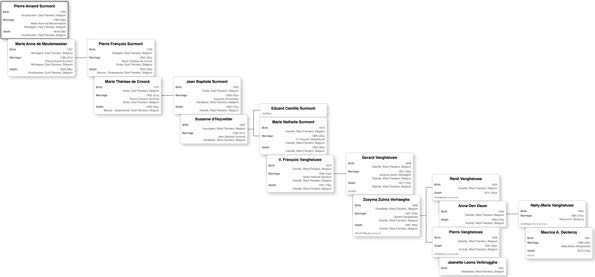
The Surmont ancestry line is depicted in Figure 69.1. This genealogy marks the first studied by the author, initially known to him in his childhood through his great-grandparents, Gerard Vangheluwe and Zozyma Verhaeghe, and later his foster father and granduncle, Pierre Vangheluwe.
The author learned that this branch was historically referred to as kroekskens and barbiers in Deerlijk, piquing his curiosity about the origins of these nicknames. This chapter elucidates the etymology of these terms, revealing that barbier originated from Jan Vangheluwe and Marie-Nathalie Surmont, while kroekskens derived from the Surmont family through their De Croock ancestors.
Tracing the genealogy of the Surmont family proved challenging due to the numerous Surmont clans and their frequent name changes to Sulmont, Sulmon, Surlemont, or Desurmont, influenced by location and era. The research required an open-minded approach and a comprehensive study of Surmont families from Gent to Kortrijk, focusing on mobility within a 30 km radius between the Leie and Schelde rivers. The term kroeksken is found in the stories of René Declercq from Deerlijk, illustrated in Figure 69.2.
The author expresses particular sympathy for two ancestors in this branch who died in their early 40s in the same year, a tragedy that left their children seeking refuge in the economically stable Deerlijk. The emotional toll of abandoning young children is profound, and the author reflects on how these ancestors might find solace in knowing their descendants are commemorated in this work.
After a prolonged hiatus due to the unavailability of documents, the investigation resumed and identified the 17th-century origins of the Surmont family in the Sulmon clan from Kaster-Kerkhove in the Flemish Ardennes, near the ancestral roots of families such as Den Dauw, D’ Huyvetter, and Devenyn. It is accurate to state that half of the author’s Flemish origins are between Leie and Schelde, with the remaining half in the region enclosed by Kortrijk, Menen, Ypres, and Roeselare. The family integrated with de Croock (hence kroeksken) with ancient roots in Gent. Unlike many farmers in the author’s ancestry, the Surmont ancestors were professionals: weavers, carpenters, veterinarians, horse harness makers, etc. Their mobility likely correlated with their professions, moving to where work was available. Notably, a self-educated veterinary professional combined this work with her husband’s barbershop, leading to the dual names defining this clan.
The arrival of this family branch in Deerlijk must be understood in the context of Deerlijk’s activities. Despite its small size, the village was an industrialized textile center replete with pubs and intellectual exchange opportunities. Early-established schools supported the industry, fostering an environment that produced or attracted several writers and intellectuals such as Verriest, Declercq, and Renier. Combining these activities contributed to Deerlijk’s cultural and intellectual richness.
69.2 François Surmont & Joanna Veys
Families such as Surmont or Sulmon, Veys, and Notebaert frequently appeared in Kaster in the early 17th century. Although we have yet to dig deep into these families due to time constraints, we must locate their early origins in that village. Given the French-sounding name of Surmont, they were probably Catholics from the French-speaking South of Flanders who moved to Kaster after the religious conflicts in the late 1500s. François Surmont died in 1682, in Figure 69.3, in Kaster, and Joanna Veys in 1693, in Figure 69.4.
Figure 69.1: Descendants of Pierre Amand Surmont until the author’s parents.
The Desclergues of la Villa Ducal de Montblanc, 2nd ed., Omn., VOL. VI
© 2024 Nico F. Declercq


1402
CHAPTER 69. THE SURMONT - DE CROOCK ANCESTRY LINE
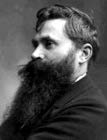
Figure 69.2: René Declercq is unrelated to us, but he is well-known for his poetry
and other writings. He was born in Deerlijk in 1877.
Figure 69.3:
Kaster, September 17,
1682, the death of François Surmont (’Sul-
mon’). He was the husband of Joanna
Veys.
69.3 Judocus Surmont & Catharina Notebaert
69.3.1 Judocus Surmont
The roots of Surmont are found in Kerkhove, shown in Figure 69.5, and Kaster. However, we suspect they may have migrated to that area shortly before the earliest traces, for instance, just after the religious troubles in the 16th century.
The second marriage of Judocus Surmont (’Sulmon’) is shown in Figure 69.6. Judocus Surmont died in 1739, in Figure 69.7, in Kerkhove.
In Chapter 69.3.2, we find that Catharina Notebaert, first wife of Judocus Surmont and our ancestor, passed away in 1707. Judocus remarried Maria Vande Meulebroucke in 1739, and she died in 1746 in Figure 69.8.
69.3.2 Catharina Notebaert
Catharina Notebaert was born at Kaster in 1659, in Figure 69.9. She married Judocus Surmont in 1686 and was his first wife. She died in 1708 at Kerkhove.
69.3.3 Their Marriage
The couple married in Kaster in 1686, in Figure 69.11, but would soon move to neighboring Kerkhove.
69.4 Louis Joseph Surmont & Petronilla Verhaeghen
69.4.1 Joseph Louis Surmont
Joseph Louis Surmont was born in Kerkhove in 1704, in Figure 69.12. He would find his bride in neighboring Elsegem, where he died in 1775, in Figure 69.13.
69.4.2 Petronilla Verhaeghen
Petronilla Verhaeghe was born at Elsegem in 1725, in Figure 69.14. Her parents were Egidius Verhaeghen and Petronilla Vansteenbrugghe. She died in Elsegem in 1785, in Figure 69.15. Elsegem is shown in Figure 69.16.
69.4.3 Their Marriage
They married in Kerkhove in 1750, in Figure 69.17.
The couple, Joseph Louis Surmont and Petronilla Verhaeghen, had the following children: Anne Marie (Kerkhove, July 14, 1765), Marie Anna (Kerkhove, October 30, 1762), Isabelle Rose (Kerkhove, September 15, 1761, who passed away at the age of 3 months), Pierre Amand (Kerkhove, January 28, 1760) in Chapter 69.5, Jacques Louis (Kerkhove January 7, 1759, who passed away at the age of 77 days), Maria Theresia (Kerkhove, November 19, 1750).
69.5 Pierre Amand Surmont & Marie-Jeanne De Meulemeester
69.5.1 Pierre Amand Surmont
Pierre Amand Surmont was born in Kerkhove in 1760, in Figure 69.18. He died in Kruishoutem in 1818, in Figure 69.19.
Kruishoutem is shown in Figure 69.20.
69.5.2 Marie-Anne De Meulemeester
Maria Anna De Meulemeester was born in 1761, in Figure 69.21, in Wortegem. She died in Kruishoutem in 1829 in Figure 69.22.
Figure 69.4: Kaster, November 1, 1693,
the death of Joanna Veys, the widow of
François Surmont (’Sulmon’).
© 2024 Nico F. Declercq
The Desclergues of la Villa Ducal de Montblanc, 2nd ed., Omn., VOL. VI



69.5. PIERRE AMAND SURMONT & MARIE-JEANNE DE MEULEMEESTER
1403
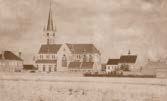
Figure 69.5: Kerkhove.
Figure 69.6: Kerkhove, February 20, 1708, the second marriage of
Judocus Sulmon with Maria Vande Meulebroucke.
Figure 69.7: Kerkhove, September 29, 1739, the death of Judocus Surmont (’Sul-
mon’), Catharina Notebaert’s widower, and Maria Vande Meulebroucke’s husband.
Figure 69.8: Kerkhove, September 11, 1746, the death of Maria Vande Meule-
broucke, the widow of Judocus Sulmon.
Figure 69.9: Kaster September 7, 1659,
the baptism of Catharina Notebaert, the
daughter of Guilelmus Notebaert and Ju-
doca Detavernier. Her twin, Judoca, was
also baptized the same day. The godparents
were Joos Notebaert, Guilemus Ruyss-
chaert, Petrus Ruysschaert, and Elisa-
betha van Steenbrugghe. Catharina Note-
baert died in Kerkhove in 1707, in Figure
Figure 69.10:
Kerkhove, March 23,
1707, the death of Catharina Notebaert.
Her widower remarried on Feb 20, 1708, at
Kerkhove to Maria Vande Meulebroecke.
Figure 69.11: Kaster, February 28, 1686, the marriage of Judocus Surmont
(’Sulmon’) and Catharina Notebaert. The witnesses were Judocus Notebaert
and Elisabeth Notebaert.
The Desclergues of la Villa Ducal de Montblanc, 2nd ed., Omn., VOL. VI
© 2024 Nico F. Declercq




1404
CHAPTER 69. THE SURMONT - DE CROOCK ANCESTRY LINE
Figure 69.12: Kerkhove, December 4, 1704, the bap-
tism of Louis Surmont (’Ludovicus Sulmon’), son of Ju-
docus Surmont and Catharina Notebaert. The godpar-
ents were Franciscus Surmont and Jacobus De Vos.
Figure 69.13: Elsegem, August 21, 1775,
the death of Louis Surmont (’Ludovicus
Sulmont’) from Kerkhove, son of Judocus
Surmont and husband of Petronilla Ver-
haeghen. The priest’s age estimation was
wrong.
Figure 69.14: Elsegem, March 8, 1725,
the baptism of Petronilla Verhaeghen,
daughter of Egidius Verhaeghe and Petron-
illa Vansteenbrugghe. The godparents were
Georges Verdieven and Arnolda Vansteen-
brugghe.
Figure 69.15: Elsegem 1785, the death
of Petronilla Verhaeghen, widow of Joseph
Louis Surmont and daughter of Egidius
Verhaeghen.
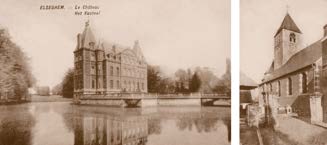
Figure 69.16: Elsegem, the Castle, and
the Church.
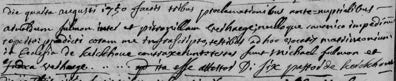
Figure 69.17: Kerkhove 1750, the marriage of Ludovicus Sulmon with Petronilla
Verhaeghe. The priest wrote Arnoldus instead of Ludovicus, confusing the groom
with his brother. The actual Arnoldus Sulmon was born in 1712 and married Joanna
Devos at Kerkhove on February 28, 1745, and the couple had six children between
1746 and 1757. The wedding witnesses were Michael Surmont and Judoca Ver-
haeghe.
Figure 69.18: Kerkhove, January 28, 1760, the baptism of Pierre Amand
Surmont (’Petrus Amandus Sulmon’), son of Louis Surmont, son of Judocus,
and Petronilla Verhaeghe, daughter of Egidius (’Aegidius’). The godparents
were Arnoldus Sulmon and Maria Anna Bourgeois.
© 2024 Nico F. Declercq
The Desclergues of la Villa Ducal de Montblanc, 2nd ed., Omn., VOL. VI
69.5. PIERRE AMAND SURMONT & MARIE-JEANNE DE MEULEMEESTER
1405
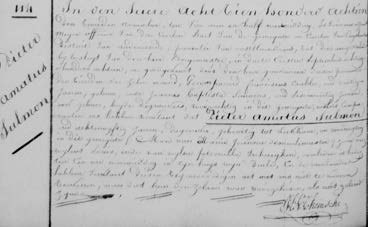
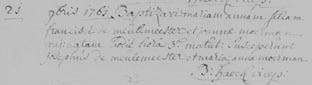
Figure 69.19: Kruishoutem, November 2, 1818, the death of 58-year-old
Pierre Amand Surmont (’Pieter Amatus Sulmon’), born in Kerkhove, hus-
band of Marie Jeanne De Meulemeester, son of Louis Surmont and Petronilla
Verhaeghe. 40-year-old neighbor Franciscus Crabbe and 46-year-old neighbor
Joannes Baptiste Simoens reported the death. He died at his home in the
Deurle suburb.
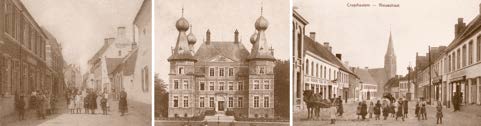
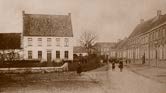
Figure 69.20: Kruishoutem: Brugstraat, the castle, and Nieuwstraat.
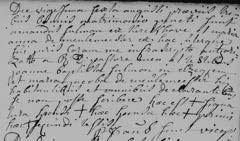
Figure 69.21: Wortegem, September 21, 1761, the baptism of
Maria Anna De Meulemeester, the daughter of Franciscus De
Meulemeester and Joanna Moerman. The godparents were Joseph
De Meulemeester and Maria Anna Moerman.
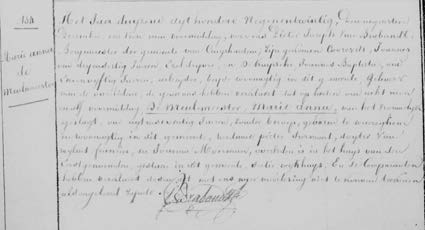
Figure 69.22: Kruishoutem, as seen in Figure 69.20, December 9, 1829, the death of 78-year-old Maria Anna De Meulemeester, born in Wortegem, widow of Pierre Amand
Surmont. She was the daughter of François De Meulemeester and Joanna Moerman. The
death was reported by her neighbors, 63-year-old Jean Devuyssche and 63-year-old Jean
Coorevits. She died in Jean Coorevits’s home in the Wykhuys suburb.
The Desclergues of la Villa Ducal de Montblanc, 2nd ed., Omn., VOL. VI
© 2024 Nico F. Declercq
1406
CHAPTER 69. THE SURMONT - DE CROOCK ANCESTRY LINE
Figure 69.23: Wortegem, August 26, 1788, the wed-
ding of Pierre Amand Surmont (’Amandus Sulmon’),
from Kerkhove, and Marie Anne De Meulemeester, from
Wortegem. The witnesses were Jean Baptiste Surmont
from Elseghem and Maria Jacoba De Meulemeester from
Wortegem.
Figure 69.24: Petegem.
69.5.3 Their Marriage
They married in Wortegem in 1788 in Figure 69.23.
69.6 Pierre François Surmont & Marie Thérèse de Croock
69.6.1 Pierre François Surmont
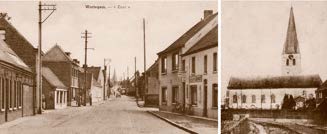
He was born in 1790, in Figure 69.25, at Petegem, shown in Figure 69.24, and baptized in Wortegem, shown in Figures 69.25 and
69.26. He would marry Marie Thérèse de Croock. The couple died at an early age in the same year.
Their children moved with their grandfather to Deerlijk. Pierre François Surmont died at Bevere in Oudenaarde in 1833 in Figure
69.6.2 Marie Thérèse de Croock
69.6.2.1 Her connection to Van Flandern
Common sense and statistics indicate that the de Croock family is from Ghent-Eeklo. DNA analysis shows links with close family members of the astronomer Thomas Van Flandern (Cleveland, Ohio, 1940 - Seattle, Washington, 2009), shown in Figure 69.41,
indicating that they are related to the author through their ancestor, Tom van Flandern. Further investigation is necessary to make conclusive statements. However, the indications point to Van Welden and De Croock as the link with Van Flandern in the West and North-West of Ghent, such as Eeklo, Bassevelde, and Boekhoute. Charles Van Vlaanderen was the first immigrant of this family line, who arrived in New York around 1880. 1
69.6.2.1.1 Astronomer Thomas Van Flandern Thomas Van Flandern was a notable American astronomer born in Cleveland, Ohio, on June 26, 1940. His early fascination with the cosmos led him to pursue an education in astronomy, culminating in a bachelor’s degree from Xavier University in 1962. He furthered his academic journey at Yale University, earning a master’s degree in 1964 and a Ph.D. in astronomy in 1969.
Van Flandern’s professional career began at the United States Naval Observatory (USNO), where he joined the Nautical Almanac Office. During his tenure at the USNO, he focused on improving the accuracy of celestial predictions and ephemerides, which are essential for navigation and space missions. His work significantly contributed to the refinement of lunar and planetary ephemerides, ensuring more precise data for various applications, including space exploration.
One of Van Flandern’s key contributions was his involvement in developing the "Nautical Almanac" and the "Astronomical Almanac," publications critical for navigational and astronomical purposes. His expertise in celestial mechanics and astrometry was widely recognized, and he played a vital role in the international efforts to synchronize and improve the accuracy of timekeeping and astronomical data.
In addition to his work at the USNO, Van Flandern had a deep interest in the fundamental questions of astronomy and cosmology.
He was particularly intrigued by the mechanics of the solar system and the nature of gravitation. His research extended into areas such as the analysis of lunar occultations, which provided valuable insights into celestial bodies’ precise positions and movements.
Van Flandern was an active member of the astronomical community, frequently sharing his knowledge and findings through publications, conferences, and public lectures. He was known for his ability to explain complex astronomical concepts easily, making him a popular figure among his peers and the general public.
Figure 69.25: Wortegem (adjacent to Pe-
tegem), December 15, 1790, the baptism of
Pierre François Surmont (’Petrus Francis-
cus Sulmon’ ), son of Petrus Sulmon from
Kerkhove and Maria Anna (De) Meule-
meester from Wortegem. The godparents
were Joseph Sulmon and Joanna Moer-
man.
1Research has, however, excluded a certain Charles Van Vlaenderen, born in Boekhoutte in 1857. Therefore, Charles Van Vlaanderen, the forefather of Tom Van Flandern, must be a different one.
© 2024 Nico F. Declercq
The Desclergues of la Villa Ducal de Montblanc, 2nd ed., Omn., VOL. VI
69.6. PIERRE FRANÇOIS SURMONT & MARIE THÉRÈSE DE CROOCK
1407
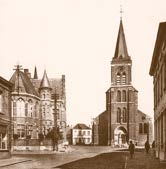
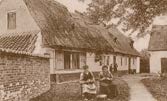
Figure 69.26: Wortegem, the church and
’Keer’ .
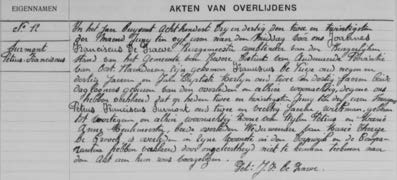
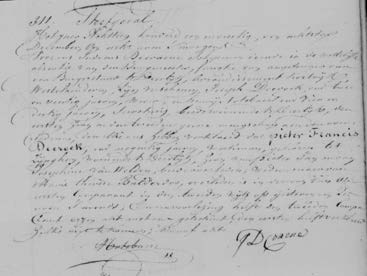
Figure 69.27: Bevere (Oudenaarde), shown in Figure 69.28, June 22, 1833, the
death of 42-year-old Petrus Franciscus Surmont, born in Wortegem and son of Petrus
Surmont and Marie Anne Meulemeester, and widower of Marie Thérèse De Croock.
The death was reported by his neighbors, 39-year-old François Devriese and 32-year-
old Jean Baptiste Merlijn. He died at dawn at his home in the village center.
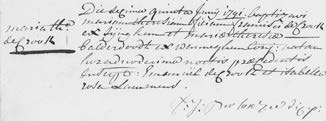
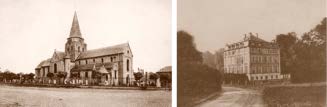
Figure 69.28: Bevere (Oudenaarde), the church.
Figure 69.29: A farm in Zingem.
Figure 69.30:
Huysse, shown in Fig-
ure 69.31, June 25, 1791, the baptism
of Maria Theresia de Croock, the daugh-
ter of François de Croock from Zingem
and Maria Theresia Balderdoot from Wan-
negem. The godparents were Emanuel De
Croock and Isabelle Rose Lammens.
Figure 69.31: Huyse, the church, and the
castle.
The Desclergues of la Villa Ducal de Montblanc, 2nd ed., Omn., VOL. VI
© 2024 Nico F. Declercq

1408
CHAPTER 69. THE SURMONT - DE CROOCK ANCESTRY LINE
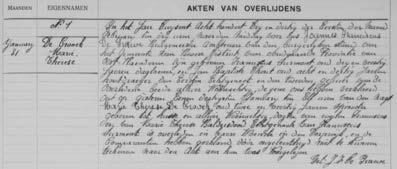
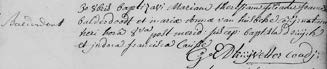
Figure 69.32: Bevere (Oudenaarde), January 31, 1833, the death of 42-year-old
Marie Thérèse De Croock from Huyse, wife of Franciscus Surmont, and daughter
of Franciscus De Croock and Marie Thérèse Balderdoot. The death was reported by
her 43-year-old husband, Franciscus Surmont, and her neighbor, 38-year-old Jean
Baptiste D’ Hont. She died at home in the village center.
Figure 69.33: Huyse (near Zingem), August 15, 1764, the baptism of Petrus
Franciscus De Croock, son of Jacques De Croock and Judoca Van Welden. The
godparents were Benedictus Blomme and Elizabeth van Welden.
Figure 69.34: Deerlijk, December 8, 1841, the death of ’90-year-old’ Petrus
Franciscus De Croock. The age is an error on the certificate. Indeed, when
he reported the death of his wife, he was 73 years old. Therefore he must have
been born around 1764 and was around 77 years old when he died. He had
been born in Zingem (in particular, Huysse), son of Jacques De Crock (not
Pierre Jean) and Judoca (i.e., Jossine, not Josephine) Van Welden. He was
the husband of Marie Thérèse Balderdoot. The death was reported by his 42-
year-old son and weaver, Joseph De Croock, and 34-year-old Henri Notebaert.
He died at his son’s home.
Figure 69.35: Ooike, October 30, 1767,
the baptism of Maria Theresia Balder-
doot, the daughter of Franciscus Balder-
doot and Maria Anna Van Husbeke. Bap-
tist Deruyck and Judoca Francisca Cause
(’Caufse’) were the godparents.
© 2024 Nico F. Declercq
The Desclergues of la Villa Ducal de Montblanc, 2nd ed., Omn., VOL. VI
69.6. PIERRE FRANÇOIS SURMONT & MARIE THÉRÈSE DE CROOCK
1409
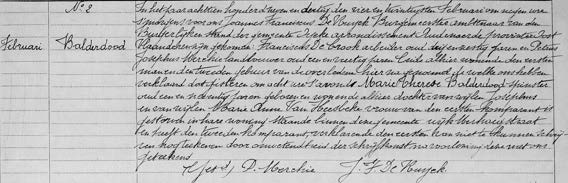
Figure 69.36: Ooike, shown in Figure 69.37, February 24, 1837, the death of 71-year-old Marie Thérèse Balderdoot.
She was the daughter of Joseph Balderdoot and Marie Anne Van Husbeke and the wife of Franciscus De Croock. Her death was reported by her 73-year-old (error in the document; the administrator wrote 63-year-old) husband, Franciscus De Croock, and 41-year-old neighbor and farmer Pierre Joseph Merchie. She died at her home in the Meerhaeghestraat suburb.
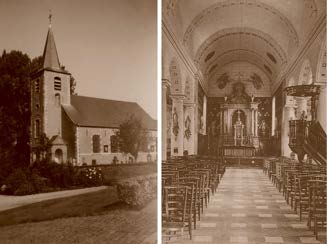
Figure 69.37: Ooike, the church, and its
interior.
Figure 69.38: Huyse, July 25, 1786 (folio 1693), the marriage of
Pierre François De Croock and Maria Theresia Balderdoot. The
groom was of minor age (indeed, he was 22 years old, less than
25) but received permission to marry from his mother. He was
born and living in Huyse. The bride was born in Wannegem but
lived in Huye. The witnesses were Emanuel De Croock, born and
residing in Huyse, and Rosalie Fetelaere (’Veiteleire’), born and
living in Zingem. The bride’s mother was present and was Maria
Anna Van Hulbeke.
The Desclergues of la Villa Ducal de Montblanc, 2nd ed., Omn., VOL. VI
© 2024 Nico F. Declercq
CHAPTER 69. THE SURMONT - DE CROOCK ANCESTRY LINE
After leaving the USNO in the early 1980s, Van Flandern founded the Meta Research organization to explore and support innovative ideas in astronomy and related fields. Under his leadership, Meta Research promoted various projects and theories, encouraging open scientific inquiry and critical thinking.
Thomas Van Flandern’s legacy in astronomy is marked by his dedication to advancing our understanding of the universe through meticulous research and his commitment to improving the precision of astronomical data. He passed away on January 9, 2009, in Seattle, Washington, leaving behind a legacy of scientific contributions that continue to influence the field of astronomy.
69.6.2.2 Her Life
She was born in 1791, in Figure 69.30, in Huysse. She was the daughter of Pierre François de Croock (Zingem 1751 - Deerlijk 1841) and Marie Thérèse Balderdoot (from Wannegem and died at Ooike in 1837).
Pierre François de Croock was a son of Pierre Jean de Croock and Josephine Vanwelden. Zingem can be seen in Figure 69.29.
Marie Thérèse de Croock died in Bevere in 1833, in Figure 69.32.
69.6.2.3 Her Parents
Her parents, Pierre François de Croock and Maria Theresia Balderdoot raised her children after their parents died in 1833.
The whole family moved to Deerlijk after the death of Marie Thérèse in 1837. At Deerlijk, they were called de kroekskens because of their family name.
69.6.2.3.1 Pierre François de Croock Pierre François de Croock was born in Huyse in 1764 in Figure 69.33, and he died in Deerlijk in 1841 in Figure 69.34.
Note that ’de Croock’ is a family name originating from East Flanders. There is indeed an area in Ghent nowadays called de krook located between two rivers already known in the Middle Ages for trade. It is known that the ’de Croock family fought on the side of the ’Lelyaards’ during the revolt organized by Jacob van Artevelde.
When her father died in Deerlijk, far from Ooike, where they originated from, his grandchildren provided incorrect information about his ancestors: They said that his father was Pierre Jean instead of Jacques and that his mother was Josephine Van Welden instead of Jossine (Judoca) Van Welden. His age was also wrong, though we could correct it by checking the document on which he had reported the death of his wife.
69.6.2.3.2 Maria Theresia Balderdoot Maria Theresia Balderdoot was born in 1767, in Figure 69.35, in Ooike, where she died in 1837 in Figure 69.36.
69.6.2.3.3 Her Parents’ marriage Pierre François De Croock and Maria Theresia Balderdoot married in Huyse, shown in Figure 69.31, in 1786, in Figure 69.38.
69.6.3 Their Marriage
Pierre François Surmont and Marie Thérèse de Croock married in 1822, in Figure 69.39, in Ooike.
© 2024 Nico F. Declercq
The Desclergues of la Villa Ducal de Montblanc, 2nd ed., Omn., VOL. VI
69.6. PIERRE FRANÇOIS SURMONT & MARIE THÉRÈSE DE CROOCK
1411
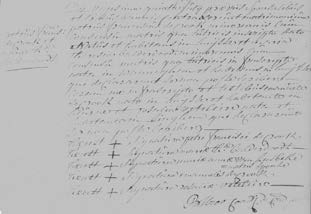
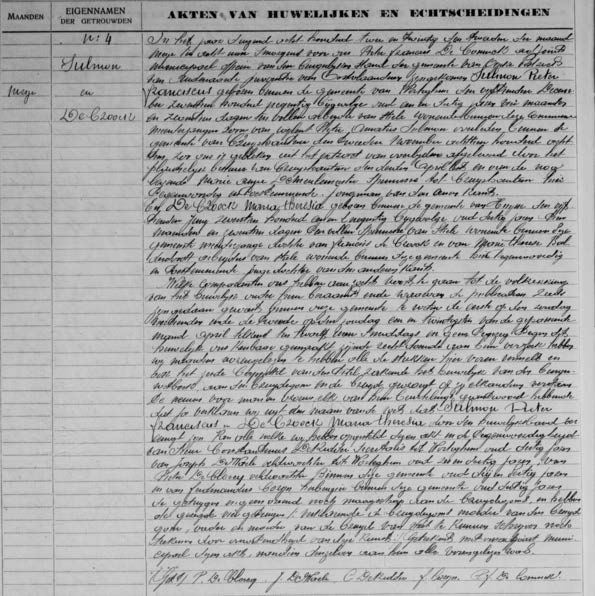
Figure 69.39: Ooike, May 2, 1822, the marriage of 31-year-old Pierre François Surmont (’Pieter Franciscus Sulmon’) born at Petegem on December 15, 1790 and residing at Ooike and Marie Thérèse de Croock, born at Huyse on June 15, 1791, who lived in Ooike. The groom was the son of Pierre Amand Surmont, who died in Kruishoutem on November 2, 1818, and Maria Anna De Meulemeester, ’spinesse’ at Kruishoutem and present at the wedding. The bride was the daughter of Pierre François De Croock and Marie Thérèse Balderdoot, and her parents were present at the wedding.
Figure 69.40: Deerlijk, Kerkplein with Saint Columba church.
The Desclergues of la Villa Ducal de Montblanc, 2nd ed., Omn., VOL. VI
© 2024 Nico F. Declercq
1412
CHAPTER 69. THE SURMONT - DE CROOCK ANCESTRY LINE
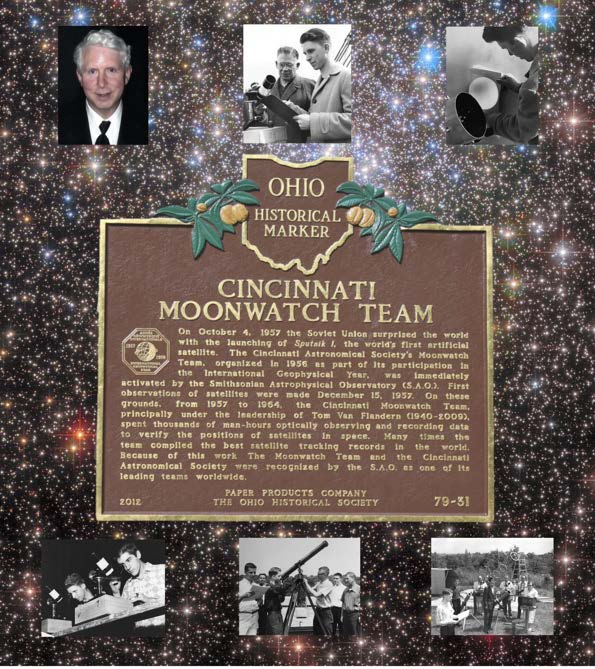
Figure 69.41: Images of Tom van Flandern. The background is Globular Cluster NGC 6355, obtained by NASA’s Hubble telescope. Tom van Flandern (1940-2009) was a renowned American astronomer known for his work in celestial mechanics and his theories on astronomy and physics. He earned his Ph.D. in astronomy from Yale University and worked at the U.S.
Naval Observatory, where he contributed to developing highly accurate astronomical timekeeping.
© 2024 Nico F. Declercq
The Desclergues of la Villa Ducal de Montblanc, 2nd ed., Omn., VOL. VI
69.7. JEAN BAPTISTE SURMONT & SUSANNE D’ HUYVETTER
1413
69.7 Jean Baptiste Surmont & Susanne d’ Huyvetter
69.7.1 Jean Baptiste Surmont
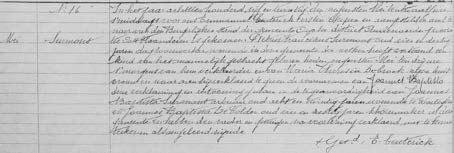
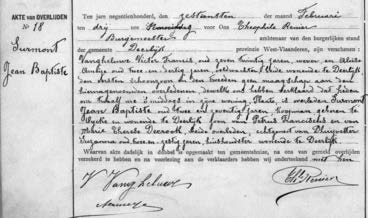
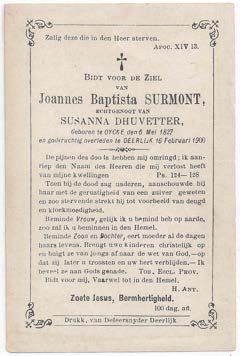
He was a horse harness manufacturer and merchant. He was born in Ooike on May 6, 1825, in Figure 69.42, and died in Deerlijk on February 16, 1900, in Figures 69.43 and 69.44.
He came to Deerlijk as a minor with his grandfather, Pierre François De Croock. He lost both his parents in 1833 when he was eight years old and was further raised by his grandparents. When his grandmother died, his grandfather Pierre François De Croock moved with him to Deerlijk. Jean Baptiste became a successful merchant and manufacturer. Despite his family name, Surmont, he received the nickname Kroekske in Deerlijk because his grandfather was de Croock. His son-in-law was Vangheluwe and had the nickname Barbier, whence both nicknames ran through this clan until after WWII.
69.7.2 Susanne d’ Huyvetter
69.7.2.1 Her Life
Susanne d’ Huyvetter is shown in Figure 69.47. She was born in 1837, in Figure 69.46, in Ingooigem. She was a veterinarian of the practice and descended from a long bloodline at Ingooigem, with marriages with Windels, Van Hulle (DNA evidence is given in Chapter 73.13.3 on page 1602), Demeester, Saelens and de Noreille. Her husband was a barber; therefore, the family was nicknamed barbiers at Deerlijk, shown in Figure 69.48.
The combination of offering veterinary services and that of a barber was not unusual. Barbers in those days were also responsible for blood-letting and simple medical treatments such as human or animal tooth extractions. This is why there was traditionally a red post outside barber and hairdresser’s shops: it symbolized the pillars on which red cloths used during blood-letting practice were dried. Such a post is known in many countries as a barber’s pole.
The Barber tradition ran through the Vangheluwe family. For instance, Joannes Vangheluwe was a Barber at Nieuwmolenhoek in Deerlijk and died in 1853. He was the grandfather of V. François Vangheluwe and son of Emiliana Vangheluwe.
69.7.2.2 Her Relatives
69.7.2.2.1 Ursula D’ Huyvetter Susanne D’ Huyvetter had a sister Ursula D’ Huyvetter, born at Ingooigem on January 11, 1832.
69.7.2.2.2 Jean Baptiste D’ Huyvetter Jean Baptiste D’ Huyvetter was born in 1842, in Figure 69.49, at Ingooigem. He married Julie Vandenheede in Kaster in 1870, in Figures 69.50 and 69.51. Kaster and Ingooigem are shown in Figures 69.52 and
69.7.2.2.3 Georges D’ Huyvetter Georges D’ Huyvetter married Françoise Vanhulle at Ingooigem in 1826, in Figures 69.54
and 69.55. DNA evidence is given in Chapter 73.8 on page 1590.
69.7.3 Their Marriage
Their wedding was in 1858, in Figures 69.56 and 69.57, in Harelbeke, Belgium.
Figure 69.42: 1825, May 9, Ooike, the birth of Jean Baptiste Surmont, son of 34-year-old
Petrus Franciscus Surmont and Maria Theresia De Croock. The witnesses were 28-year-old
Jean Baptiste Surmont, who resided in Wortegem, and 64-year-old shoemaker Jean Baptiste De
Volder.
The Desclergues of la Villa Ducal de Montblanc, 2nd ed., Omn., VOL. VI
© 2024 Nico F. Declercq
1414
CHAPTER 69. THE SURMONT - DE CROOCK ANCESTRY LINE
Figure 69.43: Deerlijk, February 16, 1900, the death of 72-year-old merchant
Jean Baptiste Surmont, born at Ooike and dead at his home in the center of
Deerlijk. He was a son of Pierre François Surmont and Maria Theresia De
Croock and husband of 62-year-old Susanne D’ Huyvetter. His son-in-law, V.
François Vangheluwe, reported the death.
Figure 69.44: The obituary card of Jean Baptiste Sur-
mont, husband of Susanna D’ Huyvetter, Deerlijk, Febru-
ary 16, 1900. Note the mistake in the birth date, which
shows again the knowledge gap caused by Jean-Baptiste
having moved as a child from Ooike to Deerlijk, shown
in Figure 69.45. (Declercq de Silva Archive)
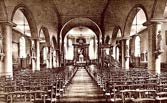
Figure 69.45: Deerlijk, the interior of Saint Columba church.
© 2024 Nico F. Declercq
The Desclergues of la Villa Ducal de Montblanc, 2nd ed., Omn., VOL. VI
69.7. JEAN BAPTISTE SURMONT & SUSANNE D’ HUYVETTER
1415
Figure 69.46: Ingooigem, May 9th of 1837, birth certificate of Susanne D’ Huyvetter, daughter of 39-year old Georges D’
Huyvetter and Marie-Françoise Vanhulle (36 years old).
Figure 69.47:
Left, Susanne D’ Huyvetter with her
daughter Marie Nathalie Surmont, right.
MyHer-
itage® colorized this photo. (Declercq de Silva Archive)
Figure 69.48: Deerlijk, Schoolstraat.
The Desclergues of la Villa Ducal de Montblanc, 2nd ed., Omn., VOL. VI
© 2024 Nico F. Declercq
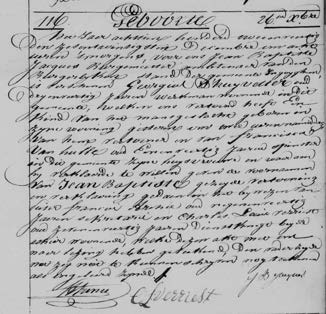
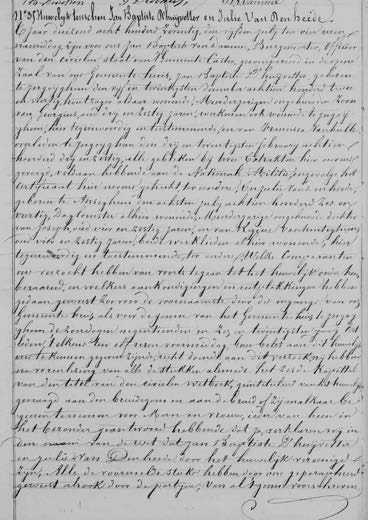
1416
CHAPTER 69. THE SURMONT - DE CROOCK ANCESTRY LINE
Figure
69.49:
Ingooigem, December
25, 1842, the birth of Jean-Baptiste D’
Huyvetter, son of 43-year-old Georges D’
Huyvetter and 41-year-old Françoise Van-
hulle.Charles Louis Verriest was a witness.
Figure 69.50:
Kaster, July 5, 1870, the marriage of Jean-Baptiste D’
Huyvetter with Julie Vandenheede. The groom was a carpenter, brother of
Susanne D’ huyvetter, and born at Ingooigem on December 25, 1842. The
bride was born at Anzegem on August 8, 1846. The parents of Jean-Baptiste
were Georges D’ Huyvetter and Françoise Vanhulle, who died on February 23,
1863. The parents of Julie Vandenheede were Joseph Vandenheede and Regine
Vanhouteghem. (sheet 1)
© 2024 Nico F. Declercq
The Desclergues of la Villa Ducal de Montblanc, 2nd ed., Omn., VOL. VI
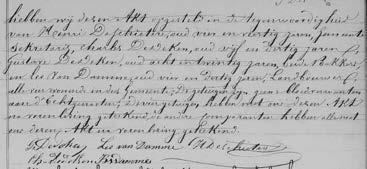
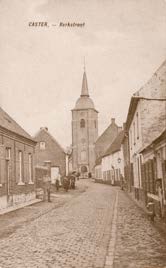
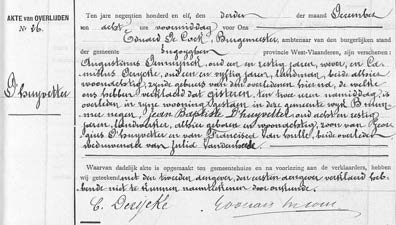
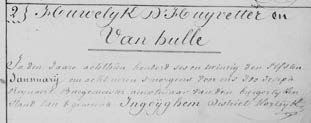
69.7. JEAN BAPTISTE SURMONT & SUSANNE D’ HUYVETTER
1417
Figure 69.51:
Kaster, July 5, 1870, the marriage of Jean-Baptiste D’
Huyvetter with Julie Vandenheede. (sheet 2)
Figure 69.52: Kaster, Kerkstraat.
Figure 69.53: Ingooigem, December 3, 1911, the death of farmer Jean-Baptiste D’
Huyvetter, age 68, son of Georges D’ Huyvetter and Françoise Vanhulle.
Figure 69.54: Ingooigem, January 11, 1826, the marriage of
Georges D’ Huyvetter with Françoise Vanhulle. Georges was a
weaver, born at Ingooigem on April 21, 1798, and the son of Jean-
Baptiste D’ Huyvetter, dead on July 17, 1823, and Marie-Josephe
Yzenbaert. Françoise was a spinster, born at Ingooigem on May
13, 1802, and was the daughter of Augustin Vanhulle, who died on
April 8, 1819, and Marie-Caroline Windels, who died on May 13,
1819. (sheet 1)
The Desclergues of la Villa Ducal de Montblanc, 2nd ed., Omn., VOL. VI
© 2024 Nico F. Declercq
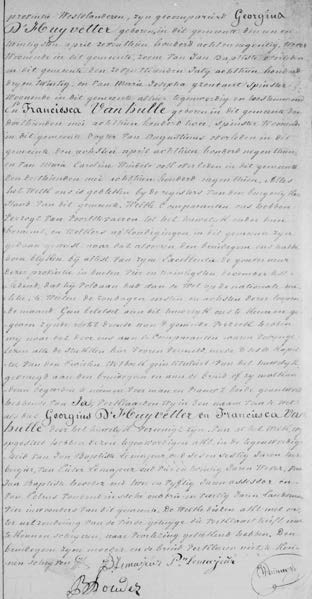
1418
CHAPTER 69. THE SURMONT - DE CROOCK ANCESTRY LINE
Figure 69.55: Ingooigem, January 11, 1826, the marriage of
Georges D’ Huyvetter with Françoise Vanhulle. (sheet 2)
Figure 69.56:
Harelbeke, October 6,
1858, the marriage of Susanne D’ Huyvet-
ter and Jean-Baptiste Surmont. (sheet 1)
© 2024 Nico F. Declercq
The Desclergues of la Villa Ducal de Montblanc, 2nd ed., Omn., VOL. VI
69.7. JEAN BAPTISTE SURMONT & SUSANNE D’ HUYVETTER
1419
Figure 69.57:
Harelbeke, October 6,
1858, the marriage of Susanne D’ Huyvet-
ter and Jean-Baptiste Surmont. Jean Bap-
tiste was born at Ooike on May 12, 1825,
and lived in Deerlijk; he was the son of
Pierre-François Surmont, who died at Be-
vere (Oudenaarde) on June 22, 1833, and
Marie-Thérèse de Croock, who died at Be-
vere (Oudenaarde) on January 31, 1833.
The grandparents of Jean Baptiste were
also deceased. Susanne D’ Huyvetter was
born at Ingooigem on May 9, 1837, and
lived in Harelbeke; she was the daugh-
ter of weaver George D’ Huyvetter and
spinster Marie-Françoise Vanhulle, who
both lived in Ingooigem and were present
for the wedding. The witnesses were Su-
sanne’s 30-year-old brother Charles Louis
D’ Huyvetter, a sheep farmer residing
in Zwijnaarde (Gent), 58-year-old weaver
Pierre Joseph De Croock, uncle of the
groom from Deerlijk, unrelated 28-year-old
weaver Edouard Vandeputte from Deerlijk,
and unrelated 45-year-old Pierre Decruye-
naere from Harelbeke. The couple would
have a daughter, Marie-Julie, who died at
Deerlijk in 1862 at the age of 1, and a son,
Henri, who died at Deerlijk in 1869 at the
age of 4. (sheet 2)
The Desclergues of la Villa Ducal de Montblanc, 2nd ed., Omn., VOL. VI
© 2024 Nico F. Declercq
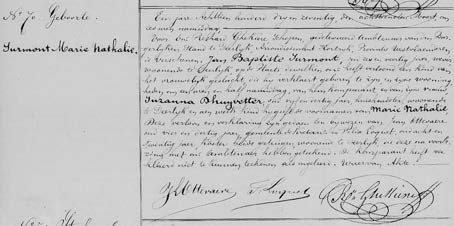
1420
CHAPTER 69. THE SURMONT - DE CROOCK ANCESTRY LINE
69.8 Marie Nathalie Surmont & V. François Vangheluwe
69.8.1 Marie Nathalie Surmont
Marie Nathalie Surmont is shown in Figure 69.59. She was born in Deerlijk on March 18, 1873, in Figure 69.58, and died in Deerlijk on February 15, 1955, in Figure 69.59.
Her brother and only sibling was Eduard Camille Surmont, a horse harness manufacturer and merchant at Deerlijk who appears in works (e.g., Harmen Riels, 1913, p. 6) of poet René Declercq (Deerlijk 1877 - Sint Maartensdijk 1932) as his friend Kroeksken.
The nickname Kroeksken originated from the ancestors of Marie Thérèse de Croock, as described above. Eduard Camille Surmont was born in the same year as René Declercq and they went to school together at Deerlijk. Marie Nathalie Surmont was married to V. François Vangheluwe.
It may be worthwhile highlighting Eduard Camille Surmont, brother of Marie-Nathalie Surmont, a little better here. His marriage is shown in Figure 69.60. He was a member of the Sint-Elooisgilde (Guild of Saint Eloise) and appeared in some of the works of poet René Declercq because they had both been born in the same year and were friends.
René Declercq called him Kroeksken in his works. In reality, people either called him Kroekie or Kroekske in the local dialect. He had had Poliomyelitis as a child, and as a result, one leg was shorter than the other. Those days, people were rather harsh when using nicknames.
From ’Harmen Riels,’ written by René Declercq in 1913, we can cite (in Flemish) the following paragraph, which expresses a flavour of how René Declercq wrote tales. The citation places the appearance of manke Kroeksken in the correct context of what Harmen (i.e. René Declercq) undertook as a child in Deerlijk. The text brings contemporary children and their language during Marie-Nathalie Surmont’s youth back to life.
’Dat was niet wel, Harmen, niet schoon van u. En het was ook niet braaf dat ge aan het hoofd van een bende medeschavuiten draafdet rondom Kabijntjes berdenkot, scherend onder zijn venster weg, waarachter het dreigde met zijn kromme sikkel. Maar gij waart al voorbij, en schateren, tieren en tergen weder ! En gemeen was het dat ge een een heelen korf puiten uitstortted over de halve deur van Trezeke-mijn-Bezeke, bij wie ge later zoo dikwijls gingt zitten met Jan Veyt en Fontje Soete pijpkens dampen in de duik, al luisterend naar haar ronkend spoelewiel, haar spookvertellingen en rijke rare liedekens. Scherfstukken hebt ge laten schijveren, oneerbiedige, naar het grauwgroene standbeeld van Plaetsier op het kerkhof en manke Kroeksken hebt ge opgestoken over het tralieschot, en sneeuw opgegeven om den rijmelaar warm te kleeden in de versche wat ; en als ge over de witte haag een zwarte soetane gewaar werdt, hebt ge stillekens den bijs gestoken, en over den muur heen hebt ge Kroeksken zien klauwieren en schruwelen, totdat de goedzakkige pastor het zelf verlossen moest. Doch erger kon het met u afloopen toen ge een krieksteen gooidet op het oorlelleken van bult Lamoen die u achternazat met zijn moordenaarsmes ! Rappe beenen hadt ge, dat is bekend.’
Leon Defraeye was a friend of Gerard Vangheluwe, son of Marie-Nathalie Surmont. They were born in the same year and went to school together. From ’Geschiedenis en folklore van Deerlijk’ published by Leon Defraeye in 1942 we can cite (in Flemish):
’Harmen was een kwaperterik gelijk alle andere jongens, hij en andere kapoenen stortte eens een heelen korf puiten uit boven de halve deur van Trezeke-mijn-Bezeke, winkelierster. Met Jan Veyt ging Harmen Riels veel luisteren naar de spookvertelsels van Trezeke en naar haar rare liedekens. Hij gooide met scherfstukken naar het grauw groene standbeeld van Plaetsier op het kerkhof en manke Kroeksken stak hij over het traliewerk om den rijmelaar met sneeuw te bedekken. Toen hij een zwarte soetane zag naderen (de pastoor) liet hij Kroeksken in den brand zoodat de pastoor het venthe moest helpen om eraf te komen.’
69.8.2 V. François Vangheluwe
69.8.2.1 His life
He was born in 1872 in Figure 69.61, in Deerlijk, on December 23, and was married to Marie Nathalie Surmont. There is a legacy that he was complex because of his short height. He overcompensated by sometimes defending himself quite aggressively when he deemed it necessary. In Figure 69.62, the reader can find that he was exactly 160 cm tall, which was indeed shorter than average but not abnormal. He voluntarily became a Chasseur ’a Pied (comparable to modern commando troops and shown in Figure 69.63);
therefore, he was a strong man.
His father was Joannes Vangheluwe, a farmer at Deerlijk, who was married to Frederica Herman, daughter of Ivo Herman and Victoria Vandeputte. Joannes Vangheluwe was born in 1830 and was the son of Joseph Vangheluwe and Maria Constancia Vanhoutteghem.
Joseph was born at Deerlijk in 1806 and was a son of Jean-Baptiste Vangheluwe, born at Deerlijk in 1777, and Maria Anna Dewaele, born at Desselgem in 1779.
Jean-Baptise Vangheluwe was the son of Amelia Vangheluwe and an unknown father. The Vangheluwe family, i.e., the paternal Figure 69.58: Deerlijk, March 18, 1873, was the birth of Marie Nathalie Surmont, the daughter
of 47-year-old weaver Jean Baptiste Surmont and 35-year-old Susanne D’ Huyvetter.
© 2024 Nico F. Declercq
The Desclergues of la Villa Ducal de Montblanc, 2nd ed., Omn., VOL. VI
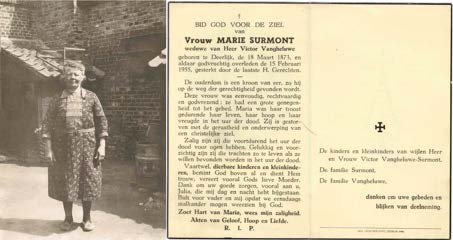
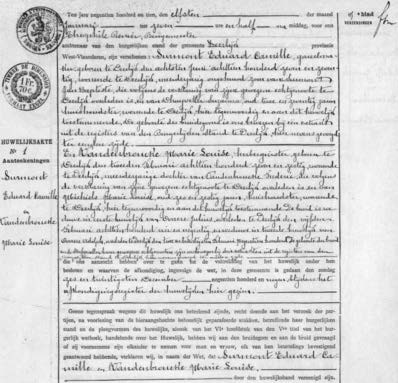
69.8. MARIE NATHALIE SURMONT & V. FRANÇOIS VANGHELUWE
1421
Figure 69.59: Marie-Nathalie Surmont was a straightforward, upright woman who loved her
goats and other animals in her yard and was appreciated by everyone in the village. Her obituary
card tells that she was the widow of V. François Vangheluwe. The author had known the ’Julia’
(Julia Debaere, 1903-1983, wife of Michel Camille Vangheluwe) mentioned in the eulogy when
he was a child - she lived across from the community school (’gemeentelijke jongensschool’) in
Deerlijk and had a hearing problem. (Declercq de Silva Archive)
Figure 69.60: Deerlijk January 11, 1910, the marriage of Edouard Camille Sur-
mont and Marie Louise Vandenbroucke. The groom was born in Deerlijk on June
8, 1877, lived in Deerlijk, and was the son of Jean Baptiste Surmont, who died at
Deerlijk, and 72-year-old Susanne D’ Huyvetter, who was present for the wedding.
The bride was an innkeeper, a widow of Jules Ovaere and Adolph Ovaere; she was
born in Deerlijk on February 2, 1867, and the daughter of Frederic Vandenbroucke,
who died at Deerlijk, and 66-year-old Marie Louise Michiels.
The Desclergues of la Villa Ducal de Montblanc, 2nd ed., Omn., VOL. VI
© 2024 Nico F. Declercq
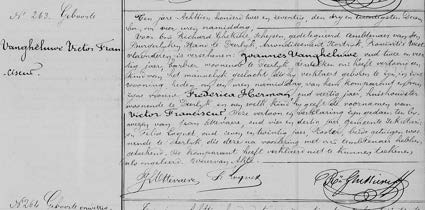

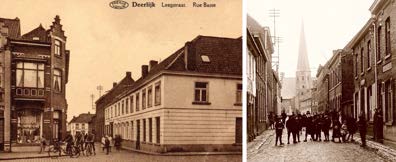
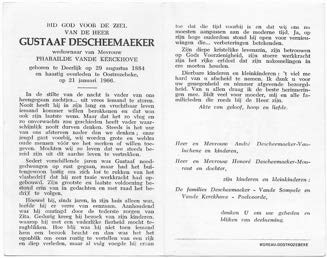
1422
CHAPTER 69. THE SURMONT - DE CROOCK ANCESTRY LINE
Figure 69.61: Deerlijk, December 23, 1872, the birth of V. François Vangheluwe, son of
42-year-old barber Joannes Vangheluwe and 40-year-old Frederica Herman.
Figure 69.62: Military registration of V. François Vangheluwe in Levée de 1892, Milice Nationale, Province de la Flandre Occidentale, 17e Canton de Milice, Commune de Deerlijk. He was a textile manufacturer at Deerlijk, born in the village on December 23, 1872. He was 160 cm tall. His father was Jan Vangheluwe, and his mother was Fréderique Herman. For many generations, his father was a barber (hence the family’s nickname, ’de barbiers’). He was recruited on March 5, 1892. On April 21, 1892, he joined the 1st Chasseurs à pied, in Figure 69.63, as a voluntary soldier, number 174576. He was released from his military obligations on October 1, 1905.
Figure 69.63: The Chasseurs à Pied were the army’s elite corps and
were the guards of the Royal Palace in Brussels.
Figure 69.64: Deerlijk, Leegstraat.
Figure 69.65: The obituary card of ac-
quaintance Gustaaf Descheemaeker, hus-
band of Pharailde Vande Kerckhove, 1966.
(Declercq de Silva Archive)
© 2024 Nico F. Declercq
The Desclergues of la Villa Ducal de Montblanc, 2nd ed., Omn., VOL. VI
69.8. MARIE NATHALIE SURMONT & V. FRANÇOIS VANGHELUWE
1423
ancestors of Amelia Vangheluwe, were farmers in Deerlijk in 1572 and had probably lived in the village even long before23. V.
François Vangheluwe died in Deerlijk on January 10, 1951, according to Geneanet ®.
69.8.2.2 His Relative Octavie Vangheluwe
Octavie was the auntie of V. François Vangheluwe. She was a daughter of Joseph Vangheluwe (1805-1855) and Marie-Constance Van Houtteghem (1801-1850). She had the following siblings: Joannes, Lucia, Ivo, Agnelys, Cordula, and Franciscus. Her brother Joannes (Deerlijk 1830 - Vichte 1901) was married to Frederica Herman (Waregem 1832 - Deerlijk 1882) and they were the parents of V. François Vangheluwe (Deerlijk 1872), described in Chapter 69.8.2, who married, in 1895 to Marie Nathalie Surmont (1873-1955).
The son of V. François Vangheluwe and Maria Nathalie Surmont was Gerardus Vangheluwe, described in Chapter 69.9, and is the author’s great-grandfather.
Octavie Vangheluwe is known in Deerlijk for the miracle in 1884, found in Chapter 49.13.6. On April 2, 1884, Octavie Vangheluwe, born on May 1, 1845, and who would die on May 7, 1893, lived in the Leegstraat (Shown in Figure 69.64, nowadays René Declercqstraat), had been in bed for 2 two and a half years, was suddenly healed and showed herself to the neighbors to prove that she was cured. The entire village was very much under the impression of this miracle. The miracle was associated with the chapel
’Kapel-ter-Ruste.’ We refer to Chapter 49.13.6 for more information. An acquaintance is shown in Figure 69.65.
69.8.2.3 His Sibling Valerie Vangheluwe
She is the originator of the family branch, which would live in Waregem as Vynckier and remained in good contact with the family throughout the 20th century. Valerie Eudolie Vangheluwe married in 1894, in Figures 69.66 and 69.67. Her husband was Amadé Usmare Vynckier, and some documents of their children are shown in Figures 69.68, 69.69 and 69.70.
69.8.2.4 His Sibling Emile Vangheluwe
On the military registration of Gustave Felix Vangheluwe, son of Emile Vangheluwe, in Figure 69.71, we discovered that Emile was married to Sylvie Leonie Eeckhout. This is important to note because Chapter 48.9.5.3 described how Marie Elodie Eeckhout was connected to the Verhaeghe family. It’s perfectly possible that they were related.
69.8.2.5 His Paternal Ancestry Line
The name-line begins with Joannes Baptiste Vangheluwe in 1777, in Figure 69.72. The father was officially not known. Therefore, Joannes Baptiste Vangheluwe started a new bloodline with a name not his but his mother’s. We do not know the circumstances, but in general, such is considered a high treason of the blood. It means the author’s mother’s name should, in fact, not be Vagheluwe, but different.
69.8.3 Marriage and Family
V. François Vangheluwe and Marie Nathalie Surmont married in 1895, in Figures 69.73 and 69.74, in Deerlijk. They had the following children: Michel, André and Gerard. The latter is described in Chapter 69.9. Figures 69.75 and 69.76 show the military registrations of Michel and André, in the family memory engraved as nonkel Michel and nonkel André.
2Filip Benoit, ’Deerlijk volgens het Twintigste Penningkojier van 1572,’ Derlike 20ste jaargang, nr 1, 1997.
3Stadsarchief Gent, Twintigste Penningkohier, reeks 28, bundel 11/51, Deerlijk, anno 1572.
The Desclergues of la Villa Ducal de Montblanc, 2nd ed., Omn., VOL. VI
© 2024 Nico F. Declercq
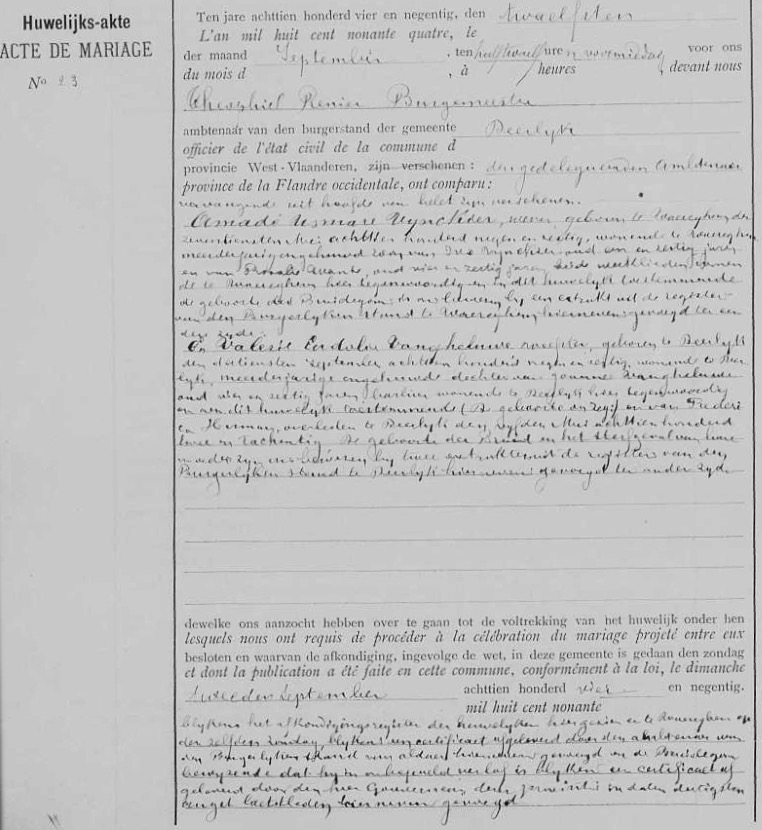
1424
CHAPTER 69. THE SURMONT - DE CROOCK ANCESTRY LINE
Figure 69.66: Deerlijk, September 12, 1894, the marriage of Amadé Usmare Vynckier, born in Waregem on May 17, 1869, son of Ivo Vynckier and Rosalie, with Valerie Eudolie Vangheluwe, born in Deerlijk on September 13, 1869, daughter of 64-year-old barber Joannes Vangheluwe and Frederica Herman who had died in Deerlijk on May 5, 1882.
(sheet 1)
© 2024 Nico F. Declercq
The Desclergues of la Villa Ducal de Montblanc, 2nd ed., Omn., VOL. VI
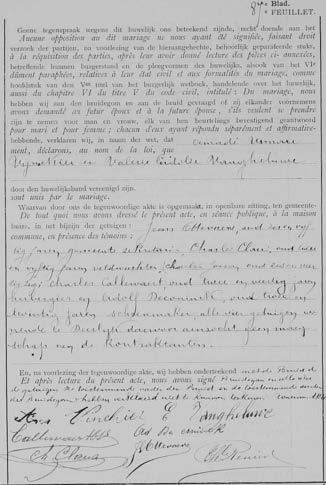


69.8. MARIE NATHALIE SURMONT & V. FRANÇOIS VANGHELUWE
1425
Figure
69.67:
Deerlijk, September
12, 1894, the marriage of Amadé Us-
mare Vynckier, with Valerie Eudolie
Vangheluwe. (sheet 2)
Figure 69.68: The military registration of Joannes Remie Vynckier, in lichting van 1914, Nationale Militie, provincie WestVlaanderen, militiekanton, gemeente Waereghem. He was a railway worker, lived in Deerlijk, and was born in Waregem on December 19, 1894. His parents were Amedé Ursemar Vynckier, from Waregem, and Valerie Vangheluwe, from Deerlijk. He had six younger siblings; on June 4, he was exempt, although he had been declared fit to handle any weapon.
Figure 69.69: The military registration of Emile Maurice Vynckier, in Lichting van 1919, Nationale militie, Provincie WestVlaanderen, militiekanton, gemeente Waereghem. He was a railway worker who was born in Waregem on January 30, 1899.
His parents were Amedé Ursemar Vynckier, from Waregem, and Valerie Eudolie Vangheluwe, from Deerlijk. On November 19, 1919, he was considered fit to handle any weapon. He remained a military man until May 19, 1927.
The Desclergues of la Villa Ducal de Montblanc, 2nd ed., Omn., VOL. VI
© 2024 Nico F. Declercq
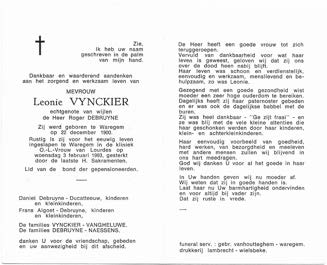

1426
CHAPTER 69. THE SURMONT - DE CROOCK ANCESTRY LINE
Figure 69.70:
The obituary card of
Leonie Vynckier, the wife of Roger De-
bruyne and daughter of Amadé Usmare
Vynckier and Valerie Eudolie Vangheluwe.
Figure 69.71: The military registration of Gustave Felix Vangheluwe in Lichting van 1914, Nationale Militie, provincie West-Vlaanderen, Militiekanton Harelbeke, gemeente Deerlijk. He was a worker, born on June 2, 1894, in Deerlijk, son of Emile Vangheluwe and Sylvie Leonie Eeckhout. He was admitted with the cavalry on May 24, 1919.
Figure 69.72: 1777, the baptism of Joannes Baptiste Vangheluwe, the earliest
paternal ancestor of Gerard Vangheluwe, carried this family name. He was an il-
legitimate son of Amelie Vangheluwe. His godfather was Joannes Lefevre, and his
Godmother was Francisca Salens. We need to find out Amelie Vangheluwe’s life
story. Therefore, we cannot judge nor understand. We found no further trace of
Amelie.
© 2024 Nico F. Declercq
The Desclergues of la Villa Ducal de Montblanc, 2nd ed., Omn., VOL. VI
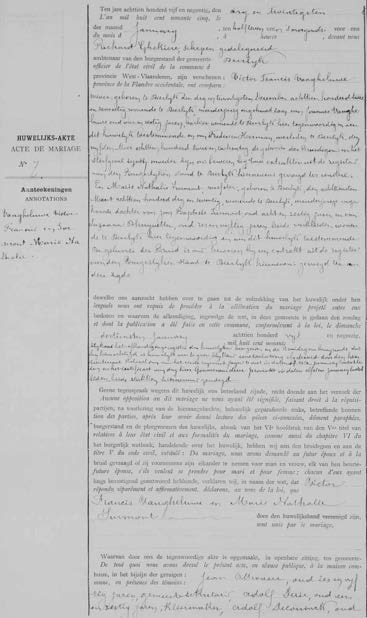
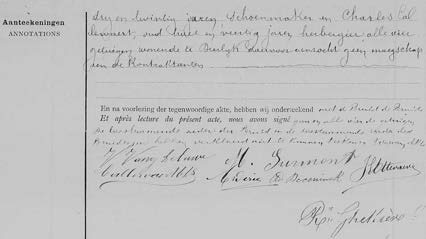
69.8. MARIE NATHALIE SURMONT & V. FRANÇOIS VANGHELUWE
1427
Figure 69.73:
Deerlijk, January 23, 1895, the mariage of V. François
Vangheluwe and Marie Nathalie Surmont. At the time of his marriage, the
groom was a weaver, born in Deerlijk on December 23, 1872, son of 64-year-old
barber Joannes Vangheluwe, present for the wedding, and Frederica Herman,
who died in Deerlijk on May 5, 1882. The bride was also a weaver at the time
of her marriage, born in Deerlijk on March 18, 1873, daughter of 68-year-old
Jean Baptiste Surmont and 56-year-old Susanne D’ Huyvetter. (sheet 1)
Figure 69.74: Deerlijk, January 23, 1895, the mariage of V. François Vangheluwe and
Marie Nathalie Surmont. (sheet 2)
The Desclergues of la Villa Ducal de Montblanc, 2nd ed., Omn., VOL. VI
© 2024 Nico F. Declercq
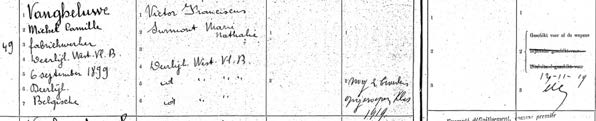

1428
CHAPTER 69. THE SURMONT - DE CROOCK ANCESTRY LINE
Figure 69.75: The military registration of Michel Camille Vangheluwe, in Lichting van 1919, Nationale Militie, Provincie West Vlaanderen, Militiekanton Harelbeke, gemeente Deerlijk. He was a worker, born in Deerlijk on September 6, 1899, and had two more brothers in ’lichting 1919.’ His father was V. François Vangheluwe, and his mother was Marie Nathalie Surmont. He was recruited on November 14, 1919.
Figure 69.76: The military registration of Joannes Adreas (André) Vangheluwe, in Lichting van 1915, Nationale Militie, provincie West-Vlaanderen, militiekanton Harelbeke, gemeente Deerlijk. He was a textile manufacturer who was born in Deerlijk on August 22, 1895. His parents were V. François Vangheluwe, and Marie Nathalie Surmont. He was admitted to the cavalry on May 24, 1919.
© 2024 Nico F. Declercq
The Desclergues of la Villa Ducal de Montblanc, 2nd ed., Omn., VOL. VI
69.9. GERARD VANGHELUWE & ZOZYMA ZULMA VERHAEGHE
1429
69.9 Gerard Vangheluwe & Zozyma Zulma Verhaeghe
69.9.1 Gerard Vangheluwe
69.9.1.1 Introduction
Gerard Vangheluwe, depicted in Figure 69.80, is a notable ancestor of the author and is also mentioned in Part X as the spouse of Zozyma Zulma Verhaeghe. During World War I, he was subjected to forced labor under German occupation, working in the forests near Charleville-Mézières and Sedan. In recognition of his acts of sabotage against the Germans while in captivity, King Albert I awarded him an honorary medal. Born in Deerlijk in 1898, as illustrated in Figure 69.77, Gerard attended school with Leon Defraeye and Joseph Ovelacq, prominent figures in Deerlijk. Following his internment as a forced laborer during World War I, Gerard Vangheluwe served as a Belgian soldier, as shown in Figure 69.78, and participated in the military occupation of Germany after the war.
69.9.1.2 His Youth
Gerard Vangheluwe’s youth was filled with the charming and adventurous spirit typical of a small-town boy. One anecdote he often recounted, which has become legendary within the family, involved a daring escapade at seven or eight. One day, young Gerard decided to climb the church tower of Deerlijk. Although he had no fear of heights throughout his life, he could not descend the tower on this occasion. The local fire department had to be summoned to rescue him, creating a story that echoed through the decades. However, it has largely faded from the collective memory of the current generation.
The author has pondered Gerard’s motivation for this climb, speculating that it was likely influenced by a high opening in the tower known as a rave hole. This aperture was used to display flags during festivities and offered a magnificent view. The poet René Declercq reminisced4 about his youth, describing how he and a friend ascended the tower to smoke a pipe and enjoy the splendid panorama of Deerlijk. It is plausible that young Gerard sought the same breathtaking view. However, the difference in Gerard’s adventure was his unconventional approach; family lore suggests he climbed the exterior of the tower, which led to his predicament.
The military registrations of his contemporaries further illustrate the charm of Gerard’s youth, Leon Defraeye, and Joseph Ovelacq, shown in Figures 69.81 and 69.82. Images of Gerard’s schooldays are displayed in Figures 69.83 and 69.84, and the streets he roamed are also depicted in Figure 69.84. Like many young boys in Deerlijk, Gerard’s early life was filled with joy and simplicity until the shadow of war loomed in the summer of 1914.
In Figure 69.85, we see a photograph of Gerard Vangheluwe taken early during World War I, before he was coerced into forced labor by the Germans in southeastern Belgium. His lifelong friend, Leon Defraeye, is also featured in Figure 69.85, symbolizing the enduring bonds formed in their idyllic youth.
69.9.1.3 WWI, Ziviel Arbeiter Bataillon 3, nr 186
69.9.1.3.1 Introduction The story of Gerard Vangheluwe from Deerlijk during World War I is a gripping narrative of survival, resilience, and the brutal realities of war. Like many others, Gerard was thrust into a situation that tested the limits of human endurance and spirit. This account delves into the dramatic events that shaped his life and those around him, drawing on the broader context of World War I to provide a comprehensive understanding of his experiences. It is helpful to first check the map of his Journey to Sedan in Figure 69.89.
On October 18, 1916, the tranquil town of Deerlijk was plunged into chaos. The German occupiers ordered all fit young men to report to the town hall. The tension was palpable as families bid tearful farewells to their sons, husbands, and brothers, knowing the uncertain and dangerous future.
69.9.1.3.2 The Selection Among the 250 men selected was Gerard Vangheluwe, a young man whose life would be irrevocably changed. The selection process was fraught with controversy. Mayor Renier’s refusal to provide the names of the unemployed, seen as an act of defiance, led to arbitrary choices that sowed seeds of discord in the community. Gerard was convinced he was targeted due to personal vendettas, found himself among the chosen, and his fate was sealed by subjective biases rather than objective need.
Mayor Renier stood in his office, the weight of the decision heavy on his shoulders. He looked out the window at the gathered crowd, faces etched with fear and anxiety. Turning to his aide, he sighed,
"I cannot hand over this list. To do so would be to betray my people."
"But, sir," the aide replied, "the Germans have threatened to execute those who do not comply. Are we not putting our citizens at greater risk?"
Renier shook his head. "Better that we choose our own, even if the process is flawed. At least we can try to protect those who would suffer most."
69.9.1.3.3 The Farewell The scene on October 22 was heart-wrenching. Mothers wept, fathers stood stoically, and siblings clung to their departing brothers. The entire village turned out to witness the departure, their shouts of encouragement and resistance echoing in the crisp autumn air.
"Don’t work," "Don’t sign anything," and "Remember your brothers at the Yser River,"
they cried, urging the men to hold fast to their principles. Gerard stood in the doorway of his home, his mother clutching his arm.
"Please, Gerard, be careful,"
she whispered, tears streaming down her face. His father, a stoic man, placed a hand on his shoulder.
"You are strong, my son. Remember that. And remember us."
His sister hugged him.
"Come back soon, Gerard," she pleaded.
He knelt, ruffling her hair.
"I will, little one. I promise." The men were transported to Kortrijk, the journey filled with uncertainty and fear. Gerard and his companions were acutely aware that they might be forced into labor that would aid the enemy, a thought that gnawed at their consciences.
4René Declercq, Harmen Riels, S. L. Van Looy, Amsterdam, 1913, pages 9-11.
The Desclergues of la Villa Ducal de Montblanc, 2nd ed., Omn., VOL. VI
© 2024 Nico F. Declercq
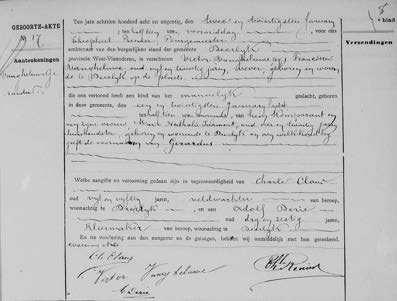

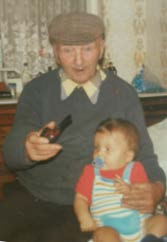
1430
CHAPTER 69. THE SURMONT - DE CROOCK ANCESTRY LINE
Figure 69.77: Deerlijk, January 21, 1898, the birth of Gerard Vangheluwe, son of
25-year-old V. François Vangheluwe, and 24-year-old Marie Nathalie Surmont.
Figure 69.78: The military registration of Gerard Vangheluwe in lichting 1918, Nationale Militie, provincie West-Vlaanderen, militiekanton Harelbeke, gemeente Deerlijk. He was born in Deerlijk, shown in Figure 69.79, on January 21, 1898, as the son of V. François Vangheluwe and Marie Nathalie Surmont. He could handle all weaponry and was admitted on October 22, 1919.
Figure 69.79: Deerlijk, Kerkplein with Saint Columba church.
Figure 69.80: 1976, the author with his great-grandfather Gerard
Vangheluwe. (Declercq de Silva Archive)
© 2024 Nico F. Declercq
The Desclergues of la Villa Ducal de Montblanc, 2nd ed., Omn., VOL. VI


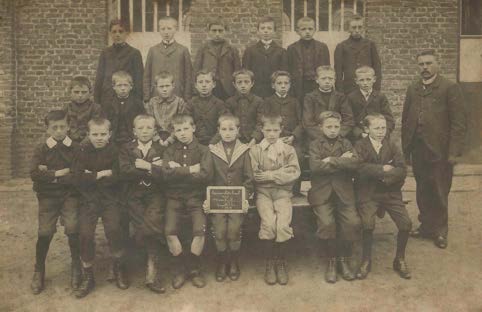

69.9. GERARD VANGHELUWE & ZOZYMA ZULMA VERHAEGHE
1431
Figure 69.81: Military registration of Leon Defraeye, in Lichting van 1919, Nationale Militie, provincie West-Vlaanderen, militiekanton Harelbeke, gemeente Deerlijk. He was a student, born in Deerlijk on June 6, 1899, the son of Joannes Baptiste Defraeye from Beveren Leie and Maria Eulodia Vandenhende from Beveren Leie, both of whom remained in Deerlijk. He was admitted on November 12, 1919.
Figure 69.82: Military registration of Joseph Ovelacq, in Lichting van 1919, Nationale Militie, Provincie West Vlaanderen, militiekanton Harelbeke, gemeente Deerlijk. Joseph Ovelacq was born in Deerlijk on January 10, 1899, as a son of Alfred Pierre Ovelacq from Deerlijk and Marie Dambre from Brouckerke in West Vlaanderen. He was admitted on November 12, 1919.
Figure 69.83: Children born in 1898 and 1899 at the Community School (Gemeenteschool) of Deer-
lijk. Picture taken in 1909. First (front) row, from left to right: Lionel Vercruysse, Alberic Vlieghe, Gerard Vangheluwe (January 21, 1998 - September 19, 1977), Leon Defraeye (June 6, 1899 - March 22,
1977), Joseph Ovelacq, Gentil Hinnekens, Remi Caveye, Odilon Decock. Second (middle) row, from
left to right: Jeroom Depamelaere, Hector Desimpelaere, x Loquet, Adelson Buyze, Remi Verplancke,
Abdon Declercq, Georges Ottevaere, Juul Maes, Prosper Opsomer (teacher, 1875-1955). Third (back)
row, from left to right: Julien Rohaert, Odilon Herman, Alois Deschamps, Valeer Vanneste, Maurice
Devroe, Georges Putman.
Figure 69.84: Deerlijk, gemeenteschool (gemeentelijke jongensschool). Right, we see Hoogstraat and Stationsstraat.
The Desclergues of la Villa Ducal de Montblanc, 2nd ed., Omn., VOL. VI
© 2024 Nico F. Declercq
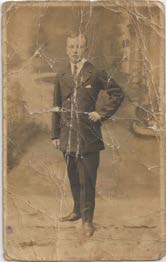
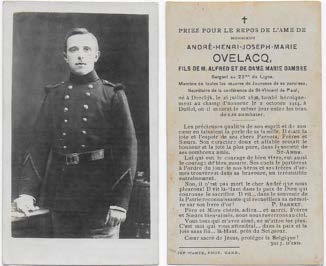
1432
CHAPTER 69. THE SURMONT - DE CROOCK ANCESTRY LINE
Figure 69.85: Gerard Vangheluwe, just after he was informed that he
had become a forced laborer and would have to depart to another area.
(Declercq de Silva Archive)
Figure 69.86: Leon Defraeye, image taken from his obituary card. (Declercq de
Silva Archive)
Figure 69.87: The obituary card of An-
dré Henri Joseph Marie Ovelacq, brother
of Joseph. He died in October 1914. (De-
clercq de Silva Archive)
Figure 69.88: Before WWI, the military base at Kortrijk also
served as a training school for the military. (Courtesy of Ann
Ganseman)
© 2024 Nico F. Declercq
The Desclergues of la Villa Ducal de Montblanc, 2nd ed., Omn., VOL. VI
69.9. GERARD VANGHELUWE & ZOZYMA ZULMA VERHAEGHE
1433
Figure 69.89: The route from Deerlijk to the work camp. Cour-
tesy of Googlemaps ®
69.9.1.3.4 The Kortrijk Barracks Upon arrival at the Kortrijk military base, shown in Figure 69.88, the men were stripped of their identities, assigned numbers, and given caps emblazoned with ’ZAB 3,’ marking them as members of the Ziviel Arbeiter Bataillon 3. Gerard became number 186. For three days, they were confined to the barracks, their every move monitored by German soldiers armed with bayonets.
The barracks were cold and unwelcoming, starkly contrasting to the homes they had left behind. The men were packed into cramped quarters, the air thick with the smell of sweat and fear.
Gerard looked around at his fellow detainees.
"We must stay strong,"
he said quietly to the men around him.
"They want to break us, but we cannot let them."
One of the men, Jules, nodded.
"You’re right, Gerard. We stick together. We survive together."
69.9.1.3.5 The Departure On October 25, under the cover of darkness, the men were herded to the train station. The atmosphere was tense as they were loaded into cramped, foul-smelling beast wagons. The journey took them through familiar and foreign landscapes, each mile taking them further from home and deeper into the unknown.
The train ride was long and grueling. Packed tightly into the wagons, the men struggled to find space to sit or lie down. The smell of unwashed bodies and fear permeated the air.
Gerard leaned against the wall of the wagon, trying to catch some sleep. Beside him, a young man named Henri whispered,
"Where do you think they’re taking us?"
"I don’t know," Gerard replied.
"But we must be ready for anything."
69.9.1.3.6 Arrival in France After an arduous journey, the train finally arrived in France. Gerard and his fellow Deerlijkers were separated into groups and sent to various locations. Gerard ended up in Sedan, a place that would test his mettle and resolve.
69.9.1.3.7 Life in Sedan In Sedan, the men were subjected to grueling labor. Gerard, tasked with chopping wood, found the work backbreaking and the conditions harsh. Food was scarce, and survival depended on rationing meager supplies. Gerard’s slender frame, once a sign of fragility, became his saving grace. Unlike the burly workers who perished quickly, Gerard’s ability to stretch his provisions allowed him to endure.
A typical day in Sedan began before dawn. The men were woken by the harsh sound of a whistle, signaling the start of another day of labor. They were given a meager breakfast, usually a piece of stale bread and some watery soup, before being marched to the forest to begin their work. Gerard swung his axe with steady determination, his hands blistered and sore. Each strike of the wood felt like a small victory, a testament to his will to survive.
"Keep going, Gerard," he muttered to himself. "Just one more day."
69.9.1.3.8 A Brush with Death One of the most harrowing episodes in Gerard’s account involved a daring theft. Driven by hunger, he sneaked into a German meat store and stole a salami.
It was a cold, moonless night when Gerard decided to steal the salami. He moved silently, avoiding the guards as he slipped into the store. His heart pounded in his chest as he grabbed the salami and turned to leave, only to come face-to-face with a German soldier.
"Was tun Sie hier?" the soldier demanded.
Thinking quickly, Gerard replied, "Ya Russkiy."
The soldier hesitated, then shrugged and walked away, leaving Gerard to make his escape.
69.9.1.3.9 The Brutal Realities The camp in Sedan was notorious for its brutality. Gerard was beaten by a guard, an injury that would plague him for life. The men were subjected to inhumane conditions, their days marked by relentless toil and their nights by fitful sleep. The toilet was a simple tree branch, a stark reminder of their dehumanized state.
The beating happened on a cold winter’s day. Gerard had been working for hours, exhausted, when he collapsed from fatigue.
The Desclergues of la Villa Ducal de Montblanc, 2nd ed., Omn., VOL. VI
© 2024 Nico F. Declercq
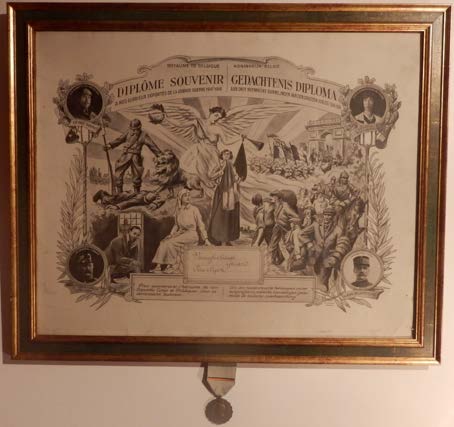
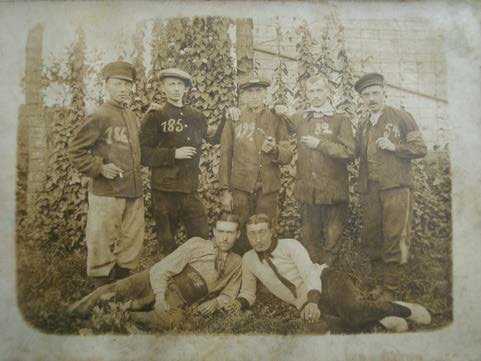
1434
CHAPTER 69. THE SURMONT - DE CROOCK ANCESTRY LINE
Figure 69.90: A diploma was offered to Gerard Vangheluwe after the war for his experiences
during WWI. (Declercq de Silva Archive)
Figure 69.91: 1918, Gerard Vangheluwe (186) (great-grandfather of the author), Julien Soen (185),
Theofiel Malfait (199), Medard Vercruysse (82), Joseph Devoghelaere (54), Aloïs Bijttebier (507)
(great-grandfather of Joko Vanmeerhaeghe) and Maurice Heye. (Declercq de Silva Archive)
© 2024 Nico F. Declercq
The Desclergues of la Villa Ducal de Montblanc, 2nd ed., Omn., VOL. VI
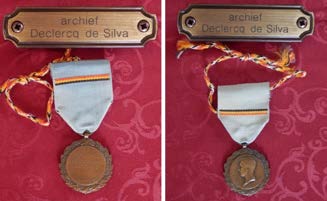
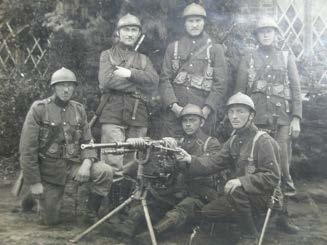
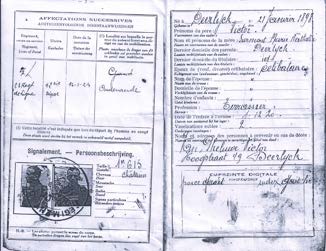
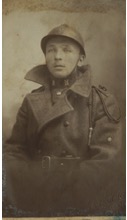
69.9. GERARD VANGHELUWE & ZOZYMA ZULMA VERHAEGHE
1435
Figure 69.92: A medal in possession of
Gerard Vangheluwe. We assume he re-
ceived it after the war for his experiences
during WWI. (Declercq de Silva Archive)
Figure 69.93:
After WWI, Gerard be-
came a soldier. As far as we know, he took
part in the occupation of the Ruhr area in
Germany. (Declercq de Silva Archive)
Figure 69.94:
After WWI, Gerard be-
came a soldier. As far as we know, he
took part in the occupation of the Ruhr area
in Germany. This is his military identity
card. (Declercq de Silva Archive)
Figure 69.95: Gerard Vangheluwe as a soldier. We assume this photo was taken
when he was just recruited after WWI, and he would lose some weight soon after.
During WWII, he hid his military uniform and helmet in the ground. It was discov-
ered over six decades later; the helmet was rusty but still intact. (Declercq de Silva
Archive)
The Desclergues of la Villa Ducal de Montblanc, 2nd ed., Omn., VOL. VI
© 2024 Nico F. Declercq
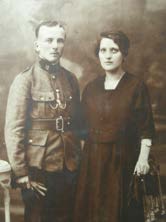
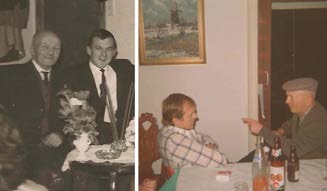
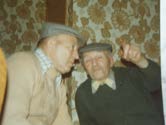
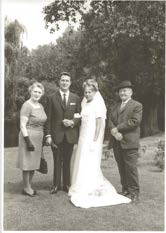
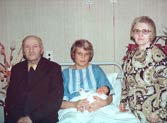
1436
CHAPTER 69. THE SURMONT - DE CROOCK ANCESTRY LINE
Figure 69.96: A wedding photo of Gerard Vangheluwe, in military
uniform, and Zozyma Verhaeghe. (Declercq de Silva Archive)
Figure 69.97:
Gerard Vangheluwe and
Maurice Declercq, the author’s father, dis-
cuss life. The discussion was likely also
about the war. (Declercq de Silva Archive)
Figure 69.98: Gerard, like most older men those days, enjoyed pipe
smoking. When he was even older, he was surprised with a new blue
leader reclining chair, which he smoked a pipe in daily. It was in that
chair at home that he died in 1977. He had still played with the au-
thor that morning, but he did not feel well and died in that chair in
the afternoon. MyHeritage® colorized this photo. (Declercq de Silva
Archive)
Figure 69.99: Left is Gerard Verbrugghe, described in Chapter 77,
and right is Gerard Vangheluwe. The two could discuss WWI and
WWII for hours at a time. One had lived South of the Leie River, the
other North, near Gerard Vangheluwe’s sister-in-law Maria Verhaeghe
in Wielsbeke. (Declercq de Silva Archive)
Figure 69.100: Gerard Vangheluwe and Zozyma Verhaeghe with their
grandson Lucien Vangheluwe (1946) and Jenny Declercq (1947) at
their wedding on June 20, 1968. The couple has two daughters, Inka
(1970) and Maika (1975), the author’s close cousins. (Declercq de Silva
Archive)
Figure 69.101: Gerard Vangheluwe and Zozyma Verbrugghe visited
their great-grandson (the author) when he was born in 1975. (Declercq
de Silva Archive)
© 2024 Nico F. Declercq
The Desclergues of la Villa Ducal de Montblanc, 2nd ed., Omn., VOL. VI
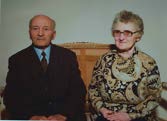
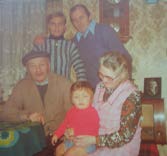
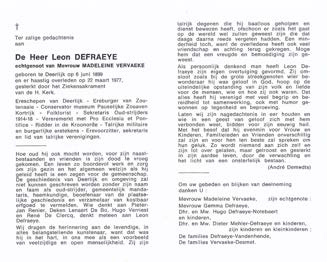
69.9. GERARD VANGHELUWE & ZOZYMA ZULMA VERHAEGHE
1437
Figure 69.102: The last known picture of Gerard and Zozyma dressed
up, before Gerard died. (Declercq de Silva Archive)
Figure 69.103: The author is on Zozyma Verhaeghe’s lap, with Ger-
ard Vangheluwe on the other side. In the back are the author’s parents,
Maurice Declercq and Nelly Maria Vangheluwe. The picture in the
back is René Verhaeghe. The old radio was the first radio in the neigh-
borhood, while the clock on the wall had a warm and pleasing sound.
There was a smell of butter, coffee, and tobacco in the living room
and perfectly baked bread made by baker Casteele. (Declercq de Silva
Archive)
Seeing him on the ground, a German guard approached with a scowl.
"Aufstehen!" he barked, kicking Gerard in the ribs.
Gerard struggled to his feet, but the guard wasn’t satisfied. He struck Gerard with the butt of his rifle, the blow landing squarely on his chest. Gerard fell to the ground, gasping for breath, the pain searing through his body.
The guard sneered. "You work, or you die."
69.9.1.3.10 The Aftermath and Legacy Despite the hardships, Gerard survived the ordeal. His resilience and cunning saw him through the darkest days. After the war, he, like many others, received a diploma recognizing his suffering and endurance.
However, the memories of those years lingered, casting long shadows over his life.
Gerard’s story, though not formally documented by him, was passed down through generations. His accounts, corroborated by others who shared his fate, paint a vivid picture of the trials faced by forced laborers during World War I. His great-granddaughter, Joko Vanmeerhaeghe, confirmed vital details, ensuring that his legacy lives on.
Gerard’s diploma after the war was a small piece of paper, shown in Figure 69.90, but it represented a world of suffering and endurance. It was a testament to his strength and resilience, a symbol of the hardships he had overcome.
Gerard Vangheluwe’s experiences during World War I are a testament to the human spirit’s capacity to endure unimaginable hardship. His story is a vital piece of the larger tapestry of the war, offering insights into the lives of those caught in its grip.
As historians, we must strive to preserve and honor these narratives, ensuring that the sacrifices and resilience of individuals like Gerard are never forgotten.
Joseph Ovelacq, a friend of Gerard Vangheluwe, had a brother, André, who died in the military in 1914, as shown in Figures 69.87.
Figure 69.92 shows additional items and memorabilia from Gerard Vangheluwe’s time in forced labor.
Gerard Vangheluwe passed away in 1978, precluding the possibility of the author’s direct questioning. Consequently, the author sought to obtain all available information from family members who recalled the narratives shared by Gerard in earlier times.
Adhering to scientific rigor, the author endeavored to verify all details meticulously. To ascertain Gerard Vangheluwe’s presence in Sedan, the author consulted Joko Vanmeerhaeghe, the great-granddaughter of Aloïs Bijttebier (identified as no. 507 in Figure
69.91). She corroborated that her great-grandfather had been in Sedan, substantiating the account. It is acknowledged that war veterans and forced laborers were sometimes prone to embellishing their stories over time. While it is conceivable that Gerard may have amplified certain aspects, he consistently reiterated the mentioned facts without significant exaggeration.
Figure 69.104: This is the obituary card
of Leon Defraeye (1899-1977), a youth
friend of Gerard Vangheluwe who is very
well-known for establishing the archives in
Deerlijk named after him. (Declercq de
Silva Archive)
The Desclergues of la Villa Ducal de Montblanc, 2nd ed., Omn., VOL. VI
© 2024 Nico F. Declercq
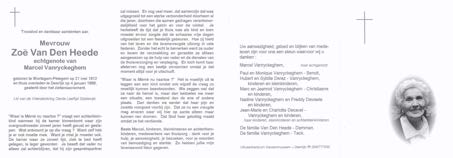
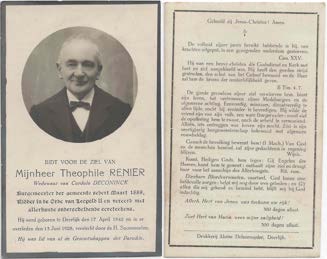
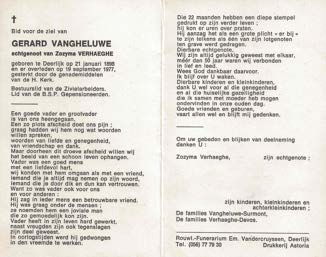
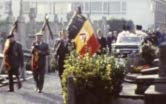
1438
CHAPTER 69. THE SURMONT - DE CROOCK ANCESTRY LINE
Figure 69.105: The mortuary card of Zoë Van den Heede, widow of Marcel Van Ryckeghem.
The couple were terrific friends during the old days of Gerard Vangheluwe and Zozyma Ver-
haeghe. They spent numerous evenings together to chat about life, the world, and, most of all,
the past. She died in 1999 at a considerable age. (Declercq de Silva Archive)
Figure 69.106:
The obituary card of
Theophile Renier, 1928. (Declercq de Silva
Archive)
Figure 69.107:
The obituary card of
Gerard Vangheluwe in 1977. (Declercq de
Silva Archive)
Figure 69.108: The funeral procession for Gerard Vangheluwe. (De-
clercq de Silva Archive)
© 2024 Nico F. Declercq
The Desclergues of la Villa Ducal de Montblanc, 2nd ed., Omn., VOL. VI
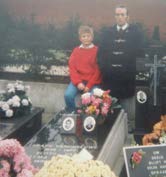
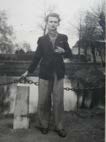
69.9. GERARD VANGHELUWE & ZOZYMA ZULMA VERHAEGHE
1439
Figure 69.109: The author with Gerard’s son Pierre (1939-1991),
who was the author’s granduncle and foster father. The photo was
taken around 1985 after cleaning the graves of Gerard and Zozyma the
day before ’All Saints.’ The author is still responsible for preserving
the grave concession at Deerlijk so that they can rest in peace for many
more ye (Declercq de Silva Archive)
Figure 69.110: Maurice Vangheluwe, son of Gerard Vangheluwe and Zozyma Ver-
haeghe. His character was the same as that of Pierre Vangheluwe. They were both
very righteous and honorable men, rocks on which others could build. He was married
to Mariette Vroman and died in 2000. His daughters are Christina and Gina. One of
his grandchildren has been a Premier League soccer player, Wouter Biebauw (1984).
(Declercq de Silva Archive)
69.9.1.4 Just after WWI
Gerard Vangheluwe’s military registration is shown in Figure 69.78, on page 1430. Images from that period can be seen in Figures
69.93, 69.94 and 69.95.
69.9.1.5 Life and Hobbies
As a child, the author was very much intrigued by the pigeon-house left when Gerard died. For several years the pigeons remained and, later, the author started his own pigeoneering hobby until he went to study in Leuven. Several times he raced on Barcelona, but it’s hardly possible to combine modern life with sedentary pigeoneering. Gerard hardly ever visited a pub. Instead, he liked to invite people at home to drink something and chat the whole evening. One of his favourite visitors was the butcher nearby (Marcel Van Ryckeghem), who came almost every weekend. Still, from time to time, he could not refuse an invitation. One evening, in the winter of 1964-1965, he attended a party of someone who retired from the army. It was frozen and very foggy. He returned through de Gavers, a shortcut, and got stuck in a cart track and fell into the icy Gaverbeek Creek. It was pitch dark, misty and freezing.
He was soaking wet and got out of the stream with incredible difficulty. When he did not retrieve his bike and had no orientation, he started to run to keep warm. Eventually, he ended up in a house in Stasegem-Harelbeke, where the residents coAs with many persons in this book, the memories of Gerard Vangheluwe are vividly clear concerning certain events, while others remain shrouded in the mists of time. Often, a sequence of photographs speaks volumes more than an attempt to reconstruct a life through words.
Some impressions of Gerard can be seen in Figures 69.96, 69.97, 69.98, 69.99, 69.100, 69.101, 69.102, and 69.103.
A profound love marked Gerard’s life for simple yet fulfilling pastimes.
Among his many hobbies, pigeoneering was a passion that shaped much of his leisure time. The pigeon-house he left behind after his death fascinated the author as a child. For several years, the pigeons continued to inhabit this dovecote, and later, the author adopted this hobby until his academic pursuits in Leuven took precedence. Gerard’s pigeons were not merely for pleasure; he was actively involved in pigeon racing, a pursuit requiring dedication and patience. Despite the challenges of modern life, Gerard managed to race pigeons on long-distance routes such as Barcelona, an endeavor that highlighted his commitment and love for the sport.
Socially, Gerard was a man who cherished the warmth of home and the company of friends over the bustling atmosphere of pubs.
His home became a welcoming haven where he hosted evenings filled with conversation and camaraderie. One of his frequent visitors was Marcel Van Ryckeghem, the local butcher, who came almost every weekend. These gatherings were a testament to Gerard’s hospitable nature and ability to foster meaningful connections.
However, Gerard was open to occasional outings. One notable event occurred on a frosty, foggy evening in the winter of 1964-1965.
Gerard attended a retirement party for an army acquaintance. He faced an unexpected peril when he chose a shortcut through de Gavers on his way home. The night was pitch dark and misty, and Gerard found himself stuck in a cart track, eventually falling into the icy waters of Gaverbeek Creek. Soaked and disoriented, he struggled to extricate himself from the frigid stream. Gerard resorted to running to stave off the cold, but his bike was lost, and he had no sense of direction. His resilience and determination saw him through this harrowing ordeal until he found refuge in a house in Stasegem-Harelbeke, where the residents contacted his family, who then came to his rescue. This incident underscored Gerard’s tenacity and the sheer force of will that defined his character.
Through his hobbies and lifestyle, Gerard Vangheluwe exemplified a spirit of warmth, resilience, and dedication. His legacy, as captured in these memories and anecdotes, offers a glimpse into a life richly lived and deeply cherished by those who knew him.uld phone home. He was consequently picked up. He could have died that night.
69.9.1.6 Their Acquaintances
Gerard Vangheluwe has always been a very welcoming and liked person. He had numerous friends but was never seen entering a pub, except perhaps at WWI commemorative events or pigeon racing. Some acquaintances are shown in Figures 69.104, 69.105 and
The Desclergues of la Villa Ducal de Montblanc, 2nd ed., Omn., VOL. VI
© 2024 Nico F. Declercq
1440
CHAPTER 69. THE SURMONT - DE CROOCK ANCESTRY LINE
69.9.1.7 His Death
When Gerard Vangheluwe passed away, he received the honors typical for war veterans. Impressions and documents are shown in Figures 69.107, 69.108 and 69.109.
69.9.2 Zozyma Zulma Verhaeghe
She was a haute couture tailor who specialized in wedding dresses. She was a sister of Maurice Florimond Verhaeghe (Harelbeke February 15, 1892), who was killed as a soldier during WWI on September 28, 1918, on the battlefield of Langemark-Houthulst (Rank: Solder 2kl OV, Unit A.B.L., nr 134/1210, 4 Karabiniers.), as described in Chapter 48.9.5.4. His body has never been found.
He received the Victory Medal and the Croix de Guerre.
Zozyma Verhaeghe is primarily described in Part X as the daughter of Marie Louise De Vos and Theophile Verhaeghe. She is the author’s great-grandmother. He remembers her very well, and he was alongside her bed when she died in 1981.
69.9.3 Their Offspring
Their children were Marie Louise (1921, lived one day), René (1925, described in Part X), Maurice (1931, shown in Figure 69.110),
Lucien Auguste (1935-1940), Gilebert (1937), Pierre (1939).
69.10 René Vangheluwe & Anna Den Dauw
69.10.1 René Vangheluwe
René Vangheluwe is primarily described in Part X as the son of Zozyma Verhaeghe and Gerard Vangheluwe and Nelly Maria’s father.
He is referred to in Chapter 67 as the husband of Anna Den Dauw.
69.10.2 Anna Den Dauw
Anna Den Dauw is primarily described in Part X as the wife of René Vangheluwe, a descendent of the Desclergues along a maternal line.
Being a ’Den Dauw,’ she is also listed in Chapter 67 and Chapter 72 in the maternal (mt-DNA) ancestry line of the author as his grandmother.
69.11 Pierre Frans Vangheluwe & Jeanette Leona Verbrugghe
69.11.1 Pierre Frans Vangheluwe
69.11.1.1 Introduction
Pierre Frans Vangheluwe (1939-1991), depicted in Figure 69.111, played a significant role in the author’s upbringing when his parents were preoccupied with other commitments. His importance in this narrative parallels the author’s grandfather, his eldest brother.
From a sentimental perspective, Pierre was akin to a brother to the author’s mother, Nelly Maria Vangheluwe, thus positioning him as an uncle figure to the author. His placement in this book is multifaceted, reflecting his profound impact on the author’s formative years, serving as a steadfast figure upon whom the author relied.
Pierre Vangheluwe was the son of Gerard Vangheluwe and Zozyma Zulma Verhaeghe, as well as the grandson of Maria Nathalie Surmont. His influence extends into Part X of this book. Pierre was married to Jeanette Verbrugghe, who continued her role as a foster mother and later as a grandmother following his passing.
The author considers himself privileged to have been partially raised by such an extraordinary granduncle, who regarded him as a foster son. Pierre was inherently a philosopher, sparking the author’s interests in history, travel, politics, and existential inquiries.
Despite the author ultimately pursuing a career in physics and engineering, he maintains a profound appreciation for the subjects that Pierre introduced him to. Pierre’s extensive travels, including visits to countries like Sri Lanka, instilled in the author a deep respect for diverse cultures and peoples, irrespective of race, nationality, or religion.
Pierre Vangheluwe was a man of integrity, possessing excellent diplomatic skills and high moral standards. His political views were aligned mainly with Socialist ideals, yet he also held Royalist sympathies. Whether he believed in God or was an atheist remains ambiguous; perhaps such distinctions are inconsequential for men of true righteousness. As the youngest child in his family, Pierre was close in age to the author’s mother, creating a sibling-like bond between them and their younger brother, who was also partially raised alongside Pierre. Consequently, although technically the youngest, Pierre functioned more as a middle child, caring for his younger ’siblings.’
Figure 69.111: As a self-educated philosopher, historian, and linguist,
Pierre Vangheluwe could discuss fascinating topics endlessly. Right,
Pierre Vangheluwe was explaining some ’secrets’ to Luc Millecamps from
Waregem. (Declercq de Silva Archive)
© 2024 Nico F. Declercq
The Desclergues of la Villa Ducal de Montblanc, 2nd ed., Omn., VOL. VI
69.11. PIERRE FRANS VANGHELUWE & JEANETTE LEONA VERBRUGGHE
1441
Figure 69.112: Pierre Vangheluwe with his brother Gilebert during
WWII. (Declercq de Silva Archive)
Figure 69.113: This is a school picture at Waregem (Rijksmiddelbare school). Pierre is seated
in the second place on the right. MyHeritage® colorized this photo. (Declercq de Silva Archive)
Figure 69.114: From left to right: Gilebert, Pierre and Maurice. The
picture of the three brothers was taken at school. Their elder brother
René was from a different generation, given their age difference. The
individual photo shows Pierre Vangheluwe at school. Consistently ranked
first, despite studying one year ahead, he probably had big plans at that
age. (Declercq de Silva Archive)
The Desclergues of la Villa Ducal de Montblanc, 2nd ed., Omn., VOL. VI
© 2024 Nico F. Declercq
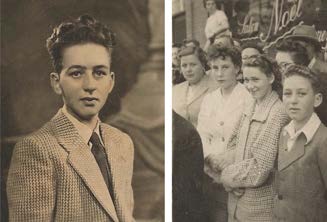
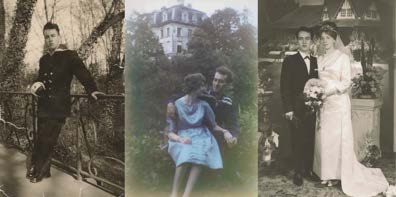
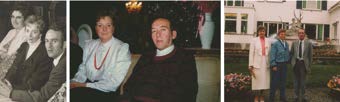
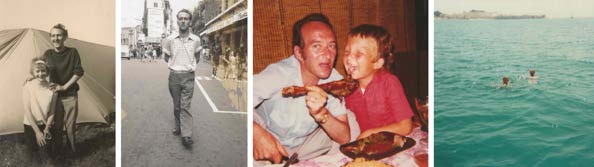
1442
CHAPTER 69. THE SURMONT - DE CROOCK ANCESTRY LINE
Figure
69.115:
Pierre Vangheluwe
around the age when he was forced to quit
school. Right, we find him in good com-
pany at Deerlijk, attending the ’Heilige
Hart Feesten’ in 1953. (Declercq de Silva
Archive)
Figure 69.116: Pierre temporarily regained his pride as a Belgian navy sailor. He
has always remembered this period with great satisfaction. This photo was taken
in Ostend on March 28, 1959. We can also see Pierre Vangheluwe and Jeanette
Verbrugghe’s wedding and prior engagement at Ooigem Castle. (Declercq de Silva
Archive)
Figure 69.117: From right to left, Pierre Vangheluwe, his wife Jeanette
Verbrugghe, and his brother’s wife, Mariette Vroman. The middle image
shows Pierre with his wife around two years before his death. The right
pictures were taken at Le Bouquet, Kluisbergen, on May 30, 1987, at the
author’s communion. (Declercq de Silva Archive)
Figure 69.118: Soon after they married, Pierre and Jeanette went camping. First Belgium, then all over Europe. Then, they discovered the airplane and visited the entire world. Pierre has always enjoyed discovering new places, cultures, and people.
The picture with the author was taken in Senegal in 1981 at a Mauretanian restaurant. Pierre taught the author how to swim in Morocco (Hotel Solazur in Tanger). In 1983, we see both swimming in Tunisia. For Pierre, swimming was never close to the beach but in deep water. Here, he was swimming with the author not far from the shore of Sousse. (Declercq de Silva Archive)
© 2024 Nico F. Declercq
The Desclergues of la Villa Ducal de Montblanc, 2nd ed., Omn., VOL. VI
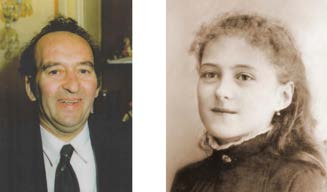
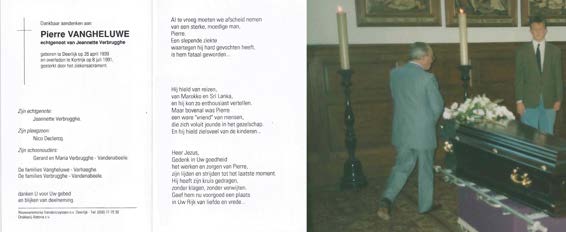
69.11. PIERRE FRANS VANGHELUWE & JEANETTE LEONA VERBRUGGHE
1443
Figure 69.119: Left is the last picture
of Pierre at his godchild Inka’s wedding
in 1991. The summer before, in 1990,
Pierre and Jeanette, with the author, made
Pierre’s last journey. He chose Lisieux in
France. Saint Theresia of Lisieux is shown
right. (Declercq de Silva Archive)
Figure 69.120: The loss of his foster father in 1991, just when the school year had ended, has been a shocking event for the author. In the picture, he stands at Pierre’s body to greet everyone who attended the funeral. The person walking towards the author is André Verhaeghe, found in (Chapter 48.10.5 and Chapter 48.10.6). The obituary card of Pierre Vangheluwe is also shown. (Declercq de Silva Archive)
Pierre’s aspiration to become a teacher was curtailed by circumstances that interrupted his education. This setback, however, always maintained his kindness and enthusiasm for engaging with others. Pierre was a philosopher at heart with a wide array of interests. A self-taught polyglot, he was fluent in English and French and conversant in German and Italian. He was also a skilled chess player and harbored a profound love for children and a commitment to their education.
This book acknowledges and honors Pierre Vangheluwe’s contributions, reflecting his profound and lasting impact on the author’s life.
69.11.1.2 His Youth
During his school years, Pierre Vangheluwe’s intelligence was quickly recognized by his teacher, Meester Frans Viaene (who passed away in 2015 at 91). Mr. Viaene promoted Pierre a year ahead of his peers, frequently encouraging him with the belief that he could achieve anything he set his mind to. After World War II, several families in Deerlijk opted to send their children to public schools rather than Catholic ones.
Consequently, Pierre attended the Rijksmiddenschool in Waregem, where he excelled and prepared for high school (Atheneum).
However, a significant issue arose: Pierre was too young to officially receive his diploma, which was granted as a courtesy rather than a right.
Known for his strong sense of justice, Pierre was in trouble after protesting against a school employee who had disrespected female students. This protest led to the refusal of his diploma. He would have needed to repeat a year in middle school to obtain the necessary certificate to proceed with his education.
Despite his teachers recognizing his academic potential, pressing matters at home required Pierre to leave school, a temporary measure that unfortunately became permanent, marking a devastating turn in his educational journey.
Throughout his life, Pierre maintained a close friendship with Marcel Demeyere, who is mentioned in this book’s acknowledgments.
Marcel remained in touch and sympathized with Pierre’s situation.
Figures 69.112, 69.113, 69.114, and 69.115 provide visual insights into Pierre’s youth, capturing the essence of his early years and the challenges he faced.
69.11.1.3 Military Service: A Sailor in the Belgian Marine
Pierre’s love for people, nature, and swimming found a harmonious blend during his service with the Belgian Marine in 1958.
Stationed in the harbor of Ostend, Pierre’s military service was a significant period that shaped his character and reinforced his passions. The Belgian Marine, known for its rigorous training and demanding duties, provided Pierre with an environment where he could physically and mentally thrive.
Life in the Belgian Marine involved a strict regimen that focused on discipline, physical fitness, and maritime skills. As a sailor stationed in Ostend, Pierre was part of a strategic naval force responsible for patrolling the Belgian coastline, ensuring maritime security, and participating in various national and international missions. The harbor of Ostend, a bustling port city, was a crucial base for naval operations and training exercises.
Pierre’s daily routine included intensive navigation, seamanship, and combat readiness training. He and his fellow sailors were The Desclergues of la Villa Ducal de Montblanc, 2nd ed., Omn., VOL. VI
© 2024 Nico F. Declercq
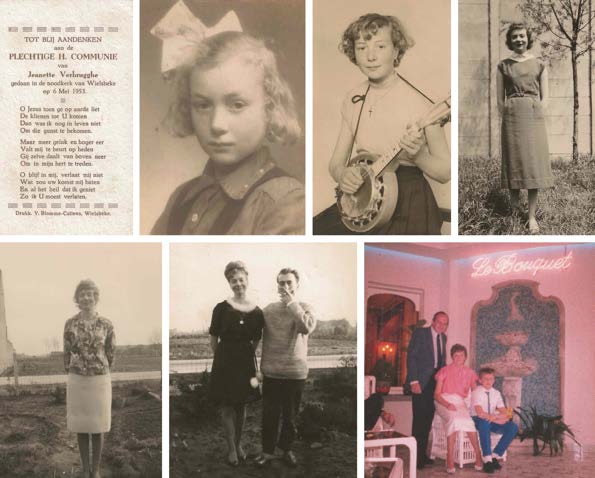
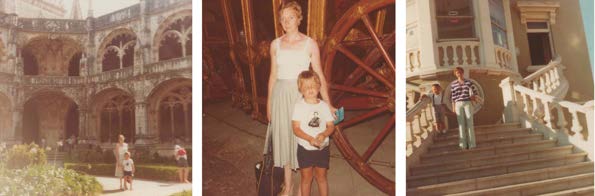
1444
CHAPTER 69. THE SURMONT - DE CROOCK ANCESTRY LINE
Figure 69.121: Jeanette Verbrugghe and Pierre Vangheluwe have always been like brothers and sisters to the author’s parents, Maurice Declercq and Nelly Maria Vangheluwe. The color photo was taken at the author’s confirmation on May 30, 1987, at Le Bouquet in Kluisbergen. The confirmation of Jeanette Verbrugghe in 1953 is shown in the opposite corner. As a child, Jeanette was an excellent Banjo player. Her Parents’ house in Wielsbeke was near ’Hof van Brussel’ and in the suburb of Molsten. The author has often visited it and was, therefore, thanks to her, often in the areas where numerous ancestors have lived for the past two hundred years. (Declercq de Silva Archive)
Figure 69.122: When the author visited Portugal in 1980, he visited Vasco Da Gama’s grave. A photo taken nearby is shown left. The middle picture shows Lisbon’s carriage museum. Right, we see Hotel Inglaterra at Estoril in Portugal. The hotel still exists. (Declercq de Silva Archive)
Figure 69.123: Marbella, Spain, 2003. Although she could not join
the author on his numerous journeys worldwide, Jeanette has occa-
sionally joined his family and loved the excitement of her foster grand-
children: first Benjamin, followed by Anna-Laura, and later Lambert.
(Declercq de Silva Archive)
© 2024 Nico F. Declercq
The Desclergues of la Villa Ducal de Montblanc, 2nd ed., Omn., VOL. VI
69.11. PIERRE FRANS VANGHELUWE & JEANETTE LEONA VERBRUGGHE
1445
tasked with maintaining the ships, performing drills, and staying prepared for any emergencies at sea. Despite the demanding nature of military life, Pierre found joy and solace in the marine environment. The sea, with its vastness and unpredictability, was a source of inspiration and a reminder of nature’s grandeur.
His passion for swimming, which he nurtured during his naval service, became a lifelong pursuit. Pierre’s swimming skills were a recreational activity and a crucial aspect of his military training. He took great pride in offering swimming lessons to children, passing on his love for the water to the next generation. Among those who benefited from Pierre’s teaching, the author learned to swim under his guidance in Morocco. This foundation led the author to win several medals and achieve remarkable feats in swimming, given his young age, including earning two 1500 m diplomas in one afternoon at the Deerlijk swimming pool.
Swimming, for Pierre, was more than a skill; it was a passion intertwined with his identity as a sailor. His military service with the Belgian Marine, depicted in Figure 69.116, was a defining period that impacted his life. It instilled in him a sense of pride and discipline, a love for the sea, and a commitment to teaching and helping others, which he carried with him long after his naval days were over.
69.11.1.4 Their Marriage
Pierre married Jeanette Verbrugghe, his auntie’s neighbor, in Wielsbeke. They both adored children but never had one of their own. The author became like a foster son to them. Some impressions are presented in Figures 69.116 and 69.117.
69.11.1.5 A Globe Trotter
Pierre Vangheluwe harbored a profound passion for travel and a genuine desire to discover the world and continually expand his horizons. This love for exploration was not just about visiting new places; it was an insatiable curiosity about different cultures, landscapes, and the diverse features of humanity. Accompanied by his wife Jeanette, who shared his enthusiasm, Pierre embarked on numerous journeys, transforming himself into a true globe trotter. From 1980 onwards, the author joined them on these adventures, creating lifelong memories and a deep appreciation for the world’s beauty and diversity.
This book contains a vivid collection of photographs documenting the myriad places they visited, including Portugal, Senegal, Morocco, Tunisia, and Sri Lanka. Each destination offered Pierre a unique opportunity to immerse himself in its culture, engage with its people, and absorb the distinct characteristics of the nation. He reveled in conversations in multiple languages, connecting with locals and fellow travelers alike. His linguistic skills, honed through self-teaching, allowed him to communicate effectively and foster meaningful relationships wherever he went.
Pierre’s travels were more than just sightseeing; they were immersive experiences. He delighted in the sensory richness of each place—feeling the heat and humidity of tropical climates, smelling the spices in bustling markets, and hearing the myriad sounds of different environments. His journeys celebrated the world’s diversity, and he relished every moment spent learning about new customs, tasting exotic foods, and exploring historical sites.
Between travels, Pierre maintained his connections with numerous international friends through letters, sharing stories, and keeping the bonds strong despite the distances. His correspondence was a testament to his enduring friendships and his genuine interest in the lives and cultures of people around the globe. He radiated this sense of humanism onto the author, and it shaped his life story.
Pierre’s travel experiences vividly brought to life through the photos in this book (as shown in Figure 69.118), capture only a fraction of the richness of his adventures. To honestly convey the essence of his travels, one would need to evoke the sounds, smells, and atmospheres of the places he visited. While a book is limited to pictures and words, it serves as a window into Pierre’s world of exploration, offering a glimpse of his boundless enthusiasm for discovering the wonders of our planet.
His deep respect marks Pierre Vangheluwe’s legacy as a world traveler for different cultures, his joy in engaging with people from all walks of life, and his unwavering passion for exploring the unknown. His journeys left an indelible mark on those who accompanied him, the author in particular, and inspired many others to look beyond their horizons and embrace our vast, beautiful world.
69.11.1.6 His Death came too Soon
Pierre Vangheluwe passed away in 1991 with the author by his side. In his final moments, he looked the author in the eyes and, with an attempt to speak, departed for his Nirvana. His wish was to be cremated, as is customary in India or sometimes in Sri Lanka, a practice that was still uncommon in Belgium at the time. This poignant period is depicted in Figures 69.119 and 69.120,
capturing the sorrow and loss felt by those who knew and loved him.
The author’s sadness was profound, as Pierre was a guiding figure and a source of inspiration and joy. The sorrow for a life that ended too soon is palpable; Pierre’s character, marked by kindness, wisdom, and an unquenchable thirst for knowledge and adventure, left an enduring legacy. His passing left a void that was felt deeply, a stark reminder of the fragility of life and the loss of a remarkable person.
Pierre always advised the author not to cry upon his death but to smile, celebrating their shared life rather than mourning his departure. Perhaps this book, written with fond memories and deep respect, can be seen as a smile—an homage to Pierre’s life and his indelible impact on those around him. Thirty years after his death, this book is a testament to his enduring spirit and the love he spread during his lifetime.
Pierre’s last wish, communicated to his wife in the days before he died, was for the author to continue his education and fully realize his academic potential. Honoring this heartfelt request, the author pursued his studies with determination and passion, ultimately achieving a professor position in the United States. This accomplishment is a fulfillment of Pierre’s dream, a testament to the influence of his foster father’s guidance and encouragement. While the author’s inherent passion for science and scholarly achievements drove his success, the memory of Pierre’s hope and belief in his potential was a powerful motivator, weaving a thread of purpose and dedication through his academic journey.
69.11.2 Jeanette Leona Verbrugghe
69.11.2.1 Introduction
Jeanette Leona Verbrugghe is the wife of Pierre Vangheluwe. With her husband and alone long after his death, she served as a foster mother to the author when his parents were too busy with other matters. She is equally referred to in the Part X as the daughter-in-law of Zozyma Verhaeghe and Gerard Vangheluwe.
Her parents, Gerard Verbrugghe and Maria Van den Abeele, are described in Chapter 77.
As Mark Twain said, ’Action speaks louder than words but not nearly as often. . . ’
The Desclergues of la Villa Ducal de Montblanc, 2nd ed., Omn., VOL. VI
© 2024 Nico F. Declercq
CHAPTER 69. THE SURMONT - DE CROOCK ANCESTRY LINE
Indeed, this person’s actions prove that actions speak louder than words. Still being with us, hopefully, for many more years to come, a eulogy is avoided, and instead, a depictive story is told here and throughout this book.
69.11.2.2 Her Youth
Figure 69.121 shows a selection of youth photos.
69.11.2.3 Their Marriage
Impressions are found throughout this book. Two additional images are shown in Figure 69.121.
69.11.2.4 A Globe Trotter
Jeanette has traveled worldwide with her husband Pierre and, from 1980 onward, with the author. The examples shown in this book are only the tip of the beautiful iceberg. Some memories are shown in Figures 69.122 and 69.123.
69.12 Maurice Alois Declercq & Nelly Maria Vangheluwe
69.12.1 Maurice Alois Declercq
Maurice Alois Declercq (DC16) is primarily described in Chapter 46 as a descendant of the Desclergues and father of the author.
He is equally referred to in the following chapters: Chapter 64, as the son of Irma Helena Lesage; Chapter 65, as the great-great-great-great-great-great-grandson of Adrienne de Patin (DP12); Chapter 66.1, as the great-great-great-great-grandson of Barbara Benoit; Chapter 66.2, as the great-great-great-great-great-grandson of Maria Jeanne Christine Benoit; Chapter 67, as the son-in-law of Anna Den Dauw; Chapter 68, in the ’t Kint ancestry line; and Chapter 71, as the great-grandson of Clemens Lammens.
69.12.2 Nelly Maria Vangheluwe
Nelly Maria Vangheluwe is primarily described in Part X as the daughter of René Vangheluwe and Anna Den Dauw and as the mother of the author.
She is equally referred to in the following chapters: Chapter 64, as the daughter-in-law of Irma Helena Lesage; Chapter 65, as the great-great-great-great-great-great-granddaughter-in-law of Adrienne de Patin (DP12; Chapter 66.1, as the great-great-great-great-granddaughter-in-law of Barbara Benoit; Chapter 66.2, as the great-great-great-great-great-granddaughter-in-law of Maria Jeanne Christine Benoit; Chapter 67, as the daughter of Anna Den Dauw; Chapter 68, in the ’t Kint ancestry line; Chapter 71, as the great-granddaughter-in-law of Clemens Lammens; and in Chapter 72, the maternal (mt-DNA) ancestry line of the author, as his mother.
69.13 Nico Felicien Declercq & Shirani Olupathage de Silva
69.13.1 Nico Felicien Declercq
Nico Felicien Declercq (DC17) is the author of this book and is primarily described in Chapter 47 as a descendant of the Desclergues and also in Part X.
He is equally referred to in the following chapters: Chapter 64, as the grandson of Irma Helena Lesage; Chapter 65, as the great-great-great-great-great-great-great-grandson of Adrienne de Patin (DP12); Chapter 66.1, as the great-great-great-great-great-grandson of Barbara Benoit; Chapter 66.2 as the great-great-great-great-great-great-grandson of Maria Jeanne Christine Benoit; Chapter 67,
as the grandson of Anna Den Dauw; Chapter 68, in the ’t Kint ancestry line; Chapter 71, as the great-great-grandson of Clemens Lammens; and in Chapter 72, the maternal (mt-DNA) ancestry line of the author.
Furthermore, he is also referred to in Part XII as the husband of Shirani Oluphathage de Silva.
69.13.2 Shirani Olupathage de Silva
Shirani Olupathage de Silva is first described in Chapter 47.3 as the author’s wife.
She is equally referred to, in much detail, in Part XII, and also in the following chapters: Chapter 64, as the granddaughter-in-law of Irma Helena Lesage; Chapter 65, as the great-great-great-great-great-great-great-granddaughter-in-law of Adrienne de Patin (DP12); Chapter 66.1, as the great-great-great-great-great-granddaughter-in-law of Barbara Benoit; Chapter 66.2, as the great-great-great-great-great-great-granddaughter-in-law of Maria Jeanne Christine Benoit; Chapter 67, as the granddaughter-in-law of Anna Den Dauw; Chapter 68, in the ’t Kint ancestry line; and Chapter 71, as the great-great-granddaughter-in-law of Clemens Lammens.
© 2024 Nico F. Declercq
The Desclergues of la Villa Ducal de Montblanc, 2nd ed., Omn., VOL. VI
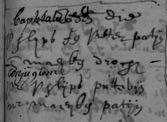
Chapter 70
The Side-Branch of de Patin de Langemarck
70.1 Introduction
This branch could also be called ’the Mare Liberum branch’. In Chapter 65, we describe our ancestors’ ’de Patin’ branch.
Along that branch, we found that the children of Pierre de Patin (DP11) and Marie Douchy were: Pierre de Patin (DP12a), Philippe de Patin (DP12b), Jacques de Patin (DP12c), Marie de Patin (DP12d), Adrienne de Patin (DP12) and Hubert de Patin (DP12e).
Here we continue with the descendants of Philippe de Patin (DP12b). Indeed, we descend from Adrienne de Patin (DP12), whereas the descendants of Philippe de Patin (DP12b) are described in this chapter. We focus primarily on the line from Philippe de Patin (DP12b) to Charles Philippe Jean Marie Joseph de Patin de Langemarck (DP12by1y1y1y2yyy), in Chapter 70.10, who passed away in 1888. One of the persons in this particular branch is Charles Philippe de Patin (DP12by1y1), in Chapter 70.6, who has played an essential role in the history of Belgium.
To include all known side branches of this illustrious family, we have logically used codes behind each name as in a family tree.
However, the sequence of persons appearing as sub-chapters is somewhat independent of that code and may need clarification. It’s because we had no other option: in a book where this branch is considered a side branch, it looks better to present the different personalities linearly rather than parallel. However, a graphic tree has been added here and there to maintain clarity. We have used several sources to write this chapter, including civil and church records, genealogy books, and documents in our archive. The branch finds its roots in the deep south of West Flanders, and in Cambresis, it should not be confused with families carrying a similar name in Bruges.
Le Carpentier has, indeed, not been able to relate to any of the Patin families described in this book to the Pattyn family that inhabited the city of Bruges.
70.2 Philippe de Patin
Philippe de Patin (DP12b) was, just like our ancestor Adrienne de Patin (DP12) in Chapter 65.13, a child of Pierre de Patin (DP11) and Marie Douchy. He was born in Menin on January 20, 1637, and was baptized in the parish church of St-Vast, in Figure 70.1.
He was the Lord of Terbeke, etc.
He married Anne Vermeersch (of noble blood). Anne Vermeersch was a sister of Marinus Vermeersch, in Chapter 65.13, our ancestor, who married Adrienne de Patin (DP12), Philippe de Patin’s (DP12b) sister. He would consequently marry Joanna Duthoo.
Philippe de Patin (DP12b) and Anne-Thérèse Vermeersch had the following children: Pierre de Patin (DP12by1), Philippe de Patin (DP12by2), Monique de Patin (DP12bx1), Marie de Patin (DP12bx2), Anne de Patin (DP12bx3), Philippine de Patin (DP12bx4) and Josephine de Patin (DP12bx5). The death, at Bixschote, of Philippe de Patin (DP12b) on September 8, 1720, and his second wife Joanna Duthoo on September 15, 1741, is shown in Chapter 70.3.
Descending generations of Philippe de Patin (DP12b) are shown in Figure 70.2.
70.2.1 Philippe de Patin
Philippe de Patin (DP12by2) was born in Dadizele in 1667 in Figure 70.6.
He married Katrien de Roo, and they had one daughter who married Antoon de Lavael (DP12by2).
70.2.2 Monique de Patin
Monique de Patin (DP12bx1) was born in Dadizele in 1664 in Figure 70.7.
She married first Jan Ghisdael and later Jacob van den Bulcke at Ledegem.
70.2.3 Marie Catherine de Patin
Marie Catherine de Patin (DP12bx2) was born in Dadizele in 1664 in Figure 70.8. She married Joris Brouwere.
Figure 70.1:
Geluwe, January 20, 1637, the baptism of Philippe
de Patin, son of Pierre de Patin (’Pieter Patijn) and Marie Douchy
(’Maayken Drochy’), our ancestors (see Chapter 65.12). Philippe
Peutevin (’Phlyps Puttevyn’) was the godfather, and the godmother was
Marie de Patin (’Maeyken Patijn’).
The Desclergues of la Villa Ducal de Montblanc, 2nd ed., Omn., VOL. VI
© 2024 Nico F. Declercq
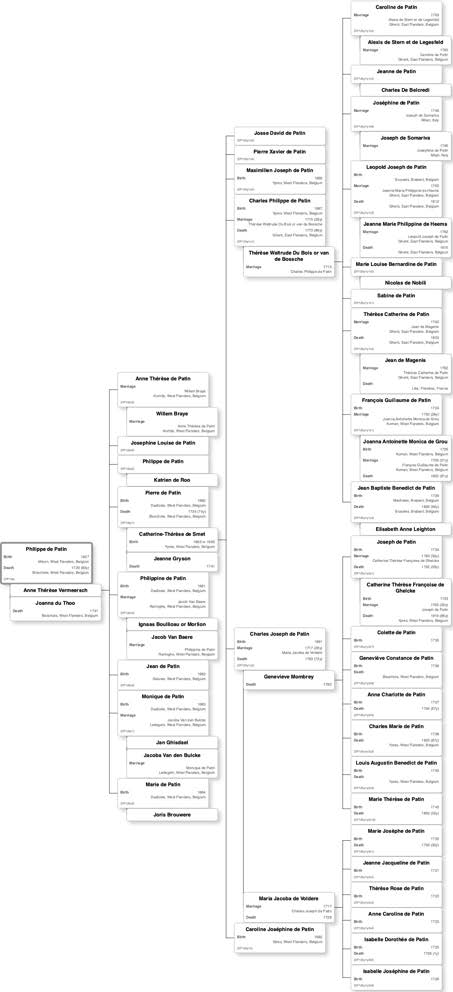
1448
CHAPTER 70. THE SIDE-BRANCH OF DE PATIN DE LANGEMARCK
Figure 70.2: Three descending generations of Philippe de Patin (DP12b). Further descendants
can be found in Figures 70.3, 70.4 and 70.5.
© 2024 Nico F. Declercq
The Desclergues of la Villa Ducal de Montblanc, 2nd ed., Omn., VOL. VI
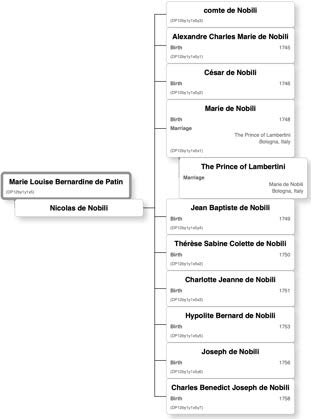
70.3. PIERRE DE PATIN & CATHERINE-THÉRÈSE DE SMET
1449
Figure 70.3: Descendants of Marie Louise Bernardine de Patin
and Nicolas de Nobili.
70.2.4 Anne de Patin
Anne de Patin (DP12bx3) married Willem Braye at Kortrijk.
The Braye family is the one who is also found in our Desclergue ancestry, as described in Chapter 34.13.7.1.
70.2.5 Philippine de Patin
Philippine de Patin (DP12bx4) was the daughter of Philippe de Patin (DP12b) and Anne Vermeersch and was born in Dadizele in 1661 in Figure 70.9.
Philippine de Patin (DP12bx4) first married Ignaas Boullioau (or Morlion) and, consequently, Jacob van Baere at Reninghe.
70.2.6 Josephine de Patin
Josephine de Patin (DP12bx5) was the daughter of Philippe de Patin (DP12b) and Anne Vermeersch.
70.2.7 Jean de Patin
Jean de Patin (DP12by3) is not found in genealogy books. Therefore, it is likely that he died at a young age. He was born in Geluwe in 1662, in Figure 70.10.
70.3 Pierre de Patin & Catherine-Thérèse de Smet
Pierre de Patin (DP12by1) was born in Dadizele on September 17, 1660, in Figure 70.11. He was the Lord of Terbeke, Burgcautere, Schaepweide, Nonneland, Langemarck, etc. He became Lord of Ter Beke in 1719 after purchasing it from Joos Andries de Patin (DP12ay1) and became Lord of Burghcoutere in 1696 after purchasing it from Charles Philippe Blomme. Several times, he has also been an alderman of the hall and Castellany of Ypres. He has often been a deputy on behalf of the noble vassals as Bailiff of the Barony of Guise and Coutsy.
Pierre de Patin married first Catherine-Thérèse de Smet, born in Ypres, shown in Figure 70.15 on page 1454, on May 26, 1663, the daughter of Martin de Smet and Jacqueline de Ghekiere, granddaughter of Jean de Smet and Jeanne de Wostyn. He then married his second wife, Jeanne Gryson, the daughter of Jean Gryson and Jeanne Marre. She died on December 18, 1741.
The couple had no children. But from his first marriage, Pierre de Patin (DP12by1) had four children: Charles Philippe de Patin (DP12by1y1), described in Chapter 70.6, Charles Joseph de Patin (DP12by1y2), Caroline Joséphine de Patin (DP12by1x) (She died without any offspring), Maximilien-Joseph de Patin (DP12by1y3) (born in Ypres on January 11, 1686), Pierre Xavier de Patin (DP12by1y4) (He died without any offspring) and Josse David de Patin (DP12by1y5) (He died without any family).
Pierre de Patin (DP12by1) died at Bixschote on August 27, 1735, in Figure 70.12 and was buried there with the following epitaph:
’Grafsteen van d’ heer Pieter Patyn, Heere van Langemarck, Schaepweide, Ter Beke, Burgercautere , Nonneland, Alderman der stede ende Casselrie van Ypre , Bailliu der Baronnie van Guysen dit Coudtsy tot syn overlyden den 27en Ougst 1735 in den ouderdom van 75 jaeren; Ende van Jonkvrouw Joanna Gryson fille de Jans ende van Joanna Marre, syne tweede gheselline overleden sonder kinderen op den 18° October 1741 oudt 75 jaeren, de welcke hebben ghefondeert een eeuwigh jaerghetyde binnen dese kerck van Bixschote met distributie van broodt voor den armen. Godtvrughtighen Leser bidt voor hunne zielen.’
The Desclergues of la Villa Ducal de Montblanc, 2nd ed., Omn., VOL. VI
© 2024 Nico F. Declercq
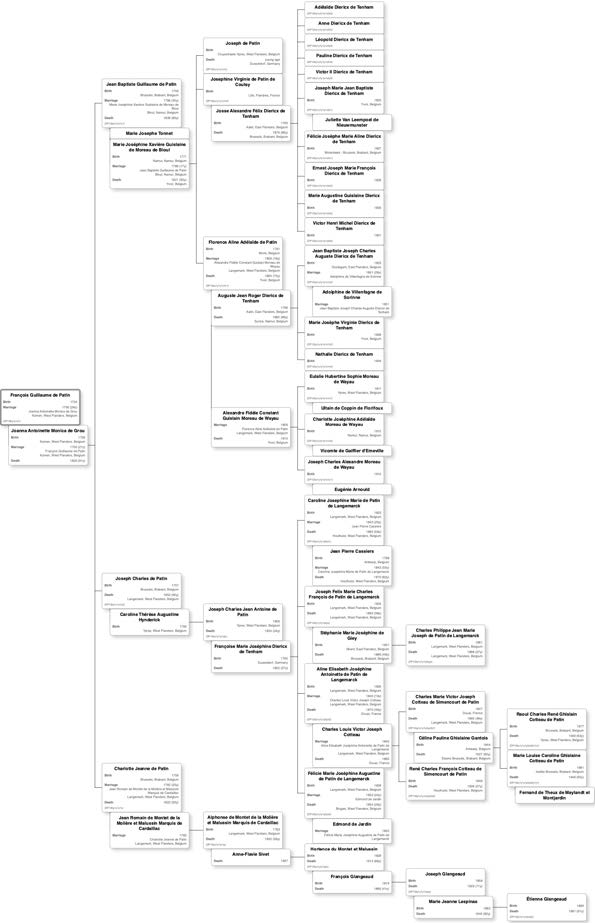
1450
CHAPTER 70. THE SIDE-BRANCH OF DE PATIN DE LANGEMARCK
Figure 70.4: Descendants of François Guillaume de Patin Joana Antoinette Monica de Grou.
© 2024 Nico F. Declercq
The Desclergues of la Villa Ducal de Montblanc, 2nd ed., Omn., VOL. VI
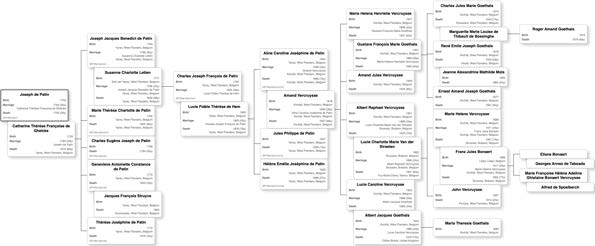
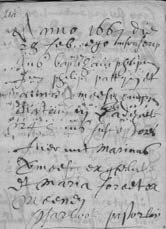
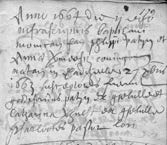
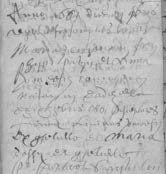
70.3. PIERRE DE PATIN & CATHERINE-THÉRÈSE DE SMET
1451
Figure 70.5: Descendants of Joseph de Patin and Catherine Thérèse Françoise de Ghelcke.
Figure 70.6: Dadizele, February 28, 1667, the baptism of Philippe
de Patin (DP12by2), son of Philippe de Patin and Anna Vermeersch.
The Godfather was Marinus Vermeersch, our ancestor from Geluwe
(see Chapter 65.13), and the godmother was Maria Fozaet from Menin.
(see also Chapter 65.12.3.2).
Figure 70.7: Dadizele, January 1664, the baptism of Monique de
Patin, the daughter of Philippe de Patin and Anne Vermeersch. The
godfather was Goddefridus Patijn from Geluwe, and the godmother was
Catharine Verhulst from Geluwe. She was born on December 17, 1663,
in Dadizele.
Figure 70.8:
Dadizele, September 7, 1664, the baptism of Marie
Catherine de Patin, daughter of Philippe de Patin and Anne Vermeer-
sch. The godfather was Livinus Vermeersch from Geluwe, our ancestor
(see also Chapter 65.13.2), and the godmother was Marie Douchy from
Geluwe, our ancestor (see also Chapter 65.12).
The Desclergues of la Villa Ducal de Montblanc, 2nd ed., Omn., VOL. VI
© 2024 Nico F. Declercq
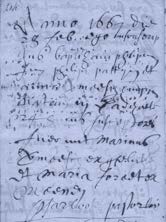
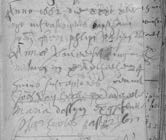
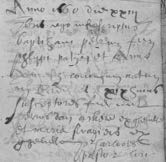
1452
CHAPTER 70. THE SIDE-BRANCH OF DE PATIN DE LANGEMARCK
Figure 70.9: Dadizele, February 28, 1661, the baptism of Philippine
de Patin, the daughter of Philippe de Patin and Anne Vermeersch. The
godfather was Marinus Vermeersch, our ancestor (see Chapter 65.13.2)
from Geluwe, and the godmother was Maria Foraet from Menin.
Figure 70.10: Geluwe, December 31, 1662, the baptism of Jean de
Patin, the son of Philippe de Patin and Anna Vermeersch (’Vander-
meersch’). The godfather was Joannes Van Hecke from Dadizele, and
the godmother was Marie Douchy (’Maria Doschy’) from Geluwe, our
ancestor (see Chapter 65.12).
70.3.1 Charles Joseph de Patin & Marie-Jacqueline de Voldere
Charles Joseph de Patin (DP12by1y2) was born on March 24, 1691. He was the Lord of Letuwe, Nonneland, etc. He was a counselor and master of the waters and forests of His Imperial Majesty in the district of Ypres (’water- en woudmeester der Keizerlijke Majestijd voor het Ypersche’), and collector-general of the hall and Castellany of Ypres and Bailiff of Ypres.
He was married twice.
On May 20, 1717, he first married Marie-Jacqueline (or Marie Jacoba) de Voldere, who died on March 6, 1728. She was the daughter of Jean-François de Voldere and Marie-Pétronille EIbo; She was the granddaughter of Jacques de Voldere and Jacqueline Gallieu.
He married a second time on December 1, 1732, to Genevieve Mombry or Mombrey, who died on November 26, 1760. She was the daughter of François-Jacques and Dame Anne-Catherine des Rameaulx; she was the widow of Jean-Jacques de Baune or de Barne, an alderman of the city of Ypres.
Charles Joseph de Patin (DP12by1y2) received nobility letters from Maria Theresia of Austria on October 15, 1755, with the noble title of Knight de Patin.
He died on February 7, 1763. From his second marriage, he had a son, Joseph de Patin (DP12by1y2y1).
Charles Joseph de Patin (DP12by1y2) and Marie-Jacqueline de Voldere had the following children, also depicted in Figure 70.13:
Marie Josèphe de Patin (DP12by1y2x1), Jeanne Jacqueline de Patin (DP12by1y2x2), Thérèse Rose de Patin (DP12by1y2x3), Anne Caroline de Patin (DP12by1y2x4), Isabelle Dorothée de Patin (DP12by1y2x5), Isabelle Joséphine de Patin (DP12by1y2x6).
Charles Joseph de Patin (DP12by1y2) and Dame Genevieve Mombry or Mombrey had the following children: Joseph de Patin (DP12by1y2y1), Colette de Patin (DP12by1y2x7), Geneviève Constance de Patin (DP12by1y2x8), Anne Charlotte de Patin (DP12by1y2x9), Charles Marie de Patin (DP12by1y2y2), Louis Augustin Benedict de Patin (DP12by1y2y3), and Marie Thérèse de Patin (DP12by1y2x10).
70.3.1.1 Marie Josèphe de Patin
Marie Josèphe de Patin (DP12by1y2x1) was born on August 26, 1720, and was a religious nun at Nonnenbossche at Ypres. She died on July 20, 1750.
70.3.1.2 Jeanne Jacqueline de Patin
Jeanne Jacqueline de Patin (DP12by1y2x2) was born on August 23, 1721. She became a religious nun at Coninckxdale in 1748.
70.3.1.3 Thérèse Rose de Patin
Thérèse Rose de Patin (DP12by1y2x3) was born on August 30, 1722, and became a religious Carmelite nun on May 8, 1745.
Figure 70.11: Dadizele, September 17, 1660, the baptism of Pierre
de Patin, the son of Philippe de Patin (’Philippus Patijn’) and Anne
Vermeersch. The godfather was Petrus Vanackere from Geluwe, and
the godmother was Maria Stagiers from Geluwe.
© 2024 Nico F. Declercq
The Desclergues of la Villa Ducal de Montblanc, 2nd ed., Omn., VOL. VI
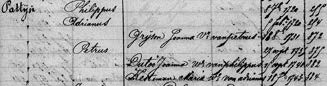
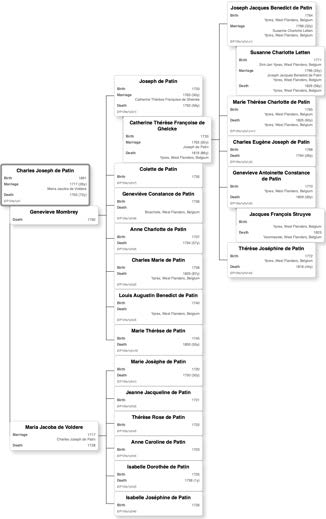
70.3. PIERRE DE PATIN & CATHERINE-THÉRÈSE DE SMET
1453
Figure 70.12:
Bixschote, August 27,
1735, the death of Pierre de Patin was
on the list of the deceased. Other docu-
ments disappeared during WWI. The list
equally showed the death of Philippe de
Patin on September 8, 1720, his wife
Joanna Duthoo on September 15, 1741,
and Joanna Gryson, the widow of Pierre
de Patin, on October 12, 1741.
Figure 70.13:
Two descending gen-
erations of Charles Joseph de Patin
(DP12by1y2).
70.3.1.4 Anne Caroline de Patin
Anne Caroline de Patin (DP12by1y2x4) was born on December 17, 1723, and died as a nun on September 14, 1749.
70.3.1.5 Isabelle Dorothée de Patin
Isabelle Dorothée de Patin (DP12by1y2x5) was born on March 17, 1725, and died on July 10, 1726.
70.3.1.6 Isabelle Joséphine de Patin
Isabelle Joséphine de Patin (DP12by1y2x6) was born on August 20, 1726. She was a religious nun and later became Abesse of the abbey of Wevelgem, where she also died.
70.3.1.7 Colette de Patin
Colette de Patin (DP12by1y2x7) was born in January of 1735.
70.3.1.8 Geneviève Constance de Patin
Geneviève Constance de Patin (DP12by1y2x8) was born on January 15, 1736, died at a young age, and was buried at Bixschote.
70.3.1.9 Anne Charlotte de Patin
Anne Charlotte de Patin (DP12by1y2x9) was born on July 10, 1737, and died on May 17, 1794.
70.3.1.10 Charles Marie de Patin
Charles Marie de Patin (DP12by1y2y2) was born on September 8, 1738. He was a captain of a military infantry regiment of Kollerwuth in the Imperial Austrian Army. He died at Ypres on May 20, 1825, and was buried in Bixschote.
The Desclergues of la Villa Ducal de Montblanc, 2nd ed., Omn., VOL. VI
© 2024 Nico F. Declercq
1454
CHAPTER 70. THE SIDE-BRANCH OF DE PATIN DE LANGEMARCK
Figure 70.14: Painting of Caroline Joséphine de Patin (1692-1784). The shape of
her chin is characteristic of de Patin and was also prevalent with the Lesage branch
in Chapter 64.
Figure 70.15: The Lakenhalle of Ypres, a grand Gothic
edifice, was initially constructed between 1200 and 1304.
Serving as a cloth hall, it was central to the medieval wool
trade, with lower floors for commerce and upper floors for
storage and quality control. The 70-meter belfry sym-
bolized municipal autonomy, housing communal charters
and serving as a watchtower. During World War I, the
Lakenhalle was almost totally destroyed but was metic-
ulously reconstructed between 1933 and 1967. Now a
UNESCO World Heritage site, it hosts the In Flanders
Fields Museum, commemorating the war’s impact. The
Lakenhalle remains a testament to Ypres’ historical and
cultural heritage.
70.3.1.11 Louis Augustin Benedict de Patin
Louis Augustin Benedict de Patin (DP12by1y2y3) was born on November 4, 1740. He was a captain of a dragons regiment of Wurtemburg in the Imperial Austrian Army. He died at Ypres and was buried in Voormezeele.
70.3.1.12 Marie Thérèse de Patin
Marie Thérèse de Patin (DP12by1y2x10) was born on March 4, 1745. She was a Benedictine religious nun at Poperinge and died on February 17, 1800.
70.3.2 Caroline Joséphine de Patin
Caroline Joséphine de Patin (DP12by1x), shown in Figure 70.14, was born in Ypres on March 4, 1692, and died at Wevelgem in 1784. She was the sister of Charles Philippe de Patin (DP12by1y1).
Note that Ypres was French at that time. Therefore, Caroline Joséphine de Patin would later be assumed to be French. Indeed, she was the 36th abbess of Guldenbergabdij at Wevelgem from 1769 until 1784. Apart from the fact that many believe she was French, the only known information about her is a painting that survived, found at the presbytery of St Hilarius parish of Wevelgem. During Caroline’s ’reign,’ only four new nuns would join because Maria Theresia of Austria had decided that novices should be older than 25 and that donations from their families were forbidden. The Abby would ultimately end its activities because of a shortage of income. After her death, Caroline was succeeded by Albérique de Madre.
70.4 Joseph de Patin & Catherine Thérèse Françoise de Ghelcke
Joseph de Patin (DP12by1y2y1) was born on October 17, 1733. He was the Lord of Letuwe, an alderman of the Castellany of Ypres, and he died on October 18, 1792.
His tomb is shown in Figure 65.4 on page 1300, at the beginning of Chapter 65.
He married on September 13, 1763, Catherine-Thérèse-Françoise de Ghelcke, who was born on January 19, 1733, and died in Ypres on July 4, 1819, aged 83, and was buried in Brielen. Catherine de Ghelcke was a daughter of Jacques-Laurent de Ghelcke and Genevieve Antoinette de Wavrans, daughter of Eugene and Marie-Jeanne Queval, daughter of Nicolas Queval. Joseph de Patin (DP12by1y2y1) and Catherine Thérèse Françoise de Ghelcke had the following son: Joseph Jacques Benoît de Patin (DP12by1y2y1y1).
Note that the de Patin family also had links with the Hynderick family. Figures 70.16 and 70.17 are the marriage announcement and the mortuary card of Auguste Hynderick, who was married to Ida de Ghelcke.
© 2024 Nico F. Declercq
The Desclergues of la Villa Ducal de Montblanc, 2nd ed., Omn., VOL. VI
70.4. JOSEPH DE PATIN & CATHERINE THÉRÈSE FRANÇOISE DE GHELCKE
1455
Figure 70.16: The marriage announcements of Auguste Hynderick and Ida de Ghelcke, Ypres, September
26, 1848. (Declercq de Silva Archive)
Figure 70.17: The obituary card, in 1883, of Auguste Hynderick, the
husband of Ida de Ghelcke. (Declercq de Silva Archive)
Figure 70.18: The death announcement
of Charles Hynderick de Ghelcke in 1931.
(Declercq de Silva Archive)
The Desclergues of la Villa Ducal de Montblanc, 2nd ed., Omn., VOL. VI
© 2024 Nico F. Declercq
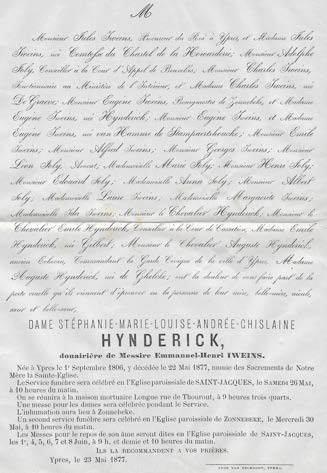
1456
CHAPTER 70. THE SIDE-BRANCH OF DE PATIN DE LANGEMARCK
Figure 70.19: The death announcement
of Louise Hynderick de Ghelcke, the widow
of Eugène Iweins, in 1927. (Declercq de
Silva Archive)
Figure 70.20: The death announcement
of Stephanie Hynderick in 1877. (Declercq
de Silva Archive)
© 2024 Nico F. Declercq
The Desclergues of la Villa Ducal de Montblanc, 2nd ed., Omn., VOL. VI
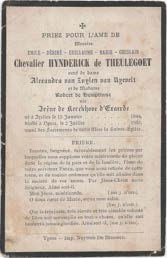
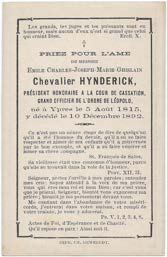
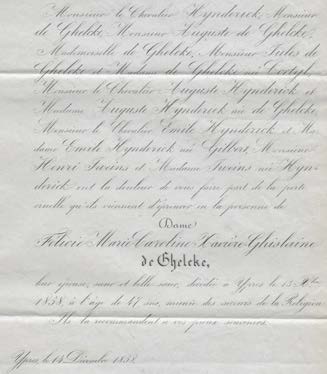
70.4. JOSEPH DE PATIN & CATHERINE THÉRÈSE FRANÇOISE DE GHELCKE
1457
Figure 70.21: This is the obituary card from 1903 of Emile Hyn-
derick de Theulegoet, husband of Alexandra Zuylen van Nyevelt and
René de Kerckhove d’Exaerde, who was also known as Mrs Robert de
Hemptinne. (Declercq de Silva Archive)
Figure 70.22: The obituary card of Emile Hynderick, in 1892. (De-
clercq de Silva Archive)
Figure 70.23: The death announcement
of Felicie de Ghelcke in 1858. (Declercq de
Silva Archive)
The Desclergues of la Villa Ducal de Montblanc, 2nd ed., Omn., VOL. VI
© 2024 Nico F. Declercq
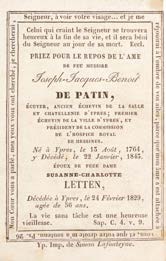
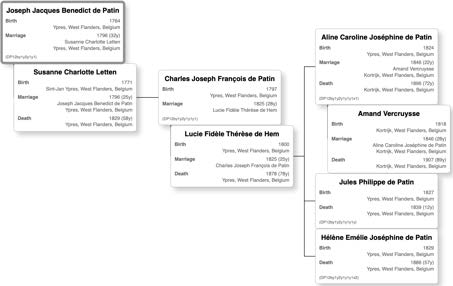
1458
CHAPTER 70. THE SIDE-BRANCH OF DE PATIN DE LANGEMARCK
Figure 70.24: The obituary card of Joseph de Patin, in 1843, the
husband of Susanne Letten. (Declercq de Silva Archive)
Figure
70.25:
Two descending generations of Joseph Jacques Benedict de Patin
(DP12by1y2y1y1).
Figure 70.26: The matriculation record of Charles Eugène Joseph de Patin as a
student in the year 1787, October 20, at the Catholic University of Leuven.
© 2024 Nico F. Declercq
The Desclergues of la Villa Ducal de Montblanc, 2nd ed., Omn., VOL. VI
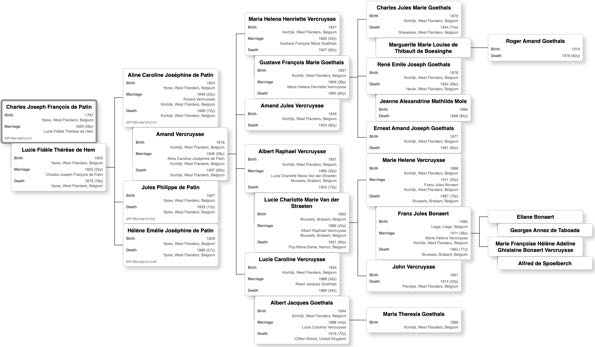
70.5. CHARLES JOSEPH FRANÇOIS DE PATIN & LUCIE FIDÈLE THÉRÈSE DE HEM
1459
Figure 70.27: Four descending generations of Charles Joseph François de Patin (DP12by1y2y1y1y1).
70.4.1 Marie Thérèse Charlotte de Patin
Marie Thérèse Charlotte de Patin (DP12by1y2y1x1) was born in Ypres on December 7, 1765, and died at Ypres on March 28, 1825, at 59. She has been buried at Brielen.
70.4.2 Charles Eugène Joseph de Patin
Charles Eugène Joseph de Patin (DP12by1y2y1y2) was born on October 10, 1768, and was the second lieutenant of the cuirassiers in the regiment of Archduke François. He died at a military camp near Maalhem on October 14, 1794.
Charles Eugène Joseph de Patin was a Catholic University of Leuven student. His inscription can be found on October 20, 1787.
His enrollment at the university is shown in Figure 70.26 on page 1458.
70.4.3 Géneviève Antoinette Constance de Patin
Géneviève Antoinette Constance de Patin (DP12by1y2y1x2) was born in Ypres on May 21, 1770. She died on August 4, 1809. She married on January 16, 1797, Jacques-François Struye, born in Ypres, lawyer and former alderman of Ypres, the Lord of Swielande, who died on July 2, 1825, and was buried in Vormezeele. They had children.
70.4.4 Thérèse-Joséphine de Patin
Thérèse-Joséphine de Patin (DP12by1y2y1x3) was born in Ypres in 1772 and died on May 9, 1816. Some related memorabilia are shown in Figures 70.16, 70.17, 70.18, 70.19, 70.20, 70.21, 70.22 and 70.23.