

The Desclergues of la Villa Ducal de Montblanc, Second Edition Omnibus by Nico Declercq - HTML preview
Download the book in PDF, ePub, Kindle for a complete version.
59.2.7 Conclusion
The caste system in India is a historically rooted and complex social structure that has undergone significant changes over time.
As the priestly class, Brahmins have traditionally held the highest position in this hierarchy, symbolizing spiritual and educational authority. Despite legal and social advancements, the legacy of the caste system continues to influence Indian society profoundly.
59.3 The Sri Lankan Caste System
The caste system in Sri Lanka, like that in India, is a deeply entrenched social hierarchy that has historically influenced various aspects of life, including marriage, occupation, and social status. While there are similarities to the Indian caste system, Sri Lanka’s caste structure has its unique characteristics. It has evolved differently due to the island’s distinct historical, cultural, and religious contexts.
59.3.1 Historical Context
Sri Lanka’s caste system is believed to have been influenced by the Indian caste system through centuries of ethnic, cultural and religious exchanges between the Indian subcontinent and the island. The introduction of Buddhism in the 3rd century BCE and subsequent historical developments significantly shaped the caste dynamics in Sri Lanka.
59.3.2 Major Ethnic Groups and Caste Systems
Sri Lanka’s population is primarily divided into two major ethnic groups: the Sinhalese and the Tamils. Each group has its distinct caste system.
59.3.2.1 Sinhalese Caste System
The Sinhalese, who are predominantly Buddhist, form the majority ethnic group in Sri Lanka. The Sinhalese caste system is less rigid than the Hindu caste system in India but still significantly determines social interactions and hierarchies.
59.3.2.1.1 Goyigama The Goyigama caste is the highest and most populous caste among the Sinhalese. Traditionally, members of this caste were landowners and farmers. They held significant social and political power.
59.3.2.1.2 Radala The Radala caste is a sub-group within the Goyigama and is considered to be of aristocratic status. They historically held key administrative and military positions in the Kandyan Kingdom.
59.3.2.1.3 Karava Another prominent caste is the Karava, traditionally associated with fishing and seafaring. Despite their initial lower status, some Karava families gained wealth and influence over time.
59.3.2.1.4 Durava and Salagama These castes are also significant among the Sinhalese. Durava were traditionally involved in toddy tapping and distillation, while Salagama were associated with cinnamon peeling and related trades.
59.3.2.1.5 Rodiya At the bottom of the Sinhalese caste hierarchy are the Rodiya, a marginalized group historically considered untouchable. They faced severe social ostracism and economic disadvantages.
59.3.2.2 Tamil Caste System
The Tamils, predominantly Hindu, also have a caste system similar to that in South India. The Sri Lankan Tamil caste structure is more rigid and closely mirrors India’s varna system.
59.3.2.2.1 Vellalar The Vellalar caste is the highest among Sri Lankan Tamils and is traditionally associated with landownership and agriculture. They held significant social and economic power in Tamil society.
© 2024 Nico F. Declercq
The Desclergues of la Villa Ducal de Montblanc, 2nd ed., Omn., VOL. IV
59.4. COMPARATIVE ANALYSIS OF THE CASTE SYSTEMS IN INDIA AND SRI LANKA
1147
59.3.2.2.2 Karaiyar The Karaiyar caste, traditionally involved in fishing and maritime activities, is another important caste among the Tamils.
59.3.2.2.3 Paraiyar The Paraiyar caste, considered untouchable, is at the bottom of the Tamil caste hierarchy. They faced severe discrimination and social exclusion.
59.3.2.2.4 Other Castes There are several other castes among Tamils, including the Koviar (servants), Nalavar (toddy tappers), and Pallar (agricultural laborers), each with its distinct roles and social status.
59.3.3 Colonial and Post-Colonial Impact
The Portuguese, Dutch, and British colonial periods significantly impacted the caste systems in Sri Lanka. Colonial rulers often used caste distinctions to administer the island, particularly for labor and tax purposes. The British, for example, employed caste divisions in the plantation economy, further entrenching caste identities. Post-independence, Sri Lanka’s constitution and legal frameworks do not recognize or enforce caste distinctions. However, caste continues to play a role in social relations, marriage, and politics, particularly in rural areas.
59.3.4 Contemporary Dynamics
In modern Sri Lanka, caste identity is less overt than in the past, particularly in urban areas where education, economic opportunities, and social mobility have diluted traditional caste boundaries. However, caste-based discrimination and prejudices persist, particularly in rural communities. The civil war (1983-2009) and subsequent social changes have also impacted caste dynamics, with issues of caste intersecting with ethnic and political identities.
59.3.5 Conclusion
The caste system in Sri Lanka, while historically influenced by the Indian caste structure, has developed its unique characteristics.
The Goyigama and Radala castes traditionally held significant power among the Sinhalese, while the Vellalar caste was dominant among the Tamils. Although contemporary legal frameworks do not support caste discrimination, its social impact remains significant, reflecting the deep historical roots of caste in Sri Lankan society.
59.4 Comparative Analysis of the Caste Systems in India and Sri Lanka
59.4.1 Historical Origins and Development
59.4.1.1 India
59.4.1.1.1 Origins The Indian caste system, or varna system, originated around 1500 BCE with the arrival of the Indo-Aryans.
The Rigveda mentions the varna system, dividing society into four broad categories: Brahmins, Kshatriyas, Vaishyas, and Shudras.
59.4.1.1.2 Evolution Over centuries, the system became more complex with the development of thousands of jatis (sub-castes).
It was deeply intertwined with Hinduism and influenced by religious texts and practices.
59.4.1.1.3 Colonial Impact British colonial rule codified and reinforced caste distinctions through administrative practices and censuses.
59.4.1.2 Sri Lanka
59.4.1.2.1 Origins The caste system in Sri Lanka was influenced by Indian caste dynamics, mainly through cultural and religious exchanges. The introduction of Buddhism in the 3rd century BCE played a significant role in shaping its caste system.
59.4.1.2.2 Evolution The Sinhalese and Tamil populations developed distinct caste systems. The Sinhalese system was less rigid, while the Tamil system closely mirrored the Indian varna structure.
59.4.1.2.3 Colonial Impact Portuguese, Dutch, and British colonizers used caste distinctions for administrative purposes, reinforcing caste identities in various ways.
59.4.2 Structure and Hierarchy
59.4.2.1 India
59.4.2.1.1 Varna System The four varnas are hierarchical, with Brahmins (priests and scholars) at the top, followed by Kshatriyas (warriors and rulers), Vaishyas (merchants and farmers), and Shudras (laborers and service providers).
59.4.2.1.2 Jatis Thousands of sub-castes within these varnas determined specific occupations and social interactions. The jati system was highly localized and complex.
59.4.2.2 Sri Lanka
59.4.2.2.1 Sinhalese Caste System The Goyigama caste (landowners and farmers) holds the highest status, followed by Radala (aristocracy), Karava (fishing and maritime), Durava (toddy tappers), and Rodiya (marginalized group).
59.4.2.2.2 Tamil Caste System The Vellalar caste (landowners) is at the top, followed by Karaiyar (fishing), Paraiyar (marginalized), and other castes like Koviar (servants) and Pallar (agricultural laborers).
The Desclergues of la Villa Ducal de Montblanc, 2nd ed., Omn., VOL. IV
© 2024 Nico F. Declercq
CHAPTER 59. ENCYCLOPEDIC OVERVIEW OF THE CASTE SYSTEMS IN INDIA AND SRI LANKA:
1148
HISTORICAL CONTEXT, STRUCTURE, AND CONTEMPORARY DYNAMICS
59.4.3 Social Mobility and Rigidity
59.4.3.1 India
59.4.3.1.1 Rigidity Historically, the Indian caste system was rigid and had limited social mobility. Inter-caste marriages and occupation changes were rare and often taboo.
59.4.3.1.2 Contemporary Changes Legal frameworks have abolished caste-based discrimination, and affirmative action policies have aimed at improving the socio-economic status of lower castes. Urbanization and education have contributed to some mobility.
59.4.3.2 Sri Lanka
59.4.3.2.1 Rigidity The Sinhalese caste system was less rigid than the Indian system, particularly due to the influence of Buddhism. The Tamil caste system was more rigid and similar to the Indian structure.
59.4.3.2.2 Contemporary Changes Caste identity is less overt in urban areas, but discrimination persists in rural regions.
The civil war and subsequent social changes have impacted caste dynamics, intersecting with ethnic and political identities.
59.4.4 Cultural and Religious Influences
59.4.4.1 India
59.4.4.1.1 Hinduism The caste system is deeply rooted in Hindu religious texts and practices, which reinforce caste divisions and roles.
59.4.4.1.2 Diversity India’s diverse religious landscape means caste dynamics vary significantly across regions and communities.
59.4.4.2 Sri Lanka
59.4.4.2.1 Buddhism Among the Sinhalese, Buddhism played a role in shaping a somewhat less rigid caste system compared to Hinduism.
59.4.4.2.2 Hinduism Among the Tamils, Hinduism reinforced a caste system similar to that in South India, with a solid religious justification for caste divisions.
59.4.5 Colonial and Post-Colonial Policies
59.4.5.1 India
59.4.5.1.1 British Rule The British codified and reinforced caste distinctions for administrative convenience, deepening caste identities.
59.4.5.1.2 Post-Independence India’s constitution abolished "untouchability," and affirmative action policies were implemented to uplift historically disadvantaged castes.
59.4.5.2 Sri Lanka
59.4.5.2.1 Colonial Rule The Portuguese, Dutch, and British utilized caste distinctions for labor and taxation, entrenching caste identities.
59.4.5.2.2 Post-Independence Legal frameworks do not support caste distinctions, but social and economic realities maintain caste-based disparities.
59.4.6 Contemporary Dynamics
59.4.6.1 India
59.4.6.1.1 Legal and Social Reforms Significant efforts to dismantle the caste system have been made, but caste-based discrimination and violence remain substantial issues.
59.4.6.1.2 Urban vs. Rural Urbanization has diluted caste boundaries to some extent, while rural areas still see strong adherence to caste norms.
59.4.6.2 Sri Lanka
59.4.6.2.1 Civil War Impact The civil war and ethnic conflict have influenced caste dynamics, with caste issues intersecting with ethnic identities.
59.4.6.2.2 Urban vs. Rural Caste identity is less pronounced in urban areas, but rural communities continue to observe caste distinctions.
© 2024 Nico F. Declercq
The Desclergues of la Villa Ducal de Montblanc, 2nd ed., Omn., VOL. IV
59.5. OVERLAPS AND DIFFERENCES
1149
59.5 Overlaps and Differences
59.5.1 Overlaps
Both systems have historically stratified societies into hierarchical groups with specific social roles.
Both were influenced by religious doctrines (Hinduism in India, Buddhism and Hinduism in Sri Lanka).
Colonial powers in both countries reinforced caste distinctions for administrative purposes.
Contemporary legal frameworks in both countries seek to mitigate caste-based discrimination, though challenges remain.
59.5.2 Differences
The Indian caste system is more complex and rigid, with a broader and more deeply entrenched hierarchy.
The Sinhalese caste system is relatively less rigid compared to the Tamil and Indian systems.
The influence of Buddhism in Sri Lanka contributed to a less stratified society among the Sinhalese compared to the Hindu-influenced Indian and Tamil systems.
Post-colonial affirmative action policies are more prominent in India than in Sri Lanka.
59.6 Conclusion
While India and Sri Lanka have caste systems with historical roots and significant social impacts, the structures, rigidity, and contemporary dynamics differ. India’s system is characterized by a more complex and rigid hierarchy deeply embedded in Hinduism.
In contrast, Sri Lanka’s system varies between the less rigid Sinhalese system influenced by Buddhism and the more rigid Tamil system influenced by Hinduism. Both countries continue to grapple with the legacies of caste discrimination despite legal and social reforms aimed at fostering equality.
The Desclergues of la Villa Ducal de Montblanc, 2nd ed., Omn., VOL. IV
© 2024 Nico F. Declercq
CHAPTER 59. ENCYCLOPEDIC OVERVIEW OF THE CASTE SYSTEMS IN INDIA AND SRI LANKA:
1150
HISTORICAL CONTEXT, STRUCTURE, AND CONTEMPORARY DYNAMICS
© 2024 Nico F. Declercq
The Desclergues of la Villa Ducal de Montblanc, 2nd ed., Omn., VOL. IV
Chapter 60
The Karava and Salagama Caste and the Origins of
the Olupathage Family
60.1 Introduction
Every family in Sri Lanka has arrived from India. For some, this may have been thousands of years ago; for others, a thousand, five hundred, or sometimes just one century ago. Furthermore, all families in Sri Lanka have mixed genes. Therefore, should every person in Sri Lanka make his ancestry tree and go back many centuries, he will find branches that arrived recently and branches that came much earlier.
For our particular family, the male-line chapter arrived from Goa in India, where a Portuguese forefather, Juan Carvalho de Silva, established them. The caste system in India and Sri Lanka is often associated with past migrations. Sometimes, a whole tribe formed a caste, and sometimes, individual families integrated into an existing caste through profession, marriage, or location.
In our case, everything indicates that the family first incorporated into the Karava or Carea caste and were then, because of location and profession and probably also through marriage, associated with the Salagama caste, also known as Chale caste, just like almost everyone in the village in Sri Lanka where they blossomed for several centuries.
60.2 The House of the Heads
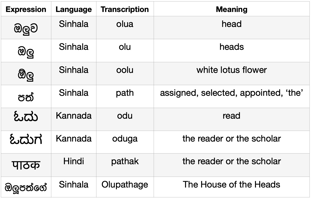
We refer to Figure 60.1 to compare the Sinhala, Hindi and Kanada expressions with the used transcriptions and interpretations.
It is vital to investigate the original Sinhala spelling of the name to understand the meaning of Olupathage. Indeed, the Roman alphabet cannot represent each character; therefore, different sounds and words end up equal in the Western alphabet. At the same time, they are different from the original Sinhala.
The term Olu means ’Heads.’ The word path is challenging to translate. It resembles words such as ’assigned,’ ’selected,’ ’appointed’
or ’the.’1
So, Olupathage means ’The House of the Heads.’ We do not know when the name was first used, except that this must have been before 1760, when the Dutch VOC prohibited further name changes.
As the name is not widespread and is even mostly geographically confined to the area around Uduwara, the name was first used as a clan name in the early 18th century and originated literally from the ’House with the Heads’ located inside the Uduwara fortress.2
Several families received the same clan name Olupathage, because not every Olupathage also has a Portuguese family name. Indeed,
’ge-names originally were not family names but descriptive identifiers typically describing the place where one lived.
Since the family lived in Goa in the early days of the Portuguese presence in India, it is interesting to look at some possible origins of the name Olupathage if the house in Uduwara had been designed to designate the name and not vice versa. The name may originate from the Northern Indian family name ’,’ which is Pathak, and translates as ’the reader’ or ’the scholar,’ and that the name degenerated to ’Olu-pathak’ in Sri Lanka (with a different sounding ’a’) and ultimately adapted to the Karava custom by adding ’-ge’ and became Olupathage which as described above had a different meaning than pathak. Still, meanings may be lost when subsequent generations change language.3 Combining ’Olu’ with ’Pathak’ is not unnatural, as both words somehow refer to a person’s brain and mind.
Figure 60.1: The analysis of the Olupathage name.
1Note that the other word ’White Lotus Flower’ would be transcribed from Sinhala into the English alphabet just as olu or oolu, but has, in Sinhala, nothing to do with ’Heads.’
2Typically, ’ge-names’ originate from an actual home with specific features or functions. We know that the ’House of the Heads’ is located in Uduwara and that the ancestors of Shirani de Silva originate from it. What we do not know, however, is whether that house was first constructed and then the family was named after this house or if the family name already existed while the house was built to represent the family name.
3For instance, first Hindi and later Portuguese and Sinhala.
The Desclergues of la Villa Ducal de Montblanc, 2nd ed., Omn., VOL. IV
© 2024 Nico F. Declercq
CHAPTER 60. THE KARAVA AND SALAGAMA CASTE AND THE ORIGINS OF THE OLUPATHAGE
1152
FAMILY
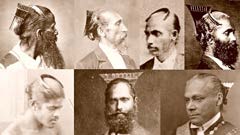
Figure 60.2: Karava and Salagama ornaments.
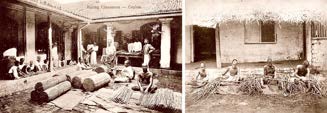
Figure 60.3: Salagama peeling and pack-
ing Cinnamon by Salagama caste farmers
and traders. Note the ornaments on their
heads, which they share with the Karava
caste.
There is an even more exciting etymology possible. Around Goa, the language spoken was Kannada, apart from Hindi. An analysis is shown in Figure 60.1. So, perhaps the early version of the name was Odupathak and transformed from that to Olupathage by subsequent generations who no longer spoke Hindi or Kannada and became connoted with ’heads’ in Sinhala rather than ’reader’
in Hindi and Kannada.
60.3 The Sri Lankan Caste System
The caste systems in Sri Lanka and India present fascinating trends in historical claims, social structures, and cultural identities.
In Sri Lanka, each caste traces its lineage back to specific kingdoms and ancestors serving ancient kings as soldiers or servants.
This sense of pride significantly shapes their caste identity, though mixed marriages and extramarital children are often excluded from these narratives.
When studying the history of castes, one must exercise caution with sources, as human nature’s inherent heroism and vanity can distort historical facts. While pride in one’s heritage is commendable, it is crucial to adhere to verified facts.
Western classifications of Sri Lankan castes, which often simplify them into categories like fishermen, farmers, or weavers, can be misleading.
Historical records show that castes were not limited to single professions. For instance, although the Goyigama caste is frequently labeled as farmers and landowners, many members were also engaged in fishing.
Similarly, while the Salagama caste is often associated with weaving and cinnamon peeling, some members were involved in military activities and trade. The Karava and Salagama castes, having arrived in Sri Lanka when land ownership was already established, were less involved in paddy agriculture and more in other professions. This is corroborated by early 17th-century Portuguese tombos (land registers), which show few Karava and Salagama as landowners.
Contrary to the caste system in India, the caste system in Sri Lanka may not be as rigid or extensive.
Much of the discourse on castes in Sri Lanka is rooted in myths and misconceptions. People often identify their family with a particular caste and seek to elevate their status by asserting their caste’s superiority. The term ’caste’ itself, derived from the Portuguese word casta, was initially used to identify tribes and clans rather than social hierarchies.
Literature on the subject reveals astonishing beliefs, with some claiming descent from kings or highly esteemed ancestors. However, before the Portuguese period, names in Sri Lanka were fluid identifiers that could change based on a person’s location or profession and were not strictly inherited.
The arrival of the Portuguese heightened the importance of names, which began to be inherited, like in Europe, reflecting one’s noble status. The Dutch, arriving through the VOC around 1760, further institutionalized this practice, making names strictly hereditary.
Two significant works that delve into this subject are B. J. Perera’s ’The Ge names of the Sinhalese’ and M. D. Baghavan’s ’The Karava of Ceylon, Society and Culture.’
Perera’s work examines the evolution of Sinhalese names, while Baghavan explores the societal and cultural aspects of the Karava caste.
Many Sri Lankans have changed their names in the past century to avoid associations with lower castes, reflecting ongoing social dynamics.
60.4 The Karava and Salagama Castes
60.4.1 Historical Origins and Migration
Based on comprehensive research, including DNA analysis, it can be concluded that the Olupathage de Silva clan originally hailed from India’s Goa region. They were initially identified as Karava or associated with the Karava due to a presumed common origin, despite lacking a ge-name. Upon settling in Uduwara near Kalutara, they adopted the name Olupathage. Subsequently, through intermarriage with the Salagama caste, the Olupathage clan assimilated into the Salagama caste. Both the Karava and Salagama castes likely descended from Goa, and this transition was possibly driven by economic factors, as discussed further. Genetic evidence supports links with numerous Karava members.
The Olupathage de Silva family is firmly established within the Salagama caste, also known as the Hali or Chali caste. This situation is unusual as the name Olupathage is typically associated with the Karava caste and, in rare instances, the Govi caste.
© 2024 Nico F. Declercq
The Desclergues of la Villa Ducal de Montblanc, 2nd ed., Omn., VOL. IV
60.4. THE KARAVA AND SALAGAMA CASTES
1153
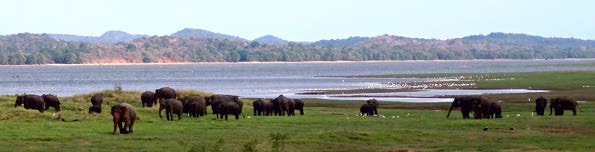
Figure 60.4: Elephants near Anuradhapura, in 2007. (Declercq de Silva Archive)
The author’s wife’s grandfather, Peiris de Silva, bore a name commonly found in the Karava caste.
The family’s rituals resemble those of the Karava caste, although similar practices are observed in the Salagama caste.
60.4.2 Social and Economic Factors
The traditions and terminology of both castes, along with their myths of origin and geographic overlap, suggest the possibility of caste switching across generations, particularly following mixed marriages. For instance, the name Suriya, prevalent in Karava family names, also serves as a heraldic symbol in the Salagama caste. This indicates that a family generation may have chosen to identify as Salagama (Hali or Chali) during the Dutch colonial period when the Dutch allowed Salagama families to monopolize the cinnamon trade, as shown in Figure 60.3.
Economic pressures likely necessitated the Olupathage de Silva family’s association with the Salagama caste, mainly due to their involvement in cinnamon cultivation. Roberts4 mentions that during the seventeenth century, the Portuguese coerced various castes, including the Karava, into cinnamon-peeling services. Similar accounts are found in the works of C. R. de Silva5 and D. A.
Kotelawele6.
60.4.3 Family and Caste Dynamics
The Olupathage de Silva family originally stemmed from a mixed marriage in Goa. Being mestiços, their descendants could easily navigate life as Portuguese, Karava, or both. Upon settling in Uduwara, Sri Lanka, they were joined by both Karava and Salagama castes, who were amicable towards the Portuguese in both India and Sri Lanka.
According to M. U. De Silva7, by 1769, the cultivation of cinnamon had become successful, and Mudaliyars and Muhandirams were instructed to plant cinnamon. The Dutch policy favored the Salagama caste, providing them with privileges and substantial lands.
This policy encouraged social and economic mobility within the Salagama caste, allowing them to amass wealth and status.
During the VOC period, cinnamon workers from the Salagama caste, who were not landowners, sometimes registered their children under a different caste to avoid economic restrictions. This strategy highlights the flexibility and social mobility within the caste system, driven by economic incentives and colonial policies.
M. U. De Silva8 notes that Salagama headmen prospered under Dutch rule, expanding their plantations and elevating their social status. In contrast, Karavas were often allocated positions as weavers and fishers. Thus, a Karava involved in cinnamon cultivation had solid economic incentives to integrate into the Salagama caste.
60.4.4 Migration and Cultural Integration
The Karava, originally from the Kuru Kingdom in Northern India, gradually migrated to Sri Lanka through various Indian regions, including Tamil Nadu. Historians such as Peiris9 and Jayasekara10 support this migration narrative. Both economic opportunities and colonial interactions influenced the Karava migration patterns.
The Portuguese favored importing caste members from friendly Indian territories to establish better relationships in Sri Lanka.
This facilitated the integration of various castes, including the Karava and Salagama, both prominent in coastal regions.
During British rule, the exchange of people and goods between Sri Lanka and Southern India continued to be encouraged, further mixing the population. Roberts estimates that by 1820, the Karava comprised 9% of Sri Lanka’s population, the Durava 3%, and the Salagama 4%. In Kalutara, the population distribution in 1814 included 22Roberts also notes various castes’ economic activities and social status, highlighting the Karava’s roles in unloading vessels and carpentry. This socio-economic mobility allowed families like Olupathage de Silva to strategically choose caste affiliations based on economic benefits.
60.4.5
Salagama Caste and Economic Contributions
The Salagama caste, also known as Halagamas, Chalias, or Halias, claim their origins in Kerala. While initially cloth weavers, they turned prominent in the cinnamon trade during the Portuguese and VOC periods. The Salagama caste is now known for entrepreneurship, owning large businesses, and holding top-level positions. The caste’s pride is reflected in the Singhalese saying,
"Salagamas must never be humiliated."
During the VOC period, the first professional large plantations were established in Sitavaka, Matara, and Kalutara, the latter being 4Michael Roberts, ’Problems of social stratification and the demarcation of national and local elites in British Ceylon,’ The Journal of Asian Studies, vol. XXXIII, 1974.
5C. R. de Silva, ’The first Portuguese revenue register of the Kingdom of Kotte - 1599,’ The Ceylon Journal of Historical and Social Studies, Vol V:1
and 2, 1975, p. 109.
6D. A. Kotelawele, ’The Dutch in Ceylon 1743-1766,’ PhD thesis, London University, 1968, p. 201.
7M. U. De Silva, ’Land tenure, Caste system and the Rajakariya, under foreign rule: a review of the change in Sri Lanka under Western powers, 1597-1832,’ Journal of the Royal Asiatic Society of Sri Lanka, New Series, Vol. 37 (1992 / 1993), pp 1-57.
8M. U. De Silva, various SLNA documents, and Political Council Minutes.
9P. E. Pieris, ’Ceylon: The Portuguese era: being a History of the Island for the Period 1505-1658,’ vol. 1, Colombo: Apothecaries Co. Ltd., 1913.
10Jayasekara, ’Social and Political Change in Ceylon 1900-1919,’ Ph.D. thesis, London University, 1970.
The Desclergues of la Villa Ducal de Montblanc, 2nd ed., Omn., VOL. IV
© 2024 Nico F. Declercq
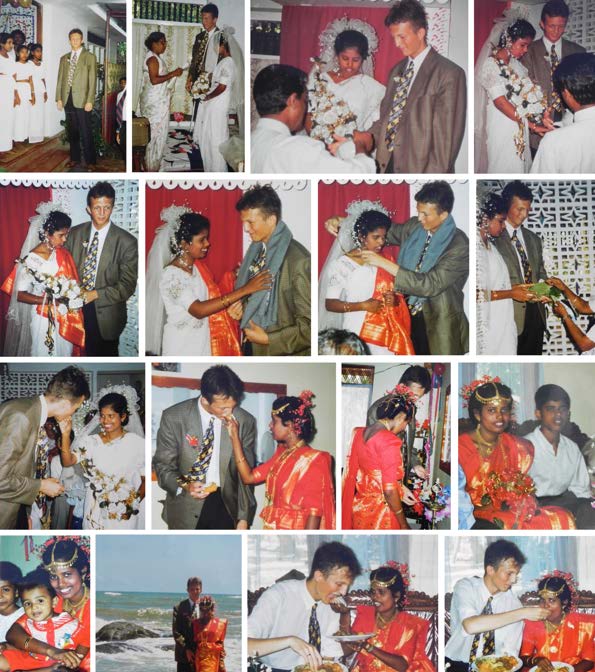
CHAPTER 60. THE KARAVA AND SALAGAMA CASTE AND THE ORIGINS OF THE OLUPATHAGE
1154
FAMILY
Figure 60.5: The author’s June 1997 wedding exemplifies typical Salagama or Karava weddings. The first day is white, the second red. The events are chronologically presented: the groom, welcomed by young singers Lanka, Mangala, and Kumari; the city registrar certifying the marriage; the couple’s bonding with a cotton thread and water symbolizing family unity and the passage of time; symbolic textile and golden ornament exchanges; offering beetle leaves to family members; the exchange of wedding cake; and the beginning of an exciting life for the couple. The Tangerine Beach Hotel in Kalutara holds significance for the author, who stayed with his foster parents in room 401, near the Presidential Suite and the manager’s apartment. During the JVP resurrection in 1987, the author sought refuge at the hotel, protected by secret agents. Despite the turmoil, love for Sri Lanka endured, leading to subsequent returns. A 2007 photo shows the hotel’s post-tsunami refurbishment. On the second wedding day, the groom and bride again exchange cake, and the ’Sri-Bo-Male’ is visible. The lighting of a candle symbolizes life, the sun, and wisdom. The wedding was bittersweet as the bride’s youngest brother, pictured, remained unmarried after their parents’ passing but later married and started a family. Additionally, the bride is pictured with her eldest sister’s two youngest children at ’Goda Galla’ rock, marking the northern sea boundary of Kalutara. The three-day ceremony included multiple food occasions, with the tradition of offering each other and closest family members the first bite of food. (Declercq de Silva Archive)
© 2024 Nico F. Declercq
The Desclergues of la Villa Ducal de Montblanc, 2nd ed., Omn., VOL. IV
60.4. THE KARAVA AND SALAGAMA CASTES
1155
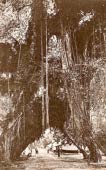
Figure 60.6: This is an image of the very famous tree, which grew over the road
from Colombo to Galle. It was located in the North of Kalutara, at Nagas Handya.
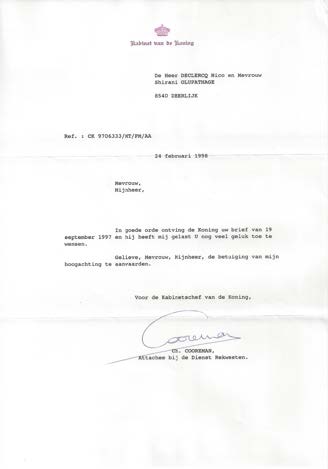
Figure 60.7:
The year 1997 presented
significant challenges for the author in
terms of balancing academic pursuits, ad-
ministrative responsibilities, and extensive
travel. This correspondence, received from
His Majesty King Albert II of Belgium,
serves as a response following the success-
ful conclusion of these endeavors in early
1998.
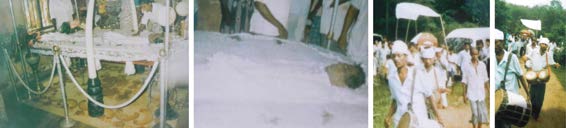
Figure 60.8: The remains of Belin de Silva were received by numerous friends and family members at his ancestral Portuguese residence in Uduwara. The body was symbolically safeguarded by elephant tusks, signifying the utmost respect accorded to the deceased in Sri Lankan tradition. In accordance with custom, Belin de Silva’s procession to the Uduwara cemetery was accompanied by a ceremonial parade featuring drums and white adornments, emblematic of the Salagama and Karava communities. (Sri Lanka, 1996) (Declercq de Silva Archive)
The Desclergues of la Villa Ducal de Montblanc, 2nd ed., Omn., VOL. IV
© 2024 Nico F. Declercq
CHAPTER 60. THE KARAVA AND SALAGAMA CASTE AND THE ORIGINS OF THE OLUPATHAGE
1156
FAMILY
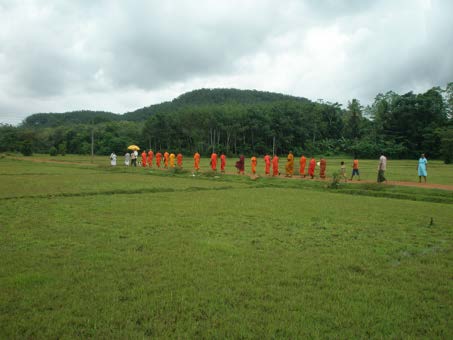
Figure 60.9: This ceremony commemorated Belin de Silva, Shirani’s father, in 2000. The
priests walked to Belin’s former house. His eldest son led while carrying a relic on his head.
Drummers joined him. (Declercq de Silva Archive)
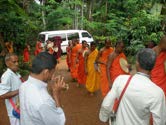
Figure 60.10: This was a commemoration for Belin de Silva, Shi-
rani’s father, in 2000. The priests arrived at the house and were wel-
comed by the drummers. As part of the ceremony, all the priests, in-
cluding all the villagers, received a meal. Extra portions were donated
to numerous poor people in Horana and Kalutara. Chanted prayers
lasted until morning. (Declercq de Silva Archive)
where Uduwara is located and where the Olupathage de Silva family flourished in the cinnamon business. Early in the British period, cinnamon remained economically significant due to the momentum from the VOC period. However, the industry gradually declined because the British needed more expertise in cinnamon cultivation, and the Sri Lankans were reluctant to share their knowledge.
The Revenue Register of 159911 highlights the Salagama’s role in the cinnamon trade, collecting and paying tribute to the king.
This documentation, along with Chandra R. de Silva’s work12 underscores the significant economic contributions and privileges granted to the Salagama caste during colonial times.
60.4.6 Colonial Policies and Social Structures
The Portuguese colonial period, from the 1590s to 1658, was marked by significant disruptions, warfare, and social upheaval.
According to Roberts13, the Portuguese often disregarded local customs, which opened opportunities for non-Goyigama individuals and families to ascend socially. In contrast, the Dutch implemented a more orderly administration that maintained existing customs but occasionally bent traditions favoring the Salagama, crucial to the cinnamon industry.
Roberts’ analysis indicates that the Dutch colonial policies were instrumental in carving out a distinct social and economic niche for the Salagama caste. The Dutch incentivized the Salagama to expand cinnamon plantations, resulting in significant economic prosperity and social elevation for the caste. This policy created a privileged position for the Salagama within the colonial economy and society.
60.4.7 Economic Incentives and Social Mobility
The economic policies of the Dutch VOC facilitated the integration and upward mobility of the Salagama caste. As noted by M. U.
De Silva14, the Dutch encouraged the Salagama to plant cinnamon on a large scale, offering them land and privileges. This policy boosted the cinnamon industry and entrenched the Salagama caste as a significant economic force.
The Dutch policy incentivized Salagama headmen to expand their plantations and accumulate wealth. This economic prosperity was accompanied by social elevation, as Salagama headmen received titles, gold chains, and medals for their successful efforts in the cinnamon industry. This created a distinct social class within the Salagama caste, marked by economic wealth and social prestige.
11Arquivo Nacional do Torre do Tombo, Manuscritos do Convento da Graça, tomo 6D, p. 330-3.
12Chandra R. de Silva, ’Portuguese Encounters with Sri Lanka and the Maldives - Translated Texts from the Age of the Discoveries,’ 2009.
13Michael Roberts, ’Caste conflict and elite formation: the rise of a Karava Elite in Sri Lanka, 1500-1931,’ Cambridge University Press, 1982.
14M. U. De Silva, ’Land tenure, Caste system, and the Rajakariya, under foreign rule: a review of the change in Sri Lanka under Western powers, 1597-1832,’ Journal of the Royal Asiatic Society of Sri Lanka, New Series, Vol. 37 (1992 / 1993), pp 1-57.
© 2024 Nico F. Declercq
The Desclergues of la Villa Ducal de Montblanc, 2nd ed., Omn., VOL. IV
60.4. THE KARAVA AND SALAGAMA CASTES
1157
60.4.8 Social Integration and Cultural Exchange
The Karava and Salagama castes and other immigrant groups, such as the Durava, were gradually integrated into Singhalese society.
The Janavamsa, a poem from around 1400, indicates that these castes were considered Singhalese, suggesting early and successful integration. The shared cultural and economic interests of these groups facilitated this integration.
Roberts15 describes how the Portuguese and Goan missionaries successfully converted many Karava to Christianity, further aiding their integration.
The Christianization of the Karava began in India, and many Karava arrivals during the Portuguese period were already Christian.
Mass conversions, such as the conversion of over 70000 Karava in 1556, as documented by Fernao de Queiroz16 and Tikiri Abeyas-
inghe17, highlight the extent of this religious transformation.
The arrival of the Portuguese and establishing colonial rule created new opportunities for social mobility and integration. The Portuguese favored importing caste members from friendly Indian territories to develop better relationships in Sri Lanka. This facilitated the integration of various castes, including the Karava and Salagama, both prominent in coastal regions.
60.4.9 Ancestral Names of Karava
Most family names of the Karava caste are referred to as ’ge-names’ because they end with -ge. Perera18 explains that this -ge signifies Gehi and not the genitive form, which also ends with -ge. He asserts that -ge translates to ’the House of,’ a view shared by other scholars in this field.
Identifying a clan based on their house would have been convenient if the reference was to that specific house. This identifier could have described the house’s physical appearance, its associated profession, or its location related to the village name. If -ge indeed stands for ’house’ and not a genitive, then the ge-name initially served as an identifier rather than a family name. Thus, individuals with the same ge-name are not necessarily blood-related. However, given the historically limited mobility in Sri Lanka, there has been a higher likelihood of intra-village marriages. This suggests that people with ancestors from the same location may be blood-related and share a ge name.
60.4.10 Karava and Salagama Customs
Several traditional customs of the family of Shirani are common to the Karava caste, and many are also found among the Salagama caste, making them difficult to distinguish. For simplicity, these will be referred to as ’Karava customs.’ A Portuguese manuscript from the early 1600s notes that the Karava preferred death over forsaking their traditions in birth, marriage, or death rituals.
Examples of these customs are detailed below.
60.4.10.1 Karava and Salagama Births and Upbringing
Upon birth, astrologers are consulted to determine the first letter of the child’s given names. The ge-name precedes these names and, if applicable, is followed by a Portuguese title. A Pancha-Uda, a gold coin depicting the five weapons of Lord Vishnu, is used to ornament the child for protection.
The child’s first writing lesson, an auspicious custom, is given by an educated family member, symbolizing the introduction of a wise mentor.
Additionally, upon a girl’s first menstruation, it is customary in the Karava caste to seclude her from male adults until a ceremony is held in her honor.
60.4.10.2 Karava and Salagama Weddings
In 1988, in Anuradhapura, as illustrated in Figure 60.4, the author’s foster father, Pierre Vangheluwe, experienced a heat stroke, as described in Chapter 69.11. Contributing factors included smoking, sleep deprivation, dehydration, extensive travel, and the sweltering weather of Northern Sri Lanka. The episode occurred during dinner; he suddenly became bewildered, had slurred speech, and an accelerated heart rate. Despite blocked roads due to the Tamil Tigers’ conflict with the Sri Lankan army, we navigated to a hospital where he received appropriate treatment. The hospital environment was dire, filled with severely injured patients and the overwhelming smell of blood and pus. Once stable, he insisted on returning to the hotel (Tissawewa Resthouse). He gradually recovered and later, in Belgium, was found to have had a minor heart attack. He fully recovered but passed away three years later from unrelated health issues. The author’s last visit with him to Sri Lanka was in 1988, though the author returned in 1997 to marry his wife.
Marriages on the Indian subcontinent are arranged based on suitable partners considering horoscopes, caste, profession, and other factors.
Horoscopes also determine the wedding date. A wedding starts with the groom being served milk by his mother before he departs for the bride’s house. Upon arrival, he is welcomed by younger female relatives who wash his feet and sing. A respected family member conducts the ceremony, tying the couple’s fingers and pouring water over them, symbolizing unity. The couple exchanges golden rings, and the groom symbolically drapes the bride with the wedding saree and a white cloth. The couple distributes betel leaves to family members and lights a traditional pahanne lamp. The bride wears the Sri-Bo-Male, a necklace worn by Karava brides and royals. Photographs of various marriage rituals are shown in Figures 60.5 and 60.6.
60.4.10.3 Karava and Salagama Funerals
Funeral scenes are depicted in Figure 60.8. A Karava or Salagama funeral procession is led by traditional drummers, recognized by their white cloths and flags. Historically, a service caste performed the drumming. Nowadays, except for the Karava, other castes proceed to the cemetery without drummers. When present, drummers in Karava or Salagama processions cover their drums to muffle the sound. Drummers arrive hours before the procession’s departure and frequently play funeral beats. If cremation is 15Michael Roberts, ’Caste conflict and elite formation: the rise of a Karava Elite in Sri Lanka, 1500-1931,’ Cambridge University Press, 1982.
16Fernao de Queiroz, ’The temporal and Spiritual Conquest of Ceylon,’ translated by Fr S. G. Perera, Colombo: Govt Printer, 1930, pp. 326-7.
17Tikiri Abeyasinghe, ’Portuguese Rule in Ceylon 1594-1612,’ Colombo: Lake House Investments Ltd., 1966, pp. 202-5.
18B. J. Perera, ’The ’Ge’ Names of the Sinhalese,’ Journal of the Royal Asiatic Society of Sri Lanka, New Series, Vol. 55 (2009), pp. 1-16, Royal Asiatic Society of Sri Lanka (RASSL).
The Desclergues of la Villa Ducal de Montblanc, 2nd ed., Omn., VOL. IV
© 2024 Nico F. Declercq
CHAPTER 60. THE KARAVA AND SALAGAMA CASTE AND THE ORIGINS OF THE OLUPATHAGE
1158
FAMILY
chosen, drummers stay overnight at the pyre, playing traditional beats.
Unlike other castes who abstain from cooking until the funeral is over, Karava and Salagama families cook and feed friends visiting for the funeral, excluding fried foods. After burial or cremation, attendees return for a communal meal. Alms are given to priests on the 7th day, three months later, and annually, as shown in Figures 60.9 and 60.10.
Families conscious of their Karava heritage may incorporate royal symbols such as the White (Pearl) umbrella (Mutu kuda), a sword, or a trident into the funeral.
Flags may display typical Karava symbols like the sun and moon. However, most Karava and Salagama families prioritize their Sri Lankan identity over caste, focusing more on religious than caste-ceremonial aspects. The funeral procession typically forms a long line as the body is transported from the home to the burial site.
© 2024 Nico F. Declercq
The Desclergues of la Villa Ducal de Montblanc, 2nd ed., Omn., VOL. IV
Chapter 61
Uduwara: the Ancestral Village of Shirani de Silva in
Sri Lanka
61.1 Introduction
The history of the village of Uduwara in Sri Lanka is rooted in its ancestral connections to Goa, India. There are three primary routes to reach Uduwara from Kalutara: traveling by boat along the Kalu Ganga River, taking the northern path via the right bank, and taking the southern path via the left bank. Alternatively, one can arrive from Horana or Ratnapura.
Despite the presence of a highway near Uduwara, the exit is relatively distant, requiring travelers to pass beneath the road before arriving in the village. The highway itself is situated approximately midway between Kalutara and Uduwara.
Upon arrival, Uduwara may initially seem unremarkable. However, it boasts a school, a post office, residences, rice fields, and a few small streets.
An aerial view reveals the village’s unique topography, with hills such as Deewalkanda and the curving Kalu Ganga River placing Uduwara within a broader historical and geographical context. The village’s historical significance is often overlooked by its inhabitants, as it receives no tourists or foreign visitors and lacks a local historical department.
There is only one primary school, and the villagers know little about Uduwara’s history. They are more familiar with nearby towns such as Kalutara and Horana. The nearest police station is Anguruwathota, which offers a scenic river view.
Elderly residents and former priests once held a wealth of historical knowledge about Uduwara, which is now in scholarly texts and at prominent universities across the island.
Historically, the village was known for its cinnamon cultivation, which has since declined. Rice and tea remain prominent crops, though rubber cultivation, which gained significance in the latter half of the 20th century, has also waned. The village lacks medical facilities, necessitating trips to Galpatha, Anguruwathota, or Nagoda for healthcare.
Two significant landmarks in Uduwara are the remnants of a Portuguese chapel, Capela in Portuguese, now a cozy temple in the suburb still known as Kapuella, and the main village temple with a school across the street. These sites once formed the fortress of Uduwara, a fact evident in the site’s construction, including the house with the heads, Olupathage, and the defense wall along the river.
Uduwara’s proximity to the Kalu Ganga River offers a tempting invitation for a swim, particularly when the current is mild.
However, it’s important to exercise caution due to the potential presence of snakes and crocodiles. While swimming in the river’s warm waters can be a romantic experience, it’s crucial to note that swimming at the river’s estuary in Kalutara is perilous.
Over the years, the riverbed has deepened due to sand dredging for the construction industry, reducing the frequency of floods in the rice fields.
Despite these challenges, Uduwara remains a relatively safe spot for swimming, offering a unique and inviting environment for residents and visitors alike.
61.2 The Geographic Situation
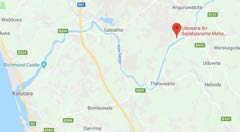
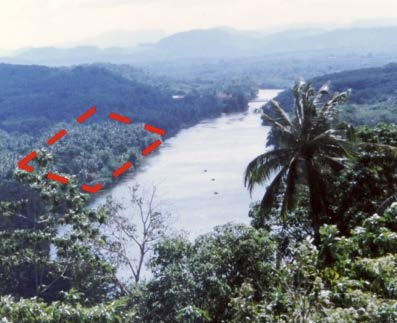
The ancient fortress of Uduwara, shown on a map in Figure 61.1, was located, where, in 1890, the temple Uduwara Shailatharama Maha Viharayaya was established. Constructing Buddhist temples on former fortresses is expected and frequently done because of the elevated ground and safety during flooding. The elevated field is still clearly visible, and so are the Portuguese buildings older than 1890.
The fortress was constructed on the right bank of the Kalu Ganga. Stairs led to the river as this was the only access because no roads or bridges existed.
The Portuguese built the fortress along the Kalu Ganga’s straight navigable stretch near the place where the Kuda Ganga River joins the hardly navigable upstream Kalu Ganga River.
It served as an outpost for Kalutara and a trading spot from which goods were shipped to Kalutara.
Figure 61.1: The most romantic way to reach Uduwara
is by boat on the Kalu Ganga River. Established by a
distant relative of Shirani de Silva, Richmond Castle is
seen on the left bank. One must go nearly straight until
Galpatha, beyond the modern highway, and then follow
a large curve until Uduwara comes in view. Getting off
the boat at the fortress is naturally the most attractive
option in the context of this book.
The Desclergues of la Villa Ducal de Montblanc, 2nd ed., Omn., VOL. IV
© 2024 Nico F. Declercq
1160
CHAPTER 61. UDUWARA: THE ANCESTRAL VILLAGE OF SHIRANI DE SILVA IN SRI LANKA
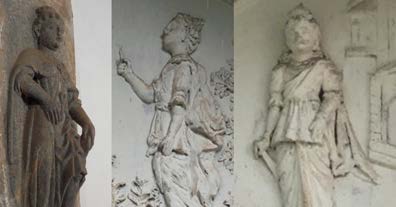
Figure 61.2:
Don Antonio Carvalho de Silva, who established the Fortress of
Uduwara. Left is his image at Goa, described in Chapter 54.5.25 and Figure 54.47
on page 1068; in the middle and right are his images shown twice on the Portuguese building at the Fortress of Uduwara. The construction on the right-hand side depicts
the Sé Catedral de Santa Catarina in Goa, in Portuguese India. The tree in the mid-
dle figure (partially revealed but entirely visible in Figure 61.25 on page 1171) is an oak tree, symbolizing ’Carvalho.’ The main building at the fortress of Uduwara also
shows several images of a lion and a rose, which refer to the heraldic signs of ’De
Silva’ and ’Carvalho,’ respectively. (Declercq de Silva Archive)
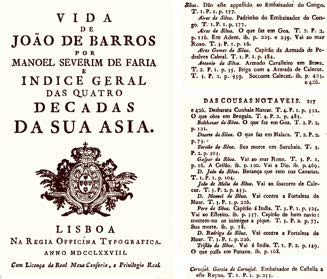
Figure 61.3: First page of Manoel Sev-
erim de Faria, ’Vida de Jo¯ao de Barros,
e indice geral das quatro décadas da sua
Asia’ , Lisboa, na regia officina typográ-
fica, com licença da Real Mesa Censoria,
e Privilegio Real, 1778, and some citations
from the book on the right had side. The
list of de/da Silva, on page 216; the list
of de/da Silva, on page 2167; and, finally,
Garcia de Carvajal (Garcia de Carvalho)
listed on page 14.
61.3 A Brief Recapitulation of Local History and Construction of a Fortress
at Uduwara by Antonio Carvalho de Silva
As detailed in Chapter 54.5.23 - Chapter 54.10, the Asian chapter of the Iberian ancestors of Shirani de Silva commences with the momentous arrival of Juan Carvalho de Silva in Goa circa 1570. Accompanied by his uncle Pere de Silva y Rivera (Da Silva Ribeira), who also had ties to de Almeida, this marked the family’s first step into the rich historical tapestry of Goa. Pere de Silva y Ribeira would serve as the Viceroy at Goa in his twilight years, from 1635 to 1639.
Juan Carvalho de Silva, a family scion, married a Luso-Indian in Goa, a testament to the family’s diverse heritage. They had two sons, one of whom, Antonio, would leave a lasting mark in Sri Lanka.
Antonio, as depicted in Figure 61.2, would venture to Sri Lanka and play a pivotal role in establishing and defending a fortress at Uduwara around 1600. This fortress, a testament to the family’s military prowess and strategic importance, was a reinforcement following the battle of Uduwara at Deewalkanda in 1595 (see also Chapter 56), which was initially constructed by Diego Samarakoon, brother of Fernando Samara de Cunha y Rala (Samarakoon), in 1596.
The battle of Deewalkanda in Uduwara, in 1595, was one to keep the armies of the neighboring Kingdom of Rayigam Chorale, led by Domingos Correa, also known as Edirimana Suriya Bandara and Appuhamy, from capturing the Royals from the Kingdom of Kotte. It was Diego Samara de Cunha y Rala (Diego Samarakoon), better known as Samarakoon and sometimes confused with his brother Fernando, a Singhalese with Portuguese ancestors, who could stop the Rayigam Chorale armies by launching an attack from the Deewalkanda hill at Uduwara.
The assault saved the royals and, therefore, the Kotte Kingdom.
The wooden construction at Uduwara remained weak as in 1596, Domingo Correa attacked Uduwara again in May. The attack was, however, unsuccessful whence he fled and hid somewhere near Uduwara. He was consequently handed over by an older woman, a local Achi, who had informed Samarakoon of his hiding place.
On July 14, 1596, Domingo Correa was executed in Colombo. His capture was highly applauded by King Felipe III of Spain (i.e., Felipe II of Portugal) in 1598, and he decided to invest more in the Kingdom of Kotte.
Don Carvalho de Silva would arrive in Sri Lanka from Goa during this policy. A stone fort was constructed on the Kalu Ganga at Uduwara in the early 1600s. The buildings inside the fortress may have been built somewhat later, however. These constructions were made for trade and for gunpowder fabrication, such as the Olupath house, from which the family would receive its Karava-style
© 2024 Nico F. Declercq
The Desclergues of la Villa Ducal de Montblanc, 2nd ed., Omn., VOL. IV
61.4. AN ARCHEOLOGICAL INVESTIGATION OF THE FORTRESS OF UDUWARA
1161
Sri Lankan family name in addition to their Iberian ’de Silva’ name.
The fact that Antonio Carvalho de Silva constructed the fortress is also read on page 149 in O. M. da Silva Cosme’s book1.
On page 176, O. M. da Silva Cosme describes Antonio de Silva, an army captain who died in December 1614, along with Vincent Rodrigues, a former captain of Balana, in Chapter 56, and resident of Colombo. It took place in a campaign against Kandy, at Maturata, on the way to Badulla. The following year, a punitive expedition occurred to Thumpana, also in Chapter 56, in August 1615 under captain Major Pero Peixo da Silva.
We remind the reader that the story in Sri Lanka, related to the Carvalho de Silva family and the construction of a fortress in Uduwara, came after the life of Joao de Barros (1496-1570) and, therefore, after the descriptions in the famous book series ’Decadas da Asia.’
Nevertheless, those books show that family members were involved very early on in the conquest of India and Ceilao, exposed in Figure 61.3, and further below.
A search through the entire book series ’Decadas da Asia,’ by Joao de Barros (1496-1570), delivers an extensive list of persons named da Silva or de Silva and Carvalho. Note that Barros always applies the Portuguese spelling, even if it concerns men from Spain or Spanish ancestors; therefore, ’da Silva,’ in many cases, was ’de Silva.’ The series covers the period when Jorge Cabral and Vasco da Gama were involved. Nevertheless, it shows that even early on, many de Silvas and Carvalhos were involved in India and Sri Lanka, some of whom were very likely related.
In particular, those men were captains or knights in the early days. Later, we should also consider the arrivals of merchants, government officials, and even religious priests. Here is the list in the spelling as used by Barros in his books ’Decadas da Asia’: Aires da Silva, Aires Gomes da Silva, Antonio da Silva, Antonio da Silva de Menezes, Antonio Gomes da Silva, Antonio Moniz da Silva, Ayres da Silva, Ayres Gomes da Silva, Balthazar da Silva, Braz da Silva, Correa da Silva, D. Bernardo da Silva, D. Pedro da Silva, D. Pedro da Silva da Gama, D. Rodrigo da Silva, Diogo da Silva, Diogo Gomes da Silva, Dona Leonor da Silva, Duarte da Silva, Fernao da Silva, Francisco da Silva, Francisco da Silva de Menezes, Francisco Ferreira da Silva, Gaspar da Silva, Gomez da Silva, Joao da Silva, Joao da Silva Barreto, Joao da Silva Pereira, Joao de Mello da Silva, Joao Gomes da Silva, Jorge da Silva, Luiz da Silva, Luiz de Mello da Silva, Manoel Carvalho de Oliveira, Manoel da Silva, Manoel de Almeida da Silva, Manuel da Silva, Martim Correa da Silva, Pedro da Silva, Pedro da Silva de Menezes, Pedro da Silva Modeliar, Pedro Peixoto da Silva, Pero da Silva, Ruy Pereira da Silva, Tristao da Silva, Vasco da Silva, Aleixo Carvalho, Alvaro Carvalho, Alvaro de Carvalho, Antonio Carvalho, Antonio Carvalho de Araujo, Belchior Carvalho, Bernadim de Carvalho, Carlos Carvalho, Domingos Carvalho, Farnao Carvalho, Fernao Rodrigues de Carvalho, Filippe de Carvalho, Garcia de Carvajal, Gaspar de Carvalho, Gil Fernandes de Carvalho, Gomez Carvalho, Jeronymo Carvalho, Joao Carvalho, Joao Lopes Carvalho, Joao Rodrigues de Carvalho, Joao Rodrigues Salema de Carvalho, Lourenço Carvalho, Lourenço de Carvalho, Luiz Carvalho, Luiz Rodrigues de Carvalho, Macedo de Carvalho, Miguel Carvalho, Pedro Carvalho, Pedro Fernandes de Carvalho, Pero Fernandes de Carvalho, Ruy Carvalho, Vasco de Carvalho, and Vicente Carvalho.
A less extensive coverage of the early decades of the Portuguese in India and Sri Lanka can also be read in ’Lendas da India,’ by Gaspar Correia (1492-1563). His book shows very few de Silva and Carvalho persons:
Antonio Nunes de Carvalho, Rebello da Silva, Lourenço da Silva, Joao Pedroso Gomes da Silva, and Bràs da Silva.
61.4 An Archeological investigation of the Fortress of Uduwara
61.4.1 Similarities with Other Portuguese Colonial Mansions and Homes
The Olupathage de Silva family’s ancestral house was the fortress of Uduwara on the Kalu Ganga River. An impression is shown in Figure 61.4.
The original architecture of the buildings inside the fort, such as the Gothic entrance bow (clearly Iberian) and the head sculptures on the walls, are not just architectural marvels but also significant historical artifacts. The Gothic entrance, though it may appear modern, is likely an original feature that was preserved during refurbishment. The other formation with the head sculptures is Portuguese.
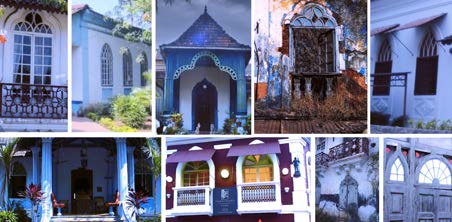
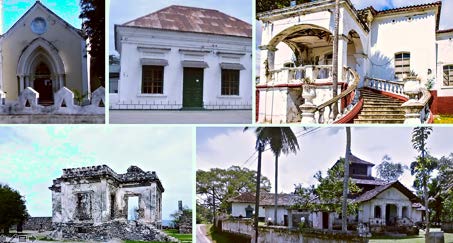
To compare, one may look at Colonial homes and buildings in Mannar, Goa, Zanzibar, Angola, Timor, etc. Comparative impressions as introduction are shown in Figures 61.5 and 61.6.
61.4.2 Its Strategic Location along the Kalu Ganga River
To appreciate the location of the Uduwara fortress, we show Figures 61.7 and 61.8. Figure 61.31 shows an impression in times of conflict.
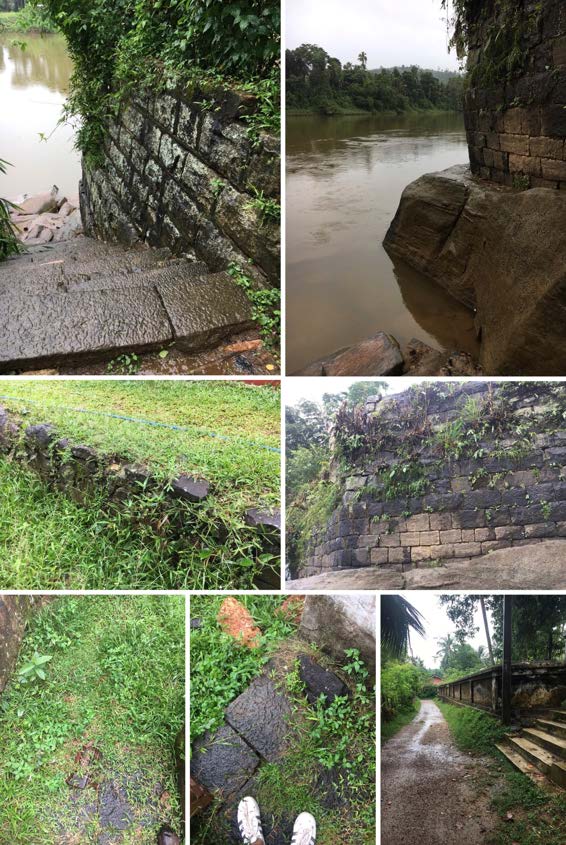
61.4.3 Fortress Wall Remains and Access to Kalu Ganga River
Important remains are depicted in Figures 61.9, 61.10 and 61.11.
61.4.4 The House of the Heads: a Polyvalent Building for Governance, Trade and a Gunpowder
Factory
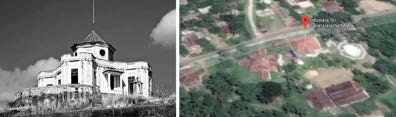
A satellite view reveals that the building has a cross shape, which is misleading as it consists of two parts. The front section (East side) is an ornamented construction that looks like an official building. The local Portuguese authorities probably used it for governance purposes.
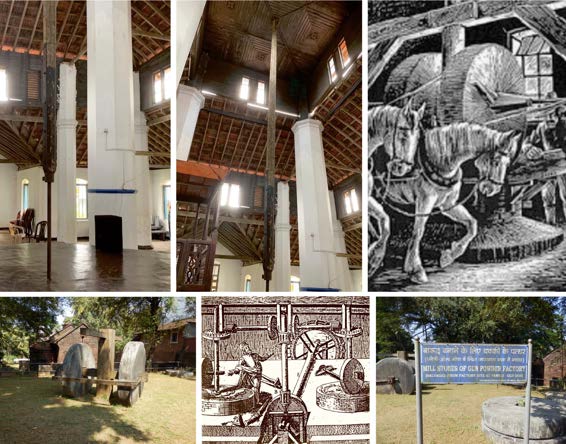
Attached is a robust rectangular construction where the gunpowder3 mill was located, possibly driven by cattle.
This square construction has three branches that may have served as living places or storage facilities. The square with the three components and the front building forms a cross.
The reader may also be interested in comparing with Chapter 56.6.9, the fortress of Colombo.
Note that the cross of the Order of Christ has been a national emblem of Portugal since Manuel I’s reign (1469-1521). Although it 1O. M. da Silva Cosme, ’Fidalgos in the Kingdom of Kotte (Sri Lanka: 1505 - 1656), The Portuguese in Sri Lanka’ , Limited edition of 350 copies, copy no. 31 and signed by the author, published in Colombo, Sri Lanka, in 1990, by Harwoods Publishers, 38 1/1/, Dudley Senanayake Mawatha, Colombo 8, and printed by Evangel Press Limited, 490/8 Havelock Road, Colombo 6, Sri Lanka.
3As a curiosity, a gunpowder recipe from that time is shown in Figure 61.12
The Desclergues of la Villa Ducal de Montblanc, 2nd ed., Omn., VOL. IV
© 2024 Nico F. Declercq
1162
CHAPTER 61. UDUWARA: THE ANCESTRAL VILLAGE OF SHIRANI DE SILVA IN SRI LANKA
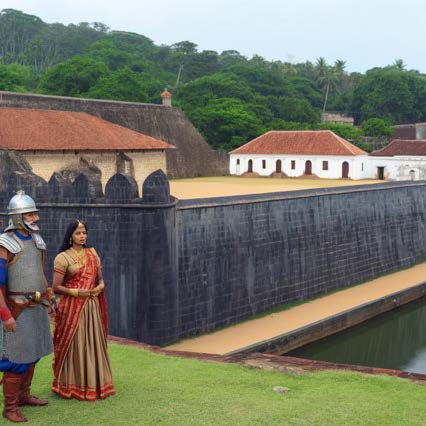
Figure 61.4: A historical scene in Uduwara of a mixed Portuguese conquistador and his
wife. This image was made with AI (DALL·E 2024-05-22 20.03.52).
does not appear on Portugal’s coat of arms, it is frequently used as a national symbol. For instance, it was used in the sails of the Portuguese ships that discovered India and Sri Lanka, and it can still be found today in the sails of the Portuguese navy’s school ship, Sagres.
A reference picture is shown in Figure 61.13, followed by an overview of the Uduwara fortress site in Figures 61.14 and 61.15,
anteceded by a Portuguese military reference, equally in Figure 61.15.
Many books have been written about the fabrication of gunpowder. Here we refer to an article by Brenda J. Buchanan4. Another example is a book by Jack Kelly5, while in Figure 61.12, we have shown an old recipe.
To summarise, the best quality gunpowder, i.e., black powder, is as follows.
Charcoal is to be fabricated first, which is done by burning wood without oxygen, preferably willow, alder, buckthorn, or cottonwood.
We assume that the Portuguese also experimented with other timber in Sri Lanka and India. The other ingredient is Potassium Nitrate (Saltpetre), which is needed to provide oxygen during the chemical reaction. The last element is, of course, Sulfur. The role of Sulfur is to provide the fuel for the explosion while also lowering the temperature to ignite the mixture.
The proportions are the order of magnitude of 75% Potassium Nitrate, 15% charcoal, and 10% Sulfur. This mixture only becomes black powder if it is very closely blended. That is a double problem. First, it must be ground for many hours to get a fine paste.
Then, one must ensure that it remains balanced during transportation. The latter was hardly possible, so it was customarily fabricated at the place of usage, i.e., inside the fortress.
To grind gunpowder, one must ensure that no sparks occur because these could be dangerous and cause explosions. The most widely adopted method uses an edge-runner mill, such as the one found in Uduwara and shown in Figure 61.16.
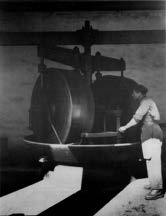
Milling black powder was done by a marble or limestone millstone on a limestone bed. Later, cast iron wheels were also used on an iron bed. Before the limestone millstone, a rotating ball mill made of bronze or lead (to avoid sparks) was also used.
61.4.4.1 Ornaments
Observed ornaments are consequently shown in Figure 61.19. The ornament above the arch is very common in Goa. An example is shown in the same Figure 61.19. The lower head, in Figure 61.20, is very similar to the heads found in Goa. The compass needle, also in Figure 61.20, refers to the seafaring Portuguese, as left in Figure 61.20. In contrast, the lion head refers to the lion symbol of ’de Silva,’ and the rose below refers to the ’Carvalho.’ Both emblems are artistic references to the weapon shield of Carvalho de Silva as described in Chapter 54.6.
61.4.4.2 East Sside Ornament Revealing a Seat of Governance
Swans, shown in Figure 61.21, are used as ornaments on the building. The use of swans as decorations was prevalent around 1600
in Portugal. For instance, 27 swans are painted in the Palacio Nacional de Sintra, outside Lisboa in Portugal, in Renaissance-style wooden caskets decorated with white swans in different positions, with inverted crown-shaped tips. The swans were also mentioned by the poet Luís Pereira Brandao around 1570. The appearance of Knight-like figures in Figure 61.22 indicates that the fortress must have been a local seat of power.
4Brenda J. Buchanan, ’The Gunpowder Heritage: Re-using the Industrial Past,’ Icon, Vol. 17, pp 71-93, 2011, published by the International Committee for the History of Technology.
5Jack Kelly, ’Gunpowder: Alchemy, Bombards, & Pyrotechnics: The History of the Explosive that Changed the World,’ Basic Books, 2004.
© 2024 Nico F. Declercq
The Desclergues of la Villa Ducal de Montblanc, 2nd ed., Omn., VOL. IV
61.4. AN ARCHEOLOGICAL INVESTIGATION OF THE FORTRESS OF UDUWARA
1163
Figure 61.5: Doors and windows of Portuguese Colonial homes in Goa (India), Zanzibar and
Angola.
Figure 61.6: Olupathage in Uduwara, right under, compared with Portuguese colonial con-
structions in Timor and Goa.
Figure 61.7: Uduwara view on the Kalu Ganga and the location of the fortress,
from the rock Deewalkanda nearby. (Sri Lanka, 1997) (Declercq de Silva Archive)
The Desclergues of la Villa Ducal de Montblanc, 2nd ed., Omn., VOL. IV
© 2024 Nico F. Declercq
1164
CHAPTER 61. UDUWARA: THE ANCESTRAL VILLAGE OF SHIRANI DE SILVA IN SRI LANKA
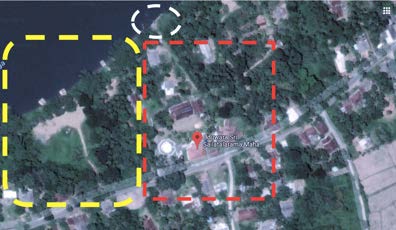
Figure 61.8: Areal view Uduwara fortress. The red area is the former fortress,
and the yellow area is the harbor on the river flank; the white space is the staircase
leading to the river. In the fortress center is the Olupathage house, oriented in the
NWSE direction, contrary to the other buildings around. There was a typical square
in the fortress that was directed likewise. The cross-shaped structure resembles the
governor’s home at the Fortress of Graça in Elvas, Portugal. The gunpowder mill
was in the middle of the fortress. Given that it reached the Kalu Ganga River, it
must also have gone North beyond the area where there is a school at Uduwara.
Indeed, in and around the school where Shirani de Silva received her early education,
it is known that ancient constructions were located until the 1990s.
61.4.4.3
The Other Walls Depict the Story of the Arrival of the de Silva Family from Goa, Symbolized by an
Abundance of Head-Shaped Figurines
Besides the depiction of the seat of governance, there are also depictions of what happened before this, in Figures 61.23, 61.24 and
61.25. The unique and intriguing use of head figures, hence the term Olu in Olupathage, is prominently shown in Figures 61.26,
61.27, 61.28, 61.29 and 61.30, along with comparisons of style with Goa. It is particularly clear that the use of heads in Uduwara, on civil buildings, even exceeded the frequent appearance on religious constructions in Goa.
61.5 Style of the Sculptures on the House of the Heads
The artistic ornaments at Uduwara in Sri Lanka present a fascinating amalgamation of cultural and historical influences, particularly evident in the sculptural decorations. At the foundational levels of the construction, human heads, or Olu, are prominently featured, while the upper tiers are adorned with lion heads. This stratified arrangement symbolizes the heritage and hierarchical significance attributed to the first Carvalho de Silva family, who constructed the house. They ingeniously incorporated the traditional symbols of Olupathage (human heads) and augmented them with lion heads, signifying the de Silva family’s emblem (the crowned Lion).
The inclusion of a rose motif further signifies the Carvalho lineage.
Detailed illustrations and further exposition can be found in Chapter 61.4.4.1, Figures 54.44, 61.2, 61.20, 61.24, and 61.25. A thorough examination of the hairstyles depicted in the sculptures, collectively referred to as Olupathage (or Olu-Path-ge or Olu-Path-geddara), reveals significant insights into their chronological context.
The sculpted hairstyles are reminiscent of those found in the artworks of Caravaggio (1571-1610), characterized by their looser, less constrained appearance, which contrasts with the more confined and neat hairstyles depicted in Michelangelo’s works (1475-1564).
Caravaggio’s period, often considered a more ’bohemian’ era compared to the Renaissance austerity of Michelangelo, aligns well with the hair styling observed in Uduwara’s sculptures.
This stylistic analysis is further corroborated by comparisons to the naturalistic yet slightly wilder hairstyles of Bernini’s sculptures (1598-1680), as depicted in Figure 61.32. These comparisons suggest that the sculptures at Uduwara likely date back to around 1600, concurrent with the early Portuguese settlements along the Kalu Ganga, including Uduwara. While signs of repair and potential replacements are evident, the overall stylistic integrity points to this early 17th-century origin.
Chapter 61.4.4.3 further elucidates the stylistic parallels between the sculptured heads at Uduwara and those found at the Church of Bom Jesus in Goa, India. This comparative analysis is not just a side note, but a crucial part of our research. It underscores the cultural and historical linkages between the two sites, providing a broader context for understanding the artistic and architectural exchanges within the region during the period of Portuguese influence. This broader context is essential for fully grasping the significance of our findings and their implications.
61.6 Other Remaining Constructions on the Site
Most buildings on this site are either Portuguese or have been constructed similarly. Note the building next to the cross-like one where the Google Maps® label Uduwara Sri Sailatalarama Maha point points. This temple uses the facade of a Portuguese church.
At some point in history, probably when the VOC controlled the area, and Catholics were forced to convert to Protestantism or Buddhism, the church must have been used for different purposes or was even destroyed. The facade remained, and Roman Catholic signs were removed. Nowadays, the facade shows the British heraldic symbols of the lion with the unicorn and others. The sun, the moon, and a temple are more challenging signs to interpret in their historical context. We assume that the sun was there originally.
The other symbols were added later during the many conversions from the Roman Catholic church to perhaps an administrative building during the British era and then to a Buddhist temple.
Interestingly, the church’s facade reveals the original church’s unique architectural features. The facade is in the SSE direction,
© 2024 Nico F. Declercq
The Desclergues of la Villa Ducal de Montblanc, 2nd ed., Omn., VOL. IV
61.6. OTHER REMAINING CONSTRUCTIONS ON THE SITE
1165
Figure 61.9: This is a compilation of images taken at the fortress of Uduwara. Towards the river is a modern staircase that dates back to around 1900, when the fortress became a Buddhist temple. Before this, there may have been stairs or just a pathway. More critical is the remaining fortress wall, which the Portuguese constructed. The corner of the fortress with access to the Kalu Ganga is still splendid. As the water level depends on the season, the access platform on which the wall is built is sometimes immersed. Also, the remaining wall is still remarkable. One can also see that Carvalho de Silva built the fort on elevated ground. Granite foundation stones have also been used to pave the ground for stability during the war and trade during the Portuguese and later the VOC period. The author’s daughter’s shoes are shown in one of the photos to get a sense of the size of the granite foundation stones used for the construction. (Sri Lanka, 2019) (Declercq de Silva Archive)
The Desclergues of la Villa Ducal de Montblanc, 2nd ed., Omn., VOL. IV
© 2024 Nico F. Declercq
1166
CHAPTER 61. UDUWARA: THE ANCESTRAL VILLAGE OF SHIRANI DE SILVA IN SRI LANKA
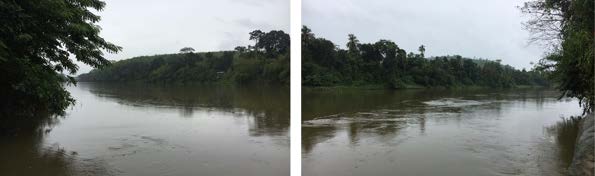
Figure 61.10: A view from Uduwara fortress on the Kalu Ganga River. Left is from West to East, right is from East to West. (Sri Lanka, 2019) (Declercq de Silva Archive)
Figure
61.11:
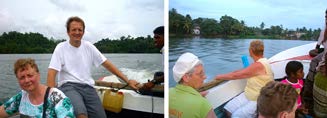
2007, a journey on
the Kalu Ganga River from Kalutara
to Uduwara, together with the author’s
mother, Nelly Maria Vangheluwe, fa-
ther, Maurice Declercq, foster mother
Jeanette Verbrugghe and grand-auntie Ma-
riette Vroman. Our captain was the son
of a cousin and is now a captain on large
sea ships after a fisherman’s education in
South Korea. (Declercq de Silva Archive)
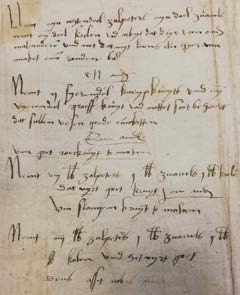
Figure 61.12: As a curiosity, this is a recipe for mak-
ing different types of gunpowder, possibly for fireworks or
for shooting small bullets. It was found in a Vorsterman
bible of 1532 in Nijmegen, the Netherlands, way before
the 80-year war between the Northern Netherlands and
Spain. The imperfect transcript is:
’ ’ Nemt eyn achtendeel zalpeters eyn deel zuavels nimt
eyn deel koolen unde arbyt dat drye uren onder malcan-
deren unde met dat mint bins dit hyer van maket enen
ronden bal en ander
Nemt II fyevendel kneypkruyts onder ende vyerendeel
groeff kruyt onder mettet soet behoert dat sullen vvesen
goede ruicketten. Een ander
om goet roerkruyt te maken Nemt VII lb zalpeters, I lb
zuavels, I lb koemen dat vyert goet kruyt.
Ein ander om slangen (a type of cannon) kruyt te maken
nemt III lb zalpeters i lb zuavels I lb kolen onder. Het
vyrt goet Deus asset nobis gratia (God’s grace is on our
side)’ ’ (Declercq de Silva Archive)
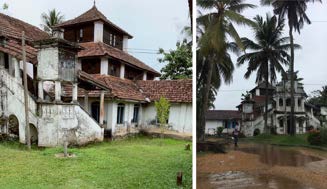
Figure 61.13:
A typical Portuguese
Colonial Mansion located at the Fortress of
Uduwara. Right, we see a front view (from
the East side) of this ’Olupath’ House.
Standing in front of it is the author’s
brother-in-law.
The building is loosely
based on the architecture of the Igreja de
Nossa Senhora da Imaculada Conceição at
Goa in India and the governor’s home at
the Fortress of Graça in Elvas in Portugal,
seen in Figure 61.15. (Sri Lanka, 2019)
(Declercq de Silva Archive)
© 2024 Nico F. Declercq
The Desclergues of la Villa Ducal de Montblanc, 2nd ed., Omn., VOL. IV
61.7. REMAINING PORTUGUESE HOUSES NEARBY
1167
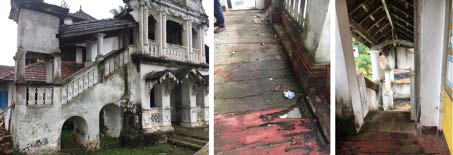
Figure 61.14: The shiny white building in the middle of the fortress, surrounded by green fields
and forests, must have been a formidable symbol of Portuguese status while it was operational.
The wooden planks probably survived a few hundred years after their construction but became wet
because of a lack of maintenance in the past decades, hence their deterioration. The roof, made
of strong tropical wood and Portuguese skill, is still the original. (Sri Lanka, 2019) (Declercq de
Silva Archive)
Figure 61.15: An aerial close-up of the building complex at the Fortress of Uduwara
shows the cross-shaped Olupathage building oriented NWSW. The white construction
on its right is a Buddhist pagoda (Courtesy of Google Maps®). The right photo
shows the cross-shaped governor’s home at the Fortress of Graça in Elvas, Portugal.
Just as in Uduwara, the central tower originally housed a gunpowder mill.
meaning the altar is pointed in the NNW direction. So one was facing the sun on the front if one was standing South and watching in the NNW direction. Note that the churches in Sri Lanka and India do not typically point in a specified orientation as they often do in Europe (regularly looking East).
The NNW direction is the direction to Goa in India, where the Portuguese extit ’Basílica do Bom Jesus’ is located having an altar with a large sun sculpture above, as seen in the image below. This unique architectural feature adds to the fascination of this historical site.
61.6.1 The Gate at Uduwara to resemble Goa
At Goa, an arch, in Figure 61.33, marks the entrance to the city from the river. Before the Portuguese arrived, an arch was already called the Adil Shah arch. It marked the entrance from the river to the Palace of Adil Shah. The Portuguese used the palace of Shah Adil as the governors’ residence until 1695, but it was, for an unknown reason, demolished by the government in 1820. The Portuguese built the Viceroy’s arch in 1599 to substitute that of Adil Shah. Also, at Uduwara, they made an arch that one had to pass through after ascending from the Kalu Ganga River bank. Uduwara served as a small copy of Goa.
The Viceroy’s arch in Figure 61.33 was built in 1599 to mark Goa’s Portuguese conquest by Governor Francisco da Gama in memory of his great-grandfather Vasco da Gama. On the riverside is a statue of Vasco da Gama; on the rear side is a statue of Santa Catarina.
It is speculated that the building adorned with the Salagama symbols was embellished at the onset of the VOC period with these symbols to signify to the Dutch that the village was Salagama and met the monopoly for Cinnamon trade as imposed by the VOC.
In essence, it was a display of status and concealment of their Karava origins, as being considered Karavas at that time would have been detrimental to their business. It’s worth noting that the Sun and Moon ornaments, also found at Goa, as depicted in Figures
61.34 and 61.35, further underscore the architectural similarities between Uduwara and Goa.
A more detailed examination of the Uduwara arch is presented in Figures 61.34, 61.35, 61.36 and 61.37.
61.6.2 Other Noteworthy items
Other noteworthy items found on the Uduwara fortress site are shown in Figures 61.38, 61.39, 61.40 and 61.41.
61.7 Remaining Portuguese houses nearby
In the village of Uduwara, in between modern homes, one can still find several Portuguese-style homes, some of which may be hundreds of years old. The colonial past can always be sensed. Impressions and comparisons are shown in Figures 61.41, 61.43,
The Desclergues of la Villa Ducal de Montblanc, 2nd ed., Omn., VOL. IV
© 2024 Nico F. Declercq
1168
CHAPTER 61. UDUWARA: THE ANCESTRAL VILLAGE OF SHIRANI DE SILVA IN SRI LANKA
Figure 61.16: In the middle of the gunpowder building in Uduwara (Sri Lanka, 2019), shown in the two upper left photos, there is a stage with a post that reaches the ceiling. This has functioned as a human or animal-driven grinding mill (also known as the Roman Mill), which has been well-known since the Roman period. The workers, the horse, cow, or donkey, would have walked on the stage floor, and in the middle, held by the metal post, would have been a vertical grinding wheel, spinning around a horizontal axis attached to and rotating around the metal post. The system is still used in rural areas in India. It may also have been a Moorish mill with a conical grinding stone, yet it was found in Spain (e.g., Millstone Oil Mill Alcazar Jerez de la Frontera Cadiz Andalucia Spain) and Morocco. In particular, the axis is held in place by the roof and the floor, around which a mill ran to make gunpowder. The sheer height provided sufficient fresh air to prevent dangerous fumes from building up during the long grinding process. The figure also shows a drawing of a horse-driven gunpowder mill. The horses marched on the floor on a stage around the mill’s vertical rotation axis, which had two vertical millstones. The model was used in the 17th century in the Spanish Netherlands (Belgium) and the Dutch States (The Netherlands). It created a tight melange of the ingredients used to make gunpowder by vertical millstones on a horizontal surface. Humans, animals, or by wind or water drove it. p Furthermore, photos are shown, taken in Goa in 2019, of millstone remains of a large gunpowder mill setup at the archaeological museum of Goa. The reconstruction is inaccurate as the solid rectangular wooden beams could never allow the stones to rotate, neither around their axis nor the central axis. Another view of the site is shown in Figure 61.16. Finally, an ancient drawing of a water-driven Blackpowder mill is equally shown (Courtesy of Villorio Zonca, ’Novo Teatro de machine et edifice,’ 17th century p). A modern version is shown in Figure 61.17
Figure 61.17: A modern, electric driven, cast-iron blackpowder mill,
made by Krupp. p 196 of Antonio de Carvalho et al. a
aAntonio de Carvalho Quintela, Joao Luis Cardoso, Jose Manuel Mas-
carenhas, Maria Da Conceiçao André, A fábrica da pólvora de Barcarena e
os seus sistemas hidráulicos, 1995
© 2024 Nico F. Declercq
The Desclergues of la Villa Ducal de Montblanc, 2nd ed., Omn., VOL. IV
61.7. REMAINING PORTUGUESE HOUSES NEARBY
1169
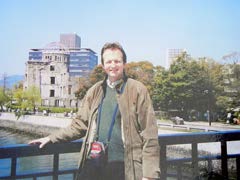
Figure 61.18: In 2004, Hiroshima, Japan, stood as a
reminder of a pivotal moment in warfare history. Alfred
Nobel’s 1860s invention of dynamite marked a signifi-
cant shift, eventually leading to the creation of nuclear
weapons. The uranium bomb, ’Little Boy,’ dropped on
Hiroshima by the plane ’Enola Gay’ on August 6, 1945,
showcased the devastating impact of such weaponry. Sub-
sequently, ’Fat Man,’ a plutonium bomb, was dropped on
Nagasaki on August 9. While the United States’ deci-
sion may have seemed justified from military and political
perspectives, the horrifying reality of innocent lives lost,
particularly children, remains difficult to comprehend. It
is a sincere hope that such weapons will never again be
utilized in warfare. (Declercq de Silva Archive)
Figure 61.19:
The left photo permits
a look inside one of the three branches
attached to the main square building in
Uduwara (Sri Lanka, 2019). The arch with
ornaments is Portuguese and can be com-
pared to the middle and right photos. The
middle is an ornament on a ceiling beam,
found upside-down at Goa in the garden
outside the Archeology Museum, while the
right photo shows the front of the basil-
ica of Bom Jesus (1594) with a clear view
of the used ornaments. (Goa, 2019) (De-
clercq de Silva Archive)
Figure 61.20: On the left, we see a symbolized compass on a building where St
Cajetan church is in Goa (Goa, 2019). The other images show three ornaments that
are apparent at the Uduwara fortress. Below are the human heads. On the pillar is
the compass needle, which refers to the Portuguese’ maritime blood, ’ and the lion
with a rose is at the top. The lion head symbolizes ’de Silva’ and the rose ’Carvalho.’
(Sri Lanka, 2019) (Declercq de Silva Archive)
The Desclergues of la Villa Ducal de Montblanc, 2nd ed., Omn., VOL. IV
© 2024 Nico F. Declercq
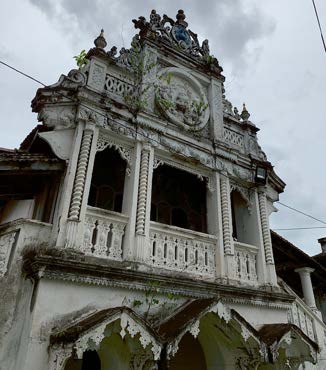
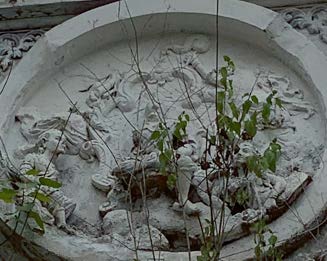
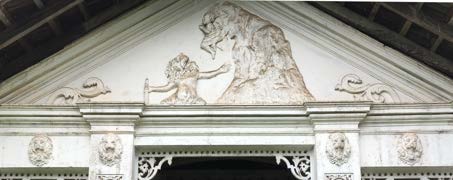
1170
CHAPTER 61. UDUWARA: THE ANCESTRAL VILLAGE OF SHIRANI DE SILVA IN SRI LANKA
Figure 61.21: Ornamented-Portuguese-
style-front of the building. Spiral pillars
are also used at the Palácio da Pena in Sao
Pedro de Penaferrim in Sintra, Portugal.
Spiral columns are prevalent throughout
Portugal, e.g., in front of Porto’s cathe-
dral, at the Praca do Municipio in Lisbon,
in Elvas in Alentejo, etc. Above all, they
appear in Monasteries in the Estremadura,
from where the de Silva’s originated. We
assume this building was polyvalent: court,
trade, and home. Note the peacock sym-
bol at the top and elsewhere on the facade.
Thirteen (3+3+7) heads are shown on the
front facade’s railing, representing Anto-
nio Carvalho de Silva’s first name. Indeed,
13 is a reference to Saint Antoni. (Sri
Lanka, 2019) (Declercq de Silva Archive)
Figure 61.22: A knight-like figure at the
top of the front wall is still clearly visible.
Perhaps this acted as a ’Solar.’ Neverthe-
less, the central figure is equal to one of the
sons, Antonio, of Juan Carvalho de Silva,
who was found in Goa. (Sri Lanka, 2019)
(Declercq de Silva Archive)
Figure 61.23: This image depicts the battle of Deewalkanda at Uduwara in 1595. The masked
person represents the warriors of Rayigam Chorale, such as ’Correa,’ while the person ’jumping’
or ’running’ off the hill to fight them was Samara de Coon y Rala, better known as ’Samarakoon.’
At first sight, Samarakoon may be regarded by the spectator as a child because of the proportion
of his head to his body. However, we know from Chapter 57.10 and from P.E. Peiris’s work2,
that Samarakoon had a large head and was famous for it. A sculptor would, therefore, purposely
expose this to clarify the identity of his artistic subject. (Sri Lanka, 2019) (Declercq de Silva
Archive)
© 2024 Nico F. Declercq
The Desclergues of la Villa Ducal de Montblanc, 2nd ed., Omn., VOL. IV
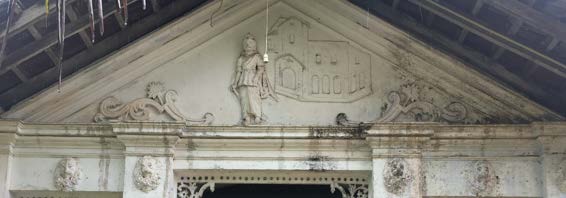
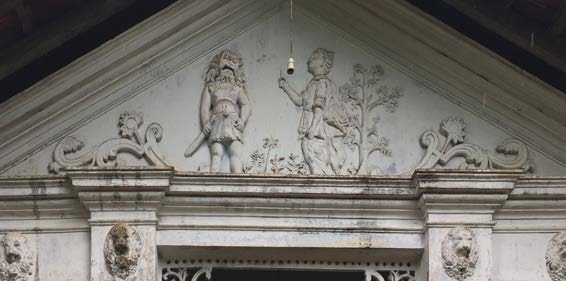
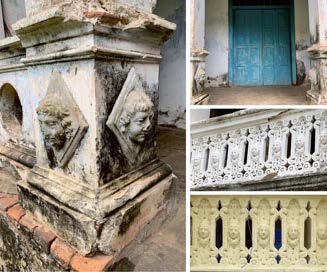
61.7. REMAINING PORTUGUESE HOUSES NEARBY
1171
Figure 61.24: This image depicts Dom Antonio Carvalho de Silva. He is wearing Indian-style clothes because he was born in India. To expose where he comes from, behind him is an image ex Memoriam of the Sé Catedral de Santa Catarina in Goa, in Portuguese India. The Lion’s heads stand for ’de Silva,’ the rose below for ’Carvalho.’ (Sri Lanka, 2019) (Declercq de Silva Archive)
Figure 61.25: This image shows Dom Carvalho de Silva confronting and negotiating with the Kotte Kingdom’s enemies, such as the warriors of Rayigam Chorale, depicted by a masked man. It represents the battle between the Portuguese and the Singhalese, which occurred before constructing the fortress of Uduwara. The person exposing a finger is again a son of Juan Carvalho de Silva, and the same is the one depicted in Goa. Note that the tree behind Dom Carvalho de Silva is, in fact, an oak tree and symbolizes his name, ’Carvalho.’ The Lion heads stand for ’de Silva.’ The rose below each lion sculpture symbolizes the heraldic shield of ’Carvalho.’ (Sri Lanka, 2019) (Declercq de Silva Archive) Figure 61.26: Head ornaments are found
everywhere on the construction at the
fortress of Uduwara. A couple of heads
have been refurbished. Still, most are orig-
inal and slightly worn by weather and his-
tory. Several layers of paint have protected
the original heads against South-West Sri
Lanka’s tropical climate. The fortress of
Uduwara looks like little Portugal. (Sri
Lanka, 2019) (Declercq de Silva Archive)
The Desclergues of la Villa Ducal de Montblanc, 2nd ed., Omn., VOL. IV
© 2024 Nico F. Declercq
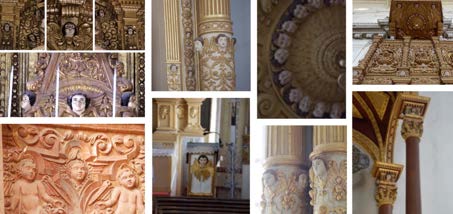
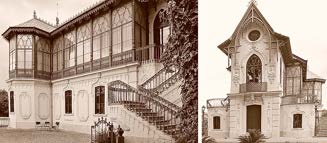
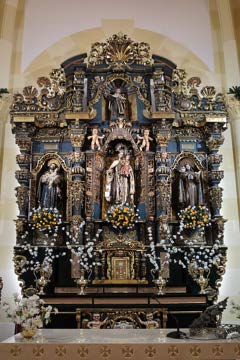
1172
CHAPTER 61. UDUWARA: THE ANCESTRAL VILLAGE OF SHIRANI DE SILVA IN SRI LANKA
Figure 61.27: Head sculptures are prevalent in all churches of old Goa, much more so than
in Iberia. In this compilation, images are shown, taken at different churches. Some denote
angels, while in Uduwara, only heads were sculptured, never wings. In the Basilica of Bom
Jesus, Baroque sculptured heads on the altar are seen, similar to the ones in Uduwara. Still,
the ones at Goa denote angels because they are accompanied by wings, in contrast to Uduwara.
Other examples are the Santa Monica Church of Goa (Institute Mater Dei Santa Monica Old
Goa 403402), the Santa Inez church, established in Goa in 1671, the St Cajetan church of
Goa, established approximately in 1650, and the Se Cathedral, established in 1615. (Goa, 2019)
(Declercq de Silva Archive)
Figure 61.28: The style used in Uduwara
even influenced Portuguese architecture of
the 19th century, as can be seen here in
an example of the house of Carlos Augusto
de Mascarenhas Relvas de Campos (1838-
1894), at Golegã, Portugal.
Figure 61.29: Similar heads as in Uduwara can also be found inside the church of
’Vallbona de les Monges,’ 12 km North of Montblanc, Spain. (Photo taken by César
Favà Monllau, PhD thesis, University of Barcelona, 2017, citation from page 435)
Figure 61.30: Interestingly, the heads can also be found
ten times on the altar at the Nuestra Señora del Carmen
church, at Salinas, in Asturias in Spain. Salinas was
where Honorato de Carvalho came from, married Maria
de Silva, and was the forefather of the de Silva branch we
describe here. More information can be found in Chapter
© 2024 Nico F. Declercq
The Desclergues of la Villa Ducal de Montblanc, 2nd ed., Omn., VOL. IV
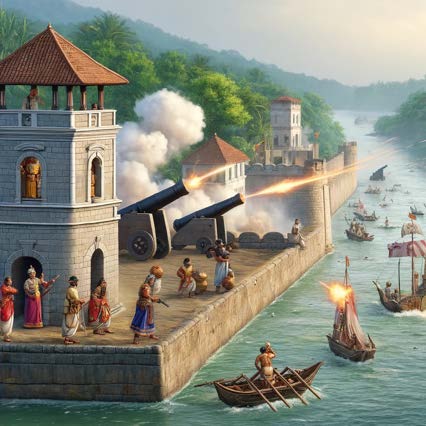

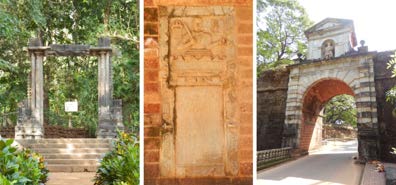
61.7. REMAINING PORTUGUESE HOUSES NEARBY
1173
Figure 61.31: A historical scene in Uduwara in a time of conflict. This image was made
with AI (DALL·E 2024-05-22 20.16.53).
Figure 61.32: The left compilation shows a comparison of a Caravaggio painting with two faces in Uduwara. The middle shows Caravaggio men and boys in comparison with a sculpture at Uduwara (with a self-portrait of Caravaggio in the middle-left). The compilation on the right shows Bernini faces (with a self portrait of Bernini in the middle).
Figure 61.33: On the left, we see Adil Shah’s arch at Goa’s gate, 50 m away from
the later-built Viceroy’s arch, which is oriented in the same direction as the palace’s
entrance from the river. On the right, we see the Viceroy’s arch with a statue of
Vasco da Gama and a plaque on the wall dating back to 1599. Even here, the Lambda
shapes are present. (Goa, 2019) (Declercq de Silva Archive)
The Desclergues of la Villa Ducal de Montblanc, 2nd ed., Omn., VOL. IV
© 2024 Nico F. Declercq
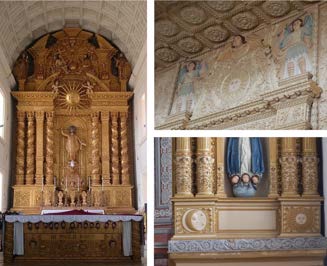
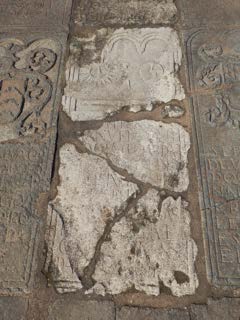
1174
CHAPTER 61. UDUWARA: THE ANCESTRAL VILLAGE OF SHIRANI DE SILVA IN SRI LANKA
Figure 61.34: The main altar of the Por-
tuguese ’Basílica do Bom Jesus’ in Goa,
India (constructed 1594-1605). Also, the
moon, the sun, and head sculptures are ev-
erywhere in the Santa Monica Church of
Goa (Institute Mater Dei Santa Monica
Old Goa 403402). (Goa, 2019) (Declercq
de Silva Archive)
Figure 61.35: Sun and moon symbols on a grave in the
Saint Augustin Church of Goa. (Goa, 2019) (Declercq
de Silva Archive)
© 2024 Nico F. Declercq
The Desclergues of la Villa Ducal de Montblanc, 2nd ed., Omn., VOL. IV
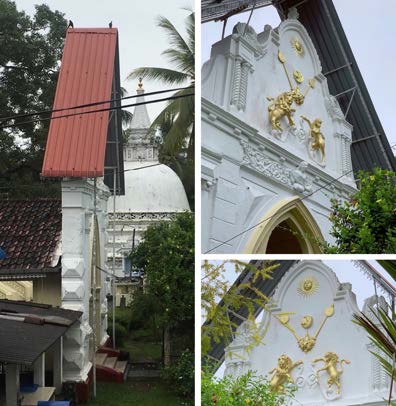
61.7. REMAINING PORTUGUESE HOUSES NEARBY
1175
Figure 61.36:
The old church facade is an architectural entity separated from
the later constructed building. Likely, the top carried a cross, and most symbols
on the facade were added after the Portuguese rule to meet its new functionalities.
Nowadays, the restored and beautifully gilded top of the old church’s facade shows the
likely British heraldic symbols of the Lion with the Unicorn - very likely, a heraldic
shield of the British was placed between them - together with the (probably original)
sun and moon, which are Salagama symbols, but also appear at Goa, as shown in
Figures 61.34 and 61.35, and pagoda with oars, Salagama too. A closer look at the facade of the old church reveals that the entrance is Iberian. The figure above the
entrance likely depicts the person who established the first church. (Sri Lanka, 2019)
(Declercq de Silva Archive)
The Desclergues of la Villa Ducal de Montblanc, 2nd ed., Omn., VOL. IV
© 2024 Nico F. Declercq
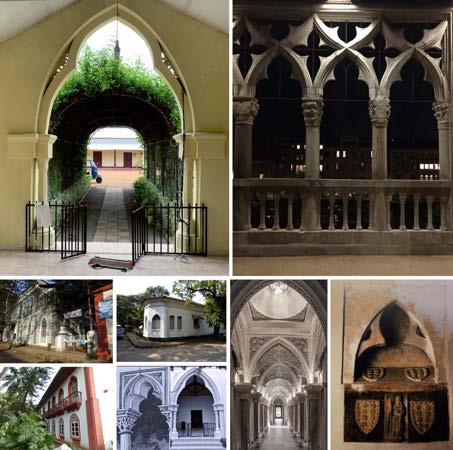

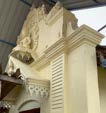
1176
CHAPTER 61. UDUWARA: THE ANCESTRAL VILLAGE OF SHIRANI DE SILVA IN SRI LANKA
Figure 61.37: The arch, situated in the top-left corner, is a captivating feature found within
the fortress of Uduwara. It stands as the remnants of a former church or chapel, with only the
gate, serving as a facade, remaining intact. A new construction has been erected behind it. The
distinct shape of the arch, a testament to its Iberian origins, is a fascinating detail. The building, in its excellent condition, was originally a Roman Catholic Church. It was later converted and
partially reconstructed into an administrative building during the British era, adding another
layer to its historical narrative. For comparison, a selection of other arches is shown. The
Ajimez-window in Valencia (before 1500), of which the outer arch is pure Gothic and appears in
the Portuguese flag castles, while the Moors influence the inner arch, clearly an Iberian and even
Portuguese style. We also show arches in Venice, Italy. Interestingly, a comparison with one of
three examples of ossuaries at Montblanc (Spain) is possible, where the same arch is used as in
Uduwara. It concerns the Ossera de la abadessa Constança de Llobets, inside the church of Santa
Maria de la Serra. Also fascinating to compare is the Monserrate Palace at Sintra in Portugal,
which has bows similar to those in Uduwara everywhere. We see such bows inside the palace,
but the gates to go outside also have them. The castle has a long history, and the architecture
is eclectic. Nevertheless, modern construction, as can be seen, dates back to the 19th century
only. However, it was inspired by ancient Portuguese structures influenced by Islam until the
11th century.6 (Declercq de Silva Archive)
Figure 61.38: A wall with frescos is dated
2458 on the Buddhist calendar, 1914; an-
other is dated 2444 on the Buddhist cal-
endar, 1900. The transformation to a
Buddhist monastery occurred during the
British era. (Sri Lanka, 2019) (Declercq
de Silva Archive)
Figure 61.39: A crowned figure is on top of another building at the fortress of
Uduwara. We assume that this building was constructed in recent times because the
architecture shows more British influences. The figure is crowned and probably repre-
sents a mythological figure from Buddhism or Sri Lankan history. (Sri Lanka, 2019)
(Declercq de Silva Archive)
© 2024 Nico F. Declercq
The Desclergues of la Villa Ducal de Montblanc, 2nd ed., Omn., VOL. IV
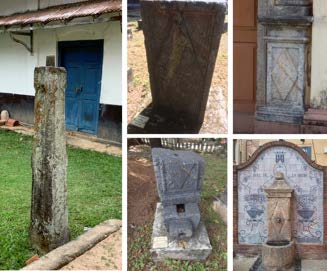
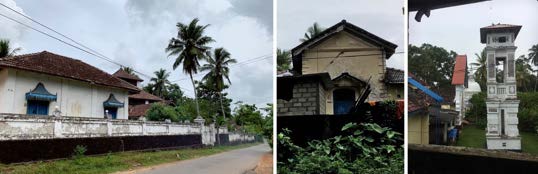
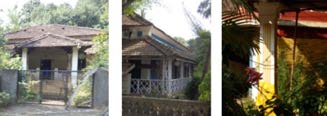
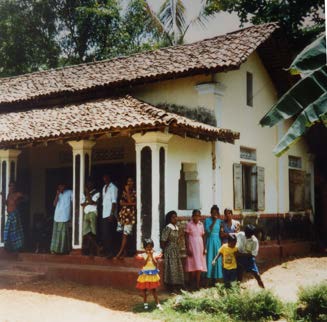
61.7. REMAINING PORTUGUESE HOUSES NEARBY
1177
Figure 61.40: Several granite pillars are
found on the site, remnants of an older
construction, probably from the Portuguese
period. The carved ornament is signifi-
cantly different from other posts found in
Sri Lanka. It’s not the exact parallelogram
often found in Iberia or Goa, but it’s prob-
ably inspired by it. Posts in Goa and a
fountain in Spain are also compared. (Sri
Lanka and Goa, 2019) (Declercq de Silva
Archive)
Figure 61.41: We get a view of the fortress from the street. The fort is very clearly an old Portuguese village.
The British paved the road and would not have crossed the fort during the Portuguese era, but it was an access road to the settlement. The yellowish building in this picture, located on the west side of the fortress, in between new constructions, is Portuguese. Besides the triangular neo-classical shapes, the appearance of corner reinforcement stones is also typically European. We can also observe a bell tower is located on the site. Its architecture looks different from the rest of the site. Therefore, it was constructed either at the end of the Portuguese period, the VOC period, or perhaps the British or later. An attempt was made to fit into the site’s style, but one must find a way to eliminate the differences. (Sri Lanka, 2019) (Declercq de Silva Archive)
Figure 61.42: Homes at Goa reminds the
reader of the house he visited in 1997, the
house of retired Mister Norbert, Justice of
the Peace at Uduwara. (Goa, 2019) (De-
clercq de Silva Archive)
Figure 61.43:
The old house of Olu-
pathage Peiris de Silva, Shirani’s grand-
father, at Uduwara, near the former
Portuguese Chapel ’Kapuella’ and within
walking distance from the former Por-
tuguese fortress. The picture was taken
in 1997. Unfortunately, the house was
destroyed in 2002. Note that the pillars
are ornamented almost equal to the gran-
ite ones found at the Uduwara fortress.
Also, a Swastika symbol was engraved on
the outer wall and was overpainted (hardly
visible in the image). This Roman sym-
bol, which also appears in Spain, may have
been a tradition since the early settlers
in Uduwara, as described elsewhere. Al-
though it’s also a symbol in India’s Arian
cultures, it’s typically only applied to tem-
ples, not homes. (Sri Lanka, 1997) (De-
clercq de Silva Archive)
The Desclergues of la Villa Ducal de Montblanc, 2nd ed., Omn., VOL. IV
© 2024 Nico F. Declercq
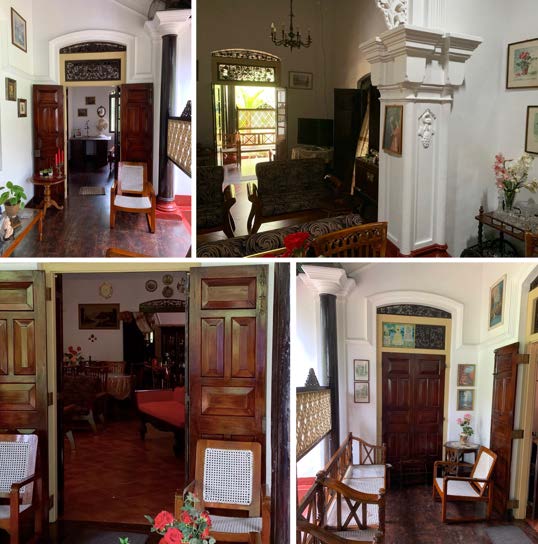
1178
CHAPTER 61. UDUWARA: THE ANCESTRAL VILLAGE OF SHIRANI DE SILVA IN SRI LANKA
Figure 61.44: Uduwara, the house, and the patio exude colonial charm. In this tranquil setting, Sri Lankans often enjoy Arack, a traditional local spirit accompanied by ’tapas’—a custom likely inherited from Portuguese colonial influences. In this context, the term ’tapas’ may refer to a variety of small dishes, similar to the Spanish tradition where ’tapas’ are small appetizers or snacks typically served with drinks. In Portugal, these small plates are known as ’petiscos’ and are enjoyed similarly. The integration of this cultural practice illustrates the blending of culinary traditions brought about by historical colonial exchanges. (Sri Lanka, 2019) (Declercq de Silva Archive)
© 2024 Nico F. Declercq
The Desclergues of la Villa Ducal de Montblanc, 2nd ed., Omn., VOL. IV
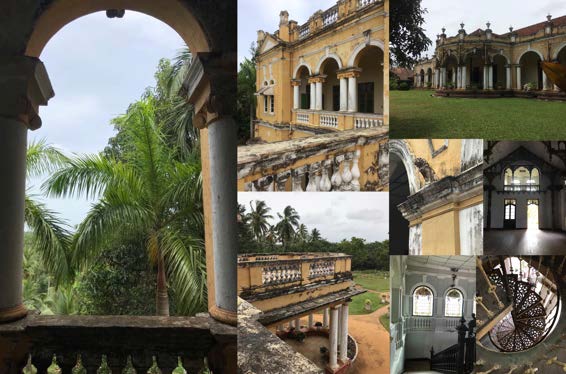
Chapter 62
Richmond Castle at Kalutara
62.1 Introduction
The name and DNA analysis on relatives show that Appuhamilage Arthur de Silva, who constructed this charming castle on the Kalu Ganga River at Kalutara, is a distant blood-relative of Shirani de Silva. Although it concerns a small court, despite what local guides tend to claim, it’s ideally located on the river’s left bank, where it catches a sweet ocean breeze and offers a beautiful inland view. The court requires urgent professional restoration, while a stylish additional construction should be built as a cafeteria for visitors. It’s a place of potential, but we noticed that, in 2019, it was disintegrating.
62.2 Appuhamilage Arthur de Silva Constructed It
Figure 62.1: Richmond Castle, built by Arthur de Silva in Kalutara in 2019, is in an excellent location and splendid architecture. Apart from the Lion, the symbol of ’de Silva,’ a Victorian staircase, and a ventilation system adjusted to the tropical climate are also present. (Declercq de Silva Archive)
The reader can find in Part XV that Shirani de Silva is blood-related to A. Arthur de Silva. In particular, a blood relationship between Shirani de Silva and this N. D. A. Silva Wijayasinghe is proven in Chapter 74 about autosomal DNA-analysis (39 centiMorgans in common, 9494 matching SNP’s).
With its Majestic view of the river, shown in Figure 62.2, the castle was constructed between the former Fortress of Kalutara and Uduwara, along the Kalu Ganga. It was erected by Appuhamilage Arthur de Silva, also known as Nanayakkara Rajawasala Appuhamilage Don Arthur de Silva Wijesinghe Siriwardana or as N. D. A. Silva Wijayasinghe. He was born on November 12, 1889
or 1888, at Kollupitiya and died childless on July 8, 1947, at Kandy. He was the Padikara Mudaliar of Kalutara and was educated at St. Thomas College in England. The castle was first used in 1910. The small villa has 16 rooms, 99 doors, and 38 windows.
Arthur de Silva was married in 1910 to Clarice Matilda Maude Suriyabandara. His father was Paulis de Silva. His grandfather was N. D. P. de Silva; his grandmother was Dona Isabella de Silva, who passed away on November 17, 1822, at 56. When Arthur de Silva passed away in 1947, he was buried at the Colombo General Cemetry of Borella. The grave states:
’To the memory of Grand Chevalier N. D. A. de Silva Wijayasinghe, the Padika Mudliyer, Knight Grand Commander of the Holy Sepulchre order, Knight Grand Commander of the Order of St Sylvester.’
The grave is indicated as ’Grant Nr 188/499, Location 2 PC 14, Number 247647, date 10.7.1947, Name N. W. A. de Silva Wi-jaysinghe, date of birth 8.7.1947, receipt nr 2685, age 59, occupation Padikara Mudali, Roman Catholic RC Section.’ Being of a noble and wealthy family, Arthur and his brother studied in Great Britain. He became a friend of the Maharaja of Ramnad. After the studies, he visited the Maharaja, was quite impressed by his friend’s mansion, and expressed his interest in building a look-alike in Sri Lanka. Upon arriving in Sri Lanka, Arthur was appointed the ’Head of Mudaliyars’ of the Kalutara region. There were 12
The Desclergues of la Villa Ducal de Montblanc, 2nd ed., Omn., VOL. IV
© 2024 Nico F. Declercq
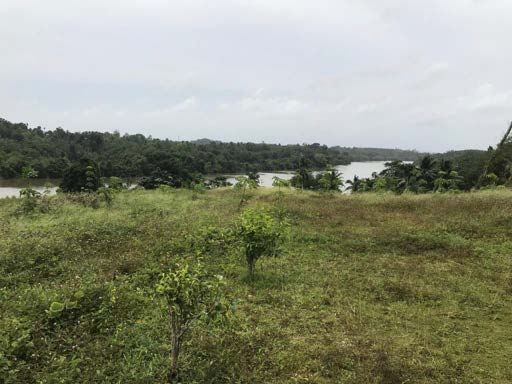
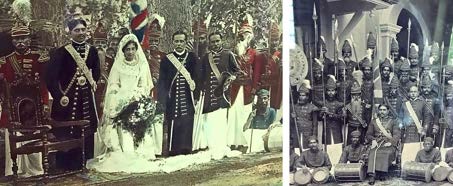
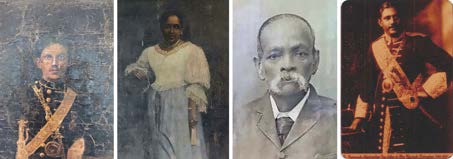
1180
CHAPTER 62. RICHMOND CASTLE
Figure 62.2: Arthur de Silva built Richmond Castle in Kalutara. From the castle, the Kalu Ganga River
can be seen. Imagine the sunrise behind those distant forests near Uduwara. (Sri Lanka, 2019) (Declercq de Silva Archive)
Figure 62.3: The left is Arthur de Silva’s 1910 wedding to Clarice Matilda Maude Suriyaban-
dara. The right shows Arthur de Silva seated in the middle.
Figure 62.4: Pictures of paintings found at the castle are shown from left to right. We see
Arthur de Silva, his mother, and his father, Paulis de Silva. Note that the ornament on his head
was typical for the Salagama and Karava castes. Indeed, Arthur’s ancestors were also Cinnamon
cultivators and traders. Finally, a picture of Arthur de Silva is shown from the Declercq de Silva
Archive.
© 2024 Nico F. Declercq
The Desclergues of la Villa Ducal de Montblanc, 2nd ed., Omn., VOL. IV
62.3. THE BRITISH PRESENCE IN INDIA AND SRI LANKA
1181
Mudalis working under him and 40 Sentinels-in-Attendance. The Prince and Princess of Wales attended the wedding of Mudaliyar and Clarice Maud Sooriya Bandara.
Being a Christian, the marriage occurred at the Infant Jesus Church in Kalamulla, Kalutara.
Personalities and events in the life of Arthur de Silva are shown in Figures 62.3 and 62.4.
His castle, commonly known as ’Richmond Castle,’ with a beautiful view of the Kalu Ganga River while always enjoying a soft sea breeze, is shown in Figure 62.1.
62.3 The British Presence in India and Sri Lanka
To understand why Appuhamilage Arthur de Silva would have constructed a typical British colonial mansion in the early 1900s while Sri Lanka was, as a matter of fact, occupied by the British, a little bit of history is required in which one should distinguish the early British rule through the East India Company and the later rule through the Crown.
The British presence in India began with the establishment of the East India Company (EIC) in the early 17th century. Chartered by Queen Elizabeth I in 1600, the EIC was initially a commercial entity focused on trade, particularly in spices, silk, cotton, tea, and opium. Over time, however, the EIC transitioned from a trading company to a powerful political entity, establishing control over large swathes of the Indian subcontinent.
62.3.1 The East India Company and Its Rule
A combination of military conquest and political manipulation marked the EIC’s dominance. The company secured control over Bengal, Bihar, and Orissa through victories in key battles such as the Battle of Plassey (1757) and the Battle of Buxar (1764). This era saw the implementation of policies that heavily favored British economic interests, often to the detriment of local economies and populations. The EIC established a complex system of administration and taxation, often employing brutal methods to extract revenue.
The company’s administration, however, was marred by widespread corruption, inefficiency, and exploitation. Famines, such as the Great Bengal Famine of 1770, exacerbated by mismanagement, resulted in the deaths of millions. The company’s oppressive policies and disregard for local customs and traditions eventually culminated in the Indian Rebellion of 1857, mentioned in Figure
62.5. This uprising, also known as the Sepoy Mutiny, was a significant turning point, revealing the profound discontent among various sections of Indian society.
62.3.2 Transition to Crown Rule
The rebellion prompted the British Crown to reevaluate its relationship with India. Recognizing the need for a more stable and humane governance structure, Queen Victoria issued the Royal Proclamation of 1858, which marked the dissolution of the EIC and the transfer of its powers to the British Crown. This proclamation promised to respect the rights of Indian princes, acknowledge the importance of Indian traditions and customs, and ensure justice and equality under British law.
Under Crown rule, India was administered directly by the British government, with a Viceroy representing the monarch. As this period of direct governance was known, the British Raj lasted until India’s independence in 1947. The Raj brought significant infrastructural developments, such as expanding the railway network, establishing telegraph lines, and improving irrigation. However, British economic policies prioritized British interests, leading to exploitation and underdevelopment in many sectors of the Indian economy.
62.3.3 British Rule in Sri Lanka: A Separate Entity
The EIC’s role in Sri Lanka was mainly as an agent of the British Crown during the initial takeover from the Dutch. However, the governance of Ceylon quickly transitioned to direct Crown control rather than being administered by the EIC. By 1802, following the Treaty of Amiens, Ceylon was officially declared a British Crown colony, separate from British India, which remained under EIC control until 1858.
While India was the jewel in the Crown of the British Empire, Sri Lanka (then known as Ceylon) was treated as a separate colony.
British control over Sri Lanka began in 1796, and by 1815, they had complete control following the defeat of the Kingdom of Kandy.
Several factors contributed to the British decision to administer Sri Lanka separately from India:
62.3.3.0.1 Geopolitical and Strategic Considerations Sri Lanka’s strategic position in the Indian Ocean made it a crucial point for maritime routes. The British maintained separate administrative control to ensure direct oversight of this vital location, essential for the protection of naval routes and for maintaining British naval dominance.
62.3.3.0.2 Economic Interests Sri Lanka’s economy was primarily driven by plantation agriculture, particularly tea, coffee, and rubber. The British established a plantation economy that was distinct from the broader economic strategies applied in India.
This specialization warranted a different administrative approach tailored to the unique economic activities of the island.
62.3.3.0.3 Cultural and Ethnic Diversity Sri Lanka had a distinct cultural and ethnic composition, with significant differences from mainland India. The British administration recognized these differences and opted for a separate colonial administration to better manage the local population and mitigate potential conflicts.
62.3.3.0.4 Colonial Administration Efficiency Administering Sri Lanka as a separate entity allowed for more focused governance. The British aimed to implement policies specific to the local context, facilitating more effective control and exploitation of resources.
The Desclergues of la Villa Ducal de Montblanc, 2nd ed., Omn., VOL. IV
© 2024 Nico F. Declercq
CHAPTER 62. RICHMOND CASTLE
62.3.4 Richmond Castle Expressed Harmony
The British administration in India and Sri Lanka differed significantly due to various strategic, economic, and cultural factors.
Unlike India, Sri Lanka had not suffered unt he the East Indian Company and was, therefore, less hostile towards the British. The EIC’s initial rule in India set the stage for British colonial governance, characterized by economic exploitation and administrative control, which continued under the British Raj. In contrast, Sri Lanka’s separate colonial administration reflected the British emphasis on strategic maritime control and the unique economic model of plantation agriculture. These differences underscored the British’s varied approaches to maintaining their empire across different regions, adapting to local conditions to maximize their colonial objectives. Ceylon, while being the jewel of the British Crown, was a sweet spot for constructing a Richmond Castle by a Sri Lankan.
© 2024 Nico F. Declercq
The Desclergues of la Villa Ducal de Montblanc, 2nd ed., Omn., VOL. IV
62.3. THE BRITISH PRESENCE IN INDIA AND SRI LANKA
1183
Figure 62.5: Left: Lakshmibai, the Rani of Jhansi (1828-1858).
Lakshmibai, born Manikarnika Tambe on November 19, 1828, in Varanasi, India, was the queen consort of Jhansi and one of the most prominent figures in the Indian Rebellion of 1857. Known for her courage, strategic acumen, and leadership, she became a symbol of resistance against British colonial rule. In 1842, she married Maharaja Gangadhar Rao Newalkar of Jhansi. After his death in 1853, under the Doctrine of Lapse, the British East India Company refused to recognize the Maharaja’s adopted son, Damodar Rao, as the rightful heir and annexed Jhansi. Lakshmibai’s refusal to cede Jhansi to British control led her to play a pivotal role in the rebellion.
When the uprising began in 1857, Rani Lakshmibai assumed a leading role, organizing her forces and successfully defending Jhansi against British attacks. However, the city fell to the British in 1858. She fled to Kalpi, joined forces with other rebels, and eventually regrouped in Gwalior. On June 18, 1858, during a fierce battle near Gwalior, Lakshmibai fought valiantly against the British forces. According to accounts, she was mortally wounded while leading her troops dressed as a cavalry leader. To prevent the British from capturing her body, she instructed a hermit to burn it. Her death marked a significant moment in the struggle for Indian independence.
The historical context of the battle in which Lakshmibai died is rooted in the wider Indian Rebellion of 1857, a major, unsuccessful uprising against British rule. The revolt had various underlying causes, including political, economic, and social grievances. Rani’s leadership and valor made her an enduring symbol of resistance and an inspiration for future generations of Indian nationalists.
Right: Jhanis, 2023, the author, and Radha Charan Gupta, born in 1935 in Gursarai, Jhansi. Gupta is a distinguished Indian mathematics historian known for his extensive contributions to the field. An alumnus of the University of Lucknow, Gupta completed his bachelor’s degree in 1955 and his master’s degree in 1957. He earned his Ph.D. in the history of mathematics from Ranchi University in 1971, under the guidance of T.A. Sarasvati Amma. His academic career includes a professorship at Birla Institute of Technology, Mesra, where he served from 1958 until retirement in 1995 as Emeritus Professor of History of Mathematics and Logic.
Gupta is renowned for his work on Indian mathematical history, including studies on interpolation techniques and the works of mathematicians like Govindasvamin and Paramesvara. His notable publications include a comprehensive collection of his research papers titled Gait¯ananda: Selected Works of Radha Charan Gupta on History of Mathematics.
Throughout his career, Gupta has received numerous accolades, including the prestigious Kenneth O. May Prize in 2009, making him the first Indian recipient of this honor. In 2023, the Government of India awarded him the Padma Shri for his contributions to literature and education. A passionate historian and mathematician, Gupta’s work has significantly advanced the understanding of India’s rich mathematical heritage. His dedication to history and mathematics inspires scholars and students alike. (Declercq de Silva Archive)
The Desclergues of la Villa Ducal de Montblanc, 2nd ed., Omn., VOL. IV
© 2024 Nico F. Declercq
CHAPTER 62. RICHMOND CASTLE
© 2024 Nico F. Declercq
The Desclergues of la Villa Ducal de Montblanc, 2nd ed., Omn., VOL. IV
More Literature on the Portuguese and Sri Lanka
This literature list contains more references than those studied by the author and was formed with the help of one of Chandra R.
de Silva’s papers. 1
Abeyasinghe, T. “History as Polemics and Propaganda: An Examination of Fernão de Queiros History of Ceylon”, Journal of the Royal Asiatic Society, Sri Lanka Branch, new series, XXV (1980-81), pp. 28-69.
Abeyasinghe, T. “The myth of the Malvana Convention”, The Ceylon Journal of Historical and Social Studies, new series, XVII (1973), pp. 11-21.
Abeyasinghe, T. “Portuguese Rule in Kotte, 1594-1638”, in K. M. de Silva, ed., University of Peradeniya, History of Sri Lanka, vol. II, (Peradeniya, 1995).
Abeyasinghe, T. Portuguese Rule in Ceylon 1594-1612, (Colombo, 1966).
As Gavetas do Torre do Tombo, 10 vols. (Lisbon, 1960-1974).
Alakesvarayuddhaya, ed. A. V. Suraweera (Colombo, 1965).
Alden, Dauril The Making of an Enterprise: The Society of Jesus in Portugal. Its Empire and Beyond, 1540-1750 (Stanford, 1996).
Alguns Documentos da Torre do Tombo acerca das navegações e conquistas portuguezas, ed. Ramos Coelho (Lisbon, 1892).
Amerasingha, Risiman Aithihasika Sitawaka (Colombo, 1990).
Amerasingha, Risiman Sitawaka Rajadhaniye Unnathiyeda Avanathiyeda Samahara Ansha Pilibanda Vimarshanayak (Colombo, 1998).
Asgiri Talpatha, Mendis Rohanadheera, ed. (Colombo, 1997).
Biedermann, Zoltán “Tribute, Vassalage and Warfare in Early Luso-Lankan Relations (1506-1543)”, in Fatima Gracias, Celsa Pinto and Charles Borges, eds., Indo-Portuguese History: Global Trends. Proceedings of the XIth International Seminar on Indo-Portuguese History (Goa, 2005), pp. 185-206.
Bouchon, Geneviève “A propos de l‘Inscription de Colombo (1501). Quelques observations sur le premier voyage de João de Nova dans l’Océan Indien”, Revista da Universidade de Coimbra, XXVIII (1980), pp. 235-270.
Bouchon, Geneviève “Les Rois de Kotte au début du XVIe siècle”, Mare Luso-Indicum, 1 (1971), pp. 65-96.
Bugge Henriette and Rubiés, Joan Pau eds., Shifting Cultures: Interaction and Discourse in the Expansion of Europe (Munster, 1995)
Cartas de Afonso de Albuquerque, seguidas de documentos que as elucidam, ed. R. A. de Bulhão Pato, vol. 1 (Lisbon, 1884) Carter, John Ross “The Origin and Development of ‘Buddhism’ and ‘Religion’ in the study of Theravada Buddhist Tradition”, in On Understanding Buddhists: Essays on the Theravada Tradition in Sri Lanka (Albany, 1993), pp. 9-25.
Codrington, H. W. A Short History of Ceylon (London, 1947).
Constantino de Sa’s Maps and Plans of Ceylon, l624-1628, ed. E. Reimers (Colombo, 1929).
Correa, Gaspar, Lendas da India, 4 vols. (Lisbon, 1858-1866)
Culavamsa being the more recent part of the Mahavamsa, W. Geiger, trans., (London, 1930).
da Silva Cosme, O. M. Fidalgoes in the Kingdom of Kotte, Sri Lanka 1505-1656 (Colombo, 1990).
da Trindade, Paulo Chapters on the Introduction of Christianity to Ceylon taken from the Conquista Espiritual do Oriente of Friar Paulo do Trindade, trans. Edmund Pieris and Achilles Meersman (Colombo, 1972).
1Chandra R. de Silva, "Portugal and Sri Lanka: The Historiography Today", April 20, 2021.
The Desclergues of la Villa Ducal de Montblanc, 2nd ed., Omn., VOL. IV
© 2024 Nico F. Declercq
CHAPTER 63. MORE LITERATURE ON THE PORTUGUESE AND SRI LANKA
da Trindade, Paulo Conquista Espiritual do Oriente, 3 vols. (Lisbon, 1960-1967).
de Castanheda, Fernão Lopes, História do Descobrimento e Conquista da India pelos Portugueses, 9 vols. (Coimbra 1924-1933).
de Silva, C. R. “Algumas reflexões sobre o impacto português na religião entre os Singaleses durante os séculos XVI e XVII”, Oceanos, 34 (1998), pp. 104-116.
de Silva, C. R. “Beyond the Cape: The Portuguese Encounter with the Peoples of South Asia”, Implicit Understandings: Observing. Reporting, and Reflecting on the Encounters between Europeans and Other Peoples in the Early Modem Era, Stuart B.
Schwartz, ed.,(Cambridge, 1994), pp. 295-322.
de Silva, C. R. “Portuguese Interactions with Sri Lanka and the Maldives in the Sixteenth Century: Some Parallels and Divergences”, Sri Lanka Journal of the Humanities, XXVII & XXVIII (2001-2002), pp. 1-23.
de Silva, C. R. “The First Visit of the Portuguese to Ceylon 1505 or 1506?”, in Indrapala Prematilleke and Lohuizen van Leeuw, eds., Senerath Paranavithana Commemoration Volume (Leiden, 1978), pp. 218-220.
de Silva, C. R. “The Kingdom of Kotte and its Relations with the Portuguese in the Early Sixteenth Century”, in E. C. T.
Candappa and M. S. S. Fernandopulle, eds., Don Peter Felicitation Volume (Colombo, 1983), pp. 41-42.
de Silva, C. R. “The Historiography of the Portuguese in Sri Lanka: A Survey of the Sinhala Writings”, Samskrti XVII (1983), pp. 13-22.
de Silva, C. R. The Portuguese in Ceylon 1617-1638 (Colombo, 1972).
de Silva, C. R. “The Portuguese Revenue Register of the Kingdom of Kotte, 1599 by Jorge Florim de Almeida”, The Ceylon Journal of Historical and Social Studies, V (1975) pp. 69-153.
de Silva, C. R. “Sri Lanka in the early 16th century: economic and social conditions”, in K. M. de Silva, ed., the University of Peradeniya, History of Sri Lanka, vol. II, Peradeniya, 1995, pp. 11-36.
de Silva, C. R. and de Silva, D. “The History of Ceylon (circa 1500-1658). A historiographical and bibliographical survey”, The Ceylon Journal of Historical and Social Studies, new series, III (1973), pp. 52-77.
de Silva, Daya, “A bibliography of manuscripts relating to Ceylon in the archives and libraries of Portugal”, Boletim International de Bibliografia Luso-Brasileira, VIII (1967), pp. 533-552, 647-675; IX (1968), pp. 84-157, 499-527.
de Silva, Daya, The Portuguese in Asia: An Annotated Bibliography of Studies on Portuguese Colonial History in Asia 1498-c.
1800 (Zug, 1985).
de Silva Jayasuriya, Shihan Tagus to Taprobane: Portuguese Impact on the Socio-Culture of Sri Lanka from 1505 (Dehiwala, 2001).
de Queyroz, Fernão, Conquista Temporal e Espiritual de Ceylão (Colombo, 1916).
de Queyroz, Fernão, The Temporal and Spiritual Conquest of Sri Lanka, S. G. Perera trans., (Colombo, 1930).
do Couto, Diogo and de Barros, Joao, Decadas da Asia, 24 vols. (Lisbon 1777-88).
Documenta Indica, ed. José Wicki, 14 vols. (Rome, 1948-1979).
Documentação para a História dqs Missões do Padroado Português do Oriente. Índia, ed. António da Silva Rego, 12 vols.
(Lisbon, 1947-1958).
Documentos sobre os Portugueses em Moçambique e na África Central, 1497-1540/Documents on the Portuguese in Mozambique and Central Africa, 1497-1540, vol. III, (Lisbon, 1964).
Don Peter, W. L. A. Education in Sri Lanka under the Portuguese (Colombo, 1978).
Everaert, J. “Soldiers, Spices and Diamonds: Northerners in Portuguese India 1505-1590”, in Anthony Disney and Emily Booth, eds., Vasco da Gama and the Linking of Europe and Asia (New Delhi, 2000), pp. 84-104.
Ferguson, D. W., “The Discovery of Ceylon by the Portuguese in 1506”, Journal of the Ceylon Branch of the Royal Asiatic Society, XIX (1907), pp. 321- 385.
Flores, Jorge Manuel “ A ‘Gift from the Divine Hand’: Portuguese Asia and the treasures of Ceylon”, in Helmut Trnek and Nuno Vassallo e Silva, eds., Exotica. The Portuguese Discoveries and the Renaissance Kunstkammer, Exhibition Catalogue (Lisbon, Calouste Gulbenkian Museum, 2001) pp. 81-92.
Flores, Jorge Manuel, Os Olhos do Rei: Desenhos e Descrições Portuguesas da Ilha de Ceilão (1624, 1638) (Lisbon, 2001).
© 2024 Nico F. Declercq
The Desclergues of la Villa Ducal de Montblanc, 2nd ed., Omn., VOL. IV
Flores, Jorge Manuel, Os Portugueses e o Mar de Ceilão, 1498-1543: Trato, diplomacia e guerra (Lisbon, 1998).
Flores, Jorge Manuel, Hum Curto Historia de Ceylan: Five Hundred Years of Relations between Portugal and Sri Lanka (Lisbon, 2000).
Franciscans and Sri Lanka, ed. W. L. A. Don Peter (Colombo, 1983).
Goonewardena, K. W. “Dutch Policy towards Buddhism in Sri Lanka: Some Aspects of its Impact”, in K. M. de Silva, Sirima Kiribamune and C. R. de Silva, eds., Asian Panorama: Essays in Asian History (New Delhi, 1990), pp. 319-352.
Goonewardena, K. W. Foundations of Dutch Rule in Ceylon (Amsterdam, 1958).
Gunawardane, Philip Sitawka Urumaya (Colombo, 1973).
Holt, John C. Buddha in the Crown: Avalokiteswara in the Buddhist Traditions of Sri Lanka (New York, 1991).
Holt, John C. The Buddhist Vishnu: Religious Transformation, Politics and Culture (New York, 2004).
Holt, John C. “The Persistence of Political Buddhism”, in Tessa Bartholomeusz and Chandra R. de Silva, eds., Buddhist Fundamentalism and Minority identities in Sri Lanka (Albany, 1998), pp. 192-194.
Ilangasinha, B. M. Buddhism in Medieval Sri Lanka (New Delhi, 1992).
Jackson, Kenneth David De Chaul a Batticaloa. As Marcas do Império Português na Índia e no Sri Lanka (Ericeira, 2005).
Jackson, Kenneth David Sing Without Shame: Oral Traditions in Indo-Portuguese Creole Verse (Amsterdam and Macau, 1990).
Journal of Spilbergen: The First Dutch Envoy to Ceylon, 1602, ed. K. D. Paranavitana (Colombo, 1997).
Kustantinu Hatana, ed. S. G. Perera and M. E. Fernando (Colombo, 1932).
Maha Hatana, ed. T. S. Hemakumar (Colombo, 1964).
Malalgoda, K. ‘Concept and Confrontations: A Case Study of agama” in Michael Roberts, ed., Collective Identities Revisited, vol. 1 (Colombo, 1997), pp. 55-78.
Matatakkalappu Manmiyam, ed. F. X. C. Nadarajah (Colombo, 1962).
Mirando, A. H. Buddhism in Sri Lanka in the 17th and 18th Centuries (Dehiwala, 1985).
Paranavitana, Senerat “The Emperor of Ceylon at the time of the arrival of the Portuguese in AD 1505”, University of Ceylon Review, XIX (1961), pp. 10-29.
Perera, S. G. A History of Ceylon, revised by Fr. V. Perniola (Colombo, 1955).
Perera, S. G. History of Ceylon: The Portuguese Period 1505-1656 (Colombo, 1932).
Perera, S. G., ed. and trans., The Tombo of the Two Korales, (Colombo, 1938).
Pieris P. E. ed., The Ceylon Littoral 1593, (Colombo, 1949).
Pieris P. E. ed., The Kingdom of Jaffnapatam, 1645, (Colombo, 1920).
Pieris P. E Ceylon: The Portuguese Era being the History of the Island for the Period 1505-1658, 2 vols. (Colombo, 1913-1914) Pieris P. E. ed., “Kiraveli Pattuva, 1614”, Journal of the Royal Asiatic Society (Ceylon Branch), XXXVI/100 (1945), pp. 141-185.
Portuguese Regimentos on Sri Lanka, ed. T. Abeyasinghe (Colombo, 1975).
Prakash, Om Bullion for Goods: European and Indian Merchants in the Indian Ocean Trade 1500-1800 (Delhi, 2004).
Queré, M. “Beginnings of the Portuguese Mission in the Kingdom of Kotte”, Aquinas Journal, V (1988), pp. 80-85.
Queré, M. Christianity in Sri Lanka under the Portuguese Padroado, 1597-1658 (Colombo, 1995).
Queré, M. “Christianity in the Kingdom of Kotte in the First Years of Dharmapala’s Reign, 1551-1555”, Aquinas Journal, V
(1988), pp. 160-165.
Queré, M. “Christianity in the Kingdom of Kotte during Dharmapala’s reign, 1558-1597”, Aquinas Journal, VI (1989), p. 70-78.
Rajasiha Hatana, ed. Ellepola H. M. Somaratna, ed. (Kandy, 1966).
The Desclergues of la Villa Ducal de Montblanc, 2nd ed., Omn., VOL. IV
© 2024 Nico F. Declercq
CHAPTER 63. MORE LITERATURE ON THE PORTUGUESE AND SRI LANKA
Rajavaliya, ed. A. V. Suraweera (Colombo, 1976).
Rajavaliya, trans. B. Gunesekera, (Colombo 1900).
Rambukwelle, P. B. The Period of Eight Kings (Colombo, 1996).
Roberts, Michael Caste Conflict and Elite Formation: The Rise of a Karava Elite in Sri Lanka 1500-1950 (Cambridge, 1982).
Roberts, Michael Sinhala Consciousness in the Kandyan Period, 1590s to 1815 (Colombo, 2004).
Rogers, John D. “Post-Orientalism and the Interpretation of Pre-Modern and Modem Political Identities: The Case of Sri Lanka”, Journal of Asian Studies, 53 (1994), pp. 10-23.
Ribeiro, João, Fatalidade Histórica da Ilha de Ceilão, (Lisbon, 1836).
Rohanadheera, Mendis Dharma Parakramabahu: Prutugeeseen Mawu, Sinhale Vyaja Raajayaa ([Colombo], 1997).
Rohanadheera, Mendis 1506 Parangiya Gaalu Giya: Ithihasakarana Drushtikonayaki ([Colombo], 1999).
Rohanadheera, Mendis “Revised Chronology of Sri Lankan Rulers, circa 1500 AD: A Historiographical Perspective”, in R. A. L. H.
Gunawardana et al, eds., Reflections on a Heritage: Historical Scholarship on Early Modern Sri Lanka (Colombo, 2000), pp. 255-282.
Sitawaka Hatana, ed. Rohini Paranavithana (Colombo, 1999).
Somaratne, G. P. V. The Political History of the Kingdom of Kotte, 1400-1521 (Colombo, 1975).
Strathern, Alan “Re-reading Queiros: Some Neglected Aspects of the Conquista”, Sri Lanka Journal of the Humanities, XXVI (2000), pp. 1-28.
Strathern, Alan “Theoretical Approaches to Sri Lankan History and the Early Portuguese Period”, Modern Asian Studies, 38
(2004), pp. 190-226.
Subhramanyam, Sanjay “Iranians Abroad: Intra-Asian Elite Migration and Early Modem State Formation”, The Journal of Asian Studies, 31 (1992), pp. 340-363.
The Catholic Church in Sri Lanka. The Portuguese Period, ed. V. Perniola, vol. 1 (Dehiwala, 1989).
Vassallo e Silva, Nuno “Jewels ‘in gold and stones’ from Ceylon”, Oriente, 2 (2002), pp. 23-36.
Walters, Jonathan S. “Vibishana and Vijayanagara: An Essay on Religion and Geopolitics in Medieval Sri Lanka”, The Sri Lanka Journal of the Humanities, XVII & VIII (1994), pp. 129-142.
Winius, George W. The Fatal History of Portuguese Ceylon (Cambridge, MA, 1973).
© 2024 Nico F. Declercq
The Desclergues of la Villa Ducal de Montblanc, 2nd ed., Omn., VOL. IV
The Desclergues of la Villa Ducal de Montblanc, 2nd ed., Omn., VOL. V
© 2024 Nico F. Declercq
Other ancestry lines I
The Desclergues of la Villa Ducal de Montblanc, 2nd ed., Omn., VOL. V
© 2024 Nico F. Declercq
The Lesage Ancestry line
64.1 Introduction
This ancestry line concerns our ancestors in the region Ypres-Roeselare with the de Patin link. An ancestral overview is given in Figure 64.1.
64.2 Joannes Lesage (LS02) & Petronella Magerman
64.2.1 Joannes Lesage (LS02)
He died in Westrozebeke in 1746, in Figure 64.2.
64.2.2 Petronella Magerman
She was born in Moorslede in 1705, with baptism in Figure 64.3, and she died in Westrozebeke in 1746, in Figure 64.4.
64.2.3 Their Marriage
They married at Moorslede on April 17, 1725, in Figure 64.5.
64.2.4 Their Children
We found a document (akte nr. 3741 72v, December 3, 1762) at Roosebeke (Westrozebeke), called ’Renseing bij forme van Rekenijnghe der goederen toecomende aan de kinderen,’ on December 3, 1762, Staten van Goed van het Graefschap Carnin en Staden, in which he is mentioned as Joannes Lesage, testator, deceased husband of Pieternelle Magherman, and having the following children: Joannes Baptiste Lesage (adult), Pieter Jacobus Lesage (adult), Josephus Florentinus Lesage (age 18), Anne Catherine Lesage (married to Pieter Anthone Maes), Marie Victoire Lesage (married to Pieter Van Mechelen) and Jacoba Lesage (married to Joseph Braem). The paternal guardian was Joseph Braem.
We also found the following daughters: Thérèse Lesage, born at Moorslede on September 3, 1731, who married Hendrik Maes, and who died in 1755 at Beveren1; Maria Agnes Lesage, born at Moorslede on February 15, 1730; Maria Rosa Lesage, born at Moorslede on May 13, 1728. Thérèse Lesage died in 1755 at Beveren as can be found in ’akte 1497 - Staten van goed, Kasselrij Ieper.’
Our ancestor, Jean Baptiste Joseph Lesage, is described in Chapter 64.3, while some of his siblings can be found in Figure 64.6.
64.3 Jean Baptiste Joseph Lesage (LS03) & Jeanne Claire Van Oost
64.3.1 Jean Lesage
He was born in Moorslede on July 20, 1734, in Figure 64.7, as the son of Jean-Baptiste Lesage (’Lesaege’) and Petronella Magerman.
He died at Staden on 5 Pluviose An VII, January 24, 1799, in Figure 64.8. This can be found in his son’s wedding certificate.
In the tables with births, at Staden, he appears in the list of 1798 without month or day because An VII began on September 22, 1798. Therefore, this is merely a date conversion problem.
At the same time, the available civil and administrative records for Staden of that year began late in 1798. We assume, therefore, that he died in the Spring of 1798.
From his son’s wedding certificate at Staden in 1807, we can infer that he passed away on January 24, 1798.
64.3.2 Jeanne Claire Van Oost
She was from Staden, where she was born in February 1740 in Figure 64.9.
She died in Staden on October 16, 1792, in Figure 64.10.
64.3.3 Their Marriage
They married in Staden on October 28, 1765, in Figure 64.11.
64.4 Jean Lesage (LS04) & Barbe Thérèse Reynaert
1Beveren near Roeselare
The Desclergues of la Villa Ducal de Montblanc, 2nd ed., Omn., VOL. V
© 2024 Nico F. Declercq
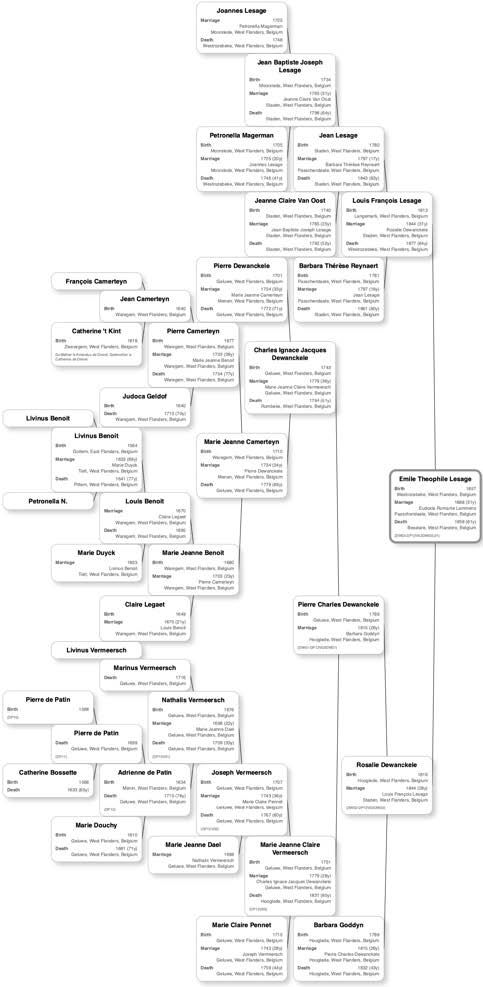
1194
CHAPTER 64. THE LESAGE ANCESTRY LINE
Figure 64.1: Ancestors of Emile Lesage.
© 2024 Nico F. Declercq
The Desclergues of la Villa Ducal de Montblanc, 2nd ed., Omn., VOL. V







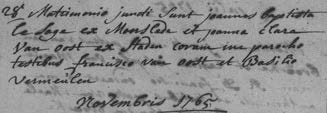
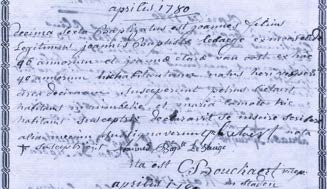
64.4. JEAN LESAGE (LS04) & BARBE THÉRÈSE REYNAERT
1195
Figure 64.2:
Westrozebeke 1746, the
death of Joannes Lesage in the church reg-
ister. The record itself is unavailable or
destroyed.
Figure 64.3: Moorslede, 1705, the bap-
tism of Petronella Magerman in the church
register. The record itself is unavailable or
destroyed.
Figure 64.4:
Westrozebeke 1746, the
death of Petronella Magerman in the
church register. The record itself is un-
available or destroyed.
Figure
64.5:
Moorslede 1725, the
marriage of Jean Lesage and Petronella
Magerman in the church register. The
record itselfa is unavailable or destroyed.
aAkte PARHUWVL 00005413
Figure 64.6:
Moorslede 1728-1731 the
baptisms of siblings of Jean Baptiste
Joseph Lesage in the church register.
Figure 64.7: Moorslede 1734, the bap-
tism of Jean Baptiste Joseph Lesage in the
church register. The record itself is un-
available or destroyed.
Figure 64.8: Staden, 1798, the death of
Jean Lesage in the church register. The
record itself is unavailable or destroyed.
Figure 64.9: Staden, 1740, the baptism
of Joanna Clara Van Oost in the church
register. The record itself is unavailable or
destroyed.
Figure 64.10: Staden, October 16, 1792,
the death of Jeanne Claire Van Oost, from
Staden, daughter of Franciscus, and the
wife of Jean Lesage.
Figure
64.11:
Staden, October 28,
1765, the marriage of Jean Baptiste
Joseph Lesage (LS03), from Moorslede,
and Jeanne Claire Van Oost, from Staden.
The witnesses were Franciscus Van Oost
and Basile Vermeulen.
Figure 64.12: Staden, April 16, 1780,
the baptism of Jean Lesage (LS04). His fa-
ther, Jean Baptiste Joseph Lesage, was 46
years old and from Moorslede; his mother,
Jeanne Claire Van Oost, was 40 years
old and from Staden. The godfather was
Petrus Lietaert from Rumbeke (married to
Agnes van Oost in Staden in 1777). The
godmother was Marie Catherine Lamote
from Staden (married to Joseph Florentin
Lesage at Staden in 1776). Jean Bap-
tiste Joseph Lesage, the father, signed the
record.
The Desclergues of la Villa Ducal de Montblanc, 2nd ed., Omn., VOL. V
© 2024 Nico F. Declercq
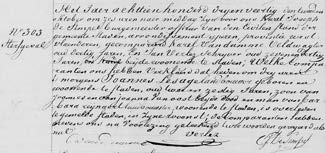
1196
CHAPTER 64. THE LESAGE ANCESTRY LINE
Figure 64.13: Staden, October 2, 1843,
the death of farmer Jean Lesage, born
in Staden, son of Jean Baptist Joseph
Lesage (’Joannes’) and Jeanne Claire Van
Oost (’Joanna Van Oost’), 62-year-old
husband of farmer Barbara Thérèse Rey-
naert (’Barbara Reynaert’).
Figure 64.14: The church of Passchendaele at the be-
ginning of WWI. It can be seen that the church was al-
ready partially destroyed. The entire village would turn
to dust during the war.
Figure 64.15: This is an aerial view of
Passchendaele at the beginning of WWI. It
is an example of a village that would even-
tually be destroyed by shells to the point
that even streets were no longer identifi-
able.
Figure 64.16: Passchendaele, December
13, 1781, Barbara Thérèse Reynaert, the
daughter of Petrus Joannes Reynaert and
Maria Joanna Deman, was born, baptized,
and residing in Passchendaele. Joannes de
Poorter and Maria Anna Pype were the
godparents, both living in Passchendaele.
The priest added a note at the end, prob-
ably interpreted as ’the father was absent’
and ’it was noted that the father is from
Roeselare.’ At Roeselare, we found the
birth of Petrus Joannes Reynaert on Oc-
tober 8, 1730, son of Jean Reynaert and
Maria Magdalena Jonckheere.
Figure 64.17: Staden, June 29, 1861, the death of 81-year-old Barbara Thérèse Reynaert, born in Pass-
chendaele, daughter of Pieter Reynaert and Joanna Deman. She was the widow of Jean Lesage, and she
died in her son Bruno’s home. Her son, 34-year-old merchant Bruno Lesage, reported the death.
© 2024 Nico F. Declercq
The Desclergues of la Villa Ducal de Montblanc, 2nd ed., Omn., VOL. V
64.5. LOUIS FRANÇOIS LESAGE (LS05) & ROSALIE DEWANCKELE
1197
Figure 64.18: Passchendaele, September
10, 1807, the marriage of Barbara Thérèse
Reynaert and Jean Lesage (LS04). The
bride was born in Passchendaele on De-
cember 13, 1781, and resided in Passchen-
daele. Her parents were Pierre Jean Rey-
naert (dead at Passchendaele on May 26,
1806) and Marie Jeanne Deman (alive and
present). The groom was born in Staden
on April 16, 1780, and resided in Lange-
mark. His parents were Jean Baptiste
Lesagea (dead at Staden on January 24,
1798) and Jeanne Claire Van Oost (dead
at Staden on October 16, 1792). The wit-
nesses were 32-year-old Pierre Lamaire,
farmer at Staden and brother-in-law of
the groom; 23-year-old Louis Reynaert,
farmer, brother of the bride and resid-
ing in Passchendaele; 29-year-old Joseph
Reynaert, the bride’s brother who lived
in Passchendaele; and 27-year-old David
Reynaert, the brother of the bride, a
farmer who lived in Passchendaele. (sheet
1)
aTher record states that Jean Baptiste
Lesage died in Staden on 5 Pluviose an VII,
corresponding to January 24, 1799. This is a
mistake as we found that it should have been
1798; therefore, it was probably 5 Pluviose an
VI, corresponding to January 24, 1798.
64.4.1 Jean Lesage
Jean Lesage was born in Staden, in Figure 64.12, on April 16, 1780, and lived in Langemark. He had a sister, Helena Lesage, who died in Esen on December 7, 1840, at the age of 74, after whom, probably, Irma Helena Lesage, described in Chapter 45.2, was named.
The Godmother Marie Catherine Lamote and Joseph Florentin Lesage had a son, Pierre Lesage, who married Marie Thérèse Vermeulen in Staden on October 6, 1813. Marie Thérèse Vermeulen was the daughter of François Vermeulen and Marie Josephine Bardijn. The latter two married Maria Jacoba Bordin and Petrus Francis Vermeulen at Staden on July 5, 1785.
Petrus Francis Vermeulen was born in Staden in 1741.
He died in Staden, proven on the wedding certificate of his son, on October 2, 1843, and also in Figure 64.13. This family is related to Edward Vermeulen, described in Chapter 44.8.2 and Chapter 64.6.1.5.
64.4.2 Barbara Thérèse Reynaert
She was from Passchendaele, in Figures 64.14 and 64.15, and was born on December 13, 1781, in Figure 64.16.
Her father was Petrus Jean Reynaert, and her mother was Marie-Jeanne de Mare. Her godfather was Petrus Joannes De Poorter.
Her godmother was Maria Anna Pype. She died in Staden in 1861, in Figure 64.17.
64.4.3 Their Marriage
They have married2 at Passchendaele in 1807, in Figures 64.18 and 64.19. The witnesses were Pierre Lamaire, Louis Reynaert, Joseph Reynaert, and David Reynaert, all farmers.
64.5 Louis François Lesage (LS05) & Rosalie Dewanckele
64.5.1 Louis François Lesage
He was born in 1813 at Langemark, Belgium, in Figure 64.20, as the son of Jean Lesage and Barbe Thérèse Reynaert.
His military record is given in Figure 64.21.
He died in 1877, in Figure 64.22, at Westrozebeke, Belgium.
Louis François Lesage is primarily described in Chapter 65 as the husband of Rosalie Dewanckele.
He is equally referred to in the following chapters: Chapter 66.2. as the great-great-grandson of Marie Jeanne Christine Benoit and Chapter 68, in the ’t Kint ancestry line.
64.5.2 Rosalie Dewanckele
Her life events are shown in Chapter 65.18. She was a farmer born in 1816 in Hooglede, Belgium.
She was the wife of Louis François Lesage and died in 1872 at Westrozebeke, Belgium.
She is the mother of Emile Theophile Lesage. DNA evidence is given in Chapter 73.8 on page 1590.
2A transcript is also available in the Belgian archives under HUWVL 00254913
The Desclergues of la Villa Ducal de Montblanc, 2nd ed., Omn., VOL. V
© 2024 Nico F. Declercq
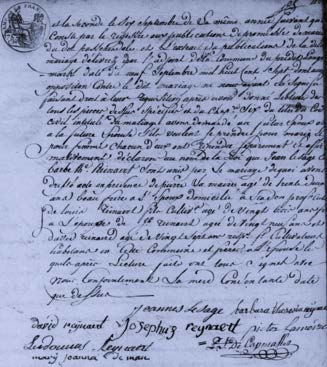
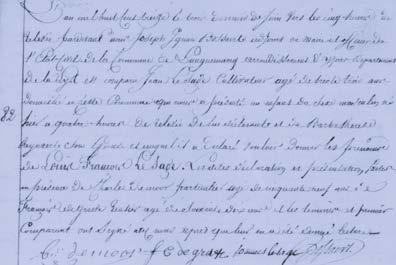

1198
CHAPTER 64. THE LESAGE ANCESTRY LINE
Figure 64.19: Passchendaele, September
10, 1807, the marriage of Barbara Thérèse
Reynaert and Jean Lesage (LS04). (sheet
2)
Figure 64.20: Langemark, June 2, 1813, was the birth of Louis François Lesage
(LS05), son of 33-year-old farmer Jean Lesage and Barbara Thérèse Reynaert. The
witnesses were 59-year-old Charles Demoor and 72-year-old rentier François Con-
stantin De Graeve (He married Isabelle Clara Samijn in Langemark on May 15,
1781. He was born in Langemark on February 21, 1741, and died in Langemark on
January 9, 1820. His parents were Ignace De Graeve and Maria Catharina Pladijs).
We assume that François was also the godfather.
Figure 64.21: Military registration of Louis Lesage in 1832, Nationaele Militie, Provincie West-Vlaenderen, 49ste Kanton, Gemeente Staeden, Loting register. On June 2, 1813, he was born at Langemark, Canton 49, Westvlaenderen, and lived in Staden. His father was Jean Lesage, and his mother was Barbara Theresia Reynaert. He had an oval face, a high forehead, blue eyes, a thick nose, an average mouth, a round chin, and his hair and eyebrows were blond.
© 2024 Nico F. Declercq
The Desclergues of la Villa Ducal de Montblanc, 2nd ed., Omn., VOL. V
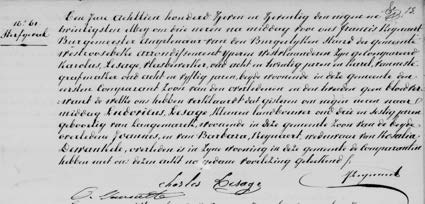
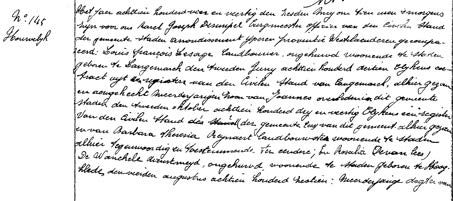
64.5. LOUIS FRANÇOIS LESAGE (LS05) & ROSALIE DEWANCKELE
1199
Figure 64.22: Westrozebeke, May 28, 1877, the death of 63-year-old farmer Louis Fran-
cois Lesage, born in Langemark, son of Jean Lesage and Barbara Thérèse Reynaert, and
widower of Rosalie Dewanckele. The death was reported by his 28-year-old son, Charles
Lesage.
Figure 64.23: Obituary card of Antoine Ghekiere, husband of Marie Joseph De-
wanckel 1963, not long before the death of Michel Declercq, described in Chapter 45.
He was known as a brewer and the mayor of Moorslede. (Declercq de Silva Archive)
Figure 64.24: Staden, May 6, 1844, the marriage of Louis François Lesage, a farmer born in
Langemark on June 2, 1813, and residing in Staden, and Rosalie Dewanckele, born at Hooglede
on August 4, 1816, and living at Staden. The groom was the son of Jean Lesage, who died in
Staden on October 2, 1843, and Barbara Thérèse Reynaert, a farmer who resided in Staden, was
present at the wedding. The bride was the daughter of Pierre Dewanckele, who lived in Hooglede
and was present for the wedding, and Barbara Goddyn, who died in Hooglede on January 30,
1832. The witnesses were the bride’s mother and Bruno Deschrijver, a 32-year-old shoemaker,
Joseph Huyghe, a 50-year-old tanner, and Edouard Billiet, a 26-year-old baker. (version 1, sheet
1)
The Desclergues of la Villa Ducal de Montblanc, 2nd ed., Omn., VOL. V
© 2024 Nico F. Declercq
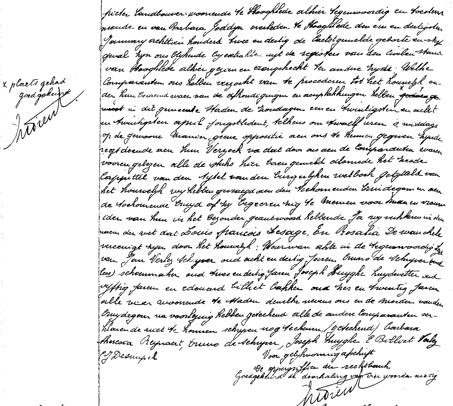
1200
CHAPTER 64. THE LESAGE ANCESTRY LINE
Figure 64.25: Staden, May 6, 1844, the marriage of Louis François Lesage and Rosalie De-
wanckele. (version 1, sheet 2)
Rosalie Dewanckele is primarily described in Chapter 65 as the daughter of Pierre Charles Dewanckele and Barbara Goddyn.
She is equally referred to in the following chapters: Chapter 66.2, as the great-great-granddaughter of Marie Jeanne Christine Benoit; and Chapter 68, in the ’t Kint ancestry line.
A souvenir of a distant Dewanckele family member is shown in Figure 64.23.
64.5.3 Their Marriage
Their wedding was in 1844 at Staden, Belgium, in Figures 64.24, 64.25 and 64.26.
We found two versions of the wedding, namely the original and a transcript3.
64.5.4 Their Acquaintances and some Memorabilia
Some memorabilia are shown in Figures 64.27 and 64.28.
3A transcript was also made by the Belgian archives under HUWVL 00298608
© 2024 Nico F. Declercq
The Desclergues of la Villa Ducal de Montblanc, 2nd ed., Omn., VOL. V
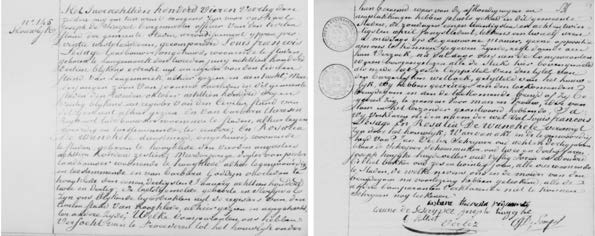
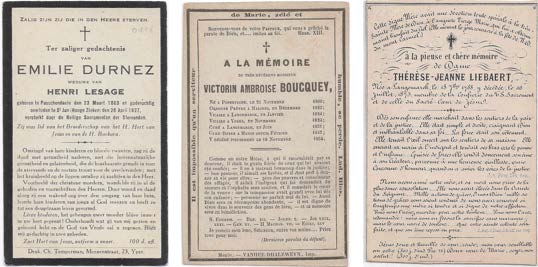
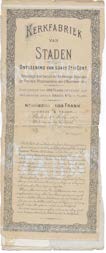
64.5. LOUIS FRANÇOIS LESAGE (LS05) & ROSALIE DEWANCKELE
1201
Figure 64.26: Staden, May 6, 1844, the marriage of Louis François Lesage and Rosalie Dewanckele. (version 2, sheets 1
and 2)
Figure 64.27: From left to right, we see the following souvenirs. The obituary card of Emilie Sophie Durnez, the wife of Henri Lesage. She died in 1927. Henri Lesage was born in Westrozebeke on January 5, 1853; his parents were Louis François Lesage, who died in Westrozebeke on May 18, 1877, and Rosalie Dewankele, who died in Westrozebeke on October 8, 1872. He was, therefore, Emile Theophile Lesage’s brother and the author’s great-granduncle. The obituary card of sister Victorin Ambroise Boucquey, 1864. She was a religious nun at Langemark. The obituary card of Thérèse Jeanne Liebaert, 1875. She was born in Langemark in 1788. (Declercq de Silva Archive)
Figure 64.28: An old financial share of ’Kerkfabriek’ Staden 1877. (Declercq de
Silva Archive)
The Desclergues of la Villa Ducal de Montblanc, 2nd ed., Omn., VOL. V
© 2024 Nico F. Declercq
CHAPTER 64. THE LESAGE ANCESTRY LINE
64.6 Emile Theophile Lesage & Eudoxie Romanie Lammens
64.6.1 Emile Theophile Lesage
64.6.1.1 Introduction
Emile Lesage, shown in Figure 64.29, was born on June 29, 1857, in Westrozebeke, Belgium, as the son of Louis François Lesage and Rosalie Dewanckele.
He died in 1938 in Beselare, Belgium.
Emile Theophile Lesage is primarily described as the author’s great-grandfather in Chapter 64.
He is equally referred to in the following chapters: Chapter 65, as great-great-great-great-grandson of Adrienne de Patin (DP12); and also in Chapter 66.2, as the great-great-great-grandson of Marie Jeanne Christine Benoit; Chapter 68, in the ’t Kint ancestry line; and Chapter 71, as the son-in-law of Clemens Lammens and Natalia Juliana Decaestecker.
Emile Lesage, a distinguished member of the landed gentry, was widely respected in his community. He married later in life, likely prioritizing economic stability before starting a family. Despite having numerous children, he ensured each one received financial support to establish their careers and secure viable marriages. Although much of his story has been lost to time, several notable anecdotes remain.
One such tale involves the annual gift of a salted and dried ham to the postman every New Year, a gesture eagerly anticipated by the recipient. Another story from Emile’s youth recounts a transaction in which he sold a horse for significant cash. Suspecting the buyer might rob him, Emile discreetly left the inn and ran home to safeguard his earnings, an episode preserved in family lore.
Between 1910 and 1912, Emile planned to invest in the United States, intending to purchase land, likely for his eldest son, Cyrille Lesage. However, he postponed the trip for unknown reasons. When the Titanic tragically sank in April 1912, a legend emerged that Emile had narrowly missed being a passenger, potentially saving his life—a story that endures to this day.
Before he died in 1938, Emile expressed concerns to his son-in-law, Michel Declercq, about the size of his family. Emile suggested that Michel buy a farm in Cordes (Frasnes-les-Avaing) and cease expanding his family. Michel, citing his Christian duty, insisted on having more children, while his wife Irma refused to move, disliking the isolation of Cordes.
Emile maintained a close friendship with the Declercqs of Wielsbeke and was determined to support his youngest children in marrying into this esteemed family. To this end, he provided substantial financial assistance.
His youngest daughter, Irma Lesage, married Michel Declercq in 1932, and his son Daniel was engaged to Valentine Declercq, considered the most attractive of the Declercq daughters. However, plans changed when Gerard Lesage, another of Emile’s sons, died. Daniel was compelled to break off his engagement and marry Gerard’s widow, Magdalena Meersseman, to ensure the continuation of Gerard’s farm.
This decision had significant repercussions. Valentine Declercq was deeply affected, as detailed in Chapters 64.7.12 and 44.5.5.
Emile and Daniel’s actions, while pragmatic, may seem unsympathetic.
Alternatively, their sense of duty to Magdalena Meersseman may have left them no choice. This incident likely profoundly impacted Irma Lesage, potentially making her vulnerable to manipulation within the Declercq household, although there is no evidence to suggest this occurred.
64.6.1.2 Birth and childhood
His birth, in Figure 64.31, was on June 29, 1857, in Westrozebeke, seen in Figure 64.30.
64.6.1.3 His Military Service
He did his military service in 1877, as seen from his record in Figure 64.32. This was also the year when Graham Bell first presented the telephone to the public, Queen Victoria became Empress of India, and the Wimbledon tennis tournament was first held.
64.6.1.4 Whereabouts in Peace and War
Emile Lesage lived in Westrozebeke, shown in Figures 64.33 and 64.30, where he would continue to live with Eudoxie until 1896-1897.
Eudoxie Lammens was born in Zonnebeke but lived in Passchendaele when they married in 1888.
While they lived in Westrozebeke, they had the following children: Cyrille (1890), Alida (1892), Maria (1893) and Amandine (1895).
They lost Alida one month after her birth.
The family moved to Moorslede before 1898, where Gerard (1898), Hector (1898), Maria (1900), Paul (1902), Godelieve (1903), Irma (1905), Oscar (1906) and Daniel (1911) would be born. At Moorslede, shown in Figure 64.34, they lived near the train station in Statiestraat 518.
In July of 1912, the family moved to Ledegem, in Figure 64.35, to a farm at Kortwagenstraat 33. Everything went well until WWI started in the summer of 1914. As described in Chapter 64.6.1.5, during WWI, Emile Lesage stayed with his son Paul Lesage at the farm in Ledegem. At the same time, Eudoxie moved with the other children to Oudezeele in France. Meanwhile, Cyrille Lesage was a soldier, and later, two other sons, Gerard and Hector, were also recruited while in France.
After the war, the entire region was devastated and required reconstruction, as seen in Figures 64.37 and 64.38. Moving back right away was impossible.
The census of Beselare of 1920-1930 shows, for Keiberg - Spilstraat 12, the following inhabitants: Lesage Emile (arrived from Ledegem on September 30, 1921), Martha, Amanda, Gerard, Marie, Paulus, Godelieva, Helena; and Lammens Eudoxie (arrived from Ledegem on September 30, 1921). Note that ’Helena’ was actually ’Irma Helena,’ i.e., the author’s grandmother.
The census of Beselare of 1930-1940 shows, for Keiberg - Spilstraat 12, the following inhabitants: Lesage Emile (arrived from Ledegem on September 30, 1921), Godelieva, Irma, Oscar, Daniel, Maria (2x), Andreas; and Soenen Anna.
Based on the fact that Daniel Lesage never mentioned ’Ledegem’ in the 1980s, while he often talked about Beitem, we must assume that the Lesage family was more closely connected to Beitem, in Figure 64.36 than Ledegem. Beitem is not a village but is a parish distributed over three villages, including Moorslede and Ledegem.
It’s likely that, despite the location of their farm on the ground of Ledegem, their social life was in Beitem. After the war, Daniel and Oscar Lesage went to school in Beitem. They possibly resided with Gerard Lesage or one of the parents in Ledegem after the war while a new farm was under construction in Beselare.
On September 30, 1921, the family changed its official address from Ledegem to Beselare, Spilstraat 12 on ’Keiberg,’ at the junction
© 2024 Nico F. Declercq
The Desclergues of la Villa Ducal de Montblanc, 2nd ed., Omn., VOL. V
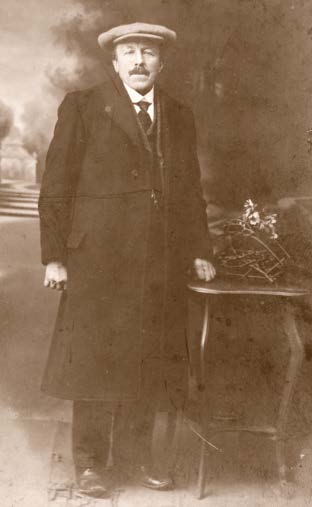
64.6. EMILE THEOPHILE LESAGE & EUDOXIE ROMANIE LAMMENS
1203
Figure 64.29: Emile Theophile Lesage was a wealthy, wise man,
ten years older than his wife, Eudoxie Romanie Lammens, and
highly praised in his village. (Declercq de Silva Archive)
with Slangemeersstraat. However, Paul Lesage stayed at Ledegem and became a harness manufacturer because he had an arm injury due to a bombardment on August 4, 1916.
64.6.1.5 The WWI experience
64.6.1.5.1 Ledegem During World War I, Eudoxie resided with her children in Oudezeele, France, staying with the Secq family at Route des Trois Rois 77. This address, positioned near the village center and the Café des Trois Rois, was listed as number 49
among the homes housing refugees in Oudezeele. The household comprised two adults and several children, with Eudoxie registered as Mme Eudoxie Lesage. The two adults were Eudoxie and her eldest daughter, Martha.
The terror of World War I reached Ledegem on October 19, 1914, a day infamously known as Schuwe Maandag or ’Terrifying Monday’4. Due to insufficient records, it is unclear where every family member was on that specific date. It is possible that some had already fled, or they were still in Ledegem, soon to escape the impending violence. Emile Lesage remained on the family farm with his son Paul, while Eudoxie and most of her children moved to Oudezeele in northern France.
On Terrifying Monday, British forces liberated parts of West and South Ledegem. However, the Germans managed to reclaim these areas after a day of intense fighting. The unexpected resistance from the British led the Germans to believe that the civilian population had supported the enemy, prompting a brutal retaliation. Many civilians were killed or wounded, and numerous farms and homes were set ablaze. The atrocities were so extreme that subsequent German arrivals documented their disgust in their diaries. Frans Huyghe and Filip Jacques5 cite Max Hoelz and Heinrich Wandt, noting that the German soldiers responsible were drunk and wrongly believed a young girl had shot a soldier. Later investigations revealed this was impossible, as the girl was not present at the massacre site, and the local populace had surrendered their weapons well before the event.
Under German occupation, Belgium saw its administrative structures supplanted by German authorities, although local village governance remained intact. In areas far from the front lines, a semblance of normalcy persisted with some freedoms allowed to the population. However, in frontline villages like Ledegem, military rule was strict. Residents were confined to their towns, and heavy taxation was imposed on goods. Farmers, including Emile and Paul Lesage, were compelled to relinquish a substantial portion of their produce to the German army. Post-1914, the threat of death also came from British forces positioned across the frontline.
In early August 1916, Ledegem suffered bombings, particularly near the train station and Pionierpark on the village’s north side.
These attacks resulted in the deaths of a dozen civilians. Sources conflict with the exact dates, citing either August 1 or 4, suggesting possible bombardments on both days. During one such attack, Paul Lesage was severely injured while peeling potatoes on the farm; he either lost or was disabled in his left arm due to the bombing. The impact of World War I on Ledegem and Beitem is graphically depicted in Figures 64.39 and 64.40.
4Schuwe maandag appears in Chapter 48.9.5.4.5, Chapter 64.6.1.5.1, Chapter 64.7.1.6.7, and Chapter 65.
5Frans Huyghe and Filip Jacques, ’Ledeghem in den Grooten Oorlog’
The Desclergues of la Villa Ducal de Montblanc, 2nd ed., Omn., VOL. V
© 2024 Nico F. Declercq
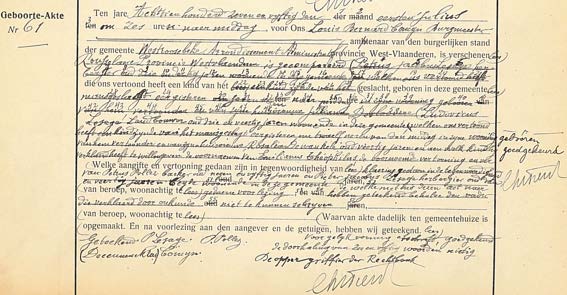

1204
CHAPTER 64. THE LESAGE ANCESTRY LINE
Figure 64.30: The town hall and the church of Westrozebeke.
Figure 64.31: Westrozebeke, June 29, 1857, the birth of Emile Theophile Lesage (’Emilianus Theophilus Lesage’), the son of 43-year-old farmer Louis François Lesage (’Ludovicus Lesage’), residing in Westrozebeke, and 40-year-old Rosalie Dewanckele. The witnesses were 59-year-old baker Pierre Polletz and 43-year-old inn-keeper Pierre Jacques Lesage.
Figure 64.32: The military registration of Emile Theophile Lesage in Levée de 1877, Milice Nationale, Province de la Flandre Occidentale, 35e Canton de Milice, Commune de Westroozebeke, list de Tirage. He was a farmer from Westrozebeke, where he was born on June 29, 1857. He was 168.5 cm tall. His father was farmer Louis Lesage, and his mother was Rosalie Barbara Dewanckele.
Figure 64.33: Before World War I, Westrozebeke was a delightful and picturesque village, full of charm.
© 2024 Nico F. Declercq
The Desclergues of la Villa Ducal de Montblanc, 2nd ed., Omn., VOL. V
64.6. EMILE THEOPHILE LESAGE & EUDOXIE ROMANIE LAMMENS
1205
Figure 64.34: Moorslede at the beginning of WWI. Minor destructions are visible.
Figure 64.35: Scenes of Ledegem before WWI. We can recognize, for instance, Rollegemstraat, Statiestraat, the corner of Begijnhofstraat, Statieplaats, and Kerkstraat, with the church visible in the background.
The Desclergues of la Villa Ducal de Montblanc, 2nd ed., Omn., VOL. V
© 2024 Nico F. Declercq

1206
CHAPTER 64. THE LESAGE ANCESTRY LINE
Figure 64.36: Beitem was a peaceful parish covering three villages. Women and children are shown posing for the camera.
We can also see the ’Vossemolen’ windmill.
Figure 64.37: Three scenes during WWI when Emile Lesage resided in the area. On the right, we see a German picture proudly showing the intact church of Ledegem during WWI. In the middle, we see Germans in Moorslede with, in the background, the windmill ’Strobomemolen’ during WWI. On the left, we observe Moorslede in 1915, under the German occupation.
In this picture, a German military member poses as a farmer. The church of Moorslede, which has not yet been destroyed, is visible in the background.
64.6.1.5.2 Wielsbeke As previously noted, Paul Lesage’s left arm was severely injured in early August 1916. The following summer, Paul and his father, Emile Lesage, were compelled to leave Ledegem. On July 23, 1917, they were expelled from their village and relocated to Wielsbeke. They likely stayed for several months at the farm of the Declercq family, where Paul Lesage, who was the same age as the eldest Declercq son, could find companionship. Despite their relocation, the official Belgian address of the entire Lesage-Lammens family remained in Ledegem, even though, from July 1917 onwards, no family members resided there.
Ledegem had remained relatively tranquil during the early years of World War I. However, the situation changed dramatically in the summer of 1917 due to significant developments on the Western Front, particularly with British forces breaching German defense lines in the Ypres salient. The Battle of Passchendaele, also known as the Third Battle of Ypres, raged from July 31 to November 10, 1917.
The information provided here is based on private communication between the author and Frans Huyge, the co-author of ’Ledeghem in den Grooten Oorlog, as well as personal interactions between the author and his granduncle, Daniel Lesage, in the 1980s.
Additional details can be found in the book above. On August 1, 1916, a bomb struck the Lesage farm at Kortwagenstraat 33. Paul Lesage, who was peeling potatoes at the time, suffered severe injuries to his left arm, resulting in its loss or permanent disability.
The Lesage farm was not the sole property affected by the conflict.
In 1917, the German forces decided to evacuate most of Ledegem’s population, approximately 130 families, as the area had become a critical transfer hub for goods, mainly bricks, iron, and cement, making it a target for British attacks. The German authorities forced the local residents to relocate to various villages, although the specific destinations for each family were only sometimes documented. Some recorded destinations included Moorsele, Gullegem, Lendelede, Kortrijk, Harelbeke, Bavikhove, Beveren-Leie, Desselgem, Deerlijk, Dentergem, Wakken, Machelen, Meulebeke, Wielsbeke, Zwevezele, Kruishoutem, Wannegem-Lede, Zwevegem, Heestert, Avelgem, Ruien, Ronse, Eine, Oudenaarde, Schoonaarde, Orroir, Deinze, Huyse, Wiese, Denderbelle, Londerzeel, Wolvertem, Sint-Amand-Puurs, Balen, Ukkel, and Brussels.
Only a few farmers returned to Ledegem to tend their land in the spring and summer of 1918. Wielsbeke became the refuge for Emile and Paul Lesage, where they stayed with the family of Ernest Constant Declercq. It is possible that the Lesage and Declercq families were acquainted before the war, given that later, two children from each family became engaged, with one couple eventually marrying—these being the author’s grandparents. When Emile Lesage was ordered to leave Ledegem in 1917, he quickly took a figurine of Mary with him, which he kept throughout his displacement; this figurine still exists today, as shown in Figure 64.45.
Figure 64.38: Three WWI images of Moorslede. From left to right, Moorslede, probably in 1917. It’s sad to see such ruins of what used to be an ancient and beautiful village where several ancestors once lived. ’Statiestraat,’ in Moorslede, was destroyed during WWI. Irma Lesage was born in 1905. Finally, a panoramic view of Moorslede on October 17, probably in 1917. The whole area was reconstructed in the decades to come and required one century of development to bring it back to the level of other Belgian regions.
© 2024 Nico F. Declercq
The Desclergues of la Villa Ducal de Montblanc, 2nd ed., Omn., VOL. V
64.6. EMILE THEOPHILE LESAGE & EUDOXIE ROMANIE LAMMENS
1207
Figure 64.39: A compilation of scenes of Ledegem during WWI. During WWI, Ledegem became an essential hub for the Germans to supply the frontline closer to France and Ypres. We can see, for instance, a German military on a horse approaching villagers, an aerial view, and playing children near a destroyed home. In particular, we see the results of the August 4, 1916 assault on the village, such as a destroyed farm and Germans showing the destruction caused by shells. The church is where, after WWI, a plaque was mounted with the names of two of Emile’s sons, killed during WWI.
The Desclergues of la Villa Ducal de Montblanc, 2nd ed., Omn., VOL. V
© 2024 Nico F. Declercq

1208
CHAPTER 64. THE LESAGE ANCESTRY LINE
Figure 64.40: The destruction of Beitem
during WWI.
Figure 64.41: We see how Germans occupied a farm at Westrozebeke during WWI. Furthermore, the church is shown hit by shells, and homes have destroyed roofs. Finally, the partially repaired church is shown after the shooting.
During this tumultuous period, Emile and Paul likely had little information about the whereabouts or well-being of Eudoxie and the other children, who were located in Oudezeele. Communication across the frontline was severely restricted, with occasional messages smuggled through Great Britain and the Netherlands, though it is uncertain if any such news reached the Lesages. One son, Cyrille, had already died, another son, Gerard, was fighting at the front, and the youngest son, Hector, would soon join the army and be killed before the war’s end.
Huyge-Jacques said only men between 14-18 and 65-70 were permitted to stay in Ledegem after September 1917. By November of that year, nearly the entire population had left. Emile, at 60 years old, and Paul, 15 and handicapped, likely did not return to Ledegem until after the war concluded. They probably remained with the Declercqs in Wielsbeke at Hof van Brussel6 until the war’s end.
The remaining residents of Ledegem faced harsh conditions in 1918, as the frustrated and poorly provisioned German soldiers often mistreated the locals, including severe beatings for those attempting to protect their crops.
64.6.1.5.3 Meanwhile in Emile Lesage’s Birthplace Illustrations of the impact of WWI on Westrozebeke, where Emile Lesage was born, are shown in Figure 64.41.
64.6.1.6 His Wife’s Death and His Role as a Widower
Emile Lesage spent his final years devotedly supporting his children, drawing upon his vast wisdom and rich life experiences. He lived with his son Oscar and his family, imparting his knowledge until his passing.
In Beselare, Oscar proudly carried on the family farm, honoring his father’s legacy. Some impressions are shown in Figures 64.42
and 64.43.
The farm still exists, although it has been modernized by Oscar and later by subsequent owners. The reader can enjoy it in Figure
64.6.1.7 His Death
When Emile Lesage died, in Figure 64.46, he was buried with his wife at Beselare.
64.6.1.8 Selected memorabilia
Some of Emile Lesage’s memorabilia can be seen in Figures 64.47, 64.45 and 64.48.
64.6.2 Eudoxie Romanie Lammens
64.6.2.1 Introduction
She was a lady with military blood, born in 1868 in Zonnebeke, Belgium.
She resided in Passchendaele, Belgium, where she married Emile Lesage in 1888.
She died in 1931 in Beselare.
Eudoxie Romanie Lammens is equally referred to in the following chapters: Chapter 65, as great-great-great-great-granddaughter-in-law of Adrienne de Patin (DP12); Chapter 66.2, as great-great-great-granddaughter-in-law of Marie Jeanne Christine Benoit; Chapter 68, in the ’t Kint ancestry line; and Chapter 71, as the daughter of Clemens Lammens and Natalia Juliana Decaestecker.
Early in her marriage, she lived at Westrozebeke, where her husband, Emile Theophile Lesage, had been born.
Consequently, she moved to Moorslede, then to Ledegem, from there to Oudezeele, and from Oudezele to Beselare.
Her parents were Clement Lammens and Nathalie Julie Decasestecker, both farmers. Nathalie Julie Decaestecker was from a family of farmers at Passchendaele. Clement Lammens is the son of Joseph Leopold Lammens (Vladslo 1790-1847), married Anne Thérèse Pareyn, and both were farmers.
Both their parents were from Vladslo and were also farmers.
Different genealogists trace Nathalie Julie Decaestecker’s ancestors to Vincent van Qoilge, born in 1390 and died in 1420, and Bardeyn le Cluyse, born in 1547. Joseph Leopold Lammens was the grandson of Jean Norbert Lammens and Anne Marie Winne, who married in Vladslo in 1714.
The Lammens family can be traced back to the area of Veurne where, for instance, Jacques Lammens, the Lord of Brouckerkhove, was first a captain in the army at Nieuwpoort and was later mayor of Veurne in the early 17th century.
6nowadays Reynaertstraat
© 2024 Nico F. Declercq
The Desclergues of la Villa Ducal de Montblanc, 2nd ed., Omn., VOL. V
64.6. EMILE THEOPHILE LESAGE & EUDOXIE ROMANIE LAMMENS
1209
Figure 64.42: Emile Lesage and his wife Eudoxie Lammens when
she was already sick and close to the end of her life. Just behind
Emile is Irma Lesage. The family was known for its kindness,
notwithstanding the hard work. Despite his simple lifestyle, Emile
was wealthy and supported his children by delivering sound invest-
ments. (Declercq de Silva Archive)
Ann Thérèse Pareyn, the grandmother of Eudoxie, was the great-great-granddaughter of Jean François Ardan and Marie Josephe Rouye, who married at Damme in 1698. Jean François Ardan was a military stationed at Damme in the garrison of de Rysbourgh and later de Morel; his granddaughter was Anne Marie Francoise Caestecker, Anne Thérèse’s grandmother.
Interestingly, in the 17th century, the Declergues also appeared in Damme about the military. So, these two bloodlines may have encountered each other already at that time.
64.6.2.2 Military Blood
Eudoxie Lammens descends from ancestry lines that were closely involved in warfare. Also, her sons paid their dues during WWI and WWII. As mentioned in the previous section, for instance, the bloodline of Lammens stems from Jacques Lammens, the Lord of Brouckerkhove, who was first a captain in the army at Nieuwpoort and was later mayor of Veurne in the early 17th century. In this book, there are several chapters on blood relatives of Eudoxie Romanie Lammens, who served the military, such as: Jean François Ardan (17th century), Burgundian Regiment of the Spanish Army in Belgium;
Pierre Joseph Decaestecker (1785 - 1868), Army of Napoleon;
Charles Lammens (1814 - 1881), Belgian Army with Henri Conscience;
Cyrille Camille Lesage (1890 - 1916), Belgian Army, WWI;
Hector Alidor Lesage (1898 - 1918), Belgian Army, WWI;
Gerard Medard Lesage (1887 - 1933), Belgian Army, WWI; and
Oscar Lesage (1906 - 1990), Belgian Army, WWII.
The author’s father, the grandson of Eudoxie, was equally a trained military engineer. Before he became an American employee, the author was once supported by the North Atlantic Treaty Organization (NATO) for scientific collaboration with the Americans and the Russians.
64.6.2.3 Birth and Childhood
Eudoxie was born in Figure 64.49 and raised in Zonnebeke in Figure 64.50. She probably said ’Zinnebeke’ as the village is locally called. Indeed, the earliest records dating back 1000 years indicate that the original name of this village was ’Sinnebeke.’
Zonnebeke, a picturesque village during Eudoxie’s time, faced devastation in World War I. Below are images from circa 1900, capturing the serene beauty she experienced before relocating to Passchendaele and marrying Emile Lesage.
64.6.2.4 Whereabouts in Peacetime
As mentioned, Eudoxie Lammens was born in Zonnebeke but lived in Passchendaele at her wedding in 1888. Emile Lesage lived in Westrozebeke, where he would continue to live with Eudoxie until 1896-1897. While they lived in Westrozebeke, they had the following children: Cyrille (1890), Alida (1892), Maria (1893) and Amandine (1895). They lost Alida one month after her birth.
The family moved to Moorslede before 1898, where Gerard (1898), Hector (1898), Maria (1900), Paul (1902), Godelieve (1903), Irma (1905), Oscar (1906) and Daniel (1911) would be born. At Moorslede, they lived very near to the train station in Statiestraat 518.
In July of 1912, the family moved to Ledegem to a farm at Kortwagenstraat 33. Everything went well until WWI raged in the summer of 1914.
During the German invasion of Belgium, Eudoxie fled to Oudezeele in the North of France, close to the Belgian border. Emile Lesage stayed at the farm in Ledegem with Paul while Cyrille was in the military. Later, the other sons, Gerard and Hector, would also join the military after moving with their mother to Oudezeele.
On July 23, 1917, Emile Lesage and Paul were expelled from their village of Ledegem and went to Wielsbeke. They stayed several months at the farm of the Declercq family. Paul Lesage was the same age as the eldest son of the Declercq family. The whole time, the official Belgian address of the entire Lesage-Lammens family remained at Ledegem, although from July 1917 onwards, nobody lived there anymore.
On September 30, 1921, the family changed its official address from Ledegem to Beselare, Spilstraat 12 on ’Keiberg,’ at the junction with Slangemeersstraat. Paul Lesage, however, stayed at Ledegem and would, given that his left arm had been injured on August The Desclergues of la Villa Ducal de Montblanc, 2nd ed., Omn., VOL. V
© 2024 Nico F. Declercq
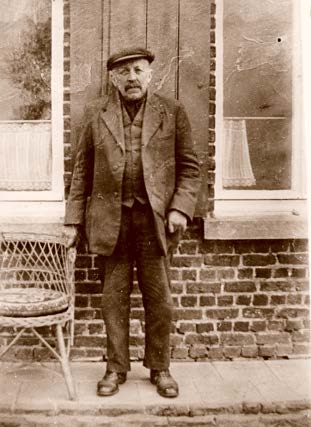
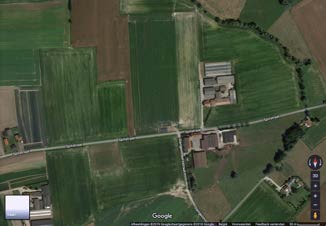
1210
CHAPTER 64. THE LESAGE ANCESTRY LINE
Figure 64.43: This was Emile Lesage in the twilight of his life, a
dignified and proud gentleman to the very end. (Declercq de Silva
Archive)
Figure
64.44:
Current
Maps®
view of what used to be
Emile Lesage’s farm at Beselare after
WWI, at the corner of Spilstraat and
Slangenmeersstraat. On both sides of the
mentioned streets, the lands near the farm,
surrounded by a creek, also belonged to
him. His children had inherited them and
are now owned by others and descendants.
Emile also helped with investments for his
children in other locations.
Figure 64.45: This figurine comes from the parents of Eudoxie Ro-
manie Lammens. When Emile Lesage stayed behind during WWI on
the farm in Ledegem with one son, Paul, while Eudoxie fled to Oudezele
in Northern France with the remaining children, the statue was in his
living room. On July 23, 1917, a shell hit the Lesage farm (Kortwa-
genstraat 33, Ledegem), and the figurine survived. When Emile had
to leave the farm with Paul the following year, they quickly took some
things, including this statue. Afterward, Emile could laugh about it.
It may have reminded him of his wife and family. Later, the figure
moved with his favorite daughter, Irma Lesage, to Deerlijk. Maria De-
clercq, the author’s auntie, is now taking care of it. (Declercq de Silva
Archive)
© 2024 Nico F. Declercq
The Desclergues of la Villa Ducal de Montblanc, 2nd ed., Omn., VOL. V
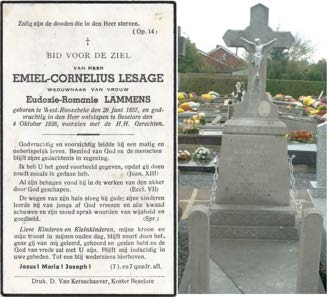
64.6. EMILE THEOPHILE LESAGE & EUDOXIE ROMANIE LAMMENS
1211
Figure 64.46:
The mortuary card of
Emile Theophile Lesagea, Beselare, 1938.
The other photo shows the grave of Emile
Lesage and Eudoxie Lammens just before
the local authorities removed it around
2012. Their remains are now located in
the ossuary at the same cemetery of Bese-
lare. (Declercq de Silva Archive)
aThe typesetter erroneously wrote ’Cor-
nelius’ instead of ’Theophile.’
Figure 64.47:
A postcard was sent by Maria De-
clercq and Valentine Declercq, sisters of Michel Declercq,
to Emile Lesage and addressed to Godelieve and Irma
Lesage. The latter was the fiancé of Michel Declercq.
They sent the card from Bruges in 1931. (Declercq de
Silva Archive)
1, 1916, due to a bombardment, become a harness manufacturer.
The census of Beselare of 1920-1930 shows, for Keiberg - Spilstraat 12, the following inhabitants: Lesage Emile and Eudoxie Lammens, who arrived (officially) from Ledegem on September 30, 1921; and also Martha, Amanda, Gerard, Marie, Paulus, Godelieve, (Irma) Helena. The census of Beselare of 1930-1940 did no longer count Eudoxie, but showed, for Keiberg - Spilstraat 12, the following inhabitants: Lesage Emile, Godelieve, Irma, Oscar, Daniel, Maria, Maria (daughter of Oscar), Andrea (daughter of Oscar), and Soenen Anna (wife of Oscar).
64.6.2.5 Residence at Oudezeele During WWI
We refer to Figures 64.51 and 64.52. Eudoxie lived with her children in Oudezeele in France during WWI with the Secq family at Route des Trois Rois 77, the road from the village center to Café des Trois Rois, the house near the village center. The home was designated number 49 on the list of homes of refugees at Oudezeele during WWI. The family consisted of 2 adults (+ children), and Eudoxie was registered as Mme Eudoxie Lesage. The two adults were Eudoxie and her eldest daughter Martha. After the war, the area where she had lived before was devastated. Therefore, Eudoxie stayed with some of the children in Oudezeele. As far as possible, they would return first to Ledegem and then move on September 30, 1921, from Ledegem to Spilstraat 12 on ’Keiberg’ in
Beselare7. While Eudoxie was still a resident of Oudezeele, some children resided already at Ledegem and were with their families in Moorslede-Zonnebeke. Oscar Lesage and Daniel Lesage remained in Ledegem, probably in Beitem, with their brother Gerard Lesage and would move to Beselare to the parents’ address in the 1930s. When Eudoxie officially moved from Ledegem to Beselare on September 30, 1921, she moved from Oudezeele, where she also gave up her residence. So, her address in France was a whereabout address, while officially in Belgium, she had still been registered in Ledegem.
The author received this friendly message8 from Mr and Mrs Regine et Regis Beaucamp in Oudezele: Bonjour M Declercq,
Nous avons bien reçu votre courrier dont nous vous remercions.
Voici en retour, les premières réponses à votre question:
la maison existe toujours, la famille Secq a construit une nouvelle habitation devant l’ ancienne 77 route des Trois Rois.
Les familles n’ oublient pas ce qu’ elles ont vécu pendant ces guerres.
Vos documents seront classés dans l’ album des anciens combatants.
Avec nos remerciement et nos sentiments les meilleurs
Regine et Regis Beaucamp
109 rue Gilles
59670 Oudezeele.
Impressions of Oudezele are found in Figures 64.53, 64.54, 64.55, 64.56, 64.57 and 64.58.
64.6.2.6 Devastation During WWI and Rehabilitation of the Area Where Eudoxie was Rooted
The cataclysm of World War I profoundly scarred Eudoxie and Emile. Not only did they endure the unbearable loss of their children, but they also witnessed their homeland reduced to ruins. The war’s relentless devastation transformed their once-vibrant 7The numbers have changed, but we know that it was at the junction between Slangemeersstrat and Spilstraat.
8Transcribed letter received from Regine & Regis Beaucamp, on November 27, 2017.
The Desclergues of la Villa Ducal de Montblanc, 2nd ed., Omn., VOL. V
© 2024 Nico F. Declercq
1212
CHAPTER 64. THE LESAGE ANCESTRY LINE
Figure 64.48: Several expired shares are visible. The one of 1900 shows that, before WWI,
investments in agriculture must have been popular with farmers in West Flanders. Others are
also shown, such as 1919-1921-1922 shares purchased after WWI to reconstruct the country.
Our archive has a dozen more of them. 1923-1925-1927, shares were purchased after WWI to
rebuild the country. A share of 1927 shows that investing in the Belgian Congo in the 1920s must
have been a quest for security after the WWI experience of destruction. We know that Emile
Lesage cherished the United States of America and that, just before WWI, he even had plans to
visit the country to purchase land for one of his children. His attitude remained unchanged after
the war, as seen in the 1929 share. 1930-1938 shares were purchased in the interbellum and had
a common purpose similar to the pre-WWI period. (Declercq de Silva Archive)
region into a desolate lunar landscape, demanding a monumental effort to rebuild and restore what had been lost.
64.6.2.6.1 Devastations During WWI Images tell more than text. The gradual devastations of Zonnebeke, where Eudoxie was born and raised, can be observed in Figure 64.59.
64.6.2.6.2 Rehabilitation of the Area After WWI Just after WWI, many inhabitants decided never to return to the area.
The ones who did return shared the area with Chinese workers who cleaned up the region. Imagine all the barbwire, shell remains, trenches, dirt, bunkers, holes, and ditches everywhere, while every tree was gone and every home and church destroyed. Inhabitants stayed in nearby undestroyed villages with family or sheltered in barracks.
Some illustrations are shown in Figure 64.60.
64.6.2.7 Human Loss During WWI
Below, we refer to 5 casualties. There could be more, however.
64.6.2.7.1 Cyrille Camille Lesage Cyrille Camille Lesage (1890 - 1916) died in Paris, where he was buried at Père Lachaise.
He is extensively described in Chapter 64.7.1.
64.6.2.7.2 Hector Alidor Lesage Hector Alidor Lesage (1898 - 1918) died during the final assault in 1918. He is thoroughly reported in Chapter 64.7.6.
64.6.2.7.3 Paul Lesage Paul Lesage (1902 - 1976) injured or lost his arm in August 1916. More information is presented in Chapter 64.7.8.
64.6.2.7.4 Gerard Lesage Gerard Medard Lesage (1887 - 1933). His lungs, scarred by a gas assault, bore silent witness to the ravages of war, and it was pneumonia that ultimately claimed his life, slipping him away in the winter of 1933 or 1934.
The reader will find more about him in Chapter 64.7.5.
64.6.2.7.5 Maurice Cyrille Willaert Maurice Cyrille Willaert played a significant role in the occupation of the Rhineland in Germany from 1919 to 1923. This occupation, conducted in collaboration with French and British forces, aimed to ensure that Germany would not invade its neighbors again following the devastating consequences of World War I. The military presence was critical to the post-war efforts to maintain peace and stability in Europe. Maurice Cyrille Willaert’s involvement in this occupation suggests that he joined the military shortly after World War I. His participation in such a significant historical event reflects his active engagement in the efforts to secure and rebuild Europe after the war. To understand Maurice Willaert’s family background, we include his obituary card in Figure 64.61. The card highlights the prevalence of specific names within Eudoxie’s family, such as Romanie and Cyrille, underscoring the continuity of family traditions and naming practices. Maurice Willaert was born in Keiem in 1902 to Charles Willaert and Romanie Lammens. His life was tragically short, as he passed away in 1925. His mother, Romanie Lammens, was born in Vladslo on May 4, 1870, to farmers Robert Lammens and Amelie Mergaert. Robert and Amelie were married in Vladslo on May 3, 1866. Robert Lammens, born on February 26, 1832, was the son of Joseph Leopold Lammens and Anne Thérèse Parein. Thus, Maurice Willaert’s great-grandfather, Joseph Leopold Lammens, was also the grandfather of Eudoxie Lammens, as described in Chapter 71.6. This genealogical context provides a comprehensive view of Maurice Cyrille Willaert’s familial connections,
© 2024 Nico F. Declercq
The Desclergues of la Villa Ducal de Montblanc, 2nd ed., Omn., VOL. V
64.6. EMILE THEOPHILE LESAGE & EUDOXIE ROMANIE LAMMENS
1213
Figure 64.49: Zonnebeke, May 16, 1868, the birth of Eudoxie Romanie Lammens (’Eudoxia Romania Lammens’), the daughter of 42-year-old farmer Clemens Lammens (’Clement Lammens’) from Vladslo, and Natalia Juliana Decaestecker (’Julie Decaestecker’). The witnesses were 44-year-old Louis Lammens and 62-year-old Louis Stragier.
64.6.2.8 The Death of Eudoxie Lammens
Eudoxie succumbed to edema, likely resulting from congestive heart failure, mirroring the fate of her son Daniel, who died from the same condition in 1988. The family vividly recalls the excruciating final weeks of her life. As her condition deteriorated, a doctor resorted to using a trocar to alleviate the swelling in her legs, a desperate measure reflecting the severity of her suffering.
An oil lamp, casting a somber glow, sat on her night table—a silent witness to her agony. Despite the apparent gravity of her condition, her physician inexplicably chose not to hospitalize her, a decision that has haunted her family. In her final days, Eudoxie clung to her faith, praying to ’The Holy Heart’ in an emotional plea for relief that never came.
The oil lamp from her bedside remains, a poignant relic displayed in Figure 64.62. Figures 64.63 and 64.62 capture the heartbreaking images taken during her last days—an attempt to preserve her memory while she was still alive. Her obituary card, shown in Figure
64.63, and her tomb in Figure 64.62, stand as solemn testaments to her life and suffering.
Tragically, only two photographs of Eudoxie exist, both taken when she was gravely ill and on the brink of death. These images were meant to serve as a memento, a final glimpse of a life overshadowed by relentless pain.
64.6.3 The Marriage of Emile Theophile Lesage and Eudoxie Romanie Lammens
Their wedding, in Figure 64.65, was in 1888 at Passchendaele, in Figure 64.64, on September 28, 1888, three months after the death of Charles Philippe J. M. J. de Patin of Langemack, shown in Chapter 70.10.
The Desclergues of la Villa Ducal de Montblanc, 2nd ed., Omn., VOL. V
© 2024 Nico F. Declercq
1214
CHAPTER 64. THE LESAGE ANCESTRY LINE
Figure 64.50: Pre-WWI scenes of Zonnebeke, such as the castle, the old church, the road ’Yperstraat,’ homes for workers in Beselarestraat, and two panoramic views.
Figure 64.51: A scan sent by the author-
ities of Oudezeele (Fance) containing the
following list: ’page de recensement avant
1922’ . (census before 1922) . Numéro
de la maison: 49. Désignation de la Mai-
son: Eudoxie Lesage. Nombre des person-
nes qui fait partie du ménage: 2. Nombre
des hommes de 16 à 60 ans dans le mé-
nage: ’nihil’ . (Declercq de Silva Archive)
© 2024 Nico F. Declercq
The Desclergues of la Villa Ducal de Montblanc, 2nd ed., Omn., VOL. V

64.6. EMILE THEOPHILE LESAGE & EUDOXIE ROMANIE LAMMENS
1215
Figure 64.52:
’Plan d’ Oudezeele; sit-
uation de la maison de M Secq’ . This
map shows where the house of M Secq was
located in Oudezeele. (Declercq de Silva
Archive)
Figure 64.53: Left are photos taken in 1982, during a visit by the author with his parents and
with Daniel Lesage to the old home of M Secq at Oudezeele in France, where Daniel stayed with
his mother and most of his siblings during WWI. Daniel Lesage explored the garden where he
used to play as a child. Right, we see the home at Oudezeele, built recently on the same land as
the old house once visited by the author and Daniel Lesage in the early 1980s. The old house
used to be behind the new one. Some remains are still visible on Google Maps® earth view.
(2019)(Declercq de Silva Archive)
Figure 64.54: Gazing from Cassel, you are treated to a breathtaking panorama stretching across Oudezele to the Belgian border. In this captivating scene, Oudezeele graces the image’s left side, enhancing the view’s charm. (September 13, 2020) (Declercq de Silva Archive)
The Desclergues of la Villa Ducal de Montblanc, 2nd ed., Omn., VOL. V
© 2024 Nico F. Declercq
1216
CHAPTER 64. THE LESAGE ANCESTRY LINE
Figure 64.55: A close-up of Oudezele, with its characteristic church, as seen from Cassel.
(September 13, 2020) (Declercq de Silva Archive)
Figure 64.56: At the end of the street where Eudoxie lived with the Secq family,
there’s still a charming café called ’Café aux Trois Rois.’ Likely, the eldest boys
occasionally enjoyed a beer there. Perhaps it was in this very café that Hector Lesage
decided to join the army. (September 13, 2020) (Declercq de Silva Archive)
© 2024 Nico F. Declercq
The Desclergues of la Villa Ducal de Montblanc, 2nd ed., Omn., VOL. V
64.6. EMILE THEOPHILE LESAGE & EUDOXIE ROMANIE LAMMENS
1217
Figure 64.57: Scenes of Oudezeele in France. We can see, for instance, the road from Cassel to Herzeele in Oudezeele as it was when the Lesages lived there. Also, the school for boys, the Herzeele street, and the route of the Lourdes Chapel.
Views of the church and cemetery are also shown. We can be sure that Eudoxie often prayed at this church during WWI.
The Desclergues of la Villa Ducal de Montblanc, 2nd ed., Omn., VOL. V
© 2024 Nico F. Declercq
1218
CHAPTER 64. THE LESAGE ANCESTRY LINE
Figure 64.58: On the fourth of July 1951, a postcard was sent from
Oudezeele by Oscar Lesage and his wife, Anna Soenen, to Michel De-
clercq. (back) (Declercq de Silva Archive)
Figure 64.59: A series of pictures showing the gradual destruction of Zonnebeke in WWI.
Figure 64.60: After World War I, the
makeshift and newly constructed barracks
in Zonnebeke provided a haven for vil-
lagers, enabling them to return and rebuild
their homes and streets, breathing new life
into the community.
© 2024 Nico F. Declercq
The Desclergues of la Villa Ducal de Montblanc, 2nd ed., Omn., VOL. V
64.6. EMILE THEOPHILE LESAGE & EUDOXIE ROMANIE LAMMENS
1219
Figure 64.61: The obituary card is from
Maurice Cyrille Willaert, son of Charles
Lammens and Romanie Lammens from
Keiem. (Declercq de Silva Archive)
Figure 64.62: Left is the petrol lamp used by Eudoxie Lammens during the last
weeks of her life. She died on May 5, 1931. It’s said that she suffered deeply. The
middle photograph captures Eudoxie Romanie Lammens in the twilight of her life,
residing peacefully on her farm in Beselare. Right is the grave of Eudoxie Lammens
in Beselare, not long after her death. A recent picture is found in Chapter 64.6.1.7.
(Declercq de Silva Archive)
Figure 64.63: Eudoxie Lammens in 1928, 3 years before she died. This picture, with data, was received from Daniel Lesage, her youngest son. Next is the obituary card of Eudoxie Romanie Lammens, May 5, 1931, wife of Emile Lesage. (Declercq de Silva Archive)
The Desclergues of la Villa Ducal de Montblanc, 2nd ed., Omn., VOL. V
© 2024 Nico F. Declercq
1220
CHAPTER 64. THE LESAGE ANCESTRY LINE
Figure 64.64: Passchendaele. Eudoxie Romanie Lammens married
Emile Theophile Lesage on September 28, 1888, in this church. The
church was destroyed on purpose in 1903 and replaced by a new church,
which would again be destroyed during WWI.
Figure 64.65: Passchendaele, September 28, 1888. This is the wedding of Emile
Theophile Lesage, a farmer from Westrozebeke, born at Westrozebeke on June 29,
1857, with Eudoxia Romania Lammens, a farmer from Passchendaele, born at Zon-
nebeke on May 16, 1868. The witnesses were Louis Lesage, Rosalie Dewanckele,
Clement Lammens and Juliana Decasestecker.
© 2024 Nico F. Declercq
The Desclergues of la Villa Ducal de Montblanc, 2nd ed., Omn., VOL. V
64.6. EMILE THEOPHILE LESAGE & EUDOXIE ROMANIE LAMMENS
1221
64.6.4 Acquaintances of Emile Theophile Lesage and Eudoxie Romanie Lammens
64.6.4.1 Acquaintance Edward Vermeulen
The Vermeulen family was related to the Lesages, as found in the earliest records shown above of the Lesages. Edward Vermeulen, also known under the pseudonym ’Warden Oom,’ (Beselare 1861 – Hooglede 1934) was a writer. He was of the same generation as Emile Theophile Theophile Lesage (Westrozebeke 1857 – Beselare 1938), and they lived within walking distance from one another during their youth (from 1865 until 1888). They must have known each other personally, as they were related to the same primary school at Hooglede. When Emile Theophile Lesage moved to Beselare, he settled with his family at a new farm in
’Slangenmeersstraat’ just after WWI, approximately 2 km from Edward Vermeulen’s birthplace at Navingeer9. It is there that Emile’s youngest daughter, Irma Helena Lesage, grandmother of N.F. Declercq got engaged with Michel Achiel Renatus Declercq when he visited Beselare for several reasons: to buy flax; to see the birthplace of Edward Vermeulen, well known to Michel because of his interest in Flemish literature; to visit the village of Beselare, well known for its inspirational and famous folk tales; and because Emile Lesage knew the Declercqs from the last year of WWI when he stayed at Wielsbeke after he had to leave Ledegem in 1917.
When Edward Vermeulen studied at Klein Seminarie of Roeselare (until 1877), one of his teachers was Flemish writer Hugo Verriest, who would later become a priest at Wakken (not far from where the Declercq and Demedts families lived) and who was born in Deerlijk and stemmed from the Verriest family of Sint Lodewijk Deerlijk, where Michel Achiel Renatus Declercq would later settle with his own family and where the author has grown up. Edward Vermeulen frequently wrote about the life of farmers, which must have appealed to Michel Declercq.
Note also that André Demedts, a good friend of Michel Declercq, was a fan of Edward Vermeulen. In 1937 for instance, he wrote a book about him.10
Edward Vermeulen was born Aloise Edouard Vermeulen on April 19, 1861, as the son of Auguste Vermeulen and Marie Thérèse Spruytte. It is not a coincidence that Michel Declercq named one of his sons after Vermeulen, Maurice Alois Declercq, the author’s father.
Edwards’s father was Augustus Vermeulen, born at Beselare on July 26, 1829, as the son of Petrus Josephus Vermeulen and Amelia Judith Drouillon. Ernest Constant Declercq named one of his daughters ’Judith.’
If the reader is further interested, Petrus Josephus Vermeulen was born at Beselare on December 24, 1764, was a farmer, and married Amelia Judith Drouillon at Beselare on October 4, 1817. Judith was born at Moorslede on April 13, 1789, and was a farmer too. Petrus Josephus was a son of Jean-Baptiste Vermeulen and Marie Jacoba Nuytten, while Judith was a daughter of Antonius Josephus Drouillon and Marie Joacoba Lehouck.
A transformative experience during World War I notably marked Edward Vermeulen’s life. In the summer of 1917, while Vermeulen was residing in Hooglede, his village, akin to Ledegem, where Emile Lesage lived, faced evacuation.
Consequently, Vermeulen spent a period in and around Meulebeke before proceeding to Mol. The central square of Meulebeke is merely 8 kilometers from Ernest Constant’s residence in Wielsbeke, and we know that Vermeulen visited Wielsbeke, despite its absence in his memoir11. It is plausible that his friend Emile Lesage seized the opportunity to invite him to Wielsbeke, where he was staying with the Declercq family. Additionally, Marie Elodie Devenyn had familial connections in Meulebeke through the Vereecke and De Bouvere families. Such encounters occurred, especially considering the passage of numerous Hooglede villagers through Meulebeke and Wielsbeke during that period. While Lesage resided in Ledegem, he was initially from Westrozebeke, adjacent to Hooglede and Staden; therefore, he knew the villagers who passed through Meulebeke and Wielsbeke.
After all, the fastest route from Hooglede to Mol is through Meulebeke, and from Meulebeke to Wielsbeke, where the road adjacent to the Leie River is taken toward Deinze and Ghent.12
Vermeulen’s account of his 1917 experiences was published in 1934. Notably, he was welcomed in Meulebeke by the school principal, Van Hove. The Van Hove and De Bouvere families were interconnected through marriage in 1835, which further implies that the Lesage and Declercq families were involved in Vermeulen’s residence in Meulebeke in 1917.
We refer to Chapter 44.8, where Edward Vermeulen is seen in a picture with his sister, with Ernest Constant Declercq (DC14) and Lesages. Other photos are shown in Figure 64.66, and his obituary card in Figure 64.67. A newspaper extract appears also in Figure 64.66.
Figure 64.66: Two signed photographs of Edward Vermeulen (Warden Oom) are shown (De-
clercq de Silva Archive). Furthermore, a 1933 newspaper extract shows Edward Vermeulen with
his sister, Elisa Vermeulen, and dr H. Allaeys.
9Navingeer was a farm in Beselare.
10André Demedts, ’Edward Vermeulen, schrijver en boer’ , published by Leuven Davidsfonds.
11Edward Vermeulen, ’Dagboek van een banneling,’ Lannoo, Tielt 1934.’
12If uninterrupted, the walk would take 38 hours.
The Desclergues of la Villa Ducal de Montblanc, 2nd ed., Omn., VOL. V
© 2024 Nico F. Declercq
1222
CHAPTER 64. THE LESAGE ANCESTRY LINE
Figure 64.67: The obituary card of Ed-
ward Vermeulen in 1934. (Declercq de
Silva Archive)
Figure 64.68: From left to right, we see the following souvenirs. The mortuary card of Joseph Vermeulen, 1946. The obituary card of Jules Vermeulen, 1921. The obituary card of Nestor Vandenbulcke, 1941. The obituary card of Ernest Iweins d’Eeckhoutte, 1893. (Declercq de Silva Archive)
Figure 64.69: Left, the death announcement of Elvire Van Biervliet, the wife of Emmanuel Iweins, 1956. Right, the death announcement of Emmanuel Iweins, husband of Elvire Van Biervliet, 1957. (Declercq de Silva Archive)
© 2024 Nico F. Declercq
The Desclergues of la Villa Ducal de Montblanc, 2nd ed., Omn., VOL. V
64.6. EMILE THEOPHILE LESAGE & EUDOXIE ROMANIE LAMMENS
1223
Figure 64.70: The death announcement
of Emmanuel Henri Iweins, 1855. (De-
clercq de Silva Archive)
Figure 64.71: The death announcement
of Eugene Iweins, husband of Marie An-
toinette Hynderick, 1902. (Declercq de
Silva Archive)
The Desclergues of la Villa Ducal de Montblanc, 2nd ed., Omn., VOL. V
© 2024 Nico F. Declercq
1224
CHAPTER 64. THE LESAGE ANCESTRY LINE
Figure 64.72:
The death announce-
ment of Louis François Iweins, husband of
Amelie de Codt, 1867. (Declercq de Silva
Archive)
Figure 64.73: The following souvenirs are shown. The obituary card of Antoon Van Walleghem, husband of Maria Van Doorne, 1967. The obituary card of Karel Hoflack, 1934. The obituary card of Hendrik Hoflack, husband of Leonie Develter and Romanie Demeulenaere, 1927. The mortuary card of Charles Louis Deprez, widower of Nathalie Wostyn, Beselare, 1928.
(Declercq de Silva Archive)
© 2024 Nico F. Declercq
The Desclergues of la Villa Ducal de Montblanc, 2nd ed., Omn., VOL. V
64.6. EMILE THEOPHILE LESAGE & EUDOXIE ROMANIE LAMMENS
1225
Figure 64.74: Moorslede, 1935, the obit-
uary card of Leon Ghekiere. (Declercq de
Silva Archive)
Figure 64.75: We present the following souvenirs. 1930, the obituary card of Désiré Alois Pattyn. 1880, the obituary card of Armand de Stuers. The Lesage and Vermeulen families were acquainted and sometimes even related. Here is an obituary card of Eudoxie Lesage, widow of August Vermeulen, from Westrozebeke, in 1945 and of the same generation as Emile Lesage and Edward Vermeulen. We have not found who they were, but the appearance of both family names is significant. The obituary card of Henri Forrez, husband of Felicie Baelde, Beselare, 1939. The obituary card of Désiré De Laey, husband of Elodie Vereecke, 1924. (Declercq de Silva Archive)
The Desclergues of la Villa Ducal de Montblanc, 2nd ed., Omn., VOL. V
© 2024 Nico F. Declercq
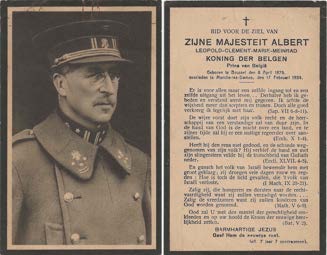
1226
CHAPTER 64. THE LESAGE ANCESTRY LINE
Figure 64.76: The obituary card of His
Majesty King Albert I of Belgium, 1934.
(Declercq de Silva Archive)
64.6.4.2 Other Acquaintances
A selection of memorabilia of acquaintances is shown in Figures 64.68, 64.69, 64.70, 64.71, 64.72,64.73, 64.74, 64.75, and 64.76.
© 2024 Nico F. Declercq
The Desclergues of la Villa Ducal de Montblanc, 2nd ed., Omn., VOL. V
64.7. THE OFFSPRING OF EMILE LESAGE AND EUDOXIE LAMMENS
1227
64.7 The Offspring of Emile Lesage and Eudoxie Lammens
There can be no doubt that the death of two sons during WWI had the most dramatic impact on the lives of Emile Lesage and Eudoxie Lammens.
Figure 64.77 shows the soldiers’ obituary card.
They had, however, many more children. The family still remembers that Eudoxie has been pregnant 18 times. We found 13
registered births:
Cyrille Camille Lesage (Westrozebeke May 28, 1890 - Paris, March 17, 1916),
Alida Maria Lesage (Westrozebeke, February 13, 1892 - Westrozebeke, February 26, 1892),
Martha Helena Lesage (Westrozebeke, March 9, 1893 - Roeselare, January 13, 1983),
Amanda (Amandine) Maria Lesage (Westrozebeke, September 5, 1895 - Ypres, November 28, 1983),
Gerard Medard Lesage (Moorslede 1898 - Moorslede 1933),
Hector Alidor Lesage (Moorslede, October 9, 1898 - Jonkershove September 28, 1918),
Maria Magdalena Lesage (Moorslede, March 18, 1900 - Ypres, July 27, 1980),
Paulus Ireneus Lesage (Moorslede, June 19, 1902 - Roeselare, September 1, 1976),
Godelieve Angela Lesage (Moorslede August 18, 1903 - Roeselare, June 23, 1990),
Irma Helena Lesage (Moorslede, February 21, 1905 - Kortrijk, June 7, 1953),
Oscar Petrus Lesage (Moorslede, June 13, 1906 - Roeselare, September 10, 1990), and
Daniël Abel Lesage (Moorslede July 15, 1911 - Deerlijk, April 29, 1988).
Every child is described in subsequent sections, while Irma Lesage is described in Chapter 45.2 as the wife of Michel Declercq and the author’s grandmother.
64.7.1 Cyrille Camille Lesage
64.7.1.1 Introduction
Cyrille Camille Lesage (Westrozebeke, May 28, 1890 - Paris, March 17, 1916) was the first child of Emile Lesage and Eudoxie Lammens. Born at his paternal grandparents’ home in Westrozebeke, the newlywed couple resided there until the birth of their third child. Subsequently, they relocated to Moorslede, near the train station at Statiestraat 518, where they had eight more children. In July 1912, the family moved to a farm in Ledegem at Kortwagenstraat 33.
The family’s circumstances were dramatically altered by the outbreak of World War I in the summer of 1914. By this time, Cyrille had enlisted in the Belgian military and was committed to defending his nation against the German invasion. The Lesage family faced significant upheaval during his intense engagement in the defense efforts near Antwerp. Emile Lesage and his son Paul remained in Ledegem, while Eudoxie Lammens relocated to Oudezeele in Northern France with the other children. They found refuge with the Secq family at Route des Trois Rois 77, a home designated as number 49 on the refugee list during the war.
Cyrille Lesage’s military career began in 1910 when he joined the Belgian army as part of the Militien 1910, serving in the 2nd Chasseurs à Pied, 3rd Army Division. He re-enlisted on July 30, 1914, in the 4/II Division, 2nd Regiment of the Chasseurs à Pied.
Lesage witnessed significant events on the Western Front, including the German bombardment of Ypres in April 1915, marked by the first large-scale use of chlorine gas.
On April 22, 1915, at 17:30, German forces released 168 tons of chlorine gas from 5730 cylinders, creating a devastating yellow-green fog that drifted towards Allied positions between Steenstraat and Poelkapelle. The gas attack impacted British, French, and Belgian units, but a swift counterattack by Allied forces prevented the Germans from capitalizing on the breach in the lines.
Cyrille was exposed to gas attacks multiple times, including a significant attack on August 12, 1915, at Noordschote, near Lo-Reninge. By August 21, 1915, his health had deteriorated, leading to his evacuation from the front lines due to severe lung problems. Lesage succumbed to tuberculosis in a Paris hospital on March 17, 1916.
In recognition of his service, Cyrille Lesage was awarded two Chevrons for his one year and seven months of duty at the Western Front.
Posthumously, he received several honors: Chevalier de l’Ordre de Léopold II (April 20, 1917), Croix de Guerre (April 20, 1917), and the Yser Medal, ’Gevochten aan de Yser van 17 tot 31 Oktober 1914 ’13, commemorating his involvement in the Yser battle from October 17 to 31, 1914. Cyrille Lesage is interred at the Père Lachaise Cemetery in Paris, within the Belgian War Monument, ensuring his sacrifice and memory endure.
64.7.1.2 His Birth
Cyrille Camille Lesage was born in 1890, in Figure 64.78 in Westrozebeke.
64.7.1.3 His Early life
Two pictures of Cyrille are shown in Figure 64.79.
64.7.1.4 His Military Career Before WWI
Cyrille Lesage was recruited, shown in Figure 64.80, on June 21, 1910, at the 36th canton of West Flanders in the village of Moorslede.
From October 3 onwards, he was considered a military.
Photographic evidence in Figure 64.81 of 1911 proves that Cyrille first joined the 1st Chasseurs ’a Pied at Charleroi (’1ste Jagers te voet’). In documents, however, established later, there is only a mention of the 2nd Chasseurs ’a Pied. So we assume he did not stay long in the first division and moved quickly to the second division at Mons, as shown in Figure 64.82.
His military files covering WWI are shown in Figures 64.83, 64.84, 64.85, 64.86, 64.87 and 64.88. A picture of when he was recruited for WWI is also shown in Figure 64.88.
In 1913, before he ended his regular term as a soldier, he received a military identification card with picture and matriculation number 51639 of the ’2e Régiment de Chasseurs ’a Pied, II Bataillon, 4 Compagnie.’ One can see that his address was in Moorslede at the time.
13Arrêté Royal 917.2, April 19 1921.
The Desclergues of la Villa Ducal de Montblanc, 2nd ed., Omn., VOL. V
© 2024 Nico F. Declercq
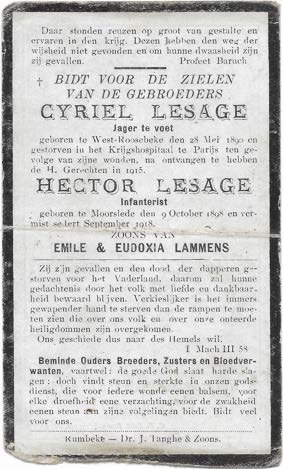
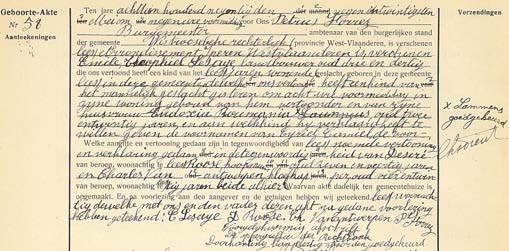
1228
CHAPTER 64. THE LESAGE ANCESTRY LINE
Figure 64.77: The death of Cyrille and Hector Lesage, Bel-
gian military and sons of Emile Lesage and Eudoxie Lam-
mens, is undoubtedly the most significant event in the lives of
this family and has been the center of numerous discussions
in the family and visits to the Western WWI front, through-
out the 20th century. Cyrille is described in Chapter 64.7.1,
Hector in Chapter 64.7.6. (Declercq de Silva Archive)
Figure 64.78: Westrozebeke, May 28, 1890, the birth of Cyrille Camille Lesage, son of 33-year-old farmer Emile Theophile Lesage and 22-year-old Eudoxie Romanie Lammens. The witnesses were 47-year-old merchant Désiré Roose and 24-year-old clog maker Charles Van Antwerpen.
© 2024 Nico F. Declercq
The Desclergues of la Villa Ducal de Montblanc, 2nd ed., Omn., VOL. V
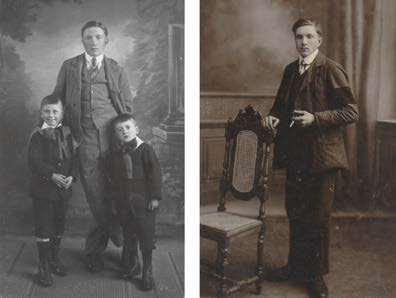
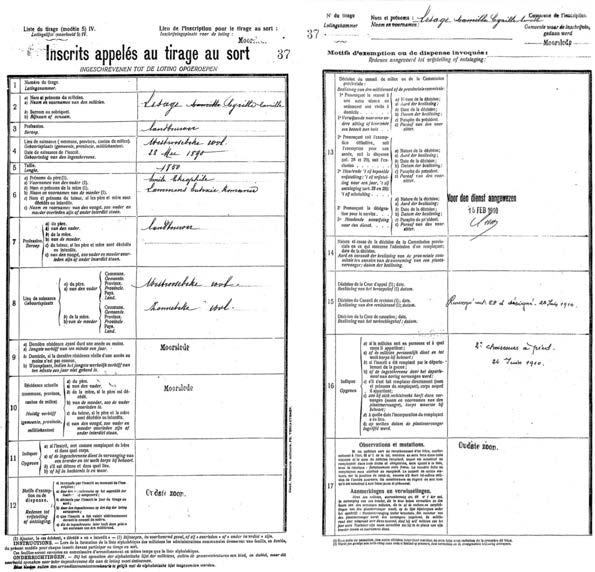
64.7. THE OFFSPRING OF EMILE LESAGE AND EUDOXIE LAMMENS
1229
Figure 64.79: Cyrille Lesage, alone and with his younger brothers Gerard Lesage
(left on the image) and Hector Lesage (right on the image). All three brothers would
be combat soldiers during WWI. The pictures probably date from around 1909-1911.
(Declercq de Silva Archive)
Figure 64.80: Military registration of Cyrille Camiel Lesage, in lichting van 1910, Nationale Militie, Province de la Flandre Occidentale, 36e militiekanton, gemeente Moorslede. He was a farmer, born in Westrozebeke on May 28, 1890. He was 175
cm tall. His parents were farmers, Emile Theophile Lesage, born in Westrozebeke, and Eudoxie Romanie Lammens, born in Zonnebeke. He had resided at least one year in Moorslede before his recruitment. His parents also lived in Moorslede. He was the eldest son. His recruitment date was February 15, 1910, after which he was sent back home for 82 days to join the army on June 24, 1910, in the Regiment of the 2nd Chasseurs à Pied.
The Desclergues of la Villa Ducal de Montblanc, 2nd ed., Omn., VOL. V
© 2024 Nico F. Declercq
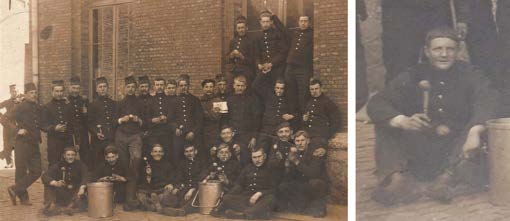
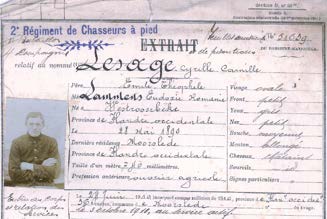
1230
CHAPTER 64. THE LESAGE ANCESTRY LINE
Figure 64.81: Charleroi 1911, 1st Chasseurs à Pied. Cyrille Lesage is positioned on the ground on the left side of the image. He is holding a potato skewered on a knife, as shown in the zoomed-in view.
Figure 64.82: The military headquarters of the 2nd Chasseurs à Pied,
in Mons, Belgium.
It proves that the family would move to Ledegem just before the onset of WWI. His height was 178.1 m, which was quite tall at that time.
Concerning his face, the document mentions:
Visage: ovale (Oval face)
front: petit (small forehead)
yeux: gris (grey eyes)
nez: petit (small nose)
bouche: moyenne (average mouth)
menton: allongé (long chin, which he had inherited from the de Patin ancestors)
cheveux: châtains (brown hair)
sourcils: idem (brown eyebrows)
signes particulier: non (no other particular signs)
His military records in Figure 64.89 further show that on March 11, 1912, he was granted unlimited time-off at his home in Moorslede, ’Rue Statiestraat 513,’ in the district of Ypres, canton Zonnebeke.
On July 3, 1912, he returned to the army and received unlimited time off on June 12, again at Moorslede, ’Rue de la station 518 ’
at the district of Ypres, Canton Zonnebeke.
On June 13, 1912, as we interpret the data correctly, he changed residence to Ledegem in the District of Kortrijk, Canton of Menen.
Then, on May 7, 1913, he returned to the army and was granted unlimited time off again on June 2. We assume this was the end of his regular military career. Later, he would return to the army when Germany declared war on Belgium in 1914.
Based on the pictures we have discovered, we assume he got engaged between June 1913 and July 1914. We do know, however, that he is never married.
64.7.1.5 His Civil Life just Before WWI
Once poised to follow in his parents’ footsteps and become a farmer, Cyrille Lesage found his destiny irrevocably altered by the tides of history. Before the eruption of World War I, the summer of 1914 shone brightly upon a prosperous land brimming with promise and hope. However, this idyllic existence was swiftly shattered, plunging Cyrille and countless other Europeans into the harrowing depths of conflict and despair. The poignant images of Cyrille captured just before the war serve as a haunting reminder Figure 64.83:
Military file of Cyrille
Lesage. This was probably made at the
end of his term in June 1913. He was
then a 2nd Chasseur à Pied (in Mons),
while in 1910, he must have been a 1st
Chasseur à Pied (in Charleroi), file num-
ber 20180302085626394. (sheet 1)
© 2024 Nico F. Declercq
The Desclergues of la Villa Ducal de Montblanc, 2nd ed., Omn., VOL. V
64.7. THE OFFSPRING OF EMILE LESAGE AND EUDOXIE LAMMENS
1231
Figure 64.84: The appearance of Cyrille
Lesage in the military database, file num-
ber 20180302085626394. (sheet 2)
Figure 64.85: The military records of Cyrille Lesage, file number 20180302085626394. (sheets 3 and 4)
of the innocence lost, as shown in Figure 64.90.
64.7.1.6 His Military Career During WWI
Cyrille Lesage, a distinguished soldier of World War I, demonstrated exceptional bravery during the Yser Battle between October 17 and October 31, 1914. He was posthumously awarded the Yser Medal by Royal Decree 917.2 for his bravery on April 19, 1921.
In addition to this honor, he received a posthumous knighthood, becoming a Chevalier of the Ordre de Léopold II. He was also awarded the War Cross (Croix de Guerre) on April 20, 1917.
Lesage’s military service was further recognized posthumously with the conferment of two front stripes (chevrons) on October 20, 1922. The Headquarters of the 2nd Chasseurs awarded these à Pied, which had relocated to Charleroi in 1919, having previously been stationed at Mons. On August 21, 1915, Lesage was evacuated from the Yser front due to illness but subsequently returned to duty. Tragically, he succumbed to lung tuberculosis at the Hospital Roi Albert I in Paris, located at 2 Rue d’Arcole in the 4th arrondissement, on March 17, 1916. He was initially interred at Ivry on March 20, 1916, and was later reburied in the Belgian soldiers’ monument at Père Lachaise Cemetery in Paris. His death certificate records that he was a Chasseur à Pied in the 5th Division of the Army, unmarried, and a resident of Ledegem.
Lesage’s military journey is intricately intertwined with the 2nd Chasseurs à Pied, his regiment. The 2nd Chasseurs à Pied, with its rich history, traces its roots back to the Frankish corps and was officially established on March 30, 1831, by decree of Baron Surlet de Chokier, Regent of Belgium. The regiment’s volunteers played a pivotal role in defending Mexico in 1864 at the request of Emperor Maximilian and Empress Charlotte of Belgium. They also contributed significantly to the protection of the Belgian Congo under King Leopold II.
During World War I, the 2nd Chasseurs à Pied displayed extraordinary heroism, particularly at the Willebroek canal’s Pont-Brûlé in Eppegem, where Corporal Léon Trésignies led under intense German fire. The regiment engaged in several significant battles, including the gallant fight at Jodoigne on August 16, 1914, the defense of Antwerp’s fortresses, and actions along the Nete River.