

The Desclergues of la Villa Ducal de Montblanc, Second Edition Omnibus by Nico Declercq - HTML preview
Download the book in PDF, ePub, Kindle for a complete version.
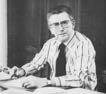
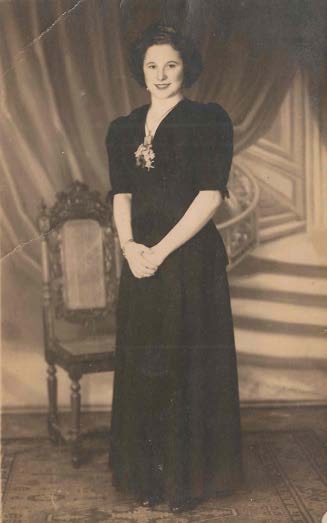
Figure 48.189: Left is a picture of Lucien Vangheluwe in 1938, taken on the wedding of René
Verhaeghe (described in Chapter 48.9.5.1), by Lucien’s elder brother René. Lucien died at the age of 5, on September 22, 1940, due to a (cow) smallpox vaccination, which killed him in 10
days. His death has been a shock for the family and a wound that never healed. The authorities
have always denied the accusations. The family consistently reported that the nurse responsible
for administering the smallpox vaccine did not adequately shake the vial prior to administration.
This oversight may have resulted in a higher concentration of the vaccine being delivered to the
child than intended, with lethal effects. The fact is that he was a perfectly healthy boy and very
energetic until the day after his vaccination. When he was dying, he asked his brother to buy a
bicycle with a real chain. (Declercq de Silva Archive)
The Desclergues of la Villa Ducal de Montblanc, 2nd ed., Omn., VOL. IV
© 2024 Nico F. Declercq
CHAPTER 48. THE MATERNAL DESCLERGUE ANCESTRY BRANCH BEGINNING WITH JOANA
964
CATHARINA DECLERCGZ (DC08B) & JOANNES DE VOS
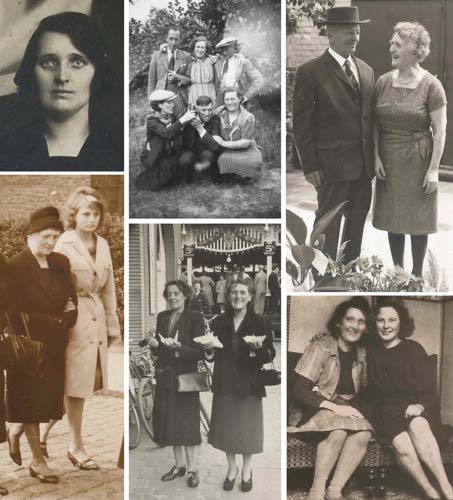
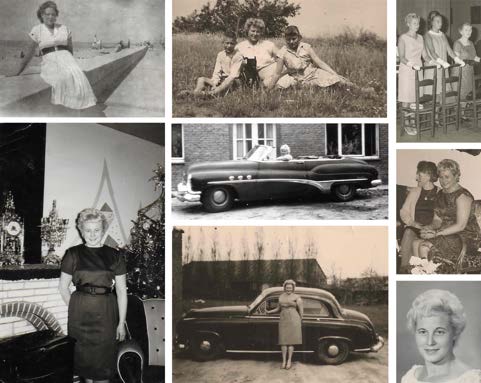
Figure 48.190: This compilation gives an impression of Zozyma Verhaeghe’s life. On the
picture with friends, we find her at the bottom left, with cap, and notice also Elizé Broucke
(middle) and Irma Verhaeghe (right). Behind is Theophile Caby (right, with cap). We equally
see her on another shot with her daughter-in-law Anna Den Dauw. One frame shows how
Zozyma Verhaeghe just bought French Fries at a carnival at Deerlijk (Kerkplein) or Kortrijk.
The woman to her right is Elsa Serleth (1907-1986), the wife of Adolf Dequesne, from Deerlijk.
Adolf was a good friend of Georges Verschae, see also Chapter 48.10.5. A moment of sadness is presented in the photo where Zozyma Verhaeghe is seen with her granddaughter (and foster
daughter) Nelly Maria Vangheluwe, mother of the author, in 1962 at the funeral of Zozyma’s
sister Irma Verhaeghe at Sint Lodewijk, Deerlijk. Finally, a moment of celebration is shared of
the 50 years marriage anniversary of Gerard Vangheluwe and Zozyma Verhaeghe. (Declercq de
Silva Archive)
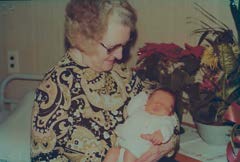
Figure 48.191: December 1975, Zozyma Verhaeghe was
holding the newborn author of this book at his baptism.
(Declercq de Silva Archive)
© 2024 Nico F. Declercq
The Desclergues of la Villa Ducal de Montblanc, 2nd ed., Omn., VOL. IV
48.12. RENÉ VANGHELUWE & ANNA DEN DAUW
965
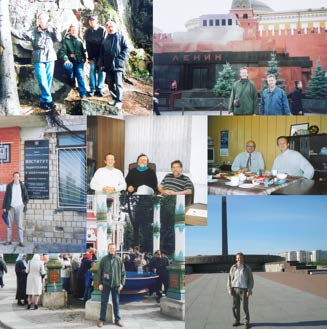
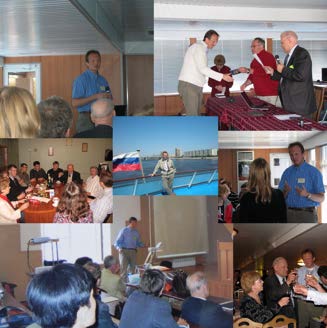
Figure
48.192:
From left to right,
top to bottom, we can see, at Valaam
near Sint Petersburg, Vitali Voloshinov
from Moscow State University, the author,
Sangtek Kim from Colorado University,
and Vladimir Petrov from Saratov Univer-
sity. Consequently, we see the Mausoleum
of Lenin, with the author and Vladimir
Kotov from the Institute of Radioengineer-
ing in Moscow. Then, we see the Insti-
tute of Radioengineering at Fryazino, the
acousto-optics lab of Vladimir Molchanov
in Moscow, and the lab of Biophysics of
Vadim Levin. Then, we observe the author
at the Danilov Monastery near Moscow
(the Moscow Patriarchate, at the town es-
tablished by Saint Vladimir the Great in
988). Finally, the author at the monument
to the Heroic Defenders of Leningrad.
(Declercq de Silva Archive)
author’s presence.
Her father was Theophile Verhaeghe, and her mother was Marie Louise De Vos.
Her husband was Gerard Vangheluwe.
48.11.1.2 Her Youth
She was born in Harelbeke, shown in Figure 48.185, and lived in the downtown area of Deerlijk, in Figure 48.186. A picture of her in that period is shown in Figure 48.187.
There is also a beautiful picture of Zozyma Verhaeghe, her fiancé, and her siblings and cousins in Deerlijk just after WWI, in Chapter 48.10.2.
48.11.1.3 The First World War
WWI facts have been described in the life of her brother Maurice Florimond Verhaeghe, such as in Chapter 48.9.5.4.5.
Zozyma’s identity card, required to work during WWI, is shown in Figure 48.187.
48.11.1.4 Their Marriage
Her marriage and other events can be found in Chapter 69, on the Surmont family line of Gerard Vangheluwe, particularly in Chapter 69.9.
Wedding souvenirs are shown in Figure 48.188.
48.11.1.5 Life in Pictures and Key Facts
As with several persons in this book, the abundance of pictures allows for a more engaging narrative than a thousand words.
To provide a comprehensive understanding of Zozyma’s life, we present Figures 48.186, 48.189, 48.190 and 48.191, each capturing a significant period or event in her life.
48.11.2 Gerard Vangheluwe
Gerard Vangheluwe is primarily described in Chapter 69 as the son of Marie Nathalie Surmont and François Vangheluwe and the author’s great-grandfather.
Two of his children have played a crucial role in the author’s life: the eldest son, René Vangheluwe, as the grandfather, and Pierre Vangheluwe, a foster father.
For the latter, we refer, just as for Gerard Vangheluwe, to Chapter 69 for extensive information.
Also, Jeanette Verbrugghe, who has served as a foster mother, is extensively described there. Her parents, Gerard Verbrugghe and Maria Van den Abeele, who have acted like foster grandparents, are extensively described in Chapter 77.
48.12 René Vangheluwe & Anna Den Dauw
48.12.1 René Vangheluwe
René Vangheluwe is equally referred to in the following chapters: Chapter 67 as the husband of Anna Den Dauw; Chapter 69 as the grandson of Maria Nathalie Surmont; and Chapter 72 as the husband of Anna Den Dauw.
48.12.1.1 Introduction
René Vangheluwe was born in Deerlijk in 1925 and he died in Izegem in 2017. He was married to Anna Den Dauw, who died in 1999 in Kortrijk.
The Desclergues of la Villa Ducal de Montblanc, 2nd ed., Omn., VOL. IV
© 2024 Nico F. Declercq
CHAPTER 48. THE MATERNAL DESCLERGUE ANCESTRY BRANCH BEGINNING WITH JOANA
966
CATHARINA DECLERCGZ (DC08B) & JOANNES DE VOS
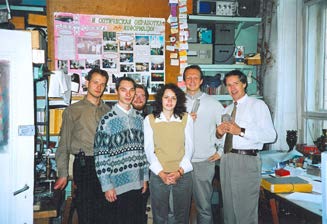
Figure 48.193:
2004, one year after
the death of Vladimir N. Parygin, the
author visited the Acousto-optics lab of
Vitaly B. Voloshinov (on the right) and
Natalia Polikarpova (in the middle) at
Moscow State University. From left to
right, the other persons are Yury Dobrolen-
sky, Aleksandr Thchernyatin, and Aleksei
Zakharov. Vladimir I. Balakshy took the
picture. Natalia Polikarpova has been one
of the author’s best friends since 2004; a
long connection was made possible because
both have become professors, i.e., Polikar-
pova at Moscow State and the author at
Georgia Tech. (Declercq de Silva Archive)
Figure 48.194:
The author has regu-
larly been a plenary speaker at famous
congresses organized by Academician Prof.
Dr. Sergei Kulakov from the St Petersburg
State University of Aerospace Instrumen-
tation in Russia. Sometimes, the congress
was held in the university infrastructure;
other times, it took place on a cruise ship
on the lakes North of the city. On the
top right, the author was presented with
an award by the Rector of the University,
Prof. Dr A. Ovodenko, while Prof. Dr
Sergei Kulakov was making the announce-
ment. The congress secretary was Lyud-
mila Konovalova, who has always been ex-
tremely friendly and helpful with the orga-
nization and visa arrangements. (Declercq
de Silva Archive)
48.12.1.2 His Personality
René Vangheluwe’s educational journey, which began at the Royal Atheneum of Kortrijk, was abruptly interrupted by the onset of World War II in 1940. Despite this, he demonstrated remarkable resilience, leaving school in 1942 to immerse himself in various economic activities. This decision, a significant departure from his scholarly path, was a testament to his ability to adapt to the tumultuous times and the tragic loss of his younger brother to smallpox just after the German invasion of Belgium. This personal tragedy, though profoundly traumatic, did not break his spirit, but rather left a lasting impression on René.
René’s intellectual prowess was evident, yet circumstances prevented him from fully realizing his potential. Despite this, he excelled in other areas, notably in sports and playing soccer until age 60. His remarkable speed and agility were assets on the field and during the war years.
René founded and managed several companies as an entrepreneur, earning admiration and respect from his extensive network. His employees often spoke highly of him, appreciating the opportunities he provided.
Known for his adventurous and sometimes reckless business approach, René was a paradoxical figure. He appeared open yet authoritarian, and his underlying insecurity often drove him to acts of generosity. During the war, he frequently sold food to needy families at low prices or on credit, which was seldom repaid. This generosity stemmed from a desire to be loved and admired, creating a network of indebtedness that offered him a sense of security.
One notable example of his compassion was his support for the Declercq-Lesage family, who lived on a farm near Deerlijk’s train station during the war. His connection with this family extended beyond the war years, fostering a bond that influenced subsequent generations. René’s wife, Anna Den Dauw, continued this legacy of kindness by cooking for the Declercq-Lesage children after the death of their mother, Irma Lesage. This intertwined history eventually led to the marriage of the author’s parents in the 1960s.
Politically, René was a fervent believer in Communism, yet he lived a lifestyle reminiscent of American values, embodying a fascinating contradiction. He often engaged in lengthy discussions about the war, politics, and history, though his personal biases notably colored his narratives. A memorable aspect of his influence was his insistence that his grandson learn Russian, driven by his belief in the eventual global dominance of Communism—a prediction that history did not fulfill. Nevertheless, this linguistic endeavor proved valuable, facilitating the author’s later academic and professional interactions with Russian scientists.
In 2004, the author embarked on a journey that exemplified bridging cultures and eras. Traveling from Gdansk to Saint Petersburg and then to Moscow on a Tupolev plane, he participated in scientific congresses and visited laboratories, strengthening his connections within the international scientific community. An anecdote from this period highlights the unexpected warmth and camaraderie he experienced: navigating the Moscow metro to visit Vitali Voloshinov’s team at Moscow State University, he was initially denied entry by a guard. After a tense exchange, the guard relented, and the author successfully reached his destination, surprising his hosts with perseverance. When, at nine, Natalia Polikarpova arrived with Vitali B. Voloshinov (1947-2019), shown in Figure 48.192, and someone else, they were stunned that he was standing there and could not believe he had reached their door all alone. It is an anecdote that is still being told regularly. The picture in Figure 48.193 was taken that day. The anecdote of this
© 2024 Nico F. Declercq
The Desclergues of la Villa Ducal de Montblanc, 2nd ed., Omn., VOL. IV
48.12. RENÉ VANGHELUWE & ANNA DEN DAUW
967
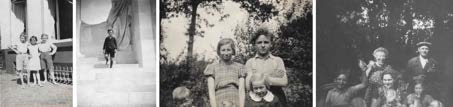
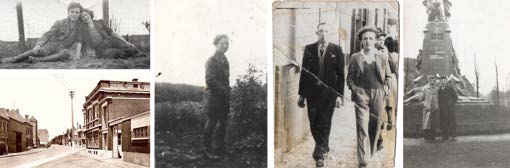
Figure 48.195: From left to right, we find, in 1933, Achiel Desmet, Suzanne Desmet, and
René Vangheluwe on the Belgian coast. Then, in 1938, René Vangheluwe was spotted at the
Canadian War monument of Vimy in France. The memorial is located at Givenchy-en-Gohelle,
just south of Lens in France. The same year, he enjoyed his holidays at Verdain-le-Veille, just
north of Lens in France, with the Demeyere family in the French resistance during WWI. The
family is described in Chapter 48.9.5.1 (Leonie, Josephe, Germaine, and children). (Declercq de Silva Archive)
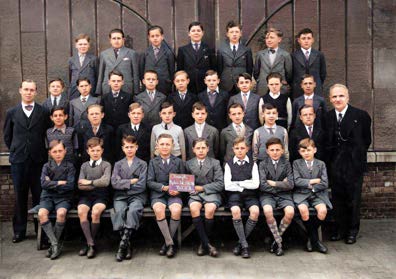
Figure 48.196:
1939, (5de middelbaar, i.e. 2nd year middle school) Royal
Atheneum Kortrijk, with René Vangheluwe in the front-middle holding a sign. My-
Heritage® colorized this photo. (Declercq de Silva Archive)
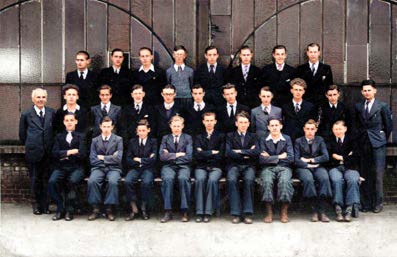
Figure 48.197: 1941 (3de middelbaar, i.e. 4th year high school), Royal Atheneum
Kortrijk, René Vangheluwe standing next to the school principal, left on this image.
MyHeritage® colorized this photo. (Declercq de Silva Archive)
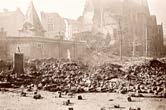
Figure 48.198: The Allies bombed, in 1944, the Royal Atheneum
of Kortrijk at the end of WWII. The prestigious building used to be a
military base of the 2nd line regiment of the Belgian army and had been
used in 1916, during WWI, for the deportation of forced laborers by the
Germans, described in Chapter 69.9.1.3. The place is also regarded as
the headquarters of the resistance of Kortrijk during WWII.
The Desclergues of la Villa Ducal de Montblanc, 2nd ed., Omn., VOL. IV
© 2024 Nico F. Declercq

CHAPTER 48. THE MATERNAL DESCLERGUE ANCESTRY BRANCH BEGINNING WITH JOANA
968
CATHARINA DECLERCGZ (DC08B) & JOANNES DE VOS
Figure 48.199: From right to left, several impressions are given of the WWII period. On the last Sunday of 1940, René Vangheluwe visited, with his friend Daniel Derudder, the Groeninghe statue in Kortrijk. Note that the Derudder family also founded a school in Deerlijk, described in Chapter 48.10.5. In 1942, we see René Vangheluwe with baker André Pattijn from Harelbeke. They were dressed in Zazou fashion, typical for occupied Europe, to protest against the Germans. In 1942, we observe René Vangheluwe in outfit during
WWII operations. A photo of René Vangheluwe and Anna Den Dauw in 1944 is shown, when they were just
married at the war’s end. The Zazou fashion still influenced their style. We equally notice the junction of Stationsstraat and Kapel-Ter-Rustestraat in Deerlijk. There have been fierce fights here between the British and the Germans during the liberation of Deerlijk in 1944, described in Chapter 48.10.5. (Declercq de Silva Archive)
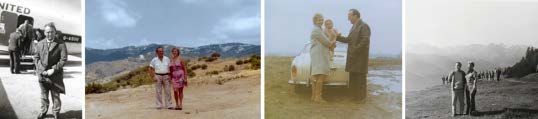
Figure 48.200: We can see René Vangheluwe and one of his cars from left to right in 1960. Then, around 1950, he is on the beach, holding his two children, Nelly and Lucien. Around 1959, René is seen with Anna at a packaging line they owned.
In 1963, we find him in Blankenberge at one of his outlet shops that sold the textiles his company manufactured. One of his cars was a Pontiac Chieftain, which is likely the one seen on the right. (Declercq de Silva Archive)
Figure 48.201: In 1964, René Vangheluwe made a business trip to London to buy new Singer looms for his company. In 1973, we see René Vangheluwe with Anna Den Dauw, holding their eldest grandchild, Inka, going for a ride in their white Karmann® sports car. In 1971-1973, they visited the Pyrenees. Around 1980, we see, somewhere in Spain, René Vangheluwe and Anna Den Dauw. (Declercq de Silva Archive)
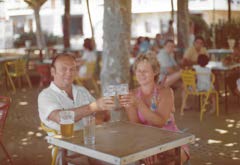
Figure 48.202:
Around 1980, somewhere in Spain,
René Vangheluwe and Anna Den Dauw. They were
happy and enjoyed the memories of their rich and ex-
citing experiences over the past 40 years. (Declercq de
Silva Archive)
Figure 48.203: René Vangheluwe knew Senator Armand de Rore (1919-1999) rather
well, probably from WWII in Waregem. (Declercq de Silva Archive)
© 2024 Nico F. Declercq
The Desclergues of la Villa Ducal de Montblanc, 2nd ed., Omn., VOL. IV
48.12. RENÉ VANGHELUWE & ANNA DEN DAUW
969
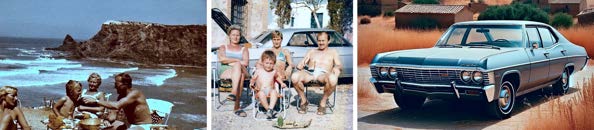
Figure 48.204: Anna Den Dauw, 1979, Algarve, Portugal, with Nelly, Nico, and Maurice, photo by René. The middle photo, 1978, Spain, summer journey with a gray Chevrolet Impala (Fourth Generation 1967 Impala 4-Door Sedan, shown right). From right to left: Maurice A. Declercq, Nelly M. Vangheluwe, Nico F. Declercq, Anna Den Dauw. (Declercq de Silva Archive)
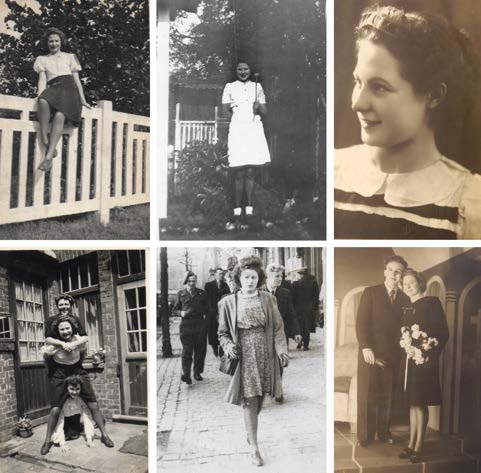
Figure 48.205: In the upper row, we see Anna Den Dauw around 1944, in 1952, and the beginning of
WWII. The lower row shows her in 1944 with two friends in Saint Louis, Deerlijk. The lower middle
picture was taken in 1945-1947, likely in Kortrijk. Her hair and dress show signs of the Zazou fashion during WWII against the German occupation. In the background, there is an accidental soldier in
the picture. Experts told the author that this soldier was British (RAC division, with copper signs
on his shoulder) in 1945. Otherwise, it may have been a Belgian soldier from 1946 to 1947 who
had a similar uniform with slightly different symbols on the shoulders. Indeed, the airforce base of
Wevelgem was in British hands after the war until 1946, after which it was returned to the Belgian
army. Comparison with other pictures and information indicates that the image was likely taken at the
end of 1945. Finally, the lower right photo is her wedding with René Vangheluwe in 1944. (Declercq
de Silva Archive)
The Desclergues of la Villa Ducal de Montblanc, 2nd ed., Omn., VOL. IV
© 2024 Nico F. Declercq
CHAPTER 48. THE MATERNAL DESCLERGUE ANCESTRY BRANCH BEGINNING WITH JOANA
970
CATHARINA DECLERCGZ (DC08B) & JOANNES DE VOS
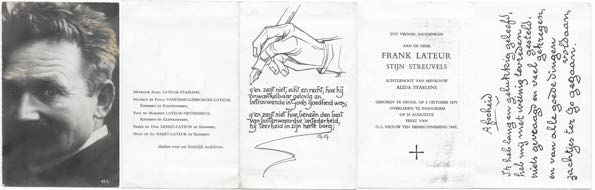
Figure 48.206: Frank Lateur, also known as Stijn Streuvels, husband of Alida Staelens, was an acquaintance of the Den Dauw family. A picture is shown, together with his obituary card. (Declercq de Silva Archive)
visit is still frequently recounted, capturing the spirit of determination and cross-cultural engagement.
Acousto-Optics is the study of the interaction of light with sound. Briefly explained the sound causes a periodic modulation of the optical refractive index (through density variations caused by the acoustic pressure), deflecting light. Because of the periodicity and the weakness of the interaction, the light phase and not the amplitude are periodically distorted, which causes the sound wave to act like a diffraction grating. As a result, light is diffracted, which means it splits into different light rays, and the sound wave determines Doppler shifts. Engineers and scientists can use the principle to visualize and measure sound or control laser light.
Therefore, as described in numerous scientific papers, it is essential in laser-guided systems, laser printing, optical communications systems, and many others. The author has regularly met with prominent
48.12.1.3 A Life in Pictures
Pictures, more potent than words, are shown in Figures 48.195, 48.196, 48.197, 48.198, 48.199, 48.200, 48.201 and 48.202.
48.12.1.4 Some of his Acquaintances
René Vangheluwe had a vast network of friends and acquaintances, mainly in West-Flanders but also far beyond. He treated them very discreetly and hardly ever had mixed meetings. Some of his friends were ordinary men, and others were compelling.
His best friends were attorney Professor V. Wieme and his wife, Solange. They lived in Brussels, in Molenbeek Saint-Jean, in Boulevard Louis Mettewie. Mr Wieme was, at the end of his life, an honorary attorney. He died on June 20, 2015, at the age of 87. He has been, half a century, a member of the bar of lawyers in Ghent since 1960 and Brussels since 1963, and he was the successor, in Brussels, of attorney Pierard. Mr Wieme had a special relationship with Rwanda, where he managed the Antwerp Law Faculty program in Butare under challenging circumstances—the program aimed to train the necessary lawyers. Sadly, many of the students who graduated under his guidance perished in the genocide that ravaged the country shortly afterward. Mr Wieme also taught comparative law in Antwerp for many years.
René Vangheluwe’s admiration for public figures was a notable aspect of his character. He held Albert Windels, the mayor of Deerlijk from 1961 until 1976, in high regard.
His appreciation extended to King Boudewijn of Belgium and Armand De Rore, a prominent figure from Waregem in Figure 48.203.
He also had a close relationship with Eric Derycke’s parents from Waregem, whom he knew well from WWII.
It is believed that many people were indebted to him, both financially and otherwise, which provided him with a sense of comfort and protection.
René Vangheluwe was a man deeply enmeshed in the intricate web of secrets spun during World War II and the years that followed.
His knowledge of covert operations, personal indiscretions, and hidden agendas made him formidable. He guarded these secrets unyieldingly, understanding that the power they conferred was a double-edged sword. Those around him were acutely aware of the depth of his knowledge; some admired him for his discretion and wisdom, while others lived in constant apprehension of what he knew. This reverence and fear duality became the cornerstone of his influence. René’s silent guardianship of such potent secrets cemented his unparalleled power and authority in a world where information was both currency and weapon.
48.12.2 Anna Den Dauw
48.12.2.1 Introduction
Being a Den Dauw, Anna is also listed in Chapter 67.
Furthermore, as she carries the same mtDNA as the author and is his grandmother, she also appears in the Chapter 72.
Anna Den Dauw loved traveling through France, Spain, and Portugal. In the late 1970s, the author traveled with his parents and grandparents through Iberia. Tourism hardly existed back then, and we could visit villages and people all over Spain in the early days after the Franco era. An impression is shown in Figure 48.204. We usually drove a powerful car with a caravan behind: our moving fortress through the Spanish landscape. The author can still smell and feel Spain in his distant memories. In particular, the taste of fresh Spanish Peaches and other fruits is still vividly alive in his warm memories of that time. The hot yellow soil in summer and the smell of conifers likewise.
Anna Den Dauw, born in Deerlijk (Saint Louis) on February 19, 1924, and passed away in Kortrijk on May 7, 1999, at the same hospital where, on October 21 that year, her great-grandson Benjamin Declercq would be born. The author cherishes the memory of sharing the news of his wife’s pregnancy with Anna before her passing; her joy is palpable.
Despite her age, Anna had a unique gift of communication, especially with the younger generation. Her ability to connect with young people endeared her to teenagers, family, and neighbors. They saw in her a surrogate elder sister, always ready with wise and humanistic advice.
Anna often shared a fascinating aspect of her youth, a testament to her strong family ties and local history. Despite the early loss
© 2024 Nico F. Declercq
The Desclergues of la Villa Ducal de Montblanc, 2nd ed., Omn., VOL. IV
48.12. RENÉ VANGHELUWE & ANNA DEN DAUW
971
Figure 48.207: By outsiders, Anna Den
Dauw is remembered chiefly for her beauty.
(Declercq de Silva Archive)
Figure 48.208: Anna Den Dauw is depicted at the beach in Belgium or the North of France around
1954 and with her children Lucien and Nelly around 1957. The image in the church was taken at the
wedding of Lucien and Jenny in 1968, and we can see Anna Den Dauw, Nelly Maria Vangheluwe,
and Zozyma Verhaeghe, Anna’s mother-in-law. Other images, such as Christmas Eve around 1960, at
home in Oude Heerweg, Deerlijk, or 1962, in a Buick (production 1950-1959), are also shown. René
had bought this car to travel comfortably to Venice with his family. Next, in 1966, we see Zozyma
Verhaeghe, Anna Den Dauw, and Anna in her car. She liked driving cars until she was around 60
years old. (Declercq de Silva Archive)
The Desclergues of la Villa Ducal de Montblanc, 2nd ed., Omn., VOL. IV
© 2024 Nico F. Declercq
CHAPTER 48. THE MATERNAL DESCLERGUE ANCESTRY BRANCH BEGINNING WITH JOANA
972
CATHARINA DECLERCGZ (DC08B) & JOANNES DE VOS
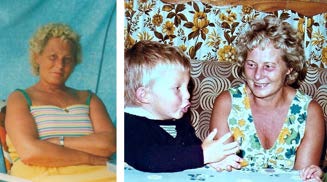
Figure 48.209: Anna Den Dauw always
enjoyed summer vacations with her grand-
children Inka, Maika, and Nico. Here,
she is enjoying an ’explanation’ by Nico,
author of this book. (Declercq de Silva
Archive)
of her mother and her father’s illness, her parents and grandparents had a close relationship with Flemish author Frank Lateur (Stijn Streuvels). Frank and his parents, who were bakers in Avelgem, were frequent visitors to the Den Dauw family in Otegem.
Anna’s paternal ancestors, renowned shoemakers, were a prominent part of the Otegem community. Their story is beautifully chronicled in Chapter 67.
In honor of Anna’s deep love for photography and film, particularly those capturing her travels, family, and cherished moments from her youth, we will share her story primarily through the images she held so dear. These photos, reflecting the essence of her life and passions, speak more profoundly than words ever could.
48.12.2.2 Her Youth
Figure 48.205 gives a pictorial impression of her youth.
48.12.2.3 Some of her Acquaintances
Frank Lateur, better known as Stijn Streuvels (Heule 1871 - Anzegem 1969), was a flemish writer, the son of a baker from Avelgem.
He is shown in Figure 48.206. The Lateur bakers were well known by the Den Dauw family (Otegem). Declercq’s grandmother, Anna Den Dauw, has seen Frank Lateur several times during her youth. The stories of Stijn Streuvels were viral and easy to read. Anna Den Dauw was equally acquainted with the families of Mekeirele, Mattijs, and many others through her uncles and grandparents.
Stijn Streuvels’ life was deeply intertwined with the geographical landscape of the area on and North of the Schelde River, such as Avelgem, Otegem, etcetera. It was not uncommon for families from this region to move, for economic reasons, to the French border or just across the border. Indeed, in the 2nd half of the 19th century, we also found the Den Dauw family in that region, close to Roubaix, namely Leers-Nord. This geographical context, with its rich history and cultural diversity, undoubtedly played a significant role in shaping Streuvels’ worldview and his literary works.
Franciscus Petrus Maria Lateur was born on October 3, 1871, in Heule, near Kortrijk. He died on August 15, 1969, at Ingooigem near Vichte. His parents were bakers. He ran their business between 1891 and 1895. He lived for around 20 years in his parents’
bakery at Avelgem. His father was Camille Lateur (1844-1897), a baker and tailor; his mother was Louise Gezelle (1834-1909).
Frank Lateur married Alida Staelens in 1905, in Avelgem. Their children were Paula, Paul, Dina, and Isa. Frank’s siblings were Maria Louisa, Elisa, Camille, Karel and Maria. Frank’s paternal ancestors were bakers from Avelgem, while his mother’s family was from Heule. His grandparents at Avelgem were Pierre Lateur and Amelie Van Meenen. It was in Roubaix that Camille Lateur married Louise Gezelle in 1865. Frank Lateur is also described in Ernest Constant Declercq’s life in Chapter 44.8.13.
48.12.2.4 Mother and Grandmother
Should we be able to ask Anna how she should be remembered in this book, her answer would be "show pictures!" Her will is fulfilled in Figures 48.207, 48.208, 48.209, and 48.204.
48.13 Nelly Maria Vangheluwe & Maurice Alois Declercq
48.13.1 Nelly Maria Vangheluwe
Nelly Maria Vangheluwe is described in Chapter 46 as the wife of Maurice Declercq (DC16). She is the author’s mother, the daughter of René Vangheluwe and Anna Dendauw, born in 1945. They married in 1966. She is equally referred to in the following chapters:
Chapter 64 as the daughter-in-law of Irma Helena Lesage; Chapter 65 as great-great-great-great-great-great-granddaughter-in-law of Adrienne de Patin (DP12); Chapter 66.1 as great-great-great-great-granddaughter-in-law of Barbara Benoit; Chapter 66.2 as a great-great-great-great-great-granddaughter-in-law of Maria Jeanne Christine Benoit; Chapter 67 as the daughter of Anna Den Dauw; Chapter 68 a an in-law ’t Kint descendant; Chapter 69 as the great-granddaughter of Marie Nathalie Surmont; Chapter 71
as great-granddaughter-in-law of Clemens Lammens; and Chapter 72 as the mother of the author.
48.13.2 Maurice Alois Declercq
He is described in Chapter 46 as the author’s father and the son of Michel Achiel Renatus Declercq and Irma Helena Lesage. He was born in 1941 and died in 2015. He is equally described in the same chapters as Nelly Maria Vangheluwe.
48.14 Nico Felicien Declercq & Shirani Olupathage de Silva
Nico F. Declercq, the author of this book, is not only a figure in the Spanish paternal ancestry line in Chapter 47 but also in all the other chapters and bloodlines documented here.
© 2024 Nico F. Declercq
The Desclergues of la Villa Ducal de Montblanc, 2nd ed., Omn., VOL. IV
973
Shirani de Silva appears in the same chapters as the author, with particular attention in Part XII with a separate description of her Iberian, Indian, and Sri Lankan ancestry.
In particular, she can also be found in the following chapters: Chapter 64 as granddaughter-in-law of Irma Helena Lesage; Chapter 65
as great-great-great-great-great-great-great-granddaughter-in-law of Adrienne de Patin (DP12); Chapter 66.1 as great-great-great-great-great-granddaughter-in-law of Barbara Benoit; Chapter 66.2 as a great-great-great-great-great-great-granddaughter-in-law of Maria Jeanne Christine Benoit; Chapter 67 as granddaughter-in-law of Anna Den Dauw; Chapter 68; Chapter 69 as great-great-granddaughter-in-law of Marie Nathalie Surmont; Chapter 71 as great-great-granddaughter-in-law of Clemens Lammens; and Chapter 72 as the wife of the author.
Their children are Benjamin Jonathan Howard Declercq (1999), Anna-Laura Florence Marion Declercq (2005), and Lambert Leander Belin Declercq (2011).
The Desclergues of la Villa Ducal de Montblanc, 2nd ed., Omn., VOL. IV
© 2024 Nico F. Declercq
CHAPTER 48. THE MATERNAL DESCLERGUE ANCESTRY BRANCH BEGINNING WITH JOANA
974
CATHARINA DECLERCGZ (DC08B) & JOANNES DE VOS
© 2024 Nico F. Declercq
The Desclergues of la Villa Ducal de Montblanc, 2nd ed., Omn., VOL. IV
Solo la gloria a Dios
The Desclergues of la Villa Ducal de Montblanc, 2nd ed., Omn., VOL. IV
© 2024 Nico F. Declercq
Chapter 49
The Chapel of Nuestra Señora del Reposo or De
Kapel van Onze Lieve Vrouw Ter Ruste, in Deerlijk
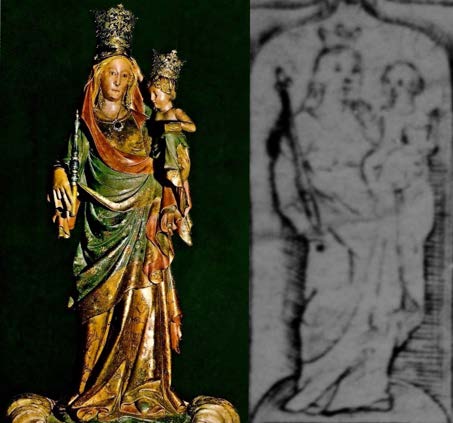
Figure 49.1: Left is the Virgin of the Sierra, better known as ’la Mare de Déu de la Serra de
Montblanc,’ the patron of Montblanc, described in Chapter 49.6. Right is a close-up of Figure
49.8 on page 49.8, which is the oldest known image of the chapel in Deerlijk, described in Chapter
49.2 and representing the miracle that happened in that location in 1634. Striking is, for instance, the script in Jesus’ hand in both pictures. It is also clear that Mary is standing in both depictions, while Jesus’ and Mary’s heads are approximately at the same height. In both cases, Jesus is not
watching the spectator and is not looking down on him. The depiction of Figure 49.8 therefore shows that the 1634 miracle in Deerlijk, outlined in Chapter 49.5 and similar to the one of Montblanc, described in Chapter 49.6, occurred in front of a tree in which ’la Mare de Déu de la Serra de Montblanc’ hung. The chapel, constructed near the wonder’s location, would be called
’Kapel ter Ruste,’ as described in Chapter 49.1. Anyone visiting Antwerp will see a Spanish Mary statue at the top of the facade of the town hall, placed there during the reign of Felipe II of
Spain, which shows some similarities with the figure in Montblanc. Nevertheless, the Antwerp
statue shows Jesus looking down on the spectators and holding the bible slightly differently. Also,
the height of Jesus’ head differs from that of Montblanc. Still, it is an additional indication that
the Spanish who ruled Flanders around 1600 preferred this type of Mary with Jesus statuete.1
As described in Chapter 25.0.1.3, through generations, our family has acknowledged the profound significance of Church Retables, not solely as expressions of faith but also as embodiments of cultural heritage and artistic mastery. Retables, characterized by their intricate designs and spiritual narratives, function as focal points within sacred spaces, inviting contemplation and reverence.
Understanding the immense dedication and resources required to craft such monumental works, our family has established a tradition of providing financial support. This commitment goes beyond mere philanthropy; it is a testament to our unwavering belief in the power of art to inspire, uplift, and unite communities. It is a commitment that we are proud to uphold.
Our investment in the creation of Church Retables is not just a tribute to our familial tradition, but a significant contribution to the preservation and enrichment of our collective cultural heritage. Through our patronage, we are empowering talented artists to perpetuate their craft and leave a legacy that transcends generations. This is a role we take with great responsibility and pride.
For instance, Notary Ramon Berenguer Desclergue supported Joan Barceló in creating a retable at Santa Maria del Pi in Barcelona, exemplifying our dedication to this endeavor.
The Desclergues of la Villa Ducal de Montblanc, 2nd ed., Omn., VOL. IV
© 2024 Nico F. Declercq
CHAPTER 49. THE CHAPEL OF NUESTRA SEÑORA DEL REPOSO OR DE KAPEL VAN ONZE LIEVE
978
VROUW TER RUSTE, IN DEERLIJK
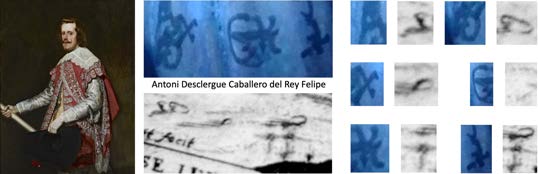
Figure 49.2: Left is H.M. King Philip IV of Spain. The painting was made in 1644 by Diego Rodriguez de Silva y Velázquez (Sevilla 599 - Madrid 1660) and can be admired in the Frick Collection Museum, Manhattan, New York, USA. Then we see Antoni Desclergues’ (DC06) initials on the chapel’s artwork and its oldest surviving drawing. Each item is separately shown in Figures 49.36 on page 1002, 49.35 on page 1002, and Figure 49.8 on page 997.
Antoni Desclergue (DC06) used ’ADXCRF ’ as initials, shown in Figure 49.2 and referring to his knighthood and service to H. M.
King Felipe IV of Spain. Alternatively, he also added ’EHR’ to his signature, having the same meaning and shown in Figure 34.2 on page 520. His Majesty was the feudal lord of the ground on which the chapel in Deerlijk, described in this chapter, was built in 1639.
That Marguerite Kelduwier was not the only person to support constructing the chapel in Deerlijk is proven by evidence found in the archives of Arras, stating the establishment of the chapel was realized thanks to the devout donations of certain persons, or, in Dutch,
’Twelck oock daernaert geschiet is want door de godtvruchtige giften van sommighe ende . . . 2
49.1 El Suelo del Reposo - Introduction
In Chapter 29.5.8, the arrival of Jeroni Joan Desclergue y Cortés (DC05), father of Antoni Desclergue (DC06), in Harelbeke is outlined, specifically witnessed by Maestro de Campo Luis del Villar, shown in Figures 29.24 and 29.25 on page 393 in Chapter
29.5.2, preserved in the handwriting of Francesc de Pedrolo y Desclergue and kept in the archives at Urgell in Spain.
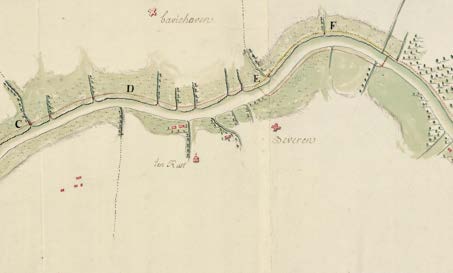
In Chapter 29.12, we have introduced the location of the Spanish barracks between Deerlijk and Harelbeke. On that spot, the Leie River had a calm section East of Harelbeke, nicknamed Ten Rust (Reposo). Figure 49.4 offers a closer look at this particular strip and shows that there was a Chapel called Ten Rust, Saint Anne’s church, at the junction of Kleine Heerweg en Grote Heerweg at the end of the 17th century. In Chapter 48.9.5.4.5, we have seen that the area has also served as the crossing point by the British during the liberation in 1918, where the bank South of the Leie River was used as a bridgehead.
The area was chosen for several military strategic reasons and mainly served as the ground to find rest, i.e., El Suelo del Reposo.
’Rest’ is what this location was known for because, in the North, it was a gateway to the Leie River, where the river was tranquil and had very flat shores, similar to a beach. In old Flemish, the word kust was not reserved for a marine coast but also existed to describe river flanks, i.e., rivierkust. Perhaps the origins of another nearby chapel, Kutskapel, should be searched in this context as a corruption of the word kust, or even the Spanish counterpart Costa.
Kuts cotemporarily means fever. Its ancient roots are interesting in the context of a tranquil river with a weak flow. Indeed, Olivier van Renswoude3 published an extensive study of the Dutch word koorts which is kuts in Flemish. He concludes that the word originates from the Germanic word kurtisonq, which means ’weak’ and later evolved into the meaning of ’fever’ or ’being feverish.’
From this work, we copy, for future reference, the sources used by Renswoude, i.e., R. S. Beekes4, L. De Bo5, R. Derksen6, J. and W. Grimm7, E. Hellquist8, H.& W. Meid Krahe9, W. P. Lehmann10, M. Mayrhofer11, J. Müller12, M. Philippa et al13, D. Ringe and A. Taylor14, J. C. von Schmid15, M. de Vaan16, J. de Vries17, Fr. Woeste18, and also some dictionaries19.
Therefore, we assume that the tranquil Leie River section was initially called ’weak’ in Germanic and evolved simultaneously to kuts and rust because both words have the same semantic root. It may be why there used to be a chapel called Kutskapel nearby20.
Such a tranquil river section was essential to embark on or rest if a boat continued its journey upstream afterward. It was also ideal for the military to gather ships and load them in calm water before taking off.
2The document confirming the appointment of Walrand Du Bois as chaplain of O.-L.-Vrouw ter Ruste in Deerlijk states ’Twelck oock daernaert geschiet is want door de godtvruchtige giften van sommighe ende . . . ,’ Arras, Archives Départementales du Pas-de Calais, n 43J, Chartrier Clouet des Pesruches, 175/19.
3Olivier van Renswoude, ’ Herkomst Koorts,’ Taaldacht, February 1, 2020
4R. S. Beekes, Etymological Dictionary of Greek (Leiden, 2010).
5L. De Bo, Westvlaamsch Idioticon (Gent, 1892).
6R. Derksen, Etymological Dictionary of the Baltic Inherited Lexicon (Leiden, 2015).
7J. and W. Grimm, Deutsches Wörterbuch (Leipzig, 1854-1961).
8E. Hellquist, Svensk etymologisk ordbok (Lund, 1922)
9H. & W. Meid Krahe, Germanische Sprachwissenschaft: III Wortbildungslehre (Berlijn, 1969).
10W. P. Lehmann, A Gothic Etymological Dictionary (Leiden, 1986)
11M. Mayrhofer, Etymologisches Wörterbuch des Altindoarischen, I-III (Heidelberg, 1992-2001).
12J. Müller, Rheinisches Wörterbuch (Bonn, 1928).
13M. Philippa et al, Etymologisch Woordenboek van het Nederlands (webuitgave).
14D. Ringe and A. Taylor, The Development of Old English (Oxford, 2014).
15J. C. von Schmid, Schwäbisches Wörterbuch (Stuttgart, 1831).
16M. de Vaan, Etymological Dictionary of Latin and the other Italic Languages (Leiden, 2008), and ”Etymologie en dialectgeografie van koorts’ ’ , in Verslagen en Mededelingen van de Koninklijke Academie voor Nederlandse Taal- en Letterkunde, jaargang 120, aflevering 3 (2010), blz 45–79.
17J. de Vries, Nederlands etymologisch woordenboek (Leiden, 1971).
18Fr. Woeste, Wörterbuch der westfälischen Mundart (Norden/Leipzig, 1882).
19Svenska Akademien, Ordbok över Svenska Spraket (1893-present), Vroegmiddelnederlands Woordenboek (online), and Middelnederlandsch Woordenboek (online).
20In modern Flemish, the words kuts (koorts or ’fever’) and rust are disconnected, but they share the exact Germanic origin.
© 2024 Nico F. Declercq
The Desclergues of la Villa Ducal de Montblanc, 2nd ed., Omn., VOL. IV
49.1. EL SUELO DEL REPOSO - INTRODUCTION
979
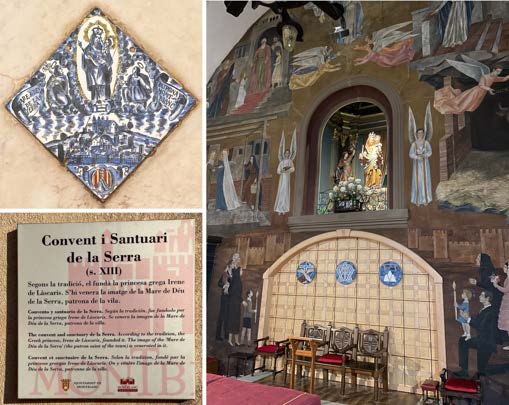
Figure 49.3: The Convent and Sanctuary of la Serra in Montblanc is where the original statue is found, after which the one that played a role in the miracle in Deerlijk was copied.
Figure 49.4: This map of the end of the 17th century shows the Leie River between Beveren and
Harelbeke, where the Spanish military could quickly embark their ships and where the river was
tranquil. On that spot, nicknamed Ten Rust, there was a Saint Anne chapel that the map maker
mistakenly called Ten Rust. To the Spanish, the whole area between Deerlijk and Harelbeke,
headed by the Overacker Manor equally visible on this map, was a resting place or a spot to set
up their camps. It’s, therefore, no wonder that a new Chapel at Deerlijk, constructed in 1639,
carried a similar name. More extensive views of this map can be found in Figure 29.32 on page
396 and Figure 29.208 on page 454.
Figure 49.5: The interior of the Sant Miquel church of Montblanc.
The Desclergues of la Villa Ducal de Montblanc, 2nd ed., Omn., VOL. IV
© 2024 Nico F. Declercq
CHAPTER 49. THE CHAPEL OF NUESTRA SEÑORA DEL REPOSO OR DE KAPEL VAN ONZE LIEVE
980
VROUW TER RUSTE, IN DEERLIJK
The location may also have been fordable during some periods, which may have been the fundamental reason for a town like Harelbeke to develop nearby.
The site was prone to invasions from the North and required military protection, yet another reason to install military there.
The Spanish associated the whole area West of Deerlijk and South of Harelbeke as a place of rest. The Chapel at Deerlijk, constructed in 1639, naturally received the name Kapel-ter-Ruste, La Capilla del Reposo, or ’The Chapel of Nuestra Señora del Reposo.’
A close-up of the river where the Saint Anne chapel was located and referred to as Ten Rust on the map at the end of the 17th century is shown in Figure 49.4. More extensive views can be found in Figure 29.32 on page 396 and Figure 29.208 on page 454.
The Chapel in Deerlijk, established in 1639, is undeniably a locally rooted Spanish conception that has determined the village’s landscape since its erection. The 18th-century legend formerly narrating the story of the Chapel’s foundation was socially so well embedded and affirmed that it must have undoubtedly been rooted in a factually based local tale in which a Knight or Nobleman was involved.
Records-based research in the regional and French ecclesiastic administration has revealed that Marguerite Kelduwier, the widow of banker Jean du Bois, initiated the foundation act and financial support. Her descendants were wealthy, and even the Romans knew about the rich, that ’Dives est qui sibi nihil deesse putat.’
Further research, however, on the witnesses involved with the miracle of 1634 used as official raison d’ être to establish a Chapel, revealed a clan all personally connected to our paternal ancestor, Antoni Desclergue (DC06), a Catalan Knight, born in Barcelona, Spain, son of Jeroni Joan Desclergue y Cortés (DC05) and described in Chapter 37.
Circumstantial research of the 1639 period in Deerlijk indicates that constructing a new chapel near Deerlijk’s main church may only have been possible under solid support by the Spanish regime. The cleric who collected the testimonies was a Portuguese provost of the Saint Salvator church in Harelbeke. At the same time, the Bishop, whose approval was needed, had known Antoni Desclergue’s (DC06) father, Jeroni Desclergue (DCO5), outlined in Chapter 29, since the end of the 16th century in Cambrai.
Beatrice Declercq, the spouse of Antoni Desclergue (DC06), hailed from the distinguished Declercq family of Kortrijk and Doornik, outlined in Chapter 34.13. This family maintained robust ties with prominent local financial dynasties, including influential bankers and merchants such as the Du Bois, Andries, Braye, and Grimaldi families. Consequently, it is reasonable to assert that Antoni Desclergue possessed a more formidable network than Marguerite Kelduwier. Without his discreet support and extensive connections in Tournai and with the Spanish regime, Marguerite would have been unable to establish a chapel in such proximity to the main church of Deerlijk.
When the Chapel in Deerlijk was constructed in 1639, Flanders’ Count was Felipe IV of Spain, introduced in Chapter 8.8.4. He was the King of Castile, Leon, Aragon, the Duke of Brabant, Luxemburg, etc., and equally the count of Flanders, Artésie etc.
The Chapel was built on the count’s domain of the Spike (Spijker) of Harelbeke. The Chaplaincy and the land on which the Chapel stood were, therefore, ultimately owned by the Count of Flanders, H.M. King Felipe IV of Spain, shown in Figure 49.2, not Harelbeke and not Deerlijk.
The mentioned Bishop of Tournai was Maximilien II Vilain de Gand, an accomplice of the Spanish regime and well-connected to Archdukes Albrecht and Isabella, described in Chapter 8.8.3 and Antoni Desclergue (DC06) and his father Jeroni Joan Desclergue y Cortés (DC05). The Archdukes carried strong responsibility for the contra-reformation in Flanders and for celebrating the bond between the Catholic faith and the Flemish-Spanish victory at Oostende in 1604, where Jeroni Joan Desclergue y Cortés (DC05), Antoni’s father, had died a hero in the final combat, as described in Chapter 29.5.28.
While Maximilien II Vilain de Gand was still a priest at Cambrai, Jeroni Joan Desclergue y Cortés (DC05) had liberated the town in 1595. He had been hospitalized there at the Saint-Jean hospital for a severe wound in the face, as shown in Chapter 29.5.19 and Chapter 29.5.20. Therefore, there is no doubt that the Bishop personally knew Jeroni Joan Desclergue y Cortés (DC05), Antoni Desclergue’s father, in his former role as priest.
Antoni Desclergue (DC06), primarily a military, was not wealthy and needed local financial support to establish the Chapel.
Marguerite Kelduwier and her Du Bois family were affluent. They must have considered a new chapel as an essential key to unlocking more power. At the same time, they needed the miracle at Deerlijk and the Spanish influence from Antoni Desclergue (DC06) to realize their project.
By joining forces, both families could achieve their goals.
Antoni’s involvement has solidified into the local legend of a Knight or Nobleman. He witnessed the miracle, while the contribution of the Du Bois family has more clearly survived in the written records because they owned the Chapel. Recent investigations, however, discovered physical evidence of Antoni Desclergue’s (DC06) involvement. At the same time, the documents the Du Bois family stored were never signed nor sealed by the Bishop and are, therefore, untrustworthy or incomplete.
Artwork in the Chapel contains an image of the Plaza Mayor of Montblanc, the hometown of the Desclergues in Spain, with their house Casal dels Desclergue and in the background, the Saint Michael’s Church of Montblanc, seen in Figure 49.5, and shows Antoni Desclergue’s (DC06) signature, shown in Chapter 49.3.3.3.
Two figures depicted in the Montblanc scene represent Jeroni Joan Desclergue y Cortés (DC05) (as Saint Hieronymus) and his wife Felipa de Montoya y Diaz (as Saint Felipa). The face of the Saint Hieronymus depiction is that of distantly blood-related Hernán Cortés de Monroy, as explained in Chapter 27.2 and Chapter 25.1.3.2, and described in Chapter 27.20.
Early inscriptions on the Chapel are of Saint Hieronymus and form references to the life of Jeroni Joan Desclergue y Cortés (DC05).
The Chapel’s original architecture was Spanish, and a giant S above the entrance, a sign preserved after a 19th-century restoration, still catches the eye.
In addition, the Flight from Egypt panel, shown in Figure 49.76 on page 1014, also references Hernán Cortés.
Finally, Spanish sculptor Alonso Cano created the Chapel’s miraculous Baroque statuette of Mary around 1639. The legend of the statue’s early appearance is similar to that of Scherpenheuvel and is, therefore, firmly bonded to the victory at Ostend in 1604.
Curiosities such as the Chapel’s dimensions and orientation form additional indications.
The Chapel was, therefore, the realization of honra a tu padre y a tu madre and is a tribute of Antoni Desclergue (DC06) to his parents Jeroni (DC05) and Felipa, under the financial aegis of Marguerite Kelduwier.
Indeed, although he was a respectable military and nobleman, Antoni was not wealthy and, therefore, the actual creation of the Chapel was done by Marguerite Kelduwier, the banker’s widow from Lille with roots in Deerlijk, who found in this opportunity a way to increase her family’s power and obtain access to the Catholic University of Leuven.
Mary statuettes and crucifixes were ubiquitous in Catholic Flanders. The erection of a chapel does not exclude dozens of such symbols at other places in Deerlijk, such as junctions or alleys, before 1639. Every family must have had one at home or its entrance. The unicity of the one inside the Chapel is that it shows no signs caused by weather or wear and is of the hand of Spanish sculptor Cano, making it a remarkable historical, artistic object.
© 2024 Nico F. Declercq
The Desclergues of la Villa Ducal de Montblanc, 2nd ed., Omn., VOL. IV
981
This chapter summarizes the author’s research and discoveries in the framework of earlier findings and studies by respectable investigators on the local history of Deerlijk, such as Benoit and Uyttenhove2122, Bruggeman23, Defraeye24, Despriet2526, Dhaluin2728,
Uyttenhove29 and others. Without the valuable preliminary and ongoing work of these giants, the author could never have reached his conclusions.30
The Chapel in Deerlijk, constructed in 1639 under the aegis of the Spanish Knight Antoni Desclergue during the Spanish regime, remains a subject of considerable debate. On one side, there are those who view the Chapel as a continuation of Deerlijk’s medieval heritage, untouched by external influences and dating from before the iconoclasm and the Counter-Reformation. On the other hand, there are those who acknowledge the historical evidence of Spanish influence.
It is not uncommon for the Flemish and Walloons to overlook the Spanish period, often associating it with occupation and oppression.
This perspective has been shaped by years of indoctrination through literature from the Dutch North, the subsequent inundation of our country by other powers, and recent experiences with wars of occupation in the twentieth century.
However, it is essential to recognize that history is complex and multifaceted. The narrative of a purely Germanic heritage, untouched by foreign influence, is a romanticized version of the past that does not align with historical facts. The reality is that our history is a rich blend of cultures and influences, including the Spanish.
Embracing this truth does not diminish our heritage but enriches it, providing a fuller understanding of our past. Through this broader perspective, we can truly appreciate the diverse influences that have shaped our identity.
The Chapel’s location is in the East of the plane where the Spanish military resided in Barracks. At the beginning of the 12-year truce between the Dutch States and Spain, in 1609, a chapel called Kapelle ter Bede had been established near Kortrijk on the opposite side. During the Chapel’s construction in Deerlijk, the Spanish had to fight two fronts since intensity had increased near the border with France. The desire for rest or reposo could never have been more pressing.
In what follows, we present historical or written evidence on artwork and in church records in Chapter 49.2. The evidence shows Antoni Desclergue’s signature on a sculpture inside the Chapel and the oldest surviving drawing. Ecclesiastic records show that everyone involved with the miracle was connected to Antoni. Then, in Chapter 49.3, other evidence is presented pointing at Antoni Desclergue as éminence grise, such as the presence of 13 temple flowers on each panel, the Plaza Mayor of Montblanc with the house of Desclergue in one of the panels. We also go deeper into ultraviolet experiments that revealed Antoni’s signature.
Then, in Chapter 49.4, we have a closer look at the artwork in the Chapel, brought from Spain by Antoni Desclergue. An entire narrative is presented on Spanish sculptor Alonso Cano, who made the miraculous statue of Mary with Jesus. A comparison is made between the figurine and other works of Cano. We equally propose why the child Jesus has blond hair, which is linked to the Desclergues’ connection with Carlos Coloma and the ancient history of the Desclergues in Mallorca, described, for instance, in Chapter 18.
An infrared investigation is presented as evidence that the panels originally belonged to the initial retable and were recycled to form the Seven Sorrows of Mary.
Consequently, in Chapter 49.5, we present a narrative of the miracle of 1634 with details of the recorded testimonies. The similarities with the wonder of Montblanc are narrated in Chapter 49.6 and are evidence that the original statue, hanging in a tree in Deerlijk, must have been a copy of la Mare de Déu de la Serra de Montblanc, as shown in Figure 49.1, probably brought by Jeroni Joan Desclergue y Cortés (DC05) from his hometown.
Despite Antoni Desclergue’s importance in establishing the Chapel, Marguerite Kelduwier was the proprietary and financial backbone for the establishment and further care. She is described, with her husband Jean du Bois, in Chapter 49.9.
Obtaining more power must have been Marguerite Kelduwier’s motivation, while Antoni Desclergue’s motivation was to honor his parents, Jeroni and Felipa, outlined in Chapter 49.10. Antoni Desclergue, a Spanish Knight, firmly stemming from Knights Templar and grandson of a notary in Montblanc, possessed the necessary educational level to incorporate subtle indications of his contribution and the Chapel’s aim to honor his parents. These clues are indicated in Chapter 49.11 and may intrigue the Chapel’s visitors in the future. The facts are genuine, although some may be exciting coincidences and baffle the spectator.
The legend of the Chapel’s origin is given in Chapter 49.12.
It would be presumptuous to underestimate the intellect and discernment of Deerlijk’s inhabitants. The deeply entrenched belief in the legend of the Chapel suggests that this confidence was undoubtedly grounded in substantial historical evidence.
Indeed, from the current work, we learn that the nobleman in Deerlijk’s legend was not de Cassina but Antoni Desclergue (DC06), a Catalan Knight born in Barcelona and residing in Deerlijk.
The Chapel has had a complicated history during its four centuries of existence, partially revealed in Chapter 49.13.
The reader may be interested to read that the Desclergues maintained a connection with the Chapel during its long history, some of which is revealed in Chapter 49.13.5.
49.2 Historical Evidence
49.2.1 Antique Images of the Chapel’s Original Spanish Architecture Reveal Antoni Descler-
gues’ Initials
Historical or written evidence is what genealogists and historians search for, even when other proof is available, such as artwork, described in Chapter 49.4, and Chapter 49.3, or archaeology described in Chapter 49.4.2. Here, we provide written evidence found on the artwork, while Chapter 49.2.2, unravels the ecclesiastic registers. More historical records are provided in Chapter 49.5 and Chapter 49.9.
In Figure 49.2 on page 978, Antoni Desclergue’s initials are shown on the chapel’s artwork in Figures 49.36 on page 1002 and 49.35
21Filips Benoit, ’Over de Deerlijkse Oorsprong van de Kapel-ter-Ruste,’ Derlike, 43ste jaargang, nr. 2 - April - mei - Juni 2021, pages 48-50.
22private communication
23Albert Bruggeman, ’The legend of O.-L-Vrouw ter Ruste’ , Derlike, 26th volume, Jul-Aug-Sept 2003.
24H. Defraeye‚ Deerlijkse Volksverhalen: over de kapel van O.L.-Vrouw ter Ruste‚ Derlike, Jaargang I, nr. 3, 1979, p. 41-43, heemkring Dorp en Toren vzw, Deerlijk
25Ph. Despriet‚ De kapel van O.-L.-Vrouw ter Ruste in Deerlijk: Geschiedenis - kunstbezit- devoties en gebruiken, Themanummer Derlike, Jaargang VI, nr. 4, 1984, p. 99-135, Heemkring Dorp en Toren vzw, Deerlijk.
26Philippe Despriet, De dorpsheerlijkheid en het kasteel van Vichte, 2004.
27J. Dhaluin, Restauratie harmonium, in Nieuwsbrief 2008 van het René Declercqgenootschap, p. 9
28J. Dhaluin, Verslag Open Monumentendag 2009, in Nieuwsbrief 2010 van het René Declercqgenootschap, p. 10-11
29private communication
30Nico F. Declercq, ’Over de Spaanse oorsprong van de Kapel-ter-Ruste,’ Derlike XLIII, 1 (2021).
The Desclergues of la Villa Ducal de Montblanc, 2nd ed., Omn., VOL. IV
© 2024 Nico F. Declercq
CHAPTER 49. THE CHAPEL OF NUESTRA SEÑORA DEL REPOSO OR DE KAPEL VAN ONZE LIEVE
982
VROUW TER RUSTE, IN DEERLIJK
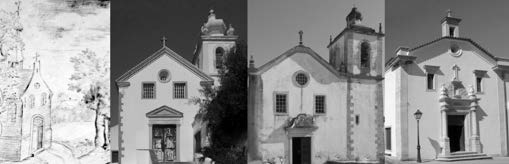
Figure 49.6: Left is a drawing of the chapel in Deerlijk by Antoine Baillet, the oldest surviving image. The chapel looked mainly Spanish and even more so Portuguese. The circular window contained the ’S’ already
- Indeed, Portuguese churches more often show earthly signs and shields than Spanish. The Spanish and
Portuguese Kingdoms were united from 1580 until 1640. The year 1639 is also visible by anchors above the windows. The complete image is shown in Figure 49.8 on page 997. The photos on the right are of churches from the 17th century or older in Portugal. From left to right: Igreja Matriz de Alenquer; Igreja de São Pedro de Alenquer; and Igreja da Misericórdia de Ansião. Lambda and Delta shapes appear above the door, typical for Portugal and the Portuguese colonies (described in Part XII). The two rectangular windows with the circular one above are similar to the composition of the chapel facade at Deerlijk. The towers are also akin.
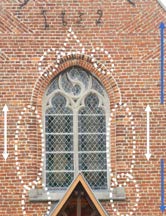
Figure 49.7: The white dashed zones show areas where the mason
had difficulties squeezing bricks when constructing the new window. At
the top, there are even signs of a repair after a collapse. The blue
arrows show the zones above and below the original windows, where
the bricks are still where they were initially located. The white arrows
indicate the zone between the bottom and top of the original windows,
and it can be seen that bricks have been squeezed in those areas. The
analysis suggests that the original circle with ’S’ must have been at
approximately the exact location as it is now, and the original windows
were either rectangular or slightly curved. Still, the new bricks were
placed in a rectangle to preserve the wall’s symmetry. (Declercq de
Silva Archive)
on page 1002, and on the oldest surviving drawing of the chapel in Figure 49.8.
Besides the initials on both tokens, old images are of crucial importance, as they always show the chapel with a window left and right above the entrance and a circular window straight on top. For instance, a drawing by A. Baillet31 representing the chapel’s legend and dating from the 17th or 18th century, likely based on, or even copied from earlier drawings soon after the chapel’s construction in 1639, not only reveals Anton Desclergues’ initials but also shows the chapel with a facade32 similar to Spanish chapels, particularly in Catalonia, but also elsewhere in Iberia. The windows were replaced in 1884, after which the Spanish aspect was no longer there to relish.
A comparison of the chapel with others in Iberia is shown in Figure 49.6. Other examples of similar chapels in Spain include : Ermita de la Mare de Deu dels Torrens de Vimbodi; Ermita de la Mare de Deu en el Montsant; Mare de Deu de la Mola-Buira-El pont;Ermita de l’ Abellera; Ermita Santa Bàrbara in Blanes; Ermita de San Roque Goian; Ermita de Santa Quiteria; and Ermita de Sant Francesc de Blanes. In this context, we equally highlight Ermita de Sant Josep de Montblanc, constructed in the 17th century.
The chapel had a different look in the past, and as Philippe Despriet indicated in his article, the facade changed during the restorations of 1884. More precisely, he states that the shape of the windows has changed, which he has proven by comparison with old images and a restoration plan. Physical evidence, explored by the author, is still found with the naked eye in Figure 49.7 and, with infrared, in Figures 49.105 and 49.106 on page 1030.
A more recent drawing from before the chapel’s restoration is shown in Figure 49.100 on page 1027.
49.2.2 Antoni Desclergue’s (DC06) Personal Connections involved in the 1634 Miracle and its
Recognition
49.2.2.1 Birds of a Feather
’Birds of a Feather,’ or ’Show me your friends and I will tell you who you are,’ is a valuable technique to find a person by investigating evidence concerning his entourage.
First, in Chapter 49.2.2.2, we show the importance of bishop Villain de Gand in establishing the chapel and the fact that he knew Antoni Desclergue’s (DC06) father Jeroni Joan Desclergue y Cortés (DC05). Then, in Chapter 49.2.2.3, we show that Antoni Desclergue (DC06) was close with the witnesses of the 1634 miracle. The latter is demonstrated by ecclesiastic documents revealing that the families frequently witnessed baptisms and marriages.
31Antoine Baillet engraved the illustration, indicated by An. Baillet fecit, an expression commonly used by engravers.
32The facade is on the Westside, where the entrance is.
© 2024 Nico F. Declercq
The Desclergues of la Villa Ducal de Montblanc, 2nd ed., Omn., VOL. IV
983
49.2.2.2 The Role of Maximilien II Villain de Gand and his Connection with Antoni Desclergue
Jacob Maximilian Villain de Gand (1569 — Tournai, November 29, 1644) was a bishop of Tournai.33343536373839 One may nowadays still observe a tomb in the cathedral of a cousin of his, François Gilbert Vilain de Gand, shown in Figure 49.31 on page 1001. The majestic Romanesque cathedral of Tournai is shown in Figure 49.32 on page 1001.
He also appears in the literature as Maximilien II Villain de Gand, Maximilianus Vilanus a Gandavo, Maximilien Villain de Gand, and Max Villain.
The first aspect he had in common with Antoni Desclergue (DC06) was that his mother’s name was also Felipa or Philipote.
His education ensured he was aware of the great Spanish empire compared to most of the locals in Flanders. For instance, he studied at the University of Pont-à-Mousson40, shown in Figure 49.9, between Metz and Nancy and at the University of Douai.
Mgr Villain de Gand was known and referred to in the literature as a pious person who applied his prerogatives firmly and did not shy away from conflicts such as with the collegial chapter of Tournai, the Dominicans of Lille or even nuncio Richard Pauli-Stravius.
He was a man not subdued by bankers or other earthly powers. His character is revealed in Chapter 49.2.2 and Chapter 49.5, where he refused to sign an essential document.
Mgr Villain de Gand’s commitment to principles is evident in his written works. For instance, Manuale pastorum ad usum ec-clesiarum civitatis et dioecesis Tornacensis (1625) is a manual for priests in the Diocese of Tournai, Speculum sacerdotum (1634) points at the moral duties of priests, while Methodus sacrum Missae sacrificium celebrandi romano ritu (1641) tells again how to celebrate the Mass in the Roman Catholic Church.
Before becoming the Bishop of Tournai, appointed by Archduke Albert and, therefore, carrying the Spanish victory at Ostend of 1604 close to the heart, he was a priest and later a canon at Cambrai since December 12, 1587, and soon after additionally a member of the collegiate chapter of Tournai.
At Cambrai, Antoni’s father Jeroni (DC05), as described in Chapter 29.5.19 and Chapter 29.5.20, was hospitalized after the Spanish had successfully reconquered the town from the French in 1596.
The position elevation to Bishop of Tournai occurred in 1616.
Soon after, in 1617, Carlos Coloma de Saa became the governor of Cambrai, described in Chapter 34.5.15.
In 1641, Antoni Desclergue, or his brother Jeroni Desclergue (DC06c), donated money to the Saint John Hospital of Cambrai on behalf of his father, Jeroni, described in Chapter 34.5.17.
Maximilien II Villain de Gand was also a close relative of Philippe Lamoral Villain de Gand, born in 1587 and married Marguerite Isabelle de Merode, the daughter of Charles Philippe de Merode, on November 22, 1611.
Marguerite Isabelle de Merode’s daughter was Marguerite Villain de Gand, born in 1622, and she married Ferdinand Philippe de Merode of Westerlo. In Chapter 29.5, we describe how Jeroni Desclergue had liberated the castle of de Merode at Westerloo in 1591. The other children of Marguerite Isabelle de Merode were Balthazar Philippe de Villain de Gand (1616) and Isabelle Claire de Villain de Gand (1619).
As an author, Villain published funeral sermons for Archduke Albrecht (1621) and Archduchess Isabella (1633), as well as a pastoral handbook (1625). He also gave the funeral oration of Albert of Austria, described in Chapter 8.8.3.
He was at the origin of the founding in Lille in 1627 of a convent of penitent nuns known as Capuchins, an order created by Françoise de Saint-Omer.
Jacob Maximilian Villain de Gand was the youngest son of Maximilian Vilain (Ghent, 1530 - Tournai, June 5 1583), who held important positions in the Spanish Netherlands and energetically defended the Catholic cause. King Philip II of Spain, described in Chapter 8.8.1, appointed him to his Council of State in 1576 and made him head of Finance in the Netherlands. His loyalty to the king was rewarded with elevation to Count of Isenghien in 1582. Maximilian Vilain has also been the governor of Lille, which is how he must have been in touch with the banker Jean du Bois, the husband of Marguerite Kelduwier.
In his role as the Bishop of Tournai, Maximilien II Villain de Gand was the ecclesiastic superior who had to approve the miracle at Deerlijk of 1634 and the establishment of a chapel Kapel-ter-Ruste around 1639.
Given his past in Cambrai, he knew Jeroni Joan Desclergue y Cortés (DC05) and Antoni Desclergue (DC06). In contrast, through his father, he must also have known Jean du Bois and Marguerite Kelduwier, the two bankers without which the expensive undertaking could never have occurred. Connected to the family of de Merode, Jeroni’s intervention in Westerloo in 1591 must equally have been appreciated.
Finally, Maximilien II Villain de Gand’s admiration for Archduke Albert, whose funeral he preceded in 1621, and the Spanish admiration for Mary of Scherpenheuvel and her assumed role in the victory at Ostend in 1604 convinced the Bishop to offer his support for establishing the chapel.
Interestingly showing the close connection between the Bishop of Tournai and the Spanish regime is that Julie Piront41 writes that the nuns arrived in Tournai in 1624. Their cloister at Tournai was made possible by a license given at Brussels on May 4, 1621, and confirmed on May 15 by Andrea Soto, the general commissar of H.R.H. the Princess of Spain. She writes that at that time (1615-1644), the Bishop of Tournai was Maximilien II Vilain de Gand. The founder of the cloister, Catherine, received a letter of recommendation on June 18, 1621, from the Archiducs Albrecht and Isabella. However, the city of Tournai would become French in 1667 under Louis XIV.
49.2.2.3 The Bonds Between Antoni Desclergue (DC06) and the Other Miracle Witnesses of 1634
To learn about Antoni Desclergue’s (DC06) network in Deerlijk, we redirect the reader first to Chapter 34.5.13, where his appearances are studied, and the witnesses involved with the 1634 miracle are described. Details of the miracle are outlined in Chapter
49.5, more precisely in Chapter 49.5.4.
33Alain Lottin, Lille, citadelle de la Contre-Réforme? (1598-1668), 2018, p. 73-75.
34Alfred Deboutte, ’Villain de Gand (Maximilien)’ , in: Dictionnaire de spiritualité, vol. 16, kol. 769-770.
35Alexandre Pasture, ’Le cycle d’ un épiscopat à Tournai sous le régime espagnol (1564-1666)’ , in: Miscellanea L. Van der Essen, 1947, vol. II, p.
669-681.
36Abbé Parenty, Vie de madame Maës, née Taffin du Hocquet, nommée en religion sœur Françoise de Saint-Omer, Lille, 1841, p. 69.
37Foulon, Louis (Abbé), ’Vie de monseigneur Vanderburch, archevêque duc de Cambrai... / tirée en partie du latin de l’ abbé Foulon ; considérablement augmentée et enrichie de notes et de pièces inédites, par le R. P. Alexis Possoz,...’ , A. Régnier-Farez (Cambrai), 1861.
38Société des sciences, de l’ agriculture et des arts de Lille, ’Mémoires de la Société des sciences, de l’ agriculture et des arts de Lille’ , 1839.
39Hugo De Schepper, De Kollaterale Raden in de Katholieke Nederlanden van 1579 tot 1609, 1972, vol. III, p. 377-383.
40Interestingly, Pont-à-Mousson, was the town the author negotiated with to organize his congress dinner in 2015 before the city of Metz proposed an appropriate location at its Arsenal
41Julie Piront, ’L’ architecture du couvent des célestines de Tournai (1621/1624 - v. 1890)’ , published in Mémoires de la Société royale d’ histoire et d’ archéologie de Tournai, 2010, 13, pages 307-349.
The Desclergues of la Villa Ducal de Montblanc, 2nd ed., Omn., VOL. IV
© 2024 Nico F. Declercq
CHAPTER 49. THE CHAPEL OF NUESTRA SEÑORA DEL REPOSO OR DE KAPEL VAN ONZE LIEVE
984
VROUW TER RUSTE, IN DEERLIJK
Here, we add more records to clarify the network around Antoni Desclergue (DC06) and the persons who witnessed the wonder.
In Figure 49.10, Beatrice, the wife of Antoni Desclergue (DC06), became, on September 9, 1638, in Deerlijk, the godmother of Jan de Vos, son of Michael de Vos and Anne Tackx, with Jan Montens as godfather.
In Figure 49.11, we found a Jan Montens, son of Jan Montens senior, who came from Deerlijk and married Margriet De Vos in Beveren Leie on August 17, 1639, with Franciscus de Vos as a witness.
In Figure 49.12, the couple baptized their first child in Vichte on May 22, 1640, and their subsequent children in Deerlijk.
We also found this Franciscus de Vos as godfather, together with godmother Petronella Vermeersch, of Elisabeth Kelduwier (’Calluier’) in Deerlijk on August 20, 1643, daughter of Judocus Kelduwier and Elisabeth Stalins, shown in Figure 49.24.
In Figure 49.13, in April 1648, a certain Joannes Stalins married in Zwevegem with Joanna Kelduwier (’Quellerie’). We have not been able to establish a relationship, but it is still worthwhile to mention.
In Figure 49.14, it was not the first meeting as godparents. Less than a year after the miracle, Beatrijs De Ghelinck (’Gelyct’), daughter of Willem De Ghelinck and Maria (’Maeyken’) Seynaeve, was baptized on May 1, 1635 in Deerlijk. The godfather was Jan Montens, the son of Jan, and the godmother was, here too, Beatrice, the wife of Antoni Desclergue.
In Figure 49.15, interestingly, as described in Chapter 37.4, where we outline the family Ximenez de la Cruz, we find Willem De Ghelinck (’Guillemus Dinghelinc’) as a witness on March 26, 1666, at Ghent Spaniard Castle, on the wedding of Juan de los Rios and Maria Francisca Gregori. The other witness was Petrus Ximenez de la Cruz.
In Figure 49.15, we found a link with Marcus Van Marcke, also present at the miracle. On August 4, 1631, Beatrice Van Marcke was born in Deerlijk, the daughter of Willem Van Marcke and Martine Wautier. The godfather was Marcus Van Marcke, and the godmother was Beatrice, the wife of Antoni Desclergue. Figure 34.120 on page 559 indicates Spanish links with the Van Marcke family in 1651. Another connection was found in 1644 in Figure 49.30 on page 1000.
In Figure 49.16, when, at Deerlijk on October 11, 1640, Pere Declerque (DC07d), son of Antoni Desclergue (DC06), was baptized, Martine Wautier was godmother, while Pieter Declercq (DK03dyb) was godfather.
In Figure 49.17, also interesting is the baptism of Judocus Deckere, son of Martinus Deckere and Magdalena Kelduwier (’De Caluwe’), with Judocus van Oosthuyse the godfather, and Beatrice, the wife of Antoni Desclergue, the godmother, in 1644. The family Deckere was linked to Martina de la Cruz, the daughter-in-law of Antoni Desclergue (DC06), as shown in Chapter 37.4.3, in Figure 37.34 on page 652. Her godfather was Paulus Deckere or Deckers.
In Figure 49.18, on January 9, 1646, Beatrijs Wolfcarius was baptized at Deerlijk, daughter of Stephanus Wolcarius and Elisabeth Kelduwier (’de Caluudue’). The godfather was Willem Beyls, and the godmother was Beatrice, the wife of Antoni Desclergue.
In Figure 49.19, six years earlier, at Deerlijk, on May 10, 1640, we already found the baptism of Valentinus Wolfcarius, son of Stephanus Wolfcarius and Elisabeth Kelduwier (’Decaluwe’). The godfather was Valentin Bekaert, and the godfather was Magdalena Amaye.
In Figure 49.20, we would also like to point out that Valentin Bekaert, also involved in the miracle in Deerlijk, was married to Joanna de Croix and had his daughter Maria Bekaert baptized in Deerlijk on January 19, 1641. The godfather was Antoni Desclergue, and the godfather was Maria Degroote. Perhaps Joanna de Croix was also from the Ximenez de la Cruz clan.
In Figure 49.21, note that a certain Thomas Bekaert married Joanna Van Rumbeke at Harelbeke on February 19, 1612. The bride’s brother was Jacobus Van Rumbeke, father of Joanna Van Rumbeke, who married Mathias Du Puich (Vandeputte or Steenput) in Harelbeke in 1662. The couple had a son, Egidius, who married Maria Declercgz (DC08d), daughter of Antoni Declerque (DC07) and Martina de la Cruz and granddaughter of Antoni Desclergue (DC06) and Beatrix Declercq. More information can be found in Chapter 37.9.2.
On December 17, 1619, Jan Montens married Joana Bekaert in Harelbeke. The witness at that marriage was Claes (’Nicolaes’) Montens, together with Arnoldus Vanhoutte. Claes Montens assisted in the miracle. In Figure 49.22, We equally found a Claes Montens 19 years earlier as godfather in Harelbeke.
There is a Claes Montens, as an inhabitant of Desselgem, who appeared on the Lists of Bourgeois Forains of Kortrijk in 1634 and is also mentioned in the orphan register as Nicolais Montens42.
On January 13, 1595, Anna Desclergue (DC06f), the daughter of Jeroni Joan Desclergue y Cortés (DC05), was baptized in Kortrijk, as can be read in Chapter 29. She married widower Vincent Stalins in Waregem on September 6, 1620, witnessing Anna’s mother Felipa and Joannes de Wilde. Her husband had previously been married to Marie Deman on February 24, 1609, in Waregem.
The marriage witnesses were the chaplain and the sexton, and the marriage received the priest’s permission of Izegem. We deduce from this, as can often be found in ecclesiastical documents from that period in our region, that Vincent Stalins had a temporary position in Waregem. Although it is not explicitly stated that he was a soldier, it is a logical thought line. We suspect that it was this witness Joannes de Wilde, who would also later function as the godfather of Florence Vermeersch, together with godmother Florence Decostere, in Harelbeke on March 20, 164243.
On April 15, 1640, Maria Decostere was baptized in Harelbeke, daughter of Egidius Decostere and Catarina Vermandere (’Vermandele’). The godmother was Maria Ducx, and the godfather was Willem Vermandere (’Guillelmus Vermandele’). The latter was also involved in the miracle. In Figure 49.23.
In Figure 49.13, we continue with the wedding of Anna Desclergue (DC06f) and Vincent Stalins. Anna Desclergue (DC06f) had twins, Petrus and Joannes, baptized in Waregem on October 8, 1626. Jean du Breucq (’Joannes de Bucker’), Godeliva Crispel, Antoni Desclergue (DC06), and Judoca Van Brabant were the godparents. Anna died in 1627, and all her children died before 1627.
War may have caused devastation in 1625. Indeed, on December 6, 1625, a regiment of Neapolitans44, under the command of the maestro di campo Marcello del Judicis (Marcelo del Guidice), marched to Kortrijk45. This regiment consisted of 15 companies of foot soldiers. Three days before that, they had left the Castellanies of Aalst and Dendermonde, where they had stayed for several months. The fifteen companies were divided over the garrison towns of Oudenaarde (5), Roeselare (1), Tielt (1), and Kortrijk (8)46.
On April 1648, Joannes Stalin married in Sint Denijs Zwevegem to Joanna Kelduwier (’Quellerie’). We have not demonstrated a correlation between these Stalins and those mentioned above, but we cannot rule out a relationship.
In Figure 49.24, on August 20, 1643, a particular Elisabeth Kelduwier (’Calluier’) was baptized in Deerlijk, daughter of Judocus Kelduwierand Elisabeth Stalins, with Franciscus de Vos and Petronella Vermeersch the godparents.
In Figure 49.25, Joannes Kelduwier (’Kelduier’) was baptized in Deerlijk on 20 November 1644, son of Judocus Kelduwier and Elisabeth Stalins. Joannes Kelduwier and Annabel Roman were the godparents.
42RAK Weesregister 76 Deerlijk folio 21r, 1634; courtesy of Filip Benoit.
43transcript reference PARDOWVL 00890282, original not found; Harelbeke, March 20, 1642, the baptism of Florentia Vermees, daughter of Adrianus Vermees and Catharina Leupe; the godfather was Joannes Dewilde, the godmother was Florentia Decostere.
44SA Oudenaarde, Kroniek De Rantere, 1625-1644, blz. 15.
45RA Kortrijk, Fonds Colens, nr. 249, kasselrijrekening 1625-1627, f° 46 v°.
46RA Kortrijk, OSAK, nr. 1817, stadsrekening 1625-1626, f° 80 en RA Ronse, kasselrijarchief Oudenaarde, nr. 1467.
© 2024 Nico F. Declercq
The Desclergues of la Villa Ducal de Montblanc, 2nd ed., Omn., VOL. IV
49.3. OTHER EVIDENCE OF ANTONI DESCLERGUE’S PERSUASIVE ROLE
985
In Figure 49.26, On July 22, 1640, in Templeuve, 8 km southeast of Lille, Jean Dubrucq and Catherine du Bois’s wedding took place. The couple, Jean Dubrucq and Françoise du Bois lived in the same village during that period. In 1655, Isabella (Elizabeth) Stalins married Philippe Albert de la Motte Baraffes in Ypres on January 29. The latter family owned the manor of Deerlijk.
In Figure 49.27, Pieter Wielandt, equally involved in the miracle, also existed, as is evident from the Lists of Bourgeois Forains of Kortrijk, from 1628 and 163847. Not much information was found about Pieter Wielandt, present at the miracle, except that he was probably buried in Deerlijk on August 9, 1666.
In Figure 49.28, in Ghent, at the church of Saint Nicolas, we found a marriage of Pieter Wielandt (’Wylant’) and Barbara Hebbelynck48, without witnesses except for the parish priest of Saint Bavo. We have insufficient information to conclude that it concerns the same Pieter Wielandt, who went to live in Ghent for a while and perhaps later returned to Deerlijk, but it is an exciting line of thought. 1620 was, in fact, at the end of the twelve-year truce in the Eighty Years’ War when tension was rising in our country and in the overseas territories where the VOC abused the truce to defend its position vis-à-vis the Iberians. Perhaps he was involved in reinforcement works in Ghent, preparing to end the ceasefire. The Saint Nicolas Church of Ghent is located in the street Cataloniastraat, a few hundred meters from the Spaniard Castle. A man from Deerlijk who had lived at the Spaniard Castle should undoubtedly have known the Desclergues.
In Harelbeke, Noel Declercq, father-in-law of Antoni Desclergue (DC06), witnessed a wedding on November 19, 1621, of Mathieu Casiere and Christina du Bois (’de Bo’). It’s possible that Christina du Bois was a relative of Jean du Bois. In Figure 49.29, Antoni Desclergue (DC06) (’De Clergs’) is, for instance, also found in 1644 in Deerlijk, and in Figure 49.30 as godfather to Anthonius van Marcke, son of Guilelmus (Willem) van Marcke and Martine Wautier; the godmother was Ghuilelma van Ounackere. Another connection was found in 1631 in Figure 49.15 on page 999.
49.3 Other Evidence of Antoni Desclergue’s Persuasive Role
49.3.1 Éminence Grise
As outlined in Chapter 34.5, Chapter 49.2.2, and specifically in Chapter 34.5, Antoni Desclergue (DC06) exercised military power and could influence the Spanish regime and the ecclesiastic sphere required to obtain approval to construct a chapel, without holding an official administrative civil, financial or religious leadership position. His ancestors were of purple-blood nobility and stood above everyone, poor or rich.
As éminence grise, his situation was ideal for supporting banker Marguerite Kelduwier, described in Chapter 49.9, to establish a chapel, which she desired to solidify power while securing a healthy financial resource for the establishment and maintenance of the chapel.
Antoni Desclergue (DC06) had personal motives to establish a chapel, described in Chapter 49.10, but was likely not interested in its maintenance or financing because, as a military, he was not opulent.
As the guiding light, steered by deeply personal motives, he has played a significant role as éminence grise.
Still, while not the financier or the chapel’s owner, he remained invisible in the financial and religious accounts of the chapel after its foundation. He was, therefore, disregarded in recent investigations, although the legend, described in Chapter 49.12, had always remembered his existence.
Nevertheless, as explained earlier and shown below, physical evidence of his role remains.
49.3.2 Artwork Observed in Visible Light and Signs of Influence by Andreu Ramírez
The first items that draw attention when entering the chapel are the beautiful panels placed in alcoves on the wall.
One of these panels shows the Plaza Mayor of Montblanc, the ancestral home of the Desclergues, explained in Chapter 49.4.2, while another, described in Chapter 49.3.3.3, exhibits Antoni Desclergue’s initials.
The panels are all circumvented by 13 roses, which stands for St. Anthony of Padua (Lisbon 1195 - Padua 1231)50 and represent Antoni Desclergue (DC06).
A close look at Figure 49.33, in comparison with, e.g., Figure 29.16 on page 375, reveals that they are not just flowers. Given the number of petals, they neither represent a rose nor a fleur de Lys. In fact, between the petals, one can see the Knight’s cross used by the Templars or the Shield of Malta. Indeed, they are Templar flowers.
In particular, we can refer to Knight’s crosses found on tombstones of Templars, such as the Knights Templar Tombstone of St Mary’s at Selborne Hampshire, or in La Couvertoirade, where the Knight’s cross is ornamented as a flower, almost identical to the ones seen on the frames at Deerlijk.
We may also refer to the Basilicata Potenza Santa Maria del Sepolcro in Italy, where a similar Templar flower appears as a fresco.
Furthermore, at the railing of the tower of Belém in Lisbon, Portugal, it can be seen, as well as in the Church of Bures, Suffolk, in the United Kingdom.
Perhaps more importantly, the same templar flowers are also found in Santa Coloma de Queralt near Montblanc, as can be seen in Figure 29.16 on page 375.
As to who the artist who made the polychrome panels found in Deerlijk was, we are still determining the answers. Since section Chapter 49.3.3 shows that initials are placed on one of them, indicating that they are likely fabricated in the Conca de Barberà, i.e., in or near Montblanc, we can search for the artist or his school.
When we study the persons depicted on the polychrome panels in the chapel in Deerlijk, we see remarkable similarities in style with the works of the Catalans Damià Forment and Andreu Ramírez. Because we only know when Antoni Desclergue brought the art back from Spain, we cannot, in principle, exactly determine when they were made. The artists mentioned lived in the 16th century.
The work is likely from someone influenced by these artists. We also see, for example, a tendency to depict fairly robust limbs in 47Courtesy of Filip Benoit.
48The banns were published October 24, 1620, marriage November 8, 1620.
50The number 13 is associated with Saint Anthony of Padua, particularly in the context of his miracles or intercessions. Saint Anthony of Padua, also known as Saint Anthony of Lisbon, was a Portuguese Catholic priest and friar of the Franciscan Order who lived in the 12th and 13th centuries. One of the most famous associations with Saint Anthony and the number 13 is the tradition of the ’Thirteen Tuesdays’ or ’Thirteen Tuesdays Novena.’ This tradition involves praying a novena (a series of prayers repeated over nine days) to Saint Anthony on thirteen consecutive Tuesdays, often to seek his intercession for lost items or other intentions. Devotees believe Saint Anthony will answer their prayers and perform miracles on the thirteenth Tuesday of the novena. Additionally, some legends and stories attribute specific miracles or interventions by Saint Anthony to occurrences on the 13th day of the month or other instances involving the number 13. These associations may vary depending on cultural traditions and regional practices but reflect the deep devotion and belief in Saint Anthony’s miraculous powers among his followers.
The Desclergues of la Villa Ducal de Montblanc, 2nd ed., Omn., VOL. IV
© 2024 Nico F. Declercq
CHAPTER 49. THE CHAPEL OF NUESTRA SEÑORA DEL REPOSO OR DE KAPEL VAN ONZE LIEVE
986
VROUW TER RUSTE, IN DEERLIJK
the second half of the 17th century, as in the works of Joan Grau. The reader can make the comparison himself by reading an article written by Amorós Albareda and Yeguas Gassó.51
The heavy limbs can also be found later in the 17th century in Joan Grau’s works, which are also mentioned in that article.
We compared work by Andreu Ramírez, in particular, his Santa Magdalena52 in Sant Sepulcre in Poblet, to a personage found in Deerlijk and the comparison indicates that the artist of the panels in Deerlijk was either from the same school or from a school that was highly influenced by that of Andreu Ramírez. The comparison is shown in Figure 49.44. The likeliness does not prove anything, but it shows that, at least, this type of sculpture existed among artists in Catalonia in the period of interest.
Similarities of sculptured persons in Deerlijk are also found in the work by Francesc Puig I and Jacint Reguer of 1648 in the retable of Sant Andreu at the Santa Maria church of Cervera.
Other similarities are found with the work of Andrea Fortunato de Peregrinis in San Martín del Río, dating from 1590,53 and Miguel Rubiol of 1604.54. The two latter works are also shown in Joan Yeguas i Gassó.55
In Figure 49.45, sculptured bricks can be compared.
Around 1634, a sculpturer active in Catalonia, Benet Baró, a Burgundian, made retables of a similar (low) quality and a somewhat similar style of figures as the one in the chapel in Deerlijk. An example is shown in Figure 49.46 on page 1007. 56
The style matches what was available in Catalonia around 1640 in terms of scholarship, materials, artistic techniques, and artists.
We can cite a letter sent to the author:
Estimado Dr. Declercq,
Me ha parecido muy interesante su investigación y le felicito por la publicación del libro. Respecto a su consulta, debo decirle que a primera vista me parece ver una conexión con las obras de un escultor francés activo en la zona de Tarragona entre el final del siglo XVI y los principios del XVII, llamado Benet Baró.
Creo que hay puntos de contacto en cuanto al tipo de relieve, los fondos arquitectónicos, las figuras, etc. Debo decir que el retablo que usted publica ha sido restaurado de forma abusiva. También que Benet Baró era un escultor de poca calidad, a mi parecer...
Espero haberle sido de utilidad.
Saludos.
Sofia Mata De la Cruz,
Història i Història de l’Art,
Universitat Rovira i Virgili.
49.3.3 Observations with Ultraviolet Luminescence and the Discovery of Antoni Desclergue’s
Signature
49.3.3.1 About Ultraviolet Luminescence
When exposed to ultraviolet radiation (UV)57, some materials used in art become fluorescent and give off visible light. In particular, traditional natural resin varnishes58 emit a characteristic yellowish-greenish color.
Observing art under UV makes monitoring the presence or removal of old varnishes possible.
Retouchings covering a layer of varnish also show up clearly in UV because they appear very dark compared to the fluorescent varnish.
While most paints emit very little fluorescence, some pigments and dyes in paint emit a characteristic color appropriate for identifying a particular stain.
49.3.3.2 General Observations
The chapel’s polychrome reliefs clearly show during the experiments that they were varnished and painted, which is also noticeable with the naked eye in normal light.
However, each panel is stunning and exposes details thanks to fluorescence that cannot be seen in normal light due to the sloppy repairs.
Figure 49.34 shows the Montblanc panel under UV light.
49.3.3.3 Antoni Desclergue’s (DC06) Initials Found on Panel 7
The 7th panel, shown in Figures 49.36 and 49.35, represents the Tomb of Jesus.
The relief was inspired by Michelangelo Merisi da Caravaggio’s painting, who lived from 1571 to 1610 and came from the Milan region. The region belonged for a long time to the crown of Aragon and belonged to Emperor Charles V59. The painting was made around 1603 and was based on John’s Gospel. As a result, the man on the left is Joseph of Arimathea; the holy woman with Jesus, who appears to bless him, is Mary’s mother. The man who holds Jesus’ legs is Nicodemus. The woman on the right in the picture who raises her hands is Maria, the wife of Klopas. The latter is not considered a saint.
In contrast to Caravaggio’s painting, Mary Magdalene is absent on panel 7 in the chapel, which may hold another clue. Indeed, 51Damià Amorós Albareda, Joan Yeguas Gassó, "Alguns fragments d’escultura dels segles XVI i XVII procedents de Poblet: Forment, Ramírez i els Grau", Centre d’Estudis de la Conca de Barberà, Aplec de Treballs (Montblanc) 40 (2022): 253-264.
52Damià Amorós Albareda Joan Yeguas Gassó, "Andreu Ramírez i l’escultura pobletana a final del segle XVI", Centre d’Estudis de la Conca de Barberà, Aplec de Treballs (Montblanc) 35 (2017): 221-242.
53Andrea Fortunato de Peregrinis, Adoració dels pastors, retaule del Roser, església parroquial, San Martín del Río, 1590.
54Miguel Rubiol, Cap d’atlant, antic retaule major, col·lecció Robert Pérez, Linyola, 1604
55Joan Yeguas i Gassó (Museu Nacional d’Art de Catalunya), "escultura al pla d’urgell entre 1500 i 1640. notes d’arquitectura", URTX 146-174.
56Sofia Mata, "L’escultor Benet Baró, autor dels retaules del Sant Nom de Jesús de Tamarit i la Pobla de Montornès, 1634", Quadrens d’Història Tarraconense XIV (1996)
57On Friday, February 21, 2020, around 7:30 PM, experiments were conducted in the Chapel Kapel ter Ruste, with ultraviolet light in the dark, which happened in the presence and with the generous assistance of priest Marc Messiaen, Willy Kemseke, Benjamin Declercq, Anna-Laura Declercq, and Lambert Declercq, although the experiments were carried out with simple means, exciting discoveries were made.
58Mastic and dammar are traditional natural resin varnishes.
59Emperor Charles V was King Carlos I of Castile, Aragon, Emperor of the Holy Roman Empire, Count of Flanders etc. and is described in Chapter
© 2024 Nico F. Declercq
The Desclergues of la Villa Ducal de Montblanc, 2nd ed., Omn., VOL. IV
49.4. SPANISH ARTWORK IMPORTED BY ANTONI DESCLERGUE (DC06)
987
Antoni Desclergue was born in Barcelona and baptized in the Marie-Magdalena church in Tournai. Marie-Magdalena, however, also symbolizes the Knights Templar,60 an order to which Antoni’s ancestors were affiliated as extensively explained in Chapter 18.
What makes panel seven special is that initials are depicted in hand-written characters from the first half of the 17th century on the woman’s clothing on the right. They are almost invisible in normal light but are very clearly visible during a UV fluorescence experiment61, as shown in Figure 49.36 and 49.37. The woman character was probably chosen because she was not a saint62.
Several people have ’signed’ the image by drawing their initials in approximately the same color as the woman’s robe so that it hardly stands out with the naked eye and in normal light.
Apart from a few crosses at the top, perhaps from some illiterate participants, we see six distinct sets of initials.
We could identify Antoni Desclergue’s initials. They are equal to the ones found on the oldest surviving sketch of the chapel, shown in Figure 49.2 on page 49.2.
From that time, letters to the King of Spain show that people used such initial-based signatures. Sometimes, they were real works of art, as shown in Figures 49.39, 49.40, and 49.41.
The ADXCRF signature is marked with an X after AD, representing a Burgundian cross, the Spanish military flag called La Cruz de Borgoña. The cross thus symbolizes the Spanish soldier. The signature says,
’Antoni Desclergue, militar, cabellero del Rey Felipe,’ or
’Antoni Desclergue, soldier and knight of King Filip.’
Antoni used a similar acronym in his signature on documents, i.e., EHR, as shown in Figure 34.2 on page 520.
The King was Felipe IV, introduced in Chapter 8.8.4 and shown in Figure 49.43. H. M. Felipe IV was born in Valladolid in 1605
and died in Madrid in 1665. He was King of Spain from 1621 to 1665.
Other images can be found in Figure 49.2 on page 978 and 49.43 on page 1005. His Majesty signed as ’Yo el Rey F,’ as shown in Figure 49.42.
49.4 Spanish Artwork Imported by Antoni Desclergue (DC06)
49.4.1 Cano’s Miraculous Sculpture of Mary with Jesus
49.4.1.1 Introduction and Ultraviolet Fluorescence Investigation
In Catholic Flanders, Mary’s figurines and crucifixes must have been found almost everywhere: at junctions, squares, alley entrances, and even private homes. Consequently, no matter where a miracle happened, figurines were always nearby. The miracle at Deerlijk in 1634 refers to a depiction of Mary in a tree close to the place where the event, described in Chapter 49.5, happened.
The analysis of Figure 49.1 on page 977, based on comparing the oldest surviving depiction of the chapel in Figure 49.8 on page
997 with la Mare de deu de la serra, proves that the 1634 miracle in Deerlijk must have happened at a figurine depicting the patron of Montblanc.
The appearance of a Mary statue in a tree is familiar. It is shared with Scherpenheuvel63 and in Barcelona64.
Still, the wooden Baroque sculpture found at the chapel, constructed in 1639, exhibits no weather, wear, sunlight, or dirt marks.
As a result, when the chapel was erected in 1639, the sacred place was equipped with a brand new figurine, which was of sufficient symbolic and artistic value that substitution was acceptable. Its impeccable state must have been interpreted by many as a miracle, too.
Almost four centuries later, the author examined the figurine with ultraviolet (UV) light65, shown in Figure 49.47, and discovered that it has never been masked, whitewashed, or overpainted. Using optical waves of 365 nm, a UV fluorescence experiment on the miraculous statue yielded the following observations:
The sacred polychrome sculpture of Mary with Jesus in the chapel is made of wood, then covered with a gesso layer, and this layer was painted. The figurine was never varnished and never overpainted. We must, therefore, conclude that it is in its original state.
The statue looks very simple but still perfect. It is reminiscent of a hastily made work of art by a talented artist who has done a very masterful job in little time but with unique skills.
By studying the date of fabrication and other works, the author concludes that it is of the hand of Alonso Cano, described in Chapter
49.4.1.2 on shown in Figure 49.47.
Creating such perfection with so much simplicity is only reserved for the greatest.
The gesso appears brown or golden with the naked eye and in normal light. Tinted gesso was typical of Spain in the 16th and 17th centuries when oil-based paints became more popular than the earlier tempera paints, and a new surface was necessary.
Mary’s statue in Figure 49.47 does not glow brightly under UV light, possibly due to oil-based paints.
On the other hand, the tempera gesso, seen through a few cracks in the paint layer, has a blue-white appearance under UV light, which means that the artist used egg yolk with lead to prepare the paint, equally characteristic of the 16th and 17th centuries.
49.4.1.2 Spanish Baroque sculptor Alonso Cano (1601-1667)
Alonso Cano, shown in Figure 49.47, was born in Granada on March 19, 1601, and died in Granada in October 1667. He has produced beautiful and impeccable Baroque sculptures, particularly at the end of his life. He must have also been outstanding before, as he received attention from the Spanish King.
Remarkable is that, in 1614, he moved with his family to Sevilla, where he entered the painting school of Francisco Pacheco.66 The 60Marie-Magdalena, often regarded as a symbol of repentance and devotion in Christian tradition, holds a significant emblematic association with the Knights Templar. This medieval Christian military order, officially endorsed by the Catholic Church in the 12th century, played a crucial role during the Crusades. The Templars were known not only for their martial prowess but also for their deep spiritual commitment and complex relationship with sacred relics and figures, including Saint Mary Magdalene.
61Priest Marc Messiaen noticed the signatures first during the investigation.
62We assume that souls preferred not to write on the robe of a saint.
63The Spanish strongly associated Scherpenheuvel with their victory in Ostend in 1604.
64In Barcelona, we refer to Santa Maria del Pi, near where Antoni Desclergue (DC06) was born, described in Chapter 29.5.26 and Chapter 34.4.
65On Friday, February 21, 2020, around 7:30 PM, experiments were conducted in the chapel, with ultraviolet light in the dark, which happened in the presence and with the generous assistance of Priest Marc Messiaen, Willy Kemseke, Benjamin Declercq, Anna-Laura Declercq, and Lambert Declercq.
While the experiments were carried out, exciting discoveries were made. This experimental research was done long after historical research pointed at Alonso Cano as its creator.
66Note that Enric Desclergue (DC05c), uncle of Antoni Desclergue (II) (D06) and described in Chapter 33, was married to Ana Pacheco. We don’t know if the two Pachecos were related, but it is worth mentioning.
The Desclergues of la Villa Ducal de Montblanc, 2nd ed., Omn., VOL. IV
© 2024 Nico F. Declercq
CHAPTER 49. THE CHAPEL OF NUESTRA SEÑORA DEL REPOSO OR DE KAPEL VAN ONZE LIEVE
988
VROUW TER RUSTE, IN DEERLIJK
latter had been an apprentice of the famous artist Velazquez.67
Typically, a statue of the Virgen del Reposo makes the gesture of the end of breastfeeding Jesus, hence the ’resting’ mother. A typical example is in Valverde del Camino, near Helva and Sevilla, shown in Figure 49.48. The original statue from the 1500s and the one inspired by it and exposed in the church from the 1600s until its destruction on July 21, 1936, showed Mary gesturing to cover her breast after feeding Jesus. The statue in Sevilla, like the one in Deerlijk, is, however, different.
Alonso Cano must have known the Virgen del Reposo in Sevilla. Indeed, Nuestra Señora del Reposo of Sevilla is a sculpture from around 1517 located on the cathedral’s altar.
In fact, in Spain, similar chapels and churches are not rare. Indeed, we find many chapels and churches named after Nuestra Señora del Reposo, Nuestra Señora del Buen Reposo and la Vírgen del Buen Reposo.
We believe Alonso Cano made his version of this Mary statue, either while in Sevilla or later when he was in Madrid and sold or gave it to Antoni Desclergue (DC06) during their encounter, described in Chapter 34.5.11 and Chapter 34.5.16.
One year before 1639, when Antoni Desclergue (DC06) went to Spain, Alonso Cano moved to Madrid upon invitation by King Felipe IV and Count Olivares.68 He became an official painter of the Court. During this period, he experimented more with bright colors because he could access the colorful Venetian works there. Prior, his pieces were more colorless. The figurine in Deerlijk must have been a try-out in that period.
After four years in Madrid, Cano’s wife was killed, and Alonso Cano was accused of murder, but his guilt was never proven. Again remarkably, he fled during this time of accusation to San Francisco’s convent in Valencia, where Carlos Coloma, described in Chapter
34.5.15, originated from and returned to Madrid in 1647 where he became steward of the brotherhood of Nuestra Señora de Los Siete Dolores (Our Lady of the Seven Sorrows).
In 1651, he returned to Granada to become a priest. It was at the end of his life that he made his masterpiece.
So, Cano was in Madrid when Antoni Desclergue (DC06) was there, and clearly, he had connections with Count Olivares and Carlos Coloma, both acquaintances of Antoni (DC06). Because the statue, brought back from Spain by Antoni Desclergue (DC06), was Nuestra Señora del Reposo, the Chapel at Deerlijk was named after it, i.e. Kapel-ter-Ruste, or vice versa.
The Cano family had ties with Flanders and may have known Jeroni Joan Desclergue y Cortés (DC05), Antoni’s father, while he was in the area of Kortrijk. For instance, in December 1597, Isabella Cano was Margareta Borri’s godmother, while the godfather was Joan Potosi. In 1612, a wedding at the Spaniard Castle of Ghent took place, of Francisca Ansa from the castle, with Anton Cano, a son of Juan de Fuentes, and Maria Cano from Baeza near Jaen, which is not far from Granada. 1612 was when a sister of Antoni Desclergue (DC06), Juana Desclergue (DC06c), described in Chapter 29.9.1, lived in the Spanish Castle of Ghent.
Even the untrained eye can see the figure’s resemblance at the chapel with Alonso Cano’s oeuvre in Figure 49.47. His masterpiece, Immaculada de facistol, from 1655, can still be found at Granada’s cathedral and was created as pure perfection in Baroque art in 1655-1656. This period was Cano’s artistic maturity period. He must have been highly talented before but yet to be perfect.
49.4.1.3 A Closer Look at the Jesus Figurine
The little Jesus is also somewhat specific because of his blond hair. The Desclergues were familiar with a blond-haired Jesus. For instance, the Mare de Déu de la Serra, the patrona of Montblanc, shown in Figure 49.85 on page 1016, exposed blond hair.69
Apart from the blond, or golden, hair in the figurine of la Mare de Déu de la Serra, there are no facial resemblances with the little Jesus in Cano’s work. More striking concerning the child Jesus are the resemblances with a discovery in Mallorca. The Nuestra Senora de Seu at the Santa Iglesia Catedral de Mallorca indeed carries the same Jesus. Could there have been a reason for sculpturing such a Jesus? Perhaps there is. Antoni Desclergue (DC06) left for Spain shortly after Carlos Coloma’s death. The latter had family ties in Deerlijk through his wife, Margareta de Liedekerke. He had been well-known by Antoni (DC06) and his father Jeroni (DC05). Perhaps Margareta had requested or suggested that Antoni bring Mary’s Statue with the child Jesus, who looked like the one in Mallorca.
In this context, we must also keep in mind that the Desclergues descend from Ramon Desclergue and Francesc Desclergue, who lived in Mallorca, as explained in Chapter 18.10 and Chapter 18.11.
One observes that the child Jesus at Deerlijk appears to have lost his left arm. We may only guess what the hand looked like or what it was holding. Perhaps a book, as in Figure 49.1 on page 977, or maybe a globe as in the refurbished Statue in Mallorca shown in Figure 49.49.
The Statue in Mallorca initially did not have fingers on Jesus’ right hand. Indeed, during the liturgical restoration of Gaudí, when the altarpiece was moved to its current location on the Mirador portal, some small interventions were carried out in this work. The aim was to improve its aesthetic appearance. The fingers of the right hand were added to Jesus’ hand, while the polychrome and the gold were retouched70. The sculpture was placed in a tabernacle built for this purpose.
Antoni Desclergue (II) (DC06), his father Jeroni (DC05), and two uncles, Antoni (DC05b) and Enric (DC05c), are all linked to Carlos Coloma, as are found at different places in this book, such as Chapter 29.5.2 and Chapter 34.5.15.
With his Flemish wife Margareta de Liedekerke and his six children, Carlos Coloma resided in Mallorca from 1611 until 1617. The Statue of Nuestra Senora de Seu at Mallorca already existed. It was made at the end of the 14th century and is more than 2 m tall. It used to have a more prominent place in the cathedral but is found inside the cathedral at the Capella de la Santissima Trinitad. The reason is that all Gothic statues had to make room for Baroque art in the 17th century. Guillem Morey created it, and it is Gothic. Jesus holds the globe with a cross in his left hand and blesses the spectator with his right hand, although the original Statue did not have fingers and probably did not ’bless’ the spectator. Several copies exist in other churches, and Jesus does not always bless the spectator. In Deerlijk, he also does not seem to praise the spectator.
The similarities between the two Jesuses are eye-catching. A blond child Jesus is not uncommon in Spanish Baroque, but the facial resemblance is striking. A comparison is shown in Figure 49.49.
49.4.2 The Plaza Mayor of Montblanc on a Panel of the Chapel’s Original Retable
67Diego Rodríguez de Silva y Velázquez (Sevilla 1599 - Madrid 1660
68Count Olivares was Gaspar de Guzmán y Pimentel Ribera y Velasco de Tovar, shown and described in Figure 34.41 on page 537.
69Joana Sans from Montblanc pointed out, in private communication with the author, that the Metropolitan Museum of New York has an ancient copy of this figurine in its collection, in pure wood and not painted
70Llompart Gabriel. ’Nostra Dona de la Seu i el seu desdoblament secular en les diversos devocions marianes’ , A. Pascual (coord.), La Seu de Mallorca, Palma, 1995, pp. 53-74.
© 2024 Nico F. Declercq
The Desclergues of la Villa Ducal de Montblanc, 2nd ed., Omn., VOL. IV
49.4. SPANISH ARTWORK IMPORTED BY ANTONI DESCLERGUE (DC06)
989
49.4.2.1 Introduction
Even though Figure 49.1 on page 977 is striking evidence of the chapel’s reference to Montblanc, and although the miracle in Deerlijk, described in Chapter 49.5, exposed close similarities with that of Montblanc, described in Chapter 49.6, even more, fascinating is the panel showing the Plaza Mayor of Montblanc, constituting a direct reference to the Desclergues.
When the author discovered that 1639 was a pivotal year in the life of Antoni Desclergue (DC06), he suddenly remembered the chapel of Deerlijk with its year of construction, 1639, visible on the facade. Curious to look in the light of this awareness, he entered the chapel and noticed that one of the panels (panel 3) embedded as an alcove in the right wall depicted the Plaza Mayor of Montblanc. He did the consequent investigations visually. In the final stage, when he had already drawn the most critical conclusions, the author performed Ultraviolet and Infrared experiments in Chapter 49.3.3 and Chapter 49.4.3, resulting in further confirmations, such as Antoni Desclergue’s signature and traces of the original Spanish architecture. We logically describe the discoveries and disregard their chronological order.
49.4.2.2 A Visual Study of the Montblanc Panel
The reader may be interested in reading Chapter 5, Chapter 24 and Chapter 7.5 first. Here, we focus solely on panel 3 in the chapel, shown in Figure 49.51. Chapter 49.4.3 provides a study of the others. A visual inspection shows that the polychrome relief was made using techniques prevalent in Spain for making baroque reliefs in the 16th and 17th centuries. However, the artwork was carelessly painted over during a later restoration, as shown in Figure 49.52.
With the naked eye, one can see in Figure 49.52 that, at the male figurine’s feet, a sculpture of a lion, a significant part of the artwork’s original composition, was tragically demolished during restoration to recycle the retable panels into those fitting Mary’s seven sorrows. To better appreciate the 3D nature of this work, a side view is presented in Figure 49.53.
The Gothic square where the two characters are located is the Plaça Major or Plaza Mayor of Montblanc. The investigation is summarized in Figures 49.53, 49.54, 49.55, 49.56, 49.57, 49.58, 49.59, 49.60 and 49.61.
The observation point is located to the right of l’ Ajuntament De Montblanc,71 while the observation direction points South-East.
On the right is the building that from the 17th century became known as Cal Malet, shown in Figures 49.60 and 49.61, and still bears that name. To the left is the tower of the Saint Michael’s church of Montblanc, shown in Figure 49.62. In between, the Casal dels Desclergue (Casa Desclergues) palace is recognizable. Trees still grow on the square and are used for cooling during the hot Spanish summers. Indeed, some things never change. An impression during a festival of the Giants of Montblanc is shown in Figure
Consequently, we investigate a close-up. The dress of Mary was initially Spanish Green with a golden motif, which is the style found in the School of Gregorio Fernández in 17th century Spain, and the use of Spanish green color was also widespread in the works of Francisco de Zurbarán, who was operational in Madrid around 1640. In particular, Zurbarán painted saints, to whom he gave a persuasive look in their faces and body language, which is somewhat of the female figure’s style in the Montblanc panel. A fair comparison is that of his painting of Santa Eufemia.
When we compare the windows on the 3rd floor of the Casal dels Desclergue on the Montblanc panel with the ones found nowadays, the old ones appear rectangular and more straightforward than the current ones. The Montblanc panel from around 1640 is likely accurate. It is known that Montblanc has suffered several devastating fires, including ’the great fire of 1652.’ Restoration has resulted in refined windows. We can illustrate this with a particular example shown in Figures 49.64, 49.65 and 49.66.
49.4.3 An Infrared Study of the Polychromes, including the Montblanc Panel
Although the experiments were performed by simple means;72 new information was obtained. The procedure is to heat a wall gently (a few degrees Celsius) and then cool it to ambient temperature.73
During the cooling, photos are taken with a heat camera (infrared camera).74 Structural variations of the wall, or the layers covering the wall, can, in principle, be visualized in this way. The requirement is that they exhibit differences in thermal properties. For example, pure wood will absorb and release heat at a different speed than stone so that, during the process, the temperature of the two materials will be slightly different and observable with a heat camera.
The results are presented in Figures 49.67, 49.68, 49.69, 49.70, 49.72, 49.73, 49.74 and 49.75.
In Chapter 49.13.1, more infrared experiments are shown that reveal the chapel’s original architecture.
49.4.3.1 Alcoves
The infrared images show that the reliefs were placed in alcoves cut out as rectangular shapes with straight or rounded corners from an existing and plastered wall. The remaining space between the panel and the alcove edges was then filled with new plaster, which reacted slightly differently to infrared rays than the surrounding original application.
49.4.3.2 Original Details of the Montblanc Panel
The results are shown in Figures 49.67, 49.68, 49.69, 49.70, 49.71, 49.72 and 49.74.
49.4.3.3 The Panel with an Inscription Added Later
Evidence that the panels have been recycled to become the seven sorrows of Mary is provided in Figure 49.75, revealing the entirely different nature of this panel compared to the others. A sculptor has produced this panel excellently, similar to the originals, but infrared reveals the difference.
71The Montblanc town hall is locally known as l’ Ajuntament De Montblanc.
72On Friday, February 28, 2020, experiments were conducted, using an infrared camera with a temperature resolution of 50 mK, in the chapel Kapel-ter-Ruste and the church of Saint Columba, with an infrared source and an infrared camera. The experiment occurred in the presence of Priest Marc Messiaen, Luc Beke, Frans Declercq, Marc Vergote, Antoon Vanhoutte, and Lambert Declercq.
73The results are welcome examples the author will show to his students taking Engineering Thermodynamics at The Georgia Institute of Technology.
74The infrared images shown here have been optimized by adjusting the temperature and color ranges to make measurable variations visible on the photo.
The Desclergues of la Villa Ducal de Montblanc, 2nd ed., Omn., VOL. IV
© 2024 Nico F. Declercq
CHAPTER 49. THE CHAPEL OF NUESTRA SEÑORA DEL REPOSO OR DE KAPEL VAN ONZE LIEVE
990
VROUW TER RUSTE, IN DEERLIJK
49.4.3.4 Vegetation Seen on the Flight from Egypt panel
The Flight from Egypt panel, shown in Figure 49.76, depicts vegetation connected to Mexico at the time of the chapel’s construction.
Indeed, it concerns the Mexican Yucca on the one hand and Dracaena Americana on the other.
Like wheat in Spain, Yucca or Cassava was the primary food among Caribbean cultures and is prevalent in Mexico, conquered by Hernán Cortés. The first Spanish settlers placed little interest in this plant, in contrast to the Indians of the Caribbean, who had cassava as a basis for their diet and many other uses. They extracted materials for constructing their housing, needles, ropes, drinks, and medicines. Since the 16th century, the Spanish exported the plant to Cuba and Spain. What is eaten is the root, similar to manioc or potatoes.
The panel, a depiction of a well-known biblical scene, also holds a personal connection to Antoni Desclergue. It references a significant event in his early life when his mother, along with her brother and child, fled from Spain to Flanders in 1602. This event is detailed in Chapter 29.5.26 and Chapter 34.4, adding a personal and historical layer to the panel’s interpretation.
49.4.3.5 The Original Retable Fabricated with 17th-century Spanish Techniques and later Recycled to the Seven Sorrows of Mary
49.4.3.5.1 Applied Fabrication Technique Two examples of refined Spanish Baroque sculptures for comparison, with comparative color pallets, are shown in Figures 49.77 and 49.78.
As is common in Spain, the original retable must have been built of several panels representing Saints and Biblical events. As described in Chapter 49.13.4, the original retable has been replaced by a new one.
The reliefs were re-used to form the seven Sorrows of Mary in the chapel’s interior walls in 1884. Before, they must have been stored elsewhere and were most probably part of the chapel of Onze Lieve Vrouw Ter Ruste inside the Columba church after one had removed them from the Chapel of Deerlijk during the French period. The remaining panels are described in Chapter 49.4.3.5.3 and shown in Figure 49.84 on page 1016. They are numbered from 1 to 7. There were likely more panels, but one probably destroyed them as they did not fit their new purpose to represent the seven sorrows. The installation of the panels cost 1200 Franks, which was half the price of constructing a little tower on the chapel’s roof.
The panels are of a similar artistic quality as retables in Spain from the first half of the 17th century. For instance, the Retablo de Nuestra Señora del Rosario at Calamoch in the province of Teruel is one such example, made by Pedro Martínez, Domingo Martínez, and Jaime Viñola in 1606 and Melchor Luzón made some alterations in 1646; the style of the retable at Calamocha is that of Pedro Belsue and Francisco Lacosta.
About Panel 2 of the flight to Egypt in Figure 49.67, the moon’s appearance on the panel is rare. For instance, we may cite Adam Elsheimer here, born in Frankfurt in 1578 but had his career in Italy and died there in Rome in 1610. In his painting of the flight to Egypt, a moon is visible. In a later period, 1640, we also find a moon on Rembrandt’s version of the flight to Egypt.75
We studied the technique used to fabricate the panels. We investigated the clumsy restoration that had taken place in the past when they changed function from Retabel reliefs to Panels describing Mary’s seven sorrows, and maybe later, too.
They are wooden sculptures in panels that must have been part of the chapel’s original retable. The panels were covered by gesso76
(an underground layer covering the wood substrate), which is textured77 on a flat background, shown in Figure 49.79, 49.80, 49.81
and 49.82.
This technique of texturing was widespread in Spain in the 16th century. The Gesso is covered by a red layer of assiette ’a dorer,78
as shown in Figure 49.80.
On top of the red layer is a gilded79 layer of gold paint.
The above description also applies to, for instance, the Retablo de la Orden de Santiago80 at Iglesia Parroquial de la Virgen de los Remedios, Estremera in Madrid, constructed around 1530.
An introduction to such techniques can be found in the work of Eva López et al.81.
A repetitive square-like pattern was typical for that time and was probably used to let the gold shine omnidirectional. On the panel with text, at Deerlijk, no such gesso layer is applied, confirming that the ’panel zero’ does not belong to the original set and must have been added in 1884.
49.4.3.5.2 Narrative of the Retable In the current configuration of panels in the chapel, the Montblanc panel presumably depicts Mary and Joseph. They have lost Jesus in the temple at the age of 12. The relief serves as one image out of seven, representing the sorrows of Mary. A Mary-like personage and a male personage are there, and buildings suit this purpose.
Still, several issues clearly show that this was, initially, neither Mary nor Joseph. Priest Michiel Declercq, shown in Figure 49.95
on page 1023, of the parish of Saint Columba in Deerlijk, once described the chapel’s interior in Deerlijk during the baptism of the author’s youngest son Lambert. He explained that there used to be an animal on that particular panel, as in Figure 49.83 a long time ago, and that this has been removed because it was ugly and because one would never expect Joseph to have an animal on a leash. We know that Saint Rochus often has a dog with him, but never a lion; he also never has a script in his hand and typically has a shell of Saint-Jaques and other apparent pilgrimage symbols, but never a book. Several images are shown at the beginning of Chapter 29. Unlike Saint Rochus (Saint Roch or Sant Rocco), Saint Jeroni is never depicted as a pilgrim on his way to Santiago de Compostela (wearing a shell) because the pilgrimage to Santiago de Compostela has existed only since 814. At the same time, Saint Hieronymus of Stridon died in 420.
The sculpture has been overpainted several times. The figure of Sant Jeroni has been transformed, mainly by removing the lion 75Rembrandt’s version of the flight to Egypt is by experts sometimes attributed to Ferdinand Bol.
76Gesso is a white paint mixture consisting of a binder mixed with chalk, gypsum, or pigment. It is used as an underlayer on wooden panels to create a smooth surface for painting or Gilding.
77Textured Gesso: In the 16th century, particularly in Spain, Gesso was often textured to add a decorative element. This texture could be achieved through various techniques such as stamping, carving, or pressing patterns into the wet Gesso. The texture would create a subtle relief that would enhance the appearance of the Gilding applied on top.
78Assiette is a term used in Gilding that refers to the base layer applied before the gold leaf. Typically, this layer is red or reddish-brown and is made from a mixture of clay (bole) and a binder. The color of the assiette affects the tone and brilliance of the gold leaf applied over it.
79Gilding is the process of applying gold leaf or gold paint to a surface. Since ancient times, this technique has been used to add a luxurious finish to artworks, architecture, and decorative objects.
80Retablo de la Orden de Santiago: As mentioned, this retable located in the Iglesia Parroquial de la Virgen de los Remedios in Estremera, Madrid, constructed around 1530, serves as a prominent example of these techniques. The repetitive square-like pattern used in the gesso texturing would catch light in different directions, enhancing the brilliance of the gold.
81Eva López Zamora, Consuelo Dalmau Moliner, Facultad de Bellas Artes, ’Materiales y técnicas de dorado a través de las antiguas fuentes documentales’
, Univ. Complutense de Madrid.
© 2024 Nico F. Declercq
The Desclergues of la Villa Ducal de Montblanc, 2nd ed., Omn., VOL. IV
49.5. NARRATIVE OF THE MIRACLE AND ANTONI DESCLERGUE’S ROLE IN 1634
991
figure. Still, even under these circumstances, it does not yet resemble Joseph as we usually find him in models.
The seven panels at Deerlijk intend to represent Mary’s seven sorrows, but a church is visible in the picture, while churches, of course, appear only centuries later.
An oil painting shows Joseph wearing a hat, Huida a Egipto by Antonio Pradales (1618-1685), currently stored at the Arts Institute of Detroit in Michigan, USA. So, a hat is possible for Joseph. However, the scene in Deerlijk does not represent Egypt’s flight as the panel next to it does. Also, generally, in paintings representing the flight to Egypt, there is a donkey visible, and Jesus is, of course, also depicted.
Note that sometimes Santiago is also shown wearing a sombrero. Still, Santiago is recognizable by other attributes, such as a shell or a water bottle, which are not visible on the Montblanc panel. The only location where a bottle or shell might have appeared would be at the bottom of the stick, where it has been broken. Nevertheless, this would be weird: we have not found a single depiction of Santiago holding a bottle or shell close to the ground at the lower end of the stick.
We may safely assume that the depicted male figure is that of Sant Jeroni.
49.4.3.5.3 The Retable in its Current Role as Seven Sorrows The buildings are typically Spanish and show Gothic features. They can still be found in Montblanc, Tarragona, and Barcelona. The Gothic period appeared much later than the 1st century AD. The appearance of a church contradicts the modern use of the Seven Sighs of Mary because there were no churches in her life.
The archives at Deerlijk reveal that the seven sorrows’ images were (re) installed in the chapel in 1884. As mentioned above, their installation cost 1200 Franks. It is then that a new altar has been constructed in the chapel, which replaced the original retable. In contrast, the original retable parts had been stored (perhaps in a temporary chapel inside the Columba Church of Deerlijk). They received their new destination in the chapel in 1884.
The course of time must have impacted the appearance of the retable.
Besides, the chapel served different purposes during its lifetime, including a school and a hospital. The intact remains of the retable have been refurbished to help a new mission: depicting the seven sorrows of Mary. Why? Well, devotion to Mary became a significant trend again in Flanders after 1854.
Figure 49.84 shows the seven panels in the Chapel of Deerlijk, constituting the chapel’s seven sorrows, together with a panel that displays a gothic inscription. Although one has tried to make the latter fit into the series of 7 reliefs, when they appear together, the differences are striking. The seven sorrows are as follows:
The Prophecy of Simeon.
The escape and Flight into Egypt.
The Loss of the Child Jesus in the Temple of Jerusalem.
The Meeting of Mary and Jesus on the Via Dolorosa.
The Crucifixion of Jesus on Mount Calvary.
The Piercing of the Side of Jesus with a spear, and His Descent from the Cross.
The Burial of Jesus by Joseph of Arimathea.
Panel zero shows a text in Gothic letters: ’De VII Weedommen van Maria’ (The seven sorrows of Mary). The board is different from the others and is probably fabricated in a somewhat industrialized manner.
Whoever made it did his best to appear as if the text was written in 1639 when the chapel was established. We have discovered that the characters were copied from Herman Pieterszoon, Leersnijder, at Delft in 1508. The distinctive letter M has equally been used to ornament the dress of the Mary of Sorrows’ colossal statue, adorning the chapel since 1884.
Note that, to transform the scene on the Main Square of Montblanc (relief 3) into something that may portray Joseph and Mary searching for their lost son Jesus in the temple, the lion, typical for Sant Jeroni, has been removed as described before to make Jeroni look more like Joseph even though the buildings on the scene are gothic.
There is a church in the back, which is anachronistic, given that early churches date from after 200 AD. The author knows only two examples of a church being shown in a biblical scene: Hans Memling’s Last Judgment (1467-1471), which refers to a distant future, and Pieter Bruegel the Elder’s Census at Bethlehem (1566), which explicitly invokes an anachronism to show a snowy Flemish contemporary landscape and to complain about the modern bureaucracy.
In other words, the church shown on the panel in Deerlijk appears on purpose to represent Montblanc.
49.5 Narrative of the Miracle and Antoni Desclergue’s Role in 1634
49.5.1 Introduction
The wonder, described in Chapter 49.12 and the recorded facts presented here offer significant similarities with one in Montblanc, described in Chapter 49.6.
There have been several versions of the 1634 miracle. The original testimonies were discovered by the team of Bruggeman82 in the Arras archives83 in France and date from 1639.
To this book’s author, there is no doubt that Antoni Desclergue (DC06) and his wife Beatrice Declercq (DK02byx) witnessed the miracle of 1634 at Deerlijk. The induction is based on the legend that a Knight or Nobleman was involved, on the fact that Antoni knew all the known witnesses personally, and that the Bishop, who knew Antoni Desclergue (DC06) and his father Jeroni Joan Desclergue y Cortés (DC05), refused to sign the record with the witnesses because we presume, he knew it was not (yet) completed.
He needed Antoni’s statements on this matter to be included before his validation.
In addition, the oldest known depiction of the miracle refers to Jeroni Desclergue, explained in Chapter 49.10.4, bares Antoni Desclergue’s signature, as shown in Figure 49.2 on page 978, and depicts la Mare de Déu de la Serra de Montblanc in the tree, as seen in Figure 49.1 on page 977.
The witnesses were recorded in 1639 while Antoni was in Spain. The written testimonies belong to the Du Bois archives, not the ecclesiastic ones at Tournai; they were never sealed nor signed by the Bishop, and there are no indications of completeness84. It’s striking that, apart from a short statement by the local priest, none of the other clerics or men in power at Deerlijk or Harelbeke has made any preserved declaration.
82Albert Bruggeman, ’De legende van O.-L.-Vrouw ter Ruste’ , Derlike, 26ste jaargang, nr 1, 2003, pages 3-9.
83Archives Départementales du Pas-De-Calais, Série 433-175/18.
84Although it’s unlikely that the recorded testimonies would be false, their preservation must have resulted from selective archiving by the family, while they may have destroyed disadvantageous documents.
The Desclergues of la Villa Ducal de Montblanc, 2nd ed., Omn., VOL. IV
© 2024 Nico F. Declercq
CHAPTER 49. THE CHAPEL OF NUESTRA SEÑORA DEL REPOSO OR DE KAPEL VAN ONZE LIEVE
992
VROUW TER RUSTE, IN DEERLIJK
In Chapter 49.2.2.2, we highlighted Bishop Maximilien II Villain de Gand and his connection with Antoni Desclergue (DC06). We also saw that he was a pious person and a man of principle.
In particular, in the year of the miracle at Deerlijk, he wrote the manuscript ’Speculum sacerdotum.’ In other words, in 1634, he highlighted priests’ moral duty and conscience, which must have contributed to his stubborn refusal to sign the document in 1639.
Indeed, although the family Du Bois-Kelduwier insisted on having the report approved and moving forward with establishing the chapel that they sponsored and tried to obtain benefits from, the Bishop could not sign it because it was not complete; Antoni Desclergue’s (DC06) testimony and that of others were missing. Consequently, a completed document must have followed and awaits discovery or is lost in time.
When the witnesses were recorded in November 1639, Antoni Desclergue (DC06) had yet to return from Spain with the statuette of Cano and the retable containing the scene of the Plaza Mayor of Montblanc. Antoni Desclergue (DC06) and his wife Beatrice Declercq (DK02byx) must have been essential witnesses of the event, reflected in the legend that survived and was written down in the 18th century.
They, and nobody else, were the Knight or Nobleman and his wife, central in the tale.
49.5.2 Antoni Desclergue (DC06) in 1634
The year 1634 has been critical to the Desclergues. Indeed, that year, Antoni Desclergue’s (DC06) uncle in Montblanc, Francesc Desclergue (DC05e) received a nobility title, as described in Chapter 28.5.6 and shown in the document of Figure 28.23, on page
358. Bringing back a handcrafted retable from Montblanc during his visit in 1639 should have received full support from his family.
1634 was an annus mirabilis and assured the family that the coincidental miracle in Deerlijk was not haphazardly. Support to credit Jeroni Joan Desclergue y Cortés (DC05) must have been natural.
In 1634, on June 30, Antoni Desclergue’s (DC06) uncle Antoni (DC05b) died in Ghent, as shown in Figure 32.20 on page 498. It was equally the year when Carlos Coloma de Saa, a friend of Jeroni Joan Desclergue y Cortés (DC05) and the person who had recruited Antoni Desclergue (DC06), returned to Spain.
Antoni Desclergue (DC06) was not absent on the list of la bourgeoisie foraine of Kortrijk in 1634, shown in Figure 34.177 on page
On July 11, 1634, Joan (DC07c), son of Antoni Desclergue (DC06) and Beatrice Declercq (DK02byx), was baptized at Deerlijk in Figure 36.10 on page 642. He may have been in a precarious condition just after his birth, whence his father Antoni (DC06) promised to construct a chapel in Deerlijk should he recover. Then, when the miracle happened a few weeks later, in August, Antoni remembered his promise. As a few years went by, he decided to devote the chapel to his parents and found financial support in the person of Marguerite Kelduwier, the wealthy widow of Jean Du Bois.
49.5.3 The Miracle Pointed at la Mare de Déu de la Serra
From Bruggeman’s article, we translated the existing legend concerning the chapel:85
In great distress, Antoni Desclergue (DC06) took refuge in la Mare de Déu de la Serra and promised to fall the giant tree in the forest to build a chapel in her honor on Asschendries. His prayer was answered, and his son was healed, but he forgot the promise.
When the tree was felled and transported along the Asschendries, horses and wagons could no longer go on. The Catalan Knight sawed the tree, and he found a small statue of Our Lady in it. The event reminded him of his promise, after which a chapel was erected.
The reader familiar with Catalan will recognize ’la serra,’ which is ’a saw’ in English, applied to cut trees and saw wood, but equally used to describe ’a mountain range.’ The pun, along with the tree cutting in the legend, were references to La Mare de Déu de la Serra.
Interestingly, Bruggeman states that86
’Is the legend nothing but the fruit of the imagination of a pious population? There is a grain of truth in all legends and that truth would give our local fraternity of historians the opportunity to discover!’
49.5.4 Details of the 1634 Miracle
49.5.4.1 The Recorded Facts
The miracle in 1634 is the religious foundation of the chapel in Deerlijk. It was discovered in 2003 by Albert Bruggeman87 and his colleagues of Heemkring Dorp en Toren of Deerlijk. The discovered files come from a private archive, not the official ecclesiastic of the Diocese of Tournai, and they are probably incomplete.
None of the documents contains the seal or signature of the Bishop.
In the 18th century, one mixed the memory of this miracle with new facts. It resulted in a legend about the chapel in which a Nobleman called de Cassina was involved. Still, the chapel is a century older than the Cassina family’s appearance in Deerlijk.
Bruggeman’s article re-established that ’De Cassina’ had nothing to do with the chapel because this family only appeared in Deerlijk in the 18th century.
Colleagues of Heemkring Dorp en Toren have done investigations at Les Archives Départementales de Arras in Northern France.
They found seven written testimonies concerning the chapel’s legend in the private Du Bois archives. We summarise the testimonials below.
The main witness was Judocus Bulckaert (JB), husband of Jeanne Cloet and son of Pierre. He was a carpenter from Kortrijk who had bought an oak tree in Deerlijk.
85We have replaced the words ’Adriaan de Cassina, heer van Deerlijk,’ by ’Antoni Desclergue.’ Note that both names have AD as an acronym. We equally replaced ’kasteelheer’ with ’Catalaanse ridder’ to smoothen the line of thought. We also replaced ’Onze-Lieve-Vrouw’ by ’Onze-Lieve-Vrouw van de zaag’ and translated to ’la Mare de Déu de la Serra’ to specify our Lady congruent our argument.
According to Bruggeman, the story was copied from Leon Defraeye, ’Geschiedenis en Folklore van Deerlijk,’ of 1942, which referred to an article in ’Biekorf’
in 1891
86’Is de legende dan niets anders dan de vrucht van de verbeelding van een vrome bevolking? In alle legenden schuilt een grond van waarheid en die waarheid zou onze heemkring in de gelegenheid zijn te ontdekken!’ , on page 4 of Bruggeman’s article.
87Albert Bruggeman, ’The legend of O.-L-Vrouw ter Ruste,’ Derlike, 26th volume, Jul-Aug-Sept 2003.
© 2024 Nico F. Declercq
The Desclergues of la Villa Ducal de Montblanc, 2nd ed., Omn., VOL. IV
49.5. NARRATIVE OF THE MIRACLE AND ANTONI DESCLERGUE’S ROLE IN 1634
993
The other witnesses were Valentin Bekaert (VB)888990 from Deerlijk, Marcus Van Marcke (MVM)9192, Guillaume Vermandere
(GV)93 from Kortrijk, Pieter Wielandt (PW)9495 from Deerlijk, pastor Zacharius Waultier (SW)96 from Deerlijk and finally, and the Bishop of Tournai, Maximilien II Villain de Gand, described in Chapter 49.2.2.2.
The testimonies date from the end of 1639, just after the chapel was built.
We noted November 2 (MVM) and November 3 (PW) in 1639.
The testimonies were recorded by the Hispanic theologian Matheo de Morgues of Portuguese origin.
Links between Antoni Desclergue (DC06) and the different witnesses of the miracle of 1634 are shown in Chapter 34.5.13, including the Kelduwier and Montens families.
The witnesses are the carpenter and the people who helped him that day. Besides, the pastor is heard, and the Bishop of Tournai decides.
The official document expressing the Bishop’s approval has never been found, but the Du Bois family claims in later papers that it occurred on November 23, 1639. Since Antoni Desclergue returned from Spain in 1640, we assume his testimony should have been recorded before his departure in 1639. It is improbable that a Bishop would have approved the miracle in nearly three weeks, based on seven ordinary witnesses, without hearing any person of higher rank.
We defined the initials in the above paragraphs and summarised the information provided by the seven testimonies in the following.
The story is about a carpenter from Kortrijk who bought an oak tree (JB, VB, GV) from the Assche court (’Asschendries’) in Deerlijk (JB, VB, GV). During transport, the horses suddenly could no longer pull the cart, which was abnormal.
All witnesses agree that the merchant was Judocus Bulckaert (JB, VB, MVM, GV, PW). The latter added a few more details: the tree cost seven pounds and had about 180 bundles of branches (JB). He also remembered that the incident occurred at the end of August 1634, four months after purchasing the tree (JB). The other witnesses remember it was about five years before their testimony (MVM, GV, PW). So far, everything is clear and reasonable.
The witnesses disagree or no longer know about the other facts.
About the distance from the tree’s original location to where the miracle happened, JB claims it is 400-500 steps, while PW claims it is 400-500 feet97. According to JB, his alleged distance concerns the number of footsteps measured from de Vierschaar van Assche.
The other witnesses claim that the incident occurred where ’now’ (i.e., late 1639) the chapel stands (VB, MVM), while GV only claims it is where a statue of Mary hung from a tree. PW clearly states that it happened where Mary’s statue hung from an oak and where ’now’ (so, at the end of 1639), the chapel was built.
GV claims that four horses usually pull such a tree trunk on a cart without any problems. The witnesses agree that not four but five horses were used to drag the cart (JB, VB, MVM, GV, PW).
There is a complete disagreement about the number of people who helped: more than twelve (VB), sixteen (MVM), more than twenty (JB), and many (PW).
Two extra horses were delivered (JB, VB, MVM, GV, PW) by a certain Nicolas or Clays Montens9899100101102 (JB, MVM, GV, PW).
According to JB and MVM, the spectators interpreted the incident as a wish of the Virgin Mary’s statue to be presented with a shelter. The latter would need to be constructed from the timber of the transported oak trunk. Only JB adds ’who’ had to do that, namely ’someone.’
Pastor SW said that he had heard from a sixty-year-old parishioner, Vincent de Cruce, that the Virgin Mary statue had been hanging on the tree for about twenty years and that there had been another one before.
The Bishop then added that he gave indulgences of forty days to the faithful who prayed the following: ’Pater Noster,’ or, ’Ave Maria,’ or, ’Ave Maris Stella,’ or, ’O Glorioso Domina,’ or, ’Salve Regina.’
49.5.4.2 This Author’s Reflections on the Testimonies
It is unequivocal that the chapel was constructed by November 1639, albeit yet to be functional, due to the pending official establishment.
Consequently, Antoni Desclergue likely observed the completed structure before his departure to Spain, enabling him to accurately determine the religious ornamentation required for its embellishment.
Given the longstanding presence of the previous statuette, which had been suspended in the tree for approximately two decades, and considering the existence of an even earlier one, the residents of Deerlijk did not exhibit a strong attachment to the statue.
Consequently, they would have been amenable to its replacement in 1639 with Cano’s work.
Furthermore, it is probable that Catholic Flanders was replete with statues of Mary, indicating a cultural context where such replacements would not be unusual.
Still, a later depiction of the event shows that it concerned a statue of La Mare de Déu de la Serra of Montblanc, shown in Figure
The chapel’s construction in Deerlijk in 1639 had been planned for at least five years.
According to his testimony to the Portuguese cleric Matheo de Morgues, Pastor Zacharius Wautier (SW) is the sole credible source in this matter.
This brief testimony, written in Latin, reveals that Wautier learned from a 60-year-old parishioner, Vincent van Cruce, that the statue had been hanging on the tree for approximately 20 years. However, the pastor refrains from commenting on the events, leading to suspicions that the witnesses may have fabricated parts of the story or that the pastor himself was inadequately informed.
88see also Figure 49.19 on page 999
89see also Figure 49.20 on page 999
90see also Figure 49.21 on page 999
91see also Figure 34.120 on page 559
92see also Figure 49.30 on page 1000
93see also Figure 49.23 on page 1000
94see also Figure 49.27 on page 1000
96see also Figure 49.30 on page 1000
97The stated numerical value for the distance was 400 to 500 feet or steps and was precisely the same for every witness. Altogether, it concerns 900, so ’CM’ in Roman numerals, again symbolism for the complete family name of Antoni (DC06), namely ’desClergue y de Montoya,’ a curiosity.
98see also Figure 49.11 on page 998
99see also Figure 49.12 on page 998
100see also Figure 49.14 on page 999
101see also Figure 49.21 on page 999
102see also Figure 49.22 on page 999
The Desclergues of la Villa Ducal de Montblanc, 2nd ed., Omn., VOL. IV
© 2024 Nico F. Declercq
CHAPTER 49. THE CHAPEL OF NUESTRA SEÑORA DEL REPOSO OR DE KAPEL VAN ONZE LIEVE
994
VROUW TER RUSTE, IN DEERLIJK
As mentioned above, the fact that the tree was sawn pointed, in the story, at ’la serra’ and therefore revealed that it concerned La Mare de Déu de la Serra of Montblanc.
The contradictory testimonies concerning the distance between the location where the oak tree was felled and the chapel’s site are especially dubious. During that period, craftsmen were undoubtedly familiar with the distinction between a foot and a step, ’un pie y un paso.’ A step was approximately five times the length of a foot, making it highly improbable that such measurements could be erroneously conflated in a professional testimony given in good faith.
We know that Antoni Desclergue (DC06) wanted a chapel built in honor of his father, Jeroni Joan Desclergue y Cortés (DC05), and possibly his mother, Felipa de Montoya; he must have supported Marguerite Kelduwier in this regard, who also wanted a chapel.
Ecclesiastical endorsement for establishing a chapel is more readily secured when a miraculous event is associated. It is plausible to surmise that in August 1634, an incident involving a cart laden with a tree trunk becoming immobilized occurred, reminiscent of the legend of La Mare de Déu de la Serra of Montblanc. This could have been perceived as a miraculous event or ascribed to a mechanical failure, such as a defective wheel or axle. The individuals at the scene likely believed, with genuine conviction, that they were witnessing a miracle. While the occurrence may have had supernatural undertones, discrepancies exist among witness reports regarding the number of onlookers present.
Nevertheless, considering the broader context in this volume, it is reasonable to infer that Antoni Desclergue (DC06) and his spouse, Beatrice Declercq (DK02byx), were among the witnesses. The event likely transpired in the vicinity of the current chapel or nearby.
A statue of Mary was reportedly affixed to a tree at the site, aligning with the narrative of La Mare de Déu de la Serra of Montblanc.
The precise location was likely of minimal significance because, in Catholic Flanders, figurines of the Virgin Mary were ubiquitous, particularly at crossroads and alley entrances. The statuette mentioned in the narrative cannot be the one currently housed in the chapel, as it remains remarkably well-preserved, showing no signs of weathering or damage, indicating it must have been stored in a sheltered environment for nearly four centuries. A statue exposed to the elements in a tree for twenty years would undoubtedly exhibit wear and deterioration. Therefore, it is highly probable that the present statue was brought from Madrid by Antoni Desclergue in 1639 (DC06).
It is entirely plausible that both Antoni Desclergue (DC06) and the Bishop linked the event in Deerlijk to Her Royal Highness Isabella of Spain, given the symbolic involvement of a tree. However, the reference to a saw indicates La Mare de Déu de la Serra of Montblanc. Furthermore, the earliest depiction explicitly illustrates that the event was indeed associated with the patron saint of Montblanc.
On December 1, 1633, Her Royal Highness Isabella of Spain, whose life and deeds are elaborated upon in Chapter 8.8.3, passed away in Brussels approximately one year before the Miracle at Deerlijk.
This raises the question: was Isabella communicating something through this miraculous event? This occurrence undoubtedly contributed to the Bishop’s understanding of the matter. Isabella was the consort of His Royal Highness Albert of Austria. Together, they were celebrated for their triumph in the Battle of Ostend, a conflict in September 1604 where the Spanish Netherlands emerged victorious against the Dutch States and the English. Notably, Jeroni Joan Desclergue y Cortés (DC05), the father of Antoni and a figure described in Chapter 29.5.28, was killed during this battle.
The Spanish attributed their victory at Ostend to the intercession of the Virgin Mary of Scherpenheuvel, a statue discovered in an oak tree. In 1605, in gratitude for this victory, Isabella and Albert commissioned the construction of a basilica in the pilgrimage town of Scherpenheuvel. Following this, Ambrogio Spinola secured a series of victories against the Dutch States, which the Spaniards also credited to the divine favor associated with Scherpenheuvel.
Significantly, the Bishop gave indulgence for the following prayers:
’Pater Noster,’ a symbolic link to Jeroni Joan Desclergue y Cortés (DC05), father of Antoni Desclergue (DC06);
’Ave Maria,’ a symbolic link to Felipa de Montoya, mother of Antoni Desclergue (DC06);
’Ave Maris Stella,’ a symbolic link to the SuperNova seen in the sky at the end of the battle for Ostend in 1604 and considered a divine sign;
’O glorioso Domina’ and ’Salve Regina,’ almost direct references to Isabella of Spain.
The person who provided the two extra horses was a certain Nicolas Montens, while one witness remembered him as Clays Montens.
As stated above, he is likely a relative of Marguerite Kelduwier but is also associated with Antoni Desclergue.
’ Vincent de Cruce’ is the sixty-year-old villager mentioned by the pastor. It means that this witness was born in 1579 when the Spanish liberated Kortrijk from the Calvinists. If this was a fictitious person, it’s important to remember that his full name means
’the Victory of Christ.’103
In August 1634, Antoni Desclergue (DC06) and his contemporaries interpreted the Miracle as a sign of divine protection. This perception can be contextualized by the arrival of Ferdinand of Austria, brother to King Philip IV of Spain, who had arrived from Milan with a substantial military force the preceding month. This army was deployed to safeguard the Southern Netherlands from the States and the French. Consequently, Ferdinand’s presence engendered a sense of security and relative peace. In this context, it became necessary to erect the chapel ’Ten Ruste’ as a tangible expression of this newfound stability and protection.
The merchant acquired an oak tree for seven pounds. The tree’s dimensions dimensions were such that it could yield 180 bundles of branches. Within the narrative, two oak trees are featured, symbolically resulting in 360 branches. It is noteworthy that Jeroni Desclergue passed away in Ostend precisely 360 months before the Miracle in Deerlijk.
49.5.4.3 Official Endorsement of the 1634 Miracle and further Contestation of the Chaplaincy until Antoni Desclergue died in 1690
Subsequent documents authored by the descendants of Du Bois assert that the miracle received official recognition on November 23, 1639.
However, no archival record contains a document signed by the Bishop to substantiate this claim. This either indicates that the information needs to be more accurate or that the archives need to be completed. The benefice was formally approved on June 18, 1641, coinciding with the year following Antoni’s return from Spain.
The Chaplaincy, which represented the status that would ultimately confer the desired power upon the Du Bois family, remained contested until 1690. This year marks the death of Antoni Desclergue (DC06), suggesting that he opposed the Chaplaincy until his demise.
103Vincent de Cruce may have been symbolically appropriated as a conceptual witness, despite the existence of an actual individual by that name. Within the realms of faith and the esoteric associations with miracles and the Knights Templar, symbolic representations frequently hold greater significance than empirical facts.
© 2024 Nico F. Declercq
The Desclergues of la Villa Ducal de Montblanc, 2nd ed., Omn., VOL. IV
49.6. SIMILARITIES WITH THE LEGEND OF LA MARE DE DÉU DE LA SERRA DE MONTBLANC 995
49.6 Similarities with the Legend of la Mare de Déu de la Serra de Montblanc
We present the patron of Montblanc, the Virgin of the Serra, in Figure 49.1 on page 977.
We conclude that the miraculous event detailed in Chapter 49.5 likely occurred before a replica of this figurine, which was suspended in a tree in Deerlijk in the year 1634. Notably, the phenomenon in Deerlijk exhibits remarkable similarities to the one associated with la Mare de Déu de la Serra de Montblanc, as depicted in Figure 49.85.
The contents of this section mainly come from Albert Oliva’s article, described in Figure 49.85, with the necessary information added in this book’s context. The image of the Virgin of the Sierra, a large Italian Gothic alabaster sculpture, has been revered for centuries. Its history, shrouded in one of the most enigmatic and amazing legends in the region 104, holds a significant place in religious history. It shows essential similarities with the miracle in Deerlijk, described in Chapter 49.5.4. The carving of the Virgin of the Serra is located in a chamber behind the main altar of the sanctuary, shown in Figure 49.86, of la Mare de Déu de la Serra de Montblanc, and is accessed by stairs built on the sides. Probably from the 13th century, the image depicts the life-size Virgin Mary with the child Jesus in her arms. It is 1.75 m high and weighs 371 kg. Four personages of biblical women guard it throughout the year, Rachel, Esther, Rebekah, and Judith.
The legend pertains to a Greek princess who transported the sacred image to Montblanc. According to tradition, Princess Irene of Lascaris carried an image of the Virgin Mary from Salou to Zaragoza. During their journey through Montblanc, the oxen pulling the carriage halted and refused to proceed, interpreted as a divine sign of the Virgin’s desire to remain at that location. This site was notably marked by a Green Cross, now housed within the sanctuary, signifying the place where Saracens were said to have martyred five Christian children.
Princess Irene subsequently sought permission from King James II to construct a convent for the Poor Clare nuns on that hill, utilizing stones from the recently demolished synagogue in Montblanc’s Jewish Quarter. The construction of the new sanctuary, intended to house the Holy Image, commenced in 1296. Historical records indicate that it became the second most frequented sanctuary in Catalonia, following Montserrat, and it received numerous privileges from Popes and monarchs during the fifteenth century.
Throughout history, like many other significant monuments and buildings, it has endured the ravages of wars and looting. Nevertheless, the veneration and upkeep of the sanctuary have persisted to the present day. The Greek princess was notably relentless in bringing the Virgin Mary to Zaragoza.
As per oral tradition, she amputated a finger from the image and transported it to her destination city, as the image itself had resolved to remain in Montblanc.
Upon examining the Virgin of the Sierra, one can observe that a finger from her right hand is conspicuously missing, with evidence suggesting it was meticulously removed. The exact timing of this event and the current whereabouts of the finger remain unknown.
Legend holds that, in some manner, the finger eventually reached Zaragoza.
49.7 Children Concerned in Montblanc and Deerlijk
About the place of prayer Onze-Lieve-Vrouw-ter-Rustekapel, it is known that mothers often visited the chapel with their children and that the holy patron goddess was worshiped there against the crying of the children to obtain peace of mind.105 We know from the place of prayer El monestir i la Mare de Deu de la Serra de Montblanc that in the monastery of the Serra in Montblanc, a green cross and a polychrome statue of the Virgin of the Serra are central.
The legend about the origin of the place where the oxen stopped occurred where a green cross (la creu verdá) was on the hill.
According to the story, that cross, shown in Figure 49.87, was placed there in memory of five Christian children who were tortured to death by the Saracens. 106 107 108 109 110 111 112 113 114 115 116 [117
Many miracles are attributed to the pilgrimage site of El monestir i la Mare de Deu de la Serra de Montblanc, many related to children, such as the story that a deceased child was brought back to life.
49.8 Paranormal Events in Deerlijk and Montblanc
Besides miracles related to children, several others are attributed to the monastery of la Mare de Deu de la Serra in Montblanc, shown in Figure 49.88, such as halos above the monastery and flashes of light in and above the sanctuary.
Other paranormal events were also recorded there, such as the inexplicable lighting of a candle and other ghostly occurrences and
When Jeroni Desclergue was killed in action in Ostend in 1604, a bright light was visible in the sky, caused by Kepler’s supernova 104The area is that of Tarragona and includes Montblanc.
105Pagina 123 Derlike, 6de jaargang, nr 4, april-mei-juni 1984
106Baucells i Reis, J. et al. Biografia de la fundadora i altres treballs històrics del Monestir de la Mare de Déu de la Serra de Montblanc. Edita: Monetir de Santa Maria de la Serra de Monges de Santa Clara- Montblanc. Montblanc, 1996.
107Grau Pujol, Josep M. et al. El centenari de la Coronació canònica de la Mare de Déu de la Serra, patrona de Montblanc (1906-2006). Història d’una devoció. Cossetània edicions. Valls, 2006.
108Grau i Pujol, Josep Maria, Badia i Batalla, Francesc. Diccionari biogràfic històric de Montblanc (1155-1920). Edita: Fundació Martí l’Humà. Tot Conca. Montblanc, 2008.
109Porta i Balanyà, J. M. Montblanc. Imatges i Records. Editorial Viena. Barcelona, 1998.
110Porta i Balanyà, J. M. Montblanc. (La Creu de Terme). Cossetània Edicions. Valls, 2000. pp. 72-75.
111Serra, Gabriel. Director. El monestir de la Mare de Déu de la Serra de Montblanc. Monuments de la Conca de Barberà. Edita: Centre d’Estudis de la Conca de Barberà. Montblanc, 1996.
112Vives Poblet, Lluís, La Mare de Déu de la Serra durant la Guerra Civil . Editorial Cossetània, Valls 2006.
113Palau, Antoni (1931). Guia de Montblanch. Barcelona: Imp. Romana.
114París i Bou, Lluís (1981). Història de la Serra. Montblanc: Santuari de la Serra
115Sanahuja, Pedro (1959). Historia de la seráfica provincia de Cataluña. Barcelona: Ed. Seráfica
116Sánchez Fuertes, Cayetano (2012). Reseña histórica de los monasterios de clarisas de España y Portugal. Vol. II. Salamanca: Hermanas Clarisas de España
117Serra, Gabriel (1996). El monestir de la Mare de Déu de la Serra de Montblanc. Montblanc: Centre d’Estudis de la Conca de Barberà 118Carme Plaza Arqué, El Monestir i la Mare de Déu de la Serra de Montblanc, entre història i llegenda, Col.lecció El Bagul - 13, Cossetània édicions, 2016
119Mites montblanquins la Cru Verda, in Històries de la Conca, 2 January 2014.
The Desclergues of la Villa Ducal de Montblanc, 2nd ed., Omn., VOL. IV