

The Desclergues of la Villa Ducal de Montblanc, Second Edition Omnibus by Nico Declercq - HTML preview
Download the book in PDF, ePub, Kindle for a complete version.
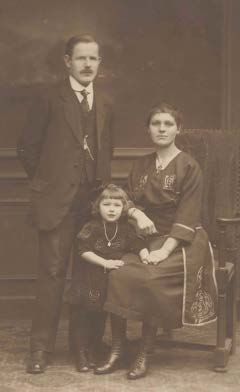
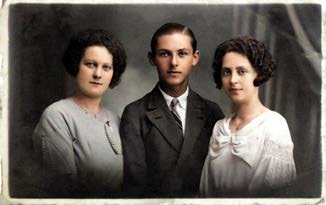
The person in the middle is Clothilde Ver-
haeghe. (Declercq de Silva Archive)
© 2024 Nico F. Declercq
The Desclergues of la Villa Ducal de Montblanc, 2nd ed., Omn., VOL. IV
48.9. MARIE LOUISE DE VOS (DC08BY2Y1Y1Y1X1) & THEOPHILE VERHAEGHE
931
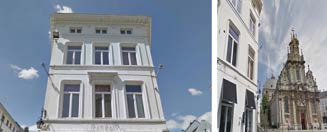
Figure 48.126:
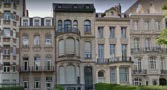
Brussels, Rolstraat 1
(side and front).
Here, Elisa Clara,
Clothilde and Eldodie Marie Eeckhout lived
while in Brussels.
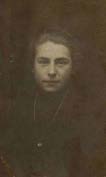
Figure 48.127: Clothilde Verhaeghe, the daughter of
Marie-Louise De Vos and sister of Zozyma Verhaeghe,
who lived in Brussels, probably in Etterbeek, with her hus-
band Mr Plasse and with their only child Louise Plasse.
(Declercq de Silva Archive)
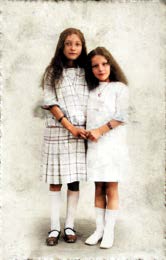
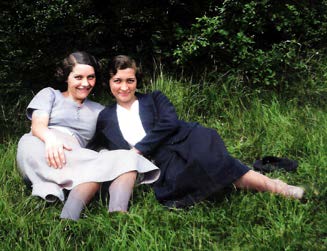
Figure 48.128: Grand-daughters of Marie-Louise De Vos, namely
Louise Plasse (daughter of Clothilde Verhaeghe en Mr Plasse) who lived
in Brussels (right) and Simone Van Houtven (daughter of Elisa Clara
Verhaeghe and Guillaume Van Houtven) who lived in Wetteren (left).
MyHeritage® colorized this photo. (Declercq de Silva Archive)
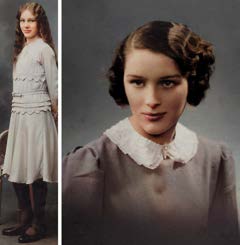
Figure 48.129: Louise Plasse, who lived in Brussels,
granddaughter of Marie-Louise De Vos. The archive
counts numerous pictures of her because she was the God-
child of Zozyma Verhaeghe. MyHeritage® colorized this
photo. (Declercq de Silva Archive)
The Desclergues of la Villa Ducal de Montblanc, 2nd ed., Omn., VOL. IV
© 2024 Nico F. Declercq
CHAPTER 48. THE MATERNAL DESCLERGUE ANCESTRY BRANCH BEGINNING WITH JOANA
932
CATHARINA DECLERCGZ (DC08B) & JOANNES DE VOS
Figure 48.130: Sint Michielslaan 125, in 1000 Brussel-Etterbeek.
Figure
48.131:
Grand-daughters of
Marie-Louise De Vos, namely Louise
Plasse, who lived in Brussels (left) and
Simone Van Houtven, who lived in Wet-
teren (right). MyHeritage® colorized this
photo. (Declercq de Silva Archive)
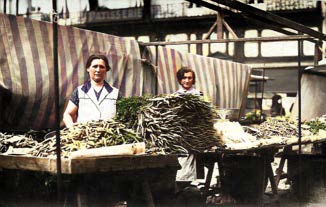
Figure
48.132:
Elisa Clara Ver-
haeghe (She was married to Guillaume
Van Houtven and she died in Wet-
teren in 1969), daughter of Marie-Louise
De Vos, and her daughter Simone Van
Houtven, selling vegetables at the mar-
ket of Etterbeek in Brussels. Simone Van
Houtven married Gharles Bayens. MyHer-
itage® colorized this photo. (Declercq de
Silva Archive)
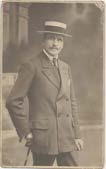
Figure 48.133: Guillaume van Houtven (also known as Lomé), husband of Elisa
Clara Verhaeghe. (Declercq de Silva Archive)
Figure 48.134:
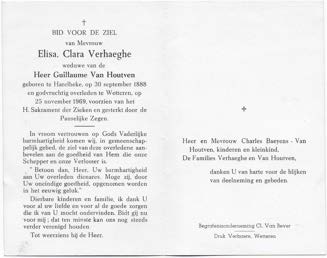
The mortuary card of
Elisa Clara Verhaeghe, widow of Guil-
laume Van Houtven, Wetteren 1969. (De-
clercq de Silva Archive)
© 2024 Nico F. Declercq
The Desclergues of la Villa Ducal de Montblanc, 2nd ed., Omn., VOL. IV
48.9. MARIE LOUISE DE VOS (DC08BY2Y1Y1Y1X1) & THEOPHILE VERHAEGHE
933
Figure 48.135: Elodie Marie Eeckhout, picture probably taken around 1906, in
Brussels. (Declercq de Silva Archive)
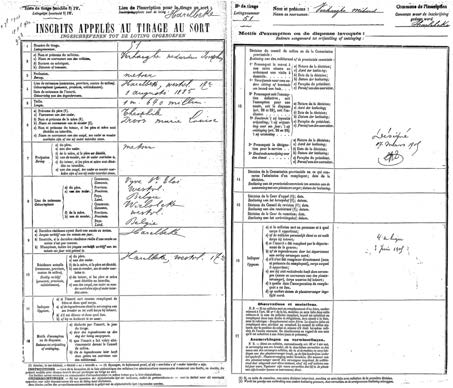
Figure 48.136: The military registration of Medard Joseph Verhaeghe, in Lichting van 1905,
Nationale Militie, Provincie West Vlaanderen, 17de militiekanton, gemeente Deerlijk. He was
a mason, born in Harelbeke on August 1, 1885, and was 164 cm tall. His father was Theophile
Verhaeghe, a mason born in Sint Eloois Vijve, and his mother was Marie Louise De Vos, born
in Wielsbeke. He had resided at least a whole year in Harelbeke before his recruitment. He was
admitted on March 17, 1905, and belonged to the 4th Line since June 3, 1905.
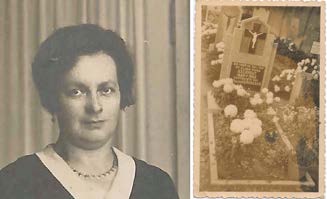
Figure 48.137: Left, Elodie Marie Eeck-
hout in the late 1920s. Right, the tomb
of Elodie Marie Eeckhout. The archive
also contains pictures of the deceased body
of Elodie Marie (not shown in this book).
(Declercq de Silva Archive)
The Desclergues of la Villa Ducal de Montblanc, 2nd ed., Omn., VOL. IV
© 2024 Nico F. Declercq
CHAPTER 48. THE MATERNAL DESCLERGUE ANCESTRY BRANCH BEGINNING WITH JOANA
934
CATHARINA DECLERCGZ (DC08B) & JOANNES DE VOS
Figure 48.138:
Clara Verhaeghe (left)
with her half-sister Rachelle Verhaeghe
(who later married an Englishman, see
Chapter 48.10) and her half-brother, all
descendants of Marie Louise De Vos with
Spanish roots. Clara, born from a pre-
vious relationship of Marie Elodie Eeck-
hout before her marriage to Medard Jozef
Verhaeghe, does not share these roots.
The person in the middle is Maurice
Verhaeghe, named after the soldier Mau-
rice Verhaeghe killed in 1918. Maurice
Alphonse Verhaeghe lived in Oudenaarde
and married Adrienne Debleeckere (1913-
1990) from Bevere near Oudenaarde. This
photo was colorized by MyHeritage®.
(Declercq de Silva Archive)
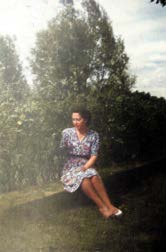
Figure 48.139: Rachelle Verhaeghe, granddaughter of Marie-Louise
De Vos, married an Englishman, Mr A. Strickland and lived in London,
United Kingdom, in 56 Priory Road, NW6 3RE, four miles from the
Duke of York, shown in Figure 48.140 on page 934. See also Chapter
48.10. The location is shown in Figure 48.141. MyHeritage® colorized this photo. (Declercq de Silva Archive)
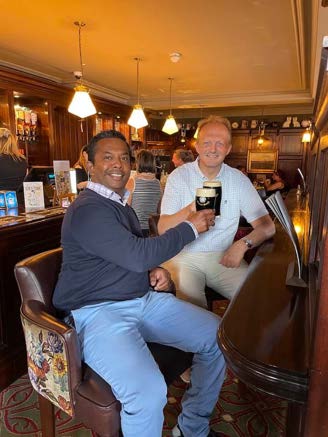
Figure 48.140: The author was having
fun with Michael Roman at the London
Pub, the Duke of York, in Westminster,
2022, shortly before H. M. Queen Elizabeth
II celebrated her Platinum Jubilee.
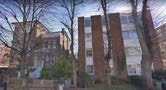
Figure 48.141: A recent view of 56 Priory Road, London NW6 3RE,
United Kingdom. Either the house is left or used to be right, where
there is a modern building now.
© 2024 Nico F. Declercq
The Desclergues of la Villa Ducal de Montblanc, 2nd ed., Omn., VOL. IV
48.9. MARIE LOUISE DE VOS (DC08BY2Y1Y1Y1X1) & THEOPHILE VERHAEGHE
935
The wedding took place after the birth of Edouard Verhaeghe, born on May 11, 1821; therefore, the child had to be legalized on their marriage certificate.
48.9.2.3.4 Edouard Verhaeghe (V02) & Ursula Baert
48.9.2.3.4.1 Edouard Verhaeghe (V02) Edouard Verhaeghe was born in Waregem on May 31, 1821, in Figure 48.112,
before his parents were married.
Nevertheless, he was registered correctly, and his parents soon married. A baptism record is like a holy contract of existence between a family and God. At the same time, birth registration is an existential, holy formalization of our society’s existence. It must be done correctly and without later changes, additions, or corrections. Edouard’s parents were wise enough to understand this.
His father was Antonius Verhaeghe, and his mother was Josephe Corneille. The family lived in Potegem, a suburb of Waregem located near the current Hippodrome.
Edouard Verhaeghe died in Kortrijk on October 6, 1907, in Figure 48.113. Perhaps he died at the hospital, located in the street Budastraat, where he passed away. We don’t know. Still, his death was later registered in Harelbeke, where he resided.
48.9.2.3.4.2 Ursula Baert Ursula Baert was born at Sint Eloois Vijve on June 3, in 1829, in Figure 48.114 as the daughter of Dominicus Baert (son of Franciscus Baert and Judoca Beyens) and Francesca Xaveria Pauwels (daughter of Joannes Baptiste Pauwels and Anne-Marie Snauwaert). She has roots in Zulte and Waregem and Wortegem.
She died in Harelbeke, in Figure 48.115, at 38, on February 6, 1867.
DNA evidence is given in Chapter 73.8 on page 1590.
48.9.2.3.4.3 Their Marriage Edouard Verhaeghe married Ursula Baert on September 25, 1857, in Figures 48.116, 48.117
and 48.118, at Sint Eloois Vijve. From that certificate, for instance, we can extract the following information.
Edouard Verhaeghe was a servant (dienstbode) at the time of his wedding and lived at Waregem, where he was born on May 31, 1821, as the son of Antoine Verhaeghe (who died on December 8, 1834) and of Marie Josephe Corneille, a spinster, age 65 (born around 1793) and living at Waregem.
We can equally read that Ursula Baert was a spinster. On June 3, 1828, she was born at Sint Eloois Vijve, where she lived at the time of her wedding. She was the daughter of Dominicus Baert, a worker, age 69 (therefore born around 1788), and Francisca Pauwels, a spinner, age 61 (therefore born around 1796), both living at Sint Eloois Vijve.
48.9.3 The Marriage of Theophile Verhaeghe & Marie Louise De Vos
In Figure 48.119, their wedding was in 1884 in Wielsbeke, on October 17, at 4 pm.
At their marriage, Theophile Verhaeghe was a mason who lived in Harelbeke. His father was a farmer, and his mother had already died.
Marie Louise De Vos was a lace worker who resided in Wielsbeke.
Theophile was 21 when he married, while Marie Louise was already 25. Both had lost one parent at the time of their wedding.
At a later age, the couple can be seen in Figure 48.120.
48.9.4 Their Offspring, Entrepreneurship and the France and Brussels link.
Further in this book, we focus on Zozyma Zulma Verhaeghe (DC08by2y1y1y1x1x) in Chapter 48.11.
Here, we highlight the other children of Theophile Verhaeghe and Marie Louise De Vos.
Their children were all born at Harelbeke. In Deerlijk, we found Marie Louise Devos in the index in the population’s register, referring to book 7, page 1220. This is a book covering the period 1900-1910. Although we have not seen the book with details yet, we can conclude that the family must have arrived from Harelbeke at Deerlijk no later than 1910.
Marie Louise de Vos and Theophile Verhaeghe had the following children:
Medardus Josephus Verhaeghe (DC08by2y1y1y1x1xh), born at Harelbeke in 1885, akte 258; he married Elodie Marie Eeckhout.
Marie Leonie Verhaeghe (DC08by2y1y1y1x1xb), born at Harelbeke in 1887 on March 28, akte 115; she married Gustaaf Vannieuwenhuyze.
Elisa Clara Verhaeghe (DC08by2y1y1y1x1xc), born at Harelbeke in 1888 on September 30, akte 284; she married Guillaume Van Houtven.
Alida Augusta Marie Verhaeghe (DC08by2y1y1y1x1xd), born at Harelbeke in 1890 on May 6, akte 183; she married Victor Alfons Simoens.
Maurice Florimond Verhaeghe (DC08by2y1y1y1x1xi), born at Harelbeke in 1892 on February 15, akte 78; he died as a soldier.
Clotilde Maria Verhaeghe (DC08by2y1y1y1x1xe), born at Harelbeke in 1894 on February 19, akte 69; she married Mr Plasse.
Renilde Marie Verhaeghe (DC08by2y1y1y1x1xf), born at Harelbeke in 1896 on December 17, akte 465; she married René Delrue.
Verhaeghe Zozyma Zulma (DC08by2y1y1y1x1x), born at Harelbeke in 1898 on September 5, akte 318; she married Gerard Vangheluwe.
Seraphin René Verhaeghe (DC08by2y1y1y1x1xj), born at Harelbeke in 1899 on October 30, akte 475; he married Rachelle Demeyere.
Irma Elisa Verhaeghe (DC08by2y1y1y1x1xg), born at Harelbeke in 1901 on September 16, akte 201; she married Theofiel Caby.
The surviving family, around 1926, is shown in Figure 48.121. We have no absolute certainty about their residence in Deerlijk.
They probably even moved within the municipality once. Indeed, Maurice Verhaeghe’s military records mention two addresses as a place of residence in Deerlijk: Vichtestraat 1 and Hoogstraat 23. On a work permit from his sister Zozyma Verhaeghe from 1917, we find Hoogstraat 23.
48.9.5
Offspring, Entrepreneurship and the Link to France and Brussels.
Theophile Verhaeghe probably established the initial links with Brussels.
Through his connections, his children could find employment in the capital.
Theophile had also established relationships with the North of France for similar reasons. Our archive has pictures of children visiting France for their holidays to study French.
The secure connection with Brussels and the North of France was why the Verhaeghes could speak and write French.
The Desclergues of la Villa Ducal de Montblanc, 2nd ed., Omn., VOL. IV
© 2024 Nico F. Declercq
CHAPTER 48. THE MATERNAL DESCLERGUE ANCESTRY BRANCH BEGINNING WITH JOANA
936
CATHARINA DECLERCGZ (DC08B) & JOANNES DE VOS
The associations also played an important role during both wars (WWI and WWII) in terms of their economic and underground activities. For instance, Zozyma Verhaeghe’s home was a haven for individuals from Brussels who came by train to trade and connect with networks in and around Kortrijk.
Even after the war, the family sent children to French schools. The author unknowingly continued the tradition by sending his children, for around six years, to a French-speaking school in Dottignies across the language border in Belgium.
48.9.5.1 Seraphin René Verhaeghe & Rachelle Demeyere
Seraphin René Verhaeghe was known as René Verhaeghe and is shown in Figure 48.122. He was a good musician and played several instruments. He could even play the accordion very well.
His military record is given in Figure 48.123.
Seraphin René first married the love of his life. However, she passed away very unexpectedly shortly after their wedding while pregnant with their first child. At that time, the cause had never been determined.
He then married Rachelle Demeyere, shown in Figure 48.124.
We know, for instance, that Seraphin René Verhaeghe and Rachelle Demeyere had relatives across the border with France, shown in Figure 48.124. According to a picture with description, Rachelle’s mother was Leonie, who lived with her son Joseph Demeyere and daughter-in-law Germaine at Vendin-le-Viel in 1938, neighboring Pont-a-Vendin and near Lens in France. In France, le Service Historique de la Défense lists Joseph Demeyere as a French resistance member during WWI.
We have yet to figure out who is who, how, and why they lived in France. In fact, we found several family names that are common to Flanders in that village, starting from around 1870. We probably found births at Vendin-le-Viel, perhaps of the three youngest children of the Demeyere family there: Leonie Georgette (1936), Pierre Jules (1935), and Paulette Jacqueline (1933).
48.9.5.2 Elisa Clara & Clothilde Verhaeghe
Here, we will focus a little bit on the daughters of Theophile Verhaeghe, of whom we know they have lived a while in Brussels.
A beautiful picture is shown in Figure 48.125. Elisa Clara Verhaeghe and Clothilde left for Brussels with Elodie Marie (described below), who would ultimately marry Medard Verhaeghe, brother of the other two.
The three stayed at Rolstraat 1 in Brussels. As it looks today, two pictures of the place are shown in Figure 48.126.
Elisa Clara Verhaeghe married Guillaume Van Houtven, and they moved to Wetteren. They had a daughter, Simone Van Houtven, who would marry Charles Bayens.
Clothilde Verhaeghe married Mr Plasse, shown in Figures 48.127, and they would have one daughter, Louise Plasse, shown in Figures 48.128 and 48.129, named after Marie-Louise De Vos. Her godmother was Zozyma Verhaeghe, though.
Clothilde Verhaeghe and her family lived in Brussels 1000 (Etterbeek), at Sint Michielslaan 125. Fortunately, the house is still there, depicted in Figure 48.130.
Marie Louise Plasse married Henri Mestdagh, and they settled at Mont Saint André in Ramillies, somewhere in Rue de l’ Eglise.
Interestingly, this is 5 km from where the Galle-Declercq family ended up, as described in Chapter 44.5.2. More charming memories are found in Figures 48.131, 48.132, 48.133 and 48.134.
48.9.5.3 Elodie Marie Eeckhout, a Courageous Woman, Wife of Medardus Verhaeghe
For many years, the person Elodie Marie Eeckhout, shown in Figures 48.135 and 48.137, has been a mystery during the investigations that resulted in this book. We also refer to Chapter 69.8.2.4. There were stories, and there were pictures, but we were unable to clarify and link matters. Curiosity sparks research, so we may state that the search for her has been a driving force in our investigations many years ago. She is not blood-related, but two of her children are. As described earlier in this chapter, these two children descend from Marie Louise De Vos and have Spanish roots.
In 1887, at Hulste, Elodie Marie’s parents married. They were Barbara Theresia Depaepe, a lacemaker born in Hulste in 1865 as the daughter of Petrus Depaepe and Nathalie Carette, both workers and Petrus Martinus Eeckhout, a flax worker born at Ooigem in 1857 as the son of Angelus Eeckhout and Catherine Adens, also both workers.
Elodie Marie Eeckhout was their first child to survive after her sister Aloyise had died at Ooigem in 1889. She was born on August 9, 1889, in Desselgem. Two years later, in March of 1891, her brother Alphonse Joseph was born. In 1892, her sister Bertha Elisa was born, but she would die at 14 months.
Elodie Marie’s father, Petrus, died in March of 1893 when she was not yet four years old. One month later, a brother, Julien Alphonse, was born at Desselgem, which must have been hugely symbolic as the father was not alive anymore to enjoy the birth of his son. The boy, unfortunately, would live only five months.
Elodie Marie’s mother, who had two living children, re-married in November 1894 at Desselgem to Honoré Désiré Vanoverschelde, son of Joannes Vanoverschelde and Melanie Derycke and widower of Marie Louise Vandenbroucke and already a father of children older than Elodie Marie. A new half-sister of Elodie Marie was born in July 1895 at Desselgem. She was named Magdalena Zulma Vanoverschelde. She was six years younger than Elodie Marie. In 1897, a brother, Maurice Aloise Vanoverschelde, was born. In 1900, a brother, Robert Vanoverchelde, was born.
Being the eldest child and most probably longing for a better future, Elodie Marie first went to Kortrijk and then to Brussels around 16 to work. She did this with Elisa Clara Verhaeghe, the eldest daughter of Marie Louise De Vos, Theophile Verhaeghe, and her sister Clothilde Verhaeghe.
Likewise, they may have met in Kortrijk or Brussels and decided to stay together. We do not know.
In Brussels, they lived at Rolstraat 1, downtown Brussels. Figure 48.126 shows a picture of the place.
Elodie Marie Eeckhout had a relationship in Brussels, and at the age of 21, this resulted in a daughter, Clara Eeckhout, born in Brussels on April 17, 1910. Most likely, Elisa Clara Verhaeghe was her godmother.
One year after Clara’s birth, her mother married Medard Jozef Verhaeghe in Brussels on January 21, 1911, and he adopted Clara, so she became Clara Verhaeghe.
Medard’s military records are shown in Figure 48.136.
The family then moved to Marke near Kortrijk. It can, for instance, be found that he claimed funding after WWI.21
If time travel would ever be invented, it is essential to know that Elisa Clara Verhaeghe was called tante Clara and that Clara Verhaeghe (in case the time-traveler meets the Eeckhout family) was called Clara van Marke.
Their wedding had taken place on January 1, 1911, in Brussels.
21Folie 30, Boek 167, Akte 1919, Dossier Oorlogsschade, Medard Verhaeghe, Gemeente Marke.
© 2024 Nico F. Declercq
The Desclergues of la Villa Ducal de Montblanc, 2nd ed., Omn., VOL. IV

48.9. MARIE LOUISE DE VOS (DC08BY2Y1Y1Y1X1) & THEOPHILE VERHAEGHE
937
Her address at that time was Rolstraat 1, Brussels, and the document indicates that she had lived in Kortrijk before this.
Medard Jozef Verhaeghe, born in Harelbeke as is found in Chapter 48.9.4, and son of Marie-Louise De Vos and Theophile Verhaeghe, lived in Vorst at that time after having lived in Anderlecht.
Elodie Marie’s mother was still alive at the time of the wedding.22
Two witnesses involved with the Belgian Railways were Alfred Verhoeven (age 25, from Saint-Gilles) and Renaat Labeyt (age 25, from Vorst).
Clara Eeckhout, daughter of Elodie Marie, was adopted during the wedding and received a new name: Clara Verhaeghe, and she is shown in Figure 48.138.
Note that a document from 1928 reveals they must have moved back to Brussels. Indeed, Medard Jozef Verhaeghe and Elodie Marie Eeckhout must have lived for a while at Sint Jans Molenbeek at that time, in Landmeterstraat 8. Nowadays, there are modern 3-story apartments at that location. It is even likely that their eldest daughter remained in Marke as she was already an adult by then, and she was in close contact with the nearby family.
The tomb of Marie Elodie and Medard is shown in Figure 48.137.
Rachelle Verhaeghe, shown in Figure 48.139, daughter of Marie Elodie Eeckhout and Medard Jozef Verhaeghe, married in London to Mr A. Strickland. The couple found each other thanks to contacts made by Maurice Florimond Verhaeghe during WWI. In Chapter 48.9.5.4, we can read that Maurice Florimond Verhaeghe was in England to be treated for a severe injury in 1915, after which he returned to the frontline in Belgium. Maurice was Rachelle’s uncle. During his stay in England, he got to know the Strickland family and both families. After the war, they established contact with each other, which resulted in Rachelle marrying a member of the family. We do not know every detail but suggest the reader look at Chapter 48.10.
48.9.5.4 Maurice Florimond Verhaeghe
48.9.5.4.1 Introduction Maurice Florimond Verhaeghe was a resident of Deerlijk, fought on the Western Front for four years, and was killed in the final offensive in 1918.
His military registration is shown in Figure 48.142.
Maurice Florimond Verhaeghe also appears in the journal ’Derlike.’ 23
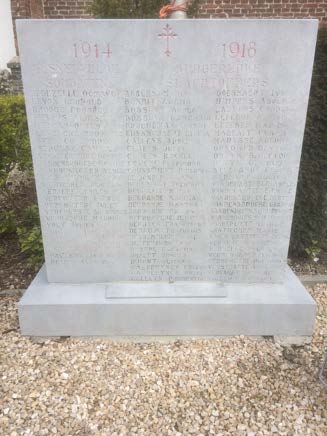
The inhabitants of Deerlijk erected a monument, shown in Figure 48.143, at the Saint Columba church, with the names of the soldiers from Deerlijk who died during WWI. ’Verhaeghe Maurice’ is listed as the penultimate in the first column.
As was often the case with soldiers who lived in a municipality different from where they were born, one paid little attention to this young man after the war. Maurice’s remains were never found, which made his brothers and sisters’ beaten wounds particularly deep.
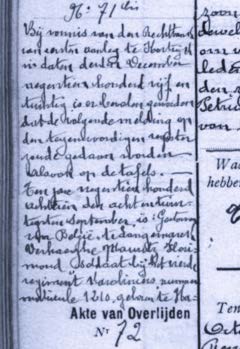
A few lines of text as a comment in the registers of the deaths in Deerlijk, shown in Figure 48.144, was, until now, the only written document witnessing his life and death.
48.9.5.4.2 Birth in Harelbeke and the family settled in Deerlijk Maurice Florimond Verhaeghe was a son of Theophile Verhaeghe (born in Klauwenhoek in Sint Eloois Vijve in 1863) and Marie Louise de Vos (born in Molsten in Wielsbeke in 1859).
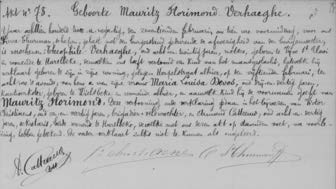
He was born in Harelbeke in 1892, in Figure 48.146.
His parents married in Wielsbeke in 1884.
On his father’s side, Maurice was related to a soldier of Napoleon, Berbaerd Verhaeghe, as described further in Chapter 48.9.5.4.6
and Chapter 48.9.2.3.1.
In contrast, on his mother’s side, he had Spanish ancestors, including Jeroni Joan Desclergue y Cortés (DC05) and his son Antoni Desclergue (DC06), both soldiers from Montblanc in Tarragona, Spain, as described at the beginning of his chapter. In particular, Maurice’s mother, Marie Louise de Vos, was a descendant of Petrus de Vos (DC08by2) from Harelbeke, the son of Joannes de Vos and Joana Catharina Declergz (DC08b). The latter was indeed a granddaughter of Antoni Desclergue (DC06), responsible for constructing the chapel Kapel-ter-Ruste in Deerlijk around 1639. The Spanish look is noticeable in several of Marie Louise’s descendants.
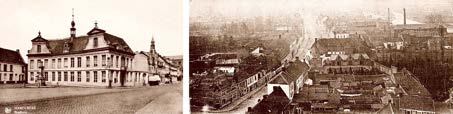
At the beginning of the 20th century, Harelbeke, shown in Figure 48.145, was known for the many masons, while Deerlijk was known for its weavers.
Older people often talked about fights between both communities when a weaver’s son seduced a bricklayer’s daughter or vice versa.
It was during this period that Maurice’s youth took place.
48.9.5.4.3 Soldier during WWI An impression of Deerlijk at the early stages of World War I is shown in Figure 48.147. We begin with facts found in the journal Derlike, written by Laurent Tack and Laurent Tack with Luc Adams, which provide a detailed Figure 48.142: The military registration of Maurice Florimond Verhaeghe, in lichting 1912, Nationale Militie, Provincie Westvlaanderen, 17e Militiekanton, Gemeente Harelbeke. He was a mason, born in Harelbeke on February 15, 1892. He was 166 cm tall. His father was Theophile Verhaeghe, born in Sint Eloois Vijve. His mother was Marie Louise De Vos, born in Wielsbeke. He had a brother in the army. He did not need to join the military, as was declared on September 30, 1911. However, we know that he joined voluntarily in 1914.
22The mother of Elodie Marie Eeckhout lived in Desselgem in 1911 and is called ’Barabara Depaepe’ on the wedding certificate.
23Derlike, XLII, extranummer, 2020, 131-141; Derlike XXVII, 2 (2004), 38-46; Derlike XXXI, 4 (2009), p111-112.
The Desclergues of la Villa Ducal de Montblanc, 2nd ed., Omn., VOL. IV
© 2024 Nico F. Declercq
CHAPTER 48. THE MATERNAL DESCLERGUE ANCESTRY BRANCH BEGINNING WITH JOANA
938
CATHARINA DECLERCGZ (DC08B) & JOANNES DE VOS
Figure 48.143: The monument to fallen
soldiers at Saint Columba Church in Deer-
lijk. (Declercq de Silva Archive)
Figure 48.144: Maurice Verhaeghe’s death certificate,
added to the death registers in Deerlijk after the officials
established that he had died and his remains were miss-
ing.
Figure 48.145: Harelbeke.
© 2024 Nico F. Declercq
The Desclergues of la Villa Ducal de Montblanc, 2nd ed., Omn., VOL. IV
48.9. MARIE LOUISE DE VOS (DC08BY2Y1Y1Y1X1) & THEOPHILE VERHAEGHE
939
Figure 48.146: Harelbeke, February 15, 1892, the birth of Maurice
Florimond Verhaeghe, son of 28-year-old Theophile Verhaeghe, mason,
born in Sint Eloois Vijve and residing in Harelbeke in Herpelstraat,
and of 33-year-old Maria Louisa De Vos, born in Wielsbeke and equally
residing in Harelbeke, shown in Figure 48.145.
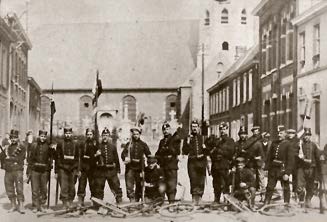
Figure 48.147:
Belgian soldiers and
civilians on ’Kerkplein’ in Deerlijk. The
picture was taken after a confrontation be-
tween the Belgians and 25 German recon-
naissance troops on September 8, 1914.
The soldier, second from right, shows off
with a German boot stuck on his riffle.
The picture has been reproduced several
times. The Archive Leon Defraeye equally
has a reproduction, published in Derlike
XVI, 4 (2004) p. 108.
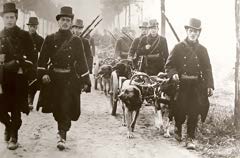
Figure 48.148: Belgian carabiners in 1914 during the
retreat from the Nete to Antwerp.
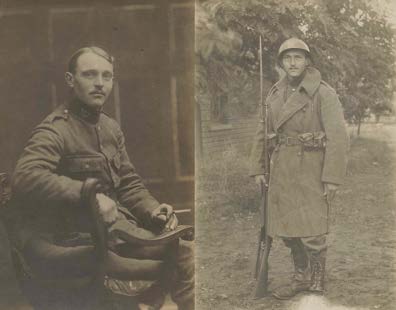
Figure 48.149: Maurice Verhaeghe in his carabiner uniform, probably in 1917, and
with bayonet. (Declercq de Silva Archive)
The Desclergues of la Villa Ducal de Montblanc, 2nd ed., Omn., VOL. IV
© 2024 Nico F. Declercq
CHAPTER 48. THE MATERNAL DESCLERGUE ANCESTRY BRANCH BEGINNING WITH JOANA
940
CATHARINA DECLERCGZ (DC08B) & JOANNES DE VOS
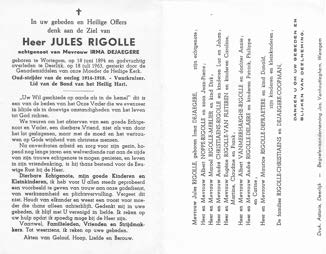
Figure 48.150:
The obituary card of
Jules Rigolle, the person who claimed to
have seen Maurice Verhaeghe’s body after
the enemy had killed him. It is highly un-
likely that this claim was true and, there-
fore, we think he did it as a favor to the
family, so they could close this chapter.
(Declercq de Silva Archive)
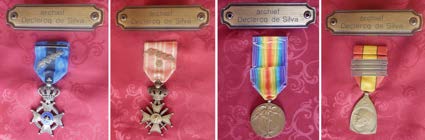
Figure 48.151: Maurice Verhaeghe received la medaille Commémorative de la Guerre
1914-1918 (7 chevrons), a Croix de Guerre with palms and golden lion for achievements,
Knighthood in the order of Leopold II, with palms (and ’barrette de deuil’) and the Victory
Medal. (Declercq de Silva Archive)
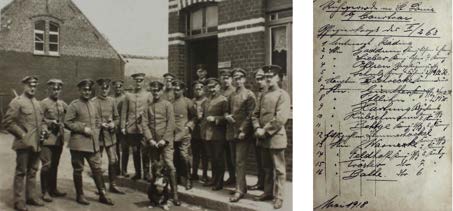
Figure 48.152: May 1918, German officers (Offizirenkorps 25 II/263) at Saint Louis at their
’Casino.’ The numbers match the image, counting from left to right, except for 10 and 11, i.e.
10 stands in the doorway with 11 in front. We have not transcribed the legend to avoid mistakes.
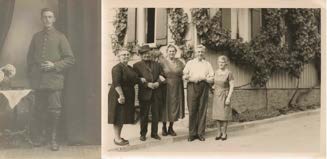
Figure 48.153:
Left, German soldier
Josef Schmidt to whom the Verhaeghes had
to provide shelter during WWI. Right, the
1960s in Ilshofen-Germany, from right to
left: Zozyma Verhaeghe, Josef Schmidt
with his wife Maria, Gerard Vangheluwe
(spouse of Z. Verhaeghe), Renilde Ver-
haeghe. (Declercq de Silva Archive)
© 2024 Nico F. Declercq
The Desclergues of la Villa Ducal de Montblanc, 2nd ed., Omn., VOL. IV
48.9. MARIE LOUISE DE VOS (DC08BY2Y1Y1Y1X1) & THEOPHILE VERHAEGHE
941
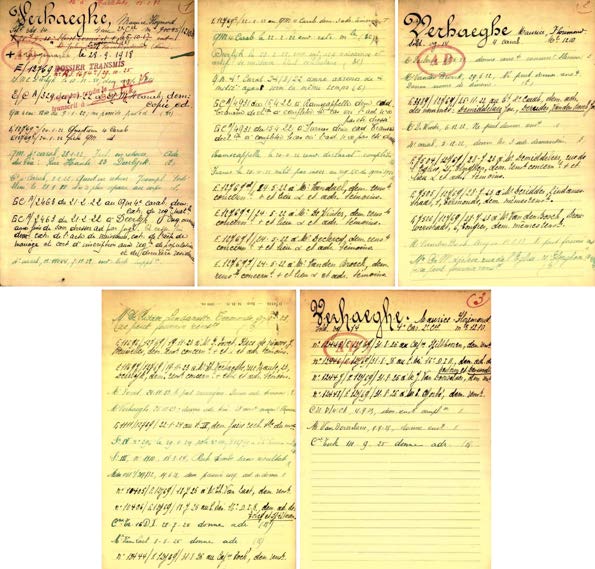
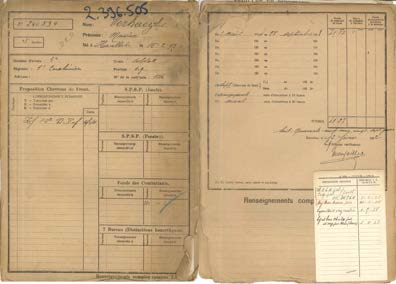
Figure 48.154: Maurice Verhaeghe, fiche militaire 35075, pages 1-5.
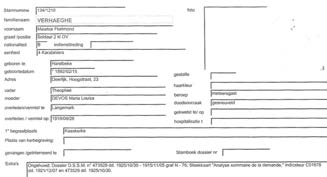
Figure
48.155:
The military record of Maurice Verhaeghe, number
20180302085847378, pages 1-2.
The Desclergues of la Villa Ducal de Montblanc, 2nd ed., Omn., VOL. IV
© 2024 Nico F. Declercq
CHAPTER 48. THE MATERNAL DESCLERGUE ANCESTRY BRANCH BEGINNING WITH JOANA
942
CATHARINA DECLERCGZ (DC08B) & JOANNES DE VOS
Figure
48.156:
The
military
record of Maurice Verhaeghe, number
20180302085847378, database.
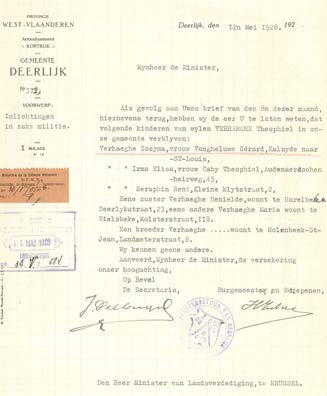
Figure
48.157:
The
military
record of Maurice Verhaeghe, number
20180302085847378, page 3.
account of the wartime experiences in Deerlijk.24252627
On August 22, 1914, the first German troops, consisting of cavalry or uhlanen from neighboring Vichte, arrived in Deerlijk. They departed soon after, as German forces moved southward to engage the Allies. On September 8, 1914, 25 reconnaissance troops, hussars or huzaren, depicted in Figure 48.164, arrived. During this period, Belgian soldiers and police officers managed to capture some Germans, leading to a notable incident resulting in the death of Carl Trunk, a German soldier. Despite this resistance, the Germans did not retaliate against Deerlijk, likely because a wounded German soldier declared that Belgian military personnel, not civilians, were responsible for his injuries.
The German occupation of Deerlijk began on October 17, 1914. By the war’s end, Maurice Verhaeghe died at Langemark, and another Deerlijk soldier, Evarist Dejager, died at Moorslede. Maurice Verhaeghe’s name appears on war monuments in both Harelbeke and Deerlijk. Notably, he was not listed among the killed soldiers of the Flanders Fields Museum in 2004. Jules Rigolle, who witnessed Maurice’s death, played a crucial role in ensuring that his death was officially recorded on December 3, 192528. The obituary of Jules Rigolle is shown in Figure 48.150.
Maurice Verhaeghe did not initially appear in military archives, and Leon Defraeye omitted him from his 1932 list of killed soldiers.
His name was eventually added to the Deerlijk monument erected in 1952. According to Laurent Tack, Maurice was erroneously declared dead on May 16, 1915, and some registers were not updated, leading to confusion with another soldier of the same name from Torhout.
Laurent Tack and Luc Adams reviewed documents indicating Maurice Verhaeghe was treated in an English hospital in 1915. This period of hospitalization, during which he was mistakenly declared dead, allowed him to establish connections with the Strickland family in London, evidenced by his niece Rachelle Verhaeghe’s later marriage to Mr. Strickland.
Maurice was neither buried in Kaaskerke nor De Panne, likely due to confusion with the Torhout soldier. The British liberation of Deerlijk from October 18 to 20, 1918, was marked by intense fighting, resulting in significant civilian casualties due to German artillery fire from the Schelde River valley. Deerlijk lost 11 soldiers in 1918, with 12 others killed between August 4 and October 17, 1914, and five more before the year’s end. Before the war, Maurice Verhaeghe worked as a mason with his father.
Unmarried, he enlisted as a war volunteer on August 3, 1914. By October 2, 1914, he joined the 2nd regiment of carabiniers, deployed to defend Antwerp. The Battle of the Nete began on October 2, 1914, with the Germans advancing to Antwerp’s fortresses by October 5, 1914, equally described in Chapter 64.7.1.6.5.
24Laurent Tack, "De Deerlijkse gesneuvelde soldaten, burgers en zivielarbeiders in de Eerste Wereldoorlog (dl. II)," Derlike XXVII, 1 (2004).
25Laurent Tack, "De Deerlijkse gesneuvelde soldaten in de Eerste Wereldoorlog," Derlike XXVII, 2 (2004).
26Laurent Tack, "De Deerlijkse Gesneuvelde Soldaten, Burgers en Zivielarbeiders in de Eerste Wereldoorlog," Derlike XXVI, 4 (2004).
27Laurent Tack and Luc Adams, "De Deerlijkse Gesneuvelde Soldaten uit de Eerste Wereldoorlog - Aanvullende gegevens en correcties," Derlike XXXI, 4 (2009).
28Jules Rigolle relayed this information to Simone Caby decades later (see Figure 48.165)
© 2024 Nico F. Declercq
The Desclergues of la Villa Ducal de Montblanc, 2nd ed., Omn., VOL. IV
48.9. MARIE LOUISE DE VOS (DC08BY2Y1Y1Y1X1) & THEOPHILE VERHAEGHE
943
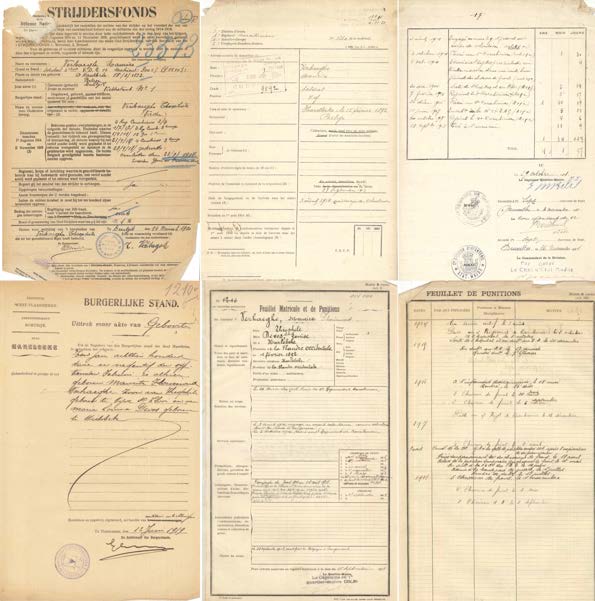
Figure 48.158: The military record of Maurice Verhaeghe, number 20180302085847378, pages 4-9.
Figure 48.159:
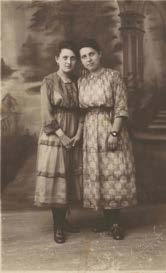
Two daughters of Marie-Louise De Vos. Left is
Zozyma Verhaeghe, right is Alida Verhaeghe. (Declercq de Silva
Archive)
The Desclergues of la Villa Ducal de Montblanc, 2nd ed., Omn., VOL. IV
© 2024 Nico F. Declercq

CHAPTER 48. THE MATERNAL DESCLERGUE ANCESTRY BRANCH BEGINNING WITH JOANA
944
CATHARINA DECLERCGZ (DC08B) & JOANNES DE VOS
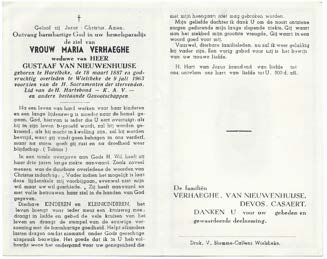
Figure 48.160: 1963 Wielsbeke, the obit-
uary card of Maria Verhaeghe. Maria
Leonia Verhaeghe married Modest Gustaf
Vannieuwenhuyse in 1919 at Deerlijk.
(Declercq de Silva Archive)
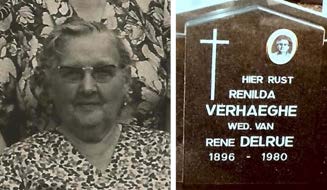
Figure 48.161: July 24, 1971, Renilde
Verhaeghe. Right is her tomb. (Declercq
de Silva Archive)
Figure 48.162: The military registration of Theophiel Remi Caby, in Lichting van 1916, Nationale Militie, Provincie West Vlaanderen, militiekantoor Harelbeke, gemeente Deerlijk. He was a textile manufacturer, born in Deerlijk on June 18, 1896, as the son of Jules Caby from Deerlijk and Marie Octavie Casteur from Desselgem. He was admitted on July 9, 1919.
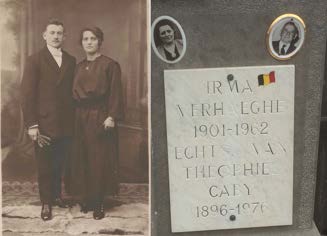
Figure 48.163: The wedding of Theophile
Caby with Irma Verhaeghe and their tomb
at Saint Louis Deerlijk. (Declercq de Silva
Archive)
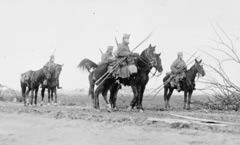
Figure 48.164: German hussars. The hussar is a sol-
dier belonging to the light cavalry. The hussars were pri-
marily employed for reconnaissance and raids to supply
the marching army. In battle, their function was also to
harass the enemy, to seize artillery batteries or to chase
down troops in a debacle. (Declercq de Silva Archive)
© 2024 Nico F. Declercq
The Desclergues of la Villa Ducal de Montblanc, 2nd ed., Omn., VOL. IV
48.9. MARIE LOUISE DE VOS (DC08BY2Y1Y1Y1X1) & THEOPHILE VERHAEGHE
945
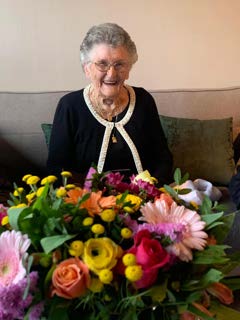
Figure 48.165:
Simone Caby, a granddaughter of
Theophile Verhaeghe and Marie Louise de Vos, turned
100 in 2024. (Declercq de Silva Archive)
Maurice, injured on October 6, 1914, spent the subsequent months in a military hospital, missing the retreat from Antwerp to the Yser and the Battle of the Yser. He rejoined his regiment on February 7, 1915, after being discharged from the hospital on December 20, 1914. He was again injured in May 1915 and briefly hospitalized.
In 1916, Maurice transferred to the 4th regiment of Carabiniers, formed after the army’s reorganization at the Yser River. He served with the 56th company Troupes auxiliaires du génie (T.A.G.) before returning to the 4th carabiniers. His regiment participated in various operations, including guarding Nieuwpoort and replacing British divisions in Brielen.
On September 28, 1918, Maurice was killed during an offensive to liberate Passchendaele. His battalion continued to advance, reaching De Ruiter by October 5 and subsequently moving through several locations until the ceasefire on November 11, 1918.
Maurice’s service at the front lasted four years, one month, and 27 days, excluding his hospitalization during the winter of 1914-1915.
Remarkably, Maurice Verhaeghe did not appear in the military archives, and Leon Defraeye forgot to mention him in his 1932 list of killed soldiers.
His name now appears on the monument in Deerlijk, erected in 1952, but was absent from earlier memorials.
According to an appendix by Laurent Tack, Maurice Verhaeghe had once been mistakenly declared dead on May 16, 1915. Some registers never corrected this error, leading to post-war confusion between two soldiers named Maurice Verhaeghe. Documents reviewed by Laurent Tack and Luc Adams revealed that Maurice had been treated in an English hospital in 1915, where he was erroneously declared dead shortly after.
His temporary residence in England is corroborated by subsequent family events and his involvement in underground activities during both World Wars. It was during this time that Maurice became acquainted with the Strickland family. His brother’s daughter, Rachelle Verhaeghe, would later marry Mr. Strickland from London.
Maurice Verhaeghe was not buried in Kaaskerke or De Panne. Earlier mistakes resulted from confusion with another Maurice Verhaeghe from Torhout, who died in 1915. During the British liberation of Deerlijk from October 18 to October 20, 1918, significant fighting occurred, causing civilian casualties due to German artillery from the Schelde River valley.
Deerlijk lost 24 civilians on October 20, 1918, and 11 soldiers died in 1918.
Between August 4, 1914, and October 17, 1914, 12 soldiers were killed, with five more casualties before the end of 1914.
Maurice Verhaeghe’s early wartime service began when he enlisted as a war volunteer on August 3, 1914. He was part of the 2nd regiment of carabiniers, defending Antwerp during the Battle of the Nete. In Figure 48.148, we see the 2nd regiment of carabiners who withdraw from the Nete to Antwerp in the days after October 2, 1914.
After sustaining injuries, he spent time in a military hospital, missing key battles. Upon recovery, he returned to the front lines on October 20 and rejoined the 2nd and 4th regiment of carabiners, shown in Figure 48.149. His regiment was involved in critical operations, including the defense of Nieuwpoort and participation in the liberation of Passchendaele, where Maurice was ultimately killed. We also refer the reader to Chapter 48.10 for more details about the death declaration and the link with England.
Throughout his service, Maurice displayed exceptional bravery and dedication. Despite early administrative errors and the chaos of war, his legacy endures. His story, meticulously documented through historical records and family accounts, highlights the sacrifices made by soldiers like Maurice Verhaeghe during World War I. His name, now honored on monuments, serves as a poignant reminder of the cost of war and the valor of those who fought.
48.9.5.4.4 Distinctions Maurice Florimond Verhaeghe, proudly posing in Figure 48.149, received several distinguished honors throughout his military career. His dedication and bravery in service were recognized through numerous accolades, reflecting his exceptional contributions during World War I.
On September 28, 1918, Maurice Verhaeghe tragically lost his life in Langemark during the final liberation assault on the German forces. His valor and commitment to duty were evident through the distinctions he earned.
As a testament to his front-line service, he was awarded the prestigious 7 chevrons de front (front stripes or front chevrons).
Posthumously, Maurice Verhaeghe was honored with the Victory Medal and the Médaille Commémorative de la Guerre 1914-1918.
These medals commemorated his participation and sacrifices in the Great War, underscoring the significance of his contributions to the Allied victory.
Furthermore, he received the Knight’s Cross with Palms from the Order of Leopold II, a high honor recognizing his outstanding bravery and leadership. Additionally, he was awarded the Croix de Guerre, further highlighting his heroism in the face of adversity29.
29Royal Decree of April 8, 1928, no 24561.
The Desclergues of la Villa Ducal de Montblanc, 2nd ed., Omn., VOL. IV
© 2024 Nico F. Declercq
CHAPTER 48. THE MATERNAL DESCLERGUE ANCESTRY BRANCH BEGINNING WITH JOANA
946
CATHARINA DECLERCGZ (DC08B) & JOANNES DE VOS
The medals of Maurice Florimond Verhaeghe, depicted in Figure 48.151, are enduring symbols of his courage, dedication, and the ultimate sacrifice he made for his country. His legacy is a poignant reminder of the bravery exhibited by soldiers who fought valiantly during World War I.
48.9.5.4.5 Meanwhile, at the Homefront in Deerlijk Various studies were performed in the past on the events in Deerlijk at the beginning of the war, for instance, by Philippe Despriet30. When the war had started, Deerlijk remained tranquil. Many young men were soldiers and fought the Germans in the East and North, while the people from Deerlijk had to make do with reading the newspapers and praying in the Chapel Kapel-ter-Ruste. Indeed, the fear of death makes people very religious.
Unfortunately, humility often evaporates after the events and is replaced by vanity and a high hat.
On August 22, 1914, German soldiers arrived in Deerlijk for the first time. French troops spotted nine Uhlans led by Count von Schwerin in Deerlijk. These French informed the pastor of Desselgem (Coussement).
The Germans were also spotted in Harelbeke and Kuurne. Citizens of Deerlijk informed Desselgem of the arrival of the Germans on Sunday, August 23, at 9:30 pm.
The population panicked when they learned that the Germans were arresting or shooting all men they encountered. The story was incorrect, but it was a reason to flee on Monday, August 24. The day is remembered as Lopersmaandag (Runner Monday)31. The events of August 24 formed a domino effect. Men fled west; they told the story in every congregation they encountered, and the local men ran. However, German troops retreated, and nothing happened. Somewhat embarrassed, the men returned home on Monday evening.
On August 25, a German stole a horse in Deerlijk. He had stopped a rider, Cyrille Dewulf, and taken his horse. Cyrille, therefore, complained to the constable. The German told him he would pay for the horse. This was very strange, but the German returned the horse the next day.
The mayor of Deerlijk, Theophile Renier, received several orders to carry out on August 29. Inns had to close at 9:00 pm, and the Belgian flags had to remain on the official buildings. All refugees from Brussels had to go to Sint Niklaas, and wounded soldiers had to be sent to Antwerp when healed.
The Germans did not initially occupy every street but limited their attention to the front line and village surveys.
The first encounter occurred on September 8 at a farm in Deerlijk in the Desselgemstraat. A mixed gang of Belgian civilians, gendarmes, and French soldiers attacked a German patrol.
People were killed in the attack, but they were unable to overpower the Germans wholly. For that reason, the population was very concerned because they expected reprisals. Also, the attackers had all disguised themselves as civilians by wearing their vests inside out, not to be recognized immediately. As a result, they feared that the Germans would believe civilians had attacked them, which was precarious for the locals.
Indeed, usually, the Germans then started murdering and destroying.
Police officer Alois Ameye collected all weapons from the civilian population. When he had confiscated all the guns, he wrote a report stating that not a single civilian had shot at the Germans but the military.
On September 10, the Belgian government announced that the refugees in Deerlijk could leave for England while soldiers were all sent to Antwerp.
On Thursday, September 10, 1914, there was a second encounter in Deerlijk around 10:30 am. Twelve German soldiers on horseback and five by bicycle rode from Vichte to Deerlijk. These soldiers took the bend in Deerlijk, in the station’s direction, then Sint Lodewijk, and then Heestert and Avelgem, where they joined their unit in Berchem. However, when these Germans arrived at the spruce forest in Deerlijk, somebody shot them at the Heirweg to Kortrijk. There were deaths, and the Germans again had not seen military uniforms. Harsh reprisals were bound to follow. The Germans then set fire to some farms. Buildings, equipment, and supplies went up in flames. There was also a civilian casualty.
The Germans tried to ask the pastor to explain the shootings that had taken place in Deerlijk, but the pastor Aimé Dieudonné Desmedt had fled.
The villagers further hid this fact during the war. After the war, however, writer Stijn Streuvels (Frank Lateur), who had been, almost like a real journalist, on inspection in the area during the events of that period and who wrote everything in a book, reported in his testimony that the pastor had, indeed, fled. Later research by Philippe Despriet in the documents of neighboring parishes provided ample evidence. The pastor had certainly run to another parish, namely to Desselgem. He arrived there on September 10, with his two maids, in the parish, filled with fear. After they arrived in Desselgem, the three fled on to Oostrozebeke. Joseph Coussement would be his successor in Deerlijk.
On that same day, there was also an event in Sint Lodewijk. Indeed, Romain Bulcaen32 writes that the newly installed priest of Sint Lodewijk, namely Louis Rommel33 was stopped by a German patrol when he left his church on September 10, 1914. The Germans asked him for directions to Waregem. He was so shocked that he could hardly speak. Therefore, he was arrested but would be released soon after.
Concerning the events in Deerlijk, the Germans indeed planned to take revenge. They sent part of their army unit in Berchem to Deerlijk to eradicate the village. Stijn Streuvels sensed the disaster and had already commented about it in his diary on September 8. On the evening of September 10, an entire army unit passed through Ingooigem, from Berchem to Deerlijk. It was a huge column, soldiers in front, heavy artillery in the back, followed by an ambulance. The people in Ingooigem had intensely mixed feelings. On the one hand, they were happy that the unit passed by and left them alone. On the other hand, they feared what was to come to Deerlijk.
The inhabitants of Deerlijk came together in their houses. It was as if they felt death approaching. They hid precious items in wells and cellars. They heard the Germans approaching in the distance on the cobbled road from Vichte to Deerlijk. The Germans made the situation even more terrifying by asking people how far Deerlijk was and that they were on their way to destroy the municipality.
Meanwhile, in Deerlijk, the atmosphere turned hushed. Cows mooed, dogs barked, and frogs croaked. In the distance, they heard the Germans marching to Deerlijk.
There was one missing soldier from the day that the firing in Deerlijk took place among the Germans. However, fortunately, the Germans found this soldier on their way to Deerlijk. His testimony confirmed that the Germans had not shot at Civilians but by the military. This testimony saved the population. The 1300 soldiers were ordered to return to Berchem immediately. Deerlijk was 30Philippe Despriet, ’Deerlijk 1914,’ published in Derlike, 3rd volume, no.4, 1981 and Derlike, 4th year, no.1, 1981.
31Later, on October 19, there was also a Schuwe Maandag, which also appears in Chapter 64.6.1.5.1, Chapter 64.7.1.6.7 and Chapter 65.
32Romain Bulcaen, ’Sint Lodewijk in de Eerste Wereldoorlog,’ Derlike, 10de jaargang, nr 1, 1987.
33Rommel was Flemish, despite his name.
© 2024 Nico F. Declercq
The Desclergues of la Villa Ducal de Montblanc, 2nd ed., Omn., VOL. IV
48.9. MARIE LOUISE DE VOS (DC08BY2Y1Y1Y1X1) & THEOPHILE VERHAEGHE
947
saved from destruction! For the residents, it was like a miracle. They were convinced that there had been intercession by Onze Lieve Vrouw ter Ruste. The chapel, described in Chapter 49, founded by Antoni Desclergue (DC06) in 1639, with substantial support from Marguerite Kelduwier, was once again in the middle of the war scene. From that moment on, daily pilgrimages to the chapel took place.
Deerlijk remained unoccupied until October 15, 1914. This meant that, despite the presence of German soldiers in the region, the village of Deerlijk remained under the authority of the Belgian government until that date.
During this interim period, Deerlijk received orders and instructions from the Belgian government almost daily. For example, the outrages of the Germans had to be reported, and German and Austrian subjects had to be arrested. Food convoys were not allowed to move in the direction of German-occupied territories. The public lighting had to be switched off at 9:00 pm on September 21 so German blimps would not find a passage easily. The meat price was fixed, and the authorities claimed grain. On October 1, doctor Isebaert of Deerlijk warned that Typhus had broken out among the refugees. Influential pieces of art in Deerlijk had to be stored safely. It may be a miracle that the polychrome panels in the Kapel-ter-Ruste were never stolen or damaged during this period.
The well-known Sint Columba retable in Deerlijk was also hidden but was later damaged during the shelling in 1918.
Alcohol was banned, and lists of cows, horses, grain, wheat, and the like were made to claim these goods, if necessary, for the Belgian army or the armies of friendly nations like England or France. On October 7, the authorities begged all men between 18
and 30 to become war volunteers and go to Ostend’s military depot. It is admirable that 310 years after the liberation of Ostend, this city was again central to a military story. On October 10, all motorized traffic was banned, which was the last Belgian warrant found at Deerlijk town hall. After that, the municipality fell into German hands.
Deerlijk was relatively far from the front, so life could go its ordinary course despite the occupation and to the extent possible. The Verhaeghe-de Vos family, like many other families in Deerlijk, was the residence of a German soldier, as ordered by the government.
When we consider Schuwe Maandag34 and the front lines of German soldiers who, according to their Schlieffen plan, wanted to conquer France within four weeks in August of 1914, to be able to attack Russia afterward, and therefore mercilessly punished any opposition or delay in Belgium with massacres, it is hard to imagine that there were also civilized Germans. The family was fortunate to have given shelter to a well-mannered soldier. His name was Josef Schmidt, from Ilshofe, between Stuttgart and Nuremberg. This soldier, shown in Figure 48.153, had little to do with hostilities, as he was a shoemaker and responsible for repairing the shoes of the German soldiers. Theophile Verhaeghe’s workshop was perfectly usable as a military shoemaker and was confiscated by the Germans. Josef, however, behaved very respectably throughout the war.
Occasionally, he could arrange extra rations so that the daughters in the family would not starve. The mutual respect was seen by the friendship between the two families, which lasted for many decades. Contact was maintained long after WWII even, and occasional visits took place. Josef Schmidt’s legacy lived on in his adoptive son Emile Bayer and his grandson Wolfgang.
The fact that the inhabitants of Deerlijk had to continue to work to have bread on the table, despite the occupation, is also evident from a 1917 work permit from Zozyma Verhaeghe, Maurice’s sister, shown in Figure 48.187 on page 963.
At the same time, during the war in Deerlijk, 250 local young men (aged between 17 and 30) were also forcibly recruited as civilian workers.
Germans took them to Sedan and Charleville-Mézières, where they had to work in the timber industry for the German war apparatus.
One of them was Gerard Vangheluwe, who would marry Zozyma Verhaeghe after the war and become the brother-in-law of the late Maurice Verhaeghe. The story is described in Chapter 69.
Gerard claimed all his life that he had not been randomly selected as a civilian worker but that local people who had to choose on behalf of the occupier didn’t like him. Gerard had once climbed the church tower as a child, after which the fire brigade had to free him. His mother was Marie Nathalie Surmont, the sister of Eduard Camille Surmont. The latter was a friend of the poet René Declercq and is described in ’Harmen Riels’ in 1913 as Kroeksken who once troubled the local pastor involving snowballs. Where the name ’Kroeksken’ came from can be found in Chapter 69.
Philippe Despriet described the events during the war further in Derlike35.
When the Germans took over authority in Deerlijk, many civilians were obliged to give shelter to the Germans, including the Verhaeghes, as mentioned above. Again, all goods, including sugar and alcoholic drinks, were listed. The Germans forced bars to close. The Germans placed the men under house arrest, who the Belgian state could claim as soldiers.
They confiscated all horses. In the following winter, there was a shortage of people. The inhabitants also stole a lot of wood from forests and gardens to heat homes. Deerlijk had entered a dark period, comparable to many periods in the 16th and 17th centuries during the civil wars in the Low Countries. For instance, a forest at Sint Lodewijk was cut and transformed into farmland. Romain
Bulcaen36 writes that this was the forest called ’Harelbekehout’ and used to be the size of 9 ha before the war. In the same reference, we can also read that, on October 20, 1916, the German Emperor Kaiser Wilhelm II attended a military parade at Banhout forest.
The German military guarded every road junction on this occasion, and the inhabitants were ordered to shut their window blinds.
The Germans also took the pastorie of Saint Louis, used it as a Casino, and did not show exemplary behavior. Many photo cards of the casino with Germans posing, as in Figure 48.152. They loved sending such pictures back home, probably to show they were totally in control.
As Romain Bulcaen described, the German occupation of Saint Louis was a constant reality until October 15, 1918. On that day, the villagers noticed that Germans began to retreat and took ammunition with them. The Germans also passed through the village, from West to East, and herded sheep and goats. The Germans requested the young men to follow their retreat. It’s not sure if they intended to use them as hostages or if they were afraid they might reinforce the Allied troops while reconquering Belgium.
By dawn on Sunday, October 20, the Allies crossed the Leie River between Kortrijk and Desselgem. The British crossed the Leie River at Beveren-Leie close to the border with Harelbeke37. In Chapter 49, the reader will see that a few centuries before, the Spanish and later the French had chosen the exact location as a bridgehead and to install barracks. The area served the military very well, and history repeats itself.
A mas occurred at dawn at Sint Lodewijk, while one could hear shells from a distance. By 9 o’clock, the Germans fled in panic. By 10:30, the first British military arrived in Sint Lodewijk. Then, the Germans began to assault Saint Louis. The church encountered numerous shells. A shell hit the sacristy of the church. All the windows were broken, except the one above the hoogkoor in which we can still read that the inhabitants of Saint Louis constructed the church. The German assault killed seven people and wounded 15.
The German bombardment did not damage the organ. In Chapter 72.4.9, we read that our ancestor, Sidonie Verbeke, wife of 34Schuwe Maandag also appears in Chapter 64.6.1.5.1, Chapter 64.7.1.6.7 and Chapter 65.
35Philippe Despriet, Derlike, 4th volume, no. 2, 1981.
36Romain Bulcaen, ’Sint Lodewijk in de Eerste Wereldoorlog,’ Derlike, 10de jaargang, nr 1, 1987.
37Gil Bossuyt and Phil Hamilton, ’visitor’s guide to the 36th Ulster Division Lys Memorial,’ 2019.
The Desclergues of la Villa Ducal de Montblanc, 2nd ed., Omn., VOL. IV
© 2024 Nico F. Declercq
CHAPTER 48. THE MATERNAL DESCLERGUE ANCESTRY BRANCH BEGINNING WITH JOANA
948
CATHARINA DECLERCGZ (DC08B) & JOANNES DE VOS
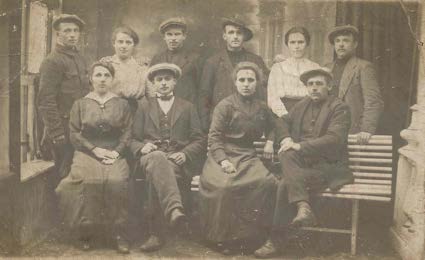
Figure 48.166: Back row from left to right: Gerard Vangheluwe (1898), Zozyma Ver-
haeghe (1898), Georges Remi Verhaeghe (1897, brother of Julien Verhaeghe; his military
record is shown in Figure 48.167), Seraphin René Verhaeghe (1899), Julia Augusta Verhaeghe (1899, sister of Julien Verhaeghe), Josef Georges Lambrecht (1896, flax merchant
in Wielsbeke). Front row from left to right: Alida Verhaeghe (1890), Julien Verhaeghe
(1895), Irma Verhaeghe (1901), Jozef Valère Verhaeghe (1891, brother of Julien Ver-
haeghe). (Declercq de Silva Archive)
Camillus Waelkens, was killed in Vichte (next to Saint Louis) on October 31, 1918. She died for her country. We don’t know any other details, but she likely died after being shot or hit by a shell. She was 65 years old.
On November 10, when a ceasefire was announced for the next day, everyone was thrilled, and, according to Bulcaen, the British played ’Blessed be God’ (Offertory Hymn) in the Church.
48.9.5.4.6 Life after WWI All of Maurice Verhaeghe’s surviving siblings eventually married. His sister Zozyma, for example, married Gerard Vangheluwe on July 20, 1921; the couple first lived in the center of Deerlijk and moved to Kalsyde naar St-Louis in the late 1920s, better known today as Stationsstraat. Zozyma would work all her life as a self-employed Haute couturière of ceremonial dresses.
Two sisters went to live in Brussels (Etterbeek and Sint Jans Molenbeek), one in Wielsbeke. The others stayed in Deerlijk or Harelbeke.
The families with whom the Verhaeghes married were Caby, Demeyere, Eeckhout, Delrue, Plasse, Simoens, Vangheluwe, Van Houtven, and Van Nieuwenhuyze.
After the war, the family searched in vain for Maurice. His body is most likely buried namelessly. On August 26, 1924, a letter was sent to the family by the military burial service38, stating that Maurice was buried in De Panne and that the army had taken his body from Kaaskerke. It would be grave number N76.
Upon further investigation, however, it turned out to be a mistake. Another Maurice Verhaeghe was buried there, someone from the 2nd regiment Jagers te Voet, who died in 1915.
Who knows, Maurice may be buried in the unknown soldier’s grave in Brussels - we don’t know. His brothers and sisters always kept a place in the house for a photo of Maurice. They all died a few decades ago.
The Verhaeghes, reasonably fluent in German and French, who had spread from Marke to Brussels during the interbellum and on both sides of the Leie River, formed an ideal mini-network during WWII for underground activities and connections to the resistance. We only know vague stories and single incidents during WWII. Therefore, this chapter in the life of the Verhaeghes is skipped in our book, apart from some vague facts mentioned further.
The war records of Maurice Verhaeghe are listed in Figures 48.154, 48.155, 48.156, 48.157 and48.158.
48.9.5.5 Other Descendants of Theophile Verhaeghe and Marie Louise de Vos
The list of children is shown above. Here, we have collected a few pictures and memorabilia not offered in other sections. They are found in Figures 48.159, 48.160, 48.161, 48.162, and 48.163.
In 2024, one of the granddaughters of Theophile Verhaeghe and Marie Louise de Vos, Simone Caby, turned 100. Figure 48.165
shows a photo of the event on page 945.
48.10 Verhaeghe: Pioneering Liberalism, Socialism, Resistance, and Education
This section aims to objectively portray the socio-psycho-economic world of the Verhaeghes within a historical context. Unlike the numerous heroic narratives that emerged post-World War II, this work is neither a cinematic venture nor a romantic novel. Due to the subject’s sensitive nature, we will not assert definitive facts, evidence, or conclusions.
Instead, the approach gently describes the context and offers insinuations, allowing the reader to engage with the material imaginatively.
The details provided here are intended to serve as a foundation for future historians who may delve into the detailed daily reports and records of Deerlijk and its surrounding villages during the World Wars. The family knows the names of individuals and families in Deerlijk, Harelbeke, Waregem, and Kortrijk who were traitors and collaborators with the Germans. However, the book tells our story, not that of the traitors.
38Major Michelet, message No. 6869 / E / 35376
© 2024 Nico F. Declercq
The Desclergues of la Villa Ducal de Montblanc, 2nd ed., Omn., VOL. IV

48.10. VERHAEGHE: PIONEERING LIBERALISM, SOCIALISM, RESISTANCE, AND EDUCATION
949
Figure 48.167: The military registration of Georges Remi Verhaeghe, in Lichting van 1917, Nationale Militie, Provincie West-Vlaanderen, militiekantoor Harelbeke, gemeente Deerlijk. He was a mason, born in Harelbeke on May 24, 1897, son of Jules Verhaeghe (he was dead), from Sint Eloois Vijve, and Marie Thérèse Libeer, from Harelbeke. The doctor declared that he had a heart condition (B-31), on July 24, 1919.
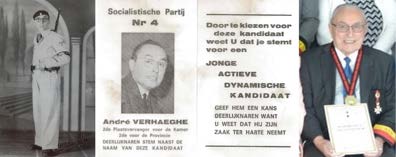
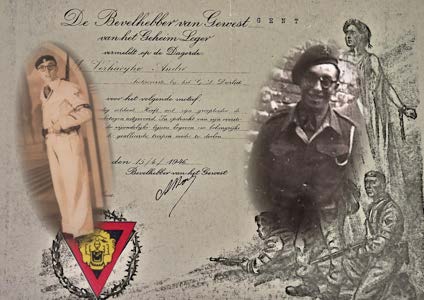
Figure 48.168: We can see André Verhaeghe in his uniform of the White Brigade.
The picture was taken in September 1944 (Courtesy of Archive Leon Defraeye Deer-
lijk). André Verhaeghe received accolades many times in his life, such as in the
color picture taken in Deerlijk. Furthermore, as seen in the middle, André has long
chaired the socialist political party of Deerlijk. This leaflet must have been distributed
in the 1960s or 1970s during one of his campaigns; Courtesy of Zozyma Verhaeghe.39
(Declercq de Silva Archive)
Therefore, certain critical aspects of the narrative necessitate a degree of vagueness.
The author, possessing a slow yet enduring memory, has compiled stories heard during childhood from great-grandparents, great-granduncles and aunts, grandparents, and acquaintances. These recollections have been placed within a historical framework, allowing bits and pieces to coalesce into this chapter.
Notably, the author’s great-grandmother, Zozyma Verhaeghe, could converse for hours, sharing her tales with anyone willing to listen. As a child, the author was an attentive listener, profoundly respecting the elders and their rich stories.
A vague yet insightful reconstruction is possible by situating these reports within their historical context.
This chapter, therefore, represents memories and historical context, providing a nuanced glimpse into the lives of the Verhaeghes during the war. It invites readers to explore and imagine the untold details, fostering a deeper understanding of this family’s journey through one of history’s most tumultuous periods.
48.10.1 The Importance of Deerlijk
The village of Deerlijk frequently appears in this book. In particular, in the years 1600 and from the second half of the 18th century onwards, it’s been a place that played quite an essential role in our ancestry.
Apart from this, Deerlijk is one of the cradles of ideas and innovations in Flanders. It could rightfully be called a revolutionary village. Indeed, centered between rural villages and the Leie River, relatively close to Kortrijk and on the edge of the castellany of Kortrijk and near that of Oudenaarde, Deerlijk has played an important economic role, in particular in the textile industry.
A healthy mix of workers, catholic farmers, liberal and catholic industrials, numerous pubs, and many immigrants from surrounding villages have molded Deerlijk into a hub and fireplace of ideas.
We can mention the Renier family, the Verriest family, René Declercq, several important priests, politicians, influential industrials, and countless others. Many are covered, for instance, in the journal Derlike, published by Heemkring Dorp en Toren.
It’s not an understatement to say that Deerlijk has played a pioneering role in education, particularly for workers’ children. As a result, Deerlijk has had a high percentage of literate people in the past two hundred years or more.
48.10.2 The Personages in the Verhaeghe Network
Here, we focus on one particular family that played a role, perhaps significantly, in the first half of the 20th century.
In particular, we are referring to the descendants of Edouard Verhaeghe (Waregem 1821 - Kortrijk 1907) and Ursula Baert (Sint Eloois Vijve 1828 - Harelbeke 1867), described in Chapter 48.9.2.3.4. The couple was married in Sint Eloois Vijve in 1857 and had two sons, namely Theophile Verhaeghe (Sint Eloois Vijve 1863 - Deerlijk 1926) and Jules Verhaeghe (Sint Eloois Vijve 1858 -
Harelbeke 1911).
Jules had a son, Julien (Harelbeke 1895 - Spiere 1932), two other sons, and one daughter. The two men, Theophile and Jules, were very dynamic, like their ancestors, and would transfer this mentality to their descendants.
Theophile Verhaeghe married Marie Louise De Vos, while Jules Verhaeghe married Maria Theresia Libeert.
The Verhaeghe family, navigating the complex socio-economic landscape of Belgium around 1900, exemplified a unique blend of liberalism and socialism, influenced by social and moral convictions.
At the core of the Verhaeghe family’s ethos were principles of freedom of thought and speech, liberal ideas, and a robust sense of solidarity. These values, deeply embedded in their psychological makeup, fostered a strong personality that resisted societal The Desclergues of la Villa Ducal de Montblanc, 2nd ed., Omn., VOL. IV
© 2024 Nico F. Declercq

CHAPTER 48. THE MATERNAL DESCLERGUE ANCESTRY BRANCH BEGINNING WITH JOANA
950
CATHARINA DECLERCGZ (DC08B) & JOANNES DE VOS
Figure 48.169: Military registration of Juliaan Florin Verhaeghe, in Lichting van 1915, Nationale Militie, Provincie WestVlaanderen, militiekanton Harelbeke, gemeente Harelbeke. He was a mason, born in Harelbeke on March 30, 1898, son of Jules Verhaeghe (deceased), born in Sint Eloois Winkel (this must be Sint Eloois Vijve), and Maria Thérèse Libeer from Beveren Leie. He was declared fit only to sit, on May 30, 1919.
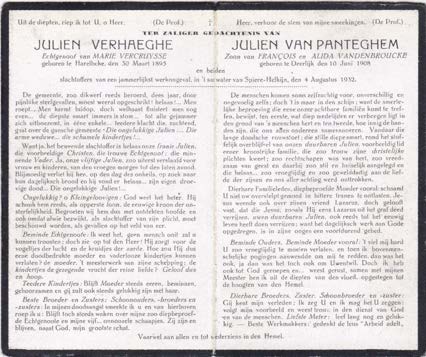
Figure 48.170: The obituary card of Julien Verhaeghe and Julien Van Panteghem, 1932.
(Declercq de Silva Archive)
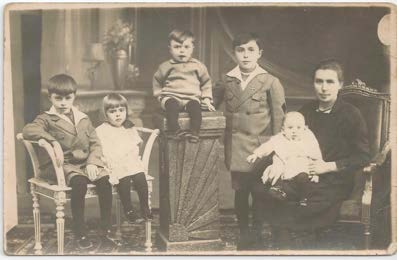
Figure 48.171: 1932 widow and children of Julien Verhaeghe, shortly after his
death. Julien died on August 4, 1932. From right to left, Maria Vercruysse (1901,
was a shop owner and she died in Deerlijk on February 3, 1978), Georges Fer-
nand Jules Verhaeghe (1932-1999), André Maurice Verhaeghe (1922), Aloïs Jules
Verhaeghe (1930-2004), Jeanne Georgette (1929) and Maurice Georges Verhaeghe
(1924-2002). (Declercq de Silva Archive)
© 2024 Nico F. Declercq
The Desclergues of la Villa Ducal de Montblanc, 2nd ed., Omn., VOL. IV
48.10. VERHAEGHE: PIONEERING LIBERALISM, SOCIALISM, RESISTANCE, AND EDUCATION
951
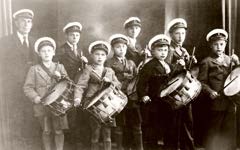
Figure 48.172: Around 1934, the Sint Cecilia fanfare,
established by Alexander Opsomer in Deerlijk. From left
to right: Alexander Opsomer, André Demuynck, Albert
Opsomer, Remi Deleersnyder, André Verhaeghe, Michel
Vercruysse, Valère Bruneel, Marcel Demeulemeester and
Remi Bruneel. Courtesy of André Verhaeghe. The pic-
ture also appeared in Derlike XXVII, 1 (2004), page 8.
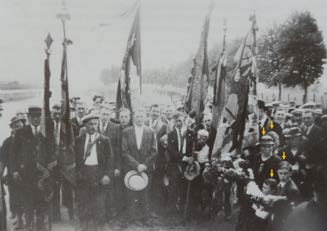
Figure 48.173: Spiere, August 30, 1936.
From top to bottom, the arrows point at
André Verhaeghe, his mother Maria Ver-
crusse, his younger brothers Maurice Ver-
haeghe and Georges Verhaeghe. Hidden be-
hind the flag is Alfred Den Dauw, as is
apparent in Figure 48.174. Courtesy of
Archive Leon Defraeye Deerlijk, foto nr
14.419. The image also appeared in Der-
like XLI, 3 (2019), page 83.
Figure 48.174: Spiere, August 30, 1936.
The arrows point, from top to bottom, at
Alfred Den Dauw, André Verhaeghe, his
mother Maria Vercruysse, and his younger
brother Maurice Verhaeghe. Courtesy of
Archive Leon Defraeye Deerlijk, foto nr
14.415. The image also appeared in Der-
like XLI, 3 (2019), page 82.
Figure 48.175: The founders of the school in 1963.
From left to right, Raïs Picavet, Willy Derudder, André
Verhaeghe, Roger Coussement, Julien D’ Hulst, Marcel
Demeyer, Julien Lorrez, Walter Heugens and Norbert
Lorrez. Note that Robert Vanheerweghe was equally a
co-founder, be he was absent when the picture was taken.
Note that André Verhaeghe and Julien Lorrez were both
former members of the Resistance in WWII. Courtesy
of Robert Vanheerweghe and Willy Derudder. The pic-
ture also appeared in Derlike, 12de jaargang, nr 2, 1989.
MyHeritage® colorized this photo.
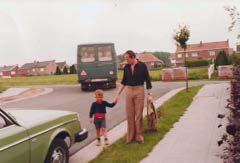
Figure 48.176: Around 1978, the author dropped off
by the school bus with driver Lucien Ghevaert and taken
home by his father Maurice Declercq in Sint Lodewijk,
Deerlijk. (Declercq de Silva Archive)
The Desclergues of la Villa Ducal de Montblanc, 2nd ed., Omn., VOL. IV
© 2024 Nico F. Declercq
CHAPTER 48. THE MATERNAL DESCLERGUE ANCESTRY BRANCH BEGINNING WITH JOANA
952
CATHARINA DECLERCGZ (DC08B) & JOANNES DE VOS
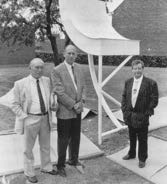
Figure 48.177: A monument was revealed on June 24, 1989 on the
occasion of the 25th year jubilee of the school. On the image we see,
from left to right, André Verhaeghe, Frans Viaene and R. Delbarge.
Courtecy of Archive Leon Defraeye. The picture also appeared in Hugo
Defraeye, ’200 jaar onderwijs in Deerlijk’ , Heemkring Dorp en Toren,
Deerlijk, 1990.
Figure 48.178: André Verhaeghe’s souvenirs of his time with the resistance. (Declercq
de Silva Archive)
constraints, rigid systems, traditions, and dogmas. This intrinsic belief in personal freedom and moral autonomy shaped their worldview and guided their actions.
Despite being drawn towards socialism, the Verhaeghes’ entrepreneurial behavior revealed their liberal inclinations. Around the turn of the century, Belgium was experiencing significant economic and industrial growth, which presented new opportunities and challenges. The Verhaeghes’ engagement in entrepreneurial activities reflected their liberal ideology, emphasizing individual initiative, economic freedom, and self-reliance.
Their liberalism, however, was not synonymous with capitalism. Unlike capitalists prioritizing profit maximization and capital accumulation, the Verhaeghes balanced their entrepreneurial spirit with a solid commitment to social justice and solidarity. This distinction underscores a nuanced understanding of liberalism that values personal freedom and economic initiative while rejecting the excesses of capitalist exploitation.
The socio-economic context of early 20th-century Belgium was marked by significant inequality and social unrest. Industrialization had created stark divisions between the working class and the bourgeoisie, leading to widespread calls for social reform. The Verhaeghes, influenced by the prevailing conditions and their sense of solidarity, found resonance in socialist ideals that advocated for workers’ rights and social equity.
Their attraction to socialism can be seen as a pragmatic response to the socio-economic realities of their time. It provided a framework to address the injustices and hardships faced by many Belgians, aligning with the Verhaeghes’ moral commitment to solidarity and social justice. Yet, their socialism was tempered by their liberal roots, creating a hybrid ideology that sought to harmonize personal freedom with collective welfare.
The Verhaeghe family was also Catholic, adding another layer of complexity. During this period, the Catholic Church in Belgium played a significant role in social and political life, often advocating for conservative values. However, the Verhaeghes’ liberal and socialist leanings indicate a selective integration of religious beliefs with their broader ideological commitments.
Their Catholicism provided a moral and ethical framework that complemented their liberal and socialist values. It emphasized the dignity of the individual, the importance of community, and the moral obligation to aid the less fortunate.
Born in Sint Eloois Vijve, the two men, Theophile Verhaeghe and Jules Verhaeghe, married and moved to Harelbeke, where they became construction entrepreneurs after passing through the different levels of bricklayers.
Theophile, at some point, even owned a pub to guarantee a steadier income. Jules worked at an oil mill when the weather was too bad for constructing homes.
Jules died at the age of 52, while his son Julien was merely 16 years old.
The boy and his siblings were further raised by Theophile Verhaeghe and Marie Louise De Vos and became one big family. The family had moved to Deerlijk, a center of the textile industry, but they remained active in the construction branch.
At that time, socialism was gaining momentum in the village and Harelbeke. As described above, the family lost a soldier during WWI, Maurice Florimond Verhaeghe; they had to endure a German soldier in their workshop and home, who luckily turned out to be a friendly man. Soon, there were in-laws.
Zozyma Verhaeghe, daughter of Theophile Verhaeghe, would marry Gerard Vangheluwe, a forced laborer during WWI. The local
© 2024 Nico F. Declercq
The Desclergues of la Villa Ducal de Montblanc, 2nd ed., Omn., VOL. IV
48.10. VERHAEGHE: PIONEERING LIBERALISM, SOCIALISM, RESISTANCE, AND EDUCATION
953
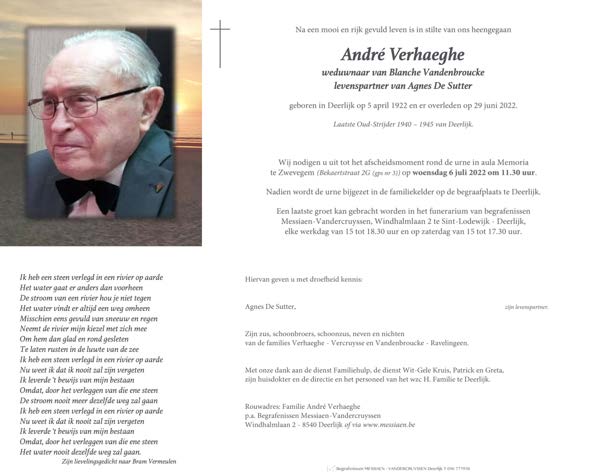
Figure 48.179: André Verhaeghe’s obituary, June 29, 2022. He died at 100. (Declercq de Silva Archive)
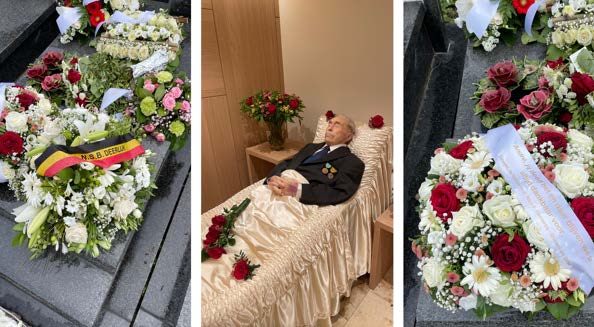
Figure 48.180: After André Verhaeghe’s death, he was laid in state with his medals pinned on. His funeral occurred privately, in the author’s presence, the Deerlijk Veterans’ Association, the Mayor of Deerlijk, and some of his closest friends and remaining family. (Declercq de Silva Archive)
The Desclergues of la Villa Ducal de Montblanc, 2nd ed., Omn., VOL. IV
© 2024 Nico F. Declercq
CHAPTER 48. THE MATERNAL DESCLERGUE ANCESTRY BRANCH BEGINNING WITH JOANA
954
CATHARINA DECLERCGZ (DC08B) & JOANNES DE VOS
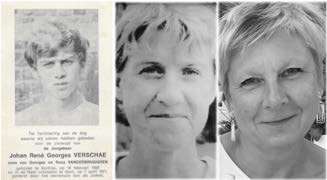
Figure 48.181: The obituary card of Jo-
han Verschae, brother of Clodien Verschae
and son of Georges Verschae, 1971. (De-
clercq de Silva Archive) Next, the two ma-
jor driving forces behind the resurrection
of the school around 2000. Left: Clodien
Verschae, right: Carinne Dhaene. (Cour-
tesy of Gino Baert and Carinne Dhaene)
priest and mayor had chosen him to join the forced labor corps mainly because of his dissident mentality.
His fellows particularly remembered Gerard for taking a salami from the German military butchery at Sedan (France) one day. The whole group was forced to join the feast without leaving any evidence of this ’crime.’
The next day, they all had severe diarrhea.
Gerard had also, on one day, been struck very hard by the butt of a German rifle right on his back. It’s been a weak spot for the rest of his life.
During WWI, the Verhaeghe family found themselves in a vital position for espionage by the Belgian army. Indeed, the presence of a German soldier in their home, the particular jobs held by the sons of the family, and the local network they had were essential facilitators.
Figure 48.166 is a historically significant picture taken just after WWI at Deerlijk. The empty spot on the image was left open on purpose.
Indeed, their hero, Maurice Florimond Verhaeghe, was missing. After four years of service on the front line, the Germans killed him at the end of WWI, but it took time for evidence to show up.
The picture shows the children of the joint families Verhaeghe-Devos and Verhaeghe-Libeert, as well as their fiancés, who were still at Deerlijk then. Julien Verhaeghe is remembered in Deerlijk as the father of André Verhaeghe.
48.10.3 Espionage During WWI
The Verhaeghe family, residing in the occupied village of Deerlijk during World War I, found themselves at the epicenter of covert operations against the German military. A shoemaker by trade, described separately in Chapter 48.9.5.4, a German soldier was billeted with the Verhaeghes and utilized their workshop to repair and distribute shoes to the German army. Despite his amiable nature, his presence unwittingly transformed the Verhaeghe home into a hub for espionage activities.
Maurice Florimond Verhaeghe, one of the Verhaeghe sons and a Belgian soldier, became a crucial figure in these covert operations. In 1915, while recuperating at an army hospital in England, Maurice was declared dead, a misconception that played to his advantage.
Under the radar, Maurice continued to serve on the Belgian side of the front, utilizing the underground courier mail to stay informed about his family’s situation back home.
The Verhaeghes’ home, already a hotspot due to the shoemaker’s activities, became a fertile ground for gathering intelligence on German military movements. Whether they wanted to or not, the family became privy to sensitive information. This environment and Maurice’s unique position laid the groundwork for a sophisticated espionage network.
By 1915, Deerlijk was teeming with espionage activity involving multiple networks. A British secret agent was hiding on a farm between the Verhaeghe residence and the railway at Felix Courtens’ farm on Tapuitstraat.
This agent, equipped with a radio, meticulously monitored the railway traffic, noting the direction and composition of German trains. His intelligence was crucial for the Allied forces, providing real-time data on enemy movements.
The Verhaeghes’ connection with British intelligence would have long-lasting implications. After the war, Rachelle Verhaeghe, daughter of Medard Verhaeghe, married Mr. A. Strickland, a British national. This union symbolized the enduring bond forged through shared struggles and mutual assistance during the war.
Medard Verhaeghe, a railway employee at the war’s onset, leveraged his mobility to support the resistance. His position allowed him to gather and relay vital information about German railway traffic, which was critical for coordinating Allied operations. In Brussels, Clothilde Verhaeghe, married to Mr. Plasse, acted as a pivotal link in the network, ensuring the flow of intelligence between Deerlijk and the capital.
Post-war, the Verhaeghe family maintained connections with notable resistance figures. They became close friends with Joseph Demeyere, a celebrated French resistance hero, and his wife, Leonie. After World War I, Joseph, honored for his bravery, lived in Verdun-le-Vieil during the 1930s. While the exact details of his wartime activities remain unclear, his association with the Verhaeghe family underscores their extensive involvement in resistance efforts. Seraphin René Verhaeghe, another family member, even married Joseph’s daughter, further intertwining their fates.
The Verhaeghes’ story of espionage is a testament to their resilience and ingenuity. Their covert operations, driven by a deep-seated desire for freedom and justice, played a significant role in the resistance against German occupation. This chapter of their history, rich with intrigue and bravery, adds a compelling dimension to the broader narrative of World War I espionage.
48.10.4 The Network During WWII
The concept of resistance encompasses the determination and actions taken to defy living and operating under the terms imposed by an occupying force. Resistance activities ranged from disrupting enemy operations to simple acts of disobedience. This broad spectrum included propaganda against the enemy, espionage, and underground trade, among other forms.
Post-war narratives often highlight heroic tales that portray the resistance as composed of military partisans engaged in overt acts of defiance.
However, the reality was far more subtle and nuanced.
The Verhaeghe family’s resistance efforts exemplify this complexity. Their operations were not limited to direct confrontations with the occupying forces but included extensive involvement in the black market. This dual engagement was strategic; when captured, it was often safer to be convicted of black market activities than to be suspected of participating in covert resistance operations.
© 2024 Nico F. Declercq
The Desclergues of la Villa Ducal de Montblanc, 2nd ed., Omn., VOL. IV
48.10. VERHAEGHE: PIONEERING LIBERALISM, SOCIALISM, RESISTANCE, AND EDUCATION
955
The Verhaeghe family’s resistance network was extensive, with crucial connections in various locations. While it is challenging to pinpoint the most critical link in their network, the city of Kortrijk played a fundamental role. The family’s ties spanned across the Leie River and extended to Brussels, Wetteren, France, and England. However, Kortrijk was a significant hub for their resistance activities.
The Royal Atheneum of Kortrijk was a focal point for resistance efforts in the city, serving as the main cradle of the local resistance.
The list of known participants reveals birthdates around 1925, indicating a youthful and dynamic group. The members of this network came from diverse backgrounds, including socialists and pro-British individuals, united by their opposition to fascism.
The White Brigade of Kortrijk was established at the end of 1940 and later became part of the V Liga. It was well-organised.
Gustave Naessens was in charge, not only of the Kortrijk sector but, after a while, also of West Flanders. Another influential person was Florent Willems.
The Atheneum cluster, mainly recruited by Maurice Vangilbergen (Kortrijk 1922), consisted of at least the following students as active and establishing members by June 1941: Omer Ballieu (Kortrijk 1924), Lodewijk Zeebrouck (Kortrijk 1926), Achilles Desmet, Adolf Vandamme, André Boucneau, André Fieux (Kortrijk 1920), Lucien Delbaere (Kortrijk 1920), Romain Bonte (Kortrijk 1925), Henri Pannecoucke (Kortrijk 1924), Léon Tieleman (Kortrijk 1922). Petra Demeyere published the list in het thesis.40 Petra is the daughter of Marcel Demeyere found in the acknowledgments of this book.
We should note that Léon Tieleman was a relative of the police commander of Kortrijk and was well-connected, but he was a student at Sint Amands College in Kortrijk. He formed the Catholic link of the resistance group in Kortrijk and formed connections with Leon Bekaert in Zwevegem.
As a result, many men from Zwevegem, predominantly employees of the Bekaert company, were recruited to join the resistance near the end of World War II. This recruitment effort was facilitated by Tieleman’s branch of the resistance, through which Florent Deloof was recruited to lead the White Brigade in Deerlijk.
Deloof enlisted André Verhaeghe from Deerlijk, although Verhaeghe was unaware of the channels through which he had been identified as a candidate for the resistance. The recruitment process was orchestrated from Kortrijk, with André’s recommendation originating from a family member known by a nickname that the author vaguely recalls as ’Rotkiv,’ possibly derived from a Russian name, or ’Torvik,’ perhaps of Norwegian origin, or ’Torvi,’ a female variant of the Norse thunder god ’Thor.’
Tieleman himself was known by the moniker ’Lidy.’
Romain Bonte (born in Kortrijk, 1925), listed in Petra Demeyere’s publication, was a relative of Jaak Bonte (born in Kortrijk, 1927), who later married Camilla Den Dauw, as described in Chapter 67.9.4.5.
The early resistance efforts were characterized by idealism, focusing on publishing and distributing anti-enemy propaganda. Membership in the resistance was considered a significant and honorable achievement, proudly recorded on various lists. However, this idealism rendered members highly vulnerable to mass arrests, leading many to end up in German prisoner camps.
The Verhaeghe family learned from these early experiences. They realized that maintaining loose contacts was safer and that formal membership in resistance organizations was dangerous and unwise.
Gustave Naessens (born in Deerlijk, 1890) served as the liaison for Zwevegem to the resistance in Kortrijk. He was married to Paula Vandenghinste.
During the early years of the war, a family member who attended school daily in Kortrijk, residing in Deerlijk, frequently visited Saint Louis in Deerlijk, where he later found his bride. After two years of occupation, he left school, leveraged his family network to continue traveling to Kortrijk and Harelbeke, and increasingly crossed the Leie River to Wielsbeke.
The family had connections in Waregem through the farm ’Ter Caysele’ (also known as het verbrande hof in Nieuwenhove) and, in the war’s final year, also had ties to Le Grèbe in the southwest of Waregem. However, Le Grèbe was generally avoided due to its heavy involvement in an official resistance organization, deemed unnecessarily dangerous based on early war experiences.
The Verhaeghe family shared a keen interest in soccer and bicycle racing during the war. These sports provided ample reasons and occasions to travel extensively, thereby facilitating their covert resistance activities.
The membership of André Verhaeghe (born in Deerlijk, 1922) in the Belgian resistance in 1944 can be traced through crucial family connections in Kortrijk and Waregem. His recruitment into the resistance was swift, driven by his ambition and a somewhat reckless desire to join the militaristic branch of the organization.
While his allocation to the Waregem sector led to relatively minor activities, this geographical assignment likely influenced his survival. Had he been based in Kortrijk, he might have faced more dangerous tasks, potentially leading to his capture or death at the hands of the German occupiers. This hypothetical scenario should not detract from the valor and honor of André Verhaeghe, despite certain disparaging remarks about him in Derlike in 2019. This narrative aims to uphold the integrity of his contributions, as only his wartime activities have been publicized post-war.
The Verhaeghe family formed an essential part of the resistance network during WWII, with several key members facilitating covert operations across different regions.
Medardus Josephus Verhaeghe and Elodie Marie Eeckhout in Marke provided adequate cover to maintain contact with the Royal Atheneum resistance network in Kortrijk. Their residence served as a strategic meeting point and a haven for resistance members.
Guillaume Van Houtven and Elisa Clara Verhaeghe, based in Wetteren, were pivotal in establishing connections with East Flanders and Ghent. Their involvement ensured a broader reach and support for resistance activities across these critical areas.
Gustaaf Vannieuwenhuyze and Marie Leonie Verhaeghe operated a resistance cell in Wielsbeke. Along with their associate Vermeulen, they managed operations on the opposite side of the Leie River, acting as a liaison for trade and other covert activities. An anecdote from their neighbors, Gerard and Maria Verbrugghe - Van den Abeele illustrates the perilous nature of their work. During a German raid, two resistance members hid in an emptied cesspool. The daughters of the household used their wit and charm to distract the German soldiers, preventing a thorough search and thus safeguarding the hidden men.
Their contributions to the resistance were marked by ingenuity and bravery, crucial elements in the broader struggle against German occupation. Through familial networks and strategic positioning, they played a significant role in the resistance movement in Belgium during WWII.
A pivotal encounter in the early 1940s, likely in 1941 or 1942, would leave an indelible mark on the Verhaeghe family’s legacy. This event involved a confrontation with a German soldier at a checkpoint on the Leie bridge, a crucial crossing point that was heavily monitored by the occupying forces. The elder Verhaeghe, a seasoned member of the resistance, and his son, often referred to by his nom de guerre Rotkiv, were attempting to cross the bridge under the guise of a routine family visit.
The operation was dangerous, as the German checkpoint guards were notoriously vigilant. To mitigate the risk, the Verhaeghes employed a multifaceted strategy that included several layers of deception. Their first line of defense was the pretense of a family visit, a seemingly innocent reason for their presence that often deflected initial suspicion. However, if this ruse failed, they were 40Petra Demeyere, ’Analyse en situering van het verzet in de stad Kortrijk: 1940-1944’ , Universiteit Gent, 2000
The Desclergues of la Villa Ducal de Montblanc, 2nd ed., Omn., VOL. IV
© 2024 Nico F. Declercq
CHAPTER 48. THE MATERNAL DESCLERGUE ANCESTRY BRANCH BEGINNING WITH JOANA
956
CATHARINA DECLERCGZ (DC08B) & JOANNES DE VOS
prepared to smuggle contraband items such as soap or tobacco, which, while illegal, were less severely punished than resistance activities.
On this particular occasion, the deception nearly unraveled. The German guard, suspicious of their intentions, pressed for more information. Faced with the imminent threat of exposure, the situation escalated. The elder Verhaeghe, recognizing the potential disaster, decided that fighting was the only remaining option. Both father and son engaged the German soldier in a swift and decisive action. The struggle was fierce, and they managed to overpower the guard through a combination of tactical skill and sheer determination. In the ensuing scuffle, they threw him into the river Leie, ensuring their escape but simultaneously drawing heightened scrutiny to their activities.
The repercussions of this daring act were immediate and severe. The elder Verhaeghe, now a wanted man, was forced into hiding to avoid capture and execution. This sudden shift in circumstances thrust ’Rotkiv’ into a leadership role at a very young age. While his youth brought energy and innovation to their operations, it also introduced elements of instability.
The challenges of leadership in such a high-stakes environment were compounded by the temptations and distractions that came with the resistance lifestyle, including the allure of money and the risks of romantic entanglements.
Despite these challenges, the Verhaeghe family’s resolve did not waver.
Their operations continued with the same fervor, albeit under the shadow of increased danger. Each crossing of the Leie was meticulously planned, always involving the three layers of protection: the guise of a family visit, the fallback of smuggling contraband, and the ultimate resort to physical confrontation if necessary.
The episode on the Leie bridge highlights the perilous nature of resistance work and the extraordinary lengths to which ordinary citizens went to oppose the tyranny of occupation.
The resistance network in Brussels was notably facilitated by Mr. Plasse and the Verhaeghe family, particularly Clotilde Maria Verhaeghe and her daughter, Marie Louise Plasse in Brussels. In the war’s final two years, the home in Deerlijk became a hub for resistance activities. Individuals from Brussels frequently arrived by train to Deerlijk, opting for this small village over the more conspicuous city of Kortrijk to avoid suspicion. These visitors often spent the night with the Verhaeghe family before heading to Kortrijk during the day to conduct resistance-related activities.
The Verhaeghe family’s links to France were primarily maintained through Seraphin René Verhaeghe and Rachelle Demeyere. Ostensibly, their visits to France were made for family reasons. This guise effectively masked their purpose of coordinating with French resistance members and facilitating cross-border communication and operations.
The family’s connections extended to England through Rachelle Verhaeghe, daughter of Medard Verhaeghe, and her husband, Mr.
A. Strickland. This connection was pivotal, providing a direct line to London’s British intelligence and support networks. Through these connections, the Verhaeghe family contributed to the coordination and execution of various resistance operations, including intelligence gathering and the facilitation of escape routes for Allied soldiers and other individuals targeted by the Nazis.
By using their strategic connections in Brussels, France, and England, the Verhaeghes effectively supported the broader resistance efforts.
The Verhaeghe family’s activities can be better understood within the broader framework of the Belgian resistance, which included various networks such as the White Brigade, the Comet Line, and the Armée Secrète. These groups, often operating independently but with common goals, engaged in sabotage, intelligence gathering, and creating escape routes for Allied soldiers. The Verhaeghe family’s contributions were part of this giant mosaic of resistance, characterized by its diversity of methods and participants.
The exact date when André Verhaeghe, son of Julien Verhaeghe, began his involvement in resistance activities remains unknown.
As depicted in Figure 48.178 on page 952, he officially joined the White Brigade of the Resistance in the spring of 1944. He remained an active member until Deerlijk was liberated in September 1944. Deerlijk fell under the jurisdiction of the Waregem sector, facilitating André Verhaeghe’s recruitment through this branch.
The Verhaeghe family possessed British binoculars, although one lens was shattered, and the copper casing was heavily dented. It was rumored that a British airman, whose plane had been downed during WWII, had gifted these binoculars to the family.
On September 7, 1944, a family member took refuge at a house at the intersection of Kapel-ter-Rustestraat and Stationsstraat near Cassinastraat. This junction is illustrated in Figure 48.199 on page 968. The family member, ’Rotkiv,’ was monitoring the situation, possibly under directives from contacts in Zwevegem.
That morning, a British armored vehicle, commanded by Trooper Thomas Marshall of the Recce, 15th Scottish Division, arrived from Zwevegem along Stationsstraat. The vehicle parked a short distance from Cassinastraat on the left side of the road, soon followed by additional cars. Another vehicle parked across the road, and soldiers positioned a six-pounder cannon in front of the socialist headquarters (’t Belfort), aiming at the two junctions. Members of the White Brigade also arrived to support the British forces.
As the situation remained calm, curious onlookers began to gather. The Derlike article lists citizens present, including Frans Deknudt, Norbert Decraene, Ferdinand Gardyn, Jules T’ Joen, Staf Benoit, André Vannieuwenhuyze, Georges Deconinck, Jean Matthys, and Paul Benoit.
Suddenly, the British troops spotted German forces moving along Harelbekestraat at its junction with Stationsstraat and opened fire. The Germans quickly set up an 88 mm anti-tank cannon behind a corner and aimed it down Stationsstraat at the British forces. Thomas Marshall swiftly moved his vehicle to the other side of the road and entered Kapel-ter-Rustestraat. The Germans fired on the vehicles that had parked behind Marshall’s position.
The British positioned their cannon at the intersection of Stationsstraat and Kapel-ter-Rustestraat and targeted a German tank on Hoogstraat, at its junction with Stationsstraat.
Unfortunately, they mistakenly hit a British vehicle that had entered Deerlijk from another road. This error resulted in the deaths of British soldiers A.A.D. Davies and B.T. Miggins, with one soldier managing to escape.
Subsequently, the British received orders to retreat to the Deerlijk train station towards Zwevegem. They hurried back along Stationsstraat, zig-zagging to avoid German fire from the 88 mm cannon.
Several British vehicles parked at the junction were hit. One such explosion injured ’Rotkiv’ and his friend. Despite the common belief that the vehicle had been struck by German fire, the wounded family member always maintained that British forces had caused the damage. Thomas Marshall’s witness account, transcribed in the 1980s or 1990s and published in Derlike, corroborates this story.
The family member sustained a hand injury from the explosion, with a metal shard embedded in his hand until its surgical removal around 1984.
According to Jan Deloof’s work,41 German soldiers continued hiding in a small forest near the Gaverbeek creek between Deerlijk center and Zwevegem after the initial Deerlijk skirmish. Someone spotted the Germans and informed the British.
41Jan Deloof, "Onze Oorlog - Zwevegem om de Tweede Wereldoorlog" (2009)
© 2024 Nico F. Declercq
The Desclergues of la Villa Ducal de Montblanc, 2nd ed., Omn., VOL. IV
48.10. VERHAEGHE: PIONEERING LIBERALISM, SOCIALISM, RESISTANCE, AND EDUCATION
957
This led to a British bombing of the forest. The British forces were positioned near the entrance of the Versschuere farm on Blokkestraat in Zwevegem.
During the final days of the war, an abundance of horse meat was consumed in Deerlijk, as the retreating Germans left behind many dead and injured horses. One family member even rode a horse home from Hoogstraat, where it was subsequently killed indoors.
The ground trembled from the horse’s fall, prompting neighbors to inquire about the event, which became a long-standing family anecdote.
Another wartime episode involved a wedding in Deerlijk on the day of the German retreat. Despite the surrounding danger, the ceremony took place in the church, followed by a reception at the Socialist headquarters at the junction of Stationsstraat and Kapel-ter-Rustestraat. The couple spent their wedding night hiding in the building’s basement amidst ongoing shootings and explosions.
In an interview published in Derlike, the bride humorously noted that no wedding had experienced as much "shooting" as theirs, referencing the traditional fireworks known as ’shooting at the wedding.’
It is crucial to distinguish between two individuals named André Verhaeghe. One, born in Kortrijk on January 9, 1914, was a notable resistance fighter from Kortrijk, possibly a distant relative of André Verhaeghe from Deerlijk. However, not part of the Atheneum fighters, the Kortrijk Verhaeghe was connected to them and linked to resistance activities near the Koninklijk Atheneum in Kortrijk. This connection suggests a possible involvement of the Verhaeghe family and the broader Verhaeghe Network through Medard Verhaeghe.
48.10.5 The WWII Resistance of the Last Semester
Although, as we have explained above, resistance networks existed from the beginning of the war, the official White Brigade of Deerlijk was deployed only in the last semester at Deerlijk. By only highlighting the existing records of this period at Deerlijk, an article in Derlike42 scrutinizes and denigrates the resistance as if it were a joke.
This is, however, not entirely fair.
Resistance networks had been operational throughout the war at Deerlijk, including members of the extended Verhaeghe family.
Still, the military and structured White Brigade at Deerlijk was established only when the Belgians anticipated the invasion by the Allies.
A group of people was necessary to preserve law and order during a vacuum after the Germans had been driven out and before an occupational force 43 would have arrived.
The White Brigade of Deerlijk, which has existed only briefly, has undertaken only one act of sabotage. Just after the Germans were driven out, they were equipped with beautiful white uniforms, which appears to be too much of an honor if we remember that they had almost nothing on the list of their achievements. However, such a uniform was not given as a reward. Still, it was necessary to expose the fact that they were there to preserve order when the Germans were gone and represent the Belgian government after the arrival of the British. Nobody would have gained in a jungle except robbers. Their job at that time was that of policemen.
They had to protect the people from the people, and they also had to ensure no looting.
It is true that after the war, this group received more accolades than they deserved as if they had liberated the country. Nevertheless, their presence had been significant. Nobody could have anticipated in the summer of 1944 how necessary they might have been should anything have gone wrong during or just after the retreat of the Germans. The person who had been a member of this official brigade for the longest time at Deerlijk and who had never hidden such involvement was André Verhaeghe, son of Julien.
We know two essential endeavors in his role as the White Brigade soldier.
First, he cut a telephone wire that connected Kortrijk to Brussels. It occurred on the night of 6-7 July 1944 and was commanded by Commander Windels from Waregem. It was André Verhaeghe who climbed the post and cut the wires. He was an officer then, under Florent Deloof, who had received the order from Windels. Although this act may seem unimportant because the Germans repaired the cable the next day, it was risky. It occurred at a crucial and coordinated time, significantly disrupting the Germans.
The second act was when the Germans were still in Deerlijk and had prepared to defend the village against the British while the British were approaching from Zwevegem to inform the British. Thanks to his family connections in Stationsstraat and near the train station, André could easily approach the railway. Then he crossed it and reached a farm in Deerlijk, the nearest to Zwevegem.
He communicated with the British, who were positioned at the canal Leie-Schelde. Thanks to his information, the Germans would not ambush the British.
Indeed, instead of penetrating the village through Stationsstraat, they approached the town along three roads. The first approach occurred from Vichte to Belgiek and then to the downtown area; the other course from Zwevegem, which the Germans expected the most, would be taken last. Meanwhile, outstanding coordination would allow the troops at Zwevegem to protect the flanks approaching from Vichte.
This is why the White Brigade requested resistance groups and individuals to occupy, as civilians, specific observation posts near essential junctions in the village. Communication occurred by running through the fields. The west of Stationsstraat was just farmland (also known as de Gavers), with some bushes and creeks. Therefore, observers who were good runners could easily cross the fields to transfer information. It allowed the British at Zwevegem to know what to aim at with their heavy artillery and when to assault.
Above, we have described the events at the junction of Stationsstraat with Kapel-ter-Rustestraat and Cassinastraat. It’s essential to reread the events while keeping the provided information in mind.
Regarding resistance, we should not be guided by romantic books about heroes or action movies. Numerous self-declared heroes may or may not have taken action at the war’s end, later, or even in their dreams.
The Verhaeghe network was not a romantic gang of heroes but of young and energetic entrepreneurs who did not fit into a world of nazism. The network ended up in underground activities, which included smuggling and feeding the poor and the hungry. Assisting or undertaking work for the military resistance also happened, but it has never been their sole purpose. They have never actually considered themselves as members of a secret militia.
Favors were paid with blessings: information, sometimes food, sometimes assisting a passage, or perhaps an act of sabotage.
Sabotage was dangerous but was not as spectacular as in movies. Cutting communication wires was a typical sabotage activity, not the big explosions as in the film.
The Verhaeghes were also not the kind of people who would murder or deliberately endanger others.
We should also note that the organized secret army existed only from August 1943 onward. Before that, the resistance was merely a large number of networks that operated more or less like the Verhaeghe network and mixed several types of underground activities, 42Derlike XLII, 1 (2019)
43the Britains, or the Americans or the Polish.
The Desclergues of la Villa Ducal de Montblanc, 2nd ed., Omn., VOL. IV
© 2024 Nico F. Declercq
CHAPTER 48. THE MATERNAL DESCLERGUE ANCESTRY BRANCH BEGINNING WITH JOANA
958
CATHARINA DECLERCGZ (DC08B) & JOANNES DE VOS
some of a military nature, but most to resist the situation, smuggle, and provide families with food.
Feeding one’s family was also an act of resistance because otherwise, one had to live on ration coupons or work for the Germans.
Actual sabotage, for instance, mainly occurred from the summer of 1943 onward, when the Allied forces were steadily making plans to invade Nazi-held Europe.
There were also acts of sabotage to protect constructions from planned destruction by the Germans upon their withdrawal. Even here, cutting wires or providing information was the most critical activity.
People from Harelbeke, for instance, had prepared to loot textile factories in Deerlijk, but the white brigade, as they were called, stopped them by force. We can refer to Armand Deknudt in his series de Septemberdagen van 1944 in Derlike in 1997.
There, we can read that on September 5, 1944, the Germans had left Deerlijk, but then, suddenly, other Germans with tanks arrived, and Deerlijk was once again occupied. The secret army had already secured the village but had to go underground again.
On September 6, the Germans were in Deerlijk, while the British were in Zwevegem. It was André Verhaeghe who was able to reach Deerlijk’s station area. We described above how this was made possible. André Verhaeghe hid in a farm near the train station and communicated with the British at the canal in Zwevegem. They said they would invade Deerlijk but first strike with artillery to drive the Germans out. André said the Germans expected this and better invade Deerlijk from the other side.
The organized secret army of the White Brigade in Deerlijk was established on March 15, 1944, and belonged to Zone III of the Waregem Sector. This is the one that is documented and of which name lists exist.
Becoming a member may have been attractive because the end was near, there were rumors of an impending invasion by the Allies, and it was also a way to climb the stairs of (post-war) society.
André Verhaeghe was 22 at that time, his brother Maurice was 20. They had a callous youth because of the loss of their father and decided to join the secret army, first André and, much later, Maurice. It meant that the Verhaeghe network now also had an official military branch.
Interestingly, the White Brigade of Deerlijk had only 19 members, and their official outfit, worn after the Germans had left, can be seen in Figure 48.168. Ten joined on March 15, 1944, and four joined on June 1. Five joined on September 3, just a few days before the liberation of Deerlijk.
The data, published in Deerlike44, show that André Verhaeghe joined on March 15, while his brother Maurice joined on September 3. André Verhaeghe cut communication wires on the night of 6-7 July 1944.
48.10.6 André Verhaeghe Before and After WWII
The reader may first want to check the funeral picture in Chapter 69.11.1.6.
We shall begin this section with a long citation describing André as he was. It is a translation of a text written by Robert Vanheerweghe.
A word from a friend - a hat with many feathers45.
During his inauguration on Sunday, September 8, 2019, organized by the local NSB department Deerlijk in collaboration with the city council, André Verhaeghe was decorated for his merits as a resistance fighter. A detailed description of his activities during the war reaches beyond my capacities because I was born only in 1942. However, I can appeal to the many stories and anecdotes told to me by his good friend, Albert Vanhoenacker.
As with most stories, sometimes facts are forgotten, and others exaggerated. Yet, frequently recurring words were courage, fighting spirit, weighing the risk, conscientiousness, pride, and loyalty to the Fatherland. After WWII, André wanted to propagate those values through his political commitment. He became the secretary of the local branch of the Socialist Party. In that capacity, I experienced him the most. As a board member of the youth association, I became a member of the party management and participated in many exciting meetings.
There, I got to know and appreciate André’s democratic attitude and organizational talent. With the help of only a few board members, he organized an unforgettable Oosthoek demonstration on April 26, 1964.
To give more charisma to our Socialist movement, he invited all comrades from the region to come and demonstrate in Deerlijk on that day. There was an enormous number of people. Endless processions of red flags and music bands drew prominent politicians on his guidelines through our beautiful congregation to end at the church. The audience was addressed from a podium by August Debunne, BSP representative of the people from Menen, among others. André became a municipal councilor, but as the only opposition member, he competed against ten CVP members who advocated a subordinate policy. André chose to submit all points of the plan to his entire administration.
After weighing up the many arguments, he defended our shared position in the municipal council with stubborn and enormous dedication. Sincerely straightforward, sometimes with a hint of aggression, he repeatedly succeeded in impressing through his used arguments, respectable language, and healthy fanaticism. He has been a real example! Has he had enemies because of that?
Perhaps, but he was always concerned with the statements, not the persons. The inhabitants of Deerlijk respect him because of his proud attitude and neat clothing.
He is often approached with a question, a request, or a fact, but not as Dree or Dretie. He is always respectful as André, nevertheless not as Mr. André, because he is far too modest for that. Another example of André’s versatility and enormously commendable personality is his driving force in establishing the Rijksbasisschool, ’De Driesprong,’ in Deerlijk. He did this probably partly because of the ’School Struggle’ that divided our country in 1955. Our municipality had two primary schools: the municipal school, exclusively for boys, and a free primary school for toddlers and girls.
André was annoyed by the pedagogical project, which was perhaps too religious, and the segregation of boys and girls.
He sometimes asked himself whether the local teachers of that municipal school, who were mainly indebted to the CVP board, were impartial in their teaching.
Perhaps they were not, though. Being very stubborn, he sought allies and got his grip on a file, resulting in a primary school with a nursery section. That is mainly his Merit: a primary school that has grown into a natural green pedagogical oasis. It’s a pearl in Deerlijk’s crown.
At one of the numerous meetings in our congress room at ’De Kroon,’ the usefulness of literature was mentioned. André, a frequent reader, picked up on this and consulted the board about their reading habits. It turned out that there was a need to enable reading more books.
44Deerlike XLII, 1 (2019), p 11.
45Translated quote of Robert Vanheerweghe as an introduction to the book by Marc Vanwijnsberghe, ’André Verhaeghe, een man van Deerlijk’ , self-published in 2020.
© 2024 Nico F. Declercq
The Desclergues of la Villa Ducal de Montblanc, 2nd ed., Omn., VOL. IV
48.10. VERHAEGHE: PIONEERING LIBERALISM, SOCIALISM, RESISTANCE, AND EDUCATION
959
Some board members bought books, which were quite expensive, lent them, and sometimes never received them back. Other board members nevertheless ventured to go to the so-called ’patronage’ church library but were annoyed by the biased collection they had to offer. A board member indicated that he once wanted to read Lode Zielens ’Moeder waarom leven wij?,’ but such a book was taboo in the ’patronage.’ That is why André suggested starting up a library himself. In ’De Kroon,’ there was still one room available. He appealed to all members to donate books. That was the start of a library ’Ontvoogding.’ The name was appropriate, and the late Marcel Demeyere was the ideal librarian. His fascination with establishing a school and a library indicates his concern for the youth.
Nevertheless, he also felt that older people needed communal activities. So, he started a retirement association as well. He was extraordinarily creditable and very versatile! André indeed deserves a hat with many feathers! But he was also, perhaps in the first place, a purebred resistance fighter at the service of our Fatherland!
The figure of André Verhaeghe has already been addressed in the previous sections, where he is also shown in his White Brigade uniform.
Here, we focus on other aspects of his youth and his mission after the war.
André Verhaeghe was the eldest son of Julien Florimond Verhaeghe and grandson of Jules Verhaeghe. The latter was the brother of Theophile Verhaeghe. Therefore, André’s father was Zozyma Verhaeghe’s cousin, and they were very close.
Julien Florimond Verhaeghe, whose military registration is given in Figure 48.169, born in Harelbeke on March 30, 1895, was a construction entrepreneur who died with his worker Julien Ferdinand Vanpanteghem in Spiere on August 4, 1932.
The event used to be remembered at Deerlijk as one of the significant tragedies of its recent past. The accident happened during the construction of a building along the Schelde River. Bricks and cement were transported across the river to reach the construction spot. The two were on the boat when a water current suddenly grabbed it. When they approached a waterfall, the two saw no other option but to jump off the ship and swim to the shore. However, the currents were too firm, and they both drowned. Julien had one brother and sisters.
At the funeral, there was a large delegation of Verbond der Vlaamse Oud-Strijders, VOS, Bond van Vlaamse Oud-soldaten, BVOS
and Zivilarbeiter Bataillon, ZAB, to honor Julien Verhaeghe who had been a soldier in WWI and had been captured by the Germans.
Indeed, he had ended up as a prisoner of war and forced labor.
Julien Verhaeghe was survived by his wife, Maria Vercruysse, and five children. The eldest child was André Verhaeghe, ten years old. The youngest was merely six months old. Sad memorabilia are shown in Figures 48.170, 48.171, 48.172 and 48.173.
The accident in Spiere was also described recently by Jan Vanoverberghe,46 who performed research in the context of preservation as a monument of the grave of Julien Verhaeghe.
The pictures in Figures 48.174 were taken at a memorial service held in Spiere in 1936 when a plaque was fixed on the bridge where they died.
Incidentally, we noticed that Alfred Den Dauw, described in Chapter 67.9, was also present at the event, as seen in Figure 48.173.
We can describe André Verhaeghe in a few sentences. He is a very respectable and respectful man. He is too often associated with his life during the war because of his membership in the white brigade at the end. We can say without doubt that André had good intentions and that, had he been able to fabricate his own life, he would have performed dangerous missions with courage and idealism. Probably to his regret, the situation was less romantic and less heroic than in his dreams. Circumstances limited his importance at the end of the war.
However, being a member of the organization has been more critical for his career than the facts of the deeds he realized. We can make these statements because they are reality. They are not intended to diminish the person. André would remain a great man, even if he were not a hero at the war’s end.
Interestingly, while this text was realized, another work appeared on the life of André Verhaeghe by Marc Vanwijnsberghe.47 Warm words precede the manuscript by Robert Vanheerweghe, cited and translated above, who we may describe as an intellectual from Deerlijk who can share words of wisdom with a humorist flavor. Robert Vanheerweghe knows André Verhaeghe personally and in the context of the socialist party in Deerlijk and education. Indeed, Robert has been a teacher and school director, and André has been one of the prominent pioneers and supporters of the public school of Deerlijk. The way Robert describes André is adequate and very positive. His words clearly show that André is a great man, and his adventures during the war do not matter.
The book describes André Verhaeghe’s life and highlights his contributions to the White Brigade. It’s denigrating for André that this episode ever happened.
On the one hand, his membership propelled his career after the war. On the other hand, it has always required him to play a role that was not his. He had to play the war hero, which he was not. That’s unfortunate.
If the episode had never happened, then André, given his qualities, would likely have had a similar career, but people would have judged him for who he was, not for the romantic war hero he was supposed to be.
Marc Vanwijnsberghe’s manuscript cites an interview with André. It’s painful to read how vague his answers are and how few precise facts he can mention about the war apart from ’we were idealists’ and ’I was not there’ and ’I have not seen it.’ Luckily, the book highlights the rest of his life, during which the man flourished like a horse rider.
We can safely say that after having been a member of the white brigade, the end of the war was the beginning of the political career of André Verhaeghe.
He voluntarily reinforced his situation by joining the Belgian army after the liberation of Deerlijk and became involved in the Battle of the Bulge in the winter of 1944-1945. Later, he participated in the occupation of Germany. He remained in the military, became the first sergeant, and quit voluntarily on August 20, 1946.
Having had good connections with the communists, socialists, and others within the White Brigade and having had a challenging youth after losing his dear father, defending people experiencing poverty had become the primary purpose in his life.
We should not forget that André, the eldest of the family, did not attend school after his father’s death but instead had to work very hard to add extra income to the family budget to stay alive and feed his siblings. His mother, Maria Vercruysse, was called
’the courageous widow’ and was a shop owner. Having struggled so hard strengthened André, which is why he dared to join the white brigade at the end of the war and wanted to fight for people with low incomes after the war. The man is an honorable person.
Some indications of his life after WWII are shown in Figure 48.168.
The public primary school of Deerlijk has existed since 1963. The founder was André Verhaeghe, who initiated political talks to receive support for his idea, which was just a dream at the beginning. But, in 1962, MP Jules Deconinck from Wevelgem, a 46Jan Vanoverberghe, Derlike XLI, 3 (2019)
47Marc Vanwijnsberghe, ’André Verhaeghe, een man van Deerlijk,’ self-published in 2020.
The Desclergues of la Villa Ducal de Montblanc, 2nd ed., Omn., VOL. IV
© 2024 Nico F. Declercq
CHAPTER 48. THE MATERNAL DESCLERGUE ANCESTRY BRANCH BEGINNING WITH JOANA
960
CATHARINA DECLERCGZ (DC08B) & JOANNES DE VOS
socialist, approached the local party members André Verhaeghe, Georges Verschae, and Robert Vanheerweghe and informed them that the government was willing to support the establishment of a new public school. Interestingly, Georges Verschae was friends with Gerard Vangheluwe, Zozyma Verhaeghe, Adolf Dequesne, and Elsa Serleth. Hence, the tandem between Georges Verschae and André Verhaeghe was strongly entangled with the Verhaeghe family, not only through André but also through a much older understanding.
Gerard Vangheluwe and Zozyma Verhaeghe were pioneers in providing education for their children in Kortrijk and later in Waregem when most people would never leave their tiny village. We know for sure, however, that the couple was Christian, definitely not atheistic. Zozyma even had her private chair in church.
The fact is that the Verhaeghe family loved the idea of free-thinking, even though they were Catholic. Questioning one’s religion is a way to achieve a more profound belief.
Then, Minister of National Education Victor Larock established the De Rijkslagere school (RLS) on January 16, 1963.
In reality, the construction of the school still had to begin from scratch. André Verhaeghe and Georges Verschae found themselves in an almost impossible situation. Indeed, there were no buildings or pupils for the implantation of another school network in the village of Deerlijk.
The endeavor was an almost inconceivable task because there was probably no need for this type of school in Deerlijk.
Indeed, Deerlijk had had a long tradition of very decent education, which a lot of liberalism had already penetrated. Numerous people did not understand why such a school of free-thinkers, liberals, and socialists needed to embed the village. The opposition against the new school was firm and would remain vital for many years.
The author even witnessed stigmatization and bullying in the 1980s.48
There was also a lot of gossip. People said that the public school children were not decent, not brilliant, atheists, and much more.
However, such stigmatization motivated the teachers even more, while competition must have sharpened the teachers of the other schools. Competition sometimes has positive results.
Nowadays, the school is more widely accepted in Deerlijk, and there is much better mutual understanding and friendship.
The author entered the public school of Deerlijk when he was less than two and a half years old and went to school until he was eleven and a half. Not every teacher was perfect, but he can assure the reader that most teachers were among the best imaginable.
The experience of denigration at Deerlijk was, in fact, very motivating. What does not kill you makes you stronger.
The author took the catholic religion from age six until 16 and was not an atheist. He had, however, many atheist teachers, but different views and opinions can be very enriching. From eleven and a half until seventeen, the author went to public middle and high school (Koninklijk Atheneum) in Waregem. Stigmatisation also existed at Waregem. The school was called ’Kiekenschool’ by outsiders. The author studied Latin, Maths, and Sciences there and decided to study at the Catholic University of Leuven. He has never experienced a lack of education. When he wanted to enter the university, the administration told him they first had to investigate whether his school met all requirements.
Prejudice was indeed prevalent everywhere. After he had become a Master in Physics cum laude, the author wanted to do a PhD
with a retired professor at the Catholic University, but an emeritus professor had no funding at that time; therefore, he switched to the University of Ghent, which was, in fact, the University version of the public schools he had frequented as a child. In Ghent, there was again prejudice because someone from a Catholic University was like a stranger to them. So, he did a PhD at Ghent and became a Doctor of Philosophy in Engineering Physics summa cum laude. After his PhD, the author was supposed to enter a world many describe as asinus asinum fricat.
However, he had different plans and became a professor in the United States of America at 30, a University always in the top 5
engineering schools in the country.
At Georgia Tech, he climbed the echelons to the highest rank and never experienced any drawbacks caused by his early educational years.
Looking back, the author is happy that science, education, and knowledge mattered more than where he went to school. He learned a lot from numerous points of view, controversies, and different political schools of thought. After all, an excellent religious man is not necessarily better or worse than a good atheist. Goodness reveals itself in actions, not so much in words or hypocrisy.
So, return to the establishment of the new public school in Deerlijk in 1963. The site was met with a lot of skepticism at Deerlijk.
The existing schools were not pluralistic. Almost all teachers in the schools in Deerlijk lived locally, took part in the social, cultural, and sporting life, had a reputation, and enjoyed the parents’ confidence. A public school in Deerlijk, like Hugo Defraeye, wrote,
’seemed like a bogeyman in fairyland.’
And yet, the two pioneers persisted. They founded a Club (called Vriendenkring) on March 24, 1963. This Club would be the driving force behind the construction and development of the school. In addition to Verhaeghe and Verschae, the members were Ms Raïs Picavet, Marcel Demeyer, Willy Derudder, Julien D’ Hulst, Walter Heugens, Julien and Norbert Lorrez and Roger Coussement, the first principal of the school, and Robert Vanheerweghe. Figure 48.175 shows the founders of the school established by André Verhaeghe.
A suitable terrain was found on the Dries (next to Kapel-ter-Ruste). The land belonging to farmer Remi Devos was confiscated, which angered Deerlijk. However, Remi Devos quickly changed his opinion and became a close ally of the school.
In no time, four pavilions rose from the ground. Indeed, the situation was urgent because the Club wanted to begin classes on September 1. Unfortunately for the other schools, several children would switch schools. However, failure was not an option. The Club visited numerous families in Deerlijk, trying to convince them to have their children attend public school. It is said that one in thirty visits was successful. The message was always that the school represented pluralism. Children of any ideology could live and study together and cross-fertilize their brains with mutual respect for other people’s opinions.
Memorabilia during the author’s life are shown in Figures 48.176 and 48.177. The school is preparing yet another revolution under director Isabelle Christiaens and will be provided with modern infrastructure.
By the end of August, 60 pupils in the primary school were subscribed and another 36 in the nursery school. The teaching staff were all very motivated persons who were unknown in Deerlijk. Therefore, they could not rely on their circle of friends to attract children and had to work extra hard and use their enthusiasm to convince more parents to send their children to public school. The first teachers were Roger Coussement (the director), Mrs. Lucrèce Dammekens, Norbert Duquesnoy, Miss Marie-Paule Mattelaer, and Jacqueline Hoste. Many more would follow in their footsteps, some of whom the author still regards as crucial persons in the course of his development, such as Mrs. Marie-Jeanne (family of Mr. Delrue, husband of Renilde Verhaeghe, described in Chapter 48.9.4),
48Examples included but were not limited to falsification of swim contests (1985, the author won by 1.5 m but was registered second, behind someone from gemeentelijke jongensschool) at the public swimming pool, less access to sports facilities at Gaverdomein, the organization of competition for the giant pumpkin of the village while distributing a small variety (orange) to the public school and a massive variety (white) to the other schools, to name a few.
© 2024 Nico F. Declercq
The Desclergues of la Villa Ducal de Montblanc, 2nd ed., Omn., VOL. IV
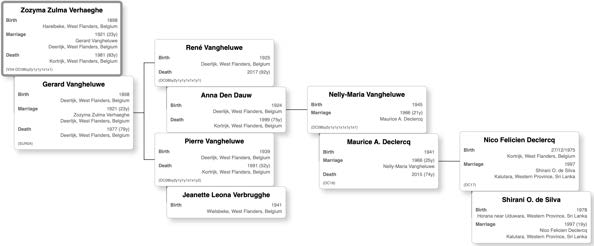
48.11. ZOZYMA ZULMA VERHAEGHE
961
Figure 48.182: Three descending generations of Zozyma Zulma Verhaeghe (DC08by2y1y1y1x1x1)
Mrs. Chantal Delbarge, Mrs Nadine Detremmerie, and Mrs Mady Vandendriessche. Indeed, children addressed their teachers by their first names in public schools in the 1980s. The most inspiring director in the 1980s was Freddy François (husband of Erna Verhaeghe). The best school guardian was Mrs Greta (Georges Verhaeghe’s wife and André Verhaeghe’s sister-in-law). In the fifth grade, at the age of 10, the author gave a 30-minute presentation about the solar system. He received 20/10 for his work, i.e., ten surplus points. The teacher (Mrs. Nadine) must have sensed that perhaps an astrophysicist was born. In 2000, the author indeed because a Master’s in Astrophysics cum laude. In 1963, the school had no road, playground, water, or electricity, and cows grazed up to the classroom windows.
The school bus was initially a Volkswagen bus of Gerard Bert from Harelbeke. Then, school equipment arrived, and in January 1964, the playgrounds were there, the meadows were covered, and the refectory with a kitchen was furnished. The service personnel expanded, and gradually, the pioneering days evolved into a period of regular school life.
On September 1, 1969, Alfons Crabbé succeeded director Coussement, and the school had 104 students. Mr Leon Bettens became chairman of the Club Vriendenkring, and both were to start an intense campaign: Deerlijk was allowed to pick up students in Vichte, where many more possible attendees lived. By 1975, when the author was born, 324 children were attending public school. The vast number required eight classes of primary education and five kindergarten classes. The school also has new and comfortable buildings: airy classrooms, a modern media library, a play area, and a modern kitchen. In the meantime, school buses were indispensable in the region: after Bert, the first female driver, Monique (Monika) Vanhevel made a name for herself with the blue Tempo, the first private bus purchased by the Club. Then came the orange Leyland and the blue Mercedes with Lucien Gevaert as the driver.
In the beginning, the teaching staff changed almost every year, but over time, a stabilization occurred, and many more teachers settled in Deerlijk. They propagated the objectives of the primary school: respect for other people’s convictions in an atmosphere of tolerance.
Like every other school, the school has gone through ups and downs. In particular, around 2000, the school was in deep trouble due to a lack of children. That’s when the author decided to support the school by enrolling his children. Indeed, the family lived in Deerlijk back then. Later, the children went to a French school to become bilingual. It was also around 2000 that Clodien Verschae, daughter of Georges Verschae, together with Carinne Dhaene, Gino Baert, Jozef Gevaert, Andy Demeulemeester and several others of the Club, including, as a minor player, the author, and also the director at that time, Ilse Delombaerde, did the best they could to regain momentum by re-establishing the school’s strong reputation.
The current director, Isabelle Christiaens, flawlessly continues this terrific task. The school is flourishing again, just like the other outstanding schools of Deerlijk, and will be modernized in the coming years. The author’s wife, Shirani de Silva, has had a warm bond with all the children of the school for over two decades. Hopefully, they will remember her just like the author still remembers every staff member from 40 years ago.
Still today, it’s safe to state that Deerlijk belongs to exemplary villages in terms of education.
The pioneering blood of the Verhaeghes probably emerged when the author became a tenured professor of Georgia Tech Atlanta to settle at GT-Lorraine in Metz, France, when the first laboratories were established there and they first offered a complete academic program.
At the same time, he has always remained an inhabitant of Deerlijk and, later, Kortrijk.
Finally, we show two memorabilia of the children of Georges Verschae in Figure 48.181.
André Verhaeghe passed away peacefully at Deerlijk on June 29, 2022, at the age of 100, shown in Figure 48.179 on page 953 and Figure 48.180 on page 953.
48.11 Zozyma Zulma Verhaeghe & Gerard Vangheluwe
Three descending generations of Zozyma Verhaeghe are shown in Figure 48.182.
48.11.1 Zozyma Zulma Verhaeghe
48.11.1.1 Introduction
She was a haute couture tailor who specialized in wedding dresses.
She was a sister of Maurice Florimond Verhaeghe (Harelbeke February 15, 1892), described in Chapter 48.9.5.4, who was killed as a soldier during WWI on September 28, 1918, on the battlefield of Langemark-Houthulst. His body has never been found.
She is also the author’s great-grandmother and is equally referred to in Chapter 69.
She was born in Harelbeke on September 5, 1898, in Figure 48.183, and died in Kortrijk on July 9, 1981, in Figure 48.184, in the The Desclergues of la Villa Ducal de Montblanc, 2nd ed., Omn., VOL. IV
© 2024 Nico F. Declercq
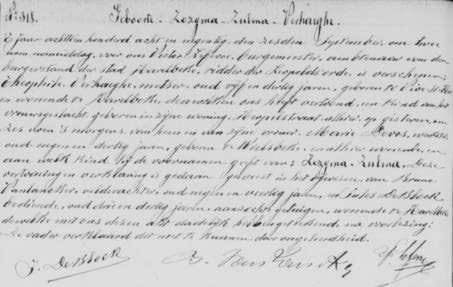
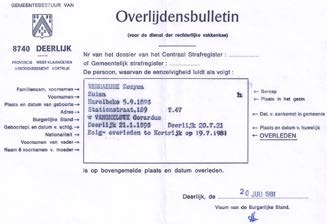
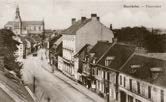
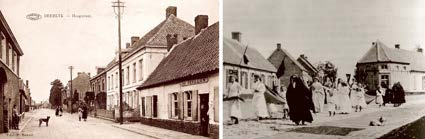
CHAPTER 48. THE MATERNAL DESCLERGUE ANCESTRY BRANCH BEGINNING WITH JOANA
962
CATHARINA DECLERCGZ (DC08B) & JOANNES DE VOS
Figure 48.183: Harelbeke, September 5, 1898, the birth of Zozyma Zulma Verhaeghe, daughter
of 35-year-old Theophile Verhaeghe, mason, born in Sint Eloois Vijve and residing in Harelbeke
in Herpelstraat, and of 39-year-old Marie (Louise) De Vos, born in Wielsbeke and equally residing
in Harelbeke.
Figure 48.184: Deerlijk, July 19, 1981,
the death at Kortrijk (the Hospital in
Budastraat) of Zozyma Zulma Verhaeghe,
born in Harelbeke on September 5, 1898
and widow of Gerard Vangheluwe, born in
Deerlijk on January 21, 1898. They had
married in Deerlijk on July 20, 1921.
Figure 48.185: A panoramic view of Harelbeke.
Figure 48.186: Left is Hoogstraat, Deerlijk. Right is a picture of a procession in Deerlijk,
taken by Leon Ovelacq. The house on the corner of Vichtesteenweg and Sint Rochusstraat
was ’Café in den Tram’ , constructed in 1904. The house served as a pub until 1916 when
the German occupiers closed it. The last owners were Secember-Christiaens. This family
moved to Harelbeke on October 14, 1920. The home was then bought by Gerard Vangheluwe
and Zozyma Verhaeghe, who married on July 20, 1921 and was used only for residential
purposes. They had their first two children born there, namely Marie Louise and René.
They lived there until a few years after 1925. Courtesy of Archive Leon Defraeye Deerlijk,
item 10.192. The picture dates from before WWI.
© 2024 Nico F. Declercq
The Desclergues of la Villa Ducal de Montblanc, 2nd ed., Omn., VOL. IV
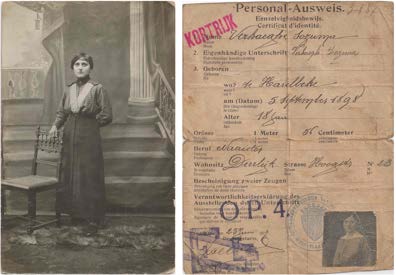
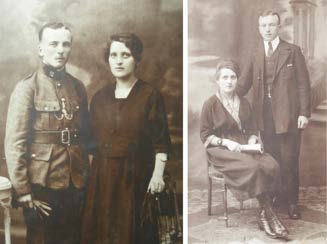
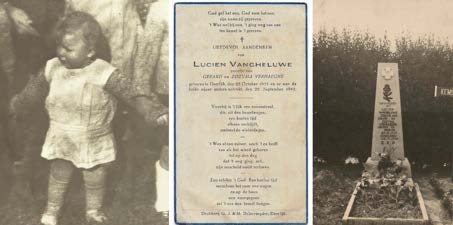
48.11. ZOZYMA ZULMA VERHAEGHE
963
Figure 48.187: Left, Zozyma Verhaeghe, probably in 1917. Right, we find her’
Personal - Ausweis’ , given during the German occupation of Belgium in WWI. The
card shows that she was born in Harelbeke on September 5, 1898. She was 18 years
old, 1 m 56 cm tall and was a tailor, who lived in Deerlijk at Hoogstraat 23. The
certificate was given on June 25, 1917. (Declercq de Silva Archive)
Figure 48.188: The wedding of Zozyma
Verhaeghe and Gerard Vangheluwe was on
July 20, 1921, and the other picture soon
after. (Declercq de Silva Archive)