

The Desclergues of la Villa Ducal de Montblanc, Second Edition Omnibus by Nico Declercq - HTML preview
Download the book in PDF, ePub, Kindle for a complete version.
46.2. MAURICE ALOIS DECLERCQ (DC16)
855
Figure 46.9:
Left is the obituary card
of Nicole Helene Monbaliu, the daughter
of Philip Monbaliu and Germaine Malfait,
Deerlijk, May 31, 1946 (Declercq de Silva
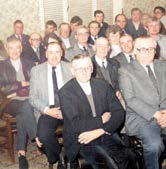
Archive). Right, seated in the front, is
Dr. Philip Jacob Monbaliu (1895-1999),
who assisted with the birth of Maurice De-
clercq and is described in Chapter 45.9.
Standing behind him, wearing glasses, is
Dr Werner De Keukeleere (1921 - 1998),
who helped deliver Nico Declercq, the au-
thor. The picture was probably taken in
the 1980s. (We could not determine the
source). Dr Monbaliu would save the life
of Maurice in 1961 after an accident, de-
scribed in Chapter 46.2.6.
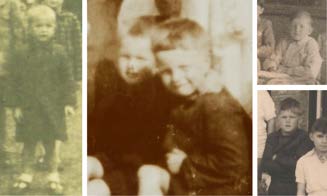
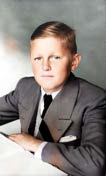
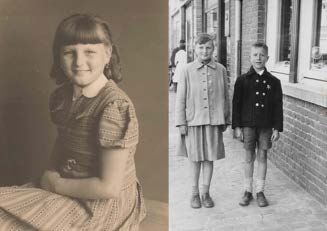
Figure 46.10: Left, Maurice Declercq in
Deerlijk at his parents’ farm near the train
station, in 1944 or 1945. In the middle,
we see him in Wielsbeke in the Spring of
1946. Maurice Declercq is shown left, his
brother right. Right, Maurice Declercq in
1947-1948, and 1948-1949 at the Commu-
nity Boys School of Deerlijk (’ Gemeen-
teschool’ ), just before the family moved
to Sint Lodewijk in Deerlijk. (Declercq de
Silva Archive)
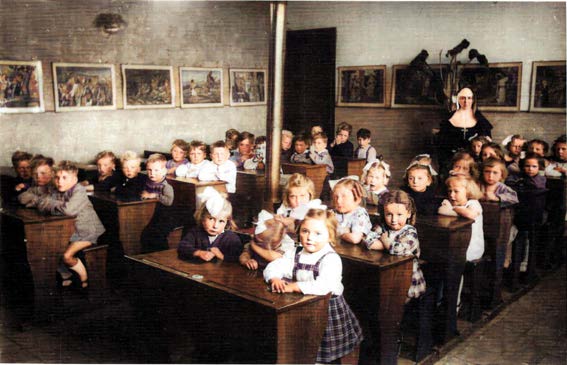
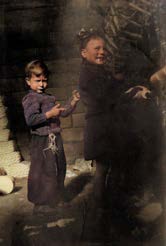
Figure 46.11: 1946-1947, Maurice Declercq in class at the local school near the train station. In the picture, he is the boy just left of the stove pipe. MyHeritage® colorized this photo.
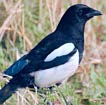
Figure 46.12: As a child, Maurice had raised a young magpie. The bird was very
tame but occasionally went to pick some grain from the farm in Oude Heerweg. One
day, the farmer shot the magpie with his rifle. Maurice never forgave him. (Declercq
de Silva Archive)
The Desclergues of la Villa Ducal de Montblanc, 2nd ed., Omn., VOL. III
© 2024 Nico F. Declercq
856
CHAPTER 46. MAURICE ALOIS DECLERCQ (DC16) & NELLY MARIA VANGHELUWE
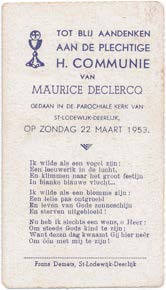
Figure 46.13: On March 22, 1953, Maurice celebrated his confession.
The text ’Ik wilde als een vogel zijn, een leeuwerik in de lucht, en klim-
men naar het groot festijn in blanke blauwe vlucht’ was likely a text he
selected. (Declercq de Silva Archive)
Figure 46.14: 1953. When the new academic year started in September, Maurice
lived in a different world, coping with the loss of his mother. The mourning sign
on his vest was a constant reminder of his loss. MyHeritage® colorized this photo.
MyHeritage® colorized this photo. (Declercq de Silva Archive)
Figure 46.15: The person in the front is Albert Buysschaert, at a
meeting of the farmers of Deerlijk on November 10, 1986. The person
next to Albert is Roger Terryn, farmer and former mayor of Deerlijk.
Courtesy of Marc Vergote, image 2938, also published in Derlike, 25ste
jaargang, nr 1, 2002.
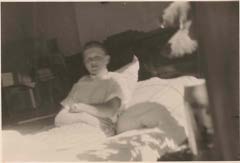
Figure 46.16:
Maurice Declercq, bedridden in 1955.
(Courtesy of Nelly Maria Vangheluwe) (Declercq de Silva
Archive)
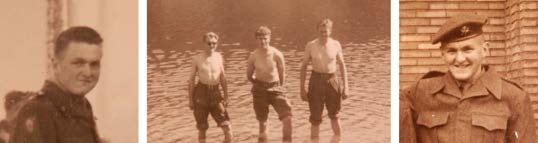
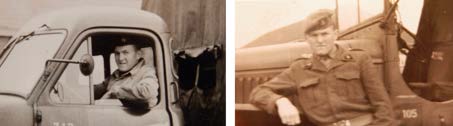
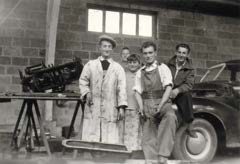
Figure 46.17: Maurice Declercq as a soldier. In the middle photo, Maurice Declercq (person on the right) is seen at Vogelsang. (Declercq de Silva Archive)
© 2024 Nico F. Declercq
The Desclergues of la Villa Ducal de Montblanc, 2nd ed., Omn., VOL. III
46.2. MAURICE ALOIS DECLERCQ (DC16)
857
Figure 46.18:
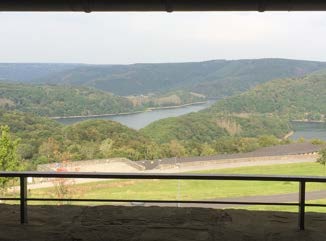
2019, a wonderful view
of Vogelsang near Aachen in the Eiffel in
Germany. (Declercq de Silva Archive)
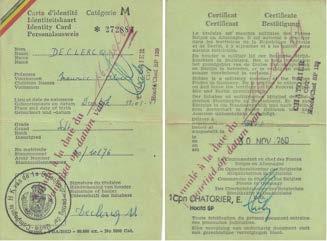
Figure 46.19: 1960, November 30, the
Military identity card of Maurice Declercq.
(Declercq de Silva Archive)
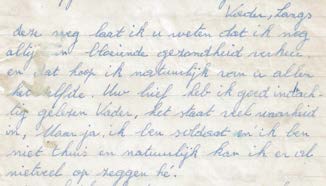
Figure 46.20:
1961, June 19, a letter
of Maurice Declercq from Westhoven to
his father in Deerlijk. It states (in old-
fashioned Dutch): ’Father, in this way, I
let you know that I am still in prosperous
health. Of course, I hope so for all of you
too. I have read your letter carefully and
with the most significant interest. Father,
there is a lot of truth in your message.
Nevertheless, I am a soldier, and I am not
at home. Besides, there is not much I can
say about it, can I?’ . The letter exposed
the close bond between Michel and his son
Maurice. (Declercq de Silva Archive)
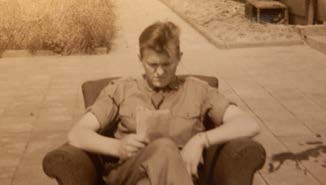
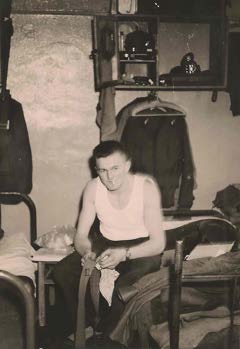
Figure 46.21: Maurice Declercq in West-
hoven, reading a letter from his father.
(Declercq de Silva Archive)
The Desclergues of la Villa Ducal de Montblanc, 2nd ed., Omn., VOL. III
© 2024 Nico F. Declercq
858
CHAPTER 46. MAURICE ALOIS DECLERCQ (DC16) & NELLY MARIA VANGHELUWE
Figure 46.22: Maurice obtained the entire range of driver’s licenses in the army and could
drive any vehicle, from a motorcycle to the most massive trucks and passenger couches, if he
wanted. (Declercq de Silva Archive)
Figure 46.23: Maurice Declercq, approaching the end
of his military service. (Declercq de Silva Archive)
Daniel Lesage’s wife was Magdalena Meersseman. Daniel and Magdalena had no children and fostered Maurice the best they could as if he were their son. Consequently, they also thought of the author as their Grandson. The feelings were mutual.
Maurice Declercq was a professional engineer. He served in the Belgian Army Corps of Engineers in Germany, mainly at Cassel and Vogelsang, in the 1950s.
He was a man of few words but a person of significant deeds. His actions consistently spoke louder than any words could, embodying a quiet strength and unwavering commitment to those he cared for. The author sees a reflection of his father’s life and character in Juan Carlos de Borbón y Battenberg, Count of Barcelona (1913-1993), albeit at a different level and in varied circumstances. Both men exemplified a life of duty and dedication, leaving indelible marks on their respective spheres through their steadfast and noble deeds.
46.2.2 Spring: his Early life
As explained in the introduction, Maurice was born at his parents’ farm near the train station during the war. The doctor who delivered him was Dr Philip Monbaliu, described in Chapter 45.9, who lived 2 km away. Memorabilia are shown in Figure 46.9.
The family had trusted this doctor for several years, mainly because they lived nearby for a while just before the war in a rental home somewhere in Braamakerstraat near the chapel Kapel-ter-Ruste, built in collaboration with our ancestors and extensively described in Chapter 49.
Because Maurice’s parents had virtually no income before and during the war, and with their investments frozen3, they were unable to pay the rent and pleaded with the landlord for patience. The landlord, however, remained implacable and ultimately evicted them from their home.
Although Maurice’s father, Michel Declercq, knew their family was not destitute, this event was profoundly traumatic for the children. Maurice’s mother, Irma Lesage, was devastated by the ordeal. This eviction inflicted deep humiliation and frustration upon the family, especially given their young children and shaped their character profoundly.
The psychological impact of this event was profound and far-reaching. The trauma experienced by Maurice’s family not only affected the immediate members but was also transmitted to future generations, including Maurice himself. The events before his birth indelibly shaped his worldview and perception of society. This inherited memory resulted in pervasive insecurity throughout Maurice’s life and was even indeliberately transmitted to his son without ever mentioning the facts.
The enduring humiliation from the eviction left indelible scars on the family’s collective psyche. For Maurice, it fostered a persistent feeling of inferiority and, simultaneously, a profound sense of interdependence with his siblings. This interdependence, while offering emotional support, also imposed a significant burden on his marriage. The notion of inferiority was deeply ingrained and eroded only gradually over time.
Maurice’s journey towards finding peace was long and arduous. It was only through the academic success of his son, who became 3Including stored flax, their parents’ farm, unsold jewelry, money loaned out, and pending payments delayed due to the war.
© 2024 Nico F. Declercq
The Desclergues of la Villa Ducal de Montblanc, 2nd ed., Omn., VOL. III
46.2. MAURICE ALOIS DECLERCQ (DC16)
859
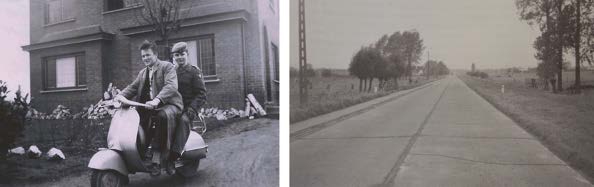
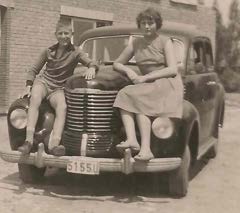
Figure 46.24: 1959-1960: Maurice Declercq on his Vespa scooter in front of their house in Oude Heerweg, Deerlijk. The boy riding behind has not been identified (Declercq de Silva Archive). Right, we see Deerlijk, Vichtsesteenweg, in 1968, just before the construction of Highway E3 or E17 began and cut the road in two. It was about seven years earlier that Maurice Declercq had his nearly deadly motorcycle accident along that road. Courtesy of Archive Leon Defraeye Deerlijk, dia nr 4090.
The image also appeared in Derlike, 24ste jaargang, nr 1, 2001.
a university professor, and the joy of having grandchildren that Maurice finally found a sense of fulfillment and tranquility.
This ultimate reconciliation highlights the potential for intergenerational healing and the profound impact of educational and familial achievements on psychological well-being.
After their Braamakerstraat experience, the family moved to a farm near the train station in Deerlijk, where Maurice was born.
WWII continued to cause difficulties until 1944. They received support through merchandise they could buy below the market price thanks to the goodwill of René Vangheluwe, described in Part X, who would much later become the father-in-law of Maurice Declercq. René appreciated the family because he knew them when they lived in Wielsbeke and understood the difficulties they faced in having so many children during the dark years of WWII.
After the war, the situation improved quickly. Michel received due money, could be economically active, and finally was paid back the money he had spent before and during the war for his sisters’ education. As a result, they constructed a beautiful home in Oude Heerweg, Sint Lodewijk, Deerlijk, shown in Figure 45.75 on page 841. The house provided new oxygen to the nine children and offered Michel and Irma a sense of pride and worth. Interestingly, René Vangheluwe also constructed a home in the same area in 1955. In other words, the seeds were sown that would result in a marriage between the author’s parents.
Sweet memories of Maurice’s youth are shared in Figures 46.10, 46.11, 46.4, and 46.12.
46.2.3 The Death of his Mother
On March 22, 1953, Maurice celebrated his confession warmly embraced by his parents, godfather Daniel Lesage, and godmother Rachelle Declercq. The family was happy. They had lived in their new home in Sint Lodewijk, Deerlijk, for several years. They had gained prosperity, and everything went well.
Nobody would have expected the disaster that would follow. His confession token in Figure 46.13 contains words that are so meaningful in the light of his past and the time yet to come,
’Ik wilde als een vogel zijn, een leeuwerik in de lucht, en klimmen naar het groot festijn in blanke blauwe vlucht.’
The word ’wilde’ then had two meanings, i.e., ’wanted’ and ’would like to.’ Looking back at it in the following years, he probably interpreted the word by its first meaning and looked back with enormous nostalgia.
In the late Spring of 1953, Irma Lesage, mother of Maurice, became slightly ill. She had digestive problems and pain, which worsened. The diagnosis was a volvulus. This medical problem sometimes goes away, but it requires rest and, if possible, proper medical treatment. Being a mother of nine children, Irma felt she was too busy with her household to go to the hospital and undergo surgery when it worsened.
She ultimately had complications that caused an intestinal perforation. She was urged to the Hospital of Kortrijk immediately and had surgery, but it was too late. The surgeon was Dr. André Baekelandt, brother of Leon Baekelandt, a flax merchant from Gullegem and acquaintance of Michel Declercq. Irma was already poisoned and died the next day, on June 7, 1953.
Before she died, she asked Maurice to look after his siblings, a task he fulfilled until he died in 2015, when the request’s intended expiry date had already passed 50 years or so.
Her death was a shock to the entire village. Everyone knew Irma as a sweet, decent mother who had gone through difficult times and found new happiness in Saint Louis, Deerlijk. To Michel Declercq, this was a fatal disaster. Not only had he lost his beloved wife, but her death also left him with nine growing children.
When Maurice, as an older man, looked at his picture in Figure 46.14, tears always appeared because of the reminder of his mother and his suffering afterward.
After his mother’s death, when Maurice was not in Moorslede, he found comfort with farmer Albert Buysschaert, shown in Figure
46.15, and his wife, Marguerite Vandendriessche, in Groenstraat in Sint Lodewijk Deerlijk. Indeed, it was somewhat too crowded at home with so many children, and Maurice was cozier with the Buysschaert family. He would visit them until the end and see them with the author when he was still a child. Albert was a fine and honest man with significant knowledge about farming, real estate, and much more. The Buysschaert family is buried a few meters from the Declercq de Silva tomb. Their distant relatives, Geert Buysschaert and Rosalie Buysschaert, are, respectively, the author’s former dentist and current family physician.
Maurice’s profound sense of responsibility towards his siblings shaped much of his emotional landscape throughout his life. This unwavering trust and belief in his siblings persisted even in the face of clear signs that they might not always be honest with him or exploit his confidence.
Maurice’s commitment to his family remained steadfast despite these potential betrayals and the emotional torment he often endured.
The tumultuous environment of a large family, with numerous siblings under one roof, contributed to Maurice’s aversion to chaos and his longing for a more serene and intimate family setting. This experience profoundly influenced his decision to have only one child later.
The Desclergues of la Villa Ducal de Montblanc, 2nd ed., Omn., VOL. III
© 2024 Nico F. Declercq
860
CHAPTER 46. MAURICE ALOIS DECLERCQ (DC16) & NELLY MARIA VANGHELUWE
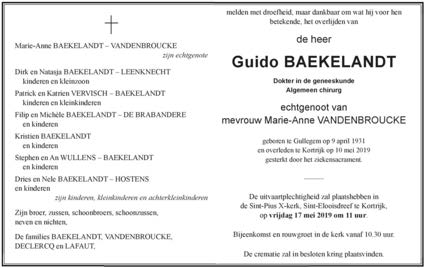
Figure 46.25: 2019, the death announcement of Dr Guido Baekelandt, the hero who
saved the life of Maurice Declercq in 1961. The author would never have existed if Dr
Baekeland had not been there. Eternal gratitude is in place; hence, here is a copy of
this announcement. Dr Baekelandt was rightfully blessed with a rich and meaningful life
that lasted 88 years. The accurate measure of a doctor’s success lies in their technical
proficiency and unwavering dedication to preserving life and fostering the bonds that define
our humanity. A real doctor does not steal a son but returns him to the father. Through
such dedication, a genuine doctor like Dr. Bakelandt exemplifies the highest virtues of
the medical profession, achieving the profound and honorable distinction of ’summa cum
laude’ in the art of healing.
Maurice’s preference for smaller, more peaceful family dynamics was a deliberate effort to create the stable and calm environment he had always yearned for.
Maurice found solace and a sense of true belonging in the company of families that epitomized the tranquility he desired. Notably, the Buysschaert family and his godfather, Daniel Lesage, gave him the peace and quietness he craved. In their company, Maurice experienced a genuine sense of home, where he could find respite from the emotional upheaval that often characterized his interactions with his siblings.
His life and character accentuate the interplay between Maurice’s early familial experiences and later life choices. His constant quest for emotional stability and his selective trust in certain family members reflect the profound psychological impact of his upbringing.
Maurice’s life story reveals the enduring influence of childhood environments on adult relationships and personal well-being, offering valuable insights into psychology and social sciences for those interested in these fields.
46.2.4 A Period when he was Temporary Bedridden
Around 1955, 2 years after his mother’s death, Maurice was diagnosed with a Femoroacetabular impingement, which required surgery and rest in bed for a couple of months. Although Maurice has never felt any discomfort in his entire life because of it, the fact that he had had to stay in bed for so long was a painful memory. Indeed, he was a very active person. Having to remain in bed for so long must have been very frustrating.
He often told how he could hear his siblings playing outside while lasting helplessly in his room.
René Vangheluwe and Anna Den Dauw moved to their new house near the Declercqs during these months. The author’s mother still remembers visiting the author’s father to offer him some comfort. Image 46.16 shows Maurice in bed in a picture taken by Nelly (the author’s mother) with her father’s camera.
The anecdote of this picture is that Maurice always asked his youngest sister and Nelly to play outdoors close to his room to watch them play. Nelly had climbed through the window to take this picture. It was the bedroom located downstairs in the South-West corner of the house. Given the shadows shown, it must have been in the afternoon. A short time later, Agnes Declercq had fabricated a seesaw for the two girls when Nelly broke her arm due to inattention. Maurice freaked out to Agnes that she had paid insufficient attention, but he couldn’t do anything since he was in bed.
Thanks to this picture, it’s lovely how an instance of these anecdotes survived.
46.2.5 His Military Service
When Maurice Declercq became a military, Belgium was highly involved in the post-war occupation of Germany. Practically every Belgian soldier at that time spent several months in Germany.
At first, they occupied a sector, but later, they provided Germany’s military defense against the Russians. The efforts ensured that Germany would not need an army.
The ’Belgian Armed Forces in Germany’ contained military forces and an occupied territory. They were a Belgian occupation force in Germany just after WWII in West Germany. The Belgian troops were under British command because they had previously been assigned to the British as their occupation sector.
From April 1, 1946, three Belgian infantry brigades in Germany were under British command; they operated as occupation units.
Shortly afterward, the Belgian units were given their particular zone within the British occupation sector, called the BSD, Belgische strijdkrachten in Duitsland. Thus, the Belgian army controlled an entire zone between Aachen, Cologne, Soest, Siegen, and Kassel, mainly in North Rhine-Westphalia. A garrison was also located in Bonn until the founding of the Federal Republic of Germany, BDR, the Bundesrepublik Deutschland, on May 23, 1949. Then, the commander of the Belgian armed forces, General Piron, had to free up space and release buildings occupied by the Belgians for the new Federal Republic government.
© 2024 Nico F. Declercq
The Desclergues of la Villa Ducal de Montblanc, 2nd ed., Omn., VOL. III
46.2. MAURICE ALOIS DECLERCQ (DC16)
861
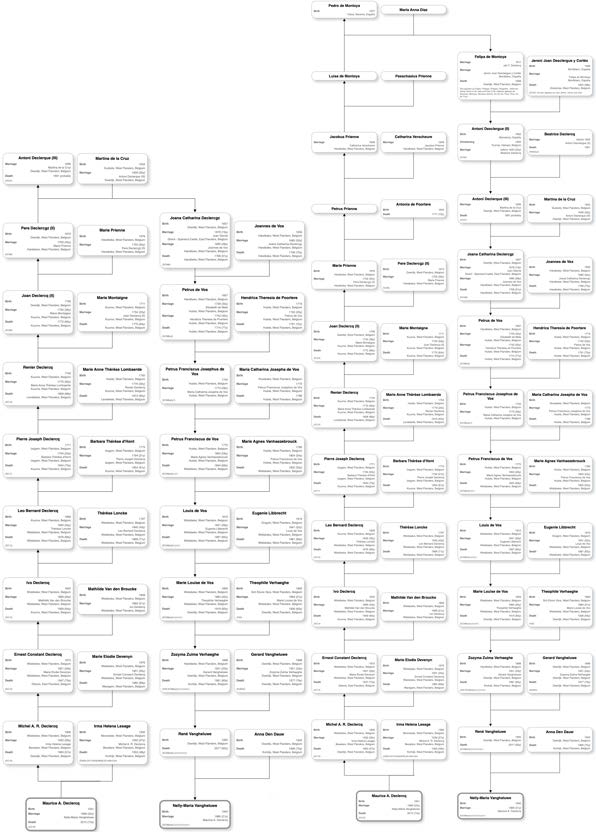
Figure 46.26: Maurice Declercq and Nelly-Maria Vangheluwe, the author’s parents, were distantly blood-related. They both descend from the Desclergues of Montblanc.
The Desclergues of la Villa Ducal de Montblanc, 2nd ed., Omn., VOL. III
© 2024 Nico F. Declercq
862
CHAPTER 46. MAURICE ALOIS DECLERCQ (DC16) & NELLY MARIA VANGHELUWE
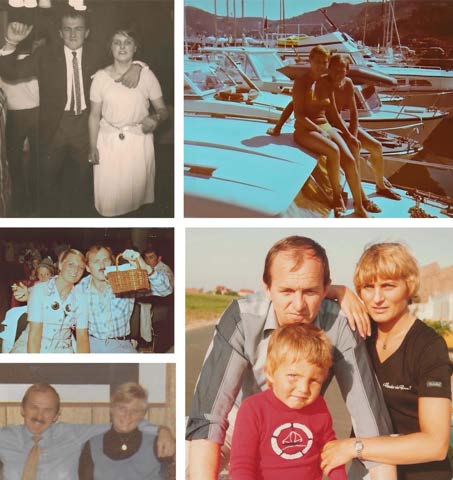
Figure 46.27: The compilation shows Maurice and Nelly, the author’ s parents, when they were
engaged. We also see them in 1974, enjoying their time at ’Wit Paard’ in Ostend. It was located
at Van Iseghemlaan 67, 50 m from the Casino where Sandhill was located in 1604 and where
Jeroni Joan Desclergue y Cortés (DC05) has died. In 1975, they appear in Wakken, when Nelly
was pregnant. In 1977, they are seen in ’La Napoule’ in the South of France. In 1978-1979, we
observe the author on his father’s bike, with both parents. (Declercq de Silva Archive)
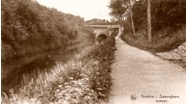
Figure 46.28: The tunnel passage, called ’souterrain’ ,
at Moen in Zwevegem. The tunnel and hill were removed
many years ago, and the canal is now vast.
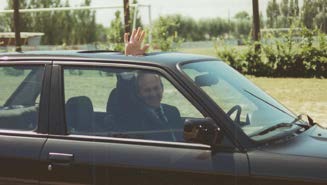
Figure 46.29: Once Maurice reached 50,
he tended to prefer BMW® cars above
other brands. Twenty years later, his taste
switched to Audi®. Before BMW® he
loved Volvo®, and in his young years, he
liked sports cars such as Karmann®. (De-
clercq de Silva Archive)
© 2024 Nico F. Declercq
The Desclergues of la Villa Ducal de Montblanc, 2nd ed., Omn., VOL. III
46.2. MAURICE ALOIS DECLERCQ (DC16)
863
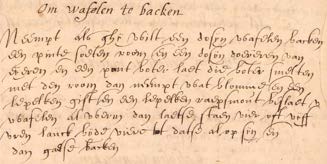
Figure 46.30: This is an old recipea for
baking waffles, dating from the late 17th
century. Courtesy of Erfgoedbibliotheek
Hendrik Conscience.
a” Neempt als ghij wilt een dosijn wafelen
backen: een pinte soeten room ende een dosijn
doeiieren vaneijeren ende een pont boter. Laet
die boter smelten met den room, dan neempt
wat blomme ende eenlepelken gist ende een le-
pelken raepsmout. Beslaet u wafelen al werm,
dan laetse staen vier oft vijff urenlanck bi-
jde viere tot datse al op sijn, ende dan gaetse
backen.’ ’
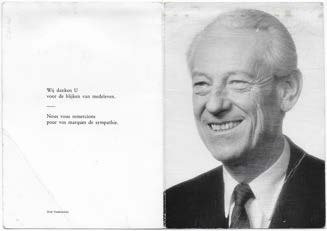
Figure 46.31:
The mortuary card of
Antoon Bekaert, March 7, 1990 (outside)
(Declercq de Silva Archive)
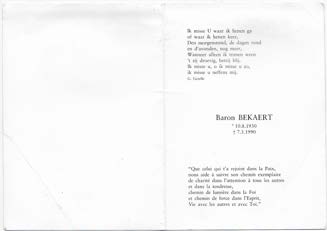
Figure 46.32: The mortuary card of An-
toon Bekaert, March 7, 1990 (inside) (De-
clercq de Silva Archive)
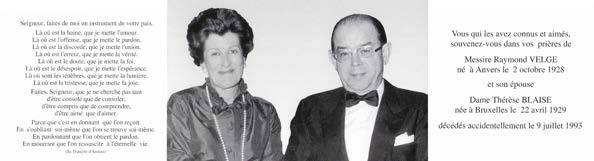
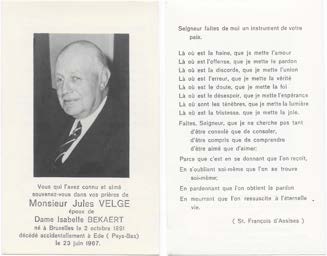
Figure 46.33: The mortuary card of Thérèse Blaise and Raymond Velge, July 9th of 1993. The author can still vividly recall the haunting sound of their car accident on the Highway. They were very nice persons. (Declercq de Silva Archive) The Desclergues of la Villa Ducal de Montblanc, 2nd ed., Omn., VOL. III
© 2024 Nico F. Declercq
864
CHAPTER 46. MAURICE ALOIS DECLERCQ (DC16) & NELLY MARIA VANGHELUWE
Figure 46.34:
The mortuary card of
Jules Velge, husband of Isabelle Bekaert,
June 23, 1967. (Declercq de Silva Archive)
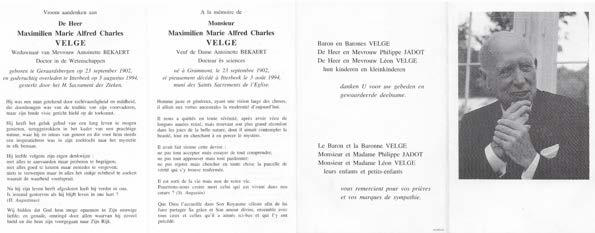
Figure 46.35: The mortuary card of Maximilien Marie Alfred Charles Velge, husband of Antoinette Bekaert, August 3, 1994.
(Declercq de Silva Archive)
NATO, the North Atlantic Treaty Organization, was founded on April 4, 1949, and the BDR became a NATO partner on May 9, 1955. The Soviet Union, with its Warsaw Pact, established on May 14, 1955, and which included the DDR, the Deutsche Demokratische Republik, had meanwhile become the new enemy.
The Belgian forces resided in Germany in a NATO context, as the DBR was also part of it. They assisted, with the British and the Americans, in defense of West Germany against the Warsaw Pact.4
Maurice was a military engineer in the Belgian army and received general engineering training specializing in bridge design, construction, and fast assembly strategy. In this role, he also learned to drive every armed vehicle and was, as such, allowed to drive motorized automobiles ranging from motorcycles to large trucks and buses for the rest of his life. He has, however, never used them as such and has only driven his passenger cars.
Maurice’s coordinates were nr 60/10876, corps Gn 85795. He was first trained at the Turnhout Infantry unit and later joined PCR
3003.19 Geniecommando SP nr 120, BPS 4 - BSD.
In Germany, he was stationed at Westhoven and Vogelsang. At Vogelsang, he once saved the life of a soldier who could not swim and had decided to go in the water.6
Maurice called Vogelsang ’the most beautiful place on earth’ in his letters. The author took the picture in Figure 46.18 in 2019. He had to attend a congress in Aachen (ICA) and drove from Metz, in the dark, to his destination, a family hotel just outside Aachen.
Because of road works, bad weather, and traffic jams, the global positioning system on his phone sent him through tiny roads, through the hills, in the rain, along numerous curves when suddenly, totally unexpected, he passed by Vogelsang and remembered his father’s letters. Earlier, he had not profoundly investigated Vogelsang’s location because a preliminary search had not delivered any match. Indeed, his father had always misspelled it in his letters as ’Vogelzang.’
Suddenly, being there was like a gift from above. The next day, before the congress began, he quickly visited the place and took a couple of pictures. On his way to the congress, he saw relics of the Siegfried line, an exciting experience.
A couple of memorabilia and pictures are presented in Figures 46.17, 46.19, 46.20, 46.21 and 46.23.
Maurice has always had a passion for cars and vehicles in general. Having an opportunity to receive the entire range of possible driver’s licenses must have been a very appealing side-activity during his service in the army. He cherished some souvenirs, shown in Figure 46.22. Interestingly, when the author learned to drive, he taught him many things from the military. A particular example is always walking around the car before opening the door and quickly checking if the tires are okay and if there is no visible damage.
Furthermore, regular checks of the oil, water, and engine’s overall appearance were part of the training. The most important lesson was always to catch the mistakes made by others. In other words, a driver must anticipate what other drivers may do wrong to avoid accidents. Such lessons, stemming from the army and transmitted many decades later, are still invaluable to the author and his children.
What Maurice studied most enthusiastically during his stay in the army was the pleasure of engineering. Even the most minor 4The Warsaw Pact consisted of the Soviet Union, East European Countries, and the DDR.
5Gn = genie = military engineering corps.
6Letter, Westhoven June 25, 1961, from Maurice Declercq to his father, Michel Declercq.
© 2024 Nico F. Declercq
The Desclergues of la Villa Ducal de Montblanc, 2nd ed., Omn., VOL. III
46.2. MAURICE ALOIS DECLERCQ (DC16)
865
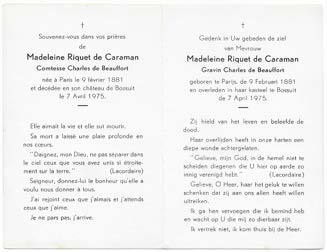
Figure 46.36:
The mortuary card of
Magdalena Riquet de Caraman, wife of
Charles de Beauffort, April 7, 1975. (De-
clercq de Silva Archive)
crafts were like an engineering project to him, considering ideas, a pre-study, gathering all the materials, enjoying the manufacturing process, and, finally, admiring the final product.
He transmitted this enthusiasm later to his son, the author, although the latter often has more significant time constraints. The author fabricated uncountable things with his father during his youth. The pleasure of constructing, whether very small or tremendous and the sense of accomplishment is exhilarating when the task is accomplished.
Maurice enjoyed farming. Gardening is fun, but growing potatoes could appeal more to the author.
Maurice was likewise a good horse rider and could handle draft horses. He learned these skills as a child during his numerous visits to Daniel Lesage and Magdalena Meersseman. Had he been in the army 30 years earlier, such skills would have served him well.
Before Maurice reached the end of his duty, he had a life-threatening accident, described in Chapter 46.2.6.
46.2.6 His Nearly Deadly Accident in 1961
Soldiers were occasionally granted leave to return home, typically every few months. It was customary for them to hold a farewell party before rejoining their units, often culminating in a pub crawl with friends. On the eve of Maurice Declercq’s return to the army, he embarked on such a pub crawl with two friends and his brother Marcel. Each of the boys was driving a Vespa scooter, as in Figure 46.24.
After visiting various establishments, the group halted in Deerlijk along the road to Vichte. In Het Lindenhof, they consumed a substantial amount of beer in a short period. Despite the lack of alcohol control and fewer cars on the road, the dangers of their actions were undeniable. They set off for home, heavily intoxicated, and prudently separated, with Maurice bringing up the rear.
At some point, Marcel noticed his brother was no longer visible and presumed Maurice had taken another route home. However, an ominous feeling prompted Marcel to retrace his steps, only to find Maurice unconscious in a ditch on Vichtesteenweg, shown in Figure 46.24. Marcel urgently sought help from Dr. Philippe Monbaliu, described in Chapter 45.9, their family physician, who had delivered Maurice in 1941. Unable to call an ambulance and lacking a car, Marcel raced home to enlist the aid of their neighbor, René Vangheluwe7.
That night, Marcel and René rushed Maurice, still in a coma, to the Sacred Heart Hospital in Kortrijk, the same hospital where Maurice’s mother had died a few years earlier. The emergency department was staffed by nuns, who promptly summoned a doctor.
An X-ray revealed Maurice had suffered a ruptured liver, likely from the scooter’s handlebars, and a possibly damaged aorta, leading to internal bleeding. The nuns, deeming his condition hopeless, suggested administering the last rites. However, Dr. Guido Baekelandt, a cousin of Dr. André Baekelandt who had previously operated on Maurice’s mother, described in Chapter 45.2.1,
resolved to attempt surgery. It was his first liver operation in Kortrijk.
Post-surgery, Dr. Baekelandt could only offer a guarded prognosis. Maurice’s family, mistakenly informed of his death, was devastated. Upon discovering Maurice was still alive but in critical condition, they rushed to the hospital. The ensuing healing process was excruciating, with Maurice often begging for release from his pain. Yet, after weeks of struggle, he began to recover.
Maurice was transferred to the Military Hospital in Ostend for further rehabilitation, drawing a poignant parallel to his ancestor Jeroni Joan Desclergue y Cortés (DC05), who had died in Ostend in 1604. Maurice eventually regained his health but would ultimately succumb to the long-term consequences of his injuries in 2015, passing away in a Ghent hospital where several of his ancestors had also died in the 17th century.
Dr. Guido Baekelandt, who performed the life-saving surgery, was the son of Leon Baekelandt and Mrs. Germana Declercq8. Leon Baekelandt, a flax trader from Gullegem, was André Baekelandt’s brother and acquainted with Michel Declercq (DC15). Guido Baekelandt was born in Gullegem on April 9, 1931, ten years earlier than Maurice, and he died on May 10, 2019, in Figure 46.25,
one day before Maurice’s 78th birthday. He turned 88 years old. Two years after the successful operation, he married Marie Anna Van den Broucke from Kortrijk, one month before Michel Declercq’s death.
The four heroes who saved Maurice’s life that fateful night were Marcel Declercq (his brother), René Vangheluwe (his future fatherin-law), Dr. Philippe Monbaliu (who had delivered him in 1941), and Dr. Guido Baekelandt (nephew of the surgeon who operated on his mother Irma in 1953; and son of a flax merchant acquainted with Michel Declercq).
46.2.7 Summer: his Marriage
Maurice and Nelly have known each other since childhood. The reader will find in Part X that they were distant relatives, and both descend from the Desclergues, namely Maurice paternally, while Nelly through her great-grandmother Marie Louise de Vos.
In particular, Zozyma Verhaeghe, daughter of Marie Louise de Vos and grandmother of Nelly, meddled a lot to arrange the marriage.
Their relationship chart is shown in Figure 46.26, while a picture from their engagement period is shown in Figure 46.27.
7René is described in Chapter 48.12.1; he would later become Maurice’s father-in-law.
8Germana Declercq was unrelated to us and born in Deerlijk
The Desclergues of la Villa Ducal de Montblanc, 2nd ed., Omn., VOL. III
© 2024 Nico F. Declercq
866
CHAPTER 46. MAURICE ALOIS DECLERCQ (DC16) & NELLY MARIA VANGHELUWE
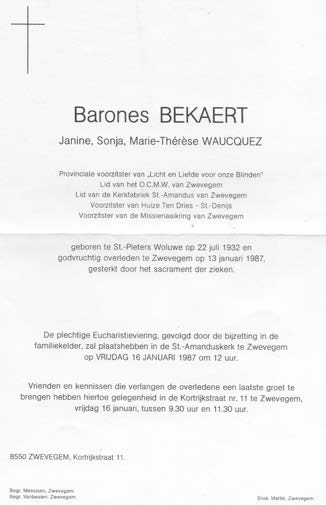
Figure 46.37: The death announcement
of Janine Sonja Marie-Thérèse Waucquez,
wife of Antoine Bekaert, January 13,
1987. (Declercq de Silva Archive)
Maurice Declercq and Nelly Maria Vangheluwe married on January 28, 1966 at Deerlijk. The mayor at that time was Albert Windels. The religious wedding was the next day in Ghent, while the wedding feast was in Waregem.
Maurice and Nelly, driven by a shared ambition, decided to delay starting a family until 1975. They were determined to further their careers, build a new home, and relished in the joy of raising the children of their closest relatives in the meantime. A snapshot from this period, displayed in Figure 46.27, captures their contentment. Despite the potential for a larger family, they chose to have only one child, the author of this book, born on December 27, 1975, in Kortrijk. Figure 46.27 also features a picture of Nelly during her pregnancy with the author, a testament to their anticipation and joy.
As this book is a reflection of the past, the author has chosen to primarily focus on the period up to 1975, a time that holds significant importance in Maurice and Nelly’s lives. The author’s own story, which extends beyond this book’s scope, is briefly touched upon, providing glimpses of his life throughout the narrative. Two snapshots from the time shortly after 1975, displayed in Figure 46.27, offer a glimpse into this era. For more pictures, we invite you to explore Chapter 46.3.4.
46.2.8 His Passion for Sports and Fast Cars
Maurice liked endurance sports. From the age of 16, he became a kayaker and rower. He practised this sport on the Kortrijk-Bossuit canal. The canal was not very wide at the time, and there was a tunnel halfway, in Figure 46.28.
The canal enabled shipping between the Scheldt and the Leie, and Bekaert, somewhere halfway in Zwevegem, made fair use of it to ship steel wire. The tunnel ran under a hill near Moen and must have been an attraction. Especially for kayakers and rowers, it was always an adventure to sail through. The author never saw the tunnel because the canal had been modernised and widened by the time he was born.
Maurice also liked cycling very much, but he did not want to wear the typical clothing whence he had an aerodynamic disadvantage.
Nevertheless, he liked long-distance routes and enjoyed the fresh air of the countryside very much.
Cars formed yet another passion. Throughout his life, he has always enjoyed driving cars, typically beautiful vehicles. In particular, when he was young, he was indulged by Karmann® sports cars. Later he switched to more classical ones, as in Figure 46.29, and when he was old, his choice was determined by a combination of a classical look with a dynamic engine.
Apart from the hobbies mentioned here and his joy of helping others, the author does not remember other hobbies.
46.2.9 His Passion for Baking Waffles
Maurice liked to eat, but always in moderation. Strangely, he enjoyed eating bread and often experimented with different bakers to search for the best bread.
He also liked to eat soft waffles baked according to an old recipe, as in Figure 46.30, with a massive waffle iron of Vandendriessche from Deerlijk. For that reason, Nelly’s grandmother, Zozyma Verhaeghe, gave her waffle iron as a gift to Maurice so that he could bake waffles as often as he wanted. In this way, a naturally born tradition has arisen, and Maurice occasionally baked waffles for visitors, his family, his grandchildren, etc.
It is typical for people to be glorified after death, but in his case, we can unquestionably state that his waffles were legendary even during his lifetime.
© 2024 Nico F. Declercq
The Desclergues of la Villa Ducal de Montblanc, 2nd ed., Omn., VOL. III
46.2. MAURICE ALOIS DECLERCQ (DC16)
867
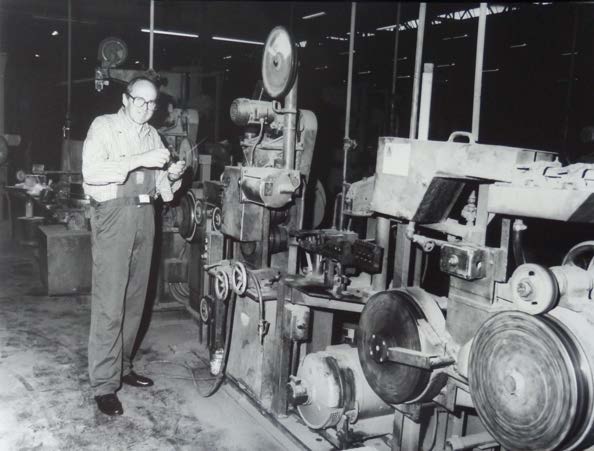
Figure 46.38: Maurice Declercq has always been passionate about construction, machinery, and safety. He had achieved a great deal of intuition and work experience by always trying things by himself. He was not afraid to put on dirty clothes and reach the goal. His company elected him twice to reside abroad (in Brazil and China) to establish new production units. Steel wire drawing through dyes with varying diameters is a metalworking process that stretches steel wire by plastic deformation caused by pulling over a curved axis. During the process, the diameter of the wire decreases while its length increases. The process seems simple, but a lot of ’fingerspitzengefühl’ is necessary to adjust the wheels along which the wire propagates to spin at the right speed and cause the correct force. Minor errors always cause the wire to break because the forces may surpass the wire’s tensile strength and result in substantial production delays. The process often occurs at room temperature but may also occur at high temperatures. The procedure appeared in a large chain of sub-processes to increase efficiency, including cleaning and applying a coating through zinc and plastic coverage electrolysis. Interestingly, the author’s father could acoustically check the process’s quality because each part produced noise that changed when something went wrong. He often complained about workers who still did not sense that something had gone wrong even after being explained numerous times. Because of quality differences in supplied wires and different applications, including hanging wire, staples, fibers for concrete, or steel cord, the process required constant adjustments and a lot of insight and experience. Supplied wires and end-products needed specific quality testing and sometimes the development of new testing techniques. A passion for fibers had been passed onto Maurice by his father, Michel, who associated fibers with his past in the flax business. (Declercq de Silva Archive) Figure 46.39: Left: Maurice Declercq in
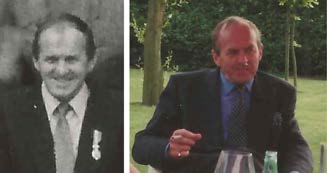
a picture taken on an occasion related to
his job. Right: Maurice Declercq enjoying
a good conversation with a former engi-
neer who had constructed a power plant in
Baghdad many decades earlier. He smoked
one cigarette per day and enjoyed smoking
only in the presence of good company. (De-
clercq de Silva Archive)
The Desclergues of la Villa Ducal de Montblanc, 2nd ed., Omn., VOL. III
© 2024 Nico F. Declercq
868
CHAPTER 46. MAURICE ALOIS DECLERCQ (DC16) & NELLY MARIA VANGHELUWE
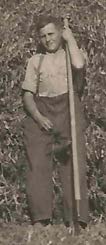
Figure 46.40: Passchendaele, Kazakke, at Messestraat 4, 1953-1955, Maurice De-
clercq during his summer stay with Daniel Lesage and Magdalena Meersseman. The
entire picture is shown in Chapter 64.7.12.8. Daniel and Magdalena had a land there too. (Declercq de Silva Archive)
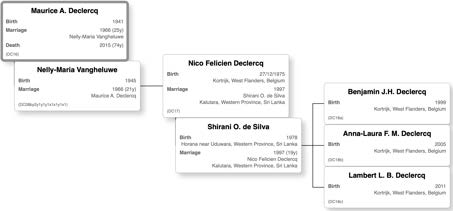
Figure
46.41:
Two descending generations of Maurice Alois Declercq (DC16,
DP12V03DW02L02)
Waffles and Kortrijk go hand in hand, as explained in Chapter 29.5.9.
46.2.10 Acquaintances
Maurice was a man who truly knew how to connect with people from all walks of life. His ability to engage with individuals from every social class was remarkable, and he never hesitated to stop and chat, no matter who he encountered. His modesty and fair speech endeared him to many, earning their admiration and respect. Maurice was a source of wisdom and guidance, always ready with thoughtful advice. If he believed he could assist someone, he made it a priority, either by offering his help or by finding the right person who could.
Every new project allowed Maurice to showcase his enthusiasm, reconnect with old friends, and seek their counsel. His unwavering commitment to these relationships was a testament to his character. His genuine interest in others’ opinions was not just a trait but a way of life for him.
Even after his passing, his impact on numerous lives became evident. The author discovered many individuals who, despite not having met him personally, felt a deep connection with him through his father’s actions and reputation.
Figures 46.31, 46.32, 46.33, 46.34, 46.35, 46.36 and 46.37, are selected relics of Maurice’s old acquaintances; Many others are distributed in other chapters in this book.
46.2.11 His Career
He was a partly self-educated, partly trained professional engineer with many skills. As mentioned earlier, he has also been a Belgian Military Engineering Corps member. He has, above all, always been a good project planner. As already mentioned earlier, the author also very much enjoyed the numerous constructions made together. The author still remembers vividly how, as a child, he heard from his father that televisions would, in the distant future, become as flat as paintings and that cars would be able to run on water.
His career at Bekaert NV in Zwevegem was a significant milestone. As a research engineer, he was at the forefront of innovation, contributing to the development of various steel products. His role also extended to overseeing production units, demonstrating his versatility and hands-on approach. A testament to his love for practical work is shown in Figure 46.38. His most profound passion, however, was farming. He loved watching plants grow and fancied animals. He has continuously struggled with a choice to continue the farming career of his godfather Daniel Lesage, described in Chapter 64.7.12, or continue in the industry.
Finally, he opted for early retirement and has had an exciting life and career in the last 25 years of his experience.
Maurice occasionally enjoyed discussions in good company, as in Figures 46.39.
He detested the rigid mentality of the metal industry and its strict hierarchy, which is found in almost all such sectors worldwide.
© 2024 Nico F. Declercq
The Desclergues of la Villa Ducal de Montblanc, 2nd ed., Omn., VOL. III
46.2. MAURICE ALOIS DECLERCQ (DC16)
869
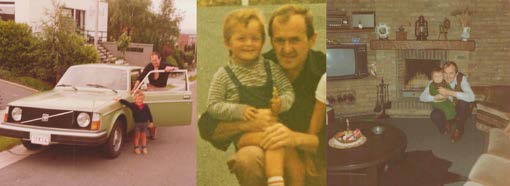
Figure 46.42: Around 1976-1977, the author is shown with his father, Maurice Declercq, at their home, in front of the fireplace. Note that Napoleon’s dish is shown elsewhere in this book. The fireplace was constructed from scratch by Maurice, with the ’help’ of the author, while crawling around and playing with mortar and bricks. The bricks came from an oven in Zingem. We can also see the author, who had just arrived at school, with Maurice around 1978. The author went to kindergarten when he had yet to reach 2.5 years. The image with a car was when Maurice had just arrived home in our new Volvo® car, and the author was proud to
pose for this picture around 1979. (Declercq de Silva Archive)
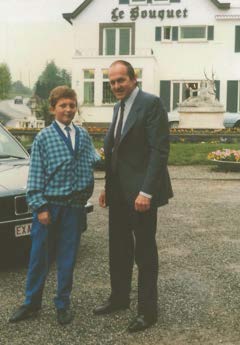
Figure 46.43: 1987, Maurice and Nico Declercq, author
of this book. (Le Bouquet, Kluisbergen, Belgium, just
across from the country residence of King Boudewijn and
Queen Fabiola). (Declercq de Silva Archive)
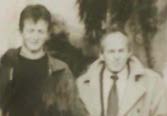
Figure 46.44: The author with his father, Maurice, at Chateau ten
Broucke (’Kasteel Nieuwenburgh’) in Wielsbeke early 1992. (Declercq
de Silva Archive)
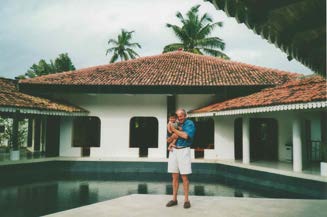
Figure 46.45:
Maurice with his first
grandchild Benjamin, in Sri Lanka in
2000. (Declercq de Silva Archive)
The Desclergues of la Villa Ducal de Montblanc, 2nd ed., Omn., VOL. III
© 2024 Nico F. Declercq
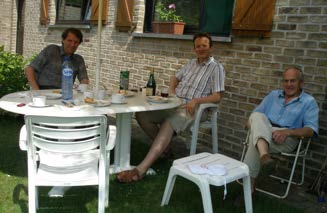
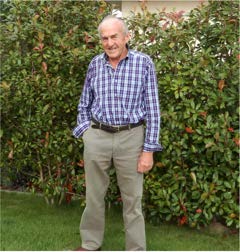
870
CHAPTER 46. MAURICE ALOIS DECLERCQ (DC16) & NELLY MARIA VANGHELUWE
Figure 46.46: Deerlijk, Saint Louis (Sint
Lodewijk), June 19, 2006, from left to
right, Prof. Dr Gennady Nickolaevich Shk-
erdin (Institute of Radio-engineering, Rus-
sian Academy of Science, Moscow), the
author, and his father Maurice A. De-
clercq. (Declercq de Silva Archive)
Figure 46.47: Maurice, on a regular day, posing in the
garden of his son, a few years before his death. The image
radiates simplicity and peace and, above all, a sense of
accomplishment. (Declercq de Silva Archive)
46.2.12 His godfather Daniel Lesage
As explained above, Daniel Lesage was the godfather of Maurice, while Rachelle Declercq was the godmother. He received his name from Rachelle’s husband, Maurice, and Daniel’s father-in-law, Alois.
Daniel Lesage, described in Chapter 64.7.12, was married to Magdalena Meersseman. The couple remained childless and considered Maurice as if he was their son. To Daniel, Maurice was not only his godson, but he was also the son of his brother-in-law, Michel Declercq, through his sister Irma Lesage, but also the past brother-in-law-to-be through Valentine Declercq, who had been Daniel’s fiancé in the past, as described in Chapter 64.7.12 and Chapter 44.5.5.
For Maurice, they provided additional safety, which has been very important due to the difficulties he had as a child, such as his mother’s death when he was just 12 years old.
Maurice spent almost every summer vacation entirely with Daniel in Moorslede and often visited him during the rest of the year.
While he was there, Daniel and Magdalena pampered him and educated him to grasp every possible skill to become a farmer one day. He learned to handle and ride horses, milk cows, grow crops, and enjoy the August sun’s fields’ splendor.
To Maurice, the regular stays in Moorslede, such as in Figure 46.40, were a welcome alternative to his education at home. At home, life was very hectic with nine children. In Moorslede, he found quietness, peace, warmth, and the world in which his mother had been raised.
During his time in Moorslede, Maurice’s interactions extended beyond the Lesage household. He often visited Oscar Lesage’s farm in Beselare, where Emile Lesage and Eudoxie Lammens resided, to purchase dairy butter. These visits to the local farms and neighbors added a social dimension to Maurice’s life, enriching his experiences in the community.
He also visited the nearby Maesen-Haspeslagh family often.
When the author was born in 1975, Magdalena and Daniel were delighted. Indeed, they finally had a ’grandson.’ Unfortunately, Magdalena died when the author was not yet one year old.
Maurice continued to visit Daniel weekly. At some point, Daniel decided to move to a home for older people, but he hated the place. Maurice rescued him after a few years by bringing him to our house in Sint Lodewijk, Deerlijk. Daniel had a perfect time there until his death. We still preserve important, irreplaceable souvenirs of Daniel and Magdalena.
46.2.13 His Son and Grandchildren
As indicated earlier, this book is not about the life of the author and his children. We present the fundamental aspects in Figure
46.41 and provide a vivid portrayal through a series of images scattered throughout this book, such as Figures 46.42, 46.43, 46.44
and 46.45.
46.2.14 Autumn: Happiness
The author observed a profound transformation in his father, Maurice Declercq, who evolved from a less secure individual burdened by childhood traumas, particularly the early death of his parents, into a mature and content human being. This evolution culminated in a life that, by its end, Maurice found to be extraordinarily fulfilling. Although his life was cut short at the age of 74, we remain grateful for the years he was granted, especially considering the near-fatal motorcycle accident described in Chapter 46.2.6.
Life is often a journey of pain, misfortune, and trauma. Yet, if one can reach a state of full maturity, finding peace, harmony,
© 2024 Nico F. Declercq
The Desclergues of la Villa Ducal de Montblanc, 2nd ed., Omn., VOL. III
46.3. NELLY MARIA VANGHELUWE
871
and deep satisfaction, then the journey has been worthwhile. Maurice’s life is a testament to this resilience. The birth of his grandchildren brought him serenity, and when his son, the author, embarked on an academic career, Maurice’s support and pride were instrumental in the author’s success, rekindling the self-confidence that had been eroded in his youth.
Maurice’s realization of his family’s fragmented history, and his belief that past accomplishments had been forgotten, made the author’s genealogical pursuits all the more significant. Maurice’s enthusiasm was tangible as he accompanied the author to various town halls, retrieving certificates of recent ancestors and reestablishing his connection with his heritage. These moments, shared several years before his passing, were filled with a sense of pride and joy that resonated with Maurice’s deep love for his family and his roots.
Although Maurice is no longer with us to witness the culmination of these genealogical efforts, we are confident that, in some way, he remains aware of the legacy uncovered.
Figures 46.46 and 46.47 capture impressions of Maurice in the last decade of his life, reflecting the contentment and peace he ultimately achieved.
46.3 Nelly Maria Vangheluwe
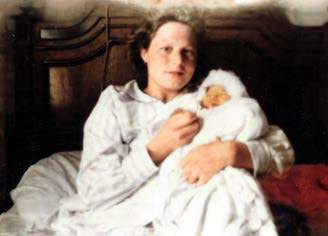
Figure 46.48: Newborn Nelly with her
mother Anna Den Dauw, in 1945. My-
Heritage® colorized this photo. (Declercq
de Silva Archive)
46.3.1 Introduction
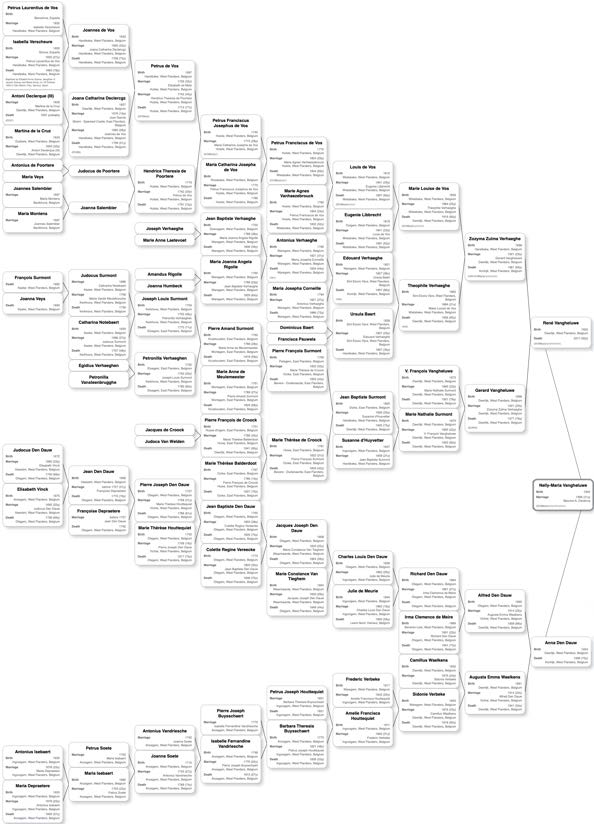
Her most recent ascendants are shown in Figure 46.49.
She grew up mainly with her grandparents Gerard Vangheluwe and Zozyma Verhaeghe, described in Chapter 48.11, and stems from a family of entrepreneurs.
Her grand-uncle, described in Chapter 48.9.5.4, served four years on the war front, received several Belgian recognitions, and was killed during the final offensive in 1918.
Her great-grandfather, described in Chapter 48.9.2.2, was an architect of the practice and a construction entrepreneur and contributed to the Cinquantenaire in Brussels and the Basilica of Dadizele.
The author’s mother’s entrepreneurship made her more progressive than her more conservative husband, Maurice.
The tension did not benefit their marriage, and the siblings interfered too much. Life is like a volcano, and growth is never possible without a bit of fire from time to time. However, external souls should try to extinguish a fire with water, not oil. Pouring oil instead of water is what the author has difficulties with forgiving them.
Despite being born in a village, Nelly’s entrepreneurship fit better in a town or a city, so she has always leaned towards Kortrijk.
She has established more than one company there and had a very successful business in providing book-printing and copy services to the students and other companies at Kortrijk.
As mentioned earlier, the purpose of this book is to write about the past, not the author or his living family. Therefore, a photographic impression of his mother’s past life is given rather than a written story. Life continues and is an uninterrupted gathering of stories and experiences.
46.3.2 Her Childhood
Nelly was born in 1945, on May 26. She was delivered by Dr Philippe Monbaliu, just like Maurice Declercq. Later, her family’s physician would be Dr De Groote. Impressions of her childhood are shown in Figures 46.48, 46.50, 46.51, 46.52, 46.53, 46.54, 46.55,
46.56, 46.57 and 46.58.
46.3.3 Her Youth
Photographic impressions of her youth are shared in Figures 46.59, 46.60, 46.61 and 46.62.
46.3.4 Her Marriage and Family
We also refer to the pictures in Chapter 46.2.7. The author’s parents married on January 28, 1966, at Deerlijk. The church ceremony was in Ghent. Precious memories are shown in Figures 46.63, 46.64, 46.65, 46.66, 46.67, 46.68, 46.69 and 46.70.
46.3.5 Her Career
Her career was introduced above. Sweet memories are shared in Figures 46.71 and 46.72. While a youngster, Nelly also ran a fashion shop at Blankenberge and Ronse. She also established a flourishing restaurant at Nieuwpoort. Her longest career, however, The Desclergues of la Villa Ducal de Montblanc, 2nd ed., Omn., VOL. III
© 2024 Nico F. Declercq
872
CHAPTER 46. MAURICE ALOIS DECLERCQ (DC16) & NELLY MARIA VANGHELUWE
Figure 46.49: Nine ascending generations of Nelly Maria Vangheluwe.
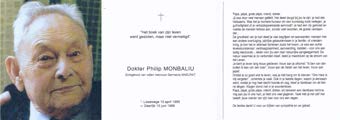
Figure 46.50: The obituary card of Dr Philip Monbaliu, June 15, 1999.
(Declercq de Silva Archive)
© 2024 Nico F. Declercq
The Desclergues of la Villa Ducal de Montblanc, 2nd ed., Omn., VOL. III
46.3. NELLY MARIA VANGHELUWE
873
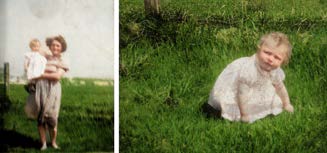
Figure 46.51:
1946, Nelly with her
grandmother and foster mother Zozyma
Verhaeghe. MyHeritage® colorized this
photo. (Declercq de Silva Archive)
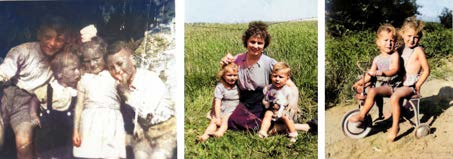
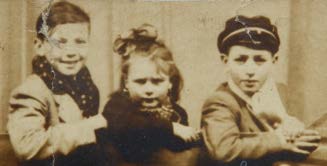
Figure 46.52: From left to right, Gilbert, Lucien, Nelly, Pierre, around 1948. The middle and
right photos show Nelly, Anna and Lucien. MyHeritage® colorized this photo. (Declercq de
Silva Archive)
was when she owned a Copy center, as shown in Figure 46.71.
Nelly’s involvement in a Kortrijk theater production of a Brothers Karamazov-based drama, originally written by Dostoevsky, is a fascinating part of her story. In this narrative, a character named Zozyma takes center stage. It’s interesting to note that this Zozyma was not a lady like Zozyma Verhaeghe, Nelly’s grandmother, but a Russian man.
The Desclergues of la Villa Ducal de Montblanc, 2nd ed., Omn., VOL. III
© 2024 Nico F. Declercq
874
CHAPTER 46. MAURICE ALOIS DECLERCQ (DC16) & NELLY MARIA VANGHELUWE
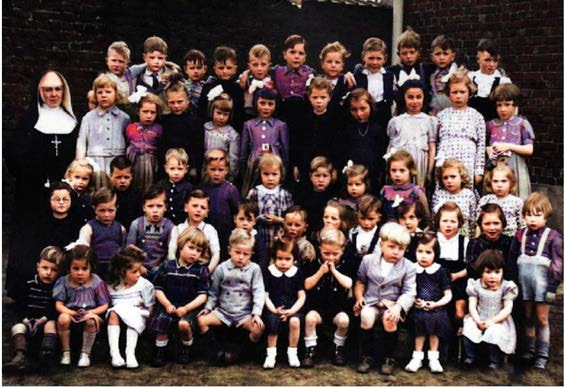
Figure 46.53: School children born in 1945-1949, who took classes near the train station of Deerlijk. Nelly stands third person right of the nun, while Lucien can be found on the 3rd row almost in the middle between two girls. MyHeritage® colorized this photo. (Courtesy of Werner Lamont)
Figure 46.54: Nelly and her brother Lucien helping (probably just
for the picture) as children in the textile manufacturing company of
their father, around 1950-1951. MyHeritage® colorized this photo.
(Declercq de Silva Archive)
Figure 46.55:
Around 1951.
Being
raised by her grandparents Gerard and
Zozyma, her uncles Gilbert (left) and
Pierre (right) and Maurice were like broth-
ers to her. (Declercq de Silva Archive)
© 2024 Nico F. Declercq
The Desclergues of la Villa Ducal de Montblanc, 2nd ed., Omn., VOL. III
46.3. NELLY MARIA VANGHELUWE
875
Figure 46.56: Nelly and Lucien, around
1955. (Declercq de Silva Archive)
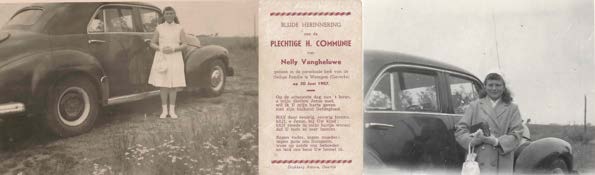
Figure 46.57: 1957, the confirmation of Nelly Maria Vangheluwe, at Gaverke, Waregem, where she attended school at 50 m from Judith Declercq’s home, described in Chapter 44.5.8. (Declercq de Silva Archive) Figure 46.58: Lucien and Nelly around 1960, watching
an engine repair at their home. The others were acquain-
tances. (Declercq de Silva Archive)
Figure 46.59: Nelly with her brother Lucien. (Declercq
de Silva Archive)
The Desclergues of la Villa Ducal de Montblanc, 2nd ed., Omn., VOL. III
© 2024 Nico F. Declercq
876
CHAPTER 46. MAURICE ALOIS DECLERCQ (DC16) & NELLY MARIA VANGHELUWE
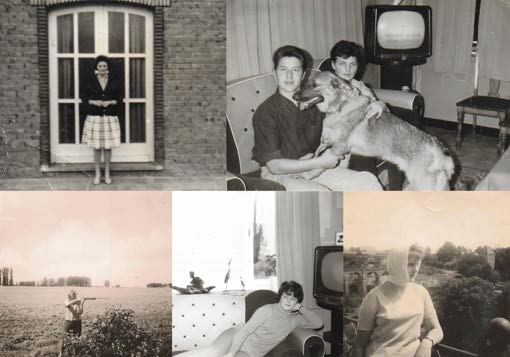
Figure 46.60: Nelly Maria Vangheluwe in 1957-1960. We can, for instance see Lucien and Nelly, with
their famous German Shepard, named ’Gerda.’ A trip through Germany and Italy is also shown. The
author’ s mother can also handle a rifle, if necessary9. (Declercq de Silva Archive) Figure 46.61:
Nelly and her brother Lucien. (Declercq de Silva
Archive)
Figure 46.62: Pierre was Nelly’s youngest uncle and
like a brother to her. From left to right: Pierre, Nelly,
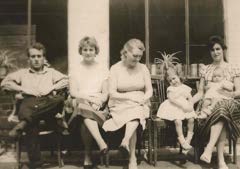
Zozyma Verhaeghe, Christina Vangheluwe (mother of
goal keeper Wouter Biebauw) and her mother Mariette
Vroman, wife of Maurice. (Declercq de Silva Archive)
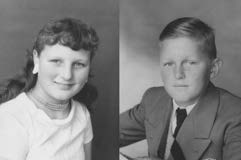
Figure 46.63: Nelly in 1956 and Maurice (DC16) in
1953. They have known each other since early childhood.
(Declercq de Silva Archive)
© 2024 Nico F. Declercq
The Desclergues of la Villa Ducal de Montblanc, 2nd ed., Omn., VOL. III
46.3. NELLY MARIA VANGHELUWE
877
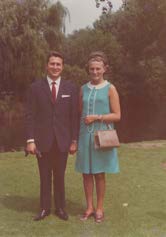
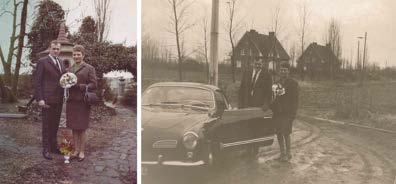
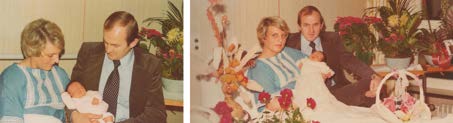
Figure 46.64: 1966, the wedding of Maurice and Nelly, and their homecoming.
(Declercq de Silva Archive)
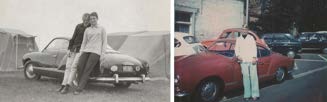
Figure 46.65: Left, Maurice and Nelly,
visiting a camping place on August 9,
1966, in their blue Karmann®
car.
Right, Nelly liked her red Karmann®.
(Declercq de Silva Archive)
Figure 46.66: The birth and baptism of the author, December 27, 1975. (Declercq de Silva
Archive)
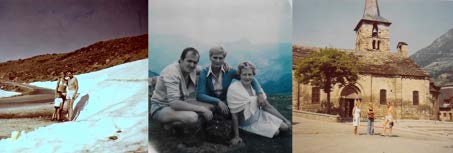
Figure 46.67: Left, 1979, the Sierra Nevada in the South of Spain. Middle and right, the
Pyrenees, possibly on the Spanish side, probably in 1977. (Declercq de Silva Archive)
Figure 46.68: Nelly and Maurice, probably in 1979. (Declercq de
Silva Archive)
The Desclergues of la Villa Ducal de Montblanc, 2nd ed., Omn., VOL. III
© 2024 Nico F. Declercq
878
CHAPTER 46. MAURICE ALOIS DECLERCQ (DC16) & NELLY MARIA VANGHELUWE
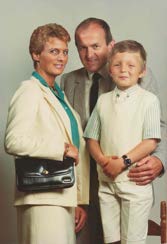
Figure 46.69: The author’s first communion. The blue watch was a
precious gift from his grandfather. (Declercq de Silva Archive)
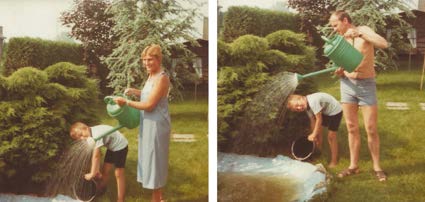
Figure 46.70: Fond of nature, the author has always kept animals, birds, fish etc. This
picture was taken at the pond, fabricated together with his father. As no air pump was
installed, pouring water during hot summer days was necessary to maintain a good oxygen
level. (Declercq de Silva Archive)
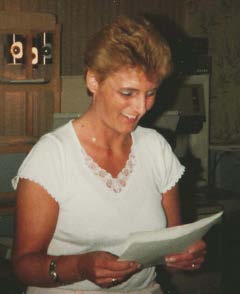
Figure 46.71: Nelly Vangheluwe, a beloved figure in
her hometown of Kortrijk, was renowned for her en-
trepreneurial spirit, most notably through her cherished
business, the Copy House. Over the years, this estab-
lishment, also known as Copytheek and Missis Copy, be-
came a haven for students and small businesses alike.
It was more than just a place to print and copy; it was
a warm, academic-friendly environment where students
could study and seek advice. Nelly’s Copy House was a
cornerstone of the community, fostering a sense of be-
longing and support.
Students saw Nelly not only as a business owner but also
as a mentor and a mother figure. She provided guidance,
a listening ear, and a welcoming atmosphere that made
Copy House a second home for many. Her genuine love
for being around young people and her dedication to their
success impacted countless lives.
Nelly’s passion for her work extended beyond the per-
sonal connections she made. She was deeply fascinated
by the technology of photocopying, which, in the 1980s,
was both sophisticated and elegantly simple. The process
involved a cylindrical drum coated with a photoconductive
material that became conductive when exposed to light.
This drum, charged at high voltage, would reflect light
from white areas of the document, discharging the drum
locally. Toner would then adhere to these charged ar-
eas and be transferred to electrically charged copy paper,
where heat and pressure would fixate it permanently.
Nelly’s Copy House was not just a business; it symbol-
ized her dedication to her community and her love for
nurturing the minds of the future. Her legacy lives on in
the countless students she helped and the warm memories
she created in her cozy, inviting print shop. (Declercq de
Silva Archive)
© 2024 Nico F. Declercq
The Desclergues of la Villa Ducal de Montblanc, 2nd ed., Omn., VOL. III
46.3. NELLY MARIA VANGHELUWE
879
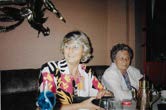
Figure 46.72: Nelly and her mother Anna enjoying a coffee some-
where in Kortrijk during the glorious days of the 1980s and 1990s.
(Declercq de Silva Archive)
The Desclergues of la Villa Ducal de Montblanc, 2nd ed., Omn., VOL. III
© 2024 Nico F. Declercq
CHAPTER 46. MAURICE ALOIS DECLERCQ (DC16) & NELLY MARIA VANGHELUWE
© 2024 Nico F. Declercq
The Desclergues of la Villa Ducal de Montblanc, 2nd ed., Omn., VOL. III
Nico Felicien Declercq (DC17) & Shirani de Silva
47.1 Introduction
This chapter is deliberately short because the author’s life story remains beyond this book’s scope, apart from some glimpses.
47.2 Nico Felicien Declercq (DC17)
In an ancestry context, the author can be found in the following chapters: Chapter 47, as a descendant of the Desclergues and the author of this book; Part X; Chapter 64, as the grandson of Irma Helena Lesage; Chapter 65 as great-great-great-great-great-great-great-grandson of Adrienne de Patin (DP12); Chapter 66.1 as great-great-great-great-great-grandson of Barbara Benoit; Chapter
66.2 as a great-great-great-great-great-great-grandson of Maria Jeanne Christine Benoit; Chapter 67 as the grandson of Anna Den Dauw; Chapter 68 as a ’t Kint descendant; Chapter 69 as the great-great-grandson of Marie Nathalie Surmont; Chapter 71 as the great-great-grandson of Clemens Lammens; and Chapter 72. Furthermore, he is equally referred to in Part XII as Shirani Oluphathage de Silva’s husband.
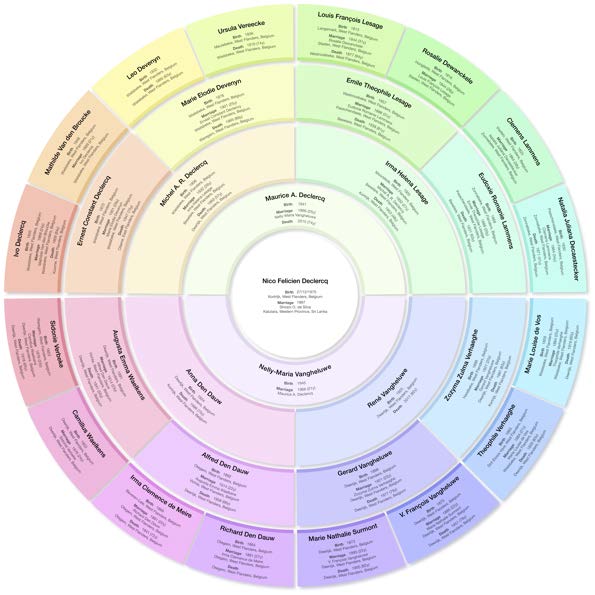
His most recent ancestors are shown in Figure 47.2.
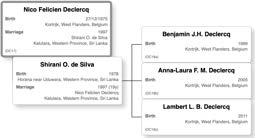
His children Benjamin, Anna-Laura, and Lambert appear in Figure 47.3 and are the ones who can continue this book’s long story.
The author is an only son and grew up with his parents, Maurice Declercq (DC16) and Nelly Maria Vangheluwe, his grand-uncle Pierre Vangheluwe, and his great aunt Jeanette Verbrugghe, his foster parents.
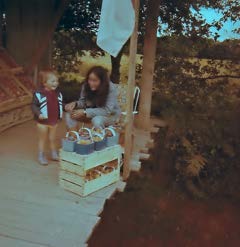
Of the numerous places he has visited, Spain is where he feels most at home, which is no wonder given the context of this book. A photo in Spain is shown in Figure 47.4.
47.3 Shirani Olupathage de Silva
She is Belin de Silva’s daughter and Peres de Silva’s granddaughter. She lost her mother at a very young age and lost her father in 1996. She has Iberian roots and arrived through Goa in Sri Lanka.
She descends from the de Silva family members who established the Uduwara fortress in Sri Lanka around 1600, described in Part
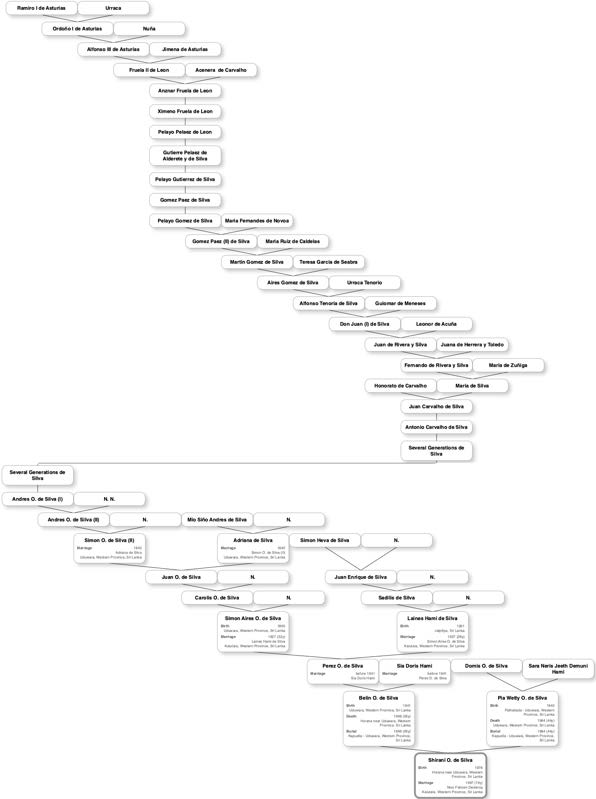
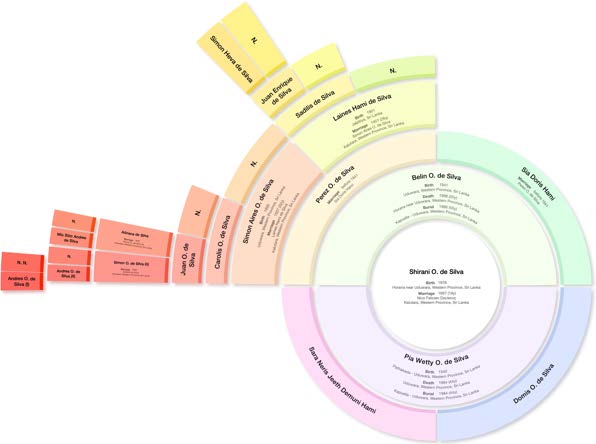
Her most recent ancestors are shown in Figures 47.5 and 47.6.
She is described in Chapter 47 as the author’s wife. She is equally referred to, in much detail, in Part XII and also in the following chapters: Part X ; Chapter 64 as granddaughter-in-law of Irma Helena Lesage; Chapter 65 as great-great-great-great-great-great-great-granddaughter-in-law of Adrienne de Patin (DP12); Chapter 66.1 as great-great-great-great-great-granddaughter-in-law of Barbara Benoit; Chapter 66.2 as a great-great-great-great-great-great-granddaughter-in-law of Maria Jeanne Christine Benoit; Chapter 67 as granddaughter-in-law of Anna Den Dauw; Chapter 68 as a ’ t Kint descendant-in-law; Chapter 69 as great-great-granddaughter-in-law of Marie Nathalie Surmont; Chapter 71 as great-great-granddaughter-in-law of Clemens Lammens; and Chapter 72 as the wife of the author.
47.4 Youngest Declercq Generation
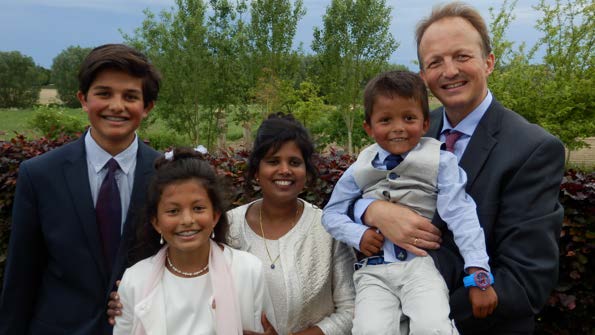
Their children (DC18) are Benjamin Jonathan Howard Declercq (DC18a), Anna-Laura Florence Marion Declercq (DC18b), and Lambert Leander Belin Declercq (DC18c). A family picture can be seen in Figure 47.7.
The Desclergues of la Villa Ducal de Montblanc, 2nd ed., Omn., VOL. III
© 2024 Nico F. Declercq
882
CHAPTER 47. NICO FELICIEN DECLERCQ (DC17) & SHIRANI DE SILVA
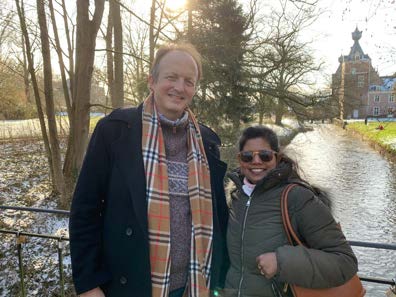
Figure 47.1:
On Valentine’s day, 2021, the author, with his wife and family,
visited Leuven University. It was great to return to Saint Anthony’s chapel near
Tiensepoort. Almost 25 years ago, the author contemplated his life there and decided,
while being a student, to return to Sri Lanka for a big adventure in 1997, of which
his family is the result. Their children took this picture at campus Arenberg during
the visit. (Declercq de Silva Archive)
Figure 47.2: Six ascending generations of Nico Felicien Declercq, the author of this book, are shown as a fan chart.
© 2024 Nico F. Declercq
The Desclergues of la Villa Ducal de Montblanc, 2nd ed., Omn., VOL. III
47.4. YOUNGEST DECLERCQ GENERATION
883
Figure 47.3: The children of Nico Felicien Declercq,
the author of this book, and his wife Shirani O. de
Silva.
Figure 47.4: The author has always loved Spain. The
picture dates from 1978. (Declercq de Silva Archive)
The Desclergues of la Villa Ducal de Montblanc, 2nd ed., Omn., VOL. III
© 2024 Nico F. Declercq
884
CHAPTER 47. NICO FELICIEN DECLERCQ (DC17) & SHIRANI DE SILVA
Figure 47.5: Most recent ascending generations of Shirani O. de Silva.
© 2024 Nico F. Declercq
The Desclergues of la Villa Ducal de Montblanc, 2nd ed., Omn., VOL. III
47.4. YOUNGEST DECLERCQ GENERATION
885
Figure 47.6: Fan chart of six ascending generations of Shirani O. de Silva, spouse of the author.
Figure 47.7: Family picture taken in May 2016. (Declercq de Silva Archive)
The Desclergues of la Villa Ducal de Montblanc, 2nd ed., Omn., VOL. III
© 2024 Nico F. Declercq
CHAPTER 47. NICO FELICIEN DECLERCQ (DC17) & SHIRANI DE SILVA
© 2024 Nico F. Declercq
The Desclergues of la Villa Ducal de Montblanc, 2nd ed., Omn., VOL. IV
The Desclergues of la Villa Ducal de Montblanc, 2nd ed., Omn., VOL. IV
© 2024 Nico F. Declercq
The Maternal Desclergue Ancestry Branch
The Desclergues of la Villa Ducal de Montblanc, 2nd ed., Omn., VOL. IV
© 2024 Nico F. Declercq
The Maternal Desclergue Ancestry Branch beginning
with Joana Catharina Declercgz (DC08b) & Joannes
De Vos
48.1 Introduction
Here, we describe a second blood-relationship with the Desclergues of Montblanc. Before we continue, we prefer to highlight Chapter
28.5, connecting events in Harelbeke with events in Montblanc.
The paper trail showed that the author descends from the Desclergues through his father and his mother before a DNA investigation was made. The latter confirmed the discovery.
In particular, the maternal ancestry begins with a sister, Joana Catharina Declercgz (DC08b), of Pere Declercgz (DC08), husband of Marie Prienne.
Joana Catharina married Juan Garcia, a soldier at the Spaniard castle of Ghent, in 1676. Later, she married Joannes de Vos in 1685 in Harelbeke. The latter was already of considerable age.
The couple had one son, Petrus de Vos, who survived childhood but was orphaned at 11. He was probably raised by the Maes (or de la Maza) family. He stayed in touch with his Desclergue family through his auntie Maria Declercgz (DC08d), who married Egidius Vandeputte or Du Puich.
We descend patrilineally from Pere Declercgz (DC08) and matrilineally from Joana Catharina Declercgz (DC08b).
48.2 A DNA Investigation
The reader may be interested in checking out Chapter 73.10.3.6 first.
Because Nico F. Declercq’s parents are distantly blood-related through their common ancestors Desclergue - de la Cruz, significant traces of this relationship can be retrieved in his DNA. GEDmatch® has a tool1 to make such investigations by comparing corresponding DNA sequences on chromosome couples. One sequence comes from one parent and the other from the other parent.
Luckily, we have a sample to compare with, namely that of the brother of Shirani de Silva. Their parents had common ancestors around 4-5 generations ago, and we used it as calibration.
We have checked the most extensive sequence of DNA for each chromosome, which appears equal on both pairs. These numbers were then compared between both samples. We obtained the following numbers:
The maximum sequence for Declercq was 562 (chromosome 15), while 3805 (chromosome 3) for de Silva; the minimum of the common sequences for Declercq was 102 (chromosome 16), while 119 for de Silva (chromosome 21); the average sequence for Declercq was 222, while 832 for de Silva.
If we assume that the numbers are, on average, divided by 2 for every subsequent generation, then, as a rough estimate, a common ancestor of Declercq’s parents appears around nine generations ago, while for de Silva, approximately 4-5 generations ago.
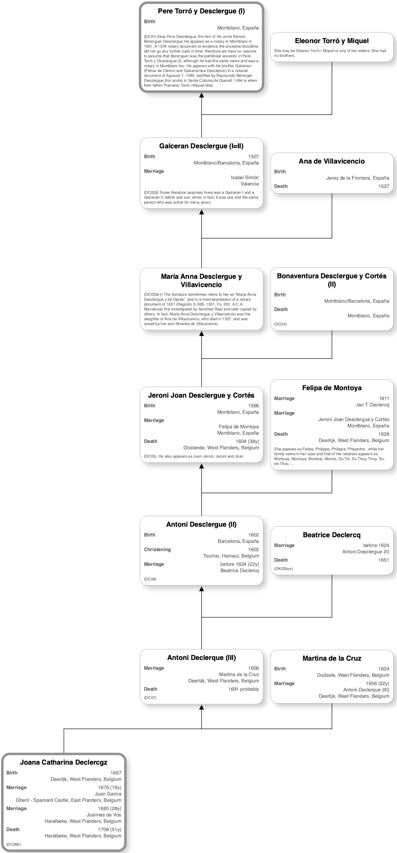
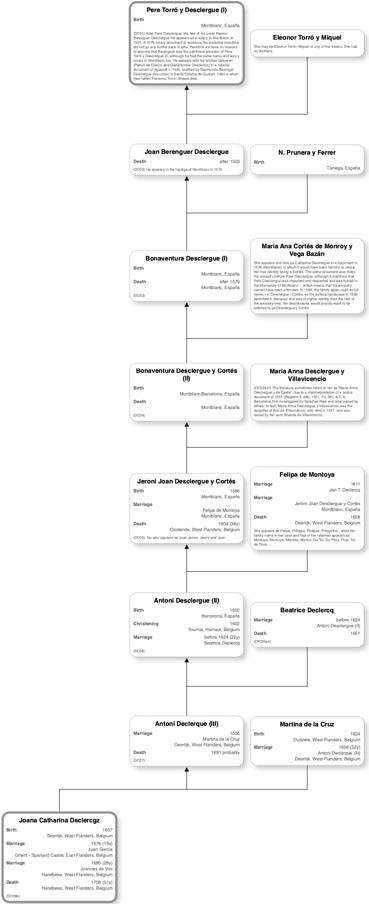
Indeed, the common ancestors of Declercq’s parents lived nine generations ago and were Declercq-de la Cruz. We refer to earlier chapters for the ancestry before Antoni Declerque (DC07) and Martina de la Cruz. One of their children was Joana Catharina Declergz (DC08b), introduced in Chapter 37.9.3. Her ancestry until Pere Desclergue (DC01) is shown in Figure 48.1.
48.3 Joana Catharina Declercgz (DC08b)
Before reading this chapter, it is crucial to check Chapter 37.9.2, devoted to Maria Declercgz (DC08d) because she and her family stayed connected to the offspring of Joanna Declercgz (DC08b), in Figure 48.3, after her death. Furthermore, Joana’s birth and first marriage are described in Chapter 37.9.3.
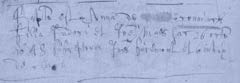
Joanna Catarina Declercgz (DC08b) was introduced in Chapter 37.9.3. Her baptism is shown in Figure 48.4.
To allow reading the godmother’s name on this certificate of 1657, we have taken a mirror image of the backside of the page and performed an overlay experiment. It allowed identification of which lines on the paper were written on Joanna’s certificate and the back. Hence, we have concluded that the godmother was Joanna Tila or Joanna De Tila (spelled as ’Tdylaet’).2 We found the family name De Tila in many documents in Spain in the 17th century. Also, the name Edilla is Spanish. Either way, De Tila or Edilla is linked to the Maza family, as seen next.
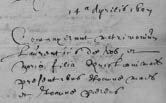
Note that a Margareta De Tila (’Tylaet’) was also a godmother, on baptism in Deerlijk in 1644, in Figure 48.5, to Guilelmus Vercruyce, son of Petrus Vercruyce and Rogeria de Graue or De Grave. The latter family also appears in Figure 48.35 on page 904.
Petrus Vercruyce was either the brother or the father of Martina Vercruyce, as they had the same name and were both of sufficient age in 1644 to be godparents.
An early connection between the de la Cruz family and de Tila is also shown in Figure 37.81 on page 659.
When the Desclergue family fled to Ghent during the French occupation, described in Chapter 34.10, Joana Catharina Declergz (DC08b) married a soldier at the Spaniard Castle. The marriage was in 1676, and the groom was Juan Garcia.
1Runs of Homozygosity
2In that period, the name Edylaet also appeared and still causes some doubt.
The Desclergues of la Villa Ducal de Montblanc, 2nd ed., Omn., VOL. IV
© 2024 Nico F. Declercq
CHAPTER 48. THE MATERNAL DESCLERGUE ANCESTRY BRANCH BEGINNING WITH JOANA
892
CATHARINA DECLERCGZ (DC08B) & JOANNES DE VOS
Figure 48.1: Relationship chart relating Joanna Declergz (DC08b) to Don Pere
Desclergue (I) (DC01) in Montblanc, Spain, first connection.
© 2024 Nico F. Declercq
The Desclergues of la Villa Ducal de Montblanc, 2nd ed., Omn., VOL. IV
48.3. JOANA CATHARINA DECLERCGZ (DC08B)
893
Figure 48.2: Relationship chart relating Joanna Declergz (DC08b) to Don
Pere Desclergue (I) (DC01) in Montblanc, Spain, second connection.
The Desclergues of la Villa Ducal de Montblanc, 2nd ed., Omn., VOL. IV
© 2024 Nico F. Declercq
CHAPTER 48. THE MATERNAL DESCLERGUE ANCESTRY BRANCH BEGINNING WITH JOANA
894
CATHARINA DECLERCGZ (DC08B) & JOANNES DE VOS
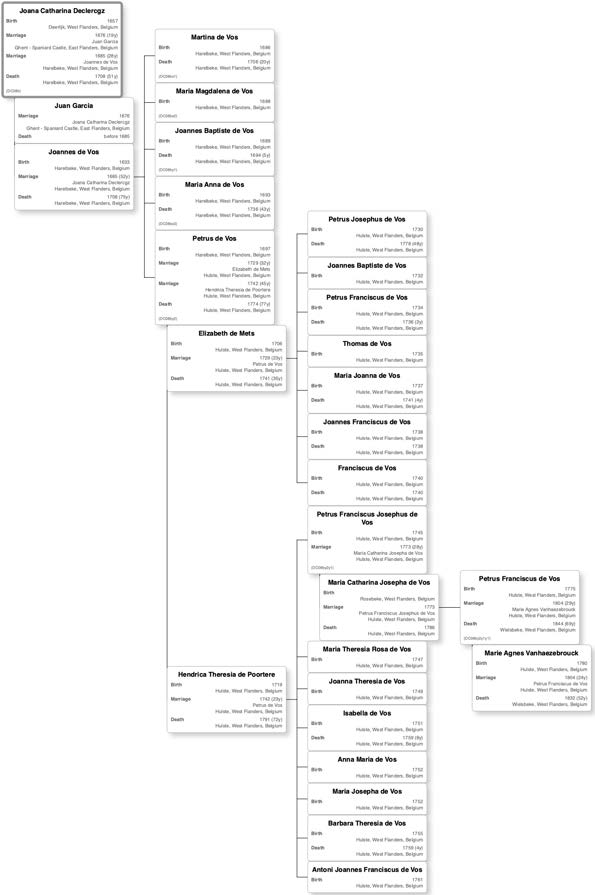
Figure 48.3: Three descending generations of Joana Declercgz (DC08b)
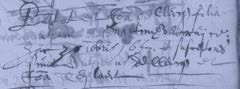
Figure 48.4: December 20, 1657, Deerlijk, the baptism
of Joana Catharina Declercgz (DC08b), daughter of An-
toni Declerque (III) (DC07) and Martina Vercruyce /
De la Cruz. The godfather was Antoni Desclergue (II)
(DC06), godmother was Joanna De Tila (’Tedylaet’).
© 2024 Nico F. Declercq
The Desclergues of la Villa Ducal de Montblanc, 2nd ed., Omn., VOL. IV




48.3. JOANA CATHARINA DECLERCGZ (DC08B)
895
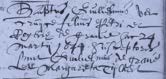
Figure 48.5: March 24, 1644, Deerlijk, the baptism of Guillelmus Ver-
cruyce, son of Petrus Vercruyce and Rogeria de Graue. The godparents
were Guillelmus de Graue and Margareta De Tila (’Tylaet’).
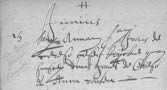
Figure 48.6: 1708, July 5, the funeral
at Harelbeke of Joana Catharina Declergz
(DC08b).
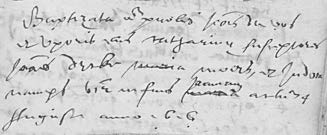
Figure 48.7:
1590, September 7, Ko-
rtrijk, the baptism of Pau Cortillo, i.e.
’Paulus Lindenhove’ , son of Pau(lus).
The godfather was Petrus Laurentius de
Vos (’Laurentius de Vos’), the godmother
was Paschasia Vincke.
Figure 48.8:
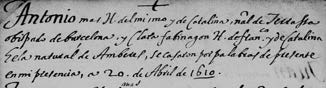
Ghent, Spaniard castle,
April 20, 1610, the marriage of Antonio
Mas from Barcelona and Clara Fabinagon
from Antwerp.
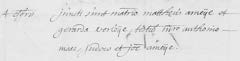
Figure 48.9: Harelbeke, October 4, 1612, the marriage
of Gerarda Verleye and Mattheus Ameye. The witnesses
were Antheunis m(ercato)ro Maes and Joos, and Joannes
Ameye.
Figure 48.10:
Harelbeke, April 21, 1613, the baptism of Maria de la Maza
(’Maes’), daughter of merchant Antoni de la Maza (’Antony Maes mercatoris’).
The godfather was Domingo Caninico de la Maza (’Dominus Canonicus Maes’)
and Maria, the mother’s sister (’Maria soror matris’).
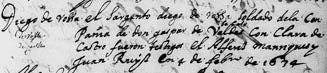
Figure 48.11: 1634, February 4, Ghent
Spaniard Castle, the wedding of Diego de
Vossa and Clara de Castro, the witnesses
were ’Alferes’ Manriques and Juan Ruiz.
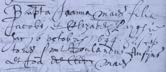
Figure 48.12:
Deerlijk, October 16, 1644, the baptism of Joanna
Maes, daughter of Jacobus Maes and Elisabeth Langhie. Her godfa-
ther was Roulandus du Syns, and her godmother was Joanna Maes.
Languie/Langie is a name that appears in the north of France and
is probably linked to the Douai and Cambrai areas. Interestingly, the
Priest almost wrote Joana Declergz (DC08b) instead of Joana Maes.
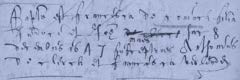
Figure 48.13: Deerlijk, December 16, 1647, the bap-
tism of Francesca de Coninck, daughter of Judocus De
Coninck and Joanna Maes. The godfather was Antoni
Desclergue (DC06), and the godmother was Francesca
Verlinde. Interestingly the Priest first wrote Joanna De-
clergz (DC08b) instead of Joana Maes.
Figure 48.14: Deerlijk, October 26, 1648, the baptism
of Anna De Coninck, daughter of Judocus Deconinck and
Joanna Maes. The godfather was Joannes Suremont, and
the godmother was Beatrice Declercq (DK02byx), the wife
of Antoni Desclergue (DC06).
Figure 48.15: Harelbeke, May 14, 1614, the baptism of Cecilia Van-
denberghe, daughter of Laurentius Vandenberghe and Catharina De
Mare. The godfather was Laurentius De Vos, and the godmother was
Cecilia Rapsaet.
The Desclergues of la Villa Ducal de Montblanc, 2nd ed., Omn., VOL. IV
© 2024 Nico F. Declercq


CHAPTER 48. THE MATERNAL DESCLERGUE ANCESTRY BRANCH BEGINNING WITH JOANA
896
CATHARINA DECLERCGZ (DC08B) & JOANNES DE VOS
Figure 48.16: Harelbeke, April 4, 1616, the baptism of Joan De Cerezo
y Burke (’Joannes Bryche’) son of Natalis De Cerezo y Burke from the
restaurant (’camponis’), mother was Elizabeta van Harlebeke. The god-
father was Joan de la Maza (’Joannes Maes’). Based on other certifi-
cates, we must, however, conclude that the mother was Elizabeta van
Hollebeke.
Figure 48.17: Bruges, Saint Salvator, June 25, 1620, the baptism of
Anna Brice de Ceresco, daughter of Juan Brice de Ceresco. The god-
father was Juan de Ceresco, and the godmother was Anna (de Portea
i) Roure (’Rouker’).
Figure 48.18:
Harelbeke, September 23, 1624, the baptism of Martina
Welleyn, daughter of Jacobus Welleyn and Maria Van Dycke. The godfa-
ther was Laurentius De Vos , censitor in Deerlijk, and Martina Huizentruit.
Note that this certificate is evidence that Laurentius De Vos was linked to the
Spanish regime in Belgium, i.e. as a censitor or a tax collector.
Figure 48.19: Veurne Sint Walbruga, April 14, 1607, the marriage
of Petrus Laurentius de Vos and Maria Maes, daughter of Guilermo de
Maza/Maes (spelled as Guirlemi Maes, the ’r’ appearance in his first
name, even on the wrong place, probably indicates that he pronounced
it in Spanish as only in Spanish and Portuguese we find the formation
of an ’r’ in the local form of Guillelmus-Willem-Guillaume), witnesses
were Joanna Maza (’Maes’) and Joanna Fierens.
Figure 48.20:
1616, Pittem, the bap-
tism of Judocus De Vos, son of Joannes
De Vos (brother of Laurentius De Vos)
and Catarina, the godfather was Joannes
Duch, and the godmother was Maria Maes
(maybe this was Maria de la Maza, per-
haps she was the first wife of Laurentius
De Vos). Note that ’Duch’ is a Catalan
family name.
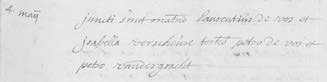
Figure 48.21: 1632, May 4, Harelbeke,
the 3rd marriage of Petrus Laurentius de
Vos and Isabella / Elisabeth Verscheure,
the witnesses were Petrus De Vos and
Petrus Van der Gracht.
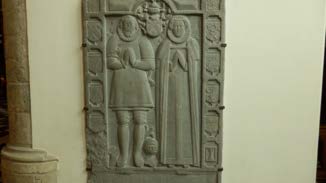
Figure 48.22: At the church of Geluwe
(2013), a memorial stone of the family
Van der Gracht (1623) can be seen. (De-
clercq de Silva Archive)
© 2024 Nico F. Declercq
The Desclergues of la Villa Ducal de Montblanc, 2nd ed., Omn., VOL. IV
48.3. JOANA CATHARINA DECLERCGZ (DC08B)
897
The life of a soldier was hazardous. After his death, she married Joannes de Vos, a widower, in 1685 at Harelbeke. Joana Catharina Declergz (DC08b) was born in Harelbeke in 1657 and died there in 1708, in Figure 48.6.
48.3.1 Early Link Between Desclergue and de Vos
There was a connection between the Declercq branch of our family and the de Vos family that predated the marriage of Joanna Catharina Declercgz and Joannes de Vos.
Indeed, in Figure 34.256 on page 611, we see that Nicolas Declercq was acquainted with Petrus Laurentius De Vos in 1621. The families Declercq and De Vos would later merge through Beatrice Declercq (DK02byx), cousin of Nicolas Declercq, through the marriage, in 1685, of Joanna Catharina Declercgz, the daughter of Antoni Declerque (DC07) and Martina de la Cruz, with Joannes de Vos, the son of Petrus Laurentius de Vos and Isabella Verscheure.
48.3.2 Link Between Desclergue, De Vos and Maes (Mas / de la Maza)
Raymond Fagel3 describes how several Spanish and their families had become Bourgeois or Bourgeois Forain (’Burgher’ and ’Outside Burgher,’ or ’Poorter’ and Buitenpoorter’) already in the 16th century and consider it as an act of integration. The book even mentions families with such ties from early in the 16th century:
Quinto from Zaragoza, Garcia, De Paredes, Garcia Almarez and Dalmares from Segovia, De Vaille (converso from Burgos), de Haro, de Muxica, de Valle, de Castro, De Valladolid, de la Palma, de Medina, Perez de Aresti, Ortiz, de Segura, de Ayala, de Mena, de Polanco, Rodriguez Gallo, de Ampuero etcetera.
Interestingly, the book also states that merchants from the Netherlands went to Spain in the 15th and 16th centuries. Therefore, it may only sometimes be clear if someone was from Flanders but resided in Spain or if someone in Flanders, from Spain, had earlier roots in Flanders. Nevertheless, the book shows, among many other interesting aspects, such as Flemish participation in the trade with the Americas, that family names were smoothly transformed from one language to the other and vice versa, such as, for instance, ’Van Hoof ’ which became ’De Cortés’ because the latter existed in Spain. Perhaps a compelling case is that of a merchant
’de la Fosa,’ which in Dutch would quickly transform to ’De Vos.’ The same would be true for ’De Poch.’ Genetic evidence of such transformations is found in Chapter 73.10.3.6. It is found in Chapter 29.8.5 that there are secure connections with, for instance, the families De Vos and Maes (Mas / de la Maza) and that the specific persons appearing are probably of Spanish descent.
Therefore, perhaps some are Spanish and of old Flemish origins; it is impossible to tell. The fact is that they were tightly connected with the Spanish.
Numerous sources confirm that there were many connections between Flanders and Spain through merchants from Flanders visiting or even residing in Spain and vice versa.
W.P. Blockmans and Walter Prevenier4 describe how international communities, small in number, formed elite members of the Flemish society in several cities. In Antwerp around 1560 AD, there were around 1100 foreign merchants with a total population of approximately 100000; 450 were Spaniards and Portuguese, 200 Italian, 300 German, 100 French, and 50 English.
The same book also states that even before, more precisely around 1422 and 1462, Portuguese and Castilian skippers had disputes with each other.
The book also mentions that, typically, foreign merchants did not integrate except the Iberians. Iberians usually married local women. They continued this tradition worldwide, as can also be seen, for instance, in India, Sri Lanka (described in Chapter 54.8),
Brazil, and all other places where Portuguese and Spanish merchants, military, and governors arrived.
In 1590, in Figure 48.7, we found Petrus Laurentius de Vos (’Laurentius de Vos’) as godfather to the son of a Spanish-Catalan individual, Pau Cortillo (’Paulus Lindenhove’).
In 1607 (April 14, folio 179), Petrus Laurentius de Vos married Maria de la Maza (I) at Veurne (Sint Walbruga). Maria de la Maza (I) was the daughter of Guillermo de la Maza. Witnesses were Joan de la Maza and Joanna Fierens. The certificate is shown in Figure 48.19.
On April 20, 1610, at the Spaniard Castle of Ghent in Figure 48.8, Antoni Mas married Clara Fabinagon. The groom was from Terrassa near Barcelona, while the bride was from Antwerp (’Amberes’). The groom’s parents were Antonio Mas and Catalina, and the bride’s parents, Francisco Fabina and Catalina.
In Figure 48.9, we found a wedding in Harelbeke of Ameye, with merchant Antoni Mas (’Antheunis Mercatoro Maes’) as a witness.
The family name Ameye existed locally, but also in Spain, typically spelled as ’Amaya.’
We found a baptism at Harelbeke of Maria de la Maza (II) in 1613, in Figure 48.10, daughter of merchant Antoni de la Maza. The godfather was Domingo Canonico de la Maza, and the godmother was Maria, the mother’s sister.
Geneanet® provides a document of a wedding on December 9, 1646, in the Parroquia de Santa Maria de la Asunción of Laredo, Cantabria, of Maria De Tila de la Maza (III), with Felipe Rosillo Hoyo. The parents of Maria De Tila de la Maza (III) were Diego De Tila Muñoz and Maria de la Maza (IV). We know that the children of Maria Maza (IV) and Diego De Tila were born between 1630 and 1644, and she had godchildren between 1639 and 1662 in Spain.
We need more information to identify Maria de la Maza (I, II, III, IV). However, a likely scenario is that Antonio, Guillermo, Domingo Canonico, Joan, and Maria (IV) were siblings. Maria (IV) remained in Spain and married Diego De Tila Munôs. They had a daughter, Maria (III), who married in 1646 to Felipe Hoyo. Antonio was married to a sister of a particular Maria; they had a daughter at Harelbeke in 1613, Maria (II), and Domingo Canonico served as godfather together with Maria, sister of the mother.
Guillermo had a daughter, Maria (I), at Veurne in 1607; his sister Joan was the godmother.
Perhaps Joanna De Tila was a sister of Diego De Tila and was linked to the Maza family, which was linked to de Vos and Desclergue.
We found a Domingo de la Maza, on a document of Geneanet®, who married Catalina De Manzinas on February 9, 1634, in the Cathedral of Valladolid in Spain.
On February 4, 1634, in Figure 48.11, we found a marriage between Diego de Vossa, a sergeant in the Company of Don Gaspar de Valdes, and Clara Castro. The witnesses were alferes Manriques (see also Chapter 29.5.4), in whose company, early on, Jeroni Joan Desclergue y Cortés (DC05) and Carlos Coloma de Saa had been military, and Juan Ruiz, known as the verger of the church.
We found a baptism in Deerlijk in 1644, in Figure 48.12, where the Priest wrote DeClercq and then changed his mind and wrote Maes. We are not sure who was at this event, but it may indicate that Declercqs and Maes families were present during the baptism; therefore, the Priest was confused.
3Raymond Fagel, ’De Hispano-Vlaamse Wereld, De contacten tussen Spanjaarden en Nederlanders, 1496-1555,’ Katholieke Universiteit Nijmegen, 1996
(PhD Thesis).
4W.P. Blockmans and Walter Prevenier, ’Prinsen en Poorters,’ 1998.
The Desclergues of la Villa Ducal de Montblanc, 2nd ed., Omn., VOL. IV
© 2024 Nico F. Declercq
CHAPTER 48. THE MATERNAL DESCLERGUE ANCESTRY BRANCH BEGINNING WITH JOANA
898
CATHARINA DECLERCGZ (DC08B) & JOANNES DE VOS
We must warn anyone searching for certificates that confusion between our Antoni Desclergue (DC06) and his step-family Antonius Declercq (DK03dyay1) is imminent. The latter was married to Elizabeth de Laere and was a son of Jan Declercq (DK03dya) and Jossina Nooters. Jan Declercq (DK03dya) was Antoni’s (DC06) stepbrother. This step-family is described in Chapter 34.13.7. In the 1640s, we see Antonius and Elizabeth Declercq-de Laere appearing a couple of times at baptisms for the children of Joannes Maes and Joanna Payge or Page. Hence, we assume that there were several Maes families in the area. We refer to Figures 48.13
and 48.14.
Apart from the possible links with Maes or Maza and indications of Spanish connections in this realm, we know that, much later, our Joana Declercgz (DC08b), daughter of Antoni Declerque (III) (DC07) and Martina Vercruyce / De la Cruz, married Joan de Vos in 1685 and that she would die in 1708 at Harelbeke. We have found indications of a Spanish link for all mentioned persons and events, as read below.
Desclergue and De Vos (or perhaps ’Poch’ or ’de Poch’) had old links.
Indeed, in 1607 (April 14, folio 179, shown in Figure 48.19), Petrus Laurentius de Vos married Maria Maes at Veurne (Sint Walbruga).
Several documents reveal that Joanna Declercgz (DC08b) had connections with the Maes family, and it is even almost sure that her son Petrus De Vos (DC08by2) grew up with the Maes family after he was orphaned, as can be seen later.
Petrus Laurentius de Vos married again at Harelbeke in 1632, on May 4, to Isabella Vanderscheure in Figure 48.21; witnesses were Petrus De Vos and Petrus Van der Gracht.
This marriage would result in a son, Joannes De Vos, in 1633, who married Joana Declercgz (DC08b) in 1685 in a second marriage.
We must here also repeat that Joana’s sister, Maria Declergz (DC08d), born at Deerlijk in 1665, married Egidius Vandeputte (Du Puich) in 1701 and that this Vandeputte (Du Puich) was likely linked to the Desclergue family through Beatriz de Pinto on the one hand, and the construction of the Chapel in Deerlijk, described in Chapter 49, on the other.
A Spanish family in Belgium with only a few members, namely in Bruges and Harelbeke, carried the name ’de Cerezo y Burke.’
In Harelbeke, we found a baptism of Joanes Bryche in 1616, son of Natalis from the restaurant (camponis) to whom Joan de la Maza (’Joannes Maes’) served as godfather.
In Bruges, this family appears at the baptism of Anna De Cerezo y Burke (’Anna Decereso, geseit Bryche’), daughter of Joan De Cerezo y Burke (’Joannes Decereso, geseit Bryche’), in 1620. Her godfather was Joan de Cereso, and her godmother was Anna Coucke. We refer to Figures 48.15, 48.16, 48.17 and 48.18.
Note that Figure 48.18 is evidence that Laurentius De Vos worked for the Spanish regime in Flanders because he was censitor; in other words, he was a tax collector.
More paper trails are shown in Figures 48.19 and 48.20.
In Pittem-Wingene-Tielt, the De Vos family probably became acquainted with the Declercq family, or even sooner, back in Spain.
The De Vos family will also link to Pedrolo y Desclergue; see further.
Despite the local appearance of the family name ’Maes,’ we should remember that certain appearances may have been of Spanish origins, such as ’Mas’ from the Barcelona area, and even French, where ’Masse’ also existed. We found conclusive evidence, neither pro nor contra.
In fact, at the baptism of Joanna De Vos, we see De Tila as a godmother.
In Cantabria, we also found a married couple, De Tila-Maza. It may be that the godmother De Tila was related to Maria Maza.
Note that, e.g., in Kortrijk, we also find Massa/Masse/Mazza as a family name during the period when many Spanish soldiers resided in and around the town; examples are Anthonia Masse (godmother to Maria Hubble, January 8 1592, Kortrijk, baptisms Saint Martin) and Joannes Masse (godfather to Joannes O’ Brien, April 28 1594, Kortrijk, baptisms Saint Martin).
Hence, there is definitely a link at Kortrijk between Massa/Mas/Masse and foreigners.
For instance, Francesc de Mazza appears on baptism certificates at Antwerp (San Felipe de la Castile) in the early 1600s, and Pedro de Masa appears on a wedding certificate there.
Petrus Laurentius de Vos had already been married once at Harelbeke, so he must have married at least thrice.
Indeed, in 1625 and 1629, we have found two baptisms of children of Petrus Laurentius de Vos and Catarina Vanbaelbeerghe, namely Petrus De Vos (Harelbeke, September 19, 1625, the godfather was Petrus De Vos, godmother was illisible Degrybenaek) and Maria De Vos (Harelbeke, October 1, 1629, godparents not mentioned). His third marriage is shown in Figure 48.21.
48.3.3 The Vercruyce and Van der Gracht Families in a Record of King Felipe IV of Spain
In the documents related to the marriage and family of Declercq and De Vos, in Deerlijk-Harelbeke-Hulste, we observe the appearance of Charles Vercruyce and Petrus Van der Gracht.
For instance, the latter family was historically significant in our region, as shown in Figure 48.22. How are these persons linked to each other? They may be connected through King Philippe IV of Spain (Felipe IV). We cannot be sure about the identity of the persons below.
Nevertheless, it is noteworthy to mention the following discovery. We found an interesting document at Lille5
’Registre des rémissions des années XVIe cinquante sept, cinquante buicet (huit) et XVIe cinquante neuf. Lettres de relief d’ appel accordées par le roi Philippe IV à Charles Vercruyce (’Vander Cruyce’) (Bruges), Pierre Van der Gracht (Helchin), . . . ’ This is quite remarkable.
Martine Vercruyce, from Dudzele (close to Bruges), and Charles Vercruyce may indeed be linked through this document; the document also mentions Petrus (’Pierre’) Van der Gracht, from Helchin (right in between Deerlijk and Tournai).
Note that the Van der Gracht family acquired Hulste in 1618.6
48.4 Joannes De Vos, or Joan de Poch
As far as we discovered, Joannes de Vos was a Belgian of Flemish descent, but he went to Spain, either as a military or, more likely, for trade. He married there, had a daughter, and returned to Flanders when his wife died. He married a Desclergue in Flanders in a second marriage, while his Spanish daughter later married a blood relative of the Desclergues. He was known as Joan de Poch in Spain because this family name is widespread in Barcelona, where Joan resided.
Based on the records we discovered, the parents of Joannes de Vos were well-connected with the Spanish in Flanders, including de 5B.1823 (Registre) - In folio, parchemin, 97 feuillets; 1659-1669
6Willem van der Gracht bought Hulste in 1618 from the Saint Salvator Kapittel of Harelbeke; Willem was Lord of Schiervelde and Passchendaele.
© 2024 Nico F. Declercq
The Desclergues of la Villa Ducal de Montblanc, 2nd ed., Omn., VOL. IV

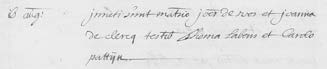
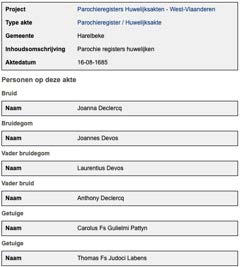
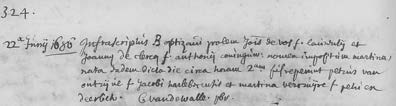


48.4. JOANNES DE VOS, OR JOAN DE POCH
899
Figure 48.23: The baptism of Joannes De Vos, Harelbeke, February 22,
1633. He was the son of Petrus Laurentius de Vos and Elizabeta or Is-
abella Verscheure or Vanderscheure. His godfather was Juan de Montoya
(’Joannes De Montause’), his godmother was Catarina Gol/Galés/Gals.
Perhaps the mother was of Spanish descent, namely Isabella De Segura.
Figure 48.24:
Harelbeke, August 16,
1685, the marriage of Joanna Declercq
and Joannes De Vos. The witnesses were
Thomas Labens and Charles Patin. The
transcript is shown in Figure 48.25.
Figure 48.25: Harelbeke, August 16, 1685, the mar-
riage of Joanna Declercq and Joannes De Vos. The wit-
nesses were Thomas Labens and Charles Patin. This
transcript of Figure 48.24, made by the Belgian archives,
is added because more information appears included by
the transcriptor of the Belgian Archives, probably com-
ing from another copy of the marriages of Harelbeke. It
shows that Joannes De Vos was a son of Laurentius, that
Joanna is Antoni’s daughter and more information on
the witnesses.
Figure 48.26:
Harelbeke, June 22, 1686, the baptism of Martina De Vos
(DC08bx1), daughter of Joannes De Vos (son of Petrus Laurentius de Vos, ’Lau-
rentius De Vos’) and Joanna Declercq (daughter of Antoni Declercq). The godfather
was Petrus Van Outryve (son of Jacobus) from Harelbeke and Martina Vercruyce
(daughter of Petrus) from Deerlijk.
Figure 48.27: Harelbeke, November 3, 1688, the baptism of Maria Magdalena De
Vos (DC08bx2), the daughter of Joannes De Vos (son of Petrus Laurentius de Vos,
’Petrus’) and Joanna Declercq (daughter of Antoni). The godfather was Antoni
Declercq (DC07) (son of Antoni Desclergue (DC06)) from Deerlijk and Magdalena
Van Outryve (daughter of Jacobus) from Harelbeke.
Figure 48.28: Harelbeke, December 11, 1689, the baptism of Joannes Baptiste De
Vos (DC08by1), son of Joannes De Vos and Joanna Declercq. The godfather was
Joannes Declercq (son of Antoni), and the godmother was Martine De Vos (daughter
of Carolus) from Deerlijk.
The Desclergues of la Villa Ducal de Montblanc, 2nd ed., Omn., VOL. IV
© 2024 Nico F. Declercq


CHAPTER 48. THE MATERNAL DESCLERGUE ANCESTRY BRANCH BEGINNING WITH JOANA
900
CATHARINA DECLERCGZ (DC08B) & JOANNES DE VOS
Figure 48.29: Deerlijk, February 22, 1665, the baptism of
Martina De Vos, daughter of Charles de Vos and Judoca de
Meestere. The godfather was Oliverius Nolf, and the godmother
was Martina Christiaens.
Figure 48.30: Deerlijk, February 5, 1675, the baptism
of Judoca de Vos, daughter of Charles de Vos and Judoca
de Meestere. The godfather was Stephanus de Vos, and
the godmother was Margarita de Vos.
Montoya. So, very likely, they were acquainted with the Desclergues first in Flanders and later in Spain, not vice versa.
Joannes de Vos had the following siblings: Joanna (1636), Margareta (1638), Judoca (1641), Martina (1643) and Elisabeta (1646).
His parents were Laurens de Vos and Isabelle Verscheure. His father Laurens, also known as Petrus Laurentius de Vos, was a son of Pieter de Vos (who died in Harelbeke on April 4, 1621) and Michelina Van Meulebroucke (who died in Harelbeke on June 26, 1621). Pieter De Vos was a son of Jan De Vos and Genie Streyers. Jan de Vos died before 1559 and was a son of Eloy De Vos.
Isabelle Verscheure was the daughter of Jacobus Verscheure, and she would die at Harelbeke in 1683. Isabella Verscheure was baptized as Elisabet Anna Graner, daughter of Jaume Graner (i.e. Jacobus Verscheure) and Maria Anna, on October 16, 1605, in San Martin, Pau, Girona, Spain.7
We refer the reader first to Chapter 28.5 to understand Joannes De Vos.
Joannes de Vos was born in 1633 at Harelbeke, in Figure 48.23. His Godfather was Juan de Montosa (on the document spelled
’Joannes Demontauze,’ who was, purely based on his death certificate, a descendent of the noble house of Braña), a Spanish military who would die at Sint Eloois Vijve in 1678. The Godmother was Catarina Gol/Galés/Gals.
It’s interesting to find out who Catherine Gol/Galés/Gals was.
She married Lucas Huysentruyt, son of Jan Lauwers Husentruyt and Jacoba Parmentier. Lucas was a brewer, the Lord of Mosscher at Kuurne, and the Lord of Nieuwenhuyse. He received bourgeoisie rights (buitenpoorter, or, bourgeois forain) of Kortrijk at Harelbeke from 1593 until 1623 and his wife Catherine Gol/Galés/Gals from 1631 until 1645.
In 1624, she married Petrus Vercoutre again at Zwevegem; the witnesses were Domino Catharina Waltrich (’Waultrik’), probably with German roots, and Judocus de Roo.
She must have been a critical figure because she forms a link with Laurentius De Vos and the family Rollefoort, which appears on many of our certificates. On August 26, 1624, at Harelbeke, she was godmother to a son, Arnoldus Vanhoutte, of her sister-in-law; the child’s father being Jacobus Vanhoutte, the mother being Judoca Vercouttere and godfather being Arnoldus Vanhoutte.
In 1633, on October 19, at Harelbeke, she was godmother to Laurentius Husentruyt, son of Laurentius Huysentruyt and Anna Demunck; the godfather was Laurentius De Vos.
On October 20, 1634, at Harelbeke, she was Godmother, with godfather Adrianus Rollefoort, to Catharina Rollefoort, daughter of Jacobus Rollefoort and Catharina Mareels.
Apart from the mentioned events, we found her as godmother in Harelbeke several times, probably due to her social status and connections.
In Chapter 34.6.3, we describe Jacobus Rollefoort as a witness, with Petrus Clere, at the wedding of Gaspar Portocarrrero with Joanna de Carron in 1643 in Harelbeke. This Petrus Clere, or Pieter Declercq, was the brother-in-law of Antoni Desclergue (DC06) and is described in Chapter 35.
It’s also interesting to read in Chapter 37.4.2 that we found another connection with the Rollefoort family.
Indeed, in 1621, at Houtave, Pedro Ximenez de la Cruz married Maria de Sapena. There were three witnesses, namely Petrus Daens, Pedro de Sapena, and Bethina de Roo, the wife of Lenaert Rollefoort. Even the name ’de Roo’ appears again.
Rollefoort is also a family name in Wingene, where Michael Rollefoort married Anna Declercq in 1629 (perhaps linked to Antoni Desclergue (I)). She would later live in Harelbeke as the wife of Joan Bucquet, as can be found elsewhere.
The birth certificate of Joannes De Vos indicates that the family had bonded with the Spanish. Therefore, it is not surprising that Joannes De Vos married a daughter of the Desclergues, Joana Declercgz (DC08b).
Figure 48.31: Deerlijk, February 20, 1700, the baptism
of Arnoldus de Vos, son of Judocus de Vos and Judoca de
Meestere. The godfather was Guillelmus de Vos, and the
godmother was Martina de Meestere.
7’Graner’ is Catalan for a granary, which is schuur or graanschuur in Flemish
© 2024 Nico F. Declercq
The Desclergues of la Villa Ducal de Montblanc, 2nd ed., Omn., VOL. IV
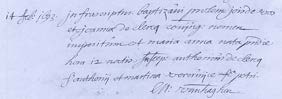

48.4. JOANNES DE VOS, OR JOAN DE POCH
901
Figure 48.32: Harelbeke, February 14, 1693, the baptism
of Maria Anna De Vos (DC08bx3), the daughter of Joannes
De Vos and Joanna Declercgz (DC08b). The godfather was
Antoni Declerque (III) (DC07), son of Antoni Declerque
(II) (DC06), and the godmother was Martina de la Cruz
(’Vercruyce’), daughter of Pedro (’Petrus’).
Figure 48.33: Harelbeke, October 26, 1730, Maria Anna
De Vos (DC08bx3) is godmother to Dionisius Franciscus Gal-
liot, son of Dionisius Franciscus Galliot (son of Petrus Gal-
liot) and Margareta Courssel, daughter of Valentin Courssel.
The godfather was Antonius Josephus Follé. Most likely, the
Courssel family was from Bruges.
Juan de Montoya is described in Chapter 29.10.8.189. He was blood-related to Felipa de Montoya, wife of Jeroni Joan Desclergue y Cortés (DC05).
Petrus Laurentius De Vos and Isabella Verscheure married at Harelbeke in 1632. Witnesses were Petrus De Vos and Petrus Van der Gracht. The Van der Gracht family was a noble family with ties to the Azores.
48.4.1 The First Marriage of Joannes De Vos in Spain, to Maria Anna (de Portea y) Roure
Joannes de Vos lived for a while in Barcelona and Blanes, Spain. Indeed, traces are found of Joan de Vos in Spain before his second marriage in Harelbeke, Belgium, in 1685. Indeed, he is referred to in a manuscript of 1679 as the father at his daughter’s wedding.
Geneanet® provides a transcript of the following wedding of a daughter Maria Anna de Vos, daughter of Joannes De Vos and Maria Anna Portea i Roure:
’Blanes, Gerona (Lugar del matrimonio), 14-08-1679 (Fecha de matrimonio), Maria Anna (Nombres), Poch y Roure (Apellido); Antoni (Nombre de pila del cónyuge), de Padrola y Desclergue (Apellido del cónyuge); Antoni (Nombre de pila del cónyuge); Joan (Nombres del padre), de Poch (Apellido del padre); Maria Anna (Nombres de la madre); Francisco (Nombres del padre del cónyuge), de Padrola y Desclergue (Apellido del padre del cónyuge); Maria Anna (Nombre de pila de la madre del cónyuge).’
It means that,
’at Blanes, Gerona (Place of marriage) on 08-14-1679 (Date of marriage), there was the wedding of Maria Anna Poch y Roure (Names & Surname), daughter of Joan de Vos (de Poch) (Father’s names & Father’s last name) and Maria Anna Roure (Mother’s names & her Surname extracted from the Surname of the bride). The groom was Antoni de Pedrolo y Desclergue (Spouse’s First Name & Spouse’s Last Name), son of Francesc de Pedrolo y Desclergue (Names of the spouse’s father & Surname of the spouse’s father) and Maria Anna (First name of the spouse’s mother).’
This matches information obtained from Montblanc. Indeed, the parents of Antoni were Francesc Jacinto de Pedrolo y Desclergue (DC05ex1y2) (born at Montblanc in 1641 and dead in Montblanc in 1685) and Anna Maria de Ratera i Robuster.
We also know from other sources that Antoni de Pedrolo y Desclergue was born at Montblanc in 1659 and would marry (in a second marriage) Jerònia de Folcràs in 1693. The latter was born at Cervera (Spain) in 1658 and died at Montblanc in 1708.
Joan de Vos also appears in 1685 in,
’Causa de Joan de Poch, ciudadano honrado de Barcelona en la villa de Blanes habitante, tutor y curador de los pupilos, hijos y herederos de Gaspar Sala, mercader de la villa de Lloret, obispado de Girona’10.
One can find further information about Antoni in Chapter 28.5, devoted to his father, Francesc Jacinto de Pedrolo y Desclergue (DC05ex1y2). The latter was married to Anna Maria de Ratera y Robuster.
The concerned daughter of Joan de Vos and Maria Anna (de Portea i) Roure was baptized on March 17, 1661, at Santa Maria, Blanes, Gerona, Spain. Her complete name was Maria Anna Scholastica Ignacia Poch y Roure. Her father was registered as Joan de Poch, and her mother, Maria Anna.
It means that she married at 18 and was born when Joan was 28. We found this information in the registered transcript on 8Note that the possibility of Juan de Montosa de Braña being Jean de Montauzée of Branne (also known as Brana, near Bordeaux in France) has been considered during this research. Although we cannot exclude that this was indeed a French military who drowned in the Leie at Sint Eloois Vijve in May 1678, which is just before the Treaty of Nijmegen, on August 10, 1678, we have severe doubts given the fact that we only found this person one other time, namely on the birth certificate of Joannes De Vos in 1633. It does not seem plausible that a French military would have been at Harelbeke in 1633. Indeed, the area had become temporarily French in 1668 until the Treaty of Nijmegen, by the Devolution war. But 1633 was much earlier. Another option is that two persons are concerned here: a Spanish Juan de Montosa in 1633 in Harelbeke and a French Jean de Monauzée of Branne in Sint Eloois Vijve in 1678. We cannot be 100% sure. However, we must also highlight that the expression ’miles regi(u)s’ (Royal Soldier or King’s Soldier) has been found in Spain’s literature, not France’s. Based on this fact, the odds are high that the person who drowned in Sint Eloois Vijve was indeed a Spanish Juan de Montosa de Braña.
9Francisco Berganza y Arce (fray.), ’Antiguedades de España, propugnadas en las noticias de sus reyes, en la Coronica del Real Monasterio de San Pedro de Cardeña, en Historias, cronicones, y otros instrumentos manuscritos, que hasta aora no han visto la luz publica’ , ’por Francisco del Hierro’ , 1721.
10ES.08019.ACA, ACA, REAL AUDIENCIA, Pleitos civiles,18081
The Desclergues of la Villa Ducal de Montblanc, 2nd ed., Omn., VOL. IV
© 2024 Nico F. Declercq
CHAPTER 48. THE MATERNAL DESCLERGUE ANCESTRY BRANCH BEGINNING WITH JOANA
902
CATHARINA DECLERCGZ (DC08B) & JOANNES DE VOS
Geneanet®. De Vos and de Pedrolo y Desclergue may have been acquainted through de Vos and Desclergue in Belgium, or else de Vos found the Desclergues in Belgium because of his connection with de Pedrolo y Desclergue.11
48.4.2 The Second Marriage of Joannes De Vos in Harelbeke (Flanders - Belgium), to Joana
Declercgz (DC08b)
When Joannes de Vos, born in Belgium in 1633 and living in Barcelona or Blanes, lost his wife, Maria Anna (de Portea i) Roure, and remarried Joana Declercgz (DC08b), he was already 52 years old. His bride was 28 years old and had already married a Spanish soldier.
It indicates that Joannes de Vos must have been wealthy.
Joannes De Vos and Joana Declercgz (DC08b) married at Harelbeke in 1685, in Figures 48.24 and 48.24. Joana Declercgz (DC08b) was blood-related to Joannes De Vos’s son-in-law Antoni de Pedrolo y Desclergue.
This relationship was as follows: Antoni’s great-grandfather was Francesc Desclergue (DC05e), brother of Enric Desclergue (DC05), who was the great-grandfather of Joana Declercgz (DC08b).
Again, this is evidence that until the 1680s, the Desclergue in Belgium was in touch with the Desclergue in Spain.
48.4.3 The Children of Joannes De Vos and Catharina Declercgz (DC08b)
48.4.3.1 Martina De Vos (DC08bx1)
Martina De Vos (DC08bx1) was born in 1686, in Figure 48.26 at Harelbeke, Belgium, daughter of Joannes De Vos and Joana Declercgz (DC08b).
Martina De Vos (DC08bx1) would, in 1703, at Harelbeke, serve as godmother to Maria Catharina Vandeputte (DC08dx1) (Du Puich), daughter of Egidius Vandeputte (Du Puich), and Maria Declercgz (DC08d), daughter of Antoni Declerque (III) (DC07); The godfather was Joan Declercgz (DC08c). We refer to Chapter 37.9.2.1.
48.4.3.2 Maria Magdalena De Vos (DC08bx2)
Maria Magdalena De Vos (DC08bx2) was born, in Figure 48.27, in 1688 at Harelbeke, Belgium, and was the daughter of Joannes De Vos and Joana Declercgz (DC08b).
48.4.3.3 Joannes Baptiste De Vos (DC08by1)
Joannes Baptiste De Vos (DC08by1) was born in 1689, in Figure 48.28, at Harelbeke, Belgium, son of Joannes De Vos and Joana Declercgz (DC08b). His godmother was Martine De Vos.
Martine De Vos was a daughter of Carolus De Vos, born in 1665 in Deerlijk, in Figure 48.29, and sister of Judoca de Vos, born in Deerlijk, in Figure 48.30 in 1675. Her godfather was Oliverius Nolf, and her godmother was Martina Christaens.
Carolus De Vos was born in Harelbeke in 1634, the son of Petrus Laurentius de Vos (’Laurentius De Vos’ ) and Isabella Verscheure.
His godfather was Carolus Demaryvoorde, and his godmother was Maria Conincx. Therefore, Carolus De Vos was the brother of Joannes De Vos.
Carolus De Vos married Judoca Demeestere in Deerlijk in 1664. Witnesses were Jacobus Van Outrijve and Christina De Graeve.
We found a Jacobus Van Outrijve married to a Margareta De Vos at Harelbeke in 1662, ’akte 851,’ and witnesses were Simone Staes and custode, which is an indication of a lack of family members at Harelbeke at that time.
Margareta De Vos appears as a godmother to one of the children of Carolus De Vos and Judoca Demeester.
The godparents of the Judoca De Vos mentioned above, in Figure 48.30, were Stephanus12 De Vos and Margarita De Vos.
We also found Arnoldus De Vos, baptized in Deerlijk in 1700, in Figure 48.31, son of Judocus de Vos and Judoca de Meestere, with Godfather Guilemus De Vos and godmother Martina Demeester.
We, therefore, suspect that Joannes De Vos (born at Harelbeke in 1633) had the following siblings and half-siblings: Margarita De Vos (at Deerlijk in 1675), Stephanus De Vos (at Deerlijk in 1675), Guilelmus De Vos (at Deerlijk in 1670) and Carolus De Vos (born in Harelbeke in 1634, present at Deerlijk in 1664, 1665, 1675, 1700).
We found Esteve Poch (Stephanus de Vos) in Spain in documents in 1638, 1643, 1650, 1656, which is before he became a godfather in 1675 in Figure 48.30.
163813: ’Causa de Josep de Miralbell y Esteve Poch, ciudadanos honrados de Barcelona, contra el excelentísimo marqués de Aitona,’
scope and content,
’Testigos recibidos por parte del marqués de Aitona, sobre los bienes inmuebles, censales y rentas que poseen Miralbell y Poch en los vizcondados de Cabrera y Bas, jurisdicción del marqués de Aitona.’
164314: ’Causa de Esteve Poch, ciudadano honrado de Barcelona, antes mercader de Tordera, contra los herederos y tenutarios de la noble Maria de Farnés y Meca’, scope and content ’Sobre la reclamación del pago de pensiones de censal.’
165015: ’Causa del magnífico Esteve Poch y Anna Poch, cónyuges ciudadanos de Barcelona vecinos de Blanes, contra Paula Matheu ( o Mateu) Regas y Carbonell, hermana del fallecido Pere Antonio Matheu (o Mateu),’
scope and content,
’Causa de suplicación a sentencia dada en la curia vicaria de Blanes y avocada en Real Audiencia sobre la universal herencia de Pere Antoni Matheu ( o Mateu). Existe pieza cosida de anteriores originales procesos y copia de otro primitivos (1601,1603) sobre censales y deudas que implican los bienes y propiedades de que se trata en esta causa de 1650, donde se nombran varias propiedades entre ellas el Mas Mateu ( o Matheu) de la parroquia de Vidreres (Girona).’
165616: ’Causa de Esteve de Poch, ciudadano honrado de Barcelona en la villa de Blanes domiciliado, contra la universidad y particulares de la villa de Blanes,’
scope and content,
’Sobre reclamo de pagos por unas letras de cambio.’
11We will probably never know what the chicken was and what the egg.
12Stephanus is Esteve in Catalan.
13ES.08019.ACA, ACA, REAL AUDIENCIA, Pleitos civiles, 29451.
14ES.08019.ACA, ACA, REAL AUDIENCIA, Pleitos civiles, 27038.
15ES.08019.ACA, ACA, REAL AUDIENCIA, Pleitos civiles, 685.
16ES.08019.ACA, ACA, REAL AUDIENCIA, Pleitos civiles, 30175.
© 2024 Nico F. Declercq
The Desclergues of la Villa Ducal de Montblanc, 2nd ed., Omn., VOL. IV
903
165617: ’Causa del reverendo fray don Jaume Meca, abad del monasterio de Sant Salvador de Breda, contra el magnífico Esteve Poch, ciudadano honrado de Barcelona en Blanes domiciliado,’
scope and content,
’Sobre reconocimiento de señoría y alodio de los mansos ’Pochs’ que posee el demandado en Vidreres a favor del reverendo y reclamación del pago de luismos y censos correspondientes.’
48.4.3.4 Maria Anna De Vos (DC08bx3)
Maria Anna De Vos (DC08bx3) was born in 1693 at Harelbeke, in Figure 48.32, in Belgium, and was the daughter of Joannes De Vos and Joana Declercgz (DC08b).
She was named after the daughter Maria Anna De Vos of the first wife of Joannes De Vos, who died before 1693, which we know because her husband remarried in 1693.
In Figure 48.33, we found her as Godmother.
48.4.3.5 Petrus De Vos (DC08by2)
Petrus De Vos (DC08by2) was born in 1697 at Harelbeke, Belgium. He was the son of Joannes De Vos and Joana Catharina Declercgz (DC08b) and is described below in Chapter 48.5.
48.5 Petrus De Vos (DC08by2)
48.5.1 His Birth, Life and Death
He was born in 1697, in Figure 48.35, at Harelbeke, Belgium; He died in 1774, in Figure 48.36, in Hulste, Belgium, and was a son of Joannes De Vos and Joana Declercgz (DC08b).
Petrus De Vos (DC08by2) was orphaned at a young age. We do not know what happened to him, except that he married Elizabeth De Mets in Hulste in 1729 and remarried Hendrica Theresia Depoorter in 1742.
We stem from his second wife.
His descendants are shown in Figure 48.34.
Hulste is adjacent to Harelbeke and is also the village where his niece Maria Catharina Declercq (DC08cx3), daughter of his uncle Joan Declercgz (DC08c) and Joanna Debels, would marry in a second marriage to Petrus Verhelst in 1734. Petrus Verhelst had a sister, Christina Verhelst, who had married, in 1730 at Hulste, Joannes (Baptiste) De Vos (DC08by1); the wedding witnesses had been Martina De Vrieze and Joannes Maes.
Petrus De Vos (DC08by2) likely grew up with Maes, who were acquaintances of Joana Declercgz (DC08b) and Petrus De Vos.
Note that earlier in this book, we suggested that the first appearing ’Maes’ in this ancestry story, namely Maria Maes, who married Laurentius De Vos, might have been Maria de Maza. The latter is a family name that existed in the Gerona region around 1600.
Therefore, this family might have Spanish roots as well.
For instance, Joana Declercgz (DC08b) appears as a godmother on a birth certificate at Harelbeke in 1690 of the son of Catharina Maes.
More links between Maes and Desclergue are shown in Figure 48.37.
Catharina Maes, who appears in Figure 48.37, was the daughter of Joannes Maes and was born at Deerlijk in 1663, in Figure 48.38.
Catharina Maes was a witness in 1729 at the wedding at Hulste of Petrus De Vos (DC08by2) and Elizabeth De Mets.
We extracted the names of the witnesses and godparents, who are connections of importance to our ancestry, from the marriages and baptisms shown in further records.
The Maes family: Joannes and Maria Catharina;
The de Vos family: Petrus Joseph;
The Vandeputte / Du Puich family: Maria Josephine;
The Callens family: Maria;
A link with Deerlijk: Petrus Franciscus Josephus Lieluy (the vice pastor of Deerlijk).
The other witnesses and godparents were:
The De Graeve family: Petrus, Christina, Rogeria and Guillelmus;
The Van Rumbeke family: Catharina, Livinus, Petrus, Elisabetha Cule (the wife of Petrus Van Rumbeke), and Anna; The de Mets family: Franciscus, Guillelmus, Joannes and Thomas;
The De Poortere family: Antonius Franciscus, Judocus, Maria Catharina, and Maria Magdalena.
Other families: Judoca Devolder, Elisabetha Vandersteene, Ignatius Fernod, Jacobus De Meyere, Anthonius Feys, Maria Anna Rosa Bauvin, Joannes Verhelst, Judoca Michiels, Joannes de Vroe, and Anna de Langhe.
48.5.2 Elizabeth De Mets, the First Wife of Petrus De Vos (DC08by2), and their Children
Elizabeth De Mets was born in 1708 in Hulste, Belgium. She is not our ancestor. However, her children’s church certificates are essential to exposing family bonds.
48.5.2.1 Elizabeth De Mets’ Birth and Death
Elizabeth De Mets was born in Hulste in 1708, in Figure 48.39, she died there in 1741, in 48.40.
Her mother was Anna Van Rumbeke.
In Chapter 29.8.3.5, the reader will find that in 1701, Maria Declercgz (DC08d), granddaughter of Antoni Desclergue (II) (DC06), married Egidius Vandeputte (Gilles Du Puich), son of Mathias Vandeputte (Mathieu De Puich) and Joanna Van Rumbeke.
Elizabeth De Mets was, therefore, related to Egidius Vandeputte, which is likely how the Hulste branch of our ancestors was initiated.
17ES.08019.ACA, ACA, REAL AUDIENCIA, Pleitos civiles, 29055.
The Desclergues of la Villa Ducal de Montblanc, 2nd ed., Omn., VOL. IV
© 2024 Nico F. Declercq
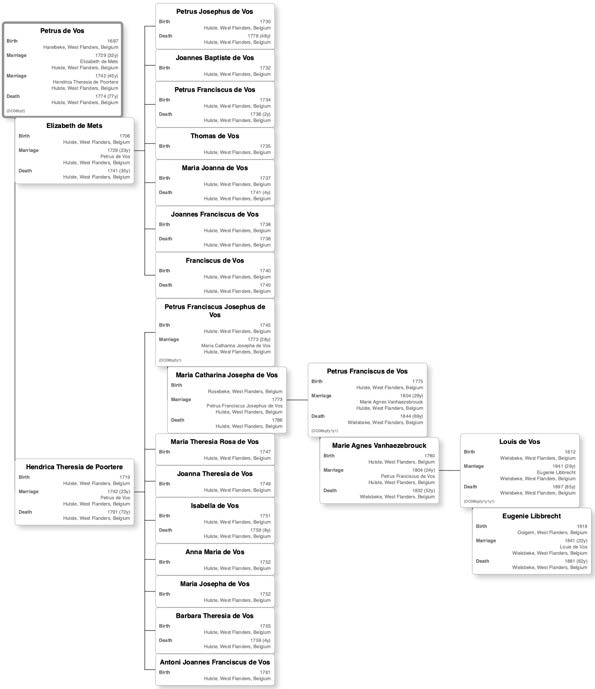
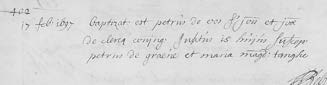

CHAPTER 48. THE MATERNAL DESCLERGUE ANCESTRY BRANCH BEGINNING WITH JOANA
904
CATHARINA DECLERCGZ (DC08B) & JOANNES DE VOS
Figure 48.34: Three descending generations of Petrus De Vos (DC08by2)
Figure 48.35:
Harelbeke, February 17,
1697, the baptism of Petrus De Vos
(DC08by2), son of Joannes De Vos and
Joanna Declercq.
The godfather was
Petrus De Graeve, and the godmother was
Maria Magdalena Tanghe. The De Graeve
family was also connected to Martina de la
Cruz, as described in Chapter 37.4.3 and
equally appears in Chapter 48.3.
Figure 48.36: Hulste, April 4, 1774, the death of Petrus De Vos (DC08by2), 72 years
old, husband of Elisabeth De Mets and later of Henrietta Theresia Depoortere. Based
on the baptism, he must have been 77 years old. The priest likely misread a note which
contained his age.
© 2024 Nico F. Declercq
The Desclergues of la Villa Ducal de Montblanc, 2nd ed., Omn., VOL. IV

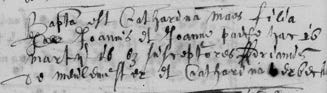






48.5. PETRUS DE VOS (DC08BY2)
905
Figure 48.37: Harelbeke, March 21, 1690, the baptism of Matheus Adams son
of Matheus Adams and Catherina Maes. The godfather was Mattheus Steelant,
son of Mattheus, from Deerlijk; and the godmother was Joana Catharina Declergz
(DC08b), daughter of Antoni Declerque (DC07), from Harelbeke.
Figure 48.38: Deerlijk, March 26, 1663,
the baptism of Catherina Maes, daughter
of Joannes Maes and Joanna Paege. The
godfather was Adrianus De Meulemeester,
and the godmother was Catharina Verbeke.
Figure 48.39: Hulste, November 7, 1708,
the baptism of Elizabeth De Mets, daughter
of Joannes De Mets and Anna Van Rum-
beke (’Van Ruymbeeke’). The godfather
was Petrus Van Rumbeke (’Van Ruym-
beeke’), and the godmother was Elizabeth
Van Rumbeke (’Van Ruymbeeke’).
Figure 48.40: Hulste, April 28, 1741, the death of Elisabeth De Mets, wife of
Petrus De Vos.
Figure 48.41: Hulste, November 6, 1729, the marriage of Petrus De Vos
and Elisabeth De Mets. The witnesses were Joannes Maes and Livinus van
Rumbeke.
Figure 48.42:
Hulste, December 14,
1730, the baptism of Petrus Josephus de
Vos, son of Petrus de Vos and Elisabetha
De Mets. The godfather was Livinus van
Rumbeke, and the godmother was Anna
Van Rumbeke. Livinus Van Rumbeke lived
in Bavikhove and was married to Alde-
gonde Van Outryve, his father also carried
the name Livinus Van Rumbeke. Anna
Van Rumbeke was married to Joannes De
Mets.
Figure 48.43: Hulste, March 22, 1732, the baptism of Joannes Baptiste
de Vos, son of Petrus de Vos and Elisabetha De Mets. The godfather was
Joannes De Mets, and the godmother was Judoca Devoldere.
Figure 48.44: Hulste, April 20, 1734, the baptism of Petrus Franciscus de Vos, son
of Petrus de Vos and Elisabetha de Mets. The godfather was Petrus Van Rumbeke,
and the godmother was Anna van Rumbeke.
The Desclergues of la Villa Ducal de Montblanc, 2nd ed., Omn., VOL. IV
© 2024 Nico F. Declercq




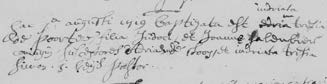
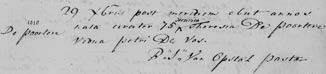
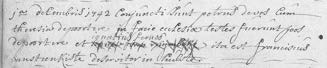

CHAPTER 48. THE MATERNAL DESCLERGUE ANCESTRY BRANCH BEGINNING WITH JOANA
906
CATHARINA DECLERCGZ (DC08B) & JOANNES DE VOS
Figure 48.45: Hulste, July 13, 1735, the
baptism of Thomas de Vos, son of Petrus
de Vos and Elisabetha de Mets. The god-
father was Thomas de Mets, and the god-
mother was Elisabetha Vandersteene.
Figure 48.46: Hulste, February 14, 1737
(Valentine’s day), the baptism of Maria
Joanna de Vos, daughter of Petrus de
Vos and Elisabetha de Mets. The godfa-
ther was Guillelmus de Mets, and the god-
mother was Elisabetha Cule. Note that
Elisabetha Cule (1671 - 1750) was the
daughter of Gerard Cule and Maria De-
vlaminck.
She was married to Petrus
Van Rumbeke (1668-1750) and had the fol-
lowing children: Catharina Van Rumbeke
(1700-1766) and Anna Maria van Rum-
beke (1704-1787).
Figure 48.47: Hulste, December 11, 1738, the baptism of Joannes Franciscus
de Vos, son of Petrus de Vos and Elisabetha de Mets. The godfather was
Joannes De Mets, and the godmother was Catharina Van Rumbeke. The
child died the same year.
Figure 48.48: Hulste, October 3, 1740, the baptism of Franciscus de Vos,
son of Petrus de Vos and Elisabetha de Mets. The godfather was Franciscus
de Mets, and the godmother was Catharina Van Rumbeke.
Figure 48.49: Hulste, August 7, 1719,
the baptism of Hendrica Theresia De-
poorter, daughter of Judocus Depoorter
and Joanna Salembier. The godfather was
Adrianus Sloos, and the godmother was
Hencrica Theresia Simon.
Figure 48.50:
Hulste, December 29,
1791, the death of Hendrica Theresia De-
poorter, widow of Petrus De Vos.
Figure
48.51:
Hulste, December 1,
1742, the marriage of Petrus De Vos and
Hendrica Theresia Depoortere. The wit-
nesses were Judocus Depoortere and Ig-
natius Fernod (the priest first wrote Anna
van Wijmbeke).
Figure 48.52: Hulste, April 21, 1747, the baptism of Maria Theresia Rosa de Vos, daughter
of Petrus de Vos and Hendrica Theresia Depoortere. The godfather was Anthonius Feys, and
the godmother was Maria Anna Rosa Bauvin.
© 2024 Nico F. Declercq
The Desclergues of la Villa Ducal de Montblanc, 2nd ed., Omn., VOL. IV


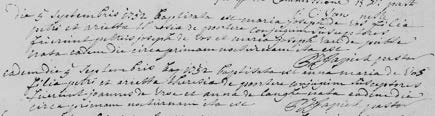
48.6. PETRUS FRANCISCUS JOSEPHUS DE VOS (DC08BY2Y1)
907
Figure 48.53: Hulste, March 25, 1749, the baptism of Joanna Theresia de Vos,
daughter of Petrus de Vos and Hendrica Theresia Depoortere. The godfather
was Jacobus De Meyere, and the godmother was Maria Magdalena de Poortere.
Figure 48.54: Hulste, January 1, 1751, the baptism of Isabella de Vos, daughter
of Petrus de Vos and Hendrica Theresia Depoortere. The godfather was Joannes
Verhelst, and the godmother was Judoca Michiels.
48.5.2.2 Their Marriage and Children
They married in Hulste in 1729, in Figure 48.41. The witnesses, Van Rumbeke and Maes, formed a link with the Du Puich and Maes families, respectively. The baptisms of their children are shown in Figures 48.42, 48.43, 48.44, 48.45, 48.46, 48.47 and 48.48.
48.5.3 Hendrica Theresia Depoorter, the Second Wife of Petrus De Vos (DC08by2), and their
Children
Theresia Depoorter and Petrus De Vos (DC08by2) are our ancestors.
48.5.3.1 Hendrica Theresia Depoorter’s Birth and Death
Hendrica Theresia Depoorter was born in Hulste in 1719, in Figure 48.49. She died in Hulste in 1791, in 48.50.
48.5.3.2 Their Marriage and Children
They married in Hulste, 1742, in Figure 48.51. The baptisms of their children are shown in Figures 48.52, 48.53, 48.54, 48.55, 48.56,
48.57 and our ancestor in 48.59.
48.6 Petrus Franciscus Josephus De Vos (DC08by2y1)
The descendants of Petrus Franciscus Josephus De Vos (DC08by2y1) are shown in Figure 48.58. He was born in 1745, in Figure
48.59 in Hulste, Belgium. He married Maria Catharina Josepha De Vos, born at Oostrozebeke, in Hulste, in 1773, in Figure 48.60.
The baptism of Maria Catharina Josepha De Vos is found in Figure 48.61, and her parents’ wedding is in Figure 48.62.
After the death of Maria Catharina Josepha de Vos in 1786, Petrus Franciscus Josephus de Vos remarried widow Maria Josepha Devolder, in Figures 48.63 and 48.64, in Hulste on July 4, 1787. Maria Josepha Devolder was the widow of Guillelmus Sobri.
48.7 Petrus Franciscus De Vos (DC08by2y1y1) & Marie Agnes Vanhaeze-
brouck
48.7.1 Petrus Franciscus De Vos
The descendants of Petrus Franciscus De Vos (DC08by2y1y1) and Marie Agnes Vanhaezebrouck are shown in Figure 48.65.
Petrus Franciscus De Vos (DC08by2y1y1) was born at Hulste in 1775, in Figure 48.66, and he died at Wielsbeke in 1844 in Figure
Note that Petrus De Vos (DC08by2) died in 1774. His grandchild Petrus Franciscus De Vos (DC08by2y1y1), born in 1775, was named after him. Because he had passed away and could not be godfather, his second wife, Theresia Depoorter, served as godmother.
Figure 48.55: Hulste, September 5, 1752, the baptism of a twin of Petrus de Vos and
Hendrica Theresia Depoortere. The godfather of Maria Josepha was Petrus Joseph de Vos,
and her godmother was Maria Josephine Du Puich (’Van de Putte’). The godfather of Anna
Maria was Joannes de Vroe, and her godmother was Anna de Langhe.
The Desclergues of la Villa Ducal de Montblanc, 2nd ed., Omn., VOL. IV
© 2024 Nico F. Declercq
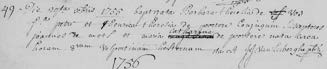
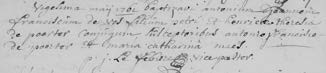
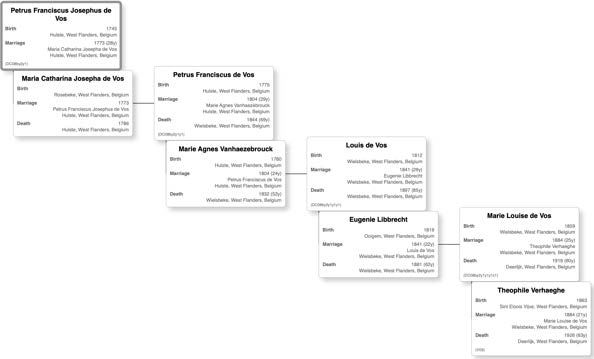

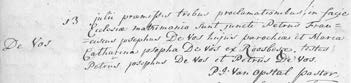
CHAPTER 48. THE MATERNAL DESCLERGUE ANCESTRY BRANCH BEGINNING WITH JOANA
908
CATHARINA DECLERCGZ (DC08B) & JOANNES DE VOS
Figure 48.56:
Hulste, December 24,
1755, the baptism of Barbara Theresia de
Vos, daughter of Petrus de Vos and Hen-
drica Theresia Depoortere. The godfather
was Joannes de Mets, and the godmother
was Maria Catharina de Poortere.
Figure 48.57: Hulste, May 20, 1761, the
baptism of Antoni Joannes Francisus de
Vos, son of Petrus de Vos and Hendrica
Theresia Depoortere. The godfather was
Antonius Franciscus De Poorter, and the
godmother was Maria Catharina Maes.
Figure 48.58: Three descending generations of Petrus Franciscus Josephus De Vos (DC08by2y1).
Figure 48.59:
Hulste, September 10,
1745, the baptism of Petrus Franciscus
Joseph De Vos, son of Petrus Devos and
Hendrica Theresia Depoortere. The god-
father was Petrus Franciscus Josephus
Lieluy, who was pastor in Deerlijk, and the
godmother was Maria Callens. We found
Jacobus Callens as godfather to Guilelmus
Vandeputte (DC08dy2) (Du Puich), son
of Egidius Vandeputte (Du Puich), son
of Matheus Vandeputte (Du Puich), and
Maria Declercgz (DC08d), daughter of An-
toni Declerque (III) (DC07) in Harelbeke
in 1706; the godmother was Joanna De-
clercgz (DC08b).
Figure 48.60: Hulste, July 13, 1773, the wedding of Petrus Franciscus
Josephus De Vos and Maria Catherina Josepha De Vos from Oostrozebeke.
The witnesses were Petrus Josephus De Vos and Petrus De Vos.
© 2024 Nico F. Declercq
The Desclergues of la Villa Ducal de Montblanc, 2nd ed., Omn., VOL. IV
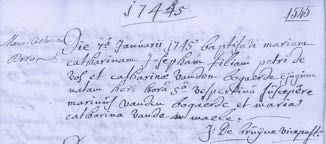
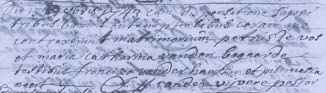
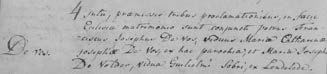
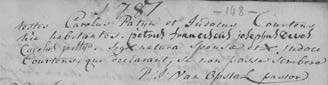
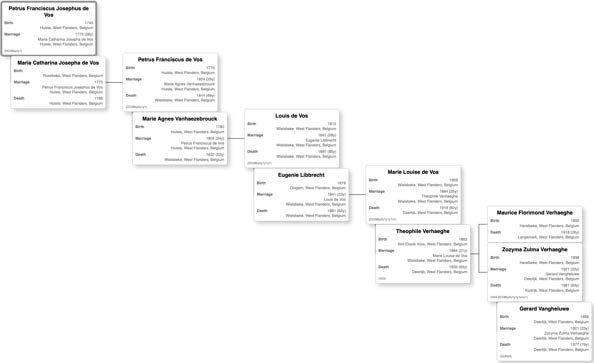
48.7. PETRUS FRANCISCUS DE VOS (DC08BY2Y1Y1) & MARIE AGNES VANHAEZEBROUCK
909
Figure 48.61:
Oostrozebeke, January
7, 1744, the baptism of Maria Catherina
Josepha De Vos, the later wife of Petrus
Franciscus Josephus De Vos. Her father
was Petrus De Vos , her mother was Maria
Catherine Van den Bogaerde. Her God-
father was Marinus Van den Bogaerde,
and her Godmother was Catharina Van de
Maele.
Figure 48.62:
Oostrozebeke, October
17, 1743, the marriage of Petrus De
Vos and Maria Catharina Van Den Bo-
gaerde, the later parents of Maria Cathe-
rina Josepha De Vos, who married Petrus
Franciscus Josephus De Vos. The wit-
nesses were Franciscus Van Der Haeghen
and Petronella Naert.
Figure 48.63:
Hulste, July 4, 1787,
the marriage of Petrus Franciscus Jose-
phus De Vos, widower of Maria Catha-
rina Josepha De Vos, from Hulste, with
Maria Josepha Devolder, widow of Guillel-
mus Sobri, from Lendelede. The witnesses
were Charles Patin and Judocus Courtens
from Hulste. (page 1)
Figure 48.64:
Hulste, July 4, 1787,
the marriage of Petrus Franciscus Jose-
phus De Vos, widower of Maria Catha-
rina Josepha De Vos, from Hulste, with
Maria Josepha Devolder, widow of Guillel-
mus Sobri, from Lendelede. The witnesses
were Charles Patin and Judocus Courtens
from Hulste. (page 2)
Figure 48.65: Four descending generations of Petrus Franciscus De Vos (DC08by2y1y1)
The Desclergues of la Villa Ducal de Montblanc, 2nd ed., Omn., VOL. IV
© 2024 Nico F. Declercq

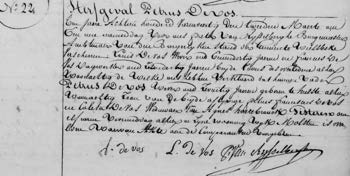
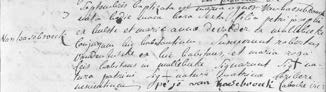
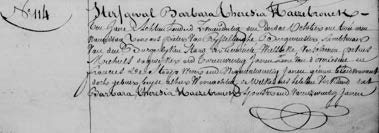
CHAPTER 48. THE MATERNAL DESCLERGUE ANCESTRY BRANCH BEGINNING WITH JOANA
910
CATHARINA DECLERCGZ (DC08B) & JOANNES DE VOS
Figure 48.66: Hulste, January 15, 1775, the baptism of Petrus Franciscus De Vos, son
of Petrus Franciscus Josephus De Vos and Maria Catharina De Vos. The godfather was
Petrus De Vos (on the mother’s side), and the godmother was Maria Theresia de Poortere
(second wife of the recently passed grandfather Petrus De Vos).
Figure 48.67: Wielsbeke, March 21 1844, the death of 70-year-old Petrus
Franciscus de Vos (DC08by2y1y1), son of Petrus Franciscus De Vos and
Coleta De Vos. He was a widower of Marie Agnes Vanhaezebrouck (’Agnes
Haesesbrouck’) and lived in Molsten in Wielsbeke. The death was reported
by Louis de Vos, 31 years old, and Francis De Vos, 36 year old, both sons
of the deceased, and living in Wielsbeke.
Figure 48.68: Hulste, September 7, 1780,
the baptism of Marie Agnes Vanhaeze-
brouck, daughter of Petrus Josephus Van-
haezebrouck from Hulste and Marie Anne
de Voldere from Meulebeke. The witnesses
were Robert Vandenbulke who lived in Hul-
ste and Maria Rosa Feys who lived in
Meulebeke.
Figure 48.69: Wielsbeke, October 3, 1837, the death of 74-year-old Barbara
Theresia Haezebrouck, wife of Joseph Michiels and born in Hulste around 1763.
She was a daughter of Pieter Haezebrouck and Judoca Vanneste. She was a 17-
year-older half-sister of Marie Agnes Haezebrouck. Her death was reported by
her 42-year-old son Pieter Michiels. (part 1)
Figure 48.70: Wielsbeke, October 3, 1837, the death of 74-year-old Barbara Theresia
Haezebrouck. (part 2)
© 2024 Nico F. Declercq
The Desclergues of la Villa Ducal de Montblanc, 2nd ed., Omn., VOL. IV
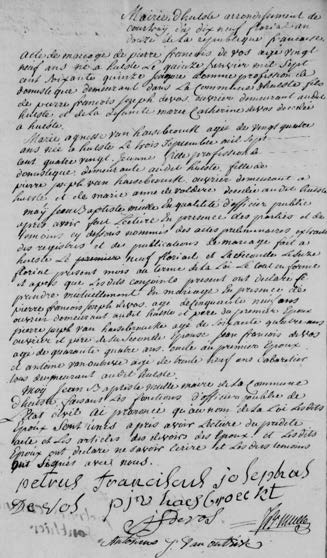
48.8. LOUIS DE VOS (DC08BY2Y1Y1Y1) & EUGENIE LIBBRECHT
911
Figure 48.71: Hulste, May 9, 1804 (19
florial, an XII), the marriage of Petrus
Franciscus De Vos and Marie Agnes Van-
haezebrouck. The groom was 29 years old
and was born in Hulste on January 15,
1775, and was a son of Pierre François
Joseph De Vos and Marie Catherine De
Vos, who had died in Hulste. The bride
was 24 years old, born in Hulste on
September 3, 1780, and was a daugh-
ter of Pierre Joseph Vanhaesebrouck and
Marie Anne De Voldere, who had died in
Hulste. The witnesses were 59-year-old
Pierre François Joseph De Vos, father of
the groom, and 64-year-old Pierre Joseph
Vanhaesebrouck, father of the bride. There
was also 44-year-old Jean François De
Vos, uncle of the groom, and 37-year-old
Antoine Vanoutryve.
Note that Petrus Franciscus De Vos (DC08by2y1y1), on his wedding certificate in Figure 48.71, uses a modern signature instead of just his name, i.e., he signed as ’P. F. De Vos.’
48.7.2 Marie Agnes Vanhaezebrouck
She was born in Hulste in 1780, in Figure 48.68, and she died in Wielsbeke in 1837 in Figures 48.69 and 48.70. Her parents, Petrus Joseph Vanhaesebrouck and Marie Anne De Voldere, died in Hulste, respectively, in 1817 and 1793.
48.7.3 Their Marriage
Their marriage was in 1804, in Hulste, Belgium, in Figure 48.71.
48.8 Louis De Vos (DC08by2y1y1y1) & Eugenie Libbrecht
48.8.1 Louis De Vos
Louis De Vos was born in Wielsbeke in 1812, in Figures 48.73 and 48.74.
His descendants are shown in Figure 48.72.
He died in Wielsbeke in 1897, Figure 48.75.
His military record is exposed in Figure 48.76.
48.8.2 Eugenie Libbrecht
She was born at Ooigem in 1819, in Figure 48.77, and she died in Wielsbeke on February 21, 1881, in Figure 48.78.
The obituary card of her auntie is shown in Figure 48.79.
48.8.3 Their Marriage
They married at Wielsbeke in 1841, in Figure 48.80.
The Desclergues of la Villa Ducal de Montblanc, 2nd ed., Omn., VOL. IV
© 2024 Nico F. Declercq
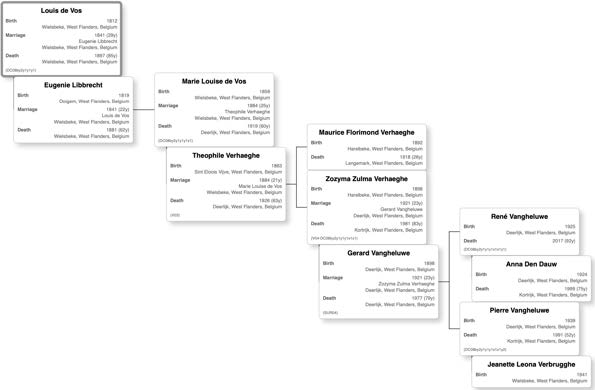
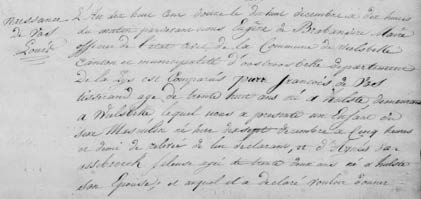
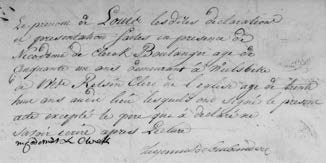
CHAPTER 48. THE MATERNAL DESCLERGUE ANCESTRY BRANCH BEGINNING WITH JOANA
912
CATHARINA DECLERCGZ (DC08B) & JOANNES DE VOS
Figure 48.72: Three descending generations of Louis De Vos (DC08by2y1y1y1)
Figure 48.73: The birth of Louis De Vos (DC08by2y1y1x1), Wielsbeke, December 17,
1812. He was the son of 38-year-old Pierre François De Vos, born in Hulste and living
in Wielsbeke, and 32-year-old Agnes Vanhaesebrouck, born in Hulste. The witnesses were
51-year-old baker ’Nicodeme de Clerck’ and 38-year-old Medard Retsin, from the church.
(part 1)
Figure 48.74:
The birth of Louis De
Vos (DC08by2y1y1x1), Wielsbeke, Decem-
ber 17, 1812. (part 2)
© 2024 Nico F. Declercq
The Desclergues of la Villa Ducal de Montblanc, 2nd ed., Omn., VOL. IV
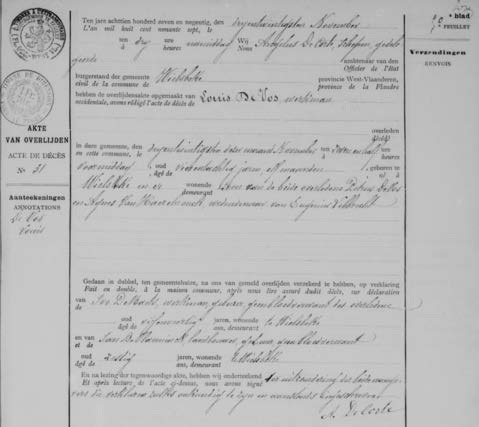

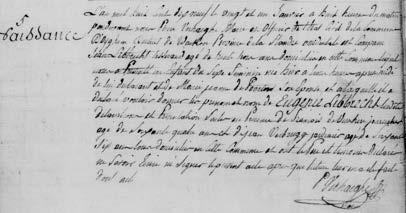
48.8. LOUIS DE VOS (DC08BY2Y1Y1Y1) & EUGENIE LIBBRECHT
913
Figure
48.75:
Wielsbeke, November 29, 1897, the death of 84-year-old Louis de Vos
(DC08by2y1y1x1), son of Petrus De Vos and Agnes Van Haezebrouck, and widower of Eugenie Lib-
brecht. The death was reported by his 60-year-old neighbor, farmer Jan De Vlaeminck.
Figure 48.76: The military registration of Louis De Vos in 1831, Nationale Militie Provincie West-Vlaanderen, 42e Kanton, Gemeente Wielsbeke, Lotings Register. He was born on 17 December 1812 in Wielsbeke, 42e Kanton, West Vlaanderen. His father was Pieter De Vos and his mother was Agnes Vanhaezebrouck. He was a textile manufacturer. He had a long face and a large forehead. His eyes were gray, his nose was normal, his mouth was small, his chin was sharp, and his hair and eyebrows were blond. He had a brother Francis De Vos.
Figure 48.77: Ooigem, January 21, 1819, the birth of Eugenie Libbrecht, daughter
of 38-year-old Jean Libbrecht, who lived in Ooigem, and Marie Jeanne De Poortere.
The Desclergues of la Villa Ducal de Montblanc, 2nd ed., Omn., VOL. IV
© 2024 Nico F. Declercq
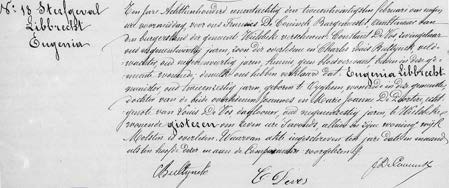
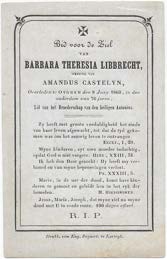
CHAPTER 48. THE MATERNAL DESCLERGUE ANCESTRY BRANCH BEGINNING WITH JOANA
914
CATHARINA DECLERCGZ (DC08B) & JOANNES DE VOS
Figure 48.78: Wielsbeke, February 21, 1881, the death of 62-year-old Eugenie Libbrecht, born
in Ooigem, daughter of Joannes Libbrecht and Marie Jeanne Depoortere, wife of 69-year-old
Louis De Vos, who lived in Molsten, Wielsbeke. The death was reported by her son, 29-year-old
Constant De Vos.
Figure 48.79:
The obituary card of Barbara Theresia Libbrecht,
widow of Amandus Castelyn (back). She was born in Bavikhove in
1784 as the daughter of Joseph Libbrecht and Maria Josephe Lom-
baerde. Her brother was Joannes Cornelis Libbrecht, father of Eugenie
Libbrecht.
48.8.4 Their Offspring
The births of their children are shown in Figures 48.81, 48.83, 48.84, 48.85,48.86.
The military record of Pieter Francis De Vos, born in 1842, is shown in Figure 48.82.
Marie Louise De Vos (DC08by2y1y1y1x1), our ancestor, born in 1859, is described further in Chapter 48.9.
48.9 Marie Louise De Vos (DC08by2y1y1y1x1) & Theophile Verhaeghe
48.9.1 Marie Louise De Vos
The most recent descendants of Marie Louise De Vos are shown in Figure 48.87.
She was born in 1859, on January 27, in Wielsbeke, in Figure 48.88, as the daughter of Louis De Vos (Wielsbeke, 1812) and Eugenie Libbrecht (Ooigem, 1810).
Louis De Vos has roots in the area of Hulste-Wielsbeke.
Eugenie Libbrecht is the daughter of Jean Cornele Libbrecht (Bavikhove, 1785) with roots in Bavikhove, Zwevegem, and Deerlijk and of Marie Jeanne de Poortere with roots in Beveren-Leie and having ancestors Servaege and Heineken around 1600. She died in 1919, a little more than a half year after the death of her son, soldier Maurice Verhaeghe, described in Chapter 48.9.5.4.
Figure 48.90 of Marie Louise De Vos comes from an old photo of a living room in which a picture of her was hanging. For this reason, the quality is deficient. Still, we can see that Marie Louise had Spanish traits, which is also found in Simone Caby, one of her grand-daughters, shown in Figure 48.165 on page 945. Before, it was unclear where these characteristics could have come from; genealogical research, as is clearly outlined in this chapter, has revealed Spanish origins (Desclergue, De la Cruz, and others). The picture also clearly shows the facial similarities between her and her grandson Pierre Vangheluwe, described in Chapter 69.11. He has acted as foster father to the author of this book for many critical years during his childhood.
48.9.2 Theophile Verhaeghe
48.9.2.1 Introduction and some Basic Facts
He was born in 1863, on December 31, in Sint Eloois Vijve, in Figure 48.91, as the son of Edouard Verhaeghe and Ursula Baert.
He died in Deerlijk on July 21, 1926, in Figures 48.92 48.93.
His military service file is given in Figure 48.94.
He married Marie Louise De Vos in 1884 in Wielsbeke on October 17, at 4 pm. Theophile was 21 when he married, while Marie-Louise was already 25. Both had already lost one parent at the time of their wedding.
He passed away in Deerlijk on July 21, 1926, Belgium’s national day. He was a construction Entrepreneur, Architect of the Profession, and master brick-mason. He was also an innkeeper at Harelbeke for some time. He has been directly involved in
© 2024 Nico F. Declercq
The Desclergues of la Villa Ducal de Montblanc, 2nd ed., Omn., VOL. IV
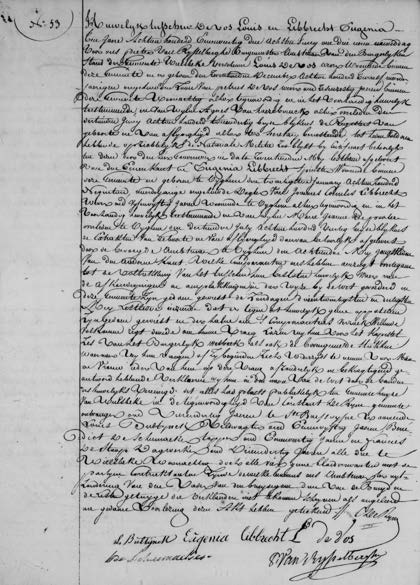
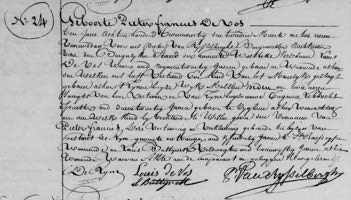
48.9. MARIE LOUISE DE VOS (DC08BY2Y1Y1Y1X1) & THEOPHILE VERHAEGHE
915
Figure 48.80: Wielsbeke, the marriage of Louis De Vos and Eugenie Libbrecht, June 8,
1841. The groom lived in Wielsbeke and was born there on December 17, 1812; he was a
son of 66-year-old Petrus de Vos, who lived in Wielsbeke and was present at the wedding,
and Agnes Van Haezebrouck, who died on June 13, 1832, in Wielsbeke. The groom
had done his military service. The bride lived in Wielsbeke and was born in Ooigem
on January 20, 1819; she was the daughter of 55-year-old Joannes Cornelis Libbrecht,
present at the wedding and Marie Jeanne Depoortere, who died in Ooigem on July 13,
1840.
Figure 48.81: Wielsbeke, the birth of Pieter Francis De Vos, March 2,
1842, son of 29-year-old Louis De Vos, born and residing in Wielsbeke,
and of Eugenie Libbrecht. The child was born at Molsten in Wielsbeke.
The Desclergues of la Villa Ducal de Montblanc, 2nd ed., Omn., VOL. IV
© 2024 Nico F. Declercq

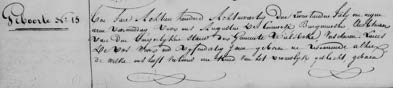
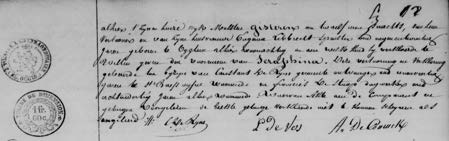
CHAPTER 48. THE MATERNAL DESCLERGUE ANCESTRY BRANCH BEGINNING WITH JOANA
916
CATHARINA DECLERCGZ (DC08B) & JOANNES DE VOS
Figure 48.82: The military registration of Pieter Francis De Vos, in Levée de l’ an 1862, Milice Nationale, Province de la Flandre Occidentale, 42e Canton, Commune de Wielsbeke, Registre du Tirage. He was a textile manufacturer, born on March 2, 1842, in Wielsbeke, where he resided. His father was Louis De Vos, and his mother was Eugenie Libbrecht. He was 155cm tall.
Figure 48.83: Wielsbeke, July 17, 1848, the birth certificate of Seraphina De Vos
(page 1).
constructing the arch at the Cinquantenaire parc at Brussels and the Basilica of Dadizele.
Theophile’s father, Edouard Verhaeghe, was born in Waregem in 1821 and died in Kortrijk in 1907. He was married to Ursula Baert. His roots can be found in Waregem; he was the son of Antoon Verhaeghe and Maria Josepha Corneille.
Ursula Baert was born in 1829 and died in 1867 in Harelbeke as the daughter of Dominicus Baert (son of Franciscus Baert and Judoca Beyens) and Francesca Xaveria Pauwels (daughter of Joannes Baptiste Pauwels and Anne-Marie Snauwaert). She has roots in Zulte, Waregem and Wortegem.
Freddy Byttebier18 from Heemkring Dorp en Toren explained that the cemetery of Deerlijk, originally located around the main church, has been moved to its current location in 1930. The first new grave at the present cemetery was that of Albert Casteele on June 25, 1925. It is sure that Marie Louise De Vos was buried at the old cemetery, while Theophile Verhaeghe was buried at the new cemetery. Possibly, Marie Louise was moved to a new place to rest with her husband. We don’t have any further information.
The grave is not there anymore. Very likely, it has been removed after 50 years.
48.9.2.2 The life of Theophile Verhaeghe
Theophile Verhaeghe, illustrated in Figure 48.93, was a prominent construction contractor active in the early 20th century.
Initially residing in Harelbeke and later moving to Deerlijk, he specialized in building private residences. His expertise extended beyond residential projects, contributing to notable architectural works, including the triumphal arch at the Cinquantenaire in Brussels in 1905 (Figure 48.95) and the reconstruction of the Basilica of Dadizele between 1921 and 1924 (Figure 48.96).
Despite a tremor that impeded his writing abilities, the cause remains unknown. Verhaeghe excelled in sketching and calculating construction plans with remarkable precision. His tremor, while affecting his handwriting, did not hinder his capability to draft intricate designs and execute detailed calculations. His proficiency allowed him to present clients with accurate cost estimates, material requirements, and project timelines, demonstrating expertise that blended craftsmanship with entrepreneurial acumen.
Verhaeghe often claimed illiteracy to avoid the discomfort of writing in public despite being literate. This subterfuge was likely a strategy to mitigate situations where his tremor might be misinterpreted as a lack of competence. Notably, he refrained from signing birth certificates for his children, likely to avoid public scrutiny of his shaky handwriting.
Administrative records also reveal that he operated an inn, indicating his versatility and business savvy.
Theophile Verhaeghe’s legacy extended to his children, who inherited his entrepreneurial spirit. His daughter, Zozyma Verhaeghe, exemplified this by becoming a haute couture dressmaker. Specializing in ceremonial attire, she sometimes crafted dresses without preliminary sketches, relying on her innate design skills—a testament to the innovative mindset fostered by her father.
Documented evidence of Verhaeghe’s handwriting appears sparingly. His marriage certificate from 1884 displays a steady hand, suggesting confidence and control. In contrast, his 1920 application to the Combatant Fund shows a pronounced tremor, reflecting his physical condition at the time. However, a construction plan from the late 1920s shows minimal shaking, indicating moments of clarity or mastery over his ailment during professional tasks.
Figure 48.84: Wielsbeke, July 17, 1848, the birth certificate of Seraphina De Vos (page 2).
18As a curiosity, he said that Leon Defraeye found out that Louise Degraeve had been the last person buried at the old cemetery on May 28, 1925, while another source (De Gaverstreke) claims that it was Aimé Vergote, on June 20, 1925.
© 2024 Nico F. Declercq
The Desclergues of la Villa Ducal de Montblanc, 2nd ed., Omn., VOL. IV
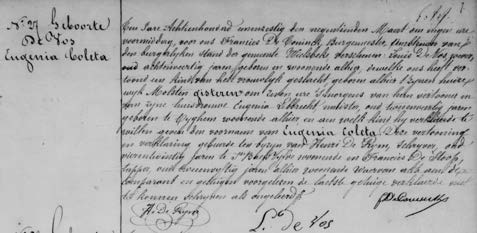
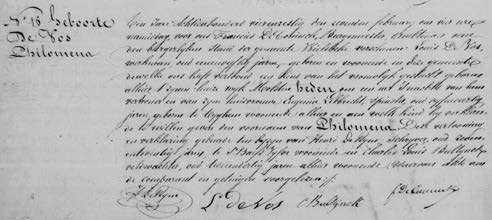
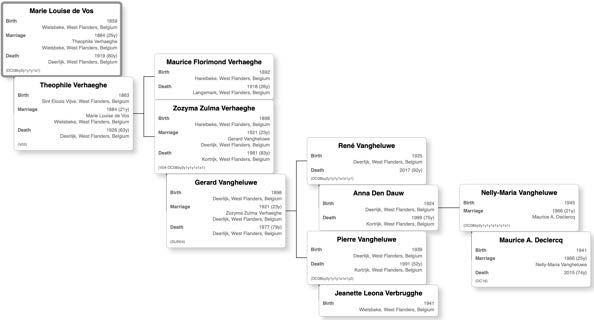
48.9. MARIE LOUISE DE VOS (DC08BY2Y1Y1Y1X1) & THEOPHILE VERHAEGHE
917
Figure 48.85: Wielsbeke, March 18, 1861, the birth of Eugenia Colete de Vos. Her father was 48-
year-old Louis de Vos, born and residing in Molsten, Wielsbeke. The mother was Eugenie Libbrecht,
a 42-year-old garment maker, born in Ooigem and residing in Wielsbeke.
Figure 48.86: Wielsbeke, February 7, 1864, the birth of Philomena de Vos, daughter of 51-year-old
Louis de Vos, born and residing in Molsten, Wielsbeke, and of 45-year-old Eugenie Libbrecht, born in
Ooigem and residing at Wielsbeke.
Figure 48.87: Three descending generations of Marie Louise De Vos (DC08by2y1y1y1x1)
The Desclergues of la Villa Ducal de Montblanc, 2nd ed., Omn., VOL. IV
© 2024 Nico F. Declercq
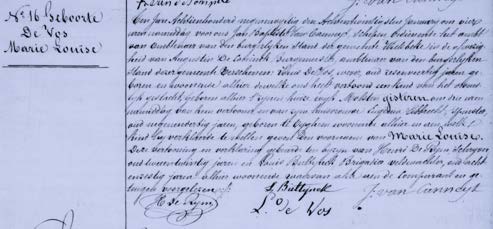
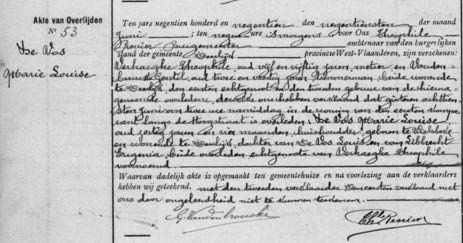
CHAPTER 48. THE MATERNAL DESCLERGUE ANCESTRY BRANCH BEGINNING WITH JOANA
918
CATHARINA DECLERCGZ (DC08B) & JOANNES DE VOS
Figure 48.88: Wielsbeke, January 27, 1859, the birth of Marie Louise De Vos, daughter of 46-year-old
Louis de Vos and 39-year-old Eugenie Libbrecht. She was born at Molsten in Wielsbeke.
Figure 48.89: Deerlijk, June 18, 1919, the death of 60-year-old Marie Louise De Vos. Her
husband, 55-year-old Theophile Verhaeghe, reported the death.
Theophile Verhaeghe’s contributions to the construction and entrepreneurial legacy resonate within his family and the broader community. They illustrate a blend of technical skills, business acumen, and adaptive strategies that inspire modern construction engineers, architects, and entrepreneurs.
48.9.2.3 The Verhaeghe Family: A Legacy of Adventurous Spirit and Resilience
The Verhaeghe family, descendants of Theophile Verhaeghe, epitomize a unique blend of industriousness and entrepreneurial spirit.
Unlike other branches of our ancestral tree, the Verhaeghe lineage stands out for its distinct characteristics, which are no less compelling. Historical accounts and testimonies reveal that many of Theophile’s descendants possessed a robust and adventurous spirit, reminiscent of the daring personas celebrated in Johnny Cash’s song ’Highwaymen.’
These descendants were known for their daring lifestyles, often characterized by a penchant for adventure and recklessness. Some were womanizers and had extramarital children, demonstrating a defiance of conventional norms. This boldness was accompanied by notable physical strength, further underscoring their larger-than-life presence.
However, it is crucial to acknowledge that not every descendant exhibited these traits. As with any attribute, the key to its value lies in its wise application. When channeled effectively, the Verhaeghe family’s adventurous spirit became a source of strength and resilience.
This indomitable spirit was most vividly displayed during times of conflict. Members of the Verhaeghe family earned medals for their bravery during World War I and played active roles in the resistance movements of both World War I and World War II. Their contributions to these significant historical events underscore a legacy of courage and patriotism.
The Verhaeghe family’s story is of resilience, strength, and a relentless pursuit of adventure. Their unique characteristics and daring exploits add a vibrant chapter to our family history, celebrating a lineage that embraced life’s challenges with vigor and determination.
48.9.2.3.1 Bernard Verhaeghe Bernard Verhaeghe (V01b) is the granduncle of Theophile Verhaeghe, as shown in Figure
48.97, and was Napoleon’s military from April 25, 1813, to his death on June 13, 1813. An image of Napoleon is shown in Figure
Between April 25, 1813, and his death on June 13, he participated, like all recruits of that period, in la Bataille de Lützen, as the French call the battle, or der Schlacht bei Großgörschen, as the Germans prefer. The battle occurred between Napoleon’s debacle in Russia and his eventual loss and exile to Elba. After his stay in Elba, Napoleon rose from his ashes in 100 days and gave his opponents full charge in Belgium. We know, of course, that this ended severely for Napoleon in the battle near Waterloo, South of Brussels. Historians often cite the Lützen battle as an example of Napoleon’s strategic ingenuity and military insight. At that time, Napoleon was at the height of his ability as a military leader.
© 2024 Nico F. Declercq
The Desclergues of la Villa Ducal de Montblanc, 2nd ed., Omn., VOL. IV
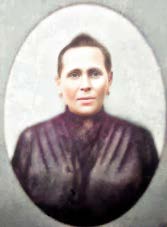
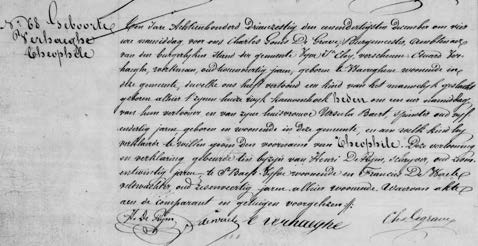
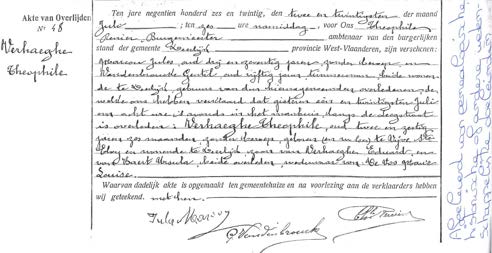
48.9. MARIE LOUISE DE VOS (DC08BY2Y1Y1Y1X1) & THEOPHILE VERHAEGHE
919
Figure 48.90: Marie Louise De Vos. MyHeritage® colorized this
photo. (Declercq de Silva Archive)
Figure 48.91: The birth certificate of Theophile Verhaeghe, December 31, 1863, Sint Eloois Vijve.
His father was 42-year-old Edouard Verhaeghe, born in Waregem and residing at Sint Eloois Vijve.
The family lived at Kauwenhoek in Sint Eloois Vijve. His mother was 35-year-old Ursula Baert, born
and residing in Sint Eloois Vijve.
Figure 48.92: The death certificate of Theophile Verhaeghe, July 21, 1926, Deerlijk. His death was
reported by his neighbors Gentil Vandenbroucke and Jules Warcon. Theophile was 62 years old and 6
months and was retired. He was born in Sint Eloois Vijve as the son of Edouard Verhaeghe and Ursula
Baert and was widower of Marie Louise De Vos.
The Desclergues of la Villa Ducal de Montblanc, 2nd ed., Omn., VOL. IV
© 2024 Nico F. Declercq
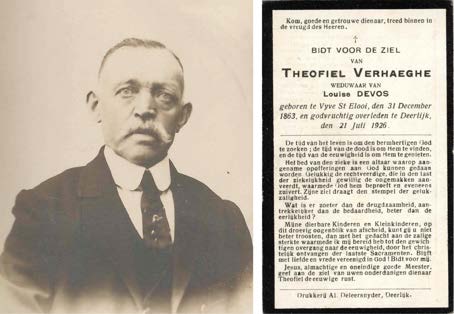
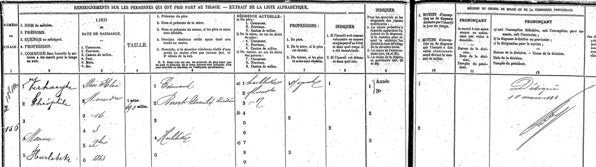
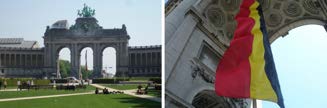
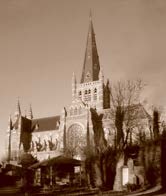
CHAPTER 48. THE MATERNAL DESCLERGUE ANCESTRY BRANCH BEGINNING WITH JOANA
920
CATHARINA DECLERCGZ (DC08B) & JOANNES DE VOS
Figure 48.93: Theophile Verhaeghe in the 1920s (Declercq de Silva Archive). Right is his
mortuary card (Courtesy of Luk Schelfhout).
Figure 48.94: The military registration of Theophile Verhaeghe, in Levée de 1883, Milice Nationale, Province de la Flandre Occidentale, 17e Canton de Milice, Commune de Harelbeke. He was a mason residing at Harelbeke and born in Sint Eloois Vijve on December 31, 1863. He was 169 cm tall. His father was farmer Edouard Verhaeghe, who also resided in Harelbeke, and his mother was Ursula Baert, who was already dead. On March 10, 1880, he was recruited and remained in the army until October 1, 1884.
Figure 48.95: The arch at the Cinquan-
tenaire park in Brussels. Theophile Ver-
haeghe was a constructor who was involved
in its construction in 1905. The other
image shows the Belgian flag underneath
the monument. (2011) (Declercq de Silva
Archive) The monument in 2023 can also
be seen in Figure 8.42 on page 74.
Figure 48.96: The Basilica of Dadizele (2014). (Declercq de Silva
Archive)
© 2024 Nico F. Declercq
The Desclergues of la Villa Ducal de Montblanc, 2nd ed., Omn., VOL. IV
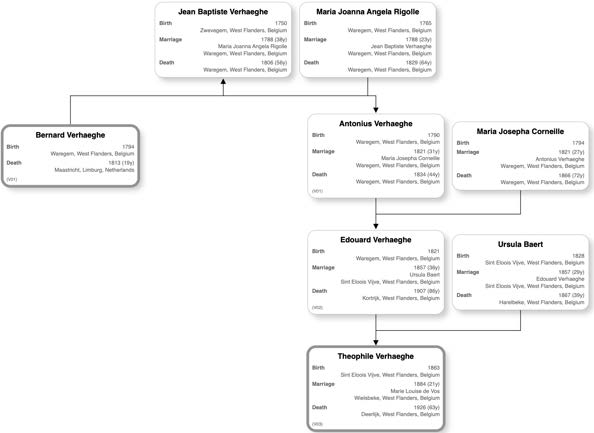
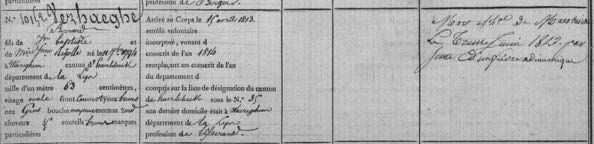
48.9. MARIE LOUISE DE VOS (DC08BY2Y1Y1Y1X1) & THEOPHILE VERHAEGHE
921
Figure 48.97: Relationship Chart Bernard Verhaeghe (V01) - Theophile Verhaeghe (V03)
Figure 48.98: Napoleon at ’la bataille de
Lützen’ , by Andrea Johann Fleischmann
(1811 – 1878).
Figure 48.99: The military file of Bernard Verhaeghe.
Figure 48.100: Painting by Alexandre Veron-Bellecourt
(1773-1838) depicting Napoleon, visiting the Invalides
infirmary in Paris on February 11, 1808. The one at
Maastricht may have looked similar.
The Desclergues of la Villa Ducal de Montblanc, 2nd ed., Omn., VOL. IV
© 2024 Nico F. Declercq
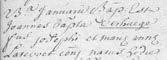

CHAPTER 48. THE MATERNAL DESCLERGUE ANCESTRY BRANCH BEGINNING WITH JOANA
922
CATHARINA DECLERCGZ (DC08B) & JOANNES DE VOS
Figure 48.101: 19th century, Statue of Marechal Ney at l’ Esplanade
of Metz. The statue is still there.
Figure 48.102: The baptism of Jean Baptiste Verhaeghe, Zwevegem,
January 23, 1750. He was a son of Joseph Verhaeghe and Marie Anne
Laetevoet. The godparents were not indicated.
Although the archives provide little information, we can assume that Bernard Verhaeghe was wounded in Lützen and transferred to the French military hospital of Maastricht, where he contracted typhus and died of it.
From his military file in Figure 48.99, we extracted the following information.
He was born at Waregem in 1794 (found in ’akte 1435’), and his Matricule number was 10152. He was a soldier in the 22e régiment d’ infanterie de ligne which recruited from March 27, 1812 until April 15, 1813 (matricules 8401 à 10200). His military record literally tells:
’Verhaeghe Bernard, fils de Jean Baptiste Verhaeghe et Marie Jeanne Rigolle, né le 11 septembre 1794 à Waregem, canton de Harelbeke, departement de la Lys, taille d’ un mètre 63 centimètres, visage ovale, front couvert, yeux bruns, nez gros, bouche moyenne, menton rond, cheveux j(aune), sourcils brun, marques particuliers nihil. Arrivé au Corps le 15 avril 1813, conscrit de l’
an 1814, compris sur la liste de désignation du canton de Harelbeke, sous le Numéro 35. Son dernier domicile était a Waregem, departement de la Lys. Profession de tisserand. Mort ’a l’ hôpital de Maastricht’ (Perhaps the hospital looked like Figure 48.100)
’, le 13 Juin 1813 parsuite d’ une fièvre adynamique19.’
Very likely, according to Klaas Portier,20 he died of Typhus.
The Battle of Lützen took place on May 2, 1813, and was a victory of Napoleon’s French forces against allied Russo-Prussian forces.
It was the first battle of the Befreiungskriege in Germany during the War of the Sixth Coalition, under the command of General Gebhard Leberecht von Blücher and Marshal Ludwig Adolf Peter Zu Sayn-Wittgenstein, which Napoleon’s enemies had formed after his defeat in Russia and the difficulties in Iberia.
Napoleon’s army forced the Allies to retreat but could not chase down the defeated troops due to a lack of cavalry. The victory, therefore, could not bear fruits to its full extent. In the Spring of 1813, Napoleon’s 145000 men strong army went to Leipzig through the Thuringian Forest. On May 1, his vanguard came into battle with Ferdinand von Wintzingerode, a Russian commander of the Austrian army, after which they occupied Lützen and Flossgraben. The latter was, in fact, a route for the transport of logs cut in the higher forests.
The night of May 1, Napoleon spent at the monument to the First Battle of Lützen, which took place in 1632 and in which King Gustav II Adolf of Sweden was killed. So, the battle of 1813 was, in fact, the second Battle of Lützen. He moved on to Leipzig the next day but left Marechal Ney in Großgörschen to cover his right flank. Ney, shown in Figure 48.101, had occupied the villages of Grossgörschen, Rahna, Caja, and Kleingörschen. The Prussian-Russian army was across the White Elster, the river that flows to Leipzig.
The following day, Ney was attacked by Prussian and Russian soldiers under General Gerhard von Scharnhorst at noon.
Napoleon came back to his aid, which led to a heavy battle that left 22000 dead and wounded on the French side and 8500 Prussians and 3000 Russians dead and injured.
Nevertheless, Napoleon was the victor, and France again possessed Saxony and the Elbe line.
48.9.2.3.2 Jean Baptiste Verhaeghe & Maria Joanna Angela Rigolle They were the parents of Bernard Verhaeghe (V01b).
Figure 48.103: Deerlijk, August 8, 1753 Deerlijk, the baptism of Maria
Anna Theresia Verhaeghe, daughter of Joseph Verhaeghe and Marie Anne
Laetevoet. She was a sister of Jean Baptiste Verhaeghe and probably died at a
young age. The godparents were Pierre Clarice and Anna Maria Verhaeghe.
19An adynamic fever is a fever that weakens the muscles significantly and may cause death.
20Klaas Portier, ’Soldaten van Napoleon - De gezondheidstoestand van militairen tussen 1799 en 1815’ , Master Thesis under the supervision of Isabelle Devos, Ghent University, 2013.
© 2024 Nico F. Declercq
The Desclergues of la Villa Ducal de Montblanc, 2nd ed., Omn., VOL. IV

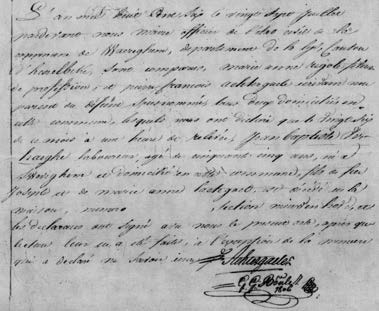
48.9. MARIE LOUISE DE VOS (DC08BY2Y1Y1Y1X1) & THEOPHILE VERHAEGHE
923
Figure 48.104:
Deerlijk, August 1, 1756, the baptism of Maria Anna
Theresia Josepha Verhaeghe, daughter of Joseph Verhaeghe and Marie Anna
Laetevoet. She was a sister of Jean Baptiste Verhaeghe. The godparents were
Pierre Clarice and Barbara Theresia de Cuypere.
Figure 48.105: The death of 56-year-old Jean Baptiste Verhaeghe, Waregem,
July 26, 1806. The document erroneously tells he was 55 years old, probably they
mixed him up with another Jean Baptiste Verhaeghe, born on March 3, 1751
and a son of Petrus Verhaeghe and Joanna Theresia Verbrugghe. He was the
husband of Marie Anne Rigolle, a cloth manufacturer. The death was reported
by his wife and by Pierre François Achtergaele. Jean Baptiste Verhaeghe was
born in Zwevegem, he resided in Nieuwenhove in Waregem, and he was a son of
Joseph Verhaeghe and Marie Anne Laetevoet (’Laetegoet’).
48.9.2.3.2.1 Jean Baptiste Verhaeghe Jean Baptiste Verhaeghe was born in Zwevegem on January 23, 1750, in Figure
48.102. His parents were Pierre Joseph Verhaeghe and Marie Anne Laetevoet.
He married Maria Joanna Angela Rigolle and died in Waregem, at the age of 56, on July 26, 1806, in Figure 48.105.
Jean Baptiste Verhaeghe was a brother of Maria Anna Theresia Verhaeghe, documented in Figures 48.103 and 48.104.
48.9.2.3.2.2 Maria Joanna Angela Rigolle Maria Joanna Angela Rigolle was born in September 1765 in Waregem, in Figure 48.106. Her parents were Amandus Rigolle and Joanna Humbeck.
She died in Waregem on November 12, 1862, at 65, in Figure 48.107.
We have not further investigated the family Humbeck. On Geneanet® , some genealogists identify this family with Haembeck, Hombeck, or Haenbeck and claim they were initially from Kruishoutem. Their German-sounding name possibly means they were Catholics who moved from Westfalen in Germany during the Spanish period. Some of our German autosomal DNA links may originate from this family.
48.9.2.3.2.3 Their Marriage Jean Baptiste Verhaeghe and Maria Anna Angela Rigolle married at Waregem in 1788, in Figure 48.108.
48.9.2.3.3 Antonius Verhaeghe (V01) & Maria Josepha Corneille Antonius was the brother of Bernard Verhaeghe (V01b).
48.9.2.3.3.1 Antonius Verhaeghe (V01) From his wedding certificate, we can extract that Antoine Verhaeghe was born on October 3, 1790, at Waregem, and he was a textile weaver. He was a son of Jean Baptiste Verhaeghe, who had died at Waregem on July 26, 1806, and of Marie Anne Rigolle. Antonius Verhaeghe (V01) died on December 8, 1842, at 42, in Figure 48.109.
48.9.2.3.3.2 Maria Josepha Corneille The list of baptisms at Waregem shows that she was born in 1793, with a baptism certificate of 1417.
Nevertheless, we have yet to find the baptisms at Waregem of that year and fear that the records have not survived.
She died in Waregem in 1866, in Figure 48.110.
48.9.2.3.3.3 Their Marriage Marie Josephe Corneille was 27 when she married, in Figure 48.111. She was a spinster and a daughter of Pierre Antoine Corneille and Maria Jeanne Bettens (who died in Waregem in 1811).
The Desclergues of la Villa Ducal de Montblanc, 2nd ed., Omn., VOL. IV
© 2024 Nico F. Declercq
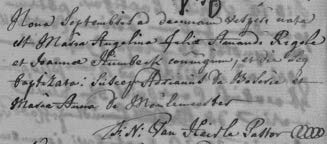
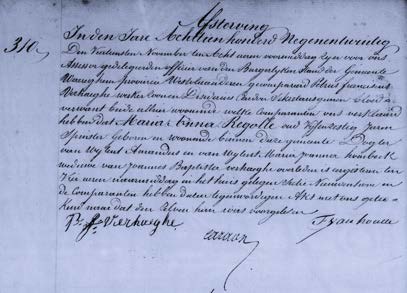
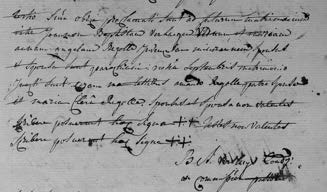
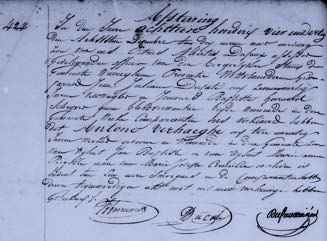
CHAPTER 48. THE MATERNAL DESCLERGUE ANCESTRY BRANCH BEGINNING WITH JOANA
924
CATHARINA DECLERCGZ (DC08B) & JOANNES DE VOS
Figure 48.106:
Waregem, September
1765, the baptism of Marie Anne Angela
Rigolle, daughter of Amandus Rigolle and
Joanna Humbeck. The godparents were
Adrianus de Boserie and Maria Anna de
Meulemeester.
Figure 48.107: Waregem, November 12, 1829, the death of 65-year-old Maria Anne
Angela Rigolle, born and residing in Waregem. She was the daughter of Amandus
Rigolle and Maria Joanna Humbeck. She was the widow of Jean Baptiste Verhaeghe.
The death was reported by Pierre François Verhaeghe and Desiderius Cardoen.
Figure 48.108: Waregem, 1788 the mar-
riage of Joannes Baptiste Verhaeghe and
Marie Anne Angela Rigolle. The witnesses
were Amandus Rigolle and Maria Clara
Rigolle.
Figure 48.109: Waregem, December 8,
1834, the death of 42-year-old Antonius
Verhaeghe, who was born and residing in
Waregem and the son of Jean Baptiste
Verhaeghe and Marie Anne Rigolle and
husband of Marie Josephe Corneille.
© 2024 Nico F. Declercq
The Desclergues of la Villa Ducal de Montblanc, 2nd ed., Omn., VOL. IV
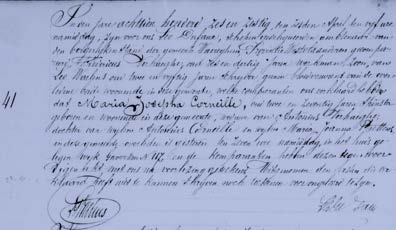
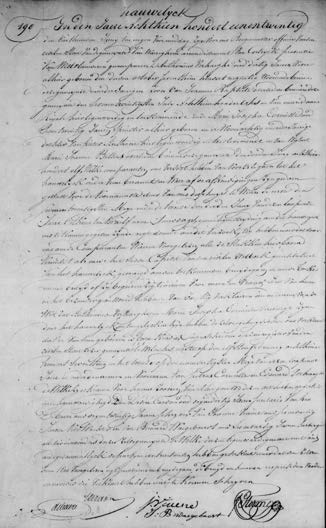
48.9. MARIE LOUISE DE VOS (DC08BY2Y1Y1Y1X1) & THEOPHILE VERHAEGHE
925
Figure 48.110: Waregem, April 5, 1866, the death of 72-year-old widow of Anto-
nius Verhaeghe, Maria Josepha Corneille. She was born and residing in Waregem
and was the daughter of Antonius Corneille and Maria Joanna Bettens. The death
was reported by her 36-year-old son Frederic Verhaeghe. She lived in the suburb
’Gaverke 117’ . She died in the year of a Cholera epidemic; perhaps Cholera was
the cause of her death.
Figure 48.111:
Waregem, June 14,
1821, the wedding of 30-year-old Anto-
nius Verhaeghe with 27-year-old Maria
Josephe Corneille. Antonius Verhaeghe
was born in Waregem on October 3, 1790,
lived in Waregem and was a son of Jean
Baptiste Verhaeghe who died in Waregem
on July 27, 1800, and of Marie Anne
Rigolle, who witnessed the wedding. Marie
Josephe Corneille was born and residing in
Waregem and was the daughter of Pierre
Antoine Corneille, who witnessed the wed-
ding, and Marie Jeanne Bettens, who died
in Waregem on June 3, 1811. The docu-
ment also refers to their son Edouard Ver-
haeghe, who was born before their marriage
and had been properly registered.
The Desclergues of la Villa Ducal de Montblanc, 2nd ed., Omn., VOL. IV
© 2024 Nico F. Declercq
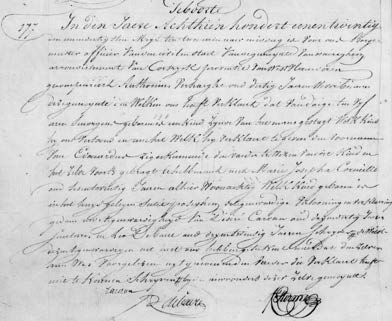
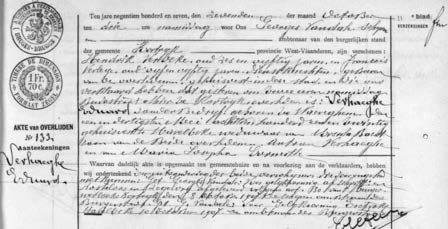
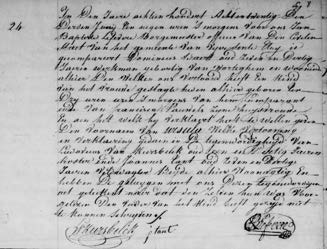
CHAPTER 48. THE MATERNAL DESCLERGUE ANCESTRY BRANCH BEGINNING WITH JOANA
926
CATHARINA DECLERCGZ (DC08B) & JOANNES DE VOS
Figure 48.112: Waregem, May 31, 1821, the birth of Edouard Verhaeghe. Note
that he was born before his parents’ marriage, as can be read in their wedding
certificate the same year in Figure 48.111. He was the son of 30-year-old Antonius Verhaeghe, who honorably recognized the child as his son on the birth certificate.
This was agreed upon by the wise mother, 26-year-old Marie Josephe Corneille. It
is important to note that this could only be done if the mothers consented, which
indicates that Marie Josephe Corneille must have been a respectable lady. Edouard
was born in Potegem, a suburb of Waregem.
Figure 48.113: Harelbeke, October 6, 1907, the death of Edouard Verhaeghe. He died in
Budastraat in Kortrijk. He was born in Waregem on May 30, 1821, lived in Harelbeke and
was widower of Ursula Baert and he was the son of Antonius Verhaeghe and Maria Josepha
Corneille. Note that his granddaughter, Zozyma Verhaeghe, equally died in Budastraat in Kor-
trijk, in 1981, in the presence of the author.
Figure 48.114: Sint Eloois Vijve, June
3, 1828, the birth of Ursula Baert. Her
father was 36-year-old Dominicus Baert,
born in Wortegem and residing in Sint
Eloois Vijve. The mother was Francisca
Pauwels.
© 2024 Nico F. Declercq
The Desclergues of la Villa Ducal de Montblanc, 2nd ed., Omn., VOL. IV
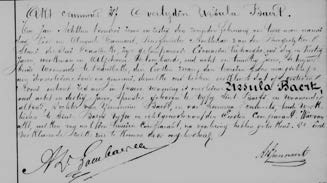
48.9. MARIE LOUISE DE VOS (DC08BY2Y1Y1Y1X1) & THEOPHILE VERHAEGHE
927
Figure 48.115: Harelbeke, February 6,
1867, the death of 38-year-old Ursula
Baert. The death announcement was made
by her husband 43-year-old Edouard Ver-
haeghe. She was born in Sint Eloois Vi-
jve (the registrar wrote ’Sint-Baafs-Vijve’)
and residing in Harelbeke, and she was the
daughter of Dominicus Baert and Fran-
cisca Pauwels who lived in Sint-Baafs-
Vijve (this may also have been Sint Eloois
Vijve).
Figure 48.116: Sint Eloois Vijve, September 25, 1857, the marriage of
Edouard Verhaeghe and Ursula Baert. Edouard Verhaeghe was a ’dien-
stbode’ , born on May 31, 1821 and was a son of Antonius Verhaeghe
who died in Waregem on December 8, 1834, and of 65-year-old Maria
Josepha Corneille who witnessed the wedding and resided in Waregem.
Ursula Baert was a spinster, born on June 3, 1828 in Sint Eloois Vijve,
where she also resided. The bride was a daughter of 69-year-old Dominicus
Baert and 69-year-old Francisca Pauwels. (sheet 1)
Figure
48.117:
Sint Eloois Vijve,
September 25, 1857, the marriage of
Edouard Verhaeghe and Ursula Baert.
(sheet 2)
The Desclergues of la Villa Ducal de Montblanc, 2nd ed., Omn., VOL. IV
© 2024 Nico F. Declercq
CHAPTER 48. THE MATERNAL DESCLERGUE ANCESTRY BRANCH BEGINNING WITH JOANA
928
CATHARINA DECLERCGZ (DC08B) & JOANNES DE VOS
Figure
48.118:
Sint Eloois Vijve,
September 25, 1857, the marriage of
Edouard Verhaeghe and Ursula Baert.
(sheet 3)
Figure 48.119: Wielsbeke, October 17, 1884, the marriage of Theophile Ver-
haeghe and Marie-Louise De Vos. The groom was a mason, residing in Harel-
beke, and born in Sint Eloois Vijve on December 31, 1863, son of 63-year-old
Edouard Verhaeghe, residing in Harelbeke, who witnessed the wedding, and of
Ursula Baert, who died in Harelbeke on February 6, 1867. The groom had also
fulfilled his military service. The bride was a lace worker who lived in Wielsbeke,
where she was born on January 27, 1859. Her father was 72-year-old Louis de
Vos, who resided in Wielsbeke and witnessed the wedding, and her mother was
Eugenie Libbrecht, who died in Wielsbeke on February 31, 1881.
© 2024 Nico F. Declercq
The Desclergues of la Villa Ducal de Montblanc, 2nd ed., Omn., VOL. IV
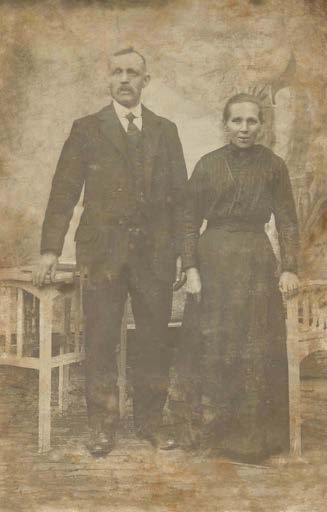
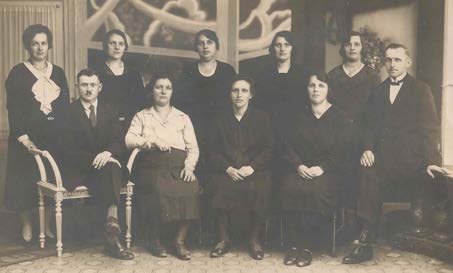
48.9. MARIE LOUISE DE VOS (DC08BY2Y1Y1Y1X1) & THEOPHILE VERHAEGHE
929
Figure 48.120:
Marie Louise De Vos
with her husband Theophile Verhaeghe, not
long before she died. We assume this pic-
ture is therefore taken in 1918 or early
1919. (Declercq de Silva Archive)
Figure 48.121: The children of Verhaeghe-De Vos who survived their parents. The picture was
likely taken in 1926 or 1927 and probably commissioned by the couple Caby-Verhaeghe because
Theophiel is the only in-law on the picture. From left to right: Elodie Marie Eeckhout, Theophiel
Caby, Irma Elisa Verhaeghe, Clotilde Maria Verhaeghe, Marie Leonie Verhaeghe, Renilde Marie
Vehaeghe, Zozyma Zulma Verhaeghe, Alida Augusta Marie Verhaeghe, Elisa Clara Verhaeghe
and Seraphin René Verhaeghe. (Declercq de Silva Archive)
The Desclergues of la Villa Ducal de Montblanc, 2nd ed., Omn., VOL. IV
© 2024 Nico F. Declercq
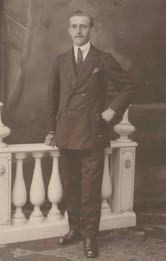

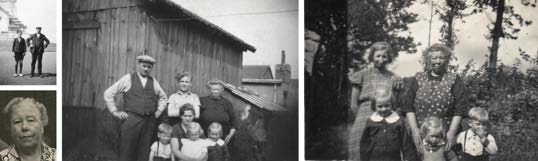
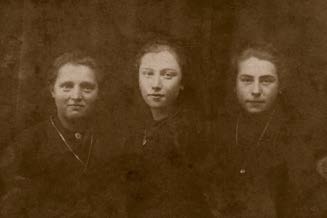
CHAPTER 48. THE MATERNAL DESCLERGUE ANCESTRY BRANCH BEGINNING WITH JOANA
930
CATHARINA DECLERCGZ (DC08B) & JOANNES DE VOS
Figure 48.122: Seraphin René Verhaeghe in the 1920s. He married
Rachelle Demeyere from France in 1938. The marriage may have oc-
curred in France, but the party was in Deerlijk in the suburb ’Belgiek’
. (Declercq de Silva Archive)
Figure 48.123: Military registration of Seraphin René Verhaeghe, in Lichting van 1919, Nationale Militie, Provincie West-Vlaanderen, militiekantoor Harelbeke, gemeente Deerlijk. He was a mason, born in Harelbeke on October 30, 1899. His parents were Theophile Verhaeghe from Sint Eloois Vijve, and Marie Louise De Vos, from Wielsbeke. On November 12, 1919 (we assume, or perhaps this was added later), he was exempted because he was indispensable for taking care of his father who had become a widower.
Figure 48.124: We can see Rachelle Demeyere, the wife of Seraphin René Verhaeghe, on July 24, 1971. We equally see Demeyere in-law relatives of Seraphin René Verhaeghe at Vendin-le-Viel in France in 1938. The older person is Leonie (mother of Rachelle Demeyere and Joseph Demeyere), the youngest three children are Leonie Georgette (1936), Pierre Jules (1935) and Paulette Jacqueline (1933). On the image of Joseph Demeyere (from the French resistance) with his wife Germaine and three youngest children. the boy in the middle is René Vangheluwe, described in Chapter 48.12.1, while the person right is Leonie. Finally, an image appears from 1938, of Joseph Demeyere and René Vangheluwe, described in Chapter 48.12.1, at Vimy monument in France. (Declercq de Silva Archive)
Figure 48.125: These three adolescents
worked and lived at the same place in Brus-
sels, when the picture was taken. Left
is Elisa Clara Verhaeghe, right is Elodie
Marie Eeckhout who would later marry
Elisa Clara’s brother Medard Verhaeghe.