The Desclergues of la Villa Ducal de Montblanc, Second Edition Omnibus by Nico Declercq - HTML preview
Download the book in PDF, ePub, Kindle for a complete version.
814
CHAPTER 45. MICHEL ACHIEL RENATUS DECLERCQ (DC15) & IRMA HELENA LESAGE
Figure 45.31:
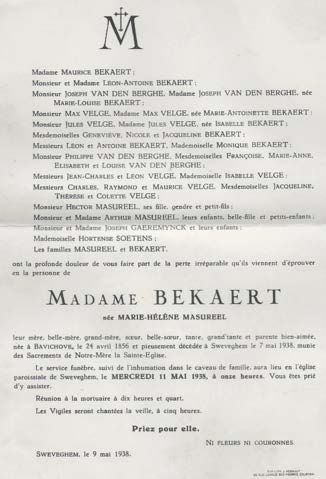
The death announce-
ment of Marie Hélène Masureel, Madame
Bekaert, May 7, 1938. (Declercq de Silva
Archive)
Figure 45.32:
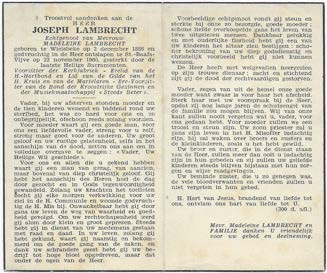
The obituary card of
Joseph Lambrecht, husband of Magdalena
Lambrecht, November 22, 1960. Joseph
Lambrecht was one of the main business
partners of Michel Declercq in the 1920s
and 1930s, together with Vanlerberghe.
(Declercq de Silva Archive)
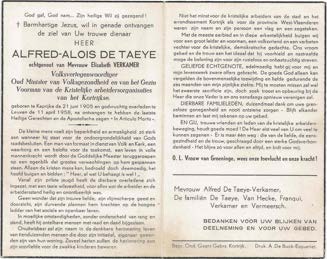
Figure 45.33: The obituary card of Al-
fred Alois de Taeye, husband of Elisabeth
Verkamer, April 11, 1958. (Declercq de
Silva Archive)
© 2024 Nico F. Declercq
The Desclergues of la Villa Ducal de Montblanc, 2nd ed., Omn., VOL. III
45.1. MICHEL ACHIEL RENATUS DECLERCQ (DC15)
815
Borrelia bacterium.
45.1.2 His Early Youth
Michel Declercq was born in Wielsbeke, shown in Figure 45.8 in 1906, in Figure 45.3, at the height of the region’s flax commerce.
He was the third child of Ernest Constant Declercq and Marie Elodie Devenyn. His elder brother Joseph was born four years earlier, while his sister Maria was born one year earlier.
His parents would soon recognize Michel as a child prodigy and expect him to have a career rather than continue the family farm.
He received a proper education as described next. A beautiful school picture taken during WWI is shown in Figure 45.8.
A crucial period in his life must have been the German occupation of Wielsbeke during WWI. Figure 45.8 shows him as a young child in a school picture in 1916, while some events that must have been engraved in his memory are shown in 45.9.
He must have had a bad experience during the war or heard many horror stories just after the war. When the Nazzis occupied the region during WWII, he refused to participate in the economy under the occupation.
It can also be read in Chapter 64.6 about Emile Lesage (Michel’s father-in-law), whom the two families had met at the end of WWI.
As a result, the two families became business partners, and Emile’s youngest daughter later married Michel.
45.1.3 His Education
Michel’s primary school was the village school of Wielsbeke. The authorities took a picture during WWI at the convent of Wielsbeke, shown in Figure 45.10, on the occasion of the Americans sending provisions to the village. Indeed, the USA was neutral during most of the war and sent food to occupied Belgium.
Around 1919, Michel began his education at Sint-Amandscollege in Kortrijk, shown in Figure 45.11, together with André Demedts, described in Chapter 45.1.4.
Michel would soon find interest in attending school in Ghent, shown in Figure 45.12 because his auntie and André Demedts’ uncle lived in Gentbrugge. André had been in school in Ghent at Sint Lievenscollege for a few months just after the war and must have talked about it to Michel.
When Michel was barely 16, he went to Ghent and studied at ’Sint-Barbara college,’ organized by the Jesuits, while André had to stop and work on his parent’s farm. During his education, Michel probably stayed at his Auntie Flavie’s house or, at least, could visit her when needed. Flavie Declercq died in 1926 and is described in Chapter 43.5. The picture in Figure 45.12 was probably taken at the college dorm. Michel can be seen in the middle of the second row, the fourth person from the right, with a close-up in Figure 45.13. Being in such company as a young boy was quite remarkable. We can only speculate on the occasion of the picture and who was on it. It nevertheless indicates that Michel was an unusual boy.
Joseph, Michel Declercq’s brother, had also been a student at Sint-Barbara the year before, at 19.
It is essential to repeat that André Demedts, unlike Michel, ended his education at 15 because he had to work on his parents’ farm.
Self-education, very likely with the help of books and discussions provided by Michel and his siblings, further transformed André into the talented writer he would become.
We don’t know precisely until what age Michel Declercq studied but assume that he was already a flax merchant at the age of 21
because, at the age of 22, he sent a postcard, shown in Figure 45.88 on page 845, from Zelzate to his girlfriend, Irma Lesage. We assume that his presence at Zelzate was related to the flax industry rather than education.
45.1.4 His Friendship with André Demedts and Gabrielle Demedts
The reader may be interested in checking out Chapter 44.9 and Chapter 44.8.5 first.
André Demedts (Sint-Baafs-Vijve, Wielsbeke, 1906 - Oudenaarde 1992), shown in Figure 45.15, was a Flemish writer, son of Maurits Demedts and Celesta Vandenhende and grandson of Ivo Demedts.
His parents are described in Chapter 44.9 and were friends of Ernest Constant Declercq and Marie Elodie Devenyn. André’s sister was Gabriëlle Demedts (Sint-Baafs-Vijve, Wielsbeke, 1909 – Kortrijk 2002), equally a Flemish poet. The picture in Figure 45.14
was taken at the ’Paasfoor’ of Kortrijk around 1927. In the photo, taken in a fake car at the carnival, we find the two Demedts siblings and five Declercq siblings.
Michel Declercq was born in Reynaertstraat (Hof van Brussel) in Wielsbeke in the same year as Andre Maurice Demedts, who was also born in Wielsbeke (Elsbos, Sint-Baafs-Vijve, Wielsbeke) in Drogenbroodstraat. Both farms of Declercq and Demedts were only 2 km apart, as explained in Figure 44.110 on page 790.
Michel was four months older than André. Michel’s eldest son was named André, while the author’s father would also be Maurice, the name of Andre Demedts’ father. It is probably a coincidence that André Demedts’ grandfather was Ivo Demedts, while Michel Declercq’s grandfather was Ivo Declercq (DC13).
André’s cousin, who frequently stayed with the Demedts family, was called Marcel and was also known by the Declercqs. Michel’s second son was named Marcel, the father of Carolle.
André’s sister was Gabrielle, equal to the second name of Maria Declercq.
Michel’s mother was a single child and had lost her father early in her life. She was a strong, friendly, and emancipated woman who had decided, with her husband, to offer all her children, including their daughters, a good education. However, they lived in a rural village. One can only imagine how interesting the daily discussions at the dinner table of six studying youngsters in one family must have been, certainly when the Demedts siblings joined them.
To understand the life of André Demedts, we should highlight the passion of the Declercqs for overseas countries and, in particular, Africa. Around 1960, Sister Ernestine Declercq, described in Chapter 44.5.7, was in the Belgian Congo. Still, this passion for Africa was also part of their literature and a mission to spread knowledge and civilization to countries that needed it. Indeed, André Demedts would also spend energy on South Africa, as is described below.
André Demedts (Wielsbeke 1906—Oudenaarde 1992) was a Flemish writer and teacher. From 1949 to 1971, he was the director of Flemish Television in Belgium (BRT), the radio division of West Flanders. Demedts was a member of the Royal Academy for Dutch Language and Literature and was awarded the Triennial State Award. His oeuvre covered all genres.
In 1929, when Michel Declercq (DC15) was a flax merchant and was in a relationship with Irma Lesage, André Demedts was at the height of his ambitions as a writer and published his poetry debut Jasmijnen.
Later, he would also write novels, such as Voor de avond valt(1947), De ring is gesloten (1951), Geluk voor iedereen (1982), Veertien-Achttien (1985). Most noteworthy are the repression novel De Levenden en de Doden (1959) and the tetralogy De eer van ons volk (1973-1978), a rural epos set in the turbulent period around the French Revolution and partly based on Demedts’ family history.
The Desclergues of la Villa Ducal de Montblanc, 2nd ed., Omn., VOL. III
© 2024 Nico F. Declercq
CHAPTER 45. MICHEL ACHIEL RENATUS DECLERCQ (DC15) & IRMA HELENA LESAGE
André Demedts is also known for a beautiful work he wrote on the life of writer Stijn Streuvels, shown in Figure 45.15, ’Stijn Streuvels, een terugblik op leven en werk’ (1971). He has received numerous awards for his work.
We can notice his love for Africa in the bonds he established with South Africa. Indeed, he strived for cultural integration between Flanders, the Netherlands, and South Africa. As early as 1944, he paid attention to the Afrikaners’ problems in the book ’Trouw aan hun Volk,’ which he published under the pseudonym Koen Lisarde and set during the Boerenoorlog. Demedts regularly published in South African magazines and, in 1948, became a member of the Afrikaanse Skrywerskring, having become a member of the Maatschappij der Nederlandse Letterkunde in Leiden one year earlier. From that moment on, he became a permanent employee of the Zuid-Afrikaanse Tydskrif vir Letterkunde. He provided a column with reflections on the latest achievements in literature and literature from Flanders.
Also, Demedts was very much concerned about La Flandre in the North of France, particularly in the areas where Flemish is spoken and had been confiscated by Louis XIV, as can be found, for instance, in Chapter 34. It is no coincidence that Demedt’s efforts to improve the Dutch language and culture still bear the most fruit in this area today.
The André Demedt Prize was created in Kortrijk in 1970. The prize aimed to award a person or organization that, entirely in the spirit of Demedts, had committed itself to the Flemish emancipation, the Dutch integration, the cultural contacts with South Africa, or the stimulation of cultural awareness in French Flanders. The prize is still awarded every two years in December.
André Demedts’ legacy is best felt in his native village, Sint-Baafs-Vijve, Wielsbeke. In 1983, a genuine museum André Demedtshuis was built in the old rectory next to the Saint-Bavo church. It is an arts and culture center with monthly exhibitions, which houses the André Demedtsmuseum.
Critical to André Demedts, shown once more in Figure 45.15, was his unshakeable loyalty to the Christian faith, his country, and his people, similar to Michel Declercq (DC15). His Christian belief is something he, indeed, shared with Michel Declercq his entire life.
Gabriëlle Demedts (Wielsbeke 1909 – Kortrijk 2002), shown in Figure 45.16, sister of André Demedts, was a Flemish Belgian poet.
1934, she wrote her first poems, and in 1937, she published her first work, Een gevangene zingt.
As a young child, she was struck by Poliomyelitis, which has confined her life. She was very close with Valentine Declercq. Gabriel was born on June 11, 1909, while Valentine was born eight months later, on February 13, 1910.
When Valentine Declercq was ill in 1939 and knew she would die soon, Gabrielle wrote a poem for her, Zomer, on page 763.
Gabrielle Demedts also wrote a poem for Valentine when her relationship with Daniel Lesage had ended, Rustig Lied, shown on page 758, followed by Lage tonen, on page 758.
Finally, when Ernest Constant Declercq died, she wrote Ik heb gedaan for him, shown on page 793.
When Andre Demedts and Michel Declercq were born, we also find the birth of Karel Jonckheere in Ostend. The Declercqs and the Demedts knew his works. He is described in Chapter 44.5.7.3.
45.1.5 His Career as a Flax Merchant
The epicenter of flax merchandising in the world was the Kortrijk market. Flax was sold on Mondays, and money was trafficked from merchants to farmers. Although the merchants made the deals there, the actual transfer of goods took place either at the riverbank, at the train station, or in devoted warehouses. Money transactions regularly occurred in Kortrijk, even when flax was purchased or sold at a farm.
To gain money, a flax merchant had to forecast the quality of flax. The most exceptional quality looked blueish and consisted of excellent fibers. Flax class prediction was the connoisseur’s job. The soil, the climate, the seeds, the shape of the early plants, the color, the speed of growth, the shine, and the flowers were all of primordial importance. Every aspect was carefully studied to estimate the ultimate quality and, therefore, the price a merchant was willing to pay in advance, hoping to sell at a high price once harvested and processed.
However, the venture was even more comprehensive. Indeed, the rate changed with time, depending on offer and demand. A merchant with a large house and a barn could store high-quality flax for one or more years until the price rose to a peak to sell at the highest profit. Even when low-quality flax had been bought, if stored correctly, it could be sold reasonably once the demand was high.
In some years, this constant gamble was a moderate risk; in others, it was devastating.
As described in Chapter 45.3 and Chapter 45.5, a devaluation of the Belgian Franc in 1935 forced Michel Declercq and Irma Lesage to postpone purchasing a farm and overpowered them to trade more flax. It made Emile Lesage somewhat anxious after a while because he worried that the money he had paid the couple when they married would evaporate. There were already three children before his death in 1938, and Emile expressed his worry to Michel. He suggested Michel purchase a farm at Cordes (Frasnes-Les-Avaing) and stop making babies.
Michel answered that it was his Christian duty to have more kids, while Irma refused to move to Cordes because she didn’t like living in the middle of nowhere. So, the flax business continued, and evil years were yet to come.
As was made evident in Chapter 44.6, Michel, son of Ernest Constant, grew up in a family of flax farmers and merchants. In that chapter, we explain how flax is cultivated. Once flax was harvested, it was dried before transportation. A modern impression is shown in Figure 45.17.
A merchant who purchased ’straw-flax’ (i.e., it is yet to be processed and typically transported to Kortrijk from France or the Netherlands) had to have the necessary skills to determine the quality. Good quality straw-flax met the following requirements: Good even stem length; Suitable consistent stem thickness; Few and highly branched; A root system with a straight, fine, white spindle root and many suction hairs (i.e., hair roots) spread over the root’s entire length; Uniform white-yellow color; Smooth and vigorous straight stem; Good and even degree of ripeness; Free from disease and infection damage; The Flax must not be damaged; The highest possible purity was achieved when there were no weeds or earth residues.
45.1.5.1 retting or ’roten’
The purpose of retting is described in Chapter 44 to dissolve pectin and release the wood-like inner part of the stem from the fibrous outer part. Here we show an example of hot-water retting, in Figures 45.20 and 45.21, which happened at a water temperature of 32 degrees Celsius and occurred in 2 to 3 days, much faster than river retting that took a few weeks. The quality, in principle, was the same but was better controllable and reproducible. On average, one had to release 10% water daily and replace it with hot water of around 45 degrees Celsius to maintain a constant temperature. The timing was crucial. Retting had to continue until the experienced operator, after a quality check, noticed that the pectin was dissolved, and the time was right to remove the product from the water bath. Flax must swell during the process, which occurs efficiently when the mass ratio of flax/water is 10%. If
© 2024 Nico F. Declercq
The Desclergues of la Villa Ducal de Montblanc, 2nd ed., Omn., VOL. III
45.1. MICHEL ACHIEL RENATUS DECLERCQ (DC15)
817
more flax is used, the production cost per hot-water bath is the same, but the flax stems don’t swell properly and reduce the final product’s quality. Indeed, a retting process that occurs too slowly produces acids harmful to the fibers.
In particular, processing thin flax stems was risky because they were easily packed too densely. Thick flax was almost naturally stacked in a hot-water bath at the required 10% rate.
The flax merchant who provided flax carefully monitored the procedure, as shown in Figure 45.20. The most efficient retting companies immediately moved the flax bunches from the cart into the bath without intermediate stacking. Not only did it gain time, but it also reduced the risk of nestling and other side effects, which would complicate work afterward.
The person in Figure 45.20 could easily be mistaken for either Constant Vansteenkiste or Joseph Vansteenkiste from Wevelgem1
because there are similarities, and they are well-known. On the back of the postcard2, the process invented by Vansteenkiste is mentioned, but it does not state that the person on the card is Vansteenkiste.
We have performed an investigation using biometric methods, and neither Constant nor Joseph match3. Furthermore, the Vansteenkistes were born around 1870; by the time this picture was taken (around 1930), they would have been around 60, which is not the case for the person in the image.
In 1930, Michel Declercq was 24 years old and active as a flax merchant before marrying in 1932. Also, the glorious Belgian days of the Vansteenkistes occurred before 1920 and were somewhat discredited later for political reasons. One would not have risked placing them on a postcard in the 1920s or 1930s.
Although we don’t want to exclude the possibility, the chances are higher that this was, in fact, Michel Declercq. The same biometric comparison methods used on Michel Declercq resulted in a closer match, as shown in Figure 45.19.
A linguistic investigation dates the postcard to the period before 1939, shown in Figure 45.21.
45.1.5.2 Drying or ’kapellen’ , turning or ’keren’
After Flax had been removed from therootput, it was thrown, as bunches, on a field at specific distances from one another so that workers could adequately construct chapels.
The task of kapellen was challenging and intensive, as shown in Figures 45.18 and 45.22. The purpose was to dry Flax efficiently.
The chapel’s angle was crucial because if it was too steep, it did not contain enough Flax or too much otherwise. If the inclination was too low, the fibers could bend, making further processing difficult. Incompetence to choose the right angle or perfectly bind the top of the chapel could destroy it in bad weather, either by the wind or by too much rain penetrating the stems.
Flax was then further processed to extract fibers like blond hair. The best Flax was called ’first class.’ It’s an expression still used in our family to state that something is perfect: ’Het is eerste klasse.’ If a flax merchant had incidentally bought low-quality Flax, he used to say ’het is een buk.’
While the chapels were on the field, they had to be turned inside out, at least twice, to dry evenly. In some processes, Flax has retted more than once, and therefore, the procedure of forming chapels and turning or keren was repeated several times. The industry demanded skilled workers to handle this.
45.1.5.3 Breaking flax (’braken’ or ’brakelen’)
When flax was retted, the fibers were unbonded from the other tissue but not released. Flax stems had to be broken or cracked, shown in Figure 45.22 to reveal the threads, and then the undesired remains of the wood pipes were removed.
This could only be done when the flax stems were dehydrated because otherwise, the wood pipes did not break easily and were stuck onto the fibers during the scutching process described in Chapter 45.1.5.4. Indeed, the purpose was to retain only the beautiful threads and liquidate the rest for other purposes.
45.1.5.4 Scutching flax (zwingelen)
Scutching, shown in Figure 45.23, was initially done by tapping the flax parallel to the fibers to release the wood-like interior particles from the outer flax fibers in flax stems. Soon, the star mill or Stermolen was invented, i.e., the wheel to which fins were attached that beat the Flax 12 times per cycle. The machine was hazardous because it could hurt the head and the worker’s hands without protection. Though safer and fully automated, modern machinery still uses this principle, as in Figure 45.23. Each flax stem contains between 30 and 40 fibers.
Flax appropriately dried and was scutched easily. The reason is that under the best circumstances, flax was bleached by ultraviolet sunlight while drying. This bleaching destroyed the retting process’s slimy relicts and helped naturally release the particle from the flax fibers. Sophisticated producers of flax sometimes removed slime and particles while flax was still wet, called pressing, or persen because a press pushed muck out of the retted flax. In particular, the British detested the procedure because they did not like retting pits. Pressing was extra work but made the remaining processes run smoother. The decision to use this procedure depended on the additional cost compared to the benefit of time gained. It all depended on the circumstances, including the market value.
Scutching requires essential worker skills and experience. One had to transpose the ’handful of Flax sufficiently’ to ensure the fins hit the insufficiently scutched stems. One also worked from top to bottom. The machine had to be set according to the thickness of the bunch of flax to be processed. The inexperienced worker could break the fibers or produce flax loins4 of lousy quality and therefore equally useless. Even more so, he could easily break his fingers or hand.
After scutching, a vital side-product could also be further used, i.e., flax loaves or vlaslemen. These were used for the fabrication of plates or pellets. Line seeds were used for sowing new Flax 5 or for extracting oil. Linseed oil is, for instance, used in fine oil paint by artists.
1Constant Vansteenkiste was an inventor and is hugely respected in the industries he was involved in; Joseph was his brother and is less known.
2The back of the postcard reads ” 12 – Het roten in bassins. De wetenschap zoekt het geheim der Leie op te sporen. Ontelbare roterijen werden sedert de oorlog opgericht waarin het vlas naar de methode van C. Vansteenkiste in 1904 toegepast in lauw water geroot het Leieroten niet enkel evenaart, maar zelfs te boven gaat. Le Rouissage en cuves. La science tache de decouvrir le pouvoir merveilleux de la Lys. A la suit de Constant Vansteenkiste qui en appliqua le principe en 1904 beaucoup de liniers utilisent avec succès le rouissage à eau chaude. Leurs produits egalent et surpassent actuellement les lins rouis à la Lys.’ ’ Postcard by Thill and Nels, Uitg. Van Melle, Burgstraat, 23 Gent
3The hairline shape and position are different, and the relative proportions of the face are also different. It is, therefore, unlikely that the person in Figure 45.20 is one of the Vansteenkiste brothers.
4Loins were a side product, called vlaslemen
5In that case, the farmer selected the most voluminous seeds.
The Desclergues of la Villa Ducal de Montblanc, 2nd ed., Omn., VOL. III
© 2024 Nico F. Declercq
CHAPTER 45. MICHEL ACHIEL RENATUS DECLERCQ (DC15) & IRMA HELENA LESAGE
45.1.5.5 Hackling flax (Combing or ’hekelen’)
Combing flax removes particles and short fibers so that only perfect long threads remain the end product. Figure 45.24 dates from 1815-1830 and was based on the traditional flax processing, done in small quantities at the farm, where the farmer and his wife had separate tasks.
The wife traditionally did the cutting and spinning, while the husband was responsible for fieldwork, merchandising, and caring for the cattle. For instance, flax fibers were used by the Egyptians to make ropes and fabricated lines for mummification. Uniforms of soldiers in Europe also used to be made of flax. Sails on boats to cross the oceans were also made of linen.
45.1.5.6 Textile: Spinning and Weaving and how this process moved to neighboring areas
The Declercqs may have woven textiles, as seen in Figure 43.5 on page 720 concerning Leo Bernard Declercq (DC12). Therefore, we describe briefly how flax fibers were further processed. Weaving linen became very important from the 15th century onwards.
Existing technology used for wool textile production could be used with minor adaptations.
In the context of our book, which described how our Declercqs arrived from Spain, in the area of Kortrijk at the end of the 16th century, it is interesting to find a quote6 from Emperor Carlos V, which states,
’Ik vrees niets voor Vlaanderen, zolang de velden er vlas zullen dragen, er vingeren zijn om het te spinnen en armen om het te weven: de Vlamingen zullen altijd rijk zijn, zolang men de duimen van hun spinsters niet af en houwt!.’
In other words,
’I fear nothing for Flanders, as long as the fields will carry Flax, there will be fingers to spin it and arms to weave it: the Flemish will always be rich, as long as one does not cut off the thumbs of their spinners!.’
It’s inevitable that the Declercqs when they were military in the 16th and 17th centuries, must have been aware of the existence and importance of Flax cultivation and linen production in Flanders. Later, their descendants would transform into farmers and merchants in subsequent generations. Combing and spinning were traditionally done before the product was sold to weavers. When large quantities were produced, spinning was even done by separate households before it was sold to weavers. For instance, in the area between Leie and Schelde, most of the population were farmers, spinners, or weavers. Spinning and weaving are shown in Figure 45.24 while bleaching and sewing are also shown in Figure 45.24.
The production of textiles by farmers existed on a small scale until around 1850. Making a living out of this activity became no longer possible because of competition with countries that produced fabrics cheaply, such as England. In 1845 and 1846, there was also a Typhus and Cholera epidemic in Flanders, which worsened the deplorable condition of farmers and workers. It was then that the Flemish switched to the production of flax fibers rather than textiles. They could again compete in the global market by specializing in what they were best at. This period was when the area around the Leie became the world center for processing flax from dry stems to fibers and the Leie River became the Golden River. Textile production occurred elsewhere, although it would remain in some specific regions, such as Deerlijk.
Flax retted in the Leie River was lighter in color, which was advantageous for textile production. Before WWI, the annual output of Flax in Flanders was between 100 million and 150 million kg.
Shortly after 1830, British and French companies specialized in spinning and weaving discovered Kortrijk and set up trade with the city. From then on, farmers and flax fiber producers could sell their products in Kortrijk, and that’s how it became the world center for flax trade. Shortly after 1830, local merchants flourished and acted as an intermediary between producers and international purchasers. These intermediaries were also called bottenkopers. Indeed botte was a measure of quantity used in this business. The ubiquitous presence of British sales associates is how soccer and tennis were introduced in Kortrijk, not to mention a sense of high society. People from the surrounding villages often referred to inhabitants of Kortrijk as dikke nekken (big heads). Of course, the English term Golden River also comes from the British. The industrialization of flax production occurred around 1900 when hand-driven machines were replaced for those who could afford them by mechanized systems, usually driven by steam or electricity.
This era was when small factories rose in the area where workers had jobs as zwingelaars.
One could trade flax anywhere. As narrated earlier, flax was often bought in situ at farms. Nevertheless, there was one place frequented by flax merchants every Monday to meet everyone in the flax business, learn about new developments and the international situation, and meet old friends. This place was Kortrijk, as mentioned earlier. It was the epicenter of flax in the world. It was also the place for the farmer to buy linseed or equipment and meet possible buyers for their flax.
The financial crisis of the 1930s hit the industry hard. Further modernization was necessary, such as hot water (32 degrees Celsius) retting, which was more efficient and could be done all year round and not necessarily near the River. Also, a zwingelturbine was developed. River retting was forbidden from 1943 onward. The Declercqs remained attached to flax long after quitting traditional trade, as seen in Figure 45.25.
45.1.6 His Acquaintance with the Bekaert Family
The reader may be interested in reading Chapter 44.5.8.2, Chapter 44.8.20, and Chapter 44.10 first.
Michel Declercq’s experiences in flax were advantageous for his contacts in the industry and other fields. His interest in flax fibers must have triggered further interest in metal fibers produced by Bekaert NV in Zwevegem. His father, Ernest Constant, also had a network in the cultural world, as described in the previous chapter. They were also distantly related, as explained in the mentioned chapters.
Bekaert was active in the steel processing industry and reduced production during WWII to a level that was just sufficient to pay bills and workers. Michel appreciated this ’soft resistance.’
When Judith, Michel Declercq’s youngest sister, established a new college for nurses at Kortrijk and became the Children’s Welfare Organization president, she often met with the Bekaert family and strengthened the bonds even more.
At some point, Michel was asked by Leon Bekaert to work for him, to which he agreed. It was when life was tough for the Declercq–Lesage family economically. After receiving additional education, Michel became a purchasing manager in this multinational company while taking responsibility for the production department.
His sons would later continue to enjoy the established connection. Some memorabilia are shown in Figures 45.26, 45.27, 45.28,
45.29, 45.30 and 45.31.
6Bert De Wilde, 20 eeuwen vlas in Vlaanderen (Tielt: Lannoo, 1984), page 18.
© 2024 Nico F. Declercq
The Desclergues of la Villa Ducal de Montblanc, 2nd ed., Omn., VOL. III
45.2. IRMA HELENA LESAGE
819
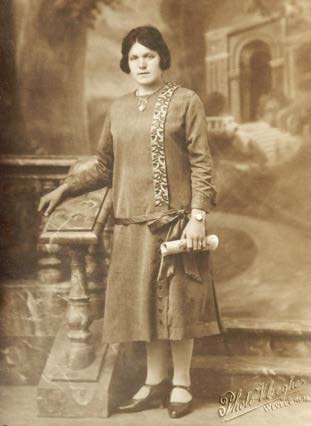
Figure 45.34: 1925, Irma Helena Lesage, a proud and adorable
farmer’s daughter. (Declercq de Silva Archive)
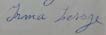
Figure 45.35: Irma Lesage’s signature.
45.1.7 Other acquaintances of Michel Declercq
Memorabilia of other acquaintances are shown in Figures 45.32 and 45.32.
45.2 Irma Helena Lesage
45.2.1 Introduction, Birth and Death
Irma, shown in Figure 45.34, is primarily described here as the wife of Michel Achiel Renatus Declercq (DC15) and the author’s grandmother. Her early death has been traumatic for her children and has determined their lives. In that respect, every tiny relic is of high value, such as her signature in Figure 45.35.
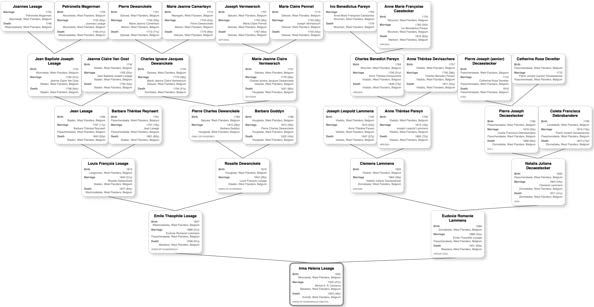
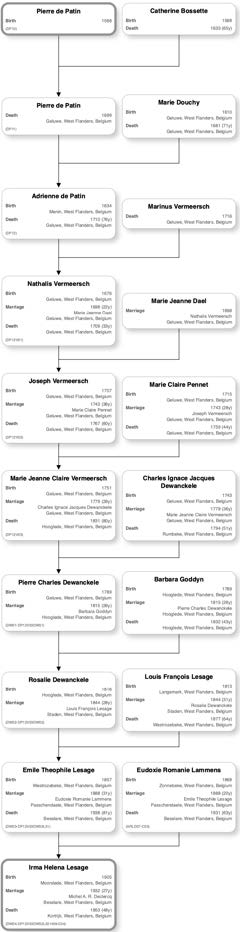
She is equally referred to in the following chapters: Chapter 64, as the daughter of Emile Theophile Lesage; Chapter 65, as great-great-great-great-great-granddaughter of Adrienne de Patin (DP12); Chapter 66.1, as great-great-great-granddaughter-in-law of Barbara Benoit; Chapter 66.2, as the great-great-great-great-granddaughter of Maria Jeanne Christine Benoit; Chapter 68; and Chapter 71 as the granddaughter of Clemens Lammens and Natalia Juliana Decaestecker. Her closest ancestors are shown in Figure
45.36, while Figure 45.37 explains how she is connected to the de Patin family.
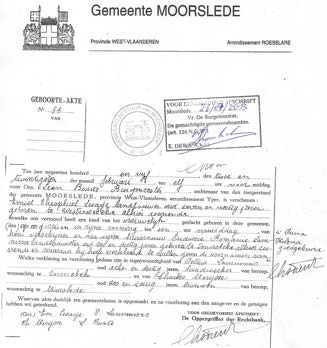
Irma Helena Lesage (Moorslede, February 21, 1905 - Kortrijk, June 7, 1953) was the youngest daughter of Emile Theophile Lesage and Eudoxie Romanie Lammens. Her birth is shown in Figure 45.38. She had two younger brothers, Oscar and Daniel. Her elder sisters were Marta, Amanda, Maria and Godelieve. Her elder brothers were Cyrille, Gerard, Hector, and Paul.
During her childhood, Irma went to a French school in Moorslede. In Oudezeele, she continued school in French. After the war, she went to school in Zonnebeke.
Before WWI, her family moved from Moorslede, Statiestraat 518, to Ledegem, where they purchased a farm at Kortwagenstraat 33.
Irma was nine years old when WWI commenced. Her mother fled, with most children, to Oudezeele in the North of France, while her father stayed behind with her brother Paul in Ledegem. In France, the family remained with Secq at Route des Trois Rois 77, the road from the village center to Café des Trois Rois. The house was located near the village center and was designated number 49 on the list of homes of refugees at Oudezeele during WWI.
Irma lost her eldest brother Cyrille, a soldier, in 1916, described in Chapter 64.7.1. At the war’s end, she lost her other brother Hector, also a soldier, described in Chapter 64.7.6. Another brother, Gerard, described in Chapter 64.7.5 and equally a military, became a victim of a gas attack and suffered from health issues until he died in 1933. Before his death, he witnessed the wedding of Irma Lesage and Michel Declercq at Beselare.
The family had moved to Beselare on September 30, 1921, at Spilstraat 12 on Keiberg, at the junction with Slangemeersstraat.
Irma’s father and her brother Paul had first stayed in Ledegem during WWI but were expelled by the Germans on July 23, 1917, and went to Wielsbeke. They survived a few months at the Declercq family’s farm, Hof van Brussel. Paul, severely injured on July 23 due to a bombardment at Ledegem, found a contemporaneous companion in the eldest son of the Declercq family. Later, Irma would marry the second eldest son of the Declercq family, Michel Declercq (DC15), the author’s grandfather.
The Desclergues of la Villa Ducal de Montblanc, 2nd ed., Omn., VOL. III
© 2024 Nico F. Declercq
820
CHAPTER 45. MICHEL ACHIEL RENATUS DECLERCQ (DC15) & IRMA HELENA LESAGE
Figure 45.36: Five ascending generations of Irma Helena Lesage
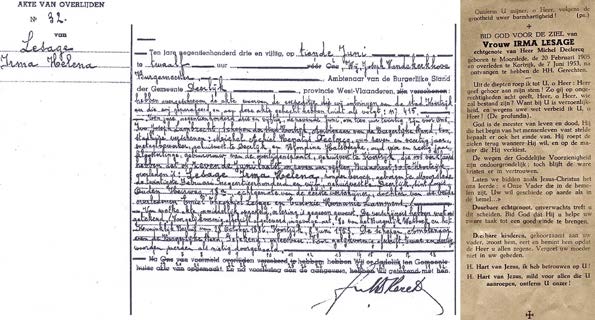
Irma died in 1953, as shown in Figure 45.40.
The death of a mother is always unfortunate, traumatic, and dramatic. The experience was not different with Irma Lesage. She had nine children. Maurice Declercq (DC16), the author’s father, was only twelve.
Irma Lesage’s cause of death started with a reasonably banal volvulus. The latter occurs when a loop of the intestine twists around itself and the mesentery supporting it, resulting in bowel obstruction. This was undoubtedly not life-threatening and could have been treated surgically or otherwise easily. However, Irma was so concerned about her children and household that she delayed a doctor’s visit. Ultimately, the situation was so severe that Michel Declercq (DC15) took her to the hospital in Kortrijk, where she was operated on immediately by Dr. André Baekelandt, uncle of Dr Guido Baekelandt, who saved the life of Irma’s son Maurice Declercq (DC16), the author’s father, in 1961, as described in Chapter 46.2.6.
The procedure was successful, but the surgeon pronounced that it was too late and that she was already heavily infected. She reportedly was capable of talking to her children but died shortly after that.
Everyone in Deerlijk was shocked by the sudden death of this dear mother, who had endured hard times during WWII. Even people who can still retell always start their story with ’She was such a sweet and good woman. . . ’ Her death was undoubtedly a tragedy for the children.
Irma was buried in bare soil in Sint Lodewijk, Deerlijk, with a simple cross, which, one day, would have been replaced by a decent tombstone.
However, a single father with nine developing children had numerous vital tasks on his priority list.
When her husband, Michel Declercq, died ten years later, the children finally bought a beautiful tombstone for their parents. The reader can find more information about this in the sections on the family grave, Chapter 45.8 and Chapter 64.7.10.
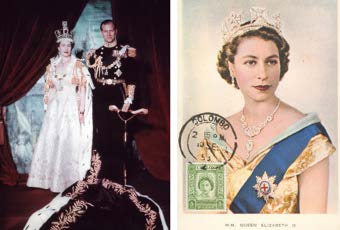
As a reference, Irma Lesage died the week after Queen Elizabeth II of England’s coronation, Empress of the British Empire and Queen of Ceylon, shown in Figure 45.41. It’s an event that Irma must have experienced on the radio the week before she died.
45.2.2 The early days in Moorslede
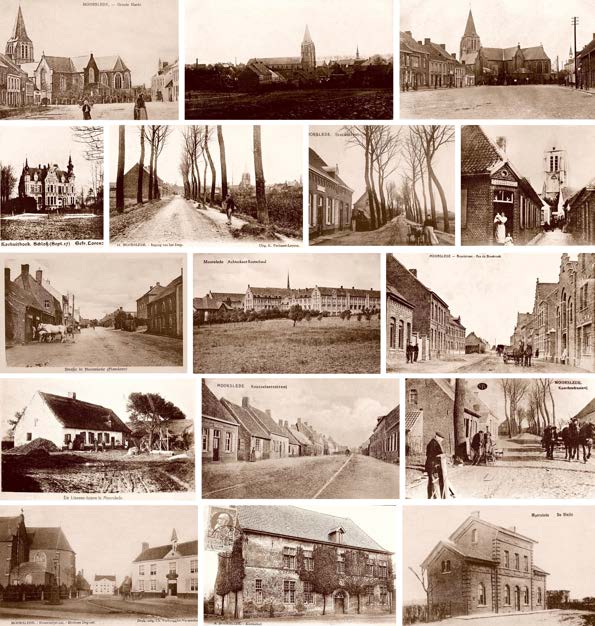
As mentioned above, Irma Lesage was born at Statiestraat 518 in Moorslede, near the station. She spent her early youth there and went to a French school in the village. Not long before WWI, she moved with her family to Ledegem. Being the youngest daughter in a family with wealthy parents and caring brothers and sisters, she must have had a delightful youth until 1914. Impressions of Moorslede are shown in Figure 45.43.
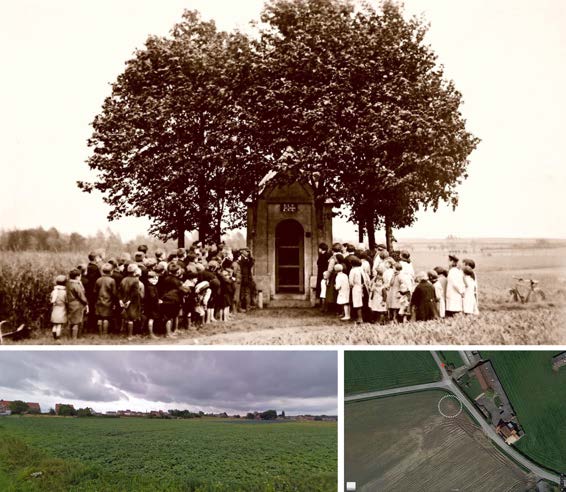
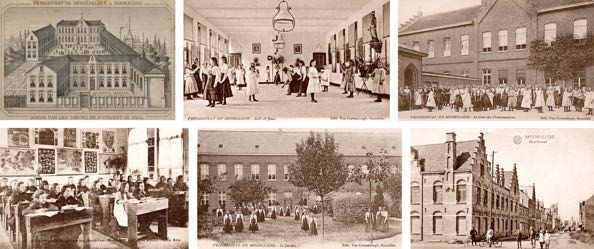
Moorslede became a German stronghold during WWI, as seen in Figure 45.42. At that time, Irma lived with her mother in Oudezeele in Northern France. The street where Irma was born and resided before WWI can be seen in Figure 45.44. The scene shows a little chapel, Kapelleke van de Veldhoek, where Irma undoubtedly prayed as a child. Irma Lesage attended school in Moorslede at Pensionat Ten Bunderen, shown in Figure 45.45, where she was educated in French. In the summer of 1914, when she was merely nine years old, WWI began, and she moved with her mother to Oudezeele in the North of France, where she recapitulated her education in French until the end of the war.
Therefore, until the age of 15, she was educated in French. Consequently, she spoke and wrote French very well but wrote Dutch with dialect influences and in an old spelling learned from her mother, sometimes blended with French phonetics. An example7 is
’... kan Zondag niet koomen. Hij gaat naar Kortrijk naar de paardekours.’ She also used some literal translations from French, such as ’puis il y viendra le Dimanche,’ which she wrote as ’hij zal dan komen daar naar de zondag.’
Her siblings were also fluent in French. It is not exceptional that her father suggested in the 1930s that she and Michel Declercq (DC15) would purchase a farm at Cordes (in Frasnes-Les-Avaing in Belgium, where the villagers spoke French). She prayed and sung in French.
Because Irma Lesage had a French and catholic education, we know what orisons she prayed8:
Notre Père qui es aux cieux,
Que ton nom soit sanctifié;
Que ton règne vienne;
Que ta volonté soit faite sur la terre comme au ciel;
Donne-nous aujourd’ hui notre pain quotidien;
Pardonne-nous nos offenses
comme nous pardonnons à ceux qui nous ont offensés;
7This is a quote from a letter from Irma to her daughter Maria in 1949.
8Notre Père, la version synodale – 1910.
© 2024 Nico F. Declercq
The Desclergues of la Villa Ducal de Montblanc, 2nd ed., Omn., VOL. III
45.2. IRMA HELENA LESAGE
821
Figure 45.37: The link between Irma Helena Lesage
and the de Patin family.
The Desclergues of la Villa Ducal de Montblanc, 2nd ed., Omn., VOL. III
© 2024 Nico F. Declercq
822
CHAPTER 45. MICHEL ACHIEL RENATUS DECLERCQ (DC15) & IRMA HELENA LESAGE
Figure 45.38: 1905, Moorslede, the birth
certificate of Irma Helena Lesage. She
was born on February 20, 1905. Her fa-
ther, Emile Theophile Lesage, was a 47-
year-old farmer, while her mother was a
36-year-old farmer. The witnesses on her
birth registration were farmer Pierre Lam-
mens from Zonnebeke and brewer Charles
Morysse from Moorslede. The town hall
where she was registered is shown in Fig-
ure 45.39.
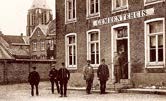
Figure 45.39:
Moorslede, the town hall before WWI. Here, Irma
Lesage’s birth was registered, in Figure 45.38.
Figure 45.40: The death certificate of Irma Helena Lesage - copy in the registration of Deerlijk, of the original record nr 415 at Kortrijk. Michel Declercq was 47 years old when he reported his wife’s death and was temporarily employed in the production process at Bekaert NV company before becoming a purchase manager. On June 7, 1953, Irma had died at quarter past seven at the hospital of Kortrijk in Budastraat. Right is he obituary card of Irma Lesage, June 7, 1953. The sentence
’Vergeet uw moeder niet in uw gebeden’ has always determined the lives of her children and comes, again, to fruition in this book. (Declercq de Silva Archive)
© 2024 Nico F. Declercq
The Desclergues of la Villa Ducal de Montblanc, 2nd ed., Omn., VOL. III
45.2. IRMA HELENA LESAGE
823
Figure 45.41: Left are Queen Elizabeth II and Philip, June 2, 1953
after the Coronation. According to Her Majesty’s Stationery Office, the
Crown copyrights for photographs taken before 1957 expire after 50 years,
and this applies worldwide. Right is a postcard of the newly Crowned
Queen Elizabeth II, posted from Colombo in Ceylon on September 10,
1953. She has been Sri Lanka’s last sovereign.
Figure 45.42:
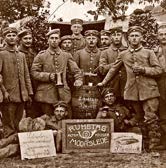
Moorslede under the German occupation in 1914.
These are the 25th ’Jager’ soldiers (Chasseurs).
Ne nous abandonne pas à la tentation;
mais délivre-nous du mal;
Car c’ est à toi qu’ appartiennent,
dans tous les siècles,
le règne, la puissance et la gloire.
Amen !
and the christian ’credo’ :
Je crois en Dieu,
le Père tout-puissant,
créateur du ciel et de la terre ;
et en Jésus-Christ,
son Fils unique, notre Seigneur,
qui a été conçu du Saint-Esprit,
est né de la Vierge Marie,
a souffert sous Ponce Pilate,
a été crucifié,
est mort et a été enseveli,
est descendu aux enfers,
le troisième jour est ressuscité des morts,
est monté aux cieux,
est assis à la droite de Dieu le Père tout-puissant,
d’ où il viendra juger les vivants et les morts.
Je crois en l’ Esprit-Saint,
à la sainte Eglise catholique,
à la communion des saints,
à la rémission des péchés,
à la résurrection de la chair,
à la vie éternelle.
Amen.
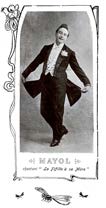
From her legacy through her descendants, we also know that she sang ’Viens, poupoule’ to her children, by Félix Mayol, shown in Figure 45.46.
The lyrics of Viens, poupoule are:
Le samedi soir après l’ turbin
L’ ouvrier parisien
Dit à sa femme : Comme dessert
J’ te paie l’ café-concert
On va filer bras dessus bras dessous
Aux galeries à vingt sous
Mets vite une robe faut s’ dépêcher
Pour être bien placés
The Desclergues of la Villa Ducal de Montblanc, 2nd ed., Omn., VOL. III
© 2024 Nico F. Declercq
CHAPTER 45. MICHEL ACHIEL RENATUS DECLERCQ (DC15) & IRMA HELENA LESAGE
Car il faut
Mon coco
Entendre tous les cabots
Refrain
Viens, Poupoule !, Viens, Poupoule ! viens !
Quand j’ entends des chansons
Ca me rend tout polisson
Ah !
Viens, Poupoule !, Viens, Poupoule ! viens !
Souviens-toi que c’ est comme ça
Que je suis devenu papa.
Un petit tableau bien épatant
Quand arrive le printemps
C’ est d’ observer le charivari
Des environs de Paris
Dans les guinguettes au bord de l’ eau
Au son d’ un vieux piano
On voit danser les petits joyeux
Criant à qui mieux mieux
Hé le piano !
Tu joues faux !
Ca n’ fait rien mon petit coco.
Refrain
Viens, Poupoule !, Viens, Poupoule ! viens !
Ce soir je t’ emmène .. où ?
à la cabane bambou
Hou !
Viens, Poupoule !, Viens, Poupoule ! viens !
Et l’ on danse plein d’ entrain
La ’polka des trottins’
Avec sa femme un brave agent
Un soir rentrait gaiement
Quand tout à coup jugez un peu
On entend des coups de feu
C’ était messieurs les bons apaches
Pour se donner du panache
Qui s’ envoyaient quelques pruneaux
Et jouaient du couteau
Le brave agent
Indulgent
Dit à sa femme tranquillement :
Refrain
Viens, Poupoule !, Viens, Poupoule ! viens !
Pourquoi les déranger
Ça pourrait les fâcher
Ah !
Viens, Poupoule !, Viens, Poupoule ! viens !
Ne te mets pas en émoi
Ils se tueront bien sans moi
Deux vieux époux tout tremblotants
Marient leurs petits enfants
Après le bal vers les minuit
La bonne vieille dit
A sa petite fille tombant de sommeil :
Je vais te donner les conseils
Qu’ on donne toujours aux jeunes mariés
Mais le grand-père plein de gaieté
Dit doucement :
Bonne maman
Laisse donc ces deux enfants
Refrain
Viens, Poupoule !, Viens, Poupoule ! viens !
Les petits polissons
N’ ont pas besoin de leçons
Ah !
Viens, Poupoule !, Viens, Poupoule ! viens !
Je suis bien certain ma foi
Qu’ ils en savent plus que toi
Les jeunes mariés très amoureux
Viennent de rentrer chez eux
Dans leur gentil petit entresol
Ils crient : Enfin seuls !
Madame se met vite à ranger
Sa petite fleur d’ oranger Pendant que Monsieur bien tendrement
Dit amoureusement
Pour tâcher
De s’ épancher
Montrant la chambre à coucher :
Refrain
Viens, Poupoule !, Viens, Poupoule ! viens !
Les verrous sont tirés
On pourra se détirer
Ah !
Viens, Poupoule !, Viens, Poupoule ! viens !
Viens chanter mon coco
La chanson des bécots
Un député tout frais nommé
Invitait sa moitié
© 2024 Nico F. Declercq
The Desclergues of la Villa Ducal de Montblanc, 2nd ed., Omn., VOL. III
825
A venir entendre un grand discours
Qu’ il prononçait le même jour
Mais à peine a-t-il commencé
Qu’ on lui crie : C’ est assez
Constitution ! Dissolution !
Pas d’ interpellation !
Ahuri
Abruti
Il prend son chapeau et dit :
Refrain
Viens, Poupoule !, Viens, Poupoule ! viens !
Je ne veux pas devenir sourd
Pour vingt-cinq francs par jour
Ah !
Viens, Poupoule !, Viens, Poupoule ! viens !
C’ est bien assez ma foi
D’ être attrapé par toi.
Before WWI, the neighboring village of Beselare was also cute and would equally be destroyed by the violence of the war. Irma would move to Beselare after the war. Some impressions of Beselare before and early during WWI are shown in Figure 45.47.
45.2.3 Her stay at Oudezeele during WWI
In Chapter 64.6.2, a description is given of the stay of Eudoxie Lammens with her children, including Irma Lesage, at Oudezeele in the North of France. Apart from the constant worry about her brothers, soldiers, and father, who had stayed behind at Ledegem in Belgium with one son, Irma probably had a good time in Oudezeele.
The author remembers a couple of visits with her youngest brother, Daniel Lesage, described in Chapter 64.7.12, to the house where she stayed. The tree where they used to play was still there in the 1980s. Going to school in the village, shown in Figure
45.48, must have been easy for Irma because she had already been at a French school in Moorslede before WWI. It is said that the numerous shell impacts and explosions at the front could easily be heard at Oudezeele and beyond.
Therefore, we know that she must have experienced the noise of horror.
45.2.4 Her Post-WWI Life in the Devastated Front Zone
After the war, the Lesages had to establish a new life. They had lost two sons and also their farm. The whole region was devastated.
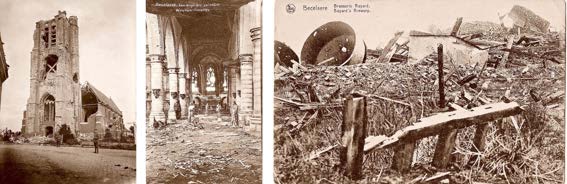
The gradual destruction during the war can be seen in Figure 45.49.
The family decided to launch the eldest son Gerard as a farmer with his wife, Magdalena Meersseman, described in Chapter
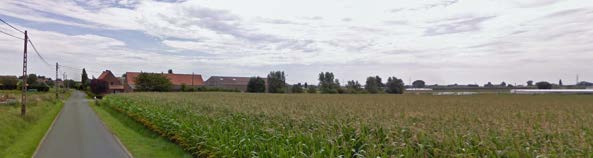
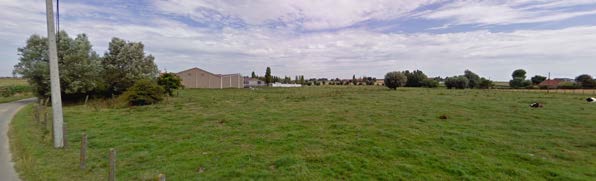
64.6.2.7.4, to establish a stable position for Paul, who had been severely injured, described in Chapter 64.7.8, and to build a new farm, shown in Figures 45.53, 45.54 and 45.55, for the rest of the family in Beselare. Initially, the area looked like a lunar surface, and the family lived separately. Streets had vanished, points of reference had been destroyed, trees had disappeared, and most inhabitants would never return.
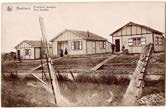
Family barracks, as in Figure 45.50, were erected soon after the war, and temporary schools were established in whichever military shelter.
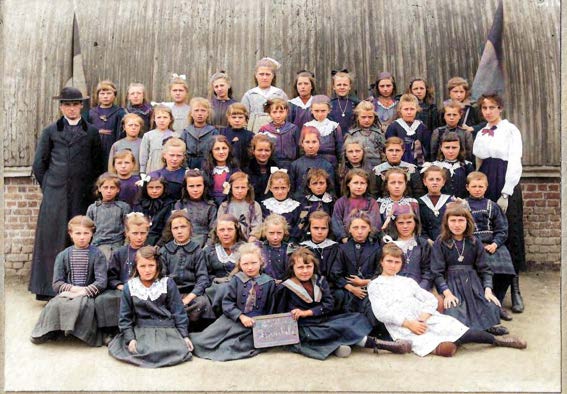
There was hardly any time for diversion. Everyone had to work very hard to resurrect the villages. Some children could go to school in Zonnebeke, such as Irma, shown in Figure 45.51. Others had to go to other areas, such as Daniel and Oscar Lesage, who went to Beitem near their original home in Ledegem, probably residing with Gerard Lesage.
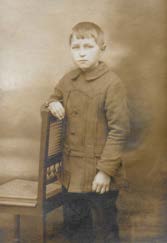
A picture of Irma Lesage is shown in Figure 45.52, taken soon after the war, perhaps in 1919.
45.2.5 Acquaintances of Irma Lesage
In Irma’s school picture of 1919, in Figure 45.51, we can see that her presumed school principal was Priest Gerard Lammens. He was rather famous. We are unsure if he was related to her mother, Eudoxie Romanie Lammens.
His tomb still exists and is shown in Figure 45.56. His death is also shown in Figure 45.56. The Lesage family was also acquainted with the Camerlynck family.
Some memorabilia are shown in Figures 45.57, 45.58, 45.59, 45.60 and 45.61.
From the village of West-Rozebeke, where Emile Theophile Lesage was born, the family also knew priest Camiel Forrez, as shown in Figure 45.62.
The Desclergues of la Villa Ducal de Montblanc, 2nd ed., Omn., VOL. III
© 2024 Nico F. Declercq
826
CHAPTER 45. MICHEL ACHIEL RENATUS DECLERCQ (DC15) & IRMA HELENA LESAGE
Figure 45.43: Pre-WWI scenes of Moorslede are shown, such as the castle at Koekuithoek, Kerkstraat, the market square Bruelstraat. The author visited Bruelstraat frequently in the early 1980s. We can also see a photo that the Germans probably took at the beginning of the occupation before the allies charged the village in the following years. The reader will also observe the farm of ’father Lievens’ (pater Lievens) and the ancient castle of Moorslede, which also appears in the ancestry of de Patin in Chapter 65.5.2. One can also see access roads to the village, rope makers on the street, the back of the boarding school, Brouwerijstraat, and the train station where Irma Lesage was born nearby. There is also a street scene shown in Moorslede at the beginning of the German occupation in 1914 when the horses had not yet been confiscated.
© 2024 Nico F. Declercq
The Desclergues of la Villa Ducal de Montblanc, 2nd ed., Omn., VOL. III
45.2. IRMA HELENA LESAGE
827
Figure 45.44: The ’Kapelleke van de Veldhoek’ in Moorslede. In May, the picture was taken when traditionally, people, primarily children, gathered to pray. Based on the clothes and the estimated age of the trees near the chapel and in the background, we assume that the picture was taken 10-15 years after WWI, i.e. around 1930. In Veldhoekstraat, there is no chapel anymore. We, therefore, believe that it must have been destroyed during WWII or for other reasons. Based on the picture taken in the evening, we know that the camera was aiming south. The chapel does not look new, so we assume it survived somehow WWI. On the horizon is ’Satiestraat’ , where Irma Lesage was born in 1905. As a child, she must have visited this chapel too. A modern view is seen at the junction of Scherminkelstraat and Veldhoekstraat, in the south direction. An areal view (Google Maps®) of the soil is also provided, where we found a good match between the landscape on the picture and the current landscape. The photo reveals where the chapel of ’Veldhoek’ was once located.
Figure 45.45: The Girls’ ’Pensionat Ten Bunderen’ at Moorslede where Irma Lesage attended school before WWI. The school was governed by the sisters of ’St Vincent de Paul’ . It was destroyed during the war and rebuilt in the 1920s.
The Desclergues of la Villa Ducal de Montblanc, 2nd ed., Omn., VOL. III
© 2024 Nico F. Declercq

828
CHAPTER 45. MICHEL ACHIEL RENATUS DECLERCQ (DC15) & IRMA HELENA LESAGE
Figure 45.46: Félix Mayol singing La Fille à sa mère, in Paris n° 250, November
5th 1907, p.6 (imag. 1) . One of the songs that Irma sung, and was still remembered
by the author’s father and sung when he was a small child, was ’Viens, poupoule’ by
Félix Mayol in 1902. (Declercq de Silva Archive)
Figure 45.47: Scenes of Beselare before WWI. One image is taken during WWI and shows Beselare, view from the South.
A German military on a horse is seen, which indicates that someone took the picture in 1914 or 1915.
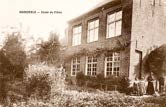
Figure 45.48: Oudezeele, the school for girls where Irma went.
Figure 45.49: Left, we see Beselare, early in WWI, when the first destructions had already taken place. The German army occupied the whole area. Right, we can see the interior of the church at the beginning of WWI, and also the severely destroyed brewery.
Figure 45.50: Soon after WWI, family barracks were constructed at
Beselare to allow families to return.
© 2024 Nico F. Declercq
The Desclergues of la Villa Ducal de Montblanc, 2nd ed., Omn., VOL. III
45.2. IRMA HELENA LESAGE
829
Figure 45.51: In 1919, an emergency school (or barrack school) was built in the Langemarkstraat in Zonnebeke on the left just past the station. On December 1, 1919, classes were offered to both boys and girls (a total of 90 students then).
In the image, we see a class of girls in front of their barrack. There were still not enough sisters back in Onze-Lieve-Vrouw-Ten-Bunderen to staff all the courses. That is why teachers were also employed, such as Céline Lammens (far right). Irma Lesage was seated in front of the teacher Céline Lammens. Priest Gerard Lammens is seen on the left, posing with his youngest parishioners. MyHeritage® colorized this photo.
Figure 45.52: Irma Lesage after WWI. She was known for being
small and skinny. Later she would gain weight and strength.
Figure 45.53: A view on the former farm of Irma’s father Emile Lesage, seen from Spilstraat, Beselare. (Declercq de Silva Archive)
The Desclergues of la Villa Ducal de Montblanc, 2nd ed., Omn., VOL. III
© 2024 Nico F. Declercq
830
CHAPTER 45. MICHEL ACHIEL RENATUS DECLERCQ (DC15) & IRMA HELENA LESAGE
Figure 45.54: A view on the former farm of Irma’s father Emile Lesage, seen from Slangenmeersstraat, Beselare. (Declercq de Silva Archive)
Figure 45.55: A view on the former farm of Irma’s father Emile Lesage, seen from Slangenmeersstraat, Beselare. (Declercq de Silva Archive)
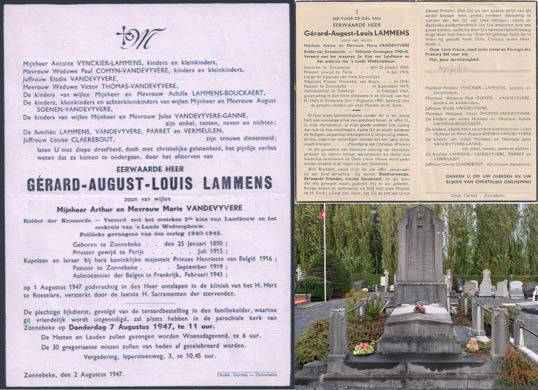
Figure 45.56: The death announcement and obituary card of priest Gerard August Louis Lammens, August 1, 1947. The tomb at Zonnebeke (October 26, 2019) is also shown. (Declercq de Silva Archive)
© 2024 Nico F. Declercq
The Desclergues of la Villa Ducal de Montblanc, 2nd ed., Omn., VOL. III
45.2. IRMA HELENA LESAGE
831
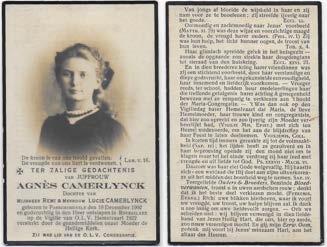
Figure 45.57:
The mortuary card of
Agnes Camerlynck, May 1922. She was
a daughter of Remi en Lucie Camer-
lynck and had the same age as Paul
Lesage, Irma’s brother. (Declercq de Silva
Archive)
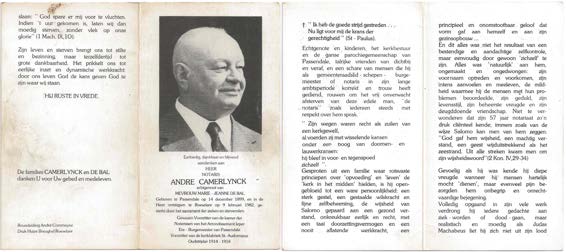
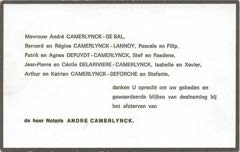
Figure 45.58: The obituary card of André Camerlynck, February 9, 1982. He was the family’s notary. (Declercq de Silva Archive)
Figure 45.59: An acknowledgment sent after the fu-
neral of André Camerlynck, the family’s notary. (De-
clercq de Silva Archive)
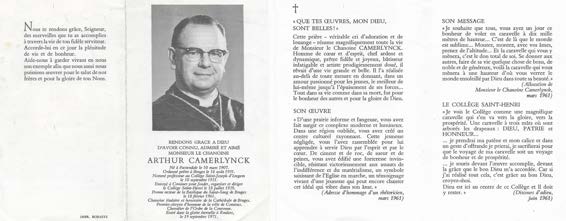
Figure 45.60: The obituary card of Arthur Camerlynck, September 19, 1971. (Declercq de Silva Archive)
The Desclergues of la Villa Ducal de Montblanc, 2nd ed., Omn., VOL. III
© 2024 Nico F. Declercq
832
CHAPTER 45. MICHEL ACHIEL RENATUS DECLERCQ (DC15) & IRMA HELENA LESAGE
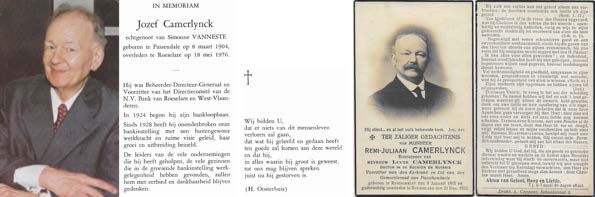
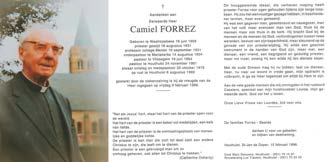
Figure 45.61: Left is the obituary card of Jozef Camerlynck, May 18, 1976. Right is the obituary card of Remi Juliaan Camerlynck, father of Agnes, shown in Figure 45.57, and husband of Lucie, December 22, 1922. (Declercq de Silva Archive) Figure 45.62:
The mortuary card of
Camiel Forrez, February 9, 1996. (De-
clercq de Silva Archive)
© 2024 Nico F. Declercq
The Desclergues of la Villa Ducal de Montblanc, 2nd ed., Omn., VOL. III
45.3. THE MARRIAGE OF MICHEL DECLERCQ & IRMA LESAGE
833
45.3 The Marriage of Michel Declercq & Irma Lesage
In Figure 45.63, the wedding of Michel Declercq and Irma Lesage at Beselare in 1932 was quite remarkable for several reasons.
Irma Lesage was the youngest daughter in a large family. Her parents were Emile Lesage and Eudoxie Lammens, and they lived in Beselare. Eudoxie had died shortly before the wedding. In Chapter 64.6, the reader finds information about their whereabouts before WWI, during, and after.
Beselare was located in the ruined area of Belgium and was under reconstruction in the 1920s and 1930s. Besides the visibility of military cemeteries, hardly anything noticeable anymore reminds us of WWI. However, until the 1980s, the area was still somewhat
’backward’ compared to other regions. In the 1920s, when Michel Declercq engaged with Irma Lesage, the area was still devastated.
Emile Lesage was a wealthy farmer, blood-related to the de Patin family, continually investing. In particular, he entrusted his children with financial support and finding suitable partners, and he considered Michel Declercq the bull’s eye. Emile strongly supported his daughter’s wedding with Michel. Since their WWI encounter and flax trade, Emile knew Ernest Constant Declercq (DC14), Michel’s father.
The Declercqs in Wielsbeke found the Lesages equally first-class marriage partners because they were traditionally Christian and wealthy farmers. They supported the engagement of Michel and Irma, Valentine, and Daniel. In addition to the common WWI experience, the Lesages were acquainted with writer Edouard Vermeulen. Michel Declercq and his siblings, all interested in culture and reading, must have deemed this very important. During a visit to the Lesage farm, Irma Lesage fell in love with Michel, which must have been around 1927. The couple would ultimately marry in 1932 and live in Wielsbeke until 1936.
Michel Declercq was a handsome, distinguished gentleman. He was educated and cultivated and offered Irma Lesage an opportunity to leave the devastated area of Beselare to live with a flax merchant in the flourishing area near the Leie River. Irma Lesage was equally in a solid situation because she descended from the noble family of ’de Patin.’ Furthermore, two brothers had been distinguished soldiers killed during WWI; one was buried at the famous cemetery of Père Lachaise in Paris inside the Monument of the Belgian Soldiers.
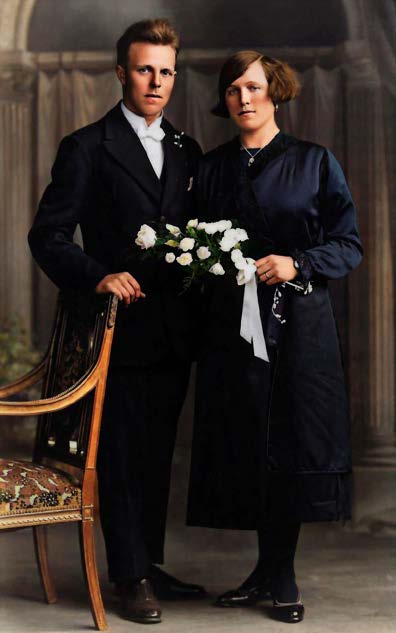
Emile Lesage was so pleased with his daughter marrying Michel Declercq that he gave her a considerable dowry. Around 65 thousand Belgian Francs in today’s currency (2021), about 1.6 million euros, were adequate to buy a sizeable farm or four beautiful homes at that time. A devaluation by 25% occurred in 1935, which forced them to invest money in the flax business, increase their capital, and then buy a farm, as described in Chapter 45.4 and Chapter 45.5. The newly married couple is shown in Figure 45.64.
45.4 The Honeymoon Years in Wielsbeke
Irma Lesage would have preferred to live alone with her husband after a few years of marriage. Instead, they were forced to reside longer in Wielsbeke in the Declercq - Devenyn family, trying to augment money through investments after the devaluation of the Belgian currency of 1935. Their objective was to buy a farm for themselves, just as they had planned when they married.
Instead, they entered a negative spiral and invested more money in Michel’s siblings’ education than in their future.
Michel’s sisters considered Irma one of them, which also had negative consequences, such as a lack of freedom and the expectation that she had no life of her own.
In 1936, they finally realized that gaining back all their money would not be a tangent target for the near future and decided to move to Deerlijk. A representative photo of this period is shown in Figure 45.65.
They genuinely made financial investments with the best intentions, including the preservation of the family’s connection to Ostend, where our ancestor Jeroni Joan Desclergue y Cortés (DC05) had died in 1604, as seen in Figure 45.66.
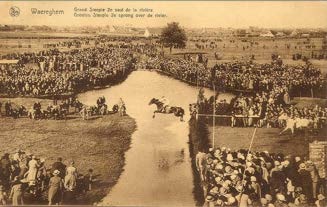
After Michel and Irma had relocated to Deerlijk, they preserved close contact with the other Declercqs, as shown in tokens, in Figures 45.67 and 45.68, from the famous Steeple Chase horse race in Waregem where horses hop over the Gaverbeek Creek - once the water supply in the lives of Jeroni Joan Desclergue y Cortés (DC05) and his son Antoni Desclergue (DC06) in the 1600s.
45.5 The Rugged WWII Years in Deerlijk
The Declercq-Lesage family moved from Wielsbeke to Deerlijk in 1936.
When describing the marriage of Michel Declercq and Irma Lesage in 1932, we mentioned that Emile Lesage had been so happy that he gave 65000 Belgian Francs to the couple9, which was sufficient to purchase a sizable farm and commence a good life. The couple hesitated to invest in a novel farm, and in 1935, the Belgian frank devaluated by 25%. Hoping for better times and flourishing in the flax business, they invested in flax and postponed real estate matters. Meanwhile, they rented a home in Deerlijk from 1936
onward. The 1930s were difficult years because of the global financial crisis after the collapse of the American economy. The crisis impacted the flax business as well.
Financially, the Declercqs suffered while the family expanded, and the sisters of Michel had to continue their (expensive) education.
The reduction of their capital and the desire to save money for better times formed significant constraints even before, suddenly, WWII started, shortly after they had moved to Deerlijk, shown in Figure 45.69.
This period, just before the war, is described in Chapter 46, about Maurice Declercq, because, although Maurice was not yet born, events have taken place that caused ripples for many years, even to the yet-to-be conceived children and grandchildren. During the war, Michel refused to contribute to the economy dominated by the German occupiers, and therefore, the family financially hibernated ’for as long as necessary.’ The war lasted four years, while more children were born.
Too proud to ask for help, the family has gone through dark times; the children have even suffered from famine. Suppliers of food and clothes were father and son Vangheluwe (described in Chapter 48.10), who traded goods on the black market and were entangled with the resistance during the war. They had known the Declercq-Lesage family in Wielsbeke and now lived nearby in Deerlijk. Sympathy for the family drove the Vangheluwes to leave many more supplies for the Declercqs than they paid for. Had Michel known, he would have refused. However, he never realized he was purchasing food below the market price. The friendship between the two families would last for a long time, resulting in Michel’s son Maurice marrying Rene’s daughter Nelly, the author’s parents, described in Chapter 46.
The difficult times during the war have left a mark on the children. It has caused frustration, humiliation, and internal competition on the one hand and an unbreakable sense of belonging together on the other hand. These contradictions have caused complexities in the future relationship between the children and their marriages. The family is shown in Figure 45.70 at their farm after WWII.
Despite their difficulties at that time, Michel Declercq (DC15), who made well-determined plans for the near future, looked like a 9his corresponds to 1.6 million euro in 2021
The Desclergues of la Villa Ducal de Montblanc, 2nd ed., Omn., VOL. III
© 2024 Nico F. Declercq
CHAPTER 45. MICHEL ACHIEL RENATUS DECLERCQ (DC15) & IRMA HELENA LESAGE
very proud man, happy for having a large family, having survived the war, and looking forward to a bright future with renewed energy and hope. In Figure 45.72, we present Michel and Irma in 1945 on the occasion of the confirmation of their eldest daughter, Agnes.
Michel Declercq missed the golden resurrection of flax in 1950-1953 during the Korean War. He had switched to other activities before that and had invested his money in a new home just before 1950. It must have hurt deeply to observe that the price of 1
kg of flax fibers was as high as one square meter of land while unable to participate. Nevertheless, many investors overestimated the future and overinvested in flax. A new crisis followed quickly, during which the price of flax dropped tremendously because of French protectionism. It was the time when most entrepreneurs switched to other businesses. The establishment of numerous small companies in Kortrijk and the Leie is why this area, in the 1960s, was called ’Texas of Flanders.’
It is said that Michel Declercq (DC15) was very supportive of King Leopold III of Belgium, in Figures 45.73 and 45.74. Michel was very catholic and detested communism on the one hand and atheist liberalism on the other. He wanted the King to return and continue his duty after the war.
45.6 A new life at Sint Lodewijk in Deerlijk
After the war, the family revived and constructed their own Casal dels Desclergue in Deerlijk in Figures 45.75 and 45.76. This was possible thanks to the money they had saved and because they were paid back a large part of the money they had invested in Michel’s siblings when the parents sold the farm at Wielsbeke.
As Michel had given up farming and the flax business during the war, a farm was no longer necessary. Therefore, a decent home that could house a family with nine children was everything they needed.
At that time, the new home in Oude Heerweg at Saint Louis in Deerlijk was the most beautiful in the area10.
The family found happiness again after the devastation of the war. Unfortunately, Irma Lesage died in 1953. Michel, shown around 1953 in Figure 45.77, would die ten years later in 1963.
Michel and Irma had acquired the land on which the house was constructed from Georges Ameye and Maria Decock11; their tombstone and obituary are shown in Figure 45.78.
45.7 Michel Declercq the Widower
A photo of Michel Declercq, taken shortly before or soon after the death of his wife Irma in 1953, is shown in Figure 45.77. The loss of Irma was devastating for Michel, yet he was not a man to succumb to despair. With unwavering resilience, he continued to invest in and plan for his children’s futures. While not every child would follow in their footsteps, this was a reflection of their own choices and characters, not a failure on their father’s part. Michel’s moral compass remained steady, guiding him toward a life marked by prosperity and high ethical standards.
As a widower, he found solace and pleasure in tending to his garden, visiting farmers (as seen in Figure 45.79), racing pigeons, and reading.
Michel is deeply connected with the plant Sedum Spurium, also known as vetkruid or kruipers in English as stonecrops. These resilient plants, which grow on rocks and in thorny soil, were moved by Michel from his farm in Wielsbeke to his home in Deerlijk and finally to his new home in Sint Lodewijk in Deerlijk. After passing, his children took shoots from these plants and planted them in their gardens. This tradition has become a form of identity for the Declercq family: a home is not truly a Declercq home without Sedum Spurium. Even the author maintains this tradition, as illustrated in Figure 45.80, with plants that trace their lineage back to Wielsbeke.
Michel’s love for farming and animals was a lifelong passion. He cultivated crops in his garden and raised racing pigeons as a hobby, a pastime shared by the author in his youth, depicted in Figure 45.82.
After Irma’s death, Michel confronted his mortality and decided to create wooden crosses for each of his children, adorning them with baroque figurines of Jesus. While he purchased the figurines, the crosses themselves were handmade, similar to the one shown in Figure 45.81.
Michel remained in good health until 1959, as seen in Figure 45.83. The Declercq home was spacious and beautiful, though contemporary standards defined comfort. A single large stove heated the entire downstairs, leaving the upstairs bedrooms chilly and the attic room freezing in winter. Nonetheless, Michel chose the attic for himself, ensuring his children had the most comfortable rooms.
A devout Catholic, Michel remained steadfast in his faith until he died in 1963.
Anecdotes abound of him refusing to converse with those who worked on Sundays. He spent his free time working in his garden or visiting friends and family, and his expertise and knowledge made him a respected figure in his community. Michel’s proficiency in farming, particularly flax, and his technical education made him a valued guest and advisor.
Had Michel lived longer, his positive influence on his descendants would undoubtedly have been significant. His wisdom and guidance would have been a cherished legacy for his children and grandchildren, providing counsel on life, morality, education, farming, industry, and more. In his absence, his DNA lives on in his descendants, a testament to the enduring impact of his life.
Whether or not there is life after death, the legacy Michel left behind is cherished and respected, symbolized in Figure 45.84.
Life in the Declercq household, with nine children, was often hectic. When disputes arose at the dinner table, Michel would take his dish outside, finding peace in the embrace of nature, enjoying the sunshine or the song of a bird. He loved to nap in the shade of his crops on summer days, particularly his princess beans, which provided him comfort and tranquility, particularly when he fell ill around 1960. During these times, he likely reflected on his life, his beloved wife, missed opportunities, and his family’s future.
Visits to his mother, who outlived him, may have offered him solace.
Michel’s health deteriorated rapidly due to an infection affecting his aortic valve, possibly caused by Lyme disease. He experienced shortness of breath and swollen feet, and he passed away on August 2, 1963, at 10 a.m., at the age of 57. His final years were marked by a rapid decline in health, as evident in Figure 45.83. There are indications from family accounts that Michel died a disappointed man, having had little opportunity to share his life stories and family history with his children, resulting in their limited interest in their heritage.
However, connections with their mother’s family, mainly through Daniel Lesage, remained strong. The author hopes this book will 10Private communication with Dion Van Loosveldt and Christa Deplae
11Private communication with their daughter.
© 2024 Nico F. Declercq
The Desclergues of la Villa Ducal de Montblanc, 2nd ed., Omn., VOL. III
835
honor Michel’s legacy and the entire family’s history, reversing the tide of forgetfulness. Michel’s brother-in-law, Amandine Lesage’s husband, also passed away in 1963, as mentioned in Chapter 64.7.4.
45.8 The Family Tomb
The new tomb is shown in Chapter 64.7.10. When Irma Lesage passed away, she was not interred in a stone tomb but instead buried in the ground with a wooden cross marking her grave. The family initially planned to purchase a beautiful tombstone for her. However, as time passed and the children became preoccupied with their own lives and worries, Michel’s illness further diverted their attention. When Michel passed away in 1963, the children decided it was time to honor their parents properly. They resolved to rebury Irma in a stone tomb alongside Michel and to provide a dignified tombstone for both parents.
Unfortunately, the task was not carried out as intended. The hired contractor failed to fulfill their duties appropriately. Instead of reinterring Irma, the workers placed a concrete box in which Michel was buried on top of her remains. This situation was highly disrespectful to their mother. It is assumed that the children were unaware of this and were betrayed by the company they entrusted with this significant task. When the author’s father died in 2015, the grandparents were exhumed and reburied in a new family grave, as shown in Chapter 64.7.10. It was during this process that the misfortune was discovered and rectified. Additionally, Michel had been buried with his feet pointing north, while the grave was oriented south. According to Catholic tradition, it is preferable to be buried with feet pointing east or south, but never north, especially when the tomb is oriented feet south and head north.
Therefore, Michel’s burial was not only disrespectful but also contrary to his religious beliefs. The error was corrected with a dignified reburial in 2015, ensuring Michel and Irma could rest together as they wished. The author, their grandson, performed this sacred act of exhumation and reburial. The new family grave, depicted in Chapter 64.7.10, is intended for three generations of Declercqs, including the author.
When the original grave’s 50-year concession expired in 2013, Maurice Declercq (DC16) ensured its prolongation. Maurice took care of the family’s administrative legacy, as evidenced by the death certificate of Michel Declercq in Figure 45.6 on page 806.
He made sure that the grave of Michel and Irma Declercq-Lesage would not be emptied and destroyed, as evidenced in Figure 45.86.
However, the old tomb had become heavily damaged, with a significant crack in the erected stone, posing a danger to surrounding graves. For this reason, to honor the grandparents, they were reburied in 2015 in a larger family grave, shown in Figure 64.180 on page 1274, located 20 meters northeast of the original tomb. The new mausoleum ensures their remembrance will be preserved for many decades. Maurice is being buried in the same family grave as his parents, a favor he owes.
The ground where the original grave was located was preserved and used in 2018 for the burial of Agnes Declercq, Michel, and Irma’s eldest and unmarried daughter. Agnes had expressed her wish to be buried in her parents’ tomb. Her burial was arranged by the children of Maria Declercq, who were closely connected to her. Nearby is also the grave of Marcel Declercq, which is maintained by his daughter Carole.
Michel Declercq’s house did not remain in the family and was sold once all the children had reached adulthood and chosen separate life paths.
45.9 Additional Acquaintances of the Family
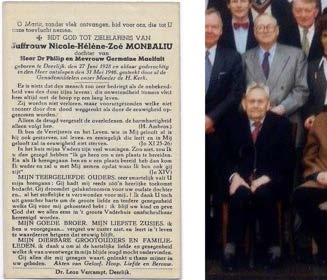
Throughout this chapter, we have mentioned several acquaintances of the family. Here, we highlight the family of Dr Philip Monbaliu, shown in Figure 45.87. Reference to them is also made in Chapter 44.8.22, Chapter 46.2.6, and also Figure 46.9. Dr Philip Monbaliu was born in Lissewege on April 13, 1895, and died in Deerlijk on June 15, 1999. He was a farmer’s son, which made Michel Declercq choose him as a family doctor at Deerlijk. During WWI, the doctor accomplished all his consultations on a bicycle. He often trotted 20 km a day. There was no phone at that time, except at some fixed locations. So, he always left a consultation round planning of the day with his wife. By doing so, she could have someone intercept him on his round in case of an emergency.
Pharmacists did not exist, so the doctor had a pharmacy where his wife mixed the necessary powders and syrups in his house.
The author often saw the ancient doctor in his beautiful home at the corner of the streets, ’Kapel-ter-Rustestraat’ and ’Stationsstraat’
while reading or walking in the garden. He never spoke to him but remembered a radio interview when he was over 100. "God heeft mij vergeten," he said in amazement.
Many people in Deerlijk have been born by Dr Monbaliu. Many souls were saved thanks to the ingenuity of the doctor and his very primitive tools.
45.10 Some Memorabilia
Some memorabilia are shown in Figures 45.88, 45.89, 45.90, 45.91, 45.92 and 45.93.
The Desclergues of la Villa Ducal de Montblanc, 2nd ed., Omn., VOL. III
© 2024 Nico F. Declercq
836
CHAPTER 45. MICHEL ACHIEL RENATUS DECLERCQ (DC15) & IRMA HELENA LESAGE
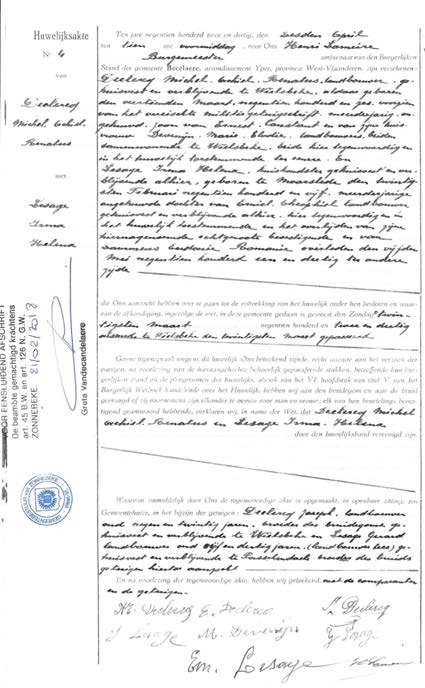
Figure 45.63: Beselare, April 6, 1932, the wedding of Michel Achiel Renatus Declercq
with Irma Helena Lesage. The groom was a farmer from Wielsbeke, born on March 14,
1906. He had passed his military service, son of farmers Ernest Constant Declercq and
Marie Elodie Devenyn, from Wielsbeke, present and approving the marriage. The bride was
living in Beselare and born in Moorslede on February 20, 1905, daughter of farmer Emile
Theophile Lesage, present and approving the marriage, and Eudoxie Romanie Lammens,
who passed away on May 5, 1931. The witnesses were 29-year-old farmer Joseph Declercq,
brother of Michel who lived in Wielsbeke, and 35-year-old farmer Gerard Lesage, brother
of Irma, who lived in Passchendaele.
© 2024 Nico F. Declercq
The Desclergues of la Villa Ducal de Montblanc, 2nd ed., Omn., VOL. III
45.10. SOME MEMORABILIA
837
Figure 45.64: 1932, the wedding photo of Michel Declercq with Irma Lesage. Cour-
tesy of Ann and Françoise Vanhecke, and Maurice Declercq. MyHeritage® colorized
this photo. (Declercq de Silva Archive)
The Desclergues of la Villa Ducal de Montblanc, 2nd ed., Omn., VOL. III
© 2024 Nico F. Declercq
838
CHAPTER 45. MICHEL ACHIEL RENATUS DECLERCQ (DC15) & IRMA HELENA LESAGE
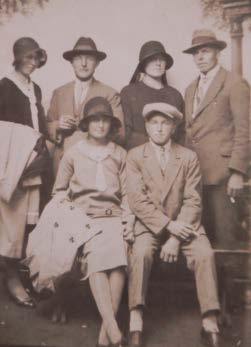
Figure 45.65: Around 1933. Standing from right to
left: The married couples Michel Declercq and Irma
Lesage, and Gerard Lesage and Magdalena Meersse-
man. Seated: the engaged couple Daniel Lesage and
Valentine Declercq. Gerard Lesage died a few years
later, and his widow Magdalena would marry Daniel
to safeguard the family’s possessions, which has been
traumatic for Valentine as outlined in Chapter 44.5.5.
(Declercq de Silva Archive)
Figure 45.66: Souvenir from Westend and Ostend (1935). (Declercq
de Silva Archive)
Figure 45.67: Postcard of 1920 (Nels),
which shows that wearing a hat was very
fashionable at ’Waregem Koerse’ . Many
people still live under the assumption that
they are supposed to wear a hat at the
event.
© 2024 Nico F. Declercq
The Desclergues of la Villa Ducal de Montblanc, 2nd ed., Omn., VOL. III
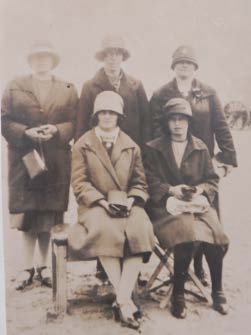
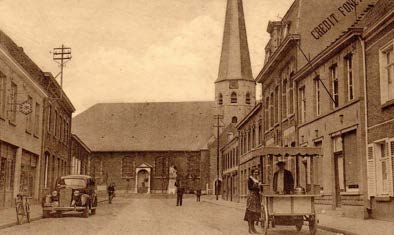
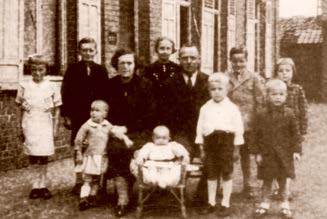
45.10. SOME MEMORABILIA
839
Figure 45.68:
Around 1950. From left to right,
standing: Irma Lesage, Magdalena Meersseman,
Rachelle Declercq; seated: Judith Declercq, Agnes De-
clercq. (Declercq de Silva Archive)
Figure 45.69: Deerlijk, probably in 1947. This is what the church square looked
like when the Declercq-Lesage family moved from Wielsbeke to Deerlijk and before
they relocated to Saint-Louis-Deerlijk. The lady in the picture, ordering ice cream,
is Lea or Leona Delombaerde (according to Freddy Byttebier), probably also seen
in 1933 in Figure 44.106 on page 782 serving coffee to Ernest Constant Declercq (DC14).
Figure 45.70: The Declercq-Lesage fam-
ily at their farm near the train station in
Deerlijk, shown in Figure 45.71, just after
the war and before they would construct a
new home at Saint-Louis in Deerlijk. They
had nine children. The image is of inferior
quality due to multiple copying while the
original is lost. (Declercq de Silva Archive)
The Desclergues of la Villa Ducal de Montblanc, 2nd ed., Omn., VOL. III
© 2024 Nico F. Declercq
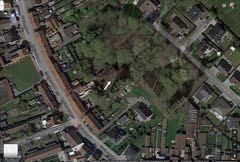
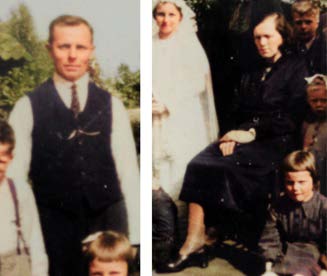
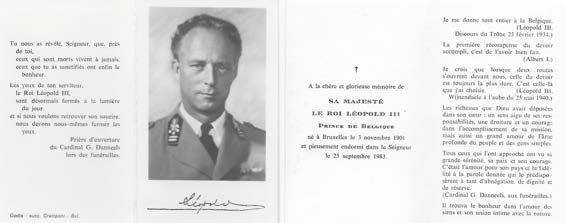
840
CHAPTER 45. MICHEL ACHIEL RENATUS DECLERCQ (DC15) & IRMA HELENA LESAGE
Figure 45.71: Remains of the Declercq-Lesage farm in
Deerlijk not far from the train station. The white arrow
approximately shows the location and direction of the pic-
ture in Figure 45.70, taken just after the war. Courtesy
of Google Maps®.
Figure 45.72: Michel Declercq and Irma
Lesage on May 10, 1945. The picture
was taken on the occasion of the confirma-
tion of Agnes Declercq. MyHeritage® col-
orized this photo.
(Declercq de Silva
Archive)
Figure 45.73: The obituary card of H.M. King Leopold III of Belgium, September 25, 1983. (Declercq de Silva Archive) Figure 45.74: The obituary card of Princess Lilian, second wife of H.
H. King Leopold III, in Figure 45.73. The King married Lilian Baels
on December 7, 1941. She was born in 1916 in London and died in
Brussels in 2002. (Declercq de Silva Archive)
© 2024 Nico F. Declercq
The Desclergues of la Villa Ducal de Montblanc, 2nd ed., Omn., VOL. III
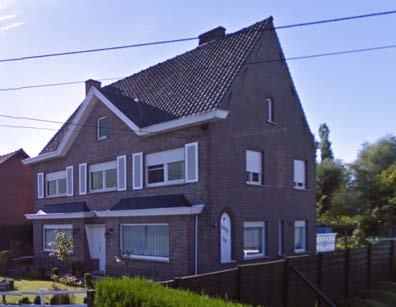
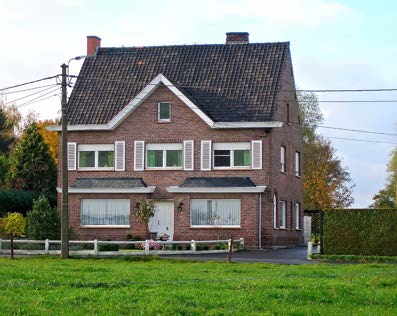
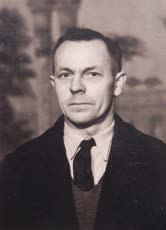
45.10. SOME MEMORABILIA
841
Figure 45.75: A picture taken in 2013, of the house of Declercq-Lesage constructed
around 1950, at Sint Lodewijk - Deerlijk, in Oude Heerweg. The house is since 2016
owned by others and has been completely modernized. The house had been a warm
and spacious nest to live for the family with nine children. (Courtesy of Google®,
2013)
Figure 45.76: November 6, 2010, the same house as Figure 45.75. (Declercq de
Silva Archive)
Figure 45.77:
Michel Declercq in the 1950s. (Declercq de Silva
Archive)
The Desclergues of la Villa Ducal de Montblanc, 2nd ed., Omn., VOL. III
© 2024 Nico F. Declercq
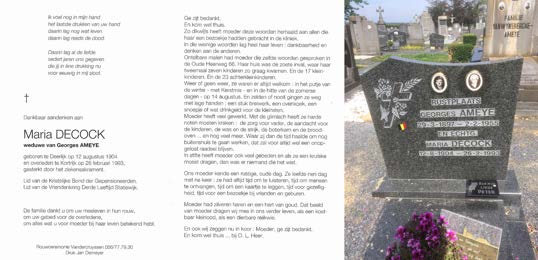
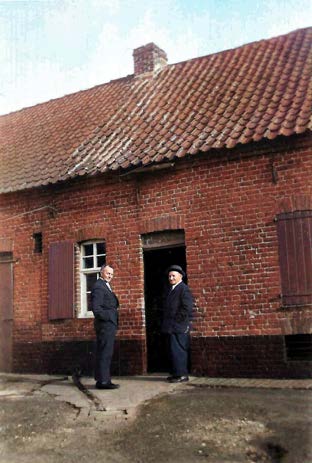

842
CHAPTER 45. MICHEL ACHIEL RENATUS DECLERCQ (DC15) & IRMA HELENA LESAGE
Figure 45.78: The obituary card of Maria Decock (1904-1993), widow of Georges Ameye, from whom the land was bought on which Michel Declercq and Irma Lesage constructed their home in Sint Lodewijk, Deerlijk. Right is their tomb stone in 2019. (Declercq de Silva Archive)
Figure 45.79: Declercq Michel in 1957 at a farm somewhere in
Saint Louis Deerlijk, possibly at the junction between Kerkstraat
and Pladijsstraat. MyHeritage® colorized this photo. (Declercq
de Silva Archive)
Figure 45.80: Sedum Spurium, ’kruipers’ which descend from the ones originally
planted by Michel Declercq. (Declercq de Silva Archive)
© 2024 Nico F. Declercq
The Desclergues of la Villa Ducal de Montblanc, 2nd ed., Omn., VOL. III
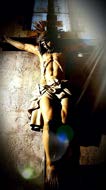
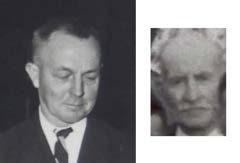
45.10. SOME MEMORABILIA
843
Figure 45.81: After the death of Irma Lesage, Michel Declercq decided to make
baroque-style crucifixes for each of his children. To him, they must have symbolized
his desire to transmit his Christian faith and expressed the suffering he went through.
A crucifix in a similar style is found, for instance, in Montblanc in Spain, from where
the Desclergues came. (Courtesy of Joaquim Parés Pubill of Montblanc, ’Ramper’)
Figure 45.82: As a child, the author used to breed and race pigeons. His specialty
was the ’grand fond’ , with the crown on his efforts for Barcelona’s annual race. He
ended his hobby when he went to college but has kept his best pigeons for many more
years. This picture was taken somewhere in France when he released his remaining
pigeons in May 1998. They arrived home earlier than the author, as usual. (Declercq
de Silva Archive)
Figure 45.83:
Left is Michel Declercq on the bap-
tism of his grandson Franck Vanhecke in January of
1959. Michel was a gentleman with very high moral stan-
dards, and he was still in perfect health then. Right is
Michel Declercq at Malève in 1960, three years before he
died. Indeed, at the end of his life, he looked like Stijn
Streuvels, but we don’ t know if his mustache was grown
with that purpose. It is remarkable how so suddenly the
aging process had set in. (Declercq de Silva Archive)
The Desclergues of la Villa Ducal de Montblanc, 2nd ed., Omn., VOL. III
© 2024 Nico F. Declercq
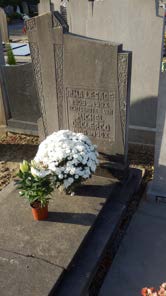
844
CHAPTER 45. MICHEL ACHIEL RENATUS DECLERCQ (DC15) & IRMA HELENA LESAGE
Figure 45.84: Two grandchildren of Michel Declercq and Irma Lesage at the 2015 International Congress on Ultrasonics (ICU) organized by the author in Metz, France, in the week of May 11, 2015. When the author (President) and Françoise Vanhecke (special guest) appeared together on the stage, it must have put a smile on their grandparents’ faces somewhere in Heaven. It was also the birthday of the author’s father. It was an event where a few details about the family history were revealed, a peak moment of happiness, but it was sadly followed by the sudden death of the author’s father at the end of June. The author was the President of the 2015 ICU Congress and the Steering Committee of the ICU. He welcomed 700 participants from 53 countries; 612 were active participants from ultrasonics, 88 were visitors or accompanying persons, 30% were students. The participants enjoyed 542 presentations during the congress, i.e., 410 oral presentations and more than 170 poster presentations. The event held 67 scientific sessions (spread over 95 periods) with a maximum of 10 parallel sessions. Nine industrial sponsors supported the event. The congress invited nine plenary and keynote speakers. In total, 645 abstracts had been submitted; 89% were of sufficient quality and were accepted for presentation.
The event has been the largest and most successful ICU congress ever. For many years, the participants have also mentioned the excellent food provided during the event, prepared by a Master-Chief.
Figure 45.85: 2014, Sint Lodewijk in Deerlijk. The original tomb-
stone of Michel Declercq and Irma Lesage before their reburial in the
family grave Declercq de Silva on the same cemetery, shown in Chap-
ter 64.7.10 (2014). The original grave is now taken by their unmarried
daughter Agnes Declercq, who died in 2018. (Declercq de Silva Archive)
© 2024 Nico F. Declercq
The Desclergues of la Villa Ducal de Montblanc, 2nd ed., Omn., VOL. III
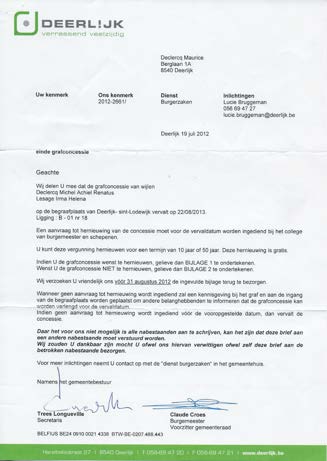
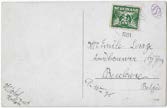
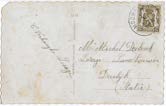
45.10. SOME MEMORABILIA
845
Figure 45.86:
It was thanks to Mau-
rice Declercq, after the author had insisted,
that the grave concession of Michel De-
clercq and Irma Lesage was extended. Nev-
ertheless, as the tombstone was in bad
shape and endangered other graves, the au-
thor relocated his grandparents’ remains in
2015 by a reburial in the new family grave,
shown in Chapter 64.7.10.
Figure 45.87: Dr Philip Monbaliu and his wife Germaine Maelfait,
relaxing after a hard day’s work. Courtesy of Armand Deknudt. This
picture also appeared in Derlike, 18de jaargang, nr 1, 1995. MyHer-
itage® colorized this photo.
Figure 45.88: 1928, July 6, a postcard from 22 years old Michel
Declercq to Irma Lesage, sent from Zelzate on one of Michel’s journeys
to purchase flax. (Declercq de Silva Archive)
Figure 45.89: 1931, twenty-five-year-old Michel Declercq sent this
postcard from Holland in the Netherlands, on a journey to make a flax
purchase deal, to Emile Lesage. He sent it from Dordrecht. Michel
visited the farmers around Dordrecht or IJselmonde at that time, two
areas known for flax cultivation. (Declercq de Silva Archive)
Figure 45.90: January 1940. This is a postcard sent by Camiel Ver-
haeghe and Godelieve Angela Lesage, from Moorslede to Michel De-
clercq and Irma Lesage who, at that time, lived in Deerlijk in a farm
near the train station. (Declercq de Silva Archive)
The Desclergues of la Villa Ducal de Montblanc, 2nd ed., Omn., VOL. III
© 2024 Nico F. Declercq
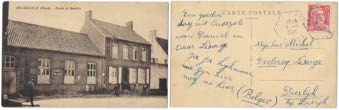
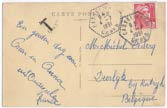
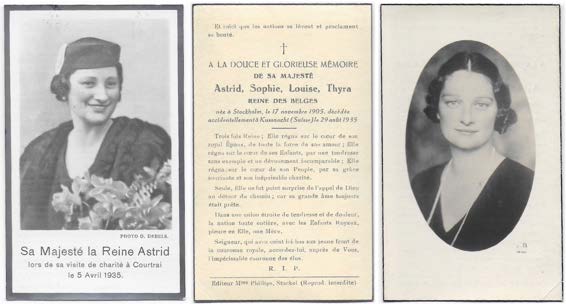
846
CHAPTER 45. MICHEL ACHIEL RENATUS DECLERCQ (DC15) & IRMA HELENA LESAGE
Figure 45.91: June 6, 1949. This postcard was posted by Daniel and
Oscar Lesage when they visited Oudezeele in the North of France, where
they had lived during WWI. The note was sent to Michel Declercq and
Irma Lesage, who, at that time, already lived in Oude Heerweg in Sint
Lodewijk Deerlijk. (Declercq de Silva Archive)
Figure 45.92: July 4, 1951. This postcard was sent by Oscar Lesage
and his wife Anna Soenen, to Michel Declercq and Irma Lesage, during
a visit to Oudezeele. (Declercq de Silva Archive)
Figure 45.93: The obituary photo card and the mortuary card of H.M. Queen Astrid Sophie Louise Thyra, wife of H.M. King Albert of Belgium (De Saxe Cobourg), August 29, 1935. One picture was taken in Kortrijk, on April 5, 1935.
(Declercq de Silva Archive)
© 2024 Nico F. Declercq
The Desclergues of la Villa Ducal de Montblanc, 2nd ed., Omn., VOL. III
847
45.11 Their Offspring
As expressed at the beginning of this book, the author has decided to limit the descriptions of cousins, uncles, and aunties, apart from some exceptions. The continuation of the Declercq line is shown in Figure 45.94.
Marcel Declercq, Carol’s father, appears in Chapter 46.2.6 and is shown in Figure 19.2 on page 156. We would also like to mention and acknowledge the son Jozef and the daughters, Maria and Agnes, with permission. Indeed, they contributed to this book by sharing photos and information that had not been available to the author earlier. Maria’s children are Françoise, Caroline, Ann, Dominique, and Franck, and she raised her granddaughter Angelique on her own. They all expressed genuine interest in the contents of this book.
Agnes’ profound religious faith and her lifelong devotion towards her closest family’s well-being and many others earn her appearance in this book, in Figure 45.95. Her alternative way of life, devotion to God and humankind, love for simplicity and infinite goodness, daily prayers, and philosophical mind have baffled many of her siblings and frequently resulted in ignorance and exclusion. Her inclusion in this book is the author’s statement of appreciation.
Although she had always desired to become a nun, she has chosen an earthly life close to her dearest ones and may be called an exemplary ’sister of the profession.’ She had a golden voice inherited from her father, Michel Declercq, and filled churches during masses and prayers like an angel sent from Heaven. She loved reading books on matters close to her heart, such as religion, philosophy, history, and, above all, the life of Saints. Money and possessions were of no interest to her. She hated pride and glorified simplicity. Her tombstone was paid voluntarily by the dearest ones to her and who let their heart speak. As expected, she has spent her entire fortune on charity and left nothing behind. She was a good Christian to the bone. We can cite Luke,12
’Do not be afraid, little flock, for it is your father’s pleasure to give you the kingdom. Sell your possessions and give alms. Make purses for yourselves that do not wear out, an unfailing treasure in Heaven, where no thief comes near, and no moth destroys. For where your prize is, there your heart will also be.’
Her obituary card and gravestone are also shown in Figure 45.95.
Maria is shown in Figure 45.96. After the death of her husband, Maria raised her five children and later also her granddaughter Angelique. Her strength is remarkable, and her deed is honorable because she neither chose to become a widow nor steal anyone’s children. They were a gift from God, and she has cherished them with all her might and love.
12Luke 12:32-34
The Desclergues of la Villa Ducal de Montblanc, 2nd ed., Omn., VOL. III
© 2024 Nico F. Declercq
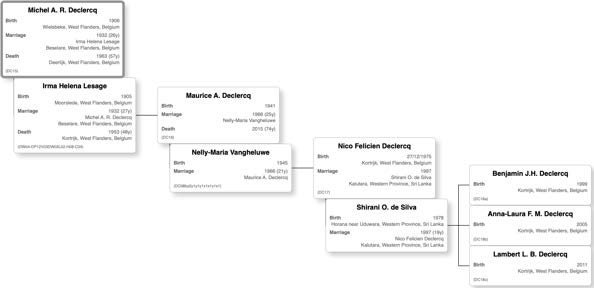
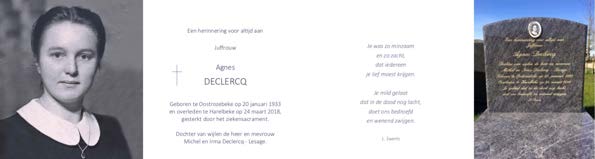
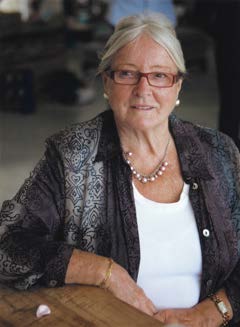
848
CHAPTER 45. MICHEL ACHIEL RENATUS DECLERCQ (DC15) & IRMA HELENA LESAGE
Figure 45.94: Three descending generations of Michel Achiel Renatus Declercq (DC15)
Figure 45.95: Agnes Declercq (1933-2018), godmother of Françoise Vanhecke and foster mother of Maria Declercq’s children, grandchildren, and many other dear ones. Her obituary card is equally shown on March 24, 2018. The tomb of Anges Declercq is particular. In English, the text reads: ’In everlasting memory of Miss Agnes Declercq, daughter of the late Mr and Mrs Michel and Irma Declercq-Lesage, born in Oostrozebeke on January 20, 1933, and who died in Harelbeke on March 24, 2018.
The memory of your face that still smiles, even while you are no longer among us, leaves us behind in tears and profound silence.’ (Declercq de Silva Archive)
Figure 45.96:
Declercq Maria is the second eldest
daughter of Michel Declercq and Irma Lesage. With this
foto, the author wishes to express his gratitude for all the
photographic information and anecdotes provided in the
past years, which enriched his knowledge of 20th-century
family history. Her perseverance and moral compass,
representing her parents and who they were, have pleased
the author and motivated him to continue this work until
the end. (Declercq de Silva Archive)
© 2024 Nico F. Declercq
The Desclergues of la Villa Ducal de Montblanc, 2nd ed., Omn., VOL. III
Maurice Alois Declercq (DC16) & Nelly Maria
Vangheluwe
46.1 Introduction
Maurice Alois Declercq and Nelly Maria Vangheluwe are the author’s parents, and they also appear in the other chapters.
Maurice Declercq appears in Chapter 64 as the son of Irma Helena Lesage; in Chapter 65 as great-great-great-great-great-great-grandson of Adrienne de Patin (DP12); in Chapter 66.1 as great-great-great-great-grandson of Barbara Benoit; in Chapter 66.2 as great-great-great-great-great-grandson of Maria Jeanne Christine Benoit; in Chapter 67 as the son-in-law of Anna Den Dauw; in Chapter 68 as a ’t Kint descendant; in Chapter 69 as great-grandson-in-law of Marie Nathalie Surmont; and in Chapter 71 as the great-grandson of Clemens Lammens.
Maurice and Nelly’s relationship was rooted in a profound familiarity, having known each other since childhood. Their bond, forged over many years, provided a solid foundation for a marriage that was, by many accounts, remarkable in its strength and mutual affection. However, this foundation had its cracks, primarily due to siblings’ pervasive and persistent interference.
Despite the relentless interference from siblings, Maurice and Nelly’s resilience shone through. They continually navigated the tumultuous waters of familial involvement, addressing complex challenges at the expense of their own peace and stability. These external pressures, while exacerbating the inherent difficulties of their lives, also showcased their unwavering commitment to each other and their marriage.
The constant presence of siblings in their marital affairs often overshadowed the couple’s personal needs and aspirations. The siblings’ actions, whether driven by misguided concern or sheer stubbornness, frequently undermined Maurice and Nelly’s efforts to carve out their own identity as a family unit. This interference strained their relationship and impeded their ability to fully support each other in the manner they both deserved and desired.
Had Maurice and Nelly been granted the necessary support and respect for their autonomy, their marriage could have soared to even greater heights of happiness and fulfillment. The lack of familial boundaries deprived them of the opportunity to nurture their relationship without the added burden of external conflicts. Their resilience in the face of such adversity is a testament to their deep connection and commitment to one another, leaving us to ponder the potential that was left unfulfilled.
While Maurice and Nelly’s marriage was indeed wonderful, it was marred by their siblings’ continuous and often intrusive involvement. This amplified their challenges and detracted from their ability to realize their full potential as a couple. Their story underscores the importance of respecting the autonomy of married couples, allowing them the space to build their future free from undue external pressures.
In 1975, the author was born into a family that, despite its challenges, provided an environment rich with love and support. The author can unequivocally affirm that he was fortunate to have exemplary natural parents and also epitomic foster parents, whose detailed accounts are provided in Chapter 69.11. The complexity of his youth, shaped by a blend of nurturing care and occasional familial turbulence, played a pivotal role in molding his character and fostering a deep sense of perseverance.
The author experienced a balance of positive and challenging moments throughout his formative years. The constructive influences of his upbringing significantly outweighed the difficulties, instilling in him resilience and a profound appreciation for the strength of familial bonds.
These early experiences laid the groundwork for a well-rounded diplomatic personality with a persistent drive to overcome obstacles and achieve personal growth.
One of the most transformative periods in the family’s journey was marked by the arrival of grandchildren. This new generation brought a renewed sense of unity and purpose to the author’s parents, bridging previously insurmountable gaps. The joy and fulfillment derived from their roles as grandparents mitigated the impact of external negativities, fostering a more harmonious family dynamic.
In essence, the author’s birth in 1975 marked the beginning of a life enriched by the unwavering support of his parents despite the complexities they faced. The subsequent arrival of grandchildren further solidified these familial bonds, demonstrating the enduring power of love and togetherness in overcoming external adversities.
Indeed, tout est bien qui finit bien.
Unfortunately, the author’s father passed away too soon. He had just reached the cream of the pie of his life and could have enjoyed it for a few more years. Sic vita est hominum.
We should always remain grateful that he survived an accident when he was a soldier and received a 55-year extended life span to establish a life and family. It was a satisfying experience to find the name Maurice Declercq in the Spanish archives of our ancestors in Figure 46.1.
Nelly Maria Vangheluwe, the author’s mother, was a woman of many talents. She was always self-employed, a testament to her entrepreneurial spirit. Her love for people was evident in her enjoyment of their company. The spirit of trade and merchandising, a part of her family’s heritage, ran deep in her veins.
46.2 Maurice Alois Declercq (DC16)
The Desclergues of la Villa Ducal de Montblanc, 2nd ed., Omn., VOL. III
© 2024 Nico F. Declercq
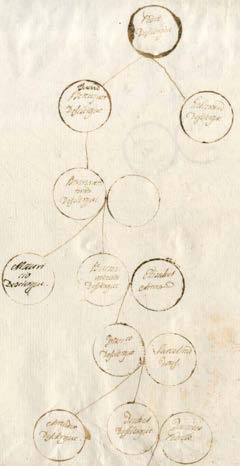
850
CHAPTER 46. MAURICE ALOIS DECLERCQ (DC16) & NELLY MARIA VANGHELUWE
Figure 46.1: This is a fragment of ’Arbre genealògic
del llinatge Desclergue i el seu entroncament amb els
Pedrolo.’ It is shown here because it indicates that our
ancestors had already used the name Maurice Declercq,
namely ’Mauricio Desclergue.’ The fragment shows the
bloodline from Pere Desclergue (DC01) to Isabel De-
sclergue, who married Jacint de Pedrolo. We can see
two sons of Pere Desclergue, namely Galceran (DC02d)
and Joan Berenguer (DC02). The latter person’s son,
Bonaventura (I) (DC03), is shown, but his wife, Maria
Ana Cortés de Monroy, is ignored. Two sons are shown,
namely Mauricio Desclergue (DC04e) and Bonaventura
Desclergue (II) (DC04). The latter married Elisabeth
Anna de Ratera, from whom Francesc (DC05e), An-
toni (DC05b), and Francisca (DC05d) were born. Later,
Maria Anna Desclergue y Villavicencio gave birth to En-
ric (DC05c) and Jeroni (DC05). The tree only focuses
on Francesc (DC05e), the ancestor of Francesc de Pe-
drolo y Desclergue. Therefore, it continues with the
couple Francesc (DC05e) and Catarina Tous y Mon-
serrat, from whom two children stem, namely Isabel
Dessclergue (DC05ex1) and Amadeo Francesc Descler-
gue (DC05ey1). Isabel married Jacint de Pedrolo, and
they were the parents of Francesc de Pedrolo y Descler-
gue. (Source: Arxiu Comarcal Urgell Desclergues docu-
ment 8 page 1 view 1; Courtesy of Arxiu Comarcal Urgell
and the de Pedrolo family)
46.2.1 Introduction, his Birth and Death
The most recent ancestors of Maurice Declercq, shown in Figure 46.4, can be found in Figure 46.2. His birth is presented in Figure
46.3. Introducing a dear person and his passing away in recent times, shown in Figures 46.5, 46.6, and 46.7, is not an easy task.
Therefore, we may ask what Maurice would have suggested writing about him as a brief introduction.
He was a professional engineer but always wanted to be a farmer, and he was the heir of his godfather and uncle, Daniel Lesage.
He grew up with his parents in Deerlijk, his uncle Daniel Lesage, and his aunt Magdalena Meersseman in Moorslede. He lost his mother when he was twelve and his father when he was twenty-two. He loved helping others by all means possible and had one child, the author. He cheered up and became confident and satisfied once he had grandchildren.
According to medical analysis, Maurice Declercq died in 2015 of an aortic rupture, likely induced by a chronic aortic aneurism initiated many years earlier by the scooter accident described in Chapter 46.2.6, which had also ruptured his liver1. The hypothesis is that the problem has led to a dangerous situation due to an age-related rise in blood pressure in addition to stress caused by his siblings. This stress caused not only a rise in blood pressure but also migraine, for which he has been injected with triptan regularly, worsening the situation even more. In addition, robbers had entered his home a few months before his death, whence he could no longer sleep peacefully and became exhausted. A thorough medical check2, for instance, would likely have revealed the problem and allowed Maurice to have turned 90 and still enjoy his life and grandchildren.
Pointing fingers at others would not bring him back, whence the author decided in 2015 to accept his faith. A Declercq, however, remembers.
The author’s father passed away with a clear conscience, having led a prosperous life devoted primarily to the well-being of others.
He excelled as a son, parent, brother, uncle, neighbor, friend, and acquaintance, leaving a lasting impact on all who knew him. His dedication to these relationships and his unwavering support for those around him were exemplary.
However, in his selflessness and commitment to serving others, he often neglected his own needs and personal enjoyment. While his life was marked by a profound sense of duty and care for his loved ones and community, he sacrificed his own pleasures and opportunities for self-care.
Despite this, his legacy is one of remarkable kindness, generosity, and devotion, embodying the highest ideals of familial and social responsibility.
Maurice Alois Declercq (DC16) was born on May 11, 1941, in Deerlijk. He was a son of Michel Achiel Renatus Declercq (DC15) and Irma Helena Lesage. The Germans occupied Deerlijk then, and his parents went through a challenging period described in Chapter 45.5. These difficult times taught Maurice to respect his elder siblings and show responsibility to his younger ones. This sense of duty was later strengthened by his mother’s death and cost more energy during his entire life than what may reasonably be expected of a brother.
He was named after the husband, Maurice Wullaert, of his godmother, Rachelle Declercq, described in Chapter 44.5.6. He received his second name from the father-in-law, Aloïs Xavier Meersseman, of his godfather, Daniel Lesage, described in Chapter 64.7.12.
Aloïs Xavier Meersseman was born at Oostnieuwkerke in 1849 and was Maria Pahrailde Vercruysse’s husband, born at Moorslede in 1860.
1A comparison with the medical literature indeed confirms such a hypothesis. The National Library of Medicine has published several articles on this matter. Examples include ’Traumatic aortic arch false aneurysm after blunt chest trauma in a motocross rider,’ J Cardiothorac Surg. 2008 May 1;3:23.
’A case of a chronic traumatic thoracic aneurysm after an injury 18 years ago,’ Nihon Kyobu Geka Gakkai Zasshi. 1994 Nov;42(11):2102-5. ’Thoracic aortic aneurysms after blunt trauma,’ Ulus Travma Acil Cerrahi Derg. 2013 Jul;19(4):343-7.
2His symptoms have not been taken seriously.
© 2024 Nico F. Declercq
The Desclergues of la Villa Ducal de Montblanc, 2nd ed., Omn., VOL. III
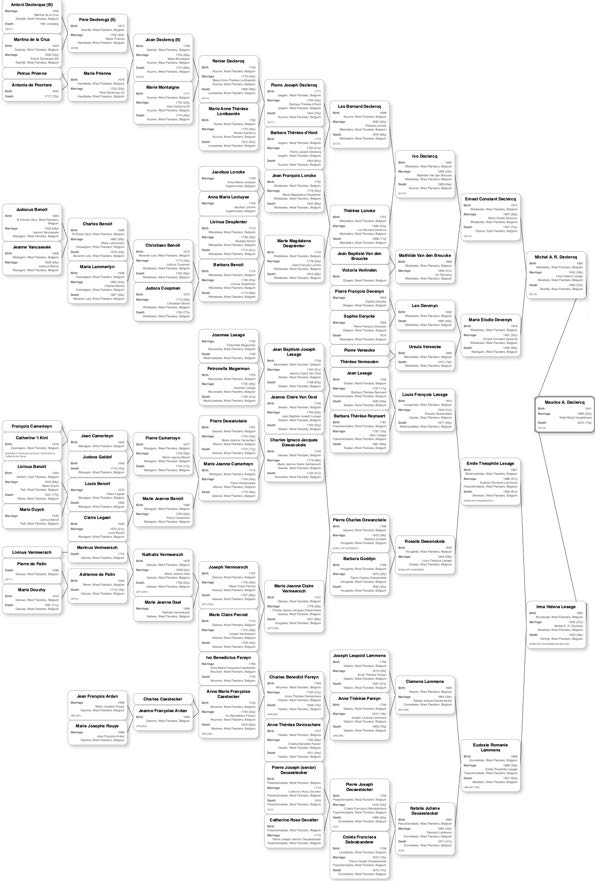
46.2. MAURICE ALOIS DECLERCQ (DC16)
851
Figure 46.2: Eight ascending generations of Maurice Alois Declercq (DC16, DP12V03DW02L02)
The Desclergues of la Villa Ducal de Montblanc, 2nd ed., Omn., VOL. III
© 2024 Nico F. Declercq
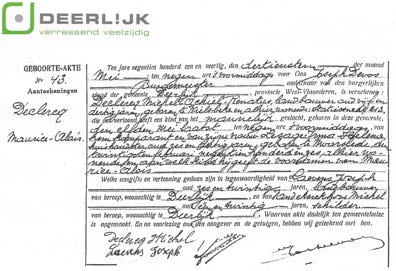
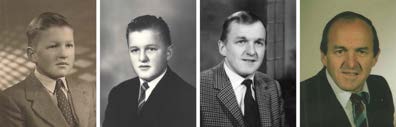
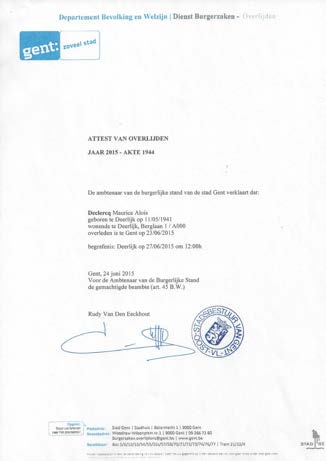
852
CHAPTER 46. MAURICE ALOIS DECLERCQ (DC16) & NELLY MARIA VANGHELUWE
Figure 46.3: Deerlijk, May 11, 1941, the birth certificate of Maurice Alois Declercq,
son of farmer Michel Declercq and Irma Lesage.
Figure 46.4: Passport photos of Maurice Declercq.
Figure 46.5: Ghent, the death of Mau-
rice Declercq, June 23, 2015. The evening
before, he had passed out while working
in the garden at Sint Lodewijk, Deer-
lijk.
His life was saved by his neigh-
bor Stephanie Bourgeois, the wife of Koen
De Marez, a wonderful couple with a
sweet family. Still, very unfortunately,
Maurice passed away the following day
in Ghent at the hospital after surgery.
The author has found tremendous sup-
port in the sympathy from his father’s
mentioned neighbors, and also Antoine
and Solange Verzele-Deschinkel, Hassan
and Sharon Zaâter-Vanhaezebrouck, Steve
and Kelly Lobbens-Veys, Dirk and Hilde
De Ceukelier-Deprez, Adrien and Chan-
tal Dekens-Bauwens, Eugene and Katrien
Decock-Sagaert, Francine Tailly, the later
arrived neighbors Pascal and Sofie Loncke-
Remmerie and many others.
© 2024 Nico F. Declercq
The Desclergues of la Villa Ducal de Montblanc, 2nd ed., Omn., VOL. III
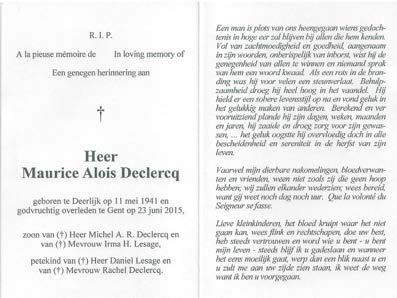
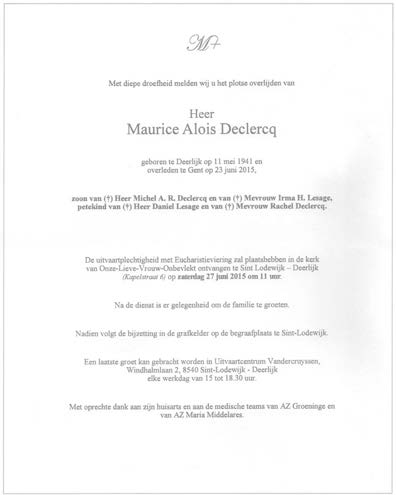
46.2. MAURICE ALOIS DECLERCQ (DC16)
853
Figure 46.6: The obituary card of Maurice Alois Declercq, June 23, 2015. (Declercq
de Silva Archive)
Figure 46.7: The death announcement of Maurice Declercq, June 23, 2015. The
funeral was on the last Saturday of June, at 11 am, 2015. (Declercq de Silva Archive)
The Desclergues of la Villa Ducal de Montblanc, 2nd ed., Omn., VOL. III
© 2024 Nico F. Declercq
854
CHAPTER 46. MAURICE ALOIS DECLERCQ (DC16) & NELLY MARIA VANGHELUWE
Figure 46.8: Venerable Gnanissara Murungagasyaye was born on April 24, 1946, in Hambantota, Sri Lanka, and died on November 5, 2021. He was a personal friend of Sri Lanka’s Presidents Mahinda and Gotabaya Rajapaksa and a respected representative of the Buddhist community at the United Nations and Europe. Mahinda Rajapakse was President from 2005 to 2015, following Chandrika Kumaratunga Bandaranaike, while Gotabaya Rajapaksa has been President since 2019, following Maithripala Sirisena. Venerable Gnanissara Murungagasyaye was originally from the South of Sri Lanka, and he did his Dhamma studies at a school for Vidyodaya Pirivma monks in Colombo and then began his university studies at the University of Peradeniya. Consequently, he became a teacher of Buddhism for about ten years in a school designed to train monks. Venerable Gnanissara came to France at Venerable Chandaratana’s invitation in 1985. The latter helped him find accommodation in the Vietnamese temple of Blanc Mesnil under the patronage of Venerable Kim Ban. He notably studied French and Philosophy at the University of Paris VIII. He became the President of the Vietnamese Theravada Buddhist Association until his death.
He continued his life as a monk with seriousness and honesty for many years, attending to the religious activities of the Buddhist communities established in France and Sri Lanka. In particular, he gave numerous scholarships and much more to underprivileged schoolchildren and university students. He built houses for low-income families in Sri Lanka. He also had a hospital built near his native village. This building had around 40 beds and all the necessary medical equipment. On Sunday, November 7, 2021, he was cremated in his native village in the presence of Sri Lanka’s President and numerous high-placed officials and scholars. He has visited the author’s family more than once. Three months after the death of the author’s father, Maurice Declercq, in 2015, Venerable Gnanissara Murungagasyaye led a Buddhist commemorative ceremony at the author’s home in Kortrijk and that of his father in Deerlijk. When he woke up before the ceremony, Venerable Gnanissara Murungagasyaye said that the quietness and beautiful farmland view reminded him of his home in Sri Lanka and made him very happy. His visit has been a blessing for the family and friends and has always been appreciated. The top-left five images depict the life and death of the monk, while the other photos were taken on September 26, 2015, at the commemoration of the author’s father.
© 2024 Nico F. Declercq
The Desclergues of la Villa Ducal de Montblanc, 2nd ed., Omn., VOL. III