

The Desclergues of la Villa Ducal de Montblanc, Second Edition Omnibus by Nico Declercq - HTML preview
Download the book in PDF, ePub, Kindle for a complete version.
Vlug weg en were, zie
Een witte vlinder
En voort tot waar dat blauw
En groen in’ t koren
Vol lokkend grijs en grauw
Verloopt, verloren.
Zoover als om end om
Het oog kan dragen
Het vlas staat in de blom
Te wiegewagen!’
44.6.5 ’De Mei steken’
When the Declercqs searched for sound flax to purchase, they visited many farms. Flax was often bought while it was still developing in the field. After flax was sold, farmers no longer preferred to be disturbed by frequent merchant visits. Therefore, they placed a
’May’ on their orchard to signal that it was no longer the subject of trade. As it was locally called, this ’May stabbing’ or ’de Mei steken’ was done by a stick topped with a ball of straw at the end. Without straw, the farmer used a leafy branch to serve this purpose.
It also occurred that a flax merchant bought a flax orchard at an earlier stage, sometimes even before it was sown.
The earlier a merchant purchased flax, the cheaper and, therefore, the more profitable it was. However, it was also riskier. Sometimes, flax was bought after it was harvested, which was safer but more expensive. The negotiations between flax traders and farmers were a unique dance, each party employing their own special techniques. When merchants journeyed to Normandy to purchase flax, negotiations often took place over a glass of Calvados, a traditional apple brandy. This shared drink was not just a social custom, but a strategic move, a hopeful gesture for a prosperous trade. And in the spirit of direct and immediate transactions, flax was always paid for in cash.
44.6.6 Harvesting after 100 days : ’Slijten’
Flax should not be dark green and not too thick. It should grow fast enough and fast enough. An orchard is like a child and must develop correctly and at the right pace, as in Figure 44.94. A farmer must neither too quickly claim victory nor become desperate too soon. As parents must bring support without force, farmers must let nature take care of their orchards with respect and patience. Parents often make a mistake when describing their young children by claiming success and geniality. Flax merchants know that this is a mistake. Only the final product matters, while the road to success consists of hard work and humility, not pretentious vanity and self-claimed genius and skillfulness.
Flax, like life, can be ’read’ reasonably quickly. When gently laid down by the dew and then straightened by the sun, high-quality Flax can surrender to nature and fit into the context without losing sight of the ultimate goal. Flax that works against nature is generally of lower quality, a lesson that applies to humans as well. Genius is more than being smart; it is the ability to fit within society and to grow and thrive within its framework. The sensible person knows that society does not change by kicking it but adapting it from high within, i.e. inside out. An excellent flax farmer respects his crops, not himself. These lessons from Flax farming and merchants are not just about agriculture; they are about life.
When Flax had reached its entire length, i.e., 80cm to 120cm, typically in the second half of July, it was harvested by hand. Flax was not cut but pulled or plucked from the ground. The job was customarily done by workers and was called slijten in Flemish.
An essential factor in flax harvesting is determining ripeness; the degree of maturity of the Flax has a significant influence on the quality of the fiber and the seed. This responsibility is comparable to one of a teacher’s tasks: grading students. Also, in parenting, the mother and father must gradually feel the children’s growing independence and provide trust and transfer of decision-making when the time is right.
Flax is harvested, as in Figure 44.94, when it is yellow-ripe, that is, when the stem turns yellow, and the leaves have fallen off the lower half of the branch, while the seed begins to change from white to brown.
Flax harvested too early gives yields with a weaker, flaky fiber and seeds less suitable for sowing, a result comparable to youngsters who gain independence when their brains are still insufficiently mature. The fiber yield will be lower, and it will also ret longer.
Flax harvested late, which was already barren on the land, gives a broader, lean, brittle fiber, similar to adults who wait too long to become independent human beings. The lesson here is clear: timing is everything. Just as in life, the right moment for action can make all the difference in the outcome.
Generally, the correct harvest time is earlier for the Flax fiber than for the linseeds. One must choose the golden mean. For humans,
© 2024 Nico F. Declercq
The Desclergues of la Villa Ducal de Montblanc, 2nd ed., Omn., VOL. III
44.7. HE WAS AN INVESTOR
777
Figure 44.99:
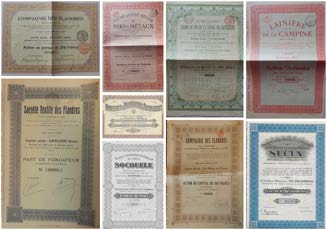
Expired shares of the
textile company ’Compagnie des Flandres,
S. A.’ (1904); ’Compagnie du Chemin
de Fer de la Sierra de Carthagène’ , in
Spain (1905); ’Société Textile des Flan-
dres, S. A.’ (1920); textile and wool com-
pany ’Compagnie des Flandres, S. A.’
(1921 and 1925); ’Compagnie Belge de
Fers & Métaux’ (1921, 1922, 1923 and
1926); ’Lainière de la Campine’ (1925);
Secia in Congo (1927); Socouele in Congo
(1927); Holleries & Raffineries Africaines,
Congo (1929). (Declercq de Silva Archive)
this frequently corresponds to becoming university students.
In the past, the harvest was immersed in the river to ’ret’ and release the fibers. If well-planned, the process can also be done on the field, where rain and dawn deliver sufficient humidity. As with humans, the process is either induced or happens naturally.
Harvesting may seem like a trivial task, but it was, in fact, an artwork. Among the workers were ’left pullers’ and ’right pullers.’
One had to find a technique to ensure the roots were pulled out swiftly, and an adjustment of the pull direction was required, determined by the direction of the flax plant. The world is not ideal; therefore, Flax does not always grow vertically. Good pluckers could work left and right and adjust their technique according to the situation. The roots had to be aligned so that all the flax plants were well-ordered from the beginning to make further processing easier. There was also a difference between Dutch harvesters and Flemish harvesters. Indeed, the Dutch pulled ’handfuls’ and placed them on the ground, while the Flemish placed them on their arm and removed earth by smashing the roots on their knees. Slijten of Flax was complicated and had to occur as equally as possible over the entire field to quickly pick up and process without nestling problems, discontinuity in packing thickness, and so on.
As in Figure 44.94, Hedges was used for drying Flax before processing. Forming fences usually started with a vertical plank against which, on both sides, bundles of Flax were placed. Afterward, the plank was removed and re-used to make another hedge. Times change, and the applications are different, whence the process has also evolved, as described in Figure 44.94.
44.6.7 Stacking
When the flax hedges were dry, they were moved to a particular spot on the field and stacked, as in Figure 44.94. This was called mijten. Very often, a sail covered the stack to keep the rain out.
44.6.8 Threshing (’Boten’ or ’Dorsen’)
Flax fibers are located in the outer part of the stem. Several processes are required to remove those fibers adequately, which we will describe later. Because the fibers are most important, the process consists of preserving the threads while discarding the stem’s remains. Linseed oil is typically harvested in areas where fiber flax could be better quality. In Canada, for instance, farmers cultivated Flax, which was better for oil production. Such Flax had stems with branches and was not suitable for fiber extraction.
In Flanders, seeds were only used for sowing flax in the new season if they were good quality. Daughters of farmers knew this very well and used their intelligence amply when seeking a husband. The workers broke the Flaxseed balls with a kind of hammer necessary to remove linseed, as in Figure 44.95, which was heavy work done by hand and later by machines.
After the retting process, the empty seed balls remained attached to the flax stem. These were then later removed, a step that was sometimes unnecessary if the retting process was done correctly. This sequence of steps in flax processing provides a clear understanding of the process.
44.6.9 Rippling (’Repelen’)
Threshing leaves the empty seed balls on the plant. They had to be removed by a comb, as seen in Figure 44.95, constructed on a table through which workers pulled bunches of Flax, leaving behind the empty seed balls.
44.6.10 Retting (or ’Roten’)
’Flax retting’ or Vlasroten is meant to release the bonding between the flax stem’s exterior fibers and the wood-like inner structure, enabled by dissolving pectin, a natural glue inside the branch. Immersion in water and starting a ’rotting’ process called retting or roten dissolves pectin and disconnects the fibers. However, further processing is required to separate the fibers from the rest and obtain a hair-like final product, which can then be spun and woven. Illustrations are shown in Figures 44.96 and 44.97.
Caissons in which flax was stacked floated because flax naturally floats, as also illustrated in Figure 44.96. One can, indeed, not expect flax to ignore Archimedes’ law. Indeed, flax is hollow and, therefore, has a low density. Even the fibers are hollow. Heavy stones were placed on the top to immerse the caissons sufficiently deep. Workers emptied the massive caissons bundle by the bundle.
Illustrations are shown equally in Figure 44.96.
To delve deeper into the fascinating world of flax processing, we invite the reader to explore Chapter 45. This chapter focuses on the work of Michel Declercq, the son of Ernest Constant Declercq, and provides a comprehensive overview of the various stages and techniques involved in flax processing.
The Desclergues of la Villa Ducal de Montblanc, 2nd ed., Omn., VOL. III
© 2024 Nico F. Declercq
778
CHAPTER 44. ERNEST CONSTANT DECLERCQ (DC14) & MARIE ELODIE DEVENYN
44.7 He was an Investor
Here, we show some relics of the past, which show that flax farmers could also be flax merchants and investors. The reason is that farmers needed more land to develop economically and had to add activities as merchants, provided they had a barn to store Flax.
Other investments also substantially ensured their family’s stability when the flax price oscillated.
We discovered some expired shares once owned by Ernest Constant Declercq, shown as historical curiosities in Figure 44.99.
44.8 Stewards of Virtue, Knowledge, Literature, and Christianity
Ernest Constant Declercq and Marie Elodie Devenyn have always been deeply invested in education, religion, agriculture, and the flax trade. They particularly admired the village of Deerlijk, renowned for its pioneering educational figures, such as Pieter Jan Renier, and its rich cultural heritage, exemplified by the Verriest family and René Declercq.
Economically, Deerlijk was significant, primarily due to its textile industry, including linen manufacturing. The village’s population comprised a healthy mix of workers, farmers, and entrepreneurs. Consequently, it is unsurprising that they invited many distinguished guests when Deerlijk celebrated the ’Bond van Grote en Jonge Gezinnen.’ It is plausible that Ernest Constant Declercq dabbled in poetry, although no publications have been found to date. This chapter focuses on a notable event in 1933, highlighted by a remarkable photograph taken during a banquet.
The journal Derlike14 published an article featuring a series of photographs by Gemma Defraeye and Nelly Verhelst. This article meticulously documented the 1933 event, marking the tenth anniversary of the ’Bond van Grote en Jonge Gezinnen,’ Deerlijk division. The ’Bond der Kroostrijk Gezinnen’ hosted a grand celebration in Deerlijk on August 26, 1933. The guest of honor was General Hector Deprez, and it appears that Baron Bekaert organized and sponsored the event. As was customary for such interwar period events, the ceremony began with the presentation of a new flag at the town hall at 9:00 AM.
This was followed by a procession to the church for a special service, a tribute to fallen soldiers, and finally, a banquet at the youth patronage (formerly located on Nieuwstraat).
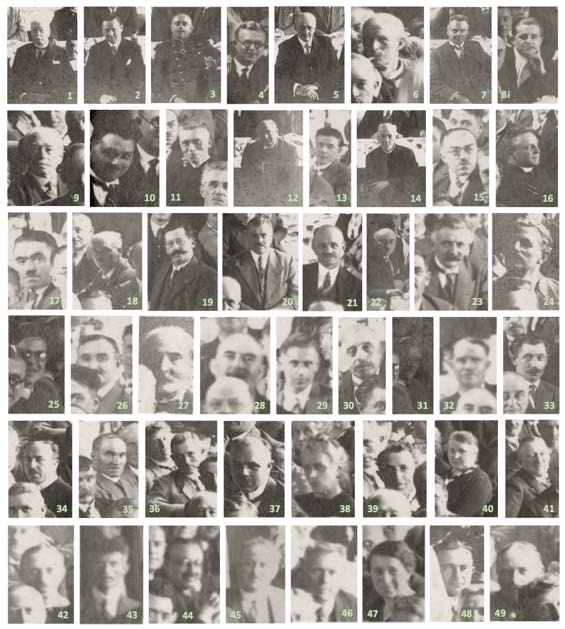
At 3:30 PM, a large procession marched through the municipality. The 1999 article identified several key figures, which we supplement here. Identified attendees included General Deprez, the Bekaert family (father and son), and several prominent educators from Deerlijk and Zwevegem. We have identified a total of 50 individuals in the banquet photograph of Figure 44.102, including numerous writers. Notably, members of the Stijn Streuvels family (the Lateur and Gezelle families) are visible at the central table and in the background. The author was delighted to identify his great-grandfather Ernest Constant Declercq and Paul Lesage in the photograph. In the following section, we provide a comprehensive list of recognized individuals showcasing the diverse and influential attendees of the 1933 event.
Deerlijk has long been a hub of intellectual and cultural prominence. The significant contributions to the country and beyond by leading industrialists, the Renier and Verriest families, René Declercq, and others are noteworthy. The author believes a balanced mixture of intellectuals, industrialists, workers, and farmers fostered Deerlijk’s cultural development. The presence of numerous immigrants, bringing diverse customs, traditions, and languages, contributed to an open-minded and wise community. Interactions among wise farmers, ambitious industrialists, and skilled artisans offered valuable learning experiences.
For example, around 1600, many French-speaking immigrants settled in Deerlijk, and later, industrial development and educational advancements attracted people from outside the municipality.
The interaction between different languages was poignantly expressed by British Queen Elizabeth in her 1992 speech to François Mitterrand: ’La tradition anglo-saxonne est un peu à la tradition latine en Europe ce que l’huile est au vinaigre : il faut les deux pour faire de la sauce, sinon, la salade est mal assaisonnée.’
The year 1933 was marked by significant global events, such as the appointment of Adolf Hitler as Reich Chancellor of Germany by President Hindenburg, the Reichstag fire, the establishment of the Dachau concentration camp, and the beginning of the boycott of Jewish shops. President Roosevelt announced his New Deal in the United States to revitalize the economy. Germany witnessed book burnings in May, while the Flemish National Song Festival took place in Antwerp on June 9. The Blankenberge Pier was inaugurated in early July, and on July 22, the Loch Ness monster was reportedly sighted. A week before the Deerlijk event, the Simele genocide occurred in Iraq. After the Deerlijk celebration, Joseph Goebbels mandated that all German artists join the Reichskulturkammer. On October 29, José Primo de Rivera founded the Falange Española in the Spanish Republic, leading to the Spanish Civil War three years later.
Notably, physicist Albert Einstein spent three months in De Haan (Le Coq Sur Mer) on the Belgian coast during the summer of 1933.
While some of this information appears in separate chapters of this book, readers interested solely in the 1933 event may find this chapter sufficient. The author has also submitted an article to the journal ’Derlike’ of ’Heemkring Dorp en Toren’ for comprehensive coverage, including facial recognition images and extensive references.
44.8.1 Ernest Constant Declercq
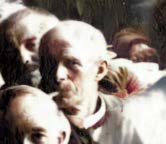
He is number 6 on the 1933 banquet picture in Figure 44.102 on page 780.
Ernest Constant Declercq (1872-1947) was the author’s great-grandfather and an occasional writer. While it is well-documented that he was an avid reader, the precise nature of his literary contributions—whether prose or poetry—remains to be determined.
Figure 44.100: Ernest Constant Declercq, extracted from a large pic-
ture taken during a banquet on August 16, 1933, at Deerlijk. The whole
image is shown in Figure 44.102 on page 780. MyHeritage® colorized this photo.
14Derlike, Volume XXI, Issue 3, 1999
© 2024 Nico F. Declercq
The Desclergues of la Villa Ducal de Montblanc, 2nd ed., Omn., VOL. III
44.8. STEWARDS OF VIRTUE, KNOWLEDGE, LITERATURE, AND CHRISTIANITY
779
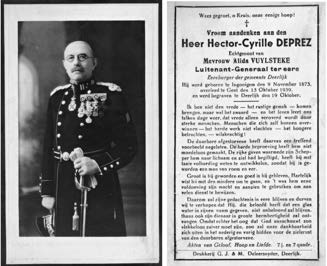
Figure 44.101:
The mortuary card of
General Hector Deprez, 1939. He was one
year younger than Ernest Constant De-
clercq. (Declercq de Silva Archive)
Declercq’s influence extended significantly to writers André Demedts and Gabrielle Demedts, the children of his close friend Maurits Demedts, as elaborated in Chapter 44.9 and Chapter 45.1.4.
Ideally, the transmission of knowledge and cultural heritage from one generation to the next occurs seamlessly. However, in the case of the author’s ancestors, this continuity was disrupted by adverse circumstances such as the flax crisis, the premature death of the author’s grandparents, and a lack of interest in historical preservation by the intervening generation. Despite these challenges, not all archival materials, including invaluable photographs, have been lost. The adage aptly captures this phenomenon, ’The blood creeps where it can’t go.’ The diligent efforts of the local historical society ’Dorp en Toren’ have been instrumental in preserving and disseminating this heritage, as evidenced by their publication of hundreds of insightful articles. Image 44.102 is a particularly noteworthy example of their valuable work.
Direct and indirect sources had already shown that Ernest Constant Declercq (1872-1947) was friends with the Demedts family and also with Edward Vermeulen (1861-1934) and Emile Theophile Lesage (1857-1938). They are described in Chapter 44.8.2,
Chapter 44.8.5, and Chapter 44.8.3. That these families were suddenly seen together in the same photo in Figure 44.102 was a hot
When Ernest Constant Declercq died in 1947, Gabriëlle Demedts (1909-2007) wrote a poem about her feelings, ’Ik heb gedaan ...,’
shown on page 793, in which we can read that she admired him for what he had meant to her in her childhood. She lamented that he could no longer impart the wise words that had once flowed so freely from his lips. Despite the infirmities of age, which had stifled his laughter in his final days, the resolute strength of his character remained evident in the firmness of his handshake.
Overwhelmed by the profound loss upon realizing he had passed, Gabriëlle was moved to tears. In the poignant conclusion of her poem, she subtly suggested that Ernest Constant, like herself, found solace and expression in the craft of poetry.
Gabriëlle Demedts (1909-2007) also wrote a poem about her best friend Valentine Declercq (1910-1939), daughter of Ernest Constant Declercq, when she became terminally ill shortly after her wedding. The poem is ’Zomer’ and appeared in ’Dietsche Warande en Belfort’ in 1939. It is shown in Chapter 44.5.5.
Given his extensive literary connections, it is highly plausible to surmise that Ernest Constant Declercq himself engaged in the creation of prose and poetry. Why else would Gabrielle Demedts have called him ’dezelfde’ (’the same one’) in her poem?
44.8.2 Edward Vermeulen and Elisa Vermeulen
They are numbers 9 and 40 on the 1933 banquet picture in Figure 44.102 on page 780.
Aloise Edouard Vermeulen, born in Beselare on the homestead ’De Navingeer’ on April 12, 1861, and died in Hooglede on July 6, 1934, soon after the event in Deerlijk, had a rich familial background. His mother was Marie-Thérèse Spruytte. His mother was Marie-Thérèse Spruytte, and his wife, Maria-Jacoba Nuitten, descended from a notable old family in Beselare, adding to the intrigue of his life.
Edward’s father was Augustus Vermeulen, born in Beselare on July 26, 1829, the son of Petrus Josephus Vermeulen and Amelia Judith Drouillon. Petrus Josephus Vermeulen was born in Beselare on December 24, 1764, was a farmer, and married Amelia Judith Drouillon in Beselare on October 4, 1817.
Edward became especially famous under the pseudonym Warden Oom. He wrote reasonably dialectically about peasant life in West Flanders. He had roots in the Hooglede-Westrozebeke region, moved there with his parents in 1865, and went to school in Hooglede.
Later, he was educated by Hugo Verriest16 in the Klein Seminarie of Roeselare until 1877, when he was 16 years old.
He had occasionally already written poems when he endeavored his first novel, ’Herwording’ in 1911. He was 50 years old but was well known in the Hooglede area, where he served as a congregation receiver and had frequently published in local papers. He wrote under the pseudonym Warden Oom in the magazine De Stem uit het Vaderland of the Flemish Seasonal Workers in Northern France and Wallonia. He also served as co-publisher of ’t Manneke van de Mane. Hugo Verriest was full of praise for Edward Vermeulen when he received his poems in 1906 when Michel Declercq (DC15) was born. Prosaic work, ’Pole,’ a 21-episode story, appeared in 1908 in the weekly ’De Wegwijzer.’
Edward Vermeulen (1861-1934) lived in Hooglede during WWI. Just like Ledegem, where Emile Theophile Lesage (1857-1938) lived with his son Paul Lesage (1902-1976) (described below in Chapter 44.8.3 and further in Chapter 64.7.8), the village was evacuated in the summer of 1917.
Edward Vermeulen stayed in Meulebeke for some time before continuing his journey to Mol. Although the main square of Meulebeke is only 8 km away from where Ernest Constant Declercq (1872-1947) lived, it is unlikely that Edward visited Wielsbeke. Otherwise, 15In this work, we always used two software to identify persons based on biometric comparisons. The most spectacular one, in which one face blends into another, is ’Facefilm.’ In Ernest Constant’s case, we also found similarities with other family members and would have identified him even without software.
16The Verriest family is also found in Chapter 43.7 and Chapter 44.11.
The Desclergues of la Villa Ducal de Montblanc, 2nd ed., Omn., VOL. III
© 2024 Nico F. Declercq
780
CHAPTER 44. ERNEST CONSTANT DECLERCQ (DC14) & MARIE ELODIE DEVENYN
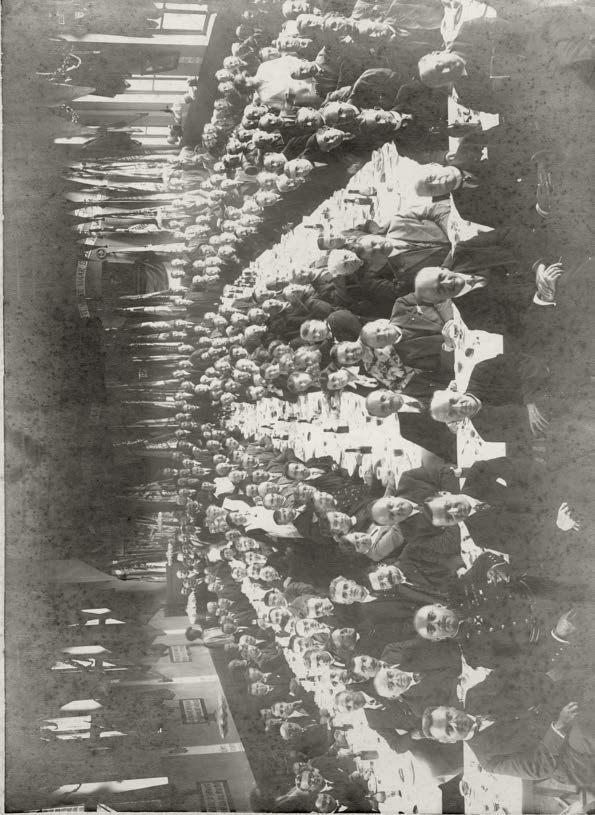
Figure 44.102: Banquet on the occasion of the celebration of the tenth year ’Bond der Kroostrijke Gezinnen,’ Deerlijk,
’jongelingenpatronage,’ August 16, 1933. The identified persons, including Ernest Constant (located on the right-hand side behind the lady serving coffee), are shown separately in Figure 44.103. The table with the guest of honor, General Deprez, must have been near the center of the room, from which we can deduce that there were still party tables at the height of the photo camera, of which the seated people have positioned themselves between the other tables and at the back of the room, for the snapshot. All recognized persons are shown in Figure 44.103. Courtesy of Archive Leon Defraeye Deerlijk. The image also appeared in Derlike XXI, 3 (1999), page 83.
© 2024 Nico F. Declercq
The Desclergues of la Villa Ducal de Montblanc, 2nd ed., Omn., VOL. III
44.8. STEWARDS OF VIRTUE, KNOWLEDGE, LITERATURE, AND CHRISTIANITY
781
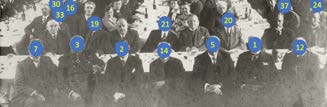
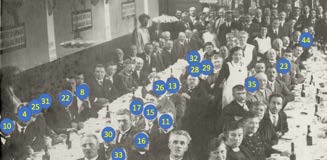
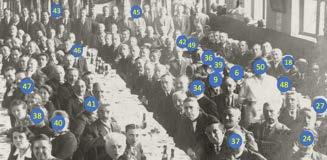
Figure 44.103: All recognised individuals are listed and numbered. The positions and legend are provided in the Figures
44.104, 44.107, 44.105, 44.108, 44.106 and 44.109.
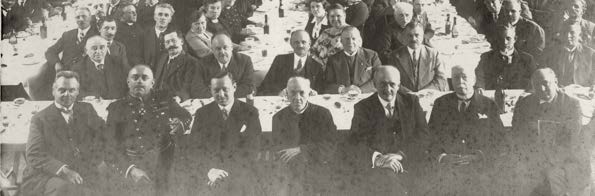
Figure 44.104: The table of the guests of honor, enlarged and provided with numbers in Figure 44.107.
The Desclergues of la Villa Ducal de Montblanc, 2nd ed., Omn., VOL. III
© 2024 Nico F. Declercq
782
CHAPTER 44. ERNEST CONSTANT DECLERCQ (DC14) & MARIE ELODIE DEVENYN
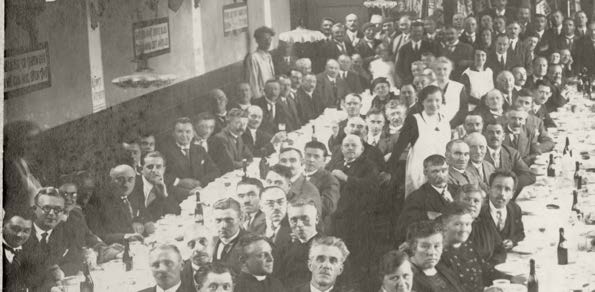
Figure 44.105: An enlarged view of the room’s left side. The legend is shown in Figure 44.108.
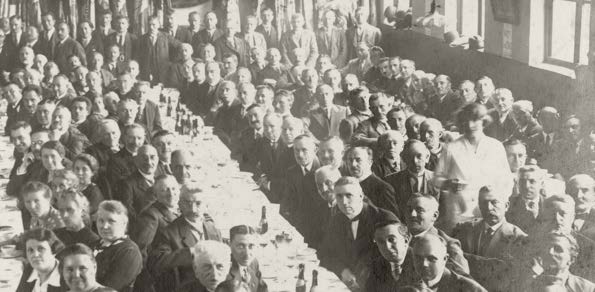
Figure 44.106: An enlarged view on the room’s right side. The legend is shown in Figure 44.109.
Figure
44.107:
Figure 44.104 pro-
vided with numbers: (1) Leo Leander
baron Bekaert; (2) Leon Antoine esquire
Bekaert, son of (1); (3) Hector Deprez
(1873-1939), general; (5) Hector Isebaert,
Mayor; (7) A. Decock, from Izegem; (12)
H. Depraetere, from Ingelmunster; (14)
Joseph Coussement, pastor; (16) Gerard
Hemeryck, curate; (19) Camiel Rycke-
bosch, school principal from Zwevegem;
(20) Joseph Lemayeur (1880-1941), pres-
ident of the union; (21) Claus, educa-
tion inspector; (24) René Vandekerckhove
(1883-1968), teacher; (30) Cyrille Depla;
(33) Gentiel Vermoere, school principal in
Sint Lodewijk; (37) Marcel Matthijs. a
aa) Derlike XLII, 4 (2020) p. 105. b) Der-
like XLII, 4 (2020) p.105.
© 2024 Nico F. Declercq
The Desclergues of la Villa Ducal de Montblanc, 2nd ed., Omn., VOL. III
44.8. STEWARDS OF VIRTUE, KNOWLEDGE, LITERATURE, AND CHRISTIANITY
783
Figure 44.108:
The legend of Figure
44.105: (4) Joseph Devos, notary; (8)
Marcel Deleersnyder; (10) Philip Mon-
baliu, physician; (11) Amand De Meester,
priest.; (13) Jules De Haene, sexton; (15)
Julien Allegaert (1895-1974), teachera;
(16) Gerard Hemeryck, curate; (17) Remi
Devos; (22) Gentiel Vandendriessche; (23)
Gentiel Coorevits; (25) Leon Defraeye
(1899-1977), author and local historian;
(26) Alois Vandendriessche; (28) Gustaaf
Steelandt; (29) Leon Bossuyt; (30) Cyrille
Depla; (31) Edmond Vanneste; (32) Remi
Vanderschelden; (33) Gentiel Vermoere,
school principal in Sint Lodewijk; (35)
Karel Lateur; (44) Jan Greshoff.
aDerlike XLII, 4 (2020) p. 110.
Figure 44.109:
The legend of Figure
44.106: (6) Ernest Constant Declercq
(1872-1947);
(9) Edward Vermeulen
(1861-1934);
(18) Mauritz Demedts
(1872-1943); (24) René Vandekerckhove
(1883-1968), teachera; (27) Georges Ista;
(34) Willem Elsschot; (36) Paul Lesage;
(37) Marcel Matthijs; (38) Henriette
Roland Holst; (39) Marnix Gijsen; (40)
Elisa Vermeulen, the sister of Edward
Vermeulen (9); (41) Willem Jan Marie
Anton Asselbergs; (42) Joseph Ziller;
(43) Stijn Streuvels; (45) Arthur van
Schendel; (46) Maurice Auguste Eugène
Charles Marie Ghislain Count Lippens;
(47) Anna Charlotte Ruys; (48) August
Defresne; (49) Pierre Henri Ritter; (50)
Lea or Leona Delombaerde, wife of Marcel
Deleersnijder (8).
aref Derlike XLII, 4 (2020) p.105.
he would probably have mentioned it in his book ’Dagboek van een banneling’ in 1934.17
Yet Marie Elodie Devenyn (1876-1965), described in Chapter 44.3, the wife of Ernest Constant Declercq, had roots in Meulebeke through the Vereecke and De Bouvere families.
An encounter might have been possible because several villagers from Hooglede and Westrozebeke were passing through Meulebeke at that time, where Emile Lesage had roots. We believe that Emile Lesage, Edward Vermeulen, and Ernest Constant Declercq met in the summer of 1917. Indeed, Emile Theophile Lesage was a close acquaintance of Edward Vermeulen, and we know that the Lesages stayed in 1917 at the farm of Ernest Constant Declercq in Wielsbeke.
An interesting detail is that Edward Vermeulen was welcomed in Meulebeke by the headmaster, Van Hove. The Van Hove and De Bouvere families were related by marriage in Meulebeke in 1835. The Lesage and Declercq families must have heard that Edward Vermeulen stayed in Meulebeke in 1917, which nearly guarantees an encounter.
44.8.3 Paul Ireneus Lesage
He is number 36 on the 1933 banquet picture in Figure 44.102 on page 780.
Paulus Ireneus Lesage is described in detail in Chapter 64.7.8 and was born in Moorslede on June 19, 1902, in a house near the station. He died in Roeselare on September 1, 1976, and was a son of Emile Theophile Lesage (1857-1938) and Eudoxie Romanie Lammens (1868-1931). He was four years older than the author’s grandmother, Irma Helena Lesage (1905-1953), his sister. Paul Lesage was married to Maria Magdalena Herpoelaert (1897-1967) and had a son, Gaston Lesage (1927-2017), who was six years old in 1933. Emile Theophile Lesage, described in detail in Chapter 64.6, was a son of Louis François Lesage from Langemark and Rosalie Dewanckele from Hooglede. DNA evidence is given in Chapter 73.8 on page 1590.
Since Michel Declercq (1906-1963) and Irma Helena Lesage (1905-1953), son and daughter of Ernest Constant Declercq and Emile Theophile Lesage, respectively, were married in 1932, we assume that the latter stayed with his daughter Irma and son-in-law Michel at the farm ’Hof van Brussel’ in Wielsbeke, during the event in Deerlijk. Emile’s wife, Eudoxie Romanie Lammens, described in Chapter 64, had died in 1931, so he was a recent widower. It would be logical that his son Paul brought him from ’Westhoek’ to our region on the Leie that day.
The Lesage-Lammens family moved to a farm in Ledegem, Kortwagenstraat 33, in July 1912. Life was beautiful there until WWI began. The two eldest sons, Cyrille, described in Chapter 64.7.1, and Gerard, described in Chapter 64.7.5, were military and were drafted. Later, a younger son, Hector, described in Chapter 64.7.6, would also become a soldier. Cyrille Lesage (1890-1916) was a chasseur à pied (2nd company) buried at Père Lachaise in Paris. He received several awards, including ’Chevalier Ordre de Leopold II (April 20, 1917),’ ’Croix de Guerre (April 20, 1917),’ ’Yser Medaille’ (Arrêté Royal 917.2, April 19, 1921).
We know less about the military life of Gerard (1897), except that he earned two front chevrons and was part of the mounted artillery or guides. After the war, Gerard married Magdalena Meersseman (1899-1976) and died at a relatively young age, childless, 17Edward Vermeulen, ’Dagboek van een banneling,’ Lannoo, Tielt 1934
The Desclergues of la Villa Ducal de Montblanc, 2nd ed., Omn., VOL. III
© 2024 Nico F. Declercq
CHAPTER 44. ERNEST CONSTANT DECLERCQ (DC14) & MARIE ELODIE DEVENYN
of pneumonia. He is said to have had fragile lungs from a gas attack during the war. His widow Magdalena later married the youngest brother, Daniel Abel Lesage (1911-1988), described in Chapter 64.7.12. After becoming a widower at an older age, Daniel moved to Deerlijk and died there on April 29, 1988.
Hector (1898-1918) signed up as a soldier near the end of the war and was killed in the final offensive on the same day and almost in the same place as Maurice Florimond Verhaeghe (1892-1918) described in Chapter 48.9.5.4. Hector Lesage is buried at the Belgian military cemetery of Houthulst. He was posthumously awarded the Victory Medal and the War Cross.
When the advancing Germans approached Ledegem in 1914, the Lesage-Lammens family decided to split. Emile Lesage remained with his son Paul Lesage, and the rest of the family fled to France. They eventually landed in Oudezeele, with the Secq family in Route des Trois Rois 77. Father and son had a relatively everyday life during the German occupation until Ledegem was confiscated for military supplies.
The German occupiers then told the inhabitants to leave. Similar events took place in other villages around the front. On July 23, 1917, Emile and Paul Lesage hastily left Ledegem, a statue of Mary, and some possessions quickly taken. They ended up in Wielsbeke with the Declercq-Devenyn family at the farm Hof van Brussel. The father of the family, Ernest Constant Declercq, is described above in Chapter 44.8.1.
It soon became apparent that both fathers and the family’s children had a shared interest in literature. Ernest Constant’s eldest son was Joseph (1902-1989), described in Chapter 44.5.1, and was the same age as Paul Lesage (1902-1976). The author’s grandfather, the other brother, Michel Declercq (1906-1963), was four years younger.
Michel Declercq married Paul Lesage’s youngest sister, Irma Helena Lesage (1905-1953), in the interbellum. Their story can be found in Chapter 45.
The family later moved to Deerlijk, first, as described in Chapter 45.5, not far from the Chapel Kapel-ter-Ruste18.
In a farm near the station and, finally, in a house they built in the street ’Oude Heerwerg,’ as outlined in Chapter 45.6.
Emile Lesage was born in Westrozebeke, his grandparents lived in Langemark and Hooglede, and he knew the Vermeulen family, of writer Edward Vermeulen, very well. It is curious that after the war, the Lesage-Lammens family would move, on September 30, 1921, to Beselare, the home village of Edward Vermeulen. Their farm was built at ’Spilstraat 12’ on ’Keiberg,’ at the intersection with ’Slangemeersstraat.’
Determining the further life of Paul Lesage was the fact that his arm was seriously injured during the bombing of Ledegem in early August 1916. The story goes that Paul was peeling potatoes when a shell hit the farm.
Most of the children in the Lesage-Lammens family were bilingual because, especially the girls, they had studied at a French-speaking school in Moorslede. Irma Lesage, for instance, wrote in Dutch but reasoned in French, as evidenced by the notes we found. Their stay in Northern France during WWI had, of course, further contributed to their French skills. Paul Lesage’s mother, Eudoxie Romanie Lammens (1868-1931), stemmed from farmers and the military, outlined in Chapter 71. Her mother was Natalia Juliana Decaestecker and was the granddaughter of Pierre Joseph Decaestecker.
The latter was a soldier in Napoleon’s army and fought in Austerlitz (1805), Ostrelenka (1807), Friedland (1807), Spain (1808-1813), Bayonne-Orthez-Toulouse (1813-1814) and Waterloo (1815). He was awarded the Saint Helena Medal in 1821. Eudoxie’s uncle was Charles Lammens, a military officer. He was chasseur ’a pied together with Hendrik Conscience (1812-1883).
The Lammens family lived in the Vladslo region for several generations, where Joseph Leopold Lammens, born in Vladslo in 1790, married Anna Theresia Pareyn. The latter’s ancestors arrived in the area of Woumen after they moved from Damme. They descended from the couple Joanna Francisca Ardan and Charles Caestecker. Joana was a descendant of Jean François Ardan and Marie Josephe Rouye, who defended Damme against the Dutch States.
The Lesage family were farmers with ancient Cambresis blood in their veins, as outlined in Chapter 65. They descended from the de Patin family, whose history dates back to the 1300s at the Cambrai Castle.
After living in the Menen-Geluwe area for several generations, the family moved to Ypres. Anyone visiting the town hall of Langemark may be told that this is the site of Langemark Castle, built by the viscounts de Patin de Langhemarck, described in Chapter 70. In particular, the Lesages and the Vermeersch family share the same ancestors as Viscount Charles Philippe de Patin, described in Chapter 70.6. To understand de Patin, one must return to the Austrian period.
He was born near Ypres on April 19, 1687. Since Ypres was French during his youth, he grew up as a Frenchman. However, he chose to study in the Austrian Netherlands at the Studium Generale Lovaniense (the Catholic University of Leuven). He became a lawyer and, thanks to his multilingualism and talent for diplomacy, was able to rise to the position of chief counselor to Charles VI, Holy Roman Emperor, and later to his daughter Empress Maria Theresa of Austria, and was concerned with the Austrian Netherlands (Belgium). When Charles Philippe de Patin worked as a negotiator for the Austrians during the conflict that arose with France through the Austrian succession (1740-1748), he prevented our country from being destroyed by the French and the Council of Flanders from being abolished.
When de Patin subsequently offered his resignation to the French king (H.M. Louis XV) from the Council of Flanders and expressed his desire to join his Empress in Austria, the king is said to have told ’he wished he had such loyal servants himself’.
Above all, De Patin has remained famous for his work Mare Liberum, described in Chapter 70.6.10 which has been published in three languages, shown in Figures 70.53 and 70.55 on page 1473. Grotius was, of course, ahead of him in writing such a manifesto, but this was not universal and, in fact, only protected the Dutch fleet. De Patin went much further in his argument and obtained that a country like Belgium (as part of the Austrian Empire) was also allowed to sail the world’s seas. Just as with Grotius, the Dutch, and the Zeelanders could obtain their VOC; we acquired the Ostend Company (1722-1731), through which trade was temporarily conducted with India’s East Coast. It is from the de Patin family that the Lesage family inherited their rather sturdy chin and jawbones.
44.8.4 Joseph Ziller
He is number 42 on the 1933 banquet picture in Figure 44.102 on page 780.
This person, described in Chapter 64.7.8.5, was a Frenchman from Lorraine and had started his career with the French police.
Readers unfamiliar with the context would not understand why a French police officer was at the event in Deerlijk - he was not a spy. Joseph Ziller was married to Maria Lesage. He was born in Jarville, in the department of Meurthe et Moselle, in France, on June 9, 1889. He died in Oostnieuwkerke on May 4, 1939, and is buried in Westrozebeke.
During his career, he was a member of the French police. He became a disabled war veteran during WWI. He has received several decorations from the French army. He had no children.
His wife, Maria Lesage, was related to Paul Lesage’s wife (nr 36). We also have a photo of Joseph Ziller, in Figure 64.166 on page 18The Kapel-ter-Ruste origins are described in Chapter 49
© 2024 Nico F. Declercq
The Desclergues of la Villa Ducal de Montblanc, 2nd ed., Omn., VOL. III
44.8. STEWARDS OF VIRTUE, KNOWLEDGE, LITERATURE, AND CHRISTIANITY
785
1270, with Paul Lesage and his brother Daniel Lesage, and Paul’s wife and father-in-law Désiré Herpoelaert (1869-1946), in 1938
at the Antwerp Zoo.
44.8.5 Maurits Demedts
He is number 18 on the 1933 banquet picture in Figure 44.102 on page 780.
Maurits Ferdinand Demedts (1872-1943), described in Chapter 44.9, was married to Celesta Vandenhende (1878-1966). His picture is shown in Figure 44.111 on page 791. The couple were excellent friends with Ernest Constant Declercq (1872-1947) (number 6 in Figure 44.102) and Marie Elodie Devenyn (1876-1965).
Maurits is perhaps best known as the father of writer André Maurits Demedts (1906 - 1992), who was born on August 8, 1906, Wielsbeke- Sint-Baafs-Vijve, the year in which the second son of the Declercq-Devenyn family, namely Michel Achiel Renatus Declercq (1906-1963), the author’s grandfather, was also born.
Also well known is André Demedts’ sister, the poet Gabrielle Maria Celesta Demedts (1909-2007), born in 1909, the same year as Valentine Declercq (1910-1939), a daughter of the Declercq-Devenyn family, described in Chapter 44.5.5.
The Demedts family lived on the Elsbos farm in Sint-Baafs-Vijve, within walking distance of the Hof van Brussel farm in Wielsbeke, where the Declercqs lived.
44.8.6 Georges Ista
He is number 27 on the 1933 banquet picture in Figure 44.102 on page 780.
Georges Ista, a man of many talents, was born in Liège on November 12, 1874. His diverse skills and interests spanned across various fields. He was not only a Walloon writer and militant but also a screenwriter, draftsman, and painter. His versatility was a testament to his creative spirit and intellectual curiosity.
In Wallonia, especially in Liège, the man was well-known for his theatre work before WWI. He also organized, together with Maurice Wilmotte, the first Congrès de l’Association Internationale pour la Culture et l’ Extension de la Langue française in 1905.
Many consider him a pioneer in the world of cartoons. In addition to his theatre work and talent as an artist, Ista was also known as a columnist in the Liège newspapers le Journal de Liège and L’ Express.
He felt Wallonia had become too small for him in this capacity, so he went to Paris. There, he published numerous articles. He was in favor of everything that was French and everything that was Walloon. He regarded the French-speaking world as centralistic, with Paris in the center, against which regionalism had to counterbalance.
In 1917, he somehow returned from Paris to Belgium, but then he chose Paris forever. After WWI, he wrote many dramas, stories, comedies, operettas, chronicles, etc. We may assume that Ista came to Deerlijk thanks to Joseph Ziller (1889-1939), described in Chapter 44.8.4.
44.8.7 Willem Elsschot
He is number 34 on the 1933 banquet picture in Figure 44.102 on page 780.
1933 was the year in which Willem Elsschot published his famous work ’Kaas.’ His real name was Alphonsus Josephus de Ridder, and he was born on May 7, 1882, in Antwerp. His father was a baker in the street Keyserlei. He died in Antwerp on May 31, 1960.
He studied at the Royal Athenaeum of Antwerp and also at the Institut Supérieur de Commerce de l’ État and is known as an atheist. One of his teachers at the Atheneum was Pol de Mont (1857-1931), a Flemish poet and writer. He chose the pseudonym Elsschot because, in his youth, he often went for a walk at Helschot between Blauberg and Veerle near Laakdal.
He has worked in many places, such as Antwerp, Brussels, Paris, Rotterdam and Schiedam. He worked in the latter municipality for the company Werf Gusto.
Elsschot began his career in Rotterdam, although he had previously published some experimental works in Flanders in 1900 and 1901 in Alvoorder. Today’s reader is probably familiar with his work Villa des Roses, although it received little attention when published in 1913.
Later results were usually a hit, such as Lijmen in 1924, Kaas in 1933, Tsjip in 1934, and Het been in 1938.
Students who may read this book have probably heard of the student song Schele Vanderlinden, also written by Elsschot.
In the context of the event in Deerlijk, Willem Elsschot is said to have met Menno ter Braak and Jan Greshoff in 1933. The latter convinced him to return to writing, and the album Kaas was the result. This meeting would have taken place in 1933, according to the Willem Elsschot Genootschap19.
In the photo taken in Deerlijk in 1933, we see both Willem Elsschot (nr 34) and Jan Greshoff (nr 44). The two may, of course, have met several times that year, but this photo proves that they met in Deerlijk. Isn’t it amazing how Deerlijk, a tiny little village, most likely played a crucial role in Willem Elsschot’s revival?
44.8.8 Karel Lateur
He is number 35 on the 1933 banquet picture in Figure 44.102 on page 780.
He is best known as the brother of Stijn Streuvels (1871-1969). Karel Lateur was born in Heule in 1873 and died in Bruges in 1949.
Like his brother, he was the son of Camille Lateur and Louise Gezelle. He was a sculptor, trained in Matthias Zens’ studio, and worked with Jules Lagae and Juliaan Dillens. He lived for a while in Guido Gezelle’s birthplace in Bruges.
He mainly focused on religious art and made the mausoleum of Hugo Verriest, among other items. Although we do not know everyone’s face, one can see from the features that at the middle table, besides Karel Lateur, there were also other family members of the Lateur and Gezelle clans.
44.8.9 Marcel Matthijs
He is number 37 on the 1933 banquet picture in Figure 44.102 on page 780.
Marcel Gustaaf Matthijs was born in Oedelem on January 11, 1899, and died in Bruges on August 30, 1964. It is remarkable that he only attended primary school and then pursued many professions, such as cow warden, harness maker, and gardener, to eventually 19Willem Elsschot Genootschap, website 2012-2013, based on ’Willem Elsschot, Letters, collected and explained by Vic van de Reijt with the cooperation of Lidewijde Paris, Em. Querido’s Uitgeverij BV., Amsterdam 1993’
The Desclergues of la Villa Ducal de Montblanc, 2nd ed., Omn., VOL. III
© 2024 Nico F. Declercq
CHAPTER 44. ERNEST CONSTANT DECLERCQ (DC14) & MARIE ELODIE DEVENYN
become a furniture upholsterer in his native village.
He left Flanders in 1919 to work in Wallonia and France. During that period, he even worked in coal mines for a while. He married in 1924 and from then on lived in Sint-Kruis-Bruges.
He wrote many novels but also ventured into poems and plays. One can deduce a sense of fatalism from his work. Unsurprisingly, he even became an anarchist.
The Spanish Republic’s existence, where many admired anarchism, will undoubtedly have inspired him. In 1933, during coffee in Deerlijk, he probably listened quite cynically to, presumably, the very Catholic speeches and discussions among the attendees, many of which were Christian, others socialist-atheist, liberal, or even a tad nationalist.
In the same year, Matthijs wrote his well-known work De ruitentikker, expressing his disappointment with the clerical ruling class, socialism, and social pressure. His personage breaks the windows in a village his work. May we hope it was not Deerlijk.
He could have entered a dispute in Deerlijk with August Defresne (nr 48), who was in Deerlijk with his mistress Anna Charlotte Ruys (nr 47).
Indeed, we know that the work Een spook op zolder, which Matthijs later published in 1938, was adopted by the then-wife of August Defresne (nr 48), namely Charlotte Köhler (1892-1977), into the play filomeentje.
On a political level, Matthijs was not an impeccable figure during the interbellum and WWII.
The reader can find more information in other literature.
44.8.10 Henriette Roland Holst
She is number 38 on the 1933 banquet picture in Figure 44.102 on page 780.
Henriette Goverdine Anna Roland Holst-van der Schalk, depicted as number 38 in the 1933 banquet picture in Figure 44.102 on page 780, was born in Noordwijk-Binnen in 1869 and passed away in Amsterdam in 1952. Renowned as a socialist and poet, Roland Holst studied French in Liège, contributing to her intellectual formation despite her Dutch heritage.
She married the visual artist Richard Roland Holst (1868-1939) and maintained close friendships with influential figures such as the poet Herman Gorter (1864-1927), who played a pivotal role in her conversion to socialism. Her artistic circle included notable personalities like Richard Roland Holst, Albert Verwey (1865-1937), Willem Kloos (1859-1938), and Jan Toorop (1858-1928).
In 1896, Henriette joined the Sociaal-Democratische Arbeiderspartij (SDAP), and by 1900, she was a delegate at the Socialist International. Her involvement in the international socialist movement was further exemplified by her participation in the Zimmerwald Conference in 1915, where she engaged with figures such as Leon Trotsky (1879-1940). The Russian Revolution had a profound impact on her, leading to her embrace of communism.
By the early 1930s, when the photograph in Deerlijk was taken, Roland Holst was actively writing socialist-themed poetry, plays, biographies, and journalistic articles. Her literary prowess brought her significant wealth and recognition. In 1934, her poetic work Tusschen tijd en eeuwigheid was published, reflecting themes that her 1933 visit to Deerlijk may have influenced. This is evidenced by statements on page 23 of the book, which suggest the potential impact of the Catholic community in Deerlijk on her thoughts.
Henriette Roland Holst’s contributions to literature and socialist thought were widely recognized. In 1934, she was awarded the Prize for Mastership for her entire oeuvre. In 1947, she received an honorary doctorate from the University of Amsterdam alongside Kamiel Huysmans (1871-1968), Pieter Nicolaas van Eyck (1887-1954), and Herman Teirlinck (1879-1967). She was also nominated for the Nobel Prize in Literature in 1939 and 1950.
1933 marked a significant period in her career when she met Ernest Constant Declercq. Declercq, a dedicated feminist, undoubtedly engaged in meaningful dialogue with Roland Holst and supported her endeavors. This meeting may have further inspired her work and reinforced her commitment to socialist ideals.
On page 23 of Tusschen tijd en eeuwigheid, she makes statements possibly influenced by Catholic Deerlijk:
’en met milde zekerheid gezegend,
dat met elke beproeving, elke pijn,
de harten dieper het besef doorregent,
hoe allen toch in God geborgen zijn.’
On that same page, she gave additional advice, perhaps to herself, should she be able to turn back the clock:
’Maak van de driften van het lijf u vrij:
zij staan altijd gereed u te omsnoere’ en
daarheen, waar ge zelf niet wilt gaan, te voeren:
ge moet meester zijn van uw lot: niet zij.’
And finally, she wrote a few words for students:
’de gave vrucht hangt het langst aan den tros’20
Her intense career had left traces in her sense of age21. So she wrote:
’Ik voel dat sterven naderkomt,
en voel me nog zóó ver van u, God,
zoo verstrikt in de dingen der wereld.
Spreek tot mij, opdat haar geruisch verstomt.
Leid mijn voeten, die nog aarzlen, tot
de beemden, van uw dauw bepaereld.’
Finally, Deerlijk hopefully gave the ultimate decisive impetus for her to write the following22:
’Er valt opnieuw een nieuw licht op het leven
voor mij: ik ben nog niet aan ’t end:
ik moet weer ànders zoeken, verder streven:
de Meester heeft het blad voor mij gewend,
en op ’t nieuwe staat een nieuw woord geschreven.’
20This may be a derivative of the very wise saying, based on life experience, that the erudite man said: ’Do not take revenge, the rotten fruits will fall by themselves’ .
21A sentiment shared by the author
22The author shares this sentiment and considers ending his book as the beginning of a new dawn.
© 2024 Nico F. Declercq
The Desclergues of la Villa Ducal de Montblanc, 2nd ed., Omn., VOL. III
44.8. STEWARDS OF VIRTUE, KNOWLEDGE, LITERATURE, AND CHRISTIANITY
787
44.8.11 Marnix Gijsen
He is number 39 on the 1933 banquet picture in Figure 44.102 on page 780.
Marnix Gijsen was the pseudonym of Joannes Alphonsus Albertus Goris, and he was born in Antwerp in 1899. He died in Lubbeek in 1984. When the event in Deerlijk took place, Marnix Gijsen lived in his so-called ’First Belgian period 1899-1939.’
There would also be a ’Second Belgian period’ from 1964 onward.
In between, he was in his American period when he stayed in New York. Marnix Gijsen was a Flemish Catholic and studied at the French-speaking Sint-Ignatius Institute in Antwerp and later at the predecessor of the current UFSIA.
Because he had demanded a Dutchification of the school, he was expelled in 1917. In that year, he argued, together with Paul van Ostayen (1896-1928), among others, against Cardinal Mercier (1851-1926), who was a Francophile. Finally, Marnix Gijsen obtained a PhD in history from the Catholic University of Leuven in 1925. He then studied at the University of Freiburg, the London School of Economics, and the Université de Paris. In his turbulent youth, he was a flemish political nationalist but later rejected this view.
He still regarded himself as Flemish but no longer as a nationalist.
Important in the context of the event in Deerlijk is that Marnix Gijsen was a civil servant for Antwerp from 1928 until 1933, when he was appointed on January 1 by Frans Van Cauwelaert (1880-1961), who was then mayor of Antwerp, as director of the Fine Arts and Propaganda department. The year after the event in Deerlijk, he was promoted to chief of staff of Camille Huysmans (1871-1968) in the Ministry of Industry, Self-Employed and Domestic Trade. When Huysmans was replaced by Philip Van Isacker (1884-1951), Marnix Gijsen retained his position until 1938, after which he became Commissioner-General for Tourism. When Gijsen was in New York, connected with the Belgian pavilion at the world exhibition, WWII began and stayed.
He eventually remained in the United States until 1963. In 1947, Marnix Gijsen became an honorary citizen of New York.
Among various others, he received the Prijs voor Nederlandse Letteren in 1974.
When he came to Deerlijk in 1933, he had already written several well-known works. The previous year, he published Ons volkskarakter, een poging tot inzicht, which means that we may assume that his conversations in Deerlijk must have been rather contemplative.
44.8.12 Anton van Duinkerken
He is number 41 on the 1933 banquet picture in Figure 44.102 on page 780.
The real name of Anton van Duinkerken was Willem Jan Marie Anton Asselbergs or, as on his birth certificate, Wilhelmus Johannes Maria Antonius Asselbergs. His friends, however, knew him as Willem Asselbergs.
He was born in Bergen op Zoom on January 2, 1903, and died in Nijmegen on July 27, 1968.
He was a poet, literary historian, and professor.
He married Nini Arnolds (1903-1990) in 1930.
Above all, he was a Catholic writer and won several awards and recognitions.
It is remarkable that in 1933, the year of the banquet in Deerlijk, he won the C.W. van der Hoogtprijs for his work Dichters der contra-Reformatie. The prize had already been awarded to him in 1932, something one must have known in Deerlijk. In 1932 he published Katholiek verzet and in 1933 Welaan dan, beminde gelovigen.
Who knows, Deerlijk opened the eyes because, in 1934, he did not publish anything for a while, only to appear in 1935 with De menschen hebben hun gebreken.
The work Guido Gezelle 1830-1899 that he published in 1958 proves that our region must have left a deep impression. The meeting with relatives of Gezelle in Deerlijk will undoubtedly have played a role.
He could not capture it all in the latter work, whence, in 1960, he added the work Vlamingen to his oeuvre.
In 1937, four years after the event in Deerlijk, Asselbergs received an honorary doctorate from the Catholic University of Leuven.
He became a professor at Leiden University in 1940.
44.8.13 Stijn Streuvels
He is number 43 on the 1933 banquet picture in Figure 44.102 on page 780. Stijn Streuvels is so famous that, as the saying goes, A bon vin point d’enseigne, we count on the reader’s general knowledge for more information. However, to provide a more comprehensive understanding, we shall delve into this remarkable literary figure’s life, works, and critical acclaim.
Stijn Streuvels, whose real name was Frank Lateur, was an eminent Flemish writer whose literary contributions have left an indelible mark on European literature. Born in Heule in 1871, Streuvels initially gained recognition in his local area as a baker. This profession provided him with profound insights into the daily lives of ordinary people, which would later influence his literary works. Over time, his stature grew, and he emerged as a towering figure in literature, earning widespread acclaim.
Streuvels was married to Alida Staelens (1879-1975), a partnership that supported his literary endeavors. His family background is notable; his parents were Camille Lateur (1841-1897) and Louise Gezelle (1834-1909). Louise was the sister of Guido Gezelle (1830-1899), a renowned poet and priest, which suggests a familial environment rich in literary and intellectual stimulation.
Streuvels’ literary career was marked by prolific output and profound themes. His works often explored the complexities of rural life, the struggles and resilience of the common people, and the inexorable passage of time. His narrative style, characterized by vivid descriptions and deep psychological insight, resonated with a broad audience and earned him critical acclaim.
Notably, the Nobel Prize committee considered him for the Nobel Prize in Literature 15 times, a testament to his significant contribution to the literary world.
Among Streuvels’ most celebrated works are De Vlaschaard (1907), Het leven en de dood in den ast (1926), and De teleurgang van de Waterhoek (1927). De Vlaschaard (The Flaxfield) is often hailed as his masterpiece, depicting the life and hardships of a rural farming community with poignant realism and empathy. The novel explores generational conflict and the harsh realities of rural life and showcases Streuvels’ ability to blend social critique with deep humanism.
Het leven en de dood in den ast (Life and Death in the Barn) and De teleurgang van de Waterhoek (The Decline of the Waterhoek) further solidify his reputation as a master storyteller. These works are characterized by their meticulous attention to detail and their exploration of themes such as the passage of time, the inevitability of change, and the resilience of the human spirit. Streuvels’
ability to capture the essence of rural life and his sympathetic portrayal of his characters have earned him praise from critics and readers alike.
In 1933, during a pivotal moment, Streuvels met our ancestor, Ernest Constant Declercq, an influential figure in his own right.
This encounter occurred during a banquet, captured in the photograph where Streuvels is identified as number 43. The interaction between these two luminaries is a fascinating chapter in our family’s history. Judith Declercq, Ernest Constant’s daughter, and her The Desclergues of la Villa Ducal de Montblanc, 2nd ed., Omn., VOL. III
© 2024 Nico F. Declercq
CHAPTER 44. ERNEST CONSTANT DECLERCQ (DC14) & MARIE ELODIE DEVENYN
sister Ernestine were also close with Stijn Streuvels. The author’s grandmother, Anna Den Dauw, knew Steuvels personally, not in his writing capacity, but in his profession as a baker.
Critics speak warmly of Streuvels’ works for several reasons. Firstly, his vivid and evocative prose brings to life the rural landscapes and communities he intimately knew. His ability to paint with words allows readers to fully immerse themselves in the settings and experiences of his characters. Secondly, Streuvels’ deep empathy for his characters, particularly those from marginalized and rural backgrounds, gives his works a profound emotional depth. His characters are not mere stereotypes but fully realized individuals with complex emotions and motivations.
Furthermore, Streuvels’ exploration of universal themes such as the passage of time, the struggle for survival, and the resilience of the human spirit resonates across cultures and eras. His works transcend their specific rural settings to speak to broader human experiences, making them timeless and universally relevant.
Stijn Streuvels’ enduring legacy is reflected in his extensive body of work and his influence on subsequent generations of writers. His novels and short stories continue to be studied and celebrated for their literary merit and insightful portrayal of human nature. His life and works are further explored in Chapter 48.12.2.3, where readers can better understand his impact on literature and culture.
Streuvels passed away in Ingooigem in 1969, leaving behind a rich legacy that continues to inspire and captivate readers worldwide.
His journey from a humble baker to a literary giant is a testament to his talent, perseverance, and the timeless power of storytelling.
44.8.14 Jan Greshoff
He is number 44 on the 1933 banquet picture in Figure 44.102 on page 780.
As mentioned in Chapter 44.8.7 about Willem Elsschot (1882-1960) (nr 34), this person was responsible after a meeting in 193323,
for the revival of Elsschot. After this revival, the first work was the book Kaas, dedicated by Elsschot to Greshoff.
Jan Greshoff was a journalist and a writer. He was born in Nieuw-Helvoet on December 15, 1888, and died in Cape Town on March 19, 1971.
As a journalist, he worked for the paper Dagblad van Zuid-Holland and ’s Gravenhage. He has also worked for De Telegraaf.
He wrote numerous poems. His first collection was Lumen, later he wrote Aardsch en Hemelsch in 1926 and Ikaros bekeerd in 1938.
In 1933, he released Pro domo, the year before Voetzoekers, and in 1934 Arthur van Schendel.
As our photo shows, it is extraordinary that Jan Greshoff met Arthur van Schendel (nr 45) the year before, namely in 1933, in Deerlijk. The latter is described in Chapter 44.8.15.
44.8.15 Arthur van Schendel
He is number 45 on the 1933 banquet picture in Figure 44.102 on page 780.
It was precisely in 1933 that Arthur van Schendel won the Tollens Prize for his entire work. Two years earlier, he had already won the C. W. vander Hoogt Prize for ’Het fregatschip Johanna Maria.’
After WWII, in 1947, he would posthumously win the P.C. Win Hooft Prize for Het oude huis.
Arthur François Emile van Schendel was born in Batavia in the Dutch East Indies on March 5, 1874, and died on September 11, 1946.
He was a versatile Dutch writer of, among other items, the novels Een zwerver verliefd, De wereld een dansfeest, Het fregatschip Johanna Maria and Een Hollands drama.
44.8.16 Count Maurice Lippens
He is number 46 on the 1933 banquet picture in Figure 44.102 on page 780.
Count Maurice Auguste Eugène Charles Marie Ghislain Lippens was born in Ghent on August 21, 1875, and died in Ixelles on July 12, 1956. He was a liberal politician and was also governor-general of the Belgian Congo.
He is the grandfather of the famous mayor of Knokke-Heist, Count Leopold Lippens (1941-2021).
He was a doctor of law and has held several important positions.
In the context of his visit to Deerlijk in 1933, it is essential to note that from 1932 to 1934, he was Minister of Public Education.
The year after the event in Deerlijk, he became Minister of State. He received the personal title of ’Count’ in 1936 after enrolling in the peerage in 1921.
44.8.17 Anna Charlotte Ruys
Anna Charlotte Ruys, an eminent figure in medical science, is prominently featured as number 47 in the 1933 banquet picture in Figure 44.102 on page 780.
Born in Dedemsvaart, a town situated 20 km northeast of Zwolle, on December 21, 1898, Ruys’ life journey is marked by resilience, intellect, and a commitment to scientific advancement. She passed away in Amsterdam on February 8, 1977.
Ruys received her early education at the Gymnasium in Zwolle. Despite the systemic barriers of her time, she demonstrated remarkable adaptability and determination, traits essential for her subsequent achievements. The Gymnasium in Zwolle has a storied history, tracing its origins to the Latin school that was well-known in the city during the 14th century, particularly under the rectorship of Johannes Cele (1350-1417).
Notable alumni of this institution include Johan Rudolph Thorbecke (1798-1872), a prominent Dutch statesman, and Pope Adrian VI (1459-1523). The school, once located on the Nieuwe Markt, a stone’s throw from the notorious Walstraat, eventually moved outside the city walls due to its success.
Undeterred by the era’s gender biases and the challenges faced by women in academia and professional fields, Ruys continued her studies in Utrecht before moving to Groningen, where she pursued a medical degree. Her graduation in 1925 was a significant milestone, and by 1940, she had become a professor by special appointment in bacteriology, epidemiology, and immunology at the University of Amsterdam. This was a remarkable accomplishment, a testament to her resilience and intellect.
In 1933, at the age of 35, Ruys found herself in Deerlijk, facing personal and societal challenges. The reason for her visit was romantic in nature; she was involved with August Defresne, who is number 48 in the banquet picture. Their relationship, which began in 1924, persisted despite societal and legal obstacles. It was not until 1937 that Defresne’s legal wife sought a divorce, but even then, a marriage to Ruys was impeded by the General Civil Servants Regulations (ARAR) of January 19, 1934. This regulation 23We may cautiously assume that it concerns the meeting in Deerlijk
© 2024 Nico F. Declercq
The Desclergues of la Villa Ducal de Montblanc, 2nd ed., Omn., VOL. III
44.8. STEWARDS OF VIRTUE, KNOWLEDGE, LITERATURE, AND CHRISTIANITY
789
mandated the immediate dismissal of a woman under 45 if she married, a clause that starkly highlighted the gender discrimination of the period.
Despite these challenges, Ruys and Defresne maintained their relationship, and following World War II, they were finally able to marry on June 22, 1945. However, the couple did not have children.
The presence of Edward Vermeulen’s wife and Ruys’s lover at the Deerlijk event suggests that Ernest Constant Declercq, number 6
in the banquet picture, conversed with Ruys. Declercq, a principled man whose daughters were distinguished students, must have highly regarded Ruys for her academic and professional achievements.
Anna Charlotte Ruys was indeed a remarkable woman. Her dedication to her field and her ability to overcome significant personal and professional hurdles serve as an inspiration. Her career in bacteriology, epidemiology, and immunology during a time when women faced considerable discrimination in the workforce is a testament to her strength and intellect. Ruys’s story is of perseverance and excellence, deserving admiration and respect. Hats off to this extraordinary lady from Zwolle!
44.8.18 August Defresne
He is number 48 on the 1933 banquet picture in Figure 44.102 on page 780.
It’s essential also to read the life story of Anna Charlotte Ruys (nr 47) in Chapter 44.8.17.
It is remarkable that in 1933, Defresne wrote the story De vrome speelman, about a playmate who leaves earthly life, women, and pubs behind and devotes himself entirely to God and Our Lady. Deerlijk must have made a deep impression on the man. Defresne will most likely have been a valuable asset to the others in Deerlijk.
Like Sigmund Freud (1856-1939) before him, he linked mythical stories with psychology. His debut in 1920 was The psychology of Van den Vos Reynaerde24. Indeed, the essence of a Middle Dutch epic to the Low Countries is similar to what Greek mythology meant to the ancient Greeks. Whether the story that Reynaert became fond of chickens after tasting one sparked any curiosity when August Defresne (nr 48) and Anna Charlotte Ruys (nr 47) first met in 1925 will probably never be known. Renaert’s story may have influenced his first wife, Charlotte Köhler (1892-1977), and this can be inferred from the fact that they married in 1920, the year of his debut. Many attendees at the 1933 feast must have been impressed by a psychological approach to poetry and prose.
An interdisciplinary approach is much more satisfying than the narrow scope of the specialist. The author can only hope that in 1933, Defresne (nr 48) also had a good discussion with his great-grandfather Ernest Constant Declercq (nr 6).
Marie André Antoine August Defresne was born in Maastricht on November 6, 1893. He died in Amsterdam on April 2, 1961.
He is best known and remains known as a playwright and director. His love for mythology and psychology has never ceased.
Therefore, around 1950, when he was co-director of the Amsterdamse Toneelgezelschap, he directed works by Shakespeare.
The surrealistic character of his short stories must have caused some connection with Belgium, but his Limburg origins almost certainly contributed as well.
44.8.19 Pierre Henri Ritter
He is number 49 on the 1933 banquet picture in Figure 44.102 on page 780. Pierre Henri Ritter published under the pseudonym dr. P. H. Ritter Jr. and was born in Utrecht on August 16, 1882. He died in Amsterdam on April 13, 1962. He was a civil servant, Dutch literary scientist, writer, journalist, critic, and radio presenter.
In 1933, Ritter was editor-in-chief of the Utrechtsch Dagblad. We can, therefore, somewhat expect that he must have mentioned the beautiful event in Deerlijk in that newspaper unless Ritter regarded it as a ’business meeting’ and not so much as a public event.
He became a fierce opponent of National Socialism in the 1930s and, for that reason, ended up in Buchenwald during WWII.
Ritter was discovered as a writer by Lodewijk van Deyssel (1864-1952), who included the work of the then-young gymnasium student in his magazine De XXe Eeuw.
44.8.20 Baron Leon Leander Bekaert
He is number 1 on the 1933 banquet picture in Figure 44.102 on page 780.
We also refer to Chapter 42 and Chapter 43 for some documents in our archives related to the Bekaert family and to Chapter 44.10.
He is well known in Zwevegem and the surrounding area and, therefore, needs little explanation.
Still, we will highlight some additional facts in the context of the 1933 photo. Leon Leander Bekaert was born in Zwevegem on January 28, 1855. He died three years after the event in Deerlijk. His father was Leander Leonard Bekaert (1797-1868). He was friends with Pierre François Devenyn, described in Chapter 44.3.3, born in Wortegem on October 14, 1789, and residing in Zwevegem, who married Sophie Derijcke in Otegem on May 12, 1824. From this marriage, Leopold Devenyn was born in 1832, with ancestors in Zwevegem, Otegem, Wortegem, and Anzegem.
Leopold Devenyn (1832-1895) had, with Ursula Vereecke (1836 –1910), only one child, namely Marie Elodie Devenyn (1876-1965), the wife of Ernest Constant Declercq (DC14) (nr 6) (1872-1947). They married in 1901 in Wielsbeke, described in Chapter 44.4.
Leander Leonard Bekaert (1797-1868), friends with Marie Elodie’s grandfather, died when Leon Leander Bekaert (1855-1936) (nr 1) was only 13 years old. In summary, Marie Elodie (1876-1965) knew the Bekaert family very well, as her father and Leon Leander Bekaert (1855-1936) were both the sons of friends Leander Leonard Bekaert (1797-1868) and Pierre François Devenyn (1789-1865).
Ernest Constant Declercq (nr 6) was not only the husband of Marie Elodie (1876-1965) but also a son of Ivo Declercq (DC13) (1845-1909) and Mathilde Van den Broucke (1848), described in Chapter 43. Ivo was a son of Leo Bernard Declercq (1808-1876) and Thérèse Loncke (1797-1868), daughter of Jean François Loncke (1711) and Marie Magdalena Desplenter (1754-1812). Jean François’ parents came from Hulste, and he was born in Wielsbeke in 1711. He came from the Loncke-Vandekerckhove-Lambrecht clan. The Loncke family were farmers and millers in Hulste.
Isabella Rosa Loncke (1798-1878) was a daughter of Joannes Franciscus Clement Loncke (1765-1824) from Hulste and Isabelle Rose Vandekerckhove (1775-1820), and she married Charles Louis Masureel (1796-1877). Julia Sophia Masureel (1828-1895) was born to the couple, who married Rufin Romain Masureel (1829-1894), mayor of Bavikhove. From this marriage stem Marie Helene Romanie Julie Valerie Masureel (1856-1938), who married in Bavikhove, on July 24, 1888, to Leon Leander Bekaert (1855-1936) (nr 1). The chances are that Leopold Devenyn (1832-1895) had some involvement, as he had known the groom’s father well and because he, through his son-in-law Ernest Constant Declercq (nr 6), also knew the bride.
We know that Ernest Constant Declercq (1872-1947) was an acquaintance of the Bekaert family in Zwevegem. Therefore, it is not surprising that he was one of the liaisons in the network of guests at the event in Deerlijk in 1933. We also know that one of Ernest 24August Defresne, The psychologie van ’Van den Vos Reynaerde’ , Boonacker, Amsterdam
The Desclergues of la Villa Ducal de Montblanc, 2nd ed., Omn., VOL. III
© 2024 Nico F. Declercq
790
CHAPTER 44. ERNEST CONSTANT DECLERCQ (DC14) & MARIE ELODIE DEVENYN
Constant’s daughters (nr 6), namely Judith Declercq (1918-2007), described in Chapter 44.5.8, was a frequent visitor to the family Leon Antoine Bekaert (1891-1961) & Elisabeth Velge (1894-1972). Her role as head of the organization ’Child Welfare’ probably also fitted smoothly into the Catholic political world where the Bekaert family had since established itself.
It is also not surprising that Michel Declercq (1906-1963), son of Ernest Constant (1872-1947), described in Chapter 45 and the grandfather of the author (1975), took refuge in Leon Antoine Bekaert (1891-1961) after having been affected very hard in his role as a flax merchant, during the crisis of the 1930s and then through WWII. A friend in need is a friend indeed. Out of gratitude, the author gave his last son the name Leander as a middle name in 2011.
The interest in fellow authors must have awakened in Leon Leander Bekaert (1855-1936) when he wrote and published a book in 1927, ’The History of the Municipality of Sweveghem.’
Ernest Constant Declercq (1872-1947), farmer, flax merchant, occasional writer, and passionate reader, will have opened particular doors for him to which someone like Leon Defraeye might not have had access.
The links with Edward Vermeulen and the Lesage family have already been described above. Ernest Constant, a flax merchant, often ended up in France and the Netherlands. Thanks to him, the event’s organization has contacted some Dutch people.
Leon Leander Baron Bekaert (1855-1936) is, of course, world-famous as the founder of the metal company Bekaert in Zwevegem, which developed into a world empire very soon.
44.8.21 Baron Leon Antoine Bekaert
He is number 2 on the 1933 banquet picture in Figure 44.102 on page 780.
Leon Antoine Bekaert (1891-1961) succeeded his father as director of the company and a baron. He married Elisabeth Velge (1894-1972). We mentioned the couple in the previous section. Their charming son Baron Antoine Bekaert (1930-1990) has become famous worldwide for his qualities as a person and manager of the global enterprise Bekaert NV.
44.8.22 Other persons and some concluding remarks about the banquet picture of 1933
Other persons found on the 1933 banquet picture in Figure 44.102 on page 780 are described here.
At first glance, the photo may seem to witness an ordinary fait-divers following a party in little Deerlijk. A more in-depth investigation revealed that the coffee table was more like a Solvay Congress about everything Deerlijk loved at the time, namely the Church, literature, education, and industry. We may assume that what has been described here is only the tip of the iceberg. Most likely, more prominent figures can be identified, and perhaps one day, one can fully understand the importance of this meeting. We can proudly state that little Deerlijk was the center of the universe for a short while on August 16, 1933.
We can add a few remarks concerning the other persons present at the banquet of 1933.
Priest Joseph Coussement (nr 14) died in 1933. He is well known for his diary, which he wrote during WWI.
Camille Ryckebosch (nr 19) was the school principal in Zwevegem since 1916. He lived in Zwevegem since 1901 and originated from Beselare, from the Ryckebosch family who owned the pub Gareelmakerij in Beselarestraat, acquainted with Emile Theophile Lesage, whose daughter Irma Lesage married Ernest Constant’s son Michel Declercq in Beselare in 1932.
Philip Monbaliu (nr 10) would later save the life of Maurice Declercq, grandson of Ernest Constant (nr 6), in 1961, after a motorcycle accident as described in Chapter 46.2.6.
Leon Defraeye (nr 25) established Heemkring Dorp en Toren, had been a classmate and friend of the author’s great-grandfather Gerard Vangheluwe, described in Chapter 69.9, and is the founder of the archives in Deerlijk.
Edmond Vanneste (nr 31) was mayor of Deerlijk just after WWII. Gustaaf Steelandt (nr 28) was mayor of Deerlijk at the end of WWII.
René Vandekerckhove (1883-1968) (nr 24) was a teacher and music composer and is the great-grandfather of Reinhild Vandekerckhove (1969), who is known for her academic study of the dialect of Deerlijk.
Joseph Devos (nr 4) was not only a notary but also mayor of Deerlijk from 1939 until early 1944.
44.9 Friendship with the Family of André and Gabrielle Demedts
The reader may be interested in checking out Chapter 44.8.5 first, and further also Chapter 45.1.4.
André Maurits Demedts (Wielsbeke - Sint-Baafs-Vijve August 8, 1906 - Oudenaarde November 4, 1992) was a Flemish writer. He and his sister Gabrielle were friends of the Declercqs during their youth.
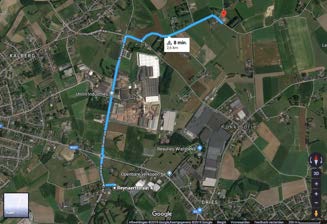
The two families knew each other for several reasons. First, their farms were within walking distance from each other, as shown in Figure 44.110. Second, they were both farmers. Third, both families enjoyed reading and culture, which was personified by Hugo Verriest, from Deerlijk, a priest in the area where the two families lived. Maurice, the author’s father, probably even received his first name, inspired by Maurits Demedts, father of André, shown in Figures 44.111 and 44.113. The author’s eldest uncle was named André. Indeed, Michel Declercq (DC15) was a good friend of André Demedts, hence the inspiration.
André Demedts had a much younger brother, ’Michel,’ born in 1922 when the author’s grandfather Michel (DC15) and André were 16. Michel Declercq’s sister, Rachelle, born in 1912, carried Gabrielle as the second name. André Demedts had a sister, Gabrielle Figure
44.110:
Current Google
Maps®
view of the area Wielsbeke-
Sint-Baafs-Vijve
with
the
shortest
new route (2.6 km) from the farm of
Declercq-Devenyn to the farm Demedts-
Vandenhende. They probably walked along
the old east path or used a bicycle back
then. Farmers also had horses.
© 2024 Nico F. Declercq
The Desclergues of la Villa Ducal de Montblanc, 2nd ed., Omn., VOL. III
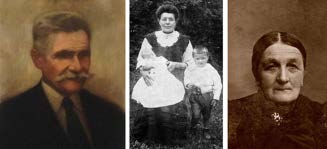
44.9. FRIENDSHIP WITH THE FAMILY OF ANDRÉ AND GABRIELLE DEMEDTS
791
Figure 44.111:
Left, we see Maurits
Demedts, father of André and Gabrielle
Demedts, painted by Georges Dheedene
(1909-1973). This portrait is probably the
only one that survives. The shown low-
resolution image serves as a reference to
compare a picture with, shown in Chap-
ter 44.8.5, of 1933 at a banquet in Deer-
lijk (© André Demedtshuis vzw. Im-
age reproduced with permission. Cour-
tesy of Bert De Smet, André Demedt-
shuis vzw.). In the middle, we see Andre
Demedts with his younger sister Gabrielle
Demedts and his mother Celesta Vanden-
hende (© André Demedtshuis vzw. Image
reproduced with permission. Courtesy of
Bert De Smet, André Demedtshuis vzw.).
Right, we see Maria Philomena Rosalia
Thérèse Baert, mother of Celesta Vanden-
hende and grandmother of André Demedts.
Figure 44.112: A low-resolution scan of
the obituary card of André Demedts. The
original card is not in our archives.
Figure 44.113:
The death announce-
ment, April 28, 1943, of Maurits Fer-
dinand Demedts, husband of Celesta
Vandenhende and father of André and
Gabrielle Demedts.
(Declercq de Silva
Archive)
The Desclergues of la Villa Ducal de Montblanc, 2nd ed., Omn., VOL. III
© 2024 Nico F. Declercq
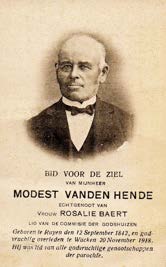
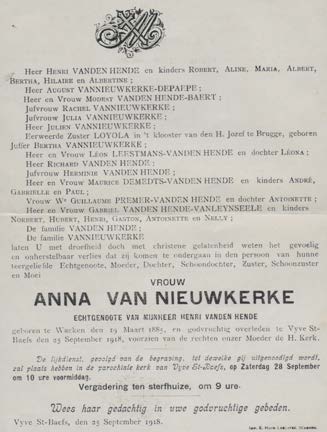
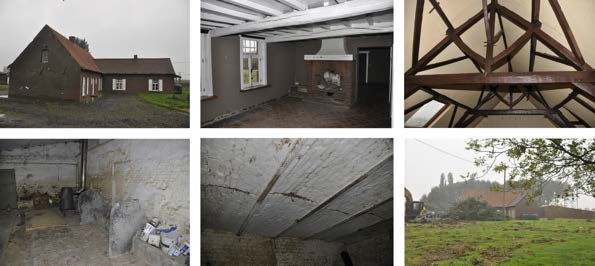
792
CHAPTER 44. ERNEST CONSTANT DECLERCQ (DC14) & MARIE ELODIE DEVENYN
Figure 44.114: The obituary card of Modest Vandenhende, November
20, 1918, husband of Rosalie Baert en grandfather of André Demedts.
(Declercq de Silva Archive)
Figure 44.115: The death announcement
of Anna Van Nieuwkerke, September 25,
1918, wife of Henri Vandenhende and aun-
tie of André Demedts. The first names
Rachel, Maurice, André, Maria, Gabrielle,
were also used by the contemporary Decler-
cqs. (Declercq de Silva Archive)
Figure 44.116: Pictures of the house where André Demedts grew up, i.e. ’de Elsbos’ . It had a similar style and size as that of the Declercqs in Wielsbeke. The Declercqs visited it often as children and vice versa. (© André Demedtshuis vzw. Images reproduced with permission. Courtesy of Bert De Smet, André Demedtshuis vzw.)
© 2024 Nico F. Declercq
The Desclergues of la Villa Ducal de Montblanc, 2nd ed., Omn., VOL. III
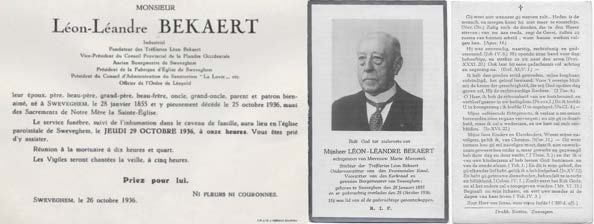
44.10. THE BEKAERT FAMILY
793
Figure 44.117: The death announcement and the obituary card of Leon Leander Bekaert, October 25, 1936. (Declercq de Silva Archive)
Maria Celesta, who died early. In 1909, his new sister was born, who received the same name as Gabrielle Maria Celesta Demedts, shown in Figure 44.111.
The grandfather of André Demedts, through his mother, was Modest Vandenhende, in Figure 44.114, husband of Rosalie Baert, in Figure 44.111. Modest was also the name of the brother of Ernest Constant Declercq.
When Ernest Constant Declercq died in 1947, Gabriëlle Demedts wrote a poem about her feelings. From the text Ik heb gedaan...(shown below25), we can extract that she admired him because of what he had meant to her as a child. She was sad that he could no longer speak the wise words he used to say. Even though his aged teeth stopped him from laughing at the end of his life, his firm handshake still exposed his inner strength. Realizing that he was dead, Gabriëlle broke into tears.
Ik heb gedaan...
Ik heb gedaan of al was als voorheen
maar binnenin was de bevreemding groot.
Hoe kon het zijn dat jij nu minder scheen
of was in werklijkheid de grootheid dood
die in mijn ziel met jou was opgegroeid?
En waarom vlekte donker nu de mond
- de tover van je glimlach uitgebloeid -
omdat de tijd je gave tanden schond?
Ik schaam mij diep. Ging ooit die sterke macht
met deze broze dingen saâm? Ach neen
en duizendmaal neen! Zwart als de nacht
had jij mogen zijn, doof en kaal meteen
als maar dezelfde uit je handdruk sprak...
Wie was dezelfde? Bestond die niet meer?
Ik zocht nog te schuilen onder het dak
van zacht herinn’ ren, maar ’t stortt’ op me neer
The reader will find the obituary card of André Demedts in Figure 44.112 and Anna Van Nieuwkerke in Figure 44.115. To get an impression of how a farm, such as the ’Hof van Brussel’ farm of the Declercqs looked like, we show pictures of that of Demedts in Figure 44.116, which were kindly shared by Bert De Smet26.
44.10 The Bekaert Family
The reader may find Chapter 44.8.20 exciting in this context, and also Chapter 42 and Chapter 43.
Here, we share souvenirs in Figure 44.117 of the Bekaert family that are not shown in Chapter 45.1.6.
Michel and Judith’s acquaintances in Zwevegem and those of Ernest Constant were equal so that one may check there. Judith visited the family often as President of the Children’s Welfare Organization, as described in Chapter 44.5.8.2.
Indeed, just after WWII, this organization played an important role because of the baby boom. Leon Bekaert is also described in Chapter 44.8.20 and shown in Figure 44.107 on page 782.
44.11 The Influence of Hugo Verriest
The Verriest family of Deerlijk, described in Chapter 42.8, were acquaintances of the Declercqs in Wielsbeke. They knew each other through the flax industry and probably even from earlier times.
Hugo Nestor Verriest (Deerlijk 1840 - Ingooigem 1922), shown in Figures 44.118, 44.119, 44.120, was a Flemish Priest, writer and philosopher.
He was a son of Petrus Johannes Verriest (Sint Lodewijk or Saint Louis, in Deerlijk).
25Poem about the death of Ernest Constant Declercq, by Gabriëlle Demedts, ’Ik heb gedaan...’ , Dietsche Warande en Belfort, Jaargang 93, 1948, page 538.
26Bert De Smet is a driving force behind ’André Demedtshuis vzw’ , and is engaged in education, the preservation of the local history of Sint Baafs Vijve and the legacy of the celebrated writer André Demedts and poet Gabriëlle Demedts.
The Desclergues of la Villa Ducal de Montblanc, 2nd ed., Omn., VOL. III
© 2024 Nico F. Declercq
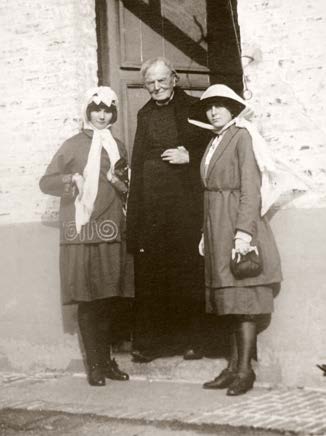
794
CHAPTER 44. ERNEST CONSTANT DECLERCQ (DC14) & MARIE ELODIE DEVENYN
Figure 44.118:
Hugo Verriest at his
home in Deerlijk on August 14, 1821. (De-
clercq de Silva Archive)
Verriest received his early education from Pieter Jan Renier, described in Chapter 42.7, and later studied under the renowned poet Guido Gezelle at the Kleinseminarie in Roeselare. In 1864, he was ordained as a priest.
His career was unrolled in the following locations: Deerlijk, Roeselare, Brugge, Heule, Ypres, Wakken (near Wielsbeke), and Ingooigem. Albrecht Rodenbach (Roeselare), Constant Lievens (Moorslede, described in Chapter 64.7.12.12) and Edward Vermeulen (Beselare, described in Chapter 44.8.2 and Chapter 64.6.4.1) have been his students.
His teaching career included positions at educational institutions such as Sint-Lodewijkscollege in Bruges and Kleinseminarie in Roeselare, where he mentored prominent students like Albrecht Rodenbach and Constant Lievens. He also held positions as a rector, principal, and pastor at various locations.
Verriest was a key influencer in the Blauwvoeterij movement and significantly influenced the literary and cultural landscape. His staunch advocacy for the Dutch language in education and his editorial role in publications such as De Vlaamsche Vlagge and De Nieuwe Tijd highlight his influence on language, religion, and social issues.
In recognition of his contributions, Verriest became a member of the Royal Flemish Academy for Language and Literature in 1906.
Additionally, he received an honorary doctorate from the Catholic University of Leuven.
Despite facing challenges from his Catholic superiors for his involvement in the Flemish Movement, Verriest’s impact transcended political and religious boundaries. His literary works, including biographies and treatises on art and culture, as well as his romantic-impressionist poems, were widely acclaimed.
Hugo Verriest passed away in 1922 in Ingooigem and was laid to rest at St. Anthony’s Church next to his friend Stijn Streuvels.
In Wielsbeke (the place of birth of Michel A. R. Declercq) as well as Beselare (the place where Irma H. Lesage lived before she married) and Moorslede (the place of birth of Irma H. Lesage), Hugo Verriest had left a cultural legacy and was extremely popular.
It may have played a role in the decision of Michel A. R. Declercq and Irma H. Lesage to settle and construct a home after WWII in Sint Lodewijk Deerlijk, where we find the roots of Hugo Verriest.
While Hugo Verriest was a priest at Wakken, the Declercqs knew him very well. This was likely through the Demedts family, who had long had connections with Wakken (church and education). The Declercq family were not Flemish nationalists, but they enjoyed the Flemish culture and, in fact, culture in general.
The work of Hugo Verriest and those he had inspired was very well known to them. Persons like Constant Lievens joined the Jesuits, inspired by Hugo Verriest; Ernest Constant Declercq equally sent his sons to a Jesuit College for their Higher Education in Ghent.
The contact with Hugo Verriest must also have fed the admiration for Guido Gezelle (Brugge 1830 - 1899), uncle of Stijn Streuvels (Frank Lateur, described in Chapter 44.5.7.2, Chapter 44.8.13, Chapter 48.9.5.4.5, Chapter 48.12.1.4, and Chapter 48.12.2.3). Guido Gezelle, in Figures 44.124 and 44.126, had been a priest in several places such as Roeselare (1854-1860), Bruges (1860-1872) and Kortrijk (1872-1899).
Souvenirs of the Verriest family are shown in Figures 44.121, 44.122, 44.123, 44.124, 44.125 and 44.126.
44.12 The family of Van der Bruggen & de Nieulant et de Pottelsberghe
The Declercqs have been in contact with this family since the generation of Ivo Declercq, in Chapter 43.6 and Chapter 43.9. Some memorabilia are shown in Figures 44.127, 44.128 and 44.129.
44.13 The De Clerck & Lauwers Family
After WWII, this family of catholic farmers at Wielsbeke would establish and be associated with Beaulieu International Group through Roger De Clerck and Noël Demeulenaere. They have also served in the local catholic political party. Although both families
© 2024 Nico F. Declercq
The Desclergues of la Villa Ducal de Montblanc, 2nd ed., Omn., VOL. III
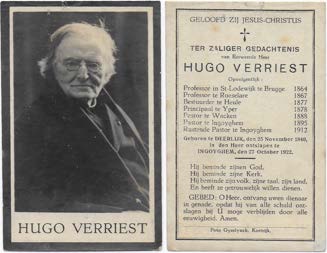
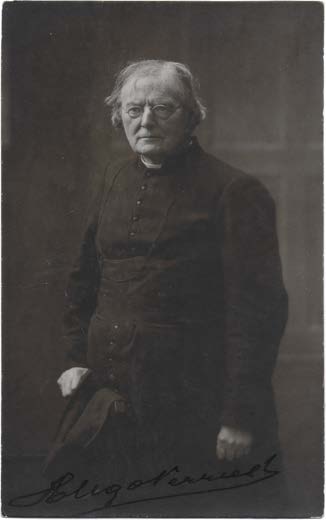
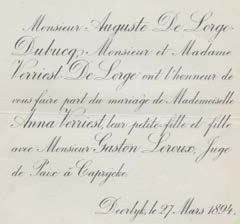
44.13. THE DE CLERCK & LAUWERS FAMILY
795
Figure 44.119: Obituary card of Hugo
Verriest, October 27, 1922. (Declercq de
Silva Archive)
Figure 44.120:
Autographed picture of
Hugo Verriest. (Declercq de Silva Archive)
Figure 44.121: Marriage announcement of Anna Ver-
riest and Gaston Leroux, March 27, 1894. Anna’s uncle
was Hugo Verriest. (Declercq de Silva Archive)
The Desclergues of la Villa Ducal de Montblanc, 2nd ed., Omn., VOL. III
© 2024 Nico F. Declercq
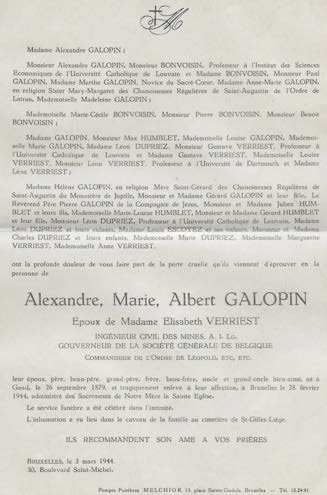
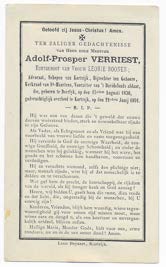
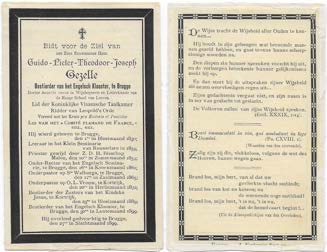
796
CHAPTER 44. ERNEST CONSTANT DECLERCQ (DC14) & MARIE ELODIE DEVENYN
Figure 44.122: The death announcement
of Alexandre Marie Albert Galopin, hus-
band of Elisabeth Verriest, September 26,
1879. Elisabeth was the daughter of Gus-
tave Conrad Verriest, brother of Hugo.
(Declercq de Silva Archive)
Figure 44.123: Obituary card of Adolf Prosper Verriest, June 21,
1891. He was the brother of Hugo Verriest. (Declercq de Silva Archive)
Figure 44.124: Obituary card of Guido
Pieter Theodoor Joseph Gezelle, November
27, 1899. (Declercq de Silva Archive)
© 2024 Nico F. Declercq
The Desclergues of la Villa Ducal de Montblanc, 2nd ed., Omn., VOL. III
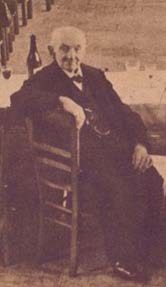
44.14. THE LAMBRECHT FAMILY
797
Figure 44.125: Theophile Renier of Deerlijk, on the festivities for
Verriest (’Verriestfeesten’) in 1927.
are not blood-related, they were acquainted during the life of Ernest Constant and likely even earlier.
We are not aware of any contacts after WWII. The families were both flax cultivators and flax merchants. Around 1960, this family switched to industrialized manufacturing of carpets, a fact for which they are still very famous.
The author appreciates Noël Demeulenaere (1938) for some wise advice he offered him a decade ago. He also remembers that Noël, an amiable man, offered the author a cup of coffee and a biscuit at his home and consequently made fun of professors by stating, in German, Professoren haben viele Titel, aber keine Mittel.
Indeed, the world of multi-national industrialists is somewhat different from that of academics, but in the end, we take nothing with us but lasting memories, and why not ’titles’?
The author is relished that he joined the inauguration, by Noël Demeulenaere, of a statue de Vlasser in Wielsbeke to honor the flax farmers, merchants, and workers in the area in 1988. The statue is shown in Figure 45.22 on page 811.
44.14 The family Lambrecht Family
Ernest Constant Declercq (DC14) and later his son Michel Declercq (DC15) often bought flax with Jozef Lambrecht from Wielsbeke
- Sint-Baafs-Vijve.
Jozef was a son of Henri Lambrecht (from Wielsbeke) and Marie Lauwers (from Aarsele, in Figure 44.132).
44.15 The Van den Broucke Family
The mother of Ernest Constant was Mathilde Van den Broucke. The two families had close contacts, private and business, particularly with Jules Van de Broucke and later, until Michel Declercq died, with his son Jozef, who was married to Claire Lambrecht.
In particular, Jozef van den Broucke was known worldwide for his first-class race pigeons. Until the 1960s, most people owned race pigeons, and so did Michel Declercq (DC15) (the author’s grandfather), Gerard Vangheluwe (the author’s great-grandfather), and the author himself. Between 14 and 18, the author raced Barcelona, Brive, Limoges, Pau, Narbonne and Marseille. He first raced under his foster father’s name, Pierre Vangheluwe, and later under his own.
Training a team of pigeons became a hobby when summer vacations were temporarily suspended due to his foster father’s illness, Pierre Vangheluwe. In this context, the author became acquainted with Jozef Van den Broucke and others such as Roger Vereecke, Dirk De Ceukelier (husband of Hilde Deprez), Uwe Hermes, and Simon Callens from Deerlijk. Jozef Van de Broucke and Roger Vereecke are still celebrated as the crème de la crème in Japan and China.
In particular, the experiences obtained thanks to Simon Callens from Deerlijk, who died in 2024, are always hugely appreciated.
Although the author has been out of the pigeon business, he still has the skills to start again if needed. A busy international life, however, makes such a dream unrealizable. Being the coach of a team of pigeons is similar to being an educator. One must judge pretty, try to get the best out of every team member and stimulate growth.
Some souvenirs are shown in Figures 44.133 and 44.134.
The Desclergues of la Villa Ducal de Montblanc, 2nd ed., Omn., VOL. III
© 2024 Nico F. Declercq
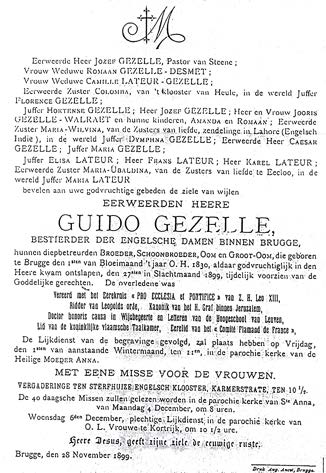
798
CHAPTER 44. ERNEST CONSTANT DECLERCQ (DC14) & MARIE ELODIE DEVENYN
Figure 44.126:
A copy of the death
announcement of Guido Gezelle.
Our
archives do not contain the original. (De-
clercq de Silva Archive)
Figure 44.127: The death announcement of Clotilde Marie Joseph Ghislaine De Nieulant et de Pottelsberghe, Wielsbeke, June 17, 1924. The death announcement of Maurice Louis Marie Van der Bruggen, September 30, 1919 (French and Flemish versions). (Declercq de Silva Archive)
Figure 44.128: Wielsbeke 1919, the death certificate of Maurice Louis Marie
Van der Bruggen. (Declercq de Silva Archive)
© 2024 Nico F. Declercq
The Desclergues of la Villa Ducal de Montblanc, 2nd ed., Omn., VOL. III
44.15. THE VAN DEN BROUCKE FAMILY
799
Figure 44.129:
A name card of Maurice Marie Louis Van der
Bruggen, which likely accompanied a letter sent to Ernest Constant
Declercq. (Declercq de Silva Archive)
Figure 44.130: The death announcement
of Maria Louise De Clerck, daughter of
Jan De Clerck and Julie Lauwers, in 1945.
(Declercq de Silva Archive)
Figure 44.131: The obituary card of Julie Lauwers, wife of Jean
Nico De Clerck, September 2nd of 1916. Julie was the mother of Jozef
De Clerck and grandmother of Roger De Clerck. (Declercq de Silva
Archive)
The Desclergues of la Villa Ducal de Montblanc, 2nd ed., Omn., VOL. III
© 2024 Nico F. Declercq
800
CHAPTER 44. ERNEST CONSTANT DECLERCQ (DC14) & MARIE ELODIE DEVENYN
Figure 44.132:
The obituary card of
Marie Lauwers, wife of Henri Lambrecht,
May 21, 1910. (Declercq de Silva Archive)
Figure 44.133: The death announcement of Jules Van den Broucke, husband of
Aurée Glorieux and father of Jozef Van den Broucke, December 21, 1954. (Declercq
de Silva Archive)
Figure 44.134: The death announcement
of Claire Lambrecht, wife of Jozef Van den
Broucke. (Declercq de Silva Archive)
© 2024 Nico F. Declercq
The Desclergues of la Villa Ducal de Montblanc, 2nd ed., Omn., VOL. III
44.16. OTHER ACQUAINTANCES IN WIELSBEKE AND MEULEBEKE
801
44.16 Other acquaintances in Wielsbeke and Meulebeke
The Declercqs, who hailed from Wielsbeke, were familiar with virtually every resident of the village prior to World War II. The population experienced a substantial surge due to a large influx of immigrants, as well as a post-war baby boom. Figure 44.135
showcases several notable mementos.
The Desclergues of la Villa Ducal de Montblanc, 2nd ed., Omn., VOL. III
© 2024 Nico F. Declercq
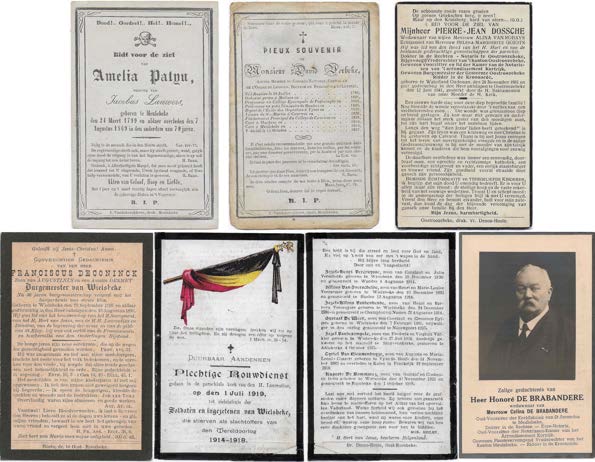
802
CHAPTER 44. ERNEST CONSTANT DECLERCQ (DC14) & MARIE ELODIE DEVENYN
Figure 44.135: Obituary cards of the following persons are shown. Amelie Patyn, wife of Jacques Lauwers, August 7, 1869.
She was born in Meulebeke. David Verbeke, October 13, 1867. Pierre-Jean Dossche, husband of Alina Van Robays, June 12, 1941. This notary legalized documents of the Declercqs at Oostrozebeke. François Deconinck, August 19, 1896. He has been the mayor of Wielsbeke. Honoré De Brabandere, from Meulebeke. There is also an obituary card to pray for the victims of Wielsbeke during WWI. (Declercq de Silva Archive)
© 2024 Nico F. Declercq
The Desclergues of la Villa Ducal de Montblanc, 2nd ed., Omn., VOL. III
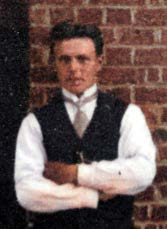
Chapter 45
Michel Achiel Renatus Declercq (DC15) & Irma
Helena Lesage
45.1 Michel Achiel Renatus Declercq (DC15)
45.1.1 Introduction, his Birth and Death
The author’s grandparents are Michel Achiel Renatus Declercq (DC15) and Irma Helena Lesage (DP12V03DW02L02).
Michel (DC15), shown in Figure 45.1 and 45.4, was born in 1906 in Wielsbeke, Belgium. His ancestors are shown in Figure 45.2. He was the son of Ernest Constant Declercq (DC14) and Marie Elodie Devenyn, and Irma Helena Lesage’s husband (DP12V03DW02L02). He married Irma Lesage in 1932 and died in 1963 in Deerlijk, Belgium.
In this chapter, Michel Achiel Renatus Declercq (DC15) is primarily described as a descendant of the Desclergues and grandfather of the author. He is equally referred to in the following chapters: Chapter 64, as the husband of Irma Helena Lesage; Chapter 65,
as the husband of Irma Helena Lesage, who was a great-great-great-great-great-grandson of Adrienne de Patin (DP12); Chapter
66.1, as great-great-great-grandson of Barbara Benoit; Chapter 66.2, as the husband of Irma Lesage, who was a great-great-great-great-granddaughter of Maria Jeanne Christine Benoit; Chapter 68, as a descendant of the ’t Kint family line; and Chapter 71 as grandson-in-law of Clemens Lammens.
He was a farmer and a flax merchant. In the last years, he held a trading post as purchasing manager in a multinational steel company (Bekaert NV) in Zwevegem, Belgium, co-owned by the Bekaert family described in Chapter 44.8.21, Chapter 44.10, Chapter
Until his wife died in 1953, he took courses oriented toward this position while temporarily working in the company’s production facility. The production of metal fibers must have appealed to him because of his experience with flax and linen branches. The fact that flax fibers are increasingly used in durable composites in our modern world would have fascinated him. He was receiving a position at Bekaert NV that resulted from his skills, connections, and qualities.
He was a distinguished gentleman with excellent technical knowledge of agriculture, specifically flax and the flax industry. Moreover, he had an eye for beauty and believed that a specialized product should be durable and beautiful.
Furthermore, like Baron Bekaert, he was very catholic, and, as explained in the previous chapter, his parents were acquainted with the Bekaert family. Michel and Irma were both Flemish, but they also spoke French fluently.
Michel had planned to buy a large farm and establish a new life with Irma at Cordes (Frasnes-lez-Avaing). The language would not have formed any problem, but Irma, raised in the devastated ’Westhoek’ after WWI, refused to move to such a rural area. Hence, they made other plans.
Interestingly, Irma’s sister’s son would later move to Moustier at Frasnes-lez-Avaing with the same purpose, described in Chapter
64.7.7, just like Michel’s sister would later move to Malève near Jodoigne, described in Chapter 44.5.2.
According to Agnes (1933-2018), the eldest daughter of Michel Declercq, her father had the most beautiful musical tenor voice she had ever heard. Perhaps she exaggerated slightly, but it indicates that he must have had a beautiful sound.
Even when his early career had passed, Michel, a proud gentleman, continued to describe himself as a farmer and flax merchant.
His siblings have all been described in Chapter 44. He was the brother of Joseph Antonius Gerardus Declercq (1902-1980), Maria Antoinette Gerarda Declercq (1904-1989), Valentine Alida Declercq (1910-1939), Rachelle Gabrielle Declercq (1912-2007), Esther Ernestina Godeliva Declercq (1915-2011), and Judith Flavia Maria Declercq (1918-2007). Joseph was a farmer. Maria was a midwife. Valentine died soon after marrying. Rachelle was a teacher. Esther (Sister Ernestine) was a French and music teacher and has been a school principal and religious nun. Judith has been a nurse teacher and president of the Children’s Welfare Organisation.
Michel Declercq was very ambitious and honorable and expected the same passion for his children and family. There are several anecdotes about him. For instance, when his brother-in-law Robert Courtens decided to become a middle school teacher at a technical school, Michel found this to be inferior. He told him he should aim higher or become a farmer and improve his future.
Figure 45.1: Around 1924, Michel Declercq at his home in Wielsbeke.
The entire picture is shown in Figure 44.31. MyHeritage® colorized
this photo. (Declercq de Silva Archive)
The Desclergues of la Villa Ducal de Montblanc, 2nd ed., Omn., VOL. III
© 2024 Nico F. Declercq
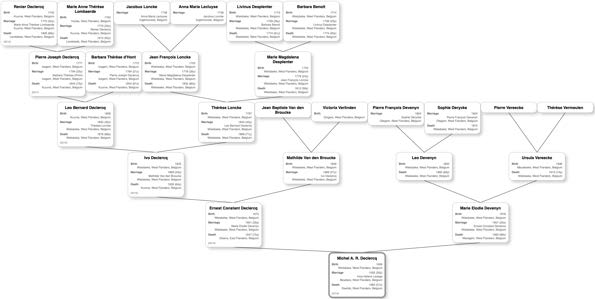
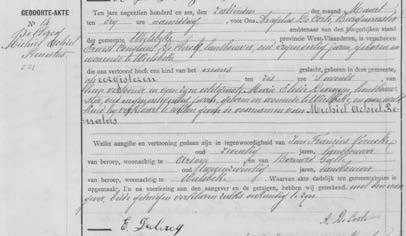
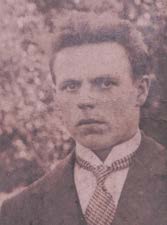
804
CHAPTER 45. MICHEL ACHIEL RENATUS DECLERCQ (DC15) & IRMA HELENA LESAGE
Figure 45.2: Five ascending generations of Michel Achiel Renatus Declercq (DC15)
Figure 45.3: The birth certificate of Michel Achiel Renatus Declercq, Wielsbeke, 1906,
born on March 14. Birth registration witnesses: Jean François Vereecke, farmer, 70
years old, inhabitant of Ardooie; Bernard Galle, 72 years old, farmer, inhabitant of
Wielsbeke.
Figure 45.4:
Around 1924, Michel Declercq. (Declercq de Silva
Archive)
© 2024 Nico F. Declercq
The Desclergues of la Villa Ducal de Montblanc, 2nd ed., Omn., VOL. III
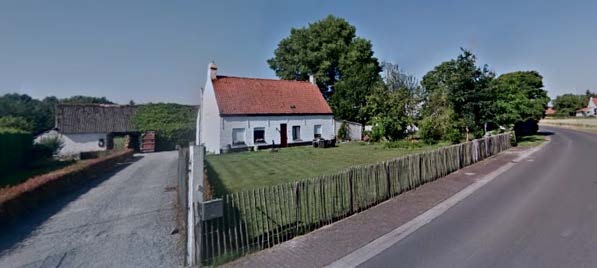
45.1. MICHEL ACHIEL RENATUS DECLERCQ (DC15)
805
Figure 45.5: The remains of the farm Hof van Brussel where Michel Declercq has grown up. In the back, the flax shed is still visible. (Courtesy of Google®)
Also, he kept standing tall as a farmer and flax merchant during a difficult time, which was his identity. It required a lot of courage for him to switch professions after WWII. It is generally known that flax farmers and flax merchants were rather vain. They formed a community within the community.
Michel had nine children and was disappointed in the ones who did not meet his high expectations.
Consequently, they were also the ones who did not understand their father and his attitude towards them.
The author has spoken to many people who have known him. Inhabitants of Saint Louis in Deerlijk remember him as a skilled gentleman with vast expertise in farming and crops, an excellent nose for flax, and a man with technical skills and a sense for esthetics and culture.
As a young married man, he considered having many children a Christian duty. The author appreciates this attitude because otherwise, his father, one of the youngest children, would not have been born. Still, having so many children has had implications as well.
Michel was the second son of Ernest Constant Declercq and Marie Elodie Devenyn. His parents were very progressive because, contrary to the mainstream, they wanted each child to have a proper education. Indeed, their children were brilliant students. The eldest son was destined to become a farmer and stay at the farm in Wielsbeke (Hof van Brussel), while the second son, Michel, leaned towards establishing his career. Being from Wielsbeke, along the Golden River (Lys or Leie), becoming a flax merchant was a natural choice. As a merchant and a handsome, fine young man, he was popular with the girls and had a potentially bright future.
In Chapter 44 and Chapter 64, we have explained how the Declercq and Lesage families have known one another since WWI. When Michel visited the area of Beselare to buy flax, he never hesitated to visit the Lesages, even when there was no flax to purchase.
Indeed, farmland could only be used once a decade to cultivate flax. During one of his trade missions to villages in Beselare, he must have had an adorable encounter with Irma Lesage. When Irma met Michel, a charming and handsome flax merchant from a catholic family in Wielsbeke, she fell in love with him. She said that she wanted to marry this lovely gentry chap from Wielsbeke, and she did.
Trade journeys such as the one that got Michel and Irma to fall in love were mandatory. The area of interest was not limited to Flanders and covered the North of France (mostly Picardie) and even the Netherlands (Flevoland, Groningen, IJselmonde, Dordrecht, and Zeeland). Michel visited farms to purchase flax that he sold immediately or stored in Wielsbeke and later merchandised in Kortrijk.
The family Lesage-Lammens was a wealthy and very decent family of farmers. They had many children, and 3 of their sons had been soldiers during WWI. The cutest daughter was the youngest, Irma. Michel must have liked her since he agreed to the engagement, which would last a couple of years before the marriage.
As described in Chapter 44.5.5 and Chapter 64.7.12.5, Michel’s sister Valentine and Irma’s youngest brother Daniel would also have a relationship.
Irma was born in Moorslede, went to a French school there, and moved to Ledegem. When WWI started, she escaped with her mother to Oudezeele, France, while her father stayed at the farm in Ledegem with one of Irma’s brothers, Paul, described in Chapter
64.7.8. After the war, Irma lived in the devastated areas of Beselare and Zonnebeke.
Life was difficult during the post-war reconstruction. Irma was determined never to marry a man from her village. Michel and Irma married at Beselare in 1932 but have had an affair since 1928. After the wedding, they lived in Wielsbeke in the household of the Declercq-Devenyn family, at the farm ’Hof van Brussel,’ shown in Figure 45.5.
As mentioned, Michel hoped to buy a large farm at Cordes (Frasnes-Les-Avaing). Still, Irma Lesage, who had grown up in Westhoek’s desolate country, destroyed during WWI, was not keen on moving to the middle of nowhere. Nevertheless, the language would not have formed any barrier because Irma thought in French and could speak and write the language very well. She had had her education in a French school at Moorslede and later at Oudezeele in France.
The young couple searched, instead, for a suitable farm in the area of the Leie River. However, a financial crisis suddenly diminished their savings due to the devaluation of the Belgian Franc. They had no choice but to invest their money in flax and hope to gain more money to later fulfill their dreams, a gamble that they lost. Michel’s siblings would also partially consume their savings for education.
Paying back the investment would occur only after WWII. When prosperity returned, Michel and Irma built a beautiful house at Deerlijk (Oude Heerweg in Saint Louis).
During WWII, the family suffered the most because they had many young children. Flax trade was hardly possible, and Michel, a stubborn man, refused to work in an economy dominated by the German occupier.
Michel Declercq (DC15) died in 1963, as shown in Figures 45.6 and 45.7. His death was caused by heart disease as a result of the The Desclergues of la Villa Ducal de Montblanc, 2nd ed., Omn., VOL. III
© 2024 Nico F. Declercq
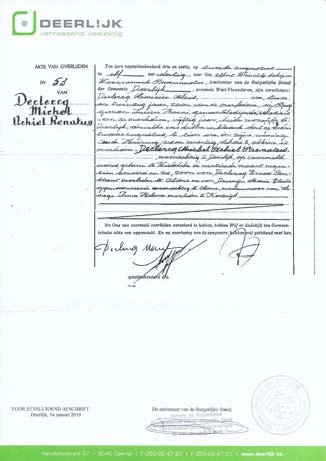
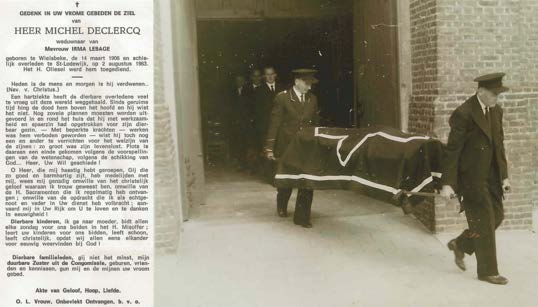
806
CHAPTER 45. MICHEL ACHIEL RENATUS DECLERCQ (DC15) & IRMA HELENA LESAGE
Figure 45.6: Transcript of the death cer-
tificate of Michel Achiel Renatus Declercq
(DC15) at Deerlijk, on August 2, 1963. It
was indeed Maurice A. Declercq (DC16)
who took care of the administrative legacy
of the family, as can be read in the certifi-
cate. Maurice Declercq also ensured that
the grave of the parents Declercq-Lesage
would not be emptied and destroyed after
50 years. When the tomb was damaged
by wear and time, the author consequently
moved them to a new family grave a few
meters further so that they could last for
several more decades. After all, they are
the oldest existing remains of the Descler-
gue bloodline and de Patin side branch and
deserve care and protection.
Figure 45.7: Left is the obituary card of Michel Declercq, August 2, 1963. His mentioned heart disease was likely Lyme carditis due to Lyme borreliosis, an infectious disease caused by the Borrelia bacterium spread by ticks. He turned from an energetic man into an aged person gasping for oxygen in as little as two years or so. The sentence
’leert uw kinderen voor ons bidden’ came, with this book, to fruition. Right is the funeral of Michel Declercq at Sint Lodewijk (Saint Louis), Deerlijk, August 1963. (Declercq de Silva Archive)
© 2024 Nico F. Declercq
The Desclergues of la Villa Ducal de Montblanc, 2nd ed., Omn., VOL. III
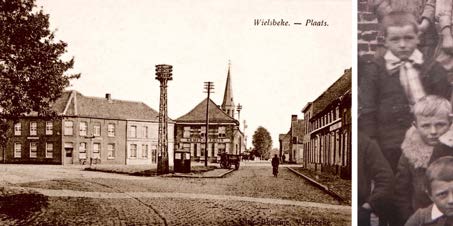
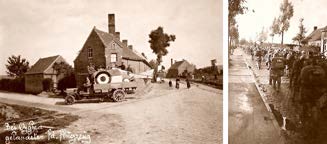
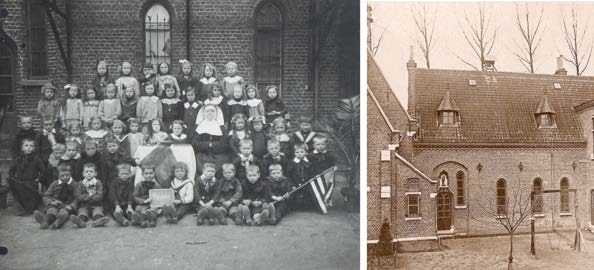
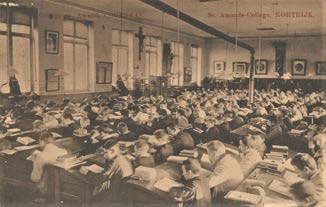
45.1. MICHEL ACHIEL RENATUS DECLERCQ (DC15)
807
Figure 45.8: Left is the market square of Wielsbeke, at the old Church, around the time when
Michel Declercq was a child. Right is a close-up of Michel on a School picture taken in Wielsbeke
in 1916. (Declercq de Silva Archive)
Figure 45.9:
An airplane had landed
at Ooigem near Wielsbeke during WWI.
Right is Wielsbeke, November 1917, the
march of German soldiers to Waregem.
Figure 45.10: A school picture taken in 1916 at Wielsbeke to thank the (then still neutral) Americans for providing help to the village. Michel Declercq is the Spanish-looking boy in the third row, the second child from left, wearing a black jacket and a large ’pajarita’ (Declercq de Silva Archive). Right is a postcard that shows the exact location where the school picture had been taken.
Figure 45.11: Sint Amandscollege Kor-
trijk, study room (studiezaal).
The Desclergues of la Villa Ducal de Montblanc, 2nd ed., Omn., VOL. III
© 2024 Nico F. Declercq
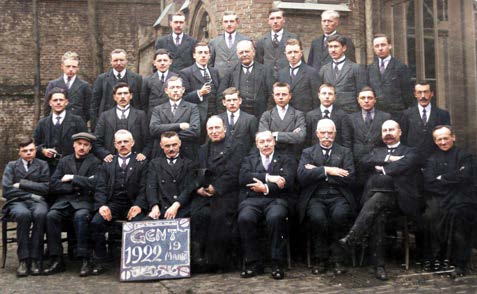
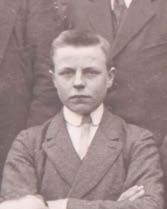
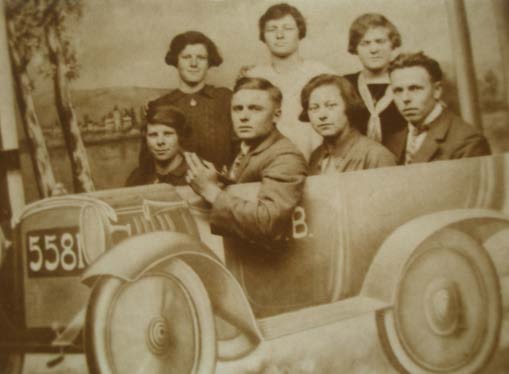
808
CHAPTER 45. MICHEL ACHIEL RENATUS DECLERCQ (DC15) & IRMA HELENA LESAGE
Figure 45.12: 1922, March 19, Michel Declercq at the ’Sint Barbara college’ in Ghent. MyHer-
itage® colorized this photo. (Declercq de Silva Archive)
Figure 45.13: Close-up of Michel Declercq in 1922, in Ghent. (De-
clercq de Silva Archive)
Figure 45.14: Kortrijk ’paasfoor’ , around 1927. Clockwise beginning with the driver : André Demedts
(1906), Esther Declercq (1915), Gabrielle Demedts (1909), Maria Declercq (1904), Rachelle Declercq (1912), Michel Declercq (1906) and Valentine Declercq (1910). (Declercq de Silva Archive)
© 2024 Nico F. Declercq
The Desclergues of la Villa Ducal de Montblanc, 2nd ed., Omn., VOL. III
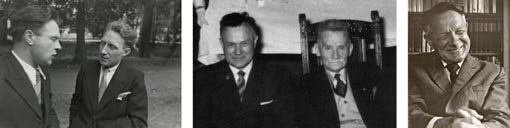
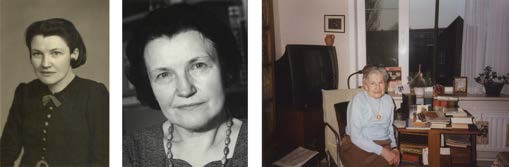
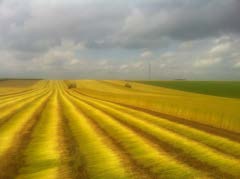
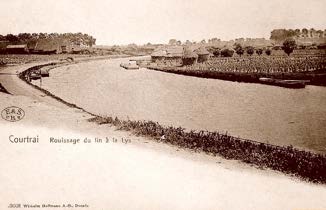
45.1. MICHEL ACHIEL RENATUS DECLERCQ (DC15)
809
Figure 45.15: From left to right: André Demedts (left) with Pieter Buckinx (right), August 2, 1937
at Bachte-Maria-Leerne at the event ’Vlaamse Poëziedagen’ (Letterenhuis, photo by AFO Antwerp, with
permission); André Demedts together with Stijn Streuvels: two giant historical figures of Flemish literature.
The picture was taken at Kortrijk in 1959 when Streuvels received honorary citizenship of the town (© André Demedtshuis vzw. image reproduced with permission. Courtesy Bert De Smet, André Demedtshuis vzw.);
André Demedts, around 1974. He was a friend of Michel Declercq. (© André Demedtshuis vzw. Image
reproduced with permission. Courtesy Bert De Smet, André Demedtshuis vzw.) (photo by Paul van den
Abeele).
Figure 45.16: From left to right: Gabriëlle Demedts (around 1945) (Courtesy of Letterenhuis); Gabriëlle Demedts, May 15, 1966 (Foto Jean Mil, courtesy of Letterenhuis); Gabriëlle Demedts, Kortrijk, January
10, 1999 (Courtesy of Letterenhuis, photo by Paula D’ Haen).
Figure 45.17: Modern flax harvesting, ’vlas slijten’ .
(Courtesy of Flaxbox, Zulte)
Figure 45.18: The Leie River with flax
chapels on a neighboring field.
The Desclergues of la Villa Ducal de Montblanc, 2nd ed., Omn., VOL. III
© 2024 Nico F. Declercq
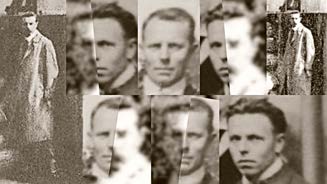
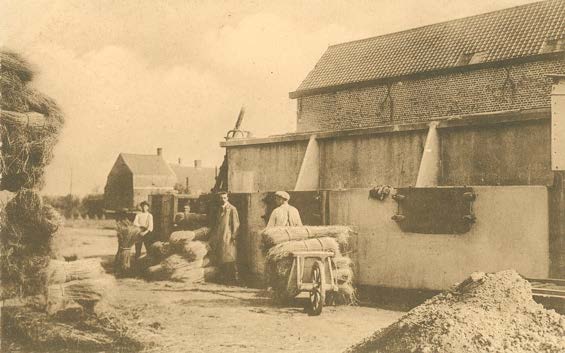
810
CHAPTER 45. MICHEL ACHIEL RENATUS DECLERCQ (DC15) & IRMA HELENA LESAGE
Figure 45.19: Comparison of Michel De-
clercq (top-center in 1946 and bottom-right
in the 1920s) with two low-resolution post-
cards as shown in Figure 45.20. While we
lack a pre-WWII photo of Michel with a
mustache, he did sport one later in life.
Unfortunately, a high-resolution version of
the postcard in Figure 45.20 is unavailable.
However, the figure on the postcards bears
a closer resemblance to Michel Declercq
than, for instance, the Vansteenkiste broth-
ers, known for their mustaches. While not
definitively proven, it is likely that the indi-
vidual on the postcards is Michel Declercq.
(Declercq de Silva Archive)
Figure 45.20:
This is likely Michel Declercq (wearing a long overcoat which was fashionable around 1930). He
overviewed workers who started processing a load of purchased Flax to be retted in a concrete ret-bath. A biometric comparison is shown in Figure 45.19.
Figure 45.21:
The facsimile in Fig-
ure 45.20 was used for a multi-language
postcarda. The Dutch spelling of ’rooten’
suggests a publication before 1946 (Bel-
gian Dutch) or before 1934 (Netherlands
Dutch). Spanish and German on the card
imply a publication before the end of the
Spanish Civil War and before 1939 (when
Nazi Germany invaded Poland), respec-
tively. Hence, the picture likely predates
1939, aligning with the Declercq-Lesage
family’s involvement in the flax business
in Wielsbeke before that time.
aPublished by Nels, the card includes the
phrases ’Le Rouissage en cuves. - Het rooten in
Bassins. - Retting flax in tanks. - Das Rösten
in Bassins. - Enriando el lino en cuvetas.’
© 2024 Nico F. Declercq
The Desclergues of la Villa Ducal de Montblanc, 2nd ed., Omn., VOL. III
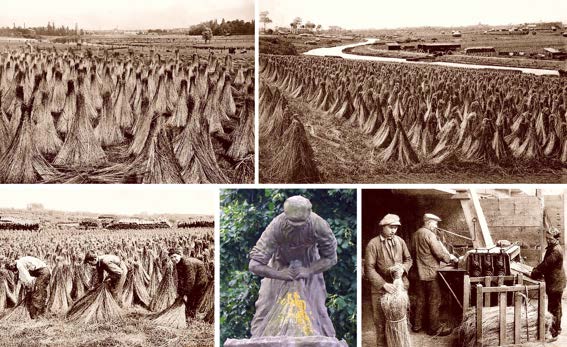
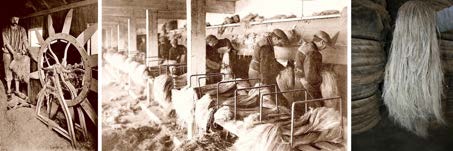
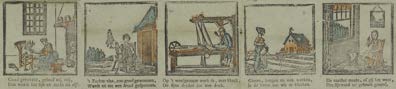
45.1. MICHEL ACHIEL RENATUS DECLERCQ (DC15)
811
Figure 45.22: In the middle, we see the statue ’ Aandenken aan de Vlasser die tussen 1860 en 1960 door mateloos noeste arbeid de welvaart bracht aan de Golden River’ , by R. Debucquoy, Wielsbeke (at the Church), April 23, 1988. It was thanks to Gerard Verbrugghe (described in Chapter 77) that the author was present during the inauguration of this statue in Wielsbeke in 1988. If only his grandfather Michel and great grandfather Ernest Constant had seen, they would have been very proud. The inauguration is also mentioned in Chapter 44.13 . (Declercq de Silva Archive) Furthermore, the compilation shows images of fields, filled with chapels, which formed landscapes that no longer exist today. Flax was often placed in ’chapels’ to dry. The Leie River, with such chapels on its shores was absolutely regal. Finally, we can see ’Brakelen’ (Flax cracking), a process that cracks the Flax stems without cutting. The purpose is to preserve the long fibers in the stem while breaking the stem tissue.
Figure 45.23: ’Zwingelen’ (scutching) of Flax was a process of removal of unnecessary tissue
from the flax fibers. The result was a pure flax fiber, almost like beautiful blond hair. The middle
photo shows an industrialized ’zwingel’ (scutching) process. Right, flax fibers just after scutching
(’zwingelen’) are shown, using modern machines. (Courtesy of Flaxbox, Zulte)
Figure 45.24: Drawing by G. Hesselinck, Zutphen in ’Let wel, kinderen! en be-
merkt, hoe Vlas en Lijnwaad wordt bewerkt. N9. 12.’ , a ’centsprent’ distributed
between 1815 and 1830. The text states: ’If well-combed, believe me, flax will become
as fine and soft as hair or silk’ . The images depict spinning and weaving of linen,
and also bleaching and sewing of linen.
The Desclergues of la Villa Ducal de Montblanc, 2nd ed., Omn., VOL. III
© 2024 Nico F. Declercq
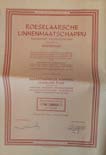
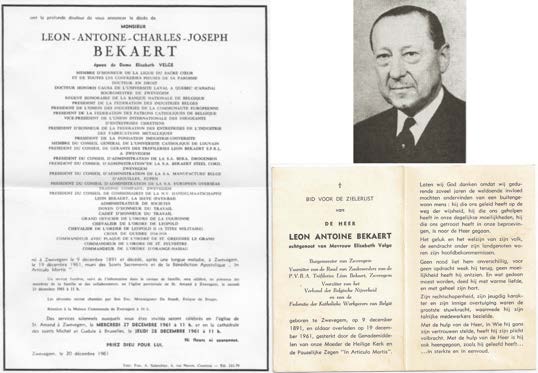
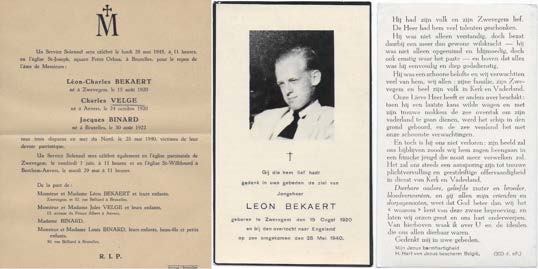
812
CHAPTER 45. MICHEL ACHIEL RENATUS DECLERCQ (DC15) & IRMA HELENA LESAGE
Figure 45.25: August 1950, an expired share of ’Roeselaarse Linnenmaatschappij’
. (Declercq de Silva Archive)
Figure 45.26: The death announcement, and the mortuary card of Leon Antoine Charles Joseph Bekaert, husband of Elisabeth Velge, December 19, 1961, 2 years before the death of Michel Declercq. (Declercq de Silva Archive) Figure 45.27: The death announcement of Leon Charles Bekaert, Charles Velge and Jacques Binard, May 28 0f 1940. They were war victims. His obituary card is also shown. (Declercq de Silva Archive)
© 2024 Nico F. Declercq
The Desclergues of la Villa Ducal de Montblanc, 2nd ed., Omn., VOL. III
45.1. MICHEL ACHIEL RENATUS DECLERCQ (DC15)
813
Figure 45.28: The obituary card of Marie Antoinette Bekaert, wife
of Max Velge, February 16, 1883. (Declercq de Silva Archive)
Figure 45.29: The obituary card of Mau-
rice Bekaert, husband of Marie Magdalena
Laurent, December 20, 1933. (Declercq de
Silva Archive)
Figure 45.30:
The death announce-
ment of Zulma Bekaert, Madame Remi
Gaeremynck, wife of Joseph Gaeremynck,
February 20, 1932. (Declercq de Silva
Archive)
The Desclergues of la Villa Ducal de Montblanc, 2nd ed., Omn., VOL. III
© 2024 Nico F. Declercq