

The Desclergues of la Villa Ducal de Montblanc, Second Edition Omnibus by Nico Declercq - HTML preview
Download the book in PDF, ePub, Kindle for a complete version.
Pierre Joseph Declercq (DC11) & Barbara Thérèse d’
Hont
41.1 Introduction
Pierre Joseph is a patrilineal ancestor. He was the son of Renier Declercq (DC10) and Marie Anne Thérèse Lombaerde and was born in Izegem in 1771.
His parents moved to Lendelede, probably in the 1790s. When he married Barbara Thérèse d’Hont in 1794, he lived in Lendelede but married in Izegem, where his bride lived.
The couple soon moved to Kuurne and would continue to reside there. Probably Marie Anne Thérèse d’ Hont lived for a short while separated from her husband in Emelgem (next to Izegem) or had her official residence there in the period when the couple had their daughter Rosalie Declercq (DC12b) at Kuurne in 1800, as can be read in the concerned birth certificate shown in Figure
41.11. It’s a mystery why this was so.
Future generations may search the archives to find the reason. For instance, just after WWI, this happened to couples, with one person rebuilding the home while the other resided in a haven where the children could go to school.
Contrary to earlier generations, we now have civil and church records to investigate the genealogy.
41.2 Pierre Joseph Declercq (DC11)
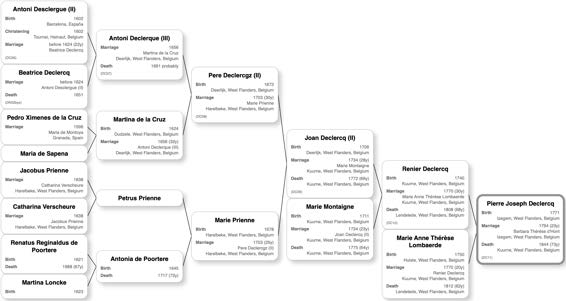
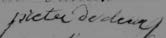
He is a patrilineal forefather whose ancestors are shown in Figure 41.1. We can also observe in Figures 41.2 and 41.3 that Pierre Joseph Declercq (DC11) wrote his family name consistent with our modern version.
We found him signing differently: Petrus Josephus Declercq, Pieter Declercq, Pieter Joseph Declercq. It is essential to observe that he wrote his family name ’Declercq’ in one word and ending with ’-cq,’ irrespective of what the registrar did. This is the natural continuation of the old Spanish spelling ’Desclergue’ from earlier chapters.
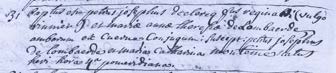
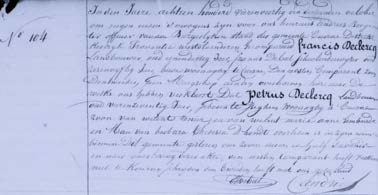
He was the son and only child to produce offspring of Renier Declercq (DC10) and Marie Anne Thérèse Lombaerde. He was born in 1771 at Izegem in Figure 41.4 and died in 1844, in Figure 41.5, at Kuurne in Belgium.
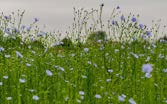
Like his descendants, he was a farmer and must have been involved in flax cultivation, as in Figure 41.6, and merchandising. On a map of 1842 by Philippe Christian Popp, several farms can be found belonging to the family of Declercq at Hulste and Kuurne.
41.3 Barbara Thérèse d’ Hont
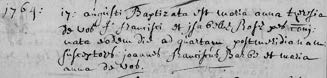
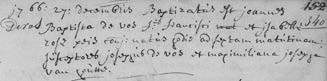
She was the wife of Pierre Joseph Declercq (DC11) and was born in 1773 at Izegem. Her baptism is shown in Figure 41.7. She died in Kuurne in 1854, shown in Figure 41.8. She was the daughter of Pierre Joseph d’ Hont, from Heule, and Marie Anne Thérèse Deryckere, from Heule. Her godfather was François Callens. Her godmother was Veronica Van Becelaere.
She was probably the sister of Anne Marie d’ Hont, born around 1767, and wife of Pierre Joseph de Saintobin, born around 1765, who lived at Izegem between 1798 and 1811.
We found birth certificates of the following siblings of Barbara Thérèse d’ Hont at Izegem: Petrus Joannes D’ Hont (1771, the godfather was Joannes Baptiste Deryckere, godmother was Maria Francisca Deryckere), Anna Catharina (1778, the godfather was Josephus Delaere, godmother was Veronica Van Becelaere) and Petrus Joannes (1781, the godfather was Joannes Franciscus Van Haelewyn, godmother was Maria Anna Theresia D’ Hont) Barbara Thérèse was a farmer at Kuurne, and she died in 1854 at Kuurne, Belgium.
Note that the family Deryckere were friends and later relatives of the family through the second marriage of Marie Anne Thérèse Lombaerde, as can be read in Chapter 40.3.
41.4 Their Marriage
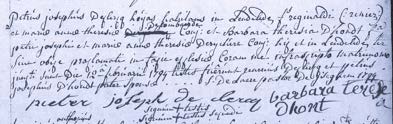
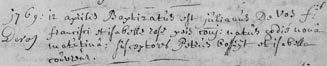
Their wedding was in 1794, at Izegem, in Figure 41.9. The groom lived in Lendelede and was the son of Renier Declercq (DC10) (’Reginaldus : Renier’) and Marie Anne Thérèse Lombaerde (’Delombaerde’). The bride was the daughter of Pierre Joseph d’Hont and Marie Anne Thérèse Deryckere. The bride’s mother had been buried in Izegem in the same church by the same priest. Renier Declercq (DC10) and Pierre Joseph d’Hont were the wedding witnesses.
41.5 Their Offspring
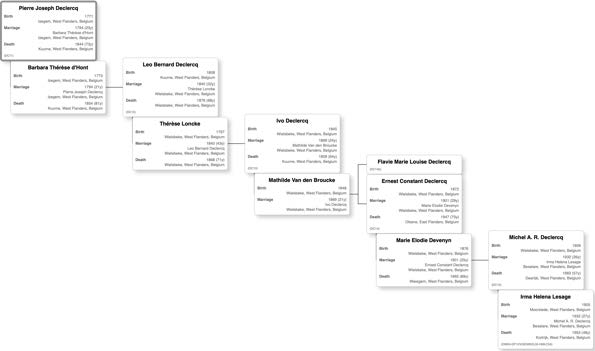
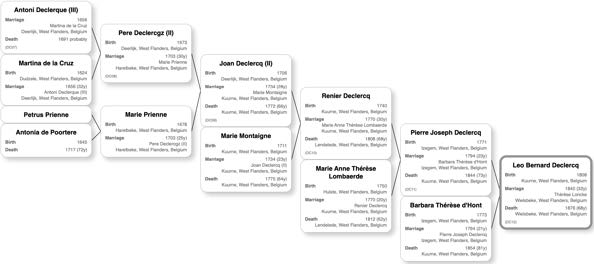
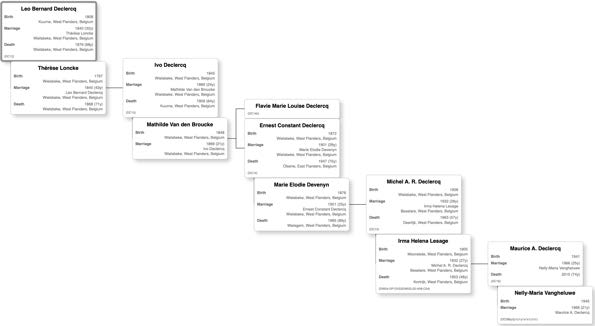
Four descending generations are shown in Figure 41.10.
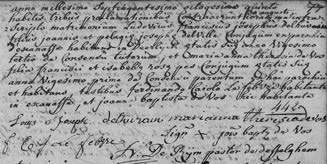
The couple had a daughter, Rosalie Declercq, born in 1800 at Kuurne, in Figure 41.11. Three years later, they had a son, Guillaume Declercq (DC12c), in Figure 41.12, who unfortunately died three days later. Leo Bernard Declercq (DC12), our ancestor, was born in 1808 at Kuurne and is described in the next chapter. In 1812, at Kuurne, their son Francois Eugene Declercq (DC12d) was born, in Figure 41.13. The latter would wait very long to marry and had no offspring. Some interesting information about him is found The Desclergues of la Villa Ducal de Montblanc, 2nd ed., Omn., VOL. III
© 2024 Nico F. Declercq

696
CHAPTER 41. PIERRE JOSEPH DECLERCQ (DC11) & BARBARA THÉRÈSE D’ HONT
Figure 41.1: Five ascending generations of Pierre Joseph Declercq (DC11).
Figure 41.2: The signature of Pierre Joseph Declercq to show that he
wrote his family name in one word.
Figure 41.3: The signature of Pierre Joseph Declercq to show that he
wrote his family name in one word.
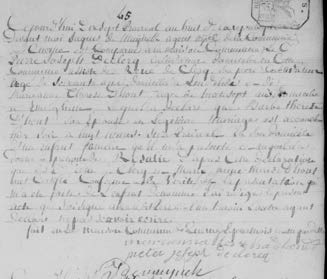
Figure 41.4: Izegem, 1771, May 31, the baptism of Pierre Joseph
Declercq (DC11), son of Renier Declercq (DC10) (’Reginaldo vulgo Re-
nier’) and Marie Anne Thérèse Lombaerde (’de Lombaerde’). The god-
father was Pierre Joseph Lombaerde (’de Lombaerde’), and the god-
mother was Catherine Montaigne.
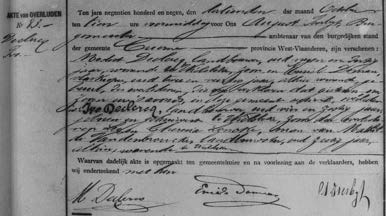
Figure 41.5: Kuurne, October 13, 1844, death certificate of Pierre Joseph
Declercq, who died the day before at the age of (almost) 74 at his home in Kuurne.
He was a farmer, born at Izegem and living in Kuurne. He was a son of Renier
Declercq (DC10) and Maria Anne Thérèse Lombaerde. He was the husband of
Barbara Theresia D’ Hont.
Figure 41.6: Flax (Courtesy of Dominique Demeulemeester).
© 2024 Nico F. Declercq
The Desclergues of la Villa Ducal de Montblanc, 2nd ed., Omn., VOL. III

41.5. THEIR OFFSPRING
697
Figure 41.7: Izegem, November 12, 1773, the baptism of Barbara Thérèse d’
Hont, daughter of Pierre Joseph d’ Hont and Maria Anna Theresia Deryckere,
both from Heule. The godparents were François Callens and Veronica Van
Becelaere.
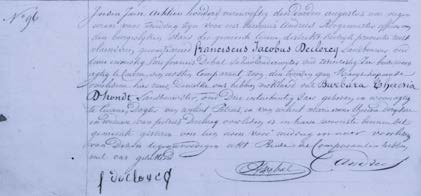
Figure 41.8: Kuurne, August 3, 1854, the death certificate of Barbara Theresia D’
Hondt. She died on August 2 at her home in Kuurne at the age of 83. She lived in
Kuurne and was the daughter of Pierre D’ Hont and Marie Anne Thérèse Deryckere.
She was the widow of Pierre Joseph Declercq (DC11).
Figure 41.9: Izegem, February 12, 1794, the wedding (church) of Pierre Joseph
Declercq (DC11) with Barbara Thérèse d’ Hont.
Figure 41.10: Four descending generations of Pierre Joseph Declercq (DC11).
The Desclergues of la Villa Ducal de Montblanc, 2nd ed., Omn., VOL. III
© 2024 Nico F. Declercq
698
CHAPTER 41. PIERRE JOSEPH DECLERCQ (DC11) & BARBARA THÉRÈSE D’ HONT
Figure 41.11: Kuurne, 1800, the birth
certificate (l’ an huit, 17 Prairial) of Ros-
alie Declercq (DC12b). Her father was
Pierre Joseph Declercq, a farmer resid-
ing in Kuurne and son of Renier De-
clercq (DC10), a farmer of 60 who lived in
Lendelede. Her mother was Marie Anne
Thérèse d’ Hont, 37 years old, residing in
Emelgem. The child was born the day be-
fore at 8:12 at the father’s home. Inter-
estingly both parents have signed the doc-
ument, which means the mother was fit
enough to join her husband for the decla-
ration.
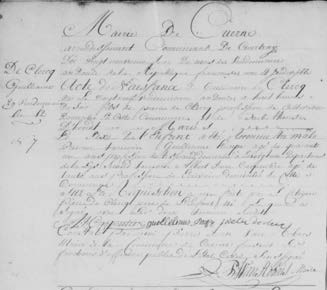
Figure 41.12: Birth certificate of Guil-
laume Declercq (DC12c) , Kuurne, 22 Oc-
tober 1803 (29 Vendémiere, Republican
year 12), who would die 3 days later, son
of Piere Joseph Declercq (DC11) and Bar-
bara Thérèse d’ Hont. The witnesses were
Guillaume Himpe, a tissue manufacturer
of 40, and Albert Jean Carpentier, a writer
of 30.
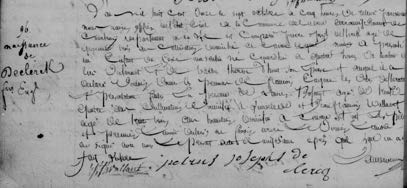
Figure 41.13: Kuurne, October 7, 1812, the birth certificate of François Eugène
Declercq (DC12d) in 1812 at Kuurne. His father, Pierre Joseph Declercq (DC11), a
farmer of 43 and living in Kuurne, signed exceptionally in two words because there was
not enough space to spell his name in one word. Besides, the registrar chose to use
’-ck’ while Pierre Joseph insisted on ’-cq’ at the end of his name. The witnesses were
Xavier Bossuyt, a farmer of 34 from Lendelede and Francois Wallaert from Kuurne.
He remained childless; otherwise, his descendants would probably live on under the
name ’Declerck’ .
© 2024 Nico F. Declercq
The Desclergues of la Villa Ducal de Montblanc, 2nd ed., Omn., VOL. III

41.5. THEIR OFFSPRING
699
Figure 41.14:
Military registration of François Eugene Declercq in Ligting 1836, Nationaele Militie, Provincie West-
Vlaenderen, 36e Kanton, Gemeente Cuerne (Kuurne), Lotings register. He was a worker, born on October 7, 1812, at Kuurne. His father was Pierre Joseph, and his mother was Barbara Theresia D’ Hont. His face was oval, his forehead was high, his eyes were gray, his nose normal, his mouth small, his child was round, and his hair and eyebrows were blond. After his selection, he paid Leon Dartoil, nr 20, 1831, to go in his place. He remained, however, in the Reserve 6th regiment and was released of his duties in 1840.
in Figures 41.14, 41.15, and 41.16.
Rosalie Declercq died in Kuurne on October 10, 1877, and was married to Antonius Noppe from Hulste on January 14, 1824.
Antonius Noppe died on January 13, 1833, after which Rosalie would never remarry. Of their children, Antonius, Constantinus, Juliana, and Ida Rosilia survived until adulthood and married.
An obituary card of an acquaintance is shown in Figure 41.17.
The Desclergues of la Villa Ducal de Montblanc, 2nd ed., Omn., VOL. III
© 2024 Nico F. Declercq
700
CHAPTER 41. PIERRE JOSEPH DECLERCQ (DC11) & BARBARA THÉRÈSE D’ HONT
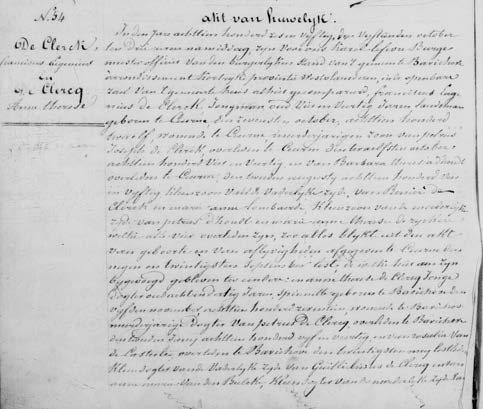
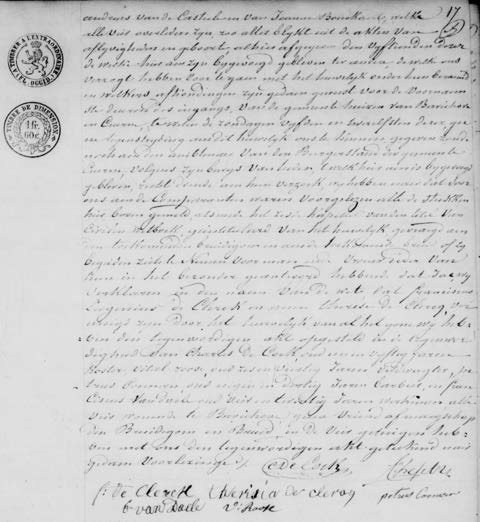
Figure 41.15: Bavikhove, October 15, 1856, the marriage of François Eugène Declercq (DC12d) (’De
Clerck’), a 44-year-old unmarried farmer, born at Kuurne on October 7, 1812, residing in Kuurne,
son of Pierre Joseph Declercq (DC11), dead at Kuurne on October 12, 1844, and Barbara Theresia
D’ Hont, deceased at Kuurne on August 2, 1854, grandson on his father’s side of Renier Declercq
(DC10) and Marie Anne Thérèse Lombaerde, grandson on his mother’s side of Pierres D’ Hont and
Marie Anna Thérèse Deryckere, all four grandparents dead; with Anne Thérèse Declercq (’Declercq’),
an unmarried 38-year-old spinster, born at Bavikhove on November 5, 1817, residing at Bavikhove,
daughter of Petrus Declercq, dead at Bavikhove on June 2, 1845, and of Rosalie Van de Casteele,
dead at Bavikhove on May 20, 1856, granddaughter along her father’s side of Guillaume Declercq and
Anna Maria VandenBulke, and along with her mother’s side of Andries Van de Casteele and Joanna
Bouckaert, all four grandparents dead. (first part)
© 2024 Nico F. Declercq
The Desclergues of la Villa Ducal de Montblanc, 2nd ed., Omn., VOL. III
41.5. THEIR OFFSPRING
701
Figure 41.16: The certificate at Bavikhove, October 15, 1856 of Figure 41.15, second part.
Figure 41.17:
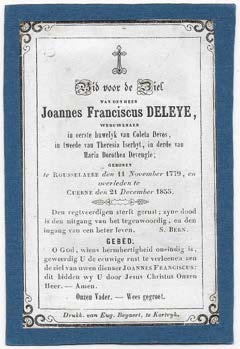
Obituary card of Joannes Franciscus
Deleye, widower of Coleta Devos, Theresia Iserbyt and
Maria Dorothea Deveugle. He was born in Roeselare in
1779 and died in Kuurne in 1855. He was an oil man-
ufacturer and was acquainted with the family. (Declercq
de Silva Archive)
The Desclergues of la Villa Ducal de Montblanc, 2nd ed., Omn., VOL. III
© 2024 Nico F. Declercq
CHAPTER 41. PIERRE JOSEPH DECLERCQ (DC11) & BARBARA THÉRÈSE D’ HONT
© 2024 Nico F. Declercq
The Desclergues of la Villa Ducal de Montblanc, 2nd ed., Omn., VOL. III
Chapter 42
Leo Bernard Declercq (DC12) & Thérèse Loncke
42.1 Introduction
Leo Bernard Declercq (DC12) established ’Hof van Brussel,’ is a patrilineal ancestor of the author, and is also described in Chapter
66.1 as the husband of Thérèse Loncke, the granddaughter of Barbara Benoit.
The memory of Spanish ancestry must have been an almost forgotten anecdote in the memory of the Desclergues in the life of Leo Bernard Declercq (DC12), though only partially. Nevertheless, after his marriage to a bride from Wielsbeke, he established the farm ’Hof van Brussel’ to commemorate the glory days of the family when the Spanish Monarchy governed the country through the center of power of the ’Hof van Brussel,’ better known as the ’Palace of the Koudenberg’ in Brussels.
Indeed, earlier chapters such as Chapter 8.7, Chapter 43, Chapter 29.5.25, Chapter 33.6, Chapter 38, and Chapter 39.6 show that the actual ’Hof van Brussel’ at Brussels, also known as the ’Koudenberg Palace’ or Palatium Bruxellense ducis Brabantiae, was the place from which the Spanish governed the Netherlands.
When the previous ancestors are considered, it is clear that the Declercqs could not find a place they called ’home.’ Leo Bernard Declercq (DC12) appears to be the first to settle and secure his position as a farmer and his children, which is vital to understand his sentiments.
Indeed, Pere Declercgz (II) (DC08), son of Antoni Declerque (III) (DC07) and Martina Ximenez de la Cruz, married Marie Prienne from Harelbeke and would decide, or be forced, to move away from Deerlijk. His son Joan Declercq (II) (DC09) married Marie Montaigne at Kuurne, and this family would remain at Kuurne. Their son Renier Declercq (II) (DC10) married Marie Anne Thérèse Lombaerde, and this couple was again forced to move on to Izegem and then to Lendelede. Their son Pierre Joseph Declercq (DC11), born at Izegem, married Barbara Thérèse d’ Hont in 1794 and settled in Kuurne. The last couple had a son Leo Bernard Declercq (DC12), described in the current chapter, who could finally settle by marrying the eleven-year-older bride, Thérèse Loncke, from Wielsbeke in 1840.
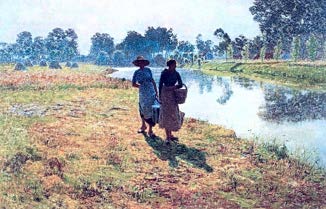
The couple purchased or inherited a farm at Wielsbeke near Oostrozebekestraat, not far from the Leie River, shown in Figure 42.1.
Leo Bernard Declercq gave the farm a name associated with his ancestors, Hof van Brussel.
Given their age, Leo Bernard (DC12) and his wife Thérèse Loncke miraculously still had a child, Ivo Declercq (DC13),1 born in 1845, described in Chapter 43. This only child would be prosperous because of his family’s small size, but he definitely must have missed siblings.
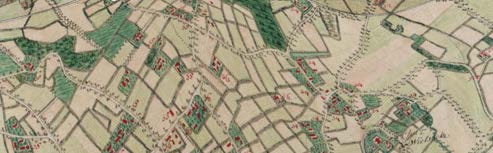
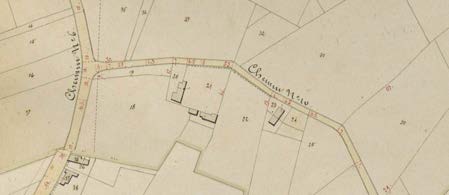
The Ferraris map of 1777 in Figure 42.2 shows the Declercq farm as land strip 36 at Wielsbeke. A map from 1841 shows it, in Figure 42.3 on the land strips 20-21.
The farm of Leo Bernard Declercq and Thérèse Loncke, with its land, was located East of the junction between ’Chemin nr 10’ and
’Chemin nr 6’ on the map in Figure 42.3. The latter street would later be named ’Oostrozebekestraat’ and is nowadays ’Ridder de Ghellinckstraat.’ ’Chemin nr 10’ is the road along which the first encountered farm was ’Hof van Brussel.’
Therefore, the street received the name ’Hof van Brussel’ and is nowadays ’Reynaertstraat.’ When we compare the farm’s shape in 1841 with the one found in pictures in subsequent generations, we must conclude that our family must have rebuilt it later, as seen in Figure 42.5. The street, ’ Hof van Brussel,’ already existed in 1858, shown in Figure 42.6.
42.2 Leo Bernard Declercq (DC12)
Figure 42.1: Emile Clauss (1849-1924),
’Young peasant Women beside the Leie
River’ , 1887. p
1Leo Bernard (DC12) likely did not randomly choose the name Ivo. It is the Spanish version of ’Yves,’ after Yves de Bretagne (St Yves Tréguier), who had been declared holy by the pope during the lifetime of our ancestor Bertrand Du Guesclin (DG11). Given his contacts with the Verriest and the Renier families, described in this chapter, we consider it perfectly understandable that he decided to reaffirm his past and identity, which appears to be a family trait for short-named Desclergue descendants, whether Leo, Ivo. or Nico. His comfortable financial situation must have offered him more time to study and think about his ancestors than the previous generations, who probably struggled more to make a living.
The Desclergues of la Villa Ducal de Montblanc, 2nd ed., Omn., VOL. III
© 2024 Nico F. Declercq

704
CHAPTER 42. LEO BERNARD DECLERCQ (DC12) & THÉRÈSE LONCKE
Figure 42.2: The 1777 Ferraris map shows the future farm’s location, which would later be named
’Hof van Brussel’ , as land strip 36 at Wielsbeke. The road north of the farm is now ’Expresweg’ ,
while there was no road at the farm. A road would be constructed by 1841 when Leo Bernard Declercq
has purchased or inherited the farm or even built it. This street would be named after the farm, by Leo Bernard Declercq, as ’Hof van Brussel’ , or ’Chemin nr 10’ .
Figure 42.3: 1841, a map showing the farm, likely constructed but possibly purchased or
inherited by Leo Bernard Declercq at Wielsbeke, which he named ’Hof van Brussel’ (One can
find the home on the land strips 20-21). The old barn still exists and is shown in Figure 42.4.
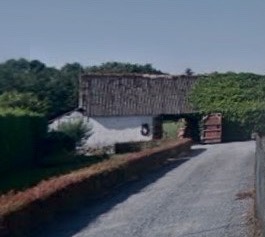
Figure 42.4: A recent picture, view from the street,
shows that the old barn behind the home is still there. In
Figure 42.5, it is shown between identifiers 415 and 414.
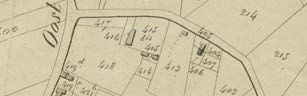
Figure 42.5: Period 1842-1879, a map showing the farm, ’Hof
van Brussel’ (One can find the home on the land strips 415-
415bis-416 with surrounding land 417-418-414 and also land fur-
ther south).
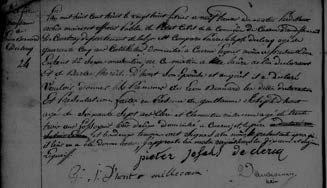
Figure 42.6: A publication in 1858 shows
that the street name ’Hof van Brussel’ al-
ready existed (page 124 of Dictionaire des
Communes, by Hameaux).
© 2024 Nico F. Declercq
The Desclergues of la Villa Ducal de Montblanc, 2nd ed., Omn., VOL. III

42.2. LEO BERNARD DECLERCQ (DC12)
705
Figure 42.7:
Kuurne, February 28,
1808, the birth certificate of Leo Bernard
Declercq (DC12), son of farmer Pierre
Joseph Declercq (DC11) residing in Ku-
urne; and Barbara Thérèse d’ Hont. Reg-
istration witnesses were Guillaume Joseph
D’ Hondt and Clementine Millecam both
from Kuurne. Note that the registrar made
a mistake in the age calculation of the fa-
ther. The other certificates, including Leo
Bernard’s (DC12) wedding in 1840, offer
sufficient redundancy to overrun this er-
ror. Indeed, the parents were 37, respec-
tively 35 and not 45.
Figure 42.8: Kuurne, February 28, 1808, the baptism of Leo Bernard Declercq (DC12), son of Pierre
Joseph Declercq (DC11) and Barbara Thérèse d’ Hont. The godfather was Pierre Joseph Sintobin
(’Sainte Obin’) from Izegem, and the godmother was Barbara Theresia Declercq (’Declercq’) from
Lendelede.
Figure 42.9: Five ascending generations of Leo Bernard Declercq (DC12).
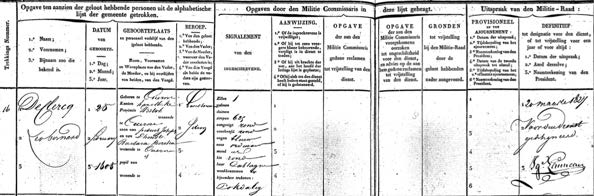
Figure 42.10: Registration of Leo Bernard Declercq as a military on March 20, 1827, Nationale Militie, Provincie WestVlaanderen, 34e Kanton, Gemeente Cuerne, Loting Register. He was born on February 28, 1808 at Kuurne (’Cuerne’), Kanton Harelbeke, Provincie Westvlaanderen. He lived in Kuurne and was a son of Pierre Joseph Declercq and Barbara Theresia d’ Hont. He and his parents were farmers. He had a round face and forehead. His eyes were blue, his nose and mouth were normal, and his chin round. His hair and eyebrows were auburn. As special signs, it is indicated that he was
’pockmarked’ .
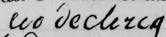
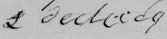
Figure 42.11: The signature of Leo Bernard Declercq (DC12) on his
own wedding certificate.
The Desclergues of la Villa Ducal de Montblanc, 2nd ed., Omn., VOL. III
© 2024 Nico F. Declercq
706
CHAPTER 42. LEO BERNARD DECLERCQ (DC12) & THÉRÈSE LONCKE
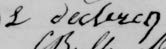
Figure 42.12: The signature of Leo Bernard Declercq (DC12) as a
witness on the wedding certificate of his son Ivo.
Figure 42.13: The signature of Leo Bernard Declercq (DC12) on the
death certificate of his wife Thérèse Loncke.
42.2.1 His Birth, Military Service and Death
Leo Bernard Declercq (DC12) was a son of Pierre Joseph Declercq (DC11) and Barbara Thérèse d’ Hont. His birth document is shown in Figure 42.7 and his baptism in Figure 42.8.
He was the only male descendant of the couple to have offspring and continue the Declercq bloodline, shown in Figure 42.9.
He waited long before getting married, and his bride was a decade older. As a result, only one child, Ivo (DC13), was born. Despite an unfortunate lack of siblings of these generations of the Desclergues, the family gained wealth and would, in Wielsbeke, have a good life for a couple of generations at the farm ’Hof van Brussel.’
Leo Bernard Declercq was a military shortly before the Belgian revolution of 1830 and was, therefore, in the Belgo-Dutch army under the King of the Netherlands. His military file is shown in Figure 42.10. Leo’s signature is shown in Figures 42.11, 42.12 and
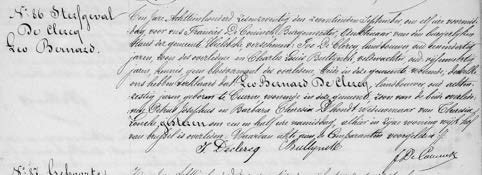
Leo Bernard Declercq died on September 16, 1876, in Figure 42.14, and the notary opened his will on the same day at Meulebeke2.
42.3 Flax and linen
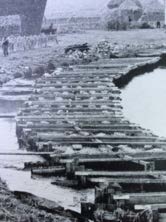
Fence stones, or rootstenen, shown in Figure 42.15, played a crucial role during the retting season. The fences, retting cages, hekken, or rootbakken, filled with flax bundles, needed to be weighted down with these stones to ensure the flax and bins remained sufficiently submerged. After the retting season, the containers were dried in the Leie River meadows and repaired. Horses dragged the fences, placing them in long rows on fence stones within the Leiemeersen (Leie meadows) to protect them from rotting. Necessary repairs were conducted to prepare for the next retting season.
The fence stones were then piled in heaps along the meadow side of the hoist road to avoid obstructing the lines used by ship tractors. Lost or ’sunken’ fence stones were retrieved from the mud using an iron claw or hook on a long heavy handle. The teeth of the claw were often cupped, sometimes with a wide iron ring, to facilitate scooping and holding the irregular stone.
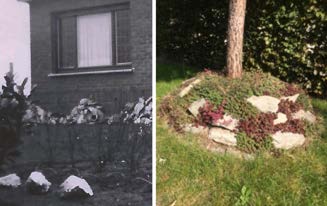
The homes of flax merchants were easily recognized by the piles of fence stones in front, symbolizing their profession and status.
For instance, Figure 42.16 shows that in the 1950s, Michel Declercq (DC15) visibly stacked such stones against his house, signifying his birthright as a flax merchant. Flax merchants highly valued their status, a tradition continued by the author for sentimental reasons, as seen in Figure 42.16.
The production of flax and flax linen dates back to ancient Egypt, where mummies were wrapped in linen. When the Romans entered Gaul in 57 BC, they were impressed by the numerous beautiful flax fields. Before this, the Romans already recognized the region as a flax-producing area. Around 200 BC, Plautus wrote, Lineae Cooper est Gallia (Gaul is covered with linen workhouses).
Virgil noted that the Gallic people made linen cloth for their sails. Pliny praised the high-quality flax linen produced along the coastal region between Boulogne and Ypres in his Historia Naturalis. He described the women’s linen clothes as the finest he had ever seen. Julius Caesar was similarly impressed by the flax linen smocks worn by northern Gaul men. Druids also wore linen robes, likely introduced by the Celts. Consequently, the region was called Belgica by the Romans and later internationally recognized as Belgium, deriving from the Celtic word for flax, Belc’ h. Thus, the etymological origin of Belgium likely predates that of Flanders.
The flax and linen industry experienced several fluctuations, often influenced by its relationship with the wool industry. In the 16th century, the flax industry struggled, with flax from the Kortrijk and Roeselare regions primarily sold to Ghent and traded with Spain. During the latter half of the sixteenth century, with the arrival of the Desclergues, nearly everyone in the region was involved in flax and linen production. Almost every cottage or farm grew flax and wove it into linen. Emperor Charles V once remarked, there will always be prosperity as long as the population can process flax (Figure 42.22). Following the wars of religion in the Netherlands, many flax experts emigrated to France and Holland, creating fierce competition for Flanders. During Napoleon’s time, the Flemish flax industry thrived, especially as his regime banned English wool. Flax retted in the Leie was particularly popular despite previous prohibitions.
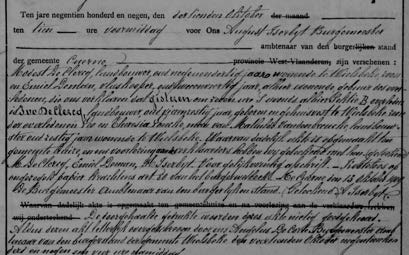
Figure 42.14: Wielsbeke, September 17, 1876, the death certificate of 68-year-old farmer Leo Bernard
Declercq (DC12). The death was reported by his 31-year-old son, farmer Ivo Declercq (DC13), and
constable Louis Bultynck. The deceased was a son of Pierre Joseph Declercq (DC11) and Barbara
Thérèse d’ Hont, and he was the widower of Thérèse Loncke. Leo Bernard died on September 16 at
his farm ’Hof van Brussel’ . Note his son’s signature ’I. Declercq’ .
2Erfnr B85, Docunummer 194, Filmnummer 417, Opnamenummer 246136.
© 2024 Nico F. Declercq
The Desclergues of la Villa Ducal de Montblanc, 2nd ed., Omn., VOL. III
42.4. THÉRÈSE LONCKE
707
Figure 42.15: This is a fragment as image citation, from page 226
of the book ’20 eeuwen vlas in Vlaanderen’ , by Bert de Wilde and
published by Lannoo in 1984. The image also appears on postcards that
are more than a century old. It shows fence stones used to submerge
flax in the water to establish a fair retting process. In the back, there
are also stacks of retting rocks visible.
Figure 42.16: Massive and smaller ret-
ting stones were placed in front of Michel
Declercq’s house in the 1950s, which
were prestigious symbols to show that he
stemmed from a family of flax merchants.
We still use small retting stones as orna-
ments in our garden (2020), not for pres-
tige but as souvenirs, and they are cov-
ered by Sedum Spurium, which descend
from cuttings taken from the farm ’Hof
van Brussel’ of the Declercqs in Wielsbeke.
(Declercq de Silva Archive)
Flax production has always been sensitive to international influences such as wars and competition. In the 20th century, communist Russia emerged as a significant competitor for Flemish flax. Hence, Michel Declercq (DC15) was a staunch opponent of communism for economic and religious reasons, deeming it a devil’s system.
42.4 Thérèse Loncke
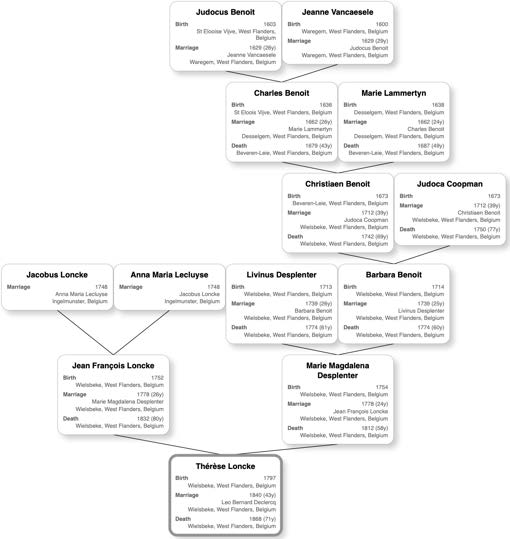
She was a farmer who was a descendant of the Benoit family. In Figure 42.17, her ancestors were dairy farmers. She was married to Leo Bernard Declercq (DC12) and was born at her parents’ home in 1797 in Wielsbeke, where she was a farmer, and baptized in the Saint Laurentius church in Figure 42.18. Her birth is shown in Figures 42.19 and 42.20. She is referred to in the Chapter 66.1
as the daughter of Marie Magdalena Desplenter and Jean François Loncke.
Thérèse Loncke’s brother Jean Loncke, born at Wielsbeke in 1785, had Jeanne Benoit from Waregem as Godmother. Jeanne Benoit (Wielsbeke 1716 - Waregem 1799) was Barbara Benoit’s sister. Joseph Benoit (Wielsbeke 1726-Wielsbeke 1783) was a brother of Barbara and Jeanne Benoit, and he was married to Jeanne Marie Thérèse Baert at Wielsbeke in 1755; she died at Wielsbeke in 1804 and given her name, may have been the Godmother of Thérèse Loncke, although the baptism has not been retrieved for investigation.
The Loncke family was farmers in the area around Hulste. A 1794 cattle census, for instance, indicates that the Loncke family was the leading dairy farmers clan of Hulste at a farm near the Potterijstraat.
Thérèse Loncke died at her home Hof van Brussel in Wielsbeke on December 3, 1868, shown in Figure 42.21.
42.5 Their Marriage and Child
The wedding of Leo Bernard Declercq (DC12) and Thérèse Loncke took place in 1840 at Wielsbeke, Belgium, in the church shown in Figure 42.18.
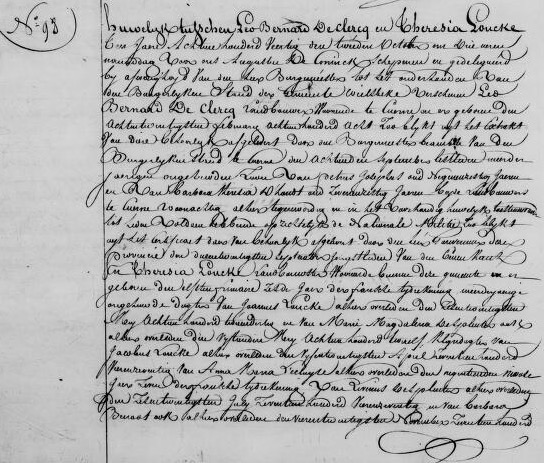
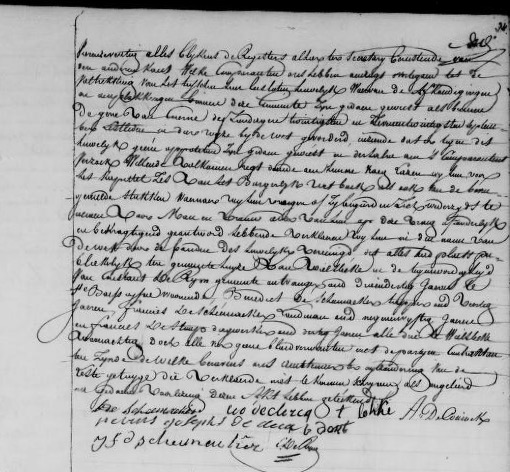
From the marriage, shown in Figures 42.23 and 42.24.
Leo Bernard Declercq (DC12) was an unmarried farmer, resident of Kuurne, and born there on February 28, 1808. He was the son of 69-year-old Pierre Joseph Declercq and 67-year-old Barbara Thérèse d’Hont, farmers at Kuurne. Thérèse Loncke was equally a farmer, residing in Wielsbeke and born there on December 1, 1797 (’11 frimaire an 6’). She was an unmarried daughter of Jean François (’Joannes’) Loncke, who died in Wielsbeke on May 26, 1832, and of Marie Magdalena Desplenter, who died in Wielsbeke on May 15, 1812. Thérèse Loncke was a granddaughter of Jacques Loncke, who died in Wielsbeke on April 25, 1774, and of Anna Maria Lecluyse, who died in Wielsbeke on January 8, 1799 (’19 nivose an 7’). She was also a granddaughter of Livinus Desplenter, who died in Wielsbeke on July 27, 1774, and of Barbara Benoit (’Barbara Benoot’), who died in Wielsbeke on November 24, 1774.
The latter is also confirmed in Chapter 66.1.14.
As mentioned earlier, the couple had only one son to continue the Declercq bloodline, namely Ivo (DC13), described in Chapter 43.
The descending generations are shown in Figure 42.25.
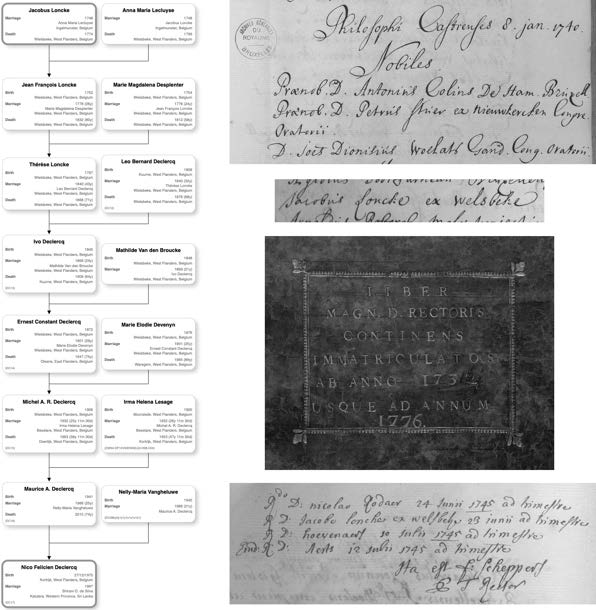
42.6 Thérèse’s Grandfather ’Dominus’ Jacobus Loncke
Jacobus Loncke married Anna Maria Lecluyse in Ingelmunser in 1748. Their son, born in Wielsbeke in 1752, was Jean François Loncke, who married Marie Magdalena Desplenter in 1778. Jean François Loncke and Marie Magdalena Desplenter were the parents of Thérèse Loncke. Jacobus Loncke has been a student at the Catholic University of Leuven. His inscription can be found on January The Desclergues of la Villa Ducal de Montblanc, 2nd ed., Omn., VOL. III
© 2024 Nico F. Declercq
708
CHAPTER 42. LEO BERNARD DECLERCQ (DC12) & THÉRÈSE LONCKE
Figure 42.17: Five ascending generations of Thérèse Loncke.
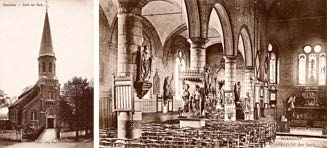
Figure 42.18: Wielsbeke, Saint Lauren-
tius church around 1906, near the Leie
River where the old market square was lo-
cated.
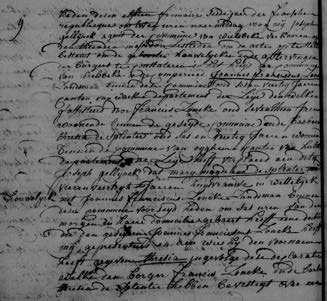
Figure 42.19:
Wielsbeke, December 1,
1797 (11 frimaire an 6), the birth cer-
tificate of Thérèse Loncke, daughter of 46
year old farmer Jean François Loncke and
Marie Magdalena Desplenter. The wit-
nesses were 17 year old Francis Loncke
from Wielsbeke (canton Wakken) and 46
year old Barbara Thérèse Desplenter from
Ooigem (canton Hulste). The child was
born at home at 6am the same day. The
document continues in Figure 42.20.
© 2024 Nico F. Declercq
The Desclergues of la Villa Ducal de Montblanc, 2nd ed., Omn., VOL. III
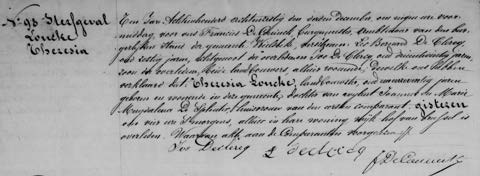
42.7. LINK WITH THE RENIER AND AN EXCITING EXAMPLE OF NAME EVOLUTION
709
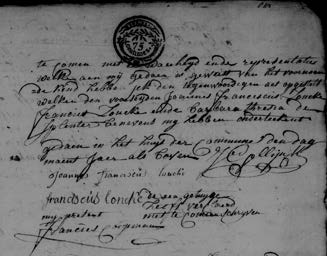
Figure 42.20: The continuation of the
birth certificate of Thérèse Loncke of Fig-
ure 42.19 at Wielsbeke, December 1, 1797.
Figure 42.21: Wielsbeke, December 3, 1868, the death certificate of Thérèse Loncke. The death was
reported by farmers Leo Bernard Declercq (DC12), her 60-year-old husband and Ivo Declercq (DC13),
her 23-year-old son. The deceased was a 71 years old farmer, born and residing at Wielsbeke, daughter
of Jean François (’Joannes’) Loncke and Marie Magdalena Desplenter. She died at her home ’Hof
van Brussel’ (equally the neighborhood’s name), on December 2 at 4 am.
1, 1740. His matriculation at the university is shown in Figure 42.26 on page 711, as well as evidence of his success as a student.
His degree was Dominus.3
42.7 Their Link with the Renier Family and an Exciting Example of Name
Evolution
Thérèse Loncke, born in Wielsbeke, married Leo Bernard Declercq in 1840. They were grandparents of Ernest Constant Declercq, father of Michel Achiel Renatus Declercq.
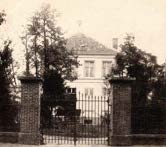
The Renier family, shown in Figures 42.27 and 42.28, has particularly become famous at Deerlijk, where the early Desclergues lived and would form bonds again in the next generations. The Declercq family and the Renier family knew one another much earlier, we may presume, because, during the decades before, they also lived in the same area (Heule-Hulste-Kuurne). The families ’Renier’
and ’Deconinck’ are well-known for their literature, poetry, and education (primarily at Deerlijk).
Pieter Jan Renier wrote a poem about flax, which most likely revered the Declercqs, given their involvement in his industry:
’ In België wordt het land bereid
voor ’t Vlas !
Men ploegt met zorg en wijs beleid
voor ’t Vlas !
Men mest, men egt, men zaait, men wiedt
voor ’t Vlas !’
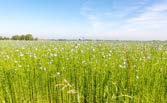
Thérèse Loncke, descending from cattle farmers, had known Pierre Jean Renier (Pieter Jan Renier, Deerlijk 1795 – Deerlijk 1859) while the Renier family lived in Wielsbeke (Sint-Baafs-Vijve). Pierre Jean Renier’s parents were Jean Joseph Renier (Heule Figure 42.22: A flax field. (Courtesy of Dominique Demeulemeester).
3Dominus was abbreviated as D. and was the equivalent of Master in modern-day-academia.
The Desclergues of la Villa Ducal de Montblanc, 2nd ed., Omn., VOL. III
© 2024 Nico F. Declercq
710
CHAPTER 42. LEO BERNARD DECLERCQ (DC12) & THÉRÈSE LONCKE
Figure 42.23:
Wielsbeke, October 2, 1840, the marriage of Leo Bernard Declercq
(DC12) and Thérèse Loncke. (sheet 1)
Figure 42.24:
Wielsbeke, October 2, 1840, the marriage of Leo Bernard Declercq
(DC12) and Thérèse Loncke. (sheet 2)
© 2024 Nico F. Declercq
The Desclergues of la Villa Ducal de Montblanc, 2nd ed., Omn., VOL. III
42.7. LINK WITH THE RENIER AND AN EXCITING EXAMPLE OF NAME EVOLUTION
711
Figure 42.25: Four descending generations of Leo Bernard Declercq (DC12).
Figure 42.26: The matriculation record of Jacques Loncke as a philosophy student in 1740 at the Catholic University of Leuven. His link with the author is shown on the left side. At the bottom is evidence, from the same register, in 1745, that he successfully mastered his studies.
The Desclergues of la Villa Ducal de Montblanc, 2nd ed., Omn., VOL. III
© 2024 Nico F. Declercq
712
CHAPTER 42. LEO BERNARD DECLERCQ (DC12) & THÉRÈSE LONCKE
Figure 42.27: Deerlijk, country estate (’buitengoed’) Renier.
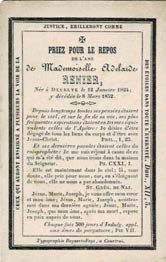
Figure 42.28: Deerlijk, obituary card of Adelaïde Renier (1824-1852).
(Declercq de Silva Archive)
1773 – Deerlijk 1811) and Marie Josephe Deconinck, as shown in Figure 42.29. Jean Joseph was the son of Jean François Xavier Renier and Marie Françoise Glorieux. The Renier family lived in Wielsbeke from 1798 until 1808, where younger siblings of Pieter Jan Renier were born, e.g., Amelie Rosalie Renier and Eugeen Joseph Renier.
Like the Desclergue family, the Renier family has been mobile. The reason is that they married exotic partners from different regions of the country.
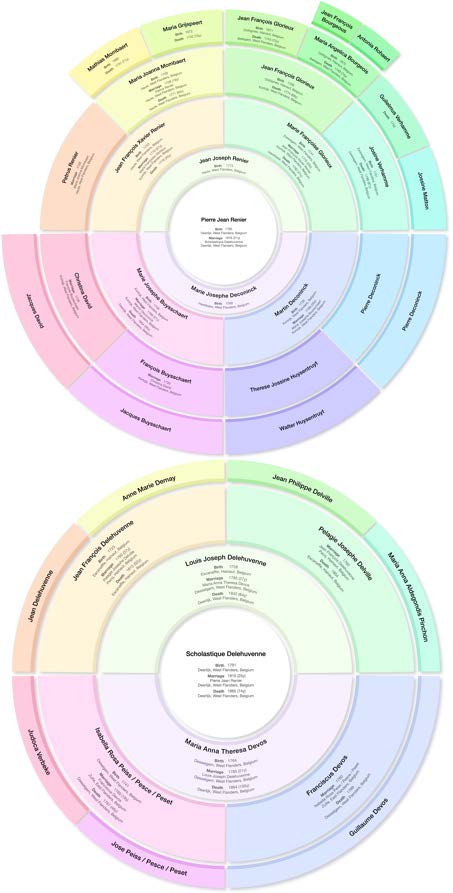
It is certain that Pieter Jan Renier’s wife, Scholastique Delehuvenne, was bilingual, which can be seen upon investigating her ancestry in Figure 42.29. Indeed, she has a French family name, and her father was born in Escanaffles, where one spoke French.
Interestingly she also has foreign ancestors called ’Peis’ or ’Pes,’ which probably originate either from an Italian family, ’Pesce,’
from a Spanish family, ’Peset,’ or from a German family, ’Peiss.’
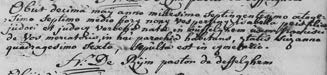
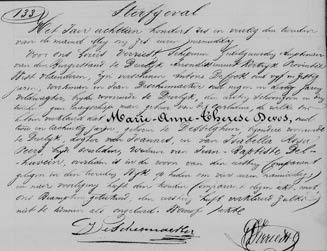
In fact, in this book’s context, the ’Peis ancestors’ of Scholastique Delehuvenne form an excellent example of how names evolve not because of time but because of integration issues. We can see that the family insisted on the correct pronunciation of their name for a long time, which was either of the three possibilities above, but sounded like ’Peis’ or ’Pes.’ Since there was a similar name in Flanders, i.e., ’Peers’ or ’Peirs,’ the local authorities (the priest, in our study) always attempted to interpret the word as such and insisted on an immediate integration. So, although the family commanded several decades, ultimately, society won, and the name became ’Peers,’ just like the local name. The evolution is not linear in time because it depends on where a registration occurred. Before showing the records, we can make the following summary: Peesz (1730 Oeselgem), Pees (1730 Oeselgem), Pees 1730 Oeselgem), Peess (1731 Oeselgem), Peess (1733 Oeselgem), Peers (1760 Zulte), Peys (1761 Waregem), Pes (1764 Desselgem), Peis (1766 Desselgem), Peis (1769 Desselgem), Peis (1771 Desselgem), Peis (1774 Desselgem), Pes (1785 Desselgem), Peis (1787
Desselgem), Peers (1846 Deerlijk). In Figures 42.30, 42.31, 42.32, 42.33, 42.34, 42.35, 42.36, 42.37, 42.38, 42.39, 42.40, 42.41, 42.42,
42.43 and 42.44, every certificate is shown to help the reader interested in such a name evolution.
As mentioned above, the Declercq family and the Renier family knew one another much earlier, presumably because they lived in the same area (Heule-Hulste-Kuurne) during the decades before.
The Renier family is so famous that numerous works exist about them. The description we offer here is primarily based on an extensive article by Dominique Velghe4.
Pieter Jan Renier (1795-1859) was friends with Hendrik Conscience (1812-1833), like Charles Lammens (1814 - 1881) described in Chapter 71.6.5, who had been a soldier with Conscience. Pieter Jan Renier was born in Deerlijk on September 21, 1795. He was the eldest son of Maria Josepha Columba de Coninck (born in Harelbeke in 1769) and Jan Jozef Renier (born in Heule in 1773).
Maria de Coninck’s grandfather was Pieter de Coninck, an author of a play about the Battle of the Golden Spurs in Kortrijk in 1302.
Jan Jozef Renier was a teacher, first in Tielt and then in Deerlijk, where he founded a French school in 1792 in the infrastructure of his uncle Pierre Glorieux. The school immediately went well, but Renier moved to Wakken with his family. A few years later, however, he returned to become a village teacher again. He soon received assistance from his son Pieter Jan Renier, who would later succeed him.
Jean-Joseph Renier died in 1811 at the age of 38. Pieter Jan Renier was only 16 then and continued school. He was also admitted by the Académie de Bruxelles, an institution within the Imperial University of the French who then, under Napoleon Bonaparte, ruled the Low Countries, including Deerlijk.
On March 27, 1816, Pieter Jan Renier married Scholastica Delehuvenne, four years older. Given his interest in education, her beautiful name will undoubtedly have influenced his choice. The couple had 11 children.
Although the Flanders’ government became Dutch in 1815, we can nevertheless assume that his wife’s bilingualism must have been an advantage if only to attract foreign-language students. The administration was perhaps partially Dutch, but French was still essential in teaching, and the certificates and diplomas were used in education. Several other schools in Deerlijk arrived partly due 4Dominique Velghe, ’Pieter Jan Renier (1795-1859): Dichter en Kostschoolhouder,’ in Derlike, 18de jaargang, nr 3, 1995.
© 2024 Nico F. Declercq
The Desclergues of la Villa Ducal de Montblanc, 2nd ed., Omn., VOL. III
42.7. LINK WITH THE RENIER AND AN EXCITING EXAMPLE OF NAME EVOLUTION
713
Figure 42.29: Fan ancenstry charts of Pieter Jan Renier and his wife, Scholastique Delehu-
venne.
The Desclergues of la Villa Ducal de Montblanc, 2nd ed., Omn., VOL. III
© 2024 Nico F. Declercq
714
CHAPTER 42. LEO BERNARD DECLERCQ (DC12) & THÉRÈSE LONCKE
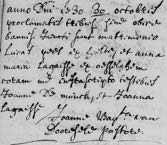
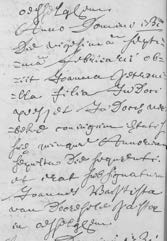
Figure 42.30: Oeselgem, December 18, 1730, the baptism of Anna
Maria ’Peesz’ , daughter of Jose ’Peesz’ and Jossine Verbeke. The
priest afterwards indicated that the name has an ending with a strong
’s’ . (Generation X)
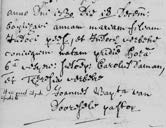
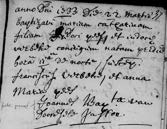
Figure 42.31: Oeselgem, October 20, 1730, the wedding announce-
ment of Lucas ’Pees’ from Zulte and Anna Maria Lagaisse from Oes-
selghem. (Generation X)
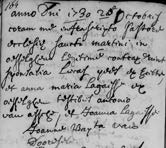
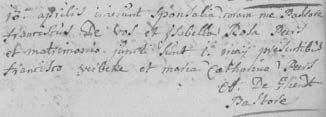
Figure 42.32: Oeselgem, October 30, 1730, the wedding of Lucas
’Pees’ from Zulte and Anna Maria Lagaisse from Oesselghem. (Gen-
eration X)
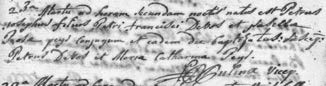
Figure 42.33: Oeselgem, Febuary 27, 1731, the death of Petronilla
’Peess’ , daughter of Jose ’Peess’ and Jossina Verbeke. (Generation
X)
Figure 42.34: Oeselgem, March 22, 1733, the baptim of Maria Catha-
rina ’Peess’ , daughter of Jose ’Peess’ and Jossina Verbeke. (Genera-
tion X)
Figure 42.35:
Zulte, 1760, April 13,
the marriage of Isabella Rosa ’Peers’ with
Franciscus Devos. She was the daughter of
Jose ’ Peess’ and Jossina Verbeke. (Gen-
eration X+1)
Figure 42.36:
Waregem, March 23,
1761, the baptism of Petrus Josephus De-
vos, son of Franciscus Devos and Isabella
Rosa ’Peys’ . (Generation X+2)
© 2024 Nico F. Declercq
The Desclergues of la Villa Ducal de Montblanc, 2nd ed., Omn., VOL. III


42.7. LINK WITH THE RENIER AND AN EXCITING EXAMPLE OF NAME EVOLUTION
715
Figure 42.37:
Desselgem, August 17,
1764, the baptism of Maria Anna Theresia
Devos, daughter of Franciscus Devos and
Isabella Rosa ’Pes’ . (Generation X+2)
Figure 42.38: Desselgem, December 27,
1766, the baptism of Joannes Baptiste De-
vos, son of Franciscus Devos and Isabella
Rosa ’Peis’ . (Generation X+2)
Figure 42.39:
Desselgem, April 12,
1769, the baptism of Julianus Devos, son
of Franciscus Devos and Isabella ’Peis’ .
(Generation X+2)
Figure 42.40: Desselgem, December 4,
1771, the baptism of Maria Barbara Devos,
daughter of Franciscus Devos and Isabella
’Peis’ . (Generation X+2)
Figure 42.41: Desselgem, July 7, 1774,
the baptism of Josephus Devos, son of
Franciscus Devos and Isabella Rosa ’Peis’
. (Generation X+2)
Figure 42.42:
Desselgem, August 30,
1785, the marriage of Louis Joseph Dele-
huvenne en Maria Anna Theresia Devos,
daughter of Franciscus Devos and Isabella
Rosa ’Pes’ . (Generation X+2)
Figure 42.43: Desselgem, May 10, 1787,
the death of Isabella ’Peis’ , age 46 and
born at Oeselgem, wife of Franciscus De-
vos and daughter of Jose ’Peis’ and Judoca
Verbeke. (Generation X+2)
Figure 42.44:
Deerlijk, May 2, 1846,
the death of Marie Anne Thérèse Devos,
age 82 and born in Desselgem, wife of
Jean Baptiste Delhuvein and daughter of
Joannes Devos and Isabella Rosa ’Peers’ .
(Generation X+3)
The Desclergues of la Villa Ducal de Montblanc, 2nd ed., Omn., VOL. III
© 2024 Nico F. Declercq
716
CHAPTER 42. LEO BERNARD DECLERCQ (DC12) & THÉRÈSE LONCKE
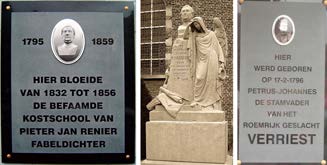
Figure 42.45: The Mausoleum of Pieter
Jan Renier in Deerlijk at the Sint Columba
church. In addition, two memorial plaques
are shown, i.e. one on the wall of a
Pieter Jan Renier boarding school in Deer-
lijk and another at the home of Verriest in
Saint Louis (Sint Lodewijk) in Deerlijk, the
home where Petrus Johannes Verriest was
born in 1796. (Declercq de Silva Archive)
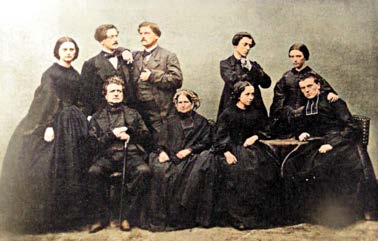
Figure 42.46: The Verriest family. From left to right, seated: the parents
Pierre Jean Verriest (1796-1871) and Caroline Florentine Van Ackere (1801-
1886), Oda Verriest (1832-1891), Hugo Verriest (1840-1922). From left to right,
upright: Julie Tharsile Verriest (1838-1908), Adolphe Prosper Verriest (1830-
1891), Charles Louis Verriest (1828-1894), Gustave Conrad Verriest (1843-
1918) and Marie Louise Verriest (1835-1907). The image appeared in many
publications, including Derlike II, 4, 1980. MyHeritage® colorized this photo.
to Pieter Jan Renier’s example.
From 1817, there was also a boarding school in Deerlijk founded by Renier.
Due to Renier’s tremendous success and good connections, children from far away came to boarding school, and tuition fees were increased on a competitive basis to the extent that children from Deerlijk hardly had a chance to study with Renier. In that context, others also established schools, creating a cascade system. Out of frustration, the city council even lowered the subsidies for Renier’s school. The colloquial language in Renier’s school was always French, but there were also Dutch lessons.
Besides, Renier was also the author of ’Beginselen der Vlaemsche Spraekkunst.’ For example, the children also learned to translate the fables of De La Fontaine. Other teachers also assisted Renier. Some were related to him, including Aloisius Renier, his son, who would succeed him as director.
Renier’s school was initially a blended institute, but in 1826, a girls’ school was split off.
Pieter Jan Renier was a pioneer in education in Flanders and is known for his works, such as De slag der Gulden Sporen (The Battle of the Golden Spurs), a play he wrote.
He also took part in several linguistic competitions where he scored very high.
The Dutch regime did not appreciate Renier. His real breakthrough as a writer came after the foundation of the modern Belgian state in 1830. Unsurprisingly, he is remembered very well at Deerlijk, in Figure 42.45.
42.8 Their Link with the Verriest Family
A famous picture of the Verriest family is shown in Figure 42.46.
Thérèse Loncke, born in 1797, was of the same age as Pierre Jean Verriest, born in 1796, father of the well-known Verriest family in Deerlijk.
Pierre Jean Verriest was a son of Pierre Jean Verriest (1763-1832) and Marie Françoise Veys (1762-1836). He had the following siblings: Isabelle Rose Verriest (1785-1833), Pierre Joseph Verriest (1787-1840), Maria Angela Verriest (1790-1792), and Louis Verriest (1793-1864). Pierre Jean Verriest (1796-1871) was born in Deerlijk and was a merchant, sexton, and armenmeester (responsible for supporting people experiencing poverty). In the context of our genealogy, it is interesting to note that Pierre Jean Verriest (1763-1832) was a son of Pierre Joseph Verriest (1738-1782) and Marie-Jeanne Debels (1731-1813) and that Pierre Joseph Verriest was a son of Roger Verriest ( 1692-1761) and Joanna Pauwels (1684-1764).
Oda Verriest (1832-1891) was a nun (’Agnes’) with the Sisters Sint Vincentius ’a Paulo, just like Ernestine Declercq, granddaughter of Ivo Declercq (DC13). Hugo Verriest (1840-1922) was the pastor and apprentice of Guido Gezelle. He was five years older than Ivo Declercq (DC05).
Julie Tharsile Verriest (1838-1908) married Emile Henry Sobry from Zwevegem. Adolphe Prosper Verriest (1830-1891) was a school friend of Guido Gezelle in Roeselare. He became a lawyer and alderman and was director of the music school of Kortrijk.
Charles Louis Verriest (1828-1894) was a notary and mayor of Deerlijk from 1872 to 1885, and Theophile Renier succeeded him.
In Chapter 43.7 and Chapter 44.11, we also refer to the Verriest family.
© 2024 Nico F. Declercq
The Desclergues of la Villa Ducal de Montblanc, 2nd ed., Omn., VOL. III
42.9. OTHER ACQUAINTANCES
717
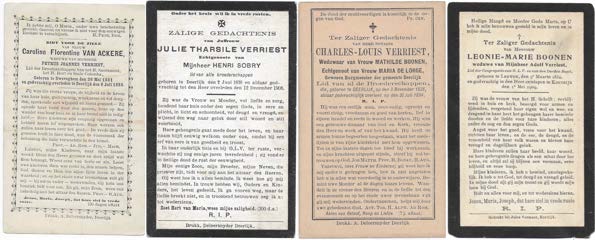
Figure 42.47: From left to right, we find the obituary cards of the following persons. Caroline Florentine Van Ackere, the widow of Petrus Joannes Verriest. She was born in Zwevegem in 1801 and died at Deerlijk in 1886. Julie Tharsile Verriest, the wife of Henri Sobry. She was born in Deerlijk in 1838 and died in 1908. Charles Louis Verriest, the widower of Mathilde Boonen and husband of Maria de Lorge. He was born in Deerlijk in 1828 and died in 1894. Leonie Marie Boonen, the widow of Adolf Verriest. She was born in Leuven in 1983 and she died at Kortrijk in 1909. (Declercq de Silva Archive) Figure 42.48: The blood-relationship between the Bekaert and the Declercq fami-
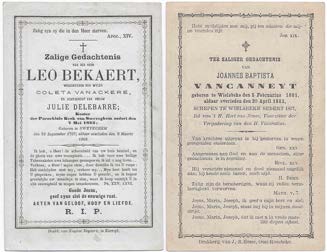
lies is described in Chapter 44.8.20 about
Leon Leander baron Bekaert. Here we see
the obituary card of Leo Bekaert, widower
of Coleta Vanackere and husband of Julie
Delebarre. He was born at Zwevegem in
1797, where he died in 1868. Right is
the obituary card of Jean-Baptiste Van-
canneyt. He was born in Wielsbeke in
1801 and died in 1883. (Declercq de Silva
Archive)
Memorabilia of the Verriest family are shown in Figures 42.47 and 42.45.
42.9 Other Acquaintances
Memorabilia of some acquaintances are shown in Figure 42.48, including distant blood relatives, namely the Bekaert family, that will play a more prominent role in the lives of the Declercqs in subsequent generations.
The Desclergues of la Villa Ducal de Montblanc, 2nd ed., Omn., VOL. III
© 2024 Nico F. Declercq
CHAPTER 42. LEO BERNARD DECLERCQ (DC12) & THÉRÈSE LONCKE
© 2024 Nico F. Declercq
The Desclergues of la Villa Ducal de Montblanc, 2nd ed., Omn., VOL. III
Ivo Declercq (DC13) & Mathilde Van den Broucke
43.1 Introduction
Ivo Declercq (DC13) represents a pivotal figure in our patrilineal heritage. Alongside his wife, Mathilde Van den Broucke, he heralded the family’s transition into the modern farming era, marked by significant advancements in trade and education.
A crucial advantage facilitated this era of progress: Ivo Declercq, as an only child, inherited substantial resources that enabled the family’s upward trajectory. Mathilde Van den Broucke, hailing from a lineage of farmers and entrepreneurs, complemented Ivo’s assets with her familial legacy. Their union solidified a foundation of agricultural and commercial prowess.
The couple’s legacy was furthered by their son, Ernest Constant Declercq (DC14), and subsequently by his son, Michel Declercq (DC15), from whom we directly descend. The Van den Broucke name remains esteemed in Wielsbeke, recognized for its contributions to farming, the flax trade, and industry during the latter half of the 20th century.
Ivo and Mathilde were not only progressive farmers but also cultivated a sense of nobility and erudition within their household.
This is evident in the distinguished names they bestowed upon their children, honoring Roman emperors and reflecting their vision and aspirations for future generations.
43.2 Ivo Declercq (DC13)
43.2.1 His Birth, Military Service and Death
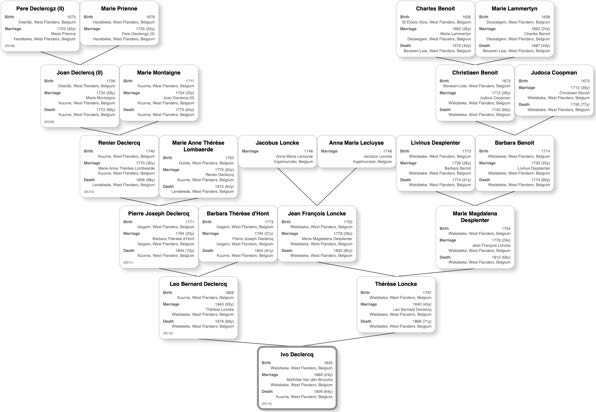
Ivo (DC13) is the author’s great-great-grandfather and is described in Chapter 66.1 as great-great-great-grandson of Barbara Benoit.
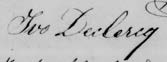
His ancestors are shown in Figure 43.1, and his signature in Figures 43.2, 43.3 and 43.4.
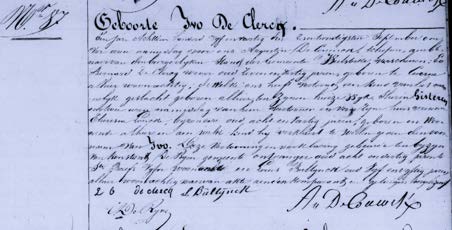
Ivo, born in 1845 in Wielsbeke, was the husband of Mathilde Van den Broucke. His birth certificate in Figure 43.5 shows us that his father, Leo Bernard Declercq, was 37 years old and born in Kuurne. The document tells that he was a textile manufacturer, although he was a farmer. This indicates that he combined farming with the more lucrative textile fabrication and flax trading.
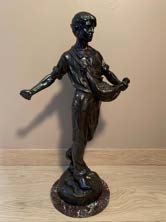
Figure 43.6 shows a family souvenir of a person sowing linseed for flax cultivation.
Ivo’s mother, Thérèse Loncke, was 48 years old and was born in Wielsbeke.
Ivo (DC13) was a Farmer, like his parents and in-laws.
He lived in Wielsbeke and died in Kuurne in 1909.
The registrar of Wielsbeke copied his death certificate on his records. They are both given in Figures 43.8 and 43.9. Ivo has fulfilled his military service during his life, shown in Figure 43.7.
43.3 Mathilde Van den Broucke
43.3.1 Her Life
Mathilde Van den Broucke, a farmer, is equally referred to in the Chapter 66.1 as great-great-great-granddaughter-in-law of Barbara Benoit.
She comes from a family of farmers. She was the daughter of Jean-Baptiste Van den Broucke and Victoria Verlinde. Her distant relatives would become renowned linen manufacturers in the area of Wielsbeke in a joint venture with the Lambrecht family.
She was born in 1848, in Figure 43.11 early in the morning at Molsten in Wielsbeke on July 31, and was the wife of Ivo Declercq (DC13).
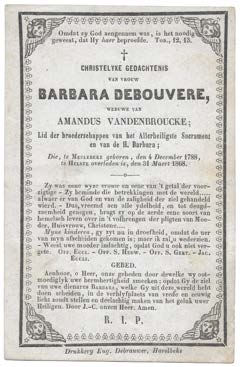
Her father, Jean-Baptiste Van den Broucke, was a son of Amand François Van Den Broucke and Barbara Debouvere and was born in Ingelmunster in 1813. Her mother was Victoria Verlinde, daughter of Ignace Verlinde and Barbara Thérèse du Bois. Jean Baptiste Van den Broucke and Victoria Verlinde married in 1847 at Wielsbeke. Victoria Verlinde passed away in 1851; Jean Baptiste re-married Sophia Francisca Vervaeke from Lendelede in 1852.
Mathilde had one brother, Constant Ignace, who lived in Ooigem.
She equally had a half-brother, Jules Van den Broucke, born in 1855; a half-sister, Marie-Flavie, born in Wielsbeke in 1860; a brother, Petrus Adolf, born in 1857; and a brother, Ivo Charles Louis, born in 1853. The latter would later serve as a witness on the birth certificate of Judith Declercq, in Chapter 44.5.8, daughter of Ernest Constant Declercq (DC14).
Jean Baptiste Van den Broucke was born in 1814 in Ingelmunster and died in Wielsbeke in 1890. The Van den Broucke family originates from Hulste, where they owned a considerable farm in Oostrozebekestraat.
Amand François van den Broucke was the son of Amand François van den Broucke (senior) and of Marie Jeanne Ramon (1753-1794) from Ingelmunster, who was the daughter of Jean Ramon and Marie Jeanne du Bois, both farmers. The family of du Bois originates from Rollegem along the Lys River (Leie) near Kortrijk. It is possible, though not sure, that Jozef Van den Broucke, son of Van den Broucke-Glorieux and married to Claire Lambrecht, is a grandson of one of the (half) brothers of Mathilde Van den Broucke (the aforementioned Constant Ignace, Jules, Petrus Adolf or Ivo Charles Louis), for instance through Medard Jozef Van den Broucke, born in Wielsbeke in 1892 or Maurice Alois Edgard Van den Broucke, born in Wielsbeke in 1893.
The documents could not yet be found to investigate further the link between the family Van den Broucke-Lambrecht and Declercq-Devenyn. It is known that the Lambrecht family was linked to Declercq through friendship, but it is not known if there was also a blood-relationship, the same as with the family Van den Broucke.
Mathilde Van den Broucke had an auntie, Barbara Theresia Van den Broucke, in Figure 43.10, born in Hulste on June 12, 1815, and The Desclergues of la Villa Ducal de Montblanc, 2nd ed., Omn., VOL. III
© 2024 Nico F. Declercq
720
CHAPTER 43. IVO DECLERCQ (DC13) & MATHILDE VAN DEN BROUCKE
Figure 43.1: Five ascending generations of Ivo Declercq (DC13).
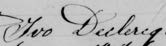
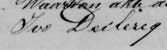
Figure 43.2: The signature of Ivo on the birth certificate of Modest
Ernest.
Figure 43.3: The signature of Ivo on his wedding certificate.
Figure 43.4: The signature of Ivo on the death certificate of Thérèse
Loncke.
Figure 43.5: Wielsbeke, September 27, 1845, the birth certificate of Ivo Declercq.
© 2024 Nico F. Declercq
The Desclergues of la Villa Ducal de Montblanc, 2nd ed., Omn., VOL. III

43.4. THEIR MARRIAGE
721
Figure 43.6: A figurine of a flax cultivator sowing linseed. Maurice
Declercq (DC16) once purchased it because it reminded him of his an-
cestors. It has always been in the home of the author, from the day he
was born. (Declercq de Silva Archive)
Figure 43.7: The registration of Ivo Declercq as a military in 1865, Nationale Milicie, Provincie Westvlaenderen, 42e Milicie Kanton, gemeente Wielsbeke, Lotingsregister. On September 25, 1845, he was born in Wielsbeke, 42e kanton, Provincie Westvlaanderen, where he lived as a farmer. He was the only child of Leo Bernard Declercq and Thérèse Loncke. He was 166cm tall. He had a round face and forehead. His eyes were blue, his nose moderate, his mouth small, and his chin round.
His hair and eyebrows were blond. His military duty was shortened by one year because he was an only child.
daughter of Amandys Van den Broucke and Barbara Debouvere. She would become more than 100 years old and married Frederic Verbeke from Waregem. The couple lived at ’Gaverken,’ where, later, Judith Declercq would live.
We have not retrieved any details of Mathilde Van den Broucke’s death. Perhaps she died in Wielsbeke, or Kuurne, Ghent or Lauwe. Only if we had access to all the registers, we would find her. Privacy clauses make genealogy of the 20th century difficult, but the data should become available in the following decades.
43.3.2 Her Relatives
Below, we show documents of Mathilde’s relatives. Figure 43.12 shows the mortuary card of Barbara Debouvere, Mathilde’s grandmother.
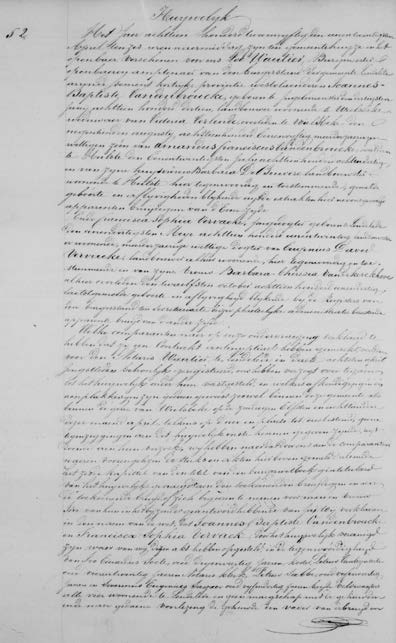
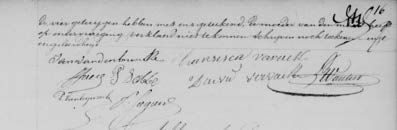
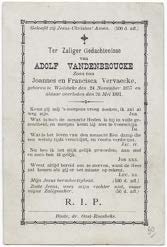
Figures 43.13 and 43.14 show the wedding of Jean Baptiste Van den Broucke and Francisca Sophia Vervaeke. Jean Baptiste was Mathilde’s father, who remarried after Mathilde’s mother, Victoria Verlinde, had died. Figure 43.15 shows the obituary card of Mathilde’s half-brother Adolf.
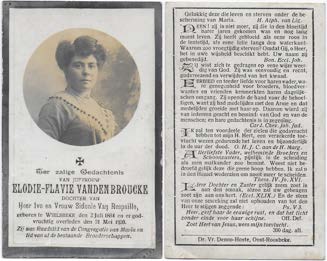
Figure 43.16 shows the obituary card of Mathilde’s half-cousin Elodie-Flavie, whose birth is shown in Figure 43.20.
Mathilde also had an uncle, Ivo, whose birth is shown in Figure 43.17.
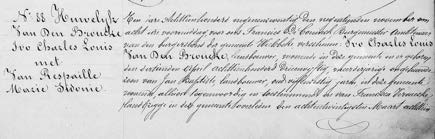
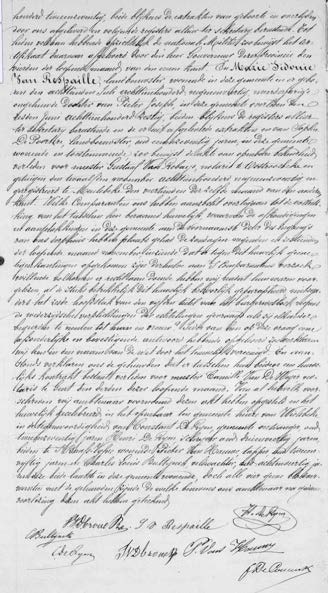
Her half-brother’s wedding is shown in Figures 43.18 and 43.19.
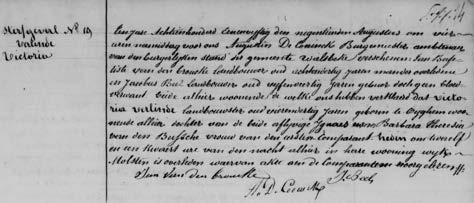
The parents of Mathilde Van den Broucke were Jean Baptiste Van den Broucke and Victoria Verlinde. Their marriage is shown in Figures 43.21 and 43.22. Victoria was the daughter of Ignace Verlinde, who died in Oostrozebeke on March 21, 1824. He also had a son with Barbe Thérèse Van den Bussche, Ignace Verlinde, born at Ooigem on September 2, 1808, who married Sophie Verbeke (born in Wielsbeke on June 6, 1815) in Wielsbeke on April 1, 1842. Barbe Thérèse Van den Bussche was born around 1770 and lived at Meulebeke in 1842. Victoria Verlinde died in 1851 at age 34, shown in Figure 43.24.
43.4 Their Marriage
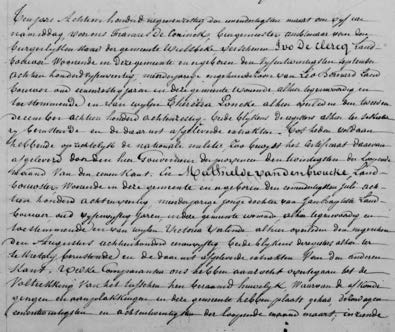
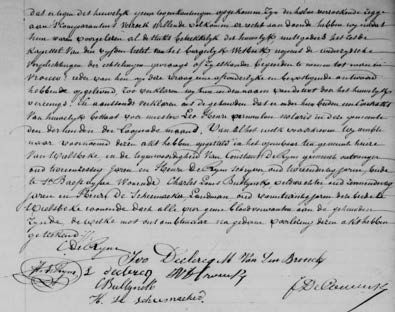
Ivo Declercq (DC13) and Mathilde Van den Broucke married in 1869 in Wielsbeke, Belgium, in Figures 43.25 and 43.26.
The groom was a farmer, born in Wielsbeke on September 25, 1845, and residing in Wielsbeke, unmarried son of Leo Bernard Declercq (DC12), a 61 years old farmer, living in Wielsbeke and present on the wedding; and of Thérèse Loncke, death at Wielsbeke on December 2, 1868. The groom had fulfilled his military duties.
The bride was a farmer, born in Wielsbeke on July 31, 1848, and residing in Wielsbeke, underaged and unmarried daughter of 55
years old farmer Jean Baptiste Van den Broucke, who lived in Wielsbeke and was present at the wedding, and of Victoria Verlinde, death in Wielsbeke on August 9, 1851.
The couple had a marriage contract with Leo Henri Vermeulen, notary at Wielsbeke. None of the witnesses was a blood relative.
43.5 Their Offspring
As mentioned early on in this chapter, Ivo Declercq (DC13) and Mathilde Van den Broucke were likely aware of the Spanish origins of the family. Apart from naming their farm after the Spanish government center Hof van Brussel and apart from the specificity of Ivo’s first name, they also ensured, by coincidence or not, that all the children had names containing such indications. Indeed, each child had a series of names, of which at least one started with M (Montblanc) or E (España). When we only consider the first two sons, we find M(ontblanc) E(spaña) and E(spaña) C(atalonia). It’s an observation, but we cannot know if it was also the parents’
intention. Nevertheless, it’s an exciting fact, and it is clear that names were repeated, which was intentional. The children were: The Desclergues of la Villa Ducal de Montblanc, 2nd ed., Omn., VOL. III
© 2024 Nico F. Declercq
722
CHAPTER 43. IVO DECLERCQ (DC13) & MATHILDE VAN DEN BROUCKE
Figure 43.8: Kuurne, October 13, 1909 (And copied as record 33, 1909 at Wiels-
beke), the death certificate of Ivo Declercq (DC13). The persons who reported the
death were Modest Declercq, 39-year-old farmer and son of Ivo, and Emile De-
man, a 42-year-old flax merchant. Ivo died on October 12 at the house of Modest
in Section B of Kuurne. He was a 64-year-old farmer, born in and resident of
Wielsbeke, son of Leo Bernard Declercq (DC12) and Thérèse Loncke, husband of
60-year-old farmer Mathilde Van den Broucke residing at Wielsbeke. Note that
no records have been found of any children of Modest, neither at Wielsbeke nor
at Kuurne, whence we assume that he remained childless and perhaps even never
married.
Figure 43.9: Wielsbeke, 1909 transcribed record 33 of Ivo’s death certificate in Ku-
urne.
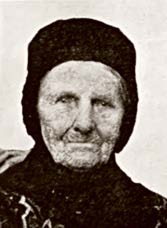
Figure 43.10: Barbara Theresia Van den Broucke. The picture was
taken on the occasion of her 100th birthday, in 1915, at Gaverken in
Waregem. She was Mathilde Van den Broucke’s auntie. The picture
was published in a local newspaper. The caption reads ’La Centenaire
de Waereghem - Mme veuve Verbeke, née Thérèse Van den Broucke,
originaire de Hulste. La commune de Waereghem, dont elle est pension-
naire, se prépare à fêter ses cent ans’ . Her husband Frederic Verbeke
had died in Waregem on June 21, 1897, at the age of 78. He was a
son of Pieter Anthone Verbeke and Sophie Vandenheede. (Declercq de
Silva Archive)
© 2024 Nico F. Declercq
The Desclergues of la Villa Ducal de Montblanc, 2nd ed., Omn., VOL. III
43.6. THE MANSION TEN BROUCKE IN WIELSBEKE
723
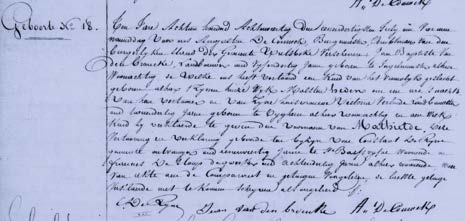
Figure 43.11: Wielsbeke, July 31, 1848, the birth certificate of Mathilde Van den Broucke,
daughter of 35-year-old farmer Jean Baptiste Van den Broucke, born in Ingelmunster and residing
at Wielsbeke, and 32-year-old farmer Victoria Verlinde, born at Ooigem and residing at Wielsbeke.
The child was born early morning at Molsten in Wielsbeke.
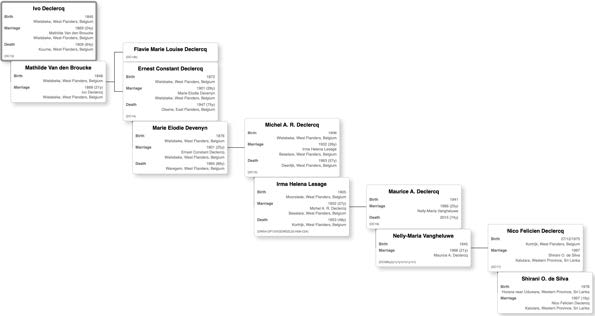
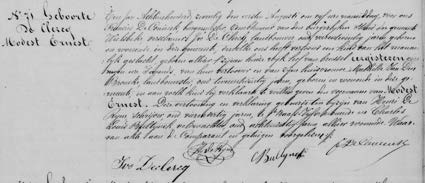
Modest Ernest Declercq (DC13c) was born in 1870 and shown in Figures 43.28 and 43.29. He became a farmer at Kuurne, but we found no indications that he ever married.
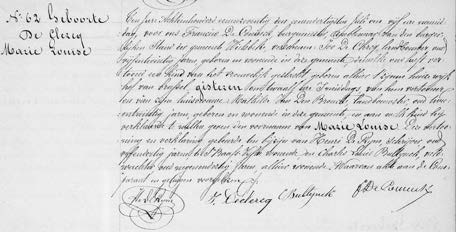
Marie Louise Declercq (DC13d) was born in 1871 in Figure 43.30. We have found no further trace of her and assume she became a religious sister.
Ernest Constant Declercq (DC13), born in 1872. He is our ancestor and married Marie Elodie Devenyn. We describe him in Chapter
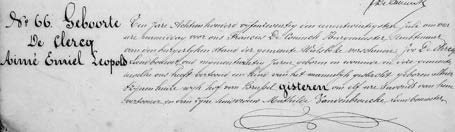
Aimé Emile Leopold Declercq (DC13e), born in 1875 in Figures 43.31 and 43.32. We have found no further trace and assume he may have become a priest. Furthermore, we have not found any military record of him, so perhaps he died at a young age.
Emile Alphons Declercq (DC13f), born in 1881. He died after ten months.
Elie Marie Mathilde Declercq (DC13g), born in 1883. She died after 11 months.
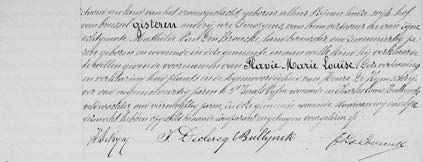
Flavie Marie Louise Declercq (DC13b) was born in 1886 and described in Chapter 44. She married, in 1912, Georges Van Haverbeke from Lauwe, and died in Ghent in 1926. George Louis Joseph Constant Van Haverbeke was a merchant born in Lauwe in 1880 and the son of Louis Joseph Van Haverbeke and Romanie De Brabandere. Her birth is shown in Figures 43.33 and 43.34.
Another observation is that Ivo and Mathilde frequently chose the names of Roman Emperors. In particular, the following emperors had exciting names in the context of their choices: Gaius Flavius Valerius Constantius (Emperor 305-306), Flavius Iulius Constantius, Flavius Iulius Constantius (Emperor 337-361), Flavius Claudius Constantius Gallus (Emperor 351-354), Flavius Constantius (Emperor 421). We should also remember father and son Ernesto Mansfeld (Peter Ernst I von Mansfeld and Peter Ernest II von Mansfeld), commanders of the Spanish armed forces in the 16th century. It required merely some interest in the topics and access to books to develop these names. Unfortunately, we cannot make time travel and ask.
43.6 The Mansion Ten Broucke in Wielsbeke
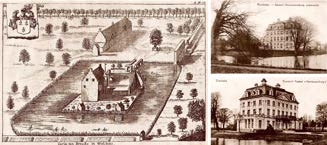
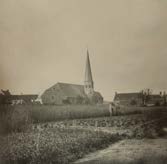
The castle Ten Broucke, depicted in Figure 43.35, is currently better known in Wielsbeke as the castle Hernieuwenburg.
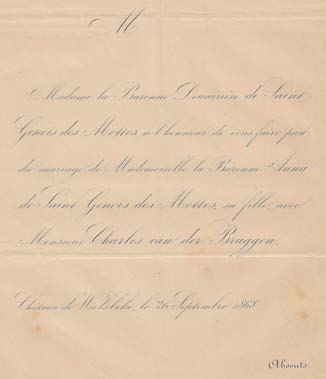
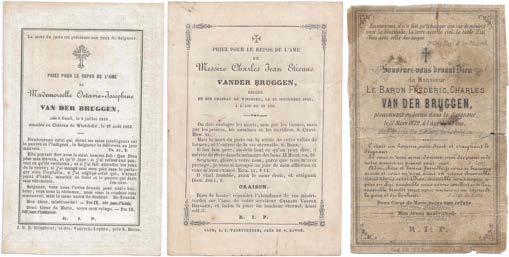
Ivo Declercq (DC13) and Mathilde Van den Broucke were well-acquainted with the Van der Bruggen family. Although the exact nature of their relationship remains unverified, extant documents confirm their acquaintance. There is also evidence of an association with Ghent, suggesting that the family occasionally engaged the services of a notary from Ghent or chose to reside or study there in subsequent generations. Consequently, it is reasonable to infer that the family visited the castle ’Ten Broucke’ in Wielsbeke occasionally.
Mathilde Van den Broucke likely descended from a family from the ’Ten Broucke’ estate. This manor held low jurisdiction and was feudally subordinate to the castle of Kortrijk and the Leenhof of Tielt. The ’Ten Broucke’ administration included a bailiff, an under-bailiff, a sergeant, and seven aldermen. Historical records indicate that Wouter van Harelbeke was the castle’s lord in 1359.
It later passed to the Uuten Zwane family, the lords of Wakken. In 1485, Joris van Crombrugghe acquired the manor. Sanderus’
Flandria Illustrata (1641-1644) references the estate asCuria Ten Broucken, owned by Mr. Ghiselbert Franciscus van Crombruggh.
Upon Frans de Crombrugghe’s death, his daughter married the knight Ildefons Van der Bruges in 1719, transferring the castle to the Van der Bruggen family. After a devastating fire destroyed the original castle, the family constructed a new one around 1780.
In the 1860s, Lord Frederic-Charles van der Bruggen renovated the castle’s southwestern extension and renewed the roof around 1870. In 1880, Maurice van der Bruggen further enlarged the castle. From 1895, the estate became the permanent residence of Baron Maurice van der Bruggen, who had previously been mayor of Wingene. From 1888, Baron van der Bruggen also served as a representative of the Catholic Party and, from 1899 to 1907, as Minister of Agriculture, National Health, and Fine Arts. The Van der Bruggen couple had no children. Subsequently, the heirs leased the castle to Catholic organizations, who renamed it
’Hernieuwenburg.’ Today, the castle serves as the town hall, and its grounds have been transformed into a recreational area.
Following World War II, Wielsbeke saw an influx of immigrants drawn by the village’s burgeoning textile and clay plate industries.
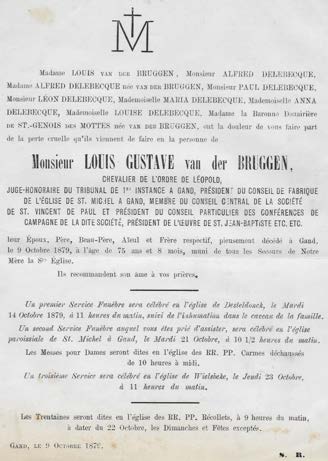
These newcomers, lacking familial ties to the village, exhibited little interest in preserving its history. As a result, much of the local historical knowledge has faded. Regrettably, many residents today are unaware of their village’s rich heritage. The Declercq family maintained a connection with the Van der Bruggen family, as evidenced by memorabilia shown in Figures 43.36, 43.37, and 43.38.
43.7 The Verriest Family
The family Verriest is primarily described in Chapter 42.8. Interested in culture and education, Ivo Declercq (DC13) must have visited Deerlijk, shown in Figure 43.39, and knew the Verriest family well. We show some memorabilia in Figures 43.40 and 43.41.
The Desclergues of la Villa Ducal de Montblanc, 2nd ed., Omn., VOL. III
© 2024 Nico F. Declercq
724
CHAPTER 43. IVO DECLERCQ (DC13) & MATHILDE VAN DEN BROUCKE
Figure 43.12: The obituary Card of Barbara Debou-
vere, wife of Amandus Van den Broucke and grand-
mother of Mathilde Van den Broucke. Barbara was born
in Meulebeke in 1788 and died in Hulste in 1868. (De-
clercq de Silva Archive)
43.8 Other Acquaintances
Memorabilia of other acquaintances are shown in Figure 43.42.
43.9 Ivo Declercq (DC13) was Well Established
We have described above that Ivo (DC13) had no siblings and was relatively wealthy. He invested money, was a farmer, was involved in textile fabrication and flax trade, and was well-connected. Indeed, the family of Van der Bruggen was not the only family he had relations with; Verriest and others were friends, too, even in Ghent. His investments must have reflected his vision of the modern economy. Two representative memorabilia are shown in Figure 43.43.
43.10
Were there Spanish Descendants Already in Wielsbeke?
We have not found conclusive evidence that Wielsbeke had Spanish persons among its inhabitants before the arrival of the Declercq family.
However, there is one interesting case that several genealogists have no clue about and may be of Spanish descent. It concerns Maria Hermenez. Her family name is unusual and may come from Ximenez. The traces we have found are shown in Figures 43.44,
On January 10, 1682, Adrianus de Corte was baptized, son of Ludovicus de Corte and Maria Hermine, with godparents Joannes Van Hoff and Anna Boesserie.
On November 29, 1715, Maria Magdalena was baptized, daughter of Ludovicus de Corte and Maria Anna Tack, with godparents Joannes Tack and Magdalena Tack, indicating that Ludovicus likely had no close relatives in Wielsbeke.
On April 21, 1756, Ludovicus de Corte was buried, son of Ludovicus de Corte and Maria Herminez and widower of Maria Anna Tack.
Although not proven, perhaps Herminez came from Ximenes and de Corte from Cortes. The families Van der Bruggen and Van Crombrugge, who resided in Wielsbeke and were acquainted with the Declercqs, often have foreign names in their godparents or other witnesses.
© 2024 Nico F. Declercq
The Desclergues of la Villa Ducal de Montblanc, 2nd ed., Omn., VOL. III
43.10. WERE THERE SPANISH DESCENDANTS ALREADY IN WIELSBEKE?
725
Figure 43.13: Lendelede, April 21, 1852, the wedding certificate of Jean Baptiste
Van den Broucke and Francisca Sophia Vervaeke. The groom was born at Ingelmun-
ster on June 30, 1813, and was a farmer residing in Wielsbeke. He was a widower
of Victoria Verlinde, who died in Wielsbeke on August 19, 1851. He was a son of
Amandus Franciscus Van den Broucke, who died in Hulste on July 21, 1838, and of
Barbara De Bouvere, a farmer who resided in Hulste and was present at the wedding.
The bride was born in Lendelede on May 31, 1821. She was a farmer and unmar-
ried daughter of Eugène David Vervaeke, a farmer at Lendelede and present at the
wedding, and Barbara Theresia Vandekerckhove. She died on October 12, 1831. The
couple had a marriage contract with Notary Wautier at Lendelede. (Sheet 1)
Figure 43.14: Lendelede, April 21, 1852, the wedding certificate of Jean Baptiste
Van den Broucke and Francisca Sophia Vervaeke. (Sheet 2)
The Desclergues of la Villa Ducal de Montblanc, 2nd ed., Omn., VOL. III
© 2024 Nico F. Declercq
726
CHAPTER 43. IVO DECLERCQ (DC13) & MATHILDE VAN DEN BROUCKE
Figure 43.15: The mortuary card of Adolf Van den Broucke, son
of Joannes Baptiste Van den Broucke and Sophia Francisca Vervaeke.
He was a half-brother of Mathilde Van den Broucke. (Declercq de Silva
Archive)
Figure 43.16: Wielsbeke May 31, 1920.
The mortuary card of Elodie-Flavie Van
den Broucke, the daughter of Ivo Charles
Louis Van den Broucke, who was a half-
brother of Mathilde Van den Broucke. Ivo
Van den Broucke was the son of Jean-
Baptiste Van den Broucke and of Sophia
Francisca Vervaeke. (Declercq de Silva
Archive)
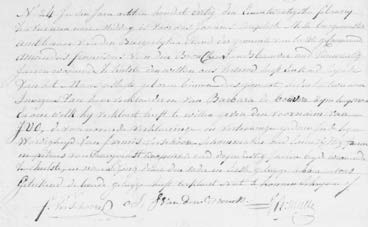
Figure 43.17: The birth certificate of Ivo Van den Broucke, uncle of Mathilde
Van den Broucke, born on February 21, 1830 at Hulste. He was a son of
farmer Amandus Franciscus Van den Broucke and of Barbara de Bouver. The
witnesses on the certificate were shoemaker Francis Verschoore from Hulste
(51 years old) and merchant Petrus Van Craeyenest from Hulste, 63 years
old.
© 2024 Nico F. Declercq
The Desclergues of la Villa Ducal de Montblanc, 2nd ed., Omn., VOL. III
43.10. WERE THERE SPANISH DESCENDANTS ALREADY IN WIELSBEKE?
727
Figure 43.18: Wielsbeke, November 19, 1879, the wedding certificate of Ivo Charles Louis
Van den Broucke, and Marie Sidonie Van Respaille. The groom was born on April 13,
1853, and was an unmarried farmer at Wielsbeke. He was a son of Jean Baptiste Van den
Broucke, a 65-year-old farmer at Wielsbeke, and Francisca Vervaeke, a farmer, who died in
Wielsbeke on March 28, 1872. The bride was a farmer, who lived in Wielsbeke and was born
in the village on July 18, 1849, daughter of Piere Joseph Vervaeke, who died at Wielsbeke
on June 6, 1860, and of Sophie Depoortere, a 71-year-old farmer who lived in Wielsbeke and
was present at the wedding. The couple had a marriage contract with notary Camille Van
de Weyer in Ghent. (sheet 1)
Figure
43.19:
Wielsbeke, November
19, 1879, the wedding certificate of Ivo
Charles Louis Van den Broucke, and
Marie Sidonie Van Respaille. (sheet 2)
The Desclergues of la Villa Ducal de Montblanc, 2nd ed., Omn., VOL. III
© 2024 Nico F. Declercq
728
CHAPTER 43. IVO DECLERCQ (DC13) & MATHILDE VAN DEN BROUCKE
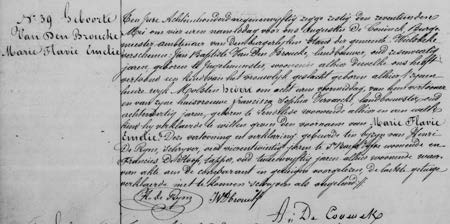
Figure 43.20: Wielsbeke, May 17, 1860 (the registrar corrected 1859 to 1860, see record 39
of the year 1860), the birth certificate of Marie Flavie Emelie Van den Broucke, daughter of
Jean Baptiste Van den Broucke, a 47-year-old farmer born at Ingelmunster and residing in
Wielsbeke. The mother was Francisca Sophia Vervaeke, 38-year-old farmer born in Lendelede
and residing in Wielsbeke. The child was born at home at Molsten in Wielsbeke.
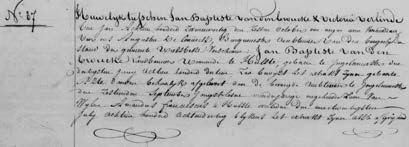
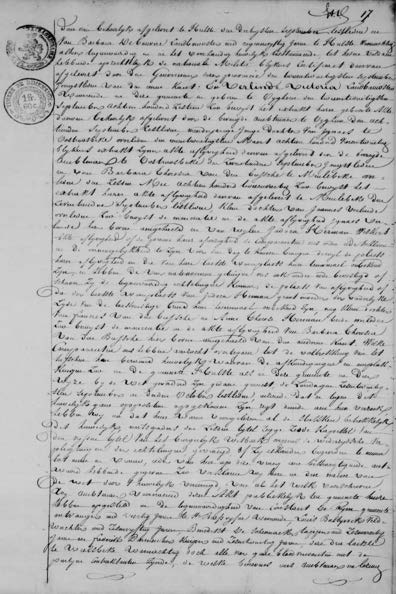
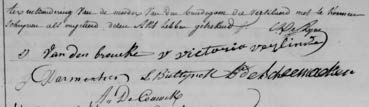
Figure 43.21: Wielsbeke, October 6, 1847, the wedding certificate of Jean Baptiste
Van den Broucke, a farmer from Hulste and born in Ingelmunster on June 30, 1813,
and Victoria Verlinde, a farmer in Wielsbeke and born at Ooigem on September 22,
1816. The groom was an unmarried son of Amandus Franciscus Van de Broucke, dead
at Hulste on July 21, 1838, and Barbara De Bouvere, a 59-year-old farmer in Hulste.
The groom had fulfilled his military duties. The bride was an unmarried daughter of
Ignace Verlinde, who died in Oostrozebeke on March 21, 1824, and of Barbara Theresia
Van den Bussche who died in Meulebeke on May 6, 1842. Along her father’s side, the
bride was also a granddaughter of Joannes Verlinde and Judoca Herman; and Francis
Van den Bussche and Anne Thérèse Herman along her mother’s side. (sheet 1)
© 2024 Nico F. Declercq
The Desclergues of la Villa Ducal de Montblanc, 2nd ed., Omn., VOL. III
43.10. WERE THERE SPANISH DESCENDANTS ALREADY IN WIELSBEKE?
729
Figure 43.22: Wielsbeke, October 6, 1847, the wedding certificate of Jean Baptiste
Van den Broucke and Victoria Verlinde. (sheet 2)
Figure 43.23: Wielsbeke, October 6, 1847, the wedding certificate of Jean
Baptiste Van den Broucke and Victoria Verlinde. (sheet 3)
The Desclergues of la Villa Ducal de Montblanc, 2nd ed., Omn., VOL. III
© 2024 Nico F. Declercq
730
CHAPTER 43. IVO DECLERCQ (DC13) & MATHILDE VAN DEN BROUCKE
Figure 43.24: Wielsbeke, August 19, 1851, the death certificate of Victoria Verlinde, 34-year-old
farmer, born at Ooigem and residing at Wielsbeke, daughter of earlier deceased Ignace Verlinde and
Barbara Theresia Van den Bussche. The death was reported by Jean-Baptiste Van den Broucke, a
38-year-old farmer, husband of the deceased and by his neighbor Jacques Beel, a 45-year-old farmer.
Victoria died at her home at ’Molsten’ in Wielsbeke.
Figure 43.25: Wielsbeke, March 31, 1869, the marriage certificate of Ivo Declercq
(DC13) and Mathilde Van den Broucke. (sheet 1)
Figure 43.26: Wielsbeke, March 31, 1869, the marriage certificate of Ivo Declercq
(DC13) and Mathilde Van den Broucke. (sheet 2)
© 2024 Nico F. Declercq
The Desclergues of la Villa Ducal de Montblanc, 2nd ed., Omn., VOL. III

43.10. WERE THERE SPANISH DESCENDANTS ALREADY IN WIELSBEKE?
731
Figure 43.27: Four generations of descendants of Ivo Declercq (DC13) and Mathilde Van den Broucke.
Figure 43.28: Wielsbeke, August 1, 1870, the birth certificate of Modest Ernest Declercq,
son of 24-year-old farmer Ivo Declercq (DC13), who was born and resided at Wielsbeke, and
of Mathilde Van den Broucke, a 27-year-old farmer who was born and living in Wielsbeke.
The child was born at Hof van Brussel the day before at 9 pm. As mentioned earlier,
Modest would become a farmer at Kuurne, but we have not found any records anywhere of
a marriage or offspring. Therefore, we assume that he was never married.
Figure 43.29: Military registration of Modest Ernest Declercq, in Levée de 1890, Milice Nationale, Province de la Flandre Occidentale, 42e Canton de Milice, Commune de Wielsbeke, liste de tirage. He was born in Wielsbeke on July 30, 1870 and was 163.5 cm tall. His father was Ivo Declercq, a farmer at Wielsbeke, and his mother was Mathilde Van den Broucke
The Desclergues of la Villa Ducal de Montblanc, 2nd ed., Omn., VOL. III
© 2024 Nico F. Declercq

732
CHAPTER 43. IVO DECLERCQ (DC13) & MATHILDE VAN DEN BROUCKE
Figure 43.30: Wielsbeke, July 21, 1871, the birth certificate of Marie Louise Declercq, daugh-
ter of 25-year-old farmer Ivo Declercq, born and residing at Wielsbeke, and Mathilde Van den
Broucke, 22 year old farmer, born and residing at Wielsbeke. The child was born the day before,
at noon, at Hof van Brussel. We found no further traces of her and assume that she became a
religious sister.
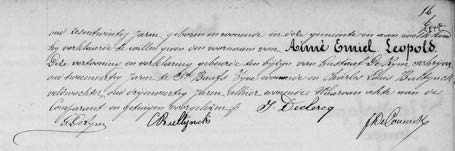
Figure 43.31: Wielsbeke, July 21, 1875, the birth certificate of Aimé Emile Leopold Declercq,
son of 29-year-old farmer Ivo Declercq (DC13), and of 26-year-old farmer Mathilde Van den
Broucke. The child was born at Hof van Brussel the night before (July 20). We have not found
any other document referring to him and therefore assume that he has become a priest. (sheet
1)
Figure 43.32: Wielsbeke, July 21, 1875, the birth certificate of Aimé Emile Leopold Declercq.
(sheet 2)
Figure 43.33: Wielsbeke, 1886, February 6, the first part of the birth certificate of Flavie Marie Louise Declercq (DC13b). Because she had an impact on Ernest Constant Declercq and his children, in particular for their education in Ghent, she is described in Chapter 44.
© 2024 Nico F. Declercq
The Desclergues of la Villa Ducal de Montblanc, 2nd ed., Omn., VOL. III
43.10. WERE THERE SPANISH DESCENDANTS ALREADY IN WIELSBEKE?
733
Figure 43.34: Wielsbeke, 1886, February 6, the second part of the birth certificate of
Flavie Marie Louise Declercq (DC13b).
Figure 43.35: The castle ’Ten Broucke’
in Wielsbeke as it used to be. Nowadays
it’s called ’Hernieuwenburg’ and looks as
in the two right photos.
Figure 43.36:
The wedding announce-
ment of Charles Van der Bruggen with
Anna de Saint Genois de Mottes, Septem-
ber 26, 1868. (Declercq de Silva Archive)
The Desclergues of la Villa Ducal de Montblanc, 2nd ed., Omn., VOL. III
© 2024 Nico F. Declercq
734
CHAPTER 43. IVO DECLERCQ (DC13) & MATHILDE VAN DEN BROUCKE
Figure 43.37: The death announcement
of Louis Gustave Van der Bruggen on Oc-
tober 9, 1879. (Declercq de Silva Archive)
Figure 43.38: From left to right, we show mortuary cards of the following persons. Octavie Josephine Van der Bruggen, August 27, 1863. Charles Jean Etienne Vander Bruggen. He died in Wielsbeke in 1843 at the age of 69. Frederic Charles Van der Bruggen, who died on March 17, 1872. (Declercq de Silva Archive)
Figure 43.39: This is a picture of the Saint Columba church Deerlijk,
taken around 1868. It is a restoration made by Amand and Sabine
Deknudt, based on a stereo image on glass, donated by AloDel to the
archives of Leon Defraeye in Deerlijk nr 10.209. The picture also ap-
peared in Derlike XXXVIII, 1 (2015) p.27. Courtesy of ’Heemkring
Dorp en Toren’ , Leon Defraeye, AloDel and the Deknudt family. Der-
like referred to this picture as the oldest known photographic image of
Deerlijk.
© 2024 Nico F. Declercq
The Desclergues of la Villa Ducal de Montblanc, 2nd ed., Omn., VOL. III
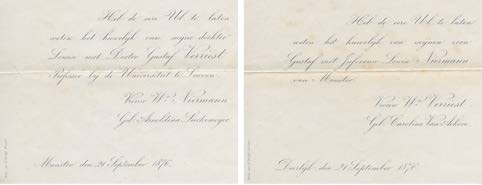
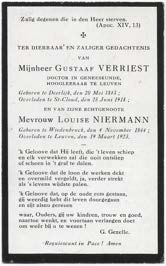
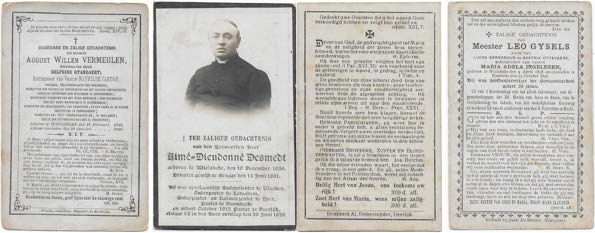
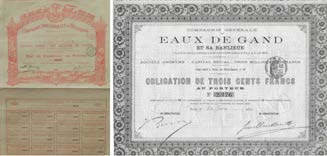
43.10. WERE THERE SPANISH DESCENDANTS ALREADY IN WIELSBEKE?
735
Figure 43.40: Wedding announcements, in 1876, of Gustaaf Verriest and Louise Niermann. (De-
clercq de Silva Archive)
Figure 43.41: The obituary card of Gustaaf Verriest, a professor at
Leuven University who died in 1918, and of his wife Louise Niermann,
who died in 1923. (Declercq de Silva Archive)
Figure 43.42: From left to right, we show the obituary cards of the following persons. August Willem Vermeulen, widower of Delphine Standaert and husband of Mathilde Carton. He was the notary at Wielsbeke and died in 1880. Priest Aimé Dieudonné Desmedt from Wielsbeke. He was born in 1856, became a priest in 1881 and died in Deerlijk in 1920. Leo Gysels, a teacher who was born in Wielsbeke in 1838. He was the husband of Maria Adela Ingelbeen, and he died in 1896 in Rumbeke.
(Declercq de Silva Archive)
Figure 43.43: Shares of Compagnie In-
dustrielle de Belgique, 1898, and Eaux de
Gand, 1880. (Declercq de Silva Archive)
The Desclergues of la Villa Ducal de Montblanc, 2nd ed., Omn., VOL. III
© 2024 Nico F. Declercq
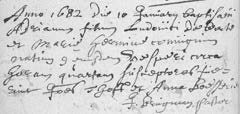
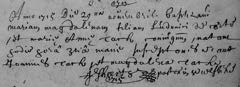
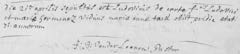
736
CHAPTER 43. IVO DECLERCQ (DC13) & MATHILDE VAN DEN BROUCKE
Figure 43.44: Wielsbeke, January 10, 1682, Adrianus
de Corte was baptized, son of Ludovicus de Corte and
Maria Hermine, with godparents Joannes Van Hoff and
Anna Boesserie. This document is discussed in Chapter
43.10, in which we show a possible Ximenes – Cortes
family appearing in Wielsbeke.
Figure 43.45: Wielsbeke, November 29, 1715, Maria
Magdalena was baptized, daughter of Ludovicus de Corte
and Maria Anna Tack, with godparents Joannes Tack
and Magdalena Tack, indicating that Ludovicus likely
had no close relatives in Wielsbeke. This document is
discussed in Chapter 43.10, in which we show a possible
Ximenes – Cortes family appearing in Wielsbeke.
Figure 43.46: Wielsbeke, April 21, 1756, Ludovicus de
Corte was buried, son of Ludovicus de Corte and Maria
Herminez and widower of Maria Anna Tack. This docu-
ment is discussed in Chapter 43.10, in which we show a
possible Ximenes – Cortes family appearing in Wielsbeke.
© 2024 Nico F. Declercq
The Desclergues of la Villa Ducal de Montblanc, 2nd ed., Omn., VOL. III
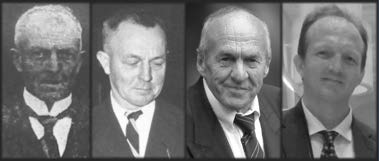
Chapter 44
Ernest Constant Declercq (DC14) & Marie Elodie
Devenyn
44.1 Introduction
From this chapter onward, we enter the era of photography. To compare the faces of four generations of Desclerqs, we present Figure 44.1.
Ernest Constant Declercq (DC14) is a patrilineal ancestor who, with his wife, Marie Elodie Devenyn, was the kind of farmer who dwelled prosperously but was not opulent. The couple spent much of their resources and energy on their children’s education, reading books, and other cultural activities.
To a large extent, we can compare them to the Verriest family from Deerlijk.
Most of their children were daughters, but they received equal opportunities as the boys, which was quite extraordinary then.
44.2 Ernest Constant Declercq (DC14)
Ernest Constant Declercq (DC14) also appears in Chapter 66.1 as the great-great-grandson of Barbara Benoit.
44.2.1 His Birth, Military Service and Death
He was born on July 28, 1872, at 3 am, in Figure 44.2, in Wielsbeke, Belgium, at Hof van Brussel, as the son of Ivo Declercq (DC13) and Mathilde Van den Broucke. Ivo Declercq was a son of Leo Bernard Declercq (DC12) and Thérèse Loncke.
As a young man, Ernest Constant Declercq (DC14) has been a Belgian military, as seen in Figure 44.3.
He died in Olsene in 1947, shown in Figures 44.4 and 44.5.
He married Marie Elodie Devenyn in 1901 at Wielsbeke.
He was a farmer. His farm was called Hof van Brussel and was located in nowadays ’Reynaertstraat’ in Wielsbeke. The name of his farm referred to the Palace in Brussels located at Coudenberg and is, therefore, a reference to the early history of the Desclergues in Belgium, as described earlier.
Before the industrialization after WWII, Wielsbeke was a small cosy village with several peculiar landmarks as shown in Figure
44.2.2 The Ancestry of Ernest Constant Declercq
His ancestry is provided in Figure 44.7.
44.2.3 Blood-Relatives of Ernest Constant Declercq
We refer to Chapter 43.5 for detailed information about Ernest Constant Declercq’s (DC14) siblings.
Of his siblings who have survived childhood, we can mention two with whom there existed contact and two of which we have not retrieved a single document.
The former are Modest Ernest Declercq (DC13c), born in 1870, and Flavie Marie Louise Declercq (DC13b), born in 1886.
The latter two are Marie Louise Declercq (DC13d), born in 1871, and Aimé Emile Leopold Declercq (DC13e), born in 1875.
The two missing persons have either died and were not correctly registered or have become religious clergy. Otherwise, they never married and were never involved in the family’s official administrative events, or perhaps they migrated to another country. We don’t know. Future research may shine a light on their destiny.
Figure 44.1: From left to right, four generations of Declercq, i.e. Ernest Con-
stant Declercq, Michel Achiel Renatus Declercq, Maurice Alois Declercq and Nico
Felicien Declercq. (Declercq de Silva Archive)
The Desclergues of la Villa Ducal de Montblanc, 2nd ed., Omn., VOL. III
© 2024 Nico F. Declercq
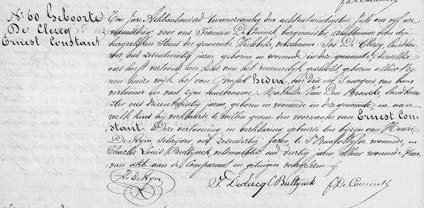
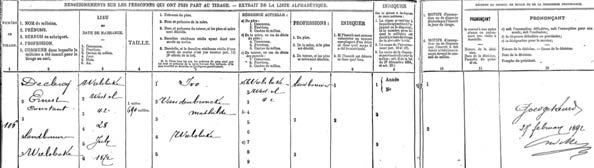
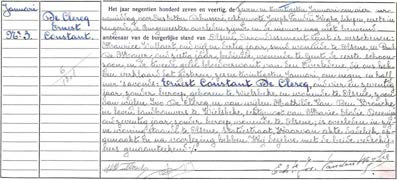
738
CHAPTER 44. ERNEST CONSTANT DECLERCQ (DC14) & MARIE ELODIE DEVENYN
Figure 44.2: 1872, Wielsbeke, the birth certificate of Ernest Constant Declercq (DC14).
He was born on July 28, 1872 in Wielsbeke at ’Hof van Brussel’ , at 3 am. His father,
Ivo Declercq (DC13), was a 26-year-old farmer at Wielsbeke, born in the village. The
mother was Mathilde Van den Broucke, a 23-year-old farmer, equally born in Wielsbeke.
Interestingly, the registrar writes the family name in two words, while Ivo signed as ’I.
Declercq’ .
Figure 44.3: Registration of Ernest Constant Declercq as a military on February 27, 1892, Milice Nationale, Province de la Flandre Occidentale, 42e Canton de Milice, Commune de Wielsbeke, Liste de Tirage, nr 106. He was a farmer at Wielsbeke, born there on July 28, 1872, was 169 cm tall, son of Ivo Declercq and Mathilde Van den Broucke.
Figure 44.4: The death certificate of Ernest Constant Declercq. He died on January
26, 1947, in Olsene, at 9:30 pm. The death was reported by his 35-year-old son-in-
law Maurice Wullaert. Ernest Constant had reached the age of 74 and lived in
Olsene when he died. He was a son if Ivo Declercq and Mathilde Van den Broucke,
and had been a farmer at Wielsbeke. He was the husband of 70-year-old Marie Elodie
Devenyn, who equally lived in Olsene.
© 2024 Nico F. Declercq
The Desclergues of la Villa Ducal de Montblanc, 2nd ed., Omn., VOL. III
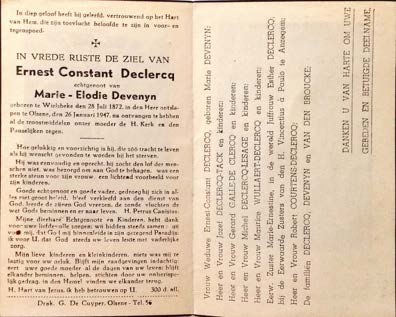
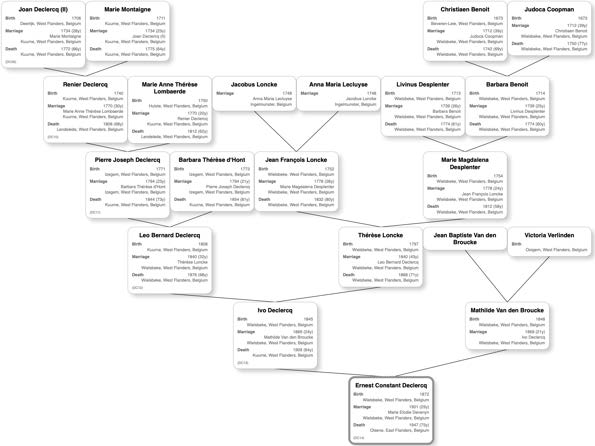
44.2. ERNEST CONSTANT DECLERCQ (DC14)
739
Figure 44.5: The obituary card of Ernest Constant Declercq, husband of Marie
Elodie Devenyn, Olsene, January 26, 1872. (Declercq de Silva Archive)
Figure 44.6: Commemorative dishes of Wielsbeke, depicting ’Het Geldhof ’ , ’De Sint Lauren-
tiuskerk’ ,’ Het Dorpsplein’ and ’De Pastorij’ . (Declercq de Silva Archive)
Figure 44.7: Five ascending generations of Ernest Constant Declercq (DC14).
The Desclergues of la Villa Ducal de Montblanc, 2nd ed., Omn., VOL. III
© 2024 Nico F. Declercq

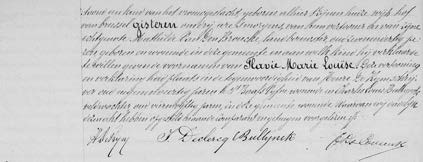
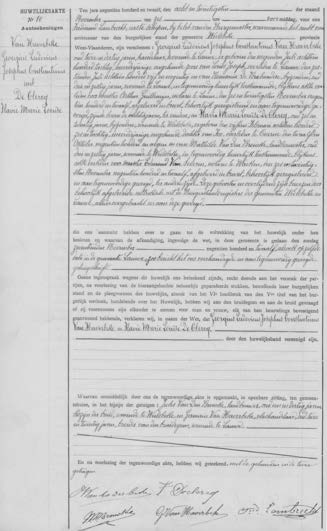
740
CHAPTER 44. ERNEST CONSTANT DECLERCQ (DC14) & MARIE ELODIE DEVENYN
Figure 44.8: Wielsbeke, 1886, Febuary 6, first part of the birth certificate of Flavie
Marie Louise Declercq (DC13b). Her father was 40-year-old farmer Ivo Declercq,
born and living at Wielsbeke. Flavie was born at Hof van Brussel on February 5,
at 3 am. Her mother was 37 year old farmer Mathilde Van den Broucke, born and
living at Wielsbeke.
Figure 44.9: Wielsbeke, 1886, Febuary 6, second part of the birth certificate
of Flavie Marie Louise Declercq (DC13b).
Figure
44.10:
Wielsbeke, November
28, 1912, the marriage of Flavie Marie
Louise Declercq with Georges Louis Joseph
Constant Van Haverbeke.
The groom,
Georgius Ludovicus Josephu Constantinus
Van Haverbeke, was a 32-year-old mer-
chant, born and residing at Lauwe. His
birthday was on July 9, 1880. His parents
were Louis Joseph, who died at Lauwe on
July 16, 1895, and 63-year-old Romanie
de Brabandere, who witnessed the wedding.
The groom’s notary was Arthur Guillemyn
in Lauwe. The bride, Flavie Marie Louise
Declercq, was 26 years old. She was born
and residing at Wielsbeke. Her birthday
was on February 5, 1886. Her father was
Ivo Declercq, who died at Kuurne on Octo-
ber 12, 1909, and her mother was Mathilde
Van den Broucke, a 63-year-old farmer liv-
ing in Wielsbeke, present and agreeing with
the wedding. The bride’s notary was Ed-
mond Van Severen in Wakken.
© 2024 Nico F. Declercq
The Desclergues of la Villa Ducal de Montblanc, 2nd ed., Omn., VOL. III
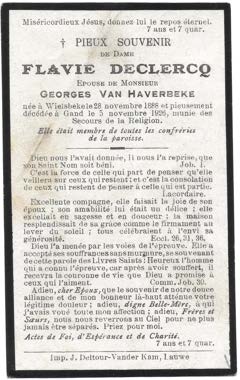
44.3. MARIE ELODIE DEVENYN
741
Figure 44.11: The obituary card of Flavie Declercq.
She died childless in Ghent on November 5, 1926, at the
age of 40. The given information suggests that her sister
Marie Louise Declercq may still have been alive, although
we can’ t distinguish whether the text refers to her siblings
or those of her husband. (Declercq de Silva Archive)
We know that Modest Ernest Declercq (DC13c) was a farmer at Kuurne, but no documents reveal any marriage. Likely, he never married.
Flavie Marie Louise Declercq (DC13b) married Georges Van Haverbeke from Lauwe, and she died in Ghent in 1926. We do not have much information about her either, but we assume that it was thanks to her that Michel Declercq (DC15) resided in Ghent during his education, as seen in Chapter 45.1.3. Figures 44.8 and 44.9 show the birth certificate of Flavie Declercq (DC13b).
Figure 44.10 shows her marriage, while Figure 44.11 shows her obituary card. She died in Ghent in 1926 at 40 and had no children.
Flavie Marie Louise Declercq married Georges Louis Joseph Constant Van Haverbeke in 1912. Her husband was a 32-year-old merchant, born and residing at Lauwe. His birthday was on July 9, 1880. His parents were Louis Joseph, who died at Lauwe on July 16, 1895, and 63-year-old Romanie de Brabandere, who witnessed the wedding. The groom’s notary was Arthur Guillemyn in Lauwe. The bride’s notary was Edmond Van Severen in Wakken.
Privacy concerns make it challenging to research relatives in the 20th century when an obituary card is sometimes the only information on which to count. Anyone continuing this research half a century from now should have full access to all the documents and fill the gaps in our current knowledge and understanding.
44.3 Marie Elodie Devenyn
44.3.1 Introduction
For all we know, Marie Elodie is remembered by her grandchildren as a strong grandmother who firmly held the families strings.
She can be seen in Figure 44.12.
44.3.2 Her Birth and Death
She was born in 1876 in Wielsbeke and was a farmer, in Figures 44.13 and 44.14, as the daughter of Leopold Devenyn and Ursula Vereecke. She was an only child. Marie Elodie Devenyn is equally referred to in the Chapter 66.1 because her husband was a great-great-grandson of Barbara Benoit. Marie Elodie Devenyn was Ernest Constant Declercq’s wife and the author’s great-grandmother.
She married in 1901 and died in 1965 in Waregem. She was very emancipated, and she ensured, with her husband, that all her children, including her daughters, would have a good education. She died in 1965 in Waregem, in Figures 44.15 and 44.16. The death was declared to the registrar by 71-year-old Arthur Vanhoutteghem and 33-year-old Godfried Demey, both neighbors of the place of death. Marie Elodie died at Nijverheidsstraat 85 in Waregem, while her residence was Statiestraat 85 in Olsene. The street has been renamed Zeswegenstraat and Muizelstraat.
The address Muizelstraat 85 is where the author attended high school from 1989 to 1993 (Koninklijk Atheneum, Waregem).
According to witnesses, the name has changed, but not the house numbers. If so, she died 200 m from the home of her daughter Judith, who lived on the same street across from the junction, near the church ’Gaverke,’ at the current address designation
’Zeswegenstraat 93’ . An image is shown in Chapter 44.5.8.
Another witness claims that number 88 is 108 now (in Zeswegenstraat). If so, then the former number 85 is likely the current number 93, meaning that Marie Elodie Devenyn must have died at the home of Judith Declercq and Robert Courtens, shown in Chapter 44.5.8.
The family bond creeps through time and distance, even when paths do not directly intersect. The author attended high school between 1989 and 1993, merely 200 meters from Judith’s home. During those formative years, they remained strangers, the author unaware of their profound connection.
Yet, as life unfolded its intricate narrative, Judith, with quiet dedication, began to trace the lines of the author’s journey. She meticulously collected every piece of information she could find, cherishing his appearances in newspapers and celebrating his research and career from afar.
It is often said that the blood always creeps where it cannot go, and in this tale, it rings true. Unseen and unnoticed, the family The Desclergues of la Villa Ducal de Montblanc, 2nd ed., Omn., VOL. III
© 2024 Nico F. Declercq
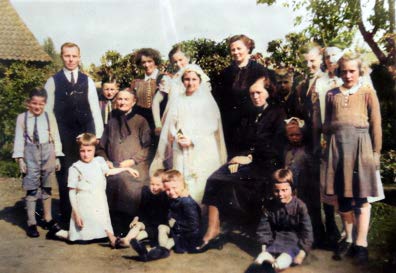
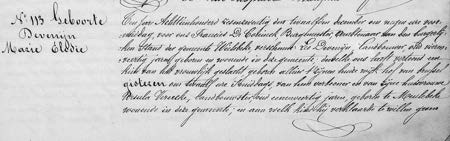
742
CHAPTER 44. ERNEST CONSTANT DECLERCQ (DC14) & MARIE ELODIE DEVENYN
Figure 44.12: Wielsbeke, May 10, 1945. The image was taken on the occasion of
the confirmation of Agnes Declercq. Marie Elodie is seated next to Michel Declercq
(DC15). MyHeritage® colorized this photo. (Declercq de Silva Archive)
Figure 44.13: Wielsbeke, December 12, 1876, the birth certificate of Marie Elodie Devenyn
(part 1). At midday, she was born on December 11, near the farm of the Declercqs in the
suburb called ’Hof van Brussel’ after the farm of Declercq. Possibly her parents were Declercq’s
neighbors. Her father was 44-year-old farmer Leo Devenyn, who was born and residing at
Wielsbeke. Her mother was 41-year-old farmer Ursula Vereecke, born in Meulebeke and living
in Wielsbeke.
bond perseveres, finding its way through unseen channels and unspoken words. Judith’s careful watch over the author and her unwavering interest in his achievements speak to the enduring strength of familial ties. These ties, though unseen, form a silent current, connecting hearts and souls across the years and miles. It appears that in the quiet corridors of time, the family bond remains a beacon, illuminating the paths of those connected by blood, even when unaware of the intricate dance of destiny that binds them.
44.3.3 Life and Blood-Relatives of Marie Elodie Devenyn
Marie Elodie was a daughter and only child of Leopold Devenyn and Ursula Vereecke. Leopold Devenyn was a son of Pierre Francois Devenyn and Sophie Derijcke, whose wedding is shown in Figure 44.17; he was born in 1832, and he died at Wielsbeke in 1895; he had roots in Otegem, Zwevegem, Wortegem, and Anzegem.
Ursula Vereecke was a farmer, born at Meulebeke in 1836 as the daughter of Pierre Vereecke, who died in the year that Ursula was born and had roots in Meulebeke and of Thérèse Vermeulen, with roots in Oostrozebeke. Ursula died in Wielsbeke in 1910.
Marie Elodie Devenyn, a woman of remarkable fortitude and foresight, faced profound personal losses early in life. She lost her father at the age of 19 and her mother at the age of 34.
She married at 25 after living alone with her mother, Ursula Vereecke, for six years. Ursula was raised without a father, which influenced Marie Elodie’s character and determination. Their home was near Declercq, Hof van Brussel, in Wielsbeke.
Marie Elodie’s early experiences likely instilled a deep resolve to ensure her children received the best possible education. She was forward-thinking and devoted to planning and preparing for the future. Despite her challenges, she was unwavering in her commitment to her children’s education, treating her sons and daughters equally in academics, a progressive stance for her time.
During the severe economic crisis of the 1930s in Belgium, Marie Elodie continued to invest in her children’s education, even utilizing funds from her son, Michel Declercq, and his wife, Irma Lesage. The outbreak of WWII made it challenging to repay this debt.
Still, Marie Elodie honored her commitments by selling her farm in Wielsbeke after the war, ensuring all her children had completed their education and the borrowed money was returned.
In the post-war period, on April 23, 1945, Marie Elodie moved with Ernest Constant Declercq to Olsene, Statiestraat 100, near her daughter Rachelle Declercq.
Following Ernest Constant’s death in 1947, she moved again, likely to her daughter’s residence in Waregem. The family’s movements, including the farm sale, were possibly influenced by deteriorating health and the practicalities of managing family assets. Judith Declercq looked after her.
After being repaid, Michel Declercq and Irma Lesage built a beautiful home in Deerlijk for their large family.
A photograph from this period, in Figure 44.12, taken during the confirmation of their eldest daughter, Agnes Declercq, features
© 2024 Nico F. Declercq
The Desclergues of la Villa Ducal de Montblanc, 2nd ed., Omn., VOL. III
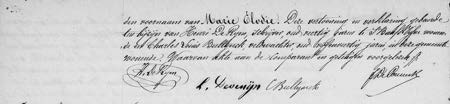
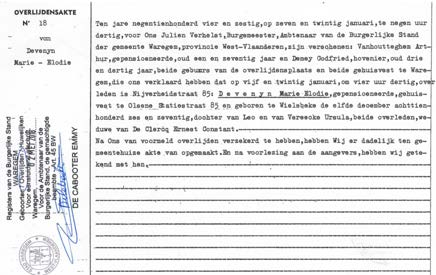
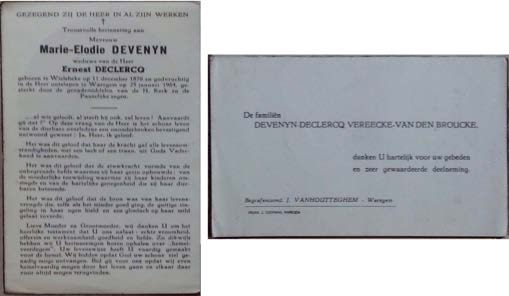
44.3. MARIE ELODIE DEVENYN
743
Figure 44.14: Wielsbeke, December 12, 1876, the birth certificate of Marie Elodie Devenyn
(part 2).
Figure 44.15: The death certificate of Marie Elodie Devenyn, Waregem, January 25, 1964.
She was born at Wielsbeke on December 11, 1876, the daughter of Leo Devenyn and Ursula
Vereecke, and she was the widow of Ernest Constant Declercq.
Figure 44.16: The obituary card of Marie Elodie Devenyn, widow of Ernest Constant Declercq, January
25, 1964, half a year after her son’s Michel Declercq (DC15) death. (Declercq de Silva Archive)
The Desclergues of la Villa Ducal de Montblanc, 2nd ed., Omn., VOL. III
© 2024 Nico F. Declercq
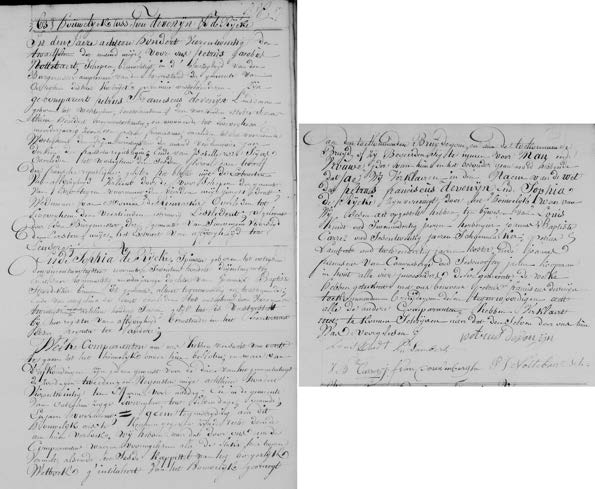
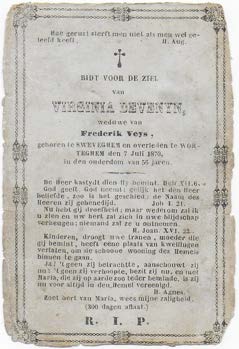
744
CHAPTER 44. ERNEST CONSTANT DECLERCQ (DC14) & MARIE ELODIE DEVENYN
Figure 44.17: Otegem, May 12, 1824, the wedding of Pierre François Devenyn and Sophia Derycke. The groom was a farmer, born at Wortegem on October 14, 1789. He lived in Zwevegem and was a son of Pierre François Devenyn (Senior), who died in Wortegem on October 15, 1804, and Isabelle Rose Seyns, who died in Wortegem on April 26, 1804. The groom was a widower of Monica Deriemacker, who died in Zwegevem on February 14 (Saint Valentine’s day) in 1823. The bride was Sophia Derycke, born in Otegem on November 24, 1793. She was the daughter of Jean Baptiste Derycke from Otegem and Angelina Desmet, who died at Otegem on November 24, 1897. The witnesses were Louis Kindt, 37 years old, a barkeeper at Otegem; Jean Baptiste Carrez, a 25-year-old shoemaker from Otegem (he must have been a competitor of the Den Dauw family appearing in Chapter 67); Pierre Lambert, a 32-year-old sexton; and Jean François Vancauwenberghe, a 56-year-old timber wood merchant from Otegem.
Figure 44.18: Wortegem, 1870. The obituary card of
Virginia Devenyn. She was a half-sister of Leo Devenyn
and hence a half-auntie of Marie-Elodie Devenyn. Vir-
ginia Devenyn was a half-grand-auntie of Michel A. R.
Declercq (DC15). (Declercq de Silva Archive)
© 2024 Nico F. Declercq
The Desclergues of la Villa Ducal de Montblanc, 2nd ed., Omn., VOL. III
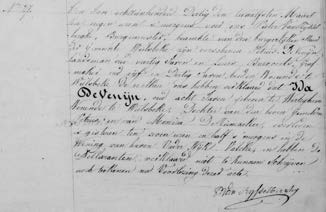
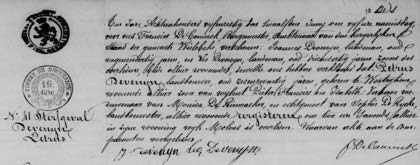
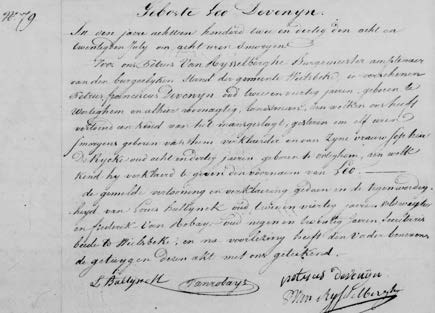
44.3. MARIE ELODIE DEVENYN
745
Figure 44.19: Wielsbeke, 1830, the death
of Ida Devenyn, a half-sister of Leopold
Devenyn. The family lived in the area of
’Valcke’ in Wielsbeke at that time, which
is now ’Ridder de Ghelinkstraat’ and near
the farm ’Hof van Brussel’ of Declercq.
Figure 44.20: Wielsbeke, June 10, 1865, the death of Pierre François (’Petrus’) De-
venyn, grandfather of Marie Elodie. He was a 76-year-old farmer who lived in Wielsbeke
and who was born in Wortegem. His parents were Pierre François Devenyn and Isabelle
Rose Seyns (the registrar wrote ’Isabelle Verhenne’ , but we have several records to prove
it was ’Seyns’). His wife was Sophie Derycke, and his former wife, Monica Deriemacker.
He died at his home at 10 pm in the suburb called ’Molens’ . The death was reported by
his sons and farmers, 39-year-old Jean Devenyn and 33-year-old Leo Devenyn.
Figure 44.21: Wielsbeke, July 28, 1832, birth of Leo Devenyn. His father was a 42-year-old
farmer, Pierre François Devenyn, born at Wortegem and living in Wielsbeke. His mother
was 38-year-old Sophie Derycke, born in Wortegem.
The Desclergues of la Villa Ducal de Montblanc, 2nd ed., Omn., VOL. III
© 2024 Nico F. Declercq
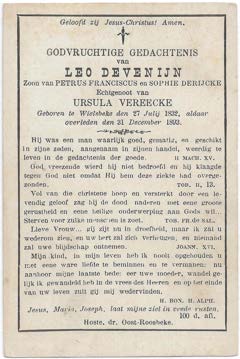
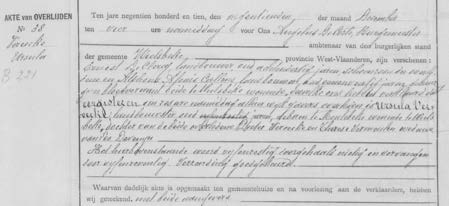
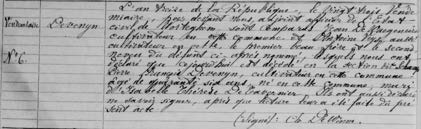
746
CHAPTER 44. ERNEST CONSTANT DECLERCQ (DC14) & MARIE ELODIE DEVENYN
Figure 44.22: The obituary card of Leo Devenyn. He
died in Wielsbeke in 1893 at the age of 61 and was the
father of only-child Marie Elodie Devenyn. (Declercq de
Silva Archive)
Figure 44.23: Wielsbeke, December 17, 1910, the death of Ursula Vereecke, wife of Leo De-
venyn and mother of Marie Elodie Devenyn. 38-year-old farmer Ernest Constant Declercq
(DC14) and 41-year-old farmer Alphons Alouis Callens reported her death. Ursula died at 6
pm. She lived in the suburb called ’Gavers’ , a 75-year-old farmer, born in Meulebeke and
daughter of Pieter Vereecke and Thérèse Vermeulen, and she was the widow of Leo Devenyn.
Figure 44.24:
The death certificate of farmer Pierre François Devenyn, great-
grandfather of Marie-Elodie Devenyn, at Wortegem, on October 15, 1804. He was a
farmer and lived in the area called ’Schamp’ in Wortegem. He was 46 years old, was
born in Wortegem, and married Isabelle Thérèse de Tavernier. The death was reported by
farmers Jean De Wageneire and Antoine Veys, brother-in-law, respectively nephew of the
deceased. From the other certificates shown above, we must conclude that this incomplete
certificate, which does not mention his parents, also does not mention that this concerns
his second wife. In contrast, his first wife was Isabelle Rose Seyns.
© 2024 Nico F. Declercq
The Desclergues of la Villa Ducal de Montblanc, 2nd ed., Omn., VOL. III
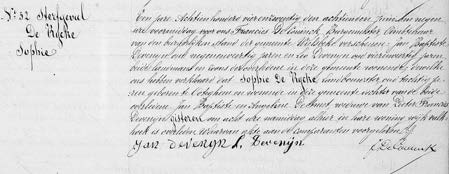
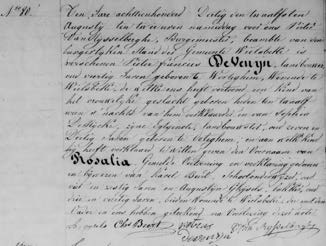
44.4. THEIR MARRIAGE
747
Figure 44.25: Wielsbeke, June 17, 1874, the death of 80-year-old farmer Sophie Derycke,
grandmother of Marie Elodie Devenyn. The death was reported by her sons, 49-year-old farmer
Jean Baptiste Devenyn and 44-year-old farmer Leo Devenyn. Sophie Derycke was born in
Otegem and lived in Wielsbeke. Her parents were Jean Baptiste Derycke and Angeline Desmet.
She was the widow of Pierre François Devenyn. She died at her home in the suburb called
’Valkhoek’ , which is nowadays Ridder de Ghelinckstraat, not far from ’Hof van Brussel.’
Figure 44.26: Wielsbeke, 1830, the birth
of Rosalie Devenyn, sister of Leo Devenyn.
several family members: Agnes in her white dress, with her grandmother Marie Elodie Devenyn to her right, her mother Irma Lesage to her left, and her father Michel Declercq standing beside Maria. Seated in front is Maurice Declercq, close to his grandmother, Marie Elodie.
Marie Elodie Devenyn’s life was marked by resilience, dedication, and an unwavering commitment to the well-being and education of her children. Her legacy is one of honor and inspiration, reflecting the values of perseverance and equality that she so diligently upheld.
We show the marriage certificate of her grandparents, Pierre Francois Devenyn and Sophie Derycke, in Figure 44.17. Note that Pierre François Devenyn’s first wife, Monique Deriemackere, was born in Zwevegem on July 28, 1783, and he married her at Anzegem on September 9, 1814.
When Pierre François Devenyn married Isabelle Rose Seyns, he already had several children: Leo Devenyn, born in Zevegem who died at Wielsbeke on November 19, 1827, at the age of 9; Pierre Devenyn, born in Zwevegem who died on November 23, 1827, at the age of 10; Ida Devenyn, born in Wortegem, who died in Wielsbeke on March 12, 1830 at the age of 8 in Figure 44.19; Virginie Devenyn, who married Frederic Veys at Wielsbeke on October 1, 1841 and whose obituary is shown in Figure 44.18; Amelie Devenyn who married Jean Lapierre at Wielsbeke on April 28, 1854; Joseph Devenyn, who married Rosalie Veys at Sint-Baafs-Vijve on July 20, 1861; and Amelie Devenyn, born in Zwevegem, who died in Wielsbeke at the age of 80 on November 18, 1900.
Pierre François Devenyn, the grandfather of Marie Elodie, died at Wielsbeke in 1865 in Figure 44.20. He lived in the area ’Molens’
in Wielsbeke and was born in Wortegem.
Figure 44.21 shows the birth certificate of Leo Devenyn, father of Marie-Elodie, at Wielsbeke in 1832. Given the many deaths in the family at that time, as mentioned above, it must have been a challenging period for the family.
Leo Devenyn’s obituary is shown in Figure 44.22.
Ursula Vereecke, Leo Devenyn’s wife and Marie Elodie’s mother, died in Wielsbeke in 1910 in Figure 44.23. She was a farmer and lived in ’Gavers’ in Wielsbeke at 1 km from Hof van Brussel, where the Declercqs lived.
Figure 44.24 shows the death certificate of Pierre François Devenyn. He had a son, Pierre François Devenyn, grandfather of Marie Elodie Devenyn, and son of Isabelle Rose Seyns (who died in Wortegem in 1804).
Sophie Derycke, Marie Elodie’s grandmother and Pierre Francois Devenyn’s wife, died in Wielsbeke in 1874 in Figure 44.25. An interesting fact is that Pierre François Devenyn, grandfather of Marie Eldodie Devenyn and son of Pierre François Devenyn and Isabelle Rose De Seyns, was born on October 14, 1789. DNA evidence is given in Chapter 73.8 on page 1590. Hence, his mother was pregnant during the French Revolution.
In Figure 44.26, the birth of Leo Devenyn’s sister is shown, and in Figure 44.27, the death of his brother Louis.
44.4 Their Marriage
Their wedding, in Figure 44.28, was in 1901 at Wielsbeke, shown in Figures 44.29. The document indicates that the groom was a farmer, born at Wielsbeke on July 28, 1872, and the son of 55-year-old farmer Ivo Declercq (DC13) and 52-year-old farmer Mathilde The Desclergues of la Villa Ducal de Montblanc, 2nd ed., Omn., VOL. III
© 2024 Nico F. Declercq
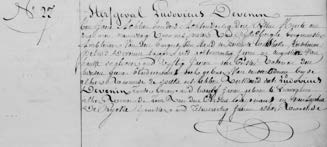
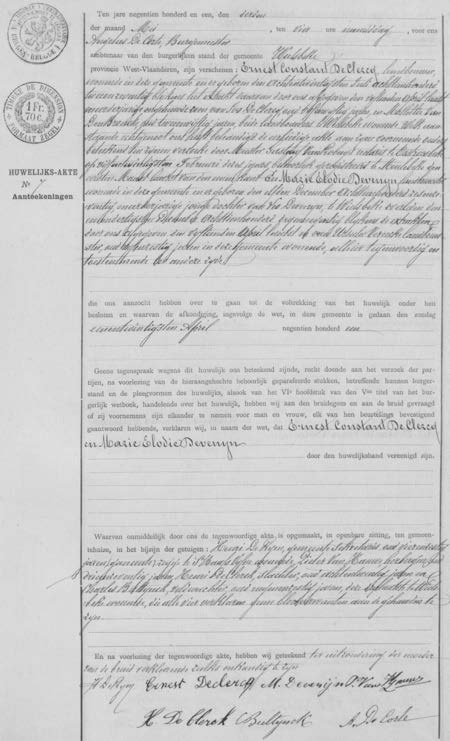
748
CHAPTER 44. ERNEST CONSTANT DECLERCQ (DC14) & MARIE ELODIE DEVENYN
Figure 44.27: Wielsbeke, 1831, the death
of Louis Devenyn, brother of Leo Devenyn.
He was born in Zwevegem.
Figure 44.28: Wielsbeke, May 3, 1901, the wedding of Ernest Constant Declercq (DC14) and
Marie Elodie Devenyn.
© 2024 Nico F. Declercq
The Desclergues of la Villa Ducal de Montblanc, 2nd ed., Omn., VOL. III

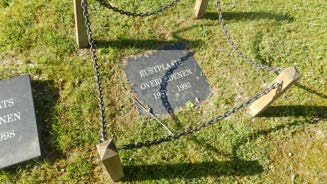
44.5. THEIR FAMILY LIFE AND OFFSPRING
749
Figure 44.29: Scenes of Wielsbeke, prior to 1900, such as, from left to right,’ Melkerij’ , ’ Gildhof’ and the front of ’klooster’
. The picture was taken before WWI, but the card was sent on December 27, 1915 (to the day exactly 60 years before this book’s author was born). Right, we see Saint Laurentius Church in Wielsbeke, also around 1900.
Figure 44.30: The grave of Ernest Con-
stant Declercq and Marie-Elodie Devenyn
does not exist anymore in Olsene. We as-
sume, for good reasons, that their remains
have been re-buried in a mass grave seen in
this picture during the period 1981-1993.
(Declercq de Silva Archive)
Van den Broucke. Both parents lived in Wielsbeke.
The groom’s notary was Gustaaf Vanrobays at Oostrozebeke.
The bride was a farmer, born at Wielsbeke on December 11, 1876, and daughter of Leo Devenyn, who died at Wielsbeke on December 31, 1893, and a 65-year-old farmer, Ursula Vereecke. The latter lived in Wielsbeke and agreed with the marriage.
The couple’s burial site in Olsene is shown in Figure 44.30.
44.5 Their Family Life and Offspring
Ernest Constant Declercq and Marie Elodie Devenyn had the following children:
Jozef Antonius Gerardus Declercq (1902-1980) (DC15c), born on June 12, 1902, in Wielsbeke.
Maria Antoinette Gerarda Declercq (Wielsbeke 1904 - Malèves 1983) (DC15b), born on April 24, 1904, in Wielsbeke.
Michel Achiel Renatus Declercq (Wielsbeke 1906 - Deerlijk 1963) (DC15), born on March 14, 1906, in Wielsbeke. He is the grandfather of the author of this book. His birth registration witnesses were Jean François Vereecke, a farmer who was 70 years old and an inhabitant of Ardooie, and Bernard Galle, who was 72 years old, a farmer and an inhabitant of Wielsbeke. Four descending generations of Ernest Constant through Michel are shown in Figure 44.32.
Alida Maria Juliana Declercq (Wielsbeke 1908-1908) (DC15d), born on March 2, 1908, in Wielsbeke. She died at a very young age.
Valentine Alida Declercq (Wielsbeke 1910 - Olsene 1939) (DC15e) was born on February 13, 1910, in Wielsbeke; She was born one hour before Valentine’s Day.
Rachelle Gabriëlle Declercq (Wielsbeke 1912 - Anzegem 2007) (DC15f), born on March 16, 1912, in Wielsbeke.
Esther Ernestina Godeliva Declercq (Sister Ernestine) (Wielsbeke 1915 - Anzegem 2011) (DC15g), born on November 7, 1915, in Wielsbeke. Her birth registration witness was Elodie Van Den Broucke.
Judith Flavia Maria Declercq (Wielsbeke 1918 - Waregem 2007) (DC15h), born on July 30, 1918, in Wielsbeke. Her birth registration witness was Ivo Van den Broucke, 65 years old, a farmer, and an inhabitant of Wielsbeke.
The children of the Declercq-Devenyn family, shown in Figure 44.31, all went to college, which was remarkable at that time, given that they lived in a tiny village. The girls went to Middle school in Anzegem (Saint Vincent de Paul), while the boys went to Middle School in Kortrijk (Sint Amands College). Consequently, the girls had higher education in Bruges (Sint Andries Normaalschool, specialized in educating girls to become teachers). In contrast, the boys had theirs at Ghent at the Jesuit College of Saint Barbara.
Ernest Constant Declercq, depicted in Figure 44.33, and Marie Elodie Devenyn resided at the Hof van Brussel farm in Wielsbeke, an inheritance they managed with diligence. The origin of the name ’Hof van Brussel’ is discussed in Chapter 39.6 and Chapter 42.
Ernest Constant married Marie Elodie Devenyn, shown in Figure 44.35, who was a strong-willed neighbor and had experienced the loss of her father several years before their marriage. Marie Elodie’s mother, having been raised without her father, who died the year she was born, undoubtedly served as a paragon of resilience and fortitude for her daughter.
Ernest Constant and Marie Elodie were advocates of gender equality and understood the critical importance of education for both boys and girls. They meticulously planned and allocated resources, even during the economic hardships of the 1930s, to ensure their children could continue their schooling. They utilized funds from Michel and Irma to support the younger children’s education, a testament to their prioritization of learning.
After the war, Ernest Constant and Marie Elodie fulfilled their financial obligations by selling the farm, demonstrating their steadfast commitment to keeping promises and the integrity of the Declercq family. This action reflects their unwavering adherence to their word and the value they placed on education and familial responsibility.
We found evidence that the family housed Emile Theophile Lesage and his son Paul Lesage near the end of WWI when he was a refuge expelled from Ledegem, where the Germans had cleared the village, as described in Chapter 64.6.1.5. Their friendship continued after the war and was translated into regular merchandising of flax.
In Chapter 44.8, we also describe a picture taken at Deerlijk in 1933, in which Ernest Constant is seen together with Paul Lesage and many others.
Under these casual circumstances, their son Michel Declercq (DC15) would meet Irma Lesage, the youngest daughter of Emile Lesage, and would marry. They are the grandparents of the author.
The Desclergues of la Villa Ducal de Montblanc, 2nd ed., Omn., VOL. III
© 2024 Nico F. Declercq
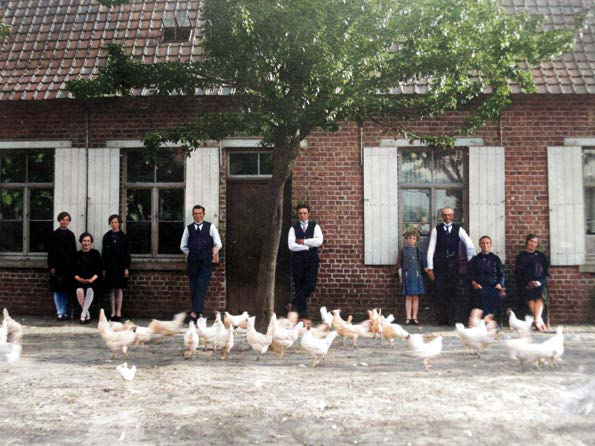
750
CHAPTER 44. ERNEST CONSTANT DECLERCQ (DC14) & MARIE ELODIE DEVENYN
Figure 44.31: This is the most beautiful picture in our collection. It’s taken at the Declercq farm ’Hof van Brussel,’ also shown in Figure 44.34, in Wielsbeke and shows the family of Ernest Constant Declercq (DC14) and Marie Elodie Devenyn.
Each child has studied in college. Each child showed intellectual curiosity. If the author could go back in time, he would go back to the day this picture was taken and visit his ancestors to discuss so many things—what a charming thought. From left to right: Rachelle, Valentine, Esther, Jozef, Michel, Judith, Ernest Constant, Marie Elodie and Maria. MyHeritage® colorized this photo. (Declercq de Silva Archive)
Ernest Constant (DC14) and Marie Elodie were friends with Maurice Demedts, Celeste Vandenhede, André and Gabrielle Demedts’s parents. Their children1 were also friends and exchanged books and knowledge.
The family also knew Hugo Verriest2 very well, which may have been one reason, early in the 1950s, for Michel and Irma to move to Saint Louis in Deerlijk, described in Chapter 45.5 and Chapter 45.6.
Ernest Constant and Marie Elodie were also acquainted with the families of de Nieulant et de Pottelsberghe and Vanderbruggen at Wielsbeke, described in Chapter 44.12.
Consultation of the registers at Olsene revealed (sic):
’Bij nazicht van de bevolkingsregisters blijkt dat Dhr. en Mevr. Ernest Declercq - Marie-Elodie Devenyn in Olsene, Statiestraat 100 ingeschreven waren op 31/12/1940 komende van Wielsbeke, Hof van Brussel. Op 20/07/1942 zijn zij terug vertrokken naar hetzelfde adres in Wielsbeke. Op 23/04/1945 zijn zij dan opnieuw ingeschreven op het adres Statiestraat 100 in Olsene.’
This means that at the end of Ernest Constant’s life (DC14), the couple moved close to their daughter Rachelle Declercq. When Marie Elodie died, her address was Statiestraat 85, which indicates that she probably resided at the home of her daughter and was no longer alone.
At the beginning of WWII, they decided to give up farming and live with their daughter Rachelle in Olsene when she married Maurice Wullaert. Maurice was a widower and former husband of their daughter, Valentine, who died in 1939.
When the coast was clear, they returned to Wielsbeke. Finally, they returned, perhaps because of health issues, to their daughter in April 1945, almost one year after the German occupation of Wielsbeke, shown in Figure 44.36, ended and just before WWII ceased in Belgium. Some aerial views of Hof van Brussel are shown in Figures 44.37, 44.38, 44.39 and 44.39, and a view from the street is shown in Figure 44.40.
44.5.1 Joseph Antonius Gerardus Declercq
I
44.5.1.1 Introduction
Joseph Antonius Gerardus Declercq was the only brother of Michel Declercq (DC15) and was destined to become a farmer, which he remained until his death.
We know he was a charming, righteous man who lived a quiet life. He died at the age of 87 and was married to Zozyma Tacq. His birth record is shown in Figure 44.41.
Like Michel Declercq, he studied in Ghent as seen in Figure 44.42. As a young adult, also seen in Figure 44.42, he became military in Figure 44.43.
1André Demedts and his sister Gabrielle Demedts are celebrated writers in Flanders.
2See also Chapter 43.7 and Chapter 44.11
© 2024 Nico F. Declercq
The Desclergues of la Villa Ducal de Montblanc, 2nd ed., Omn., VOL. III
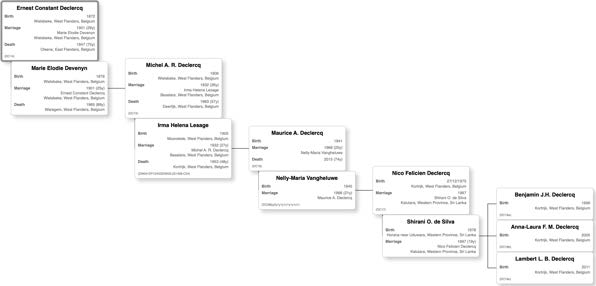
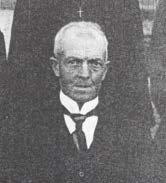
44.5. THEIR FAMILY LIFE AND OFFSPRING
751
Figure 44.32: Four descending generations of Ernest Constant Declercq (DC14).
Figure 44.33: Ernest Constant Declercq. (Declercq de Silva Archive)
A painful event in his life was the death of his brother, Michel. He is shown at his funeral in Figure 44.42.
Joseph’s sweet character is revealed on his obituary card in Figure 44.44.
His wife, Zozyma Tacq, is shown in Figure 44.45 and her obituary card in Figure 44.46.
44.5.2 Maria Antoinette Gerarda Declercq
Courageously, she moved to Malève near Jodoigne in 1951. She was the sister of Michel Declercq (DC15). Like Judith Declercq, Maria (1904-1983) studied in Anzegem and later in Bruges and became a nurse. She worked as a midwife. She married Gerard Galle (1909-1989) in 1934. The couple lived in Izegem, where all or most of their children were born, and they moved later to Malève near Jodoigne in 1951. Their descendants still live there.
Interestingly, in the context of our earliest ancestors in Belgium, the names Jerome (Jeroni), Antoon (Antoni), and Michel (Miguel) appear as the names of her children. The author found Cindy Galle and her father, Michel, a few years before the publication of this book. They were very friendly and open-hearted. It’s adorable to retrieve a distant family member and still feel a blood connection.
We show a citation from a letter received on February 6, 2018, by the author from Michel Galle (1942), through his daughter Cindy Galle (1980),
’ Je suis bien le fils (le 5iem) de Gerard et Maria. Je suis né en 1942 à Izegem. Je suis ému de voir la photo de mariage de mon frère Antoon dont le mariage a eu lieu en 1960 à Malèves. Ton grand père, Michel était d’ ailleurs le parrain du marié. Tu me trouveras dans le coin supérieur gauche de la photo sur ton courrier.’
This means that Michel Declercq was the godfather of Antoon Galle, the groom at the 1960 wedding at Malèves, shown above in Figure 44.51 and Figure 44.52.
Figure 44.47 shows Maria’s birth certificate. Images from her school in Anzegem are shown in Figure 44.48. Figure 44.49 reveals an image at Hof van Brussel. Her marriage can be seen in Figure 44.50. Other pictures can be found in Figure 44.49.
Maria’s presence at the funeral of Michel Declercq is also revealed in Figure 44.49, while her obituary card and tomb are shown in Figure 44.53.
44.5.3 Michel Achiel Renatus Declercq (DC15)
Michel Achiel Renatus Declercq (DC15) is the author’s grandfather and is extensively described in Chapter 45.
44.5.4 Alida Maria Juliana Declercq
The family endured an unimaginable tragedy with the loss of Alida Maria Juliana Declercq, who passed away after just 25 days.
This heartbreak is starkly illustrated by Figures 44.54 and 44.55. The death of a child is the deepest sorrow a parent can endure, an agony beyond the reach of words. This profound loss has indelibly marked the family’s lives, casting a shadow that will linger for years. Adding to their grief, the family later lost another child, Valentine Declercq, who died shortly after marriage. While a The Desclergues of la Villa Ducal de Montblanc, 2nd ed., Omn., VOL. III
© 2024 Nico F. Declercq
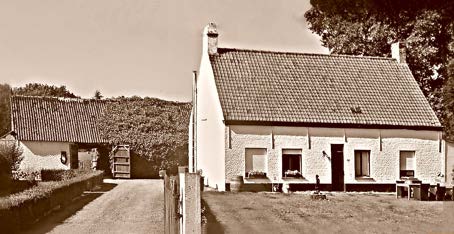
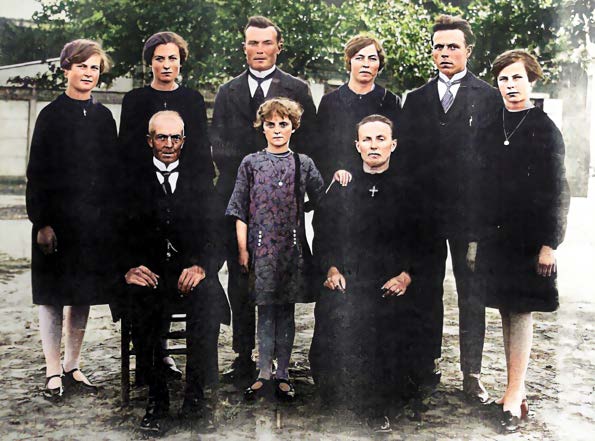
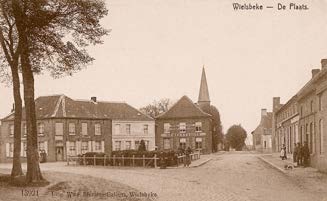
752
CHAPTER 44. ERNEST CONSTANT DECLERCQ (DC14) & MARIE ELODIE DEVENYN
Figure 44.34: The remains of Hof van Brussel, view from the street, recent times. The flax
barn in the back is still visible. The family had their farmland behind the barn. The picture
44.31, with the chickens, was taken on the other side of the home, on the inner yard. (Declercq de Silva Archive)
Figure 44.35: Ernest Constant Declercq and Marie Elodie Devenyn with their youngest daughter Judith. Behind them, from left to right: Rachelle, Valentine, Jozef, Maria, Michel and Esther. MyHeritage® colorized this photo. (Declercq de Silva Archive)
Figure
44.36:
The village square
of Wielsbeke when the Declercq-Devenyn
family had small children.
© 2024 Nico F. Declercq
The Desclergues of la Villa Ducal de Montblanc, 2nd ed., Omn., VOL. III
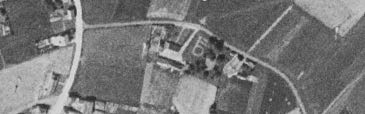
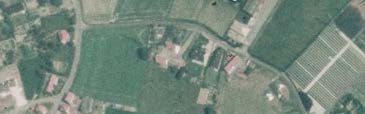
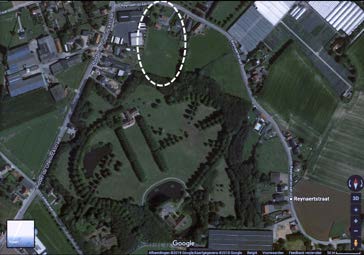
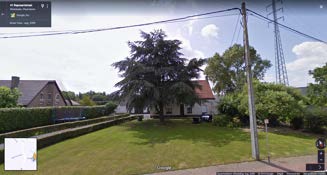
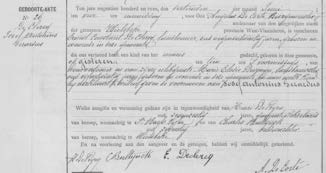
44.5. THEIR FAMILY LIFE AND OFFSPRING
753
Figure 44.37: Aerial view of ’Hof van Brussel’ , 1971.
Figure 44.38: Aerial view of ’Hof van Brussel’ , around 1980.
Figure 44.39: Current areal view (Google Maps®) of what used to be the
farm of Declercq-Devenyn at Wielsbeke, ’Hof van Brussel’ . The street is Rey-
naertstraat and was formerly named after the farm. (Courtesy of Google®)
Figure 44.40: Current view of what is
left of the farm of Declercq-Devenyn. The
farm has been integrated into a modern
urban planning scheme and nowadays ap-
pears as a regular house. (Courtesy of
Google)
Figure 44.41: Birth certificate of Joseph
Antonius Gerardus Declercq, Wielsbeke,
1902, born on June 12. Birth registration
witnesses: Henri De Rym, 66 years old,
registration secretary from Sint Baafs Vi-
jve; and Charles Bultynck, 70 years old,
rural constable, an inhabitant of Wiels-
beke.
The Desclergues of la Villa Ducal de Montblanc, 2nd ed., Omn., VOL. III
© 2024 Nico F. Declercq

754
CHAPTER 44. ERNEST CONSTANT DECLERCQ (DC14) & MARIE ELODIE DEVENYN
Figure 44.42: Left is a 1921 picture of
Joseph Antonius Declercq in Ghent, dur-
ing his education at Sint Barbara’s col-
lege. (’Photographie H Haes Lebacq Rue
du Nord 46 Gand’). Then, we see him
around 1924 at the family farm in Wiels-
beke. Right, he is observed at the fu-
neral of his brother Michel Declercq in Au-
gust 1963. The person in the background
is Gerard Galle, husband of Maria An-
toinette Gerarda Declercq. (Declercq de
Silva Archive)
Figure 44.43: Military registration of Joseph Antonius Gerardus Declercq, in lichting 22, Nationale Militie, Provincie West Vlaanderen, militiekantoor, gemeente Wielsbeke. Note that the military registration of Michel Declercq is, as of today, not yet available due to the 100-year privacy rule in Belgium. Joseph was a farmer, born in Wielsbeke on June 12, 1902, as the son of Ernest Constant Declercq and Marie Elodie Devenyn, both from Wielsbeke. He had six younger siblings. He has chosen to join the heavy artillery regiment on May 6, 1922.
Figure 44.44: The obituary card of Joseph Antonius
Declercq, February 23, 1989, text extracted describing his
character. (Declercq de Silva Archive)
Figure 44.45: Zozyma Tacq, wife of Joseph Declercq, at Wielsbeke
in 1946; and at the funeral of Michel Declercq in 1963. To her left is
Magdalena Meersseman; right from her (wearing glasses) is Godelieve
Lesage. (Declercq de Silva Archive)
© 2024 Nico F. Declercq
The Desclergues of la Villa Ducal de Montblanc, 2nd ed., Omn., VOL. III
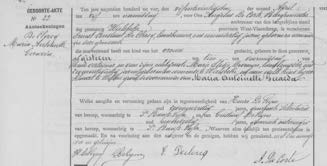
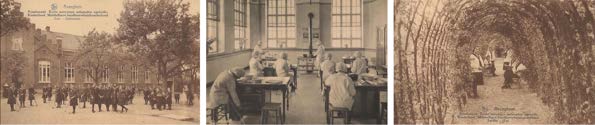
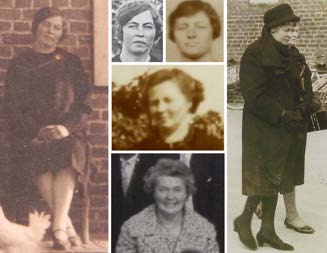

44.5. THEIR FAMILY LIFE AND OFFSPRING
755
Figure 44.46: The obituary card of Zozyma Tacq, November 4, 1992,
text extracted describing her character. (Declercq de Silva Archive)
Figure
44.47:
The birth certificate
of Maria Antoinette Gerarda Declercq,
Wielsbeke, 1904, born on April 24. Birth
registration witnesses: Henri De Rym, 66
years old, registration secretary, an inhabi-
tant of Sint Baefs Vijve; Gustaaf De Rym,
61 years old, village treasurer, an inhabi-
tant of Sint Baefs Vijve.
Figure 44.48: The school at Anzegem where Maria Declercq studied.
Figure 44.49:
We can see Maria De-
clercq around 1924 at the farm in Wiels-
beke, and also in 1946. Another image
shows her at Malèves. The right pictures
shows Maria Declercq at the funeral of
Michel Declercq in August 1963. (Declercq
de Silva Archive)
Figure 44.50: 1934, Wielsbeke, the marriage of Maria Antoinette Gerarda Declercq
and Gerard Marcel Galle.
The Desclergues of la Villa Ducal de Montblanc, 2nd ed., Omn., VOL. III
© 2024 Nico F. Declercq
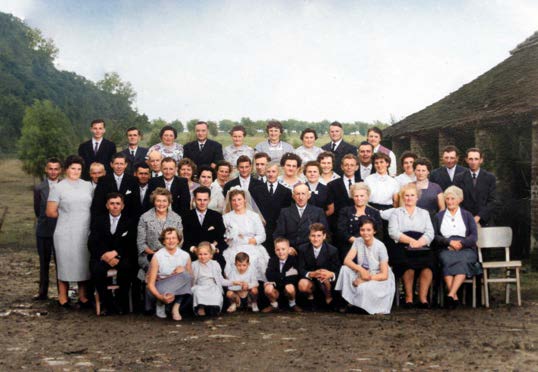
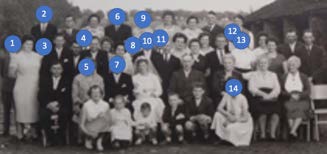
756
CHAPTER 44. ERNEST CONSTANT DECLERCQ (DC14) & MARIE ELODIE DEVENYN
Figure 44.51: 1960, a family picture of the Galle family at Malèves, on which several Declercqs are visible. They are enlisted in Figure 44.52. MyHeritage® colorized this photo. (Declercq de Silva Archive) Figure 44.52: Index of Figure 44.51. 1.
Michel Galle; 2. Arsène Galle; 3. Joseph
Declercq; 4. Michel Declercq; 5. Maria
Declercq; 6. Mauritz Wullaert; 7. Antoon
Galle; 8. Judith Declercq; 9. Rachelle
Declercq; 10. Joseph Galle; 11. Robert
Courtens; 12. Jerome Galle; 13. Mag-
dalena Galle; 14. Godelieve Galle. Cour-
tesy of Maria Declercq. The help of Cindy
Galle and Michel Galle to identify every-
one is greatly appreciated. (Declercq de
Silva Archive)
natural death may be somewhat more bearable than losing a child to violence or abduction, it still leaves an everlasting void and unending pain.
© 2024 Nico F. Declercq
The Desclergues of la Villa Ducal de Montblanc, 2nd ed., Omn., VOL. III
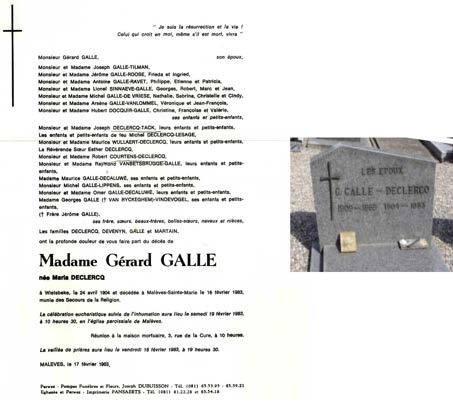
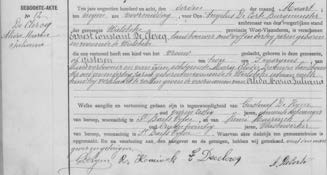
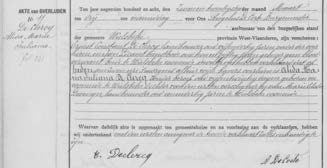
44.5. THEIR FAMILY LIFE AND OFFSPRING
757
Figure 44.53: The death announcement of Maria Declercq, wife of Gerard Galle, February 16,
1983. Their tomb at Malèves is also shown. (Declercq de Silva Archive)
Figure 44.54:
The birth certificate of
Alida Maria Juliana Declercq, Wielsbeke,
1908, born on March 2. Birth registration
witnesses: Gustaaf De Rym, 61 years old,
village treasurer, an inhabitant of Sint-
Baafs-Vijve; and Remi Haerinck, 25 years
old, flax worker, an inhabitant of Sint-
Baafs-Vijve.
Figure 44.55: The death certificate of Al-
ida Maria Juliana Declercq in 1908, Wiels-
beke. She died on March 27, 1908, and was
merely 25 days old.
The Desclergues of la Villa Ducal de Montblanc, 2nd ed., Omn., VOL. III
© 2024 Nico F. Declercq
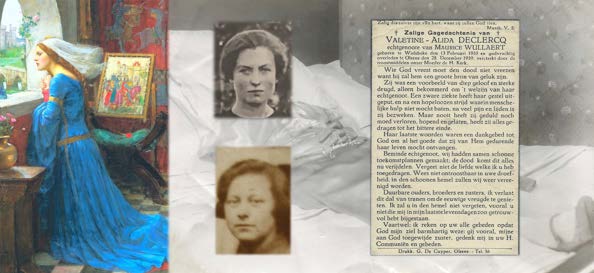
758
CHAPTER 44. ERNEST CONSTANT DECLERCQ (DC14) & MARIE ELODIE DEVENYN
Figure 44.56: The photo in the background shows the body of Valentine Declercq after she had died. It was the last souvenir Michel Declercq had of his sister, and it was preserved by his daughter Agnes. The compilation is a tribute to Valentine.
Right, we find her obituary card of December 28, 1939. In the middle are two pictures of her. (Declercq de Silva Archive) Left is representative for how she felt when Daniel Lesage was obliged to reject her and marry Madeleine. When reading Gabrielle Demedts’s poem ’Rustig Lied’ about Valentine Declercq, this scene, painted by John William Waterhouse in 1916 comes to mind p. Two pictures of Valentine.
44.5.5 Valentine Declercq
Valentine Alida Declercq was Gabrielle Demedts’3 closest friend and the beloved sister of Michel Declercq (DC15). Her untimely death left an indelible mark on her family. Valentine was born on February 13, 1910, the day before Saint Valentine’s Day, and passed away on December 28, 1939—exactly 36 years, minus a few hours, before the author’s birth. Her family named her Valentine in homage to Saint Valentine, celebrated on February 14, just hours after her birth. Tragically, they could not have foreseen that she would pass away at the peak of her life shortly after her marriage.
A poignant photograph of Valentine reposing on her deathbed is too painful to show in full; therefore, only a glimpse is provided in Figure 44.56. It is believed that she died of leukemia. The loss of such a vibrant and beautiful young woman was unimaginable for her family.
Valentine studied in Brugge, likely at the Sint Andreas Normaalschool, which specialized in educating girls to become school teachers. Her close friend Gabrielle Demedts, a leading Flemish poet, composed a touching poem, included below, when Valentine fell ill.
They were the same age, both born in 1910, as depicted in Figure 44.58. Valentine’s beauty is evident in Figures 44.56 and 44.57.
As a young woman, Valentine was engaged to Daniel Lesage, shown in Figure 44.59 and described in Chapter 64.7.12.5. Figure
44.60 shows a keepsake from that period. When Valentine and Daniel Lesage parted ways in early 1934, Gabrielle Demedts wrote the poem ’Rustig Lied’4 (Quiet Song) to capture Valentine’s emotions. This poem symbolically uses the snow to represent a bride’s veil and refers to Daniel Lesage’s upcoming marriage to Magdalena Meersseman and the hope for a future marriage for Valentine.
Chapter 64 reveals that Valentine had also been the love of Daniel Lesage’s life, but he felt compelled to comply with an arranged marriage to Magdalena Meersseman instead.
Valentine’s story is a poignant testament to the complexities of love and loss, leaving a legacy of profound emotional impact on those who knew and loved her.
Rustig lied
Onder het raam, in de aarde, die sporen
die me dierbaar zijn.
Toen hij kwam, wie zond hem weg? Ik zond hem weg;
het deed geen pijn.
Het deed geen pijn; maar iets is verdwenen
of dood in mij.
Mijn gedachten staan, als soldaten gehoorzaam,
in rechte rij.
Op een nacht valt de sneeuw, maakt de aarde wit, maakt de aarde rein.
De randen van mijn oogen doen pijn;
het komt door de slaap, het komt door de sneeuw, het komt door die sporen
die niet te vinden meer zijn.
Clearly, Valentine remained single for a couple of years before she would decide the marry someone. Meanwhile, in 1936, Gabrielle Demedts wrote another poem, ’Lage tonen’5 to express her emotions.
Lage tonen.
3Gabrielle Demedts was a leading Flemish poet
4February 1934 poem ’Rustig lied’ (’quiet song’) by Gabrielle Demedts, published in Dietsche Warande en Belfort, Jaargang 1935, page 690.
5February 1934 poem ’Lage tonen’ (’low vibes’) by Gabrielle Demedts, published in Dietsche Warande en Belfort, Jaargang 1936, page 19.
© 2024 Nico F. Declercq
The Desclergues of la Villa Ducal de Montblanc, 2nd ed., Omn., VOL. III
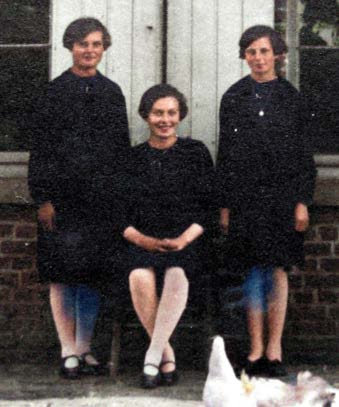
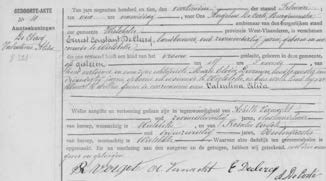
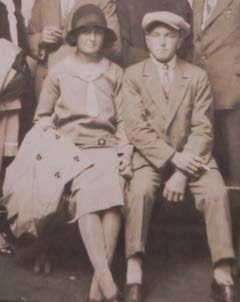
44.5. THEIR FAMILY LIFE AND OFFSPRING
759
Figure 44.57: Around 1924, Valentine with right from her (left side of
the picture), Rachelle and left from her, Esther. MyHeritage® colorized
this photo. (Declercq de Silva Archive)
Figure 44.58:
The birth certificate of
Valentine Alida Declercq, Wielsbeke, 1910,
born on February 13, one hour before
Valentine’s day. Birth registration wit-
nesses: Achille Vernaekt, 27 years old,
flax merchant, an inhabitant of Wielsbeke;
Rosalie Vergote, 73 years old, Inn-Keeper,
an inhabitant of Wielsbeke.
Figure 44.59: Valentine Declercq with her fiancé Daniel
Lesage in 1932. The couple separated when Daniel found
no other option, probably under pressure by his father
Emile Lesage, but to marry his sister-in-law Magdalena
Meersseman in 1934 after being widowed when Gerard
Lesage, the elder brother of Daniel, had died, as described
in Chapter 64.7.5. Valentine was very handsome while
Daniel was the one billion dollar bachelor, so to speak.
(Declercq de Silva Archive)
The Desclergues of la Villa Ducal de Montblanc, 2nd ed., Omn., VOL. III
© 2024 Nico F. Declercq
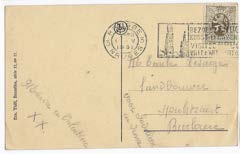

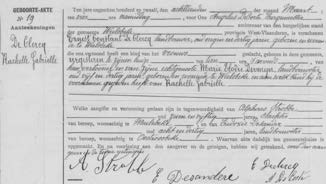

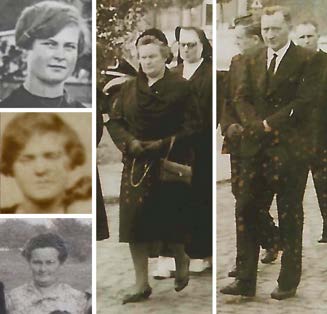
760
CHAPTER 44. ERNEST CONSTANT DECLERCQ (DC14) & MARIE ELODIE DEVENYN
Figure 44.60: 1931, Valentine and Maria wrote a post-
card to Godelieve Lesage and Irma Lesage while they
were students in Brugge. Valentine was aiming for
Daniel Lesage, while Irma was her brother’s fiancé. (De-
clercq de Silva Archive)
Figure 44.61: 1938, Wielsbeke, the marriage of Valentina Alida Declercq with
Maurice Wullaert.
Figure 44.62:
The birth certificate of
Rachelle Gabrielle Declercq, Wielsbeke,
1912. She was born on March 16. Birth
registration witnesses: Alphons Strobbe,
57 years old, butcher, an inhabitant of
Meulebeke; Eudoxie Desander, 38 years
old, farmer, an inhabitant of Oostrozebeke.
Figure 44.63: 1940, Wielsbeke, the marriage of Rachelle Gabrielle Declercq with
Maurice Wullaert, shown in Figure 44.64 and widower of Rachelle’s sister Valentine.
Figure 44.64: Pictures of Rachelle De-
clercq, at different ages. The series in-
cludes one in 1960 in Malèves and one in
August 1963, at the funeral of her brother
Michel Declercq (DC15). Her sister Es-
ther Declercq walked behind her. Right, we
see, in 1963, Maurice Wullaert, husband of
Rachelle Declercq and widower of Valen-
tine Declercq. (Declercq de Silva Archive)
© 2024 Nico F. Declercq
The Desclergues of la Villa Ducal de Montblanc, 2nd ed., Omn., VOL. III
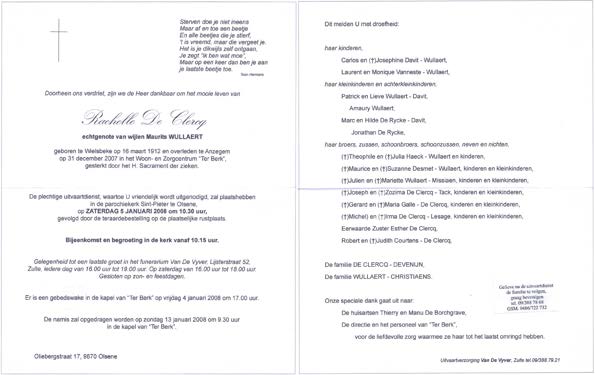
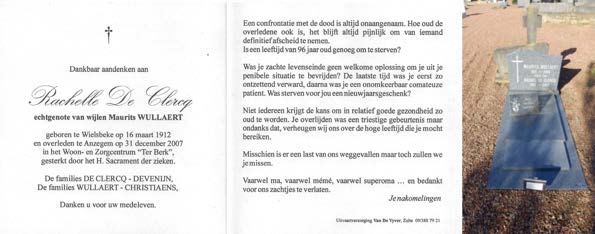
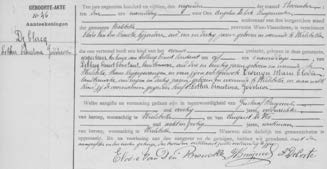
44.5. THEIR FAMILY LIFE AND OFFSPRING
761
Figure 44.65: The death announcement of Rachelle Declercq, 2007. (Declercq de Silva Archive)
Figure 44.66: The obituary card of Rachelle Declercq, December 31 of 2007. The tomb of Rachelle Declercq and Maurice Wullaert at Olsene, 2018. (Declercq de Silva Archive)
Figure 44.67: The birth certificate of Es-
ther Ernestina Godeliva Declercq, Wiels-
beke, 1915. She was born on Novem-
ber 7. Birth registration witnesses: Gus-
taaf Bruyneel, 40 years old, rural consta-
ble, an inhabitant of Wielsbeke; August De
Vos, 68 years old, worker (could not write;
therefore Elodie Van Den Broucke signed
in his place), an inhabitant of Wielsbeke;
Elodie Van Den Broucke.
The Desclergues of la Villa Ducal de Montblanc, 2nd ed., Omn., VOL. III
© 2024 Nico F. Declercq
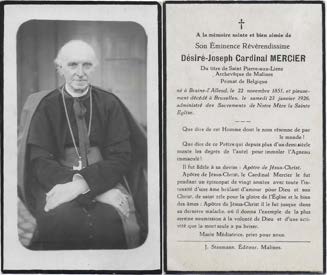
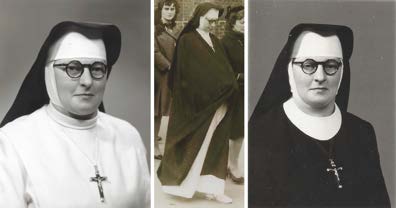
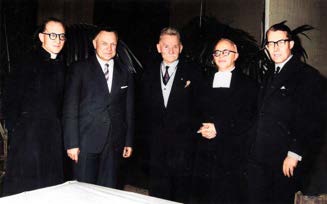
762
CHAPTER 44. ERNEST CONSTANT DECLERCQ (DC14) & MARIE ELODIE DEVENYN
Figure 44.68: Ernestine in the 1920s, and also the school in Anzegem where she studied before she went to Bruges for higher education. She must have enjoyed music classes very much. (Declercq de Silva Archive)
Figure 44.69:
Cardinal Désiré Joseph
Mercier was a prevalent religious person
in Belgium while Ernestine was a child.
His scholar ideas must have influenced her.
The image exposes his obituary card in
1926. (Declercq de Silva Archive)
Figure 44.70: In 1936, Esther Declercq became a sister and was henceforth known
as ‘Zuster Ernestine’ . In the middle, she is seen at the funeral of her brother Michel
Declercq in August of 1963 at Sint Lodewijk in Deerlijk. (Declercq de Silva Archive)
Figure
44.71:
Felix Dalle (1921 -
2000, André Demedts (1906 - 1992), Stijn
Streuvels (1871 - 1969), Fred Germonprez
(1914 - 2001), picture taken at Kortrijk in
1959 when Streuvels received an honorary
citizenship of the town (Letterenhuis).
© 2024 Nico F. Declercq
The Desclergues of la Villa Ducal de Montblanc, 2nd ed., Omn., VOL. III
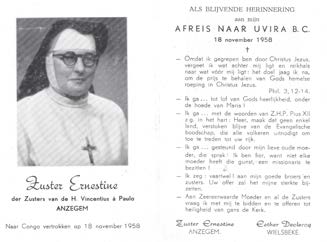
44.5. THEIR FAMILY LIFE AND OFFSPRING
763
Figure 44.72: Karel Jonckheere (1906-1993), a fraction of a picture available at
Letterenhuis. The photo is an example of persons’ natural photography by Filip Tas
(1918-1997).
Figure
44.73:
Commemorative card
printed on the occasion of Ernestine’s de-
parture for Congo in 1958. (Declercq de
Silva Archive)
Ik ben niet moe, ik ben niet oud
doodsverlangen heb ik niet.
De dagen gaan, de jaren gaan,
ongebroken buigt het riet.
Aan géén leed wil ik ontkomen;
maar de droefheid zoek ik niet.
Roekeloosheid is lang verzwonden
met den droom die mij verliet.
Hopeloos, maar onweerstaanbaar
mischt in mij een heel oud lied,
van eindeloos en groot verlangen
naar u, naar u dien ik verliet.
Valentine married Maurice Wullaert in Figure 44.61 in 1938. Destiny ended her life too soon the year after. Her obituary card is shown in Figure 44.56.
As indicated, the death of Valentine Declercq has left a shock for many decades. The author remembers that his father (DC16) mentioned her several times, even though he had never met her. Michel Declercq (DC15) probably talked often about his deceased sister, Valentine. Later generations haven’t named any girl ’Valentine.’ Perhaps they felt that the honor only belonged to the handsome and joyful sister or auntie and should not be reused. Otherwise, they feared that the name was associated with the early loss of a beloved child.
In 1939, during Valentine’s illness, Gabrielle Demedts wrote the poem for Valentine called ’Zomer.’ Gabrielle was eight months older than Valentine, and they were close friends. Valentine died at the end of that year, on December 28. To understand the poem, one must remember that Valentine became sick just after she was married, so instead of enjoying the summer (zomer) of her life and looking forward to having children, she fell ill. She suddenly faced the end of her life, which was devastating and struck Gabrielle Demedts, whence she wrote the poem6:
Zomer
Is dit de zomer wel?
Ik zie geen rijpend ooft,
ik hoor geen kinderspel;
heb ik in God geloofd?
Ik heb op God gebouwd
en, ach, zoo vast vertrouwd
dat Hij nie knakken zou
dien ik genezen wou;
genezen kon een korte stond
tot d’ onrust weerom wortel schoot,
ontvreemdend u den goeden grond,
ontvreemdend mij mijn goed genoot.
De dagen gaan door het verdriet,
de nachten gaan en ’t zomert niet;
mijn Lente was verbeeldingsspel,
seizoenen zijn mij van geen tel.
6Gabriëlle Demedts, ’Zomer’, about Valentine Declercq, in ’Dietsche Warande en Belfort,’ 1939
The Desclergues of la Villa Ducal de Montblanc, 2nd ed., Omn., VOL. III
© 2024 Nico F. Declercq
764
CHAPTER 44. ERNEST CONSTANT DECLERCQ (DC14) & MARIE ELODIE DEVENYN
Figure 44.74: Sister Ernestine, weighing a newborn child at a Belgian Hospital
in Uvira, Congo. MyHeritage® colorized this photo. (Declercq de Silva Archive)
Er is geen rijpend ooft,
dit is de zomer niet,
ik heb in God geloofd,
Geloof begeef mij niet.
Mijn lief, voor u, moog’ t zomer zijn,
vol zonneschijn uw oogen beî,
die ik niet meer nabij zal zijn;
het leven is niet goed voor mij.
44.5.6 Rachelle Gabrielle Declercq
Rachelle, the biblical figure, is also described in Chapter 49.6 as guardian of la Mare de Déu de la Serra de Montblanc.
Rachelle Gabrielle Declercq was the author’s father’s godmother. She was born in Wielsbeke on March 16, 1912, in Figure 44.62,
and died at Anzegem on December 31, 2007. She was buried at Olsene on January 5, 2008. Her husband was Maurice Wullaert, Valentine’s widower, and their marriage is shown in Figure 44.63.
She studied in Bruges at the Sint Andreas Normaalschool, which specialized in educating girls to become school teachers.
Even when she was of respectable age, she could list many facts about geography, such as listing all the cities of a given country from the top of her head. She also spoke French fluently and has taught French, in addition to regular classes, to children. Pictures of her are shown in Figures 44.64.
Her death announcement and obituary card are shown in Figures 44.65 and 44.66. Her tomb at the cemetery of Olsene is also shown in Figure 44.66.
44.5.7 Esther Ernestina Godeliva Declercq
44.5.7.1 Introduction
Esther, the biblical figure, is also described in Chapter 49.6 as guardian of la Mare de Déu de la Serra de Montblanc.
Esther Ernestina Godeliva Declercq is well-known as ’Sister Ernestine’ . We show her birth in Figure 44.67, a picture in Figure
44.68, and her school at Anzegem in Figure 44.68.
Esther Ernestine Declercq is the author’s grand-auntie, born on November 7, 1915, in Wielsbeke. She studied first at Anzegem, then in Bruges, and then at the ’Normaalschool’ at Sint Andries. Becoming a teacher was indeed her vocation, combined with becoming a religious nun of Saint Vincentius ’a Paulo in Anzegem, likely inspired by Cardinal Mercier, whose obituary card is shown in Figure 44.69. She is well-known as a Catholic Sister, as in Figure 44.70. She died in 2011 at the age of 96.
She has been a primary and secondary school teacher in general subjects, mainly French and Music. From 1943 until 1956, she was a school Director at Ingooigem, replacing Irma Cottenier. At Ingooigem, she was also close with writer Stijn Streuvels and his family, shown with André Demedts in Figure 44.71. Ingooigem must have been appealing to her because it was the last village where the priest and writer Hugo Verriest (Deerlijk 1840 - Ingooigem 1922) had lived, who was well known by Ernestine’s father, Ernest Constant Declercq.
Simultaneously, she has worked at the Women’s Jail of Bruges (’Kleine Refuge’ and ’Grote Refuge’ of Sint Andries). On November 18, 1958, when she was 43 years old, she became a Missionary at Uvira in Congo, where she taught French classes. After being taken hostage at Uvira, she returned to Belgium, where she became the school Director at Mannekensvere while continuing her Jail Ministry. At the end of her career, she lived at the monastery of Anzegem. Sister Ernestine is well-known for her educational role and her captivity in Congo.
As a child, the author had heard about ’Zuster Ernestine’ occasionally, but he had never met her, at least not as far as he can remember. He met her finally for the first time around 1999. She left a deep impression, was very knowledgeable, even in physics, and talked about Michel Declercq (DC15) in a way as if he was still alive. It was the first time that the author heard someone talk about his grandfather so openly. When the author spoke about his education (he was studying physics at the Catholic University of Leuven), she immediately replied that she was not surprised. "Our family have been brilliant students," she replied. She also talked about her friends and fellow nuns who had been active in Sri Lanka for many years. The author is still very appreciative of her and this meaningful chat.
© 2024 Nico F. Declercq
The Desclergues of la Villa Ducal de Montblanc, 2nd ed., Omn., VOL. III
44.5. THEIR FAMILY LIFE AND OFFSPRING
765
Figure 44.75: Sister Esther Ernestine Godelieve Declercq, wearing sunglasses, in
Uvira, in Belgian Congo in 1959. MyHeritage® colorized this photo. (Declercq de
Silva Archive)
44.5.7.2 Stijn Streuvels
During Ernestine’s activity as school principal at Ingooigem (1943-1956), she had the opportunity to become more intimately acquainted with writer Stijn Streuvels and his family. Stijn Streuvels, shown in Figure 44.71, was a pseudonym for Frank Lateur (Heule 1871 - Ingoogem 1969) and was naturally well known by the clan of the Declercqs and Demedts.
Stijn Streuvels also appears in the picture of 1933, discussed in Chapter 44.8, with Ernest Constant Declercq (DC14).
44.5.7.3 Karel Jonckheere
Karel Jonckheere (Ostend 1906) was a writer and globetrotter and was three weeks younger than Michel Declercq (DC15) (Wielsbeke 1906) and has known Michel’s friend writer Andre Demedts (Wielsbeke 1906).
It is unknown if Michel has known Karel personally, but Michel likely read works published by Karel, and so did his sisters. It is even expected that some of his works789, inspired by journeys to Congo and other countries, were known to Esther Ernestina Godelieve Declercq (Sister Ernestine) when she decided to become a missionary in Belgian Congo end of 1958.
Figure 44.72 is Karel Jonckheere and shows how he was involved with naturalism, such as Stijn Streuvels, Tolstoj, and others, reflecting his willingness to work with Filip Tas on this type of photography.
44.5.7.4 Her Adventure in Congo 1958-1964
On November 18, 1958, at 43, Sister Ernestine, born Esther Declercq, embarked on her mission to Uvira in Congo, where she taught French classes. This event was commemorated with a memorial card, highlighting the significance of her new journey (see Figure 44.73). During her tenure in Congo, Sister Ernestine fulfilled her educational responsibilities and undertook medical duties, as depicted in Figures 44.74 and 44.75. Her integration into the community and enjoyment of her work is evident in Figure 44.76
and Figure 44.77. Figure 44.78 presents an artistic impression of her mission. Renowned for her intelligence and empathy, Sister Ernestine played a pivotal role in negotiating with the rebels at Uvira during her captivity.
In 1964, the eastern region of the newly independent Republic of Congo was engulfed by the Simba Rebellion, a significant and brutal conflict during the Congo Crisis. The Simba Rebellion was led by leftist militants who opposed the central government and sought to implement a radical socio-political transformation. The rebellion was part of a larger wave of post-colonial violence and instability that plagued Congo following its independence from Belgium in 1960. The rebellion’s name, Simba, meaning lion in Swahili, indicated the ferocity and strength the rebels aimed to project.
Amidst this turmoil, rebellion leader Gaston Soumialot orchestrated the kidnapping of a group of Belgian and Italian Catholic Sisters, including Sister Ernestine, from Uvira. The capture of these religious figures was a strategic move intended to leverage international attention and pressure. The Sisters were subjected to forced labor and endured numerous atrocities, which were reported by news agencies worldwide, drawing global condemnation. Uvira’s strategic location near the border with Burundi made it a crucial supply route for the rebels, further complicating the situation.
The capture and subsequent treatment of the Sisters highlighted the severe human rights violations perpetrated during the rebellion. The international community, including the United Nations, strongly condemned these acts. The kidnapping represented a dramatic escalation in the conflict and underscored the vulnerability of foreign nationals and missionaries in the region.
On October 7, 1964, a Western military operation successfully liberated the kidnapped Sisters. This operation was part of a broader effort by Western nations to stabilize the region and protect their nationals. The Sisters were escorted from Uvira to Bukavu, where they were flown back to Belgium. Their safe return was a moment of relief and triumph, yet it left an indelible mark on those involved.
Sister Ernestine’s return to Belgium did not mark the end of her service. She assumed the role of School Director at Mannekensvere and continued her involvement in jail ministry, demonstrating her resilience and unwavering commitment to her faith and community. Her strength and determination are evident, as shown in Figure 44.70.
7Karel Jonckheere, Kongo zonder buks of boy – 1957
8Karel Jonckheere, Kongo met het blote oog – 1958
9Karel Jonckheere, Kongo het woord - 1961
The Desclergues of la Villa Ducal de Montblanc, 2nd ed., Omn., VOL. III
© 2024 Nico F. Declercq
766
CHAPTER 44. ERNEST CONSTANT DECLERCQ (DC14) & MARIE ELODIE DEVENYN
Figure 44.76: Right, we see Sister Ernestine visiting a village in Uvira, Congo. Left, we
see the author with his daughter Anna-Laura and youngest son Lambert at the Afrikamuseum
of Tervuren near Brussels, in 2013. H.M. King Leopold II established the museum. At the
time of our visit, it was a time-capsule of colonial thought and, therefore, fascinating from a
historical perspective. Unfortunately, the museum has been completely modernised since then,
and therefore, this historical value has been wiped out. (Declercq de Silva Archive)
The kidnapping of Catholic Sisters during the Simba Rebellion is a poignant example of the intersection of religion, colonial legacies, and conflict in post-colonial Africa. The incident underscores the perils missionaries and foreign nationals faced amidst political instability and highlights the broader implications of the Congo Crisis on international relations and humanitarian efforts.
44.5.7.5 Her Retirement
After she retired from her education duties, Ernestine ultimately resided at the end of her life in Anzegem at a ’home for the elderly,’
shown in Figure 44.79.
44.5.7.6 Her Death in 2011
Her death announcement and obituary card are shown in Figures 44.80 and 44.81. The author attended the funeral and was impressed by the status and dignity, as well as the simplicity and humbleness of the ceremony. It reflected her character of greatness and simplicity, strength and compassion. Her tomb is shown in Figure 44.81.
44.5.7.7 Some Memorabilia
The postcard in Figure 44.82 reads,
’Mr Emile Lesage, Farmer, Spilstraat, Beselare. Dear Irma, I received your note with great joy. I will never forget that day when I came to you, and maybe I will return this summer. I hope we will have just as much fun again. I long to see you again, since it’s been a year since I’ve seen you. See you again, and in the meantime, I offer you my best regards, Esther.’
Other memorabilia are shown in Figures 44.82 and 44.83.
44.5.8 Judith Flavia Maria Declercq
44.5.8.1 Introduction
Judith, the biblical figure, is also described in Chapter 49.6 as guardian of la Mare de Déu de la Serra de Montblanc.
Judith Flavia Maria Declercq (Wielsbeke, Belgium, July 30, 1918 – Waregem, Belgium, March 3, 2007) has been the President of the children’s welfare organization and was the youngest child of Ernest Constant Declercq.
She studied in Anzegem, shown in Figure 44.84, and later in Bruges at nursing school ’Elisabethverpleegsterschool.’ She was married to Robert Courtens, a high-school teacher and, as far as we have been told, school director10 at Waregem.
Judith as a child can be seen in Figure 44.85.
On her birth certificate in Figure 44.86, Ivo Van den Broucke was a witness. Ivo was a half-brother of Mathilde Van den Broucke and, therefore, a half-uncle of Ernest Constant Declercq (D10).
44.5.8.2 Her Life and Career
Judith Declercq was the Provincial President of the Belgian National Child Welfare organization. She had grown into this position because of her education, connections, and unfulfilled desire to have children.
Her father’s relationship with Baron Bekaert and frequent visits to the Bekaert family helped her obtain this position. The reader 10Vrij Technisch Instituut
© 2024 Nico F. Declercq
The Desclergues of la Villa Ducal de Montblanc, 2nd ed., Omn., VOL. III
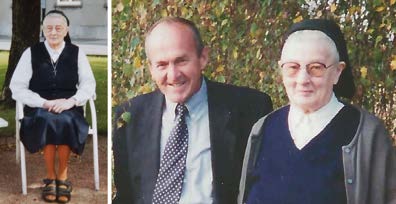
44.5. THEIR FAMILY LIFE AND OFFSPRING
767
Figure 44.77: Sister Ernestine (left), posing with other nuns at huge cactuses in
Uvira, Congo. MyHeritage® colorized this photo. (Declercq de Silva Archive)
Figure 44.78: Artistic impression, made with AI, of a nun, similar to Sister
Ernestine, teaching French to the children of Uvira in Congo. (DALL·E 2024-06-
03 18.14.58)
Figure 44.79: Maurice Declercq (DC16) on a visit to his auntie ’Zuster Ernestine’
in Anzegem, in the early 1990s. (Declercq de Silva Archive)
The Desclergues of la Villa Ducal de Montblanc, 2nd ed., Omn., VOL. III
© 2024 Nico F. Declercq
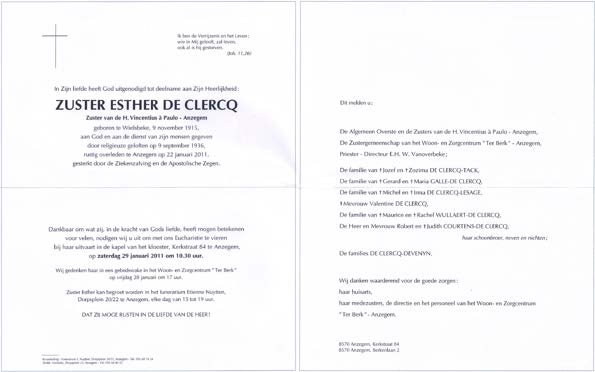
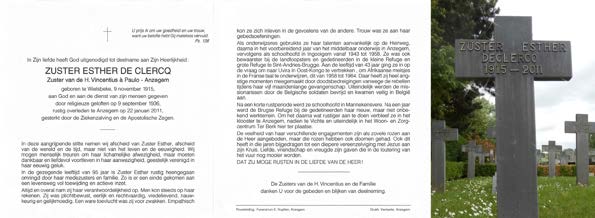
768
CHAPTER 44. ERNEST CONSTANT DECLERCQ (DC14) & MARIE ELODIE DEVENYN
Figure 44.80: The death announcement of Sister Ernestine, 2011. (Declercq de Silva Archive)
Figure 44.81: 2011, January 22, the obituary card of Sister Ernestine. Right is her tomb stone at the cemetery of Anzegem.
(Declercq de Silva Archive)
Figure 44.82: Left is a postcard written by Esther Ernestine Declercq on December
12, 1930, to Michel Declercq’s fiancé Irma Lesage, addressed to her father, Emile
Lesage. Esther Ernestine had beautiful handwriting. Right is an example of a an
envelope of a letter sent from Brugge, on which she has written her brother’s ad-
dress, in 1957: ’Heer Michel Declercq en Kinders, Oude Heerweg 76, Sint Lodewijk
- Deerlijk’ . (Declercq de Silva Archive)
© 2024 Nico F. Declercq
The Desclergues of la Villa Ducal de Montblanc, 2nd ed., Omn., VOL. III
44.5. THEIR FAMILY LIFE AND OFFSPRING
769
Figure 44.83: 1976, the obituary card of Firmin Joseph Loeys, mayor of Man-
nekensvere, where Ernestine has been a school principal. (Declercq de Silva Archive)
Figure 44.84: Judith began her education at Anzegem. A picture is shown of the school’s
playground and a regular class.
Figure 44.85: Left, Judith Declercq is shown around 1924 at her home in Wielsbeke.
Her father is holding her hand. Right, Judith is wearing a ’Charleston hat’ . Those
hats were trendy around 1930. We, therefore, suspect this image was taken in 1930
when visiting the World Exhibition at Antwerp. In the middle, Judith is shown
around 1937. (Declercq de Silva Archive)
The Desclergues of la Villa Ducal de Montblanc, 2nd ed., Omn., VOL. III
© 2024 Nico F. Declercq
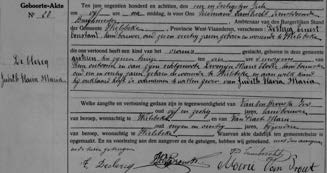
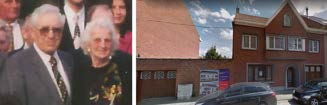
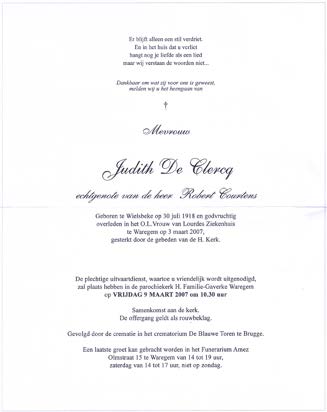
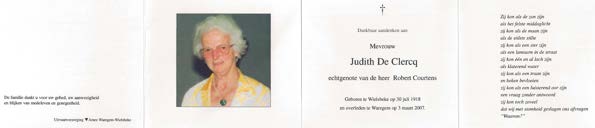
770
CHAPTER 44. ERNEST CONSTANT DECLERCQ (DC14) & MARIE ELODIE DEVENYN
Figure 44.86:
The birth certificate of
Judith Flavia Maria Declercq, Wielsbeke,
1918, born on July 30. Birth registration
witnesses: Ivo Van den Broucke, 65 years
old, farmer, an inhabitant of Wielsbeke;
Marie Van Praet, 49 years old, an inhabi-
tant of Wielsbeke.
Figure
44.87:
Judith Declercq with
Robert Courtens in their old days. Right,
the house of Judith Declercq and Robert
Courtens is shown in Zeswegenstraat 93,
8790 Waregem. The picture was taken
in 2019, right before the home would be
demolished.
Courtesy of Google Street
View®.
Figure 44.88: The death announcement
of Judith Declercq.
(Declercq de Silva
Archive)
Figure 44.89: The obituary card of Judith Declercq, March 3 of 2007. (Declercq de Silva Archive)
© 2024 Nico F. Declercq
The Desclergues of la Villa Ducal de Montblanc, 2nd ed., Omn., VOL. III
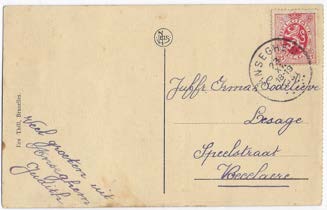
44.5. THEIR FAMILY LIFE AND OFFSPRING
771
Figure 44.90: The death announcement of Robert Courtens, husband of Judith Declercq. (Declercq de Silva Archive) Figure 44.91: The obituary card of Robert Courtens, husband of Judith Declercq, August 14 of 2015. (Declercq de Silva Archive)
Figure 44.92: The back of the card shown
in Figure 44.82 on page 768. (Declercq de
Silva Archive)
The Desclergues of la Villa Ducal de Montblanc, 2nd ed., Omn., VOL. III
© 2024 Nico F. Declercq
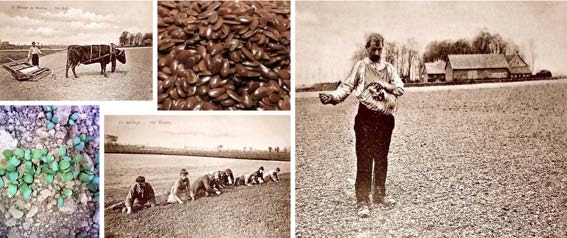
772
CHAPTER 44. ERNEST CONSTANT DECLERCQ (DC14) & MARIE ELODIE DEVENYN
may also check Chapter 42, Chapter 43, Chapter 44.8.20, Chapter 44.10, and Chapter 45.1.6 for more information.
The ability to care for children’s welfare must have compensated for her broken dreams. She had had her education to become a nurse at Elisabethverpleegsterschool of Brugge. As a trained nurse, she also became involved in education as a teacher.
She became one of the founders of ’Hoger Instituut voor Verpleegkunde’ at Kortrijk, a college associated with the Katholieke Universiteit Leuven. The Nurse Training School ’Maria Middelares’ would later become ’Hoger Instituut voor Verpleegkunde’ 11.
The idea to have such a school in Kortrijk came from Dr Sebrechts, who convinced Canon Decoene to convince Dean Camerlynck.
The first steps were set in 1935 by the sisters of Sint-Niklaas, with the help of the families Landas and Vermeulen. It was on October 12, 1937, that the new school was inaugurated.
One week later, the first classes were taught. The early teachers were sister Marie-Pierre, sister Marie-Xavier, and sister Hildegarde for Psychology and Pedagogy.
Simultaneously, juffrouw Judith Declercq provided technical education, and priest F. Demarez provided religion. Judith was not yet 20 years old.
The appearance of Camerlynck and Vermeulen indicates that Michel Declercq, her brother, had probably suggested Judith. He knew both families well through his wife, Irma Lesage, and his parents-in-law. Judith’s young age was not a surprise. Indeed, becoming a nurse then required one year of education after high school. She was well on track.
She was an example of the early emancipation of women. She had finished her medical education and started teaching when the Second World War began, and the Germans invaded Belgium in May 1940. During the invasion, followed by the German occupation, and later during the liberation of Belgium in 1944, she worked in the field and regular hospitals.
After the war, she continued to work as the Head of maternity in Kortrijk and as a teacher. As mentioned, she also became President of the Children’s Welfare Organization in West Flanders12.
Pictures of Judith are shown in Figure 44.85. Her husband is shown in Figure 44.87. They lived in Waregem at Gaverke, in Figure
44.87, also where Marie Elodie Devenyn, her mother, died. The death announcements and obituary cards of Judith and her husband are shown in Figures 44.88, 44.89, 44.90 and 44.91.
The author had the pleasure of meeting Judith and her husband, Robert, only a few times many years ago. In contrast, the author’s father enjoyed the warmth of their company nearly every month, and after Judith’s passing, he visited Robert almost weekly.
Judith and Robert deeply admired the author, keenly following his educational journey and scientific endeavors. It is said that they meticulously clipped and preserved every newspaper article featuring the author, a testament to their unwavering support and pride. Reflecting on the past, there is a poignant regret for not sharing more moments, as their kindness and friendliness left a lasting impression.
44.6 Their Life as Farmers and Flax Merchants
44.6.1 Introduction
Etymologically, the words Flanders (Vlaanderen) and Belgium (België or Belgique) originate respectively from the Germanic word Flaum and the Celtic word Belc’ h, meaning ’wetland’ and ’flax’ 13, or ’red hair,’ are two characteristics our country has always been associated with. Indeed, even the Romans were very impressed by the flax fields. Water is needed to ret flax, while the climate and soil between the Seine and Amstel rivers are ideal for flax cultivation.
The best soils for flax are found in Flanders: fertile, intensely cultivated, richly fertilized, weed-free, and with a well-drained top layer. In other words, loamy soils, sandy, and clay soils that are not too heavy are best. The climate should be mild, relatively constant, and moist, with long periods of sun.
A problem with flax is that it cannot be cultivated continuously but must be alternated with other crops. In particular, flax may only be grown on the same plot of land every seven years. This number was probably derived partly from experience and partly from religious considerations. Flax was indeed so noble it must be divine. Usually, barley was the fruit that was grown the year before flax was sown. Later, farmers also did this after wheat. In some areas during the 19th century, flax was also sown after potato cultivation. Curiously, these traditions were so deeply ingrained that even in the 1970s and 1980s, one often saw ordinary people growing potatoes in their gardens, only to sow grass the following year to obtain a beautiful lawn. Such traditions all date back to the days of flax cultivation. Sow flax on soils where nitrogenous plants had grown was always avoided because of its lower Figure 44.93: We can see rolling the land, a farmer sowing flax seeds (linseed), and weeding the land. In addition, images of linseed and young flax plants are shown, courtesy of Flaxbox, Zulte.
11Acta Groeninge nr 7 - AZ Groeninge, June 2007.
12Nowadays called ’Kind en Gezin.’
13H. Wedgwood, ’A dictionary of English etymology, Volume 1; Volume 3’
© 2024 Nico F. Declercq
The Desclergues of la Villa Ducal de Montblanc, 2nd ed., Omn., VOL. III
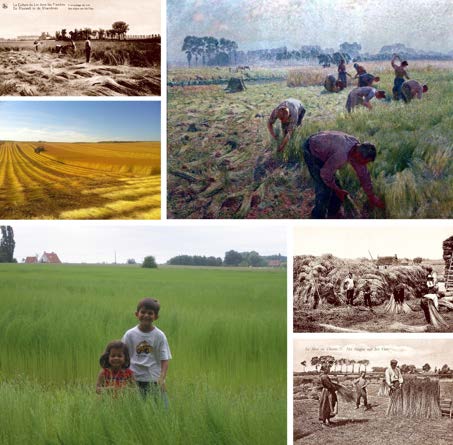
44.6. THEIR LIFE AS FARMERS AND FLAX MERCHANTS
773
Figure 44.94: The compilation shows different early stages in the processing of flax. First, we
find the author’s eldest children on June 22, 2008, in the middle of a flax orchard in Kortrijk,
in a wet spot where flax did not grow well (we avoided damage to the orchard). (Declercq de
Silva Archive). Then, scenes of flax harvested by workers are shown, which is dried and then
transported to the river. Flax was, for instance, placed in ’hedges’ to dry before processing.
Modern Flax Harvesting, ’vlas slijten’ is also shown (Courtesy of Flaxbox, Zulte). The machine
automatically removes the seeds before the flax plants are laid on the ground. Linseed must be
dried before it can be further processed. Finally, we see ’ Vlasoogst’ , painted by Emile Claus in
1904 p.
quality. Strangely, the ground became flax weary very quickly, and flax did not grow nicely or sometimes did not bloom. If that happened, it was sometimes avoided for 30 years.
The cultivation of flax and the production of linen in the area between Normandy and Holland is probably 2000 years old. Linen, however, was not very widespread because of several reasons. Wool, for instance, was much more accessible for clothing. Shortly after Belgium’s independence in 1830, linen production was boosted and formed the core business along the Leie River, soon receiving the name Golden River. For over one century, the industry prevailed in the region. By the end of the 1950s, flax in the area had lost its importance because of synthetic fibers, cheap flax, and linen exported by the Soviet Union. Flax cultivation still exists, but only for specialized applications requiring long, high-strength, and fine bio-fibers. In the Kaukasus mountains, flax fibers were found 32000 years ago when men were not even farmers. The oldest linen fabric was found in Turkey and is around 9000 years old, which is remarkable because the oldest cloth made of wool is about 6000 years old. Therefore, it is very likely that flax fibers were used for clothing and other applications much earlier than wool. The main difference between wool and linen is that flax fibers are hollow and lighter than wool, yet better isolating. It is well-known that if treated well, linen clothes last a lifetime and become softer. Flax slowly turns into silk, so to speak, because it becomes softer and whiter when dried or bleached in the sun after being washed.
It may be hard for the reader not from the Golden River area to believe that flax used to be a religion, an obsession, an identity, a source of income, and social status. The author is not a flax farmer and did not grow up as such, but he is still baffled by how important flax used to be and how unimportant it is today. Nowadays, we find flax as carbonized fibers (although other sources of carbon fibers are more common) in airplane composite materials, but also United States Dollar bills. Sometimes expensive clothes are made of flax. Composites made of uncarbonated flax fibers are gaining momentum nowadays as a modern hype. These materials have excellent properties in vibrations and isolation and are also very fashionable.
To farmers, the most beautiful creation is a flowering flax orchard. The charming, beautiful purple color is even more beautiful than indigo blue. Indeed, the combination with the flax stem’s light green, where the fibers are growing, is splendid. Each flower blooms only one day. There are, however, numerous flowers, making the entire transitory blossoming period around three weeks.
It all begins with preparing the ground and careful raking. Then, one must choose the perfect day to sow the seeds. The honor to do this goes to the head of the family. He acts, on that day, like a God. Prayers are not uncommon. Sowing is done with love and affection, hope and aspiration. Even the choice of seeds is very delicate. The Latin name for flax, exploited for its fibers, is Linum usitatissimum, which means ’the most useful type of flax.’ Flax also exists to extract linseed oil, but our ancestors aimed for real gold: perfect fibers.
Growing flax takes 100 days from sowing until harvesting. Our ancestors probably experimented with growing flax on their land.
However, the ground was usually used for other crops. Instead, flax was grown on somebody else’s farm. Indeed, high-quality flax can be cultivated within 100 km from the coast, between Caen in France and Amsterdam in the Netherlands. The best soils are The Desclergues of la Villa Ducal de Montblanc, 2nd ed., Omn., VOL. III
© 2024 Nico F. Declercq
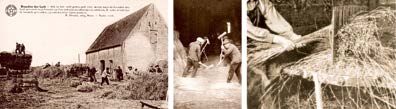
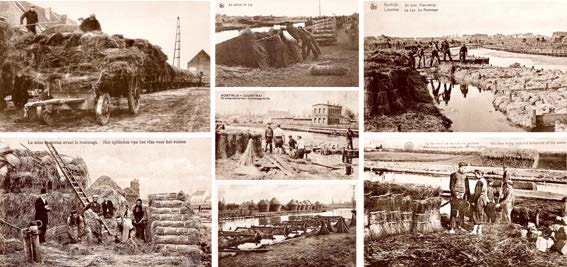
774
CHAPTER 44. ERNEST CONSTANT DECLERCQ (DC14) & MARIE ELODIE DEVENYN
Figure 44.95: Dry flax plants were beaten or threshed to release the seeds (thresh-
ing). We can also see how flax rippling occurred to remove the empty seed balls.
Figure 44.96: Flax had to be transported for further processing. We can see flax being unloaded from the train onto a cart. Another image shows a flax merchant overviewing workers who bind a load of dry flax in preparation for retting.
Then, flax is prepared for immersion in the river. This was typically done after flax merchants purchased it, who paid workers to arrange the immersion process. We also see flax immersed in the Leie River. The purpose was to rot the plants and hence to release the fibers. Workers are observed pushing a caisson with flax into the river and pulling out flax. The Leie River, despite its nickname, was heavily polluted when flax was retted. For this reason, more sophisticated techniques, such as hot water tubs, have been used more recently.
found in Northern France (Picardie). If he did not know the farmer, the standard procedure for a flax merchant was to lease land in France for one season 50/50 with the landowner, Compte ’a Demi. This means the merchant paid half the cost and earned half the gain. Such a procedure was widespread and allowed the farmer to merchandise his yield, diminishing the risk in case of a natural disaster. To the merchant, it guaranteed that he would get the harvest. The harvest was then shipped by train or boats to the Golden River area in West Flanders for further processing, typically controlled by the merchant. Sometimes, a merchant sold the harvest at the train station to other merchants.
44.6.2 Plowing, Harrowing and Sowing Flax (’Ploegen, ’Eggen’ or ’Rakelen’ and ’Zaaien’)
Plowing was crucial for achieving high-quality flax. It was done as deep as possible, preferably before winter. When deeply plowed earth freezes, it crumbles and ensures a deep layer of grainy earth through which water can quickly drain. The first requirement was to avoid diseases and reduce unwanted weeds in the flax yard.
As soon as the soil and weather proved suitable, the farmer began to prepare his land. It was plowed again and then leveled and crumbled. So the farmer first used the plow, then a zevenschaar to uproot developing weeds, and then a harrow to better crumble the soil. Consequently, he leveled the land to become as flat as possible, without clods and pits. He used a roll, as seen in Figure
44.93, but also mats, planks, or sometimes even his bare feet.
Sowing flax was a religious ritual. Linseed was sown on the prepared soil and then lightly covered so the seeds were buried no deeper than 2cm. The farmer required sufficient expertise and mastery to perform this task to perfection. Flax was not allowed to grow too close, but also not too much spread out. Therefore, the right amount of seed per hectare was of paramount importance. When one chose to grow very fine flax, intended for lacework, a framework of twigs was made above the field through which the flax could grow so that it was well held and protected against blowing over or falling over. This was very intensive work, partly determining the high cost of fine linen. The linseed, shown in Figure 44.93, was always blessed before it was sown. There was also a great deal of superstition among the people from which they believed they could predict whether a flax year would be prosperous. They never sowed on Good Friday in most places, while in Moorslede, they did sow on this day. They also tried to sow at the new moon.
Flax was instilled early in the morning and calm weather. The sower was usually given exceptional nourishment for performing his sacred act.
The sowing apron was pure white out of respect for the linseed, hoping the flax would also be paler. The seed was often poured into the seed coat by a beautiful young girl, as in Figure 44.98 on page 775, after which the sower could begin his precision work.
Before the sower threw his first throw of seed on the ground, he had to pray and make a sign of the cross on his chest. A sign of the cross was also placed on the ground with the feet to keep away all evil forces. The farmer threw the seeds, as shown in Figure
44.93, with the tips of the fingers and in wide arches around him. Flax nut was used with the full hand, as was done with wheat and grain, to avoid sowing too close and to show respect.
The sower did not look around but kept his head still and concentrated on the path to follow, strip by strip, the entire field very
© 2024 Nico F. Declercq
The Desclergues of la Villa Ducal de Montblanc, 2nd ed., Omn., VOL. III
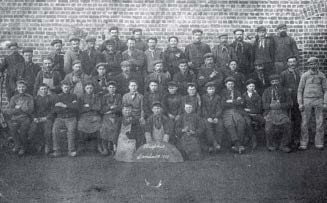
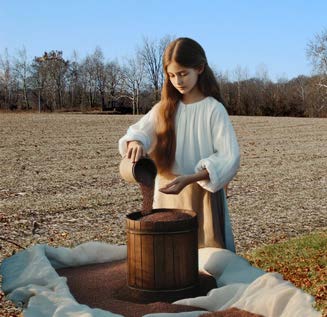
44.6. THEIR LIFE AS FARMERS AND FLAX MERCHANTS
775
Figure 44.97:
The picture was taken
in 1909 of the working staff of the flax
processing company of Lambrecht at Sint-
Baafs-Vijve. Lambrecht was one of the
major partners of the Declercq family at
Wielsbeke in the framework of their flax
trade.
Figure 44.98:
This artistic impression
depicts a young girl standing in a flax field,
pouring linseed into a seed coat. The im-
age was made with AI (DALL·E 2024-06-
04 14.15.42)
evenly. While walking, the sower always took equal steps. He also threw the seed relatively high in the air for even distribution on the ground and hoped for long flax fibers. After completing the task, the farmers stuck blessed palm branches into the ground at the field’s four corners. Sometimes, sacred ashes were scattered over the domain.
After sowing, the orchard was carefully raked. The land was rolled again slightly in dry weather to cover the seed a little better and protect it from dehydration. A horse never did the task because they made too deep wells. Therefore, the entire sacred ritual was done barefoot and very carefully.
Depending on the weather and the ground, a flax cultivator had to choose a suitable date to sow Flax between March 15 and April 15. Sometimes, May was selected if an early period needed to be wetter, resulting in lower quality or lower yield flax. Early sowing (long vegetative period) was beneficial for the total crop yield. However, flax was sensitive to night frost up to about three days after emergence, after which the frost sensitivity decreased.
There was approximately 120 kg of linseed necessary for one hectare. Flax required good moisture-retaining soil with an undisturbed profile and good drainage. The yield potential was determined by unchecked primary root growth, a homogeneous emergence, and steady development of the flax plants.
The soil had to be well-drained and sunny, so flax naturally did not grow near the Leie River but in better areas, particularly in the North of France. The ground had to be flattened so the plants grew equally and were quickly processed afterward. A flat and well-crumbled seedbed (approx. 4 cm) on a moist substrate was obtained when preparing the seedbed. Processing flax was done in the Leie River or nearby because of the beneficial properties of this specific river water and the centuries-old expertise in the area.
Sowing linseed early in the year is possible because flax grows well in cold temperatures.
Funny expressions existed to describe the quality and properties of land with flax. A beautiful one is ’the farmer’s wife has helped to sow,’ meaning it was not evenly spread. Indeed, sowing flax was exclusively done by men; therefore, women unfortunately never acquired the necessary experience and expertise, hence the expression.
44.6.3 Weeding the Field
Flax then grew, and while it did, the land had to be weeded, as in Figure 44.93, several times, or only once at the right time, to ensure only Flax grew, as, also, in Figure 44.93, and nothing else. The entire family and available workers were involved in this mandatory task, although workers primarily did the work.
The intensive work lasted several days and always commenced with a solemn prayer, a moment of deep reverence for the task at hand. The farmers and workers also bestowed many blessings during the weeding process, a gesture of respect and hope for a bountiful harvest. This practice served not only to ask for prosperity for the Flax but also to discourage excessive gossip and maintain a respectful atmosphere. Workers, known for their penchant for gossip, were reminded of the potential consequences of their words on the harvest. Unlike cotton fields, flax fields did not require irrigation.
The Desclergues of la Villa Ducal de Montblanc, 2nd ed., Omn., VOL. III
© 2024 Nico F. Declercq
CHAPTER 44. ERNEST CONSTANT DECLERCQ (DC14) & MARIE ELODIE DEVENYN
44.6.4 The Bloom of Flax
Flax blooms in the second half of May or early June. It takes three to four days for the entire flax field to be colored, with each flower blooming for only a few hours. Each flower opens early in the morning and is completely open by ten o’clock. Around two or three o’clock in the afternoon, the flowers close again to wither by evening. Each flax plant has different branches, which means that it flowers for several days in total. In the past, flax flowers were always blue, but white varieties are equally disease-resistant.
The blue color of flax flowers is the most beautiful azure in the world. In particular, the combination of the light green Flax with the sky-blue color of the flowers is truly heavenly. Flowering Flax is even more beautiful when the sun shines, and the wind creates an undulating back-and-forth dance of the flax orchard.
René Declercq wrote a poem about blooming flax:
’Het vlas staat in de blom,
Al groen en blauwig,
En ’t windje vliegt er om,
Zoo vleiend flauwig.
De herels recht en flinks
Hun teert topjes,
En keeren rechts en links
Hun kleine kopkes.
Hoe zot en preusch ze zijn,
Elk met zijn vaantje,
Van hemelsblauw satijn
Op’ t groene staantje!
Hier beet een bruine bie
En ginder, ginder