

The Desclergues of la Villa Ducal de Montblanc, Second Edition Omnibus by Nico Declercq - HTML preview
Download the book in PDF, ePub, Kindle for a complete version.
34.6. MILITARY CAREER OF ANTONI DESCLERGUE AFTER 1641
571
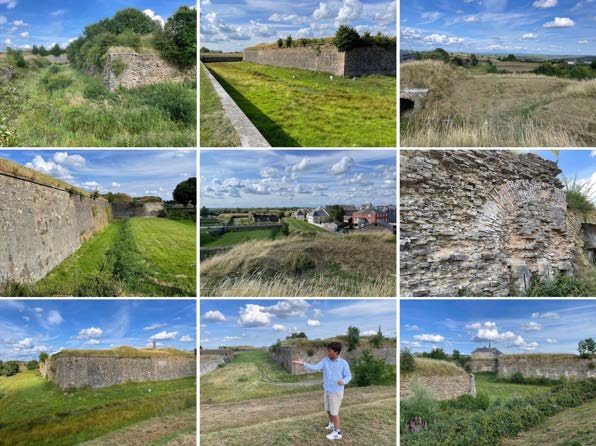
Figure 34.150: Rocroi. In 1545, Francois I requested Girolamo Marini, commissioner-general of Champagne fortifications, to fortify the Champagne border. He constructed a modest fort near the town of Roulcroix. In 1552, Charles Quint resolved to construct Fort Charlemont at Givet. In response, Henri II ordered the construction of the Rocroi enclosure in the same year, with its radio-concentric plan inscribed in a system of five star-shaped bastions (with orillons). As evidenced by fortification treaties published after 1545, the radio-concentric plan has become the distinctive layout of war towns alongside the polygonal bastioned enclosure. It was finished in 1556. Marini likely constructed the former fort, which has been converted into a bastion known as Bastion du Petit-Fort or Bastion du Roy. Marshal de Bourdillon entrusted the construction to a master mason from Senlis, Loys Lenthe. Initially, there was no enclosure. The Spanish unsuccessfully besieged the city in 1556 and 1559.
The administrator of Champagne, Francois de Clèves, ordered the immediate reinforcement of the defenses. Sedan Protestants captured the location on November 20, 1588. It was sold to the Duchess of Guise. In 1614, King Louis XIII purchased it. The initial plan was maintained, but half-moons altered the bastions. As a citadel, a moat separated the King’s bastion from the city. Finally, the scarps were concealed with masonry. During the siege of Rocroi by the Spaniards led by Francisco de Melo on May 19, 1643, the famous Battle of Rocroi took place, resulting in a French victory over the Spaniards. The commander-in-chief of the French royal army, the Duke of Enghien, subsequently known as the Grand Condé, demonstrated his military brilliance to all. After a century of defeats and civil conflicts, this decisive victory in the Thirty Years’ War (1618–1648) signified France’s return to the international stage.
The Desclergues of la Villa Ducal de Montblanc, 2nd ed., Omn., VOL. II
© 2024 Nico F. Declercq
572
CHAPTER 34. ANTONI DESCLERGUE Y DE MONTOYA (DC06)
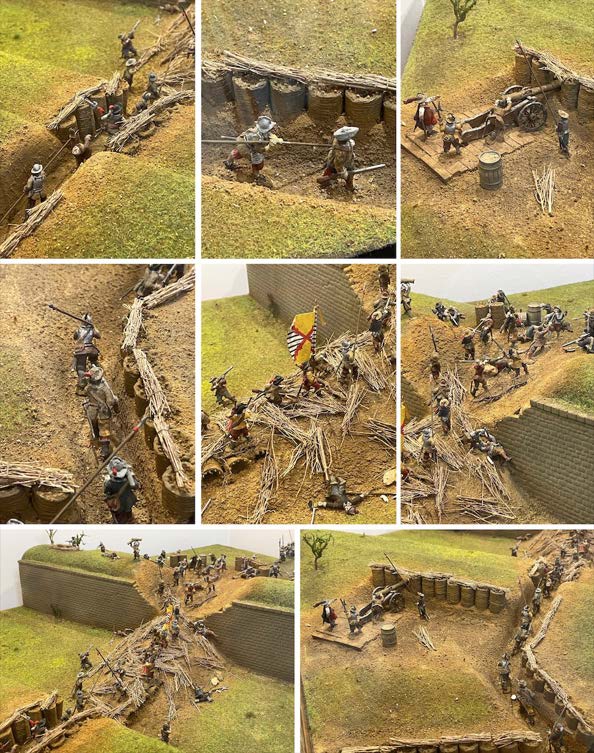
Figure 34.151: Battle scenes are shown at the Museum of Rocroi, ”Musée de la Bataille de Rocroy et de la Guerre de 30
ans’,’ of the famous battle of Rocroi during a breach of the defense walls.
© 2024 Nico F. Declercq
The Desclergues of la Villa Ducal de Montblanc, 2nd ed., Omn., VOL. II
34.6. MILITARY CAREER OF ANTONI DESCLERGUE AFTER 1641
573
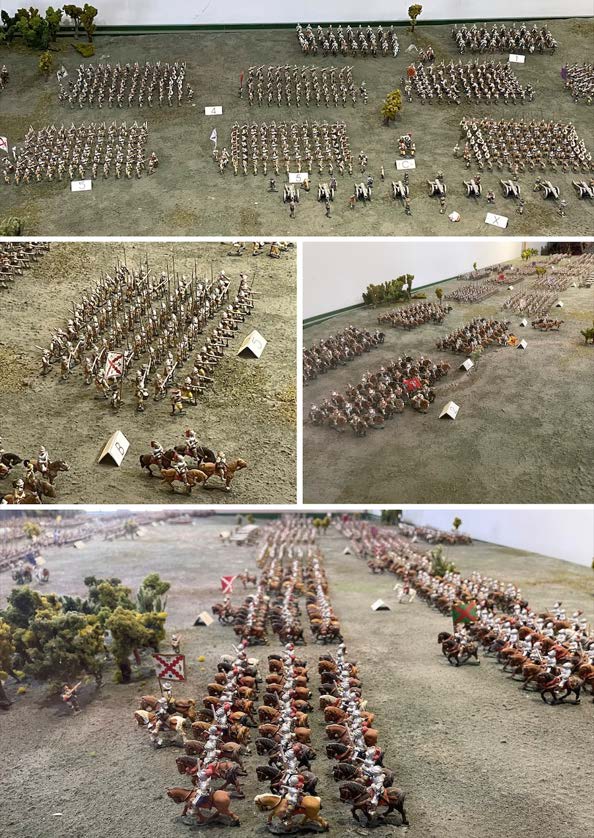
Figure 34.152:
The battlefield of Rocroi. (1) Reserve Spanish Cavalry (D’André); (2) Croates; (4) German Infantry
Regiments; (5) Spanish Tercio Infantry; (A) Issembourg; (B) De Melo (Mellos); (C) Fuentes (Fontaine);(X) Spanish Artillery.
The Desclergues of la Villa Ducal de Montblanc, 2nd ed., Omn., VOL. II
© 2024 Nico F. Declercq
574
CHAPTER 34. ANTONI DESCLERGUE Y DE MONTOYA (DC06)
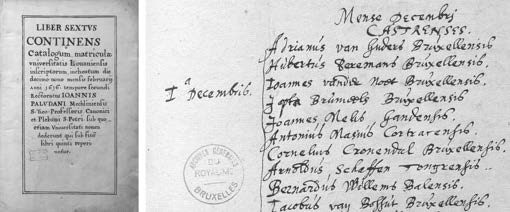
Figure 34.153: The inscription at the Catholic University of Leuven of student Antonius Maes from
Kortrijk (’Cortracensis’) on December 1, 1631. With Anna Declercq, he would later witness a baptism in Deerlijk in 1653.
© 2024 Nico F. Declercq
The Desclergues of la Villa Ducal de Montblanc, 2nd ed., Omn., VOL. II
34.7. ANTONI DESCLERGUE AS ALDERMAN’S CLERK
575
34.7 Antoni Desclergue as Alderman’s Clerk
Spanish military personnel stationed in Flanders were not constantly engaged in combat during the Eighty Years’ War. While summers were typically reserved for fighting or besieging cities, the winter months necessitated alternative occupations. Antoni Desclergue was a member of an ancient noble family from Spain, distinguished by their long tradition of serving as notaries and scribes—professions denoted by their noble purple blood.
Antoni Desclergue’s youth was marked by the challenges of being orphaned at a young age, which likely limited his formal education.
Despite this, the notarial profession, deeply rooted in his family heritage, naturally attracted him. This familial legacy of clerical and administrative service probably influenced Antoni’s decision to become a griffier (scribe) at the Alderman’s bench in Deerlijk.
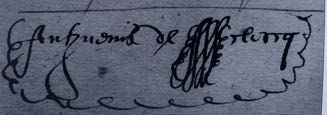
As a scribe, Antoni’s duties would have included recording legal documents, maintaining municipal records, and facilitating the administrative functions of the local government. His work in this role is evidenced by his distinct signatures on official documents.
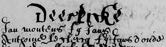
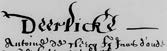
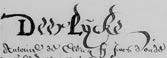
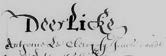
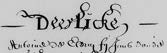
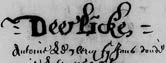
Notably, Antoni differentiated his signatures based on the importance of the matters at hand. For routine notarial duties, shown in Figure 34.154, he signed without the "C" of Caballero, his knighthood title. However, for significant personal or official matters, such as documenting the death of his wife Beatrice, he utilized his full knighthood signature, underscoring the gravity and personal significance of those events.
Antoni Desclergue’s dual role as a military officer and a civic scribe reflects the broader historical context in which Spanish soldiers in Flanders operated. His ability to navigate these responsibilities highlights the versatility and adaptability required of individuals in such tumultuous times. Desclergue’s career also exemplifies how noble lineage and family traditions continued to shape personal and professional identities, even amidst the ongoing conflicts of the Eighty Years’ War.
Figure 34.154:
As a scriber, a side-
job in the tradition of his ancestors, An-
toni Desclergue (DC06) used a less sophis-
ticated signature than as a private indi-
vidual, where he indicated his knighthood
with ’c’ in front of his name, as in Fig-
ure 34.1. Nevertheless, an ornamental ’c
can still be identified, while the character
’A’ is actually a merged F and A. Still, the
anagram EHR in the middle can be read,
meaning Knight of the Spanish King, or,
either ’Eques Hispani Rex.’ In case the
middle is only an ornament instead of H,
then there is ER, meaning ’Eques Regii,’
or Royal Knight. Adding an indication of
one’s Spanish Knighthood was not unique
and can also be found in Figure 34.155 of
another Spanish Knight in Tournai.
The Desclergues of la Villa Ducal de Montblanc, 2nd ed., Omn., VOL. II
© 2024 Nico F. Declercq
576
CHAPTER 34. ANTONI DESCLERGUE Y DE MONTOYA (DC06)
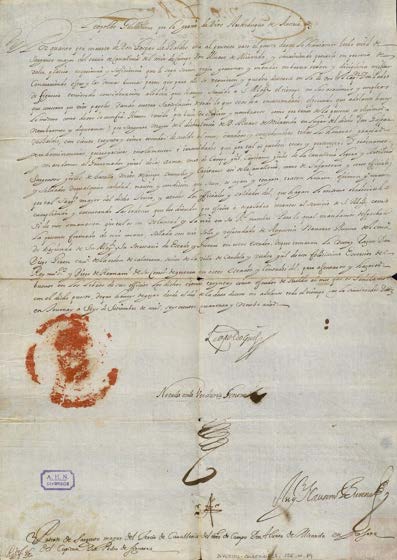
Figure 34.155: A patent of the Sergeant Major of a Tercio of Álvaro de Miranda
in 1649, was preserved in the National Historical Archive of Spain. It bears the
autograph signature of Leopoldo Guillermo of Habsburg, the Archduke of Austria,
and was issued in 1649 in favor of Captain Pedro de Figueroa, replacing the late
Gaspar de Baldés. His salary amounted to 135 escudos a month. The document was
written in Tournai and was also signed by Augustin Navarro Buzena, who was a
Spanish Knight, as can be seen in the anagram he added at the end of his signature,
similar to Antoni Desclergue’s signature in the same period shown in Figure 34.1
on page 519, and Figure 34.154 on page 575.
© 2024 Nico F. Declercq
The Desclergues of la Villa Ducal de Montblanc, 2nd ed., Omn., VOL. II
34.8. THE SIEGE OF BARCELONA IN 1651
577
34.8 The Siege of Barcelona in 1651
34.8.1 Antoni Desclergue’s Context
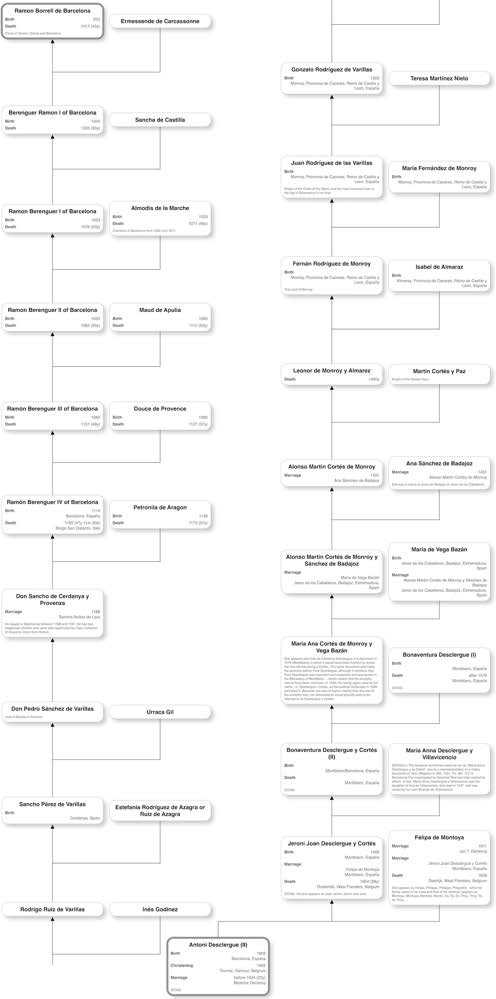
It may first be necessary to remind the reader that Antoni Desclergue (DC06) was a descendant of the counts of Barcelona, as shown in Figure 34.156 and outlined in Chapter 19.27.2 on page 211, and in Chapter 27.2 on page 301.
It is essential to comprehend the context of this section by recognizing that since 1641, Catalonia, including key areas such as Barcelona, Perpignan, and Roussillon, had fallen under the control of the French Crown. The Spanish Monarchy initiated renewed efforts to reclaim these territories from 1647 onwards. This strategic campaign involved redeploying troops initially from various regions within Spain and subsequently from other Spanish territories, including Flanders. These military maneuvers aimed to reassert Spanish dominance in Catalonia and reverse the territorial losses sustained earlier in the conflict.
Antoni Desclergue (DC06) went to Spain with his brothers-in-law Jan Declercq, an archer in the Spanish army, and Pieter Declercq, also in the military. We assume that their wives joined them if they could, i.e., Beatrice Maria Du Puich or Vandeputte of Jan, who would call herself ’Beatriz Maria de Pinto’ while in Spain53. Beatriz Declercq of Antoni (DC06) could not join them because she passed away early in 1651. The clan left for Barcelona in the summer of 1651, we presume, i.e., after Antoni Desclergue (DC06) had made the necessary arrangements concerning his wife’s inheritance for the children.
We have not found more data about Pieter Declercq. Pieter Declercq and Antoni Desclergue (DC06) had been registered as Burgher of Kortrijk but ended this status before leaving for Spain. Indeed, Pieter would never re-establish his condition, while Antoni would re-establish it afterward, as shown in Chapter 34.12.2.
Maria Declerque (DC07b), daughter of Antoni Desclergue (II) (DC06), joined too. She married in Spain, probably in Valls or in Montblanc, Rafael Juan de Pedrolo, as described in Chapter 28.5.
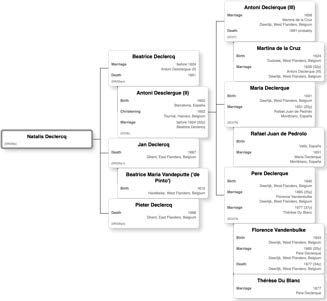
Figure 34.157 shows the relationships between Antoni Desclergue (DC05) and his brothers-in-law.
We know that in 1646, Antoni Desclergue (II) (DC06) was already a sergeant. He must have further climbed the military echelons to take an essential role in the Siege of Barcelona in 1651. As mentioned, in 1651, he did not register as a Bourgeois Forain at Kortrijk; his wife died in early 1651, and he left for Spain in the summer of 1651. It is interesting to note that it took Antoni Desclergue, the son of Jeroni Joan Desclergue y Cortés (DC05), who had passed away in 1604, nearly six months to arrange his wife’s inheritance in 1651, which may be due to his activity to recruit soldiers for Spain.
Antoni’s brother-in-law Jan Declercq, from the family of Beatrice Declercq (DK02byx) and Antoni’s stepbrother Jan Declercq (DK03dya), served as guardians for the underaged children concerning the inheritance. Indeed, as can be in Chapter 34.12.3, on July 17, 1651, both Jans were appointed as guardians to the children. After the Siege, Jan Declercq remained in the army described in Chapter 36.4. We don’t know what happened to Pieter Declercq.
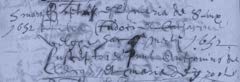
Antoni Desclergue (DC06) took another person with him from Deerlijk, namely Joost Desaux, who would be called ’Jose Dausach’ in Spain, very likely with his family, including his sister or an adult daughter, Catherine Desaux (Catarina Dausach). After returning from Spain, Antoni Desclergue (II) (DC06) served as godfather in 1652, at Deerlijk, to the daughter of Jose Dausach, in Figure
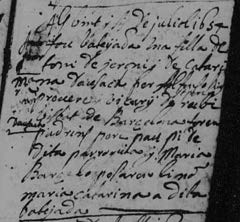
We know that Antoni did not marry again but would have an affair with Catarina Dausach or Catherine Desaux. The latter returned to Spain in the winter of 1653-1654 or Spring of 1654, perhaps with Antoni (DC06), and had a daughter ’Maria Catarina Dausach’ (sic), baptized on July 26, 1654 (at Sant Pere de Rubi, near Barcelona), in Figure 34.158. Maybe the couple traveled back and forth during that period. We do not know if Antoni (DC06) was there too at that time; perhaps not. The daughter received the name of the already passed away eldest daughter of Antoni Desclergue (II) (DC06) and Beatrice Declercq (DK02byx), namely Maria, followed by the first name and the mother’s family name.
We found no further records of this daughter, Maria Catarina Dausach. Perhaps she did not live long. However, we know that when Antoni Declerque (III) (DC07) and Martina de la Cruz had a daughter in 1669, her name would be Maria Catarina. She was named after her (dead) auntie.
On the Spanish baptism certificate of Maria Catarina Dausach, Antoni Desclergue is mentioned as ’Antoni de Jeroni’ (sic).
That the Desclergues were connected to the Dausach clan is also shown in Figure 29.171 on page 435, where a daughter of Miguel Desclergue (DC06b), described in Chapter 29.9.6, gives birth to a daughter, Maria Anne Legier in Cambrai in 1650, with Ares Dausach as godfather.
In 1656, in Deerlijk, Antoni (DC06) was present for the wedding of his son Antoni (DC07) with Martina de la Cruz, described in Chapter 37.5. We also know that he appeared as Bourgeois Forain of Kortrijk from 1652 onwards. Therefore, if he had left again for Spain, it would not have been for several years.
Note that from 1652 onwards, there were more baptisms of the Dausach-Velghe family in Deerlijk (Catharina on June 18, 1658, Arnoldus on March 4, 1657, Joanna on July 28, 1655, Agidius on November 9, 1653, Maria on March 5, 1652, Ludovicus on December 5, 1649, Michael on February 19, 1648).
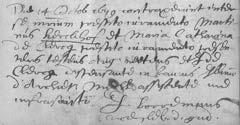
It is possible that Maria Catarina Dausach returned with her mother to Belgium. Perhaps Antoni and Catherine even married afterward. We have no evidence. There is a wedding in Figure 34.160 on October 14, 1679, in Brussels at ’Saint Michel et Gedule,’
which may be of Maria Catarina. The witness was ’J Declercg’ and may have been Joana Declercgz (DC08b), her niece, who was 22 years old. Her father, Antoni (DC06), was still alive but was an older man of 77 years who perhaps could not travel to Brussels.
While these scenarios are plausible, conclusive evidence remains elusive.
Before we move on to the next topic, it’s exciting to read again the baptism certificate of July 26, 1654, at Sant Pere de Rubi near Barcelona, in Figure 34.158. The baptism certificate from Rubi was obtained with the help of Mormons in France at Villeneuve d’
Ascq and Loos at the border with Haubourdin54. Note that, as a coincidence, this village also appears in the history of the Chapel of Deerlijk as described in Chapter 49.
The certificate reads,
’Als Vint y Sej de juliol 1654, fou bateyada una filla de Antoni de Jeroni y de Catarina Maria Dausach per Afonso.. vicary de rubi villat de Barcelona foren padrinij Pere Pau Pi de dita parroquiae y Maria Barcelo, posaran el nom Maria Caterina di la babejada.’
In English, it says that,
’at San Pere e Rubi near Barcelona, on July 6, 1654, a daughter of Antoni de Jeroni en of Catharina Mana Dausach was baptized.
Alfonso, the vicar of Rubi in the county of Barcelona, did the baptism. The godparents were from the parish and were Pere Pau Pi and Maria Barcelo. The child was Maria Catharina, called ’Babejada,’ which means ’the little drooler’.’
We found that the godmother, Maria Barcelo, had married Joan Llados y Ameller in San Pedro, Rubi, near Barcelona, on February 53This was preferable above ’de puta’ because ’puta’ means ’whore’ in Spanish.
54See also Chapter 29.8.3.3
The Desclergues of la Villa Ducal de Montblanc, 2nd ed., Omn., VOL. II
© 2024 Nico F. Declercq
578
CHAPTER 34. ANTONI DESCLERGUE Y DE MONTOYA (DC06)
Figure 34.156: Antoni Desclergue (DC06) was a descendant of Count Ramon Berenguer of Barcelona
and Queen Petronila of Aragon.
© 2024 Nico F. Declercq
The Desclergues of la Villa Ducal de Montblanc, 2nd ed., Omn., VOL. II
34.8. THE SIEGE OF BARCELONA IN 1651
579
Figure 34.157: The descendants of Na-
talis or Noel Declercq, father-in-law of An-
toni Desclergue (DC06).
Figure 34.158: Maria Catarina Dausach, baptized on
July 26, 1654 at Sant Pere de Rubi near Barcelona. The
mother was Catarina Dausach, and the father was An-
toni (DC06) of Jeroni (DC05). Her godfather was Pere
Pau from Rubi, and her godmother was Maria Barcelo,
the daughter of H. Barcelo and Elaria Llados y Ameller
from Tarrasa. The godparents were unrelated to the
mother.
26, 1648; she was the daughter of H. Barcelo and Elaria. Her husband was the son of Joan Llados y Ameller and Anna. We also found a Pere Pau Pi who married Ygnes Baneta at San Pedro, Rubi, Barcelona, on January 3, 1668. We have found no trace of Catarina Maria Dasauch and also not of her daughter Maria Catarina.
Before 1700, we only found two Dassauch couples within a reasonable area around Barcelona. Perhaps one of these is the parents of Catarina Maria. We saw Joan Dausach and Margarida at Gerona, who had children in the 1620s (Pere Joseph, e.g.), and we also found Ramon Dausach and Eleanor Paset. They married at Tarrasa in Barcelona on May 19, 1619.
The surname Dausach is notably rare. The name probably derives from ’Da Usach.’ While ’Usach’ does exist, it is equally uncommon.
34.8.2 Antoni Desclergue’s Involvement in the Siege of Barcelona
Before the Siege of Barcelona, numerous episodes in the re-conquest of Catalonia were characterized by significant conflict and hardship. While there are no specific indications that Antoni Desclergue (DC06) was involved in these early stages, it is vital to understand the broader military and political landscape leading up to the siege.
Manel Güell55 recounts a dramatic episode where the Santa Maria Church of Montblanc was nearly destroyed in August 1649.
Prominent figures such as Juan de Garay, Francisco de Melo, the Marquis de Mortara, the Duke of Albuquerque, Gaspar de la Cueva, Juan de Sossa, Alonso de Mercado, and many others played crucial roles during these turbulent times.
The Siege of Barcelona, which took place from July 1651 until October 1652, was a pivotal event in the Catalan Revolt (1640-1652).
The revolt was part of the larger struggle against the centralizing policies of the Spanish Monarchy under Philip IV and his prime minister, the Count-Duke of Olivares. With its distinct political traditions and economic interests, Catalonia resisted these policies, leading to a decade-long conflict.
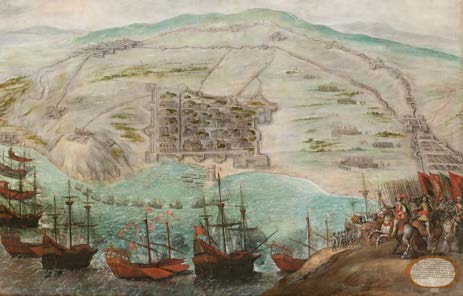
The siege was orchestrated by a substantial Spanish army that descended on Barcelona, besieging the city held by a garrison of Catalan and French troops under the command of Philippe de La Mothe-Houdancourt. This prolonged and arduous siege, depicted in Figure 34.161, lasted 15 months and culminated in a decisive Spanish victory, effectively ending the Catalan Revolt.
The fall of Barcelona suppressed the revolt and reasserted Spanish control over Catalonia. However, French troops remained in Catalonia for another seven years, maintaining a precarious ceasefire until the Treaty of the Pyrenees in 1659, which concluded the Figure 34.159: 1652, Deerlijk March 5, Antoni Desclergue (II) (DC06) is godfather, with godmother Maria de
Groote, to Maria Dausach (’De Saux’), daughter of Jose
Dausach and Catharine Velghe.
55Manel Güell, ’Juan de Garay, capità general de l’exèrcit de Catalunya (1649-1650)’
The Desclergues of la Villa Ducal de Montblanc, 2nd ed., Omn., VOL. II
© 2024 Nico F. Declercq
580
CHAPTER 34. ANTONI DESCLERGUE Y DE MONTOYA (DC06)
Figure 34.160: Brussels, October 14, 1679 at ’Saint
Michel et Gedule’ , the wedding of ’Maria Catharina De-
clercg’ and ’Martinus Kerckhof’ with J Declercg as a wit-
ness.
Figure 34.161: ’El setge de Barcelona de 1651 - 1652’ , Escuela española del siglo XVII El Sitio
de Barcelona de 1651-1652
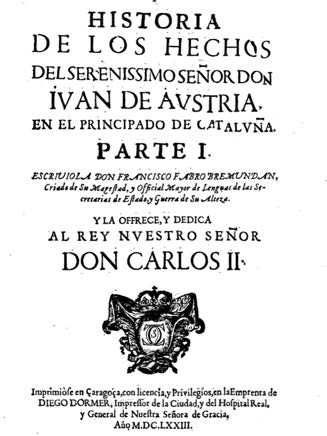
Figure 34.162: ’Historia De Los Hechos
Del Serenissimo Señor Don Ivan De Aus-
tria, En El Principado De Cataluña’ , by
Francesco Fabro Bremundan, 1673.
© 2024 Nico F. Declercq
The Desclergues of la Villa Ducal de Montblanc, 2nd ed., Omn., VOL. II
34.8. THE SIEGE OF BARCELONA IN 1651
581
conflict and resulted in the cession of northern Catalonia, including Roussillon, to France.
Antoni Desclergue (DC06), a man of nearly 50 years at the onset of the siege, may not have participated as a traditional soldier due to his age. However, his role in the siege was significant. It is plausible that he served in a senior staff role, such as a colonel or a mayor, though below the rank of maestro de campo. His involvement in the siege can be inferred from the military compositions and movements documented during this period.
An analysis of the army’s composition is essential to estimate Desclergue’s position during the siege better. According to George Payne Rainsford James,56 the Spanish besieging force included a Flemish regiment, suggesting the presence of troops from various Habsburg territories.
In July 1651, Baron de Seebach led an army comprising 6000 men, 2,600 horses, 16 guns, and four artillery pieces from Lleida to Cervera to threaten Balaguer. The Marquis de Mortara’s records indicate that this force grew to 5760 men, 2300 horses, 22 artillery pieces, 250 chariots, and 400 mules. This army later joined another force transported by sea, which disembarked on August 8 and included 2,500 German soldiers and additional artillery.
The Siege of Barcelona was a significant military endeavor involving extensive logistics and coordination. The presence of a Flemish regiment within the Spanish forces, along with the later addition of German soldiers, underscores the multinational nature of Habsburg military operations. Antoni Desclergue’s role, while not explicitly documented in the early stages, would have been crucial in the later stages, contributing to the administrative and logistical efforts required for such a protracted siege.
The army that besieged Barcelona was composed of up to 24 tercios or regiments:
Spanish tercios:
- Gaspar de la Cueva
- Juan del Castillo with a battery of 7 pieces 1 of 26 pounds the rest of 30, 40 and 46 pounds.
- Luis de Torres
- Pedro Estevan (Aragonese of 10 companies)
- Francisco de Sada (Aragonese of 10 companies)
Irish Tercios:
- Count of Tirón
- Cristobal Obreni (O’ Brien)
Italian Tercios:
- Tiberio Carraffa
- Marco Antonio de Genaro
- Marquess of Grez
Walloon Tercios:
- Ignace Clerc
- Calone
- Francisco Franquè
German regiments:
- Iaques
- Cleinhans
The cavalry of Baron de Butier
- Troç of Burgundy - Dionisio Poitier 600 men
- Troç of Flanders - Julio Vizconde (Comissario General) 600 men57
German Regiment of the Count of Ro commanded by Hercules Vizconde
- Tercio of Cristobal Cavallero
- Tercio of Pedro Viedma - (he Trinidad Fort)
German Regiment of Baron de Vilani - (Fort of Our Lady of Montserrat)
- Tercio of Valencia (387 men effectively in August of 1652)
- Tercio of the Count of Ro - (To the Fort Viscount and Our Lady of Grace)
- Careme’s German Regiment - a Star (not a fort)
- Tercio of Walloons of Franqueè - (the fort of San Buenaventura)
- German Regiment of Chapuis - (Within two redoubts next to the Quarter of Sans)
In December, 1100 men arrived from Martin de Azlor’s Aragonese tercio. On December 21, 1651, Pedro de Viedma’s tercio arrived with 300 men. On December 28, a company of 90 men of the tercio of Valencia and 160 men of the cam of Juan de Miranda. On December 31, 1651, the tercio from Tarragona arrived with 900 men in 10 companies. Engaged with this was a company of 110
men from the Aran Valley. Antoni Desclergue (DC06) likely played a senior role in the Flemish regiment ’Troç de Flandes led by Julio Vizconde.’ The composition, as mentioned above, of the army on the side of the Spanish Monarchy can also be found in Bremundan’s book58, shown in Figure 34.162.
34.8.3 Antoni Desclergue’s Life After the Siege of Barcelona
Following the Siege of Barcelona, one might have anticipated that Antoni Desclergue (DC06) would transition to a more peaceful life.
However, the region around Kortrijk remained tumultuous. The period from 1658 to 1659 is notably called the Berlot era. Despite the signing of the Peace of Münster on May 15, 1648, King Louis XIV of France continued hostilities against the Spanish. During these conflicts, Harelbeke endured significant hardships. Unlike previous periods, the scale of billeting increased substantially, with extensive military contingents occupying the town for extended durations.
In the spring of 1658, the French army, under the command of Marshal Turenne, once again invaded Flanders. Both Spanish and French forces devastated the local agriculture, turning the area into a no-man’s land frequented by vagrants and soldiers who harassed and plundered the populace.
On May 22, 1658, the Castellany of Kortrijk was authorized to establish guards in all its parishes to protect against these threats.
That same year, the Kortrijk garrison under Baron de Berlot served the Spanish crown, pillaged Harelbeke, stealing clothing, fruits, livestock, and other valuables and setting several houses ablaze. Despite these depredations, residents were still required to supply 56George Payne Rainsford James, ’Lives of the Most Eminent Foreign Statesmen: Louis de Haro; Cardinal Dubois; Cardinal Alberoni; John William, Duke of Ripperda,’ Longman, Rees, Orme, Brown Green, 1837
57Antonio Gómez, Con balas de plata III: 1640-1650. Cataluña y Rosellón, Difundia Ediciones, 2018
58Francesco Fabro Bremundan, ’Historia De Los Hechos Del Serenissimo Señor Don Ivan De Austria, En El Principado De Cataluña,’ 1673
The Desclergues of la Villa Ducal de Montblanc, 2nd ed., Omn., VOL. II
© 2024 Nico F. Declercq
582
CHAPTER 34. ANTONI DESCLERGUE Y DE MONTOYA (DC06)
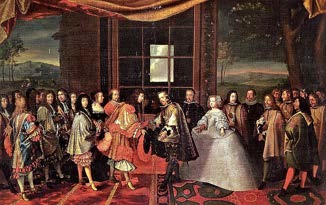
Figure 34.163: November 7, 1659, meet-
ing of King Felipe IV of Castile and his
delegation, with King Louis XIV of France
and his delegation, to seal the Treaty of the
Pyrenees, which resulted in peace between
Spain and France, but also the definitive
loss of Roussillon (North of Catalonia) to
France.
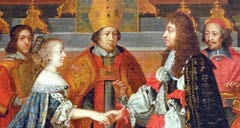
Figure 34.164:
Wedding of H.M. French King Luis
XIV with Spanish Maria Theresia of Austria on June
9, 1660 at Saint Jean de Luz.
provisions to the occupying armies.
The logistical needs of an active army precluded barracks, necessitating soldiers’ forced billeting in private homes. From May 28
to June 30, 1659, Harelbeke hosted Count Merchy’s troops in Spanish service for 33 days and nights. These troops could have conducted themselves better, and numerous houses were demolished during their stay.
André Woestijn59 documented specific instances of this billeting.
For example, a captain and his retinue were lodged with the brewer Arent Lemayeur, while the company of Count de Merchy’s son stayed with Simoen Staes at De Swaene, among others. The supply roll indicates that approximately 4300 men and 50 horses were billeted in the area. On June 30, 1659, new cavalry and infantry regiments arrived, further straining local resources.
Records from the Kortrijk archives confirm that soldiers were quartered in Zwevegem during 1659-1661.60
On November 7, 1659, France and Spain signed an armistice, followed by the Treaty of the Pyrenees, as detailed in Chapter 8.12.1
and Chapter 34.9. This treaty led to the withdrawal of French forces from the region, temporarily restoring Kortrijk to Spanish control. However, this peace was short-lived, as hostilities resumed in 1666.
34.9 Tratado de los Pirineos - Visit of Antoni to Montblanc in 1659
In 1659, Antoni Desclergue (DC06) undertook a significant journey from Kortrijk in Flanders to Montblanc near Tarragona in Spain. This period was marked by the conclusion of the Reapers’ War and the signing of the Treaty of the Pyrenees, events that are detailed in Chapter 8.12.1 and illustrated in Figure 34.163.
The Treaty of the Pyrenees, signed on November 7, 1659, between France and Spain, effectively ended the Franco-Spanish War (1635–1659), bringing considerable geopolitical shifts. The treaty resulted in territorial concessions, with Spain ceding parts of Catalonia, including Roussillon, to France, thereby altering the balance of power in the region.
Antoni Desclergue’s return to Spain in 1659 was not just a geographical journey, but a personal one. It was a time for him to reconnect with his family in Montblanc, including his daughter, Maria Declercque (DC07b), and her husband, Rafael Juan de Pedrolo.
Historical records indicate that Antoni Desclergue was absent from his duties as Bourgeois Forain of Kortrijk during 1659 and 1660, as mentioned in Chapter 34.12.2.
While in Montblanc, Desclergue probably played a significant role in familial and local community events. Notably, he is believed to have served as the godfather to Antoni de Pedrolo, the son of Francesc de Pedrolo y Desclergue and Anna Maria Ratera Riber and Robuster. This child was baptized on November 20, 1659.61
Desclergue’s journey from Flanders to Catalonia during this period was not just a physical distance, but a testament to the interconnectedness of European regions, even amidst ongoing conflicts. The journey itself would have been a daunting task, involving traversing territories still recovering from years of warfare. However, the cessation of major hostilities following the Treaty of the Pyrenees likely facilitated safer passage for individuals, highlighting the tangible impact of this historical event on individual lives.
The Treaty of the Pyrenees had far-reaching implications. It marked the end of the Franco-Spanish War and symbolized the decline of Spanish hegemony and the rise of French power under Louis XIV. The treaty included marriage arrangements between the French and Spanish royal families to secure long-term peace between the two nations.
34.10 Devolution War (1667-1669) and his Residence in Ghent (1672-1678)
during the Dutch War
59André Woestijn, ’Harelbeke in de Spaanse tijd, 1585-1713,’ De Roede van Harelbeke (De Leiegouw), nr 14, 1994.
60Gemeente Kortrijk, ’Oud Stadsarchief Kortrijk’ (OSAK), Document A0516-109095-107868-DUT-13659: Trial between Pieter vanden Berghe in Zwevegem, plaintiff, and mayor and aldermen of Kortrijk, defendant, before the Council of Flanders. Subject: Compensation for billeting by the defendant of soldiers with the claimant from January 11, 1659, to May 28, 1659. 1660-1661. 1 cover.
61Santiago Alberti, ’Esquema Històric del llinatge Pedrolo.’
© 2024 Nico F. Declercq
The Desclergues of la Villa Ducal de Montblanc, 2nd ed., Omn., VOL. II
34.10. DEVOLUTION WAR (1667-1669) AND RESIDENCE IN GHENT (1672-1678)
583
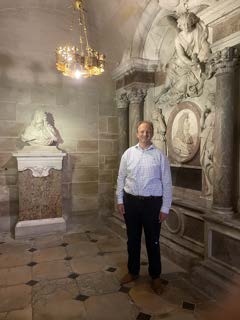
Figure 34.165: The tomb of Louis XIV at Saint Denis,
Paris, in 2023.
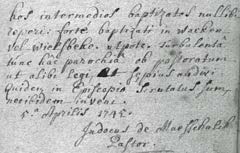
Figure 34.166: An interesting note was written by the
pastor in Wakken in 1745 in the transcription of the bap-
tisms, where the baptisms of 1671 were missing due to
force majeure.
34.10.1 Antoni Desclergue as a Military Recruiter for the Devolution War (1667-1669)
There are indications in the Bourgeois Forain registers of Kortrijk that Antoni Desclergue (DC06) was significantly affected by the Devolution War, as detailed in Chapter 8.12.1. Notably, his name does not appear in the records for 1668 and 1669.
The Devolution War (1667-1668) was a conflict initiated by France under King Louis XIV, who claimed the Spanish Netherlands (modern-day Belgium) on behalf of his wife, Maria Theresa of Spain, based on the law of devolution, which argued that these territories should devolve to her upon the death of her father, Philip IV of Spain. The war resulted in significant territorial gains for France, confirmed by the Treaty of Aix-la-Chapelle in 1668.
In the face of renewed hostilities, the Spanish Monarchy launched a strategic and extensive recruitment campaign. Commencing in the fall of 1667, new soldiers were enlisted in Spain to bolster the forces against France. Recruiters, including the notable Antoni Desclergue (DC06), were dispatched from Flanders to Spain. Their mission: to enlist men for the Ejercito de Flandes (Army of Flanders). This recruitment effort was not just a necessity, but a crucial strategy to maintain Spanish defenses and counter French advances during the war.
Such recruitments in Asturias for instance, are described by Antonio José Rodríguez Hernández62. His article explains that the recruitment occurred during winter to ensure the new troops arrived in Flanders by the beginning of Spring 1668, ready for the campaign against France. From Asturias alone, around 400 Spanish soldiers were sent to Flanders between 1668 and 1672.
To show that such recruitments took place everywhere in Spain, by incorporation of the nobility, we may also cite Antonio José Rodríguez Hernández63:
’A finales de 1667 se pidió a distintos nobles y prelados eclesiásticos que sirviesen a la corona reclutando a su costa algunas compañías. La idea de esta petición a los grandes poseedores de jurisdicciones sobre importantes territorios era el intentó de establecer
’una leva universal en todas partes’ para poder asistir lo más brevemente posible al gran apuro que había supuesto la invasión francesa de los Países Bajos en mayo de 1667. La guerra había pillado por sor- presa a gran parte del alto mando hispano que aun se lamentaba de la imposibilidad que suponía para la Monarquía Universal su incapacidad de someter al país vecino y el poco fruto que se había tenido con todas las campañas emprendidas para ello. La corona ese año había calculado que necesitaba movilizar para reforzar los ejércitos de Flandes, Milán y Cataluña, alrededor de 20.000 hombres en la península, por lo que las vías normales de reclutamiento apenas podrían llegar a cumplir con una cuarta parte de las necesidades. Ante estas expectativas la corona pretendía intensificar el reclutamiento de todas las formas posibles, creyendo que la nobleza y el clero podrían ayudar a conseguirlo. No se pedía que los nobles a la cabeza de sus vasallos salieran a combatir a cualquiera de los frentes, sino que ejercieran una función de reclutadores de hombres en sus propios estados para que algunos de sus vasallos se alistasen en los ejércitos convencidos por sus señores.’
62Antonio José Rodríguez Hernández, ’El reclutamiento de Asturianos para el Ejército de Flandes durante el reinado de Carlos II’ , Entemu XVII –
Aportaciones a cinco siglos de la Historia Militar de España, pp 7-47, 2013.
63Antonio José Rodríguez Hernández, ’El Reclutamiento de españoles para el Ejército de Flandes durante la segunda mitad del siglo XVII’ , in : E.
García Hernán y D. Maffi (Eds.), Guerra y sociedad en la Monarquía Hispánica: Política, Estrategia y Cultura en la Europa Moderna (1500-1700), Madrid, Laberinto, V-II, 2006, page 411.
The Desclergues of la Villa Ducal de Montblanc, 2nd ed., Omn., VOL. II
© 2024 Nico F. Declercq
CHAPTER 34. ANTONI DESCLERGUE Y DE MONTOYA (DC06)
34.10.2 French King Louis XIV and Spanish Maria Theresia of Austria
In this book, we do not delve deeply into the remarkable figure of French King Louis XIV, le Roi-Soleil, whose tomb is illustrated in Figure 34.165. For a comprehensive understanding of his transformative impact on France, we invite readers to consult existing literature on his reign.
On June 9, 1660, Louis XIV married Maria Theresia of Austria, the daughter of Spanish King Felipe IV, depicted in Figure 34.164.
Maria Theresia renounced her claim to any Spanish inheritance to prevent a conflict of interest. In exchange, Spain was obliged to pay a substantial dowry to the French king. However, Spain failed to fulfill this obligation, leading Louis XIV to assert his right to the Spanish Netherlands through his wife’s claim.
To counter this potential claim, Felipe IV remarried and fathered a son shortly before his death. According to Spanish law, this son was the legitimate heir to the entire inheritance, bypassing the elder sister. In contrast, under French and Belgian law, the inheritance would be divided among all children, thereby sustaining Louis XIV’s claim to the Spanish Netherlands. Following Felipe IV’s death, tensions escalated. On May 7, 1667, Louis XIV declared war on Spain, and two weeks later, he invaded the Spanish Netherlands. The Dutch Republic, aligned with England, Scotland, and Sweden, intervened to assist Belgium and repelled the French forces. They preferred maintaining Belgium as a buffer state rather than having France as a direct neighbor.
On May 8, 1667, Louis XIV also declared war on Charles II of Spain. Historian André Woestijn64 discovered evidence of this period in Harelbeke. In 1667, the town hosted military lodgings, including a company called ’La Verge Rouge.’ Captain Wain’s company, assigned to the city for six weeks, was subsequently bailed out.
On July 13, 1667, the French commander d’Aumont attacked Kortrijk, forcing the Spanish to retreat towards Harelbeke and Deerlijk due to insufficient resistance. The Spanish then regrouped and retreated to the fortress of Ghent. The impact on the Desclergues family is detailed in Chapter 34.10.3. The French Marquis de Villequier captured the bridge over the Leie River at Harelbeke with 600 cavalrymen, reinforcing it to facilitate the siege of Kortrijk. Marquis de Bellefroid later assumed control of Harelbeke.
A significant event occurred on August 29, 1667, when Louis XIV himself visited Kortrijk, attended a Te Deum at the local church, and spent the night at the Harelbeke army camp, previously used by the Spanish, near Overacker along the Beveren Creek (explored in Chapter 29.12 and Chapter 29.12.2). From Harelbeke, Louis XIV advanced towards Deinze.
The Peace of Aachen, signed on May 2, 1668, granted Louis XIV control over the conquered regions of Flanders and Hainaut, including the Castellany of Kortrijk. Fireworks were set off in Harelbeke to celebrate the peace. In May 1668, France partially withdrew from the Netherlands and entirely from Franche-Comté. The regions of Sint-Winoksbergen, Veurne, Menen, Ath, Oudenaarde, Binche, Charleroi, Kortrijk, and Tournai remained under French control for a period. Additionally, French-speaking areas in the Spanish Netherlands, such as Lille, Armentières, and Douai, also remained French.
André Woestijn describes how, under French rule, the demands on local resources continued unabated. On February 20, 1669, the Castellany of Kortrijk was required to supply 500 rations of forage (comprising one bundle of hay and one bundle of straw each) and 500 rations of oats for the French cavalry stationed in Kortrijk. Harelbeke’s contribution was set at two daily quotas, to be delivered to Remaut at the Pottelberg warehouse, with severe penalties for non-compliance. Kortrijk remained a French stronghold until the Peace of Nijmegen in 1679, as detailed in Chapter 34.11. During this period, Harelbeke and Deerlijk shared Kortrijk’s fate, being part of the same Castellany. This conclusion is further supported by records of Bourgeois Forains residing in Deerlijk during that era.
34.10.3 Residence at Ghent
We believe that this episode in the life of Antoni Desclergue (DC06) impacted the early history of a chapel in Deerlijk, referred to as Saint Louis, described in Chapter 50.
France initiated a war against the Dutch Republic in May 1672, known as the Franco-Dutch War. This conflict primarily focused on the eastern regions, sparing Flanders from direct hostilities. However, the war’s implications reached far and wide, affecting various territories and prompting significant strategic shifts.
Upon his return from Spain, Antoni Desclergue (DC06) initially settled in Deerlijk. However, after a few years, he relocated with his family to Ghent, recognizing its importance as Flanders’ economic and military stronghold. Given its fortified position and resources, Ghent was strategically vital for repelling French advances.
As the Franco-Dutch War progressed, alliances began to shift. Despite their historical enmity, the Dutch Republic and Spain found a common cause against the burgeoning power of France. By 1672, the Dutch were on the verge of allying with Spain to counteract French aggression. This coalition aimed to reclaim territories and curtail French dominance.
Antoni Desclergue’s move to Ghent was timely, as this city became a focal point for organizing and launching counterattacks against French forces. The anticipation of Dutch support bolstered the defensive efforts in Flanders, providing a glimmer of hope for those resisting French expansion.
The Franco-Dutch War marked a period of complex political maneuvering, where former adversaries united against a common threat. The Dutch-Spanish cooperation symbolized a significant geopolitical shift, impacting the strategies and movements of individuals like Antoni Desclergue, who sought refuge and opportunity within Ghent’s protective embrace.
We have found traces of the Desclergues in Ghent during this period, such as shown in Figure 37.97 on page 664, or Chapter 37.98
on page 664. They resided at the parish of Saint Bavo, within walking distance from the Spaniard Castle. Numerous appearances of the Desclergues are shown in this book in earlier times, such as, for instance, Figure 34.83 on page 554, which means that they were familiar with the Spaniard Castle and also Saint Bavo’s parish.
The French capture of Ghent in 1678 was critical in the lives of the Desclergues because they resided at Ghent then. We focus on this episode in Antoni’s son Antoni Desclergue (DC07) description in Chapter 37.6.
The Descendants of the Desclergues took the side of the Spanish and could no longer reside in the French-held area, which is how they ended up in Ghent.
In Chapter 37.6, describing the life of Antoni’s (DC06) son Antoni Declerque (DC07), we show church records at the Spaniard castle, which expose their presence there. We also describe in more detail the capture of Ghent by the French.
Interestingly, there is proof that the two branches of the descendants of the Desclergues of Montblanc appeared together in Ghent at that time. It shows that the families probably remained in contact, although not always visible in the records, and showed up on a church certificate together on the occasion of a wedding at the Spaniard castle in 1674.
When Ghent was defeated and occupied by the French in 1678, the Desclergues returned to Deerlijk either immediately or just after the Treaty of Nymeghen, as is witnessed by the registrations of the Bourgeois Forains of Kortrijk.
64André Woestijn, ’Harelbeke in de Spaanse tijd, 1585-1713,’ De Roede van Harelbeke (De Leiegouw), nr 14, 1994.
© 2024 Nico F. Declercq
The Desclergues of la Villa Ducal de Montblanc, 2nd ed., Omn., VOL. II
34.11. A VISIT TO SPAIN IN 1679 FOR A WEDDING AFTER THE PEACE OF NIJMEGEN
585
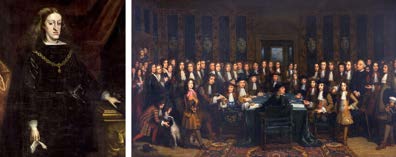
Figure 34.167: Left, H.M. King Carlos II of Spain, portrait by Juan Carreño de
Miranda. Right, the signing of the Peace Treaty of Nymegen between France and
Spain in 1678.
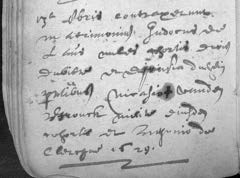
Figure 34.168: Wedding certificate, at Wingene on Oc-
tober 13, 1629, of Dionisia Duhein or Dubieze and José
(’Judocus’) Delos (’Delaus’) a ’miles cohortis,’ where
Antoni Desclergue (II) (DC06) appears as a witness,
with Nicasius Vandenbrouck from the same ’milites co-
hortis.’
The Peace Treaty of Nymegen of September 17, 1678, turned the Chastelany of Kortrijk back to the Spanish. In April 1678, for instance, Antoni Desclergue (DC06) still appeared as a witness at a wedding at Ghent Sint Pieters of a soldier Joannes Tibau and of Clara Le Leroy, as shown in Figure 37.98 on page 664 in Chapter 37.6.
34.10.4 Other indications of Regional Instability
The instability or transitional state of the region during that period is corroborated by a compelling annotation found in the parish registers of Wakken, situated along the Leie River adjacent to Wielsbeke, Sint Baafs Vijve, and across from Sint Eloois Vijve. For a particular duration, no baptisms or marriages were recorded in the parish, a hiatus attributed to force majeure. The pastor eloquently summarized the situation with the phrase "under duress." This specific note is documented in a figure, referred to as
34.166, within a 1745 transcription of the baptismal records at Wakken, dating back to 1671.
34.11 A Visit to Spain in 1679 for a Wedding after the Peace of Nijmegen
At the age of 77, Antoni served as a marriage broker to his Godchild Antoni de Pedrolo, son of Francesc Jacinto de Pedrolo y Desclergue, described in Chapter 28.5.9, and Maria Anna De Vos, in 1679. The wedding took place in Blanes, Gerona. Interestingly, Antoni does not appear in documents at that time in Flanders, equally not as Burgher (Bourgeois Forain, absent in 1679 and 1680).
This year is not a coincidence and should be viewed in the light of the Treaties of Nijmegen, explained in Chapter 34.11, and shown in Figure 34.167, which ended, again, the wars between France and the Spanish Netherlands and also France and Spain and Spain and the Northern Netherlands. Indeed, on August 10, 1678, France and the Dutch Republic made peace. On September 19, 1678, France and Spain (under H.M. King Carlos II) made peace.
In 1679, peace was also established with Sweden and the Holy Roman Empire. In 1679, Antoni Desclergues (DC06) was able to convince H.M. King Carlos II of Spain, shown in Figure 34.167, to grant a hereditary noble title to Francesc de Pedrolo y Desclergue, father of Antoni de Pedrolo. Antoni de Pedrolo was located at Gerona for his wedding because he was involved in the military then, as described by Santiago Alberti.65
34.12 Antoni Desclergue’s Marriage and Whereabouts
Our extensive account reveals the remarkable journey of Antoni Desclergue (DC06), who, in 1619, stepped into the shoes of Carlos Coloma, serving as a Spanish soldier in Flanders. His unwavering dedication saw him remain in the Spanish army for an impressive 22 years until his mention in a book in 1641. It is believed that he continued his service, albeit in more administrative capacities, a testament to his commitment and loyalty.
He married early, around 1620 when he was in Cambrai. He had three children with his first wife, namely Anna Declerque (DC07e), in Chapter 36.3, Juan Declerque (DC07c), in Chapter 36.4, and Michiel Declerque (DC07f) in Chapter 36.8.
His wife died soon, and Antoni remarried before 1628 Beatrice Declercq (DK02byx) from his stepfather’s Declercq clan of Kortrijk, described in Chapter 34.13, with whom he had four more children, namely Antoni Declerque (DC07), in Chapter 36.2, Maria Declerque (DC07b), in Chapter 36.5, Joan Declerque (DC07g), in Chapter 36.6, and Pere Declerque (DC07d), in Chapter 36.7.
In 1639, he went to Catalonia with his family for the war between Spain and France. He returned but would go back to Spain several times.
It is exciting to compare his presence on the lists of Bourgeous Forains in Chapter 34.12.2 of Kortrijk with his military career. He remained absent on the list when he was in Spain. Also, they cannot be found on the list during the family’s stay in Ghent.
65Santiago Alberti, ’Esquema Històric del llinatge Pedrolo.’
The Desclergues of la Villa Ducal de Montblanc, 2nd ed., Omn., VOL. II
© 2024 Nico F. Declercq
586
CHAPTER 34. ANTONI DESCLERGUE Y DE MONTOYA (DC06)
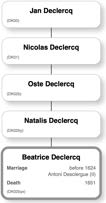
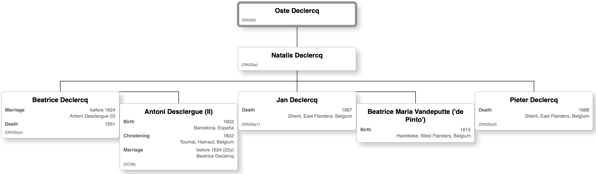
Figure 34.169: The ancestors of Beatrice Declercq (DK02byx), the wife of Antoni
Desclergue (DC06).
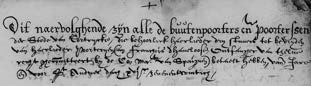
Figure 34.170: The descendants of Oste Declercq (DK02b) until the generation of Beatrice Declercq (DK02byx). Oste was the son of Nicolas Declercq (DK01)
Although we have no evidence that Antoni lived in Wingene, he must have visited it because it was located in the North of the Castellany of Kortrijk, close to Flanders’ Northern defense line. A trace is found in Figure 34.168 in 1629.
34.12.1 Beatrice Declercq (DK02byx), Antoni Desclergue’s (II) (DC06) wife
Beatrice Declercq (DK02byx), our ancestor, was the daughter of Natalis Declercq (DK02by) (known as ’Noel Declercq’), the son of Oste Declercq (DK02b). Oste was the son of Nicolas Declercq (DK01) and the grandson of Jan Declercq (DK00).
They were members of the Declercq clan from Kortrijk, described in Chapter 34.13, just like Jan Declercq (DK03), described in Chapter 34.13.7. More information about Beatrice Declercq (DK02byx), her ancestry, and her connection to Jan Declercq, Beatrice’s stepfather-in-law, is given in that Chapter 34.13.
A summary is provided in Figure 34.169 on page 586 and Figure 34.170 on page 586.
34.12.2 Antoni Desclergue (II) (DC06) on the List of ’la Bourgeoisie Foraine’ of Kortrijk at
Deerlijk
To understand this chapter, it’s interesting first to read Chapter 29.11. Jan Declercq (DK03), a prominent citizen in Kortrijk, was Antoni Desclergue’s (DC06) stepfather, while Jeroni Joan Desclergue y Cortés was his natural father. They were both ’Jan.’
Nevertheless, it’s through Jan Declercq (DK03) that Antoni Desclergue received bourgeoisie rights and other local privileges.
Furthermore, the Bourgeoisie list in Kortrijk has no entries that specifically fixed a stepfather or stepson. Stepchildren could become Bourgeois Forain, but Kortrijk, unlike other cities, did not make the distinction.6667 The designation was ’f’ 9’, which could stand for filium or filiastrum, i.e., son or stepson. The other possible entries in Kortrijk were: ’fa’, which stood for filia or filiastra (daughter or stepdaughter), or ’Wa’, which stood for Vidua or widow. It was much more difficult for Spaniards to obtain bourgeoisie rights, often only possible through marriage.
So, Jan Declercq (DK03) opened the door for them. Hence one can see, for instance, ’Antoni Desclergue (DC06), (step)son of Jan Declercq (DK03)’ in the list, or literally: ’Anthone Le Clercq fili(astr)um Jans.’ The (step)father / (step)son relationship gave them access to local privileges easily. However, it was not automatically inherited but typically arranged when they became somewhat independent, i.e., when they reached 25 or married.68
With his descendants, Jan Declercq (DK03) is described in Chapter 34.13.7.
Apart from the Salamanca principles of Ius inter gentes, we can also refer to other generally applicable work. Marco Ferro69 wrote that,
’adoption by marriage, when the husband’s or wife’s children from a previous marriage were accepted as legitimate and natural children, not stepchildren, were admitted to inheritance with the same rights and on the same footing as children from the current marriage.’ Although the exact laws did not apply in Deerlijk, the marriage contract between Jan Declercq (DK03) and Felipa de 66According to professional genealogist Jan Caluwaerts, a distinction was sometimes made in Kortrijk in later times, i.e. after 1680, and in that period one also sometimes made a distinction between children of first or second marriage.
67As a matter of fact, there are many genealogies based on lists of Bourgeois Forrains. One must be very careful because often, stepchildren are taken for biological children. Therefore, these genealogies are wrong, except when backed up by other evidence.
68Jan Declercq (DK03) is often confused with Jan Declercq (DK03dy), the son of Thomas Declercq (DK03d), brother of Jan Declercq (DK03). To allow a difference, the lineage of Thomas Declercq (DK03d) in the bourgeoisie list appears as ’Declercq,’ while that of Jan Declercq (DK03) appears as
’Le Clercq.’
69Marco Ferro, in the entries Adottare, Adottivo, Adozione of the Dizionario del diritto commune e Veneto, published in Venice between 1778 and 1781.
© 2024 Nico F. Declercq
The Desclergues of la Villa Ducal de Montblanc, 2nd ed., Omn., VOL. II


34.12. ANTONI DESCLERGUE’S MARRIAGE AND WHEREABOUTS
587
Montoya in Tournai enabled such. This is also found in the work of Maria Gigliola di Renzo Villata70. We do not assume that Jan Declercq (DK03) adopted the children as such, but the concept of entirely accepted stepchildren was not alien to society at that time and was a direct consequence of the marriage contract made in Tournai, explained in Chapter 29.11.3.3.
We see the first appearance as Bourgeois Forain in 1627, when Antoni (DC06) was precisely 25 years old and became an adult.
His brother Miguel turned 25 in 1630, whence we find his first appearance not earlier than 1630; indeed, he first appeared in 1634, probably when he married or otherwise decided to use his Bourgeois rights.
In Figures 34.171, 34.172, 34.173, 34.174, 34.175, 34.176, 34.177, 34.178, 34.179, 34.180, 34.181, 34.182, 34.183, 34.184, 34.185,
34.186, 34.187, 34.188, 34.189, 34.190, 34.191, 34.192, 34.193, 34.194, 34.195, 34.196, 34.197, 34.198, 34.199, 34.200, 34.201, 34.202,
34.203, 34.204, 34.205, 34.206, 34.207, 34.208, 34.209, 34.210, 34.211, 34.212, 34.213, we show all the entries of Antoni Desclergue (DC06).
Antoni Desclergue’s (DC06) brother, Miguel Desclergue (DC06b), could not be confused with anybody else on the Bourgeoisie list in Kortrijk, whence he appears as ’Declercq’ and not as ’Le Clercq’ as his brother.
Nevertheless, Miguel Desclergue would also sometimes opt for the ’Le’ annotation, as seen in Figure 29.160 on page 433, but not when he became a Bourgeois in 1634.
As described above, the gap between Figures 34.203 and 34.204 is caused by the family residing for a couple of years in Ghent during the French occupation of the region around Kortrijk.
Figure 34.171:
1627 front page of the list of ’la bourgeoisie
foraine’ in which Antoni first appears.
Figure 34.172: 1627 Antoni Desclergue (II) (DC06) on the list of ’la
bourgeoisie foraine’ of Kortrijk at Deerlijk.
Figure 34.173: 1629, Antoni Desclergue (II) (DC06) on the list of
’la bourgeoisie foraine’ of Kortrijk at Deerlijk.
34.12.3 The Orphan’s Deed when Antoni’s Wife Beatrice Declercq (DK02byx) Died in 1651
34.12.3.1 The Transcript
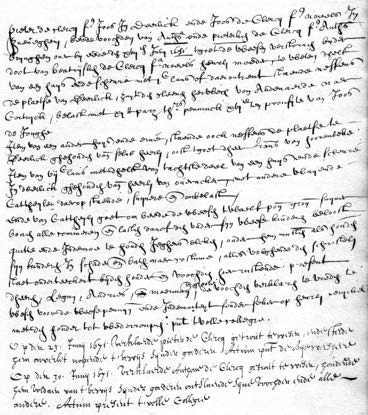
The transcript of Figure 34.214 is as follows:
’Voogdarei
(line 1) Pieter Declercq fillius Joos in Deerlijk ende Joos Declercq filius Noeels in
(line 2) Zuevegehem, beede voogden van Anthonius ende Pieterken Declercq filius/filii Anthonius
(line 3) brynghen ons bij eede den 17 July 1651 ’t goet de weezen verstorven by de
(line 4) doot van beatrijsen Declercq filia Noeels hennen moeder, te weten dhelft
(line 5) van een huys ende schure met 100 lands of daeromtrent staende neffens
(line 6) de plaetse van Deerlick, zuit des cleene herweeg van audenaerde naar
(line 7) Cortryck, belast met 12 parizi ponden?? penninck ?? profyte van Joos
(line 8) de Jonghe
(line 9) Item van een ander huys ende erve, staande ook neffens de plaetse te
(line 10) Deerlijk ghehouden van zelve heeren, ook tgoet dhele van Franciscus van hoorenbeke
(line 11) Item van vijf honderd lands met dhelft van tachtste deel van een huys ende schure
(line 12) in deerlick gehouden van heeren van overacker, met andere waeyende
(line 13) cattheylen daarop staende, suvere en onbelast,
(line 14) ende van Cattheylen goet om beede de weezen twaelf [ponden gro??] zuvere
(line 15) boven alle commecien en de lasten dan of den vader zijn weezekinders beloost
(line 16) quitte ende judemne te houden jeghens elcken, onder hen rusten als houden
(line 17) zijn kinders in schade en baten naer costume, alles volgende den schristelen
(line 18) staet ondertekent bij den houder en de voochdin hierenstende present
(line 19) dheezen, Legan, Andries, moerman, de groote, de voogden verklaren te lezeden te
(line 20) wezen voor de weezepennyng, ende indemniteit zonder zelve op heuren [???]
(line 21) met den houder tot wederronzers p(rese)nt ’t volle collegue.
(line 22) Op den 23 juni 1671 verklarde pieter Declercq getrout te weisch, ende stede
(line 23) hem omverlit nopende t bewijs sijnde goedere actum p(rese)nt de bijdewezere
(line 24) op den 30 juny 1671 verklaerde anthone Declercq getrout te wisch, houdende
(line 25) hem voldaen van ’t bewijs sijndeze goederen ontslaende sijnde voogden ende alle
(line 26) andere. actum present ’t volle collegue.’
We can extract important information from the Orphan’s deed in Figure 34.214.
70Maria Gigliola di Renzo Villata, editor, ’Family Law and Society in Europe from the Middle ages to the Agesemporary Era,’ Studies in the History of Law and Justice 5, Springer, 2016.
The Desclergues of la Villa Ducal de Montblanc, 2nd ed., Omn., VOL. II
© 2024 Nico F. Declercq


588
CHAPTER 34. ANTONI DESCLERGUE Y DE MONTOYA (DC06)
Figure 34.174: 1631, Antoni Desclergue (II) (DC06) on the list of
’la bourgeoisie foraine’ of Kortrijk at Deerlijk.
Figure 34.175: 1632, Antoni Desclergue (II) (DC06) on the list of
’la bourgeoisie foraine’ of Kortrijk at Deerlijk.
34.12.3.2 The Father of Beatrice Declercq (DK02byx)
Beatrice was Noel Declercq’s daughter (Noel is Natalis).
We have found a Natalis Declercq (DK02by) in Harelbeke, serving as Godfather to Catharina Onse, on August 13, 1616. The child was the daughter of Judocus Onse and Catharina DeKlerck (’Sclercx’), the godmother was Catharina Loosvelt. Note that the family name Onse appeared in Catalonia in the 17th century.
We also found Natalis Declercq (DK02by) in 1621 at Harelbeke as the wedding witness of Matheus Casiere and Christina du Bois, and the other witness was Guilielmus van Bonen. It’s possible that Christina du Bois was related to Margriet de le Quellerie /
Keldewier and Jean du Bois, who were involved in constructing the Chapel at Deerlijk in 1639, not very far from the Saint Columba church, shown in Figure 34.219. The chapel construction is described in Chapter 49.
In 1625, in Figure 34.220, Natalis Declercq (DK02by) was Godfather, in Harelbeke, to Elisabeta, daughter of Maria Van Putte or Du Puich. The godmother was Elisabeth de Smedt. On that baptism certificate, it is mentioned that Natalis was a shoe producer and that the mother and an unknown father conceived the child, for which he volunteered to be godfather. It concerns a family involving Irish, clearly in a military clan.
We must, therefore, conclude that Natalis, the father of Beatrice Declercq (DK02byx), was a shoe producer and had contacts with Spanish and Irish families and families who had been in excellent or unfortunate contact with foreigners.
Noel Declercq, the father of Beatrice Declercq (DK02byx) and son of Oste Declercq (DK02b), is found, as shown in Figures 34.222,
34.223, 34.224, 34.225, 34.226, 34.227, 34.228, 34.229, 34.230, 34.231, 34.232 and 34.233 on the list of ’la bourgeoisie foraine’ of Kortrijk at Deerlijk.
We have not found the mother of Beatrice Declercq (DK02byx). She must have died before 1607 because her father Nathale or Natalis of Noel Declercq married as a widower on May 30, 1607, at Zwevegem, in Figure 34.221. The bride was Isabel van Wi-jnsberge, and the witnesses were Oste Declercq (DK02b) and Egidius Nutens (possible related to Nutens in Figure 34.241 on page
603). Since we found no further trace of Noel in Zwevegem, we assume his bride was from there, and the couple lived in Deerlijk.
Possibly they had no children.
34.12.3.3 The Guardians
To continue interpreting the Orphan’s deed, we remind the reader that it was customary to select one guardian from the mother’s side and one guardian from the father’s family, even if the father was still alive.
The clerk wrote ’Joos’ twice at the beginning of the deed. This must have been done in error; it should have been Jan or Joan instead.
Indeed, Juan Declerque (DC07c), described in Chapter 36.4, was old enough; he married Beatrice de Pinto and became a military (an archer) in Spain that same year or the year after. In 1662, he requested to return to Flanders but was killed soon.
34.12.3.4 The Age of Antoni Declerque (DC07) and Pere Declerque (DC07d)
The deed tells that Antoni Declerque (DC07) and Pere Declerque (DC07d) were unmarried minors (i.e., they had not reached the age of 25).
34.12.3.5 Beatrice Declercq (DK02byx) was the Second Wife of Antoni Desclergue (DC06)
The goods the two sons inherited reveal exciting facts. We refer to Chapter 36 to find all the children of Antoni Desclergue (DC06), whether from his first or second marriage.
Maria Declerque (DC07b), described in Chapter 36.5, was born in 1631 and, therefore, only 20 years old in 1651. However, because of her marriage to Rafael Juan de Pedrolo, she was no longer considered a minor and received a dowry, which excluded her from inheriting.
Let’s summarize the inheritance structure: Antoni Desclergue (DC06) inherited half of a land and a barn with a house from his mother Felipa de Montoya. Upon his first marriage, he became the proprietor of 50% of that inherited property. When his wife passed away, the other 25% of the property would stay out of his future marriage and belong to him and their children. The part that went into the new marriage with Beatrice Desclercq (DK02byx) was the 25%, to be split in half when Beatrice died and went to their two sons. This means that each son inherited half of half a quarter of the total property, or one-sixteenth each. This detailed structure is evidence of Beatrice Declercq (DK02byx) being the second wife of Antoni Desclergue (DC06) and the couple having two sons, Antoni (DC07) and Pere (DC07d) minors in 1651, and a married daughter, Maria (DC07b).
The children stemming from his first marriage did not inherit from Beatrice. They were Michiel (DC07f), Anna (DC07e) and Juan (DC07c).
For example, Anna Declerque (DC07e), described in Chapter 36.3, was born in 1621, was 30 years old in 1651, and had been married to Alonso Ximenes de la Cruz since 1639. Nevertheless, she did not inherit from Beatrice because she was the daughter of Antoni Desclergue’s first wife. Similarly, Juan Declerque (DC07c), born around 1623, was not a son of Beatrice and, therefore, did not inherit from her.
34.12.3.6 Antoni Desclergue (DC06), was Still Alive in 1651
The father, Antoni Desclergue (DC06), was still alive in 1651 when his wife Beatrice Declercq (DK02byx) died, and he kept the other 50%.
© 2024 Nico F. Declercq
The Desclergues of la Villa Ducal de Montblanc, 2nd ed., Omn., VOL. II






















34.12. ANTONI DESCLERGUE’S MARRIAGE AND WHEREABOUTS
589
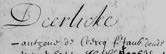
Figure 34.176: 1633, Antoni Desclergue (II) (DC06) on the list of
’la bourgeoisie foraine’ of Kortrijk at Deerlijk.
Figure 34.177: 1634, Antoni Desclergue (II) (DC06) on the list of
’la bourgeoisie foraine’ of Kortrijk at Deerlijk.
Figure 34.178: 1635, Antoni Desclergue (II) (DC06) on the list of
’la bourgeoisie foraine’ of Kortrijk at Deerlijk.
Figure 34.179: 1636, Antoni Desclergue (II) (DC06) on the list of
’la bourgeoisie foraine’ of Kortrijk at Deerlijk.
Figure 34.180: 1637, Antoni Desclergue (II) (DC06) on the list of
’la bourgeoisie foraine’ of Kortrijk at Deerlijk.
Figure 34.181: 1638, Antoni Desclergue (II) (DC06) on the list of
’la bourgeoisie foraine’ of Kortrijk at Deerlijk.
Figure 34.182: 1641, Antoni Desclergue (II) (DC06) on the list of
’la bourgeoisie foraine’ of Kortrijk at Deerlijk.
Figure 34.183: 1643, Antoni Desclergue (II) (DC06) on the list of
’la bourgeoisie foraine’ of Kortrijk at Deerlijk.
Figure 34.184: 1645, Antoni Desclergue (II) (DC06) on the list of
’la bourgeoisie foraine’ of Kortrijk at Deerlijk.
Figure 34.185: 1646, Antoni Desclergue (II) (DC06) on the list of
’la bourgeoisie foraine’ of Kortrijk at Deerlijk.
Figure 34.186: 1648, Antoni Desclergue (II) (DC06) on the list of
’la bourgeoisie foraine’ of Kortrijk at Deerlijk.
Figure 34.187: 1649, Antoni Desclergue (II) (DC06) on the list of
’la bourgeoisie foraine’ of Kortrijk at Deerlijk.
Figure 34.188: 1650, Antoni Desclergue (II) (DC06) on the list of
’la bourgeoisie foraine’ of Kortrijk at Deerlijk.
Figure 34.189: 1652, Antoni Desclergue (II) (DC06) on the list of
’la bourgeoisie foraine’ of Kortrijk at Deerlijk.
Figure 34.190: 1653, Antoni Desclergue (II) (DC06) on the list of
’la bourgeoisie foraine’ of Kortrijk at Deerlijk.
Figure 34.191: 1654, Antoni Desclergue (II) (DC06) on the list of
’la bourgeoisie foraine’ of Kortrijk at Deerlijk.
Figure 34.192: 1655, Antoni Desclergue (II) (DC06) on the list of
’la bourgeoisie foraine’ of Kortrijk at Deerlijk.
Figure 34.193: 1657, Antoni Desclergue (II) (DC06) on the list of
’la bourgeoisie foraine’ of Kortrijk at Deerlijk.
Figure 34.194: 1658, Antoni Desclergue (II) (DC06) on the list of
’la bourgeoisie foraine’ of Kortrijk at Deerlijk.
Figure 34.195: 1661, Antoni Desclergue (II) (DC06) on the list of
’la bourgeoisie foraine’ of Kortrijk at Deerlijk.
Figure 34.196: 1662, Antoni Desclergue (II) (DC06) on the list of
’la bourgeoisie foraine’ of Kortrijk at Deerlijk.
Figure 34.197: 1664, Antoni Desclergue (II) (DC06) on the list of
’la bourgeoisie foraine’ of Kortrijk at Deerlijk.
The Desclergues of la Villa Ducal de Montblanc, 2nd ed., Omn., VOL. II
© 2024 Nico F. Declercq








590
CHAPTER 34. ANTONI DESCLERGUE Y DE MONTOYA (DC06)
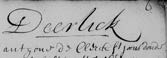
Figure 34.198: 1665, Antoni Desclergue (II) (DC06) on the list of
’la bourgeoisie foraine’ of Kortrijk at Deerlijk.
Figure 34.199: 1666, Antoni Desclergue (II) (DC06) on the list of
’la bourgeoisie foraine’ of Kortrijk at Deerlijk.
Figure 34.200: 1667, Antoni Desclergue (II) (DC06) on the list of
’la bourgeoisie foraine’ of Kortrijk at Deerlijk.
Figure 34.201: 1670, Antoni Desclergue (II) (DC06) on the list of
’la bourgeoisie foraine’ of Kortrijk at Deerlijk.
Figure 34.202: 1671, Antoni Desclergue (II) (DC06) on the list of
’la bourgeoisie foraine’ of Kortrijk at Deerlijk.
Figure 34.203: 1672, Antoni Desclergue (II) (DC06) on the list of
’la bourgeoisie foraine’ of Kortrijk at Deerlijk.
Figure 34.204: 1678, Antoni Desclergue (II) (DC06) on the list of
’la bourgeoisie foraine’ of Kortrijk at Deerlijk.
Figure 34.205: 1681, Antoni Desclergue (II) (DC06) on the list of
’la bourgeoisie foraine’ of Kortrijk at Deerlijk.
Figure 34.206: 1683, Antoni Desclergue (II) (DC06) on the list of
’la bourgeoisie foraine’ of Kortrijk at Deerlijk. a
aAs a curiosity, we can mention here that the church tower of Deerlijk was
struck by lightning in 1683. The building broke, fell and destroyed the nave
of the church almost entirely.
Figure 34.207: 1684, Antoni Desclergue (II) (DC06) on the list of
’la bourgeoisie foraine’ of Kortrijk at Deerlijk.
Figure 34.208: 1685, Antoni Desclergue (II) (DC06) on the list of
’la bourgeoisie foraine’ of Kortrijk at Deerlijk.
Figure 34.209: 1686, Antoni Desclergue (II) (DC06) on the list of
’la bourgeoisie foraine’ of Kortrijk at Deerlijk.
Figure 34.210: 1687, Antoni Desclergue (II) (DC06) on the list of
’la bourgeoisie foraine’ of Kortrijk at Deerlijk.
Figure 34.211: 1689, Antoni Desclergue (II) (DC06) on the list of
’la bourgeoisie foraine’ of Kortrijk at Deerlijk.
Figure 34.212: 1690, Antoni Desclergue (II) (DC06) on the list of
’la bourgeoisie foraine’ of Kortrijk at Deerlijk.
Figure 34.213: 1691, Antoni Desclergue (II) (DC06) on the list of
’la bourgeoisie foraine’ of Kortrijk at Deerlijk.
© 2024 Nico F. Declercq
The Desclergues of la Villa Ducal de Montblanc, 2nd ed., Omn., VOL. II
34.12. ANTONI DESCLERGUE’S MARRIAGE AND WHEREABOUTS
591
Figure 34.214: 1651, Deerlijk, orphan’s deed of Antoni Declerque (DC07)
and Pere Declerque (DC07d) after the death of their mother Beatrice Declercq
(DK02byx) (Wezerij 84 Helkijn f 3r, Rijksarchief Kortrijk). The corresponding
inventory is shown in Figures 34.215, 34.216, 34.217, and 34.218
The Desclergues of la Villa Ducal de Montblanc, 2nd ed., Omn., VOL. II
© 2024 Nico F. Declercq
592
CHAPTER 34. ANTONI DESCLERGUE Y DE MONTOYA (DC06)
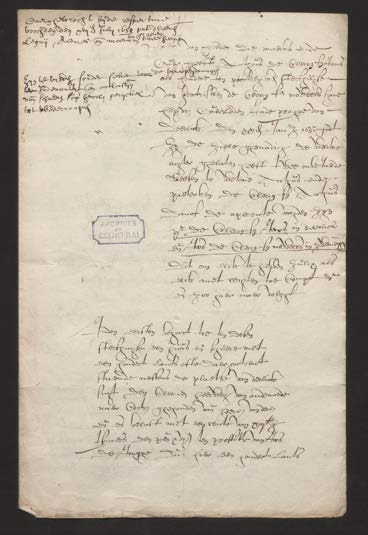
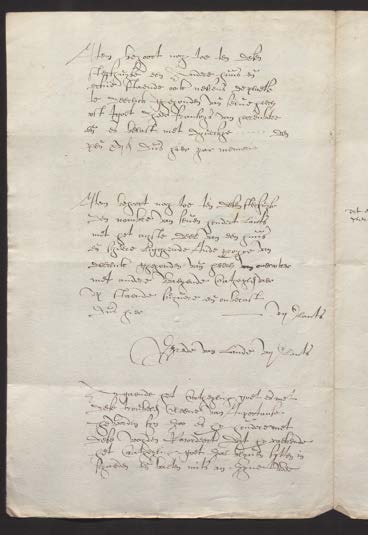
Figure 34.215: 1651, Deerlijk, inventory made for Antoni Declerque (DC07)
and Pere Declerque (DC07d) after the death of their mother Beatrice Declercq
(DK02byx), Rijksarchief Kortrijk, 1651, part 1. The term "fs Jan" refers
either to Antoni’s stepfather Jan Declercq or his natural father Jeroni Joan
Desclergue y Cortés.71
© 2024 Nico F. Declercq
The Desclergues of la Villa Ducal de Montblanc, 2nd ed., Omn., VOL. II
34.12. ANTONI DESCLERGUE’S MARRIAGE AND WHEREABOUTS
593
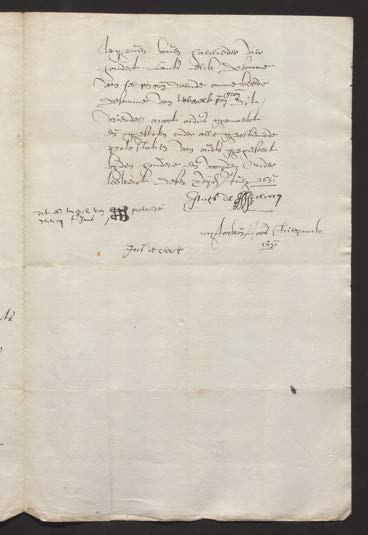
Figure 34.216: 1651, Deerlijk, inventory made for Antoni Declerque (DC07)
and Pere Declerque (DC07d) after the death of their mother Beatrice Declercq
(DK02byx), Rijksarchief Kortrijk, 1651, part 2.
The Desclergues of la Villa Ducal de Montblanc, 2nd ed., Omn., VOL. II
© 2024 Nico F. Declercq
594
CHAPTER 34. ANTONI DESCLERGUE Y DE MONTOYA (DC06)
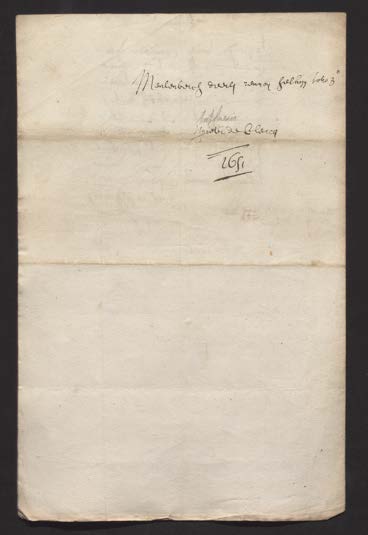
Figure 34.217: 1651, Deerlijk, inventory made for Antoni Declerque (DC07)
and Pere Declerque (DC07d) after the death of their mother Beatrice Declercq
(DK02byx), Rijksarchief Kortrijk, 1651, part 3.
© 2024 Nico F. Declercq
The Desclergues of la Villa Ducal de Montblanc, 2nd ed., Omn., VOL. II

34.12. ANTONI DESCLERGUE’S MARRIAGE AND WHEREABOUTS
595
Figure 34.218: 1651, Deerlijk, inventory made for Antoni Declerque (DC07)
and Pere Declerque (DC07d) after the death of their mother Beatrice Declercq
(DK02byx), Rijksarchief Kortrijk, 1651, part 4.
Figure 34.219: Deerlijk, Saint Columba church with a cemetery. The tower is neo-
gothic and is a refurbishment of the original Romantic tower. The building received
its current look soon after 1580.
Figure 34.220: Harelbeke, 1625, March 1, the baptism of Elisabeta ’Van de
Putte alias MacManus’ . The way the priest wrote this suggests that Elisabeth
MacManus, an Irish, had a child of a Vandeputte. Else it could have been
Elisabeth Vandeputte who had a child of an Irishman MacManus. Or perhaps
the father is not indicated, and the mother had mixed parents, i.e. a local and
an Irish parent. The father of the child may have been Spanish then. Noel
Declercq (’Natalis Le Clercq’) was her godfather, and he appears to have been
a shoemaker (’sutor’).
The Desclergues of la Villa Ducal de Montblanc, 2nd ed., Omn., VOL. II
© 2024 Nico F. Declercq












596
CHAPTER 34. ANTONI DESCLERGUE Y DE MONTOYA (DC06)
Figure 34.221: Zwevegem, May 30, 1607, the wedding of widower
Natale De Clerc and Elisabetha Vanwynsberghe. The witnesses were
Oste Declercq (DK02b) (Noel’s father) and Egidius Vanwynsberghe.
Figure 34.222:
1620, Noel Declercq (father of Beatrice Declercq
(DK02byx) and son of Oste Declercq (DK02b)) on the list of ’la bour-
geoisie foraine’ of Kortrijk at Deerlijk.
Figure 34.223:
1621, Noel Declercq (father of Beatrice Declercq
(DK02byx) and son of Oste Declercq (DK02b)) on the list of ’la bour-
geoisie foraine’ of Kortrijk at Deerlijk.
Figure 34.224:
1622, Noel Declercq (father of Beatrice Declercq
(DK02byx) and son of Oste Declercq (DK02b)) on the list of ’la bour-
geoisie foraine’ of Kortrijk at Deerlijk.
Figure 34.225:
1623, Noel Declercq (father of Beatrice Declercq
(DK02byx) and son of Oste Declercq (DK02b)) on the list of ’la bour-
geoisie foraine’ of Kortrijk at Deerlijk.
Figure 34.226:
1624, Noel Declercq (father of Beatrice Declercq
(DK02byx) and son of Oste Declercq (DK02b)) on the list of ’la bour-
geoisie foraine’ of Kortrijk at Deerlijk.
Figure 34.227:
1625, Noel Declercq (father of Beatrice Declercq
(DK02byx) and son of Oste Declercq (DK02b)) on the list of ’la bour-
geoisie foraine’ of Kortrijk at Deerlijk.
Figure 34.228:
1627, Noel Declercq (father of Beatrice Declercq
(DK02byx) and son of Oste Declercq (DK02b)) on the list of ’la bour-
geoisie foraine’ of Kortrijk at Deerlijk.
Figure 34.229:
1628, Noel Declercq (father of Beatrice Declercq
(DK02byx) and son of Oste Declercq (DK02b)) on the list of ’la bour-
geoisie foraine’ of Kortrijk at Deerlijk.
Figure 34.230:
1629, Noel Declercq (father of Beatrice Declercq
(DK02byx) and son of Oste Declercq (DK02b)) on the list of ’la bour-
geoisie foraine’ of Kortrijk at Deerlijk.
Figure 34.231:
1630, Noel Declercq (father of Beatrice Declercq
(DK02byx) and son of Oste Declercq (DK02b)) on the list of ’la bour-
geoisie foraine’ of Kortrijk at Deerlijk.
Figure 34.232:
1631, Noel Declercq (father of Beatrice Declercq
(DK02byx) and son of Oste Declercq (DK02b)) on the list of ’la bour-
geoisie foraine’ of Kortrijk at Deerlijk.
Figure 34.233:
1641, Noel Declercq (father of Beatrice Declercq
(DK02byx) and son of Oste Declercq (DK02b)) on the list of ’la bour-
geoisie foraine’ of Kortrijk at Deerlijk.
© 2024 Nico F. Declercq
The Desclergues of la Villa Ducal de Montblanc, 2nd ed., Omn., VOL. II
34.13. CLAN OF BEATRICE DECLERCQ (DK02BYX) ANTONI DESCLERGUE’S WIFE
597
34.13 The Kortrijk Clan of Beatrice Declercq (DK02byx) Antoni Desclergue’s
wife
34.13.1 Introduction
Beatrice Declercq (DK02byx), the wife of Antoni Desclergue (DC06), was introduced in Chapter 34.12.1. Her lineage holds significant importance as her bloodline merges with ours through her marriage and, consequently, because she is our ancestor. Beatrice’s mother-in-law, Felipa de Montoya, was also connected to the Declercq clan through her marriage to Jan Declercq (DK03), detailed in Chapter 29.10.5. It is important to note that although we are related to this clan through Felipa de Montoya and Beatrice Declercq, we do not descend directly from Jan Declercq (DK03).72
The Declercq family of Kortrijk was distinguished by their roles as notaries, with some members engaged in commerce or religious vocations. Antoni Desclergue’s (DC06) marriage to Beatrice Declercq (DK02byx) represents the union of the Desclergue and Declercq clans.
In Figure 34.234 on page 598, for instance, we can see that Natalis73 Declercq, the father of Beatrice Declercq (DK02byx), was in debt with someone in 1621 and that his son Pieter Declercq, known as Pedro Declercq, described in Chapter 35, paid the debt in 1635. Natalis Declercq (DK02by) resided in Deerlijk, just like Jan Declercq (DK03y),74 whose sons had been the guardians of Antoni Desclergue’s (DC06) brother Miguel Desclergue (DC06b) when their mother Felipa de Montoya died in 1629.
In Figure 34.235 on page 598, we can see that Natalis Declercq (DK02by) offered bail for Loys Denys in Kortrijk in 1622.
As described in Chapter 34.12.3.2, Noel Declercq was a shoe producer, which was, because of the military presence in the region, a lucrative business. It also brought Noel in contact with the Irish and Spanish military.
The Desclergues were not the only Spanish family marrying the Declercqs of Kortrijk. Another Spanish or Italian family, Grimaldi, did the same. The connection between Antoni Desclergue (DC06), his wife Beatrice Declercq, and the Grimaldi family is shown in Figure 34.239 on 602, and Figure 34.240 on 603.
The progenitor of Declercq was Jan Declercq (DK00), described in 34.13.2.
Given the frequent occurrence of the name Nicolas Declercq in the Declercq family lineages of Tournai and Kortrijk, it is plausible to speculate a connection to our Desclergue ancestors, particularly the branch residing in Manresa, described in Chapter 18.29,
where the name Nicolas Desclergue was equally shared. This hypothesis, which holds significant potential for uncovering intriguing familial ties, requires further investigation by future genealogists to be fully substantiated.
The possibility of mere coincidence cannot be entirely dismissed. However, Jeroni Desclergue (DC05) ’s rapid integration with the Declercq family of Kortrijk suggests a deeper connection. This swift acquaintance might be better explained by preexisting familial bonds or shared ancestry rather than coincidental name similarity alone.
Future research into this potential link between the Declercq and Desclergue families could yield fascinating insights into their genealogical roots. The prevalence of the name Nicolas in both family branches presents a compelling starting point for such inquiries. Exploring historical records, genetic testing, and other genealogical methods could further illuminate the connections between these families, enhancing our understanding of their shared heritage.
34.13.2 Jan Declercq (DK00)
Jan Declercq (DK00) was a student at the Catholic University of Leuven, as found in the registers of the university in 1505 in February. It is shown in Figure 34.308 on page 617.
It still needs to be determined if Jan Declercq (DK00), the first Declercq we retrieved in Kortrijk, originated from Kortrijk or Tournai. An objective observation of all the discovered evidence related to his descendants indicates that he was probably from Tournai.
34.13.3 Nicolas Declercq (DK01)
Nicolas Declercq (DK01)75 was, as far as we have been able to figure out, the son of Jan Declercq (DK00) described in Chapter
The descendants of Nicolas Declercq (DK01) are shown in Figure 34.257 on page 612. Nicolas Declercq (DK01) was the father of Jan Declercq (DK02a), Nicolas Declercq (DK02), described in Chapter 34.13.4, and Oste Declercq (DK02b).
Jan Declercq (DK02a) was the father of Tomas Declercq (DK02ay1), shown in Figure 34.255 on page 611, and of Jan Declercq (DK02ay2).
Oste Declercq (DK02b) was the father of Natalis Declercq (DK02by) and the grandfather of our ancestor Beatrice Declercq (DK02byx), described in Chapter 34.12.1, who married Antoni Desclergue (DC06).
Nicolas Declercq (DK01) became a student at the Catholic University of Leuven in 1531, shown in Figure 34.309 on page 618.
34.13.4 Nicolas Declercq (DK02)
Nicolas Declercq (DK02) was the father of Jan T. Declercq (DK03), described in Chapter 34.13.7, Magdalena Declercq (DK03c), Tomas Declercq (Dk03d), described in Chapter 34.13.6, and another child (DK03e).
In Figure 34.236 on page 599, we read that Thirion Dupret, the son of Jan Dupret, transported a debt inherited from his father onto Nicolas Declercq (DK02) from Kortrijk, signed by Jan Claissone on behalf of the dominions of His Majesty the King, in 1561.
In 1634, Jan Declercq (DK03) and his father Nicolas Declercq (DK02) were still alive, as shown in Figure 34.237 on page Chapter
Nicolas Declercq (DK02) became a student at the Catholic University of Leuven in 1553, shown in Figure 34.310 on page 618.
72In an earlier edition of this book, this clan was spelled as ’DeKlerk’ to distinguish them from other Declercqs mentioned in this work. At that time, the Declercq clan had not been thoroughly investigated, and it was not yet known that Beatrice Declercq (DK02byx) was blood-related to Jan Declercq (DK03). The familial connections established through Felipa de Montoya and Beatrice Declercq (DK02byx) later clarified why our family name transitioned from the Spanish ’Desclergue’ to the Flemish ’Declercq.’
73Natalis is Noel
74Jan Declercq (DK03y) was married to Margareta Pauwels from Deerlijk.
75An observation concerning the prevalence of the name Nico or Nicolas in the Declercq family of Kortrijk and that of the Desclergues of Manresa, is indicated in a footnote in Chapter 18.29.1.
The Desclergues of la Villa Ducal de Montblanc, 2nd ed., Omn., VOL. II
© 2024 Nico F. Declercq
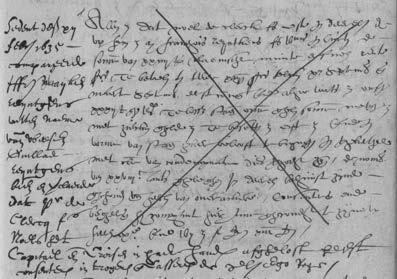
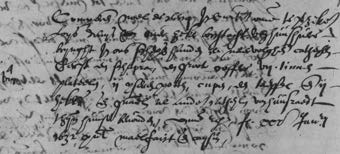
598
CHAPTER 34. ANTONI DESCLERGUE Y DE MONTOYA (DC06)
Figure 34.234: Kortrijk, March 10, 1621: Natalis Declercq (DK02by) (’Noel De-
clerck’), the son of Oste Declercq (DK02b) in Deerlijk, has a debt to François Reynt-
gens, the son of William, of a hereditary annuity that he promises to insure on
land in Deerlijk. Kortrijk, February 12, 1635 (left column): Miss Maria Reyntgens
appeared on behalf of the orphans of William Reyntgens and declared that Pieter
Declercq (DK02by2), the son of Natalis, paid the debt. Source: Oud Stadsarchief
Kortrijk, Akten en Contracten, 965, 1074481 arch 106, 95r scan 122, 1620-1622, 10
maart 1621, Schuldbekentenis.
Figure 34.235: Kortrijk, 1622, January 30, Natalis Declercq (DK02by)
(’Noel Declercq’) secures a bail for Loys Denys with the furniture from
his house. Source: Oud Stadsarchief Kortrijk, Akten en Contracten,
Document 5095 - 1074484 arch 111 1630-1634, 30 januari 1622.
34.13.5 Jan Declercq (DK02a)
Jan Declercq (DK02a) was a son of Nicolas Declercq (DK01) and a brother of Nicolas Declercq (DK02) and Oste Declercq (DK02b).
His son was Tomas Declercq (DK02ay1), cousin of Tomas Declercq (DK03d), Nicolas Declercq’s (DK02) son, described in Chapter
Another son was Jan Declercq (DK02ay2).
34.13.6 Tomas Declercq (DK03d)
His descendants are shown in Figure 34.258 on page 613. His son, Jan Declercq (DK03dy), is described in Chapter 34.13.6.1 and married Margareta Pauwels from Deerlijk.
34.13.6.1 Jan Declercq (DK03dy)
Jan Declercq (DK03dy), son of Tomas Declercq (DK03d) and the nephew of Jan Declercq (DK03), lived in Deerlijk and can be found on the list of ’la bourgeoisie foraine’ of Kortrijk at Deerlijk. He died around 1646. Jan Declercq’s (DK03dy) uncle was Jan Declercq (DK03), described in Chapter 34.13.7.
His presence is shown in Figures 34.259, 34.260, 34.261, 34.262, 34.263, 34.264, 34.265, 34.266, 34.267, 34.268, 34.269, 34.270, 34.271,
34.272, 34.273, 34.274, 34.275, 34.276, 34.277, 34.278, 34.279, 34.280, 34.281, 34.282, 34.283, 34.284, 34.285, 34.286, 34.287, 34.288,
34.289, 34.290, 34.291, 34.292, 34.293, 34.294, 34.295, 34.296, 34.297, 34.298, 34.299, 34.300, 34.301, 34.302 and 34.303.
He was Married to Margareta Pauwels from Deerlijk. The Pauwels family owned the Klaverhof farm in Deerlijk. Figure 34.304
shows the baptism of their daughter Judoca Declercq (DK03dyf) on page 616.
Because his children, grandchildren, and great-grandchildren lived mostly in Deerlijk when the offspring of Jeroni Joan Desclergue (DC05) lived there too, and because, being related, they were acquainted, their appearances in Church certificates coincide and may cause great confusion to genealogists.76
76The contents of this monograph stem from an extensive inquiry encompassing meticulous examination of archival materials sourced from Kortrijk and its environs. Initially, the investigative process involved the comprehensive compilation of ecclesiastical records, which were subsequently subjected
© 2024 Nico F. Declercq
The Desclergues of la Villa Ducal de Montblanc, 2nd ed., Omn., VOL. II
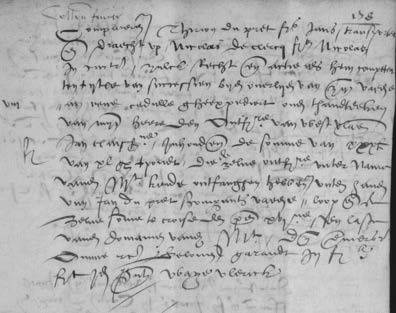
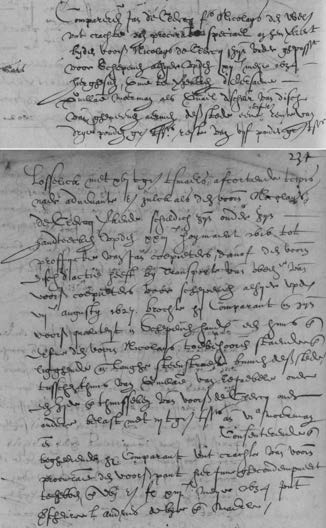
34.13. CLAN OF BEATRICE DECLERCQ (DK02BYX) ANTONI DESCLERGUE’S WIFE
599
Figure 34.236: Kortrijk, December 29, 1561. Thirion Dupret, the son of Jan
Dupret, transports a debt inherited from his father onto Nicolas Declercq from Kor-
trijk, signed by Jan Claissone on behalf of the dominions of His Majesty the King.
Source: Oud Stadsarchief Kortrijk, Akten en Contracten, 1254, 1074463, arch66,
158r.
Figure 34.237: Kortrijk, May 13, 1634,
guarantee. Jan Declercq (DK03), the son
of Nicolas Declercq (DK02), with power
of attorney from his father (passed be-
fore the aldermen of the city on May
12, 1634), guarantees to Guillaeme Moer-
man, general ’dismeester’ of the city, the
interest that father Nicolas Declercq had
transferred under his signature on August
23, 1616 to Jan Coppieters, whose widow
transported them to the court on August
7, 1627. He does this with his house as
surety in the Lange Steenstraat between
Guillaeme Vanrejaebele and the aforemen-
tioned Declercq, charged with debts to the
widow of Moerman. Subsequently, in (F°
234A), Nicolas Declercq passes the power
of attorney to his son Jan Declercq (DK03)
mentioned above in the original document.
He also gives power of attorney to transfer
an interest on Adriaen Dero, the son of
Jan Dero. (see the same book, f° 243). In
the margin of this document there is men-
tion of an interest that Rogier Delescluse,
the son of Jaecques Delescluse and Mar-
griete Lampe, transferred on February 13,
1615 for the bailiff of Quintebaele and
the Groeninck aldermen to Jan Declercq
(DK03). Then, in (F° 234B), the orig-
inal of the snnouncement itself. Source:
Oud Stadsarchief Kortrijk, Akten en Con-
tracten, 5744, 1074484, arch 112, 233v.
The Desclergues of la Villa Ducal de Montblanc, 2nd ed., Omn., VOL. II
© 2024 Nico F. Declercq
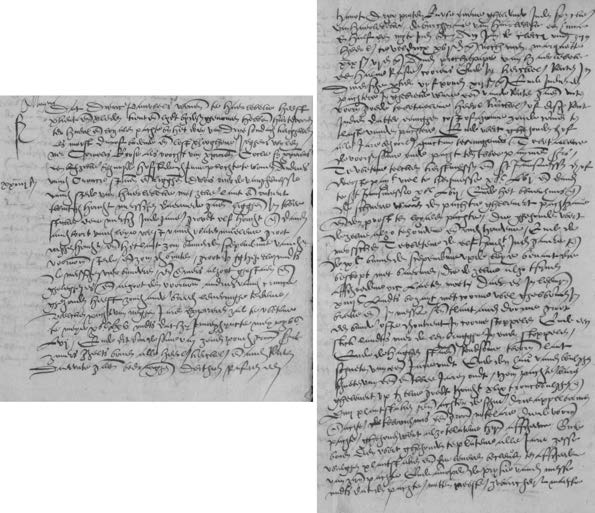
600
CHAPTER 34. ANTONI DESCLERGUE Y DE MONTOYA (DC06)
Figure 34.238: Kortrijk, January 22, 1560. This is a rental contract. Dierick Pauwels in Harelbeke rents from Cornelis Roose, as guardian of Christiaen Cocle fs Christiaen, the homestead in which Andries Vandercruuce used to live. The homestead was located opposite the Harelbeke prison. There are also charges to Jan Declercq (DK03) because of his seigneury in Veldricx. Pieter Salm and Bouduwyn Vanderholle determined the price. Source: Oud Stadsarchief Kortrijk, Akten en Contracten, 478, 1074462, arch65, 141r.
34.13.7 Jan Declercq (DK03) & Isabeau Braye
34.13.7.1 Isabeau Braye
The Braye family was prominent in Kortrijk in the 17th century. Their origins were found in Tournai in the 16th century.77
A document linking the families of Braye and Declercq in 1640 is shown in Figure 34.306 on page 617.
In 1564, Joos Braye, the son of Jan Braye, was still alive and was married to Cathelyne Vandenberghe, as can be read in Figure
Guilielmus Braye became a student at the Catholic University of Leuven on December 12, 1640, as shown in Figure 34.307 on page
617. He was a relative of Isabeau Braye.
Interestingly, at the end of the 17th century, there was also a marriage between Braye and someone from the de Patin family, another ancestral branch of ours. This can be read in Chapter 70.2.4.
34.13.7.2 Jan Declercq (DK03)
Jan Declercq (DK03) was a notary at Kortrijk from 1588 until 1620.78
His descendants are shown in Figure 34.305 on page 616. His son, Nicolas Declercq (DK04g), described in Chapter 34.13.8.12, was also a notary in Kortrijk.
Apart from being a notary, Jan Declercq (DK03) also held other roles, such as school director. He was also responsible for allocating guardians to orphaned children and arranging their inheritance.
to clustering analysis.
Subsequent phases entailed scrutinizing supplementary Spanish and notarial documents and validating the identified clusters.
The genealogical connections within the familial networks of Jan Declercq and Catherine Van Wymelbeke in Waregem presented a complex puzzle.
Overlapping given names and surnames added to the challenge. However, our perseverance and dedication to the research process eventually led to the elucidation of these connections, revealing straightforward ancestral lineages. This journey was not without its difficulties, requiring us to navigate through confusion, iterate model construction, and deconstruction. The satisfaction of a methodically executed investigation was the ultimate reward.
The role of clerical involvement in administrative documentation is of paramount importance in our research. The orthographic variations in personal names often reflect more about the clerical context than the individuals themselves. Priests, in their efforts to facilitate divine discernment, employ local phonetic renderings, standardized forms, or Latinized Flemish variations. These archival records, with their unique insights into historical familial dynamics, hold immense value for genealogical scholars. They warrant meticulous examination and appreciation for the role they play in our understanding of the Pauwels family and related lineages in Deerlijk and Waregem.
77Archief van de familie Braye, Rijksarchief Kortrijk
78Herman Van Isterdael, "Beknop Archievenoverzicht Rijksarchief Kortrijk."
© 2024 Nico F. Declercq
The Desclergues of la Villa Ducal de Montblanc, 2nd ed., Omn., VOL. II
34.13. CLAN OF BEATRICE DECLERCQ (DK02BYX) ANTONI DESCLERGUE’S WIFE
601
Jan Declercq (DK03) was a prominent person and left many traces in the archives of Kortrijk.
Figure 34.238 on page 600 shows that Jan Declercq (DK03) possessed the manor Veldricx in Harelbeke in 1560.
On December 1, 1588, Jan Declercq (DK03), the son of Nicolas Declercq (DK02) (whose wife inherited the interest from Joos Braye) declared that Symon Samyn had paid off a debt, as can be read in Figure 34.241 on page 603.
We can read that Joos Braye is the son of Jan Braye in Figure 34.242 on page 604, which states that Jan Declercq (DK03) paid money to pay off someone else’s debt in 1583.
We can read in Figure 34.243 on page 605 that, in 1586, Jean du Bois, described in Chapter 49.9.2, was an acquaintance of Jan Declercq (DK03) and that the latter was the governor of a school in Kortrijk.
In Figure 34.244 on page 605, we can, for instance, read that Jan Declercq (DK03) was a notary in 1602.
In 1622 Jan Declercq (DK03) was still alive, as can be read in Figure 34.245 on page 606. Some of his children were religious, namely Ambrosius Declercq (DK04k), Jeronimus Joannes Declercq (DK04h), Cathelyne Declercq (DK04j).
Jan Declercq (DK03) took the role as weesheer (orphan lord), as can be read in a 1612 document in Figure 34.254 on page 610.
In 1625, Jan Declercq (DK03) was still alive, as we can read in Figure 34.246 on page 606.
Evidence that Jan Declercq (DK03) had property, or, at least, a guarantee based on a property, in Deerlijk is shown in Figure
Jan Declercq (DK03) died on December 30, 1640.
In 1611, after the death of Isabeau Braeye, Jan Declercq (DK03) organized a transfer to Felipa de Montoya in 1611, as can be seen in Figure 34.252 on page 609 and Figure 34.253 on page 610.
Even in 1601, we can read that a connection existed between Jan Declercq (DK03) and Felipa de Montoya, the wife of Jeroni Joan Desclergue (DC05), as described in Chapter 29.10.4.
34.13.8 The Lives of the Biological Descendants of Nicolas Declercq (DK02
34.13.8.1 Jan Declercq (DK03dya)
Jan Declercq (DK03dya) was the son of Jan Declercq (DK03dy) and Margareta Pauwels. He married Martina Vander Beke before 1624 and Jossina Nooters after 1624. Jan Declercq’s wife (DK03dya), Martina Vander Beke, appeared as godmother to Martina de la Cruz at Dudzele in 1624, as described in Chapter 37.4. It means that Jan (DK03dya) very likely has been military at Damme for some time during that period, probably convinced by Antoni Desclergue (DC06), or else he may have been married to a daughter of a military who was involved in the area of Damme. We don’t know. Given his age at that time, 42, it’s more likely, however, that the connection was the result of Felipa de Montoya, a relative of the de la Cruz family, as outlined in Chapter 37.4 and Chapter
29.10.6, who entered the clan of Jan (DK03dya) through her marriage, in 1611, with Jan Declercq (DK03).
Jan Declercq’s (DK03dya) presence on the list of ’la bourgeoisie foraine’ of Kortrijk at Deerlijk is shown in Figures 34.313, 34.314,
34.315, 34.316, 34.317, 34.318, 34.319, 34.320, 34.321, 34.322, 34.323, 34.324, 34.325, 34.326, 34.327, 34.328, 34.329, 34.330, 34.331,
34.332, 34.333, 34.334, 34.335, 34.336, 34.337, 34.338 and 34.339.
34.13.8.2 Family of Jan Declercq (DK03dya)
The orphan’s deed in Figure 34.340, in 1655, found upon the death of Jan Declercq (DK03dya), reveals some details about his family at that time.
In summary, the orphan’s deed in Figure 34.340 states that there were four children below 25 years old (or were perpetually considered minors for other reasons). Their guardians were their uncles Pieter Declercq (DK03dyb) and Lauwereyns Vander Beke, son of Steven, both from Deerlijk. The orphans inherited a farm, 2500 lands extensive, consisting of 5 pieces of land joint together, at Desselgem (Sint Pieters), half of a land of 100 lands at Desselgem (also Sint Pieters), half of a land of 100 lands at Desselgem (also Sint Pieters), half of a land of 1400 lands in two parts at Beveren-Leie (also Sint Pieters); half of a land of 800 lands at Desselgem (Cuypers) and a land of 800 lands at Desselgem (Ten Rade). The latter land was given to their disabled brother Anthonius (DK03dyay1). So, altogether, the descendants of Pieter Declercq inherited 6200 lands. Given that 100 lands equal 885
square meters, they inherited 54870 square meters or 5.5 hectares. Jan Declercq (DK03dya) had been Foreign Bourgeois of Kortrijk at Deerlijk from 1618 until 1652.
34.13.8.3 Pieter Declercq (DK03dyb)
Pieter Declercq (DK03dyb) would marry four times and have many children. His first marriage, in Figure 34.341, occurred in Wervik, located along the Leie River, and is passed when traveling, for instance, along the river, from Kortrijk to Loos or Lille.
Therefore, this is not surprising. We have found no further trace of the couple. Probably the bride, Maria Legin, died at a young age without children. From his wedding onward, in 1612, Pieter became Buitenpoorter of Kortrijk at Deerlijk, whence we may assume that the couple did not live at Wervik but at Deerlijk. Pieter would be Bourgeois Forain from 1612 until 1657 and get children from 3 marriages between the 1620s and 1654.
Pieter Declercq (DK03dyb) became a Bourgeois Forain of Kortrijk at a very young age. Two mechanisms helped to achieve this status. First, in the publication ’De Poorterij en buitenpoorterij in Vlaanderen’ 79, we find that a child could become Foreign Bourgeois of Kortrijk if he registered with his father80. Second, the fact that he married that year, in Figure 34.341, may have been a sufficient condition to declare him an adult and become a Foreign Bourgeois. His appearance is shown in Figures 34.342, 34.343,
34.344, 34.345, 34.346, 34.347, 34.348, 34.349, 34.350, 34.351, 34.352, 34.353, 34.354, 34.355, 34.356, 34.357, 34.358, 34.359, 34.360,
34.361, 34.362, 34.363, 34.364, 34.365, 34.366, 34.367, 34.368, 34.369, 34.370, 34.371, 34.372, 34.373, 34.374, 34.375, 34.376, 34.377,
34.13.8.4 The family of Pieter Declercq (DK03dyb)
Pieter Declercq (DK03dyb) married Joanna de Poorter or Judoca de Pootere in June 1642 at Deerlijk. She was his 4th wife.
Witnesses were Mrs de Witte, indicated by the priest as the bride’s mother, and Antoni Desclergue (DC06), who had returned from Spain. In contrast, the priest did not characterize their relationship. Indeed, although acquainted and residing in Deerlijk, their family bond was further than a priest would normally indicate in such a document.
79De Poorterij en buitenpoorterij in Vlaanderen, jaarboek 3 of VCGH.
80A fact confirmed in private communication with genealogist Johan Amaat.
The Desclergues of la Villa Ducal de Montblanc, 2nd ed., Omn., VOL. II
© 2024 Nico F. Declercq
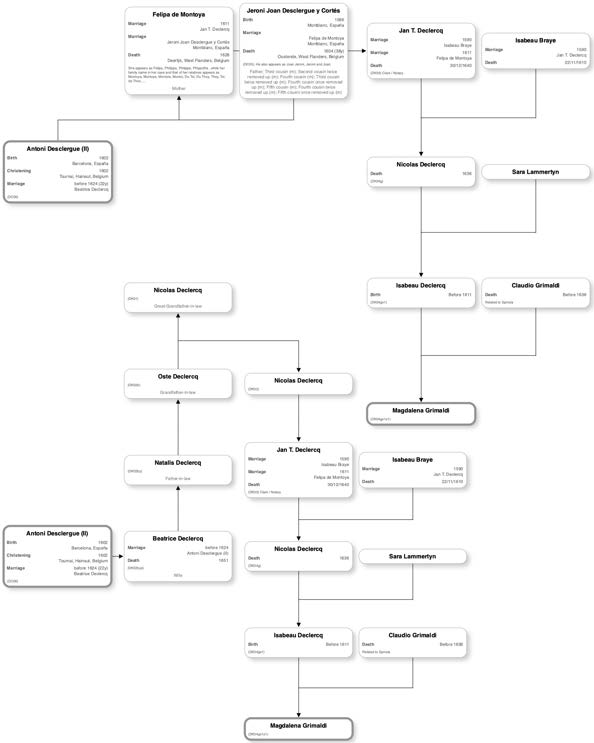
602
CHAPTER 34. ANTONI DESCLERGUE Y DE MONTOYA (DC06)
Figure 34.239: The connection between Antoni Desclergue (DC06) and Magdalena Grimaldi (DK04gx1x1) through Antoni’s stepfather Jan Declercq (DK03). The connection through his wife Beatrice Declercq (DK02byx) is shown in Figure 34.240 on page pagerefGrimaldiBeatriceDeclercq.
© 2024 Nico F. Declercq
The Desclergues of la Villa Ducal de Montblanc, 2nd ed., Omn., VOL. II
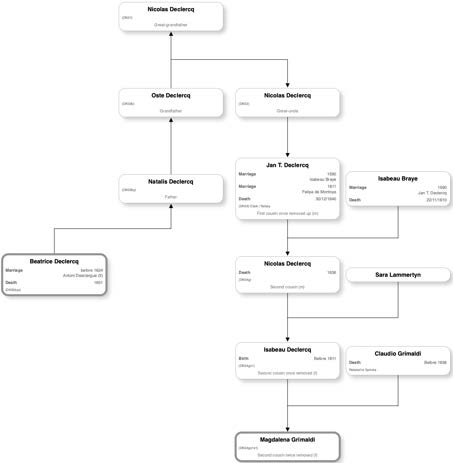
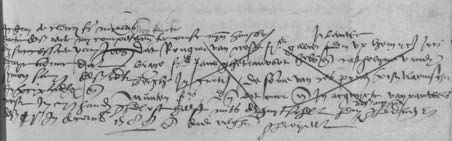
34.13. CLAN OF BEATRICE DECLERCQ (DK02BYX) ANTONI DESCLERGUE’S WIFE
603
Figure 34.240: The blood-connection between Beatrice Declercq (DK02byx) and Magdalena
Grimaldi (DK04gx1x1). Another connection through her husband Antoni Desclergue’s (DC06)
stepfather (DK03) is given in Figure 34.239 on page 602.
Figure 34.241: Kortrijk, April 14, 1561, confession of guilt. Rougier Vanneste, son of Gillis in
Lauwe, is guilty of Joos Braye, the son of Jan Braye and Cathelyne Vandenberghe, in acquisition
of Pauwels and Gheeraert Derue. The guarantors were provided by Willem Nuten, the son of
Oste Nutten in Kortrijk, and Jacob Calewaert, the son of Jacob Calewaert in Lauwe. Then,
on December 1, 1588, Jan Declercq (DK03), the son of Nicolas Declercq (DK02) (whose wife
inherited the interest from Joos Braye) declared that Symon Samyn had paid off the debt. Source:
Oud Stadsarchief Kortrijk, Akten en Contracten, 694, 1074462, arch65, 211r.
The Desclergues of la Villa Ducal de Montblanc, 2nd ed., Omn., VOL. II
© 2024 Nico F. Declercq
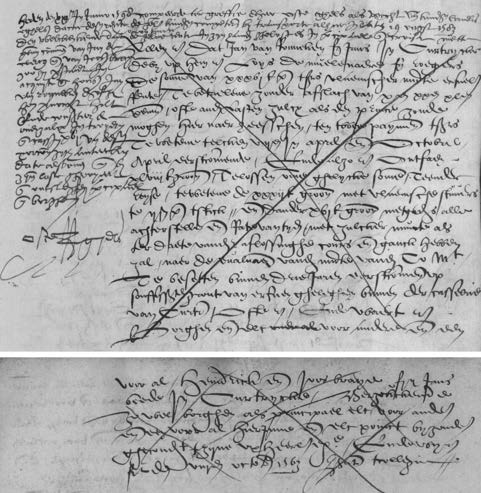
604
CHAPTER 34. ANTONI DESCLERGUE Y DE MONTOYA (DC06)
Figure 34.242: Kortrijk, October 8, 1563, an admission of debt. Jan Vanronneken, the son of Jan
Vanronneken in Kortrijk, owes a hereditary annuity to Loys Demuelenaere, the son of Roegier Demue-
lenaere. The guarantors were Heindrick and Joos Braye, sons of Jan Braye in Kortrijk. Subsequently,
on June 19, 1598, Oste Eghels appeared as guardian of the children of Cornelis Eghels (who had the
action after the transport of August 19, 1583). They stated that the interest had been repaid with
money from Jan Declercq (DK03) and Joos Braye, in acquit by Jan Van Ronneken. Source: Oud
Stadsarchief Kortrijk, Akten en Contracten, 2680, 1074464, arch68, 82r.
© 2024 Nico F. Declercq
The Desclergues of la Villa Ducal de Montblanc, 2nd ed., Omn., VOL. II
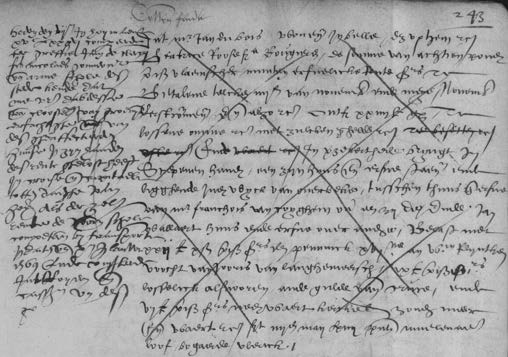
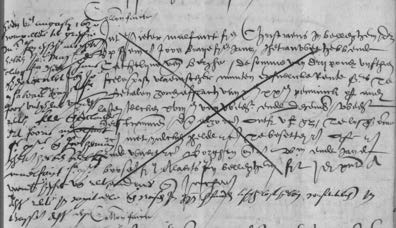
34.13. CLAN OF BEATRICE DECLERCQ (DK02BYX) ANTONI DESCLERGUE’S WIFE
605
Figure 34.243: Kortrijk, May 4, 1564, a confession of a debt. Jean du Bois, described in Chapter 49.9.2,
was in depth with Beatrice Roose, the daughter of Rougier Roose, concerning a hereditary interest. He
secured this with a house on Overbeke in Kortrijk, located between Franchois Vancoyghem and Jan Wallaert, with charges to Willem Reyntken, among others. The latter was the guardian of Jooris Vanlanghemeersch.
Subsequently, on August 7, 1586, Jan Declercq (DK03), the son of Nicolaes Declercq (DK02), as governor of the ’Arme Schole,’ and acknowledged that the abbess of Groenynghe had repaid the interest as owner of the affected property. The interest was conveyed to the school on January 10, 1569. Source: Oud Stadsarchief Kortrijk, Akten en Contracten, 3143, 1074464, arch68, 243r.
Figure 34.244:
Kortrijk, December 18, 1564 debt acknowledgment. Pieter
Maelfaict, the son of Christiaen Maelfaict in Bellegem, owes a hereditary inter-
est to Joos Braye, the son of Jan Braye and married to Cathelyne Vandenberghe.
The persons who stood warranty were Willem and Jan Deboosere, the sons of Alaert
Deboosere in Bellegem. Then, on August 5, 1630, Jan Essche, who was married to
Maria Magdalena Declercq (DK04e), the daughter of Jan Declercq (DK03) and Ys-
abeau Braye (daughter of Joos Braye) appeared and he declared that Jooris Maelfaict,
the son of Pieter Maelfaict, and Joos Herman, married with Meelken Malfaict, had
paid off the interest. Meelken Malfaict was the daughter of Pieter Maelfaict. Source:
Oud Stadsarchief Kortrijk, Akten en Contracten, 3670, 1074465, arch69, 151r.
The Desclergues of la Villa Ducal de Montblanc, 2nd ed., Omn., VOL. II
© 2024 Nico F. Declercq
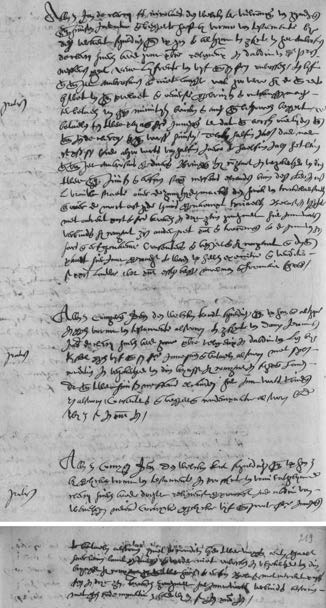
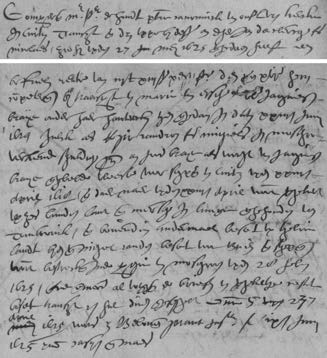
606
CHAPTER 34. ANTONI DESCLERGUE Y DE MONTOYA (DC06)
Figure 34.245:
Kortrijk, January 21,
1622. In the execution of his wife’s will,
opened after she died in 1611, Jan Declercq
(DK03), son of Nicolas Declercq (DK02),
grants an annuity in his own name to
their son Ambrosius Declercq (DK04k), re-
ligious in Ghent in St. Peter’s Abbey. He
ensures it with 2 houses next to each other
in the Onze-Lieve-Vrouwstraat on the cor-
ner of "the Cockelarstratken," next to "the
Priaelken." Idem, according to the same
will, owes idem to their son Jeronimus
Joannes Declercq (DK04h), presbyter of
the abbey in Loos, an annuity as above, in-
sured on the same houses. Idem, accord-
ing to the same will, owes idem to their
daughter Cathelyne Declercq (DK04j), re-
ligious of the abbey in Wevelgem, an annu-
ity as above, insured on the same houses.
Source: Oud Stadsarchief Kortrijk, Akten
en Contracten, 1307, 1074481, arch 106,
218v.
Figure 34.246: Kortrijk, June 9, 1625.
On May 27, 1625, Pieter Dehondt, pres-
byter and canonist of Our Lady in Kor-
trijk, conveyed to Jan Declercq (DK03),
the son of Nicolas Declercq (DK02), an
annuity that had been conveyed to him
by Marie Vanessche, the widow of Jaques
Braye, under her signature on June 23,
1624. The interest was transported by
Rogier Caudron, the son of Michiel Cau-
dron from Mouscron, to Joos Braye as
guardian of Jacques Braye on April 23,
1618.
On the same day it was guar-
anteed on 6 hectares in Luingne, held
under Tombrouck. Source: Oud Stad-
sarchief Kortrijk, Akten en Contracten,
2732, 1074482, arch 108, 108r.
© 2024 Nico F. Declercq
The Desclergues of la Villa Ducal de Montblanc, 2nd ed., Omn., VOL. II
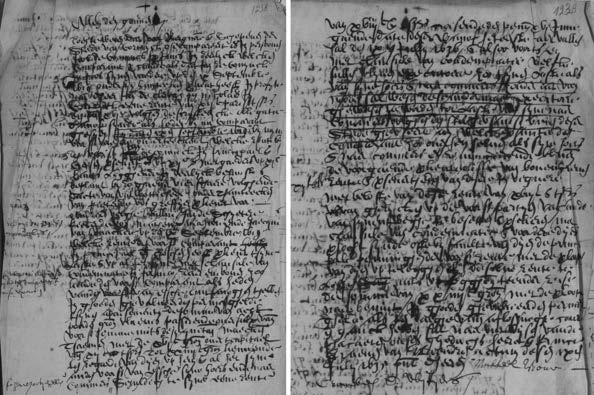
34.13. CLAN OF BEATRICE DECLERCQ (DK02BYX) ANTONI DESCLERGUE’S WIFE
607
Figure 34.247: Kortrijk, July 9, 1635, confession of debt. (See also book 113, f° 123r). Joos Deconynck, son of Jan Deconynck in Deerlijk, states that father Jan Deconinck, son of Joos Deconynck, made a debt under his signature to Jan Declercq (DK03), son of Nicolas Declercq (DK02), on September 9, 1619. He guaranteed the debt with land in Deerlijk. The deed was signed by Pieter Devos, clerk, and later settled on September 9, 1619 before bailiff Andries Velghe, Jan Deschietere, Pieter Devos, Matheux Mahieu and Jaecques Vanhonackere, aldermen of the manor of Pouckes. The person appearing, Jan Declercq (DK03), received the capital from the interest from Jan Vanessche (the husband of Maria Magdalena Declercq).
Source: Oud Stadsarchief Kortrijk, Akten en Contracten, 6699, 1076580, arch 114, 123A and B.
The Desclergues of la Villa Ducal de Montblanc, 2nd ed., Omn., VOL. II
© 2024 Nico F. Declercq
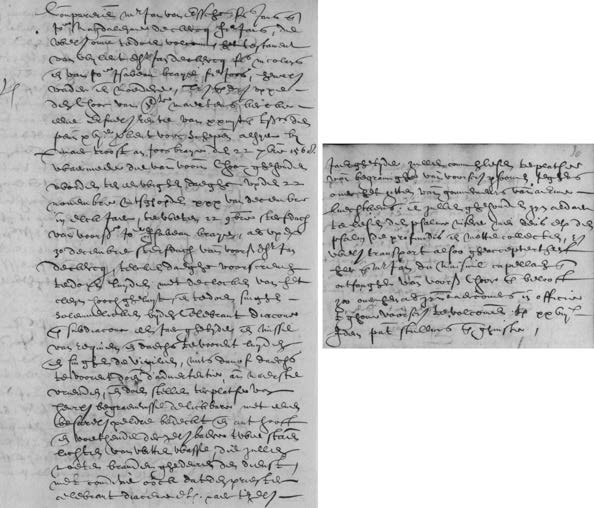
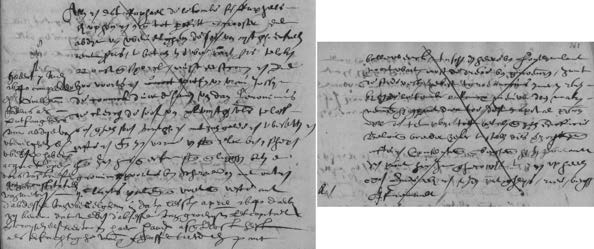
608
CHAPTER 34. ANTONI DESCLERGUE Y DE MONTOYA (DC06)
Figure 34.248: Kortrijk, January 28, 1641, transfer. In execution of the will of their parents-in-law and parents Jan Declercq (DK03), son of Nicolas Declercq (DK02) and Isabeau Braye, daughter of Joos Braye, are transferring Jan Vanessche, son of Jan Vanessche, and husband of Maria Magdalena Declercq (DK04e), daughter of Jan Declercq (DK03), to the choir of the Sint Maartenskerk an annuity that Omaer Troost granted to Joos Braye on September 22, 1568. This is for 2 annual masses, on November 22 (the anniversary of Isabeau Braye’s death) and on December 30 (the anniversary of Jan Declercq’s (DK03) death). Each time with a small high sound and singing by the celebrant, deacon and subdeacon, etc. Jan Dumaisnil, chapel and receiver of the choir, promises to take care of everything. Source: Oud Stadsarchief Kortrijk, Akten en Contracten, 7127, 1076581, arch 115, 29v.
Figure 34.249: Kortrijk, February 23, 1624, debt acknowledgment. Raphael Deletombe, the son of Raphael Deletombe, owes the monastery and abbey of Wevelgem a hereditary interest, the capital of which he received from his wife Jossyne Deconninck via Jeronimus Joannes Declercq (DK04h). He insures the debt with a house just outside the Groeninge gate, against the fortress, recently built by him. Source: Oud Stadsarchief Kortrijk, Akten en Contracten, 2243, 1074482, arch 107, 241v.
© 2024 Nico F. Declercq
The Desclergues of la Villa Ducal de Montblanc, 2nd ed., Omn., VOL. II
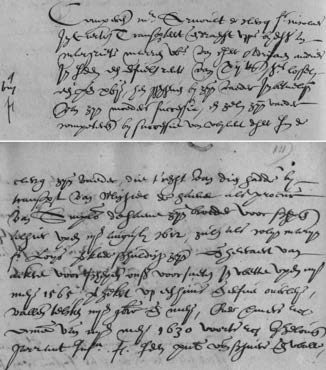
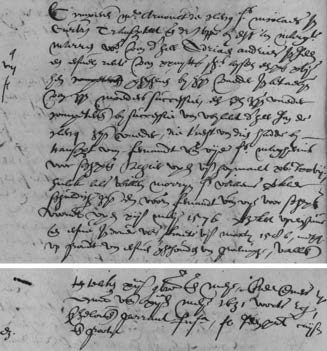
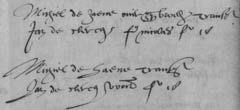
34.13. CLAN OF BEATRICE DECLERCQ (DK02BYX) ANTONI DESCLERGUE’S WIFE
609
Figure 34.250: Source: Kortrijk, March
31, 1631, transfer.
Arnoult Declercq
(DK04gy1), the son of Nicolas Declercq
(DK04g) in Kortrijk, transfers to Margri-
ete Marren in Kortrijk, the widow of Adri-
aen Andries, an annuity that he received
from his father as payment for his mater-
nal inheritance. Father Declercq had in-
herited this from his own father Jan De-
clercq (DK03), to whom it had been trans-
ferred on August 3, 1612 by Michiel De-
haene as attorney of brother Amluenis De-
haene. The annuity had been transferred
by Colyn Maryn, the son of Loys Maryn,
to Gheeraert Vanackere on May 4, 1565
and was guaranteed by a house in Overleie.
Oud Stadsarchief Kortrijk, Akten en Con-
tracten, 4789, 1074484, arch 111, 110v.
Figure 34.251: Kortrijk, May 31, 1631,
transfer. Arnoult Declercq (DK04gy1), the
son of Nicolas Declercq (DK04g) in Kor-
trijk, transfers to Margriete Marren in Ko-
rtrijk, the widow of Adriaen Andries, an
annuity that he received from his father
as payment for his maternal inheritance.
His father had inherited it from his father
Jan Declercq (DK03), to whom it had been
transported by Fernandt Vanderoije, the
son of Magherin Vanderoije, on August 6,
1577. The interest had been transferred by
Willem Morryn, the son of Willem, to the
aforementioned Fernandt on May 12 1576
and was guaranteed by a house in the Oude
Weduwestraete and on land held by Groen-
inghe. Source: Oud Stadsarchief Kortrijk,
Akten en Contracten, 4867, 1074484, arch
111, 147r.
Figure 34.252: This is the appearance in the index of
1612 of the document shown in Figure 34.253 on page
610. Source: Oud Stadsarchief Kortrijk, Akten en Con-
tracten , 107737, arch 102, folio index.
The Desclergues of la Villa Ducal de Montblanc, 2nd ed., Omn., VOL. II
© 2024 Nico F. Declercq
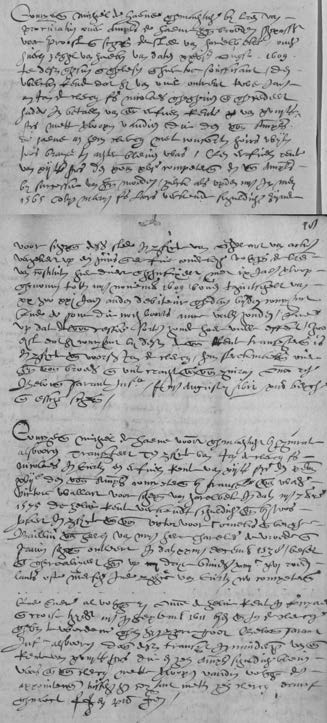
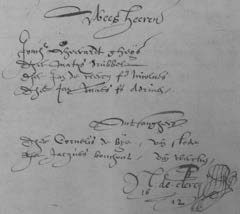
610
CHAPTER 34. ANTONI DESCLERGUE Y DE MONTOYA (DC06)
Figure 34.253: Kortrijk, August 1612,
transports of Michiel Dehaene and Jan
Declercq (DK03), the son of Niclas De-
clercq (DK02). The bottom transport, 11
September 1611) concerns property for-
merly belonging to Jan Declercq’s deceased
wife (uxore Clercq) and transported to Fe-
lipa, de widow of Jeroni Joan Desclergue
(DC05) (Philippe vidua Jeroni Desclerq).
The mentioned Michiel Dehaene acted on
behalf of Ampleunis Dehaene, his brother,
approved by ’Proost ende Schepenen ter
Stede van Harelbeke’ in 1609. The doc-
uments also involve Joos Braye, the son
of Anteunis Braye. The documents are
indexed in Figure 34.252 on page 609.
Source: Oud Stadsarchief Kortrijk, Akten
en Contracten , 107737, arch 102, 37-38,
folio 18.
Figure 34.254: Kortrijk, 1612, Jan Declercq (DK03)
on the list of ’weesheren’ in Kortrijk. He is also the one
who signed at the bottom. Source: Oud Stadsarchief Ko-
rtrijk, Akten en Contracten , 107737, arch 101, 66, folio
41.
© 2024 Nico F. Declercq
The Desclergues of la Villa Ducal de Montblanc, 2nd ed., Omn., VOL. II
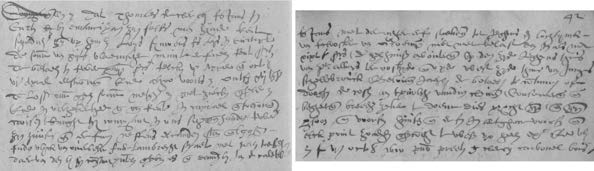
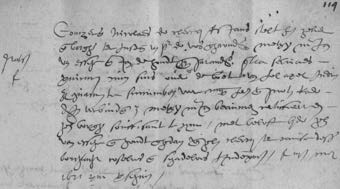
34.13. CLAN OF BEATRICE DECLERCQ (DK02BYX) ANTONI DESCLERGUE’S WIFE
611
Figure 34.255: Kortrijk, October 1610, a contract of Tomas Declercq (DK02ay1), the son of Jan Declercq (DK02a) and grandson of Nicolas Declercq (DK02). Source: Oud Stadsarchief Kortrijk, Akten en Contracten , 107737, arch 101, 66, folio 41.
Figure 34.256: Kortrijk, May 3, 1621, Guarantee. Nicolas Declercq
(DK04g) , the son of Jan Declercq (DK03), guarantees the convicted
Pieter (Laurentius) de Vos and his guarantors Jan Vanessche (married
to Maria Magdalena Declercq) and Jan Dehondt, for the fine against
Servaes Vernimmen. Jan Beaumez certifies that the deposit is sol-
vent. Source: Oud Stadsarchief Kortrijk, Akten en Contracten, 1021,
1074481, arch 106, 114r.
The Desclergues of la Villa Ducal de Montblanc, 2nd ed., Omn., VOL. II
© 2024 Nico F. Declercq
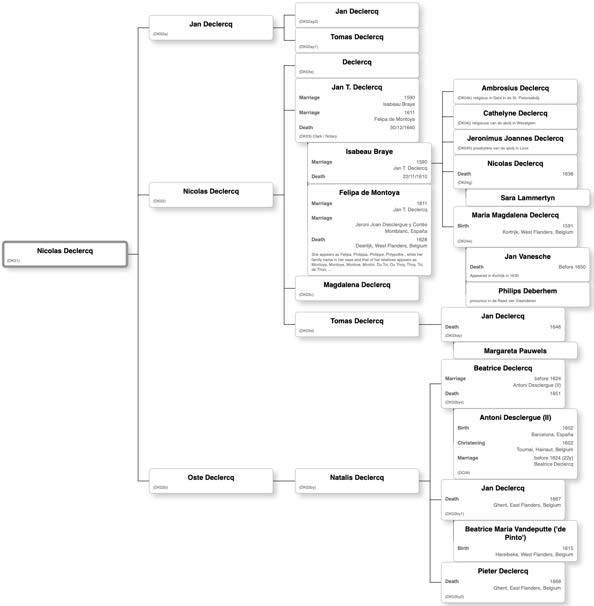
612
CHAPTER 34. ANTONI DESCLERGUE Y DE MONTOYA (DC06)
Figure 34.257: Three descendant generations of Nicolas Declercq (DK01). His descendants were prominent persons in Kortrijk and Tournai, and they married, among others, the Desclergues, Montoya, and Grimaldi.
© 2024 Nico F. Declercq
The Desclergues of la Villa Ducal de Montblanc, 2nd ed., Omn., VOL. II
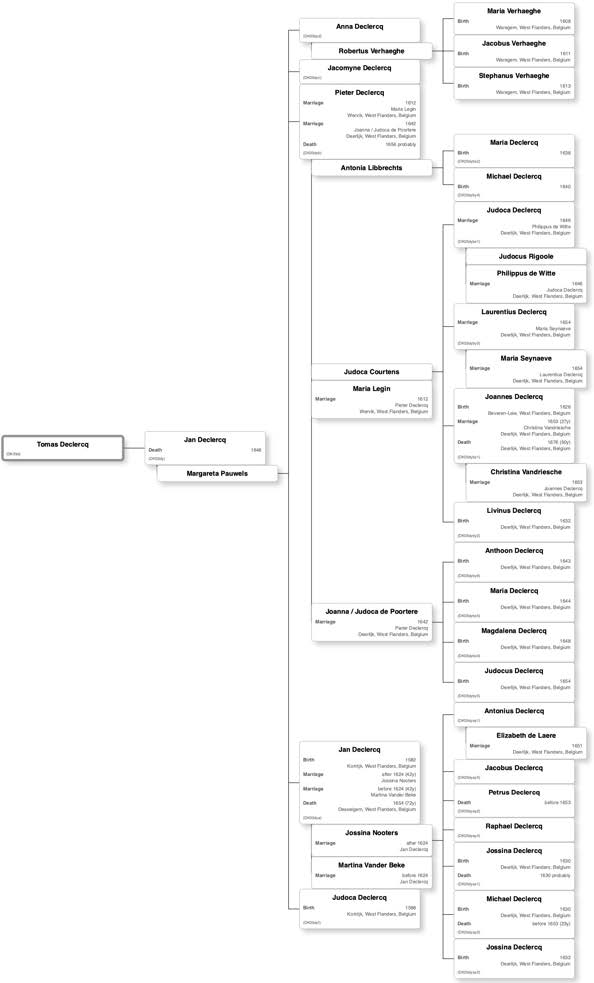
34.13. CLAN OF BEATRICE DECLERCQ (DK02BYX) ANTONI DESCLERGUE’S WIFE
613
Figure 34.258: Descendant generations of Tomas Declercq (DK03d).
The Desclergues of la Villa Ducal de Montblanc, 2nd ed., Omn., VOL. II
© 2024 Nico F. Declercq

















614
CHAPTER 34. ANTONI DESCLERGUE Y DE MONTOYA (DC06)
Figure 34.259: Kortrijk, market with city hall before 1900.
Figure 34.260: 1593, Jan Declercq (DK03dy) on overview list of ’la
bourgeoisie foraine’ of Kortrijk at Deerlijk, with initial date 1593.
Figure 34.261: 1593, Jan Declercq (DK03dy) on the list of ’la bour-
geoisie foraine’ of Kortrijk at Deerlijk.
Figure 34.262: 1594, Jan Declercq (DK03dy) on the list of ’la bour-
geoisie foraine’ of Kortrijk at Deerlijk.
Figure 34.263: 1595, Jan Declercq (DK03dy) on the list of ’la bour-
geoisie foraine’ of Kortrijk at Deerlijk. Although he must have been in
Tournai for a while, he kept his status in Deerlijk.
Figure 34.264: 1596, Jan Declercq (DK03dy) on the list of ’la bour-
geoisie foraine’ of Kortrijk at Deerlijk.
Figure 34.265: 1597, Jan Declercq (DK03dy) on the list of ’la bour-
geoisie foraine’ of Kortrijk at Deerlijk.
Figure 34.266: 1598, Jan Declercq (DK03dy) on the list of ’la bour-
geoisie foraine’ of Kortrijk at Deerlijk.
Figure 34.267: 1600, Jan Declercq (DK03dy) on the list of ’la bour-
geoisie foraine’ of Kortrijk at Deerlijk.
Figure 34.268: 1601, Jan Declercq (DK03dy) on the list of ’la bour-
geoisie foraine’ of Kortrijk at Deerlijk.
Figure 34.269: 1602, Jan Declercq (DK03dy) on the list of ’la bour-
geoisie foraine’ of Kortrijk at Deerlijk.
Figure 34.270: 1603, Jan Declercq (DK03dy) on the list of ’la bour-
geoisie foraine’ of Kortrijk at Deerlijk.
Figure 34.271: 1604 or 1605, Jan Declercq (DK03dy) on the list of
’la bourgeoisie foraine’ of Kortrijk at Deerlijk.
Figure 34.272: 1606, Jan Declercq (DK03dy) on the list of ’la bour-
geoisie foraine’ of Kortrijk at Deerlijk.
Figure 34.273: 1607, Jan Declercq (DK03dy) on the list of ’la bour-
geoisie foraine’ of Kortrijk at Deerlijk.
Figure 34.274: 1608, Jan Declercq (DK03dy) on the list of ’la bour-
geoisie foraine’ of Kortrijk at Deerlijk.
Figure 34.275: 1609, Jan Declercq (DK03dy) on the list of ’la bour-
geoisie foraine’ of Kortrijk at Deerlijk.
Figure 34.276: 1610, Jan Declercq (DK03dy) on the list of ’la bour-
geoisie foraine’ of Kortrijk at Deerlijk.
Figure 34.277: 1611, Jan Declercq (DK03dy) on the list of ’la bour-
geoisie foraine’ of Kortrijk at Deerlijk.
© 2024 Nico F. Declercq
The Desclergues of la Villa Ducal de Montblanc, 2nd ed., Omn., VOL. II






















34.13. CLAN OF BEATRICE DECLERCQ (DK02BYX) ANTONI DESCLERGUE’S WIFE
615
Figure 34.278: 1612, Jan Declercq (DK03dy) on the list of ’la bour-
geoisie foraine’ of Kortrijk at Deerlijk.
Figure 34.279: 1613, Jan Declercq (DK03dy) on the list of ’la bour-
geoisie foraine’ of Kortrijk at Deerlijk.
Figure 34.280: 1614, Jan Declercq (DK03dy) on the list of ’la bour-
geoisie foraine’ of Kortrijk at Deerlijk.
Figure 34.281: 1615, Jan Declercq (DK03dy) on the list of ’la bour-
geoisie foraine’ of Kortrijk at Deerlijk.
Figure 34.282: 1616, Jan Declercq (DK03dy) on the list of ’la bour-
geoisie foraine’ of Kortrijk at Deerlijk.
Figure 34.283: 1617, Jan Declercq (DK03dy) on the list of ’la bour-
geoisie foraine’ of Kortrijk at Deerlijk.
Figure 34.284: 1618, Jan Declercq (DK03dy) on the list of ’la bour-
geoisie foraine’ of Kortrijk at Deerlijk.
Figure 34.285: 1619, Jan Declercq (DK03dy) on the list of ’la bour-
geoisie foraine’ of Kortrijk at Deerlijk.
Figure 34.286: 1620, Jan Declercq (DK03dy) on the list of ’la bour-
geoisie foraine’ of Kortrijk at Deerlijk.
Figure 34.287: 1621, Jan Declercq (DK03dy) on the list of ’la bour-
geoisie foraine’ of Kortrijk at Deerlijk.
Figure 34.288: 1622, Jan Declercq (DK03dy) on the list of ’la bour-
geoisie foraine’ of Kortrijk at Deerlijk.
Figure 34.289: 1623, Jan Declercq (DK03dy) on the list of ’la bour-
geoisie foraine’ of Kortrijk at Deerlijk.
Figure 34.290: 1624, Jan Declercq (DK03dy) on the list of ’la bour-
geoisie foraine’ of Kortrijk at Deerlijk.
Figure 34.291: 1625, Jan Declercq (DK03dy) on the list of ’la bour-
geoisie foraine’ of Kortrijk at Deerlijk.
Figure 34.292: 1627, Jan Declercq (DK03dy) on the list of ’la bour-
geoisie foraine’ of Kortrijk at Deerlijk.
Figure 34.293: 1628, Jan Declercq (DK03dy) on the list of ’la bour-
geoisie foraine’ of Kortrijk at Deerlijk.
Figure 34.294: 1629, Jan Declercq (DK03dy) on the list of ’la bour-
geoisie foraine’ of Kortrijk at Deerlijk.
Figure 34.295: 1630, Jan Declercq (DK03dy) on the list of ’la bour-
geoisie foraine’ of Kortrijk at Deerlijk.
Figure 34.296: 1631, Jan Declercq (DK03dy) on the list of ’la bour-
geoisie foraine’ of Kortrijk at Deerlijk.
Figure 34.297: 1632, Jan Declercq (DK03dy) on the list of ’la bour-
geoisie foraine’ of Kortrijk at Deerlijk.
Figure 34.298: 1633, Jan Declercq (DK03dy) on the list of ’la bour-
geoisie foraine’ of Kortrijk at Deerlijk.
Figure 34.299: 1634, Jan Declercq (DK03dy) on the list of ’la bour-
geoisie foraine’ of Kortrijk at Deerlijk.
The Desclergues of la Villa Ducal de Montblanc, 2nd ed., Omn., VOL. II
© 2024 Nico F. Declercq





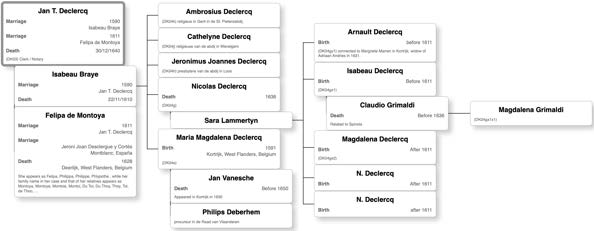
616
CHAPTER 34. ANTONI DESCLERGUE Y DE MONTOYA (DC06)
Figure 34.300: 1641, Jan Declercq (DK03dy) on the list of ’la bour-
geoisie foraine’ of Kortrijk at Deerlijk.
Figure 34.301: 1643, Jan Declercq (DK03dy) on the list of ’la bour-
geoisie foraine’ of Kortrijk at Deerlijk.
Figure 34.302: 1645, Jan Declercq (DK03dy) on the list of ’la bour-
geoisie foraine’ of Kortrijk at Deerlijk.
Figure 34.303: 1646, Jan Declercq (DK03dy) on the list of ’la bour-
geoisie foraine’ of Kortrijk at Deerlijk.
Figure 34.304:
Kortrijk, February 15,
1588, the baptism of Judoca Declercq
(DK03dyf), daughter of Jan Declercq
(DK03dy) and Margareta Pauwels. The
godfather was Josephus Pauwels.
Figure 34.305: Descendant generations of Jan Declercq (DK03).
© 2024 Nico F. Declercq
The Desclergues of la Villa Ducal de Montblanc, 2nd ed., Omn., VOL. II
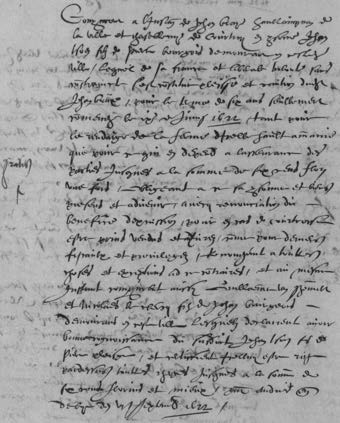
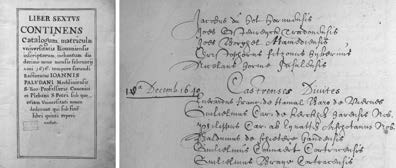
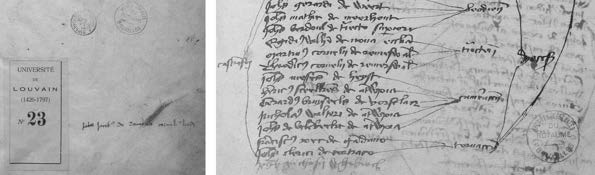
34.13. CLAN OF BEATRICE DECLERCQ (DK02BYX) ANTONI DESCLERGUE’S WIFE
617
Figure 34.306: Kortrijk, 7 september 1622, guarantee. Jehan Tsoen,
son of Pierre Tsoen, acted as president and guarantor of Jan Braye,
a prominent person in Kortrijk, for the relinquishment of the farm on
the island (later called Buda), manned for a term of 6 years. Guil-
laeme Vanghemmert and Nicolas Declercq (DK04g), the son of Jan De-
clercq (DK03) (“Nicolaes Leclercq fs Jehan”) certify that Jehan Tsoen
is rich. Source: Oud Stadsarchief Kortrijk, Akten en Contracten, 1640,
1074482, arch 107, 34v.
Figure 34.307: The inscription at the Catholic University of Leuven of student
Guilielmus Braye from Kortrijk (’Cortracensis’) on December 12, 1640.
Figure 34.308: Jan Declercq (DK00) appears as a student (’Johannes Clerici de Cortraco’) in February 1505 in the registers of the Catholic University of Leuven.
The Desclergues of la Villa Ducal de Montblanc, 2nd ed., Omn., VOL. II
© 2024 Nico F. Declercq
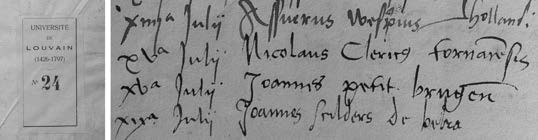
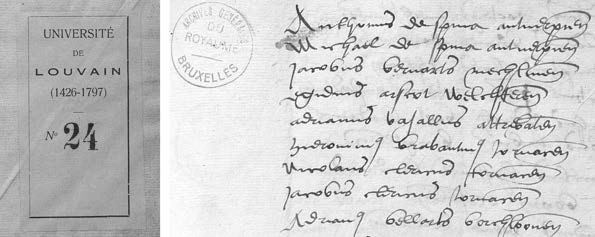
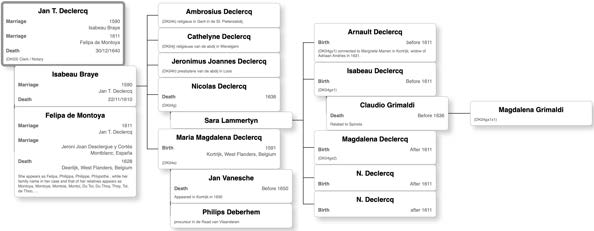
618
CHAPTER 34. ANTONI DESCLERGUE Y DE MONTOYA (DC06)
Figure 34.309: Nicolas Declercq (DK01) (’Nicolaus Clericus Tornacensis’) appears as a studenton July 15, 1531, in the registers of the Catholic University of Leuven.
Figure 34.310: Nicolas Declercq (DK02) (’Nicolaus Clericus Tornacensis’) appears as a student in August 1553 in the registers of the Catholic University of Leuven.
Figure 34.311: Descendants of Jan T. Declercq (DK03) with his first wife. Later, he married widow Felipa De Montoya, who already had children with Jeroni Joan Desclergue y Cortés (DC05).
© 2024 Nico F. Declercq
The Desclergues of la Villa Ducal de Montblanc, 2nd ed., Omn., VOL. II
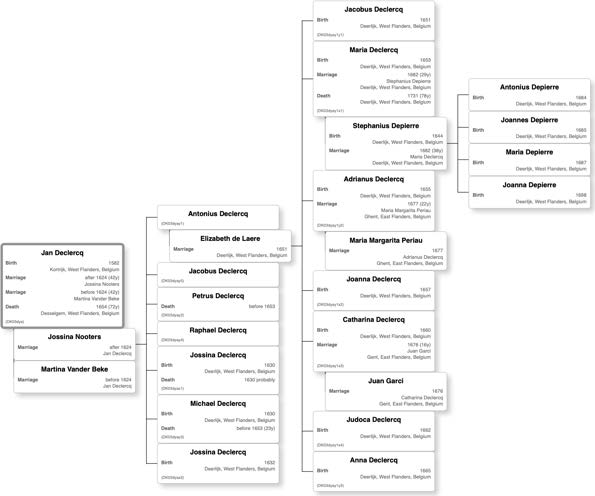











34.13. CLAN OF BEATRICE DECLERCQ (DK02BYX) ANTONI DESCLERGUE’S WIFE
619
Figure 34.312: Descendants of Jan Declercq (DK03dya)
Figure 34.313: 1618, Jan Declercq (DK03dya) on the list of ’la bour-
geoisie foraine’ of Kortrijk at Deerlijk.
Figure 34.314: 1619, Jan Declercq (DK03dya) on the list of ’la bour-
geoisie foraine’ of Kortrijk at Deerlijk.
Figure 34.315: 1620, Jan Declercq (DK03dya) on the list of ’la bour-
geoisie foraine’ of Kortrijk at Deerlijk.
Figure 34.316: 1621, Jan Declercq (DK03dya) on the list of ’la bour-
geoisie foraine’ of Kortrijk at Deerlijk.
Figure 34.317: 1622, Jan Declercq (DK03dya) on the list of ’la bour-
geoisie foraine’ of Kortrijk at Deerlijk.
Figure 34.318: 1623, Jan Declercq (DK03dya) on the list of ’la bour-
geoisie foraine’ of Kortrijk at Deerlijk.
Figure 34.319: 1624, Jan Declercq (DK03dya) on the list of ’la bour-
geoisie foraine’ of Kortrijk at Deerlijk.
Figure 34.320: 1625, Jan Declercq (DK03dya) on the list of ’la bour-
geoisie foraine’ of Kortrijk at Deerlijk.
Figure 34.321: 1627, Jan Declercq (DK03dya) on the list of ’la bour-
geoisie foraine’ of Kortrijk at Deerlijk.
Figure 34.322: 1629, Jan Declercq (DK03dya) on the list of ’la bour-
geoisie foraine’ of Kortrijk at Deerlijk.
Figure 34.323: 1630, Jan Declercq (DK03dya) on the list of ’la bour-
geoisie foraine’ of Kortrijk at Deerlijk.
The Desclergues of la Villa Ducal de Montblanc, 2nd ed., Omn., VOL. II
© 2024 Nico F. Declercq
















620
CHAPTER 34. ANTONI DESCLERGUE Y DE MONTOYA (DC06)
Figure 34.324: 1631, Jan Declercq (DK03dya) on the list of ’la bour-
geoisie foraine’ of Kortrijk at Deerlijk.
Figure 34.325: 1632, Jan Declercq (DK03dya) on the list of ’la bour-
geoisie foraine’ of Kortrijk at Deerlijk.
Figure 34.326: 1633, Jan Declercq (DK03dya) on the list of ’la bour-
geoisie foraine’ of Kortrijk at Deerlijk.
Figure 34.327: 1634, Jan Declercq (DK03dya) on the list of ’la bour-
geoisie foraine’ of Kortrijk at Deerlijk.
Figure 34.328: 1635, Jan Declercq (DK03dya) on the list of ’la bour-
geoisie foraine’ of Kortrijk at Deerlijk.
Figure 34.329: 1636, Jan Declercq (DK03dya) on the list of ’la bour-
geoisie foraine’ of Kortrijk at Deerlijk.
Figure 34.330: 1637, Jan Declercq (DK03dya) on the list of ’la bour-
geoisie foraine’ of Kortrijk at Deerlijk.
Figure 34.331: 1638, Jan Declercq (DK03dya) on the list of ’la bour-
geoisie foraine’ of Kortrijk at Deerlijk.
Figure 34.332: 1641, Jan Declercq (DK03dya) on the list of ’la bour-
geoisie foraine’ of Kortrijk at Deerlijk.
Figure 34.333: 1643, Jan Declercq (DK03dya) on the list of ’la bour-
geoisie foraine’ of Kortrijk at Deerlijk.
Figure 34.334: 1645, Jan Declercq (DK03dya) on the list of ’la bour-
geoisie foraine’ of Kortrijk at Deerlijk.
Figure 34.335: 1646, Jan Declercq (DK03dya) on the list of ’la bour-
geoisie foraine’ of Kortrijk at Deerlijk.
Figure 34.336: 1648, Jan Declercq (DK03dya) on the list of ’la bour-
geoisie foraine’ of Kortrijk at Deerlijk.
Figure 34.337: 1649, Jan Declercq (DK03dya) on the list of ’la bour-
geoisie foraine’ of Kortrijk at Deerlijk.
Figure 34.338: 1650, Jan Declercq (DK03dya) on the list of ’la bour-
geoisie foraine’ of Kortrijk at Deerlijk.
Figure 34.339: 1652, Jan Declercq (DK03dya) on the list of ’la bour-
geoisie foraine’ of Kortrijk at Deerlijk.
© 2024 Nico F. Declercq
The Desclergues of la Villa Ducal de Montblanc, 2nd ed., Omn., VOL. II
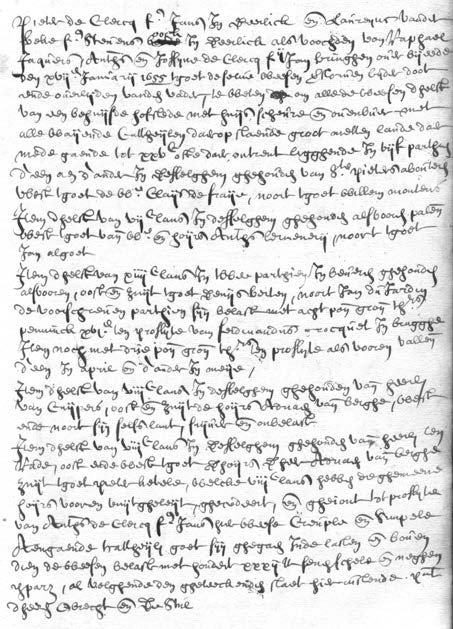






34.13. CLAN OF BEATRICE DECLERCQ (DK02BYX) ANTONI DESCLERGUE’S WIFE
621
Figure 34.340: Orphans’s deed in 1655 (’wezenakte’), Weesboek 86 f° 4r Desselgem, Rijk-
sarchief Kortrijk. Concerned minors (younger than 25 years old) : Raphael (DK03dyay4),
Jacobus (DK03dyay5), Anthonius (DK03dyay1) and Jossina (DK03dyax2, born in 1632)
Figure 34.341: Wervik, August of 1612, the wedding of Pieter De-
clercq (DK03dyb) (’Pierre Le Clercq’ with a weird ’L’ or ’D’ or both)
and Maria Legin (’Mayken Le Gin’).
Figure 34.342: 1612, Pieter Declercq (DK03dyb) on the list of ’la
bourgeoisie foraine’ of Kortrijk at Deerlijk.
Figure 34.343: 1613, Pieter Declercq (DK03dyb) on the list of ’la
bourgeoisie foraine’ of Kortrijk at Deerlijk.
Figure 34.344: 1614, Pieter Declercq (DK03dyb) on the list of ’la
bourgeoisie foraine’ of Kortrijk at Deerlijk.
Figure 34.345: 1615, Pieter Declercq (DK03dyb) on the list of ’la
bourgeoisie foraine’ of Kortrijk at Deerlijk.
Figure 34.346: 1616, Pieter Declercq (DK03dyb) on the list of ’la
bourgeoisie foraine’ of Kortrijk at Deerlijk.
Figure 34.347: 1617, Pieter Declercq (DK03dyb) on the list of ’la
bourgeoisie foraine’ of Kortrijk at Deerlijk.
The Desclergues of la Villa Ducal de Montblanc, 2nd ed., Omn., VOL. II
© 2024 Nico F. Declercq






















622
CHAPTER 34. ANTONI DESCLERGUE Y DE MONTOYA (DC06)
Figure 34.348: 1618, Pieter Declercq (DK03dyb) on the list of ’la
bourgeoisie foraine’ of Kortrijk at Deerlijk.
Figure 34.349: 1619, Pieter Declercq (DK03dyb) on the list of ’la
bourgeoisie foraine’ of Kortrijk at Deerlijk.
Figure 34.350: 1620, Pieter Declercq (DK03dyb) on the list of ’la
bourgeoisie foraine’ of Kortrijk at Deerlijk.
Figure 34.351: 1621, Pieter Declercq (DK03dyb) on the list of ’la
bourgeoisie foraine’ of Kortrijk at Deerlijk.
Figure 34.352: 1622, Pieter Declercq (DK03dyb) on the list of ’la
bourgeoisie foraine’ of Kortrijk at Deerlijk.
Figure 34.353: 1623, Pieter Declercq (DK03dyb) on the list of ’la
bourgeoisie foraine’ of Kortrijk at Deerlijk.
Figure 34.354: 1624, Pieter Declercq (DK03dyb) on the list of ’la
bourgeoisie foraine’ of Kortrijk at Deerlijk.
Figure 34.355: 1625, Pieter Declercq (DK03dyb) on the list of ’la
bourgeoisie foraine’ of Kortrijk at Deerlijk.
Figure 34.356: 1627, Pieter Declercq (DK03dyb) on the list of ’la
bourgeoisie foraine’ of Kortrijk at Deerlijk.
Figure 34.357: 1628, Pieter Declercq (DK03dyb) on the list of ’la
bourgeoisie foraine’ of Kortrijk at Deerlijk.
Figure 34.358: 1629, Pieter Declercq (DK03dyb) on the list of ’la
bourgeoisie foraine’ of Kortrijk at Deerlijk.
Figure 34.359: 1630, Pieter Declercq (DK03dyb) on the list of ’la
bourgeoisie foraine’ of Kortrijk at Deerlijk.
Figure 34.360: 1631, Pieter Declercq (DK03dyb) on the list of ’la
bourgeoisie foraine’ of Kortrijk at Deerlijk.
Figure 34.361: 1632, Pieter Declercq (DK03dyb) on the list of ’la
bourgeoisie foraine’ of Kortrijk at Deerlijk.
Figure 34.362: 1633, Pieter Declercq (DK03dyb) on the list of ’la
bourgeoisie foraine’ of Kortrijk at Deerlijk.
Figure 34.363: 1634, Pieter Declercq (DK03dyb) on the list of ’la
bourgeoisie foraine’ of Kortrijk at Deerlijk.
Figure 34.364: 1635, Pieter Declercq (DK03dyb) on the list of ’la
bourgeoisie foraine’ of Kortrijk at Deerlijk.
Figure 34.365: 1636, Pieter Declercq (DK03dyb) on the list of ’la
bourgeoisie foraine’ of Kortrijk at Deerlijk.
Figure 34.366: 1637, Pieter Declercq (DK03dyb) on the list of ’la
bourgeoisie foraine’ of Kortrijk at Deerlijk.
Figure 34.367: 1638, Pieter Declercq (DK03dyb) on the list of ’la
bourgeoisie foraine’ of Kortrijk at Deerlijk.
Figure 34.368: 1641, Pieter Declercq (DK03dyb) on the list of ’la
bourgeoisie foraine’ of Kortrijk at Deerlijk.
Figure 34.369: 1643, Pieter Declercq (DK03dyb) on the list of ’la
bourgeoisie foraine’ of Kortrijk at Deerlijk.
© 2024 Nico F. Declercq
The Desclergues of la Villa Ducal de Montblanc, 2nd ed., Omn., VOL. II










34.13. CLAN OF BEATRICE DECLERCQ (DK02BYX) ANTONI DESCLERGUE’S WIFE
623
Figure 34.370: 1645, Pieter Declercq (DK03dyb) on the list of ’la
bourgeoisie foraine’ of Kortrijk at Deerlijk.
Figure 34.371: 1646, Pieter Declercq (DK03dyb) on the list of ’la
bourgeoisie foraine’ of Kortrijk at Deerlijk.
Figure 34.372: 1648, Pieter Declercq (DK03dyb) on the list of ’la
bourgeoisie foraine’ of Kortrijk at Deerlijk.
Figure 34.373: 1649, Pieter Declercq (DK03dyb) on the list of ’la
bourgeoisie foraine’ of Kortrijk at Deerlijk.
Figure 34.374: 1650, Pieter Declercq (DK03dyb) on the list of ’la
bourgeoisie foraine’ of Kortrijk at Deerlijk.
Figure 34.375: 1652, Pieter Declercq (DK03dyb) on the list of ’la
bourgeoisie foraine’ of Kortrijk at Deerlijk.
Figure 34.376: 1653, Pieter Declercq (DK03dyb) on the list of ’la
bourgeoisie foraine’ of Kortrijk at Deerlijk.
Figure 34.377: 1654, Pieter Declercq (DK03dyb) on the list of ’la
bourgeoisie foraine’ of Kortrijk at Deerlijk.
Figure 34.378: 1655, Pieter Declercq (DK03dyb) on the list of ’la
bourgeoisie foraine’ of Kortrijk at Deerlijk.
Figure 34.379: 1657, Pieter Declercq (DK03dyb) on the list of ’la
bourgeoisie foraine’ of Kortrijk at Deerlijk.
The Desclergues of la Villa Ducal de Montblanc, 2nd ed., Omn., VOL. II
© 2024 Nico F. Declercq
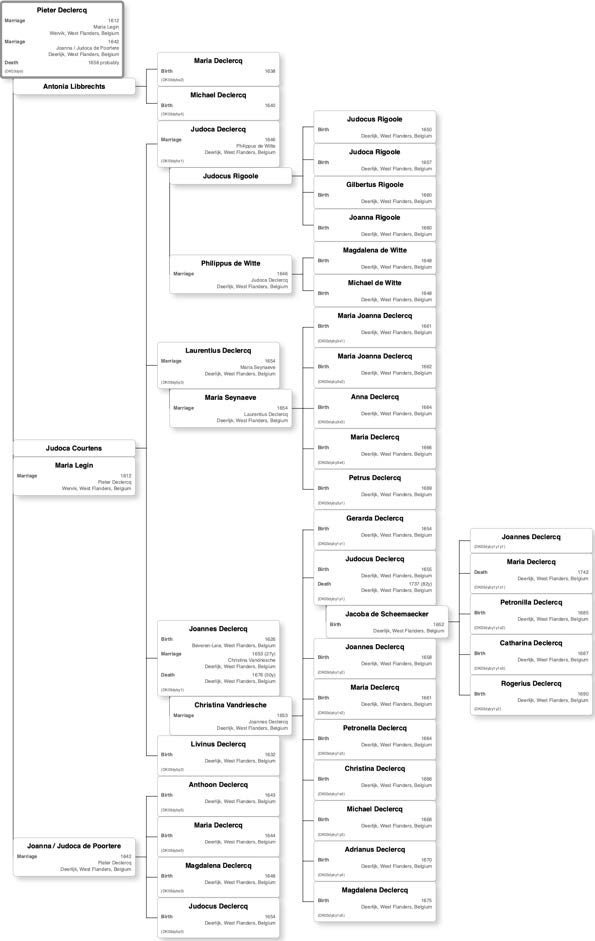
624
CHAPTER 34. ANTONI DESCLERGUE Y DE MONTOYA (DC06)
Figure 34.380: Descendants of Pieter Declercq (DK03dyb)
© 2024 Nico F. Declercq
The Desclergues of la Villa Ducal de Montblanc, 2nd ed., Omn., VOL. II
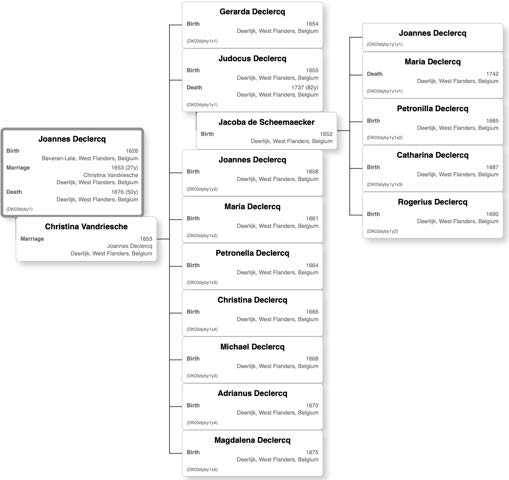
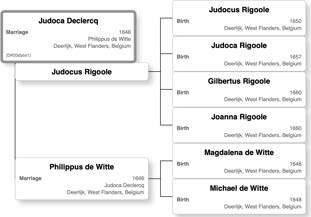
34.13. CLAN OF BEATRICE DECLERCQ (DK02BYX) ANTONI DESCLERGUE’S WIFE
625
Figure 34.381: Descendant Chart Joannes Declercq (DK03dyby1)
Figure 34.382: Descendant Chart Judoca Declercq (DK03dybx1)
The Desclergues of la Villa Ducal de Montblanc, 2nd ed., Omn., VOL. II
© 2024 Nico F. Declercq
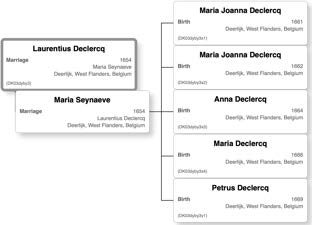
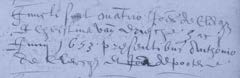









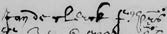


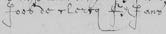
626
CHAPTER 34. ANTONI DESCLERGUE Y DE MONTOYA (DC06)
Figure
34.383:
Descendant Chart Laurentius Declercq
(DK03dyby3)
Figure 34.384: 1653, Deerlijk, June 1, the wedding
of Joannes Declercq (DK03dyby1) and Christina Vandri-
esche. Witnesses were Anthonius Declercq (DK03dyay1)
and Joanna Depoortere, who was the wife of Pieter De-
clercq (DK03dyb).
Figure 34.385: 1655, Joannes Declercq (DK03dyby1) on the list of
’la bourgeoisie foraine’ of Kortrijk at Deerlijk.
Figure 34.386: 1657, Joannes Declercq (DK03dyby1) on the list of
’la bourgeoisie foraine’ of Kortrijk at Deerlijk.
Figure 34.387: 1658, Joannes Declercq (DK03dyby1) on the list of
’la bourgeoisie foraine’ of Kortrijk at Deerlijk.
Figure 34.388: 1661, Joannes Declercq (DK03dyby1) on the list of
’la bourgeoisie foraine’ of Kortrijk at Deerlijk.
Figure 34.389: 1662, Joannes Declercq (DK03dyby1) on the list of
’la bourgeoisie foraine’ of Kortrijk at Deerlijk.
Figure 34.390: 1664, Joannes Declercq (DK03dyby1) on the list of
’la bourgeoisie foraine’ of Kortrijk at Deerlijk.
Figure 34.391: 1665, Joannes Declercq (DK03dyby1) on the list of
’la bourgeoisie foraine’ of Kortrijk at Deerlijk.
Figure 34.392: 1666, Joannes Declercq (DK03dyby1) on the list of
’la bourgeoisie foraine’ of Kortrijk at Deerlijk.
Figure 34.393: 1667, Joannes Declercq (DK03dyby1) on the list of
’la bourgeoisie foraine’ of Kortrijk at Deerlijk.
Figure 34.394: 1670, Joannes Declercq (DK03dyby1) on the list of
’la bourgeoisie foraine’ of Kortrijk at Deerlijk.
Figure 34.395: 1671, Joannes Declercq (DK03dyby1) on the list of
’la bourgeoisie foraine’ of Kortrijk at Deerlijk.
Figure 34.396: 1672, Joannes Declercq (DK03dyby1) on the list of
’la bourgeoisie foraine’ of Kortrijk at Deerlijk.
Figure 34.397:
1672, Judocus (’Joos’) Declercq (DK03dyby1y1),
son of Joannes Declercq (DK03dyby1) and Christina Vandriesche, on
the list of ’la bourgeoisie foraine’ of Kortrijk at Deerlijk. He was
merely 18, which probably means he married that year with Jacoba de
Scheemaecker, who was 21.
© 2024 Nico F. Declercq
The Desclergues of la Villa Ducal de Montblanc, 2nd ed., Omn., VOL. II

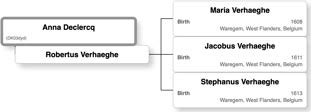
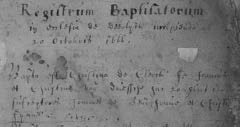


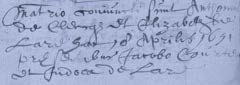









34.13. CLAN OF BEATRICE DECLERCQ (DK02BYX) ANTONI DESCLERGUE’S WIFE
627
Figure 34.398: Harelbeke 1611. Baptism of Jacomyne De Smedt, daughter of Rogier de Smedt
and Clara Vandeburie. Godfather was Laurentius Vandeburie, and godmother was Jacomyne
Declercq (DK03dyc).
Figure 34.399: Descendants of Anna Declercq (DK03dyd)
Figure 34.400: 1666, Deerlijk, the baptism of Christina
Declercq (DK03dyby1x4)
Figure 34.401: 1678, Antonius Declercq (DK03dyay1) on the list of
’la bourgeoisie foraine’ of Kortrijk at Deerlijk.
Figure 34.402: 1678, Antoni Desclergue (II) (DC06) on the list of
’la bourgeoisie foraine’ of Kortrijk at Deerlijk.
Figure 34.403: Deerlijk, 18 April, 1651, the wedding of
Anthonius Declercq (DK03dyay1) and Elizabeth Delaere,
witnesses were Jacobus Courtens, brother in law of An-
thonius’ brother Pieter Declercq (DK03dyb), and Judoca
Delaere, sister of Elizabeth Delaere.
Figure 34.404: 1678, Antonius Declercq (DK03dyay1) on the list of
’la bourgeoisie foraine’ of Kortrijk at Deerlijk.
Figure 34.405: 1681, Antonius Declercq (DK03dyay1) on the list of
’la bourgeoisie foraine’ of Kortrijk at Deerlijk.
Figure 34.406: 1683, Antonius Declercq (DK03dyay1) on the list of
’la bourgeoisie foraine’ of Kortrijk at Deerlijk.
Figure 34.407: 1684, Antonius Declercq (DK03dyay1) on the list of
’la bourgeoisie foraine’ of Kortrijk at Deerlijk.
Figure 34.408: 1685, Antonius Declercq (DK03dyay1) on the list of
’la bourgeoisie foraine’ of Kortrijk at Deerlijk.
Figure 34.409: 1686, Antonius Declercq (DK03dyay1) on the list of
’la bourgeoisie foraine’ of Kortrijk at Deerlijk.
Figure 34.410: 1687, Antonius Declercq (DK03dyay1) on the list of
’la bourgeoisie foraine’ of Kortrijk at Deerlijk.
Figure 34.411: 1689, Antonius Declercq (DK03dyay1) on the list of
’la bourgeoisie foraine’ of Kortrijk at Deerlijk.
Figure 34.412: 1690, Antonius Declercq (DK03dyay1) on the list of
’la bourgeoisie foraine’ of Kortrijk at Deerlijk.
The Desclergues of la Villa Ducal de Montblanc, 2nd ed., Omn., VOL. II
© 2024 Nico F. Declercq






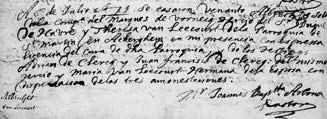
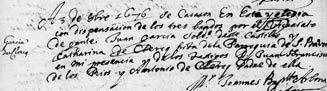
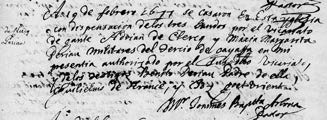









628
CHAPTER 34. ANTONI DESCLERGUE Y DE MONTOYA (DC06)
Figure 34.413: 1691, Antonius Declercq (DK03dyay1) on the list of
’la bourgeoisie foraine’ of Kortrijk at Deerlijk.
Figure 34.414: 1692, Antonius Declercq (DK03dyay1) on the list of
’la bourgeoisie foraine’ of Kortrijk at Deerlijk.
Figure 34.415: 1693, Antonius Declercq (DK03dyay1) on the list of
’la bourgeoisie foraine’ of Kortrijk at Deerlijk.
Figure 34.416: 1694, Antonius Declercq (DK03dyay1) on the list of
’la bourgeoisie foraine’ of Kortrijk at Deerlijk.
Figure 34.417: 1695, Antonius Declercq (DK03dyay1) on the list of
’la bourgeoisie foraine’ of Kortrijk at Deerlijk.
Figure 34.418: 1696, Antonius Declercq (DK03dyay1) on the list of
’la bourgeoisie foraine’ of Kortrijk at Deerlijk.
Figure 34.419: 1673, July 6, Spaniard
Castle of Ghent.
Adrianus Declercq
(DK03dyay1y2) is a witness on a wedding.
Figure
34.420:
1676, October 3,
Spaniard Castle of Ghent, the wedding of
Catharina
Declercq
(DK03dyay1x3)
daughter
of
Antonius
Declercq
(DK03dyay1), with Juan Garcia.
Figure
34.421:
1677, February 19,
the marriage of Adrianus Declercq
(DK03dyay1y2) with Maria Margarita
Periau at the Spaniard Castle of Ghent.
Figure 34.422: 1692, Adrianus Declercq (DK03dyay1y2) on the list
of ’la bourgeoisie foraine’ of Kortrijk at Deerlijk.
Figure 34.423: 1693, Adrianus Declercq (DK03dyay1y2) on the list
of ’la bourgeoisie foraine’ of Kortrijk at Deerlijk.
Figure 34.424: 1694, Adrianus Declercq (DK03dyay1y2) on the list
of ’la bourgeoisie foraine’ of Kortrijk at Deerlijk.
Figure 34.425: 1695, Adrianus Declercq (DK03dyay1y2) on the list
of ’la bourgeoisie foraine’ of Kortrijk at Deerlijk.
Figure 34.426: 1696, Adrianus Declercq (DK03dyay1y2) on the list
of ’la bourgeoisie foraine’ of Kortrijk at Deerlijk.
Figure 34.427: 1699, Adrianus Declercq (DK03dyay1y2) on the list
of ’la bourgeoisie foraine’ of Kortrijk at Deerlijk.
Figure 34.428: 1700, Adrianus Declercq (DK03dyay1y2) on the list
of ’la bourgeoisie foraine’ of Kortrijk at Deerlijk.
Figure 34.429: 1704, Adrianus Declercq (DK03dyay1y2) on the list
of ’la bourgeoisie foraine’ of Kortrijk at Deerlijk.
Figure 34.430: 1707, Adrianus Declercq (DK03dyay1y2) on the list
of ’la bourgeoisie foraine’ of Kortrijk at Deerlijk.
© 2024 Nico F. Declercq
The Desclergues of la Villa Ducal de Montblanc, 2nd ed., Omn., VOL. II






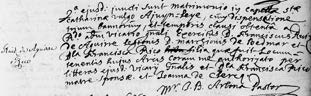
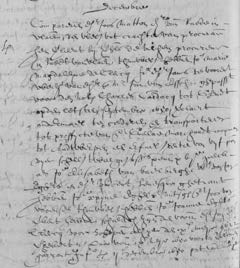

34.13. CLAN OF BEATRICE DECLERCQ (DK02BYX) ANTONI DESCLERGUE’S WIFE
629
Figure 34.431: 1708, Adrianus Declercq (DK03dyay1y2) on the list
of ’la bourgeoisie foraine’ of Kortrijk at Deerlijk.
Figure 34.432: 1709, Adrianus Declercq (DK03dyay1y2) on the list
of ’la bourgeoisie foraine’ of Kortrijk at Deerlijk.
Figure 34.433: 1711, Adrianus Declercq (DK03dyay1y2) on the list
of ’la bourgeoisie foraine’ of Kortrijk at Deerlijk.
Figure 34.434: 1712, Adrianus Declercq (DK03dyay1y2) on the list
of ’la bourgeoisie foraine’ of Kortrijk at Deerlijk.
Figure 34.435: 1713, Adrianus Declercq (DK03dyay1y2) on the list
of ’la bourgeoisie foraine’ of Kortrijk at Deerlijk.
Figure 34.436: 1714, Adrianus Declercq (DK03dyay1y2) on the list
of ’la bourgeoisie foraine’ of Kortrijk at Deerlijk.
Figure 34.437: 1680, March 9, Spaniard Castle of Ghent, the
wedding of Francisco Ruiz de Aguirre and domicella Francisca
Rico. Joanna Declercq (DK03dyay1x2) was a witness.
Figure 34.438:
Kortrijk, December 2, 1650, trans-
fer. Joos Matton, bailiff of the Council of Flanders, au-
thorized by Philips Deberhem, attorney in the Council
of Flanders and husband of Maria Magdalena Declercq
(DK04e), daughter of Jan Declercq (DK03) and widow
of Jan Vanessche (power of attorney passed before no-
tary Charles Cardocq from Ghent on September 30, 1650
), once again declares that he will transfer an interest to
Guillaeme Marchandt, a merchant from Antwerp. This
interest was from Elisabeth Vanbaelberghe, the widow of
Jan Eghels, by Vincent Levesque, husband of Christyne
Eghels, and by Joos Vanwoensel, husband of Joanne
Eghels, to the aforementioned Jan Declercq (DK03) on
May 9, 1622. Source: Oud Stadsarchief Kortrijk, Akten
en Contracten, 8344, 1076028, arch 116, 221v.
Figure 34.439:
Kortrijk, 1591, April
3, the baptism of Magdalena Declercq
(DK04e), daughter of Jan Declercq
(DK03).
Godfather was M. Ludovicus
Coppernolle, Godmother was Magdalena
Polletz. The family Pollet from Kortrijk
kan also be found in Johan Decavele,
’Ketters en Papisten in het Kortrijkse
Stadsbestuur (1561-1580)’
The Desclergues of la Villa Ducal de Montblanc, 2nd ed., Omn., VOL. II
© 2024 Nico F. Declercq
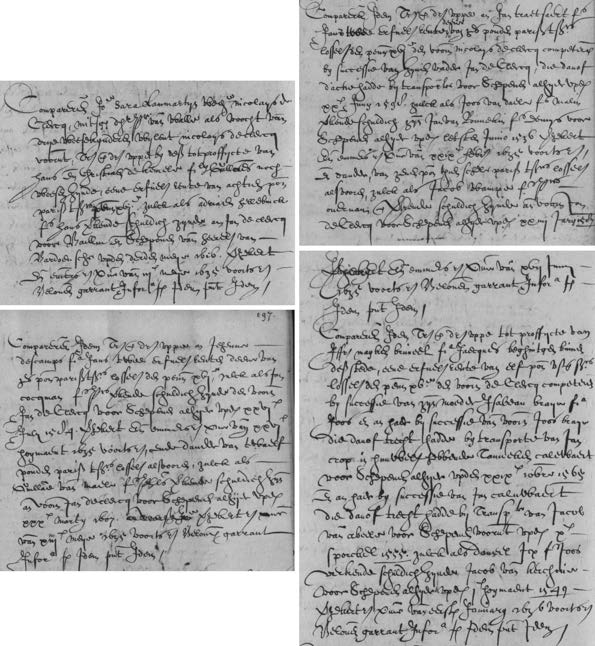
630
CHAPTER 34. ANTONI DESCLERGUE Y DE MONTOYA (DC06)
Figure 34.440: Kortrijk, March 18, 1636, transfer. Sara Lammartyn, widow of Nicolas Declercq (DK04g), together with Pieter Vandewalle who acts as guardian of the 3 orphans of the same Nicolas, transfer to the orphans Hans and Christiaen Dekemele, sons of Guillaeme Dekemele, an annuity granted by Adriaen Hellebuick, son of Hans Hellebuick, to Jan Declercq (DK03) for the seigneury of Bardoensche on May 3, 1616. On (F° 197r), same transport on Jehenne Descamps daughter of Jan Descamps 2 rents. Jan Cocqman, son of Pieter Cocqman, had awarded one of those two annuities to the aforementioned Jan Declercq (DK03) on July 26, 1584. The other annuity had been awarded by Guillaeme Vandemaele, son of Philips Vandemaele, to the same Declercq on March 30, 1607. On (F° idem), idem transferred to Jan Traetsaert, son of Jan Traetsaert, 2 annuities from the succession of Nicolas Declercq who had inherited them from his father Jan Declercq (DK03).
One interest was transferred to the latter on June 20, 1598 and it was granted on June 30, 1536 by Joos Vandaele, the son of Malin Vandaele, to Jan Vanronnekin, the son of Denys Vanronnekin. The other annuity was granted by Jacob Wampe, the son of Pieter Wampe, to Jan Declercq (DK03) on January 23, 1587. On (F° 197v), idem transported on Miss Mayken Bruneel daughter of Jacques Bruneel, beguine in Kortrijk, an interest from the succession of mother Isabeau Braye, daughter of Joos Braye, who she herself had inherited from her father on whom it was transported by Jan Crop, husband of Tanneken Calewaert, on December 29, 1565. Tanneken Calewaert had inherited them from Jan Calewaert, on whom it had been transported by Jacob Vandenabeele on February 10, 1555. Daneel Icx, son of Joos Icx, had awarded them to Jacob Vandekerchove on August 1, 1549. Source: Oud Stadsarchief Kortrijk, Akten en Contracten, 6266, 1076580, arch 113, 196v.
© 2024 Nico F. Declercq
The Desclergues of la Villa Ducal de Montblanc, 2nd ed., Omn., VOL. II
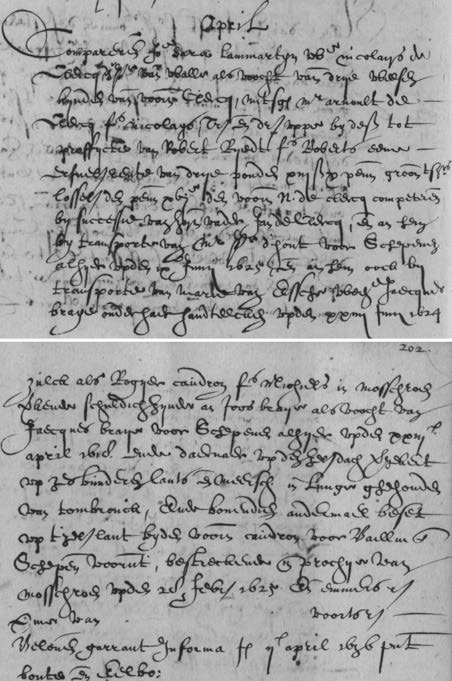
34.13. CLAN OF BEATRICE DECLERCQ (DK02BYX) ANTONI DESCLERGUE’S WIFE
631
Figure 34.441: Kortrijk, April 2, 1636, transport. Sara Lammartyn, widow of Nicolas Declercq
(DK04g), son of Jan Declercq (DK03), together with Pieter Vandewalle as guardian of the 3
orphans of the same Nicolas, and with Arnoult Declercq, the son of Nicolas Declercq, transfer
together on Robert Ryedt, the son of Rober Ryedt, an annuity that the aforementioned Nicolas
had inherited from his father Jan Declercq (DK03). It was transported on this Jan Declercq
(DK03) on June 9, 1625 by Pieter D’Hont, who had also acquired it after transport by Marie
Vanessche, widow of Jaecques Braye under her signature on June 24, 1624. The interest was
granted by Rogyer Caudron, son of Michiel Caudron from Mouscron, to Joos Braye as guardian
of Jaques Braye on April 23, 1618. On the same day it was guaranteed on 6 hectares in Luingne,
held from Tombrouck, and it was occupied again by the aforementioned Caudron on the same
land on February 28, 1625. Source: Oud Stadsarchief Kortrijk, Akten en Contracten, 6275,
1076580, arch 113, 201v.
The Desclergues of la Villa Ducal de Montblanc, 2nd ed., Omn., VOL. II
© 2024 Nico F. Declercq
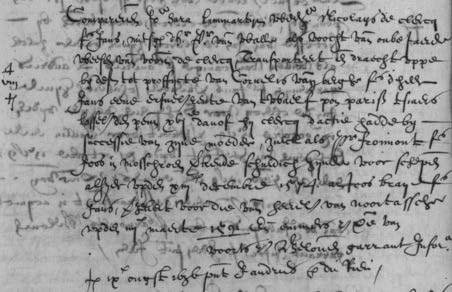
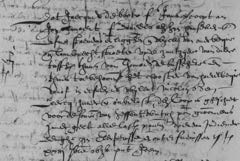
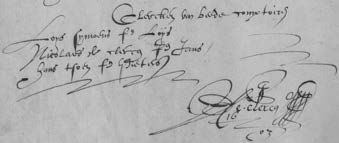
632
CHAPTER 34. ANTONI DESCLERGUE Y DE MONTOYA (DC06)
Figure 34.442: Kortrijk, August 9, 1636, transport. Sara Lammartyn, the widow of Nicolas
Declercq (DK20g), son of Jan Declercq (DK03), and Pieter Vandewalle, as guardian of the
orphans of the aforementioned Nicolas Declercq, transfer to Cornelis Vandenberghe, son of Jan
Vandenberghe, an interest from the succession of the mother of the same Nicolas Declercq. The
annuity was granted by Pieter Fromont, son of Joos Fromont from Mouscron, on December
13, 1574 to Joos Braye, son of Jan Braye and guaranteed on March 4, 1591 for the seigneury
of Noortassche. Idem is transported to Raphael Noose, son of Pieter Noose, an interest that
the aforementioned Nicolas Declercq inherited from his father, to whom she was transported on
February 28, 1598 by Piaet Debaes, who herself had inherited them from Hans Vanderstraete,
beneficiary of his wife. The annuity was granted on February 5, 1577 by Rogaer Delannoy, son of
Willem Delannoy, to Pieter Vanderstraete for the aldermen in the Bissegemstraat. Further, on
(F° 17v), idem transfer to the orphans of Jan Debersaecques, procreated by Beatryce Storme, an
interest that the aforementioned Nicolas Declercq inherited from his father, interest that Willem
Vandercaigne, son of Andries Vandercaigne, and Andries Garremyn, son of Jan Garremyn,
granted to him on October 9, 1589 and guaranteed on October 11, 1589 befor the aldermen of
Heestert. This transport takes place on behalf of the widow of Jaecques du Bois, the son of
Arnoult du Bois. Source: Oud Stadsarchief Kortrijk, Akten en Contracten, 6389, 1076580, arch
114, 17r.
Figure 34.443: Kortrijk, September 23, 1636, a sale.
Jaecques Deboote, son of Jan Deboote, sells to Jan Can-
naert, the son of Daneel Cannaert, a house on Over-
beke in Kortrijk, in the Lambrechstraat between Thomaes
Debusschere and a house of the monastery of Harelbeke
(’Haerlebeque’), formerly owned by the late Nicolas De-
clercq (DK04g). Source: Oud Stadsarchief Kortrijk, Ak-
ten en Contracten, 6427, 1076580, arch 114, 30v.
Figure 34.444: Kortrijk, June, 1602, Nicolas Declercq (DK04g), the
son of Jan Declercq (DK03), in his role as high-bailiff. Source: Oud
Stadsarchief Kortrijk, Akten en Contracten , 107737, arch 97, first page.
© 2024 Nico F. Declercq
The Desclergues of la Villa Ducal de Montblanc, 2nd ed., Omn., VOL. II
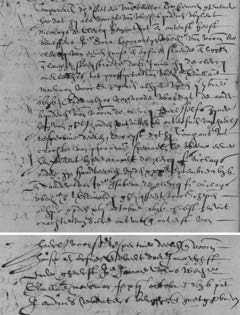
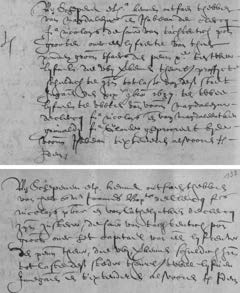
34.13. CLAN OF BEATRICE DECLERCQ (DK02BYX) ANTONI DESCLERGUE’S WIFE
633
Figure 34.445:
Kortrijk, October 16, 1636, a sale.
Pieter Vandewalle indicates that as guardian of the chil-
dren of Nicolas Declercq (DK04g), together with his
widow Sara Lammertyn, he relinquished a house in the
Lange Steenstraat on September 2, 1636 in favor of
Joanne Coolins, the widow of Guillaeme Moerman. He
also obtained power of attorney from the adult children to
do the same regarding the portion of the house they inher-
ited. In particular, of Arnoult Declercq, son of Nicolas
Declercq, under his signature on September 20, 1636, and
of Isabeau Declercq, daughter of Nicolas Declercq, widow
of Grimaldi, before the aldermen of the city on October
16, 1636. Source: Oud Stadsarchief Kortrijk, Akten en
Contracten, 6446, 1076580, arch 114, 36r.
Figure 34.446: Kortrijk, November 3, 1637, confession
of debt. The aldermen of Kortrijk were urged by a letter
from the "Gheestelycke en de Vyer Leden ’s Lants" to
pay a heavy tax. They therefore give a hereditary inter-
est to Guillaeme Moerman, the son of Nicolas Moerman.
Ditto an annuity to Isabeau Declercq, daughter of Nico-
las Declercq, in favor of Magdalena Declercq, daughter of
Nicolas Declercq, and of Magdalena Grimaldi, daughter
of Glaude Grimaldi and the aforementioned Isabeau De-
clercq. Ditto an annuity to Joannes Baptiste Declercq,
presbytere, and to sister Cathelyn Declercq, in their own
name. Ditto a hereditary annuity to Guillaeme Vande-
casteele, presbytere and chaplain in Kortrijk. Ditto a
hereditary annuity to Cathelyne Vandamme, widow of
Nicolays Nolf, for the benefit of the children of Nico-
lays Nolf, son of Nicolays Nolf and Cathelyne Vandaele,
daughter of Antoine Vandaele. Ditto a hereditary inter-
est to the Mother of the "Grauwenzusterhuus" in Kor-
trijk. Ditto an annuity to Wouter Simoens, son of Joos
Simoens, in his own name. Source: Oud Stadsarchief
Kortrijk, Akten en Contracten, 6724, 1076580, arch 114,
132v.
The Desclergues of la Villa Ducal de Montblanc, 2nd ed., Omn., VOL. II
© 2024 Nico F. Declercq
CHAPTER 34. ANTONI DESCLERGUE Y DE MONTOYA (DC06)
One of Pieter’s sons, namely Jan Declercq (DK03dyby1), was Foreign Bourgeois of Kortrijk at Deerlijk from 1655 until 1672.
The descendants are shown in Figures 34.380, 34.381, 34.382 and 34.383.
34.13.8.5 The family of Joannes Declercq (DK03dyby1)
We found the wedding in June 1653 in Deerlijk, in Figure 34.384, of Joannes Declercq (DK03dyby1) and Christina Vandriesche.
The witnesses are compelling: namely, Joanna/Judoca De Poorter (De Pooter/Depotter), who was the stepmother of Joannes, i.e. second wife of Pieter Declercq (DK03dyb); and typically, one would expect a second witness from the family of the bride, but perhaps she had no family at that time in Deerlijk; therefore the nearest witness would have been the groom’s uncle, namely Jan Declercq (DK03dya) who was replaced by his son Antonius Declercq (DK03dyay1), who, at that time, was already married to Elizabeth de Laere. The replacement may have been related to the health of Jan Declercq (DK03dya) because we know that he died a little later than one year after this wedding.
Joannes Declercq’s (DK03dyby1) appearance on the list of ’la bourgeoisie foraine’ of Kortrijk at Deerlijk is given in Figures 34.385,
34.386, 34.387, 34.388, 34.389, 34.390, 34.391, 34.392, 34.393, 34.394, 34.395, 34.396 and that of his son in 34.397.
Although it is not our intention to dive too deep into the side branch of Declercq because they are not our ancestors, we would like to show a gorgeous baptism certificate of one of his granddaughters Christina Declercq (DK03dyby1x4), in Figure 34.400, in 1666
because it appeared as the first one of the registration book, underneath a heading.
34.13.8.6 Maria Magdalena Declercq (DK04e)
We have found a baptism of Jan Declercq’s daughter, Maria Magdalena Declercq (DK04e), in Figure 34.439.
She was born at Kortrijk on April 3, 1591. Given the distribution of possessions after the death of her stepmother Felipa de Montoya, outlined in Chapter 29.11.3.3, we know that she was still alive in 1628. However, we have found no further details. This is proven by a document in 1630.
Indeed, Maria Magdalena Declercq was married to Jan Vanessche and she was the daughter of Jan Declercq (DK03) and Isabeau Braye, the daughter of Joos Braye, which can be read in a note on August 5, 1630 in Figure 34.244 on page 605.
The second husband of Maria Magdalena Declercq (DK04e), Philips Deberhem, was a prosecutor in the Council of Flanders. Her first husband was Jan Vanessche. This is evidenced in Figure 34.438 on page 629.
34.13.8.7 Jacomyne Declercq (DK03dyc)
We have found no further descendants of Jacomyne Declercq (DK03dyc); however, documents, as in Figure 34.398, refer to her.
34.13.8.8 Anna Declercq (DK03dyd)
Anne Declercq married Robertus Verhaeghe, and they had a daughter, Maria Verhaeghe, at Waregem in 1608. Jan Declercq (DK02ay2) from Deerlijk, son of Jan Declercq (DK02a), was godfather. In 1611, Anne Declercq had a son, Jacobus Verhaeghe; their godmother was Jacomyne Declercq, daughter of Jan Declercq from Deerlijk.
In 1613 she had a son Stephanus Verhaeghe. Anne also served as godmother to Anna Bollaert in Waregem in 1611. Jacomyne served as godmother to Jacomyne DeSmet at Harelbeke in 1611. The descendants are shown in Figure 34.399.
34.13.8.9 Ambrosius Declercq (DK04k)
Ambrosius Declercq (DK04k), son of Jan Declercq (DK03) and grandson of Nicolas Declercq (DK02), was a religious in Ghent in St. Peter’s Abbey, in 1622, as can be read in Figure 34.245 on page 606.
34.13.8.10 Jeronimus Joannes Declercq (DK04h)
Jeronimus Joannes Declercq (DK04h), son of Jan Declercq (DK03) and grandson of Nicolas Declercq (DK02), was a religious, namely presbyter of the abbey in Loos, in 1622, as can be read in Figure 34.245 on page 606, and in Figure 34.249 on page 608. He was named after his father’s friend, our ancestor Jeroni Joan Desclergue (DC05).
34.13.8.11 Cathelyne Declercq (DK04j)
Cathelyne Declercq (DK04j), daughter of Jan Declercq (DK03) and granddaughter of Nicolas Declercq (DK02), was a religious of the abbey in Wevelgem, in 1622, as can be read in Figure 34.245 on page 606.
34.13.8.12 Nicolas Declercq (DK04g)
Nicolas Declercq was the son of notary Jan T. Declercq, described in Chapter 34.13.7.2. He was also a notary from 1608 until 1635
and died in 1636.
In Figure 34.256 on page 611, we see that Nicolas Declercq (DK04g) was acquainted with Petrus Laurentius De Vos in 1621. As outlined in Part X, the families Declercq and De Vos would later merge through Beatrice Declercq (DK02byx), cousin of Nicolas Declercq (DK04g), through the marriage, in 1685, of Joanna Catharina Declercgz, the daughter of Antoni Declerque (DC07) and Martina de la Cruz, with Joannes de Vos, the son of Petrus Laurentius de Vos and Isabella Verscheure.
We know that Nicolas Declercq (DK04g), who was married to Sara Lammertyn, was dead in 1636, as can be concluded from Figure
34.440 on page 630, Figure 34.441 on page 631, and Figure 34.442 on page 632.
Nicolas Declercq (DK04g) took the role of high-bailiff, as can be read in a 1602 document shown in Figure 34.444 on page 632.
Nicolas Declercq (DK04g), the son of Jan Declercq (DK03), had possessions in Kortrijk that he had sold to the monastery of Harelbeke, as can be read in Figure 34.443 on page 632.
34.13.8.13 Arnoult Declercq (DK04gy1), Son of Nicolas Declercq (DK04g)
In Figure 34.250 on page 609 and Figure 34.251 on page 609, we read that the Declercq family was acquainted with the Andries family. This is of importance in Chapter 50.
© 2024 Nico F. Declercq
The Desclergues of la Villa Ducal de Montblanc, 2nd ed., Omn., VOL. II
34.13. CLAN OF BEATRICE DECLERCQ (DK02BYX) ANTONI DESCLERGUE’S WIFE
635
34.13.8.14 Isabeau Declercq (DK04gx1), the Daughter of Nicolas (DK04g) and wife of Claudio Grimaldi
Isabeau Declercq (DK04gx1), the daughter of Nicolas (DK04g), was married to Glaude Grimaldi, and they had a daughter Magdalena Grimaldi. This can be read in Figure 34.446 on page 633 and in Figure 34.445 on page 633.
The Grimaldi family originated from Genoa and were patricians, from which some Genoese merchands produced offspring in Andalusia. The Grimaldi family in Kortrijk originated from Andalusia and was acquainted with the Desclergues through their presence in Sevilla. Similar families are Spinola, Salvaggio, Di Negro, or Cattaneo, who are also found in Andalusia under Espínola, Salvago, Negro, and Cataño.
34.13.8.15 Antonius Declercq (DK03dyay1), the Son of Jan Declercq (DK03dya)
Anthonius Declercq (DK03dyay1), who had a disability (the word ’cripple’ was used), would marry a ’De Lara,’ maybe with Spanish roots, or Flemish (De Laere). He has been a Bourgeois Forain of Kortrijk from 1678 until 1696.
In fact, Anthonius Declercq (DK03dyay1) requires some extra consideration. Indeed, some genealogists assume that it was not him who married Elizabeth Delaere or De Lara, but rather Antoni Desclergue (II) (DC06) after his wife Beatrice Declercq (DK02byx) had died. However, we have discovered that this is unlikely for the following reasons.
First, in 1678, as evidenced in Figure 34.401 (and Figure 34.404 on page 627) and Figure 34.402 (and Figure 34.431 on page 629),
there are two persons at Deerlijk carrying the name ’Anthonius Declercq’ found on the list of ’la bourgeoisie foraine’ of Kortrijk.
The first one is Antonius Declercq (DK03dyay1), listed as Anthonius Declercq f Jans, the second is Antoni Desclergue (II) (DC06), listed as Anthonius Le Clercq f Jans. Perhaps this situation was also confusing to the register of the Bourgeoisie Forain at Kortrijk, which is why they would, in later years, clearly, write that Antonius Declercq (DK03dyay1) was not a son of Jan, but Jan ’the younger.’ Indeed, Antonius Declercq (DK03dyay1) was the son of Jan Declercq (DK03dya), who was the son of Jan Declercq (DK03dy).
Second, indeed, the orphan’s deed for the children of Beatrice Declercq (DK02byx), given in Chapter 34, was made on July 17, 1651. It would not be wise to marry before that date because the inheritance must be known to establish a new marriage contract, if any.
Elizabeth Delaere married Anthonius Declercq (DK03dyay1) on April 18, 1651, in Figure 34.403. At Elizabeth’s wedding, Jacobus Courtens, brother-in-law of Pieter Declercq (DK03dyb), and Judoca De Laere were witnesses, not anyone from the Desclergue family.
Besides, not a single member of the Desclergues family has ever served as godfather or godmother to any of the children of Declercq-De Laere.
When the father of Antonius Declercq (DK03dyay1), namely Jan Declercq (DK03dya), died in 1654, the orphan’s deed of January 1655 contained four children, including Antonius. It means that, under normal circumstances, he would have been born not earlier than 1629, and therefore he would have been less than 23 years old when he married, which is plausible. Still, if he were married, he would typically no longer be considered a minor in 1655. However, the orphan’s deed clearly states that he was crupel ende simple, which means he was considered cripple and mentally retarded. We cannot go back in time to figure out precisely the problem, but this statement has legal consequences. It is known that, under such circumstances, such a person would always appear on an orphan’s deed if one of the parents died. Therefore, the age of 25 when a person became an adult did not hold for his case81.
A reasonable assumption would be that he was indeed less than 25 years old but that because of his handicap, his marriage, which took place three years before, did not change his legal status from a minor to an adult.
His inheritance probably supported his marriage and descendants because the orphan’s deed indicates that he received more than his siblings. The fact that he already had two children when his mother died, despite his handicap, may have been a different reason for giving more to him than to his siblings.
His health condition may have contributed to his late registration as a Foreign Bourgeois. Indeed, it was not until 1678 that he became a Foreign Bourgeois of Kortrijk at Deerlijk for 18 years. Antoni probably died around 1696. If we assume that he was born in 1630, he reached 66 years.
Antonius Declercq’s (DK03dyay1) appearances on the list of ’la bourgeoisie foraine’ of Kortrijk at Deerlijk are shown in Figures
34.404, 34.405, 34.406, 34.407, 34.408, 34.409, 34.410, 34.411, 34.412, 34.413, 34.414, 34.415, 34.416, 34.417 and 34.418.
34.13.8.16 Adrianus Declercq (DK03dyay1y2)
Adrianus Declercq (DK03dyay1y2) was a son of Antonius Declercq (DK03dyay1). He was born in Deerlijk in 1655 and married in 1677 at the Spaniard Castle of Ghent to Maria Margarita Periau.
He was a Flemish military in the Spanish-ruled army and had had the opportunity to join the army, thanks to his step-family through his Great-Great-grandfather Jan Declercq (DK03). We assume that he settled in Deerlijk after his career and became a Bourgeois Forain like most of his family.
Documents of interest other than Figure 34.403 on page 627, are given in Figures 34.419, 34.420 and 34.421.
Adrianus Declercq’s (DK03dyay1y2) presence on the list of ’la bourgeoisie foraine’ of Kortrijk at Deerlijk is shown in Figures 34.422,
34.423, 34.424, 34.425, 34.426, 34.427, 34.428, 34.429, 34.430, 34.431, 34.432, 34.433, 34.434, 34.435 and 34.436.
34.13.8.17 Joanna Declercq (DK03dyay1x2)
Joanna Declercq (DK03dyay1x2) was a sister of Adrianus Declercq (DK03dyay1y2) and a daughter of Antonius Declercq (DK03dyay1).