

The Desclergues of la Villa Ducal de Montblanc, Second Edition Omnibus by Nico Declercq - HTML preview
Download the book in PDF, ePub, Kindle for a complete version.
544
CHAPTER 34. ANTONI DESCLERGUE Y DE MONTOYA (DC06)
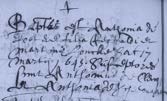
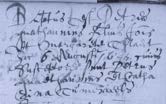
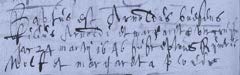
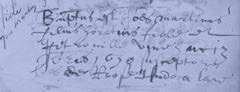
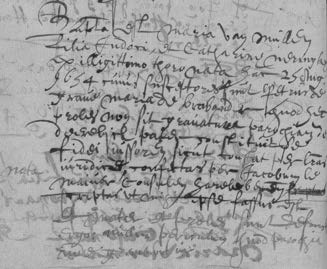
Figure 34.48: 1635, Harelbeke, on January 11, there were three baptisms. The
second one is of a Spanish Antonius Guiza or Guisa (spelled as ’Geseran’ so it
may also be Guiser, French or Spanish, or even German, there is no local name
’Geseran’ at Harelbeke). For the third baptism, Antoni Desclergue (II) (DC06)
served as godfather (’Anthonius Declercq’).
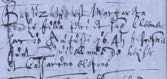
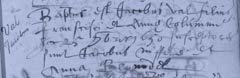
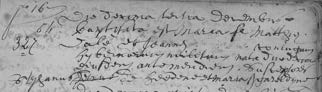
Figure 34.49: Deerlijk, October 2, 1640,
the baptism of Pere Declerque (DC07d),
son of Antoni Desclergue (II) (DC06)
and Beatrice Declercq (DK02byx). The
godfather was Pieter Declercq (DK03dyb)
(’Petrus de Clercke’), godmother was Mar-
tina Wautier. This particular baptism is
interesting. The father, Antoni Descle-
rgue (DC06), was absent, and therefore
the priest was confused about the involved
names. The child’s correct Spanish name
would have been Pere or Pedro Desclergue
y Declercq. The priest first wrote ’De Celcg
Clerck’ , then changed it to ’Clerck’ , and
was then confused about the mother’s name
and decided to spell hers as ’De Clercke’ .
The baptism is also shown in Figure 36.25
on page 644.
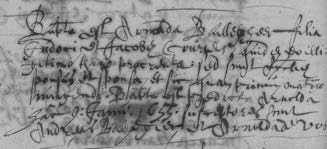
Figure 34.50:
1642, Deerlijk, Antoni
Desclergue (II) (DC06) is witness, with
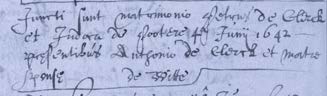
the bride’s mother ’de Witte’ , on the
wedding of his stepbrother Pieter Declercq
(DK03dyb) and Judoca or Joanna De-
poorter (’Judoca de Pootere’).
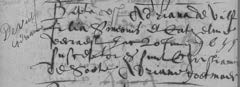
Figure 34.51:
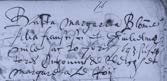
1643, Deerlijk, the baptism of Margareta Blomme,
daughter of Franciscus Blomme and Guillelma Mile, the godfather was
Antoni Desclergue (II) (DC06) (’Declercgs’), godmother was Margareta
Le Roy. Note that Miguel Desclergue (DC06b) also served as godfather
to a certain Blomme the year after.
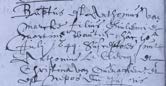
Figure 34.52: July 30, 1644, Deerlijk, Antoni Desclergue (II) (DC06)
as godfather to Antonius Van Marcke.
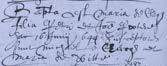
Figure 34.53: June 16, 1644, Deerlijk baptism certificate of Maria
Declercq (DK03dybx5), daughter of Pieter Declercq (DK03dyb).
Figure 34.54:
March 17, 1645, Deerlijk, Antoni Desclergue (II)
(DC06) godfather to Antonia de Pootere, daughter Reynialdi de Pootere
and Martine Loncke. Godmother was Anthonia de Scheemaeker. We
do not know if this de Pootere was related to one of the three subsequent
wives of Pieter Declercq (DK03dyb).
© 2024 Nico F. Declercq
The Desclergues of la Villa Ducal de Montblanc, 2nd ed., Omn., VOL. II



34.5. THE LIFE AND MILITARY CAREER OF ANTONI DESCLERGUE UNTIL 1640
545
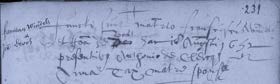
Figure 34.55: August 18, 1652, Deerlijk, the wedding of
Franciscus Windels and Joanna De Vos, witnesses were An-
toni Desclergue (II) (DC06) and Anna Tac, mother of the
bride.
Figure 34.56: May 24, 1612, Harelbeke, the baptism of Pieter Hongye, son of
Pieter Hongye from Hoei (near Dinant) or Gooi (in the Netherlands), or any
other place which begins with Gouy, a soldier in the garrison of captain Wackene
in ’Den Bosch’ (in The Netherlands), and of Maria Michiels (or Marie Michel)
born in Ynois in Luxemburg (may be Yvoir, back then located in Luxemburg).
The godfather was Cornelus van Botelberge, and the godmother was Magriete
Ma(t)hieu.
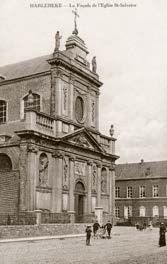
Figure 34.57: The church of Harelbeke.
Figure 34.58: 1618 Harelbeke, the death of a certain
Nicodemus from an unknown country (’de terra ignota’).
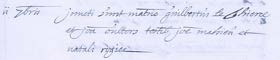
Figure 34.59: 1622, Harelbeke wedding of English or Irish
Joanna Oulters with a French man Guilbert Le Thierre.
Witnesses were Joanna Mahieu and Noel (’Natalis’) Ro-
gier. Note the possible appearance of the family Ma(t)hieu
or Matheo.
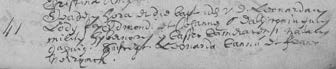
Figure 34.60: Harelbeke, 1623, the baptism of Joana Armente, daughter of
Gherardys and Cecilia Ruisdan, the godfather was David O’ Brien (’Breene’),
godmother was Margareth Driscoll (’dryescole’), all soldiers from the military
post of Lyre (’omnes Irlandi presidiarum milites in lyre’).
The Desclergues of la Villa Ducal de Montblanc, 2nd ed., Omn., VOL. II
© 2024 Nico F. Declercq






546
CHAPTER 34. ANTONI DESCLERGUE Y DE MONTOYA (DC06)
Figure 34.61: Harelbeke, 1627, the baptism of Catharina Ross (’Roste’), daughter of
Patrick from Ireland, a military at Ostend, and Anna Kennedy (’Keinet’). Godfather
was Sean Dogan (’Joannes Doudeghem’) from Ireland, and the Godmother was Delora
Kelly (’Delouera Killy’).
Figure 34.62: 1632, July 9, Waregem, the baptism of Leonora O’ Lody
(’Leonarda Lody’), daughter of Edmund O’ Lody (’Edmond Lody’), who
was an Irish soldier (Hibernia = Ireland) in the Spanish army camp (’in
castro’) of Cambrai (’Kamerensis’). The mother was Juana Dali (’Jo-
hanna Daly’). The godfather was Jean Neerynck, and the godmother
was Leonarda Cannu.
Figure 34.63: Kortrijk, January 20, 1632, the baptism of Carolo Tulo Duc, son
of Italian soldier Jacobo and Catharina Cristoporus. The godmother is a local lady
Anna Viane, daughter of Joannes Viane. The godfather is Carolo Fato. Around
that time, there were several more Italian baptisms at Kortrijk.
Figure 34.64: 1634, September 10, Waregem, the baptism of Philippa
Simoni, daughter of Vincenzo Simoni, who was an Italian soldier, and
Elisabeth Choudon (’Schoudon’). The godfather was Arnoldus Saelyns,
and the godmother was Philippa Impens.
Figure 34.65: 1634, September, Kortrijk, the baptism of Adriana
de Ryes, daughter of military Carlos de Ryes from Galicia and of
Catarina Tabor (’Tambory’), the godfather was Guilelmus Lammer-
tyn bastard-son of Jean-Baptiste Telli, godmother was Magdalena de
Reyes (’Res’), wife of Antonio Elvira (’Elivirra’).
Figure 34.66: 1635, March 27, Waregem, the baptism of Mary Wise (’Maria
Wys’), daughter of Francis Wise (’Franciscus Wys’), an Irish soldier in the
Spanish army, and of Catharina Bueleman. The godfather was Stephanus Van-
deputte (Du Puich), and the godmother was Judoca O’ Connor (’Connur’).
Figure 34.67: 1634, December 19, Harelbeke, October 19, the baptism of
Joannes Baptista Fanor, son of Carlandus and Agneta Grá, the godfather
was Joannes Baptista De Nofre, godmother was Margareta Sehat. The
priest explicitly added that the child is the son of a soldier. Fanor is a
name that appears in Burgundy (those days Spanish), Grá can be Spanish
or French, Nofre is Catalan.
© 2024 Nico F. Declercq
The Desclergues of la Villa Ducal de Montblanc, 2nd ed., Omn., VOL. II

34.5. THE LIFE AND MILITARY CAREER OF ANTONI DESCLERGUE UNTIL 1640
547
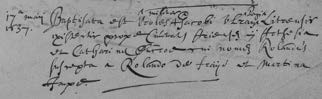
Figure 34.68: 1637, May 17, Beveren Leie, the baptism of Roland
Virlan (’Vilran’), son of Jacques Virlan, a soldier in Artesie (’Pa-
gia Artaensis’), and of Catharina Gucroe. Godfather is Roland de
Fraeye, and godmother is Martine Impe.
Figure 34.69: 1637, September 15, Ko-
rtrijk, the baptism of Elisabeth Aquila
or Aqyaviva (’Aquelin’ or ’Aquaeviva’),
daughter of soldier Alexandro Aquila
(’Aquevina’) and Barbara Vidal (’Videl’)
(nostre, i.e. from Kortrijk), the godfather
was Janessa Maritus Vincenti, godmother
was Elisabetha Rigay/Segay wife of Ger-
ardo Veck.
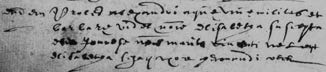
Figure 34.70: Harelbeke, November 26, 1637, the baptism of Catharina Bar-
tolome, daughter of Christianus Bartholomeus and Joanne Lloret (’Lorette’), the
godfather was Joannes Baptista De Nofre, godmother was Helena Cruve. The
priest explicitly added that the child is the daughter of a soldier. Note that Bar-
tolome is most common in Spain, and Lloret is also Spanish, just like Nofre.
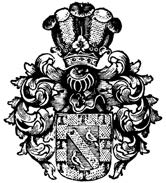
Figure 34.71: Heraldic shield of the family de Coloma (Généalogie de
la famille de Coloma, par J. F. A. F. de Azevedo Coutinho y Bernal,
1778)
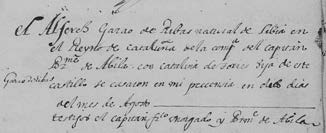
Figure 34.72: 1614, the Spaniard Castle
of Ghent. A curiosity.
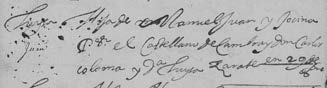
Figure 34.73: Spaniard Castle in Ghent,
October 29, 1624, the baptism of Luisa
Juan, daughter of Manuel Juan and
Jocina. The godfather was don Carlos
Coloma, the Lord of the castle of Cambrai,
and the godmother was doña Luisa Zarate.
The Desclergues of la Villa Ducal de Montblanc, 2nd ed., Omn., VOL. II
© 2024 Nico F. Declercq


548
CHAPTER 34. ANTONI DESCLERGUE Y DE MONTOYA (DC06)
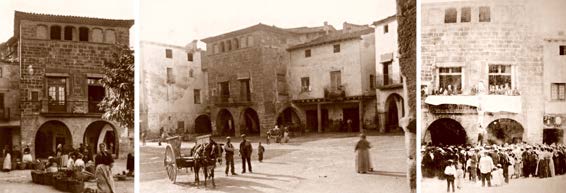
Figure 34.74: Montblanc, around 1900, views of the house of Desclergue and als ’els castells’ in front of the house of Desclergue. One can see that the house was used as a café at that time.
Figure 34.75:
In 2007, the author received an award in Madrid, Spain, from the International Commission for
Acoustics. Along with the diploma came a medal of the ICA, handed by Prof Philip Nelson who was the ICA secretary.
The International Commission for Acoustics is the largest body under which all National Acoustical Societies in the world operate and is a member of the International Union of Pure and Applied Physics (IUPAP). (Declercq de Silva Archive)
Figure 34.76:
Entry in the list of do-
nations made to the Saint-Jean Hospital
of Cambrai in 1641 by Antoni Desclergue
(II) (DC06) on behalf of his father Jeroni
Joan Desclergue y Cortés (DC05), in ’Mé-
moires de la Société d’ Émulation de Cam-
brai, 1862’
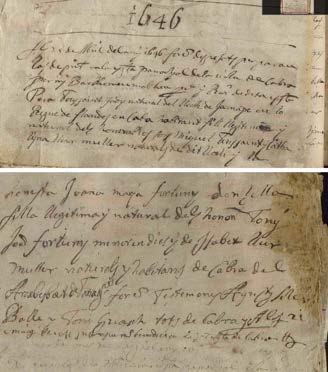
Figure 34.77: 1646, Cabra near Mont-
blanc, the marriage between a person
from Spanish Flanders and a person from
Cabra. The groom was from Jemappes
near Mons. Courtesy of Rafael Piñero
© 2024 Nico F. Declercq
The Desclergues of la Villa Ducal de Montblanc, 2nd ed., Omn., VOL. II
34.5. THE LIFE AND MILITARY CAREER OF ANTONI DESCLERGUE UNTIL 1640
549
historical connection to the Spanish Netherlands. Pera Toussaint’s journey from Jemappes to Montblanc, specifically to the village of Cabra del Camp, situated approximately two hours’ walk from Montblanc, is a testament to the extensive networks that linked various parts of Europe.
His presence in Cabra del Camp is officially recorded through his marriage in 1646 to Joanna Maria Fortuny, a local woman. The wedding is documented in the church registers of Cabra, which provide a detailed account of his origins and his integration into the local community.
The marriage register, as shown in Figure 34.77, reads:
’Pera Toussaint, fadrí, natural del lloc de Jamape en lo Regne de Flandes y en Cabra habitant, fill de (...) Miguel Toussaint y Catherina, llur muller, naturals de dit lloch, and, Joanna Maria Fortuny.’
This entry confirms his Belgian roots and highlights his established residency in Cabra, indicating a significant personal transition from a soldier in a foreign land to a settled inhabitant of a small Spanish village. The case of Pera Toussaint is emblematic of broader historical phenomena, including the movement of soldiers across Europe due to the Thirty Years’ War (1618-1648) and the subsequent social and cultural integration of these individuals into new communities. Toussaint’s marriage to Joanna Maria Fortuny signifies blending different cultural backgrounds and forming new social ties, crucial for the local community’s fabric during that era.
Furthermore, this case underscores the value of parish registers and local archives as vital sources for reconstructing individual life stories on an international platform and understanding larger historical patterns. The meticulous documentation by local church authorities provides historians with invaluable insights into demographic changes, social integration, and the personal histories of individuals who might otherwise remain obscure.
34.5.13 Specific Appearances of and Links to Antoni Desclergue in the area of Deerlijk
A selection of records is shown in Figures 34.47, 34.48, 34.49, 34.50, 34.51, 34.52, 34.54, and 34.55. The others can be found in Chapter 49, in constructing a chapel at Deerlijk. Further, we also give an overview of specific bonds with key witnesses of a miracle in Deerlijk in 1634. Antoni Desclergue (DC06) was connected to all of them.
Antoni Desclergue (II) (DC06), with his wife Beatrice Declercq (DK02byx), was in Deerlijk from 1631 onwards. When their daughter Maria was born, as described in Chapter 37.9.2, Beatrice appeared as a witness for the first time.
When their son Joan, described in Chapter 37.9.4, was born at Deerlijk in 1634, Jan Declercq, stepbrother of Antoni, was godfather, while Anne De Vos, daughter of Jan De Vos, was godmother. As indicated in Chapter 29.8.5, Chapter 48.3.2, and Chapter 48.4, the De Vos family was either Spanish or had close links with the Spanish army and would also help refugees who fled from the French army.
In Chapter 49.2.2, we clarify the bonds between Antoni Desclergue (DC06) and the witnesses of the miracle in 1634 that would lead to permission to construct a chapel in 1639 in Deerlijk, which also involves de Vos.
In 1638, on September 9, at Deerlijk, shown in Figure 49.10 on page 998, Beatrice Declercq (DK02byx) served as godmother to Jan De Vos, son of Michael De Vos and Anna Tacks (’Tonne Tack’), while Jan Montens was godfather. From that time onward, she and Antoni were not found anywhere because they left for Spain to return in 1640 when the Spanish suffered in Catalonia during the Revolt. The first appearance in Deerlijk was Beatrice, who must have returned from Spain while pregnant, while most likely Antoni returned later. In Figure 34.49, the priest has deliberately used a different spelling for different families of origin’ although the confusion was apparent, as indicated in the Figure caption.
Furthermore, the family De Witte (Du Blanc) must have been acquainted with the Desclergues because, in 1643, Beatrice Declercq (DK02byx) served as wedding witness of a certain Philippus De Witte and Judoca Declercq, i.e. (DK03dybx1) or possibly a relative of Beatrice Declercq (DK02byx). The De Witte family also appears in Wingene, where we believe we have found the two brothers of Jeroni Joan Desclergue y Cortés (DC05). Perhaps they are linked.
We found Antoni Desclergue as godfather on baptism in Deerlijk in 1643, September 20, to Margareta Blome, daughter of Franciscus Blome and Guilemla Mile; Godmother was Margareta Le Roy.
Another interesting example in Figure 34.53 is that of Miguel Desclergue (DC06b) as godfather on the baptism certificate at Deerlijk in 1644, of Maria Declercq (DK03dybx5), daughter of Pieter Declercq (DK03dyb) and Joanna Depoorter. The priest wrote ’Decleqs’
for Pieter Declercq’s branch, while he wrote ’Michael Le Clercgs’ for Miguel to show a difference. The fact that Miguel Desclergue had been baptized in Tournai in 1605, as can be found in Chapter 29.9.6, may have played a role in the priest’s decision to use the French spelling.
Interestingly, in 1647, we find Antoni Desclergue as godfather to a daughter of a certain Joanna Maes. In Chapter 48.3.2, we highlight the connection between the Desclergues and the Maes family; we also find him a witness for a family Dausach (’De Saux’) in 1652, as can be found in Chapter 34.8. As shown in Chapter 48.3.2, in 1652, we found a link between the Desclergues and the De Vos families. Antoni Desclergues would later, in 1655, also serve as godfather to the daughter of Joanna De Vos, namely Judoca Windels.
It is important to note here that the De Vos family, which was clearly acquainted with Antoni Desclergue (II) (DC06), also housed refugees who had escaped from the area of Douai-Valenciennes under French attack and occupation in the 1650s, as shown in Figure
In Chapter 49 about the chapel constructed in Deerlijk, we add more exciting connections. It was indeed so that the records show that everyone involved in constructing that chapel was acquainted with Antoni Desclergue (DC06) or his wife, Beatrice Declercq (DK02byx). With specific reference to the Chapel of Deerlijk and the witnesses involved in the miracle of 1634, we refer to Chapter
49.5 and Chapter 49.2.2 and specifically Figures 49.11 on page 998 (Montens, De Vos), 49.12 on page 998 (Montens, De Vos),
49.13 on page 999 (Kelduwier, Stalins), 49.14 on page 999 (Montens, Beatrice Declercq (DK02byx), Gilyct, Seynaeve), 49.15 on page 999 (Van Marcke, Wautier, Beatrice Declercq (DK02byx)), 49.16 on page 999 (Antoni Desclergue, Wautier, Beatrice Declercq (DK02byx)), 49.17 on page 999 (Kelduwier, Beatrice Declercq (DK02byx)), 49.18 on page 999 (Wolfcarius, Kelduwier, Beyls, Beatrice Declercq (DK02byx)), 49.19 on page 999 (Wolfcarius, Kelduwier, Valentin Bekaert), 49.20 on page 999 (Antoni Desclergue, Bekaert, de Croix / de la Cruz), 49.21 on page 999 (Jan Montens, Bekaert, Nicolaes Montens), 49.22 on page 999 (Decoop, Nicolaes Montens), 49.23 on page 1000 (Decostere, Vermandere), 49.13 on page 999 (Stalins, Kelduwier)35, 49.24 on page 1000 (Kelduwier, Stalins, De Vos), 49.25 on page 1000 (Kelduwier, Stalins)36, 49.26 on page 1000 (Stalins, la Motte Baraffe)37, 49.27 on page 1000
(Pieter Wielandt), 49.28 on page 1000 (Pieter Wielandt, Hebbelynck), 49.29 on page 1000 (Casiere, de Bois, Noel Declercq father 35Found equally in Figure 29.153 on page 432.
36Found equally in Figure 29.155 on page 432.
37Found equally in Figure 29.156 on page 432.
The Desclergues of la Villa Ducal de Montblanc, 2nd ed., Omn., VOL. II
© 2024 Nico F. Declercq
CHAPTER 34. ANTONI DESCLERGUE Y DE MONTOYA (DC06)
of Beatrice), 34.120 on page 559 (Oriol, Tani, Tani, Roman, Van Marcke) and 49.30 on page 1000 (Antoni Desclergue, Willem Van Marcke, Wautier).
34.5.14 Troops and their Families in the Area Deerlijk-Harelbeke-Kortrijk and their Impact
on the Inhabitants During the Lifetime of Antoni Desclergue - Until his Departure for
Spain in 1639
In Chapter 29.12 we have shown evidence of an excess presence of Spanish troops in the area of Harelbeke in the period 1609-1625, which will be further proven in the current section through church documents, such as Figures 34.56, 34.58, 34.59, 34.60, and 34.61.
The church of Harelbeke is shown in Figure 34.57. Also, we referred already to André Woestijn’s study38. He noticed in the records of Harelbeke town that from 1621 onward, there was more activity than in previous years. Ships transported a lot of ammunition on the Leie.
During 1621-1639, the country was crossed by various armies in Spanish service. As André Woestijn observed, in Harelbeke, there were many lodgings for Spanish, Irish, English, Italian and German soldiers. The burden was financially hefty for Harelbeke and can be observed in the accounts of these years. Harelbeke also received loans from the King to finance their efforts.
In 1620, it was apparent that the truce between the Spanish Netherlands and the Dutch States would not last. That’s why, in 1620, there was a steady build-up of troops in Belgium again. The truce finally ended on April 9, 1621. Many troops were in the Casselrye of Kortrijk during winter, including Deerlijk, Harelbeke, Kortrijk up, and even Wingene. Soldiers who did not own property were quartered in the homes of the town’s inhabitants and the neighboring villages. In return for modest financial support from the government, they had to provide the soldiers with food, water, a room with a bed, and a table. In the case of equestrians, they also had to give a stallion for the horse and look after the animal. The inhabitants were not happy about it.
The Spanish used the same procedure in Catalonia just before 1640, resulting in the Catalan revolt. The soldiers were often not alone and accompanied by their wives, children, and sometimes even servants, who needed accommodation. For instance, Juan delli Ponti’s regiment, stationed at Kortrijk in 1646, counted 15 companies containing 785 men and 1600 women and children. The book ’De geschiedenis van Kortrijk’ 39 mentions that of 7 companies, the exact numbers are known, namely 425 men, 273 women (spouses and widows) and 496 children. Furthermore, the women and children often arrived before the soldiers, as for the regiment mentioned in Kortrijk in 1646. The women and children had arrived one year earlier. The book also describes how the military of a higher rank often rented a home. Not every soldier behaved well during the war, and the local population sometimes suffered from extortion and harassment. We must also repeat that not every soldier in the Spanish army was Spanish. Many Germans, Walloons, Italians, and even Irish and Flemish were there. In his book, Parker describes that the Spanish soldiers from Iberia were better men of honor than the others because, in addition to limited financial reasons, they were soldiers to defend Christianity and often sought noble titles, by which they distinguished themselves from ordinary mercenaries.
Soldiers typically did not stay in the homes of impoverished inhabitants. The rich often paid a fee to the city to prevent the quartering of soldiers in their homes. Sometimes, entire cities paid the Spanish to avoid quartering in their towns. This meant that whole regiments then stayed in the villages outside of the town.
Only a few studies have been conducted on the precise regiments that stayed in Kortrijk in the 17th century. We need more information on tax patents. The book ’De geschiedenis van Kortrijk’ mentions the following regiments stationed in Kortrijk: The tercio of Maestre de campo Marcello del Judici in 1627 (1600 men and women);
Five companies of the corps of Don Adda in 1624;
The Italian tercio of Don Andrea Cantelmo (including 70 women and 150 children);
The regiment, as mentioned above, of Delli Ponti in 1646;
Besides, in 1646, there was also the regiment of Rouveroy (298 men, 400 women, and children), an English infantry regiment (365
men), and even four cavalry companies of Don Castelrodrigo. In 1645, there were the companies of La Housse and Pedro Villamor to protect the town of Kortrijk against a possible French attack.
The book also describes a food shortage in Kortrijk from 1635 to 1626 and the plague (the pest) from 1635 to 1637.
We also found the presence of Irish and other soldiers already in Harelbeke.
It is indeed known that (catholic) Irish soldiers took part in the Spanish army because they found a common enemy in England and the protestant Dutch Republic. Around that period, they were, for instance, involved in the Siege of Breda (1624-1625), just like Antoni Desclergue (II) (DC06). Examples are shown in Figures 34.62, 34.63, 34.64, 34.65 and 34.66. There is also clear evidence of Iberian presence in Harelbeke at that time, as shown in Figures 34.67, 34.68, 34.69, and 34.70.
34.5.15 The Role of Carlos Coloma de Saa in the Life of Antoni Desclergue
The military presence in this area can be significantly attributed to Carlos Coloma’s influence. Coloma, a prominent military figure, had a substantial impact on Jeroni Joan Desclergue y Cortés (DC05), the father of Antoni Desclergue (DC06), and subsequently recruited Antoni into the Spanish army. Chapter 29.5.2 explains how Coloma and Desclergue were each other’s relatives besides their friendship.
Carlos Coloma’s biography reveals that he served as the Viceroy of Mallorca from 1611 until 1617. Following this, he was appointed governor of Cambrai, a position he held from 1617 after capturing the city alongside his regiment, including Jeroni Joan Desclergue y Cortés (DC05). Coloma maintained his governorship of Cambrai until at least 1632. Despite frequent French attacks over the following decades, Cambrai remained under Spanish control until 1677. In Waregem, a village just east of Deerlijk, church documents indicate the presence of military personnel explicitly linked to Cambrai. Antoni Desclergue (DC06) likely maintained contact with these regiments until 1637, as he had grown up in this region after his father’s death.
Carlos Coloma influenced not only the life of Jeroni Joan Desclergue y Cortés (DC05), as detailed in Chapter 29.5.2, but also that of his son, Antoni Desclergue II (DC06). Coloma and Jeroni were contemporaries, serving in Flanders around the same time. Jeroni settled in the Flanders region, where Carlos Coloma’s wife, Marguerite van Liedekercke de Gavere, had strong familial ties. Jeroni and Coloma participated in significant military engagements, such as the Siege of Doullens and the Siege of Cambrai, discussed in Chapter 29.5.19. Jeroni returned to Spain with Coloma in 1598 but came back to Flanders in early 1603, only to be killed at the Siege of Ostend in September 1604, leaving his young son, Antoni, behind.
When Carlos Coloma returned to Flanders in 1617 as governor of Cambrai, he recruited Antoni Desclergue (DC06). Antoni had 38André Woestijn, ’Harelbeke in de Spaanse tijd, 1585-1713,’ De Roede van Harelbeke (De Leiegouw), nr 14, 1994.
39’De geschiedenis van Kortrijk,’ edited by Niklaas Maddens, published by Lannoo, Tielt, Belgium, 1990
© 2024 Nico F. Declercq
The Desclergues of la Villa Ducal de Montblanc, 2nd ed., Omn., VOL. II
34.6. MILITARY CAREER OF ANTONI DESCLERGUE AFTER 1641
551
a military career spanning about 22 years, with records in 1641 indicating his ongoing service, as mentioned in Chapter 34.3.
His career likely continued beyond this point, as further elaborated in Chapter 34.6. Born around 1601, Antoni would have been approximately 18 years old in 1619, which aligns with the documented timeline. Various sources confirm that Antoni Desclergue (DC06) served under Carlos Coloma in Flanders.
Antoni Desclergue’s family ties further illustrate Coloma’s influence. His sister, Juana Desclergues (DC06c), born in 1588 at the Spaniard Castle in Ghent, shown in Figure 34.72 and in Chapter 29.9.1, resided there as an adult, probably following her marriage to a Spanish soldier, and passed away in 1622. The connection between the Spaniard Castle in Ghent, Carlos Coloma, and the Kortrijk-Tournai-Cambrai region is underscored by a baptism certificate from Ghent, where Carlos Coloma is recorded as a godfather (Figure 34.73).
Carlos Coloma married the Flemish noblewoman Marguerite van Liedekercke de Gavere. In 1631, he became the commander-in-chief of the Army of Flanders, eventually returning to Spain in 1634.
34.5.16 The Construction of the Chapel at Deerlijk in 1639-1641 and a Possible Involvement
in Another One in 1666
We invite readers to delve into Chapter 49, which focuses on the Kapel-ter-Ruste chapel in Deerlijk, followed by a detailed account in Chapter 50 of another chapel’s construction in 1666. As explored in Chapter 29.12, on December 18, 1638, the Council of Flanders relieved the city of Harelbeke from its obligation to shelter soldiers. This decision significantly reduced the military pressure on the Kortrijk-Harelbeke-Deerlijk-Waregem region. Although soldiers likely remained in barracks at Overacker in Harelbeke, the city’s burden to provide protection was alleviated. This reduction in military presence may have been a compelling reason for Antoni Desclergue (DC06) to leave the area temporarily. During this period, he also supported the construction of a chapel in Deerlijk.
André Woestijn40 documented the hardships the church and parish of Harelbeke faced prior to the liberation of Ostend in 1604.
By 1582, Harelbeke had been ravaged, with priests fleeing and filibusters from Ostend looting the church and stealing documents.
The Malcontenten and Spanish forces gradually restored the Catholic faith in the area. The Catholic Canons of Harelbeke likely celebrated the Spanish liberation of Ostend in 1604. Establishing a chapel to honor Jeroni Joan Desclergue y Cortés (DC05), who died during the final stages of Ostend’s liberation in September 1604, would have garnered moral and religious support from the Catholic chapter of Harelbeke. Later, in 1666, a century after Jeroni’s (DC05) birth, a chapel was constructed at Saint Louis in Deerlijk, possibly with involvement from Antoni (DC06).
Between 1639 and 1641, Antoni Desclergue (DC06) was in Spain, as detailed in Chapter 49. This chapter outlines his involvement in the chapel’s construction and connections with the key figures. Some images of Montblanc and the House of Desclergue are presented in Figure 34.74. In contemporary times, the Desclergue family continues to visit Spain for professional reasons, as illustrated in Figure 34.75.
34.5.17 A Donation to the Hospital of Saint-Jean at the Citadel of Cambrai in 1641
When Antoni Desclergue (II) (DC06) returned from Spain in 1641, he installed items at the Chapel of Deerlijk and donated significantly to the Saint John Hospital of Cambrai. His father, Jeroni Joan Desclergue y Cortés (DC05), had suffered a severe facial injury from an arrow during the Siege of Cambrai in 1596. Following this injury, Jeroni stayed in Cambrai, likely receiving treatment at the Hospital of Saint-Jean. He intended to repay the hospital for their care, but his death in 1604 prevented him from fulfilling this promise. In 1641, Antoni (DC06) honored his father’s unfulfilled pledge by donating to the hospital on Jeroni’s behalf.
The Société d’Émulation de Cambrai41 recorded the names of individuals who contributed to the endowment of the Saint-Jean Hospital. On page 541 of this publication, as shown in Figure 34.76, it is documented that Antoni Desclergue (DC06) donated in 1641 on behalf of Jeroni Desclergue (listed in French as ’Jérôme Leclercq’).42 It is important to note that Cambrai remained part of the Spanish Netherlands until 1677, when the forces of Louis XIV captured it. French efforts to seize Cambrai began in 1672, marking the onset of hostilities that eventually led to its annexation.
34.6 Military Career of Antoni Desclergue after 1641
Beatrice Declercq (DK02byx), wife of Antoni Desclergue (DC06), would die in 1651. We find Beatrice active at Deerlijk as a witness to baptisms and weddings between 1640 and her death in 1651. She is also found in the period before her departure to Spain.
Antoni Desclergue is absent in the records when he was active as a military in Catalonia to fight the French between 1646 and 1652
when Barcelona was recaptured.
The French renounced Catalonia but kept Roussillon, followed by the Treaty of the Pyrenees in 1659, mentioned in Chapter 8.12.1
and Chapter 34.9. From 1648 onwards, the Peace of Westfalia agreement was signed between Spain and the Northern Netherlands.
Consequently, the Spanish could use their military elsewhere.
It is crucial here to mention that Montblanc, where the Desclergues originate from and visited by Antoni Desclergue in the period before 1642, became victim to many troubles in Catalonia, also referred to as ’Guerra dels Segadors’ and studied by Manel Güell43.
Elliot44 described the period before that.
34.6.1 The Battle of Honnecourt-sur-Escaut (1642)
The historical significance of two pivotal battles, the Battle of Honnecourt (1642) and the Battle of Rocroi (1643), is underscored by their profound impact on the military and political dynamics of the time. Notably, in the aftermath of these confrontations, essential baptisms were recorded at Harelbeke and Deerlijk, indicating the involvement of military personnel from these battles, as detailed in Chapter 34.6.3. It is inferred that Antoni Desclergue (DC06), or his son, participated in these significant engagements.
40André Woestijn, ’Harelbeke in de Spaanse tijd, 1585-1713,’ De Roede van Harelbeke (De Leiegouw), nr 14, 1994.
41Mémoires de la Société d’Émulation de Cambrai, Tome XXVII - 2ieme partie, Présidence de M. Alc. Wilbert, Cambrai 1862, Imprimerie de Simon, rue St Martin 18, pages 539-543, Noms des personnes auxquelles l’hopital Saint-Jean a du sa dotation.
42Antoni Desclergue (DC06) had a brother, Jeroni Desclergue, who was a priest. It is conceivable that if he were still alive, he might have also donated for Jeroni Desclergue (DC05) on behalf of Antoni Desclergue (DC06).
43Manel Güell, ’Els assalts [frustrats] a la vila ducal durant la guerra dels Segadors (II)’ , Centre d’ Estudis de la Conca de Barberà, Aplex de Trevalls (Montblanc):53-64.
44J. H. Elliott, ’The Revolt of the Catalans - A study in the Decline of Spain 1598-1640,’ Cambridge University Press, 1963.
The Desclergues of la Villa Ducal de Montblanc, 2nd ed., Omn., VOL. II
© 2024 Nico F. Declercq
552
CHAPTER 34. ANTONI DESCLERGUE Y DE MONTOYA (DC06)
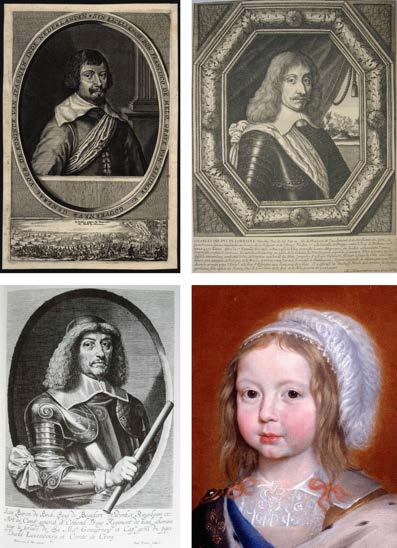
Figure 34.78: From left to right, top to bottom, we can see the following persons.
Francisco de Melo. Freiherr Johann von Beck. Kupferstich, 22.5 x 15.4cm. Inscrip-
tion: Jean Baron de Beck. Seigr. de Beaufort, Wÿdimb, et Ringsheim etc. ; Mre
de Camp general, et Collonel D’ ung Regiment de haut allemans ; pour le service
de Sa Mate. Gouverneur et Capne. genl du pays; Duché Luxembourg et Comté de
Chinÿ. Charles IV duc de Lorraine, by B. Moncornet, 1663. H.M. King Louis XIV
of France in 1643. p
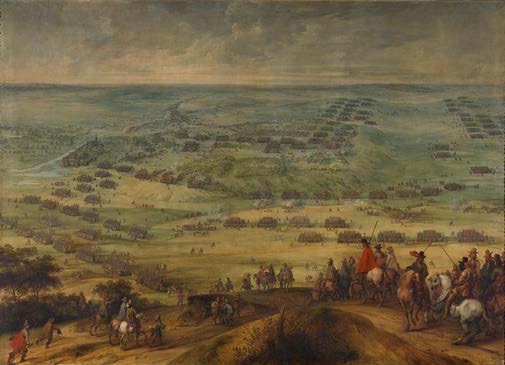
The French had suffered a significant defeat at the hands of the Spanish Netherlands in the Battle of Leuven in 1635, a critical event described in Chapter 34.5.9. The Battle of Rocroi in 1643 is often viewed as retribution for the loss at Leuven. However, this perspective overlooks the crucial intervening Battle of Honnecourt-sur-Escaut, shown in Figure 34.79. On May 26, 1642, the Battle of Honnecourt occurred, marking a notable encounter during the Thirty Years’ War.
The Spanish forces, commanded by Don Francisco de Melo, shown in Figure 34.78, and supported by Baron Jean de Beck, shown in Figure 34.78, had previously captured Lens in 1642 and advanced towards La Bassée. The French, under the leadership of Marshal de Guiche, Henri de Lorraine, comte d’Harcourt, and Antoine III de Gramont, Duc de Gramont, aimed to relieve La Bassée from the Spanish siege. However, de Melo’s forces intercepted the French, leading to a decisive battle at Honnecourt-sur-Escaut.
The engagement resulted in a substantial defeat for the French. The well-prepared and strategically positioned Spanish forces outmaneuvered the French, leading to their significant loss. Despite this victory, de Melo made a critical strategic error by hesitating to capitalize on the opportunity to invade and secure a more substantial portion of France. This hesitation allowed the French forces to retreat, reorganize, and rebuild their army.
The subsequent year, the revitalized French army achieved a landmark victory at the Battle of Rocroi on May 19, 1643. This battle is often considered a turning point in the Thirty Years’ War. The French decisively defeated the Spanish forces, commanded by the young Duke of Enghien (later known as the Grand Condé). This victory not only avenged the previous defeats but also marked the decline of Spanish military dominance in Europe.
In summary, the Battle of Honnecourt-sur-Escaut (1642) and the Battle of Rocroi (1643) were crucial in shaping the military and political landscape of 17th-century Europe. The French defeat at Honnecourt underscored the need for strategic reform, leading to their eventual triumph at Rocroi, which shifted the balance of power in favor of France.
34.6.2 The Spanish Defeat at Rocroi (1643)
An aerial view of Rocroi is presented in Figure 34.146 on page 564, while the fortifications are shown in Figure 34.150 on page 571.
Additional scenes are depicted in Figure 34.149 on page 570, Figure 34.151 on page 572, and Figure 34.152 on page 573.
Understanding the historical context of the battle is essential, particularly as it coincided with the death of King Louis XIII of France. The battle’s outcome marked King Louis XIV’s first victory, illustrated in Figure 34.78. However, at the time of the battle,
© 2024 Nico F. Declercq
The Desclergues of la Villa Ducal de Montblanc, 2nd ed., Omn., VOL. II

34.6. MILITARY CAREER OF ANTONI DESCLERGUE AFTER 1641
553
Figure 34.79: The Battle of Honnecourt, by Peter Snaeyers.p
Figure 34.80:
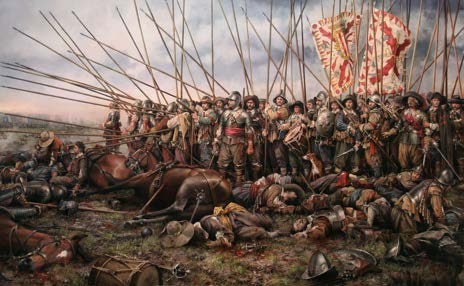
’Rocroi, el último tercio’ , showing the battle of Rocroi of 1643, painted
by Augusto Ferrer-Dalmau in 2011. Public domain, shared by Wikimedia® (OTRS ticket
2013032610005631).
Figure 34.81: 1646, February 11, Spaniard castle of Ghent, the
marriage of Diego de Portillo, a soldier (’sold-o’) of the company of
(’de la comp-a de’) Diego de Vargas (’Barjas’) Machua and Maria
de Martos. The witnesses were Sergeant Antoni Desclergue (DC06)
(’Sarg-to Ant-o S-a-s’ or ’Sargento Antonio Desclergas’) and Fran-
cisco Tiri (’fr-co tiri’).
The Desclergues of la Villa Ducal de Montblanc, 2nd ed., Omn., VOL. II
© 2024 Nico F. Declercq
554
CHAPTER 34. ANTONI DESCLERGUE Y DE MONTOYA (DC06)
Figure 34.82: The Semois River, near Rocroi, in July
2002. The author’s eldest son, Benjamin, not yet three
years old, enjoyed swimming in the river. Using a self-
made net fashioned from a T-shirt, Benjamin caught fish,
which we brought home and kept in an aquarium. As the
fish outgrew the tank, we re-released them back into the
river. (Declercq de Silva Archive)
Figure 34.83: Ghent, Saint Bavo church,
September 13, 1644, the wedding of Mar-
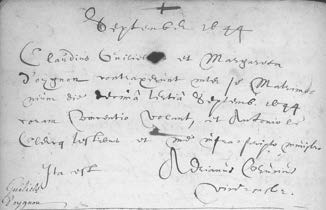
garita Dueno (D’ oygnon) with Claudius
Guiliels. The witnesses were Antoni De-
sclergue (DC06) and Vincentius Volant.
In that year, Antoni did not appear as
bourgeois forain of Kortrijk.
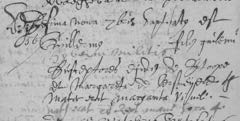
Figure 34.84: 1641, September 28, Waregem, the bap-
tism of William, son of William, an Irish (’Hibernia’)
soldier in the Spanish army, and Margarite Vinele. The
Godfather was Egidius Destoop, and the godmother was
Margareta de Leersnyder.
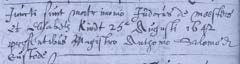
Figure 34.85: 1642, August 26, Deerlijk, the wedding
of Judocus de Meestere and Elizabeth Kindt, witnesses
were Antonio Salomo and the custode.
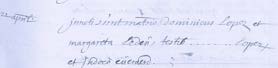
Figure 34.86: 1643, April 2, Harelbeke, Domingo Lopez’s
marriage (’Dominicus Lopez’) with Margareta Leden, the
witnesses were Lopez and Judoca Everard. Lopez is, of
course, a Spanish name.
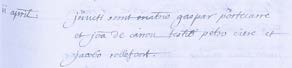
Figure 34.87: 1643, April 11, Harelbeke, the marriage of
Gaspar Portocarrero with Joanna de Carron, witnesses were
Petrus Ciere and Jacobus Rollefoort.
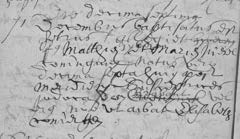
Figure 34.88: 1644, December 16, Waregem, the bap-
tism of Peter Alley (’Petrus Allegiet’), son of Matthew
Alley (’Matthias Allegiet’), who was an Irish soldier in
the Spanish army, and of Marie O’ Naraigh (’Maria
Nierel’). The Godfather was Judocus Van Brabant, and
the godmother was Elisabeth Connie (’Conieye’)
© 2024 Nico F. Declercq
The Desclergues of la Villa Ducal de Montblanc, 2nd ed., Omn., VOL. II
34.6. MILITARY CAREER OF ANTONI DESCLERGUE AFTER 1641
555
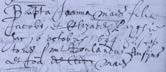
Figure 34.89:
1644, October 16, Deerlijk, the baptism of Joanna
Maes, daughter of Jacobus Maes and Elizabeth O’ Leary (’Layglrie’),
clearly Irish. Godfather was Roulandus O’ Finn (’Aufyns’), clearly
Irish, godmother was Joanna’ De Clerc Maes’ . We don’ t know why
the priest wrote the last name as he did and how exactly Maes and De
Clerc or linked or who this person was; perhaps she was not related to
us.
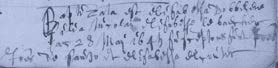
Figure 34.90:
1645, May 28, Deerlijk, the baptism of
Elisabeth De Cleene, daughter of Nicolas De Cleene and
Elisabeth De Backer. Godfather was Juan de Sousa, and
godmother was Elisabeth Decouter.
Figure 34.91: 1645, August 16, Deerlijk, the baptism of Margareta
Pladys, daughter of Petrus Pladys and Joanna Cleemens. The God-
father was Guillemus ’de Heyser’ or ’de Keyser’ , the godmother was
Catharina Alfonso (’Elepons’).
Figure 34.92: 1645, August 6, Deerlijk, the baptism of Pedro Aguado
(’Petrus Aguathaunins’), son of Juan Aguado and Margarita Tila
(’Margarete Tylaet’), Spanish names. Godfather was Petrus Ouat
(’Auaet’), Godmother was Catharina Tumerel (’Tumiriels’).
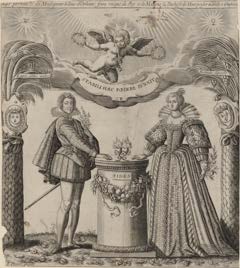
Figure 34.93: Engraving of Gaston de France, i.e. the
Duke of Orléans, brother of Louis XIII, and Marie de
Bourbon, i.e. the Duchess of Montpensier, who married
on August 6, 1626.
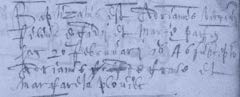
Figure 34.94: 1646, February 20, Deerlijk, the baptism
of Adrianus De la Cruz (’Vercruyce’) son of Egidius De
la Cruz and Maria Pages, Godfather was Adrianus De
Grave, Godmother was Margareta Ploner. The family
names Pages, Ploner and De la Cruz, are Spanish.
Figure 34.95: 1646, Deerlijk, the baptism of Arnoldus
Buysens, son of Arnoldus Buysens and Margarita De la
Cruz (’Vercruyse’), Godfather was Rynerius Nolf, god-
mother was Margareta Ploner.
The Desclergues of la Villa Ducal de Montblanc, 2nd ed., Omn., VOL. II
© 2024 Nico F. Declercq
556
CHAPTER 34. ANTONI DESCLERGUE Y DE MONTOYA (DC06)
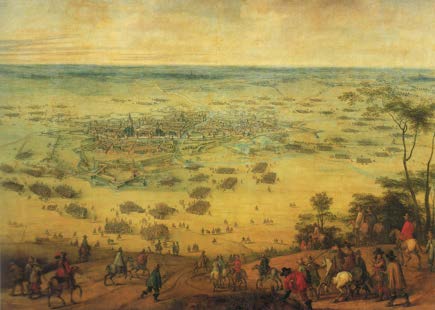
Figure 34.96: Peter Snaeyers, ’Het beleg van Kortrijk’ , 1648. This is how Kortrijk looked
like upon arrival from the directions of Deerlijk-Harelbeke-Zwevegem. p
Figure 34.97: Francisco Sanchez was the priest at Harelbeke from 1649 onward.
Figure 34.98:
August 20, 1649, Deerlijk, the marriage of Jaques
Ouat (’Ouaet’) and Catharina de Huisson (’De Huys’), witnesses were
Joanna Van Bulcke and Margareta de Huet.
Figure 34.99: September 13, 1650, Deerlijk, the bap-
tism of Joannes Martinus Fiole, son of Horatius Fiole
and Petronille Vine, witnesses were Judocus Fiole (’De
Viole’) and Judoca de Lara (’Lare’).
Figure 34.100: October 25, 1650, Deerlijk, the bap-
tism of Jaume Vals (’Jacobus Val’), son of Frances
Vals (’Francisco Val’) and Anna de Colom (’Anna
Columme’), the Godfather was Jacobus Myle (’Myele’),
godmother was Anna de Blondel-de-Manchicourt-et-
Gorre (’Blondel’).
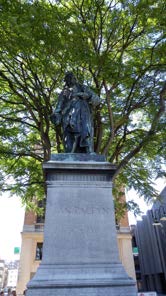
Figure 34.101: Jan Palfijn was born in Kortrijk on November 28,
1650, and died in Ghent on April 21, 1730. He is world-renowned
for his invention of the forceps to help deliver children. His father,
Gilles, was a surgeon and barber. Jan Palfijn studied human bodies by
illegal excavations at the cemetery of Kortrijk. One day, he was caught
and fled to Ghent. After three years in the town, he became a master
surgeon and moved to Paris to work with Joseph Guichard Duvernay.
When he returned to Kortrijk in 1675, he married and was caught
again for keeping a human skeleton in his home. That’s when he fled
to Ypres. After his wife’s death, he married Maria du Bois and moved
to Ghent again after her death. In 1708, he became a lector at the
Surgery School of the town and began to write books. He worked for a
while at the hospital Bijloke, where several Desclergue family members
had died the century before. A forceps already existed, but Jan Palfijn’s
model became widely known because he did not keep it secret. That’s
how he became known as the inventor of this crucial medical device.
(Declercq de Silva Archive)
© 2024 Nico F. Declercq
The Desclergues of la Villa Ducal de Montblanc, 2nd ed., Omn., VOL. II



34.6. MILITARY CAREER OF ANTONI DESCLERGUE AFTER 1641
557
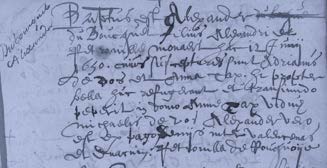
Figure 34.102: 1650, Deerlijk, the bap-
tism of Alexander de Bucquoy (’Du Bouc-
quet’), son of Alexander and Petronille
Monaert, the Godfather was Adrianus De
Vos, godmother was Anna Taja (’Tax’).
The parents were refugees from the vil-
lage of Denis (probably Denain or Den-
ing), between Valenciennes, shown in Fig-
ure 34.103, and Douai and stayed in the
house of Anna Taja (’Tax’), widow of
Michael De Vos. The midwife was Petron-
illa de Bucquoy (’Bouquoye’). The de Buc-
quoy family is also connected to Ximenes
de la Cruz, for instance, in Figure 37.79
on page 659, in the realm of the family of
Martina de la Cruz in Chapter 37.4. The
family de Bucquoy also appears in Chapter
29.10.12.3 in 1648 in a connection with de
Montoya
Figure 34.103: Images of picturesque Valenciennes along the Schelde river, when horses were still dragging boats.
Figure 34.104:
1650, Harelbeke, the baptism of the noble child
Francesca Angelina de Blondel de Manchicourt et Gorre, the daughter
of Lord Charles and Dame Anna de Vilaseca. Godfather was Franciscus
Ignatius De Vilaseca and Anna de Huisson (’de Weynssone’).
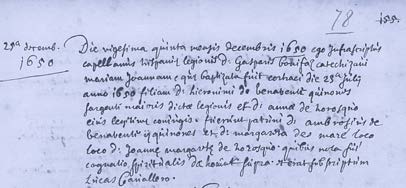
Figure 34.105: Harelbeke 1650, the baptism, performed by the capellan of the
Spanish legion of Gaspar Boniface, of Maria Joanna de Benavente, daughter of
Geronimo De Benavente and Anna de Orozco. Godfather was Ambrisus (Ambro-
sius) Benavente, and the Godmother was Margarita de Mare on behalf of Juana
Margarita de Orozco. The record continues in Figure 34.106.
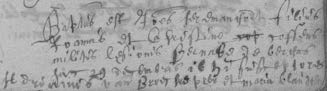
Figure 34.106: Harelbeke 1650, the continuation of the baptism record of Maria
Joanna de Benavente in Figure 34.105. A complete transcript is shown in the text.
In fact, Gerónimo de Benavente y Quiñones was a Field Master and Marshal of the
Militias of Tercios España in Flanders. He was a knight of Santiago, and he was
the son of Don Gabriel de Quiñones y Benavente and Doña Magdalena Hurtado de
Torres. Doña Magdalena was the daughter of Doña Francisca de Torres and Don
Simon Hurtado, Royal Notary of Guadalajara.
The Desclergues of la Villa Ducal de Montblanc, 2nd ed., Omn., VOL. II
© 2024 Nico F. Declercq





558
CHAPTER 34. ANTONI DESCLERGUE Y DE MONTOYA (DC06)
Figure 34.107: 1650, Kortrijk, the baptism of Martin Boil (’Bae-
olie’), son of soldier Martino Boil and Jacoba Gomez (’Goammez’),
the Godfather was Martin Garcia (’Gaersiesoo’), godmother was
Gertruda (’Geertruda’) Gomez. The Boil family is described in
Chapter 27.11.
Figure 34.108: 1650, February 5, Kortrijk, Saint Martinus Church, the baptism
of Francesc de la Costa, the son of a Spanish soldier (’militis hispani’) Pedro de la
Costa and Maria Tilly (’Tielie’). The Godfather was Francisco Olivera from Spain
and Juanita Franco (’du francque’).
Figure 34.109: 1650, February 5, Kortrijk, Saint Martinus Church, the baptism of Pascales
Garcia (’Garzsie’), son of soldier Jacobo Garcia, the Godfather was Pascalius Rodriguez, and
the godmother was Catharina Roshitz; and of Gabrielus Garcia, the Godfather was Gabrielus
De Frais, and the godmother was Luciela (’Luichaela’) Vaissal.
Figure 34.110: 1651, Kortrijk, the baptism of Julius Arcangioli, son of Italian
soldier Francisco Arcangioli and Maria Petillon, the Godfather was Julius de
Portere, and the godmother was Maria Brasseur.
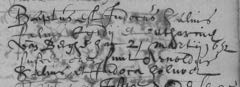
Figure 34.111: Deerlijk, 1651, Decem-
ber 29, the baptism of Joan Cermeño
(’Joannes Seremanyodt’), son of Joan
Cermeño (’Joannes’) and Christina
Cossens, military in the legion of Bernardo
de Vargas (’de Bergas’); godfather Heron-
imus (or Heremias or Adrianus) Van den
Broecke (a priest) and Maria ’illisible’ (=
Blaudoenck/Blaudten/Blaudtens/Blauwe,
possibly a descendant of a German soldier
in the Spanish army).
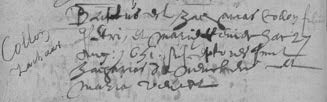
Figure
34.112:
1651, August 27,
Deerlijk, the baptism of Zacaria Colom
(’Zacharius Collon’), son of Pere Colom
and Maria Renat. The Godfather was
Zacharias de Neckere, and the godmother
was Maria Renat.
Figure 34.113: Harelbeke, 1651, November 5, the baptism of Arnoldus Turi
(’Trury’), son of Michael Turi and Pascalina (’Pascatir’) ..., Godfather was
Arnoldus du Bare, godmother was Elizabetha Poloña (’Poloine’). The names
Tury and Drury are from the British isles, the name Turi is Spanish, and so
is Poloña.
© 2024 Nico F. Declercq
The Desclergues of la Villa Ducal de Montblanc, 2nd ed., Omn., VOL. II


34.6. MILITARY CAREER OF ANTONI DESCLERGUE AFTER 1641
559
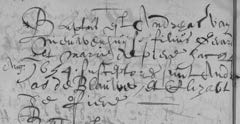
Figure 34.114: 1651, July 20, Harelbeke, the baptism of Petronilla Zeeldrayer, daugh-
ter of soldier Olverius Zeeldrayer and Maria Cocquyt. The Godfather was Joannes
Vantroys, and the godmother was Petronilla Depauw.
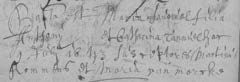
Figure 34.115: 1652, March 21, Deerlijk, the baptism
of Judocus Salins, son of Egidius Salins and Catharine
Van Berghe. Godfather was Arnoldus Salins, and God-
mother was Jossina (’Judoca’) Solivar.
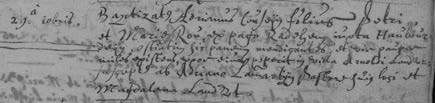
Figure 34.116: 1652, December 29, Beveren Leie, the baptism of Adrianus Couseyn, son
of Petrus Couseyn (a poor soldier, begging for bread, from Radehem near Haubourg), and
of Maria Rou. The Godfather was pastor Adrianus Lamertyn, and the godmother was Mag-
dalena Landuyt.
Figure 34.117: Harelbeke, September 20, 1652, the baptism of Aldegonda Bir-
gitta de-Blondel-de-Manchicourt-et-Gorre, daughter of Lord Charles de-Blondel-de-
Manchicourt-et-Gorre and of Anna de Vilaseca. The Godfather was Franciscus
Ignatius de Vilaseca, and the godmother was Anna de-Blondel-de-Manchicourt-et-
Gorre (’de Blondel’).
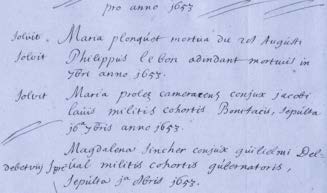
Figure
34.118:
September-October,
1653, Kortrijk, a couple of interesting fu-
nerals at the Church of Notre Dame (Onze
Lieve Vrouwe kerk).
Figure 34.119:
August 24, 1653, Deerlijk, the bap-
tism of Andreas van Nieuwenhuyse son of Gerardus van
Nieuwenhuyse and of Maria de la Piere (’de Piere’), god-
father was Andreas de Blauwe, godmother was Elisabet
de la Piere.
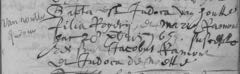
Figure 34.120: July 16, 1653, Deerlijk, the baptism of
Maria Sans Oriol (’sanoriol’), daughter of Antoni Sans
Oriol and Catharina Tani, Godfather was Martin Ro-
man (’Martinus Rommens’), godmother was Maria Van
Marcke. The names Sans, Oriol, Sans Oriol, Tani and
Roman appear in Spain during that era. At the same
time, the van Marcke family is associated with the mir-
acle at Deerlijk in 1634, described in Chapter 34.5.16,
Chapter 49.5 and Chapter 49.2.2.
The Desclergues of la Villa Ducal de Montblanc, 2nd ed., Omn., VOL. II
© 2024 Nico F. Declercq

560
CHAPTER 34. ANTONI DESCLERGUE Y DE MONTOYA (DC06)
Figure 34.121: December 28, 1653, Deerlijk, the bap-
tism of Jucoca van Houtte, daughter of Rogerius van
Houtte and Maria Ramon (’Ramont’). The Godfather
was Jacobus Ramon, and the godmother was Judoca de
Noette (probably either ’de nutten’ or ’van houtte’ or ’de
hoet’ or ’de hut’ etc. in dialect). Ramon might be Span-
ish, but it also existed in Belgium, although in that era,
the local version ’Raymon’ was more prevalent in Bel-
gium than the Southern ’Ramon’ version.
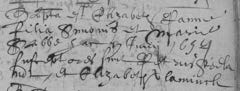
Figure 34.122: 1653, June 17, Deerlijk, the baptism of
Elisabeth Panne, daughter of Simon Panne and Marie
Sabbe. Godfather was Petrus Steelandt, and godmother
was Elisabeth Vlaminck. The family name ’Panne’ is
French, ’Panna’ is Spanish.
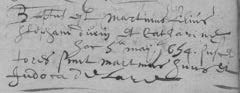
Figure 34.123: 1653, May 5, Deerlijk, the baptism of
Martin Duni, son of Esteve Duni (’Stephanus Duny’)
and Catarina (no family name given). Godfather was
Martin Hus (’Martinus Huus’), godmother was Jossina
de Lara (’Judoca de Lare’). Duni, Hus, and Lara are
Spanish, although ’Huys’ and ’De Lare’ can also be Flem-
ish, while Hess is German. An encounter with Hes is also
indicated in Figures 37.65 on page 657 and 37.40 on page
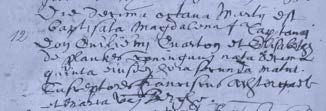
Figure
34.124:
1653, March 18,
Waregem, the baptism of Magdalena
Huarte (’Huarten’), daughter of Capitan
Don Guillermo Huarte or Guarton and
Elisabeth Deplancke. The Godfather was
Franciscus Achtergael, and the godmother
was Maria Van Berghe (possibly a sister of
Catharine Van Berghe, mentioned on bap-
tism at Deerlijk, in Figure 34.115).
Figure 34.125: 1653, December 13, Waregem, the baptism of Maria
O’ Daly (’Maria Dale’), daughter of Matthew O’ Daly (’Matthias
Dale’), who was an Irish soldier in the Spanish army, and of Joanna.
The Godfather was Stephanus De Heedene, and the godmother was
Maria Sgareldyns. The document is one of the numerous examples
where the priest chose a flemish family name above the original ver-
sion, i.e. Dale instead of O’ Daly.
Figure 34.126:
1653, Kortrijk, the baptism of Maria
Baesques, daughter of Martinus Baesques and Jacoba
Gomez (’Comes’), the Godfather was Pedro de Arvada, and
the godmother was Josepha de Valenbergo (probably origi-
nating from the name ’Van Valenberg’).
© 2024 Nico F. Declercq
The Desclergues of la Villa Ducal de Montblanc, 2nd ed., Omn., VOL. II

34.6. MILITARY CAREER OF ANTONI DESCLERGUE AFTER 1641
561
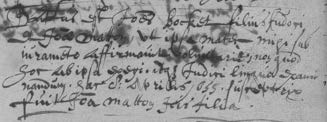
Figure 34.127:
Deerlijk, 1654, August
25, the baptism of Maria van Mullem.
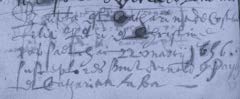
Figure 34.128: June 20, 1655, Deerlijk, the baptism
of Adriana de Wulf, daughter of Simon De Wulf and
Catherine Veraest, the Godfather was Julianus de Soete,
the Godmother was Adriana Guzman (’Goetmaen’).
Figure 34.129: 1655, Deerlijk, the bap-
tism of Arnolda Balaguer (’Ballegeer’),
daughter of Jose Balaguer and Jacoba
Courtens. The parents were not married;
hence the child was illegitimate. The God-
father was Andres Balaguer, and the god-
mother was Arnolda de Vos.
Figure 34.130: Deerlijk 1655, April 8,
the baptism of an illegal child, Jean Buc-
quoy (’Joannes Bocket’).
The mother,
Joanna Matton, voluntarily confessed,
’with her own voice’ , that the father was
Jose (’Judocus’) Bucquoy. The godmother
was Joanna Matton, daughter of Joannes
Matton.
Figure 34.131:
Harelbeke 1655, June 1, the baptism of Charles
Tomas de Blondel de Manchicourt et Gorre, son of Charles de Blon-
del de Manchicourt et Gorre and Anna de Vilaseca, Godfather was
Rolandus Thomas Bonte, and Godmother was Iberga de Huisson (’de
weynssone’).
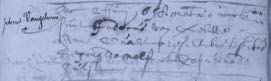
Figure 34.132: March 22, 1656, Deerlijk, the baptism
of Catharina de Coster, daughter of Petrus De Coster
and Christina Taja (’Tax’). The Godfather was Arnau
Pages, and the Godmother was Catarina Laba. Taja,
Pages and Laba are Spanish names.
The Desclergues of la Villa Ducal de Montblanc, 2nd ed., Omn., VOL. II
© 2024 Nico F. Declercq



562
CHAPTER 34. ANTONI DESCLERGUE Y DE MONTOYA (DC06)
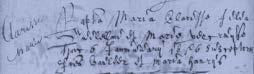
Figure 34.133:
January 6, 1656, Deerlijk, the
baptism of Maria Clarisse, daughter of Guillelmus
Clarisse and Maria De la Cruz (’Vercruysse’), the
Godfather was Joan Balder (’Joannes Baulder’), the
Godmother was Maria Heris (’Hanrys’). De la Cruz,
Balder and Heris are Spanish names.
Figure 34.134: June 2, 1658, Deerlijk, the wedding of
Judocus Van Geluwe and Anna Ouaet, the witnesses were
Regina de Nolf and Catharina de Hulste.
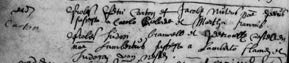
Figure 34.135: 1658, Kortrijk, July, the baptism of Anna Catharina Cal-
lell, daughter of Italian soldier Joseph Callell and Arnoldine Grepolle. The
Godfather was soldier Vincentio Raffaeli, and the godmother was Catharina
Fasael. Likely the name ’Grepolle’ soon evolved to the prevalent ’Herpoel’ in
Flanders.
Figure 34.136:
1658, October, Kortrijk, Saint Martinus
Church, the baptism of Charles Veey, son of soldier Nicola
Veey and Joanna Neristey. The Godfather was soldier Charles
Gardeyn, and the godmother was Jacoba Wallaeys.
Figure 34.137: 1658, Kortrijk, October, Carlos Ricardo was
godfather to Pierre Carton, son of Petrus Carton and of Ja-
coba Nutens. The godmother was Martha François.
Figure 34.138: 1658 Kortrijk October, the baptism of Fran-
ciscus Hee, son of Joannes Hee and Catharina Lande. The
Godfather was Francesc Cales, and the godmother was Catha-
rina Sirens.
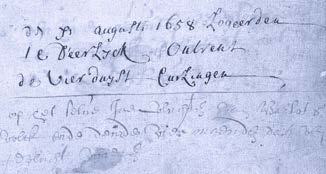
Figure 34.139:
1658 evidence of 4000
mercenaries stationed at Deerlijk, in ser-
vice of the Spanish army and led by Count
Berlo: ’De 7e van augustus 1658 logeerden
te Deerlyck omtrent de vierduyst hurlingen
op het selve jaer vijftig hurlingen barlots
volck ende de volgende maand...’
© 2024 Nico F. Declercq
The Desclergues of la Villa Ducal de Montblanc, 2nd ed., Omn., VOL. II


34.6. MILITARY CAREER OF ANTONI DESCLERGUE AFTER 1641
563
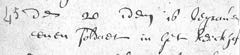
Figure 34.140: 1658 Ingooigem, the burial of an un-
known soldier.
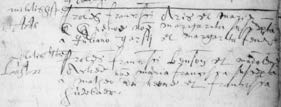
Figure 34.141: 1659, Harelbeke, the baptism of Helen Cole (Colle),
daughter of Patrick and Margareth Eloy (’Leloy’), Godfather was An-
dreas Cormaco, godmother was Adriana de Longwy, likely Lorraine per-
sons and Irish.
Figure 34.142: 1662, Kortrijk, the baptism of Margareta
Ariver, daughter of soldier Francisco Ariver. The Godfather
was Juliano Garcia (’Garcy’), and the godmother was Mar-
gareta Feuri. Equally, the baptism of Maria Francisca Lou-
son, daughter of soldier Francisco Louson and Magdalena
Archeu. The Godfather was Matheo Van Heene, and the
godmother was Francisca Huwaer.
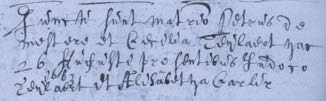
Figure 34.143: March 26, 1663, Deer-
lijk, the wedding of Pedro de Mestere
(’de mestere / mestero’) and Cordula Tila
(’Teylaet’), witnesses were Jose Tila (’Ju-
docus Teylaert’) and Elisabetha Carlier.
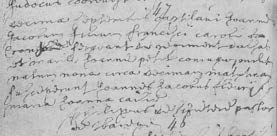
Figure 34.144:
August 24, 1664, Deerlijk, the marriage
’of Joanes Mahui and Martina Weyl (’Weyle’), witnesses were
Jacques Weyl (’Jacobus Weyle’) and Anna Vande Velde.
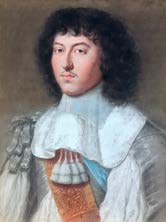
Figure 34.145: Portrait of French King Louis XIV, painted, around
1660, in pastel, by Wallerant Vaillant from Lille.
The Desclergues of la Villa Ducal de Montblanc, 2nd ed., Omn., VOL. II
© 2024 Nico F. Declercq

564
CHAPTER 34. ANTONI DESCLERGUE Y DE MONTOYA (DC06)
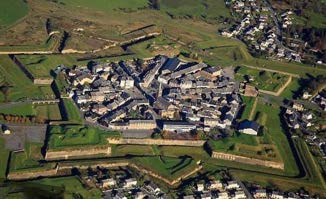
Figure 34.146: Aerial view of modern-
day Rocroi.
Figure 34.147: September 10, 1678, Waregem, the bap-
tism of Joannes Jacobus Crampe, son of Franciscus Car-
olus Crampe, who was a sergeant in the regiment Dalzas,
and of Maria Joanna Petit. Godfather was Joannes Ja-
cobus Sheryns, and godmother was Maria Joanna Carlisle
(’Carlie’).
Louis XIV was only five years old, and the regency was held by Anne of Austria from 1643 until 1651. Louis XIV married Maria Teresa of Spain in 1660 and reigned until he died in 1715.
Following the Battle of Honnecourt, French leadership faced significant challenges. The royal advisor, Cardinal Richelieu, died on December 4, 1642, and King Louis XIII fell ill in early 1643, eventually passing away on May 14. In the spring of 1643, the Spanish army advanced through the Ardennes to invade France to alleviate French pressure on the areas south of Kortrijk. The young French Duc d’Enghien and the experienced Jean de Gassion led a French division of 20000 soldiers from Amiens toward the Spanish forces near Rocroi. Upon arrival, the Spanish, under the command of Francisco de Melo, had already besieged the fortified town of Rocroi. D’Enghien positioned his forces close behind the Spanish, avoiding immediate confrontation. He learned of his king’s death on May 17 but withheld this information from his troops. It is essential to note the involvement of Fuentes (Paul Bernard de Fontaine) on the Spanish side, further discussed in Chapter 32 concerning Don Antoni Desclergue y Ratera, brother of Jeroni Joan Desclergue y Cortés (DC05) and uncle of Antoni Desclergue (DC06).
Upon hearing of the approach of 6000 additional Spanish troops to reinforce the siege, d’Enghien decided to relieve Rocroi urgently.
It prompted de Melo to direct his forces not to Rocroi but against the French. The armies clashed near Rocroi, with the French positioned on a ridge along the Oise River and the Spanish situated between them in Rocroi (Figure 34.80). The initial skirmish on May 18 was light, but on May 19, a full-scale battle erupted. The French adopted horizontal formations, while the Spanish employed traditional tercio formations. The Spanish defeat marked the last use of the tercio formation.
The battle bore significant similarities to the Battle of Austerlitz in 1805, detailed in Chapter 71.7.3.2, where Napoleon’s French army triumphed. Napoleon, known for his self-education in military history, likely studied the Battle of Rocroi. Both battles represented turning points in history. D’Enghien demonstrated strategic brilliance, advancing where his troops succeeded and accepting stalemates where necessary. This strategy enabled the French to encircle the Spanish and launch a rear attack, a maneuver known as l’illumination de génie décide du sort de la journée.
German, Italian, and Walloon troops quickly fled, while the Spanish continued to resist under heavy artillery fire until d’Enghien offered them honorable terms to withdraw into Belgium. The Spanish reorganized and defended the border between Belgium and France, preventing further French incursions into the Spanish Netherlands. While 1643 did not yield significant territorial changes, the French successfully countered the Spanish, a positive omen for the young King Louis XIV. Rocroi held symbolic value for France, akin to Austerlitz. De Melo described Rocroi as the most significant defeat for the Spanish in the Low Countries in his letters to the Spanish king. With Louis XIV too young to reign, Anne of Austria, sister to King Philip IV of Spain, acted as regent. After further military successes, the 21-year-old d’Enghien, later known as le Grand Condé, became legendary. The French victory bolstered France’s reputation at a politically vulnerable time, shifting the balance of power in Europe from Habsburg Spain to Bourbon France. By the Treaty of the Pyrenees in 1659 (Chapters 8.12.1 and 34.9), Spain was significantly weakened, losing territories like Catalonia and Dunkirk to France.
During the Battle of Rocroi, Fuentes (also known as Fontaines in Belgium and France) was killed. He should not be confused with Pedro Enríquez de Toledo, the Count of Fuentes. The chair used to carry him due to his poor health is displayed at the Musée de l’Armée in the Hôtel des Invalides in Paris. The museum’s object description notes: "Le comte de Fuentes (les Français l’appellent Fontaine) malade est conduit en fauteuil sur le champ de bataille. Ce fauteuil est exposé près du tableau de Condé à Rocroi."
Figure 34.148: 1680, Harelbeke, the funeral of Juan del
Teso (’Joannes la tesoet’), very likely with Spanish roots
although we are not sure, as it may also be ’la Tesout’ or
anything else.
© 2024 Nico F. Declercq
The Desclergues of la Villa Ducal de Montblanc, 2nd ed., Omn., VOL. II
34.6. MILITARY CAREER OF ANTONI DESCLERGUE AFTER 1641
565
Antonio Bermejo Herreros notes that hostilities against the French intensified from 1635 onwards, affecting the coast of Flanders.
In 1644, Gravelines became a focal point for the Spanish, while Bergues served as an observation center, troop gathering post, and hospital. In 1646, the Duke of Orleans captured Courtrai and then Bergues, which surrendered on July 29, 1646. The Marquis of Caracena and the Count of Bucquoy’s relief efforts were too late. However, Don Gaspar de Bonifacio recaptured Bergues in 1651.
The area returned to France in 1677 at the start of the War of Devolution, discussed in Chapter 8.12.
Antoni Desclergue was a sergeant (Sarganto) who witnessed a wedding at the Spaniard Castle in Ghent in 1646 (Figure 34.81).
André Woestijn explains that French troops advanced toward the Southern Netherlands after the Spanish defeat at Rocroi in 1643.
In October 1643, French forces reached Harelbeke to assault Kortrijk, but Spanish cavalry repelled them. On August 16, 1644, Harelbeke’s inhabitants were mustered to defend against the Croats, soldiers of the Duke of Lorraine’s army camped at Ardooie.
French Marshal Jean de Gassion captured Menin from the Spanish on September 23, 1645, but the Spanish under Marquis de Caracena retook it the same year.
In September 1645, the French threatened Kortrijk again, causing religious nuns from Harelbeke to seek refuge in Kortrijk. On May 1, 1646, the French attacked the Castellany of Kortrijk. By June 13, the Duke of Orleans and Enghien’s armies camped in Harelbeke and crossed the Leie, preparing to attack Kortrijk from the cemetery in Kuurne. The Spanish army was split, with forces in Tournai and Boezinge. On June 20, heavy fighting occurred around Harelbeke. D’Orleans surrounded Kortrijk on June 24, and after a four-day siege, the city surrendered. The surrounding areas were devastated.
In February 1647, the French fortified Kortrijk, but the Spanish recaptured it. In 1648, General Becq besieged Kortrijk from Kuurne and Bissegem while the Duke of Lorraine crossed the Leie in Harelbeke, establishing connections and spreading troops. On May 19, 1648, Kortrijk was stormed by Spanish, Walloon, German, and Italian forces, ending 23 months of French occupation. The Spanish held Kortrijk until 1667.
Woestijn found evidence of the dire conditions in Harelbeke in 1648. Despite a safeguard, the farm Harlembois was devastated, and the tenant refused to live there. The military activity had brought Harelbeke to its knees. The Peace of Münster in 1648 ended the Eighty Years War, and the bridge in Harelbeke, destroyed during the war, was repaired in 1652 with city loans.
The scenic area between Namur and Rocroi is defined by the Meuse and Semois Rivers (Figure 34.82). In 1644, Antoni Desclergue (DC06) honored his connections in Ghent by witnessing a wedding of Spaniards (Figure 34.83).
The significance of Rocroi for France is primarily symbolic and an indicator of a turning tide that began under King Louis XIV, which is why French historians at the time often exaggerated its importance. While it is true that France would secure subsequent victories, the Battle of Rocroi was less decisive than French propaganda suggested. An analysis from Historia de la Guerra en la Edad Moderna, based on the literature4546, placing the battle in a broader context.
In 1642, a year before the Battle of Rocroi, the forces of the Hispanic Monarchy achieved significant victories at Lens, La Bassée, and the Battle of Honnecourt. Thus, claiming that the tercio system became obsolete just one year after the perceived defeat in 1643 is inconsistent. The Battle of Rocroi resulted in fewer casualties for the French than the Spanish. Yet, Enghien was compelled to withdraw his forces to allow them to recuperate, and he did not launch an offensive against the heart of the Spanish Netherlands in the subsequent months. The immediate consequence was the loss of Thionville, besieged by the French from June 16 and surrendered on August 10, 1643, following a costly siege that reportedly cost the French around 3000 lives.
The French propaganda apparatus seized the opportunity to depict Rocroi as a decisive victory over the Spanish. This narrative bolstered the precarious authority of the regent Queen Anne of Austria and her bold new Cardinal Mazarin. A loss at Rocroi would have had devastating consequences for the regency. Thus, a myth was created, which grew stronger over the ensuing decades and was accepted uncritically by French historians and later adopted in Spain.
Following Rocroi, the Spanish reorganized. The Count of Fuensaldaña’s incursions in Boulonnais forced the Duke of Angoulême to withdraw his forces from Flanders. In the north, Dutch attempts to invade the Spanish Netherlands were repelled by Neapolitans Andrea Cantelmo and Francisco Pardo, who defeated the enemy cavalry near Maastricht.
Despite the Prince of Orange’s efforts, the Spaniards suffered only one significant defeat on September 4, 1643, when Juan de Borja and Aragon’s cavalry were ambushed, resulting in over 600 prisoners. The French were defeated near Tuttlingen on November 24.
The combined forces of the Imperial, Spanish, Bavarian, and Duchy of Lorraine armies defeated Marshal Rantzau, capturing him and his generals and losing their artillery. Of Rantzau’s 15000 men, only 4,500 escaped.
The losses at Rocroi did not prompt criticism of the tercio system’s effectiveness. No contemporary military authority discredited its structure. In December 1643, the Spanish army in Flanders comprised 12992 officers and 64745 infantry and cavalry soldiers, totaling 77,737—a significant number compared to the forces’ evolution between 1621 and 1659.
The war between France and Spain continued for 16 more years until 1659. By 1643, many of the war’s early protagonists had perished or disappeared from the political scene: Cardinal Richelieu died in December 1642, and Louis XIII in May 1643, shortly before Rocroi. Cardinal Mazarin and Queen Anne of Austria served as regents for the young Louis XIV until 1651. From 1648, France experienced intense internal conflicts between the Monarchy, the Parisian parliament, and the upper nobility, effectively led by Prince de Condé.
The Hispanic Monarchy faced additional challenges in 1647 and 1648, with revolts in Catalonia, Portugal, Naples, and Sicily. The fall of Olivares in 1643, who died in 1645, led to Luis de Haro succeeding him as Philip IV’s valid heir. The conflict saw alternating advances and setbacks on all fronts. The Spanish maintained a strong position in Flanders until 1647. In 1646, the French occupied parts of Artois and Hainaut and advanced into Flanders, capturing Dunkirk and Condé. In 1644, Philip IV refocused efforts on Catalonia, recapturing Lleida and defeating La Motte-Houdancourt’s army. Subsequent years saw the defeats of two notable French generals, the Earl of Harcourt and the Count himself, at Lleida’s ramparts.
During the 1648 Peace of Westphalia negotiations, Mazarin proposed allowing the Rosellon to pass through the Spanish Netherlands, which was rejected. From 1648, France’s internal conflicts constrained operations on all fronts until 1653. This diversion of French forces allowed the Spanish to reclaim much territory lost earlier. In the Netherlands, all French conquests reverted to Spanish control except for Arras, Hesdin, and Thionville. In 1652, Spanish armies captured key locations such as Barcelona, ending the Catalan rebellion, and the port of Dunkirk and Casale Monferrato. In 1653, even Rocroi fell back into Spanish hands.
According to historian Juan Luis Sanchez, an expert on the tercio system, "the string of Spanish victories in Flanders between 1647
and 1653 was only surpassed by those of Alejandro Farnesio between 1579 and 1592 and preceded by those of Ambrosio Spinola (1603 to 1607 and 1623 to 1627)."
In 1655, Oliver Cromwell’s England entered the conflict, ultimately shifting the balance in favor of France. English forces played a decisive role by blocking American money in Tenerife for several months, which harmed the Spanish economy, and by supporting Marshal Turenne’s French army at the Battle of the Dunes in 1658. The Spanish defeat under Juan José of Austria and the 45Alex Claramunt Soto and Thomas San Clemente de Mingo, Rocroi and The Loss of Rosellon. Sunset and Glory of the Thirds. Zaragoza, 2014.
46Davide Maffi, In Defense of the Empire, Madrid, 2014.
The Desclergues of la Villa Ducal de Montblanc, 2nd ed., Omn., VOL. II
© 2024 Nico F. Declercq
CHAPTER 34. ANTONI DESCLERGUE Y DE MONTOYA (DC06)
Prince of Condé forced Spain to negotiate from a weakened position. The Peace of the Pyrenees was ratified in 1659 on Pheasant Island, limiting French gains to Rosellon, Artois, and a few strongholds in Hainaut and Luxembourg—far less than Richelieu had anticipated in 1635. Historian David Parrott describes the Peace of the Pyrenees as "a commitment reflecting an existing balance of forces rather than a military diktat imposed by the victorious powers."47
Thus, while the Battle of Rocroi is celebrated in French historiography as a turning point, its immediate military impact was limited. However, it played a significant role in the broader context of the Franco-Spanish conflict of the 17th century, symbolizing a shift in momentum and contributing to the eventual decline of Spanish hegemony in Europe.
34.6.3 Troops and their Families in the Area Deerlijk-Harelbeke-Kortrijk and their Impact on
the Inhabitants during the Lifetime of Antoni Desclergue - after 1641
Before we show evidence, it’s important to note that even the priest of Harelbeke in this period was Spanish. Indeed, Francisco Sanchez was the priest from 1646 until March 2, 1662. He was replaced by Petrus Vercruysse (was this perhaps a Pedro de la Cruz
?) in 1662 and died as a priest in Staden on December 9, 1669. Petrus Vercruysse had been a priest in Vichte before he became a priest of Harelbeke. He died as the canon of the chapter (capittel) on February 7, 1712. This can be found in the church registers and is summarized by André Woestijn48.
We recall that the area was important for several reasons. It was relatively close to the French border. It was located along the Leie River. The site was necessary for the textile industry, using Spanish and English wool and local flax. Troops arrived, and troops left. Some resided in the area after purchasing a property. Others stayed in Barracks located at Overacker along the Beveren Creek, East of the town of Harelbeke. Only when dense troop concentrations appeared was lodging imposed on the city’s inhabitants, which they detested. The presence of soldiers is witnessed in church records, such as in Figures 34.84, 34.85, 34.86, 34.87, 34.88,
34.89, 34.90, 34.91, and 34.92.
In Deerlijk, 1642, we found, for instance, a baptism certificate of a certain Jose Pages (’Judocus Page’), son of Pere Pages (’Petrus Page’) and Margarete de Voldere. The Godfather was Nicolaus de Smet, and the godmother was Catharina Tumerel (’Tumeriels’).
Catherine Tumerel was likely from Douai, perhaps the father too, or he might have even been Spanish because Pere Pages is also a Spanish name from the Gerona area (Catalan).
A similar example is shown in Figure 34.94. Douai is the area where, one or two decades before, Carlos Coloma had thrived.
Tumerel has appeared more than once as godmother at Deerlijk during those years. Therefore, she probably had some importance.
The same couple had another son, Rolando, in 1640. There is no further trace of the two children in Deerlijk, so they were not a local family.
In Deerlijk and Waregem, in the 1630s—1640s, the (de) Hamaya family existed, as we have found several baptisms and weddings.
However, we are still determining if this is the old version of the common name Ameye. Two families existed then in Deerlijk: a Spanish family, Hamaya, and an indigenous family, Ameye. Because we are not sure, we are not showing the certificates.
Gaspar Portocarrero, shown in Figure 34.87, was probably related to Hernándes Teillo Portocarrero, who was involved in 1597 in the capture of Amiens, together with Jeroni Joan Desclergue y Cortés (DC05), as was described in Chapter 29.5.24. The involved Petrus Clere, or Pieter Declercq, was Antoni Desclergue’s brother-in-law (DC06) and is described in Chapter 35.
There had been problems with French Huguenots in the past, but the issues with France’s regular troops began in February 1635, when Louis XIII took the side of the Dutch States and helped to squeeze the Belgians from the South and North flanks.
On September 23, 1645, the French occupied the town of Menin, i.e., the neighboring city of Kortrijk along the Leie in the Southwest.
This resulted from a Spanish defeat at Rocroi, explained in Chapter 34.6.2, on May 19, 1643.
Right after the capture of Menin, the French set fire to the town of Kortrijk, and a large portion burned down. Just as during the years when Ostend had been Dutch, the Casselrye of Kortrijk fell victim to plundering, primarily by French troops who sneaked in and occasionally Spanish troops who took advantage of the situation.
As mentioned above, there was a Siege of Kortrijk by the French in the summer of 1646. Delli Ponti was in charge of defending the town of Kortrijk. The assault was launched by the Duque of Orleans and the Duque of Engien, i.e., almost 30000 French soldiers.
Antoni Desclergues (DC06) helped to defend the town of Kortrijk as part of the Spanish defense. The Spanish, led by the Duque of Lorraine, shown in Figure 34.78, reached Kortrijk from the West, i.e., from Boezinge near Ypres, to help defend the city. The actual release would then come from the South, i.e., from the area of Tournai. Note that the Duque of Lorraine was then Charles IV, born in Nancy in 1604. The attempt to release Kortrijk from the French Siege came mainly from the South and East, and there have been bitter fights in Deerlijk, Harelbeke, Kuurne, and Heule. Many people from those areas had found security within the walls of Kortrijk. On June 28, 1646, the town of Kortrijk surrendered to Gaston de France, the Duque of Orleans, shown in Figure
On July 8, 1646, Louis XIV held a Te Deum in Paris to thank God for the capture of Kortrijk. The citizens of Kortrijk were allowed to keep their possessions and their laws, rules, and privileges.
The war continued around Kortrijk, however. On August 16, 1646, Menin surrendered. Starting in February 1647, the French built a citadel in Kortrijk, where the Gentpoort is located until the border with Harelbeke. Later, the French fortified the city, which considered Kortrijk a defense position in the North and could also be used as a base for further offenses.
Again, ecclesiastic records witness the presence of the military in the area, as shown in Figures 34.94, 34.95, 34.97, 34.98, 34.99,
The Spanish, led by General Beck (Baron Jean de Beck), during the reign of Duque Leopold of Austria, tried to take Kortrijk back from the French first in October 1647 and then in February 1648, and then finally, with success, on May 12, 1648. The victory was due to the combined forces of the Spanish, Walloons, Germans, Italians, and Lorraines. The citadel of Kortrijk was able to withstand the Spanish attack but was also defeated on May 25.
Then, the Spanish held a Te Deum at Kortrijk to celebrate their victory.
So, in 1648, the town of Kortrijk became Spanish again, and it was decided to dismantle most of the fortifications in 1654 and 1655
because they appeared useless to the Spanish. Even the road to the town of Kortrijk was restored when arriving via Harelbeke from Ghent’s direction.
This is also when the son of Antoni Desclergue (DC06), namely Antoni Declerque (DC07), described in Chapter 37, married Martina de la Cruz in Deerlijk.
There was a period of peace then for Kortrijk and its surroundings. The Peace Treaty of Munster ended the hostilities between the Spanish Netherlands and the Dutch States, but there was no such treaty with France. Therefore, there was always a danger of 47David Parrott, Richelieu’s Army: War, Government and Society in France, 1624-1642. Cambridge, 2001.
48André Woestijn, ’Harelbeke in de Spaanse tijd, 1585-1713,’ De Roede van Harelbeke (De Leiegouw), nr 14, 1994.
© 2024 Nico F. Declercq
The Desclergues of la Villa Ducal de Montblanc, 2nd ed., Omn., VOL. II
34.6. MILITARY CAREER OF ANTONI DESCLERGUE AFTER 1641
567
France invading the region again. For this reason, there was continuously a military presence, especially in Winter, in and around Kortrijk, in Figure 34.96, famous for its citizen Jan Palfijn in Figure 34.101.
The Spanish presence is perhaps best seen in Harelbeke, where from 1649 onwards, the priest is Spanish, as found in the book of funerals of Harelbeke, in Figure 34.97.
In this context, we can mention that Carles de Colom (or Carlo de Colombo) led a regiment in the Spanish army during the battle of Rocroi in 1643, in the reserve brigade of Baron de Andre in the artillery of Alvaro de Melo under the general command of Captain-General Don Francisco de Melo. Anna de Colom, shown in Figure 34.100, may have been the daughter of Carles de Colom.
On the other hand, there is also a chance that this family belongs to the Coloma family (children of or relatives of Carlos Coloma and Marguerite de Liedekerke).
Note that Anna Tax, who appears in Figure 34.102, was Antonia Taja with Spanish roots. She was sometimes referred to as Anna and sometimes as Tanneke; she was the wife and later also appeared as the widow of Miguel De Vos. She had a daughter Margarita, born in Deerlijk in 1634, a son Jan, born in Deerlijk in 1639, as seen in Figure 49.10 on page 998, a son Antoni, born in Deerlijk in 1641, and a son Guillermo, born in Deerlijk in 1642. Adrianus de Vos was probably a brother of Miguel de Vos and was married to Petronella Vandenbulke.
It s interesting that Pere Declerque (DC07d), a son of Antoni Desclergue (DC06) and Beatrice Declercq (DK02byx), married Florence Vandenbulke at Deerlijk in 1655. The latter may have been a sister of Petronella Vandenbulke. It’s indeed characteristic of the 17th century that our family married within a Spanish cluster.
Bucquoy also appears in Figure 34.102. The Conde de Bucquoy led a regiment from Alsace in the Spanish army in the brigade led by the same, in the right-wing division led by Ernst Graf von Isenburg artillery of the Spanish military conducted by Alvaro de Melo under the general command of Captain-General Don Francisco de Melo.
After Antoni’s (DC06) return to Deerlijk, the area suffered from the conflict between France and Spain.
More appearances related to the Spanish army are found in Figures 34.104, 34.105, and 34.106.
For clarity, we present the transcript of the baptism in Figure 34.106, at Harelbeke in 1650:
’Die vigesima quinta mensis decembris 1650 ego infrascriptus capellanus hispaniae legionis don Gasparis Bonifacio catechizavi Mariam Joannam (quae baptisata fuit Cortraci die 23a julij anno 1650 filiam don Hieronimi de Benavente Quinones sargenti maioris dictae legionis et d: Anna de Horosquo eius elgitimae coniugis. Fuerunt patrini don Ambrosius de Benavente y Quinones et dona Margareta des Maré loco loco dona Joannae Margaretae de Horosquo. Quibus nota sunt cognatio spiritualis da horunt supra et erat subscriptum Lucas Cavallero.’
In English, this means:
’On August 25 have I, chaplain of the Spanish legion of don Gaspar de Bonifacio, catechized (legalized) the baptism of Maria Joanna de Benavente y Quinones, who was baptized at Kortrijk on July 23, 1650, daughter of don Geronimo de Benavente y Quinones, a sergeant in the mentioned legion, and of Dona Anna de Orozco, his legal wife. The Godfather was Don Ambrosius de Benavente y Quinones, and the godmother was Dona Margareta de Mare, replacing Dona Joana Margareta de Orozco. We note a spiritual link (e.g., Godfather and Godson) between the two men given above, and Lucas Cavallero signed the document.’
The family de Orozco was linked to Martina de la Cruz’s family, described in Chapter 37.4, in particular, in Chapter 37.4.2, who married Antoni Declerque (III) (DC07) at Deerlijk in 1656. Indeed, Martina’s full name was Martina Ximenez de la Cruz, where Ximenez was her grandfather’s name and De la Cruz was her grandmother’s. Martina’s cousin, uncle, or father’s cousin (we could not find any closer identification) was Joan Jeroni de la Cruz y Orozco, a captain in the Spanish army who lived until 1677. He married Gracia de Bermudez, the daughter of Luis Cordobes y Hurtado de Mendoza and Maria de Melo Cabral y Martin Lozano.
Indeed, for instance, during the battle of Rocroi, the military section of Gaspar de Bonifacio, clearly present in the area of Deerlijk-Harelbeke-Kortrijk around 1650, belonged to the brigade of Juan Perez de Vivero in the left-wing Tercio division of Francisco de la Cueva, the Duque of Albuquerque in the artillery of Alvaro de Melo of the Spanish Army of Flanders under the command of the Captain-General Don Francisco de Melo.49
Alfonso Ceballos-Escalera y Gila (marqués de la Floresta),50 states that Gaspar de Bonifacio y Godinex was knighted in 1625 as Caballero de Alcantara; he was born in Segovia in 1612 and was General de Artilleria and Sargento General en Flandes.
Whoever knows Sri Lanka knows the de Melo family. This family is less known in Belgium. Dom Francisco de Melo was a Portuguese nobleman and general. He was born in Estremoz, Portugal, and was marquis of the Portuguese Tor de Laguna, count of Assumar, and, from 1641 to 1644, interim governor of the Southern Netherlands.
When Francisco de Melo came to Belgium, he had a political career. From 1632 to 1636, he was the Spanish ambassador to the Republic of Genoa. In 1638, he was appointed Viceroy of Sicily, and two years later, he was ambassador in Vienna. Nevertheless, Francisco de Melo is remembered for the defeat during the battle of Rocroi in 1643, which ex post facto has been regarded as one of the critical steps in the decline of the Spanish empire. Francisco de Melo also had military successes, e.g., in the battle of Honnecourt the year before, described in Chapter 34.6.1, but they have been forgotten.
The peculiar shape of Belgium, particularly the protrusion south of Dinant, often prompts curiosity among Belgians. This seemingly missing piece, which appears like France is encroaching on Belgian territory, can be traced back to the aftermath of the Battle of Rocroi in 1643. As explained above, during this pivotal battle, the Spanish forces suffered a significant defeat at the hands of the French, resulting in territorial losses for the Spanish Empire.
Rocroi, now situated in modern France, lies close to the Belgian border south of Philippeville, a town named in honor of King Philip IV of Spain. It is strategically positioned between the Belgian town of Chimay and the French city of Charleville-Mézières. The Spanish defeat at Rocroi marked the beginning of a shift in territorial control, contributing to shaping the Franco-Belgian border as we know it today.
The Treaty of the Pyrenees, concluded in 1659, concluded the Franco-Spanish War and formalized many territorial changes, including those that impacted the southern border of what is now Belgium.
The area around Rocrois was also where, during WWI, forced laborers from Deerlijk had to work for the Germans, as explained in Chapter 69.9.1.3.
Additional records of interest in this period are found in Figures 34.107, 34.108, 34.110, 34.111, 34.112, 34.113, 34.114, 34.115,
A couple of military-related deaths at Kortrijk can be found in 1653, such as Figure 34.118 that lists the following persons: Maria Plonquet and Philippe Le Bon. We can also see Marie Prolez from Cambrai (’Cameracens’), the wife of Jacobus Delos (’De Laus’ or ’Laus’), a soldier in the regiment of Bonifacius. We also find Magdalena O’Seighin (’Sincher’), the wife of William Delaney (’Delual’), a soldier from Ireland.
49Higgins, David. ’Battle File: Rocroi, May 19, 1643.’ Strategy & Tactics, Number 244, July 2007.
50Alfonso Ceballos-Escalera y Gila (marqués de la Floresta), ’Nómina de caballeros recibidos en la Junta de Nobles Linajes de la ciudad de . . . ’
The Desclergues of la Villa Ducal de Montblanc, 2nd ed., Omn., VOL. II
© 2024 Nico F. Declercq
CHAPTER 34. ANTONI DESCLERGUE Y DE MONTOYA (DC06)
Also, in Deerlijk, some interesting records can be found in Figures 34.119, 34.120, 34.121,34.122, 34.123,34.124 34.125, 34.126.
Note that the family ’de la Pierre’ in Figure 34.119 was linked through marriage (see the work of Coloma) to Adrien Comte de Berlo, who would lead a whole regiment of mercenaries and stay in Deerlijk in 1658, as can be found further down and, for instance, in Figure 34.139. The family was also linked, again through marriage, to the family de Bucquoy.
Although we still need help with the finer details, the current work exposes the links between Desclergue and Maes (de la Maza, Masa, Mas, Masius). For instance, in 1653, a child of de la Maza and Pages was baptized, for which Antonio de la Maza and Anna Declercq were godfathers and godmothers. Antonius Maes has been a student at the Catholic University of Leuven. His matriculation is shown in Figure 34.153 on page 574.
We must mention that between 1654 and 1658, in Deerlijk, much higher than the average number of illegal children were born. One example is shown in Figure 34.127. The baptism certificate states in Latin:
’Baptisata est Maria van Mullem filia Judoci et Catharina Nerinckx ex illigittimo thoro nata hac August 25 1654 cuius susceptores sunt Petrus de Grave Maria de Brabander quod hic proles non sit gravatur(ea?) parochiam de Deerelyck pate(r) constituit se fidei iussorem sicut constat per litteras iuridice confectas per Jacobum le Maiuer consulem Harelbec(ensem?) scriptas ut mihi ipse fassus est. Et mater et proles sunt defunct(ae?). Ergo: nullum periculum quod parochia inde gravebatur,’
which roughly translates to,
’Maria Mullem was born, she was an illegal child of Catherine Nerinckx and Judocus Merincks, who had promised to support her financially; Petrus De Grave and Maria de Brabander were godfather and godmother; nevertheless, the child, as well as the mother, have died.’
Guzmán, as seen in Figure 34.128, is linked to the Spanish army.
Indeed, the tercio regiment of Antonio de Velandia Guzmán (a Spanish military) belonged to the brigade of Paul Bernard Conde de Fontaine (see the battle of Rocroi in Chapter 34.6.2), also known as ’Fuentes’ 51 in the center division lead by the same, in the artillery of Alvaro de Melo under the general command of Captain-General Don Francisco de Melo. Other interesting examples of 1655 are found in Figures 34.128, 34.129, 34.130, 34.131.
During the Winter of 1656-1657, the regiment of Serralvo, i.e., 736 men, resided in Kortrijk. In 1658, a regiment was initially meant for Dendermonde, but the troops were placed in Kortrijk because Dendermonde paid a lot to the government.
In the Spring of 1657, six English companies of the regiment of Dourmont arrived in Kortrijk to stay for two months. Around the new year 1656-1657, Francesco Romero’s garrison came with 800 cavalries in Kortrijk. The period equally offers interesting church records, shown in Figures 34.132, 34.133, 34.134. Soon after, we found more exciting evidence in Figures 34.135, 34.136, 34.137,
34.138, 34.139, 34.140, and 34.141.
At Harelbeke, in 1658, according to the famous book on the genealogy of Carlos Coloma52, Antoine van Cauteren became provost.
He was a relative of Carlos Coloma.
In 1658, the French army of Turenne invaded Flanders again and conquered Dunkirk on June 14, Menin on September 9, and Ypres and Oudenaarde. The villages around Kortrijk, including Deerlijk and Harelbeke, were devastated, and fighters stole their crops.
The devastation was caused by the French and the Spanish troops led by Berlo. The soldiers, probably mostly Flemish, Walloon, German, and Italian soldiers, in service of the Spanish in Deerlijk, were there to defend the region, particularly Kortrijk. It is found in books that they did not behave well. Historical records indicate that the conduct of this military was often less than exemplary.
Interestingly, in the book of baptisms of Deerlijk, for the period 1647-1659, the priest wrote on the cover page, in Flemish,
’De 11ste van Augustus 1658, logeerden in Deerlick omtrent vierduyst hurlingen,’ and ’op het zelve jaer vlugten gans Berlots (’Barlots’) volck ende deinde vier maenden dat wij ferenigt waeren.’
Translated, this means
’On August 11, 1658, around 4000 mercenaries were stationed at Deerlijk’ and ’in the same year the entire crowd of Berlo fled and ended the four months that we had been together.’
These were Spanish mercenaries because the French did not rely on mercenaries but only their soldiers. It is known that Berlo led the Spanish army around Kortrijk to resist the French invasion of the area.
In November of 1659, the Treaty of the Pyrenees, explained in Chapter 8.12.1 and Chapter 34.9, was signed, and the French left Flanders again, step by step; Menin turned Spanish back by March 1660.
There was peace again in Kortrijk and the surrounding villages for a few years. However, the military remained because of its location along the Leie River and close to the French border. Evidence is shown in Figures 34.142, 34.143, and 34.144.
Note that in 1657 in Deerlijk, shown further in this book, we found a baptism, in Chapter 37.9.3, of Joana Declercgz (DC08b), daughter of Antoni Declerque (III) (DC07) and Martina Vercruyce / De la Cruz. Godfather was Antoni Desclergue (II) (DC06), and godmother was Joanna (De) Tila. The latter family is also found in Figure 34.143.
In Chapter 48.3.2, a marriage certificate is also shown of 1670 at Deerlijk, between the Mazza and de Bels family.
A new war began on May 8, 1667, that would take two years and is known as the devolution war, described in Chapter 8.12.1 and Chapter 34.10, between France and Spain, described in Chapter 8.12.1. Indeed, France decided to take the Spanish Netherlands and argued, employing Louis XIV, shown in Figure 34.145, that it had inherited the country. So, Turenne invaded Belgium to fight against Charles II, and because, at that time, the country was not well defended, one city after the other fell into the hands of the French. On July 14, 1667, a new Siege of Kortrijk began, and the town surrendered on July 17. On July 28, 1667, the surrender was signed for Kortrijk and the entire Casselrey.
On May 2, 1668, the Peace Treaty of Aachen ended the hostilities between France and its enemies. However, the conquered territories, including the Castellany of Kortrijk, remained French. In 1672, a war between Holland and France began. The French now used Kortrijk as a base for guerilla attacks on the remaining Spanish territories, which forced the Spanish to counterattack the Castellany of Kortrijk.
The French period for Kortrijk, during which Louis XIV had visited the town twice, lasted until 1678, with the Peace Treaty of Nijmegen, explained in Chapter 34.11. The Treaty gave most of the Castellany back to the Spanish. However, Menen, Bissegem, and Heule would remain French.
While Louis XIV stayed in Kortrijk in May 1673, he primarily resided near the border with Harelbeke, perhaps even on Harelbeke soil. Meanwhile, 46000 French soldiers were stationed around Harelbeke, occupying the flatlands mainly to the town’s southwest, south, and southeast.
An Interesting record from 1678 is shown in Figure 34.147.
The Treaty of Nijmegen did not accurately determine which territories would stay French or return to Spain. For this reason, a special commission, namely the Chambre de Réunion, was established in Metz in 1680, but it could not resolve all the disputes.
51Bernard de la Fontaine must not be confused with Pedro Enríquez de Toledo, Count of Fuentes.
52written by Jose Felix Antonio Francisco Azevedo Coutinho y Bernal
© 2024 Nico F. Declercq
The Desclergues of la Villa Ducal de Montblanc, 2nd ed., Omn., VOL. II
34.6. MILITARY CAREER OF ANTONI DESCLERGUE AFTER 1641
569
A funeral at Harelbeke in 1680 is shown in Figure 34.148.
On September 4, 1683, Harelbeke was occupied by the French, led by the Duque of Boufflers, while Kortrijk remained Spanish.
Then Kuurne was taken by Boufflers, and Kortrijk fell under attack. Civil guards mainly defended the town of Kortrijk, but it was fortified, and they had sufficient ammunition. On November 3, 1683, the French army arrived in Harelbeke, led by Marechal d’
Humières. Kortrijk surrendered on November 4.
However, the Spanish soldiers in the town did not comply and pulled back into the citadel. They had no other option than to resign on November 6.
The French forces, primarily stationed in Harelbeke, inflicted significant devastation in the ensuing years on any individuals, villages, or towns that resisted their demands. Acts such as burning homes and looting were commonplace. The year 1683, in particular, was marked by widespread destruction and hardship.
Regensburg’s Treaty forced the French to leave Kortrijk again on August 16, 1684, and all fortifications had to be removed. Kortrijk became an open city without walls, citadels, or castles. Thus, most of the city’s history was demolished, and Kortrijk was transformed from a critical municipality to an unimportant town. The last French troops departed on May 21, 1685.
In the years to follow, the area around Harelbeke formed the stage of warfare again. In the summer of 1689, the French had still to be expelled from the district. Don de Castanaga did this with 20000 Spanish and Dutch troops.
These troops consequently moved south to defend Belgium against the French. In 1690, around 21000 French troops stayed in Harelbeke and occupied the entire area between Kortrijk and Beveren-Leie. In 1694, about 30000 French troops resided just south of Kortrijk.
In the years after, Kortrijk and its surroundings continued to play an essential role in the military.
The Desclergues of la Villa Ducal de Montblanc, 2nd ed., Omn., VOL. II
© 2024 Nico F. Declercq
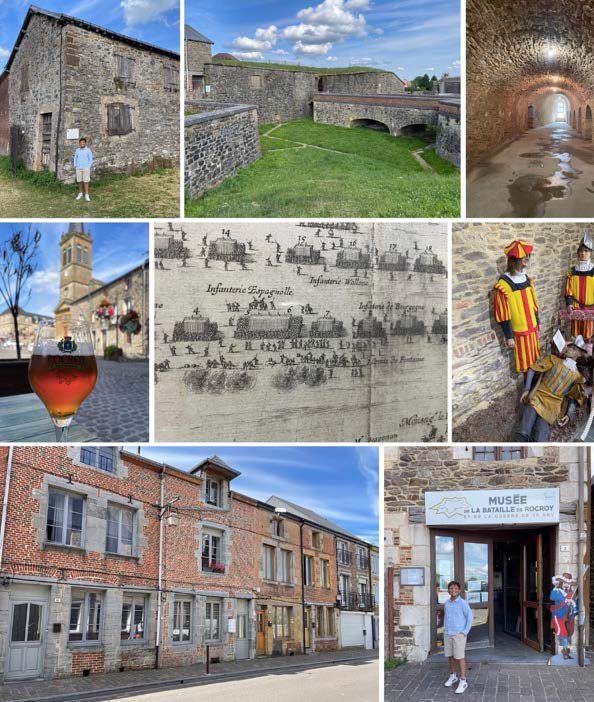
570
CHAPTER 34. ANTONI DESCLERGUE Y DE MONTOYA (DC06)
Figure 34.149: Rocroi. The top photos show the commanding officer’s stables, built during Vauban’s time. It held 19 horses belonging to the Commanding Officer. In the middle, the modern church is shown, and a local beer and a presentation of Fuentes (Fontaine) are wounded on his chair. At the bottom, the entrance of the local museum is shown, ’Musée de la Bataille de Rocroy et de la Guerre de 30 ans.’
© 2024 Nico F. Declercq
The Desclergues of la Villa Ducal de Montblanc, 2nd ed., Omn., VOL. II