The Desclergues of la Villa Ducal de Montblanc, Second Edition Omnibus by Nico Declercq - HTML preview
Download the book in PDF, ePub, Kindle for a complete version.

504
CHAPTER 33. ENRIC DESCLERGUE Y CORTÉS (DC05C)
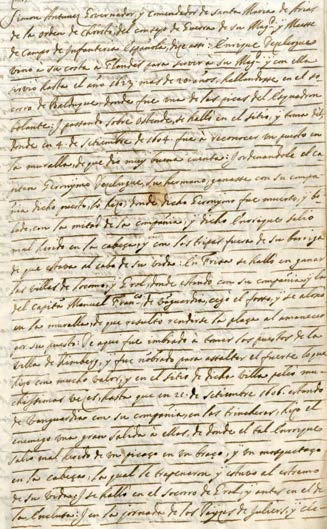
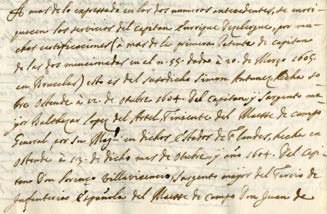
Figure 33.6:
This is a fragment of a
handwritten ’1661 transcript of nobility
letter Francesc de Pedrolo y Desclergue’
by Francesc de Pedrolo y Desclergue (born
in 1641, son of Jacint de Pedrolo and Is-
abel Desclergue y Tous). (Source: Arxiu
Comarcal Urgell Desclergues document 3
page 13 view 3; Courtesy of Arxiu Comar-
cal Urgell and the de Pedrolo family)
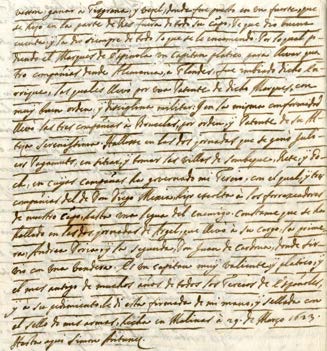
Figure 33.7:
This is a fragment of a
handwritten ’1661 transcript of nobility
letter Francesc de Pedrolo y Desclergue’
by Francesc de Pedrolo y Desclergue (born
in 1641, son of Jacint de Pedrolo and Is-
abel Desclergue y Tous). (Source: Arxiu
Comarcal Urgell Desclergues document 3
page 13 view 4; Courtesy of Arxiu Comar-
cal Urgell and the de Pedrolo family)
Figure 33.8:
This is a fragment of a
handwritten ’1661 transcript of nobility
letter Francesc de Pedrolo y Desclergue’
by Francesc de Pedrolo y Desclergue (born
in 1641, son of Jacint de Pedrolo and Is-
abel Desclergue y Tous) (Source: Arxiu
Comarcal Urgell Desclergues document 3
page 14 view 1 (it follows the previous frag-
ment); Courtesy of Arxiu Comarcal Urgell
and the de Pedrolo family)
© 2024 Nico F. Declercq
The Desclergues of la Villa Ducal de Montblanc, 2nd ed., Omn., VOL. II
33.3. HIS CAREER
505
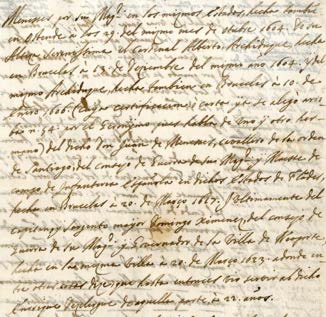
Figure 33.9:
This is a fragment of a
handwritten ’1661 transcript of nobility
letter Francesc de Pedrolo y Desclergue’
by Francesc de Pedrolo y Desclergue (born
in 1641, son of Jacint de Pedrolo and Is-
abel Desclergue y Tous). (Source: Arxiu
Comarcal Urgell Desclergues document 3
page 14 view 2; Courtesy of Arxiu Comar-
cal Urgell and the de Pedrolo family).
Figure 33.10:
This is a fragment of
a handwritten ’1661 transcript of nobility
letter Francesc de Pedrolo y Desclergue’
by Francesc de Pedrolo y Desclergue (born
in 1641, son of Jacint de Pedrolo and Is-
abel Desclergue y Tous) (Source: Arxiu
Comarcal Urgell Desclergues document 3
page 14 view 3; Courtesy of Arxiu Comar-
cal Urgell and the de Pedrolo family).
He also took part in the battles in the areas of Gulik (Juliers , or Jülich) and Kleef (Cleves or Clevesson). He won in Aachen (Aquisgrán, which in this manuscript appears as A Tisgrana), and Wesel (Vesel), where he was stationed at a fort at Rees (Res) far from the main camp.
Because of his extraordinary leadership and bravery, Enric received a patent from the Marquis of Spinola to lead, as captain, four companies in Flanders and Germany. It was under his leadership that Jülich (Gulik or Juliers) was successfully besieged and that the towns of Lembeck (Lembeque), Rees (Rese), and Goch were captured. Enric Desclergue escorted three companies, that of Diego Mexía Felípez de Guzmán y Dávila, 1st Marques de Leganes (Don Diego Messia) and that of Simón Antúnez to about 1 mile from the enemy. It was comparable to the excursion to Algiers (Argel), when Andrea Doria was in charge, while Don Juan de Cardona carried the flag.
Enric Desclergue was a courageous captain for many years. Although merely a handful of examples were listed above, Simón Antúnez was proud to sign and seal the eulogy in Mechelen on March 29, 1623.
Concerning the Spanish attempts to conquer Algiers, some interesting references are found that indicate the involvement of Spanish military from Flanders.
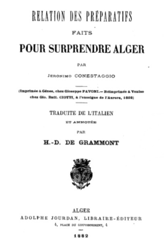
One can make reference to Jeronimo Conestaggio’s work, shown in Figure 33.32, titled ’Relation des préparatifs faits pour surprendre Alger’ from 1882. In this text, Conestaggio mentions the presence of adventurers, individuals of significant importance. He specifically says the Duke of Parma, who arrived with a contingent of two hundred Knights, his vassals, and experienced soldiers from Flanders. This publication is also found in Marco Ramerini’s paper23
The jornadas of Arzel in Algiers were overseen by Prince Andrea Doria and Don Juan de Cardona. There were two expeditions, or rather attempts at expeditions, with the primary goal of conquering the city of Algiers in North Africa. During that period, Algiers served as a hub for piracy, as maritime vessels belonging to European naval forces navigating the Mediterranean Sea were targeted and attacked. The incursions perpetrated by pirates resulted in significant detrimental effects on commercial activities within the Mediterranean region. The primary strongholds of these pirates were situated along the Mediterranean coastline of northern Africa, including the urban centers of Algiers, Tunis, and Tripoli.
The maritime vessels belonging to the monarch of Spain were prominently targeted during these invasions. Spain attempted to address this issue by launching expeditions to conquer the fortresses.
As per the historical record, it is noted that in 1601, Philip III, the reigning monarch of Spain, sent a naval fleet consisting of 70 galleys accompanied by an army exceeding ten thousand soldiers. Prince Gian Andrea Doria led this expedition, alternatively referred to as Andrettino Doria and Juan Andrea Doria (1539-1606) in Spanish documentation. Gian Andrea Doria, a notable naval commander, was from Genoa and was the direct descendant of the renowned Andrea Doria (1466-1560).
The document above, by Jeronimo Conestaggio,4 references many individuals involved in the expedition. Notably, it notes the participation of the Duke of Parma, who, along with a contingent of two hundred knights comprised of seasoned troops from 2Marco Ramerini, "Don Fernando Centeno Maldonado: Traversing Algiers, the Moluccas, and the Yucatan."
3Jeronimo Conestaggio, "Relation des préparatifs faits pour surprendre Alger", 1882.
4Jeronimo Conestaggio, "Relation des préparatifs faits pour surprendre Alger", 1882.
The Desclergues of la Villa Ducal de Montblanc, 2nd ed., Omn., VOL. II
© 2024 Nico F. Declercq
506
CHAPTER 33. ENRIC DESCLERGUE Y CORTÉS (DC05C)
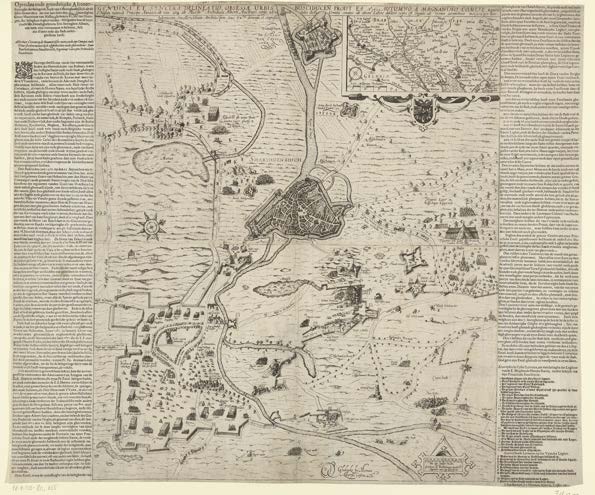
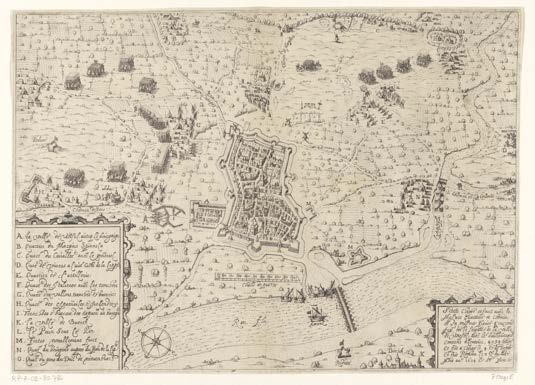
Figure 33.11: ’s Hertogenbosch besieged by Maurits van Nassau, 1603, by Herman Allertsz Coster, 1603, Amsterdam.
Courtesy of Rijkmuseum Amsterdam. p
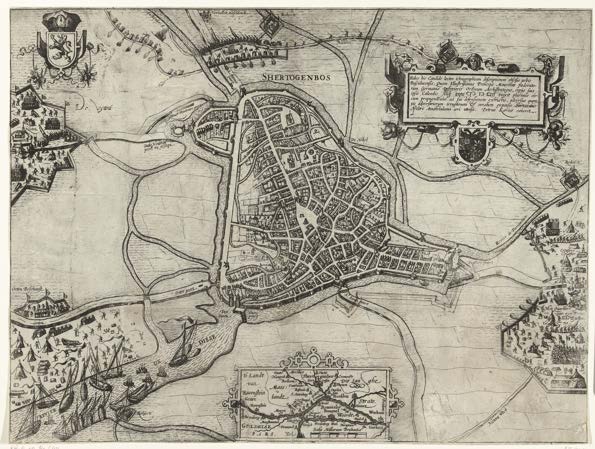
Figure 33.12: ’s Hertogenbosch besieged by Maurits van Nassau, 1603, by Pieter van der Keere. Courtesy of Rijkmuseum Amsterdam. p
© 2024 Nico F. Declercq
The Desclergues of la Villa Ducal de Montblanc, 2nd ed., Omn., VOL. II

33.3. HIS CAREER
507
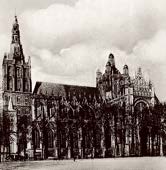
Figure 33.13: ’s Hertogenbosch Basilique. p
Figure 33.14:
Text coming from Fig-
ure 33.11, left column of Herman Allertsz
Coster’s description of the Siege. Inter-
estingly, in 1603, he refers to ’Belgische
vromigheid’ or Belgian Catholicism, con-
trary to the Dutch States Protestantism. It
is once again a refutation of the assump-
tion that the notion of ’Belgium’ would
have been invented in 1830.
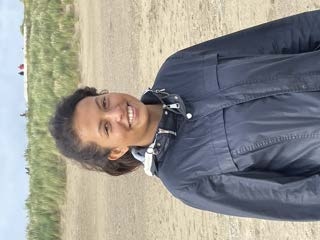
Figure 33.15:
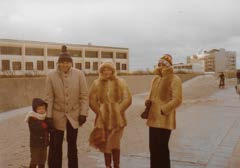
Anna-Laura Declercq on the beach of
Cadzand, 2021. (Declercq de Silva Archive)
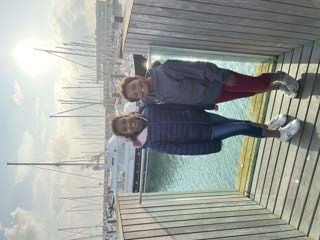
Figure 33.16: Lambert Declercq and his friend Elina
Roman at Cadzand harbor, 2021. (Declercq de Silva
Archive)
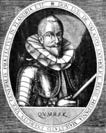
Figure 33.17: Luis de Velasco y Velasco was born in Valladolid in 1559 an died at
Dunkerque in 1625. p
The Desclergues of la Villa Ducal de Montblanc, 2nd ed., Omn., VOL. II
© 2024 Nico F. Declercq
508
CHAPTER 33. ENRIC DESCLERGUE Y CORTÉS (DC05C)
Figure 33.18: 1979, the author, Maurice, Anna and
Nelly at Cadzand in The Netherlands. (Declercq de Silva
Archive)
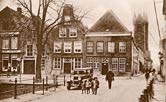
Figure 33.19: Sluis, old postcard.
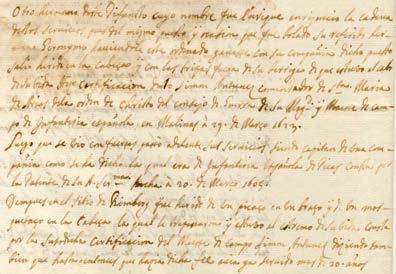
Figure 33.20: This is a fragment of a handwritten text ’Notes relatives ales gestes
militars del llinatge Desclergue’ , by Francesc de Pedrolo y Desclergue (born in 1641,
son of Jacint de Pedrolo and Isabel Desclergue y Tous) (Source: Arxiu Comarcal
Urgell Desclergues document 2 page 2 view 2; Courtesy of Arxiu Comarcal Urgell
and the de Pedrolo family)
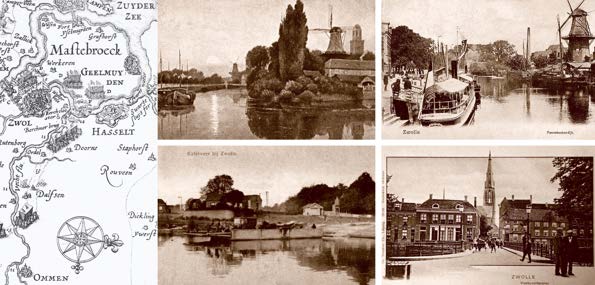
Figure 33.21: Left stems from a map of the Counties of Zutphen and Twente, depicting the Dutch army and the Spanish army during the attack on the Berkumer bridge. Note that, on this map, North is right. The old postcards of Zwolle show grinding mills, Katerveer, Pannenkoekendijk and Vischpoortenplas.p
© 2024 Nico F. Declercq
The Desclergues of la Villa Ducal de Montblanc, 2nd ed., Omn., VOL. II
33.3. HIS CAREER
509
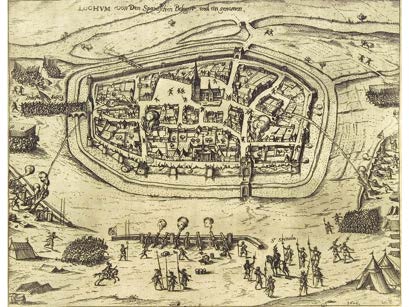
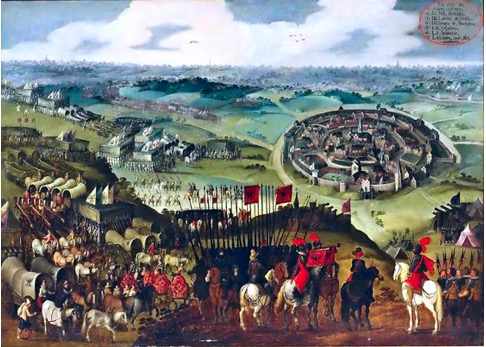
Figure 33.22: The Siege of Lochem by the armed forces of Spinola at the end of July
1606. Courtesy of Gelders Archief p.
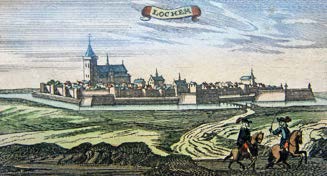
Figure 33.23: This is most likely what
the Spanish have seen of Lochem upon
their arrival. p.
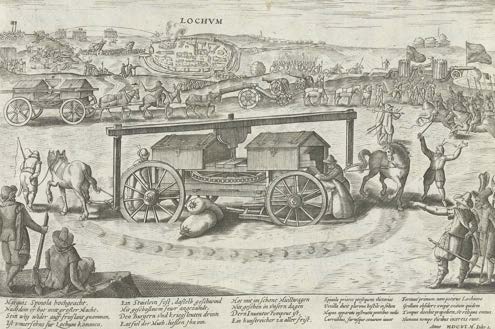
Figure 33.24: This image shows a Spanish mill, driven by horses, during the Siege of Lochem. Indeed,
while in action, the Spanish army was a moving caravan of households, families, bakers, bankers, priests, and military. p.
The Desclergues of la Villa Ducal de Montblanc, 2nd ed., Omn., VOL. II
© 2024 Nico F. Declercq
510
CHAPTER 33. ENRIC DESCLERGUE Y CORTÉS (DC05C)
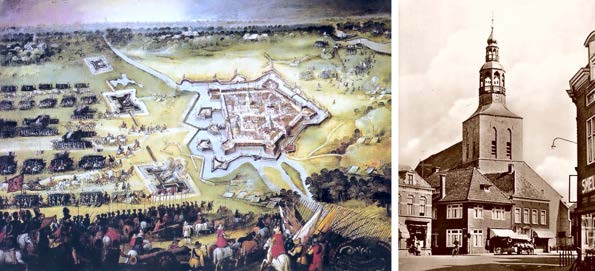
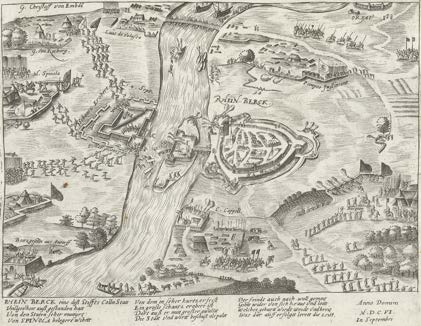
Figure 33.25: The Siege of Groenlo by the Dutch on November 9, 1606. Spinola’s forces are seen arriving and breaking the Siege. Artwork by Peter Snayers (1592-1667). Right is a protestant church in Groenlo, around 1900.
Figure 33.26: Rheinberg besieged by Spinola in 1606. Artwork by Frans Hogenberg.
Courtesy of Rijksmuseum Amsterdam p.
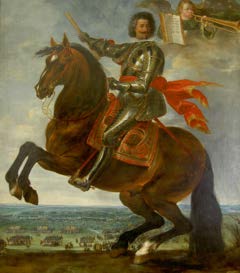
Figure 33.27:
Charles Bonaventure de Longueval,
Comte de Bucquoy, painted by Snaeyers. Courtesy of
Graf Harrach’ sche Familiensammlung, Gemäldegalerie,
Schlossmuseum Rohrau in Austria. (Photographed by
Pappenheim. p
© 2024 Nico F. Declercq
The Desclergues of la Villa Ducal de Montblanc, 2nd ed., Omn., VOL. II

33.3. HIS CAREER
511
Figure 33.28: From left to right, we see Wesel, Rees and Kleve around 1900. p
Figure 33.29: Pieter Snayers, the Siege of Aachen by Spinola’s forces in
1614. p
Figure 33.30: The capture of Wesel by Spinola in 1614. Courtesy of Rijksmuseum Amsterdam. p
The Desclergues of la Villa Ducal de Montblanc, 2nd ed., Omn., VOL. II
© 2024 Nico F. Declercq
512
CHAPTER 33. ENRIC DESCLERGUE Y CORTÉS (DC05C)
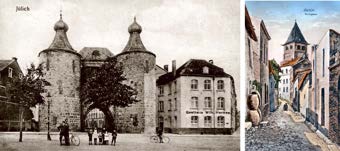
Figure 33.31: Left is a gate in the old fortifications of Jülich, around
1900. Right is sn artist’s impression of Jülich on a postcard of around
1900. p
Figure 33.32: The book of Geronimo Conestaggio, describing the first
attempt to conquer Algiers in 1601 in which Enric Desclergue (DC05c)
was likely involved, or in the attempt just after that.
Flanders, departed on the galley named ’Capitana’ under the command of Carlo Doria. One of the notable persons mentioned is Virginio Orsino, the Duke of Bracciano, aboard the galley named ’Capitana’ of Florence. During the voyage on the Royal galley, several notable individuals were present, including the Marquis of Elche, the eldest son of the Duke of Macheda.
Additionally, Alo Idiaqués, who served as the general of the light cavalry of the State of Milan and was chosen by Gian Andrea Doria as his lieutenant, was also on board. Other distinguished figures included Diego Pimentel, Manuel Mantiques (the Grand Commander of Aragon), the Count of Celano, the Marquis de Garesfi, Ercole Gonzaga, Gio Geromino Doria, Aurelio Tagliacarne, and a few other captains and esteemed individuals. Furthermore, the group included seven or eight Roman gentlemen.
The military operation on August 30, 1601, was deemed unsuccessful since it encountered a significant obstacle in adverse weather conditions, rendering the intended landing unattainable. The fleet convened at Mallorca on September 3, 1601, planning to coordinate the assault.
However, this endeavor was again unsuccessful due to unfavorable wind conditions. The whole undertaking was terminated.
A further endeavor was undertaken in 1602, starting from Cadiz and passing via Mallorca.
33.3.3 Handwritten reference 3
This fragment, shown in Figure 33.9 and Figure 33.10, says that there are many more certifications of the qualities of Enric Desclergue (DC05c) than the ones of Simón Antúnez (Ostend, October 12, 1604) and patents on March 20, 1605, in Brussels.
For instance, Sergeant Major Baltazar López, Lieutenant General of the Maestro de Campo, testified on Enric’s qualities in Ostend on October 13, 1604.
Captain Don Lorenzo Villavicencio, an infantry sergeant major in the Spanish tercio of Maestro de Campo Don Juan de Meneses, attested in Ostend on October 29, 1604. Captain Don Lorenzo Villavicencio was a distant cousin of Enric Desclergue, as outlined in Chapter 25.1.3.2.
On December 13, 1604, his Highness Cardinal Archduke Albert expressed Enric’s qualifications in Brussels, and again on January 10, 1606. The specific statements also included eulogies for Jeroni Desclergue and are shown in his Chapter 29.
Also, Don Juan de Meneses, knight of the order of Santiago and member of the Council of War of his Majesty, and Maestro de Campo of the Spanish infantry in Flanders, testified in Brussels on March 20, 1617.
We can also mention the testimony of Domingo Ximenes, member of the council of War of his Majesty and the Governor of the town of Nieuwpoort (Newport), on March 20, 1623, who mentioned that Enric Desclergue had served for 22 years in the army.
Note that Domingo Ximenes, as outlined in Chapter 37.4.2, was married to Elena de la Cruz in Valladolid in Spain in 1564, and they were the parents of Pedro Ximenez de la Cruz, who married Maria de Sapena in Granada in 1596. Their daughter was Martina de la Cruz, born in Dudzele in 1624, a village adjacent to Damme in Flanders, close to Sluis and Bruges.
33.3.4 Íñigo de Borja y Velasco
As can be read in the above shown evidence, Enric Desclergue was, at the beginning, in the tercio of Don Íñigo de Borja y Velasco (1575–1622), until 1604. He was born at Gandía in 1575 as the son of Francisco Tomás de Borja y Centelles, the sixth Duke of Gandia. His grandfather was Íñigo Fernández de Velasco, the 2nd Duke of Frías. His brother, Gaspar de Borja y Velasco, was the archbishop of Toledo and Seville.
He married a Flemish, Hélène de Hénín-Liétard, the daughter of the Marquess of Veere. Early in his career, he became a Knight
© 2024 Nico F. Declercq
The Desclergues of la Villa Ducal de Montblanc, 2nd ed., Omn., VOL. II
513
of the Order of Santiago and held the commandery of Membrilla. He served H.M. King Felipe II of Spain in France and Burgundy in the 1590s and after 1598 in northern Italy. He went to Flanders in 1603, with 3700 militaries along the Spanish Road, described in Chapter 8.10, to serve Archduke Albert. Enric Desclergue (DC05c) belonged to his tercio until 1604. Later, in 1605, he led the Antwerp garrison and stopped the Dutch from taking Antwerp.
During his military career, he participated in the 1606 Siege of Groenlo, just like Enric Desclergue (DC05c), and became an artillery general in the Army of Flanders. He governed the Antwerp Citadel from 1606 onward. In 1614, he took part in the capture of Wesel, and he died in 1622 in Brussels.
33.3.5 The defence of ’s Hertogenbosch in 1603
’s Hertogenbosch, also known as Den Bosch and Balduque, has frequently been the scene of violence during the Eighty Years War because of its strategic location. In 1603, Enric Desclergue (DC05c) protected the city from a Siege by Mauritz van Nassau.
The Siege began on July 24, 1603, and lasted until September 9. It was Enric’s first military activity and was a success. Later, the town would finally go to the Dutch in 1629.
33.3.6 His involvements in Ostend and Sluis
Sluis, also known as la Esclusa or Enclusa, had been secured by the Spanish after they besieged the town in 1587 by the forces of Alexander Farnese. The city was significant because, together with Damme, it protected access to Bruges.
In, 1604, during the struggle for Ostend, the Dutch successfully besieged Sluis. Today, it’s still Dutch. Mauritz van Nassau, along with Horace Vere, was in charge of the Dutch armed forces, while the troops of Luis de Velasco and Mateo Serrano defended the town.
The assault on Sluis began on April 25, 1604, when the 11000-strong Dutch armies left Vlissingen to the isle of Cadzand, shown in Figures 33.18, 33.16 and 33.15. They conquered the island but could not cross the wetlands and the river of Het Zwin, which was required to reach Ostend, their ultimate goal. Instead, they made a turn and went to Sluis.
On their way, they took the Oostburg line, Ijzendijke, and on May 12, Aardenburg. In 1604, taking Sluis was necessary for the Dutch because the Spanish navy was located in the town to hinder the passage of Dutch vessels from Vlissingen to Ostend. The battle between the Spanish, led by Luis de Velasco and including Enric Desclergue (DC05c), and the Dutch took place at Moerkerke while the Dutch were trying to circumvent Sluis.
After a Siege of 2 months, the Spanish attempted to free Sluis, led by Ambrogio Spinola. They could cross the Dutch lines at Sint Kruis, took the Oostburg line, and encountered heavy Dutch resistance at Coxysche Gat and Zwarte Gat. This unsuccessful attempt to liberate Sluis led to a capitulation of the town on August 14, 1604. The Dutch were now totally in charge of the isle of Cadzand and considered it as compensation for their ongoing loss of Ostend. The Spanish would take the latter, including the three Desclergue brothers, on September 22, 1604. The episode is extensively described in Chapter 29.5.28.
Enric Desclergue almost died in the blast that cost Jeroni Desclergue’s (DC05) life at Ostend, as he was ’badly injured in the head, and with the guts out of his belly, appearing as if he was at the end of his life.’
Once recovered, however, he continued serving as a soldier in several companies until the 20th of 1605, when he was promoted to captain. Like his brother Antoni Desclergue (I) (DC05 b), he was offered the command of a company in the Tercio of Alonso de Luna and later in the Tercio of Simón Antúnez.
Under Louis de Comboursier, also known as Du Terrail, the Spanish launched an attack on Sluis on July 12, 1606, but this would be unsuccessful.
33.3.7 The battles with Ambrogio Spinola 1606-1609
In the Siege of Rhinberg he was again hurt, in 1606, from a picaço in an arm and a mosquetaço in the head (’de donde el tal Enrique salió mal herido de un picago en un brago, i un mosquetaço en la cabeça, la qual le trapenaron [sic], y estuvo al extremo de su vida’), but he moved on. He continued as captain in Flanders until the truce of twelve years, from 1609. Enric was delighted by the surgery, so he did not give up and continued his career as a captain.5
Ambrogio Spinola was born in Genua in 1569. He was an Italian citizen of the Spanish Empire renowned for his strategic qualities as a military. He was sent to the Netherlands to support the Cardinal Archduke Albert in his wars with the Dutch, partially because they had captured Nieuwpoort in 1600.
Ambrogio Spinola had arrived in 1606 in Flanders from Milan with a vast army. He attacked the Dutch from the east to face the equally intelligent Prince Mauritz of Nassau.
33.3.7.1 The Battle of the Berkumerbrug in Zwolle
Berkum is a place just outside Zwolle, in Figure 33.21, at 3km from the old town, and can be reached from Zwolle via Walstraat, Spoelstraat and Almelose Kanaal along the Nieuwe Vecht waterway (Philosofenallee and Vondelkade) up to Tussen de Verlaten, where Berkum is located. Spinola’s primordial goal was Zwolle. He knew it would be impossible to take the city. Still, he tried to weaken it by cutting off one of its significant accesses while forcing the Dutch to maintain a large army in the North and undermine their Southern flanks. A partial success, for instance, by controlling the Zwarte Water River through the occupation of the fortresses of Kijk, Vegt, and Genemuiden, would have cut the Dutch territory in two in the North and weakened them significantly.
Enric Desclergue y Cortés (DC05c), brother of Jeroni Joan Desclergue y Cortés (DC05), was in this army and was 4 km from the center of Zwolle on August 1-2, 1606. Even if the Spanish had not captured Zwolle immediately, a successful raid on the mentioned fortresses would have weakened Zwolle, Groningen, and Drenthe. It could allow the Spanish to take control over the entire North province of Friesland.
The Spanish, who had tried to cross the Zwarte Water River after an approach along the rivers Regge and Overijsselse Vecht, were halted by a Dutch garrison from Zwolle. As they say, ’Sometimes you win, sometimes you lose.’ That early August, no fathers have been murdered at Zwolle.
The Dutch had carefully studied the Spanish approach and fortified Zutphen and Deventer. Spinola played the game and sent soldiers to Holten to give the impression that he wanted to capture Deventer to mislead Mauritz of Nassau.
In the days before the attack on the Berkumerbrug, Mauritz pulled back some garrisons from Lochem and, therefore, made this 5Esquema Històric del llinatge Pedrolo, per Santiago Alberti, page 68
The Desclergues of la Villa Ducal de Montblanc, 2nd ed., Omn., VOL. II
© 2024 Nico F. Declercq
CHAPTER 33. ENRIC DESCLERGUE Y CORTÉS (DC05C)
place weaker. Spinola would exploit this weakness, as described in the next section, Chapter 33.3.7.2.
Even during the last days of July, Spinola attempted to mislead the Dutch by sending troops to Bronkhorst and Doesburg.
When the Spanish approached Zwolle from the North, their movements were immediately noticed, and the city’s garrison was promptly warned. The two armies clashed at the Zwartewatersdijk on August 1, and the battle continued the following day, just outside of Zwolle. It remains uncertain if any Spanish forces managed to cross the water on the Mastenbroek plane. However, the Dutch, with their resilience and strategic foresight, drove the Spanish back to the Berkumerbrug in the East, effectively safeguarding Zwolle.
Interestingly, it was the Belgian Simon Stevin from Bruges, who took the Dutch side, that had warned the Dutch about the need to fortify Zwolle sufficiently. After the Spanish attack, the Dutch finally heeded Stevin’s advice and fortified the town. This fortification proved effective, as Zwolle was never again attacked by the Spanish. This historical episode highlights the international cooperation and shared military knowledge that was instrumental in shaping the Dutch defense. It is, therefore, fascinating to realize that the strength of the Dutch, still evident in Zwolle, is, in fact, Belgian.
33.3.7.2 The two Sieges of Lochem
In the final days of July 1606, while Spinola and Nassau were engaged in a chess game near Zwolle, the town of Lochem had been weakened by Nassau on July 21 (see Figures 33.22, 33.23, and 33.24). Spinola’s forces, including Enric Desclergue (DC05c), quickly besieged the town. The Spanish military negotiated with the inhabitants of Lochem, referred to as Locomo by the Spanish and promised them religious freedom. This led to a swift surrender.
Following the surrender, a minimal Spanish force under the command of Diaz remained in Lochem, while the rest of the troops proceeded towards Zwolle, as described in the previous section. Lochem, a symbol of Dutch resilience, stayed under Spanish control until the end of October, when Nassau used brute force to compel the Spaniards to surrender. Diaz, along with approximately 400
soldiers, was allowed to leave and they retreated to Rheinberg. From November onward, Lochem, a testament to the Dutch spirit, was back under Dutch control.
33.3.7.3 The two Sieges of Groenlo
Groenlo, or Grol, in Figure 33.25, which the Dutch had captured in 1597, was besieged by the Spanish from August 3 until August 14, 1606. Enric Desclergue (DC05c) was one of the besiegers.
Despite an attempt by the Dutch to take the town back on November 9, it remained Spanish until 1627. The Dutch Siege of Groenlo on November 9 had been unsuccessful due to an intervention by the Spanish forces, including Enric Desclergue (DC05c), led by Ambrogio Spinola.
33.3.7.4 The Siege of Rheinberg
Rheinberg, in Figure 33.26, is also known as Rijnberk and Rinberg. From August 22 until October 1, 1606, the Siege took place and was won by the Spanish. Enric Desclergue (DC05c) participated in the Siege.
The Siege of Rheinberg, or Rijnberk, took place from August 22 until October 1, 1606, and was won by the Spanish. Count de Bucquoy led the Spanish on behalf of Ambrogio Spinola, while Mauritz of Nassau and Frederik Hendrik led the Dutch. Note that, in Chapter 34, concerning Antoni Desclergue (DCo6), the son of Jeroni Joan Desclergue y Cortés (DC05), there are several links described with the family Bucquoy.
To besiege Rheinberg, the Spanish had blocked the river with a ship south of the city and placed cannons to defend the blockage.
The purpose was to prevent provisions to the town. While de Bucquoy besieged the municipality, Spinola moved his army to Wesel, in Figures 33.28 and 33.30, and crossed the Rhine River to join the troops of Bucquoy. He was followed by the soldiers of Nassau, who were unsuccessful in stopping Spinola and decided to camp at Wesel to disturb the Siege from there as much as possible. With brute force, Spinola attacked the outer defenses of Rheinberg and forced the Dutch in these positions to surrender.
Meanwhile, with his troops, Íñigo de Borja y Velasco stayed on the Wesel side to prevent Nassau’s support while Spinola attacked Rheinberg from the opposite side. While the Spanish encircled Rheinberg, they dug numerous approaches to get closer to the city, while the Dutch dug sortie trenches to counter-attack the Spanish. Because the situation was helpless for the Dutch, Nassau decided to play poker in an ultimate attempt to provide support. He moved his army of 15000 militaries to Alphen while transferring 2000
of them to Meurs. He gave Spinola the impression that the Dutch army dug in at Alphen. However, he immediately sent all his soldiers to the forces of Íñigo de Borja y Velasco at Rheinberg for a relentless attack.
The plan was to simultaneously let the Dutch in Rheinberg attack and storm the same camp inside the city. Íñigo de Borja y Velasco had a powerful army prepared for the battle after understanding the Dutch plan. His immense strength made the Dutch decide to end their dreams because they feared that had they lost the battle, they would have been too weak to withstand further expansions by the Spanish into the Netherlands. For this reason, the Dutch gave up Rheinberg, but the inhabitants maintained their resistance until October 1, 1606. When the people of Rheinberg surrendered, they obtained good conditions from the Spanish.
Charles Bonaventure de Longueval, the count of Bucquoy, in Figure 33.27, was born in Arras in 1571 and died in Neuhausel in 1621. He had a high position in the Spanish army and was already active in the military at 13. In 1600, he took part in the battle of Nieuwpoort, which the Spanish lost, but later, he also contributed to successes such as Ostend in 1604 and, as described here, in Rheinberg 1606.
33.3.8 His Mediterranean Career in the Period 1610-1613
Santiago Alberti, in his paper ’Esquema Històric del llinatge Pedrolo,’ mentions,
No hem pogut aclarir una sospita que l’home va fer unes escapades bèl·liques a la costa algeriana,’ which translates as
’We have not been able to clarify a suspicion that he was involved in war activities on the Algerian coast.’
This intriguing statement suggests potential military activities in the Mediterranean involving Jeroni Joan Desclergue y Cortés.
Notably, his connection to Carlos Coloma may provide further insights.
Carlos Coloma played a pivotal role in the military career of Jeroni Joan Desclergue y Cortés (DC05), as well as his relatives Antoni (DC05b) and Enric (DC05c). The trio participated in the Siege of Ostend, where Jeroni (DC05d) was killed in 1604.
To comprehend the subsequent events involving Enric (DC05c) and Antoni (DC05b), it is essential to revisit Coloma’s influence.
Coloma transitioned from Flanders to a significant career in the Mediterranean before returning to Flanders. Miguel Ángel Guill Ortega’s book, "Carlos Coloma," elucidates Coloma’s life, drawing from various historical sources, including Coloma’s writings
© 2024 Nico F. Declercq
The Desclergues of la Villa Ducal de Montblanc, 2nd ed., Omn., VOL. II
515
about his time in Flanders. The intriguing aspect is that Coloma’s children were named Jeroni, Antoni, and Francesc—names that resonate with the Desclergue family. Furthermore, the Coloma family had ties with Toledo and Mallorca, adding a personal touch.
The Pax Hispania, established on April 9, 1609, marked Spain’s recognition of the Dutch provinces and Belgium as separate territories from the Netherlands, France, and Germany. This truce arguably signifies Belgium’s birth as a distinct entity, 221 years before its formal independence.
Despite the ceasefire bringing peace to Flanders, Spain faced ongoing threats from the Turkish Empire and internal issues with the Moriscos.
Carlos Coloma, among others, was responsible for transporting Moriscos from Spain, primarily Valencia, to North Africa. It is plausible that during such operations, Enric Desclergue (I) was involved, aligning with Alberti’s suggestion of Desclergue’s activities on the Algerian coast. After his death, Enric’s widow contacted his brother Francesc Desclergue (DC05e) in Montblanc, hinting at possible encounters in Catalonia post-1609. During this period, nearly 4000 people were expelled from Catalonia.
Coloma served as governor in Perpignan (then part of Catalonia) for 11 years after 1610, receiving further promotions. His gratitude led him to commission an altarpiece from Rubens, dedicated to Saint Joseph. In 1611, Coloma became Viceroy of Mallorca, an island in the Balearics between mainland Catalonia and Algeria.
Enric Desclergue (DC05c) likely participated in operations in Algeria under Coloma’s command, as being Viceroy also entailed the role of Captain-General of the Spanish army in the region. This period, rather than the Morisco deportation, may be what Alberti references regarding Desclergue’s involvement in Algerian warfare. Besides Turkish attacks, Mallorca frequently faced Berber assaults. Coloma remained Viceroy until 1617, continuing a family tradition; his father, Juan Coloma, had been Viceroy of Sardinia (1570-1577). Known for his proactive governance, Coloma likely found the autonomous Viceroyalty fitting. His Flemish wife, Margarita de Liedekerke, and their six children accompanied him in Mallorca.
In Chapter 34 on Antoni Desclergue (II) (DC06), particularly Chapters 34.5.16 and 49, we explore his chapel construction in Deerlijk, Belgium. The chapel’s statue resembles Santa Maria del Pi, possibly linked to Coloma’s emotional connection with Santa Maria del Pi (Barcelona) and Antoni’s desire to honor this Maria in 1639. When Coloma was Viceroy of Mallorca, Porto Pi’s tip (portum de nomine pini in Latin, or the harbor of the pines) was fortified to protect Palma de Mallorca’s crucial harbor. Today, it is known as the port of San Carlos, in Coloma’s honor.
Coloma’s involvement extended to Malta, as detailed in Miguel Ángel Guill Ortega’s "Carlos Coloma." After his tenure in Malta, Coloma returned to Flanders in 1617, becoming governor of Cambrai. During this period, Antoni Desclergue (DC06), Jeroni’s son, was recruited. From then on, traces of Antoni (II) (DC05b) and Enric (DC05c) reappear in Flanders.
Enric (DC05c) received his accolade in 1623 and is noted on a church certificate in Wingene, dating to 1631, the year of his death. Upon Coloma’s return to Flanders, Antoni (DC05b), Jeroni’s and Enric’s brother, resurfaced in Wingene. Coloma served as Governor of Cambrai from 1617 until 1632, although he did not reside there permanently.
33.3.9 His Involvement in Eastern Provinces and Residence of Enric Desclergue in Antwerp
with his Brother Antoni, and the Onset of the 30-year War, 1614-1618
33.3.9.1 Residence in Antwerp
It is essential to remember that Íñigo de Borja y Velasco served as the governor of the Antwerp citadel from 1606 until he died in 1622. Consequently, it is not coincidental that Enric Desclergue (DC05c) and his brother Antoni Desclergue (DC05b) also used Antwerp as their base during this period.
The evidence of their residency in Antwerp from 1617 to 1618 (see Chapter 32) reveals a personal and familial decision. It is highly likely that Antoni Desclergue (DC05b) and his brother Enric (DC05c), along with their families, relocated to Antwerp to reside in the Spanish-held castle as tensions began to rise again in Europe. This was a time of great anxiety, a consequence of the Peace of Augsburg, which allowed rulers to determine the religion of their subjects. As a result, some regions became Lutheran, while others remained Catholic.
Various political and geographical unification occurred to strengthen their position against Islamic forces, leading to significant tension. The situation deteriorated further when Archduke Ferdinand fought with the Lutherans in Austria around 1609. By 1617, Ferdinand sought to revoke the religious freedoms of the Hussites in Bohemia, ultimately leading to the Thirty Years’ War outbreak in May 1618.
33.3.9.2 Support for Aachen
Aachen, in Figure 33.29, is Aquisgrán in Spanish. In 1609-1614, there was a succession war of Gulik-Kleef, known in Germany as the Jülich-Klevischer Erbfolgestreit and in Spanish La crisis de Juliers-Cléveris.
It was a conflict in which the different European powers wanted to show their strength by demanding a solution according to their terms and showing off their military potential. Because no country wanted to reduce its influence, the conflict was costly for everyone involved. The Spanish initially stayed out of the War, hoping for a peaceful solution in their favor and trying to continue their treaty with the Dutch.
However, the tide turned when some crucial people in Aachen reconverted to Catholicism in 1614, in a town where the Calvinists had taken power in May 1612. The Spanish were then obliged to support Aachen as a member of their Catholic League. The Spanish prepared around 20000 soldiers, including Enric Desclergue (DC05c), to help Aachen, which frightened the powers involved in the Gulik-Kleef dispute and forced them to bolster their positions under control in case the whole region would destabilize. We can mention a famous quote of Ambrogio Spinola to his army in Maastricht in 1614,
’Before we think of the Affairs of Juliers, the vicinity of Aachen ought to engage us to make on that side the first efforts of our army to punish the heretics of that city and to execute the Imperial Mandate discerned against them, of which the Archduke and the Elector of Cologne are Bearers. Everyone knows with what boldness and contempt for the Imperial Mandates the heretic citizens have dared usurp the government of Aachen, which belonged formerly to the Catholics only. Thus, an infinity of reasons obliges us to repress by force so unjust a usurpation. ’6
The Spanish attacked Aachen from Maastricht. Luis de Velasco and his cavalry opened the way, followed by Germans, Burgundians, Walloons, and many more Spanish military. The Spanish also blocked the road from Aachen to Jülich to prevent help from there by the Dutch. After arriving in Aachen and a few gunshots, the Spanish commenced negotiating with the inhabitants to surrender.
The city turned Spanish again before the Dutch hand could send relief. The defenders of Aachen were allowed to leave in honor 6see, e.g., J. Roberts, The History of the Succession to the Countries of Juliers and Berg, London, 1738.
The Desclergues of la Villa Ducal de Montblanc, 2nd ed., Omn., VOL. II
© 2024 Nico F. Declercq

516
CHAPTER 33. ENRIC DESCLERGUE Y CORTÉS (DC05C)
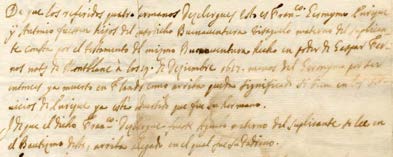
Figure 33.33: 1618, June 14, Antwerp -
San Felipe de Castile. The death of Maria,
wife of Enric Desclergue (’Henrique’), due
to an explosion at the Castle.
Figure 33.34: This is a fragment of a handwritten text ’Notes relatives ales gestes
militars del llinatge Desclergue’ , by Francesc de Pedrolo y Desclergue (born in 1641,
son of Jacint de Pedrolo and Isabel Desclergue y Tous) . (Source: Arxiu Comarcal
Urgell Desclergues document 2 page 3 view 2; Courtesy of Arxiu Comarcal Urgell
and the de Pedrolo family)
and were replaced by Catholic Germans.
The Spanish took Wesel (’Vesel’) after they had captured Aachen. It was one of the towns under dispute in the succession war of Gulik-Kleef, and the Spanish found it convenient to set foot on the town and make it part of their circle of influence. Enric Desclergue (DC05c) was one of the militaries in this campaign. The city turned Spanish and would remain Spanish until 1629 when the Dutch Otto van Gendt took it back from the Spanish commander at Wesel, Francisco Lozano.
33.3.9.3 The capture of Wesel
The capture of Wesel by Spinola in 1614 is shown in Figure 33.30.
33.3.9.4 The Kleef-Rees-Jülich issue
When the Spanish increased the pressure on the Jülich-Cleve area, shown in Figures 33.28 and 33.31, Enric Desclergue (DC05c) was stationed at Rees, ready for action should that have been necessary and to protect Jülich, which was under a siege by the French and the Dutch. The Spanish finally gave away Jülich when the Dutch mined the city walls and blasted a significant fortification section.
33.3.10 Enric Desclergue was Awarded in 1623
Enric Desclergue (DC05) received an award for his extraordinary services from Simon Antuñez in 1623. Simon Antuñez is also described in Figure 29.7 on page 370 and resided at Tournai, like Jeroni Joan Desclergue y Cortés (DC05). The documentation is shown at the beginning of this chapter.
33.3.11 His Residence in Wingene
The settlement of Enric in Wingene is not unexpected. Following the Dutch Republic’s capture of Sluis and the subsequent blockade of the Westerschelde, access to the port of Antwerp was effectively cut off. In response, the Spanish regime sought alternative routes and decided to construct a canal linking Ghent to Bruges, officially inaugurated in 1621. Consequently, Beernem-Wingene was designated as a strategic defense area against the Dutch Republic. This region became populated with military personnel, including active and retired members of the Spanish army.
33.4 His Spouses
33.4.1 Maria, the First Wife of Enric Desclergue
Maria, shown in Figure 33.33, was the first wife of Enric Desclergue.
33.4.2 Ana Fabiana Pacheco, the Second Wife of Enric Desclergue
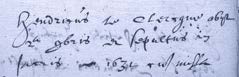
In Flanders, Enric (DC05c) married Ana Pacheco, a Spanish. He became the father of one boy.7 He died after 1623, which is in agreement with what we found about him in Flanders. His wife Anna Pacheco, whom he had married while in Flanders, apparently Figure 33.35: The death of Enric Desclergue (DC06)
(’Hendricus Le Clergue’) in 1631 at Wingene.
7according to ’La baixa noblesa de la Conca de Barberà a l’ edat moderna’ , written by Salvador J. Rovira i Gómez,
© 2024 Nico F. Declercq
The Desclergues of la Villa Ducal de Montblanc, 2nd ed., Omn., VOL. II
33.5. THE DEATH OF ENRIC DESCLERGUE
517
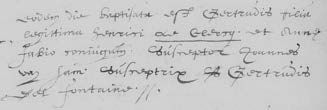
Figure 33.36: 1623, October 29, Brus-
sels St Jacob op Koudenberg, the bap-
tism of Gertrudis Desclergue (Le Clercq),
daughter of Enric Desclergue (Henricus
Le Clercq) and Fabiana Pacheco (’Anne
Fabia’), the godfather was Joannes Van
Ham, Godmother was Gertrude Fuentes
(’Del Fontaine’).
wrote a letter to her brother-in-law Francesc Desclergue (DC05e) after this death.
Alberti declares in his paper ’Esquema Històric del llinatge Pedrolo’ that,
’Enric married in Flanders to a certain Fabiana (’Ana’) Pacheco. At some point, his widow writes a letter to Francesc Desclergue in Montblanc, not long after Enric was awarded for his military achievements. The letter says that Enric has died as an elderly and that he had one child.’
Assuming that Alberti’s statement is accurate, we should find Ana (Fabiana) Pacheco in the Belgian archives. We have not been able to retrieve her with absolute certainty; however, we discovered an Anna Pasque and Anna Pascua in the first half of the 17th century in Eernegem and Leisele. Certainly, Eernegem is not far from Wingene. We do not claim that it is the same Ana Pacheco.
However, the Pacheco family was probably present in West Flanders then, and Ana Pacheco may have been a member of that Spanish family. Members of this family were perhaps in Flanders long before the Desclergue as we have found a person Diego Lopez de Pacheco, Duque of Escalona (1456 - 1529), who became a member of the Order of the Golden Fleece in 15198. There is also Marco Pacheco, a soldier at the Spanish Castle in Gent, who married Barbara de Mor at Gent in 1646. We also found the wedding of Anthonia Pacheco and a soldier, Gabriel Moreno, at the exact location. In the 1660s and later, we find births of Pachecos at Veurne, Bruges, and Brussels.
Although we found no solid proof of a link between the two families, in Chapter 19.15.3, we describe the partner of Bertrand du Guesclin and how the couple established a de Torró lineage. In that context, interesting work was published by Andrés Nicás
Moreno9 which may provide a clue.
In 1557, Don Juan Pacheco passed away. He was the son of Alonso Pacheco and Marina Fernández de Torres and the Comandador de Lopera. Alonso Pacheco, who passed away in 1490, was descended from Fernán Jeremías II, Seor de Ferreira de Aves, through Diego Lopez Pacheco, 9th Seor de Ferreira de Aves, Bellas y Celorica in Portugal and 1st Seor de Béjar in Castile. The lineage was matrilineal. Indeed, Alonso Pacheco’s father, Jean Pacheco, 3rd Señor de Belmonte, 1st Marqués de Villena, 1st Conde de Xiquena y de los Vélez, and Duque de Escalona, was the son of María Pacheco, II Señora de Belmonte and Alfonso Téllez-Girón, 1st Señor de Almansa. Marina Fernández de Torres, the illegitimate wife of Alonso Pacheco, died in Lopera in 1547.10 Her father was Juan Alonso de Torres, and she likely descended from a noble Lopera de Torres clan.
Diego López Pacheco is Juan Pacheco’s progenitor. Diego López Pacheco married Juana Vázquez Pereyra, and their son, Juan Fernández Pacheco, was the 10th Lord of Ferreira de Aves, Penela, Celorico and Oliveira and the Guard Mayor of King Mr. Juan I of Portugal.
Juan Fernández Pacheco participated in the Battle of Aljubarrota in 1384, after which he entered the service of King Enrique III of Castile. This resulted in confiscation of all of his assets in Portugal, for which the monarch of Castile granted him the Villa de Belmonte, of which he was the First Lord.
Juan Fernández Pacheco wed in Portugal Doa Inés Téllez de Meneses, whose lone daughter and heiress Doa Mara Pacheco, 2nd Lady of Belmonte, married her cousin Don Alonso Téllez-Girón. However, according to the marriage contracts, the eldest son of this union chose Pacheco as his first surname and not Téllez-Girón, thereby uniting the two famous houses of Girón and Pacheco.
Don Alonso Téllez-Girón went to Castile with his father when he was a small boy, where he became wealthy during the reign of Juan II and after Enrique IV. In 1431, he served alongside the first sovereign in the destruction of Vega de Granada and against the infantes of Aragon. In 1445, as a reward for his services, King Juan II bestowed upon him the Villa de Almansa, but he did not assume possession of it, so he must have perished around this time.
Don Juan Pacheco was the firstborn child of this couple. In 1419, this gentleman was born in Belmonte. As his maternal grandfather’s successor in the United States, he inherited the Pacheco family name and arms with the obligation to pass them down to his descendants. Juan II created him the 3rd Lord of Belmonte and the 1st Marqués de Villena in 1445. He was also the first Count of Xiquena and de los Velez, founded in 1460, and the first Duke of Escalona, created by King Enrique IV of Spain in 1472.
He was the XXXIX Grand Master of the Order of Santiago and the Administrator of the Mastership of Calatrava, the Marshal and Mayor of Castilla, the Perpetual Warden of the Villa de Molina, the Mayor of Seville, Soria, and Logroo, and a Knight of the Order of ’Jarra de Aragon y Valido’ of Henry IV.
If Ana Fabiana Pacheco was a member of this lineage, her relationship with Enric Desclergue (DC05c) must have been strategic and natural.
Other Pacheco links are outlined in Chapter 19.15.3 on page 188 and Chapter 27.2 on page 301.
33.5 The Death of Enric Desclergue
The document in Figure 33.34 shows that in 1617 when Francesc Desclergue wrote his testament, only his brother Enric was still alive, while Antoni and Jeroni had died. Enric Desclergue (’Henricus Le Clerge’) died at Wingene in 1631. His death certificate is shown in Figure 33.35.
The Desclergues of la Villa Ducal de Montblanc, 2nd ed., Omn., VOL. II
© 2024 Nico F. Declercq
518
CHAPTER 33. ENRIC DESCLERGUE Y CORTÉS (DC05C)
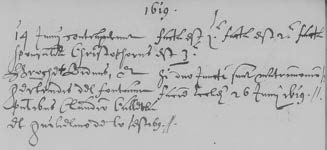
Figure 33.37:
1619, Brussels, St Ja-
cob op Koudenberg, wedding on June 14
of Christophorus Brochet, a widower, with
Gertrudis del Fontaine. The witnesses
were Claudio Gellega and Guilelmo de la
Testaby (left side).
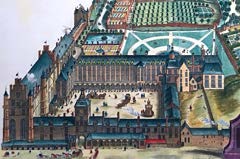
Figure 33.38:
’Hof van Brussel’ , also known as
the Koudenberg Palace or Palatium Bruxellense ducis
Brabantiae, around 1726. Engraving by Christophorus
Butkens and Jacobus Harrewijn.
33.6 His Offspring
We found the baptism of Gertrude, possibly the daughter of Enric Desclergue and Ana Pacheco, although we read ’Fabio.’ The certificate, shown in Figure 33.36, mentions that they were married and the godmother was possibly a daughter of ’de Fuentes’
(Paul-Bernard de Fontaines, 1566 Lorraine - May 19, 1643, Rocroi) from the Spanish armed forces. The baptism took place in Brussels at the Saint Jacob church at the ’Hof van Brussel,’ also known as the Palace of Koudenberg, in Figure 33.38, the center of the administration and rule of Belgium.
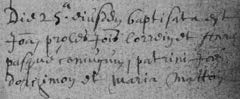
After Enric’s death, Ana Fabiana Pacheco remarried Juan Llorein, shown in Figure 33.39. At Eernegem, in 1642, we found the baptism of a girl named Juana Lloren (’Joanna Lorrein’), daughter of Juan Lloren (’Joannes Lorrein’) and Ana Fabiana Pacheco (’Anna Pasgue’), shown in Figure 33.39. The godfather was Jean d’Orchimont, and the godmother was Maria de Montoya (’Mattoye’). Given the names, we suspect that the people involved were Wallon and Spanish troops.
Note that Jeroni Desclergue’s (DC05) wife was Felipa de Montoya. Felipa had a brother, Jeronimo de Montoya, who died in Ostend in 1604, like Felipa’s husband, Jeroni Desclergue (DC06). Jeronimo de Montoya had three children, Jerome, Maria, and Antonio (born in Harelbeke in 1598). Maria de Montoya, who served as godmother to Juana Lloren, was Felipa de Montoya’s niece, Enric Desclergue’s (DC05c) sister-in-law.
Concerning the child’s name, she may have been named after Maria de Montoya’s auntie Juana de Montoya (born at Torre, Burgos, Spain, in 1561). Indeed, Felipa de Montoya had the following siblings: Juana de Montoya (1561), Maria de Montoya (1559), and Jeronimo (+1604).
If this is Ana Pacheco, it could mean that she remarried and lived at Eernegem, possibly having her child of Enric Desclergue with her.
Figure 33.39: Eernegem, January 25, 1642. The bap-
tism of Juana Lloren (’Joanna Lorrein’), the daughter
of Juan Lloren (’Joannes Lorrein’) and Ana Fabiana
Pacheco (’Anna Pasgue’). The godparents were Jean d’
Orchimont (’Joannes Dorchimon’) and Maria de Mon-
toya (’Mattoy’ , without the curl as with the ’n’ charac-
ter).
8Monique Jacqmain: De idyllische Nederlanden. Antwerp en de Nederlanden in de 16de eeuw. Lodovico Guicciardini, Antwerp - Amsterdam, Uitgeverij C. De Vries Brouwers P.V.B.A., 1987, p. 29.
9Andrés Nicás Moreno, "Descendencia ilegítima de don Juan Pacheco, i marqués de Villena. Genealogía y heráldica de don Juan Pacheco, comendador de Lopera (Jaén)," Revista de Historia, Cultural y Costumbrista de las Cuatro Villas, Argentaria, 23: 069-086, 2020.
10A. Franco Silva, "Las mujeres de Juan Pacheco ...," op, cit, p.179, fue también su hermano mayor don Alonso. Ambos hermanos quedaron bajo la tutela de su tío don Diego, II Marqués de Villena.
© 2024 Nico F. Declercq
The Desclergues of la Villa Ducal de Montblanc, 2nd ed., Omn., VOL. II
Chapter 34
Antoni Desclergue y de Montoya (DC06), the son of
Jeroni
34.1 Introduction
Don Antoni Desclergue y de Montoya (DC06), our paternal ancestor, was born in Barcelona and baptized in Belgium. He was the son of Jeroni Joan Desclergue y Cortés (DC05) and Felipa de Montoya. Following his father’s death, his mother remarried a local man, enabling Spanish-Catalan Antoni to integrate into regional communities.
Antoni Desclergue y de Montoya (DC06) embarked on a distinguished military career after being recruited by Carlos Coloma de Saa, a friend of his late father. In recognition of his achievements, Antoni constructed a chapel in Deerlijk in 1639, with financial support from a local banker, as detailed in Chapter 49.
Antoni lived to a considerable age.
34.2 The Discovery of Antoni Desclergue (DC06) by Jose Sanchez Real
As mentioned in the acknowledgments at the beginning of this book, Jose Sanchez Real was a gifted historian with an academic background in chemistry. He was the first person to study the Desclergue family. His book, ’La Casa Desclergue de Montblanc’ , was published in 1974 by Caja de Ahorros Provincial, Tarragona.1 and printed in Barcelona2
Sanchez Real fulfilled his study in the framework of restoring the house of Desclergue on the main square of Montblanc. However, a combination of limited time and a focus on the house and the people who constructed or renovated it prevented him from exploring the family’s history beyond the records he had access to in such a limited amount of time.
Still, he was the first to find Antoni Desclergue (DC06), but he needed more information to place him on the family’s ancestry.
Similarly, he did not discover the three brothers who went to Flanders, namely Jeroni (DC05), Antoni (DC05b), and Enric (DC05c).
Their discovery was made by later investigators, as described in Chapter 29, Chapter 32, and Chapter 33. Interestingly, in his book, Sanchez Real mentions Antoni Desclergue (II) (DC06) admittedly, though somewhat covered. He knew he should not discard this person from the book because of the information, but he did not know where to assign him. He knew that Antoni (DC06) was linked to Montblanc and Barcelona and that he must be placed in the realm of (his father) Jeroni (DC05). Still, because Jeroni’s (DC05) existence was not apparent at the time of Sanchez Real’s research, he somehow made the mistake of attaching Antoni (DC06) to Geronimo Desclergue of 1503, a Barcelonese knight, stemming from our common ancestors described in Part VI, married, 140 years earlier than Antoni’s appearance in the literature.
In the light of the research done after 1974, for instance, by Salvador J. Rovira i Gómez, we know that Antoni Desclergue (DC06) was born in Barcelona during his parents’ residence in the city, Jeroni Joan Desclergue y Cortés (DC05) and Felipa de Montoya, but he was raised in Belgium.
He played an essential role in the Spanish army of Flanders and was referred to in the literature as Catalan because of his birthplace and his ancestors’ town of Montblanc.
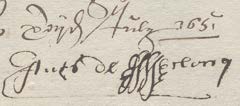
To allow the reader to comprehend how Jose Sanchez Real had placed Antoni Desclergue (DC06) in his book in 1974, we offer a Figure 34.1:
The signature of Antoni Desclergue
(DC06), ’Caballero de Felipe.’ Antoni Desclergue, in-
dicating a ’C’ before his name, with an F and A merged
oddly, clearly separating the F from the rest of the ana-
gramic character, and EHR in the middle, meaning
Knight of the Spanish King, or, ’Eques Hispani Rex.’ If
the middle is only an ornament instead of H, there is ER,
meaning ’Eques Regii,’ or Royal Knight. The anagram
is highlighted in Figure 34.2. An anagram, however, can
be read at a deeper level as if it is an artistic represen-
tation of characters, not necessarily to be read from left
to right, etc. Jairo Eduardo Cortés Rosal analyzed the
anagram and concluded that it represents ’JDCM’ and,
therefore, is a reference to the two bloodlines Antoni’s
Desclergue branch stemmed from, being that of Joan De-
sclergue and that of Cortés de Monroy. The signature
can be found when Antoni’s wife Beatrice died in 1651,
shown in Chapter 34.12.3 on page 587. Adding an indi-
cation of one’s Spanish Knighthood was not unique and
can also be found in Figure 34.155 on page 576 of an-
other Spanish Knight in Tournai.
1deposito legal B 19.565 - 1974.
2Graficas Lorente, Ciudad 13, Barcelona 2, Spain.
The Desclergues of la Villa Ducal de Montblanc, 2nd ed., Omn., VOL. II
© 2024 Nico F. Declercq

520
CHAPTER 34. ANTONI DESCLERGUE Y DE MONTOYA (DC06)
Figure 34.2: The anagram EHR in the middle of Antoni Desclergue’s signature is highlighted
for explanatory purposes. He was a Knight of the Spanish King, or ’Eques Hispani Rex.’ In case
the middle is only an ornament instead of H, then there is ER, meaning ’Eques Regii,’ or Royal
Knight. A comparison can be made with two documents shown in this work, signed by Antoni,
namely Figure 34.1 on page 519, and Figure 34.154 on page 575. Jairo Eduardo Cortés Rosal analyzed the anagram and concluded that it also represents ’JDCM’ and, therefore, is a reference
to the two bloodlines Antoni’s Desclergue branch stemmed from, being that of Joan Desclergue and
that of Cortés de Monroy.
Figure 34.3: 1641, Catholijcke klachte, view 1 (digitized by Google®)
citation and literal translation:
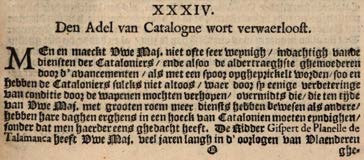
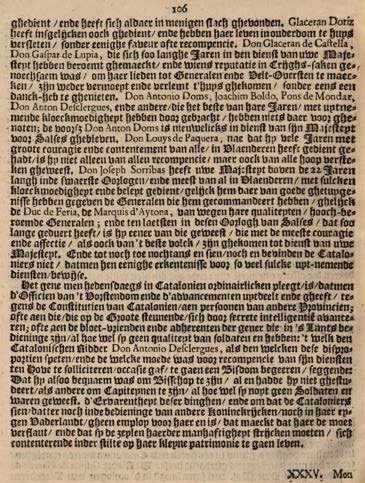
’Pere Costa: Nobiliario Catalán, Siglo XVIII, Manuscrito 153, Pago 214.’ , ’Desclergas. Esta familia fué domiciliada en Barcelona, en donde se acabó la linea varonil; las memorias que de ella hallo son que en el año 1503, Geronimo Desclergas se hallava Veguer de Cervera por el Sr. Rey de España y Archiduque de Austria Don Fellpe l. Consta de un mandato expedido en 19 de julio de dicho año en la Curia de Cervera, en las escrituras de Matheo Magre, en donde se lee que esta familia de Desclergas eran Cavalleros Donzeles. Don Antonio Desclergas (Antoni Desclergue (II) (DC06)) sirvió a Felipe 4 de España 22 años en Flandes con singular estimación de los generales por su bizarro valor, léese en la página 241 de la representación que la ciudad de Barcelona hizo a dicho Rey Felipe 4 el año 1640.’
In English, this implies, ’Desclergas. This family was domiciled in Barcelona, where the male line had ended; the memories that I find are that in the year 1503, Geronimo Desclergas was Veguer de Cervera (Vigerius of Cervera, or Lord of Cervera) by the King of Spain and Archduke of Austria Don Felipe l. It consists of a mandate issued on July 19 of that year in the Curia of Cervera, in the writings of Matheo Magre, where it is read that this family of Desclergas were Cavalleros Donzeles (i.e. Knights). Don Antonio Desclergas (II) (DC06) served Philip 4 of Spain for 22 years in Flanders while unanimously valued by the generals for his exceptional value, on page 241 of the representation that the city of Barcelona made to said King Philip IV in the year 1640.’
Jose Sanchez Real ignores the whole family of Bonaventura Desclergue (II) (DC04) except one son, Francesc Desclergue (DC05e), on page 31 of his book. It stems from the fact that he is the only son who has been responsible for the early conservation of the Casa Desclergue in Montblanc and because he formed, through his daughter Isabella Desclergue (DC05ex1), the continuation of the family towards the Jori and the Pedrolo families.
Salvador J. Rovira i Gómez3 found more members of the family of Bonaventura Desclergue (II) (DC04), namely on pages 83-84, Francesca Desclergue (DC05d), Jeroni Joan Desclergue y Cortés (DC05), Antoni Desclergue (I) (DC05b), Enric Desclergue (DC05c) and Francesc Desclergue (DC05e).
34.3 Antoni Desclergue (II) (DC06) in the Literature
In Pere Costa,4 we find the text that Sanchez Real also referred to,
’Don Antonio Desclergas sirvió a Felipe 4 de España 22 años en Flandes con singular estimación de los generales por su bizarro valor, léese en la página 241 de la representación que la ciudad de Barcelona hizo a dicho Rey Felipe 4 el año 1640.,’ or translated into English,
’Don Antonio Desclergas (DC06) served Philip IV of Spain 22 years in Flanders while unanimously valued by the generals for his exceptional value, on page 241 of the representation that the city of Barcelona made to said H.M. King Philip IV in the year 1640.’
Note that H.M. King Felipe IV reigned from 1621 onwards. It is, therefore, mathematically impossible that Antoni could have served him for 22 years by the year 1640. Thus Antoni became a military at the end of the reign of H.M. King Felipe III and served the Kings for 22 years.
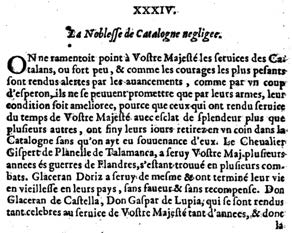
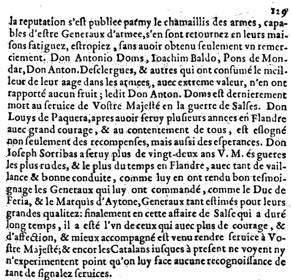
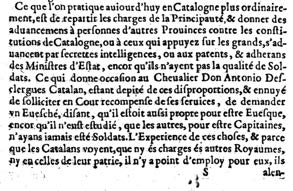
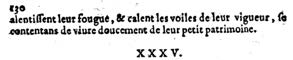
Antoni Desclergue (DC06) appeared in the famous work ’Plainte Catholique des Catalans’ 5 in 1641, shown in Figures 34.5, 34.6,
In particular, in section XXXIV, on page 129, it is stated,
that Don Antoni Desclergue (II) (DC06) tells that a number of Catalan nobles, including himself, have served a great part of their lives in the wars in Flanders and have never been rewarded for it..
The same can be found on page 109 in the Dutch version of this book, ’Catholijcke Klachte’ 6, shown in Figures 34.3 and 34.4.
3Salvador J. Rovira i Gómez, ’La baixa noblesa de la Conca de Barberà a l’ edat moderna’ , ’Montblanc : Centre d’ Estudis de la Conca de Barberà’
, 2005, published in the series ’Monografies, Montblanc, Spain’ , Volume 12
4Pere Costa: Nobiliario Catalán, Siglo XVIII, Manuscrito 153, Pago 214
5Plainte Catholique des Catalans, adressée a Philippe le Grand, Roy des Espagnes & Empereur des Indes, nostre Souverain Seigneur, par le Conseul des Cent de la ville de Barcelone, contenant les motifs de prise de leurs armes, & plusieurs remarques en l’ histoire, & Maximes servantes à la direction des Estats. Traduit de l’ espagnol, en Français, sur la copie envoyé de Barcelone. MDCXLI (1641).
6Catholijcke Klachte Voor-gedragen aen seyn Majesteyt Philippus de Groote, Konick van Spagnien, ende Keyser der Indien, onsen Over-Heer, by the Burgemeesters ende Raden vande Hondert - mannen der Stede Barcelone. Zynde niet min nuttelick als vermakelyck, ende vervarende, nevens de motiven, waerom de Cataloniers de Wapenen hebben aengeveert, vele schone gedenckweerdige Historyen, ende vele Maximen, tot wijs beleyt van Landts regeeringe seer dienstigh. Eerst Uyt het Spaensch in het Fransch vertaelt, ende nu uyt het Fransch in onse Nederlantsche taele getrouwelijck over-geset.
t’ Amsterdam, Jansz boeckverkooper op’ t water, inde Pas-Caert, 1641.
© 2024 Nico F. Declercq
The Desclergues of la Villa Ducal de Montblanc, 2nd ed., Omn., VOL. II
34.4. THE BIRTH OF ANTONI DESCLERGUE (II) (DC06)
521
Figure 34.4: 1641, Catholijcke klachte, view 2 (digitized by Google®)
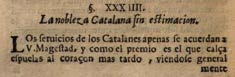
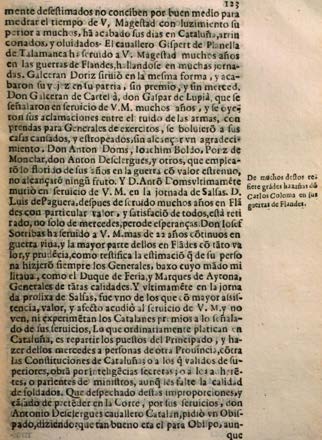
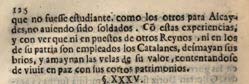
On page 123, in section ’XXXIIII: La nobleza Catalana sin estimacion’ of the original Castilian version7, shown in 34.9, 34.10 and
34.11, we found, for instance,
’. . . Don Antoni Desclergue (DC09b), y otros, que emplear¯o lo florido de sus años en la guerra (de machos destos refiere grades hazañas do Carlos Coloma en sus guerras de Flandes) có valor estrenuo, no ascançaró ningú fruto. . . .’
On page 129 of the French version, we read a paragraph expressing Antoni Desclergue’s (II) (DC06) character,
’Ce que l’ on pratique aujourd’ hui en Catalogne plus ordinairement, est de repartir les charges de la Principauté, & donner des avancements à personnes d’ autres Provinces contre les constitutions de Catalogne, ou à ceux qui appuyez sur les grands, s’ avancent par secrètes intelligences, ou aux parents, & adhérents des Ministres d’ Etat, encore qu’ ils n’ aient pas la qualité de Soldats. Ce qui donne occasion au Chevalier Don Antonio Desclergue (DC06) Catalan, étant dépité de ces disproportions, & ennuyé de solliciter en Cour récompensé de ses services, de demander un Evêchés, disant, qu’ il était aussi propre pour être Évêque, encore qu’ il n’ eût étudié, que les autres, pour être Capitaines, n’ ayans jamais été Soldats.’
In English, this translates to
’Currently in Catalonia, it is a common practice to appoint individuals to official positions within the Principality, often disregarding the traditional constitutions of Catalonia. Advancements are frequently granted to individuals from other provinces, or to those who support influential figures, gain favor through clandestine means, or are relatives and associates of the Ministers of State, irrespective of their qualifications, including military experience.
This practice has prompted the Catalan Knight, Don Antonio Desclergue, to express his discontent. Frustrated by these disparities and the need to petition at court for recognition of his services, he has ironically requested a bishopric. Desclergue argues that he is as qualified to be a bishop, despite lacking theological education, as others are to be captains, despite never having served as soldiers (DC06).’
The Desclergues family, known for invoking freedom of speech even in the presence of high-ranking nobles, attributes this trait to their ancient and distinguished lineage. Their nobility, often referred to as "purple blood," surpasses that of many other noble families in antiquity. Historical records indicate that the Desclergues were established as nobles during Roman times. Another example where a Desclergue permits himself to complain is shown in Chapter 18.11.1.
34.4 The Birth of Antoni Desclergue (II) (DC06)
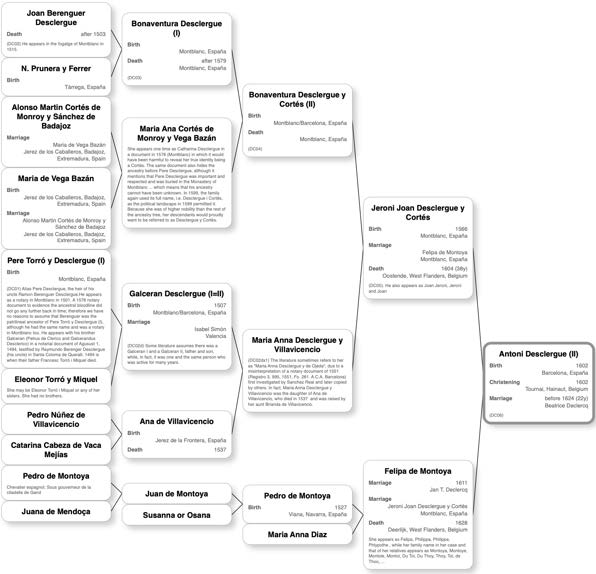
Antoni Desclergue (II) (DC06), whose lineage is illustrated in Figure 34.12, was the eldest son and heir of Don Jeroni Joan Desclergue y Cortés (DC05) and Felipa De Montoya. His siblings included Jeroni Desclergue (DC06d, a priest), Juana (DC06c, born in Ghent in 1588 and died in Ghent in 1622), and Anna (DC06f, born in Kortrijk in 1595 and died in Ostend in 1627). Notably, after the death of their father Jeroni in 1605, his brother Miguel (DC06b) was born.
Antoni was born in Barcelona and baptized in Tournai on June 26, 1602. His father, Jeroni (DC05), had been commissioned to recruit soldiers for the Army of Flanders. He received this official order during an audience with the Viceroy of Catalonia on June 7Proclamacion Catolica a la Magestad Piadosa de Felipe El Grande, Rey de las Españas, y Emperador de las Indias, Nestro Señor. Los Coselles, y Consejo de Ciento de la Ciudad de Barcelona. Con licencia en Barcelona, en casa de Iayme Matevad. Impresor de la Ciudad y su Uniursidad. Año 1641.
The Desclergues of la Villa Ducal de Montblanc, 2nd ed., Omn., VOL. II
© 2024 Nico F. Declercq
522
CHAPTER 34. ANTONI DESCLERGUE Y DE MONTOYA (DC06)
Figure 34.5: 1641, Plainte catholique, view 1 (digitized by
Google®)
Figure 34.6: 1641, Plainte catholique, view 2 (digitized by
Google®)
Figure 34.7: 1641, Plainte catholique, view 3 (digitized by
Google®)
Figure 34.8: 1641, Plainte catholique, view 4 (digitized by
Google®)
© 2024 Nico F. Declercq
The Desclergues of la Villa Ducal de Montblanc, 2nd ed., Omn., VOL. II
34.4. THE BIRTH OF ANTONI DESCLERGUE (II) (DC06)
523
Figure 34.9: 1941, Proclamacion catolica a la
Magestad, view 1 (digitized by Google®)
Figure 34.10: 1941, Proclamacion catolica a la Magestad, view 2
(digitized by Google®)
5, 1602. Around this period, likely a few weeks prior, Felipa de Montoya and Antoni and their elder children traveled to Tournai, where Antoni (DC06) was baptized. Felipa probably journeyed with her brother, Jeronimo de Montoya, while her husband, Jeroni Joan Desclergue y Cortés (DC05), joined them after completing his recruitment task.
This family movement may be allegorically represented in the ’Flight from Egypt’ panel, depicted in Figure 49.76 on page 1014
and described in Chapter 49.4.3.4. This panel, brought by Antoni Desclergue (DC06) from Spain to Flanders, symbolically reflects their migration.
Meanwhile, Jeroni Joan Desclergue y Cortés (DC05) actively recruited soldiers in towns near Montblanc. The recruited soldiers were scheduled to depart from Barcelona for Flanders on December 12, 1602.
The episode is described in Chapter 29.5.26.
Antoni, born in Barcelona but baptized in Tournai, lived with dual national identities. During this period, it was not uncommon for baptisms to be delayed by several weeks after birth without issue.
His father, Jeroni, was born in Montblanc and enlisted in the Spanish army in 1587. He was promptly dispatched to Flanders, where he played an active role in various military campaigns, including those in Holland, Cambrai, Amiens, and Ostend, where he ultimately died in 1604. Between 1598 and 1601, Jeroni returned to Barcelona to attend the Corts of 1599.
Regarding Antoni (DC06), additional information clarifies his age. When his mother, Felipa De Montoya, passed away in 1628, Antoni was already an adult, as the Orphan’s deed was only registered for his younger brother Miguel (DC06b). It confirms that Antoni (DC06) was born before 1603.
In a book from 1641, referenced in Chapter 34.3, it is noted that Antoni had served in the army in Flanders for 22 years, indicating that 1640 or 1641 marked his 22nd year of service. Given that the minimum age for military service was 18, this suggests Antoni joined the military no earlier than age 17. Therefore, it is plausible that Antoni (DC06) was born in the spring of 1602 in Barcelona.
His baptism, recorded in Figure 34.13, took place in Tournai at the Church of Marie-Magdalena, documented on page 50 of the church book, on June 26, 1602.
Perhaps interesting to mention here is that Pierre Minuit (Peter Minnewit), who was the governor of Nova Belgica (Nieuw Nederland) from 1626 until 1631, nowadays known as New York, was the one who had purchased Manhattan from the Lenape Native Americans (Canarsie). He also founded the Swedish colony of New Sweden on the Delaware Peninsula in 1638. He was born in Wesel in 1594, eight years before Antoni Desclergue (II) (DC06). His father, Jean Minuit, who married Sara Brel, originated from Tournai and had fled with his family because he was a Protestant.
It is plausible that Antoni was named after the Sint Antonius fortress of Ostend, located northeast of the town, across from the The Desclergues of la Villa Ducal de Montblanc, 2nd ed., Omn., VOL. II
© 2024 Nico F. Declercq

524
CHAPTER 34. ANTONI DESCLERGUE Y DE MONTOYA (DC06)
Figure 34.11:
1941, Proclamacion catolica a la
Magestad, view 3 (digitized by Google®)
Figure 34.12: Four ascending generations of Don Antoni Desclergue (II) (DC06)
Figure 34.13: The baptism of Antoni De-
sclergue (II) (DC06) at Tournai in 1602
(the left column is shifted to reduce the
image size, the original is available in
the Belgian Archives of Tournai/Tournai,
Marie-Magdalena church).
© 2024 Nico F. Declercq
The Desclergues of la Villa Ducal de Montblanc, 2nd ed., Omn., VOL. II
34.5. THE LIFE AND MILITARY CAREER OF ANTONI DESCLERGUE UNTIL 1640
525
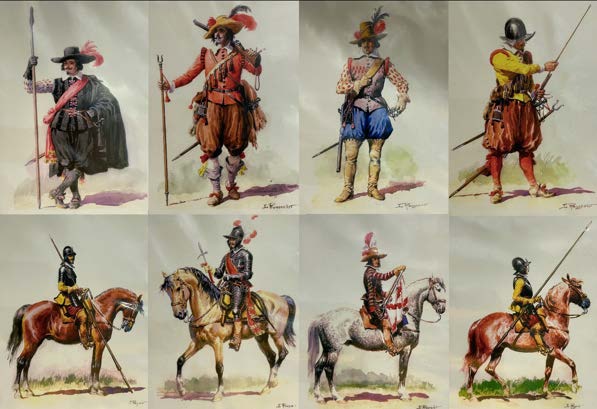
Figure 34.14: Military costumes during the 30-year War (1618-1648). From top right to bottom right: an officer of a Spanish regiment, a Spanish musketeer, a Spanish arquebusier, a Spanish arquebusier, a Spanish lancer, a Spanish cavalry colonel, a the trumpet of a Spanish cavalry regiment, and a Spanish lancer.
Geule, just before Bredene. On January 7, 1602, the city of Ostend was stormed by Spanish forces. The actions undertaken from the Sint Antonius fortress were crucial for the partial success of this assault. This strategic location allowed for the bombardment of the city and enabled the destruction of vessels delivering supplies to the Dutch and English forces stationed in the town. Maps indicating these locations can be found in Chapter 31.
34.5 The Life and Military Career of Antoni Desclergue until 1640
34.5.1 The Siege of Ostend and the Death of his Father Jeroni and Uncle Jeronimo de Montoya
As a child, Antoni (DC06) witnessed the Siege of Ostend, where his two paternal uncles, Enric (DC05c) and Antoni (DC05b), were involved and where his father, Jeroni (DC05), and maternal uncle died.
Indeed, Jeroni (DC05) was killed on September 27, 1604, in Ostend and left behind a pregnant widow and children, including Antoni Desclergue (II) (DC06). Antoni’s brother Miguel (DC06b) would be born later and baptized in Tournai.
Note that Antoni’s uncle Jeronimo de Montoya died earlier during the Siege. It is even likely that the Santa Maria fortress was nicknamed ’Jeronimo de Montoya’ after him, though we need further evidence to prove this.
For more information, refer to Chapter 31, Chapter 29.10.7, Chapter 32.2.2, and Chapter 33.3.6.
34.5.2 The Truce Between the Northern and Spanish Netherlands 1609-1621 and How it Ended
From 1609 until 1621, there was a truce between the Northern Netherlands and the Spanish Netherlands, or in other words, between Spain and the Dutch Republic. This truce, shown in Figures 34.15, 34.16, 34.17, 34.18, 34.19, 34.20, 34.21, 34.22, 34.23, had been negotiated by Ambrogio Spinola with whom Jeroni Joan Desclergue y Cortés (DC05), while Antoni Desclergue (DC06) was still a toddler, had sieged Ostend. Spinola would later be the Supreme Commander of Antoni (DC06) during the Siege of Bergen op Zoom in 1622 and the Siege of Breda in 1624-1625, explained in Chapter 34.5.5 and Chapter 34.5.6.
The truce between the Dutch and the Spanish, primarily negotiated by Johan van Oldenbarnevelt (1547-1619) (see Figure 34.24),
was met with mixed reactions from the Dutch side. Johan van Oldenbarnevelt, a pragmatic financial overseer, saw the truce as an opportunity, whereas Maurice of Nassau (1567-1625), a cautious military strategist, viewed it with suspicion. Their divergent perspectives came to a head during the Battle of Nieuwpoort in 1600. Johan’s decision to capture Duinkerken from the Spanish, against Maurice’s advice, escalated tensions between the two, ultimately resulting in Johan’s assassination in The Hague on May 13, 1619.
During the truce, internal divisions plagued the Dutch Republic. Without a common external enemy, political factions clashed over religious interpretations and the governance of the Dutch states, as outlined in the Treaty of Utrecht. This internal strife culminated in Johan van Oldenbarnevelt’s conviction and execution for high treason, a process which, although legal in appearance, was steeped in political maneuvering. With Johan’s removal, resistance to renewing the war with Spain diminished.
The truce primarily stemmed from mutual financial exhaustion and war-weariness among the populace. In the South, the lack of support for Calvinism and the continuation of life under Spanish rule, as evidenced in church documents (see Figure 34.25),
contrasted with the North, where Catholicism was suppressed.
The truce’s end can be attributed to several factors. The ease of travel during the ceasefire allowed Northerners to visit relatives in the South, revealing the Spanish regime’s relative prosperity and happiness, contradicting Dutch propaganda. This led to fears The Desclergues of la Villa Ducal de Montblanc, 2nd ed., Omn., VOL. II
© 2024 Nico F. Declercq
526
CHAPTER 34. ANTONI DESCLERGUE Y DE MONTOYA (DC06)
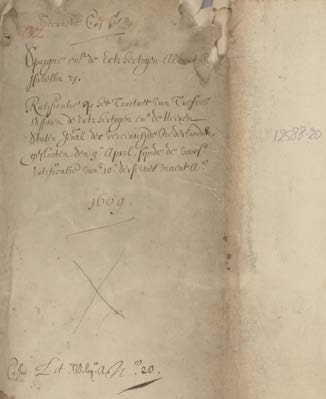
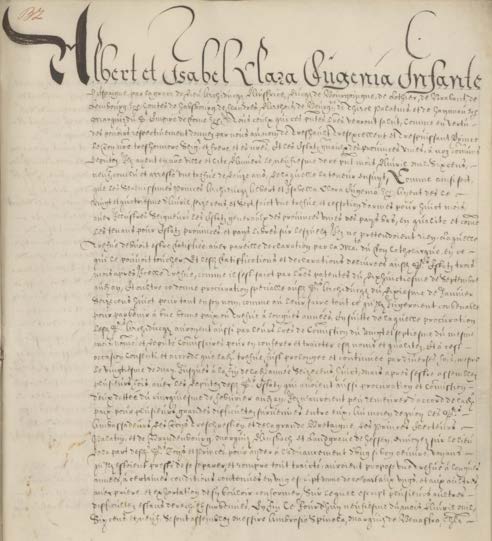
Figure 34.15:
The twelve year truce,
page 1. (Courtesy of the Dutch archives,
Nationaal Archief, Den Haag, Staten-
Generaal, nummer toegang 1.01.02, inven-
tarisnummer 12588.20).
Figure 34.16: The twelve year truce, page 2. (Courtesy of the Dutch archives, Nationaal Archief, Den
Haag, Staten-Generaal, nummer toegang 1.01.02, inventarisnummer 12588.20).
© 2024 Nico F. Declercq
The Desclergues of la Villa Ducal de Montblanc, 2nd ed., Omn., VOL. II
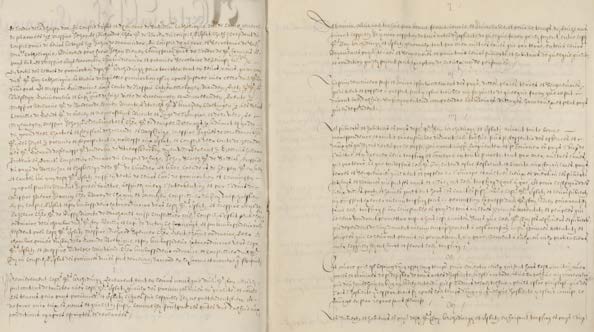
34.5. THE LIFE AND MILITARY CAREER OF ANTONI DESCLERGUE UNTIL 1640
527
Figure 34.17: The twelve year truce, page 3. (Courtesy of the Dutch archives, Nationaal Archief, Den Haag, Staten-Generaal, nummer toegang 1.01.02, inventarisnummer 12588.20).
that wealthy and industrious citizens, particularly those of Flemish and Walloon descent, might return to Belgium, potentially destabilizing the Dutch economy.
Alain Desrousseaux’s research8 highlights the significant contributions of these refugees to the flourishing textile industry in Leyden from 1550 onwards.
The Dutch aimed to disrupt Spanish trade routes globally, while the Spanish sought to reclaim the Northern Netherlands, believing that many regions had not voluntarily embraced Protestantism. Additionally, global competition between the two nations intensified, with the Dutch using the truce to advance their commercial interests, much to the Spaniards’ dismay.
The global rivalry between the Dutch and the Spanish was crucial in ending the truce. The Spanish perceived the Dutch as exploiting the ceasefire to emerge as global competitors. On the other hand, the Dutch sought to expand their territories and influence in the Americas and Asia, which the peace hindered. This rivalry is explored in detail in Chapter 57.29, which examines the Dutch-Iberian conflicts.
The principle of Mare Liberum, articulated by Hugo Grotius in 1609, underscored the Dutch’s desire for free navigation and trade, which clashed with Spanish interests. During the Austrian period, this principle was challenged by the Dutch, preventing the Belgians from maritime activities until Charles Philippe de Patin’s evolved version of Mare Liberum gained international support, as discussed in Chapter 70.6 and 70.6.10.
The truce officially ended around 1621 with renewed military activities between the Dutch and the Spanish in Antwerp. One of the Dutch justifications for resuming the war was the Spanish demand for religious freedom for Catholics in the Northern Netherlands while denying the same to Calvinists in the Spanish Netherlands. This issue of reciprocity was significant, particularly considering King Felipe II’s campaigns against Nassau in staunchly Catholic regions occupied by Protestants. When towns were predominantly and voluntarily Protestant, the King made peace.
During the truce, Carlos Coloma returned to Flanders as the governor of Cambrai in 1617, recruiting Antoni Desclergue (DC06) as indicated in Chapter 34.5.3. Desclergue likely focused on the Belgian-French border during the ceasefire and later participated in military actions against the Dutch, as detailed in chapters starting with Chapter 34.5.4.
In conclusion, the truce between the Dutch and Spanish unraveled due to internal Dutch conflicts, global competition, and strategic considerations. The Dutch sought to curtail Spanish trade dominance, while the Spanish aimed to reclaim the Northern Netherlands and counter Dutch expansion. The resumption of the war was driven by these complex, interwoven factors, ultimately shaping the trajectory of both nations in the early 17th century.
The end of the truce in 1621 can be attributed to the rise of a new Spanish regime. King Felipe III died on March 31, 1621, and was succeeded by the young King Felipe IV. The will of Felipe III is presented in Figures 34.26, 34.27, and 34.28. The daily politics of the new reign were largely influenced by Gaspar de Guzmán y Pimentel (Rome 1587 - Toro 1645), who significantly increased the Spanish military presence in the Netherlands, bringing troop numbers to approximately 60000 under the command of Ambrogio Spinola (Genoa 1569 - Castelnuovo Scrivia 1630). Military costumes from that era are illustrated in Figure 34.14 on page 525.
André Woestijn9 noted an increase in activity in Harelbeke from 1621 onwards. Ships transported large quantities of ammunition on the Leie. Although the main theaters of war were in the North and the South, the Castellany of Kortrijk faced ongoing challenges due to the winter quartering of soldiers, particularly from the end of October to the beginning of April. During 1621-1639, various armies in Spanish service traversed the country. As Woestijn observed, Harelbeke hosted numerous lodgings for Spanish, Irish, English, Italian, and German soldiers. This situation placed a significant financial burden on Harelbeke, as evidenced by the accounts from these years. The town also received loans from the King to help finance these efforts. Records of troops quartered in Kortrijk between 1620 and 1653 can also be found in the town’s archives.10
8Alain Desrousseaux, ’Les Réfugiés protestants de la Châtellenie de Lille en Hollande (milieu XVIème- début XVIIIème siècles),’ École doctorale Lille-Nord de France, 2016.
9André Woestijn, ’Harelbeke in de Spaanse tijd, 1585-1713,’ De Roede van Harelbeke (De Leiegouw), nr. 14, 1994.
10Gemeente Kortrijk, ’Oud Stadsarchief Kortrijk’ (OSAK), Document A0516-109095-107868-DUT-801-002: Documents concerning the quartering of troops. 1620-1653.
The Desclergues of la Villa Ducal de Montblanc, 2nd ed., Omn., VOL. II
© 2024 Nico F. Declercq
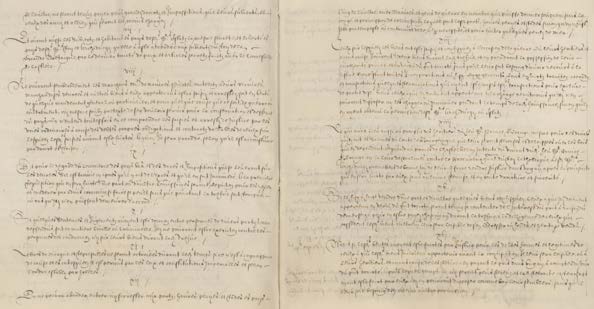
528
CHAPTER 34. ANTONI DESCLERGUE Y DE MONTOYA (DC06)
Figure 34.18: The twelve year truce, page 4. (Courtesy of the Dutch archives, Nationaal Archief, Den Haag, Staten-Generaal, nummer toegang 1.01.02, inventarisnummer 12588.20).
34.5.3 An Event which may have Triggered Antoni to Join the Armed Forces: the Comet on
Christmas 1618
Around Christmas in 1618, a comet was visible in the sky. The event shocked the Northern and Southern Netherlands. Literature on the occasion was also written in the Northern Netherlands. People were scared because, during the truce, the comet appeared while the Dutch still had Ostend’s loss on their minds during the supernova of 1604. We can refer, for instance, to ’Aenmerckinghe op de tegenwoordige steert-sterre,’ by Jacob Cat, 1619. Amsterdam was also in the middle of a pest epidemic; Johan Oldenbarnevelt was in jail, the 30-year European conflict had recently started; times were uncertain, and the comet frightened the Dutch. It’s not hard to imagine that Antoni Desclergue (DC06) was reminded of his father’s death in 1604 at Ostend while watching this comet.
Likely, the comet triggered him to join the Spanish armed forces and to continue his father’s legacy. In Chapter 29.12, we have also explained that there were indications that there were more Spanish military barracks in the period 1609-1625 than usual in the area of Harelbeke. As a consequence, Antoni (DC06) was more accessible for recruitment.
34.5.4 The Siege of Gulik, 1621-1622
Gulik is currently located in Germany and is known as Jülich. The Dutch had taken the city 12 years before the Siege. The Siege occurred from September 5, 1621, until February 3, 1622, shown in Figures 34.30 and 34.31. The Spanish forces led by Ambrogio Spinola and Hendrik van de Bergh kept the Dutch troops away from the city until the inhabitants realized that help could never arrive and would, therefore, surrender. The Spanish allowed everyone who wanted to leave the town to relocate to Nijmegen.
Indeed, the Spanish did not want to defeat the inhabitants but merely wanted the city’s location and infrastructure for future use for the winter quarter.
The Spanish were so dominant in 1622 that they decided to use the gained impetus and conquer Bergen op Zoom that same year, described in Chapter 34.5.5. To the reader who is interested in more detail, we refer to Tirion11, Geysbeek12, Siccama13, Arend14,
Le Clerc15, Nederlandsch Museum16, van Loon17, Staatkundige historie van Holland18, Schuer19, Bosscha20, and Blomhert21.
The violence in and near Gulik resulted in fugitives fleeing east to places such as Scherpenheuvel, as can be read in Figure 34.46 on page 540.
11Tirion, Beginnende, na ’t sluiten van het twaalfjaarig Bestand, in ’t jaar 1609; en eindigende, met de dood van Maurits, Prinse van Oranje, in ’t jaar 1625 P. 422, Uitgave Tirion, 1754, 1767.
12Pieter Gerardus Witsen Geysbeek, Schoonheden en merkwaardige tafereelen uit de nederlandsche geschiedenis, Volume 5 P. 135, Uitgave 1828.
13Jacob Hendrik Hora Siccama, Schets van de diplomatieke betrekkingen tusschen Nederland en Brandenburg, 1596-1678 P. 77, Kemink en zoon, 1867.
14Johannes Pieter Arend, Algemeene geschiedenis des vaderlands: van de vroegste tijden tot op heden, Volume 3 P. 643, Uitgave J. F. Schleijer, 1860.
15Jean Le Clerc, Geschiedenissen der vereenigde Nederlanden, sedert den aanvang van die republyk tot op den vrede van Utrecht in ’t jaar 1713 en het traktaat van Barrière in ’t jaar 1715 gesloten, Volume 2 P. 387, Uitgave Zacharius Châtelain, 1738.
16Nederlandsch Museum: geschied- en letterkundige merkwaardigheden, natuurbeschrijvingen, aardrijks-kundige bijzonderheden, historische en romantische verhalen, Part 14 P. 320, Uitgave 1849.
17Gerard van Loon, Beredeneerde naamlijst van al de gedenk- en legpenningen, munten ... welke gevonden worden in het penningwerk van Mr. Gerard van Loon P. 316, Uitgave 1837.
18Staatkundige historie van Holland: Benevens de Maandelijksche Nederlandsche Mercurius .., Volumes 36-39 P. 45, Uitgave 1774.
19Jan Lodewijk Schuer, Nederlands Merkwaardigste Gebeurtenissen sedert byna twee Eeuwen: Vervattende een aaneengeschakeld Verhaal der Wissel-valligheden, Zo in Voor- als Tegenspoed, ons Vaderland overgekomen : Beginnende met den Overdragt der Nederlanden Door den Keizer Karel den V.
Aan zynen Zoon Philips den II. van Spanje, In den Jare 1555 ; En eindigende met de Dood van Willem den IVa. van Oranje, In den Jare 1751, Volume 1
P. 279, Uitgave Van Poolsum, 1767
20Johannes Bosscha, Handleiding tot de kennis der krijgsgeschiedenis voor Nederlandsche militairen P. 1o1, Uitgave Broese & Comp, 1836: ’Krijgskunst: De Wallen van Gulik hebben een’ sterken bekleedingsmuur van keistenen.’
21Johan Blomhert, De geschiedenissen van het vereenigde Nederlandt, zedert zyn eerste opkomst tot op deeze onze dagen P. 172, Uitgave Gysbert, 1758: ’Onder onse doden wierdt den Kapiteyn Pithan gevonden , met vier en vyftig wonden, en syn keel soo ver deur gestooken, dat ’er de spys en drank door uytliep, maer verbonden synde, is hy, binnen weynig dagen, herstelt. Hy heeft in’ t Jaer 1622. noggeleeft, wanneer hy Gouverneur van Gulik was, als het de Spanjaerds innamen’ .
© 2024 Nico F. Declercq
The Desclergues of la Villa Ducal de Montblanc, 2nd ed., Omn., VOL. II
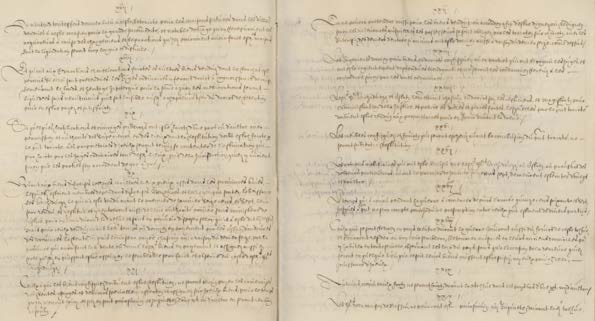
34.5. THE LIFE AND MILITARY CAREER OF ANTONI DESCLERGUE UNTIL 1640
529
Figure 34.19: The twelve year truce, page 5. (Courtesy of the Dutch archives, Nationaal Archief, Den Haag, Staten-Generaal, nummer toegang 1.01.02, inventarisnummer 12588.20).
34.5.5 The Siege of Bergen Op Zoom and Steenbergen, 1622
Ambrogio Spinola, shown in Figure 34.32, with whom Jeroni Joan Desclergue y Cortés (DC05) had performed the Siege of Ostend and died there in 1604, had negotiated the 12-year truce with the Dutch and now felt betrayed due to their global expansion at the expense of Spain. Spinola received support from some inhabitants and the Catholics of Halsteren to take back Bergen op Zoom, which convinced him to get to work.
The last time Bergen of Zoom was Sieged was in 1588 by Alexander Farnese, the Duque of Parma. Spinola, who had a much better reputation than Farnese, likely wanted to succeed where Farnese had failed. The Siege lasted from July 18, 1622, until October 2, 1622.
At the onset of the Siege, the Catholics of Bergen Op Zoom welcomed the Spanish by opening the city’s gates. However, Protestants were able to close the gates again, and this is when the Siege began. Spinola’s strategy was to send the garrison of Henrik van den Bergh to Kleef, followed by Don Luis de Velasco.
Luis de Velasco arrived in Flanders in 1691, significantly later than Jeroni Joan Desclergue y Cortés (DC05). The existing literature shows that he came by the Spanish road, described in Chapter 8.10. In 1695, he very likely met Jeroni Joan Desclergue y Cortés (DC05) as they both attended the attack on the city of Hoei, described in Chapter 29.5.19, and liberated it from the Dutch who had taken it shortly before. Unlike Jeroni, he did not participate in the Siege of Cambrai but did participate in the Siege of Calais with Diego Durango, described in Chapter 29.5.21. In 1597, on October 30, Luis de Velasco received, in Kortrijk, a permit to return to Spain. He would later return, participate in the early days of the Siege of Ostend, and then be promoted to Captain-General of the Cavalry in Flanders, a position he would hold for 22 years. He was married to a Flemish.
Note that both militaries were involved in the Siege of Calais in 1596. Luis de Velasco died in Dunkerque in 1625. He was murdered, probably as revenge for evil behavior.
Meanwhile, in Bergen op Zoom, Luis de Velasco, with his troops, could take Steenbergen but could not take Bergen op Zoom.
The reason is that Michiel de Ruyter, from the Northern Netherlands, could arrive by sea at the city and attack the camp of the remaining troops of Spinola with cannons. Spinola, being attacked from within the city as well as from the ship of de Ruyter, lost numerous men before the arrival of Maurits of Orange, with Peter Ernst II von Mansfeld (who supported the Dutch in return for money), on October 2, who, because the Spanish troops were so weakened, could rescue his city. Spinola and Luis de Velasco, with their forces, had to flee. Spinola had lost almost 8000 men during the Siege (5000 casualties, 3000 deserters). The Dutch still cherish a song related to the event. The song goes as follows:
Merck toch hoe sterck nu in ’t werck sich al steld,
Die ’t allen tijd’ so ons vrijheit heeft bestreden.
Siet hoe hij slaeft, graeft en draeft met geweld,
Om onse goet en ons bloet en onse steden.
Hoort de Spaensche trommels slaen!
Hoort Maraens trompetten!
Siet hoe komt hij trecken aen,
Bergen te bezetten.
Berg op Zoom hout u vroom,
Stut de Spaensche scharen;
Laet ’s Lands boom end’ sijn stroom
Trouwlijck doen bewaren!
’ t Moedige, bloedige, woedige swaerd
Blonck en het klonck, dat de vonken daeruijt vlogen.
Beving en leving, opgeving der aerd,
Wonder gedonder nu onder was nu boven;
Door al ’t mijnen en ’t geschut,
Dat men daeglijcx hoorde,
Menig Spanjaert in sijn hut
In sijn bloed versmoorde.
Berg op Zoom hout sich vroom,
’ t Stut de Spaensche scharen;
’ t Heeft ’s Lands boom end’ sijn stroom
Trouwlijck doen bewaren!
Die van Oranjen quam Spanjen aen boord,
Om uijt het velt als een helt ’t geweld te weeren;
Maer also dra Spinola ’t heeft gehoord,
The Desclergues of la Villa Ducal de Montblanc, 2nd ed., Omn., VOL. II
© 2024 Nico F. Declercq
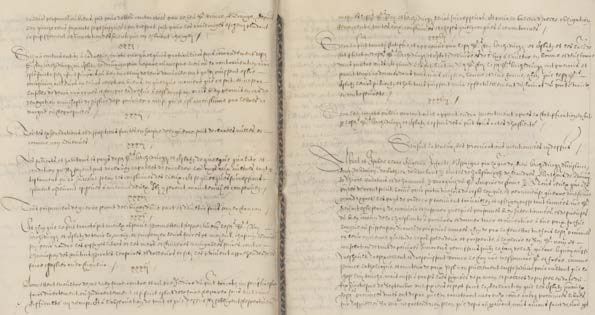
530
CHAPTER 34. ANTONI DESCLERGUE Y DE MONTOYA (DC06)
Figure 34.20: The twelve year truce, page 6. (Courtesy of the Dutch archives, Nationaal Archief, Den Haag, Staten-Generaal, nummer toegang 1.01.02, inventarisnummer 12588.20).
Trekt hij flux heen op de been met al sijn heeren.
Cordua kruijd spoedig voort,
Sach daer niet te winnen,
Don Velasco liep gestoord:
’ t Vlas was niet te spinnen
Berg op Zoom hout u vroom,
’ t Stut de Spaensche scharen;
’ t Heeft ’s Lands boom end’ sijn stroom
Trouwlijck doen bewaren!
In July 1622, the town of Steenbergen was captured by Luis de Velasco. An anecdote from this period illustrates the tensions between the local population and the military efforts to defend the city. The inhabitants of Steenbergen, who were favorable to the Spanish, were particularly distressed when Governor Borwater received additional cannons from Prince Maurits to fortify the city against the advancing Spanish forces. The resistance to this defense measure was notably led by the women of Steenbergen, who vehemently opposed the reinforcement.
In a dramatic act of defiance, these women threw the man delivering the cannons into the harbor, preventing the delivery of the much-needed artillery. As a result, the city remained defenseless, facilitating its capture by the Spanish without significant resistance.
However, the strategic significance of Steenbergen quickly diminished for the Spanish. Within a few months, the Dutch forces recaptured the town. The primary reason for this shift was the Spanish failure to capture the nearby city of Bergen op Zoom.
Without Bergen op Zoom, maintaining control of Steenbergen became strategically redundant and logistically burdensome for the Spanish. Consequently, the town reverted to Dutch control as the Spanish abandoned it.
34.5.6 The Siege of Breda, 1624-1625
Before describing the Siege of Breda, it is noteworthy to mention Antoni Desclergue’s (DCO6) presence at Dudzele, near Damme, in the winter of 1624-1625. During this period, he served as godfather to Martina de la Cruz, who later married his son Antoni Desclergue (DC07). Antoni (DC06) is referred to as Antoni Desclergue ’junior,’ indicating awareness of Antoni Desclergue ’senior’
(DC05b), who had served in the Damme area earlier in the 1600s. Additional information is provided in Chapter 37.4.
Breda, a fortified town in the Dutch States near the Spanish Duchy of Brabant, was attacked by Spanish troops in 1624 and 1625
under the command of Ambrogio Spinola (1569-1630).
The Spanish strategy aimed to conquer Breda and subsequently launch quicker attacks to dismantle the Dutch States. Conversely, Dutch control over Breda allowed them to attack the Spanish Netherlands swiftly.
Spinola was also motivated by personal honor, seeking to redeem his reputation following the failed Siege of Bergen op Zoom, discussed in Chapter 34.5.5. Contrary to the typical springtime siege, Spinola’s late-season attack caught the Dutch off guard, forcing them into an immediate offensive. After Prince Maurice, Frederik Hendrik attempted to relieve the city and disrupt Spanish supply lines.
The twelve-year truce between Spain and the Netherlands had fostered substantial growth for the Dutch, enabling them to rebuild and restore their country. The peace also opened new opportunities in America and Asia, as detailed in Part XII. However, the truce’s end in 1621 led to significant Spanish blockades. Consequently, the Dutch had to supply their new territories with weapons and men heavily, resulting in high costs and decreased revenues, thus precipitating an economic and military crisis.
Both Spain and the Netherlands desired peace, albeit with different immediate objectives. The Dutch sought to regain strength while fortifying their country, giving an illusion of desiring peace. Spain, recognizing the global instability’s disadvantage compared to Dutch gains, set two critical demands: free access to the Scheldt and the port of Antwerp, and freedom for Spanish-minded Catholics within the Dutch State to practice their faith. The conquest of Breda was intended to strengthen Spain’s negotiating position.
Breda was strategically significant, fortified by Hendrik III of Nassau inspired by modern European fortifications and situated on the Mark River, facilitating defensive flooding. The city was well-stocked to endure a nine-month siege, with a large army and well-equipped inhabitants.
© 2024 Nico F. Declercq
The Desclergues of la Villa Ducal de Montblanc, 2nd ed., Omn., VOL. II
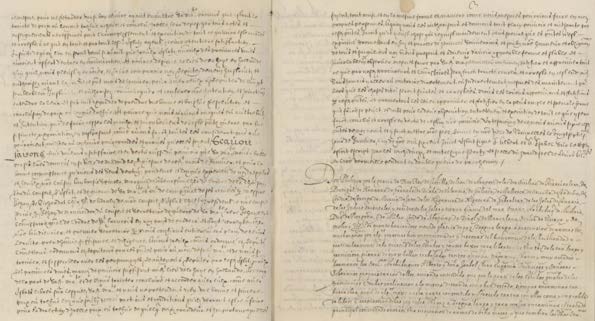
34.5. THE LIFE AND MILITARY CAREER OF ANTONI DESCLERGUE UNTIL 1640
531
Figure 34.21: The twelve year truce, page 7. (Courtesy of the Dutch archives, Nationaal Archief, Den Haag, Staten-Generaal, nummer toegang 1.01.02, inventarisnummer 12588.20).
The Spanish army command during the occupation shifted from Ambrogio Spinola to Hendrik van de Bergh, then to Jan van Nassau-Siegen, with Carlos Coloma de Sa commanding reserve troops from November 1624. Antoni Desclergue (DC06) and Carlos Coloma likely participated in the Siege from November 1624 within the reserve troops. The heraldic shield of Coloma is depicted in Figure 34.71. At the time, Antoni was relatively young, while more prominent roles might have been played by his uncles Antoni Desclergue (DC05b) or Enric Desclergue (DC05c), who were in their fifties.
The attack on Breda commenced on July 21, 1624, in Brussels under Spinola’s leadership. The army was divided into three to create confusion and maintain flexibility between targeting Breda or Grave. Ultimately, Spinola chose Breda over s’ Hertogenbosch, considering the potential conflict with France.
By August 26, the approach to Breda began, aiming to capture surrounding villages for logistical support, followed by encircling Breda.
The Spanish formed two defensive circles around the city to protect their troops from Dutch attacks and potential Dutch relief armies. These defenses included a man-made moat and a five-foot elevation, with the inner and outer circles having circumferences of 17 km and 40 km, respectively. Unlike traditional sieges, Spanish soldiers conducted these operations themselves, receiving extra pay. The supply line from Lier and Herentals faced disruptions due to Dutch attacks, leading to Spanish starvation. Nevertheless, the Siege succeeded as the Dutch supply to Breda was cut off, resulting in scarcity and hunger.
Breda, as seen in Figure 34.33, surrendered to Spinola on June 5, 1625, and Dutch soldiers allowed an honorable retreat. The conquest of Breda was globally significant, reinforcing Spain’s position in 1625. However, subsequent Dutch resilience, bolstered by new taxes, French aid, and the capture of the Spanish treasure fleet, eventually led to their resurgence. Around 700 Protestant homes were vacated as residents relocated, while Catholics celebrated newfound religious freedom. Breda was recaptured by the Dutch States in 1637 following Frederik Hendrik’s successful Siege.
Evidence of Italian troops residing in Kortrijk in 1627-1628 is documented in the town’s archives22.
34.5.7 The French-Dutch Alliance against the Habsburgs
During the 1630s and 1640s, France sought to achieve autonomy from the Spanish Habsburgs’ dominance. Alicia Esteban Estrín-
gana23 offers a valuable perspective on this endeavor, providing an assessment of its accomplishments.24
The capture of Trier by troops from the Duchy of Luxembourg, commanded by the ’Cardinal-Infante,’ and the subsequent expulsion of the French garrison on March 26, 1635, is recognized as a pivotal event leading to Louis XIII’s declaration of war on May 19, 1635. Following the capture of Trier, the French response, or lack thereof, raised doubts about the effectiveness of Richelieu’s protection policy towards the Swedes, a policy maintained since 1631. This inactivity highlighted the military weakness of the Bourbon monarch. The apprehension of Elector Felipe Cristóbal de Sötern by the prince and his transfer to Flanders with the Emperor’s awareness prompted France to take action to protect its Catholic allies. The treaty legitimized France’s overt involvement in the Thirty Years’ War.
France’s protection of Trier was part of its broader strategy to extend protection to Catholic sovereign principalities and independent Catholic cities along the kingdom’s eastern and northeastern borders between Lorraine and the Rhine. This strategy, initiated in late 1631, aimed to gain regional power through strategic occupation along the riverbanks, making Louis XIII a significant figure in European history.
Duke Charles IV of Lorraine, a consistent pro-Habsburg supporter, invited imperial forces to seize Vic and Moyenvic in the Metz diocese. Since the mid-16th century, France had protected Metz, Vic, Moyenvic, Toul, and Verdun, all affiliated with the Metropolitan Church of the Archdiocese of Trier.
22Gemeente Kortrijk. ’Oud Stadsarchief Kortrijk’ (OSAK), Document A0516-109095-107868-DUT-801-001: Account of Michiel Caysin of a tax on the Kortrijk garrison of Italian soldiers of Marsello de Indicys, with a notebook with expenses of collected tax money. 1627-1628. 2 quires.
23Alicia Esteban Estríngana, "Ear ley a los otros y emanciparse de ella: balance de hegemonía en las dos guerras de Flandes (1635-1646)," Ediciones Universidad de Salamanca, Stud. his., H.a mod., 41, no. 1 (2019): 65-116.
24Estríngana’s analysis primarily focuses on the period between 1635 and 1646, encompassing the initial stages of the conflict between Louis XIII and Philip IV and the conclusion of Philip IV’s dual wars in Flanders. Following 1646, the United Provinces’ military operations ceased, and hostilities were limited to the region near the French border.
The Desclergues of la Villa Ducal de Montblanc, 2nd ed., Omn., VOL. II
© 2024 Nico F. Declercq
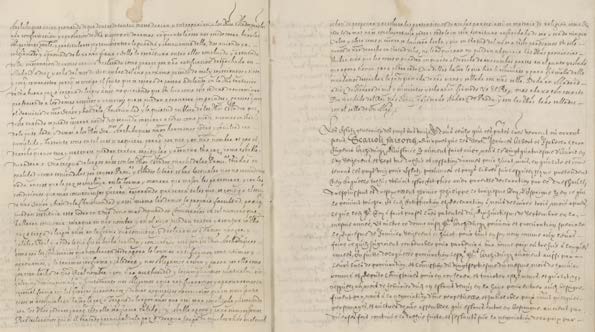
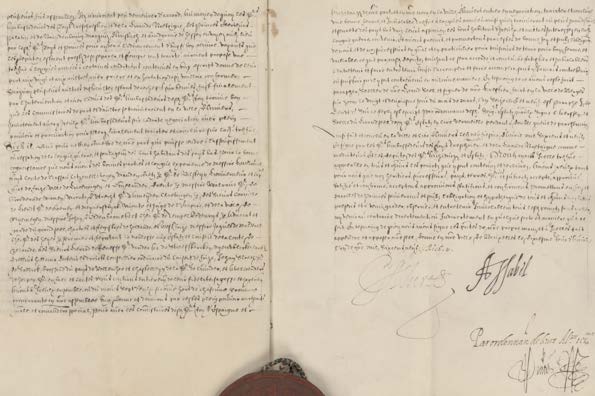
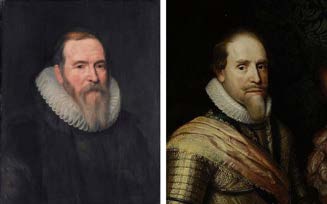
532
CHAPTER 34. ANTONI DESCLERGUE Y DE MONTOYA (DC06)
Figure 34.22: The twelve year truce, page 8. (Courtesy of the Dutch archives, Nationaal Archief, Den Haag, Staten-Generaal, nummer toegang 1.01.02, inventarisnummer 12588.20).
Figure 34.23: The twelve year truce, page 9. (Courtesy of the Dutch archives, Nationaal Archief, Den Haag, Staten-Generaal, nummer toegang 1.01.02, inventarisnummer 12588.20).
Figure 34.24:
Left is Johan van Old-
enbarnevelt (1547-1619), right is Maurice
of Nassau, Prince of Orange (1567-1625),
Rijksmuseum Amsterdam. p
© 2024 Nico F. Declercq
The Desclergues of la Villa Ducal de Montblanc, 2nd ed., Omn., VOL. II

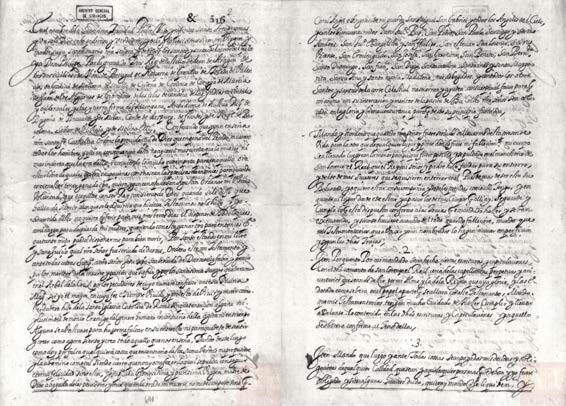
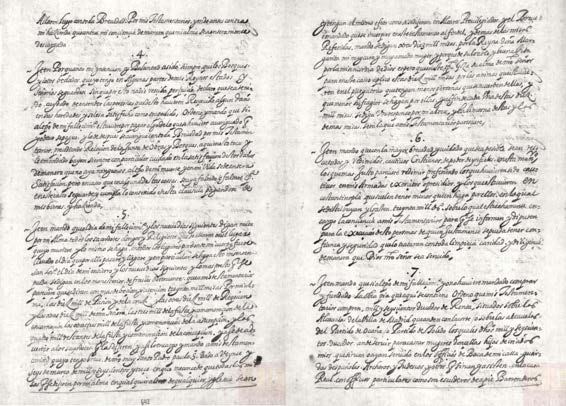
34.5. THE LIFE AND MILITARY CAREER OF ANTONI DESCLERGUE UNTIL 1640
533
Figure 34.25: 1614, Kortrijk, October, the baptism of Joannes Bracava son of
Jose Bracava and Joanna Pilo, the godfather was Joan Bracava, godmother was
Clementia Tyberghien.
Figure 34.26: The will of King Felipe III, dated March 30 1621, pages 1-2, the Spanish archives AGS; PTR, LEG, 29, DOC. 48 (Courtesy of Portal de Archivos Españoles).
Figure 34.27: The will of King Felipe III, dated March 30 1621, pages 3-4, the Spanish archives AGS; PTR, LEG, 29, DOC. 48 (Courtesy of Portal de Archivos Españoles).
The Desclergues of la Villa Ducal de Montblanc, 2nd ed., Omn., VOL. II
© 2024 Nico F. Declercq
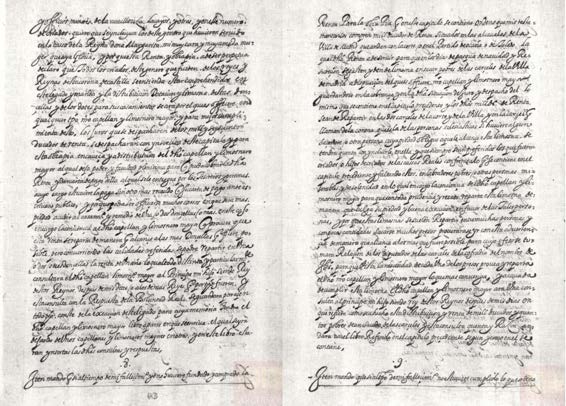
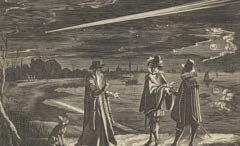
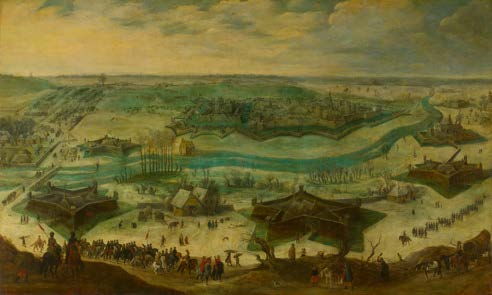
534
CHAPTER 34. ANTONI DESCLERGUE Y DE MONTOYA (DC06)
Figure 34.28: The will of King Felipe III, dated March 30 1621, page pages 5-6, the Spanish archives AGS; PTR, LEG, 29, DOC. 48 (Courtesy of Portal de Archivos Españoles).
Figure 34.29: 1619, the comet which was visible around
Christmas 1618. Aenmerckinge op de tegenwoordige
Steert-Sterre van Jacob Cats - François Schillemans,
1618 - 1619 - Rijksmuseum Amsterdam.
Figure 34.30: The Siege of Gulik by the Spaniards under Hendrik van den Bergh, between September
5, 1621, and February 3, 1622. In the center is the city, surrounded by fortifications; in the foreground a procession of equestrians and troops of the besiegers. p
© 2024 Nico F. Declercq
The Desclergues of la Villa Ducal de Montblanc, 2nd ed., Omn., VOL. II
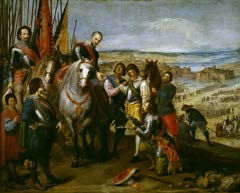
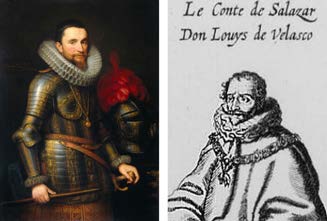
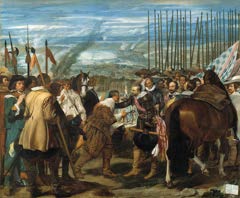
34.5. THE LIFE AND MILITARY CAREER OF ANTONI DESCLERGUE UNTIL 1640
535
Figure 34.31: The Surrender of Gulik. p
Figure 34.32: Left is a 1609 portrait of
Ambrogio Spinola (1569-1630), comman-
der in chief of the Spanish troops in the
Southern Netherlands. The emblem of the
Order of the Golden Fleece can be seen
on his necklace (Rijksmuseum Amsterdam,
p). Right is the 2nd Count of Salazar dur-
ing the Funeral of Albert VII, Arcdukea. p
aPompes funèbres de l’ archiduc Albert d’
Autriche à Bruxelles / Série de 65 gravures d’
un recueil relatant les funérailles d’ Albert d’
Autriche à Bruxelles le 11 mars 1622.
Figure 34.33: The surrender of Breda in 1625, by Diego
Rodríguez de Silva y Velázquez. The painting is also
known as ’Las Lanzas’ . In this painting, we observe
Justinus van Nassau surrendering and handing over the
city’s key to Spinola and Spain. Carlos Coloma stands
behind Spinola. It is intriguing to imagine a relative in
the picture as well. The first candidate, Antoni Descle-
rgue (DC06), was 23 years old at the time and likely
had not yet advanced sufficiently in his military career
to be included in the painting. However, his uncles, An-
toni Desclergue (DC05b) or Enric Desclergue (DC05c),
would have been in their 50s and could plausibly fit into
the artwork if they were present. If one of the latter were
in the painting, the person behind Spinola with a round
bald head appears to be a plausible candidate. p
Figure 34.34: This small gate in Amsterdam, along the canals, far
north of Breda, was constructed in 1624 during the Siege of Breda.
September 4, 2021. (Declercq de Silva Archive)
The Desclergues of la Villa Ducal de Montblanc, 2nd ed., Omn., VOL. II
© 2024 Nico F. Declercq
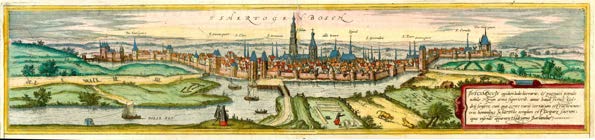
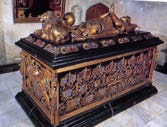

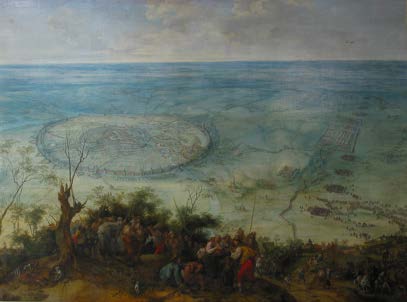
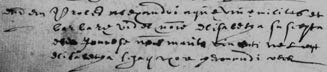
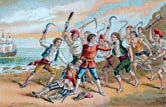
536
CHAPTER 34. ANTONI DESCLERGUE Y DE MONTOYA (DC06)
Figure 34.35: Map of ’s Hertogenbosch, by Georg Braun and Frans Hogenberg.
Figure 34.36: The tomb of Charles the Bold in Bruges. As can be read
in Chapter 8.5.4, Charles the Bold was an ancestor of H.M. King Felipe
IV of Spain, who was the King during the assault on Bruges. The King
was the great-grandson of Carlos V (Charles Quint or Keizer Karel),
a great-grandson of Charles the Bold. (Declercq de Silva Archive)
Figure 34.37: Bruges’ Christmas market of 1998. From left to right:
Jeanette Verbrugghe (the author’s foster mother), Shirani de Silva and
Maurice Declercq (the author’s father). (Declercq de Silva Archive)
Figure 34.38: The Siege of Leuven by the French and Dutch. Painting by Peter
Snayers in 1639. Source: Kunsthistorisches Museum. p
Figure 34.39: 1637, Kortrijk, the bap-
tism of Elisabeth Aque, the daughter of
military Alexandre and Barbara Vidal, the
godfather was soldier Joseph de Somariva,
godmother was Elisabetha Rigan, the wife
of Fernando Weil.
Figure 34.40: ’Els Segardors’ by Hermenegildo Miralles (1910). p
© 2024 Nico F. Declercq
The Desclergues of la Villa Ducal de Montblanc, 2nd ed., Omn., VOL. II
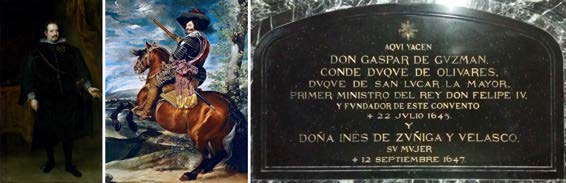
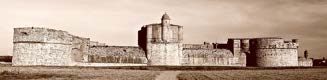
34.5. THE LIFE AND MILITARY CAREER OF ANTONI DESCLERGUE UNTIL 1640
537
Figure 34.41: Left, Diego Mexía Felípez de Guzmán y Dávila, 1st Marquess of Leganés (by Anthony Van Dyck, around 1634). Middle, Conde-Duque de Olivares (1587-1645) (by Diego Rodríguez de Silva y Velázquez). Right, the tomb of Gaspar de Guzmán in Loeches p. Before Carlos V and Count Duque Olivares made Loeches a town in the 16th century, it relied on Alcalá de Henares. Count-Duke Gaspar de Guzmán of Olivares purchased it in 1633, reaching his political peak. Born in Rome on January 6, 1587, Gaspar de Guzmán, 3rd Count of Olivares, served King Felipe IV
and died in Toro, Zamora, on July 22, 1645. Son of Spanish diplomat Enrique de Guzmán, he studied canon law in Salamanca, joining the Court of Philip III. He became Count of Olivares in 1607 and married his cousin, Inés de Zúñiga e Velasco. Francisco de Sandoval, Duke of Lerma, named him chamberlain in 1615. Olivares rose to power in 1621 and held various key positions. He aimed for domestic reform while dealing with war, but economic strategies faltered. He presented the Great Memorial in 1624, proposing legal consistency and centralized administration. The Union of Arms aimed to share war costs but faced resistance. The war with the United Provinces resumed with mixed results. Financial struggles and military defeats eroded Spain’s influence in Europe. Olivares attempted an authoritarian reform but faced resistance, leading to rebellion. Portugal’s uprising in 1640 granted independence, and Olivares lost political credibility.
He was banished to Loeches, then sent to Toro and the Inquisition, where he died in 1645. Olivares’ authoritarianism was unpopular, and Spain’s decline became evident. His failure marked the impending fall of Spanish predominance to France, and the monarchy couldn’t adapt to European progress. In summary, Gaspar de Guzmán, Count-Duke of Olivares, played a significant role in Spanish politics during the reign of Felipe IV but faced challenges and ultimately fell from power, contributing to Spain’s decline on the European stage.
Figure 34.42: Salses fortress (2018)
France’s injunction in December 1631, ignored by both the Duke and the Emperor, led to the first French invasion of Lorraine.
This military incursion captured both fortifications and the Treaty of Vic’s enforcement upon Charles IV on January 6, 1632. The treaty granted France transit rights and access to the Rhine, establishing a garrison and securing military control over Lorraine, maintaining a semblance of neutrality in potential conflicts with the Habsburgs.
France presented these protective measures as an independent response to the Swedish allies’ and Protestant factions’ success in the Battle of Breitenfeld. The battle, on September 17, 1631, in Saxony, and the subsequent Swedish capture of Mainz in December 1631, benefitted France, making the French protection treaties neutral in the France-Habsburg struggle.
The Habsburg Emperor Ferdinand II, supported by the Catholic League and Felipe IV of Spain, saw France’s diplomatic engagements with various princes and Alsace’s free cities documented until spring-summer 1634. Unlike the Elector of Cologne and the Prince-Bishop of Liège, the Elector of Trier abandoned the Habsburg client network for Ferdinand of Wittelsbach, Duke Maximilian of Bavaria’s brother.
The final French takeover of Lorraine occurred in the summer of 1634, following the Treaty of Nancy on September 26, 1633, establishing France’s ’system of protection’ in the Meuse, Moselle, and Rhine regions. In June 1632, the United Provinces initiated a strategic incursion into loyal countries through the Meuse Valley, seizing multiple cities and laying siege to Maastricht, leveraging a noble conspiracy advocating for French intervention to expel Spanish forces from Flanders. This effort involved a coordinated dual invasion, with the Maastricht siege concluding in August 1632.
Louis XIV of France benefitted from the 1632 military war with Orange, gaining military advantage near the French-occupied Trier, escalating concerns over the French-Dutch alliance. Brussels believed France and the Republic would negotiate a new treaty to invade loyalist provinces during the 1633 campaign. France controlled the region between Luxembourg and the Rhine from Trier, impeding German military support. The League of Heilbronn facilitated the blockade establishment,25 uniting Swedish forces with Protestant sympathizers in western empire regions, including Frankia, Swabia, and Upper Rhineland. This partnership and the French military presence in Lorraine threatened Italy-Flanders connections, making Flanders more vulnerable. The Alsatian campaign, led by the Duke of Feria from summer to fall 1633, failed to alleviate Flanders’ dire circumstances.
The apprehension in Brussels was substantiated. The Franco-Dutch alliance was formalized by a fourth treaty, updated on April 15, 1634. A fifth offensive pact on February 8, 1635, outlined a combined invasion strategy. The deal stipulated a March 1635
military campaign in Flanders to liberate it from Felipe IV.
From April 1634 to February 1635, significant developments within the Holy Roman Empire prompted France’s consequential decisions. The successful Habsburg military collaboration led to a decisive victory at the Battle of Nördlingen on September 5-6, 1634.
This collaboration enabled the House of Austria to assume offensive initiative and safeguard the empire from detrimental forces, destabilizing the region and creating uncertain prospects for Sweden.
The Protestants, initially allied with Sweden, withdrew their support between November 1634 and February 1635, renouncing the Treaties of Pirna. This led to their reconciliation with the Emperor and the Catholic faction. This reconciliation culminated in the Peace Treaty of Prague on May 30, 1635, officially approved by the Elector of Saxony in mid-June following successful mediation 25The League of Heilbronn was established on April 27, 1633.
The Desclergues of la Villa Ducal de Montblanc, 2nd ed., Omn., VOL. II
© 2024 Nico F. Declercq
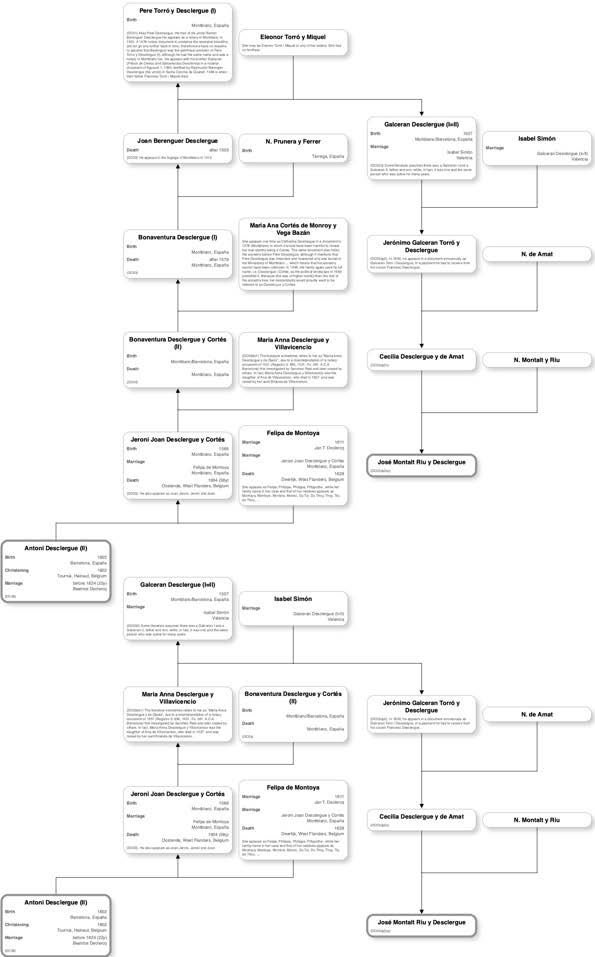
538
CHAPTER 34. ANTONI DESCLERGUE Y DE MONTOYA (DC06)
Figure 34.43: Two relationship charts between José Riu y Desclergue (DC02dy2x1y1) and Antoni Desclergue (DC06)
© 2024 Nico F. Declercq
The Desclergues of la Villa Ducal de Montblanc, 2nd ed., Omn., VOL. II
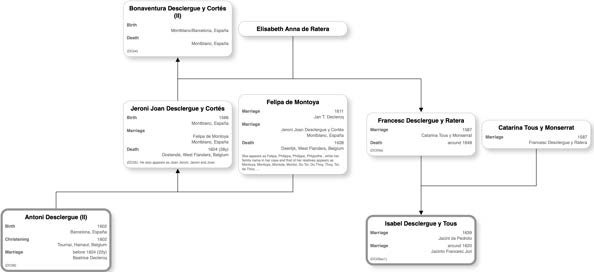
34.5. THE LIFE AND MILITARY CAREER OF ANTONI DESCLERGUE UNTIL 1640
539
Figure 34.44: Relationship chart between Isabel Desclergue y Tous (DC05ex1) and Antoni Desclergue (DC06) Figure 34.45: This is the recent work of Josep M Cartanya Roca, who won, with this picture the first
award from @fan.tasypic and Montblanc Medieval. It is a photo of the Casal dels Desclergue of Montblanc.
The famous Casal dels Desclergue is located on the main square of Montblanc and is a landmark. It was
constructed around the end of the 16th century and early 17th century by the Desclergue family.
The Desclergues of la Villa Ducal de Montblanc, 2nd ed., Omn., VOL. II
© 2024 Nico F. Declercq
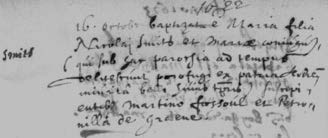
540
CHAPTER 34. ANTONI DESCLERGUE Y DE MONTOYA (DC06)
Figure 34.46: Scherpenheuvel, October
16, 1622, the baptism of Maria, the daugh-
ter of Nicolas Smits and his wife Maria,
fugitives of their homeland in Luik because
of the violence of the war. The godparents
were Martinus Fassoul and Petronille de
Groene. They have fled because of the vio-
lence in the context of the Siege of Gulik.
efforts.
34.5.8 The defence of ’s Hertogenbosch in 1629 and Bruges in 1631
Bois-le-Duc or ’s Hertogenbosch, shown in Figure 34.35 is known in Spanish as Bolduque and is, in the Netherlands, often called Den Bosch.
The period 1629-1634 is quite particular because we observe a joint involvement of Antoni Desclergue (DC06), as well as his uncles Antoni Desclergue y Ratera (DC05b) and Enric Desclergue y Cortés (DC05c). Given the age of the two latter, we must assume that they had more of an administrative and leading role in the Spanish army than the much younger and energetic Antoni (DC06).
In particular, the two elderly brothers were most definitely involved in the Spanish actions undertaken to protect the city in 1931, given their proximity to the town.
A decade later, we found an exciting reference concerning Tielt and Wingene, where the Desclergue brothers resided near the end of their lives, and which area belonged to the Casselrye of Kortrijk. In the financial accounts of the town Tielt,26 we found two references to Spanish troops originating in Iberia and Italy, as follows: ’Loys De Caigny tavernier in tSchaeck van taire tsynen huyse ghedaen byde loopende soldaeten,’ on page 362, and also ’Loys De Caigny tavernier in tSchaeck van taire tsynen huyse ghedaen byde loopende soldaeten’ on page 362.
The Spanish Crown often went bankrupt in the 1600s, partly due to exuberant interest rates on bank loans and partly due to the sometimes late arrival of silver from the New World. The massive influx of silver from the New World also caused strong European inflation. The authorities used the money for many purposes, such as erecting beautiful, functional buildings in Spanish areas all over Europe. The resources were also used for warfare, mainly against the Turkish and partly against the Protestants, such as the Dutch and the English, or France. Also, in Asia, competition between the Spanish27 and the Dutch VOC required vast resources.
The money they paid to soldiers was injected into the economy where they resided. Additional local funding for the Spanish armies mostly went to locally recruited soldiers. In 1625, the Spaniards conquered Breda and appeared supreme, but the tide quickly turned in the financial world, and bankruptcy was continually lurking.
For example, in 1627, the Spanish Crown went bankrupt again. In 1628, the Spanish treasure fleet was lost and stolen by Piet Hein and his pirates from the West Indian Company (WIC). It meant that Spain was financially weak at that time, while the Dutch States were powerful and, above all, very enthusiastic. Furthermore, the heavyweight of Spanish military activity lay in Italy, where the Mantuan War of Succession had started, also involving France. The German emperor’s support of Spain could not be expected either, as he fought a battle with Denmark. In short, it was the ideal time for the Dutch to strike and try to conquer a part of the Spanish areas. The Dutch set their sights on ’s Hertogenbosch in 1629. A possible conquest of this city would significantly elevate the prestige of the Dutch, and it was also important from a military standpoint. Indeed, the town formed a bridgehead for the Spanish to attack the Dutch States. On the other hand, for the Spaniards, the city was also crucial in its defense strategy. Indeed, the city protected the deeper Spanish areas, such as Lier, Tienen, and Herentals, which were incredibly difficult to defend against attacks by the Dutch. Above all, s’ Hertogenbosch was one of the four critical cities in Brabant, with a bishop’s seat. Spain certainly wanted to retain this city. During the twelve-year truce, the Spaniards had extensively modernized the city defenses. However, this work still needed to be completed, so some of the fortress resisted modern warfare.
When the Dutch had surrounded the city, the Spaniards had to relieve it. It happened under the leadership of commander Hendrik Van de Bergh. However, the initiative came much too late, so the Dutch could have provided the city surroundings with additional defense mechanisms against Spanish attacks. The reasons for the late undertaking are stated above and were mainly financial. The States army, led by Frederik Hendrik, defended the city excellently by focusing on the town and anticipating Spanish attempts to attack the supply lines. For example, Frederik Hendrik flooded areas to limit the access roads to the city for the Spaniards.
The Spaniards knew it was impossible to relieve the town, but they launched an attack at the end of June, given its immense prestige. By the end of the summer, it became clear that the Spaniards would not relieve the city and that the encircling Dutch would conquer it. The state’s army was also heavily weakened. For example, they had dug trenches from some directions, so-called
’approaches,’ which were frequently left unpopulated. Had the city inhabitants communicated unimpeded with the Spaniards, they could have identified the weak spots along which the Spaniards could still have relieved the city. However, the Dutch had cut off all communication channels so that the two parties could not coordinate their attacks against the surrounding Dutch and could not point out the weak spots to each other. The city defended itself superbly. There were so many victims on the States’ side that the remaining military only wanted to fight if paid a very high salary, as seen in the accounts from that time.
In time, however, the residents realized that their city was lost. There was a revolt, and they no longer wanted to support the defense. On September 11, the inhabitants punched a hole in the wall of a defensive bastion to let in the States’ armies and end the hopeless situation during that uprising. Negotiations began on September 12, and the States allowed an exodus on September 17. The city then finally fell into Dutch hands. The Spanish could not prevent the Dutch from confiscating the properties of the Catholic churches. The exodus of city dwellers and soldiers was impressive. One thousand two hundred carts were used and formed a long procession from the city to the Spanish areas. The loss of s’ Hertogenbosch was a thorn in the hearts of the Spaniards.
Another similar loss would have been inconceivable.
When Bruges was threatened in 1631, the Spaniards, to whom the city was dear, not only for its history but also for the crucial graves, such as Figure 34.36, would not give up this city without a fierce fight.
The year before, Aytona had reported to the Court in Madrid that the situation was dire and that the Spaniards feared they would 26Stadsrekeningen Tielt, 3/10/1640 - 11/9/1642, rvt, Frans Hollevoet, blz.204.
27Spain and Portugal were united at that time
© 2024 Nico F. Declercq
The Desclergues of la Villa Ducal de Montblanc, 2nd ed., Omn., VOL. II
34.5. THE LIFE AND MILITARY CAREER OF ANTONI DESCLERGUE UNTIL 1640
541
be unable to cope with the Dutch without new financing. One can read it in his letters, which are still stored in Brussels28. The fall of s’ Hertogenbosch had uplifted the Dutch. Frederik Hendrik van Nassau turned out to be a competent captain, which made the Dutch very professional. The West of Belgium was neglected and had a weak defense since the most significant Spanish troop concentrations were in Germany.
Spies had told the Spanish that the Prince of Orange had requested a large loan for Antwerp’s Siege and ’another city.’ So they knew that something was coming. Since Prime Minister Olivares did not have highly skilled Spanish noblemen who could rule the area, a military rule by Spaniards prevailed in the Southern Netherlands. The Marquis of Santa Cruz became the military commander-in-chief of the Southern Netherlands. This person was Álvaro de Bazán (1571-1646), 2nd Marquess of Santa Cruz, also known as Álvaro II de Bazán y Benavides. He was the son of the legendary Álvaro de Bazán, who is said to have never experienced defeat despite a very long military career.
At the beginning of June 1631, the Dutch States appeared with a great display of power at Bruges city. The most prominent city of West-Flanders, shown in Figure 34.37, could have turned Dutch had the Spanish not supported. The writings of Aytona and Carlos Coloma de Saa29 attest to this. They are confirmed by notes made by residents of the town of Bruges. Coloma’s account is essential to our family history, as the Desclergues were involved. Indeed, Antoni Desclergue (DC06), as well as his uncles Antoni Desclergue y Ratera (DC05b) and Enric Desclergue y Cortés (DC05c), were involved. Antoni (DC06) was still in the prime of his life and must have been engaged in the battle itself.
Until March 1631, Coloma had been a substitute ambassador for Spain in England. In the Spring of 1631, Carlos Coloma became Maestre de Campo in Flanders to better defend the area. He acted under the Marquis of Santa Cruz’s command, who arrived with a large army on Easter Monday. As an attack on the coast was expected, the whole area from Dunkirk to the border with the Netherlands was placed under Luis de Benavides’ authority. Fuentes was ordered to take a position to defend Bruges and Damme.
We can, therefore, say that the Desclergues most likely supported the cities of Bruges and Damme with Fuentes. The Spanish recruited new military personnel from the Artois, Hainaut, and Luxembourg regions.
Felipe de Silva was also ordered to recruit German soldiers from the Palatinate region. Simultaneously, Walen and Geldern were not heavily defended; they also feared an attack from the Dutch. Some 40000 Dutch troops were then stationed by the Prince of Orange, between Emmerik and Rees, and were ready to invade Belgium. Although the Spaniards expected a significant attack on the coast, they noticed that the Dutch were moving downstream along the Rhine, forcing them to defend Antwerp more heavily.
Therefore, the most remarkable Spanish troop strength would nevertheless concentrate around Antwerp. Nonetheless, they feared an attack on Bruges, which caused Fuentes to defend the area more heavily.
On May 26, 1631, the Spaniards, led by Fuentes, left Moerbrugge to target Damme. The Dutch broke through around May 30, reached Yzendijke, and then moved to Sas van Gent. Ballo and Francisco Zapata’s armies were stationed in that place but were too weak. These armies then marched to Zelzate, where Carlos Coloma joined them to advance to Heusden.
Diego Sanchez de Castro, the governor around Zelzate, had heard that the Dutch had reached Yzendijke to disembark in Watervliet.
When Coloma and Zapata were informed, they decided to spy on the enemy from the village Philippine. Prisoners of war announced that it was not the Dutch intention to take Antwerp but to capture Sas van Gent. If this failed, then they would try to conquer Bruges. Coloma hastily sent a message to Antwerp, saying that he urgently needed reinforcements.
The Spaniards gathered efficiently and fast near Ghent and advanced to Bruges to defend the city. They were so sure Bruges was in danger because spies had reported that the Dutch had no heavy artillery. So, it could not have been the intention to attack Ghent, for example.
The Spaniards moved on beyond Saint George’s fortress (Sint Joris or Sant Jori), which must have been remarkable for the Catalans, particularly the Desclergues with roots in Montblanc. Meanwhile, the cavalry resided near Aalter. On May 31, the Dutch reached Bruges. That means that they had disembarked more than 20000 foot-soldiers and 70 artillery pieces in three days and had advanced some 10 km.
In Bruges, the inhabitants locked themselves within the city walls for protection. At the same time, the Spaniards stayed at a reasonably considerable distance from the city to strike where necessary when the Dutch would take a position. The Dutch tried to negotiate with the bishop of Bruges, but he sided with the Catholics. When Spanish troops arrived at Bruges’ city walls, the city admitted 3000 of them, and the Bishop of Bruges reported this fantastic fact to the Bishop of Ghent at the Spanish Castle. The inclusion of Spaniards in the city was a disappointment for the Dutch. It meant that the residents of Bruges did not want the Dutch and took sides with the Spaniards. Then, the Dutch, disillusioned and very frustrated, withdrew. During the retreat, they lost another 1000 men, killed or captured by the Spanish. The Spaniards were not immediately aware of the withdrawal; hence, they attacked. The facts described above are discussed more in R. Bottelberge and T. Colom Aguilar’s work, ’Brugge in 1631 bedreigd en ontzet.’
Isabella of Spain died in 1633, and Flanders was governed ad interim by Francisco de Moncada, the Marquis of Aytona, until Ferdinand of Austria’s arrival.
Antoni (DC06) was also involved in Leuven, as described in the following section.
34.5.9 The Siege of Leuven, 1635
In the year 1635, France experienced significant political shifts. Concerned about the strong Habsburg presence on its borders, France, a staunch Catholic power that had recently suppressed the Huguenot rebellions domestically, declared war and supported the Protestant Anti-Habsburg states. This strategic move underscored France’s geopolitical priorities over religious affiliations.
Initially, France’s military campaign faced setbacks. An invasion of the Spanish Netherlands was unsuccessful, resulting in a French retreat to their borders for several years. However, the tide turned in 1643 with the Battle of Rocroi, where French forces achieved a decisive victory.
The involvement of Antoni (DC06) in the events of 1635, particularly in the Battle of Leuven, remains uncertain. However, it is plausible that he played a role. Kortrijk, depicted in Figure 34.39, was a Spanish stronghold. In 1635, French and Dutch forces united against the Spanish in Leuven, as shown in Figure 34.38. The Spanish defense was led by Anthonie Schetz, Baron of Grobbendonk and Lord of Wezenmaal.
At the same time, the Dutch forces were commanded by Frederik Hendrik van Oranje, and the French by Urbain de Maillé-Brezé and Gaspard III de Coligny.
The Siege of Leuven, conducted by the Dutch and French forces, lasted from June 24 to July 4, 1635. Despite their efforts, the 28Royal Library of Brussels, 16147-48 and 16149; letter of December 14 December 1630, 16149-fol 41), in Seville (Archivo de los Medinaceli de Sevilla, 79) and Madrid (Biblioteca Nacional de Madrid, 1433-1437; 1436-fol 59).
29Carlos Coloma, ’Relacion del socorro de Bruxas, Varios relaciones de los Estados de Flandes, Madrid, 1880, pages 1-25’ .
The Desclergues of la Villa Ducal de Montblanc, 2nd ed., Omn., VOL. II
© 2024 Nico F. Declercq
CHAPTER 34. ANTONI DESCLERGUE Y DE MONTOYA (DC06)
siege was unsuccessful, resulting in a Spanish victory.
34.5.10 Meanwhile in the World
A full description of the global situation in the 15th and 17th centuries would indeed be fascinating but would require a comprehensive volume.
Therefore, only some key facts to be considered while reading about this period are mentioned here. For a deeper understanding of the Portuguese endeavors in the centuries and decades preceding this period, refer to Part XII.
From 1580 until 1640, the Iberian Union united Spain and Portugal under a single monarch, creating significant implications for global trade, colonization, and cultural exchange. Although Spain and Portugal remained distinct entities, their unification facilitated a broader Spanish influence in Asia and profoundly affected the balance of power and commerce. During this time, the Iberian Union enabled a unique amalgamation of Iberian and Asian interactions, contributing to a rich cultural and economic exchange.
The Iberian Union’s impact on global trade was immense, especially as Portugal was deeply involved in the Eighty Years’ War (1568-1648) against the Habsburg rule in the Netherlands. This prolonged conflict, the Dutch Revolt, significantly strained Portuguese resources and opened opportunities for Dutch maritime expansion. The Dutch, who had previously relied on Portuguese spice imports, were compelled to establish trade routes to Asia. This necessity birthed the Dutch Golden Age, marked by rapid economic and colonial expansion.
Until 1595, Spanish and Portuguese fleets dominated the world’s oceans, effectively monopolizing global maritime trade. The Treaty of Tordesillas (1494) divided the world between these two powers, granting them exclusive rights to explore and colonize vast territories. However, having acquired knowledge of Portuguese trade routes, the Dutch began challenging this dominance. They formed private trading companies, initially owned by wealthy families from the Dutch provinces and the Southern Netherlands (modern-day Belgium). These enterprises laid the foundation for establishing the Dutch East India Company (VOC) in 1602. The VOC, or Verenigde Oostindische Compagnie, was officially called ’Generale Vereenichde Geoctroyeerde Compagnie.’
The VOC, or Vereenigde Oostindische Compagnie, was a groundbreaking entity that marked the dawn of modern capitalism. It was a company rather than a nation-state, driven by profit rather than territorial ambitions. The VOC’s success in Asia was unparalleled, yet its operations often lacked ethical considerations. While the Portuguese had a reputation for integrating with local populations through intermarriage and relatively humane governance, the VOC was predominantly driven by economic gains and strategic alliances.
Historical records highlight the contrasting approaches of the Portuguese and the Dutch. The Portuguese were more inclined towards cultural assimilation and fostering local alliances, treating indigenous populations equally. In contrast, the VOC was notorious for its exploitative practices, deceitful tactics, and prioritization of profit over ethical considerations. The VOC’s workforce was diverse, comprising Dutch nationals and Germans, Danes, French, and Belgians, all contributing to the company’s global exploits and, at times, its notorious misdeeds.
The VOC’s aggressive expansion is exemplified by its conquest of key strategic locations. In 1641, they captured Malacca from the Portuguese, a pivotal trading hub in Southeast Asia. By 1658, they had seized control of Ceylon (modern-day Sri Lanka), further consolidating their regional dominance. Conquests by the VOC typically involved the transfer of governance and economic control rather than wholesale slaughter or forced repatriation of local populations. The VOC’s methods often included forging alliances based on false promises and exploiting local power dynamics to their advantage, demonstrating their adeptness at political maneuvering.
In the Americas, the presence of the Dutch was equally significant. From 1609, they explored and settled parts of the New World, most notably establishing a foothold in the Hudson River Valley. Henry Hudson, an Englishman employed by the VOC, explored this region in search of a northwest passage to Asia. In 1624, the first Dutch colonists arrived. Peter Minuit famously purchased Manhattan Island from the Lenape Native Americans, laying the foundation for New Amsterdam, which would later become New York City. The Dutch approach to colonization in North America reflected their mercantile ethos, emphasizing trade, commerce, and pragmatic relations with indigenous peoples.
The Dutch influence extended to the Caribbean and South America. They captured the islands of Aruba, Curaçao, and Sint Maarten from the Spanish in 1634, transforming them into profitable centers of trade and commerce under the aegis of the Dutch West India Company (WIC). The Dutch also established colonies in the Guianas, including Essequibo (1616) and Berbice (1627), consolidating their presence in the region.
The Dutch colonial enterprise cannot be divorced from the broader geopolitical context of European rivalries and alliances. The Treaty of Breda (1667), which concluded the Second Anglo-Dutch War, saw the Dutch cede New Netherland (including New Amsterdam) to the English and renamed it New York. In return, the Dutch retained control of valuable sugar-producing territories in the Caribbean, underscoring the interplay between European conflicts and colonial possessions.
In conclusion, the period from 1635-1640 was marked by significant geopolitical shifts and colonial expansions driven by the ambitions of European powers. The Iberian Union, the rise of the VOC, and the Dutch incursions into the New World and Asia were pivotal events that reshaped global trade networks and cultural exchanges. These developments set the stage for the modern world, highlighting the complex interplay between European rivalries, colonial ambitions, and the relentless pursuit of wealth and power. Understanding these historical dynamics provides crucial insights into the foundations of contemporary global relations and the enduring legacies of colonialism.
34.5.11 1639-1641, the Period when Antoni Desclergue (II) (DC06) was in Spain
The Chapel at Deerlijk was not used until 1641, although construction began in 1639. This period coincides with Antoni Desclergue (II) (DC06) traveling to Spain, specifically to the house of the Desclergues (see Figure 34.45).
In 1639, the Spanish Road, detailed in Chapter 8.10, followed the route from Brussels to Leuven, Lummen, Köln, Bonn, Nordlingen, München, Innsbruck, Sondrio, Forte di Fuentes, Como, Milan, Genoa, and Barcelona. This route was crucial for moving troops and supplies during the Thirty Years’ War, highlighting the strategic importance of Antoni’s journey.
The fiscal records for 1639 and 1640 do not list Antoni Desclergue as a Burger (Bourgeois) of Kortrijk. Antoni was likely sent to Spain during this revolutionary time for multiple reasons. Born in Barcelona and fluent in French due to his baptism and partial upbringing in Tournai, Antoni had significant experience in combat against the French, likely participating in numerous skirmishes and battles given his background.
As was customary for military personnel, Antoni traveled to Spain with his entire family, likely with the soldiers he had recruited.
© 2024 Nico F. Declercq
The Desclergues of la Villa Ducal de Montblanc, 2nd ed., Omn., VOL. II
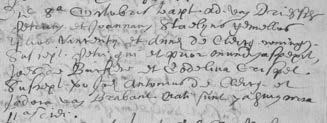
34.5. THE LIFE AND MILITARY CAREER OF ANTONI DESCLERGUE UNTIL 1640
543
Figure 34.47:
Waregem, October 8,
1626. The baptism of a twin of Anna De-
sclergue (DC06f) and Vincentius Staelens.
The children were Petrus and Joannes.
The godparents of Petrus were: Jean du
Breucq (’Joannes de Bucker’) and Gode-
liva Crispel. Joanna’s godparents were An-
toni Desclergue (DC06) (Anna’s brother)
and Judoca Van Brabant. The baptism is
also shown in Figure 29.151 on page 432.
This movement of soldiers was part of a broader strategic redeployment of Spanish forces across Europe to respond to various military pressures.
During this period, soldiers from Belgium, Italy, and other regions were dispatched to Spain. Manel Güell notes that Juan de Garay was also sent from Italy to Spain by the Marquis of Leganés in 163930. This occurred against the backdrop of ongoing wars with France, during which Spain had previously reinforced its troops in Flanders under the Duke of Olivares, as discussed by Moreno.31
Chapter 49 details Antoni’s involvement in constructing the ’Kapel-ter-Ruste’ chapel at Deerlijk and the artifacts he brought from Spain, which are linked to the legacy of King Felipe IV of Castile. This period saw the emergence of Diego de Silva y Velázquez as a royal court painter under the patronage of Felipe IV, known for supporting numerous artists, including Flemish ones such as Vrancx, Snaeyers, Molenaer, and de Hondt.
Two primary factors prompted Antoni Desclergue (DC06) to go to Spain: increased tensions between Spain and France in northern Catalonia and the planned Corts at Montblanc in 1640. However, the Catalan revolt and Beatrice’s pregnancy disrupted these plans. The Guerra dels Segadors began in May 1640 (see Figure 34.40), and Beatrice, pregnant by early spring of 1640, returned to Deerlijk, where she baptized her son, Pere Desclergue (DC07d), in October 1640 (see Figures 34.49 and 36.25).
Antoni remained in Spain, returning only in 1641. His absence was noted in the baptismal records of his son Pere (DC07d), where the priest was confused about the family’s names. The child’s correct name, Pere or Pedro Desclergue y Declercq, was initially written as ’De Celcg Clerck,’ then changed to ’Clerck,’ and the mother’s name was mistakenly spelled as ’De Clercke.’
The Corts had historically been held in Montblanc several times. Still, the planned 1640 session was canceled due to the ongoing war and the Catalan revolt32. While in Spain, Antoni likely visited his distant cousin José Riu y Desclergue (DC02dy2x1y1), a great-grandson of Galceran Desclergue (I=II) (DC02d), as discussed in Chapter 25.1.3.3. Antoni Desclergue (DC06) also attended the wedding of Isabel Desclergue (DC05ex1) to Jacint de Pedrolo in 1639, who died before his son’s birth in January 1640. The initials of family members, including those of the newborn, were inscribed on the artwork Antoni brought back to Flanders, as detailed in Chapter 28.5.1 and Figures 49.36 and 49.37. Isabel Desclergue (DC05ex1), who also signed the artwork, was both Antoni’s first and fourth cousin, being the daughter of Francesc Desclergue y Ratera, a (half)brother of Antoni’s father, Jeroni Joan Desclergue y Cortés (DC05).
Antoni’s return to Flanders coincided with the reorganization of the Spanish army to reinforce Flanders against the French. In Spain, Ambrosio Spinola’s son-in-law, Diego Mexía Felípez de Guzmán y Dávila, 1st Marquess of Leganés, was appointed to defeat the French armies in Catalonia (see Figure 34.41). During his stay in Spain, Antoni visited Madrid, where he likely met members of the royal court, including the artist Alonso Cano, who gave him a statue of Mary (see Figure 49.47) for the chapel in Deerlijk.
It is unclear if Antoni brought the statue back in 1641 or Beatrice did so in 1640.
Antoni’s return to Flanders occurred briefly when Catalonia was a republic under French sovereignty. In January 1641, King Louis XIII of France became the Count of Barcelona, and in 1643, Louis XIV assumed the title. Catalonia was not reincorporated into the Spanish Monarchy until 1652.
Eduardo de Mesa notes that the Irish forces of Tyrconnel, active in Spain, were sent to Roussillon in 1639 due to the French siege of the fortress of Salses north of Perpignan33. The Spanish troops, led by Filippo Spinola and Francesc de Tamarit, recaptured Salses on January 6, 1640. The French pressure on Catalonia and the presence of Spanish troops caused tension among the local population, leading to the Catalan revolt.
Gaspar de Guzmán y Pimentel Ribera y Velasco de Tovar, the Count-Duke of Olivares, fought the French on Catalan territory to persuade the Catalans to support the war efforts. He recruited nine thousand soldiers, likely including Antoni Desclergue (DC06), who had significant military experience from Flanders.
Antoni’s return to Flanders involved bringing panels for the chapel of Deerlijk, inscribed with his initials (see Chapter 49.3.3.3 and Figures 49.36 and 49.37). The initial protest against the Spanish troops in Catalonia led to the Catalan revolt in May 1640.
Eduard Contijoch concludes that Antoni Desclergue likely participated in the Catalan revolt, although he was more likely aligned with the Spanish troops than the ’Segadors.’ At the time of the revolt, Antoni and Beatrice were probably near Zaragoza, from where she returned home, while Antoni undertook the journey to Catalonia to restore Spanish control.
Significant attacks occurred on towns such as Perpignan in June 1640. Despite Spanish efforts to stabilize the region, Catalonia remained under French control for a decade, with northern Catalonia still remaining French.
34.5.12 Particular Case of a Soldier Recruited in Flanders who Remained near Montblanc
The historical inquiry into the life of a soldier recruited in Flanders, who eventually settled near Montblanc, offers a fascinating glimpse into the migratory patterns and social dynamics of 17th-century Europe. This specific case, meticulously researched by Rafael Piñero, highlights the interplay between local and international historical contexts, shedding light on individuals’ movement across borders during significant military and political upheaval.
Rafael Piñero’s investigations, communicated with the author with Josep Maria Grau’s facilitation, are documented in Piñero’s comprehensive book Tous-Girnonès Cal Canari 1529-2020.34 The research uncovers the life of Pera Toussaint, a native of Jemappes near Mons in present-day Belgium. During the 17th century, this region was known as ’Flandes’ to the Spanish, reflecting its 30Manel Güell, ’Juan de Garay, capit‘a general de l’exèrcit de Catalunya (1649-1650)’
31Agustín Jiménez Moreno, "Nobleza y reclutamiento durante el ministerio del Conde Duque de Olivares. La participación de la aristocracia castellana en la defensa de la monarquía (1635-1638)," Magallánica, Revista de Historia Moderna: 1/2 (Dossier), Enero-Junio 2015, ISSN 2422-779X
32Further information is available on the Montblanc medieval website
33Eduardo de Mesa, ’The Irish in the Spanish Armies in the Seventeenth Century,’ The Boydell Press, 2014, Chapter 6
34Rafael Piñero, Libro Tous-Girnonès Cal Canari 1529-2020
The Desclergues of la Villa Ducal de Montblanc, 2nd ed., Omn., VOL. II
© 2024 Nico F. Declercq