

Trans-Temporter by Christopher M Robinson - HTML preview
Download the book in PDF, ePub, Kindle for a complete version.
Chapter 4
Experiments
Lei and Mike had asked the military to help with some of their experimenting in case of explosions which Tanvi’s grandad, Bodhi Patel, had managed by pulling a few strings.
They weren’t taking any chances. Because everything needed to be set up within reach and range of ‘Unit 7’, where the original temporter was built, they had constructed two rings of thick concentric walls built of sandbags designed to contain any blasts within the largest available space within reach, the carpark, closing the station for the day and evacuating all the buildings which had all the windows taped up as a precaution against any blast.
It had taken months of careful planning ensuring the hospital unit would be unoccupied at the time with those patients due to be held in stasis at SSS being held at other hospitals.
The tests took place on a Sunday, although the blast barriers had been built a few days before, following a tight programme that had taken very careful planning with the degree of precision the military are known for. Although I was not part of the team, I was there as an observer and to support my dad.
One of the main concerns was security. They had had to set up most of the transporter boxes needed on the Saturday along with all the associated cables, utilising some of the ‘emptied’ hospital units as well as a number of others PlainVu Secure Glazing had constructed especially for the exercise. Although they had tried to keep what we were going to do as quiet as possible, and had erected a large marquee over part of the site to hide the preparations, it would be impossible to keep experiments on this scale secret, besides, they had openly invited the other nations to observe. They did, however, have a 24 hour guard on the site to ensure no sabotage.
Concern had been voiced in some quarters about the possibility of starting a chain reaction event annihilating more than the object conflicting
23
with itself. After all, similar concerns had been expressed about the atomic bomb and about the CERN particle accelerator. Lei had quashed the suggestion saying that even if a DEC event had been the cause of the explosion when she had been temported, whilst the damage was extensive, it was contained. Nobody pointed out that it probably wasn’t a DEC event that had caused that explosion, however.
There were three main areas to be explored in the programme of experiments, starting with what seemed the least risky and terminating with what was perceived to be possibly the most dangerous.
1. Termination: Looking at the potential of being able to appear to terminate temportation early by a second temportation to interrupt it, observing the effects of the masses and the temporal distances involved.
2. Portability: Whether a temporter could be moved whilst in operation and how much of the control systems would be required to be moved with it.
3. DEC (Dual Existence Conflict) events: to determine the proximity required of conflicting objects and dangers posed by their size – though in hindsight this knowledge would have been helpful for the day’s earlier experiments.
At 6:00 a.m. on that balmy Sunday morning, we started our first batch of experiments. It wasn’t especially quiet as, apart from all the recording equipment we had already set up, there were media cameras pressing up against the closest permitted access points the other side of the closed main road. We also had a helicopter on standby at the heliport from where drone cameras were also being co-ordinated.
For the ‘Temporter Termination Possibility (TTP)’ experiments, we had sent a number of objects the day before set to arrive at particular times on the Sunday. These were what we were now going to attempt to retrieve with early termination by temporting newer introduced masses in those temporter boxes. Although ‘masses’ may not be the correct term as the first couple of experiments was to see whether a light beam would suffice. It
24
was a failure. Although, as original experiments with the temporter years before had shown, light can be temported, it presumably requires a mass to interfere with a temportation of a mass. Most of the masses were the standard 10 gramme, 100 gramme, 1 kilogramme and 10 kilogramme blocks that had been experimented with since the original Swan Innovations work.
The result of the TTP experiments showed that anything with mass can be used to effectively terminate a temportation. The actual mechanism, though, as had been discovered previously, was that the original object reaches its temporal target immediately and is then dragged back to the present time. It was the implications of these experiments that led to so many new possibilities for the device, one of the principal ones being the Donated Human Organ (DHO) storage which has saved so many lives.
Organ donation has been considered almost mandatory for so many years. When someone dies, they usually have some healthy organs that could be used in transplant surgery to replace the failing organs of a dying patient. For over a hundred years, this has mainly relied on a healthy organ donor of a suitable match dying at the same time as the recipient patient needs it. Too often, those requiring an organ transplant have died before a donor organ has become available. With a ‘library’ of DHO boxes, organs could be temported into the future and the appropriate ones retrieved when needed.
There were, of course, many other uses Terminated Temportation was used for and not all were for the betterment of mankind, despite the principal aims of SSD.
The next batch of experiments was to determine the portability of a temporter. These were timed to commence at 9:00 a.m. following a breakfast or coffee break.
At set intervals, the test objects were temported short times into the future and prior to their expected arrival, the temporter boxes were physically moved to a new location at differing distances. The results were simple. It worked. Even temporting a 100 kilogramme mass. Using a
25
forklift truck, once sent on its way half an hour into the future, its temporter case was driven through the empty hospital unit to the carpark of the builders’ supplies unit (Unit 12) that remained of the original Lesser Heath Trading Estate, the furthest practical extent of all the attached cables. The fork lift drive had been pre-rehearsed, with the drive practised and timed to ensure the cables would not get snagged along the way, and a couple of volunteer marshals were on hand to ensure there were no problems. Half an hour after sending it on its way temporally, the mass appeared in its new physical location too.
The second phase of these experiments was to provide a more exiting find. Once an object had been temported, did the temporter actually need all the cables to remain attached? My dad had suggested they no longer served any function so they were about to prove him right.
Blocks were temported short distances and their boxes unplugged from all connecting cables. They arrived at their destinations exactly the same. One of the team even drove an unplugged temporter box carrying its “hidden” 10 Kg mass, ten miles away, and reported by mobile phone that it had arrived at the precise time it was intended to. However, repeating the earlier TTP experiments found they did require the connections to be present – as did the later retrieval experiments.
The beneficial possibilities were obvious; it’s a pity nobody foresaw the harmful uses at that time. Whilst the team were congratulating themselves on the possibilities for transporting any organic matter in a perfect state of preservation, others had started plotting their nefarious plans.
The most dangerous experiments were that afternoon. We had had a long, late lunch break during which the results of the numerous tests from earlier were properly recorded and any items that had been finished with had been removed from the main test area.
It had been a little more difficult than they had realised to deliberately generate a Dual Existence Conflict. They had had to arrange
26
for a mass to meet itself some time in the future. This is how they eventually managed it:
1. Send a mass into the future.
2. Retrieve it.
3. Send it again and before it arrived at its destination arrange for it
physically to have been transported there.
The difficulty had been how to ensure it met itself? The answer was quite simple in its way. The object had to exit the box and remain in existence for a short period before returning to the box between stages 1 and 2. One suggestion was to make a little preprogrammed robot like Mike had used in experiments following the Valentine’s Day “accident” years ago but it was Tanvi who came up with a simple, elegant, solution after running a ‘competition’.
The mass used needed to roll, like a ball, or, as was decided after experiment, a cylinder. The temporter could be lying slightly tilted so the mass was pressing against the opening side when it travelled to its destination whence its weight would open the side, it would roll out but how would it be returned to the box?
A number of ideas were suggested and played with:
1. Rolling up a slope and back would not have enough momentum to
re-enter the box which than had to close.
2. A strong magnet to repel the cylinder would need to be brought close
whilst the cylinder itself would need to be magnetised with one pole
on the axis and with the circumference the pole to be repelled.
3. A pendulum with a raised mass looked promising with the cylinder
releasing a pin that held it, as to was
4. A tensioned catapult with the cylinder releasing a pin.
The winner was a simple mechanical electric relay with an enlarged hinged flap held closed by a simple electric circuit the rolling cylinder could switch off by triggering a microswitch or, as was eventually used, simply
27
by pushing a wire out of the way. LH Electronics were happy to provide a number of relays for these experiments.
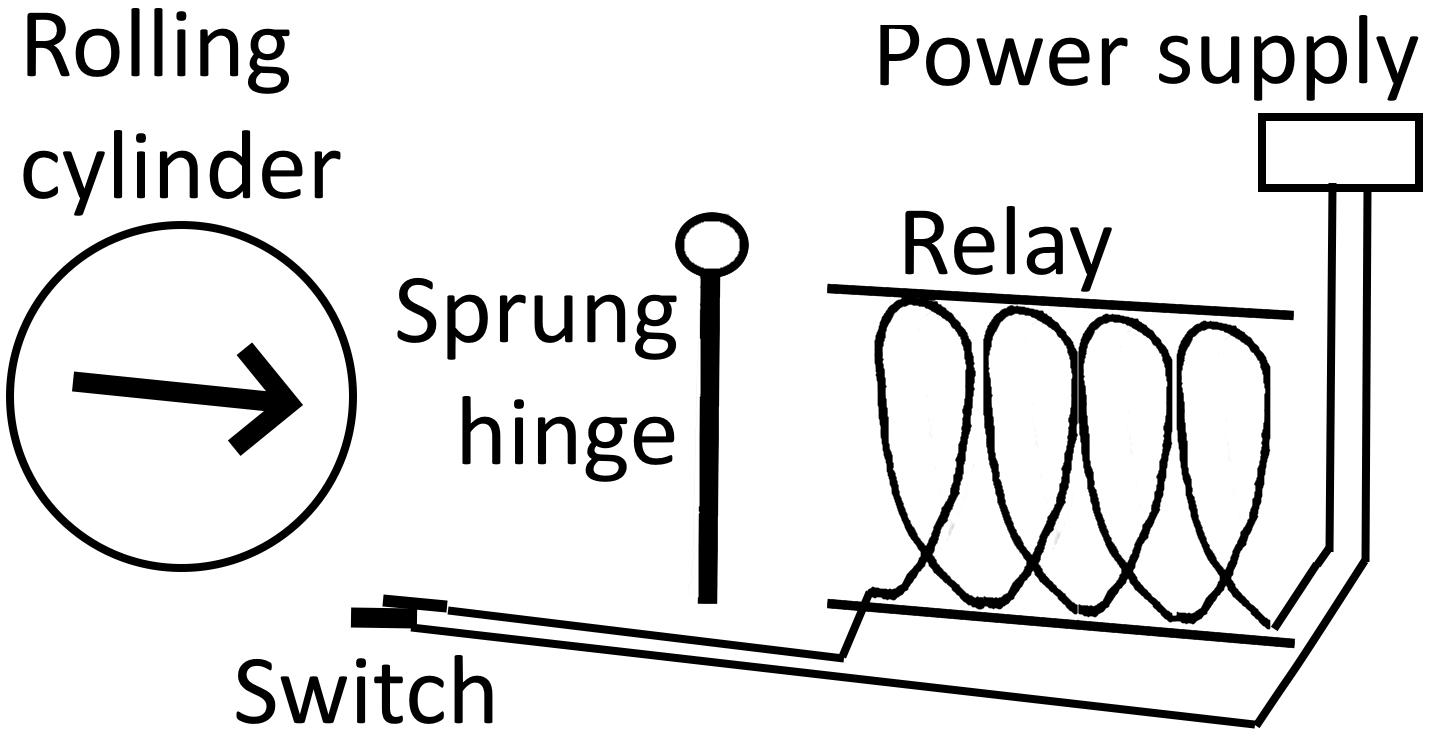
This is my simple
diagram of the relay
circuit:
The first few attempts to induce DEC events didn’t work. They tried having an identical block in position to welcome the temported one but it didn’t work. The incoming block just pushed the awaiting block to one side. It confirmed it had to be the actual original item.
So they moved on to the Tanvi setup. Experiments for the original object to temport into the same space as it already occupied from being sent there before as described above, did cause DEC explosions with the following findings:
1. The greater the mass involved, the greater the explosion.
2. The smaller the mass involved, the nearer to the original it had to be
to incur a DEC event.
Only a few such events could be experimented with but they felt they had gained sufficient data to provide formulae to determine the “safe” distances to avoid DEC events and the size of such events if they were to occur.
A long tiring day had resulted in a great deal of data collection and better understanding of how things worked plus the potential for new uses. However, as we were to find out, the day’s experiments had also fuelled the imagination of some who did not share the SSS philosophy.
28