

Trans-Temporter by Christopher M Robinson - HTML preview
Download the book in PDF, ePub, Kindle for a complete version.
Chapter 3
School Projects
I remember my primary school at Lesser Heath with fondness. I don’t remember all my teachers that much but I do remember the headmistress was Mrs Price. She was very creative and took a keen interest in the after school clubs, particularly the Junior Inventors which Mike helped with.
I enjoyed practical activities. I think I learned better by getting my hands dirty than reading a book, and I enjoyed learning.
It wasn’t quite as exciting at my secondary school. The teachers were more controlling. I guess they were more focussed on delivering the facts we had to know in their subjects to pass the exams but one or two seemed bored. Mike says it’s because they have to teach the same thing over and over again. When he trained as a teacher, he had had a teaching practice at a secondary school and says the repetition and means of delivery were why he found junior teaching more interesting.
I think it was for that reason that in my secondary school I especially liked practical science where we recreated experiments to rediscover what scientists had observed previously. I particularly liked the segment on optics.
At Lesser Heath Primary School, I remember the fun I had had creating telescopes, microscopes, periscopes and every other type of scope, even fibrescopes and endoscopes, and ‘tropes’ – liking their names as much as the fun I had with the moving objects and illusions I created.
I remember making a thaumatrope in the infants. It was a simple white piece of card on which I drew a bird on one side and a cage on the other, wedging it into a slot cut in the end of a straw and twirling it back and forth between my hands to make it look like the bird was in the cage. Of course, I then made flip books, drawing cartoon stick men on the bottom corners of pages of my books and flipping through them quickly to make them move. Instead of being reprimanded by the teacher, she gave
18
me small pads of scrap paper to make my own flip books and showed me pictures of a mutoscope which some people called a ‘What the Butler Saw’ machine. It worked by the same principle: flicking through a number of photographs taken in quick succession. Apparently in Victorian times these were a popular form of entertainment in ‘penny arcades’ usually found at the ends of pleasure piers. They were often considered naughty showing images of a lady removing her stockings for instance.
These are from my art notebook of scopes I made:
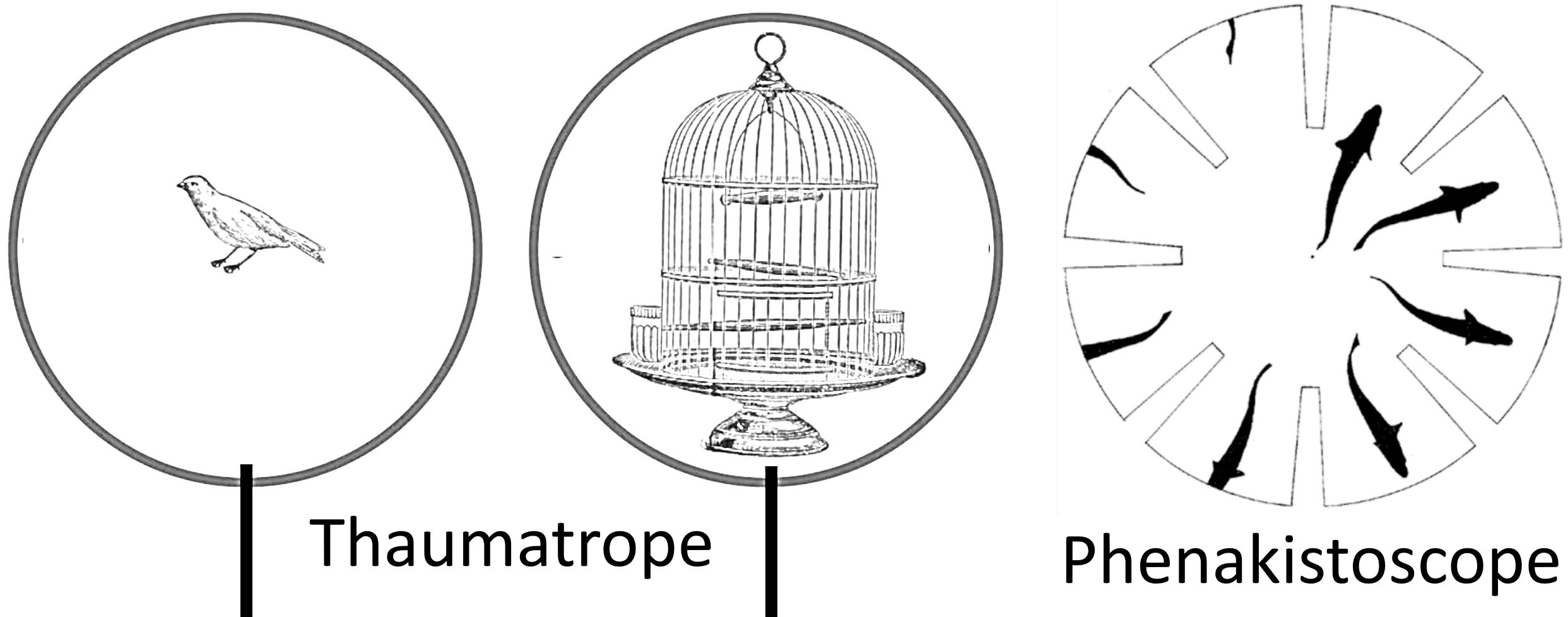
I don’t remember where I got the pictures for my phenakistoscope. I drew the images of a fish on a cardboard disc with slots cut in it. Then I pushed a cocktail stick through the middle and spun it between my fingers with the picture facing a mirror. Looking through the slots, it looked as if eight fish were swimming out of the disc. It was better when we added an electric motor in Junior Inventors.
I particularly like the zoetrope which is like a drum with slots cut down the sides and pictures pasted around the inside of the drum. It needed to sit on a turntable of some sort – a rotating base so it spun; whilst looking through the slots we could see the appearance of motion. Mike had an old fashioned record player I think he had kept just for this but in Junior Inventors we modified a desk fan. He found some photographs online taken by Eadweard Muybridge in the late 19th century of a galloping horse which he printed out for our model zoetrope. They had been taken to prove that when galloping, all four horse’s legs are off the ground at once at one stage. Mike also took Tanvi, Chris and me to the Science Museum at that
19
time to see a large zoetrope with full size plaster models of a dove in flight. It looked like there were actual doves flying inside the drum.
But apart from this history of the cinema, I was fascinated by the processes of viewing distant and close objects and of taking photographs.
In Junior Inventors, we managed to play with a load of old lenses that had once been part of now discarded spectacles that someone had managed to collect from an opticians. We made our own crude telescopes and microscopes. Though they weren’t very good, we had learned about how they worked, but in secondary school we learned the formulae for focal lengths that would enable the manufacture of better instruments.
Another thing we made was a pinhole camera. It was really so simple. Just a tin can with a very small hole punched in the bottom and a piece of tracing paper stretched over the open end. If the hole was pointed at a brightly lit object, a faint, blurred image could just be seen on the tracing paper, though upside down, which if we were careful we could trace out with a pen and turn into drawings. When we were able to find magnifying lenses of the right strength, we were able to get a clearer picture as more light could get into the box through a bigger hole. Mike had a table tennis ball that he’d set a small lens into to simulate an eyeball. When on holiday in Edinburgh one weekend, we visited a camera obscura which was a tower with a lens and mirror poking through the roof to reflect the outside image onto a table. Standing around it, we could see the outside world passing by below like a film.
In secondary school, we learned about Antonie Van Leeuwenhoek, a Dutch scientist from the seventeenth century who developed microscopes, initially using just a drop of water sitting in a hole on a piece of card or in a wire loop. He used them to discover microbes: life at a minute scale not known before.
Another science topic I enjoyed at Lesser Heath was when we looked at the human body as a machine. Our teacher had borrowed a skeleton from the secondary school. She said she had had some funny looks
20
bringing it to school in her car. For its safety in transporting it, she had strapped it into the passenger seat.
We looked particularly at the joints and how the bones move against each other pulled by tendons as the muscles contract. We also looked at some chicken’s feet from the butcher’s. By pulling on the tendons, we were able to make the claws grip or retract. There was a lot we learned about levers from this project. It coincided with some European games event so we made models to show how athletes utilise their bodies to advantage.
We didn’t only look at the action and reaction of a runner’s legs against the ground either but also things like how a rower uses oars as levers. We also learned a lot of maths from looking at gear ratios on a bicycle when we took our bikes in to school.
I had developed my interest and liking for science in the Junior School but it was in the secondary school that I actually developed a passion and aptitude for art. In the junior school, although I was praised for my artwork, I felt it was really just a time-filling exercise painting pictures for something to do with no real purpose. However, in the secondary school, we were given tuition and it helped focus my eye on essential details.
I think my scientific understanding contributed to my progression in art, particularly with respect to understanding rules of perspective and light and shade. Remembering the pinhole camera experiments, I started exploiting chiaroscuro, accentuating the contrast between lit surfaces and those in shadow to give solidity to the drawn objects.
Dad says I get my artistic talents from my mother. She was the one who designed the swans logo for Swan Science Solutions. Mike’s twin brother Tony lives in Provence and makes a living from his painting but although I enjoy it as a hobby and people admire what I achieve, I don’t want to make my living as an artist and have taken inspiration from Mike with the hope of becoming a teacher as I want to help others find that excitement of discovery I experienced when I was a child.
21
Since finishing my Post Graduate Certificate of Education a couple of months ago, I have spent some time with Ava travelling to stay with her Uncle Tony and Aunt Jane by train, not via the cross channel pipeway which is solely for cargo but the original Eurotunnel. Now with her father, Mike, I am getting tips as to how to prepare for managing my first classes in a few weeks’ time.
He says to learn from his mistakes and not be too kind to start with.
“Children need to know the limits,” he says. I have to set firm rules whilst providing praise and encouragement. I need to earn their respect. I must admit I am quite nervous and excited about the future.
Chris meanwhile has become an electro-mechanical engineer and is working on the design of new stasis units within SSS. Mum says she is proud of both of us. She likes the idea that Chris is joining “the firm” whilst I will be training up the next generation of SSS employees.
22