

The Zone Calls (Steamer #2) by Edward Drobinski - HTML preview
Download the book in PDF, ePub, Kindle for a complete version.
Chapter 9 – White Hood
The scene seemed to shift again. Steamer was now on the second floor of some sort of bricked over structure, looking down on a person covered in white, maybe one of God’s 144,000.
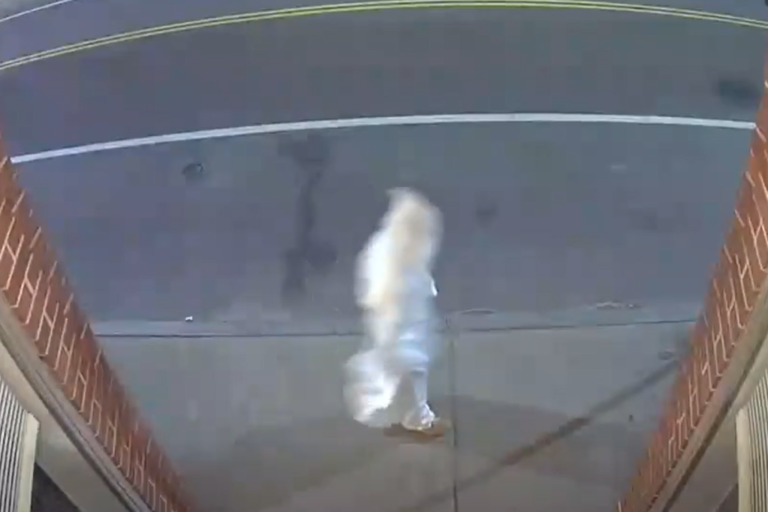
It reads like a fixed security camera moment where the world is solid but the person isn’t.
A narrow brick lined walkway runs between two retaining walls, leading out toward a quiet street. The geometry is rigid; straight lines, right angles, the kind of space that feels built for function rather than charm. In the middle of it, a single figure moves through the frame, but the motion blur turns them into a pale, elongated smear of white clothing. Instead of a body, you get a suggestion of one; a head shape, a stride, but no edges. It gives the scene that odd surveillance footage tension; the environment is crisp, the human is transient. No universal statement intended, the figure suggests a Ku Klux Klan operative stalking, suggestive of a safe area, or an intelligence agency infiltrator on a mission to give libbies something to complain about on the net.
The contrast does most of the work. The bricks and pavement are stable, textured, and literal. The person is almost spectral, as if they’re passing through rather than inhabiting the space. The result is a moment that feels both ordinary and slightly uncanny, the kind of image where the mechanism; a slow shutter or a low frame rate camera, becomes part of the atmosphere.

Another view appeared. This one has a different texture from the first; less uncanny blur, more of that grainy, nocturnal surveillance quiet.
A single person is moving across a paved area beside a building, caught mid stride. The camera’s low light sensitivity flattens everything into soft grayscale, so the figure becomes a silhouette with just enough detail to read; a hood pulled up to reveal part of a White face, long pants, dark shoes, hands tucked or close to the body. The posture suggests someone simply walking, not rushing, not lingering, yet someone who wants to be partially seen.
The environment does most of the atmospheric work. Hard surfaces; walls, windows, pavement, all rendered in that washed out night vision palette. The light source is off frame, so shadows fall in odd directions, giving the scene a slightly theatrical stillness. It feels like a transitional moment; someone passing through a space designed for daytime clarity, now reduced to shapes and tones.
The overall effect is observational rather than dramatic. A quiet, functional camera capturing a quiet, functional moment, with the grain and contrast adding just enough mystery to make the ordinary feel a little more cinematic.