

TEMPORAL AGENT by Michel Poulin - HTML preview
Download the book in PDF, ePub, Kindle for a complete version.
CHAPTER 11 – CRIMEA
07:08 (Constantinople Time)
Thursday, September 14, 1854
HMS SANS PAREIL, Kalamita Bay, Crimea
“At last! They sure took their time to decide
where to land.”
Fanny Duberly, standing against the bulwark of the HMS SANS PAREIL and watching hundreds of
large rowboats filled with troops race towards the desolate beach facing them, smiled at the impatient remark from Mary Pearson.
“Maybe, but have you ever seen such a sight before?”
Mary looked around her at the 600 ships of the allied armada, which stretched for miles along the coast, and shook her head.
“Frankly, no. I hope that the Russians will be as impressed as me and will lay down their arms at our sight.”
“Don’t count on that, Mary.” said from behind them Jeanne Smythe, making the women turn around and look at her. Wearing a dark brown jacket and riding skirt, long black boots. her leather equipment vest with revolvers, a knife and a saber, Jeanne looked ready for everything. “There will be fighting soon enough and it will be bloody, believe me.”
“So, when are we landing ourselves?” asked Sarah Champion with expectation. Jeanne shook her head at that.
“Not for a while, Sarah. Lord Paget is making an exception for my ambulance cart but all other wagons and transport animals are staying on the ships for the moment. Lord Raglan wants to keep his army as mobile as possible. You and Doctor Farrell will stay aboard while the fleet follows the army down the coast towards Sebastopol. Me and Margaret will concentrate on picking up any sick or wounded man during the advance and bringing them to the shore, where they will be embarked for treatment on the ships.”
“God, I envy you, Jeanne.” said Mary, making the French woman grin.
488
“Why? You get to stay and live in comfort aboard this luxury yacht for a while longer. See you in a few days, girls.”
The women, Fanny included, pulled their tongues at Jeanne as she walked away, giggling: the HMS SANS PAREIL was anything but a luxury yacht. There were however some such yachts bearing what was now commonly called by the troops ‘traveling gentlemen’, or T.G.s in short, effectively accompanying the fleet in the hope of being able to watch the battles to come.
Margaret Ward felt quite nervous and excited at the same time while she watched Jeanne’s ambulance cart, loaded with supplies sufficient for a couple of weeks in the field, roll down a side ramp, with sailors controlling its descent with ropes onto a large floating pontoon resting against the side of the ship. Made of two big rowboats supporting a common platform, the pontoon already bore the last squad of Captain Fields’ D Troop and its horses. Jeanne led by the reins both Yasmina, the cart’s pulling horse, and Pegasus, her personal mount, while Margaret waited until the cart was safely on the pontoon before walking down the ramp herself. Jeanne put on the hand brakes of the cart to prevent it from accidentally rolling off the pontoon, then stood besides Yasmina, calming the horse for the trip to the shore. Margaret climbed in the front of the cart, sitting on the driver’s bench and grabbing the reins handed to her by Jeanne. Margaret then discreetly checked that the cavalry rifle provided by her husband Joseph was close at hand behind the bench. Both Joseph and Jeanne had encouraged Margaret to become proficient with a rifle and, helped by steady lessons from Joseph, Margaret was now a fair shot with the weapon. The hard, endless nursing work had trimmed the excess fat the brunette was sporting when they had left England, something that had pleased Joseph to no small end. While far from looking athletic, Margaret was now in better physical shape than she had been in years and felt ready for what was to come. She was however terribly aware of the unease within the troops around her about seeing women joining them on their way to battle. Even the most ardent feminists in England would pause if they would see her and Jeanne now. Jeanne didn’t seem to care about that, though, as she had already broken about all the rules and taboos concerning the proper role and conduct of women considered acceptable in England. Being filthy rich, she could have been dismissed as a frivolous eccentric if not for her incredible intellectual and physical abilities. Those abilities had in turn further
antagonized many men, especially officers, who were secretly afraid of not measuring
489
up to her. Being French had helped Jeanne somewhat, as French women had the reputation in England of being notorious nonconformists and libertines. However, the major point helping Jeanne was the now widely acknowledged fact that she could beat up, shoot of cut to pieces about any man who would dare mock her openly. Still, as the pontoon was let loose and started rowing towards the shore, Margaret saw a number of troopers whispering to each other while glancing furtively at Jeanne and her weapons. They were probably expecting her to be put back in her proper place after the first battle, as soon as she showed the first signs of weakness under fire. Having seen her in action against bandits, Margaret suspected that they were going to wait a long time for that to happen.
After maybe fifteen minutes of rowing, the pontoon started scraping on the bottom’s sand just short of the shore. Once the pontoon came to a full stop, four sailors then slid in place a narrow ramp, allowing the cavalrymen aboard to ride off the pontoon. Jeanne, mounted on Pegasus, preceded the cart, which was then driven down the ramp by Margaret. By now the beach was alive with thousands of British, French and Turkish troops, with not a single Russian to be seen, something that surprised Margaret.
“Jeanne, how come the Russians didn’t do anything about our landing? With the size of our fleet, they surely know that we are here.”
“Oh, they know alright, Margaret.” replied Jeanne, smiling with amusement as she rode alongside the cart. “Russian cavalrymen must have reported us already to Prince Menshikov. Fortunately for us, Prince Menshikov is no Napoleon, or he would have stationed artillery on those hills surrounding this bay, out of range of our ships guns but within range of this beach. Good generalship is not something you will see much during this war, Margaret.”
Seeing the men of the 8th Hussars forming up in a regimental column, Jeanne led the cart to it, then trotted to Lord Paget while Margaret stationed the cart at the rear of the column. After a short conversation with Paget, Jeanne trotted back to Margaret to pass on the latest instructions.
“The regiment is going to act as a forward reconnaissance screen for the infantry. We are to follow the infantry and lend assistance as needed with the sick and wounded.”
“Sounds fine to me.” replied Margaret, who then looked up at the gray sky. “Let’s hope that the weather will hold.”
490
Looking up as well, Jeanne soon shook her head.
“Don’t count on it. Crimea is quite wet in this season. You did bring your rain gear as I asked you to, I hope?”
“I did.” said Margaret while looking at the darkening horizon. Jeanne’s 20/20 hindsight may be irksome at times but, from experience, Margaret knew that ignoring her advice was foolhardy. By now the Hussars were splitting into troops and galloping away to the East and South. Jeanne then pointed at a small hill overlooking the main road linking the nearby town of Eupatoria with Sebastopol, the ultimate target of the allied armies.
“Let’s take position on that hill and make ourselves comfortable. The wait could be a long one.”
Going to the hill and climbing its gentle grassy slope, they stopped beside a small clump of trees topping it and locked the cart’s brakes before untying Yasmina from it. While Margaret tied solidly their two horses to a tree, using very long ropes so that the animals could eat the long grass around them, Jeanne got busy chopping to bits with an axe a dead tree that was part of the clump. Their next labor was to erect the small rectangular tent stowed in the cart, digging a furrow around it as well to channel away any rainwater. Spotting a small stream nearby to the East of their hill, the two women led their horses to it to let them drink before filling a bucket with water for cooking purposes. Once back at their camp, a small fire was lit and a large pot of water put on it, with the intent of boiling it to make the water safe for consumption. As the water was warming up, Jeanne went to the cart and pulled out of it four steel posts, a canvas screen and a light folding toilet seat, intent on setting up a latrine that would afford them some privacy from the thousands of soldiers still busy landing and organizing themselves.
“Jeanne,” said Margaret as her companion was starting to dig a latrine hole, “our men don’t seem to be in a hurry to move out. We may well spend the night here.” Jeanne smiled at her while continuing her shoveling.
“I was expecting that, actually. I also bet that our commanders forgot to tell our troops to bring rations with them. The smell of our own food will probably drive them to us by supper time.”
“Uh, sorry but I’m not betting against you, Jeanne. I already got burned a couple of times.”
491
By the early afternoon, their hill was surrounded on three sides by British and French soldiers grouped into their respective regiments. Margaret couldn’t help notice again the striking differences between the French Army and the British Army. French troops were broken down into small, easily manageable sub-units supported by dedicated cooks, surgeons, nurses and wagon drivers. Each French regiment also had its contingent of female auxiliaries called vivandières, who helped the doctors, did the laundry and ran cantinas to help troop morale. Margaret had met a number of vivandières in Varna and had been surprised to see that they were treated like real soldiers and even wore female variants of French uniforms, with some even sporting military medals. As a result of all this, French soldiers were well fed, received good medical care and had a high morale, apart from being led by combat-hardened officers and NCOs who were promoted on merit. In contrast, the British soldiers whom Margaret was watching were formed in big regimental squares and had no logistical means of support with them. As predicted by Jeanne, they also had apparently nothing to eat, while inexperienced officers kept harassing their men with useless orders and directives. While well disciplined, the British Army was clearly an amateur one compared to the French Army. Margaret was wondering if that sad state of affair was going to change one day when Jeanne shouted happily while getting on her feet.
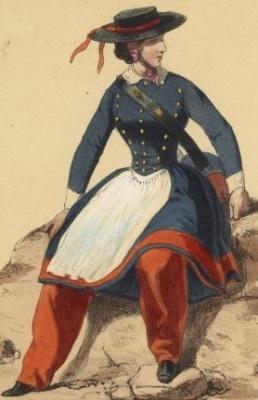
“I see Leila coming our way! LEILA, COME UP HERE!”
Looking the way Jeanne was gesticulating, Margaret saw a young woman in the baggy red trousers and short blue tunic of the Zouaves, tough colonial troops from Algeria, walking up the hill. Margaret knew Leila as well, having met the vivandière in Varna. After conversing quickly in Arabic with Jeanne, the Algerian woman hurried to the freshly dug latrine.
“Please excuse Leila if she was in a hurry,” explained Jeanne good-naturedly, “but they had not had time to prepare separate latrines for the vivandières. Leila recognized my cart from afar and assumed that we had done our usual, efficient setup.” Margaret giggled at Jeanne’s words.
“It seems that you are as well known in the French Army as you are in the British Army.”
492
“Don’t forget that I am French, Margaret. They were quite proud to see that a French woman was running the only efficient infirmary in the British camp. General Bosquet even sent me a bottle of wine as a measure of his esteem.”
“I remember that. It was quite a good wine too.”
“A Chateau-Lafitte?” replied Jeanne, faking indignation. “It better be good!” Then going to the pot steaming over the fire, Jeanne pulled open its cover and plunged a spoon inside, stirring the lentil and fish rice before tasting it.
“It’s ready!” she announced to Margaret before looking at Leila, who was coming back from the latrine. Exchanging a few Arabic words with Jeanne, the Algerian then tasted the rice and obviously liked it. However, she left nearly immediately after a quick salute at Margaret, who watched her go.
“Why the hurry? She could have eaten with us.”
“She knows,” explained Jeanne, “but she has to help run her regimental cantina. Besides, she already had lunch. Now, let’s eat ourselves before the rain starts.”
The sky was still holding, barely, when they finished eating twenty minutes later. On a common accord, the two women then grabbed the steaming pot of rice, still nearly full, along with a large service spoon, and headed towards the nearest regimental square. The men there, soldiers of the 42nd Highlanders wearing kilts and bearskin hats, welcomed Jeanne and Margaret enthusiastically, sniffing the pot of rice with famished looks. A sergeant ordered at once his men into a line and with their mess tins at the ready, allowing Margaret to spoon out rice into the presented mess tins while Jeanne held the pot. Even when rationing each man to one large spoonful, they emptied the pot quickly, leaving still many men in line with empty tins. Jeanne looked at the mass of soldiers still waiting for food and felt discouragement: there were still hundreds needing to be fed. The sergeant saw her expression and spoke quietly to her.
“Don’t blame yourself for not being able to feed us all, madam. What you did is already a lot and is truly appreciated.”
“Thank you, Sergeant. I however have some dried dates and cheese that I could go fetch in my cart and bring here for distribution. I do have a substantial food reserve with me, so that won’t leave me in need. Do your men have any cooking utensils and pots with them?”
493
“We unfortunately have with us only what we were carrying in our backpacks, which is very little, madam. All our supplies and tools are with the supply chariots on the ships.”
Before Jeanne could reply to that, a group of four mounted Highlander officers stopped by her side, prompting the soldiers around her to come to attention. The most senior officer, an arrogant looking major, eyed with contempt the weapons worn by Jeanne.
“Madam, you are disturbing the ranks. I will ask you and your friend to leave the regimental lines.”
Margaret saw Jeanne barely restrain herself from exploding, instead approaching the still mounted major.
“Mister, we were simply helping to feed your men, who obviously had nothing to eat, and…”
“Leave logistics to the commissariat and fighting to men, madam!” replied brusquely the officer. He then looked down at the sergeant near Jeanne. “Chase those two camp followers out of the lines and make sure that they don’t come back, Sergeant.” That was when Jeanne had enough of the pompous bastard. Making two quick steps towards the major, she then grabbed solidly his right arm and brutally pulled him down from his horse. The major landed hard on his back in the dirt and found himself pinned down by a furious Jeanne, who had one knee against his chest.
“Nobody insults Lady Jeanne Smythe like this, you arrogant moron!” shouted Jeanne while holding her big hunting knife to the major’s throat. The officer, near panic, looked at one of the young captains who had been accompanying him.
“Mister Jones, get that woman off…”
The pressure of the sharp blade then increased on his throat, forcing him to shut up. He could now swear that there was murder in the eyes of the tall woman kneeling on his chest.
“You can’t feed your men and asks for others to defend you and you call yourself an officer? I could challenge you to a duel but I bet that you are too much of a coward to accept it. I will let you live this time but don’t ever insult me or my friend again.” Jeanne then withdrew her knife and got up on her feet. No one had moved during the few seconds of the confrontation to help the major. Jeanne had turned around and was starting to walk back towards her camp with Margaret when the humiliated officer got up and drew his saber.
“YOU WILL PAY FOR THIS INSOLENCE!”
494
Before anyone else could react, Jeanne drew her own saber in a flash while pivoting to face the charging major. One slash to the man’s right hand made him drop his blade, while a second slash followed a fraction of a second later, making a long bleeding cut across the left cheek of the major and making him scream with pain. Jeanne then applied the tip of her sword against the man’s throat, forcing him to freeze.
“I could by all rights kill you right here and right now and justly claim self-defense, Major. Find yourself lucky that I consider you unworthy of dirtying further my blade. Now, get back on your horse and return to your tent before I change my mind.” The mortified senior officer, realizing that she outclassed him in fencing by a large margin, didn’t argue, retreating to his horse and mounting it. After a last black look at Jeanne, he then galloped away, watched by the contemptuous eyes of his men and junior officers. One of the three mounted captains then addressed Jeanne, his face serious.
“Lady Smythe, we all saw how Major McAllister insulted you and attacked you in the back. I doubt that he will press a complaint against you.”
“He better not!” replied Jeanne firmly, then softening her tone. “I only wanted to give some food to your starving men, Captain, and was not expecting to be repaid with such rudeness.”
The captain sighed while looking down at the ground.
“Your generosity is well known, Lady Smythe. God bless you for what you did already, madam. Keep the rest of your supplies for the wounded and sick to come soon: we will manage in the meantime. Again, thank you for your generosity.” Jeanne hesitated for a moment but finally turned around and walked away with Margaret, recuperating her kitchen pot at the same time. The captain watched her go, then looked bitterly at the major’s tent in the distance: This was only the latest example of the man’s utter disregard for this troops. He couldn’t know yet that the said major was going to be killed in the month to come by a not so accidental British bullet in the head.
14:51 (Constantinople Time)
Sunday, September 17, 1854
Alma River, Crimea
Gordon Smythe took his time to complete his visual scan of the grounds in front of him while sitting calmly on his horse. Even while his cavalry troop was pretty much in
495
plain sight due to the sparse cover available, the Russians fortifying themselves on the hilltops to his front didn’t seem to care about the presence of British cavalrymen. Using his spyglass, Gordon could see across the River Alma thousands of Russian soldiers digging gun positions along the ridges facing him, while more Russians were at work in the small village of Burliuk, next to the wooden bridge carrying the main road to Sebastopol. Gordon then lent his spyglass to Sergeant-Major James Champion beside him so that he could also look.
“Quite a strong position the Russians have there. There are over a hundred artillery pieces along the ridges and the slopes are quite steep. On the other hand, those tall hills to the west of the main Russian positions are nearly empty of enemy soldiers. If we could take them, we would overlook their positions and would make their defenses untenable.”
“Maybe, sir,” replied Champion while looking through the spyglass, “but if that river is too deep to ford and we are forced to use that bridge, those guns will butcher our men as if in a bowling alley.”
“Well, there is only one way to know, Sergeant-Major.” replied Gordon while urging his horse forward. “Stay here with the rest of the troop while I take a dip. If I get hit, return to the army with our information.”
Champion watched with apprehension as his captain galloped to the river, then made his horse enter the water. Some Russians in the village downstream from the British started to get nervous at the sight of the lone rider crossing the river, with about twenty of them soon starting to run along the southern bank towards Smythe. Champion then gestured to his men.
“TROOPERS DISMOUNT! GET READY TO GIVE COVERING FIRE TO THE CAPTAIN!”
While four men gathered the reins of their companions’ horses, 23 British troopers dismounted and grabbed their Minié rifles, kneeling down in a firing line along the shrubs. Captain Smythe was now close to the opposite bank, with the water having gone barely to his horse’s belly at its deepest. Champion nearly shouted in triumph when Smythe’s horse climbed the southern bank and made a few steps before its rider made it turn around and calmly cross the river again. By now the Russian infantrymen were getting too close to Champion’s taste.
“TROOPERS! ENEMY INFANTRY TO THE FRONT AT 300 YARDS! FIRE!”
496
The 23 rifles barked at nearly the same time, downing over a dozen of the Russians and prompting the rest to take cover in a hurry. Reloading their single-shot, muzzle-loading rifles frantically, the British had time to fire a second salvo before the Russians responded in the form of six guns opening fire from the top of the ridge facing them. Champion instinctively ducked as the shells passed over his head, exploding over fifty yards behind the cavalry troop. He saw as well a good hundred Russian cavalrymen now crossing the wooden bridge towards them as Captain Smythe emerged from the river, yelling orders to his men.
“TROOPERS, REMOUNT! GET READY TO WITHDRAW!” As soon as Gordon Smythe joined them back, the whole troop galloped north, with shells exploding on each side and with the Russian cavalry hard in pursuit. James Champion couldn’t help shout excitedly at his captain riding alongside.
“Quite a warm welcome from those Russians, sir. I hope that our wives’ welcome will be friendlier.”
“Nothing can beat Jeanne’s welcome, Sergeant-Major.” shouted back Gordon, grinning.
“The lucky bastard!” grumbled quietly to himself one of the troopers, imagining the naked body of the tall, shapely French woman.
09:30 (Constantinople Time)
Monday, September 18, 1854
Kalamita Bay, Crimea
Margaret Ward, driving the ambulance cart towards the shore where a British rowboat was waiting, felt her heart jump when she saw a floating pontoon being towed towards the beach, coming from the HMS SANS PAREIL. On the pontoon was the medical wagon, its trailer and the train of pack mules of the regimental ambulance. Margaret could also see Doctor Farrell, Sarah Champion, Mary Pearson and the five other women who were now regular auxiliaries of the ambulance, all waving excitedly at her. Fanny Duberly was on the pontoon as well with her horse and pack animal. Waving back, Margaret drove the cart next to the beached rowboat and stopped, to be immediately approached by the navy ensign in charge of the rowboat’s crew.
“What do you have for us this time, madam?”
497
Margaret half turned and pointed at the two men lying on the stretchers laid in the back of the cart.
“Two soldiers from the 23rd Fusiliers, sir. Both suffer from strong fevers.”
“Alright, madam, we will take it from here.” said the young ensign, a mere teenager, before shouting at his six sailors. “Four men to unload those two sick lads, quickly!”
By the time the two feverish soldiers, wrapped in blankets, were off the cart and in the rowboat, the pontoon and its towing rowboat had beached. Fanny Duberly and her horses were first off the pontoon, followed by the wagon and its trailer, with the pack mules last. The beach was soon the scene of a joyful reunion, with everybody wanting to hug and kiss Margaret. Fanny was then the first to ask the question Margaret was expecting.
“Where is Jeanne, Margaret? Normally, she accompanied you when bringing patients to the ships.”
“She had to pitch tent some fifteen miles from here to take care of four severe cholera cases, Fanny. Thank God the wagon is here now: we sure could use your help.” Fanny answered her with an embarrassed smile.
“Uh, I’m first going to Eupatoria for a day: Captain Brock, the newly appointed governor of the town, has invited me to visit him.”
“Hmm, fun before work?” replied Margaret, faking indignation. Sarah Champion then slapped the brunette playfully in the back, nearly upsetting her balance.
“Don’t worry, Maggie: we’re here now. Let us take over for a while and rest a bit.”
“Thanks! Me and Jeanne sure could use a respite: the last three days have been busy like hell.”
“With ten round trips between the front and the ships and 21 patients carried to safety, I can understand.” replied Doctor Farrell with obvious pride. “You two have been doing a great job.”
“Thank you, Doc.” said Margaret, fatigue showing on her face. “Could you and Sarah leave ahead of the wagon in the cart, to relieve Jeanne. She’s really burned up by now and has hardly slept in the last three days, what with the riding up and down the marching columns and directing me to the sick.”
“We’ll start right away, Margaret.” Promised Farrell softly. “In the meantime I want you to go lay in one of the stretchers in the back of the wagon and sleep. Mary!
498
Take Emma to help you and change the stretchers in the cart for clean ones before washing them. Me and Sarah are leaving right away.”
“We’re on it, Doc.”
As soon as Margaret had taken out her personal kit bag and after two clean, disinfected stretchers were in place in the back of the cart, Sarah and the doctor loaded in their own kit and sat in the front. They were soon out of sight of the medical wagon, trotting towards the front lines.
13:12 (Constantinople Time)
Eupatoria-Sebastopol road, Crimea
“There’s the medical tent!” suddenly shouted Farrell while pointing slightly to the right and ahead of them. Looking herself in that direction, Sarah effectively saw the familiar shape of the tent, standing in the middle of a loose clump of trees. Near it was Jeanne’s horse, tied to a tree by a long rope. Guiding the cart towards the tent, Sarah stopped in front of it as Jeanne was emerging from the tent, a bedpan in her hands. Sarah was immediately alarmed by the exhaustion apparent on Jeanne’s face as she weakly smiled at them.
“Thank God you’re here! I sure could use a hand or two.” Jumping down from the cart, Sarah went to Jeanne and took the stinking bedpan from her hands.
“Where is your sewer pit, Jeanne?”
“Thirty yards to the right of the tent. If you’re taking care of this, I will…”
“You will wash and disinfect your hands and then go to sleep, and that’s an order!” cut in Farrell with a firm voice, making Jeanne look at him with dismay.
“But…my patients need me.”
“We will take care of them.” said the doctor, his voice softening. “Just bring me up to date on their pathology before you go to sleep. You will be of no use to anybody if you fall down from exhaustion, Jeanne.”
The French woman was about to protest further but refrained after a hesitation, instead lowering her head and reentering slowly the tent, the doctor behind her.
Taking a well deserved break three hours later, Sarah found Doctor Farrell sitting on a medical supply chest in front of the tent, apparently deep in thoughts. Sitting
499
beside him, she passed one arm around the surgeon’s shoulders, making him redden with embarrassment: Farrell was as timid as he was six months ago.
“What are you thinking about, Doc?”
“About our situation, Sarah. With Jeanne included, I have five medically trained orderlies to help me, which is much more than the norm in a regiment. Yet, we have been running ragged just by taking care of the sick. With major battles to come, we will never be enough just the six of us to properly take care of the wounded as well. We need more trained orderlies but, with the ranks of the army already depleted by disease, I will never be able to get some men to help.”
“What about the four women traveling with us who do our laundry and cooking? They could be trained by you as nurses.”
“Maybe, but who will then do the domestic chores?”
“Doc, wake up!” replied Sarah. “There are about two dozen more women from this regiment sitting on our ships, most of whom have little or nothing to do. I am sure that many of them would be glad to work for you, especially if Jeanne offers them the same wondrous pay that me and the other girls get.”
“Would Jeanne accept to pay them, though? I can’t force her to spend her own money.”
“I bet she will, Doc. That kind of money is a drop in the bucket for her, truly. On the other hand, I have never possessed so much money as now. Would you believe
that I already put aside over fifty pounds17 since we left England?”
“Fifty pounds? That’s quite a sum.”
“Indeed! Do you really believe that the wife of a trooper who makes maybe five shillings a week will pass such an offer?”
“Uh, no. Maybe I should talk to Jeanne about this when she wakes up.”
“Please do that, Doc.” said Sarah while patting Farrell’s shoulder.
20:11 (Constantinople Time)
Tuesday, September 19, 1854
8th Hussars camp, four miles north of the Alma River Crimea
17 In 1854, fifty British Sterling Pounds represented close to the annual salary of a maid.
500
Thomas Farrell, standing at one end of the medical wagon’s retractable tent, looked somberly at his expectant medical staff assembled in front of him. A number of candle lamps provided sparse light that showed the grave expressions on everybody’s faces: they all knew why he had called this meeting after returning from Lord Paget’s tent. Present were Jeanne Smythe and her four junior nurses, four ex-domestic aides who had now rudimentary nursing training and six more women recently recruited by Jeanne to do the backbreaking but vital cleaning and cooking chores.
“Ladies, Lord Paget told me that our regiment will probably not see action in tomorrow’s battle, as our cavalry will act as flank protection for our attacking infantry. I thus requested and got permission to collect and treat wounded from the infantry regiments, who will undoubtedly suffer many losses tomorrow, as the Russian position is a very strong one. After this meeting, I will go visit the chief-surgeon of the Rifle Brigade to coordinate our efforts. The battle should start early tomorrow morning, so I want everybody up and ready to work by six O’clock. Here is how work will be divided: Sarah Champion, helped by Misses Short and Reeve, will keep taking care of the five sick men still in our custody inside the quarantine tent; Mary Pearson and Misses Pringle and Foster will receive the wounded and prepare them for surgery if need be; finally, Jeanne Smythe and Margaret Ward will act as our forward ambulance, collecting the wounded on the battlefield and giving them first aid before bringing them here. The six ladies of the domestic staff will make sure in the meantime that we don’t run out of clean linen and instruments. Do you have any questions?”
The only one to raise her hand then was Jeanne Smythe.
“Yes, Jeanne?”
“Doc, I have a request rather than a suggestion. In order to efficiently treat and collect the wounded on the battlefield, I will have to go on foot and stay around while our cart ferries back the wounded to you. However, Margaret cannot both drive and take care of her passengers. I would like to ask for one volunteer who knows how to drive a cart well and who is strong enough to help lift a loaded stretcher. I have to be frank here: it will be dangerous work, as we will not wait for the shooting to stop before starting to collect the wounded. Bullets and shells will still be flying around.” Margaret Ward swallowed hard but otherwise stayed impassive as the six auxiliaries looked hesitantly at each other. A sturdy woman in her late thirties then stepped forward.
“I’ll go! I drove a farm cart for years and have seen my share of blood and guts while following my husband, RSM O’Neil.”
501
“Thank you very much, Janet.” said Jeanne gratefully. “I will show you the peculiarities of my cart tomorrow morning. Uh, would you by chance know how to shoot and reload a rifle?”
“Why, you need to learn?” replied Janet with a big grin. “I went to Afghanistan with my Sean, after all.”
“Another war veteran? Excellent!” said a pleased Jeanne, getting funny looks from the others.
05:51 (Constantinople Time)
Wednesday, September 20, 1854
8th Hussars field ambulance, British camp Crimea
Janet O’Neil, emerging from the women’s tent in the dim morning light, was joining Jeanne near their cart when a civilian on a horse arrived at the ambulance and dismounted near them. The newcomer quickly tied his mount to a tree before coming towards Jeanne and Janet. He balked when he saw the revolvers and saber Jeanne carried, hesitating before speaking.
“Uh, am I at the 8th Hussars field ambulance, ladies?”
“You are, sir.” answered Jeanne calmly. “May we help you?”
“I do hope so, miss. I am Doctor Paul Gardiner, junior surgeon with the 7th Fusiliers. Since my regiment lacks most medical facilities and equipment, my brigade surgeon decided to send me to your ambulance, which is said to be superbly equipped, so that I could assist your own surgeon.”
“A very wise decision, sir.” said Jeanne, truly pleased by that. “Let me show you to Doctor Farrell, our surgeon. By the way, my name is Jeanne Smythe, field nurse with the 8th Hussars.”
“Pleased to meet you, madam.” replied stiffly Gardiner, still put off by Jeanne’s outfit, while shaking hands with her. He then followed her to the medical wagon and entered its rear tent. Jeanne soon reemerged alone from the tent and went back to the cart and Janet.
“That really made Doc Farrell happy. Now, let’s roll!’’
10:14 (Constantinople Time)
502
North bank of Alma River
“Come on, lads, “ shouted Gordon Smythe to his men as they followed him at a gallop, “we don’t want to make our infantry or, God forbid, our Russian hosts, wait!”
“Why not, sir?” shouted back Corporal Joseph Ward, riding hard with the rest of B Troop as it took its assigned position on the left flank of the long line of British infantry forming up a quarter mile short of the Alma River. “They did make us wait for them after all.”
“One must be lenient with our infantry fellows.” shouted Sergeant-Major James Champion from just behind Gordon. “They try their best but still are nothing more than low life ground-pounders.”
One soldier from the 7th Fusiliers, behind which lines the cavalrymen were passing, heard Champion and shouted at him while doing an obscene gesture.
“At least we don’t get our rocks off by rear-ending bloody horses!” Both the cavalrymen and the infantrymen broke out in laughter at that exchange. As B Troop, following A Troop across the open countryside, rode past the men of the 7th Fusiliers, Gordon saw and recognized a very familiar white and green cart that was slowly following fifty yards behind the infantry line. Riding besides it was a woman he knew very well indeed.
“Talking of arses, men, there are some of our wives.”
“Bloody hell!” shouted a surprised Corporal Ward. “What is Margaret doing this close to the frontlines?”
“Close?” replied James Champion. “This IS the frontlines!” The cavalrymen stared at the ambulance cart as the two women in it and the female rider cheered them. At the tail end of the column of Hussars, RSM Sean O’Neil saw his wife at the reins of the cart as he galloped past it.
“Hell! Is my Janet leading Lady Jeanne Smythe into this or is it the other way around?” he wondered aloud.
“That could be a difficult call, RSM.” replied Captain Heneage, who was riding besides O’Neil.
11:51 (Constantinople Time)
North bank of Alma River
503
“There it goes!” announced Jeanne at the sight of multiple puffs of white smoke erupting from the ridges to their right. Margaret didn’t understand until the delayed sound of the Russian guns firing reached them. The two mile-long line of British infantry, which had been idly waiting for the French supporting attack on their right, suddenly came to life. With officers riding in front, the two men-deep assault line started to advance towards the nearby Alma River. The village of Burliuk, situated on the southern bank across from the bridge on the river, then erupted in flames and smoke.
“What the hell is happening there?” wondered Margaret, promptly answered by Jeanne.
“The Russians turned the village into a fire bomb and just ignited it. Things are going to become bloody very soon.”
A rolling thunder then announced the firing of all the Russian guns positioned along the ridges facing the British. Geysers of smoke and dirt started to erupt among the advancing British troops, mowing down men by the dozen under Margaret’s horrified eyes.
‘’My God! This is a bloody massacre!’’
“I actually have seen worse, Maggie.” said gravely Janet O’Neil, restraining her now nervous horse.
“Let’s wait until the troops have started crossing the river before going in to help the wounded.” said Jeanne with unbelievable calm. “There is no point in getting ourselves killed right at the start of the battle.”
Janet threw an admiring glance at the French woman on hearing those words from Jeanne: this was indeed a seasoned veteran and a cool customer.
The British infantry, still under a murderous artillery fire, started crossing the Alma River ten minutes later, prompting Jeanne into signaling to Janet with one hand.
“Advance now, straight to our front.”
Urging on Yasmina, Janet drove the cart forward by 200 yards, following Jeanne’s horse, until they were surrounded by corpses and moaning wounded.
“Halt!” ordered Jeanne before jumping down from her horse Pegasus, a pack full of bandages on her back. Margaret got down next from the cart, following Jeanne on foot to a nearby group of downed infantrymen. The sight of mangled bodies and thorn limbs then made the brunette bend over and throw up despite her best efforts to keep her composure. A shout from Jeanne soon brought her back to their duty.
504
“Margaret, I need you here!”
Going over her revulsion, Margaret joined Jeanne besides a young soldier with a large wound to his left leg. Jeanne took her right hand and applied it to a point just above the gaping, bleeding wound.
“Keep enough pressure here to stop the bleeding while I bandage him.” Margaret did so while watching Jeanne work feverishly on the young man, who was delirious and agitated. A shell suddenly screamed by over their heads, exploding a mere thirty yards away from the cart and terrifying Margaret to no small degree. That prompted Jeanne into turning her head towards the waiting cart and to shout at Janet O’Neil.
“Janet, turn the cart ninety degrees and present your flank to the Russians. Maybe our ‘AMBULANCE’ sign will make them refrain from shooting at us.” Jeanne then returned to her first aid work as Janet turned the cart to the right. Another shell screamed by seconds later, missing it by a mere twenty yards.
On the ridge of the main Russian position, an artillery officer looking through a spyglass suddenly shouted at the gun crews near him.
“Halt fire! Switch target back to the English infantry now!”
“Why, sir?” shouted back one of the gun masters.
“Because that cart is an ambulance, you illiterate peasant!” Smarting over the officer’s response, the gun master then relayed the order to his men. They were soon back at boring holes in the advancing British lines.
12:13 (Constantinople Time)
North bank of Alma River
“One, two, three, lift!”
The loaded stretcher, lifted in the back of the cart by the combined effort of the three women, was then slid in place on the retaining rails specially designed to this effect, then secured in place by straps. Another wounded man on a stretcher was already inside the cart. Jeanne then helped a soldier with his left arm held in a sling get up and sit at the front, besides Janet O’Neil, while Margaret Ward sat on a small bench between the two stretchers in the back. Changing one of her water bottles, now nearly empty, for a full
505
one, Jeanne then grabbed half a dozen small white flags on thin steel poles from inside the cart and patted Janet’s arm.
“Get those wounded back to our camp at top speed, then come back here. The white flags will mark wounded men ready for pickup. Go!” Nodding in understanding, Janet turned the cart around and drove north at a gallop, using the main Eupatoria-Sebastopol road. The spring suspension system of the cart was now paying off handsomely, making it possible for Janet to push her horse without jolting around too hard the wounded she transported. They made it back to the field infirmary, four miles away, in less than half an hour. Doctors Farrell and Gardiner, along with Mary Pearson and four other women, were on hand to help unload the three wounded, who were then rushed inside the treatment tent. As soon as the cart was emptied and two clean stretchers had been put in place, Janet drove back towards the battlefield, an anxious Margaret sitting beside her.
“I hope that Jeanne is alright.”
“Don’t worry about her, Maggie. From what I have seen and heard of her, she can easily fend for herself.”
Both stayed silent during the rest of the return trip. Careful not to overexert her horse, Janet kept up a quick trot instead of a full gallop, still taking only 35 minutes to arrive back at the battlefield. They found the battle still raging on, with the British infantry now well past the river and climbing steadily the steep slopes leading to the Russian positions. The Russian guns were as active as ever, but now had to contend with some heavy British guns which had been brought forward on the north side of the river. The problem was that Jeanne and the wounded she was treating were directly in the path of the British guns’ muzzle blasts, with Russian counter fire falling around her on top of that. Margaret looked at the scene with horror and nearly pulled her hair in desperation.
“My God! She’s going to get killed in short order. What are we going to do?” Janet clenched her teeth, then took a quick decision. Jumping down from the cart, which had stopped behind and some distance to the right of the British guns, she put in place locking pins on the wheels and pulled out of the cart’s back one of their two stretchers, then shouted at Margaret.
“Maggie, get down here! We will go on foot and get the wounded with our stretchers.”
506
Only hesitating for a short moment, Margaret joined Janet and took one end of the stretcher, following her at a run. Janet could see that Margaret was as white as a sheet as they ran past the firing guns, but the younger woman didn’t falter.
“Run at a crouch, Maggie!” shouted Janet as they started running directly in front of the British guns, only forty yards away. One muzzle blast half deafened them, apart from making Margaret squeal in terror. Janet really couldn’t blame the British gunners for this, as they were taking casualties from the Russian guns and had to keep firing. One Russian cannonball ricocheted off the ground ten meters in front of Janet, splattering her with dirt, before continuing on to decapitate a British gunner. Both women finally got to Jeanne, kneeling besides the wounded man she was treating. Jeanne’s face was pale and tense but her voice was steady as she looked at Margaret.
“This man has shell fragments in his chest and legs. I did what I could to stop the bleeding and made him sniff some chloroform. You can take him away.” The three women cautiously laid the groaning man on the stretcher, then lifted him and walked back to the cart, buffeted all the way by explosions and muzzle blasts. Putting the wounded aboard the cart, they then ran back for a second wounded marked by one of Jeanne’s white flags, carrying him as well to the cart. As she was about to turn around the cart to evacuate the two wounded, Janet watched Jeanne run back to take care of more wounded.
“Now, there goes a brave woman.” she said softly before urging Yasmina northward.
16:04 (Constantinople Time)
North bank of Alma River
The staff officer, covered with dust and sweat, halted his horse besides that of Lord Raglan, Commander-in-Chief of the British Expeditionary Corps, saluting him crisply before delivering his message in a triumphant voice.
“Victory, Milord! The Russians are in full retreat, abandoning much of their baggage in the process. Our troops are now in full control of the heights.”
“By God, that is what I call good news.” said jubilantly the 66 years old, one-arm field marshal. “Let’s go see by ourselves, shall we?”
507
“Uh, sir,” cut in politely Lord Lucan, commander of the Cavalry Division, “my men are still covering the flanks and can pursue the Russians quickly enough. This is a golden opportunity to cut the enemy to pieces, sir.”
Lord Raglan looked around at his staff officers and aides, hesitant. A perfect gentleman who had served under the Duke of Wellington and who had lost his right arm at Waterloo, he was nonetheless a cautious commander.
“We don’t know anything about Russian reserve forces, Lord Lucan. I prefer to keep our cavalry in reserve in case of a Russian counter-attack.”
“Yes sir!” replied the disappointed Lucan. The command staff and its heavy cavalry escort then followed Lord Raglan down the knoll they had used as an observation point during the battle, following the road leading to the bridge crossing the Alma River. As they were approaching the river, they met a northbound white and green cart driven by a woman and bearing a big ‘AMBULANCE’ sign in three languages on both sides. The female driver waved briefly at Lord Raglan and his staff as she sped north, obviously in a hurry. Raglan, curious, looked at his army chief-surgeon.
“Doctor Sloane, whose ambulance was that and what are women doing on the battlefield so soon?”
“Sir, this was the 8th Hussars’ ambulance cart, the one donated and operated by Lady Jeanne Smythe. Since they are by far the best equipped medical unit the Army has in Crimea, I authorized them to help collect and treat the wounded from the Rifle Division. As for women driving ambulances, I believe that the only man on the staff of the 8th Hussars Field Ambulance is the surgeon himself, Doctor Thomas Farrell, who by the way did a superb job in Varna.”
“Are you telling me that no men are available for such battlefield duties?” asked Raglan, truly shocked and incensed.
“Unfortunately, none, sir.” replied Sloane, more than a bit embarrassed. William Russell, who was following Lord Raglan’s group as official correspondent of ‘The Times’, started scribbling notes furiously as the chief-surgeon went on.
“Disease has depleted the army’s ranks to such an extent that no men are left to act as orderlies and stretcher bearers, Milord. The old Chelsea pensioners London sent me as medical orderlies were of no use whatsoever and I shipped them straight back to Scutari, the ones who survived the trip, that is.”
Raglan then turned to face his chief of staff, speaking forcefully.
508
“Colonel, I want you to detail men from our quartermaster services as quickly as possible for stretcher bearer duty, along with chariots to transport our wounded. Our soldiers must be tended to as soon as possible.”
“If I may, Milord,” then cut in politely William Russell, “it seems that at least one person is already caring for some of our wounded.”
Looking in the direction pointed at by the journalist, Raglan saw a solitary figure about 300 meters away. The person was kneeling besides a wounded in the middle of the corpse-strewn battlefield, its back to Raglan, and was apparently treating him.
“Is that a French uniform? I can’t quite make it out.”
The commander’s chief of staff then turned towards one of his liaison officers.
“Captain Nolan, go identify that person and report back on the double.”
“Right away, sir!” replied the young Hussars officer before launching his horse at a gallop. As he approached the crouched figure, who was busy bandaging a wounded British infantryman, suspicion arose in Nolan’s mind: the sword slung most un-regulation wise across the person’s back was no British or French sword. The stranger also had long hair going down well past the shoulders. Drawing his own sword, Nolan slowed his horse to a trot, stopping when only a few meters from the unknown person. The latter then turned around briefly, showing a beautiful female face smeared with dirt and blood.
“Could you help me here, please?” asked the woman in a tired voice. Nolan took a few seconds to recover from the surprise.
“I’m afraid that I have to return right away to my commander, madam. May I ask who you are?”
“You may.” she replied quietly while finishing her bandage. “I’m Lady Jeanne Smythe, field nurse with the 8th Hussars.”
“How long have you been here, tending the wounded, madam?”
“Since the opening shots of this battle, Captain. Could you tell your commander that extra transports are needed urgently here. I’m doing the best I can here but our ambulance is four miles away and men are bleeding to death before our cart can pick them up.”
“I will pass the word, madam.” replied Nolan respectfully. He did however have one last question nagging him. “If you are a nurse, madam, then why the weapons?” Jeanne glanced up at him while laying gently the wounded infantryman back on the ground.
509
“Captain, don’t be naïve. Russian Cossacks don’t respect the laws of war any more than Afghan tribesmen did. My weapons are for my protection and that of my patients.”
“I understand, madam. Have a good day!” replied Nolan before galloping back to the command staff, now nearly at the bridge. He stopped besides Lord Raglan and saluted while reporting.
“This was Nurse Jeanne Smythe, from the 8th Hussars’ field ambulance, sir. She has been tending our wounded since the start of the battle and is asking urgently for more transports to get the wounded to the dressing stations.” While many staff officers looked in surprise at the distant nurse, Lord Raglan stared severely at his chief quartermaster.
“You know what your priority is now, sir. Get to it right away.”
18:43 (Constantinople Time)
8th Hussars field ambulance, Crimea
Taking a break after finishing operating on his fourth patient of the day, Paul Gardiner walked wearily out of the ambulance wagon’s treatment tent, inhaling with delight the fresh September air. The sky was now darkening quickly and the people moving around were little more than silhouettes. They were already using a good dozen candle lamps and two oil lamps to illuminate the operating section of the treatment tent. A female silhouette then approached Gardiner, something in her right hand. Paul smelled the hot tea as soon as the woman offered the tin cup she was holding.
“I thought that you could use some tea after this grueling work, Doctor.”
“You are an angel, madam.” said thankfully Gardiner while taking the cup. “Could you remind me of your name?”
The white of the woman’s teeth showed in the dark as she smiled.
“I’m Christine Sullivan, at your service, Doctor. I just relieved Diane Sutherland on cooking duty. By the way, we have some hot soup and fresh bread if you are hungry.”
“In fact, I am famished.”
“Then come with me to the cooking tent, Doctor.”
Sipping his hot tea while following Christine to the nearby tent, Gardiner went in and took place at a small table surrounded by four folding chairs. One side of the tent was lined
510
up with stacks of bags, boxes and barrels of foodstuff, while an iron stove sat in one corner, two large pots on it. Christine Sullivan, a young and pretty redhead with freckles, filled a bowl from one of the pots and put it in front of Gardiner before fetching a spoon, a knife and a half loaf of bread on a plate.
“It’s chick pea soup on the menu.” Explained Christine as Gardiner had a first spoonful. “There are some rice and bacon in it as well, plus a few spices. It is a most filling recipe.”
“A tasty one too!” replied Gardiner, enjoying his soup. “The diet at your field ambulance is far superior to the army’s regular fare. In fact, everything about this ambulance unit is superior to anything else I have seen yet. Your organization should become a model for all the other medical army units.”
“With the Commissariat in charge of army supplies?” replied Christine in a sarcastic tone. “Good luck! Only Lady Jeanne Smythe’s money and ideas made all this that you see possible. Before her, the regiment had one drunk doctor, an equally drunk orderly, a rundown shack, no wagon and precious little of anything.” Gardiner was silent as he ate his soup and bread and thought over what Christine had said. The more he saw and heard about this Jeanne Smythe, the more curious he was becoming about her. The patients they had been receiving at the rate of three or four per hour since noon had all been cared for in exemplary manner, with some cases displaying first aid techniques he had never seen before. All the wounds had been cleaned with water and alcohol and many patients had received chloroform, a pain killer that Doctor Farrell was also using extensively during his surgical work. The other nurses employed by Farrell, while not truly knowledgeable medically, were competent enough in patient care and were highly dedicated, lightening tremendously the workload of both surgeons and letting them concentrate on pure surgical work. He still had reservations about a few things, like female nurses washing male patients and women being on the battlefield while the shooting was still going on, but the alternative to that would have been neglected and uncared for patients, something Gardiner was not ready to accept.
He was about to finish his supper when he heard a number of wagons stopping nearby and men jump out, shouting orders at each other. Both he and Christine, pushed by curiosity, went out of the cooking tent to look. What they saw was a column of four big wagons stopped in front of the ambulance and at least twenty soldiers busy unloading what looked like large marquee tents under the supervision of a civilian man
511
on horseback. Four more civilians holding what looked strongly like doctors’ leather bags were stepping down from a cart at the head of the wagons. Doctor Farrell, also attracted by the noise, went to the mounted civilian, recognizing him once close to him.
“Doctor Gibbons? Could you tell me what is going on here?” The brigade’s chief-surgeon dismounted before facing Farrell and answering him.
“Orders from the army’s chief-surgeon, that’s what, my dear Thomas. Lord Raglan wants the maximum effort to be done to help our wounded as quickly as possible. The example given by your field ambulance struck him and he has directed that your facility be enlarged to act as a field hospital. I have with me the doctors from the other regiments of the brigade, plus enough equipment to assemble and furnish four marquee tents to house our wounded. Three carts are also on their way to the battlefield to help bring the wounded here.”
Farrell was speechless for a moment, not believing his good fortune.
“This…this is great, sir. We were getting swamped here as a matter of fact, with nineteen wounded already received alive from the battlefield. Unfortunately, two more wounded died from internal bleeding during transport.”
“And how many did you lose here?” asked Gibbons.
“One, sir.” answered Farrell somberly. “His wounds were too massive to survive.”
“Only one? But that’s damn good results, Thomas.” marveled the brigade surgeon. The arrival of the ambulance cart driven by Janet O’Neil interrupted their conversation, with Margaret Ward shouting from the back of the cart.
“We have two stretcher cases and two walking wounded here.”
“Sergeant Dillon!” shouted Gibbons on hearing Margaret. “Bring up six men to help unload those wounded!”
“Right away, sir!”
As soldiers came forward to help Margaret and Janet, the brigade surgeon patted Farrell’s back.
“Let me help you operate on these men, Thomas. Show me to your operating tent.”
“Then, this way, sir.” said the young surgeon, too happy to oblige. Leading him inside the rear tent of his medical wagon, he showed Gibbons a washing basin and a bar of soap sitting on a small folding table.
512
“Sir, I will ask you to remove your coat and hat and to wash your hands thoroughly with soap. One of the things that I found which helped our recovery rate is cleanliness. I will get Nurse Pearson to help you.”
Since Farrell’s methods had more than paid off up to now, Gibbons didn’t object and removed his coat and top hat, then washed his hands carefully. Mary Pearson showed up as he was toweling his hands dry. The young blonde went to a chest and took out of it three sets of clean surgical coats, hats and masks, then held a coat in front of gibbons.
“Please slip your arms in, Doctor.”
Intrigued by the unfamiliar garment, Gibbons complied nonetheless, slipping on the coat and letting Mary tie it in his back. Farrell entered the tent and started washing his hands as Mary was showing Gibbons how to put on his surgical mask.
“Where did you get your medical training, Thomas?” asked the brigade surgeon through his mask.
“St-Thomas Hospital, sir. Why?”
“St-Thomas? I’m not aware that they ever used such garbs or even enforced mandatory washing before operations.”
“They don’t, sir.” answered curtly Farrell, reluctant to get deeper into that subject. Gibbons insisted, though.
“Then, where did you learn these methods?”
“From Jeanne Smythe, sir.” said Farrell after a hesitation before lying. “She studied medical techniques in the Orient. So far, they have proved quite effective.” Farrell could feel Gibbons’ reprobation as the brigade surgeon stared at him while he put on his surgical garb with Mary’s help.
“This Jeanne Smythe, is she a qualified doctor?”
Farrell took a deep breath, then looked Gibbons in the eyes.
“Jeanne would not be recognized as such by the British Medical Association, sir, but she could surprise you with her medical knowledge and skills. She routinely assists me during surgical work and I often let her do the final stitching work, under my supervision of course. The operating theater is on the other side of this curtain, sir.” Going through the curtain, Gibbons found a sturdy table covered with a white linen sheet, a smaller table supporting trays covered with napkins and two garbage cans. A multitude of lamps lit that section of the tent. Two soldiers soon brought in a wounded soldier on a stretcher and cautiously slid him on the operating table with the help of Farrell and Gibbons. Once the soldiers were out with their stretcher, Farrell went to the
513
patient’s left foot, where a cardboard tag was attached to a toe by a string, and read the few lines scribbled on it.
“Chest sucking wound from shrapnel. No exit wound. Four drops of chloroform given at 18:06 hours.”
“Who wrote this?” asked Gibbons, surprised.
“Jeanne Smythe, sir. She tags every man she treats on the battlefield before sending him to us. It saves a lot of time at our end.”
Gibbons was thoughtful as Farrell started cautiously cutting away the bandages surrounding the man’s chest, using a pair of scissors handed to him by Mary Pearson. Some kind of paper sheet lying on top of the wound then attracted Gibbons’ eyes.
“What’s this?”
“The waxed paper wrapping of one of our field bandages, sir. It helps keep the bandage dry and clean during transport and can also be used to cover or protect a wound. When used in this case, it helps prevent a pierced thoracic cage from collapsing.”
Gently turning the patient on his side, Farrell inspected the man’s back before replacing him flat on the table.
“No exit wound. We have at least one piece inside, possibly in the left lung. Would you like to do the extraction, sir?”
“Yes! Scalpel, please!”
“Let me give more chloroform to the patient first, sir: he is still half awake.”
“Alright, Farrell, go ahead.”
Gibbons waited patiently as Farrell applied a sieve to the man’s face, then put on it a cotton pad wetted with a few drops of chloroform. The wounded man tried at first to take away the sieve but was restrained by the two surgeons until he passed out. Then taking the scalpel offered by Mary Pearson, Gibbons started cutting a way inside the wound, with Farrell sponging the blood as he went. Three minutes later he was pulling out a large chunk of metal from the wound.
“A big bugger indeed! I see no other pieces inside. Let’s sow him up.” That part took a lot longer, with the patient being carried out of the operating section one hour and ten minutes after entering it. Gibbons watched Mary Pearson take away on a tray the instruments they had used, while Farrell explained to him what she was doing.
“Those instruments will be washed, then boiled before being used again. We will have to wash our hands again and change garbs before operating on our next patient.
514
This may all sound fastidious but our infection rate is way down compared with other field ambulances.”
Gibbons nodded his head, quite impressed: there were valuable lessons to be learned here. If young Thomas Farrell was smart, he was going to claim the credit for his work before some unscrupulous medical colleague did it in his place. As for Jeanne Smythe, Gibbons had made his mind to commend her work directly to the army chief-surgeon and to Lord Raglan himself.
14:56 (Constantinople Time)
Friday, September 22, 1854
Lord Raglan’s command tent
South bank of Alma River, Crimea
“Milord, Doctor Sloane is here to see you.”
Raising his eyes from the letter he was reading, the old marshal looked at his Aide-De-Camp, now standing in the entrance of his command tent.
“Please let him in, Jarvis.”
The army chief-surgeon soon entered, walking to Raglan’s desk and handing him a sheet of paper, his face solemn.
“The butcher’s bill, sir.”
Raglan had dreaded this moment for at least a day now: of all the things he hated most about war, it was those casualties lists, where a few dry words tried to hide the reality of unspeakable suffering and mass death. Slowly taking the paper, Raglan read it twice, trying to keep his composure at the same time. His voice did show his pain as he spoke softly.
“481 dead… 356 wounded.”
Raglan then looked questioningly at Sloane.
“How come there are more dead than wounded, Doctor?” The chief-surgeon seemed to shrink at Raglan’s question.
“Milord, many of the dead were not killed outright during the battle. In fact, many of them bled to death before they could be picked up and brought to the dressing stations. This is an old problem, sir: not enough transportation means available and too few medically trained personnel at hand. The only ones present from the start of the battle and ready to help and carry the wounded away were the nurses from the 8th
515
Hussars’ field ambulance, who did sterling duty in appalling conditions. On that subject, sir, I have a request from the chief-surgeon of the Light Cavalry Brigade.”
“Go ahead, Doctor.”
“Milord, Doctor Gibbons wishes that three of those nurses be publicly commended for their devotion to duty and bravery while under fire. I personally checked on their work and interviewed a number of artillery officers who witnessed their courage on the battlefield. What I was told was quite impressive, sir. Here is my report on this matter.”
Taking a second document from Sloane, Raglan read it quickly, raising an eyebrow at its content.
“This Lady Jeanne Smythe was under artillery fire for over three hours, alone, while tending to our wounded?”
“Yes, sir! Our gunners were actually shooting over her head while exchanging fire with the Russian guns. Nurses Margaret Ward and Janet O’Neil also ran repeatedly across the battlefield to pick up wounded men while under fire.
“My God! This is truly admirable.” said Raglan, his eyes becoming moist. “Doctor, be sure that this report will be acted upon. How is our new field hospital at the 8th Hussars camp doing, by the way?”
“Swamped, sir. There are now fifteen surgeons there working non-stop and they are barely keeping up, while the female nurses are being run ragged. They are also running low on medical supplies.”
“Can’t the Commissariat restock them?” asked Raglan, irritated at having to cover this old problem again. Sloane shook his head in response.
“Hardly, sir. Adding to the usual Commissariat’s incompetence is the fact that some of the medical items which are getting scarce are non-standard ones bought in England by Lady Smythe.”
“I don’t care if those items are standard ones or not, Doctor.” fumed the old marshal. “If we have to get extra supplies from England, then let’s do it. I want our wounded men to be treated decently and speedily.”
“I will do my best, sir.” replied Sloane with little enthusiasm before leaving Raglan’s tent: getting anything from the Purveyor’s Office was like extracting a tooth.
516
Once Sloane was out of his tent, Raglan called in his ADC while still holding the chief-surgeon’s report, waiting until the colonel had snapped to attention before starting to speak.
“Jarvis, we are compiling a list of names of those present on the battlefields in Crimea in case a campaign medal is issued, aren’t we?”
“Of course, Milord! This is standard army procedure during any campaign, sir.”
“Then, Jarvis, I want you to add the names of the three women mentioned in this report to the list of nominees for a campaign medal.”
“Women, sir?” said the ADC as if asked to give a military medal to a horse.
“Yes, Jarvis! I will also give you soon a draft for a Mention in Dispatches. Make sure when it is released that Mister Russell, of The Times of London, gets a copy of it.”
“Yes, sir!” could only reply the ADC, taken aback, before saluting and leaving the tent.
06:48 (Constantinople Time)
Sunday, September 24, 1854
Crimean coast North of Sebastopol
Janet O’Neil waved one last time at Jeanne Smythe, who was standing beside her faithful horse Pegasus on the floating pontoon bringing the last batch of wounded soldiers to the waiting transport ship. She then turned the cart around and started driving back to the field hospital camp site. With the whole army on the march towards Sebastopol and with most of their wounded evacuated, the field hospital would soon be following the endless columns of men, horses and wagons headed south. Hopefully, the march would give a chance to the hospital staff to recuperate from their sleepless nights. Janet herself, despite being accustomed to hardships and backbreaking labor, was in desperate need of some sleep. Jeanne Smythe, now on her way to Constantinople to escort patients to the military hospitals there and to buy more medical supplies, was probably the most exhausted of all. Janet suspected that part of this was due to the incredible stress for Jeanne of having to treat wounded men while under fire for hours. Having been one of the pitifully few army dependents to have survived the disastrous withdrawal march out of Afghanistan a few years ago, Janet fully appreciated what Jeanne had to go through four days ago.
517
Janet was still half a mile from the hospital when she saw Fanny Duberly gallop towards her, going as fast as her cumbersome Amazon riding position permitted her to go. Fanny stopped her horse as soon as she was level with the cart and spoke excitedly.
“Jeanne, is she gone on the ship already?”
“If you wanted to speak to her, you’re too late, Fanny: the ship must have sailed by now.”
“Damn!” swore Fanny in frustration. “That means that she won’t get the news for another ten days at the least.”
“What news?” asked Janet, now frankly curious. Her question attracted a malicious smile on Fanny’s face.
“Lord Raglan has just released his latest dispatches about the battle of the Alma. In fact, these dispatches should be sailing back to England via Jeanne’s ship by now.”
“So?”
“So? My dear Janet, it happens that you, Jeanne and Margaret are mentioned in those official dispatches, for bravery shown during the accomplishment of your duties. Jeanne even rated a special mention in them.”
Janet was speechless for a moment, her heart suddenly pumping furiously. She had never heard of women being mentioned in military dispatches before, a process that normally led to the award of a medal.
“But this means that at least Jeanne could expect a medal of some sort, no?” Fanny’s smile faded somewhat then.
“Uh, I wouldn’t bet on that yet, Janet. When Captain Smythe brought us the good news a short while ago, he also told us that Lord Cardigan was already ranting and raving about women having no business being mentioned in dispatches. Most of the officers seem to think like that old martinet.”
“Bunch of aristocratic twits!” spat out Janet bitterly. “We wouldn’t have lost so many of our men if those officers knew their jobs in the first place. How is my dear husband reacting to this, by the way?”
“Quite well.” answered Fanny, smiling again. “Captain Smythe told us that your Sean and Corporal Ward are both as proud as peacocks this morning.”
“Well well, maybe I will ask him a few extra favors the next night I see him.” said Janet, grinning devilishly. “Jeanne told me about a few French love techniques I am anxious to try with Sean.”
518
“Janet!” exclaimed Fanny, feigning being scandalized before smiling and lowering her voice as she guided her horse besides the cart. “Would you mind telling me about some of those techniques?”
“Not at all, but I hope that your husband has an open mind…and a good tongue.” The two women were soon laughing hard together, exchanging jokes that would have made their own husbands blush as they rode back to the camp.
15:08 (Constantinople Time)
Wednesday, September 27,1854
Kadikoi Valley, near Balaklava Harbor
Crimea
Sarah Champion, Mary Pearson and Emma Armstrong, all sitting in the front bench of the medical wagon, looked around them as the regimental column they were part of came to a halt in the middle of a shallow valley. What they were seeing now did nothing to drive their spirits up.
“What a desolate, depressing place.” said Sarah, getting nods from the others.
“Indeed! Not one tree in sight and only sparse grass for our horses and mules to feed on.” remarked Emma. “I hope that this is not going to be our camp site.” Their hopes were dashed when Doctor Gibbons approached them on his horse and spoke briefly with Doctor Farrell, sitting with Janet O’Neil in the ambulance cart which preceded the wagon. In turn, Farrell pointed a nearby spot to the women in the wagon.
“We’re going to establish ourselves over there. Get the wagon in place first, Sarah.”
Then jumping down from the cart, the young surgeon guided the wagon, its trailer and the mules attached to it to where he exactly wanted them, careful to orient the wagon so that it would present its smaller frontal section to the winds blowing through the valley. The nine women traveling in the back of the wagon then got out and surveyed their surroundings. Less than two kilometers away the small town of Balaklava was visible, its harbor now filling with British and French ships. In the valley they were in was a tiny hamlet composed of a few miserable huts situated near one of the two dirt roads leading out of Balaklava. The roads themselves were mere trails and promised to become mud pits after any rainfall. The slopes of the hills surrounding the valley were quite gentle but
519
were covered only with short grass and light brush. Diane Sutherland, one of the medical auxiliaries, appeared dismayed by what she saw.
“We marched all the way around Sebastopol when we could have taken the city at our own leisure, only to end up here?”
Sarah Champion couldn’t help grin sarcastically then.
“Ain’t it nice to see that a simple farm girl could see what our good generals couldn’t?”
“Jeanne would probably have blown steam at seeing that.” remarked Mary Pearson, getting a nod from Sarah.
“She most certainly would. Sometimes I think that I would have more confidence in her than in our officers to lead our army.”
“Yeah,” approved Emma Armstrong, “but she probably is in Constantinople by now, the lucky girl.”
“Come on, girls!” cut in Thomas Farrell. “We better get our tents up before it rains again.”
No sooner had the surgeon spoken that rain started to fall, a few drops at first, then a heavy downpour.
“God, I hate this place!” said passionately Mary Pearson.
520
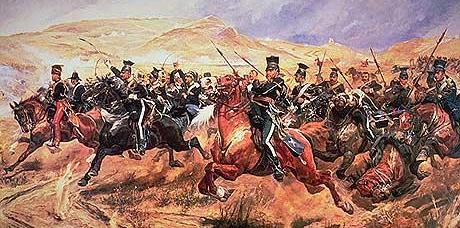
Painting representing the charge of the Light Brigade at the Battle of Balaklava.