

TEMPORAL AGENT by Michel Poulin - HTML preview
Download the book in PDF, ePub, Kindle for a complete version.
“Yes, Clara. Misses Hatfield has a rather large sum given to her by Lady Jeanne that she has to put into the safety of a bank account. No sense either in missing on potential return interests from a savings account.”
“You are right, sir. One should always get the utmost from one’s money.”
389
Jeanne then chose that time to walk in the dining room, fully dressed and with her new overcoat on. Going to Gordon, she bent down and kissed him quickly before starting to walk out.
“I’m going to tour Saint James’ District, Gordon. I’ll be back for lunch.”
“Have fun!” replied Gordon, watching her leave before getting up and looking at Clara. “I’ll be in my study if anybody needs me, Clara.”
The maid in turn watched him leave the dining room. With a beautiful woman as a guest and with a family of six now in, the household’s atmosphere had changed drastically from the quiet, routine rule of a mostly absent single man like Gordon Smythe.
09:30 (London Time)
67-A St James’ Place, London
Neville Black had a last look at his pocket watch, then decided that it was opening time and pocketed back his watch before leaving the back room of his gunsmith store and walking to the entrance door to unlock it. To his surprise a young woman was waiting on the sidewalk in front of his store, looking through the façade window. Female customers were a rarity indeed in any gunsmith store. She came in as soon as Neville unlocked the door, exchanging a polite greeting with him before avidly looking around his display cases. The woman, wearing fine jewels and being very tall for her gender, was quickly attracted to the counter displaying pistols. Moving to that counter, Neville cleared his throat to attract her attention.
“Ahem! Are you looking for something in particular, miss?”
“I am!” she replied in a clear, agreeable voice. “Do you have any American-made Colt revolvers, sir?”
That made Neville raise an eyebrow in surprise: very few of his customers knew about Colt weapons, them being so new. She must have heard stories about them from someone returning from the United States. Moving to the end of the counter, he bent down and fetched some guns from the lower tablets.
“You are in luck, miss: I acquired a few Colt models from Mister Colt himself when he was exposing his guns at the 1851 Great Exhibition. I can’t say that they are big sales items, though. I sold only one of them in three years.”
“That’s because your other customers didn’t know a good pistol when they saw one.” replied resolutely the woman, nearly getting Neville to make a remark of his own
390
on women and guns. He did manage to keep it to himself, though, and was about to present each of the Colts to her when she surprised him again. Pushing a whoop of delight, she took hold of a particular gun and smiled with satisfaction.
“A Dragoon! Excellent! Do you have a second one like this, by chance?”
“Uh, I have a few others in my back store.”
“Then, bring three more Colt Dragoons, if you have that many, sir.”
“Three more, miss?” said Neville, having a hard time believing his ears.
“Yes! I need two for a friend of mine and two for me. If you have the reloading accessories and any tools that go with them, then I will take them too, along with at least 500 percussion caps, six cans of fine grain powder and a reserve of already molded .44 caliber bullets, Minié type if possible.”
“Good God, miss! Are you planning on attending a war?” exclaimed Neville. He then found himself the target of the woman’s unflinching green eyes.
“As a matter of fact, maybe, sir.”
Deciding that he didn’t want to antagonize further that customer, Neville went inside the back store and got her extra revolvers, percussion caps, accessories and bullets. Putting the lot on the counter in front of the young woman, he smiled to her.
“I guess that I will have to get more of these from the United States now. Each gun case for the Colt Dragoons includes a spare six-shot cylinder, by the way. Anything else, miss?”
“Yes! I will need holsters, both belt and saddle types, for these guns, along with belts and ammunition pouches.”
“Then, this way please.” answered the gunsmith while pointing at a corner of his shop where leather products were displayed. The woman followed him there and examined the items as he described them.
“These holsters here will fit your Colt Dragoons. You also have here various types of belts and pouches which will go with these holsters. What waist size is your friend, miss?”
She eyed Neville critically before answering.
“He’s taller than you but has about the same waist size as you, I would say.”
“Then this one should fit him.” He said while grabbing a belt and adding it to the holsters she had selected. The woman grabbed a few matching pouches as well, then shocked Neville by taking another belt and trying it around her own waist after slipping two Colt Dragoon holsters and two pouches on it.
391
“This will do just fine for me.” she pronounced resolutely, ignoring the gunsmith’s stunned look. “Do you have fighting knives as well, sir?”
“Knives? Uh, yes miss, right here.”
The woman looked for a moment at his knives display and quickly decided on a huge American Bowie hunting knife. Taking it and its scabbard, she then smiled at him.
“Well, I think that I’m nearly done here. Since you got Colt revolvers, would you also happen to have models of Colt-Paterson revolving carbines or rifles?”
“In fact, I do, miss, but to be frank they sell even less than Colt revolvers. They have a bad reputation for unreliability and accidents.”
“Oh?” said the young woman. She then concentrated for a moment and frowned with apparent frustration. “I can’t remember anything about that, but you certainly must know better than me about it. Could I see them anyway?”
“Certainly, miss.” said the gunsmith, who walked behind his counter and took two rifles from a well filled wall rack, putting them on the counter in front of Jeanne and pointing at each weapon in turn while speaking.
“First, I have this Colt-Paterson Model 1836 revolving cylinder rifle. It has a caliber of .69 inch and has a seven-shot cylinder. The weapon above it is a Colt-Paterson Model 1842 carbine. Its cylinder can hold eight shots of .55 caliber. The main complaints about those Colt-Paterson weapons are their unreliability, their tendency to spit lead and hot gases from the gap between the barrel chamber and the front of the cylinder and the possibilities of having chain firing, when all chambers ignite at once when you fire a shot.”
“Those are serious problems indeed, sir. Are those complaints founded in your opinion, though?”
“Well, the lead and gas spitting is definitely a problem in these weapons, especially in the bigger, more powerful .69 caliber. The reliability could be better but, in the hands of a caring professional, these guns can be devastating, even if they are a bit fragile. As for the problem of chain firing, I believe that it is due to the fact that many shooters are not careful enough to cover with grease the front of the loading chambers once the powder and balls are in place. These weapons are by the way the only production repeating long guns you will find on the market now, anywhere. If you are looking for heavy firepower, then those are the things you want.” The woman nodded while eyeing the two guns, then grabbed the smaller, .55 caliber carbine and examined it from up close.
392
“Do you have a set of spacer gauges, sir? I would also need a tool set for dismantling this gun.”
“Uh, sure, miss!” replied the surprised gunsmith before going into his back store. He was back after two minutes with the gauges set and the tools, putting them on the counter. The woman first checked with the gauges the spacing between the face of the loading cylinder and the back of the barrel. She was apparently unimpressed by what she saw.
“The spacing is effectively quite large. It will lose quite a lot of energy from the powder through that gap.”
“I could always fit a thin plate to diminish that gap, miss. It would be maybe half a day’s work.”
“You could, sir?” asked the woman, smiling. “Could you as well fit a flash guard plate around the lower half of the cylinder, so that my left arm is protected during firing?”
“Certainly, miss. In fact, that modification is one that is often requested with those weapons.”
“Perfect! Let me just finish my inspection of this carbine and I will then pay for my acquisitions.”
Watched closely by the gunsmith, the young woman quickly dismantled the carbine, then checked the internal mechanisms before reassembling the weapon, all the while showing the assurance and flair of a person expert in gun handling. She finally looked and smiled at the gunsmith.
“I will take this carbine, sir. If you have spare cylinders, I will take them as well, along with a full accessories kit, two cans of powder, one can of percussion caps and what you have in .55 caliber Minié bullets. I will come back on Friday to pick up the carbine once you have a filler plate and hand guard fitted to it. You may add up my bill now.”
“Yes miss!” said the happy shop owner, who then went to his cash register and added up her bill. The young woman didn’t flinch when he told her that it all came to a total of a bit over 37 Pounds Sterling, a sum many Londoners would find quite impressive, as it representing months of salary for an average worker. The woman actually added even more to that bill, selecting a pair of leather saddlebags in which she stuffed her new acquisitions, minus the carbine. She then left the store, the heavy bags slung over her right shoulder. The shop owner watched her walk away from a window,
393
then shook his head in amusement: that woman had to be his most unusual customer ever.
11:28 (London Time)
Private study, 14 Belgrave Square
Gordon sighed with relief as he closed the accounting book and put down his pen. He always hated doing his household accounting, finding it boring and making him feel like a cheapskate. However, as his mother kept telling him, Sir Charles Smythe would not be part of the top shareholders of the prestigious East India Company if he had neglected his accounting chores. Gordon was putting back on the lid of his ink bottle when someone knocked on the door of his study.
“Come in!”
His heart accelerated when Jeanne stuck her head inside, a charming smile on her face.
“Hi, Gordon! I have a few things for you with me. Could you close your eyes for a minute?”
“Sure, my love!” replied Gordon, closing his eyes and straightening in his chair, a smile of anticipation on his face. If the few days with her had taught him something, it was that Jeanne loved making other people happy, a trait that only endeared her more to him.
“You can look now.” said Jeanne from behind him after a moment. Doing so, Gordon saw two closed wooden cases now sitting in front of him on his desk.
“What are these, Jeanne?”
“Open them and look!” she answered in an encouraging tone. Gordon did so, revealing two big revolvers and their accessories. Taking one of the revolvers, he examined it with growing happiness.
“A pair of six-shot pistols. They are real beauties.”
“These are American-made Colt Dragoon .44 caliber revolvers. I also have a few more things to go with them.”
She then lined on the desk the belt, holsters, pouches, powder and ammunition. Gordon got up from his chair and kissed Jeanne for a long moment before looking into her eyes.
“These revolvers are magnificent! Somehow, I think that my pair of Adams single shot .577 caliber pistols will take an early retirement. Thank you, Jeanne.”
394
“Actually, you could say that those guns are as much for my benefit as for yours, Gordon. They will help you stay alive while in combat and thus also help me keep you.” His happiness suddenly tempered by those last words, Gordon eyed cautiously Jeanne.
“I suppose that you are referring to that war in Crimea you predicted?”
“You suppose right, Gordon.” she said somberly. “I keep remembering more details about it all the time.”
“Jeanne, to remember something you have to either live it or see something about it, yet this war still hasn’t happened. What you see must be visions from the future.”
“Maybe that’s what they are, Gordon. It however doesn’t change the fact that they make me worry about you. You are too good a man to lose.” Softened up by her declaration, Gordon stepped to her, hugging her for a long kiss. When they parted, Gordon sighed while looking into her eyes.
“And you are too good a woman to pull away from, Jeanne. Come downstairs and let’s have lunch: we have to escort Misses Hatfield to the bank this afternoon.”
13:39 (London Time)
Midland Bank
Prince’s Street, The City
London
Gordon, Jeanne at his left side and Elizabeth Hatfield behind him, swept his right arm around as they entered the large main hall of the Midland Bank.
“The Midland Bank, repository of my family’s wealth and the best bank in London, notwithstanding what the Bank of England across the street may say about it.” The trio then took place in one of the short waiting lines of customers. Chatting about the sights they had seen while riding in Thomas’ carriage, now parked along the sidewalk outside the bank, they only had to wait five minutes before their turn at the service counter came. A clerk in his mid forties, thin and balding, smiled at Gordon and his two female companions as they stepped forward.
“Good day, Mister Smythe! I see that you had the pleasure of meeting Lady Jeanne D’Orléans.”
While Gordon froze up, thunderstruck by the clerk’s words, joy filled Jeanne’s face.
“You…you know me, sir? What name did you say again?”
395
“But…your name: Lady Jeanne D’Orléans. You are our biggest account holder.” replied the clerk, surprised by their surprise. “Is something wrong, miss?”
“Not anymore!” said Jeanne before hugging and kissing happily Gordon. “I can’t believe it! I’m finally going to know who I am.”
While hugging Jeanne, Gordon looked at the puzzled clerk.
“We need to see the bank’s director, sir. Tell him that this is most urgent and important.”
“Uh, yes sir!”
As the clerk hurried to one of the offices behind the service counter, Gordon gently took hold of Jeanne’s face and kissed her.
“Jeanne D’Orléans: a beautiful name for a beautiful woman.” Taking her hand, he led her and Misses Hatfield through a wicket and past a few bank employees desks. They were approaching a wood and tainted glass door when the clerk who had greeted them at the service counter emerged from that door. Stopping cold at their sight, the clerk then stepped aside, holding the door open for them.
“The director will see you now, ladies and gentleman.”
Jeanne took the time to slip a gold coin in the clerk’s vest pocket before going inside.
“I owe you a big one, mister. Thank you for remembering me.”
“What did I do to deserve this, miss?” said weakly the puzzled employee, getting a grin from Gordon.
“Like Lady Jeanne said, you remembered her.”
He then followed Jeanne and Elizabeth Hatfield inside the office, where the bank director greeted them and shook their hands. Sir Kenneth Maple was a jovial, rotund man with long whiskers and moustache. Offering chairs to his visitors, he then took place behind a huge desk of polished wood, sitting in a leather padded armchair. He immediately noticed the expectation on the faces of his visitors and looked questioningly at Gordon.
“How may I help you today, Mister Smythe?”
“It is Lady Jeanne that you can help most today, Sir Maple.” answered Gordon while putting a hand on Jeanne’s shoulder. He then spent a couple of minutes explaining to him how Jeanne had become amnesiac and had been sheltered by him. The director nodded gravely his head at that story, shifting his gaze to Jeanne.
“You were indeed very lucky, Lady Jeanne. You could have been robbed while unconscious and then end up a lonely, destitute woman without memories. Your fate could have been quite grim, miss.”
396
“I know, sir.” replied softly Jeanne, bowing her head. “That’s why I am grateful to have met such a gentleman as Gordon. This may sound silly, sir, but could you tell me about myself?”
“By all means, Lady Jeanne. Let me just get your account file first, please.” Gordon felt Jeanne’s hand search for his hand and then press it anxiously as Sir Maple left momentarily the office. The director returned within minutes with an inch thick file full of papers, receipts, account updates and cashed checks, putting the lot on his desk and sitting down. Taking a particular sheet from the file, he cleared his throat before reading from it.
“This is the account opening form you filled five years ago when you first came here. Your…”
“Wait!” interrupted Jeanne. “Could I have something to write all this down first?”
“Of course, miss!” replied the director, then searching in a desk drawer and taking out a few blank sheets of papers, putting them on the of the desk nearest to Jeanne, along with an ink bottle and a pen. Jeanne then shifted her chair close to the desk and dipped the pen’s tip in the ink bottle as Sir Maple resumed his reading in a slow, deliberate voice.
“As I was about to say, your full name is Jeanne Marie Céleste D’Orléans. You were born as Jeanne Marie Céleste de Brissac in Brissac, France, on June thirteen of 1831. You married the Chevalier Pierre Alphonse D’Orléans in the French overseas Territory of the Guadeloupe in 1846 but your husband died of a tropical fever in 1847 and you had no children. Both of your parents are dead according to the information you gave on this form.”
Gordon felt relief on hearing this: Jeanne’s true marital status had been increasingly bothering him, what with his project to marry her. Feeling much better now, he listened on as the bank director continued.
“Your official residence in France is listed here as the Hôtel de Brinvilliers, at number 12 Rue Charles-V in Paris. Your official occupation is as founder and head administrator of a philanthropic organization, the d’Orléans Social Foundation, based in Paris. From what I know of that organization, it is dedicated to charity work directed at the poor and the socially disenfranchised. You opened a local office in London last year, while your foundation has other offices in Italy, Germany and Holland.”
“Good God!” uttered Elizabeth Hatfield, impressed. “No wonder Lady Jeanne helped me: she could nearly qualify as a saint with this pedigree.”
397
Sir Maple gave Elizabeth an amused look.
“Actually, many members of London’s high society call her less flattering names, such as socialist revolutionary, mad visionary and stock market shark.”
“Stock market shark?” said Gordon, not having expected such an epithet for Jeanne. Sir Maple grinned at that and referred to one of the financial information sheets in Jeanne’s file.
“That’s right, Mister Smythe. Lady Jeanne seemingly started investing heavily in the stock markets on her return from the Guadeloupe, both in France and in England, using the fortune left by her dead husband. She hired an experienced stock trader here, who regularly comes to this bank to make deposits and withdrawals to and from a corporate account belonging to her foundation. The rumor at the London stock market, where I personally trade from time to time, is that Lady Jeanne is the one truly calling the shots and that her instincts on the trading floor are impeccable. Right now, Lady Jeanne’s London portfolio of shares and bonds is valued at approximately one and a half million pounds, while her personal account at this bank actually stands at a meager 873, 912 pounds. Lady Jeanne also has of course another bank account and stocks portfolio in Paris rumored to value over four million pounds in total. I have here the bank address and account number in Paris.”
While Jeanne recovered quickly from her surprise and then scribbled down all that information on paper, Gordon’s mind boiled up: Jeanne’s fortune eclipsed by far that of his own family and actually made her one of the richest women in Europe, if not the richest. Sir Maple gave Jeanne the address of her bank in Paris and the number of her bank account, then spoke cautiously.
“Since you became amnesiac, Lady Jeanne, I should remind you of a point of British law pertinent to you. According to it, women are not recognized as full legal persons. Married women in particular have no rights to private ownership, with their husbands automatically becoming owners of all their possessions on marriage.”
“But, that’s preposterous!” exploded Jeanne with indignation. “You said yourself that I support a number of charitable works. How am I supposed to continue doing that if all my wealth is forcibly stripped away from me when I marry?” Sir Maple gave a cautious look to Gordon before answering.
“For the moment, the British laws regulating the rights of women do not apply to you, Lady Jeanne, as you are both single and French. If you however marry in England, those laws will apply, unless you arrange some special legal measures.”
398
“Such as?”
“You could always transfer the money you have in England to a corporate account, with you as sole signatory authority for its use. You could also, in the case you marry in England, have your husband sign a legal waiver leaving you in charge of your fortune. That last measure would however be open to legal challenges in British courts and is not foolproof. As for your money in French accounts, it is out of reach of British law. I’m sorry if I had to raise such a subject and I certainly didn’t want to infer anything bad about Mister Smythe, who is both a good customer and a personal friend of mine, but, in view of your immense fortune, I thought it my professional duty to warn you about these laws.”
“You did well to warn her, Sir Maple.” cut in Gordon, his face sober. “To be frank, I already proposed marriage to Lady Jeanne after being conquered by her personality, even though I didn’t know who she was. The last thing I would want to do is to abuse her confidence and strip her of her fortune. I am ready any time to sign a waiver to my rights to her fortune if we marry. Your professional honesty is a credit to you, sir.” Sir Maple nodded his head at that compliment, then looked back at Jeanne.
“Your last account entry dates from last Friday and was incidentally the first one since January 26 of this year. You took out 600 pounds then and changed some French Francs as well. I thus presume that you just arrived from France on Friday.”
“That could be a useful information for later on, sir.” agreed Jeanne politely. “Do you by chance have an address for me in London? I have no clue where I resided here before I became amnesiac.”
“Unfortunately, none, Lady Jeanne. You are known to live rather modestly for a woman of your wealth and to use middle scale hotels while in London. I do have however here the address of the local office of your foundation, along with the names of its local representative and of your stockbroker.”
“Those I will certainly note down, sir.”
“Finally, I can tell you that you have a vault safety box in your name here, miss. Would you have with you your box key by chance?”
“Wait a minute!” replied Jeanne, frantically taking out her purse and searching inside it. She shouted in triumph as she took out a small key attached to a key ring and showed it to the bank director. “Could this be it, sir?”
Kenneth Maple grinned after examining the key.
399
“This is definitely one of our safety box keys. This is decidedly your lucky day, Lady Jeanne. If you will now excuse me for a moment, I will go get your deposit box.” The director then left the office for a second time. Jeanne hesitated a bit, then counted out 200 pounds out of the remaining cash left in her purse and handed it to a stunned Elizabeth Hatfield.
“You would make me very happy if you would add this to the account you are about to open, Elizabeth. There is plenty more where it came from.” After some hesitation, the widow took the money, tears filling her eyes.
“Lady Jeanne, you are simply too good to be true. How could I ever repay your kindness?”
“By raising healthy and happy children, Elizabeth.” said Jeanne softly. Gordon, a lump in his throat, rose from his chair and gently took Elizabeth’s right arm.
“Please come with me, Misses Hatfield. I will escort you to the service counter so that you can open a savings account.”
He then bent down and kissed Jeanne as he walked by her.
“You are the best woman any man could hope for, Jeanne. I love you!”
“I love you too, Gordon.” she replied before returning his kiss.
Jeanne used the time taken by Gordon and Elizabeth at the service counter to continue copying down select information contained in her bank file. The two came back just before Sir Maple, who was carrying a large, flat steel box and a booklet in his hands. He gave first the booklet to Jeanne and put the safety box in front of her on the desk.
“This is your new bank account book, Lady Jeanne. A clerk is now preparing your new checking book, which should be ready soon. Do you want a private room to examine the content of your safety box?”
“No sir. I am with people I can trust.”
Maple bowed at the compliment, flattered. Jeanne then inserted her key in the lock of the box and, after a slight hesitation, turned it and held her breath as she raised the lid. Gordon involuntarily bent forward to look inside the safety box, as did the director and Elizabeth. Jeanne first extracted a large, decorated wooden box. Next were a booklet and a leather holder. Her hands trembled as she opened the holder and unfolded the large velum sheet inside, which bore an official seal.
“A French passport… My passport! I am now officially a person.”
400
Nobody spoke as Jeanne took the time to control her emotions. Her voice was firmer when she looked at the booklet.
“A bank account book in my name, from the Banque de Paris. Let’s see the wooden box now.”
Grabbing the box and fully opening its lid, she got a concert of admiring gasps, including from herself: inside was a full set of jewels worthy of a royal person. Taking out a large diamond and emerald necklace, Jeanne held it around her neck, smiling at a mesmerized Gordon.
“So, how do I look?”
“Just irresistible, my dear Jeanne.” said Gordon, meaning it. This was decidedly turning into a true fairy tale for him. Putting back the necklace in the jewel box and closing the box, Jeanne put it back in the safety box but kept her passport and Paris bank account. Folding the sheets of paper she had scribbled on, Jeanne put them in an overcoat pocket and shook hands with the bank director.
“Sir, I owe you a big one today. I will not forget this.”
“It was my pleasure to be of help, Lady Jeanne.” replied jovially the fat man. “Let’s go see if your checking book is ready before you leave, though.” Leaving his office with his three visitors, Maple led them to an employee’s desk while carrying Jeanne’s safety box under one arm. Getting the now ready checking book from the clerk, the director handed it to Jeanne before heading to the bank vault, where he put back in place the safety box while Jeanne watched him. After a last round of handshakes with the director, his visitors started heading out of the bank. As they were passing the wicket separating the employees area from the public area, Jeanne suddenly turned around and went to the clerk who had recognized her, kissing the stunned little man on the cheek.
“I owe you my name and my fortune, mister. Thank you again.” Jeanne then walked out with her amused companions, holding Gordon’s arm. Once out on the sidewalk, she flashed a happy smile to Gordon and Elizabeth.
“Well, how about finding a suitable place to celebrate this, my friends?”
“Uh, I don’t want to be a killjoy, Lady Jeanne,” said apologetically Elizabeth, “but I’m due soon to breast-feed my little Harry.”
Jeanne grinned and shrugged at that.
401
“Then, we will buy something quickly and celebrate at home. Harry must not be made to wait for his milk. By the way, Elizabeth, please call me simply Jeanne. I believe that I am a very informal woman.”
“Thank you, Lad… uh, Jeanne.”
“That’s better!” said Jeanne cheerfully, patting Elizabeth’s shoulder.
15:06 (London Time)
14 Belgrave Square, London
Both Judith and Clara sighed with relief when Elizabeth Hatfield arrived home with Lady Jeanne and their master. Taking four year old Thomas, who had been playing horsy, off her back, Judith got back on her feet and hurried to Gordon, taking the box and bags filling his hands. On her part, Clara gratefully gave a crying Harry to Elizabeth.
“I changed him and tried everything to calm him down, madam, but I’m afraid that he is hungry.”
“No need to apologize, Clara. I will take care of that right away.” The young widow, little Harry in her arms, then disappeared in the kitchen. Clara, helping Judith with the bags, saw the content of one of them.
“French champagne? May I ask what we are celebrating, sir?”
“You may, Clara.” Happily said Gordon while passing an arm around Jeanne’s waist. “We are celebrating the rebirth of Jeanne Marie Céleste D’Orléans, born Jeanne de Brissac, the richest woman in Europe and now my fiancée.” He then told the two maids what had happened at the Midland Bank. Both servants then hugged and kissed Jeanne in turn, sharing her joy. Taking the large box they had brought with them, Jeanne offered it to Mary, smiling tenderly at the small girl.
“This is for you and your brothers and sister. I will let you take care of the distribution.”
“What is it, Lady Jeanne?”
“Chocolate!” answered the French woman, starting a rush on the box by Elizabeth’s children. By the time Jeanne had put the children under control and lined them up for their ration of chocolate, Gordon had fetched four champagne flutes. He let a radiant Jeanne pop open the first bottle and fill the glasses, two of which went to the delighted maids. Raising his glass high, Gordon looked at the three women around him in the lounge.
402
“To my fiancée, Jeanne Marie Céleste D’Orléans, and to happiness!”
“Cheers!” replied the women before sipping from their glasses. Clara then timidly looked at Gordon.
“When are you going to announce your engagement to your parents, sir?”
“Saturday, at the reception thrown at the family estate. Before, though, me and Jeanne are going to make a short trip to Paris: Jeanne has business to take care of there.”
“Paris!” said Judith dreamily. “How I would love to see and visit it.”
“You will have your chance soon, Judith.” replied Jeanne, smiling with malice at the maid.
19:58 (Paris Time)
Wednesday, March 15, 1854
Hôtel de Brinvilliers, 12 Rue Charles-V
Paris, France
“What a trip!” sighed Judith as she stepped out of the coach with Gordon’s help. “Thomas’ carriage to Dover, a boat trip across the Channel, then this coach ride from Calais. My bum feels like stone.”
“I’m sure that you could find yourself a nice Frenchman to massage feelings back into your bum, Judith.” said jokingly Jeanne. The young maid, wearing her best dress for this trip, smiled but did not reply to that: while pretty and still only 21 years old, she had been raised by strict, conservative parents and had not slept with a man yet. Looking up at the beige stone façade of the building in front of which their coach had stopped, she examined the two story residence quickly. It occupied half of a block and had a wide arched entrance gate meant to accommodate horses and carriages and that gave access to a private courtyard. As soon as their luggage was unloaded from the coach, Jeanne led Gordon and Judith to the large carriage gate giving on the street. Taking out her set of keys, she had to try three keys before getting the good one and unlocking the pedestrian door in the carriage gate. Bringing their luggage with them inside the tunnel leading to the inner courtyard, Jeanne unlocked a side door that gave on the tunnel. The trio stepped inside a wide entrance lobby with cream-colored walls and a large curved staircase with forged hand railing. Two lit oil lamps illuminated the lobby, telling Jeanne that someone was in the building.
403
“Y a t’il quelqu’un15?” She called in French. After a few seconds, they heard light footsteps upstairs and a tiny young oriental woman then appeared at the railing at the top of the staircase. She smiled at the sight of Jeanne and spoke a few words in a language Gordon had never heard before. Jeanne hesitated for a moment, then replied in the same language. As both women engaged in an animated conversation, Gordon examined with curiosity the newcomer. She looked very young indeed, probably no more than twenty years old, and stood at most five feet tall. Her slim, graceful body was enhanced by a long, beautifully embroidered red and gold silk dress which earned an admiring look from Judith. She had long, silky black hair that went down to her waist and a tiny nose that enhanced her youthfulness. Overall, Gordon found her beautiful. Jeanne then turned sideways to look at him and Judith.
“Gordon, Judith, this is Li Mai, my personal assistant. Unfortunately she speaks only French and Chinese, so I will have to play translator between you. Please follow her to the bedrooms, so that we can drop our luggage.”
Gordon closed back the main entrance door before grabbing his two suitcases and climbing the curved staircase behind Judith, Jeanne and Li Mai. Once on the upper floor, they followed a hallway lined with doors that made a ninety degree turn after fifty feet. Li Mai finally stopped and opened a door, speaking briefly to Jeanne in Chinese, who in turn spoke to Judith in English.
“This will be your room during your stay, Judith. Just drop your bags and take off your overcoat, then we will tour the rest of the residence with Li Mai.” Judith did as told, entering a fair-sized bedroom that was very comfortably furnished. Li Mai lit an oil lamp for her while she took off her wool overcoat and hung it inside a closet. Then following the Chinese girl and Jeanne, who kept translating Li Mai’s words in English, she and Gordon toured the upper floor, which had a high ceiling that further enhanced the impression of spaciousness of the residence. The place, while not extravagant in terms of luxury like some of the British manors Judith had seen, looked and felt very comfortable, with thick carpets, tapestries and well-padded furniture everywhere. It also had a strong historical flavor, being decorated with innumerable pieces of antique weapons, armor, furniture and artwork. Jeanne’s bedroom, apart from being quite large, made Gordon and Judith feel like they had been thrown back to the Middle Ages, with its canopy bed, large fireplace and medieval style furniture. In
15 Y a t’il quelqu’un? Is there anybody?
404
contrast, the private study was furnished with magnificently sculpted lacquered wood Chinese furniture and decorated with ancient pieces of oriental artwork and weapons. As for the main lounge, where Jeanne finally invited Gordon and Judith to sit with her and Li Mai, it had the looks of an ancient Persian palace lounge. Going to an antique sword hanging above a fireplace, Gordon passed a hand on it, admiring its leaf-shaped bronze blade.
“How old would be this sword, Jeanne?”
She approached him and gave a quick look at the weapon.
“Greek, Achaean Period. Probably dates from the Fourteenth or Fifteenth Century before Christ. The age and good condition of this blade would make it nearly priceless.”
Gordon gave her an awed look.
“Then you really must be an archaeologist to own such a piece.”
“It seems so.” she replied in a subdued voice while looking around her. “I see here antiques that most museums would kill to get their hands on them. Take that Egyptian bronze hand mirror over there: it must be over 3,000 years old. That little clay cylinder on that shelf is a Sumerian seal and is probably even older than the Egyptian mirror. The funny thing is that I feel completely at home around those pieces of antiques, as if I lived with them all my life.”
“Talking of home, do you have only a single servant for such a large residence?”
“Uh, let me ask Li Mai about that.”
After a lengthy exchange with the Chinese girl, Jeanne faced back Gordon and Judith.
“It seems that I gave a few days off to my other employees. According to Li Mai, I help a lot with house chores…when I’m not traveling, which seems to be often. I also help serve my guests when I throw private receptions and discussions for intellectuals, artists and scientists.”
Gordon nodded in appreciation at that: Jeanne had more than proven by now that she was a very intelligent and extremely well educated woman. She was also very liberal-thinking by any standards. She was definitely a far cry from the often empty-headed snobs which seem to populate much of the British aristocracy. Gordon then eyed the young Chinese woman, who was sitting on large Persian cushions.
“And your Li Mai, how did you find her?”
Jeanne had to ask the maid again, translating her story as Li Mai spoke.
405
“Li Mai is an orphan who was picked up at a young age by French missionaries in Beijing, in Northern China, and educated by them. A French Army captain fell in love with her when she was fourteen and married her. He brought her with him back to France but died shortly thereafter of cholera, leaving Mai alone and desperate. I found her begging in the streets five years ago, the target of pimps and abusers, and helped her by offering her a job as my personal assistant. It seems that I trained her to be a hostess for my guests, who apparently love the exotic touch she brings to my receptions. Talking of reception, how about a little snack and drink after this long trip?”
“That sounds like a good idea, Jeanne.”
“Good! Let’s find the kitchen, then.”
The four of them then walked out of the main lounge, stepping into an adjacent dining room through a connecting French double door. Despite being used to work in the quite luxurious surroundings of the Smythes’ home, Judith opened her mouth in admiration at the sight of the fine China and crystal ware displayed in glass shelving units around a large dining table made of polished and sculpted mahogany wood. Going down to the kitchen, which was connected to the dining room by a wooden staircase, they found it quite large, with both a large fireplace, a bakery oven and a wood stove. The kitchen was impeccably clean, sporting stainless steel kitchen ware and marble top counters. It also contained a small table for informal meals, around which Gordon and Judith sat while Jeanne and Li Mai prepared a frugal assortment of bread, cheese, pickled fish and dry sausages. Judith was stunned to see Li Mai sit with them afterwards. Her facial expression prompted a smile and an explanation from Jeanne.
“This may look most unusual to have my servant eat with me but I am a very democratic woman. To me, everyone is equal, without regards to race, sex, social status or religion.”
“I remember that Sir Maple told us that many in the high society of London supposedly call you a socialist revolutionary and a mad visionary.” said Gordon while pouring himself a cup of red wine. “You truly seem to honor those terms, Jeanne, not that it bothers me, though.”
“Thank you, Gordon. You are indeed a tolerant and comprehending man, the way I like them.”
406
Gordon smiled at that, having seen her wink to him. Li Mai then said something to Jeanne, prompting a quiet exchange between the two of them. Jeanne finally looked back at Gordon and Judith to explain what had been said.
“Li Mai told me that, apart from my domestic day staff, employees of my charitable work foundation work out of an office suite on the ground floor of this residence. I also have a personal mount in the stables opening on the inner courtyard, along with two more horses for my carriage.”
“Could I go see those horses after this?” asked Gordon, who had a keen interest in horses, as was fitting for a cavalry officer. Jeanne smiled and nodded.
“I also would want to see them, as my amnesia left me with no souvenirs of them and as I also love horses. That will also give us an excuse to finish touring my residence.”
After chatting and eating together for twenty minutes, Jeanne helped Li Mai put away the leftovers and clean the dishes, prompting Judith into helping them. They then left the kitchen, guided by Li Mai, who first showed them the offices used by the D’Orléans Social Foundation. Jeanne took some time there to review the papers in the ‘in’ and ‘out’ baskets on the desk of the executive secretary, in order to acquaint herself with the latest business handled by her foundation.
“I will decidedly have to have a serious chat with this Mister Jacques Leblanc. I hate to be ignorant of what my foundation does when so much people are touched by its good works. Just from those papers here, it appears that my foundation is supporting in Paris a school for poor girls, two orphanages and a shelter for abused women. I also see a transfer of funds to cover the buying last month of shares of the Minié Company.”
“The Minié Company?” said Gordon, surprised. “But that’s the company which provides the new ammunition for the rifles of the British Army.”
“It also provides the bullets for the French Army as well.” added Jeanne, thoughtful. “If what I believe about the Crimean War is correct, that company is going to make a fortune by providing ammunition for the French and British armies during that war.”
“And so will you, by buying in advance shares of that company.” said Gordon, somber. “And your foundation bought these shares before England and France became implicated politically in that war. Your visions of the future apparently helped you become rich.”
407
“I do not use my fortune for my own benefit, Gordon, and you know it.” protested Jeanne, raising her voice. “You know what kind of living standard I could be enjoying with the money I have? Hell, I could have a palace the size of Versailles if I wanted to. Yes, I do not live like a pauper either but part of the success of my foundation depends on maintaining social and political contacts at various levels and I thus have to maintain a minimum level of social decorum. If some good can be done out of that war, which I can’t stop or prevent, then I will do it.”
“Jeanne,” said softly Gordon, “don’t take me wrong. I am not blaming you for how you make your money or how you spend it. In fact, I approve of it. Let’s forget this financial business for the moment and let’s visit the stables.”
“You’re right.” said Jeanne, sighing. “Not remembering anything about myself and what I did in the past is really annoying and irritating me.”
“No wonder!”
Locking back herself the door to the office suite, Jeanne then collected a lit oil lamp and followed Li Mai outside to the three large carriage entrance doors opening on the inner courtyard, Gordon and Judith behind them. Entering the first one through a small door set in the large double doors, they found that garage occupied by a carriage parked in it, with various spare harnesses and carriage parts stored in it as well. Gordon noticed at once the unusual design of the carriage. While the passenger cabin of the carriage was luxurious and comfortable, as expected from the carriage of a rich lady, the structure and suspension system were nothing like Gordon had seen before. Instead of the leaf spring suspension common on carriages everywhere, this carriage had coil spring suspensions on all of its four wheels. Furthermore, each wheel was attached to one of four independent half axles. The main structure was also based on a metallic tubular chassis supporting a lightweight shell. Gordon scratched his head on seeing that.
“This is the strangest carriage I have seen yet, Jeanne. I suppose that you had something to do with its design, since you have visions of strange mechanical things.”
“You are probably right, Gordon.” said Jeanne while examining a small plaque screwed to the chassis of the carriage. “I see here that this carriage was built here in Paris by a local carriage shop. I will have to visit it soon to find out the story about it.” They then used an inside door connecting the garage with the next one, finding two horses occupying stalls well provisioned with hay, grain and water. Li Mai spoke briefly in French with Jeanne, who then translated for Gordon and Judith.
408
“Li Mai says that these are the horses for my carriage. Their names are Clémentine and Hercule.”
“Hello, Hercule.” said Gordon, caressing the head of the stallion near him. It was a healthy and strong Arabian horse, like the mare in the other stall. Both horses seemed quiet and docile animals and obviously enjoyed the attention. Jeanne and the others next went into the third and last garage, again using an internal connecting door. That garage housed one brown horse and a small, two-seater buggy. The buggy was as unusual as the larger carriage in the first garage and also used coil spring independent suspensions and tubular chassis construction. The big brown mare occupying the stall next to the buggy watched them quietly as Jeanne, Li Mai, Gordon and Judith examined the buggy. Gordon found the buggy surprisingly light, being able to lift one side with little effort.
“I decidedly like this design. Being this light, it must be quite fast and maneuverable.”
Gordon next went to the mare, who eyed him quietly as he caressed her head.
“And what is the name of that beauty, Jeanne?”
Li Mai again answered through Jeanne.
“Pegasus. It is my personal horse. Li Mai says that she is a very intelligent animal.”
“She appears so.” agreed Gordon while passing a hand on the right side of the horse. Jeanne, standing close to the head of the mare, saw that the animal was staring at her insistently and caressed its forehead.
“Hello, Pegasus. We will have to reacquaint with each other soon. You will have to excuse me if I don’t remember you.”
The horse raised its head at those words, as if it had understood her. Intrigued, Jeanne looked into the animal’s eyes.
“You seem to be a bright beast indeed, Pegasus. It shall be a pleasure to ride you again.”
Gordon then came to her, a smile on his face.
“Well, this was certainly interesting, especially your carriage and buggy. Shall we continue the tour of the ground level of your residence?”
“By all means! Let me ask Li Mai about what is left to see.” She conversed in French with the Chinese woman for a short while before looking back at Gordon.
409
“There are still my personal exercise room and a small workshop used by my handyman to see. My exercise room is supposedly well equipped and quite spacious.”
“Let’s see it then!” said Gordon enthusiastically. With Li Mai again leading the way, the four persons left the garage, watched by Pegasus. A few seconds after the door of the garaged had closed, the horse silently floated up a foot from the ground, then disappeared in a brief flash of white light.
15:08 (New Zealand Time)
July 9, 2980 B.C.E.
Main residential tower, main Time Patrol base
Future site of Auckland, New Zealand
Rina Tonen ‘B’, on duty as the officer in charge of the space-time transit hall, was not a little alarmed to see a brown robotic horse appear alone on arrival pad number six: robotic horses were programmed to jump space-time with the agents they were assigned to and did otherwise only in case of emergencies. Running from her control desk to the horse, the giant ex-Imperium woman gave it a short, concise order.
“Identify and report!”
“Robotic mount Pegasus, assigned to field agent Nancy Laplante ‘B’. I just arrived from March 15, 1854 Paris. Nancy ‘B’ returned from a solo trip to London in an apparent state of amnesia and accompanied by two unknown British persons.”
“Amnesia?” said softly Rina, not liking this one bit. “How severe did that amnesia appear to you, Pegasus?”
“She didn’t remember me, her name or even the layout of her Paris residence. Her maid Li Mai had to guide her around. I attempted discreet radio contact with Nancy ‘B’, including on the emergency frequency, but got no answer. Her mental brainwaves showed some disturbances and anomalies. Physically she seemed in good state.”
“Damn! Alright, Pegasus, come to the control station and I will download your recorded data on your last encounter with Nancy ‘B’.”
The robotic horse trotted at once to the control station, where Rina Tonen connected Pegasus to her computer via an optical fiber cable she plugged in a hidden port inside its left ear. While the video, sound and mental wave data was copied into her computer, Rina called at once Mike Crawford, the chief of operations of the Time Patrol, to pass him the bad news: this definitely classified as a major emergency.
410
22:19 (Paris Time)
Wednesday, March 15, 1854
Hôtel de Brinvilliers, 12 Rue Charles-V
Paris, France
Jeanne, about to go to bed for the night with Gordon, opened the closet of her bedroom to hang her dress but then froze: the closet was nearly full of female clothes that seemed made to fit her. She burst out laughing, surprising Gordon, who was also undressing for the night.
“What? What do you find funny, Jeanne?”
“My clothes! I am having Mister Meir make five dresses in a hurry for me in London and I have here a closet full of dresses and other clothes. Let’s see what I have in here.”
Sifting through the closet, she selected and took out a few dresses and items of clothing so that Gordon could see them, putting them on the bed. Jeanne suddenly shouted triumphantly and pulled out of the closet a magnificent sky blue ball dress studded with pearls, holding it against her and smiling at Gordon.
“Do you think that this would do for your parents’ reception on Saturday?”
“Do? My dear Jeanne, you will be sensational in this.” said Gordon, sincere. Grinning at his response, she laid the ball dress on the bed, then kept foraging through the closet. At one point she frowned and took out a red dress with pleated skirt, examining the bottom part.
“What is this? It looks like a normal dress but the skirt is split in two at crotch level to form a sort of trousers with wide legs.”
“I don’t know, but it should be perfect for you to ride.” said Gordon without thinking. His words made a sudden look of revelation dawn on her face.
“A riding dress! Of course! I would still look like a proper lady but wouldn’t need to use that stupid Amazon riding position. I wonder if I was the one who came out with this design.”
“You probably did, Jeanne. It is an ingenious idea indeed.”
“Thank you, my love! I see in there five more riding dresses, so I must ride quite regularly.”
She then gave a malicious look at Gordon, who was now down to his shorts.
411
“Talking of riding, I have some projects involving you tonight, Gordon.”
23:52 (Paris Time)
Master bathroom
Hôtel de Brinvilliers
After a last bought of cuddling and lovemaking with Gordon, Jeanne left the master bedroom to go into its adjacent bathroom, while Gordon went to sleep, utterly burned out but happy. The moment that Jeanne, wearing a bathrobe, closed the door of the bathroom behind her, a small cylindrical object appeared in the air close to Nancy and glued itself to her belly. Before Nancy could react, a brief white flash of light enveloped her and she suddenly found herself inside what appeared to be some kind of metallic compartment. The moment that she appeared, a man wearing a sort of gray uniform approached her slowly, both of his hands up.
“Don’t panic! We are friends of yours. Your true name is Nancy Laplante and you are one of us.”
Jeanne looked quickly around her at first, her eyes stopping briefly on the two bald, giant women standing a few paces away with a young redhead woman and a tall, powerful man. She then looked with suspicion at the man who approached her.
“How the hell did you get me here? What is this place anyway?”
“This,” said one of the two bald giant women while stepping forward, “is the Time Patrol scoutship TEEN TEAM 2, commanded by your friend Ingrid Weiss here. Nancy, you are one of our field agents, sent to this century under a false identity to study in detail this time period. My name is Farah Tolkonen, Chief Administrator of the Time Patrol. To my right are Mike Crawford and Miri Goshenk and the man facing you is Fernand Brunet, your direct superior and assault squad leader in the Time Patrol.”
“The…the Time Patrol?” said hesitantly Nancy, making Farah nod once.
“Yes! Nancy, what I will tell you now may hurt you in view of the love you showed towards the man you call Gordon: you have already two children, both boys. One is your natural son from the famous musketeer d’Artagnan, with whom you are still in love, while your second son was adopted by you in Ville-Marie in 1655.” Nancy was frozen by those words for a moment, then slowly sat on the deck, sobbing.
“No! It can’t be! I love Gordon and want to marry him.”
412
That was when Miri Goshenk hurried to her, kneeling in front of her and gently taking hold of her hands while speaking softly.
“Nancy, you still can love Gordon if you want to. You just need to know that others love you deeply too. I will help you remember them all again.” A flash of white light then enveloped the whole cargo bay for a fraction of a second without causing any apparent effect on its occupants, except for making Nancy tense up and look around her.
“What was that?”
“That was our scoutship jumping space-time back to our main base, Nancy. Once…”
“YOU ARE TAKING ME AWAY FROM GORDON?” shouted at once Nancy in an angry voice while jumping on her feet. She then grabbed Miri’s uniform collar. Before she could do more, a yellow stun beam from Fernand Brunet’s pistol struck her, making her stagger on her feet. Nancy surprised Fernand by showing enough remaining stamina to start charging him, forcing him in shooting her a second time. Nancy then collapsed at his feet, knocked out. Fernand looked down at her, shaken by her fierce reaction.
“Hell, she must really love that guy madly. You saw how she reacted at once when she understood that we were taking her away from Paris?” Miri, also shaken by Nancy’s reaction, nodded sadly.
“Yes, and it won’t make her recovery easier, I can tell you right now. Do we really have the right to deny her this love?”
“And what about the love of her sons Charles and James for her, and that of d’Artagnan?” replied Farah. “Poor girl! She will find herself in an impossible situation.”
“So, what do we do now with her?” asked meekly Ingrid Weiss, hurt by the plight of her friend. “All this was probably through no fault of hers.”
“I know.” said Farah, sounding discouraged. “Miri will have to do her best with her. We can only hope that Nancy will recover completely from her amnesia.”
“But what will happen of that Gordon, Farah?” Insisted Ingrid. “He will be undoubtedly hurt and upset if Nancy tells him afterward that they can’t continue their romance because she already has two sons. You know how strict the social
conventions are in the England of the 19th Century.”
“We will find a way to reconcile all of this.” said Farah, sounding more wishful than certain. “We have to.”
413
08:02 (Paris Time)
Thursday, March 16, 1854
Hôtel de Brinvilliers, Paris
The Sun was well up when Gordon woke up in Jeanne’s big bed. His first move then was to extend an arm, intent on caressing Jeanne, but his hand found the place besides him empty. Fully opening his eyes and looking around the bedroom, he then saw that Jeanne, wearing a bathrobe, was sitting at her private desk, a letter in her hands. The weak smile she did on seeing that he was awake alarmed Gordon, who jumped out of bed at once and went to her, kneeling in front of her.
“Is something wrong, Jeanne?”
Nancy, having returned a few hours earlier from seven months of medical treatment and rehabilitation and now in full possession of her past memories, felt her heart falter for a moment. She still loved very much that handsome and kind man who had saved her but she was going to be forced to deceive him and lie to him. The only permissible way out of her dilemma for her if she wanted to still love him was for her to live a secret triple life: one here in the 19th Century with Gordon; another in the 17th Century with d’Artagnan, with her playing the role of the Marquess of Saint-Laurent; and a third as Nancy Laplante ‘B’, field agent of the Time Patrol and single mother for two young boys. Gordon was however a man well worth the extra effort. Farah Tolkonen had also seen the practical side of this and had bombarded Nancy as the specialist field agent of the Time Patrol for the 19th Century, apart from being already the designated specialist agent for the 17th Century. That had made Nancy wonder only half-jokingly when she would also have to find another man to love in the 18th Century and become specialist agent for that century as well. Looking down into Gordon’s eyes and gently grabbing his hands, she spoke softly to him after shaking her head.
“Nothing is wrong, Gordon. My memories returned during the night, probably because the familiar setting of my residence stimulated souvenirs in me. Only a few small details are still fuzzy now.”
“But that’s great!” said Gordon, sincerely happy for her. “So, what do you remember now?”
“My life as Jeanne D’Orléans.” lied Nancy. “I now know for certain that I am not married and that I am free to marry you if you still want me.”
414
“Want you? Jeanne, I wish for no other woman than you to be in my life.” Those passionate words brought tears to Jeanne’s eyes, who kissed Gordon tenderly on the lips and then smiled.
“And I want to continue living with you, Gordon, on one condition.”
“And which one would that be?” asked Gordon, a bit apprehensive.
“That, when we marry, you sign a clause in our marriage contract stating that you renounce any legal control on my fortune and possessions. I want to be able to continue administering my charity foundation as I wish and to keep my main residence in Paris. In exchange, I am ready to provide you with a sizeable dowry on marrying you.”
“Jeanne, I wish to marry you because I love you, not because I want your money. I also believe that the work of your foundation is worth continuing and even expanding.” His answer got him another kiss.
“Thank you, Gordon. You are all that a woman could hope for. Let’s wash up and dress, then we will go have breakfast.”
“And what do you have planned for the rest of the day?”
“I will review the business of my foundation with my employees, then we will go together tour a bit Paris. I suppose that we will have to take the boat back to England tomorrow, so that we are able to be in time for your parents’ reception on Saturday.”
“Right! I’m going to shave now. I won’t be long.”
Gordon was effectively cleaned up, shaved and dressed in less than half an hour. With himself wearing a flannel suit and Jeanne wearing a nice blue city dress made of fine wool, the couple went to the dining room to have breakfast. To Gordon’s surprise, apart from meeting there Judith, who was already munching on muffins and bacon, he found nine young children already sitting around the big mahogany table and eating with gusto their eggs, bacon and croissants.
“Good morning, Jeanne!” chanted in unison in French the children, making Jeanne grin.
“Good morning, children! This is Gordon, a good friend from England. He doesn’t speak French, so you will have to talk to him through me. Everything is alright here?”
“Yes, Jeanne!” answered cheerfully the oldest child, a black girl of maybe ten years of age. Jeanne then looked at Gordon and spoke in English as she took a seat beside him.
415
“These are the children of a few of my female employees. They eat and study here while their mothers work. That way they are not left alone at home and their mothers can work without worrying about them. I employ two female teachers just for them and for a few other children selected for their special needs.”
“Jeanne, you must have the heart of an angel.” said Gordon, making her smile weakly.
“No, I simply do what others should have done if they had placed the good of others ahead of their greed and selfishness.”
A young Arabic woman then came out of the kitchen and brought a tray with pots of coffee and tea, along with cups, cream and sugar. Jeanne spoke briefly to her in French before looking back at Gordon.
“This is Leila Benchetrit, my assistant cook. She is from Algeria. We have eggs, bacon, sausage, ham, sautéed potatoes, croissants, muffins, cheese, jam and butter available for breakfast. What would you like?”
“Uh, that’s quite a selection. I will have two eggs over easy with bacon, potatoes, croissants and jam.”
Leila took as well Jeanne’s order, then returned into the kitchen after chiding in Arabic a little girl who was playing with her toasts. Gordon watched the whole scene with amusement while sipping on his cup of tea: Jeanne’s daily routine seemed quite lively to him already.
His food and that of Jeanne was served in less than ten minutes by Leila, by which time two women came to collect the nine children to bring them to their respective classrooms. The couple ate while chatting quietly about Paris in general and Jeanne’s social foundation in particular. What Jeanne told him impressed Gordon to no little degree: if she was to be believed, she held stock shares in many of the most profitable and promising commercial and industrial ventures in both Europe and the United States. In turn, much of the profits from her portfolio of stocks were used either to buy more promising shares and bonds, or financed a multitude of charitable and social help organizations, mostly on an anonymous basis. Gordon, remembering the awful
conditions he had seen in Tower Hamlets when they had taken Elizabeth Hatfield out of her life of abject poverty, felt guilt as he realized how much social abuse was hidden behind the façade of industrial and commercial prosperity in England. Worse for him was the fact that he belonged to the same privileged class which benefited from the
416
cheap labor of so many people. He however could tell himself in good conscience that he had always treated his own employees with generosity and fairness, while he believed himself to be a competent officer who truly cared for his soldiers. In contrast, too many aristocrats had bought at high prices their officers’ commissions and had proved to be utterly incompetent in the business of war, apart from treating their men little better than slaves. Gordon then saw the look of near awe Judith was giving to Jeanne. The young maid was obviously struck by her revolutionary ideas and practices, which would be surely considered politically dangerous by many aristocrats and politicians in England. That made Gordon ponder how his own parents would react on learning about Jeanne’s social activities. His father, Sir Charles Smythe, was a major shareholder of the East India Company and of a few other companies and was quite rich, even though his fortune paled compared to that of Jeanne. Gordon however honestly believed his father to be a good, generous man who simply had a good flair for business. He would thus probably approve of the charity work done by Jeanne. As for his mother, Lady Carmelia, things were a bit more complicated. While a good-natured woman, she was also a lot more class-conscious than her husband and could be at times unnerving with her snobbishness. She was also politically quite conservative, thus putting her in a direct collision course with Jeanne’s socialist ideas. Gordon finally decided to keep discreet with his parents about the full extent of Jeanne’s social work.
Once they were finished eating, Jeanne and Gordon, followed timidly by Judith, went downstairs to the office suite used by the employees of the D’Orléans Foundation. There, Gordon was presented first to Jeanne’s executive secretary, a mature man named Jacques Leblanc with whom he felt at ease at once, then to the two female secretaries present. On Jeanne’s demand, Jacques Leblanc reviewed his current dossiers with her and Gordon, spending a good hour to do so. That hour was enough to sink into Gordon the true extent of Jeanne’s charitable work and how readily she spent most of her fortune on it. Jeanne’s business and administrative savvy also struck him, while an overwhelmed Judith could only listen on in awed silence. Gordon couldn’t help think that his father would love talking business with Jeanne, knowledgeable businesswomen being truly a rarity in England. Jeanne’s beauty of course would add to that enjoyment. Once she was satisfied that she was fully up to speed with her affairs and had given precise directives to Jacques Leblanc, Jeanne got up from her chair and smiled to Gordon and Judith.
417
“Well, enough about business! Since we will have to leave for England early tomorrow, I better use the limited time left to us here to show you Paris. This will be a good pretext to take out my carriage and exercise my horses a bit.”
17:08 (London Time)
Saturday, March 18, 1854
The Smythe’s Manor
Twickenham, 8 miles west of London
England
Sir Charles Smythe looked again nervously at his pocket watch while standing under the porch of his three-story brick manor: nearly all of his guests had arrived and his son had yet to show up. Carmelia, who had been greeting guests inside, joined him briefly outside, obviously getting worried.
“Any sign of Gordon yet?” she inquired while looking down the manor’s access road through the light rain and growing darkness. Her husband shook his head in irritation.
“No, and he will hear me whenever he shows up.”
“Don’t be too harsh on him, dear. Maybe the rain delayed him.”
“With yesterday’s storm I would have understood, but he will prove a poor cavalry officer indeed if such a light pour as the actual one can delay him.” fumed Sir Charles. Carmelia gave him a cautious glance before going back inside, leaving him and two foot servants under the porch. After another ten minutes, Sir Charles was ready to give up on Gordon when he saw a carriage turn on the access road, closely followed by a second one. To his hidden disappointment, the first carriage disgorged three French aristocrats living nearby in self-exile since the 1848 proclamation of the Republic in France. Out of the second carriage came the Earl of Cardigan. Knowing the quarrelsome nature of his last guess, Sir Charles greeted his French guests as quickly as good manners permitted, then faced the earl, shaking his hand vigorously.
“Aah, my good Lord Cardigan! How nice to see you in such splendid shape. Your presence at this reception truly honors me, sir.”
“How could I refuse an invitation from such an illustrious man as you, Sir Charles?” replied with satisfaction the major general, flattered. Sir Charles made a forced smile then: he had in reality little regard for that pompous incompetent but the
418
man was after all Gordon’s brigade commander and had to be treated according to his rank, even if that said rank had been purchased instead of earned.
“Thank you again for coming, Lord Cardigan. Please come inside so as to escape this cold rain.”
“With pleasure, Sir Charles.”
The cavalry officer, escorted by a foot servant holding an umbrella, then entered the manor, leaving Sir Charles still waiting for his son outside.
Another carriage turned on the access road as the two previous carriages, now empty of passengers, rolled towards the stables. To his relief, Sir Charles soon recognized Thomas, Gordon’s foot servant, at the reins of the incoming carriage. His son, decked in his best uniform, jumped out as soon as the carriage came to a stop, then held the door open to let a tall young woman come out. Sir Charles forgot the recriminations he had saved for his son as soon as he could detail the young woman, who wore a splendid, pearl-studded blue ball dress and a fabulous set of jewels. Nearly as tall as Gordon, her face reflected both intelligence and strength of character, apart from being beautiful. While a foot servant held an umbrella over her, Gordon happily presented her to his father, holding her left hand as he spoke.
“Father, this is my fiancée, Lady Jeanne D’Orléans. Jeanne, this is my dear father, Sir Charles Smythe.”
“I am truly pleased to meet you, Lady Jeanne.” said Charles while kissing her right hand. “I…”
What Gordon had said then fully registered.
“Did you say that she is your fiancée? And how come you know her full name? Does she remember her past now?”
“I will be happy to explain everything to you, Father.” replied patiently Gordon. “Could we get out of the rain first?”
“Uh, of course!”
Letting the couple pass first, Sir Charles followed them inside, where servants took their dripping coats from them. Taking off his coat as well and giving it to a servant, Charles detailed with growing admiration Lady Jeanne. Her ball dress exposed her shoulders and had a deep cleavage which enhanced her firm, generous chest. Taking his eyes off her chest with difficulty, Charles eyed discreetly the jewels she wore. The matching set of diamond and emerald tiara, necklace, earrings, broche and bracelets was probably
419
worth more than the Smythe’s Manor and would have been worthy of being worn by Queen Victoria herself. Standing besides Gordon, she truly looked like a princess or even a queen.
“My God, Lady Jeanne, you are truly…royal!”
“Thank you, Sir Charles.” she said in a clear, agreeable voice while curtsying. “Please call me simply Jeanne.”
“Then Jeanne it will be.”
Charles then faced Gordon.
“So, how about a few explanations, my son?”
“I will be too happy to comply, Father. Our big luck came when we went together to the Midland Bank to open an account. It turned out that Jeanne, who was recognized by one of the bank clerks as well as by the director, already had a fat account there. We found as well in her bank safety deposit box her French passport, as well as her Paris bank account book. We then decided on a short trip to Paris in order to visit her residence there. Fortunately, the sights inside her home helped Jeanne remember fully who she was. She is actually a philanthropist and a generous contributor to a number of charitable works, both on the continent and in England. By the way, I’m really sorry for arriving so late: yesterday’s storm delayed our passage back to England.” Charles patted the shoulder of his son, smiling.
“That’s not important, Son. Let’s announce the good news to your mother.” Sir Charles then whispered a few words to his majordomo, standing at the entrance to the main lounge. The man then knocked the tip of his cane three times on the floor and shouted as Gordon and Jeanne entered the lounge, hand in arm.
“CAPTAIN GORDON SMYTHE AND LADY JEANNE D’ORLÉANS!” Sir Charles, a few paces behind the couple, saw his three French aristocrat guests look sharply at Jeanne when her name was announced. Their looks were not very friendly either. Deciding to clarify the matter without delay, he walked casually to the trio, letting Gordon guide Jeanne to Carmelia. The three French, a teenage boy, a mature woman and an old woman in her seventies, returned his bow as he stopped in front of them. Sir Charles faced the young Prince of Orléans, who didn’t possess much apart from his title now that the French monarchy was out of power.
“Pardon me, sir, but could I presume that Lady Jeanne is linked to your family?” The prince, trying without much success not to look with hostility at Jeanne, answered after a short hesitation.
420
“She claims our family name through a distant cousin of mine who had an estate in the Guadeloupe. We first heard of her when my father received a letter from my cousin eight years ago, announcing in it that he had just married a young lady named Jeanne. Then, a year later, that woman arrived in France with the news that my cousin had died of a tropical fever and had left everything he owned to her. My father’s lawyers checked her claims thoroughly but she had unimpeachable documentation and even knew intimate details about my cousin.”
“So, what happened then?”
“What happened?” replied the young prince, getting agitated. “She used the money she got from my cousin, which should have come to my family, for various investments and speculations.”
“How did she do in that, sir?” asked Sir Charles, genuinely interested by now. The prince sighed and lowered his eyes.
“She actually proved to be a very shrewd speculator; I have to give her that. She may live rather modestly but we know that she is quite rich by now.”
“A woman wearing such jewels can’t be modest, Louis!” retorted the prince’s grandmother and ex-queen of France. Sir Charles managed not to call her the hypocrite she was and excused himself with the prince, bowing at the trio before leaving them to their champagne cups and appetizers. He found his wife Carmelia in conversation with Gordon and Jeanne in a corner of the lounge. She smiled happily at him as he approached.
“Charles, did you hear the good news?”
“I did, my dear: Gordon told me on arrival. Uh, just out of curiosity, Lady Jeanne, could I ask how much is your financial worth? You may make a good venture partner for improving our family assets.”
As an answer, Jeanne got close to him and whispered in his ear. Carmelia saw her husband’s face reflect utter surprise then.
“I…I see!” said Sir Charles with difficulty. Gordon then jumped into the conversation.
“Father, Mother, me and Jeanne have decided to get married before the end of this month. As we are of two different faiths, we intend to make it a civil marriage, with a simple ceremony at my London house. I would like to have your approval for this.” Sir Charles stared for a moment at Gordon and Jeanne as the couple held hands together, smiling. What he had heard of Jeanne up to now had favorably impressed him
421
and she was certainly a beautiful woman. To have his son marry the richest woman in Europe, even if that fact was not public, would be positively fantastic. He was sure though that Gordon was not marrying her for her money.
“Gordon, this may be quite sudden but I will be delighted by such a marriage.”
“You chose well, my son.” added softly Carmelia before kissing in turn Gordon and Jeanne on the cheek. “I hope that you will stay after the reception?”
“We were in fact planning to stay for a day or two, if you don’t mind of course.” said Gordon.
“Stay as long as you want.” replied Sir Charles, grinning. “You did bring some luggage, I hope?”
“Our bags are in my carriage, Father.”
“Then I will get a couple of servants to bring them in. In the meantime, you may want to present your new fiancée to my guests and enjoy the reception.”
“Please, Sir Charles,” urged suddenly Jeanne as the host was about to walk away, “could you have a servant take out of my wicker chest a lyre and a lute I brought: I would like to play some music for your guests.”
“You play the lyre and the lute, my dear?” asked Carmelia, agreeably surprised. “You do have many talents indeed.”
“Thank you, Lady Carmelia.” said Jeanne, smiling modestly.
“She also sings like an angel…in a dozen or more languages.” added proudly Gordon, getting his parents’ eyes to widen.
“That I must see and hear!” exclaimed Sir Charles. “I will make sure that Jeanne gets her instruments.”
“And I will make sure in the meantime that our guests are being properly served.” added in turn Carmelia before leaving the young couple to themselves. Gordon then looked around the main lounge. There were about forty other guests, a few of them in military uniforms, mingling around the large room while servants circulated in the midst of them, bearing platters of drinks and appetizers. A four-man band sat in a corner, providing a soft background of classical music. Taking Jeanne’s hand, Gordon discreetly pointed at one of the uniformed guests.
“I believe that it would be appropriate for me to present you first to my brigade commander, Major General Lord Cardigan.”
To his surprise, her face hardened at the mention of Cardigan. She then whispered to Gordon while drilling the general with her eyes.
422
“Do we really have to speak to that infatuated martinet, Gordon?”
“You know him, Jeanne?”
“Let’s say that his reputation is not exactly a shining one.” Looking at Cardigan, then back at Jeanne, Gordon sighed while gently pulling her by the hand.
“He may very well be a bad commander, Jeanne, but he is still my commander and a guest of my father. Could you be civil with him for a moment?”
“Alright, I will turn up my hypocrisy factor for this reception.”
“That’s my girl! By the way, he likes to be called ‘General’.”
“If you say so.” she replied, then pasting a smile on her face as they walked towards Lord Cardigan.
Cardigan was conversing with a fat baroness when Gordon and Jeanne stopped besides them. One look at Jeanne made him all but forget the plump aristocrat facing him. Quickly acknowledging Gordon’s presence, he then kissed Jeanne’s right hand.
“I see that the good captain has impeccable tastes, miss. Let me present myself: Major General James Thomas Brudenell, Earl of Cardigan.”
“Pleased to meet you, General.” said Jeanne as warmly as she could force herself to do. “I am Lady Jeanne D’Orléans, Gordon’s fiancée.” Lord Cardigan raised an eyebrow in interest then.
“Then I could hope to see you again, possibly at the Winchester Barracks, Lady Jeanne?”
“Maybe, my good general.”
“If you will excuse us now, sir,” cut in Gordon politely, “I have to present Jeanne to the other guests.”
“Of course, Captain. Please proceed.” replied amiably Lord Cardigan, kissing again Jeanne’s hand before the later faced the baroness nearby. After short
presentations with the aging woman, the couple went on towards another group of guests, with Gordon whispering as soon as they were away from Cardigan.
“You see! It wasn’t so bad after all.”
“Gordon, the man was pleasant because he is hoping to seduce me one day and bed me. He thinks that he is irresistible to women. Believe my female intuition on that.”
423
Shrugging his shoulders at that, Gordon then guided Jeanne from guest to guest, exchanging presentations and pleasantries all the while. He whispered to her again when they approached the trio of French exiled aristocrats.
"Beware! This is Prince Philippe D’Orléans, Count of Paris, Head of the House of Orléans and grandson of the late King Louis-Philippe. Beside him are his mother, Princess Helena of Mecklenburg, and his grandmother and ex-Queen of France, Queen Marie-Amélie. From the way they are watching you approach; I would say that they don’t like you.”
The trio’s attitude was indeed frosty as Jeanne curtsied in front of Prince Philippe, while Gordon bowed his head politely.
“Your Highness, may I present my new fiancée, Lady Jeanne D’Orléans?” The young prince exchanged a quick glance with his mother and grandmother before looking up at the couple, as he was quite shorter.
“We already know Lady Jeanne well, sir. How long have you known her?”
“A whole week.” replied Gordon deadpan, making the French look severely at Jeanne. Princess Helena actually sneered at her.
“So, she is still a fast girl. It didn’t take her long either to seduce our cousin Pierre Alphonse in the Guadeloupe.”
Gordon repressed his anger with difficulty: this was not the first time that he met the D’Orléans and their snobbery was really starting to get on his nerves. He drilled Princess Helena with his eyes while answering in a cold voice.
“Your Highness, Jeanne conquered my heart by being the extremely intelligent, kind and caring woman she is. She doesn’t flaunt her fortune around and is dedicated to a number of charitable works. I also believe that she truly loves me as well and I intend to marry her by the end of this month.”
The trio of aristocrats stared at Gordon for a moment, taken aback by his forcefulness. Prince Philippe then nodded his head curtly.
“If this is your true feeling for her, sir, then I can only wish you happiness together.”
The three French then walked away to join a group of English aristocrats. Gordon gave Jeanne an apologetic smile.
“I’m sorry if they were disagreeable to you, my dear. No doubt that they will now spread nasty stories about you around them.”
“Well, I will have to prove them wrong publicly, I guess.”
424
Jeanne’s eyes then caught sight of two tall men in foreign military uniforms talking with each other.
“That officer on the right, isn’t he wearing the uniform of a Russian imperial guard cuirassier?”
Gordon looked at her with unmitigated surprise at those words.
“You do know your military uniforms very well, Jeanne. Yes, Baron Koslov is a cuirassier officer and is the Russian military attaché in London. The one speaking with him is the Prussian military attaché, Colonel Franz Von Schwarz. Would you like to speak with them?”
“Absolutely!” she answered enthusiastically at once.
Wading through the guests, the couple soon stopped beside the two military attachés, who couldn’t help stare admiringly at Jeanne as she bowed to them, giving them a plunging view down her wide cleavage. Jeanne then surprised them by exchanging greetings in both Russian and German, making Gordon roll his eyes in dismay: if his count was right that made twenty languages in her incredible encyclopedia of knowledge and abilities. She then switched back to English for Gordon’s benefit.
“It is truly nice to see officers from different nations speaking amicably together instead of fighting each other. Peace is so much preferable to war.”
“You are right, Lady Jeanne.” replied Koslov. “While soldiers may cover themselves with glory, war too often brings ruin and misery to a country. I personally hope that the British crown and the Russian crown will be able to resolve their differences peacefully.”
“I hope so too fervently, Baron, even if I am not overly optimistic about the prospects of peace around the Black Sea. Would you mind telling me about yourself?”
“Not at all, Lady Jeanne!” replied the delighted Russian. The four of them were soon engaged in a group conversation which naturally veered towards military subjects and military history. Sir Charles, who was standing nearby with other guests, soon excused himself with them and discreetly joined Gordon’s group, listening with growing awe as Jeanne went head to head with Koslov in an animated but friendly discussion on the strategies and tactics of the battles of the Napoleonic invasion of Russia in 1812. More and more guests around them then caught on to the fact that Jeanne was talking like an expert soldier and started eyeing her with both surprise and misgivings. Sir Charles saw that and gently touched Jeanne’s arm.
425
“Uh, I must congratulate you on your military knowledge, my dear Jeanne, but I believe that your musical instruments have been brought in and are waiting for you near the musicians. Would you like to play something for the other guests?” Jeanne, suddenly catching on to the fact that she was attracting the wrong kind of attention, grinned and nodded to Sir Charles.
“I would certainly love that, Sir Charles.”
After Jeanne excused herself with Koslov and Von Schwarz and as she made her way towards the small musical band sitting in a corner of the lounge, Gordon patted his father’s shoulder.
“Nice move, Father. Sometimes, Jeanne talks and acts much like a soldier and, while I don’t mind that, others may think that she is not a proper lady because of that.”
“Well, now we will see her feminine side…which should be quite nice indeed.”
“You have no idea, Father!” replied Gordon with a grin.
Jeanne first played her lyre, a small model that was actually more properly named a ‘bardic harp’ and could be played even when standing. Playing solo a melancholic tune on her harp, she started singing in the beautiful voice Gordon had quickly learned to admire and appreciate. Her words were however in some foreign language that, while sounding nice, was unknown to him and to the other guests. Her overall performance on her first tune however still attracted sincere applauses from the guests and from Sir Charles. Jeanne bowed at the applauses and smiled to the crowd around her.
“What I played was a very old Greek love song from 2,800 years ago. I will now use my lute to sing a French troubadour song of a more modern variety.” Switching instruments, she asked for some extra room around her, then started playing a fast, catchy tune while singing in French and dancing around. That performance made a grinning Baron Koslov clap his hands to accompany her singing and playing.
“By Saint Peter, this woman could bewitch any man!”
Jeanne apparently heard him and, at the end of her second tune, waved to him to join her.
“You can dance a good Cossack tune, Baron Koslov?”
“Of course I can!”
“Then accompany me here!”
426
She then started playing a fiery Russian tune while dancing around. Gordon, like the others around him, opened his eyes wide when Jeanne, still playing her lute, crouched and started dancing by alternatively throwing up her legs forward, showing tremendous stamina and agility. Koslov made a meritorious effort to follow her but had to give up after a couple of minutes, out of breath and sweating heavily. Gordon gave him a glass of chilled champagne as the Russian officer rejoined the ranks of the spectators while Jeanne kept dancing, singing and playing around.
“Here! I believe that you need to refresh yourself, Baron.”
“Thank you, my good Gordon. I’m afraid that I am not as young as I believed. Your fiancée certainly is in top physical shape, apart from being an excellent musician, dancer and singer.”
“I have to say that she keeps surprising me every day.”
Gordon then saw the loving look Jeanne was giving him while giving her performance. Koslov saw it too and whispered to Gordon.
“You, sir, are one lucky man indeed!”
“Ain’t I!” replied Gordon enthusiastically, having eyes only for her.
17:41 (London Time)
Tuesday, March 28, 1854
14 Belgrave Square, London
“…and whoever has objections to this marriage, speak now or hold your peace forever.”
The judge looked briefly around the crowded lounge of the groom’s house and, seeing nobody with obvious qualms about the union, looked back at the couple facing him.
“I now pronounce you husband and wife. You may kiss.” Cheers went up as Gordon and Jeanne, him in his best uniform and her in a custom-made white nuptial dress, passionately kissed each other. In the forefront of the onlookers was a relieved Sir Charles, holding the right hand of his wife, who was crying tears of joy. The bride’s gown had proved longer to make and fit than expected, due to Jeanne’s unusual size, a fact that had delayed the ceremony by two days and caused no ends of problems in rescheduling the invitations. To further sour things, this morning’s newspapers had announced that England was, along with France, declaring war against Russia, in defense of Turkey. Carmelia had cried then, knowing that her only child was
427
probably going to go to war in a distant place. Now, Carmelia was crying at the sight of Gordon and Jeanne kissing. Moving forward, Sir Charles and Carmelia were the first to hug and kiss the newlyweds, then stepped aside to let the other guests do the same. Charles thought that at least the announcement of war with Russia was a good explanation why Baron Koslov would not attend the ceremony: Charles and Gordon would still have welcomed the military attaché but the Russian was probably busy packing up for home right now.
Sir Charles’ attention was suddenly attracted to a soldier in uniform being led in the lounge by Thomas. The man, wearing a Hussars uniform, looked unsure of what to do, so Charles went to him and addressed him discreetly.
“May we do something for you, Sergeant?”
“You may, sir.” replied the NCO16, also keeping his voice low. “I have urgent orders to pass to Captain Smythe but I seem to have arrived at a most inopportune moment.”
“Indeed, Sergeant, but orders are orders. Please follow me.”
“Thank you, sir!” said the grateful NCO before following Charles through the crowd of guests. Once face to face with Gordon, the sergeant stopped at rigid attention and saluted crisply.
“Sir!” he said in a loud voice as Gordon returned his salute. “I’m sorry to announce to you that your leave has been cut short on orders of Lord Paget. You are to report no later than sundown tomorrow at the Winchester Barracks, ready for field operations, sir!”
“Do you know why such orders were issued, Sergeant?”
“No, sir, but I know that the leaves in the whole army have been cancelled, sir.” Gordon then looked sadly at Jeanne, who was starting to fight off tears.
“It must be about Crimea. I’m sorry, Jeanne: I will have to leave early in the morning.”
The despondent Gordon then saw a flash in Jeanne’s eyes. Her face hardening with resolve, she took hold of his hands and spoke out loud in a firm voice.
“Gordon, I will not let you go alone. I will go too to Crimea if you are shipped there.”
16 NCO: Non-Commissioned Officer.
428
“But, that could be dangerous!” protested Gordon. “You could get killed or contract a sickness.”
“I would much prefer die at your side than to wait in England while you risk your life daily over there, my love.”
Deeply touched by this, Sir Charles put one hand on her left shoulder.
“That was an answer worthy of a Smythe, Jeanne.”
He then looked firmly at Gordon as the guests around them nodded approvingly.
“Don’t leave her, my son. She deserves to be with you, all the way.” Gordon exchanged a tearful look with Jeanne and spoke in a strangled voice.
“Then we will live and die together, me and Jeanne.”
Cheers rose from the male guests as the newlyweds kissed each other again, while Carmelia and most of the other women present broke out in tears.
16:22 (London Time)
Wednesday, March 29, 1854
8th Hussars regimental barracks
Winchester, County of Hampshire
Southern England
“Sergeant-Major, I see Captain Smythe up the road, riding this way with a woman.”
Grabbing the regimental roster list, Regimental Sergeant-Major Sean O’Neil got out of the guard shack located at the entrance to the barracks complex, joining Private Harry Brooks by the side of the dirt road that led into the complex. Squinting his eyes from the sudden change of luminosity, the beefy RSM saw that Captain Smythe was effectively approaching at a trot, followed closely by a tall woman on a brown horse. What then caught his attention was the fact that the woman was sitting astride her horse and was not riding Amazon-style, as a proper lady should have done. He soon had a better look at her as the two riders stopped briefly in front of the guard shack. Coming to attention, O’Neil crisply saluted Captain Smythe, while Private Brooks presented arms with his rifled musket. The captain looked to be in his usual good spirits as he returned their salute.
“Good afternoon, Sergeant-Major O’Neil! I’m reporting back early from leave, as ordered. Do you have any directives or orders from Lord Paget for me?”
429
“Yes sir! You are to report to his office on arrival, sir.”
O’Neil then glanced at the woman, who was dressed with a red jacket and a green skirt that curiously split in half, which permitted her to ride like a man without being indecent in the process. Her shapely body and beauty were going to attract many eyes around the barracks.
“May I ask who is the lady, sir?”
“By all means, Sergeant-Major!” replied Smythe, grinning. “This is my new wife, Lady Jeanne. Jeanne, this is Mister Sean O’Neil, our RSM.” To Sean’s delighted surprise, the woman then spoke in fluent Gaelic.
“Pleased to meet you, Mister O’Neil, or do you prefer to be called RSM?”
“Mister O’Neil will do just fine in your case, madam.” replied Sean, also in Gaelic. Gordon then exchanged another salute with O’Neil and rode towards the regimental headquarters, followed by Jeanne. Stopping and dismounting near the entrance to the headquarters, they both tied their horses to a pole before entering the three-story brick building. The lobby they entered was decorated with battle trophies and pieces of regimental mementos. Jeanne looked at the 8th Hussars regimental flag, bearing the embroidered names of the battles the regiment had fought, her face solemn.
“A proud, distinguished unit indeed.”
Gordon nodded his head proudly.
“And one I am proud to belong to. Lord Paget’s office is on the next floor up.” Leading the way, Gordon climbed the wooden staircase to the first floor and turned left, following a wide corridor for about twenty yards before stopping in front of an open door. The few NCOs and junior officers they met saluted Gordon before ogling Jeanne in her back. The lieutenant who served as the Aide De Camp to Lord Paget also gave her a quick admiring look before speaking briefly with Gordon, then going inside an adjacent office. The ADC soon came back out, letting Gordon in Lord Paget’s office while inviting Jeanne to sit and wait.
Lord Paget was a small, aging man with graying hair and a large moustache. Gordon knew that, despite his age and time in the service, the aristocrat had no experience of real war, having purchased his commission and successive ranks. He was however a mild-mannered gentleman, in contrast to Lord Cardigan, and greeted Gordon warmly.
“Aah, my good Smythe! Please, have a chair.”
430
Taking the seat offered by his commander, Gordon sat rigidly as Paget went on.
“I’m dreadfully sorry to have had to cut your leave short, especially in view of your marriage, but Lord Raglan has ordered all leaves to be cancelled. He has also notified a number of army units, including our own, to be ready to depart for the Black Sea area.”
Gordon stiffened then: up to now, Jeanne’s predictions were decidedly proving to be flawless. That, along with her visions of advanced machines and weapons, kept raising gnawing questions about her in Gordon’s mind. While he loved her deeply and believed the feeling to be mutual, he was starting to wonder what her accidental amnesia may still be hiding from her mind. His few days at the Smythe’s Manor with her had
demonstrated to Gordon that Jeanne was not only thinking often like a professional soldier: she also had proven that she could shoot both pistols and rifles like a top marksman and also ride a horse as if she had been born in the saddle.
“Do you know when we could be leaving, sir?”
“Details are still sketchy, but I expect the regiment to sail within a month, maybe as soon as two weeks time. What I want from you, Captain, is to make sure that B Troop is ready in all respects for a military campaign around the Black Sea, and this as soon as possible.”
“B Troop will be ready, sir!” replied firmly Gordon, attracting a satisfied smile on Paget’s face.
“I know it will, Captain. Do you have any questions before you are dismissed?”
“Only one, sir. You know that, according to the Queen’s Regulations, about six wives per hundred men can accompany a unit in a campaign. My new wife, Lady Jeanne, desires to accompany me in the oncoming war and to serve as a field nurse and ambulance driver. I would be most obliged if you would permit her to do so.” Lord Paget stared at him for a moment, not a little surprised.
“But…that could be a most hard and grizzly job. Is she sure that she really wants to do this?”
“You can ask her personally, sir: she came with me and is waiting in the next office. As for her abilities and toughness, I can vouch that she would be most fit for the job, sir.”
“Then, I would very much like to speak with her, Captain.” said Paget before shouting towards his ADC’s office. “Lieutenant Campbell, please send the lady in!”
431
The moment Jeanne stepped in, Gordon saw Paget’s face soften as he looked up and down her tall, fit frame.
“I am told that you wish to accompany this regiment as a field nurse and ambulance driver, madam. You do realize the dangers and hardships of such a position, I hope?”
“I do, sir!” she replied, coming to attention. “I have a good knowledge of medicine and first aid, am an excellent rider and know how to drive a wagon. I also know how to live in field conditions, sir.”
Her firm reply and stance seemed to impress Lord Paget, who nodded his head in appreciation.
“In that case, consider yourself on strength of this regiment as a field nurse as of today. Go see the regimental surgeon first, then visit the paymaster, so that he can put you in his books.”
“Thank you, sir! Your comprehension is much appreciated, sir.” said Jeanne, grinning. Paget then looked at Gordon.
“You are dismissed as well, Captain. You can escort your wife around for now. Be ready with a roster of the men fit for field duty in your troop by tomorrow morning.”
“Yes, sir!” shouted Gordon, shooting up from his chair and saluting. Lord Paget watched in amusement as both the captain and his wife did a simultaneous about turn and walked out single file at a regulation pace. Lady Jeanne Smythe promised to be a very interesting cat indeed.
Leading Jeanne out of the headquarters building, Gordon followed its eastern façade towards a small building that appeared to have been built as an afterthought. The nearer they got to it; it certainly looked neglected enough to Jeanne.
“This is the infirmary?” she said in a dismayed tone.
“What passes for one, unfortunately.” replied Gordon, embarrassed. “Funds for medical care are quite scarce and have been so for many years. The regiment, like the rest of the army, had to make do with very limited resources in nearly everything.” As they were about to enter the infirmary, Jeanne noticed that half of the windows were broken and were either boarded up or crudely covered with cardboard. She also nearly tripped on a broken step of the entrance’s wooden stairs.
“Well, I know now where to spend some of my fortune.”
“Wait!” replied Gordon, deadpan. “You haven’t seen all of it yet.”
432
Once inside, Jeanne was able to see that the building was a near ruin, with rotting floor planks and ceiling beams and with whitewashed brick walls showing cracks. It was now evident to her that the so-called infirmary was nothing more than an old converted stable. Seeing her scandalized expression, Gordon led her straight to a small room next to the entrance, where they found a frail young man sitting on a rickety chair and reading a medical journal. Apart from a worn suit, the young man wore an overcoat to stay warm in the cold building, as the stove in one corner was empty. On seeing Gordon and Jeanne, the young man smiled timidly and rose from his chair, putting the journal he was reading down on it.
“Good afternoon miss, Captain Smythe. May I do something for you?” he said in a juvenile voice. He could not be much more than twenty years old and looked very shy and unassuming. Somehow, Jeanne took an immediate liking to him. Gordon then made the presentations.
“Doctor, this is my wife, Lady Jeanne. Jeanne, this is Hospital Assistant Thomas Farrell, of the Army Medical Department. He took his post here only a few months ago.”
“Fresh from medical school, I presume?” asked Jeanne while shaking hand with Farrell, who nodded his head.
“Correct, Lady Jeanne. I graduated from St-Thomas Hospital in December and immediately joined the army, hoping to travel around the World and see exotic places.” Farrell then swept his arms around, his face reflecting disillusion.
“Instead I got…this!”
Jeanne then patted the doctor’s shoulder, smiling in encouragement at him.
“Don’t despair, Mister Farrell: you are probably about to see lots of exotic places, apart from having your hands full of patients soon enough.”
“What do you mean, madam?”
Jeanne looked sharply at the surprised doctor and shook her head.
“Let me guess, Doctor: apart from getting little or no consideration, this regiment is treating you like a mushroom: that is they keep you in the dark and feed you shit.”
“That’s the story of my short military life, madam.” replied Farrell, smiling. “So, what is going on?”
“We are going to war against Russia and will depart for the Black Sea within a few weeks. The good news is that I am accompanying you as a field nurse and ambulance driver.”
His face reflecting joy, the young doctor looked at Gordon.
433
“Does this mean that I can be rid of Mister Connors, Captain?”
“Aah, yes, Trooper Connors!” said Gordon, while Jeanne listened on, visibly confused.
“Who is this Trooper Connors, Doctor?”
“What passes as my medical orderly. Let me show you.” Leading the couple out of his office, the doctor crossed the hallway and entered a large, dilapidated room filled with a double row of shoddy beds, each supporting a straw mattress of dubious cleanliness. Two of the beds were occupied, one by a young soldier sporting a big cast around his left arm, the other by a bearded man sleeping and snoring like a bear. Doctor Farrell pointed at the snoring man.
“That’s Trooper Connors, madam.”
Walking quickly to Connors’ bed, Jeanne bent down and sniffed close to his face before straightening up, reprobation on her face.
“This man is drunk! Is he still on duty?”
“According to my watch he is, madam.”
Gordon was about to give a rough waking up to Connors when Jeanne preceded him by taking hold of the side of the drunk’s bed and violently toppling it. Connors, thrown on his face without warning, woke up with a startle and got up on shaky legs. His angry look changed to surprise at the sight of Jeanne, then to fear when he saw Gordon. Jeanne then once again took the initiative, planting herself in front of the trooper and shouting angrily at him.
“Don’t you have duties to perform, Trooper? This infirmary needs a good sweeping and mopping. Get to it!”
“Yes maam!” said the drunk, his eyes still foggy, before running out of the ward. While Farrell looked with awed surprise at Jeanne, Gordon had a hard time containing his laughter.
“By Jove, my dear! Should I expect this kind of treatment if I ever displease you?”
“You better believe it, buster!” she replied jokingly while shaking an index at him. Then becoming serious, she looked at both Farrell and Gordon.
“Doctor, lots of lives will soon depend on you. The last thing you need is a drunkard to weigh you down around a battlefield. Gordon, is there a way to get a more dependable soldier to help the doctor?”
Gordon shook his head after thinking for a moment.
434
“I doubt it very much, Jeanne. Troop officers will not send a good soldier to what is considered a low priority duty, like infirmary duty. Connors was most probably assigned here because nobody wanted him. He has already lost his corporal’s stripes twice for drunkenness and dereliction of duty.”
“Damn!” muttered Jeanne, annoyed. “What about some of the soldiers’ wives who will accompany the regiment to Crimea? Can one or two be assigned to Doctor Farrell?”
“Uh, probably.” answered Gordon hesitantly, not prepared for her last question.
“Good! Then we could use up to two women to help the doctor at his future field dressing station, plus another one to assist me in driving the regimental ambulance, so that I can patch up wounded soldiers before loading them in our wagon.”
“Uh, there is a problem with that, Lady Jeanne.” said Farrell, obviously embarrassed. “I don’t have an ambulance wagon. In fact, I don’t have any horse or vehicle assigned to the infirmary.”
That got him a look of shocked disbelief from Jeanne.
“Then, how the hell did the regiment expect you to go around and treat the wounded and sick?”
“The Commissariat representative told me that they would provide something if and when the need comes.”
“The Commissariat!” spat Jeanne contemptuously. “Don’t wait for anything from those rule-bound, incompetent civilian bureaucrats, unless excuses are what you are looking for, Doctor.”
“She’s right, Doctor.” added Gordon glumly. “Unfortunately, the regiment can’t help you here, since the Commissariat Department of the Treasury Ministry controls army logistics. I had to buy my own war horse with my personal money, believe it or not.”
“Bureaucrats!” uttered Jeanne as if it was an insult. She then looked resolutely at Farrell. “Don’t worry about infirmary transportation, Doctor: I will take care of it personally. Do you have any other pressing needs to be filled before you are ready to do battlefield duty?”
“Well, I do have my own set of surgical instruments, but I am short of most medical supplies. I don’t even have a single stretcher as it is.”
435
“I will take care of that too. Please write down a detailed list of your needs by noon tomorrow. I will be going back to London then to place orders for supplies and equipment.”
Taking out her pocket watch, Jeanne looked at it briefly, then smiled at her husband.
“A quarter past five. How about presenting me informally to your gang of ruffians before supper, Gordon?”
“As you wish, my dear. Don’t expect geniuses and saints, though.”
“Believe me, Gordon: I’ve already seen some of the worst there is before in the past.”
Taking time first to bring their luggage to Gordon’s room in the building reserved for the officers, then to lead their horses to the stables, the couple entered a barrack block which faced the headquarters building from across a large parade square. While clean, it became quickly obvious to Jeanne that the building was overcrowded and lacked even running water. The communal room assigned to B Troop was actually on the second floor and lodged about fifty men amidst wooden bunk beds and small personal lockers and chests, with three tables and a few benches and chairs thrown in. The farthest bunks were actually crudely separated visually from the other bunks by gray wool blankets hanging vertically over their sides. A corporal who saw them enter then snapped to attention and shouted.
“ROOM!”
The soldier’s shout brought the room’s occupants to a standstill. It also made the heads of five young children and two women pop out from behind the blanket partitions. Gordon saw Jeanne’s surprised look and whispered in her ear.
“Those are the families of my married troopers. There are no formal married quarters for the junior ranks and a simple soldier can’t afford civilian housing. This is unfortunately the best that can be done for them.”
Gordon then shouted at his men.
“At ease, men! Please gather up in the middle of the room: I have news to pass. I would also like your wives to join in as well.”
“You heard the captain! Move!” shouted the senior sergeant present. Gordon and Jeanne soon had 46 soldiers and seven women formed in a semi-circle around them, with a dozen children of varied age looking on with curiosity from atop bunk beds. Gordon looked briefly around the crowd before starting to speak in a sober tone.
436
“As you must know by now, we are at war with Russia because of its attack on Turkey. Our regiment is expected to sail within a month for the Black Sea, as part of an expeditionary force that will also include French troops.”
“Blimey, sir! We are going to travel with shiploads of frogs, sir?” asked a young soldier, starting a round of laughter. Jeanne took a false air of indignation then.
“Et l’Entente Cordiale, merde?”
Laughter redoubled as the private turned red with embarrassment. Gordon shook an index at him playfully.
“Private Pearson, please be respectful to my new wife, Lady Jeanne, especially since she may be dressing your wounds one fine day.”
Becoming serious again, Gordon scanned the faces of his men and of their wives. While most of the men seemed to take the news of the war in stride, the women uniformly looked tense and apprehensive now.
“My wife Jeanne will accompany the regiment overseas and will help Doctor Farrell as a field nurse. She is looking for up to three women to assist her in infirmary work. I will now let her say more on this.”
“Thank you, dear.” said Jeanne to Gordon before stepping forward and concentrating her attention on the women present.
“I fully realize how hard separation can be, especially for those of you with small children. I also know about the financial hardships you may go through if left in England. The oncoming war will be no picnic, though. The Winter weather in Crimea is very harsh and diseases plague the whole area. You can also expect little or no material support from those uncaring incompetents from the Commissariat. On the other hand, the three women who will accompany me to work with Doctor Farrell can expect lots of hard work, primitive living conditions and heart-wrenching sights. I will need persons with a strong will, with at least one who can drive a heavy wagon. I would also prefer women with no children in their charge. I know that a ballot normally decides which of you accompany their husbands overseas, but I am ready to offer a better way out of your predicament.” What she said then surprised even Gordon.
“As a strictly personal initiative outside of army rules and customs and out of my own pocket, I am ready to offer a special war separation allowance to all the wives from this unit staying behind in England. That allowance will run from the day the regiment leaves the barracks to until your men come home. If one or more of you are widowed by this war, then this separation allowance will become a lifetime pension.”
437
There were seconds of total silence as the stunned British stared at her, digesting what she had just said. One woman then timidly raised one hand, speaking after Jeanne nodded her head to her.
“I don’t want to sound picky, madam, but how much would be this…allowance?”
“One Pound Sterling a week per wife, plus an extra two shillings a week per child.” Answered Jeanne, smiling. She could nearly feel the wave of relief and joy that then went through the crowd. The same woman who asked about the allowance grinned to her.
“Madam, with such a generous allowance you will not get one volunteer to follow you overseas.”
“Depends!” replied Jeanne, deadpan. “Apart from offering a good field pay, I was counting to find women dedicated enough to their husbands to follow them to Hell if need be.”
A stoutly built woman in her mid-thirties then stepped out of the crowd. About five feet four inches tall and with red hair, her brown eyes looked firmly at Jeanne as she spoke resolutely.
“I’m going with you, madam. I know how to drive a wagon or a mule as well as I can drive a man and I’m damned if I will let my James down!”
“May I have your name, madam?” asked Jeanne, both amused and impressed.
“Sarah Champion, wife of Troop Sergeant-Major Champion. All my children died of cholera two years ago, so I have nothing to hold me back.”
“I am sorry for your loss, madam. I will speak to you in private afterwards.” Jeanne then looked at the other women around her.
“Any other volunteers?”
After a short hesitation, two more women stepped forward nearly simultaneously.
“I’m Mary Pearson, wife of Trooper John Pearson.” said the first one, a young and pretty blonde. “I will go with you, if my husband agrees to it.” The young soldier who had made the joke about French troops looked tenderly at Mary and took her right hand.
“Thank you, my love. I will be happy to know that you are near me.” Another trooper whispered in the ear of the other woman who had stepped forward, who then spoke up firmly.
“I’m Margaret Ward, wife of Corporal Joseph Ward. I will go as well.” Jeanne smiled at the slightly overweight brunette in her mid-twenties.
438
“Excellent! I will speak to you as well as to Misses Pearson and Champion in private while my husband gets on with his men.”
Leading the three women to the farthest bunk bed, Jeanne invited them to sit on it, then sat on the bunk opposite from it.
“Before we go further, I must tell you that I married Captain Smythe only yesterday. As you get to know me, you may find me quite unusual, as I can shoot, ride, fence and fight better than most men. I also speak a number of languages, including Turkish and Russian. By the way, please call me simply Jeanne: I am a very informal woman. Yes, Sarah?”
“Correct me if I am wrong, mad…uh, Jeanne,” said the wife of Sergeant-Major Champion, “but I thought that the regiment had no ambulance wagon left. That old drunkard of a doctor we had until last November smashed the ambulance while driving it stone drunk. We’ve been waiting for a new one ever since.”
“I am taking care of that, Sarah. In fact, I will leave for London tomorrow afternoon to order supplies and equipment for the infirmary, including a wagon and a light cart. By the way, I will also need to measure you so that I can buy warm Winter clothes for the three of you.”
“Why?” then said weakly Margaret Ward, bordering on tears. “Why are you doing all this for us, miss? Nobody cared about us or our husbands before, save for a few rare officers like your husband.”
Jeanne thought for a moment before answering softly.
“I am helping for two main reasons, Margaret. First, I want our husbands to come back alive and well from the coming war. Giving them proper medical care is one way to help doing it. By caring for their families left in England, the morale of our men will be that much higher and their resolve and will to live stronger. Keep this to yourselves for the moment, but I intend to extend this war separation allowance system to all the wives of the junior ranks in the 8th Hussars. I also just made my mind to acquire a number of townhouses in Winchester and to turn them into subsidized housing units for the families of the soldiers who can’t afford civilian housing. This business of sharing accommodations in an open barrack room full of single men is both improper and inhumane.”
“But…all this will cost you a fortune!” protested Mary Pearson, making Jeanne grin to her.
439
“That is the second reason why I am helping out: I’m filthy rich and can easily afford those expenses.”
“How filthy rich exactly, miss?” asked sneakily Sarah Champion.
“Well, I will keep the full extent of my fortune confidential but, as a clue, I can tell you that the dowry my husband got on marrying me amounted to 100,000 Pounds, which is mere peanuts to me.”
All three British women then gawked at Jeanne, speechless.
18:13 (London Time)
Dining room, 8th Hussars Officers’ Mess
Fanny Duberly, wife of Regimental Paymaster Henry Duberly, was having dinner with her husband at a corner table of the Officers’ Mess dining room when she saw Captain Smythe enter with a richly dressed young lady. Discreetly getting Henry’s attention, Fanny then looked at the newcomer while whispering to her husband.
“This must be the Lady Jeanne I heard about from the men of B Troop. God, is she ever tall!”
“Must be about six feet tall, in fact.” replied Henry after a quick glance. They both soon could detail Lady Jeanne much better, as Captain Smythe made for the Duberly’s table and stopped with his wife besides it, smiling down at the couple.
“May we sit at your table for dinner? My wife Jeanne has to discuss a few things concerning payroll.”
“Of course, my good Gordon!” replied Henry cheerfully. “Have a seat, you and your beautiful wife.”
Fanny had a good look at Jeanne as Gordon Smythe gallantly pulled a chair for her. Despite being surprisingly wide-shouldered and muscular for a woman, Lady Jeanne had a most shapely body and a chest that got the undivided attention of Henry, something that prompted Fanny to discreetly kick him under the table. Lady Jeanne also wore a set of beautiful jewels with her elegant red city dress. The stories about her fortune appeared to be true after all. Captain Smythe took the time to call a steward and order dinner for himself and his wife before speaking again to the Duberlys. That gave the occasion to Lady Jeanne to present herself in the meantime. While she had a very slight French accent, Fanny found her English to be flawless. The French woman also
440
radiated confidence and strength of character and immediately gave a favorable impression to Fanny.
“Well,” said finally Gordon Smythe cheerfully, “here we are! You may have heard that Lord Paget has agreed to Jeanne coming with the regiment overseas as a field nurse.”
“We heard rumors to that effect, Gordon.” replied Fanny. “It will be nice to have another lady coming along with me.”
“You are going overseas as well?” asked an obviously delighted Jeanne.
“Of course! I can’t let my Henry go on his own, can’t I?”
“True!” said Jeanne, grinning. “Men are like lost children when away from their wives: they tend to play around. Those old Turkish pashas with their harems of young women will probably not be pleased to see the flower of British manhood descend by the thousand on their land.”
“Hmm, a point of view I didn’t think about before, Jeanne. Thanks for the warning.”
“Ahem!” said Henry, clearing his voice. “So, Lady Jeanne, you are ready to serve Her Majesty the Queen in the field, all for the fantastic pay of three shillings a week?”
“Three shillings a week?” exclaimed Jeanne in faked delight. “I’m overwhelmed, sir!”
Gordon giggled at that, patting Jeanne’s hand.
“Don’t listen to her. She probably could buy the whole regiment, lock, stock and barrel, without denting her fortune. She only needs to be put in your pay books so that her position becomes official.”
“That’s right.” seconded Jeanne. “I will probably use my pay to help feed and care for my horse.”
“Is it true that you are going to give a separation allowance to the wives staying behind?” asked Fanny. Jeanne then stared at her, now serious.
“I see that rumors fly quickly around here. Yes, it is true, but I was hoping for this to stay low key. I am also paying for three women to come with me to help Doctor Farrell.”
“May I ask which ones, Jeanne?”
441
“You may, Fanny. They are Misses Champion, Ward and Pearson. They are going mostly out of devotion to their husbands, though, a much better incentive than simply pay.”
“Just out of curiosity,” ventured politely Henry, “how much do you intend to pay those women?”
“Three pounds a week, plus rations if not provided by those uncaring idiots from the Commissariat.” answered Jeanne nonchalantly. While her answer made the Duberly’s choke with surprise, a civilian man eating at a nearby table gave Jeanne a dark look on hearing her last words. Fanny could swear then that Jeanne noticed the man’s reaction but ignored him as she went on in good humor.
“Talking of supplies, may I counsel both of you to bring warm clothing with you for Crimea? The winters there can be very harsh indeed.”
“But…the war will certainly be over by Christmas.” protested Henry, getting a dubious look from Jeanne.
“Home by Christmas…an old saying indeed but one you should not be putting much store into in this case. Believe me, sir: this will be one long and miserable war.” The uneasy silence that followed was broken by the showing up of Thomas Farrell, who timidly approached their table and saluted the Duberlys and Gordon before handing a sheet of paper to Jeanne.
“Here is the list of supplies and equipment required for the infirmary, Jeanne, as you earlier requested.”
Taking the paper, Jeanne looked questioningly at Henry and Fanny.
“Would you mind if Doctor Farrell sits at our table?”
“He is most welcome to it, Jeanne.” replied quickly the paymaster, who then looked up at Farrell. “Have you eaten yet, Doctor?”
“Uh, not yet, as a matter of fact.” The young surgeon answered in his mild voice.
“Then please join us for dinner, Doctor.”
“Thank you very much, sir.”
A steward showed up nearly at once to take the doctor’s order. Jeanne had finished reading Farrell’s list by the time the steward walked away.
“What about chloroform, Doctor? Do you have some already in stock?” Farrell hesitated for a moment, unsure how to phrase his answer.
“In truth I have none, Jeanne, but the medical department is not favorable to the use of chloroform.”
442
“Why? I know about the possible side effects of chloroform but those are certainly minor compared to the agony of having a limb amputated while fully conscious. What is your personal opinion about the use of chloroform, Doctor?”
“Frankly, I have not formed an opinion on the subject, Jeanne.”
“Would you mind then if I buy some chloroform?”
Farrell was suddenly conscious that the regiment’s Commissariat representative, Mister Grant, was looking severely at him from a nearby table. Jeanne noticed it too and stared hard at the plump civilian.
“Do you mind, sir?”
Seeing that other patrons of the mess around him eyed him with antipathy, Grant cut short his meal and, rising from his chair, left the dining room. Fanny Duberly, who had no love for the civil servant, looked with glee at Jeanne.
“My God, that’s what I would call staring someone down. Are you always this feisty, Jeanne?”
“You haven’t seen half of her yet, Fanny.” replied Gordon, a big smile on his face. Farrell then made up his mind.
“On second thought, add chloroform to my list, Jeanne.”
“Good boy!” was Jeanne’s happy reply as she patted his shoulder.
12:41 (London Time)
Thursday, March 30, 1854
8th Hussars regimental stables
Jeanne gave a last kiss to Gordon as she was about to mount her brown mare, watched by a few troopers on stable duty.
“You can expect me back in about two weeks maximum. Don’t leave for Crimea without me, you lovely hunk.”
“I won’t, I promise. Those will be two long, lonely weeks, Jeanne.”
“For me too, love. Wish me luck!’
Taking three quick steps, Jeanne then jumped astride her horse without help, attracting appreciative comments from the troopers present. Blowing a kiss to Gordon, she turned her horse towards the stable’s open door and rode off at a gallop. Troop Sergeant-Major James Champion, who was supervising the stable’s work detail, approached Gordon and whispered in his ear.
443
“I didn’t thank you yet for letting my wife come with me, sir. I owe you a big one, sir.”
“Correction, Sergeant-Major: you owe my wife a big one.” replied Gordon in a quiet voice. “God, I miss her already.”
“That’s the mark of true love, sir.” said Champion before returning to his supervisory duties.
16:49 (London Time)
Friday, April 14, 1854
Parade square, 8th Hussars regimental barracks Winchester, England
“REGIMENT, ATTEN…TION!”
Four hundred and sixty officers and men snapped to attention at Major William Henry’s command. Along one side of the parade square were lined up Doctor Farrell, 35 regimental wives and two other civilians designated to accompany the unit overseas. Only seven soldiers, either sick or on guard duty, were not present on the parade square for the commander’s address. Pivoting on his heels, Major Henry then marched six paces forward and stopped in front of the dais on which stood Lord Paget, saluting him crisply.
“Regiment present and ready, sir!”
“Thank you, Major!” replied Paget, saluting back. Henry then marched to the side of the dais and took position there. Scanning the troops, the lieutenant colonel then spoke as loud as he could.
“Officers and men of the 8th Royal Hussars! I am pleased to announce to you that I have received from the brigade commander, Lord Cardigan, our marching orders for the war. We will leave this garrison with all our horses and our baggage train on the morning of April 20th and will then ride to Plymouth, where we will board the transport ships SANS PAREIL and WANDERER. We will then sail on April 22nd for the Black Sea. Our destination will be the port of Varna, on the Bulgarian coast of the Black Sea. We should arrive in Varna around early June, weather permitting. The following sub-units will be part of the overseas contingent.”
Taking a sheet of paper handed to him by his ADC, Lord Paget then read slowly, letting each sub-unit commander acknowledge the call.
444
“Headquarters Troop, A Troop, B Troop, C Troop, D Troop, Quartermaster Troop and Regimental Ambulance. The sub-units staying behind in these barracks will be E Troop, F Troop and the Regimental Band. The garrison commander here will be Captain Ramsay Fields as of April 20th. I am sure that every one of you will do his duty to the Queen to his utmost capacity. God save the Queen! Major Henry, you can dismiss the troops!”
“Sir!” shouted the major, saluting Paget as the latter left the dais. Marching back in front of the regiment and stopping at attention, Henry shouted at the top of his lungs.
“OFFICERS, DIS…MISSED!…SERGEANT-MAJOR, TAKE THE PARADE!”
“YES SIR!” shouted back RSM O’Neil before taking place in front of the men and dismissing them with a few quick orders.
After being dismissed with the other officers by Major Henry, Gordon gathered with the others along the north side of the parade square to discuss their new orders. Some of their wives, including Fanny Duberly, soon joined them there. On her part, Fanny found her husband Henry in conversation with Gordon and with Captain Lockwood, of A Troop. She listened to them politely until an officer nearby suddenly spoke up in wonderment.
“What the hell is that?”
Turning her head towards the main gate of the garrison, Fanny watched with the others the strangest wagon she had ever seen roll through the main gate. Pulled by two big horses, it had six wheels instead of the standard four, with each wheel being much wider than normal. Its top half was made of white canvas strung on an oval section framing, while the lower half seemed made of wood planks backing a metallic framework, the lot painted green. The word ‘AMBULANCE’ in English, Turkish and Russian was painted in big red letters on the canvas top. One woman was at the reins of the long wagon, which was pulling both a small covered cart and two horses.
“JEANNE!” suddenly shouted joyfully Gordon Smythe before running towards the wagon. By the time Fanny herself got to the wagon a crowd had formed around it, while Gordon Smythe was kissing passionately his wife. Going around the wagon and examining it in detail with Henry only made Fanny more curious about it, like many others around her. Lord Paget himself then showed up, greeted with pride by Jeanne Smythe.
445
“Sir, I have the pleasure of presenting you our new regimental mobile field dressing station and your field ambulance, just completed according to my design specifications.”
Paget had one bewildered look at the big white and green wagon before facing Jeanne again.
“Uh, the least that I can say is that it is a most unusual design, Lady Jeanne. Would you care describing it to me quickly?”
“With pleasure, sir! Let’s start with the construction method.” Going to the right side of the wagon, Jeanne then touched part of the visible metallic framing.
“The wagon’s main structure is made of hollow steel tubes forming connecting trusses. This gives both very high rigidity and relative light weight. Bolted to the metallic frame is a waterproofed shell made of wood planks, which makes the wagon able to float and cross streams and rivers if need be.”
“This can float?” asked Paget, incredulous. Jeanne smiled and nodded once.
“It does, sir. There are rubber flotation bags for the horses as well. The top part of the framing is lined inside by thin wood paneling and on the outside by waterproofed canvas. The six wheels are made very wide so that the wagon can negotiate deep mud and snow. The front axle pivots to permit turns, while the two rear axles are fixed. All the axles are however equipped with independent coil spring suspensions, to give a smooth ride to any wounded man transported inside. When stopped and operating as a field dressing station, this wagon can quickly deploy a large tent to its rear, plus two smaller tents on the sides. Let me show you. Gordon, I will need your help here.”
“Coming, dear!”
Going with Jeanne to the rear of the wagon, Gordon watched her first unhook the cart and move it out of the way, along with the two horses tied to it. She then undid a few leather straps holding in place a sort of inverted U-shaped frame structure to which rolled canvas was attached. She did this on both rear sides, then pulled out two large steel pins held by thin chains to the wagon’s frame. Next, she extended out with Gordon’s help the inverted U-frames, which then proved to be mounted on horizontal telescopic tubing that was part of the wagon’s frame. To everybody’s surprise, the framing turned into a large telescopic tent that was about twenty feet long and six feet wide. Jeanne completed the tent’s installation by pulling out the telescopic legs of the
446
tent’s framing and unrolling the lower canvas parts. After a grand total of four minutes, Jeanne faced back Lord Paget, pointing at the now fully deployed rear tent.
“Here you are, sir: a field dressing tent ready in less than five minutes and able to accommodate six stretchers. As you could see, it is also quite simple to assemble.”
“Indeed! By Jove, I like this!”
“That is not all, sir. Just give me a minute and I will show you.” Going to the right side of the wagon, Jeanne undid some more straps, then went inside the wagon through the front. To everybody’s amazement, part of the canvas side soon folded down, forming in seconds a sort of side tent suspended over the side of the wagon. Coming out and climbing down, Jeanne pointed at two steel telescopic legs still folded under the side tent.
“Once deployed, those legs help support the floor of that side tent. There is a second, similar folding tent on the other side. One will be reserved for Doctor Farrell and me, the other for the nurses. The rear half of the wagon can accommodate up to six wounded on stretchers during moves, while the forward half contains storage lockers for medical supplies, as well as a small pot-bellied stove.”
Lord Paget scanned the wagon from end to end, then smiled to Jeanne.
“Madam, this is outstanding. Thank you in the name of the regiment.”
“You are most welcome, sir. I do however have one last thing to show you: our field ambulance cart.”
Going again to the back of the big wagon, Jeanne stood besides the compact four-wheeled cart parked side by side with it.
“This is a light cart built on the same principles as the bigger wagon, but it is much lighter and more mobile. It also can float and can carry up to two loaded stretchers under canvas protection. I intend to use it to pick up wounded soldiers on the battlefield and to transport those wounded to the field dressing station.”
“Again you amaze me, Lady Jeanne.” said Paget, by now truly overwhelmed. “How could we ever repay you for this?”
“Simple, sir: by getting me a written safe-conduct signed by the expedition commander that will guarantee that neither this cart nor this wagon will be requisitioned by anybody for purposes other than the transportation or treatment of the wounded and sick.”
447
“Madam, you can count on me to do my best to get you that safe-conduct. Have a very good evening, Lady Jeanne.”
Gordon went to Jeanne and kissed her as Lord Paget was walking away.
“Jeanne, you are fantastic! How could you have done all this in so little time?”
“Easy! I threw in lots of money, requested and got top production priority at the Pullman Wagon Company and stood over their backs with a whip in my hands.” That made both Gordon and the Duberlys laugh. Jeanne then saw Doctor Farrell standing timidly nearby, with Misses Champion, Ward and Pearson besides him.
“Doctor, girls, come with me! I will give you the grand tour.”
“Can I go in too?” asked eagerly Fanny Duberly. Jeanne smiled to her and took her right hand.
“Sure! You’re coming too, Gordon?”
“Of course, dear!”
Thomas Farrell looked like a big kid entering a toy castle as he climbed in the back of the wagon, using a ladder deployed from under the wagon’s chassis by Jeanne and entering through a wooden door. A grin appeared on his face at the sight of a dozen wood and canvas stretches piled in the left rear corner of the wagon.
“Yes! Just what we needed. Would you believe that Mister Grant, our Commissariat representative, has refused to procure any stretchers, on the pretext that they are not part of the official regimental kit list?”
“What would it take for him to amend that list?” asked Jeanne in a bitter tone. “A gun to his head?”
“Hey, that could work!” exclaimed Gordon, making Jeanne smile back to him.
“Maybe I should shoot him and take his place. I would probably save more lives ultimately this way than as a field nurse.”
“It won’t work!” pronounced firmly Fanny Duberly, deadpan. “They don’t accept women in the public service.”
“I should have known.”
Giggling from Jeanne’s expression, Margaret Ward pointed at a pile of travel bags and storage chests in the right rear corner of the wagon.
“What’s in there? Medical supplies?”
“In the chests, yes. Those travel bags contain our new winter clothing.” That made Henry Duberly glance dubiously at her.
448
“You really believe that this war will go past Christmas, are you?”
“You better believe it, sir.” replied Jeanne, dead serious. “If you haven’t got really warm clothes yet, I will strongly counsel that you buy some before departure. By the way, Gordon, do you know when the regiment will sail for Varna?”
“We will leave Winchester on the 20th and sail from Plymouth two days later.” answered Gordon before realizing something and looking in amazement at Jeanne.
“Hey! How did you know that our destination is Varna?”
Everybody then stared at Jeanne as she hesitated.
“Uh, simple geography, I guess: Varna is the best port inside the Black Sea and near Constantinople. It is also close to where the Turks and Russians are fighting each other right now. This is unimportant anyway. Let’s continue the tour.” Not really convinced by her explanation, the group nonetheless followed Jeanne through a canvas curtain partition dividing the inside of the wagon in half. They then found themselves in an eight by five and a half feet compartment. The head clearance was high enough even for Gordon to stand without having to bend his head. Mary Pearson had a look through the modesty curtain giving access to the still deployed right side tent and whistled in appreciation.
“Look at this! There are even a real mattress and a bear fur.”
“A bear fur!” Exclaimed Margaret Ward. “What for?”
“A bear fur beats a wool blanket any time in cold weather, Margaret. Now, those side storage bins, apart from acting as seats, also contain reserves of food, grain, water and firewood. Talking of firewood, this small pot-bellied stove here, with its brick thermal insulation around its base, will help us heat this wagon and boil water. For the good doctor, there are those two large supply cabinets where he can store his medications and instruments.”
Going to one of the cabinets pointed by Jeanne, Farrell opened it and went through it, pulling open a number of small drawers.
“This is really well designed, Jeanne. You keep surprising me.”
“Thank you, Doctor.”
“Uh, what is this exactly?” asked Henry Duberly, holding up a sort of brown leather sleeveless jacket covered with wide cargo pockets, which was hooked to a wall.
“That’s a specially-made medical equipment-carrying vest I intend to use while picking up wounded soldiers on the battlefield. The inside of the shoulder straps is
449
padded in order to distribute the weight. I will also carry a white apron over it that will prevent blood stains on the vest.”
“Including two pistols?” insisted the paymaster, pointing at the two holsters strapped horizontally to the front of the vest, at belly level. Jeanne nodded slowly, conscious that the other women were looking at her with questioning expressions.
“Actually, I will be armed with two six-shot revolvers, with which I can assure you that I am most proficient.”
“Why be armed?” wondered Mary Pearson. “Who would attack a nurse treating wounded men?”
“Russian Cossacks, for starters. The Cossacks are first rate cavalrymen but they also happen to be extremely undisciplined and most ruthless. If they find a woman with a wounded on the battlefield, they will most probably kill the wounded first, then rape the woman before cutting her throat.”
The women around her gave her horrified looks, while the men’s jaws tightened. Grabbing her web gear from Henry Duberly’s hands, Jeanne then smiled to Fanny.
“Let’s forget the horrors of war. How about a test ride in my light cart, once we have returned this wagon to its rolling mode? It will also give a chance to Misses Champion to prove how good she is at driving a wagon.”
19:57 (London Time)
Officers quarters
8th Hussars barracks
Gordon threw on his bed the two travel bags he had helped Jeanne bring from the medical wagon, then closed the door of his room and locked it while Jeanne dropped the two bags she held. Going to her next, he hugged and kissed her tenderly, then looked her in the eyes.
“Jeanne, I’m proud of you, truly. What you did may save the lives of many of our men.”
“Saving lives is a reward by itself, Gordon. By the way, you should know that I enlisted your father’s help in order to provide for the regimental wives staying behind in Winchester. He will administer my system of allowances and pensions and will also supervise the running of free housing units for military families in Winchester and the
450
shipping from England of essential medical supplies to the regiment in Crimea. Being an old Hussar himself, he was too happy to volunteer for this.”
“You decidedly think about everything, Jeanne. Let me reward you for all this.” Gordon then gently laid her flat on the bed and started kissing her while undoing her clothes.
09:02 (London Time)
Thursday, April 20, 1854
Parade square, Winchester Barracks
Lord Paget had a last look at his regiment, mounted up and ready to go, then shouted at the top of his lungs.
“REGIMENT, FORWARD…MARCH!”
His order relayed down by his subaltern officers, the long column of cavalrymen, pack horses and wagons slowly started moving out of the parade square, heading out of the garrison. Lined up alongside the barracks were the 65 men staying behind, along with the wives not chosen to accompany the regiment overseas. In contrast to other similar separations, the mood and morale of both the men of the regiment and of their families were very high, thanks to Jeanne’s generosity and sense of care. The extent of Jeanne’s fortune, rumored to be in the millions of Sterling Pounds, had come as quite a shock to Lord Paget. For such a rich woman to be willing and eager to share the hardships and risks of a war denoted rare commitment and, as was now widely realized by all, deep love for her husband. Captain Smythe could indeed count himself a very lucky man.
Saluting each sub-unit as it paraded past him, Lord Paget bowed his head politely when Jeanne Smythe, closing the convoy at the reins of her light ambulance cart, rode past him and saluted him. Lady Jeanne wore one of her now well-known riding dresses, plus a warm burgundy tunic. Pushing his horse to a gallop, Paget then rode to the head of the regiment’s column to assume the lead out of Winchester, cheered along by the crowd of well-wishers lining both sides of the road.
23 :18 (London Time)
Saturday, April 22, 1854 ‘A’
451
Forward deck of the troopship H.M.S. SANS PAREIL Off the port of Plymouth, England
Having excused herself with Gordon under the pretext of wanting to get some fresh air on the open deck of their troopship, Jeanne went to a dark corner behind a deckhouse and, checking first that nobody was in sight, concentrated and ordered mentally her implanted time distorter to make a space-time jump : she had another life to go resume in the 17th Century as Nancy Sommers, Marquess of Saint-Laurent, as well as two boys to take care of. No one on the ship saw her disappear in a brief flash of white light.
452
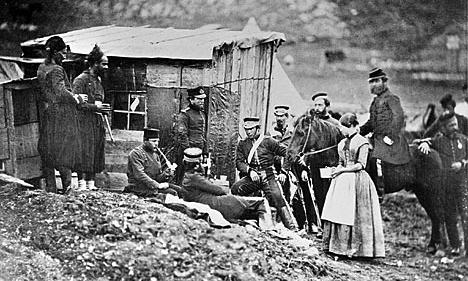
British soldiers and a regimental soldier’s wife in their camp during the Crimean War.