

Understanding The Endtimes by John Corin - HTML preview
Download the book in PDF, ePub, Kindle for a complete version.
INTRODUCTION
In looking for a ‘master plan’ to understand the end times, the believer need go no further than the ‘70 Weeks Prophecy’. This template in the book of Daniel puts critical pieces of the eschatological puzzle in place. Indeed, this prophecy is the benchmark for almost everything bible teachers advance about the end times; they realize it unlocks other eschatological passages. Yet if this cornerstone to understanding the last days is to provide a trustworthy schema (conceptual framework) it must be interpreted correctly. To find those who teach this prophecy often fail in this regard is disheartening.
Making sense of the end times also depends on recognizing divinely appointed seasons mark out history; the demarcations in time, ‘the sun, moon, and stars’ were created for, i.e., to be ' signs to mark sacred times’ (Gen 1.14NIV). These set periods in a divine calendar (not a secular one) mark the seasons of grace and covenant dispensations that guide humanity’s destiny. The many dates and lengths of time given for persons and events in scripture are the markers within this divine calendar; with one—the arrival of Jesus of Nazareth as the promised Messiah—even changing the secular calendar.
The genealogies of the early patriarchs in scripture, then, are a record of real people and not myths, and though the lengths of 28
years for their ages might seem exaggerated they are to be trusted.
By using these numbers, it is possible to calculate a reliable chronological age for the history of humanity. (What is not possible with the Babylonian myths as the recorded ages are highly exaggerated—up to 30,000 years for some persons.) Interestingly, the historical record before Christ can be divided into two almost identical periods; from Adam to Abraham is about 2000 years, and from Abraham to Christ is also 2000 years.
With 2000 (approx.) years from Christ’s death until now, the ages (up until now) arrange themselves in three equal lengths, each one representing a member of the Godhead. The first age represents the Father, the second the Son, and this current dispensation, the Holy Spirit. Each is marked off by extraordinary events or persons, with the patriarchs from Adam to Abraham being the markers for the age of ‘the Father’. The markers for the second age are Isaac as the promised son and the divine Son. It suggests the current age will also finish with a significant marker.
Within this divine calendar other periods mark out the history of Israel, the ancient people of God, e.g., the ‘time frame’ of 400
years associated with Abraham (Gen 15.13) and the 70 years of
‘babylonian captivity’. These 70 years of judgment imposed on Israel for failing to let the land enjoy its sabbaths is, in fact, the background for this prophecy in the book of Daniel (Jer 25.8-11)
—the result of Gabriel’s visit to give Daniel revelation about Israel’s future. A prophecy—in both scope and significance—that details events within a specific time frame; even outcomes at the end of the age (if the hiatus within the prophecy is recognized).
29
However, it chiefly predicts the length of time (not date) until the arrival of the Messiah while also answering the question uppermost in the mind of every Jew in the first century AD—
‘waiting for the consolation of Israel’ (Lk 2.25)—like Simeon.
The eternal question of would the Messiah’s arrival realize the hope of full redemption. And though it predicts His coming will secure a permanent answer to sin, it reveals truths also about the Messiah’s return.
Incidentally, by rejecting Jesus as their Messiah, this prophecy condemns Jewry. Mainly because they cannot dismiss it is about the Messiah, nor the fact it was fulfilled by Jesus of Nazareth. His baptism and anointing around 26AD accords exactly with the interval given before the Messiah’s arrival. Yet the Jews are not alone in having a problem with this prophecy, teachers of
‘Dispensationalism’ also do when they make it to be about the
‘Antichrist’ as well as Christ. Their peddling of this dangerous understanding has led millions of believers astray and must be countered with the truth. In this chapter, I do this by detailing the interpretation of the prophecy—defined by the term ‘Messianic Millennialism’—held by several notables of the Reformation. It has the best understanding of what Daniel was told about the divine purposes in the ‘last days’.
If a schema for this ‘present age’ is to pass the ‘smell test’, at the center of it must be the Messiah and His work on the Cross. In particular, a focus on Christ’s atoning work to secure complete redemption from sin, i.e., not only from its guilt but also its power. Only when full deliverance from sin is secured can 30
humanity know full salvation and be restored to their rightful position as the ‘sons of God’ qualified to co-rule with the Son of God. Rightly interpreted, this prophecy addresses these matters.
Now, though it predicts the Messiah will confirm the covenant promises originally given to Jewry, in stark and alarming terms, it speaks of severe judgment for the nation—the destruction of the city of Jerusalem and its revered temple. Overall, though, it is a prophecy about Jesus of Nazareth and His death on the Roman cross to effect redemption from the penalty and power of sin—not only for Jewry but all humanity.
BACKGROUND TO DANIEL 9.20-27
Though Daniel was mainly a statesman in the government of the King of Babylon (Nebuchadnezzar), he was not given this prophecy until the first year of the reign of Darius, one of several Medio-Persian kings he also served (Dan 9.1). The angel Gabriel visits Daniel in response to his seeking the Lord regarding the plight of the remnant Jews still in the ‘holy land’; that concern and the future of the ‘holy city’ and its ‘ mountain’ (Dan 9.16). A quest he embarked on after finding Jeremiah’s prophecy about the 70 years of judgment (Jer 25.11, 12), and galvanized, it appears, by the realization it was about to end. Hence, with confession and deep repentance for the sins of the forefathers, Daniel seeks to reverse the decreed judgment by asking for forgiveness and for the curse to be broken. Gabriel is sent in response to this act of
‘standing in the gap’ to give Daniel unprecedented revelation into the nation’s future along with the city of Jerusalem and its Temple.
31
Now, though Gabriel says the city of Jerusalem will be rebuilt
‘in times of trouble’, he reveals the shocking truth about another divinely ordered period of ‘70’—not years, but weeks of years, This time frame is to determine the nation’s future along with their city and temple—ultimately one of devastating judgment.
This news of 70 weeks of years (490 years) allotted for the nation—especially concerning the judgment of the city and temple—would almost certainly have left Daniel wondering what possible sin could deserve such punishment. But try as he might have done to dismiss it, he is left in no doubt the city will once again be made utterly desolate. Thankfully, this tragedy is overshadowed by the announcement of the Messiah (‘ The desire of all nations’ (Hag 2.7) coming as the incarnate Son of God to bring redemption and confirm the promises given to Abraham (e.g., Gen 12.3); what the prophets expanded on, e.g., Jeremiah told Jewry they would have a ‘new covenant’ (Jer 31.31).
PROMISED BLESSINGS OF THE MESSIAH’S ARRIVAL
‘Seventy 'sevens' are decreed for your people and your holy city to finish transgression, to put an end to sin, to atone for wickedness, to bring in everlasting righteousness, to seal up vision and prophecy and to anoint the Most Holy.’ (Dan 9.24) The Messiah’s ministry will achieve these five outcomes.
► TO FINISH TRANSGRESSION, SIN, AND INIQUITY
He will fully deal with the blight and curse of sin; securing not only its forgiveness but the eventual removal of sinful nature.
► TO EFFECT RECONCILIATION That is, secure
atonement for sin so full reconciliation with Heaven is realized.
32
► TO BRING IN EVERLASTING RIGHTEOUSNESS Not only positional righteousness (justification) but total holiness—
the state of moral perfection free of sin. (This is not the erroneous
‘sinless perfection’ doctrine of the 19th century.)
► VISION AND PROPHECY WILL FINISH This isn’t the finish of the prophetic ministry but means predictions for the nation coming to an end because they are fulfilled.
► A ‘MOST HOLY’ WILL BE ANOINTED Not the
consecration of a Most Holy Place in a natural temple (as Daniel possibly expected), but a ‘Most Holy’ Person—the Messiah (Ha Messhiah (Heb) or ‘Christos (Grk), the ‘Anointed One’. (Jhn 3.34, Col 2.9) (The word ‘place’ is not in the hebrew text.) Some teach these outcomes were all realized at the Messiah’s first coming, yet without the work of salvation associated with His return, not all Gabriel promised is achieved. Though the Cross of Calvary fully paid the cost of these promises, to realize them requires a ‘second appearance’ (Heb 9.28) of the Savior.
Now, the interpretation I advance in this chapter as the fulfillment of this prophecy is the only one to do it full justice. (Trust me, I found the other interpretations fail in some regard.) It does this because it recognizes the focus of the prophecy is the Messiah—
regarding the time frame for His arrival and what His work on the Cross secures for redemption. (The prophecy, therefore, has nothing to do with ‘the Antichrist’.) It also recognizes the Messiah confirms the Abrahamic covenant to Jewry in two periods—each of three and a half years—and not one contiguous period of seven years as many bible teachers advance. The first of 33
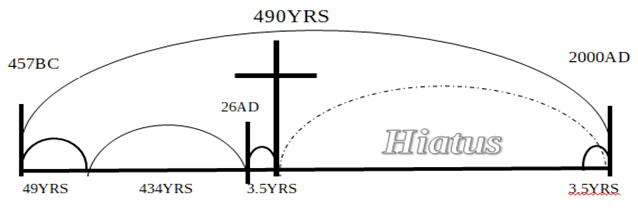
these periods was fulfilled in His ministry and the second half is fulfilled by the ‘two witnesses’ (Rev 11) when Jewry is given a final opportunity to repent of rejecting Jesus as the Christ, i.e., for the Jew willing to put faith in Jesus as the Messiah as per the covenant promises they have.
CHRONOLOGY AND DIVISION OF THE 490 YEARS
‘From the time the word goes out to restore and rebuild Jerusalem until the Anointed One, the ruler, comes, there will be seven 'sevens,' and sixty-two 'sevens.' It will be rebuilt with streets and a trench, but in times of trouble’. Dan 9.25
The time frame of 490 (70 x 7) years has three distinct periods.
► 49 YEARS (seven ‘sevens’) or 7 weeks of years when the temple and city wall are to be rebuilt, i.e., the restoration period recorded in the post-exilic books of Ezra, Nehemiah, and Haggai.
► 434 YEARS (sixty-two sevens) or 62 weeks of years.
When added to the first 49 years, it gives 483 years as the time from the start (the first terminus) until the Messiah is revealed.
► 7 YEARS or 1 week of years—divided into two 3½ year periods—when the Abrahamic covenant is confirmed.
34
‘Know and understand this: From the time the word goes out to restore and rebuild Jerusalem’. (9.25) The allotted 490 years are to commence with an edict (when
‘ the word goes out’), and though many claim otherwise, it is not possible to conclusively establish this date. The biblical record runs out some 300 or 400 years before Christ and to seek to overcome this by aligning biblical events with secular records is a lost cause. Egyptian, Greek, or Persian histories (the most doubtful) are fraught with difficulty and offer no conclusive help.
Roux says, ‘ the entire period between the accession of Xerxes and the conquest of Alexander is exceedingly poor in architectural remains and building inscriptions’, and Dr. Taylor writes
‘ traditional dating rests almost entirely on (that) of Claudius Ptolemaeus of the second century AD, that is, about 600 years later than the events he was recording. We have no contemporary annals for the times of Imperial Persia after Darius Hystaspes (the Great). Ptolemy lists ten kings of Persia giving rise to 205
years whereas Persian tradition itself give a total of only 52 for the same period! [Ex Nihilo Journal Vol 3 1988, pg 128ff.]
The starting point for the prophecy can only be established by working backward from the terminus ending with ‘ until the Anointed One, the ruler, comes’—the arrival of the Messiah after 483 years. This is from Jesus’ baptism at age 30, the historic event when the Holy Spirit anointed Him as the promised ‘ruler (or prince)’ (9.25) (‘Ha Mashiach’ (Heb)—The Messiah, or Anointed One). (I reject this terminus being Christ’s triumphal entry on a 35
donkey into Jerusalem.) But with errors in the modern calendar even this terminus is not certain. His birth was not as we imagine at 0AD but probably in 4 or 5BC, making 25 or 26AD the best calculation for His baptism. Working back 483 years from this date we arrive at 457 or 458BC for the edict ‘going out’ to
‘restore and rebuild Jerusalem’, i.e., the starting terminus .
Unfortunately, bible teachers muddy the waters when they conjecture who gave this edict, and this needs correcting. Now, though several kings suggested did play a part in the rebuilding of Jerusalem, only one decree warrants consideration for the starting terminus. Namely, the edict by Cyrus the Persian ruler allowing about 100,000 exiles to return to rebuild the city. It is the only edict specifically concerned with rebuilding and why Ezra records it here, ‘ now in the first year of Cyrus king of Persia, that the word of the Lord by the mouth of Jeremiah might be fulfilled…he (Cyrus) made a proclamation throughout all his kingdom (in part saying), The Lord God of Heaven…has charged me to build Him a house at Jerusalem, which is in Judah’. (Ezra 1.1) Actually, this decree by an earthly king for the rebuilding of the city is not as important as the one the ‘Lord God of Heaven’
issued when foretelling of Cyrus. The person Isaiah records and names as permitting the rebuilding of the temple and city in this passage (reading in part), ‘who (the Lord God) says of Cyrus, 'He is my shepherd and will accomplish all that I please; he will say of Jerusalem, “Let it be rebuilt" and of the temple "Let its foundations be laid’. (Is 44.24-45.13). The edict of Cyrus fits this prophecy far better than any other bible teachers suggest—be it 36
the return of exiles under Ezra the priest to teach the Law (not rebuild the city), or Artaxerxes allowing Nehemiah to return to inspect the progress of the rebuilding project. Do you not agree?
These other edicts are only suggested because the ‘received dating’ puts Ezra or Nehemiah around this starting terminus of 457BC, while the traditional date for the edict of Cyrus is 537BC.
However, Dr. Taylor refutes this ‘myth’ as does the esteemed chronologer Anstey; both calculate this accepted date is out by about 80 years making the correct date for the edict of Cyrus as 457BC. (By way of interest: Dr. Taylor quotes the report Josephus sent to Roman authorities which reproduces the letter Cyrus sent to Jerusalem.) On all the evidence, Cyrus' decree allowing the exiles to return with Jeshua and Zerubbabel (Sheshbazar) to rebuild the city and temple fits the criteria for the first terminus.
UNTIL THE ANOINTED ONE, THE RULER COMES
‘Until the Anointed One, the ruler, comes, there will be seven
‘sevens,’ and sixty-two ‘sevens’ (9.25).
With the commencement at 457 BC, the 69 weeks of years (483years) terminate around 26AD. Now, most bible teachers agree 26AD is the date for Jesus’ baptism at the river Jordan, but few regard it as when He became the ‘Anointed Ruler’. But I do!
(Note, Sir Robert Anderson made a mistake in calculating these years as having only 360 days because of a lunar cycle. The Jews make up for the missing days to align with a solar year by adding an extra month at the end of eleven years.)
No one disputes the MESSIAH (the Anointed One, Ha Messhiah (Heb) or Ho Christos (Grk)). (Luke 3.21-23) is the One 37
the Holy Spirit anoints, and at His baptism Jesus of Nazareth became this anointed prophet, priest, and king (ruler). The one Israel expected and to argue otherwise is inconceivable. Now, the nation’s leaders would have welcomed Jesus as the promised Messiah if He had satisfied their erroneous expectations about a political and religious leader fulfilling nationalistic aspirations, i.e., he would overthrow the Roman oppressors and facilitate the restoration of an autonomous kingdom. A most costly mistake that resulted in the severest of judgments for the nation as this prophecy predicted.
In addition to their nationalistic aspirations, the Jewish leaders also failed to see the Messiah as the ‘suffering servant’ of Isaiah (Chpt 52,53). Yes, secure freedom for the nation, but spiritual liberty rather than the natural kind they craved. In His sermon about the ‘messianic anointing’(Lk 4.17,18), Jesus confirmed the enduement (with power) was to redeem the nation from oppression by sin; liberating from spiritual captivity as Peter confirms when stating Jesus, ‘went about doing good and healing all that were oppressed of the devil’ (Act 10.38).
When the dates for His arrival and ministry match those in the prophecy, this leaves Jewry without excuse for rejecting Jesus as the promised Messiah. Confirmed in this interesting quote from an article in Kevin Conner’s book on this prophecy. It details how a senior Rabbi of the Jewish community moderating a debate between a Christian and a Jew made the following remarks about Daniel’s 70 weeks prophecy: ‘ Let us close the books, because if we should speculate any longer upon this prophecy, of necessity it 38
will happen that we all become Christians. It cannot be denied that therein is clearly shown that the Messiah has come, for which the time is already past. As to whether he is Jesus the Nazarene, I do not wish hastily to launch forth my sentiments’.
[Pg 38, K.J.Conner, Daniel’s 70 Weeks Prophecy.]
AFTER SIXTY-TWO SEVENS (WEEKS)
After the 62 ‘sevens,’ the Anointed One will be ‘cut off’. (9.26).
With His death on the cross of Calvary, none can mistake Jesus was ‘cut off ’; a historic event not at the terminus but as the prophecy states—' after’ this second period of 434 years. His crucifixion was after three and a half years of ministry to the nation (most scholars believe this was the length). Interestingly, in foretelling the death of the ‘suffering servant’, Isaiah’s prophecy says He will be ‘cut off out of the land of the living; for the transgression of my people’ (Is 53.8)—the same term. And though His natural life was ‘cut off ’, the hebrew phrase has the additional meaning of ‘banishment from the Lord’s protection’; what can be identified with His cry of ‘my God, my God why have you forsaken me’ (Mt 27.46).
THE RULER WHO COMES TO DESTROY
‘The people of the ruler who will come will destroy the city and the sanctuary. The end will come like a flood: War will continue until the end, and (the) desolations…decreed.’ (9.26).
The ‘ruler’ who destroys the city is easily identified as Titus, the son of the emperor Vespasian. A Roman general at the time, Titus marched his troops against rebellious Jewry and besieged Jerusalem in AD70. But after some three years his troops lost 39
patience with the siege and set fire to the city and the temple (despite orders not to do so). As the prophecy foretells, destroying both to leave the city utterly ‘desolate’. This violent, merciless razing of Jerusalem and its temple for the second time truly was a tragedy, greater than the one Jewry suffered 500 years earlier by Nebuchadnezzar. Far worse because, in the main, it was judgment for rejecting the Son of God as the Messiah. (Lk 13.34,35). (A desolation until the nation says; ‘Blessed is He that comes in the name of the Lord’ (Luke 13.35).) Shocking punishment, but not without warning as Christ put the nation on notice more than once by spelling out the result of, ‘ not knowing the time of their visitation’ (Lk 9.43, 44).
During the siege, more than a million Jews died and a hundred thousand were captured in the ensuing battles. Fortunately, the Christians heeded Jesus’ warning and fled the city years earlier when Vespasian attacked it (Mt 24.15ff). The destruction of the temple was so complete not one stone was left standing even as Jesus predicted (Mk 13.2). (Note: the huge stones standing today in the ‘wailing wall’ are the temple’s foundation, not the temple proper). This ‘desolation’ of the temple is to continue until ‘the end’, and I take this ‘overspreading’ judgment to mean the temple site will be kept desolate to prevent the building of a new temple.
A COVENANT WILL BE CONFIRMED
He will confirm a covenant with many for one 'seven' (9.27).
These words catch out most bible teachers, so this part of the prophecy requires careful interpretation. Of the errors derived from it, the most egregious is interpreting the phrase ‘confirming 40
a covenant’ as a reference to the ‘Antichrist’. A fabrication I must rebut as it now has almost universal acceptance in evangelical Christendom after the ‘Dispensationialists’ advanced it. Other far-fetched notions from this are seeing Titus as the subject of it, or even more imaginative, the fulfillment of it in the Oslo Accords between Zionist Israel and the Palestinians.
Fortunately, Zechariah (John the Baptist’s father) gives a strong clue to its interpretation when he prophesies the ‘horn of salvation (the coming Messiah) in the house of David’ will work to ‘redeem His people’ and says this person will ‘remember His holy covenant sworn to Abraham’ (Luke 1.68-73)—almost identical wording to Daniel’s prophecy. It is indisputable, this part of the prophecy does not apply to the ‘Antichrist’ but to Jesus Christ. There is no other viable subject for this clause and to argue otherwise is impossible when this prophecy is all about the ministry of the ‘Anointed One’ (the Messiah). This part of the prophecy, then, indicates Christ’s ministry of three and a half years (half of the seven) included the mandate to confirm the covenant promises originally given to Jewry through Abraham.
More support for this interpretation is here, ‘ the Lord who you seek. Shall suddenly come...even the messenger of the covenant’
(Mal 3.1) and here, ‘ Christ has become a servant of the Jews on behalf of God's truth, so… the promises made to the patriarchs might be confirmed’ (Rom 15.8). Peter also confirms this interpretation (See Acts 3.25, 26).
All that is left to establish is when the ‘covenant is confirmed’
for the remaining three and a half years (of the seven), and for 41
this we go to the book of Revelation where ‘two witnesses’
prophesy in ‘the great city which is figuratively called Sodom and Egypt where also their Lord was crucified’ (Rev 11.3-12)—in Jerusalem. With a ministry replete with miraculous signs and wonders, these witnesses give special testimony on behalf of the Messiah for 1260 days or 3½ years (Rev 11.3, 7)—the additional length of time specified for ‘confirming the covenant’. These prophets who ‘ stand before the Lord of the earth’ (Rev 11.4) are the same ones the prophet Zechariah refers to as, ‘ the two olive trees’ and ‘ two lampstands’ (Zech 4.3, 11, 14).
Does anyone doubt their ministry is to give unbelieving Jewry a final testimony to the One they rejected, i.e., reinforce the covenant promise of a coming Messiah and give them a final opportunity to acknowledge their sin in not receiving Jesus as the Messiah. That is, repent so they are grafted back into the ‘olive tree’ (Rom 11.23, 24) of Abraham (the root) and his spiritual progeny of Jesus Christ and the church. The salvation of a Jew lies in putting faith in Christ and their incorporation into the ‘new man’ of Jews and Gentiles—Christ’s body (Eph 2.14,15; 1Cor 12.13). In other words, believing the good news about the ‘new covenant’ promised by Jeremiah. Any suggestion Jews have a different way of salvation (in a restored kingdom) is heresy.
Some will find the scenario of the last seven years divided into two halves—separated by a hiatus of thousands of years—one they are inclined to reject. Yet other prophecies have this hidden hiatus, e.g., Is 61.1,2 and Mal 3.1, 2, and with a ‘futurist’
interpretation of Revelation such a ‘gap’ presents no problem. For 42
those who might find it difficult to accept, it is a lot harder to substantiate the seven years being contiguous (without any gap)—either at the start of this age or at the end as most bible teachers advance. Some recognize this week is divided into two halves but speculate the remaining three and a half years finished at the death of Stephen. However, there is no indication his death has any significance to this prophecy and any attempt to date his death is pure speculation—the NIV Study Bible guesses it was five years after Calvary. The favored option for most bible teachers is to place the seven years at the end of the age and make it the time of Tribulation (sometimes the ‘Great Tribulation’).
HE WILL PUT AN END TO SACRIFICE
‘In the middle of the ‘seven’ (week of years) he will put an end to sacrifice and offering’ (9.27).
Teachers of eschatology make another serious error when they also see this verse referring to the ‘Antichrist’. A notion derived mainly from the motif of Antiochus Epiphanes putting an end to the sacrificial offering in the restored temple in the 4th century BC. Daniel’s prophecy, of course, refers to a much later event.
(Note; failing to recognize the true subject of this clause always results in a faulty interpretation.) To doubt the Messiah is also the subject here is unreasonable. An interpretation also hard to disagree with when after three and a half years of ministry(in the
‘middle of the seven’), His death on the Cross ‘ put an end’ to the Mosaic sacrificial system, i.e., as the prophecy states, Calvary abolished the old ‘ sacrifices and offerings’. Now, for those who object and say the temple sacrifices did not end at Christ’s death, 43
the destruction of the temple in AD70 ensured their cessation.
Let’s be clear: the efficacy of sacrifices ended when the Cross secured redemption and signified by His cry on the Cross of, ‘ It is finished’ (Jhn 19.30). After Christ’s death, the ‘sacrifices and offerings’ of the Mosaic Law are no longer acceptable for sin.
In a prophecy about the Messiah and the new dispensation, Isaiah says Heaven will only, ‘look with favor...on those who are humble and contrite in spirit, and who tremble at my word’, and goes on to warn, ‘whoever sacrifices a bull is like one who kills a person, and whoever offers a lamb is like one who breaks a dog’s neck; whoever makes a grain offering is like one who presents pig’s blood, and whoever burns memorial incense is like one who worships an idol’ (Is 66.2,3). Animal sacrifices no longer are accepted but an abomination—as this confirms. (Cf 9.27).
Interestingly, Jewry has never tried to reinstate the Mosaic sacrifices—(subconsciously) they recognize the danger in this.
ABOMINATIONS…SHALL MAKE DESOLATE.
‘And for the overspreading of abominations he shall make it desolate, even until the consummation, and that determined shall be poured upon the desolate’. (9.27 KJV) The KJV gives the best translation of this verse when it omits the word ‘temple’ (it is not in the hebrew text). As laid out, by continuing to offer up sacrifices and offerings for forty more years after Calvary, Jewry commenced this ‘overspreading of abominations’. And though the ‘desolation’ ‘determined’ was initially by the hand of the Romans (and subsequently by the Muslims) it is to continue until its ‘ consummation’. Now, in the 44
Olivet discourse, Jesus connects this ‘abomination of desolation’
to the warning telling His followers to flee to the mountains (Mt 24.15-19). Escape, not because an idolatrous Roman standard desecrated the temple—it happened after the siege ended—but due to the looming judgment for offering up the sacrifices now regarded as ‘abominable’. A disaster the nation never imagined could happen to their ‘holy city’ again, yet a judgment none should doubt was justified for Jewry by refusing to accept Jesus as their promised Messiah or His atoning sacrifice. Is there to be a greater fulfillment of the prophecy with another ‘abomination of desolation’ at the end of the age? While it is clear Jesus’ warning helped believers escape the sacking of Jerusalem, it is an open question whether verse 20ff in the Olivet discourse speaks of a repeat scenario fitting this description. Like many biblical prophecies, it could have another fulfillment, especially if Jewry once again institutes animal sacrifices, either within a rebuilt temple (highly unlikely) or on another official altar on behalf of the nation. If they do, they will commit abominations.
Most bible teachers believe a future ‘abomination causing desolation’ will be an idol or other sacrilegious artifact placed in a rebuilt temple—most say by the ‘Antichrist’. But this has two problems: it could only happen if zealous Jews (with Zionist believers) managed to build a third temple—in my mind, highly unlikely. Destruction of the holy places of Islam on the temple would result in the wrath of one billion or more Muslims. Second, the temple the ‘Antichrist ‘sits in’ (2Thes 2.4) is not natural but the body of Christ, the true temple of God.
45
INTERPRETING PROPHECY