

Understanding The Endtimes by John Corin - HTML preview
Download the book in PDF, ePub, Kindle for a complete version.
PREFACE
You might wonder why I have spent resources and energy on a book only to see it join thousands of others advancing biblical understanding of the end times. Surely, you say, there are enough books claiming to know what happens at the end of the age, with many insisting they correctly interpret the ‘signs of the times’ by tying them to world events. Most also offer a schema (a worked out, structured plan or model) for the end of the age replete with charts and conspiratorial theories about a ‘new world order’.
The subject of eschatology (theology mainly about the end times) has been a strong interest of mine since coming to Christ as a teenager more than 60 years ago when I embraced the
‘Dispensationalists’ end time schema. Their understanding of how God has dealt with humanity over the millennia greatly appealed.
That is, until I realized their notion of the ‘ pre-trib rapture’ failed to interpret the biblical material satisfactorily. If unfamiliar with Dispensationalism’s understanding of how divine grace is administered through the ages, I recommend you do this before continuing with my book as I rebut much of their popular schema.
But consult a reputable source such as Philip Mauro’s book, ‘The Gospel of the Kingdom’; it is a critique, available both on the Internet for free or you can request a copy from me via my email at the back of this book.
Over the intervening years, I studied every schema within Christendom for the end of the age; what teachers of pre, mid, or 3
post-millennialism, and the Preterists and Amillennialists advanced. Plus I examined the eschatology of various sects, e.g., the Jehovah's Witnesses and Christadelphians. Hence, I fully understand why so many believers are confused enough to throw up their hands in frustration or those who believe the best position to take about the end times is ‘Pan-Millennialism’—everything will ‘pan out in the end’. Indeed, arriving at the correct interpretation of the biblical material on this subject—particularly the book of Revelation—seems a lost cause for so many. This perplexity and muddled thinking about who the ‘Antichrist’ is, when the ‘Rapture’ takes place, what is the ‘Mark of the Beast’, and the future of natural Jewry, says one word describes current teaching on eschatology—the word confusion. Even the basic question of whether believers go through the ‘Great Tribulation’
is unclear for many. Overall, a subject with too many questions and few answers, or more correctly, many contradictory answers.
This book, therefore, is a humble attempt to offer a primer on some of the biblical material. In the main, examining the thorny
‘hot potatoes’ of eschatology now grabbing the attention to create the most alarm. i.e., the topics in need of a reasoned, balanced biblical explanation. Wild, poorly established theories on the end times and their fear-mongering have held sway long enough.
Now, because this book offers a fresh approach to the textual material, I have been in no rush to publish what is mostly an unknown schema for the end times. Especially since it counters much of what is currently promoted; in particular, the eschatology advanced in the popular ‘Left Behind’ book and movie series.
4
Using faulty exegesis (analysis of the text) to hijack the subject and raise false hopes has done too much damage. Besides, the subject is too important to be ignored or viewed as too difficult to comprehend. The bottom line: the schema I offer (in my estimation) not only better interprets the biblical material, but goes some way to reconciling some opposing views.
I claim no special divine revelation as most of what is presented was learned at the feet of apostolic ministries anointed to bring understanding on the end times—particularly on the
‘Blessed Hope’ and the book of Revelation. I discovered the truth on both topics after it was my privilege to sit under their ministry.
In fact, the truth my mentors revealed about the ‘blessed hope’
has been my ‘anchor for the soul’ (Heb 6.19); both for the troubled times ahead and keeping me faithful in a Christian walk of more than 60 years. (To read more on this hope, you can request a free copy of my e-book ‘The Hope of Perfection’ using the email at the back.)
I trust you will approach my book with an open mind to discover fresh truth, and where there is disagreement, suspend a final judgment until it is read through. Please critique the entire thesis before rushing to a decision. Now, I do not claim to fit every piece of the eschatological jigsaw puzzle into place, yet what this book offers, I believe, best harmonizes those seemingly contradictory passages of scripture baffling so many.
5
INTRODUCTION
Though I used the word ‘confusion’ to characterize the myriads of theories about the end times, I realize this is not a problem unique to theology. Medical therapies, the study of cosmology, and political and economic ideology all suffer the same issue, but the implications of this befuddlement about the end times are far more serious—for now, and the hereafter. Of course, some believe knowing the mind of God concerning an event like the Second Coming is impossible and question if eschatology can ever be understood. A valid sentiment if it concerns the timing of Christ’s return (Mt 25.13) as there is much foolish speculation about this. (I had to advise one author not to publish a book with 1999 as the year.) Or when bible teachers forcibly ‘shoe-horn’ persons or events into their end times schema; such wild speculations make the church the laughingstock of the world. When features of the end times such as who the ‘Antichrist’ is, who are ‘Gog and Magog’, or what is the ‘Mark of the Beast’ are still unclear, these wild conjectures only bring shame and reproach to God’s household.
But also counterproductive when it diverts from grappling with the issues believers need to focus on or divides the body of Christ into camps strongly opposed to each other's position. It is easy to see why many give up trying to understand these matters, bemoaning it as a waste of time, if not a dangerous diversion. Yet, 6
this cynicism must not stop the believer from following the example of the sons of Issachar who had, ‘understanding of the times to know what Israel ought to do’ (1Chron 12.32). In fact, as the end draws closer, believers are expected to have this
‘understanding’ of much (not all) of what lies ahead. Especially when we learn Jesus rebuked the Pharisees for failing to ‘discern the signs of the times’. (Mt 16.3). A reprimand confirming Heaven wants the church prepared for what the future holds. Add to this the biblical promise of the Holy Spirit ‘guide(ing) us into all truth and showing us things to come’ (Jhn 16.13) and it more than confirms such insight is the believer’s birthright.
Then we have Christ’s important discourse outlining the ‘signs of the times’ (Mt 24) to precede His return. A divine disclosure about the end of the age mandating the believer give it more than only a passing look. Indeed, inside information none can ignore.
There also are the many parables our Master Rabbi told about the last days explicitly to prepare believers alive at the end. Don’t you agree? Seeing His words on this subject as inconsequential or too mysterious to understand has to be foolish.
And we have the witness of the apostle Paul (not to mention others) who clearly wanted believers to be properly informed about the Second Advent. Several letters of his shed light on this, in the main, to correct misunderstandings about it already circulating. Last, but not least, we have the N.T. book containing the visions of the apostle John with insight into the final times; that is if you subscribe to a ‘futurist’ interpretation of the book of Revelation. Regarding the book of Revelation as only for 7
beleaguered believers in the first century (as many interpret it), or as representing the history of the church age, or as general encouragement for the church in every century is a mistake.
The believer living at this end of age (it is not certain how far we are from the finish) has no other option but to heed Jesus'
instructions and those of the apostles. The failure to respond to these divine exhortations and warnings leaves them not only unprepared for the ‘perilous times’ ahead but also without an excuse when suffering the consequences—some of them serious.
And when Jesus leaves us in no doubt the ‘hour’ before His return will be grave and dangerous, this too underscores the imperative for the believer to be fully ‘ ready’ (Mt 24.44). Especially when one of the parables indicates only the ' virgins’ who are ‘ready’
enter into a divine ‘feast’ at His return (Mt 25.10). The believer who ignores this warning does so at their peril.
Incidentally, though I sympathize with the sentiment of being ready at any time for the return of the Savior (none ‘know the day or the hour’), this idea of ‘imminence’ has been emphasized beyond what is biblical. (More on this later.) Not only that popular idea but also the ‘thief in the night’ trope—it also has been pushed beyond its true weight in scripture when applied to all alive at the end. Clearly so when Paul says believers are not
‘in the darkness so that day should surprise us like a thief’ (1Thes 5.4). Yes, believers will be taken unawares who allow a spirit of slumber to overcome them and then fail to ‘keep watch’ or ‘stay awake’ to hear the ‘alarms’ warning of His coming. But this doesn't apply to all.
8
Because they study world events or signals in the news for indications their ‘redemption draws nigh’ (Lk 21:28), many believers consider themselves awake. But it requires more than this spiritual ‘whale watching’ of the ‘signs of the times’ (I comment on these in a later chapter) to be ready for what lies ahead. Jesus’ call to ‘keep watch, i.e., ‘stay awake’ has more to do with being alert to hear the ‘voice of the bridegroom’ (Rev 18.23); as He speaks through prophetic ministry or personally within the heart. In fact, rather than scanning the internet for earthquakes or other indicators, this command to ‘watch’ also has a lot more to do with ‘not entering into temptation’ (Mk 14.38). Besides, when these ‘signs’ often turn out to be false alarms, those desperate to see them fulfilled can be left disappointed and disillusioned.
The bottom line: skewed eschatology is not harmless, without repercussions, and as a salutary warning on this, we need to go no further than the Pharisees and other leaders in Israel. Their false expectations (eschatology) about the Messiah led to the disaster of rejecting Jesus of Nazareth as the One. Their certainty about what the coming ‘anointed one’ would be like and what He would do resulted in a level of hubris where they couldn’t admit to their schema being faulty when Jesus’ ministry went contrary to it. A catastrophic blunder that resulted in the Roman armies marching into Jerusalem to destroy it and the Temple. It is one thing to have an eschatology to live by, to stubbornly hold onto a hope when it proves to be false is another. When current understanding of the
‘Second Advent’ is still limited, everyone must be less dogmatic in their beliefs about events and personages connected with it.
9
Held loosely, so when events prove otherwise, they can be let go.
Far too many are certain about who ‘The Antichrist’ is or if a
‘Third Temple’ will be built in Jerusalem and what the ‘Ten-toed Kingdom’ and ‘Babylon the Great’ represent. And while
‘knowing the truth’ may seem reassuring it can be dangerous.
No doubt, you have questions about my book, e.g., am I a better source of understanding on eschatology and does it offer anything different from what already is taught? Or, do I claim divine revelation and insight nobody else has? Even, do I have the theological qualifications to exegete the biblical texts? Well, I certainly do not claim to be the fount of all wisdom, and neither do I regard what is proposed in this book as infallible. I also don’t claim direct revelation from the Lord or that I understand every mystery. As mentioned, I had the privilege of learning from outstanding bible teachers (mainly unknown outside the churches where I fellowshipped) with fresh insights into these matters.
What I present, then, you probably have never heard and may say this less-than-widespread knowledge is a bad sign. Yet, since learning these truths on the end times over fifty years ago I have found them to be fully trustworthy.
Moreover, though it will challenge and provoke much thought, my book is devoid of the scaremongering and alarmism common today. At this stage of illumination, I have also chosen to only interpret the parts of the jigsaw puzzle with a highly probable outcome—anything I am unsure of (up until now) is skirted. This means I have not included passages other teachers venture to expound on, often with unusual certainty. What I do offer is the 10
true biblical hope for the future so you the believer can face it with optimism; indeed, the expectation of enjoying victory over every enemy, be it the world, the flesh, or the devil. Of course, no matter how convincing my thesis may be, it is your responsibility to judge if it is trustworthy. All I ask of, then, is that you follow the example of the noble Bereans and search the scriptures to see
‘if the things are so’ (Acts 17.10-15).
Yes, this ‘glorious hope for the future’ (Eph 4.4) advanced can keep you steadfast throughout the coming time so troublesome,
‘ men’s hearts (will be) failing them from fear and the expectation of those things which are coming’ (Lk 21.26). In other words, it is the hope able to make you the faithful servant who endures every trial—until the ‘salvation yet to be revealed’ (1Pet 1.5), i.e., the final deposit of grace to be poured out to complete Heaven’s purposes for the church and humanity. What is this hope? In essence, the divine plan so a company of believers reaches full maturity (perfect in righteousness) and become qualified to be co-rulers with Christ on His throne.
I also advance the scenario of this age ending in a climax and not the anti-climax many believers subscribe to. An ending to see the divine goal of full salvation for believers realized, i.e., the plan first worked out in the ancient nation of Israel, but now is invested in the church of Jesus Christ. And realized in the end time due to an unprecedented outpouring of the Spirit of God, both to revive believers and reap the promised harvest of souls.
Glorious divine purposes Satan and the maturing of evil in the world can never thwart. (See Ps 33) This deluge of the Holy 11
Spirit—the antitype (fulfillment) of the ‘latter and former rains’—
to endow a remnant of faithful believers with a double, even triple anointing will see them fulfill their finest hour of ministry to a world of lost sinners. A climactic ending to the age to see this remnant also clothed with divine glory.
This final deposit of grace, however, will be poured out on those who have not given in to temptation or backslidden, i.e., because they are faithful in the testing and trials of the final days.
They alone inherit the ultimate reward—the grace for their full redemption from the curse of sin. This final deposit of salvation is, then, the promised ‘crown of life’ (Jam 1.12) releasing believers from captivity to the flesh, the world, and the devil. In other words, completing the redemption initiated with their ‘new birth’, upgraded by the ‘Baptism of the Holy Spirit. Yet it requires this last installment of grace to reach full maturity to complete the salvation of their spirit, soul, and body.
If the church is to be the witness—a living testament to the gospel—this ungodly world is promised before this age ends, any other scenario is unthinkable. Especially when the Lord has always planned for the unsaved to have this convincing testimony to the truth—the one they have waited far too long for. Indeed, we should expect nothing less when the divine promise is for the glory of ‘the latter house (to be) be greater than that of the former’ (Hag 2.9). Particularly when the ungodly had such a witness when the early church demonstrated the power of the gospel to save from the world, the flesh, and the devil. A convincing testimony whereby they proved the good news offers 12
salvation to the mind, body, and spirit—turning the world ‘upside down’ (Act 17.6), or was it, ‘right-side up’. Yet, what Heaven poured out at Pentecost was meant to be a foretaste of the Holy Spirit’s grace and power manifest at the end so believers faithful to their covenant commitment ‘shine as the sun’ (Mt 13.43). Not only that but fully enjoy the ‘righteousness, peace and joy’ of the Kingdom. I see no other outcome is possible if the Lord is to be honored and known as ‘great’ (Mal 1.11) among the heathen.
If you believe this age ends in darkness and a manifestation of evil too gloomy to contemplate, I want to change such an outlook to one you can look forward to. If you remain faithful in walking on the ‘highway of holiness’ and pay the price of discipleship the days ahead can be those where the ‘glory of the Lord will arise upon’ (Is 60.1) you. Days also of overcoming faith and knowing the leading of the Holy Spirit so you can be the bright light God wants shining in the ‘gross darkness’ (Is 60.2) holding sway over the earth at an ever-quickening pace. You too can qualify to join the ‘overcomers’ who dwell ‘under the shadow of the Almighty’
(Ps 91.1), the ‘hiding place’ promised as a ‘covert from the storm’
(Is 4.6) i.e., the place of safety promised those ‘counted worthy to escape’ (Lk 21.36) the worst of the suffering.
As to who qualifies to escape this time of severe tribulation and the nature of this ‘safe house’, this is revealed in a later chapter. But as a teaser, it is the believers awarded a ‘white stone’
giving them entrance into a realm where they eat of the ‘tree of life’, are nourished with ‘hidden manna’, and rule with a ‘rod of iron’. (See Rev 2 & 3) The reward you are invited to strive for by 13
pressing towards the ‘ mark to obtain the ‘prize’ (Phil 3.14), i.e., finish the race every believer is called to finish (1Cor 9.24).
This book of mine, then, reveals truths many believers have never heard as it also corrects misinterpretations of important texts relevant to the end times. At the same time, it shows where the competing schemas—pre and post-tribulation, pre-millenialists, post-millenialists, preterists, and amillennialists—
can be somewhat harmonized, or discarded if they can’t. It also has viable answers to the winds of doctrine fomenting fear currently, outcomes advanced due to a false apocalyptic scenario, because the date has been set for Christ’s return, or the promotion of markers signaling doom and gloom. When the believer can face the future with confidence, these falsehoods are causing unnecessary distress. Yes, with optimism face what lies ahead because Heaven has provided a way of escape for much of the tribulation (not all). As the three Israelites miraculously escaped after being thrown into the fiery furnace for not worshiping an
‘image’, in the end times, a deliverer ‘like the Son of God’ (Dan 3.25), will stand with the children of God.
Yet, if I am candid, not all in my book will go down easily;
‘sacred cows’ are sacrificed in its pages, so quite a bit may ‘stick in your craw’. But I make no apology for my forthright and at times brutal destruction of the doctrines and schemas I regard as more than just misleading and false. If you find me too much of an iconoclast, please forgive this destruction of what I regard as dangerous—heresies that have duped and misled too many for too long. Now you may see what I rebut as only harmless conjectures, 14
just other valid opinions about the end times. I beg to differ, for even if unrecognized, these often are grievous errors damaging the health of the body of Christ. Those who swallow them will be at a great loss when the ‘fat hits the fan’.
As each topic is examined, please have an open heart as to
‘whether these things be so’; one wanting to learn, yet willing to judge if what I present is truth. If you disagree with my understanding, please pray about it, especially if it crosses a long-held view. Jettisoning cherished beliefs can be painful and very difficult. In fact, I sympathize if this is you as I had to do this after initially subscribing to ‘Dispensationalist’ eschatology.
15
THE CLIMATIC END
‘Having made known to us the mystery of His will, according
to His good pleasure which He purposed in Himself, that in
the dispensation of the fullness of the times He might gather
together in one all things in Christ,’
(Eph 1.9,10).
The events and persons I discuss will make little sense without a working framework; just be a jumble of facts with no idea of how they fit together. Hence, before laying out important eschatological truths, I need to detail Heaven’s ultimate intention for humanity—the framework. In other words, the plans set in motion at ‘the beginning’ of creation by the Godhead and determined in their ‘good pleasure’ (Eph 1.5) their realization before this age ends. And when Heaven doesn’t leave a project half done or incomplete—a finished product is lacking—there is no reason to doubt these purposes for the church will not come to fruition. I once saw a notice on a workshop wall that says it all—
‘The job is not finished until the place has been tidied up’. But before fleshing these plans out, in order are some definitions for the terminology used in eschatology.
TERMINOLOGY DEFINED
The last things
The words ‘end, last, or uttermost’ in the N.T. are translations of ‘eschatos’ (Strongs G 2078), the greek word meaning, ‘the 16
final, last or furthest in a series of things’. It occurs 54 times by itself and 17 times as part of compound terms such as ‘ last days or last times’. (‘Eschatology’, the study of last things, comes from this greek word.) In speaking of the Messianic age (to follow the
‘Mosaic age’) the O.T. prophets often used the term ‘last days’
(Micah 4.1, Isaiah 2.2, Hosea 3.5.), and according to Peter these
‘last days’ are the ‘afterwards’ of Joel’s prophecy (Act 2.17).
Along with other N.T. authors, they establish the ‘last days’
began at Christ’s first coming, confirming—according to the divine ‘redemptive week calendar’ (more on this in the next paragraph)—we live in an age of two days (each of 1000 years) when Heaven is focused on the church rather than natural Jewry.
In fact, Peter (2Pet 3.3), James (Jam 5.3), and the author of Hebrews (Heb 1.2) establish the ‘last days’ commenced at the resurrection of Christ. This suggests the generation alive today is possibly the last in this ‘present age’ (Tit 2.12); if so, the believer (at a minimum) today has the right to ask if they are living in the
‘last of these last days’. By resetting the ‘doomsday clock’ to 90
sec to midnight recently, secular scientists certainly think so.
However, more trustworthy than any doomsday timepiece is the chronological schema for time found in scripture, a ‘time clock’
constructed from the ages given for the patriarchs and other recorded time frames. These give us a divine timeline marked out for humanity (what I know as the ‘Redemptive Week’)—first posed by the early church fathers—and show the ages form a
‘week’ of days, each a thousand years long. A clock that started ticking when the first parents fell into sin in the Garden of Eden 17
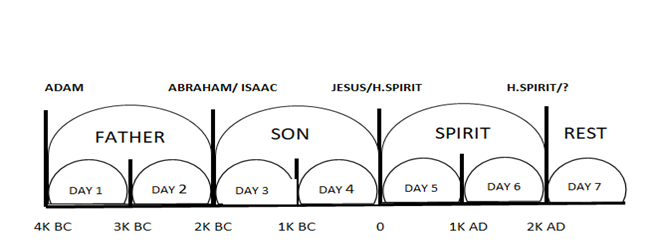
to mark out a time frame for humans consisting of six days plus an extra ‘day of rest’ (each a thousand years). In effect, the period Heaven has allotted to realize humanity’s full redemption from the consequences of the fall into sin. Now, the six thousand years before the final millennium fit into three dispensations of two thousand years each, with the first as the age of the Father’, the second of the Son, and this age of the Holy Spirit’ as the third.
A schema for the ages as this verse suggests, ‘Beloved, do not forget this one thing, that with the Lord one day is as a thousand years, and a thousand years as one day’ (2Pet 3.8). Endorsed also by the measurements of the divinely designed courts in the Tabernacle where the surface area of the curtains of the open Outer-Court (1500 sq cubits) give the time frame of 1500 years from when it was set up to the arrival of Jesus Christ. The enclosed Holy Place with a cubic measurement of 2000 matches the expected length of this current church age, and the cubic measurement of 1000 cubits for the enclosed Holy of Holies ties in with the millennium found in Revelation. And when the
‘Passover Lamb’ was kept for four days before its sacrifice (Ex 12.1-6), this correlates with the four days in the ‘redemptive week’ model the Lamb of God was kept after humanity’s ‘fall into sin’ until His death (Jhn 1.29). It looks like this.
18
If valid, it tells us the present age will also be two 1000-year days in length before the ‘ millennium’ (Rev 20.2)—known as the
‘third day’ (after Christ’s resurrection) in scripture. Many will dismiss this concept of a divine calendar now that the 21st century is well on its way, claiming it is a fallacy. But I would not be so hasty to discard this template for time when the ‘last days’
commenced at His resurrection and not at Christ’s birth. In any event, the Lord is sovereign and can make changes to the schedule He deems fit. The bottom line: the schema for the ages is an interesting construct, but a ‘non-essential’ theory.
As regards the colloquial term ‘the end times’, it refers to the closing years of this present age whereas the biblical terms are the
‘ ends of the ages’ (1Cor 10.11) and the ‘ end of the age’ (Mt 24.3; 28.20). Scripture, then, refers to three ages—' time past’ (Heb 1.1), the ‘ present age’ (Tit 2.12), and the ‘age to come’ (Eph 2.7).
The Day of the Lord
A feature of the end of this age is the ‘day of the Lord’; what the O.T. prophets saw as one of darkness and dread. The ‘day’
when the wicked are punished (Is 2.12, Jer 46.10, Ez 30.3, Joel 2.11, Amos 5.20, Obad 1.15, Zeph 1.14, Zech 14.1, Mal 4.5) as it is the ‘ day of wrath’ when the Lord ‘destroy(s) the sinners’ on the earth (Isa 13.9). Yet the ‘day’ when the ‘new heavens and earth in which righteousness dwells’ (2Pet 3.10-13) are birthed and a day of divine ‘visitation’ (1Pet 2.12) and ‘ redemption’ (Eph 4.30) for those believers who remain faithful.
Praise God, we live in the ‘day of salvation’ (2Cor 6.2) for all who ‘ call upon the name of the Lord’ (Rom 10.13), yet this age of 19
grace has to end in this ‘awful day’ (also known as the ‘ day of the Lord, God, or Jesus Christ’ (1Cor 1.8, 5.5, 2Cor 1.14, Phil 1.6,10, 1Thes 5.2, 2Thes 2.2, 2Pet 3.12)—or simply as ‘ the day’ (Rom 2.16, 13.12, 1Cor 3.13, Heb 10.25, 2Pet 1.19)). The challenge as to when it commences is best resolved if it is seen as first dawning at the start of this current age and then increasing in
‘glory’ until its full emergence at the end—to continue as the
‘millennium’(Rev 20.2). Even as Paul alludes to by saying the,
‘night is far spent, the day is at hand’ (Rom 13.12) and why believers even now can ‘taste’ the ‘ powers of the age to come’
(Heb 6.5). The believer still walks in the early rays of its glory, but these increase until they enjoy the full splendor of this day.
Hence, while the O.T. prophets saw this ‘day’ arrive in a climactic event, the N.T. reveals (admittedly in a limited way) it emerges gradually as this verse suggests, ' But the path of the just is like the shining sun that shines ever brighter unto the perfect day’ (Prov 4.18). This dawning is mirrored in the Kingdom of God as it increasingly reigns within human hearts, i.e., the realm Christ inaugurated at His first coming must wait until His return for its full manifestation. The believer, then, lives in the tension between its establishment and full dawning, or as the theologian G.Ladd expressed it, between the “already but not yet”. Even though the believer experiences the life and grace of this glorious
‘day’, they must wait for the final dawning to fully enjoy its,
‘righteousness, peace, and joy’ (Rom 14.17).
20
THE ENDING IS NOT AN ANTICLIMAX
A ‘climax’ is defined as the, ‘highest or most intense point in the development or resolution of something’ [Dictionary.com]. I choose, then, to believe this present age ends in a climax, i.e., the
‘denouement’ (the outcome of a situation, when something is decided or made clear) and not the ‘splutter’ believers anticipate.
Heaven’s plan for humanity—from the beginning of time—has been to bring ‘many sons to glory’ (Heb 2.10); a goal with more than one false start since the failure with the ‘first parents’—
Adam and Eve. Next was Noah followed by Abraham and his natural progeny (the twelve tribes of Israel) and they also proved not suitable for realizing the divine intention. Not til the Son of God came as the ‘last Adam’ and ‘second man’ (1Cor 15.45-47) has it become possible for the plan to be realized. In a nutshell, before the ‘mystery of His will’ (Eph 1.9) is fulfilled, the Cross of Calvary had to secure humanity’s total redemption from sin.
“For I am God, and there is no other…there is none like Me, declaring the end from the beginning” (Is 46.9-10). Though nothing can thwart these eternal purposes, their full realization must wait until the end of this age. And though the beginning of any undertaking is critical, so is the ending; a truth reflected in the names of God in Revelation, the book unveiling the final things of the age. Where He is known as ‘ the first and the last’ (1.11),
‘ the beginning and the end’ (1.8, 21.6), and ‘ the alpha and omega’ (1.8, 1.11, 21.6)—when the last name is the first and last letters of the greek alphabet, its significance is hard to miss.
21
‘The end of a thing is better than its beginning’ (Ecc 7.8).
Most believers opt for this age ending in anything but a climax—
just the opposite; they see a weak, defeated remnant church, its ranks decimated from a great ‘falling away’. A specter for the end times that has largely contributed to the notion these struggling survivors must be whisked away in a silent ‘rapture’ to escape severe tribulation and disaster. Rather than this age finishing
‘with a bang’ and it being the church’s ‘finest hour’, it is seen ending a disappointing ‘fizzer’. But any thought of Heaven not fulfilling its purposes for humanity before ‘closing time’ is not only unbelief, it needs to be rejected. The Lord is not a workman who quits, ashamed He cannot finish what He promised, i.e., to build a church ‘ the gates of hell cannot prevail’ against (Mt 16.18). The bottom line: God is a ‘winner’ and not a ‘loser’, so there is every reason to believe the body of Christ has a glorious future at the end—far differently to the pessimistic vision many have. Indeed, scripture leads us to believe the following.
Many are to be conformed to the image of The Son.
‘For whom He foreknew, He also predestined to be conformed to the image of His Son that He might be the firstborn among many brethren’ (Rom 8.29). As the principal ‘father’ in heaven and earth (Eph 3.15), the Lord God has always desired a family of many members; a human ‘host’ on earth to complement the angelic ‘host’ in heaven. (Hence, the title ‘Lord of Sabaoth’ (Jam 5.4) - Lord of hosts.) This earthly family is destined to be
‘conformed’ to the moral maturity exhibited by the incarnate Son of God, for these are the ‘brethren’ (Heb 2.12) (both male and 22
female) the ‘elder brother’ (Christ) will have ruling alongside Him. All with the same human identity, yet only One is God.
This desire to have a human family like unto Christ—only realized by ‘sanctification of the Spirit’ (2Thes 2.13)—is of far greater significance than many realize. In fact, any devaluing of this goal the believer is called to pursue not only is unwise but dangerous. Unless the believer embraces this divine intention of full maturity, their cooperation is unlikely. Hence, the millions ignoring its mandate for righteousness, and a sad statistic when the believer pursuing this ‘high calling’ (Phil 3.12-14, HCSB) is promised the prize of reaching perfection to realize ‘ the hope of glory’ (Rom 5.2). Incidentally, when the word ‘pursue’ in those verses also has the meaning of ‘persecute’, it is disappointing to see some bibles translate it merely with the word ‘follow’ e.g., KJV. To ‘ run in such a way as to attain the prize’ (1Cor 9.24) demands more than ‘follow; this high calling is to be ‘pursued’
with the earnestness of those who persecute. In overcoming ‘the world, the flesh, and the devil’, a disciple’s walk is one of
‘striving for mastery’ (1Cor 9.25, KJV) despite what the ‘hyper-grace’ teachers promote.
Now, the believer must overcome more than those three enemies to reach full maturity in Christ; in particular, the many trials of this ‘present evil world’ (Gal 1.4)—be it sickness, despair, unbelief, or temptation. If they are not to devour, they must fight hard to conquer these ‘giants’, not run from them, and doable when there is the promise of divine grace to ‘reign in life’
(Rom 5.17). That, and the assurance these enemies are the 23
‘servants’ Heaven uses to ‘chasten’ (correct or discipline) so the believer bears the, ‘fruit of righteousness’ (Heb 12.10,11). The bottom line: the believer ‘ fall(ing) into various trials, can, ‘count it all joy knowing …the testing of… faith produces patience. But let patience have its perfect work’ (Jam 1.2-4).
The church will make known the wisdom of God.
‘To the intent that now the manifold wisdom of God might be made known by the church to the principalities and powers in the Heavenly places, according to the eternal purpose which He accomplished in Christ Jesus our Lord’ (Eph 3.10-11). Heaven has chosen the church to make known its ‘manifold wisdom’ to the ‘principalities and powers’ (both good and evil) of the cosmos. These verses even tell us when this happens—it is ‘now’, i.e. in this age, not in the next. Incidentally, it seems to me the powers of evil have always doubted Heaven’s wisdom in deciding to invest in humanity to fulfill this purpose—they see it as an unwarranted gamble. Yet the church of Jesus Christ will prove them wrong and show their devilish jealousy to be entirely misplaced. To all the watching powers (good and bad), believers will attest to Heaven’s foresight and wisdom in appointing humanity (not the angels) to be the co-rulers of the universe.
The sons of the Kingdom will be made glorious.
‘Then the righteous will shine forth as the sun in the kingdom of their Father’ (Mt 13.43). In interpreting this verse, one option is to see it realized in the fully manifested Kingdom of God in the
‘millennium’. But Heaven has set a much nearer time to bestow this splendor on a company of believers so they ‘shine as the sun’
24
and manifest this glory. Yes, the language seems extravagant but it is not hyperbole. When ‘gross darkness’ covers the earth, this holy remnant will radiate such a degree of glory they outshine the pall of evil. As the stars in the night shine brighter the darker it gets, shine with the ‘glory of the Lord’ (Is 60.1-3).
As to the exact nature of this ‘glory’, this can only be imagined; yet there are precedents in Moses (Ex 34.29,30) and Stephen (Acts 6.15). With Moses, the glory’ was of such brilliance none could look on his glowing face—it had to be veiled (Ex 34.35). However, the transfiguration of Jesus on a mountain is the best template for this ‘glory’ empowering a company of believers for ministry in the end time (Mt 17.1-3).
Jesus’ transfiguration as the ‘elder brother’ foreshadows that of his ‘brethren’, i.e., the ‘overcomers’ who walk the earth as God’s representatives with an unearthly glory. I can even imagine a scenario where these glorious ‘sons of God’ (Rom 8.19) incur the wrath of human and demonic enemies; so much so, the corporate media advance the notion these ‘glorious’ ones are interplanetary aliens to be eradicated.
In my years as a pentecostal believer, I have attended many meetings where the presence of God has manifested strongly. But in two of these meetings, and as a testimony to this future hope of glory, an individual was pointed out as having this glory on them (of course, at a low level). Sure enough, when I looked—one was my best friend—their faces glowed with unearthly radiance.
25
They will shine their light so God will be glorified.
‘Let your light so shine before men, that they may see your good works and glorify your Father in Heaven’ (Mt 5.16). This hope of this age climaxing with a heavenly glory upon a company of believers (Rom 5.2, Col 1.27, 2Thes 2.14) is really all about God receiving the glory (Eph 1.18, 3.21). In fact, with many texts, it is difficult to discern who receives the glory—proving one does not receive it without the other. (See 1Pet 1.7) The church will reach full maturity.
‘Till we all come to the unity of the faith and of the knowledge of the Son of God, to a perfect man, to the measure of the stature of the fullness of Christ’ (Eph 4.13). The ‘five-fold’ ministries are the appointed ‘specialists’ to equip believers so the ‘body of Christ is edified’ (Eph 4.12). Edification (the greek means to construct a building) of the church so it finally is the ‘holy temple of God’ (Eph 2.21). (The temple where the ‘man of sin’ (2Thes 2.4) sits; not in one rebuilt on Mt Moriah. More on this later.) This ‘temple’ will meet these yardsticks (Eph 4.13-15).
1. It will enjoy both a ‘unity of Spirit’ (v3) and a ‘unity of the faith’ (v13), i.e., unified understanding of doctrine. You say this is impossible, but a prophet intimated this long ago. (See Isa 52.8) 2. Believers will come to, ‘the knowledge of the Son of God’(v13), and when the greek here for ‘knowledge’ is
‘epignosis’ (Str G 1921)—an intensified form of ‘gnosis’—this is not a general understanding of Christ but the kind of knowledge experienced in marital relations. The intimacy with Christ Paul looked forward to and expressed here, ‘Now I know (gnosis Grk) 26
in part, but then I shall know (epignosko Grk) just as I also am known’ (1Cor 13.12).
3. They will be a fully mature ‘perfect man’ (v13); the corporate ‘new man’ (Eph 2.15) of Jews and Gentiles referred to in the passage. Believe it or not, this company will reach a degree of spiritual and moral maturity far beyond what believers now experience. A level of perfection so they no longer behave as
‘ children’ or ‘young men’ in Christ , but as mature ‘fathers’
(1John 2.13). I trust you are not skeptical (many are) of this hope some would label as heresy. A charge made, I suspect, because of the extreme teaching of ‘sinless perfection’ by the holiness groups in the 19th century, yet a different understanding from what this book advances. Any charge of heterodoxy for this ‘hope’ I promote is unwarranted.
4. They attain the ‘stature of the fullness of Christ’. This reinforces the other statements to reveal the degree of grace to be poured out on this ‘end time company’. None other than the installment of ‘salvation’ (1Pet 1.5) reserved in heaven to be revealed in the end times. Now, most will put this degree of
‘perfection’ off into the age to come, yet this makes the same mistake as King Jeroboam when he set up the counterfeit religion in the northern kingdom and put the ‘Feast of Tabernacles’, a clear foreshadowing of this deposit of salvation, into the eighth month of the sacred year and not in the seventh (1King 12.32).
27
DANIEL’S 70 WEEKS PROPHECY