

The Chief by Joseph F. Roberts, ThD, PhD - HTML preview
Download the book in PDF, ePub, Kindle for a complete version.
Chapter Forty-Three
The Chief
The Final Leg of Paul’s Journey to Rome
Acts 28:11-31 KJV 11 And after three months we departed in a ship of
Alexandria, which had wintered in the isle, whose sign was Castor and
Pollux. 12 And landing at Syracuse, we tarried there three days. 13 And
from thence we fetched a compass, and came to Rhegium: and after one
day the south wind blew, and we came the next day to Puteoli: 14 Where
we found brethren, and were desired to tarry with them seven days: and
so we went toward Rome. 15 And from thence, when the brethren heard
of us, they came to meet us as far as Appii forum, and The three taverns:
whom when Paul saw, he thanked God, and took courage. 16 And when
we came to Rome, the centurion delivered the prisoners to the captain of
the guard: but Paul was suffered to dwell by himself with a soldier that
kept him. 17 And it came to pass, that after three days Paul called the chief
of the Jews together: and when they were come together, he said unto
them, Men and brethren, though I have committed nothing against the
people, or customs of our fathers, yet was I delivered prisoner from
Jerusalem into the hands of the Romans. 18 Who, when they had
examined me, would have let me go, because there was no cause of death
in me. 19 But when the Jews spake against it, I was constrained to appeal
unto Caesar; not that I had ought to accuse my nation of. 20 For this
cause therefore have I called for you, to see you, and to speak with you:
because that for the hope of Israel I am bound with this chain. 21 And
they said unto him, We neither received letters out of Judaea concerning
thee, neither any of the brethren that came shewed or spake any harm of
thee. 22 But we desire to hear of thee what thou thinkest: for as
concerning this sect, we know that every where it is spoken against. 23
And when they had appointed him a day, there came many to him into his
lodging; to whom he expounded and testified the kingdom of God,
persuading them concerning Jesus, both out of the law of Moses, and out
348
of the prophets, from morning till evening. 24 And some believed the
things which were spoken, and some believed not. 25 And when they
agreed not among themselves, they departed, after that Paul had spoken
one word, Well spake the Holy Ghost by Esaias the prophet unto our
fathers, 26 Saying, Go unto this people, and say, Hearing ye shall hear,
and shall not understand; and seeing ye shall see, and not perceive: 27
For the heart of this people is waxed gross, and their ears are dull of
hearing, and their eyes have they closed; lest they should see with their
eyes, and hear with their ears, and understand with their heart, and
should be converted, and I should heal them. 28 Be it known therefore
unto you, that the salvation of God is sent unto the Gentiles, and that they
will hear it. 29 And when he had said these words, the Jews departed, and
had great reasoning among themselves. 30 And Paul dwelt two whole
years in his own hired house, and received all that came in unto him, 31
Preaching the kingdom of God, and teaching those things which concern
the Lord Jesus Christ, with all confidence, no man forbidding him.
Introduction
As seen previously in the last part, we saw where the ship on which Paul was traveling to Rome was shipwrecked on the island of Malta. Because of the storm that forced them there, and the fact that winter was upon them, they spent three months on the island. We have already seen the events that took place on the island, so now it is time for them to continue on their journey to Rome.
At Sea Again
After spending three months, probably from mid to late October to sometime in January, they again set sail for Rome. This time they were on another ship from Alexandria, Egypt, that had also wintered on the island.
Luke writes that the ship’s sign was Castor and Pollux. Albert Barns has written this to explain it:
349
Whose sign - Which was ornamented with an image of Castor and Pollux. It was common to place on the prow of
the ship the image of some person or god, whose name the
ship bore. This custom is still observed.
Castor and Pollux - These were two semi-deities. They were reputed to be twin brothers, sons of Jupiter and Leda,
the wife of Tyndarus, king of Sparta. After their death, they are fabled to have been transported to heaven, and made constellations under the name of Gemini, or the Twins. They
then received divine honors, and were called the sons of Jupiter. They were supposed to preside over sailors, and to
be their protectors; hence it was not uncommon to place their image on ships.1
The first port stop was at Syracuse where they stayed for three days. No explanation is given for the three-day stop. When they again set sail, Luke uses a particular term, …we fetched a compass…, to describe their actions.
According to the website www. yourdictionary.com, it means “to make a circuit; to take a circuitous route to a place.” This means that they were unable to sail directly to their next destination because of the winds. They had to tack back and forth in order to continue to their intended destination.
This is a common method for sailing with no power except for the wind.
Wikipedia defines it this way:
Tacking or coming about is a sailing maneuver by which a sailing craft, whose next destination is into the wind, turns its bow toward and through the wind so that the direction from which the wind blows changes from one side of the boat to the other, allowing progress in the desired direction.
Wikipedia
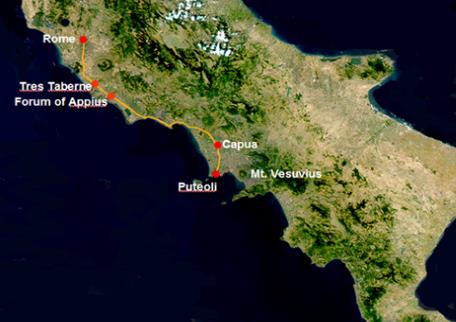
By sailing this way, they came to Rhegium. Rhegium was located on the costal tip of Italy. They soon caught a South wind that was favorable for their voyage. With this good wind, they reached Puteoli within a day. This 350
would be their last stop travelling by sea. From this point they would go inland.
Here they found some brethren that requested they stay for seven days. It is believed that Julius allowed Paul to remain there for that time. After that, they continued to Appii forum where they met some more of the brethren.
We are not told just how long they were at Appii forum but whenever they continued on, they came to the Three Taverns. This was another well-known rest stop on the Appian Way, the official road to the city of Rome. More brethren met with them there.
Paul was much encouraged by all these brethren.
A circumstance has come to light within the last thirty years which does surprise us concerning this same neighborhood,
showing how extensively the Gospel had permeated and
honey combed the country parts of Italy within the lifetime
of the first Apostles and disciples of Jesus Christ. Puteoli was a trading city, but Pompeii was a pleasure-loving city,
thinking of nothing else, and where sin and iniquity
consequently abounded. Yet Christianity had made its way
into Pompeii in the lifetime of the Apostles. How then do we
know this? Pompeii, as every person of moderate education
knows, was totally overthrown by the first great eruption of
Mount Vesuvius in the year 79 A.D. It remained for
seventeen hundred years concealed from human sight or
knowledge, till revealed in the year 1755 by excavations systematically pursued. Now at the time that Pompeii was destroyed there was a municipal election going on, and there
were found on the walls numerous inscriptions. Among
these inscriptions of mere passing and transitory interest, there was one found which illustrates the point at which we
have been laboring, for there amid the election notices of 79
A.D., there appeared scribbled by some idle hand the brief
words, "Igni gaude Christiane" (0 Christian, rejoice in the 351
fire), proving clearly that Christians existed in Pompeii at that time, that persecution and death had reached them, and
that they possessed and displayed the same undaunted spirit
as their great leader and teacher, St. Paul, being enabled like him to rejoice amid the sevenfold- heated fires.
- Stokes.2
They finally reached where the centurion delivered the prisoners to the captain of the guard. Paul was allowed to rent a house for himself and probably Luke. A Roman soldier was always present, constantly chained to Paul.
Paul in Rome
After being in his rented house for three days, Paul called for the chief of the Jews to come visit him. He gave them the reasons as to why he had been arrested and sent to Rome. He had supposed that they would have known all about the situation because there was much contact between the two groups of Jews. As it turns out, the Jews in Rome had received no letters concerning Paul, and no Jew having traveled to Judea and returned to Rome, had not been told of anything concerning Paul.
These Jews in return, asked Paul about the “sect” because they knew that
“everywhere it is spoken against.” A date was set for them to come back again, and Paul would expound and testify of the kingdom of God. From morning until evening, Paul preached and taught Jesus utilizing both the Law and Prophets. Some of the Jews believed, but others did not. This caused Paul to quote Isaiah 6:9-10.
Isaiah 6:9-10 KJV 9 And he said, Go, and tell this people, Hear ye indeed,
but understand not; and see ye indeed, but perceive not. 10 Make the
heart of this people fat, and make their ears heavy, and shut their eyes;
lest they see with their eyes, and hear with their ears, and understand with
their heart, and convert, and be healed.
352
THE CHIEF
3
Conclusion
The scriptures indicate that Paul lived two whole years in his rented house and received many people, refusing none. He continued to preach and teach the …kingdom of God, and teaching those things which concern the Lord
Jesus Christ, with all confidence, no man forbidding him.
Beginning with the next part, we will take a look at the books that Paul wrote while he was on house-arrest in Rome for those two years.
1 Rick Meyers, e-Sword version 13.0.0, Albert Barnes Commentary Acts 28:11
2 Albert Garner, Power Bible CD, an illustration pertaining to these verses in Acts 3 https://christianevidences.org/appii-forum-and-three-taverns-three-inns-italy/
353