

Islamic Methodologies Made Easy by Ehab Shawky - HTML preview
Download the book in PDF, ePub, Kindle for a complete version.
“And he hath seen a chariot, a couple of horsemen, the rider of an ass, the rider of a camel, And he hath given attention, He hath increased attention!” (Youngs’ Literal Bible) For the word “בכר” in the original Hebrew text, pronounced as “rakb,” could mean both
“rider” or “chariot,” but the correct translation with creatures like asses and the camels would be “rider.” Chariots are a type of carriages known to be pulled by horses, not asses nor camels. So the most accurate translations of this verse are those of Douay Rheims Bible and Young’s Literal Bible.
197
First: the chariot of horses which signifies war, followed by the fall of Babylon and the destruction of its idols and graven images, which are signs of polytheism and disbelief in Allah the one and only God. This fall took place in the reign of Cyrus the great back in 539 BC as the visions say in (Isaiah 45:1-4) and as explained by most Christian fathers and Jewish rabbis. It’s also well-known historically that the Persians employed chariots in their army. There is no dispute over the meaning of this prophecy.
Second: the rider of an ass in connection with its synonymously mentioned place “Seir.”
As indicated before, Seir is a landmark on the boundary of Judah (Josh 15:10) the place where Jesus lived and taught. Jesus entered Jerusalem riding an ass as testified for in Matthew (21:1-11). This is an obvious prophecy of Jesus’s coming P.B.U.H. described by the words, “The morning cometh.” The verse continues quickly as if warning the believers and stressing the fact that this rider won’t stay with them for long saying,
“and also the night. ” That’s a clear reference to the betrayal of the Jews and their trial to kill Jesus on the cross. This prevented him from fully delivering his message, and consequently created the need for another prophet after Jesus. That prophet’s signs are explained in the next verses for those who would await his coming. This is why the verse ends up saying “if you will enquire, enquire, return, come.” May Allah reward Jesus and all prophets P.B.U.T.
Third: the rider of a camel who travels in Arabia escaping from the mighty persecutors of Kedar. He would come from a place inside Arabia heading towards Tema, not to Tema.
This part of the vision totally resembles Prophet Muhammad’s immigration to Madinah.
Let’s analyze this for details and clarifications.
Verse 13 says, “The burden upon Arabia. In the forest in Arabia you shall lodge, travelling companies of Dedanim. ”
Historically Arabia has been known of being the homeland of palm trees, palm trees are the most cultivated type of trees in Arabia. Historically, it was and still is the most abundant tree the inhabitants cultivate. It suits the region’s environmental conditions perfectly. So the forest in Arabia referred to in the verse is a place full of palm trees.
This is an order for the travelers coming from Dedan to lodge at this place in Arabia, a forest of palm trees.
Verse (14) has some differences in the different translations of the bible. This is why I shall retranslate it in a trial to solve its dilemma. The verse says, “The inhabitants of the land of Tema brought water to him that was thirsty, they prevented with their bread him that fled. ”
In the original Hebrew text it’s written as follows:
“
דדנ
ומדק ומחלב אמי
ת ץרא י
בשי םימ
ויתה
אמצ
תארקל “
Pronounced as, “Lekrat samè hetayo maym yoshbe ‘aretz Tema bèlahmu keddemu nodd.”
198

Before working on the translation of this verse, we must note that most of the English translations available for this verse add too many words to the original text, in order to make any sense. Consequently, they end up changing the original meaning. Only a few examples of the variations between them are the following:
“Bring water for the thirsty, O inhabitants of the land of Tema, Meet the fugitive with
bread.” (New American Standard Version (1995))
“Give water to him who is in need of water, give bread, O men of the land of Tema, to those in flight.” (Basic English Bible)
“To meet the thirsty brought water have Inhabitants of the land of Tema, With his bread
they came before a fugitive.” (Young’s Literal Bible)
“Unto him that is thirsty bring ye water! The inhabitants of the land of Tema did meet the fugitive with his bread.” (Jewish Publication Society Bible)
“The inhabitants of the land of Tema brought water to him that was thirsty, they met with
their bread him that fled.” (Webster’s Bible)
From the above translations, two questions arise in the readers mind: 1) Was that fugitive passing by Tema or is this an order for Tema’s inhabitants to go out and meet him at a certain place that was not mentioned? For the word “תארקל” literally means “Towards” and obviously the order is for the inhabitants of the land of Tema to go out and meet the fugitive with water.
2) Was the bread the fugitive’s bread or did it belong to the inhabitants of Tema? For the word ומחלב literally means “his bread” and not their bread which actually doesn’t make any sense as noted in Young’s literal bible translation.
This is why we will first rewrite the verse as it was found written in the Dead Sea scrolls1
for there is a slight variation in the letters of the 8th word. This produces a difference in the meaning, which clears up the dilemma:
“ דדונ ומדק םחלנ אמי
ת ץרא י
בשי םימ
ויתה
אמצ
תארקל “
Pronounced as, “Lekrat samè hetayo maym yoshbe ‘aretz Tema nèlahm keddemu nodd.”
Accurately Translated to, “Towards (the) thirsty bring water inhabitants of land Tema.
Fighting preceded by emigrant.”
In the above you will find 10 separate underlined words in Hebrew, followed by their pronunciation and their literal translation in English in the same order of the Hebrew words. The bold word is the one that is different in the Dead Sea scrolls. It produces a new meaning for the verse. This new meaning is more consistent with the context and makes more sense. The verse is an order to the inhabitants of Tema to bring water towards the migrant whose coming is a sign on the approach of war and fighting.
1- Find the complete photo of this scroll attached. This trimmed part is found at the left end of the second line from the bottom. It covers the last three words in the verse under discussion.
199
Then the verses go on to say: (21:15) For they fled from the swords, from the drawn sword, and from the bent bow, and from the grievousness of war.
Verse 15 is describing the condition of this emigrant and those who escaped like him.
It explains that they will be escaping from armed people seeking to kill them, and that these fugitives didn’t fight back or wade any war against their persecutors who are identified in the next two verses that say:
(21:16) For thus has the Lord said unto me, Within a year, according to the years of an hireling, and all the glory of Kedar shall fail: (21:17) And the residue of the number of archers, the mighty men of the children of Kedar, shall be diminished: for the LORD God of Israel hath spoken [it].
These two verses state clearly that the persecutors of the emigrant or fugitive and those who escaped like him will be from Kedar tribe whose glory shall fail within a year.
An indication that the fugitives will fight back and defend themselves after a year passes from their arrival at the forest of Arabia. Thereafter, the power of the mighty men of Kedar shall diminish. Kedar was the second son of Ishmael (Gen. (25:13)), his offspring was known of living in tents as Bedouins and raising sheep, goats and camels. Smith’s dictionary says about them, “The tribe seems to have been one of the most conspicuous of all the Ishmaelite tribes, and hence the rabbins call the Arabians universally by this name.” (Smith’s dictionary of the bible 1901).
This prophecy should be studied in connection with the previous ones of the prophet from Paran as all of them include the names of places or tribes related to Ishmael, his offspring, and Arabia where they dwelt. We have already told the story of Prophet Muhammad’s immigration1. Prophet Muhammad P.B.U.H. left Makkah heading north towards Madinah; that’s in the direction of Tema and Dedan. Madinah is about 400 Km north of Makkah. Tema is about 400 Km north of Madinah, while Dedan (‘um al-qura or Al-ula) is about 380 Km North West of Madinah (i.e. the places are indicated on the map of Arabia P.185). Madinah has always been known of its abundant palm trees, so it’s among the forests of Arabia and the largest of them all. Today, its production from dates is the largest that a city produces in the whole world even after removing thousands of acres from its palm trees through centuries of constructional expansion. After referring to Jesus, these verses of Isaiah were urging those who would seek the prophet coming after him to await his coming at a place in Arabia described as “the forest of Arabia,” and it further urged the inhabitants of Tema and Dedan to meet him. The reader here should ask, why Tema and Dedan? Remember the previous verse of Deuteronomy that prophesized of the holy one from Paran, “God came from Teman, and the Holy One from mount Paran,”
these are actually all signs for those who read and study Allah’s messages, and are eager to support his prophets and make Allah’s word prevail above any other. Those who know their holy books well enough would absolutely seek to reach the place where this prophet would appear, that’s to give him aid and learn from him if he appears during their lives.
So again, if Paran is Makkah in central Hejaz as we have already discussed, and the prophet or the holy one from Arabia shall come from it, and he shall head towards Tema and Dedan; therefore, the forest of Arabia in which those who seek him should lodge is somewhere between those three places, which only leaves us with Madinah.
1: Regarding the detailed events please go back to P.172 and read again the story of immigration in connection with Surāqa Ibn Mālek’s narration.
200
After immigrating to Madinah by about eleven and a half months (one lunar year exactly), in August 623 the prophet started leading campaigns against the pagans of Makkah.
The reason was that they continued threatening Muslims even after they immigrated, and they were instigating the Arab tribes against them. The campaigns were successful.
That drove the pagans crazy. They thought that Muslims would never fight for they were few, inexperienced former slaves and shepherds, led by a 54-years-old man who never fought before. This eventually led to the battle of “Badr,” which took place in March 624
between 313 Muslim foot soldiers, and about 1000 Makkan polytheists (including 200
horsemen). Among them were the mighty leaders who have tortured and killed many Muslims before their escape to Madinah. Those leaders were of high status, known of their great hatred to the prophet and his followers. They were all killed during the battle.
This was literally the start of diminution in the numbers of the mighty polytheists of Makkah, the sons of Kedar. It was also the start of deepening the roots of the new Islamic capital in Madinah.
Many battles later on took place between Muslims and pagans alongside other Jewish tribes that inhabited Madinah, Tema, Dedan, Khaibar, and many other places all over Arabia. Many from the Jewish tribes had come to live in these places hoping to be the ones who would follow the awaited prophet and gain the honor of making him victorious.
When he came from among their Arabian brethren and not the Israelites, they declined and refused to follow him as we have discussed earlier. All of the battles following Badr were won by Muslims except for one battle which was the battle of ‘Uhud in which the prophet was almost killed. Yet, even those who fought against Muslims at ‘Uhud, all embraced Islam later on. Among them were the leader of the pagans’ Cavilary “Khaled Ibn Al-Walīd” and the army general “Abu Sufyan Ibn Harb,” whom we have told their stories before. This signified that Allah supported His final messenger and made him victorious no matter what the odds. He is the deliverer of the last message and he must live until he completes his mission. Regarding this protection, Allah says in the Qur’an:
“O messenger! Proclaim the (message) which has been sent to you from your Lord. If you do not, then you have not conveyed His message. Allah will protect you from mankind.
Verily, Allah guides not those who are intent on refusing to believe.” [The Qur’an (5:67)].
And here a very important question arises in the mind of truthful thinkers,
“If Muhammad was a liar, a fabricator and he was making up the Qur’an, would he have said the previous verse after which he forbad all of his companions from protecting him or exchanging shifts to protect his house out of fear for his life? Would he lie to himself and endanger his own life?” I leave the answer for the intelligence of the reader.
One final point: amazingly, between Cyrus and Jesus’s time, there were about 6 centuries.
Likewise, between Jesus and Muhammad’s time there were about 6 centuries. Could there be any clearer signs!
We needn’t add more now for anyone to see the resemblance of these verses with Prophet Muhammad P.B.U.H. Since that there hasn’t come a prophet from Arabia since the time of uttering the previous prophecies except Muhammad, nor has there been any one at all whose story matches these verses other than him, then logically, they complete one another, and are all describing Muhammad P.B.U.H.
201

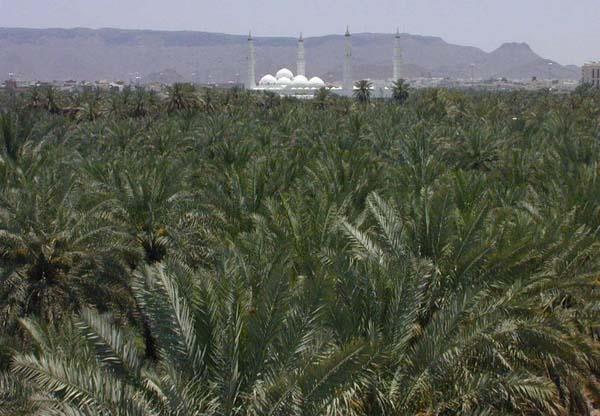
This picture is for the southern entrance of Madinah showing thousands of palm trees at this location. The white building is Quba’ mosque, the first place at which the prophet arrived and the first mosque that was ever built by the prophet P.B.U.H. when he reached Madinah. I visited the place myself and walked amidst its trees. I shall always find great honor and joy in this memory.
This was my simplified review for some of Prophet Muhammad’s signs in the Old Testament. Other signs for Makkah and the prophet are present and obvious for those who would search for the truth and are not arrogant.
Finally I would like to leave you with the words of Jesus P.B.U.H.,
“Jesus said unto them, ‘Did you never read in the scriptures, “The stone which the masons rejected, the same is become the head of the corner. This is the Lord’s doing, and it is marvelous in our eyes?” Therefore I say unto you, the kingdom of God shall be taken from you, and given to a nation bringing forth the fruits thereof. And whosoever shall fall on this stone shall be broken: but on whomsoever it shall fall, it will grind him to powder.”
[Matthew (21:42-44)].
202
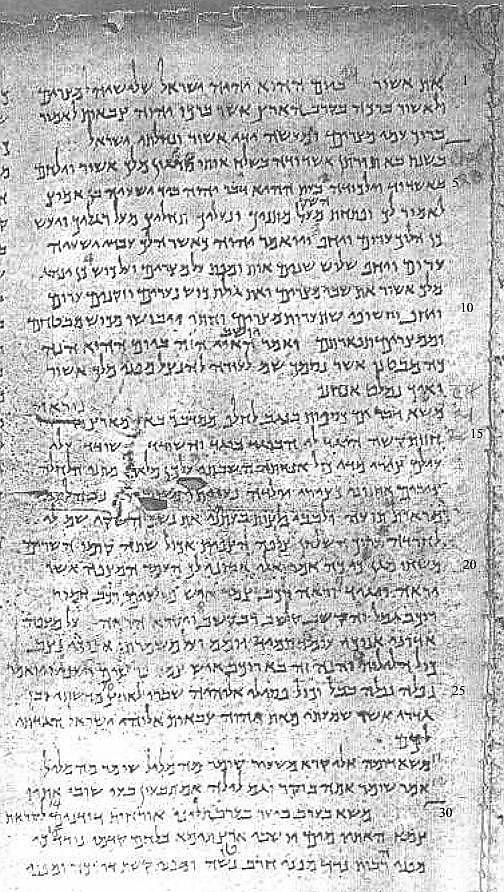
An Image of the Dead Sea scroll that contains Isaiah, chapters 20 & 21.
203
3. Qur’an, Muhammad’s fabrication or the Creator’s Words?
All prophets chosen by Allah were supported by miracles that persuaded their people of their prophethood. After the prophets and those who witnessed their miracles passed away, their stories lived on in narratives, poems, songs and stories, but nothing ever remained from those miracles to persuade those who never witnessed the events of the truthfulness of such stories. This couldn’t have been the case with the seal of all prophets; the one after whom there wasn’t going to be any more prophets or messages.
The final prophet must have an everlasting miracle that can reach all people and be strong enough to convince them of his prophethood. This is why—besides the temporal miracles that had been witnessed by his companions— Prophet Muhammad’s major miracle was a book, a scripture named, “The Holy Qur’an.” If this book was truly Allah’s final message and everlasting guide for all people, then it must have been and forever remain beyond contestation. Hence, we need to learn how this book was preserved through the ages? What is so miraculous about it? What are the signs of its supremacy? How can we be sure that it is from our Creator, not from satan, or a fabrication by Muhammad?
Some non-Muslims ask, ‘If it were from our Creator, then how come it has verses that contradict or abrogate each other, as if this Creator was teaching us through trial and error?’ The previous among other common questions about the Qur’an shall be discussed in the next few pages. Let’s start from the very beginning.
3.1. Preservation of the Qur’an
Leading a hard life in the desert, the Arabs were accustomed to making their hearts the pages on which they memorized their endless poems, lineages, glorious events, and the stories of old. Many of the people back then were unlettered. Even for those who knew how to read and write, the writing tools—as such of ink and papyrus scrolls—
weren’t easily obtainable at that region. From here, relying on memorizing the words was much stronger than relying on writing them down. The Qur’an on the other hand was favored by the greatest deal of care. The prophet’s determination—and his companions’—was primarily aimed at learning and memorizing the Qur’an by heart.
Nonetheless, this didn’t distract them from writing it down as much as the writing tools that were available back then allowed them to do so. The prophet assigned for the task of writing down the Qur’an as he dictates it some of his closest companions, among them were the following notable ones:
“Abu Bakr Al-Sedeek” : The prophet’s closest minister and First Caliph.
“ ‘Omar Ibn Al-Khattab” : The prophet’s second minister and Second Caliph.
“ ‘Othman Ibn Affan” : The prophet’s son in law and Third Caliph.
“ ‘Ali Ibn Abi-Taleb” : The prophet’s cousin, son in law, and Fourth Caliph.
“Obai Ibn Ka‘b” : One of the most knowledgeable companions. He was assigned by the prophet to teach the delegations the Qur’an and the Islamic laws.
“Zayd Ibn Thabet” : One of the most knowledgeable young companions and the prophet’s neighbor. He was 11 years old when the prophet reached Madinah. His brilliance and young age helped him memorize the Qur’an by heart. He recited all of the Qur’an to the prophet twice the year the prophet passed away, and he attended the prophet’s last complete arranged recitation of the Qur’an in that same year.
204
“ ‘Abdullah Ibn Mas‘ud” : One of the earliest men to embrace Islam, and one of the most knowledgeable companions. He was the first to recite the Qur’an in a loud voice at the Ka‘bah in Makkah and was almost killed for it.
“Az-Zubair Ibn Al-‘Awwam” : The prophet’s cousin, one of the earliest Muslims and closest companions, and the one whom the prophet declared his helper at hard times.
The Qur’an has always been preserved by two methods that complete each other in a way that guaranteed keeping it intact. The first method is memorizing it by heart; the second is having it written down. Thus, the Qur’an has always been kept intact in the hearts of Muslims and in the copies dictated directly by Prophet Muhammad. It is the only book taught on earth today whose certified teachers must be among those who have memorized it completely by heart, examined orally and in writing, (i.e. blind students are examined orally only), and have received a very unique graduation certificate that permits them to teach it to others. This certificate which we call “Ijazah” (i.e. permission) mentions the name of the graduate, his teacher and his teacher’s teacher, etc., passing through the past 1400 years until it reaches the prophet P.B.U.H. This tradition began as an oral tradition. Within the course of time, it became written as well. In other words, the teacher must have a cemented certificate testifying for his knowledge of the recitation.
Try to listen to any chapter from the Qur’an recited by a Russian, a Hindu, a Japanese, an American, and an Arab; though they are totally different people with different nationalities, different mother tongues, and different accents, you will be amazed at how all recitations are exactly the same. In order to clarify this more for the reader, I shall simplify the story of preserving the Qur’an.
When Prophet Muhammad P.B.U.H. started receiving the Qur’an from our Creator, it was not revealed all as a single unit. The verses were revealed to the prophet fluctuating according to the different incidents and occurring events that Muslims had to face throughout 23 years. When delivering the holy book was complete, the prophet was informed that his duty was done and the message was complete. This final message was not a compilation of laws, or a list of DOs and Don’ts that could be sent down all at once; it was a guide for a new nation built naturally day by day, developing its faith, forming its heart, thoughts, and volition, according to the will of their creator. A nation that wouldn’t impose its will above Allah’s will, but guides humanity to complete trust in Almighty’s laws through intellect and reason. He is All-knowing, All-wise. Through our lord’s wisdom, the Qur’anic verses were revealed circumstantially to lead this nation in its development and its challenges through the different events. This is why their final arrangement in one book couldn’t have been done except after the completion of the whole message. Amazingly enough, when you read the Qur’an you won’t find any inconsistency in it; on the contrary, it’s an intelligently connected flowing book.
The verses were inspired to Prophet Muhammad P.B.U.H. and he recited them to the companions in every incident. The companions memorized them from the prophet.
Meanwhile, those among them who knew how to read and write, wrote the new verses down as dictated by the prophet on the available tools at the time. They wrote on papyrus, palm branches, on rocks, leather, and even on animals’ shoulder bones.
‘Abdullah Ibn ‘Abbās reported that, “The prophet P.B.U.H. taught us the closing salutation of the prayers (i.e. Al-Tashahud) the same way he taught us every chapter from the Qur’an.” [Recorded by Muslim].
205
He also reported that, “Whenever new Qur’anic verses were revealed to the prophet P.B.U.H., he summoned some of the lettered companions to write them down saying,
‘Put these verses in the chapter of so and so.’” [Recorded by Abu Dāwood].
‘Abdullah Ibn Amr reported that, “The prophet P.B.U.H. said to me: ‘Read the Qur’an once every month’, so I said, ‘I can read it in less than that’. He kept on reducing the period for me until he said, ‘Read it once every three days’.” [Recorded by Bukhari].
It seems that this incident took place before the completion of the Qur’anic revelations because in another narration by Bukhari, the prophet told ‘Abdullah Ibn Amr,
“Read it once every seven days and do not read it in less than that.”
‘Abdullah Ibn Jaber reported that, “The prophet P.B.U.H. used to teach us the consultation prayers (i.e. Al-Estekharah) like he used to teach us every chapter from the Qur’an.” [Recorded by Bukhari].
Zayd Ibn Thabet also reported, “During the prophet’s life P.B.U.H. we arranged the Qur’anic verses written on Reqaa. 1 ” [Recorded by Tirmidhī and Ahmed].
From the above narrations, you can see how keen the prophet was on preserving the Qur’an, and guarding it against any distortion. He made sure that any new portion was written down in its place, memorized, and recited continuously by his companions, who later on, delivered the whole book to all people. As reported by the companions, the verses were arranged in chapters according to the instructions of the prophet. In the last year of the prophet’s life, he recited it in its final arrangement. This was witnessed and preserved by many of the companions at Madinah. On this final form, they gathered the written verses, arranged it as one book, and taught it to their followers. The followers in turn taught it to theirs, and so on. The process went as follows:
After the prophet P.B.U.H. departed, in the first year of his successor’s reign, Abu Bakr consulted ‘Omar Ibn Al-Khattab about collecting the Qur’an written during the prophet’s life. He ordered Zayd Ibn Thabet to gather a complete copy of the Qur’an dictated by the prophet. Abu Bakr and ‘Omar told Zayd not to trust only what he has written and memorized directly from the prophet, but also to revise it from what the rest of the companions have written and memorized. Furthermore, for any submitted portions, Zayd required from the companion submitting it to bring forth two witnesses to testify that they have witnessed these verses being written between the prophet’s hands and according to his dictation. Regarding this incident, Zayd said, “I swear by Allah that if they ordered me to transfer a mountain [rock by rock], it wouldn’t have been more difficult than the task of gathering the Qur’an.” [Recorded by Bukhari]. This indicates how much careful, cautious and considerate Zayd was in his mission.
This event took place in Madinah, so the closest of all companions were the ones who participated in it. They brought forward to Zayd all that which they have written.
They produced two just witnesses from among themselves to testify to have witnessed it being written between the prophet’s hands and according to his dictation. Zayd’s memorization for the Qur’an alongside that of the companions was extra assurance.
Furthermore, what they have all written stood as witnesses one above the other, and solid evidence on its correctness. That’s how the Qur’an was preserved by the companions.
ـــــــــــــــــــــــــــــــــــــــــــــــــــــــــــــــــــــــــــــــــــــــــــــــــــــــــــــــــــــــــــــــــــــــــــــــــــــــــــــــــــــــــــ
1: Reqaa’: An Arabic word meaning leather and papyrus scrolls.
206
In this cautious wise method, a complete written copy of the Qur’an dictated by the prophet P.B.U.H. was gathered. This action is an everlasting laudable deed for Abu Bakr,
‘Omar, Zayd, and the companions. May Allah award them all for their efforts.
After Zayd gathered the Qur’an written in its final arrangement as taught by the prophet, it was transferred to a room in Abu Bakr’s house for safe keeping. After Abu Bakr’s death,
‘Omar had it moved to his house for the same purpose. Later on, after ‘Omar’s death, the companions agreed to move it to his daughter’s house Lady Hafsah, the prophet’s wife and mother of believers. It remained there intact until the third Caliph ‘Othman Ibn Affan asked her for it. During ‘Othman’s reign, Muslims succeeded in delivering Allah’s final message to far away countries. Many people accepted Islam and started reading and memorizing the Qur’an as taught to them by the companions, it was then that an incident occurred.
To understand what happened, we need to go back almost three decades. When the Qur’an was first revealed to Prophet Muhammad, it was revealed to him in his tribe’s dialect.
The prophet asked Gabriel, the archangel, to teach it to him in more than one synonym; that was to facilitate its understanding on the different Arab tribes scattered all over Arabia. These tribes have been using different words and expressions in their dialects ever since the prophet’s time and till this moment but in a lesser form. The archangel first told the prophet that Allah orders him to teach the Qur’an to his nation in one synonym.
Finding it difficult for his nation, the prophet repeated his request invoking upon Allah’s tolerance and help for Arabs were still not ready to fathom all this. Allah accepted the prophet’s invocations by His grace, and for each hard word or expression in the Qur’an, the Angel taught the prophet 7 synonyms, which he taught to the companions according to their dialects. When they noticed this and asked him about it, he informed them of the previous. The story was recorded as follows:
‘Omar Ibn Al-Khattab said, “I heard Hesham Ibn Hakeem reciting Chapter Al-Furqan (i.e. The Criterion) during the prophet’s life. I listened to him and he was reciting it in different synonyms from those which I learned directly from the prophet. I was about to interrupt his prayers, but managed to stay calm until he finished. Afterwards, I grabbed him by his garment and asked, ‘Who taught you to recite this chapter as I just heard?’
He said, ‘The prophet P.B.U.H.’ I said, ‘You are lying for the prophet taught it to me with different synonyms from the ones you used in your recital.’ I led him to the prophet hurriedly then said, ‘O prophet, I heard this man reciting Chapter Al-Furqan in synonyms different from those which you taught me earlier.’ The prophet P.B.U.H. ordered me to let Hesham go and told him, ‘Recite it Hesham.’ Hesham recited the same recital I thought faulty, but the prophet said, ‘This is how it was revealed to me.’ Then he told me, ‘Recite it ‘Omar,’ and I recited it with the synonyms I memorized from the prophet. He said, ‘This is also how it was revealed to me. The Qur’an has been revealed to me in seven synonyms, so recite it in the one you find easier according to your capacity.” [Recorded by Bukhari].
‘Abdullah Ibn ‘Abbās also reported that the prophet P.B.U.H. said, “Gabriel made me recite the Qur’an on one synonym, but I kept on asking him to teach me more than one until he ended up teaching me seven synonyms.” [Recorded by Bukhari].
207

The companions understood this and they had no problem with it. Later on, during
‘Othman’s reign, when the call for Islam reached faraway lands, many people embraced it and started studying and memorizing the Qur’an. Every group recited it according to what was taught to them by one of the companions. Moreover, Arabs from different tribes and places started mingling and listening to the Qur’anic recitation from each other.
They heard different synonyms from the ones they knew, which they thought was a trial to distort the Qur’an. They didn’t understand that some expressions were taught by the prophet in 7 different synonyms for facilitation. Out of concern and sincerity, a terrible tumult was going to erupt between them. When ‘Othman was informed of this, he ordered a committee led by Zayd Ibn Thabet and constituted from the best Qur’an memorizers among the companions—who witnessed the last complete recitation of the Qur’an by the prophet—to duplicate the original copy gathered during the reign of Abu Bakr, and to gather the whole Muslim nation on one copy with one synonym. He ordered that whatever expression they differ on, they should record it in the tongue of “Quraysh” (the prophet’s tribe), for it was the original synonym with which the Qur’an was first revealed.
Consequently, the Qur’anic recitation was once again unified on one synonym, duplicated, and sent to all regions extending from Persia to Morocco as Allah had planned for it from the beginning. All other copies containing different synonyms were burned in order to prevent any future tumults. All Qur’an copies between our hands today have the exact same writing, wording, and signs as that which ‘Othman sent to all regions.
All praises be to Allah the omnipotent. He has fulfilled His promise to the believers and employed the most honest men for preserving his last message to all humanity.
May Allah reward them for their efforts with the best of awards, Amen.
Allah says in the Qur’an,
“A. L. R. These are the verses of Revelation and a Qur’an that makes things clear, may those who disbelieve wish that they had been Muslims. Let them eat and enjoy (i.e. the good things of this life) and let [false] hope amuse them: soon will they come to know. Never did We destroy a village except with a known decree beforehand. Neither can a nation anticipate its term, nor delay it. They said, ‘O you [Muhammad] to whom the Message is being revealed! Truly you are a mad [or possessed] man! Why do you not bring us the angels if you are of the truthful?’ We send not the angels except for a just cause: if they come [to the ungodly], behold! No respite would they have! Verily, it is We who have sent down the Message, and We will assuredly guard it [from any corruption].
We did send messengers before you amongst the religious sects of old. But never did a messenger come to them except that they mocked him.” [The Qur’an (15:1-11)].
208
3.2. The Qur’an as a miracle linguistically speaking Ever since the prophet P.B.U.H. started reciting the Qur’an, the musical tones in its recitation have always stolen the hearts of those who listened. The greatest Arab poets of all ages stood in awe in front of the beautiful rhythmic recitation that was neither poetry nor prose, but one of a very unique nature. Even today, you can still see people being deeply touched by the sound of the Qur’anic recitation though they aren’t Muslims, nor do they know any Arabic. The method in which the prophet recited the Qur’an and taught to all Muslims was later on developed in to a complete branch of the Islamic sciences known as (‘Ilm Al-Tajweed). Amazingly, if this science or method of recitation is tried on any other book, it fails greatly and doesn’t work. It’s an inimitable rhythmic tone created by Allah Almighty solely for His own words.
“Al-Walīd Ibn Al-Moghirah” was among the mightiest and most bitter pagans living during the prophet’s time. He was father of the famous companion “Khaled Ibn Al-Walīd,” and one of the richest and most famous leaders of the prophet’s tribe, Quraysh.
He was widely known of his vast knowledge of Arabian poetry. As such, the other leaders asked him to visit the prophet, and discuss with him what he preached. They hoped he could convince the prophet desist and give up his call. When this man went to confront the prophet and he listened to him reciting the Qur’an, his heart was ceased by it. He was overwhelmed to the extent that when he returned to his fellow pagans, they inquired worriedly about what happened, and he said, “I don’t know what to say. I swear by the gods, there isn’t a man among you who is more knowledgeable than me of poetry, its rhymes and kinds, and by the gods do I swear that what he says isn’t like any of those kinds. What he says has unique beauty and grace. Its high tone is fruitful, and its low tone is abundant. It ascends above all other words and nothing ascends over it, and it crushes down what’s beneath it.”
On hearing this, another leader and bitter enemy of the prophet named ‘Amr Ibn Hesham told Al-Walīd: “Your people won’t accept this from you. They won’t be satisfied unless you say something bad about what he recites.”
Al-Walīd thought for a moment and then said, “It is some sort of overwhelming magic.”
[Recorded by Al-Hākem and Al-Dhahaby].
The pagans then urged one another to make noise beside any Muslim reciting the Qur’an so that they may forbid others from hearing what he says. Allah described their attitude in the Qur’an where He says, “And those who denied (our message) said, ‘Listen not to this Qur’an and make noise in the midst of its recitation that you may gain the upper hand.’ ” [The Qur’an (41:26)].
Another significant evidence on the influence of the Qur’anic recitation could be sensed in the following story: When the persecution of the Makkan pagans reached its peak during the early years of the prophet’s call, Abu Bakr decided to escape to Abyssinia.
On his way out of Makkah he was intercepted by a man named “Ibn Al-Doghonnah”
who asked him where he was going. Abu Bakr answered, “I was driven out by my people, so I wish to seek refuge somewhere else where I can worship my God freely.”
Ibn Al-Doghonnah said, “A man like you Abu Bakr is not to leave nor be driven out.
You have always taken care of the poor and looked after your kin. I’m your neighbor and you have my protection. Go back home and worship your lord without any fear.”
209

After that, Ibn Al-Doghonnah paid the pagan leaders a visit and told them that he has granted Abu Bakr asylum from their persecution. They accepted on the condition that Abu Bakr practices his religion only inside his house; he cannot recite the Qur’an except within its walls. Accordingly, Abu Bakr built a small hermitage in the yard of his house.
Inside it, he secluded himself to pray and read the Qur’an every day. Passing by the hermitage, the people started listening to his recitation. He was a weepy worshipper who couldn’t hold his tears when reciting the Qur’an and pondering over its meanings.
This frightened the pagan leaders of the tribe. They sent for Ibn Al-Doghonnah and expressed their fear that Abu Bakr would charm their families, and then they asked him to forbid Abu Bakr from reciting the Qur’an in a loud voice. They told him that this was only for the sake of his asylum guarantee. Ibn Al-Doghonnah went to Abu Bakr and asked him to stop reciting the Qur’an in a loud voice. Abu Bakr then said,
“I remit your asylum burden and suffice with Allah’s asylum and his messenger’s.”
This was how the Qur’an affected both, those who believed in it, and those who did not.
‘Omar Ibn Al-Khattab, narrated the story of his faith saying, “When I heard the Qur’an, my heart softened, I wept, and Islam entered my heart.” [Recorded by Ibn Hishām].
And this is “Al-Jubair Ibn Mut‘am,” the companion, narrating the story of his faith, he said that when he was captured as a POW in the battle of Badr, he was brought back to Madinah with the Muslims’ army. During one of the prayers, he heard the prophet P.B.U.H. reciting the chapter called “At-Tur” in the Maghrib (i.e. Sunset) prayers.
When the prophet recited, “Were they created out of nothing, or were they themselves the creators?” Al-Jubair said, “This was the first portion of faith that entered my heart.”
[Recorded by Bukhari and Muslim].
By all means, don’t take my word for it, download any part you choose from the Qur’an and listen to it yourself from different reciters with different nationalities, and then make up your mind. All those who read the Qur’an, or a reliable translation of the meanings of the Qur’an, and ponder over its verses, they are affected by it. Many contemporary non-Muslims who read the Qur’an felt likewise. About this, the famous Palestinian poet
“Nicola Joseph Hannah” (1923-1999) said, “I read the Qur’an and it stunned me, I indulged in its meanings and it fascinated me, I read it again and I believed.
How couldn’t I believe when the miracle of the Qur’an is between my hands; I’m looking at it and feeling it all the time. It’s a miracle not like any other, an everlasting divine miracle that proves itself and it doesn’t need anyone to speak about it nor preach it.”
A female convert named “Ayesha Bridget Honey” who was raised in a Christian British family; while she studied Philosophy in a Canadian university she had the opportunity to learn about Islam and finally embrace it. Regarding her experience, she said,
“However hard I try, I cannot fully estimate the impression the Qur’an left on my heart.
Before I finished the third Surah (i.e. chapter), I had prostrated myself before the Creator of the universe. This was my first Salaat (prayer) and since that time by the grace of Allah I am a Muslim.” Again, by all means, don’t take my words for granted. Get your own copy of the Qur’an, read as much as you can from it, and ponder over its verses.
Try to listen to it being recited in Arabic on the internet, and then judge for yourself.
210
3.3. The Qur’an as a miracle scientifically speaking Ever since the beginning of revelation, the Qur’an has been challenging its deniers in various intellectual methods, and urging its reader to think and ponder over its verses. Since that it is an everlasting miracle, its challenge must continue through all ages and till the end of time. During the prophet’s era, the challenge was only of a linguistic nature. With the advancement of time, this linguistic challenge diminished because people’s knowledge and interests changed. Humanity has entered the age of scientific discoveries and modern technology. This new era needed a new challenge of a different nature that can cope up with the new developments. These developments were dealt with in the Qur’an and given special care by our Creator who is All-Knowing of His creation.
Allah says in the Qur’an:
“We shall show them Our signs on the horizons (i.e. the universe) and within
themselves until it will become clear to them that it (i.e. The Qur’an) is the Truth.
Does it not suffice that your Lord is Witness over all things?” [The Qur’an (41:53)].
In the 3rd section of the previous chapter, some scientists’ opinions regarding the scientific statements in the Qur’an and Sunnah have already been stated. In this section, I am going to tackle one of the modern scientific theories, and then state the related Qur’anic verses—
with their literal word for word translation—giving a brief comment about them. I leave the final judgment for the reader. I would like to remind the reader that whenever we speak about matters like the start of creation and the early beginning of things, science did not and cannot state a final opinion or theory about them; these were matters beyond the humans’ observation. What science can do is place theories based on the available evidence without forcing any ideologies upon the evidence.
According to the established modern scientific theories, the universe was originated from an explosion in a singularity point turning it into a universal celestial gaseous dust cloud. The cloud produced by the Big Bang was mostly formed of hydrogen gas alongside tiny dust particles. Gravity took its role between the close particles, the end product of which is that stars and galaxies were formed. While galaxies continue to move away from each other due to the primary explosion, some of them are moving relative to each other due to their gravitational interaction. In 1925, Edwin Hubble—after whom the Hubble Space telescope is named—provided the conclusive observational evidence for the expansion of the universe. The whole space itself is expanding, carrying galaxies with it, like spots on an inflating balloon. In a galaxy called “The Milky Way,” our solar system was formed in a similar way.
Scientists tell us that about 4.5 billion years ago, a dying star in our galaxy exploded crushing down a massive dust cloud resulting in a cloud of gas and dust. From this cloud our solar system was originated. The previous incident was the first link in a chain of events that preceded the earth’s existence. A new star was born which became our sun, and as expected, gravity played its role among the tiny dust particles forming the planets revolving around the new star. Those included our own planet. After many millions of collisions, the earth finally reached its semi spherical oblate shape.
According to the prevailing hypothesis today, the moon was formed as a result of a massive collision between earth and another semi planet, which they named “Theia.”
211
During the previous events, the sun vaporized the water molecules in the solar system.
Millions of miles away from the sun’s heat, this water vapor was condensed, frozen and accumulated on comets and asteroids as ice.
During the development of the rest of the planets of the solar system, namely the ones farther away from the sun than earth, and while their orbits around the sun became more uniform and stable, billions of comets and asteroids were driven towards the earth bringing water to our planet. As a result, life emerged in an aquatic form. Thanks for volcanoes, gases evaporating from earth started to form the earth’s atmosphere. A new form of life started to evolve. Photosynthetic organisms emerged to consume Carbon dioxide and produce Oxygen. Once oxygen had been produced, ultraviolet light split its molecules producing the ozone UV shield. At this point, life moved out from the oceans and respiration evolved. The layers of the atmosphere were formed. Meanwhile, the water cycle on earth began to stabilize.
Every planet is now stable in a specific orbit. The sun is orbiting the center of the Milky Way at a distance of approximately 24,000–26,000 light-years from the galactic center. The earth is orbiting the sun, and the moon is orbiting the earth. The sun’s rays penetrate the earth’s atmosphere and produce light during the day. The moon only reflects the Sun’s light, this is why it looks luminous at night, but it does not produce any light of its own. Thanks for the moon, the earth’s axis-tilt is preserved at 23.45o, this means that the North Pole is kept closer to the sun for 6 consecutive months than the South Pole, then in the next 6 months this is reversed resulting in the succession of the 4 seasons of the year. Consequently this makes most of the earth’s regions qualified for inhabitancy throughout the year.
To the previous, one may ask: How did the singularity point from which all this began come to exist and why did it explode? From where did the raw materials that formed the universe come from? Are those huge planets and galaxies merely the result of ungoverned gravity forces between tiny dust particles? Can unprompted order result from absolute chaos on its own? How did the early photosynthetic organisms survive the UV rays, when there was neither Ozone nor oxygen?
Now, please ponder over the following verses from the Qur’an:
“In the creation of the skies and the earth, and in the alternation of night and day,
there are signs for people of understanding.” [The Qur’an (3:190)].
This verse is an invitation for all people to ponder over the creation of the universe, especially the planet upon which we’re living in order to confirm whether a Creator exists or not.
“Allah did not create [all] that (i.e. the universe) except in truth. He expounds the signs
[in the Qur’an] for people of knowledge (i.e. scientists, scholars, truth seekers, etc.)”
[The Qur’an (10:5)].
This verse is also an invitation, but this time, it’s for those who have knowledge about the universe. It’s an invitation for scientists to read the Qur’an, study the verses that discuss the creation of the universe and the earth, and then make up their minds towards its truthfulness, and whether it’s truly a message from the Creator or not.
212
“And those who were given knowledge see that which was sent down upon you
[O Muhammad] by your Lord is the truth and guides to the path of the Exalted
[in Might] the worthy of all praise.” [The Qur’an (34:6)].
This verse confirms that if scientists and scholars ponder over the verses of the Qur’an, they will find it an evidence that the Qur’an is truly a message from the Creator.
“Haven’t the disbelievers observed that the skies and the earth were combined, then We
ruptured them, and We created from water every living thing. Would they still not
believe.” [The Qur’an (21:30)].
A confirmation that the skies and the earth were once a single body then the Creator ruptured it. The reader here should understand that the Arabic word “Samawat” (singular: Sama’) translated as skies is used to refer to the universe around us. If you check any English dictionary, you will also find the same usage for the word. This verse is a clear reference to what scientists have discovered in the Big Bang theory.
“Then He (i.e. Allah) equilibrated unto the
sky when it was (still) smoke and said unto
it and to the earth: come willingly or
unwillingly. They said, we come willingly
(O Lord)” [The Qur’an (41:11)].
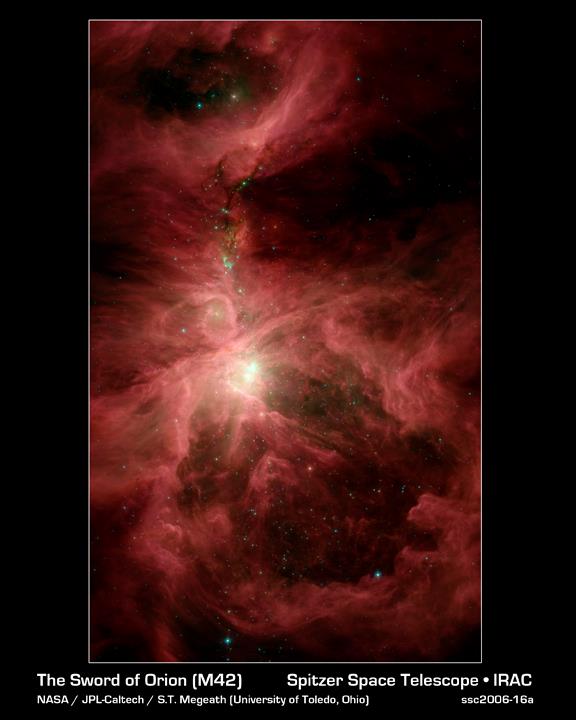
A confirmation that, at a certain point, the
universe was still a celestial cloud of gases
and dust, then a mighty force caused its
particles to combine forming the planets and
the rest of the universe around us. Please
ponder over this infrared image from
NASA’s Spitzer Space Telescope that
shows the Orion nebula, the closest massive
star-making factory to Earth. How do you
describe this celestial cloud which you see?!
“And the sky We constructed with might and verily We are expanding it” [The Qur’an (51:47)].
A confirmation to the fact that the universe is expanding, which is what all scientists today confirm and what the Big Bang theory is based upon.
“He (i.e. Allah) is The One who created the night and day, and the sun and the moon
each floating in an orbit.” [The Qur’an (21:33)].
A confirmation to the fact that the sun and the moon are celestial bodies floating in prescribed orbits.
“Blessed in The One (i.e. Allah) who made constellations in the sky, and made therein
a lamp (i.e. the sun) and a luminous moon.” [The Qur’an (25:61)].
A confirmation to the fact that the sun produces its own ligh like lamps do. On the other hand, the moon is described simply to be luminous. Of course 1400 years ago, these words did not catch the attention of the people receiving the Qur’anic message. Today, after we have discovered that the moon does not produce light but it only reflects it, we can understand why the verse gives different descriptions for the light of our two friends.
213
Any science student today, even children know the importance of both the sun and the moon for the earth. Without any of them, life wouldn’t have existed on earth.
Hence, absolutely, blessed is The Creator who created them both at their exact places.
“And Allah sent down water from the skies reviving the earth after it was dead. Surely,
in that there is a sign for the people who listen (to this message).” [The Qur’an (16:65)].
A confirmation to the fact that the earth—at a certain period—was a dead waterless place having no form of life on it. Then water was sent to earth and life started to emerge.
Scientists confirm that life did not start on earth except after water’s existence.
“And We sent down water from the sky in due measure, then We lodged it in the earth,
and of course, We are able to take it away.” [The Qur’an (23:18)].
The same as the previous, and a confirmation to the fact that the earth’s underground water results from the rainwater that infiltrates the earth’s soil.
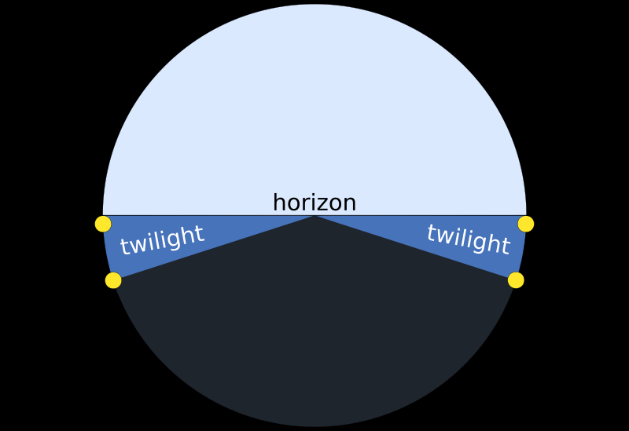
“Haven’t you seen that Allah makes the
night penetrate into the day and He makes
the day penetrate into the night...”
[The Qur’an (31:29)].
“He created the skies and the earth for a
true purpose. Spherically He coils the night
upon the day and spherically He coils the
day upon the night.” [The Qur’an (39:5)].
The above verses are an amazing description
for the picture explaining the day-night
changes. Verse (39:5) also alludes to the fact
that the earth is of a spherical shape.
“Do they not ponder over the Qur’an? If it had been from anyone other than Allah
(i.e. the true Creator of the universe), they would have found much variance in it.”
[The Qur’an (4:82)].
The Qur’an is not a science book; nonetheless, if you compare the allusions given in the previous verses to what scientists have discovered in the last 100 years about the beginning of the universe, you should reason out the following: Prophet Muhammad P.B.U.H. died more than 1400 years ago. When he started preaching Islam and reciting such verses to his people, he was accused of being a mad man and a fabricator. Of course, if any person preached such statements claiming that he receives them from the Creator—not 1400 years ago but only 200 years ago, he would have been accused of being a mad man and an imposter. For Prophet Muhammad to have stated the previous verses during his life, did he visit outer space? Did he have an infrared telescope?
Did he have a time machine? Or was he a prophet inspired by The Creator who has created this universe? Muslims believe he was.
As you can see in the above verses, the Qur’an does not demand belief, it invites belief.
In Islam there is no such a thing as “Blind Faith;” on the contrary, the Qur’an demands that you think logically, prove all things, and build your faith on solid grounds that nothing can shake. Throughout the Holy Book, you can read expressions like: “Have they 214

not considered?” “Hasn’t man seen yet?” “Do they not ponder over?” etc. It’s always an invitation for each and every person not only to read the Book, but to examine it, check the evidence on its truthfulness, and finally reach a decision that’s based on thorough study. The above verses are only a small portion of what I saw relevant to modern scientific theories proving that The Qur’an is an everlasting miracle. Many other verses discuss creation, embryology, geology, Oceanography and sea currents. Stunning facts about animals, bees, spiders, etc., are mentioned. Voluminous books have been written tackling the scientific implications alluded to by the Qur’an and the prophetic traditions.
By all means, don’t waste your time with what people say. Get your own copy of the Book and start your own examination.
3.4. The Qur’an and Evolution
The most perplexing theory that has always stood as a barrier between faith and science is the evolution theory. Ever since its early placement by Charles Darwin back in 1859, those who are religious have always rejected it. On the other hand, many evolutionists developed an atheistic ideology based on the theory and fought against the idea of God’s existence. In order to reach a verdict regarding this issue, we shall first need to understand what the theory basically says, ask the logical questions that erupt and the theory does not cover, and then compare what it says with the Qur’anic verses that speak about the beginning of life.
In short and for simplicity, evolutionists suggest that: About 3.7 billion years ago, somewhere on the earth of that time, chemicals randomly organized themselves into a self-replicating amino-acid chain (The building blocks of life). This process produced a distinct bacteria cell that divided and multiplied in an aqueous (watery) environment. This very first cell was the seed of every living organism we see today on earth.
During the cells’ division, genetic or chromosomal mutations occurred. The theory goes on to suggest that the DNA of an organism changes over time randomly; this process is called “Random Mutation.” This change in the DNA of an organism affects its offspring positively or negatively. In the case of negative effect, the offspring will most probably perish and seize to exist. While in the case of positive effect, the offspring will do better than its predecessor; it will reproduce more. Through reproduction, the positive change that had occurred is preserved and spreads. The process of preserving the better and more beneficial changes is what Darwin called, “Natural Preservation” (i.e. initially named “Natural Selection,” both names are used interchangeably). Over long periods of time (i.e. millions of years) these mutations caused new species to form.
The theory suggests that all of the species known to us were formed in millions of years starting from the very first living organism—which was a simple form of bacteria—
passing by extinct species like dinosaurs, and reaching our own species as humans.
ـــــــــــــــــــــــــــــــــــــــــــــــــــــــــــــــــــــــــــــــــــــــــــــــــــــــــــــــــــــــــــــــــــــــــــــــــــــــــــــــــــــــــــــــــــــــــــــــــــــــــــــــــــــــــــــــــــــــــــــــــــــــــــــــــــــــــــــ
1: The main references on which writing this section depends is “How did the creation start?” by Dr. Amr Sherif and “My father Adam” by Dr. Abd El-Sabour Shaheen.
215
Now, one may ask: “How did the molecules of an inorganic matter randomly organize itself to form organic matter? What is life and how did it suddenly appear in non-living matter to produce the first living cell? Could these Random mutations in the DNA of living organisms result in more advanced, more intelligent and more complicated
organisms than their predecessors without the need for any interference?”
Darwin himself answered these questions in his Autobiography saying: “Reason tells me of the extreme difficulty or rather impossibility of conceiving this immense and wonderful universe, including man with his capability of looking far into futurity, as the result of blind chance or necessity. When thus reflecting I feel compelled to look to a First Cause having an intelligent mind in some degree analogous to that of man, and I deserve to be called a Theist.” (The Autobiography of Charles Darwin 1809-1882 ed. Nora Barlow, London: Collins, 1958)1.
Back to evolution; the problem that has always faced evolutionists is not in submitting scientific evidence supporting the theory, it’s in proving that it occurred randomly without the need for an intelligent maker or omniscient creator behind its various phases. Those who deny the need for the intelligent maker say that time is capable of accomplishing everything. They always say that evolution didn’t take place in thousands of years but in hundred millions of years. Dr. Amr Sherif, an Egyptian Physician and former head of the surgery department in Ain-Shams University responded to that saying:
“Pleading time as an excuse proves the ignorance of those who use it of the second law of thermodynamics, which states that: The entropy (i.e. Lack of order or predictability, and gradual decline into disorder) of an isolated system (i.e. a system that receives no energy or organization from outside) never decreases because isolated systems spontaneously evolve towards thermodynamic equilibrium, the state of maximum entropy.
(i.e. In other words, the arrow of entropy has the same direction as the arrow of time).
Increase in entropy corresponds to irreversible changes in a system because some energy is expended as waste heat limiting the amount of work a system can do and pushing it towards slow death. Consequently, this means that ‘Time’ on its own is a destructive factor, not a constructive one. Hence, if you leave a random system on its own, it shall decay and fall apart; its situation will never get any better. If you want to preserve it and push it towards progress, you shall have to guide it through some special precautions.”
He further adds, “If only the evolution of horses needed 50 million years according to what Darwinists say, and it’s an evolution within the same species, not from one species to another, then is the age of life on earth enough for million species and kinds of living creatures to have evolved from a single living cell?! Numbers and mathematical calculations totally expose the weakness of the random evolution notion without any doubt or excuse. How far it is from reason and how magnificently it contradicts science.”
[How did the creation start? By Dr. Amr Sherif, 2011].
ـ ـ ـ ـ ـ ـ ـ ـ ـ ـ ـ ـ ـ ـ ـ ـ ـ ـ ـ ـ ـ ـ ـ ـ ـ ـ ـ ـ ـ ـ ـ ـ ـ ـ ـ ـ ـ ـ ـ ـ ـ ـ ـ ـ ـ ـ ـ ـ ـ ـ ـ ـ ـ ـ ـ ـ ـ ـ ـ ـ ـ ـ ـ ـ ـ ـ ـ ـ ـ ـ ـ ـ ـ ـ ـ ـ ـ ـ ـ ـ ـ ـ ـ ـ ـ ـ ـ ـ ـ ـ ـ ـ ـ ـ ــ ـ ـ ـ ـ ـ ـ ـ ـ ـ ـ ـ ـ ـ ـ ـ ـ ـ ـ ـ ـ ـ ـ ـ ـ ـ ـ ـ ـ ـ ـ ـ ـ ـ ـ ـ ـ ـ ـ ـ ـ ـ ـ ـ ـ ـ ـ ـ ـ ـ ـ ـ ـ ـ ـ ـ ـ ـ ـ ـ ـ ـ ـ
1: Reading Darwin’s religious views, you can easily deduce that Darwin believed in the need for an intelligent creator behind evolution, but he didn’t believe in what the Bible says about the start of creation and the age of humanity on earth. Unlike the Bible, The Qur’an gives no mentioning whatsoever of the ages of any of the prophets since Adam until Muhammad P.B.U.T. It gives a totally different account regarding creation. The age of humanity is referred to in a completely different way in Prophet Muhammad’s traditions indicating a magnificently much longer time than that indicated in the Bible. The end product is that the data found wrong in the Bible is not found anywhere in the Qur’an.
216
The reader here should know that about 580 million years ago, most organisms were simple ones, composed of individual cells. Later on, the “Cambrian explosion” occurred round 540 million years ago. This term designates a sudden geological appearance of multi-cellular animals in the fossil record. The Cambrian explosion lasted for a period of 5-10 million years in which 34 phyla of animals appeared (i.e. A phylum is the highest level for classifying organisms. It can be thought of as grouping organisms based on general body plan). Different animals appeared in this period fully designed and carrying new DNA without any need for modification until today. This referential timeline makes it impossible for all this huge diversity of animals to have appeared based merely on
“Random mutation” and “Natural selection.” To say the least, hundreds if not thousands of knowledgeable scientists and philosophers have criticized “Natural selection,”
“Random evolution” and “Neo-Darwinism.”
Brain vs. Mind
Pondering over the Human-Mind, Consciousness and perception, we are distinguished above other creatures by the Mind whose most important characteristic is Consciousness.
How can we define those terms and how are they related to one another?
“Consciousness” is the ability to perceive our surroundings, our self being, our feelings, thoughts, desires, beliefs, and freedom of choice. It’s what makes us feel alive. It is simply the difference between an awake person and a sleeping one. When you wake up in the morning, you feel that you were nonexistent then your senses start coming back; you first realize who or what is waking you up, where you are, the things you have to do this morning, and then you’re back to life’s theater, you have regained consciousness.
Consciousness could be compared to the electric current without which the computer doesn’t work. A lot of biologists consider the mind—that is responsible for consciousness—to be a direct result for the physical brain’s chemistry, exactly like the kidneys produce urine. Darwinists think that when the physical brain reached its current size and amazing complexity, the mind emerged spontaneously as a direct result for the brain’s evolution.
Those who suggest that the mind emerged naturally from the physical brain face several problems. First, their suggestion means that substance is characterized by a concealed mind of its own. When it reaches a certain stage of complexity in its construction, it explodes and the concealed capabilities emerge. The end product is that they have given materialistic substances qualities that totally contradict the materialistic concepts, which is closer to the religious concepts than science. Second, if the mind emerged from materialistic substances without any need for a higher absolute intelligence, then how can we trust its judgments?! For simplicity, imagine that a mentally retarded person makes a computer program, will you trust the outputs of this program? How be it if this programmer had no mind whatsoever?! Third, if the mind emerged from materialistic substance, this means that it shall consequently follow its definitive chemical and physical laws that give constant outputs. These definitive laws contradict the freedom of choice of all humans; e.g., you may continue to read this book or simply close it and throw it away.
If the mind was a direct result to the physical brain, then all humans would have adopted the same view for every issue. That’s because the materialistic view is always one for 217
every issue as you can see in all physical matters. Accordingly, personal perspectives which are the most important characteristic of human beings shall disappear. Thus, if this suggestion was true, the human mind wouldn’t have existed in the first place.
Let’s seek practical evidence. There is no doubt that practical evidences are the strongest.
Dr. Wilder Penfield (The founder of modern neurosurgery and a Nobel Prize winner) has performed more than 1000 operations for epileptic patients who did not respond to medical therapy. During the operations performed under local anesthetization, he tried to reach the location of the human mind within the physical brain through electrical activation for the different centers of the cerebral cortex. On activating a certain part of the cortex, one of the patients’ hands moved, but the patients would then try to stop it with their other hand. When Penfield discussed the matter with his patients later on, they said that he was the one moving their hands and that they could not stop it. This means that while one hand was moving under the electrical activation’s control, the patient’s freewill was trying to stop it with the other hand. This proves that humans have “freewill”
separate from the electrochemical activities of the brain. Dr. Penfield admitted that the brain and the mind are two separate things and each has a different nature. After his thorough researches on the human brain, Dr. Roger Sperry—a Nobel Prize winner for his research about the different brain functions—confirmed, too, that the mental functions do not emerge from the normal activities of the physical brain, even though they use it as a machine.
A person may make some tests to check on his heart and brain functions, but he will never make a neurological cerebellum examination to check on the correctness of his thoughts and feelings. Absolutely, there is no brain check that can scan our thoughts and determine if they were wrong or right. What’s going on inside our minds is something very private and totally irrelevant to materialism.
Consciousness is one of the mind’s functions, but the mind itself is not the apex of the pyramid, it’s just one of our self-being manifestations. You cannot get to know a person through lab tests and X-ray checkups. You must know how he feels, what his thoughts are, his aspirations, and his view of the whole existence, in order to really know him.
In short, the essence of any human being goes far beyond his body, brain, consciousness, and even his mind. It is rather that intrinsic nature that integrates all of the previous, and makes you feel a whole consistent being who realizes himself and name it “ME.”
This is why, when Sir “John C. Eccles” was receiving the Nobel Prize for his research on
“Brain Biology,” he said, “I find myself compelled to say that there is a non-materialistic nature for my being and my mind, a nature that agrees with what the religious call the
‘Soul.’ ” All divine religions indicate that the soul is the immaterialistic essence of any human. The dualism of the soul and the body could even be found in all civilizations throughout history all over the globe. This dualism has even been the main pillar of the Egyptian civilization that goes back more than 7000 years.
After we have tackled the issue of life and consciousness from the scientific point of view, let’s get to know what the Qur’an has to say about the creation and the emergence of life on earth in the same manner we followed in the previous section. Please note that the following contemplation is built on comparing the scientific findings to what the verses say linguistically.
218
Under the spotlight of the previous, let’s ponder over the following Qur’anic verses:
1. “Did they (i.e. the disbelievers) not see how Allah originates creation then reproduces
it? That surely is easy for Allah. Tell them, ‘Roam the earth and see how the creation
was originated. Then Allah will create the subsequent creation. Surely Allah is
powerful to do everything.” [The Qur’an (29:19-20)].
As clearly stated in the above verses, Allah is ordering those who disbelieve in the hereafter and resurrection to roam about in the earth and try to find out how the creation started. The first man to ever follow this order without ever learning a word from the Qur’an was “Charles Darwin.” This great scientist went out on a journey for 5 years roaming the earth, studying all sorts of living organisms, and gathering fossils in order to learn how the creation was originated. The Qur’an doesn’t hinder mankind from searching into matters like the start of creation; on the contrary, it orders us literally to do so.
This means that what we find through our research cannot contradict the Qur’an; or else, this would be a very strange order. Here, we must be careful not to negate the Qur’an with unestablished or incomplete theories.
2. “And indeed We created man from descendants (created) from clay (i.e. water and
earth mixture). Later on, We made him a nutfah (i.e. literal translation is sperm-drop)
in a safe lodging. Later on, we turned this nutfah into an alaqah (i.e. literal translation
is leech or blood clot), then we made the alaqah into a mudghah (i.e. literal translation
is chewed morsel), then We made out of that mudghah bones, then we clothed the bones
with flesh. Later on, We developed it into another creation, so Glorious is Allah, the
Best of the creators. Later on, you shall surely die. Later on, you will be raised up again
on the Resurrection Day.” [The Qur’an (23:12-14)].
These few words give clear reference that humans were originally created from a former progeny that was initially created from clay (water mixed with earth). Remember that the first living cell was created in an aquatic environment. Then, after a long period, referred to by the words “later on” (i.e. Arabic “Thumma” is used to indicate the occurrence of two events with a long period of time in between), the creation of humans was made from creatures that reproduce through sperm production. Though the first known scientific notion given about sperm was in 1677 by a scientist called “Antonie van Leeuwenhoek”
(The father of microbiology), yet, this verse from the Qur’an—alongside other verses—
form a much earlier reference back before 640 CE. Amazingly, sperm is described in the verses to be “in a safe lodging.” Science explains that sperm dies within a maximum period of few days after exiting the male’s body (i.e. unless special preservation-precautions like freezing were considered). Also sperm is sensitive to heat and cannot endure high temperatures. In mammals, the male’s genitalia is designed with a compensating mechanism that preserves the sperm and recycles it throughout the life span of its host. During mating, fertilization occurs. If the male’s sperm succeeds in reaching and penetrating the female’s egg (i.e. ovum) producing a zygote (i.e. fertilized egg), then it is kept safe inside the female’s womb. So literally speaking, the male’s body is a safe lodging for the sperm before fertilization. The female’s womb then becomes the new safe lodgment in which the sperm continues to live in its new form.
219
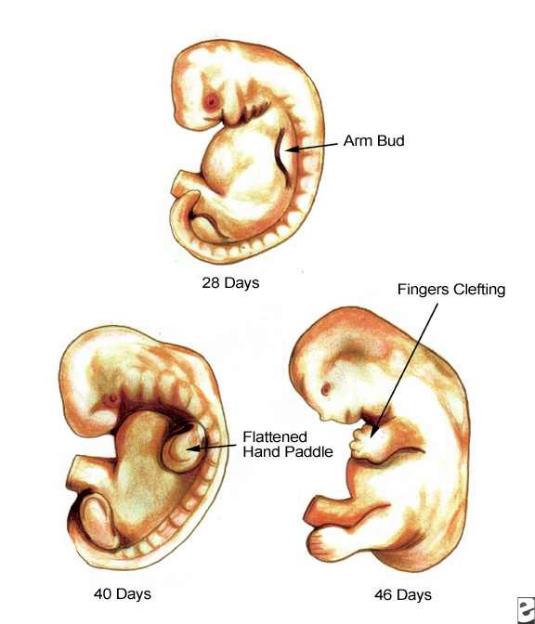
After fertilization takes place, the embryo is formed inside the female’s womb. It clings to the womb’s inside-wall feeding on the blood of the mother exactly like a leech. During the early stage of the embryo formation (i.e. first 3 weeks) the heart is not yet built.
Therefore, the embryo is filled with blood that is not circulating, it is literally a blood clot.
Hence, the two literal meanings of the Arabic word “Alaqah” are actually giving a perfect description of the embryo at its early stage.
Human Embryo: This is a photo of the human
embryo at different stages of its formation.
Notice how the vertebra looks like teeth marks
on a chewed morsel, and how the general shape
of the embryo gives you the same impression
that this is a chewed morsel, or what is called
in Arabic Mudghah. After the start of blood
circulation, the embryo develops into a lump of
flesh in which the heart, brain, head and the
tissue that later develops into the vertebra are
in the period of formation. The backbone is
formed first, followed by the rest of the bones
that are later wrapped by the muscles and then
the flesh. After 6 weeks the facial features
begin to form. Amazingly this was literally
stated by Prophet Muhammad 14 centuries ago
when he said, “When 42 nights have passed from the time of the nutfah (i.e. time of
fertilization), Allah sends an angel to it. He shapes it, makes its ears, eyes, skin, muscles
and bones...” [Recorded by Muslim]. Dividing 42 by 7, you get a 6 weeks period exactly like science has proven. After 8 weeks the fetus stage starts and the new creature continues developing. This data was only discovered by scientists after the establishment of embryology in the 19th century.
After the verses describes the reproduction process in most mammalian vertebrates, it continued to say that later on, after another long period of time, Allah developed it into
another creation. According to evolution, humans descended from mammalian vertebrates after 200 million years of mammals’ first appearance. Absolutely, among the ways through which one can understand these few verses is guided evolution.
3. “Such (i.e. Allah) is the Knower of the unseen and the seen, the All-Powerful, the
Most-Merciful, who perfected everything He created, and He originated the creation of
man from clay (i.e. water and earth mixture). Later on, He made his progeny from an
extract of a despised liquid (i.e. Male’s semen). Later on, He straightened him and
breathed into him from His Spirit (i.e. Gabriel), and He gave you hearing, sight, and
hearts. How seldom you are grateful!” [The Qur’an (32:6-9)].
In these verses, a new confirmation is made to the fact that the creation of man was originated from a water-earth mixture. Remember that the first living cell was formed—
or rather created in an aquatic environment. Later on, after a long period, man’s progeny was extracted from a phylum that reproduces through the introduction of the male’s semen into the female’s reproduction system. Later on, after another long period, Allah straightened this creature and breathed into him from His created spirit (i.e. Gabriel).
220
I believe that this is an allusion to the creation of the “homo sapiens sapiens,” who were preferred by the Creator above other creatures with the “Intellect” or “Human-Mind.”
This angelic breath granted by the intelligent creator through his archangel resulted in the main peculiarity of all humans, and made us the chosen vicegerents on earth. This breath was the most significant part of our preparation to receive our Creator’s messages, understand them, learn their content and live through their guidance. Actually, this is what Allah refers to in the Qur’an in chapter At-teen or The Fig, verse 4: “Verily We have
created man in the best modification.” (95:4). Of course, this modification requires a previous lesser creature. When you look at the other creatures, you will see that man is not the strongest or fastest among them; nonetheless, he is the smartest and most capable.
Though horses are much faster than men, but it is man who rides horses not the contrary.
It is man who studies the horse’s anatomy and treats its pains and illnesses, not the opposite. It is man who builds barns in which he takes care of horses, etc. Consequently, man is the most intelligent design; or to be more precise, the most intelligent creature created by Allah Almighty on this earth, and he must fulfill his duty towards all other creatures to succeed in his mission.
4. “Was there not a period of time when mankind was nothing worth mentioning?
Verily, We created man from a mixed sperm-drop so that We might try him, We gave
him hearing and sight, We showed him the way, whether he be grateful or ungrateful
(rests on his will).” [The Qur’an (76:1-4)].
The Qur’an is confirming that there has been a period of time when mankind was nothing worth mentioning. One way to understand the 1st verse is that it is referring to the period of time when all living creatures were still nothing but a single celled organism from which our Creator developed all living creatures. The verses then continue to confirm that mankind was created from a mixed sperm-drop, referring to the male’s sperm mixed with the female’s ovum. This entails that mankind was not created separately, but rather developed from previous ancestors. This comes in line with the previous verses and the contemplation given about them.
5. “O People, worship your Lord, who created you and those before you, so that you
may learn devoutness” [The Qur’an (2:21)].
This verse is clearly stating that there were other creatures before us as humans. Some people may say that this verse is referring to the angels, but the context implies that those creatures whom the verse is referring to were earth inhabitants.
6. “Remember when your Lord said to the angels, ‘I am going to instate a vicegerent
on earth,’ they said, ‘Will You instate therein someone who will cause corruption and
shed blood, while we glorify You with Your praise and extol Your holiness?’ (Allah)
replied, ‘Surely, I know that which you know not.’ And He taught Adam all the names,
then He set them before the angels and said, ‘Tell Me the names of these, if what you
say be true.’ They said, ‘Glory be to You, we have no knowledge except whatever You
have taught us. You are the All Knowing, the All Wise.’ Then He said, ‘O Adam, tell
them their names.’ When Adam had told them the names, (Allah) said to the angels,
‘Did I not tell you: I know the secrets of the heavens and of the earth, and I know what
you reveal and what you conceal?’ And remember when We said to the angels,
‘Prostrate yourselves before ‘Adam!’ So, they prostrated, all but Satan, he refused, and
became one of the disbelievers (in Allah’s wisdom).” [The Qur’an (2:30-33)].
221
These verses are describing the preparation of Allah’s first chosen prophet, “Adam”—the newly introduced intelligent creature—to be God’s vicegerent on earth after teaching him what was referred to as “all the names.” If you take a look at any little child in the phase of learning speech, you will see his parents teaching him the names of all surroundings, this is how any child learns how to speak. Without the ability to speak, no prophet could have conveyed his message to his people, no learning of any kind would have been possible and there wouldn’t have been any civilizations on earth today.
Another notable point here is the response of the angels—Allah’s obedient servants—
when Allah informed them that He was going to instate a vicegerent on earth, they said,
“Will You instate therein someone who will cause corruption and shed blood?”
They didn’t say for instance, “O Lord, praise be to You, You are The Omniscient Creator,” or “Create whatever You will, You are The Omnipotent Creator,” nothing of that sort. On the contrary, their response implies that they were shocked that Allah will instate a vicegerent on earth from among the creatures He created therein. According to the angels’ response, those creatures were shedding blood and causing corruption.
But Allah told them that He knows about that still non-existing creature—the awaited vicegerent—what they knew not.
Scientists have discovered that before the existence of today’s humans, there existed a primeval human whom they named: “Homo sapiens Neanderthals.” He was less skilled and less intelligent than the contemporary human. He inhabited the earth for approximately 150,000 years before extinction nearly 35,000 years ago. Scientists say that Neanderthals were skilled hunters who lived in caves. They ate meat and used arrows and spears in hunting. Neanderthals coexisted with today’s humans for 10,000-15,000
years. They must have been a source of disturbance for the humans of that day with their stern appearance. Both parties must have fought against one another. The rivalry ended with the extinction of Neanderthals. After that, humans continued securing themselves and building communities that later on formed civilizations.
Today we can see humans taking care of all sorts of creatures at their homes, or in their farms, stables, pens, barns, yards, zoos, etc. Humans have developed even medical departments for animals in their medicine schools and we see veterinarians in each and every village in the world. Humans even try to guard and protect rare species in natural preserves. If you ponder over all creatures existing on earth, you will see that humans are the only species who have the ability to study other creatures thoroughly, take care of them, and if they willed, truly become Allah’s vicegerents on earth. This is their trust and tribulation. Those who try to succeed in fulfilling this task shall prosper forever, and those who betray their trust, spread corruption and shed blood shall be doomed.
After the creation of the awaited vicegerent, granting him the ability to learn and deduce new information by bestowing upon him the bliss of the Human-Mind, and after teaching him speech, which was not among the abilities of the previous creatures on earth, it was time for honoring Allah’s most intelligent creature, first chosen prophet and vicegerent on earth. In obedience to Allah’s order, the angels prostrated themselves to Adam but Satan refused out of arrogance. This was the start of enmity between the two creatures, the one whose creation started from clay, and the one whose creation started from fire.
According to the Qur’an, this was the original sin, the first sin that was ever committed ever since the start of creation, it was racism.
222

7. “Verily, Allah has chosen Adam and Nuh (Noah) and the House of Ibrahim and the
House of Imran above all creatures.” [The Qur’an (3:33)].
This verse confirms that Allah chose Adam from among all those He created. Choosing requires choices, so how come that Adam was the only human created when Allah chose him to be a prophet, and the father of a great intelligent species capable of receiving their creator’s messages, understand them, follow the guidance and light therein, and fulfill their duty in being Allah’s vicegerents on earth?! The verse speaks for itself.
8. “Your Lord is the self-sufficient One, the merciful. If He wills, He can take you away
and instate as vicegerents whomever He pleases, just as He created you from the
offspring of other people.” [The Qur’an (6:133)].
This verse is again clearly stating that all humans were created from a previous progeny of another nation or other people. According to this account of contemplation, I can’t but say that this is a clear reference for the occurrence of some kind of guided or controlled evolution, not random mutation or natural selection. Scientists say that modern humans (i.e. Homo sapiens sapiens) were created from the offspring of a previous mammalian species whom they called “Homo erectus.”
9. “He (Allah) brings forth the living from the dead and the dead from the living. He
gives life to the earth after its death, and you shall be raised to life in the same manner.”
[The Qur’an (30:19)].
This verse states clearly that Allah—The Omnipotent Creator—is The One who gives life to what’s dead, and the one who takes it back whenever He wills. Scientists tell us that
[Water + Organic Carbon Compounds + Energy = Life]. Hence, according to this, the first living cell did not come to exist on its own, but through the organization of an Omniscient Creator and by His power. He has been sending us messages to teach us about ourselves and His supreme being ever since our existence started.
What you have read so far was a trial to understand the Qur’anic verses discussing the start of creation within their linguistic frame, placing them as evidence one over the other, and meanwhile pondering over them under the spotlight of the scientific findings. I have used literal translations for all verses without even the slightest change in the wording except when necessary, and you will find it placed between brackets. This contemplation does not mean that the Qur’an is confirming the evolution theory that we have at hand; it simply shows that our Creator could have used evolution as a mechanism or a method in creation. May Allah guide us to the truth; Amen.
223
Qur’anic verses used by some scholars to refute the previous contemplation: Some scholars would say that this explanation contradicts some other verses from the Qur’an itself. They would present the following verses:
1. “Your Lord said to the angels, ‘I am going to create a human-being out of clay, then
if I straighten him and breath from My spirit into him, prostrate yourselves before him. ’
Thereupon, the angels prostrated themselves, all of them together, except Satan, he waxed proud, and became one of the disbelievers (in Allah’s wisdom). (Allah) said, ‘Satan, what
prevented you from prostrating yourself to what I created with My own Hands? Did you wax proud or were you among the lofty ones?’ Satan replied, ‘I am better than him. You created me from fire, but You created him from clay.’ (Allah) said, ‘Then get out from
here! You are accursed: My curse will remain upon you till the Day of Judgment!’ But Satan said, ‘My Lord, grant me respite until the Day of Resurrection,’ so (Allah) said,
‘You are granted respite till the Appointed Day.’ (Satan) said, ‘By Your Honor, I will lead all of them astray, except for those among them who are Your chosen servants.’ (Allah) said, ‘Then the truth is—and I speak only the truth—that I will definitely fill up Hell with you and every one of them who follows you, altogether’.” [The Qur’an (38:71-85)].
These verses state that Allah, The Creator, told the angels—his loyal servants—that He was going to create a creature from clay. Later on, if the time comes when Allah straightens him and makes his created spirit (Gabriel) breathe into him, they must prostrate themselves to him in honoring for Allah’s new creature, for it is created in the best modification as previously explained. Some scholars refuse accepting the point of view adopted in this research saying, “How could Allah’s method in creation be guided evolution when He Himself states in the previous verses that He created Adam—the new honored creature—with His own hands?”
To their question we respond reminding them that our main and major reference is the Qur’an itself, and if we get back to the Qur’an to understand what Allah means by creating Adam or any creature with His own hands, we will find the following verse:
“Do they not see that, among the things which Our hands have fashioned, We have created for them cattle of which they are the masters?” [The Qur’an (36:71)].
Does this verse mean that Allah created our cattle with His own hands? Of course it does not. It simply means that He started the creation with his power. He designed and fashioned everything to be what it is, He is the best of creators. Let’s simplify this for better understanding. When an architect designs a building; later on, after a few years, his building is established and there he stands watching it and says, “This is the work of my own hands.” Do you understand these words in the sense that he must have dug the ground works, carried the bricks one by one, manufactured the glass, the cement, the iron beams, etc., and later on, installed everything in its place! Or do you simply understand the words in the sense that he was the designer and originator of the building? Moreover, try to imagine that the architect’s servant—an ignorant arrogant young fellow—stands beside the building looking at it with contempt. When the architect sees him, he says in anger,
“Why do you despise what I created with my own hands?” Of course, no one understands these words except in the sense that the architect was the designer of the building.
224
Allah is the supreme Designer, Creator and Originator. This is how He describes Himself in the Qur’an in different places:
“Surely your Lord is the Omniscient Creator!” [The Qur’an (15:86)].
“Glorious is Allah, the Best of Creators.” [The Qur’an (23:14)].
“Is He who created the heavens and earth not able to create others like these people?
Surely He is! He is the Supreme Creator, the All Knowing” [The Qur’an (36:81)].
“Do you (sons of Israel) call on Ba’al and abandon the Best of Creators, Allah, your Lord and the Lord of your forefathers?” [The Qur’an (37:125-126)].
Hence, we are all Allah’s creation, we were all created by His hands, not in the direct sense of the word, but in the sense described in the Qur’an itself and further strengthened by logic and science.
2. “O mankind! Fear your Lord, who created you from one soul, and from it He created
its mate, and from them spread countless men and women.” [The Qur’an (4:1)].
Some scholars will say, “How about this verse? Doesn’t it clearly indicate that Eve was created from Adam’s rib, and that all humans are their offspring?”
Our response is that: First, the stories mentioned in the book of Genesis about the start of creation, and the creation of Eve from Adam’s rib are not mentioned anywhere in the Qur’an. On the contrary, the verses of the Qur’an totally negate and contradict the account given in the Bible about creation. Second, this verse does not say anything of what you have mentioned, you are now following the Bible and a couple of weak traditions, and presenting them as evidence on your understanding. This verse is clearly stating that both males and females were created from the same human soul or the same kind; they will always be attracted to each other and find tranquility in one another. As a result of this design, males and females mate, and their offspring continues to multiply spreading all over the earth upon which they were instated as vicegerents. This was a necessity for fulfilling their assigned task. Third, as stated before, our main and major reference is the Qur’an itself. If we search in it, we will find the following verse that clears up the misunderstanding:
“And it is among His signs that He has created for you wives from yourselves, so that you may find tranquility in them, and He has created love and kindness between you.
Verily, in this are indeed signs for people who reflect.” [The Qur’an (30:21)].
Of course, no man understands from this verse that the woman he chose to be his wife was created from his rib, but rather from his kind. This verse makes it crystal clear that some scholars were misled in their contemplation by the biblical story of creating Eve from Adam’s rib. Actually this is why all translators add the word ( among) before ( yourselves) in verse (30:21) so that the meaning understood in Arabic would be correctly conveyed. This opinion was the one given by some of the most notable scholars like Sheikh Muhammad Metwally Ash-Sha’rawy (1911-1998), who said in his explanation of verse (4:1), “Allah says in the Qur’an: “There has come to you a prophet from
yourselves.” [The Qur’an (9:128)]. So did Allah create Prophet Muhammad physically from us?! Of course not. The verse means that Muhammad was a prophet from our kind, the human kind.” Sheikh Muhammad ‘Abdou (1849-1905) as well had a similar opinion.
225
In his explanation of the verse, he said, “If the expounders have interpreted the ‘one soul’
as Adam, then they have not taken this from the Qur’anic text or its direct meaning, but rather from an incontestable tale according to their understanding, that Adam is the father of all human beings. There is no definitive verse in the Qur’an stating that all humans are the descendants of Adam. The ‘one soul’ mentioned here is the human soul.”
Fourth, verse (4:1) does not say that only Eve was created from that “one soul,” but all of us were created from it. The verse is stating very clearly that this “one soul” is for all of us, for our kind, the human kind. Hence, the ‘human soul’ is what the verse is referring to, not Adam, and certainly not his rib. The human soul according to the Qur’an is a divine secret that only Allah knows. He says, “They ask you [O Muhammad] about the soul.
Say, ‘The soul owes fealty to my lord (alone); you haven’t been granted but little knowledge.’” [The Qur’an (17:85)].
3. “Verily, the example of Jesus before Allah is like the example of Adam. He created
him from earth, later on, He said to him, ‘Be!’ and he was.” [The Qur’an (3:59)].
Some scholars say, “This verse refutes your contemplation. It literally states that Adam and Jesus are alike. They were both created from dust instantaneously with a single worded order, which is ‘BE,’ and there they existed without the need for two mates.
This word was all that Allah uttered to create them both.”
Our response is that: First, the verse does not say that any of the 2 magnificent prophets was created instantaneously. On the contrary, the verse literally says “later on,” which means that their creation initially started from earth, then after a long period of time, they came to exist as human beings when Allah willed it. Second, as for the single worded order ‘BE,’ all of the universe was created with that same order but through the method designed by our Creator and described in the previous Qur’anic verses. Since that the Qur’an is our reference, read the verse that says, “(Allah is the) Originator of the heavens
and the earth. When He qada (i.e. literal translation is: decides or finalizes) a matter,
He simply says to it, “Be,” and it comes to be.” [The Qur’an (2:117)]. This verse is mentioned several times in the Qur’an. It stands as evidence on the inconsistency of the instantaneous creation understanding. The verse is saying that this single worded order is given by Allah to any matter after He decides everything about it, executes its design and finalizes it. It is like the attack order given by field commanders after training their soldiers, placing the plan, distributing the duties, preparing the weapons, etc. Later on, on the battlefield, all of the previous is implemented precisely according to the plan by the word ‘attack’ or a battle cry. Likewise, our Creator makes His design, chooses the elements contributing in it, organizes the matter, and finally gives His order ‘BE’ so that all elements would interact and produce what Allah wills. Think about it logically, if the new creature doesn’t exist then to whom is the order ‘BE’ given in the first place?! We say that it is given to the elements organized by the Creator to form it. Third, verse (2:117) states that everything including us was created by this word, but still we all needed a father and a mother to mate, fertilization to occur, and a 9 months pregnancy period before we came to the world. This totally refutes the instantaneous creation understanding.
Finally, Allah Himself says in the Qur’an: “Then He (i.e. Allah) equilibrated unto the
sky when it was [still] smoke and said unto it and to the earth, ‘Come willingly or
unwillingly.’ They said, ‘We come willingly [O Lord].’ ” [The Qur’an (41:11)]. Hence, Allah’s creation order is not always “BE” like you think. It could be whatever He wills.
226
Now what about Jesus P.B.U.H.? The Qur’an tells us that Lady Maryam’s pregnancy was miraculous. She conceived Jesus after Allah ordered Gabriel to breathe into her womb creating the baby who was to be Jesus. Hence, it never says that Jesus was created instantaneously. The Qur’anic verses praise Jesus and his mother in a magnificent way.
Meanwhile, it continuously reminds us that Jesus was human, a part of Allah’s creation whose birth was made miraculous from a woman known of her virginity and great chastity. This stood as evidence on his Prophethood in front of the sons of Israel.
The Qur’an tells us that when the Israelites asked Lady Maryam about the baby she came carrying, she pointed to the child and Jesus spoke in the cradle saying, “I am Allah’s servant and His messenger.” May Allah’s peace and blessing be upon Jesus and his mother. The Qur’an tells us about Jesus’s miracles. More miracles are even mentioned in the Qur’an than those mentioned in the gospels.
Hence, the likeness between Adam and Jesus is in the process of their creation. Both of them came to exist without biological parents. Both received an angelic breath directly from the archangel Gabriel by divine orders from our Creator. This angelic breath granted them abilities that were unimaginable for the rest of the people existing during their time so as to strengthen them in their missions. Adam was the first human to speak, and Jesus was the first infant to speak. They were both taught and granted knowledge by their creator. Adam answered questions all angels couldn’t answer, and Jesus cured diseases all people couldn’t cure.
I hope that the previous contemplations open a new window to understanding the Qur’an among Muslims and non-Muslims equally. This should not be thought of as a trial to confirm evolution, nothing of that sort. This was just a trial to see whether the Qur’an refuses the concept of evolution or it simply doesn’t negate it, that’s it. Among the scholars who did not see that evolution contradicts the Qur’an, and that it could be the method which Allah adopted in creation, are the following renowned ones: 1. Sheikh Hussein Muhammad Al-Jesr (1845-1909 A.D.): he was a Lebanese Azhary scholar and a coeval of Darwin.
2. Sheikh Muhammad Abdou (1849-1905 A.D.): he was an Egyptian Azhary scholar who became the grand jurist ( Mufty) of Egypt in 1899.
3. Sheikh Tantawy Juhary (1870-1940 A.D.): he was an Egyptian Azhary scholar and a pioneer in writing about the scientific statements in the Qur’an.
4. Sheikh ‘Abdullah Al-Jesr (1897-1980 A.D.): the son of Sheikh Hussein Al-Jesr and the grand jurist ( Mufty) of Lebanon.
5. Sheikh Abd El-Sabour Shaheen (1929-2010 A.D.): he was an Azhary scholar who wrote a book named, “My father Adam.” In it he compared the evolution theory to the Qur’an and concluded that it could be the method adopted by Allah in creation.
May Allah guide us all to the truth or grant us the honor of dying while seeking after it sincerely, Amen.
ــ
ــ ــــــــــــــــــــــــــــــــــــــــــــــــــــــــــــــــــــــــــــــــــــــــــــــــــــــــــــــــــــــــــــــــــــــــــــــــــــــــــــــــــــــــــــــــــــــــــــــــــــــــــــــــــــــــــــــــــــــــــــــــــــــــــــــــــــــــــــــــــــــــــــــــــــــــــــــــــــــــــــــــــــ
1: The expression “My spirit” must not be understood in the sense that Allah is a spirit. It means the spirit that I have created, the spirit of life. Some scholars say that this is a reference to Gabriel, the archangel who bears the responsibility of conveying Allah’s messages to His chosen servants. Allah calls him in different places in the Qur’an “The spirit.” E.g. verses (19:18) & (26:193). The second opinion was preponderated by Ibn ‘Abbas and others. Nonetheless, both meanings are valid.
227
Among the most common misconceptions raised against the Qur’an is the issue of “Abrogation.” Some would say: “How come the verses of the divine book contradict themselves? One time God says one thing; later on, He says another! How could this hesitating attitude be attributed to the Omniscient Creator? It seems that the God of the Qur’an didn’t know any better than this. Way to go Muslims, keep up the spirit of faith!”
The previous, alongside many other taunting sentences are directed to Muslims all the time. Let’s get started by explaining some facts about the Qur’an in brief, and then we shall tackle some verses deemed contradicting sometimes. First, it’s important to know that knowledge in the Qur’an discusses a variety of subjects, mainly the following ones: 1- Knowledge about our creator → Creed of Faith.
2- Knowledge about the previous nations → Lessons considered from History.
3- Knowledge about people of the book → Misconceptions and distortions.
4- Knowledge about the hereafter → Future events, Judgment Day, Heaven and Hell.
5- Knowledge about ourselves and the universe → Creation and Life.
6- Knowledge about the first generation → Prophet Muhammad and his coevals.
7- Knowledge about rituals and rites → Main pillars of Islam.
8- Knowledge about duties and rights in this life → Legal rulings, Laws, etc.
With this built up knowledge about the Creator and the creation, the present and the past, this life and the hereafter, we find that spiritual and materialistic guidance are both made available and balanced in the Qur’an. This helps the believers build up a moderate personality and live rightly. From my personal experience, pondering over the verses of the Qur’an and working your mind into understanding them is a very big step towards achieving the peace of mind and tranquility of soul. Try it yourself, write down your contemplations so that you may read them back later, and you shall get to know why the Qur’an is truly a Holy Divine Book.
Back to abrogation, the Qur’anic branch of knowledge concerned with it is the 8th branch mentioned above—the one related to “legal rulings.” This is mainly because legal rulings prescribe legal relationships between people the way our creator wishes them to be observed in different situations. Meanwhile, the remaining branches of knowledge in the Qur’an have always remained the same. Legal rulings varied throughout the 23 years of Prophethood. Many prophets received certain legal rulings for their respective communities. With time, these rulings were changed or abrogated in latter messages according to what our creator knows is best for His vicegerents.
When Prophet Muhammad started preaching Islam in Arabia, its teachings were quite different from the Arabs’ customs and daily life traditions. Arabs used to practice polygyny without any limitations. They were addicted to drinking wine and gambling.
Adultery and fornication were practiced freely. Beating women was something normal.
Burying newborn females alive was a matter of honor. Despising slaves, mistreating them; and in case of disobedience, flogging or slapping them was something normal, etc.
Those bad customs were so deeply entrenched in the society that it was so hard to change people’s attitude all at once and convince them to abandon them.
228
Therefore, the Qur’an brought important tough changes gradually; that was to help all people adjust to the new prescriptions, while observing their welfare in the process and reducing any difficulty. Let’s take an example for better understanding. In the Qur’an, there are four verses tackling the issue of wine. Drinking wine was widespread among Arabs before the advent of Islam. Although a social evil, it was highly esteemed and many of them were addicted to it. This is why its prohibition was revealed in 4 stages:
1- “And from the fruits of date palms and grape vines, you obtain intoxicants, and good
provision. Surely, in that there is a sign for people of understanding.” [The Qur’an (16:67)].
This verse is a lenient blame from the Creator to the believers. It is an invitation to think and ponder over how they make use of Allah’s provision from dates and grapes.
They either enjoy their natural taste by directly eating them, or they use them in making wine and intoxicants which are not a good provision. Later on, after this verse was revealed, many of the companions went asking the prophet about wine’s lawfulness and whether it was something evil or not.
2- “They ask you [O Muhammad] concerning wine and gambling. Say: ‘In them is
great sin, and some profit, for men, but the sin is greater than the profit.’ ” [The Qur’an (2:219)].
This verse was revealed to the prophet in response to the previously mentioned incident.
The verse here emphasizes that drinking wine is a doorway to sins, as it dulls the senses and weakens your consciousness. Since that consciousness acts as brakes against indulging into lusts and evil deeds; therefore, once it is anesthetized, the doorway to all sorts of evil deeds is left open. As noted in this verse, drinking has not been clearly identified as something unlawful but its evil has been pointed out clarifying that it may lead man to many sinful acts. This allusion was a kind of good advice urging the believers to reduce the wine dosages they were used to. Nonetheless, complete prohibition was still on hold for a wisdom that only The Creator knew back then.
3- “O you who believe! Approach not prayers with a mind befogged (drunk), until you
realize [the meaning of] all that you say.” [The Qur’an (4:43)].
Now, in this verse, Allah clearly prohibited the believers from approaching their prayers while they are still under the effect of wine. They must be completely sober in order to perform the prayers ordained upon them. Since that there are five prayers every day starting with the dawn prayer, followed by the noon prayer, then the afternoon, then the sunset, and finally the evening prayers, therefore, the only available time for drinking will be during the night. This is the only period long enough for those who drink to get rid of the drinking side effects. This verse is a semi-prohibition that resulted in a significant decrease in the wine dosages Muslims were used to. However, complete prohibition is on hold for a wisdom that only Allah knew back then.
4- “O you who believe! Intoxicants (i.e. all kinds of alcoholic drinks) and gambling,
[dedication of] stones, and [divination by] arrows, are an abomination of Satan’s
handwork; eschew such [abomination], that you may prosper. Satan’s plan is but to
inveigle enmity and hatred amongst you through intoxicants and gambling, and hinder
you from the remembrance of Allah, and from prayer: will you not then abstain?”
[The Qur’an (5:90-91)].
229
These verses were the last stage that led to complete prohibition of drinking wine.
Humans have no sustainer or helper except their Creator. This gradual prohibition for wine proves that Allah is All-Knowing of his creation, He is All-Wise and Most Merciful.
Had wine been prohibited suddenly in one step without this gradual reduction to the dosages that Muslims were used to, they would have failed to quit. This was to give all people the least possible inconvenience. Regarding Allah’s orders and obligations that He imposes upon mankind, Allah says in the Qur’an: “Allah burdens not a soul beyond its
capacity.” [The Qur’an (2:286)].
The demand and need for this mercy, wisdom and full knowledge of the human nature that suffers incredibly to cut away from a habit of a life-time—especially like addiction to drinking wine—was the reason behind this gradual prohibition. The reader here should not think that the verses of the first two steps were abrogated and so are no longer required, for what would the situation be if a person was dizzy with a foggy mind under the effect of a medical anesthetic and wanted to pray? The answer is still in the verse of the third stage, he should not approach his prayers with a befogged mind. Also what will the situation be if a person embraced Islam recently, and he or she was addicted to drinking? The same Qur’anic approach should be followed in treating his or her addiction.
Through this approach the new Muslim may reduce his drinking habits until he finally stops drinking.
What does the Arabic word “Naskh” mean?
The word “Naskh” is translated linguistically as “Abrogation,” “Annulment,”
“Repealing,” or “nullifying.” Its idiomatic meaning is a bit different. Allah gradates His legal injunctions knowing fully well that the circumstances are going to change in such a way that some laws will no longer be best for people’s interest. Hence, when the circumstances change, a more suitable law is promulgated, until finally, the aimed law from the very beginning is reached, and the community’s circumstances are improved.
The previous example from the Qur’an was a verification for this.
This is exactly like a physician who is trying to treat a patient. First, he prescribes a certain medicine in view of the patient’s present conditions, while he knows very well that after the patient uses this medication for two weeks, his condition will change and require a new medicine or a new dosage. Therefore, based on his knowledge, he prescribes the proper medicine and dosage suitable for the patient’s current condition and tells him to come back after 2 weeks for recheck and consultation. Two weeks later, when the patient’s condition has developed and the circumstances have changed, the physician prescribes a new medicine and a new dosage. Some may think that the physician can easily give the patient written instructions for the whole course of treatment with all modifications duly indicated. To this logic we say, how will the patient know whether his condition has developed to the next level or not without consulting the doctor?!
This would be putting too much burden on the already feeble patient, and there would be the danger of some harm resulting from possible errors or misunderstanding from the patient’s side. This is the only form of abrogation which has been occurring in the Qur’anic injunctions for the sake of mankind’s reformation. In short, it is not abrogation but rather gradation in the legal rulings.
230
The early generations understood “Naskh” to mean restricting a general law promulgated based on certain conditions. This is why ‘Ali Ibn Abi-Taleb stressed that no one should dare to explain the Qur’an unless he or she knows the abrogating and abrogated injunctions (Al-Nasekh Wal-Mansoukh). Example: Some people may think that wine is not prohibited in the Qur’an when reading the verses of the first three stages mentioned earlier. Some others may think that the new Muslim who is still addicted to drinking wine should be punished if he drinks. Both of the previous understandings are wrong. Drinking intoxicants is prohibited in the Qur’an, and those who are addicted to drinking must be given sufficient help to quit drinking before any blame is directed to them if they return to this bad habit. Therefore, the Knowledge of the verses tackling the same issue, and the understanding of their gradation is very important. It’s the doorway to correct application of the Islamic laws.
Scholars of the later generations—probably after the 6th century—had a different understanding of the word “Naskh.” According to their writings, they spoke of “Naskh”
as abrogation and nullifying, not gradation or restriction of general laws according to prescribed circumstances. Because of this development in the understanding of “Naskh,”
tens of misconceptions evolved. Many semi-knowledgeable scholars considered the verses tackling the same issue but giving different injunctions, contradicting.
Consequently, they investigated which was the most recent verse revealed to the prophet, and they abrogated the others. This led to huge misunderstandings for many issues in the Qur’an, and the negligence of tens of verses. Hence, many erudite scholars took the initiative of writing down books explaining the issue of “Naskh,” clarifying the verses that were permanently abrogated, and refuting the misconceptions about the other verses.
This leads us to the following important question:
How many verses are permanently abrogated in the 6236 verses of the Qur’an?
The number of verses that are abrogated in the Qur’an vary according to scholars’
understandings. I couldn’t help but notice that in most exegesis, the more reasonable and logical the scholar is, the fewer this number is. Some scholars even argue that there is no abrogation in the Qur’an. Let’s explore what some notable scholars said about this issue.
According to the Mu’tazily scholar Abu Muslim Al-Asfahany (254-322 A.H.), there is no abrogation in the Qur’an and all of the Qur’anic verses remain applicable according to the situation at hand. The great Hanbali scholar Ibn Al-Jawzy (508-597 A.H.) wrote a voluminous book about this issue in which he tackled all of the verses that the scholars during his time claimed were abrogated. He counted 247 verses; he analyzed them and concluded that only 22 verses were abrogated. According to Imam Jalal Ad-Deen As-Soyouty (849-911 A.H.) there are only 20 abrogated verses in the Qur’an. Dr. Mustafa Zayd (1337-1398 A.H.) was an Egyptian Azhary scholar who received his PhD in this specific issue. He gathered all of the verses claimed to be abrogated throughout the previous centuries. He counted 293 verses. No other acknowledged scholar ever claimed that there was abrogation in more than this number of verses. Dr. Zayd analyzed each case and concluded at the end of his huge research that only 6 verses were permanently abrogated in the Qur’an. This research took Dr. Zayd 10 years to finish it.
It is published today in 2 huge volumes under the name “Abrogation in the Qur’an,” ( An-Naskh fel-Qur’an).
231
Hence, the issue of “Naskh” has always been a controversial issue among scholars, that’s because it depends on the understanding of every scholar to the verses, which is something that could never be unified. People have different ways of thinking, different approaches in their analysis of any issue, and above all, different minds. All we can do is adopt the most reasonable opinion we reach.
Examples of the verses that are mistakenly thought of as abrogated: 1. “It is prescribed that when death approaches any of you and he is leaving behind wealth, he shall bequeath in favor of his parents and relatives equitable shares, a duty for all who fear Allah.” [The Qur’an (2:180)].
Before Islam, if a person died, his wealth moved directly to his mature sons or brothers without paying any attention to the daughters, young sons, parents or relatives. Islam abolished this habit and promulgated new laws in its place gradually. The above verse was the first step in doing so. In it Allah orders any Muslim who is extremely ill and feels death is close by, that if he is leaving behind considerable wealth, then he should bequeath in favor of his parents and relatives equitable shares from this wealth. This is an obligation from Allah.
Some scholars say that this verse was permanently abrogated by the inheritance verses of chapter 4 (The Women). Allah says in the Qur’an: “Each of your parents receives a sixth of what you leave if you have children. If you are childless and your heirs are your parents, your mother receives one third. If you have brothers [or sisters] your mother receives a sixth, after [the deduction of] any bequest you make or the repayment of any debts. With regards to your parents and your children, you do not know who of them is more helpful to you, but this fixing of shares is by Allah and He is All-Knowing and All-Wise.” [The Qur’an (4:11)].
After the promulgation of this injunction in the Qur’an, Prophet Muhammad said,
“There is no bequest for those who have a prescribed share of inheritance.”
[Recorded by Tirmidhī].
Based on verse (4:11) and the mentioned tradition, Allah has prescribed for all members of the family fixed shares of inheritance. Therefore, they are not entitled of any bequest.
The question here is what if the parents were not Muslims? Of course, non-Muslims are not entitled of the inheritance shares prescribed in the Qur’an, so what would be the proper action in such a case?
The Islamic injunctions permit any person to cut one third of his or her wealth, and bequeath it in favor of whomever he or she wills. Those who already have prescribed shares of inheritance are exempted. Hence, the answer to the above question is in the verse thought of to be permanently abrogated. That person should bequeath in favor of his non-Muslim parents an equitable share on the condition that this share should not exceed one third of his wealth. Moreover, verse (2:180) could not be abrogated as it didn’t only speak about parents, it spoke also about relatives. Relatives include uncles, aunts, cousins, nephews, nieces, etc. All those have no prescribed shares of inheritance in the Qur’an.
However, they are entitled of an equitable share through bequest on the condition that all shares recorded in the bequest do not exceed one third of the wealth left behind.
232
From this example, it is obvious that the above is not abrogation, it’s gradation in legislation that takes in consideration the welfare of all people and the consolidation of the community. That was done without laying a huge burden upon those who were not yet used to such laws after spending a lifetime accustomed to different traditions.
2. “O you who have believed, be pious to your Lord as properly as you should be, and do not permit death to take you except as Muslims [who have submitted to His will]” [The Qur’an (3:102)].
It is said that when this verse was revealed, many of the companions were extremely distressed by the huge burden of being obliged to be pious enough to fear Allah as properly as He should be feared. They said, “And who of us can carry such a huge burden.” The story goes on to say that when they said this statement, Allah laid down this burden and revealed verse (64:16) that says, “Be pious to your Lord as hard as you can,”
to abrogate verse (3:102).
By all means, this story is incorrect. Both of the previous verses are stressing the same thing but in different manners, that’s it. Verse (3:102) is saying that being pious as properly as we should be is to submit to Allah’s will throughout our lives, and die on this status. This is confirmed in the verse that says, “Strive in the cause of Allah as properly as you should. He has chosen you and laid upon you no over burdens in the matters of your religion, [it is] the faith of your forefather, Abraham. In this [scripture], as in former scriptures, [Allah] has given you the name of Muslims, so that the Messenger may be a witness over you, and so that you may be witnesses over mankind. Therefore, establish prayers regularly, pay the obligatory alms and hold fast to Allah. He is your master, such an excellent master and an excellent helper!” [The Qur’an (22:78)]. This was further confirmed by Prophet Muhammad himself when he told Mu‘adh Ibn Jabal,
“Do you know what’s the right of Allah on His servants? It is to worship Him alone without ever ascribing partners to Him.” [Recorded by Bukhari].
The previous verse (22:78) and tradition of Bukhari explain verse (3:102) and make it manifest that there is no abrogation whatsoever. Think logically, how could it be abrogated when it ends up saying: “and do not permit death to take you except as Muslims” ?! Another notable point here is how may Allah order us to do something that we cannot bear to do?! This could never be when He Himself says in the Qur’an, “Allah does not charge a soul with more than it can bear.” [The Qur’an (2:286)]. All of the previous makes it crystal clear that verse (3:102) was not abrogated, not even partially like some scholars claimed. To be pious and fear Allah as properly as we should is the same thing as to be pious as hard as we can.
3. “Let there be no compulsion in religion, what is rational stands manifest from falsehood, whoever refuses to follow satan’s temptations and believes in Allah has grasped the strong handhold that never breaks, Allah is all hearing and all knowing.”
[The Qur’an (2:256)].
Extremists claim that this verse—among others—were abrogated by a verse they named the “sword verse.” This is pure innovation. There is no such a thing as the ‘sword verse,’
nor is the word ‘sword’ ever mentioned in the Qur’an. There are verses that order Muslims to fight under described circumstances but never to force others to embrace Islam. These verses shall be dealt with in details in the next chapter. Let’s concentrate on verse (2:256).
233
To those who claim that this verse was abrogated, I ask: How can you force someone to embrace Islam when Allah Himself says, “If your Lord willed [O Muhammad] He would
have made all people become believers altogether, are you then going to compel people
to become believers! It is not for a soul to believe except by the will of Allah and He
casts His wrath upon those who do not use their reason.” [The Qur’an (10:99-100)].
How can you force people to become Muslims if faith is an act of the heart!
How can you force someone to embrace Islam or even adopt your point of view in any religious matter when the prophet and all Muslim scholars after him taught us that,
“Deeds are but by intentions.” How can you compel others to embrace your religion; meanwhile, strenuously deny the same action from their side! How can a verse that says,
“What is rational stands manifest from falsehood, whoever refuses to follow satan’s temptations and believes in Allah has grasped the strong handhold that never breaks, Allah is all hearing and all knowing,” be abrogated!
Throughout the Qur’an, Allah is inviting faith stressing upon the utilization of reason as the main path that leads to it. So who are you to change this path, and then come to claim that you are a Muslim? Know that your understanding—if you have any—is wrong.
Enough as evidence the fact that Allah says:
“Say (O Muhammad): ‘O mankind, the truth has come to you from your Lord, so whoever seeks its guidance shall verily be guided for saving his own soul and whoever goes astray shall verily stray away against it, and I am not a warder over you. ’” [The Qur’an (10:108)].
“The truth is from your Lord, so let whomsoever believes and whomsoever denies. ”
[The Qur’an (18:29)].
“If they averse, then We did not send you as a warder over them, your duty is but to convey the message.” [The Qur’an (42:48)].
“So remind them, you are only a reminder, you are not a warder over them.”
[The Qur’an (88:21-22)].
By all means, Allah does not change His opinion or take back His word. He says in the Qur’an, “My word never changes and I never wrong my servants.” [The Qur’an (50:29)].
To those who insist that all of the above verses were abrogated, all I can say is that your twisted understanding of abrogation and wrong application of the Islamic laws are harming Muslims and defaming Islam. Fear Allah whose words you take as a ride to have power, control the masses, and manipulate their wealth.
More examples of verses mistakenly considered by some as abrogated shall be tackled in their proper context. The previous three examples were just the tip of the iceberg.
As stated earlier, many books were written by erudite scholars refuting the misunderstanding about abrogation. If you wish, you can return to any of them when you encounter a verse you don’t understand; or else, suffice with the next title, it shall include the verses permanently abrogated in the Qur’an. After this, know that any other verse holding a claim of abrogation holds a meaning that negates abrogation. If you ponder over any of those verses and put your mind into it honestly, you will be able to figure out this meaning on your own. Don’t be afraid to think and use your reason like some scholars teach. The end product of their teachings is that Muslims have turned into an unworthy nation after once being the best of all nations.
234
The verses that are permanently abrogated: 1. “Believers, when you come to consult the Messenger privately, give something in charity beforehand. That is best for you and most conducive to purity. But if you cannot find anything to give, know that God is Forgiving and Merciful.” [The Qur’an (58:12)].
In this verse, Allah ordered all capable Muslims to give something in charity whenever they wished to ask the prophet about something or consult him privately. This was an obligation from Allah on all Muslims except for those who were poor or needy. Later on, this injunction was permanently abrogated by the next verse in which Allah says: “Do you fear that you will not [be able to] give in charity before your consultation? Then if you are unable to do so, [know that] Allah has turned to you in His mercy, then observe your prayers and pay the prescribed alms and obey Allah and His Messenger. Allah is All-Aware of all that you do.” [The Qur’an (58:13)].
It seems that many of the companions deemed it easy to ask the prophet about anything they wanted whenever they wished. They did so without giving any regards to his personal comfort and privacy. When this augmented beyond the prophet’s capacity, Allah revealed this obligation. Its purpose was to teach Muslims discipline and rectify their attitude. When the order in verse (58:12) was revealed, the companions found it uneasy to give something in charity whenever they wanted to ask the prophet a question.
Consequently, many of them reduced their consultation visits to the prophet.
In my opinion, through this process the companions were taught to think and ponder deeply over the meaning of the Qur’anic text, collect whatever inquiries they couldn’t find an answer for, and then raise them to the prophet. This is why the prophet was extremely keen on teaching them how to interpret the Qur’anic text through its own verses and context, and how to perform analogy whenever they faced an issue not mentioned therein. We have mentioned many examples in the first section of the book. This process was a necessary step to prepare the companions for the day in which the prophet wasn’t going to be alive amidst them anymore. Later on, after the companions’ attitude was reformed, Allah revealed verse (58:13) to remove the difficulty from the previous verse and allow them to consult the prophet freely without having to give any charity but the annual prescribed obligatory alms ( Zakah).
Some scholars were misguided by fabricated traditions ascribed to ‘Ali Ibn Abi-Taleb saying that he was the only one among the companions who gave for charity whenever he went to consult the prophet, while the rest of the companions declined. Accordingly, Allah abrogated verse (58:12). S hi‘ah claim that this is a proof that ‘Ali was the only sincere Muslim among the companions and the rest were hypocrites. To all those I say: How could ‘Ali know that he was the only one who gave for charity whenever he wanted to consult the prophet about something?! Did he spy on the other thousands of companions at the same time to see whether they gave something in charity or not before they went consulting the prophet?! Absolutely not, so please stop propagating these fabricated traditions. Try to ponder over the body of the tradition in a logical manner after you check its CON. A solid reliable CON is not enough to make a tradition authentic.
235


Amazingly, verse (58:12) is the only permanently abrogated verse in the Qur’an. The reason is obvious, the prophet P.B.U.H. is dead; therefore, it can no longer be applied.
Any other verse claimed to be permanently abrogated has a sense in which it could still be applied and there is still some need for it. The previous example of the verses tackling
“drinking intoxicants” is a solid proof on that.
Many scholars state verse (2:106) as their evidence on abrogation. This is quoting out of context. Allah says in the Qur’an:
“Those who deny the truth from among the People of the Book, and from among the polytheists, do not desire that any good should be sent down to you from your Lord.
But Allah distinguishes with His grace whomever He wills— for Allah is limitless in His great bounty. Whenever we abrogate a verse or cause it to be forgotten, We bring one better than it or one equal to it. Do you not know that Allah is powerful over everything?
Do you not know that to Allah alone belongs the kingdom of the heavens and the earth?
And, you have none, other than Allah, to protect or help you.” [The Qur’an (2:105-107)].
The abrogation spoken of in the previous verses is by one scripture to another.
Allah abrogated the Old Testament with the Gospel of Jesus, and He abrogated them both with the final testament, which is the Qur’an. The verses are crystal clear in emphasizing how the previous books were either forgotten or tampered with by their trustees.
Consequently, Allah sent down one final complete message on those whom He favored and chose to carry forth the responsibility of its deliverance to all mankind. May Allah guide us all to the truth, Amen.
236
3.6. Misunderstood verses utilized in smearing the Qur’an Some Qur’anic verses are always used by non-Muslims in smearing the Qur’an.
They have some kind of a list for those verses which they always use in the media, on internet sites dedicated for this issue, and sometimes in movies. In the next few pages I shall tackle some of these verses and clear up the misconceptions about them in a very simplified manner placing the context as the evidence on the fallacy of such accusations.
First, I’m going to write down the translations submitted to me by a fellow non-Muslim when he was presenting his argument against the Qur’an, and then I’m going to write down the complete context with the proper translation underlined. I shall follow that with a short response to the accusation according to the complete context of the Qur’an.
1. “Those who reject [Islamic] Faith, Allah will not forgive them nor guide them to any path except the way to Hell, to dwell therein forever. And this to Allah is easy.”
[The Qur’an (4:168-167)].
Islam deniers say that this verse is enough to prove that Islam is an exclusive religion.
It looks down upon other faiths and treats their adherents as infidels who don’t believe in the Creator whom Muslims call Allah.
Now let’s read the proper translation of the previous verse in its complete context in order to understand what it is actually saying. Allah says in the Qur’an:
“Because of the wrongdoings of the Jews, We forbade them certain good things that had been allowed to them before, for having frequently debarred others from God’s path, for taking usury, when they had been forbidden to do so. And because of their devouring people’s wealth wrongfully. We have prepared a painful punishment for those of them who [continue to] deny the truth. But those well-grounded in knowledge among them,
and the believers, believe in what has been revealed to you and what has been revealed
before you, as well as those observing prayers and paying obligatory charity, and those
believing in Allah and the judgment day. To them we shall give a great reward. Surely,
We have sent Our revelations to you like We have sent them to Noah and to the prophets
after him, and We have revealed to Abraham, Ishmael, Isaac, Jacob and the tribes, and
to Jesus, Job, Jonah, Aaron and Solomon, and We gave the Psalms to David. (We have
sent) Messengers, some of whom We have told you about, and some others We did not
tell you about, and Allah has spoken to Moses directly. (We have sent) Messengers giving
glad tidings and warnings, so that people may have no plea against Allah after the
Messengers (have come). Allah is All-Mighty, All-Wise. But Allah bears witness that what He has revealed to you, He has revealed it with His knowledge. The angels too, bear witness, (though) Allah is sufficient as witness. Surely, those who disbelieved and prevented (people) from the way of Allah have gone far astray. Surely, those who disbelieved and transgressed, Allah will not forgive them, nor will He lead them to a way other than the way of the hellfire where they are to remain forever. That is easy for Allah.”
[The Qur’an (4:160-167)].
These verses are describing a certain sect from among the people of the book. The people of this sect act as religious leaders and admonishers while they are not well grounded in knowledge. They refuse Islam without any truthful study or trial to understand the Qur’an.
237
They never try to compare it to the scriptures that they have in order to confirm whether it’s truly the Creator’s message or not. They don’t try to compare the knowledge in the Qur’an to what they perceive in this worldly life every day. They don’t even suffice with rejecting it, but they try to hinder others from giving the book a proper chance of examination and contemplation on its content. They never ask themselves the following important question:
“What if the Qur’an was truly the final message from the Creator of this universe and we were wrong not to study it properly and give it a true examination?”
The end product of their attitude is that they drive themselves astray and many others as well. In the previous verses as obvious, Allah is warning them; He is telling them that if they do the aforementioned and show arrogance against His message and messenger, He shall not grant them His pardon on the judgment day, and their dwelling in the next life shall be in the hellfire.
By all means, those who attack the Qur’an using the last two verses of the aforementioned Qur’anic context are doing exactly what the verses are criticizing. They trim out those two verses and present them to their followers in order to plant in their minds that Islam is a dreadful religion so stay away from it and don’t try to read its holy book. Allah is All-Aware of what they do, may He save the people from their schemes and twisted desires.
This should make it crystal clear that laymen from other faiths are not the ones intended by these verses. I believe that those who receive a distorted image about Islam in this life, or are unable to examine the Qur’an properly themselves due to some incompetence—
they shall not be wronged in the hereafter. Allah is never unjust, not in the least sense.
He shall grant them the choice whether to embrace Islam or not after having it presented to them properly. Nonetheless, every person should try to reach the truth according to the best of his or her capacity.
2. “Believers, take not Jews and Christians as friends.” [The Qur’an (5:51)].
Islam deniers say that this verse is enough to prove that Islam is a religion of hatred and enmity. It orders Muslims not to befriend the people of the book (i.e. Jews or Christians) on account of their faith.
Now let’s read the proper translation of the previous verse in its complete context in order to understand what it is actually saying. Allah says in the Qur’an:
“O Messenger, do not be grieved by those who vie with one another in denying the
truth, those who say with their tongues, ‘We believe,’ but have no faith in their hearts.
From among the Jews also, there are those who listen eagerly to any lies and listen to others (i.e. their religious leaders) who did not come to meet you [out of pride and conceit]. They (i.e. these Jewish leaders) take the words out of their context and they say,
‘If this [Qur’an] be inspired to you, receive it, but if not, then beware of it!’ [O prophet]
if anyone’s trial is intended by Allah, you cannot in the least give aid to him. Those whose hearts Allah does not intend to purify, shall be subjected to disgrace in this world and a severe punishment in the Hereafter. [This is because] they listen eagerly to falsehood, and devour forbidden things voraciously. If they come to you [seeking arbitration], you may judge between them or turn away from them. If you turn away from them, they can in no way harm you. But if you do judge between them, then judge justly, for Allah loves those who are just. Why do they come to you for judgment when they have the Torah,
238
which enshrines Allah’s own judgment? Yet, in spite of that, they turn their backs to it,
and certainly those are not believers. Verily, We have revealed the Torah in which there
was guidance and light. By it Our obedient prophets judged between the Jews. So did
the rabbis and the priests judge according to Allah’s Book which had been entrusted to
their care, and to which they were witnesses. Have no fear of people but fear Me, and do not sell My revelations for a paltry sum. Those who do not judge by what Allah has sent
down are deniers of the truth. We prescribed for them in [the Torah]: a life for a life, an eye for an eye, a nose for a nose, an ear for an ear, a tooth for a tooth, and a wound for a wound. But, if anyone forgoes, this shall be atonement for him. Those who do not judge
by what Allah has sent down are wrongdoers! We caused Jesus, son of Mary to follow
in their footsteps, fulfilling what had been revealed before him in the Torah. We gave
him the Gospel, in which there was guidance and light, fulfilling what was revealed
before it in the Torah: a guide and an admonition to the God fearing. Therefore, let
those who follow the Gospel judge according to what Allah has revealed in it. Those
who do not judge by what Allah has sent down are rebellious. We have sent down the
Book to you with the truth, fulfilling [the predictions] revealed in the previous
scriptures and determining what is true therein, and a guardian over it. Judge, therefore, between them by what Allah has revealed, and do not follow their vain desires turning away from the truth that has come to you. To every one of you We have ordained a law and a way, and had Allah so willed, He would have made you all a single nation,
but He did not so will, in order that He might try you by what He has given you. Vie, then, with one another in doing good works, to God you shall all return, then He shall make clear to you what you have been disputing about. Judge between them by what Allah has sent down and do not be led by their desires. Beware of them lest they turn you away from a part of that which Allah has revealed to you. If they reject your judgment, know that Allah intends to punish them for the sins they have committed. Indeed a large number of the people are disobedient. Is it pagan laws that they wish to be judged with? Who is a better judge than Allah for those whose faith is firm? O believers do not take the Jews and Christians as allies. They are allies with one another. Whoever of you takes them as allies then he is one of them. Allah does not guide the wrongdoers. You will see those whose minds are diseased hastening towards them, saying, ‘We fear lest a misfortune befalls us.’ But Allah may well bring about victory or a decision according to His will.
Then will they repent of the thoughts which they secretly harbored in their hearts. Then the believers will say, ‘Are these the men who swore their strongest oaths by God that they were with you’? Their works will come to nothing and they will lose all. O believers,
if any among you apostates from his faith, Allah will replace them by others who love
Him and are loved by Him, who will be kind and considerate towards the believers and
firm and unyielding towards those who deny the truth. They will strive hard for the cause of Allah and will in no way fear the reproaches of the fault finders. Such is Allah’s bounty, which He gives to whomever He wishes. Allah is Bountiful and All-knowing. Verily, your
helpers are Allah, His Messenger and the believers who preserve their prayers and pay
the alms and bow down in worship. Those who ally themselves with God, His
Messenger, and the believers must know that Allah’s party is sure to triumph. O
believers! Do not seek alliance with those who were given the Book before you (i.e.
Jews and Christians) and the deniers who ridicule your religion and make a jest of it,
if you are true believers. When you call for prayers, they take it in amusement and treat
it as a jest. This is because they are people who have no understanding. ” [The Qur’an (5:41-58)].
239
These verses are describing a certain sect of Muslims, Jews and Christians. They all claim to be adhering to their faiths, but actually, they are hypocrites. Although they know the truth and understand it with their minds, they don’t truly believe with their hearts nor do they follow Allah’s messages. Their actions contradict their understanding. They follow man made laws in their judgments and neglect Allah’s laws. The end product of their hypocritical attitude is that the world inclines towards a distorted unbalanced system more and more every day. Eventually, this shall lead to our destruction. As for the believers who acknowledge the truth when they receive it, they take Allah and each other as allies in this unbalanced system. Muslims who take hypocrite Jews or hypocrite Christians as allies are described in the verses as apostates. Allah knows what’s in their hearts; He proclaims that He shall replace them with others who are sincere in their faith.
Now the reader may wonder, why couldn’t we as Muslims take allies from among the people of the book when the prophet himself took Negus, king of Abyssinia, as an ally and he was a Christian? The prophet also took the Jews of Madinah as his allies when he immigrated to Madinah, and he respected this alliance until they committed high treason when Madinah fell under attack during the invasion of the confederates. The prophet used as well to praise a rabbi named “Mukhaireeq” for refusing to betray the alliance with Muslims and died while defending Madinah with the Muslims’ army in the “Battle of
‘Uhud.” The verses answer all these questions saying that those among the people of the book who ridicule Islam and treat it as a jest are the ones intended. There are many from among the people of the book who respect Islam and treat Muslims in a very kind manner.
I knew an American who was raised in adoption by a Christian mom. He told me that when he started thinking about embracing Islam, she gave him great support and never tried to hinder him from following his heart. He described her to be the most honest woman he ever knew. When he spoke about her final illness and departure, the grief in his voice was honestly heart breaking. People are not all alike, some non-Muslims may respect Islam more than some born Muslims do. Those who respect your religion are the only ones worthy of your friendship and alliance.
Amazingly, Islam haters neglect the entire preceding context and trim out only verse (5:51) from amidst it. The worst forgery of all is when they neglect verse (5:57) in the same page, this verse is very clear in stating that those who ridicule Islam and mock Muslims are the ones intended by the preceding verses, but as the verses describe their attitude “This is because they are people who have no understanding.” The Qur’anic context is clear, it doesn’t need elaborated explanation. Please read it again and decide for yourself whether this is a religion that promotes hatred, or mutual respect.
3. “I will terrorize the disbelievers. Therefore smite them on their necks and every joint
[and incapacitate them. Strike off their heads and cut off each of their fingers and toes]” [The Qur’an (8:12)].
Islam deniers say that this verse is enough to prove that Islam calls for terrorism and violence. They say it’s a sick religion that orders its adherents to kill those who don’t accept it in the most terrible ways.
Now let’s read the proper translation of the previous verse in its complete context in order to understand what it is actually saying. Allah says in the Qur’an:
240
“[Remember] When you begged your Lord for help, He answered you, ‘I will reinforce
you with a thousand angels in succession.’ God made this a message of hope to reassure
your hearts. Help comes only from God, He is mighty and wise. Remember when He covered you with slumber as a reassurance from Him, and sent down water from the sky to purify you, to remove Satan’s insinuations from your [hearts], to make your hearts strong and your feet firm. Your Lord revealed to the angels: ‘I am with you: give the believers firmness, I shall cast terror into the hearts of the disbelievers, strike above their necks and strike their fingertips.’ That was because they defied Allah and His Messenger, and if anyone defies Allah and His Messenger, Allah punishes him severely, ‘That is what you get! Taste that!’ and the torment of the hellfire awaits the disbelievers.” [The Qur’an (8:9-14)].
After the advent of Islam, Muslims lived under persecution for 13 years. Whenever they asked the prophet to invoke Allah to deliver them from the hands of the Makkan pagans, he ordered them to be patient for Allah has promised His sincere servants a great triumph, but it was not time for it yet. During those 13 years, many men and women were tortured and killed for holding on to their faith. Prophet Muhammad himself was beaten and targeted to be killed several times; nonetheless, never did Muslims raise one finger in the faces of their persecutors. Near the end of year 13, Prophet Muhammad ordered Muslims to forsake their homeland and immigrate to Madinah. After Muslims immigrated to Madinah leaving behind their homes, lands, and all possessions, the Makkan pagans didn’t leave them alone, they sent scouts after them and plotted to attack Muslims in their new homes at Madinah. It was only then when Muslims started to fight back.
The first battle Muslims ever led against the pagans was the “Battle of Badr.” They were outnumbered by 3 to 1. Their army comprised nothing but 313 shepherds and former slaves who never fought before. They only had “two horsemen” and the rest of them were foot-soldiers armed with swords, bows and arrows, and light shields. On the other hand, the pagans’ army comprised more than 1000 soldiers, most of whom were strong husky combatants known of having fierce fighting skills. They had more than 100 horsemen and 600 strong shields. Any quick analysis of the situation will tell you that the battle would end in 15 minutes tops.
On the battle’s eve, Muslims were unable to sleep out-of fear and worry. The news brought back by their scouts weren’t auspicious. On the battle’s day, they woke up astonished that they all fell asleep. They enjoyed a sound sleep to the extent that some of them had wet dreams. This could cynically make you laugh, but actually it’s an indication to how deeply and securely they slept without any traces of worry or fear on their minds.
Those who had wet dreams during their sleep, woke up afraid that they might get killed in the battle without praying for they were impure and needed to wash their bodies, so it started raining and they washed their bodies, performed ablution and prayed.
They prepared themselves in ranks for the battle and it was then when the prophet gave them glad tidings of victory and that Allah has sent His angles to fight among their ranks.
Amazingly Muslims triumphed in a magnificent way. The above verses were revealed after the battle as a commemoration of the incident so that Muslims throughout the ages would remember that victory is not given for the stronger army, but it is given to those who have stronger faith. Allah grants His victory only to those who are righteous.
241
Although the context is clear and the reason of revelation is written in all exegesis, some people twist the meaning of the verses to satisfy their own inclination and prejudice.
If you compare the two preceding translations, you will instantly notice that the words placed between square brackets in the translation given by Islam deniers is an addition found nowhere in the Original Arabic wording. Moreover, the incident itself was one of self-defense against a much stronger and mightier army. Muslims were defending their new homes against those who drove them out from their original homeland after having tortured and persecuted them for 13 years. So the question here is: “What exactly is the way “Islam deniers” deem appropriate to deal with those unscrupulous invaders, lie on the ground and play dead?!”
The worst forgery of all is when Islam deniers trim out the words from amidst the context, and then tamper with its translation to portray Muslims as a bunch of cannibals sitting above the bodies of their decapitated victims and cutting off their fingers and toes.
This is the instant image that anyone gets when reading the incomplete verse, while the complete context is actually ordering the fighters to either strike with their swords the enemies above the neck and kill them instantly, or strike at their fingertips in order to incapacitate them and stop their attacks. This is also why Prophet Muhammad said,
“If you strike to kill, make it a quick death.” And this is also how the prophet P.B.U.H.
never killed anyone in all of his battles except one man, and we have already told this story. This was a sword fight for crying out loud, so what exactly is it that Islam deniers want Muslims to do, throw down their swords and deliver thunderous slaps to their enemies’ faces?! Even the context of the order itself was not directed to Muslims, but it is a narration of Allah’s orders to the angles whom He sent to support the Muslims’ army, and the verses were revealed to Muslims after the battle was over, this is why Allah is continuously saying “Remember.”