

The Physiology of Faith by N. Fakhr - HTML preview
Download the book in PDF, ePub for a complete version.
The Arms Race on the Path to Development
Weapon One: Unity
A religious establishment that could, through political maneuvering or by any other means, drive rival religions from the field, take control of religious education, and make society religiously homogeneous would effectively produce the largest possible proportion of believers in a single faith. An alliance between the clergy and the rulers—who granted that religious establishment legal legitimacy—together with the people’s complete obedience to the clergy, could create greater social cohesion in times of war. This unity was society’s first weapon.
Weapon Two: Guaranteed Paradise
The second weapon religion could provide in this arms race was the promise of an afterlife and the exceptional status awaiting those who died in battle. The clergy could portray a war as a holy war and present the death of believers in that war as a guarantee of entry into paradise.
The desire to die for one’s faith, combined with the prospect of material gain and the spoils of war, could become a highly effective weapon—one capable of overcoming rival kingdoms and empires.
Weapon Three: Self-Control
The third weapon that religion and the clergy could provide their society was self-control. The repeated reminder of God—a being superior to us, wiser than us, and whose will always takes precedence over our own—could lead believers to attach less importance to their personal desires and preferences, making them less likely to break down or lose endurance in times of hardship.
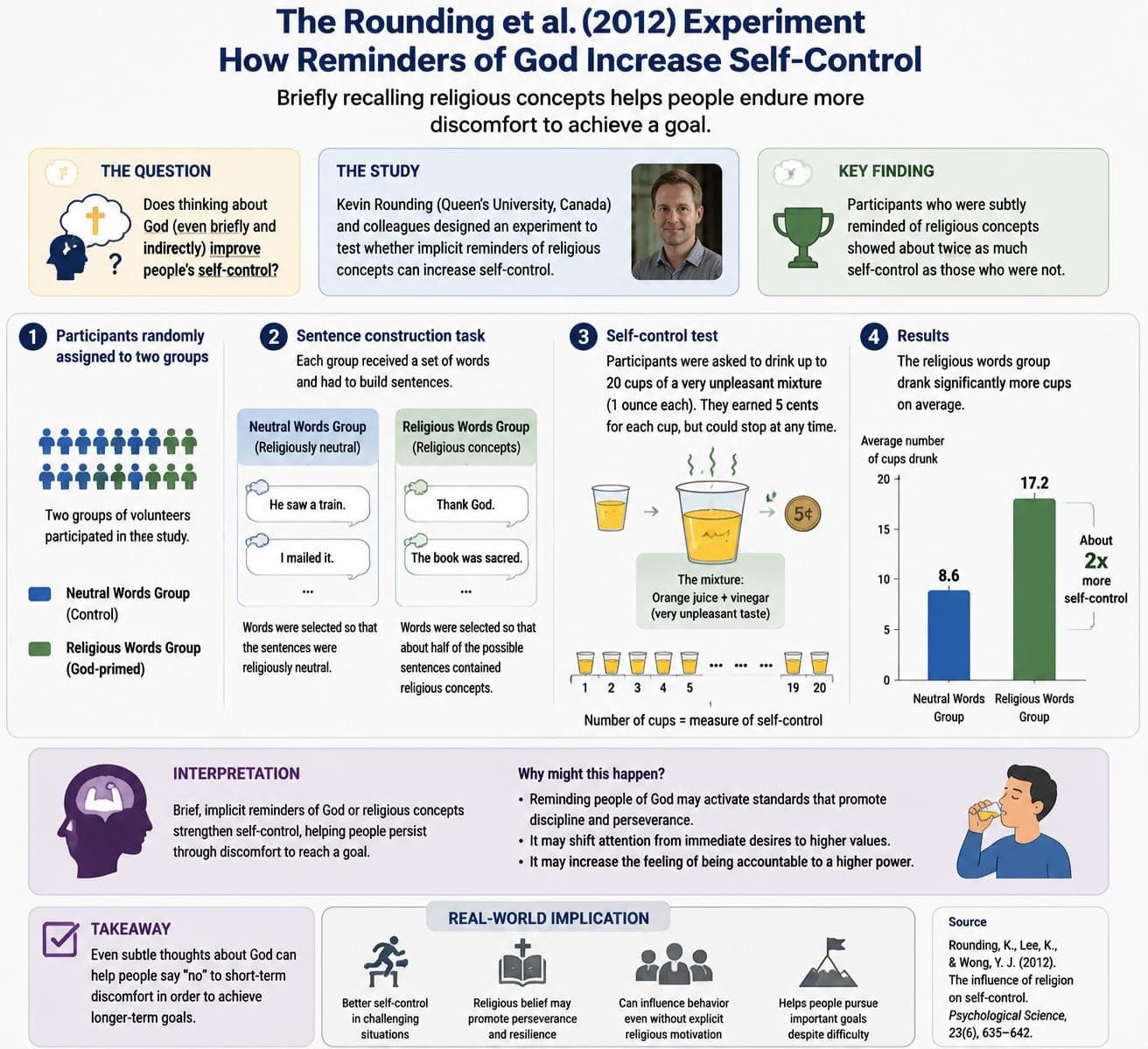
Kevin Rounding, a psychologist at Queen’s University in Canada, and his colleagues conducted a study to examine the effect of reminders of religious concepts on participants’ capacity for self-control. They divided the volunteers into two groups. Each group was given sets of words from which they had to construct sentences.
The words given to the first group were selected so that they produced religiously neutral sentences, such as “He saw a train” or “I mailed it.”
The words given to the second group were chosen so that half of the sentences they could construct contained religious concepts, such as “Thank God” or “The book was sacred.”
The participants were then asked to take part in a test in which they could drink up to twenty cups, each containing one ounce of an unpleasant mixture of orange juice and vinegar. They received five cents for each cup—not a substantial amount of money—and could stop whenever they wished. The number of cups they managed to drink was taken as a measure of self-control: in this case, their ability to suppress or disregard the unpleasant sensation caused by drinking the mixture.
The result was that the second group, who had been implicitly reminded of God and religious concepts, were able to tolerate the unpleasant experience for roughly twice as long as the first group and consequently drank a greater amount of the mixture. [1]
Wars have always imposed financial and human costs on populations and have often brought scarcity and hunger with them. How successfully people could disregard their own desires, or regard their personal wants and needs as less important than the will of God, could therefore play a strategic role in enduring the hardships of war. Greater psychological endurance and resilience in one group than in its opponent could help determine the outcome of a conflict.
Weapon Four: Ruthlessness
Another weapon religion could give its society was ruthlessness toward the enemy. The clergy could not only define other groups as outsiders or “others,” but also turn this dehumanization into a coherent doctrine through religious beliefs, allowing it to persist for centuries. This could make it easier for believers to shed the blood of rival peoples or exploit their labor through slavery.
The superiority of one’s own ethnic group over other peoples, the superiority of believers in one’s own religion over followers of other religions, or the superiority of free people over slaves and concubines could be described as something inherent, natural, or divinely ordained. As a result, believers could not only regard themselves as enjoying divine approval and support, but also resort to violence more readily, since their enemies were understood to possess an inherently lower status.
In this process, after declaring their own people, ethnic group, or fellow believers superior to others, the clergy would commonly place themselves—the clerical class—at the highest level of the hierarchy, or only one step below the king, thereby acquiring special privileges.
In the worldviews that religions and their clergy presented to society, the king and the clerical class were usually placed at the top of the hierarchy and regarded as possessing the right to rule and guide. Their fellow believers or members of their own ethnic group then enjoyed the greatest rights and privileges. Followers of other religions, members of other ethnic groups, and slaves generally possessed the fewest rights and privileges within the city-state, kingdom, or empire.
Humans, however—and some other primates as well—have a sense of fairness and resist unequal treatment. This intolerance of unfairness is another evolutionary root of morality in Homo sapiens and other primates. Humans and other primates initially perceive members of their own kind as fundamentally similar to themselves and therefore expect themselves and their peers to be treated in comparable and equitable ways.
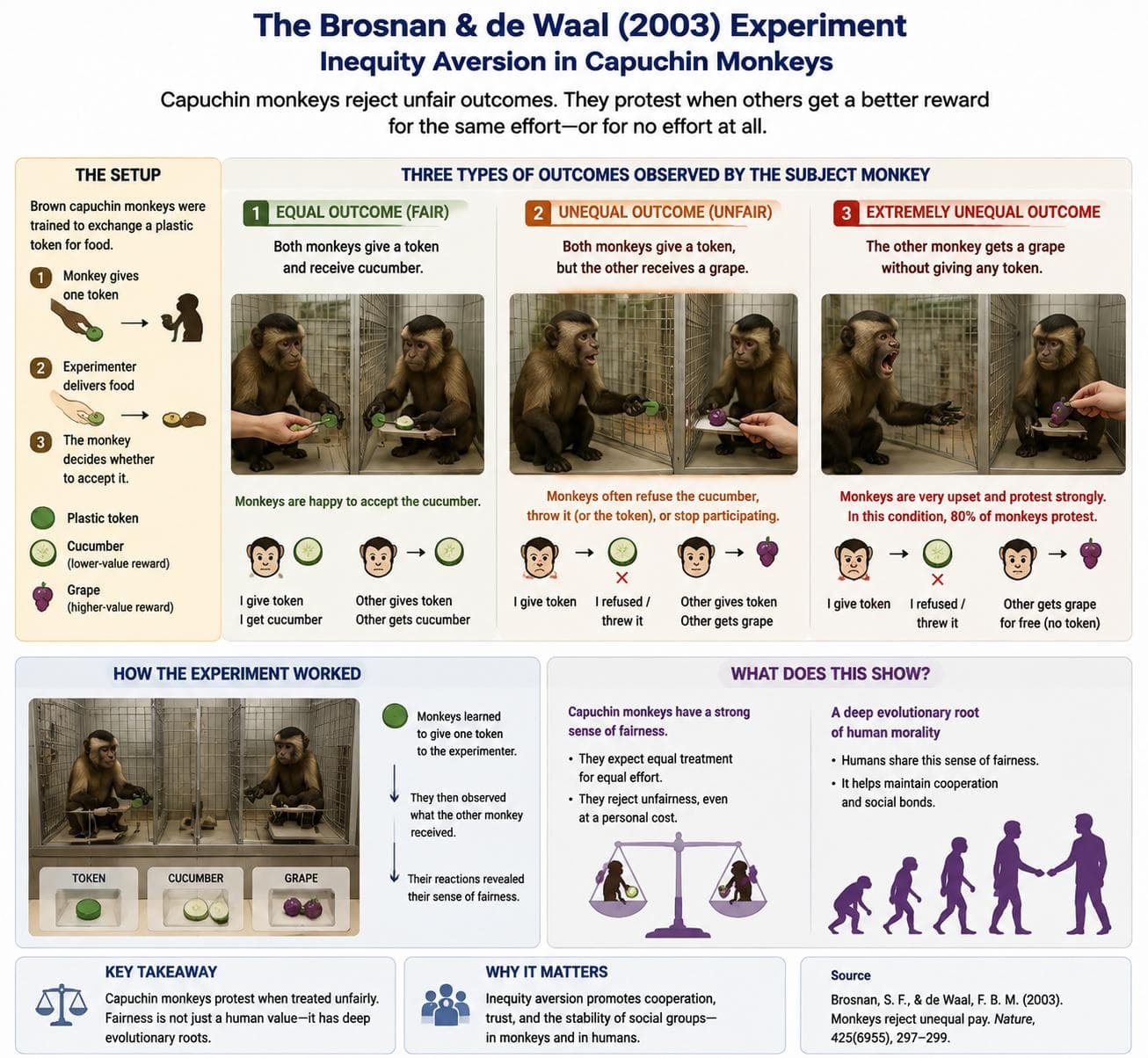
Sarah Brosnan, of Emory University in Atlanta, and Frans de Waal taught brown capuchin monkeys to exchange plastic tokens for food. At first, the monkeys were perfectly happy to hand over a token and receive a piece of cucumber in return. But if they saw another monkey receive a grape for handing over the same token while they themselves were given cucumber, they became angry. They would stop handing over their tokens or refuse to accept the cucumber. Some even threw the cucumber or the token out of their enclosure.
The monkeys became even more upset if they saw another monkey receive a grape without even having to hand over a token. Under these conditions, 80 percent of them showed some form of protest.
We have ample evidence from ourselves and from human societies that a similar tendency exists in humans and can even give rise to resentment. When we perceive discrimination or unfair treatment, we become angry with the person responsible and, at the very least, may reject and exclude them. In other words, we do not regard ourselves as inherently inferior to others. This sense of equality with others is another of our evolved traits, and this time it leads us to demand fair and ethical treatment from others. Thus, not only does empathy lead us to regard ourselves as equal to others and incline us to behave ethically toward them; our sense of equality with others also leads us to expect ethical and fair treatment from them.
If a member of society disregards this expectation, then even if they do not encounter violence from us, they may at least face rejection and exclusion. As we saw earlier, Homo sapiens—and many other primates as well—find social exclusion deeply unpleasant and difficult to tolerate. They therefore tend to conform to ethical behavior within the group, even if they do so hypocritically.
Given this tendency toward fairness in our species, how have religious authorities been able to divide their societies into different classes, assign unequal rights to those classes and to themselves, and do so without fearing rejection by other members of the group?
Religious authorities make such classifications and inequalities acceptable by presenting people with a particular worldview. They persuade people that God or the gods have ordained such differences, or that the laws of existence themselves dictate that some people, because of their beliefs, actions, the class into which they were born, or the very nature of their creation, possess an inherent and essential superiority over others. Within such a worldview, people may come to accept, for example, that they are simply not the equals of the clergy, rulers, or members of higher castes, and therefore should not expect equal rights. Sacred texts may also contain stories, examples, commandments, and laws that reinforce these classifications. As we have seen, believers regard sacred texts and sacred figures as being under the protection and approval of their mental guardian and therefore do not question them. Consequently, their instinctive demand for fairness becomes restricted to those whom they regard as their equals in status, class, sex, and so forth.
In this way, religions and their clerical institutions can shift the foundation of a society’s moral system away from a sense of equality among all its members—which is the natural foundation of evolved morality—and toward a sense of equality only among people of the same profession, class, sex, and so forth. These categories, moreover, may themselves be defined by religious authorities. In this way, groups and classes enjoying special rights may have less reason to fear rejection, anger, or rebellion from those deprived of such privileges.
Overall, it can be argued that during periods when the survival and economic and political expansion of human societies depended above all on acquiring more land, religious faith and clerical institutions played an important role in the expansion of societies through mechanisms resembling those described above.