The Physiology of Faith by N. Fakhr - HTML preview
Download the book in PDF, ePub for a complete version.
Homo sapiens: A Moral Species—or an Immoral One?
Chimpanzees that cannot swim have been observed entering water-filled moats in zoos in attempts to rescue other chimpanzees, sometimes drowning in the process.
Rhesus monkeys that could obtain food by pulling a chain—which simultaneously delivered an electric shock to another rhesus monkey—have been observed to refrain from pulling the chain, preferring to endure hunger for days rather than inflict pain on another.
Dr. Frans de Waal, of Emory University, who studied the behavior of primates for decades, observed that after a fight between two chimpanzees, other members of the group attempt to console the loser. Such behavior is also common among great apes, including gorillas, but is not observed in some monkeys, such as macaques. Female macaques, for example, do not engage in comparable consoling behavior even after their offspring have been injured. [1]
Chimpanzees have also been observed helping elderly members of their group and assisting chimpanzees with disabilities, such as individuals missing an arm.
Frans de Waal argues that such behaviors are rooted in empathy—the capacity to understand and share the feelings of others.
Empathy and identification with others lie at the foundation of moral behavior. Members of our own species, too, begin to act morally when they perceive the pain and suffering of another person: they may help that person, refrain from causing harm, and understand the meaning of the principle, “Do not do to others what you would not want done to yourself.”
The moral similarities between humans and our close evolutionary relatives—the great apes, including chimpanzees, gorillas, and bonobos—are striking. They suggest that the stability of social life, which has provided a major biological advantage for both humans and other apes, rests to a considerable extent on these moral dispositions, and that these dispositions themselves are products of evolution. Such traits strengthened social bonds, while stronger social bonds helped sustain group living and increased the chances of survival and reproduction among individuals capable of forming and maintaining them.
But how far would such relationships have been advantageous to us? In other words, could empathy toward all other living beings have provided an evolutionary advantage and helped our genes proliferate? Or was empathy beneficial to our survival and reproduction only insofar as it was directed toward members of our own group and community? If our ancestors had empathized with deer, rabbits, and mammoths as readily as they did with one another, would they have been able to bring themselves to hunt them?
In a study conducted by Claudia Rudolf von Rohr, of the University of Zurich, two groups of chimpanzees from two zoos in Zurich were shown several videos:
A video showing a chimpanzee infant being killed by other chimpanzees.
A video showing a colobus monkey being killed by chimpanzees.
And a video showing ordinary chimpanzee behavior, such as cracking nuts.
The chimpanzees spent four times as long watching the video in which a chimpanzee infant was killed by its own kind as they did watching the other videos. There was no significant difference among the other videos in this respect. The chimpanzees did not, however, display any other obvious reaction; for example, they did not become visibly agitated.
According to von Rohr, chimpanzees understand the meaning of social norms and can also distinguish between behavior occurring within their own group and behavior occurring in other groups. In their own group, they do not kill chimpanzee infants, and when they observe this happening in another group, they appear to recognize that something abnormal has occurred, without becoming strongly emotionally aroused. By contrast, the killing of a colobus monkey by other chimpanzees appears to be of little significance to them, attracting no more attention than ordinary behavior such as cracking nuts. [2]
At this point, we can say that great apes such as chimpanzees possess a capacity for empathy and identification with others. This capacity plays a fundamental role in forming social relationships and in giving meaning to moral norms and violations of those norms. Its strongest reach, however, appears to extend primarily to members of their own group rather than to outsiders. Chimpanzees may even kill and eat infants belonging to other chimpanzee groups.
Apparently, many of these characteristics apply to Homo sapiens as well. We, too, tend to empathize and behave morally toward those whom we do not regard as outsiders. Yet toward other beings—or even other human beings—whom we perceive as outsiders, we may be capable of extreme cruelty, while their pain and suffering may cause us little or no distress.
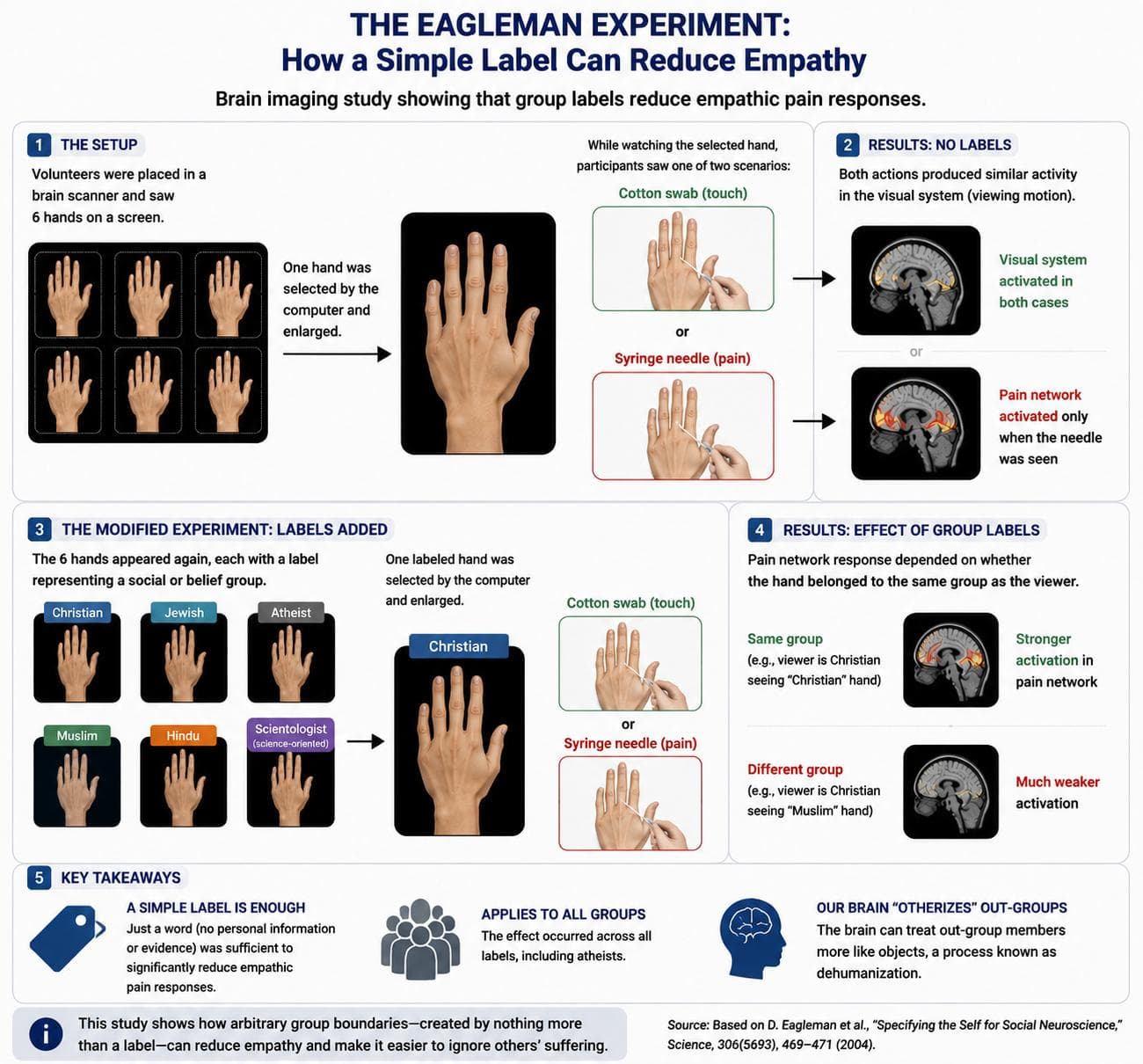
David Eagleman, a neuroscientist at Stanford University, designed an experiment in which volunteers were placed inside a brain scanner. While being scanned, they saw six hands on a screen in front of them. One of the hands was selected by a computer and enlarged. As the participant watched the hand, one of two things could happen: either a cotton swab was rubbed across the hand, or the needle of a syringe was inserted into it.
Brain scans showed that the two actions produced similar patterns of activity in the visual system, since both involved comparable visual motion. The second scene, however—the needle being inserted into the hand—also activated the observer’s pain network. Activation of this pain-related network is associated with empathy and the sharing of another person’s pain.
Eagleman then modified the experiment. The same six hands appeared on the screen, but this time each hand carried a label. The labels read Christian, Jewish, Atheist, Muslim, Hindu, and Scientologist—the latter referring here to someone who emphasizes the central role of empirical science and the scientific method in all aspects of life. One hand was selected by the computer and enlarged. Again, either a cotton swab was rubbed across it or a syringe needle was inserted into it.
The participants’ brain responses differed depending on which of these groups they themselves belonged to. When the participant and the person represented by the hand belonged to the same group—for example, when both were Christian—the sight of the needle entering the hand produced greater activation in the participant’s pain network. When the hand was labeled as belonging to a different group, the response of the pain network was considerably weaker.
One of the important findings of this experiment was that a simple label alone could substantially reduce empathic responses. No extensive evidence or detailed information about the other person was necessary. This effect was observed across the different groups, including atheists.
In other words, our brains can respond differently to people whom we perceive as belonging to an out-group, reducing the degree to which we share or represent their pain. This process can contribute to what is called dehumanization.
Lasana Harris, of University College London, showed his volunteers photographs of people belonging to different social groups. He found that when participants looked at images of homeless people, the medial prefrontal cortex (mPFC) showed reduced activity. This region is normally active when we interact with other people or think about them, but it is less engaged when we deal with objects. It is as though we strip these homeless individuals of their human identity: we no longer empathize or sympathize with them, and consequently may no longer regard them as fully entitled to the moral consideration we ordinarily extend to other human beings. In other words, we may come to perceive them more like objects than persons. [3]
Now let us see what function these characteristics of our brains may have served over the course of thousands of years.
For hundreds of thousands of years, human groups faced limited resources necessary for survival. To prevail in the struggle for survival, they needed, on the one hand, strong social bonds and effective cooperation within their own group and, on the other, the capacity for ruthlessness toward other creatures and competing groups. Empathy and the ability to share the feelings of others are among the most important foundations of morality, and morality in turn helped create the social bonds that contributed to group survival and the transmission of its members’ genes to subsequent generations. But this empathic response also had to be capable of diminishing when people confronted other creatures or rival groups, allowing them to eliminate competitors without hesitation, consume other creatures as food, or exploit their labor without being overwhelmed by guilt.
Evidence of cannibalism has been found among the remains left by our hunter-gatherer ancestors.
With the emergence of sedentary life, population growth, and increasing competition over water and fertile land needed to feed people and their livestock, this struggle intensified. People obtained their food from the land, and now they fought not only for food itself but also for the land that produced it. One group’s source and means of food production became another group’s target. Any individual or group seeking greater wealth and prosperity needed access to more fertile land.
Strong and self-interested groups gave way to still stronger and more self-interested ones, and the larger and more powerful a group became, the greater its chances of passing its members’ genes to the next generation. The members of the group had to remain united, participate in war, risk their lives, and show ruthlessness toward their enemies. Even those who died on the victorious side could, in evolutionary terms, contribute indirectly to the transmission of genes shared with their brothers and cousins. Alongside their genes, the victorious group could also pass on its culture and traditions—and its religion and gods—to subsequent generations.
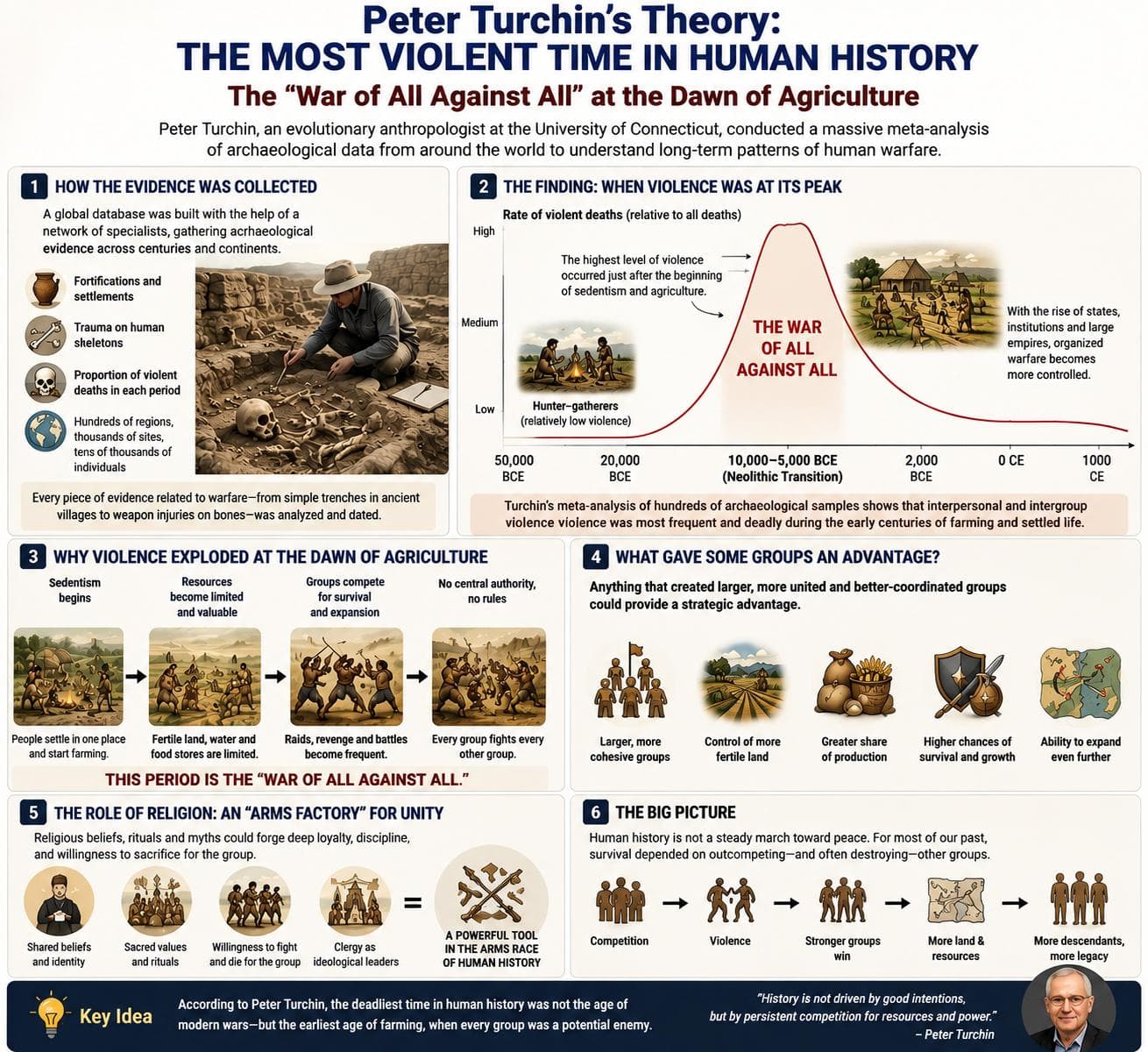
Peter Turchin, an evolutionary anthropologist at the University of Connecticut, conducted a large-scale meta-analysis with the help of a network of specialists, collecting and analyzing archaeological evidence spanning centuries of human history. He assembled a global database that allowed researchers to search across both historical periods and geographical regions and analyze virtually every kind of evidence related to warfare—from the remains of simple fortifications in the ruins of villages thousands of years old, to signs of trauma on the bones of people killed in ancient conflicts and the proportion of such remains among all human remains recovered from a particular period.
The conclusion of this meta-analysis was that the most violent period in human history occurred around the time when humans had recently begun settling permanently and practicing agriculture. Peter Turchin calls this period “the war of all against all.”
From that point onward, anything that could help create larger and more cohesive groups could give those groups a strategic advantage: they could seize more fertile land, secure a larger share of production, and improve their chances of survival, economic expansion, and the acquisition of still more territory amid these relentless conflicts. Religious faith could function as a kind of arms factory in this struggle, and the clergy could play a significant role in this arms race.
You may ask: What arms race?