

The Physiology of Faith by N. Fakhr - HTML preview
Download the book in PDF, ePub for a complete version.
Remembering Miracles
Sometimes we encounter people who recount an extraordinary, seemingly miraculous event for which they can imagine no explanation other than a miracle. We ourselves may also carry memories of such events from the past. What I mean is that we may remember apparent miracles in which something seemed to occur in violation of the natural laws of physics or chemistry, leaving us unable to find any logical explanation for it. Naturally, for the person who remembers such an event, that memory can serve as evidence and as a source of knowledge that a miracle really occurred.
Someone may try to find a rational, non-supernatural explanation for such seemingly miraculous events, or may simply argue: “The fact that we cannot explain such phenomena does not necessarily mean that we should attribute them to deliberate intervention by supernatural powers.” But rather than approaching these memories through philosophical or logical argument, I want to examine them from another angle: the reliability of memory, particularly when it comes to distant memories.
Elizabeth Loftus, a cognitive psychologist and expert on human memory at the University of California, lost her mother in an accident when she was a child. Her mother drowned in a swimming pool. Years later, during a conversation with a relative at a birthday party, Loftus learned something about the incident that she had never known before. She was told that she herself had been the first person to discover her mother’s body in the pool. Until then, she had remembered nothing of the kind, and she initially found it difficult even to believe that this had happened to her.
She recalls that after returning home from the birthday party, she began thinking about the events surrounding the day of her mother’s death. She remembered, for example, the firefighters arriving and giving her oxygen. Perhaps, she thought, she had needed oxygen because she had discovered her mother’s body and had become distressed. Before long, she could even remember the image of her mother’s body floating in the swimming pool.
But some time later, another relative told Elizabeth that she was definitely mistaken. It had not been Elizabeth who discovered the body in the pool. It had been her aunt.
This experience made the phenomenon of false memory formation personally fascinating to Professor Loftus. How could she have developed a memory of seeing a body that she had never actually seen? She subsequently conducted pioneering research on this question.
In one study, she worked with a group of volunteers and asked members of her research team to contact their families and gather information about events from the participants’ pasts. Using this information, the researchers constructed four stories about each participant’s childhood. Three of the stories were true, while the fourth contained plausible but fabricated details. The false story described the participant becoming lost in a shopping mall as a child, being found by an elderly woman, and eventually being reunited with his or her parents.
During interviews, the participants were told all four stories and asked whether they remembered them. At least one quarter said they remembered becoming lost in a shopping mall as children—even though no such event had ever happened to them. At first, they remembered only a few details. But when they returned the following week, they often “remembered” considerably more. They might describe the elderly woman who had rescued them and add details such as: “The old woman was wearing a strange, ridiculous hat,” or “I had my favorite toy with me that day,” or “My mother was very angry.”
Loftus found that not only could new memories be introduced into people’s minds, but people could also elaborate on those memories themselves. Without realizing it, they used imagination to enrich the story with additional details.
In another study, Elizabeth Loftus showed that the wording of a question could alter people’s subsequent reports. Participants were shown a collision between two cars and then asked either, “How fast were the cars going when they hit each other?” or, using more forceful wording, “How fast were the cars going when they smashed into each other?”
Participants who were asked the second question estimated higher speeds for the cars.
When we look back on memories from our own past, therefore, we should remember that not every detail we recall is necessarily accurate. Some details may have come from stories told by other people, while others may have been supplied by the storytelling processes of our own minds. [3]
But why does this happen? We said that for long-term memory to form, new junctions, or synapses, must develop between nerve cells. The loss of these synapses can lead to the loss of memories. One factor involved in stabilizing these synapses is a group of long molecules extending from the cells on either side of the synapse. These long, chain-like molecules, known as neural cell adhesion molecules (NCAMs), extend from both the presynaptic and postsynaptic cells, bind to one another, and help stabilize the synapse in place.
During the recall of a long-term memory, chemical changes in NCAMs may temporarily make them less adhesive9, allowing the pre- and postsynaptic sides to loosen their attachment. This gives synapses greater freedom to grow and change their orientation, allowing new configurations to form. Further chemical changes can then restore the adhesive properties of NCAMs, helping stabilize the newly modified synaptic configuration. [4]
In fact, human memory is not like an engraved tablet or a computer memory in which information remains intact and can later be retrieved without being altered in the process. Human memory is a dialectical phenomenon. A memory is not stored in a separate compartment, simply retrieved and then returned unchanged to its original place. Each time a memory is recalled and brought back to life, it once again interacts with our present thoughts and present surroundings, is influenced by them, and may be rewritten. Our memories are renewed each time we remember them. [5]
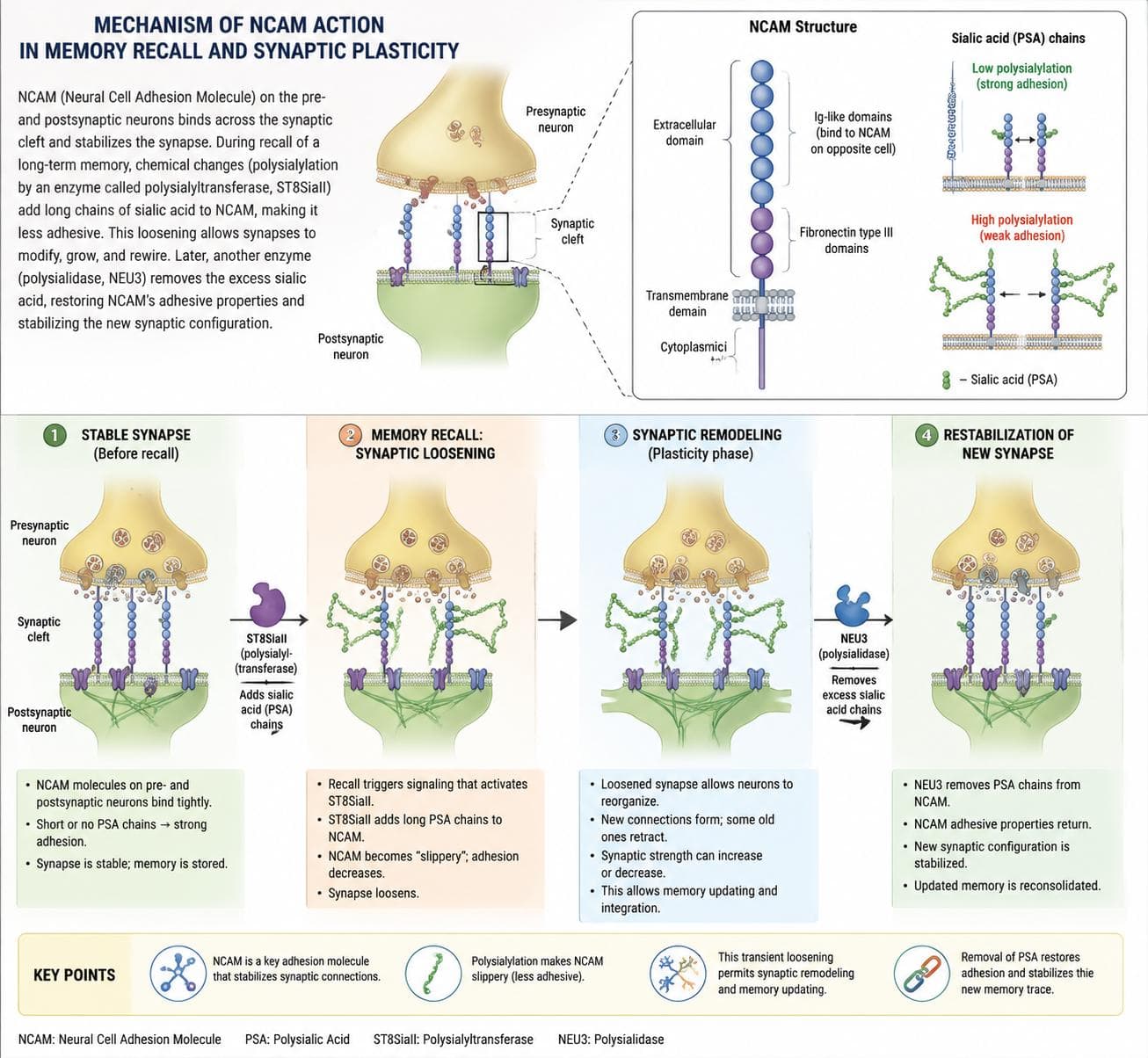
Whenever we recall a memory, therefore, we not only revive and retrieve its images and impressions; we also create an opportunity for that memory to be rewritten and altered. Whether the mechanism described above or other mechanisms are responsible for this process, the important point is that our memories are subject not only to fading and forgetting, as synaptic connections deteriorate, but also to modification and transformation.
Unlike modern computers, our brains do not have memory and processing located in two entirely separate places. When a memory is retrieved, it is also processed within the same system. This is one of the advantages of the brain and helps explain why its energy consumption is so much lower than that of modern computers. Yet this same characteristic also makes our memories, unlike information stored in computer memory, vulnerable to alteration and manipulation.
Indeed, this capacity for modifying memories may be part of what is used in psychotherapy. A therapist may encourage a patient to recall distressing memories and, through working with those memories, may ultimately help the patient reconstrue them in a way that reduces their emotional charge. The person may then become better able to accept what happened without continuing to experience the same degree of distress or feeling the need to escape from the memory.
With this in mind, even if our only interpretation of a particular memory of a miracle is that no natural or logical explanation for it exists, and that it therefore could only have resulted from supernatural forces intervening in nature, there is still good reason not to make a single memory the foundation of our knowledge and certainty. The reconstructive nature of human memory itself gives us reason for caution.
In earlier times, when people did not have the means of recording moments and events that we possess today, memories of astonishing and seemingly unbelievable events were far more common as sources of evidence than they are today. Such memories could reinforce religious faith and could even become the basis for belief in imaginary beings. Today, photographs, videos, and written records can help prevent memories from becoming distorted or can help us correct them afterward. At the same time, despite the enormous number of photographs and videos now recorded by cameras everywhere, they have not provided evidence of phenomena that violate the universal laws of physics and chemistry.
Nevertheless, exaggerations introduced when we or others retell an event can still replace the original event in our minds. An embellished version of what happened may gradually take the place of the original memory—or we may even acquire a memory of something that was never part of our own life or experience at all.