

How to Know Your I.Q. Level without Taking the Test & Brainy Stories by Billy J. Burton - HTML preview
Download the book in PDF, ePub, Kindle for a complete version.
1. I.Q. Tests: Facts and Observations
So far, intelligence has only really been assessed, with some precision, by scientifically normed
I.Q. tests 241 overseen by psychologists. No other method has ever given a better outcome, but the
notion, although renowned, remains fuzzy.
You may be wondering what those tests truly represent and what they actually measure. You
may be unsure whether or not they are accurate.
You may have been confused by the results given to you after an assessment.
The next paragraphs should enlighten the curious reader.
1.1What’s an I.Q. Score?
What exactly is an I.Q. score1?
It’s not a mark, points, or the total of one’s neurons. It is a relative score comparing one’s mental
ability to that of the rest of the general population in one’s country. It doesn’t measure
intelligence directly but what one can do with it compared to the reference group. It is akin to measuring your strength by how high you can jump or how far you can throw.
I.Q. testing is habitually used as a clue for psychologists to find out if people are capable of
unusual mental performance or if they suffer from cognitive disabilities 242. It ordinarily has to be
completed with a psychological assessment 14 to proceed with a diagnosis.
1.2 The Different Types of Tests
To measure an Intelligence Quotient 27 you need a tool in the form of a test. It resembles an exam
with questions, not specifically created to evaluate what you know, but rather whether you are
cognitively equipped to find a solution. Several authors have invented their own specific tests for quantifying intelligence over the years.
1.2.1 A Little History
In 1905, Alfred Binet was asked, by the French government, to create a test destined to measure children’s intelligence in the hope of evaluating their cognitive disabilities. Its purpose was to
avoid sending those youngsters to an asylum by establishing if they were merely slow as
opposed to insane: The Binet-Simon test2.
A few years later, in 1912, a German psychologist named William Stern 4 invented the term
Intelligence Quotient3 or I.Q. in short. It represented the ratio between a child’s mental age and his or her real age for comparison purposes.
Then, in 1916, Alfred Binet inspired Lewis Terman, a psychologist from the Stanford Graduate
School of Education, to create the first intelligence scale along with his Stanford-Binet11 test.
In 1939 the calculating method was changed, namely by David Wechsler5, an American
psychologist, to a relative score15 comparing itself to other test-taker’s score, of the same age
group, in the same country. He thought intelligence was constituted of several elements which
could be measured by several large subtests representing a particular aspect of cognitive ability 6. His tests, each aimed at one age group, are still the most famous and widely used ones in the
world (WPPSI, WISC, and WAIS243).
To him, intelligence was the faculty to be logical, reach one’s goals, and be in control of one’s life outcomes.7
Wechsler’s tests, in the USA, rival with James McKeen Cattell’s8 who was the first American
psychology professor, and author for the Science Journal. He eventually designed his own test, based on a wider scale than Wechsler’s.
1.2.2 Nowadays
Nowadays, standardized tests involving several types of puzzles are used to rank a person's
intelligence in the main cognitive areas. The resulting score is compared to the average intelligence of the test-taker’s countrymen by converting it to a rank positioned on the normal
distribution function9. This rank corresponds to the proportion of people who share the same
intelligence degree in the same age-group. There have been several legitimate I.Q. tests used by psychologists for decades ; some are aimed at children whereas others are for adults. They differ
by author, scale, standard deviation, subtests 19, main cognitive skills focus, but their mean (or
Esperance) is usually set at 100.
Most tests assess the main intelligence categories, albeit in different groupings of reaction time, verbal, numerical, spatial, abstract, or logical etc.… subtests. Abstract reasoning is particularly
interesting as it impacts every other skill 36 and can be perceived as a kind of core fluid intelligence79 influencing cognitive abilities and their related psychological traits.
Points are, at that moment, attributed to all subtests, and afterwards, a rank in the form of a
global score, or a percentile29, is calculated and given to the “patient”. A percentile is the
percentage of people who did worse than the test-taker on the assessment.
The most famous tests, available nowadays, are the Wechsler Adult Intelligence Scale10 (or
WAIS), the Stanford-Binet11 12 , the Cattell Culture Fair Intelligence Test, the Raven Progressive
Matrices 13 and a few others. Each of them employs a particular scale.
The scale I resort to, in this book, is the most widely used in the world (except in the USA): the Wechsler scale22.
The average of most modern tests is set at 100 by default. It is considered mean intelligence. On
the Wechsler Scale, the scores follow a bell curve with a fat hump of 68% of people who fall
within the average range: between 85 and 115; 16% are above 115, 16% are below 85. On the Cattell Scale the ranges boundaries are distinct.
Untimed tests for high-range244 intelligence exist as well. Sadly, due to the limited number of
people with such high cognitive abilities, they are normed with smaller groups and frequently developed outside of official structures. As a result, they are considered fairly unreliable.
Two main scales:
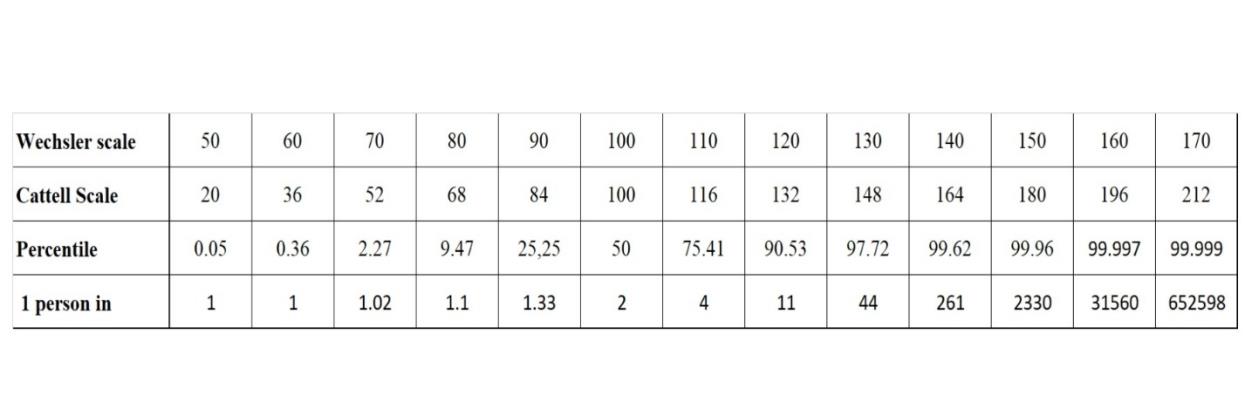
To explain the table22 above, a person with an I.Q. score of 120 on the Wechsler Scale does better than 90.53% of the population of his or her country and such a level (or above) is found in 1 person out of 11. Similarly, a person with an I.Q. score of 90, does better than 25.25% of people and such a score (or higher) can be found in 100 people out of 133 (1/1.33).
1.3 Are Official Tests Accurate?
Every so often, I meet people who distrust I.Q. tests assuming they cannot measure intelligence
properly.
Is there any basis to that assumption, or are tests really trustworthy?
1.3.1 I.Q. Tests are Flawed Tools.
A handful of flaws have been observed, over the years, which put a damper on the notion of the all-powerful, unquestionable I.Q. test score. These defects are to be attributed to the
configuration of the test itself, but also, to the emotional state of the test-taker.
Test Issues
I.Q. tests are imperfect tools, yet, so far, nothing else has been able to measure intelligence
comprehensively, with some degree of certainty, in a scientific way.
I.Q. measuring occasions several significant concerns:
- 16-17 The tests measure “The g factor” (the general intelligence factor), a component directly correlated to efficient cognitive functioning. This factor, involved in cerebral performance also
characterizes the perception of what intelligence represents. But these I.Q. assessments only
account 18 for about 70% of “g”; consequently 30% of intelligence is never considered. A WAIS result, for example, is often given with an accuracy of 95% by providing a confidence interval19,
hence the range sometimes given to the patient (ex: 123-133) instead of a single number (ex: 130), the confidence level of which, would be much lower.
In short, only part of your intelligence is considered in an I.Q. test and the result is a little
uncertain.
- An I.Q. score somewhat depends on the type of test used. Some tests give a slight advantage 248-
249 to people who are good at 3D puzzles, others to people who work better with letters or who
are highly logical. Some tests items involuntarily measure knowledge245 instead of inference;
others possess more than one possible answer246-247, in this way, quantifying mainstream thinking instead of cleverness.
So, if you take 3 different assessments you will get 3 dissimilar I.Q. scores for the same
“volume” of intelligence.
- Since these tests aim at quantifying one’s ability to find solutions to problems one has never
met before250, one cannot become excessively familiar with these types of questions for fear of
invalidating the accuracy of the calculated score.
Therefore, having taken a previous I.Q. test may potentially alter the result of a future one.
- The most troublesome test feature for very clever individuals is the existence of test ceilings 20-
21. Because putting together normative groups of superior intelligence is arduous, I.Q. tests are
particularly designed for people of average intelligence 41 (I.Q. score from 85 to 115). For others, the score is merely an approximation to be confirmed by further I.Q. test-taking, which, as we
have just seen, may actually prevent precision. The WAIS’ maximum score is 160, but its real
upper limit is undoubtedly closer to 135-140 due to additional ceilings in all subtests 251. As a result, the higher the total, the more artificially lowered it gets. People in the upper realms of
intelligence typically hit every ceiling and end up with official scores around 135-140 unless
specific extended subtests 252 are added. In addition, the higher one ranks on the curve, the
stronger one’s aptitude in pattern-detection when presented with a great deal of seemingly unrelated information253. This is never considered in regular I.Q. tests, in which simple patterns
are employed.
So, the less average your intelligence, the less accurately assessed by I.Q. tests it is.
- In psychometrics254 (psychological measurements), a global I.Q. score is valid if all the
subtests’ indexes are homogeneous. When subtests scatter23 is too great, the psychologist is not
able to calculate a meaningful average. The test-taker may feel cheated for not receiving a concrete result, even if subtests can be interpreted individually. Besides, when subtest averaging
is possible, a global I.Q. score doesn’t necessarily hold much meaning on its own. Indeed,
discrepancies between subtests highlight dissimilar functioning at the same intelligence level. It
is especially interesting, to Neuro-atypicals255-256 (cognitively nonconforming people) for self-awareness reasons, as well as clever individuals as, the further removed from the average, the
more spread out the subtests 84. In any case, abstract reasoning, having an impact on every
subtest36; it is undoubtedly the most trustworthy beacon to gauge somebody’s intelligence.
Consequently, a global I.Q. score may be meaningless if subtests are too uneven.
- I.Q. tests largely estimate male reasoning proficiency37-38 in spatial and numerical logic.
Consequently, the higher the score is, the greater the gap between the genders in the number of persons represented at each increment. This is confirmed by the enhanced variability of male
brains’ I.Q. scores24-25 compared to females. I’m referring to the brain structure here and not
necessarily the sex of its owner. Still, men’s scores are naturally more spread out, being more present at both ends of the curve257 (in the lower and higher ranges), than women’s scores which
are primarily found in the middle.
In a nutshell, I.Q. tests may be less suited to account for women’s intelligence.
- The average I.Q. score varies from country to country27. Since it is a comparison to the rest of a
given population, a score appraised with a test aimed at a specific country is only valid in that country258-259-260. Similarly, taking a test in a foreign language, even for fluent people, artificially
lowers one’s verbal I.Q261. score as well as the whole evaluation.
So, if you take an I.Q. test devised for foreigners or in a foreign language you may be at a
disadvantage.
The Flynn Effect:
The Flynn effect28 (noticed by James R. Flynn) is an apparent score increase, attributed, for the most part, to greater life complexity 65 64 and heightened guessing habits, which, in some measure,
improve pattern recognition to favor higher scores. That gain is merely statistical and doesn’t
reflect actual betterment in cognitive ability. To make up for that artificial progression, I.Q. tests are overhauled every ten years262, so that, the same scores calculated decades ago and nowadays
remain equivalent.
The hidden decline in intelligence:
For environmental reasons263 43 , to some extent, the tendency to become parents later in life and the higher percentage of childlessness among high I.Q. people40-43, intelligence has been
declining, mainly in first world countries 28-43, for over a century. Yet, that decline, which has
been masked by the Flynn effect, has commonly been ignored. Undeniably, in spite of the ever-rising ceiling of tests, we don’t seem that much smarter than our ancestors.
Actually, a deterioration in I.Q. scores 42 as well as an important decrease in intellectual
capacity43 has been noticed in the impoverishment of vocabulary, hue differentiation, reflexes,
memory, and attention span. That slow drop in intelligence, by nearly three points per decade264-265, is worrisome, as it causes an alteration of the distribution, primarily at its extremities. To
illustrate296, a drop of 3 points can be estimated to lower the proportion of people with a score above 120 by over 30% and that of gifted people by roughly 40%; at the same time scores under
80 increase by about 40%.
People’s Issues
An I.Q. test-taker is classically given a score or a range (sometimes a percentile29) by a psychometrician. Such a test can be sought, out of curiosity, or to ascertain that everything is
normal in the cognitive area, but if one is looking to establish the presence of giftedness 266 (I.Q.
in the top 2% of a given population), the result provided merely helps the practitioner who also
requires a psychological evaluation to establish such a diagnosis 0.
Why is it so? Most importantly because one’s state of mind impacts psychometric results!
Under most circumstances, in spite of life ups and downs, the intelligence of adults78 remains
stable. One’s I.Q. level as measured by tests, however, is bound to vary, fluctuating according to
one’s emotional balance267.
A test score can be rendered inaccurate because of personal impairment, may it be, fleeting or
permanent: - 271 267 I.Q. results fluctuate according to one’s level of confidence , health, anxiety, or energy
level during the test. Therefore, someone’s I.Q. could amount to 145 on a good day, but only to 120 on a bad day, or even as low as 100 on an even worse day.
- Dyslexia30 31 35-104-267 32 33 , dyscalculia , depression , social anxiety disorder , bilingualism, and
ADHD 34 add extra hurdles to a correct I.Q. measurement:
- Dyslexia269 270 268 , dyscalculia and ADHD increase reflection time.
- Social anxiety 347 makes it harder to concentrate when one is being watched.
-Depression impairs104 memory, attention span, cognitive processing, and decision-making
abilities thus, reduces scores significantly. Since giftedness frequently entails existential depression105, it also goes hand in hand with unreliability in I.Q. scores.
Being bilingual reduces the quantity of words one knows in either language (compared to
monolingual speakers, on average272), whereas total vocabulary in both languages is larger. As a result, test-measured verbal I.Q., typically evaluated in only one language, gets artificially
truncated.
Therefore, although having become fluent, as an adult, in at least one additional language, compared to your peers in the same cultural background (for example, being an American who
speaks Spanish fluently if you’re not of Hispanic decent) is a sign of hi 44-45-46 gh intelligence,
your verbal subtest score gets artificially reduced.
1.3.2 Why use an I.Q. scale at all?
Why bother employing an I.Q. scale10, at all, if I.Q. tests are somewhat unreliable?
In spite of the aforementioned flaws, I.Q. tests allow the assessment of human cognitive abilities,
at a specific time, and under well-defined circumstances, even though emotional and psychological impairments remain unheeded.
Besides, the Intelligence Quotient is a well-known concept that has been capturing people’s
imagination. Who hasn’t heard of the I.Q. score of various scientists and authors, rumored to be
through the roof, even if its consequences on aptitude or psychology remain unclear? Einstein’s I.Q. score of 160 47 is quite famous, although it appears to be a meaningless oversimplification of
what his intelligence, in physics, represented.
Moreover, it’s an easy way to discern the degree of intelligence involved, as well as its
frequency.
The Intelligence Quotient theory, by itself, is already pretty comprehensive. Contrary to what the
uninitiated may think, the concept of I.Q. is not in competition with “Emotional Intelligence” 49-50 (also known as E.Q.) or with the “Theory of Multiple Intelligences”51-52. Even if I.Q. tests do not
directly measure social intelligence, creativity, imagination, learning ability or long-term
memory, these notions are all highly positively correlated to “g” 53-54-55.
In a nutshell, the Intelligence Quotient theory works, scientifically speaking, even if its implementation is not entirely trustworthy because of the human factor. The integration of
psychology, in my opinion, is paramount to avoid misestimating the subject’s level.
My goal, in this book, is to do away with any kind of emotional, learning, health issues which
weaken the assessment’s precision and to observe the direct consequences of “g”18, characterized by our inner emotional mechanisms and noticeable behaviors.
This approach offers a good approximation of the extent of one’s intelligence throughout one’s
life, in a global, holistic way, regardless of ups and downs, impairments, subtests ceilings, and lack of access to a sometimes pricey, psychometric test.