

I’ll Be Back by Henning Jon Grini - HTML preview
Download the book in PDF, ePub, Kindle for a complete version.
1
I'LL BE BACK
AND HOW YOU CAN MAKE
MY RETURN FASTER
By Henning Jon Grini
2
Published 2025
Note: This book can be freely copied, shared and reproduced
without permission from the author.
Cover images: ChatGPT / DALL·E
Layout: Henning Jon Grini

www.inspirasjonogideer.no/english
«We won’t have to worry about a fascist takeover
as long as democracy delivers on its promises.»
– Franklin D. Roosevelt
3
Content
American Democracy at a Crossroads: Drivers of Authoritarian Drift
Religious Influences: The Rise of Christian Nationalism ........................................15
Key Turning Points in Democratic Decline .......................................................16
The Post-Cold War Unipolar Moment (1990s) ..................................................16
The 9/11 Attacks and the War on Terror (2001–2006) .......................................17
The 2008 Financial Crisis and Great Recession ..................................................18
The 2016 Election and the Rise of Populist Authoritarianism .............................19
Parallels with Historical Regimes and Lessons .................................................21
Lessons from the Fall of the Roman Republic ...................................................21
The British Empire’s Decline and Adaptation ....................................................24
Global Context and Conclusion: The Future of American Democracy ....................26
Mindful Resistance to Authoritarianism ............................................ 28
Mini-Manifesto: Soulful Resistance for a Democratic Future .................................34
Defeating Authoritarian Regimes Through Civil Resistance: Global
Case Studies and Strategies ................................................................ 35
Case Studies of Successful Civil Resistance Movements ..................................36
Eastern Europe: Toppling Communist and Post-Communist Dictatorships .........37
4
Latin America: From Military Rule to Democracy...............................................38
Asia: People Power Movements in the Philippines and Beyond .........................39
Middle East and North Africa: The Arab Spring and Beyond ..............................41
Key Strategies and Methods of Successful Movements ...................................43
1. Nonviolent Discipline and Diverse Tactics .....................................................43
2. Mass Mobilization and Coalition-Building .....................................................44
3. Digital Activism and Communication ............................................................45
4. International Solidarity and External Pressure ...............................................46
The 3.5% Rule: Why Mass Participation Matters..............................................50
Most Recent Resistance Strategies and Future Visions from 16 Public
Women in Society: Historical Suppression, Religion, and Modern
5
1. Historical Suppression of Women in Europe and the Middle East ......................70
2. The Role of Christianity and Islam in Women’s Suppression ..............................71
3. Benefits Women Bring to Politics and Leadership .............................................72
4. Differences in Women’s Leadership Styles vs. Men’s .........................................74
5. Women Heads of State: Examples and Comparisons of Outcomes ....................76
7. Strategies to Strengthen and Empower Women Globally (with a Focus on the
US Political Polarization and Immigrant Scapegoating: Causes and
Immigrant Scapegoating by Trump (2016–2025) ..................................................89
Approaches to Countering Immigrant Scapegoating............................................91
Democracy Index: Norway vs. United States – A Comparative
Overview of the Democracy Index and Rankings ..................................................93
Norway – Why It Ranks #1 in Democracy.............................................................93
Comparison of the Nordic Model vs the United States ..................... 99
6
From “Soulless” to “Soulful”: Transforming Society for Meaning and
Philosophical and Spiritual Perspectives for a Soulful Society ............................. 114
Practical Initiatives: Grassroots Movements and Community Projects Fostering
Policy Changes: Public Policies for Well-Being, Ecology, and Spiritual Flourishing 119
Cultural and Value Shifts: Media, Education, and Discourse Nurturing a Soulful
Recommended further reading ........................................................ 126
Message from the future: WE MADE IT! ........................................................... 127
7
Introduction
To my fellow American, we stand with you!
We see your struggle and your fear from the outside. I my case from Norway.
We can hardly believe what we are seeing, that the United States, which has been a country we have looked up to, is now moving dangerously fast towards dictatorship.
American influence has spread throughout the world, for better or worse. Lately, it has been for the worse.
We are all affected by the decisions you Americans do. Actually, we are all affecting each other, regardless of where we live. We are all in this together. That’s why your problems are our problems, and vice versa.
We in Norway have our freedom and democracy intact. In fact, we are ranked number one in democratic development. Not only that, but we are also number one when it comes to freedom of the press. Above all, we take care of our citizens, when in the states you are more or less left for yourselves when challenges arise.
Hopefully we can inspire you and give you some ideas on how to move forward in these challenging times.
The Nordic countries are regarded as having one of the best systems in the world. We have a social democracy with a mixed economy as its basis, i.e. a mixture of capitalism and socialism. Even though it is not perfect, we have reason to be proud. By the way, socialism has got a bad reputation in your country, completely unfounded and wrongly.
The most prominent ideologies here in the West have been communism and capitalism. The biggest problem is not the ideologies themselves, but rather that power-hungry, greedy, and selfish people are in charge. Neither power nor money should be the driving force. Today profit comes before people and the planet, which is extremely short-sighted.
To be the leader of a country, one should possess high ethical standards. This is where the real problem lies. Far too many leaders are simply not mature enough. This applies to both socialist and capitalist countries, as well as countries with other ideologies.
In difficult times, people tend to seek a “Strongman” who offer simple solutions. The problem is that this type of populist often plays on fear, anger and the lower aspects of humanity. They pursue an agenda that prefers to place the blame on others, such as foreigners, even though they are a tremendous resource when properly integrated.
8
We need wise, mature leaders who show empathy, respect, and tolerance. We need leaders who demonstrate compassion and ensure that people are seen and understood. Sadly, your president Trump demonstrates the opposite, and now even early in 2025 you are seeing the consequence, and it will be much worse if you do not change and resist (in a peaceful manner).
In addition, we need an enlightened population that thinks for itself, which requires upbringing and education that teaches our children fundamental human values. They also need to learn to respect other cultures and opinions because that prevents polarization and bullying. We need to unite people, not divide them. We are far more connected and interdependent, on a deep level, than most people realize.
When I visited the states in 1990, I saw fences around luxury houses in Miami, some with barbed wire. What! It looked like fortresses.
Since then, things have been getting worse. The rich have become richer and the poor poorer. Parts of the US today look like developing countries.
This extreme inequality makes your country sick and is an important reason for the state of your country and the rise of authoritarian forces.
Rudolf Steiner (founder of Waldorf schools) believed that there were three areas of society that should be equally emphasized for society to be well-developed and harmonious: economy, politics, and culture/ religion.
He argued that these three areas should be given equal importance and independence; otherwise, it could lead to human suffering — and as we have now also experienced — environmental destruction never seen before. Only then can we achieve a civilized society. None of these three areas should dominate the others. The problem is that this is exactly what has happened in large parts of the world.
In the United States, the economic sphere dominates both the cultural and political spheres. Many members of Congress and the Senate receive large sums from corporations, which results in a highly unhealthy influence on their politics. This has led to an undignified imbalance and the breakdown of society.
In Russia, politics dominates the cultural and economic spheres. Russia, under the leadership of Putin, now governs the country with an iron fist and fear. It has become a dictatorship. His distorted, outdated ideology and cynicism have led to the indoctrination of the population and a horrific war of aggression against Ukraine.
In Afghanistan, culture (in the form of religion) dominates the economic and political spheres. The country should never have been ruled by the religious Taliban, under whom women in particular are oppressed and harmed.
9
When it comes to women, by the way, we in the Nordics have a history with Vikings and “strong women” that has had an influence on our society to this day. Their roles, in that time, were not defined solely by domesticity; they were landowners, farmers, entrepreneurs, and occasionally warriors. They also sometimes participate in political decision-making through assemblies (called things).
In modern times, the women in Nordic and other countries have fought for their rights, where those in power, men, didn't easily want to let go of their privileges. One day in October 1974, 90 % of the women on Iceland went on strike and paralyzed the country completely. One of the reasons for the strike, was the fact that they were lesser paid than men, just because they were women. They refused to do domestic chores, left their homes and their jobs, and made men realize their importance. Six years later, Iceland had the first democratically elected female president in the world.
We need more women in politics and leadership, which is why I have included a chapter on that topic. They usually think long-term and are more empathetic.
This book is made possible in a short time thanks to ChatGPT. All text has been generated by it, except for this Introduction and the end of the book (where freedom comes back). I am very satisfied with the answers it has provided.
The title of the book is inspired by the Terminator movies, played by actor Arnold Schwarzenegger. In the movie he is joining the resistance movement against Skynet (a synthetic intelligence). He is also in resistance against the current administration.
The people of America have to resist too. I have therefore included what we can learn from civil resistance against authoritarianism around the world. I have also included resistance strategies from 16 public figures (Arnold Schwarzenegger is one of them).
Please note that resistance must be peaceful. Be peaceful yourself, because hate and condemnation do no good. Seek rather to change things and look what Mahatma Gandhi accomplished to free India from the British empire with peaceful means. The most powerful resistance is creative, compassionate, and courageous.
Harvard University has stand up against Trump, and I have included a chapter from Harvard Kennedy School which says that no government has survived a challenge in which at least 3.5% of the population mobilized in sustained protest.
I have included comparison of the Nordic Model vs the United States and Norway's top ranking in the democracy index compared with the USA.
The last big chapter is about transforming a soulless society into a soulful one. My hope is that it can inspire you to organize your society into a friendlier and more inclusive and stable society that takes care of each other and where empathy and love is the guiding force. That should be the goal for any society.
10
Note!
All the following text in the book is generated by ChatGPT until the end where I have the final say.
American Democracy at a
Crossroads: Drivers of
Authoritarian Drift
Introduction
In recent years, a growing chorus of scholars and observers warn that the United States is experiencing democratic backsliding – a worrying drift toward authoritarianism. Indicators that once ranked the U.S. among the strongest democracies have registered sharp declines. For instance, between 2014 and 2021 Freedom House’s global freedom score for the U.S. plummeted from 92 to 83 (on a
100-point scale)foreignaffairs.com. Similarly, the Economist Intelligence Unit downgraded
America from a “full democracy” to a “flawed democracy” after 2016nature.com. In early 2025, a survey of over 500 political scientists found an overwhelming consensus that the United States is “moving swiftly from liberal democracy toward some form of
authoritarianism”npr.org. These experts rated the quality of U.S. democracy at just 55 out
of 100 – a precipitous drop from 67 just a few months earliernpr.org. Such metrics and warnings suggest that the American republic, long held up as a beacon of freedom, is now at a perilous crossroads.
What is driving this perceived slide toward dictatorship or authoritarian rule? This report undertakes a comprehensive analysis of the deeper political, economic, social, religious, and cultural forces eroding U.S. democracy. It will examine key turning points in recent history – from the post-Cold War era and 9/11 to the 2008 financial crash and the tumultuous elections of 2016 and 2020 – that accelerated these trends. Finally, it will compare the United States’ current trajectory with the fate of past republics and empires (Roman, Weimar Germany, British Empire) to glean historical patterns and lessons. The goal is to illuminate how and why the guardrails of American democracy have weakened, and what can be learned in a global context from this decline or transformation.
11
Political Factors Eroding Democracy
One fundamental cause of democratic erosion in the U.S. lies in political factors – particularly institutional weaknesses and partisan power struggles that undermine democratic norms. Foremost is the extreme political polarization that has emerged in recent decades. The collapse of cross-party consensus since the 1990s has turned politics into zero-sum tribal warfare, making compromise rare and governance dysfunctional. The two major parties are now sharply divided on basic democratic principles, such as whether to accept election results. This polarization has fed a “vilification of members of the opposing party” and even tolerance for political
violencebrookings.edu, corroding the civic spirit required for democracy to function.
Institutional guardrails have also weakened. The constitutional system of checks and balances has strained under hyper-partisanship. Congress, for example, has grown gridlocked and often fails to perform impartial oversight of the executive
branchbrookings.edu. This creates an opening for executive power overreach. Indeed, over the 21st century, U.S. presidents have significantly expanded executive authority, often through unilateral executive orders and emergency powers. With legislative paralysis, recent presidents have tested the limits of their power – in some cases undermining democratic accountability. Career civil servants and inspectors general who provide nonpartisan checks have been attacked or removed for political reasons,
eroding the independence of the civil servicebrookings.edubrookings.edu. Even the judiciary’s impartiality is in question, as court appointments have become intensely politicized
Perhaps the most alarming political development was the willingness of a sitting president to subvert an election. After losing the 2020 vote, President Donald Trump tried to overturn the results and block the peaceful transfer of power – violating the
cardinal rule of democracyforeignaffairs.com. He pressured state officials and even inspired a mob attack on the U.S. Capitol rather than concede defeat. Equally troubling, many in his party aided or excused this behavior. The failure of institutions (Congress, courts) to swiftly hold leaders accountable for such anti-democratic actions has further
emboldened would-be authoritariansforeignaffairs.com. All of these political factors – polarization, institutional paralysis, executive aggrandizement, and norm-breaking behavior – have created fertile ground for an authoritarian style of governance to take root in the U.S.
Economic Pressures and Inequality
Underlying America’s democratic malaise are economic factors that have fostered public anger and disillusionment with the status quo. Foremost among these is rising economic inequality. Over the past few decades, the gap between the wealthiest
12
Americans and everyone else has widened to levels not seen since the Gilded Age. Stagnant real wages for the middle and working classes, coupled with astronomical gains for the top 1%, have created widespread resentment. As in ancient republics, “the emergence of a huge gap between [the] wealthiest citizens and everyone
else” time.com has destabilizing effects. Historically, when average people feel shut out of prosperity, they grow frustrated with elite leadership – making them more receptive to populists who promise radical solutions.
Repeated economic crises have amplified these pressures. The 2008 global financial meltdown was a pivotal moment. The crisis devastated household wealth, threw millions out of work, and required massive taxpayer-funded bailouts of banks. In its wake, Americans on both left and right grew deeply skeptical of “politically favored”
elites and institutionspbs.org. A wave of anti-establishment populism spread through both parties: on the right, the Tea Party movement rose in 2010, railing against
government and paving the way for Trump’s anti-elite candidacypbs.org; on the left, the Occupy Wall Street protests and figures like Bernie Sanders gained prominence by
denouncing “socialism for the rich”pbs.org. As an Associated Press analysis notes, “The 2008 financial crisis unleashed a political realignment that rejected perceived elites and establishment figures”, fracturing the old order of both Democrats and Republicans
pbs.org. This realignment has produced a polarized environment where voters are angry and distrustful of institutions, unconcerned with the traditional norms that once
governed politicspbs.org.
Another economic factor is the impact of globalization and deindustrialization in the post-Cold War era. The 1990s and 2000s brought intense global economic integration – trade deals and technological shifts that, while boosting overall growth, also led to factory closures and job losses in many American communities. Regions like the Midwest experienced social decline as manufacturing work dried up. This fueled grievances among working-class voters who felt abandoned by “globalist” elites, contributing to the appeal of populist leaders promising to restore lost jobs and put “America First.” In short, long-term economic trends have left a portion of the electorate economically insecure and receptive to authoritarian populism as a remedy. The perception (and reality) that government serves the wealthy while ordinary people struggle has eroded faith in democracy itself. As one populist slogan put it, people see a system of “socialism for the rich and rugged individualism for
everyone else” pbs.org – a sentiment that breeds contempt for democratic institutions and openness to strongman solutions.
Social and Cultural Divisions
Deep social and cultural divisions in American society form another layer of the authoritarian drift. American society has become increasingly polarized along lines of identity, values, and geography. These culture wars – over race, immigration, gender,
13
religion, and education – have reached a fever pitch. Many Americans now perceive those with opposing cultural values not merely as fellow citizens with differences, but as existential threats to the country’s future. This has normalized an attitude that “we do need to fight the culture war” at all costs, even if it means trampling democratic
norms news.ku.edu in the process. In other words, a significant segment of the public is prioritizing victory in the culture war over the preservation of democratic rules. As sociology professor David N. Smith observes, it’s not that masses of Americans openly reject democracy – it’s that they are willing to accept undemocratic behavior
as a side effect of pursuing their cultural agendanews.ku.edunews.ku.edu. If “domineering” leaders are needed to defend their vision of America, so be it.
One driver of these divisions is racial and demographic change. The U.S. is becoming more ethnically diverse, which some white Americans view with anxiety. The election of the first Black president in 2008, for instance, sparked a backlash among certain groups and helped ignite the Tea Party and later Trump’s rise, fueled in part by nativist and racist appeals. Misinformation and propaganda circulating through partisan media and social networks have further inflamed social discord. Conspiracy theories and false narratives (from “birtherism” to QAnon lies about satanic elites) have convinced many that the opposing camp is not just wrong, but evil or illegitimate. Indeed, the public sphere is flooded with “widespread
misinformation” and demonization of opponentsbrookings.edu, undermining the shared factual reality that democracy requires. Social media algorithms often deepen echo chambers, making compromise and understanding even more elusive.
All of this has led to a troubling normalization of extremism and political violence. The United States has seen a rise in hate crimes, armed militia groups, and incidents like the 2017 Charlottesville rally (where neo-Nazis and white supremacists marched openly) and multiple foiled plots of violence. Finally, the decline of civic institutions – such as local community organizations, unions, and even trust in an independent press – has frayed the social fabric. Fewer Americans engage in cross-cutting civic activities that build tolerance (as famously documented in Bowling Alone by Robert Putnam). The erosion of a “vibrant civil society” and independent
media makes it easier for authoritarian-minded leaders to operate uncheckedbrookings.edu. In sum, America’s cultural polarization – supercharged by racial tensions and the fragmentation of information – has created a citizenry that is increasingly divided into mutually hostile camps. This social cleavage provides a ready constituency for authoritarian politicians who promise to vanquish the hated “other side” and restore a nostalgic vision of order.
14
Religious Influences: The Rise of Christian Nationalism
Intersecting with cultural divisions is a potent religious factor: the rise of Christian nationalism in U.S. politics. A segment of religious conservatives, particularly white evangelical Protestants, has embraced the belief that America is a “Christian nation” that must be governed by Biblical principles and defended against secular or non-Christian influences. This ideology often correlates with authoritarian leanings. Surveys show a strong overlap between Christian nationalist views and authoritarian attitudes. In one recent study, 74% of Americans who strongly identify with Christian nationalism also scored high on a standard right-wing authoritarianism scale – more
than double the rate among non-adherents prri.org. In essence, many who seek to fuse church and state also express a desire for a “strong leader who is willing to break the
rules” to set things rightprri.org. This is reflected in political behavior: Christian nationalists were disproportionately likely to dismiss the 2020 election results and to agree that if their candidate was not declared the winner, he should “do whatever it
takes” to assume powerprri.org.
Why does Christian nationalism often align with authoritarianism? One reason is that its adherents perceive a existential threat to their values. The rapid secularization of society, legalization of same-sex marriage, abortion rights, and increasing religious diversity are seen as assaults on what they consider the sacred moral order. This siege mentality can justify undemocratic means. If one believes the country’s very soul is at stake, one may condone leaders who flout laws or norms in order to impose “God’s will.” Indeed, Christian nationalist rhetoric frequently glorifies power and submission: the idea of one nation under one God, led by a divinely ordained strongman. During the Trump era, some evangelical pastors explicitly likened Donald Trump to biblical kings appointed by God despite their flaws, urging followers to “stand by” their leader unconditionally. This creates a ready-made constituency for authoritarian politics draped in religious legitimacy.
Furthermore, Christian nationalism often overlaps with nativism and racial hierarchy, given that its vision of America is historically tied to white Christian dominance. This can translate into hostility toward pluralism and minority rights – again hallmarks of authoritarian sentiment. The embrace of conspiracy theories by some religious-right circles (such as QAnon or claims that opponents are satanic) also mirrors the cult-like devotion authoritarian leaders cultivate. A recent Public Religion Research Institute report warned that “the rising influence of Christian nationalism in some segments of American politics poses a major threat to the health of our
democracy”americanprogress.orgprri.org. Notably, among Americans who fully reject Christian
nationalism, support for authoritarian measures is far lowerprri.org. In short, the infusion of a certain kind of religious zealotry into politics – one that places biblical law or theocratic visions above the liberal democratic order – is an important cultural current propelling the nation toward illiberalism.
15
Key Turning Points in Democratic Decline
While the causes above evolved over decades, several historical turning points sharply accelerated the U.S. trajectory toward authoritarianism. These inflection moments either exposed latent weaknesses or introduced new stresses to America’s democratic system. Below we highlight how each turning point contributed to the current crisis:
The Post-Cold War Unipolar Moment (1990s)
The end of the Cold War in 1991 removed a powerful external constraint that had, for decades, helped unify American politics. During the Cold War, the existential threat of the Soviet Union often forced U.S. leaders of both parties to maintain a basic consensus on foreign policy and to contain extremist impulses at home (so as not to undermine the fight against communism). Once the Soviet collapse left the U.S. as the sole superpower, politics increasingly turned inward. In the 1990s, partisan rivalry intensified. Without a common enemy to encourage a “rally around the flag,”
differences that had been muted came to the forefronten.wikipedia.org. For example, the Newt Gingrich revolution of 1994 saw a more combative style of partisan politics take hold in Congress, breaking norms of cooperation. The late 1990s impeachment of President Clinton on a party-line basis also reflected this new era of winner-take-all politics.
Internationally, the unipolar moment bred a degree of American hubris. The U.S. expanded its global military commitments (from humanitarian interventions to NATO expansion) under the assumption that liberal democracy had triumphed (“the end of history” was declared by some). But this overconfidence also led to imperial overreach. Historian Paul Kennedy famously warned that great powers decline when “their military obligations exceed their economic means”, citing the example of
Victorian Britainamericanheritage.com. In the 1990s and 2000s, the U.S. began to follow this pattern – stretching itself with costly endeavors abroad, while economic gains from globalization were unevenly distributed at home. The stage was being set for domestic backlash. In summary, the post-Cold War era’s lack of external check and the overextension of American power sowed seeds of later troubles. The political system grew more polarized and less restrained, and public trust in institutions began to ebb as elites pushed globalization and foreign interventions that did not obviously benefit many citizens.
16
The 9/11 Attacks and the War on Terror (2001–2006)
The terrorist attacks of September 11, 2001, were a dramatic turning point that reshaped American governance and politics in ways that fed authoritarian tendencies. In the immediate aftermath, fear and anger created public support for sacrificing some civil liberties in exchange for security. Within weeks, Congress passed the sweeping USA PATRIOT Act with almost no debate, vastly expanding the
government’s surveillance and law democratic-erosion.orgdemocratic-erosion.org-enforcement powers. While enacted with good intentions of preventing terrorism, the Patriot Act and related measures blurred lines that protect citizens from state overreach. Many Americans viewed these laws as a threat to privacy and liberty, raising “questions
regarding the effect of a high- democratic-erosion.org surveillance government on ... democracy”.
The post-9/11 period saw warrantless wiretapping of phone calls, bulk data collection on Americans’ communications, and the aggressive use of “national security letters” to obtain personal records – practices later deemed excessive. This surveillance state, justified by an open-ended War on Terror, set precedents for government intrusion that could be misused by authoritarian-leaning leaders in the future.
Alongside surveillance, the War on Terror concentrated power in the executive branch. President George W. Bush, with Vice President Dick Cheney’s advocacy, adopted a doctrine of unilateral executive authority in war-making and counterterrorism. The administration claimed nearly unlimited commander-in-chief powers to detain suspects indefinitely (Guantánamo Bay), authorize “enhanced interrogation” (torture), and conduct drone strikes, all with minimal judicial or congressional oversight. This erosion of checks and balances in matters of national security contributed to an “imperial presidency.” It normalized the idea that in crises, the executive can act outside the usual legal constraints – a notion later presidents could invoke for other purposes. Domestically, the period after 9/11 also saw a rise in nationalist and xenophobic sentiment (e.g. suspicion of Muslim Americans, freedom fries, etc.), which authoritarian politicians can exploit. While the nation rallied together initially, by the mid-2000s the protracted wars in Afghanistan and Iraq had bred public cynicism. Failures in Iraq undermined trust in expert leadership and fueled a narrative that elites were leading the country astray. In sum, 9/11 led to a trade-off of liberty for security and a more unitary executive – conditions that, while aimed at external enemies, created tools and precedents that an aspiring autocrat could later use against internal opponents.
17
The 2008 Financial Crisis and Great Recession
The collapse of financial markets in 2008 and the ensuing Great Recession marked another pivotal moment that altered America’s political landscape. The crisis revealed deep dysfunction in the economic system and the close ties between government and powerful financial interests. Millions of Americans lost homes, jobs, and savings in the downturn, yet the federal response prioritized rescuing banks deemed “too big to fail.” This fueled a populist backlash across the political spectrum. As PBS reported, “the 2008 financial crisis unleashed a political realignment that rejected
perceived elites and establishment figures” pbs.org in both parties. Faith in technocratic expertise and moderate politics plummeted. In the years immediately after, we saw two seemingly opposite movements – the Tea Party on the right and Occupy Wall Street on the left – both roaring to life out of resentment for bailouts and inequality. What they shared was a conviction that the system was rigged: Tea Partiers railed against government overreach and debt, while Occupiers protested corporate greed and the wealth of the 1%.
This era set the stage for anti-establishment figures to gain mass followings. For Republicans, the insurgent mood manifested first as the Tea Party wave in the 2010 midterms, which ousted more moderate conservatives and pushed the GOP further right. Populist hardliners in Congress, hostile to compromise, contributed to the legislative paralysis that plagues governance (e.g. debt ceiling crises, government shutdowns). The Tea Party also embraced nativist and conspiratorial elements – for instance, many were early proponents of the false “birther” claim that President Obama was not born in America. These tendencies hinted at an openness to undemocratic ideas under the surface of libertarian rhetoric. On the Democratic side, figures like Senator Bernie Sanders and Elizabeth Warren rose in prominence by directly challenging Wall Street and the bipartisan consensus on free trade. While left-wing populism did not reject democratic norms per se, it added to the pressure on the center, pulling the Democratic Party away from Clinton-style triangulation and making politics more ideologically charged.
By the mid-2010s, the political center had hollowed out. A “deeply fractured political environment” took hold, with both parties’ bases “skeptical of institutions and
uninterested in ... niceties” pbs.org of traditional politics. In this climate, trust in government hit near-record lows. Many voters felt betrayed – seeing Washington as either hopelessly inept or outright corrupt. Such widespread cynicism is dangerous for democracy: it creates an appetite for outsiders promising to “drain the swamp” and an impatience with the compromises of liberal governance. Indeed, the anger and disillusionment from the Great Recession directly fueled the success of Donald
18
Trump’s anti-establishment candidacy in 2016 (as well as insurgent campaigns of demagogues in other countries). The crisis taught millions to believe that rules can be bent to favor the powerful, so why not support a rule-breaker on your behalf? In summary, the 2008 financial collapse shattered public trust and turbocharged anti-elite, populist sentiment – a breeding ground for authoritarian-style politics.
The 2016 Election and the Rise of Populist Authoritarianism
The election of 2016 was a watershed in revealing and accelerating America’s democratic vulnerabilities. The campaign itself saw norms flouted at every turn. Russian operatives interfered through hack-and-leak operations and online propaganda, exploiting societal divisions. More importantly, domestic political rhetoric took an authoritarian tone. Donald Trump’s insurgent campaign deployed demagogic tactics rarely seen in mainstream U.S. politics: scapegoating minority groups (calling Mexican immigrants rapists, proposing a Muslim ban), encouraging violence at rallies, attacking the free press as “the enemy of the people,” and preemptively casting doubt on any election outcome not in his favor. Trump broke with longstanding norms such as releasing tax returns or conceding gracefully. When he nonetheless won the presidency (despite losing the popular vote by 3 million), it signaled that a sizeable portion of the electorate was willing to accept an illiberal populist leader and that key guardrails (like responsible media coverage and party gatekeeping) had failed.
During Trump’s presidency (2017–2021), many of the trends described earlier intensified. Trump governed with open contempt for institutional constraints – firing or attacking inspectors general, intelligence officials, judges, and others who challenged him. He was famously autocratic in style, once musing “Then, I have an Article II, where I have the right to do whatever I want as President,” referring to the
Constitutionforeignaffairs.com. While in many cases the courts or civil servants resisted unlawful orders, the constant stress test weakened norms. The administration also gave encouragement to far-right extremist groups, who perceived some of Trump’s comments (like telling the Proud Boys to “stand back and stand by”) as validation. According to democratic scholars, the U.S. under Trump began to fulfill criteria of an “incipient authoritarian” regime: systematic attempts to intimidate the media, politicize law enforcement, undermine independent institutions, and delegitimize the
opposition. In global indices, America’s ratings declined accordingly nature.comnature.com.
However, the most critical turning point came with the aftermath of the 2020 election. Faced with defeat in his re-election bid, Trump did something unprecedented in U.S. history: he refused to concede and instead launched a
19
concerted effort to overturn the result. This culminated on January 6, 2021, when a violent mob of his supporters stormed the Capitol as Congress met to certify the vote count. The January 6 insurrection was a shocking breach of the peaceful transfer of power – the cornerstone of American democracy since 1800. Lawmakers cowered in hiding as rioters assaulted police and chanted about hanging the Vice President. Although the coup attempt failed that day, the event revealed how fragile U.S. democratic norms had become. It was a clear warning that the “unthinkable” – a violent attempt to overthrow an election – had become thinkable and even supported by a faction of the population.

Rioters attempt to break into the U.S. Capitol on Jan. 6, 2021, shattering windows and clashing with police. This unprecedented attack on Congress highlighted the fragility of America’s peaceful transfer of power and marked a severe escalation in anti-democratic action.
In the wake of 2020–21, rather than a moment of national unity against authoritarianism, the country remained starkly divided over what had happened. A large portion of one political party embraced the “Big Lie” that the election was stolen, and efforts to reform election laws in many states were driven by false fraud claims. This suggests the U.S. is now in a state of what some experts call “competitive authoritarianism.” In such a system, elections still occur and opposition can contest power, but the incumbent party routinely “rigs the game” –
20
tilting laws and institutions to entrench their advantageforeignaffairs.com. Indeed, since 2010, numerous U.S. state legislatures (largely Republican-controlled) have passed laws to manipulate electoral rules: imposing stricter voting ID requirements, limiting early voting, purging voter rolls, and extreme gerrymandering to entrench minority
rulebrookings.edubrookings.edu. These steps, often justified by unfounded claims of fraud, systematically make it harder for certain populations to vote and easier for one party to win disproportionate power. Taken together, the 2016 election and its aftermath exposed how quickly a democracy as old as America’s could teeter toward authoritarian practices when confronted with an ambitious populist and a polarized society.
Parallels with Historical Regimes and Lessons
To better understand America’s trajectory and possible futures, it is instructive to compare it with past republics and empires that experienced decline or authoritarian takeover. History does not repeat exactly, but it often rhymes. We consider three comparisons – the Roman Republic, Weimar Germany, and the British Empire – to draw out patterns and warnings relevant to the contemporary United States.
Lessons from the Fall of the Roman Republic
The case of ancient Rome looms large in the imagination of America’s founders and contemporary analysts alike. The Roman Republic, which lasted nearly 500 years, was a direct inspiration for the U.S. Constitution – providing concepts like the Senate,
checks and balances, and veto powerstime.com. But Rome’s Republic ultimately degenerated into autocracy, collapsing into civil wars and giving rise to dictatorial emperors. The Roman parallel is sobering because it shows how a proud republic can die not suddenly, but gradually through internal decay. The Founding Fathers were acutely aware of this; Benjamin Franklin famously warned that the new
American republic would endure only “if you can keep it.”time.com
What caused Rome’s republic to fall, and how does it compare to the U.S. today? Historians point to a slow erosion of norms and institutions in Rome. Crucially, extreme wealth inequality corroded the social fabric. By the 1st century BC, Rome had conquered vast territories and wealth, but the riches flowed primarily to a small
elite, while ordinary Romans’ livelihoods stagnatedtime.com. Efforts at reform – to redistribute land or broaden political representation – were continually blocked by entrenched elites in the Senate. This created public resentment and made populist leaders appealing. A stark example is Tiberius Gracchus, a Roman tribune who in 133 BC proposed modest land reforms to help the poor. When his initiatives were stymied by the aristocracy, Tiberius took the unprecedented step of bypassing normal procedures – he mobilized angry crowds, deposed a political opponent, and
appropriated funds without Senate approval time.com. These norm-breaking tactics led
21
to escalation: his opponents responded by literally clubbing Tiberius to death on the
Senate floor – Rome’s first political murder in centuriestime.com. As historian Edward J. Watts notes, once the taboo against political violence was broken, it “proved useful”
and was repeated with increasing frequency time.com. Over subsequent decades, Rome saw a spiral of partisan violence, demagoguery, and civil wars , culminating in Julius Caesar’s dictatorship and assassination, and finally the end of the Republic
The Roman story offers a chilling lesson: great republics often rot from within before an authoritarian openly seizes power. The erosion is insidious – a slow crumbling of consensus and rules in favor of expediency and force. In Rome, decades of inequality, corruption, and governmental paralysis led citizens to embrace strongmen like Caesar
who promised to time.com “do whatever is necessary” to solve their problems. The American Republic today shows similar symptoms. Wealth inequality in the U.S. is at its highest in living memory, and social mobility has declined. Populist politicians exploit the anger this fosters, sometimes openly flaunting their willingness to break norms to get things done – much as the Gracchi or later warlords did in Rome. As one historian put it, “it may still take decades before citizens turn to men like Tiberius Gracchus or Donald Trump” to fix their woes, but eventually frustration reaches a
breaking pointtime.com. The critical lesson is that a republic’s cultural defenses – its respect for law, norms of mutual tolerance, and expectations of fair play – must be actively maintained. Rome’s guardrails gave way as each side normalized previously unthinkable behaviors to counter the other. The United States must beware a similar spiral. No republic is eternal; it survives only so long as citizens and leaders choose to
uphold democratic norms over short-term factional advantagetime.com. The Roman analogy, therefore, is both a warning and a plea to “keep” the republic by reinforcing equality, compromise, and the rule of law before it’s too late.
Echoes of Weimar Germany
Another frequently evoked historical parallel is Weimar Germany – the ill-fated democratic experiment that preceded Hitler’s Third Reich. The Weimar Republic (1919–1933) was a democracy born in the aftermath of World War I, plagued by crises from the start. Its collapse into Nazi dictatorship is often held up as the quintessential case of democratic failure. Observers have noted “striking” similarities
between the political climate of Weimar and that of the contemporary U.S.time.com. In both cases, society became deeply fragmented and fearful, with a proliferation of conspiracy theories and extremist propaganda. In Weimar, many Germans fell for the “Dolchstoss” (stab-in-the-back) myth – a baseless conspiracy that traitorous left-
wing politicians and minorities were to blame for Germany’s WWI defeat time.com. Analogously, in the U.S., false narratives like the stolen 2020 election or other conspiracy-laden culture war panics have gained alarming traction, feeding a sense of
22
grievance and betrayal among some Americanstime.com. In both contexts, democracy’s opponents worked to delegitimize legitimate government by claiming it was controlled by corrupt or traitorous forces.
Weimar Germany also suffered from economic and social calamities that undercut faith in democracy. Hyperinflation in 1923 wiped out middle-class savings, and the Great Depression after 1929 brought mass unemployment – Weimar’s government appeared ineffective in the face of these challenges. Similarly, the United States endured the Great Recession (as discussed) and, more recently, the economic upheaval of the COVID-19 pandemic, which hit lower-income and minority workers
hardestfordhamobserver.com. The pandemic’s crisis, coming on the heels of years of rising inequality, added stress to an already polarized society. In Weimar, hardship fueled the rise of extremist parties (Communists on the left, Nazis on the right) who promised radical fixes. Likewise, in the U.S., the past decades’ inequality and political dysfunction have led some voters to embrace extremist movements and candidates
outside the traditional political normsfordhamobserver.com.
A key feature of Weimar’s downfall was the normalization of political violence and paramilitaries. The 1920s saw armed militias like the Nazi Brownshirts and Communist Rotfrontkämpfer street-fighting and undermining public order. While the U.S. is not at that level, there has been an uptick in violent incidents and militia organizing (e.g. the 2020 plot to kidnap Michigan’s governor, or the presence of armed far-right groups at protests). In 2020, the U.S. experienced the most significant political violence in recent memory with the unrest around racial justice protests and the Jan. 6 Capitol attack – prompting comparisons to the unrest of Weimar’s final
yearsfordhamobserver.com. Analysts noted the presence of right-wing paramilitary groups like the Oath Keepers and Proud Boys playing a role akin to Weimar’s
Freikorps or Sturmabteilung (SA)fordhamobserver.com. This is a worrisome parallel: when private militias take politics into the streets, it signals that the state’s monopoly on force – and thus the rule of law – is eroding.
Despite these parallels, there are also important differences that provide some hope. Weimar Germany was a fledgling democracy with shallow roots – it lasted only 14 years and never gained the full trust of its populace or elites. The United States, by contrast, has a 240-year history of constitutional governance and a much deeper democratic culture. As one historian notes, “democracy has much deeper roots in 21st-
century America than it did in Weimar Germany”foreignpolicy.com. The U.S. has weathered severe crises before (the Civil War, the Great Depression) and maintained its constitutional order. Additionally, in Weimar, pro-democratic forces failed to unite effectively against the Nazi threat; in today’s America, we do see a broad pro-democracy coalition emerging across traditional party lines. For example, in 2020 and 2022, many Republican election officials, judges, and even Trump-appointed officials stood up to reject false fraud claims and upheld the rule of law. This cross-ideological commitment to democracy – from liberals and conservatives alike – is
23
something that was largely absent in Weimar’s final daystime.com. It suggests the U.S. might avert the worst outcomes if enough leaders and citizens prioritize the republic over party or persona.
In conclusion, the Weimar comparison serves as both a warning and a reminder. The warning is that even an advanced society with educated citizens can slide into tyranny if economic pain, hyper-partisanship, and demagogic propaganda overwhelm its institutions. Weimar teaches us how democracy can die from a combination of internal weaknesses and external shocks. But the reminder is that America’s longer democratic tradition is an asset – one that must be actively leveraged. Unlike Weimar, the U.S. still has a chance to mobilize its civil society, invoke its constitutional ideals, and isolate the authoritarian elements before they fully capture the state. The lesson is to not be complacent: the Weimar Republic’s fate shows that once democracy reaches a tipping point of dysfunction and violence, collapse can come “far more
destructive than anyone could imagine.”fordhamobserver.com The U.S. must act before that point to reinforce its democratic norms and resilience.
The British Empire’s Decline and Adaptation
A different kind of comparison comes from the experience of the British Empire – not a collapse into dictatorship, but a rapid loss of global dominance and adjustment to a reduced role. In the mid-20th century, Britain saw its centuries-old empire dissolve and its status as the world’s foremost power eclipsed by the United States and Soviet Union. Some have drawn analogies between Britain’s imperial decline and signs of American decline on the world stage. Indeed, Britain’s post-World War II trajectory offers lessons about managing decline and the importance of domestic renewal.
At its height in the early 1900s, the British Empire ruled over a quarter of the world’s population and prided itself on being a liberal democracy at home. However, the two World Wars exhausted Britain economically and militarily. By 1945, Britain was heavily indebted and its colonies were agitating for independence. Within a quarter century, the empire had largely disintegrated – “the decline of the British Empire took
less than one generation” pmc.ncbi.nlm.nih.gov , as one analysis notes. This “shockingly quick collapse” of global power is sometimes cited by those who see America’s power wane
in the 21st centuryamericanheritage.com. The Suez Crisis of 1956, where the U.S. and USSR forced Britain to back down in Egypt, symbolized the end of British superpower status. Britain was replaced on the world stage by the United States – which has now itself experienced costly military ventures and faces a rising superpower rival in China. The concept of imperial overstretch, coined by Paul Kennedy, applied to Britain and arguably now haunts America: Britain’s “military obligations exceeded its
economic means” americanheritage.com , leading to strategic overextension and decline. The
24
long wars in Iraq and Afghanistan, for example, cost the U.S. trillions of dollars and demonstrated the limits of its power, reminiscent of how maintaining far-flung colonies became untenable for the UK.
One key lesson from Britain is that decline need not equal domestic tyranny. Despite losing its empire, Britain did not succumb to authoritarian rule at home – in fact, it underwent significant reforms and retained its democracy. The British people elected reformist governments (the Labour victory in 1945 led by Clement Attlee) that built a welfare state and managed a peaceful transition from empire (albeit with some turmoil abroad, but no dictatorship in London). The UK became a more modest social democracy, focusing on improving living conditions through measures like the National Health Service. This suggests that if the U.S. is indeed facing a relative decline in global hegemony, it could similarly choose a path of internal renewal – strengthening democracy and social cohesion – rather than chasing authoritarian solutions to reclaim past glory. In other words, managing decline through reform can avert the far worse path of breakdown or fascism. American leaders might learn from Britain’s example that letting go of an unsustainable imperial role and investing in the home front (infrastructure, social safety nets, education, etc.) can preserve the core values of the nation even as global influence wanes.
Another British lesson lies in confronting hypocrisy. The British Empire long justified itself as a force for civilization and liberty, even as it denied basic rights to millions
in coloniesthecrimson.comnewyorker.com. Some historians argue that this imperial arrogance – claiming to be a liberal democracy while practicing authoritarian rule overseas –
undermined Britain’s moral authority and hastened its imperial declinethecrimson.com. The United States, too, has at times fallen into a similar pattern by preaching democracy abroad while tolerating erosion at home. The post-9/11 torture programs, mass surveillance, and recent election subversion attempts undermine America’s ability to lead by example. The global influence of the U.S. rests in part on its credibility as a functioning democracy. If that falters, other powers (notably China) are ready to champion authoritarian models. In the late 1940s, Britain helped create a U.S.-led international order rather than resist it, ultimately joining alliances like NATO and finding a new role (a “special relationship” with the U.S.). Similarly, as the U.S. transitions away from unipolar dominance, it might avoid a violent reckoning by recommitting to alliances and multilateral cooperation, thus sharing the burdens of leadership rather than clinging to an outdated solo supremacy.
In summary, the British comparison teaches that decline is not linear or fated to end in chaos – wise policy and humility can allow a great power to decline gracefully. However, it also warns that economic weakness and strategic overreach can rapidly change a nation’s fortunes. For the U.S., the British Empire’s fall underscores the importance of getting one’s house in order. By strengthening democratic institutions and addressing domestic discontent, the U.S. can weather relative decline without losing its core identity. Failing that, the vacuum of global leadership and internal strife
25
could open avenues for more extreme, authoritarian forces (either domestic or foreign) to assert themselves.
Global Context and Conclusion: The Future of American
Democracy
The perceived decline or transformation of the United States carries profound implications not only domestically but for the global democratic order. For the better part of a century, the U.S. has been a symbol – sometimes flawed, sometimes hypocritical, yet still influential – of liberal democracy. If the United States were to slide fully into authoritarianism, it would represent a seismic geopolitical shift. Adversary autocracies and illiberal populists worldwide would be emboldened, while democratic allies would be shaken. We have already seen a global “democratic recession” underway for over a decade, with many countries turning toward populist strongmen. From Hungary’s Viktor Orbán to India’s Narendra Modi to Brazil’s flirtation with Bolsonaro, leaders have risen by undermining checks and balances while maintaining a veneer of democracy. The U.S. was not immune to this trend, as evidenced by its Freedom House score decline and being grouped with backsliding
democraciesforeignaffairs.com. If America’s experiment were to outright fail, it could mark an end to the liberal international order that emerged after World War II.
However, history and comparative perspective also remind us that decline is not destiny. Corrections are possible. American democracy has faced grave threats before – from the Civil War’s sectional division to the 1960s turmoil – and yet it managed to renew itself. The current moment is arguably as critical as any in U.S. history. The deeper reasons for the authoritarian drift that we examined (political polarization, economic inequality, social fragmentation, religious extremism) are not intractable. Each can be addressed with concerted effort and leadership. Political reforms like expanding voting rights, curbing gerrymandering, and reinforcing the
independence of the Justice Department can shore up institutional integritybrookings.edu
brookings.edu. Economic measures to reduce inequality – fairer taxes, anti-corruption efforts, investment in education and jobs – can help rebuild a broad middle class that feels invested in democracy. Socially, a renewed commitment to civic education and dialogue across differences could slowly rebuild social cohesion. And confronting the threat of disinformation (through media literacy and accountability for tech platforms) is vital to restore a shared reality.
From Rome’s collapse we learn the urgency of bolstering norms before crisis hits; from Weimar we learn to stand firm against political violence and scapegoating; from Britain we learn the value of pragmatic adaptation and reform in the face of change. The United States today still possesses strengths: a vibrant if fractious civil society, an opposition that has proven it can win elections, and a written Constitution that, if
26
upheld, provides a framework for rights and law. The fact that the 2020 election ultimately saw the loser leave office (however reluctantly), and the 2022 midterms saw many election-denying candidates defeated, shows that democracy’s antibodies are fighting back. As one analyst noted, Americans alarmed by democratic erosion “are forging a crucial cross-ideological coalition” – uniting liberals, moderates,
and even some conservatives in defense of core democratic normstime.com. This coalition, including figures from both parties, academia, media, and the public, could be the nucleus for American democracy’s revival.
In conclusion, the United States stands at a pivotal moment where it must reckon with its internal weaknesses to avoid a slide into authoritarianism. The trends of the past few decades – political, economic, social, religious – have indeed set off alarms that “the unthinkable” could happen in America. Yet the future is not written. The patterns from history are cautionary tales, not absolute prophecies. America’s decline or renewal will depend on choices made in the coming years by its leaders and citizens. A critical mass must choose democracy – in practice, not just in name – over the siren song of authoritarian simplicity. To paraphrase Franklin, it is still a
republic “if we can keep it.”time.com The world is watching whether the United States can learn from history and its own ideals to arrest the authoritarian drift and reinvigorate its democracy for future generations.
27
Mindful Resistance to
Authoritarianism
Many Americans are worried that recent policies and rhetoric feel “authoritarian.” It’s natural to feel fear or outrage – but psychologists warn that authoritarians thrive on fear and anger. As one analysis notes, “authoritarians commonly rely on fear and anger mongering… and on promises of protection, to secure control”
psychologytoday.com. In other words, reacting in panic or fury can play into their hands. The old saying “What you resist, persists” (often attributed to Jung or spiritual teachers) reminds us that fixating on an enemy can keep our attention locked on the threat. We’ll show how shifting from reactive outrage to clear, value-driven action – grounded in mindfulness and community – can weaken authoritarian trends rather than strengthen them.
Why Reactive Resistance Can Backfire
When people fight oppression from a place of panic or hate, they may unintentionally intensify the problem. For example, spreading unverified rumors or angrily attacking opponents on social media can amplify mistrust and chaos. Studies show that today’s politics often amplify “fear, anger, and hatred” between groups
pmc.ncbi.nlm.nih.gov, which only deepens division and gives demagogues fodder. Moreover, movements driven by unchecked anger risk drifting into their own echo chambers. Without clarity, protest energy can dissipate in shouting matches or become hijacked by extremists – or it can give justification for harder crackdowns by those in power. In fact, experts warn that if authoritarian actions go unopposed or are met only with hysteria, they can “calcify into permanent changes that render meaningful political opposition… difficult if not outright impossible”
Instead of feeding a spiral of fear, it helps to step back and ask: What do we truly want to build? Authoritarian leaders want us to fixate on worst fears. As one commentator puts it, a fundamental question is whether society organizes itself around its “brighter hopes for collective welfare, or around its worst fears”
psychologytoday.com. By framing our response in terms of positive values (justice, freedom, community) rather than reactive fury, we reduce the emotional fire that authoritarian narratives feed on.
28
Cultivating Clarity and Inner Alignment
A key to resisting constructively is self-awareness. Practices like meditation, journaling, or reflective breathing create a pause between emotion and action. Mindfulness exercises, for example, “provide a powerful tool for working with fear, anger, and other emotions as they arise,” because they create mental space between
a feeling and an impulsive reaction nonviolent-conflict.org. In a heated moment, pausing even a few breaths can prevent regrettable outbursts (online or in person) and allow a calmer, strategic response.
Equally important is reconnecting with core values. History shows that enduring movements often had a spiritual or values-based core: one activist notes that successful struggles (Gandhi’s nonviolent satyagraha, MLK’s civil rights movement,
etc.) were grounded in principles like love and human dignity truthout.org. Today’s organizers can follow that example by articulating shared principles (such as respect for the rule of law, equality, or nonviolence) and aligning all actions with them. For instance, a modern environmental group Peaceful Uprising lists values like “respecting the inherent worth of every individual,” “refusing to be obedient to
injustice,” and “recognizing nonviolence as the most effective means” truthout.org. These kinds of clear, positive values guide people to act consistently, rather than reacting unpredictably.
Mindfulness also helps activists avoid replicating the same problems they fight. As one organization explains, paying attention inwardly can “align [our] values, thinking, and actions,” so that we do not unconsciously adopt the divisive or unjust
patterns we oppose nonviolent-conflict.org. For example, an activist who is aware of their own biases will notice if they start to blame or exclude others. By “creating spaces of refuge” (community meditation, prayer meetings, or intentional conversations), activists recharge their clarity and stay connected to the “why” behind
their workstarhawk.org nonviolent-conflict.org.
Inner alignment strategies:
• Mindful pauses. When you feel triggered by news or online posts, take a
moment to breathe, reflect, or step away. This helps stop knee-jerk reactions.
• Values check-ins. Remind yourself daily why you care about democracy or
justice. Write down or talk about these core values. Let them guide your tone
and tactics.
• Emotional regulation. Notice anger or fear without judgment, but don’t let
them drive your actions. Practices like meditation, nature walks, or prayer can
29
cultivate calm strength. Studies suggest such practices can reduce extreme
anger or disgust responses to political content nonviolent-conflict.org.
Building Community and Coalitions
Authoritarian systems rely on isolation and division. They target groups or individuals, making people feel alone and afraid. A key antidote is community. As one activist put it, regimes “use alienation as one of their primary weapons” by
isolating people truthout.org. The remedy is to bind people together: build networks of support, ally with like-minded groups, and invest in each other’s well-being. For example, holding neighborhood meetings, joining church or civic groups, or even creating online forums (with civil discourse rules) can remind everyone that they are not alone. When people connect, authoritarian narratives of “us vs. them” lose power.
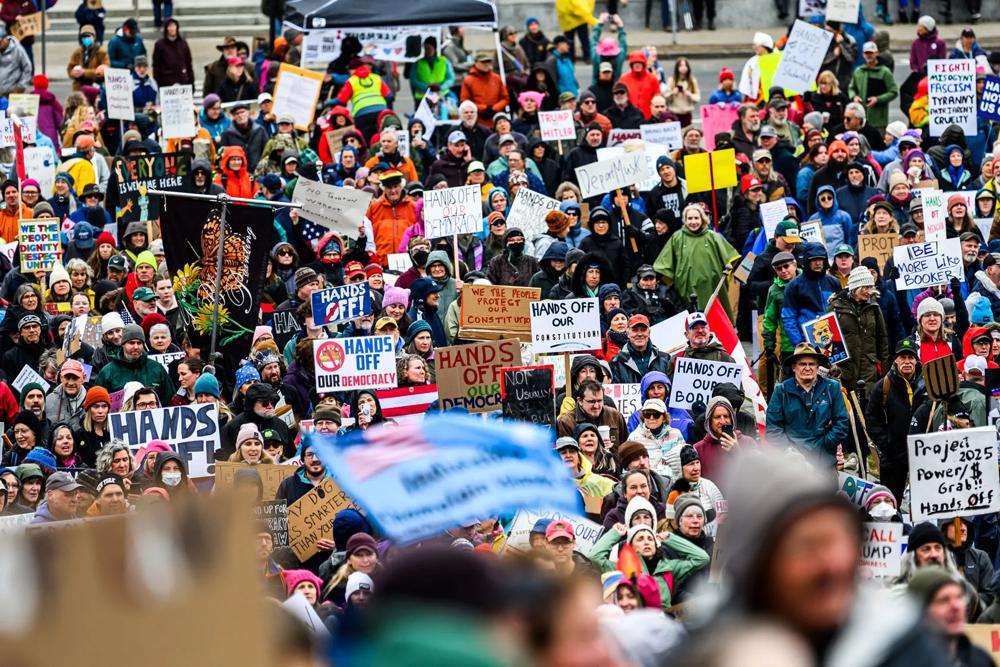
Large crowds of Americans at a peaceful rally emphasize unity and democracy.
Public gatherings – like rallies, community forums, or cultural events – can be powerful ways to notice shared humanity. Together, people can articulate a hopeful vision for society (clean air, fair wages, open elections, etc.) rather than just shouting “no” to leaders. In fact, experts urge leaders across different parties and issues to work together. They call for a kind of “peacebuilding” approach: convene diverse
30
networks and communities with democracy experts to identify common goals, and
use a systems perspective to plan strategic actions justsecurity.org.
For instance, one report suggests that unions, universities, nonprofits, professional groups, and others should coordinate a broad “connective infrastructure of
democratic resistance” americanprogress.org. This means building relationships today so that if authoritarian measures escalate, these groups can rapidly mobilize together – calling legislators, hosting forums, or launching campaigns that cut across age, race, and ideology. Successful examples in recent years include the 2020 election mobilization: a huge cross-partisan turnout and organized vote-protection campaign
helped ensure every vote was counted justsecurity.org. That effort shows the power of everyone pitching in using established systems (like campaigning and poll monitoring) rather than only protesting angrily.
Community-building strategies:
• Join or form cross-issue alliances. Work with groups beyond your usual
circle. For example, environmentalists, labor activists, and civil rights groups
can unite around protecting free speech or fair courts, since those issues affect
all causes.
• Strengthen local institutions. Support and participate in churches,
neighborhood associations, mutual aid networks or local news outlets. These
often become networks of trust and information when national discourse is
tense.
• Facilitate constructive dialogue. Host or attend town-hall style meetings
(even online) where people calmly share concerns. Encourage listening across
differences. This builds empathy and isolates extremists.
• Nonviolent discipline. If protesting, plan carefully: train marshals, know your
rights, and emphasize nonviolence. As one study notes, mindful activists can
stay composed even under provocation, helping keep protests focused and
credible nonviolent-conflict.org.
Practical Civic Engagement
Mind and spirit are important, but so are concrete actions. Democratic self-governance offers many tools to push back against authoritarian steps – and using them deliberately can be empowering. Importantly, these tactics are purposeful, not just reactive.
31
• Vote and advocate for election integrity. Every election matters. Work to
ensure voting rights, fair districts, and transparent counts. Volunteer as a poll
worker or observer. Support organizations that fight voter suppression. By
reinforcing clean elections, you strengthen an institutional check on power.
• Contact your representatives (calmly). When a policy seems authoritarian
(e.g. censoring speech, undermining courts), write or call your local and
national legislators explaining your concerns. Use facts and values (equality,
justice) rather than insults. Legislators hear hundreds of angry messages; a
clear respectful message can have more impact.
• Engage in local governance. Attend city council or school board meetings.
These bodies sometimes adopt policies that check or enable higher-level
orders. You can speak up, propose resolutions supporting democratic norms,
or run for local office yourself. (Local campaigns are often less polarized and
more about community solutions.)
• Support independent media and watchdogs. Authoritarian moves often
include controlling information. By subscribing to or donating to independent
news, listening to local community stations, or sharing verified news, you help
ensure citizens stay informed. When disinformation spreads, counter it with
reliable sources and patience.
• Use the law. If rights are threatened, legal action can block bad policies.
Support or volunteer with civil liberties organizations that can sue or file
complaints (e.g. ACLU or local law clinics). Court challenges have historically
stopped or delayed overreaching laws.
In all these actions, keep tone and focus positive. Emphasize what you stand for (e.g. “We support a free press so people can stay informed,” or “We want everyone’s vote counted equally”). This avoids validating the fear narrative. For example, instead of shouting “down with tyranny,” you might say “We believe in elected representation under the law.” Studies suggest that framing issues in terms of shared values (rather than attacking an out-group) can actually reduce polarization
pmc.ncbi.nlm.nih.govpsychologytoday.com.
Examples and Takeaways
• Nonviolent discipline has worked before. Look at movements like the 1960s
civil rights struggle: activists trained in careful nonviolent resistance and
grounded themselves in the value of loving their opponent’s humanity. Their
strategic moral stance gained broad support. Today’s activists can similarly
32
train (for instance, taking nonviolent protest workshops) and stay steady
under pressure nonviolent-conflict.org.
• Focus on building, not just tearing down. If you see an authoritarian policy,
think: how can we create a strong alternative? For example, if a law tightens
internet control, activists might simultaneously work on building decentralized
information platforms or secure communication channels. This mirrors the
principle: instead of fixating solely on fighting the new censorship law, also
invest energy into positive solutions that embody free speech.
• Keep personal balance. Burnout and despair play into authoritarian narratives
too. Take care of your mental health: meditate, exercise, connect with loved
ones. A clear mind makes clearer strategies. The goal is sustainable resistance,
not just a moment of catharsis.
• Unity across differences. Remember that even within a divided society, most
people care about family, security, and dignity. Talk with neighbors or
colleagues who have different views, listening first and finding common
ground. Personal connections remind us that “the people” aren’t far apart at
heart.
In short, wakeful action grounded in values and solidarity is the antidote to fear-driven chaos. As one guide advises, use a systems lens and shared goals to strategize – bringing together all sectors of society so “the connective infrastructure of
democratic resistance” is ready when needed americanprogress.orgjustsecurity.org. By responding with calm determination and positive vision, Americans can push back against authoritarian impulses effectively. We may resist laws or orders we see as unjust – but always with our eyes on the world we want to create, not just on the world we oppose.
Key Takeaways: Stay calm and clear; practice mindfulness or reflection. Build and nourish communities of support. Use democratic tools (voting, petitions, dialogue) proactively. Frame your activism around shared values. In doing so, fear loses its power, and real democratic change becomes possible.
Sources: Psychological and political science studies support these ideas
psychologytoday.compmc.ncbi.nlm.nih.govnonviolent-
conflict.orgjustsecurity.orgamericanprogress.org, as do insights from historic and
modern activists truthout.orgtruthout.orgnonviolent-conflict.org. Each suggests that mindful, values-aligned action – rather than reactive outrage – opens the path to preserving democracy.
33
Mini-Manifesto: Soulful Resistance for a Democratic
Future
We believe that democracy cannot survive on fear, hate, or division — it must be rebuilt on courage, compassion, and clarity.
We choose not to meet authoritarianism with reactive anger, but with grounded awareness, unshakable values, and shared purpose.
We gather in homes, communities, town halls, and online forums — not only to resist what is wrong, but to co-create what is right.
We will:
• Stand up for truth, even when lies are louder.
• Defend the rights of all people, even those we disagree with.
• Refuse to be manipulated by fear.
• Remain nonviolent, even under threat.
• Organize from the inside out — aligning our actions with our deepest values.
We resist not with rage but with vision.
We respond not with panic but with purpose.
We reclaim our country not through domination, but through shared humanity.
"In the face of darkness, we become the light."
34
Defeating Authoritarian Regimes
Through Civil Resistance: Global
Case Studies and Strategies
Introduction
Civil resistance – the use of nonviolent protests, strikes, and other forms of collective action – has proven to be a powerful force in challenging and even toppling authoritarian regimes. Research by scholars at Harvard Kennedy School and elsewhere has shown that nonviolent movements often achieve remarkable success. In fact, campaigns of civil resistance are roughly twice as likely to succeed as armed
insurgencies hks.harvard.edu in achieving their goals. History is replete with examples on nearly every continent where determined popular movements have dismantled dictatorships or military regimes without resorting to warfare. Not only have these movements ousted entrenched autocrats, they have frequently paved the way for democratic transitions. Erica Chenoweth, a Harvard Kennedy School researcher, found that countries where resistance campaigns remained nonviolent were far more likely to transition to democracy compared to those where opposition turned to violence
A striking insight from recent scholarship is the “3.5% rule,” which quantifies the critical mass needed for success. Chenoweth and colleagues analyzed hundreds of campaigns from 1900-2006 and observed that no government has survived a challenge in which at least 3.5% of the population mobilized in sustained
protesthks.harvard.educommonslibrary.org. In other words, when even a relatively small fraction of citizens (often just a few million people in larger countries) actively participates in a resistance movement, the movement has never failed to bring about some form of
change in regimehks.harvard.edu. This finding underscores the power of mass participation: when enough ordinary people withdraw their consent and cooperation from an authoritarian system, that system becomes unsustainable. As we will see in the case studies below, movements that reached this critical mass – from Eastern Europe to
Asia – were uniformly successful in forcing political changehks.harvard.edu.
In this report, we survey several case studies of civil resistance movements across different regions and time periods that successfully defeated authoritarian regimes. We then examine the key strategies and methods that made these movements effective – including a commitment to nonviolent action, savvy use of digital tools,
35
and the leveraging of international solidarity and pressure. Finally, we analyze why achieving broad-based participation (such as that 3.5% of the population threshold) dramatically increases a movement’s chances of victory, drawing on the work of Erica Chenoweth and others. Throughout, examples from around the world – Eastern Europe, Latin America, Asia, the Middle East, and Africa – will illustrate these concepts. Tables are included to compare cases and highlight strategic commonalities.
Case Studies of Successful Civil Resistance
Movements
To understand how civil resistance can topple tyrannies, it is instructive to look at prominent examples. The table below summarizes a selection of successful movements from different regions and eras, followed by additional details for each region:
Country Authoritarian
Region (Year) Regime Movement & Key Tactics Outcome
Negotiated transition;
Communist one- Solidarity movement – labor strikes, free elections in 1989
Eastern Poland party rule underground organizing, broad anti- end communist rule
Europe (1980–1989) (Jaruzelski regime) communist coalitionnonviolent-conflict.org nonviolent-conflict.org.
Dictator voted out in
Nationwide protests, labor strikes, 1988 plebiscite;
Military church-led advocacy, “No” Pinochet steps down,
Latin Chile dictatorship (Gen. plebiscite campaign with creative democracy restored
America (1983–1988) Pinochet) medianonviolent-conflict.org nonviolent-conflict.org.
“People Power” Revolution –
Personalist Regime overthrow in 4
millions in street protests, prayer
Philippines dictatorship (F. days; Marcos flees into
vigils, support from Catholic Church
Asia (1986) Marcos) hks.harvard.edu exilehks.harvard.edu.
President Ben Ali
Jasmine Revolution – spontaneous
Long-term ousted after 23 years in
mass protests, youth-led digital
Middle authoritarian power; transition to
activism (Facebook/Twitter), trade
East/N. Tunisia president (Z. Ben democracy begins
union (UGTT) strikesharvest.usask.ca
Africa (2010–2011) Ali) aljazeera.com harvest.usask.ca.
Nationwide demonstrations, sit-ins Army removes (e.g. mass sit-in in Khartoum), Bashir after 30 years;
Military-Islamist women and youth leadership, power-sharing deal
Sudan autocracy (O. professional association coalition; with civilians follows
Africa (2018–2019) Bashir) pressure on army freedomhouse.org.
36
Eastern Europe: Toppling Communist and Post-Communist Dictatorships
Eastern Europe provides some of the most dramatic examples of nonviolent people-power dismantling authoritarian regimes. In the 1980s, a wave of mostly peaceful revolutions swept the Eastern Bloc, bringing down one-party communist governments that had ruled for decades. This “Autumn of Nations” in 1989 saw mass protests in Poland, East Germany, Czechoslovakia, and beyond, culminating in the
collapse of Soviet-backed regimes within monthsmiamioh.edu. Notably, Poland’s Solidarity movement – a trade-union-led underground opposition – had been organizing strikes and civil resistance since 1980, weathering martial law and repression, until it forced the regime to negotiate free elections in 1989. Solidarity’s broad coalition (workers, intellectuals, church) and strict nonviolent discipline were crucial to its success, resulting in a peaceful transfer of power and Poland’s transition to
democracynonviolent-conflict.org. In East Germany, weekly prayer meetings and demonstrations in Leipzig grew into huge rallies by late 1989; the regime’s decision not to fire on protesters led to the fall of the Berlin Wall and the end of Communist rule. Similarly, Czechoslovakia’s Velvet Revolution of November 1989 saw students and civic activists lead strikes and rallies that ousted the communist leadership in just 10 days, without a shot fired.
After the Cold War, Eastern Europe continued to see dictators fall to civil resistance. One example is Serbia in 2000, where Slobodan Milošević – who had ruled through nationalism and repression throughout the 1990s – was defeated by a student-led movement named Otpor! (“Resistance”). Otpor used creative nonviolent tactics (humorous protests, rock concerts, street theater) to galvanize public discontent, and built a broad coalition demanding free elections. After Milošević tried to falsify election results, massive demonstrations and strikes erupted. Protesters poured into Belgrade on October 5, 2000, even driving bulldozers through police barricades – an event dubbed the “Bulldozer Revolution.” Crucially, the security forces refused to massacre the crowds; many police and army members stood down or even joined the protesters. Within days, Milošević conceded. In the aftermath, the opposition coalition won power and Serbia was restored to democracy after years
of conflict nonviolent-conflict.org. The Serbian case also had an international ripple effect: Otpor’s leaders went on to train activists in other countries, spreading techniques of nonviolent resistance.
Another post-communist example is Georgia’s Rose Revolution (2003). After a fraudulent election, tens of thousands of Georgians led by young activists flooded the streets of Tbilisi carrying roses as symbols of peace. President Eduard Shevardnadze, an old Soviet-era ruler, faced unrelenting but peaceful protests. In a famous scene,
demonstrators hks.harvard.edu stormed the parliament with roses in hand , not weapons. The pressure forced Shevardnadze to resign, ushering in new elections. Georgia’s
37
revolution, like Serbia’s, was part of the early 2000s wave of “Color Revolutions,” in which civic movements across the former Soviet sphere (including Ukraine’s Orange Revolution in 2004) challenged authoritarian practices largely through mass demonstrations and civil disobedience.
Key lessons from Eastern Europe: Whether in the 1980s or 2000s, these movements succeeded through broad unity (across workers, students, religious groups, opposition parties), strategic nonviolence, and refusal of security forces to prop up the regime via deadly force. Once a significant portion of society visibly withdrew its consent – packing city squares and going on strike – regimes discovered they could no longer govern effectively or retain loyalty. In many cases, leaders opted to negotiate or flee rather than order mass atrocities, leading to relatively peaceful transitions.
Latin America: From Military Rule to Democracy
Latin America’s transitions from dictatorship in the 1980s and 1990s were also propelled in part by civil resistance. While some regimes were removed due to economic collapse or armed insurgency, many saw extensive popular protests and civic pressure that forced dictators to open up. One iconic case is Chile’s struggle against General Augusto Pinochet. Pinochet seized power in 1973 through a coup and ruled with brutal force for 17 years. By the mid-1980s, however, Chileans from various walks of life – workers, students, Catholic Church groups, opposition parties – began organizing bold acts of resistance. Starting in 1983, labor unions led by copper miners launched periodic national “Days of Protest,” which saw citizens banging pots and pans (cacerolazo protests), slowing down traffic, staying home from work, and
other acts of civil disobediencenonviolent-conflict.org. These decentralized, low-risk actions helped people overcome fear and demonstrated growing dissent even amid
repressionnonviolent-conflict.org. As momentum built, an alliance of opposition groups mounted a campaign to defeat Pinochet in a 1988 national plebiscite (a yes-or-no vote on extending his rule). Using creative media – including an upbeat “No” TV advertising campaign – and massive voter registration drives, the opposition galvanized Chileans to vote “No” despite the regime’s intimidation. Grassroots organizing in labor unions, universities, and churches mobilized citizens across
the countrynonviolent-conflict.org. The result was a stunning victory: nearly 56% voted against Pinochet, and he was forced to accept the verdict of the people and step down from
the presidencynonviolent-conflict.org. Chile then began a transition to democracy. This outcome was achieved without a civil war – a testament to the power of coordinated nonviolent action and electoral strategy, even under a harsh dictatorship.
38
Other Latin American dictatorships also faced people-power uprisings. In Brazil, during the early 1980s, the Diretas Já (“Direct Elections Now”) movement brought hundreds of thousands into the streets demanding an end to military rule – pressuring the regime to eventually allow a democratic opening. In Argentina, public outrage and protests (such as the courageous marches of the Mothers of the Plaza de Mayo, who demanded accountability for the “disappeared”) delegitimized the ruling junta, which fell in 1983 after its disastrous war in the Falklands/Malvinas. Throughout the region, broad civic coalitions often involving labor unions, human rights groups, students and faith communities pressed relentlessly for change. International solidarity bolstered these efforts as well – for instance, the exposure of human rights abuses by groups like Amnesty International and pressure from foreign governments made it harder for regimes to continue repression without cost.
Key lessons from Latin America: Nonviolent resistance in Latin America frequently took the form of persistent protests, general strikes, and electoral pressure. Even where dictators tried to co-opt or divide the opposition, the coming together of diverse forces (for example, Chile’s unification of secular opposition parties with the Catholic Church and grassroots organizations) proved decisive. These movements also innovated under repression – using tactics from neighborhood pot-banging protests to creative media and cultural resistance – to undermine authoritarian control and embolden the public. By making regimes answer to the people in referendums or negotiations, Latin American civil resistance helped bring about the end of an era of widespread military dictatorship.
Asia: People Power Movements in the Philippines and Beyond
Asia has witnessed several high-profile people power movements that unseated long-ruling strongmen. The Philippines’ “People Power” Revolution of 1986 is perhaps the most famous. After 20 years of authoritarian rule marked by martial law and corruption, President Ferdinand Marcos faced mounting discontent. When Marcos brazenly claimed victory in a snapped 1986 election marred by fraud, Filipinos responded with outrage. Nearly two million citizens swarmed Manila’s Epifanio de los Santos Avenue (EDSA) in late February 1986, rallying to demand Marcos
resignhrf.orghrf.org. For four days, masses of ordinary Filipinos – priests and nuns, workers, students, entire families – occupied the streets in peaceful protest and prayer, even as tanks surrounded them. Crucially, the protest movement had the backing of the influential Catholic Church (led by Cardinal Sin) and was broadcast by rebel media outlets. In a remarkable turn, segments of the military, including Defense Minister Juan Ponce Enrile and the Armed Forces vice chief Fidel Ramos, defected from Marcos and aligned with the people. Confronted by a sea of nonviolent
39
demonstrators and lacking full military support, the Marcos regime collapsed in a matter of days. On February 25, 1986, Ferdinand Marcos fled into exile, and
democracy was nominally restored under Corazon Aquinohks.harvard.edu. The Philippine People Power movement showed the world that a unified, disciplined populace could oust a dictator without resorting to armed rebellion – inspiring pro-democracy activists globally.
In South Korea, a powerful example of civil resistance came in 1987. Decades of military-backed dictatorship led to growing public demand for democracy. When the regime of General Chun Doo-hwan tried to perpetuate itself by hand-picking a successor and refusing democratic reforms, Koreans erupted in protest. During June 1987, millions of South Koreans took to the streets in cities nationwide, chanting
for free elections and an end to martial law8964museum.com. Middle-class citizens, students, and opposition politicians joined in unprecedented numbers. After weeks of escalating demonstrations – known as the June Democracy Movement – the pressure became irresistible. On June 29, 1987, Chun’s ruling party conceded, with his chosen successor announcing the adoption of a new democratic constitution and the holding
of direct presidential elections8964museum.com. This was a nonviolent revolution in effect: the people’s relentless yet peaceful pressure forced the regime to back down and ushered in South Korea’s transition to democracy. Notably, the South Korean protests succeeded where an earlier 1980 uprising (the Gwangju Uprising) had been brutally crushed, underscoring how timing, broad participation, and some restraint by security forces can change the outcome.
Indonesia in 1998 offers another instance. After the Asian financial crisis hit, long-standing grievances against President Suharto’s 32-year authoritarian rule boiled over. Students led huge demonstrations in Jakarta calling for Suharto’s resignation, and when soldiers killed student protesters, public anger only grew. Eventually, even Suharto’s allies withdrew support. Faced with nationwide unrest and economic paralysis, Suharto resigned in May 1998, marking the end of one of Asia’s most enduring dictatorships. Although there was sporadic rioting, the core movement was a civilian protest that achieved its aim without a civil war.
Key lessons from Asia: These movements – from the Philippines to South Korea to Indonesia – highlight the importance of mass mobilization cutting across societal divisions. In each case, millions of people (well over the 3.5% population threshold) turned out. This critical mass created situations where the regime’s pillars of support (especially the military) began to fracture. Nonviolent discipline was also key; protesters often brought flowers, prayed, or used symbols of peace, reinforcing their moral high ground. Moreover, Asian people power demonstrations often unfolded in front of the world’s eyes via television – global media coverage amplified their impact and put pressure on regimes not to resort to massacres. Ultimately, by denying authoritarian rulers the cooperation of the governed on a huge scale, these
40
movements forced dictators into a corner where exit (resignation or exile) became the only viable option.
Middle East and North Africa: The Arab Spring and Beyond
The Middle East and North Africa (MENA) region has experienced both dramatic successes and harsh setbacks in civil resistance. The Arab Spring of 2011 in particular saw an unprecedented surge of people power against autocracy. The spark was lit in Tunisia, where decades of frustration under President Zine El Abidine Ben Ali’s police state exploded after a street vendor’s self-immolation in December 2010. Protests against corruption, unemployment, and repression spread rapidly, first in provincial towns and then in the capital, Tunis. Despite attempts at violent crackdowns, the protesters remained overwhelmingly nonviolent – they marched, chanted, and documented events on social media. Digital activism played a pivotal role: Tunisian bloggers and youth used Facebook and Twitter to share videos of demonstrations and police abuses, bypassing state media. This online dissemination helped galvanize more support and drew international attention. As one analysis noted at the time, bloggers and online activists helped force President Ben Ali to
flee the country by January 14, 2011aljazeera.com. The army in Tunisia ultimately refused to shoot en masse at the demonstrators, and Ben Ali, losing his grip, escaped into exile. The victory in Tunisia – a comparatively peaceful revolution driven by social networking sites and grassroots action – marked the first ever ouster of an Arab
dictator by popular revolt in the modern eraaljazeera.com. It triggered hope for democratic change and indeed led to a transition process that, for a time, made Tunisia the only Arab Spring country to establish a democracy.
Tunisia’s success quickly inspired Egypt, the most populous Arab nation, to follow suit. On January 25, 2011, Egyptians launched nationwide protests against President Hosni Mubarak’s 30-year authoritarian rule. Centered in Cairo’s Tahrir Square, the protests swelled over 18 days into the largest demonstrations in Egypt’s modern history. Egyptians from all walks of life – Muslims and Christians, rich and poor – sustained sit-ins and marches despite waves of arrests and occasional violence from pro-regime thugs. Once again, social media helped organizers coordinate and expose the regime’s tactics, and satellite channels like Al Jazeera broadcast the events live across the globe. By February 11, 2011, the pressure was unstoppable: the military stepped in and compelled Mubarak to resign. Elation filled the streets of Cairo as Egyptians celebrated the end of Mubarak’s rule after just 18 days of mass
civil resistancealjazeera.com. While Egypt’s democratic experiment later faltered, the 2011 uprising demonstrated the potential of unified, nonviolent pressure to bring down a dictator. Observers noted that social media was “instrumental in the success of the
anti- ijoc.org government protests that led to the resignation of [Egypt’s] dictatorial leader”.
41
Beyond Tunisia and Egypt, the Arab Spring saw civil resistance surges in countries like Bahrain, Yemen, Syria, and Libya, though those did not have the same immediate success (some turned into tragic wars). However, a second wave of nonviolent uprisings in the MENA region later in the decade did score victories. One notable case is Sudan in 2019. Starting in December 2018, Sudanese fed up with soaring prices and 30 years of oppression under President Omar al-Bashir began protesting in towns and cities. Women and young people were at the forefront of what grew into the largest mass movement in Sudan’s history. They organized through neighborhood committees and professional associations, maintaining nonviolent discipline even as security forces occasionally fired on crowds. By April 2019, months of nationwide demonstrations and strikes had made Bashir’s position untenable
freedomhouse.org. In a last resort to stabilize the country, the Sudanese military **deposed Bashir in a coup d’état – but only after massive civilian pressure forced their hand
freedomhouse.org. Bashir’s fall was followed by negotiations in which protest leaders secured a civilian-military power-sharing agreement (though Sudan’s transition remains fragile). Sudan’s revolution echoed two earlier people’s uprisings in its history (1964 and 1985), showing a long tradition of Sudanese using nonviolent mass action to topple dictators.
Key lessons from MENA: The successful cases in this region highlight the importance of digital activism, the contagion effect of people power (one success inspiring another), and the role of the army’s stance. Protesters skilfully used social media to organize and to win the narrative globally – Tunisia and Egypt were often dubbed “Facebook revolutions” in recognition of this new tool. International solidarity was evident as well: Egyptians in the diaspora and global civil society put pressure on regimes and provided support (for example, tech support to keep protesters online when governments tried to shut down the internet). Another factor was that in cases like Tunisia and Egypt, the military ultimately refused orders to massacre and instead facilitated a change in leadership – a reminder that winning over or neutralizing the security forces is critical. When nonviolent movements can create splits within a regime’s pillars (as happened when the Tunisian and Egyptian armies sympathized with a largely peaceful popular movement), the fall of the dictator can come swiftly.
42
Key Strategies and Methods of Successful
Movements
Despite differences in context, successful civil resistance movements against authoritarian regimes tend to rely on a common toolkit of strategies and methods. These include maintaining nonviolent discipline, mobilizing a wide cross-section of society, leveraging communications technology, and garnering outside support. Below, we outline some of the key strategies and how they have been applied in various movements:
1. Nonviolent Discipline and Diverse Tactics
A commitment to nonviolent action is the defining feature of these movements and a source of their strength. By eschewing armed struggle, civil resistance campaigns can attract far greater numbers of participants – including women, children, the elderly, and others who would not take up arms – thus expanding the movement’s size and diversity. Nonviolent movements also impose a dilemma on authoritarian rulers : if a regime cracks down violently on peaceful protesters, it often backfires by eroding the regime’s domestic and international legitimacy, and even triggering more public outrage. On the other hand, if the regime tolerates the protests, the movement gains space to grow. Either way, the regime’s usual tools of control are less effective. This partially explains why, historically, every campaign that mobilized at least 3.5% of the population and maintained nonviolent discipline was successful in forcing
political change (typically regime change)commonslibrary.org.
Successful movements practice nonviolent discipline even under provocation, and they employ a creative variety of tactics beyond just street rallies. As Chenoweth and Stephan’s research notes, campaigns that innovate with numerous methods (strikes, boycotts, sit-ins, stay-at-home protests, humor and satire, parallel
institutions, etc.) are harder to suppresshks.harvard.edu. For example, Poland’s Solidarity not only organized strikes but also ran underground schools, newspapers, and cultural
events, creating an hks.harvard.edu alternative society that the regime could not fully control. In Chile, when direct protests were too dangerous, opponents of Pinochet found ingenious ways to signal dissent, like the nighttime pot-banging protests or a
national “flash mob” style slowdown of trafficnonviolent-conflict.org. In Morocco during the Arab Spring, activists dyed stray cats in the colors of the national flag and released them in the streets as a whimsical protest – injecting humor to undercut the regime’s
aura of control hks.harvard.edu. Such imaginative tactics keep people engaged and can undermine the fear that sustains authoritarian rule.
43
Just as important is training participants to resist provocations to violence. Movements often emphasize discipline – no stones thrown, no retaliation against police – even if infiltrators try to spark riots. This discipline helped movements like Serbia’s Otpor gain moral high ground. When riot police beat unarmed Serbian students, it only made the regime look worse and swelled the protesters’ ranks. Chenoweth identifies unity, strategic planning, and nonviolent discipline as three
crucial attributes that determine a movement’s success or failure hks.harvard.edu. By staying united in purpose and refusing to be lured into violence, successful movements avoided giving regimes a pretext for all-out repression.
2. Mass Mobilization and Coalition-Building
The sheer size and social breadth of a movement is one of the strongest predictors of success. Large numbers signal that the resistance is not a fringe group but truly represents the populace’s will. A common rule of thumb from research is that engaging at least 3.5% of the population in active protest is correlated with
victoryhks.harvard.edu. Reaching this level requires building broad coalitions – uniting disparate social groups and even unlikely allies against the regime. In case after case, successful movements found ways to bridge ideological, class, and religious divides in the name of a common goal (freedom, democracy, human rights).
For instance, the People Power movement in the Philippines brought together urban middle classes, rural poor, the Catholic Church hierarchy, former political elites, and communist guerrilla sympathizers into a loose but effective alliance against Marcos. In Sudan’s 2018–19 uprising, professionals (doctors, lawyers, engineers), trade unions, women’s groups, rebel regions, and even elements of the Islamist movement all coordinated under the banner of removing Bashir. This broad social basis made the protests the “largest social movement in Sudan’s history,” creating nationwide
pressure on the regimefreedomhouse.org. Similarly, Poland’s Solidarity started in the shipyards with workers but soon encompassed students, intellectuals, rural farmers,
and the Catholic Church nonviolent-conflict.org – a true cross-section of Polish society. A large and diverse participation sustained over time not only boosts the movement’s legitimacy; it also means the regime would have to repress an untenable proportion of its own people to stop it.
44
Mass mobilization can take the form of huge demonstrations (as seen in Korea 1987
with millions in the streets8964museum.com) but also general strikes and shutdowns. When people stop the machinery of daily life – factories idle, transportation halts, shops close – the regime feels economic and governance pressure. Serbia in 2000 is a classic example: opposition leaders called for a general strike after Milošević tried to steal the election, and many industrial workers and miners answered that call,
crippling the country until he gave innonviolent-conflict.orgnonviolent-conflict.org. The ability to mobilize across sectors (workers, students, civil servants, etc.) stems from coalition-building and planning. Leaders of successful movements often spend years quietly organizing networks and partnerships so that when the decisive moment comes, society can act in unison. They also deliberately craft messages that resonate widely – focusing on shared grievances and values rather than narrow ideologies. This inclusive approach is vital for getting to that magic 3.5% participation and beyond.
3. Digital Activism and Communication
Modern civil resistance movements have added a new set of tools to their arsenal: digital media and communications technology. Especially in the last two decades, the internet, mobile phones, and social media platforms have dramatically changed how movements organize, communicate, and draw support. Successful uprisings have leveraged these technologies in various ways:
• Organization and rapid mobilization: Social media platforms like Facebook
and Twitter allow activists to publicize protest plans and rally supporters at
lightning speed. In Egypt 2011, for example, youth activists administered
Facebook pages (like the “We Are All Khaled Said” page) that helped
coordinate the initial Jan 25 protests. Through viral posts and messages, tens
of thousands of Egyptians learned where to go and what to demand, largely