The Philosophy of the Sitra Achra by Denys Spirin - HTML preview
Download the book in PDF, ePub for a complete version.
 |  |

Chapter 17. Lehavah

The Qliphoth may become an attractor, and that much is settled. To take the underside of a Sephirah for one's fixed line, to run toward the wretched that mercy sheds or the unbound that severity drops is to be drawn along a vector no less than the will gathered by the Sephirah. The leash remains; the direction is reversed. The foregoing has shown this: ten attractors and ten undersides, and the will that swears itself to any one of them is held.
But the underside can be taken another way. A will fixed in mercy can be struck loose from it by cruelty that does what mercy forbids and thereby breaks the hold. The act is not the swearing of a contrary oath. The will that performs it does not leave mercy to enlist under cruelty, does not exchange one side of the line for the other. It strikes the attractor and enlists nowhere, breaks the hold and raises no second hold in its place. Golachab sworn to is the unbound made a rule, a fresh leash for the throat the limit let go. Golachab, struck as an act and not an allegiance, is the limit's grip broken.
One underside serves two contrary motions, and which it serves depends on how it is taken. Made a fixed rule, it captures. Used as a blow against the rule above it, it frees. The antinomian act is this second use: a Qliphah spent to shatter the attractor that suppressed it, the will pulled out of the line it was running along. And the act, breaking the attractor, sets nothing where the attractor stood.
This opens the question the Other Side answers. If the antinomian act raises no second attractor, then what remains there? Not the Sephirah, not its underside as a new rule. Something holds the place that is neither the sealed face nor the sworn reverse, and to name it is to clarify what the Sitra Achra is in its own right, no longer the Tree read backward.
One station of the Tree gives the form of the answer, as it alone was never sealed. The others were cut and closed, one face gathered up and shown, the rest pressed under. Daath was cut and could not be closed. What it holds is identity and difference kept level: the grasp that gathers and the cut that divides, both alive and neither resolved into the other. A station that sets the two as equals knows difference as something unity cannot rank. What Daath is — the place where a cut is held open instead of closed on one side — is what stands where the antinomian act breaks the attractor.
The sealed cut is opaque. A Sephirah shows its kept face and buries the other, and the line reads as a feature of the world; to live in it is to take one's own division for reality. Under shamar, to guard and to hold shut, the watchman's word for keeping a thing closed, a cut stays sealed, its making forgotten and hardened into a nature. Against that darkness we set a term, drawn from Hebrew and put to a use the tradition did not give it. Lehavah is a feminine Hebrew noun meaning flame. A flame is what a form becomes when it will not hold still and will not go dark, giving light and lasting only in the burning. The cut held as Lehavah remains visible as the act of laying a line, burning rather than settling into a law, since a flame gone still is ash. It takes the feminine because it names a Qliphah set aflame, a Sephirah turned to fire, belonging to the same grammatical family as the shells and the emanations it works upon. The Draconian current has always named its godhood a fire, the Black Flame of a will that is its own and bows to nothing above it, and the Lehavah is that fire brought to the single cut. A will draws it, and in the drawing knows it for its own, laid here and open to falling elsewhere or not at all, made knowingly and kept from passing for a law.
Said plainly, the Lehavah is the cut of a will under neither an authority above it nor a law it hardens into. No god, no order, no morality rules the line from outside, and no identity and no self-caused nature drive it from within. The freedom is twofold, and freedom from law is only half of it. To be under no law is not yet the whole of it, since a will freed from rules above it might still think its task is to choose a side from a field already divided, mercy and its opposite laid out as given options, with liberty reduced to the absence of a hand forcing the choice. That is the smaller freedom. The Lehavah holds the larger one. The sides are not found waiting; the cut lays them. What a will draws its line across is the undivided, which forbids no line and ordains none, and the marked and discarded sides arise only through the drawing. The will does not choose between mercy and cruelty; it draws the line whose one face reads as mercy and whose other falls away, and it could have drawn elsewhere, the depth resisting nothing and prescribing nothing. Freedom in the Lehavah is first this, the laying of the cut, and then the holding of it open; the second without the first would be a chooser faced with a fixed menu, unbound in choosing and not in what there is to choose.
Two ways of hearing that freedom miss it. One hears no law and puts chance in its place: if nothing rules the cut, the cut is a throw of the dice. But a will owning the line it lays is the contrary of a dice-throw, and chance is the absence of a chooser where the Lehavah is a chooser unbound by any law, the will kept where randomness would remove it. The other keeps the will and turns its freedom into a discipline: hold the poles alive by taking them in turn, give today and refuse tomorrow so as not to set, until the not-setting is itself the rule the days serve. That is the attractor rebuilt as a timetable of its own undoing. The Lehavah keeps no such rhythm, and no act or policy of alternating acts seals the place into a nature.
Take a man whose entire life has run in mercy. He cannot refuse a plea, cannot withhold or say the hard word, and he calls this his goodness. The kindness is not chosen. He runs in a groove, a compulsion wearing the face of virtue, and mercy holds him as surely as an order holds a soldier. Suppose he refuses once, deliberately, and turns away a hand held out to him, for one reason: to prove to himself that the groove is not his nature, with no wish to turn cruel and no oath sworn to hardness. In that act the hold breaks. What may remain afterward is neither the compelled giver nor a fresh compelled refuser. The free figure is the man who sees that his compulsion to give was a line drawn through him, and who from here gives or withholds as he wills, owning it as his act. He still shows mercy, but now as a thing he does and could leave undone, no longer as a law he serves. This is the Lehavah: the cut kept in the hand that made it, the act performed without the actor dissolving into it.
The one who works this way must distinguish the Lehavah from its counterfeit, and the mark is in how the act is lived. In an attractor the deed carries an alibi: it is felt as the only possible act — I had to give, I had to destroy. The necessity is the sensation of the leash. In the Lehavah the alibi is gone. The act may be hard or soft, ruinous or sparing, and it does not shelter behind the structure of being; it appears as a line the will knows it laid, held to no order above it. To act and feel no compulsion in the acting, to find the possibility of another line still open beside the one drawn, is the whole difference felt from within.
The first snare comes when the freeing act is raised into a rule for the next one. Because refusal broke one attractor, refusal itself is taken as the law: "now I must refuse." The stroke that frees then hardens into another command. The Lehavah begins where neither the giving nor the refusal becomes what he is, where he can do either and be neither, the side he acts from never hardening into his nature.
The second snare comes after the act, in what the doer makes of himself. Let the outcome be taken as an identity, "so this is what I am, one who is cruel," and the cut has cooled into a self, the act read back as the identity of the one who performed it. No doctrine is needed for this, only the turn by which a will points at the trace it left and calls it what the will is. The Lehavah leaves residue, but raises none of it into a nature. It ends in no teaching to carry forward, no rule drawn from the deed and set over the next one. The will that held the cut open walks away holding no law it must now obey, and the moment a law is claimed the flame has gone to sediment.
The objection that cuts deepest is the one we have turned on others: here is your freedom, and it is one more attractor wearing a new sign. Put the Lehavah to that test and see whether it holds the shape of an attractor. An attractor was never defined by its content. It is a will frozen in a determination, a cut taken for a nature and run as a law. Let the will set into the line it drew, take the determination for what the will is, and run from there: that setting is the attractor. Let the will hold the line without setting into it, owning the cut and being able to lift it: that holding is the Lehavah. To call the Lehavah an attractor is to say a will that has not frozen has frozen, a contradiction in the terms. The knowledge of contingency is not a further doctrine a will sinks into, because it is the name for the will's refusal to sink, the refusal to freeze carried as awareness. A doctrine is a filled and hardened line, mercy laid out thus, justice thus. The knowledge of contingency fills no line; it holds a line as drawn and drawable otherwise, which is the one content that cannot set without ceasing to be what it is. The attractor is not a rival to the Lehavah on the same ground. It is what the Lehavah becomes the instant the will lets it harden, and the difference between them is the difference between a flame and its ash.
The dogmatist swears his cut is the truth, and the answer is that no cut shows a ground beneath it — this saying included. He turns that on itself: if any cut is contingent, so is this one, so it might be false, so there may be necessary cuts after all. The turn equivocates. That the saying is contingent as an act, laid by a will and never bound to be laid, is granted, and nothing follows about its content, no more than a spoken truth becomes false because the speaker might have kept silent. And the content is not one cut competing with another. To call a cut necessary is to assert a ground beneath it and owe an account of that ground; to call a cut contingent is to report that no such ground has been found, under any cut and under this report too. The one must produce a presence; the other marks an absence, and an absence turned on itself stays an absence. What would break it is a single necessary cut shown together with the ground that makes it necessary; yet that ground would itself be another cut demanding a further ground, and so on through Agrippa's regress.
The two sides of the cut show through the Lehavah, not a void behind them. To read the seeing-through as a window into Tiamat, as though the open cut looked past both faces to some blank beneath all sides, is to lose it and sink into the undivided. The Lehavah makes mercy and its underside visible together, while revealing no emptiness beneath them.
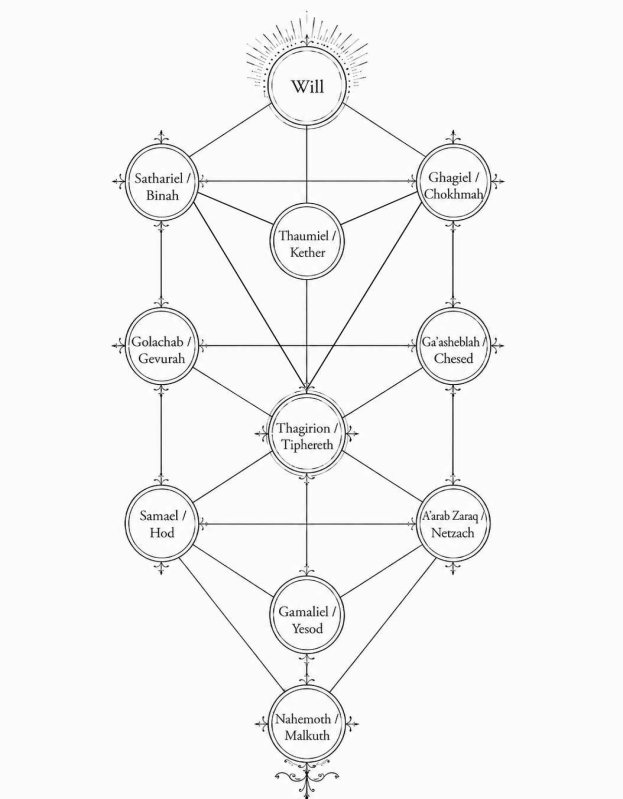
Gevurah is the limit, the line that binds and cuts the unbounded away. Sealed into a Sephirah it shows the limit and hides the unbound it suppressed to keep its measure. Golachab is what it dropped. As a rule, Golachab is that unbound raised into a law. As a Lehavah, Golachab is neither the limit shown nor the limitlessness sworn to, but the cut between them held open. The same holds down the stations: Tipheret seals proportion and buries the misshapen, and the Lehavah at Thagirion holds proportion and its breaking open together; Hod seals form and buries the formless that eats it, and the Lehavah at Samael holds both forming and dissolving, neither one the truth of the place.
Two readings gut this, and both fold the Lehavah back into a unity. The first takes both sides at once for a harmony that holds the two in a higher whole, the reconciliation that gathers difference into the One. The Lehavah reconciles nothing; it holds the two open and leaves them two. The other takes the refusal to fix either side as a sinking of the distinction into what has no sides, unity reached from below. The Lehavah is still a cut, two faces held apart, where the undivided has no faces at all. To hold the difference so is the contrary of gathering it and of dissolving it alike, and the two errors are one error in two masks.
A will under no law looks like a will that may do as it pleases, and so it is, though that is no charge against it. To want anything and to be able to act on it is what a will is by definition, and no rule above has ever changed that; the rule only draped the wanting in permission and prohibition. Lift the rule and the will stays what it always was, free to draw any line. What meets it then is world resistance. Will acts among other wills and against the grain of things, and the cut it lays comes back to it in consequences it did not decree. The freedom to want everything was never a freedom from the return of the act.
The inward return is heavier. Under a law the will could lay its cut and answer for none of it, the law taking the weight, so that even indulgence came already judged, permitted or forbidden by something above. Strip the law and the warrant is gone with it. The will that takes what it wants can no longer say the wanting justified the taking; the cut is its own, excused by nothing. And a will that keeps taking based on appetite alone lays that same line until it sets, and the taking becomes the taker, appetite closed into the nature of a self. That is an attractor, a desire in the place duty held, and it hardens into shapes the Left-Hand Path is quickest to mistake for freedom. Egoism is the will set into the self it serves; power is the will set into its own increase, and any appetite worn as a nature quickly becomes a law. The hedonist bound by his craving, the tyrant by his dominion, are held as the saint is held by his mercy. That these wear the colors of self-assertion changes nothing. The Lehavah does not forbid the indulgent cut; it refuses the settling, and it leaves responsibility for the cut with the one who draws it.
This distinction is invisible to the Right-Hand Path. The contrast between the shell sworn to as a rule and the shell struck as an act can be seen only from inside the work with the Qliphoth. It sorts the Left-Hand traditions from one another. The Holy Side sees none of it. It admits only one distinction: whether the shell has been severed from the pure, and along that axis the Lehavah and the sworn inversion fall together on the same side, both still bound to the husk the ascent exists to cut away. To hold the cut open is, to that eye, to have failed to close it, which is the one failure the Right-Hand Path knows. For it the Lehavah is evil for the plain reason that evil has always meant the shell unremoved, and the will that keeps both faces alive is condemned for the amputation left undone.