

The Big Corner by Edward Drobinski - HTML preview
Download the book in PDF, ePub, Kindle for a complete version.
Page 120
Jack Benny: “Well, all right then. I have an important appointment soon. Just polish my shoes.”
Rochester: “Yassuh, Missah Binny. Yassuh. Ah jus luvs dat polishin. Mmmmnnn. Mmmmnnn. Mmmmnnn.”
The audience laughed.
Jack Benny: “After that you can wash the car.”
Rochester: “Ooooh, Missah Binny. Yu be one mean man. I’s so tard, yu workin’ me so hahd.”
Jack Benny: “Have you been eating your Grape Nuts Flakes?”
Rochester: “No suh, Missah Binny. I’s gots no tahm fo brekfas wid all dese jobs.”
Jack Benny: “Rochester; it’s not the jobs; it’s that you lack the energy to do them.”
Rochester: “Ah doan know, Missah Binny. Ah be ow rite wid dese shoes heah. Mmmmnnn. Mmmmnnn. Mmmmnnn. Ah jus luvs dat polishin.
Smell be so good.”
The audience laughed.
Page 121
Jack Benny: “Rochester, life is not all fun and games. There is work to be done. Stop that shining for a minute and eat some of these Grape Nuts Flakes.”
Rochester, as he eats: “Mmmmnnn. Mmmmnnn. Mmmmnnn. Yassuh, Missah Binny. Yu What peeples be so smart. Taste so good, an ahm reddy to woik all day. Mmmmnnn. Mmmmnnn. Mmmmnnn.”
The audience cheered.
Jack Benny: “Take it from Rochester. No, don’t take it from Rochester. Get your own. Just like Rochester, you good folks out there in radio land can fuel your day with Grape-Nuts Flakes cereal. The delicious whole grain goodness has been converted into lightly crispy flakes. They're the perfect jump start for the healthy, active day ahead. These wholesome flakes are a good source of fiber. Ninety percent of users surveyed report doing daily poops. It’s heart healthy. The diet is low in saturated fat and cholesterol, and as low as possible in trans fat. Not one case of a heart attack has been reported while eating Grape Nuts Flakes. This delicious cereal is full of the good stuff you love, with no artificial colors or flavors. Grape Nuts Flakes are a good source of eleven essential vitamins and minerals, a satisfying cereal that is high in iron and folate. So, what are
Page 122
you waiting for? Go out and get your own Grape Nuts Flakes right now. ........ Errr, I mean when the show is over.”
The audience laughed and applauded, though it seemed as if that their heart was not in it.
Rochester: “Missah Binny. It be seem lahk da audience need some Grape Nuts Flakes, too.”
Jack Benny: “Raht you beez, Missah Rochester.”
The audience laughed.
Rochester: “Hey, Missah Binny. Doan yu be stealin’ my stuff.”
Jack Benny: “I’m a comedian. You know that. That’s what we do, silly boy.”
Rochester: “Yu be breakin’ da low, bose.”
Jack Benny: “Who cares?”
The audience applauded and laughed.
Jack Benny: The Radio Show
Jack benny was called “Mister Radio,” and was the original “King of All Media.” The world's oldest thirty-nine year old was quite possibly the person most associated with the golden age of radio.
Page 123
Jack Benny, born in 1894, grew up in Waukegan, Illinois, the town he made famous in countless routines. At age six he began studying the violin, and in 1911, at age 17, Benny began his career playing the violin on the vaudeville stage. His violin would serve him well throughout his career, becoming one of the most iconic props in comedy.
After more than two decades in vaudeville that included several name changes, refinements to both his act and character, a stint in the US Navy during WWI, and marriage to Sadie Marks, better known as Mary Livingstone, Benjamin Kubelsky settled on the name and persona of Jack Benny, and decided that the time was right to move into the new medium of radio.
In 1932, Benny made his first brief appearances on radio.
Proving to be a natural personality for the new medium, at age thirty-eight he was awarded his own show on the NBC Blue Network. Jack Benny would celebrate his thirty-ninth birthday on the air, and because according to Jack; "There's nothing funny about forty," would go on to celebrate his thirty-ninth birthday forty-one more times throughout his life.
“The Jack Benny Show” was actually many different shows, each named for its respective sponsor. At various times, Benny's radio program was known as “The Canada Dry Program,” “The
Page 124
Chevrolet Program,” “The General Tire Revue,” “The Jell-O
Program,” “The Grape Nuts Flakes Program,” and “The Lucky Strike Program.” Despite the name changes, the show and cast went largely unchanged throughout the years. The many forms of “The Jack Benny Show” would remain on radio for more than two decades.
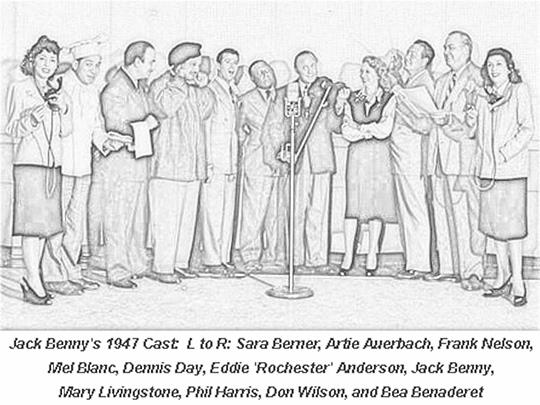
The cast was led, of course, by Jack Benny as the well-known everyman with many comic foibles, including gently exaggerated vanity, pettiness, self-importance, and the ability to squeeze more out of a penny than any man alive. Appearing with Benny in these programs were Eddie Anderson as his valet “Rochester,” who knows him better than anyone and regularly plays on Jack's vanity; Mary Livingstone, his wise cracking secretary and provider of a uniquely female perspective on Jack's peculiarities, and his real life wife for 47 years; Dennis Day, the naive and sheltered singer; Phil Harris, a hard drinking bandleader and hipster son of the south; Don Wilson, the rotund announcer and the target of many of Jack's barbs; and voice actor extraordinaire Mel Blanc as just about every character imaginable, including Polly the Parrot and Benny's sputtering Maxwell automobile.
The Big Corner
Page 125
Like many of the major stars of this era of radio, Jack Benny remained in firm control of the many programs that bore his name. Although not credited as such, he was both director and head writer of all of his series. This did not mean that he was a tyrant of his productions, rather he was very generous in valuing both his writers and his cast, most of whom were with him until the end of his radio career. This generosity extended to allowing cast members and guest stars to have the best lines.
Jack often said that it didn't matter who got the laughs, as long as the show was funny.
This firm control even extended to the commercial breaks on his programs. On “The Lucky Strike Program,” for example, Jack would
Page 126
allow the advertisers to write the opening and closing spots, but insisted that his own writers be the ones to write the middle commercial, leading to many of the program's best segments.
Jack Benny’s overall approach was quite innovative despite being post-modern as it took as its premise from characters on a reality radio show, which in itself is a form of fiction posing as truth. He spins that story with vivid and overpowering sensory images, delves deep into the psyche of the protagonist, and leaves the listener laughing while contemplating life meanings and how one sees oneself. Besides appearing in his own series, Jack Benny was a much sought after guest on other radio shows. He made many appearances on such popular anthology programs as “The Screen Guild Theater,” “Lux Radio Theater,” and
“Suspense,” and even recreated his “The Horn Blows at Midnight,”
a better story than he ever let on, on “Ford Theater.”
Some of Jack's most notorious appearances were in name only, on
“The Fred Allen Show.” Jack Benny and Fred Allen had a feud that ran for almost two decades, each star mercilessly taunting the other on the air. In reality, this was for comedic purposes only; off air Benny and Allen were friends with the utmost mutual respect.
Page 127
In his private life, Jack Benny could not have been any more the opposite of his on air persona. He was a generous, thoughtful man.
Exiting the “lunch” counter area, Sam Shovelin was in the section which sold tropical fish. He always hated this area, as the store workers always removed a few of the fish from the tank, and placed them in plastic bags full of water. This didn’t seem to serve any purpose, didn’t look like it did any wonders for the trapped fish, and he didn’t even want to think about the sick predators with needles, though he had seen their work two or three times, and found it a difficult image to forget.
Sam scooted through the long, straight aisles of the store cursorily viewing the myriad of items for sale, each section presided over by an attendant who with head down was fussing with something that was ostensibly in need of some altering
“enhancement,” more likely a function of their down-to-earth wish to appear as busy to the strict, self-important floorwalker, who aggrandized his position when he constantly and smugly considered his ambulatory guard duty job as being part of upper management.
Sam went to the toy section. He found that there were still roscoes which shot soft plastic bullets and/or caps, dolls for
Page 128
girls with outfits ranging from raggedy to regal; the dolls that is, marbles, games and puzzles of all sorts, though more or less disproportionately evocative of war, Little Golden Books, models to be assembled with glue and finished with decals, Disney puppets, building blocks, Lincoln logs, Mr. Potato Head, tin soldiers, slinkies, and fake dough; the latter a wad that could choke a scientifically rendered image of a sharp toothed tyrannosaurus rex, yours for a real buffalo or Jefferson nickel.
That seemed a better deal than was available anywhere else, but Sam had a soft spot for the Kentucky Derby horse racing game, which was now still available, but at an inflated price of nineteen cents. He lingered over the names of the all-time greats who were still competing for every kid whose parents had that nineteen cents; Whirlaway, Gallant Fox, Citation, Seabiscuit, Assault, Man O’ War, Sir Barton, and Count Fleet. He wondered if he should open the unsealed box. He looked around furtively, didn’t see anyone watching him, and lifted the lid, put the bangtails at the starting gate, and flicked the arrow.
The arrow whirred as it spun around the wheel just the opposite of what they do roulette. It stopped on his favorite, Whirlaway, just as it consistently did when Sam was a three foot tall fan of the triple Crown winner. He smiled, and put the lid back on
Page 129
before anyone could see him playing “baby” games, content that some things never change.
He exited Woolworth’s and was greeted by the waves of heat emanating from the shrill rays of the insistent, sweltering sun, which made him momentarily consider the purchases of five and dime shades and A-shirts.
The expansive sizes and purposes of the shop windows gradually expanded as he took it on the arches in an uptown direction.
Initially, narrow windows provided light and limited display space for craftsmen and direct importers. Silversmiths displayed their handmade goods next to pieces they purchased on trips to Europe and the Northeast. Early china importers on the street filled their windows with colorful transfer printed earthenware and sleek porcelain dishes that had just arrived on trucks from New York City; and ships from Staffordshire, England; and Le Havre, France.
Leaded windows looked in on traditionally high end furniture stores, evocative of a time passed which focussed on quality, still popular with those who could afford it. Pilgrim, Queen Anne, Chippendale, Sheraton, Heppelwhite, and some of the Empire, that crafted before it got degraded and machined, still reigned in glory inside, defiant of the inferior succeeding
Page 130
forms. In other emporiums, light reflected from huge pier mirrors, silk curtains, and polished rosewood, cherry, and mahogany furniture; some oak, walnut, and pine creeping in.
Upholstery fabrics, mirrors, and miscellaneous “fancy goods”
were sold to accompany elaborate and highly ornamented furniture in the earliest of the many Victorian styles, available at reasonable prices.
Large plate glass shop windows along parts of Broadway were dedicated to glittering luxuries. Local newspapers reported on the diamond jewelry, marble statues, regulated clocks, patented pistols, and specialty china and silver services that filled the best windows. Retailers competed with one another to have the most impressive objects on display. When one jeweler displayed a miniature fire engine as a prize for a local fair, another made a true to life, silver and gold model of one of the mule drawn streetcars that once traveled up and down Broadway.
Since the turn of the twentieth century, large department stores became the anchors of the shopping district on Broadway. They created lifelike tableaus in their windows, complete with mannequins, foliage, and taxidermy animals. Illuminated by electricity instead of sunlight, these windows illustrated the life of luxury that was becoming increasingly affordable for
Page 131
many. The shop windows of Bayway Town were designed to spark viewers’ imaginations and encourage them to open their purses.
Sam was so sparked, but carried no purse. He crossed to the south, non-Paramount side of the street, where the retail stores were of the more “affordable” variety. “John’s Bargain Store”
stood out, literally so, as John had so much merchandise that the bargains spilled into bins which occupied the concrete sidewalk. “ALL SALES FINAL; NO RETURNS,” peeped its message in rather fine print above the cash register, just as it did on customer sales receipts. Seconds and/or irregulars were not marked as such. “John” Merrill Garfinkel purchased them at manufacturer’s closeouts for next to nothing, and if he sold one quarter of what he purchased he was in the chump change already.
He made no differentiation between goods, and he purchased whatever he could get cheap, the items ranging from leaky garden hoses to tape recorders which used a tape size which no longer was made to underwear with stretched out elastic. The store really belonged in a dinge area, but even after a bad experience, people would come back, expecting next time to be different at an affordable price.
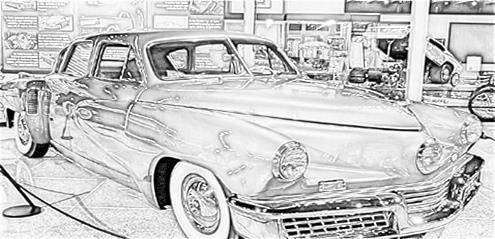
Sam re-crossed Broadway in the middle of the street and almost got hit by a Tucker Torpedo, which he had to dodge at the last second.
The Big Corner
Page 132
The Tucker, which may have ignored a traffic sign or two, had a driver who seemed oblivious to the well-travelled road, his seemingly fascinated face looking toward the shop windows, and unaware of having missed Sam by all of eight inches.
Sam decided to curtail his window shopping and go back to the safety of his 25th Street office. His mind flipped over to thinking about how much he disliked his lying, possibly dangerous client, Vivian, countering that with how much he liked her clams. Az men git dem tayvl a hor, vil er di gantse bord.
Page 133
Tiresome Replay
Sam entered his office to find Vivian Beaumont in her usual spot; on his desk. This time he wasn’t the least bit clumsy and thrown off as he was during her first visit. As his disappointed eyes rolled from her to the faux Indian chest on the floor used for filing, he unconsciously grimaced. Perhaps as a result of seeing that, Vivian was less casual this showing, and righted her skirt before standing next to the desk and saying; “Well, what do you know?”
“Less than you, I’d imagine.”
“What’s that supposed to mean?”
“Just what it said. Which of those words are not in your vocabulary?”
“Imagine.”
“Figures.” Sam was more than a tad irked about how she had not given him the full story and had consequently put him behind the eight ball on the cheap, simultaneously thinking that this scenario was the domain of the private dick, and that he shouldn’t react with anger. That’s for the losers. The winners are more adept at enhancing their potential reward/potential risk ratio. However, Sam couldn’t help but say one more
Page 134
irrelevant thing; “You know I could have you arrested for breaking and entering?”
“Oooooh, so exciting. Do I get handcuffed too?”
“Okay. This is getting boring. Artie was not your boyfriend. You were just one of his many bimbos. The watch has no ‘sentimental’
value for you. It’s extremely valuable, and is being sought by a number of contacted parties, as it belonged to Hitler.”
“That’s excellent detective work, but of no value to me. Now, don’t knock yourself out, but tell me something I don’t already know.” Vivian’s tone seemed as confident as a full sized raccoon in reach of newborn rabbits. She had a point, but also a strong tendency to overplay her hand.
“It was a mob wannabee who put the chill on your ‘beloved’ Artie and he sold the watch to Zanarelli, who’s going to pass it to some freaky rich Reich investor for four million US simoleons.”
Viv didn’t appear to be overly impressed, but hid being modestly infatuated. Sam read this, and pressed on with a demand for $10
an hour, not caring if she ankled it out. Viv read this and she reached into her purse to find $200 to give him saying; “This will last you a few days. Does the wannabee or Zanarelli have the watch now?”
Page 135
“I don’t know.”
She sighed in a disgust which was courting sarcasm, and said;
“Figures.”
Sam tried to alleviate her bad feeling with a way to show that he’s actually doing something. He says; “Look. I’ll show you. Be at this office at 9AM tomorrow and we’ll both go to meet Bayway Town’s top informant.”
“Who is that?”
“I’m not going to name him. Professional courtesy.” Sam knows that even if Fats knows nothing more than he previously had said, he’ll add to it to sound important, apparently thinking people just take his word and never check anything.
Vivian agreed and in fact seemed excited about being a part of the action. She ankled out of the office purring; “Later.”
“9AM sharp!” When he heard the outside door slam shut he called Fats Squealitieri.
Ring, ring, ring, ring, ring. “Aw, come on Fats.”
“Yeah.”
“Fats, Snovelin here. I need a favor.”
Page 136
“Things are tough all over. Who doesn’t?”
“Gustav Koenig. Look, I got twenty simoleons in search of a new home.”
“I’m sometimes a foster parent. Shoot your shit.”
“I’d like you to meet my client, and run some of your bullshit by her in person.”
“Hey, hey. I don’t want to be advertised all over town by being seen with Vivian Beaumont.” In reality Fats doesn’t care about
“being advertised all over town” so much. He mostly doesn’t want to incur any danger by being seen with watch player Vivian Beaumont, especially when he’s on DiCesare’s payroll through Red Doherty.
“Thirty bucks for ten minutes work.”
“I’ll make you a tape.”
“Forty bucks pays your rent for a month.”
“Not with this Truman inflation. ...... No introductions and we meet under the bridge.”
“9AM tomorrow.”
“You got it, chief.”
Page 137
“Sharp! And hey, bring something new. Vivian has already heard the stuff you told me last time.”
The Bayway Town Bridge, built in 1931, connects Bayway Town and New York City. The main foundations, in Bayway town covering First and Second Streets on Avenue A is a perennially shaded area which locals use, especially during heat waves, to relax and throw rocks in the water and wash cars. Fishing is also allowed, but no one does that as the polluted jelly water rubbed out the last fish decades ago.
Page 138
Bayway Town Joe Zanarelli
In order to convincingly pretend to have an understanding of part of Bayway Town’s culture and mores, it is absolutely essential to have some familiarity with Bayway Town Joe’s terror tactics, which were perhaps borrowed from the activities of the Khazarian Zionist advocates and terrorist warrior Lehi Group and Irgun, though perhaps oddly, during WWII, Lehi offered its services to both Germany and Italy, and further though Germany and Italy both publicly refused, ostensibly finding them useless or subversive, likely the latter.
If one says that they have no interest in convincingly pretending to have an understanding, their poseur position is well recognized, and is still fully admissible as a plus on their application for enrollment in most US secondary colleges, as well as all of the primaries.
In any event Bayway Town Joe Zanarelli and his cohorts terror maneuvers came to be seen, substantively or not, as the hallmark of Zanarelli’s reign. He and his followers showed no respect for anyone who stood in their way. Acts such as screaming and cursing at the judge and prosecutors in the courtroom; several defendants getting up and pushing through the juror box; picking up a chair and throwing it at the judge, and the jury foreman
The Big Corner
Page 139
mysteriously falling or getting thrown down two flights of stairs in an abandoned building became part of his standard repertoire.
He is his own world, his own universe. Other than himself he can form no conception. He knows not length, nor breadth, nor height, for he has had no experience or need of them. He is complete. He has no cognizance even of the number two; nor has he a thought of plurality, for he is himself his one and all, simultaneously being really nothing. Bayway Town Joe Zanarelli understood that and it made him more dangerous than a hungry pit bull infested with mange.
Joseph “Joe Bayway Town” Zanarelli, A/K/A “Bayway Town Joe,”
“Joe Z,” and “Joe the Zionist” was born in 1912. He had
Page 140
originally been raised and grew up on Avenue B in Bayway Town, New Jersey. Bayway Town wasn’t big enough for both DiCesare and Zanarelli. So both expanded out of town and agreed to not step on the other’s feet.
“Bayway Town Joe” Zanarelli’s international circle of business contacts and political allies extended far beyond the Caribbean.
In particular, he teamed up with adventurers, criminals, lobbyists, and intelligence agents involved in creating and defending the state of Israel. Their unorthodox tactics were reminiscent of the China Lobby’s. Both groups were dedicated to saving a “small and beleaguered” nation by any means necessary.
Like the China Lobby, this Zionist pro-Israel network illustrates the deep political nexus between organized crime, corruption, and government intelligence. During the state’s official infancy, according to the Federal Bureau of Narcotics, Zanarelli was “alleged to have been involved in the trafficking of arms and munitions sold to the government of Israel.”
Probably not coincidentally, the gangster was also a business partner of two leading Jewish bootleggers, Abner “Longie”
Zwillman and Schenley CEO Lewis Rosenstiel. More than a few prominent Jewish gangsters, including Meyer Lansky, Zwillman,
“Bugsy” Siegel, and Mickey Cohen, supported the Jewish underground with dough and logistics help in the 1940s.
The Big Corner
Page 141
Zanarelli’s partner in the sale of arms and stolen securities, Steven Irwin Schwartz, had been a prominent gunrunner to Jewish armies in Palestine. Schwartz was an officer in ABCO, a New Jersey cigarette vending company controlled by Zanarelli and New York Mafia underboss Carmine Galante. “Since January 1946,” the Federal Bureau of Narcotics report noted, “Schwartz has been engaged in the traffic of arms, a good portion of which have been obtained from Communist Bloc nations and shipped first to Israel and later to Cuba.” Associated with Schwartz in those ventures were Irving “Swifty” Schindler and TWA flight engineer Adolf Schwimmer. The Brooklyn born Schwartz and the Florida
Page 142
based Schindler were both pilots who joined the Jewish underground to seize and fight for a new homeland in British controlled Palestine. Under Schwimmer’s leadership, they smuggled surplus military airplanes to Palestine to build the first Jewish air force. Schwartz recruited pilots from supporters of the right wing terrorist group, the Irgun, headed by Menachem Begin, future head of the State of Israel.
Schindler, Schwartz, and Schwimmer were all found guilty of violating the Neutrality Act but were given light fines, thanks to warming US relations with Israel. Schindler became head of Israel’s new Air Transport Command. Schwimmer founded Israel Aircraft Industries, whose Washington lobbyist for several years was the extraordinary Irving Davidson. A leading fundraiser for this group’s smuggling efforts in 1948 was Abraham Feinberg, a New York based manufacturer of hosiery and president of Americans for Haganah, Inc. As Jonathan Marshall, “Dark Quadrant: Organized Crime, Big Business, and the Corruption of American Democracy” noted, his timely delivery of $100,000 in campaign cash to Louis Johnson helped finance President Truman’s come from behind campaign; the one in which the “Chicago Tribune” pre-printed the famously wrong headline; “DEWEY DEFEATS
TRUMAN.” It should be noted that virtually all major newspapers thought Truman had no chance, but didn’t jump the printing gun, perhaps because they were more aware of the Democrat well-honed
Page 143
capabilities in election fraud; inclusive of ballot box stuffing. For example, Bayway Town’s Democrat Mayor Frank DiCesare's use of voter fraud is the stuff of legend, writing the playbook for future Democrat standard operations. In 1937
Bayway Town had 160,050 registered voters, but only 147,000
people who were at least twenty-one years old; the legal voting age at the time.
A source deemed reliable by the FBI, for whatever that little bauble is worth, said that the Israeli government turned to Feinberg to put political pressure on the Justice Department to
“squash” the indictments against Schwimmer and other Neutrality Act defendants. The Israeli government indicated that Feinberg was also prepared to intervene with Louis Johnson on behalf of the indicted gunrunners. The FBI also observed that Feinberg was in contact with no fewer than four senior members of the Israeli military and foreign intelligence services, including the founder of Mossad. No less significant, Feinberg was a leading financial patron of Ernst David Bergmann, the father of Israel’s atomic bomb. Under supervision of Defense Minister Shimon Peres, Feinberg and other wealthy diaspora Jews raised millions of dollars to fund Israel’s secret nuclear bomb plant at Dimona. At the same time, he wielded political clout in the United States to derail attempts by the Kennedy administration to inspect the
The Big Corner
Page 144
Dimona reactor. Under President Johnson, Feinberg enjoyed remarkable influence over the administration’s Middle East policy; reportedly in return for delivering hundreds of thousands of dollars in cash to the White House. Through his connections with Israel, Feinberg became head of American Bank and Trust, a subsidiary of the Swiss-Israel Trade Bank. The latter bank, based in Geneva, was headed by Mossad agent Yehuda Assia, an Iraqi Jew who lived through World War II in Thailand.
There he befriended General Phao Sriyanonda while dealing in bulk sales of gold. In 1957, the infamous “Mr. Opium,” reputed
Page 145
to be “one of the richest men in the world,” moved to Geneva, where he shared an apartment with Assia and doubtless banked with him as well. Assia’s Swiss Israel Trade Bank also oversaw the collection of foreign funds to finance Israel’s bomb program. Its successor in that task, the International Credit Bank of Geneva, employed Lansky’s financial adviser John Pullman to solicit deposits from North American racketeers. One of Assia’s close American friends, and account holders, was the extraordinary Irving Davidson. When he wasn’t working for Caribbean dictators, Teamster president Jimmy Hoffa, or Louisiana mobster Carlos Marcello, Davidson was lobbying for Israel Military Industries, maker of the Uzi submachine gun, and for Schwimmer’s Israel Aircraft Industries. The FBI reported that Hoffa’s support for Israel is what brought him together with Davidson. In 1957, Davidson brokered Nicaragua’s purchase of seventy-three Israeli Staghound armored cars, followed the next year by Nicaragua’s sale of thirty Staghounds to the Batista regime in Cuba. In 1960, he advised Vice President Nixon’s campaign manager that “Israeli Military Intelligence”
hoped Nixon would become President. Davidson remained in close touch with senior Israeli intelligence officials for years afterward. Meanwhile, in parallel with Davidson, Zanarelli and Schwartz were also selling weapons to Caribbean dictatorships.
“During early 1958, Zanarelli and Schwartz accompanied Galante
Page 146
to Cuba,” the Federal Bureau of Narcotics report stated. “It was reported that they were engaged in the sales of arms to the Batista and Castro forces, the Dominican Republic, as well as the sale of worthless or stolen Canadian securities.” And as we saw in the previous, while Davidson served the Somoza family, Jonathan Marshall, “Dark Quadrant: Organized Crime, Big Business, and the Corruption of American Democracy,” Zanarelli acted as one of Trujillo’s unofficial political agents. Davidson later became a Washington agent for Trujillo’s successor, Balaguer. Davidson’s connections to Nicaragua and Zanarelli’s connections to the Dominican Republic are likely both related to their connections with Israel. Somoza was an indispensable and well compensated supporter of the Jewish underground in 1948, and his regime was one of the first to recognize the new state of Israel. The Dominican Republic followed soon thereafter.
Trujillo, despotic though he was, won the profound gratitude of many Jews for his decision to allow hundreds of European Jewish refugees to settle in the Dominican Republic in 1940, saving them from the supposed Holocaust. Not so ironically, one of Trujillo’s motives was to “whiten the Dominican race.” The American rabbi Baruch Rabinowitz, who raised lots of cabbage for the Lehi Group and the Irgun,
The Big Corner
Page 147
from Mickey Cohen and Frank Sinatra, among others, also convinced Trujillo to grant false passports to help members of the Jewish underground leave British detention camps in Eritrea.
Trujillo’s beneficiaries included future Prime Minister Yitzhak Shamir, Justice Minister Shmuel Tamir, and Finance Minister Ya’acov Meridor. Until his death, Trujillo went out of his way to support Israel, knowing that would improve his image with influential American Jews.
Page 148
The political, business, and criminal ties between Israel, the Somoza dictatorship, and the Trujillo regime were strong, as were the ties between their allies in Washington, DC, including Irving Davidson, Jimmy Hoffa, and Rep. Abraham Multer. Should we not read into these facts a dark Israeli, much less Jewish conspiracy? They do reveal the outlines of a deep political network whose activities are detrimental to the US as a whole.
This is not only the story of mobster Joe Zanarelli. This is a story of the purchasability of the US federal government. This is the story of how the mob found greener pastures doing
“business” with and running the government as opposed to extorting the public on an individual basis. This is a story taken from the daily headlines. This is the story of the corruption of a US congressman by the mob. Not just any congressman, but one of influence and importance both within the US government and abroad; the Honorable Cornelius E. "Neil"
Moriarity, Democrat from New Jersey's 13th Congressional District, a key member of the House Committee on Foreign Affairs and the House Government Operations Committee, the chairman of the US and Canadian Interparliamentary Group, and a US delegate to the Disarmament Conference. Moriarity, a man as prominent in the Democrat party as he is in the federal government, was among the handful seriously considered by Frenk Rosenfeld as a
Page 149
possible running mate, until J. Edgar Hoover warned him off. He would have made an attractive candidate. He has good looks, charm, and intelligence. He once taught at Rutgers University.
His war record was impressive. As a captain he commanded a rifle company in Europe in World War II and was wounded three times, winning eight decorations.
Organized crime has succeeded in planting its poisonous roots deep in American business, inside labor unions and city and state government. Now, an eight month investigation has established that the mob has gained yet another choice plum; federal control and influence. Behind the facade of prestige and respectability lives another Neil Moriarity; a man who time and again has served as the tool and collaborator of a Cosa Nostra gang lord, Bayway Town Joe Zanarelli.
Congressman Neil Moriarity's tie in with this glowering Cosa Nostra figure, Joe Zanarelli, has ranged from his own home turf in Bayway Town, NJ to points as far distant as Montreal and Santo Domingo, capital of the Dominican Republic. It has involved such diverse interests as "fixes" with local New Jersey police, Caribbean politics, giving US armaments and technology to Zionist Israel, the promotion of a contraband "cancer cure"
and a gangster's weird, and some might say funny, tale about the disposal of a corpse.
Page 150
The story of Moriarity's availability to run the mob's errands begins with conversations he had with Zanarelli. The latter had a complaint. The police had strayed out of line and were putting heat on some of his men in the gambling rackets. Zanarelli wanted this nonsense stopped.
In Cosa Nostra, Zanarelli holds the rank of capo, or captain, in the fearsome Joe Bonanno "Family." In the rackets he is known by a number of nicknames; one Joe Bayway Town, derived from the New Jersey industrial waterfront city, which squats opposite Manhattan's towering financial district. This is Zanarelli's and Moriarity's power base. The residents don’t mind as as far as they are concerned this is always how it was and forever will be; and no loss to them. All politicians steal. What, you think they devote their lives to being prominent in government because it pays so well? You’re too stupid to bother speaking with. To Zanarelli a political "connection," or "The Fix" is a thing of beauty, like cash in a Swiss bank, a two star sapphire pinky ring, or a small Picasso original. Racketeering in all its profitable and ugly aspects is Zanarelli's trade, and his connections have kept him unconfined and operating.
Above all, Zanarelli is cagey. For a long time, he followed the practice of issuing his orders to captive New Jersey politicians from public call boxes.
Page 151
On the morning of Monday, June 13, 1940, authorities began electronic surveillance of a Manhattan bar telephone booth from which Zanarelli conducted his business. They were interested solely in the mobster. The congressman came into the inquiry unexpectedly; and what to do about this has been troubling officials of the Department of Justice ever since.
In 1940 Joe Zanarelli maintained a Manhattan "pad" in the Park Royal Hotel. Electronic surveillance of his suite by law officers yielded evidence linking the mobster boss to Congressman Moriarity.
On June 13, 1945, from the pay call box, Zanarelli called Moriarity's unlisted telephone at the congressman's law office in Bayway Town. There was no answer. Zanarelli called the congressman's home. Moriarity wasn't there, either.
A week passed. The following Monday, June 20, Zanarelli called Moriarity's law office once again and placed two more calls to the congressman's home. Again Moriarity was out and this time Zanarelli asked the frail who answered to tell the congressman to "call Mr. Gray at the Murray Hill number."
On the next day, June 21, Zanarelli finally got through to Moriarity on the unlisted office telephone. He complained that the Bayway Town police had staked out the key stations of his
Page 152
gambling network. His business was being disrupted, Zanarelli huffed, by the treachery of a top police official.
"OK," said Moriarity. "Let me get hold of him right now."
A few hours later, Zanarelli phoned Moriarity again at his office, demanding to know what the congressman had done for him.
"I got hold of a friend who said the police official was jumping," said Moriarity. "I got a hold of the ‘little guy’ in Bayway Town and told him to reach out for him."
That night, a messenger from Bayway Town appeared at the West Side apartment used by Zanarelli as a Manhattan hideaway. With the authorities listening in, he gave the gangster some bad news.
"One of the dumb lightweights, an honest policeman, grabbed a runner with a bag of scratch; return scratch," the messenger said. "Later, I laid it in to Chief Red Doherty. I said you guys are wrong here, taking out scratch and then hurting people."
Zanarelli cautioned the messenger to keep his cool. "I talked to DiCesare, the top man," counseled Zanarelli. "Take it easy.
Don't get excited. He'll see Doherty tomorrow."
Page 153
Mr. Gray got him off the House floor. Zanarelli was unwilling to wait. On June 23 he ameched Moriarity's home and tersely left word for the congressman to "call Mr. Gray."
It was two days later, Saturday, June 25, before Moriarity returned the call to Zanarelli at the pay phone. This conversation followed; Moriarity said; “I got hold of both DiCesare and Doherty. There will be no further problem.”
Zanarelli said; “I hope so, because they're ruining me.”
Moriarity said; “They damn well better not. They owe me big time.”
Zanarelli said; “They're doing a job on me like was never done before.”
Moriarity said; “I laced into them.” Moriarity said he would
"follow through" on the job. He explained that he was going to Washington, and said that if Zanarelli would call him there he would call back.
A few days later Zanarelli, again using the name of "Mr. Gray,"
did ameche Moriarity's office in Washington. One of the congressman's aides told him that Congress was in session and Moriarity was on the floor of the House of Representatives.
Page 154
"Well, go get him off the fucking floor. This is important!"
commanded Zanarelli.
The aide, shaken by the imperious manner of "Mr. Gray,"
suggested that Mr. Gray call the Capitol direct. Zanarelli did, and Moriarity quickly left the House floor at the word that Mr.
Gray was calling. The "important" message was simply that Joe Zanarelli wanted to see his congressman as soon as possible.
That telephone conversation was followed by a number of Sunday morning meetings between Moriarity and Zanarelli. Some of these brunch powwows were uncovered by authorities who had Zanarelli under surveillance.
While he was serving as the cochairman of the Canadian-American Interparliamentary Group, Democrat Moriarity was received warmly by President Truman at the White House.
To this date, Zanarelli has never been in jail. In fact he has never even been directly charged with anything. You might just say, as the folks in Bayway Town do, that he is just an inevitable part of the democrat government. If not him it would be someone else. That’s all.
The Big Corner
Page 155
Mayor Frank DiCesare
Frank DiCesare was the 30th Mayor of Bayway Town. Number 31 had a long wait as Frank specialized in election fixing and has been holding the office since May 15, 1917. Frank also has “served”
as Democratic National Committeeman from New Jersey since 1922, and Vice Chairman of the Democratic National Committee since 1924. Appearances can be quite deceiving as Frank is not a lightweight.
DiCesare has a widely known reputation for corruption and bossism and has been called "the grandaddy of Jersey bosses." It should be noted that this “widely known reputation” has been fostered by the press some characterize as Zionist dupes or operatives. He enjoyed palatial homes, European vacations, and a
Page 156
private suite at the Plaza Hotel. He had four homes; in Bayway Town, on Manhattan's Park Avenue, on Miami's Biscayne Bay and on the Jersey coast at Deal.
His wealth has been estimated to have been over $10 million, although his city salary never exceeded $8,500 per year and he had no other legally recognized source of income. His desk had a specially designed lap drawer which could be pushed outward towards the person with whom he was meeting. This allowed his
"guests" to discreetly deliver bribes in the form of envelopes containing large amounts of cash.
DiCesare's political machine, known as "The Organization," was one of the most powerful in the United States controlling politics on local, county, and state levels. DiCesare's personal influence also extended to the national level, influencing federal patronage, presidential campaigns, and the spoils of war.
Francis "Frank" DiCesare, born in Bayway Town, was the fourth of eight children to John D. and Margaret DiCesare (née Fagen), immigrants from Palermo, Sicily, Italy and County Cavan, Ireland, respectively. He was raised in Bayway Town's Second ward, an area known as The Horseshoe due to its shape which wrapped around a railroad loop. The ward was created when the
Page 157
Republican controlled legislature gerrymandered a district within Bayway Town in 1871 to concentrate and isolate Democratic, and mostly Catholic, votes.
By age 14, DiCesare was expelled from school prior to completing the sixth grade for poor attendance and unacceptable behavior.
The chief protagonist in Frank’s expulsion was one Miss Prudence Warren, a fortyish, spinster grammar school teacher, who was convinced that “Sneaky Frank” was getting his desired wicked deeds done by other more innocent children, thereby establishing a blame path which always cut off short of him. Two months after the expulsion, this silly woman was found dead, totally ensconced in and face down in her apartment building’s trash chute. The police investigation of the incident concluded that when Miss Warren was overzealously trying to find the source of a blockage, she inadvertently became it.
Expelled DiCesare worked briefly as a blacksmith's apprentice for the Erie Railroad. While training at a local gym for his own potential debut as a prizefighter, he arranged to become manager for Joe Craig, a professional lightweight boxer. Craig was successful enough to allow DiCesare to buy a few suits that made him appear successful. In 1896, DiCesare's apparent prosperity gained him the attention of local tavern owner "Nat" Kenny who was seeking a candidate for constable in the upcoming primary to
Page 158
run against the candidate of a rival tavern owner. Kenny provided DiCesare with $75 to "spread around," and Frank DiCesare quickly won his first election by a ratio of three to one.
DiCesare's big victory in the Constable election brought him to the attention of Hudson County Democratic political boss "Little Bob" Davis, and Davis asked DiCesare to help get out Democratic votes for the upcoming 1897 Mayoral election. DiCesare's efforts were credited with generating large voter turnout in the Second Ward for the 1897 and 1899 elections. As a reward for his work, DiCesare was appointed as a deputy sheriff at a salary of $25
per week. Over this time, DiCesare took a leadership role in the Second Ward Democratic club.
In the 1901 Mayoral election, Republican Mark M. Fagan was elected. DiCesare's second ward was one of only two that voted Democratic. DiCesare survived a Republican challenge for a third term as Constable the following year.
As a ward leader, DiCesare was approached by a dame to provide assistance for her son, who had been arrested for passing a forged check. The son, Red Doherty, had been a classmate of DiCesare's in school. According to the “Boston Evening Transcript” of October 4, 1904, Doherty had deposited a forged
Page 159
check for $955 in the Peoples Bank of Roxbury, Massachusetts, and convinced the bank manager to let him withdraw $500.
DiCesare ignored a subpoena to testify in Hudson County Court and traveled to Massachusetts to provide an alibi for Doherty.
DiCesare and another deputy sheriff, Thomas "Skidder" Madigan, claimed that they had seen Doherty in Bayway Town on the day of the alleged offense. Both were threatened with perjury charges.
Upon returning to Bayway Town, DiCesare was found guilty of contempt of court for ignoring the subpoena. He was fined $100
and stripped of his duties as Deputy Sheriff. When he shortly was to became the Bayway Town’s public safety commissioner, DiCesare appointed Red Doherty to be the police chief.
In spite of the resulting press coverage of the event, DiCesare was more deeply embraced by his constituency. The newspapers wrote; "But to the residents of the Horseshoe, Frank DiCesare had gone out of his way to help a friend; had practically given his livelihood to aid a brother." In the succeeding municipal election of 1905, which saw the return of incumbent Fagan to the office of mayor, DiCesare was elected to a fourth term as constable.
DiCesare rose through the Democratic machinery of Hudson County, which drew much of its strength by providing newly arrived
Page 160
immigrants with rudimentary social services. DiCesare took a job as a collector for a local brewery, leaving him with time to spend in the streets and the local taverns which were the hubs of political activity. He also spent his time cleaning up the loose ends of the Second Ward's south end Democratic Club to consolidate his power.
As a reward for his efforts in turning out votes in the 1905
election, Bob Davis named DiCesare as the party leader for the Second Ward and arranged for DiCesare to be appointed as Sergeant at Arms for the New Jersey State Assembly.
DiCesare broke ties with "Boss" Davis in 1906 over a difference of opinion on a candidate for appointment to the city Street and Water Board. As a result, DiCesare supported H. Otto Wittpenn for mayor of Bayway Town in the 1907 election. Wittpenn was a reformer who opposed the control Davis held over Hudson County politics. Over the objections of Davis, newly elected Mayor Wittpenn appointed DiCesare as chief custodian of City Hall; a cushy job with plenty of patronage opportunities. During the Wittpenn administration, DiCesare also became friendly with Wittpenn's secretary; a Presbyterian Sunday school teacher named A. Harry Moore.
Page 161
The resulting battle for control of the Hudson County Democratic machine would ironically result in one of the greatest boosts to DiCesare's rise to power; the Walsh Act of 1911. In 1909 Davis, seeing support for DiCesare increasing, supported Wittpenn's reelection against former mayor Fagan. DiCesare's second ward produced the largest plurality of Wittpenn votes of any of Bayway Town's 12 wards. Davis then arranged the appointment of Fagan to the Hudson County Tax Board. When Wittpenn's administration began facing troubles, including Fagan's discovery of a Pennsylvania Railroad property that had paid no taxes for four years, Wittpenn blamed Davis.
Seeking to curb the influence of Davis, Wittpenn announced his candidacy for Governor, stating "I have endured the machine as long as possible, but patience is no longer a virtue." Davis, in turn, prevailed upon Woodrow Wilson, then President of Princeton University, to oppose Wittpenn's candidacy. Wilson's victory was overwhelming even in DiCesare's ward, despite the heavy handed tactics used there. The statewide daily, “The Jersey Journal”
wrote; "Cops on duty were using clubs and blackjacks to assist Mayor Wittpenn and Frank DiCesare defeat the Davis men."
The Big Corner
Page 162
Wilson's reform minded term as Governor saw the establishment of Presidential primary elections, introduced workers'
compensation, and brought about passage of the Walsh Act which provided for a non-partisan commission form of municipal government that was greatly reflective of his academic writings in Congressional Government.
"Little Bob" Davis died of cancer shortly after the 1910
gubernatorial election leaving a vacuum in the power structure of the Hudson County Democrats. Wittpenn quickly endorsed the idea of converting Bayway Town to a commission form of government, but was opposed by forces, including DiCesare, attempting to take control of the party. DiCesare campaigned heavily against the idea in the Horseshoe, claiming that such a system of citywide elected commissioners would erode the
Page 163
influence of the working class and consolidate power among the city's elite. Wittpenn's opponents successfully petitioned for a change in the date of the vote on the charter change, moving it from September to mid-July, and the proposal was defeated. As a result of this campaign, DiCesare came under the scrutiny of
“The Jersey Journal,” which had supported the proposed charter change. It was reported that DiCesare's older brother, a battalion chief on the city fire department, had been on "sick leave" for three years at full pay.
DiCesare reconciled with Wittpenn to support his re-election in 1911. Wittpenn then supported DiCesare's nomination for Commissioner of Streets and Water. Both were elected. The new position greatly expanded DiCesare's patronage authority. While City Hall employed a few dozen custodians, there were hundreds of workers in the Street and Water Department. DiCesare's work as head of the Department of Street Cleaners even convinced “The Jersey Journal” to endorse him as a "reform candidate" in the next election.
In the spring of 1913, having gained confidence in his own ability to assure himself a place on the commission, DiCesare supported the renewed effort to change the Bayway Town government from the Mayor-Council model to a commission model under the recently adopted Walsh Act. This act would place all
Page 164
executive and legislative powers in a five man commission, each of whom would head a city department. The five commissioners would choose one of their colleagues to be mayor. The vote for charter change passed, and the stage was set for Frank DiCesare's rise to further local power.
In 1913, the first election for the city commission saw ninety-one men on the ballot competing for five available seats on the commission. DiCesare finished fourth with 17,390 votes and was elected to the five man commission. The only Wittpenn supported candidate, A. Harry Moore, was also elected. As a result of having garnered the most votes - 21,419, former mayor Fagan became the first mayor under this new form of government, and the only Republican to hold that title in Bayway Town for the following 75 years. DiCesare was named public safety commissioner, with control over the police and fire departments.
He immediately named his old buddy, Red Doherty, police chief.
In the same year, DiCesare cemented his control of the Hudson County political machine by securing for himself the leadership of the Hudson County Democratic Organization Executive Committee.
DiCesare immediately set about reshaping the corrupt Bayway Town police force with tough Horseshoe recruits. DiCesare spearheaded crackdowns on prostitution and narcotics trafficking, earning
Page 165
him favor with religious leaders. These enforcement acts went as far as DiCesare himself marching across local Vaudeville stages personally directing the shutdown of "girlie shows." At the heart of this change was an inner cadre of officers known as the Zeppelin Squad or "zepps" who were personally loyal to DiCesare alone. The "zepps" would spy on, and report back to DiCesare about other members of the department. Eventually, Bayway Town had one patrolman for every 3,000 residents, causing a marked decline in the city's once astronomical crime rate.
DiCesare took steps to curb the police department's lackadaisical work ethic, punishing offenses that had gone unpunished for years. He also made much needed improvements to the fire department. At the time he took office Bayway Town's fire insurance rates were among the highest in the nation.
Upon discovering in early 1916 that millions of pounds of munitions were being stockpiled on the Bayway Town waterfront, DiCesare travelled to Washington, DC to register concerns for the safety of his constituents. His meetings with congressmen resulted in no action, Congress having decided that Bayway Town was an "appropriate port." DiCesare's concerns were shown to be valid in July 1916 when the “Black Tom” explosion sent shrapnel flying across the city, further popularizing him with his constituents.
Page 166
In 1917, DiCesare, with his reputation as the man who cleaned up the police force, ran for reelection. He put together a commission ticket called "The Unbossed." The ticket consisted of him, Parks Commissioner Moore, Revenue Commissioner George Brensinger, ex-judge Charles F.X. O'Brien and City Clerk Michael I. Fagan. It swept all five spots on the commission. Moore topped the poll, and traditional practice called for him to be appointed mayor. However, when the commission met for the first time on May 11, DiCesare was “chosen” as the new mayor.
Technically, DiCesare's only responsibility as mayor was to appoint the school board. Otherwise, he was merely first among equals, with no powers over and above the other four commissioners. However, soon after taking office, he wrested control of the Hudson County Democratic Party from Wittpenn.
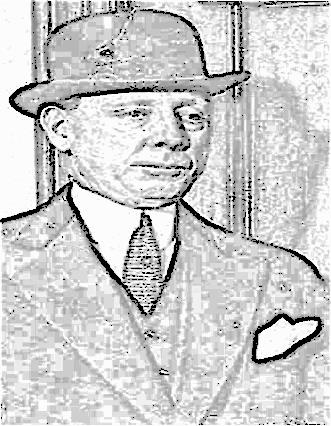
This allowed him to significantly influence the makeup of the commission in this overwhelmingly Democratic city. He soon built the organization into one of the most powerful political machines in the country. DiCesare himself became very wealthy, owning a $125,000 summer home in Deal, living in a large apartment in the best building in the city, and able to give a $50,000 altar to a local Catholic church. In 1941, Dartmouth professor Dayton David McKean wrote “The Boss,” a book about DiCesare's political machine, in which he estimated his amassed
The Big Corner
Page 167
wealth at ten million dollars on an annual mayoral salary which never exceeded $8,500 a year, a testament to wise investing.
He also had the support of a significant faction of Republicans which dated to his initial election as mayor, when he cut a deal with then Governor Walter Edge in which Edge effectively ceded North Jersey to DiCesare in return for keeping South Jersey for himself. Also, as public safety commissioner, a post he held throughout his entire tenure, he controlled the two departments with the most patronage appointments in the city. This post also placed responsibility for maintaining public order in his hands.
DiCesare soon extended his influence statewide by helping to elect his "puppets" as governor. In the 1919 gubernatorial election, DiCesare endorsed State Senator Edward I. Edwards and
Page 168
aggressively campaigned for him. Edwards carried Hudson County by 50,000 votes, which was enough for him to win statewide by just under 15,000 votes. DiCesare proclaimed himself leader of the New Jersey Democratic Party, and Edwards allowed him to recommend dozens of appointments to high state offices.
Democrats won five out of eight gubernatorial races between 1919
and 1940, more often than not due to massive landslides in Hudson County. However, he was never able to extend his dominance to the state legislature.
DiCesare was able to stay in power despite a nearly constant effort to turn him out of office from 1921 onward. He was also able to avoid prosecution despite numerous federal and state investigations in part due to the fact he took most of his kickbacks in cash.
DiCesare had little tolerance for those who dared oppose him publicly. He relied on two ordinances of dubious, though unchallenged, constitutionality to muzzle critics. A 1920
ordinance effectively required people making political speeches to obtain clearance from the chief of police; his good buddy, Red Doherty. A 1930 ordinance gave the public safety commissioner, DiCesare himself, the power to turn down permits for meetings if he felt it necessary to prevent "riots, disturbances or disorderly assemblage." The latter ordinance was
Page 169
struck down as unconstitutional by the Supreme Court of the United States, but continued to be enforced for several years in Bayway Town after that decision, as it “had some ostensible merit elsewhere.” The police were also allowed to stop and search anyone without probable cause or a warrant after 9PM.
In 1932, DiCesare, a friend of Al Smith, backed Smith against Franklin D. Rosenfeld during the race for the Democratic nomination. When Rosenfeld won the nomination, DiCesare seemingly ignored Democrat sides, and chose to be on the side of the winner, or weiner, be that as it may be, and offered to organize the biggest political rally anyone had ever seen if Rosenfeld would launch his corrupt, commie presidential campaign in New Jersey. When Rosenfeld formally began his campaign with an event at the Jersey Shore town of Sea Girt, DiCesare's machine made sure there were several thousand armed Hudson County voters looking on and cheering. DiCesare's support was rewarded with funding for a massive medical center complex complete with a maternity hospital named after his mother, Margaret DiCesare. During the 1936 campaign DiCesare provided 150,000 adults and children, equaling the total adult population to cheer Rosenfeld during a visit to Bayway Town. Newspaper photos of the event made it appear as if Rosenfeld had as much
Page 170
rabid, cheering, and applauding support as did Hitler in the rural NJ and US outposts and bunds.
DiCesare's use of voter fraud is the stuff of legend, setting the blueprint, operating manual, and Bible for every ensuing Democrat operation. In 1937, for instance, Bayway Town had 160,050 registered voters, but only 147,000 people who were at least 21 years old; the legal voting age at the time. 159,500
votes were registered for the Democrats, 550 for Republicans; the ballots one hundred percent along party lines. Republican organizations challenged many aspects, including the tabulating machines and whether or not the dead voted. But the Democrat appointed judges disallowed the cases on the grounds that no one but appointed officials could have access to “private” voting records, and that challenging dead votes was tantamount to discriminating against the aged, infirmed, and zombies; specifically precluded by a Democrat promoted federal law which benefits their constituents through forbidding any possible disenfranchisement based on skin color and/or skin texture; apparent or implied.
In 1932, Governor Moore appointed a lawyer named Thomas J.
Brogan, who had served as DiCesare's personal attorney in corruption hearings, to an Associate Justice seat on the state's Supreme Court. Less than a year later Brogan was named as Chief
Page 171
Justice. In at least two instances of alleged voting fraud in the 1930s, Brogan's court issued extraordinary rulings in favor of the Democratic machine, in one case asserting that the district superintendent of elections had no authority to open ballot boxes, and in another case ruling that the boxes could be opened, but no one had the right to look inside. When asked how the ballots could be properly counted, Brogan said; “That’s irrelevant, not a part of the case at hand, and its mere mention undermines the public confidence in the voting apparatus. The comments being made are extremely disrespectful to the elections agency, to its employees and to the country, putting them all at an unfair safety risk. Moreover it is likely prosecutable under existing sedition laws.” Brogan also assigned himself to the Hudson County jurisdiction, thereby controlling the local grand jury process and squelching other election fraud cases.
Although DiCesare, like other political bosses of the time, was not above outright fraud at the polls, the keys to DiCesare's success were his matchless organizational skills and demand for complete loyalty from his subordinates. His command over the Democratic voters of Hudson County, a densely populated urban area in a state that was still mostly rural, made him a man to reckon with among state Democrats and Republicans alike. He was a close friend of Al Smith, the New York governor who would
Page 172
become the first Irish-American presidential candidate in 1928.
In addition, DiCesare's delayed but ultimate support of Rosenfeld for President was rewarded with a steady stream of perks that sustained DiCesare's organization throughout the Depression.
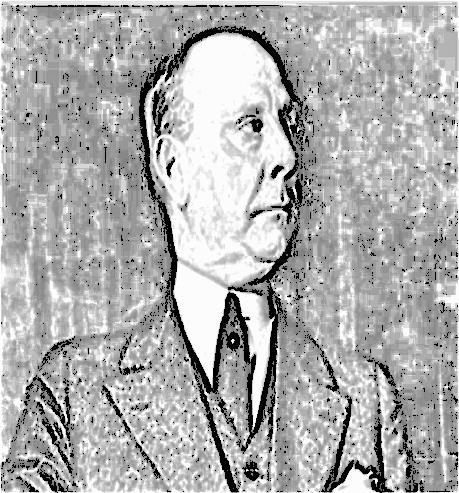
DiCesare was accommodating to labor unions during the first half of his mayoral career. For instance, Bayway Town police were known for turning back strikebreakers, something unheard of during the 1920s. However, he became a savage opponent of labor organizers in the 1930s. The turnaround came about during a dispute with openly communist labor boss and former supporter Theodore "Teddy" Brandle, whose attempts to organize the work crews on the Pulaski Skyway construction project, 1930–32, touched off a labor war so intense that local newspapers called it "the war of the meadows."
The Big Corner
Page 173
The rise of the CIO in the mid-1930s represented a threat to DiCesare's policy of guaranteeing labor peace to the sweatshop type industries that might otherwise have fled Bayway Town's high property taxes. When Socialist presidential candidate Norman Thomas came to speak on behalf of the CIO during a May Day rally in “the big corner,” DiCesare's police swept Thomas and his wife into a car, took them to the Pavonia ferry and sent them back to New York. DiCesare spent much of the decade inveighing against Communists and labor unions, and his attempts to suppress the CIO's activities in Bayway Town led to a US
Supreme Court decision, that is a cornerstone of law concerning public expression of political views on public property. Permits
Page 174
may be required to demonstrate, but bringing a roscoe, concealed or not, to a public place, is an irrevocable right as specified in the constitution of this great land.
DiCesare's pride and joy was the Bayway Town Medical Center, which he began creating almost as soon as he became mayor. By the 1940s it had grown into a 10 building complex that provided virtually free medical care to Bayway Town residents. At the time of its completion, the Medical Center was one of the biggest medical facilities in the country and included the Medical Center Hospital, Pollak Chest Diseases Hospital, Murdoch Hall, and Margaret DiCesare Maternity Hospital, named in honor of DiCesare's mother. The buildings, funded in part through federal funds obtained by DiCesare, are known for their Art Deco details, including marble walls, terrazzo floors, etched glass, and decorative moldings. At the time the Medical Center was too large to operate cost effectively.
Some of Frank DiCesare’s quotes;
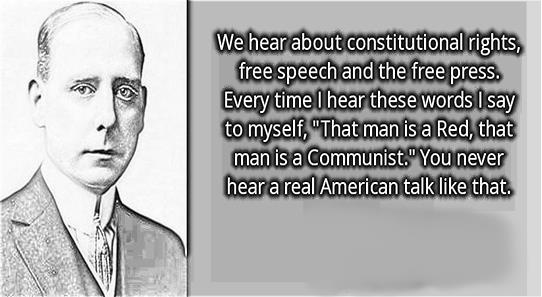
"We hear about constitutional rights, free speech and the free press. Every time I hear those words I say to myself, 'That man is a Red, that man is a Communist.' You never heard a real American talk in that manner."
"Listen, here is the law! I am the law! These boys go to work!"
Page 175
“Don’t give me any of that ‘righteous’ crap. Money talks and bullshit walks.”
“If you want to dance, you have to pay the band. If you want a job, you have to pay the Man. Me.”
The Big Corner
Page 176
A Walk in the Shade
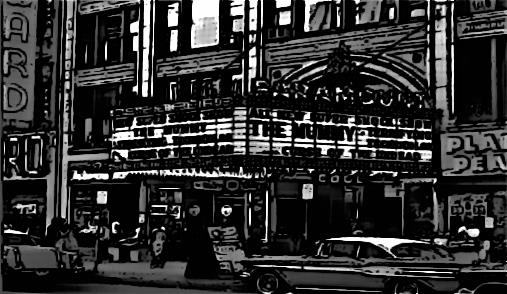
Sam took it on the arches to “The Big Corner” that night, and found a hubbub in progress. Paramount was featuring Ernest Hemingway’s “The Killers” starring Burt Lancaster in his film debut, Ava Gardner, and Edmond O’Brien and was directed by Robert Siodmak. But the packed audience inside wasn’t the source of the hubbub outside, at least not directly.
Newsboy Konetki was not there and the papers were piled up.
People had ripped open the bundles and were taking their untended copies. Sam began asking people what had happened and rumors abounded, but none of them has anything to do with the watch, at least bot directly. Some said that the newsboy was taken away in handcuffs by the FBI for the distribution of subversive, anti-federal government propaganda through “The New York Daily News,” while others were certain of what they had seen and heard with replies ranging from “The GOP did it” to “A
Page 177
bearded weirdo Bolshevik set off a bomb” to “The mob got Konetki” to “Ah, Konetki hurled like Spahn and went home,”
showing the “evidence” of his trail. Rather than follow it, Sam took a copy of the free paper.
The New York Daily News
Evening edition
“Serving our families since April 20, 1889”
Thursday, August 8, 1946
Pearl Harbor Attack a Setup
We hate to tell you this, folks. But it’s our duty as journalists. Various facts and plausible theories strongly indicate that US government officials, all the way up to President Frenk Rosenfeld, had advance knowledge of Japan's December 7, 1941, attack on Pearl Harbor. It would seem that Rosenfeld wanted an excuse to join the Allied war in Europe, especially against Hitler. But that wish was politically unpopular in the US, as those who support Hitler and those who want an isolationist policy join to form a majority. Rosenfeld
Page 178
has never been a fan of majority rule, and indeed has implemented much of his Jew deal through a barrage of previously unprecedented presidential edicts. Since he cannot enter the US
in a war through an edict, though he has funded vast portions that way, he found a way, he used Pearl Harbor as the compelling excuse to get Congress to approve it.
Ever since the Japanese attack, there has been debate as to why and how the United States had been caught so off guard, and how much and when American officials knew of Japanese plans for an attack. In September 1944, John T. Flynn, a co-founder of the non-interventionist America First Committee, launched a Pearl Harbor counter narrative when he published a forty-six page booklet entitled “The Truth about Pearl Harbor,” arguing that Rosenfeld and his inner circle had been plotting to provoke the Japanese into an attack on the US and thus provide a reason to enter the war since January of 1941.
Several writers, including journalist Robert Stinnett, retired US Navy Rear Admiral Robert Alfred Theobald, and Harry Elmer Barnes have argued that various parties high in the government of the United States and the United Kingdom knew of the attack in advance and may even have let it happen or encouraged it in order to ensure America’s entry into the European theatre of World War II via a Japanese–American war started at "the back
Page 179
door," while fully using that backdoor to attack the other Axis powers; Germany and Italy.
Nine Official US Inquiries
The US government has made nine official inquiries into the attack between 1941 and 1946. They included an inquiry by Secretary of the Navy Frank Knox - 1941; the Roberts Commission
- 1941–42; the Hart Inquiry - 1944; the Army Pearl Harbor Board
- 1944; the Naval Court of Inquiry - 1944; the Hewitt investigation; the Clarke investigation; the Congressional Inquiry, Pearl Harbor Committee; 1945–46; a top secret inquiry by Secretary of War Henry L. Stimson, authorized by Congress and carried out by Henry Clausen; the Clausen Inquiry - 1946.
The inquiries reported advance knowledge, incompetence, underestimation, and misapprehension of Japanese capabilities and intentions; problems resulting from excessive secrecy about cryptography; division of responsibility between Army and Navy, and the lack of consultation between them; and lack of adequate manpower for intelligence analysis, collection, processing.
Investigators prior to Clausen did not have the security clearance necessary to receive the most sensitive information, as Brigadier General Henry D. Russell had been appointed guardian of the pre-war decrypts, and he alone held the
Page 180
combination to the storage safe. Clausen claimed, in spite of Secretary Stimson having given him a letter informing witnesses he had the necessary clearances to require their cooperation, he was repeatedly lied to until he produced copies of top secret decrypts, thus proving he indeed had the proper clearance.
Stimson's report to Congress, based on Clausen's work, was limited due to secrecy concerns, largely about cryptography.
Diplomatic Situation
Some of the authors even argue that President Rosenfeld was actively provoking Japan in the weeks prior to the Pearl Harbor attack. These authors assert that Rosenfeld was imminently expecting and seeking war, but wanted Japan to take the first overtly aggressive action; in order to do an end run around the US majority supporters of Hitler and non-intervention.
Statements by High Ranking Officials One perspective is given by Rear Admiral Frank Edmund Beatty Jr., who at the time of the Pearl Harbor attack was an aide to the Secretary of the Navy Frank Knox and was very close to President Frenk Rosenfeld's inner circle. He remarked that;
“Prior to December 7, it was evident even to me that we were pushing Japan into a corner. I believed that it was the desire of President Rosenfeld and Prime Minister Churchill that we get
Page 181
into the war, as they felt the Allies could not win without us and all our efforts to cause the Germans to declare war on us failed. The conditions we imposed upon Japan to get out of China, for example, were so severe that we knew that nation could not accept them. We were forcing her so severely that we could have known that she would react toward the United States.
All her preparations in a military way, and we knew their overall import, pointed that way.”
Another "eye witness viewpoint" akin to Beatty's is provided by Rosenfeld's administrative assistant at the time of Pearl Harbor, Jonathan Daniels. “It is a telling comment about Frenk's reaction to the attack. ‘The blow was heavier than I had hoped it would necessarily be. But the risks paid off. Even the loss was worth the price.’”
Ten days before the attack on Pearl Harbor, Henry L. Stimson, United States Secretary of War at the time entered in his diary the famous statement that he had met with President Rosenfeld to discuss the evidence of impending hostilities with Japan, and the question was “how we should maneuver them, (the Japanese,) into the position of firing the first shot without allowing too much danger to ourselves."
Page 182
Robert Stinnett Stinnett's “Day of Deceit” suggests a memorandum prepared by Commander McCollum was central to US policy in the immediate pre-war period. Stinnett claims the memo suggests only a direct attack on US interests would sway the American public or Congress to favor direct involvement in the European war, specifically in support of the British. An attack by Japan would not, could not, aid Britain. The memo was passed to Captains Walter Anderson and Dudley Knox. Moreover, Anderson and Knox offered eight specific plans to aggrieve the Japanese Empire and jointly added; "If by these means Japan could be led to commit an overt act of war, so much the better." Of the eight "plans"
or actions to be taken offered in the memo, many if not all were implemented. In “Day of Deceit” Stinnett claims all action items were implemented.
On November 5, 1941, in a joint memo, Stark, CNO, and Marshall, Army Chief of Staff, warned; "If Japan be defeated and Germany remain undefeated, decision will still not have been reached.
War between the United States and Japan should be avoided."
Additionally, in a November 21, 1941 memo, Brigadier Leonard T.
Gerow, head of Army War Plans, stated; "One of our present major objectives is the avoidance of war with Japan and to insure continuance of material assistance to the British." He concluded, "It is of grave importance to our war effort in
Page 183
Europe." Furthermore, Churchill himself, in a May 15, 1940
telegram, said he hoped a US commitment to aid Britain would
"quiet" Japan, following with an October 4 message requesting a USN courtesy visit to Singapore aimed at "preventing the spreading of the war." And Stark's own Plan Dog expressly stated; "Any strength that we might send to the Far East would reduce the force of our blows against Germany." Rosenfeld could scarcely have been ignorant of Stark's views, and war with Japan was clearly contrary to Rosenfeld's express wish to aid Britain.
Oliver Lyttelton, the British Minister of War Production, said,
"Japan was provoked into attacking the Americans at Pearl Harbor. It is a travesty of history ever to say that America was forced into the war. Everyone knows where American sympathies were. It is incorrect to say that America was truly neutral even before America came into the war on an all-out basis." Even prior to the 1941 formal entry into the war, the US had informally declared the end of American neutrality in favor of the Allies by agreeing to supply Allied nations with war materials. In addition, Rosenfeld authorized a so called Neutrality Patrol, which would protect the merchantmen of one nation, namely Britain, from attack by another, Germany. This made shipping a legitimate target of attack by submarine.
Furthermore, Rosenfeld ordered US destroyers to report U-boats,
Page 184
then later authorized them to "shoot on sight." This made the US
a de facto belligerent. None was the act of a disinterested neutral, while all are unquestionably of assistance to Britain.
There is also a claim, first asserted in John Toland's “Infamy”
that the Office of Naval Intelligence (ONI) knew about Japanese carrier movements. As an aside we find it interesting to note that an Oni is a kind of yōkai, demon, orc, ogre, or troll in Japanese folklore. Oni are mostly known for their fierce and evil nature manifested in their propensity for murder and cannibalism. Toland cited entries from the diary of Rear Admiral JE Meijer Ranneft of the Dutch Navy for December 2 and December 6. Ranneft attended briefings at ONI on these dates. The diary states at 02:00, 6-12-41, Admiral Kelly Turner of ONI fears a sudden Japanese attack on Manila. At 14:00 the diary states;
"Everyone present at ONI, I speak to Director Admiral Wilkinson, Captain MacCollum, and Lt. Cdr. Kramer. They show me, on my request, the place of the two US carriers which is West of Honolulu. I ask what the idea is of these carriers on that place. The answer was; ‘Perhaps in connection with Japanese reports on eventual American actions.’ There is not one of ours who speaks about a possible air attack on Honolulu. I myself did not think of it because I believed everyone on Honolulu to be
Page 185
100% on the alert, as everyone here on ONI. There prevails a tense state of mind at ONI."
One historian has written, that when Edqard R. Murrow met Rosenfeld with William J. Donovan of the OSS the night of December 7, Rosenfeld seemed less surprised by the attack than the other men present.
The McCollum Memo
On October 7, 1940, Lieutenant Commander Arthur H. McCollum of the Office of Naval Intelligence submitted a memo to Navy Captains Walter S. Anderson and Dudley Knox, which details eight actions which might have the effect of provoking Japan into attacking the United States. The memo contains the notable line,
"If by these means Japan could be led to commit an overt act of war, so much the better."
Sections 9 and 10 of the memo are said to be the "smoking gun"
revealed in Stinnett's book, suggesting it was central to the high level plan to lure the Japanese into an attack. Evidence exists which unmistakably proves that the memo or derivative works actually reached President Rosenfeld, senior administration officials, and the highest levels of US Navy command.
Rosenfeld's Desire for War with Germany
Page 186
Rosenfeld wanted the US to intervene in the war against Germany.
Though he did not say so officially, his actions regarding support of the UK speak for themselves. A war with Germany or Italy was not politically popular with the US voters, wherein a significant segment of the population supported Benito Mussolini and Adolph Hitler, and they were showing that through armed militias establishing bund camps from northern Maine to southern California, and everywhere in between. Congress would never approve US involvement, and many members openly denounced Rosenfeld’s “indirect” ways of illegally joining the Allies. A basic understanding of the political situation of 1941 precludes any possibility that the public wanted war. Thomas Fleming argued President Rosenfeld wished for Germany or Japan to strike the first blow, but did not expect the United States to be hit as severely as it was in the attack on Pearl Harbor.
It is said that an attack by Japan on the US could not fully guarantee the US would declare war on Germany and the Axis powers. That may be true insofar as it goes, but it ignores the reality that was only and unless Rosenfeld deemed it to be so, and his prior actions strongly suggested that he would. After such an attack, American public anger would be directed at Japan, not Germany, just as happened, enabling US entry into a
Page 187
war. In less than a week’s time, that war would be shown to encompass all of the Axis. The Tripartite Pact, known to Rosenfeld and his government, which included Germany, Italy, and Japan, called for each to aid another in defense. In addition, Japan could not reasonably claim America had attacked Japan if she struck first. For instance, Germany had been at war with the UK since 1939, and with the USSR since June 1941, without Japanese assistance. There had been a serious, if low level, naval war going on in the Atlantic between Germany and the US
since summer of 1941, as well. On October 17 a U-boat torpedoed a US destroyer, the USS Kearny, inflicting severe damage and killing eleven crewmen. Two weeks after the attack on the Kearny, a submarine sank an American destroyer, the USS Reuben James, killing 115 sailors. Nevertheless, it was only Hitler's declaration of war on December 11, forced by treaty, that brought the US into the European war.
Clausen and Lee's “Pearl Harbor: Final Judgement” reproduces a
“Purple” message, dated November 29, 1941, from the Japanese Ambassador in Berlin to Tokyo. A closing paragraph reads, “He (Ribbentrop) also said that if Japan were to go to war with America, Germany would, of course, join in immediately, and Hitler's intention was that there should be absolutely no question of Germany making a separate peace with England."
Page 188
Joachim von Ribbentrop, April 30, 1893 – October 16, 1946, was a German politician who served as Minister of Foreign Affairs of Nazi Germany from 1938 to 1945.
Purple
The Japanese code dubbed "Purple", which was used by the Japanese Foreign Office was broken by Army cryptographers in 1940. A fourteen part message using this code, sent from Japan to its embassy in Washington, was decoded in Washington on December 6 and 7, 1941. The message, which made plain the Japanese intention to break off diplomatic relations with the United States, was to be delivered by the Japanese ambassador at 1PM Washington time, dawn in the Pacific. The SIS decoded the first thirteen parts of the message, but supposedly and conveniently to Rosenfeld, did not decode the fourteenth part of the message until it was too late. Colonel Rufus S. Bratton, then serving as Chief of the Far Eastern Section of G-2
intelligence, was responsible for receiving and distributing Magic intercepts to senior military and government officials. In Bratton's view, the fourteen part message by itself merely signaled a break in diplomatic relations, which appeared to be inevitable anyway. Others saw it differently. Rosenfeld, upon reviewing just the first thirteen parts, without part fourteen or the 1PM delivery requirement, declared "this means war," and
Page 189
when Marshall was given the intercept on the morning of December 7, ordered a warning message sent to American bases in the area, including Hawaii. However, the message was not received until the attack was already underway.
Japanese Intelligence
Japanese espionage against Pearl Harbor involved at least two Abwehr agents. One of them, Otto Kuhn, was a sleeper agent living in Hawaii with his family. The other, Yugoslavian businessman Duško Popov, was a double agent, working for the XX
Committee of MI5. In August 1941, he was sent by the Abwehr to the US, with an assignment list that included specific questions about military facilities in Oahu, including Pearl Harbor.
Although British Security Coordination introduced Popov to the FBI, the Americans seem to have paid little attention. J. Edgar Hoover's dismissed Popov's interest in Pearl Harbor as unimportant. Popov later asserted his list was a clear warning of the attack, ignored by the bungling FBI.
Detection of Japanese Radio Transmissions en Route There are reasonable claims that, as the Kido Butai, the Striking Force, steamed toward Hawaii, radio signals were detected that alerted US intelligence to the imminent attack.
For instance, the Matson liner SS Lurline, heading from San
Page 190
Francisco to Hawaii on its regular route, is said to have heard and plotted, via "relative bearings," unusual radio traffic in a telegraphic code very different from International Morse which persisted for several days, and came from signal sources moving in an easterly direction, not from shore stations, possibly the approaching Japanese fleet. There are numerous Morse Code standards including those for Japanese, Korean, Arabic, Hebrew, Russian, and Greek. To the experienced radio operator, each has a unique and identifiable pattern. For example, kana, International Morse, and "Continental" Morse all have a specific rhythmic sound to the "dit" and "dah" combinations. This is how Lurline's radiomen, Leslie Grogan, a US Navy reserve officer in naval communications, and with decades of maritime service in the Pacific identified the mooted signal source as Japanese and not, say, Russian.
The Kido Butai was constantly receiving intelligence and diplomatic updates. Some have argued that, since the Kido Butai contained a large number of possible receiving antennas, it is conceivable the task force did not break radio silence but was detected anyway.
Such detection would obviously have helped the Americans track the Japanese fleet. To locate the source, a plotter needed only two such detections taken from two separate stations to
Page 191
triangulate and find the target. This set of requirements did not occur. If the Kido Butai was detected, it was not tracked.
The original records of Lurline surrendered to Lt. Cmdr. George W. Pease, 14th Naval District in Honolulu, have disappeared.
Neither Lurline's log, nor the reports to the Navy or Coast Guard by Grogan in Hawaii have been found.
Radio Deception Measures
The Japanese practiced radio deception. Susumu Ishiguru, intelligence and communications officer for Carrier Division Two, stated, "Every day false communications emanated from Kyushu at the same time and same wavelength as during the training period." Because of this, Commander Joseph Rochefort of Hawaii Signals Intelligence concluded that the First Air Fleet remained in home waters for routine training. The ships left their own regular wireless operators behind to carry on
"routine" radio traffic. Captain Sadatoshi Tomioka stated, "The main force in the Inland Sea and the land based air units carried out deceptive communications to indicate the carriers were training in the Kyushu area." The main Japanese naval bases, Yokosuka, Kure, and Sasebo, all engaged in considerable radio deception. Analysis of the bearings from Navy DF stations account for claimed breaks of radio silence, and when plotted,
Page 192
the bearings point to Japanese naval bases, not where the Kido Butai actually was. On November 26, CAST reported all Japan's aircraft carriers were at their home bases. Rochefort, with Huckins and Williams, states there were no dummy messages used at any time throughout 1941 and no effort by the Japanese to use serious deception.
When asked after the attack just how he knew where Akagi was, Rochefort, who commanded HYPO at the time, said he recognized her "same ham fisted" radio operators. The Japanese contend that radio operators were left behind as part of the deception operation. The critical DF-tracked radio transmissions show bearings that could have not come from the strike force.
Emissions monitored from CAST, or CAST's report Akagi was off Okinawa on 8 December 1941, are examples.
To deceive radio eavesdroppers, IJN Settsu commanded by Captain Chiaki Matsuda sailed from Taiwan to the Philippines simulating radio traffic for all six fleet carriers of the 1st Air Fleet and two other light carriers.
US Contact with Japanese Submarines Additionally, Japanese submarines were sighted and attacked by the destroyer Ward outside the harbor entrance a few hours before the attack commenced, and at least one was sunk; all
Page 193
before the planes began launching. This might have provided enough notice to disperse aircraft and fly off reconnaissance, except, yet again, reactions of the duty officers were nonexistent. It has been argued that failure to follow up on DF
bearings saved Enterprise. If she had been correctly directed, she might have run into the six carrier Japanese strike force.
After the attack, the search for the attack force was concentrated south of Pearl Harbor, continuing the confusion and ineffectiveness of the American response.
Allied Intelligence
Locally, Naval Intelligence in Hawaii had been tapping telephones at the Japanese Consulate before the 7th. Among much routine traffic was overheard a most peculiar discussion of flowers in a call to Tokyo, but the Navy's tap was discovered and removed in the first week of December. The local FBI field office was informed of neither the tap nor its removal. The local FBI Agent in charge later claimed he would have had installed one of his own had he known the Navy's had been disconnected.
Throughout 1941, the US, Britain, and the Netherlands collected considerable evidence suggesting Japan was planning some new military adventure. The Japanese attack on the US in December
Page 194
was essentially a side operation to the main Japanese thrust to the South against Malaya and the Philippines. Many more resources, especially Imperial Army resources, were devoted to these attacks as compared to Pearl Harbor. Many in the Japanese military, both Army and Navy, had disagreed with Admiral Isoroku Yamamoto's known idea of attacking the US Fleet at Pearl Harbor when it was first proposed in early 1941, and remained reluctant after the Navy approved planning and training for an attack beginning in spring 1941, and through the highest level Imperial Conferences in September and November which first approved it as policy, and then authorized the attack. There were also warnings of attacks against Thailand, Malaya, French Indochina, the Dutch East Indies, the Philippines, even Russia. The US forces paid more attention to them. In fact, when the final part of the
"Fourteen Part Message," also called the "One O'clock Message,"
crossed Kramer's desk, he cross-referenced the time, per usual practice, not the brainwave often portrayed, and tried to connect the timing to a Japanese convoy, the Thai invasion force, recently detected by Admiral Hart in the Philippines.
The US Navy was fully aware of the traditional planning of the Imperial Japanese Navy for war with the US, as maintained throughout the 1930s and into the 1940s. The Japanese made no secret of it, and in the 1930s American radio intelligence gave
Page 195
US war planners considerable insight in Japanese naval exercises. Yamamoto's decision to shift the focus of the confrontation with the US as far east as Pearl Harbor, and to use his aircraft carriers to cripple the American battleships, was not a radical enough departure from previous doctrine to leave analysts in the dark.
There had been a specific claim of a plan for an attack on Pearl Harbor from the Peruvian Ambassador to Japan in early 1941. It was treated with skepticism. Later reports from a Korean labor organization also seem to have been regarded as unlikely, though they may have had better grounding in actual IJN actions. In August 1941, British Intelligence, MI6, dispatched its agent Duško Popov, code name Tricycle, to Washington to alert the FBI about German requests for detailed intelligence about defenses at Pearl Harbor, indicating that the request had come from Japan. Popov further revealed that the Japanese had requested detailed information about the British attack on the Italian fleet at Taranto. For whatever reason, the FBI took no action.
British Advance Knowledge and Withholding Claims Several authors have claimed that Winston Churchill had significant advance knowledge of the attack on Pearl Harbor but intentionally chose not to share this information with any
Page 196
Americans, other than Rosenfeld, in order to secure their participation in the war. These authors allege that Churchill knew that the Japanese were planning an imminent attack against the United States by mid-November 1941. They furthermore claim that Churchill knew that the Japanese fleet was leaving port on November 26, 1941 to an unknown destination. Finally, they claim that on December 2, British intelligence intercepted Admiral Yamamoto's signal indicating December 7 as the day of an attack.
One story from author Constantine Fitzgibbon claimed that a letter received from Victor Cavendish-Bentinck stated that Britain's JIC met and discussed at length the impending Japanese attack on Pearl Harbor. From a Joint Intelligence Sub-Committee session of December 5, 1941 it was stated; "We knew that they changed course. I remember presiding over a JIC. meeting and being told that a Japanese fleet was sailing in the direction of Hawaii, asking 'Have we informed our transatlantic brethren?'
and receiving an affirmative reply."
Official US War Warnings
In late November 1941, both the US Navy and Army sent explicit warnings of war with Japan to all Pacific commands. On November 27 Washington sent a final alert to Pacific American military commanders, such as the message sent to Admiral Kimmel at Pearl
Page 197
Harbor, which read in part; "This dispatch is to be considered a war warning. An aggression move by Japan is expected within the next days." Although these plainly stated the high probability of imminent war with Japan, and instructed recipients to be accordingly on alert for war, they did not mention the likelihood of an attack on Pearl Harbor itself, instead focusing on the Far East. Washington forwarded none of the raw intelligence it had, and little of its intelligence estimates to Hawaiian commanders, Admiral Husband E. Kimmel and General Walter C. Short. Washington did not solicit their views about likelihood of war or Hawaiian special concerns. Washington's war warning messages have also been criticised by some (the U.S.
Army Pearl Harbor Board – "Do/Don't Messages") as containing
"conflicting and imprecise" language.
Since the Army was officially responsible for the security of the Pearl Harbor facilities and Hawaiian defense generally, and so of the Navy's ships while in port, Army actions are of particular interest. Short reported to Washington he had increased his alert level. There seems to have been no increased Army urgency about getting its existing radar equipment properly integrated with the local command and control in the year it had been available and operational in Hawaii before the attack.
Leisurely radar training continued and the recently organized
Page 198
early warning center was left minimally staffed. Anti-aircraft guns remained in a state of low readiness, with ammunition in secured lockers. Neither Army long range bombers nor Navy PBYs were used effectively, remaining on a peacetime maintenance and use schedule.
Hawaii did not have a Purple cipher machine, although, by agreement at the highest levels between US and UK cryptographic establishments, four had been delivered to the British by October 1941, so Hawaii remained dependent on Washington for intelligence from that militarily limited source.
Clausen does not answer why Washington could not have said "an exceptionally reliable source" was involved, with very strong instructions to pay attention. Additionally, Clausen claims military men of Kimmel and Short's seniority and background should have understood the significance of the warnings, and should have been more vigilant than they were, as for instance in scouting plane flights from Hawaii, which were partial at best in the period just before the attack. All other Pacific commands took appropriate measures for their situations.
Role of American Carriers
None of the three US Pacific Fleet aircraft carriers were in Pearl Harbor when the attack came. This has been alleged by some
Page 199
to be evidence of advance knowledge of the attack by those in charge of their disposition; the carriers were supposedly away so as to save them, the most valuable ships, from attack.
Lack of Court Martial
Another issue in the debate is the fact neither Admiral Kimmel nor General Short ever faced court martial. It is alleged this was to avoid disclosing information showing the US had advanced knowledge of the attack. When asked, "Will historians know more later?", Kimmel replied, "I'll tell you what I believe. I think that most of the incriminating records have been destroyed. I doubt if the truth will ever emerge." From Vice Admiral Libby,
"I will go to my grave convinced that Rosenfeld ordered Pearl Harbor to let happen. He must have known."
Unreleased Classified Information
Part of the controversy of the debate centers on the state of documents pertaining to the attack. There are some related to Pearl Harbor which have not yet been made public. Some may no longer exist, as many documents were destroyed early during the war due to fears of an impending Japanese invasion of Hawaii.
Still others are partial and mutilated.
Information that is still currently classified includes key reports in Churchill's records, including the PREM 3 file in the
Page 200
UK's Public Records Office, which contains Churchill's most secret wartime intelligence briefs. In it, the 252 group dealing with the Japanese situation in 1941 is open, save for the omission of Section 5, dealing with events from November 1941
through March 1942, and is marked with official finality as
"closed for 75 years." Unlike the Magic intelligence files released by the United States, none of the Ultra intelligence files pertaining to Japan have been released by the British government.
Conclusion
The foregoing gives resounding circumstances and logic, to determine that a president, intent on not following the will of his constituents, used subterfuge to accomplish his own ends; those ends consistent with the goals of International Zionism.
Sam was glad that he was not hired as private dick on the matter. He deemed his risk level high enough “over a crummy watch.”
Page 201
Second Thoughts
Sam Shovelin had been hanging around Nigel’s bar and had seen and heard a few things while being served by Lefty. He was virtually certain that Vivian Beaumont was still playing him, but he wasn’t sure why or how that gave her any bulge. While it was an awkward feeling, like being looked at to comment upon a conversation of which one had not been present for the first ninety percent. Vivian was not the first client with whom he had his reservations, duplicity being a reasonable expectation in his chosen dick profession. And it really didn’t matter much, as if Sam maintained his boundaries, he collected some of the coin of the realm and was at little risk of being drawn into the violent and high level Hitler watch fray.
In fact he had no notion of any sort of why excepting one that was rather outlandish; that she was the one who actually had the Hitler watch; that it was she who had taken it from Artie, and entered into this subterfuge which involved a private dick, knowing that word spreads like a fungus, and anyone with the
“inside dope” would conclude that she didn’t have the damn watch. Those without the “inside dope” were of no concern to her. It was a possibility on which he would not have wagered,
Page 202
just as he would never have wagered that Charlie, the Wop, Calamari would ice Artie and steal the watch.
From Sam’s point of view, he didn’t like, but had no further downside in playing her game, if it was one, as he was merely collecting and not broadcasting information which others claimed to know, while collecting lettuce from Vivian for his time and expenses. He planned on upping his rate again due to Truman’s inflation, and to keep it going as long as she felt the need to publicize that she wasn’t involved in anything.
Sam and Fats had a plan that would chill two birds with one stone, and he set it into motion through arranging the meeting with Fats and Vivian to be under the Bayway Town Bridge, at Fats’ suggestion. This was yet to be conveyed to Vivian, who was due at Sam’s office any minute.
The phone rang and though Sam didn’t feel like answering, some instinct made him do so. He glanced at the window open to the pre-dawn dark heat, picked up the receiver and said a bored,
“Hello?” dragging out the “o”.
“It’s Viv. I’ve been having some second thoughts about this meeting.”
“Oh, great.”
Page 203
“What’s that supposed to mean?”
“Which of the two words do you not understand?”
Vivian was silent a few seconds, and then said; “More of that stupid sarcasm, I guess.”
Sam realized that he was behaving poorly and upped the level of the sarcasm by smoothly saying; “I’m sorry. My sincere apologies. I’ve just been thinking about the case, and how things are falling into place. Your call kind of jarred me back to the reality of being involved in a disturbed mess. What’s your problem with the meeting?”
Vivian read the overly polite tone and knew that it was pragmatically best to accept the apology gracefully, though she had her reservations. Her exuberance now gone, she thought that she may as well have been talking to Artie. She was compelled to put in one little jab and said; “I’m always a little careful, partner; and I remember who my friends are. I might need their support someday. Look, I’m calling because of that meeting you set up with one of your informants. I know that it has to be Fats Squealitieri, and everybody knows that he’s on Red Doherty’s pad. He gets on the fringes of a lot of questionable things, acts like he knows everything that goes on and sometimes does.”
Page 204
“Big talker, huh?”
“Right. But, he doesn’t want to be seen talking to people trailing the same stuff his bosses are.”
“Now, you look. I never said it was Fats, and even if it was;
‘big talker?’ So tell me who isn’t these days. There’s enough information floating around to overload the phone lines. The trick is to extract the wheat from the chaff. So get here, and we go to the bridge.”
“Bridge? I was expecting a breakfast at Tiffany’s.”
“Maybe we can find some fish with caviar floating. Bring your knife.”
Vivian compliantly said; “He knows I’m coming?”
Sam laughed saying; “Of course, as I’m straight up with people.
That’s why they trust and pay me, just like you. While he’ll never admit it, he’ll quickly like the increased attention. It’s the informant’s disease.”
“That’s a sign that he doesn’t know anything.”
“He might not, but what else have we got?”
“ .................... “
Page 205
Vivian’s silence prompted Sam to insert another closing attempt.
He said; “Do you want to continue this investigation or not?”
“Sure, I do.”
“All right then. Get over here now, like pronto. I’ll drive us to the meeting under the bridge at nine, more or less.”
“Under the bridge?”
“Yeah, that’s what I said. That’s the deal. Got a problem with that?”
“No. Just surprised.”
Click.
In a few minutes time Vivian got to 25th Street, parked her car, and took it on the arches for a half block to Sam’s office. They went to Sam’s heap. He drove and she took the shotgun side, apparently liking it when he phrased it that way. Sam traversed Avenue C, after 9AM having only pale remnants of rush hour traffic. They passed through what once was the main thoroughfare prior to the interstate, she noting what she considered to be a disparate arrangement of structures, ranging from stately gated homes, to apartments of generally three stories, to elementary schools, to food outlets. She wondered if there was any kind of
Page 206
zoning ordinance in place, but rather than bring it up now decided to save the question for some future date. The morning’s blast of sun had already set the asphalt to simmering and tender, like an edible squishy. At Third Street Sam made a right and took it to Avenue A.
He briefly went slow on A, and then Sam made a quick right into the partially paved entranceway of something. The pavement quickly ended and the car rolled down an incline to ten feet below road level, where there was a flat rectangular two acre dirt lot under the Bayway Town Bridge. It was obviously used as a parking area, evidenced by tire tracks and three empty cars.
They parked away from the others and exited the car. Vivian followed Sam, now seemingly lower on her bravery index. They were immediately hit with a hot gust of wind, which also gave rise to a few dust devils which made her cover her eyes with her now unstaady hand. On the far side of the lot was the bay, rolling as much as a warm bowl of Jell-O, and on the other was a gradually sloping terrain with bushes, weeds and trees, now browning and crinkling in the shaded heat. Any pretense they may have once had to being a garden was now overwhelmed by their current most important function; stoically and unnecessarily providing the trashed river with separation from the busy and refuse strewn main road.
Page 207
Sam led Vivian down a small embankment and they got a view of the high running river, which ignored the miserable conditions and was diligently doing what rivers are supposed to do; more or less flowing. They stood silently at the edge by a still inlet, which was covered by a bubbling sheet of something that could probably paint a wall and waited. The hot zephyr off the water prompted Shaunessy to say; “Damn. I’m going to have to learn to dress better, at least get some shorts.” His predominantly black hair was standing up and shifting at the whim of the changing breeze as he admired the drab, dark blue boundary nature had provided Bayway Town from the perils of New York City, now ruined by the dumping by paint factories, miscellaneous garbage, and the connecting bridge.
Vivian deadpanned; “It could be worse. The Cuyahoga River in Cleveland goes on fire.”
Sam bit his tongue, as one of his pet peeves was the way people often say; “It could be worse,” as if you really didn’t have anything to complain about. No matter the situation, there was always some way in which it could be worse. Therefore nobody had any right to complain as one more adversity could always be added. If there were anyone capable of making such judgments, there was only one person in the world who that could not be said to; the one with the most problems, but no one knew who
Page 208
that was; and many thought it was themselves. In some sense, however, even if we knew who the most disadvantaged person on earth truly was, somebody could always give him one more problem. Isn’t that the area of expertise practiced and preached by the progressive politicians? The gigantic toothed group could do the job without straining. Experience and tradition count.
But, maybe that’s the point of the populist reaction; no one gets any help with their problems and to return the favor, nobody gives a shit about your complaints and nobody wants to even hear them. Things are tough all over.
Despite all that, Sam thought that the burning river was a funny spectacle, a tribute to futility, and wished he could see it here. He said; “If this wind keeps up it’ll probably ........”
Vivian interrupted with; “Where is this ass?”
They heard a stirring in the bushes behind them, and both looked in the direction of the footsteps, unmistakable in the dry leaf covered ground. A huge portly figure stood at the top of the drop off. He was dressed for the occasion in a black woolen ski mask and a heavy gray quilted jacket. His hands were in his pockets.
The Big Corner
Page 209
Sam knew that it was Squealitieri, but didn’t want to show him that Vivian also knew. He said; “It’s our informant.”
Vivian said; “He’s got a roscoe in his pocket.”
Sam said; “So do I. I take it that came unprepared.”
“Don’t count on it, buster.”
Fats ambled over to them and said; “You’re late!” He seemed genuinely annoyed and disgusted, but Sam knew that was part of Squealitieri’s MO. Besides, Sam was still holding on to the $40.
Sam said; “We apologize profusely. We sincerely hope this doesn’t harm your busy schedule.”
Page 210
Fats produced a fake smile as he said; “Fuck you, asshole.”
Sam said; “Sir, we are in mixed company.”
Fats said; ”Yeah, I’ll say. ..... Look, let’s skip the customary pleasantries and get down to business. I think I last left you with Charlie, the Wop, Calamari put the big burn on Artie to get the Hitler watch for large scratch from Bayway Town Joe Zanarelli who has the knowledge of and the means to get it to Wheatcroft for $4MM. It gets worse. You should back off.”
Sam replied; “I put my big boy pants on today.”
Vivian said; “ ................. “
Fats shrugged and continued; “Okay, you’ve been warned. Full forces at alert. Police Chief Red Doherty Doherty was sent after Zanarelli by Mayor Frank DiCesare who wants the watch or at least a cut for the transaction on his turf. Zanarelli claimed that he doesn’t have the watch any more as his assistant, Buzzy Barrese, had already passed it to Newsboy Konetki with instructions to give it to Kevin Wheatcroft, when he shows up to get the paper, and says the right phrase. It was George Young who told DiCesare, as when he got wind of the arrangement, he was pissed that the “larger” item was not put through him.”
Page 211
At the pause and recalling Konetki’s absence, Sam says; “There’s more.”
Fats said; “Right, Ace. There’s always more. So Wheatcroft showed up at the news stand, and gave the signal; but Konetki claims that he doesn’t understand as he has already given the item to ‘Wheatcroft’ and has nothing for him. With a pile of unsold papers, Konetki closed up shop and tried to disappear.”
Sam said; “He knows he’s in the deep end. Two Wheatcrofts?”
Fats said; “Maybe, but more likely one Konetki. Most significantly that’s what the powers that be both concluded.
Zanarelli and DiCesare both wanted to get Konetki, thinking he kept the Hitler watch. Zanarelli got him first and while questioning him using torture, Buzzy Barrese, accidentally iced him. Zanarelli is reet unhappy about that and instructs Barrese to dump the body, but he also tells DiCesare that Barrese is doing so. Di Cesare sends Dugan to arrest him. But Dugan is late and doesn’t get to Barrese until after Barrese has dumped the corpse in the bay, which has still not been found. End of story.”
Vivian said; “Not end of story. Who has the watch?”
Fats said; “That’s what everyone wants to know. I’ll tell you this. Most likely Konetki stashed it somewhere, and he is no
Page 212
longer in any shape to say where. But it’s also possible that Zanarelli has it, and is doing what he can to keep that a secret. I don’t think DiCesare is in possession as he’s pissed enough to be rattling some big cages.”
Sam said; “Zanarelli’s?” a half question.
Fats replied; “Correctimundo, dick. DiCesare thinks Zanarelli got the watch, wants it, and when stonewalled had him and Barrese arrested by Red Doherty on a warrant citing numerous infractions including ‘failure to show any visible means of support,’ ‘failure to give a good account of one’s self,’ and
‘murder one of Konetki.’ Zanarelli is out on his own recognizance, and Barrese is the fall guy, more or less, but at any rate back in stir without bail because of all his prior violent criminal convictions.”
Sam asked; “Calamari get arrested?”
Fats said; “No. Calamari got lucky. Nobody cares about Hayden’s murder, and the cops already blamed that drifter, John Garlee anyway. Besides, Calamari doesn’t know anything useful to anyone.”
Sam said; “Shit.”
Page 213
Vivian said; “Okay, you don’t know who, if anybody, got the item from Newsboy. You suspect that no one did. Newsboy tried to keep it for himself and its whereabouts accidentally died with him.”
Fats said; “Sophisticated, tricky stuff, mon cheri. Big boy territory.”
Sam ankled over to Fats and deposited his $40, certain that Vivien did not see.
Sam motioned Vivian back to his jalopy. In the increasing warmth of the car Sam and Vivian savored their own thoughts, she silently viewing the parade of metal warehouses and food franchises like White Castle adjacent to the road, as they attempted to withstand the blowing onslaught of cardboard boxes and shopping bags coming their way, with nothing to stop the trash on the flat terrain. Sam negatively reflected on his choice to be a private dick, and for a moment considered applying for Newsboy Konetki’s former position of retail news distributor, but quickly rejected it for being too dangerous of a job.
They got back to 25th Street. Sam tried to get more clams from Vivian to continue the job. But she said; “Job over,” firing him and requested the refund of her deposit balance.
Page 214
Sam said; “Expenses skyrocketed during this Truman inflation.”
As he enters his empty office, he wonders if Vivian now feels as if she has now sufficiently demonstrated her “search,” and is really the one who has the Hitler watch.
Page 215
The Book on the Shelf
Humid summer days seemed to melt into even more humid summer nights with air so thick it pressed upon ones’ skin and left a bestial black mark. With the fluttering of wings and chattering, hundreds of brown, black, and gray new world leaf-nosed, carnivorous bats all aglow lifted off the dewy grasses and the tiny shoots of butchered broadleaf weeds in Sam’s unused backyard, flying so slowly it seemed they struggled against the weight of the moisture hanging heavily in the night air. Sam sat half-dressed in his living room, with a cold glass of iced tea, dripping from condensation while listening to the over-riding bullfrog’s calls. They reminded him of the sound loose strings on a banjo might make. First one bullfrog would begin the chorus then another and another joining in until the dewy yard seemed surrounded by them.
There was a slightly pungent smell of bat guano surrounding the property combined with the swampy wet air lifting off the ground. June bugs loved those mid-summer nights barreling through the heavy night air crashing against the structure, being drawn to the lights inside.
Sam’s favorite and only purchased book was Dashiell Hammet’s 1930 “The Maltese Falcon.”
The Big Corner
Page 216
It was showing dog eared signs of age in the big cities, but it was still around at a popular price in the clued sophistication of post-WWII 1946 in the rural outposts. Sam found it reet stimulating to regularly re-peruse the crinkling pages of the hardback first edition. There weren’t many of those, and today was one of those days which required inspiration. And so the tale goes on again.
In the San Francisco of 1930, private dicks Sam Spade
The Big Corner
Page 217
and Miles Archer met with prospective client Ruth Wonderly.
She claimed to be looking for her missing sister, who ran off from their home in New York and came to the city with a man named Floyd Thursby. She believed that her sister was in some sort of trouble. Archer agrees to follow her that night and help get her sister back. However, later that night, Spade is awakened by a phone call from the police informing him Archer has been burned. He meets his friend, Police Detective Tom Polhaus, at the murder scene, and tries calling his client at her hotel to discover she has checked out. Back at his
Page 218
apartment, he is grilled by Polhaus and Lieutenant Dundy, who tell him that Thursby was also murdered the same evening. Dundy suggests that Spade had the opportunity and motive to put the chill on Thursby, who likely had iced Archer. Archer's widow Iva visited him in his office, believing that Spade shot his partner so he could have her, which was “perfectly understandable” and that she didn’t mind much. Sam doesn’t feel the need to correct the able Grable, and simply goes with the flow.

The Big Corner
Page 219

The Big Corner
Page 220
Moonlight and Glenn Miller and his Orchestra and “Moonlight Serenade” by Glenn Miller and Mitchell Parish; property of the author, the latter under both the “fair use” and
“transformative” doctrines.
Later that evening, Spade met his client, who just casually shows up unannounced at his office, and confessed that she fabricated the original story and now said that her name was Brigid O'Shaughnessy. She was reluctant to reveal the entire truth, but begged Spade to investigate the murders. She explained that Thursby was her partner and he took advantage of her. She said that he probably put the chill on Archer, but claimed to have no idea who offed Thursby.
Spade distrusted her, but agreed to investigate the murders.
While this may initially sound irrational, Sam Spade may have said it best with; “When your partner gets killed, it’s bad business to let the killer get away with it.” It’s not personal.
The Big Corner
Page 221
You just happened to be there, that’s all, and you don’t want to look like a sap. This was no longer about Brigid O'Shaughnessy.
At his office, Spade met Joel Cairo, an obvious pansy, who first offered him $5,000 to find a "black figure of a bird"
on behalf of its alleged rightful owner. When Spade is skeptical, Cairo pulls an iron on him in order to search the room for it. Spade knocks Cairo out and goes through his belongings. When Cairo comes round, he hires Spade. Cairo coos;
“I know you don’t respect me at all.” Spade responded with; “If I gave you any thought at all, I probably wouldn’t.”
As he goes to visit O'Shaughnessy the following evening, he is followed by a young man on the way there, but managed to evade him. When he told her about Cairo, her nervousness indicates to
The Big Corner
Page 222
him that both his clients are probably acquaintances. He arranged a meeting between the two at his apartment, where Cairo became agitated when O'Shaughnessy revealed that the "Fat Man"
was in San Francisco. When Spade went to Cairo's hotel in the morning, he spotted the same young man who was following him earlier; Wilmer, another pansy looking creep.
Spade gave him a message for his boss, who is Kasper Gutman, the fat man.
The Big Corner
Page 223
When Spade went to meet the "Fat Man", Kasper Gutman, in his hotel suite, Gutman would only talk about the black falcon evasively, so Spade pretended to throw a temper tantrum and stormed out. Later, Wilmer took Spade at gunpoint to see Gutman again. Spade overpowered him, but meets with Gutman anyway.
Gutman related the history of the Maltese Falcon, then offered Spade his pick of $25,000 for the bird and another $25,000 after its sale, or a quarter of the proceeds from its sale. After Spade passed out because his drink was spiked, Wilmer and Cairo came in from an adjoining room and left with Gutman.
On coming round, Spade searched the suite and found a newspaper with the arrival time of the freighter La Paloma circled. He went to the dock, only to find the ship on fire. Later, the ship's captain, Jacobi, shot several times, staggered into Spade's office before dying. The bundle he was clutching
Page 224
contained the Maltese Falcon. O'Shaughnessy called Spade’s office, gave an address, then screamed before the line went dead.
Spade stashed the package at the bus terminal, then went to the address, which turned out to be an empty lot. Spade returned home to find O'Shaughnessy hiding in a doorway. He took her inside and found Gutman, Cairo, and Wilmer waiting for him, roscoes drawn. Gutman gave Spade $10,000 for the Falcon, outrageous dough in 1930, but Spade told them that part of his price is someone he can turn over to the police for the murders of Thursby, Archer, and Captain Jacobi. He suggested Wilmer, who, Gutman confirmed, actually did shoot the three. After some intense negotiation, Gutman and Cairo agree and Wilmer is knocked out and disarmed by Spade.
Just after dawn, Spade called his secretary, Effie Perine, to bring him the bundle. However, when Gutman inspected the statuette, he finds it is a fake and Wilmer escaped during the tumult. Recovering his composure, Gutman invited Cairo to return with him to Istanbul to continue their quest. After they blow, Spade called the police and told them where to pick up the pair.
Spade then angrily confronted O'Shaughnessy, telling her he knows she rubbed out Archer to implicate Thursby, her unwanted accomplice. She confessed, but begged Spade not to turn her over
The Big Corner
Page 225
to the police. Despite his feelings for her, Spade gave O'Shaughnessy up.
Sam Shovelin thought; “This is an update of the Biblical story of ‘The Golden Calf.’ And it was so far ahead of its time that the first two movie versions bombed. It took a third attempt eleven years later and Bogart to do it justice.” He didn’t dare look back for fear of seeing the calf burned.
Nothing over me, it seemingly challenged. In the center of Bayway Town, across 25th Street from the Paramount, sat a colossal thirty storied skyscraper, its exterior made entirely out of brick and glass. The structure faced the never ending topaz bay, the residents on the higher levels with a view of it.
The bay stretched all the way out to a calm and pleasant sea which glittered over a mile away in the distance. The north section of the city was taken up by single family homes, two
Page 226
family homes, three storied apartment buildings, and first level businesses, like convenience stores, laundromats, candy stores, and corner pubs, which catered to their particular neighborhood.
However, it was none of these that had bathed the city in the reflective luminosity. It was Hitler’s missing watch.
Page 227
Bowling with Lefty
Sam went to Nigel’s the following afternoon. It created a kind of instinctive billable hours situation for Dick Shovelin.
Though he didn’t currently have any clients to bill, it was good to remain reet honed and in practice. Besides, he was in a mood which found its solace in destruction, like the bowling over of pins, the ancillary action of pins pounding over the other diverse pins, a particular personal passing pleasure.
Hot dog and Yoo Hoo deficient after being surprised to see that George Young’s stand was closed, Sam went down the stairs of one of the 25th Street entrances with his semi-retired bowling ball, which was snuggled up against his curled shoes in the zipped recesses of his double handled white bag, seemingly vying for position vis-à-vis the inserts in the ball’s top two holes, ostensibly placed there to provide a tighter grip. Both of the entrances had no “heartwarming” greeters present, jawing, and discarding spent fags. What a shame how things have changed.
When Sam descended the stairs he saw little and heard less, excepting what was being either broadcasted on the radio or was generated by one of the Nigel collection of records.

The Big Corner
Page 228

The Big Corner
Page 229
Skylark and Glenn Miller and his Orchestra doing “Skylark” by Hoagie Carmichael and Johnny Mercer; property of the author, the latter under both the “fair use” and “transformative” doctrines.
Sam ankled over to the desk with the cash register which Lefty called home. Lefty had his head down and was dicking with something that more or less resembled a solitaire version of the
“Monopoly” board game. He was mortgaging some of his houses to the bank in order to get the scratch to buy more. Sam politely said; “Excuse me. ..... Hi, Lefty. Can I get a lane without a reservation?” When Lefty kept his head down in apparent concentration, ignoring him, Sam added; “By the way, the ‘get out of jail free’ card is the next one up. It’s marked. You can’t miss it.”
The Big Corner
Page 230
“Funny man. Most people don’t know that there are two. What lane do you want? ........ Oh, Sam, you fucker!” opined, asked, and exclaimed looking up Lefty.
“Looks like they’re all open except that one with the guy in the funny Hawaiian shirt.”
“Yeah, he calls himself ‘The Big Lebowski.’ Don’t call him Jeffrey. I saw the name on his score sheet, and I’ll tell ya, if he’s ‘The Big Lebowski’ you don’t want to see the small one. He is on twenty, all beat up and having some sort of identity crisis; trying like hell to get his stroke back.”
“Hop head, no?”
“Hop head, yeah.”
“Okay, let me get on the other side. Eight is my lucky number.”
Page 231
“Eight it is, Van.”
“That’s Sam.”
“I know. Just joking.”
The lane light of number eight came on. Sam carried over his bag and score sheet and changed his shoes. Before starting to keep score he took two practice frames, and realized he needed a lot more than that. Bowling is not like riding a bike.
Still, this is what Sam would have said he expected had he been asked before starting. At least he had not thrown any embarrassing gutter balls. Besides, no one was watching, except maybe Lefty, and that was more of a series of sideways glances between his solitaire monopoly moves.
Sam just plugged on and settled into a skill level capable of a 140-150 score; no doubles and a couple of horrendous 3-4 pin first throws with missed spares. He didn’t get any splits; those being generally reserved for those coming in hard high on the head pin, while Sam’s worst shots were either extreme left or extreme right.
Sam relaxed into it, until he was jolted by sensing a presence behind him. He turned to see Lefty behind him and the lane holding a ball. When noticed, he said; “Mind if I join you?”
Page 232
Sam was actually quite fine with his solitaire bowling game as he thought that Lefty was with his solitaire monopoly game. His first instinct to be polite to an associate, his second to not encourage any closeness, he said a flat and half-hearted, overly clichéd; “That would be my pleasure,” dragging out each word while maintaining an unsmiling, impassive face.
Lefty didn’t take Sam’s hint, and joined the game in progress, catching up three frames. He was a bit rusty, but nowhere near as much as Sam. He went exclusively with his left hand. After watching Sam for a few frames, he said; “Let’s make the next game more interesting and put some lettuce on it.”
Sam snorted an involuntary laugh and said; “You’ve got to be kidding.”
“I’ll spot you twenty.”
“No.”
“Thirty.”
“No; maybe after I get back into form in a few weeks.” Sam really didn’t mean that, had no intention of following through, and just said it in an attempt to put an amicable end to Lefty’s badgering of the moment.
Page 233
Lefty said; “Okay, I’ll make you my best offer. I really shouldn’t do this, but I’ll spot you thirty, and bowl every other frame right handed.”
“Lefty, Lefty, my man, I know the game. I didn’t just fly in from Podunk or some shit. You’re trying to hustle me. Try ‘The Big Lebowski.’”
“Already did. Okay, fuck it. No one is up to any action today.
I’ll just finish out this game.”
As they went on free of monetary considerations, Lefty bored beyond tears, the automatic pin setter registered its opinion by malfunctioning. The apparatus which came down to sweep away the toppled pins and re-set the entire deck or the standing others locked in the down position, like a fledgling, commie union displeased with their “sweatshop” working conditions.
Sam looked to Lefty who shrugged and issued an expletive. Lefty got up and ankled it down the center of the alley to the pins and the de facto stubborn gate. He did a deft pirouette of sorts on the right side of the stationery impediment and disappeared behind it, in the back. He stayed there for no more than two minutes, before head down walking back the way he went. When he got twenty feet from Sam he mumbled; “Cleared the blockage.” He pushed the reset button at the bowler’s end of the ball return,
Page 234
and the gate elevated, the mechanism gathered ten pins in its slots, and the gate came back down until the pins were deposited in their rightful place, before elevating a second time.
While Lefty was ambling back, Sam noticed that he had rolled op his long sleeves to do his work. Now, virtually next to him, he sees that Lefty is wearing a square headed, gold wristwatch. Sam said; “Mystery solved. So you’re the one who has Hitler’s watch.”
Lefty seemed un-nerved, and immediately opened the watch face to show that there was no inscription. “It’s only one of the many fakes.”
“Sure, Lefty. I was just joking.”
“No, truly! The real Hitler watch has an inscription that the fakes don’t. In fact it contains three dates; Hitler's birthday
– April 20, 1889, the day he was named Germany's chancellor –
January 30, 1933, and the day the Nazi party won the 1933
election – March 5, 1933.”
Lefty was so adamant, for a moment Sam thought he was as cute as a bug in a Gorring rug. Sam did his best not to crackup when he repeated; “Sure, Lefty. I was just joking.”
Page 235
“Well, do me a favor and don’t say it again. With all that’s gone on, that’s dangerous stuff.”
Failing at his attempted Peter Lorre accent/purr, Sam changed tone and said; “This information is worth something.”
Lefty thought for a second, and decided that Sam already knows enough to cause him trouble, so he tells him the whole story, thinking that Vivian is still his client and it will help his job. “Nigel was the one who got it from Newsboy. I got him the password, and since no one knows what he or Wheatcroft look like, Nigel showed up first and got it. I accidentally, without out trying, picked up the password because loudmouth, stupid Buzzy Barrese was right at the bar here and used the phone to call his boss and benefactor Zanarelli to ‘proudly’ confirm that he had completed his task of passing the watch to Marecki and that the code phrase was ‘What have we got in tonight’s news?’
Nigel tried to sell it to Wheatcroft. They happen to be in the same social circle more or less, though Nigel, like David Foster Wallace’s Pemulis, is a lesser player and also their main supplier of contraband. Wheatcroft refused after seeing it was a fake. When Nigel verified that he gave the watch to me as a
“bonus” of sorts. Will you stay quiet?”
Page 236
Sam sincerely says; “You have my word. If I have to I can fart around Vivian with some shit story,” as he wants Lefty to think that she is still his client, and they go on bowling. Sam still has his doubts.
Re-considering that this information is worth something and un-nerves Lefty, Sam says; “Tell you what, Lefty. Just to make you feel better, I’ll show you that I know how to play your game.
I’ll take you up on that offer of a money match right now. .....
Three games, you spot me thirty pins per game, and you bowl lefty. The loser pays for the games and gives the winner twenty-five cents per total pins. Jake with that?”
Lefty was around long enough to figure that Sam’s resurrection of his “game” was a way of getting him to pay off for Sam keeping his trap shut. He had little choice in the matter, outside of offing Sam, the result of which could be worse than people knowing he had a fake Hitler watch. He figured that at the rate Sam had been performing, he’d probably average around 145, and bring that up to 175 with the thirty spot. On average Lefty could beat that with either hand, but that wasn’t the point. The point was that this was a dinge type game. He was being extorted, though he was precluded from openly saying that.
The only relevant question was how much he was required to lose,
Page 237
and “dump” accordingly. Lefty played the game and said; “Sure, Sam. I’m Jake. Sure you can afford to lose that much money?”
Playing along too, Sam said; “Don’t worry about it. I figure I’ll be making about a sawbuck,” giving Lefty an indication of how much he expected.
As the bowled they shot some unchallenging, “friendly,”
innocuous shit about absurd world events, enabling them to continually keep track of what was on the score card.
The light topics included but was not limited to the first meeting of United Nations General Assembly in London on January 10th, that the League of Nations was dissolved, that Italy abolished the monarchy, that the Philippines gained independence from the United States, that twelve Nazi leaders, including one tried in absentia, were sentenced to hang, seven were imprisoned for life, and none were acquitted in the kangaroo court of the Nuremberg trials, that Winston Churchill's "Iron Curtain" speech warned of Soviet expansion, that Juan Perón became president of Argentina, that the US Atomic Energy Commission was established, that Benjamin Spock's childcare classic was published, that in the US there were the worst work stoppages since 1919, with coal, electrical, and steel industries hit hardest, that the first automatic electronic digital computer, ENIAC, was
Page 238
dedicated at the University of Pennsylvania, that the St. Louis Cardinals defeated the Boston Red Sox in the World Series, four games to three, that Montreal won hockey’s Stanley Cup over Boston, though neither knew or cared enough to know any particulars beyond that, that a dinge first had happened in Chattanooga, Tennessee, that being that one got a non-government job, which Sam uncharacteristically disputed for lack of empirical evidence while Lefty uncharacteristically mumbled something about faith, which ultimately disinterested both, that assault was the Kentucky Derby Champion, that Oklahoma A&M
defeated North Carolina for the NCAA Basketball Championship, while the NCAA did not exist, that Notre Dame was declared the NCAA football champions by the same nonexistent entity, that the World Cup, ostensibly soccer, was not held and no one noticed, that "The Lost Weekend” won the Academy Award for best picture, that the Nobel Prize for Literature was taken by Hermann Hesse to Switzerland or some such place, that the Cannes Film Festival debuted in France, “The Best Years of Our Lives” is released, and is immediately recognized as a classic post-War film that accurately—and poignantly—portrays the readjustment families face when loved ones return from battle by the general population, though it is denied any Oscars by the academy of film experts, for being ridiculously sappy, that Roberto Rossellini's neorealist ode to the Italian Resistance, “Rome,
Page 239
Open City,” presents an alternative to Hollywood with its use of street cinematography, lyrically capturing the despair and confusion of post-World War II Europe, that "Chiquita Banana"
was the best song of the year, that "Zip-a-Dee-Do-Dah" must have been sarcastically envisioned, that Evelyn Waugh, of “Brideshead Revisited” fame wasn’t really a guy, that the US Atomic Energy Commission was formed, that the US Army made radar contact with the moon for the first time, but were unable to know what was being said due a lack of fluency in “Moonspeak,” that W.C.
Fields, Gertrude Stein, and H.G. Wells croaked.
After five frames it seemed obvious to Sam that Lefty was not performing anywhere near his capabilities, despite that being less while limited to using his off, left hand. Sam wanted to test his hypothesis at the extreme end. So, he purposely bowled even worse than his 145 level expectations to see what Lefty would do.
Lefty countered as Sam had hoped he would, by being ridiculously bad. He feigned drunkenness to slam a few gutter balls off his ankle and slid over the line, producing fouls.
When the three games were over, Lefty handed Sam a sawbuck and said; “Good game.”
Page 240
As Sam was re-bagging his ball and shoes, he found that amusing, and replied; “I’ll give you a re-match next week.”
Lefty said; “How about the week after next?”
Sam said; “Jake with me. Make it easy on yourself,” and left Nigel’s.
For the moment both thought that they knew the precise rules of the game, and could live with them. However it should be noted that the twisted mutation of the mind tends toward leftism, as we were previously so strongly evolved to conservatism, and it seems to be mediated by mental illness, which strongly predicts leftism, possibly because it involves strongly negative feelings, such as jealousy and paranoia.
Thus, leftists desire power over everyone else and deeply hate those they see as powerful. Or maybe depression makes leftists unhappy. They cope with this by telling themselves that they’re morally superior to everyone else, which turns them into narcissistic campaigners.
Sam wondered if he should let Lefty bowl righty for their next match if he wants to. “Naaaah. Hehehehe.”
Page 241
Infinite Thoughts
Back at home, a sawbuck richer, weary and confused, though he wouldn’t admit the latter even to himself, Sam once again mulled over the details concerning the chase after Hitler’s favorite watch. Why anyone put any value in it made as much sense as valuing his Third Reich worn draws. Sam got off that train of thought when he realized that some invariably did. They had just not yet come to market. Okay, forgetting the draws, there is a lot of cabbage to be made here, some serious “fuck you” kind of money. Fuck Vivian’s chump change entirely. All one has to do is get the Fuhrer’s real watch; not exactly duck soup, but not exactly the hardest of numbers either. Lots of crumbs and heels had it for a while, and one still does. Why not me? I’m free, White, and over twenty-one.
The watch came to Adolph Hitler by way of either Chancellor Paul von Hindenburg or Hermann Goring, as representative of the Nazi party, likely on Hitler’s forty-fourth birthday. “This is in the interest of completionism, as this is historical information of no current matter whatsoever in any direction I take it, I don’t think.”
Next, a French soldier named Sergeant Robert Mignot with a taste for stealing from cadavers, takes it from Hitler’s rotting,
Page 242
suicide prone corpse during the closing weeks of the Second World War. As he does nothing with it, his monetary intent in doing so is no more clear than that of touring big band leader Artie Hayden; also known as Artie Bumcke, also known as Gustav Koenig who steals it from Mignot while touring France with his big band. Gold watches have some value worthy of note even prior to retirement. But, in this case, maybe nothing more than that had yet been deciphered. His attraction is likely to only be his wish to appear flashy to the frails, and Artie/Gustav takes it back with him to the US and openly wears it there, attracting some attention he had not anticipated or desired in the person of Vivian Beaumont, who hooks up with Artie to get it. Not to pick on the doll-faces it is at this point where the story becomes more interesting as well as unfathomable. Vivian thinks that she is acting on her own behalf, and maybe she fakes having failed in that respect, in order to conceal her success.
Concurrently, the inside dope on the original of the Hitler watch, which has already spawned an uncounted number of fakes, says that it is currently being sought by an un-named Third Reich collector, rumored and likely to be super wealthy Kevin Wheatcroft, who has reportedly issued a standing offer of $4,000,000 to reputed mobster, Bayway Town Joe Zanarelli, for
Page 243
it. Here in Bayway Town of all places. Wheatcroft is from Peoria or some other Podunk. But, okay; maybe irrelevant detail.
Upon learning that Zanarelli wants the watch, Charlie, the Wop, Calamari rubs out Artie to get it for the big clams and status expected from Bayway Town Joe Zanarelli who has the knowledge of and the means to get it to Wheatcroft for $4MM. The cops put the blame on some homeless drifter they found dead in an alley, and said that the bum’s name was John Garlee, putting Calamari in the clear.
But, going in another direction, how did Calamari know that Artie Hayden had the watch? Did he just happen to see it? Or is there a tie to Vivian? Further, did Calamari get juiced by Zanarelli? Maybe, maybe not, maybe he’s owed a favor, maybe he got sapped. Maybe, maybe, maybe. Probably would make a good Glenn Miller song.
Whatever, behind the eight ball kind of stuff. But, maybe Calamari got lucky. Maybe someone else can too.
Zanarelli has his assistant Barrese give it to Newsboy Konetki with the “magic” code necessary to pass it to Wheatcroft, which Zanarelli gives to a happy and anxious Wheatcroft. Wheatcroft shows up, and gives the signal; but Konetki claims that he doesn’t understand as he has already given the item to the first
Page 244
“Wheatcroft” and has nothing for this one. Wheatcroft and Konetki both disappear. George Young had gotten wind of the Zanarelli arrangement and is pissed that the “larger” item was not put through him, and had stuck with ranks to tell his boss, DiCesare, who is furious, though remaining rational, which is his trademark.
By this time, Zanarelli and DiCesare both want to get Konetki, the last known holder, thinking it was most likely he who had kept the watch. Zanarelli gets him first and while questioning him using the torture methodology he had learned from the Zionists in “liberated” Germany, Zanarelli’s helper Buzzy Barrese, accidentally puts the chill on him. It was a mistake Zanarelli would never forgive, as he now believes the whereabouts of the watch is most likely with Konetki in the land of the dead. Who would have known that the minor amputation surprisingly, would not stop bleeding at the point of chainsaw contact? Zanarelli instructs Barrese to dump the body, but also tells DiCesare that Barrese is doing so, who sends Dugan to arrest him. But Dugan is late and doesn’t get to Barrese until after Barrese has dumped the corpse in the bay. It has not yet been found, and no authority is searching for it.
Upon hearing the “news,” DiCesare then sends Police Chief Red Doherty after Zanarelli and Barrese with a warrant citing
Page 245
numerous infractions including “failure to show any visible means of support,” “failure to give a good account of one’s self,” and “murder one of Konetki.” The motivation here is that Mayor Frank DiCesare wants his share of the watch or at least a cut for the transaction done on what he sees as his turf.
Zanarelli doesn’t see Bayway Town as DiCesare’s exclusive turf, but continues to not confront that old buried issue directly as he finds it easier to tell the pragmatic truth; that he continues to not have the watch or any scratch related thereto.
This was a bit of a technicality, as his assistant, Buzzy Barrese, had already passed it to Newsboy Konetki with instructions to give it to Kevin Wheatcroft, when he shows up to get the paper. Zanarelli was to collect later from Wheatcroft, as Wheatcroft can afford it and is in no position to get at odds with the mob by stiffing a made member. Red Doherty had been instructed by DiCesare to just bluff with the warrant by fucking it up. “We don’t have any need to have Bayway Town Joe up on charges.”
That this is the result of a seemingly frustrated and irrational, and uncharacteristic DiCesare seems possible, but he is not guilty on both counts. DiCesare also still thinks it’s possible that Zanarelli has the watch, despite it making more overly simplistic financial sense for Zanarelli to have
Page 246
transferred it for cash to Wheatcroft, while that scenario is lacking in the face of a pragmatic wish to hold collectibles during the Truman based inflation. Regardless, DiCesare wants his share now, and as previously stated, when stonewalled has Zanarelli and Barrese arrested by Red Doherty for Konetki’s murder, in the hope that Barrese will get scared and talk. He’s facing serious time and will not have good legal representation.
However, according to Lefty, Nigel was the one who actually got the Hitler watch. Nigel had used his lack of recognizable characteristics to pose as Wheatcroft after finding out about the whole thing “from me, yeztruly, his man on ‘the big corner,’
‘Lefty’ Stan Centraglia.”
Nigel had gotten it from Newsboy after Lefty got him the password, and since no one in Bayway Town knows a Nigel from a Wheatcroft, Nigel showed up first, said the magic words, and got it. Centraglia had picked up the password because stupid Buzzy Barrese was at Nigel’s bar and without any regard for the necessary secrecy used the bar phone to ameche his boss Zanarelli to ‘proudly’ confirm that he had completed his task of passing the watch to Konetki and that Konetki fully understood that the code phrase for transfer was “What have we got in tonight’s news?” which Zanarelli had passed to Wheatcroft. Nigel tried to sell the watch to Wheatcroft. It was easy as they
Page 247
happen to frequent many of the same places. Wheatcroft checked it, and refused to buy it, saying that it was one of the fakes, pointing at the lack of any inscription. When Nigel left, he also verified that with “independent” experts and sources, and having no interest in a fake, he gave the watch to “Lefty.”
Maybe Nigel still has the real thing and holds it as a good investment in the Truman inflationary environment, as after he contacted Wheatcroft to sell him the watch for the offered $4MM, he could have gotten one of the many fakes and offered that to Wheatcroft instead. But when Wheatcroft refused the watch saying it’s a fake, he had no more use for it, and gave it to “Lefty”
for his good work.
If in fact Lefty’s watch is a Hitler fake, and it probably is as Wheatcroft has effectively lusted after wanting Hitler’s real watch, then the question becomes when the substitution was made.
It could have been done by Nigel, but it could also take us all the way back to French Sergeant Robert Mignot, and everyone thereafter involved. Any of them could have easily acquired one of the many fakes, switched it with the real McCoy, and are still holding the one of a kind Hitler watch as an inflation hedge in a new market, intending to sell it later. It’s stupid to think that it dropped into someone’s hands accidentally.
Accidents never happen in a perfect world. And who knows what
Page 248
other unknown party or parties might have held or are still holding onto the Great One’s favorite possession? The possible tangents are immeasurable.
Sam thought; “The more information I get and the more I think about it, the less I’m sure of. Though there is probably going to be a huge payoff for someone who puts themselves in the right place at the right time, with muscle, it’s a reet fine line.
Probably. But, three that we know of are dead already, and two are facing big time in the cooler. Zanarelli is out cabbage or the equivalent. It’s duck soup that there are just too many avenues to investigate which are all behind the eight ball to make the shot a good percentage play. The best gamblers only bet on sure things.”
He called Mida Carey. She was home all alone and didn’t have a thing to do.
The Big Corner
Page 249
Sam said; “Meet me at Woolworth’s?”
Mida said; “That’s so charmingly novel. I’ll be there!” She thought; “I’m going to get that furry little kitten today!”
As Sam put down the phone and took it on the arches, he felt childish and silly, but most of all Jake. He also felt the heat subside in a summer breeze while a congregation of white, cumulous clouds rolled in. They seemed to bring the sky closer to the earth.

The Big Corner
Page 250
The End
Page 251
You may also like...
-

Zero Access: Shadow of the Mastermind (Alex Dean Series - Book 1) Mystery by Ateeq JPZero Access: Shadow of the Mastermind (Alex Dean Series - Book 1)
Reads:
1Pages:
67Published:
Oct 2026Zero Access: Shadow of the Mastermind is the gripping first installment of the five-part Alex Dean Series.An orphan prodigy, Alex Dean, rises from iron furn...
Formats: PDF, Epub
-
THE ASH BETWEEN US Mystery by BORICE B.THE ASH BETWEEN US
Reads:
14Pages:
329Published:
Oct 2026Forensic auditor Naomi Baraka is handed her dead father's secret ledger by a dying man on a Mombasa ferry, pulling her into a hunt across Kenya and South Afri...
Formats: PDF
-

Skyadina: A Fearless Unicorn from Slumber Mystery by Werley NortreusSkyadina: A Fearless Unicorn from Slumber
Reads:
13Pages:
234Published:
May 2026One day in Aykourbeng Island, a 32-year-old Farmer encountered a fearless Unicorn from his slumber he had described to his only sister, as it arrived at their...
Formats: PDF, Epub
-

Ley Wendavik and the 3 Little Fairies Mystery by Werley NortreusLey Wendavik and the 3 Little Fairies
Reads:
1Pages:
543Published:
May 2026Ley Wendavik was a young painter born in Italy, who grew up in the town of Sorrento, where he sold his paintings. Meanwhile, his father, Legrand Wendavik, was...
Formats: PDF, Epub