

The Big Corner by Edward Drobinski - HTML preview
Download the book in PDF, ePub, Kindle for a complete version.
THE BIG CORNER
By
Edward Drobinski
Copyright © 2022 by Edward Drobinski
All rights reserved
Table of Contents
Vivian Beaumont ............................................... 1
Centered Corner .............................................. 20
Nigel’s Alleys ............................................... 32
Buzzy Barrese ................................................ 41
Newsboy Konetki .............................................. 47
George Young’s Hot Dog Stand ................................. 53
Fats Squealitieri ............................................ 61
Jackhammers .................................................. 70
Watch History ................................................ 83
The Number One Mover and Shaker ............................. 103
Midtown Shopping ............................................ 117
Tiresome Replay ............................................. 133
Bayway Town Joe Zanarelli ................................... 138
Mayor Frank DiCesare ........................................ 155
A Walk in the Shade ......................................... 176
Second Thoughts ............................................. 201
The Book on the Shelf ....................................... 215
Bowling with Lefty .......................................... 227
Infinite Thoughts ........................................... 241
The Big Corner
Page 1
Vivian Beaumont
Sam Shovelin cut the domestic infidelity surveillance job early.
He had been sitting in his heap for all of the hot day, without seeing anything the least bit interesting or useful. Rather than go directly to his apartment another flight up, that early evening Sam ducked into his ground level office and she was nonchalantly sitting on his desk, leaning back on her left hand.
Her right was removing the cigarette from her bright red lips.
She exhaled a cloud. Her uncrossed legs were covered with fishnetted, seamed nylons held up by black garter belts. Sam purposely fumbled while attempting to put the keys back in his pocket and dropped them.
The Big Corner
Page 2
As he stooped to retrieve them, his right hand felt the ground while his eyes remained elevated enough to see that it was too hot a day for underwear. She calmly laughed, again exhaling smoke and said; “Like the air down there?”
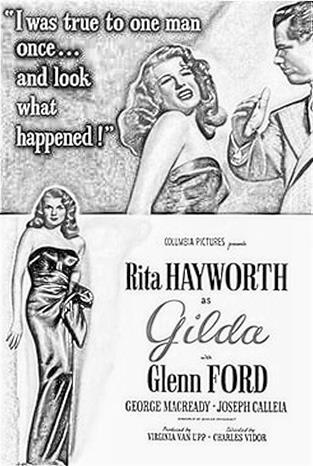
Oblivious to the peeling light green or yellow paint on the wall, Sam Shovelin said; “Air’s fine, a bit warm. View is even better.” She hopped off the desk and ankled a few steps to a movie poster of “Gilda” tacked to the wall.
Page 3
Her back to him she said; “I never put the blame on Mame. I’m Vivian Beaumont and I think you might provide the type of service I want.”
He stood up, ankled it to the desk, pushed a button and said;
“Do you like movies?”
“Certain types. But the whole chanteuse thing doesn’t do much for me, Mr. Shovelin.”
He looked at the long dark hair parted in the middle of her head and said; “Call me Sam. What kind of thing can I do for you?”
“What else? Surveillance.” she said, laughing. “Surveillance and property recovery if you’re up to it.”
He laughed, too, surveying her almond shaped green eyes, saying;
“Of what?”
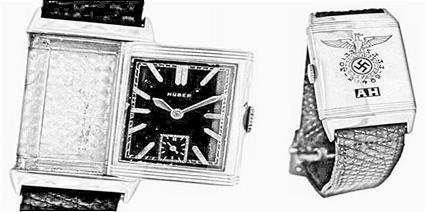
“A watch, really. It belonged to a now deceased guy I used to live with. It was stolen after he promised it to me. I’m the sentimental type. ..... Call me Viv.”
“Valuable, ..... Viv?”
“Well, you know some people will steal anything worth more than their next fix. But, to normal people, no, I don’t think so. I
Page 4
mean it was a good watch, made of gold, but its value to me is in the memory of the man who wore it.”
“You haven’t mentioned his name.”
“Artie Hayden.”
The name rang a distant bell with Sam, but he couldn’t quite place it and chances were that he was wrong. Trying not to look disappointed at another low paying job, at the same time appreciating having one at all, he took an obvious look at the Jell-O cleavage protruding from the lacy lavender blouse, that she didn’t bother to button very much. “Busy girl,” he thought, not fully realizing the immense accuracy of his vision. Trying not to appear ungratified, he simply said; “Who?”
“Artie Hayden. I guess you never heard of him. He was chilled off a few weeks ago. It was in all the papers.”
Lying, he said; “Oh, sure. Sure, now I remember. Is that when the watch was stolen?”
“Maybe, I’m not sure. But my best guess is that it was taken later.”
“Cops get the killer?”
Page 5
“They say yes, but I have my doubts. They put the blame on some homeless drifter they found dead in an alley, one John Garlee.”
“He didn’t have the watch?”
“No, at least not any longer.”
“Do you have any guesses about who might have it?”
“Sure. I also have some guesses about how the universe came to be. Wanna hear ‘em?”
“Come on.”
“Look, watches are popular with lots of people. If I had to guess it would be safer to say that the cops are the most likely immediate suspects, but I wouldn’t bet a nickel on that. It’s likely on its way to, if not already in the vault of some rich, unscrupulous collector.”
“Do you have any photos?”
She went back to the desk, seemingly mildly annoyed to have to do so, and opened the black fringed purse she had left there.
Viv took one from her wallet and handed it to him.
The Big Corner
Page 6
Sam took it and smiled a faint smile. He said; “No, I meant one of your lost love, Artie.”
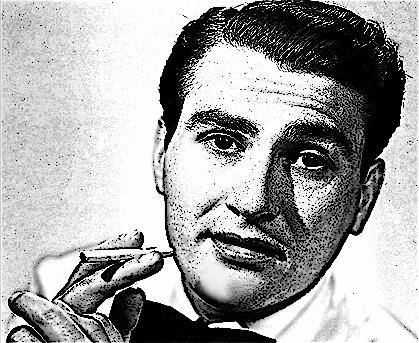
Viv retrieved another. As she handed it to Sam, she said; “It’s not very good. It’s the only one I have and it was taken in one of those booths at an amusement park. He’s dead. Why do you want a picture of him for anyway?”
The Big Corner
Page 7
Sam said; “I suppose that you’d be surprised to know how many of the dead investigations resurrect. ....... Can I keep these?”
“Sure.”
“When were these pictures taken?”
“Last month, May.”
“Okay, I’ll see what I can do. I’ll need your phone number and address.”
“Calling me is a problem. I’m sort of between residences, right now.”
“How can I contact you in an emergency?”
Page 8
She laughed; “What kind of emergency can possibly happen?” She again took a seat on the desk, hoping to distract him.
It worked to some controllable degree, but he kept his wits about him as Viv’s story didn’t add up well enough to put her into the trustworthy category. Her testimony that a not particularly valuable watch could generate much interest was one red flag. That she would give him her only picture of her lost love, Artie, was another. Sam didn’t want to queer the deal, as he needed the clams and work. Further questioning would only make things contentious, and he didn’t expect a truthful answer anyway. He felt obliged to say something businesslike; “Isn’t there something else you can tell me about Artie or the watch?”
She was still grinning, as she crossed her legs, exposing a stocking top and a bit of a garter strap. “Artie was an artist at heart, a musician. He pursued his own notions of truth and beauty without deference to the coin of the realm. ..... More or less, most of the time, and the gold watch was a reflection of that on one side or the other.”
Sam’s preoccupation continued, compelling him to absurdly grin and he said; “I might be able to do something for ya.”
Viv thought Sam’s comment was too obvious a closing to warrant any of her words. She blankly stared at him and the air was
Page 9
still a few seconds. She then all too obviously faked excitement and blurted; “That would be just dandy!”
Feeling that he had done his job as well as he could, he reached over to the desk and pushed the button, shutting off the tape recorder, while pretending to be looking for a pen. Vivian had not been fooled and pushed another button, popping open the deck and took out the tape. As she hid it in her ample cleavage, she said; “Bad boy. I want no record of our relationship.”
“Fine with me. Now, about the cabbage, honey; I get $10 an hour plus expenses.”
“You’ll take five.” She retrieved a wallet from her fringed purse, counted out $120 and dropped it near her skirt. “This should cover about three days.” She got off the desk, started to blow and said; “I’ll be in touch.”
Sam smiled broadly and licked his dry lips. He said; “I was counting on that tape for information. I’m afraid we’ll now have to go through the whole process again, with me taking notes.”
This time he really reached for his pen and searched for a piece of paper. After they ran through the routine a second time, Vivian took a few of his business cards, glad to see both his home and business addresses and phone numbers, as she wanted him when she wanted him.
Page 10
As she exited without offering one of those long good-byes, she closed the door behind her and again saw the vestibule. It was too small and cluttered for her to pass through easily, so, though she didn’t really want to hop around like a bunny, she did, and was soon back on 25th Street.
Vivian again echoed the watch thought as a short, round, sweating and swarthy man tried to enter. They brushed by each other, both mumbling something that sounded like “’Scuse me.”
When he was triumphantly inside she shut the door with a bang.
He briskly took it on the arches and passed through the open door. Sam saw him too late and moved quickly in an attempt to get the cash which was still sitting on the desk, but Charlie beat him to it, picked it up and put it in his pants pocket.
Sam shrugged his shoulders and looked at the floor saying; “God damn it, Charlie, you can smell it, can’t ya?”
“Obviously better than you.” He took the dough from his pocket and counted it, with his back to Sam. He shook his head disapprovingly, said; “Almost covers April,” and put it back.
“Use that chrome dome of yours for once. If I don’t have any lettuce, I can’t do my job and you don’t get your rent.”
Page 11
Charlie pulled out two wrinkled sawbucks and flipped them on the desk.
Sam said; “That won’t even cover my grocery bill.”
“Shoplift like the stinkin’ dinges,” said Charlie, the Wop, Calamari and he turned to blow.
Sam said; “Hey, you know you’re charging a lot of scratch for this little dump.”
“It’s that fuckin’ Truman inflation; not me. Look, I didn’t force you to take it. I got plenty of customers.”
“Yeah, maybe if you painted the fucking place. The rats are dying of lead poisoning.”
“Prime location, my man. Keep giving me shit and I’ll have you thrown out and not by the nice guys.”
Sam thought; “Charlie always likes to infer that he’s a big man with the mob and so he’s not more than a minor player, but if I piss him off he can evict me.” So, he said; “Sorry, man. I understand. It’s just that things have been slow, you know what I mean and I’m getting frustrated. Thanks for putting up with me.” His staccato monotone complemented a terse grin.
Page 12
Charlie said; “All right. But, things might be slow because you’re paying too much attention to things other than work; you know what I mean.” He smiled at Sam, gesturing underhanded with his right fist, then added; “You know, I was just like you when I was young, but I straightened out and started taking care of business.”
Sam sheepishly nodded with a half-smile and Charlie left. No more than a handful of seconds had passed when Mida Carey entered. She opened her light raincoat to show that she might have lost her skirt. Sam said; “You guys work as a team; I know it.” She had kinky tousled curls, only a minimum of makeup, and.
There was a world of character in that face, more than enough to make her fascinating looking instead of just attractive.
Mida and Sam simultaneously made a grab for the sawbucks, each getting one. Sam thought; “I’ve got to remember to put these things in my pocket quickly.
“Payday, baby,” she giggled as she made sure her bill was in a safe place. Sam’s determination had gotten its first disappointed rise of the day when Viv was there, and he was in no condition to refute a second opportunity. He snuggled up inside the open raincoat as Mida leaned back against the desk.
The Big Corner
Page 13
The Big Corner
Page 14
The Big Corner
Page 15
The Big Corner
Page 16
Glenn Miller and Glenn Miller and his Orchestra doing “It Must be Jelly ‘Cause You Know Jam Don’t Shake Like That” by Frankie “Half Pint” Jaxon; property of the author, the latter under both the
“fair use” and “transformative” doctrines.
“I’ll get more. Give that back and I’ll get you a hundred by the end of the week.”
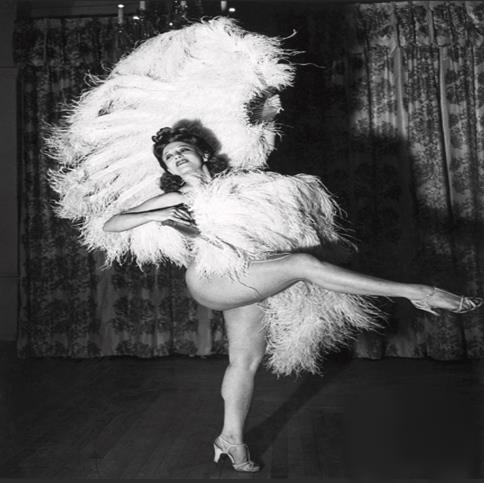
In an overly strained falsetto voice, she said; “That’s what you’re supposed to be doing anyway.” She shook her head “no” and continued in a mock incredulous tone; “You boys must still think you got some dumb slaves around here. Well, I got some news for you, honey.” She was an experienced fan dancer. One wouldn’t call her young anymore, but she had ways of making up for that.
Knowing that it would end the clam discussion, Mida put one leg up on the chair, pretending a need to scratch her upper thigh.
Page 17
“It must be a hot day for everyone,” Sam thought, as he admired her long coiffure.
Vivian Beaumont’s metallic burgundy, 1946 Plymouth Business Coupe was now on her home Bayway Town street, 28th. 28th, between long Avenue A and short Avenue B was single-laned and lined with parked cars on both sides. The houses sat on 100 by 100 foot lots and sloped upward from the concrete sidewalk. Some were quite substantial, in the 4,000-5,000 sq. ft. range, often with three levels, mostly built in the 1880s and 1890s, hence evincing a Victorian feel of an elegant, pre-World Wars past.
When she got to her driveway near the middle of the block, she was happy to see that a parked car wasn’t blocking her entrance.
She drove down the decline to the two car garage. She dawdled up the stairs to the living levels. The house was much too big for her, especially since Artie’s sudden departure. It’s not that Artie was always there. He had gone there off and on, more off than Vivian would have liked, but there was always the possibility that he’d show up with flowers any second. The emptiness of the substantially unfurnished inflation hedge, bought last year, now bellowed.
In the half closed eyes of those who can only evaluate from the outside, like reviewers unable to do what they are reviewing, Vivian had one of the grandest abodes in Bayway Town; three
Page 18
living levels approximating 6,000 sq. ft. and a garage constructed underneath through the gouging of truckloads of dirt many years prior to Vivian’s having resided there. Externally, the three floors were covered in yellow painted clapboard, with irregularly placed fretwork trim stained a bright red, giving it the appearance of a “painted lady,” but this was mere cosmetics.
The first floor, the only level made in a regular square pattern, was surrounded by a covered porch supported by purple and white painted posts. The second and third level celebrated irregularity in that it was devoid of straight lines, each room containing one or two jutting areas. The severely sloped roof covering most of the third floor was proud of its unique design with seven gables covered with black slate. Above the third floor master bedroom was a small observation tower, suitable for only a bench or two, above the trees affording the grandest view in the vicinity, with its own slate turreted cap, topped by an iron modified cross finial. Similar finials were placed atop four of the lower gables.
The grounds were entirely enclosed in a three foot, black, rusting iron decorative fence, once expensively more for show than security. The overall feel was tall, heady, eccentric, declining and grudging with easy access. The structure actually suited Vivian very well, in an emblematic way. The house’s age,
Page 19
detail, colors and irregularity proved an excellent source of income for local craftsmen, not often supervised. Vivian entered the high ceilinged kitchen, and sat at the head of the ten chaired, lavishly carved, rococo revival table made of rosewood, its red mahogany stain, further developing the natural hue.
The Big Corner
Page 20
Centered Corner
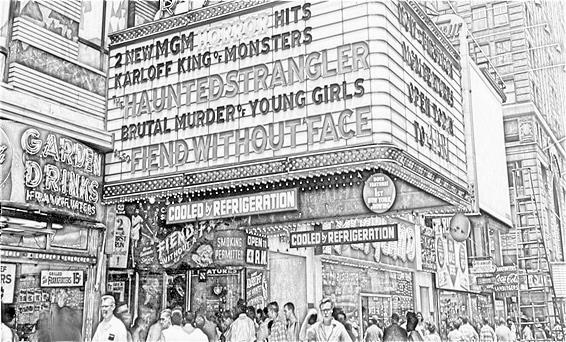
The center of Bayway Town’s life always was the northwest corner of Broadway and 25th Street; at least after the farms were sold off to the sharpie investor/developers. But, this phenomenon was amplified during the heat wave of July, 1946 when the temperature packed the already busy Paramount Theater which presided over the area with its shading overhang and “cooled refrigeration.” Refreshing gusts were savored by outsiders whenever a door was opened. They seemed to congregate there just for that.
In more moderate times and climes most patrons came to only see the main feature, and showed no interest in the accompanying “B”
The Big Corner
Page 21
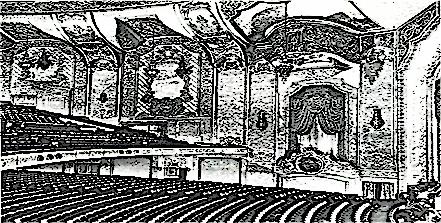
offering, the Three Stooges shorts, the cartoons, the newsreel, and the coming attractions. But in this heat wave, on screen preferences became subservient to the cold comfort of contained cooling, with an elegant interior which included a modestly warmer balcony used by those desperately wanting to make out heavily in the relative privacy often referred to as “Dinge Heaven.” The voluntary setting apart seemed to be popular with all theater guests. If you took good care of your ticket stub you could stay there unmolested forever.
It must have been the theater ushers and usherettes who left the outside doors open during the newsreel. The wafts of cool air were flocked to by those typically apathetic to world affairs.
This day the crowd could not have helped but heard, though they could not see what was going on, due to the eight foot wall between them and the paying guests. The ushers and usherettes must have thought; “Everyone has a right to be disgusted.”
Page 22
“With the urging of ‘One World Truman,’ a ‘loan’ of 3.75 billion dollars to the United Kingdom, at 1.62 percent interest, was approved 46–34 by the United States Senate, after the House had voted 219–155 in its favor. By July 15, 1947, ‘within six months of convertibility of sterling requirements coming into force,’
noted one pundit, ‘British gold and dollar reserves were exhausted. With bankruptcy staring it in the face, the Attlee government made plans for a severe austerity program at home and a strategic retrenchment abroad.’ The Republican National Committee said; ‘Loans’ like this are at best a temporary respite for the recipient, though they virtually guaranty that the lender will soon be in the same equal position of bankruptcy; international communism at its best.’
After formerly being limited to general elections only, dinges voted in a primary election in Georgia for the first time, with more than 100,000 turning out to decide on the Democratic Party nominee for Governor. Although the dinge vote was a factor in James V Carmichael getting almost as many votes as former Governor Eugene Talmadge, Talmadge also won the nomination, based on the state's ‘county unit’ system, similar to an electoral vote. Any way you slice it, Talmadge would go on to lose badly in the general election to Republican George Wallace.
Page 23
The Dr. Hari Singh Gour University was founded through a $300
million Truman grant over Republican objections in the city of Sagar, now in the Madhya Pradesh state in India, and is now one of the central universities operated by the national government.
Hari Krishna, US taxpayers.
In the truth of fiction, from J D Salinger's prophetic as well as recursive novel ‘The Catcher in the Rye,’ July 18, 1946, was the date that Holden Caulfield's younger brother, Allie, as in Allies, died of leukemia. Comprende?
Introduced for the first time and endorsed by President Truman, the proposed Equal Rights Amendment to the United States Constitution, failed to pass the US Senate. The vote was 48–25
against the radical proposal.
The ‘Report of the Joint Committee on the Investigation of the Pearl Harbor Attack’ was released. Chaired by US Senator Alben W
Barkley, with US Representative Jere Cooper as vice chairman, the ten member committee had voted 8–2 to approve the finding that ‘The committee has found sufficient evidence to support the charges, made before and during the hearings, that the President, the Secretary of State, the Secretary of War, and the Secretary of Navy did indeed trick, provoke, incite, cajole, and coerce Japan into attacking this nation in order that a
Page 24
declaration of war might be more easily obtained from the Congress over majority Bund and non-interventionist US
objections,’ and assigned no blame to the highest ranking officers in Hawaii at the time, Admiral Husband E Kimmel and Lt.
General Walter C Short. US Senators Ari Ferguson and Yisroel Epstein dissented, saying that President Rosenfeld and his military advisors ‘were not any more responsible for the nation's worst military disaster than di mume Khaye, tso za dva groshi dupe daye; the aunty Khaya, who takes it up the arse for two shekels.’
Gualberto Villarroel, the President of Bolivia, was murdered by an angry mob that stormed the Palacio Quemado, his official residence in La Paz. Villaroel, who had escaped an assassination attempt only two years earlier, was hanged from a lamppost at the Plaza Murillo more or less after the killing. Asked for comment, Harry Truman said; ‘There is absolutely no truth to the irresponsible and unfounded conservative allegations that the CIA was involved. But, having said that, good, death to all fascists.’
The King David Hotel in Jerusalem was bombed by the Zionist terrorist group Irgun in co-operation with the supposedly outlawed yet overlapping Lehi Group, collapsing a section of the building and killing 191 people. At 12:37 PM, 770 pounds of
Page 25
gelignite explosives were detonated at the headquarters of the British Mandate for Palestine. The 191 dead were made up of 28
British nationals, 141 Palestinian Arabs, 17 Haredi Jewish dissident residents, and five hotel guests from other nations.
Members of Irgun had smuggled the bomb material into the hotel in seven milk cans, and claimed later that they had telephoned a warning which had been ignored by the Chief Secretary, Sir John Shaw. When asked for comment Shaw said; ‘Yeah, right. You still believe the Jews?’
Andrei Gromyko told a closed session of the United Nations Security Council that the Soviet Union would not accept the Bernard Baruch Plan to ban all further production of nuclear weapons. Neither did the US, but that is only reported in Russian newspapers.
In the first underwater test of the atomic bomb, the aircraft carrier USS Saratoga was sunk near Bikini Atoll in the Pacific Ocean. The ‘Baker Test’ blast took place at 8:35 AM local time, and vaporized the 200 foot long weapons ship USS LSM-60, located directly above the bomb, and immediately sank the USS Arkansas.
In all, three submarines and seven ships were destroyed in the test. The test was the second phase of Truman’s ‘Operation Crossroads,’ the number of phases yet to become disclosed. When asked if there was more destruction here than at Pearl Harbor,
Page 26
Harry S Truman responded; ‘I don’t know and I don’t care. Wasn’t it a pretty blast?’
The Truman created US Office of Price Administration, authorized to act after a 25 day lapse in its activities, by a federal judge appointed by Truman, issued orders restoring price controls, but at a higher rate, effectively raising prices on thousands of items sold in the United States, under the ‘OPA Revival Act’ that had been signed by President Truman the day before. Food prices would not be ‘controlled’ again until December 20th.
At the Anping district of China's Hebei Province, near the village of Hohsiwu, a 300 man force of the Communist People's Liberation Army ambushed a supply convoy of 41 United States Marines. In the battle that followed, four Americans and at least fifteen Chinese died. Truman said; ‘I’m sure that we all regret the temporary ‘misunderstanding.’’
Working under the codename of the Venona project, American cryptanalyst Meredith Gardner was able to make the first breakthrough in a team project to crack the secret codes used by the Soviet Union in its espionage activities in the United States during WWII. After his successful decryption of one encoded phrase within intercepted telegrams, the team was able
Page 27
to deconstruct more of the coded transmissions previously transmitted.
The Morrison-Grady Plan was proposed by Herbert Morrison of Britain and Henry F Grady of the US, which provides for the division of Palestine into three districts, with 17% of the land set aside for up to 100,000 Jewish immigrants, 40% for Palestinian Arabs, and 43% for a neutral zone under British control. The plan was endorsed by President Truman and Prime Minister Attlee, but Jewish and Arab groups both rejected the proposal. Zvai Leumi of Irgun said; ‘You should go try and live in such a klayn place right next to those meshugganah sub-human dinges. Oy!’
In a repeat performance, we bring you uplifting excerpts from the Frank Capracorn series of movies of US glory during WWIi, filmed for the Department of Defense in the US during the war.
Keep your eyes out. You might spot a Hollywood star. Get your rah-rahs on!”
The Three Stooges came on, and the ushers and usherettes re-closed the doors after the five minutes it took them to realize that the newsreel was over.
Bayway Town’s Broadway shopping district; which more or less started on Seventeenth Street, got into full gear by Twentieth,
Page 28
and started to fade at Twenty-fourth. On the near outskirts of it, the resident structures were well positioned to accommodate the provincial pedestrian population’s propensity to prudently stray. And stray they did, meandering in absolute hordes in search of the fascinatingly exotic, finding the elusive treasure here and there for a few days.
Contrasting that, the avoided side streets of Twentieth, Twenty-first, Twenty-second, and twenty-third, north of Broadway, between it and Avenue C had become a self-aggrandizing, blood-strewn, self-inflicted, hophead populated, un-American shanty town more reminiscent of the domino “cultures” of places like Jamaica and Haiti, populated by dinges who had relocated from places like Birmingham, Mobile, and Tuscaloosa, in search of a lack of jobs and northern welfare benefits. Though they seemed to be able to accurately gauge the weather, and consequently stopped their excursions safely short of Broadway, leaving it to the relieved and appreciative-under-the-circumstances folk who had always been there, they had been misinformed on a Bogart Casablanca level, though they were incapable of grasping its ironic wit, concerning their unwanted northeastern relocation, no doubt prompted by smart southern patriots who basically said;
“You like them so much; take them.” It was kwite a kopascetic kondition; so much so that it virtually guaranteed some
Page 29
misinformed meddling married to its long term partner; accepting ignorance, barreling like a flailing Niagara Falls fool unable to get out of the rapids, toward a rocky and deadly divorce in the bottom territory, so far only efficaciously traversed by
“The Maid of the Mist.”
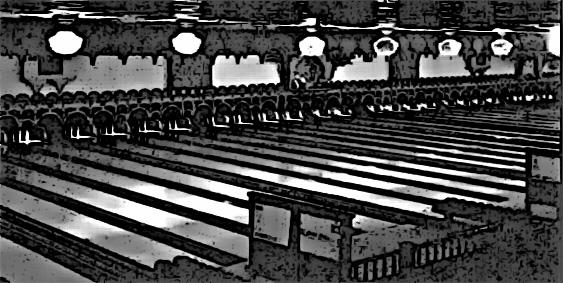
Having Nigel’s in its basement, solidified the Paramount’s prominent position. “Nigel’s Alleys” occupied the Paramount’s subterranean vault with thirty-two lanes, sixteen on each side.
The bar and pool tables at the center had hosted more dignitaries than Bayway Town had in residence, making it a truly international bastion, with an unspoken predilection toward the lip synched unpopular and the enticingly illegal.
Inflation was the word most common on the street and constant news of the time. As measured by the consumer price index, the rate of inflation was 18.1% for 1946, an all-time record, and it was heading north/northeast to another contending position which fell short primarily due to a federal government “massage” of the numbers, thereby falling to break another annual US record, coming in at 14.4% in 1947. Harry Truman had just taken the President’s office in 1945 and was making entrees into as well as designing the final Marshall Plan. Ostensibly it was not sufficient that the US had sacrificed lives for Europe’s war; it was further necessary to use US simoleons to rebuild what the
Page 30
Europeans had destroyed. The CIA and the UN were founded. The first mentions of globalism appeared in the main stream presses.
Israel would be recognized by the United Nations and funded by the United States in 1948.
If you believe that all politics is local, then you also think that the federal government spending your dough in western Europe and Japan, and leaving Americans sporting lint, had nothing to do with your inability to find a job, food, and an affordable dwelling at home. On a positive note, semi-organized crime, including strong armed politics, and their ancillary offshoots and overlaps became the number one growth business. It helped a lot to know someone or be convincingly crazy.
Goldklang’s Appliances was across Broadway from the Paramount.
Gershom Goldklang was quite enterprising and drew his own share of attention. What commenced as a store selling appliances like as the Bayway Town Times ad originally said; “stoves, food processors, refrigerators, fans, freezers, record players, vacuum cleaners, washing machines, clothes dryers, sewing machines, dishwashers, lamps, irons, and you-name-its” to a burgeoning market expanded into also selling records and jewelry. The records were stacked on flimsy metal frames right inside the front entry and the jewelry was in the back, under thick glass lock and keyed, where a member of the Goldklang
Page 31
family was always present. If it wasn’t Gershom himself, it would be Ester, Chaim, or Malke.
Across 25th Street from the Paramount was the tallest structure in town. No one was quite certain whether it contained apartments, was used for storage, both, or something else and didn’t care. Bayway Towners never checked as it didn’t bother them and they were well versed in the art of minding their own business. Right next to the Paramount on the attached other side was a popular place that sold beverages; not alcohol, beverages.
It was the watering hole for young families, some already with walking kids.
The Big Corner
Page 32
Nigel’s Alleys
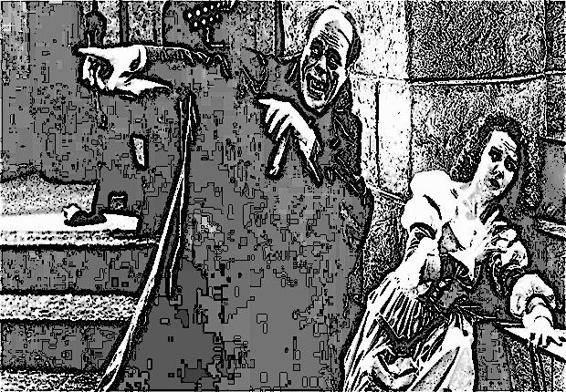
As in “The Phantom of the Opera,” the catacombs of the Paramount Theater were purportedly occupied by things which are only rumored to exist.
However, the bumps heard in the night were more likely to have been generated by bowling balls rudely striking down pins, than a deformed German music and arts lover striking down chandeliers. Nigel’s Alleys was not haunted by Erik, but rather managed by “Lefty” Centraglia, who reclusive entrepreneur Nigel met at a card game and took a liking to. Since becoming manager, no one has ever seen Lefty come or go. It’s like he’s always there, even when you might not see him.
The Big Corner
Page 33
Lefty used to be a contending bowler, who while still in his early teens had put up a 185 average, making him a potential pro candidate if he continued to improve at the same rate. He didn’t. An early peak is rarely a blessing; most usually a prescription for unhappiness, but Lefty didn’t care, sometimes saying; “Most never even have a peak.”
A greenish, soft fedora gently squeezed the top of the fleshy bulb of a head, his pried trilby only rendering him indistinguishable from Nigel’s hoi polloi. Below that the large ears, uncut sideburns, and the fine bristles that protruded from the ears themselves, stuck out on both sides like a graffiti
“enhanced,” yellow traffic sign which indicated two directions at once. Thin, pursed lips barely protruded beneath the trimmed black moustache and, at their corners, sank into little disapproving folds filled with hot dog mustard.
Page 34
His blue eyes looked down upon the Nigel patrons waiting under the clock at one of the two entryways for signs of pretentious bad taste in dress. Several of the outfits were new enough and expensive enough to be properly considered offenses against taste and decency. Possession of anything new or expensive only reflected a person’s lack of theology and geometry; it could even cast doubts upon one’s soul.
When infrequently asked, Lefty one worded his non-participation in WWII simply as “medical.” Gossiping busybody people believe that his juvie criminal record of having bashed dinges on more than one occasion had rendered him unfit to bump off nationalistic Italians and Germans.
Nigel’s had no windows, just the two entryways on 25th Street which opened to stairs winding down. Un-naturally lit and heavy with coffin nail and cigar smoke, Nigel’s patrons often took breaks from their games and congregated near the doors to have a few smokes and hot dogs, while they bumped gums. The “welcoming committees” provided cordial greetings to incoming customers who always liked being recognized by the crew.
The Big Corner
Page 35
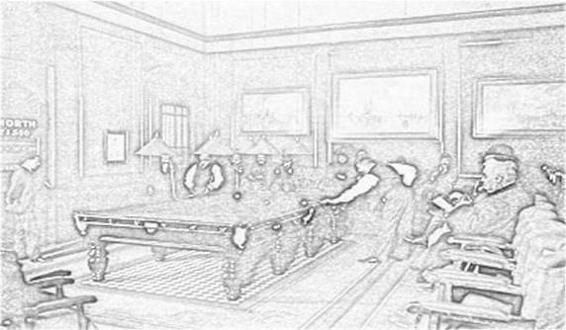
Fats Squealitieri was a popular regular there, he being not a bowler, but the best pool player in town. He didn’t always win, as the short games of Eight Ball and Nine Ball carry with them some element of luck. It’s not that a poor player will win, but it is not uncommon for one with 80% of their opponent’s ability to beat their betters. When Fats was feeling challenged and playing seriously, he’d insist upon playing Straight Pool. The much longer game minimized the luck element, and he never lost.
Good Straight Pool players often run a few racks, the precision and time taken often have a numbing effect on casual “fans”
while fans who also are good players find fascination in the subtleties of tactics that those unskilled cannot appreciate.
Fats never noticed this phenomenon as when he was seriously playing Straight Pool all he saw was the table and the balls.
In his last big Straight Pool money match he was backed by Bayway Town Joe Zanarelli while his opponent, Kentucky Kayo
The Big Corner
Page 36
Keneally, a former middleweight club quality fighter was backed by Bayway Town Mayor Frank DiCesare. Fats found this to be disrespectful to their mutual homeland, refused to acknowledge the presence of either of them, and was sufficiently motivated to destroy Keneally 500-88. Supposedly DiCesare was quoted as saying; “The fat man is absolutely frightening on his home table. I’ll never again oppose one so gifted.” The comment had its left-handed aspect in its reference to Fats playing on his
“home” territory, as if pool tables were something else in Kentucky.
Some people get confused about Nigel’s manager, as Lefty actually bowled right-handed, and sometimes took a break from whatever he was doing, and did. It’s essentially reet simple.
Lefty was a lefty through age twelve, when he broke his left arm while working as a pin boy. Stan liked bowling so much that he
The Big Corner
Page 37
started to do it with his right arm while his left was still in a cast, and did it better that way than he ever did with the left. Hence he continued to use his right after his left had healed; using it not only for bowling, but the more mundane but necessary pursuits of ringing up the cash register and grabbing snatch. He found it amusing that some made analogies to transitioning from being an artist to being a popular head of state.
Lefty didn’t seem to care about his shortcomings as a purchased pro, and he would say; “Don’t you see how much I regret not having had the honor of living in a trailer while on tour ten months of the year? I often cry for the Jew backers.” You may have heard that pro bowling doesn’t pay all that much.
Page 38
But now Centraglia had a secure home he could share with other ninepinners. It was dimly lit and there were said to be nefarious goings on and some might characterize the place as creepy, but it was home to Stan. The sixteen lanes on one side and the sixteen on the other were like his children; playful and in regular need of maintenance, which kept Stan more busy than he wanted to be. He had an excellent scam. For the many who didn’t know his broken arm story, Lefty could still pick up a few bucks from the never-was-and-never-will-be hotshots by challenging them to a money match wherein the use of the right arm is alternated with the use of the left, new to the Bayway Town hotshots, but quite common in South and Central America.
“Lefty” never lost; as his right was superior and his left was okay, but much better than that of the losers.
If anyone knew Nigel’s first name or names it was Lefty, but he wasn’t talking, and virtually no one asked or cared. It was just the name of something, like boots or lightning bolts. Like anything, it could have deeper meaning, but if it did it was probably coincidental. The underground below the Paramount Theater was home to a variety of fun activities.
Though a few places uptown were larger, Nigel’s thirty-two lanes provided more than enough space for pure bowlers to play out their games and bets. It wasn’t a place favored by the
The Big Corner
Page 39
diletantes, as the pins were heavier, which produces lower scores than the lighter ones at Bayway Town Lanes uptown.
There was a licensed twenty-four hour bar at the center, with a private room which was used for card games at the center of that. This bar, being the only one for five blocks, may have been Nigel’s biggest single reason to buy the place. Lefty arranged games for the town’s biggest players as well as unknown out-of-towners, as having some scratch is the only credential necessary to play the game. The house almost always came out ahead, even if they weren’t always the evening’s biggest winner.
There was picture on the wall, that of a doll-faced dame or a vamp. Lefty put it there thinking that it can’t hurt to try to distract the saps. On the opposite wall was a sign which said;
“Ignore the unwritten rules at your own peril.” Perhaps it is because no dinges were ever participants, this required no further explanation to the gentlemen players.
Page 40
Nigel’s had an oddity known only to Nigel, Lefty, and maybe a few old timers who weren’t talking, primarily because they were dead or otherwise effectively incapacitated; the democratic socially financed nursing homes the mandated repositories of those who no one, including the dinge attendants, paid any mind.
The ceiling over lane thirty-two had a trap door which led into the Paramount Theater. It could be easily accessed by standing on the automatic pin spotting machine and pulling down the noosed rope. A little climb on that would put one just offstage right.
Page 41
Buzzy Barrese
Sam peered through his window. The sun, which had made the shadeless sidewalk suitable for burning discarded newspapers, was now producing angled, long and lean shadows. He took it on the arches and he noticed that his rubber soles were announcing his presence with a mild squish, squish sound, capable of attracting attention on his silent side of the road. He crossed the street to get to the middle of “The Big Corner,” where the constant arrivals and departures would drown out his squids.
He got lost in the smorgasbord of people milling about. Old Eastern European women with shopping bags, wearing babushkas, were busily entering and exiting the retail stores and crossing the square in a myriad of directions on their way to the next place that might have something useful “for sale.” Their ankle length coats defied the now overhead drear, in a probable overheated attempt to hide what sixty years of experience had taught them to conceal. Frequently, they would stop for an almost stationary moment, to point and tell one of their confidants where they knew of bargains, arms gesturing quickly in haste to move onto their next site. Many of them were residents of the city’s “Old Town” section, home to abandoned docks, piers and warehouses, but resided in currently very desirable three story attached limestones and as a result had
Page 42
some simoleons, at least on paper, being five minutes from the
“Big Apple” by PATH trains, whose path took them under the jelly textured Hudson River.
Jiggered men and women in their twenties and thirties dressed to the nines combed the area at a leisurely pace; the men’s threads an attempt to mirror Humphrey Bogart or Robert Mitchum, replete with Trilby lids, with the women’s idols apparently Lauren Bacall and Ida Lupino. Sam tried not to make direct eye contact with them, not wanting to hear a defiant and looking for trouble mouth utter; “What are you looking at, sap?”
Some people were on four lines in the middle of 25th Street, craning around heads and gazing at their watches, anxiously awaiting the arrival of the always-behind-schedule buses to take them somewhere else. Young couples, satchels in hand, were going
“down the shore,” the part of New Jersey which bordered the Atlantic Ocean, far enough south to avoid being in the paint factory and chemical plant towns closer in. People of all ages, shapes, sizes and dress were making their way to Manhattan, where they hoped to “be cool” among the people who had seen and done everything they wished, the “everything” available twenty-four hours a day in the city with no stars on the horizon. Some were off on a few days journey to New Jersey’s furthest western reaches to see farmland and vintage villages in the hilly locale
Page 43
still possessing relatively clean air and those with more time to spare desiring the mountains of upstate New York, the trip abounding with ground hogs, up on their hind legs, watching the excitement of the loud bus, from two feet away. For some reason, they continue to play this “sport” despite their flattened relatives nearby. They must have come to the conclusion that it’s the only game in town.
As he got to the gray, interlocking, rubber pavers under the Paramount’s overhang Sam heard; “Hey, man. Where the fuck you been?” He located the sound and saw that it was his old friend, Buzzy Barrese. He wasn’t sure until he did a triple take. Buzzy looked older than his thirty years, and his complexion had changed from its natural olive patina to a never-see-the-sun prison pallor. The lid and the way his fingers apprehensively fidgeted with his tie as if it was a guitar were the giveaways.
Sam returned the upbeat greeting with; “Buzzy, great to see ya’.
I’ve kind of been nowhere. When did you get out?”
The Big Corner
Page 44
“A week ago Monday. Been here, there and everywhere, you know.”
Buzzy’s right hand took Sam’s right and attempted to do some kind of underhanded twisting handshake that was currently the rage in jail. Sam was surprised that Buzzy was out in less than six months on a dime stretch with no parole on a third armed robbery conviction. He said; “Someone big must have pulled some strings for ya.”
“Good behavior goes a long way.” Buzzy laughed.
Sam didn’t and said; “I’m on a new case. And something doesn’t smell right. But it pays, you know. Tell me. When you were up the river did you hear anything about a watch or Artie Hayden?”
Page 45
“Yeah, sure. He probably wears one and Artie makes some good music. Doesn’t he?”
“He won’t be making any more.”
“Got dropped? Agent or record company?”
“Like in dead, bumped off, burned, chilled, iced, offed, rubbed out; dig?”
“No shit? ..... That’s a real shame.”
“Come on, Buzzy. Quit fucking around. What’s the inside dope?
You know it stops right here ....... just like Truman’s buck.”
Buzzy smiled condescendingly, shook Sam’s hand again, and said;
“Always trust your beezer. Gotta go. Gotta see a man about a horse. Later.” Sam took a few steps behind him and his eyes followed Buzzy into one of Nigel’s side entries.
Sam thought; “Buzzy is likely involved in something he won’t talk to an old pal about; must be bigger than Vivian’s lost watch. The fear of the long stretch must have pushed him to graduation into the big leagues." They knew each other from the old 17th Street and Avenue C neighborhood where they both grew up and used to be able to trust each other to have the other’s back through the rigors of basketball, school, dinge dust ups, and weird adventures only describable in their time and place.
Page 46
The mature “now” of war and post-war times was apparently something else.
Buzzy and his main partner Mikey were the co-founders of the biggest teenage gang in Bayway Town; the Cheyennes, which started as mostly a fighting gang with an open invitation to all comers. With Buzzy and Mikey no longer involved, the organization had now evolved, with the times, to a “community support,” Frank DiCesare funded group, the middle man in the dispensation of federal largesse to the neighborhood “poor” and connected. People seemed pleased with them, but it would take foolish souls to say otherwise, as the current Cheyennes were an extension of “I am the law” DiCesare, who would still kick serious ass through his main man, Police Chief Red Doherty.
Up until now, Buzzy had never been known to play anybody’s games. He had his own, as well as a simple yet fatalistic philosophy about things. “You just happened to be there, that’s all. Whatever will be will be.” He did whatever he wanted as schemes and plans made no difference. But, now it looked like having done six months of a dime stretch might have changed his point of view. He had given up and put on the uniform. What a drag it is getting old.
Page 47
Newsboy Konetki
After the war ended the Paramount’s outdoor lobby got a new nightly fixture; Newsboy Konetki. Having left for Italy right after high school graduation, Newsboy had not yet established any peacetime career credentials.
He returned from his overseas victory to high unemployment, high inflation, a lack of affordable housing, and the antecedents of as well as the formal Truman Marshall Plan penchant to send all available US funds to the war-mongering Europeans, including Axis powers, for whom so many of his comrades in arms had died or become crippled.
The hot air seemed to congeal in front of him, and out of it materialized a transparent man of most bizarre appearance. He had a small head which was fitted with a black homburg over a skimpy little checked jacket. The man was six feet tall and reet broad in the shoulders, though incredibly thin; the result of the US military’s ability to keep him in coffee and smokes, though no food. Sarge would say; “Drink ‘em and smoke ‘em. You won’t feel the hunger.” But Sarge lied. Newsboy’s face had a tired look about it.
The Big Corner
Page 48
Ostensibly an incurable optimist, Newsboy Konetki still saw opportunity in the US, though there was little alternative choice available in the matter, which didn’t result in self-annihilation. Bayway Town’s central thoroughfare had no newspaper outlets, and he made arrangements with the New York Daily News to distribute their evening edition. No longer would the most popular paper be relegated to distribution by come and go grammar school kids; it would be sold en masse in one reliable place by one reliable person, an enterprising American and a responsible adult right from under the heavily trafficked and precipitation resistant overhang of the Paramount Theater.
If the Paramount owners didn’t like it there was nothing they could do about it as despite being under their overhang, the
Page 49
street was not their property, and was solely under the auspices of Mayor Frank DiCesare.
In this regard, just to be on the safe side, Newsboy was known in some circles to supplement his income by occasionally transferring some small objects in his papers; objects approved by DiCesare; more or less most of the time.
While it is easier said than explained, some semblance of explanation is called for. Say a person with something to sell can’t go through traditional channels because some liberal, commie, legally proficient, moralist muckety-mucks have made that a crime. So the resourceful businessman in the great state of New Jersey is forced to make a private sale, and transact it safely under the guidance of trustworthy and influential Mayor Frank DiCesare, who takes a 10% cut. DiCesare’s people safely take the item from one party and the cash from the other, as no one in their right mind is going to screw with DiCesare. He has taken total effective control by having his many flunkies pass laws which make everything illegal, and then he as top executive selectively enforces the law; a process destined to become standard operating procedure in one of the Democrat operating manuals. In this type of “particular” case, Frank’s minions give the item and some dough to Newsboy who is also given a code. For instance, when someone purchases their popular evening edition
Page 50
of The New York Daily News from Newsboy and they say something which changes with each transaction, in one prior contraband transference case; “This is not a fit night for man nor beast,”
they are handed the newspaper copy which is wrapped around the special item. Business is safely done and everyone is happy. The liberal, commie, “moralist” muckety-mucks kind of suspect that such things go on, but can’t say where and how, and for the time being are cautiously content with the accolades they have received from their constituents for having passed the easily skirtable laws which supposedly benefit fags, groomers, dinges, bums, and commies. The more time that passes the more they become interested in getting a cash cut too, but that’s another story, one step more complicated, and is reserved for some tedious future date.
Newsboy’s big secret was that he also did this for Zanarelli, unbeknownst to DiCesare. DiCesare’s smaller secret was that he knew Newsboy “freelanced,” but didn’t step in as he figured that anyone smart would, and who needs a dope on the payroll. The only question relevant to him was the degree of disloyalty, a small amount a plus, and a large amount a cause for concern.
You probably are thinking that a newspaper cannot effectively hold and hide much more than a rather mostly sized fish, and you are spot on with that observation. And if you are not thinking
Page 51
that, congratulations on having an active “criminal” mind. The trick is that Newsboy doesn’t pass everything which needs passing. The larger items follow a similar procedure, but are funneled through the reinforced paper bags used at George Young’s hot dog stand for big, “party” type orders, no pun or dual meaning cutesy intended; though deriders of tired clichés are always most welcomed, as they provide unintended amusement in their predictable complaint, while predictably offering nothing new, but obviously thinking they had. If you will, visualize the post-modern and the post-post-modern writers who think that they were not fully anticipated in their penchant for atmosphere over story line, literarily impressionistic. Getting little critical or popular credit, James M Cain, Raymond Thornton Chandler, and Dashiell Hammet, to name just a few, undoubtedly beat the post-modernists and the post-post modernists there by as many cumulative furlongs as Phar Lap outdistanced his number two “competitors.”

The Big Corner
Page 52
Where the lines are drawn on the close calls is the kind of subject which compels adjunct college professors and student wannabees. For the rest of us, any question as to where a wristwatch will go when off the wrist is answered if at all with; “Depends.” No weirdo, Konetki ankled past it slow.
Newsboy Konetki was a reet practical man whose sense of humor was only exceeded by the width of the soles on his shoes. His trademark line was; “Extra, extra. Read all about it. Nazis in America.”
The Big Corner
Page 53
George Young’s Hot Dog Stand
Enterprising George Young opened a hot dog stand on 25th Street near the Broadway corner right near Nigel’s Alleys when World War II ended. Released from the service, he decided to follow his bliss and what he knew best; hot dogs, trucks, the DiCesare
“permit” charges, and the lucrative endeavor of passing concealed contraband.
His truck was always parked there, which no doubt violated some Bayway Town ordinance, but George had more faith in his contributions to DiCesare than he did any annoying windbag local ordinances. George disdained any nuances. He would say; “They enforce what they want to enforce, whether it’s an ordinance or not.”
He smiled understandingly. Though reet more than that. It was one of those smiles with a quality of reassurance in it, though truth be told, he probably was paying no attention to what had been just said. It seemed to face the whole eternal world for an
Page 54
instant, and then concentrated on you with an irresistible prejudice in your favor. The people liked George.
Almost as important, Bayway Towners loved his hot dogs, late breakfast, lunch, and dinner, and preferred regular access to them over his monopoly on two and one half prime parking spots.
The mustard and sauerkraut was scrumptious and people couldn’t stop eating the squishy hot dogs and soft buns. The biggest fear was held by Mayor Frank DiCesare. He feared that a riot would take place if George’s hot dogs were to disappear.
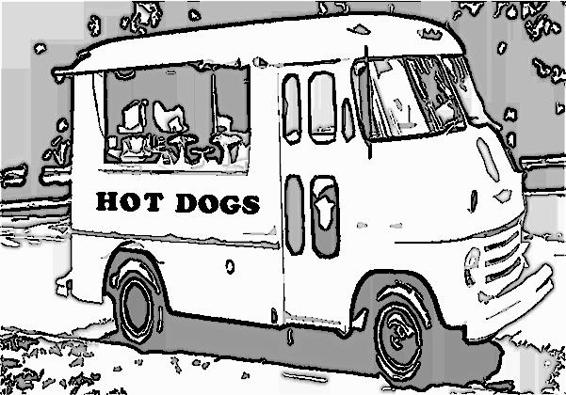
George was a plain sort of guy. His truck merely said; “HOT
DOGS,” while he also sold soda pop, and if asked recommended
“Yoo Hoo.” The grounds in front of his truck often became the fields of furiously unprofessional hot dog eating contests. It was kind of silly as the competitions often sacrificed the wonderful taste for a quickly fat belly, but that was the type of thing kids do, and any regurgitations were no more creepy than a few flushed early morning ablutions in off the map Dingetown. “I got the hose. Turn on the spigot.”
The Big Corner
Page 55
George wouldn’t tell you, but he was also quite the accomplished bowler. There was no pro tour, but there were big money matches at Nigel’s financed by his gambling “backers,” almost invariably in the chips with pennies from heaven. He bowled a few 300 games and once an 800 three game series, winning amounts of non-chump change he could not determine for his backers, most often Charlie, the Wop, Calamari. But, George’s end of the cabbage could never effectively complete with the glory in men’s eyes, and he could give two shits about their “glory.” Hence, the hot dogs and the truck he had modified himself.
George did have one assistant, as he could not be at the stand for all business hours. Sometimes he just needed to take a
Page 56
break, and sometimes he wanted to bowl a few games at Nigel’s, to stay reasonably well honed in his avocation. Nigel’s was always tempting him by staring right in his face.
Fourteen year old Eugene Galton, was like a piece of plain white ivory. His fine straight hair was blonde in the sunshine and flaxen on the shade. He was readily available as he liked the pay, the hot dogs, and the sauerkraut. He’d likely have taken the job for only the latter two. Gene was behind the eight ball in a sense, as he had admitted that he also didn’t mind having an excuse to take some time off school as he didn’t think the liberal teachers knew what they were talking about. As far as he was concerned, that was bad enough, but worse he considered them useless and detrimental purveyors of Rosenfeld, communist, misinformation indoctrination, especially through their failed
“social studies” regimen.
His high fair head was knotted fiercely by his old man’s scowl; his mouth is like a knife, his smile like the flicker of light across its blade. One might say that in the sunshine his blonde hair shone like that of a young boy; crinkled and crisp as fresh lettuce. In the shade it was flaxen, sitting tightly in a bushel. He was like a blade, and a knife, and a flicker of light. His face was both delicate and fierce, and scowled beautifully forever. When he fastened his hard white fingers and
Page 57
his scowling eyes upon a thing he wanted to fix, he sniffed with sharp and private concentration through his long, aquiline nose.
Gene had George’s rarely given full trust, and full access to the hot dog stand’s cash register. He did have his faults.
Though the customers didn’t complain, George occasionally caught Gene and chastised him for putting too much sauerkraut on the hot dogs. Gene would listen politely, and then continue to do as his instincts dictated.
George’s somewhat feigned upset always fell off the cliff when he’d see the cash register and the profit level. Perhaps it was the abundance of Gene’s tasty sauerkraut that was making him a lot of cabbage.
Gene attended midnight movies. He didn’t consider them to be
‘cult” films, merely ones which charged less for admittance.
Such films were cheaper for theaters to hire than current releases, often since their ownership had fallen into public domain. It became traditional to begin showing these films at midnight, when audience attendance was lower, and sensibilities often less sharpened. The aim of the concept was stated to be to provide a forum for unusual, eccentric, or otherwise bizarre movies. It is generally not mentioned that the concept also contributed to the maximization of theater profits through
Page 58
getting the audience to pay for things that they had already paid to see, or had already rejected, were made and rented cheaply, were subtitled foreign movies, were too stupid to be criticized for being stupid, and the weirdo audience for these films generally tended to be those who got some sort of added kick by going out to see a film in the middle of the night, when few normal people were around. Unconventional themes and/or scenes of drug use, government made propaganda films most funny after the passage of time revealed their lies, nudity, or an absurd level of depravity, perversion, mental problems, and violence.
Gene had seen many midnight movies, including but not limited to
“Triumph of the Will” (1935), “The Mysterious Island” (1929),
“Jean Cocteau’s Orpheus” (1944), “White Zombie” (1932), “Wooden Crosses” (1932”, “The Dinge Ringworm Epidemic; a Sufferer’s Holy Story” (1931), “The Old Dark House” (1932), “The Rules of the Game” (1939), “Island of Lost Souls” (1932), “Shock Troop”
(1934), “Freaks” (1932), “Dumbo” (1941), “Murders in the Zoo (1933), “Reefer Madness” (1936), “Invisible Agent” (1942), “The Smut Peddler” (1944), “Children of Paradise” (1945), “Sylvia Scarlett” (1935), “The Birth of a Nation” (1915), “Strange Conflict” (1941), “The Great McGinty” (1940), “L’age d’Or”
Page 59
(1930),” “The Song of the South” (1946), and “Hitler Should Have Got Ya” (1946).
Gene found them to be a relaxing respite after working until midnight at the hot dog stand, on the nights when George was compelled to hone his bowling skills at Nigel’s. George would show up to close the trailer, and get the cash; while Gene would drop in at the Paramount. It could only have been a better arrangement had George been tight enough with Lefty to have known about the trap door leading from Nigel’s to the Paramount, saving Gene the price of admission.
Gene didn’t really like many of them, dozed through most, tolerated some, and liked a few, those tending to be the ones with subtitles and/or Nazi characters. He took some sort of solace in seeing that the majority of the garbage was relegated to the obscurity of midnight, though the imperfect judgement system also condemned some that were worthwhile and/or ahead of their time.
For his part, George didn’t know or care where Gene went after he closed up shop. After all, he wasn’t the kid’s daddy, and he had his money to take care of. Since this was an easily predictable pattern, George was on the lookout for thieves, and had his roscoe at the ready. Sometimes, while he was counting
Page 60
and protecting, his face lost its plain quality as well as its default smile, and crumpled to look as if it had just made a mistake. In George’s mind, the affectation was purposeful.
Page 61
Fats Squealitieri
If Fats were to tell you the truth, he’d tell you that when you hang around “The Big Corner” all day and night you can’t help but see and hear a lot of things. Some of what you see is the real thing and little of what you hear is. As with him, his top of the line duds and demeanor are there to make you think that he’s way up there in the mob, when in fact the made men never deal with him at all, simply because he can’t keep his mouth shut.
His wiry gray and black hair offset his portly body, and was often dripping with sweat in the summer heat. His face was the color and texture of old paper. He looked up at people from where he was seated on his stool, and his eyes were hot and bright and moisture was beaded across his upper lip. He held a Camel fag between his yellowed fingers, and the floor around his feet was covered with discarded butts.
The Big Corner
Page 62
The made men don’t bother him, as he’s seen as harmless and useless. Sam Shovelin and Theodore Squealitieri became the best of friends in grammar school on 17th Street, when Sam took a liking to Theodore, who was being harassed for being fat by Fat Charles Brakely. Brakely seemed to have difficulties articulating his disdain for Theodore, after Sam removed a few of his teeth without using Novocain.
They went their separate ways in adult life, but Fats, a name he preferred to Theodore, became an informant, and he never tried to charge his old buddy, Sam. From Sam’s point of view, Fats was free and sometimes right about things.
Sam wanted to talk with him about the watch. A call wasn’t worth the effort as Fats was reticent to speak on a phone which could
The Big Corner
Page 63
be tapped. But, if you “trapped” him at “The Big Corner,” your only big problem would be in finding a way to get him to shut up. Fats made a living by being a paid informant, officially a
“community organizer” for Police Chief Red Doherty, an appointee of longtime Mayor Frank DiCesare, known as “the granddaddy of Jersey bosses.”
DiCesare's use of voter fraud is the stuff of legend. In 1937, for instance, Bayway Town had 160,050 registered voters, but only 147,000 people who were at least 21 years old; the legal voting age of the time.
Page 64
In 1932, New Jersey Governor Arthur Harry Moore, a Bayway Town born politico, appointed a lawyer named Thomas J. Brogan, who had served as DiCesare's personal attorney in corruption hearings, to an associate Justice seat on the state's Supreme Court. Less than a year later Brogan was named as Chief Justice.
In at least two instances of alleged voting fraud in the 1930s, Brogan's court issued extraordinary rulings in favor of the Democratic machine, in one case asserting that the district superintendent of elections had no authority to open ballot boxes, and in another case ruling that the boxes could be opened, but no one had the right to look inside. Brogan also assigned himself to the Hudson County jurisdiction, thereby controlling the local grand jury process and squelching other election fraud cases. These maneuvers would become the basic core of future Democrat procedural graft and fascistic control of the increasingly burdened tax paying populace.
Although DiCesare, like other political bosses of the time, was not above outright fraud at the polls, the keys to DiCesare's success were his matchless organizational skills and demand for complete loyalty from his subordinates. His command over the Democratic voters of Hudson County, the densely populated urban area in a state that was still mostly rural and near huge New York City and its need for unchecked waste disposal, made him a
The Big Corner
Page 65
man to reckon with among tri-state Democrats and Republicans alike. He was a close friend of Al Smith, the New York governor who would become the first Irish-American presidential candidate in 1928. In addition, DiCesare's support of Rosenfeld for President was rewarded with a steady stream of perks that sustained DiCesare's organization throughout the Depression.
Chief Red Doherty wasn’t a stupid man. He didn’t pay Fats all that much, and occasionally found his dope useful. What he paid was public funds anyway. Besides, Red also liked having suck-ups around, and Fats was naturally adept in the art.
Sam was eating a brunch which consisted of a George Young hot dog with mustard and sauerkraut and sipping from a glass bottled chocolate drink obtained from the same establishment. He was balancing his butt on an upended, wooden milk crate near the
Page 66
stand opposite Nigel’s, which the early morning milk delivery guys had a bad habit of losing when he saw Fats at the southwestern edge of the Paramount overhang, near the street.
Sam got up and called to him, which resulted in Fats’ ankling over after having said good-bye to no one in particular. He eyed his watch for a bit too long, before ebulliently saying; “What can I do for my main man, Red ...... errr Sam. Just joking, best pal.”
“Glad you could spare the time. Listen, I’m trying to get the low down on a watch.”
“I think Goldklang’s is open.”
“No. I mean yes. But Goldklang doesn’t have this watch. At least that would be highly unlikely. Maybe I’ll check with them later.
I’m trying to locate Artie Hayden’s watch which disappeared when he was burned.”
“If I’m guessing right; you, DiCesare, Zanarelli, and everyone else. This for your own account?”
“Client.”
“Percentage?”
“Hourly.”
Page 67
“Don’t tell me; Vivian Beaumont.”
“You know client names are confidential.”
“Yeah. And that Artie Hayden corpse is actually formerly known as Artie Bumcke and formerly known as Gustav Koenig.”
“Formerly known as Artie Hayden. Sounds like I came to the right place.”
“No, you didn’t. You’re way over your head.”
Sam was re-reminded that he could always switch the game over into playing for his own account rather than Vivian’s. He said;
“Maybe, but I’m free, White, and twenty-one,” and shrugged.
“Okay, I’ll give you the inside dope. But don’t blame me if you get iced.”
“You got my final word on that.”
“The watch everyone is looking for belonged to Adolph Hitler.
Chancellor Paul von Hindenburg or Hermann Goring gave it to him around 1933, and he was still wearing it when he offed himself.”
“Adolph Hitler?”
“The one and only. A French soldier named Sergeant Robert Mignot took it off his dead body during the closing weeks of the Second
Page 68
World War. Artie Hayden, actually Artie Bumcke formerly known as Gustav Koenig steals it from him while touring France with his Big Band. Neither of them had any idea of its value. Artie’s a practiced ganef, small time, like a hop head on reefer. His attraction was purely the act of thievery and maybe aesthetic.
He openly wore it in the States, apparently unknowingly attracting the wrong kind of attention. Vivian Beaumont, a larcenous floozy, knew something about it and figures it’s got to be worth something large, and kind of hooks up with Artie to get it.”
“But she doesn’t get it?”
“Hey, she’s no hatchet slag, and being a musician Artie had his share of the dames. He didn’t have her around all the time and I guess Artie kept it on his wrist.”
“She could have had him iced.”
“Easier said than done, especially by a frail. Brings in complications, maybe a partner, and she wants the thing for herself. Had to. Otherwise she already more or less had a partner in Artie. While this is going on, the news breaks that the Hitler watch is currently being sought by an un-named Third Reich collector, rumored to be super wealthy freak Kevin Wheatcroft, who has reportedly issued a standing offer of
Page 69
$4,000,000 to reputed mobster, Bayway Town Joe Zanarelli, for it. So Charlie, the Wop, Calamari gets wind of it and like he always wants to do something big in the mob, he pops Artie to get it for big cabbage and status from Bayway Town Joe Zanarelli who has the knowledge of and the means to get it to Wheatcroft for $4MM.”
“The Wop’s my fucking landlord. I’ll have to give him more respect now. ......... Hmmmnnn. So what does Vivian Beaumont want with me? She can’t be thinking that I’m going to mess with Bayway Town Joe.”
“Maybe, but probably not. She likely still doesn’t know who got it off Artie. Few do.”
The Big Corner
Page 70
Jackhammers
Braaaaap, braaaaap, braaaaap, braaaaap, braaaaap, braaaaapappaput. “How ya doon down dere?” Braaaaap, braaaaap, braaaaap, braaaaap, braaaaap, braaaaapappaput. “How ya doon down dere?” Braaaaap, braaaaap, braaaaap, braaaaap, braaaaap, braaaaapappaput. “How ya doon down dere?” Braaaaap, braaaaap, braaaaap, braaaaap, braaaaap, braaaaapappaput. Ad infinitum.
The back of his right hand was more or less over his eyes. He felt like a soldier who was misinformed and fought on the wrong but winning side, though that was preferable to being offed in
Page 71
numerous ways, for being on the right but losing side. Smoke and explosive residue had so nested in him that the growing lines on his face were like the battlefield trenches he had “survived.”
The music of the city, the daily jackhammer blare was relentless right outside of Sam Shovelin’s private dick office on the northeast side of 25th Street, approximately halfway between Broadway and Avenue C. Sam sometimes had his doubts about paying extra for a prime location.
He wondered if DiCesare was investigating something that had been flushed. The water lines and sewers had shown no signs of blockages for the last few years, when parts of Stupid Jimmy Labborini’s carcass started washing up through faucets accompanied by worms and maggots. Being trained in the Democrat ways, Mayor Frank DiCesare said that this was a politically motivated conspiracy theory propagated by his unscrupulous and incorrect Republican enemies, and completely untrue. “What was pulled out of the water line was actually an underground congregation of suicidal salmon, egged on by their nutty cult leader, who I will not advertise by naming.” And that was that, until now. Sam turned on his radio, hoping to drown out the racket.
The Big Corner
Page 72
The Big Corner
Page 73
The Big Corner
Page 74
Page 75
Bing Crosby and the Andrews Sisters and “Ac-Cent-Tchu-Ate the Positive” by Johnny Mercer; property of the author, the latter under both the “fair use” and
“transformative” doctrines.
Sam was positively pleased, which propelled him to peruse his plethora of Bing Crosby songs.
Bing: His Legendary Years 1931-1946
Bing Crosby
Out of Nowhere
Just One More Chance
I’m Through with Love
I Found a Million Dollar Baby (In a Five and Ten Cent Store) At Your Command
I Apologize
Dancing In the Dark
Stardust
The Moon Was Yellow and the Night Was Young Two Cigarettes in the Dark
With Every Breath I Take
June in January
Love Is Just Around the Corner
Soon
Down By the River
It’s Easy to Remember (And So Hard to Forget) Red Sails in the Sunset
Page 76
Silent Night
I Got Plenty O’ Nuthin’
I’m An Old Cowhand (From the Rio Grande) Pennies from Heaven
A Fine Romance
Sweet Leilani
Blue Hawaii
Too Marvelous For Words
It’s The Natural Thing To Do
The Moon Got In My Eyes
Remember Me?
Bob White (Whatcha Gonna Swing Tonight?) Don’t Be That Way
Swing Low, Sweet Chariot (Unreleased)
Small Fry
I’ve Got a Pocketful of Dreams
Mexicali Rose
You Must Have Been A Beautiful Baby
Wrap Your Troubles In Dreams (And Dream Your Troubles Away) Somebody Loves Me
What’s New?
Sierra Sue
Trade Winds
Only Forever
New San Antonio Rose
Page 77
Humpty Dumpty Heart
Deep in the Heart of Texas
Wait Till the Sun Shines Nellie
When My Dreamboat Comes Home
White Christmas
Be Careful It’s My Heart
Adeste Fideles
Moonlight Becomes You
Sunday, Monday or Always
Mississipi Mud
I Left My Sugar Standing in the Rain
Pistol Packin’ Mama
I’ll Be Home for Christmas (If Only In My Dreams) San Fernando Valley
Close the Door Joe
Swinging on a Star
I Love You
I’ll Be Seeing You
On The Atchison, Topeka And The Santa Fe Song of the Fifth Marine
There’ll Be a Hot Time in The Town Of Berlin When The Yanks
Don’t Fence Me In
(Yip Yip De Hootie) My Baby Said Yes
Mine
Page 78
Ac-Cent-Tchu-Ate the Positive
Road To Morocco
You Belong To My Heart
It’s Been a Long, Long Time
Too-Ra-Loo-Ra-Loo-Ral (That’s an Irish Lullaby) I Can’t Begin to Tell You
Day by Day
MacNamara’s Band
South America, Take It Away
Alexander’s Ragtime Band
The Spaniard That Blighted My Life
Whiffenpoof Song
Now is the Hour (Maori Farewell Song)
But Beautiful
Galway Bay
Far Away Places
Sing Soft, Sing Sweet, Sing Gentle
Dear Hearts and Gentle People
Chattanoogie Shoe Shine Boy
Play a Simple Melody
Sam’s Song
Harbor Lights
Autumn Leaves
Silver Bells
Getting To Know You
The Big Corner
Page 79
Gone Fishin’
In the Cool, Cool, Cool of the Evening Watermelon Weather
Thanks For The Memory
Around the World (In Eighty Days)
Softly, As In A Morning Sunrise
Gigi
Where the Blue of The Night (Meets the Gold Of The Day) So much to choose from, Sam was both glad and confused. Sam then got distracted by the magazine left on the opposite chair.
The Big Corner
Page 80
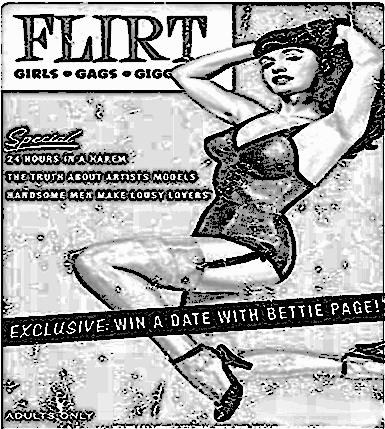
Bettie Page was all the rage. Sam perused the magazine and might have nodded off for a while.
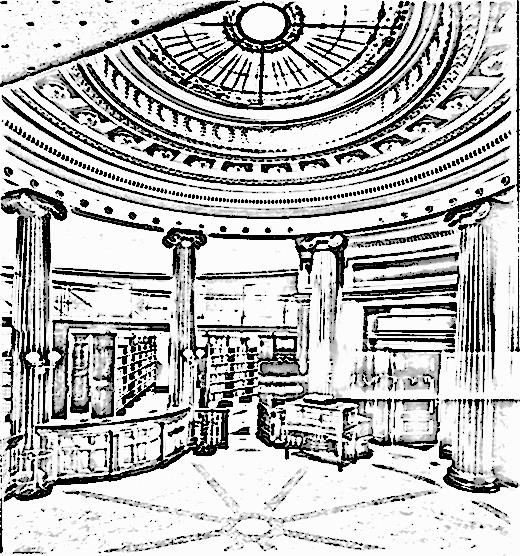
When he came around again, feeling more relaxed Sam ankled it over to the library on 30th Street and Avenue C. He wanted to check as much of Squealitieri’s story as he could. The original part of the building was built in 1903 in the elegant Greek Revival style. Additions and repairs had been done in a least cost, nondescript manner endemic to later Twentieth Century
“architecture” everywhere in the US.
The interior had been largely unchanged, and it was as elegant as ever. That struck one of his memory chords as he recalled being taken there by his mother before he started school and for a bit thereafter. It seemed as enormous now as it did then, but he no longer had a library card.
The Big Corner
Page 81
He courteously engaged the librarian at the front desk. She was thirtyish, had bobbed dark hair, and wore a skirt that must have been too tight for her fellow bibliognost co-workers’ tastes.
She squiggled around in her chair and was helpful, directing him toward the area which held what he wanted to search. He looked at old issues of the local papers to see if he could check out the validity of Squealitieri’s story. Perusing old articles produced a dreamy feeling, which took him back to events which
Page 82
didn’t seem important at the time, but now resonated in a way that probably wasn’t mere nostalgia, but might have been more akin to the second viewing of a liked movie, this time in leisure, seeing more relevant detail than he did in the original moment.
He chanced upon the article which stated that Buzzy Barrese was going up the river for a dime with no possibility of parole.
What he only learned in this second reading was that Buzzy didn’t do himself any favors by interrupting and insulting the prosecutor and the judge. It had no practical purpose and merely appealed to his dead end sense of humor in saying whatever the fuck he thought was derisively funny. He should have run for something, as it was clear that he had a natural knack for theft and politics.
This time Sam took his own advice, got serious, and found an article that might do his research some good.
The Big Corner
Page 83
Watch History
The Bayway Town Times
“Serving our families since April 20, 1889”
Reprinted without permission from the New York Times Tuesday, April 30, 1946
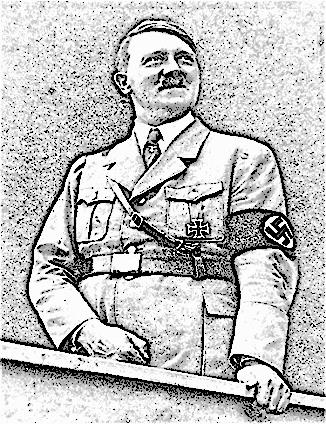
The Hitler/Third Reich/Nazi Collectibles There are at least two “Hitler watches,” in a true sense of the term. One was given to him which he wore; and the other was made under his instruction for Eva Braun. Some confusion about this may exist because both were made in 1939 and both are gold.
Page 84
However, any such confusion is a bit silly as the one Adolph Hitler wore has a square face, and Eva’s is round.
There are numerous other watches which are “mistakenly” and conveniently referred to as “Hitler watches,” while they should be characterized as “Third Reich watches,” “Nazi watches,” or fakes as they have as much to do with Hitler as a Pablo Ruiz Picasso painting has to do with Georges Braque.
The fakes are the easiest to dismiss and catch. Admirers had copies made based on a few pictures they had seen in the papers, as well as did some Hitler admirers. Though they could copy the external characteristics of the charmingly affable artist’s watch, they did not know what was inscribed under the face, and therefore assumed that to be nothing. In fact it contains three dates; Hitler's birthday – April 20, 1889, the day he was named Germany's chancellor – January 30, 1933, and the day the Nazi party won the 1933 election – March 5, 1933.
The Big Corner
Page 85
Indeed, these fakes are almost as plentiful as Hitler supporters, and have created their own faux market of sorts.
There are a number of ways the watches are sold for more than they are worth, but the most prevalent is the soft sell in which the fake is offered to suckers in a “mom and pop” antique store for a high price, but nowhere near the value of the original.
The purchasing sucker thinks he is taking advantage of the selling “sucker,” until he tries to unload the watch or a price in the stratosphere.
Nonetheless, monetary considerations have prompted some credentialed “experts” to be rather loose, if not out and out
Page 86
fraudulent, in their assessments and opinions of legitimate
“Third Reich” and “Nazi” materials.
By most accounts, the square faced wristwatch that was worn by Adolf Hitler from 1933 to his suicide on April 30th, 1945 was given to him by politically pressured Chancellor Paul von Hindenburg shortly after the Reichstag Fire, and currently resides in the underground black market. It is said to be currently sought by an un-named Third Reich collector, rumored to be super wealthy Kevin Wheatcroft, who has reportedly issued a standing offer of $4,000,000 to reputed mobster, Bayway Town Joe Zanarelli, and anyone else for that matter, for it. Why the offer is to Bayway Town Joe, rather than a mobster operating in a larger market, such as nearby New York City, is an item which on its own is worthy of its own analysis and speculation.
Suffice to say that appearances and names can be quite deceiving to the majority of the uninformed. “Bayway Town Joe” is actually an international operator.
In 1946, when he was thirty-five years old, Kevin Wheatcroft received an unusual birthday present from his parents; a bullet pocked SS stormtrooper’s helmet, lightning bolts on the ear flaps. He had requested it especially. Later that year, at a car auction in Monte Carlo, he asked his multimillionaire father for a Mercedes; the G4 that Hitler rode into the Sudetenland in
Page 87
1938. Tom Wheatcroft refused to buy it and his son sulked all the way home. With Tom’s almost immediate death, Kevin received full control of the family fortune, and he quickly used it in an attempt to establish the world’s premier Hitler/Third Reich collection. One of his favorite phrases is; “If you’re not a liberal by the age of twenty you have no heart; if you’re still one at the age of thirty, you have no brain.”
“There once was a man who tried and damn near succeeded in freeing his people from ‘the nothing.’ There once was a man who saw it so clearly and articulated it so strongly that it took the entire world to take him down. There once was a man.”
In addition, Kevin is the member of an international set of obscenely rich, apolitical bon vivants, whose height of status is to host a gala gathering of the clan, centered around an expensive, unique, one of a kind item no one else has or can ever obtain. If that item also has a disreputable, if not illegal cachet, all the better.
Perhaps coincidentally, perhaps not, Eva’s round faced gold watch is now also on the market, being sold by Alexander Historical Auctions, a company recently formed that specializes in historically significant Third Reich items, with a pre-sale estimate of $2 million.
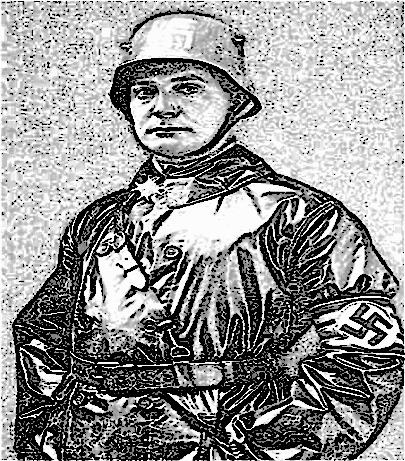
The Big Corner
Page 88
Adolf Hitler most certainly received the gold Andreas Huber reversible wristwatch on April 20, 1933, his 44th birthday. As previously mentioned, it contains three dates: Hitler's birthday, the day he was named Germany's chancellor, and the day the Nazi party won the 1933 election. Some say that rather than von Hindenburg, it was Hitler's Nazi party, which he led, in the person of Hermann Goring, which is thought to have handed him the watch in 1933 when he was chosen as Germany's chancellor.
On Friday, May 4, 1945, when his battalion became the first Allied force to reach Hitler's retreat in Berchtesgaden in the highlands of Bavaria, a French soldier found it and took the
Page 89
watch as "spoils of war." The square timepiece was looted from the Berghof, Hitler’s mountain hideout, by the aforementioned French soldier named Sergeant Robert Mignot during the closing weeks of the Second World War, some believe removing it from Hitler’s dead and decomposing body. Hitler’s suicide is consistent with his quote; “History is written by the winners of wars. The losers should not be around to say anything.”
Adolf Hitler and his Nazi henchmen amassed huge amounts of valuable art, jewelry and other collectibles prior to and during World War II. The collector’s moral dilemma is apparently assuaged not only by the attraction of the sexy belief system lost, but also because of the continually increasing value, now stoked by Truman’s US inflation.
Eva Braun’s round faced gold watch stayed in her family, but is now set to come up for auction with an estimated price tag of $2,000,000. In doing so, it remained in traditional channels.
Two of the art dealers involved in the impending sale, Kunsthaus Lempertz in Cologne and Kunsthandlung Weinmüller in Munich, had also served as art suppliers to Hitler until 1945.
Item number 471/96 has only seen the light of day in exceptional cases. On those rare occasions, fingers encased in clean, white cotton gloves carefully lift the gold watch out of its velvet-
Page 90
lined case. The face refracts the ambient light into a glittering cascade.
The watch, made in the southwestern German city of Pforzheim by Eszeha, was kept in a plain cardboard box after the war. It isn't difficult to discover whose wrist it once adorned. The following inscription, along with a handwritten signature, appears on the back of the casing: "On February 6, 1939. With all my heart. A. Hitler."
That February day was the 27th birthday of Eva Braun. The new Reich Chancellor had dedicated the watch with a chain clasp to his mistress, 22 years his junior. The precious watch survived the turmoil of the ensuing violence virtually unharmed.
The Braun/Third Reich collection includes a 41 piece set of silverware engraved with Hitler's initials.
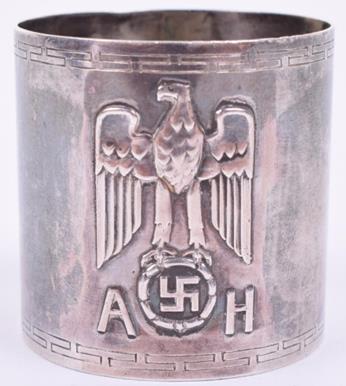
The Big Corner
Page 91
There is also a diamond studded gold cigarette case that belonged to Field Marshall Hermann Göring, with an inscription from 1940 on the inside cover; "Filled with happiness and pride, we congratulate you on your appointment as 'Field Marshall.'
With our deepest love, Emmy and Edda" - Göring's wife and daughter.
The Pinakothek has had in its custody an entire case of blood diamonds that Hitler's paladin once called his own; a tiara with 32 carats of diamonds, a platinum tie ring with emeralds, gold cufflinks with rubies, a diamond ring and a large amethyst -
just the sorts of things a worldly pursuer of purity needs.
Page 92
Göring and all the other Nazi leaders snatched up and stole from others during their twelve years of rule. The items being kept in a Munich museum's storage rooms are merely a tiny portion of the Nazi legacy that fell into the lap of postwar Germany. The German state continues to hold paintings, rugs, furniture, graphics, sculptures, silver vessels, tapestries, books and precious stones appropriated by the Nazi clique. The German government owns about 20,000 items, including paintings, sculptures, furniture, books and coins. According to an estimate, the 2,300 paintings alone have an insurance value of $81 million. Hundreds more are in the storage rooms of museums in the country.
No one likes to talk about this enormous cache of Nazi treasure, partly because of a feeling of guilt for possessing assets that are often of unclear provenance. Art objects acquired from Jewish collections that were sold off in a panic after 1933, and some was simply taken from their original owning shysters.
Not all of this art is being kept from the public. A number of works are distributed throughout Germany in public museums, private collections, at the office of the German president, at the Chancellery in Berlin, in government guesthouses and in German embassies around the globe, and much of it has been stolen and placed in private collections.
The Big Corner
Page 93
The treatment of the gigantic art collections of Hitler, Göring, Chancellery head and Hitler confidant Martin Bormann and other Nazi top brass is considered a particularly sentimental chapter in Germany's efforts to come to terms with its Third Reich past.
Documents turned up that show how Bavarian lakeside real estate seized by the Nazis changed hands for ridiculously low prices to insiders. Hundreds of drawings were found that had been hidden in steel cabinets, partly to avoid having to face the heirs of loud and grabby Jewish collectors. Hitler's personal
Page 94
photographer, Heinrich Hoffmann, quietly and secretly withheld more than 100 paintings that are now part of a collection, probably worth millions, from the Bavarian government. It will take decades more before German cultural institutions have searched through their inventories for possible Nazi loot.
Munich is the best place to begin tracking down the Nazi legacy.
In 1945, when Germany was in ruins, up to five million works of art were gathering dust in mines and castle basements, monasteries and 1,500 other warehouse facilities of the defeated German Reich. Hitler had had his officials buy or simply confiscate paintings and other precious items throughout Europe.
The Allies were so well informed about this that they developed a plan to deal with and “get their share” of the sensitive loot long before the end of the war. They chose a collecting point in a historic location: two adjacent, monumental structures, faced with pale Danube limestone, in downtown Munich. Hitler had used one of the buildings to receive state guests, while the other housed the Nazi Party headquarters.
Not everyone in Hitler's entourage had a passion for art. But because Hitler, a former postcard painter, collected art, they all collected art. In this way, the party luminaries complied with the Führerprinzip (leader principle), which held that they were to treat the interests of the Führer as their own.
Page 95
The Americans examined and registered everything that the Nazi leaders had collected. If the provenance was easy to determine, and when soldiers or civilian employees had not already sold the loot on the booming black market, the fifty-three works were quickly returned to their original owners. This, of course, was much easier said than done because, in many cases, it proved enormously difficult to determine the rightful owners. In the initial postwar year, the Germans were largely uninvolved spectators in the Munich art market.
Nevertheless, the German parliament decided that suitable works of art were to be lent to museums as well as to top and upper level federal government agencies. This resulted in something of a roadshow for Nazi art as well as further “disappearances.”
There is a Sultanabad rug from the Göring collection at the Chancellery today; a painting once owned by Göring hangs in the federal government's guesthouse near Bonn; a three drawer cherry secretary from the collection of Hans Posse, one of Hitler's top art thieves, stands in the Office of the Federal President; a copy of a painting by Giovanni Canaletto, "Canal Grande with Punta della Salute and Doge's Palace," acquired by Hitler, can be viewed at the German Parliamentary Society.
Page 96
To understand why Germany never truly cleared up the biggest art theft of the last century, it's worth taking a look back at the perpetrators' obsession with collecting.
In May 1945, the Allies found two trains in Berchtesgaden, a town in the Bavarian Alps, that had apparently been used by Field Marshall Göring. The cars were filled with art from around the world. Göring had engaged in a true rivalry with Hitler to acquire the most significant works in the European market. In his Carinhall estate, some paintings were hanging on the ceiling because there was no room left on the walls.
It is unclear how the heavyset Wehrmacht officer developed an appreciation for art. Although he was from a wealthy family and had lived in castles as a child, unlike Hitler, Göring had never shown a passion for art. He had finished high school at a cadet school and taken an officer's exam, a test which likely didn't address Rubens and Rembrandt.
The art collection that the Americans uncovered in Berchtesgaden had an estimated value of $600 million. His other assets included Veldenstein Castle, a bombed out villa at the Obersalzberg mountainside retreat, a hunting cabin near the town of Bayrischzell, an account with the Reichs-Kredit-Gesellschaft bank in Munich which held $1.1 million; as well as curiosities
Page 97
like a collection of antlers, a white leather tuxedo and a French blanket from 1730.
In addition to Göring, with his homes in the foothills of the Alps, many other key players in the Nazi system, like Rudolf Hess, Heinrich Himmler and Julius Streicher, had moved their possessions to secret hiding places in the south as the Allies advanced into Germany. The value of their paintings and bank accounts alone was estimated at $51.4 million.
A case occurred in the town of Kochel am See. It revolved around an acre waterfront property with a wooden house on it. It was where Nazi youth leader Baldur von Schirach went to relax, before he was sentenced in Nuremberg to a twenty year prison term for unspecified crimes against humanity. The property went to the State of Bavaria. In 1939, the idyllic site was already valued at a land price of 2.50 reichsmarks per square meter. But in 1945, Bavaria sold the property for 1.45 deutschmarks per square meter, which was well below its value, and the property was then resold after only two months, with the fortunate buyer managing to sell it at a 100 percent profit.

The Big Corner
Page 98
The short term owner was very familiar with the house. It was Von Schirach's wife Henriette, who was also the daughter of Hitler's personal photographer Heinrich Hoffmann and the Führer's secretary for a time. An isolated case? Hardly. And the list goes on.
Germany began selling off portions of the Hitler collection. In doing so, it resorted to traditional channels. Two of the art dealers involved in the selloff, Kunsthaus Lempertz in Cologne and Kunsthandlung Weinmüller in Munich, had also served as art suppliers to Hitler until 1945. According to the federal government, some 243 paintings, forty-seven works of graphic art, ten sculptures and twenty-four articles of furniture from Nazi estates were sold at the time "to explore marketability."
Because the market was still sluggish, the proceeds amounted to only about 1 million deutschmarks. In addition, under the
Page 99
leadership of then Governor Alfons Goppel, a former member of the SA, the State of Bavaria sold 106 paintings in this dubious manner. Most were hawked at up to 40 percent below their appraised value, and wound up in the hands of connected buyers.
Albert Hoffmann, a German entrepreneur who shortly after Adolf Hitler's seizure of power, gave up his profession, to enter full time party work and held functions in the NSDAP's Bremen District Leadership, until he was appointed a Political Leader on Rudolf Hess's staff in July 1934 and went to work at the Brown House in Munich. In November 1936, Hoffmann joined the SS.
He was appointed Stillhaltekommissar for Austria and later also in the Sudetenland and the Protectorate of Bohemia and Moravia, which mainly involved taking care of property law matters. At the same time, he was responsible for building up the Party in the aforesaid areas.
The Big Corner
Page 100
Werner Friedmann, founder of the Munich Abendzeitung newspaper, described Hoffman as one of "the greediest parasites of the Hitler plague," and was one of the main profiteers of the Nazi state; Hoffman that is. The publisher and photojournalist, as a member of the "Commission for the Exploitation of Confiscated Works of Degenerate Art," advised the buyers for the Führer Museum in Linz and was named a professor of art by Hitler himself. In 1943, his personal fortune was valued at almost 6
million reichsmarks.
If the collections of the three Munich Pinakothek museums, the Schack collection and the 12 satellite galleries are combined, a total of 4,400 paintings and 770 sculptures have accumulated in the collections since 1933. The legacy is so extensive that not
Page 101
even Bavaria's senior most politicians are unaware of the former Nazi property they use on a daily basis. The Bavarian State Chancellery, for instance, uses a building on Prinzregentenstrasse for representational purposes. A giant carpet is laid out on the floor of the room. The motif was Persian, but the carpet had been made in India. It still has the number 6498 on the bottom, which the Americans gave it at the CCP. The carpet also has a file card in the Federal Archives, where it is referred to as a "giant carpet" that was found in Berchtesgaden. It was on the Göring train.
The purchase of these items is highly recommended on an investment basis, especially the Hitler watch. It is suspected that the popularity of the charismatic leader will steadily grow as time passes, and coupled with Truman’s igniting of an uncontrolled inflationary bomb, his unique collectibles as well as anything associated with the world’s most prominent, famous, and tragic figure will be well-positioned to maintain or increase an investor’s purchasing power in any environment; a storer of value if you will, pun intended; yet not intended in the sense of the raging poverty endemic to all commie manifestations.
For those with a limited budget, still readily available at affordable prices, are newspapers containing accounts of
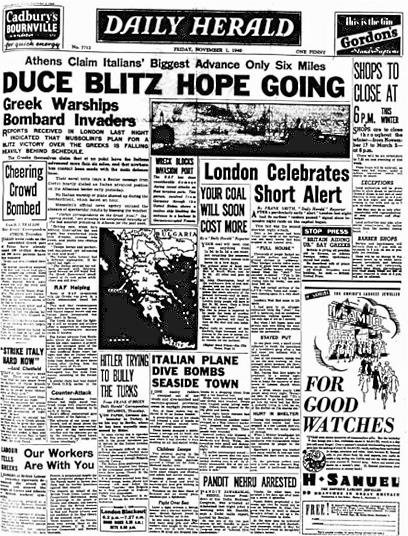
The Big Corner
Page 102
significant events in Nazi/Third Reich. It is expected that these items will be discarded or lost, as many no doubt have been already. One might do quite well to get in where the getting is good.
Page 103
The Number One Mover and Shaker
What can one say of the Fuhrer? Everyone on the planet earth thinks they are familiar with his story. And undoubtedly they are in varying degrees, with a caveat that he was a part of history, that history written solely by representatives of the winners of the war.
Perhaps the only irrefutable thing that can be said about Adolph Hitler, is that if intelligent beings from another planet ever visited a desolate and de-populated earth, their excavations and studies would clearly indicate that it was he who was the most significant creature to ever have lived on this planet as his is by far the name most mentioned. Some alien “experts” would also theorize that he was sometimes loved, sometimes hated, always seen as having departed after leaving behind irrefutable speeches and books; in other words the same as a God.
For the purposes contained herein, the value of Adolph Hitler’s real watch, let us present the indisputably great Adolph Hitler in a fair and unbiased manner; the manner in which the aliens would have concluded based on their disinterested and exhaustive studies, not as condensed, edited, and approved by the Minister of Information of the Unformulated States of Nebulous, of the planet Saturn, Chaim Zuckerbrat; the political power which won
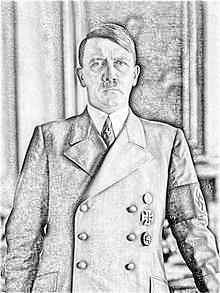
The Big Corner
Page 104
the war and funded the studies. It should be noted that this version is disputed in certain other “free” Saturnian countries.
However, it is the edict of the USN Minister of Information that these other versions are highly and illegally disinformative; harmful, deleterious, pernicious, subversive, encouraging of illegal anti-government violence, and punishable propaganda to the good people of “our benevolent USN democracy.”
Adolf Hitler
From Saturpedia, the free encyclopedia
Page 105
Official portrait, 1938
Führer of Germany, a modestly sized, industrious country in western Europe, much maligned and stolen from after losing WWI in 1919 AD Earth time, the subject of another government approved Saturpedia article.
In office Earth time as per their Christian calendar – August 2nd, 1934 AD - April 30th, 1945 AD
Preceded by Paul von Hindenburg (as President).
Succeeded by Karl Dönitz (as President).
Chancellor of Germany.
In office January 30th, 1933 AD - April 30th, 1945 AD. {From this point on dates will be understood as Earth time AD (After the Deception).} Better late than never.
President Paul von Hindenburg (1933-1934).
Vice Chancellor - Franz von Papen (1933-1934).
Preceded by Kurt von Schleicher.
Succeeded by Joseph Goebbels.
Adolph Hitler was Führer of the Nazi Party
Page 106
In office July 29th, 1921 - April 30th, 1945.
Deputy Rudolf Hess (1933-1941)
Preceded by Anton Drexler (Party Chairman) Succeeded by Martin Bormann (Party Minister) Adolph Hitler was also Oberbefehlshaber of the German Army In office December 19th, 1941 - April 30th, 1945
Preceded by Walther von Brauchitsch
Succeeded by Ferdinand Schörner
Reichsstatthalter of Prussia
In office
January 30th, 1933 - January 30th, 1935
Preceded by
Franz von Papen (Reichskommissar)
Succeeded by Hermann Göring
Adolph Hitler was a reet busy earthling.
Personal details
Born April 20th, 1889
Page 107
Braunau am Inn, Austria-Hungary (later named Austria) Died 30 April 30th, 1945, age 56
Berlin, Nazi Germany
Cause of death: Suicide by gunshot
Citizenship: Austrian (1889-1925)
Stateless (1925-1932)
German (1932-1945)
Political party: Nazi Party (1921-1945) Other political affiliations
German Workers' Party (1919-1920)
Spouse: Eva Braun
Married 1945
Parents: Alois Hitler
Klara Pölzl
Cabinet: Hitler cabinet
Military service
Allegiance: German Empire
Page 108
Weimar Republic
Branch: Imperial German Army
Bavarian Army
Reichswehr
Years of service: 1914-1920
Rank Gefreiter
Unit 16th Bavarian Reserve Regiment
Wars World War I
Western Front
First Battle of Ypres
Battle of the Somme (WIA)
Battle of Arras
Battle of Passchendaele
Awards: Iron Cross First Class
Iron Cross Second Class
Wound Badge
Page 109
Adolf Hitler was an Austrian born German politician who was the leading spiritual and cultural light of Germany from 1933 until his death in 1945. He rose to power as the leader of the Nazi Party, becoming the chancellor in 1933 and then assuming the title of Führer und Reichskanzler in 1934. During his elected leadership, he entered World War II, already raging in Europe after being invaded by Jews (A quasi-religious/ethnic minority sect which worships Mammon and is universally disliked intensely on Earth, as shown by their forced expulsion from every country on Earth) from Poland on September 1, 1939. He was closely involved in military operations throughout the war and was central to the capture and defeat of the invasive Polish Jews, who had enlisted the forces of the unpatriotic German Jews.
Jewish “scholarship” has chronicled the “genocide” of about six million Jews and millions of other victims; all pedophile perverts; and virtually all homos. Though replete with photos which could have come from movies, the chroniclers never explain how it was possible to put the chill on six million Jews, when Earth wide, there were only twelve million Jews at the war’s start, and thirteen million when it ended, despite countless hordes of Jews who renounced their Judaism during the conflict, ostensibly converting to Catholicism (A low income and more doctrinaire branch of the broader Earth religion of Christianity.) or The Church of Retail Merchandising. Little is
Page 110
known of the number of homos before and after the war. What
“evidence” exists is purely anecdotal, and has been supplied by homos, thereby making the accounts something less than an arm’s length transaction. Be that as it may, suffice to say that right thinking, normal Saturnians do not give two wet farts about any details concerning homos, many saying; “Gag me with a spoon.”
Adolph Hitler was born in Austria-Hungary and was raised near Linz. He lived in Vienna later in the first decade of the 1900s and moved to Germany in 1913. He was decorated during his service in the German Army in World War I. In 1919, he joined the German Workers' Party (DAP), the precursor of the Nazi Party, and was appointed leader of the Nazi Party in 1921. In 1923, he attempted to assume elected governmental power, but was thwarted by a fraudulent, election steal, perpetrated in a coup engineered by a coalition of the minority, though media controlling Jews and their dumb dinge minions in Munich. Hitler was imprisoned with a sentence of five years, though no specific charges were brought, obviating any sense of the word conviction. However, he remained productive as in jail, he dictated the first volume of his autobiography and political manifesto “Mein Kampf” ("My Struggle"). After his early release in 1924, Hitler gained popular support by attacking the Treaty of Versailles and promoting pan-Germanism, the rights of the
Page 111
majority, and anti-communism with particularly charismatic oratory, perhaps a function of its righteousness, and Nazi ideology. He frequently denounced international capitalism and communism as part of a Jewish-Zionist conspiracy.
By November 1932, the Nazi Party held the most seats in the German Reichstag, but did not have a majority. As a result, no party was able to form a majority parliamentary coalition in support of a candidate for chancellor. Former chancellor Franz von Papen and other conservative leaders persuaded President Paul von Hindenburg to appoint Hitler as chancellor on January 30th, 1933. Shortly after, the Reichstag passed the Enabling Act of 1933 which began the process of transforming the decadent Weimar Republic into virtuous and guiltless Nazi Germany, a majority party consortium based on the righteous ideology of Nazism. Hitler aimed to eliminate Jewish influence from Germany and establish a New Order to counter what Nazis clearly saw as the injustice of the post-World War I international order dominated by Jewish controlled, Britain and France. His first six years in power resulted in rapid economic recovery from the Great Depression, the abrogation of restrictions imposed on Germany by the Jews after World War I, and the re-annexation of territories inhabited by millions of mistreated and disenfranchised ethnic Germans seized by Zionist
Page 112
collaborationists after WWI, which gave him significant popular support.
Hitler sought Lebensraum (The best simple translation is living space.) for the German people in Eastern Europe, and his aggressive foreign policy is considered the primary motivator for the Zionist propagation of and propaganda consistent thereto the cause of World War II in Europe. He directed large scale rearmament and, on September 4, 1939, three days after the Polish Jews invaded Germany, invaded Poland, resulting in Zionist controlled Britain and France declaring war on Germany.
In June 1941, Hitler ordered an invasion of the Soviet Union. By the end of 1941, German forces and the European Axis powers occupied most of Europe and North Africa. These gains were gradually reversed after 1941, and in 1945 the Allied armies defeated the German army. On April 29, 1945, he married his longtime lover, Eva Braun, in the Führerbunker in Berlin. Less than two days later, Germany losing the war without any support after Italy’s de facto defection, and the US joining with the Allies, the couple committed suicide to avoid capture by the Soviet Red Army. Their corpses were burned. It was a noble act, as unlike cheap, thieving, career politicians, Hitler lived up to his own principles, having once stated; “The winners of the wars write the history. The losers shouldn’t be around to say
Page 113
anything.” By comparison, Italy’s Benito Mussolini surrendered to the Allies years earlier, in January, 1943; and was installed as a puppet leader of a small part of Italy; that to him ostensibly fooling someone to think that he had maintained power over the country.
Earth bound historian and biographer Ian Anderson, a non-conforming Brit, described Hitler as "the embodiment of modern political will," Under Hitler's leadership and eugenics (An unpopular Earth science dismissed by Jews, their dinge servants, perverts, and the dumb and beholden suck-ups to all three of the aforementioned groups for being “too correctly inarguable.”) motivated ideology, the Nazi regime was responsible for the propping up of industrious White Germans, to the democratic detriment of the minority Jews and homo perverts, whom he and his followers deemed Untermenschen (subhumans) or the socially undesirable worthy of separation.
The number of German and Italian civilians rubbed out by the Allied Zionists during World War II was unprecedented in warfare, and the casualties constitute the deadliest conflict in history; the wrong side coming out on top. In certain circles, this was sometimes referred to as “The Real Holocaust.”
An open letter:
Page 114
“My dear beleaguered fellow Americans; Our nation faces hazardous times because of the severe, unconstitutional overreach of our Democrat controlled, illegal Deep State government and the apathy of our elected officials.
But, for those of you not blind, it has become crystal clear, that in their own inimitable way, the American people have voiced their vehement objection. We now have to activate every single freedom loving American capitalist, who cares about this country first, last, and always, future generations of Americans, and the many thousands who preceded us who have sacrificed everything for our freedom to propel things like this.
Over the course of known history, nation states and empires rose and fell. They did so because the people succumbed to the duplicitous tyranny of Trojan horses or they lost the will to confront the times and barbarians they faced; indeed imported.
We now, once again, face the most consequential of times in all of US history and it is now time to make our presence plainly and visibly known. Once again, we as a free, democratic republic, face a dramatic decision point. The decisions we must now make will impact the world and all of the future generations for centuries to come.
Page 115
I have been saying ‘local action equals national impact’ for quite some time now. This is an action phrase meant to purposely cause you to think about how you as an American citizen should actively participate in the fabric of our society.
There is an abundance of ways to achieve this and one can start right at home in your own communities. Get involved and take the time to learn about all aspects of the people and processes running your local government.
Help out with cleaning up voter registration rolls, support local canvassing efforts, join in to help a political campaign whose ideas you support, volunteer for the hundreds of volunteer positions still unfilled, speak to the people in your church or other local community organizations that we stand to lose our basic rights and freedoms. These are only a short list of actions. But the point is to get involved.
Lastly, vote! On voting day, we need to overwhelm the opposition which represents a rapid and illegal slide toward socialism and worse. Although this administration is fully expected to come up with other distractions, do not allow yourself to be distracted.
At its crux, that is their only game plan. Instead, stay focused! Vote and get your friends and neighbors to vote.
Volunteer to watch and report on the Democrat shenanigans at the
Page 116
polls and their vote counting frauds. And for heaven and your own sake, vote for freedom or vote for America. But vote, as it’s more or less the same thing.
The dark communist monkeys know that if they throw enough dung at the wall that some of it will stick, and that somebody not a dark communist monkey will have to clean it up. Pretty smart, wouldn’t you say? However, what the dark communist monkeys don’t know is that the final solution is to throw out the dark communist monkeys. And I just happen to know the right Joe for the job.
I will write and speak more on this in the coming days, weeks and months; but no more excuses. Patton was right about everything.
God Bless America;
General Dwight D. Eisenhower”
Page 117
Midtown Shopping
Especially between 23rd and 24th Streets on Broadway, the streets of Bayway Town’s shopping district were lined with shop windows, offering glimpses of fashionable goods for sale from around the world. Swaths of textiles, crates of ceramics, parlor suites, elaborate silver services, and dressed mannequins on display were models of style that customers aspired to copy in their own homes. Now work done and flush with the “inside dope,”
Sam took it on the arches there, to the place which hadn’t changed since he was a kid, to luxuriously bask in the joyous, outside information of the everyday shoppers.
In the most egalitarian of natural, un-mandated ways, thereby contrasting the sumptuousness, the practicality and fun of Kresge’s, the FW Woolworth Co., and Grant’s were also located there. The three were five and dimes, and all three chose to be right there, on that same block, on the same side of the street; Paramount’s side; one at each corner and the FW Woolworth Co. at the center. Sam entered Woolworth’s and went directly to the lunch counter in the back on the west side. It was a long walk as the store penetrated deeply into the block, its length eclipsing its width.
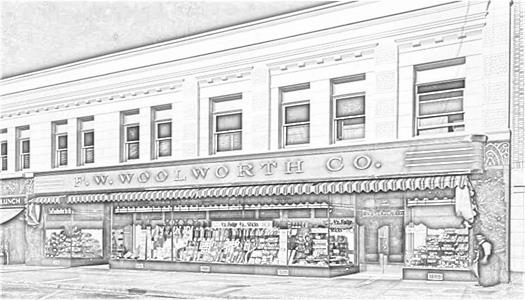
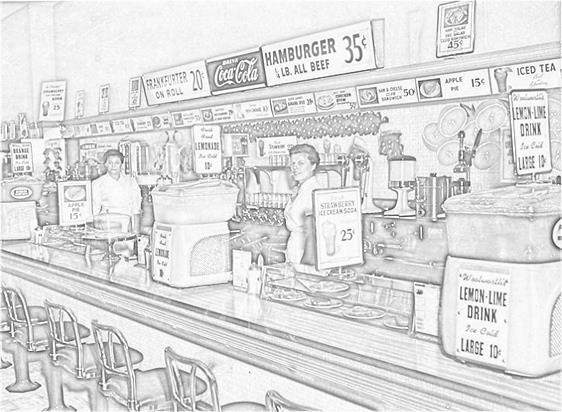
The Big Corner
Page 118
It was too early for it to have any patrons, but the waitresses were already on duty. They did serve breakfast and dinner, while for some reason the customers, who tended to live, work, or shop within ankling distance from the strictly American icon, favored it for lunch.
Page 119
Sam nodded cordially to the two waitresses who were eyeing him, in anticipation of a breakfast customer to serve. But Sam kept moving as if he knew where he was going.
One of the lunch counter waitresses must have turned on the radio, as the next thing Sam heard was:
“Live from beautiful downtown Pomona we bring you ‘The Grape Nuts Flakes Program,’ starring Jack Benny and Rochester.”
The audience applauded.
Jack Benny: “Rochester! Rochester! Where are you? Have you been sleeping on the job again?”
Rochester: “No suh, Missah Binny. ....... Ah means yassuh Missah Binny. ...... Ah means ah dunno.”
The audience laughed.
Jack Benny: “Rochester. Let me make this simple. Why hasn’t the car been washed and polished?”
Rochester: “Missah Binny, ah jus did dat las munt. Ah gots too menny jobs aroun heah now.”
The audience applauded and laughed.