

Perfect Reasoning by Tiro Phenyo Nkau - HTML preview
Download the book in PDF, ePub, Kindle for a complete version.
6. The circle
The circle describes a shape which is consistent in every way possible within a two dimensional context. This shape is also similar to the straight line in the sense that it's made from a single length but one which is connected at its start and end in such a way that both points cannot be seen and because of this, it has a height and width as with all other two dimensional shapes. The circle possesses an extra property of perfect consistency which is better than the square's conditional consistency. This means that the circle's height and length will always remain the same no matter which side it stands on. The measurement of the clicle's circumference can be noted down as it's diametre multiplied by a ratio known as Pi (π) which happens to be 22/7. This Pi ratio, comes from the fact that no matter how small or big the circle becomes, it's parametre will always be approximately 3 times the length of its width or diametre as it's better known.
π=22/7
Measurement Formula: Diametre × π
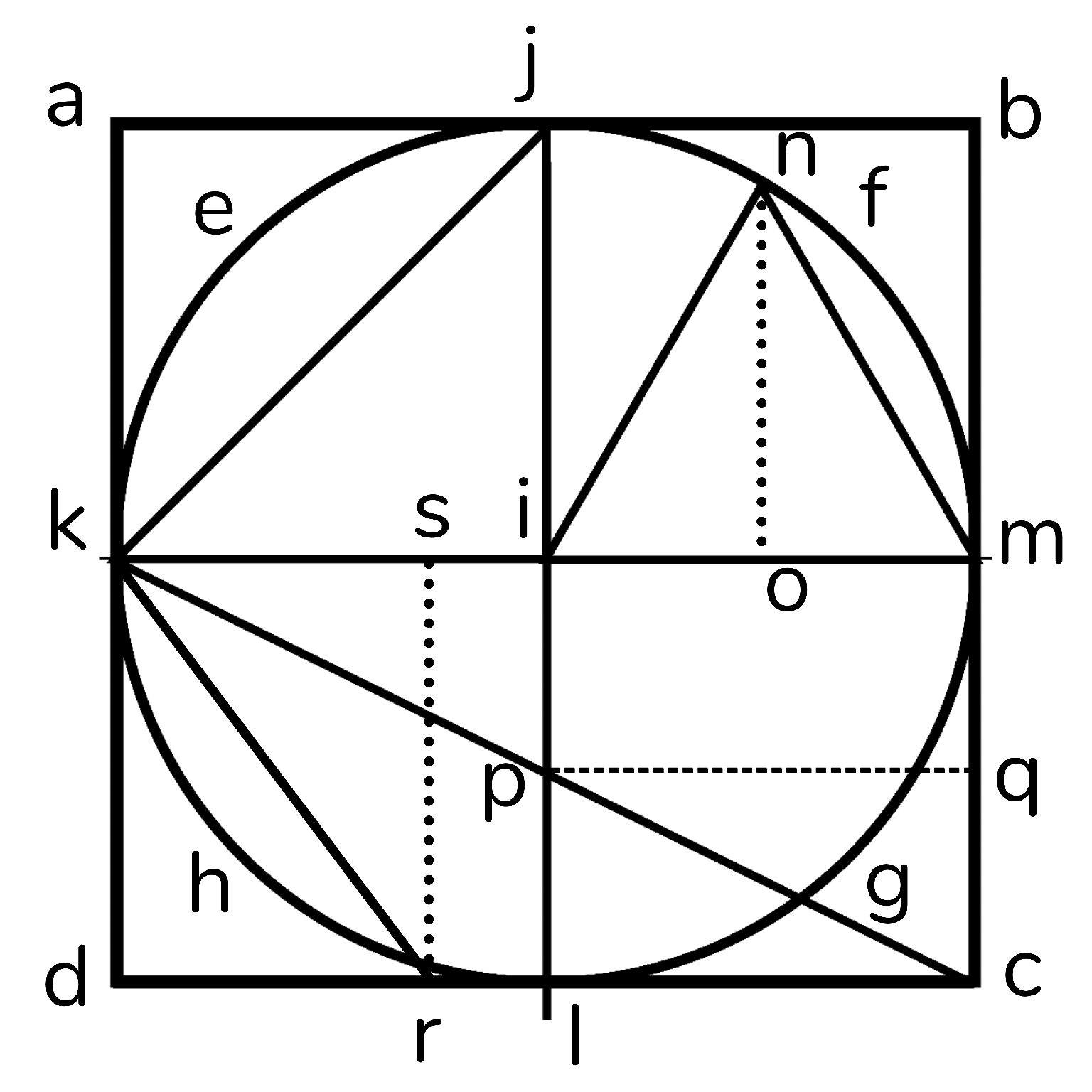
Area measurement observations
1. A rectangle's area is always measured as its width multiplied by its height.
This means that because there are two blocks going right in shape dkmc and one block going up, the total size of its area is 2.
2. A triangle because of how it sits as a half dimensional rectangle, can have its total area measurement taken down as its height multiplied by its width multiplied by half. This can be seen through how box dkmc and box kaji all breakdown to form two equal triangles once their cut diagonally.
3. A circle is always approximately three quarters of the surrounding square which touches its diameter on all sides. This observation can be seen in how shape keji is approximately 3/4 of shape kaji and how this pattern repeats itself in all the other blocks as well.
4. If a triangle's apex is not above its base, then its area measurement can be taken down as half multiplied by its width and height minus half multiplied by
its protruding box sizes width multiplied by its height. This can be seen in how shape dkc sits as half of shape dkmc minus shape dksr.
The area of two dimensional shapes