

Core Concepts of Marketing by John Burnett - HTML preview
Download the book in PDF, ePub, Kindle for a complete version.
CHAPTER 8
COMMUNICATING TO MASS MARKETS
PERSON X
PERSONY
(GROUP)
(GROUP)
INTERFERENCE
FIGURE 8.1
A model of human communication
Friend, parent, boss, client, or customer are just some of the roles we may portray in
any communication process. The nature of the role directly affects
nature of commu-
nication. We communicate quite differently with our boss than we do
close friends.
People who have known each other for a long time often devise their own communication
system, which may include lots of no nverbal signals.
Finally, the communicatioa system exists within an environment. The environment
is everything internal and external to the communication system that can affect the system
(family,
competing advertisements, etc.). Each of the factors within the environ-
ment interacts with the communication system to a different degree. Because communi.ca-
tion systems are open to the influence of the total environment, we can never analyze a
communication event from only the point of view of the people who seem obviously involved.
Everything may affect communication, positively or negatively. The iatter
may alter
or distort inputs, outputs, or processing and are called interference. Interference can be gen-
erated internally (e.g., fear, love, prejudice) or externally (e.g., noise, weather, physical
appearance) .

HOW WE COMMUNICATE
193
MARKETING CAPSULE
•
The primary role of IMC is to systematically evaluate the
4. The basic objectives of marketing communication are to:
communication needs and wants of the buyer and, based
communicate, convince, and compete.
on that information, design a communication strategy that
5. The elements of human communication include:
will: provide answers to primary questions of the target
a. The processing subsystem
audience; facilitate the customer's ability to make correct
b. The output subsystem
deci sions; and increase the probabili.ty that the choice they
c. The nature of the role
make will most often be the brand of the information
d. The environment
provider.
6. There are four types of communication systems:
2. Marketing communications is defined as a message deliv-
a. Interpersonal
ery system that includes all the identifiable efforts on the
b. Organizational
part of the seller that are intended to help persuade buy-
c. Public
ers to accept the seller's message and store it in retriev-
d. Mass
able form.
3. The four components that make up marketing communi-
cation are: advertising, sales promotion, public relations,
and personal selling.
Types of Communication Systems
There are several types of communication systems, classified depending on the level of con-
tact between communicators and the ability to respond to feedback.
Interpersonal Communication Systems
At the basic level of interpersonal communication systems is the dyadic context. A dyad consists of two people, or two major subsystems. Personal selling falls under this heading.
Organizational Communication Systems
The organizational communication context represents a much more complex system than
interpersonal communication. Examples include a bank, a factory, a retail store, or the gov-
ernment attempting to communicate with one another. These systems include a large col-
lection of subsystems, all organized around a common goal(s). Interactive technology has
changed these types of systems in a dramatic way.
Public Communication Systems
This type of system involves communication usually from one person to a large group of
people. Although everyone affects everyone else to some degree in every communication
system, in a public communication context, such as a speech from a politician to people
standing behind a platform of a campaign train, the speaker does most of the talking.
M ass Communication Systems
The mass communication context exists when a person/organization is communicating indi-
rectly with a large group of people and there is even less opportunity for people to inter-
act freely with one another and to mutually affect one another. Advertising and public relations are such mass communications.


194
CHAPTER 8
MASS MARKETS
Target audiences
Target audiences
- Past
Customers
- Present
Employees
Future
Resellers
Stockholders
- Competing
Companies
Functions
- Noncompeting
- Government
Publics
- Agencies
- Groups
FIGURE 8.2
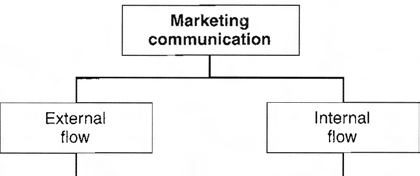
The flow of marketing communication
Marketing Communications
While all communication includes the same basic components depicted in Figure 8.1, mar-
keting communication differs somewhat in two respects. First, the intent of marketing com-
munications is to present a persuasive message, which reinforces the total offer made by
the marketer. Essentially, all marketing communication attempts to create uniqueness in the
mind of the target audience.
Second, marketing communication can be divided into two flows (i.e., internal and
external), which are directed at different target audiences. This necessitates different com-
munication strategies, which, never the less, must be compatible. A company cannot be telling
a customer one story and stockholders another. The flow of marketing communication is
depicted in Figure 8.2.
DESIGNING AN IMe STRATEGY
The design of an effective IMC strategy is a very difficult and time-consuming process that
requires the efforts of many members of the marketing staff. Although there has been a great
deal of variety in designing this process, the steps depicted in Figure 8.3 are most common.
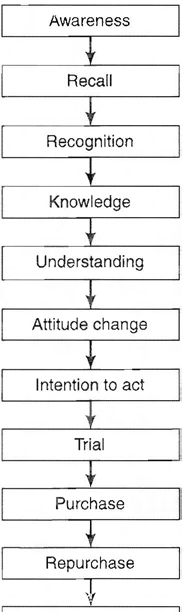
As is the case with most marketing activities, IMC is guided by a set of objectives.
There are numerous responses that the manager may desire from his IMC effort. Although
the ultimate buyer behavior desired is product purchase, several intermediate responses may
prove important as well. Examples of these intermediate responses are shown in Figure 8.4.
If there is a marketing opportunity, there must also be a communication opportunity.
Although the role of IMC is de-emphasized in certain marketing programs, there will also
be some communicative, motivational, or competitive tasks to be performed. Whether or





DESIGNING AN IMe STRATEGY
195
Determine objectives
I
Determine promotional
opportunities
I
I
Select audiences
I
I
Marketing
information
-
system
I Select message(s)
I
I
Determine budget
I
I
I
Allocate funds
I
I
I
Measure results
I
I
I
I
Organizing
I
I
FIGURE 8.3
The IMe Strategy
not the marketing programs should rely heavily on its communication ingredient to per-
fonn such tasks depends upon the nature and extent of the opportunity. There are several
conditions which, if they exist, indicate a favorable opportunity to communicate: for exam-
ple, it is always easier to communicate effectively when moving with the current consumer
demand rather than against it. Companies such as IBM have been actively promoting their
business computers, which are increasing in popularity, rather than home computers, which
are not doing as well.
The third consideration is selecting the target audience for the IMC. This is undoubt-
edly the most important factor in the IMC strategy, yet it is probably the issue that many
companies slight or overlook entirely. Marketing messages must be directed at the specific
target for which the overall marketing program is being designed. However, very seldom
is there a single group of consumers at which to direct promotion. Many individuals affect
the buying process, and the IMC program must be designed to reach all of them. In addi-
tion to the primary purchasers and users of the product, individuals who influence the pur-
chase decision must also be considered. For example, consumers usually rely heavily upon
the assistance and advice of others in purchasing such products as automobiles, interior dec-
orating, major appliances, and physicians, to name but a few. Similarly, industrial buyers
consider the advice of engineers, technicians, and even competitors. Thus it is extremely
important in resolving the communication issue to identify accurately not only those who
consume and buy the product but also those who influence its purchase.
Detennining exactly what to say to the relevant audience is the fourth consideration.
The heart of IMC is the transmission of ideas of marketing significance to the seller. Whether
these ideas are received and perceived as intended depends in large part on the skill used
in developing the communication appeal. It also depends upon the vehicle used to deliver




196