

Core Concepts of Marketing by John Burnett - HTML preview
Download the book in PDF, ePub, Kindle for a complete version.
CHAPTER 8
COMMUNICATING TO MASS MARKETS
that justify managerial specialization and require directed efforts. Yet a company, even a
very large one, typically does not have a specialist in each area, but only in those cases
where the importance and usage frequency of the tool justify specialized competence. His-
torically, companies first made a separate function out of the personal selling function, later
out of advertising, and still later out of public relations. The remaining tools (e.g. coupons,
specials) were employed by the directors of these functional areas as needed. Although the
definitions vary, the four components that make up marketing communication are as follows:
1. Advertising: Any paid form of nonpersonal presentation of ideas, goods, or serv-
ices by an identified sponsor. Although some advertising is directed to specific
individuals (as, for example, in the use of direct mail), most advertising messages
are tailored to a group, and employ mass media such as radio, television, news-
paper, and magazines.
2. Personal selling: An oral presentation in a conversation with one or more prospec-
tive purchasers for the purpose of making sales. It includes several different forms,
such as sales calls by a field representative (field selling), assistance by a sales
clerk (retail selling), having an Avon representative call at your home (door-to-
door selling), and so forth.
3. Public relations: A nonpersonal stimulation of demand for a product, service, or
business unit by planting commercially significant news about it in a published
medium (i.e., publicity) or obtaining favorable presentation of it through vehicles
not paid for by the sponsor. Although commissions are not paid to the various media,
there are salaries and other expenses that mean that public relations is not a cost-
less form of promotion.
4. Sales promotion: Those marketing activities that add to the basic value of the prod-
uct for a limited time period and thus directly stimulate consumer purchasing and
dealer effectiveness. These activities include displays, shows and exhIbitions,
demonstrations, and various nonrecurring selling efforts not in the ordinary rou-
tine. As the provision for an additional incentive to buy, these tools can be directed
at consumers, the trade, or the manufacturer's own sales force.
THE OBJECTIVES OF MARKETI NG COMMUNICATION
The basic objectives of marketing communication have been reduced to three more mean-
ingful directives: (1) to communicate, (2) to compete, and (3) to convince. The primary pur-
pose of MC is to communicate ideas to target audiences. This is done through advertising, personal selling, sales promotion, and/or public relations. Principles of effective communication are intended to achieve this task. Clearly, most of marketing is communications,
and it is in this context that communication is included as a purpose of Me. Moreover, what-
ever is communicated should be accurate, truthful, and useful to the parties involved. Because
of the pervasiveness of marketing communication, it has a unique responsibility to com-
municate with integrity.
Helping the company to compete consistently and effectively in the marketplace is
the second objective. For many companies, MC may offer the company its most promis-
ing marketing opportunities. Competitors may sell essentially the same product, at the same
price, in the same outlets. It is only through MC that the company may be able to appeal
to certain segments, properly differentiate its product, and create a level of brand loyalty
that can last for many years. In addition, the prominence of extensive communication efforts


HOWWE COMMUNICATE
191
on the part of competitors means that a company that did not exhibit a strong MC program
would appear dull and unconvincing to the customer. Thus, MC is employed as both a defen-
sive and offensive weapon.
The final objective of MC is to convince. Although this goal is most often ascribed
to MC, it is the most questionable. "Convince" and "persuade" are not synonymous terms.
Realistically, MC does extremely well if it presents ideas in a manner that is so convinc-
ing that the consumer will be led to take the desired action. These ideas, along with a host
of other factors, will help persuade the consumer to make a particular decision. Therefore,
the ability of MC to present information in a convincing manner is critical. It is also nec-
essary to reconvince many consumers and customers. lust because a person buys a partic-
ular brand once or a dozen times, or even for a dozen years, there is no guarantee that they
won't stop using the product if not constantly reminded of the product's unique benefits.
Ultimately, MC objectives can be broken down into very specific tasks. The point is all MC
must be guided by objectives.
In conclusion, effective marketing communication should present useful ideas (infor-
mation) in a manner that makes them clearly understood (communicate), cause the con-
sumer to believe the message is true (convince), and is as appealing or more appealing than
the message delivered by competitors (compete).
HOW WE COMMUNICATE
Because communication is such an integral part of effective marketing, it is important that
we provide a basic understanding of its process. Our starting point is a basic definition of
human communication: a process in which two or more persons attempt to consciously or
unconsciously
each other through
use of symbols or words in order to satisfy
their respective needs.
Basic Elements of Communication
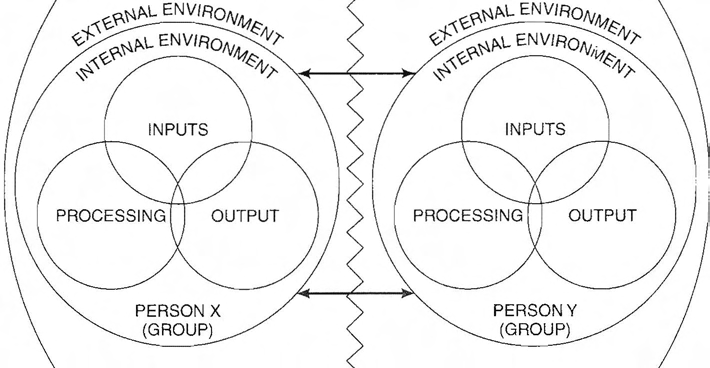
The basic elements within any communication system are depicted in Figure 8.1. It includes
two or more people or organizations called communicators. The underlying assumption of
this model is that all communications (dialogue) are continuous. This factor suggests that
we are constantly and simultaneously in the role of communicator and receiver. Each com-
municator is composed of a series of subsystems (i.e., inputs, outputs, processing). The input subsystem permits the communicator to receive messages and stimulus from outside as well as from the other communicator. It involves the reception of light, temperature, touch, sound
and, odors via our eyes, skin, ears, nose, and tastebuds. These stimuli are intimately eval-
uated through a process called perception. Thus, we input and perceive advertising mes-
sages, a 50 cents-off coupon, the appearance and words of a salesperson, and so forth. 3
The processing subsystem of a communicator includes all thought processes. As we
process, we generate, organize, and reflect on ideas in response to the stimuli received. This
entire process is determined not only by the stimuli just received, but also by all stimuli
ever received, such as past experiences, education, health, genetics, and all other factors in
our environment. Some people clearly process the humor in the Pepsi-Cola ads better than
others.
The output subsystem includes the messages and other behaviors produced by the com-
municator. These include nonverbal messages, verbal messages, and other physical behav-
iors. All of these become input (feedback) for other people and can have both intentional
and unintentional effects on them.




192