

Engineering Mindset for Early-Career Developers by Moyinoluwalogo O. Mayowa - HTML preview
Download the book in PDF, ePub, Kindle for a complete version.
CHAPTER 4 — WRITING CODE THAT LASTS
INTRODUCTION
In the early stages of learning programming, many developers focus primarily on one goal: making the code work. When the program runs successfully and produces the expected output, the task feels complete.
However, professional software development requires a much deeper approach. Writing code that works today is only part of the responsibility. The real challenge is writing code that remains understandable, maintainable, and reliable months or even years later.
In real-world software projects, code is rarely written once and forgotten. It is constantly updated, extended, reviewed, and maintained by different developers over time. Because of this, code must be written in a way that others can easily understand and modify.
This is what engineers mean when they talk about writing code that lasts.
Code that lasts is:
• clear and readable
• well organized
• easy to maintain
• flexible enough to evolve
• resistant to common errors
Developers who master these practices build stronger systems and become far more valuable members of engineering teams.
This chapter explores the principles and habits that help developers write durable, long-lasting code.
THE IMPORTANCE OF MAINTAINABLE CODE
In many projects, developers spend far more time reading and modifying existing code than writing new code.
Some studies estimate that developers spend up to 70–80% of their time understanding existing codebases.
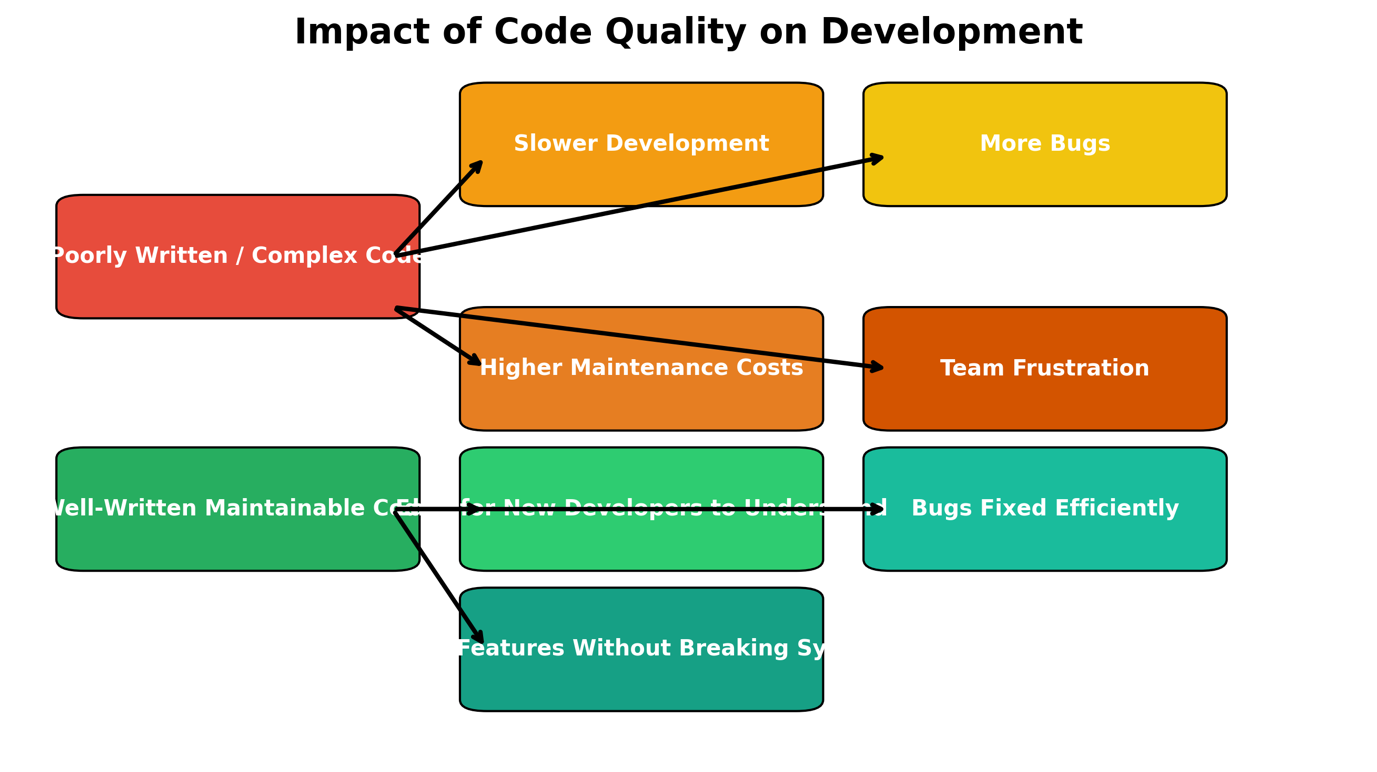
If code is poorly written, unclear, or overly complex, future developers may struggle to understand it. This leads to:
• slower development
• more bugs
• higher maintenance costs
• frustration among team members
On the other hand, well-written code saves time and improves collaboration.
Maintainable code ensures that:
• new developers can quickly understand the system
• bugs can be fixed efficiently
• new features can be added without breaking existing functionality
Good engineers always consider the future maintainability of their code.
READABILITY: THE FOUNDATION OF LONG-
LASTING CODE
Readable code is the foundation of maintainable systems.
Programs are written for computers to execute, but they are primarily read by humans.
Clear code allows developers to quickly understand how a system works.
Several practices help improve readability.
USE MEANINGFUL NAMES
Variable names, function names, and class names should clearly describe their purpose.
For example:
Bad example:
x = u * p
Better example:
total_price = unit_price * quantity
The second example clearly explains what the calculation represents.
Meaningful names reduce confusion and make code easier to understand.
KEEP FUNCTIONS FOCUSED
Functions should perform one clear task.
Large functions that attempt to do many things become difficult to understand and maintain.
Breaking code into smaller functions improves clarity.
For example:
Instead of one long function handling validation, calculation, and database operations, separate them into different functions.
Small functions are easier to test and reuse.
MAINTAIN CONSISTENT FORMATTING
Consistent formatting helps developers read code more easily.
Most programming languages follow style guidelines that include:
• indentation rules
• spacing conventions
• naming styles
Using automatic code formatting tools can help maintain consistency across large projects.
SIMPLICITY OVER CLEVERNESS
Some developers try to write code that looks clever or sophisticated.
However, overly complex code often creates more problems than it solves.
Simple solutions are usually easier to understand and maintain.
Consider this principle:
The best code is often the simplest code that solves the problem effectively.
Engineers prefer solutions that are straightforward and predictable.
When code becomes difficult to understand, future developers may introduce bugs while trying to modify it.
Clarity should always be prioritized over clever tricks.
MODULAR DESIGN
Modular design means dividing a program into independent components.
Each module handles a specific responsibility.
This approach offers several benefits:
• easier debugging
• better organization
• improved reusability
• simpler testing
For example, a web application might separate functionality into modules such as:
• authentication
• user management
• payment processing
• notifications
Each module can be developed and maintained independently.
Modular systems are easier to extend as applications grow.
AVOIDING CODE DUPLICATION
Code duplication occurs when the same logic appears in multiple places.
Duplicated code creates maintenance problems because changes must be applied in several locations.
For example, imagine the same validation logic repeated in five different files.
If a bug is discovered in the validation process, developers must update all five locations.
Instead, it is better to create a shared function or module that performs the validation.
This principle is often called DRY, which stands for “Don’t Repeat Yourself.”
Reducing duplication improves maintainability and reduces the risk of errors.
WRITING SELF-DOCUMENTING CODE
Self-documenting code explains itself through clear structure and naming.
When code is well written, developers should be able to understand its purpose without extensive comments.
For example:
calculate_total_price()
This function name clearly explains its purpose.
However, if a function is named:
process_data()
Its purpose may not be obvious.
Clear naming conventions reduce the need for excessive comments.