

The Unpleasantness in Nucktown by Edward Drobinski - HTML preview
Download the book in PDF, ePub, Kindle for a complete version.
Wife and Kid Return
I just heard the door. I hope it’s my wife, Syrenitee, returning from her unmarried sister Jemima’s place with my kid, Crypton. I don’t want any more uninvited Nucks coming in here after the last “long lost cousin Leeroy’s” newest disappearance again coincided with the vanishing act performed by my big screen TV.
Syrenitee has been keeping close tabs on our eight year old boy Crypton lately, but not because of anything you would likely imagine if you’re not a Nuck.
A week ago the fascist White American cops caught Crypton with an open bag of stolen potato chips. Somebody recorded him bawling his ass off as the cops put him into the back seat of their car to bring him here to tell his folks, while not arresting or charging him with anything, despite the 7-11
manager saying that he only called the cops because this was the fifth time that Crypton took something. They put the bawling video on the net and I never would have guessed it, but the cyber community almost unanimously thought that the White American cops were being cruel, anti-ethnic beasts.
After the cops dropped him off I chastised Crypton, who had stopped bawling as soon as the cops left, for taking something as small as potato chips. But he told me that he only did it
The Unpleasantness in Nucktown Page 79
because there were no Cheese Doodoos. “Supply chain must be fucked up or some shit,” he said.
I said; “Well, okay then. Very good on that. But I also told you when in trouble start crying. It never hurts. And, I also told you to start yelling racist, fascist, and ‘dindu nuffin’ at the same time.”
“Yeah, I remember. I was crying. But, I didn’t remember the words because at the time I was a little fucked up on some fentanyl laced weed.”
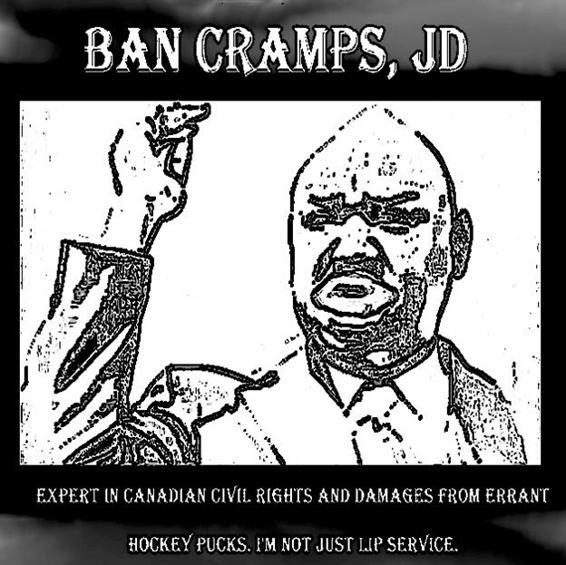
And so it went, me thinking little of it, until I got this weird e-mail, supposedly from Ban Cramps, LLB, who said he’d like to represent Crypton, Syrenitee, and me in a wrongful arrest, psychological damages, and federal hate crime case.
The Unpleasantness in Nucktown Page 80
I figured this was some kind of scam, so I asked Ban Cramps a lot of stupid questions like; “He doesn’t have any bruises.
Should I punch his face in and take some pictures?” Mr. Ban Cramps answered them diligently and without a discernable trace of humor. At that point I surmised that I was likely speaking to
The Unpleasantness in Nucktown Page 81
an actual attorney, who had made the transition from ambulance chaser to cop car chaser.
Ban Cramps further wrote; “We’re talking seven figures, half for you. We’ll first get them to go for racial equity and implicit bias training. That’s easy, is seemingly innocuous, and it’s difficult to object to additional education. In court we’ll treat that as an admission of guilt, and it’ll work. Hehehe. I shouldn’t be saying this, but you are now complicit in any ramifications, so you won’t mention this. Eh? Some say that Nucks are pretty stupid, but they understand where the bucks come from. I look forward to your reply.
Best;
BC”
I was truly impressed. Anyway, here’s my girl Syrenitee. After Mr. Ban Cramps’ advice to that effect, she has taken it upon herself to keep Crypton away from any place which might have something to steal; especially the ones with the un-resistible Cheese Doodoos; until we get our money.
“Hi Syrenitee. Hi Crypton. How’s lesbo Jemima doing?”
“Better than this neighborhood. What the fuck is going on?”
The Unpleasantness in Nucktown Page 82
I should explain. I previously noted that Syrenitee didn’t approve of using the word Nuck, and also that “She can be so damn proper sometimes.” That didn’t mean that she was a
“progressive” activist/rioter/arsonist. Au contraire. It meant that she is one who doesn’t want any involvement with recordable words and actions which can prove to have a less than beneficial effect on her well-being, and by extension, mine and doodooo addicted Crypton’s. I love that girl, Syrenitee. I should further explain. I fully agree with her, and just find it a bit more fun than she does and somewhat lucrative to dance at the edge of what is permitted. Going a tad off topic, I responded;
“I guess you haven’t heard. Someone is trying to market Nuck Tape. But, not even the libtards are buying it, because no one believes it will ever work.” I wanted to see her reaction to my
“new” joke, in order to gauge how it will play on ItsFunToBeANuck.com.
She picked up my Nuck Braining Stick and went right for me. She smiled coyly as she said; “You had to start up right away, eh?”
thereby evincing an unexplainable understanding we have. Eh? I took three shots on flashy fleshy parts, which indicated a so-so overall, but okay-for-the-general-masses assessment, ending with a demand for an apology which was provided, before a low toned grumble, which started up matters again.
The Unpleasantness in Nucktown Page 83
You see, that low toned grumble brings up the fact that there is one voice that I use which Syrenitee says she can’t stand and has forbidden. It has many forbears, all comics, but rather than bore both of us with one of those post-modern lists, almost suffice to say that it owes a great something to the sound of the Laugh-In’s dirty old man, Tyrone F Horneigh, played by Arte Johnson approaching the drab spinster, Gladys Ormphby, played by Ruth Buzzy, who sits on the park bench.
I also owe a great debt to Jack Benny’s Rochester, as played by Eddie “Rochester” Anderson. His lowpitched “yassuhs” to Missah Binny, are just like how Obama so many times said; “Yassuh, Missah McConnell.” In that vein and in response to Biden’s plan to send certain refugees to Canada, King Trudeau of Canada said;
"We's be suport dose rafugees. Buts, doan uses dat as excoose ta be's sendin’ all dem Nucks back ova heah. Sfachim!"
The Unpleasantness in Nucktown Page 84
The Myth of the 1893 Fire
On a historical note, when an influx of French-Canadian, illegal immigrants struck fear into White Americans in the late 19th century, they supposedly had come to seek “work” in the overstaffed New England cotton mills, but the “New York Times,”
among others, saw something more sinister. Contrary to popular belief the first known Nucks in the US did not bother to hoof it all the way to the southlands of Alabama, Georgia, Louisiana, Texas, Mississippi, South Carolina, Florida, Virginia, Arkansas, North Carolina, Tennessee, Missouri, and last but not least the great state of Kentucky. Their first stops were in the more easily accessible north.
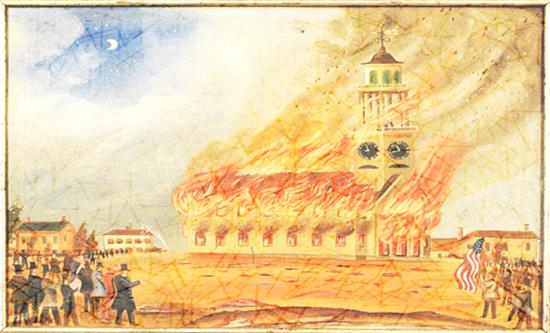
Northern White Americans who distrusted their Catholic, French-speaking, new neighbors supposedly burned the Old South Church in Bath, Maine. Below is the only known depiction, purportedly painted at the time, by someone who obviously hadn’t seen many fires, though possibly in full possession of the intention of flaming the fires of discord.
The Unpleasantness in Nucktown Page 85
Please note that the cupola and dome resemble a wizened, staring face wearing a beany with a propeller, an ironic Jewish construct, which is not being engulfed as is the rest of the building. People who are making no effort to douse the flames over-conveniently advertise their affiliation through carrying an American flag, while another well-dressed group also just watches. The quarter moon’s daytime appearance in this image, with a special space devoid of smoke created for it, is suggestive of moral instability, the changing heart, the gullible mind, and our frequently ambivalent resolve. These details are suggestively telling of the pictorially rather naïve
“artist’s” insidious objectives.
The Unpleasantness in Nucktown Page 86
You may wonder why a Nuck is deriding things which are conducive to the gathering of more Nuck sympathy and the receipt of subsequent reparations of various sorts. Well, it’s a simple case of “Let’s throw out the merely anecdotally based conjectures ourselves, before our enemies score points by doing it for us.” The use of empirically lacking “evidence,” like in the events at Bath and Tulsa, is a laughable deficiency used for dismissal, and is egregious to a similar extent as that of the deficiency of the original hockey stick. It is now known that while the original hockey stick can, and has been improved in a number of ways, it was not far off the mark. Most later temperature reconstructions fall within the error bars of the original hockey stick.
In 1893, Clare de Graffenried, special agent of the United States Department of Labor, published an article in “The Forum”
describing the unchecked invasion of America’s northeastern border. For thirty years, Graffenreid observed, hundreds of thousands of French Canadians had been pouring uncontrolled into states like Maine, New Hampshire, Massachusetts and Rhode Island, finding their desired lack of work in the region’s well-stocked industries. “Manufacturing New England, Puritan and homogeneous no longer, New England now speaks a French patois,
The Unpleasantness in Nucktown Page 87
especially when discussing the intolerable increases in violent, yet petty crime.” she wrote.
Furthermore, Graffenreid continued, French Canadians huddled in
“Little Canadas,” precursors of today’s Nucktowns, of “hastily constructed tenements,” in houses holding from three to fifty families, subsisting in conditions that were “a reproach to civilization,” while “inspiring fear and aversion in their besieged neighbors.”
Soon after Graffenried’s piece appeared, both of my grandfathers were born in Maine’s Little Canadas. Later, when I began researching these roots, I uncovered a lost chapter in US
immigration history that has startling relevance today; a story of immigrants crossing a land border into the US and the fears they aroused.
A Distinct Alien Race: The Untold Story of Franco-Americans: Industrialization, Immigration, Religious Strife This well documented narrative touches on the issues of cross-border immigration; the Nativists fear of the other; the rise and fall of manufacturing in the US; and the construction of hockey rinks.
Apparently, inheriting an ideology of cultural survival from the Québecois separatists, which in today’s world centers around Guy
The Unpleasantness in Nucktown Page 88
La Fleur’s propensity to heavily favor the offense on the ice, the French Canadians in the US resisted assimilation. This led a segment of the American elite to regard these culturally isolated, offensively predisposed, French speakers as a potential threat to the territorial integrity of the United States. “Pawns!” conspiracy theorists cried, “in a Catholic plot to subvert the US Northeast.”
While French speaking people had lived in North America since the 1600s, the French Canadians Graffenried discussed didn’t cross the US border until the late 19th century, mainly as the result of having heard that US commies had now made provisions for people to collect a livable wage without having to bother with the personal intrusion of holding a job. Contrary to popular libtard thought, disinformation existed prior to the internet, and those dumb enough to believe anything they heard/read or clever enough to merely say that they had, were as misinformed or fabricated as a Bogie looking for non-existent waters in “Casablanca.” Cotton textile manufacturing began in earnest in the region during the War of 1812, and by mid-century, it was the US’ largest industry in terms of employment, capital investment, and the value of its products. When the United States blockaded Confederate ports during the Civil War and prices for raw cotton soared, New England’s mills shut down
The Unpleasantness in Nucktown Page 89
or slashed hours. Textile workers turned toward other industries, joined the army, or headed west; leaving the Canadians with exactly what they had come for; no employment, welfare subsidies, and the removal of American Whites. Sure, they had “demonstrations” claiming prejudicial abandonment.
These efforts would only have been more convincing if any of the Canadian demonstrators had ever previously held a job.
After the war, with cotton shipping again, the mills reopened, but the skilled, White American textile workforce had scattered.
The corporations launched a campaign to recruit workers, but were left with the dregs of the Canadian race; now quite content with their government handouts including PTSD disabilities, deceptively inflicted during the war in which they did not serve. Canada’s French-speaking province of Québec again answered the call. Before the Civil War there had been a steady rain of migration from Québec to the Northern states, but when hostilities ended, the floodgates opened. Trainload upon trainload of French Canadians began to settle in neighboring New England. By 1930, nearly five million had crossed the border in search of a place on the US government dole.
They arrived in extended non-family groups, the undisciplined little Nuck bastards kicking their improvised hockey pucks of cow chips down the roads. They established French speaking
The Unpleasantness in Nucktown Page 90
enclaves throughout New England in small industrial cities like Lowell, Massachusetts; Manchester, New Hampshire; Woonsocket, Rhode Island; Lewiston, Maine; and pretty much anywhere else the White Americans had abandoned for greener pastures.
These Little Canadas, often wedged between a mill and a Catholic church, formed a cultural archipelago, outposts of Québec scattered throughout the Northeast in densely populated pockets.
By 1900, one-tenth of New Englanders spoke French. Yet in the region’s many cotton mills, French Canadians made up only four percent of the workforce; two percent nationally; at a time when cotton retained its position as a dominant industry.
French-Canadian workers often lived in overcrowded, company-owned tenements housing 500 people per acre, with outhouses filled with cow chips that overflowed into the wells and basements.
Liberal journalist William Bayard Hale visited Little Canada in Fall River, Massachusetts, in 1894. “It would be an abuse to house a dog in such a place,” Hale wrote. Some Fall River tenements, continued Hale, “do not compare favorably with old time slave quarters,” a not so distant memory in the 1890s.
“These hockey infested creatures would have their and our lives bettered were they to be housed in a zoo.”
The Unpleasantness in Nucktown Page 91
Unfortunately, the Zionists who owned the newspapers discredited Hale, to the benefit of the Zionists who owned and collected rents from their tenements, albeit through their federal government allies. Other immigrants also faced pitiable conditions, but the French Canadians were unique because they were of some use to the half-dick consortium owners of the media. “The French Canadian is as American as someone born in Boston,” said “Boston Globe” chief editor, Hymie Funkalewsky in a front page op-ed, ghost co-authored with his ghost partner, Volodmyr Zelensky. “It is all the nationalities that emigrated here that truly constitutes the American people.” Funkalewsky was part of the small, educated Zionist elite in the US, which included rabbis, journalists, money changers, and business owners. In their view, “American” was not a nationality, but a collection of “all the nationalities” living under the Stars and Stripes. In keeping with this understanding, they coined a new term for their people living in the US: Franco-Canadian-Americans.
Franco-Canadian-American journalist Ferdinand Gagnon argued in an 1881 hearing at the Massachusetts State House that French Canadians were among the original constituent elements of the American Republic. He cited “Langlade, the father of Wisconsin; Juneau, the founder of Milwaukee; Vital Guerin, the founder of
The Unpleasantness in Nucktown Page 92
St. Paul, Minnesota; Menard, first lieutenant governor of Illinois,” among his compatriots who had founded “nearly all the large cities of the Western States.”
While Gagnon encouraged French Canadians to pursue US
citizenship, for him naturalization implied a narrow contract.
If naturalized citizens obeyed the laws, defended the flag, and worked for the general prosperity, he felt their duties were discharged. Language, religion, and customs could remain in the private sphere. Gagnon's concept of citizenship was based on Québec’s history, where French Canadians had maintained a distinct cultural identity despite British rule since 1763. The Franco-American elite expected their people to maintain their identity in the US just as they had done in Canada.
But US opinion demanded of the naturalized citizen something more than a merely formal participation in civic life, and Franco-American efforts to preserve their hockey based culture soon aroused suspicion and enmity, especially when White Americans started to regularly see adult Nucks walking around with 5-6 foot wooden sticks; their children carrying the same thing, though proportionately smaller. Periodic reports of French-Canadian kids confusing White American kids heads for pucks did little to help their public relations image. By the 1880s, elite American newspapers, including “The New York
The Unpleasantness in Nucktown Page 93
Times,” saw a sinister plot afoot. The Catholic Church, they said, had dispatched French Canadians southward in a bid to seize control of New England. Eventually, the theory went, Québec would sever its British ties and annex New England to a new nation-state called New France. Alarmists presented as evidence for the demographic threat the seemingly endless influx of immigrants across the northeastern border, coupled with the large family size of the Franco-Americans, where 10 or 12
children was common, and many more far from unknown.
Anti-Catholicism had deep roots in the Northeast US. The region’s Revolution era patriots had numbered the Quebec Act of 1774 among the British Parliament’s “Intolerable Acts,” not least because it upheld the Catholic Church’s privileges in Canada, establishing “popery” in North America. In the mid-19th century, supporters of the Know Nothing movement led attacks on Catholic neighborhoods from New York City to Philadelphia. In October of 1854, Catholic priest John Bapst was assaulted, robbed, tarred and feathered, and driven out of Ellsworth, Maine. While the Know Nothings faded away, in the late 19th century the nativists regrouped as the American Protective Association, a nationwide anti-Catholic movement.
The Know Nothings were a nativist political party and movement in the United States in the mid-1850s. The party was officially
The Unpleasantness in Nucktown Page 94
known as the "Native American Party" prior to 1855 and thereafter, it was simply known as the "American Party."
Though the Know Nothings were originally a secret society of men who opposed Roman Catholicism, Irish and other Roman Catholic immigration, in many respects, they were a populist movement.
The party was progressive in its stances on "issues of labor rights and the need for more government spending" and furnished
"support for an expansion of the rights of women, the regulation of industry, and support of measures which were designed to improve the status of working people." It was a forerunner of the temperance movement in the United States. The Know Nothing movement briefly emerged as a major political party in the form of the American Party. Members of the movement were required to say "I know nothing" whenever they were asked about its specifics by outsiders, providing the group with its colloquial name.
In this climate, the supposed French Canadian Catholic subversion of New England became national news. Between about 1880 and 1900, as immigration peaked, it attracted coverage in daily newspapers; think pieces in outlets such as “Harper’s,”
“The Nation,” and “The Forum;” articles in academic journals; and books in English and in French. “The New York Times”
reported in 1881 that French-Canadian immigrants were “ignorant
The Unpleasantness in Nucktown Page 95
and unenterprising, subservient to the most bigoted class of Catholic priests in the world. They care nothing for our free institutions, have no desire for civil or religious liberty or the benefits of education.” This long term, observationally based truth was compelling.
In 1885, “The New York Times” reported that there were French Canadian plans “to form a new France occupying the whole northeast corner of the continent.” Four years later, it outlined the purported borders of New France: “Quebec, Ontario, as far west as Hamilton, such portions of the maritime provinces as may be deemed worth taking, the New England States, and a slice of New York.”
And in 1892, “The New York Times” suggested that emigration from Québec was “part of a priestly scheme now fervently fostered in Canada for the purpose of bringing New England under the control of the Roman Catholic faith. This is the avowed purpose of the secret society to which every adult French Canadian belongs.”
Protestant clergy responded by leading well-funded initiatives to convert the Franco-American Catholics. The Congregationalists’ Calvin E. Amaron founded the French Protestant College in Massachusetts in 1885, offering a training course for evangelizing and exorcising the French Canadians of
The Unpleasantness in Nucktown Page 96
New England and Québec. Baptist missionaries fielded the “Gospel Wagon;” a hefty, horse drawn vehicle with organ and pulpit, lit by lanterns at night, preaching Protestantism in French to the Little Canadas of Massachusetts and New Hampshire.
New England had become “a magnet attracting the world’s bums to itself. Québec is repellant and shunned by the world’s best blood,” thundered the Baptists’ Henry Lyman Morehouse in an 1893
pamphlet. “The one a mighty current. That has been as the water of life to the civilized world; the other, a sluggish, slimy stream, that has fructified nothing and given to mankind nothing noteworthy; a civilization where mediaeval Romanism (French Canadianism) is rampant. Against the abhorrent forces of this Romish civilization we are contending, especially in New England.”
Amaron and Morehouse identified Protestantism with Americanism.
For them, it was unthinkable that the US could accommodate a variety of religious traditions and yet retain its political culture.
In retrospect, the fevered discourse about New England’s class of destitute factory workers did not discourage Franco-American sentiments in favor of maintaining their identity but intensified them. The Little Canadas continued in vigor for at
The Unpleasantness in Nucktown Page 97
least another half century, and slowly dispersed, not due to nativist provocations, but for economic reasons; the advancement of New England’s manufacturing base and its attendant French Canadian (Nuck) aversion to plentiful jobs.
Talk of a French Canadian threat waned in the first years of the 20th century, as migration across the northeastern border slowed temporarily. This Victorian episode faded from memory only when US fears were supplanted to new subjects: the even more foreign seeming Jewish and non-Protestant immigrants from Southern and Eastern Europe, who, in the early 20th century, began to arrive in growing numbers on US shores.