THE ULTIMATE GUIDE TO KICKING SUGAR by Flora Zhao - HTML preview
Download the book in PDF, ePub, Kindle for a complete version.
Chapter 3
should not use a large amount of any sweetener,” Seeram
said.
“Do I believe that it is a functional sweetener or smart-
er sweetener [than] unrefined sugar? The answer is yes,”
but, he added, “you should drizzle, not guzzle.”
According to the 2020–2025 Dietary Guidelines for
Americans, developed by the USDA, limiting the intake of free sugars to less than 10 percent of total daily calories is recommended. For someone with a daily calorie intake of
2,000 calories, the upper limit of free sugar intake would be 200 calories. Sixty milliliters (approximately 1/4 cup or 4
tablespoons) of maple syrup provides 270 calories.
The British government takes it a step further in
its recommendations, suggesting that the energy from
free sugars should be limited to below 5 percent. This
means that for adults, the total daily intake of free sugars
shouldn’t exceed 30 grams, equivalent to less than 40 milliliters of maple syrup (1 tablespoon has 15 milliliters).
74
NATURAL SUGARS: HONEY, MAPLE, AND COCONUT
Coconut
Sugar
“Research has confirmed that there are
five main phenolic compounds, such as
gallic acid, protocatechuic acid, caffeic acid,
p-coumaric acid, and alanine in coconut
sap. These will be in coconut sugar.”
Yus Aniza Yusof, Department of Process and Food Engineering, Universiti Putra Malaysia
When it comes to healthy natural sugars, many people
think of coconut sugar. Some might assume because of its
name that coconut sugar is extracted from coconut fruit.
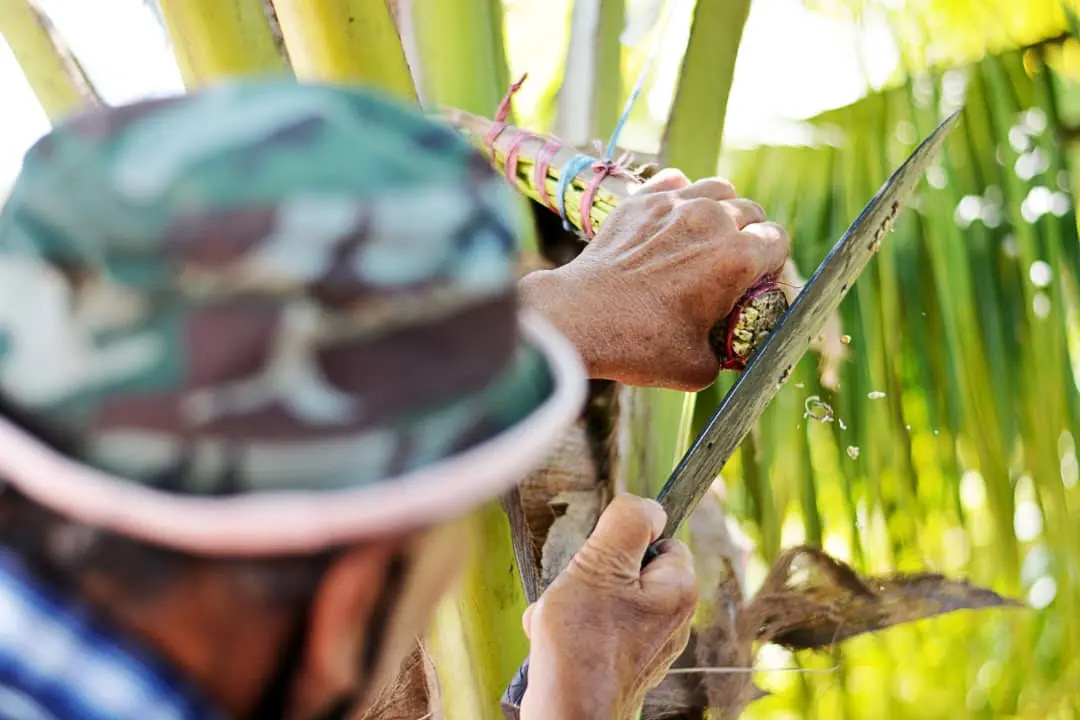
However, to be precise, this type of sugar is called “coconut blossom sugar,” as it’s derived from sap that flows from the coconut tree’s inflorescences, which are clusters of flowers 77