

Sci-Fi Film Fiesta, The Swingin' 60s - Volume 1 Eve of Destruction by Chris Christopoulos - HTML preview
Download the book in PDF, ePub, Kindle for a complete version.
Established relocation centres are operating in the following
sections of this state:
For Los Angeles, Malibu.
For the San Fernando valley, Thousand Oaks.
The southern portion of the Sierra Nevada Range, Wheaten.”
On the surface it seems as if civilisation is beginning to re-emerge from the ashes of destruction. How easy it is to grasp at any positive sign as if it were a life preserver when faced with the possibility of drowning. Upon hearing the news, Karen bitterly retorts, “Some civilization…..All our friends are probably dead. Our house, my school. Everything's gone. Everything's changed. Including me.”
Harry doesn’t greet the news on the radio with any glee. He believes that “a lot of the wrong people heard that broadcast, too.” and that “the roads will be crawling with them.
When asked by his wife if they would feel any safer where they are, Harry replies, “I have some measure of control here. Out there, none.” Having power and control over others and exercising it for what he deems to be the good of his family has now become a way of life for Harry. It is how he defines himself and measures his worth as a man, a husband and father and that is something not to be surrendered lightly if at all.
As for a woman? Her worth in the new world could be defined by her practical usefulness rather than modern civilisation’s now irrelevant and meaningless criteria. According to Harry, Marilyn would be good for Rick on the basis of her being “pretty good with the rifle” which she can use to cover Rick while he’s chopping wood. (Personally, I’d rather have her chop the wood while I held on to the rifle!)
When Ann heads off to bed, Harry remains outside for a while. An indication of how life has changed can be seen from his reaction to the sounds emanating around the cave site at night. It is becoming a more fearful and nervous world, with people constantly on edge.
And what do we have in the next scene? Lo and behold! Rick showing off while chopping wood and Marilyn covering him with the gun while casting a few admiring looks his way.
Suddenly Carl, the missing and eldest hoodlum, sneaks up behind Marilyn and forces her to drop the rifle. He then questions her about what happened to his other two felonious compatriots. Rick shouts at him to back off and throws a part of a tree limb at him, while Marilyn breaks free, grabs the rifle, and shoots Carl dead. In the same instant, Carl fires a shot, striking Rick in the leg.
The family are forced to head off to the nearest town to find a doctor to help save Rick. On the way there, they hear the following announcement on the radio;
“Ladies and gentlemen, the Secretary of State.
‘The enemy has requested an immediate cessation of
hostilities. A meeting is now in progress to discuss the terms
and conditions under which peace, not war, may be declared.
Year Zero is drawing to a close’
Resumption of normal broadcasting is anticipated within the
next 12 hours.”
The Baldwins finally manage to locate Doctor Strong who does what he can for Rick. Unfortunately, Rick has lost so much blood that he requires a blood transfusion within three hours or he will die. The only way for this to happen is for him to be transported to an Army hospital more than 100 miles away.
Before Harry departs with his family, Doctor Strong bitterly and sardonically advises him to be careful as “our country is still full of thieving, murdering patriots.” [We’ve unfortunately at times recently observed this aspect of human nature during the course of our own global pandemic crisis and concurrent events.]
It is however the example set by those like the Doctor Strong character that give hope to civilisation. Despite the chaos around them, their own suffering, potential dangers to themselves and a creeping sense of futility, such people continue to offer assistance to others and act in a truly selfless manner out of compassion and a sense of duty.
Along the way with sixty miles or less to go, the family encounter an Army military patrol and after a tense and potentially dangerous exchange with two soldiers, they are permitted to continue. As the soldiers watch them depart, they observe that they are "five good ones" who escaped radiation sickness by being in the mountains when the bombs exploded. As the family drives on, a closing title card states: "There must be no end – only a new beginning," indicating that hopefully mankind will have learned its lesson and will make Year Zero a new symbolic beginning.
Points Of Interest
“Panic In The Year Zero” was filmed in two - three weeks and was originally known as “Survival.” It was for a short time re-released in 1965 as "The End of the World" before reverting to its original title. The film was Initially released as part of a double feature with “Tales of Terror” (1962).
According to Roger Corman Ray had experienced difficulties attempting to act and direct at the same time. Although considering the fine end product, you wouldn’t know it!
CONELRAD (Control of Electromagnetic Radiation) was established in 1951 and was the nationwide system for emergency broadcasts in the United States. All radios made between 1953 and 1963 were required to have marks on the AM dial at 640 and 1240 MHz where citizens could tune to obtain civil defence information. CONELRAD was succeeded by the Emergency Broadcast System in 1963 which was itself replaced by the Emergency Alert System in 1997.
Coincidentally, while writing this I’m listening to a small transistor radio from my vintage radio collection, a SONY TR-724 AM / SW pocket Transistor made in in 1960 which has two small orange markers on the dial – one on 640 and one on 1240 MHz.
Two stories by Ward Moore that appeared in The Magazine of Fantasy and Science Fiction, "Lot" (May 1953) and "Lot's Daughter" (October 1954) may have been used as the basis for the film’s screenplay
“Panic In The Year Zero” deals with the theme of nuclear apocalypse which was not surprisingly an ever-present concern during the Cold War period. This film together with “This Is Not A Test” (1962) focuses more on ordinary people who find themselves caught up in a crisis and events not of their making and beyond their power to control. They are regular people with lives and concerns we can relate to and about whom we can wonder what we would do if we were in their shoes.
Take for instance, Ray Milland’s character, Harry Baldwin. What would we do as a dedicated father and husband who struggles with determination to survive and protect his family? Would we too find ourselves abandoning the very civilized morals for which we are fighting and trying to maintain? These days in film, he’d likely be portrayed as the absent or abusive or emasculated or morally weak father!
I don’t really care whether certain heads are exploding over the fact that the female characters could have been portrayed as being more assertive. Yes, they did come across as being vulnerable and in need of protection, but you have to take into account that it was a very different era. Ann’s role was very important for the story’s development in that she provided her husband with a constant reminder of how easy it can be to lose one’s humanity.
"Panic in Year Zero!" is interesting by virtue of not presenting things in a simple black and white manner. There is a constant tension or conflict between the need to preserve civilisation and having to compromise one’s beliefs and moral code in order to save one’s family. We question each of Harry’s acts such as his conduct toward the hardware store owner and so does Harry himself, especially under the scrutiny of his wife. We find ourselves hovering between condemning Harry but also understanding why he does what he does without fully condoning it.
Some may think that the kind of nuclear threat that is depicted in the film is merely a thing of the past and nothing to worry about in this modern 21 st Century age. If nuclear war were to occur they may argue that it would be conducted in a limited or surgical sense rather than in the manner of a Cold War Mutual Assured Destruction scenario. Only an idiot would say so for certain.
What we can be sure of is that one of the greatest threats to civilization that would emerge from such a crisis would be the moral and ethical collapse that would result from the sheer struggle for survival. The biggest threat may not be just from national or terrorist adversaries, it may also be from ourselves, our neighbors and those we thought we knew and could trust.
**********
Crack in the World (1965)
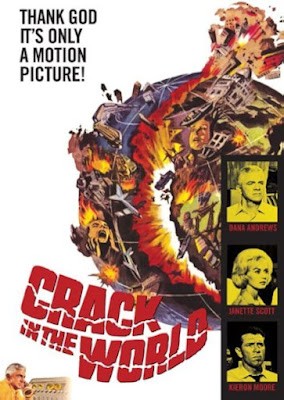
An entertaining sci-fi film that is great fun to watch and does not fail to warm things

up for the audience
Directed by Andrew Marton
Written by Jon Manchip White, Julian Zimet
Produced by Bernard Glasser, Lester A. Sansom Cinematography: Manuel Berenguer
Music by Johnny Douglas
Distributed by Paramount Pictures
Running time: 96 minutes
Budget: $875,000
Cast
Dana Andrews as Dr. Stephen Sorensen
Janette Scott as Dr. Maggie Sorensen
Kieron Moore as Dr. Ted Rampion
Alexander Knox as Sir Charles Eggerston
Peter Damon as John Masefield
Jim Gillen as Rand
Gary Lasdun as Markov
Alfred Brown as Dr. Bill Evans
Mike Steen as Steele
Emilio Carrere
Sydna Scott as Angela
John Karlsenas Dr. Reynolds
Todd Martin as Simpson
Ben Tatar as Indian Ambassador
A geothermal energy project developed with the aim of
breaking through to the Earth's magma layer by means of a
thermonuclear device!
The possibility of cracking the key to unlimited energy!
or
Cracking Earth’s crust and destroying the planet!
Part 1: Emerging Fault-lines
“ ...we don't want the commissioners to think we're all mad
scientists”
In Tanganyika, Africa we have the rather incongruous sight of a couple of natives bearing shields and spears looking down upon a small convoy of vehicles heading toward a facility that houses ‘Project Inner Space,’ an international scientific consortium tasked with tapping into the Earth's geothermal energy. The project is the brainchild of Dr. Stephen Sorensen who believes it holds out the promise of unlimited geothermal energy for an energy-hungry world. The United Nations Economic, Scientific, and Cultural Organisation (UNESCO) is willing to finance his project.
Dr. Sorensen's young beautiful wife, Maggie acts as Project site guide for the convoy of UNESCO officials, led by Sir Charles Eggerston. Maggie had in fact been a student of Dr Sorensen and that is how they first met. Soon after entering the site, Sir Charles orders the convoy to stop near the Project's bore hole where he has spotted a ballistic missile, minus its warhead, hanging inverted from a drill tower over the bore hole. His tone of voice suggests disapproval as he demands an explanation for the missile’s presence. He informs Maggie that he is under the impression that they are there to “discuss with your husband the possibility of using an atomic warhead.” Maggie reminds him that the missile is only “half a missile” and is not armed and that he and the other officials are there to decide whether or not to permit its being armed.
Maggie conducts Sir Charles and the others to the main building where they all enter an elevator which descends two miles down to the Central Operations complex where the work of Project Inner Space takes place. Maggie seems to be almost engulfed by the overwhelming male presence in the confined space. Exiting the elevator, the party emerge into a almost breath-taking expanse of a technological marvel. This cathedral of worship of humanity’s technological prowess is the product of many millions of dollars. As Maggie explains to the officials, “this entire area is pressurised and air conditioned, of course - otherwise the temperature would be well over 200 degrees.” Apparently they are all there only by the grace of….technology.
While Dr Sorensen prepares for his meeting with the Council members, he undergoes an X-ray treatment for an unspecified malignant cancer in his left hand. Aware that the treatments will not work, Sorensen’s doctor, Bill Evens agrees to keep his patient’s illness, along with its nature and severity secret from everyone, including Sorensen’s wife.
Sorensen eventually meets with the UNESCO councillors and a problem with the Project is soon broached involving the drilling team encountering a solid wall that separates them from the magma, and that in 17 weeks they haven't advanced an inch. During an old-school presentation, Sorensen outlines his plan for overcoming the current impasse.
Sorensen explains to the assembled officials that the target of the Project is the magma and if this molten mass is brought to the surface the world would have all the energy it can use. Basically, it involves geo-thermal power on steroids. Sorfensen goes on to explain that up until now “the only thing that stands between us now and success is this thin layer” which “has held us up for 17 weeks.” Unfortunately, “no drill that exists will bore through it, not the toughest steel or the hardest diamond. Conventional explosives are useless.” When questioned by Sir Charles Eggerston as to what he means by stating that "conventional explosives are useless," Sorensen informs him that he was thinking of a thermonuclear device, apparfently in form of the missile hanging poised over the drill-hole.
Somewhat conveniently, the project's chief geologist,Ted Rampian is not present. Rampian is not in favour of Soreneon’s plan but he is not there to present his case that using a thermonuclear warhead would result in such a shock to the earth that it will cause the crust to crack. By means of a demonstration involving a hammer, a source of heat and a couple of panes of strengthened glass, Sorernsen sets about the task of disproving the validity of Rampian's theory while demonstrating to Sir Charles and the rest of the UNESCO Council’s satisfaction that the nuclear detonation will release sufficient heat to safely melt through to the magma.
Meanwhile, Daring-do, He-Man, globe-trotting Ted Rampian returns in a helicopter which he exits exuding copious quantities of ego, self-confidence and testosterone, completely disdainful of the whirling blades slicing through the air mere inches above his head! His dander is well and truly up when he notices the missile hanging above the drill-hole, complete with its warhead! Insult is added to injury when Rampian learns that the damnable blighters of the UNESCO Council had the effrontery to depart without so much as giving him a hearing. Damn their eyes!
Well, there’s nothing for it but to have it out with Sorensen and his attitude is best summed up when he angrily asks Sorensen, “what's the hurry, Stephen? Can't you wait for another Nobel Prize?” Woooo! The cracks are beginning to emerge but bubbling below the surface is the underlying reservoir of magma consisting of jealousy and resentment. You see, Rampian and Maggie were involved in a relationship before she enrolled in Sorensen's class and became his wife.
Rampian spits the dummy and resigns from the Project and decides to take all his research notes with him to London where he can personally present his case to Sir Charles. Maggie, despite her protestations to the contrary still seems to have feelings for Rampion buried deep within her. As for Rampian, he still has a photo of himself and Maggie together stuck to the back of the door to his locker. Maggie rushes to convince him not to go, even resorting to the cringe-worthy line when suggesting that she’ll darn his old socks: “If the world IS going to come to an end, at least you won't get caught with holes in your socks.” Well Rampian, there’s a woman worth fighting for! Ha Ha!
Part 2: Turning The Page Of History
“A Peak Into The Future”
Later, Sorensen prepares for the firing of the missile but first receives bad news from doctor Evans concerning the progress of his cancer treatment. He is told that there is no hope and that he doesn’t have long to live. He leaves the doctor and approaches the Project control room, the only visible indication of the effect of the bad news on him being an initial hesitancy in his progress which he quickly shakes off as he gets closer the room. So what sustains you now, Dr Sorensen? “An opportunity to turn the page of history?” To be lauded alongside the likes of Newton, Pasteur, Einstein? Maybe you are simply desperate to achieve success before your funding is cut and you die before you can see your work completed. Or perhaps you just want to prove a point: that you were right after all. And what of your wife, Maggie whom you’ve been steadily pushing away? Are you trying in some misguided way to protect her from being tied to an old man destined to die shortly? Perhaps your callous attitude toward her is the result of misdirected anger on your part tied in with your jealousy of the younger Rampian and your own insecurities. At any rate, you are surely succeeding in driving Maggie away from you and eventually into the arms of Rampian.
Speaking of Rampian, the indefatigable roller up of shirt sleeves has managed to obtain an audience with Sir Charles and quickly appraises him of the urgency of his position concerning the impending missile activation. Rampian points out that years of nuclear testing prior to the test ban treaty have resulted in fissures in the crust, several of which have led to a major tectonic fault. A thermonuclear detonation at that depth will crack the fissure open.“Suppose the Macedo Trench splits open under the ocean? A crack a thousand miles long, bringing super-heated magma in contact with the ocean: earthquakes, tidal waves, mass destruction on an apocalyptic scale” will according to Rampian be the result.
Sir Charles now having had his day thoroughly spoiled by the gravity of this new information, puts a call through to the Project. As fate would have it, Sorensen ignores the alert of an incoming call and proceeds with the missile shot. The missile descends into the bowels of the earth where in a short time the warhead detonates. After a tense moment, magma erupts to the surface, as Sorensen predicted. Rampian takes the news of the seeming confirmation of Sorensen’s work and the apparent incorrectness of his own like the man he is. Sorensen, in a rather triumphant but magnanimous mood asks Sir Charles to tell Rampian to return to the Project and get back to the pile of work that awaits him.
Rampian returns to the Project in style in his helicopter which kind of detracts a bit from Sorensen’s little media scrum. As Rampian exits the copter. again seemingly oblivious to the potentially lethal nature of its blades, Maggie switches into gleeful girlie mode and makes a bee-line toward our maverick hero and walks back with him arm-in-arm. Subtlety is not one of her strong points.
Part 3: Cracks Emerge
“You were right and I was wrong”
The unusual movement of a herd of animals alerts Sorensen, Maggie and Rampian to a potential problem which is soon confirmed by reports in the media of devastating earthquake activity. Rampian is able to plot the progress of the seismic activity and establishes that it is tracking right along the fault, as he had predicted.
Meanwhile, the fault-lines in Sorenen’s relationship with his wife further widen as he seems to shut himself off from her and behaves towards her in a very cruel and callous manner. Despite her appeals and declaration of her feelings towards him, Sorensen tells her that he has nothing more to give her. The cancer that is spreading and eating him up is not merely of a medial nature. Maggie had earlier read Rampian’s letter when her husband could not respond sexually to her. Now she physically runs from Sorenson in agonised disbelief and confusion on an emotional fault line that will lead her to…….
Our hero Rampian with his shirt sleeves pushed half way up his armpits dashes off once again to organise a dive in the Indian Ocean using a deep sea submersible. At considerable risk (coz’ that’s what he does) he obtains photographic evidence of a chasm with magma boiling out of it, extending along the floor of the Indian Ocean. When later confronted with this evidence, Sorensen acknowledges that he is responsible for causing a crack in the earth's crust, and that this could ultimately lead to the destruction of the world..
At a meeting of the UNESCO Councillors there is an atmosphere of outrage and recriminations as they are confronted with a most unbelievable notion: “A crack in the world?” Rampion explains with the aid of a wall map, showing the crack’s likely progress along the Macedo Trench where “it's following a geological flaw in the Earth's crust, known as the Macedo Fault. That runs from here, to the tip of India, then veers across towards Indonesia, and terminates off the Australian continental shelf.” If the crack keeps going “where the land masses split, the oceans will be sucked in, and the colossal pressure generated by the steam will rip the Earth apart, and destroy it.” In short, the world as we know it will come to an end.
As Sir Charles points out, they all voted for the Project to proceed and therefore the all share in the responsibility for what has happened. “The question now is not who is to blame but how we can stop the catastrophe.” There is no option left but to allow Sorensen and Rampian to come up with the means to solve the problem. As Rampian points out, “at present we don't know any way we can stop it. First, we have to learn to understand the natural forces involved and, if possible, find some way to control them in the time permitted to us.” Until then there is little more that any of them can do except, “pray.”
Bare-armed geologist superhero Rampian has now assumed command of the Project and both he and Sorensen set about examining spectrographic data and films of previous nuclear detonations. Running the films in reverse offers a clue as to what has happened. Ir appears that the missile unleashed a fusion explosion in a layer of hydrogen in a pocket located beneath the magma, resulting in an explosion the force of which was greater than Sorensen had anticipated. So, knowing this, what can be done?
Part 4: Darning A Hole In A Sock
"How do you start up a volcano?”
“With a nuclear bomb”
“Another bomb?”
The knowledge thus gained in fact also suggests a solution: another nuclear bomb detonation in the path of the crack in the hope of breaking a gaping hole in the crust into which the crack would run and before coming to a halt. Armed with a plan of action, Rampian sets off in Batman mode once again, this time to the site of a dormant volcano.
With the heat-shielded fission bomb set up and ready to descend into the maw of the volcano, scientist Steele somewhat reluctantly assumes the role of Robin and accompanies Rampian in the descent into the dormant volcano crater where the bomb will be deposited into the lava.
All seems to be going reasonably well as Rampion and Steele lower the bomb through the volcano’s shaft. Suddenly there is a snag when the progress of the bomb is halted by a ledge above a chamber of molten lava. There is no choice but to try and push the bomb away from the obstructing ledge. While the two men attempt to manoeuvre the bomb away, Steele positions himself under the bomb. Just as it starts to dislodge, Steele’s support cable becomes wedged between the ledge and the bomb casing. The cable snaps and Steele plunges into the molten lava, a life snuffed out in a flash of flame.
Assailed by the intensity of the heat, a grief-stricken Rampian just manages to release the bomb into the lava before he collapses and dangling seemingly lifeless from his line he is raised to the surface. For a while Maggie is under the impression that Rampian has been killed and is almost overwhelmed by grief. However, her joy and feelings for Rampian upon seeing him alive and well also stand as a testament to her love for our hero. This is somewhat hard to square with her all too recent breakup with her husband. But that’s some people for you!
On a nearby island where the team of scientists are based, the signal is given to set the bomb off. The bomb annihilates the volcano cone in an atomic conflagration and the consensus is that the crack has been stopped and the good planet earth is saved. Just like darning holes in a sock…….
Part 5 : Convergence
“It’s Another Crack!”
Despite the euphoria surrounding Rampian’s miraculous survival and the apparent success of the detonation, bad news arrives in the form of a message received by Maggie informing her of her husband’s medical condition. Sorensen has malignant terminal cancer that will kill him within a week and he has kept this from his wife. Upon receiving this news, Maggie rushes back to be at Sorensen's side.
The bad news continues when another earthquake in the Indian Ocean indicates to Sorensen that the crack has not stopped and that “there are two fissures now, or rather, two ends of the same crack. One of them has changed direction, and if the other one does” and they are both extended they will intersect “at the bore hole, where it all started.” This will result in a circle being cut out of the Earth's crust that “will break away, acting as a safety valve of immense proportions, twenty-thousand square miles of the Earth's surface thrown out into space.” As to the likely effect on the earth’s rotation and whether the Earth can survive…...Who knows? As Sorensen observes, “no one has ever observed the birth of a moon.”
During radio communication with the Project site, Rampian learns from Sorensen the location of the new quake's epicentre leading to the realisation that the crack has doubled back toward the Project's original bore hole. While communicating with Rampian, Sorensen passes out from the debilitating effects of his medical condition. Rampian learns from Mansfield that Sorenson was about to inform him that the crack is now moving at twice its original speed.
Rampian once again draws on his inexhaustible stores of energy and with Maggie in tow, high-tails it back to South Africa to observe the crack's inexorable progress. Once there on the scene there is mo mistaking the fact that two cracks have opened in the crust, and that both are converging on the bore hole site. Rampian orders an evacuation of a threatened village, but herd-like mentality takes over and the villagers pile on to a train that’s about to take them toward their doom. Despite Rampian and the other science team members’ efforts to get the train to stop, they can only watch helplessly as the train runs headlong toward the crack. As the train with whistle bravely blaring makes a dash along a bridge, it is wrecked when the crack causes the bridge to crumple sending it and the train plunging like discarded toys into the abyss. After ordering another evacuation, a rather dispirited Rampian and Maggie return to the Project site.
Back at the Project, Sorensen has ordered a full evacuation, excluding himself as he has decided to remain below ensconced in the bunker. A frantic Maggie together with Rampian take the elevator down to find Sorensen alone at the consoles making ready to personally record what he believes will be the birth of a new moon. He states that he has “work to finish” and that only “once in a billion years a moon is born.” What is happening now “may destroy the Earth, but it may save it and that “whatever happens, I've got to stay here and record it!” even though it will definitely mean the end of his life.
No matter what happens, Sorenson is facing a death sentence but that is not the destiny he intends for Rampian and Maggie. He therefore manages to get them out of the control room under the pretext of retrieving various items for him. He then shuts the large metal door and shorts out its control mechanism thereby locking himself in.
Sorensen is fully aware of his responsibility for the unintended consequences of his decisions. His sense of guilt now weighs heavily on him. He could just crawl away and hide and become completely overwhelmed by guilt and shame and by the magnitude of what has happened. Instead, he acts in the only way he knows how – as a scientist. Having caused the catastrophe in the first place, it is up to him to at least provide invaluable data that could contain the means to rectify what he has unleashed. Sorenson tells Maggie and Rampian, “I'll keep recording everything that happens as long as I can…….if you survive, you'll find all my records in the safe. If everything goes... doesn't matter anyway.”
With little time left, Rampian and Maggie dash toward the elevator and use it to take them topside, but before they are they able to get halfway to the surface, a boulder smashes through the side of the elevator cab. In desperation, Rampian and Maggie (who has acquired a rather strategic and pleasing split in her skirt) climb up through the trap door and then up the elevator shaft. Once on the surface, they struggle away from the bore hole and make their way through a hellish scene of flame, crumbling edifices of hubris and rivers of lava accompanied by the soul crushing reverberating sounds of destruction.
Outside of the Project area, Rampian and Maggie witness the moment when the two cracks finally meet at the bore hole. They look with disbelief and wonder as a gigantic whirling disk of the Earth’s crust ascends into space and into Earth orbit to become a companion to the Moon. The earthquake activity subsides and then stops. Suddenly a little creature emerges from its hiding place underground while Rampian and Maggie appear as if they are a new Adam and Eve in a world that has has arisen from the ashes of the old world and been given a second chance.
Points Of Interest
Crack in the World is a 1965 American science-fiction disaster movie filmed in Spain. It was released by Paramount Pictures on February 24, 1965.
The notion of using technology to drill through the Earth’s crust had already been featured in Edgar Rice Burrough’s novel At the Earth’s Core. It had also been put into effect in the real world with rather mixed and less dramatic outcomes:
Project Mohole
The scenario of Crack in the World, involves a drilling experiment that accidentally triggers catastrophic geological events with global implications. It serves as a cautionary tale about the consequences of humanity’s technological hubris and the perils of human intervention in our world’s natural systems. A real-life example of such an endeavour was Project Mohole which stands a a real-life parallel.
Project Mohole, was an actual project in the late1950s and early 1960s aimed at drilling through the Earth's crust to reach the Mohorovičić Discontinuity, or "Moho." The Moho is the boundary between the Earth's crust and mantle, and studying it promised to provide groundbreaking insights into geology, tectonics, and Earth's inner structure.
Project Mohole: A Brief Overview
“In the late 1950s, as part of the Cold War-driven push for scientific and technological supremacy, American scientists launched Project Mohole. The project aimed to achieve a feat never before accomplished: drilling into the Earth's crust to reach the mantle. The boundary between these two layers, known as the Mohorovičić Discontinuity (or Moho), had been identified in 1909 by Croatian seismologist Andrija Mohorovičić. Reaching the Moho was seen as a way to unlock secrets about the Earth's composition and dynamics.”
Goals of Project Mohole
“To advance drilling technology for scientific purposes. To recover samples from the mantle for geophysical and geochemical studies. To better understand the Earth's formation and the processes driving plate tectonics and volcanic activity.”
Execution and Challenges
“The project began in 1961 off the coast of Guadalupe Island, Mexico, where the oceanic crust is thinner than the continental crust. Scientists drilled through 600 feet of sediment and 200 feet of basalt rock, setting a record for the deepest ocean drilling at the time. However, they did not reach the Moho.”
“Despite this initial success, Project Mohole faced significant challenges:
Technological Hurdles: The deep-sea drilling techniques required were unprecedented, requiring innovation and improvisation.
Escalating Costs: The project became a financial burden, ballooning far beyond initial estimates.
Political Issues: Funding mismanagement and changing priorities in the U.S. government led to the project's cancellation in 1966.”
Legacy:
“Although Project Mohole was ultimately abandoned, it laid the groundwork for modern deep-sea drilling and scientific exploration. It also inspired the creation of the Deep Sea Drilling Project (DSDP) and later international initiatives, such as the Integrated Ocean Drilling Program (IODP).” (Chatgpt)
Kola Superdeep Borehole
“The greatest distance ever drilled into the Earth's interior was achieved by the Kola Superdeep Borehole, located in Russia's Kola Peninsula. Here's an overview of this remarkable achievement and its results:
Kola Superdeep Borehole
Drilling Period: 1970–1994
Maximum Depth: 12,262 meters (40,230 feet)
Purpose:
The project aimed to explore the Earth's crust and gain a better understanding of its composition, structure, and geological processes. It was primarily a scientific endeavor, with no commercial intent.
Achievements
Record-Breaking Depth: The Kola Superdeep Borehole remains the deepest artificial point on Earth, though it only penetrated about one-third of the way through the continental crust.
Scientific Discoveries:
► Unexpected Heat: Temperatures at the bottom of the borehole reached
approximately 180 °C (356 °F), far higher than anticipated. This intense heat made drilling deeper impossible.
► Mineral Insights: Researchers discovered rocks that were over 2.7 billion
years old and contained microscopic fossils of single-celled organisms, providing evidence of ancient life.
► Discontinuity Findings: The project found no clear transition layer where
seismic waves indicate the Moho. Instead, it revealed a gradual change, challenging prior assumptions about the crust-mantle boundary.
Challenges and Results
• Technical Difficulties: Extreme heat and pressure caused equipment failures,
limiting the project's depth.
• Scientific Impact: The findings redefined many geological theories,
particularly about the Earth's crust's structure and behaviour under extreme conditions.
• Symbolic Value: The project demonstrated human ingenuity and ambition but
also the limits of technology in exploring Earth's interior.
Why Wasn't It Deeper?
Despite the ambitious plans, the combination of unexpected heat, pressure, and financial constraints ultimately curtailed the project. Drilling deeper would have required advances in technology that were unavailable at the time.
Perspective
To put this in context:
The Kola Superdeep Borehole only penetrated 0.2% of the Earth's total radius (~6,371 km). While it didn’t reach the mantle, it remains a testament to humanity’s determination to uncover the secrets of the Earth’s interior.” (Chatgpt)
When Crack in the World was made, Plate tectonics was not regarded as the dominant theory, although there was an awareness of the existence of major faults in the earth surface.
Tapping the earth for geothermal energy is am accepted part of the dependable renewal energy mix in today’s world albeit on a smaller and more sensible scale with considerably less risk to the planet!
As a disaster sci-fi movie, Crack In The World might as a result of budgetary constraints, disappoint some fans of the genre. However, the film relies much more on its pace and sense of urgency leading up a quite impressive climax. It is supplemented with a lot of stock footage which is at least seamlessly incorporated into the disaster scenes. Also, the personal the drama between the three leads parallels and intertwines well with the continuing existential threat of annihilation being faced.
Dana Andrews is a familiar face from drama and noir films of the 1950s. He gives a good performance as the complex Sorensen who gives his all to his work even at the expense of his relationship with his wife. He tries to suppress his fears of his own mortality and misdirects his anger toward his wife to the very point of risking their marriage by shutting out Maggie and forcing her back into the arms of Rampian. On top of all the drama of the love triangle, Soresnsen has to deal with the sense of personal error and guilt at being confronted with his responsibility for what he has caused to happen. Our view of Dana Andrew’s character alternates between sympathy and condemnation and that alone makes him a very real and relatable character.
With the character Maggie played by Janette Scott, there is also a strong feeling of relatable realism. How many of us have wound up in relationships that we perhaps shouldn’t have embarked on in the first place and had done so for the wrong reasons? We may have convinced ourselves it was all for love or a chance at security, but time and what life throws at us in the form of various crisis often highlights the hollowness of such foundations in some relationships.
It is pretty clear that Maggie still had strong feelings for Rampian and all it took for her to retrace her steps in his direction was her husband’s unwillingness to be open to her and his inability to respond emotionally to her. Both he and Maggie are trapped and it is no wonder that Maggie feels confused and isolated and turns to the one person who can remove that sense fo confusion and isolation. It might not be desirable or right but we are after all only human and we do make mistakes.
Art Direction and Design was by Eugene Lourie, who is featured in a tribute post elsewhere in this blog. The film’s climactic scene displays Lourie's work to good effect with a hellish visual feast of apocalyptic conflagration and devastation. Finally, with so many developments taking place there days in such areas as computer technology, artificial intelligence, military technology, communications and so on, it now more than ever important that we stop and question such forms of progress. For instance;
• Who came up with this development?
• Why should it be considered necessary?
• What genuine need is it supposed to be addressing or fulfilling?
• What are the benefits?
• Who stands to gain?
• Who might stand to lose?
• What might be the possible consequences?
• If the potential costs are too high, can we do without it?
• Is it likely that vested interests will outweigh social good?
• Are people given a fair say in its implementation?
• Is its introduction facilitated largely via the promise of
• convenience and stealthily incorporated within
conditions of use?
• Is there legislative and legal backing to prevent the
introduction and implementation of damaging and dangerous developments?
• Who has ultimate control and say – Tech behemoths? Corporate billionaires?
Politicians? Autocrats? Oligarchs? OR, The majority of people likely to be affected?
Knowing the answers to such important questions may hold the key to our well-being and very survival.
*************
The films in this volume were shaped by the shadow of the Bomb and fears for the future of humanity, but their concerns extend far beyond Cold War geopolitics. They explore themes such as media responsibility, governmental secrecy, scientific hubris, youth rebellion, moral collapse, and the endurance—or fragility—of civilisation itself. The films are products of their time — yet they speak with unsettling clarity to our own. The themes and concerns they dealt with are not relics of the Cold War or a by-gone age but instead constitute enduring human dilemmas. They dare to ask whether humanity will mature in time… or merely continue to repeat its mistakes.
Recommended Resources
The resources featured below provide historical and cultural context, and critical insight into the anxieties that fuelled 1960s apocalyptic cinema.
I. Nuclear Anxiety & Cold War Culture
Boyer, Paul. By the Bomb’s Early Light: American Thought and Culture at the Dawn of the Atomic Age. Chapel Hill: University of North Carolina Press, 1985. A foundational study of how nuclear fear reshaped public consciousness. Essential background for understanding the psychological atmosphere behind The Day the Earth Caught Fire and This Is Not a Test.
Rhodes, Richard. The Making of the Atomic Bomb. New York: Simon & Schuster, 1986.
A sweeping history of nuclear weapons development. Offers sobering real-world context for the scientific brinkmanship dramatised within the films of this volume.
Whitfield, Stephen J. The Culture of the Cold War. Baltimore: Johns Hopkins University Press, 1996.
Explores how Cold War tensions permeated film, literature and politics.
Winkler, Allan M. Life Under a Cloud: American Anxiety About the Atom. Urbana: University of Illinois Press, 1993.
Examines civil defence drills, fallout shelters, and atomic paranoia — invaluable for appreciating the survivalist mentality portrayed in This Is Not a Test.
II. Science Fiction Cinema & Apocalypse
Booker, M. Keith. Monsters, Mushroom Clouds, and the Cold War. Westport: Greenwood Press, 2001.
Examines the symbolic evolution of nuclear imagery in cinema.
Broderick, Mick. Nuclear Movies: A Critical Analysis and Filmography. Jefferson: McFarland, 1991.
A key text analysing nuclear themes in post-war cinema. Particularly relevant to minimalist survival narratives.
Seed, David. American Science Fiction and the Cold War: Literature and Film. Edinburgh: Edinburgh University Press, 1999.
Shows how science fiction shifted from alien threats to internal human catastrophe as reflected in the Sci-Fi Fiesta sereis..
III. British Cinema & Media Responsibility
The Day the Earth Caught Fire
Chapman, James. British Science Fiction Cinema. London: I.B. Tauris, 2011. Insightful commentary on British genre film-making and Cold War politics. Offers useful context for Val Guest’s work.
Shaw, Tony. British Cinema and the Cold War. London: I.B. Tauris, 2001. Explores state influence, propaganda concerns, and media tension — central themes in any consideration of the role of whistle-blowers and government secrecy.
Schudson, Michael. Discovering the News. New York: Basic Books, 1978. A thoughtful study of journalism’s evolution. Enhances appreciation of the newsroom drama in The Day the Earth Caught Fire.
IV. Authority, Civil Defence & Social Breakdown
This Is Not a Test
Oakes, Guy. The Imaginary War: Civil Defense and American Cold War Culture. New York: Oxford University Press, 1994.
Essential reading for understanding the bureaucratic psychology and “button-up” mentality embodied by Deputy Sheriff Colter.
V. Online & Archival Resources
Atomic Heritage Foundation – Nuclear history materials
https://www.atomicheritage.org
British Film Institute (BFI) – Production essays and archival materials https://www.bfi.org.uk
Imperial War Museums (IWM) – Cold War documentation https://www.iwm.org.uk
The National Archives (UK) – Declassified government records https://www.nationalarchives.gov.uk
The Bulletin of the Atomic Scientists – Doomsday Clock archive https://thebulletin.org
Suggested Further Viewing
Dr. Strangelove
Fail Safe
On the Beach
Planet of the Apes
You may also like...
-
Charlie Charlie General Non Fiction by Remiro MejiasCharlie Charlie
Reads:
10Pages:
146Published:
Aug 2026Share with everyone, but trust no one.
Formats: PDF, Epub
-

A Little Book About Climate Change General Non Fiction by Tom WallaceA Little Book About Climate Change
Reads:
7Pages:
77Published:
Jul 2026The book aims to be a concise and accessible guide to the latest thinking on climate change, along with the related topics of depletion of natural resources a...
Formats: PDF
-

More Hubs that Provoke General Non Fiction by Roy T JamesMore Hubs that Provoke
Reads:
5Pages:
113Published:
Jun 2026This is a rather provocative collection of essays addressing fundamental questions about human nature, society, and our future. The aim is to look at all this...
Formats: PDF, Epub
-
Few More Thoughts General Non Fiction by Roy T JamesFew More Thoughts
Reads:
4Pages:
43Published:
Jun 2026We all know, human society is a violent one, and there is nobody who is not concerned. Everybody has a remedy, and all of it borders on the abstract, where, b...
Formats: PDF, Epub