

More Hubs that Provoke by Roy T James - HTML preview
Download the book in PDF, ePub for a complete version.
More Hubs that Provoke
Roy T James
These are some of my views, perhaps uncommon and controversial, about a few issues that we constantly grapple with. They may not be fully and unquestionably right, nor will they be a farce, and completely devoid of merit. Significantly, wherever merit can be seen, it will be having a lot to do with the peace and harmony of the society.
Contents
1. How to get an idea about life?
2. Altruistic Evolution..Need of the Hour?
3. How to make humans live in peace.
4. The Story of Human Names
5. The Story behind Human Nature
6. How to Make Human Society Peaceful
7. Isn’t there room for A New Lifestyle?
8. Life or Lifestyle, Which is Evolving? and, How
9. What is Not Right with Us
10. What Can Make It Right
11. Is Human a Complex Life? And, if so, Why?
12. Are we terrestrial?
13. A Way to Live
14. What help, the past?
15. Why Should there be Unrest?
16. Why Should there be Worry?
17. Future of God
18. Future of The Rational
19. Future of Knowledge
20. Future of Human Society
21. An Answer to all our Problems from the Economics Angle
22. The Value of Cultural Values
23. Looking for Human Nature
24. What Can we Learn from Disharmony?
25. A Thought for the Future
26. Tax for A Good Future
27. Abstractions are Nothing but Distractions
Chapter 1
How to get an idea about life?
Is there something that cannot be known? Are there things we can understand with our minds and, things we cannot? What is the idea in vogue? And, if there is something that can’t be known, isn’t ‘our life’, top in the list?
Many explanations of life are alive at any time, thanks to one whole army of ‘spiritual leaders’ busy on the job. And it is so, at all times, and everywhere, since the beginning of history. It is a thriving profession, ever since. Also, it seems people are attached too tightly to any theory of such a nature, for, even while showing an unquenchable thirst for new ones, any infringement to the existing ones are reacted to, instantly and harshly. And the society is ever ready to pardon excesses in this regard, at the least, by turning a blind eye. Exactly the opposite happens, when we deal with all other matters. We behave as though we are quite happy to accept a new idea, or modify whatever ideas we possess. And, if and when a new or useful theory on such a terrain gets introduced, though it will have to go through a rigorous regime of proving itself, in due course, the theory gets accepted. Why is it like this? Why are we so eager, towards one side, and quite reluctant, to the other? I thought of investigating into it.
We know many things. We also hold a few things as beyond the mind, thus beyond understanding. Mind, on its part is conceived as an entity having its own limitations, posing another hurdle. All infinite and never-ending things are considered to be beyond the mind. And we attribute to everything, something infinite and never-ending. In such a case, it is far easy to be ‘without any idea’ of something, and be at ease, rather than to be aware of it, and be behind unknowns.
The difficulty in comprehending these things is accepted as something associated with life. And, everything that happens, the things we do, or that we think, are part of the incomprehensible. Should it be so?
Idea of space: space is everywhere, both inside and outside of everything. The presence thus has to be acknowledged of an infinite number of universes inside every atom in the universe. If a piece of a material is cut it in half, and cut the half in half and so on, it can go on. In this case, one will never run out of something to cut.
When you burn something, you are just turning the material into heat, light, ash, smoke etc. Also, nothing is lost in this reaction. Even the electric power that runs TV or computer is not lost. One can look at electric power as water flowing through the cord into the screen. This then sprays out into the room and back into the environment again. Nothing can be considered as lost. All that takes place is just a change in form, everything moves in a circle or cycle, back and forth. This, in a nutshell, can be considered as our present idea about material things.
In a similar manner, perhaps by using the process of elimination, extrapolation, or any other method of reasoning, one can learn about life. This, I think summarizes our approach to this question.
I feel we are wrong. We are going on a tangent. That too motivated by our predilection with the unseen dimension of life, the spiritual world.
Think of a group of frogs residing in a well. And another group, consisting of ones living outside. The cosmology of those inside the well may contain ideas of universe, as well as about the variety of species that reside in it, limited in its extent. For example, they would be having strong notions of cosmic background noise, since they will hear a lot of noise during their lifetime without actually seeing where the sound comes from. If the owner of the well follows a pattern of cleaning the well yearly, as most villagers do, those frogs may also possess certain ancestral knowledge about the end of the universe, and the events that accompany it. A few ones might even succeed in predicting such events and getting acknowledged for their acumen. Getting recognition of divinity is likely, if we assume that some frog, in the past, happened to escape back into the well during the cleaning process.
Now think of the other group. These frogs will be having a totally different cosmology. With better grasp about things and, relatively free of illusions like cosmic background noise, they are likely to appear epitomes of contentment. Questions like the end of universe may not occur at all to them, having never experienced a discontinuity.
What does this story show? Where do we fit in? On all matters except those concerning life, we are like the latter group. Having reached the assumption that reality could exist beyond our perception, there is no logical necessity for an end. Here we are quite comfortable, whichever facet of the universe is under consideration. But when it comes to life, I think we are severely handicapped. Like the earlier group of frogs, our idea of life is only what we experience from inside life. Unless we are able to view life from a plane different from life, all the notions we entertain about life cannot describe life in full. (Nobody can say I understand what a globe is, unless one has a look at it, that too, from the outside of it.) Moreover, our fondness of the spiritual dimension of life is effectively putting a brake in our quest for new ideas.
And for What Gain.
Now that we know about our limitations in learning about life, we can end up much wiser. By being more accommodating, as far as new theories go, and more willing, to tinker with the existing ones, we shall be injecting new blood into explorations in this regard. Future then shall become the golden age of life sciences. The question, what is life, will be an apt one there.
Chapter 2
Altruistic Evolution – Need of the Hour
All over the world, human societies are in a state of disarray. Since commotions occur on a multitude of issues, like political, religious, or ethnic rivalry, constant attention is needed to keep those down, and to maintain even a semblance of peace and orderliness. As a result, rather than preparing ourselves to probe and counter future challenges, the present is keeping us fully occupied. Why aren’t human societies calm and serene? Where lies the problem? What can be done?
Where is the Problem?
Let us say, how life appeared in human form is, more or less, as narrated by the theory of evolution. Which can explain what we do. All our actions are only natural responses to different stimuli, like other forms of life. Except that in our case stimuli could be real as well as abstract. Hence, I think the issue does not lie in our actions. Which is also confirmed by the fact that though there is concerted remedial attempts from every nook and corner, be it political upheavals, religious decrees, or social engineering, each and every society remains as incendiary as before. That is, totally different actions or approaches, which would have been the suggestions from these corners, remain equally powerless. True, religious, social, as well as political leadership recognize it, and constantly advocate some repair, mostly in the form of corrective or punitive action. But, since the very excuse for the choice of each, political, social, or religious leaning, is in the undesirability of the other two, such repair actions effectively do nothing but passing on the blame.
Where, then, lies the problem? A turbulent society is not an uncommon thing, for all species of life. But, unlike other species, human societies do not get corrected or settled on its own. And, when correcting force is not available, or is insufficient, the inherent contradictions in the society gets amplified, leading it to its doom. Our history is replete with instances of decay and death of cultures, literary wealth of olden times show. Now, what is the correcting force, as far as other species go? Nothing but their living style, where the well distributed functional divisions and responsibilities effectively nullify disturbing forces. But in our case, so far, repair actions were doing nothing but passing on the blame, with of course, (temporary) relief. We then forget about it, while the relief lasts, and then pass the blame, once again. In most cases, since those involved in such activities would have belonged to different age or generation, nobody notices this. Had we persisted, we would have had the occasion to experience or realize the root cause, the absence of a unique living style for humans.
The Root Cause
Some style would have evolved, had such frequent instances of unrest not been accepted as a part of our life, one can safely say. The living style should have been able to explain, why we do what we do, and lead us to the answer we are looking for. Given that humans were intellectually oriented right from the beginning of their origins, since we have no information to the contrary, the living style that came to be adopted would have been taking into account, all the strengths and weaknesses of the race.
But, it didn’t happen, then or later. We do not have a unique living style, even now. I think we continue to imitate blindly, other forms of life. Our mannerisms, our habits and all our priorities of life begin its journey from there. This, though we know, unlike all the other forms, each human being tends to learn and adopt a style for oneself, for whatever one does. And we proudly do so in all matters not directly related to physical well-being, like reading, writing, or mannerisms.
While we remain interested to learn more about life, and derive the benefits thereof, we seem to be uninterested to learn about the best way to live that life. This, though we know, nothing comes to us without learning. I therefore think, we have two issues in hand needing immediate attention, and a much larger question of great significance to our future. One issue is, learn, or derive the optimum living style for humans. And the other, incorporate that style for the race in a suitable manner.
(I think there also is a larger question, that is, how is that such a grave situation is going unnoticed since time immemorial. Hopefully, this will also get addressed, while deriving the optimum style. Concede, as it stands, we are approaching all issues in the material plane logically and with reason. We always compare the actual with the desired, compute corrections wherever necessary, and apply those, to marry the actual and the desired. However, in all other areas, as our behavior is guided more by certain irrational interests than by natural propensity, a good part of human transactions lead to unintended consequences, which in many cases are highly destructive. While deriving the optimum lifestyle, since we will be doing a rather thorough study of human transactions, specifically of those lacking in reason, appropriate guidelines would emerge.)
Humans Lack A Style of Their Own
Let us once again look at the human species. The issue is a simple one. The appropriate ways of doing things, especially for those that are a part of the essential activities of life, do not come to one, on its own. This is quite different from all the other forms of life, where such an ability is there, at the time of birth itself. Rather than investigating into this with a view to establish whether these activities have a human equivalent, or not, we just copy other beings. (And we have no qualms in viewing it as a unique quality of the race, and feel proud about it!) One has to learn things in one’s early years, if one is to enjoy the years, one is capable of enjoying. Still we continue to imitate other forms of life, while not making any efforts to make an original study. I do not know whether we are aware of this, we make it a point to spoon-feed the next generation everything related to life, much of which we ourselves are not clear about. And, more than anything else, it makes our ignorance perpetuate.
Before suggesting a living style, let me examine a few unique aspects of human life, especially to see, whether we have been missing any. One can safely assume, all the aspects we have not been missing would have already become a part of whatever lifestyle, we currently follow.
Is Man a Thinking Animal
I have heard it often, man is a thinking animal, and our lifestyle is largely based on this. I think the statement is not entirely right, since it promotes the idea that animals do not think. For whatever activities humans may do, involving all dimensions or depth of thought, in the animal kingdom too, something of comparable complexity exists. I think this deserves further study.
In his bestselling book 'Thinking fast and Slow’, Daniel Kahneman puts forward the idea of thinking as a mixture of two different activities. 'Thinking fast', and 'Thinking slow'. To put it in a simplified way, each of us is constituted by two individuals, one identifiable as the experiencing self and the other, as the remembering self. Appropriate combination of the nature, or the intended effects, of the acts of thinking and the ‘self’ who performs it, is the need of the hour, anytime. I plan to show some audacity by making a few suggestions here.
'Thinking fast' could correspond to immediate reactions, or instinctive response. Which also is what is done by all forms of life excepting humans, where, every stimulus is reacted upon instantly.
'Thinking slow' points to studied responses, perhaps the appropriate ones, when we consider humans. Where, rather than reacting instantly, the focus is on the effectiveness of the response, or the desirability of whatever real or abstract consequences it may lead to. Which could entail some amount of reflection, with the help of symbolic logic or various form of language. In fact, the prime function of a language is nothing else but this.
Now what is remaining is only a logical conclusion. 'Thinking fast' denotes animal instinct, what can be called instant reactions. And 'thinking slow' is what we should have been having in our minds, whenever we use the word, thinking.
Then, and only then, Man is a Thinking Animal.
What can we do, such that we become one?
We either stop 'thinking fast', or always resort to 'thinking slow', or both. Our natural response to every trigger should be to ‘think slow’, resorting to ‘think fast’ when it is not advisable to do so.
Now, let use see how to put a stop to 'thinking fast'. When do we react fast? When the mere presence of something calls for immediate response.
When do that happen? I think the general idea is, at any time, our response shall also be colored by whatever is affecting our minds the most, at that instant. Which can be probed further. While each and every idea continue to prod our brains, wherever we are not able to come up with an instant and satisfactory answer to the issue it posed, a reaction will arise. Or, as it is normally seen, the well read or the clued up ones do not react often, they are always ready with a satisfactory answer! It is this reaction, which is coloring our response. And the reaction, of course, would have been shaped by one’s (lack of) priorities in life. (e.g. One who is very clear about one’s priorities in life, or those who are well vertsed, will seldom face a situation, where one is affected by one’s bad temper)
But, an instant and satisfactory answer could be there, which can obviate such instant reactions, if only one is ready to think and come up with an answer. Our idea should be to make thinking the default activity, as far as humans are concerned.
Why do we think? We think, because, the very act of thinking is immensely pleasurable. How do we derive pleasure from it? I think we constantly compare the outcomes, consequences, conclusions, etc., almost at every instant, with whatever idea, concept, or expectation we already have. Such ideas could come from the immediate past, like the results of a preceding calculation, or those leanings that are always there. And, when there is nothing left to compare to, we resort to action. When looked at in this light, there is no reason why humans should try 'thinking fast', especially on new things or ideas. Since there is nothing to compare to, and there is no opportunity to relish the results.
So, the more we are aware about the many sides of a random issue that comes up, the more solid, our propensity to 'thinking slow'. Which calls for keeping ourselves, always well-informed and updated.
Our default mode shall then be that of 'thinking slow'. Now, since our natural choice in all matters will be the one providing most returns, we need to make 'thinking slow', one attracting the most benefits. Had it been so, one benefit surely would have been the discovery of the optimum lifestyle for humans, followed by its adaptation by all. ‘Thinking fast’ could be there, say, for emergencies.
Presently, all of us engage in 'thinking fast', since it comes to us effortlessly, as we are trained and encouraged to be so, from birth. All of us thus get habituated to look for such quick responses that are highly cherished. As a result of which, they lead a wonderful life. And the first thing we learn in life is to value greatly, such an attribute to our character. Which we do, and we make it a part of our life, and get together, perpetuating it. This is how human society is born. Many more of us, though not that successful, manage themselves to fit into the society. A few among us who do not fit into this, who in fact are a failure as far as ‘thinking fast' go, resort to 'thinking slow', producing matters that look impressive. All, including those who think fast, take their guidance from here, since it is easy to do so. (It is because of this unintended guidance that our society remains in one piece, since it would also have been compensating for the seeds of destruction, every instance of ‘thinking fast’ would be producing.) And they remain on the borders, or as outsiders beyond the society, or, the society models itself to accommodate them in whatever form they are.
In Conclusion
To summarize, from the early days of evolution, humans did not make an attempt to identify the optimum style of living. Instead, they chose to hang on to the default, the lifestyle adopted by every other variety of life, something easily visible to them. Which continued ever since. As a result, human race is always in disarray. To make a change, and derive the perfect living style, we should now begin on a clean slate. Fashion our life from the very beginning. We need to identify ‘thinking fast’ as another of our animal instincts, and resort to it sparingly, just as we do with other reactions of such nature. Humans could identify themselves as a form of life, where the default is to ‘think slow’. And when that happens, gone will be the excesses, differences, or skirmishes that engage the race perpetually in wasteful and harmful ventures, bringing a bright future to our future.
Chapter 3
How to make humans live in peace.
Why humans do not live in peace. Why do they find enemies among their own, unlike all the others forms of life. What do we need to do? Isn’t this a strong indication that there is something wrong with our lifestyle, or our priorities? What can we do, right now?
During all my years in the navy, what I ended up doing most often was to ‘regularize’, or to seek assistance from someone else for doing the same. Referred to by many an expression, like tying loose ends, this is an important activity that needs to be mastered by everyone. Whatever work, one may do, unless one completes this activity, others shall not get a desirable image of it. One can therefore say, success in the professional sphere is in fact a reflection of one’s ability to dovetail this particular activity with the unfinished jobs that happen to be left in one’s charge. More importantly, in a manner that does not leave a shadow on other agencies or offices. In fact one can take up and continue with whatever activity that pleases one the most, provided one can ‘regularize’ it by end of the day. And, unlike what is said in the books dealing with leadership, or management, the one who can regularize the best, is the ultimate winner.
‘Regularize’, in this context becomes an all pervasive word, most helpful to people like us who are prone to act without a well thought about plan. Sometimes it entails correction of records. Sometimes execution of certain defined process. And sometimes both. The beauty is that there is nothing that cannot be regularized.
While in navy, more so, since I was in the naval aviation where time is always at a premium, I was required to find answers to every issue that comes up in the quickest possible manner. Since speed of completion was the prime parameter, and the search for an answer routinely involved interaction with many and varied agencies, such answers would have been leaving some dots unconnected. And all such instances, many of which though of a fairly insignificant nature, needed to be corrected appropriately. This was important, especially in view of surprise inspections we were always wary of, and the short-cuts that were always inviting. Now I fondly recall, how the ‘global’ power of ‘regularizing’ used to come to my rescue often. It was that activity, which made our day to day life a pleasant one, by protecting us against the frequent and unwelcome surprises and other disturbances.
The above comes to my mind whenever I read about disturbances in human societies, the more menacing and radical ones being those initiated by some abstract reason. The deeper I think about it, whether it is about the commotion about different sects, religions, linguistic groups, political leanings, or economic stature, the harder, I am reminded of the soothing and calming effect, every instance of ‘regularizing’ used to bring along. (And how we used to find that as a good reason to celebrate!)
I therefore feel, a strong case exists for regularizing human society and the many transactions that constitute it. People can be busy for a full day, with whatever entertains them the most. And take certain corrective steps before the day ends. Since those are entirely dependent on each one’s build, human nature, I think is the first entity that deserves attention. Especially since in all kinds of social disturbance or commotion, human transaction is the only common factor.
We all know, from the time of birth, one continues with the learning process. There is nothing that is not learned, and one’s stature and capacity in life depends a lot on how good are the opportunities for this, and how well one utilizes it. Why is that we never thought of making a handbook about human nature and teaching it in a formal, defined manner.
Let us say there was a handbook, and it contained clear instructions about one’s priorities in life. What those are, how to identify the one for each one, and the ways to attain those. How peaceful would have been our society while being keen, sharp, and receptive or whatever was most beneficial.
Presently, we are just continuing with imitating our past generations. As we progress with our life, everything new, we find is almost overturning some ideas we were holding as dear since long. And we happily continue with mimicking the past, but for the unavoidable changes, it might have forced on us. (Many instances should have made us rethink about all the ideas we hold as gospel truth. You see, the approach we take while dealing with all other phenomena, whether related to animals, plants, or inanimate objects, is quite different from this. And we also know, the same is the reason for the progress, the human race makes in leaps and bounds.)
What do we need to do? Make a handbook of human nature, specifying what it should yield, say at different circumstances.
Let us have a good look at the literature already existing on this topic, and see, whether it meets our need or not.
There are a number of perspectives regarding the fundamental nature and substance of humans, the gist of which can be as shown below. Abstract ideas about the physical body and its spiritual element emerge here, giving rise to as many divisions for each of these approaches. Let us say, as many as an imaginative mind can produce, which all can be broadly classified into two.
1. Philosophical approach: A set of views that humans are purely natural phenomena, aided and assisted by other such phenomena to reach the present. Further, labels placed by society introduce mechanisms that can make alterations to it. The issue of free will, determinism and morality underlies much of the debate about human nature, and, this being an area open to opinions, the debate persists.
2. Religious views: This hold that a human is a spiritual being which was deliberately created by God. Good and evil are to be decided, based on how well human beings conform to God's hopes and ideas about man. For some religions, it entails adherence to certain rules of behavior, and for some others, it entails one to identify completely with God. The idea of an unquestionable entity is at the heart of all these, which gets evoked whenever the need is felt to end a debate.
In one case, the debate goes on with no answer in sight. And in the other case, the debate ends soon with reaffirmation of the omnipotence of God.
No, the above won’t suffice, and one will have to come up with a new one, as far as the handbook of human nature goes. Which in fact reaffirms my earlier proposition that we urgently need to regularize all that we do. And it is a vast field encompassing all that we dream, think, plan and do. Each one of us has the potential to contribute to it, provided we are in possession of such a book.
I shall try to write the first and most important chapter of this book, one dealing with the human predisposition with the superlatives or the extremes.
We tend to nurture our ability or skill since it leads us to a pleasurable experience. We start enjoying it, and we use it to do things more often, as it pleases us more. As an offshoot, we get appreciated as a talented one. Sooner than later we forget about deriving pleasure from what we do, focusing only on the comparison of one’s ability with that of the rest. (The latter is much easier! What happens here is, we abstract what we do and feel happy about it, while looking for ways to win competitions, for more happiness)
And in any comparison, what stand out are only the extremes, in one direction, or of the reverse of it. This attachment with the extremes affects us everywhere, and we lose the ability to appreciate ourselves. We grossly overlook the loss, especially because we tend to equate the particular ability with selfishness, which has been taught to us as an undesirable element of one’s character. As a consequence, rather than self-confidence that abounds in every young one, we all grow up with a whole lot of social needs at all stages, like that of attention, approval, recognition, and encouragement. And the surest way to gain it is to be the superlative, which also we learn from experience.
What is the result? A society that is always on the go, more or less specifically in search of the superlative. (All living beings are naturally desirous of maximizing comfort) The few, those happen to be very clear about the destination, and also having the wherewithal to pursue it, tread a stable path. Others also continue this search. However, since the destination, or the paraphernalia necessary for a fruitful journey, or both, are not clearly known to them, they falter. All people of all age groups, whether they follow successfully their vocations, or unsuccessful in their ventures, irrespective of spiritual, political, or other leanings, can be divided into these two. Countries shall remain healthy and flourish when the former is in majority, and widespread unrest shall prevail when it isn’t so.
This is where regularization comes in. From the above it is well clear that human can also have a peaceful existence in this world, provided we do something that prevents the falter. For that, whenever one happens to be unclear about the destination, or feel inability in pursuing it, a mechanism should suggest an alternate path, bringing back stability. All stable systems shall remain stable as long as the fluctuations that may happen due to any reason do not cross the threshold beyond which correction is not possible. Thinking in a similar manner, one can say, as long as human feelings or reactions do not cross a certain limit, say beyond which, one becomes unreasonable, human society shall remain stable.
Now, to regularize. I think a good way is to establish a regimen that will put in place a self-regularizing human nature. If one takes a cue from the physical world, one can see, all self-contained systems have extensive arrangements of sensing on its own, external signals of interest, and acting on it, while keeping the interfering signals away. We need to incorporate something similar in our lives. In fact such was the social life in the distant past, I think. All children were transferred to a centralized nursery, where they were given necessary lessons. (This would have been saving them from the present danger: parents, who were born in a different time, and tend to confine the children to what they think should be taught to the children.) Which continued till they reached the age where they are fit to take up the roles they got assigned for themselves. Having already learned about their role and task in life, it won’t be difficult to set their priorities, which alone is enough, to self-regularize. And, unlike it is now, humans, like all other forms of life, will be engaging in activities that are helpful for living, while desisting from things that aren’t.
Chapter 4
The Story of Human Names
Why is that humans have the practice of identifying each one by a name that does not carry any form of useful information or intelligence? And we stretch our imagination to find unique names of such passivity. In fact, it seems, long back in history, names always carried some idea that is relevant to the society, surviving old names, like Miller, Smith, etc., show.
An important lesson we all learn in our initial days of association, be it with programming, engineering, medicine, science, or arts, is that the variables, constants, or other entities, are to be named in an intuitive way. By doing so, it becomes easy to keep track of the ones that take part in various references or manipulations. Which will obviate such entities getting mixed up or lost, while ensuring a seamless flow of reasoning and judgment, an essential feature of success, anywhere.
Now imagine we all are named in such a manner. That is, each name will somehow indicate the salient features of one’s connection with the entity (constant, variable, etc) that is of current interest. A name will instantly bring up many connotations. Think of the benefits. Every social transaction shall be meeting its desired end, and nothing more, and nothing less, since there is no mismatch between the sides that take part. Nobody shall be feeling the need to assert oneself, and neither will one feel the urge to ignore, since all those who take part in various transactions, are the ones made for each other. For example, if I need a loan, I can easily approach the person whose name shall be indicating, say a big heart, or if I need to dispose off something, I can ask the one whose name sounds needy. Gone is the irritated, disappointed, or the thankless, and the ones who are otherwise fed up.
You see, life is so simple.
Aren’t humans an interesting lot? All of this, they very well know. How, having a meaningful way of identifying an entity, makes easy, everything that follows. And they apply this logic everywhere, in things living or abstract.
But they have been carefully avoiding this in naming themselves, which would have altered our history. And by doing so, they opened up an easy way for misunderstandings, redundancies, and other negative aspects to find its way in, and prevail. Which is leading to society that constantly face social disharmony and danger of self annihilation. (This is another proof to my theory that humans have an ulterior interest to keep everything related to life, complex!)
Then they rightly identified the prevailing danger of disharmony, and are always busy with corrective measures, some of them, permanently so. Surprisingly, almost all remedial measures are aimed at making humans more accommodating to such divergent views, ideas, and practices. Whereas, a more meaningful name would have eliminated the likelihood of such dividing forces, in the first place.
What do we need to do? Why can’t we think of rolling names? Suppose one is given a name at birth, which points to one’s salient features that are of significance, at that age. Identifying easily, the child’s priorities, all grownups can conveniently prevent the child from getting upset, or hurt. All children will find themselves upset on fewer occasions, as a result. The name, then can undergo changes, at every stage that necessitate addition or deletion of features, like completing education, gaining experience, or other eventualities of interest. When we communicate, each of us would naturally assume relevant roles, for example, one of authority, one of receptiveness, or submission, such that there isn’t any loss. And, being fully aware at all times, each and every one will feel encouraged to live up to one’s name, making peace only, to prevail.
Chapter 5
The Story behind Human Nature
Human nature is celebrated extensively. It gets used as a good excuse to cause inconvenience to others, or to tolerate excesses, or for something else, if it pleases one. However, a hard look reveals that all the failures of human race is due to it. And what about the instances of success? Well, suffice to say, all those who have achieved great success, other than the instances where brute superiority did the trick, did deviate from the paths that would have been the natural ones, then. Hence, it won’t be incorrect to say, one needs to go beyond the limits set by one’s nature, to achieve success. If so, doesn’t this call for a rethink about human nature.
What is human nature?
I feel, currently we think of humans to be differing greatly from all the other forms of life. But, do they? As far as the functions essential for the maintenance and progression of life is concerned, there is no great difference. Both are well-equipped to perform all such functions, each following its own style and extent. But on closer look, there is a difference. One’s nature, for all other species of life, support unfettered growth. For humans, unless they keep their nature in check, they will be meeting their doom, very soon. And humans perpetually are busy doing something, where, each one will be busy with something that is in consonance with their nature. All this points to a big difference. And this difference is the one, which has come to known by the term human nature. This I think needs some explanation, since a few questions arise instantly. What is it? How did humans acquire it? What effect does its have on the fortunes of human race? And, What is the optimum way of handling it?
How do machines acquire a nature
Let me start with inanimate objects. I think mainly owing to its environmental particularities of use and the personal priorities of the user, one can say, things acquire a sort of personality. To mention an example, think of a kitchen, a workshop, or some such place having many knives of the same type. For a particular use, one will be relying more on a specific one. And, because of this, it could get used more often, fortifying its position as an apt knife for a particular need. In some time, each piece of implement shall acquire certain peculiarity of its own, which incidentally can be noticed in its rate of wear or the frequency of replacement. When a necessity arrives, the chosen knife shall be the one, where the particular peculiarity is apt for the need.
Things are a little more clear when we deal with more complex objects. Think about putting to use, a machine, an instrument, or some other expedient. Say, a mechanism to pump water.
As we install it, we shall be learning of many requirements necessary to put the particular pumping system to work satisfactorily. Like appropriate fittings, joints, and connectors to fabricate and match various elements of installation, provision of electrical power, incorporation of safety devices, or protection from weather. As a result of which, quite a few devices, systems or equipment shall form a part of this installation. And to this, some more will get added up, as and when we face bottlenecks, both while installing it and during the run-in-period thereafter.
Thinking in a similar manner, each and every living being acquired its nature while growing up in its environment, which, over many generations, the environment being more or less the same, becomes attached permanently. However, it is susceptible to changes, domestication, for example. We can say, it is not at all difficult for a living being to be freed of its nature, provided, we feel the need.
How Machines are Freed of its Nature
Over a period of time, these issues shall be getting sorted out, which shall be rendering many of the elements that have become a part of the installation, redundant. What normally happens in a well run case is that we would strive to utilize some of these redundancies, sometimes as spares, sometimes for improvisation, or for selling as scrap. However, when the machine undergoes a planned overhaul, we discard all these and bring the machine to its specified consistency. This in fact is the main purpose behind an overhaul, which is an essential part of all systems, machines, or other such entities.
How do Humans Acquire a Nature
Something similar is true, in the case of human race too. In our long journey, which we now imagine as one from the state of a primate-like being to the relatively civilized ones of today, human race must have added quite a few particularities, whether of lifestyle, of behavior, of ambition, or of outlook. (Even if it began with an intelligent design, situation need not be much different) We continue to cling on to these, though none are relevant, and quite a few are rather dangerous, as far as the needs, desirability, and living style in our current environment goes. But, quite non-intuitively we have been hanging on to these. Labeling these as the unquestionable elements of human nature, we make it rather everlasting.
In fact each of these elements are snippets of whatever was the current events of significance, some time in the past. These would have been serving an actual purpose then. And later, even after getting replaced, these continue to remain with the human society, joining a vast kitty of abstractions. And does not leave us, even when situation demands so.
Why we are Never Freed of our Nature
As mentioned, many of these would be the ones that got discarded at opportune moments in the past, when external or internal forces made our forefathers view some part of the current living style as superfluous, inconvenient or dangerous. And remained with the human society, though redundant. But, unlike the way mechanical elements got treated, there was never a planned attempt to identify and eliminate the redundancies of life. On the contrary, later generations started holding these in very high esteem.
In fact, it is worth noting here, how, while dealing with machines, the full range and power of human intelligence always come to fore. We very well know, everywhere, some form of routine repair is necessary, at intervals based on the conditions and circumstances of use. Note also, how we take pride in our ability for identifying the cardinal as well as for overlooking the insignificant. But all these are missing, when we deal with our own fortune!
The result is: we have successfully added another abstraction called ‘fond memories’, which made it all the more attractive to hoard these for no reason. Not only that there is no gainful use, but also the time and effort spent on these, effectively put a brake to the forward momentum, the human race would have acquired. Consequentially, there is a delay in identifying, receiving and responding to fresh input. In short, we are in a vicious circle. Because of the hoarded memory, fresh input gets colored before we have a chance to react. Hence, our reaction is incorrect, which lead to unsavory results, and we go back to our memory.
And the Way Ahead..
I think what is happening is, unlike all other species of life, humans are in a continuous process of learning their response to inputs. Memory, in fact the past responses stored therein, makes it easier to form a fresh response by providing an easy guide, a reference, or a standard. The same becomes rather difficult, when the input, and consequently, the desired response, are changing fast. Or, in a fast changing world, it adds to the constraints, one is already in. Therefore, the race needs to undergo a planned overhaul at certain intervals and shed much of the stored responses, such that human nature always is in sync with the current realities.
I find it rather amusing that we haven’t thought about this earlier. By now we know. Unlike other forms of life, humans have to inculcate and develop necessary routines, patterns and other requirements, and changes in habits, for the very need of staying alive. But why is that, here we overlooked the need to do away with the old ones? When we know that clearing the unwanted or the excess is an essential need to maintain the health of machines, or of the domesticated animals, why didn’t we institute in our life, a regime to discard old and unwanted experiences. Which will result in a lifestyle that shall also release mankind from the influence of the past?
I think we are just following whatever we have come to observe among other forms of life. But all the elements that are unique to humans have so far not received the attention it deserves. Therefore, the current understanding of human nature is grossly inadequate, to say the least. Though many of the behavioral patterns we proudly brandish may happen to be helpful to us, it is limited to functions and activities we share with other forms of life. (Even then, one cannot be sure that there isn’t a better way, unless one makes an attempt to find one!)
Human race needs to go back to the plotting table, and come up with fresh ideas about how to live, and originate human nature.
Chapter 6
How to Make Human Society Peaceful
If all that is wrong with us is in the misplaced or untimely choice of our responses, how can it be corrected? Well, let every form of response flourish. The one most suitable will naturally survive.
Today, we understand that infectious diseases like flu, chickenpox and pneumonia are caused by microscopic organisms – bacteria and viruses. This, the germ theory of diseases, in fact opened our eyes. With this knowledge, we have developed ways to treat and prevent infections, or diseases spreading unspeakable tragedy.
The Issue
In the same manner, won’t a new and different approach to mental health empower us in facing issues of harmony in society? I think, yes, it will. In fact all our issues in the behavioral plane can be grouped as misplaced or unsuitable responses, whether as actions, reactions, or other expressions, all of which would have been the desired choice, elsewhere. And in instances where the response fit, its intensity would be making it a misfit. A society without peace is the direct result of this lack of harmony.
To me, while seeking the origin of such an incongruity, one thing is becoming clear. Our adherence a particular set of responses, which we term as the appropriate ones, does have the potential to make any natural response, unacceptable. And it is a huge canvas, limited only by the current ambiance. Or, we involuntarily suppress much of our natural reactions, at least some of which could have been the best suited ones at that instant. Or, our reluctance to accept any other kind of response even when suggested so with all sincerity, could be the one making our position untenable to others. And the cascading effect of the original response followed by such unsustainable actions and reactions by various entities that come across this, results in instances of unrest, that too, for no specific grounds. (Actually this is why we find it difficult contain unrest, there is no real reason for it!)
Once the unrest sets in, the original, in-congruent response of some random entity that would have caused it, gets submerged in a sea of reactions. Each such reaction assuming a degree of depth, urgency, or other parameters depending on the instantaneous feeling of intensity or abhorrence felt by the reacting entity, the responses tend to assume a form that will be unrecognizable from the original action of in-congruence. Also, the response can occupy a wide canvas, depending solely on things like creativity, imagination, or aesthetic sensibility of the respondent. As a result, anybody trying to find an answer to the instances of current unrest will never have the luxury of having an inkling about the in-congruent actions, the original cause. In addition, each such response (from different entities) being wholly dependent on the dramatic capabilities or exhibitor leanings of the respondent, those who prod further will find it difficult to see beyond its bedazzlement. This is the reason, I think, in all instances of disharmony, the fundamental cause is never found. (In fact due to the same reason, much of the writings on such topics are mostly abstract, philosophical, and perhaps scholarly, dissertations)
The Cause
But the fact is, when our (conditioned) response start producing such established, dazzling reactions, it becomes an issue. That being true for the natural responses from each of us, turning anything into an issue is dependent only on current or local sensibilities or both. For example, see the religious sphere. Rather than the ‘hate’ content of an event, what really would spark an issue is the current, local reaction to certain happening. You see, an event does not maintain its ‘hateful’ nature, except in a social group, which, for certain reasons would have painted it so. Rather, that particular group is a conditioned one.
Or, we can say that conditioned behavior is acting like a germ. Just as germs are spreading diseases without our knowledge, our dazzling, conditioned responses are also spreading issues of mental health with no intervention from our side. (I agree, presently we do not see this as issues of mental health, but we better) Thus, whatever social issues are there in our midst could be happening as a result of some of our conditioned responses. Either in the form of impediments we impose on our conduct, or unbridled celebrations, or both, either by us, ourselves, or by others.
What are we doing now? I agree we are always aware of the incendiary nature of our society, the most common places to observe sparks of a destructive nature being language, religion or ethnicity. But events do not elicit an appropriate reaction. Since, whenever we observe a violent reaction, say in matters concerning religion, rather than looking for the source of violence, we direct our efforts to the particular aspects of religions that took part in it. And we may issue corrective or punitive actions to contain those aspects. This goes on, as it had been since the dawn of history. Whenever the disturbance becomes too much to handle, we resort to some kind of urgent, symptomatic cure that can make some difference. And forget about such issues till the next time it erupts.
(Such a lackadaisical approach to an issue that is crucial to our well being needs to be investigated further. Contrast this with the material world. Here, I think we approach even less significant issues with an open, alert mind, and keep looking for answers. And answers come, making our life more and more comfortable.
But, when it comes to the spiritual world, we are very clear about two things. One, we are unwilling to question spiritual matters. Two, we are quite vehement in our objections to others doing so. Whereas the opposite is true for the material world; not only that we are quite happy to question any matter relating to the physical world, but also we are eager to help others doing so. Why so? Are we afraid that we may stumble upon some answer?)
My Answer
What do we need to do? I think we need to be more inclusive, while teaching ourselves about correct responses. In a given situation, rather than assessing a few of the responses as correct, and some other ones as wrong, we need to mold ourselves to appreciate all responses as valid, a few of those perhaps more appropriate at the given instant than the others.
For example, we already know there are many dimensions to each issue. Some of those, I myself have tried to portray, through my 'hub's. What stops us from re-evaluating all our priorities and responses, in the light of those? Perhaps that can result in a complete shift, to our system of education? Which will usher in a society with a different set of ambitions, desires, etc. that are more conducive to peace and harmony?
But, it is Nothing New
In fact, we already know this. We apply this philosophy in our appreciation of the material world. For example, we know, different elements, compounds, and other stuff need to go into the constitution of things, to meet the desired requirements. And we never rest, taking one line of analysis, even if it took us to the desired result. We know that every constituent is there to meet some need, or cause something undesirable, or both.
But when it comes to the societal plane, we have molded ourselves to think of all responses other than a few chosen ones, unnecessary, or dangerous. And by constantly suppressing some of our responses, we are encouraging unknowingly, instances of unrest. Therefore, we need to permit a wide variety of responses from all, leading to spontaneous evolution of priorities. And the actions for it should begin at home, don’t be adhered inflexibly to whatever one is attached to. Remember also, a flexible adhesion makes a stronger joint, one that can withstand more forces of disruption.
The Ultimate Answer
That completes all that is needed to put an end to instances of unrest, which is only this, let each and every reaction bloom. (Selective breeding of ideas, the favorite pastime of the world since long, is still possible. But at a much slower pace, one not discernible easily)
Chapter 7
Isn’t there room for A New Lifestyle
I have written many articles, each of which featuring a new or varied look at some part of human nature. I think most of it veers around one idea. How incorrect or misplaced we are, when we continue to react, appreciate, or sense, as we currently do. A few of the questions that were examined illustrate this, like, how harmful is unity, why the current pattern of education is fit for a change, etc. And it is not difficult to come to this conclusion, whatever is common to all these issues is the one that deserves to be attacked first.
If we are to proceed with the re-examination of all that we currently consider as wrong, unsuitable, or inappropriate, the very first entity that pops up is our current lifestyle. I think there should be no doubts about this, since it is a prime common factor, which in fact engulfs everything else.
Our current lifestyle is one of permanent settlement, and the earlier one can be considered to be a fully nomadic one. When we compare both, one thing stands out.
In a settled life style, everything good or bad in a society gets distributed in a rather narrow centralized way, limited both in time and space. Whereas in a nomadic one, all this happens in a broad, decentralized manner, spreading fast in all dimensions.
As a result, in the former case, people get fed up of good things fast, since they are virtually confined to the same spot, where they are repeatedly exposed to the same ambiance. And when we look at the bad things, the torment continues with no respite. In spite of all this, people continue to revel in their fortunes, since they hardly get a chance to learn of any other way of life.
But in the latter case, exact opposite happens. Here, the good gets distributed, making more people happy. When the bad follows suit, inconveniences smooth out due to spreading. Also, at any time, they shall remain better informed about whatever possibilities that may occur about enhancing their means, outlook, and happiness, always being in touch with a wider cross section of the world.
Undoubtedly, the nomadic approach is the better one.
But we chose to be otherwise. And are continuing to remain to be so. Perhaps farming did the trick, the agrarian community of that era couldn’t have afforded to be always on the move. We hence follow a lifestyle of settlements and communities, even though the good dies here fast and the bad lasts longer. But, since the original compulsions of the agrarian society are no more applicable to us, we can very well do a rethink.
Now, if we are to utilize the benefits of the progress, we made so far in the areas of science and technology, we can make a suitable mix of these two lifestyles. This can let us enjoy the benefits of both, while avoiding the many disadvantages, each have.
Chapter 8
Life or Lifestyle, Which is Evolving, and How?
Human lifestyle is constantly evolving, and, all the disquiet that is seen in our societies is a direct result of this. What is necessary is to have a theory in this regard, say, the theory of evolution of lifestyle, which can guide the populace to arrive at the correct priorities in life.
There is no sign to show that we are evolving. But there are far too many signs that show, human lifestyle, or the set of priorities that constitute it, evolving constantly. Why didn’t we think of a theory in connection with this, which could have helped in the adaptation of the appropriate lifestyle for humans, without leaving the human society in perpetual turmoil, as it is now.
I think there was room, waiting for a theory in this regard. And I also think, it happened to get filled by the very first theory that came up, since it turned out to be a brilliant one, though not a right one. And its brilliance effectively stopped further research.
Let facts speak for itself. There was neither a sign that necessitated man to evolve, particularly in physical appearance, nor was there another one, that showed partially evolved ones. But there were enough signs, which showed everyone nurturing a constantly evolving set of priorities that greatly influence the way the life progress, for one and all. We call it by the noun lifestyle, which is nothing but the aggregate of such a set of preferences. So, though in reality, more than humans, human lifestyle is the one which is evolving. Since we noticed changes in physical appearance easily, the evolving lifestyle would have escaped us. Readily visible differences took better of us, prompting one to come up with a theory.
I think it happened thus because of this difficulty. Far too many aspects related to our lifestyle show signs of gradual change. That can lead to many variables involved in the examination, and can make the study on the mechanism of its evolution, an impossible one. As a result human lifestyle has become a complex stuff, and is progressing, perhaps in a haphazard manner, without any worthwhile contribution from us, whereas, it is our input that makes our life pleasant everywhere else. (We take pride in the fact that our life is complex, as well as belittling other forms for having a life of simplicity and ease!) Also, we are always ready to make any alterations to whatever is our way of doing things currently, just to make our life a bit more pleasant, or to let it progress in the same manner. That is, we agree to make any changes anywhere, just to enable us to continue with our current lifestyle. Why is that, in spite of the admirable progress we make in all spheres of life, like technology and medicine, human life does not flow smoothly?
In fact here we are lucky. Human life can be simplified as a complex set of preferences. And there is a single point which controls all such preferences, whether it is about social life, professional one, or whatever. It is nothing else but one’s God, and it makes our task, a really straightforward one. More than whether man is a product of evolution or not, or rather than investigating into the vast foray of unpredictable priorities that form our lifestyle, we could spent all our efforts in only one direction - debating about the evolution of God. Though there are far too many signs indicating to the evolution of God, we dismiss all such signs with a stock response. ‘Whenever the ancients made a reference to animals, natural wonders, or some other sign as God, they really were having whatever is our current idea, in their mind.’
In fact, God is a unique idea, which, while dictating and controlling all that we think or do, splendidly supports itself. One can see it evolving every day, when our current idea about God shapes itself to keep in pace with new developments, especially in science, while simultaneously and silently altering our appreciation of all things. (All this happens on the quiet. The moment a theory or observation that is likely to cast a shadow on the existing idea of God, becomes rather indisputable, the very idea of God turns a little in the abstract, just enough to circumvent or nullify the effects of such a theory.)
While discussing the evolution of religious belief, I found one book mentioning something very important. When thoughts like that of God originated in the early humans, the idea of God would have been one as real as the mountains, waterfalls, forests, thunder, lightning, or eclipses, which all were thought to be the homes from where Gods came. The idea of God was something quite similar to whatever idea they possessed about such magnificent events or sites. As time went by, they learned more about all these wonders. That these are, more than wonders, real, consisting of different substances, having certain composition, and identifiable functions, all of which alterable to a great extent, by their effort. And they would have learned to tame some of these for better living. But, all these while, the idea of God remained intact. How did this come to be? To make this a possibility, we constantly attribute style, power, and a fertile imagination to the ancient ones. (We attribute them with ignorance, everywhere else!) Some of them think in a particular manner and unearth the secrets of nature, while some others think in a manner exactly opposite to it, to keep the idea of God safeguarded against any change caused by such unraveling. It seems all those who thought, deliberated or wrote about this are in total agreement that there is nothing amiss here.
What can explain the above? What makes us exhibit such a context sensitive intellect?
As far as real things go, the ancients must have felt encouragement from all quarters. And the pursuit of the secrets of nature, naturally followed. But we know, for imagination to flourish there should be something, like the society, to appreciate and support it. A king, like in earlier times, or a government, or other organizations that offers encouragement. One can see, the prevalence of great poetry, or impressive sculptures, indicate as much to the supportive nature of the society as to the creative talents of that era.
In this light, our assumption about the ancients having an expressive, fanciful, and fertile mind seems to be too much. Ancient world could not have been one where talents of imagination flourished. You see, the very activity of staying alive would have involved protecting themselves from the dangers posed by the weather and the wilderness. And a lion’s share of human effort would have been spent here, leaving hardly any time for reflections, debate, or discussions over and above the routine tasks involved in progressing one’s life. Rather than ascribing motives of supplication, exploration or experiment, I think we should see the remnants of the distant past, more than as products of imagination, as a record of observations or their reaction to all that was impressive.
Look, all animals are capable of doing something no man can do. This is all the more striking, if we think of the days before the appearance of implements or weapons of various nature. Imagine of the discomfort, an unfriendly animal would have caused, and the help or benefit, a friendly one could have been of. It is only normal that such beings become a revered lot. Remember, for each and every activity that man cannot do, there is some other being from the kingdom of animals, who excels in it. Man was comfortable with his limited superiority.
Time went on, changing our perception about things, and altering greatly, the capabilities of man. We reached a position where there is a ready explanation regarding almost all things. That creates a vacuum, since there is nothing to submit to. We hence started to imagine of some entity, and present ourselves to it. Here one needs to admit, our fertile mind came up with admirable acuity. And provided a simple, but effective answer. Think of all those we used to submit to, as two, rather separate, entities. One we can see as well as sense, and another we can only feel. Which will be giving rise to a plethora of objects, both real and imaginary, all of it fitting into three heads, namely, religion, science, and those not belonging to either. Religion happens to get accumulated with things we can see and feel, as long as one can do it successfully. Then science comes and takes over a few things, starting with areas where religion clearly falters. Things that can belong to either heads also got into groups. Like the many facets of arts, and those belonging to neither religion nor science. These can come to great use, where none else fit.
Science is progressively displacing religion and God. I think the final gasps of life is coming out from both religion and God, painting an ambiance of violence everywhere. A discernible replacement for God and religion is evolving, bringing it to an end, even if none of us recognize this. (It can happen much earlier, if we pay heed to these thoughts.) And we shall then follow the true lifestyle, which we should have been following, from the days of ‘big bang’ itself. (We wouldn’t have been facing this situation had the theory of evolution addressed the spiritual sphere of life instead of the biological one. Since Darwin took an easy path and examined the living forms physically, similarities could be seen among different species of life. Had he chosen to examine the less obvious features of life, origin of deities would have been the outcome, and perhaps, an insight into how our priorities change. Which could have thrown more light on the spiritual dimension of life, and how to bring it in tune with the current priorities at all times. Not to mention of the good that would have happened by now, had human efforts been directed away from wars and strife)
Chapter 9
What is Not Right with Us
I think, Shakespeare should have added after ‘frailty thy name is woman’, inconsistency, thy name is man. For, in this particular aspect of one’s character, and perhaps only in it, one can say, both man and woman surpass each other. And it is the only shortfall that is readily seen in both men and women, they more or less complementing each other, everywhere else.
In many ways, this form of life is the best of life. In many other ways, it isn't so. At any instant, there are losers, and at least a few gainers. When things go right, we feel happy for the gainers, and reaffirm our intent to emulate them. But when things go wrong, we find inadequacy in their efforts, or keep flaying their choice of an unsuitable path. By making them think that they too should have been gainers, effectively, we all implore them to do better. And we have been continuing with such an approach to life, since time immemorial. Strangely, we also seem to have accepted that it is OK for things to go wrong, as far as humans go, though nothing goes wrong, when it comes to other forms of life.
Why is it so? I think we are yet to get something right. I also think, given our penchant for finding answers to tough questions, and when the only issue is to figure out the reasons for such an ambience of unpredictability in everything concerning human race, why is that we are yet to make a start? And, as the human race advances in leaps and bounds, new findings keep on appearing. But, almost all of those explain, why a self learning system, like a human, is likely to be prone to errors, though is a superior or an advanced one. Isn’t this making further efforts of resolution unnecessary, say, by making a virtue out of a shortfall?
Or, Is it So?
Well, human society always is, unlike that of all the other forms of life, a bunch of contradictions.
Take the prevailing ideas about our nature itself, to start with. We have meekly accepted an error-prone nature for ourselves. Couldn’t we have imagined of a different ambience, where our nature will be error free, like that all the other species of life and earth. Or, take our actions. On the whole, the most admired actions are those that lead to destruction of the current social order, or the way we progress our life. Think of a few great names chosen at random and one can easily confirm it as a fact. Like, Hannibal, Napoleon, Karl Marx, Abraham Lincoln, Mahatma Gandhi, Jesus Christ, Buddha, or Muhammad Nabi. If that so, are humans always looking for fresh living conditions, a new lifestyle, and are in a constant search for it?
I think yes. What else is the reason for the instant acceptance enjoyed by almost all who come up with a somewhat imaginative idea in this regard? Also, what other cause could be there to render even a widely celebrated idea of such a genre to dust, for no apparent reason?
(This, the rather restless nature of humans, is a favourite topic of great men, and all schools of philosophy owes its presence, as well as the high pedestal it gets placed, to nothing else, but this. And I think, had they looked at unrest, not as a fairly philosophic issue common to mankind as a whole, but as individual expressions of unease, a remedy could have evolved by now)
And if we look closely, not even one member of this species is like any other member, as far as the style of living, one’s priorities in life, and the character go, though they are all the same, as far as the material and physical consistency go. And it is quite unlike all other species of life, where, even when physical appearance and texture differ, which is not at all uncommon, remarkable unity is displayed, both of character and living style. Here I think, the words race, species etc., should have an altogether different meaning, when referred to humans.
Since long, everyone has been accepting the collection of human lifestyles as just the same as the way of life of all other forms of life, modified suitably for humans. And the argument goes, human essentially is an altruistic animal who has to conclude first, unlike all other species, what one is to do, learn how to do it, and then do it. Thereafter, the reaction or results faced at each instant shall have the power to alter in a proportionate manner, any of these, unless of course, one decides against it. And over the years, a lifestyle seems to have evolved, which is well suited for such a kind of life. Which, though happens to be vastly different from that of all the others, is very much a natural style for humans.
Room For a Re-think?
Is it so? I think, there is room for a rethink. One question comes to me instantly. Are we living, the way a race should be? That is, are we using all our abilities to the optimum? And if we are, would the living style of human race, turn out to be an issue for humans itself, not to speak of all other forms of life, and everything else, everywhere? Aren’t humans living in a manner that is just a copy of the life followed by all the other ones?
You see, one can put all forms of life into two groups. Those who survive on naturally occurring resources like plants, and those who survive on those ones. Except man, none contributes in any way to the irreversible changes that happen constantly. (Even in case of global warming caused by animals, it is the population of farm animals that is contributing to it. Clearly, that is something of man’s interest.) Though as much a part of nature as any other one, man is a threat to nature. Why? If man is just another inhabitant of this planet, why should one follow a path that is dangerous, not only to self, but also to the planet itself? I therefore think, there is an urgent need to examine and re-validate the lifestyle we have come to adopt.
Do We Have a Consistent Lifestyle?
One can’t but notice this. All the other species follow somewhat the same style of living wherever they are, though their physical constitution may differ to suit the prevailing environmental parameters. Man follows many different styles of living, all chosen according to one’s liking, a totally random parameter, even when there is no change in environment. And, the physical constitution remaining the same, man is forced to devise ways of making the environment, a suitable one. In short, rather than having a lifestyle, man excels in moulding one’s life to suit the style, one chooses to adopt. So, let us assume, when it comes to lifestyle, each one chooses the one that suits one’s priorities the most. Or, does it happen that way? Let us check. Assuming that we belong to this planet, let me examine how befitting is the way humans conduct themselves. Especially in relation to the affairs of life and living.
The questions to be asked are, are we following the correct, best suited path? Is there a better way? If yes, what could be the new approach to life? And, if we aren't living the appropriate way, why is it so?
I think the above questions should have been among of the first ones to be faced by mankind, had we ever questioned the manner of living, we humans have adopted. We need to learn to do even basic activities like walking and talking, followed by a long list that includes everything from sleeping to procreation. When that is so, why is it that a unique lifestyle was not adopted by our ancestors? Why didn’t it become a part of growing up?
Let me address the question regarding a consistent lifestyle.
I think, currently and for the past many years, we have been living as separate families that constitute societies, further differentiated on many other parameters like, religion, cast, and colour. These get organized into countries and beyond. Constantly, interactions take place, within each country, between countries, between societies, within each society that exist as part of every country, and also within and between families that constitute all of this. Some of such exchanges could be beneficial, and some, harmful.
However the ultimate effect of all these is to keep the societies always on the boil. And, all is not well with the society, we instantly recognize. But, as there are always quite a few who are ready with a countermeasure, some of it looking appropriate to whatever be the original cause, the race as a whole ignores this. In fact in most cases, the cure disturbs the society more than it pacifies, since the actual cause is never identified, being a part of the very cure. In addition, each of these societies could span more than one country, widening the extent and scope of conflicts. And for managing all this, we presently have a large establishment of international and other organizations. Is this the ideal way to live? Especially when it is clear as daylight, the large scale interactions in the society, much of it for no reason, is the one that sows the seeds of conflict. (Not that we are not aware of this. “Improving communication skills’ has been a pet topic always, which in fact does nothing more than replacing one such seed by another. Though this may eliminate the current conflict, it could lead to many new ones.)
Ideal Way to Live?
But, as mentioned earlier, the fact that our forefathers failed to institute a unique lifestyle, casts a doubt about the currently accepted lifestyle. Which is nothing but a pattern of life well suited for one particular way of living, namely, as a society. The idea of which, the early ones might have gathered easily by sheer observation of the living style adopted by every other form of life. I therefore go one step further. We are forcing ourselves to live in a manner similar to that of all the other inhabitants of this planet. I agree, for many centuries we have been living thus, since it so happened that for whatever reason, we found it profitable. But there is one question we need to ask ourselves. Is this the appropriate way? Is there a need at all, for a lifestyle, as far as humans go?
Are We Future-ready?
To help us in coming to a conclusion, let us look at life as a whole. Earth can be thought of as the primary market for life, which also is the main product of all players of this market, say, cow corporation, dog corporation, parrot corporation, and so on, where the market leader currently is human corporation. The ideal lifestyle should have been, while catering to the present needs and comforts, making due allocation for preparing oneself and one’s progenies to the perceived threats and changes both of the immediate and the long term future.
Are we doing so? I think no. We are merrily relaxing, the big gap between the humans' perception of life, and that of all others, effectively make us blind to any threat, both of the present, and of the future. (I think this is nothing new. Presently, we realize this, but much later in life. And some of us constantly come up with remedies that makes life uncomfortable, especially for the ones who have much life ahead for them. As a result, all those who like to think deeply on such topics will feel highly discouraged, leading to more suggestions or cures that are impractical or not progressive enough. Had it not been so, we all would have been following a perfectly fitting lifestyle that leaves no room for disharmony, just like all other forms of life)
What about other forms of life? Are they doing so? I think yes. Though I cannot describe the process, but the results we constantly observe in nature, like the appearance of new breeds with added immunity, specifically against whatever might have caused the extermination of its previous generations, could point to nothing else.
Why So?
In the present style of living, a good portion of our effort needs to be directed to assuaging and settling the disturbances, the inherent incompatibilities existing in the society would have caused. (Discordance of such a scale would not have been there, had society been a natural part of human life!) And that represents a lion’s share of destructive efforts, we humans entertain. Namely, wars, pestilence, and diseases. And also, we continue with our attitude of demeaning constantly, the living style of all other forms of life.
Now that we have more or less concluded that we aren't living the appropriate way, let us try to find out, what is preventing us. And why we are yet to realize it.
Human Society, The Culprit?
Re-examine the very idea of human society. Each member of the human species is vastly different from every other member of this species, having distinct physical and mental make-up with one’s own priorities and approach. What is good for one need not be acceptable to every other person, and it is this facet of life, we celebrate as uniqueness or individuality. Now let us see what could have happened, if there was no society, at least, in its present form? How changed, would have been the life, the humans lead?
Take the best case of a society. If there are ten individuals, and even if they are of similar nature, there would have been eleven opinions. One each for all ten, and one, where all are in agreement.
Now take the worst case. If all of them happen to be of entirely different nature, well, there would not have been a limit to the differing opinions that can prevail at any moment. One each for each individual, and so also, for the many groups that would have been springing up. New groups would have been forming, consisting of any two individuals, any three, and so on, with each group being of individuals sharing a common opinion. And, as many new groups would have been in place, as all the permutations possible, both within each group and beyond groups.
The more the groups or sub-groups, the more numerous, the occasions of skirmish, since group loyalty is an easy, but potent spark.
In Future, No Society?
But the above situation changes, if there is no society, at least in its present form. Obviously so, since there are no groups in the absence of a society. For the above scenario of groups and sub-groups, and for all the other combinations, clearly, such frequent instances of skirmish would not have been occurring. And the result - human race would not have been facing any troubles except for random occurrences of dispute, or clash of personal preferences. And in such a case, even if installed, a government is needed only to act as a troubleshooter.
It can continue to be in slumber, except for organizing and conducting a smooth flow of life, while on the look out for future threats and, keeping the race prepared to meet those.
And, since each and every member of the race get an opportunity to express themselves fully, dissatisfaction or resentment shall become things of the past. Also when all the diversified talents that are hidden in every single society bloom, golden, the days shall become.
The Unanswered Questions
Let me list a few reasons, indicating why we are not able to do all these life saving measures, as far as human race go. Or, let us see what is preventing us. I think a few significant questions in this regard will give the answer. Why are humans, so unlike every other form of life on earth? Where do we belong to? Do we appear to be a natural constituent of earth? What can explain the contradictions, which no other species show? Do humans belong to some other planet that has a more conducive ambience, like a better suited ‘g’, as some scientists suggest? This question takes prominence now, thanks to the impending danger to earth, both from global warming, and from the irreversible depletion in natural resources. Since the primary culprit in these cases is nothing but human action, shouldn't we wonder, why unlike all other living constituents of this planet, humans cause grave damages to their living environment by their (natural) way of life. And if so, would it be in error, if someone doubts, even if there is no other reason to support such a query, whether humans are meant to be living in this planet or not?
The last question can explain an inconvenient fact we constantly overlook. Every form of life has its own nature and character, and follows a life that is consistent with it. Whereas, if at all we succeed in specifying a nature or character for human race, we will also find them leading a life that is totally at variance with it.
How Could It Happen So?
If we assume that human is as much a natural creation as any other living being on earth, it is not easy to attribute such a disparity to a specific, localized, reason, like environmental change, unless we come up with something that affects humans radically while bypassing successfully, all other forms of life. Or, we need to look elsewhere. But if we make assumptions to the contrary, that human is not a natural constituent like others, almost all the contradictions we have observed in the course of our discussion becomes non-existent. All the behavioural particularities of humans shall then become valuable questions for further study. The results of which can show us the correct origins of the race.
I think one such possibility is this. We could be having our origins in a comet like object. Some of earliest forefathers might have happened to get dropped here during one of its visits. Further adaptation occurred over many years, during which, they acquired the shape, size and other traits necessary for survival in this planet, progressively losing some or all of their original characteristics or features. Also, the possibility of intermingling between at least one of the many forms of life here and the visitors cannot be ruled out. Either, by the time the comet made another visit, they or descendants were not able to recognize each other, or, another visit is yet to take place. In fact all the observations and deductions of human evolution fits here perfectly well. Which can also explain easily, the existence of intermediate forms for a human, like Neanderthal, and the absence of any such, for all the other forms of life.
Lastly, assuming that human is as much a natural creation as any other, irrespective of the origin, let me see what can explain the peculiarities or differences discussed above.
In the beginning of this paper, a few questions were asked. Are we following the correct, best suited path? Is there a better way? Such questions hide the real reason for human society to be highly turbulent.
We all know, in connection with physical systems, instruments, or machines, from the simple to the most complex, that all of those has an operating range, which affects every parameter of interest. And for each of those, one can rely on the measured or indicated value, only when the system is operating within this range. Beyond which, whether above or below, the behaviour of the particular machine or system will be erratic. For example, if a spring balance has a measuring range from 10 kg to 100 kg, and if it is used for measuring a load more than 100 kg, or less than 10 kg, the indicated weight will not be the actual one. Taking a cue from here, one can say, it does not matter much, what exactly is the path one follows. There shall be no turbulence as long as one remains within the equivalent of the operating range, whatever be the path one would have chosen. It should not matter much, whether the path is one of love or violence, or, of material benefits or spiritual goals. But, turbulence shall undoubtedly prevail, if one happens to disregard such a range, whatever be the path.
And that is what is not right with humans, the path they follow is right, but the way they follow the path is wrong. They always remain beyond the linear range, whatever be the parameter in consideration, giving rise to disproportionate reaction to input.
(We may not admit to it easily, but the fact is that one’s responses are always coloured by the mental state, one is in. Hence, even when there are no disturbances, both external and internal, it is extremely difficult for one to produce an unbiased response. That is why, one has to make oneself free of every form of discomfort, as well as states of extreme delight, if one’s decisions are to be undoubtedly worthy.)
And if the reaction is agreeable to us, we celebrate the disproportion, and if it is not so, we tend to accommodate it. In both the cases, the disproportion is accepted as a unique facet of human nature. As a result, each and every one feels greatly encouraged to react always excessively and in a manner that is grossly out of proportion. And it leads to a vicious circle, and quite amusingly, rather than realizing it as such, we celebrate the same also, as a unique part of the human.
To correct this, we only need to take a few simple steps. Rather only one step. Make moderation a steady and permanent part of life. A constant feature of one’s approach to whatever, one may be busy with. And in this regard, a practical way is to establish the equivalent of ‘operating range, or safe limit’ for whatever activity, one may choose to be with, and then adhere to it. To let that happen, we need to shun all types of deviations that are substantially away from the average, whether toward the better or the poorer, the higher, or the lower, or of comfort, or of discomfort, in whatever facet of life, we may currently dwell in. A quick and easy way for all this, I think is to abolish from our languages, all comparatives, superlatives, and other words of similar vein.
(I am wondering, how would have such words become so dear to us. What do such words do? These words make it possible to prolong whatever association or engagement one may happen to be having with other objects or events, an essential element of life, which I discuss in my book, The Unsure Male.. Like, if one can relish a cooked item, one can relish it for longer time or have repeated helpings, if the item is say, cooked better. Or, One may enjoy a sweet song, but one can do it more often, when the song is a sweeter one.)
Chapter 10
What Can Make It Right?
There is plenty of literature available on topics that discuss human race, especially the question, what is wrong with the human race. All of those agree on one point. That humans behave in a manner that is destructive to the planet, all its occupants, and everything else, not to miss the first victim, human race itself. However, such discussions center around possible remedies, and, various suggestions keep appearing often, making an already complex life, a little more hard. Nowhere could I find an inquiry into a fundamental question, why should humans cause a danger to the planet, if they are as much a natural constituent of the planet, as others?
No, human life should not pose a danger to the planet. But in reality, it does. Why? I think, humans do not live in the way they should have been living. This line of thought is not at all a strange one. Many are the propositions that arise from a variety of thinkers, and, as mentioned, all of those adds to the existing complexity of living as a human. And, it won’t be incorrect to say that almost all of the damages we do to our environment originates out of this complexity.
Now, let me see how we can put this right. How to make our life, less complex? Based on the experience gained over last many centuries, and making copious allocation for the potential for further awareness that may turn all these upside down, let us look for new conclusions. What exactly is wrong with human life? Why is it so involved? What is the one thing, the regularization of which can put the whole race back on track, assuming, like all other species of life, humans also are meant to flourish in some environment, where the environment also gets enriched in return?
One common error I have observed with almost all who dwell on human life is, they consider human as another form of life. And while doing so, they naturally get unduly influenced by the living style or other peculiarities of those forms. Each forms of life has a common character or ability that is shown by all members of the species, while they all could differ in their appearance. But human is predominantly a character that has life, where each human, while comparable to another in appearance, is entirely different from the other in outlook or ability.
We therefore need to study personalities, or, examine which part of our personalty is not going well, or leading to irreversible changes to the environment. I studied this aspect, I have noticed one thing that stands out. Which is common with all humans, rather, it is the only thing common to all. Which is nothing but the propensity to have at any time, and at any age, whatever be the circumstances, one or a set of priorities that take the primal spot in life. One is able to forgo any or all the needs of living, if it helps in getting those preferences or goals met. Also for the same reason, one can hurt another one with no remorse whatever And one will get the feeling that all one’s needs are met satisfactorily, when those priorities are met, even when one misses all the real needs of keeping oneself at the prime of health and in good comfort.
Situation is more or less the same, when we proceed with our daily chores too. When confronted with an issue, the reaction shall always be colored by one’s idea about the expectations of others, something that is dependent on one’s preferences or goals. There may be few, who will disregard totally, the expectations, it may be a life and death issue, for some, and the majority of us fall somewhere in-between.
Thus, we only need to establish a set of priorities for ourselves, which has the power to bring in a calming ambience at all times, whatever be the context. In fact we are lucky here. We can comfortably devise one, which, with the experience gained over many centuries of turbulence, shall be something that can promise a good future to our future. The set of priorities defining our lifestyle, gone shall be the days of frequent uproars, making human, as predictable as any other form of life.
Now let us talk of a brand new lifestyle. We have seen above, what is needed is nothing but establishing a fresh set of priorities that does not lead to turbulence. Our foray into physical entities, both things and phenomena, have already taught us an important axiom. That everything loses the desirable, when it is not in the median range of the possible variations, whatever be the entity in consideration. For example, a rotary pump will produce the designed output flow, only when it operates not in the extremes of permissible speed, where the speed is more than a lower limit, as well as less than an upper limit.
If we take note of this, I think formulation of a new lifestyle will be quite easy. And it is easier to continue to adhere to it. Shun everything that is beyond the optimum, whether towards the less, the minus, or the damaging, or to the plus, the more, or the advantageous. In fact it is not difficult to make this happen. Stop competitions of any nature, though it is not easy to do so.
Each one then shall be free, or rather feel encouraged, to fend for one’s life, following one’s own approach, and behavioral parameters, that result, always in a desirable outcome. As long as the society deems good qualities like acuity, dexterity, sophistication, etc., as more acceptable and celebrated, which should anyway be occurring to us naturally, flow of life shall continue to be smooth.
I feel vindicated once again. Danger is posed by the extremes, and it is the same, whether because of good things, or due to bad ones. Constantly, we are nurturing both the ones. One, by promoting it beyond ourselves, and the other, by not opposing those with enough force, or by opposing, only if it poses a serious danger. And, if we happen to notice any such instance as a danger, we go to the extremes there also, of correction, compounding the issue. That is, effectively, we are accommodating extremes everywhere. And this is what most of my books, hubs, or other articles say.
All of this is okay, but, if this is all that was needed to keep the society healthy and vibrant, why it did not happen so far? Why is that we have overlooked it all these while? And what can make it happen?
You see, we continue to live as a society, both by enjoying the extremes, where it is pleasant, and by making it simple to overlook the danger posed by these, where it isn’t so. But for social living, both would have been impossible. The question need to be asked therefore is, what is making us live as a society. There are two main forces keeping the humans organized. Which are, language, and religion. Look carefully. One can see that both are not essential at all for any of our metabolic needs, and comes into play only for those activities that are offshoots of social living.
Let us examine each. What do language do. We have always seen language as means of communication, and have been nurturing those to ease, or to enable, wider exchanges. But, more important is its appropriateness as an expedient for whatever, the speakers desire to achieve, like its role as a vehicle of thought. But, when the choice of language is based solely on ease of communication, we are letting random exchanges, whether meaningful or not, and that have no relevance in the absence of a society, flourish. This in turn make the idea of society, stronger, and the role of its constituents pretty insignificant. Whereas, in the absence of a society, each one of us would have been choosing one’s language based entirely on its ability to spark thoughts, one would like to pursue. Also, each will continue to be a reckon-able force at all times.
Now let us see how religion comes in here. One result of such widespread exchanges is that sooner than later, all worthwhile topics of exchanges shall meet its culmination. A happy one, if it ends in a success, and a not-so-happy one, if it isn’t so. The discussion, exchange, or talk naturally will have to veer towards the irrational, if it is to remain. Irrational, since such topics can continue to serve an exchange without the fear of a culmination, while giving a boost to artistry, imaginativeness and creative thinking. The longest surviving topics of this genre are the ones that get identified, collated, and are widely accepted as religions.
This, we can surmise from the above. Once each of us identify and choose a language, as well as religion, strictly on the basis of personal preferences, all issues with the human race will come to an end. You see, for whatever reasons, if people are to go irrational, or cross the limits of other’s tolerance, eruptions can be expected to occur. But, unlike now, where such eruptions multiply and strengthen in the vast canvas provided by a common language and culture, those would smother each other, being of random nature, and not well understood by all. And, gone shall be the days of recurring turbulence.
Chapter 11
Is human a complex life? And, if so, why?
Human, in fact is a life, like all other forms, except that it is a programmable form of life. One can mould a new born in the manner one would wish. As one grows up, one’s own will, the influence from chosen entities, or a mix of both, can do it. When one wouldn’t make a wish here, the default comes into play, which also is a mix of both. Mainly, this is what was happening to human race all these years, but, since we have been celebrating the default, that too as something human-specific, unfathomable, etc., we have come to accord a status of complexity to human life. There is one more issue, humans always put into practice, whatever one learns. Since we are constantly being told that we belong to a complex species, it just doesn’t occur to us to examine whatever choices we make, against a yardstick of simplicity. And as a result of this also, we tend to shape our actions as well as reactions in a complicated and circuitous way.
I can think of, one way of simplifying it. Which is this. Look at life, including human life, through the eyes of a computer program. In fact our appreciation of life already follows such a path, and we seem to have landed with it well before we ever had a chance to acquaint with programming as a way to confront questions. Just as in programming, where we use procedural or functional model of the issue to make a computer equivalent of the whole, in our journey behind the secrets of life and matter, we are in fact attributing properties and functions, similar to that of humans, to each and everything, and then make amends wherever necessary. Like specifying qualities of sexual or gender nature as the key to everything, except where it is impossible to do so. The few places where such an approach is yielding true and desirable outcome serves as a versatile and universal support, for continuing with the same for other areas too. Over the years, though we have been making quite a bit of headway in realizing the true nature of things, and integrating those gainfully, in this matter, which includes our own life, we are happily continuing with the ancient approach. And, even when a change becomes inevitable, by making it to align to such an approach, we are losing much of the gain, it would have brought. Which perhaps is the reason, why human life is so full of problems. Look carefully, and one can see that every new problem is nothing but a leftover from some of the solutions of the past.
Not that we are unaware of this. But, we are confronting it in a manner that is totally unbecoming of an intelligent race. I find, whenever we observe something amiss, the immediate reaction is to belittle the intellectual standards of previous generations, except the rare cases where it is not possible to make even a remote link. And the immediate result is, we are getting an impression that we have found an answer. We continue to do so and keep feeling great about ourselves, and, we do not feel the need to examine the issue in depth. We are effectively in a vicious circle. By belittling the previous generations, we are placing ourselves on a superior pedestal, which makes them relatively more inferior. Naturally, then we pat ourselves, and put further examinations to rest. We need to ask ourselves, why, even though we pride ourselves to be well oriented to intellectual transactions, shy away from probing an obvious confusion as this?
I think, ages back, we understood ourselves as life that is programmed in a particular manner. (Not in these words, though!) And instituted a system of nurturing future generations in that manner, while educating the current one to align themselves to it. Over a period of time, human life ended up getting specified as a continuum, a collection of desires and the ways of achieving those, where one may entertain many desires, while having no limit to the ways of accomplishing each of those. As a result of which, each and every one of a group of people, effectively will turn out to be, a group of desires, combined with another group of efforts towards those desires. This naturally will lead to phenomenal complexity in human affairs, where each and everything is linked to each and everything else. Bewildered of the issues that constantly affect the race as a whole, rather than taking the natural path of questioning the original specifications that led to this complexity, we continue to tackle the situation by incessantly repeating to ourselves, man is a highly complex life.
Thus, we have acquired a flurry of imponderables, mostly acclaimed as unique parts of the human, in almost all aspects of our life. For example, it is perfectly acceptable for one to say, ‘I am greatly offended by you wearing a red dress, when my faith defines it as deadly’. And it is quite in order if some people make elaborate plans for keeping red dress as a controlled commodity, on this account. In short, any member of our race can create a commotion. One only need to link disturbances of some facet of life, to some reason, and commotion will follow. It is immaterial, whether the proposed reason is rational or absurd, and, however abstract, vague or remote be the connection between the reason and the commotion.
Suppose, ages back humans understood themselves as something programmed in an object oriented manner. That, while confronting different issues or circumstances, human behaviour shall assume unique patterns that are not necessarily connected. (Which, I think is true for all other forms of life. Perhaps for humans also, no such connection existed. Since intellectual transactions were a favourite past time of humans, we seem to have discovered a possibility of such relationships, which happened to get instituted as important features of human life. There would have been motivating factors, which needs to be investigated further)
In such a case, all the phenomena associated with our race would have been reduced to a set of particularities of conduct, behaviour, etc., and the occasions suiting to each. Each one, will then feel disposed to each such particularity, under respective circumstances. Which can turn human nature more towards the predictable, letting in an ambience of tranquility and ease. More importantly, our young ones would have been growing up with rather clear idea about themselves and the reactions, greatly altering the social fabric.
What all could have happened as a result? One substantial change, I can feel immediately, is about thinking. Like speaking, writing, and other forms human expressions, we would have had thinking also, as an art and a science formally taught to our children. Which could have enabled the society to have standardized patterns of going ahead with this activity, as well as allocating for research and development. Perhaps, just like in all other cases, we would still have been giving to the object under consideration, undivided attention. But, the random disturbances that always exist, unlike presently, where it poses a threat, depending on many parameters like the mental state of the personnel involved and the prevailing social atmosphere, shall die its natural death, being entirely overlooked. In short, as a matter of habit itself, each and every issue would get addressed, neglected, or contemplated upon, in its ideal way. An air of discipline shall be prevailing, at all times, and everywhere.
So, this is how we humans can simplify it all. We need to fashion everything in our life, like our wants, desires, and reactions, in an object oriented manner. And the objects remain independent, having no influence on one another, unless explicitly activated thus. In which case, for example, neither shall hunger, shorten one’s temper, nor will gratification, cause a celebration.
Chapter 12
Are we terrestrial?
Well, human society always is, unlike that of all the other forms of life, a bunch of contradictions. We consider or take pride in all those as unique features of our race, venerating or celebrating it at every chance. But, by doing so, we are losing a valuable opportunity - one to learn more about ourselves. In fact, rather than examining critically and analyzing it, as we do for all other matters in relation to the living and the non-living, we are closing our eyes to a clear paradox like this, for no worthy reason. And we don’t realize it, being blinded by the pomp and the glory we accord to human race.
Why are there such contradictions within the same race? Is each human made up of a different life altogether, unlike all other species? The reason for such a disparity between human and all the other species of life could be attributed to the origins of each, I think. Perhaps, rather than a cultured monkey, our forefather is a descendant of something extraterrestrial.
One such possibility is, we could be having our origins in a comet like object.
Say, some life like constituent of the object might have got dropped here during one of its visits, and at least a few could endure the earth. Further adaptation occurred over many centuries, during which, they acquired the shape, size and other traits necessary to survive and flourish in this planet, progressively losing some or all of their original characteristics or features. Also, the possibility of intermingling between at least one of the many forms of life here, and the visitors, cannot be ruled out. Either, by the time the comet made another visit, they or descendants were not able to recognize each other, or, another visit is yet to take place. In fact all the observations and deductions of human evolution fits here perfectly well. Which can also explain easily, the existence of intermediate forms for the human, like Neanderthal, and the absence of any such, for all the other forms of life.
This could be fitting quite well with findings and discoveries of anthropology. Think of human nature, to start with. They begin their life as terribly weak ones, unable even to stand erect for some time, unless supported. Thereafter, one grows up to become capable of doing all that, but in a rather error-prone manner, unlike all the other occupants of this planet. They need to spend much of their life, just to learn, how to live. And then there is a need to practice, what one learns. Now, can’t we imagine of a different planet, whose ‘g’ shall not prevent the new-born ones from standing erect? Followed by a long period needing every sort of attention? One that has a different ambience, where our nature will be error free, like that of all the other species of life?
Or, take our actions. On the whole, the most admired actions are those that lead to destruction, of the current social order, or the way we progress our life. Think of a few great names chosen at random and one can easily confirm it as a fact. Like, Hannibal, Napoleon, Karl Marx, Abraham Lincoln, Mahatma Gandhi, Jesus Christ, Buddha, or Muhammed Nabi.
Think of resources. Those available in this planet are constantly depleting, posing a threat to the seamless continuation of human species. Either our pattern of utilization, that is our life itself, is wrong, or we belong to a different part of this universe where human specific needs are never in short supply.
Think of human child. Unlike the new ones of all other species of life, why should there be a need to learn everything afresh, like learning to walk? Or, why should it be told what not to eat?
Think of human lifestyle. One that is totally unsuitable for rest of the life, and the planet, little reflection can show. And also, constantly adding difficulties to the race itself?
Think of human intellect. One that is always coming up with fresh ideas. Mostly with the potential to cause some harm to humans themselves, if not to destroy the race completely. But, on a few occasions, such ideas could result in something good too. And, by extolling beyond all proportions, the latter, the former, though abundant, gets overlooked easily. What do all these indicate? Humans do not belong to this planet? I feel so. The forefathers of humans would have been the constituents of a different planet, or a comet as mentioned before. Where, the prevailing environmental parameters would have been a suiting one, for humans, or for the real stock of the species, to live in total comfort, all through one’s lifetime. And as a result, all their intellectual transactions get absorbed in a seamless manner. We are yet to locate their descendants, or they haven’t been able to meet their ones of this planet, or each of them is unable to recognize the other one.
Chapter 13
A Way to Live
Human Society - A Quick Fix
There is plenty of literature available on topics that discuss human race, especially the question, what is wrong with human race. All of those agree on one point. That humans behave in a manner that is destructive to the planet, all its occupants, and everything else, not to miss the very first victim, human race itself. However, even though all such discussions centre around possible remedies, and a plethora of wise suggestions appear at regular intervals, it ends up making an already complex life, a little more involved. (Also, the proposed changes in our lifestyle have not shown any success so far.) Nowhere could I find an inquiry into a fundamental question, why should humans cause a danger to their planet, if they are as much a natural constituent of the planet, as others? Or, is human society, the cause of the danger, making our style of living, the prime suspect?
No, human life should not pose a danger to the planet, more so, when it is a part of it. But in reality, it does. Why? I think, humans do not live the way they should have been living. It seems, human society, or the way humans interact with the rest of the universe currently, is not a natural construct. This line of thought is not at all a strange one. In fact many propositions arise from a variety of thinkers, and, almost all of those are but suggestions about how humans can release themselves from the artificial ways of life, they follow. Though they only happen to follow such a life in the natural course of events. But, as mentioned, all of these adds to the existing complexity of living as a human. And, it won’t be incorrect to say that almost all of the damages we do to our environment originate out of this complexity.
Now, let me see how we can put this right. How to make our life, less complex? Based on the experience gained over last many centuries, and making copious allocation for the potential for further awareness that may turn all these upside down, let us look for new conclusions. What exactly is wrong with human life? Why is it so involved? What is the one thing, the regularization of which can put the whole race back on track, assuming, like all other species of life, humans also are meant to flourish in some environment, where the environment also gets enriched in return?
One common error I have observed with almost all who dwell on human life is, they consider human as just another form of life. And while doing so, they naturally get unduly influenced by the living style or other peculiarities of all those forms. Each form of life has a common character or ability that is shown by all members of the species, while they all could differ widely in their appearance. But human is predominantly a character that has life, where each human, while comparable to another in appearance, is entirely different from the other in character or ability.
We therefore need to study personalities, which is nothing but a condensed form of one's ability, in a ready use package. And identify the part of our personalty that is not going well with the environment, or leading to irreversible changes to it. I tried to study this aspect, and I have noticed one thing that stands out. Which is common among all humans, rather, it is the only thing common to all. Which is nothing but the propensity to have at any time, and at any age, whatever be the circumstances, one or a set of priorities that take the primal spot in life. One is able to forgo any or all the needs of living, if it helps in getting those preferences or goals met. Also for the same reason, one can hurt another one, or make any deviation from the norm, with no remorse whatsoever. And one will get the feeling that all one’s needs are met satisfactorily, when those priorities are met, even when one misses all the real needs of keeping oneself at the prime of health and in good comfort.
To find a cure for this, let us first see, how we came to adapt this as the signature character of human race.
Humans have to learn everything before they actually practise it. That includes the art of learning itself. Let us therefore see, how did the present style of learning, come about? Why we are learning things like addition, multiplication, and other internal, invisible, minuscule or abstract parts of all forms of arts and science? I feel the answer is a simple one. Such a pattern was established by we grown-ups. We found it easy to appreciate those parts, being relatively free of dispute, rather than whole that enveloped all those parts. (It is time for a rethink, now dispute is more with the parts than the whole! We can look for better ways of learning.)
Situation is more or less the same, when we proceed with our lifestyle too. Lifestyle essentially is nothing but a collection of standardised ways of confronting, or putting forth issues. When one is confronted with an issue, or while one is putting forward something, one’s demeanour shall always be coloured by one’s idea about the expectations of others, something that is dependent on the preferences or goals, each one entertains. There may be few, who will disregard totally, the expectations, or it may be a life and death issue, for some. But, the majority of us fall somewhere in-between.
Thus, we only need to establish a set of priorities for ourselves, which has the power to bring in a calming ambience at all times, whatever be the context. In fact we are lucky here. We can comfortably devise one, which, with the experience gained over many centuries of turbulence, shall be something that can promise a good future to our future. The set of priorities defining our lifestyle, gone shall be the days of frequent uproars, making human, as predictable as any other form of life.
Now let us talk of a brand new lifestyle. We have seen above, what is needed is nothing but establishing a fresh set of priorities that does not lead to turbulence. Our foray into physical entities, both things and phenomena, have already taught us an important axiom. That everything loses the desirable, when it is not in the median range of the possible variations, whatever be the entity in consideration. For example, a rotary pump will produce the designed output flow, only when it operates not in the extremes of permissible speed, where the speed is more than a lower limit, as well as less than an upper limit.
If we take note of this, I think formulation of a new lifestyle will be quite easy. And it is easier to continue to adhere to it. Shun everything that is beyond the optimum, whether towards the less, the minus, or the damaging, or to the plus, the more, or the advantageous. In fact it is not difficult to make this happen. Stop competitions of any nature, though it is not easy to do so.
Each one then shall be free, or rather feel encouraged, to fend for one’s life, following one’s own approach, and behavioural parameters, that result, always in a desirable outcome. As long as the society deems good qualities like acuity, dexterity, sophistication, etc., as more acceptable and celebrated, which should anyway be occurring to us naturally, flow of life shall continue to be smooth.
I feel vindicated once again. I have been writing about the danger posed by the extremes. That the adverse effect is the same, whether because of good things, or due to bad ones. Constantly, we are nurturing the ultimate, for both the good, and the bad. The good, by always promoting it beyond ourselves, and the other, by not opposing it with enough force, or by opposing, only if it proves to be posing an urgent and serious threat. And, if we happen to notice any such instance as a danger, we go to the extremes, there also, of correction, compounding the issue. That is, effectively, we are accommodating extremes everywhere. And this is what most of my books, hubs, or other articles say.
(By the way, the significant danger posed by the extremes is very well understood by the mankind, as far as man’s foray into science and technology goes. It is well known - the specified behavior of an equipment, system, etc., is valid, or reliable, only while the system’s operation, or the measurement, or whatever, is in a region that is neither inching towards the minimum, nor near the maximum. Such a region is generally identified as the linear range of the parameter of interest. By choosing appropriate values for size, weight, electric potential, impedance, and a host of other variables, the designer or the engineer has to ensure that operation does not go beyond the linear range. Or, an operating range is specified for the entity in question, within which, a linear relationship can be assured. I feel, we need to dovetail and incorporate such concepts in our life too.)
All of this is okay, but, if this is all that was needed to keep the society healthy and vibrant, why it did not happen so far? Why is that we have overlooked it all these while? And what can make it happen?
You see, we continue to live as a society, both by enjoying the extremes, where it is pleasant, and by making it simple to overlook the danger posed by these, where it isn’t so. But for social living, both would have been impossible. The question need to be asked therefore is, what is making us live as a society. There are two main forces keeping the humans organized. Which are, language, and religion. Look carefully. One can see that both are not essential at all for any of our metabolic needs, and comes into play only for those activities that are offshoots of social living.
Let us examine each. What do language do. We have always seen language as means of communication, and have been nurturing those to ease, or to enable, wider exchanges. But, more important is its appropriateness as an expedient for whatever, the speakers desire to achieve, like its role as a vehicle, or a facilitator, of thought. But, when the choice of language is based solely on ease of communication, we are letting random exchanges, whether meaningful or not, and that have no relevance at all, in the absence of a society, flourish. And remain potent for long, even though the original cause that led to the exchange, exist no more. When looked in this light, a common language becomes a liability, mainly by promoting unnecessary, as well as unintended, transactions between all and sundry. This, while adding nothing of any value to an individual, keeps the prevailing ambience, one well appreciated and desired, which effectively prevent humans from progressing with the activity that yields the richest dividends, namely, thinking.
This in turn make the idea of society, stronger, and the role of its constituents pretty insignificant. Whereas, in the absence of a society, each one of us would have been choosing one’s language based entirely on its ability to spark thoughts, one would like to pursue. Also, each will continue to be a reckonable force at all times.
Now let us see how religion comes in here. One result of such widespread exchanges is that sooner than later, all worthwhile topics of exchanges shall meet its culmination. Surely and completely, if the end is a success, while prolonging, say partially, otherwise. The discussion, exchange, or talk, naturally will have to veer towards the irrational, if it is to remain. Irrational, since such a topic can continue to serve as an exchange without the fear of a culmination, while giving a boost to artistry, imagination and creative thinking. The longest surviving topics of this genre are the ones that get identified, collated, and are widely accepted as religions.
I think, the following we can surmise from the above.
One way to bring peace is, each one of us should identify and choose a language, as well as a religion, strictly on the basis of one’s own personal preferences. This in turn shall take all issues with the human race to its end. You see, for whatever reasons, if people are to go irrational, or cross the limits of another’s tolerance, eruptions can still be expected to occur. But, unlike now, where such eruptions multiply and strengthen in the vast canvas provided by a common language and culture, those would smother each other, being of random nature, and not well understood or appreciated by all. And, gone shall be the days of recurring turbulence.
This shall also modulate the tendency to go for the ultimate, or the maximum, at every beck and call; since there won't be many, to encourage. The significant danger posed by the extremes being addressed thus, peace is just a call away. And, one can continue with one’s choice of language as well as religion, since what is prevailing shall only be moderation.
Chapter 14
What help, the past?
What use, the past?
What lesson can we learn from our past, apply to the present, and make the prospects bright? I think there is a simple answer. Locate contradictions and remove them.
(In fact this is how we repair a machine, a device or a system. Where any of its physical or operating or whatever parameters do not correspond to one another in the desired manner, we identify a nonconformity. We investigate it further to locate the culprit, and act as necessary to bring back the correspondence.)
I have been writing about the contradictions that are always in existence in everything related to human, and by now I am sure, there is nothing without it. Many of these are described in my book, The Hubs that Provoke, and some of these, in all my books. And I have also noted, in one book, The Unsure Male, how humans are benefiting from these errors. And of course, the benefit is the one that is making sure that such errors continue.
How to Locate Contradictions?
A direct outcome of all this is the lifestyle we have come to follow. Where we are also making it a permanent one, with the future generations having few options but to continue with the same lifestyle. But, the lifestyle is also causing severe stress on the environment, a burden, much more than all the other forms of life combined. I know, at present the whole mankind is seized of this situation.
I feel, our lifestyle originate in our heads. And we thought, this befits us the best. So, we need to revisit thinking, the one which led to such a self-destructive lifestyle.
Contradictions Originate in Our Minds.
I think we are not entirely right (nor wrong!), when we hold thinking, as something solely different from action. In fact we can see thinking, perhaps as another form itself, of action. Just as action essentially is body locomotion, thinking can become locomotion of the mind. Each of which may be governed by its own rules, rather the qualitative and quantitative aspects of the relationship between the different entities that take part in this. Where, such a relationship may be natural or unnatural, conceptual or real, or permanent or fleeting. But, the reality is far different.
Imagine of our children growing up unguided. They would have had to learn to walk, run, and all other things on their own, mostly by sheer experimenting. In that process, they would have encountered many instances of danger, and also the style or way of doing all this would not have been the optimum, though suited best, to each one. As they grow up, a society would have been evolved, with conflicting movements and manoeuvrers that effectively make the society, a burden to the race as a whole. I think this is what is happening now, as far as thinking go. On top of this, we continue to celebrate all the random thoughts, proclaiming with gusto that human society is defined thus. And one cannot come across a different view, however hard is the try.
And are Nurtured by our Lifestyle
In fact we are already made this into a formal way of life. Each of us brandish one’s own unique reactions to events and occurrences, where such reactions define, or does not oppose much, one’s approach to life. Otherwise, we tend to go with the flow. The approach being one greatly influenced by the education, one happens to go through, it is natural that such a way of life will continue to flourish, if education follows a predictable pattern. And at present it is so, making it rather impossible to think of a deviation to it.
How to Go About?
Well, what should we do now?
We need to reinvent the wheel. Rather, reinvent reinventing itself, by redefining the activities that goes behind it. I now take up those very ones, which are nothing but action and thought.
We can begin by viewing thinking as another form of action. Just as action essentially is body locomotion, thinking can become locomotion of the mind. The rules, rather the particularities of relationship between the natural and unnatural entities that can be of influence here, shall be more or less the same for both.
A Society with Commotions Aplenty
How?
In fact one’s approach to life, which has the single greatest part to play in one’s ups and downs, is largely decided by the pattern of education, one happens to have gone through. This is also easily recognizable in our actions, where, the efforts to contain its repercussions need to follow every action. That is so, since most of us are taught in a similar manner, where we learn only the abstract idea of things in our younger days, when we act most, and understand the significance of its constituent parts much later in life, when we hardly act. As a result of which, when we are in our relatively unstable youth, we deal with the active whole that could be incendiary, and when we turn stable in our life, we look at the inactive part that make up the whole. Naturally this has led to an unbalanced society, one with an unstable root. A society that is in perpetual commotion, however worthy, the fruits, that may come out.
What can End Commotions
Obviously, the answer would be to go for the roots of the commotion. Where, we would in all probabilities be noting that the curiosity of the young is constantly grappling with things that call for greater maturity and understanding. Whereas the old, constantly engaging with anything and everything in its component parts, where there always is a possibility of rearrangement, silently causes an ambience of commotion. Thus, one can say, the roots of the restless nature of human society lies here, in this incompatibility. Which might tell us to let the young ones worry about things, only in its nuts and bolts. And to let the old revel in their ability to gamble with the whole.
Thinking Fast and Slow
In fact what the young will now be busy with, and what engages the old, can be thought of as ‘thinking fast’, and ‘thinking slow’, respectively, as described by Daniel Kanheman in the bestseller, Thinking Fast and Slow. Which shall be bringing in certain changes.
How the Past can be Turned into A Good Future
Firstly, nothing will get overlooked, nor things will get huddled, leading to instances of commotion. See, the young, thinking fast, can react instantly to each and every event, the bubbling energy of the youth being put to good use. And the elders can take their time and respond, whether in agreement, or otherwise, their knowledge and experience getting duly recognized. When we continue to live thus, we also stand to acquire new lifestyle for ourselves.
And that will start the end of all contradictions, and also acting as a recipe for a good future; for human race, for Earth, and all that is beyond.
Chapter 15
Why Should there be Unrest?
Should we be living with unrest?
Unrest in fact is nothing special. These are our normal transactions, which are of a very high intensity and rate. I could easily notice that, since the earliest days of life, frequent occurrence of this has more or less become a permanent feature of our world. Many a time it has resulted in wars and other skirmishes, and quite often, in building empires. Also, all our glories, like explorations, discoveries and inventions, can’t be seen to be independent of its influence.
However, instead of recognizing this simple fact, we have been attributing this turmoil to an unknown force. Sometimes we see this as a result of our sinful life, sometimes, which happens more often, we feel these are caused by forces external to us, and which become the villain in ones depiction of life. Thus, for one who is left leaning, this unrest is due to class struggle and capital is the villain. For a capitalist however, it is caused by insufficient production, the villain becoming the low productivity of labor, or its main cause, the labor unions. Also, any of the other common culprits of social disharmony like inter-religious rivalry, caste oppression, male chauvinism or lack of faith in god could become the ‘bad guy’, for those disposed to other viewpoints.
We are making two mistakes. We are not examining the root cause, a propensity to resort to transactions of the extremes. We are compounding it by directing our efforts to the apparent cause, capital, religion or chauvinism, which, even though is present in every society, need not necessarily affect its state of health.
Thus, beliefs, or the propensity to revel, as we adhere stronger there, makes the human society, a turbulent one.
But, if that is so, we should have been feeling unrest everywhere in our life, in more or less equal proportion.
Yes, some kind of unrest happens everywhere, which settles promptly, and quietly, as another facet of the current lifestyle we follow. Changes in politics, fashion, local customs, and many other rearrangements are there in our society, happening at all times, which individually or collectively absorb the commotion caused. Normally changes happen without anybody noticing it as such. However, there is one exception. The abstract areas corresponding to the beliefs, each society entertain. Such entities can be seen to successful in remaining active. whatever be the changes, a society may face. If and when a change becomes inevitable, say due to an invention, our appreciation of such an entity gets modified, so as to accommodate the original idea of the entity unscathed. And changes occurring in all the other areas get appropriated to suit whatever are the abstract notions extant in that area.
Thus the consequences of almost every event, whether desirable or otherwise, tends to get distributed over and over, in the natural course of events itself. Which causes the subdued unrest also to get reinstated, at each such step. (Such redistribution do exist everywhere in the world. It is only over time, all things settle) The society, say wise men, leaders, etc., now invent a totally new reason for every instance of unrest, prescribing imaginative solutions. Every such solution having the potential to raise unrest afresh, the unrest escalates, or spreads, or both. Thus, instead of getting tapered down while in repeated redistribution, it turns into an ambience of agitation, and becomes a staple element of human society.
I therefore feel, an effective way to deal with unrest is to attack the force that nurtures the unrest. Which is nothing but the aggregate of all the abstract notions extant in a society.
I know, this is easier said than done, but it is so only when we take such notions as unchangeable elements.
We thus come to a simple answer, as far as making a human society that is always at ease. Be flexible, especially with the abstract tenets, every society is abundant with.
Chapter 16
Why should there be Worry
What could be the future of worry
There exists scope, for re-examining all that is associated, primarily, only with human life, many of which, my hubs have been addressing. For the reason that the origin of these are shrouded in obscure beliefs. In fact, these beliefs are not much different from the other concepts of the old days, like that of a geocentric world. Those beliefs that are unable to withstand the forces of time and tide, and are clear as daylight, do get reviewed sometimes. The collection of all such reviews, where each one has the potential to spark many new reviews, is what we acknowledge as knowledge, say as science, humanities, etc., depending on repeat-ability of the findings of the review. But the other beliefs, a brute majority, remain with us, some of those, playing havoc regularly. And we all turn a blind eye to it, unless impossible to do so.
My blog entry ‘Is human a complex life?’, explores this, and finds that, we humans, rather than looking for an answer to this, make answer itself redundant, by declaring human as complex. And are merrily relaxing. As they are also taking efforts to make themselves more and more comfortable in the existing circumstances, they continue to remain blind to this issue. On top of it, saying, life is beyond comprehension, they happily ignore warning signs or other inputs, unless there is reason not to do so. To counter this, human race needs to go back to the plotting table, and come up with fresh ideas about how to live, and originate a new set of priorities that form human nature.
Let me start the ball rolling, by having a close look at one significant element of human nature, worry, something widely accepted as universal.
Should there be worry? And, if so, shouldn't we gain something from it? Is it needed at all? How relevant is it?
The prevailing sentiment seems to be one that equates it with an evil, at the most, a necessary one. And I think all are in agreement here, whether common people, academic luminaries or professional psychologists. But I feel otherwise. If something is associated with a life, it should be serving a purpose clearly related to that particular life. And worry is a universal phenomenon associated with humans. Hence, it should be serving something essential for the whole race, in addition to the consequences we presently entertain, whether predictable or unpredictable, and welcome or unwelcome.
Now, let us ask afresh what exactly is worry?
To answer it, I think, we need to examine, which human want is being met by worry, or what purpose, it is meeting. What use, worry is of? A plausible reply is, I think, worry originated as a mental attempt, or a reminder to it, to confront, or avoid, a threat. Where the threat could be a real one, or one that has become one as a result of the current priorities, each society entertain. (Just as happiness would have originated as a reminder to continue with whatever affair is leading to the current instance of relaxed feeling or contentment) It is a vital part of survival, as well as that of the successful conduct of the entity, one is currently engaged in. Though presently programmed automation takes care of much of such needs, for the early humans, it surely would have been of utmost importance. For example, one worried about a danger in hiding, or anxious of an impending storm, would have been moving around better equipped and with greater care. And if, say a wild animal appeared, since worry would have been keeping them well geared, and their reflexes sharp, quite appropriate would have been the steps that followed. (Naturally, people with such a genetic make up have a greater chance of survival. Those predisposed to excessive worry (and happiness) multiply as generations go, and, unfortunately, the population of the calm and serene lot, dwindle!)
So, effectively, worry is nothing but a reminder, and of course, one of great significance.
What can it do for us?
In that case, worry, or everything unpleasant, as well as those pleasant, deserve to be seen as life saving institutions. Clearly, pleasant experiences add to our longevity, we all know. The unpleasant ones also do it, by leading us to suppress, or avoid, things that adversely affect the same. This perhaps is the original reason, both for happiness and unhappiness. Say I see someone close to me die. If am unhappy, I am likely to be looking for the reasons for that death, and take actions to counter it or stay away from the same. Just as this, when I am happy with something, I will feel encouraged to be associated more with it. Both of which, adding to my state of bliss and longevity.
But, what is the reality?
However, over time, worry would have got cemented as a part of our basic character, each generation celebrating it as a unique facet of the human. Where, rather than acting as a signal, and perhaps as a life saving measure, worry takes position as a part of the default ambience, the human race show at all times. (As I have elaborated in my hub, we continue to cling on to worry, though irrelevant in the new world. Hence, we always need to come up with a good reason to worry!)
Naturally, it became the prime route, we people took for ‘wasting time’, for the reasons described in my book, The Unsure Male. In fact overindulgence in whatever is one’s current interest, is a favorite activity for humans. Worry is a fit candidate here, since, one is less likely to feel fed up of it, unlike pleasurable feelings. Thus, it became omnipresent, and evoking sympathy, as far as human life go. No wonder, it monopolized everyone’s emotional make up. And, it started to displace many helpful emotions, becoming a threat to longevity.
Is Worry a Virtue?
The original idea of worry as a subtle reminder does not accord the status of a virtue to it, since one need not engage with it for no reason. Also, no instance of such reminders shall go unattended. Consequently, there may not be any ‘orphaned instances’ of worry to keep one engaged, an essential attribute of a virtue. (A virtue is one in which one can engage for no reason and feel happy)
But in reality, it isn’t so, we worry, whether a reason exists for it, or not. The abstractions associated with human life, like duty, honor, etc., are of great use here, it can produce a reason for worry, out of nothing. And it made worry the best medium for ‘wasting time’. Thus, humans succeeded in making a virtue out of necessity. Though the original reason for institution of the same would have been getting lost on the way, as generations go by, worry continues to remain an integral part of the human, thanks to the persistent nature of all things irrational. (And the fleeting nature of everything rational, where even the best of theories will sway at the weakest opposition from another one) Which is understandable, for, even in this age of language and writing, it is not very easy to get rid of a crazy or harmful idea from the past or, prevent genuine, helpful ones from fading to oblivion, that too, notwithstanding the best efforts in record-keeping.
(I think this needs an explanation. Things rational are highly volatile, while those irrational, remain for ever. This is the main observation that led me to my theory of the unsure male, in which I found that the primary motivation for dealing with things, both rational and irrational, is the urge to occupy oneself. In such a case, it is only natural that we want to study in depth, all the real stuff, and be casual and impulsive, with all other stuff. For, further study of things rational can lead to new revelations and more things to ponder, while a deep foray into things irrational could render it useful no more, by revealing its true nature or insignificance.)
Why has it Engulfed Us?
As we continued to overcome the dangers, the earlier days posed, every success, effectively rendered ineffective, at least one avenue for worrying. However, the propensity to worry remained unabated, which had to now look for new outlets. As a result, worry has become a part of everything humans do. To ensure this, wherever there is no natural scope for worry, we are constantly instituting abstract values. Thus, worry can easily fit in, in whatever we do. In fact no other form of life is affected by it. Even if we take certain peculiar expression seen among other species as those of anguish, there is no instance of such expressions causing disruption to any activity of life.
What fortunes await it?
We only need to keep in mind that there will be worry, as long as we take worry as something worrisome. Once we start considering as a useful input, worry will also wane like any other happy feeling or sentiment, since as time goes by, or when circumstances change, its impact or utility will diminish. And worry won't be something to worry about.
Chapter 17
Future of God
I make three assumptions while writing this. One, none of the forefathers of humans are any less than those of the current generation, as far as ability go, whether intellectual, physical, or whatever. Concede, our reaction to an event, say an eclipse, is far different and perhaps more worthy from that of the earlier generations; but, it is due to the cascading effect of knowledge. Two, also there are no changes, when it comes to attributes, like temperament, character, or aptitude. And lastly, almost every other creature of our earth is superior to us, till we devise an implement, or some other expedient, specifically to contain it. Naturally, till industrial revolution enabled us to develop powerful, sophisticated mechanisms for our help and comfort, humans were not the best of the lot.
God - The Original Rationale
Humans can be considered as a form of life that derive benefits, both from activities of expressing oneself and those of exploring things external, while progressing with the essential elements of living, like all other forms of life. Though the drive for the latter is ingrained, the former needs a push. And this where god and spirituality comes in. Thus, reality and spirituality becomes the inseparable components of all that is there in the universe, as far as we are concerned. For each, reality corresponds to all that we can sense, and spirituality, everything else. However, reality and spirituality are mostly in disagreement with each other, and, as a result of which, I think, we have come to see these as totally separate entities.
Is that right? As mentioned, god, as well as spirituality, are the earliest, ‘scientific’ concepts. The famous ‘x’, that too, a dynamic one. Such that any unknown, of whatever nature, could be accommodated by this term, and provide the ‘push’ that is necessary for exploration, or expression, or both. And spirituality, a collection of activities that leave a lingering unease, which always leads one to return to the concept, whether it is in pain, or moved by pleasure. This ensures that no unknown in a society will be left unexplored, while we derive whatever benefits we can, from everything ‘known’. And if at all it happens thus, people will be forced to continue thinking about the unknown itself, till an answer is found. Exactly for doubly ensuring this, spirituality is something that is always held in high esteem. Now, one can say with confidence, an answer will be there for every question, sooner than later. Hence, god and spirituality are well planned moves by the ancients, which are for ensuring the smooth conduct of life.
Also, like any other scientific idea, it has been susceptible to change, and was accommodating itself seamlessly. Addition or alteration of underlying notions have been happening all throughout, of course with a peculiarity. In spiritual affairs, the change is not acknowledged as such. If and when a new finding conclusively establishes an existing notion as inappropriate, the notion itself is redefined, such that the message conveyed by the existing notion is the new altered one. And people accept it instantly. For example, almost all things, whether living or non-living, or, real or abstract, have been adorning the position of god, some time, and to which, we kept attributing everything, except when doing so is a clear misfit. It thus becomes the default cause for each and every effect, till some other reason could explain it undoubtedly and clearly. And when that happens, the new explanation shall take the center stage, god quietly withdrawing to the domain of the remaining unknowns.
The Mistakes that Killed the Original Rationale
In fact this is where, humans committed their first mistake. Or, it was a planned move to ensure the survival of the fundamental idea, the original one behind the very concept of god, such that all the unknowns will get addressed, if ever there is any change in circumstances. That is, unlike everywhere else, they continued to refer to it by the same name, god, even after the entity representing the idea changed substantially. Which is quite a possibility, since the early humans would not have been aware of the potential to derive practical benefits from such ideas, and the one that manages to catch people’s fancy would have been the one in reign, any time. As a result of this, subsequent generations could not perceive things like the original, scientific element in the idea of god, and failed to register the rationale behind the adoption of different entities, of widely varying nature, to occupy that slot. God in turn became another unknown, one of magnificence. One can easily see, this is quite a probability. Even in this age of printing, publication, and modern communication, messages or values do change, unless kept updated.
And they imagined god to be comprised of whatever was currently of influence, the most.
Another mistake, a major one, helped perpetuate the above. Every generation of humans started observing something abnormal with the previous generations’ choice of god, nonchalantly attributing it to the ignorance prevailing then, while finding theirs, appropriate, and progressive. And they all had a ready answer to this imbroglio, if someone pointed it out as self-contradictory. Human society then, was yet to be evolved fully, and the circumstances, not progressed enough.
God Rises from the Ashes of the Rationale
God was resurrected in the ancient days of humans, as a sequel to the discoveries that would have been constantly in the making. Given the propensity, the humans show, for anything extracurricular or extraordinary, very many discoveries and inventions would have been happening constantly, as can be confirmed from the remains of the past. One can also presume, quite a few would have been the phenomena, categorized as ‘unknown’. Over time, along with the discoveries that were adopted by each of us, when ‘unknowns’ became a force to be reckoned with, those things collectively came to be known as god. Many of those would have been of great help, and we readily accepted such unknowns, which is what happens, when people get civilized.
Perhaps they wanted to investigate such unknowns further. So, for easy identification and retrieval of data, whenever an opportunity for the same arise, all such unknowns were assigned or latched to prominent objects, most of which happened to be objects of the sky.
Worship the Rationale - First Step
By now, we know, humans are a lazy lot, and so would have been, our forefathers. Rather than following the tedious path of exploring things with a critical mind, they would have been resorting to a less taxing way, one of supplication and worship. Maybe, critical examination also was happening simultaneously, but on a scale not big enough to leave any remnants. (Interestingly, now the exact opposite is taking place. Dwelling deeply into the fundamentals, we are leaving ample signs of the times. We still resort to worship, but only in a few cases where it is inconvenient to explore!)
A cursory glance at the history of spirituality and our gods shall be enough to prove, how apt is the above reasoning. Also, see, in the very early days, people were not at all aware of their planet and all that is inside and outside of it. The deities of those eras are not much different from the stuff, one encounters often.
Worship the Rationale - More Steps
However, as days passed, the quantum of entities unclear to us kept on reducing, reaching finally, couple of abstract questions related to the universe as a whole. And quite in step with it, our current idea about god also transforms, and it homes on to whatever is there, we are not aware of, clearly. Since, either we are quite clear about almost everything we can see or feel directly. or we are becoming thus, the idea of god is turning towards the realm of the abstract.
It is something like this. Say, there is a storage space, a cupboard, where we stack all our unknowns. And this place can be of use, whenever we are in a need of something we do not already have. During such times, we can visit this area and search. As time passes, some of these may happen to become greatly useful to us, and known to us clearly. At such times, we need to remove those from the cupboard, rearranging the contents. Which generally takes place, sometimes pretty smoothly, sometimes very violently, and most of the times, with hiccups. A revisit would have been happening at such junctures and ironing things out, taking suitable steps. We, being quite imaginative, I think, ascribe certain relationships and link all these unknowns, naming the resulting product or edifice, god. This ‘edifice’ needs to be refreshed during regular visits. But, since there have been no system of refreshing the society’s memory, which, in the absence of proper ways of record keeping became an impossible task, succeeding generations lost the connection between the two, as well as that of the revisits. In a little while, the hiccups were roaming free and causing a commotion, which, subsequent generations ‘understood’ as the complexity associated with human race. Currently we imagine it to be originating from the confluence of the material elements of human nature and the spiritual priorities.
Worship the Rationale - Current Step
The ‘edifice’ metamorphosed into an abstract idea encompassing whatever is currently unknown, or not clearly known, and got entrenched into human society as the spiritual domain. This was a boon, a place, where the early humans could find themselves much superior to all other races. It became the distinct mark of the race, and spiritual transactions became hugely popular. Think of the early days, especially those before gun powder and the industrial revolution, where wild animals are a major threat, and overcoming those could raise even common people to stardom. But, only a few, brave, physically strong ones would have been able to get recognized thus. Those intellectually superior would have been missing it, motivating them to come up with an answer. This is where spirituality came to their rescue. They could easily overwhelm the fellow beings, who would have taken to suppressing threat from other species, on their behalf as well. Now they had to hold the spiritual domain itself close to their hearts, and since any attempts of exploration or study would have weakened their position, they did all they could to keep the whole domain under wraps. Spiritual world came to be associated with magnificence and splendour of the highest degree. Nobody would have objected to it, since, the spiritual dimension to life was only making their own race appear much superior to all the other ‘competitors’.
Time moved on. Inventions and discoveries kept on occurring, making significant changes to human life and lifestyle, all of which, having the potential to pose a threat to spiritual domain. Here, brisk changes are always in progress, both to the current constituents and its orientation, many a time, testing the limits of creativity. We humans have been facing it in a unique manner, that is, by turning more to the abstract. Also, since the complete superiority of human race over all the other ones started to manifest in many ways, none needing the support of the spiritual, we are constantly advocating spiritual corrections to whatever ills we may face. Else, spirituality would have become extinct by now.
Worship the Rationale - The Road Ahead
Logically, the welcome results we have been amassing over the past many millenniums would have already provided the human race with considerable momentum. As a result, all their activities shall continue without the need of an external push. And, under these circumstances, relevance of the spiritual domain should have been on a decline, vanishing altogether, in due course. But it didn’t happen thus. Since the principle of causation, that every effect needs a cause, was part of our guiding science, the idea of god could remain alive to meet the few effects that are still remaining rather unclear. Now that quantum theory is posing a question here, that effects need not have a cause, and random events can occur without it, what will happen to god and spirituality?
Will the idea of god regain the original position it lost, that is, as the proverbial 'x'? And spirituality take up a role of facilitating the necessary? Will it turn a little more towards the abstract, becoming the dynamic repository of whatever is left unexplained?
Chapter 18
Future of The Rational
As I propose in my book, The Unsure Male, we are slowly, but surely heading into the age of the irrational. I was not at all comfortable with this thought, and perhaps nobody else too will be, since I could not show a reason, a force that can spark it.
Once one starts showing the inclination to the irrational, or to the rational, my book tries to make it clear, how, certain aspects of life shall come to fore, encouraging one to go to the extremes of whatever is of interest currently. What is missing then is a spark, something that can trigger one's interest. The spark decides, whether it will be a foray into the rational world, or a brush with things irrational. With the idea of finding a spark, and something that can aid or abet such a shift, let me once again examine this issue from the beginning.
How Humans Turned Rational
To understand this better, let me see, how the human society as a whole embraced the rational, or why they chose to throw the irrational out. In fact, a question about the relevance itself, of an attribute such as rational, wouldn’t have come up in the natural course of living, let alone opting for it. You see, just like all other forms of life, humans too need to test their responses, like thoughts and actions, whether those are beneficial to life and living. Proceed with things, if it is yes, and refrain from it, if otherwise. But, we seem to have added another dimension to it, certain abstract notions that can lead one to override the natural response, if necessary. Which is what we identify as the rational.
If we are to observe closely, the human race, the desire to be rational is closely linked with age. Clear, unmistakable signs of a tilt away from the irrational can be seen, only after we cross maturity, and experience life a little more. Also, those shouldering responsibilities in life, like tending to domestic affairs, early, stand to lose the playful nature (the irrational twist in us) also, early. Hence, I think it will be correct to say, the experiences that matter to us the most, for example, those pertaining to issues like life and death, domestic harmony, or the desire for fun filled occasions, do influence us also, the most, while we acquire our nature, like playful, methodical, farsighted, or impulsive. Thus, to be rational, or otherwise, is not an innate disposition, and unmindful of its context. We, at any time, tend to choose the way that serves us the best. Something we experience after we mature, tilts the scale towards the rational. And, as we move towards old age, we start losing our clear tilt.
If the above is right, an examination of the ancient texts should be showing that each of our forefathers is a medley of the rational and the irrational, with the irrational having an edge over the other. And in fact, it does appear to be true. Such texts are mostly tales of irrational twists and turns, with a few flashes of brilliant, thoughtful moves here and there.
I think it is the germs' theory of disease that made it a permanent tilt to the rational. It was a landmark in our struggle for survival. It brought to attention, the critical part played by microorganisms in a large variety of phenomena and its role in human health. As we started to dominate and influence such organisms, more and more threats, of varying form and significance, continued to get neutralized. And our style of living took an easier, but more adventurous and enjoyable path. In fact the multifaceted success story of human race, the era of exploration, the conquest of nature, to name a few, owe a lot to nothing else but this. In these matters, and those of life and death, being rational, delivered the best results. There was no looking back; and we continued to be thus.
How the Rational Prospered
Our decisive victory over germs effectively gifted us with a large kitty of spare time that is always looking for an outlet. Perhaps we began by imitating other species, copying style, substance, rivalries and friendships. As the idea of benefiting from the free time began to sink in, we started to immerse in whatever, the nature would offer. The unlimited possibilities that were in existence, both for perceiving, and reacting to every facet of nature differently, came to our aid, and we never had to look elsewhere, how much ever be the free time. I think that is the one, which led us to the discovery of arts, crafts, and science, all of which is nothing but the same stuff perceived in different ways. Even other areas of our interest, whether of entertainments, or engagements like exploration, or fight, are also born out of this. In fact all the art forms are nothing but our attempts to emulate activities found elsewhere, for example, among other beings, where the ones that catch our imagination get the prominence. The much celebrated industrial revolution, the single most significant reason for our distinctive lifestyle that sets us apart from all other living forms, can be seen as nothing else but an offshoot of our spare time activity.
What did Prosperity do
What has this victory done to us? We learned, germs, also called microbes, have a lot to do with all our health problems. Humans (and plants) could be seen as nothing (as far as health go) but a place for germs to live and multiply. Many methods evolved to keep the growth of germs in check, while progressing smoothly, the natural elements of living. Like hand washing, taking care of hygiene, and keeping the immune system well nourished, which lessened health issues and expanded our life span. Further, advances in the sphere of health, like inoculation, or arresting infant mortality, resulted in the human race expanding in an all out spree. And our spare time too, increased in geometric proportions.
And Prosperity Poses a Challenge
With that came the first real challenge, humans faced. How to keep oneself occupied even more, while remaining within the constraints of good hygiene. Significantly, unlike the earlier case, where they could formalize or extend the rudimentary exploits of some other form of life, here they did not have the luxury of finding something similar anywhere else. This was a challenge unique to humans.
An Imaginative Response to the Challenge
I am sure, the 'earlier generations of forefathers' too would have been finding the challenge posed by the 'idle minds', quite a handful. And manifestation of the 'idle minds' too would have been quite similar to what we see these days, like overindulgence, drugs, or other antisocial activities (of those times!). Our forefathers had to invent something new. It seems they took a very efficient, practical path to confront this issue. Few would devote themselves for coming up with fresh ideas, some others would spread those, and the rest would engage fiercely, looking at every avenue or corner of the human style of living to see where all it can fit in. So, at any time, a few suggestions or proposals would have been in the air, with the one that was most successful in getting accepted by the society getting applauded much. Such proposals or reasoning mostly belonged to the domain of the abstract, since those are never limited by a real constraint, like that of a material need. Over years, these proposals would have acquired high status, and was being identified as philosophy, the proponents of which becoming a revered lot. (Rather than taking efforts to explore such complex judgments or doctrines, and appreciate the ideas therein, or take even more trouble, and oppose it, it is always easier to admire, worship, or hold the makers of those in high esteem.)
Outcome of the Response
As time moved on, and as new principles, theories, inventions, and discourses flooded the activities of living, each such activity gave rise to many more ones. Which turned philosophy, a repository of all of those, into the most trusted companion in humans’ search for avenues to engage themselves. While at the same time, the earlier pastimes to catch our imagination, art, science, and all, were also witnessing fresh creations.
But all this did not take place in a disciplined way, naturally, since the very notion itself, of discipline, was yet to be born. As a result, new theories, ideas, and all such stuff would have been germinating at random, just like all the natural variations or activities take place, both in the living and in the nonliving world. That would have been giving rise to a cacophonous ambience, wherever and whenever humans happen to be more than one. And the different faculties we have, like the many forms of arts, science, and other entities including the spiritual ones, owe its origin to this cacophony. Evidently, each such faculty would have been useful in separating many from such wild gatherings and immerse them in their own world, something of comfort to everyone. And a bright halo accompanied each, which we identified as the rational. Human race was growing in leaps and bounds, and the halo of the rational, a constant accompaniment of all that we do.
Outcome of the Outcome
What principle is now familiar to us through Lenz’s law, or Newton’s third law of motion, can be seen here in action. That is, all the entities originating out of this cacophony effectively bringing the cacophony itself, to an end. This is where discipline was born, when people started to show varying levels of attraction or appeal to each such entity. It is the collective noun that denoted channeling such activity, of action or inaction, of all kinds, in a direction that is in consonance with one’s current priority.
Time moved on. Human memory kept adding to its load. The new entity of discipline, the outcome of the outcome, by severely limiting the cacophony, effectively applied a brake on the evolution of new ideas. The large variety of approaches that were taking place has been curtailed. And the halo is now only a shadow of the former. However, human race will still progress, but only when there is no other way.
Now, wherever a change isn’t inevitable, discipline shall be forcing the present arrangement to continue, whether there are issues or not. Also, humans have been administering temporary solutions to issues, or living with it, where the issues are generally confined to a group or groups of people. (Since such groups, to a great extent, are mutually unaccommodating, the issues get absorbed in the resulting ruckus.) As a result, the present arrangement shall continue to be in force, unless it becomes unsustainable, for whatever reasons.
Outcome of the Outcome of the Outcome
In such a scenario, a big halo shall accompany an idea, only when there is a potential change, that too of substantial or mammoth proportions. By being indifferent to the rational, for example, because of constant association, human race effectively becomes irrational, except when there is a big change. As we are in the habit of enjoying the lingering halo that continues to color us as rational, even when we aren’t so, we accord abstract meanings that can appear rational, to whatever we are currently busy with. (If our actions, beliefs, or both appear doubtlessly irrational, rather than examining how relevant those are, we redefine the same action or belief, mostly using different words to make it appear rational.) The final outcome therefore is that human race shall embrace the irrational, that too, with the thought that it is the ultimate wisdom.
Summary
To be occupied, is a biological need, as far as humans go, like all other species of life. Humans, unlike other species, have a choice, whether to engage in rational pursuits, which acquire value by our engagement, or irrational ones, where we acquire value by engaging with it. Some time back, rational pursuits began endearing us with the novelty of its fruitful results, and we have been following that path. Such results, especially with the capacity to trigger popular imagination, are not as frequent now, as before. Irrational pursuits are ready and waiting to fill that vacuum.
Chapter 19
Future of Knowledge
I think, something can be learned from the way the effect of COVID is getting distributed to countries. Countries that have great knowledge, and are scientifically superior, seem to face a much greater threat.
Is it just a matter of complacency? Is it the law of diminishing returns, in action? Let me ponder.
As our knowledge increases, the irrational content in whatever we absorb also, increases. Because of this, we tend to go overboard also, more often. So, it rather becomes one of lack of 'complacency', where, one reacts disproportionately, whether lightly or harshly.
To learn more about this, we need to study about the future of knowledge.
Why should knowledge have a future? Knowledge, in fact refers to awareness of or familiarity with various objects, events, ideas, or ways of doing things. Which can be further refined or redefined, grouped differently, and placed as the primary trigger, humans look for. Hence, it cannot have an end.
In that case, the trigger always would have been pointing to things like greater awareness, or more desirability, and human condition would have been the best, and the most appropriate one, any time. But in reality, it is not so. Correction to our thinking or living style is being contemplated any time, by almost all societies.
I think there is room for a rethink. To me, our current idea about knowledge does not look to be a complete one.
Let me explain. To make matters clear, I think we need to see knowledge as something constituted of two parts. One, things that are necessary for the desirable progression of life, for meeting the essential needs, as well as for other requirements, like recreation. Two, an important one of a variety of things we choose to adopt, hold, or consider greater than life itself, for various reasons that have no direct link with life.
Now comes the interesting part. Whenever we speak of knowledge, and hold knowledge at a very high pedestal, we are equating it with the former. In all other times, like formulating methods or contents for action and thought, it is the latter that is in our minds. Consequently, when we use the word knowledge, we are not at all referring to a unique idea. The former one, or the latter, comes to fore, depending on whatever is of convenience currently. As a result of this, we have never been having a conclusive knowledge about knowledge.
If it is so, how can we make it clearer? I think for humans, the former idea is of little relevance. It is the latter one that should interest us more, and in which case, knowledge, in fact becomes an unintended consequence of our engagement with all and sundry, for no reason. And, knowledge will definitely have a definable future, if we are to unearth a reason for the engagement, and are successful in countering it effectively.
Leaving that apart, the very reason, which made humans engage with one another and join into a society, is not a static one, and would have been evolving. That also, always acted upon by new knowledge and fresh experience, which are constantly altering our lifestyle. And now it has come to acquire a shape, quite a bit unlike the original one. In fact such slow changes were taking place all along, and that was making us fit for the times, at any instant. Presently too, our lifestyle suits us, where, since we are now in the age of domain knowledge, our compartmentalized wisdom enable us in answering each specific issue, as and when it confronts us. Consequently, at any instant, the ones who shall be following such lifestyle, who also shall be the ones of relevance at that instant, neither will have the time nor the occasion to confront knowledge as an undefined entity. However, all others do it by habit, resulting in skirmishes, and leading to social disharmony. Thus, knowledge is also the one that is keeping the human society always on the boil. (We of course are finding culprits in everything else but this. Since those are never the real ones, the search continues, opening up a wide field of social reform.)
We however continue to have our learning process or education, as it was designed or established long ago to suit such an entity. Which perhaps would have been a good fit for the idea of knowledge that was extant, then.
As noted, we now need to derive a clear understanding of knowledge, one that is a good fit for the current times. In fact what we commonly encounter, a constant mismatch between the education and the employ-ability of the ones looking for jobs, is an indication that it is not at all clear now.
If so, what should be done? What can enable us in getting the correct idea of the word, knowledge? And, since knowledge does not seem to protect us from stupidity, what will?
For all, the style of learning proposed in my essay 'Is There Another way to Learn', is the answer. Choose the topics, or the area of learning, in such a way, where, each one will naturally itself, identify fully with the concept, one is currently learning.
Chapter 20
The Future of Human Society
Human is a little different from all others. They have to learn firstly what to do, then learn how to do, and then only do it. This is true for all activities, whether of living one’s life, or those connected with leading life in general. In fact, human society was born before humans could learn to make one, and a journey of trial and error began with the origin of man. That journey is still on, with the hopes of a fruitful culmination. Since wisdom is not letting us have a free ride in this, by forcing us to stop, divert, or even retract, at times, the culmination is never in sight.
Human is a form of life, for which, nothing occurs without learning. From the most fundamental activities of living its life, for everything, human has to learn about the need of action, and then learn how to perform that action. The first question that was faced by the earliest humans would have been, how to live? It looks like, they have, rather than taking the trouble for a cumbersome learning process, taken a convenient path of copying the living style of all other forms of life. And as a result, human societies came into existence.
Human race has been struggling hard, ever since. Whether as city states, nations, empires, or commonwealths, the primary aim of organizing ourselves was to keep our societies alive and kicking. We haven’t succeeded fully, even now.
A good society will produce good people, and good people invariably make a good way of organizing themselves. If so, why to have an elaborate structure of carrots and sticks to discipline people, when we only need to make the populace, a good one. (If it had been so, there would not be a natural need to trigger fresh institutions like society as a part of human life and living. Also, as I propose in my hub, since another major issue facing the early human also needed to be settled, we just chose a path that came to us first, for both the purposes.)
What is a good society?
I think a few questions will help me find a good answer. What is a good piece of furniture? What is it, when it is of a dress, or a vehicle? One can easily see that in all these cases, what we consider good is the one that meets the intended purpose satisfactorily. Where, the word purpose implies both of meeting the ends and of overcoming hindrances.
In this condition, a good society is one that is healthy. Since, a healthy one is that one, which not only meets its ends, but also is capable of taking steps to correct itself, as and when it becomes a necessity.
What would make a society healthy? Or, what makes anything healthy? What is the secret of a good and stable condition? If we are to look at all living and nonliving things around us with this question in mind, certain universal propositions or other commonalities will come to light.
Hurtful events as well as destroying and destabilizing forces are present everywhere, and at all times. And the resulting deviation lead to unacceptable states, or undesirable living circumstances, at least for the duration such forces. The ability to retain or revert to the original state, in respect of nonliving things, and a brisk return to the normal, in respect of others, come into play, ensuring stability and normalcy. Which in fact points to an important attribute, say gravity, in the case of nonliving things, and another one that molds the character or traits, in case of things with life. Thus, gravity makes it possible to continue its existence optimally, as far as the nonliving objects go, and constancy of character or traits do the same, in case of others.
Look at the human. Here also, hurtful and destabilizing forces are rampant, causing at all times, a tendency to deviate from the normal. But, unlike all other forms of life, whenever such forces stop to exist, things do not go back to normal. Instead, we humans need to manipulate, sometimes even falsify, all the residual forces to maintain a degree of normalcy. Where we succeed, we call this activity by an endearing name – progress. Where we do not, sometimes, that too where the deviation from the normal is not all that great, we just acknowledge it by a maxim – human society is a violent one. All other instances would be contributing to whatever we identify as a pertinent issue facing the human race, like clash of civilizations.
Now, the cascading effect of the residual forces and the resulting deviation, continue to multiply, leading to the disintegration of societies. We effectively keep the disintegration under wraps by having a dynamic approach to our social edifice. Where, we entertain a bouquet of expedients and choose the one that serves us the best, like monarchy, oligarchy, or democracy. Rather than the disintegration of a society, we see this as a failure of the current system of governance, say an unsuitable monarchy. We then hop between various to systems of governance, every time selecting the one that fires our imagination the best, and telling ourselves that all is well now. To aid us in swallowing such opinions and conclusions without leaving an iota of doubt, we are nurturing an armory of expedients like sociology, theology, and many streams of philosophy. Over the years, all of which have turned, rather, effectively hidden, the real destructive elements or traits in our midst as something that makes the human, a complex object far different from all other forms of life.
Now comes the interesting part. Had we been acknowledging this imbroglio, being the most discerning of all creation, by now, we would have been ready with an answer. Instead, totally disregarding the need to dwell into the reasons, we are gladly embracing this crazy outlook as something that makes the human race unique. Result: even by chance, no eye will ever fall on this. If this continues, not only our present, but also the future of our future will head to darkness.
Why did it happen this way? And why does it continue to be so? In fact what we celebrate as human uniqueness is nothing but the reflection of the craziness living in us. Depending on the entity with which one is transacting currently, this appears in a multitude of genres, shapes, or composition, which we always overlook. It however leaves every society perpetually in a turmoil. More often than not, the refrain, the unfathomable human, is the one that makes sure that we will see nothing upsetting in this. Not that we are totally unaware of it. Suitable changes and corrections are a staple part of every society, and its governance. And every correction finds fault with the previous one, and promise bright prospects.
I think we need to go back to the fundamentals of the decision that gave ourselves the stamp of craziness. Re-examine how human became the ‘unfathomable’. What could have been the spark? Let us also think, whatever it was, it surely would have been a natural one. And in those days also people would have debated and deliberated in a manner similar to whatever style we follow these days, which essentially is nothing but a judicious mixture of knowledge and wisdom. In which case, we need to re-examine the origins of knowledge and wisdom. Now, it is not the human that is unfathomable, but wisdom and knowledge, the defining attributes of the human.
While pondering on this, I find both knowledge and wisdom originating from a basic property all living beings share. Sense, which is there with all forms of life. And we all sense, whether we want to, or not. Knowledge is an aggregate of all that we sense. Here, those that has relevance in matters of immediate gain, whether directly, or by reducing discomfort, takes prominence, any time. However, certain additional factors, both internal to each, and external to all, come into play when people start living as societies. These factors play an active role in modulating all that each one knows to do. And wisdom is nothing but an aggregate of knowledge, especially the modulated part of it, which, in the absence of a society, has no real scope for existence.
All of these play a major part guiding us to whatever path we take, or things we choose to do. Presently, we would like it to be a direct result of whatever we know. However, the wise ones among us would decide to have it examined by those wiser, and others follow suit. So, either our knowledge, or that of the wiser ones, is the one causing the element of ‘unfathomableness’. Thus, unless stamped as worthwhile, our choices or decisions will not see the light of the day. In turn, this introduces a lag between the events and occurrences that call for human intervention, and our response to it. The lag affects almost all our responses, making each one of those, rather inappropriate in time or circumstances.
The above is true for every human society. Also, the wild ambiance resulting out of this is traditionally accepted as a standard signature of the human race, which we celebrate as the one separating us from all other creatures. So, even now, we are unable to notice the unfathomable part of the human as something that may have an explanation.
In short, knowledge would have been acting as a worthy aid in whatever we do, perhaps in a little more elaborate manner in comparison with other forms of life, as it is, everywhere else. In addition, it kept on accumulating, and more so, since we are beyond ourselves in celebrating as wisdom, the accumulated product. And quietly it has reached a point, where it modulates knowledge itself. (Lenz’s law of knowledge?) The result is, whatever aid or comfort we derive out of knowledge need not be not the one befitting the events or circumstances. The cumulative effect of that inappropriateness makes our societies to remain perpetually on the boil.
So, what can we do now? How can we maintain a calm ambience while assuring a good future? I now feel the need to release ourselves from the dependence on wisdom. Surely, it may lead to new, unexpected events and occurrences. But the resulting society or other arrangement will be something liberated from a state of perpetual unrest, and shall be able to cure itself.
Chapter 21
An Answer to all our Problems from the Economics Angle
Economics is nothing but an analysis of wealth. Here we discuss issues like the creation (production), distribution, and consumption of wealth; how it benefits us, and how it can grow. We have made it into an art and a science that study the production, distribution, and consumption of goods and services, since we equate all of these with wealth. And each of these facets grew into rather independent and definable areas of expertise, which we have been cultivating as the central pedestal of our society. And these areas effectively sideline the abstract element of wealth, which should have been taking the attention of economics.
Also, the most important part, the one that actually turns wealth into something of value, is nothing but the transaction of all that constitute wealth. What we take as wealth is actually something that enables, and many a time necessitates, a transaction. I think this fact does not get the attention it deserves.
Economics overlooks the above aspect. And because of this reason, economics does not help us to make an objective analysis of wealth, and arrive at rather definite conclusions. I think this is the reason for the absolutely illogical state of the best of the species being the worst in looking after itself. Had we been keeping our tool, economics, well polished, just as we do everywhere else, an answer would have been in place.
Think of the early days. One can say, we were more successful in handling our physical sphere than the economic, or the social, ones. I find there are two reasons for this. The issues faced by the early ones were rather well-understood and reacted upon, as far physical surroundings go. Secondly, the available tools, implements or other expedients were logically sustainable, thereby enabling a structured response, as far as the physical sphere go. To compound this, the sphere of life in general, and especially that of health, boasted of a mixture of traditional practice and rather obscure wisdom. And in all other areas, like wealth, health, or well-being, no logical connection could be established.
As time went by, our understanding and appreciation of health improved dramatically, the germ theory of disease paving the way. Something in similar lines is slowly taking place in many other areas, all leading us to new and path-breaking concepts and discoveries, like quantum theory. However, we are closely guarding at least a few age-old notions, like the difficulty to analyze or modulate our priorities. This is affecting our social living or wealth or both, but we are happily living with it. In short, wealth is causing the human societies to be in a state of war with each other. (In fact I fail to understand this. We humans respond rationally, only to things that are established as rational. For everything else, we pride in giving an irrational response!. Of course naming it as love, hatred, pity, etc.)
Rightfully, taking a cue from our successes, where a substantive deviation from the old or the existing can be seen to have contributed to it, we should have been going for an overhaul of the art and science of wealth. The principles of economics should have been re-written to account for the unpredictable human, to begin with. Instead, we nonchalantly attribute all that cannot be explained to what we call as the vagaries of human behavior. Moreover, we feel proud of the fact that it is not all there with any other form of life.
Now, what do we need to do? I think only this. Choose a lifestyle that accords value to transactions rather than things.
What is that lifestyle? Undoubtedly, a nomadic lifestyle fits here, the best.
Now, If we succeed in making that form of living, a default choice for the populace, it will a pleasant change. This is where, I think, economics will come to our help. A good measure in this regard can be ROI, which is definitely more attractive, as far as a nomadic lifestyle go. Think of the avenues, each one of us stand to get for exhibiting and relishing one’s talents, however meager that be. Think of the openings, all of us will have, where everything pent-up stands to get released, howsoever big that be. This, and the added benefit of the freedom from contagious health issues of community living, will make this style, a much sought after one, one can be sure.
Chapter 22
The Value of Cultural Values
I think it is a well acknowledged maxim, and I have seen it in action in many and varied activities of importance. Sometimes called ABCD technique of management, it is nothing but a planned and monitored allocation of resources. Put roughly, here, each constituent part shall get attention in proportion to its relative significance. The end result is, the activity as a whole becomes rather self-correcting, and also shall progress without the need of constant supervision.
I also think, we have been missing this, from where it is more appropriate. Take human nature, one, which effectively is an edifice having as many unique features as the population of this planet. Had we employed such techniques in nurturing this, wouldn't the world be missing all the wars and strife? And, let me see how it will look, if we are to make a start, now.
What is the most celebrated part of human nature? Undoubtedly, culture. Not only that cultural values take a prime position, but also it contributes handsomely to all that is not 'OK', when we think of human society. And, in the vast sea of cultural values, the strongest waves are the ones resulting from the expression of freewill. Therefore, a study into freewill and its repercussions can enlighten us more about the value of cultural values, an easily visible aspect of human nature.
In fact, freewill is given the foremost recognition and value as an attribute, as far as humans go. Freewill, in this case, is far different from whatever is the freedom that can be observed among all other beings. Put in a nutshell, it refers to the propensity to reach absolutely independent conclusions, even when it involves inconvenience or extreme danger, to oneself, or for all, and for reasons real as well as abstract. We should not confuse this with the free expression of one's choice in the activity of interest, which is more or less present among all forms of life.
To understand this better, let me introduce two kinds of mathematical equations. One, which is quite common and clearly understandable to all. Where, an equation will have both LHS and RHS, and we manipulate one side (most often LHS – left hand side) to get the other side of our liking. Two, which is not so common and not that clear to one and all, where one can manipulate both the sides simultaneously. Both these equations are enough to represent all our transactions, including the ones that are beyond the limit of our senses.
The former style of equations constitute all that we have achieved, as far as the material plane goes. But, one can see that greater achievements stare at us, where we manipulate at a time, both the LHS and the RHS. The more imaginative of those manipulations appear to us as derived knowledge, philosophical treasures, and other forms of literary wealth, of which we pride ourselves.
In fact the life of an average person, as well as that of all forms of life other than the human, almost fully consist of activities that can be represented by the former style of equations. Here, all the milestones and components of living, like success, failure, happiness, or sorrow, occur in a manner that keeps the current equation, desirable as well as complete. If it doesn’t happen so, one will be left with voids that will always be leading to some form of consternation, unless kept refilled or neutralized in some way. Generally such a void gets filled by the random activities of play, love, or fight, that pervades every bit of the space, humans come to occupy. To doubly ensure this, each one of us is also having a few traits, which in fact can enable one to make sense, even when no one else can. (This can also be spotted quite easily among all other forms of life, though to a much lesser extent.) In fact, the many facets of a human, and the widely varying ambience that gets associated with each such facet, ensure that no trait goes without a room for expression. And, as mentioned, these expressions keep those ‘voids’ filled, letting us lead a contended life.
The role of freewill, just as that of all the other traits or milestones of life, is not difficult to fathom. It is yet another one of the traits, which is normally in a dormant state. However, it comes handy like a trump, at every moment when all other traits fail to fill a void. That is, in normal circumstances, nobody gets excited or agitated wildly on matters of freewill any more than the state of flux associated with other facets of life and living. But, freewill shall be taking a role of prominence when none of the other ones merges appropriately with the current context, and fill the voids, if any.
But, there always will be a few, who do not fit into the above description. Some of those may even be known as geniuses. This is where, the latter style of equations come to use. Once we notice the 'genius' flag, we tend to forget about the simultaneous manipulation of the LHS and the RHS, and apply the same yardstick as the one earlier. But, it is clear that we cannot be expecting results similar to the earlier case, while manipulating the LHS and RHS simultaneously and at will. This where the idea of freewill comes to use, when it enables us to overlook the irrationality. Thus, in whatever proposition, one may find difficulty to digest, freewill becomes a universal expedient. So, an indigestible intrusion or a potentially inconvenient suggestion can easily become a tolerable one, once we apply the concept of freewill.
Is Freewill, Part of our Life?
One can perhaps make out, one thing stands out. Freewill does not add any real value, whatever may be the circumstances of use. If that so, how come we consider such a thing as the most coveted of our possessions? And are ready to face acute inconveniences, just to be able to exercise it? I think, before we could realize the true extent of its power or use, freewill has become a major player in human life. That should be calling for a reassessment of all that we have come to be.
I am sure, all will agree, humans have started their life well before they could learn how to live. Naturally, we came to acquire a default living style, and in which, free will occupies a prime spot. And our life thereafter is a continuous struggle to maintain the default. In addition, we also need to save the planet, the environment, and all other living things, from the ill effects of that style. We are further compounding the situation, not only by refusing to learn afresh, but also by incorporating new changes or corrections that enable us to continue with the old. Certainly freewill and our lifestyle are not a snug-fit.
A couple of questions arise. What made us choose the current style of living? Can't we start on a clean slate and arrive at the appropriate living style to adopt?
I feel, our style of living is essentially the same, ever since the birth of our race. Also, there is no reason to think that our current living style is not the ideal one for this form of life. But, we are constantly engulfed by a varying set of priorities we entertain at any moment. And, our style of living models appropriately to be in tune with such priorities, even making the appearance of a new lifestyle, if necessary. (I think, rather than our priorities dictating our lifestyle, our lifestyle should have been the one that sets the terms for everything else, just as it is with all other species. This deserves further study)
Yes, we can start on a clean slate. But, for that we need to erase everything that is inscribed on its surface. Accordingly, we have to do two things. Firstly, identify clearly the 'surface' on which we have built our 'human' existence. Thereafter, make that 'surface' free of all that we added since the day we have been having such an existence.
I think, the current ‘version’ of the human has its beginnings in the industrial revolution, and the success we achieved in killing illnesses. Even the most celebrated of human attributes, cultural values, owes to it. The huge changes in productivity, along with mechanization of agriculture, presented us with phenomenal amount of free time, and that brought all our dormant traits out in the open. Each of the dormant traits, which would have been passive ingredients meant for filling 'voids' in human interactions, started to attain a larger than life status and the need of a ‘release’. Culture, in fact is nothing but a direct result of this, a cumulative effect of the ‘release’.
Now comes, what can be called the 'Lenz's law of culture'. The dormant traits, which were actively involved in maintaining a balance, stopped doing so. Rather than filling voids, they now exist as an active part of the cacophony we have come to associate with every human society. Culture, which is an accumulated version of our traits, moderate, or effectively suppress each of it, but for the currently dominant one. Naturally, all the suppressed ones shall have to peak somewhere, before disappearing by merging with the ambience. Those that get such an opportunity, though vacate or dissipate fast, adds considerably to the existing social 'noise'. Those that do not get, remain, as well as being ready to flare up at the next spark. This causes a rather 'stuffy' atmosphere to permeate, where arguments or misunderstandings flourish, effectively pointing to the death of culture.
We can perhaps provide a 'virtual garden', where such traits can, either blossom to glory, or die on the quiet; both capable of calming down the ruckus that can result. But, when we are more concerned about the ‘dying’ ruckus, since it may not align with our ‘culture’, we end up discarding the ‘virtual garden’ and choose alternate paths that effectively amplify those traits. When the trait in question is a prominent one like freewill, the resulting commotion is good enough to cause instability or destruction. Since we identify each trait with certain people of prominence, we immediately link those personalities with this, mostly terming it as social violence initiated by those. And we more or less conclude, the violence is due to these personalities.
Here, not only that we miss the abstract, cultural elements that gave rise to it, but also bring to a stop, any possibility of further investigation as well as correction. Also, we then form reactions based on the images we happen to nourish about those people, and directing those responses in support, or in opposition. Effectively we have increased instability and violent nature, and sealed it by terming it as the signature of our race.
You see, we can easily bring lasting peace to a society. We only need to devalue a bit, cultural values. That too, with freewill taking the most of it.
Chapter 23
Looking for Human Nature
Human Nature. What is it?
I came across a study, one about, human nature with a goal in mind. An effort to ‘find out what human nature consists of, as viewed from an objective, scientific, third-person point of view'. The aim was 'to find out how to live well'; and I think nothing can be more holistic than this. It further makes certain assertions about human nature and what we need to do in order to experience the fulfillment of functioning well. And its main findings can be summarized as the following.
1. We have a much greater intelligence than other animals.
2. We can be far more loving, powerful, cooperative and enthusiastic about life.
3. These traits, along with intelligence itself, are diminished by emotional distress. However, we have the capacity to recover from such distress through the innate healing mechanism of emotional discharge. The more we do so, the better we function.
4. We are good for each other, or rather, we are indispensable for each other.
5. We have an innate sense of morality and religion. Even atheists find satisfaction in aligning themselves with a purpose greater than themselves.
Can we call this as human nature? Isn't this, the nature of all that has life? In each and every form of life, all of this appears, perhaps with differing intensity, and at varying contexts and relevance. What then differentiates human from all the others? Why are we not able to make a unique definition of ourselves?
A notable difference between human and all others, I find, is this. Whenever human is to engage in any kind of transaction, unseen dimensions crop up, and gather some attention, if not dictating its essence and spirit in full. Whereas, all the other forms of life shall be carrying out the current engagement with single-minded dedication and complete involvement. Since we have been living in this manner for many a generation, now we have in our kitty, quite a few dimensions to whatever can elicit a reaction from us. All such dimensions, or at least whatever struck our imagination, got added to a kitty, and got cemented as the natural features of the human kind of life. This phenomenon gives rise to very many attributes, transactions, and responses, and is collectively identified as our cultural wealth. And at any time, many of such entities, we celebrate, and a few, we despise.
Now it is clear. Till our character acquired an ambience that is always on the lookout for the unseen, human would have been just another one of the animal kingdom. But, that brings up another significant question to answer. How did we acquire the propensity to look for unseen dimensions in all that we see?
I think we acquired it on our way. We also started our journey like all other living forms, but, certain events would have been significant enough to spark a variation. I think, now we are not able to notice it as a variation only, since we are celebrating all those we observe, as unique facets of the human.
If so, won’t a glance at our past should show those sparks? Yes, and I think, it will. Also, these might be pointing to a major upheaval of the physical world, an explosion in the cultural sphere, an enigma of the psychological domain, or another factor with deep influence on our lives. Now, with this idea, if we examine the way human species did grow over the years, what do we find? I find, the first time the whole mankind felt a severe jolt that left a permanent scar was when the idea of the geocentric universe collapsed.
Remember, geocentric universe is an intuitive idea, and it fits well with whatever we see. Here, naturally occurring thoughts and fairly familiar logical elements are sufficient to manipulate or predict the parameters of interest. Child-like curiosity shall be enough to drive people to it, and who will find in it, a rewarding experience. But, when the heliocentric systems took the center stage, things would have gone for a toss. The intuitive became instantly unreliable, paving the way for the altruistic to rule over the realistic. Abstract calculations that are far removed from the obvious, ever-present danger from hidden variables, and the perpetual presence of unseen elements, are some parts of the mystic edifice that resulted. Which of course produced wonderful results, but one had to struggle hard to understand the wonder, if we leave alone appreciating it. Naturally, this changed the way we approach issues.
Consequently, much would have happened. Natural ability would have had to go low-key, when the capacity to reign in the unseen and hidden elements, took the center stage. And history shows us that the area where natural talents could be of value, brute force, did not dictate human fortunes, except for a few era. Many an era were there, where everything else flourished. In short, we humans have had a haphazard past. Not that they did not progress, but progress did not follow an optimum path. Or, the progress happened in spurts and bursts.
Take for example, the idea of heliocentric universe itself. Suppose this idea occurred to us well after we mastered the art of machine computing. We still would have been in our comfort zones of geocentric outlook, all the complexity of computations relegated to the rather invisible internals of relevant computers or other devices. Our ideas and notions would not have been imagination intensive, letting a large populace take active part in it. As a result, the whole society would have been remaining active in rather profitable ventures. In fact the very idea of learning would have been taking a route of unfettered enjoyment, and in close link with whatever challenges we face in life. This, needless to say, is more or less in line with how it is with all the other forms of life. Moreover, even the epoch changing issues and outcomes that will have a significant say on the future of the planet shall now on present a rather down-to-earth ambience. And the result: a more homogeneous populace and a bright future.
Or take gunpowder. Suppose it was invented after we mastered the art of antibiotics. Since injuries, easily containable, thanks to antibiotics, would not have been a way of settling differences, gunpowder would have found only limited use in warfare. Other areas like rocket propulsion getting all the attention, ours would have been the golden age of inter galactic travel, to mention one possibility.
In fact we would still have been progressing in all dimensions at more or less the same rate. But, there wouldn’t have been frequent skirmishes that effectively puts a brake. Like the ones we often see between the moral outlook of a society and the ‘libertine’ technological innovations. Or, an invention like cell phone would have entered our life when we are already comfotable with the social changes it would have led to. Most importantly, all people would have been partaking in all the affairs with comparable gaitey and abandon. And the conduct and the behavior of the people at large shall be pointing to the true nature of the human race.
Chapter 24
What Can we Learn from Disharmony
Disharmony, I think, has become an inseparable part of human life. And it remains so, despite our best efforts. Rather than continuing with a losing battle, as we perhaps do now, we should be thinking of learning something from it.
What can we learn from disharmony?
Is human, a species that is not at all at ease with itself? It looks like. They constantly find threats everywhere, whether it is of a non-living entity like climate’s change, or of a living one going to extinction. And there seems to be a qualitative difference in confronting issues, for, when the issue concerns humans themselves only, or when it is something affecting all others, even when it includes themselves, our approach differs substantially.
Take pessimism, for example. In fact, we understand this particular twist in character, and, especially on matters connected with our lifestyle, it is widely discouraged. There is always someone exhorting to the populace to see that it does not grow beyond where it can be a harmless curiosity. But, effectively, and quite notably too, we welcome such a viewpoint on matters regarding our life. Where, we not only encourage, but also give it a position of great significance.
Isn’t there a dichotomy?
Yes, there is, and it manifests best, in the dual nature of our intelligence. Our intelligence does not always result in our benefit. On one side, this intelligence keeps us well separated from all the other species, and makes us the masters of the fortunes for the complete living world. And on the other, it makes us overlook our own fortunes, at least as much as we can. Rather, everything else stands to become a master of human’s fortune! I think there are some more dimensions to it.
We all know, success always comes to those who are ready to meet an eventuality, any time. Here, we humans cut a sorry figure. As mentioned, our intelligence is not a fool-proof mechanism. It has a tendency, or is programmed, to overlook threats in matters related to its own welfare. Hence, we do not happen to be prepared to meet an eventuality, more so, when the eventuality is something related to our own social life. Hence, every contingency in that sphere will topple some human society, the repercussions of which toppling many more. I think this is why, human race is in a perpetual disharmony.
Yes, always there is someone among us looking for causes for every eventuality that confronts us, who comes up with answers that may be of some effect for some time. But, the faster we get used to the changes brought in by the answer, the more ineffective, it turns out to be. Thereafter, these answers also add to the complexity and confusion, resulting in disharmony being always on the rise.
This is true for all human affairs, except for one area where we have been achieving great success. This area is health, and remarkable indeed, the way we have been dealing with the many and varied challenges since the beginning of history, especially during the modern age. Remember, ill health, and the threat of contagious diseases, were the most serious issues of early times. But, we could overcome all that when we effectively abstracted the reason for ill health to an independent entity, identified as germs. Can we learn something here and make a fresh attack on the issue of social disharmony?
I think the first step would be to conclude that no human should be able to initiate disharmony. In fact each one of us follow one’s own call or priority, with which, one is generally in harmony. In certain cases, the chosen calls might overlap, and, as long as the concerned ones can keep the resulting protrusions in check, there should not be an issue. And harmony should be prevailing. But in reality, something else happens.
If we look at human race in this light, what will be the outcome? Just that human race is in perpetual disharmony, leading instantly to another question, what is affecting them in a rather steadfast manner. Look at the lifestyle of the human race. One can easily make a conclusion. Since long, the one that keeps us always on our toes is nothing but wealth, albeit in very many forms. Like money, land, valuables such as gold, or personal attributes and talents of worth, especially those that can be acquired or augmented by training. As you can see, most forms of wealth end up uniting or dividing us decisively, except the last one, which introduces a rather subjective appeal. What I have understood is, for each and every one of us, always and every time, this, the last form of wealth, results in an abstraction that controls our line of thought. It could be one linked to the creation of wealth in all its forms, its destruction, or its utilization. Also, of matters of its castigation or its substitution, more so for those who are not a natural success in these, as far as the current context goes. Moreover, those who happen to share a similar degree of success tend to form groups. In short, wealth in various forms unites us, while dividing us also decisively. No wonder, human race is always in a disarray, and without the need of someone for starting it.
But we are unable to see the disarray. All those ‘wealthy’ abstractions act as worthy alternatives and engage us in loops and mazes. Because of this we end up closing our eyes to the disarray, naming it as a part of the ‘unfathomable’ human.
You see, any form of wealth, except the last one, is a solid, rather simple idea. Its fulfillment calls for single-minded dedication and untiring efforts. But when we talk of the last form of wealth, whatever be the chosen variant, it shall take position as the loftiest of aims, desires, or ambitions. Sure, it would have been a great success. You see, the effort, one needs to put in, and the benefit one stands to derive, are, more or less, as decided by each one. And even those not fortunate enough to be born with a soaring strength and style, stood to gain a lot. One can safely assume, more of such people would have been from those blessed with intellectual prowess, who would have then found it quite convenient and rewarding to pursue one’s call.
Remember, it is not easy to amass wealth. One has to overcome many hurdles, real, natural ones as well as those invented by competitors. But, the last form of wealth, which in reality is of abstract nature, offers a lot of room for maneuvering. Its value is definable to a great extent, and can act as an expedient at one’s will and pleasure. Because of this, our forefathers seem to have embraced these abstractions fully, and belittled everything else. Over time, it would have had an impact on the aims and priorities of people, where real wealth comes low on the list.
Also, in the early eras, we were yet to master the art of improvisation, or scientific concepts like efficiency or mechanical advantage, and incorporate such ideas in these areas. Therefore, the actual increments of wealth (any measurable parameter) would not have been commensurate with the effort that was needed to go in. Naturally, these abstractions would have received great, widespread welcome. It effectively replaced real forms of wealth, and in turn effort, with something subjective as well as imaginary. Sure, the society would have benefited a lot, but it also opened up fresh room for maneuver in social transactions. And nobody would have been able to foresee the complexity that awaited them.
As one can infer from the above, over time, this complexity metamorphosed into a disharmony. Especially since there was nothing to absorb the anomalies or disturbances resulting from the above transactions, which, as one can imagine, would have been involving real and unreal elements. Had there been no disharmony, each and every anomaly or disturbance would have to be dealt with appropriately, taking the lion's share of society's efforts. That is why, disharmony came to be instituted as an essential part of the human race, since it saved them from a lot of effort that could then go into the more rewarding activities of living.
But, in the current times, situation is different. There is hardly any reason for the continued existence of this complexity, given that there are many avenues, especially those resulting from scientific innovation, that can bring attractive increments in all variants of real wealth. This perhaps shall place the abstractions, redundant, and matters of esteem having no real role to play in life. The original reason for this complexity, and through which the disharmony, namely, the incapability of the early humans in arriving at quick, satisfactory results, exists no more. We are also fully capable of conquering nature. But, for certain unfathomable reasons, we take an unnatural path of clinging on to the ideas reflected in those abstractions. In fact the whole edifice of theology serves no purpose other than that of keeping these abstractions and the complexity alive, thereby defying its natural death.
So, we are continuously deriving benefits out of disharmony. We are deriving a lot of value from the abstractions like pride, love, or courage, that directly contribute to the disharmony. But for it, the abstractions would have vanished, becoming the victims of time and tide, and harmony would have prevailed, instead.
Chapter 25
A Thought for of the Future
Let Us Start our Life on A Clean Slate
I am sure, a discussion about the future of humans will have to take the past, the present, and the long path that can be traced between the two, into consideration. The past will be rather sketchy, and more so for the period beyond the advent of printing. The present need not have been so, but it is so, being entirely subjective, and the subjects themselves being highly individualistic. It can be easily seen that one tends to see whatever one wants to see, which depends on one's current temperament or leaning. And lastly coming to the long path that lies between the two, one thing stands out. More than the people and their priorities, what stands out at any juncture is the direction, the rulers, whether of aristocracy, democracy, or something else, have been taking. I therefore feel, effectively, one's future is nothing but the future of the state, one is a part of.
In this light, let us look at our future. Presently we think of states as nothing but an extension, or a collection, of families, the basic unit of organized human living. I think, no, it is not so. I have mentioned elsewhere, we learned of the possibility of forming a social group, and as an extension, a society, by looking at other forms of life. However, as we needed to give allowance to a heap of widely varying and human-specific transactions, the idea of a political existence too, cropped up. Thereafter, the political as well as the biological impetus coincided, and human family was born. That is, we humans would have been developing an urge to group ourselves following the pattern of organizing a state, since it was serving well.
Accordingly, we can assert, human societies are nothing but states. And, social control is quite akin to governance of those states. When we examine governance, certain aspects common to all states come to light. The major parts of governance are, formulation of a policy and its execution, supervision, identification as well as correction of irregularities, and the election, or other means of instituting a team including the head of state. In all systems of governance, these functions assume an ascending order of importance. Whether a nation is following a democratic government or not, choosing a leader assumes the most significant of the spots that unites the nation.
And this idea percolates down, and every unit or organization in a state gets assessed, more from the charisma that emanates from the top than anything else. In short, leadership has come to assume the position of the greatest value, overshadowing necessary and significant contributions from individuals and group, or results from a wide spectrum of people and their functions.
As a consequence, activities of visible governance take the first spot, everywhere. In a nation, the head of state, and in every arrangement or other expedient, the chief executive, stand to merit full and undivided attention. Naturally, all the aspects and indicators of an effective governance, like the ease of living, to mention one, get relegated to spots that fall vacant at random. True, the edifice of government addresses issues, but it is never at the optimum juncture. Since we have been overlooking this aspect for ages, the dictum of a perpetually violent human society takes over. And we end up designing our state with due allowance for inherent violence. In short, the best is always there assume leadership, or the most visible spot, like all other forms of life. A calm society is not one of the expectations, unlike all the others.
I think we need to note, in every well running machine, it is the invisible internals that does the trick, as far as execution of its designed functions go, both by reacting to signals, and by absorbing shock, if any. In human society, the invisible internal is an area yet to be studied. And it is not difficult to fathom, we will have the best of the plans, but with limited capabilities of execution. Naturally, issues like how appropriate is our design, how it can be made to gel with whatever aims we may have, do not merit a top spot. Also, there are many more questions of similar vein that do not find a place at all. Consequently, the ones looking after the delivery of plans and programs face considerable difficulty. For example, those involved directly with the execution and materialization aspects of these plans need not get to use the most appropriate of the implements or guidelines. Which perhaps may result in the wide use of improvisations and other stop-gap arrangements. Evidently, not only that the correct, established procedures are not adopted at all levels, but also one will not be exploiting one's capabilities to the optimum. Though the state of the art is faithfully reflected by those conceiving a project, the associated mechanisms of delivery shall be leaving much to be desired. Result: the best of the creation embroiled perpetually in bottlenecks and missing deadlines that many a time lead to violence.
Of course, we visualized this, as well as the need for a cure, long back. And for that we adopted a many pronged strategy. Though we couldn't find one, in the process of coming up with a cure, the strategy metamorphosed into the current lifestyle, we all follow. This lifestyle, especially the fact that there exist a multitude of facets that look obscure to all except the ones interested in it, enable us to overlook its inherent contradictions. You see, all but the ones who are to institute a change, may find a change as an immediate necessity. And for others, no change is necessary, since the particular facet of our lifestyle is delivering results. Also, the invisible internals of our society that should have been keeping it well oiled and responsive, in such a scenario, garner hardly any attention. In fact this is the reason for the continuation of many obscure and hazardous practices since time immemorial. (Had we not been accounting for the self-destructive twist in our character by the maxim that ours is a violent society, an answer would have been there, by now!)
Of course, we also have been overlooking one more significant fact. As I mentioned at the beginning, we humans fashioned family living after our chosen state. But, somewhere on the way we forgot about this. Not only that we did not make enough efforts to design ourselves to align with the messages emanating from the state, but also started to tinker with the state to make it suitable to the current living style. Over the years both our living style and the states' domain of existence have started to de-link from each other. I think there is room for both a living style and a state that are made for each other.
What can we do now? My answer is to try a different approach to the whole issue. Make a deviation from the top-down path, we have been following in originating and running human societies, and arrive at a new path, rather a new set of priorities, for human life. Thereafter, reflection of the new path will be seen all over, whether it is a small one like a family, a shop, or an office, or a big one like a political party, a business, or a secretariat.
We can think of a new path, putting the giant leaps we made in science and technology, to full use. While making its mark felt in all dimensions of our social existence, the new path will ease the complexity of getting ourselves governed. Here, all citizens can be connected to a central server directing the various elements of government. It can also be programmed to act on the input from citizens thus connected, appropriately reacting to each and every signal. At predetermined intervals, this can also decide on the continuation of the present government as well as, choosing new government, and other features of interest.
One can see, the above system enables a larger share of the state’s population to devote themselves to productive activities. Consequently, wealth, standard of living as well as, public happiness stands to benefit. The invisible internals of our societies shall garner our full and undivided attention. Additionally, computer programs shall be taking over the role of many of the elements of government that are a potential source of wasteful efforts, disagreements, and conflicts. And this can leave a large wealth of population free, for monitoring, research, or other futuristic needs.
Chapter 26
Tax for a Good Future
Presently we are thinking of welfare for all, and effectively, taxing each one’s present and past deeds to meet its expense. Disparity results, and it continues to grow. If we are to focus on our future needs and tax the past, disparities won’t result, and welfare shall prevail.
Tax in fact is the most potent and convenient weapon of every government, and is rather ubiquitous for its power to land a feather touch, or the heaviest of blows, at the will and pleasure of those in the reckoning. It thus plays a very important role, especially in maintaining a healthy, progressive society, while enabling those responsible for the maintenance of peace, sleep in peace. No wonder, it is present everywhere. But, are we deriving its benefits to the fullest extent? Why can’t we think of utilizing also, its huge potential to make a large population to fall in line rather easily, while regulating or re-calibrating our approach to life and society in meeting the desired ends?
You see, since long, we have been using differential taxation as a tool to modulate the disparity that is ever present in our society. All will agree, it is for a worthy cause, namely, making a society that is oriented towards the welfare of all. But, this cause is overshadowing all the significant signs that could have a say in this matter.
For example, disparities have been on the rise, ever since the beginning of history. This, notwithstanding the experiments that took place in different cultures and settlements that paved the way for new mechanisms of social governance, like aristocracy, oligarchy, democracy, or communism. It remains as a perennial threat to welfare. I think, while addressing the issue of welfare, we are overlooking the root cause that necessitate frequent attention to the issue. Which is nothing else, but the origin and rise of disparities.
(I am not at all suggesting that nobody is aware of this. But, what we do is, we take imaginative steps to distribute the eyesore of a disparity, effectively hiding it from all, including ourselves. As a result, a glance, even from a random individual, will never fall on the real issue. Else, interesting questions would have been propping up, followed by probes and exchanges that might succeed in arresting the disparity.)
In fact, the social moderation steps and allied actions taken year after year culminate in repositioning and rendering the disparity unrecognizable, while preserving its status as an undesirable. Which, though evokes sympathy from all and promotes urgent corrective steps, do not succeed it tying all loose ends, since the real status or causes of the disparity is not clearly addressed. We, rather than investigating further into those loose ends, attribute all failures to those who happen to be at the better side of the disparity. For example, if poverty is the issue in consideration, the ones who are not poor are at fault. So, certain shortcomings or failures do occur, which get distributed, mostly as fresh taxes, particularly to those groups that happen to deserve the least of sympathy.
(In any a system of governance other than democracy, a state, if there is always a dissatisfied group, cannot continue as a stable one. But in democracy, as long as the support of governance can be adequately gathered from groups other than the dissatisfied ones, there should be not be an issue. Or, those in power only need to distribute or reposition the elements that lead to dissatisfaction, away from where they get support.)
As a result, over time, two groups emerged. A small group that is taxed heavily, but is made to feel at home with a thought that they are better off. A large group that is made up of people who are not taxed, or those taxed lightly, but is made to feel at home with a thought that things could be worse. So, effectively, there is nothing to remind the people on either sides of disparity that things could be better without the disparity, or that the disparity is something that needs to be addressed.
I feel we need to use our main weapon, taxation, a little more creatively, specifically to address the issue of disparity. Currently, it only acts at random, sometimes as a carrot, and some other times as a stick.
Make an Incentive out of Income tax
Let us say we divide the year’s income into two broad categories.
One, income arising as a result of one’s efforts during the current year.
Two, that arising as a result of one’s past efforts and other things like returns from investments, interest, gift, inheritance, or windfalls, like those arising from changes in statutes and provisions.
In the first case, let us tax income at a rate that decreases as income goes up. This shall act as an encouragement for working hard. Moreover, people shall find it greatly rewarding to lead an active life, and utilize all the available time in productive ventures.
In the latter case, tax should be at a rate that progressively rise with income. This should be a good discouragement for amassing huge wealth, as more of it amounts to burdening oneself more. This shall promote consumption, which in turn shall create greater employment opportunities, with corresponding benefits to the society as a whole.
Consequentially, changes that can be expected are plenty, at least a few of which having the potential to restructure the society itself.
The first one could redefine the productivity values of capital and labour. Broadly, rent will go down and salaries will go up. Also, rather than a manager, a leader will be in demand.
Another one could put an end to hoarding every kind. Since it will turn out to be counter-productive in itself, the natural course will be to vanish as a historic aberration. In parallel, knowledge, or skill shall get positioned at the pinnacle of appeal. There shall be less need to govern, since people do not make themselves free enough to be led astray.
This in any case will put a final end to a favourite pastime of humans, namely, wasting time. In fact the ills people have acquired over time, be stuck with something forever, or be busy in gambling, womanizing or alcoholism, to name a few, originate from the very act of wasting time. Since it shall now be paying to be engaged with something, it is only natural that wasting time is done away with, once for all. The imaginative human will soar over, bringing in a golden era for the mankind.
The last one that could elicit the greatest welcome shall be the unprecedented peace and tranquility, every society will be boasting of.
In a few generations, while discussing the earth and its history, text books shall start talking about a violent ‘Middle Ages’ that died soon after the twentieth century AD. When people fought over, or violently celebrated, even the delightful differences that manifested in every human competition, whether physical, ethnic, or religious, bringing an unfortunate end to many a golden era. When most people felt suffocated even while merriment flourished.
Chapter 27
Abstractions are nothing but Distractions.
Whenever I remember my days with the navy, this is what comes to me first. The issue that used to trouble or confront us, almost every day, used to be something related to mutual disagreements. Headaches like interdepartmental rivalry, ego clashes between naval branches, or other differences fueled by the socio-educational background of each one of us, were always there, ready to flare up at the next spark. In the beginning, as young and inexperienced, we could not solve such issues in full, and had to take advice and instruction from our superiors.
I found one thing common in all such advices, more so, in the instances where we could succeed instantly, convincingly. 'Remove generalizations as much as you can, and bring down the issue to certain specifics. You will find much of the issue evaporating away during the transition itself.'
I think this is what is missing, when we deal with ourselves, particularly on contentious issues like social harmony and peace. Firstly, we are not paying sufficient attention to specifics of any issue. As a result, what appears to us is a version that is unrecognizably clouded by whatever are the current priorities of the one who is noticing and reporting the issue. Now, though it is impossible to come up with a fitting antidote, there being nothing specific to address, we administer corrective steps. So, not only that we do not find an apt answer to the issue, but also complicate it further by suggesting ill-fitting solutions. And every ill-fitting solution adds more problem than what it solves. Moreover, we vitiate the prevailing atmosphere by shouting out with all our might, whatever local ripples or undulations, all of this might have been leading to, as far as the social fabric go.
Why?
Because, firstly, it is easy to do so. Also, there is no danger of a retort from someone who gets blamed in the process. One needs to keep in mind that it is not a simple, straightforward job to locate the specifics of any issue. More often than not, one will find oneself only, at least as one of the reasons for the same. If corrective or punitive actions follow, naturally, one will have to be ready for the same too.
This perhaps is the most significant issue, the early humans faced, and which we continue to face. How to escape from blame, when logically, one is blameworthy? Perhaps each one pointed to the other one as more blameworthy, which, over many such iterations, metamorphosed into what we now term as generalization. Here, everyone gets blamed without putting the blame on someone.
Over time, generalization, and its root, abstraction, which is nothing but generalization of generalization, have taken over the heart of the human intellect. I am sure, a question will come up. Why is generalization so popular? A little reflection shall clear the air. When we generalize, we get the feeling of knowing things without having a real idea of it. We can also talk for hours about it, without the ability, rather the need itself, to make it result in something. And there is no chance of a reckon-able failure.
Because of all this, we could successfully overlook everything else, but, the vitiated atmosphere remained as a challenge. I am sure, at least some of our early forefathers would have found the human society in a perpetually agitated state for no reason. But, an effective answer seems to have settled it for good. We quietly generalized the ambience of the persisting commotion as the defining character of human society, one that separates us from all the other forms of life.
How else but violent, human society will be? Being a thinking animal, we should have known better. Empiric and specifics, we need to address, while viewing all abstractions as nothing else but distractions.
.
About the Author
He has taken to writing on retirement from Indian Navy in 2013 after a lengthy career. During which, he had the good luck to come across as colleagues, subordinates and superiors, a real, wide cross-section of India, and quite a bit of the rest of the world. Every second person he met or did business with being from entirely different backgrounds, a kaleidoscopic view of society resulted. And, he cannot but reflect on human transactions in many colors, each of them leading to a horde of imponderables, human or nonhuman, living and nonliving.
Other books by this author
Please visit your favorite e-book retailer to discover other books by Roy T James
The Unsure Male: A bold, new-look at the enigma of life that explains everything one needs to know.
Caste-the Unexplored Territories: A fresh look at the most perennial social problem in India
Glimpses of Autobiography: A bunch of people, their impressions, and thoughts that would have found a place in his autobiography, had he wrote one.
Hubs that Provoke: An oblique view of all that we consider as the most cherished values in life.
Homo-posterus: A science fiction novel
Easy Route to Peace: A collection of essays proposing a few quick and easy ways to simplify the complex life, we have made for ourselves.
Easier Route to peace: A quicker way to simplify our complex life.
Life of Style: A peep into the human society to see why it is always into violence.
Overhaul Life: Some suggestions to correct our life to address all the troublesome issues that stick.
Human Element of the Human: Identifying spirit as the element, the book explores its origin and destination, and suggests ways to garner it for the benefit of the race.
Fathoming the Enigma: A trip to the bottom of the issue, to locate the culprits that are making an enigma out of every human
All My Books: All my books in one book
Is Wisdom, a Must? Explains why we should try to live without wisdom
Evolution and the Future of the Unique Human: How come human is an unfathomable, and if it remains so, what all can lie ahead.
The Way to A Lifestyle: Do Away with A Violent Human Society. What we can do as a permanent remedy? Follow a new style of thinking, which will make us look for a lifestyle to follow.
Few More Thoughts: An examination of the future of the spiritual and the material, a critic of our present state, a suggestion for a better life for the human, and an insight into thinking, are some of the ideas presented in this book.
Lessons Of Violence: We all know, human society is a violent one, and there is nobody who is not concerned. Everybody has a remedy, and all of it borders on the abstract. But, a better approach is to use the lessons profitably. If so, some things and ideas we cherish as distinct human features stands to get axed.
You may also like...
-

Charlie Charlie General Non Fiction by Remiro MejiasCharlie Charlie
Reads:
6Pages:
146Published:
Aug 2026Share with everyone, but trust no one.
Formats: PDF, Epub
-
A Little Book About Climate Change General Non Fiction by Tom WallaceA Little Book About Climate Change
Reads:
5Pages:
77Published:
Jul 2026The book aims to be a concise and accessible guide to the latest thinking on climate change, along with the related topics of depletion of natural resources a...
Formats: PDF
-
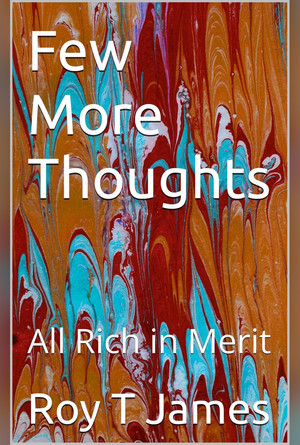
Few More Thoughts General Non Fiction by Roy T JamesFew More Thoughts
Reads:
3Pages:
43Published:
Jun 2026We all know, human society is a violent one, and there is nobody who is not concerned. Everybody has a remedy, and all of it borders on the abstract, where, b...
Formats: PDF, Epub
-
Sci-Fi Film Fiesta: The Swingin' 60s - Volume 8: Way Out Worlds- General Non Fiction by Chris ChristopoulosSci-Fi Film Fiesta: The Swingin' 60s - Volume 8: Way Out Worlds-
Reads:
0Pages:
77Published:
Jun 2026The eighth and final volume of Sci-Fi Film Fiesta: The Swingin' 60s takes readers beyond the boundaries of Earth and into the vast, mysterious reaches of spac...
Formats: PDF, Epub