

THE LONE WOLF (2025 Edition) by Michel Poulin - HTML preview
Download the book in PDF, ePub, Kindle for a complete version.
CHAPTER 2 – U-800
17:16 (Berlin Time)
Wednesday, February 13, 1941
Construction Slip Number 5, Krupp’s Germaniawerft Shipyard Kiel, Baltic coast of Germany
Ulrich Von Wittgenstein, Otto’s second in command, looked around with bewildered eyes as his new commander guided him and the 74 other designated crewmembers of the U-800 into the covered slip sheltering their new boat.
‘’Uh, where are all the shipyard workers, Kapitän? Shouldn’t the evening shift be taking over now from the day shift?’’
Otto gave the tall, aristocratic officer a resigned look.
‘’Believe it or not but there is no evening shift. There is also no night shift or weekend shift, just a weekday shift. I was as shocked as you are now on learning this the first time I came here, but it seems that our war industries are still on peacetime production routine.’’
‘’Peacetime production routine, Kapitän?’’ nearly exploded Franz Streib, the designated third watch officer. ‘’The British sure aren’t on peacetime routine these days. This is nonsense!’’
‘’I certainly agree with you on that, Franz. However, decisions concerning that matter are way over our pay grades. The good side of this is that we will be able to visit our new boat in relative quietness. Thankfully, Doctor Gustav Premingen, the designer of the U-800, seems to have a higher sense of work ethics than his colleagues in Kiel: he will be the one giving us the tour of our new boat.’’
‘’I can’t wait to meet that man, Kapitän.’’ said Von Wittgenstein. ‘’He must be a true genius and visionary, judging from what you told us about the U-800.’’
‘’And I am sure that he will be happy to meet you, Ulrich.’’ replied Otto Kretschmer with a malicious smirk. When the face of his first watch officer reflected confusion at that reply, Otto got closer to him and whispered in his ear.
‘’I can’t swear about this, but I believe that he is gay.’’
Otto then laughed briefly at the reaction of his subaltern, who recoiled in disgust.
14
‘’You can’t be serious, Kapitän!’’
‘’I am, Ulrich. However, that man, gay or not, has designed a revolutionary submarine which could just help us crush the British Navy and starve the British into submission, thus winning the war for us. So, please be polite to Doctor Premingen and do your best to ignore any advances he may make towards you. I’m serious about this, Ulrich.’’
‘’Uh, very well, Kapitän. I will do my best to be open-minded during this visit.’’
‘’Excellent! Aah, I believe that the good doctor is waiting for us at the entrance of the construction slip.’’
Ulrich Von Wittgenstein, like the rest of the crew, focused his attention at once on the thin, nearly ascetic man in his fifties with balding salt and pepper hair standing beside the two Kriegsmarine armed sailors guarding the entrance to the slip containing the U-800. Doctor Premingen was of medium height, wore thick glasses and was the perfect image of the scientist with no social life, something that was going to be called a ‘nerd’ decades in the future. Getting to him first, Otto Kretschmer shook hands with him after returning the salute of the two sentries.
‘’Doctor Premingen, it is nice to be able to meet you again. As promised, I have brought my whole crew with me, so that they could visit their new boat.’’
‘’And I will be happy to guide them around, Korvettenkapitän Kretschmer. If you will all follow me inside.’’
Premingen then opened wide the door guarded by the sentries and walked inside a cavernous space hidden from the outside world by large canvas tarps laid on its sides and ceiling. The 74 men of Otto’s crew stopped nearly at once at the sight of the big shape filling the construction slip. Herman Spielberger, the second watch officer, let out an exclamation as he stared at the hull of the submarine.
‘’Mein Gott! I have never seen anything like this before! It is nearly shaped like a sperm whale, except for that big topside kiosk, which looks like a truncated dolphin fin.’’
‘’That shape, which is admittedly very different from that of our other submarines, is meant to offer the least hydrodynamic drag possible in the water. In this, I indeed inspired myself from the shape of marine mammals and fish.’’ replied Premingen, sounding like a schoolmaster teaching a class of new students. ‘’The whole premise of my design was to produce a true submarine which would operate mostly under water, rather than as a submersible that would only dive to hide or attack.’’
15
‘’But, once submerged, its battery capacity would severely limit its endurance under water, no?’’
‘’True, and that still applies with my U-800. I however mostly got over that problem by using two things. Firstly, I adapted to the U-800 a recent invention from Dutch naval designers: the schnorchel. A schnorchel is basically a vertical tube sticking up from a submerged submarine and through which the diesel engines of that submarine can get their needed air, with a second tube used to evacuate the exhaust gases from the diesels. Now, the Dutch had not developed that concept in a manner I considered satisfactory, so I tinkered with it in depth while adapting it to my U-800. Instead of folding down on top of the upper deck of the submarine, something that made the schnorchel tube rather fragile and both slowed down the submarine and created much extra hydrodynamic drag, I designed a telescopic model of it. That model, which incorporates separate tubes for diesel intake, diesel exhaust and crew air ventilation, telescopes vertically out of the top fin structure and is surrounded by a hydro-dynamically-shaped support sleeve which both reduces greatly the drag when deployed and also masks the schnorchel head from enemy radar via a special rubber coating. The main problem associated with schnorchels, mainly the tendency of the diesels to suddenly suck in the air inside the submarine when their intake heads are temporarily covered by high waves, was eliminated by the use of a two-stage diesel air intake system, where the incoming air is first compressed inside a large tank, from which the diesels then extract the volume of air they need, and this without impacting on the ventilation air for the crew. The U-800 will thus be able to navigate at periscope depth most of the time, using its schnorchel to either run on diesel power or to recharge its batteries out of sight of enemy planes and ships. I also made sure that the schnorchel head would be well above most waves, so that it would not be affected by waves except the biggest ones.’’
Premingen then went on as the officers and men of Kretschmer’s crew looked at each other.
‘’Secondly, about the limit imposed by batteries, my solution was simpler and was one of brute force: I simply packed as much batteries as I could inside the U-800, in order to boost the endurance on batteries while deeply submerged. While your old Type VII submarine packed 124 battery cells inside its hull, the U-800 contains a total of 1,240 battery cells. Despite its displacement being six times that of a Type VII and being much longer and beamier, the battery capacity of the U-800, allied with its much more
16
streamlined, hydro-dynamically efficient shape and more efficient propeller, will allow it to attain top speeds underwater of well over twenty knots and to have a submerged endurance undreamed of in other types of submarines.’’
‘’TWENTY KNOTS SUBMERGED?!’’ exclaimed Von Wittgenstein. ‘’But with that kind of speed we could outrun many of the British convoy escort ships. And what kind of endurance are we talking exactly, Doctor Premingen?’’
‘’My calculations showed that the U-800 should have a deeply submerged range of at least 400 nautical miles at a speed of ten knots on batteries, enough to safely pass undetected a danger zone like, say, the Bay of Biscay. That figure is however purely theoretical and I was very conservative in my estimates. It will actually be your job to find out the true performances of the U-800, gentlemen. With this said, let’s go inside and see what this beast is made of.’’
As Premingen turned around and started walking towards a wooden staircase built beside the hull of the U-800, Von Wittgenstein noted the closed outer doors for eight torpedo tubes, visible on the bulbous bow of the submarine. That was twice the amount of bow torpedo tubes in his old Type IX submarine! The U-800 was already promising to be a formidable war machine.
With Otto Kretschmer and his crewmembers following him closely, Premingen climbed the staircase at a measured pace, then crossed the wooden bridge linking the top of the staircase to the upper deck casing of the U-800. Still followed by the crowd of submariners, he went to what appeared to be a large empty well on the forward part of the hull and pointed at the bottom of the well.
‘’What you see here at the bottom of this well is the pressure hull of the U-800, made of forty-millimeter-thick steel plates. That will give it an operational depth capability of 300 meters and a calculated crush depth of 450 meters.’’ Otto Kretschmer couldn’t help exclaim himself then, most favorably impressed by those numbers.
‘’Mein Gott! This means that we could safely dive to a depth that enemy depth charges can’t reach. If we get the time to dive deep, then we will basically be invulnerable to enemy weapons.’’
17
‘’That is correct, Kapitän. As for the well itself, it will house the main deck gun, a twin 10.5-centimeter SKC 33 dual purpose,
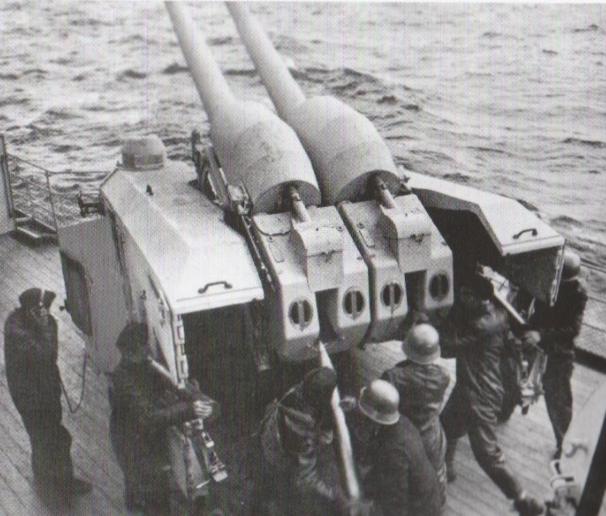
high-elevation gun, when retracted for submerged navigation, with a hydraulically-
powered deck cover plate then preserving the
smooth profile of the hull. The gun platform
itself, which will also support two armored,
waterproof boxes containing ready-to-fire
shells, will rise in seconds and emerge in the
open air when needed for surface combat.
Two similar but smaller wells, on the forward upper deck and on the stern upper deck, will each house a quadruple 20mm anti-aircraft cannon gun mount, while two twin 20mm cannon mounts will be sitting high in the sail. With its eight bow and four stern torpedo tubes, plus forty lateral launch tubes for TM-Series sea mines, the U-800 will be about the most powerfully-armed submarine in existence, gentlemen.’’ The designated chief gunner of the U-800, Fritz Lent, gave a surprised look at Premingen.
‘’This submarine will carry sea mines as well as torpedoes?’’
‘’It will! My goal when designing the U-800 was to produce a long-range submarine able to bring war to the enemy’s coasts, including North America. With it, you will be able to attack and harass enemy convoys right from the start, when they will emerge from Canadian ports or from Newfoundland’s ports.’’ While impressing the crewmen of the U-800, that declaration also somewhat threw cold water over them: operating close to the Canadian coast would put them well within the range of all the patrol aircraft based on Canadian soil or in Newfoundland, making such missions quite risky.
Going to the bow section, Premingen showed to Kretschmer and his men something that somewhat mystified them. A kind of surface ship’s bow that apparently could be retracted within the outer bow hull stuck above the deck and stood a good two meter-high.
‘’This is what I call a ‘false bow’ and I designed its concept in order to help the U-800 attain good speeds while on the surface while avoiding its bulbous bow to make it dig itself in incoming waves. The general shape of my submarine was optimized for
18
underwater navigation and was not ideal for surface navigation, so I designed my false bow to at least mitigate that problem. Without it, the U-800 would probably not have been able to exceed a speed of twelve or thirteen knots on the surface without constantly nosediving under the surface. With it, I am hoping to see my U-800 reach surface speeds of at least fourteen knots or more while keeping steady. However, I was not able to conduct test basin model studies as thorough as I wished, so it will be up to you, Herr Kapitän, to find that out during your sea trials.’’
‘’I will certainly test your submarine as thoroughly as it could be, Herr Doctor.’’ Nodding his head at that, Premingen then showed to the submariners the two forward hatches hidden under the deck casing at the bow which were meant to load fresh torpedoes aboard the submarine. Next, Premingen walked to the central fin, rising over six meters above the upper deck, and opened a large steel hatch cut in its frontal surface. Otto Kretschmer saw the designer hesitate for a moment before going through the hatch, prompting him to ask a question in a worried tone.
‘’Are you alright, Doctor Premingen?’’
‘’Er, yes, Herr Kapitän! To be honest, I suffer from a mild case of claustrophobia. This may sound ludicrous for someone designing submarines but I can’t help it.’’
‘’That is nothing to be ashamed of, Doctor. Many people I know suffer from claustrophobia.’’
Seemingly arming himself with courage first, Premingen then stepped into a shallow space between the frontal, unpressurized hatch and the much thicker heavy hatch which gave access to the inside of the submarine, followed closely by Kretschmer and his men. They found themselves nearly cramming to capacity what appeared to be a circulation space, with one large deck hatch, an access ladder and what looked like a lift cage visible to them.
‘’Immediately aft of this compartment are a number of small compartments containing various equipment and gear meant to be used on the surface, like inflatable boats, stocks of life vests and rescue gear. One deck down is the control room, which is presently empty and is still being fitted out. If you and your crewmembers could proceed downstairs, Kapitän, I will show to you and your officers the officers’ mess and cabins, situated one deck below us.’’
‘’Very well, Doctor.’’ said Otto before looking at his senior NCO. ‘’Oberbootsmann Lent, have the men come down one level and then wait for a moment.’’
‘’Yawoll, Herr Kapitän!’’
19
Now intensely curious, Otto followed Premingen down the access hatch, ending up in a sort of circulation space with a number of doors and one passageway visible. They then went to the first doors visible along the short passageway, which were actually closed by curtains rather than by door panels. The first door proved to be that of a still mostly empty small cabin with a single captain’s bed and a sink. Otto estimated its surface to be about seven square meters, which was utter luxury for a single man cabin aboard a U-boote. Hell, separate cabins were in fact unheard of in U-boote! His own ‘cabin’ on his U-99 had been a simple private space closed off by a curtain. That space had been in fact less than half the volume of the cabin Premingen was now describing.
‘’This is one of six cabins reserved for the junior officers of the U-800. They are still not fully furbished but each such cabin will contain a personal locker and one small work desk and chair, while the bunk bed includes four drawers under it and a reading lamp at its head. Near the entrance of this passageway, you will find a small bathroom with a toilet stall and a shower stall, plus two sinks, all reserved for junior officers. There are also three other, larger cabins reserved for senior officers, plus the captain’s suite.’’ Ulrich Von Wittgenstein, like the other six officers of the crew, grinned with contentment and exchanged approving looks with his comrades on hearing that: ‘comfort’ and ‘privacy’ had been up to now meaningless words aboard submarines, even for officers. As for the usual living conditions of the non-commissioned crewmembers, the word ‘Spartan’ did not even start to describe them in a realistic manner. In fact, ‘squalid’ would have been a better word.
The visit of the nearby officers’ mess and captain’s suite, situated aft of the still empty control room, cemented the contentment of Otto and of his officers, with the officers’ mess proving to be nearly as spacious as the one found on a frigate or destroyer, while the captain’s suite included a sleeping cabin, a work office and a private bathroom, the lot occupying an incredible twenty square meters of deck surface. Otto couldn’t help remark on that to Premingen.
‘’Did your claustrophobia push you into being this generous with internal spaces, Doctor? Isn’t such use of the available space going to impact negatively on the combat and propulsion systems?’’
‘’On the contrary, my dear Kapitän! Your missions at sea may go on for months at a time and anything that will preserve the moral and physical wellbeing of your crew can only benefit the combat efficiency of your boat. I visited many other U-boote before
20
and spoke at length with their crewmen, enough to see that the living conditions aboard our Type VII and Type IX are downright scandalous, something that has to affect severely the morale and efficiency of their crews. I thus vowed that any submarine of my design would pay proper care of its crew. As for the combat and propulsion systems, you will soon find out that I didn’t neglect them, on the contrary. I just used my imagination to find more efficient ways to pack things inside a submarine without it looking like a sardine can, which our other submarines are. Granted, most of the other designers and the managers of this shipyard called me names on seeing what they characterized as an ‘atrocious waste of internal space’ but Admiral Dönitz, who has experienced the living conditions at sea of submariners during the Great War, understood and accepted my point of view about this, especially after he saw what I did with the combat systems. Next, I would like to show to your men how they will be accommodated, Herr Kapitän.’’
‘’You are the guide, Doctor: you decide where we go. It is not as if we won’t be spending a lot of time soon exploring this boat and getting to know it in detail.’’
‘’True! We will thus go next to the crew’s accommodations, situated forward and one deck down.’’
Getting the rest of his crew to follow behind his officers, Otto followed Premingen down an unusually wide access ladder, ending up in a large and spacious compartment filled with long tables with fixed swiveling chairs, a number of counters and numerous storage cabinets.
‘’This is the crew mess, where your men will eat and relax. Up to 58 men will be able to sit here at a time and eat in proper conditions. No more eating while sitting on a torpedo. We will now go forward to the upper deck crew quarters.’’ Moving forward through a watertight hatch, the group ended up in another spacious compartment containing fifteen double bunk beds with drawers, thirty large individual effects lockers and one table with eight chairs. Otto nodded in approval as he looked around the compartment, while his sailors were left aghast with admiration.
‘’Not bad at all, Doctor! The men will be plenty satisfied with such facilities.’’
‘’This is just one of the four compartments used as crew dormitories, Herr Kapitän.’’ said proudly Premingen. ‘’There is a total of 78 bunks for sailors and petty officers in the forward sections of this submarine, plus 46 more bunks aft, to be used by embarked commando soldiers or passengers, like rescued sailors.’’
21
‘’Better and better.’’ said Otto. Premingen then led the group further forward in a compartment nearly filled with two huge steel casings, with ten single bunk beds lining the sides of the compartment.
‘’The upper torpedo storage room. The two casings you see are chain-driven torpedo storage carrousels, each containing up to sixteen torpedoes and sixteen TM-Series sea mines. Above us, retracted under the weather deck, is a loading crane meant to facilitate the handling of torpedoes during reloading operations on the surface. With the eight forward launch tubes, this will give you a total of up to forty torpedoes in the bow section. In the stern section, you will find four launch tubes, plus two torpedo carrousels, each containing eight torpedoes, for a total aft of twenty torpedoes. You will thus have a total capacity of sixty torpedoes aboard, Herr Kapitän, enough to decimate a whole convoy by yourself.’’
‘’Incredible! Something tells me that the British will get to positively hate this submarine.’’
‘’That is the whole point of my design, Herr Kapitän. I must point out that you will find both the torpedo carrousels and the torpedo launch tubes to be unusually long. That was intentional and I designed them that way so that each torpedo reload cradle can accommodate either one T7 torpedo and one TM-Series sea mine, or three TM-Series sea mines. There is also a total of sixty lateral launch tubes for TM sea mines atop the half section of this submarine. In my mind and that of Admiral Doenitz, bringing the fight all the way to enemy ports will be as important as sinking enemy ships. Let’s go back now and look in detail at the galley and at the boat’s infirmary.’’
Going through the upper dormitory and stepping inside the crew mess, Premingen
guided the group to the forward starboard part of the mess, where they found an enclosed, fully equipped kitchen. Otto couldn’t resist calling loudly for his designated senior cook, Matrosen Obergefreiter Dieter Hannig.
‘’HEY, SMUTJE1, COME ADMIRE YOUR NEW KINGDOM!’’ Hannig, a jovial Bavarian young man who had worked before the war in his Munich family restaurant, quickly waded through his crewmates and joined his captain at the entrance of the kitchen. His lower jaw dropped wide open as he eyed the fifteen-square-meter surface of what was going to become his work space.
1 Smutje: ‘Coal’ in German. Familiar nickname given to the cook aboard German submarines in WW2.
22
‘’Mein Gott! I will actually be able to walk across my kitchen, rather than bump from one corner to the other. There are even two refrigerators, on top of stoves, hot plates and electric ovens!’’
‘’There is actually a large pantry on the next deck below, along with a cold room, a walk-in freezer and a dry foodstuff storage room: easily enough volume to store up to four months of food.’’ said Premingen. ‘’You will find a bread oven at the back of your galley, so the men will be able to eat fresh bread every day. What many called ‘an extravagant waste of space’ was simply in my mind the correct answer to a major deficiency of our submarines, namely their lack of all-around endurance and crew amenities.’’
Kretschmer smiled and nodded his head at those words.
‘’And you were more than justified to design the U-800 the way you did, Doctor Premingen. This will work miracles for my crew’s morale and fitness during long war patrols. What next?’’
‘’We will have a quick look at the infirmary, just aft of the mess, then will visit the aft compartments containing the propulsion systems and auxiliary machinery.’’
‘’Excellent choice! Lead us, Doctor!’’
With Premingen still in the lead, the group went aft through a hatch and found itself in a fairly small but well-equipped infirmary containing an examination table and two beds for patients, plus a collection of lockers and shelves meant for medical equipment and supplies. There was even a small refrigerator meant to contain blood supplies. Doctor Konrad List, a World War One veteran and the designated medical officer for the U-800, eyed the infirmary with glee.
‘’A fully equipped infirmary…on a submarine! I am in Heaven!’’
‘’Wait till you see your cabin, Doctor.’’ replied a smiling Premingen, who then led him to a cabin adjacent to the infirmary and covering a surface of nine square meters. List’s jaw dropped on seeing the single bunk bed, storage locker and bathroom with toilet, shower stall and sink.’’
‘’Mein Gott! This is utter luxury!’’
‘’Not for a man who may be saving lives during combat cruises, Doctor. Next, we will visit the engine room. Be careful once in there, gentlemen: we will be standing on a gratings deck above the diesel engines.’’
23
Premingen led the group aft and entered a high-ceiling compartment nearly filled with four big diesel engines and two large tanks situated above the diesel engines and connected to them by pipes. Narrow gratings decks allowed men to circulate around the top part of the diesel engines and also allowed the group to go further half to the next compartment.
‘’The diesel room, containing four M.A.N. M6V 40/46 turbocharged engines totaling 7,800 shaft horsepower. Those diesels can either turn directly the propeller via hydraulic clutches and gearboxes, or be connected to eight SSW GU 365/30 electric motors which can function either as generators or as motors, depending on which shafts they are connected to. These motors, situated aft of this compartment, can provide a total of 14,800 kilowatts of propulsive power to a ducted dual contra-rotating centerline propeller.’’
‘’Nearly fifteen megawatts of electrical power for propulsion?!’’ exclaimed the designated chief engineer of the U-800, Oberleutnant Werner Jentz. ‘’But, that amount of installed power is completely unheard of!’’
‘’True, and it will help propel the U-800 at speeds underwater which you could only dream about up to now.’’
The rest of the tour took another hour and showed to Otto and his crewmen many more surprises and innovations due to Preminger’s genius. Now confident that they were going to have the ultimate tool for their tasks to come in the war, they returned after their guided tour to the Kriegsmarine barracks near the port, were they passionately discussed and commented as a group what they had seen. Then came time to go sleep, as they were scheduled to start tomorrow a long period of over seven months of theoretical learning and practical training, in order to be able eventually to use with maximum efficiency their new, revolutionary but also quite complex vessel. In the meantime, the war went on, as ferocious and bloody as before. Barely over a month later, Otto Kretschmer got the painful news that his old boat, the U-99, had been lost at sea, with many of his ex-crewmen killed in action, while a good friend of his, Joachim Schepke, was lost the same day with the whole crew of his U-100, sunk by a British destroyer. More losses followed in the next few months, while the British received more and more aid from the United States, some of it barely covert. It soon became evident to Otto that the U-800 was going to be sorely needed soon in the fight at sea if the German submarine arm was to prevail in the long run in the Atlantic.
24
25