THE LONE WOLF (2025 Edition) by Michel Poulin - HTML preview
Download the book in PDF, ePub, Kindle for a complete version.
CHAPTER 7 – HAPPY TIMES IN AMERICA
08:26 (Paris Time)
Tuesday, December 9, 1941
Pen Number Three, Keroman I submarine bunker complex Port of Lorient, coast of Brittany, France
The few sailors present on the deck casing of the U-800 and busy loading various supplies aboard the submarine came to attention and saluted when Admiral Karl Dönitz came down via the gangway. Dönitz returned their salutes, then looked at the most senior submariner present.
‘’Where could I find Kapitän Kretschmer, Bootsmann?’’
‘’I believe that he is down in the stern torpedo tubes compartment, Herr Admiral.’’
‘’Good! Please show me the way.’’
‘’Right away, Herr Admiral!’’
Following the submariner through the forward hatch of the conning tower, Dönitz went down to the crew mess, on the Main Deck, before heading aft. Crossing the deck gratings running around the four big diesels of the U-800, Dönitz next went through the combat divers’ compartment, with its big diver’s airlock chamber along its port side, before stepping inside the aft torpedo room proper. He then saw Kretschmer, his back to him while he watched a pair of technicians working on one of the two big torpedo carrousels. The sailor who had guided him then shouted to warn his captain.
‘’ROOM!’’
Turning around at once, Kretschmer promptly saluted his commander, while the technicians stood at rigid attention.
‘’Admiral?!’’
‘’At ease! Continue your work, men. Could I speak with you in private, Herr Kapitän?’’
‘’Of course, Herr Admiral! Will my cabin do?’’
‘’It will be perfect. By the way, what are these men doing, if I may ask?’’
83
‘’They are repairing one of the two aft torpedo carrousels, Herr Admiral. Something was making it difficult to rotate it but the cause has been identified and it will soon be back in good order.’’
Dönitz nodded his head, pleased.
‘’Excellent! As a matter of fact, you will soon need all of your torpedoes during your next mission. Let’s go to your cabin to talk about it.’’
The two men were soon alone in Kretschmer’s work office, with its door firmly closed. Inviting Otto to sit near him at the small work desk of the cabin and sitting himself in the padded sofa facing it, Dönitz took out of a vest pocket a fairly thick envelope, giving it to Otto.
‘’Here are your new mission orders: your general objective area has both changed and expanded. I suppose that you heard about the Japanese attack against the American naval base in Pearl Harbor, in Hawaii?’’
‘’Who hasn’t, Herr Admiral?’’
‘’True! Know that Berlin has advised me via a directive that is for the moment still confidential that Germany will be declaring war to the United States in the next couple of days and that my command is to be ready to hit American shipping along their East Coast as soon as we have submarines in that area. You will be my vanguard off the United States and in the Caribbean, my dear Kretschmer.’’
‘’There are a lot of countries within the Caribbean and along the coasts of the Gulf of Mexico that are still officially neutral, Herr Admiral. What will I be allowed to attack over there that does not fly an American or British flag?’’
‘’Quite a lot, actually. Our embassies are already picking up signs that many of the countries in the Caribbean and in Central and South America are about to side with the United States and against us in this war. Within a few days, I will have a precise list of who you can strike and in what circumstances. However, irrespective of in which waters or port you will find them, American, British and Canadian ships, both merchantmen and warships, will be fair game for you. In view of the percentage of war supplies and of fuel that the Allies are getting from the Caribbean Basin and Gulf of Mexico areas, you should find there plenty of juicy, legitimate targets for your torpedoes. Your only true worry, apart from enemy warships and patrol planes of course, will be your foodstuff, torpedo and fuel status. Unfortunately, the supply ships we had in the Atlantic have been either found and sunk by the Allies, or are now in the Indian Ocean,
84
so I won’t have any ship available to resupply you on the spot there. You will thus have to husband your fuel and torpedoes and make them count.’’ Otto thought about that for a few seconds before asking a question in a cautious tone.
‘’What about if I play by the old rules of past privateers, Herr Admiral?’’
‘’What do you mean, Kretschmer?’’
‘’That, instead of sinking immediately every enemy merchantman I will be encountering, that I stop and board isolated cargo ships and use their fuel and food supplies to replenish my boat. That will leave only my reserve of torpedoes as a limiting factor for the duration of my war patrol. I will of course exercise due caution in choosing my preys to be boarded and will jam their radios in advance of boarding, then will destroy their radios.’’
‘’Hum, that could be quite risky but it could effectively stretch the duration of your patrol by a significant factor. You will however need to carry with you some extra equipment, like portable pumps and fuel hoses and a few inflatable boats, plus extra small arms. I can get those things for you within a day.’’
‘’Thank you, Herr Admiral. Uh, do we have any kind of combat troops in the Kriegsmarine similar to the British Royal Marines? Having professional infantrymen with a good sailor footing would be a definite plus for such boarding operations. I presently have ten spare bunks available which were originally meant to accommodate shipwreck survivors, or spies being transported on overseas missions.’’ It was the turn of Dönitz to think over his answer.
‘’We don’t have any such troops in the Kriegsmarine, unfortunately. We would thus have to get the use of either Army soldiers or of Luftwaffe paratroopers. I however agree with you that such soldiers could come handy for your patrol, especially if you intend to sabotage Allied ships in neutral harbors. I will try to arrange something quickly within two days. After that, you will have to sail for America, with or without soldiers. In the meantime, I will pass the word that you are to be supplied with anything you will ask for, and this without delays or questions. I will want you to come visit my intelligence section tomorrow. There, you will get maps, charts and intelligence data on your new patrol area.’’
‘’I will be there, Herr Admiral. Thank you for your support.’’
‘’You can thank me by sinking many enemy ships, my good Kretschmer.’’ replied Dönitz, a smile appearing on his face.
85
22:09 (Paris Time)
Wednesday, December 10, 1941
U-800, Keroman I submarine bunker complex
Lorient, coast of Brittany, France
Otto was in his office, reviewing for the second time the lists of supplies, equipment, spare parts and ammunition which had been loaded aboard his submarine in advance of his incoming war patrol, when someone knocked on the door, making Otto shout out.
‘’COME IN!’’
He looked up towards the door of his office in time to see his second-in-command, Ulrich Von Wittgenstein, open it. Wittgenstein then stepped inside the cabin, closely followed
by a young Heer3 lieutenant in camouflage pattern combat uniform. Both of them saluted Otto as the latter got up from his chair.
‘’Kapitän, seven men of the Heer have arrived to serve on our submarine. I brought their leader with me.’’
The Heer lieutenant clicked his heels and spoke up in a strong, firm voice.
‘’Leutnant Hugo Margraff, of the Brandenburg Regiment, reporting with six men for duty on the U-800, at the request of Admiral Dönitz.’’
Otto went around his desk and walked to him at once to shake hand with Margraff.
‘’And I am Korvettenkapitän Otto Kretschmer, Captain of the U-800. I am happy to see you and your men, Leutnant Margraff: you will make ship boarding operations a lot easier for me down in the Caribbean. Did you bring with you some special equipment or weapons which will need to be stored aboard?’’
‘’We did bring extra equipment and ammunition, including explosives, Herr Kapitän. We also had a pair of pneumatic boats with us but we were just told that you have already two such boats aboard.’’
‘’Hum, true, but I would still be more comfortable with four boats rather than two. Ulrich, go see if those two extra boats can be accommodated inside our two conning tower storage areas, then lead Leutnant Margraff’s six men to the bunks in the aft torpedo room section. As for the good Leutnant, I will install him in our spare junior officer’s cabin. Leutnant Margraff, if you will follow me.’’
3 Heer: German Army
86
With Margraff following closely behind him, Otto walked out of his office and went next door to the junior officers’ quarters section, pulling open the curtain door of one of the four officer’s cabin along that short passageway. Margraff opened his eyes wide on seeing the small but comfortable room.
‘’Mein Gott! This is much nicer than what I saw in the one submarine I visited once.’’
Otto couldn’t help grin at that remark and briefly stopped, turning to look at the Heer junior officer.
‘’Wait until you see the officers’ wardroom, Leutnant Margraff. The U-800 is the sole existing example of the Type XX submarine and is effectively much more spacious and comfortable to live and work in than the previous types of submarines in the Kriegsmarine. You and your men can count yourselves lucky to end on this boat rather than in a Type IX boat. However, know that the U-800 is as deadly for the enemy than it is comfortable for us.’’
‘’You definitely will need to tell me more about your boat later on, Herr Kapitän.’’
‘’And you will have to tell me more about you and your men, Leutnant Margraff.’’ replied Otto, becoming serious again. ‘’We will be counting heavily on you for any future boarding of enemy merchant ships around the American East Coast and in the Caribbean Sea. Drop your kit and weapons in a corner of this cabin for the moment, then we will go back to my office to talk.’’
‘’It won’t be long, Herr Kapitäan.’’ promised Margraff before entering the cabin and piling in one corner his military backpack, kit bag, steel helmet, web gear and weapons. He couldn’t help nod in approval while eyeing the double locker, one sink, a small work desk with chair and captain’s bed filling the small cabin. He however kept his comments in and followed Otto back to his office, where he was told to sit on the comfortable sofa in the room, while Otto sat back at his desk.
‘’So, Leutnant Margraff, tell me about you, your men and your unit. I have to say that I never heard of the Brandenburg Regiment before.’’
‘’That is most understandable, Herr Kapitän: few people actually know about it. It
is a light infantry unit subordinate to the Abwehr4 and it specializes in covert military operations and raids behind enemy lines. We are rightly considered an elite unit and we
4 Abwehr: German Army Intelligence service during World War 2.
87
were active right from the start of the war, first in Poland, then in Belgium and Holland. Men from the Brandenburg Regiment, then a battalion, went ahead of our Heer troops in 1940 and seized important bridges and other valuable installations behind enemy lines before the enemy could blow them up. We often work while disguised as enemy soldiers and all of our men know at least one foreign language. As for me and my men, we can all speak English fluently with little or no accent, while a few of us know also either French, Dutch or Spanish. Personally, I speak fluently English and Dutch, plus can understand French. My sub-unit, the coastal raider platoon of the Brandenburg Regiment, is specially trained in coastal infiltrations, amphibious operations and small boat handling.’’
Otto nodded his head, thoroughly impressed. He could also see the ribbon of the Iron Cross First Class on the uniform jacket of Margraff: the man was no blowhard.
‘’I see that Admiral Dönitz got us the very best, Leutnant. Now, about the U-800 and me. One of my nicknames in the Kriegsmarine is ‘The Tonnage King’, because I sank more enemy ship tonnage than any other U-boot captain in this war. My title was further reinforced by my last war patrol in October and November of last year, which was the first war patrol of the U-800. During that war patrol, we sank forty enemy merchant ships and twelve warships, including the battleship KING GEORGE V, the aircraft carrier VICTORIOUS and the American light carrier USS RANGER, sunk off Halifax. To be fair, our expertise and experience were only parts of the reasons for our tremendous successes on that patrol. The U-800 itself made a huge difference, with its much higher submerged speed and endurance and its huge torpedo capacity. Right now, we are about ready to leave for our next war patrol in American waters with a total of sixty torpedoes and forty sea mines aboard, plus plenty of ammunition for our 10.5-centimeter twin deck gun, two quadruple 20mm flak mounts and two twin 20mm FLAK 38 cannons. While we will eventually run short of torpedoes during our patrol far from Europe, I intend to use them sparingly, thus expect to run short of fuel and fresh food first. That’s where you and your men will become important, Leutnant Margraff. While we will avoid bombarding coastal installations of nations that are still technically neutral in this war, I intend to attack enemy merchant ships anchored in or off neutral ports. One way to do that while avoiding angering those neutral governments will be to board them discreetly, take control of them and resupply ourselves in food and fuel directly from those seized enemy merchantmen. We will then scuttle them after letting their crews off safely. One thing we will keep an eye for while doing such boarding operations will be for any cargo
88
of strategic metals or rare materials, like chromium, nickel, tungsten, rubber and the likes. While space is still tight on the U-800, we do have some spare space that we can make for cargo considered valuable enough. Your job will however be mostly limited to the initial boarding and seizure of the ships, plus guarding of the enemy crews while my men do the plundering and fuel transfer. One important note: I personally believe in fighting a clean war as much as possible, so I will expect you and your men to respect the laws of war, except for the bit about tricking the enemy by wearing their uniforms to infiltrate them and take them by surprise. You have my blessing to deal with anyone trying to resist by force, but no unnecessary violence against unarmed civilians, please. Do you understand me on that, Leutnant Margraff?’’
‘’Perfectly, Herr Kapitän! We in the Brandenburg Regiment can be ruthless when needed, but we are no murderers or butchers. Admiral Canaris, who commands the Abwehr, would not condone the massacre of prisoners anyway.’’
‘’Excellent! Now, can you tell me what kind of equipment you brought with you, apart from your individual weapons and ammunition?’’
‘’Well, first, we have the two inflatable assault boats that I mentioned earlier. We came with complete frogmen’s suits and closed-circuit breathing apparatus. We also brought plenty of explosives and detonators, in order to do demolition work or to scuttle a ship. Next, me and each of my men brought in our kit bags a variety of disguises, including British, American and even Dutch uniforms, in order to better take enemy merchant ships by surprise. Finally, we brought plenty of ammunition and grenades, plus two backpack VHF radios and two signal lamps.’’
‘’That should do just fine, Leutnant. Now that this is covered, we will go see how your men are fitting in their new accommodations in the aft torpedo section.’’
Leading Margraff, Otto left his office and entered the officer’s wardroom. Margraff nodded in approval as he eyed the big dining table and the sofas of the wardroom, then followed Kretschmer down a nearby hatch, climbing down a ladder that brought them to the combat divers’ compartment, on the Upper Deck, with its big divers’ airlock. Going aft through another hatch, they then entered a long but fairly narrow space containing individual lockers and five double bunk beds. On seeing the two
89
officers enter, Unteroffizier5 Franz Stein, Margraff’s senior NCO, called the group to attention at once and saluted him and Otto.
‘’Sirs!’’
‘’At ease!’’ replied Otto, returning the man’s salute. ‘’I am Korvettenkapitän Otto Kretschmer, Captain of the U-800. What do you think of your accommodations up to now, men?’’
‘’They actually came as an agreeable surprise, Herr Kapitän.’’
‘’Good! You will next be given a complete tour of the boat once your men will have finished making themselves at home. I will see you again tomorrow morning at four, when we will depart on our war patrol. That may be the last time you will see the open sky for quite a few days. We will discuss our offensive strategy after that, while transiting at schnorchel depth. On this, have a good night, Leutnant Margraff.’’
‘’You too, Herr Kapitän.’’ replied the Heer officer, saluting Otto, who saluted back before leaving the compartment.
04:04 (Paris Time)
Thursday, December 11, 1941
Conning tower of the U-800
Port of Lorient
Otto, standing in the open bridge atop the conning tower of his U-800, gave a last salute to Admiral Dönitz, who was present in the first rank of onlookers on the concrete quay, as the submarine slipped slowly out of its protective pen and started to emerge in the open. Then, he found himself staring at a dark, cloud-covered night sky as two gunboats escorted the U-800 out of Lorient Harbor. Leutnant Hugo Margraff, standing next to him, spoke softly after a minute of silence.
‘’I now understand at least partly the feeling you must have when leaving for a long sea patrol, Herr Kapitän: it is a bit akin to what me and my men feel when going deep behind enemy lines for days and even weeks. You can count only on yourself to survive, do the job and then come home intact.’’
‘’That is very true, my dear Margraff. You and your men better enjoy this last hour on the surface: once we dive, you will not breathe fresh open air again for at least
5 Unteroffizier: German Army rank equivalent to sergeant.
90
two weeks, if not more. And please remind them that they can’t smoke inside the submarine or on the deck, within sight of possible distant observers. They will have to use the smoking lounges for that.’’
Margraff gave Otto an amused smirk at those words: the ‘smoking lounges’ were actually a pair of pressurized compartments, situated at the base of the submarine’s conning tower, and which were next to the boat’s evacuation stations. It had a number of thick, small diameter ports which gave a view of the outside, even when under water, and had its own air ventilation and filtering unit to eliminate as much as possible tobacco smoke.
‘’I will pass the word, Herr Kapitän.’’
Margraff then went inside the submarine, using the armored hatch on the side of the forward underwater observation dome tower. Forty minutes later, the topside of the submarine was evacuated and all hatches firmly closed, then the U-800 slipped under the waves to hide from enemy patrol planes before the Sun could come up.
10:07 (Mid-Atlantic Time)
Control room of U-800, navigating at periscope depth Atlantic Ocean, southwest of the Azores
Oberfunkmaat Eberhard Stamp, the chief radio operator of the U-800, came to Otto’s side as the latter was examining the chart on the navigation plotting table in the control room and presented him with a two-page document.
‘’A general distribution message from Lorient headquarters, Herr Kapitän.’’
‘’Thanks, Pusher6!’’ replied Otto while taking the message. He read it once before switching on his ship intercom box.
‘’Leutnant Margraff is requested in the control room. I say again: Leutnant Margraff is requested in the control room.’’
It took only two minutes before Hugo Margraff showed up, presenting himself at attention and saluting.
‘’You asked for me, Herr Kapitän?’’
‘’Yes, I did, Leutnant. We just got a message listing the countries around the Caribbean and South America which declared themselves neutral or declared war with
6 Pusher: Nickname given to the radio operator aboard German submarines of WW2.
91
Germany. I believe that it will greatly clarify what kind of liberty of action we will have towards those countries when we get there. Here is the message.’’ The young Heer officer took the message and read it quickly, nodding his head at the end of his lecture.
‘’So, apart from the British West Indies, Dutch West Indies, Puerto Rico and the United States, the countries which are now officially at war with us are Costa Rica, Cuba, the Dominican Republic, El Salvador, Guatemala, Haiti, Honduras, Nicaragua and Panama. I suppose that this means that their ships, ports and territorial waters are now fair game for us, right?’’
‘’Correct! However, a number of the countries which declared themselves neutral did break all diplomatic relations with us or openly support the British and the Americans, thus making them less than friendly for us. For those countries, meaning Colombia, Mexico, Peru and Venezuela, our orders are to avoid directly attacking their ports and coastal installations. We are however permitted to attack enemy ships that are within their territorial waters or at anchor in their ports and anchorages. You and your men will become especially useful around those four countries. As for friendly or sympathetic nations, we can count only on Chile and Paraguay.’’
‘’Humph! It is nice to see that we have so many friends around there.’’
‘’Isn’t it?’’ replied Otto in a sarcastic tone. ‘’Well, we will reward those who deserve it the way they deserve, with either a handshake or a torpedo, my dear Margraff.’’
16:14 (New York Time)
Wednesday, December 24, 1941
Aft torpedo carrousels room, U-800
Near the entrance of Chesapeake Bay
Coast of Virginia, United States
Gefreiter7 Heinrich Bayerlein, of the Brandenburg Regiment, couldn’t help snap his fingers as he followed the beat of the American Jazz music piped across the submarine. They had been able to receive American radio shows and music for a good two days now, something that had helped spice up the monotonous routine aboard the
7 Gefreiter: German Army rank equivalent to corporal.
92
submarine. Right now, Bayerlein was watching a mean game of Skat, a very popular card game in Germany, between two of his comrades and two sailors who were using the small table found in the compartment. To his disappointment and that of his companions, the music abruptly ended, to be replaced by an announcement by Kapitän Kretschmer.
‘’Attention all hands, this is the captain. We are about to approach our first objective of this patrol. Everybody is to go to battle stations and to switch to silent running.’’
The sailors in the torpedo carrousel compartment immediately got up and retrieved the deck of cards, putting it away in a locker before going aft to their posts in the stern torpedo room. As for the six men of the Brandenburg Regiment, they did as they had been told a number of times to do if a call to battle stations was heard: they sat either on their bunks or at the table and kept out of the way of the sailors while staying quiet. The whole crew had been told a few hours ago that they were now approaching the American East Coast, so no one was surprised now to be called to battle stations. In fact, it restored a sense of purpose in the men after those two weeks spent underwater at sea. One of the sailors then started gesticulating while looking at the Heer soldiers, who understood after a couple of seconds that he was enjoining them to put over their boots the special felt slippers used by submariners to move more quietly. Crawling on their fours to their kit lockers, the Brandenburg men took out of them the said slippers and put them on, then returned to their various places. The ventilation system had by now stopped and the only noise they could hear was the weak humming from the electric propulsion motors of the submarine and a sort of barely audible noise of flowing water that came from the big contra-rotating ducted propeller. The men in the compartment then settled into a tense, nervous wait.
About 35 minutes later, the noise of approaching ship propellers started to be heard, apparently coming towards them. The men tensed up more as the swishing noise got progressively louder, to finally be heard right overhead.
‘’Himmel!’’ said in a near whisper Gefreiter Karl Haussmann. ‘’Are they going to drop depth charges on us?’’
‘’We’ll know soon enough, Karl.’’ replied Franz Stein. ‘’Now, keep quiet!’’ To their relief, there were no resounding underwater explosions around them, while the propeller noise gradually weakened. They thought themselves safe then, until a second
93
set of propeller noise grew, reviving their nervousness. That second set passed overhead, then faded as well, only to be replaced by a third set of screw noise. Seeing the nervousness of the Heer men, one of the senior sailors took on him to go see them, walking quietly to them and crouching near their group with a reassuring smile on his face.
‘’Don’t worry, guys: those ships passing overhead did not hear or detect us. If they would have, we would have gotten a few depth charges on our heads already.’’
‘’Where are we exactly?’’ asked Obergefreiter8 Michel Drücker. ‘’There seems to be a lot of ship traffic around here.’’
Somehow, his nervous question seemed to amuse the sailor.
‘’Of course there will be lots of ship traffic around here! We are near the entrance to Chesapeake Bay, on the coast of Virginia.’’
‘’So?’’
‘’So, on the other side of that entrance is the biggest American naval base on the Atlantic coast.’’
‘’What?!’’ nearly exploded Drücker, barely keeping his voice low. ‘’And what are we doing here, near such a big naval base?’’
‘’Hey, did you forget that we are on Christmas Eve? We have gifts to give to the United States Navy.’’
The sailor then returned to his post, giggling to himself and leaving the soldiers mystified and uncomprehending.
Maybe ten minutes later, the submarine performed a noticeable ninety-degree turn to the left, or port in marine jargon. Not long after that, the Heer soldiers nearly jumped when a strong sudden noise of compressed air being released for a second was heard, coming from their submarine. More similar noises followed at intervals of about 45 seconds. Drücker counted ten such blasts of compressed air before the submarine performed a wide half turn to go back on a parallel course. Again, ten blasts of compressed air followed at regular intervals, then the submarine did yet another half turn, followed by ten more blasts of air, before doing a final turn and picking up a bit of speed while staying mostly silent. Unable to resist his curiosity, the soldier walked quietly to the sailor who had come to speak with his group earlier on.
8 Obergefreiter: German Army rank equivalent to master corporal.
94
‘’Can you tell me what the hell is going on, man?’’
‘’But I told you already: we came to drop Christmas gifts for the American Navy.’’ said the sailor before becoming more serious. ‘’Look, there is no need to be nervous. We just sowed thirty sea mines across the mouth of Chesapeake Bay, in the entrance channel used by American warships. The idea is to set a trap for them when they will run out of their harbor at top speed to respond to our future actions. Now, we are going to head towards the entrance of New York Harbor, to start picking up juicy targets there for our torpedoes. That is if the captain’s plan has not been changed in the last few hours.’’
‘’What if the Americans sweep the entrance channel with minesweepers before coming out?’’
The sailor gave a dubious look at Drücker then.
‘’If you are a policeman sitting in his police station, would you watch where you step when you run out after receiving a call about a burglary in progress?’’
‘’Uh, I suppose not.’’
‘’Neither will the Americans and they will end up stepping in our dog poop big time, mark my words.’’
Less than seven hours later, as he was heading towards New York at twelve knots while at schnorchel depth and going on diesels, Otto raised his search periscope above the waves in response to a hydrophone report about a large ship about to cut across his path a few kilometers ahead. Expecting to have a hard time finding that ship in the dark night, he was both surprised and shocked to spot it at once: it was sailing with all its lights on! Otto frowned at that, having expected the Americans to enforce a general night curfew now that they were at war. A brief look at the American coast nearby told him that it was not so. His confused look attracted an alarmed question from Ulrich Von Wittgenstein, who had been plotting their position.
‘’Is something wrong, Herr Kapitän?’’
‘’With us, no! With the enemy, definitely! Come and have a look around.’’ Intrigued, his second-in-command came to the periscope and took his place before doing a sweep of the horizon. When he looked at Otto again, it was with incredulity on his face.
‘’The Americans are not enforcing a night curfew of their coastal towns and ships? Are they mad or just stupid?’’
95
‘’More like amateurs at the business of war.’’ replied Otto in a somber tone. ‘’I believe that we will have to awaken them to reality. Prepare Tube One for firing!’’
An old couple sitting on the porch of their house facing the sea near Ocean City, Maryland, suddenly saw a flash of light far at sea. A distant fireball then rose in the night sky as the two old Americans fixed it with their tired eyes. The noise of an explosion came only after long seconds, prompting a question from the old woman to her husband.
‘’What could that be, Mark?’’
‘’Uh, I frankly don’t know, dear.’’
‘’Could it be something serious?’’
‘’On Christmas Eve? What could happen now that would be serious?’’
After sinking his first ship off the American coast, a large tanker which burned fiercely before going under, Otto continued on his way to New York but kept encountering ships of all types and sizes along his route, all of them illuminated as if they had not a single care in the World, while all the towns and fishing ports along the coast were lit up. He even saw a display of fireworks fired above a town at midnight, probably to celebrate the coming of Christmas. Shaking his head at such lack of concern and common sense, he picked the juiciest-looking target within his sight and fired a carefully aimed torpedo at a big cargo ship heading the same way he was, ripping away its propellers and rudders and making it stop dead in the water while sinking by the stern. Otto had ample time to record the name and port of call of the ship in his log and to take a picture of it before it sank under the waves in plain sight of a brightly lit American coastal community less than eight kilometers away. His third victim, a Panama-registered tanker ship, came less than half an hour later, broken in two and sunk by a single torpedo.
03:27 (New York Time)
Thursday, December 25, 1941
United States Atlantic Fleet Headquarters
Norfolk, Virginia
‘’Sir, we have another message from the Coast Guard about a ship sinking, presumably from a torpedo attack.’’
96
Commander Emmett Waddington the Third, the duty operations officer present in the Fleet Command Center at this early hour on Christmas Day, took the message handed to him by a young ensign from the Transmissions Department and read it quickly before giving it back with a dismissive gesture.
‘’Probably someone who celebrated too much and hit a rock. The Coast Guard got the initial call, thus let them handle it.’’
‘’But, sir, this is the second such message in less than two hours, from the same general area. It can’t be a mere coincidence, sir.’’
Waddington, who was still pissed at having been put on duty on Christmas Day while all the other senior officers of the headquarters had gone on leave, threw an annoyed look at his subaltern.
‘’And your vast experience is telling you that, Ensign Farrell? Tell the Coast Guard that it’s their problem, not ours.’’
The young ensign, still believing that this was serious but unable to convince his superior, returned to his radio room, hiding his frustration.
04:19 (New York Time)
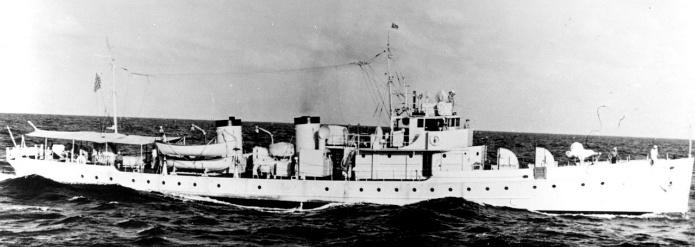
U. S. Coast Guard Cutter ICARUS
(WPC-110)
Off Atlantic City
‘’FLAMES VISIBLE ON THE HORIZON AT ELEVEN O’CLOCK, SIR!’’ Lieutenant (Navy) Maurice D. Jester ran to the port side open bridge wing on hearing the lookout’s warning and raised his binoculars to his eyes. Jester knew well the local waters and knew that there were no submerged rocks in this area. This was also the third time that a distress signal had been received by the Coast Guard in this area tonight. Something a lot more sinister than a simple reef was causing those distress signals.
‘’ALL CREW TO ACTION STATIONS! PREPARE FOR ANTI-SUBMARINE ACTION! HELM, STEER PORT BY TEN DEGREES! ENGINES TO FORWARD FULL!’’
As the crew of his small, fifty-meter-long coastal patrol boat ran to their battle stations, Jester thought about his next actions. His ship had a small radar and a sonar set, plus
97
one three-inch gun, one depth charge projector and two depth charge tracks, but a German submarine was an opponent that you dismissed only at your own peril. That opponent had already hit three merchantmen in the area, maybe more, and it was both his job and his duty to stop it before it could do more damage.
Rushing in at its top speed of sixteen knots, the American patrol boat was soon approaching the scene of the sinking, with burning fuel floating on the ocean and with debris scattered on the surface. As it was less than 300 meters from the debris and flames, the crew of the ICARUS suddenly saw the flash of an explosion in the direction of New York Harbor, maybe five kilometers away. That flash was then followed by a brilliant fireball, then by the noise of a powerful detonation fifteen seconds later.
‘’Damn! A tanker must have been hit over there.’’ muttered Jester to himself before shouting an order to his helmsman.
‘’NEW HEADING: 348! FULL SPEED AHEAD!’’
As his helmsman obeyed him and turned his ship around, Jester had a glimpse of a body floating face down in the water, maybe a hundred meters away, as one of his projectors was sweeping the surface of the sea for survivors. The projector beam quickly came back to the corpse, then searched around it for men who still could be saved. Unfortunately, there were none to be found, something that didn’t surprise Jester: the frigid December waters would kill by hypothermia any swimmer who would not be rescued within minutes. The sight of that corpse however reminded Jester that this was about a lot more than just some ship being lost. The wives and children of the crewmembers of the ships sunk tonight by that presumed German submarine would soon enough learn that they had lost their loved ones at sea, and this on Christmas Day!
‘’Chief Pettigrew, send the following message to our base in New York: have found site of recent sinking, with no survivors in sight. Am now prosecuting a probable enemy submarine who has just attacked another ship in proximity. Request support. Add our position and send as quickly as possible.’’
‘’Right away, sir!’’ replied the veteran Coast Guard man before disappearing inside the radio room situated aft of the bridge. He reappeared six minutes later, as the ICARUS was still a few minutes away from what looked like a burning tanker ship cut in two and sinking.
‘’Message sent, sir!’’
98
‘’Good! Tell our gunners to load our three-inch gun with armor-piercing shells and tell our depth charge men to set their hydrostatic detonators to a depth of sixty feet. In these shallow waters, a submarine won’t be able to dive much deeper than that.’’
‘’I’m on it, sir!’’
Jester’s next order was to his sonar operator, telling him to start searching on active pinging mode for a submarine, then telling his radar operator to look for any small echo which could be coming from an emerged periscope. If, as it had happened often in the past months with British Atlantic convoys, that submarine chose to attack while surfaced, in order to gain speed and to be able to use its deck gun to finish off its preys, then his radar would be able to find it, hopefully before that submarine could see his cutter.
04:28 (New York Time)
Control room of U-800
‘’Active pinging now coming from Bearing 087, Herr Kapitän.’’
‘’Thank you! I have that ship in my sight right now: it is being silhouetted by the burning fuel floating around that sinking tanker. Hmm…looks like a small coastal patrol ship, about forty to fifty meters in length. Two low funnels amidships, raised forecastle with one open gun mount and bridge superstructure just at the forecastle break.’’ Maschinen Obergefreiter Wolfgang Leeb, who was standing on the opposite side of the attack periscope, flipped quickly the pages of the ships’ recognition book he held in his hands, looking carefully at one page before passing to the next one and then speaking while turning around the book so that Otto could look at the ship silhouette on that page.
‘’Got it, Kapitän!’’
Otto needed only a quick glance before he nodded his head.
‘’That’s the one! THETIS-Class American Coast Guard cutter. It has radar, sonar and depth charge tracks, plus one 75mm gun. Hmm…it also has quite a shallow draught. BOW TORPEDO ROOM: SET TWO EELS ON MAGNETIC FIRING AND DEPTH OF SIX METERS!’’
Otto then looked at Leeb with a sober expression.
‘’Time to see if the recent modifications to our torpedoes have truly corrected their problems with their magnetic detonators.’’
Leeb nodded, understanding too well what Otto was alluding to: the first months of the war had been very frustrating to German submariners, thanks to defective contact and
99
magnetic detonators which had resulted in up to forty percent of torpedoes fired either failing to explode on contact or detonating prematurely due to overly sensitive magnetic sensors in their warheads. Otto then returned his eyes to his periscope’s aperture.
‘’Target bearing, relative: 016! Set!’’
Hermann Spielberger, the watch officer sitting at the torpedo fire control station, entered at once that data.
‘’Set!’’
Otto then waited ten seconds, with the top of his attack periscope lowered below the waves, before raising it again.
‘’New relative bearing for target: 013! Set!’’
‘’Fire control solution calculated, Herr Kapitän.’’
‘’Then, match bearing and fire Tube Two!’’
‘’Firing Tube Two!’’
On the ICARUS, Jester was scanning the night with his binoculars, trying to find survivors from the burning and sinking tanker ship, when his radar operator called to him.
‘’Sir, I just got a weak, intermittent radar contact from Heading 260, distance of approximately half a mile.’’
Jester immediately walked to the radar console, set in a corner of the bridge.
‘’Could it be a submarine periscope?’’
‘’Uh, I don’t know, sir: it was very small and faint, even for a submarine periscope.’’
Neither the operator nor Jester could know then that the periscopes and schnorchel masts of the U-800 were covered with special anti-radar coating which greatly diminished their radar signatures. However, Jester didn’t take any chance then, activating his intercom.
‘’Sonar, do an active ping to Heading 260, distance of half a mile!’’ His sonar operator took a few seconds before replying to him via intercom.
‘’Nothing there, sir. My sonar should easily detect any submarine submerged at that distance, but my pings are only bouncing on the bottom and I can’t hear anything special on passive mode.’’
‘’Very well! Keep watching that sector closely, just in case.’’
‘’Aye, sir!’’
Jester then looked outside through the windows of his ship’s bridge.
100
‘’Come on! Where are you hiding, you son of a bitch?’’
Maybe twenty seconds later, his sonar operator came back on the intercom, near-panic in his voice.
‘’I JUST HEARD WHAT APPEARS TO BE A TORPEDO TUBE BEING DISCHARGED, CAPTAIN!... I CONFIRM: TORPEDO IN THE WATER, HEADING FOR US!’’
‘’Shit! HELM, HARD TURN TO PORT! INCREASE SPEED TO MAXIMUM!’’ Jester then grabbed hold of the radar console as his patrol boat started to turn hard. Looking at the direction of the last radar contact, he felt his heart sink on seeing a rapidly approaching trail of bubbles: his ship was never going to be able to avoid it at the speed the torpedo was going.
‘’Dear God, have mercy on us!’’
Fired from much nearer than he feared, the torpedo, a steam-propelled G7a set at its maximum speed of 44 knots, passed under the keel of the ICARUS at the level of the machinery room. The sudden passage under such a mass of steel set off the magnetic detonator of the torpedo and detonated the 280 kilos of Hexagonite explosive in its warhead. The powerful underwater explosion bodily raised the small patrol boat out of the water, breaking it in two before it fell back down. Out of the 75 officers and men aboard the cutter, only 41 survived the immediate aftermath of that torpedo strike, to then having to survive the frigid coastal waters, either swimming or clinging desperately to some pieces of debris. However, their fate was sealed a mere two minutes later, when the depth charges aboard the hulk exploded as the stern part of the boat sank past the depth of eighteen meters at which they had been set. The underwater shockwaves from the twelve exploding depth charges turned the internal organs of the surviving American sailors into jelly, killing them nearly instantly, along with the few crewmen of the tanker ship who were still alive at the time.
07:46 (New York Time)
Operations center of U.S. Atlantic Fleet
Norfolk, Virginia
Captain (Navy) William G. Greenman couldn’t help raising his voice to a near shout as he stared angrily at Commander Emmett Waddington the Third, whom he had come to relieve as Fleet Duty Officer of the day.
101
‘’Seven merchant ships either sent maydays or are reported missing, plus we have a Coast Guard cutter which is not responding after signaling that probable German submarines were operating in our area, yet you didn’t deem necessary to advise either the Fleet Commander or the Chief of Staff? WHY?’’
‘’But, sir, nothing of that was confirmed.’’ replied rather lamely Waddington, making Greenman even more angry.
‘’Not confirmed? NOT CONFIRMED? WHAT THE HELL WOULD IT TAKE YOU AS A CONFIRMATION BEFORE YOU GOT OFF YOUR ASS, YOU IMBECILE? HAVE YOU ALREADY FORGOTTEN THAT WE LOST SIX TROOPSHIPS, ONE CARRIER, TWO HEAVY CRUISERS AND THREE DESTROYERS TO GERMAN SUBMARINES OFF HALIFAX BARELY SIX WEEKS AGO? DID YOU EXPECT THE ENEMY TO TELEGRAPH US IN ADVANCE BEFORE ATTACKING?’’ Regaining his control with difficulty, the Chief of Staff of the Atlantic Destroyer Force lowered his voice but kept starring into Waddington’s eyes as he spoke further, his tone dangerous.
‘’You will stay here until I say otherwise, so that Captain Hustvedt can interrogate you afterwards about the events of last night. In the meantime, I will go do what you should have done at once: call the Chief of Staff.’’
Leaving the sweating Waddington to stand near the big plot table of the operations center, Greenman walked inside the private office of the officer of the day and sat down behind its desk before picking up the telephone and composing a number. A male voice answered him after two rings.
‘’Captain Hustvedt’s residence. May I help you?’’
‘’This is Captain Greenman, calling from the Fleet’s operations center. I need to speak urgently with Captain Hustvedt.’’
‘’One moment, sir.’’ replied the steward before putting down his receiver and walking away. Maybe forty seconds later, the voice of Captain Olaf Hustvedt, the Chief of Staff of the Atlantic Fleet, came on the line.
‘’Captain Hustvedt here! What is happening, Bill?’’
‘’Some potentially very bad news, Olaf: we very well may have a pack of German submarines operating off our coast. Seven merchant ships and one Coast Guard cutter are missing and not responding to calls.’’
Greenman then told Hustvedt in detail about the news and events of the night. The Chief of Staff was left speechless for many seconds.
102
‘’And Waddington never deemed this to be serious enough to contact me or anyone else?’’
‘’Apparently not, Olaf. Look, if the pack of submarines that we now have on our front lawn is the same as the one that struck Convoy WS-12 last November off Halifax, then we are in potential deep shit. I advise that we take out all of our available destroyers and patrol ships, plus have all our patrol planes take off at once to hunt those submarines down. I know that many of our men are presently on Christmas leave, but I believe that I can muster enough men to fully man at least four of my destroyers.’’
‘’Do it! I will be at the operations center in half an hour.’’
‘’Uh, what do I do with Commander Waddington in the meantime, Olaf?’’
‘’Make him wait at attention beside my office’s door: I will deal with him myself.’’
‘’Understood!’’
Greenman had just put down his telephone receiver when a young duty ensign came to him with a dismayed expression on his face.
‘’Yes, what is it, Ensign Smatters? Another merchant ship has been reported missing?’’
‘’No sir! One of our fleet oilers just blew up on a sea mine right in our own entrance channel.’’
That painful piece of news reminded Greenman at once of one detail about the attacks on Convoy WS-12.
‘’Damn! It is the same pack after all!’’
09:32 (New York Time)
Operations center, Atlantic Fleet headquarters
Vice Admiral Royal Eason Ingersoll, Commander Designate of the United States Atlantic Fleet, was understandably in a sour mood by the time he arrived at his fleet headquarters. The whole nation was still sore and in shock from the disaster at Pearl Harbor, while Ingersoll himself had to skip an invitation to attend Christmas supper with his extended family after getting an urgent call from his chief of staff. Worse, he was still not officially Fleet Commander, as he was due to officially take the post only on New Year’s Day, while the titular commander, Admiral Ernest King, was in Washington, preparing to officially become the new Chief of Naval Operations. Ingersoll’s first move after dropping his coat and hat in his office was to go to the fleet’s operations center,
103
where he found Olaf Hustvedt standing beside the big chart table of the center. The ethnic Norwegian called the center to attention on seeing Ingersoll enter, then waited for his commander to be by the chart table before starting to speak to him.
‘’I am sorry that I had to disturb you like this on Christmas Day, Admiral, but the situation along our Atlantic seaboard is grim and getting grimmer by the hour.’’
‘’Don’t feel bad about that, Olaf: you did the correct thing by calling me. So, what has happened up to now?’’
‘’Well, it seems that the ball started rolling sometimes around midnight last night, Admiral. That was when the first merchant ship, a tanker, was apparently torpedoed and sunk off the coast of Maryland, near Ocean City. It had time to send a mayday by radio to the Coast Guard before its crew had to abandon ship.’’ Hustvedt then moved the tip of the pointer he was holding to a second red marker on the chart.
‘’Next was a cargo ship which disappeared in that area about one hour later, followed by a Panama-registered tanker ship that burned and sank half an hour later. After a fourth ship signaled that it was sinking, the Coast Guard base in New York radioed our headquarters for help at 03: 20. Unfortunately, the fleet duty officer at that time, Commander Waddington, dropped the ball and refused to act on the Coast Guard’s message. Then, at around 04:26, the Coast Guard cutter ICARUS signaled seeing a tanker ship being hit and burn, presumably attacked by a submarine. The last report from the ICARUS said that it was prosecuting a possible submarine contact off Atlantic City. Then, it disappeared and is presently classified as missing in action. Two more merchant ships sank in the two hours that followed, before our fleet oiler CIMARRON hit a sea mine planted in the entrance channel to Chesapeake Bay and was heavily damaged at about 07:55. Our fleet minesweepers went to work to clear the channel but it proved to be very dangerous work, as well over twenty dual acoustic/magnetic influence sea mines were found to have been sown, forming a dense minefield completely blocking the entrance channel. One of our minesweepers, the RAVEN, in fact hit a mine itself and sank while clearing the minefield. Our
minesweepers are still at work to make sure that all the mines around the Chesapeake Bay have been found. Until they are done with that job, our fleet is essentially bottled up in harbor, Admiral.’’
Ingersoll frowned, obviously not liking that latest piece of news. He however contained his temper and asked a question in a calm voice.
104
‘’Did anything happen since then? Was any other merchant ship attacked?’’
‘’Unfortunately, yes, Admiral. A cargo ship off Cape Henlopen sent a mayday radio message half an hour ago, saying that it had been torpedoed and was sinking. The Coast Guard has diverted one of its cutters towards that cargo ship, while four of our patrol planes were sent to scour that zone and find the submarine which attacked that cargo ship. Unfortunately, they have found nothing so far. Captain Greenman told me that he believes that the same group of submarines which ambushed Convoy WS-12 off Halifax in November is at play here. In view of the present events, I would tend to agree with him, Admiral.’’
Ingersoll nodded his head slowly, his expression grim. The attack on Convoy WS-12 had been a double disaster: a military one and a political one. Apart from losing many important ships and thousands of men, the United States had been plunged as well into political chaos, with President Roosevelt having been ferociously attacked by members of the Congress and by parts of the medias for having blatantly violated the America Neutrality Act. Only the Japanese attack on Pearl Harbor, which had diverted the public’s attention, had saved President Roosevelt from a possible impeachment procedure by the Congress.
‘’I think that he is right, Olaf. This is a well-planned anti-shipping campaign by a well led group of submarines. If we don’t want to see a scene of carnage at sea extending from here to New York, then we will have to do everything possible to find and sink those German submarines.’’
‘’Then, could we at least start by enforcing a general blackout of all the ships off our Atlantic coast, Admiral? I know that this is normally a political decision, but the way ships are sailing around at night with all their navigation lights on is pure suicide. Coastal towns should also be made to respect a night blackout, to avoid giving a lit background that helps German submarines to silhouette their targets.’’
‘’These are simple common-sense measures, Olaf, but we already tried to convince the politicians about this, with no success. It would hurt the population’s morale too much, we were told. I will however contact Admiral King in Washington and ask him to try again to gain permission to impose a coastal and sea night blackout. In the meantime, fly out as many air reconnaissance patrols as you can along the coast and send out our destroyers to make anti-submarine sweeps as soon as the entrance channel is declared safe for navigation. I want those German submarines found and sunk before they could paralyze our whole shipping traffic.’’
105
‘’Understood, Admiral! We will do our best.’’
Ingersoll was tempted to say then that the enemy was certainly doing his own best already, but left it at that.
11:53 (New York Time)
Grumman J2F DUCK patrol amphibian aircraft
78 kilometers east of Atlantic City
Second Lieutenant John Barber had been buzzing around off the coast for a good three hours now in his amphibian biplane, with nothing seen but merchant ships and fishing boats. His plane was running low on fuel and he would soon have to return to his airfield in Lakehurst, New Jersey. He would not mind that, however: being scrambled on patrol on Christmas Day kind of ruined the holiday spirit. An excited shout from his observer, Technical Sergeant Frederic Stanfield, made him snap his head around to look down at the sea.
‘’SUBMARINE ON THE SURFACE AT TWO O’CLOCK!’’ Barber spotted nearly at once the submarine in question, which was sailing northward at about ten knots. He grinned ferociously as he started diving on the apparently unsuspecting vessel.
‘’You can run, but you can’t hide, Kraut! You will soon pay for all the merchantmen you killed.’’
Flipping a switch to arm the two small bombs carried under his lower wing, Barber then concentrated on his aim as he dove down. He could now see men on the aft deck of the submarine running towards the central kiosk, probably to scramble inside before it dove under the surface. The submarine was however too slow to react and Barber was able to release his two bombs while it was still on the surface. To his savage joy, both of his bombs straddled the submarine, exploding less than ten meters from its hull and most probably causing serious damage to it.
‘’YES! ONE KRAUT SUB THAT WON’T BE ABLE TO EVADE OUR SHIPS NOW. LET’S RETURN TO BASE TO CELEBRATE THIS, FRED!’’
‘’I SECOND THAT!’’
106
Standing atop the kiosk of his now slowly sinking submarine, Lieutenant Commander Thomas Klakring, Commander of the U.S. Navy submarine S-17, angrily shook his fist at the receding aircraft as his men hurried to evacuate their doomed boat.
‘’YOU FUCKING JACKASS! I WILL HAVE YOUR WINGS FOR THIS!’’
17:33 (New York Time)
U-800, seventy kilometers southeast of Atlantic City
‘’SURFACE! SURFACE!’’
With his men blowing air inside their ballast tanks, Otto waited patiently while his boat rose to the surface and broke through the waves, something that took less than a minute. Once he was satisfied that his boat was fully surfaced, he climbed up from the control room to the open-air bridge of the conning tower, wearing a thick sweater under a rubberized waterproof long coat and wide-brimmed fisherman’s hat. When he emerged in the open, he found the air to be quite cold, with strong winds and moderately strong waves. That weather, combined with the darkness of the night, should make him fairly safe from the American patrol aircraft which had forced him to stay at periscope depth and slow speed nearly all day. Now he would have a chance to recharge his batteries, augment his speed and recycle the air inside his submarine, all the while hunting on the surface for new targets.
‘’Surface watch team, take your posts!’’
As soon as six sailors had climbed up and had started to scan the night with their binoculars, Otto gave more orders by intercom.
‘’Start the diesels! Recharge the batteries! Refill the compressed air tanks and purge the sewage tanks! Those who want to use the smoking lounges can now do so in rotation of eight men at a time.’’
His last directive was promptly seized by many of his crewmen and particularly by the soldiers of the Brandenburg Regiment, who had a hard time getting accustomed to the ‘no smoking’ policy in force aboard the submarine. Any time submariners could have a chance at breathing fresh air was a good time, unless of course the boat found itself in the middle of a Winter storm. Otto himself started scanning the night with his own binoculars, looking for ships within visual range. He and his lookouts were able to detect nearly at once no less than three ships, all of which were travelling with all their lights on.
107
Otto shook his head at that, dismayed but also satisfied: the indolent attitude of the Americans nearly scandalized him, but it did provide him with many easy targets.
‘’Helm, steer port to Bearing 337 magnetic! Increase speed to twelve knots! Torpedo fire control team, be advised that we have multiple targets in sight.’’ Otto then resumed his observation of what was going to be his fifteenth victim along the American coast.
05:08 (New York Time)
U-800, 52 kilometers south-east of New York
‘’Wow! That one was quite spectacular, Herr Kapitän.’’
‘’Indeed!’’ replied Otto, himself staring at the huge mushroom cloud which had replaced the latest cargo ship torpedoed by his submarine. ‘’Torpedoes and ships loaded with ammunition and explosives truly don’t mix, Koenig. Well, I think that this will make a nice finale for the first phase of our campaign plan. With a total of 23 ships sunk to date, we spread enough mayhem and terror in this area for now.’’ On those words, Otto left the conning tower and climbed down to the control room, where he consulted his navigation chart for a moment before giving orders to the helmsman.
‘’Helm, steer to starboard on Heading 190 magnetic! Increase speed to thirteen knots!’’
‘’Heading 190 magnetic, speed thirteen knots, aye, Herr Kapitän.’’ His Second Watch Officer, Leutnant zur See Hermann Spielberger, came to see him then to discreetly ask him a question.
‘’We are heading for our Phase 2 area, Herr Kapitän?’’
‘’Yes! The New York area is about to become way too hot for our comfort, with ships and patrol planes attracted by our latest series of sinkings. On the other hand, our Phase 2 area should offer us plenty of juicy targets, with the added benefit of a warmer climate. While heading that way, we may still engage targets of opportunity as they present themselves.’’
108
109