

O.K. Corral by Edward Drobinski - HTML preview
Download the book in PDF, ePub, Kindle for a complete version.
when police swooped in and arrested a West Coast gambler named James A. Sullivan, who was standing nearby. They took Masterson, too, alleging he was part of a bunco scheme to fleece a Mormon elder named George H. Snow out of $16,000. Masterson also had a concealed revolver. The bunco charge was dismissed and Masterson paid a $10 fine for the concealed weapon. About his arrest, Masterson complained to a reporter; "This fellow Gargan who arrested me is a warm baby, in his mind. He thinks all people are suckers. That's the trouble with these mush headed coppers. Give them a political job to keep from starving and they think they own the earth."
A friend, journalist, Alfred Henry Lewis, persuaded his brother, William Lewis, to provide Masterson with employment as a columnist for William's newspaper, the “New York Morning Telegraph.” His column,
"Masterson's Views on Timely Topics," concerned sports in general and boxing in particular. The column appeared thrice weekly from 1903 until his death in 1921. In 1905, Alfred Henry Lewis published
“The Sunset Trail,” a fictionalized biography of Masterson.
925
Lewis encouraged Masterson to write a series of sketches about his adventures, which were published by Lewis in “Human Life” magazine.
In 1907, Masterson provided five biographical studies of Ben Thompson, Wyatt Earp, Luke Short, Doc Holliday, and Bill Tilghman.
Masterson explained to his audience what he felt were the best properties of a gunfighter. Other articles were supposed to be in Masterson's “Human Life” series, which had appeared under the title of "Famous Gun Fighters of the Western Frontier," but the next three issues of “Human Life” came and went without a Masterson article. In the November 1907 issue, editor Alfred Henry Lewis assured the readers that Masterson would resume the series by explaining that Masterson's reasons for "breaking off the output" were "wholly of an idle, indolent, midsummer sort, which the managers of this magazine hope to overthrow so soon as a cooler temperature comes to the assistance of their arguments." Lewis offered this apology as part of his own article called "The King of the Gun Players: William Barclay Masterson." Lewis met with only limited success. Masterson provided only one more article, on Buffalo Bill Cody, which was his final “Human Life” contribution.
926
Concurrent to his career as a newspaper writer, Masterson served as the timekeeper for many prize fights, most notably for the Jack Johnson – Jess Willard title fight in Havana, Cuba, on April 5th, 1915. A newsreel featuring the then 61 year old Masterson's introduction in that role was included in a documentary called “Legendary Champions 1882–1929.”
Alfred Henry Lewis introduced Masterson to President Theodore Roosevelt, and the two formed a friendship that resulted in Masterson being a frequent White House guest and also included regular correspondence. President Roosevelt arranged for Masterson's appointment as deputy US Marshal for the Southern District of New York. On February 2nd, 1905, Roosevelt wrote Masterson a letter which concluded with the lines; "You must be careful not to gamble or do anything while you are a public officer which might afford opportunity to your enemies and my critics to say that your appointment was improper. I wish you to show this letter to Alfred Henry Lewis and go over the matter with him." Masterson served in the position, earning $2,000 per year, until 1909. Theodore Roosevelt did not seek a third term in 1908, and his successor, William Howard Taft, 927
did not share Roosevelt's enthusiasm for Masterson. President Taft had his attorney general conduct an investigation of Masterson's employment as a deputy US Marshal, which resulted in Masterson being terminated on August 1st, 1909. For the remaining 12 years of his life, Masterson covered the major boxing events of that era for the
“New York Morning Telegraph.”
On April 5th, 1915, the 61 year old Masterson was in Havana, Cuba, attending the heavyweight championship fight between Jack Johnson and Jess Willard. As he arrived, he posed for a newsreel cameraman.
In the brief film clip, he doffs his hat, smiles for the camera, and dons his hat. Later that day, in the official film of the fight, Masterson can be seen as one of the seconds for Jess Willard, climbing through the ropes just prior to the fight.
On July 2nd, 1921, Masterson attended his last heavyweight championship fight, the so-called "Million Dollar Gate," promoted by George "Tex" Rickard, in which Jack Dempsey defended and retained his title of heavyweight champion of the world. Three months later, on October 7th, silent screen cowboy star William S. Hart visited 928
Masterson. They were photographed standing together on the roof of the “New York Morning Telegraph” building and went back to Masterson's office where he asked Hart to sit in his chair and pose for a second photo with him. According to Hart; "I did so, and he stood beside me. Mr. Masterson was sitting in that same chair eighteen days later when he heard the last call." Hart subsequently cast a lookalike as Masterson in his biographical film “Wild Bill Hickok,” which was released in 1923.
On October 25th, 1921, at age 67, Masterson died at his desk from a massive heart attack after writing what became his final column for the “Morning Telegraph.” His last column included this statement; "I suppose these ginks who argue that because the rich man gets ice in the summer and the poor man gets it in the winter, things are breaking even for both. Maybe so, but I'll swear I can't see it that way."
About 500 people attended Masterson's service at Frank E. Campbell's Funeral Church at Broadway and 66th Street. Masterson's honorary pallbearers included Damon Runyon, Tex Rickard, and William Lewis.
Runyon was a close friend of Masterson's and offered this memorable 929
eulogy; "He was a 100 percent, 22 karat real man. Bat was a good hater and a wonderful friend. He was always stretching out his hand to some down and outer. He had a great sense of humor and a marvelous fund of reminiscence, and was one of the most entertaining companions we have ever known. There are only too few men in the world like Bat Masterson and his death is a genuine loss."
Masterson was buried at Woodlawn Cemetery in the Bronx. His full name, William Barclay Masterson, appears above his epitaph on the large granite grave marker. Masterson's epitaph states that he was
"Loved by Everyone."
930
14G- Tom Fitch Revisited
On October 27h, 1881, just one day after the gunfight at the O.K.
Corral that left Billy Clanton and Tom and Frank McLaury dead and Morgan and Virgil Earp wounded, and doc Holliday grazed, Ike Clanton filed murder charges against the Earps and Doc Holliday. A preliminary hearing was convened by Judge Wells Spicer on October 31st. In October 1881 Fitch and Hunsaker were hired by the Earps when they were indicted for murder. Johnny Behan was by this time the Cochise County Sheriff and a witness for the prosecution during the Earp's preliminary hearing that determined whether the Earps and Doc Holliday would face murder charges as a result of the gunfight at the O.K. Corral.
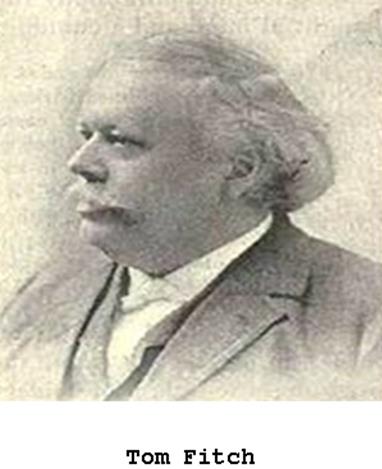
The Earps chose Tom Fitch, "the Silver Tongued Orator of the Pacific Slope" as their lead attorney. Doc Holliday was defended by United States Court Commissioner Thomas J. Drum.
931
O.K. Corral
The preliminary hearing turned into a month long dramatic courtroom confrontation, the longest in Arizona history. The legal purpose of the hearing was to determine whether a crime had actually been committed, and whether there was "sufficient cause" to bring the four defendants to trial. Fitch was forty-three when he arrived in Tombstone early in 1881. He brought a wealth of trial experience in criminal law from his time in California, Nevada, and Utah. Fitch also contributed US$10,000 to Wyatt Earp's defense fund.
932
The prosecution presented considerable evidence in an attempt to bind the Earps and Holliday over for trial. On the second day of the hearings, William Allen testified for the prosecution that "the firing commenced by the Earp party. I think it was Doc Holliday who fired first." Johnny Behan testified that he tried to prevent the confrontation, testifying; “I told them that I was down there for the purpose of disarming the Clantons and McLaurys. They (the Earps and Holliday) wouldn't heed me, paid no attention. And I said, 'Gentleman, I am Sheriff of this County, and I am not going to allow any trouble if I can help it.' They brushed past me." He said Cowboys had put up their hands or thrown open their coats to show they weren't armed, and that Doc Holliday had fired first. He testified that the first five shots had come from the Earps. He clearly blamed the Earps and Doc Holliday for instigating the shootout.
Fitch had seen Judge Wells Spicer as an attorney defend John D. Lee in the notorious 1875 Mountain Meadows Massacre, and it was likely that he had developed a deep appreciation for the judge. The two men had a great deal in common. Both had practiced criminal law, had written for newspapers, and both were Republicans. Fitch may have 933
based his defense on what he saw as Spicer's repugnance of the perjured testimony and unjust outcome in Lee's case. In a preliminary hearing, the attorneys usually do not reveal their entire defense strategy. Fitch may have chosen to use the hearing as a forum to expose the entire case because he thought Spicer held considerably skepticism about the prosecution's case and would allow Fitch considerable latitude. Judge Spicer made several rulings favorable to the defense.
Fitch had Wyatt Earp prepare a written statement, as permitted by Section 133 of Arizona law, which would not allow the prosecution to cross-examine him. The prosecution vociferously objected. Although the statute wasn't specific about whether it was legal for a defendant to read his statement, Spicer allowed his testimony to proceed.
Fitch was very successful in cornering witnesses into offering conflicting testimony or saying they did not remember. In several instances, he obtained testimony from prosecution witnesses and followed up with statements corroborated by others that conflicted with the prior testimony. Prosecution witnesses repeatedly stumbled 934
when Fitch asked them questions, in many instances replying weakly;
"I don't remember." Tombstone's chief prosecutor was Republican Lyttleton Price, who was aided by Ben Goodrich and, three days into the hearing, by co-counsel Will McLaury, brother to the dead Cowboys Frank and Tom McLaury. Will McLaury left his Texas law practice and his children with a caretaker to help prosecute the Earps and Doc Holliday. He summed up his attitude towards the Earps in a letter to a law partner; "I think I can hang them."
Cochise County Sheriff Johnny Behan’s testimony for the prosecution crumbled under Fitch's questioning. Behan testified that he had seen Doc Holliday holding a shotgun prior to the gunfight. He then offered an improbable scenario; Doc Holliday had first fired a nickel plated pistol, then fired the shotgun, and then resuming shooting with the pistol. Another influential witness for the defense was Deputy District Attorney Winfield Scott Williams. In earlier testimony, Behan denied telling Virgil on the night after the gunfight that Virgil had acted properly. Williams testified that Sheriff Behan had inaccurately reported that conversation during which, according to Williams, Behan told Virgil that one of the McLaury brothers drew his gun first, and 935
"You did perfectly right." Behan denied that he said anything resembling this. Fitch's ability to impeach the testimony of the County Sheriff and key witness probably influenced Judge Spicer, who had been subject to perjured testimony in the John D. Lee case that resulted in his client's execution.
Fitch was able to damage Ike Clanton's credibility through skillful questioning. In response to his questioning, Clanton denied seeking confirmation from Wyatt Earp about the reward offered by Wells, Fargo and Co., "dead or alive," for the stage robbers. When shown the telegram confirming the reward would be paid in either circumstance, he denied having ever seen it before. On November 12th, he got Clanton to testify that he had never spoken to Ned Boyle on the morning of the gunfight, and on November 23rd, Boyle's testimony contradicted Clanton's. During Ike Clanton's testimony under cross-examination by Fitch, he said; "I don't remember" fourteen times. This and other contradictions impugned Clanton's testimony.
After a month of testimony from thirty witnesses, Spicer concluded that there was not enough evidence to indict the men. In his ruling, he 936
noted that Ike Clanton had the night before, while unarmed, publicly declared that the Earp brothers and Holliday had insulted him, and that when he was armed he intended to shoot them or fight them on sight.
On the morning of the shooting Ike was armed with revolver and Winchester rifle. Spicer noted that; “Witnesses for the prosecution state unequivocally that William Clanton fell or was shot at the first fire and Claiborne says he was shot when the pistol was only about a foot from his belly. Yet it is clear that there were no powder burns or marks on his clothes. And Judge Lucas says he saw him fire or in the act of firing several times before he was shot, and he thinks two shots afterwards.”
Spicer specifically noted that Ike Clanton claimed the Earps were out to murder him, yet while unarmed had been allowed by the Earps to escape unharmed from the fight. He wrote; "The great fact, most prominent in the matter, to wit, that Isaac Clanton was not injured at all, and could have been killed first and easiest." He described Frank McLaury's insistence that he would not give up his weapons unless the marshal and his deputies also gave up their arms as a "proposition both monstrous and startling!"
937
Spicer said that Virgil in "calling upon Wyatt Earp, and J. H. Holliday to assist him committed an injudicious and censurable act, and although in this he acted incautiously and without due circumspection," in the end "the Earps acted wisely, discretely and prudentially, to secure their own self-preservation. He needed the assistance and support of staunch and true friends, upon whose courage, coolness and fidelity he could depend."
Spicer noted that if Wyatt and Holliday had not backed up Marshal Earp, then he would have faced even more overwhelming odds than he had, and could not possibly have survived. He invited the grand jury to confirm his findings, and two weeks later, it agreed with Spicer's finding and also refused to indict the men.
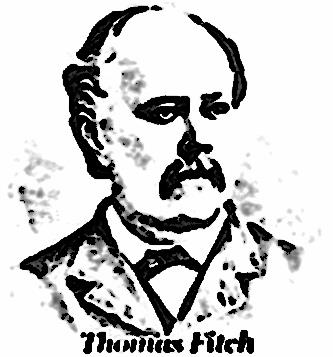
After his time in Arizona, Fitch spent two years traveling through Europe, the Southern United States, and California, after which he lived in Arizona for four years where he practiced law. In 1880 he removed to Minneapolis and formed a partnership with Mr. Morrison, which took the title of Morrison and Fitch.
938
In 1884 he left Arizona and for the next eight years resided part of the time in San Diego, and some time in San Francisco County. In 1891, he defended Ed Tewksbury who was accused of murdering Tom Graham in one of the final acts of violence growing out of the Pleasant Valley War in central Arizona. He settled in New York City in December, 1892
for a period before he returned full time to Arizona in 1893. He briefly moved to Utah in 1894 when the territory was granted statehood and announced his candidacy for United States senator but failed to receive the nomination. Fitch returned to Arizona and settled in Phoenix where he remained through at least 1896.
939
O.K. Corral
Later in his life he credited his oratorical skills to the influence of Col.
E. D. Baker and Thomas Starr King and to the time he spent with Mark Twain and Joaquin Miller. He also said he was influenced by the friendship of Leland Stanford, Collis P. Huntington, Mark Hopkins and Charles Crocker. He spoke in Phoenix in 1906 in support of the territory's desire for dual statehood with New Mexico. He lived at different times in San Diego and in Honolulu. While in Hawaii, he represented sake manufacturers who were attempting to have their product classified as a beer instead of a liquor for customs purposes.
940
In 1909 he moved to Los Angeles where he became a writer for the
“Los Angeles Times,” a position he held through 1916. He died at a Masonic home in Decoto, California, on November 12th, 1923. He was interred in Cypress, later renamed Chapel of the Chimes, Cemetery in Decoto, later Hayward, California.
941
O.K. Corral
14H- Crawley P. Dake Revisited
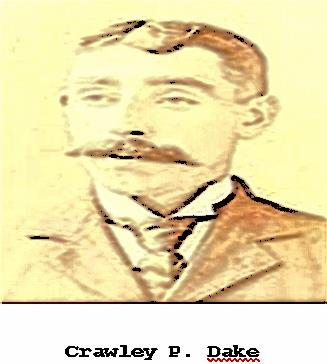
After the shootout, the acting attorney general ordered Dake to take action against the Cowboy faction, but Dake was replaced by Zara T.
Tidball less than six months later, in July 1882.
Dake knew a number of well-known Old West characters, including Leslie Blackburn, Virgil and Wyatt Earp, Joseph Evans, Joe Phy and 942
others. During the American Civil War, he served as a Union Army cavalryman, including at the Battle of Gettysburg. Seriously wounded in battle, he retired as a Major in August 1864. Dake went on to serve as chief deputy marshal in Detroit before working as an IRS agent and then as US Marshal for the Arizona Territory from 1878 to 1882, facing an epidemic of stage robberies. He worked together with territorial authorities and the Mexican government to fight the local bandits, but the federal government was prevented from using the US Army to hunt down bandits by the Posse Comitatus Act and neglected to fund the Marshals. On November 27th, 1879, Dake deputized Virgil Earp to help fight the Cochise County Cowboys in Pima County, but he was criticized and ultimately replaced for his failure to prevent, as if someone could prevent, the Earp-Cowboys rivalry and for Virgil's participation in the gunfight at the O.K. Corral. Three years later he was charged and ultimately cleared from misappropriating funds. By late 1888, illness confined him to his home. Dake died in Prescott, Arizona Territory on April 9th, 1890.
943
15 - The Cowboys After the Shootout
The Wild West era was a period of myth making cowboys, gunslingers, and saloon madames, while it actually lasted only thirty years.
The Wild West provides some of the most enduring tenets of American mythology, perpetuated by film legends from Bronco Billy to Clint Eastwood. And no wonder. The lawlessness of the time provided plenty of drama, and the lonely windswept territories, mountainous and arid, provided the cinematic backdrop. The image is indelible; a lonely cowboy clopping across the plains. Supplement that with an Ennio Morricone soundtrack. Ironically, the era that has provided more than 1,000 years’ worth of celluloid fantasies lasted only one-thirtieth of that time.
In fact, the era known as the Wild West, or the American Frontier, began after the Civil War in 1865 and ended around 1895. The American imperative of Manifest Destiny dictated that the country expand to “overspread the continent allotted by Providence for the free development of our yearly multiplying millions,” as John L.
944
O’Sullivan wrote in the July-August 1845 edition of the “United States Magazine and Democratic Review.”
The frontier area west of the Mississippi River during the late 1800s included the territories of Dakota, Nevada, Oregon, Utah, Idaho, Montana, Arizona, California, New Mexico, and Colorado. The untamed territories were noted for their lawlessness, which gave rise to wild, rowdy, unrestrained, disorderly, and unruly behavior, which is what made for such great stories in print and on screen. But while much of the culture that is attributed to the Wild West was just normal colonial culture in many parts of America at different times, it became ingrained in people’s imaginations.
“That experience seemed to be regarded as defining uniquely American characteristics and values; traditionality, individualism, self-reliance, and an instinctive commitment to democracy,” as David Hamilton Murdoch wrote in “The American West: The Invention of a Myth.”
Naturally, Hollywood glamorized the truth. Cowboys were illiterate and worked hard, dirty jobs. They weren’t even called “cowboys,” instead 945
they were cattlemen. They wore one set of clothes until they turned into rags, didn’t bathe, or brush their teeth. Truth be told, few Americans did at all until an ingenious ad campaign popularized tooth brushing in 1915. The further cattleman truth is, nobody wore Clint Eastwood’s flat-brimmed cowboy hat. It wasn’t practical and furthermore, it was too expensive. There were always men, but they came from all over the planet. In Wyoming alone, with a population of 10,000 people, there were at least 56 nationalities, including Germans, Irish, Italians, Swedes, Norwegians, Finns, Chinese, Russians, and Slovakians.
And for some more myth-busting; one of the most defining scenes of the Wild West era, the gunfight at the O.K. Corral, lasted only 30
seconds and didn’t take place at the O.K. Corral at all. The famous gunfight occurred at about 3:00 PM on Wednesday, October 26th, 1881, in Tombstone, Arizona Territory. The shooting occurred near the current intersection of Third Street and Fremont Street, which is actually behind the corral. Deputy Marshall Wyatt Earp and his brothers Virgil Earp and Morgan Earp, with the support of Doc Holliday, confronted the Clanton gang of outlaws and Cowboys, ironically over 946
the issue of gun control. Billy Clanton and gang members Tom McLaury and Frank McLaury were shot down and killed but Ike Clanton and Billy Claiborne escaped. Virgil Earp and Morgan Earp were wounded, but Wyatt Earp and Doc Holliday was grazed, though it really pissed him off.
As for the cowboy’s entrance into celluloid history, Bronco Billy Anderson is widely credited as being the first cowboy matinee idol. He starred in the classic 1903 silent black and white film “The Great Train Robbery.” Efficiently cast, he played three roles; tenderfoot dancer, shot passenger, and most memorably, bandit. Advertised as “a faithful duplication of the genuine “Hold Ups” made famous by various outlaw bands in the far West,” the film was a primitive 10 minute one-reeler, but it launched the Wild West film genre that continues to this day.
Bronco Billy himself watched the film in a vaudeville theater and was impressed by the audience’s wildly enthusiastic reaction. He ended up writing and starring in dozens of Western films. His contributions to cinema were so well regarded that Anderson was honored posthumously in 1998 with his image on a US postage stamp. In a 947
O.K. Corral
fitting footnote to amalgamated US history, Bronco Billy was born Maxwell Henry Aronson, the son of German and Russian Jews.
Here are some purportedly real later participants in the actual Wild West.
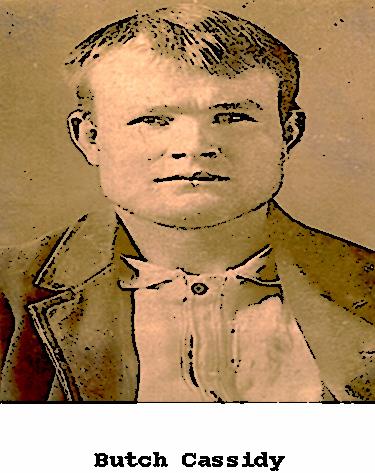
Butch Cassidy – 1866 to 1908
Lots of famous cowboys were criminals, robbing banks and trains on horseback. Robert LeRoy Parker was one. Going by Butch Cassidy, he often worked with Harry Longabaugh A/K/A the Sundance Kid.
948
He got his nickname while working as a butcher’s apprentice.
Robert LeRoy Parker, April 13th, 1866 – November 7th, 1908, better known as Butch Cassidy, was an American train and bank robber and the leader of a gang of criminal outlaws known as the "Wild Bunch" in the Old West.
Parker engaged in criminal activity for more than a decade at the end of the 19th century and the early 20th century, but the pressures of being pursued by law enforcement, notably the Pinkerton detective agency, forced him to flee the country. He fled with his accomplice Harry Longabaugh, known as the "Sundance Kid," and Longabaugh's girlfriend Etta Place. The trio traveled first to Argentina and then to Bolivia, where Parker and Longabaugh are believed to have been killed in a shootout with the Bolivian Army in November 1908. The exact circumstances of their fate continue to be disputed.
Parker's life and death have been extensively dramatized in film, television, and literature, and he remains one of the most well-known icons of the "Wild West" mythos in modern times.
949
Robert LeRoy Parker was born in Beaver, Utah Territory, the first of 13
children of English immigrants Maximillian Parker and Ann Campbell Gillies. The Parker and Gillies families had converted to the Mormon faith while still living in the United Kingdom. Maximillian Parker was 12 years old when his family arrived in Salt Lake City in 1856 as Mormon pioneers. Ann Gillies was born and lived in Tyneside in northeast England before immigrating to the US with her family in 1859 at age 14. The couple were married in July 1865. Robert Parker grew up on his parents' ranch near Circleville.
Parker fled his home as a teenager and, while working on a dairy ranch, met cattle thief Mike Cassidy. He subsequently worked on several ranches, in addition to a brief apprenticeship with a butcher in Rock Springs, Wyoming, where he got his nickname by the word
"butcher," which morphed later into "Butch," to which he soon added the last name Cassidy in honor of his old friend and mentor.
Butch Cassidy's first criminal offense was minor. Around 1880, he journeyed to a clothier shop in another town but found it closed. He broke into the shop and stole a pair of jeans and some pie, leaving an 950
IOU promising to pay on his next visit. The clothier pressed charges, but Cassidy was acquitted by a jury. He continued to work on ranches until 1884, when he moved to Telluride, Colorado, ostensibly to seek work, but perhaps to deliver stolen horses to buyers. Cassidy led a cowboy's life in Wyoming and Montana before returning to Telluride in 1887, where he met Matt Warner, the owner of a racehorse. Cassidy and Warner raced the horse at various events, dividing the winnings between them.
Cassidy's first bank robbery took place on June 24th, 1889, when Warner, two of the McCarty brothers, and he robbed the San Miguel Valley Bank in Telluride. Businessman L. L. Nunn had taken a controlling interest in the bank the previous year. The robbers stole around $21,000, after which they fled to the Robbers Roost, a remote hideout in southeastern Utah.
In 1890, Cassidy purchased a ranch on the outskirts of Dubois, Wyoming. This location is across the state from the notorious “Hole in the Wall,” a natural geological formation, and a popular hideout for outlaw gangs, including Cassidy's, during the era. Cassidy's ranching 951
was possibly a façade for clandestine activities, perhaps with “Hole in the Wall” outlaws, as he was never financially successful at ranching.
Cassidy's ranch used the "unmistakable brand" of "Reverse-E, Box, E."
In early 1894, Cassidy became involved romantically with rancher and outlaw Ann Bassett. Her father was a rancher who did business with Cassidy, supplying him with fresh horses and beef. That same year, Cassidy was arrested at Lander, Wyoming, for stealing horses and possibly for running a protection racket among the local ranchers there. He was imprisoned in the Wyoming State Prison in Laramie, where he served 18 months of a two year sentence. He was released and pardoned in January 1896 by Governor William Alford Richards. He became involved briefly with Bassett's older sister Josie before returning to Ann.
Cassidy associated with a wide circle of criminals, most notably his closest friend William Ellsworth "Elzy" Lay, Harvey "Kid Curry" Logan, Ben "The Tall Texan" Kilpatrick, Harry Tracy, Will "News" Carver, Laura Bullion, and George "Flat Nose" Curry, who collectively became the "Wild Bunch." The gang assembled sometime after Cassidy's 952
release from prison in 1896, and took its name from the Doolin–Dalton gang, also known as the "Wild Bunch."
On August 13th, 1896, Cassidy, Lay, Logan, and Bob Meeks robbed the bank at Montpelier, Idaho, escaping with roughly $7,000. Cassidy recruited Harry Alonzo Longabaugh, also known as the "Sundance Kid," into the gang soon after.
Bassett, Lay, and Lay's girlfriend Maude Davis all joined Cassidy at Robbers Roost in early 1897. The four hid there until early April, when Lay and Cassidy sent the women home so that the men could plan their next robbery. They ambushed a small group of men carrying the payroll of the Pleasant Valley Coal Company in the mining town of Castle Gate, Utah, on April 22nd, 1897, stealing a sack of silver coins, with which they fled back to the Robbers Roost.
On June 2nd, 1899, the gang robbed a Union Pacific Overland Flyer passenger train near Wilcox, Wyoming, a robbery that earned them a great deal of notoriety and resulted in a massive manhunt. Many notable lawmen took part in the hunt, but they did not find them. Kid Curry and George Curry had a shootout with lawmen following the 953
train robbery, killing Sheriff Joe Hazen. Tom Horn, a killer for hire employed by the Pinkerton National Detective Agency, was told by explosives expert Bill Speck about the Hazen shooting. Pinkerton detective Charlie Siringo was then assigned the task of capturing the outlaws. He became friends with Elfie Landusky, who was using the last name Curry after becoming pregnant by Kid Curry's brother Lonny Logan, and Siringo intended to locate the gang through her.
On July 11th, 1899, Lay and others were involved in a Colorado and Southern Railroad train robbery near Folsom, New Mexico, which Cassidy might have planned and personally directed. A shootout ensued with local law enforcement, during which Lay killed Sheriff Edward Farr and Henry Love. Lay was convicted of murder and sentenced to life imprisonment at the New Mexico State Penitentiary.
The Wild Bunch typically separated following a robbery and fled in different directions, later reuniting at a predetermined location such as the “Hole in the Wall,” Robbers Roost, or Fannie Porter's brothel in San Antonio.
954
Cassidy approached Utah Governor Heber Wells to negotiate an amnesty. Wells advised him to ask the Union Pacific Railroad to drop their criminal complaints against him, and Union Pacific Chairman E.
H. Harriman attempted to meet with Cassidy through Warner. On August 29th, 1900, Cassidy, Longabaugh, and others robbed Union Pacific train No. 3 near Tipton, Wyoming, breaking Cassidy's earlier promise to the governor of Wyoming and ending any chance for amnesty.
On February 28th, 1900, lawmen attempted to arrest Lonny Logan at his aunt's home. Lonny was killed in the shootout that followed, and his cousin Bob Lee was arrested for rustling and sent to prison in Wyoming. On March 28th, George Curry and News Carver were pursued by a posse from St. Johns, Apache County, Arizona, after using currency they had stolen in the Wilcox train robbery. The posse engaged them in a shootout, during which Deputies Andrew Gibbons and Frank LeSueur were killed, while Carver and Curry escaped. On April 17th, George Curry was killed in a shootout with Grand County, Utah, Sheriff John Tyler and Deputy Sam Jenkins. On May 26th, Kid 955
Curry rode into Moab, Utah, and killed both Tyler and Jenkins in another shootout in retaliation for the deaths of George and Lonny.
In December, Cassidy posed alongside Longabaugh, Logan, Carver, and Ben Kilpatrick in Fort Worth, Texas, for the now famous "Fort Worth Five" photograph. The Pinkerton Agency obtained a copy of the photograph and began to use it for wanted posters.
On July 3rd, 1901, Kid Curry and a group of men robbed a Great Northern train near Wagner, Montana, stealing more than $60,000 in cash. The gang split up, but a posse led by Sheriff Elijah Briant caught up with News Carver and killed him. Kilpatrick was captured in St.
Louis on November 5th at Josie Blakey's resort on Chestnut Street. In his pocket, they found a key to a room at The Laclede Hotel. The next morning, they found Laura Bullion in the lobby, checking out with her luggage. In her valise was $8500 in unsigned banknotes from the Great Northern robbery. Curry killed Knoxville policemen William Dinwiddle and Robert Saylor in another shootout on December 13th, then escaped. He returned to Montana, pursued by Pinkertons and other 956
law enforcement officers, where he shot and killed rancher James Winters in retaliation for killing his brother Johnny years before.
Cassidy and Longabaugh fled to New York City, feeling continuous pressure from the numerous law enforcement agencies pursuing them and seeing their gang falling apart. They departed from there to Buenos Aires, Argentina aboard the British steamer Herminius on February 20th, 1901, along with Longabaugh's companion Etta Place.
Cassidy posed as James Ryan, Place's fictitious brother. They settled in a four room log cabin on a 15,000 acre ranch that they purchased on the east bank of the Rio Blanco near Cholila, just east of the Andes in the Chubut.
Bruce Chatwin's “In Patagonia” references a letter Butch wrote from Cholila to Elza Lay's mother-in-law in Utah, dated August 10th, 1902.
The letter cites "our little family of 3" living in a 4 room house with 300
cattle, 1500 sheep, and 28 horses.
Two English speaking bandits held up the Banco de Tarapacá y Argentino in Río Gallegos on February 14th, 1905, 700 miles south of Cholila near the Strait of Magellan, and the pair vanished north across 957
the Patagonian grasslands. Cassidy and Longabaugh sold the Cholila ranch on May 1, fearing that law enforcement had located them. The Pinkerton Agency had known their location for some time, but the snow and the hard winter of Patagonia had prevented their agent Frank Dimaio from making an arrest. Governor Julio Lezana issued an arrest warrant, but Sheriff Edward Humphreys, a Welsh/Argentine who was friendly with Cassidy and enamored of Place, tipped them off. The trio then fled north to San Carlos de Bariloche, where they embarked on the steamer Condor across Nahuel Huapí Lake and into Chile. They returned to Argentina by the end of the year. Cassidy, Longabaugh, Place, and an unknown male associate robbed the Banco de la Nación Argentina branch in Villa Mercedes on December 19th, 400 miles west of Buenos Aires, taking 12,000 pesos. They fled across the Andes to reach the safety of Chile.
On June 30th, 1906, Place decided that she had enough of life on the run, so Longabaugh took her back to San Francisco. Cassidy obtained honest work under the alias James "Santiago" Maxwell at the Concordia Tin Mine in the Santa Vera Cruz range of the central Bolivian Andes, where Longabaugh joined him upon his return. Their 958
main duties included guarding the company payroll. The two traveled to Santa Cruz in late 1907, a frontier town in Bolivia's eastern savannah, still wanting to settle down as respectable ranchers.
A courier was carrying the payroll for the Aramayo Franke and Cia Silver Mine on November 3rd, 1908, near the small mining town of San Vicente in southern Bolivia, when he was attacked by two masked American bandits believed to be Cassidy and Longabaugh. Witnesses saw them three days later in San Vicente, where they lodged in a small boarding house owned by miner Bonifacio Casasola. Casasola became suspicious of them because they had a mule from the Aramayo Mine, identifiable from the company's brand. He notified a nearby telegraph officer, who notified the Abaroa cavalry regiment stationed nearby. The unit dispatched three soldiers under the command of Captain Justo Concha, and they notified the local authorities.
The soldiers, the police chief, the local mayor, and some of his officials all surrounded the lodging house on the evening of November 6th, intending to arrest the Aramayo robbers. As they approached the 959
house, the bandits opened fire, killing one of the soldiers and wounding another and starting a gunfight which lasted for several hours into the evening and the night. At around 2:00 AM, during a lull in the fighting, the mayor heard a man scream three times inside the house, then two successive shots were fired from inside the house.
The authorities entered the house the next morning, where they found two bodies with numerous bullet wounds to the arms and legs. The man assumed to be Longabaugh had a bullet wound in the forehead, and the man thought to be Cassidy had a bullet hole in the temple. The local police report speculated that judging from the positions of the bodies, Cassidy had probably shot the fatally wounded Longabaugh to put him out of his misery, then killed himself with his final bullet. The Tupiza police identified the bandits as the men who robbed the Aramayo payroll transport, but the Bolivian authorities did not know their real names, nor could they positively identify them.
The two bodies were buried at the small San Vicente cemetery, near the grave of a German miner named Gustav Zimmer. American forensic anthropologist Clyde Snow and his researchers attempted to find the 960
graves in 1991, but they did not find any remains with DNA matching the living relatives of Cassidy and Longabaugh. In 2017, a new search was launched for Cassidy's grave, which zeroed in on a mine outside Goodsprings, Nevada. The dig found human remains, but they did not match the DNA provided.
John McPhee's “Annals of the Former World” repeats a story that Dr.
Francis Smith told to geologist David Love in the 1930s. Smith stated that he had seen Cassidy, who told him that his face had been altered by a surgeon in Paris, and he showed Smith an old bullet wound that Smith recognized as work that he had done.
Josie Bassett claimed in 1960 that Cassidy came to visit her in the 1920s "after returning from South America," and that he "died in Johnnie, Nevada about 15 years ago." Residents in Cassidy's hometown of Circleville, Utah, claimed in an interview that he worked in Nevada until his death.
Bruce Chatwin, in his classic travel book “In Patagonia,” said; "I went to see the star witness; his sister, Mrs. Lulu Parker Betenson, a forthright and energetic woman in her nineties. She has no doubts: her 961
brother came back and ate blueberry pie with family at Circleville in 1925. She believes he died of pneumonia in Washington in the late 1930s."
An episode of the television series “In Search of...” (1978) examined the claims and possible evidence for Cassidy's return to America during the 1920s in a series of interviews with residents of Baggs, Wyoming, a popular destination for the Wild Bunch during their raiding years. Residents claimed that Cassidy had visited for several days in 1924, driving a Ford Model T. Betenson stated that he returned to the family home in Circleville during this period, and picked up his brother Mark in a Ford, then drove to their father's home, where she also lived.
Her father allegedly said to her; "I'll bet you don't know who this is.
This is your brother Robert LeRoy." She stated that Cassidy was full of regrets, particularly at having disappointed his mother. She quoted him lamenting; "All I did is make a wreck of my life." Betenson claims that Cassidy lived out his years in "the Northwest" and died in 1937
and that the family had agreed not to disclose his final resting place, since "they had chased him all his life, and now he's going to rest in peace." This story is also recounted by W. C. Jameson in “Butch 962
Cassidy: Beyond the Grave,” referencing the 1975 book Betenson coauthored with Dora Flack, “Butch Cassidy, My Brother.”
On an episode of the series “Mission Declassified” (2019), investigative journalist Christof Putzel met with local researcher Marilyn Grace at Cassidy's childhood log cabin on the Parker ranch in Circleville to talk about the alleged burial of Cassidy there on July 20th, 1937. Grace explains that Cassidy was secretly buried at Tom's Cabin, a former sheepherders' log cabin located in a remote area of the property, a favorite camping spot for his brothers and him. Grace says an eyewitness, neighbor Dee Crosby, saw the burial take place at the cabin. Earlier, Putzel spoke to Alta Orton, another Parker neighbor, who described the family as having been dressed in funeral like attire on that same day. Grace goes on to say that cadaver dogs had been brought to the cabin in an attempt to locate remains and led to a positive indication. The underside of the cabin was later dug and two bones discovered, identified as a human spinal bone and a toe bone.
Putzel had forensic scientist Suzanna Ryan at Pure Gold Forensics in Redlands, California conduct a DNA test on the bones. Ryan confirmed they were human, but lacked enough DNA for a complete profile. As 963
the site may have become public knowledge, the Parker family is believed to have since excavated Cassidy's remains at the cabin and moved them to a different burial site, leaving the spinal and toe bones behind in the process.
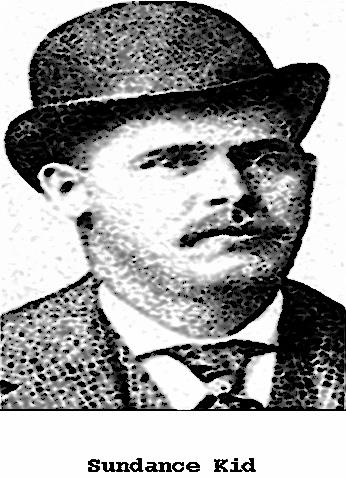
Sundance Kid – 1867 to 1908
Harry Alonzo Longabaugh, 1867 – November 7th, 1908, better known as the Sundance Kid, was an outlaw and member of Butch Cassidy's Wild Bunch in the American Old West.
964
O.K. Corral
He likely met Butch Cassidy, real name Robert Leroy Parker, after Cassidy was released from prison around 1896. The "Wild Bunch" gang performed the longest string of successful train and bank robberies in American history. Longabaugh fled the United States along with his consort Etta Place and Butch Cassidy to escape the dogged pursuit of the Pinkerton Detective Agency. The trio fled first to Argentina and 965
then to Bolivia, where Cassidy and Longabaugh may have been killed in a shootout in November 1908.
Longabaugh was born in Mont Clare, Pennsylvania to Pennsylvania natives Josiah and Annie G. (née Place) Longabaugh, the youngest of five children. At age 15, he traveled west in a covered wagon with his cousin George to help settle George's homestead near Cortez, Colorado.
While there, he found work as a wrangler at a neighboring ranch, and he learned to buy and breed horses. He left Cortez in 1886 and struck out on his own, drifting north and working on ranches. He found work on the N Bar N Ranch in Montana Territory, but the hard winter of 1886–1887 forced the ranch to lay off wranglers, including Longabaugh. Longabaugh drifted to the Black Hills before turning back to try to find work again at the N Bar N.
In 1887, while traveling across the Three V Ranch near Sundance, Wyoming, he stole a gun, horse, and saddle from a cowboy. He was captured by authorities in Miles City, Montana, and sentenced to 18
966
months in jail by Judge William L. Maginnis. He adopted the nickname Sundance Kid during this time in jail. After his release, he went back to working as a ranch hand, and he worked at the Bar U Ranch in the North-West Territories of Canada in 1891, which was one of the largest commercial ranches of the time. He became joint owner of a saloon in the Grand Central Hotel in Calgary, but after quarreling with his partner, he headed south to Montana again. There, he took another job with the N Bar N and began rustling cattle and horses in Montana and Canada.
Longabaugh was suspected of taking part in a train robbery in 1892
and a bank robbery in 1897 with five other men. He became associated with a group known as the Wild Bunch, which included Robert Leroy Parker, better known as Butch Cassidy. Longabaugh was reportedly fast with a gun and was often referred to as a gunfighter, but he is not known to have killed anyone prior to a shootout in Bolivia in which Parker and he allegedly were killed. He became better known than Kid Curry, a member of his gang whose real name was Harvey Logan.
Curry killed numerous men while with the gang. Longabaugh did participate in a shootout with lawmen who trailed a gang led by 967
George Curry to the “Hole in the Wall” hideout in Wyoming, and he was thought to have wounded two men in that shootout. Several people were killed by members of the gang, including five law enforcement officers killed by Logan. "Wanted dead or alive" posters were posted throughout the country, with rewards of as much as a $30,000 for information leading to their capture or deaths.
Longabaugh and Logan used a log cabin at Old Trail Town in Cody, Wyoming, as a hideout, as they planned to rob a bank in Red Lodge, Montana. They then began hiding out at “Hole in the Wall,” located near Kaycee, Wyoming. From there, they could strike and retreat with little fear of capture, since it was situated on high ground with a view of the surrounding territory in all directions. Pinkerton detectives led by Charlie Siringo, however, hounded the gang for a few years. Parker, Longabaugh, and his consort Etta Place left the United States on February 20th, 1901, aboard the British ship Herminius for Buenos Aires, Argentina.
A courier was conveying the payroll for the Aramayo Franke y Cia silver mine on November 3rd, 1908, near San Vicente Canton, Bolivia, 968
when he was attacked and robbed by two masked American bandits.
The bandits then proceeded to the mining town of San Vicente, where they lodged in a small boarding house owned by Bonifacio Casasola, a miner. Casasola became suspicious of them because they had a mule from the Aramayo Mine, which bore the mining company's brand. He informed a nearby telegraph officer, who notified the Abaroa cavalry unit stationed nearby. The unit dispatched three soldiers under the command of Captain Justo Concha, and they notified the local authorities. The mayor, a number of his officials, and the three soldiers from the Abaroa regiment all surrounded the house on the evening of November 6th. The bandits then opened fire, killing one of the soldiers and wounding another, which started a gunfight. The police and soldiers heard a man screaming from inside the house around 2 AM, during a lull in the firing. They subsequently heard a single shot from inside the house, after which the screaming stopped, then heard another shot minutes later.
The soldiers entered the house the next morning and found two dead bodies, both with numerous bullet wounds to the arms and legs. One of the men had a bullet wound in the forehead and the other had a bullet 969
wound in the temple. The police report surmised from the positions of the bodies that one bandit had shot his mortally wounded partner to put him out of his misery, before killing himself with his final bullet soon after. The Tupiza police investigation concluded that the dead men were the bandits who had robbed the Aramayo payroll transport, but the Bolivian authorities could not positively identify them. The bodies were buried at the San Vicente cemetery, where they were interred close to the grave of Gustav Zimmer, a German miner.
American forensic anthropologist Clyde Snow and his researchers attempted to find the graves in 1991, but they did not find any remains with DNA matching the living relatives of Parker and Longabaugh.
Many have claimed that one or both men survived and returned to the United States. One of these claims was that Longabaugh lived under the name of William Henry Long in the small town of Duchesne, Utah.
Long died in 1936, and his remains were exhumed in December 2008
and subjected to DNA testing. Anthropologist John McCullough stated Long's remains did not match the DNA which they had obtained "from a distant relative of the Sundance Kid."
970
O.K. Corral
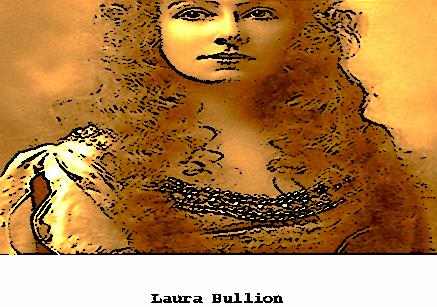
Laura Bullion – 1876 to 1961
Sometimes known as the Rose of the Wild Bunch, Laura worked with several well-known outlaws including Butch Cassidy, Black Jack Ketchum, Kid Curry, and the Sundance Kid.
She sometimes dressed as a boy during robberies and went by several aliases. She spent four years in prison and was a seamstress when she got out. Her tombstone reads “The Thorny Rose.”
971
Most sources report Laura Bullion was born in Knickerbocker, Texas, near Mertzon, in Irion County in or around October 1876. Although the actual date of her birth is unknown, Bullion's death record indicates October 4th as her birthday. Bullion's death certificate lists Henry Bullion as her father and Freda Byler as her mother.
Bullion's father had been an outlaw and was acquainted with outlaws William "News" Carver and Ben Kilpatrick, "The Tall Texan", both of whom Bullion met when she was around 13 years of age. Her aunt, Viana Byler, married Carver in 1891, but she died soon after the marriage from fever. At age 15, Bullion began a romance with Carver, who for a time after his wife's death had been involved with female outlaw Josie Bassett, sister to Cassidy's girlfriend Ann Bassett.
Most sources, as well as Bullion's grave marker, provide 1876 as the year of her birth, while 1873 is also mentioned as a possible year of her birth. The exact day is not known.
In an arrest report dated November 6th, 1901, her age is mentioned as 28 at the time of the arrest. Provided the birth year of 1876 is correct, Bullion would have been 24 or 25 years of age at this time.
972
The death certificate states Bullion's age at death as 74, and her date of birth as October 4th, 1887. Provided the birth year of 1876 is correct, Bullion would have been 84 or 85 years of age at her death.
The certificate is issued under the name Freda Bullion Lincoln, a false identity she assumed when she moved to Memphis, claiming to be the war widow of Maurice Lincoln and making herself about ten years younger than she was. Most sources, including Laura Bullion's death certificate, give Texas as her state of birth.
Data found in the 1880 and 1900 census suggests Bullion might have been born on a farm in the Palarm Township near Conway in Faulkner County, Arkansas. The 1880 Federal Census of Population for Palarm Township shows the family of a Kentucky born farmer named Henry Bullion, aged 42, living with his wife Martha, 40 years old, and four children, including a son Lewis, 4 years of age.
The 1900 census documents a 23 year old Laura Bullion, born October 1876 in Arkansas, who stated her occupation as "housekeeper" and who was living with her grandparents E.R. and Serena Byler, her aunt Mrs. Mary Allen, and her three children at the Byler homestead in the 973
southwest portion of the Commissioner's Precinct Number 4 in Tom Green County, Texas. Tom Green County borders Irion County, Bullion's assumed county of birth, in the north and east.
Other material claims Laura Bullion probably was born in Kentucky in 1873 and was raised in Texas.
When Bullion first became involved with Carver, the latter was riding with the Tom "Black Jack" Ketchum gang, and Bullion wanted to join him. However, he would not allow it at first, and they only saw one another between robberies. While in Utah and on the run from lawmen, Carver became involved with the Wild Bunch gang, led by Butch Cassidy and Elzy Lay.
Members of the Wild Bunch nicknamed Laura Bullion "Della Rose," a name she came by after meeting Kid Curry's girlfriend Della Moore.
Often, Bullion also was referred to as the "Rose of the Wild Bunch."
When her boyfriend Ben Kilpatrick and she fled east to evade the law after a train robbery in 1901, the couple traveled under the names "Mr.
and Mrs. Benjamin Arnold.”
974
In an arrest report following the train robbery, dated November 6th, 1901, Bullion's name is filed as "Della Rose" and her aliases are stated to be "Clara Hays" and "Laura Casey and Laura Bullion." The arrest report lists her profession as prostitute. According to a “New York Times” article, she was "masquerading as 'Mrs. Nellie Rose' at the time of her arrest. The same article also mentions the suspicion that she, "disguised as a boy," might have taken part in a train robbery in Montana. The paper cites Chief of Detectives Desmond; "I wouldn’t think helping to hold up a train was too much for her. She is cool, shows absolutely no fear, and in male attire would readily pass for a boy. She has a masculine face, and that would give her assurance in her disguise." Instead of "Clara Hays," Bullion also used "Clare Hayes"
or "Clara Hayes" as a version of her alias. Other assumed names she used at that time were "Desert Rose," "Wild Bunch Rose," and "Clara Casey."
When Bullion turned up in Memphis in 1918, she used the names
"Freda Lincoln," "Freda Bullion Lincoln," and "Mrs. Maurice Lincoln,"
claiming to be a war widow and her late husband had been Maurice Lincoln. She also made herself ten years younger, claiming to have 975
been born in 1887. On her grave marker at the Memorial Park Cemetery in Memphis, Bullion's name is inscribed as "Freda Bullion Lincoln" and "Laura Bullion," her birth name. The epitaph "The Thorny Rose" refers to her nickname in the Wild Bunch.
In the early 1890s, Bullion became involved romantically with Ben Kilpatrick after Carver began a relationship with a prostitute named Lillie Davis, whom he had met at Fannie Porter's brothel in San Antonio. As the gang robbed trains, Bullion supported them by selling stolen goods and making connections that could give the gang steady supplies and horses.
By 1901, Bullion again was involved romantically with Carver and had occasional involvement with other members of the gang. When Carver was killed by lawmen on April 1st, 1901, Bullion became involved romantically with Kilpatrick again, and the two fled to Knoxville, Tennessee. Della Moore and Kid Curry met with them there, and the four stayed together for a number of months, until October, when Della Moore was arrested for passing money linked to one of the gang's robberies.
976
On about November 1st, 1901, Ben Kilpatrick and Laura Bullion arrived in St. Louis by train, and checked into the Laclede Hotel using the aliases Mr.and Mrs. J.W. Rose. At 11:50 PM on November 5th, a Tuesday, Ben Kilpatrick was arrested at Josie Blakey's resort at 2005
Chestnut St. In his pocket, the authorities found a key to a room at the Laclede Hotel. On the morning of November 6th, they entered the hotel lobby, where Laura Bullion was in the process of checking out with her luggage. In her valise, they discovered $8500 in unsigned banknotes taken in the Great Northern train robbery. Laura was arrested at 9:15
AM on federal charges for "forgery of signatures to banknotes."
Curry escaped capture on December 13th, 1901, killing two Knoxville policemen in the process. Both Bullion and Kilpatrick were convicted of robbery, with Bullion being sentenced to five years in prison and Kilpatrick receiving a 20 year sentence. She served three and a half years before being released in 1905. Kilpatrick was not released from prison until 1911.
Kilpatrick stayed in contact with Bullion through letters. By the time of his release from prison in 1911, she had become involved with at least 977
four other men, but they never reconnected nor did they see one another again. Kilpatrick was killed robbing a train on March 13th, 1912. By this time, the Wild Bunch gang had disbanded.
In 1918, Bullion moved to Memphis, where she spent the remainder of her life working as a householder and seamstress, and later as a drapery maker, dressmaker, and interior designer.
In 1920, the Memphis City Directory lists her as seamstress for the Jennings Furniture Co., with rooms at 221 Monroe Ave. From 1927 to 1948, she is listed as "householder" at 1374 Madison Ave. This is the only one of the buildings still in existence in 2007. In the 1930s, Bullion was listed as "drapery maker." Her occupation was upgraded to "interior decorator" in 1940. Her fortunes declined in the late 1940s.
In 1950, Bullion moved to 1065 Walker Ave, with no profession listed.
The following year, she moved to 3691 Southern Ave and in 1952 to 733 Decatur St. From 1953 to 1959, Bullion disappeared from the telephone book and is not listed in the city directory.
In 1959, Bullion was listed as living at 278 Cossitt Place. She lived there until her death two years later.
978
According to her obituary, Bullion died of heart disease at the Shelby County Hospital at 6:45 PM on December 2nd, 1961. The memorial service was held at 11:30 AM on December 4th. She is buried in the Memorial Park Cemetery. Bullion was the last surviving member of the Wild Bunch gang.
Her grave marker reads:
Freda Bullion Lincoln
Laura Bullion
The Thorny Rose
1876 – 1961
Bullion's bronze grave marker has a decoration of embossed rose vines along the edges. The decoration and her epitaph "The Thorny Rose" refers to Bullion's nickname in the Wild Bunch.
For a number of years before her death, Bullion was one of only three people who had known the mysterious Etta Place, girlfriend to Wild Bunch gang member, the Sundance Kid. Place simply disappeared in 1909, following the Kid's alleged death in Bolivia. Only Bullion, Ann 979
O.K. Corral
Bassett, and Josie Bassett could have shed light on the facts about Etta Place. Ann Bassett died in 1956. In 1964, Josie Bassett died.
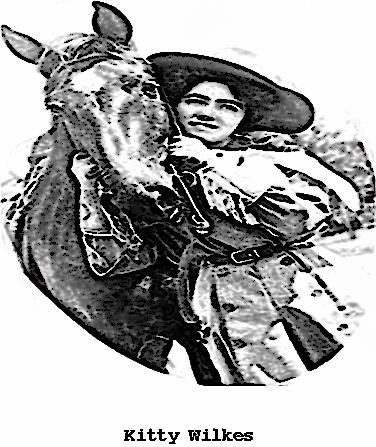
Kitty Wilkes – 1899 to 1988
Turns out it’s not just rappers who stick diamonds in their grills.
Katherine Derre, later known as Kitty Canutt, and Kitty Wilkes had one too.
980
They called her “Diamond Girl” and yes, she sometimes pawned her tooth, but always got it back. Kitty was a bronc rider and won several bucking contests. Diamond Kitty had a temper and often punched those who outperformed her.
Bronc busting champion Kitty Wilkes won her first title at the Wild West Celebration Rodeo in Miles City, Montana, in 1916. The seventeen year old New York native’s straightforwardness and untamed physical daring gave fans the impression she was born and bred into the rugged life of a Wyoming ranch. Few would have guessed she was new to the sport or that winning the top prize would inspire her to excel in other rodeos. From that exciting moment in Miles City on, she was determined to show the world that one need not be “born in the saddle” to be a crack rider.
Katherine Derre, whose stage name was Kitty Wilkes, was born on July 15th, 1899. She had a natural talent for breaking horses and parlayed that skill into bronc riding in public showings. Not only did she have a way with wild horses, but she was an exceptional trick and fancy rider. Owners of relay strings were eager to gain her services.
981
Between the rodeo in Montana in the summer of 1916 and the Pendleton Roundup in Pendleton, Oregon, in early fall in 1916, Kitty honed her bronc riding talent at ranches and rodeos throughout the West. She insisted on using the orneriest animals for training. Outlaw horses were blindfolded and saddled for her to ride. One encounter resulted in the horse bucking Kitty off and bruising her ribs. She wouldn’t allow the horse to beat her, however. She swung back into the saddle, refusing to leave it until the animal finally broke.
Kitty’s nickname was “Diamond Girl” because she had a diamond set in her front tooth. When needed, she would remove the diamond and pawn it for the entry fees to rodeo contests.
Her performance at the Pendleton Roundup in 1916 resulted in her being named the All Around Champion Cowgirl. Among the many people she met during the roundup was Yakima Canutt. Canutt, who also competed at the rodeo, would go on to become one of Hollywood’s leading stuntmen. Kitty and Yakima fell in love and were married in Kalispell, Montana, in 1917.
982
Kitty was a fierce athlete who hated to lose. It was not uncommon for her to challenge women who out-rode her, and she believed cheated, to a fistfight. In September 1918, she was disqualified from participating in a rodeo in Washington because she hit a rider in the mouth with a piece of wood.
Not content with being the top female bronc rider in the country, she aspired to be the top female relay racer as well. Rodeo fans loved to watch the petite woman fly past the grandstands on her horse, hurrying to meet the next mount waiting to be saddled and ridden to the next point. More than once, Kitty finished part of the race standing on the stirrups trying to get into the saddle. Her grit and resolve often paid off with a win.
The rodeo stars Kitty often competed against were Mabel Strickland, Bonnie McCarroll, and Prairie Rose Henderson. Kitty Wilkes was eighty-eight years old when she died on June 3rd, 1988.
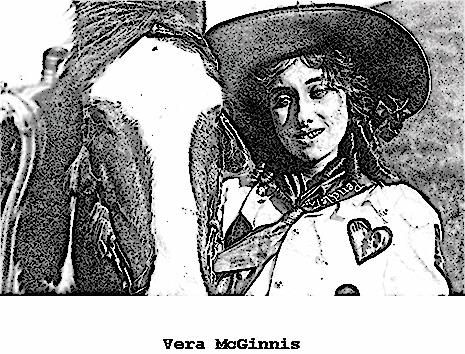
Vera McGinnis – 1892 to 1990
983
O.K. Corral
If you’re looking for famous cowgirls, check the rodeo circuit. It was the easiest way they could find work and get paid for their skills, and Vera was big there.
Her parents encouraged her to ride as a child, but she studied at business school and started her career as a film extra and stenographer in Hollywood. She later became a stunt rider and is in the Hall of Fame.
984
Vera McGinnis, November 12th, 1892 – October 23rd, 1990, was a champion American rodeo rider. She was inducted into the National Cowgirl Museum and Hall of Fame in 1979, and into the Rodeo Hall of Fame of the National Cowboy & Western Heritage Museum Rodeo Hall of Fame in 1985.
McGinnis lived in the town she was born in Missouri, until her family moved to New Mexico when she was three. After her father died, and subsequently her mother married her uncle, they moved around from town to town for his work. Her father and stepfather encouraged McGinnis to ride. Despite all the moving around, she always had access to a horse and learned how to ride astride, instead of side saddle, as was common for women. McGinnis was almost 13 when she rode in her first competition in Norborne, Missouri.
In 1914 McGinnis married Earl Simpson, a rodeo cowboy. According to McGinnis; "I was very happy, although I cried during the service, probably because it wasn't the way I'd always dreamed my wedding would be. Also because I felt I'd pushed Earl into taking the final step, and that wasn't the way I'd been taught it should be, either." Simpson 985
wanted to settle on a ranch or homestead but McGinnis was able to make him agree to doing rodeos during the summer. In 1917, Simpson was drafted for the military. The military ended up turning Simpson away, but when he didn't want to follow rodeos, McGinnis went by herself. After a few years of living separate lives, McGinnis and Simpson divorced in 1921. In 1931, McGinnis married again. Her marriage to Homer Farra lasted until her death.
After graduating high school at seventeen, McGinnis went to business school, and then tried her hand as a movie extra in Hollywood. She then moved to Utah where she first worked as a stenographer, and then got a job with the Salt Lake City Sight Seeing Company where she was able to interact with cowboys and cowgirls from the rodeos.
After participating in her first relay race at a rodeo in Salt Lake City in 1913, she stopped wearing her long corset. She placed third overall and ended by falling and breaking some teeth, but she discovered her passion and signed a contract as a relay race rider. After moving to Winnipeg, Manitoba, McGinnis expanded her skill set and picked up trick riding. While she was getting better as a rider she faced some discrimination from other women in the field because she didn't have a 986
ranch background, she was educated, and she experienced success in a short amount of time.
McGinnis was constantly working to earn a living. The troupe owned the horses and paid the riders a percentage of the prize if they won, based on the individual contracts. In 1917, McGinnis made her way back to Los Angeles, CA and was doing stunts for movies. She played the double for Estelle Taylor in “Cimarron.” She continued to compete in competitions during the summer rodeo season.
In 1922, McGinnis traveled with the Jack Burroughs Wild West Show to the Territory of Hawaii, where she broke two ribs in a bronco busting contest in Honolulu. The following year she tied for second place in trick riding at Ringling's Madison Square Garden Rodeo in New York City. In summer 1924, she toured with Tex Austin's International Rodeo. They did two shows daily for three weeks in London's recently completed Wembley Stadium as part of the British Empire Exhibition.
There she won the relay race and trick riding titles. Her European tour also included rodeos in Dublin, Paris and Brussels before she returned to New York to perform in the Madison Square Garden Rodeo again. A 987
two year world tour that included performances in China followed from 1925 to 1927.
McGinnis was known for her fashion sense as well. She was one of the first female riders to appear in trousers rather than a split skirt.
Her riding career came to an abrupt end on June 10th, 1934 at the Livermore Rodeo in front of 20,000 spectators. Entering the second turn during the first stage of the girl's relay race, her horse fell.
McGinnis was thrown against the infield rail and her horse somersaulted on top of her. She suffered a cervical fracture, five broken vertebrae, a broken right hip, three broken ribs, and a collapsed lung. Doctors told her she would never walk again. She recovered but she did not compete professionally again.
McGinnis died October 23rd, 1990.
In 1979, she was inducted into the National Cowgirl Museum and Hall of Fame. Induction into the National Cowboy & Western Heritage Museum Rodeo Hall of Fame followed in 1985.
Helen Gibson – 1892 to 1977
988
O.K. Corral
Since the most famous cowboys today are actors, it’s fitting that this famous cowgirl is from Hollywood too.
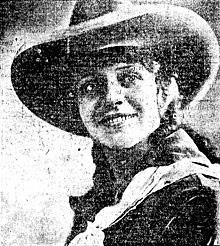
Born as Rose August Wegner, she was the first female stunt person in the film world and got her start as a trick rider in rodeos and vaudevilles. Helen had four sisters and was a tomboy. She got her first cowgirl job from a wanted ad in “Billboard” magazine.
Helen Gibson, born Rose August Wegner, August 27th, 1892 – October 10th, 1977, was an American film actress, vaudeville performer, radio 989
performer, film producer, trick rider, and rodeo performer; and is considered to be the first American professional stunt woman.
She was born in Cleveland, Ohio, one of five girls to Swiss-German parents, Fred and Annie Wegner. Her father had wanted a son, and encouraged her to be a tomboy. Helen saw her first Wild West show in Cleveland in the summer of 1909 and answered a Miller Brothers 101
Ranch ad for girl riders in Billboard magazine. They taught her to ride, and she performed in her first 101 Ranch Real Wild West Show in St.
Louis in April 1910.
She was quoted as saying; "I was already practicing picking up a handkerchief from the ground at full gallop. When veteran riders told me I could get kicked in the head, I paid no heed. Such things might happen to others, but could never happen to me, I believed. We barnstormed all over the US and the season ended all too soon. I was sorry when I had to go home, and could hardly wait to open in Boston in the spring of 1911."
When the Miller-Arlington Show suddenly closed in 1911, it left many performers stranded in Venice, California. Thomas H. Ince, who was 990
producing for the New York Motion Picture Company, hired the entire cast for the winter at $2,500 a week. The performers were paid $8 a week and boarded in Venice, where the horses were stabled. They rode five miles each day to work in Topanga Canyon, where the films were being shot. In 1912, she made $15 a week for her first billed role as Ruth Roland's sister in “Ranch Girls on a Rampage.”
Like many of the cowboy extras, Helen continued to perform in rodeos between pictures. At the Second Los Angeles Rodeo in 1913, she was featured in the Standing Woman Race, and so impressed one of the investors that he offered to finance a tour of rodeos for her, paying all expenses and splitting the winnings. At the investor's ranch outside of Pendleton, Oregon, Helen worked his horses every day, and learned new forms of trick riding. In Pendleton in June 1913, she met Edmund Richard "Hoot" Gibson (1892-1962). They began working together, and at a rodeo in Salt Lake City, they won everything; the relay race, the standing woman race, trick riding, and Hoot won the pony express race, but the promoter of the rodeo skipped town and they did not get a cent of the prize money.
991
That summer, the couple performed in rodeos in Winnipeg, Manitoba, Canada, and Boise, Idaho, and arrived back in Pendleton a few days before the Pendleton Round Up was due to begin. However, because rooms were almost impossible to obtain, they decided to "tie the knot"
as married couples were given preference, and as a result the landlady gave them her own room. They won enough money to return to Los Angeles, where Hoot worked as a cowboy extra and double for Tom Mix, at the Selig Polyscope Company in the Edendale district of Los Angeles, now known as Echo Park. Helen also worked for Selig and for the Kalem Studios in Glendale.
In April 1915 while on the Kalem payroll doubling for Helen Holmes in
“The Hazards of Helen” adventure film series, Helen performed what is thought to be her most dangerous stunt; a leap from the roof of a station onto the top of a moving train in the “A Girl's Grit” episode. The distance between station roof and train top was accurately measured, and she practiced the jump with the train standing still. The train had to be moving on camera for about a quarter mile and its accelerating velocity was timed to the second. She leapt without hesitation and landed correctly, but the train's motion made her roll toward the end of 992
the car. She caught hold of an air vent and hung on, dangling over the edge to increase the effect on the screen. She suffered only a few bruises.
"The real difficulty of the stunt lay not in the leap itself, since she had practiced this with the train stationary and it clearly presented no difficulties, but in the timing. What such stunts require is an inbuilt awareness of the speed of the moving object. During the course of a leap where a moving object is concerned, the spatial relationship between take off point and landing point changes. It is quite possible to imagine a leap from a static take off point on to the roof of a moving train in which the stuntman aims to land halfway along a carriage roof yet in fact, because of the speed of the train, lands in the gap between two carriages. It seems that in such a leap the safest place to aim at is the gap itself. At least in that way one can guarantee to miss it.
Helen Gibson had this sensitivity to spatial relationships between objects in motion, but it is certainly not a gift shared by all stuntmen."
Arthur Wise from “Stunting In the Cinema,” 1973.
993
Considered the longest serial in history, the 119 episodes of “The Hazards of Helen” are stand-alone stories, instead of chapters. The highly successful series had begun with Helen Holmes in the lead role for the first 49 episodes, but Helen Gibson was given her chance to replace Holmes for two pictures when she took ill, and starred in “A Test of Courage” and “A Mile a Minute,” for $35 a week. The Kalem New York office personnel were so impressed by her work, they instructed Glendale to keep her on when Helen Holmes and her husband, “Hazards of Helen” director, J. P. McGowan, left to form their own company.
Now rechristened “Helen” by the studio, she proved to be a capable actress, and after making several more pictures she wrote a story for a one reeler that was built around a risky stunt. To catch a runaway train, she would detach a team of horses, ride them "standing woman,"
and then catch a rope dangling from a bridge and use it to swing from the horses and onto the train as it came under the bridge. Kalem rewarded her by raising her salary to $50 a week.
994
Gibson performed in “The Hazards of Helen” for 69 episodes until the series ended in February 1917, after which Kalem tried producing another serial “The Daughter of Daring,” with a starring role for her.
One of her best stunts appeared in this serial, Traveling at full speed on a motorcycle chasing after a runaway freight train, Gibson rode through a wooden gate, shattering it completely, up a station platform, and through the open doors of a boxcar on a siding, with her machine traveling through the air until it landed on a flatcar in a passing train.
The trick was to undercrank the camera and execute it all with flawless timing.
By then Kalem, a producer of single reel films, was in decline and rather than risking financial failure producing feature films, ceased production in 1917 and was sold to Vitagraph. Universal offered Helen a three year contract at $125 a week for two reel, and five reel pictures until 1919. Among these were two 1919 John Ford films,
“Rustlers” and “Gun Law.” Her Universal contract ended with the winter of 1919 and she signed with Capital Film Company for $300 a week, but Capital was already losing money and went out of business in May 1920.
995
Hoot Gibson, who had joined the Army tank corps, returned during Christmas 1918 and Universal gave him a contract to appear in two reel Westerns. He found that his wife had become a very successful movie star while he was away, but his ego could not handle it, and the couple separated in 1920. Census records for 1920 indicate that they were living separately. Hoot Gibson listed himself as married, and Helen listed herself as widowed.
In 1920, Gibson created “Helen Gibson Productions” to produce her own starring vehicles. The first was to be “No Man's Woman,” a Western melodrama about a kind hearted dance hall hostess rescuing a rancher's child. The money gave out before the picture was finished, and it bankrupted Gibson personally. A year later, the film was released by another studio with a new title, “Nine Points of the Law.”
In March 1921, the Spencer Production Company hired Gibson to star in “The Wolverine” (1921). They were so pleased with her performance, they put her on the payroll at $450 a week. However, before shooting began on her second picture, her appendix ruptured, putting her in the hospital battling peritonitis. The studio replaced her.
996
After her recovery from surgery, Gibson's popularity as a lead had waned. In September 1921, an independent company hired her for a five reeler and folded without paying the cast or crew. Riding in the picture put Gibson back in the hospital, forcing her to sell her furniture, jewelry, and car. She made personal appearances in connection with bookings of “No Man's Woman” and “The Wolverine” in theatres and at rodeos, including visiting her old friends at the 101
Ranch in Ponca City, Oklahoma.
In the spring of 1924, Gibson got a job trick riding with Ringling Brothers and Barnum and Bailey Circus' Wild West show, along with other cowboy performers such as Ken Maynard, and performed in their
“after show” for two and a half years. In September 1926, Gibson joined a Hopi Indian act and worked the Keith Vaudeville Circuit out of Boston.
She returned to Hollywood in 1927 and began doubling for stars such as Louise Fazenda, Irene Rich, Edna May Oliver, Marie Dressler, Marjorie Main, May Robson, Esther Dale, and Ethel Barrymore. She worked constantly stunt doubling and in uncredited or bit parts. As she 997
had in her heyday, Helen became a featured guest at benefit rodeos and events such as the Annual Santa Barbara Horse Show.
In 1935, Helen married Clifton Johnson, a studio electrician who had been a chief gunner in the Navy. In 1940, he asked for active duty, and while he was serving in World War II, she carried on working as an extra and became treasurer of the stunt girl's fraternal organization.
In Universal's “Hollywood Story” (1951), she was cast as a retired silent film actress alongside Francis X. Bushman, William Farnum, and Betty Blythe, and earned $55 for one scene. Tony Curtis, then unknown, was assigned to escort Gibson and Blythe to the premiere at the Academy Award Theater at the Academy's then headquarters on Melrose Avenue in Hollywood, where the Hollywood Chamber of Commerce gave each silent star a plaque "for your outstanding contribution to the art and science of motion pictures, for the pleasure you have brought to millions over the world, and for your help in making Hollywood the film capital of the world."
Gibson continued to take character parts and extra work until 1954, when she and Clifton moved to Lake Tahoe for health reasons. After 998
trying unsuccessfully to sell real estate, they returned and bought a home in Panorama City, in the San Fernando Valley. Gibson suffered a slight stroke in 1957, but it did not prevent her working as an extra in film and television.
Her last role was in 1961, John Ford's “The Man Who Shot Liberty Valance,” for which she was paid $35 when she was 69 years old. She retired in January 1962, on a Motion Picture Industry pension of $200 a month plus social security.
The couple moved to Roseburg, Oregon, where she spent her later years fishing and giving the occasional interview. Helen Gibson died of heart failure following a stroke in 1977 aged 85.
Pearl Hart – 1871 to 1928
Although she was eventually pardoned, Pearl was known as the “Lady Bandit” because she’s the only woman ever recorded to have robbed a stagecoach.
999
O.K. Corral
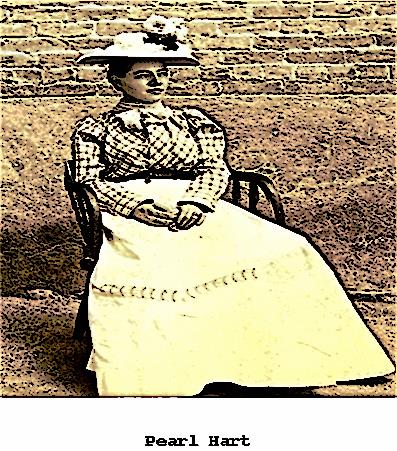
She was born in Canada to a rich family and got a good education, but fell in love with an abusive outlaw and eloped to the US. Their marriage was an on-off thing and she later robbed the coach dressed in men’s clothing.
Pearl Hart, born Pearl Taylor, 1871–1955, was a Canadian born outlaw of the American Old West. She committed one of the last recorded stagecoach robberies in the United States, and her crime gained 1000
notoriety primarily because of her gender. Many details of Hart's life are uncertain, with available reports being varied and often contradictory.
Hart was born Pearl Taylor in the Canadian village of Lindsay, Ontario.
Her parents were both religious and affluent, and these factors provided their daughter with the best available education. At the age of 16, she was enrolled in a boarding school where she became enamored with a young man, named Hart, who has been variously described as a rake, drunkard, and/or gambler.
Hart reconciled with and left her husband several times. During their time together they had two children, a boy and a girl, whom Hart sent to her mother who was then living in Ohio. In 1893, the couple attended the Chicago World's Fair, where he worked for a time as a midway barker. She in turn developed a fascination with the cowboy lifestyle while watching Buffalo Bill's Wild West Show. At the end of the Fair, Hart left her husband again on a train bound for Trinidad, Colorado, possibly in the company of a piano player named Dan Bandman.
1001
During this time Hart worked as a cook and singer, possibly supplementing her income as a demimondaine. There are also reports she developed a fondness for cigars, liquor, and morphine during this time.
A variation of this story has Bandman instead of her husband leaving Hart for war.
By early 1898, Hart was in the town of Mammoth, Arizona. Some reports indicate she was working as a cook in a boardinghouse. While doing well for a time, her financial outlook took a downturn after the mine closed. About this time Hart attested to receiving a message asking her to return home to her seriously ill mother.
Looking to raise money, Hart and an acquaintance known only as "Joe Boot," likely an alias, worked an old mining claim he owned, but found no gold in the claim.
The pair decided to rob a stagecoach that traveled between Globe and Florence, Arizona. The robbery occurred on May 30th, 1899, at a watering point near Cane Springs Canyon, about 30 miles southeast of Globe. Hart had cut her hair short and dressed in men's clothing. Hart 1002
was armed with a .38 revolver while Boot had a Colt .45. One of the last stagecoach routes still operating in the territory, the run had not been robbed in several years and thus the coach did not have a shotgun messenger. The pair stopped the coach and Boot held a gun on the robbery victims while Hart took $431.20 and two firearms from the passengers. After returning $1 to each passenger, she then took the driver's revolver. After the robbers had galloped away on their horses, the driver unhitched one of the horses and headed back to town to alert the sheriff.
Others claim the pair became lost and wandered in circles.
Regardless, a posse led by Sheriff Truman of Pinal County caught up with the pair on June 5th, 1899. Finding both of them asleep, Sheriff Truman reported that Boot surrendered quietly while Hart fought to avoid capture.
The trial of Pearl Hart was held in the Second Pinal County Courthouse located at 135 Pinal St. in Florence. Following their arrest, Boot was held in Florence while Hart was moved to Tucson, the jail lacking any facilities for a woman. The novelty of a female stagecoach robber 1003
quickly spawned a media frenzy and national reporters soon joined the local press clamoring to interview and photograph Hart. One article in
“Cosmopolitan” said Hart was "just the opposite of what would be expected of a woman stage robber," though, "when angry or determined, hard lines show about her eyes and mouth". Locals also became fascinated with her, one local fan giving her a bobcat cub to keep as a pet.
Taking advantage of the relatively weak building material, and possibly with the aid of an assistant, Hart escaped on October 12th, 1899, leaving an 18 inch hole in the wall, only to be shortly recaptured..
Hart and Boot came to trial for robbing the stagecoach passengers in October 1899. During the trial Hart made an impassioned plea to the jury, claiming she needed the money to be able to go to her ailing mother. Judge Fletcher M. Doan was shocked and angered when the jury found her not guilty and scolded the jurors for failure to perform their duties. Immediately following the acquittal, the pair was rearrested on the charge of tampering with US mail.
1004
Both Hart and Boot were sent to Yuma Territorial Prison to serve their sentences. Boot became a prison trusty, driving supply wagons to chain gangs working outside the walls. One day while driving a wagon he escaped and was never seen again. At the time of his escape, Boot had completed less than two years of his sentence.
The attention Hart had received in jail continued once she was imprisoned. The warden, who enjoyed the attention she attracted, provided her with an oversized 8 by 10 feet mountainside cell that included a small yard and allowed her to entertain reporters and other guests as well as pose for photographs. Hart, in turn, used her position as the only female at an all -ale facility to her advantage, playing admiring guards and prison trusties off of each other in an effort to improve her situation.
Hart's release from prison came in the form of a December 1902
pardon from Arizona Territorial Governor Alexander Brodie. There are accounts that she and the warden were lovers. There is no evidence Hart ever had a third child, so this rumor, if true, may indicate a 1005
successful ploy on Hart's part. Upon release from prison, Hart was provided with a train ticket to Kansas City.
After leaving prison, Hart largely disappeared from public view. She had a short lived show where she re-enacted her crime and then spoke about the horrors of Yuma Territorial Prison. Following this she worked, under an alias, as part of “Buffalo Bill's Wild West Show.” In 1904, Hart was running a cigar store in Kansas City when she was arrested for receiving stolen property.
A census taker in 1940 claimed to have discovered Hart living in Arizona under a different name, as she had married again.
In addition to being a staple of pulp western fiction, Hart's exploits have been featured in other venues. The play “Lady With a Gun” and the musical “The Legend of Pearl Hart” are also based upon Hart's story.
Pearl Hart is the main character for the play “Waiting Women” by playwright Silvia Gonzalez.
1006
The Danish rock band Volbeat has a song called “Lady Pearl in Jail” on the album “Outlaw Gentlemen and Shady Ladies,” released in 2013.
The Dalton Gang – ca. 1890’s
The Dalton Gang was a group of outlaws in the American Old West during 1890–1892. It was also known as The Dalton Brothers because four of its members were brothers. The gang specialized in bank and train robberies. During an attempted double bank robbery in Coffeyville, Kansas, in 1892, two of the brothers and two other gang members were killed. Emmett Dalton survived, was captured, and later pleaded guilty to second degree murder, although he later asserted that he never fired a shot during the robbery. He was paroled after serving fourteen years in prison.
1007
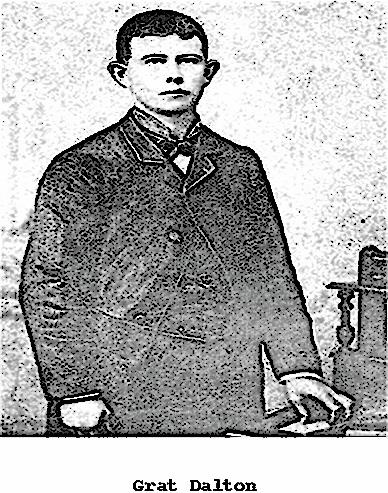
O.K. Corral
Brothers Bob, "Grat", and Emmett had first worked as lawmen for the federal court at Fort Smith, Arkansas, and then for the Osage Nation.
They started stealing horses to make more money, and then fled the area. They decided to form a gang, and started robbing trains and banks. While their older brother "Bill" Dalton never joined any heists, he served as their spy and informant.
1008
Due to the sensationalism that surrounded the Dalton Gang's exploits, they were accused of robberies all over the country, but operated chiefly in California, Kansas, Oklahoma Territory, and Indian Territory.
Numerous myths were published about the gang. After Bob and Grat were killed at Coffeyville, Bill Dalton formed another gang with Bill Doolin. It was known as the Wild Bunch, or the Dalton-Doolin Gang.
Their father was James Lewis Dalton from Jackson County, Missouri, and Kentucky. He was a saloon keeper in Kansas City, Missouri, when he married Adeline Lee Younger. Through her brother, Adeline was an aunt of Cole and Jim Younger, of the famous James-Younger Gang.
Although the Daltons may have been inspired by their famous cousins’
exploits, the Youngers were much older and were in prison at the time of the Dalton Gang's activities.
The Dalton children were: