The Adventures of Philip and Sophie DOUBLE FEATURE by Drew Eldridge - HTML preview
Download the book in PDF, ePub, Kindle for a complete version.
Chapter 17
The Escape Plan
It was the custom of the People of the Book to hold hands and pray before meals, thanking the Creator for their food, health and friends. “O Heavenly King,” said her father in his deep, gentle voice. “Lord of the universe, we thank You humbly for all your blessings. We love You and pray that this food may sustain us in our pursuit of wisdom, courage and temperance as we strive to do Your divine will. In the name of the holy and sacred One, we pray. Amen.”
“Amen,” responded Sophie and Julie together. Then they picked up their forks and started eating.
“Well,” said her father. “This is quite the breakfast.
Thank you as well, my dear, for preparing it.”
Even after many years of marriage, Julie couldn’t help gazing and blushing when her husband spoke to her—like no time at all had passed since the day she’d "rst met and fell in love with him. Sophie noticed this and liked it.
“And you,” he continued, turning his attention to our heroine. “Are you eating breakfast or conducting one of your experiments?”
“Both!” she replied. Sophie had it all set up perfectly: 117
whipped cream . . . maple syrup . . . cinnamon . . . and every kind of berry . . . all in separate miniature goblets.
“One day, I will make the perfect combination.”
“That’s my little scientist. Speaking of perfection, I heard you got a perfect score on one of Mr. Knox’s surprise math tests the other day.”
“Mmmhmm,” agreed Sophie with her mouth full.
“He told me all about it. Quite an amazing achieve-ment. Especially considering you didn’t show any of your work . . .”
Sophie froze and slowly gulped.
“Yeah, I guess,” she chuckled. “Must have got lucky . . .”
“Indeed.”
Her father was always so calm and soft-spoken.
Throughout Sophie’s whole life, she had never once heard him raise his voice or even get frustrated. He took a sip of his co#ee. Sophie used it as an opportunity to change the subject.
“Did you know,” she quickly blurted out, “that Mr.
Stanley and mother almost got married?”
Her parents both looked at each other amused.
“I did,” he replied.
Sophie started getting excited.
“Can you imagine what would have happened if they had? She wouldn’t have felt nervous and run to the beach like that! She would never have seen you! You would have drowned! None of it would have happened! I wouldn’t even be born!”
“Yeah, it’s quite something,” he remarked.
“It’s more than just something!”
“It was a miracle,” said Julie.
“Perhaps.”
Her father started eating his pancakes. He had them plain, with nothing on the side. His co#ee was plain. Even the way he sat and dressed was plain. A red checkered 118
shirt and blue overalls? Less like a farmer, and more like someone trying to look like a farmer! Sophie couldn’t tell what it was, but there was something very suspicious about him. He was just too normal!
“Pass the salt please,” he asked.
Sophie wondered if he really had forgotten who he was. Maybe he was pretending. But why?
“Sure, John,” answered Julie, handing it to him.
And that name, reader! John? He did NOT look like a
“John”!
“Thank you,” he answered. “Pass the pepper, please,” he said next, looking at Sophie this time. He smiled.
“Who puts pepper on pancakes?” she asked.
“Well, there is a "rst time for everything,” he said adventurously. “Perhaps it’s time I try something new. Don’t you think?”
She slid it to him suspiciously. Maybe he was an alien from another world! His ship had crash-landed. Now, he was trying to blend in with the humans. A ridiculous idea, of course. But if you had met Sophie’s father, reader, it would have certainly seemed more likely than the story he usually suggested.
“I’m probably just an ordinary man who got caught in a storm while "shing or something.”
He’d say it as casually as if he were commenting on the weather. But Sophie never bought it.
“Father, can’t you remember anything?” said Sophie.
“Even something small? You know, about who you were before you arrived. Your mother? Your old home? Not even your favorite color?”
He stopped and thought about it very, very hard.
“Hmm . . . no. I can’t. Sorry.”
“What about a crest?”
“A crest?”
“Well,” said Sophie, turning red. “I was suggesting to 119
mother that . . . maybe . . . you were once a knight . . . or something.”
Her father laughed.
“Good one . . .”
But his laughter only made Sophie more suspicious.
“Well, you could be!”
“Like I’ve always said, I was probably just a "sherman.
One day, I got too much sun and fainted. The ocean carried me away.”
“Oh, please!” said Sophie, much to his amusement.
“Do "sherman know how to use swords?”
Julie loved watching their debates.
“There are some pretty aggressive "sh out there, Sophie . . .” he replied. “A little sword training would be wise of a "sherman to undertake.”
“So, you WERE trained with a sword then?”
“I never said that.”
“And are there any "sh as aggressive as the Dragon King?”
“Possibly.”
Sophie’s father joined the People of the Book precisely around the time the Dragon King had risen to power. When the Dragon King discovered their village, he came to destroy it and take girls, like young Julie, as captives. But her father stood up to them. It was a "ght that the People of the Book still whispered about to that day.
The mysterious man from the sea who saved them! It was because of him they now lived in relative peace. Instead of killing the evil king—something forbidden by the religion of the People of the Book—he struck a deal. The village would make food for his army and the king would leave them alone.
“Doesn’t sound like the feat of an ordinary "sherman to me!” said Sophie after reminding him. She crossed her arms triumphantly and smiled. For once, she seemed to have stumped her father. But her triumph was short-lived.
120
“Must have got lucky,” he answered—in the same tone she had used about her math test. Then, he winked at her.
Our heroine froze and gulped. She didn’t dare pursue the matter any further. She averted her eyes and went back to eating her breakfast.
“In other news,” he continued, changing the subject.
“I’ve nearly !nished drawing up the plans for the ship.”
He made some space on the table and took out a blueprint. “If everything goes well, I’ll have it built by this fall.
We’ll have enough food to give the Dragon King over the summer, as well as enough for the journey.”
“Exquisite!” said Julie. “Finally, we’ll be free! And you’re sure there will be enough room for everyone? The whole village?”
“Yes. I’ll be meeting Jean-Pierre this afternoon to show him. It will hold everyone. I’m certain.”
“And you don’t think the Dragon King suspects anything?”
“No, I don’t think so. Everything’s been normal. As long as everyone just keeps doing what we’ve always done, and nothing unexpected happens this summer, everything should go exactly as planned.”
Sophie wasn’t very interested in talking about the voyage. She loved her home and didn’t want to leave. Why couldn’t the Dragon King just leave them alone? They didn’t bother him. Sometimes she felt like going up there and speaking with him herself. Surely, if it was just explained to him, and she showed him they meant him no harm, he would understand. But no one was allowed.
“Sophie,” said her mother. “You haven’t even touched your strawberries yet. Is something wrong?”
“No . . .” she sighed disappointedly. But her mother didn’t believe her.
“I know. How about we take the long way home tonight?”
Sophie’s eyes lit up. It was one of her favorite things in 121
the whole world to do! But she could hardly remember the last time they’d gone together.
“I don’t know . . .” said her father, sounding worried.
“I’m not sure that’s a good idea.”
“Of course, it is!” cried Sophie. “It’s a marvelous idea!
Come on! Can we please take the long way home tonight?” she begged. “Please! Please! Can we?”
“It’s a pretty long walk,” said her father. “Maybe you and I could go? We can let your mother rest.”
“No! All three of us! Like we used to! Come on!
Please?”
“I’m alright,” said Julie softly.
“You’re sure? You have the energy for it?”
“Yes,” she answered. “I want to. I’ll be "ne . . .”
“You see?” said Sophie, slapping her hand on the table. “She’ll be "ne! What else more is there to discuss?
Come on!”
“Alright . . .” her father relented. “Okay. Let’s do it.”
122
Getting Ready for Church
After breakfast, Sophie brushed her teeth, had a nice long bath and attempted some fancy stretches in the sunlight. Then she went into her closet to get dressed. Sophie had a much bigger closet than most girls. Ever since she started sewing, it needed to be.
“What is it?” she remembered her father asking her.
She was even littler back then.
“I can’t . . .” sni!e, sni!e, “#t . . .” sni!e, sni!e,
“anymo’ of my cos-tooms . . .”
“Is that so?”
Without warning, he opened the closet door and kicked the whole back wall down!
“Eek!”
“There, that’s better. Isn’t it?”
Behind the wall was their den.
“Yes, I think this will do quite nicely,” he said, looking around.” It’s all yours now. Make as many costumes as you’d like.”
He even blocked o$ the other doorways too, so the only entrance would be her bedroom. It wasn’t long before it was completely #lled up again.
Nowadays, going into her closet felt more like wandering backstage at a circus. There were hanging linens, spools of string, a wall of strange hats, funny masks and old trunks full of props. In the middle, there was a large spinning wheel and two sewing tables, each with a great jar of candy on it. One for her and one for her mother. But the best part were all the rows of dresses she could choose from.“Hmm . . .” she sighed as she skipped through that morning. “I wonder what I should wear to church today . . .”
123
Whenever Sophie got dressed, her goal was always to try and look on the outside the way she was on the inside
—using people’s reactions as a way of gauging whether she got it right. If someone told her she looked “pretty” or
“nice,” she took it as a sign that she’d chosen wrongly.
“Oh, Sophie! That’s so YOU!” or “Only YOU would wear it that way!” Now this is what our heroine liked to hear!
How then did she dress, you ask? Well, it was really quite simple. She was warm and soft-hearted. Therefore, the materials and colors she chose were warm and soft-looking. She was neat and clean. Therefore, her dresses were always spotless and constant, with no loose threads.
Sophie also loved to stop and chat with people. So, she always chose accessories that made her look extra friendly and approachable, like a basket under her arm full of goodies. She wore no watch and carried no purse, for she never wanted to appear busy or short on time. If there was to be any message in appearance, she wanted it to be
“Hello! Come and talk to me. I have all the time in the world!” And it worked very well. Wherever she went, people were always approaching her.
But Sophie was also a very odd girl—and she knew it.
So, she always tended to sew or wear things a tad un-evenly or inexplicably. Many of her pockets, for instance, were crooked. Buttons and zippers were sewn in silly places. Places which had no function whatsoever. It wasn’t because she liked the way it looked. Rather, she viewed it more like a common courtesy. People who talked to her were bound to "nd out she was a little weird sooner or later. Dressing that way helped save them the time and trouble. And this worked very well too! Sophie looked exactly like the kind of girl who would say something odd.
Many were shocked when they talked to her. But because of the way she dressed, no one was ever surprised.
All of this led, of course, to the common view that So-124
phie Tousaint didn’t care about the way she looked—and that she just threw things on at random. But nothing could have been further from the truth. To the contrary, reader, no little girl in the village spent more time designing and planning her out!ts. Every stroke of every needle she sewed, especially the little imperfections, was scrupu-lously and painstakingly planned, sometimes months in advance.
After she was done getting dressed that morning, she did her chores—sweeping, dusting, folding clothes and brushing Samson’s snowy white fur. Next, she did her outdoor chores—watering plants, trimming vines and feeding the farm animals.
Their little house was light brown with bright blue trimmings and a brick chimney. All of the windowsills had pink #owers beneath them. There were bird feeders and bird baths wherever they could !t them in the yard.
Samson liked to sit outside in the grass and plot war against them. “Be afraid!” he’d roar. “Meow! Be afraid!
Samson is nigh! Dreadful as the storm and lightning!
Stronger than the foundations of the earth!” But at the end of the day, it was always too much work for him. He wasn’t nearly as dangerous as he pretended to be and spent most hours sprawled out on the porch, fast asleep.
Birds and bunnies could hop right up to him and eat the crumbs of his breakfast o$ his whiskers. He had a hard-enough time lifting his arms, let alone hurting anything.
The farm was about as big as a schoolyard. A white picket fence encircled it. As Sophie worked, she hummed and sang little songs, saying hello to all the animals.
But there was one chore that our heroine dreaded every morning. So much so, that she often went to great lengths to avoid it. After putting it o$ as long as she could that morning, Sophie went into the barn to feed the pigs.
Suddenly, a funny-looking man appeared from the pen.
125
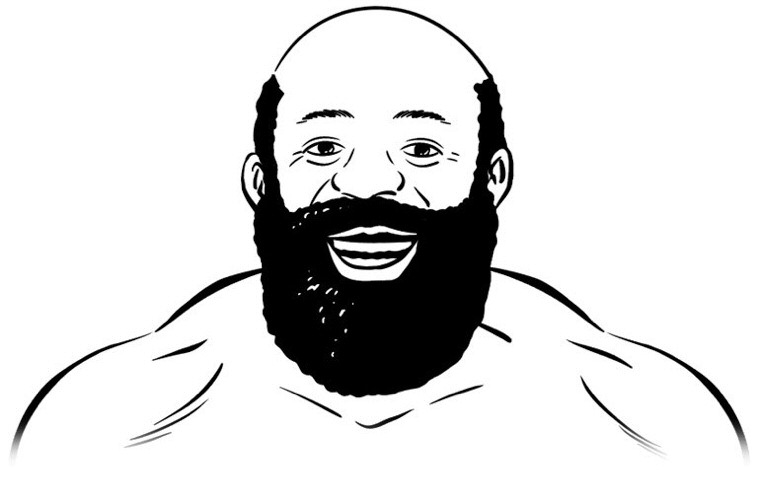
He was giant, dark-skinned and had a great big bushy beard, crawling on all fours like he was one of them.
“Snort, snort, snort! Squee! Squee!” he bellowed.
“Snort, snort, snort! SQUEE!”
Sophie shrieked.
126